


Abstract
Given that the construction industry is a major source of energy consumption and carbon emissions, its green transition holds significant implications for both economic development and environmental sustainability. This study takes the digital economy as its point of departure and systematically examines its impact on the carbon emission intensity in the construction industry, as well as underlying transmission mechanisms. Based on theoretical analysis, this study employs fixed-effects and mediation-effects models for empirical testing. The study finds that the digital economy can significantly reduce the carbon emission intensity of the construction industry, a conclusion that remains robust after a series of robustness tests. Mechanism analysis shows that industrial structure optimization plays an important mediating role in the process through which the digital economy promotes the reduction of carbon emission intensity in the construction industry. Heterogeneity analysis indicates that the impact of the digital economy on the carbon intensity in the construction industry is greater in the central and western regions than in the eastern regions. However, this impact is relatively smaller in regions with high urbanization levels than in those with average urbanization levels. At the same time, the impact of the digital economy on the carbon intensity in the construction industry is greater in low-income regions than in high-income regions. Finally, the study proposes measures to reduce the carbon emission intensity of the construction industry.
1. Introduction
As a pillar sector of the national economy, the construction industry plays a pivotal role in driving economic growth and improving living standards. Despite remarkable progress in both scale and technology in recent decades, the industry continues to be a major source of energy consumption and carbon emissions. Consequently, its green transition has become a critical issue at the nexus of economic development and environmental sustainability. However, although providing foundational infrastructure support across various sectors, the energy consumed in building material production, construction processes, and facility maintenance makes the construction industry a major source of greenhouse gas emissions [1] and a key area for energy consumption and carbon emissions [2]. According to a 2025 report from the United Nations Environment Programme, the construction industry remains a primary driver of the climate crisis, accounting for 32% of global energy consumption and 34% of global carbon dioxide emissions [3]. The green and low-carbon transformation of the construction industry has become pivotal to achieving global climate targets and supporting national high-quality development. In China, the total output value of the construction industry surpassed 32 trillion yuan in 2024, representing a year-on-year increase of 3.85%. The national floor area under construction reached 13.683 billion square meters. While driving urban development and boosting economic growth, the construction industry has also exerted a substantial environmental impact [4]. Carbon emissions across the entire building lifecycle account for over 50% of China’s total carbon emissions, and this share continues to rise. Carbon emissions from the construction industry are characterized by diverse sources and extended lifecycles, spanning the entire process from material production and construction to operation, maintenance, and eventual demolition and recycling. Reinforced concrete dominates the building materials market, yet its raw materials are almost entirely non-renewable [5]. Consequently, the sector’s emissions pose a significant challenge to global carbon neutrality goals [6]. Therefore, in the context of the dual carbon goals, exploring the factors influencing carbon emission intensity changes in the construction industry and the underlying mechanisms is of significant importance.
The digital economy reduces carbon emissions through technological innovation, resource allocation, and structural optimization. However, most existing research focuses on the national or regional level [7], with insufficient attention paid to specific high-emission industries. The optimization of energy consumption patterns and the upgrading of industrial structures play a moderating role in how the digital economy influences ‘carbon reduction and efficiency enhancement’ [8]. The construction industry consumes enormous amounts of energy, and improving the efficiency of industrial resource allocation will help promote energy conservation and emission reduction in the sector. Traditional emission reduction pathways in construction have primarily relied on material innovation, energy efficiency improvements, and renewable energy substitution. However, these technology-driven strategies face bottlenecks such as high costs, slow adoption, and diminishing marginal returns. Meanwhile, the digital economy—represented by big data, artificial intelligence, the Internet of Things, and blockchain—is profoundly reshaping the industrial ecosystem, offering new possibilities for the low-carbon transition of the construction industry. The digital economy makes a significant contribution to carbon reduction [9], influencing carbon emissions through technological innovation, industrial structure, and energy structure [10]. However, research on carbon reduction pathways in the construction industry lacks a systematic examination of the digital economy. Theoretically, reducing the input of high-carbon production factors and improving the efficiency of their utilization represent two primary pathways for carbon reduction, both of which require technological advancement in the construction industry as a prerequisite. The development of the digital economy has significantly improved the efficiency of resource allocation, helping to achieve low energy consumption and high-yield output [11]. Currently, the digital economy plays a significant role in optimizing resource allocation and enhancing total factor productivity within the sector. As the digital economy paradigm accelerates its penetration into the construction industry, it propels the industry into the digital era, fostering new directions for its green transformation. Simultaneously, ongoing socioeconomic development has brought substantial changes to industrial structures, fostering new production–demand relationships between the digital economy and construction industry. The industrial structure optimization enables the restructuring of key factors, which reduces the share of energy-intensive industries and directly reduces the construction industry’s reliance on high-carbon building materials such as steel and cement. At the same time, the optimization of industrial structure promotes technological synergy across different sectors, providing a structural pathway for the digital economy to empower the construction industry. The complex and dynamic interrelationships between the construction industry and other sectors significantly influence its carbon emissions. As a highly interconnected industry, shifts in its share of total output profoundly affect aggregate carbon emissions through scale effects [12], thereby enabling the digital economy to indirectly reduce carbon emissions via industrial restructuring [13]. Digitalization influences carbon emissions by driving technological innovation and enhancing the effectiveness of government governance. The digital economy, with data as a new factor endowment, contributes to carbon emission reduction by optimizing the allocation of traditional factors. This reflects the application of structural transformation theory at the industrial level. Ecological modernization theory posits that economic development and environmental protection are not mutually exclusive; rather, technological progress and institutional innovation can lead to a win–win outcome. Grounded in structural transformation theory and ecological modernization theory, this study systematically examines the impact of the digital economy on carbon emission intensity in the construction industry, along with the mechanisms underlying this impact. It employs fixed-effects and mediation-effects models and aims to provide theoretical support for promoting green and low-carbon development in the construction industry. The research focuses on whether the digital economy can effectively reduce carbon intensity in the construction industry and whether industrial structure optimization plays a mediating role in this process. Furthermore, this study investigates whether the impact of the digital economy on carbon intensity in the construction industry exhibits regional heterogeneity, and whether there are significant differences across regions at different stages of development.
2. Literature Review and Research Hypotheses
2.1. Digital Economy and Carbon Emission Intensity in the Construction Industry
The rapid development of the digital economy has created new opportunities for the green transition of traditional industries. In recent years, academic research has extensively examined the environmental impacts of artificial intelligence and communication technologies. However, studies that systematically examine the digital economy and its relationship with carbon emissions remain limited. Most investigations have centered on exploring the influence of the digital economy on regional low-carbon development [14], while research into its impact pathways at the industrial level remains in an exploratory phase. Concurrently, although numerous studies confirm that the digital economy can reduce carbon emissions, the underlying mechanisms are often treated as a “black box”. The construction industry presents unique characteristics, as its carbon emissions stem not only from direct energy consumption but are also deeply embedded within its industrial chain. While the literature acknowledges the benefits of industrial structure optimization, it seldom quantifies these as formal mediating channels within the carbon emissions value chain of the construction industry. Further exploration is warranted to address the mitigation of ‘carbon lock-in’ within the construction industry. As a new production factor, digitalization plays a vital role in society, the economy, and the environment [15]. However, in the context of global internet development and the widespread use of digital technologies, the positive impact of the digital economy on low-carbon development (LCD) may be undervalued or even overlooked [16]. The digital economy is widely regarded as a key enabler in decoupling economic growth from resource consumption and emissions [17], primarily reducing carbon emissions through infrastructure effects, structural optimization effects, technological innovation effects, and resource allocation effects [18]. The traditional construction industry spans multiple high-carbon sectors such as steel, cement, and coal-fired power generation, resulting in substantial energy consumption and pollutant emissions [19]. It is one of the key areas for current energy conservation and emission reduction efforts. Controlling energy consumption in construction and developing green, energy-efficient buildings have become critical issues requiring urgent resolution in China’s socioeconomic development [20]. Globally, the construction industry accounts for 40% of total carbon emissions, making it a core domain for carbon reduction. Nevertheless, the economic enhancement potential of digital technology must be recognized, as digital technology enables the whole process of green manufacturing and breaks down spatial barriers [21]. Digital transformation has promoted carbon unlocking by enhancing corporate competitiveness [22]. Meanwhile, advancements in information technology, energy, and materials have created more efficient tools for the planning, design, construction, operation, and maintenance of green buildings [23], effectively enhancing the overall efficiency of the construction industry and yielding energy-saving benefits. Smart technologies demonstrate the potential to improve the performance of the construction industry [24]. Building Information Modeling (BIM), as a new information technology tool, provides an intelligent digital representation of buildings to support various activities within the construction industry and delivers extensive benefits throughout the entire lifecycle of construction projects [25], paving the way for improved information management in the construction industry. Integrating knowledge-driven and data-driven approaches can significantly enhance the sustainability of buildings [26]. The strategic implementation of digital technologies such as cloud computing (CC) offers enhanced opportunities for collaboration and communication among organizations within the construction industry. When applied to construction, these technologies promote the specialization and refinement within the sector, facilitate the adoption of green construction practices, and enable novel production models that significantly boost construction efficiency. Through its inherent derivative characteristics [27], the digital economy amplifies the combined effects of input factors in construction, thereby boosting productivity and reducing carbon emissions. Currently, the digital economy relies on digitized knowledge and information as key production factors, with digital technological innovation as its core driver. By deeply integrating digital technologies with the real economy, it continuously elevates the levels of digitalization and intelligence in traditional industries, fundamentally reshaping economic development models. Drawing on structural transformation theory, the digital economy can accelerate structural adjustments in the construction industry by reducing information asymmetry and improving the efficiency of factor allocation. As a result, high-efficiency, low-energy-consumption enterprises gain a larger market share, while low-efficiency, high-energy-consumption enterprises face pressure to exit the market. At the same time, digital management platforms enable the centralized coordination of resources across projects, thereby reducing equipment idling and material waste. This intra-industry structural dividend directly reduces the carbon emission intensity in the construction industry.
Therefore, Hypothesis 1 is proposed: The development of the digital economy contributes to reducing carbon emission intensity in the construction industry.
2.2. Industrial Structure Optimization and Carbon Emission Intensity in the Construction Industry
Industrial structure optimization is a composite concept and evolutionary process involving economic restructuring, technological advancement, and coordinated resource-environmental development [28], with significant energy-saving and emission-reduction effects [29]. Ecological modernization theory posits that industrial structure optimization not only alters the sectoral composition of the economy but also reshapes the macro-level foundations of environmental performance. As the share of energy-intensive industries declines and the share of clean energy rises, the pressure from embedded carbon faced by the construction industry—in the upstream supply chain and during the operational phase—is significantly reduced. This enables a decoupling of economic growth from carbon emissions at the industrial level. At its core, it entails the reallocation of production factors from high-energy-consuming, low-value-added segments toward low-carbon, high-efficiency sectors. As a major end-use energy consumer and a primary consumer of building materials, the carbon emission intensity of the construction industry depends not only on energy efficiency during construction but also closely on the energy consumption of upstream raw material production. When industrial structure upgrades toward low-carbon sectors such as high-tech industries and modern services, the growth rate of society’s demand for high-energy-consuming raw materials slows down. This forces upstream raw material industries to undergo green transformation, thereby reducing carbon emissions from the construction industry at the source of the supply chain. Simultaneously, industrial restructuring is accompanied by energy-consuming right trading [30] and the clean transformation of the energy mix. An increased share of non-fossil energy sources will directly reduce carbon emissions during the building operation phase, further lowering the carbon intensity of the construction industry across its entire lifecycle. Meanwhile, industrial structure optimization is closely intertwined with technological advancement. Not only does it inherently foster energy-saving and environmentally friendly technologies, but it also drives the adoption of low-carbon technologies across all stages of the construction industry—including design, construction, operation, and maintenance—through inter-industry technology spillover effects. This significantly enhances the precision of energy and material use while reducing carbon emissions. The competitive landscape reshaped by industrial structure optimization further compels construction enterprises to integrate carbon emission efficiency into their core competitiveness. They proactively pursue technological innovation to lower compliance costs and gain market advantages. Further research reveals that industrial structure optimization provides a systematic pathway to reduce carbon emissions in production by enhancing synergies between industries and strengthening links to the circular economy. Modern industrial systems place greater emphasis on building industrial ecosystems, enabling the resource utilization of construction waste and the large-scale application of recycled building materials [31], which may further reduce the carbon emission intensity of the construction industry. With economic and technological progress, demand-side products in construction have also evolved. Societal demand has shifted from pursuing quantity of space to prioritizing spatial quality and sustainability. This transformation guides construction products toward green buildings, zero-energy buildings, and similar directions. From the demand side, it imposes rigid constraints on high-carbon construction models, driving down the average carbon emission intensity of the construction industry. In summary, industrial structure optimization can significantly curb carbon emission intensity in the construction industry through multiple channels: enhancing resource allocation efficiency, accelerating technological diffusion, strengthening industrial linkages, and guiding demand structures. As a result, it provides a dual pathway for emission reduction—operating on both the supply side and the demand side.
Therefore, Hypothesis 2 is proposed: Industrial structure optimization can significantly reduce carbon emission intensity in the construction industry.
2.3. Digital Economy and Industrial Structure Optimization
Structural transformation theory posits that economic growth is accompanied by the flow of production factors from low-productivity to high-productivity sectors. When the industrial structure shifts from energy-intensive, high-emission heavy industries toward low-energy-consumption, high-value-added industries, this yields significant environmental dividends—namely, a reduction in the environmental burden per unit of output while maintaining economic growth. As a general-purpose technology, the digital economy accelerates the flow and reallocation of production factors across industries by breaking down information barriers and reducing transaction costs. When this reallocation flows from energy-intensive sectors toward low-carbon, high-efficiency sectors, industrial structure optimization becomes the key bridge linking the development of the digital economy to improvements in environmental performance. Capital deepening and technological progress drive industrial structure optimization [32], which is progressively shaped by the advancement of the digital economy. There is a broad academic consensus that the development of the digital economy exerts a powerful impetus on industrial upgrading and optimization [33]. The digital economy, with data as its key production factor, achieves deep integration with the real economy through digital technologies. This pervasive empowerment reshapes the types, total volume, and structure of production factors, enabling the reallocation of traditional factors across industries [34]. The digital economy has also spawned numerous cross-boundary convergences, giving rise to new industries, business models, and operational paradigms. These emerging entities, with their distinctive commercial approaches and operational methods, have transformed production and lifestyles [35]. Throughout economic development, the digital economy forms new economic structures through factor integration. Its convergence with other industries drives industrial transformation, becoming a driving force for industrial structure optimization and upgrading. The reasons are twofold: on one hand, the digital economy drives industrial upgrading by transforming traditional industries and fostering the emergence of new ones. On the other hand, it promotes the renewal of the three primary industries through innovations in production methods, business operations, and service models. Furthermore, it facilitates the integrated and optimized development of these industries across three layers—foundational, supporting, and integrative—thereby continuously refining the industrial structure of the national economy [36]. Simultaneously, the digital economy indirectly boosts urban green total factor productivity by restructuring industrial patterns and stimulating green technological innovation [37]. This generates structural and technological effects, fostering efficient energy utilization and reduced carbon emissions across various industries. It also enhances the total factor productivity of traditional construction enterprises [38], thereby lowering the sector’s carbon emission intensity.
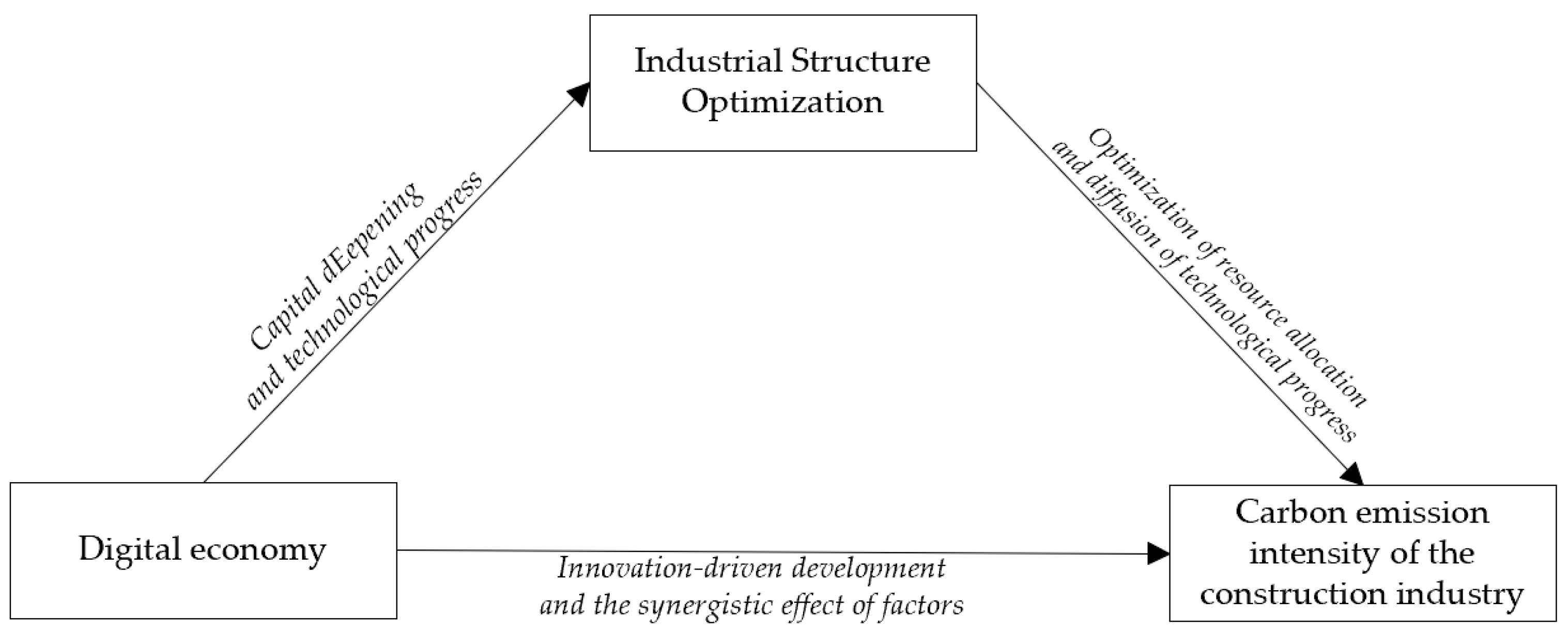
Therefore, Hypothesis 3 is proposed: The digital economy reduces carbon emission intensity in the construction industry by promoting industrial structure optimization. That is, industrial structure optimization plays a mediating role through which the digital economy reduces carbon emission intensity in the construction industry. The mechanism by which the digital economy influences carbon emission intensity in the construction industry is illustrated in Figure 1:
Figure 1.
Mechanism diagram.
3. Models and Variables
3.1. Model Specification
- (1)
- Baseline Regression Model
The fixed-effects model is one of the most fundamental methods in panel data analysis, as it can mitigate endogeneity issues caused by omitted variables that do not vary over time. This study aims to investigate the impact of the digital economy on carbon emission intensity in the construction industry. However, under current statistical conventions, a region’s construction output value is calculated based on the volume of projects completed and the contract prices by enterprises, rather than being simply aggregated by region. Statistics follow the “registered location principle,” meaning total construction output is tallied according to the registered location of the enterprise’s legal entity, rather than the project site. Therefore, a time-fixed effects model is constructed in this study as shown in Equation (1):
where represents the carbon emission intensity of the construction industry in region i during year t; denotes the digital economy; represents the control variables; , and are the parameters to be estimated; indicates the time-fixed effect; and represents the random error term.
- (2)
- Mediating Effect Model
Consistent with theoretical reasoning, the digital economy may exert technological and structural effects in promoting carbon emission reductions in the construction industry, achieving the goal through bidirectional adjustments on both the supply and demand sides. Within this framework, industrial structure optimization in particular manifests the potential for bidirectional influence on both supply and demand. Therefore, to examine the mediating effect of industrial structure optimization, the following models are constructed, as shown in Equations (2) and (3):
In the equation, Structure denotes the mediating variable, namely industrial structure optimization, while the remaining variables are as defined in Equation (1). denotes the effect of the digital economy on the mediating variable; represents the impact of the digital economy on the carbon emission intensity of the construction industry after controlling for the mediating variable; indicates the effect of the mediating variable on the carbon emission intensity of the construction industry after controlling for the digital economy. According to the results of the mediation effect model, if , and are all significant, then Structureit exhibits partial mediation; if and are significant but is not, then Structureit demonstrates full mediation.
3.2. Variable Descriptions
- (1)
- Dependent Variable
Carbon emission intensity of the construction industry (Emission).
Given regional variations in the development stage and functions of the construction industry, total carbon emissions alone cannot accurately characterize regional carbon emission levels in the construction industry. This study employs carbon emission intensity as the dependent variable, measured as the ratio of carbon emissions from the construction industry to the total output value. This metric reflects both the energy efficiency of construction activities and their environmental impact.
- (2)
- Explanatory Variable
The level of digital economy development (Digital).
The digital economy generally encompasses digital product manufacturing and services, digital technology application, digital factor-driven growth, and efficiency enhancement. As it involves digital development infrastructure, digital industrialization, industry digitization, and digital development environment, it is considered to have a significant impact on carbon emission performance [39]. The digital economy integrates into various sectors of the national economy through digital transformation, enhancing their efficiency and potential [40]. Digital technologies provide fundamental technical support for the digital economy, and their development level is considered a core element of the digital economy. Technology-driven digital development is considered an important component of the digital economy [41]. However, no unified standard currently exists for measuring digital economic development levels. When principal component analysis designed for cross-sectional data is applied to panel data, it faces the issue of factor weights varying from year to year, resulting in a lack of year-on-year comparability in the level of digital economic development across provinces. Taking into account the performance across various dimensions of the digital economy [42], this study draws on relevant findings from previous research [43,44,45,46] and, in light of data availability, uses a composite measure comprising the level of digital economic infrastructure development and the level of digital economic services to assess the level of digital economic development in each province. The constructed evaluation framework for digital economic development is presented in Table 1.
Table 1.
Digital economy development indicator system and weightings.
- (3)
- Control Variables
To mitigate the omitted variable bias and accurately identify the impact of the digital economy on the carbon intensity of the construction industry, this research adopts the theoretical framework of neoclassical economics—specifically production functions and the environmental Kuznets curve, selecting control variables across three dimensions: technological inputs, environmental management and energy structure. These three dimensions correspond to innovation capacity, governance intensity and cleanliness levels—factors that influence carbon emissions—and help capture confounding factors affecting the carbon intensity of the construction industry, beyond the digital economy. As output statistics for the construction industry include data from enterprises registered in various regions, and to ensure the accuracy regarding the study’s analysis of the digital economy’s impact on carbon emissions in the construction industry and to mitigate potential biases in the regression results, the control variables are defined as follows, drawing on existing relevant research [47,48]. According to endogenous growth theory, technological innovation is the core driver of improving energy efficiency and reducing carbon emissions. In this study, the variable for technology investment (Technology) is measured by the R&D expenditure of industrial enterprises above a designated size. According to the Porter hypothesis, appropriate environmental regulations can incentivize enterprises to engage in technological innovation, thereby partially offsetting compliance costs. In this study, environmental governance (Governance) is selected as a control variable, with investment in industrial pollution control serving as the measurement indicator. Carbon emissions in the construction industry stem not only from the direct fuel consumption of construction machinery, but also from electricity consumption during the building’s operational phase, which depends on the regional energy structure. Consequently, the energy structure variable (Energy) is measured by the proportion of electricity generated from renewable sources.
- (4)
- Mediating Variable
The industrial structure optimization serves as a key link between the development of the digital economy and improvements in environmental performance. The digital economy drives industrial upgrading by reshaping the allocation of production factors, while the shift in industrial structure towards low-energy-consumption and high-value-added sectors can reduce the consumption of high-carbon energy and raw materials at the source. Carbon emissions in the construction industry exhibit significant upstream dependency. Carbon intensity depends not only on energy efficiency during the construction process but is also constrained by the scale of upstream energy-intensive industries such as steel and cement. By reducing the proportion of energy-intensive industries in the economy, the industrial structure optimization decreases the demand for high-carbon building materials, thereby achieving carbon emission reductions beyond the construction industry itself. To further investigate the potential indirect impact of the digital economy on carbon emission intensity in the construction industry, industrial structure optimization is selected as the mediating variable. The proportion of secondary and tertiary industry value added to total value added serves as the measure for this indicator. Incorporating industrial structure optimization into the analytical framework helps to reveal more comprehensively the pathways through which the digital economy influences carbon emission intensity in the construction industry.
3.3. Data Source Explanation
Based on data availability, this study selects provinces in mainland China excluding Tibet, Xinjiang, Inner Mongolia, Heilongjiang, and Hainan (excluding Hong Kong, Macao, and Taiwan) for the period 2011–2024. The provinces and municipalities excluded are those for which data were insufficient and could not be supplemented through available technical means. Carbon emission data for the construction industry are sourced from GHG emissions of all world countries—2025 Report, Publications Office of the European Union (Luxembourg). All other data originate from the National Bureau of Statistics website, the China Statistical Yearbook, the China Industrial Statistical Yearbook, and various provincial statistical yearbooks. Data were standardized, and missing values were imputed using interpolation methods. The results of the descriptive statistics are presented in Table 2.
Table 2.
Descriptive statistics.
4. Empirical Findings Analysis
4.1. Analysis of Baseline Regression Results
The fixed-effects model was selected for baseline regression analysis based on the Hausman test, and the results are presented in Table 3. Column (1) shows the regression results for the impact of the digital economy on carbon emission intensity in the construction industry, yielding a coefficient of −12.196 with p < 0.001. Columns (2), (3) and (4) present the regression results after incorporating control variables respectively. The coefficients remain negative and statistically significant, indicating the robustness of the mitigating effect of the digital economy on carbon emission intensity in the construction industry. Consequently, Hypothesis 1 is supported: the digital economy significantly reduces carbon emission intensity in the construction industry. Meanwhile, Column (4) shows that the coefficient of the impact of the digital economy on carbon intensity in the construction industry is −6.007, indicating that for every 0.1-unit increase in the level of digital economy development, carbon intensity in the construction industry decreases by an average of 0.6007 units. Given that the mean carbon emission intensity of the construction industry across all sample provinces and cities during the study period was 4.569, this change corresponds to a reduction of approximately 13.15% relative to the average level. This finding extends existing research on the capacity of the digital economy to mitigate carbon emissions in the construction industry in the Yangtze River Delta region [48], demonstrating that the development of the digital economy has now established a nationwide effect in curbing carbon emission intensity within the construction industry. To trace the root cause, the fundamental logic of digitalization lies in the societal evolution underpinned by digital technology [49]. The digital economy emphasizes the continuous integration of digital technologies into construction innovation, driving the sector’s low-carbon transition. For instance, Building Information Modeling (BIM) technology in construction has progressively evolved from digital modeling and networked construction toward intelligent building [50], substantially reducing resource waste and lowering the sector’s carbon emissions. Advances in energy-saving and production technologies are crucial factors in curbing the growth of carbon emissions in the construction industry. In the digital economy era, continuous technological innovation underpins reductions. Technologies at varying stages of maturity transition from analog to higher-order digital forms, evolving, converging, and generating new innovations [51]. This expands the scope of digital technology application into broader societal and institutional contexts. Specifically, technological investment and energy structure optimization exert a significant negative influence on carbon emission intensity in the construction industry, reflecting that investments in energy-saving and emission-reduction technologies, along with the use of clean energy, are crucial means for lowering emissions. However, pollution control and conventionally perceived government intervention yield different outcomes that differ from the expected significant reduction in carbon emissions. This does not negate the role of pollution control but is more likely attributable to an inverted U-shaped relationship between environmental governance and emission reductions. This finding corroborates prior research indicating that pollution emissions increase rather than decrease with rising investment in industrial pollution control. This suggests that the pollution control industry itself may be inherently pollution-intensive, further underscoring that addressing pollution requires the prior development of clean pollution control technologies [52]. The level of industrialization within the construction industry thus requires further improvement.
Table 3.
Baseline regression results.
4.2. Robustness Tests
- (1)
- Replacing explanatory variable
To verify the robustness of the preceding conclusions, a robustness test was conducted by replacing the explanatory variable with an alternative measure, drawing on relevant research [53]. Given the rapid development of the digital economy under national policy guidance, diverse platforms have been established across regions to support its growth, particularly those facilitating digital technology transactions. Consequently, the transaction volume of regional technology markets (Volumemarket) was adopted as a new explanatory variable. The baseline regression analysis of the new indicator on carbon emission intensity in the construction industry, as shown in Model (a) of Table 4, yielded a regression coefficient of −0.730. This coefficient is significantly negative at the 1% level, consistent with the earlier conclusion, thereby demonstrating the robustness of the findings.
Table 4.
Robustness test results.
- (2)
- Incorporating an Additional Control Variable
In addition to measurement error in the explanatory variable, omitted variables may also lead to endogeneity issues. The output of the construction industry ultimately serves various industrial sectors, and its carbon intensity is closely tied to regional demand for buildings. To mitigate endogeneity stemming from omitted variable bias, the study further controls for social consumption variables—measured by total retail sales of consumer goods (Totalgoods)—in addition to existing controls for technology, management, and energy structure. As shown in the estimation results of Model (b) in Table 4, after incorporating the new control variable, the estimated coefficient for the impact of the digital economy on the carbon emission intensity in the construction industry remains significantly negative. The direction of the effects from other variables remains unchanged, and they remain significant, indicating the robustness of the conclusions.
- (3)
- Adjusting the Sample Size
Following the methodology of prior research [54], this study sorted the sample data based on the annual average carbon emission intensity of the construction industry and applied winsorization [55]. However, considering the sample size and the possibility that low carbon emission results in the construction industry may stem from other factors, this study excludes samples with the lowest carbon emission intensity to conduct robustness tests. As shown in Model (c) of Table 4, the coefficient for the impact of the digital economy on the carbon emission intensity in the construction industry is −5.880, which remains significant. The direction and significance of the effects of the other variables remain unchanged, demonstrating the robustness of the conclusions.
- (4)
- Calculation of the explanatory variable using the entropy method
To avoid bias in the conclusions that may arise from using different methods to measure the digital economy development, the entropy method is adopted in this study. Objective weights are determined based on the information entropy of each indicator, and these weights are then used to replace the original explanatory variable calculation in the regression analysis (Digitalscore). As shown in Model (d) of Table 4, the coefficient for the impact of the digital economy on carbon emission intensity in the construction industry is −3.856, which is significant at the 1% level and highly consistent with the baseline regression results. This indicates that the core conclusions are robust to the method used to measure the digital economy and do not depend on specific indicator weighting schemes.
4.3. Endogeneity Test
As it is impossible to ascertain whether all unobserved influencing factors have been controlled for, the method of employing lagged variables may be adopted to represent unobserved characteristic variables, thereby mitigating endogeneity issues [56]. To alleviate endogeneity problems arising from reverse causality, referencing the research of Qu Yuxiao [57], the control variables in the baseline model are replaced with their one-period lagged values for the endogeneity test. As shown in Table 4 Model (e), the impact of the digital economy on carbon emission intensity in the construction industry remains significantly negative. The direction of other variables’ effects remains unchanged and statistically significant, indicating the robustness of the conclusions.
This research employs the instrumental variable approach for further testing. The interaction term of the fixed-line telephone penetration rate for each province with the year dummy variable is selected as the instrumental variable for the digital economy. The weak instrumental variable test (Kleibergen-Paap Wald F = 6.56) suggests that the instrumental variable is correlated with the endogenous regressor, while the over-identification test (Hansen J = 16.982, p = 0.2001) supports its exogeneity. The endogeneity test is significant at the 1% level. The results of the two-stage least squares estimation using instrumental variables show that the coefficient for the digital economy is −29.470 and is significant at the 1% level, as shown in Table 5. This indicates that, even after addressing endogeneity concerns, the digital economy still significantly reduces carbon emission intensity in the construction industry, further supporting the previous findings. The causal effect is confirmed, and the findings are robust.
Table 5.
Coefficient estimation.
4.4. Heterogeneity Analysis
This study conducts heterogeneity analysis from the perspectives of regional location, GDP per capita, and urbanization rate, with the results presented in Table 6. Based on the location, this study divides all regions into eastern regions and central and western regions to investigate whether there are differences in the impact of the digital economy on the carbon emission intensity in the construction industry. The results indicate that the digital economy has significant impacts on the carbon emission intensity in the construction industry in both regions, and the impact is slightly greater in the central and western regions than in the eastern regions. However, the result by Fisher’s permutation test indicates that the difference between the two coefficients is not statistically significant (b0 − b1 = 3.896, p = 0.213). In other words, there is no statistically significant difference between the eastern regions and the central and western regions in the impact of the digital economy on carbon emission intensity in the construction industry. This finding suggests, to some extent, that the development of the digital economy has a broad impact. In the eastern regions, where the construction industry has already taken the lead in entering a phase of transformation, the reduction in carbon intensity is likely influenced more by factors other than the digital economy. The higher impact in the central and western regions can be attributed to the later start and lower initial level of digital economic development in these areas. By adopting digital technologies diffused from the eastern regions, these areas are able to achieve leapfrog upgrades in the construction industry at a lower cost, resulting in a greater marginal contribution to emission reductions. This is consistent with the notion of latecomer advantages in ecological modernization theory, whereby less developed regions can achieve more significant outcomes through leapfrog technology adoption. It may also be that past relaxation of environmental regulations in pursuit of economic growth created a ‘pollution haven’ effect; digital technologies, such as online monitoring and big data supervision, can compensate for deficiencies in regulatory enforcement, thereby demonstrating a greater impact. It is widely accepted that an urbanization rate exceeding 70% indicates a highly urbanized stage of development. In this study, all regions are categorized into highly urbanized and moderately urbanized areas based on the urbanization rate in 2024, to examine whether there are differences in the impact of the digital economy on carbon emission intensity in the construction industry. The results indicate that the impact of the digital economy on carbon emission intensity in the construction industry remains significant across regions with different levels of urbanization, but the magnitude of the impact varies considerably. The impact is bigger in moderately urbanized regions. This may be attributed to the more pronounced combined effects of socioeconomic inputs and the greater marginal benefits derived from technological innovation. In highly urbanized regions, the input of various production factors has reached a certain scale. Consequently, due to the law of diminishing marginal returns, the role of the digital economy in reducing carbon emission intensity in the construction industry is weaker than in regions with lower levels of urbanization.
Table 6.
Heterogeneity test regression results.
Meanwhile, all regions were categorized into high-income and low-income areas based on median per capita GDP. The results indicate that the digital economy exerts a significant influence on the carbon emission intensity in the construction industry in both regions. However, this impact is more pronounced in low-income regions than in high-income ones. This may stem from the fact that low-income regions typically possess factor endowment structures characterized by relatively scarce capital and relatively inexpensive labor. As a highly pervasive production factor, the digital economy functions as a resource optimizer in these low-income regions. It is worth noting that, under both urbanization and per capita GDP classifications, the differences in the coefficients of the digital economy between groups do not reach statistical significance (Fisher’s permutation test p-values are 0.360 and 0.409, respectively). This suggests that the mitigating effect of the digital economy on carbon emission intensity in the construction industry does not vary significantly between regions with high and low levels of urbanization or between regions with different per capita GDP. In other words, this effect is robust across different levels of urbanization and income.
4.5. Mediation Effect of Industrial Structure Optimization
The mediation effect analysis is conducted by incorporating industrial structure optimization. The results are presented in Table 7. The total effect of the digital economy on the carbon emission intensity in the construction industry is −4.468 and is statistically significant. After incorporating the mediating variable, the direct effect decreases to −3.730, which is significant, and the indirect effect is −0.738, which is also significant. The Sobel test is significant, indicating that the mediating effect of industrial structure optimization exists, and hypotheses 2 and 3 are supported. The mediating effect accounts for 16.5% of the total effect. Since the direct effect remains significant, this mediation effect is a partial mediation effect. The above results indicate that the digital economy effectively reduces the carbon emission intensity in the construction industry through industrial structure optimization. The mediating role of industrial structure optimization in carbon emission reduction is thus further supported [58,59]. The possible reason for this is that industrial structure has a significant impact on carbon dioxide emissions [60], and the development of the digital economy has not only improved technical efficiency but also transformed the demand structure for construction products. In particular, the rise in artificial intelligence has changed the production model and supply chain management in the construction industry. As a strategic technology leading a new round of technological revolution and industrial transition, artificial intelligence has become an important force driving green and low-carbon transformation [61]. At the same time, the digital economy has given rise to a large number of specialized design companies, green building material suppliers, and construction robot rental companies. The more detailed the industrial division of labor, the more optimized the structure, which in turn reduces transaction costs and breaks down technical barriers, guides the flow of factors, and crowds out high-carbon production capacity. As the industrial structure of the economic system continues to optimize, the construction industry has achieved higher productivity and lower carbon emissions through the reduction in materials and the shift toward technology-intensive and functional industries. The optimization of industrial structure has also accelerated the transformation of the construction industry into an industrialized sector, which can significantly reduce “carbon leakage”. At the same time, industrial structure optimization enables more efficient construction, which in turn significantly reduces the carbon emission intensity of the construction industry. However, it is worth noting that excessive environmental protection investment may crowd out the R&D and innovation funds of enterprises, which is not conducive to long-term low-carbon transformation. Moderate green investment is most conducive to improving the sustainable development of enterprises [62]. At the same time, 83.5% of the total effect stems directly from the digital economy. This is likely because the most immediate effect of the digital economy is to boost productivity, thereby driving technological innovation. Furthermore, the improved management efficiency brought about by digitalization, such as supply chain coordination and optimized project management, can reduce unnecessary resource consumption and redundant construction work, representing another significant source of this direct effect.
Table 7.
Mediation effect regression results.
5. Conclusions and Recommendations
The digital economy influences carbon emission reduction through both direct and indirect pathways [63], playing a crucial role in achieving the goals of “carbon peaking” and “carbon neutrality” [64] and offering enormous potential for carbon emission reduction globally. Based on the constructed measure of digital economy development, this study examines the mechanism through which the digital economy affects the carbon emission intensity in the construction industry. The main conclusions include: (1) The digital economy has already begun to curb carbon emissions in the construction industry nationwide; (2) The mediation effect model shows that industrial structure optimization plays a partial mediating role through which the digital economy promotes the reduction of carbon emission intensity in the construction industry; (3) Heterogeneity analysis indicates that the impact of the digital economy on the carbon intensity in the construction industry is greater in the central and western regions than in the eastern regions. However, this impact is relatively smaller in the regions with high urbanization levels than in those with average urbanization levels. At the same time, the impact of the digital economy on the carbon intensity in the construction industry is greater in low-income regions than in high-income regions. Based on the above conclusions, this study proposes the following policy recommendations:
- (1)
- Accelerate the development of the digital economy, with a particular focus on its integration with the construction industry, to further reshape the low-carbon production paradigm of the construction industry and reduce its carbon emission intensity. From an industry-wide perspective, specialized computing infrastructure for the construction industry and the deployment of IoT sensing networks on construction worksites can be advanced to strengthen the digital foundation of the industry. From the perspective of the construction industry itself, data elements can be used to connect the entire lifecycle of buildings, driving the industrial structure of the construction industry to transition from “high consumption and low efficiency” to “lean and low carbon.” Blockchain technology can be applied to manage the green production and use of building materials, supporting leading enterprises in building interconnected application platforms for the construction industry. This would help integrate resources such as design, procurement, labor, and machinery leasing, establish a carbon emission data foundation covering the entire industrial chain of the construction industry, and strengthen the application and governance of digital technologies. Implement incentives for the digital transformation of small and medium-sized enterprises and promote the adoption of digital procurement and digital construction management systems.
- (2)
- Develop digital industrial clusters and restructure the industrial ecosystem. The digital economy can promote carbon emission reduction in the construction industry, and digital traceability can reduce the market space for high-carbon building materials, thereby fostering a more low-carbon industrial ecosystem. Therefore, from the perspective of the economic system, digital industrial clusters can be developed, with a focus on green and low-carbon technologies and reshaping the underlying logic of industrial operations. At the same time, efforts should be made to establish carbon data assets within industrial clusters and to integrate the construction industry into the core framework of digital technology and digital management. A spatial layout strategy should be established, with the eastern regions taking the lead, the central and western regions focusing on application, and cross-regional coordination being strengthened. In the eastern regions, clusters for the research and development of digital construction technologies should be established, while in the central and western regions, demonstration zones for the application of digital construction should be created, serving as testing grounds for digital economy technologies and pilot areas for new business models. At the regulatory level, institutional barriers—such as data silos, funding constraints and incompatible standards—must be overcome. In addition, a national data exchange center for the construction industry should be established, along with a trading mechanism for digital carbon reduction credits.
- (3)
- Strengthen the integration mechanism for industrial structure optimization. Promote the deep integration of digital economy development with traditional manufacturing and service industries, thereby providing the construction industry with more channels for technological innovation and management innovation. Encourage construction companies to utilize digital and green low-carbon technologies to improve energy efficiency. At the industrial level, a low-carbon, collaborative smart platform spanning from upstream production to downstream distribution could be established to facilitate the information integration across multiple industries. At the technical level, collaborative research and development could be strengthened between technology-intensive industries and the construction industry in key areas such as the integration of BIM and AI. The two-way integration and co-evolution between digital technologies and traditional industries should be continuously optimized.
6. Limitations and Future Studies
This study has some limitations in terms of process and theory, including:
First, regarding the measurement of digital economy development, although this study draws on existing research, the absence of certain evaluation indicators may lead to measurement imprecision. The digital economy is a broad concept, and accurately measuring its development level is a critical and complex research area. With regard to the weighting of indicators in the evaluation of the digital economy, a balanced approach may diminish the influence of certain key indicators; this constitutes one of the limitations of this study and represents an important direction for future research.
Second, although various econometric strategies were employed in this study to mitigate endogeneity, potential endogeneity issues may still arise due to possible omissions in the selection of control variables and model specification, as well as the potential bidirectional causal relationship between the construction industry and the digital economy; this could consequently undermine the reliability of the regression results. At the same time, due to the data availability constraints, the sample period and the number of cross-sectional units in this study could be further expanded. As the study uses provincial-level data, there may be issues of aggregation bias and measurement error relative to city-level data. In addition, as this study is based solely on data from China, this may introduce certain limitations. If data on the digital economy and carbon emissions from a broader range of countries could be incorporated, the conclusions might be more generalizable.
Third, drawing on an established theoretical framework, this study focuses on industrial structure optimization as the main mediating mechanism. However, technological innovation may lead to more efficient production models and reduced factor inputs; energy efficiency improvements would drive down overall energy consumption in the construction industry, and strengthened environmental governance could curb extensive construction practices, thereby reducing the carbon emission intensity in the construction industry. Technological innovation, energy efficiency improvements and environmental governance remain potential mediating mechanisms, and these represent important areas for future research. Meanwhile, in terms of research methods, artificial intelligence and machine learning techniques are now widely used and could potentially provide more accurate impact estimates for this study.
Future research could focus on refining the measurement of digital economy development, expanding the sample size, and employing more advanced parameter estimation methods to enhance the objectivity and scientific rigor of the research. Such conclusions would have greater universal applicability and practical value.
Author Contributions
S.L.: conceptualization, methodology, literature analysis, theoretical analysis, data organization and analysis, writing. T.Z.: conceptualization, thematic guidance, literature analysis, theoretical analysis, editing and writing, financial support. X.W.: validation, data investigation, writing—review and editing. H.W.: literature analysis, editing. All authors have read and agreed to the published version of the manuscript.
Funding
This study is supported by the Research Project of Macao Polytechnic University (RP/FCHS-05/2025).
Data Availability Statement
The data used in this study is sourced from publicly available data released by the National Bureau of Statistics.
Acknowledgments
The authors thank all those who contributed to the writing and review of this study.
Conflicts of Interest
The authors declare no conflicts of interest. We confirm that this work is original and has not been published elsewhere, nor is it currently under consideration for publication elsewhere.
References
- Du, Q.; Zhou, J.; Pan, T.; Sun, Q.; Wu, M. Relationship of carbon emissions and economic growth in China’s construction industry. J. Clean. Prod. 2019, 220, 99–109. [Google Scholar] [CrossRef] [Scilit]
- Luo, Y.; Bong, V.N.S.; Bamgbade, J.A.; Alam, M.; Liew, S.C. A comparative review of whole-life-cycle carbon emission assessment in the building sector: Progress, challenges, and trends in China and globally. Build. Environ. 2026, 292, 114294. [Google Scholar] [CrossRef] [Scilit]
- Programme UN-Environment. Global Status Report for Buildings and Construction 2024/2025; Programme UN-Environment: Nairobi, Kenya, 2025. [Google Scholar]
- Guo, S.; Yan, D.; Hu, S.; Zhang, Y. Modelling building energy consumption in China under different future scenarios. Energy 2021, 214, 119063. [Google Scholar] [CrossRef] [Scilit]
- Tam, V.W.Y.; Tam, C.M. A review on the viable technology for construction waste recycling. Resour. Conserv. Recycl. 2006, 47, 209–221. [Google Scholar] [CrossRef] [Scilit]
- Hu, S.; Zhang, Y.; Yang, Z.; Yan, D.; Jiang, Y. Challenges and opportunities for carbon neutrality in China’s building sector-Modelling and data. Build. Simul. 2022, 15, 1899–1921. [Google Scholar] [CrossRef] [Scilit]
- Qin, B.; Yu, Y.; Ge, L.; Guo, Y. Smart Carbon Reduction: The Effect and Mechanism of Digital Economy Development on Urban Carbon Emissions. J. Guangdong Univ. Financ. Econ. 2023, 38, 4–23. [Google Scholar] [CrossRef]
- Jiang, L.; Hu, J.; Zhang, Z. “Carbon reduction and efficiency enhancement” effects of the digital economy and their realization pathways: An empirical study of 88 countries. China Popul. Resour. Environ. 2025, 35, 1–15. [Google Scholar]
- Jie, H.; Zheng, B.; Du, M. How digital economy mitigates urban carbon emissions: The green facilitative power of industrial coagglomeration. Appl. Econ. 2025; Early Access. [CrossRef] [Scilit]
- Yang, Z.; Gao, W.; Han, Q.; Qi, L.; Cui, Y.; Chen, Y. Digitalization and carbon emissions: How does digital city construction affect China’s carbon emission reduction? Sustain. Cities Soc. 2022, 87, 104201. [Google Scholar] [CrossRef] [Scilit]
- Xu, M.; Hu, N.; Ye, A. The Impact of Digital Economy on Carbon Emission—Theoretical Analysis and Empirical Test. J. Ind. Technol. Econ. 2025, 44, 84–95. [Google Scholar]
- Guan, J.; Jiang, L.; Zhang, Z.; Guo, H.; Zhang, Q.; Hu, A. Structure Decomposition Analysis of the Influencing Factors for the Growth of the Chinese Construction Sector’s Carbon Emission. J. Eng. Manag. 2016, 30, 7–11. [Google Scholar] [CrossRef]
- Shi, X.; Zhu, Z.; Wu, J.; Li, Z. Study on the effect of digital economy development on carbon emissions: Evidence from 30 provinces in China. Front. Environ. Sci. 2023, 30, 125931–125946. [Google Scholar] [CrossRef] [Scilit]
- Zhong, Q.; Cao, P. Study on the Impact of Digital Economic Development on Regional Carbon Emissions and Its Mechanism of Action—Based on Panel Data from 30 Chinese Provinces. Jiangxi Soc. Sci. 2023, 43, 185–195. [Google Scholar]
- Li, Y.; Yang, X.; Ran, Q.; Wu, H.; Irfan, M.; Ahmad, M. Energy structure, digital economy, and carbon emissions: Evidence from China. Environ. Sci. Pollut. Res. 2021, 28, 64606–64629. [Google Scholar] [CrossRef] [Scilit]
- Zhang, J.; Lyu, Y.; Li, Y.; Geng, Y. Digital economy: An innovation driving factor for low-carbon development. Environ. Impact Assess. Rev. 2022, 96, 106821. [Google Scholar] [CrossRef] [Scilit]
- Meng, F.; Zhao, Y. How does digital economy affect green total factor productivity at the industry level in China: From a perspective of global value chain. Environ. Sci. Pollut. Res. 2022, 29, 79497–79515. [Google Scholar] [CrossRef] [Scilit]
- Xu, W.; Zhou, J.; Liu, C. The impact of digital economy on urban carbon emissions: Based on the analysis of spatial effects. Geogr. Res. 2022, 41, 111–129. [Google Scholar]
- Zhang, Z.; Wu, Z.; Cai, B. The Impact Mechanism of Environmental Regulation on Energy Conservation and Emission Reduction in the Construction Industry: A Case Study of Low-Carbon Pilot Policies and Carbon Emission Trading Pilot Policies. Sci. Technol. Manag. Res. 2024, 44, 211–223. [Google Scholar]
- Duan, H.; Chen, S.; Liu, Y.; Zhang, S.; Wang, X.; Wang, S.; Song, J. Characteristics of reginal energy consumption of China’s construction industry from the perspective of life cycle. China Popul. Resour. Environ. 2020, 30, 57–65. [Google Scholar]
- Yin, S.; Zhang, N.; Ullah, K.; Gao, S. Enhancing Digital Innovation for the Sustainable Transformation of Manufacturing Industry: A Pressure-State-Response System Framework to Perceptions of Digital Green Innovation and Its Performance for Green and Intelligent Manufacturing. Systems 2022, 10, 72. [Google Scholar] [CrossRef] [Scilit]
- Chen, Z.; Wang, X.; Ye, Q. How does Digital Transformation Drive Manufacturing Enterprises from Carbon Lock-in to Carbon Unlocking? Res. Econ. Manag. 2025, 46, 21–38. [Google Scholar] [CrossRef]
- Lin, B.; Wang, Y.; Liu, J.; Yu, J. Green building research from design to operation in the past 20 years: A perspective. Front. Struct. Civ. Eng. 2020, 14, 1049–1055. [Google Scholar] [CrossRef] [Scilit]
- Zhu, H.; Hwang, B.-G.; Ngo, J.; Tan, J.P.S. Applications of Smart Technologies in Construction Project Management. J. Constr. Eng. Manag. 2022, 148, 04022010. [Google Scholar] [CrossRef] [Scilit]
- Zhang, R.; Tang, Y.; Wang, L.; Wang, Z. Factors Influencing BIM Adoption for Construction Enterprises in China. Adv. Civ. Eng. 2020, 2020, 8848965. [Google Scholar] [CrossRef] [Scilit]
- Xu, W.; Wu, X.; Xiong, S.; Li, T.; Liu, Y. Optimizing the sustainable performance of public buildings: A hybrid machine learning algorithm. Energy 2025, 320, 135283. [Google Scholar] [CrossRef] [Scilit]
- Tian, H.; Guan, H. Research on the Impact of the Digital Economy on Carbon Emission of Grain Production—Empirical Evidence from 108 Prefecture-Level in the Yangtze River Economic Belt. J. China Agric. Resour. Reg. Plan. 2023, 44, 145–157. [Google Scholar]
- Chen, J.; Liu, D.; Xu, A. Will Industrial Structure Upgrading Reduce Carbon Emission Intensity: Investigation from the Perspective of Green Tax. Chin. J. Environ. Manag. 2024, 16, 80–90. [Google Scholar] [CrossRef]
- Wang, W.; Xiang, Q. Assessment of China’s Industrial Restructuring and Its Energy Conservation and Emission Reduction Potential. China Ind. Econ. 2014, 310, 44–56. [Google Scholar] [CrossRef]
- Zhang, Y.; Zhou, L. Impact of energy-consuming right trading policy on the optimization and upgrading of regional industrial structure. China Popul. Resour. Environ. 2024, 34, 71–83. [Google Scholar]
- Kuoribo, E.; Shokry, H.; Mahmoud, H. Attaining material circularity in recycled construction waste to produce sustainable concrete blocks for residential building applications. J. Build. Eng. 2024, 96, 110503. [Google Scholar] [CrossRef] [Scilit]
- Gai, X.; Li, A. Research on the Spatial Effect of Factor Technical Efficiency and Industrial Structure Optimization—From the Perspective of Directed Technological Change. Collect. Essays Financ. Econ. 2021, 268, 3–13. [Google Scholar] [CrossRef]
- Wang, J.; Yuan, C.; Ma, N. The Impact of the Development of the Digital Economy on Industrial Structure and Industrial Efficiency: Empirical Evidence from the Provincial Level. Forum Sci. Technol. China 2022, 320, 117–127. [Google Scholar] [CrossRef]
- Yang, P. Research on the Effects of Industrial Structure Optimization Empowered by Digital Factors. Stat. Decis. 2023, 39, 57–62. [Google Scholar] [CrossRef]
- Zhang, Y.; Cao, D. Theoretical Mechanism and Empirical Verification of Digital Economy Empowering New-Quality Productivity. Shanghai J. Econ. 2025, 441, 76–88. [Google Scholar] [CrossRef]
- Chi, M.; Shi, Y. The Influence Mechanism and Countermeasures of Digital Economy to Promote the Optimization and Upgrading of Industrial Structure. Econ. Rev. J. 2022, 437, 122–128. [Google Scholar] [CrossRef]
- Xu, Z.; Li, T.; Zhao, X. The Impact and Mechanisms of the Digital Economy on Urban Green Total Factor Productivity. Reform 2025, 379, 64–79. [Google Scholar]
- Liu, Y. Digital Economy Enables High-quality Development of Enterprises: Empirical Evidence based on Total Factor Productivity of Enterprises. Reform 2022, 343, 35–53. [Google Scholar]
- Zhao, Z.; Zhao, Y.; Shi, X.; Zheng, L.; Fan, S.; Zuo, S. Green innovation and carbon emission performance: The role of digital economy. Energy Policy 2024, 195, 114344. [Google Scholar] [CrossRef] [Scilit]
- Li, J.; Dong, J. Theoretical Logic and Realization Path of Integration of the Digital Economy and the Real Economy to Promote High-quality Development. J. Shaanxi Norm. Univ. (Philos. Soc. Sci. Ed.) 2024, 53, 106–118. [Google Scholar]
- Wen, C.; Ying, W. Does intellectual property protection stimulate digital economy development? J. Appl. Econ. 2022, 25, 723–730. [Google Scholar] [CrossRef] [Scilit]
- Zheng, B.; Zhao, Y. How Does Digital Economy Affect Carbon Emission Intensity? An Empirical Analysis Based on China’s Provincial Panel Data. Stat. Res. 2026, 43, 85–97. [Google Scholar] [CrossRef]
- Zhong, W.; Zheng, M.; Zhong, C. Digital Economy Development and Urban Low-Carbon Transformation: Impact and Mechanism Testing. Stat. Decis. 2024, 40, 109–114. [Google Scholar] [CrossRef]
- Zhou, Y.; Ren, X.; Wang, W. Deeply lntegrated Development of Digital Economy and Manufacturing Industry: Measurement and Micro-Level Impacts. Econ. Rev. 2025, 253, 3–22. [Google Scholar] [CrossRef]
- Li, H.; Meng, Y.; Chen, Y. Evaluation and Characteristic Analysis of China’s Digital Economy Development Level: Based on a More Universal and Accurate Evaluation System. Inq. Into Econ. Issues 2025, 514, 23–41. [Google Scholar]
- Wang, J.; Zhu, J.; Luo, X. Research on the Measurement of China’s Digital Economy Development and the Characteristics. J. Quant. Technol. Econ. 2021, 38, 26–42. [Google Scholar] [CrossRef]
- Wu, J.-S.; Jin, X.-R.; Wang, H.; Feng, Z.; Zhang, D.-N.; Li, X.-C. Analysis of Carbon Emissions and Influencing Factors in China Based on City Scale. Environ. Sci. 2023, 44, 2974–2982. [Google Scholar] [CrossRef] [Scilit]
- Huang, J.; Kuai, L.-Y.; An, H. Impact Mechanism of Digital Economy on Carbon Emissions in the Construction Industry: A Case Study of Yangtze River Delta Urban Agglomeration. Environ. Sci. 2026, 47, 1463–1473. [Google Scholar] [CrossRef] [Scilit]
- Gao, T.; Chen, G.; Chen, Y. Enterprise Management Transformation from a Digital Service Perspective: Internal Logic, Driving Forces, and Practical Pathways. Guizhou Soc. Sci. 2022, 386, 135–143. [Google Scholar] [CrossRef]
- Yang, Y.; Zhang, Z.; Ma, Y.; Sun, X. Digital Transformation Path Analysis of Construction Industry Based on the Perspective of Technical Logic. Sci. Technol. Manag. Res. 2022, 42, 137–142. [Google Scholar]
- Gong, C.; Ribiere, V. Developing a unified definition of digital transformation. Technovation 2021, 102, 102217. [Google Scholar] [CrossRef] [Scilit]
- Gao, J. Stady on SO2 and CO2 Emission Path and Environment Quality: Based on the EKC by panel data of 3s0 provinces and cities in China. Mod. Financ. Econ.-J. Tianjin Univ. Financ. Econ. 2012, 32, 120–129. [Google Scholar] [CrossRef]
- Zhao, C. Digital development and servitization: Empirical evidence from listed manufacturing companies. Nankai Bus. Rev. 2021, 24, 149–163. [Google Scholar]
- Wang, L.; Li, J.; Wang, X. Study on the impact of digital economy on green transformation of urban economy: Empirical analysis based on agglomeration economy. Urban Probl. 2023, 333, 76–86. [Google Scholar] [CrossRef]
- Zhang, H.; Han, X. Sustainable Poverty Reduction Effect of Digital Finance: A Perspective of Household Poverty Vulnerability. Chin. Rev. Financ. Stud. 2021, 13, 57–77+119. [Google Scholar]
- Han, Y.; Wei, Y. How does financial resource misallocation affect carbon emission efficiency?—A dual perspective of factor and structural misallocation. J. Hunan Agric. Univ. (Soc. Sci.) 2025, 26, 113–124. [Google Scholar] [CrossRef]
- Qu, Y. The Bidirectional Impact of Artificial Intelligence on Corporate Environmental, Social, and Governance (ESG) Performance. Sci. Technol. Manag. Res. 2025, 45, 158–168. [Google Scholar]
- Jin, W.; Yan, Y. Industrial Structure Optimization and Carbon Reduction—Based on Empirical Evidence from 286 Cities. J. Liaocheng Univ. (Soc. Sci. Ed.) 2025, 229, 41–52. [Google Scholar] [CrossRef]
- Zhou, Y.; Wang, X.; Yan, Y. Study on the Mechanism of Low-Carbon Development in the Yellow River Basin Empowered by Digital Economy: Based on the Intermediary Perspective of Industrial Structure Optimization. J. Inn. Mong. Norm. Univ. (Nat. Sci. Ed.) 2025, 54, 10–16. [Google Scholar]
- Lin, B.; Jiang, Z. Prediction of China’s Environmental Kuznets Curve and Analysis of Influencing Factors for Carbon Dioxide. J. Manag. World 2009, 187, 27–36. [Google Scholar] [CrossRef]
- Cai, H. Theoretical Mechanism and Empirical Test of Artificial Intelligence on Carbon Emission Reduction—Evidence from the Panel Data of 284 Prefecture Level Cities in China. J. China Univ. Geosci. (Soc. Sci. Ed.) 2026, 1–17. [Google Scholar] [CrossRef]
- Zhu, A.; Qing, C. Is too much green investment a good thing for corporate sustainable development performance? Econ. Anal. Policy 2025, 87, 2164–2182. [Google Scholar] [CrossRef] [Scilit]
- Ming, Y.; Liu, Y.; Sheng, M.-S.; We, L. Effects of digital economy on carbon emission reduction: New evidence from China. Energy Policy 2022, 171, 113271. [Google Scholar] [CrossRef] [Scilit]
- Wang, J.; Sun, H.; Liao, Z. Digital Economy Empowerment, Dual-carbon Development Performance and Regional Coordination Effect. Inq. Into Econ. Issues 2024, 502, 125–148. [Google Scholar]

Disclaimer/Publisher’s Note: The statements, opinions and data contained in all publications are solely those of the individual author(s) and contributor(s) and not of MDPI and/or the editor(s). MDPI and/or the editor(s) disclaim responsibility for any injury to people or property resulting from any ideas, methods, instructions or products referred to in the content. |
© 2026 by the authors. Licensee MDPI, Basel, Switzerland. This article is an open access article distributed under the terms and conditions of the Creative Commons Attribution (CC BY) license.