


Abstract
The clinker grinding stage in Portland cement production is highly energy-intensive, primarily due to particle agglomeration and intensified interparticle attractive forces that hinder efficient comminution. Grinding aids (GAs) are routinely employed to mitigate these issues, enhancing grinding efficiency and improving cement performance. However, the undesirable side effects associated with conventional GAs on cementitious systems have spurred interest in modification strategies that can concurrently optimize grinding efficiency and final product quality. In this study, widely used commercial GAs, triisopropanolamine (TIPA), diisopropanolamine (DEIPA), and diethylene glycol (DEG), were chemically modified via esterification with organic acids of different carbon chain lengths. Cement specimens incorporating these modified GAs were produced at two dosages (0.05% and 0.1% by mass of clinker + gypsum), resulting in 24 distinct Portland cement formulations alongside a control mix. The influence of modification on grinding efficiency, particle size distribution (PSD), and powder flowability was investigated. Furthermore, scanning electron microscopy (SEM) was utilized to analyze particle morphology and concrete microstructural characteristics with powder flow behavior. The results indicate that organic acid modification not only facilitates achieving target fineness with lower energy consumption but also markedly improves both the PSD profile and the powder’s flow properties. Specifically, hexanoic acid-modified TIPA and DEIPA, along with propanoic acid-modified DEG, delivered the most favorable outcomes across the evaluated parameters. These findings underscore the potential of developing next-generation, modified GAs that simultaneously enhance energy efficiency and powder handling in cement grinding operations.
1. Introduction
Globally, the cement industry is a major consumer of energy and a significant source of greenhouse gas emissions, with its electricity demands and carbon footprint being of particular concern [1,2]. Within Portland cement manufacturing, the grinding of clinker to achieve the required particle size constitutes a particularly energy-intensive stage, accounting for a substantial portion of the plant’s total electrical consumption [3,4]. This high energy demand is driven by a fundamental challenge during milling: as particle size decreases, the generation of new surfaces with high-energy states, combined with a greater abundance of fine particles, strengthens interparticle cohesive forces. This leads to agglomeration and re-agglomeration, which impede efficient size reduction, prolong grinding time, and increase the specific energy required to reach the target fineness [5,6]. Therefore, improving the energy efficiency of the clinker grinding circuit is critical not only for economic reasons but also as a direct pathway to lower CO2 emissions associated with power generation.
Efforts to improve the sustainability of cement production focus on several strategies, primarily clinker substitution with supplementary cementitious materials [7,8,9], process optimization [10,11], and the use of chemical admixtures to enhance grinding efficiency and cement performance [12,13]. While clinker substitution effectively reduces associated energy consumption and carbon emissions, high replacement ratios can compromise key properties, including early strength development and hydration rates [14,15]. Consequently, chemical admixtures that address these performance limitations while also improving grinding efficiency have become increasingly important. Among these, grinding aids (GAs) stand out as a well-established and efficient technology. By stabilizing the grinding operation, they reduce specific energy consumption and enable the target fineness to be reached more rapidly, even at minimal addition rates [16,17].
GAs are organic compounds typically dosed between 0.01% to 0.1% by mass. Their fundamental mechanism lies in reducing the cohesive forces, including Van der Waals, capillary, and electrostatic interactions, which promote agglomeration among fine particles [16,17]. This is achieved by adsorbing GA molecules onto newly created particle surfaces, forming a thin film that lowers surface energy and alters surface charge. The resulting suppression of agglomeration and improved particle dispersion directly enhances grinding efficiency within the mill [18,19]. These effects critically influence the resulting particle size distribution (PSD), a parameter that dictates not only the grinding outcome but also the key physical properties of the cement. Consequently, the ability of GAs to lower the energy required to achieve a target Blaine fineness, while also modulating the slope and shape of the PSD curve, is central to ensuring consistent product quality [1,16,17].
The PSD of cement fundamentally governs its properties, including hydration kinetics and water demand, as well as rheology, strength development, and durability. While a finer grind promotes early strength, an overabundance of fine particles exacerbates interparticle cohesion. This can severely compromise powder handling, creating operational challenges in storage, transport, and processing [16,17]. Consequently, the industrial focus has shifted from pursuing fineness alone to achieving a balanced PSD that also ensures superior powder flow. This balance is now a critical requirement for efficient plant operation, directly impacting the reliability of silo discharge, bulk handling, bagging, and pneumatic conveying systems.
The flow behavior of cement powder is determined by multiple interdependent factors, notably PSD, particle morphology and surface texture, electrostatic charge, moisture content, and interparticle cohesion [20]. In industrial settings, flowability is routinely assessed through standardized metrics such as the Carr index (CI), the Hausner ratio (HR), and the angle of repose. The CI and HR, calculated from bulk and apparent density measurements, quantify powder compressibility and cohesiveness. In contrast, the angle of repose offers a direct geometric assessment of flowability based on the stability of a powder cone formed during free discharge [20,21]. Evaluating these parameters together provides a holistic understanding of how grinding aids influence not only the grinding process itself but also the resulting powder characteristics that dictate performance in handling and processing. Commercial GAs are primarily based on alkanolamines and glycol derivatives [1,16,17]. Common examples include TIPA, DEIPA, and DEG, each exhibiting distinct adsorption characteristics and interactions with clinker surfaces due to their specific functional groups.
This functionality translates into distinct performance profiles: TIPA notably enhances late-age strength, DEIPA accelerates hydration kinetics, and DEG improves grinding efficiency, albeit sometimes at the expense of optimal powder flow [4,22,23]. A significant challenge with amine-based admixtures, however, is their dosage sensitivity, which can manifest in adverse effects on rheology, unwanted air entrainment, and inconsistent performance [4,24,25,26]. To overcome these limitations and achieve more targeted performance, the strategic chemical modification of GAs’ molecular structures has emerged as a key pathway toward developing effective next-generation grinding admixtures. In this context, several studies have investigated the modification of GAs using polycarboxylate ethers (PCEs) [27,28] and organic acids [13,29]. Nevertheless, the available information on GA modification and its influence on product characteristics remains extremely limited.
A promising modification route involves converting conventional amine and glycol-based GAs into ester derivatives via reactions with organic acids. The carbon chain length and functionality of the acid reagent directly alter the molecule’s polar–apolar balance and electronic properties. These changes subsequently affect the modified GA’s adsorption affinity for particle surfaces, its effectiveness as a dispersant, and its influence on powder flow in conjunction with the resulting particle size distribution. Research indicates that ester derivatives of TIPA, DEIPA, and DEG, synthesized with organic acids of different chain lengths, can improve both grinding efficiency and cement performance [13]. Furthermore, this approach offers potential solutions to persistent industrial issues, including high energy demand and operational problems like powder clumping, erratic flow, and segregation.
The influence of GAs extends beyond surface chemistry to encompass critical changes in particle morphology. Modifications such as rounding sharp edges, smoothing surface texture, and forming more compact or spherical particles reduce interparticle friction and mechanical interlocking. These morphological improvements directly enhance powder flow, as reflected in the lower HR, CI, and angle of repose. Scanning electron microscopy (SEM) is therefore an indispensable technique for validating PSD and flowability data, as it provides direct visualization of the microstructural alterations caused by GAs and their modification. While the absolute values of flow metrics, such as the angle of repose, can be sensitive to test methodology, they remain highly effective for comparative analysis under consistent, standardized measurement conditions, underscoring the decisive role of particle geometry in flow characterization.
While the effects of GAs on grinding efficiency, hydration, and strength are well-documented, comprehensive studies that simultaneously assess organically modified commercial GAs, combining PSD analysis (including Rosin–Rammler parameters), powder flow characterization (HR, CI, and angle of repose), and morphological evidence from scanning electron microscopy, are scarce. This gap underscores the need to optimize GA design not only for fineness and energy savings, but also for practical handling properties such as transportability and storage stability. To address this, the present study modified widely used TIPA, DEIPA, and DEG via esterification with organic acids of varying chain lengths (acetic, hexanoic, and propanoic acids). The performance of these modified GAs, along with their unmodified counterparts, was evaluated at two dosages (0.05% and 0.1% by mass) selected based on previous studies on clinker grinding [4,12,13]. The evaluation focused on the effects on grinding efficiency and its environmental impact.
2. Materials and Methods
2.1. Synthesis Materials
In this study, ester derivatives were synthesized by reacting commercially available alkanolamine compounds with selected carboxylic acids in the presence of a catalyst. Acetic acid, propanoic acid, and hexanoic acid were chosen as the carboxylic acid sources to represent different carbon chain lengths. The alkanolamines employed in the esterification reactions were triisopropanolamine (TIPA), diisopropanolamine (DEIPA), and diethylene glycol (DEG) (Turkey). The selection of both the base additives and the organic acids was guided by preliminary evaluation studies [17,30]. The coding and nomenclature scheme used for the additives is summarized in Table 1.
Table 1.
Nomenclature of grinding aids modified with organic acids.
2.2. Cement Production Materials
The cements produced in this study were formulated with a 96% clinker and 4% gypsum composition and ground in a laboratory-scale ball mill to achieve a target Blaine fineness of 3900 ± 100 cm2/g. This target fineness was selected based on findings from previous studies [31,32]. The resulting cements were classified as CEM I 42.5R in accordance with the TS EN 197-1 standard [33]. The key physical and chemical properties of the clinker and gypsum used in the experiments are summarized in Table 2.
Table 2.
Key properties of the clinker and gypsum used in this study.
2.3. Method
2.3.1. Synthesis Procedure for Modified Grinding Aids
Esterification reactions are reversible equilibrium processes in which the water generated during the reaction can shift the equilibrium toward the reactants. To minimize this effect and promote product formation, a system capable of continuously removing the generated water was designed.
All syntheses were performed in a 250 mL two-necked glass reactor. A reflux condenser was connected to the primary neck of the reactor, while the secondary neck was attached to a distillation unit. The outlet of the distillation unit was connected to a vacuum line to enable the continuous removal of water produced during the reaction.
In a typical synthesis procedure, 0.8 mol of carboxylic acid and 0.7 mol of an alkanolamine compound were introduced into the reactor. Sulfuric acid (H2SO4) was added as a catalyst at 0.05 mol to initiate the esterification reaction. The reaction mixture was stirred at 600 rpm and maintained at 110 °C for 3 h under reflux conditions. Simultaneously, a vacuum was applied to continuously remove the water formed during the reaction, thereby shifting the equilibrium toward ester formation.
Using this approach and maintaining identical reaction conditions throughout the experiments, nine different modified esters were synthesized. The chemical structures of the synthesized compounds were characterized using Fourier Transform Infrared Spectroscopy (FTIR), Carbon-13 Nuclear Magnetic Resonance (13C NMR), and Gas Chromatography–Mass Spectrometry (GC–MS) [13].
2.3.2. Powder Fluidity Experiments
To evaluate the influence of GA incorporation on the powder characteristics of cement, the bulk density, apparent density, Hausner ratio (HR), Carr index (CI), and angle of repose were determined for all cement samples. All measurements were carried out under controlled laboratory conditions to minimize moisture uptake and sample agglomeration. Before testing, the samples were homogenized, and each experiment was performed in triplicate, with average values reported.
The bulk density of the cement was measured using a dry, clean graduated cylinder of known volume. The cylinder was first weighed empty, and the cement sample was then poured into it by free fall without any compaction. No shaking or pressing was applied during filling to ensure natural settling; only the top surface was gently leveled with a spatula to prevent overflow. The filled cylinder was then reweighed, and the bulk density was calculated as the ratio of the sample mass to the cylinder volume.
The apparent density was subsequently determined to evaluate compressibility-related parameters. After recording the initial volume of the bulk-packed sample in the graduated cylinder, the cylinder was placed in a tapped density apparatus, and a predefined number of standard taps was applied to induce volumetric compaction. The reduction in sample volume was monitored after each tap, and tapping was continued until the volume change became negligible. The final volume was recorded, and since the sample mass remained constant, the apparent density was calculated as the sample mass divided by the final compacted volume.
The Hausner ratio, the ratio of apparent density to bulk density, was calculated to assess the flow behavior and cohesive tendency of the cement powder. The Carr index, which reflects powder compressibility and flow performance, was determined by expressing the difference between the apparent and bulk densities as a percentage of the apparent density. In general, increases in HR and CI values indicate higher powder cohesion and reduced flowability.
The angle of repose was measured to characterize the free-flow behavior of the cement powder. In this test, a fixed mass of powder was allowed to flow freely through a funnel with a 60° cone angle and a 5 mm bore diameter, forming a pile on a flat surface. The distance between the funnel opening and the substrate was kept constant at 80 mm. The powder was allowed to flow at a constant rate until a stable pile formed. After the flow was completed, the height of the powder heap and the base diameter were measured, and the base radius was calculated. The angle of repose was then determined using a trigonometric relationship, specifically by calculating the arctangent of the ratio of the pile height to the base radius. A higher angle of repose indicates lower powder fluidity and stronger interparticle cohesion [20]. Powder flow parameters, including the bulk density, apparent density, Carr index, Hausner ratio, and angle of repose, as well as the particle size distributions (PSDs) of the cements, were investigated using GA dosages of 0.05% and 0.1%.
The apparent density was determined to evaluate compressibility-related parameters. After measuring the initial volume of the bulk-packed sample in a graduated cylinder, the cylinder was placed in a tapped density apparatus and subjected to a predefined number of taps until the volume change became negligible. The final volume was then recorded, and the apparent density was calculated as the constant sample mass divided by the final compacted volume.
The Hausner ratio (HR) was calculated as the ratio of apparent density to bulk density to assess powder flow behavior and cohesion. The Carr index (CI) was determined as the difference between apparent and bulk densities, expressed as a percentage of the apparent density. Higher HR and CI values indicate increased powder cohesion and reduced flowability.
To further evaluate powder flow behavior, vibrational sieving tests were performed. For this purpose, 100 g samples were taken from the control cement and from cement containing 0.05% GA. The samples were sieved through a 63 µm sieve using a vibratory sieve shaker operating at 50 Hz with an amplitude of 1.5 mm. The sieving durations were 15 s and 30 s, and the fraction of powder passing through the sieve was determined and expressed as a percentage (%).
3. Results and Discussions
3.1. Particle Size Distribution
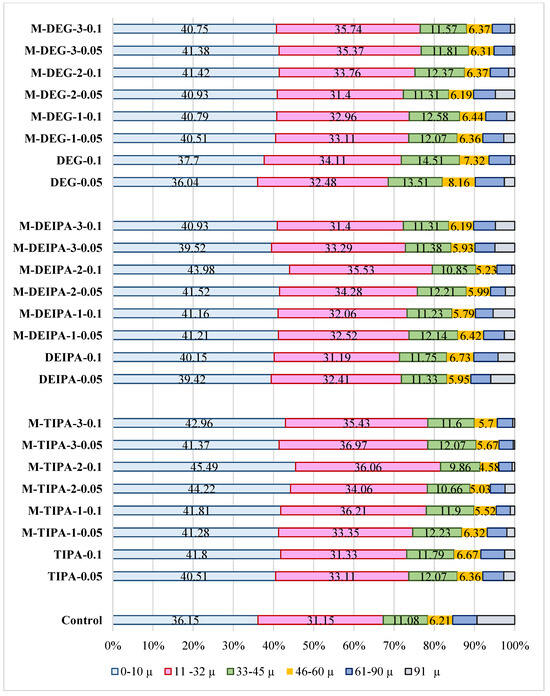
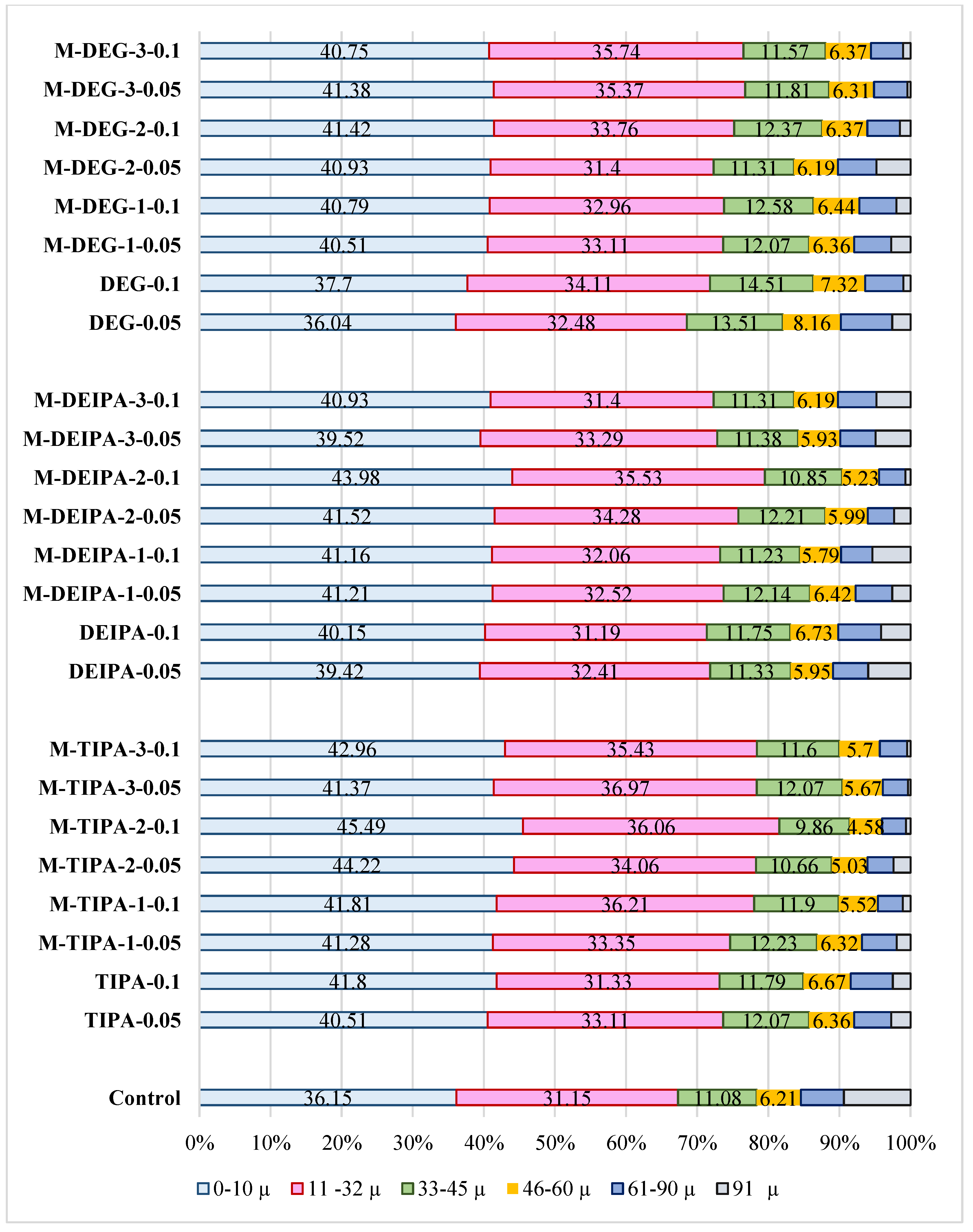
The particle size distributions of the produced cements are given in Figure 1.
Figure 1.
The particle size distributions of the produced cements.
Figure 1 presents the fraction-based percentage distribution of the particle size distributions of cements produced with and without GA. PSD plays a decisive role in the transportability and flow behavior of cement powder in cementitious systems, as it governs not only the fineness level but also particle packing, interparticle cohesion, and electrostatic interactions. For this reason, elucidating the changes induced by different GA types and dosages in relation to powder flow behavior is essential for interpreting the underlying mechanisms responsible for the observed flow performance.
A general examination of Figure 1 indicates that, for all cement samples, the highest proportion of particles is concentrated within the 0–10 µm and 11–32 µm size fractions. This outcome reflects the naturally high fine fraction content resulting from laboratory ball milling to a target Blaine fineness of 3900 ± 100 cm2/g. In the control cement, the 0–10 µm fraction accounts for approximately 36.15%, while the 11–32 µm fraction represents about 31.15%. In mixtures incorporating GAs, a noticeable increase in the 0–10 µm fraction is observed in many samples, with values reaching the 40–45% range in certain systems. This trend can be attributed to the ability of GAs to reduce agglomeration among fine particles during grinding, thereby promoting more effective comminution and enhanced dispersion. In other words, GAs improve grinding efficiency by limiting particle–particle adhesion within the mill, shifting the product PSD toward a higher fine fraction.
However, PSD should not be assessed solely based on fine fraction enrichment but also in terms of the redistribution and balance among size classes. As shown in Figure 1, in some mixtures, the 11–32 µm fraction remains comparable to or even increases alongside the growth of the 0–10 µm fraction, whereas a reduction or redistribution is observed in the 33–45 µm and 46–60 µm fractions. This behavior suggests that the fracture and disintegration mechanisms are influenced by the chemical structure of the admixtures and that, in certain systems, a more homogeneous fineness distribution can be achieved. In particular, for some combinations of modified GAs (M-series), the retention of intermediate-size fractions despite the increase in fine particles indicates that the PSD evolution is not characterized solely by excessive fineness but rather by a more balanced redistribution. Such a PSD profile is potentially advantageous in terms of both hydration reactivity and powder flow behavior.
An increase in the fine fraction is expected to accelerate hydration kinetics and enhance early-age strength due to the associated rise in specific surface area. Nevertheless, this benefit is accompanied by potential drawbacks, especially when the proportion of particles smaller than 10 µm increases. Ultrafine particles, owing to their high specific surface area, intensify Van der Waals attractions, surface polarity, and electrostatic charging effects, which can increase powder cohesion and promote agglomeration, thereby adversely affecting flowability [34]. Consequently, a shift toward finer PSD does not inherently guarantee improved powder flow; under certain conditions, it may instead lead to unfavorable changes in parameters such as the Carr index, Hausner ratio, and angle of repose. Given that the primary focus of this study is powder fluidity, it is essential to interpret PSD variations in conjunction with powder flow indices to achieve a comprehensive understanding of the observed behavior.
On the other hand, the effect of GAs on flow behavior cannot be explained solely based on PSD; particle surface chemistry and morphology are at least as decisive as size distribution. By adsorbing onto particle surfaces, GAs reduce surface energy and weaken interfacial adhesion forces, thereby improving flow performance even in cases where the fine fraction increases. In particular, because the polar–apolar balance and adsorption capacity of GAs modified with organic acids are altered, a more effective surface coating film is expected to form within the mill, and re-agglomeration of fine particles is likely to be suppressed. This mechanism can enhance the packing behavior of the product by enabling a more controlled inter-fraction PSD and can consequently lead to favorable improvements in powder flow parameters.
Accordingly, microstructural indicators such as particle surface roughness, the presence of sharp edges, and the degree of agglomeration observed by SEM provide complementary evidence for interpreting PSD findings in terms of fluidity. In this context, SEM-based morphological observations support the notion that changes in surface texture and particle shape induced by GA modification play a critical role in governing powder flow behavior, alongside PSD effects.
Overall, Figure 1 demonstrates that the use of organic acid–modified GAs generally shifts the particle size distribution of cement toward the fine fraction, with the magnitude and nature of this effect depending on the type of organic acid, modification strategy, and dosage. The observation that fine fraction enrichment occurs together with a more balanced distribution in certain combinations of modified GAs indicates that grinding efficiency and powder flow performance can be optimized simultaneously. These findings therefore confirm that organic acid modification has strong potential to enhance not only grinding efficiency but also the flowability and transportability of cement powder—properties that are critically important for industrial handling, storage, and conveying operations.
3.2. SEM Analysis
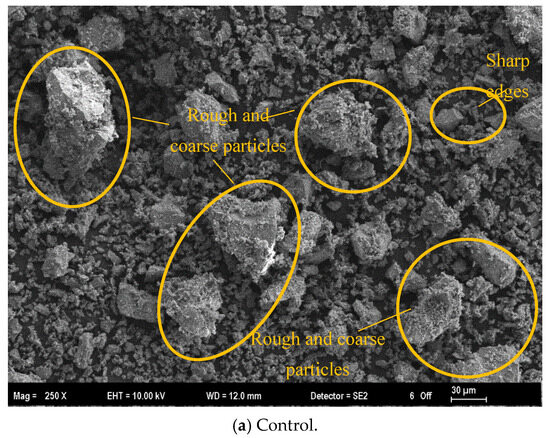
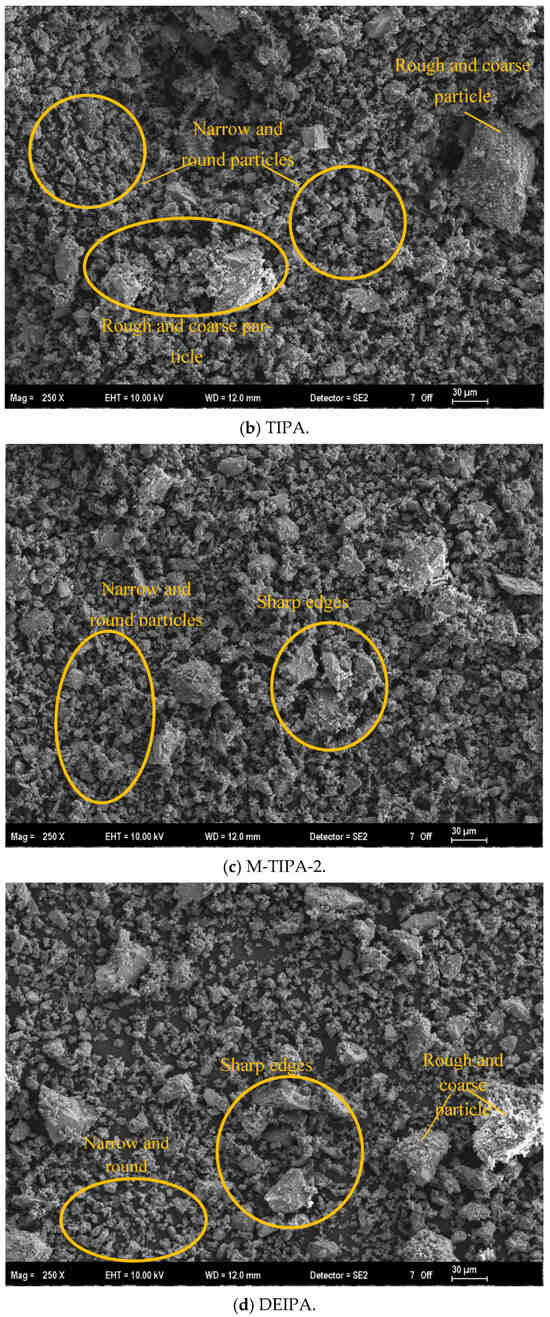
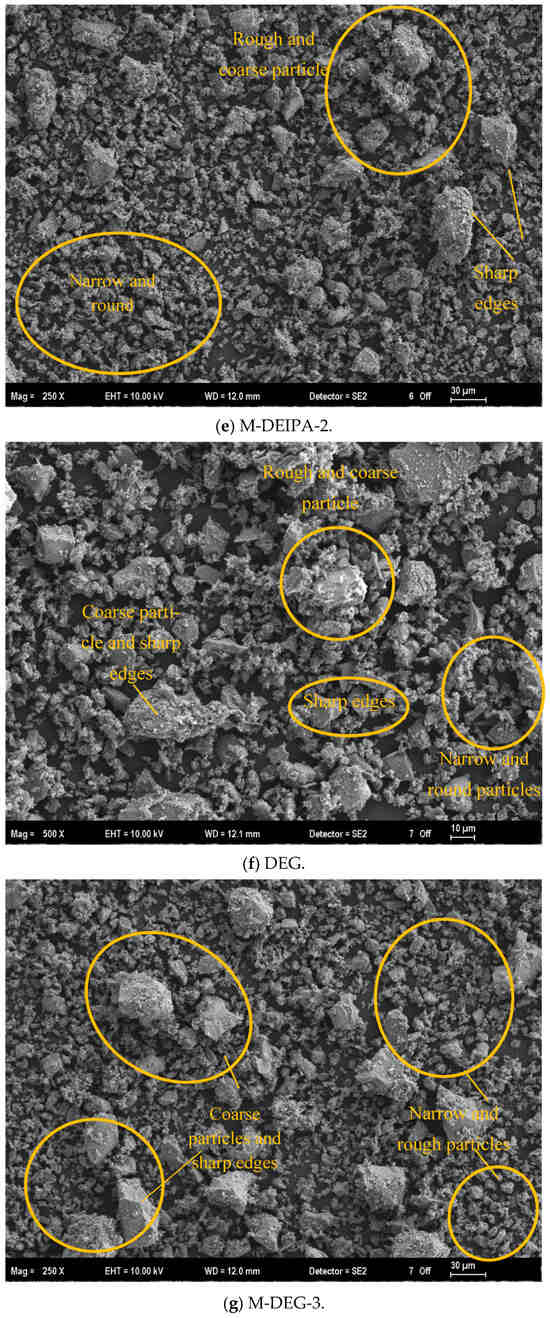
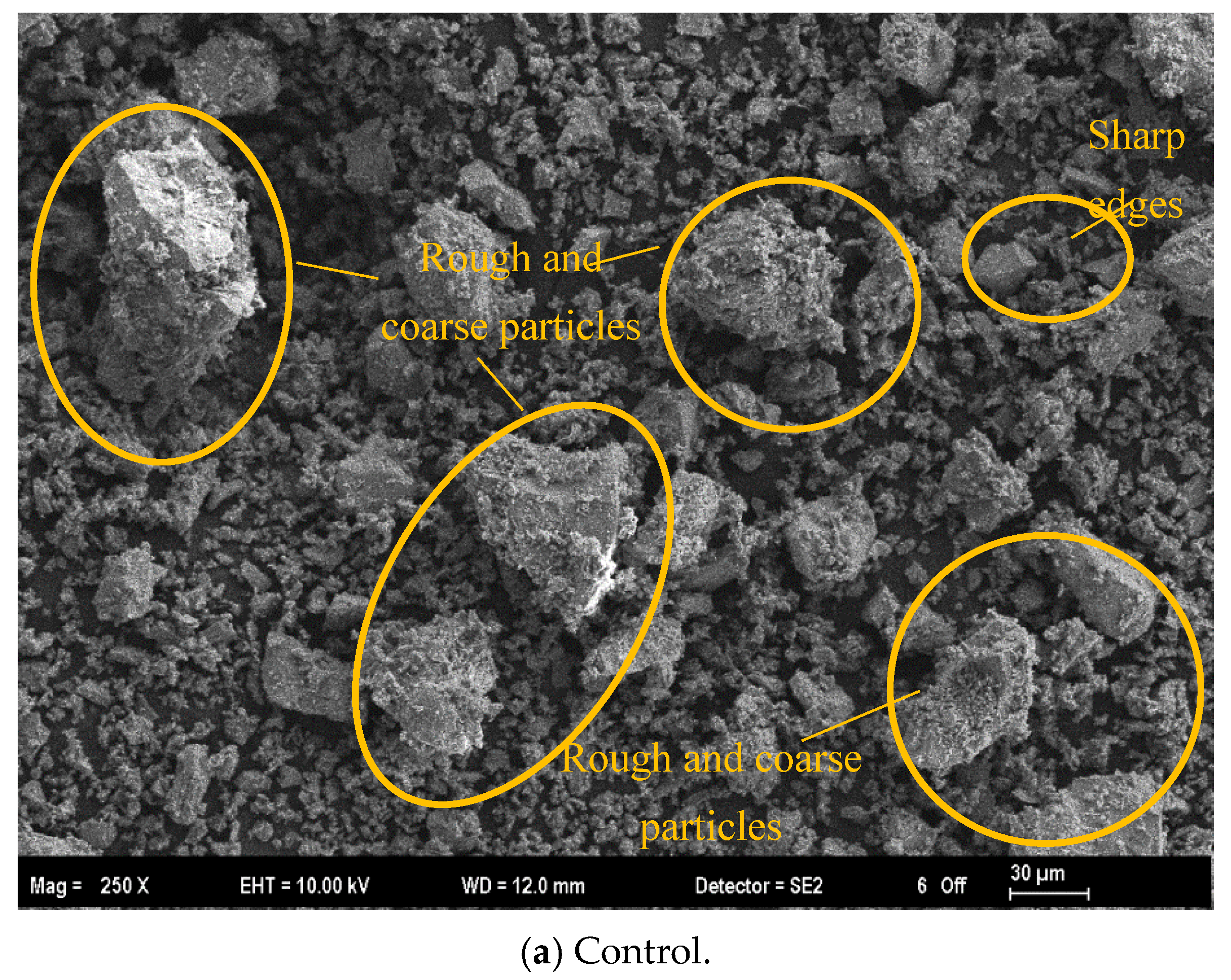
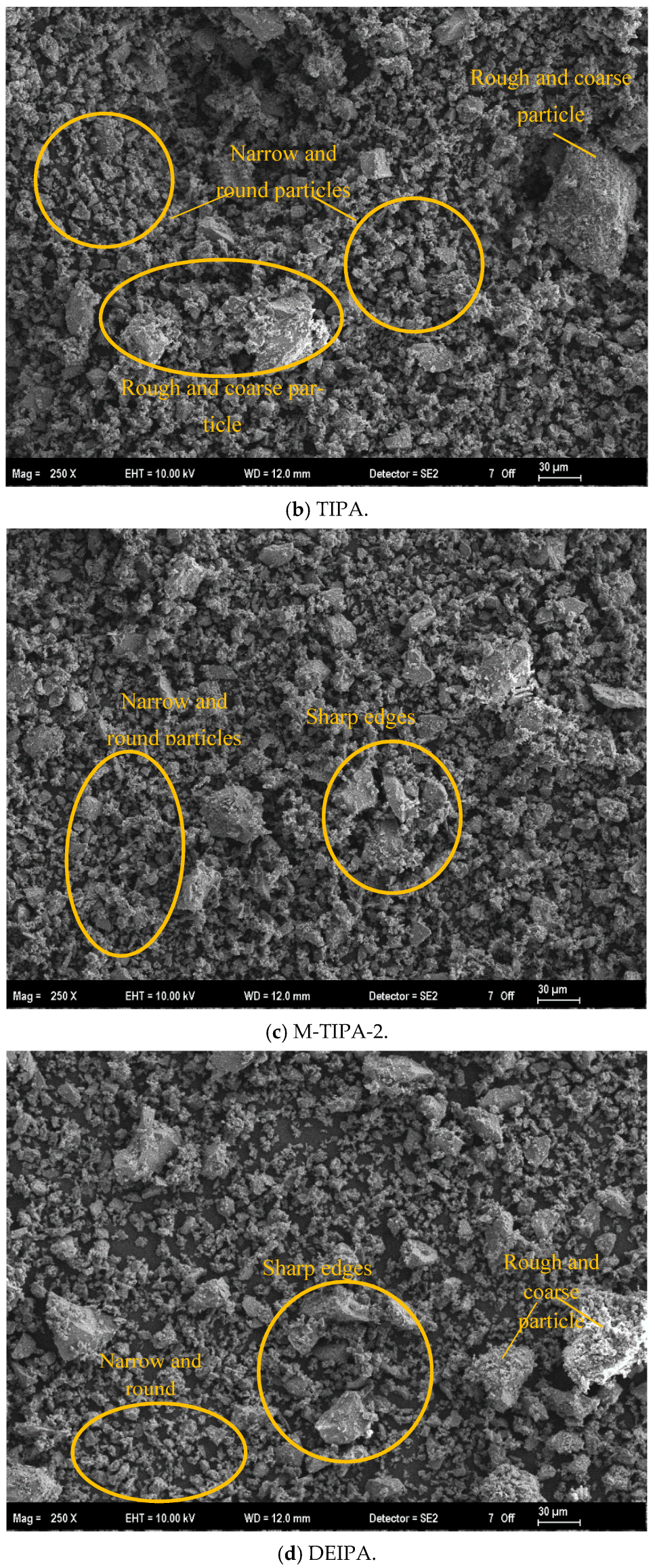
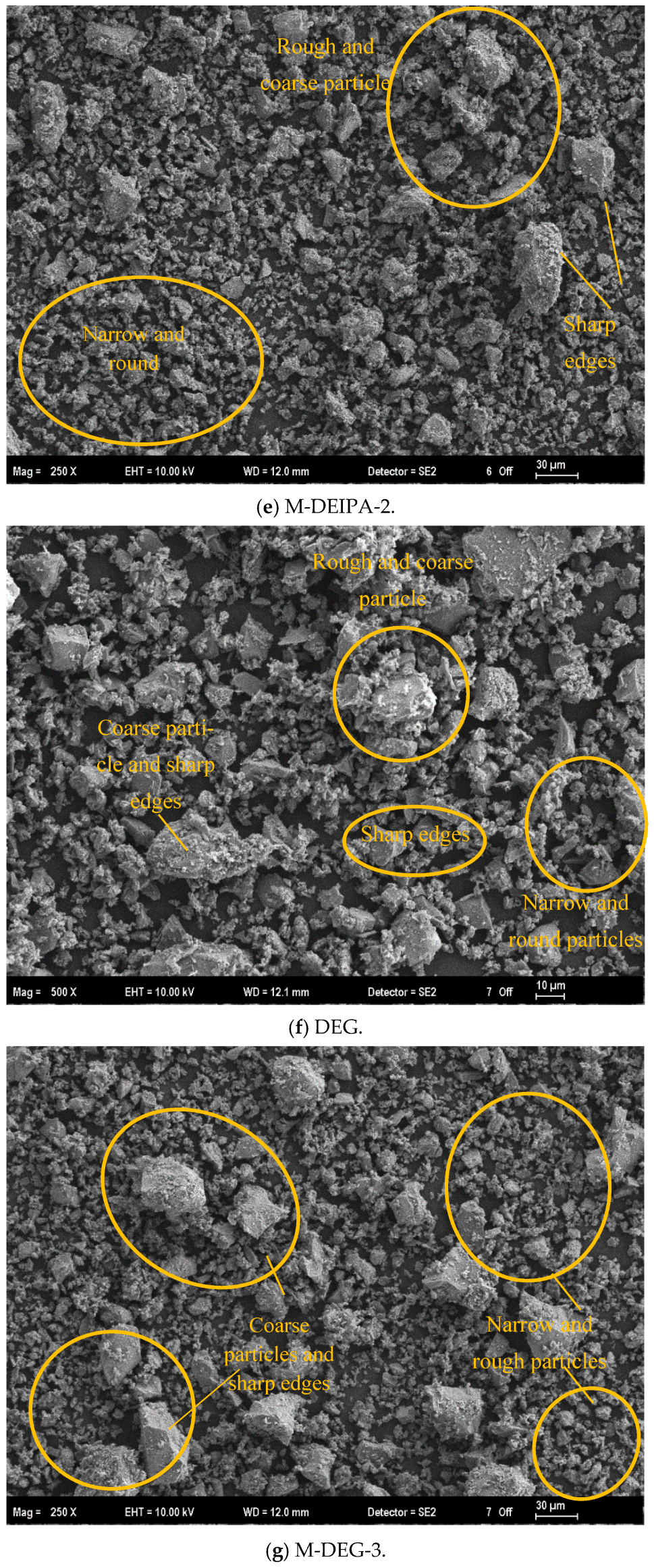
Figure 2 presents SEM images of the control cement and the cements produced with 0.05% commercial admixtures (TIPA, DEIPA, and DEG), as well as their modified counterparts that exhibited the best performance in terms of grinding efficiency and PSD characteristics (M-TIPA-2, M-DEIPA-2, and M-DEG-3).
Figure 2.
SEM images of the cements: (a) Control, (b) TIPA, (c) M-TIPA-2, (d) DEIPA, (e) M-DEIPA-2, (f) DEG, (g) M-DEG-3.
It is well established that cement particle morphology exerts a significant influence on powder flow properties [3,20,35]. As illustrated in Figure 2, irrespective of the GA type, the incorporation of GAs led to a noticeable reduction in particle sharpness and surface roughness, resulting in a more compact and uniform particle structure. Moreover, in cements produced with modified GAs, the proportion of coarse and rough-textured particles decreased, while the fraction of fine, rounded, and narrowly sized particles increased (Figure 2c,e,g).
3.3. Powder Flow Properties
Flow Properties
The bulk density, apparent density, Carr index, Hausner ratio, angle of repose, and corresponding flow class values for all cement samples are summarized in Table 3.
Table 3.
Cement parameters include bulk density, apparent density, Carr index, Hausner ratio, angle of view, and flow classes.
3.4. Carr Index and Hausner Ratio
The Carr index (CI) is a widely used parameter for quantifying the compressibility of powder materials and serves as a rapid indicator of powder flowability. It is closely related to the Hausner ratio (HR), with lower compressibility generally corresponding to improved fluidity. The Hausner ratio likewise provides insight into the flow behavior and cohesive tendency of powders [21].
Several mechanisms contribute to enhanced flowability in ground cement systems, including: (i) abrasion and rounding of sharp edges on coarse particles during grinding; (ii) suppression of fine-particle agglomeration through GA adsorption and surface layer formation; and (iii) the influence of GAs on narrowing the particle size distribution [3]. While a narrower particle size distribution can, in some cases, increase interparticle cohesion and reduce flowability, coarser particles have also been reported to exhibit superior powder flow characteristics [3]. However, the dominant factors governing this behavior are not solely related to size distribution but are strongly controlled by particle surface morphology and interparticle forces [35]. Sharp-edged, rough-surfaced particles are known to affect powder flow properties adversely. In contrast, the GA application, which promotes particle rounding and surface smoothing while inhibiting agglomeration, can offset the increase in cohesion typically associated with a narrowed PSD, thereby improving flowability even under reduced interparticle spacing [3,13].
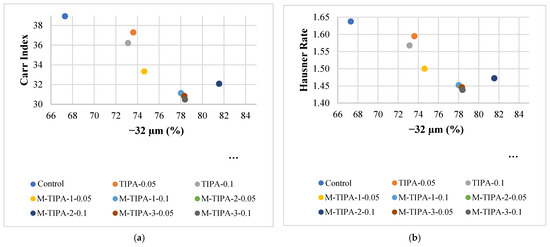
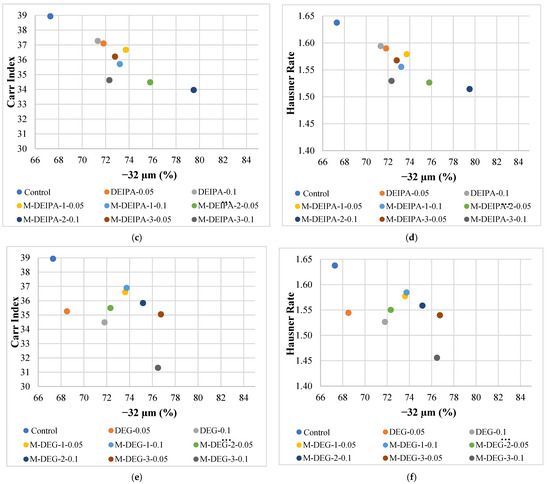
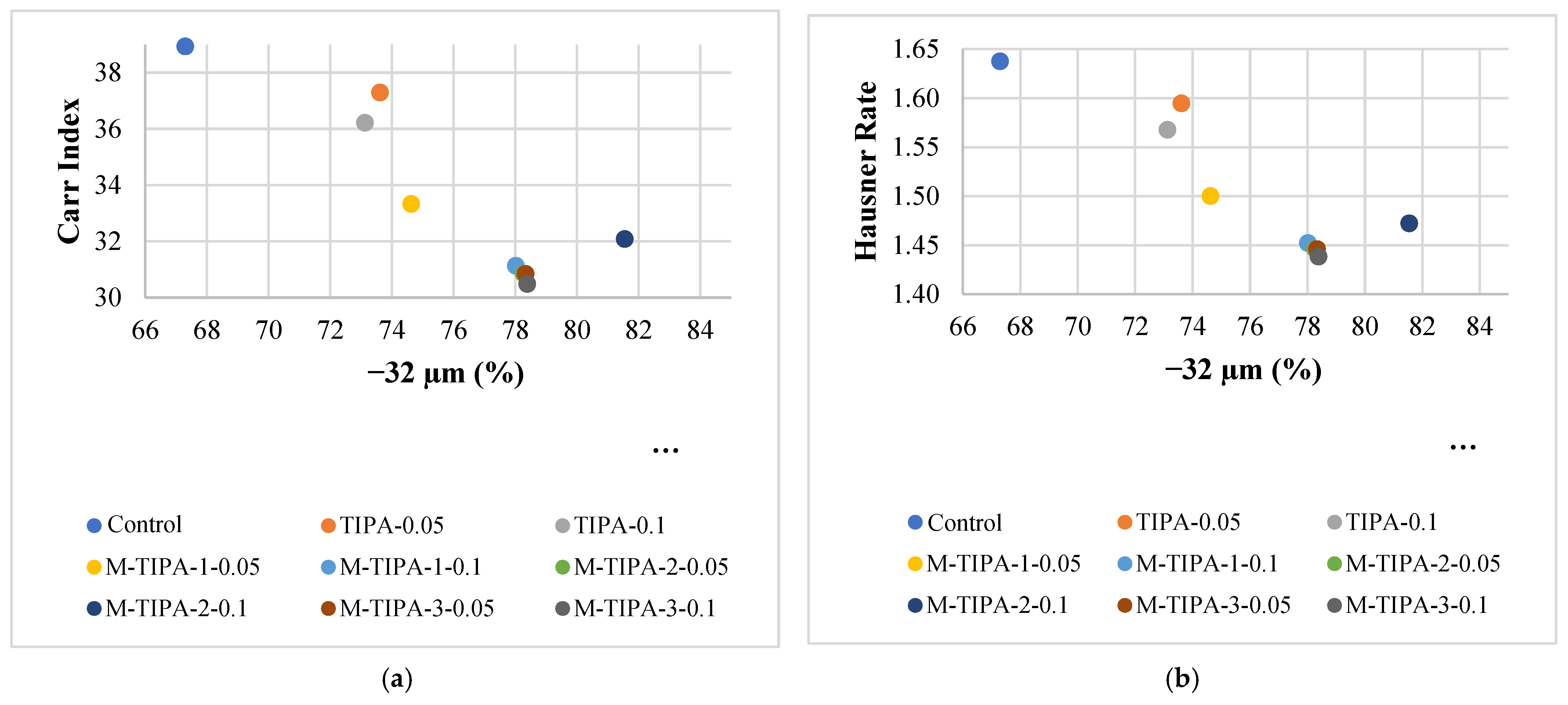
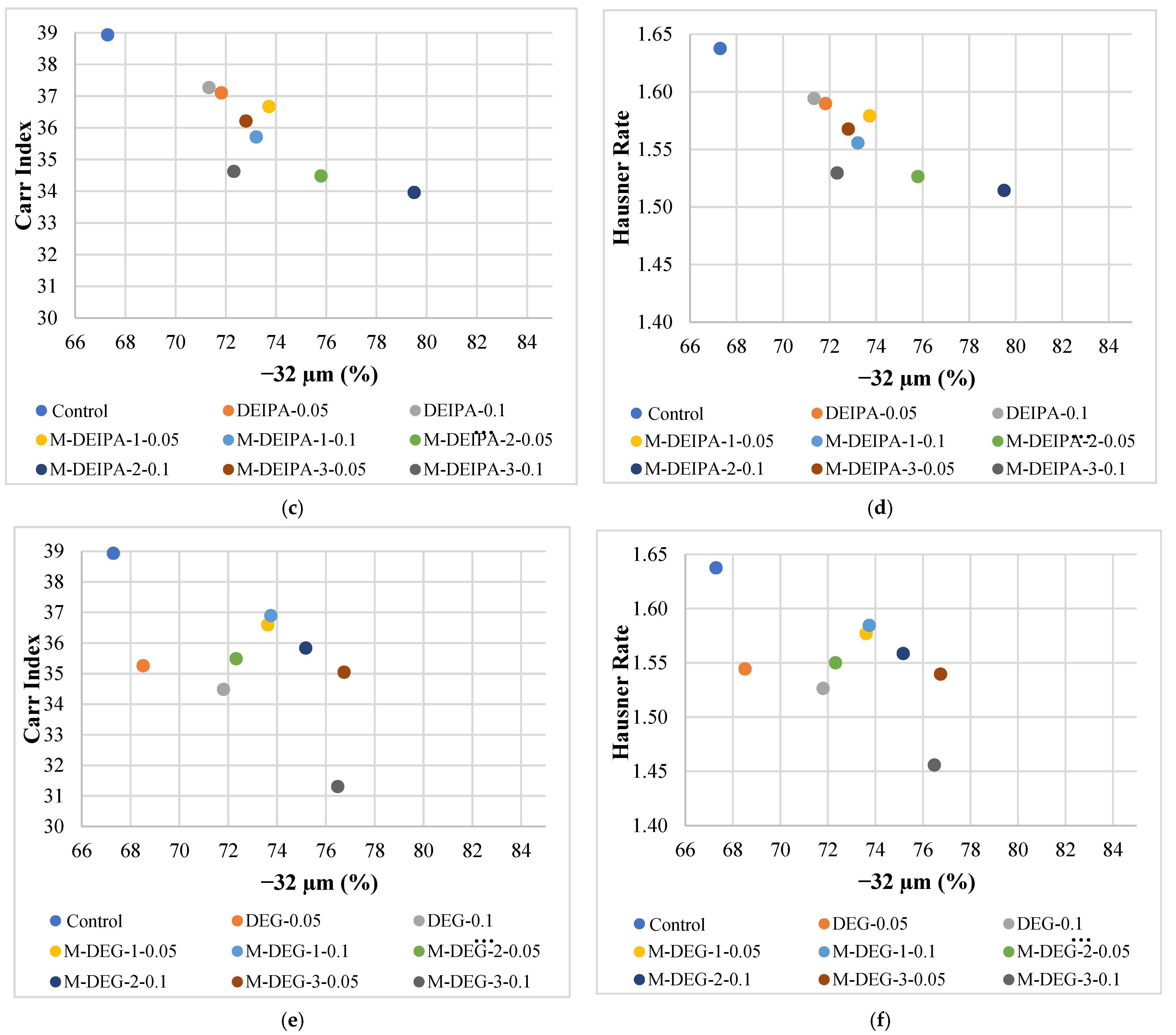
In the present study, variations in the Carr index and Hausner ratio were interpreted in relation to the −32 µm fraction and the Rosin–Rammler n (PSD slope). Accordingly, Figure 3 illustrates the changes in the CI and HR for all cement samples produced with TIPA and its modified derivatives, DEIPA and its modified derivatives, and DEG and its modified derivatives, together with the control cement, as a function of the −32 µm particle size fraction.
Figure 3.
(a) −32 µm fraction vs. Carr index for TIPA and its modified derivatives; (b) −32 µm fraction vs. Hausner ratio for TIPA and its modified derivatives; (c) −32 µm fraction vs. Carr index for DEIPA and its modified derivatives; (d) −32 µm fraction vs. Hausner ratio for DEIPA and its modified derivatives; (e) −32 µm fraction vs. Carr index for DEG and its modified derivatives; (f) −32 µm fraction vs. Hausner ratio for DEG and its modified derivatives.
As shown in Figure 3, the relationships between the −32 µm fraction and both the Carr index and the Hausner ratio exhibit similar trends for all cement samples, regardless of GA type or dosage. Moreover, independent of GA type and dosage, the incorporation of GAs leads to an overall improvement in flow properties—reflected by lower Carr index and Hausner ratio values—compared with the control cement (Figure 3).
For the TIPA-containing cements, the −32 µm fraction decreases slightly with increasing dosage (Figure 3a,b), while no pronounced change is observed in either the Carr index or the Hausner ratio. In contrast, for the M-TIPA-1 modification, both enhanced flow performance relative to commercial TIPA and a more distinct improvement in the −32 µm fraction, Carr index, and Hausner ratio are observed as the dosage increases. In this case, the improved adsorption performance of the modified additive, compared with TIPA, limits agglomeration by forming and neutralizing an adsorption layer on the particle surfaces. This results in narrower and smoother particles (relative to the control and TIPA), thereby offsetting the increase in cohesion typically associated with finer particle sizes and ultimately leading to improved flow behavior. A similar mechanism explains the improvement observed for all TIPA modifications compared with commercial TIPA.
For the M-TIPA-2 modification, although the −32 µm fraction increases with increasing dosage, a deterioration in both the Carr index and Hausner ratio is observed. While this deterioration is not pronounced in the Hausner ratio, the Carr index indicates a decline in the flowability class [36] from “Poor” to “Very Poor.” Notably, M-TIPA-2 exhibits the highest −32 µm fraction among the TIPA modification series (Figure 1), suggesting that the cohesion induced by the high proportion of fine particles is not sufficiently counterbalanced by the adsorption performance of the additive. Accordingly, the negative trend in the Carr index with increasing dosage in M-TIPA-2 cement is attributed to this imbalance.
In the case of M-TIPA-3 cement, the −32 µm fraction does not increase markedly with increasing dosage, whereas the Carr index and Hausner ratio attain their lowest (i.e., most favorable) values within this series. This observation supports the interpretation derived from the M-TIPA-2 results. For M-TIPA-3, the increase in the −32 µm fraction occurs in a more balanced manner with dosage, allowing the cohesion associated with finer particles to be effectively compensated by the adsorption performance of the GA.
As shown in Figure 3, the relationships between the −32 µm fraction and both the Carr index and the Hausner ratio exhibit similar trends for all cement samples, regardless of GA type or dosage. Moreover, independent of GA type and dosage, the incorporation of GAs results in an overall improvement in flow properties—reflected in lower Carr index and Hausner ratio values—compared with the control cement (Figure 3).
For the TIPA-containing cements, the −32 µm fraction decreases slightly with increasing dosage (Figure 3a,b), while no pronounced change is observed in either the Carr index or the Hausner ratio. In contrast, for the M-TIPA-1 modification, both enhanced flow performance relative to commercial TIPA and a more distinct improvement in the −32 µm fraction, Carr index, and Hausner ratio are observed as the dosage increases. In this case, the improved adsorption performance of the modified additive, compared with TIPA, limits agglomeration by forming and neutralizing an adsorption layer on the particle surfaces. This results in narrower, smoother particles (relative to the control and TIPA), thereby offsetting the increase in cohesion typically associated with finer particle sizes and ultimately improving flow behavior. A similar mechanism explains the improvement observed for all TIPA modifications compared with commercial TIPA.
For the M-TIPA-2 modification, although the −32 µm fraction increases with increasing dosage, both the Carr index and the Hausner ratio deteriorate. While this deterioration is not pronounced in the Hausner ratio, the Carr index indicates a decline in the flowability class [36] from “Poor” to “Very Poor.” Notably, M-TIPA-2 exhibits the highest −32 µm fraction among the TIPA modification series (Figure 1), suggesting that the cohesion induced by the high proportion of fine particles is not sufficiently counterbalanced by the adsorption performance of the additive. Accordingly, the negative trend in the Carr index with increasing dosage in M-TIPA-2 cement is attributed to this imbalance.
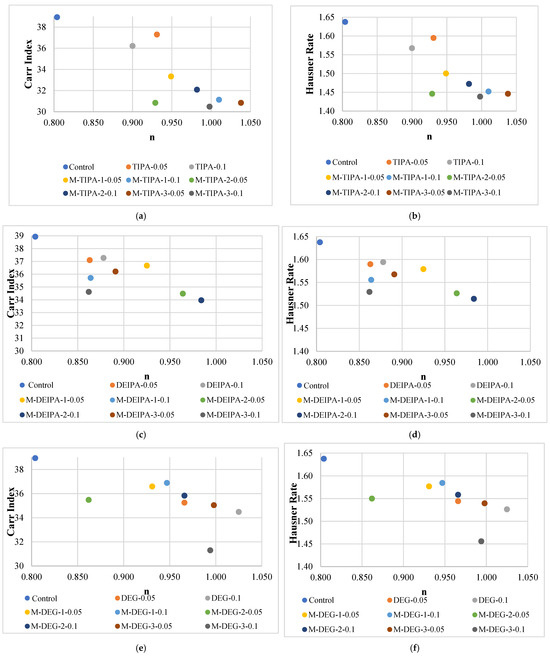
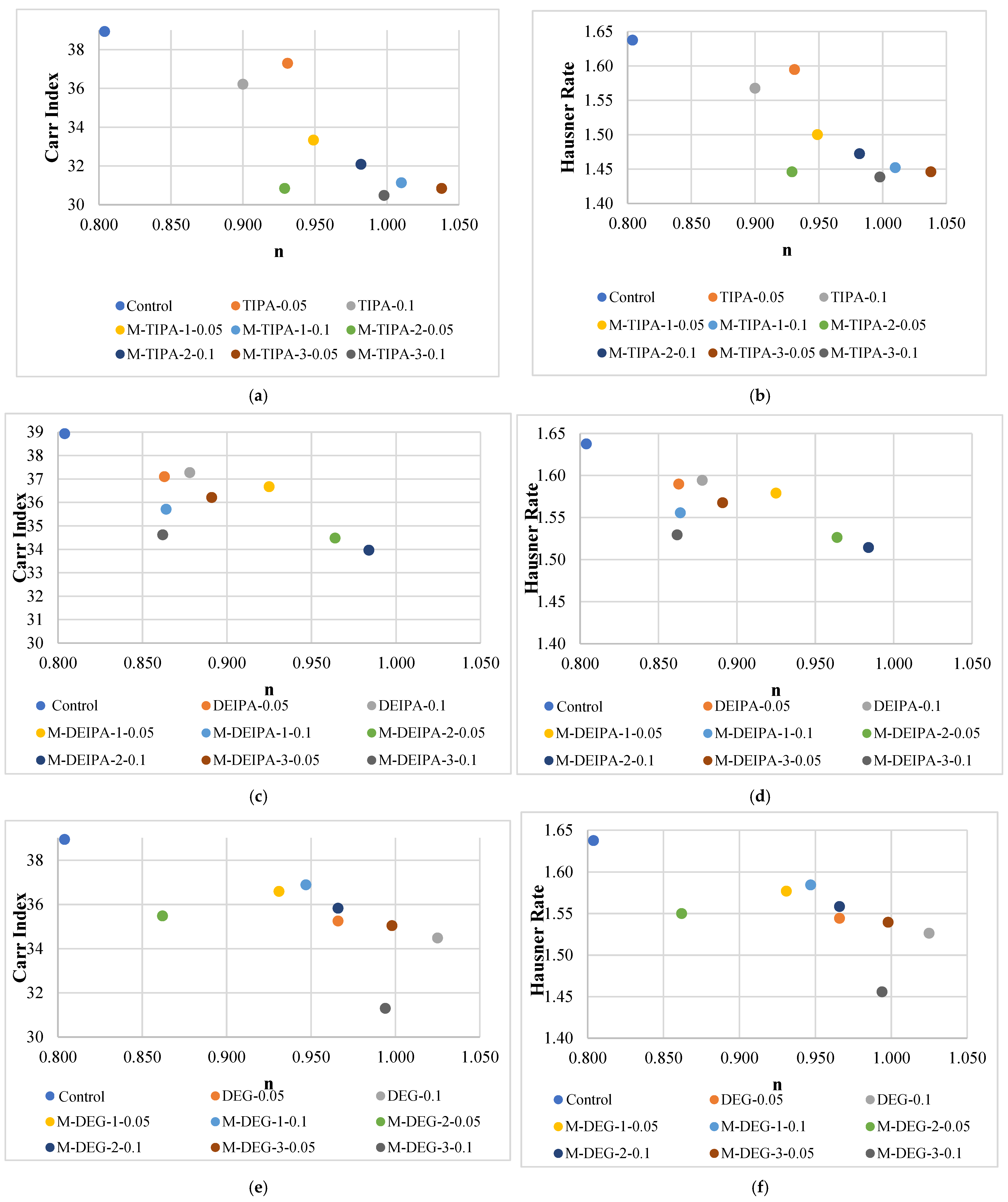
Figure 4 reveals clear similarities in the trends of the n-value–Carr index and n-value–Hausner ratio relationships across all cements, irrespective of GA type and dosage. In TIPA-containing cement, the n-value decreased with increasing dosage; however, no marked improvement was observed in either the Carr index or the Hausner ratio (Figure 4a).
Figure 4.
Control cement and (a) n–Carr index plots for TIPA and its modifications, (b) n–Hausner ratio plots for TIPA and its modifications, (c) n–Carr index plots for DEIPA and its modifications, (d) n–Hausner ratio plots for DEIPA and its modifications, (e) n–Carr index plots for DEG and its modifications, and (f) n–Hausner ratio plots for DEG and its modifications.
The reduction in n-values calculated from particle size distributions indicates a broadening and flattening of the distribution. In contrast, for M-TIPA-1 cement, improvements in flow parameters were observed with increasing n-values, suggesting that this modification promoted a more homogeneous fine-particle distribution and enhanced fluidity.
In M-TIPA-2, although increasing the dosage increased the n-value, the maximum value was not reached at a 0.1% dosage. Accordingly, the deterioration observed in the Carr index and Hausner ratio was attributed to the increased proportion of fine particles. In M-TIPA-3, the n-value decreased, yet a slight improvement in flow properties was still recorded. Overall, for TIPA-based systems, an n-value approaching unity was found to be favorable for enhancing powder fluidity.
For DEIPA-containing cement, the n-value increased slightly with dosage, while the Carr index and Hausner ratio remained largely unchanged (Figure 4c,d). In M-DEIPA-1, the n-value decreased as the −32 µm fraction increased, yet fluidity improved. This indicates that a reduction in the PBD slope (from 0.925 to 0.85) can improve flow behavior. In M-DEIPA-2, the increase in n-value did not lead to any noticeable change in flow parameters, whereas in M-DEIPA-3, both the n-value and flow indices exhibited the most pronounced improvement.
In DEG-containing cement, despite an increase in the n-value, no enhancement was observed in the Carr index or Hausner ratio, and the rise in the −32 µm fraction did not translate into improved fluidity. In general, DEG modifications tended to decrease the n-value, and only in M-DEG-3 at the higher dosage was a limited improvement in flow behavior obtained.
In conclusion, the PBD slope (n) emerged as a critical parameter governing powder flow behavior in GA-modified systems. Except for DEG-based systems, a slight decrease in the n-value combined with an increase in the −32 µm fraction was associated with an overall enhancement in powder fluidity.
3.5. Angle of Repose
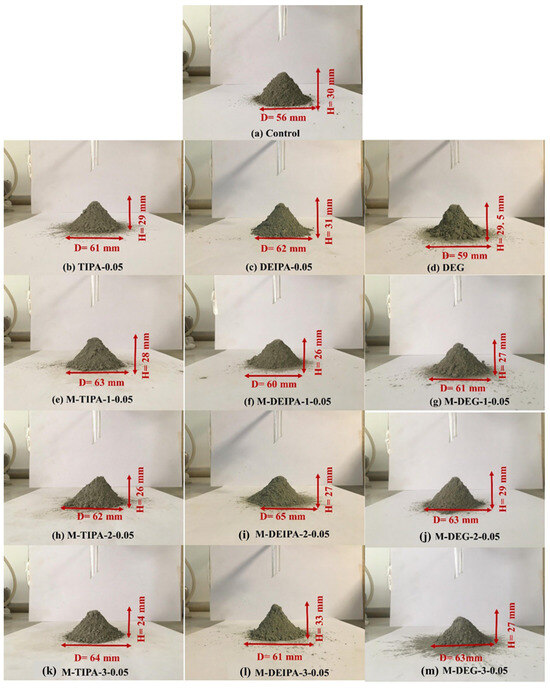
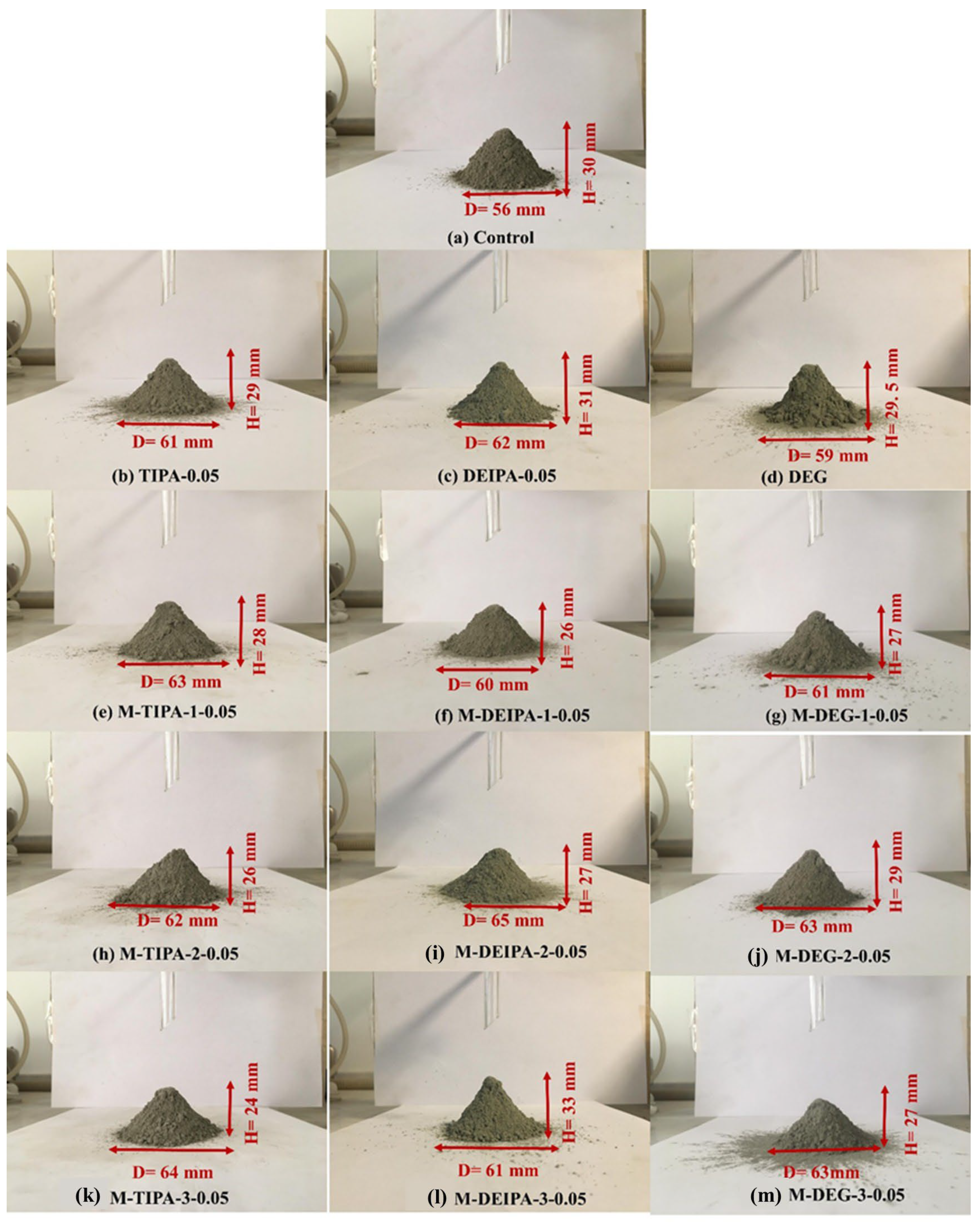
The angle of repose is a key parameter that reflects the frictional interactions between powder particles and serves as an indicator of the flow behavior of cement powder. In general, a higher angle of repose corresponds to reduced powder fluidity [3,38]. Representative experimental images illustrating the angles of repose of the cements investigated in this study are presented in Figure 5.
Figure 5.
Angle of repose images of the control cement and the cements containing 0.05% GA.
As shown in Table 3, the incorporation of GA reduced the angle of repose and, consequently, enhanced the powder fluidity, irrespective of GA type and dosage. This improvement became more pronounced with increasing GA dosage. When the modified systems were examined, enhanced flow performance was observed for all admixture types compared to their unmodified counterparts, with the exception of M-DEIPA-3-0.05 and M-TIPA-1-0.1.
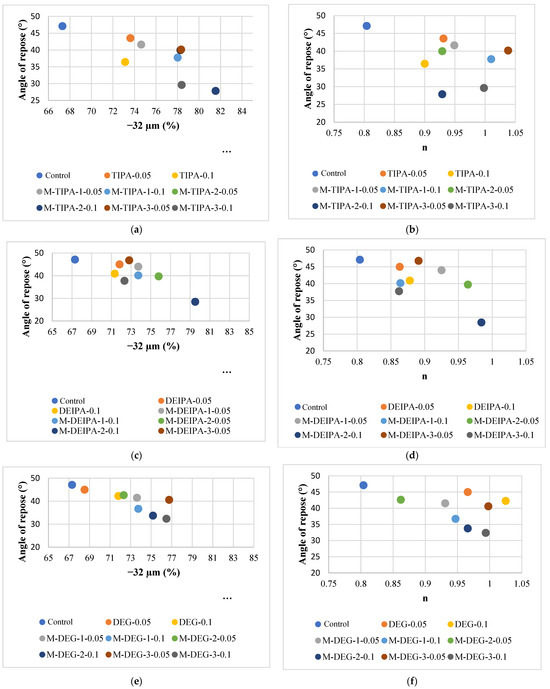
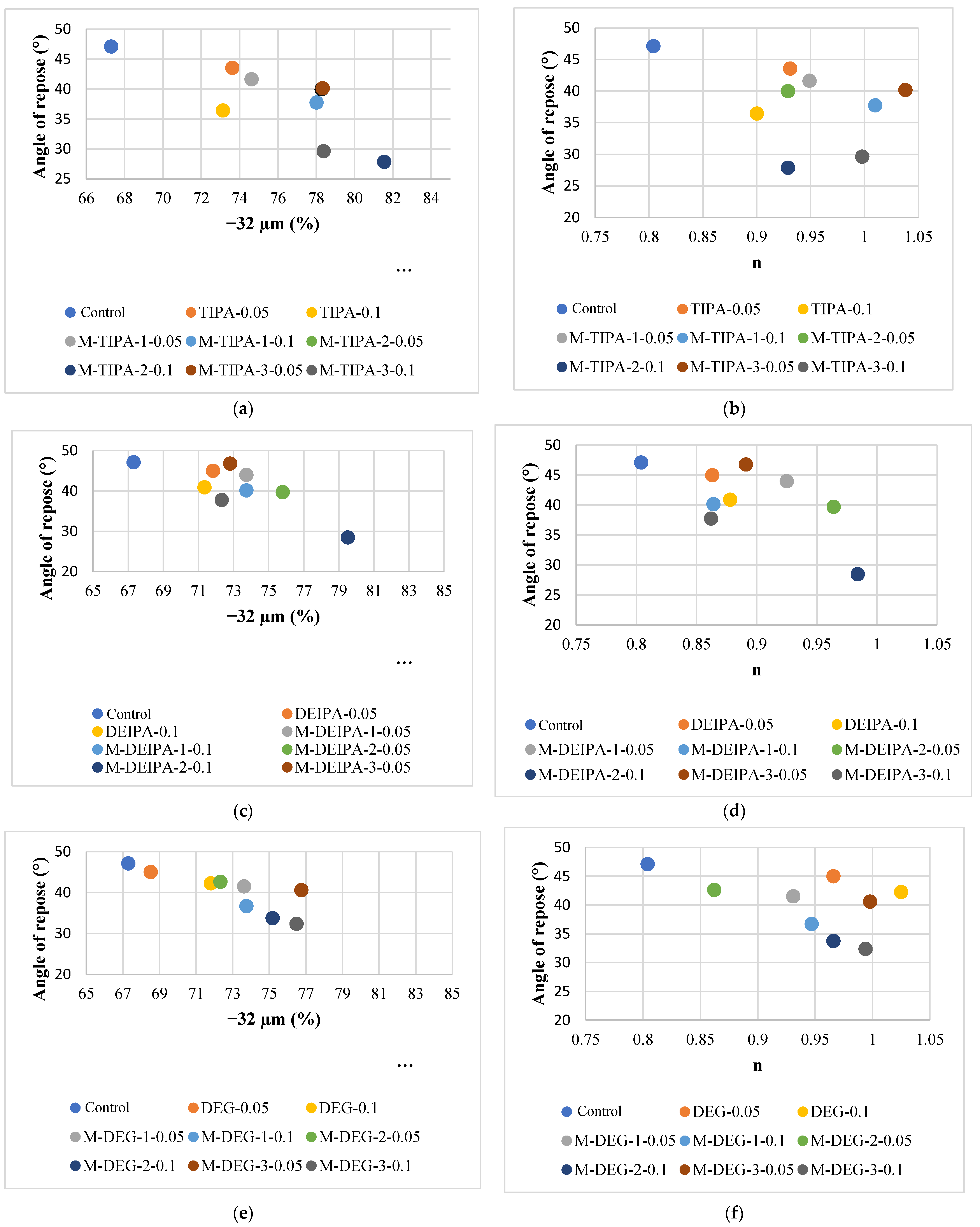
To elucidate the relationship between organic acid modification and particle size distribution, the correlations between the −32 µm fraction and the angle of repose, as well as between the PBD slope (n value) and the angle of repose, for the TIPA, DEIPA, and DEG systems together with the control cement, are presented in Figure 6.
Figure 6.
Relationships between the −32 µm fraction and the angle of repose for the control cement and (a) TIPA and its modifications, (c) DEIPA and its modifications, and (e) DEG and its modifications; and relationships between the PBD slope (n value) and the angle of repose for the control cement and (b) TIPA and its modifications, (d) DEIPA and its modifications, and (f) DEG and its modifications.
As shown in Figure 6a, increasing the TIPA dosage decreased both the fraction below 32 µm and the angle of repose. In the modified TIPA systems (except M-TIPA-3), the proportion of fine particles increased with increasing GA dosage, and correspondingly, the angle of repose decreased markedly. For instance, the angle of repose decreased from 41.63° to 37.75° in M-TIPA-1, from 39.99° to 27.86° in M-TIPA-2, and from 40.16° to 29.63° in M-TIPA-3. While the control cement fell within the “poor” flowability class, M-TIPA-1 shifted to the “passable-fair” range, and both M-TIPA-2 and M-TIPA-3 reached the “fair-excellent” range (Table 3). This enhancement in flow behavior is attributed to the smoother and more rounded particle morphology obtained in the presence of GA (Figure 2).
Figure 6b further shows that, in the TIPA system, increasing dosage resulted in a decrease in the n value together with a reduction in the angle of repose, indicating a broadening of the particle size distribution and suggesting that the presence of relatively coarser particles facilitates flow. At higher dosages, TIPA imparted more favorable morphological characteristics to the particles (Figure 2). In contrast, in the M-TIPA-1 system, the n value increased with increasing dosage while the angle of repose decreased, indicating that a narrower yet more balanced particle size distribution was achieved owing to the enhanced adsorption capacity after modification. The consistency between the trends in the n value and the −32 µm fraction further supports this interpretation.
In M-TIPA-2, increasing the dosage did not significantly change the n value, but it did reduce the angle of repose. Although the fine fraction increased, the overall distribution of PBD remained constant. When Figure 6a,b are evaluated together, these results show that the coarse fraction balances the fine particles. In Figure 6c, increasing the dosage in DEIPA and M-DEIPA-1/-3 cements did not affect the −32 µm fraction, but it significantly reduced the angle of contact. This shows that the amount of GA adsorption improves fluidity in a similar particle distribution. In M-DEIPA-2, both the fine fraction and the angle of contact increased, which is explained by morphological improvement. According to the Katircioglu-Bayel [37] classification, DEIPA and M-DEIPA-1 reached the “passable-fair” level, M-DEIPA-2 reached the “fair-excellent” level, and M-DEIPA-3 reached the “poor-fair” level (Table 3). In Figure 6d, the n value increased with increasing dosage in DEIPA cement while the standing angle decreased, consistent with the decrease in the −32 µm fraction. In M-DEIPA-1, both parameters decreased; in M-DEIPA-2 and M-DEIPA-3, the standing angle decreased while the n value increased. In particular, in M-DEIPA-2, fluidity increased due to the effect of the coarse fraction despite the increase in the fine fraction. In Figure 6e, a decrease in the −32 µm fraction and standing angle was observed with increasing dosage in DEG cement. While M-DEG-1 and M-DEG-3 exhibited lower standing angles despite similar fine distribution, the increase in the fine fraction in M-DEG-2 resulted in a significant improvement in fluidity. According to the Katircioglu-Bayel [37] classification, DEG has risen to the “passable” range, M-DEG-1 to the “passable-fair” range, and M-DEG-2 and M-DEG-3 to the “passable-good” range. Despite similar fine fraction values, the low angles of repose in M-DEG-1 and M-DEG-3 indicate that adsorption increases fluidity.
In Figure 6f, the n value increased, and the angle of contact decreased with increasing dosage in DEG cement; this is consistent with the −32 µm fraction. In M-DEG-2 cement, increasing dosage both increased the n value and decreased the angle of contact; however, the n values remained below those of DEG. A similar trend was observed in M-DEG-1; the increase in n indicated that the particle distribution became homogenized. While the n value was behind DEG at low doses, the difference closed at high doses, and M-DEG-1 exhibited a lower angle of contact at all doses. This situation has been associated with high adsorption capacity. In M-DEG-2, both the n value increased, and the orientation angle decreased; in M-DEG-3, the orientation angle decreased while n remained unchanged. In both cases, a strong agreement was observed between the −32 µm fraction and the flow parameters.
3.6. Measurement of Powder Flow Rate by Vibrational Sieving
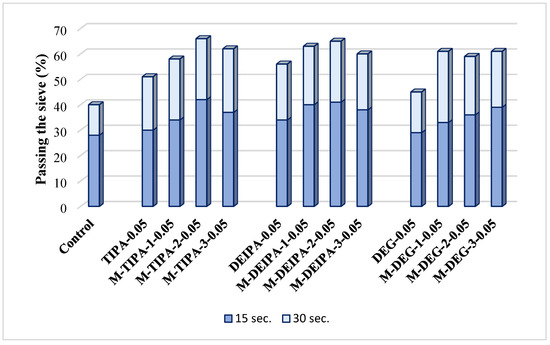
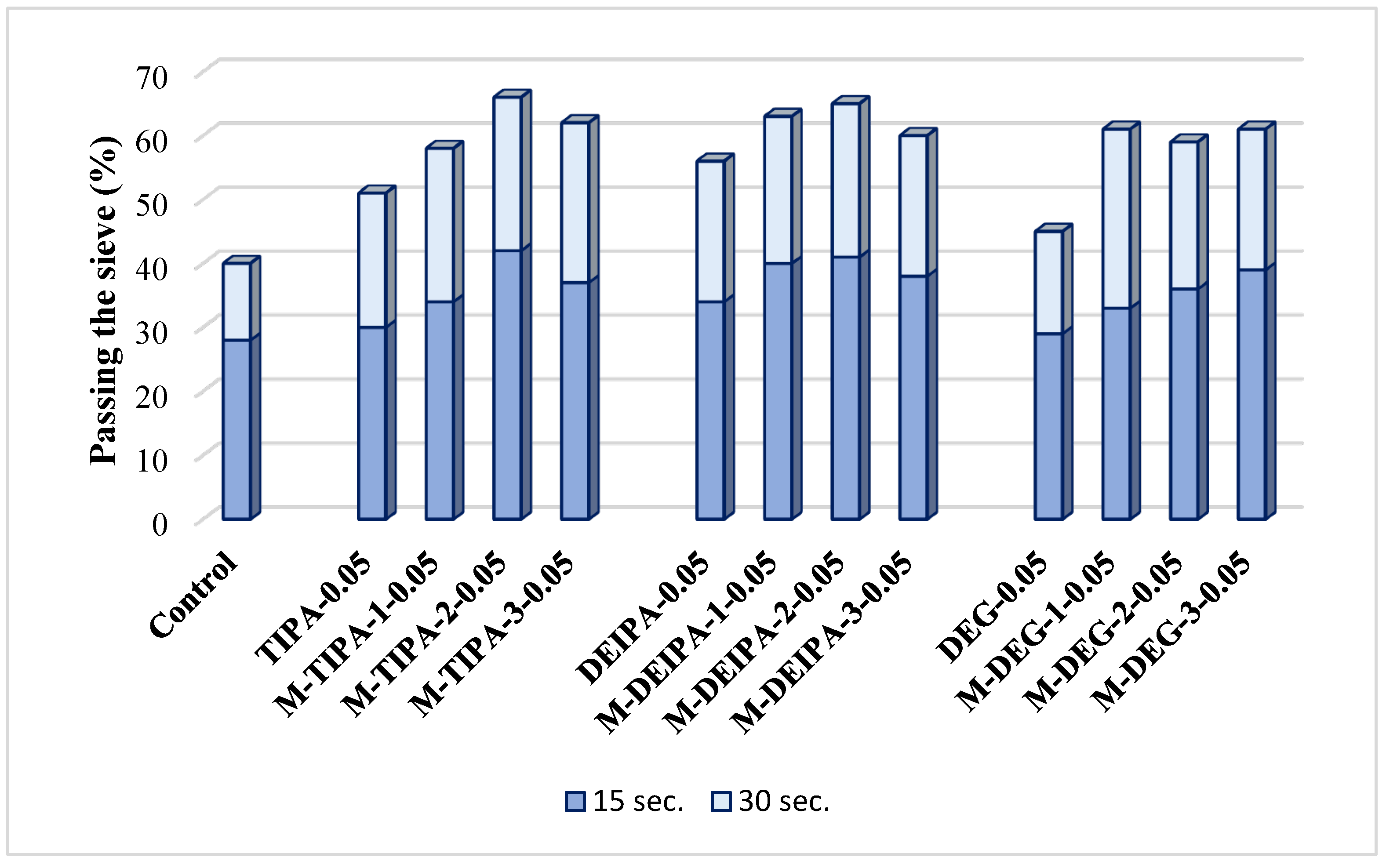
Figure 7 presents the percentage of powder from the control cement and the cements containing 0.05% GA that passed through a 63 µm sieve under vibrational sieving for 15 and 30 s.
Figure 7.
The fraction of cement powder passing through a 63 µm sieve under vibration.
As illustrated in Figure 7, the use of GAs led to an increase in the amount of cement powder passing through a 63 µm sieve within both 15 and 30 s, irrespective of GA type, compared to the control sample. This trend corroborates the previously discussed enhancement in powder fluidity associated with GA addition. In the presence of TIPA, the quantity of powder passing through the 63 µm sieve increased by 14% and 33% at 15 and 30 s, respectively, relative to the control. Following modification, these increases ranged from 21 to 50% at 15 s and 45–65% at 30 s, demonstrating the pronounced dispersion effect imparted by esterification. Consistent with the PSD, Carr index, and Hausner ratio results, the most effective TIPA modification in terms of vibration-induced powder flow was the hexanoic acid modification (M2).
For DEIPA-containing cements, the fraction passing through the 63 µm sieve increased by 24% and 40% at 15 and 30 s, respectively, compared to the control. After modification, these values rose further to 36–46% and 50–63%, respectively. Similar to the TIPA series, the hexanoic acid modification (M2) yielded the most pronounced improvement in powder flow under vibration.
In the case of DEG, only modest increases of 4% and 13% were observed at 15 and 30 s, respectively, relative to the control. However, DEG modification substantially enhanced these values to 18–39% at 15 s and 48–53% at 30 s. In line with the PSD, Carr index, and Hausner ratio findings, the propanoic acid modification (M3) proved to be the most effective DEG derivative in terms of vibration-assisted powder flow.
The chain length of the organic acid plays a decisive role in governing molecular surface wettability and powder rheology. Short-chain acids such as acetic acid exhibit higher polarity and stronger adsorption onto the cement surface, whereas longer-chain acids (e.g., hexanoic acid) are relatively less hydrophilic and tend to form a partially oriented hydrophobic layer on the particle surface [26,31]. This layer reduces interparticle cohesion, thereby enhancing powder fluidity. With increasing chain length, the bifunctional character of the molecule becomes more prominent: the polar head groups anchor the molecule to the surface, while the nonpolar tail segments weaken intergranular interactions. In the DEG system, the higher diester content associated with the propanoic acid modification (M3) likely enabled it to outperform the hexanoic acid modification.
In summary, consistent with the PSD and powder flow results, hexanoic acid (M2) emerged as the most effective modification for TIPA and DEIPA, whereas propanoic acid (M3) provided the best performance for DEG-based GAs.
The GAs mentioned above were previously studied by the same research team [13], in which the adsorption behavior of the modified GAs toward Ca2+ ions was assessed using theoretical calculations, and the zeta potentials of the resulting cements were measured. That study [13] identified M-TIPA-2, M-DEIPA-2, and M-DEG-3 as the modifications exhibiting the highest adsorption performance. In the present work, the superior powder flow properties observed for cements prepared with these additives (M-TIPA-2, M-DEIPA-2, M-DEG-3) are attributed to their strong adsorption capacity and their ability to enhance particle dispersion.
4. Conclusions
This study investigated the effects of chemically modifying the common grinding aids TIPA, DEIPA, and DEG via esterification with organic acids of different carbon chain lengths. The modifications were found to significantly influence clinker grinding efficiency, cement particle size distribution, and powder flowability. The principal conclusions are:
- Esterification with organic acids consistently improved grinding efficiency, produced a refined particle size distribution, and enhanced the fluidity characteristics of the cement powder.
- In all cases, the organically modified grinding aids provided superior performance compared to their unmodified commercial counterparts, resulting in more efficient grinding, a more favorable PSD, and better powder flow. These improvements were directly supported by SEM analysis, which revealed corresponding positive changes in particle morphology.
- For systems incorporating TIPA and DEIPA, modification with hexanoic acid (M2) proved most effective, delivering performance that exceeded both the control cement and the unmodified admixtures.
- In the DEG-based system, the most significant enhancements were achieved through modification with propanoic acid (M3).
While these results demonstrate the potential of strategically modifying conventional grinding aids to improve energy efficiency and handling properties in cement production, this study has certain limitations. The investigations were limited to a select range of acids and laboratory-scale grinding conditions; the long-term effects on hydration kinetics, durability, and large-scale production remain to be explored. Future studies could examine a broader range of organic modifiers, optimize modification levels, and assess performance under industrial milling and cementing conditions. Incorporating such research would provide a more comprehensive understanding of the practical applicability and sustainability of modified grinding aids.
In summary, organic acid modification of conventional grinding aids shows promise as a strategy to enhance grinding efficiency and powder flow; however, further work is needed to fully validate these findings under practical, long-term conditions.
Author Contributions
Conceptualization, V.K. and Y.K.; methodology, V.K., Y.K., M.İ., O.A. and A.M.; software, Y.K., M.İ. and V.K.; validation, Y.K., V.K. and A.M.; formal analysis, V.K., K.R. and A.M.; investigation, Y.K., V.K., O.A. and A.M.; resources, Y.K., V.K., O.A. and A.M.; data curation, V.K., M.İ. and A.M.; writing—original draft preparation, Y.K., V.K., O.A. and A.M.; writing—review and editing, V.K., Y.K., O.A., K.R. and A.M.; visualization, V.K., K.R. and A.M.; supervision, A.M.; project administration, A.M. All authors have read and agreed to the published version of the manuscript.
Funding
This research was funded by the Bursa Uludağ University Scientific Research Projects Unit (BAP) through Grant No. FBG-2025-2550.
Data Availability Statement
The original contributions presented in this study are included in the article. Further inquiries can be directed to the corresponding author.
Acknowledgments
The authors gratefully acknowledge financial support from the Scientific and Technological Research Council of Turkey (TÜBİTAK) under Project No. 222M245. Additional funding was provided by the Bursa Uludağ University Scientific Research Projects Unit (BAP) through Grant Nos. FBG-2025-2550 and FGA-2025-2048. The first author also acknowledges TÜBİTAK for the award of a 2211A doctoral scholarship. The corresponding author further gratefully acknowledges the support of the Turkish Academy of Sciences (TÜBA).
Conflicts of Interest
The authors declare no conflict of interest.
References
- Mishra, R.K.; Weibel, M.; Müller, T.; Heinz, H.; Flatt, R.J. Energy-Effective Grinding of Inorganic Solids Using Organic Additives. Chimia 2017, 71, 451–460. [Google Scholar] [CrossRef] [Scilit] [PubMed]
- Elehinafe, F.B.; Ezekiel, S.N.; Okedere, O.B.; Odunlami, O.O. Cement Industry—Associated Emissions, Environmental Issues and Measures for the Control of the Emissions. Mech. Eng. Soc. Ind. 2022, 2, 17–25. [Google Scholar] [CrossRef] [Scilit]
- Zhang, T.; Gao, J.; Hu, J. Preparation of Polymer-Based Cement Grinding Aid and Their Performance on Grindability. Constr. Build. Mater. 2015, 75, 163–168. [Google Scholar] [CrossRef] [Scilit]
- Kobya, V.; Kaya, Y.; Mardani-Aghabaglou, A. Effect of Amine and Glycol-Based Grinding Aids Utilization Rate on Grinding Efficiency and Rheological Properties of Cementitious Systems. J. Build. Eng. 2022, 47, 103917. [Google Scholar] [CrossRef] [Scilit]
- Chipakwe, V.; Karlkvist, T.; Rosenkranz, J.; Chelgani, S.C. Exploring the Effect of a Polyacrylic Acid-Based Grinding Aid on Magnetite-Quartz Flotation Separation. Sep. Purif. Technol. 2023, 305, 122530. [Google Scholar] [CrossRef] [Scilit]
- Gao, P.; Tian, P.; Tang, Z.; Wang, X.; He, J. Comprehensive Review of Simulation Methods in Grinding Processes: Models, Mechanisms, Applications, and Future Directions. JOM 2025, 77, 7136–7153. [Google Scholar] [CrossRef] [Scilit]
- Sezer, A.; Mardani-Aghabaglou, A.; Boz, A.; Tanrinian, N. An Investigation into Strength and Permittivity of Compacted Sand-Clay Mixtures by Partial Replacement of Water with Lignosulfonate. Acta Phys. Pol. A 2016, 130, 23–27. [Google Scholar] [CrossRef] [Scilit]
- Bayqra, S.H.; Mardani-Aghabaglou, A.; Ramyar, K. Physical and Mechanical Properties of High Volume Fly Ash Roller Compacted Concrete Pavement (A Laboratory and Case Study). Constr. Build. Mater. 2022, 314, 125664. [Google Scholar] [CrossRef] [Scilit]
- Yiğit, B.; Salihoğlu, G.; Mardani-Aghabaglou, A.; Salihoğlu, N.K.; Özen, S. Recycling of Sewage Sludge Incineration Ashes as Construction Material. J. Fac. Eng. Archit. Gazi Univ. 2020, 35, 1647–1664. [Google Scholar] [CrossRef] [Scilit]
- Li, Y.; Yang, T.; Hao, X.; Yang, J.; Sun, Q. Collaborative Optimization Decision Making of Cement Grinding Process Operational Indicators Considering Dual Dynamic Problem. Appl. Soft Comput. 2024, 161, 111772. [Google Scholar] [CrossRef] [Scilit]
- Altun, O. Energy and Cement Quality Optimization of a Cement Grinding Circuit. Adv. Powder Technol. 2018, 29, 1713–1723. [Google Scholar] [CrossRef] [Scilit]
- Njiru, E.N.; Muthengia, J.W.; Munyao, O.M.; Mutitu, D.K.; Musyoki, D.M. Review of the Effect of Grinding Aids and Admixtures on the Performance of Cements. Adv. Civ. Eng. 2023, 2023, 6697842. [Google Scholar] [CrossRef] [Scilit]
- Kaya, Y.; Kobya, V.; Kaya, Y.; Mardani, A.; Ramyar, K. Synthesis, Characterization, and Efficiency Evaluation of next-Generation Grinding Aids Modified with Organic Acids. Constr. Build. Mater. 2025, 493, 143278. [Google Scholar] [CrossRef] [Scilit]
- Zhang, R.; Zhang, Y.; Sun, G.; Wei, H. Low-Carbon and Recycled Mineral Composite Materials for Sustainable Infrastructure: A Comprehensive Review. Sustainability 2025, 17, 7908. [Google Scholar] [CrossRef] [Scilit]
- Ahmaruzzaman, M. A Review on the Utilization of Fly Ash. Prog. Energy Combust. Sci. 2010, 36, 327–363. [Google Scholar] [CrossRef] [Scilit]
- Chipakwe, V.; Semsari, P.; Karlkvist, T.; Rosenkranz, J.; Chelgani, S.C. A Critical Review on the Mechanisms of Chemical Additives Used in Grinding and Their Effects on the Downstream Processes. J. Mater. Res. Technol. 2020, 9, 8148–8162. [Google Scholar] [CrossRef] [Scilit]
- Kaya, Y.; Kobya, V.; Mardani, A.; Assaad, J.J. Advances in Clinker Grinding Aids: Understanding Mechanisms and Enhancing Cementitious System Performance. J. Green Build. 2025, 20, 373–398. [Google Scholar] [CrossRef] [Scilit]
- Weibel, M.; Mishra, R.K. Comprehensive Understanding of Grinding Aids. ZKG Int. 2014, 67, 28–39. [Google Scholar]
- Risson, K.D.B.d.S.; Proença, M.P.; Oliveira, D.R.B.; Zara, K.R.d.F.; Possan, E. Physical Characteristics Improvement of Recycled Concrete Powder by Mechanoactivation with and without Grinding Aid. Ambiente Construído 2025, 25, e139436. [Google Scholar] [CrossRef] [Scilit]
- Kaya, Y.; Kobya, V.; Samadpour, N.; Altun, O.; Ozcan, A.; Kaya, Y.; Mardani, A. Evaluation of Polycarboxylate Ether-Based Grinding Aids on Clinker Grinding Performance: The Influence of pH. J. Sustain. Cem. Based Mater. 2025, 14, 2460–2478. [Google Scholar] [CrossRef] [Scilit]
- Kobya, V.; Kaya, Y.; Akgümüş, F.E.; Kaya, Y.; Mardani, N.; Mardani, A. Sustainable Cement Production: TEA-TIPA as Grinding Aids: Optimizing Ratios for Efficiency and Environmental Impact. Polymers 2025, 17, 2698. [Google Scholar] [CrossRef] [Scilit] [PubMed]
- Jiang, J.; Wu, J.; Yang, Q.; Li, Q.; Lu, X.; Ye, Z. Mechanisms of Mechanical Performance Variations in Cement with Diethanol-Isopropanolamine Addition: Insights from a Hydration Perspective. J. Build. Eng. 2025, 107, 112747. [Google Scholar] [CrossRef] [Scilit]
- Qian, X.; Zhang, L.; Liang, R. Optimizing Hydration and Mechanical Properties of Calcined Coal Gangue Blended Cement: Defining Roles of Triethanolamine and Triisopropanolamine. Case Stud. Constr. Mater. 2025, 23, e05082. [Google Scholar] [CrossRef] [Scilit]
- Assaad, J.J.; Issa, C.A. Rheological Properties of Cement Pastes Containing Amine- and Glycol-Based Grinding Aids. Adv. Cem. Res. 2015, 27, 28–41. [Google Scholar] [CrossRef] [Scilit]
- Zhang, X.; Hu, H. Preparation and Analysis of a Polyacrylate Grinding Aid for Grinding Calcium Carbonate (GCC) in an Ultrafine Wet Grinding Process. Powder Technol. 2014, 254, 470–479. [Google Scholar] [CrossRef] [Scilit]
- Ji, X.; Zhao, W.; Pan, T.; Han, F.; Du, L.; Sha, J.; Liu, J. Effect of Ester Modified Triethanolamine on the Grinding Quality of Cement: Insight from Fractal and Multifractal Analysis. Constr. Build. Mater. 2024, 443, 137752. [Google Scholar] [CrossRef] [Scilit]
- Eskandarinia, M.; Adesanya, E.; Walkley, B.; Yliniemi, J. Polycarboxylate Ether as a Grinding Aid for Basic Oxygen Furnace Slag and Its Effects in Blended Cements. J. Build. Eng. 2026, 119, 115331. [Google Scholar] [CrossRef] [Scilit]
- Cha, S.; Park, B.; Kim, T.H.; Peterson, G.I. Comparing Kinetic Methods for Ball-Mill Grinding: Molecular Weight versus Refractive Index-Based Methods. Bull. Korean Chem. Soc. 2025, 46, 96–103. [Google Scholar] [CrossRef] [Scilit]
- Kong, X.; Lu, Z.; Zhang, Y.; Zhang, Z.; Jin, Y.; Wang, D. Effect of Organic Grinding Aids on Cement Properties and the Analysis via Organic Cement Chemistry. J. Chin. Ceram. Soc. 2012, 40, 49–55. [Google Scholar]
- Kaya, Y. The Effect of Utilization of Different Types of Clinker Grinding Aids on the Properties of Cement Systems. Master’s Thesis, Uludag University, Bursa, Turkey, 2022. [Google Scholar]
- Kaya, Y.; Kobya, V.; Mardani, A.; Assaad, J.J. Effect of Modified Triethanolamine on Grinding Efficiency and Performance of Cementitious Materials. Talanta Open 2024, 9, 100293. [Google Scholar] [CrossRef] [Scilit]
- Kaya, Y.; Kobya, V.; Mardani, A. Evaluation of Fresh State, Rheological Properties, and Compressive Strength Performance of Cementitious System with Grinding Aids. J. Appl. Polym. Sci. 2024, 141, e55212. [Google Scholar] [CrossRef] [Scilit]
- EN 197-1; Cement—Part 1: Composition, Specifications and Conformity Criteria for Common Cements. European Committee for Standardization: London, UK, 2011.
- Wang, Z.; Tian, P.; Mao, Y. Effects of Grinding Aids on the Grinding Kinetics and Surface Morphological Characterization of Quartz. Adv. Powder Technol. 2023, 34, 104142. [Google Scholar] [CrossRef] [Scilit]
- Weimer, S. Characterization of Ceramic Powders Through Powder Rheology. Ph.D. Thesis, University of Tennessee, Knoxville, TN, USA, 2024. [Google Scholar]
- Carr, R.L. Evaluating Flow Properties of Powders. Chem. Eng. 1965, 72, 116–168. [Google Scholar]
- Katircioglu-Bayel, D. Effective Role of Grinding Aids in the Dry Grinding Performance of Calcite. Powder Technol. 2023, 426, 118675. [Google Scholar] [CrossRef] [Scilit]
- Hyok, R.J.; Ho, K.Y.; Su, H.Y.; Gun, K.S.; Hyon, Y.J. Cement Grinding Aid Based on Glycerol-Waste Antifreeze. Mag. Civ. Eng. 2022, 112, 11214. [Google Scholar] [CrossRef]

Disclaimer/Publisher’s Note: The statements, opinions and data contained in all publications are solely those of the individual author(s) and contributor(s) and not of MDPI and/or the editor(s). MDPI and/or the editor(s) disclaim responsibility for any injury to people or property resulting from any ideas, methods, instructions or products referred to in the content. |
© 2026 by the authors. Licensee MDPI, Basel, Switzerland. This article is an open access article distributed under the terms and conditions of the Creative Commons Attribution (CC BY) license.