


Abstract
With the continuous development of the construction industry, work pressure faced by construction workers has been increasing, leading to a growing prominence of job burnout that adversely affects workers’ physical and mental health as well as work efficiency. Constantly exposed to high-pressure environments, construction workers are prone to symptoms such as emotional exhaustion, depersonalization, and diminished personal accomplishment, which in turn impair their work performance and quality of life. However, existing literature has largely overlooked the potential role of leisure activities such as music in alleviating job burnout. Although music is widely recognized as an effective tool for emotional regulation, its application and impact among construction workers remain underexplored. Based on a sample of 1086 construction workers (71.09% male, 48.99% aged 36–45), this study examines four dimensions of music engagement, including Time Commitment (TC), Economic Spending (ES), Emotional Investment (EI), and Personal Participation (PP), and investigates how these dimensions, through the mediating role of leisure crafting (LC), negatively influence job burnout (JB) among this population. This study employed covariance-based structural equation modeling (CB-SEM) with a sample of 1086 construction workers (71.09% male, 48.99% aged 36–45) to examine how four dimensions of music engagement, namely Time Commitment (TC), Economic Spending (ES), Emotional Investment (EI), and Personal Participation (PP), influence job burnout through leisure crafting. The results show that: (1) time commitment, economic spending, emotional investment and personal participation all have a negative influence on job burnout; and (2) leisure crafting mediates the effect of music engagement by construction workers on job burnout. This study emphasizes the necessity of incorporating mental health interventions into high-pressure work environments, providing guidance for companies to develop more flexible and effective employee care and welfare policies. This research therefore holds significant theoretical and practical value, as it promotes sustainable development in the construction industry, improves workers’ well-being and enhances the design of related work environments.
1. Introduction
As the pace of global urbanization accelerates, the construction industry, a vital sector of infrastructure development, plays a pivotal role in national economic and social progress [1,2]. However, the industry’s inherent high-risk nature and physically demanding labor expose its workforce to significant physical and mental health challenges [3]. Construction workers are exposed to high-pressure, high-risk environments for extended periods, such as deep foundation pit construction and confined spaces [4,5]. At the same time, stringent deadlines and high-standard quality control have become major sources of psychological pressure for them. Under such conditions, prolonged exposure to this persistently tense work environment significantly increases the risk of safety incidents [6,7]. Against this backdrop, job burnout among construction workers has emerged as a psychological factor that cannot be ignored. While severely compromising workers’ mental health, burnout may also lead to decreased work efficiency, weakened safety awareness, and increased operational errors, thereby posing a substantial threat to project safety and quality [8,9,10,11].
Against this backdrop, scholars have increasingly recognized in recent years that psychological recovery processes outside of work also play a crucial role. Based on leisure recovery theory, individuals need to replenish and restore their psychological resources through leisure activities after experiencing work stress; otherwise, they may fall into a state of resource depletion [12]. Music, as a highly accessible and culturally inclusive leisure medium, has gradually entered the realm of scholarly research. It serves as a powerful catalyst for promoting neuroendocrine regulation and activating mechanisms, thereby offering viable psychological protection pathways for high-stress occupational groups.
Although music immersion may positively impact construction workers’ mental health, its underlying mechanisms remain underexplored. Against this backdrop, Leisure Crafting emerges as a novel concept emphasizing individuals’ conscious adjustment of leisure behaviors to maximize the restorative benefits of recreational activities [13]. This concept provides a valuable theoretical perspective for understanding how music influences job burnout in real-world settings.
Based on the theory of leisure recovery, this study systematically investigated the impact pathways of music engagement on alleviating job burnout through a questionnaire survey of 1086 construction workers, while examining the mediating role of leisure Crafting. The findings theoretically expand understanding of psychological recovery mechanisms among high-stress occupational groups, revealing how individuals actively rebuild psychological resources through leisure engagement. This further enriches the application of occupational health psychology within the construction industry. Practically, this research provides evidence for designing low-cost, easily implementable mental health interventions in construction enterprises, contributing to sustainable human resource development and modern governance in the sector.
2. Literature Review and Research Hypotheses
2.1. Job Burnout
Burnout refers to a persistent psychological state resulting from prolonged exposure to emotional and interpersonal pressures in the workplace, characterized by emotional exhaustion, depersonalisation and reduced personal accomplishment [14,15]. Initially focused on professions in the human services sector, such as teaching and nursing, research on burnout has expanded to various occupational groups, including bank employees, managers and construction workers, establishing itself as a ubiquitous problem in the workplace. In terms of measurement tools, Maslach’s Burnout Inventory (MBI) is the most classic and widely used assessment instrument, providing a comprehensive three-dimensional assessment of individual burnout levels [16]. The subjects of this study, construction workers, are chronically exposed to high-pressure, high-risk and high-intensity work environments. The persistent accumulation of emotional conflicts and interpersonal tensions makes them highly vulnerable to occupational burnout. This study defines occupational burnout as: the psychological state exhibited by construction workers subjected to prolonged, high-pressure working conditions, characterized by emotional exhaustion, detachment and indifference towards work and colleagues, and a sense of denial about one’s own abilities and the value of one’s work.
2.2. Time Commitment
Time commitment refers to the total amount of time an individual dedicates to a specific activity, serving as a crucial metric for measuring participation levels and effort intensity. Early research primarily focused on how time commitment manifests in work and academic settings, demonstrating that the magnitude of time commitment directly impacts research output and scholarly advancement, while emphasizing the importance of rational time allocation planning [17]. In both leisure and productive activities, time commitment remains a key variable influencing individual well-being and participation quality. Zuzanek notes that time is often used as a crucial dimension defining leisure, with free time providing the fundamental conditions for leisure. However, time alone is insufficient to guarantee a high-quality leisure experience [18]. Codina and Pestana’s research further reveals that the relationship between time commitment and the quality of leisure experiences is not entirely linear: moderate and structured time allocation can enhance autonomy and satisfaction during leisure activities, whereas passive or low-quality time usage fails to deliver effective recovery. This indicates that time commitment requires not only sufficient “quantity” but also optimized “quality” [19]. Meanwhile, Verbooy et al. demonstrated through monetizing leisure time that leisure itself constitutes a scarce resource with economic value. For construction workers who endure long hours and strenuous labor, the opportunity cost of leisure time is high, making its effective planning and allocation particularly crucial. Synthesizing prior research suggests that reasonable and well-structured Time Commitment can maximize the benefits of leisure activities, strengthen psychological recovery, and serve as an essential buffer against Job Burnout. In this study, Time Commitment is conceptualized as the total duration construction workers dedicate to leisure activities—such as listening to music—which reflects both the depth and persistence of their participation. When workers allocate sufficient time to such activities, they are more likely to achieve emotional regulation and psychological restoration, thereby reducing Job Burnout and promoting overall well-being.
Empirical evidence supports this relationship. For instance, Baker et al. demonstrated that greater Time Commitment is positively associated with higher levels of leisure satisfaction and happiness, which in turn contribute to improved mental health outcomes [20]. Within the construction context, dedicating adequate time to music engagement allows workers to detach temporarily from the pressures of demanding work environments, alleviating emotional exhaustion and replenishing psychological energy. Conversely, when leisure time is insufficient or overly constrained, recovery processes are hindered, which can markedly elevate the risk of Job Burnout.
Accordingly, the following hypothesis is advanced:
H1a:
Time spent by construction workers on music engagement has a negative impact on job burnout.
2.3. Economic Spending
Economic Spending is commonly regarded as an indicator of the financial resources an individual allocates to a specific domain, reflecting both the depth of engagement and the extent of resource investment [21]. Within the field of leisure and recreation research, Economic Spending denotes the direct monetary expenditures that individuals incur in order to access and participate in leisure experiences. It not only reflects their willingness to spend but also indicates the importance they place on the activity [22]. Higher economic spending typically indicates that individuals invest more resources in leisure activities, potentially leading to higher-quality experiences and greater psychological fulfillment. In the realm of music, economic spending primarily manifests as monetary investment in music-related activities, such as purchasing instruments, paying for training courses, buying concert tickets, and subscribing to music streaming platforms [23]. Research indicates that music economic spending is influenced by multiple factors, with music interest and participation motivation serving as core drivers: the stronger the interest in music and the higher the level of participation, the greater the individual’s expenditure on music [24]. Moreover, economic spending provides the necessary material support for musical activities, enabling individuals to access higher-quality and more diverse musical experiences [25]. In the context of this paper, economic spending is defined as the total monetary investment made by construction workers in music-related activities (such as streaming subscriptions, concert/performance tickets, instrument and equipment purchases, lessons, training, and travel expenses). According to cultural consumption research, higher economic investment correlates with greater diversity in leisure activities available to individuals and higher quality of experience [26]. For construction workers, economic spending not only serves as a fundamental prerequisite for participating in music but also enhances the diversity and enjoyment of musical activities, transforming music into a genuine psychological recovery tool. By investing in economic spending to access more varied musical experiences, workers can more effectively alleviate negative emotions and stress stemming from work, thereby reducing burnout levels. Based on this, the following hypothesis is proposed:
H1b:
Economic spending on music engagement has a negative impact on job burnout among construction workers.
2.4. Emotional Investment
Emotional Investment refers to the extent of psychological energy and affective resources that an individual devotes to particular activities or relationships. It functions as an important indicator of one’s degree of engagement and the depth of psychological attachment. Early research, largely grounded in social exchange theory, emphasized that an individual’s emotional investment within a group or organization stems from their perception of personal rewards. In other words, when individuals perceive that group interactions provide meaningful emotional or tangible benefits, they are more likely to exhibit care, loyalty, and commitment toward the group [27]. Emotional Investment thus operates not only as a critical foundation for maintaining stable relationships among members but also as a key mediating mechanism that facilitates improved team performance. Evidence from the construction sector supports this view. Zhang and Fei’s study highlights that workers’ Emotional Investment in teams is largely shaped by their perceptions of reciprocity—specifically, the rewards and contributions exchanged during group interactions. Their findings also reveal notable differences in Emotional Investment across practitioners of different social strata, whereas income levels alone did not exert a direct effect [28]. This indicates that emotional investment is not merely a personal psychological phenomenon but also a crucial factor that cannot be overlooked in organizational management. In the field of music, emotional investment is considered a key driver of individual participation in musical activities. Music is not only a form of entertainment but also a tool for emotional expression and regulation, helping people articulate inner feelings, alleviate stress, and enhance well-being [29]. Research indicates that individuals with a high level of emotional investment in music are more likely to actively engage in music-related activities, such as learning an instrument, participating in performances, or creating music, and derive positive psychological experiences from these activities [30]. Moreover, emotional investment can enhance the restorative effects of musical leisure activities, making music an important avenue for fulfilling psychological needs and strengthening social connections [31,32]. Based on the above literature review, this study defines emotional investment as the psychological involvement and emotional connection demonstrated by construction workers in music-related activities, encompassing their passion for musical activities, emotional expression, and sense of belonging. Moderate emotional investment can enhance leisure experiences, promote psychological recovery, and alleviate job burnout in high-pressure work environments through the restorative effects of leisure. Saavedra and Van Dyne argue that emotional investment enhances the quality of the relationship between individuals and activities, thereby elevating the overall experience [27]. In workplace research, Zhang and Fei found that high emotional investment strengthens individuals’ social bonds, improves psychological well-being, and enhances satisfaction and happiness through emotional pathways [28]. For construction workers, emotional investment in music enables them to release negative emotions, express inner pressures through music, and gain emotional solace, thereby reducing emotional exhaustion and depersonalization within job burnout. Based on this, the following hypothesis is proposed:
H1c:
Emotional investment in music has a negative impact on job burnout among construction workers.
2.5. Personal Participation
Personal participation refers to an individual’s proactive engagement and sustained participation in a particular activity, reflecting both the activity’s significance in their life and the depth of their behavioral and psychological commitment [33]. In high-pressure work environments, individuals’ active participation in leisure activities can promote emotional regulation and psychological recovery, significantly enhancing subjective well-being and life satisfaction [34]. For construction workers, whose jobs involve intense physical exertion and constant exposure to high-pressure environments, the degree of engagement in leisure pursuits becomes especially important. Greater Personal Participation allows workers to discover self-worth outside their occupational roles and provides an outlet for emotional release, thereby mitigating the effects of accumulated stress that contribute to Job Burnout. Within the realm of music-related leisure, Personal Participation may take multiple forms. It can be active—such as learning an instrument, joining a choir, or taking part in group performances—or passive, including listening to music or attending concerts [35]. Prior studies suggest that active involvement tends to generate stronger psychological recovery and emotional regulation benefits than passive participation [36]. This emotional experience is particularly pronounced among construction workers. Through engaging in music learning and practice, they not only effectively release work-related stress but also build social support networks within musical activities. This alleviates feelings of isolation and alienation, gradually accumulating psychological resources to combat job burnout. Within the context of this study, music activities serve as one of the primary leisure pursuits for construction workers. Their personal participation extends beyond specific behaviors like attending concerts, learning instruments, or daily practice; it manifests as an emotional attachment to and value recognition of these musical activities. This study defines personal participation as: the degree of active engagement construction workers demonstrate in music-related leisure activities and the importance these activities hold in their daily lives. This variable reflects both the actual level of behavioral commitment and the role music plays in psychological adjustment and self-actualization, holding positive significance for promoting leisure transformation and alleviating job burnout. As McIntyre points out, personal participation encompasses multiple dimensions, including interest in the activity, emotional attachment, and behavioral commitment [37]. For construction workers, personal engagement in musical activities extends beyond learning instruments or participating in group performances; it also reflects the sense of self-identity and belonging they cultivate through music. High levels of personal participation can help construction workers discover positive self-worth in music, thereby alleviating low personal accomplishment and psychological exhaustion in their work. Based on this, the following hypothesis is proposed:
H1d:
Construction workers’ personal engagement in music has a negative impact on job burnout.
2.6. The Mediating Role of Leisure Crafting
The concept of leisure craftsmanship originates from Petrou and Bakker’s research on professional restructuring. They define leisure craftsmanship as follows: individuals pursue goals, establish interpersonal relationships, learn to develop and flourish through proactive leisure activities in order to achieve a higher level of leisure experiences and psychological recovery [38]. Unlike traditional passive participation in leisure activities, creative leisure emphasizes individual action, i.e., the active planning and adjustment of leisure resources in order to achieve personal fulfillment and satisfy psychological needs outside the workplace. Based on this framework, Tsaur et al. developed the creative leisure measurement tool, which identifies four fundamental dimensions: First, increasing structured leisure resources, such as acquiring relevant skills and equipment; Second, establishing and deepening social connections through leisure activities to enhance social leisure resources; Third, raising the level of leisure demands, for example, by setting higher goals and engaging in highly challenging activities; Fourth, removing psychological or environmental constraints that affect leisure participation in order to reduce barriers to leisure [13]. This model transforms leisure crafting from an abstract concept into measurable operational indicators, laying the foundation for empirical research. In summary, leisure crafting refers to the process by which individuals proactively adjust resources, goals, and obstacles within leisure activities to optimize leisure experiences, accumulate psychological and social resources, and achieve cross-domain resource transfer. This enhances well-being, alleviates stress, and improves work and life quality. It emphasizes the proactive and strategic nature of leisure engagement, distinct from passive recreation or entertainment. Within the context of this study—where construction workers alleviate Job Burnout through music engagement—leisure crafting is defined as: the process by which construction workers actively acquire and optimize emotional and social support resources through leisure activities like music, adjust leisure goals and participation strategies, overcome participation barriers, and thereby achieve psychological restoration and Job Burnout reduction. In this process, music serves as the core leisure medium, not only providing emotional regulation but also fostering workers’ social connections and personal growth. This helps them cope with high-pressure work environments, ultimately enhancing work efficiency and quality of life.
Leisure Crafting enables construction workers’ engagement with music to be more effectively transformed into psychological recovery resources through proactive planning and optimization of leisure activities, thereby alleviating occupational burnout. However, merely increasing time, financial investment, or emotional involvement in music-related activities does not automatically yield restorative effects. The key lies in whether leisure activities are actively designed and optimized through leisure Crafting [39]. Research has confirmed that leisure crafting plays a significant mediating role between time commitment and job burnout. Petrou and Bakker point out that when individuals proactively plan the structure of their leisure time and set goals through leisure crafting, leisure time can truly transform into an experience of psychological recovery, effectively reducing emotional exhaustion and depersonalization [38]. In terms of economic spending, Newman et al. propose that high-quality leisure experiences can satisfy individuals’ psychological needs and enhance well-being. This transformative process relies on individuals’ optimized management of resource allocation—specifically, redirecting economic resources toward more restorative activities through leisure crafting. Emotional investment also requires the intervention of leisure crafting to exert its positive effects. Research by Fritz et al. indicate that structured leisure experiences facilitate emotional regulation and stress reduction [40], Zhang and Fei further suggest that when individuals optimize emotional expression and social interaction through leisure crafting, their Emotional Investment is more readily transformed into positive psychological resources, thereby reducing emotional exhaustion levels associated with Job Burnout [28]. Demerouti’s research indicates that Leisure Crafting also mediates the relationship between personal participation and Job Burnout. Individuals’ proactive acquisition of resources and goal setting can buffer the negative effects of high job demands [41]. Tsaur et al. further validated the role of leisure crafting in enhancing positive outcomes of leisure activities, noting that when individuals set goals, seek challenges, and proactively build social support systems through leisure crafting, their personal participation not only provides recreational experiences but also becomes a key driver promoting psychological recovery and self-actualization [39].
The leisure recovery theory, first proposed by Sonnentag and Fritz, explains the mechanisms of resource depletion and restoration during work and non-work periods. This theory posits that individuals in high-pressure work environments continuously expend psychological, emotional, and physiological resources. If these resources are not promptly replenished and restored, it leads to persistent psychological fatigue and accumulated stress, ultimately triggering Job Burnout and health issues [42]. In existing research, the theory of leisure recovery has been widely applied to explain the relationship between leisure activities and mental health and well-being. According to Newman’s study, leisure activities can effectively reduce work stress and enhance individuals’ subjective well-being by providing psychological distance and opportunities for emotional recovery [43]. For high-stress occupational groups, the process of leisure recovery is particularly crucial. For instance, construction workers face prolonged exposure to intense physical labor, project deadlines, and safety hazards—all of which lead to rapid resource depletion and rising levels of Job Burnout. Without effective recovery during non-working hours, the cumulative toll of work-related exhaustion can gradually escalate and trigger mental health issues [44,45]. Within the research context of this paper, music, as a quintessential leisure activity, plays a significant role in the psychological recovery process. Studies indicate that music serves as a vital mechanism for emotional expression and regulation, alleviating stress and facilitating emotional release [46]. Simultaneously, group music activities foster social connection, fulfilling individuals’ needs for belonging and psychological fulfillment, thereby further enhancing the quality of psychological recovery [47]. However, mere participation in music does not guarantee restorative effects. The key lies in whether individuals consciously reshape their engagement with music through leisure restructuring—actively planning and optimizing their musical activities. Leisure restructuring enables construction workers to consciously set musical goals, select appropriate participation methods, and make adjustments in terms of time, finances, emotional investment, and personal participation. This maximizes the restorative function of musical activities.
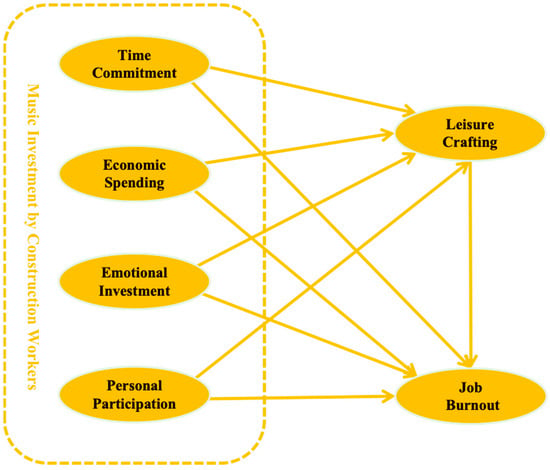
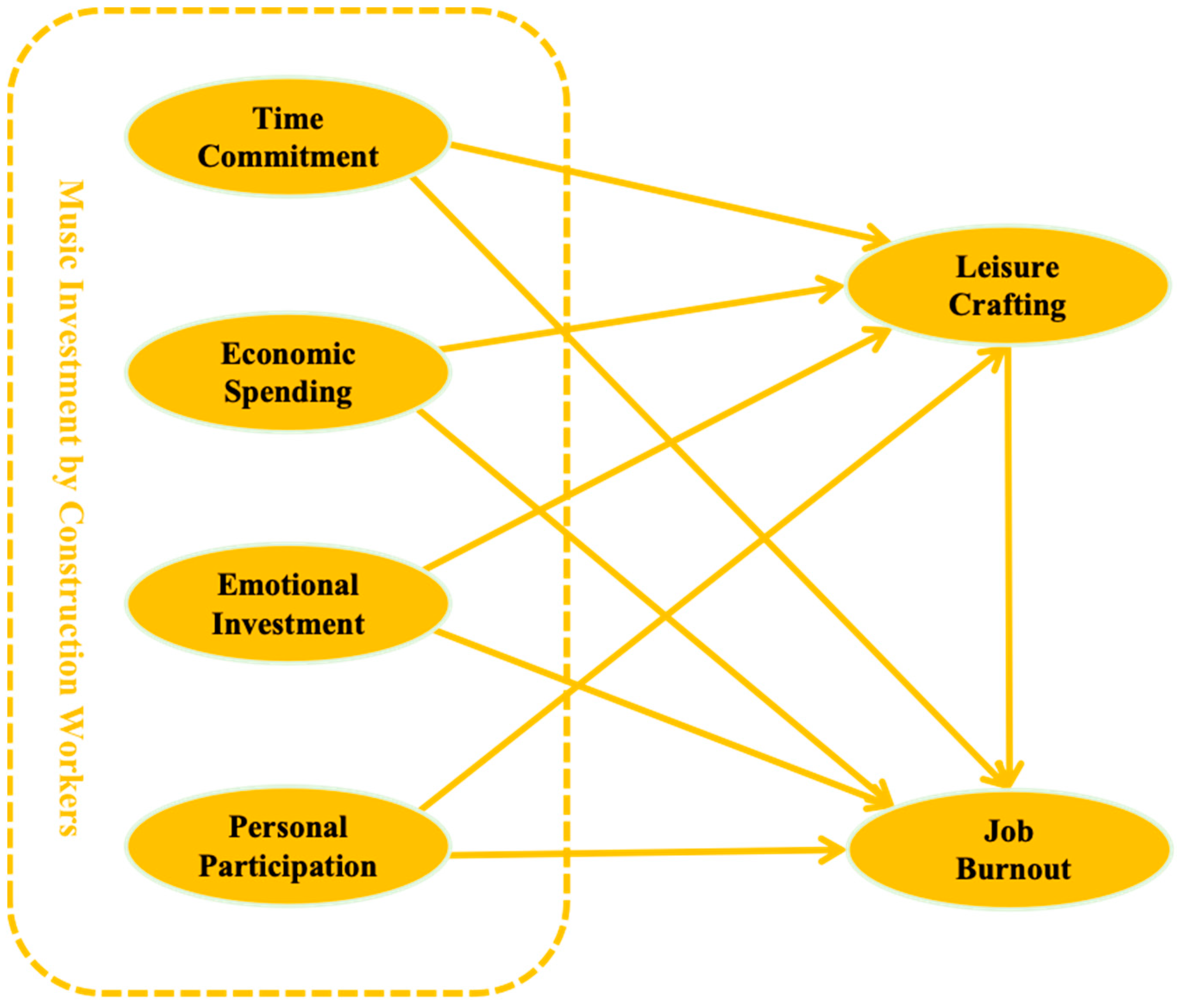
Based on this, the following hypotheses are proposed (Figure 1):
Figure 1.
Diagram of the hypothetical model.
H2a:
Leisure Crafting mediates the effect of time commitment in music engagement on Job Burnout
H2b:
Leisure Crafting mediates the effect of economic spending in music engagement on Job Burnout
H2c:
Leisure Crafting mediates the effect of emotional investment in music engagement on Job Burnout
H2d:
Leisure Crafting mediates the effect of personal participation in music engagement on Job Burnout
3. Research Design
3.1. Data Collection
This study conducted empirical research at 22 large construction sites across eight Chinese cities, including Beijing, Nanjing, and Shanghai. The research subjects were frontline construction workers directly involved in construction operations, strictly excluding management personnel, technical staff, and logistical support personnel. Questionnaires were distributed through a combination of random on-site intercepts and centralized completion during crew break periods to ensure sample representativeness and data authenticity, avoiding potential biases that might arise from centralized distribution by management. A total of 1150 questionnaires were distributed, with 1108 returned, yielding a response rate of 96.3%. Following this, invalid questionnaires were further excluded based on duplicate submissions, obvious logical inconsistencies in responses, or missing values exceeding 70% of total items. This resulted in 1086 valid questionnaires, representing an effective response rate of 97.9%. Detailed demographic information is presented in Table 1.
Table 1.
Descriptive analysis table.
Following data cleaning, descriptive statistics were performed on the demographic characteristics of the 1086 valid respondents, as detailed in Table 1. The sample is predominantly male (71.09%), which aligns with the gender distribution typical of the frontline construction workforce in China. In terms of age, the largest cohort is workers aged 36 to 45 (48.99%), indicating that the sample is composed mainly of experienced, middle-aged workers. Furthermore, a significant majority of the workers are married (70.17%), and a large portion hail from rural areas (42.17%), followed by suburbs (30.57%). This demographic profile is consistent with the well-documented phenomenon of migrant workers in China’s construction industry, who often leave their rural families to seek work in urban areas. Regarding job categories, the sample is relatively evenly distributed among Primary Trades (40.98%), Decorative Trades (30.02%), and Equipment Installation (29.01%), suggesting a diverse representation of core construction trades. This comprehensive demographic overview confirms that our sample effectively captures the key characteristics of the target population, thereby enhancing the generalizability of the study’s findings.
3.2. Variable Measurement
All concepts in this study were measured using a five-point Likert scale. The process of developing the scale is described below.
Time commitment (TC), economic expenditure (ES), emotional investment (EI) and personal involvement (PI) were measured using a 12-item scale adapted from the research of Aghanamani et al. [48], Zarmpou et al. [49], Sweeney et al. [50] and Lee et al. [51] to correspond to the characteristics of the construction worker population. Here are some examples of items: “I am willing to spend time listening to music or acquiring musical skills” (TS), “I am willing to spend money on buying musical instruments or taking music lessons” (ES), “Music brings me joy and relieves stress” (EI), “I enjoy sharing and discussing my musical experiences with others” (PP).
Leisure composition (LC) was measured using a four-item scale adapted from Petrou et al. [38]. The items were revised to align them with the research context and participant characteristics. Here is an example item: “I proactively schedule time for musical activities to help me relax and recharge my energy.”
Burnout (JB) was assessed using three scales based on Maslach’s classic study [52], with significant reference to the scale developed by Hou et al. [53] for construction workers. Here is an example item: “I often feel physically and mentally exhausted at work”.
Cronbach’s alpha coefficients for each scale were as follows: 0.795 (TC), 0.801 (ES), 0.827 (EI), 0.833 (PP), 0.907 (LC) and 0.942 (JB). All exceeded the threshold of 0.7, indicating good reliability. The complete scales are presented in Appendix A.
3.3. Data Analysis Strategy
This study used covariance-based structural equation modeling (CB-SEM) to test hypotheses and analyze complex relationships between latent variables. Data analysis was performed on the 1086 valid samples, using the following procedure: first, reliability analysis, exploratory factor analysis, and common method bias tests were performed using SPSS 23.0 software to assess data quality and the basic psychometric properties of the scales. Next, AMOS 26.0 software was used for confirmatory factor analysis, rigorously examining the convergent and discriminant validity of the measurement model through composite reliability, average variance extracted, and Fornell–Larcker criteria. After confirming the good quality of the measurement model, the structural model was fitted using the maximum likelihood estimation method, and the model-data fit was assessed using multiple fit indices, while direct effect hypotheses were tested. Finally, to examine the mediating role of leisure crafting, the Bootstrap sampling method was employed with 5000 resamples to calculate bias-corrected 95% confidence intervals to verify the significance of the mediating effects.
4. Data
4.1. Common Method Bias
This study employed Harman’s single-factor test to assess the severity of common method bias. An unrotated principal component analysis was conducted on all measurement items. As shown in Table 2, the results indicate that the first principal component (factor) accounted for 14.446% of the variance, which is well below the critical threshold of 40%. Furthermore, the cumulative variance explained by the first six factors (corresponding to the six latent variables in the theoretical model) was 71.061%. These results demonstrate that no single factor accounted for the majority of the variance, indicating that serious common method bias was not a concern in this study.
Table 2.
Total variance explained.
4.2. Exploratory Factor Analysis
In order to explore the latent structure of the measurement scale factors and optimize the measurement model, we first performed an exploratory factor analysis (EFA) on the entire data set (N = 1086). Principal component analysis (PCA) was used as the factor extraction method because of its significant advantages in terms of data simplification and identification of primary factor solutions. Based on theoretical expectations that the different dimensional factors should be independent, Varimax orthogonal rotation was applied to obtain a more concise and interpretable factor structure.
Exploratory factor analysis was performed using SPSS 23.0 software. The Kaiser–Meyer–Olkin (KMO) measure and Bartlett’s sphericity test were applied to the scale. The results (Table 3) indicate a KMO value of 0.855 (above the threshold of 0.7) and a significant Bartlett’s sphericity test (p < 0.001), confirming the suitability of the data for factor analysis. Principal component analysis was then used to extract the factors, using eigenvalues greater than 1 as the criterion, followed by Varimax rotation. As shown in Table 2, six factors were ultimately extracted, cumulatively explaining 70.061% of the variance, which exceeds the recommended threshold of 50% and indicates that these factors are representative. As illustrated in Table 4, all measurement items had factor loadings greater than 0.5, cross-loadings less than 0.4, and each item loaded on the expected factor as expected, demonstrating strong conceptual validity.
Table 3.
KMO analysis table.
Table 4.
Rotated component matrix.
4.3. Confirmatory Factor Analysis
Following the exploratory factor analysis, a confirmatory factor analysis (CFA) was performed using AMOS 26.0 on the same complete data set (N = 1086). CFA aims to rigorously test and confirm the factor structure proposed by exploratory factor analysis and the theoretical framework, while formally validating the overall adequacy of the measurement model. This sequential approach, which consists of first exploring and optimizing using exploratory factor analysis, then validating using confirmatory factor analysis on a sufficiently large sample, is recognized as a comprehensive method of scale validation. The excellent model fit indices robustly demonstrate the validity of the confirmatory model.
This study included 19 measurement items divided into six categories of variables. The results of the confirmatory factor analysis performed using AMOS 26.0 software are presented in Table 5. All measurement items had inter-variable standardized factor loadings greater than 0.6, composite reliability (CR) greater than 0.7, and average extracted variance (AVE) values greater than 0.5, indicating robust convergent validity for all variables. Distinctive validity was assessed using the rigorous AVE method [54]. For a factor to demonstrate distinctive validity, its AVE must exceed its correlation coefficients with all other factors. As the AVEs of all factors exceeded their standardized off-diagonal correlations, distinctive validity was maintained. The results of the discriminant validity assessment are presented in Table 6. The square roots of the AVE (diagonal values) for each construct were greater than their associations with other constructs (non-diagonal values), confirming discriminant validity between latent variables. It should be noted that, although all constructs possess discriminant validity, several moderate associations remain (e.g., r = −0.564 between creative leisure and burnout). These correlations are theoretically plausible. For example, the negative correlation between creative leisure and burnout is consistent with our hypothesis that active participation in leisure activities mitigates burnout. Similarly, the positive correlations between the four dimensions of musical participation indicate that they are related but distinct components within a broader concept. These results confirm that our measurement model has both discriminant validity and convergent validity.
Table 5.
Results of confirmatory factor analysis.
Table 6.
Distinction validity and correlation analysis.
This measurement model comprises 19 items across 6 variables, analyzed using Amos 26.0. The results indicate robust convergent validity: all standardized factor loadings exceed 0.6, composite reliability (CR) values exceed 0.7, and average variance extracted (AVE) exceeds 0.5. For example, AWS had a CR value of 0.801 and an EVR of 0.552; PA’s CR was 0.908 with an EVR of 0.711. Discriminant validity was verified using the EVR method, as the square root of each factor’s EVR exceeded its correlation coefficient with all other factors. For example, the square root of the AVE for social work satisfaction (SIWS) (0.718) exceeded its correlation coefficient with administrative work satisfaction (AWS) (0.305).
4.4. Structural Equation Modeling Analysis
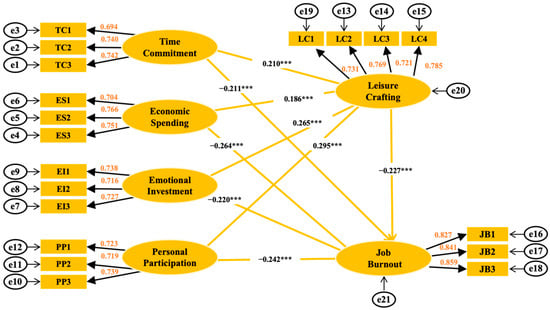
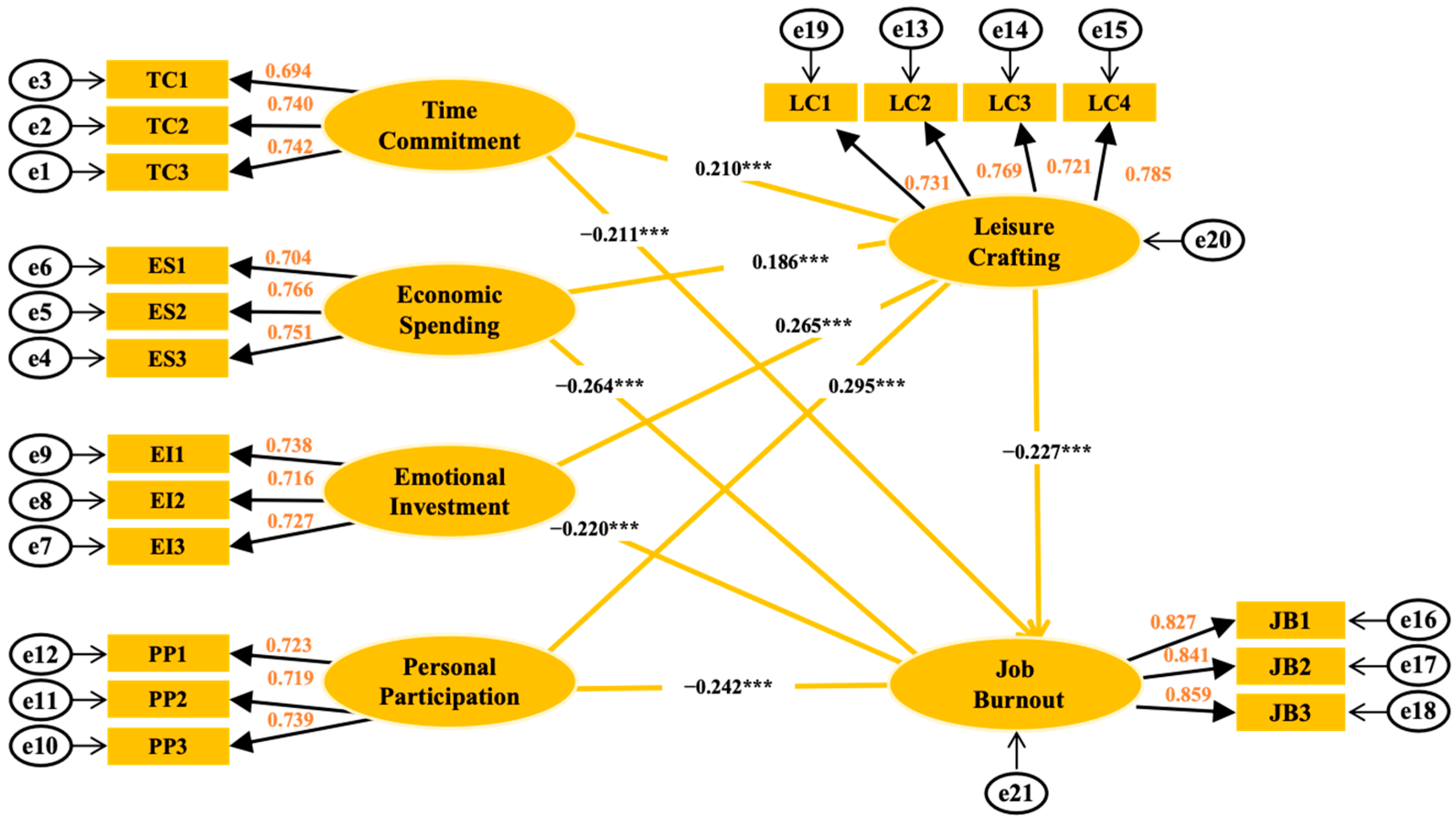
Computations were performed using AMOS 26.0 with maximum likelihood estimation, yielding results as shown in Figure 2. Regarding the fit indices (Table 7), CMIN/DF was 1.212, below the standard of 3. GFI, AGFI, NFI, TLI, IFI, and CFI all met the standard of exceeding 0.9. RMR was 0.020 < 0.08, and RMSEA was 0.025 < 0.08. All fit indices meet general research standards, indicating that this model demonstrates good fit.
Figure 2.
Revised Structural Equation Model Diagram. Note: *** p < 0.001.
Table 7.
Model fit table.
Table 8 presents the path coefficient results for the structural equation model, comprising 9 paths. The Z-values for the unstandardized coefficients of all paths are substantial (e.g., Z = 5.941 for LC ← TC and Z = −6.094 for JB ← LC), with p-values all below 0.001 (***), indicating that all paths are statistically significant. Regarding standardized coefficients: —LC ← TC: 0.210—LC ← ES: 0.186—LC ← EI: 0.265—LC ← PP: 0.295 This indicates that TC, ES, EI, and PP all positively predict LC. Among these, PP exerts the strongest positive influence on LC, while ES exerts the weakest. The standardized coefficients for JB ← LC, JB ← TC, JB ← ES, and JB ← EI were −0.227, −0.211, −0.264, and −0.220, respectively. JB ← PP is −0.242, indicating that LC, TC, ES, EI, and PP all have negative predictive effects on JB, with ES having the strongest negative impact on JB and TC having the weakest negative impact. This provides a basis for clarifying the direction and strength of the relationships between variables.
Table 8.
Path coefficient table.
4.5. Intermediate Inspection
This study employed the Bootstrapping method to validate the mediating effect. If the Bootstrap confidence interval does not include zero, the corresponding mediating effect is present. Using the Bootstrap method in AMOS 26.0 with 5000 iterations, Bias-Corrected and Percentile values were obtained at a 95% confidence level, as shown in Table 9.
Table 9.
Intermediate inspection results form.
To provide a more comprehensive understanding of the mediation mechanisms, we further calculated the ratio of the mediation effect to the total effect for each path. This ratio represents the proportion of the total effect that is transmitted through the mediator.
The mediation effect analysis table indicates that TC, ES, EI, and PP not only directly influence JB but also indirectly affect JB through the mediating variable LC. All Bootstrap confidence intervals exclude zero, confirming the statistical significance of these mediation effects. The proportion of mediation effects ranges from 30.59% to 35.43% of the total effects, specifically: 31.36% for TC, 30.59% for ES, 34.20% for EI, and 35.43% for PP. All mediation effects are valid and classified as partial mediation. Each mediation effect accounts for a certain proportion of the total effect, demonstrating that LC plays a mediating role in these relationships.
5. Discussion
5.1. Direct Effects
The findings of this study indicate that time commitment, economic spending, emotional investment, and personal participation in musical activities all exert a significant negative influence on job burnout among construction workers. This discovery provides new evidence for exploring how non-physical leisure activities alleviate psychological burdens in high-stress occupational groups, thereby expanding existing research in the fields of job burnout and leisure recovery. Previous studies on construction workers have predominantly focused on physical exercise or safety management [12], with relatively limited research on cultural leisure activities such as music. The findings of this study indicate that music, as a low-barrier, sustainable leisure activity, plays a significant role in alleviating burnout and promoting psychological recovery.
First, in terms of time investment, the study found that workers who regularly engage in musical activities effectively alleviate fatigue after work and reduce feelings of burnout. According to restorative experiences theory, quality leisure activities after work facilitate psychological detachment and emotional recovery, thereby reducing the accumulation of work-related stress [42]. Recent longitudinal studies confirm this mechanism, revealing a strong correlation between the regular allocation of free time and reduced levels of burnout [55]. However, without structured time allocation, simply increasing the amount of leisure time may not have restorative effects [56]. This indicates that managers should prioritize quality over quantity of free time. Secondly, economic investment also has a significant negative effect. Employees’ willingness to pay for music-related activities (such as purchasing instruments or enrolling in lessons) reflects their recognition of the value and psychological attachment to these activities. According to psychological investment theory, the more material resources an individual devotes to an activity, the higher their emotional dependence and satisfaction [57]. Compared to material consumption, experiential consumption more effectively improves individuals’ long-term happiness and life satisfaction [58]. These findings indicate that music-related spending is not only an investment in personal interests but also serves to alleviate work-related stress by improving mood and enhancing feelings of usefulness. However, when workers face financial strain, excessive spending may paradoxically become a new source of stress, a factor that warrants attention when promoting music interventions. Regarding emotional investment, music’s unique role in emotional regulation has been extensively validated. It modulates the brain’s reward system, reduces stress hormone levels, and promotes the generation of positive emotions [59]. Foreign scholars have further proposed that artistic activities can assist individuals in coping with negative emotions and alleviating psychological exhaustion through emotion regulation strategies such as cognitive reappraisal and emotional expression [60]. Therefore, emotional investment must be maintained at a moderate level to maximize its mitigating effects. Finally, personal participation exerts a significant influence on job burnout through social support and self-actualization mechanisms. Research indicates that participation in group music activities can substantially reduce anxiety and depression levels while fostering social connectedness, thereby indirectly alleviating job burnout [61]. Among construction workers—a high-stress group—social networks are particularly vital. Music activities provide a safe, non-work-related social space that helps enhance workers’ psychological resilience.
In summary, this study not only validates the multidimensional role of musical engagement in alleviating job burnout but also underscores the importance of engagement quality. However, it should be noted that this cross-sectional design precludes establishing causality. Future research may employ longitudinal tracking or experimental interventions to further examine the applicability of musical engagement across diverse cultural and organizational contexts.
5.2. Mediating Effects
This study systematically examined the underlying mechanisms of leisure crafting in the relationship between music engagement and job burnout through mediation analysis. Results indicate that leisure crafting exerts significant mediating effects across four dimensions: time commitment, economic spending, emotional investment, and personal participation. This finding reveals that the alleviation of job burnout through music engagement is not a simple direct effect, but rather a complex process dependent on individuals’ proactive planning and optimization of leisure experiences.
In terms of time commitment, this study found that while duration plays a fundamental role in alleviating burnout, its restorative benefits are highly dependent on the moderating effect of leisure crafting. If workers merely passively kill time without engaging in meaningful leisure planning, the restorative effect is significantly diminished—meaning the “quality” of leisure time is more crucial than its “quantity” [62]. Construction workers significantly enhanced the psychological restorative effects of time commitment by proactively designing periods for music listening, practice, or appreciation, demonstrating that Leisure Crafting is a key cognitive–behavioral strategy for achieving “high-efficiency recovery.” The economic spending dimension reveals a more complex mechanism. Simple monetary investment does not guarantee psychological benefits; its effectiveness depends on whether spending is directed toward experiential, social, and personally meaningful music activities. Research by Van Boven and colleagues indicates that without participation in Leisure Crafting, economic spending may become ineffective consumption. For construction worker groups with limited economic means, financial pressures could even lead to negative emotions [58]. Therefore, only music activities that effectively channel economic resources to foster psychological engagement and social interaction can successfully stimulate positive emotions and alleviate job burnout. Regarding Emotional Investment, while music inherently possesses the potential to evoke emotions, high-intensity emotional engagement may lead to emotional fatigue without goal-oriented guidance and strategic adjustments. This finding aligns with Fancourt’s research, emphasizing that workers require leisure-based Leisure Crafting to achieve cognitive reappraisal and emotional release [60]. Regarding personal participation, workers actively seek out music-based social interactions through leisure activities to Leisure Craft their sense of belonging and strengthen social support networks. This effectively buffers the negative effects of work stress. Specifically, collective music activities enhance group identity and provide emotional support, thereby promoting the restoration of individual psychological resources [63]. It is worth noting that workers of different ages and social preferences may benefit from differentiated participation patterns, indicating that Leisure Crafting also requires matching individual and environmental characteristics.
In summary, leisure crafting plays a crucial mediating role between music engagement and job burnout. Its essence lies in the active process by which construction workers transform general leisure resources into highly effective restorative experiences. This conclusion not only expands the explanatory scope of leisure recovery theory within high-stress occupational groups but also provides crucial directions for practical interventions: Beyond offering leisure opportunities, enterprises should enhance workers’ leisure Crafting capabilities through systematic training and psychological support, thereby maximizing the psychological recovery benefits of leisure activities like music. Future research should further focus on specific behavioral strategies for leisure Crafting and explore their applicability across diverse cultural contexts to advance the development of more precise and effective mental health interventions.
5.3. Practical Implications
The findings of this study offer several actionable implications for mitigating job burnout among construction workers. First, organizations and project managers can integrate structured music activities into the daily routine. For instance, setting up designated “music relaxation zones” in site offices or dormitories provides workers with accessible spaces for stress relief. Second, considering workers’ fragmented schedules, companies can leverage technology by developing or subscribing to mobile applications that offer curated music content or short, guided music-listening sessions designed to fit within short break periods. This approach directly addresses the challenges of scattered work locations and limited time. Furthermore, based on the significant role of Leisure Crafting, companies should not only provide resources but also empower workers through workshops or informational leaflets that educate them on how to proactively and effectively engage with music to maximize psychological recovery. Implementing these low-cost, high-accessibility strategies can significantly contribute to workers’ mental well-being, potentially leading to enhanced job satisfaction, reduced safety incidents caused by fatigue, and improved overall productivity on construction sites.
6. Conclusions
This study provides a systematic examination of the relationship between music engagement, Leisure Crafting, and Job Burnout within the context of construction workers, a population characterized by high occupational stress. It validated the mitigating effects of four dimensions of music engagement—time commitment, economic spending, emotional investment, and personal participation—on job burnout. Findings indicate that music, as a leisure activity, provides construction workers with multifaceted resources—including emotional regulation, psychological restoration, and social connection—playing a significant role in alleviating work stress and reducing emotional exhaustion. Crucially, the study reveals that leisure crafting serves as a core mediating factor between music engagement and job burnout. Construction workers can only transform fragmented time, financial, and emotional investments into high-quality psychological recovery experiences by actively planning and optimizing music activities, thereby effectively reducing job burnout levels. This finding not only enriches the application of leisure recovery theory among high-stress manual labor groups but also provides new theoretical support and practical directions for mental health management in the construction industry. The findings suggest that enterprises and managers should prioritize workers’ leisure needs by designing targeted interventions. These include providing diverse music resources, creating dedicated spaces for musical activities, and training workers in leisure Crafting skills. Such measures will foster the accumulation and restoration of psychological resources among workers, ultimately contributing to the sustainable development of the construction industry.
7. Limitations and Future Work
This study examines the relationship between music engagement, leisure crafting, and job burnout among construction workers, revealing the mechanism by which music—as a typical leisure activity—alleviates job burnout in this workforce. However, certain limitations exist that warrant further refinement in future research.
Regarding the sample, the data primarily originated from select major cities and large-scale construction projects. Despite efforts to ensure diversity during sampling, limitations such as geographical concentration and a single industry type persist. Construction workers are widely dispersed across cities and construction sites of varying scales, where organizational management levels, labor intensity, and cultural environments differ significantly. These variations may influence the effects of music engagement and Leisure Crafting. Therefore, future research should collect data across broader geographic regions and multi-tiered construction projects to enhance the generalizability and external validity of findings.
Regarding research design, this study employed cross-sectional survey data for statistical analysis, which reveals correlations between variables but cannot rigorously validate causal chains. Although structural equation modeling preliminarily confirmed the pathway “musical engagement → leisure crafting → job burnout,” this design remains susceptible to reverse causality or potential confounding variables. For instance, workers with higher burnout levels may reduce their engagement in music activities, potentially leading to underestimation or misinterpretation of causal relationships. Future research could consider longitudinal tracking designs or intervention experiments. Dynamic analysis of data across different time points or comparisons between experimental and control groups could more clearly identify causal mechanisms.
In terms of research content, this study primarily focuses on music as a single type of leisure activity. Although music has demonstrated significant emotional regulation and psychological recovery functions, construction workers engage in diverse leisure activities—such as physical exercise, family gatherings, or religious activities—which may also alleviate job burnout through similar mechanisms. Incorporating different leisure activities into a unified research framework and comparing their relative strengths in promoting psychological recovery would enhance our comprehensive understanding of leisure activities’ integrated role in advancing workers’ mental health, providing scientific grounds for developing diversified corporate welfare policies.
Furthermore, while this study model incorporates basic demographic variables such as gender, age, marital status, registered residence, and job type, it does not delve into the moderating effects of these individual differences within the causal pathways. Workers with diverse characteristics may display considerable differences in their patterns of music participation, their capacity for Leisure Crafting, and their psychological recovery needs. These variations can, in turn, shape the relationships among the variables in the model. Future research could also explore different approaches to music engagement, such as comparing the effects of active participation (e.g., singing, playing instruments) versus passive listening, and attempt to capture or quantify the associated emotional experiences through physiological measures or experience sampling methods. Accounting for such differential factors in future analyses may uncover distinct mechanisms through which music engagement contributes to the alleviation of Job Burnout across worker subgroups. Such insights would provide valuable guidance for enterprises in designing more precise and targeted psychological intervention strategies.
Finally, although this study confirms the beneficial roles of music engagement and Leisure Crafting in reducing Job Burnout among construction workers, it does not provide specific guidelines for practical implementation. Current research remains largely theoretical, lacking pathways to translate findings into practical interventions. The current practical suggestions are relatively vague and fail to consider the characteristics of construction workers—such as scattered work locations, fragmented break time, and limited construction site conditions. Future research could conduct music intervention experiments at construction sites, such as establishing music relaxation zones, organizing group music activities during break periods, or providing personalized music therapy through mobile applications that account for workers’ fragmented schedules. Effectiveness evaluations would then assess the practical value of these interventions. This approach would not only enhance the practicality of theoretical research but also offer actionable references for mental health management in the construction industry.
Author Contributions
Conceptualization, S.L., S.W. and H.Y.; Software, S.L., S.W. and K.N.; Validation, S.W.; Investigation, S.L. and H.Y.; Resources, S.W., H.Y. and K.N.; Data curation, S.L. and K.N.; Writing—original draft, S.L., S.W., H.Y. and K.N.; Visualization, S.L., S.W., H.Y. and K.N. All authors have read and agreed to the published version of the manuscript.
Funding
This research received no external funding.
Institutional Review Board Statement
Ethical review and approval were waived for this study, as the research is of an investigative nature and does not involve any form of intervention in the participants. All data collection is based on publicly available or anonymizable information and does not involve sensitive personal information or commercial interests. In accordance with the “Measures for Ethical Review of Life Science and Medical Research Involving Human Beings” (Article 32, Chapter iii) (https://www.gov.cn/zhengce/zhengceku/2023-02/28content_5743658.htm, accessed on 16 May 2025).
Informed Consent Statement
Informed consent was obtained from all subjects involved in the study.
Data Availability Statement
The original contributions presented in the study are included in the article, further inquiries can be directed to the corresponding author.
Conflicts of Interest
The authors declare no conflict of interest.
Appendix A. Survey Questionnaire
| Survey Questionnaire on Construction Workers’ Music Engagement, Leisure Shaping, and Work Burnout | |||||||
| Category | Measurement Items | 1 | 2 | 3 | 4 | 5 | |
| Time Commitment | TC1 | I am willing to dedicate time specifically to listening to music or learning music-related skills. | ◎ | ◎ | ◎ | ◎ | ◎ |
| TC2 | I often use my free time to engage in music-related activities. | ◎ | ◎ | ◎ | ◎ | ◎ | |
| TC3 | Music occupies a fixed time in my daily life. | ◎ | ◎ | ◎ | ◎ | ◎ | |
| Economic Spending | ES1 | I am willing to spend money on purchasing musical instruments, music equipment, or accessories. | ◎ | ◎ | ◎ | ◎ | ◎ |
| ES2 | I am willing to pay for activities such as music lessons, training, or attending musical performances. | ◎ | ◎ | ◎ | ◎ | ◎ | |
| ES3 | I am willing to pay for music streaming memberships. | ◎ | ◎ | ◎ | ◎ | ◎ | |
| Emotional Investment | EI1 | Music brings me joy and helps me relieve stress. | ◎ | ◎ | ◎ | ◎ | ◎ |
| EI2 | I have a deep affection for music; it is an important way for me to express my emotions. | ◎ | ◎ | ◎ | ◎ | ◎ | |
| EI3 | When I’m feeling down, music makes me feel better. | ◎ | ◎ | ◎ | ◎ | ◎ | |
| Personal Participation | PP1 | I enjoy sharing and discussing musical experiences with others. | ◎ | ◎ | ◎ | ◎ | ◎ |
| PP2 | I actively search for and discover new music or artists. | ◎ | ◎ | ◎ | ◎ | ◎ | |
| PP3 | Participating in musical activities is part of my personal interests and identity. | ◎ | ◎ | ◎ | ◎ | ◎ | |
| Leisure Crafting | LC1 | I will proactively schedule appropriate times to participate in musical activities to help myself relax and recharge. | ◎ | ◎ | ◎ | ◎ | ◎ |
| LC2 | I will choose the form of musical activity that best suits my personal interests and needs. | ◎ | ◎ | ◎ | ◎ | ◎ | |
| LC3 | I make new friends or enhance my social connections through music activities. | ◎ | ◎ | ◎ | ◎ | ◎ | |
| LC4 | I will set goals for learning or participating in music to gain a greater sense of accomplishment. | ◎ | ◎ | ◎ | ◎ | ◎ | |
| Job Burnout | JB1 | After a day’s work, I often feel physically and mentally exhausted. | ◎ | ◎ | ◎ | ◎ | ◎ |
| JB2 | My enthusiasm for work has waned compared to before. | ◎ | ◎ | ◎ | ◎ | ◎ | |
| JB3 | I doubt the meaning and value of my work. | ◎ | ◎ | ◎ | ◎ | ◎ | |
| (1: strongly disagree, 2: disagree, 3: neither agree nor disagree, 4: agree and 5: strongly agree) | |||||||
References
- Spence, R.; Mulligan, H. Sustainable development and the construction industry. Habitat Int. 1995, 19, 279–292. [Google Scholar] [CrossRef] [Scilit]
- Feng, W.; Li, Y.; Chen, S. What has influenced the growth and structural transformation of China’s cultural industry?—Based on the input-output bias analysis. Appl. Econ. 2025, 1–14. [Google Scholar] [CrossRef] [Scilit]
- Zhang, Z.; Xiang, T.; Guo, H.; Ma, L.; Guan, Z.; Fang, Y. Impact of physical and mental fatigue on construction workers’ unsafe behavior based on physiological measurement. J. Saf. Res. 2023, 85, 457–468. [Google Scholar] [CrossRef] [Scilit]
- Karthick, S.; Pamidimukkala, A.; Kermanshachi, S.; Loganathan, K. Assessment of the impact of hot weather conditions on the respiratory health, level of fatigue, and injuries of construction workforce. Archit. Struct. Constr. 2024, 4, 135–143. [Google Scholar] [CrossRef] [Scilit]
- Jeong, S.; Lee, B.H. The moderating effect of work-related musculoskeletal disorders in relation to occupational stress and health-related quality of life of construction workers: A cross-sectional research. BMC Musculoskelet. Disord. 2024, 25, 147. [Google Scholar] [CrossRef] [Scilit]
- Heng, P.P.; Yusoff, H.M.; Hod, R. Individual evaluation of fatigue at work to enhance the safety performance in the construction industry: A systematic review. PLoS ONE 2024, 19, e0287892. [Google Scholar] [CrossRef] [Scilit]
- Taherpour, F.; Kashmiri, D.; Namian, M.; Ghiasvand, E. Safety performance of a fatigued construction worker. In Construction Research Congress; Reston, V.A., Ed.; American Society of Civil Engineers: Reston, VA, USA, 2020; pp. 591–598. [Google Scholar]
- Ouyang, Y.; Luo, X. Effects of physical fatigue on construction workers’ visual search patterns during hazard identification. J. Constr. Eng. Manag. 2024, 150, 04024120. [Google Scholar] [CrossRef] [Scilit]
- Wang, S.; Yu, J.; Yang, W.; Yan, W.; Nah, K. The Impact of Role-Playing Game Experience on the Sustainable Development of Ancient Architectural Cultural Heritage Tourism: A Mediation Modeling Study Based on SOR Theory. Buildings 2025, 15, 2032. [Google Scholar] [CrossRef] [Scilit]
- Chen, S.; Chen, X.; Bao, Q.; Zhang, H.; Wong, C.U.I. Adaptive Multi-Agent Reinforcement Learning with Graph Neural Networks for Dynamic Optimization in Sports Buildings. Buildings 2025, 15, 2554. [Google Scholar] [CrossRef] [Scilit]
- Namian, M.; Taherpour, F.; Ghiasvand, E.; Turkan, Y. Insidious safety threat of fatigue: Investigating construction workers’ risk of accident due to fatigue. J. Constr. Eng. Manag. 2021, 147, 04021162. [Google Scholar] [CrossRef] [Scilit]
- Lingard, H.; Turner, M. Improving the health of male, blue collar construction workers: A social ecological perspective. Constr. Manag. Econ. 2015, 33, 18–34. [Google Scholar] [CrossRef] [Scilit]
- Tsaur, S.H.; Yen, C.H.; Yang, M.C.; Yen, H.H. Leisure crafting: Scale development and validation. Leis. Sci. 2023, 45, 71–91. [Google Scholar] [CrossRef] [Scilit]
- Maslach, C.; Schaufeli, W.B.; Leiter, M.P. Job burnout. Annu. Rev. Psychol. 2001, 52, 397–422. [Google Scholar] [CrossRef] [Scilit]
- Maslach, C. Job burnout: New directions in research and intervention. Curr. Dir. Psychol. Sci. 2003, 12, 189–192. [Google Scholar] [CrossRef] [Scilit]
- Lubbadeh, T. Job burnout: A general literature review. Int. Rev. Manag. Mark. 2020, 10, 7. [Google Scholar] [CrossRef] [Scilit]
- Mason, S.; Merga, M.K.; Morris, J.E. Typical scope of time commitment and research outputs of thesis by publication in Australia. High. Educ. Res. Dev. 2020, 39, 244–258. [Google Scholar] [CrossRef] [Scilit]
- Zuzanek, J. Leisure and time. In A Handbook of Leisure Studies; Rojek, C., Shaw, S.M., Veal, A.J., Eds.; Palgrave Macmillan: London, UK, 2006; pp. 185–202. [Google Scholar]
- Codina, N.; Pestana, J.V. Two sides of time in the leisure experience of youth: Time commitment and time perspectives. Loisir Soc./Soc. Leis. 2017, 40, 310–323. [Google Scholar] [CrossRef] [Scilit]
- Baker, L.A.; Cahalin, L.P.; Gerst, K.; Burr, J.A. Productive activities and subjective well-being among older adults: The influence of number of activities and time commitment. Soc. Indic. Res. 2005, 73, 431–458. [Google Scholar] [CrossRef] [Scilit]
- Becker, G.S. A Theory of the Allocation of Time. Econ. J. 1965, 75, 493–517. [Google Scholar] [CrossRef] [Scilit]
- Lee, R.L.; Chien, W.T.; Ligot, J.; Nailes, J.M.; Tanida, K.; Takeuchi, S.; Ikeda, M.; Miyagawa, S.; Nagai, T.; Phuphaibul, R.; et al. Associations between quality of life, psychosocial well-being and health-related behaviors among adolescents in Chinese, Japanese, Taiwanese, Thai and the Filipino populations: A cross-sectional survey. Int. J. Environ. Res. Public Health 2020, 17, 2402. [Google Scholar] [CrossRef] [Scilit]
- Mellander, C.; Florida, R.; Rentfrow, P.J.; Potter, J. The geography of music preferences. J. Cult. Econ. 2018, 42, 593–618. [Google Scholar] [CrossRef] [Scilit]
- O’Hagan, J.; Neligan, A. State subsidies and repertoire conventionality in the non-profit English theatre sector: An econometric analysis. J. Cult. Econ. 2005, 29, 35–57. [Google Scholar] [CrossRef] [Scilit]
- Krueger, A.B. Rockonomics: A Backstage Tour of What the Music Industry Can Teach Us About Economics and Life; Crown Currency: London, UK, 2019. [Google Scholar]
- Bergstrom 2019, J.C.; Cordell, H.K.; Ashley, G.A.; Watson, A.E. Economic impacts of recreational spending on rural areas: A case study. Econ. Dev. Q. 1990, 4, 29–39. [Google Scholar] [CrossRef] [Scilit]
- Saavedra, R.; Van Dyne, L. Social exchange and Emotional investment in work groups. Motiv. Emot. 1999, 23, 105–123. [Google Scholar] [CrossRef] [Scilit]
- Zhang, W.; Fei, D. Differentiation in Emotional investments in work groups among different social status of construction industry practitioners: A perspective from the social exchange theory. Comput. Intell. Neurosci. 2022, 2022, 9306167. [Google Scholar] [CrossRef] [Scilit]
- Juslin, P.N.; Västfjäll, D. Emotional responses to music: The need to consider underlying mechanisms. Behav. Brain Sci. 2008, 31, 559–575. [Google Scholar] [CrossRef] [Scilit]
- Rentfrow, P.J.; Gosling, S.D. The do re mi’s of everyday life: The structure and personality correlates of music preferences. J. Personal. Soc. Psychol. 2003, 84, 1236. [Google Scholar] [CrossRef] [Scilit]
- Yang, H.; Wang, S.; Chen, X.; Zhang, H.; Wong, C.U.I. Does Participation in Group Music Activities and Pro-Social Behavior Among College Students Have an Association? A Study of the Interlocking Mediating Effects of Positive Social Connections and Peer Support. Behav. Sci. 2025, 15, 64. [Google Scholar] [CrossRef] [Scilit]
- Saarikallio, S. Music as emotional self-regulation throughout adulthood. Psychol. Music 2011, 39, 307–327. [Google Scholar] [CrossRef] [Scilit]
- Koehler, F.; Neubauer, A.B. From music making to affective well-being in everyday life: The mediating role of need satisfaction. Psychol. Aesthet. Creat. Arts 2020, 14, 493. [Google Scholar] [CrossRef] [Scilit]
- Dingle, G.A.; Sharman, L.S.; Bauer, Z.; Beckman, E.; Broughton, M.; Bunzli, E.; Davidson, R.; Draper, G.; Fairley, S.; Farrell, C.; et al. How do music activities affect health and well-being? A scoping review of studies examining psychosocial mechanisms. Front. Psychol. 2021, 12, 713818. [Google Scholar] [CrossRef] [Scilit]
- Gustavson, D.E.; Coleman, P.L.; Iversen, J.R.; Maes, H.H.; Gordon, R.L.; Lense, M.D. Mental health and music engagement: Review, framework, and guidelines for future studies. Transl. Psychiatry 2021, 11, 370. [Google Scholar] [CrossRef] [Scilit]
- Krause, A.E.; Davidson, J.W.; North, A.C. Musical activity and well-being: A new quantitative measurement instrument. Music Percept. Interdiscip. J. 2018, 35, 454–474. [Google Scholar] [CrossRef] [Scilit]
- McIntyre, N. The personal meaning of participation: Enduring involvement. J. Leis. Res. 1989, 21, 167–179. [Google Scholar] [CrossRef] [Scilit]
- Petrou, P.; Bakker, A.B. Crafting one’s leisure time in response to high job strain. Hum. Relat. 2016, 69, 507–529. [Google Scholar] [CrossRef] [Scilit]
- Tsaur, S.H.; Yen, C.H.; Chen, Y.T. Can leisure crafting enhance leisure engagement? The role of time structure and leisure type. Leis. Stud. 2021, 40, 747–763. [Google Scholar] [CrossRef] [Scilit]
- Fritz, C.; Sonnentag, S.; Spector, P.E.; McInroe, J.A. The weekend matters: Relationships between stress recovery and affective experiences. J. Organ. Behav. 2010, 31, 1137–1162. [Google Scholar] [CrossRef] [Scilit]
- Demerouti, E.; Bakker, A.B.; Nachreiner, F.; Schaufeli, W.B. The job demands-resources model of burnout. J. Appl. Psychol. 2001, 86, 499. [Google Scholar] [CrossRef]
- Sonnentag, S.; Fritz, C. The Recovery Experience Questionnaire: Development and validation of a measure for assessing recuperation and unwinding from work. J. Occup. Health Psychol. 2007, 12, 204. [Google Scholar] [CrossRef] [Scilit]
- Newman, D.B.; Tay, L.; Diener, E. Leisure and subjective well-being: A model of psychological mechanisms as mediating factors. J. Happiness Stud. 2014, 15, 555–578. [Google Scholar] [CrossRef] [Scilit]
- Hobfoll, S.E. Conservation of resources: A new attempt at conceptualizing stress. Am. Psychol. 1989, 44, 513. [Google Scholar] [CrossRef]
- Sonnentag, S.; Fritz, C. Recovery from job stress: The stressor-detachment model as an integrative framework. J. Organ. Behav. 2015, 36 (Suppl. S1), S72–S103. [Google Scholar] [CrossRef] [Scilit]
- Chanda, M.L.; Levitin, D.J. The neurochemistry of music. Trends Cogn. Sci. 2013, 17, 179–193. [Google Scholar] [CrossRef] [Scilit]
- Fancourt, D.; Finn, S. What Is the Evidence on the Role of the Arts In improving Health and Well-Being? A Scoping Review. Available online: https://www.ncbi.nlm.nih.gov/books/NBK553775/ (accessed on 22 November 2025).
- Aghazamani, A. How do university students spend their time on Facebook? An exploratory study. J. Am. Sci. 2020, 6, 730–735. [Google Scholar]
- Zarmpou, T.; Saprikis, V.; Markos, A.; Vlachopoulou, M. Modeling users’ acceptance of mobile services. Electron. Commer. Res. 2012, 12, 225–248. [Google Scholar] [CrossRef] [Scilit]
- Sweeney, J.C.; Soutar, G.N. Consumer perceived value: The development of a multiple item scale. J. Retail. 2001, 77, 203–220. [Google Scholar] [CrossRef] [Scilit]
- Lee, C.Y.; Tsao, C.H.; Chang, W.C. The relationship between attitude toward using and customer satisfaction with mobile application services: An empirical study from the life insurance industry. J. Enterp. Inf. Manag. 2015, 28, 680–697. [Google Scholar] [CrossRef] [Scilit]
- Maslach, C.; Jackson, S.E. The measurement of experienced burnout. J. Organ. Behav. 1981, 2, 99–113. [Google Scholar] [CrossRef] [Scilit]
- Hou, Y.; Jiang, H.; Gao, Y.; Huang, Q.; Yang, L. Professional Sports Event Attendance and Construction Workers’ Job Burnout: The Mediating Role of Leisure Spillover. Buildings 2024, 14, 3251. [Google Scholar] [CrossRef] [Scilit]
- Fornell, C.; Larcker, D.F. Evaluating structural equation models with unobservable variables and measurement error. J. Mark. Res. 1981, 18, 39–50. [Google Scholar] [CrossRef] [Scilit]
- Steed, L.B.; Swider, B.W.; Keem, S.; Liu, J.T. Leaving work at work: A meta-analysis on employee recovery from work. J. Manag. 2021, 47, 867–897. [Google Scholar] [CrossRef] [Scilit]
- Kühnel, J.; Zacher, H.; De Bloom, J.; Bledow, R. Take a break! Benefits of sleep and short breaks for daily work engagement. Eur. J. Work Organ. Psychol. 2017, 26, 481–491. [Google Scholar] [CrossRef] [Scilit]
- Hobfoll, S.E.; Halbesleben, J.; Neveu, J.P.; Westman, M. Conservation of resources in the organizational context: The reality of resources and their consequences. Annu. Rev. Organ. Psychol. Organ. Behav. 2018, 5, 103–128. [Google Scholar] [CrossRef] [Scilit]
- Van Boven, L.; Gilovich, T. To do or to have? That is the question. J. Personal. Soc. Psychol. 2003, 85, 1193. [Google Scholar] [CrossRef] [Scilit]
- Wang, S.; Gong, J.; Li, X.; Peng, Y.; Du, C.; Nah, K. Integrated Office Applications Promote the Sustainable Development of E-Commerce Enterprises: A Study Based on the TPB-TAM-IS Success Model. J. Theor. Appl. Electron. Commer. Res. 2025, 20, 324. [Google Scholar] [CrossRef] [Scilit]
- Fancourt, D.; Garnett, C.; Spiro, N.; West, R.; Müllensiefen, D. How do artistic creative activities regulate our emotions? Validation of the Emotion Regulation Strategies for Artistic Creative Activities Scale (ERS-ACA). PLoS ONE 2019, 14, e0211362. [Google Scholar] [CrossRef] [Scilit]
- Daykin, N.; Mansfield, L.; Meads, C.; Julier, G.; Tomlinson, A.; Payne, A.; Duffy, L.G.; Lane, J.; D’Innocenzo, G.; Burnett, A.; et al. What works for wellbeing? A systematic review of wellbeing outcomes for music and singing in adults. Perspect. Public Health 2018, 138, 39–46. [Google Scholar] [CrossRef] [Scilit] [PubMed]
- Chen, S.; Zhang, Z.; Yan, S.; Chen, J. Enterprise Environmental Governance and Fluoride Consumption Management in the Global Sports Industry. Fluoride 2025, 58, 1. Available online: https://www.fluorideresearch.online/epub/files/306.pdf (accessed on 10 April 2025).
- Densley, B.; Andrews, K. How participation in group singing in the community impacts on emotional wellbeing: A qualitative study on the perspectives of group singing participants. Aust. J. Music Ther. 2021, 32, 39–56. [Google Scholar]

Disclaimer/Publisher’s Note: The statements, opinions and data contained in all publications are solely those of the individual author(s) and contributor(s) and not of MDPI and/or the editor(s). MDPI and/or the editor(s) disclaim responsibility for any injury to people or property resulting from any ideas, methods, instructions or products referred to in the content. |
© 2026 by the authors. Licensee MDPI, Basel, Switzerland. This article is an open access article distributed under the terms and conditions of the Creative Commons Attribution (CC BY) license.