


Abstract
Scarce global resources and reliance on non-renewable materials demand ecological, technology-integrated solutions. In Brazil, abundant wood resources remain underused in architectural education and practice. Introducing skills in curricula is essential for change and future adoption. This study developed a computational and digital fabrication methodology to rethink wood, exploring collaborative robotic assembly to build an embodied understanding of construction constraints. The Wood Innovation for Architecture in Brazil (WI-FAB) unites LAMO UFRJ and SDU CREATE robotics expertise and frames a pedagogical experiment in sustainable wood-structure design. The semester-long course tested whether the design framework could link computation, material behaviour, and assembly constraints as a pedagogical tool; the intensive workshop investigated how robotic assembly can enhance physical–digital workflows and inform future integration. The research-through-teaching methodology consisted of three phases: preliminary research, course testing, and a robotics workshop testing assembly workflows. Preliminary research developed a pedagogical framework comprising a kit of parts, joint types and string grammars tested within the semester-long course to support parametric rules and assembly sequencing. Participants assembled component “letters” that combined into “words” and then into “phrases”, developing computational and constructional understanding and converting parametric rules into tangible prototypes through iterative design-build-test cycles. Key outcomes include validation of parametric assembly rules through string grammars in the course; analysis of the robotics workshop applied four criteria (Assembly Movement; Component Geometry and Dimensions; Component Number and Slot Number; Complexity and Assembly Time) to evaluate assembly performance and workflow integration. Robotics stimulated physical–digital loops, accelerating design-to-assembly learning and informing full-scale developments. WI-FAB promotes reversible assembly, material reuse and circular-economy principles and contributes to the development of the forthcoming Sabiá parametric plugin for wooden joint design.
1. Introduction: WI-FAB Context
Global concerns about climate change, material scarcity, and the environmental impact of construction have intensified the search for low-impact, renewable alternatives within architectural practice. Wood, as a biogenic, renewable, and structurally reliable material, offers significant ecological potential; however, in Brazil—despite its abundance—it has been historically underrepresented in architectural education and marginalised in contemporary construction culture. This paradox positions wood simultaneously as a missed opportunity and a latent resource. Addressing this gap requires more than technological access: it demands a cultural and methodological shift within architectural curricula that reconnects design intent with material logic. The research problem, therefore, asks how integrating computational design and digital fabrication can construct a methodological understanding of design for wood construction, enabling students to articulate conceptual design thinking alongside physical assembly principles. The central hypothesis is that the combination of Computation for Architecture in Python and Flat Panel Tectonics can establish a robust pedagogical and methodological foundation, suitable for experimental testing within an intensive, six-month educational framework.
With these challenges in mind for the educational project Wood Innovation for Architecture in Brazil (WI-FAB), the authors established an international partnership between the LAMO laboratory at the Federal University of Rio de Janeiro (UFRJ) and SDU CREATE at the University of Southern Denmark. FAU-UFRJ and Post-Graduation Program in Urbanism (PROURB) supported this partnership, with funding from the Brazilian Internationalization Program (CAPES-print 2024). The objective of this educational initiative was to investigate how computational design and digital fabrication can support the integration of wood construction into architectural education. More specifically, the study seeks to introduce students to contemporary computational design methods and to develop the design and construction automation competencies needed for wood construction.
Wood construction encounters significant challenges when integrating physical and digital processes across component generation, fabrication, and assembly. This international partnership integrated two LAMO research lines—Computation for Architecture in Python (CAP) [1] and Flat Panel Tectonics (FPT) [2]—into an exploratory course involving participants from an advanced undergraduate laboratory (LAFD FAR532), an undergraduate elective (MDA FAR615), a postgraduate programme (PROURB FAU719), and an international robotics workshop. CAP research informed the development of a component-combinatorial optimisation system, in which strings represent words that, following logical rules, form sentences and translate into defined physical components [3]. Following the FPT study, the authors propose to democratise three-dimensional joinery by using digital fabrication to cut flat panels, a method tested in furniture development [2]. The CAP and FPT research developed an algorithm to automate the joint manufacture in flat component systems. Previous investigations in wood construction with project partners [4] and studies of experimental wooden pavilions provided foundational references [5,6,7,8,9] in the Southern Creative Robotics spirit [10].
Presented as a research-through-teaching initiative across an academic year, WI-FAB framed a pedagogical experiment in sustainable wood-structure design. This research includes one of the first experiences in collaborative robotics in Architecture in Brazil and, more broadly, in South America; the focus is therefore on the practical realities and challenges of an emerging pedagogical and technological context.
There are two main pedagogical focuses:
Pedagogical focus 1—To explore how combining generative coding in Python with digital fabrication of wooden joints may enable students to develop and apply a systemic approach to designing wooden structures along the course.
Pedagogical focus 2—To explore how engagement with robotics in an intensive workshop enables architecture students, without prior robotics experience, to integrate rule-based design thinking with material and assembly constraints, developing discrete wooden systems through robotic assembling.
To answer these focuses, the study defines two pedagogical objectives:
Pedagogical Objective 1—To explore how generative coding in Python, combined with digital fabrication of wooden joints, can serve as a pedagogical tool for students to develop a systemic approach to wooden-structure design within a semester-long course.
Pedagogical Objective 2—To explore how the use of robotics in project development may integrate geometric characteristics, slot design, material properties, and assembly constraints into an integrative feedback design process.
Research comprises three phases:
- (1)
- Preparatory research and tool development: Two converging research lines—Computation for Architecture in Python [1]—and Flat-panel Tectonics [2]—produced a kit-of-parts, a family of wooden joints, and programming tools based on string grammars [3]. This phase established the technical and conceptual basis for the semester-long course and subsequent workshop experiments and provided the tools used in the course. This phase lasted six months.
- (2)
- Course implementation test: The framework was implemented in a semester-long course where student teams used the kit, joint family, and grammar to formalise aggregation rules, prototype rapidly, fabricate (cardboard laser cut), and test assemblies by hand. This phase emphasised the feedback loop between computational design and physical making, and tracking the design developed through the semester. This phase took place over one semester.
- (3)
- Intensive robotics workshop: inside the course functions as an investigative module, testing targeted robotic interventions for slot/joint fabrication and assembly while exploring how robotics integrates design rules, material properties, and assembly constraints into a feedback process. This intensive workshop ran for five days.
This study is positioned as research-through-teaching, and with the preparatory research, the course and workshop are conceived as testing laboratories where students engage with digital and constructive methodologies in wood. The approach is framed by the two pedagogical focuses and their corresponding objectives, emphasising qualitative understanding of how students experimented with generative coding, fabrication, and robotics. The analysis centres on documenting projects and observing learning processes, reflecting on challenges and opportunities that emerged. The emphasis is on pedagogical implications drawn from practice, aiming to inform future teaching and academic research.
2. WI-FAB Methodology: Course and Workshop
The local organisers planned the WI-FAB course to begin in August 2024, including a robotics workshop in October. This manuscript section analyses the methodology and results, first of the workshop as a more intensive module and then addresses the semester course. Finally, it discusses the overall WI-FAB research, combining insights from preparatory research, the course and the workshop.
The educational activity in both activities focuses on the pedagogical development of component-based systems grounded in the logic of discrete architecture, where tectonic reasoning articulates the assembly of autonomous wooden elements. It considers discreteness as a constructive and didactic principle, emphasising explicit relationships between components, joints, and material interfaces. Within this framework, students design and digitally fabricate planar wooden components as discrete units whose aggregation follows clearly defined assembly logics. The activity foregrounds the study of wood tectonics through joint geometry, tolerance calibration, and assembly sequencing, enabling participants to understand how codified assemblage rules structure both spatial organisation and constructive behaviour [11,12]. By prioritising variation, adaptability, and constructive legibility, the pedagogical approach frames assembly and disassembly as architectural parameters rather than post-design operations. The emphasis on reversible wooden assemblies supports critical engagement with circular construction and material reuse within architectural education.
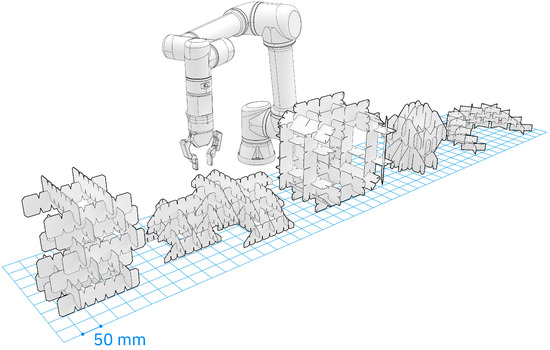
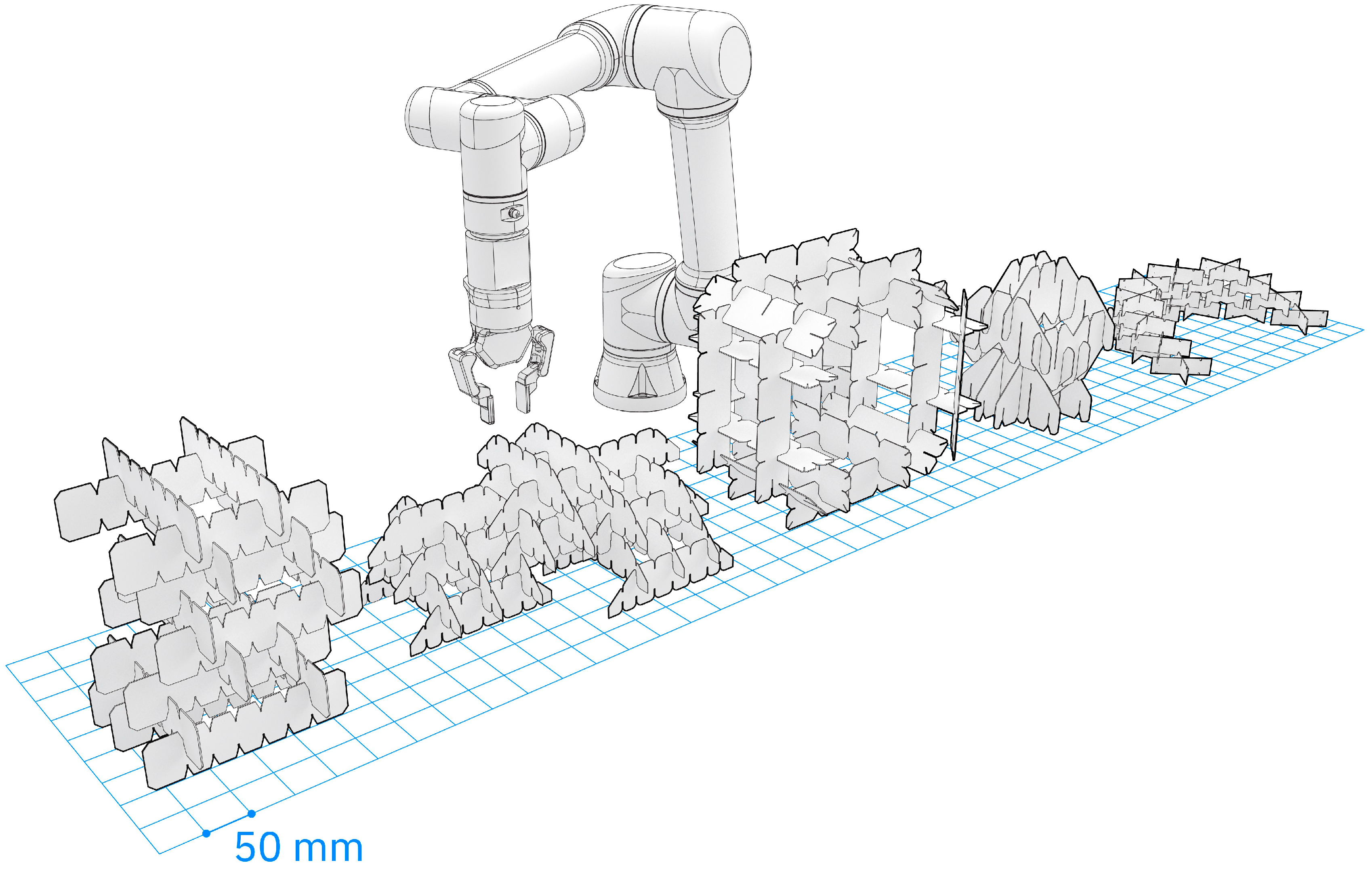
The WI-FAB robotics workshop aimed to develop fundamental skills and applied knowledge. The workshop builds on the authors’ previous robotics experience [13] and on the robotics experience of Roberto Naboni [14,15,16] and Victor Sardenberg [17,18,19]. In a preparatory meeting, the authors analysed the available robotic processes for the workshop and decided to use the system and the components developed previously in the course as initial input for robotic assembly. The authors then defined a joint framework for the UR5 collaborative robot and the tasks it should perform, using a RobotiQ gripper. After defining the framework, the authors began preparatory tests in Denmark (Figure 1), at SDU CREATE with Davide Angeletti and in Brazil with Victor Sardenberg. The organisers contacted Universal Robots, whose representative in Rio EDGE Brasil agreed to partner with the workshop and supplied a UR5 robot for the event under a contract.
Figure 1.
SDU CREATE robotic preparation tests using UR5 robot. Diagram SDU CREATE 2025.
Participants’ selection and background, together with the research context, will support future studies. FAU–UFRJ does not offer mandatory courses in computational design or digital fabrication. For the course, student selection prioritised those with prior experience in elective programming and/or digital fabrication courses taught by our research team at UFRJ. The course chose 15 participants: 7 undergraduates (MDA FAR615), 5 advanced laboratory students (LAFD FAR532), and 3 master’s students (PROURB FAU719); 12 completed the course. The workshop also included three external architects experienced in digital fabrication and four undergraduates, two of whom are members of the research group. Selection criteria considered the workshop goals, participants’ knowledge and motivation, and welcomed two newcomers; the participants had no prior experience with robotics. Both Workshop activities and course developments used Rhino 8 SR5 (July 2024), with Grasshopper, which, since late 2023, has expanded beyond exclusive access to Iron Python to include Python 3, together with a set of associated libraries and functionalities. This enabled textual programming in GhPython. To program the UR5 robot, the participants developed a visual code using the Robots plugin (version 1.6.6).
2.1. Robotic Preparation for the WI-FAB Workshop
To establish a robust and repeatable robotic assembly process, SDU CREATE conducted preparatory validation tests in Denmark. The primary task was to validate a digital-to-physical workflow for assembling discrete components using a collaborative robot, with simplified assembly logic and meticulous calibration of digital and physical systems.
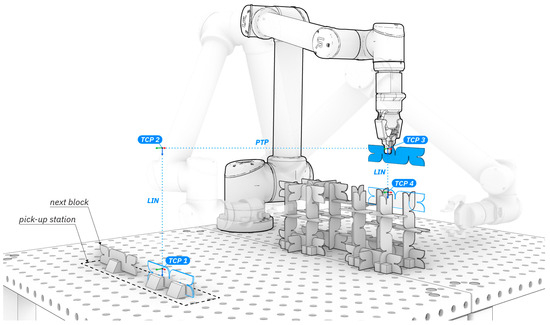
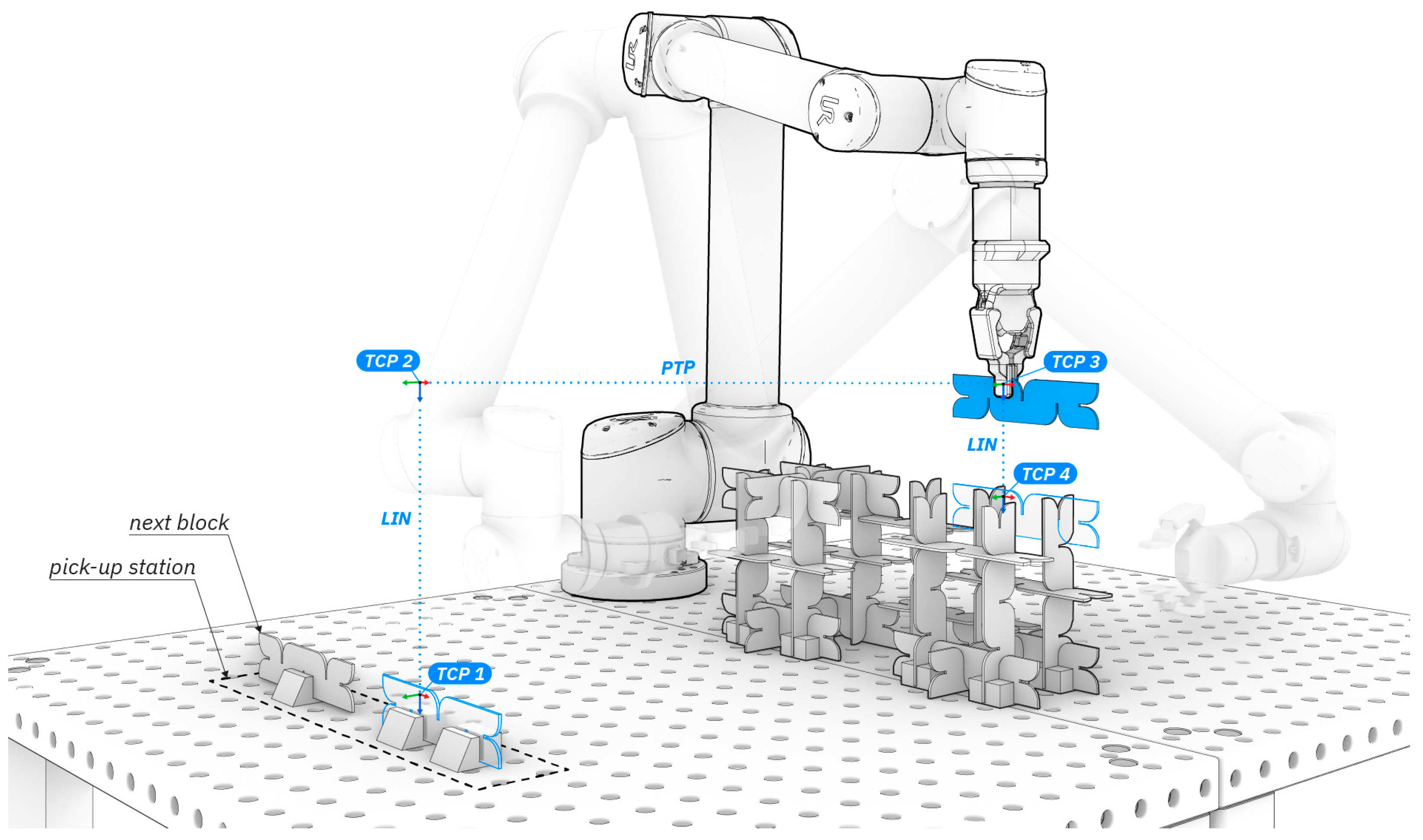
The experimental setup used a flexible robotic cell, adapted from previous research at SDU CREATE [14,15,16,20,21]. This cell incorporated a Universal Robots (UR10e) collaborative robot, equipped with a Robotiq 2-finger electric gripper. The entire system operated on a modular Siegmund table and included a pickup station and an assembly area, both accessible to the robot. The team designed a custom 3D-printed pick-up station to ensure consistent grasping. The station features slots that hold the components in a precise interlocked position while leaving the block edges accessible to the robot.
The validation focused on a custom-designed, standardised building block fabricated as a single, repeatable shape, laser-cut from 3 mm thick wood. The block measured 50 × 200 mm and featured five slots along its edges. The design of the slots used rounded corners to facilitate insertion by the robotic arm. This design enabled various intersection joint connections and multiple spatial configurations, validating both the assembly logic and the component’s viability. SDU conducted multiple tests to refine the slot tolerances. Achieving a final precision of 0.1 mm was crucial for balancing structural stability with ease of assembly, ensuring a joinery system that was firm yet not impeded by excessive friction. This validated component served as the foundational element for the subsequent workshop developments.
The preparatory study validated the workflow with a specific 12-component assembly, evaluated vertical and horizontal insertion strategies, and required placing the assembly in the pick-up station in a precise orientation so the gripper could access the correct edge for insertion. Grasshopper enabled control of the entire operation through its visual programming environment. Using the Robots plugin, the component geometry is translated directly into robot commands. Target generation defined tool centre point (TCP) planes at key locations, including precise targets for the component in the pick-up station, a safe-approach target above the assembly, and the final insertion target; the process also produced intermediate waypoints to define collision-free travel paths. This digital environment enabled full kinematic simulation to verify reachability and pre-emptively identify potential collisions.
Parametric control allows fine-tuning of motion parameters: the preparation applied slower, high-precision Linear (LIN) movements for critical approach and insertion tasks and used faster Point-to-Point (PTP) movements for transitional travel, optimising the overall cycle time. To ensure precise, stable placement of the initial block layer, the preparation designed and integrated custom 3D-printed supports into the Siegmund table. These supports feature specific slots to hold the first set of blocks securely, effectively fixing them to the table surface. This method was crucial for establishing a stable base for subsequent robotic assembly and maintaining the overall structural integrity of the construction.
2.2. WI-FAB Workshop Setting and Developments
Recognising the UR5’s lack of sensory feedback, the team defined assembly constraints for joint freedom (vertical movement only for the workshop, although preliminary tests used horizontal movements too), part dimensions (minimum and maximum), materials, and tolerances. The lack of access to CNC cutting machines led to the use of laser cutting on grey cardboard to develop a system adaptable for use with wood and its derivatives in future iterations. This technology constraint proved a catalyst for innovation, drove rapid, low-cost prototyping cycles, and showcased the workflow’s resilience with alternative materials. Drawing parallels to the Flat Panel Tectonics approach—which leveraged low-cost laser-cut components to create interlocking wood modules through parametric design—highlighted accessibility and adaptability within resource constraints, aligning with the research of Southern Creative Robotics [10]. The workshop began with introductory lectures and practical sessions related to the course and the workshop subject, delivered by Roberto Naboni (SDU CREATE), Victor Sardenberg (Mackenzie, SP), and Rebeca Duque Estrada (ICD Stuttgart), followed by hands-on robot training.
The workshop followed a progressive pedagogical sequence in three stages:
(i) Kinesthetic programming: participants performed guided motion exercises to establish an embodied understanding of robotic kinematics and spatial coordination. Through physical interaction with the robotic arm, the system recorded motion trajectories and translated them into programmable paths, enabling participants to relate bodily movement to robotic motion control.
(ii) Robotic path planning: participants developed and coded two- and three-dimensional trajectories using visual programming environments, abstracting movement into parametric and geometric representations and reinforcing the relationship between spatial intention and computational control.
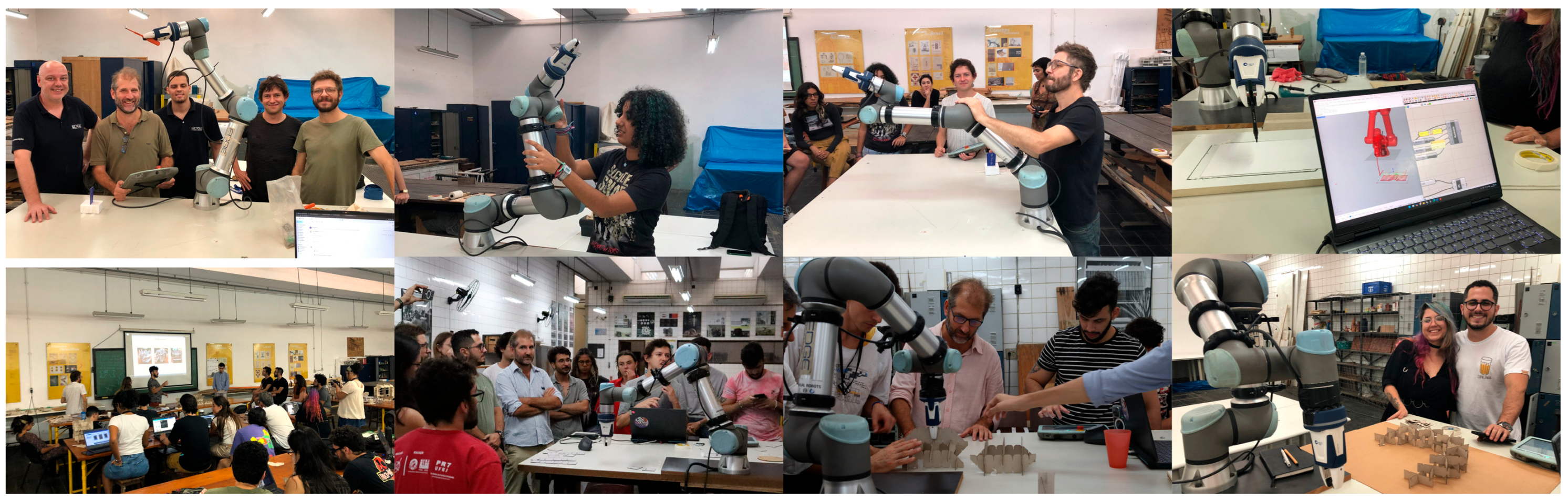
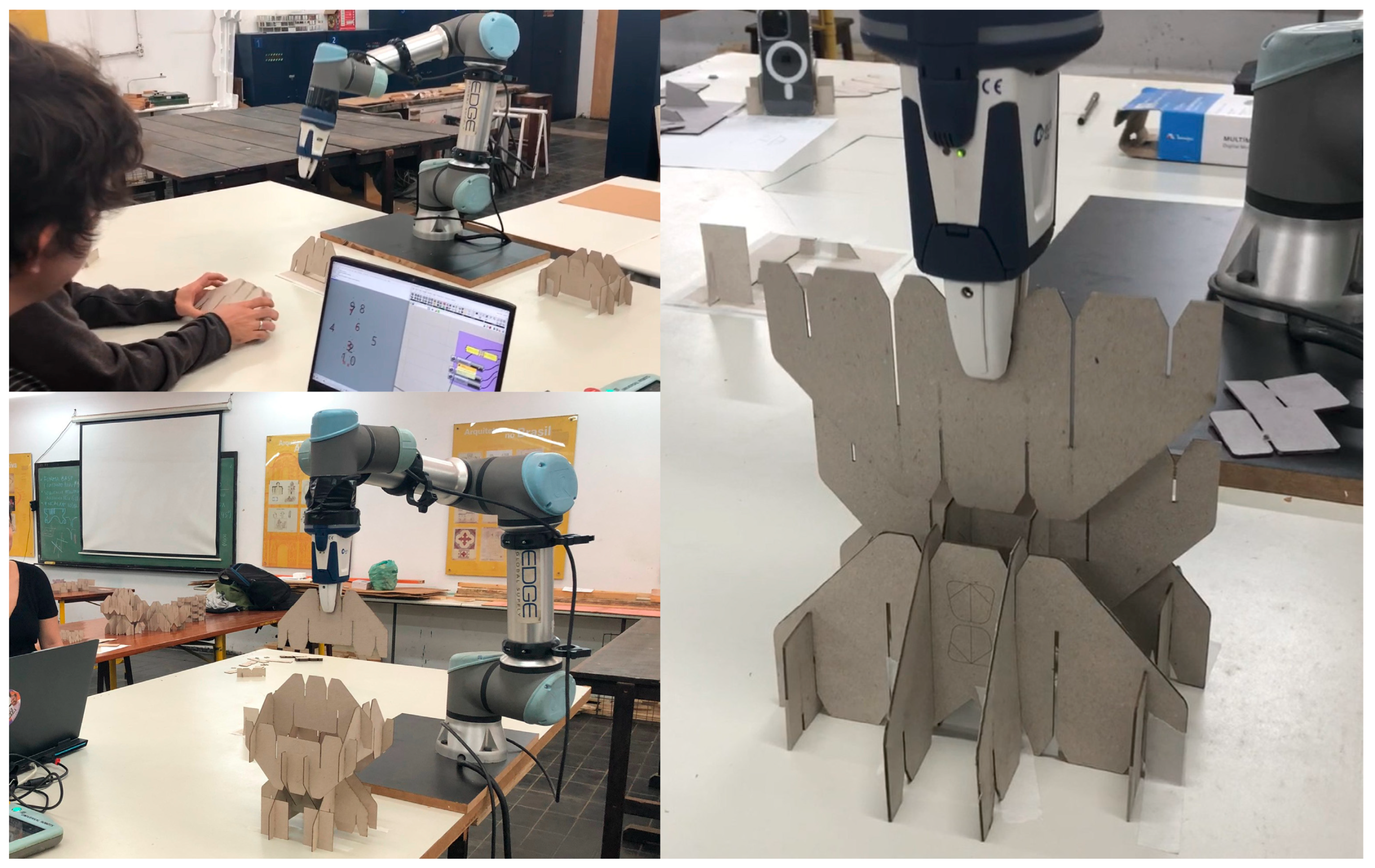
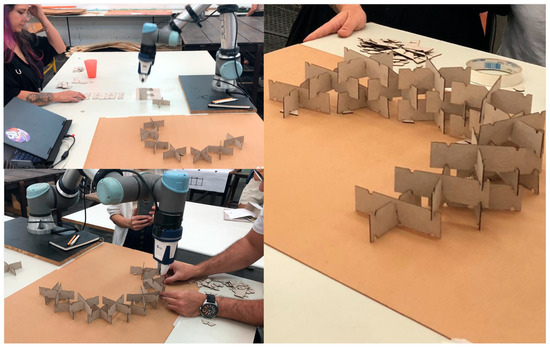
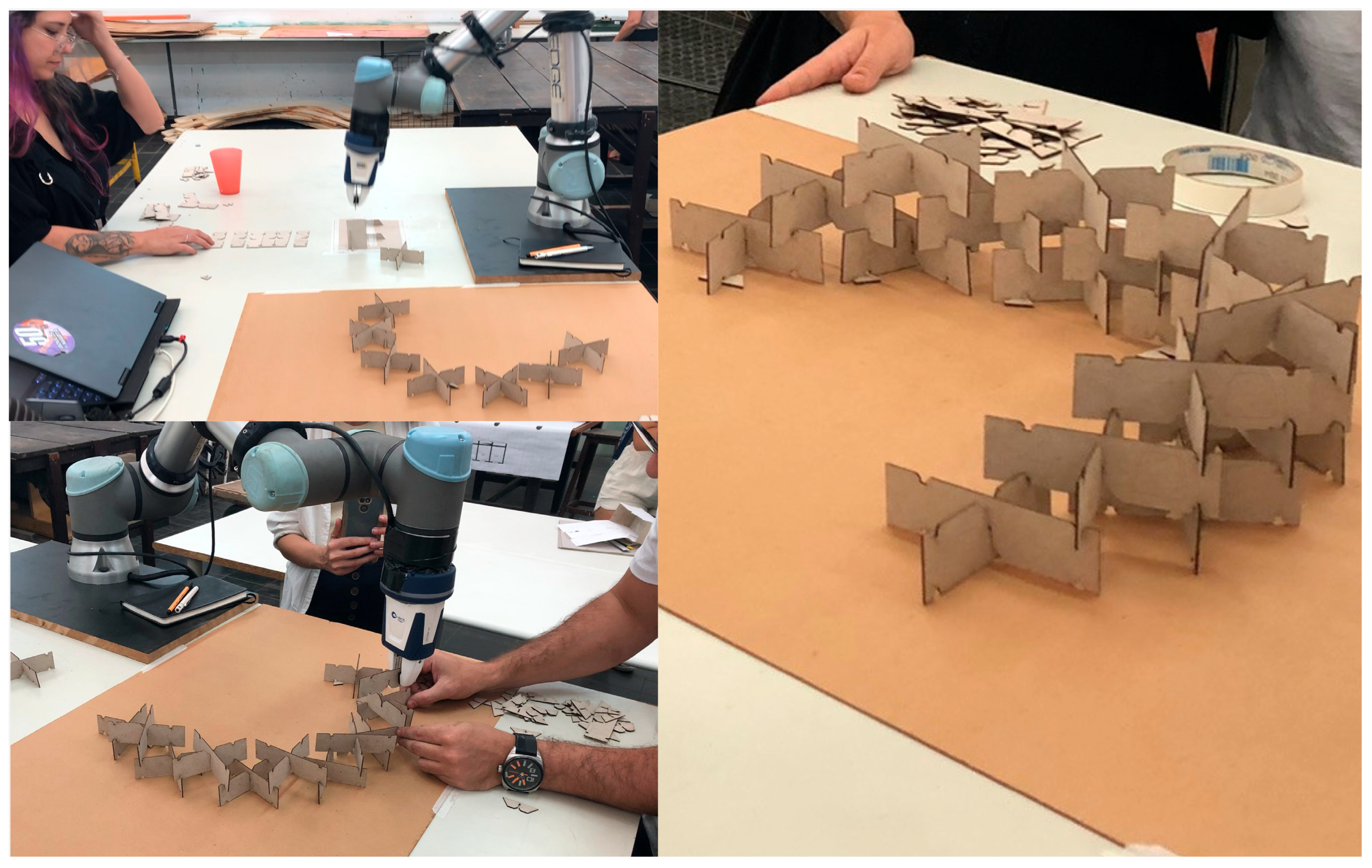
(iii) Algorithmic assembly control: a visual algorithmic framework introduced participants to robotic component assembly, integrating tool orientation, insertion logic, motion constraints, and sequencing into a coherent robotic assembly workflow (Figure 2).
Figure 2.
WI-FAB Workshop activities developed with the UR5 robot. Photos LAMO 2024.
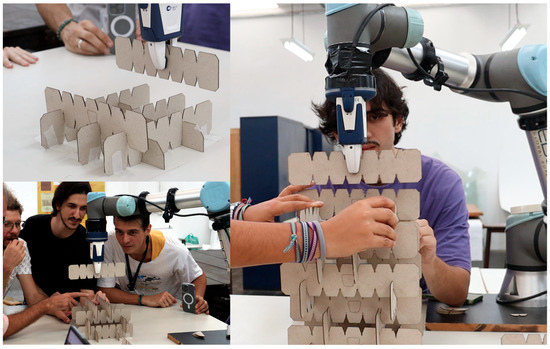
Organisers conducted this last phase through parallel work by five groups, each composed of two to three participants. Each group developed a modular system based on a single component incorporating multiple slots, using an iterative cycle of generative design, digital fabrication, and robotic assembly. At successive stages, participants evaluated joint performance and assembly behaviour through systematic tolerance testing, refining component design by adjusting slot geometry, position, type, and quantity. This iterative feedback process linked digital modelling directly to material behaviour and robotic constraints. The following section presents each group system development and outcome.
3. Results
Following the methodology outlined in Section 2, this section organises the workshop and course results and prepares for the discussion presented in Section 4.
3.1. Workshop Results
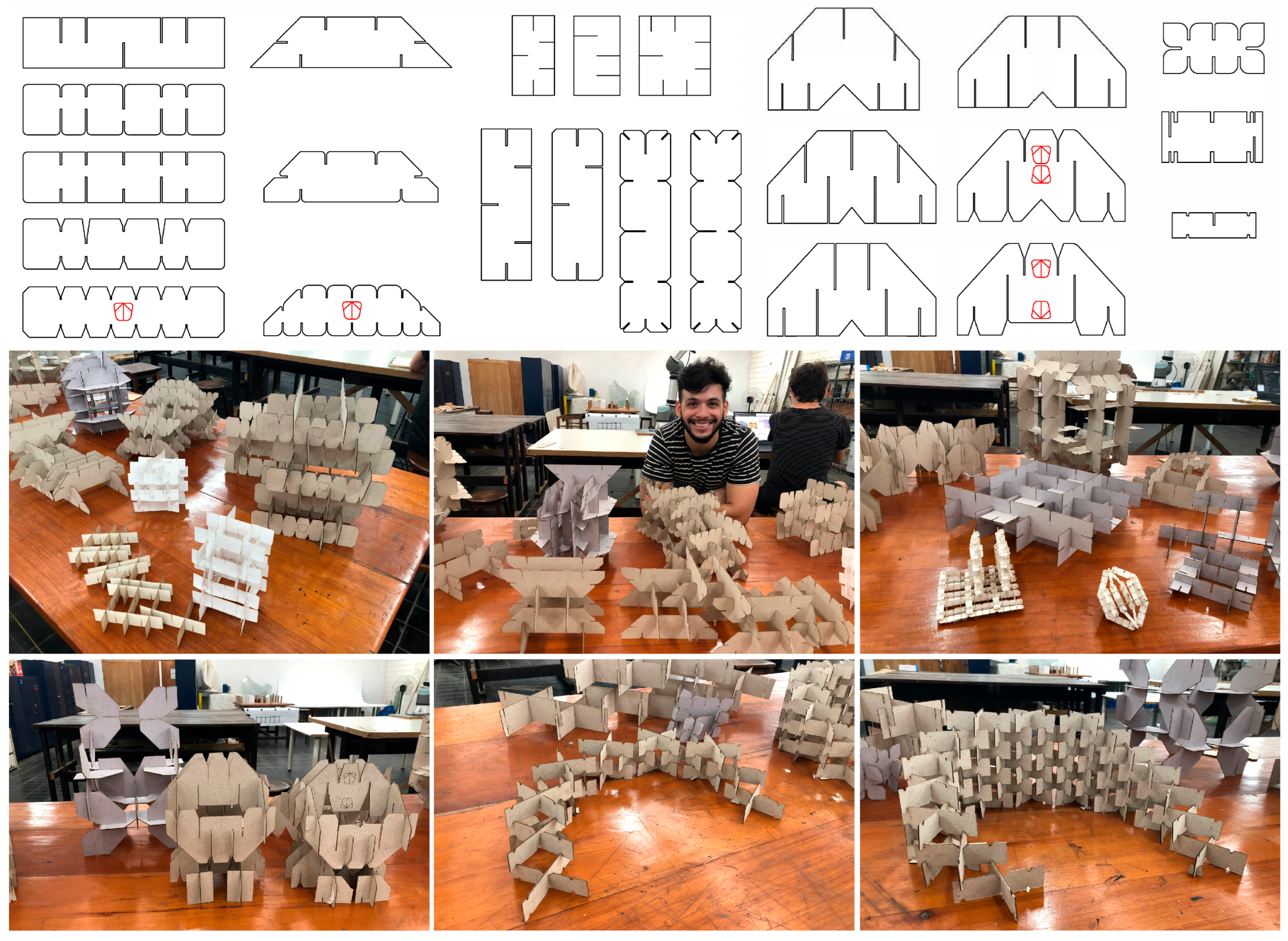
This section presents the workshop results through five parallel case studies, each developed by a group working under identical constraints of material, fabrication method, and robotic setup (Figure 3). All groups designed a modular system derived from a single planar component incorporating slot-based wooden joints. While the robotic configuration, gripper, and assembly orientation were predefined, groups explored variations in component geometry, slot number, slot depth, and joint distribution. The results highlight component evolution, joint performance, and assembly behaviour under robotic constraints, rather than only formal or narrative intents.
Figure 3.
WI-FAB, component details and physical models, WG1 to WG5. Photos LAMO 2024.
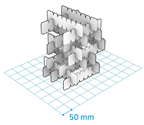
WG1 Woodpile
This group developed a linear wooden component system intended to support incremental vertical growth and partial disassembly, inspired by the wood-stacking process, considering the possibility of adding and removing components as the wood dries. The component evolved from a 240 × 60 mm element with five slots into a refined version featuring twelve half-depth slots distributed symmetrically on both horizontal faces. The group introduced two joint types to alternate assembly planes and control overhang behaviour. Slot geometry progressively adjusted into a Y-shaped configuration to ensure consistent vertical insertion during robotic assembly. The final system consisted of 21 components assembled into a 10-level structure and demonstrated stable stacking behaviour and reliable robot-assisted insertion under asymmetrical loading conditions. Primary constraint identified: reliable vertical insertion required slot geometries that could tolerate minor positional inaccuracies while maintaining sufficient friction for load transfer.
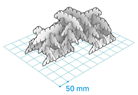
WG2 Caterpillar
This group investigated horizontal aggregation through closely spaced, shallow slots designed to increase frictional grip while allowing configurational variation—evoking the caterpillars’ slow but steady movement. The component incorporated chamfered top edges to reduce leverage effects and vertical slots on the top and bottom faces to enable multi-level stacking. Initial experiments with vertical assembly proved unreliable for robotic insertion, leading to a return to predominantly horizontal sequencing. The final component incorporated fourteen slots, seven on each horizontal face, with rounded slot edges that minimised insertion resistance. The assembled system comprised 27 components arranged across six levels, achieving controlled overhangs and stable horizontal continuity. Primary constraint identified: horizontal assemblies offered higher robotic reliability than vertical configurations but limited three-dimensional articulation.
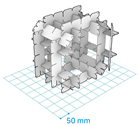
WG3 Dodecahedron
This group explored orthogonal and diagonal aggregation through paired components assembled along the X and Y axes, relating this approach to a buckling structure composed of dodecahedral modules. Initial modules measured 100 × 50 mm with half-depth slots, later scaled to 100 × 100 mm to support vertical stacking. To improve assembly precision, the group adopted a hybrid workflow in which the robot executed vertical insertions while team members completed horizontal and diagonal connections manually. The introduction of diagonal connectors enabled the construction of a twelve-faced polyhedral configuration. The final assembly consisted of six sets of four 240 × 60 mm components linked by eight diagonal connectors, forming a stable dodecahedral structure with repeatable joint behaviour. Primary constraint identified: complex three-dimensional assemblies required hybrid human–robot workflows to balance precision, reachability, and assembly speed.
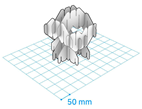
WG4 Bat Tower
This group developed a planar component with trapezoidal geometry to investigate vertical aggregation and directional differentiation through joint placement. Early free-form assemblies—groups of butterflies—were conceived later using strictly vertical assembly sequences to comply with robotic constraints and resembling more bat geometry and movement. The base component, measuring 200 × 100 mm, initially incorporated ten slots, which the group later reduced to a Y-shaped configuration with four slots on the longer edge and two on the shorter edge. This reduction improved assembly reliability and structural clarity. The final system generated vertically articulated, asymmetrical spatial patterns through repeated stacking. Primary constraint identified: reducing slot quantity improved robotic reliability and structural clarity at the cost of configurational diversity. The long dimension slots improved the assembly and stability of the whole.
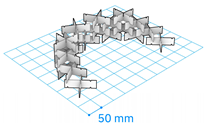
WG5 Scissor Wall
This group investigated a scissor-like wooden assembly system based on paired components connected through a central pivot that enabled curved walls. The initial component measured 120 × 60 mm and incorporated slots on all four edges. To increase curvature resolution and reduce insertion resistance, the group later reduced the component to 100 × 30 mm and simplified it to three slots, two at the ends and one at the pivot. While the reduced scale enabled higher geometric flexibility, it significantly increased assembly time due to the precision required for robotic placement. The final structure comprised 56 components assembled into four interleaved levels. Primary constraint identified: decreasing component scale increased formal adaptability but resulted in slower and more error-prone robotic assembly.
Workshop Comparative Analysis
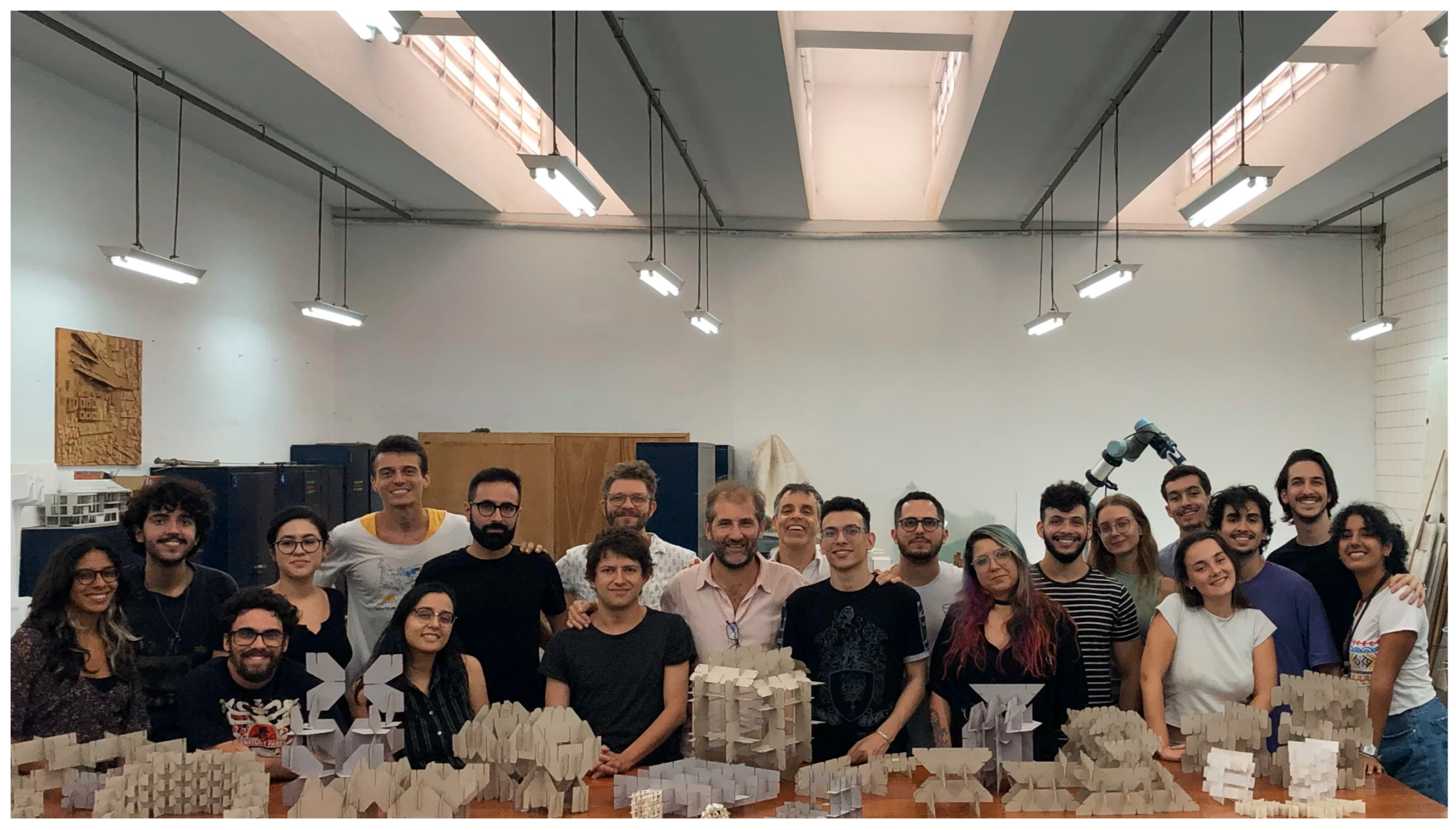
Each group explored modularity by deepening geometric and functional strategies (Figure 4, Figure 5 and Figure 6). WG1 Woodpile adopted a linear vertical progression, refining interlocks for precision and ease of assembly; WG2 Caterpillar used alternating interlocks on orthogonal axes for seamless reconfiguration; WG3 Dodecahedron combined horizontal, vertical and diagonal axes to form polyhedral clusters; WG4 Bat Tower applied evolving trapezoidal components with cut-out geometries to create dynamic 3D patterns; and WG5 Scissor Wall developed a curved scissor mechanism along concave and convex paths. The five component systems in different dimensions integrated the design cycle, digital fabrication, and UR5 robot-assisted assembly in an iterative physical–digital workflow. Table 1 summarises the group specifications: Design, Dimensions, Area, and Assembly Time, and Figure 7 displays the final works and workshop environment.
Figure 4.
WI-FAB Workshop WG1 Woodpile—by Flávia Silveira, Lael Monsores, and Fabrizzio Bandoli—assembling with the robot UR5. Photos LAMO 2024.
Figure 5.
WI-FAB Workshop WG4 Bat Tower—by Ana Paula Lobato, Marina Brant and Cainã Bittencourt—assembling with the robot UR5. Photos LAMO 2024.
Figure 6.
WI-FAB Workshop WG5 Scissors—by Pitanga Vingand and Thiers Nobrega—assembling with the robot UR5. Photos LAMO 2024.
Table 1.
Group Specifications: Design, Dimensions, Area, and Assembly Time.
Figure 7.
WI-FAB Workshop Final works and participants. Photo LAMO 2024.
The authors use the data in Table 1 together with qualitative case descriptions to inform their analysis. Therefore, they analyse the group designs according to four assembly processes: Assembly Movement; Component Geometry and Dimensions; Component Number and Slot Number; Complexity and Assembly Time.
Assembly Movement—WG1, WG2 and WG4 adopted vertical stacking with orthogonal alignment in the xy plane. WG3 introduced a hybrid orientation (man–cobot) that required a mixed process, while WG5 followed a curved assembly path that demanded more effort and time. These differences produce distinct challenges: WG5’s curved, sequential path increases assembly time and handling complexity, and WG3’s hybrid workflow requires additional planning. WG1 refined vertical interlocks for precision and ease of assembly, WG2 alternated interlocks on orthogonal axes to enable reconfiguration, WG4 evolved trapezoidal components with cut-out geometries to generate dynamic stacking patterns, WG3 combined horizontal, vertical and diagonal orientations to form polyhedral clusters, and WG5 developed a curved scissor mechanism along concave and convex paths.
Component Geometry and Dimensions—Each group uses a single component type. WG5 requires the most component instances (56), followed by WG2 (27), WG3 (24), and WG1 (21); WG4 requires the fewest (12). Consequently, WG5 has the highest slot count per assembly, WG4 the lowest, and WG1–WG3 occupy intermediate positions. This variation in component and slot numbers reflects different modular strategies: WG5’s curved sequencing demanded many small parts, WG4’s trapezoidal system relied on fewer large elements, while WG1–WG3 balanced intermediate counts with orthogonal stacking or clustering. These differences directly influenced assembly effort and repeatability, as documented in Table 1.
Component Number and Slot Number—Each group uses a single component type, but the number of instances varies: WG5 requires the most components (56), followed by WG2 (27), WG3 (24), WG1 (21), and WG4 (12). Higher component counts increase slot density, complicate sequencing and part identification, and raise misplacement risk, affecting robot path planning and cycle time, and increasing human verification load. For analyses in future cases, it would be interesting to consider key metrics such as slots per assembly, misassembly rate, and average slot lookup time.
Complexity and Assembly Time—Component counts vary (WG5: 56; WG2: 27; WG3: 24; WG1: 21; WG4: 12), creating clear trade-offs. WG5’s high part count, combined with a curved, sequential assembly path, increases sequencing complexity, handling demands and assembly time; the longer process also raises operational costs and error risk. WG3’s hybrid man–cobot workflow requires extra planning and adaptations, which similarly lengthen assembly. WG1 and WG2 occupy intermediate positions, balancing moderate sizes and counts with straightforward stacking. WG4 is the most favourable case: larger parts and orthogonal stacking reduce sequencing constraints and yield the shortest assembly time. Across all groups, the iterative physical–digital workflow integrating design, digital fabrication and UR5 robot-assisted assembly shaped these outcomes, with complexity emerging from the interplay between component geometry, assembly path and part count.
3.2. Course Results
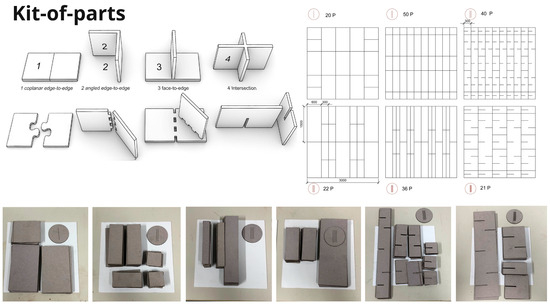
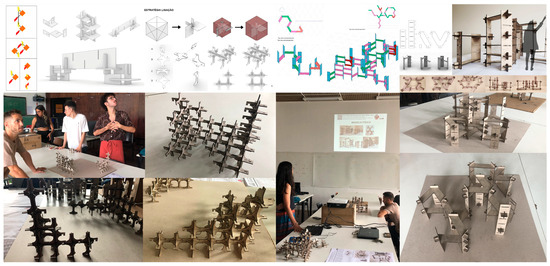
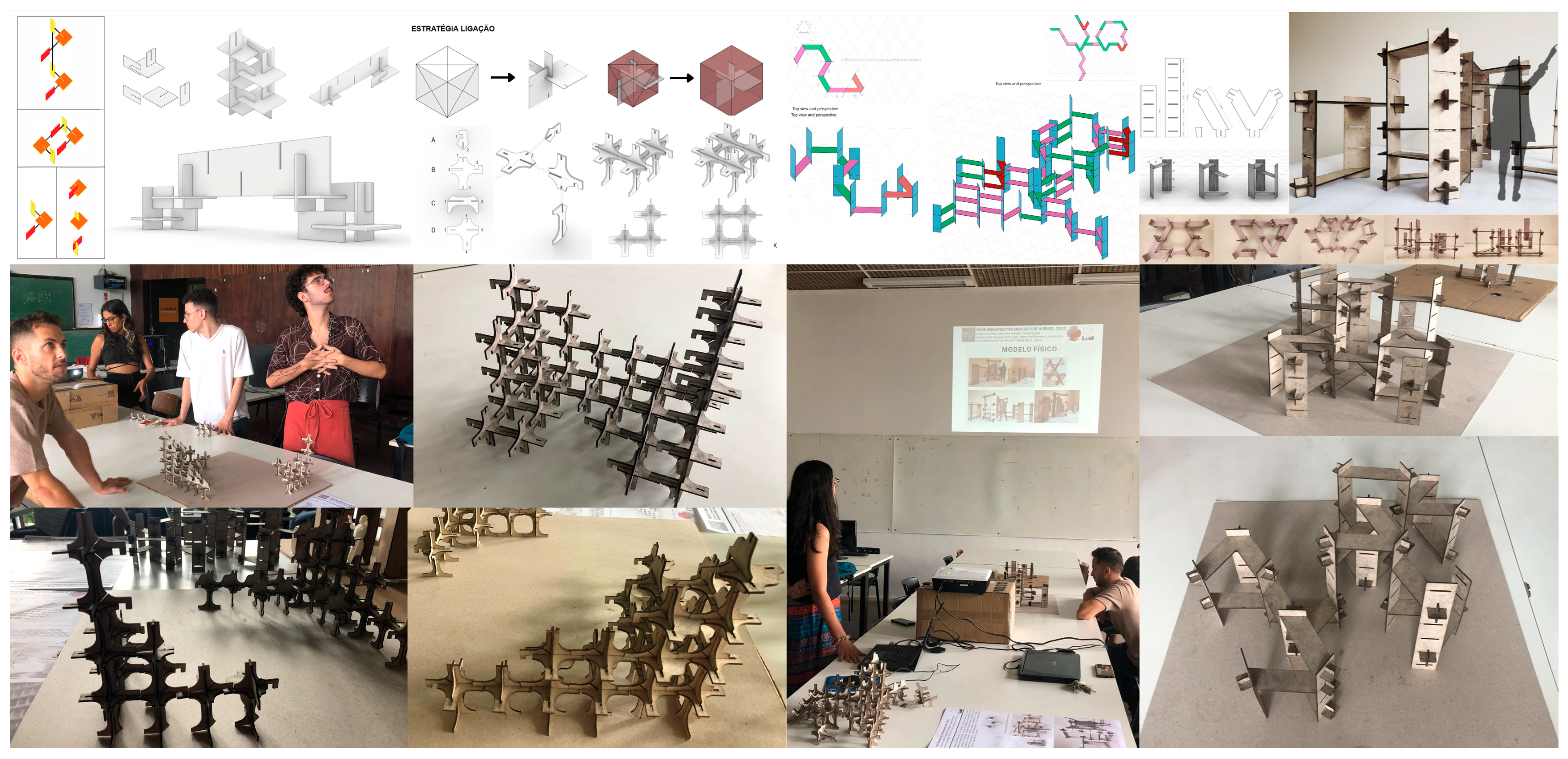
Building on the workshop findings, this section presents the course findings, combining generative design and digital fabrication. During the course, professors, advisors, and students developed physical–digital systems based on planar joints. Each group selected one of four planar joint types—coplanar edge-to-edge, angled edge-to-edge, face-to-edge, or intersection—and worked from a supplied kit-of-parts of interlocking wooden elements (Figure 8). Kits comprised 3 × 3 m boards at a 1:20 scale with 20–40 parts depending on geometry. Each group designed wooden assemblies using their chosen joint type. In a bottom-up workflow, they iteratively created and programmed combinatorial systems to explore the interaction between form, material, and digital processes.
Figure 8.
Kit-of-parts for the initial phase of project development: geometric relationships and joints (top) and cut and sorted kits (bottom). Photos LAMO 2024.
The research group from the two previously mentioned lines of inquiry developed a plugin in GhPython—the object-oriented scripting component within Grasshopper—to automate the generation of 3D geometric joints between flat sheets. Designed for hands-on use in both the course and the workshop, this framework anticipates fabrication challenges and seamlessly embeds solutions into the design workflow.
The plugin under development supports all joint relationships (edge-to-edge, edge-to-face, intersection, etc.), allowing anticipation of fabrication solutions by parameterising each joint in geometry—type and tooth-count—and exporting both 3D models and CNC fabrication drawings. With this comprehensive foundation, participants generally chose to develop their own scripts for practical reasons: their projects required only one primary joint type and, if necessary, a second. This approach ensured early detection of interference issues. It provided valuable feedback from the physical assembly back to the digital model, streamlining the transition from computational design to hands-on construction.
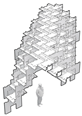
CG1 Transversal
The group uses edge-to-edge and face-to-edge joints with Kit II—a 50-piece set comprising elongated modules, half-length elements, and square pieces—to develop a reconfigurable modular system in marine-grade plywood by creating interlocking joint pieces (Figure 9). The group tested multiple combinations and achieved an agile, dynamic structure that balances simplicity and variety. In the first iteration, the group used ABC sheets to fabricate BAaC and BaAC components, enabling modules to connect along the X, Y, and diagonal axes (both ascending and descending on XZ or YZ). The group then developed parallel configurations that preserved the initial movement logic while expanding the system’s possibilities. This formal and spatial codification guided component synthesis, resulting in a transverse pavilion for the FAU-UFRJ, where shifting light and shadow invite viewers to enter, interact with, and sit within the installation.
Figure 9.
WI-FAB Course Design—CG1 Project: Lael Monsores, Fabrizzio Bandoli, Gabrielle Dinsart and CG2 Project: João Fraga, Emanuel Fonte. Photos LAMO 2024.
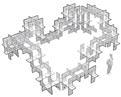
CG2 Modular Snake
The group used Face-to-Face Parallel and Intersection joints from Kit III—a 40-piece set comprising elongated modules with slots in various positions and square pieces with slots—to develop a modular system arranged in a comb-like configuration in a perpendicular orientation and secured by interlocking joints (Figure 9). Inspired by a snake’s motion, the group placed components along a continuous adaptive path, rotating them vertically to form evolving patterns. The assembly generated a self-similar pattern that repeated at multiple scales within a harmonious yet varied organisation. The group combined individual letters into words and phrases, developing physical connections among components. The system is suitable for various leisure-space applications.
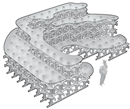
CG3 Neoplastic Filigree
The group used intersection joints and Kit III—a 21-piece set comprising long and narrow modules, distributed across five sizes, with slots—to develop a modular system inspired by neoplastic composition (Figure 10). Initially, they applied free neoplastic-type planes—perpendicular in space and intersected by slots—to explore the relationship between surfaces and the voids between them. With connections clearly defined, they inscribed the components within a bounding box, coding each face and its connection direction. As the system evolved, the group redesigned and dematerialised the planes into components with cut-outs that vary by orientation, creating a dynamic and permeable filigree—a children’s puzzle designed for park environments
Figure 10.
WI-FAB Course Design—CG3 Project: André Luiz Barbosa, Luiz Dantas, Taiane Nepomuceno and CG4 Project: Ana Paula Lobato, Desirèe Vacques. Photos LAMO 2024.
CG4 Triangular Growth
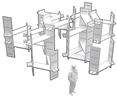
The group used Face-to-Edge joints and Kit III—a 36-piece set comprising long, narrow modules in two lengths and two widths, one half the size of the other—to define a coherent system based on a triangular grid, capable of supporting horizontal expansion and vertical growth, guided by structuring vertical pieces (Figure 10). The idea evolved as they identified new possibilities and discovered limitations, coding the system with letters, words, and phrases. Developing robust connections required the use of interlocking joints, which adapted the original kit for greater strength by locking movements and ensuring the assembly’s structural integrity. The final model resembles a triangular bookshelf, organised into interconnected levels that form a dynamic and flexible path. They further simplified the system by using vertical modules with horizontal slots in two sizes, horizontal modules that formed a trapezoid, and additional pieces with two triangular edges that bifurcated linear growth in different directions across the XY plane.
CG5 Möbius Strip
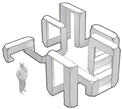
The group used Edge-to-Edge joints and the “IIII + I” kit—a 22 + 20-piece set. The first set featured long, wide modules in two lengths and two widths, one half the other, while the second included wide rectangular and square modules (Figure 11). It was a dynamic structure inspired by the continuous Möbius strip wound through a grid of cubes along the X and Y axes, rose and fell in the Z axis, forming portals and seats. The 3D strip resembles origami, requiring precise translation and selection of movement to maintain congruence. Designers used programming to balance variety and self-similarity, integrating the physical aspects of bar/node joints. The nodes were cubic components that could adapt to directional changes, with triangular slots at the vertex of each face. When instantiated, the system assigned component numbers for fabrication and assembly. The design, made from plywood sheets, can be adapted to different locations, bringing harmony and dynamism through its geometric characteristics.
Figure 11.
WI-FAB Course Design—CG5 Project: João Pina and Thiers Nobrega. Photo LAMO 2024.
Course Comparative Analyses
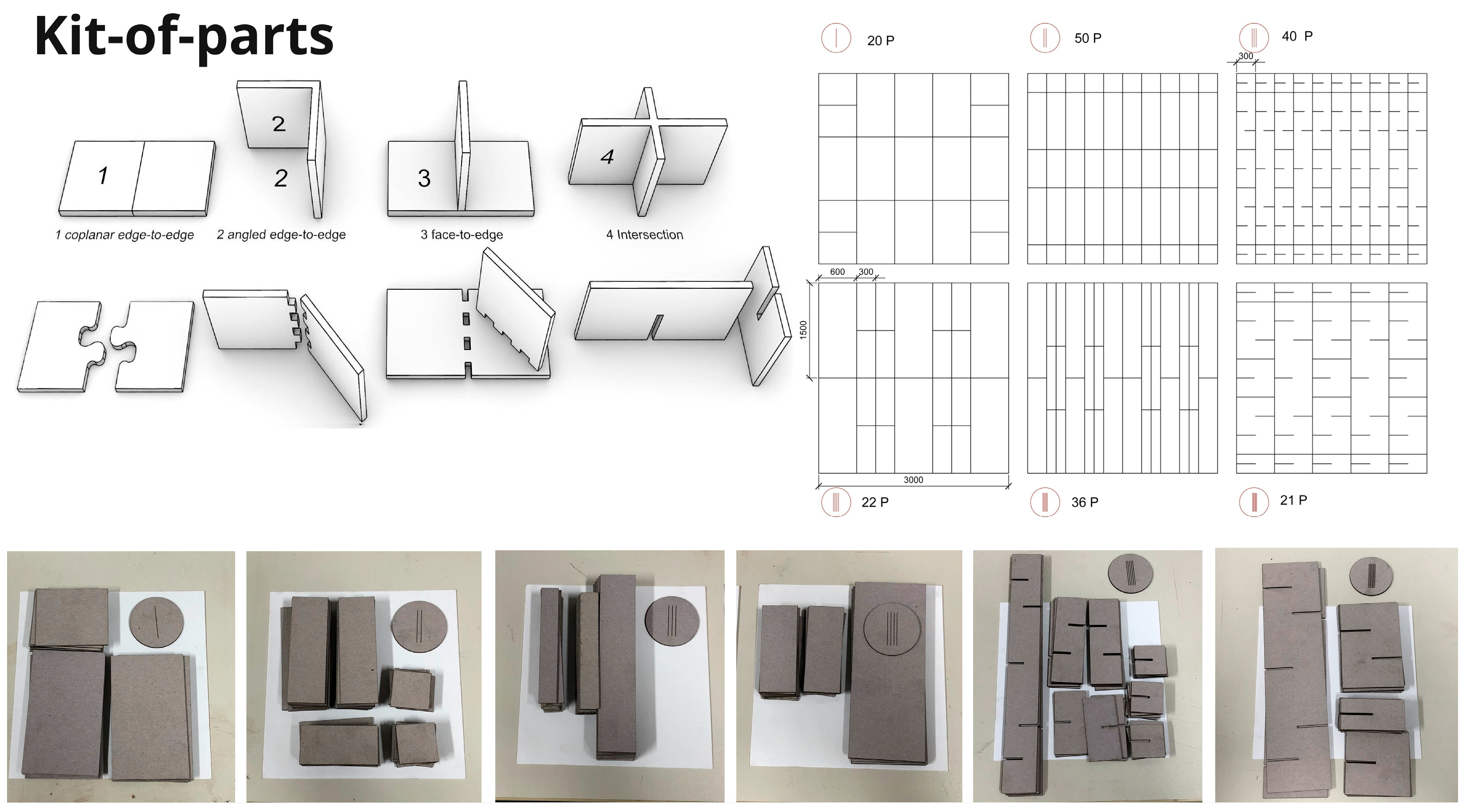
The workshop developed a direct comparative analysis of assembly performance and workflow integration; the course, however, does not support direct project comparisons at this stage. Projects have been developed using string grammars and scale models and have not progressed to full-size digital fabrication; the university did not have digital fabrication resources for this course. Process clarification: The string grammar used in this course was developed before in the research line Computation for Architecture: Developing Cognition beyond Blind Artificial Intelligence [3] and serves as an applied combinatorial design method that maps discrete planar components (treated as “letters”) to sequences of joints (“words”) and to complete assemblies (“phrases”), supporting generative exploration and automated production. The implementation combines visual and textual programming (Grasshopper and Python) for interactive parametric exploration and scripted fabrication. Unlike shape grammars, which rely on visual representations and formal geometric rewrite rules, our string grammar operates at an abstract symbolic level focused on assembly logic and production sequencing—or computational logic—rather than direct shape rewriting. Therefore, each project functions as an independent investigation of form, material behaviour and assembly logic, using also different joint types.
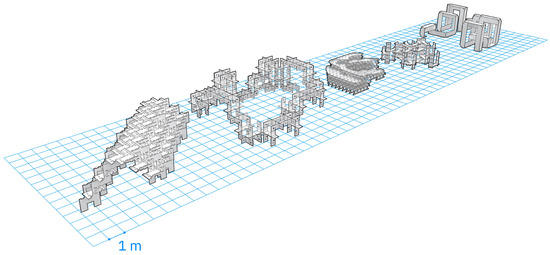
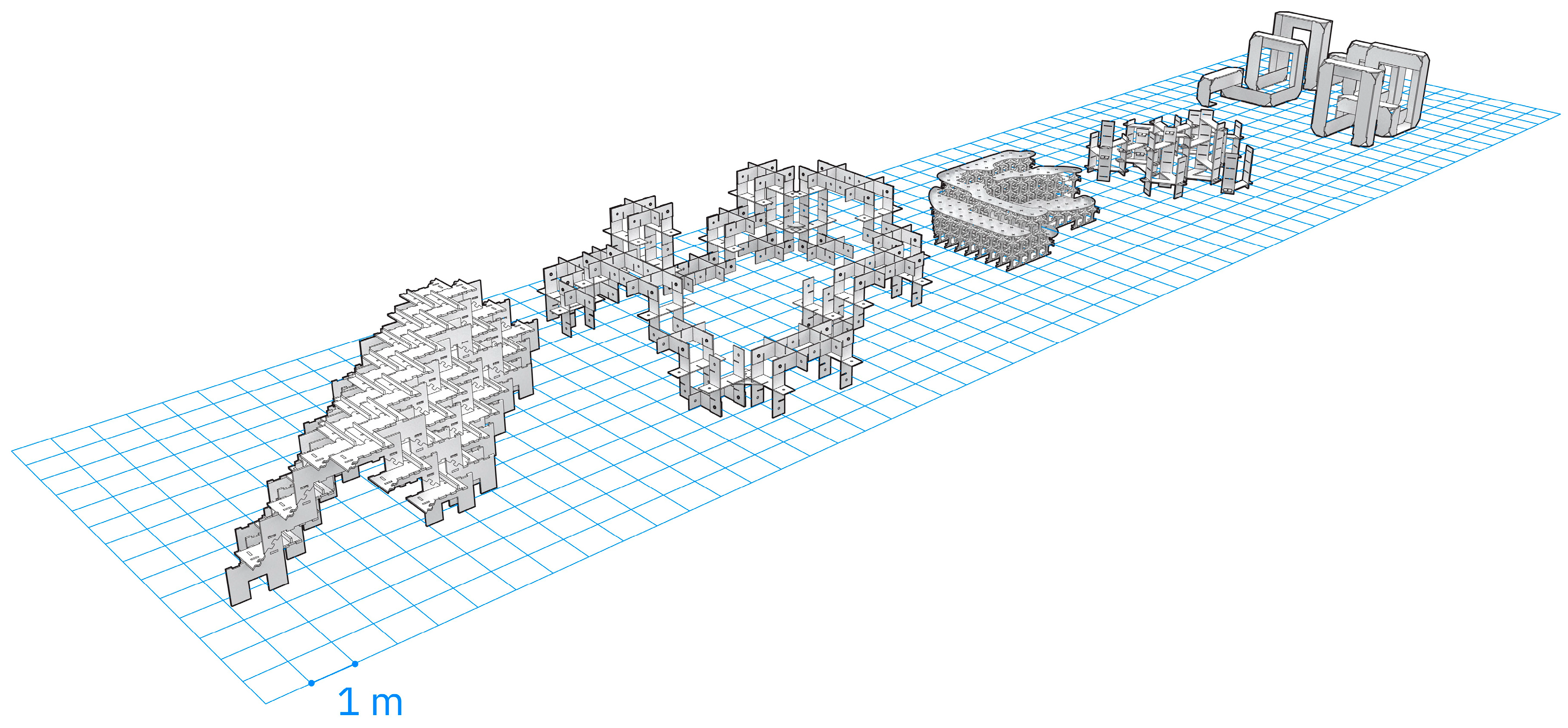
Figure 12 and Figure 13 summarise the design of the workshop and the course and introduce the results discussion developed in the next section.
Figure 12.
WI-FAB Workshop designs. Diagrams: LAMO/SDU CREATE 2025.
Figure 13.
WI-FAB Course designs. Diagrams: LAMO/SDU CREATE 2025.
4. Discussion
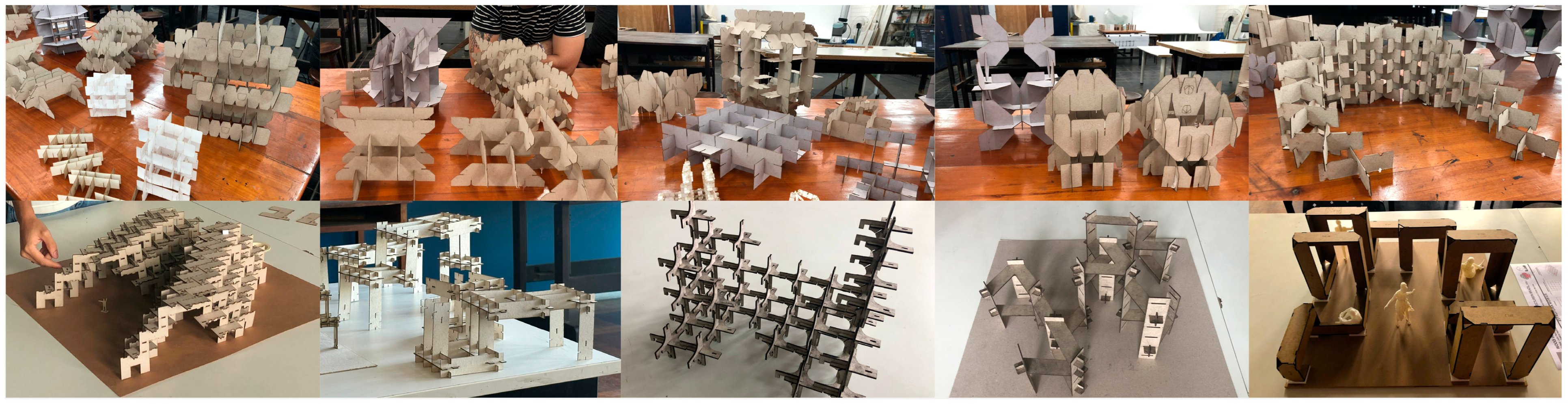
Tracks in Comparison: The WG workshop emphasises rapid assembly through calibrated slots and discrete components, enabling a human–robot choreography optimised for quick prototyping (Figure 12 and Figure 14). The CG course prioritises conceptual rigour by embedding complex connectors within each module’s structural logic, producing rich spatial articulations (Figure 13 and Figure 14). Both strands spring from the same geometric–coding foundation, yet diverge in ambition: WG pursues iteration speed, CG pursues depth of articulation.
Figure 14.
WI-FAB Workshop WG1 to WG5 and Course CG1 to CG5 results. LAMO 2024.
Modular Language: WG modules and slots serve solely as mechanical primitives—components and matching cuts that define connection logic without forming standalone “letters” or “phrases.” CG repurposes those primitives into a formal string grammar: individual components act as “letters,” sequences of joint components become “words,” and complete assemblies unfold as poetic spatial “phrases.” Merging these vocabularies yields a unified lexicon that supports both machine-readable blueprints and concept-driven architectural narratives.
Production Workflows: In WG, digital models drive the UR5 robot to insert components vertically while participants complete horizontal joins by hand, creating a seamless hybrid workflow. In CG, students fabricate and test connectors manually—iterating slot tolerances and material thicknesses to optimise interlocking behaviour without robotic aid. This juxtaposition highlights how machine precision accelerates repeatable assemblies, while craft-based prototyping fosters in-depth exploratory refinement.
Limitations: The experiments were conducted under curricular, logistical, and resource constraints that limited the scale and type of data collected; pursuing broader statistical validation would have required conditions beyond our resources and could have rendered the dissemination of this work unfeasible. Despite these limitations, this investigation has creatively managed to overcome them.
Challenges and Solutions: Both tracks confront the inherent tension between structural robustness and system flexibility. WG teams adjust slot geometries to ensure reliable robot-assisted insertions; CG teams calibrate connector profiles to balance load-bearing performance with hinge-like movement. Numbered parts and colour-coded guides enhance assembly legibility in both contexts, and iterative testing drives continuous improvement of joint behaviour under varied spatial configurations.
Outcomes and Future Directions: The combined experiments span woodpile clusters, caterpillar chains, dodecahedral volumes, Möbius loops, Bat towers, and scissor walls—each demonstrating how formal coding, robotic precision, and manual craftsmanship can coalesce into adaptable architectures. Future research will deepen the application of materials and manufacturing processes, and explore full-scale robotic assembly of connectors, all aimed at enriching a modular language capable of reconfigurable design.
5. Conclusions
The WI-FAB project establishes a research-through-teaching framework using computational thinking, digital fabrication, and creative robotics to rethink wood construction. Scarce resources and reliance on non-renewable materials require ecological, tech-integrated responses; in Brazil, abundant wood is underused, so integrating wood-related skills into curricula is essential. Through design experiments, algorithmic reasoning, and hands-on prototyping, the project links code and material via iterative feedback, repositioning wood as a digitally native, precise, and reusable material. Robotic workshops (fast, repeatable) and the semester-long course (conceptual depth, string grammar) together developed a unified modular language bridging fabrication, assembly codes, and narratives.
Methodologically, the project ran in three phases: a preliminary research phase combining Computation for Architecture in Python and Flat Panel Tectonics; a semester-long course implementing a kit of parts, a family of joints, and a programming grammar; and the intensive robotics workshop as an investigative intervention. The study is explicitly positioned as research-through-teaching, emphasising its exploratory and qualitative character. The course and workshop were conceived as learning laboratories where students engaged with digital and constructive methodologies in wood, reflecting on emerging challenges and opportunities. Findings are framed as qualitative insights that inform future teaching practices and open directions for academic research.
Key outcomes include formalised string grammar linking components to combinatorial assemblies, hybrid workflows combining robotic insertion with manual joins, and strategies for managing the robustness–flexibility trade-off. A family of designs validated the approach by demonstrating modular assembly, repeatability, and reversible joints. The methodology relied on low-cost rapid prototyping and iterative testing of slot geometries, tolerances, and robotic behaviours to produce resilient, locally adaptable workflows. Robotic processes accelerated the design-to-assembly loop and point to viable paths toward larger-scale development. Limitations include partial robotics integration and the experimental scale of prototypes. Future work should prioritise full curricular integration, larger-scale testing, and life-cycle assessment. Future studies should also intensify combined qualitative and quantitative evaluation outcomes with standardised metrics for assembly reliability and pilot tests at increased scale, assessing structural performance and circular economy impacts. WI-FAB advocates reversible assembly, material reuse within circular economy principles, and supports the forthcoming Sabiá plugin for parametric wooden joint design.
Author Contributions
Conceptualisation, G.C.H. and R.N.; General methodology, G.C.H., P.E., R.N.; Practical research, G.C.H., P.E. and V.S.; Additional workshop preparation, G.C.H., P.E., V.S., R.N. and D.A.; Writing—original draft preparation, G.C.H.; Writing—SDU workshop preparation, D.A.; Writing—review and editing, G.C.H., V.S., D.A. and R.N.; Additional group diagrams, D.A. All authors have read and agreed to the published version of the manuscript.
Funding
This research was supported by the CAPES Print program (Brazilian Coordination for the Improvement of Higher Education Personnel) as part of the Institutional Internationalization Program (CAPES-Print UFRJ) through PROURB’s application number 23079-214981/2024-48, and by a Visiting Professor scholarship awarded to Prof. Roberto Naboni in Brazil from 11 to 25 October 2024.
Data Availability Statement
The original contributions presented in this study are included in the article. Further inquiries can be directed to the corresponding author.
Acknowledgments
EDGE Brasil provided the UR5 robot under contract, and special thanks go to Lukas Bartha for assembling the UR5 robot and gripper at LAMO. The LAMO group and SDU CREATE provided infrastructure, technical assistance, equipment and machinery. The authors thank the participants of the 2024.2 CG course—Ana Paula Lobato, André Luiz Barbosa, André Rodrigues, Desirèe Vacques, Emanuel Fonte, Fabrizzio Bandoli, Gabrielle Dinsart, João Fraga, João Pedro Pina, Lael Monsores, Luiz Dantas, Taiane Nepomuceno, and Thiers Nobrega—and course teaching assistants Victor de Luca, Cainã Bittencourt, and Luca Rédua. The authors also thank the WG cobot workshop participants—Ana Gimenes, Ana Paula Lobato, André Luiz Barbosa, Cainã Bittencourt, Emanuel Fonte, Fabrizzio Bandoli, Flávia Silveira, Gabrielle Dinsart, João Fraga, João Pedro Pina, Lael Monsores, Luiz Dantas, Marina Brant, Mauricio Matias, Pitanga Vigand, Taiane Nepomuceno, and Thiers Nobrega—and acknowledge photography by LAMO with support from Ellen Correia. To prepare this article, the authors had the assistance of large language models, including Copilot for Windows (version 1.25121.84.0) and ChatGPT 5 language review and editorial assistance. The authors confirm that all intellectual content, interpretations, and conclusions are their own and take full responsibility for the final version of the manuscript.
Conflicts of Interest
The authors declare no conflicts of interest.
Abbreviations
| LAMO | Laboratory of 3D Models and Digital Fabrication, UFRJ |
| SABIÁ | Plug-in under development to automate wood assembly joints and components |
| OAJ | Open access journals |
| PROURB | Post-Graduation Program in Urbanism at Federal University of Rio de Janeiro |
| PPGAU | Postgraduate Program in Architecture and Urban Planning, Faculty of Architecture and Urban Planning, Mackenzie Presbyterian University |
| SDU CREATE | Centre for Computational Research in Emergent Architectural Technology & Engineering, University of Southern Denmark |
| UFRJ | Federal University of Rio de Janeiro |
| UPM | Mackenzie Presbyterian University, São Paulo |
| WI-FAB | Wood Innovation for Architecture in Brazil |
References
- Henriques, G.C.; Xavier, P.M.; Silva, V.d.L.; Bispo, L.R.; Fraga, J.V. Computation for Architecture, Hybrid Visual and Textual Language: Research Developments and Considerations about the Implementation of Structural Imperative and Object-Oriented Paradigms. Int. J. Archit. Comput. 2022, 20, 673–687. [Google Scholar] [CrossRef] [Scilit]
- Engel, P.; Henriques, G.C.; Lobato, A.P.; Dantas, L. Parametric Design of a Joinery Systems for Rigid Planar Materials in Right-Angle Digital Fabrication. In Proceedings of the XXIX SIGraDi Meta—Responsive Approaches FAUD, Cordoba, Argentina, 19–21 November 2025; SIGraDi: Cordoba, Argentina, 2025; pp. 1257–1267. [Google Scholar] [CrossRef] [Scilit]
- Henriques, G.C.; Silva, V.d.L.; Bispo, L.; Fraga, J.; Alves, A.; Silva, C.B. Computation for Architecture: Developing Cognition beyond Blind Artificial Intelligence. In Proceedings of the SIGraDi XXVIII, Biodigital Intelligent Systems, Barcelona, Spain, 13–15 November 2024; Estévez, A.T., Torreblanca-Diaz, D., Eds.; SIGraDi: Barcelona, Spain, 2024; pp. 1695–1706. [Google Scholar] [CrossRef] [Scilit]
- García-Alvarado, R.; Henriques, G.C.; Chiarella, M. Co-Creating Together: Ibero-American Emergent Collaborations in Architecture and Digital Manufacture /Cocreación: Colaboraciones Iberoamericanas Emergentes En Arquitectura y En Fabricación Digital. Arquit. Del Sur 2022, 40, 118–133. [Google Scholar] [CrossRef] [Scilit]
- González Böhme, L.F.; Quitral Zapata, F.; Maino Ansaldo, S. Roboticus Tignarius: Robotic Reproduction of Traditional Timber Joints for the Reconstruction of the Architectural Heritage of Valparaíso. Constr. Robot. 2017, 1, 61–68. [Google Scholar] [CrossRef] [Scilit]
- Campolongo, E.L.P.S. MackHaus: Fabricação Digital Subtrativa Aplicada à Produção de Habitações Por Meio de Encaixes Em Madeira. Ph.D. Thesis, Universidade Presbiteriana Mackenzie, São Paulo, Brazil, 2019. Available online: http://dspace.mackenzie.br/handle/10899/26203 (accessed on 1 January 2024).
- Cáceres, K.; Calvo, F.J. Crafting Innovation: Discrete Timber Pavilions and Fabrication-Driven Approaches. Int. J. Archit. Comput. 2024, 22, 89–107. [Google Scholar] [CrossRef] [Scilit]
- Passaro, A.M.; Henriques, G.C.; Sansão, A.S.; Tebaldi, I. Tornado Pavilion-Simplexity, Almost Nothing, but Human Expanded Abilities. In Proceedings of the Architecture in the Age of the 4th Industrial Revolution—Proceedings of the 37th eCAADe and 23rd SIGraDi Conference; Sousa, J.P., Henriques, G.C., Xavier, J.P., Eds.; eCAADe SIGraDi, Faculty of Architecture FAUP Porto, University of Porto: Porto, Portugal, 2019; pp. 305–314. [Google Scholar] [CrossRef] [Scilit]
- Mendonça, D.; Passaro, A.; Castro Henriques, G. WikiHouse: A Generative and Parametric Tool to Customize Curved Geometries. In Proceedings of the Blucher Design Proceedings; Sperling, D., Vizioli, S., Eds.; Editora Blucher, Institute of Architecture and Urbanism, University of São Paulo (IAU-USP): São Paulo, Brazil, 2018; pp. 714–718. [Google Scholar] [CrossRef] [Scilit]
- Henriques, G.C.; Passaro, A.M.; Garcia Alvarado, R.; González Böhme, L.F.; Quitral Zapata, F.J.; Araya, S. Southern Creative Robotics—A Collaborative Framework to Implement Computational Design, Fabrication and Robotics. Int. J. Archit. Comput. 2024, 23, 153–173. [Google Scholar] [CrossRef] [Scilit]
- Rossi, A. Mediated Assemblies: An Open Source Software Approach to Combinatorial Design and Fabrication. Ph.D. Thesis, Technische Universität Darmstadt, Darmstadt, Germany, 2023. [Google Scholar] [CrossRef]
- Mangliár, L.; Hudert, M. Enabling Circularity in Building Construction: Experiments with Robotically Assembled Interlocking Structures. In Structures and Architecture A Viable Urban Perspective? CRC Press: London, UK, 2022; pp. 585–592. [Google Scholar] [CrossRef] [Scilit]
- Chiarella, M.; Böhme, L.F.G.; Barentin, C.C.; González Böhme, L.F.; Calvo Barentin, C. Robots: Automatización En Diseño y Construcción Para La Enseñanza de Arquitectura. In Proceedings of the XVII Congress Iberoamerican Society Digital Graphics, Valparaíso, Chile, 20-22 November 2013; SIGraDi: Valparaíso, Chile, 2013; pp. 439–443. [Google Scholar] [CrossRef] [Scilit]
- Naboni, R.; Marino, S.D. Wedged Kerfing. Design and Fabrication Experiments in Programmed Wood Bending. In Proceedings of the Blucher Design Proceedings, São Paulo, Brazil, 1 December 2021; Editora Blucher: São Paulo, Brazil, 2021; pp. 1283–1294. [Google Scholar] [CrossRef] [Scilit]
- Kunic, A.; Cognoli, R.; Naboni, R. RE:Thinking Timber Architecture. Enhancing Design and Construction Circularity Through Material Digital Twin. In Design for Rethinking Resources UIA 2023; Thomsen, M.R., Ratti, C., Tamke, M., Eds.; Springer: Copenhagen, Denmark, 2024; pp. 409–422. [Google Scholar] [CrossRef] [Scilit]
- Kunic, A.; Kramberger, A.; Naboni, R. Cyber-Physical Robotic Process for Re-Configurable Wood Architecture—Closing the Circular Loop in Wood Architecture. In Proceedings of the International Conference on Education and Research in Computer Aided Architectural Design in Europe, Novi Sad, Serbia, 8–10 September 2021; Stojakovic, V., Tepavcevic, B., Eds.; eCAADe: Novi Sad, Serbia, 2021; Volume 2, pp. 181–188. [Google Scholar] [CrossRef] [Scilit]
- Sardenberg, V.; Kondziela, A.; Brünner, A.; Daadoush, Y.; Wiese, H.; Becker, M. The Migrating Walls. Spool 2024, 11, 23–48. [Google Scholar] [CrossRef] [Scilit]
- Kondziela, A.; Sardenberg, V.; Becker, M.; Lloret-Fritschi, E. Designing with Robots: Navigating the Unknown to Unlock Creativity and Innovation. In Proceedings of the Confluence—eCAADe 43, Ankara, Turkey, 1–5 September 2025; Gönenç Sorguç, A., Kruþa Yemiþcioðlu, M., Akol, M., Erol, S.B., Bük, M.E., Güney, D., Aktaþ Sulayýcý, B., Eds.; eCAADe: Ankara, Turkey, 2025; pp. 139–148. [Google Scholar] [CrossRef] [Scilit]
- Sardenberg, V.; Hudert, M. Robotic Positioning of Wooden Slats for Optimized Timber Slabs. In Proceedings of the ACM Symposium on Computational Fabrication, Aarhus, Denmark, 7-10 July 2024; ACM: New York, NY, USA, 2024; pp. 1–2. [Google Scholar] [CrossRef] [Scilit]
- Naboni, R.; Kunic, A.; Kramberger, A.; Schlette, C. Design, Simulation and Robotic Assembly of Reversible Timber Structures. Constr. Robot. 2021, 5, 13–22. [Google Scholar] [CrossRef] [Scilit]
- Kunic, A.; Naboni, R.; Kramberger, A.; Schlette, C. Design and Assembly Automation of the Robotic Reversible Timber Beam. Autom. Constr. 2021, 123, 103531. [Google Scholar] [CrossRef] [Scilit]



Disclaimer/Publisher’s Note: The statements, opinions and data contained in all publications are solely those of the individual author(s) and contributor(s) and not of MDPI and/or the editor(s). MDPI and/or the editor(s) disclaim responsibility for any injury to people or property resulting from any ideas, methods, instructions or products referred to in the content. |
© 2026 by the authors. Licensee MDPI, Basel, Switzerland. This article is an open access article distributed under the terms and conditions of the Creative Commons Attribution (CC BY) license.