


Abstract
Collaboration is a cornerstone of digital transformation in the Architecture, Engineering, and Construction (AEC) sector. Despite widespread adoption of building information modeling (BIM), a critical “human factor gap”—the disconnect between rapid technological advancement and organizational readiness—remains largely unaddressed. This study investigates the intellectual structure of BIM collaboration research. Adopting a mixed-methods review design, it conducts a comprehensive bibliometric analysis of 1595 journal articles indexed in Web of Science and Scopus, followed by a qualitative content analysis of 38 purposefully selected studies. Findings reveal a clear shift from process-oriented collaboration frameworks toward data-centric and cyber–physical systems, including digital twins, Artificial Intelligence, and blockchain-enabled environments. However, this evolution also highlights a notable asymmetry in BIM collaboration, with technology-driven dynamics substantially outweighing human and organizational considerations. This imbalance, conceptualized as a human factor gap in thematic development observed through the bibliometric analysis, points to a potential socio-technical misalignment, in which technological topics receive more scholarly attention than organizational and human factors. Rather than framing collaboration maturity as a purely technical challenge, the study emphasizes the need for advanced digital infrastructure, human-centered governance models, organizational readiness, and socio-technical competencies. It provides analytical insights for researchers and implications for policymakers and industry stakeholders, emphasizing the necessity of integrated approaches that address both the technological and human dimensions of BIM-enabled collaboration.
1. Introduction
The construction industry is inherently collaborative, as project delivery depends on the coordinated interaction of multiple disciplines, organizations, and resources operating under constraints of time, cost, and quality [1,2]. Collaboration in this context is the collective integration of expertise, information, and decision-making processes to achieve shared project objectives [3,4]. Collaboration is crucial for improving performance, optimizing resources and processes, and enhancing quality in construction projects [5,6].
However, the fragmented, project-based nature of the construction industry has historically made effective collaboration difficult. Computer-supported collaboration environments play a crucial role in facilitating collaboration among users during the construction design process [7]. With the increasing digitalization of construction, building information modeling (BIM) has been widely promoted as a key enabler of collaborative project delivery. BIM facilitates information sharing, coordination, and integration across project phases and organizational boundaries, offering a familiar digital environment for geographically dispersed stakeholders.
Beyond its technical functionality, BIM has increasingly been positioned as a socio-technical process with the potential to restructure traditional collaboration patterns by aligning people, processes, and digital infrastructures throughout the building life cycle [8,9].
Collaboration in BIM as a Socio-Technical Challenge
Despite its collaborative promise, the BIM literature consistently reports persistent challenges with collaboration. Early and contemporary studies document issues such as information misunderstandings, interoperability failures, lack of standardized procedures, and increased rework in BIM-supported projects [10,11,12,13,14,15].
Several strands of research attribute these challenges primarily to technological barriers, including software fragmentation, data loss during model exchange, and limitations of interoperability standards [16,17,18,19]. While technological immaturity remains a concern [20,21], purely technical solutions have proven insufficient to resolve these failures without corresponding organizational adaptations.
In contrast, a parallel body of research emphasizes that collaboration problems in BIM projects are rooted in socio-organizational factors, with numerous studies revealing that the fundamental cause stems from human behavior [22,23,24,25]. These studies highlight silo mentality, resistance to change, lack of trust, and unclear roles as critical impediments [26,27].
Furthermore, a significant competency gap exists; practitioners often lack the necessary collaborative skills [28,29,30], a finding that has explicitly redirected research focus towards BIM education and learning frameworks [31].
Regarding governance, Rezgui et al. (2013) argue that the lack of consensus on model ownership and lifecycle maintenance impedes transparency of information [32].
To structure these complexities, Oraee et al. (2022) classified barriers into process, actor, context, team, and task dimensions [26], while Hadzaman et al. (2020) categorized success factors into socio-organizational, legal, technical, and financial domains [33]. Complementing this, Antwi-Afari et al. (2018) standardized these factors by pinpointing five universal elements, including collaboration and information management [34].
Addressing theoretical evolution, Nguyen et al. (2023) redefined collaboration as a transition towards dynamic models [35], and Oraee et al. (2017) advocated the use of Social Network Analysis (SNA) to understand social dynamics [36]. Although several frameworks have attempted to categorize these factors, the integration of their interactions remains insufficient.
To address these persistent challenges, scholars have conducted numerous bibliometric reviews. Recent research has begun to move beyond purely technical interpretations by applying relational and socio-technical perspectives, including Social Network Analysis and organizational theory, to better capture the complexity of collaboration in BIM environments. Specifically, Baik (2025) has mapped the broad landscape of digital construction, covering IoT, digital twins, and HBIM, but provides a macro-level overview rather than a granular examination of collaboration dynamics [37]. On the other hand, studies specifically targeting collaboration, such as Ridho et al. (2025), predominantly focus on implementation barriers and practical workflows [38].
Despite extensive research on BIM collaboration, a critical gap remains in understanding its socio-organizational dimensions. Existing studies primarily emphasize technological advances, while human factors, organizational readiness, and governance structures are underexplored. Addressing identified gaps in the literature, this study offers a bibliometric examination of the BIM collaboration research in the context of the “human factor gap” through the lens of socio-technical systems theory (STS).
The “human factor gap” refers to the widening disparity between the exponential rate of technological advancement (e.g., AI, digital twins) and the linear, often resistant, rate of organizational adaptation. While technical subsystems in the AEC industry have reached high levels of maturity, the social subsystems, comprising workforce skills, cultural norms, and governance structures, remain less developed, creating a socio-technical imbalance that hinders effective collaboration.
To better understand this imbalance, this study conducts a broad bibliometric analysis of BIM collaboration research covering publications from 2000 to 2025, filling a gap in the comprehensive mapping of the field. The analysis reveals a clear shift from process-oriented collaboration models toward data-centric and cyber–physical systems linked to emerging digital technologies, reflecting the evolving dynamics of collaboration. It identifies a discernible change from process-oriented collaboration models toward data-centric and cyber–physical systems enabled by emerging digital technologies, in response to the need to understand evolving collaboration dynamics.
This study aims to provide a structured, up-to-date bibliometric mapping of the BIM collaboration literature, capturing its historical evolution, thematic clusters, and intellectual structures. Subsequently, drawing on these bibliometric findings, purposively selected studies were examined through qualitative content analysis to yield interpretive insights into collaboration dynamics. It addresses the following three Research Questions (RQs):
RQ1: How has the intellectual structure and thematic evolution of BIM collaboration research developed over time?
RQ2: What are the emerging dynamics of BIM collaboration in the analyzed studies?
RQ3: How can these dynamics be interpreted through a socio-technical systems perspective to explain the persistence of the human factor gap in BIM collaboration?
The remainder of the paper is organized as follows. Section 2 outlines the research methodology, including data collection and analytical procedures. Section 3 presents the results of the bibliometric and content analyses. Section 4 discusses the results. Section 5 concludes the study by synthesizing the main insights and outlining implications and directions for future research.
2. Materials and Methods
Adopting a mixed-methods review design, this study first conducted a comprehensive bibliometric analysis of 1595 journal articles indexed in Web of Science and Scopus, followed by a qualitative content analysis of 38 purposefully selected studies.
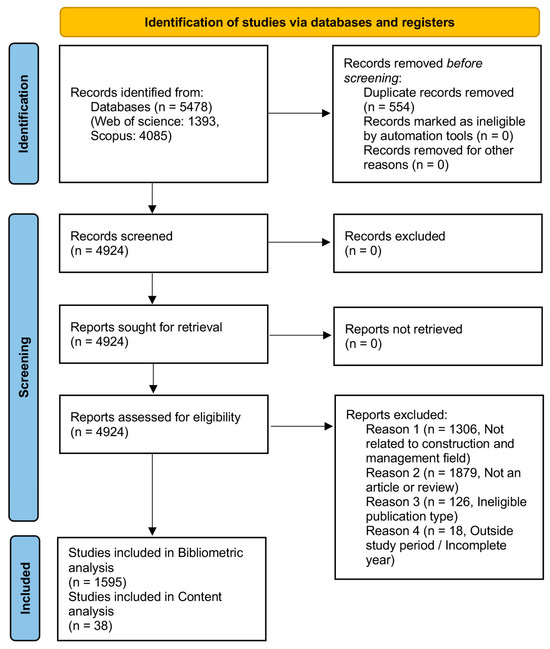
The literature identification and selection process was structured in accordance with the transparency principles outlined in the PRISMA 2020 framework. While this study does not constitute a protocol-driven systematic review, PRISMA guidelines were adopted to ensure transparent reporting of database search, screening, and eligibility procedures. A stepwise screening process was conducted, including database identification, duplicate removal, title and abstract screening, and full-text eligibility assessment. This process resulted in a final dataset of 1595 peer-reviewed journal articles, which served as the basis for the bibliometric analysis.
The PRISMA-based flow diagram (Figure 1) outlines the dataset construction process and the screening stages used to identify studies included in the bibliometric mapping. Only peer-reviewed journal articles indexed in Web of Science and Scopus were included. Conference proceedings were excluded to maintain consistent citation structures and standardized metadata for large-scale bibliometric network analysis. While conference papers may capture emerging developments, journal articles provide standardized indexing formats that support robust citation and co-occurrence mapping. It should be noted that the selection of studies for qualitative content analysis, detailed in Section 2.2, did not constitute an additional PRISMA filtering stage.
Figure 1.
PRISMA-based flow diagram illustrating the literature identification, screening, eligibility assessment, and dataset selection process used for the bibliometric analysis (adapted from the PRISMA 2020 template).
A Boolean query string was developed to identify studies in the BIM collaboration literature from the Web of Science (WoS) and Scopus databases (Table 1). These queries prioritized high-level umbrella terms (e.g., Collaborat, Coordinat, Teamwork) over specific technical acronyms (e.g., CDE, ISO 19650). This strategy is grounded in the field’s semantic hierarchy, where studies on specific technical implementations, such as Common Data Environment or interoperability, are conceptually nested within the broader BIM and collaboration context. This approach was designed to ensure comprehensive coverage of both general and technical dimensions of the field. Its effectiveness is evident in the results, where technical terms such as Common Data Environment (CDE), interoperability, and IFCs emerged as dominant nodes in the keyword co-occurrence analysis.
Table 1.
Boolean query string used in WOS and Scopus databases.
The search yielded 606 articles from WoS and 1543 articles from Scopus. Using RStudio (Version 2025.09.2+418; Posit Software, PBC, Boston, MA, USA), the datasets were merged, and 554 duplicates were removed. To address metadata format discrepancies between the two databases, a harmonization procedure was applied using the bibliometrix R package. The datasets were merged via the mergeDbSources function, which standardizes citation fields into a unified format. Additionally, to ensure the reliability of the co-citation analysis, a thesaurus file was created in VOSviewer (Version 1.0; Centre for Science and Technology Studies, Leiden University, The Netherlands) to manually merge variant citation formats, preventing node duplication and enhancing network accuracy.
After dataset cleaning and organization, 1595 BIM collaboration articles were included in the bibliometric analysis.
2.1. Bibliometric Analysis
The bibliometric dataset for this study comprised 1595 journal articles published between 2000 and 2025, indexed in Web of Science and Scopus. This dataset captures the historical development of BIM research and provides a robust basis for clustering and structural analysis. Bibliometric analysis was conducted to examine the intellectual structure, thematic evolution, and research dynamics of BIM collaboration, including publication trends, leading journals, influential authors, institutional and country-level collaboration networks, and keyword co-occurrence patterns.
Bibliometric techniques are generally divided into two categories: performance analysis and science mapping. Performance analysis evaluates the contributions of research components to the field. In the performance analysis tables, the average citations per publication (ACP) metric is defined as the ratio of total citations received to the total number of documents published by the respective author, institution, or country. Science mapping, in contrast, examines the relationships between research components [39].
In this study, both performance analysis and science-mapping techniques were applied using Biblioshiny (Version 4.1) and VOSviewer to visualize co-authorship, co-citation, keyword co-occurrence, and bibliometric coupling networks. Bibliometric analysis was conducted in two stages. First, performance analysis was performed using Biblioshiny, a web-based interface that leverages the core functionalities of the RStudio bibliometrixR package. This step identified publication trends by year and the leading journals in the field. Second, science mapping analysis was conducted using VOSviewer (version 1.0) on the combined dataset to perform co-authorship, co-occurrence, co-citation, and bibliometric coupling analyses.
VOSviewer provides three types of visualization: network, overlay, and density maps. Network and overlay maps are organized into colored groups called clusters, which consist of authors or keywords. Within each cluster, nodes represent authors or keywords. For authors, node size reflects the number of publications, the number of links, and the strength of links. For keywords, node size is determined by co-occurrence frequency and connection strength [40]. Using these methods, this study analyzed co-authorship at the author, institution, and country levels, as well as keyword co-occurrence, co-citation, and document-based bibliometric coupling.
2.2. Qualitative Content Analysis
Building on the bibliometric mapping presented in Section 2.1, a qualitative review of each selected study’s content was conducted to gain analytical insights into collaboration dynamics. The objective of this content analysis was not exhaustive coverage, but rather to enable an interpretive examination of the dynamics of BIM collaboration across the selected studies. In this study, collaboration dynamics are defined as mechanisms, conditions, and interaction patterns that shape collaborative processes, including governance structures, coordination practices, information exchange, and trust. Indicators such as delays, cost overruns, and quality outcomes are treated as consequences of these dynamics and are addressed only to the extent that they reflect underlying collaborative mechanisms.
From the initial bibliometric dataset of 1595 journal articles, 38 studies were purposively selected following a cluster-informed full-text screening protocol. The protocol was executed as follows:
Step 1-Identification of Thematic Clusters from Bibliometric Mapping: The identification of thematic clusters for guiding the subsequent qualitative content analysis was informed by the keyword co-occurrence analysis (Section 3.2.2) of all 1595 articles. The resulting clusters served as a thematic framework for organizing studies into interpretive groups without requiring any additional reclassification. These clusters served solely as a thematic guide for subsequent study selection, rather than as a strict sampling frame. The four thematic clusters are as follows:
- Process Integration and Managerial Frameworks—Addressing process integration, project delivery methods, and managerial coordination.
- Digital Transformation—Focusing on technology-supported collaboration and advanced systems such as digital twin, augmented reality, Internet of Things, cloud computing, blockchain, and computer vision.
- Organizational and Human Factors—Highlighting barriers, challenges, education, standards, and human-centric workflows.
- Data Infrastructure and Technological Interoperability—Representing foundational concepts such as industry foundation classes (IFCs), linked data, and automation.
Step 2-Cluster Characterization: Each thematic cluster was examined to identify central and influential studies based on three criteria: (i) citation counts (highly cited within the cluster), (ii) network centrality (structural importance within keyword co-occurrence and co-citation networks), and (iii) thematic representativeness (addressing the core theme of the cluster). For the qualitative selection, citation counts and network centrality were jointly considered. Degree centrality values derived from the keyword co-occurrence and co-citation networks generated in VOSviewer were used as indicators of thematic relevance and structural importance. No rigid numerical cutoff was applied; instead, centrally positioned and highly cited studies within each thematic cluster were purposively selected to ensure balanced thematic coverage.
Step 3-Study Selection within Clusters: Within each cluster, studies occupying central positions were prioritized. Peripheral or outlier studies with minimal thematic relevance were excluded. The goal was to capture the thematic breadth of the cluster without exhaustive inclusion of every study.
Step 4-Temporal Scope and Rationale: The temporal scope of 2013–2025 for the qualitative content analysis was intentionally defined to focus on the post-adoption phase of BIM collaboration, during which research attention shifted toward socio-technical coordination, digital integration, and emerging technologies. Earlier foundational studies (2000–2012) were captured in the bibliometric analysis and informed the identification of thematic clusters but were not the primary focus of the interpretive content analysis. It should be noted that the studies selected for the qualitative stage are not intended to statistically represent the entire 2000–2025 period covered in the bibliometric analysis; rather, they provide an interpretive examination of contemporary collaboration dynamics within the selected studies.
Step 5-Cross-Cluster Balance and Purposive Adjustment: The final set of 38 studies was distributed across the four thematic clusters to ensure balanced qualitative coverage, as summarized in Table 2. Selection decisions were jointly reviewed by all co-authors to enhance interpretive consistency and reduce subjective bias.
Table 2.
Distribution of purposively selected studies by thematic cluster.
Step 6-Coding and Thematic Analysis: The selected studies were manually examined following Bardin’s three-stage content analysis framework [41]:
- Open Coding and Familiarization: Explicit and implicit collaboration dynamics were coded using Microsoft Excel (Microsoft Corporation, Redmond, WA, USA.
- Grouping and Conceptual Refinement: Codes were iteratively grouped into semantically coherent categories, yielding seven analytically distinct collaboration dynamics (Section 3.3).
- Descriptive Structuring and Interpretive Review: The presence of each dynamic was recorded descriptively to support structured thematic comparison; these counts are solely for organizational purposes only and do not imply statistical generalization.
3. Results
3.1. Performance Analysis
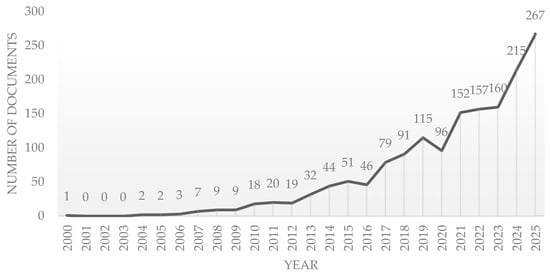
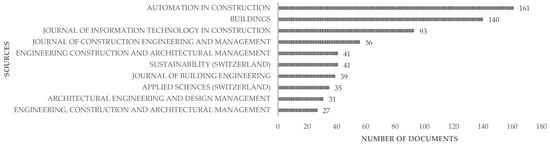
Performance analysis was conducted to examine the temporal distribution of scientific studies in BIM collaboration (Figure 2) and to identify the most influential journals in the field (Figure 3). A total of 1595 studies were included in the analysis. Consistent with technological developments, a marked increase in publications has been observed over the past five years. This growth can be attributed to three primary factors:
Figure 2.
Distribution of articles in the BIM collaboration research by year.
Figure 3.
The most influential journals in the BIM collaboration research and the number of studies published.
- Adoption of Industry 4.0 technologies: The integration of digital twins, AI, and other advanced tools has expanded BIM applications from static modeling to dynamic, data-driven collaboration.
- Regulatory frameworks: Implementation of government mandates, such as the UK’s BIM Level 2/PAS 1192-2 [42] standards and the ISO 19650 [43] series, has prompted research on compliance, standardization, and best practices.
- Post-pandemic remote work trends: The shift toward distributed and cloud-based collaborative environments, including Common Data Environments (CDEs), has accelerated academic interest in virtual collaboration platforms.
Among the journals publishing BIM collaboration studies, three stand out: Automation in Construction (161 studies), Buildings (140 studies), and Journal of Information Technology in Construction (93 studies). The prominence of these journals reflects a broader shift in the scholarly landscape: research on collaboration has moved from general project management outlets to specialized platforms emphasizing construction informatics and digital transformation. This trend underscores that collaboration in BIM is increasingly framed as a technical and technological challenge, rather than solely a managerial concern.
3.2. Science Mapping and Cluster Structure
3.2.1. Co-Authorship Analysis
Co-authorship analysis was employed to examine collaboration patterns among researchers and to map the field’s intellectual and social structure. This method enables the identification of central actors, collaborative clusters, and the overall strength of scholarly interaction within the domain [44].
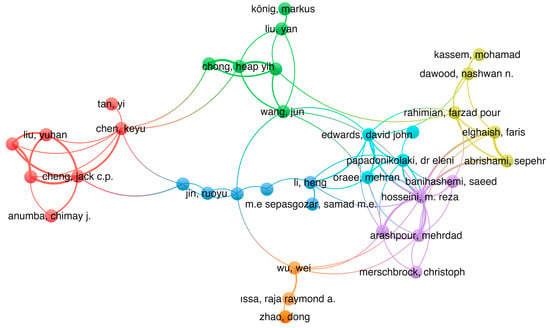
The analysis was conducted using VOSviewer. To reduce noise and ensure visualization of a stable core structure, the minimum publication threshold was set at five documents per author. The complete counting method was applied. Based on these criteria, 80 of the 4003 authors met the inclusion threshold.
To preserve network coherence and prevent fragmented visualization, only the largest connected component was retained. As a result, 44 isolated authors were excluded, yielding a final network of 36 authors with established collaborative ties (Figure 4). The fact that fewer than half of the authors who meet the threshold belong to the main connected component indicates a fragmented collaboration structure within the field. This pattern suggests that a considerable proportion of researchers either publish independently or collaborate within small, weakly connected groups.
Figure 4.
Co-authorship analysis of scientific studies in the BIM collaboration research.
The final network consists of seven clusters, 80 links, and a total link strength of 188. Each cluster corresponds to a distinct collaborative and thematic concentration within BIM collaboration research.
The purple cluster comprises authors addressing the human, stakeholder, and organizational behavior dimensions of BIM collaboration. Hosseini, M. Reza occupies the most central position in this cluster, with the highest number of connections (12), and maintains strong ties with Papadonikolaki, Oraee, and Abrishami.
The red cluster represents research focused on technology and data integration. Cheng, Jack C.P., serves as the central actor in this cluster, collaborating closely with Anumba, Tao, and Chen, collectively representing the technologically intensive segment of the literature.
The blue cluster functions as a structural bridge between the technology-focused red cluster and the management-oriented purple cluster. Authors, including Skitmore, Martin R., Li Heng, Jin, and Ruoyu, contribute to cross-cluster integration and knowledge exchange.
The green cluster, centered around Chong, Heap Yih, primarily addresses contract management and project delivery systems. The yellow and orange clusters reflect emerging and trend-oriented research streams. Authors such as Rahimian, Farzad Pour, Elghaish, Faris, Issa, and Raja Raymond are prominent contributors to these newer thematic trajectories.
Table 3 presents the most prolific authors in the BIM collaboration research along with their performance indicators. Hosseini, M. Reza (20 publications) and Cheng, Jack C.P. (18 publications) are the most productive scholars, consistent with their central positions in the largest clusters of the co-authorship network.
Table 3.
The most prolific authors and performance metrics in the BIM collaboration research (the average citations per publication (ACP) metric was calculated using the formula: ACP = Total Citations/Total Publications).
When co-authorship is analyzed at the inter-institutional level, the dense, highly interconnected structure observed among individual authors is not apparent (Figure 5). Instead, the network exhibits regional clustering, with collaboration largely shaped by geographical proximity and established research groups.
Figure 5.
Co-authorship relationships between institutions in BIM collaboration research.
For instance, Hong Kong Polytechnic University and Hong Kong University of Science and Technology form a tightly connected cluster, reflecting strong intra-Asia collaboration. In contrast, the cluster comprising the University of Salford, Birmingham City University, and Taif University functions as an academic bridge linking the UK and the Middle East. Another notable cluster includes The Bartlett (UCL—University College London) and École de Technologie Supérieure, which, despite their geographical separation, demonstrate robust UK–Canada collaboration through shared research focus areas.
Table 4 presents the ten institutions with the highest contributions to BIM collaboration research, along with their performance metrics. The table highlights the dominant presence of Hong Kong- and UK-based universities. In terms of average citations per publication, the Hong Kong University of Science and Technology leads with 88 citations, representing the highest impact within the dataset.
Table 4.
Institutions producing the most publications in the BIM collaboration research (the average citations per publication (ACP) metric was calculated using the formula: ACP = Total Citations/Total Publications).
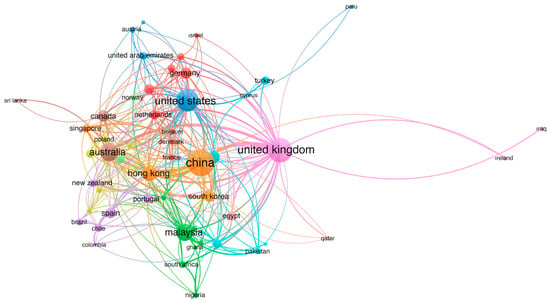
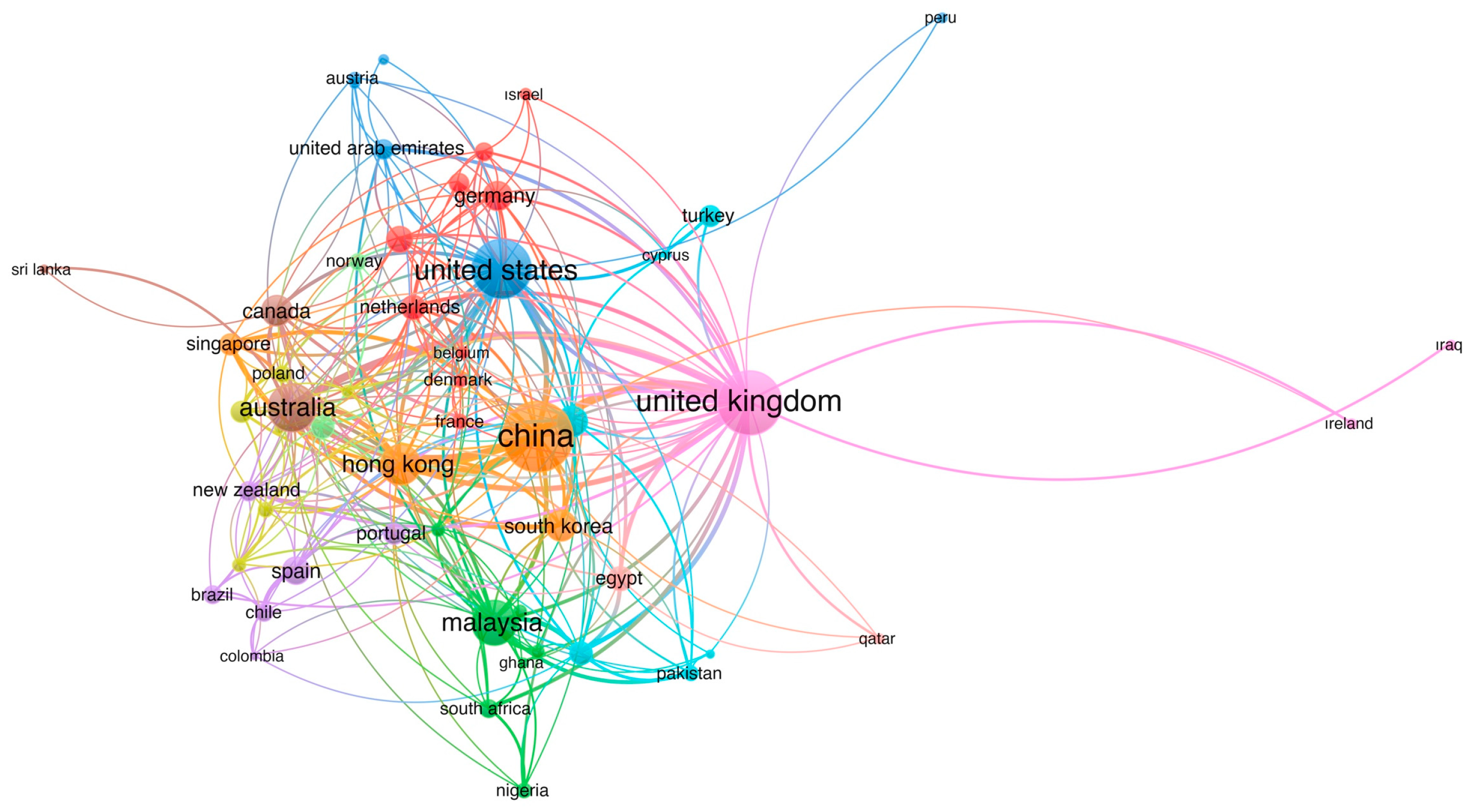
The co-authorship analysis at the country level (Figure 6) illustrates the global distribution of BIM collaboration research and highlights countries’ strategic partnership patterns. The map indicates that China, the United Kingdom, the United States, and Australia occupy central positions and represent the largest nodes, reflecting their leading roles in publishing and shaping the field.
Figure 6.
Co-authorship relationships between countries in BIM collaboration research.
Performance metrics for the top-contributing countries (Table 5) confirm a multipolar structure in the literature. China, the United Kingdom, the United States, and Australia consistently rank highest in both publication count and citation impact. Notably, the United Kingdom and Australia serve as bridges in the network, facilitating international collaboration across regions.
Table 5.
Countries with the highest number of publications in the BIM collaboration research (the average citations per publication (ACP) metric was calculated using the formula: ACP = Total Citations/Total Publications).
The inclusion of developing countries such as Malaysia, Egypt, Turkey, and Saudi Arabia underscores the growing role of BIM collaboration as a strategic approach to addressing the evolving needs of the global construction sector.
3.2.2. Keyword Co-Occurrence Analysis
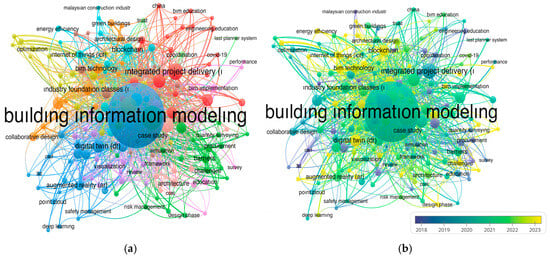
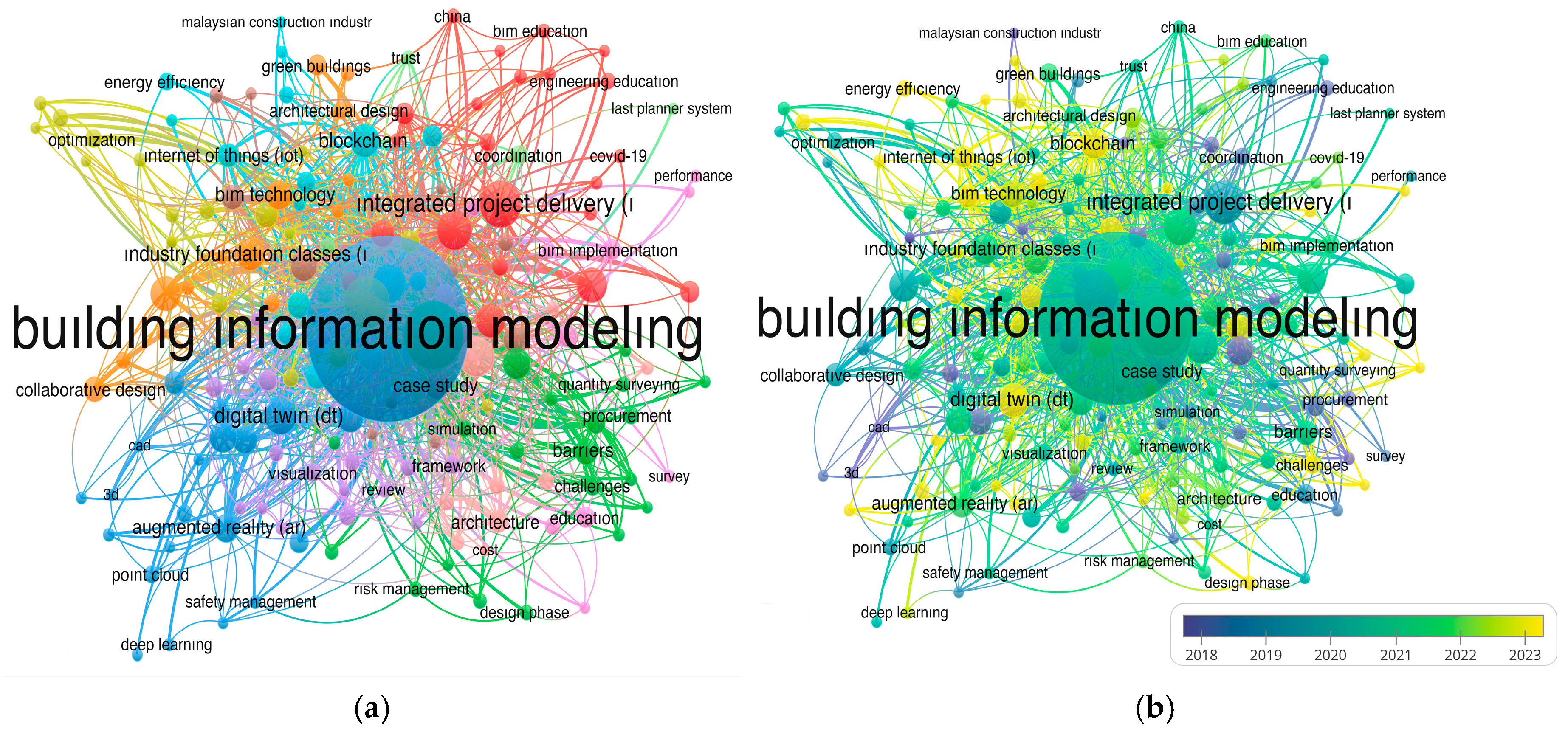
Keyword analysis is widely used in scientific research to identify which terms frequently co-occur, revealing thematic relationships, research trends, and the structure of knowledge in a field [45]. In this study, co-occurrence analysis was performed in VOSviewer to map keywords in the BIM collaboration research. Duplicates caused by spelling variations were corrected using a thesaurus file. Based on the analysis criteria, 170 frequently used keywords were identified, forming 11 groups, with 1550 connections and 3662 connection strengths (Figure 7a). The term “building information modeling” emerged as the largest and most central node, reflecting its role as the field’s core concept. The 11 clusters identified in the bibliometric mapping were synthesized into four primary thematic pillars based on semantic proximity for enabling a more interpretive and cohesive discussion. These four thematic clusters are as follows:
Figure 7.
(a) Network visualization of co-occurrence analysis of keywords in scientific studies in the BIM collaboration research. (b) Overlay visualization of co-occurrence analysis of keywords in scientific studies in the BIM collaboration research.
- Process Integration and Managerial Frameworks (Red Cluster): Keywords such as integrated project delivery (IPD), lean construction, construction management, and coordination highlight BIM as a management methodology and the importance of process integration.
- Digital Transformation (Blue Cluster): Keywords such as digital twin, augmented reality, Internet of Things, cloud computing, blockchain, and computer vision indicate a focus on technology-supported collaboration and advanced systems.
- Organizational and Human Factors (Green Cluster): Keywords such as barriers, challenges, standards, risk management, and education emphasize prerequisites for effective collaboration and the resolution of socio-technical obstacles.
- Data Infrastructure and Technological Interoperability (Yellow Cluster): Keywords such as industry foundation classes (IFCs), linked data, and automation illustrate the technical foundations that enable integration across systems.
A timeline overlay analysis (Figure 7b) further indicated the evolution of research topics. Earlier studies emphasized geometric data sharing, collaborative design, and 3D modeling, while more recent research highlights digital twins, AI, generative design, blockchain, and extended reality (XR), reflecting a shift toward technology-enabled, dynamic collaboration systems. The top ten most frequently used keywords in co-occurrence analysis, along with the cluster they belong to on the map, their frequency of occurrence, and their average publication year (APY), are presented in Table 6. The term “Collaboration” (APY: 2018) represents the foundational focus on process and human-centric workflows, whereas the emergence of “Digital Twin” (APY: 2023) and related technologies signals the growing role of real-time, data-driven collaboration.
Table 6.
Top 10 author keywords by frequency, cluster, and average publication year.
3.2.3. Co-Citation Analysis
Co-citation analysis examines instances in which two or more authors cite the same sources, providing insights into scholarly interactions and the intellectual structure of a field [46]. Identifying co-cited sources is essential for revealing the foundational literature and key theoretical frameworks within a discipline.
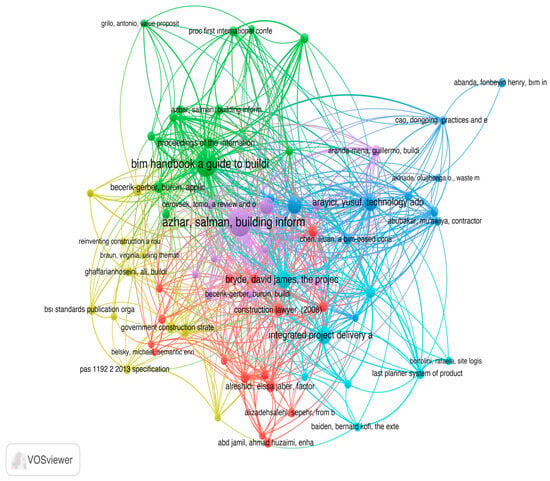
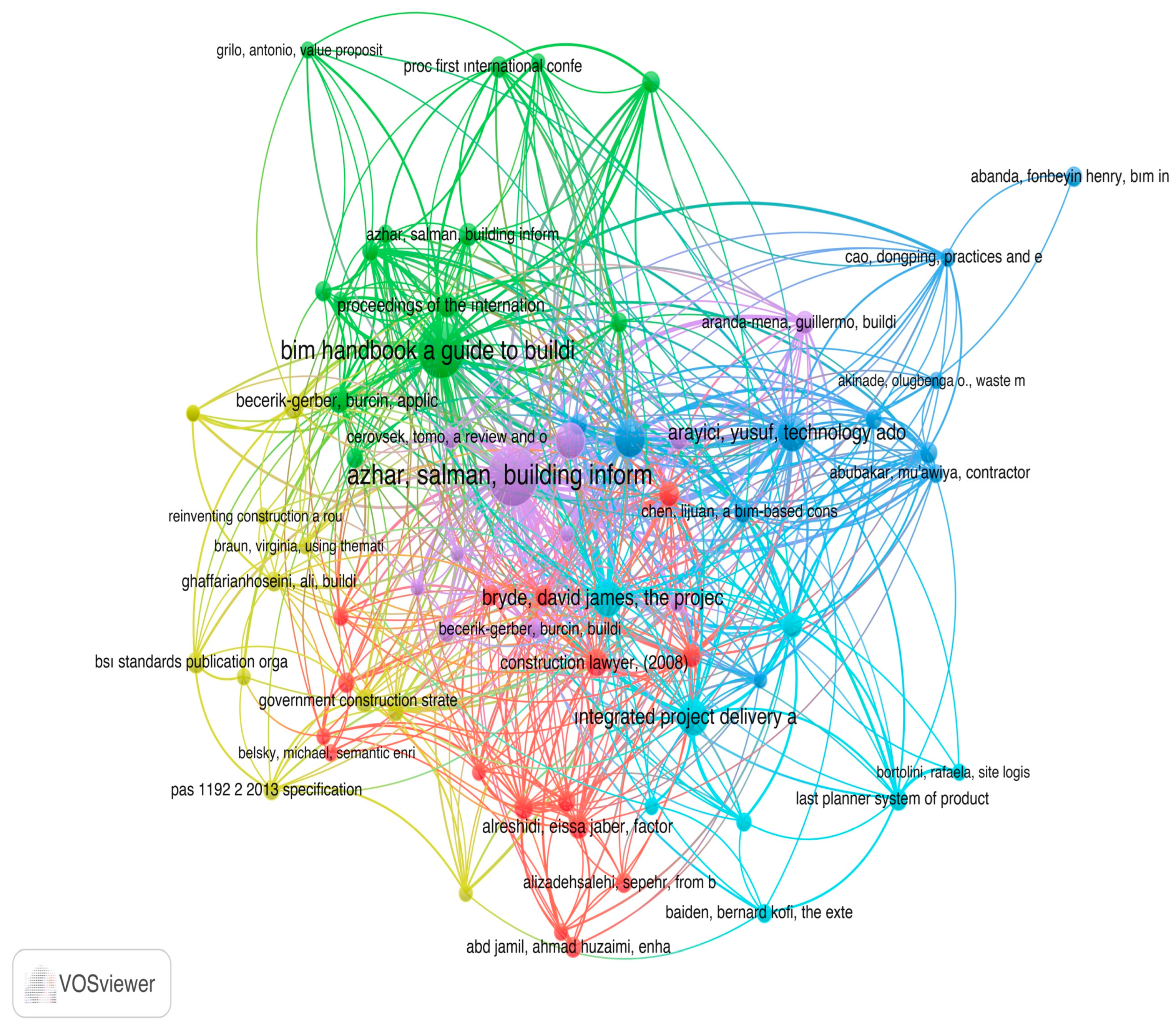
In this study, co-citation analysis was conducted to determine the classic sources and theoretical underpinnings of BIM collaboration research. The analysis revealed six primary clusters forming the intellectual structure of the literature (Figure 8). The map demonstrates that BIM research is not confined to a single topic but has developed in an integrated manner across multiple domains, including technology adoption, project management, standards, and legal processes.
Figure 8.
Co-citation analysis of scientific studies in the BIM collaboration research.
Two central nodes dominate the co-citation network. Azhar, [47] occupies the very center, indicating that it is cited across nearly all sub-disciplines. The BIM Handbook [7] similarly connects to all clusters, serving as a foundational reference for the field. Table 7 summarizes the most influential studies based on citation counts and total link strength. Azhar [47] emerges as the most central source, with 131 citations and a total link strength of 266, bridging multiple clusters. The BIM Handbook [7] is also foundational, with 113 citations and a total link strength of 124, facilitating interdisciplinary knowledge flow.
Table 7.
Co-citation analysis of fundamental studies forming the intellectual structure of the BIM collaboration research.
These findings highlight that the intellectual base of BIM collaboration research is anchored in a small set of highly influential studies, which serve as bridges connecting diverse thematic and methodological areas within the literature.
3.2.4. Bibliometric Coupling
Bibliometric coupling identifies shared references among scientific studies, providing insights into the thematic and structural relationships between publications. The technique measures the strength of connections between studies citing common sources, revealing subject trends, research clusters, and the development of core literature [55]. As the number of shared references between two articles increases, their topic similarity increases as well.
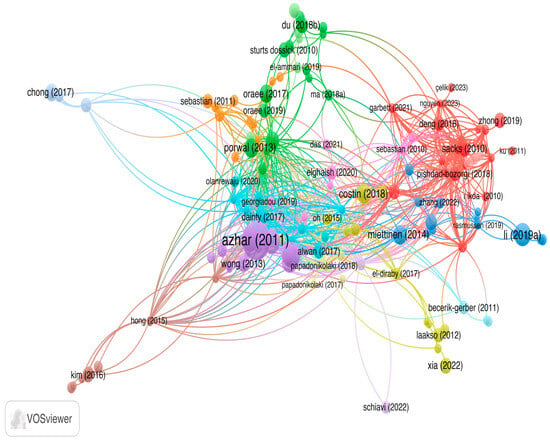
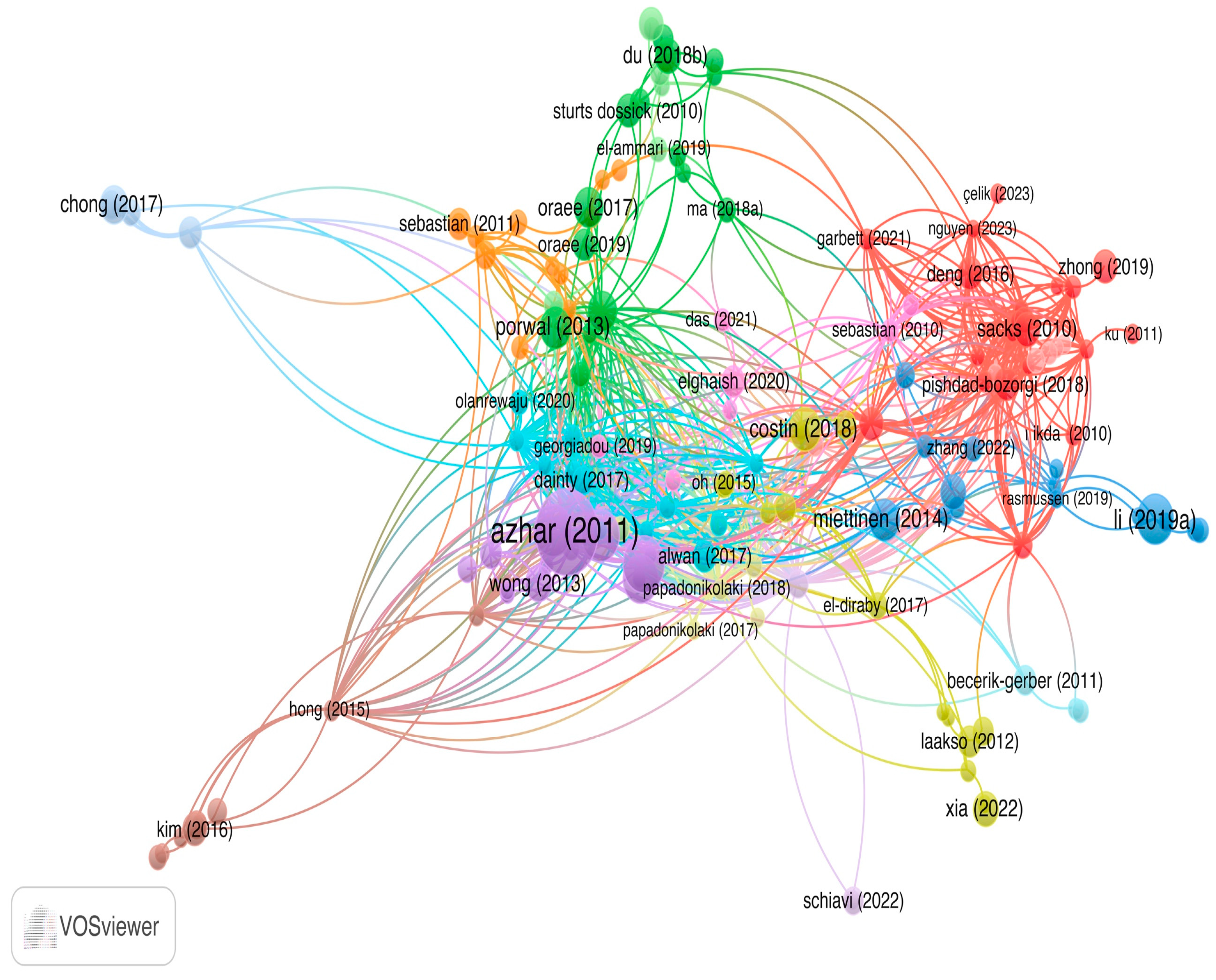
In this study, bibliometric coupling was applied to examine the interdisciplinary structure of BIM collaboration research. At the source level, Table 8 ranks the 10 most influential journals by total link strength (TLS). Automation in Construction emerges as the most influential journal, leading across all metrics with 157 publications, 15,757 citations, and a TLS of 3601. Buildings ranks fifth in TLS but is the second-most prolific journal by publication volume and stands out for hosting the most recent research, with an average publication year of 2023. At the document level, bibliometric coupling was conducted to identify thematic clusters in current research (Figure 9). The purple cluster is centered on Azhar [47], the most cited foundational study in the field. The green cluster comprises research on collaborative networks and social dynamics, with notable studies by Porwal [56] and Oraee [26,36]. The red cluster focuses on technological integration, highlighting the contributions of Sacks [57], Deng [58], Garbett [59], and Çelik [60]. The blue and turquoise clusters represent more specialized subfields, including studies by Li [61], Zhang [62], and Miettinen [63].
Table 8.
Top 10 most effective sources according to bibliometric matching analysis.
Figure 9.
Document-based bibliographic coupling analysis of the BIM collaboration research.
Overall, 15 sub-clusters were synthesized into four main thematic areas based on content similarity and citation patterns (Table 9). The dominant research theme is BIM adoption, implementation, and strategic management. Current research trends also emphasize collaboration, innovation, facility management, integration of digital tools, and advanced technologies.
Table 9.
Research clusters and prominent studies identified through bibliometric matching analysis.
3.3. Qualitative Content Analysis Findings
A qualitative full-text content review was conducted on 38 purposely selected studies, following the cluster-informed screening protocol described in Section 2.2. The goal of this review is to provide interpretive insights into the dynamics of BIM collaboration, rather than to produce statistically generalizable results. Through coding, grouping, and thematic refinement, seven distinct collaboration dynamics were identified (Table 10). These dynamics highlight the patterns of scholarly emphasis and thematic focus present in the 38 studies examined.
Table 10.
Categorization of collaboration dynamics and associated focus areas in the selected studies (n = 38).
3.3.1. Technology-Driven Collaboration Dynamics
Technology-related dynamics were the most frequently addressed among the selected studies. Collaboration is conceptualized in terms of the development and integration of digital tools rather than primarily through organizational or behavioral frameworks. Earlier studies within the reviewed literature focused on web-based data processing environments, GPS integration, and sensor technologies [38]. More recent contributions emphasize advanced digital ecosystems, including blockchain applications [39,40,41,42,43], Virtual and augmented reality (VR/AR) systems [44,45,46,47,48], and metaverse-based environments [49]. The integration of digital twins [50,51,52] and Artificial Intelligence-supported BIM processes [53] further reflects a shift toward data-driven, predictive collaboration models, in which coordination extends beyond information exchange to intelligent data management. Additionally, the incorporation of game engines [54,55] and Mixed Reality (MR) applications [38,56] indicates growing scholarly attention to immersive visualization technologies that enhance stakeholder communication and spatial coordination. Technological development emerges as a central analytical perspective in the analyzed studies, through which collaboration challenges and opportunities are interpreted.
3.3.2. Software Competence-Driven Collaboration Dynamics
Software competence captures the interactional issues between technological systems and human actors. This dynamic is examined as the operational capacity required to translate digital potential into effective collaborative practice. Several studies focus on the collaborative implications of federated model environments [38,57,58,59] and clash detection processes [38,57,59], which function as technical coordination mechanisms across disciplines. The ability of different stakeholders to develop and manage discipline-specific local models [59,60] is framed as an enabling feature of BIM-based workflows. However, software incompatibilities [20], interoperability constraints, and broader technical limitations [61,62] are identified as factors constraining collaborative efficiency. Furthermore, insufficient training and uneven digital literacy among project participants are noted as limiting conditions that hinder the effective use of BIM platforms.
3.3.3. Human Behavior-Driven Collaboration Dynamics
Human behavior-related dynamics receive comparatively less analytical attention in the analyzed studies, yet represent a critical socio-organizational layer of BIM collaboration (Table 10). It underscores that collaborative effectiveness is shaped not only by technological infrastructure but also by stakeholder attitudes, leadership approaches, and relational dynamics. Several studies indicate that adherence to traditional business practices [20] and reluctance to engage in collaborative workflows [16] may slow BIM integration processes. Conversely, leadership commitment [60,63], role clarity [63], and the establishment of mutual trust among stakeholders [60] are identified as enabling conditions for effective coordination. Within the analyzed studies, human-centered dynamics are discussed primarily in relation to behavioral adaptation and governance alignment rather than as standalone technological variables. While not as prominently highlighted as technological themes, these dynamics are presented as essential mediators of long-term collaboration.
3.3.4. Project Processes, Policies, and Procedures-Driven Collaboration Dynamics
Project processes, policies, and procedures receive limited analytical attention within the analyzed studies, reflecting the formal governance and contractual structures that underpin collaborative workflows. In the analyzed studies, the absence of clearly defined BIM policies, implementation protocols, and contractual integration mechanisms is identified as a constraint affecting coordination [16,20,63]. In particular, the lack of pre-planning structures and BIM execution plans (BEPs) is associated with workflow inefficiencies and schedule disruptions [62]. Therefore, procedural alignment emerges as a structural precondition for effective technological deployment, underscoring the interdependence between digital infrastructure and institutional governance frameworks.
3.3.5. Management, Cost, and Quality-Driven Collaboration Dynamics
The management, cost, and quality dynamics receive the least analytical emphasis within the analyzed studies. These categories primarily address performance outcomes associated with collaborative practices. Resource coordination and managerial oversight are framed as enabling conditions for collaborative efficiency [62,63]. Several studies highlight the potential of BIM-enabled collaboration to optimize costs [64] and enhance model quality [58,61], suggesting that collaboration maturity may influence broader project performance metrics. Although these dynamics are less prominently articulated than technological and socio-organizational themes, they represent consequential outcome layers closely linked to the effectiveness of technological and organizational integration.
4. Discussion
Rather than reiterating the breadth of themes, the bibliometric patterns point to a structural transformation in BIM collaboration research, in which coordination is increasingly mediated by data-driven, algorithm-supported digital systems. This shift suggests that collaboration is no longer primarily organized around interpersonal or process-based arrangements but is progressively shaped by technological infrastructures that reconfigure how interaction, decision-making, and coordination occur.
These developments do not suggest the replacement of human collaboration by digital systems. Instead, they reflect an expansion of the collaboration concept in which digital infrastructures augment coordination, decision-making, and information management.
4.1. Technological Shift in BIM Collaboration Research
The shift from process-oriented concepts (such as IPD and lean construction) to technology-driven ecosystems (such as AI, digital twins, and blockchain) signals a fundamental change in how collaboration is structured. Rather than acting as isolated technical tools, these emerging technologies facilitate real-time and predictive coordination. For instance, blockchain enhances transparency in data exchange, while AI and digital twins enable data-driven decision-making and continuous monitoring.
These emerging digital technologies were interpreted in the selected 38 studies as facilitators of coordination, interoperability, and predictive collaboration, rather than isolated technical tools. For example, blockchain and smart contracts enhance transparency and trust in data exchange, while AI and digital twins support data-driven decision-making and real-time monitoring.
This temporal transition, summarized in Table 11, suggests a reframing of collaboration from primarily human-centered coordination toward digitally mediated interaction environments characterized by data ecosystems, automated workflows, and cyber–physical integration. This transition does not imply a displacement of human collaboration; instead, it reflects a layered expansion of collaboration in which digital systems augment, rather than replace, social coordination. Advanced digital technologies are increasingly positioned as enablers of predictive, integrated, and real-time collaboration, extending the scope of coordination beyond traditional information exchange.
Table 11.
Temporal shifts in technological dynamics were identified in the analyzed BIM collaboration studies.
These findings indicate a socio-technical asymmetry, where technological ecosystems are increasingly elaborated, while mechanisms for integrating these tools into organizational and behavioral practices receive comparatively less analytical attention. This asymmetry echoes the “human factor gap.”
4.2. Social and Organizational Dimensions of BIM Collaboration
From a socio-technical systems (STS) perspective, the persistence of the “human factor gap” within the BIM collaboration research can be interpreted as reflecting entrenched socio-organizational dynamics. The sector has been characterized by a pronounced silo mentality, in which professionals from different disciplines tend to operate within clearly bounded domains to maintain professional autonomy. In this context, the heightened transparency enabled by BIM environments may be perceived as challenging established roles and responsibilities. Such perceptions can activate sociological boundary-preservation mechanisms, including territoriality, which may constrain open information exchange.
The concept of cultural lag, in which technological innovation advances more rapidly than social norms and institutional practices, provides an explanatory lens for understanding this imbalance. Although BIM tools technically facilitate real-time data sharing and coordination, organizational practices in many contexts remain shaped by adversarial contractual arrangements and liability-oriented governance models. This misalignment may generate reluctance toward collaborative engagement, not primarily because of technical limitations, but because of concerns about psychological safety, accountability, and risk exposure. Rather than representing a temporary research imbalance, the persistence of the human factor gap indicates a structural socio-technical lag, in which organizational and governance mechanisms adapt more slowly than technological capabilities.
4.3. Interpreting Global and Regional Patterns in BIM Collaboration Research
The country- and institution-based bibliometric analyses reveal a research landscape that is both multipolar and hierarchically structured. The network maps indicate that research activity is concentrated in a limited number of countries that serve as central hubs for publication output and citation connectivity. Within these networks, several countries appear to operate as bridging nodes, facilitating cross-regional knowledge exchange and scholarly interaction. This network structure should not be interpreted as evidence of normative dominance or universal authority in shaping BIM collaboration practices. Rather, it reflects the interaction between research capacity, policy environments, and citation dynamics within the analyzed dataset. In some cases, the analytical prominence of certain countries appears to align with national digitalization strategies and early institutional support for BIM adoption. For example, the United Kingdom’s visibility within BIM research has been associated with early governmental initiatives that promoted standardized BIM implementation in public-sector projects. Similarly, China’s expanding research presence may be linked to broader state-supported digital construction and infrastructure modernization agendas. However, such associations should be interpreted with caution. Bibliometric centrality captures patterns of scholarly connectivity and influence within the publication network, rather than direct indicators of practical leadership or global standard-setting authority. As such, the observed hierarchies reflect research system dynamics rather than definitive measures of implementation maturity across regions.
The presence of developing and emerging economies further indicates that BIM collaboration is being explored across diverse economic and institutional contexts. At the same time, the clustering of institutional collaborations along regional lines suggests that geographical proximity, shared policy frameworks, and linguistic commonality continue to shape knowledge circulation pathways. Consequently, the global structure of BIM collaboration research appears interconnected yet regionally patterned. Taken together, these bibliometric patterns highlight opportunities for comparative and cross-regional inquiry, rather than implying a uniform or linear global diffusion of BIM collaboration practices.
5. Conclusions
This study examined the intellectual structure, thematic configuration, and evolving analytical emphases of BIM collaboration research through bibliometric mapping of 1595 journal articles indexed in Web of Science and Scopus, complemented by a qualitative content analysis of 38 purposively selected studies.
The bibliometric findings indicate sustained growth in scholarly attention to BIM collaboration, particularly in recent years. Countries such as China and the United Kingdom emerge as prominent contributors in terms of publication activity and citation connectivity, while journals such as Automation in Construction and Buildings function as key publication venues. These patterns reflect research productivity and network centrality within the analyzed dataset, rather than normative leadership or universal authority in shaping BIM collaboration practices.
5.1. Responses to the Research Questions
Regarding the intellectual structure and thematic evolution of BIM collaboration research (RQ1), the findings indicate a discernible conceptual reorientation over time. Earlier studies were anchored in process-oriented and managerial frameworks, such as Integrated Project Delivery (IPD) and lean construction, emphasizing coordination through organizational arrangements and workflow integration. More recent research increasingly foregrounds data-centric and cyber–physical systems, including digital twins, blockchain, and Artificial Intelligence. This evolution reflects not the replacement of human-centered collaboration models, but rather an expansion of the collaboration concept toward digitally mediated, algorithm-supported interaction environments.
In addressing emerging collaboration dynamics (RQ2), the qualitative content analysis of the 38 selected studies reveals that technological dynamics and software competence occupy a central analytical position. Emerging digital technologies, including blockchain, digital twins, and AI-supported BIM processes, are interpreted as facilitators of coordination, interoperability, and information integration across project teams rather than as isolated technical tools. In contrast, dynamics related to human behavior, governance structures, and project-level processes receive comparatively lower analytical attention, highlighting the persistence of the human factor gap identified in the bibliometric analysis.
When interpreted through a socio-technical systems (STS) perspective (RQ3), the “human factor gap” emerges as a structural socio-technical asymmetry. The rapid elaboration of technological themes, combined with the comparatively limited investigation of social dimensions, such as trust, leadership, and role clarity, resembles a form of cultural lag, in which technological subsystems evolve more rapidly than institutional norms and organizational practices. From this standpoint, ongoing collaboration challenges in BIM-enabled projects are not primarily attributable to a lack of digital capability, but to misalignments between increasingly sophisticated cyber–physical systems and the traditional contractual, managerial, and relational frameworks in which they operate.
5.2. Practical and Theoretical Implications
The findings underscore that BIM collaboration cannot be adequately understood as a purely technological configuration. Instead, collaboration should be examined as a co-evolving socio-technical system, in which digital tools, organizational structures, and human behavior interact dynamically. Managerial and legal dimensions highlight the need for further theoretical development, particularly regarding governance models, contractual adaptation, and liability allocation in data-driven, algorithm-supported workflows. Aligning BIM collaboration practices with standards such as ISO 19650 may therefore require not only technical standardization, but also institutional and organizational transformation.
From an industry perspective, the results indicate that investments in advanced digital technologies yield greater collaborative benefits when accompanied by parallel attention to organizational readiness, role clarity, and trust-building mechanisms. Workforce development initiatives may thus benefit from integrating socio-technical competencies, such as collaborative governance, communication, and ethical awareness, alongside software proficiency.
5.3. Limitations and Directions for Future Research
The present study has two main limitations. First, the analysis was restricted to English-language, peer-reviewed journal articles indexed in Web of Science and Scopus, thereby excluding conference proceedings, industry reports, and non-indexed publications that may document emerging practices. Second, the content analysis focused on 38 purposively selected studies, enabling thematic interpretation while limiting statistical generalizability.
Future research may statistically examine BIM collaboration dynamics as interacting and co-evolving mechanisms. Longitudinal studies can explore how technological, behavioral, organizational, and legal dimensions evolve over the lifecycle of BIM-enabled projects. Comparative cross-regional research may further investigate how institutional, contractual, and regulatory contexts shape collaboration practices. Particular attention should be given to emerging challenges related to human–AI collaboration, data ownership, ethical accountability, and responsibility allocation in increasingly automated construction ecosystems. Advancing BIM collaboration research will require analytical frameworks that move beyond static categorizations and instead capture the dynamic interplay among technological, human, organizational, and legal dimensions within a balanced socio-technical perspective.
Author Contributions
Conceptualization, N.K. and F.H.H.; Investigation, N.K.; Methodology, N.K. and F.H.H.; Project administration, F.H.H.; Supervision, F.H.H.; Writing—original draft, N.K.; Writing—review and editing, F.H.H. All authors have read and agreed to the published version of the manuscript.
Funding
This research received no external funding.
Data Availability Statement
The original contributions presented in this study are included in the article. Further inquiries can be directed to the corresponding authors.
Conflicts of Interest
The authors declare no conflicts of interest.
Abbreviations
The following abbreviations are used in this article:
| Acronym | Description |
| BIM | Building Information Modeling |
| CDE | Common Data Environment |
| APY | Average Publication Year |
| FM | Facility Management |
| MR | Mixed Reality |
| IPD | Integrated Project Delivery |
| CAD | Computer-Aided Design |
| SNA | Social Network Analysis |
| WoS | Web of Science |
| UK | United Kingdom |
| AI | Artificial Intelligence |
| IFCs | Industry Foundation Classes |
| TLS | Total Link Strength |
| AEC | Architecture, Engineering, and Construction |
| VR | Virtual Reality |
| AR | Augmented Reality |
| XR | Extended Reality |
| IoT | Internet of Things |
| GPS | Global Positioning System |
| PRISMA | Preferred Reporting Items for Systematic Reviews and Meta-Analyses |
| BEP | BIM Execution Plans |
References
- Gann, D.M.; Salter, A.J. Innovation in project-based, service-enhanced firms: The construction of complex products and systems. Res. Policy 2000, 29, 955–972. [Google Scholar] [CrossRef] [Scilit]
- Hughes, D.T.; Williams, T.; Ren, Z. Differing Perspectives on Collaboration in Construction. Constr. Innov. 2012, 12, 355–368. [Google Scholar] [CrossRef] [Scilit]
- Kumaraswamy, M.; Love, P.E.; Dulaimi, M.; Rahman, M. Integrating procurement and operational innovations for construction industry development. Eng. Constr. Archit. Manag. 2004, 11, 323–334. [Google Scholar] [CrossRef] [Scilit]
- Hobbs, R.W. Leadership through collaboration. AIArchitect 1996, 3, 11. [Google Scholar]
- Walker, D.H.; Davis, P.R.; Stevenson, A. Coping with uncertainty and ambiguity through team collaboration in infrastructure projects. Int. J. Proj. Manag. 2017, 35, 180–190. [Google Scholar] [CrossRef] [Scilit]
- Ey, W.; Zuo, J.; Han, S. Barriers and challenges of collaborative procurements: An exploratory study. Int. J. Constr. Manag. 2014, 14, 148–155. [Google Scholar] [CrossRef] [Scilit]
- Eastman, C.; Teicholz, P.; Sacks, R.; Liston, K. BIM Handbook: A Guide to Building Information Modeling for Owners, Managers, Designers, Engineers and Contractors; John Wiley & Sons: New York, NY, USA, 2008. [Google Scholar]
- Dainty, A.; Leiringer, R.; Fernie, S.; Harty, C. BIM and the small construction firm: A critical perspective. Build. Res. Inf. 2017, 45, 696–709. [Google Scholar] [CrossRef] [Scilit]
- Hughes, D. Development of an Effective Model for Collaboration Within the UK Construction Industry. Ph.D. Thesis, University of South Wales, Pontypridd, UK, 2018. [Google Scholar]
- Nikas, A.; Poulymenakou, A.; Kriaris, P. Investigating antecedents and drivers affecting the adoption of collaboration technologies in the construction industry. Autom. Constr. 2007, 16, 632–641. [Google Scholar] [CrossRef] [Scilit]
- Hosseini, M.R.; Zavadskas, E.K.; Xia, B.; Chileshe, N.; Mills, A. Communications in Hybrid Arrangements: Case of Australian Construction Project Teams. Eng. Econ. 2017, 28, 290–300. [Google Scholar] [CrossRef] [Scilit]
- Beesley, C. BIM for Govies™; DLT Solutions, LLC: Herndon, VA, USA, 2013. [Google Scholar]
- Merschbrock, C.; Munkvold, B.E. How is building information modeling influenced by project complexity? A cross-case analysis of e-collaboration performance in building construction. Int. J. e-Collab. 2014, 10, 20–39. [Google Scholar]
- Turk, Ž. Ten questions concerning building information modelling. Build. Environ. 2016, 107, 274–284. [Google Scholar] [CrossRef] [Scilit]
- Santos, R.; Costa, A.A.; Grilo, A. Bibliometric analysis and review of building information modelling literature published between 2005 and 2015. Autom. Constr. 2017, 80, 118–136. [Google Scholar] [CrossRef] [Scilit]
- Liu, C.; Bu, Q.; Lin, S.; Li, F. BIM-based Collaborative Management and Intelligent Manufacturing in the Shenzhong Link Project. E3S Web Conf. 2019, 136, 01038. [Google Scholar] [CrossRef] [Scilit]
- Tae-Song, S. Building Information Modeling (BIM) Collaboration from the Structural Engineering Perspective. Int. J. Steel Struct. 2017, 17, 205–214. [Google Scholar] [CrossRef] [Scilit]
- Lin, Y.-C.; Yang, H.-H. A framework for collaboration management of bim model creation in architectural projects. J. Asian Archit. Build. Eng. 2018, 17, 39–46. [Google Scholar] [CrossRef] [Scilit]
- Nikolic, D.; Castronovo, F.; Leicht, R. Teaching BIM as a collaborative information management process through a continuous improvement assessment lens: A case study. Eng. Constr. Archit. Manag. 2021, 28, 2248–2269. [Google Scholar] [CrossRef] [Scilit]
- Merschbrock, C. Unorchestrated symphony: The case of inter-organizational collaboration in digital construction design. J. Inf. Technol. Constr. 2012, 17, 333–350. [Google Scholar]
- Zhang, S.; Pan, F.; Wang, C.; Sun, Y.; Wang, H. BIM-based collaboration platform for the management of EPC projects in hydropower engineering. J. Constr. Eng. Manag. 2017, 143, 04017087. [Google Scholar] [CrossRef] [Scilit]
- Emmitt, S.; Ruikar, K. Collaborative Design Management; Routledge: London, UK, 2013. [Google Scholar]
- Grilo, A.; Jardim-Goncalves, R. Value proposition on interoperability of BIM and collaborative working environments. Autom. Constr. 2010, 19, 522–530. [Google Scholar] [CrossRef] [Scilit]
- Liu, Q.; Gao, T. The information requirements for transportation industry’s facilities management based on BIM. Open Constr. Build. Technol. J. 2017, 11, 136–141. [Google Scholar] [CrossRef] [Scilit]
- Sackey, E.; Tuuli, M.; Dainty, A. Sociotechnical systems approach to BIM implementation in a multidisciplinary construction context. J. Manag. Eng. 2015, 31, A4014005. [Google Scholar] [CrossRef] [Scilit]
- Oraee, M.; Hosseini, M.R.; Edwards, D.; Papadonikolaki, E. Collaboration in BIM-based construction networks: A qualitative model of influential factors. Eng. Constr. Archit. Manag. 2022, 29, 1288–1301. [Google Scholar] [CrossRef] [Scilit]
- Jin, J.; Hwang, K.-E.; Kim, I. A study on the constructivism learning method for BIM/IPD collaboration education. Appl. Sci. 2020, 10, 5169. [Google Scholar] [CrossRef] [Scilit]
- Becerik-Gerber, B.; Gerber, D.J.; Ku, K. The pace of technological innovation in architecture, engineering, and construction education: Integrating recent trends into the curricula. J. Inf. Technol. Constr. 2011, 16, 411–432. [Google Scholar]
- Zhao, D.; McCoy, A.P.; Bulbul, T.; Fiori, C.; Nikkhoo, P. Building collaborative construction skills through BIM-integrated learning environment. Int. J. Constr. Educ. Res. 2015, 11, 97–120. [Google Scholar] [CrossRef] [Scilit]
- Matthews, J.; Love, P.E.; Mewburn, J.; Stobaus, C.; Ramanayaka, C. Building information modelling in construction: Insights from collaboration and change management perspectives. Prod. Plan. Control 2018, 29, 202–216. [Google Scholar] [CrossRef] [Scilit]
- Arayici, Y.; Coates, P.; Koskela, L.; Kagioglou, M.; Usher, C.; O’Reilly, K. Technology adoption in the BIM implementation for lean architectural practice. Autom. Constr. 2011, 20, 189–195. [Google Scholar] [CrossRef] [Scilit]
- Rezgui, Y.; Beach, T.; Rana, O. A governance approach for BIM management across lifecycle and supply chains using mixed-modes of information delivery. J. Civ. Eng. Manag. 2013, 19, 239–258. [Google Scholar] [CrossRef] [Scilit]
- Hadzaman, N.A.; Takim, R.; Nawawi, A.H. BIM compliance factors and its relations to project performance. Environ.-Behav. Proc. J. 2020, 5, 161–167. [Google Scholar]
- Antwi-Afari, M.F.; Li, H.; Pärn, E.A.; Edwards, D.J. Critical success factors for implementing building information modelling (BIM): A longitudinal review. Autom. Constr. 2018, 91, 100–110. [Google Scholar] [CrossRef] [Scilit]
- Nguyen, T.D.; Adhikari, S. The Role of BIM in Integrating Digital Twin in Building Construction: A Literature Review. Sustainability 2023, 15, 10462. [Google Scholar] [CrossRef] [Scilit]
- Oraee, M.; Hosseini, M.R.; Papadonikolaki, E.; Palliyaguru, R.; Arashpour, M. Collaboration in BIM-based construction networks: A bibliometric-qualitative literature review. Int. J. Proj. Manag. 2017, 35, 1288–1301. [Google Scholar] [CrossRef] [Scilit]
- Baik, A. Three Decades of Innovation: A Critical Bibliometric Analysis of BIM, HBIM, Digital Twins, and IoT in the AEC Industry (1993–2024). Buildings 2025, 15, 1587. [Google Scholar] [CrossRef] [Scilit]
- Ridho, A.; Aminullah, A.; Nugroho, A.S.B.; Handayani, T.N. A BIM-based Collaboration Implementation on Construction Projects: A Bibliometric Analysis and Systematic Literature Review. J. Constr. Dev. Ctries. 2025, 30, 75–107. [Google Scholar] [CrossRef] [Scilit]
- Donthu, N.; Kumar, S.; Mukherjee, D.; Pandey, N.; Lim, W.M. How to conduct a bibliometric analysis: An overview and guidelines. J. Bus. Res. 2021, 133, 285–296. [Google Scholar] [CrossRef] [Scilit]
- McAllister, C.P.; Mackey, J.D.; Alexander, K.C.; Ellen, B.P., III; Maher, L.P. Turning the page: A bibliometric review of the Journal of Organizational Behavior’s first 40 years. J. Organ. Behav. 2022, 43, 181–198. [Google Scholar]
- Bardin, L. Análise de Conteúdo; Edições 70: Lisboa, Portugal, 2011. [Google Scholar]
- PAS 1192-2:2013; Specification for Information Management for the Capital/Delivery Phase of Construction Projects Using Building Information Modelling. British Standards Institution (BSI): London, UK, 2013.
- ISO 19650-1:2018; Organization and Digitization of Information About Buildings and Civil Engineering Works, Including Building Information Modelling (BIM)—Information Management Using Building Information Modelling—Part 1: Concepts and Principles. International Organization for Standardization (ISO): Geneva, Switzerland, 2018.
- Xu, Q.A.; Chang, V. Co-authorship network and the correlation with academic performance. Internet Things 2020, 12, 100307. [Google Scholar] [CrossRef] [Scilit]
- Duvvuru, A.; Kamarthi, S.; Sultornsanee, S. Undercovering research trends: Network analysis of keywords in scholarly articles. In Proceedings of the 2012 Ninth International Conference on Computer Science and Software Engineering (JCSSE), Bangkok, Thailand, 30 May–1 June 2012. [Google Scholar]
- Trujillo, C.M.; Long, T.M. Document co-citation analysis to enhance transdisciplinary research. Sci. Adv. 2018, 4, e1701130. [Google Scholar] [CrossRef] [Scilit] [PubMed]
- Azhar, S. Building information modeling (BIM): Trends, benefits, risks, and challenges for the AEC industry. Leadersh. Manag. Eng. 2011, 11, 241–252. [Google Scholar] [CrossRef] [Scilit]
- Azhar, S.; Khalfan, M.; Maqsood, T. Building information modeling (BIM): Now and beyond. Australas. J. Constr. Econ. Build. 2012, 12, 15–28. [Google Scholar]
- Bryde, D.; Broquetas, M.; Volm, J.M. The project benefits of building information modelling (BIM). Int. J. Proj. Manag. 2013, 31, 971–980. [Google Scholar] [CrossRef] [Scilit]
- Hurtado, K.C.; Sullivan, K. How to measure the benefits of BIM—A case study approach. Autom. Constr. 2012, 24, 149–159. [Google Scholar]
- American Institute of Architects (AIA). Integrated Project Delivery: A Guide; AIA: Washington, DC, USA, 2007. [Google Scholar]
- Ashcraft, H.W. Building information modeling: A framework for collaboration. Constr. Lawyer 2008, 28, 1–14. [Google Scholar]
- Becerik-Gerber, B.; Jazizadeh, F.; Li, N.; Calis, G. Application areas and data requirements for BIM-enabled facilities management. J. Constr. Eng. Manag. 2012, 138, 431–442. [Google Scholar] [CrossRef] [Scilit]
- Succar, B. Building information modelling framework: A research and delivery foundation for industry stakeholders. Autom. Constr. 2009, 18, 357–375. [Google Scholar] [CrossRef] [Scilit]
- Van Eck, N.J.; Waltman, L. Software survey: VOSviewer, a computer program for bibliometric mapping. Scientometrics 2010, 84, 523–538. [Google Scholar] [CrossRef] [Scilit] [PubMed]
- Porwal, A.; Hewage, K.N. Building Information Modeling (BIM) partnering framework for public construction projects. Autom. Constr. 2013, 31, 204–214. [Google Scholar] [CrossRef] [Scilit]
- Sacks, R.; Radosavljevic, M.; Barak, R. Requirements for building information modeling based lean production management systems for construction. Autom. Constr. 2010, 19, 641–655. [Google Scholar] [CrossRef] [Scilit]
- Deng, Y.; Cheng, J.C.P.; Anumba, C. Mapping between BIM and 3D GIS in different levels of detail using schema mediation and instance comparison. Autom. Constr. 2016, 67, 1–21. [Google Scholar] [CrossRef] [Scilit]
- Garbett, J.; Hartley, T.; Heesom, D. A multi-user collaborative BIM-AR system to support design and construction. Autom. Constr. 2021, 122, 103487. [Google Scholar] [CrossRef] [Scilit]
- Celik, Y.; Petri, I.; Rezgui, Y. Integrating BIM and Blockchain across construction lifecycle and supply chains. Comput. Ind. 2023, 148, 103886. [Google Scholar] [CrossRef] [Scilit]
- Li, J.; Greenwood, D.; Kassem, M. Blockchain in the built environment and construction industry: A systematic review, conceptual models and practical use cases. Autom. Constr. 2019, 102, 288–307. [Google Scholar] [CrossRef] [Scilit]
- Zhang, S.; Oti-Sarpong, K.; Leiringer, R. Evolution of Building Information Modelling (BIM) Policy: The Case of Hong Kong. Lect. Notes Oper. Res. 2022, 127–135. [Google Scholar]
- Miettinen, R.; Paavola, S. Beyond the BIM utopia: Approaches to the development and implementation of building information modeling. Autom. Constr. 2014, 43, 84–91. [Google Scholar] [CrossRef] [Scilit]
- Eadie, R.; Odeyinka, H.; Browne, M.; McKeown, C.; Yohanis, M. An analysis of the drivers for adopting building information modelling. J. Inf. Technol. Constr. 2013, 18, 338–352. [Google Scholar]
- Ahn, Y.H.; Kwak, Y.H.; Suk, S.J. Contractors’ transformation strategies for adopting building information modeling. J. Manag. Eng. 2016, 32, 05015005. [Google Scholar] [CrossRef] [Scilit]
- Papadonikolaki, E.; Leon, M.; Mahamadu, A.-M. BIM solutions for construction lifecycle: A myth or a tangible future? In Proceedings of the 35th CIB W78 2018 Conference, Chicago, IL, USA, 1–3 October 2018. [Google Scholar]
- Piroozfar, P.; Farr, E.R.P.; Zadeh, A.H.M.; Inacio, S.T.; Kilgallon, S.; Jin, R. Facilitating Building Information Modelling (BIM) using Integrated Project Delivery (IPD): A UK perspective. J. Build. Eng. 2019, 26, 100907. [Google Scholar] [CrossRef] [Scilit]
- Bynum, P.; Issa, R.R.A.; Olbina, S. Building Information Modeling in Support of Sustainable Design and Construction. J. Constr. Eng. Manag. 2013, 139, 24–34. [Google Scholar] [CrossRef] [Scilit]
- Khanzadi, M.; Sheikhkhoshkar, M.; Banihashemi, S. BIM applications toward key performance indicators of construction projects in Iran. Int. J. Constr. Manag. 2020, 20, 305–320. [Google Scholar] [CrossRef] [Scilit]
- Pishdad-Bozorgi, P.; Gao, X.; Eastman, C.; Self, P.R. Planning and developing facility management-enabled building information model (FM-enabled BIM). Autom. Constr. 2018, 87, 22–38. [Google Scholar] [CrossRef] [Scilit]
- El-Diraby, T.; Krijnen, T.; Papagelis, M. BIM-based collaborative design and socio-technical analytics of green buildings. Autom. Constr. 2017, 82, 59–74. [Google Scholar] [CrossRef] [Scilit]
- Akinade, O.O.; Oyedele, L.O.; Ajayi, S.O.; Bilal, M.; Alaka, H.A.; Owolabi, H.A.; Arawomo, O.O. Designing out construction waste using BIM technology: Stakeholders’ expectations for industry deployment. J. Clean. Prod. 2018, 180, 375–385. [Google Scholar] [CrossRef] [Scilit]
- Ozturk, G.B. Interoperability in building information modeling for AECO/FM industry. Autom. Constr. 2020, 113, 103122. [Google Scholar] [CrossRef] [Scilit]
- Martins, A.C.P.; Castellano, I.R.; César Júnior, K.M.L.; Franco de Carvalho, J.M.; Bellon, F.G.; de Oliveira, D.S.; Ribeiro, J.C.L. BIM-based mixed reality application for bridge inspection. Autom. Constr. 2024, 168, 105775. [Google Scholar] [CrossRef] [Scilit]
- Mathews, M. BIM collaboration in student architectural technologist learning. In Proceedings of the AEI 2013: Building Solutions for Architectural Engineering, State College, PA, USA, 3–5 April 2013; pp. 1–12. [Google Scholar]
- Wang, X.; Truijens, M.; Hou, L.; Wang, Y.; Zhou, Y. Integrating Augmented Reality with Building Information Modeling: Onsite construction process controlling for liquefied natural gas industry. Autom. Constr. 2014, 40, 96–105. [Google Scholar] [CrossRef] [Scilit]
- Wagiri, F.; Shih, S.-G.; Harsono, K.; Cheng, T.-W.; Lu, M.-K. Exploration of Building Information Modeling and Integrated Project Cloud Service in early architectural design stages. VITRUVIO 2023, 8, 26–37. [Google Scholar] [CrossRef] [Scilit]
- Jin, M.; Li, B. Dual-Level Framework for OpenBIM-Enabled Design Collaboration. Buildings 2023, 13, 3031. [Google Scholar] [CrossRef] [Scilit]
- Singh, T.; Mahmoodian, M.; Wang, S. Enhancing Open BIM Interoperability: Automated Generation of a Structural Model from an Architectural Model. Buildings 2024, 14, 2475. [Google Scholar] [CrossRef] [Scilit]
- Hsu, C.L.; Wang, J.T.; Hou, H.Y. A blockchain-based parametric model library for knowledge sharing in building information modeling collaboration. J. Constr. Eng. Manag. 2023, 149, 04023107. [Google Scholar] [CrossRef] [Scilit]
- Zhang, T.; Doan, D.T.; Kang, J. Application of building information modeling-blockchain integration in the Architecture, Engineering, and Construction / Facilities Management industry: A review. J. Build. Eng. 2023, 77, 107551. [Google Scholar] [CrossRef] [Scilit]
- Tao, X.; Wong, P.K.Y.; Xu, Y.; Liu, Y.; Gong, X.; Zheng, C.; Das, M.; Cheng, J.C.P. Smart contract swarm and multi-branch structure for secure and efficient BIM versioning in blockchain-aided common data environment. Comput. Ind. 2023, 149, 103922. [Google Scholar]
- Dong, Y.; Hu, Y.; Li, S.; Cai, J.; Han, Z. BIM-blockchain integrated automatic asset tracking and delay propagation analysis for prefabricated construction projects. Autom. Constr. 2024, 168, 105763. [Google Scholar] [CrossRef] [Scilit]
- Gu, N.; Soltani, S.; London, K.; Pablo, Z.; Davis, A. Stakeholders’ Perceptions of Digital Collaboration in Delivering a Mixed-Use Housing Development Project: A Case Study in Australia. Buildings 2023, 13, 2229. [Google Scholar] [CrossRef] [Scilit]
- Parrinello, S.; Picchio, F. Digital Strategies to Enhance Cultural Heritage Routes: From Integrated Survey to Digital Twins of Different European Architectural Scenarios. Drones 2023, 7, 576. [Google Scholar] [CrossRef] [Scilit]
- Liu, L.; Zeng, N.; Liu, Y.; Han, D.; König, M. Multi-domain data integration and management for enhancing service-oriented digital twin for infrastructure operation and maintenance. Dev. Built Environ. 2024, 18, 100475. [Google Scholar] [CrossRef] [Scilit]
- Venkateswarlu, N.; Sathiyamoorthy, M. Sustainable innovations in digital twin technology: A systematic review about energy efficiency and indoor environment quality in built environment. Front. Built Environ. 2025, 11, 1523464. [Google Scholar] [CrossRef] [Scilit]
- Wang, X.; Veeramani, D.; Zhu, Z. Gaze-aware hand gesture recognition for intelligent construction. Eng. Appl. Artif. Intell. 2023, 123, 106179. [Google Scholar] [CrossRef] [Scilit]
- Panya, D.S.; Kim, T.; Choo, S. An Interactive Design Change Methodology Using a BIM-Based Virtual Reality and Augmented Reality. J. Build. Eng. 2023, 68, 106030. [Google Scholar] [CrossRef] [Scilit]
- Vassena, G.P.M.; Perfetti, L.; Comai, S.; Ventura, S.M.; Ciribini, A.L.C. Construction Progress Monitoring through the Integration of 4D BIM and SLAM-Based Mapping Devices. Buildings 2023, 13, 2488. [Google Scholar] [CrossRef] [Scilit]
- Vidigal, M.J.M.; Baracho, R.M.A.; Paes, D.; da Silva Santiago, L.G.; Porto, M.F.; e Silva, A.T.M.A. Building Information Modeling (BIM) and Virtual Reality (VR) in the Practice of Architectural Design. Archit. Struct. Constr. 2025, 5, 3. [Google Scholar] [CrossRef] [Scilit]
- Moghaddam, S.; Dashti, M.S.; Alvanchi, A.; Khanzadi, M. An integrated BIM-based augmented reality framework for improving facility maintenance management. Eng. Constr. Archit. Manag. 2025. [Google Scholar] [CrossRef] [Scilit]
- Abouelkhier, N.; Rauf, A.; Luyten, L.; Shafiq, M.T. Mitigating early-phase miscommunication between architects and structural engineers: The potential of BIM and VR. Archit. Eng. Des. Manag. 2025. [Google Scholar] [CrossRef] [Scilit]
- Wang, Z.; Hu, X.; Gong, J.; Ma, X. Digital twin-enabled human-robot collaborative assembly for prefabricated buildings. Autom. Constr. 2024, 160, 105295. [Google Scholar]
- Abbas, A.; Jiang, Y.; Muneer, M.; Ali, S.; Sadiq, S. Investigating the Barriers to Cloud-Based Building Information Modeling (BIM) Adoption in the Construction Industry of Pakistan. Buildings 2024, 14, 237. [Google Scholar]
- Panya, D.S.; Kim, T.; Hong, S.M.; Choo, S. Development of a BIM-Based Metaverse Virtual World for Collaborative Architectural Design. Architecture 2025, 5, 71. [Google Scholar] [CrossRef] [Scilit]
- Bagasi, O.; Nawari, N.O.; Alsaffar, A. BIM and AI in Early Design Stage: Advancing Architect–Client Communication. Buildings 2025, 15, 1977. [Google Scholar] [CrossRef] [Scilit]
- Rehman, A.U.; Paul, M.J. Exploring Data for Construction Digital Twins: Building Health and Safety and Progress Monitoring Twins Using the Unreal Gaming Engine. Buildings 2024, 14, 2216. [Google Scholar] [CrossRef] [Scilit]
- Liu, M.; Luo, X.; Lu, W.-Z.; Liu, Q. Incentives, Constraints, and Adoption: An Evolutionary Game Analysis on Human–Robot Collaboration Systems in Construction. Systems 2025, 13, 790. [Google Scholar] [CrossRef] [Scilit]
- Chen, S.; Lau, A.; Yeung, T.; Nyberg, K.; Sacks, R. Comparing concurrent and sequential practices in cloud-BIM interdisciplinary collaborative design: An experimental study. Archit. Eng. Des. Manag. 2025. [Google Scholar] [CrossRef] [Scilit]
- Paavola, S.; Miettinen, R. Dynamics of Design Collaboration: BIM Models as Intermediary Digital Objects. Comput. Support. Coop. Work 2018, 27, 1113–1135. [Google Scholar] [CrossRef] [Scilit]
- Noor, R.N.; Ibrahim, C.K.I.C.; Belayutham, S. Making Sense of Multi-Actor Social Collaboration in Building Information Modelling Level 2 Projects: A Case in Malaysia. Constr. Econ. Build. 2021, 21, 89–114. [Google Scholar] [CrossRef] [Scilit]
- Sun, C.; Wang, M.; Zhai, F. Research on the Collaborative Application of BIM in EPC Projects: The Perspective of Cooperation between Owners and General Contractors. Adv. Civ. Eng. 2021, 2021, 4720900. [Google Scholar] [CrossRef] [Scilit]



Disclaimer/Publisher’s Note: The statements, opinions and data contained in all publications are solely those of the individual author(s) and contributor(s) and not of MDPI and/or the editor(s). MDPI and/or the editor(s) disclaim responsibility for any injury to people or property resulting from any ideas, methods, instructions or products referred to in the content. |
© 2026 by the authors. Licensee MDPI, Basel, Switzerland. This article is an open access article distributed under the terms and conditions of the Creative Commons Attribution (CC BY) license.