


Abstract
Reinforced concrete (RC) columns, vital components of urban infrastructure, are highly vulnerable to severe damage from contact explosions, posing significant threats to structural integrity and occupant safety. This study presents a rigorous experimental investigation into the dynamic blast response of RC columns and the efficacy of externally bonded Carbon Fiber Reinforced Polymer (CFRP) wraps as a retrofitting solution. Three series of scaled RC columns were subjected to controlled contact explosions using RDX charges of 50 g, 30 g, and 20 g. For each charge level, three configurations were tested: unretrofitted, single-layer unidirectional CFRP (hoop direction), and dual-layer orthogonal CFRP (hoop and longitudinal). A comprehensive instrumentation system, including high-speed cameras, accelerometers, and pressure transducers, captured blast overpressure, crack evolution, and dynamic acceleration. The results demonstrate that CFRP retrofitting substantially enhances blast resistance and structural performance. Peak accelerations were reduced by up to 68%, with the dual-layer configuration achieving the highest mitigation across all charge levels. In terms of damage control, a single CFRP layer reduced spalling height by 65%, while the dual-layer system achieved up to a 75% reduction. Damage depth was also mitigated by up to 60%, highlighting the superior energy dissipation and containment provided by multi-layered CFRP. These findings underscore CFRP’s significant potential as a robust, practical, and scalable retrofitting solution for enhancing the blast resilience of critical infrastructure, contributing directly to improved urban safety and structural protection in blast-prone environments.
1. Introduction
Reinforced concrete (RC) columns are fundamental load-bearing elements in critical urban infrastructure, including high-rise buildings, transportation networks, and essential public facilities [1,2]. Their performance under extreme dynamic loads, particularly those generated by contact or close-in explosions, is paramount to urban resilience and occupant safety [3,4]. Contact explosions produce high-energy, short-duration blast waves that induce severe, highly localized damage mechanisms, including extensive concrete spalling, core crushing, and premature reinforcement yielding [5,6]. These failure modes can catastrophically compromise structural integrity, potentially triggering progressive collapse with significant loss of life and prolonged disruption to critical services [7,8]. Consequently, the development and implementation of robust, effective retrofitting strategies are essential for enhancing the blast resilience of RC columns and safeguarding urban environments [9,10].
Carbon Fiber Reinforced Polymer (CFRP) composites, applied as Externally Bonded Reinforcement (EBR), have emerged as a leading technique for improving the blast resistance of existing RC structures [11,12]. Their exceptional strength-to-weight ratio, corrosion resistance, and ease of application contribute to significant enhancements in stiffness, strength, and ductility of retrofitted elements [13,14]. Extensive reviews have highlighted the versatility and performance benefits of CFRP composites across diverse structural applications [15]. The effectiveness of CFRP strengthening in mitigating blast effects has been demonstrated in various studies. For instance, Hu et al. [16] and Mohamed et al. [17] conducted experimental and numerical investigations showing that CFRP significantly reduces maximum and residual displacements in RC columns subjected to explosions, improving damage tolerance and energy absorption capacity. More recent investigations have explored the performance of fire-damaged and subsequently CFRP-repaired RC bridge columns, underscoring the material’s versatility in post-damage structural rehabilitation [18]. In parallel, recent studies have examined more sustainable retrofitting alternatives, including glass- and basalt-fiber-reinforced systems and geopolymer-based repair materials, particularly for fire-exposed reinforced concrete members. These approaches highlight growing interest in low-carbon and cost-effective strengthening solutions while maintaining adequate structural performance under extreme conditions [19,20]. Despite these developments, CFRP remains the preferred material for applications involving extreme impulsive loads such as contact explosions. Its exceptionally high tensile strength and elastic modulus, combined with rapid stress mobilization under ultra-high strain rates, make it particularly suitable for resisting the localized, high-intensity stress waves generated by contact detonations.
However, a significant portion of existing research on structural resistance to blast has concentrated on elements such as slabs and beams, or on far-field detonation scenarios, which exhibit fundamentally different failure modes and energy absorption characteristics compared to vertical load-bearing members [21,22]. While the general behavior of reinforced concrete beams and columns under blast loading has been reviewed [23,24], studies specifically addressing the performance of CFRP-strengthened columns under the extreme conditions of a contact explosion remain limited. Contact explosions, by their nature, subject structural members to highly localized impulsive loads, resulting in complex damage mechanisms such as intense cratering, extensive spalling, and severe concrete fragmentation within the immediate blast-affected zone [23,24]. These unique failure modes pose a direct threat to the axial load-carrying capacity and overall stability of columns, necessitating tailored retrofitting approaches. Although pioneering work has explored the use of CFRP for protective retrofitting of RC piers under contact explosions [25], and risk-based assessments have been conducted for ultra-high performance concrete columns [26], a comprehensive understanding of the dynamic response of standard CFRP-strengthened RC columns in such scenarios is still lacking. Recent studies have begun to address related complexities, such as the torsional performance of CFRP-strengthened columns [27] and the influence of cross-sectional shape on blast resistance [28], yet the critical interplay between the confining effect of CFRP and the localized damage from contact explosions requires further in-depth investigation.
Despite these advancements, critical research gaps persist in understanding the dynamic response of CFRP-strengthened RC members under extreme loading conditions. The effective bond length and aggregate content significantly influence the CFRP-concrete interface performance [29], yet many numerical models fail to capture the intricate dynamic bonding behaviors between FRP sheets and concrete [30]. Furthermore, the demands on material models for simulating reinforced concrete response to extreme loads remain challenging [31], particularly when considering the efficiency of CFRP strengthening techniques for structures subjected to blast loading [32]. Maazoun et al. [33] have emphasized the importance of experimentally studying bond interaction between CFRP and concrete under blast loading, highlighting the need for more comprehensive numerical approaches that account for interfacial delamination and dynamic material degradation.
A detailed comparative assessment of different CFRP configurations including unidirectional versus bidirectional fiber orientations, single versus multiple layers and their precise impact on optimizing strengthening strategies for contact blast scenarios remains largely unexplored. Recent investigations have begun to address related aspects of FRP-strengthened concrete members under extreme conditions. Wang et al. [34] examined the close-range blast behavior of hybrid FRP-concrete-steel double-skin tubular members, revealing highly localized damage modes and the protective effects of FRP tubes. Mejía et al. [35] conducted experimental and numerical investigations on RC columns under the combined effects of contact explosion and axial loads, providing valuable insights into damage assessment. Gajdo [36] explored the effect of preloading on CFRP-strengthened concrete columns, while Tao and Yu [37] investigated the behavior of CFRP-strengthened slender square RC columns under axial compression. These studies collectively signal growing research interest in advanced multi-material solutions for structural members subjected to extreme loading conditions.
This study directly addresses the identified research gap by conducting a rigorous experimental investigation on scaled RC columns subjected to controlled contact explosions. The primary novel contributions include: (1) a systematic, comparative assessment of the blast mitigation efficacy of single-layer versus dual-layer CFRP retrofitting schemes under contact detonation scenarios; (2) a comprehensive quantification of dynamic response parameters (acceleration, vibration damping) and damage metrics (spalling height, fragmentation) using synchronized high-speed imaging and sensor data; (3) an analysis of how multi-directional CFRP confinement transforms the failure mode from brittle fragmentation to a more ductile, contained response; and (4) practical implications for blast-resistant design of critical infrastructure. These findings provide essential data for developing more reliable retrofitting strategies and advancing performance-based design methodologies for blast-prone environments.
2. Preparation of the RC Column for the Blast Campaign
2.1. Geometry and Reinforcement Details of Scaled Columns
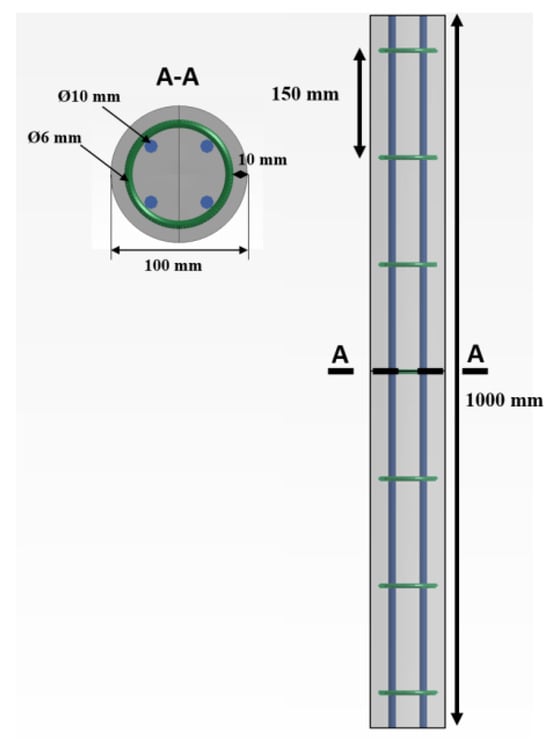
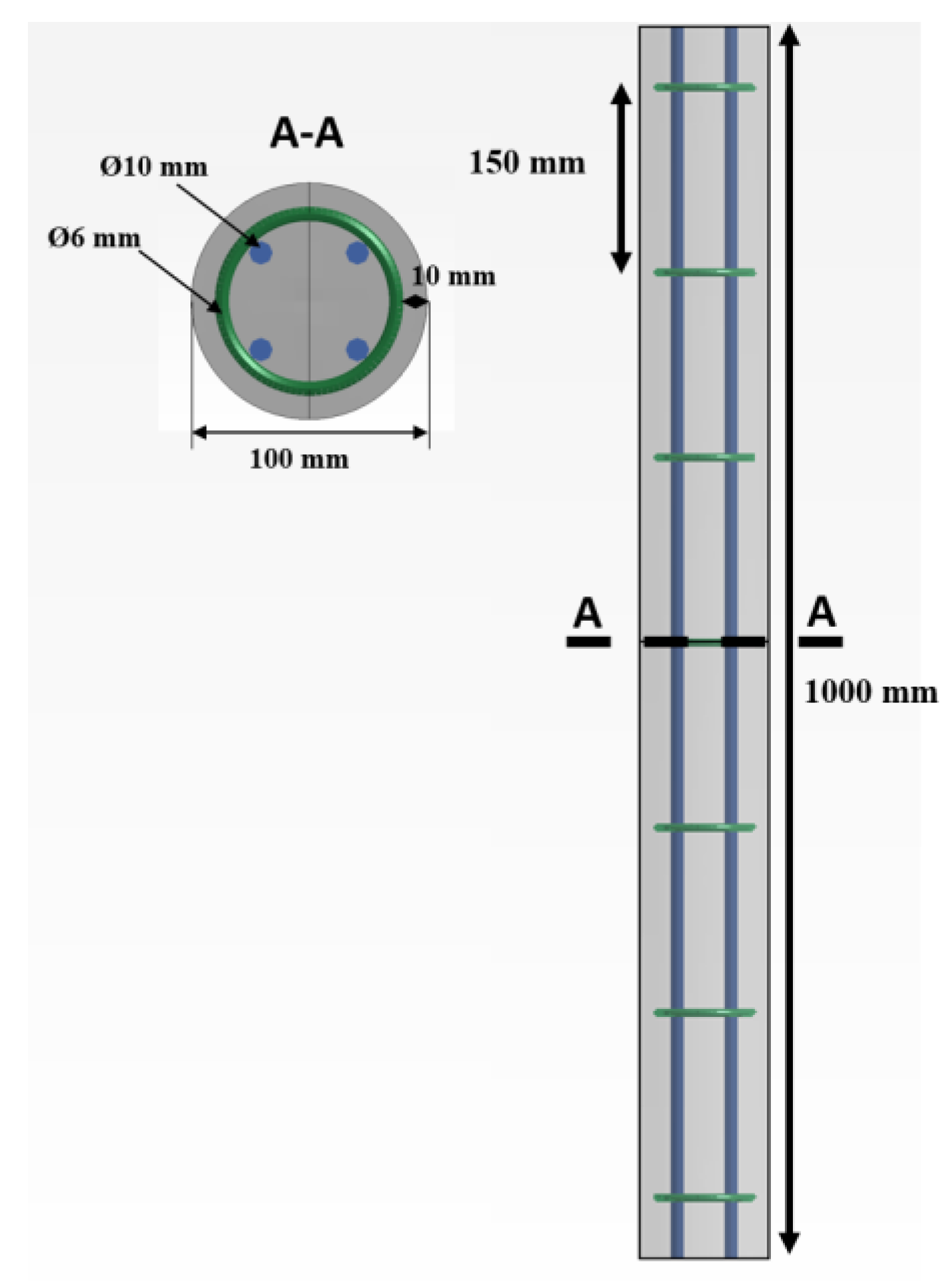
To investigate the feasibility and effectiveness of strengthening reinforced concrete (RC) columns against blast loading using externally bonded reinforcement (EBR), and to examine their dynamic response under contact explosions, nine scaled RC column specimens were cast under controlled laboratory conditions. Each column had a length of 1000 mm and a diameter of 100 mm. The internal reinforcement consisted of four 10 mm diameter high-strength deformed longitudinal bars combined with 6 mm diameter smooth closed circular stirrups spaced at 150 mm intervals along the column height. All specimens were designed in accordance with Eurocode 2, with a consistent clear concrete cover of 10 mm. The longitudinal reinforcement ratio (ρₗ = AS/Ag) was 4.0% (AS = 314 mm2; Ag = 7854 mm2), corresponding to the upper recommended Eurocode 2 limit (0.5–4.0%). The transverse reinforcement resulted in a volumetric ratio of approximately 0.27%, representative of non-seismically detailed columns and providing a conservative baseline for evaluating CFRP confinement efficiency under blast loading. Although the relatively high reinforcement ratio combined with the limited concrete cover leads to a congested reinforcement layout at this scale which may influence absolute damage indicators such as cracking and spalling the identical internal reinforcement across all specimens ensures a consistent baseline for comparison. This uniformity allows performance differences under blast loading to be attributed primarily to the CFRP retrofitting configurations, preserving the validity of the observed effectiveness hierarchy among strengthening schemes. The detailed geometric configuration and reinforcement layout of these RC columns are presented in Figure 1.
Figure 1.
RC column details.
The static material properties of the steel reinforcement, the epoxy adhesive, and the CFRP wraps, as provided by the manufacturers, are summarized in Table 1. For the CFRP retrofitting, unidirectional Sikawrap-230C (Sika AG, Baar, Switzerland) was utilized, characterized by a nominal length of 0.6 m, a width of 325 mm, and a thickness of 0.13 mm. Technical specifications from Sika company indicate a CFRP strip density of 1820 kg/m3 and a carbon fiber volumetric content of 96%. It is important to note that no geometric scaling was applied to the CFRP retrofitting system. The CFRP wraps (Sikawrap-230C, 0.13 mm nominal thickness per layer) were selected based on commercial availability and practical applicability at the laboratory scale, rather than on strict dimensional scaling from full-size prototypes. This approach is consistent with the primary objective of the study: to perform a comparative assessment of different retrofitting configurations under identical blast scenarios, rather than to replicate absolute full-scale damage dimensions.
Table 1.
Static material properties.
To facilitate quantitative comparison with other studies, a geometric FRP confinement thickness index, , is introduced. This index represents the total hoop direction CFRP thickness normalized by the column diameter:
where is the number of hoop CFRP layers, mm is the nominal thickness per layer, and D = 100 mm is the column diameter. For both the single-layer (B series) and dual-layer (C series) configurations, (0.13%), as only the outer hoop layer contributes to direct confinement. The dual-layer system achieves superior performance through its additional longitudinal fibers, which enhance flexural crack bridging and stress redistribution, rather than through increased hoop thickness.
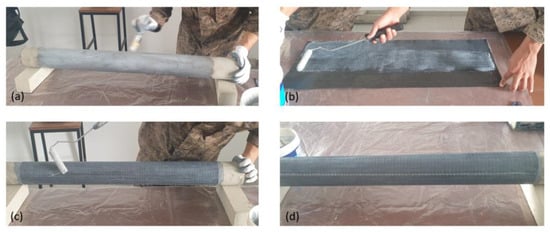
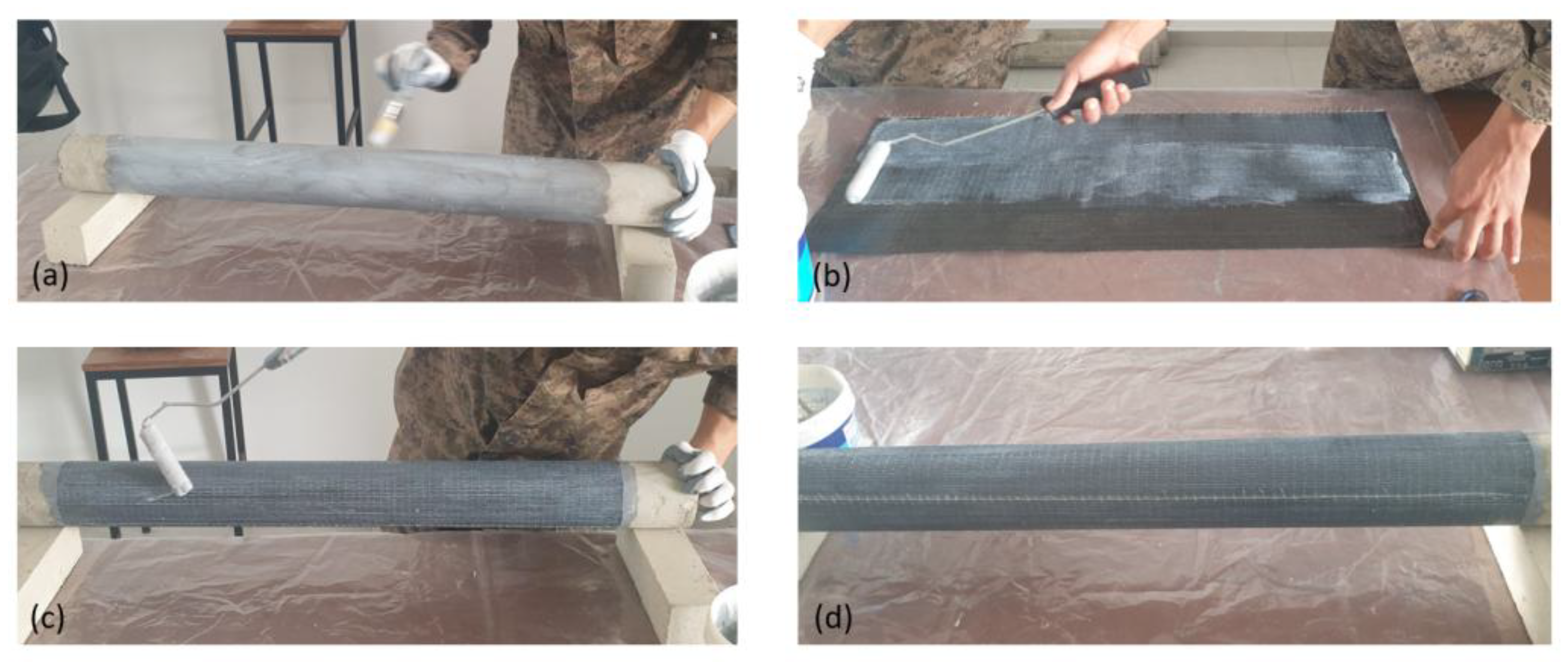
The application of the CFRP wraps was performed in accordance with the established procedure outlined in fib Bulletin 14 [38]. Prior to the adhesion of the FRP wraps, the two-component epoxy adhesive (Sikadur-330, Sika AG, Baar, Switzerland) was thoroughly mixed in the precise proportions specified by the manufacturer. A thin, uniform layer of the mixed adhesive was then applied to the cleaned concrete surface of the column. Subsequently, an additional layer of adhesive was applied directly onto the CFRP wrap itself, a critical step designed to minimize the formation of voids and ensure optimal impregnation. The CFRP wrap was then carefully positioned onto the concrete surface, and a rubber roller was systematically used to apply continuous pressure. This rolling action served to expel any trapped air, ensure intimate contact between the CFRP, adhesive, and concrete substrate, and achieve a uniform bond line, as shown in Figure 2.
Figure 2.
Application of the CFRP wrap: (a) Surface preparation: primer/adhesive applied to concrete specimen; (b) Resin application: adhesive spread on CFRP sheet using roller; (c) Wrapping: CFRP sheet bonded around specimen, roller used to remove air bubbles; (d) Final reinforcement: specimen fully wrapped with CFRP, smooth and adhered surface.
To ensure consistency and minimize specimen variability, a critical factor given the sensitivity of contact–blast response to geometric and material deviations, strict quality control was maintained during fabrication. Reinforcement placement was controlled using prefabricated plastic spacers, maintaining a clear concrete cover of 10 ± 2 mm, with longitudinal bars centred within a tolerance of ±3 mm. All nine column specimens were cast from a single, centrally mixed batch of concrete to ensure uniform material properties; they were cast horizontally in steel moulds in one continuous pour, vibrated to minimize voids, and finished to a consistent surface texture. The specimens were demoulded after 24 h and subsequently cured under controlled conditions (temperature: 23 ± 2 °C, relative humidity: >95%) for 28 days prior to any retrofitting or testing. After curing, dimensional verification was performed with digital callipers, yielding an average diameter of 100.2 mm (standard deviation: 0.8 mm) and an average length of 1001 mm (standard deviation: 2 mm). For CFRP application, sheet lengths were cut to provide a full wrap with a 100 mm longitudinal overlap, maintained within ±10 mm, and the adhesive layer thickness was controlled by notched trowel application as per manufacturer specifications (Sikadur-330). These measures ensured high geometric and material consistency across all specimens, providing a reliable basis for comparing the blast response of the different retrofitting configurations.
2.2. Scale Considerations and Dimensional Analysis for Contact Blast Testing
The use of scaled column specimens (100 mm diameter, 1000 mm length) in this study was motivated by the need for controlled, repeatable, and instrumentally dense experiments under laboratory conditions. While contact explosions are known to induce strong size-effects and scaling challenges particularly related to wave propagation, damage localization, and material strain-rate sensitivity the primary objective of this research was to perform a comparative evaluation of different CFRP retrofitting configurations under identical blast scenarios. The chosen scale allows for:
- Practical charge masses (20–50 g RDX) that generate measurable damage while maintaining safety and control.
- High-fidelity instrumentation (high-speed cameras, accelerometers) with clear signal acquisition and spatial resolution.
- Multiple specimen configurations within a reasonable experimental campaign.
Note that direct extrapolation of absolute damage dimensions (e.g., spalling depth in mm) to full-scale structures is not straightforward due to non-linear scaling effects. However, scaling laws such as the Hopkinson–Cranz (cube-root) scaling can be applied to relate blast parameters (charge mass, distance) across scales for similar blast waves. For contact explosions, where the charge is attached to the surface, geometric and dynamic similarities become more complex, and material failure mechanisms (e.g., spalling, fragmentation) may not scale linearly.
Therefore, the key findings of this study the relative performance hierarchy of retrofitting schemes (dual-layer > single-layer > unretrofitted), the trend in acceleration reduction, and the transformation of failure modes are considered to be qualitatively transferable and mechanistically informative for full-scale design. The quantitative metrics (e.g., percentage reduction in spalling height) should be interpreted as indicative trends within the tested scale, and future validation through full-scale tests or advanced finite-element models incorporating scaling corrections is recommended.
3. Mechanical Characteristics of the Concrete, Steel Rebars
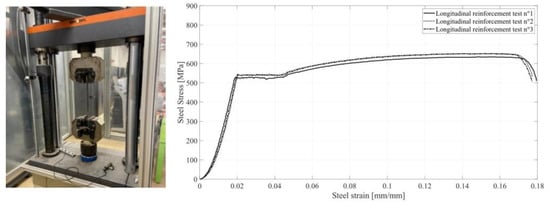
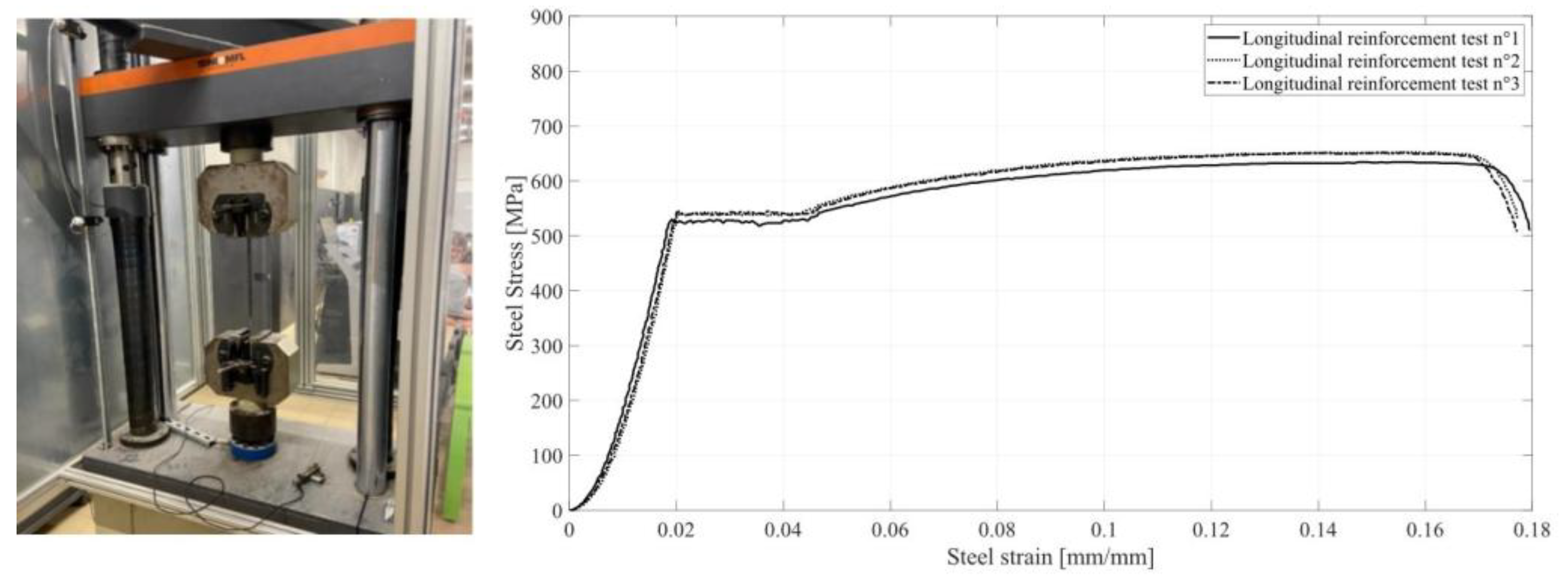
Quasi-static experimental tests were performed on both the concrete and the reinforcing steel bars. The mechanical properties of the reinforcement steel were determined through uniaxial tensile tests. To verify measurement consistency, three specimens were tested. The longitudinal reinforcement exhibited an average yield strength of 542 MPa with a standard deviation of 4.93 MPa. The stress–strain curves shown in Figure 3 correspond exclusively to the longitudinal reinforcement bars tested in this study. The mechanical properties of the transverse reinforcement, including yield strength, ultimate strength, and associated strain values, summarized in Table 1. The transverse reinforcement had an average yield strength of 235 MPa and a standard deviation of 6.32 MPa.
Figure 3.
Mechanical characteristics of the longitudinal rebars.
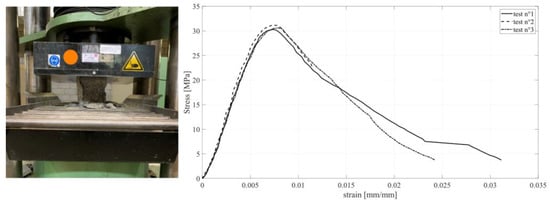
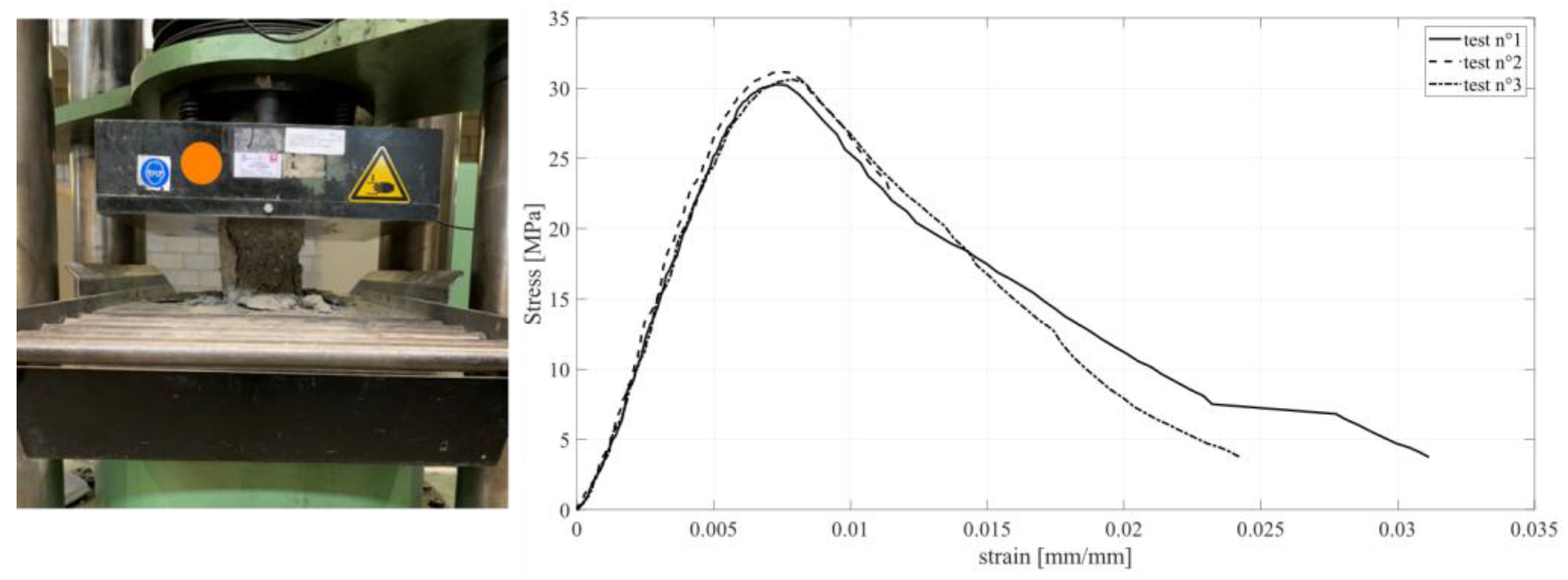
The average concrete strength, fcm, is 32 ± 0.45 MPa. This value is based on the average of three test 150 mm cubes. The tests resulted in an average uniaxial compressive strength of 32 MPa with a standard deviation of 0.45 MPa. The stress–strain responses obtained from the concrete tests are illustrated in Figure 4.
Figure 4.
Mechanical characteristics of the concrete.
4. Description of the Experimental Setup
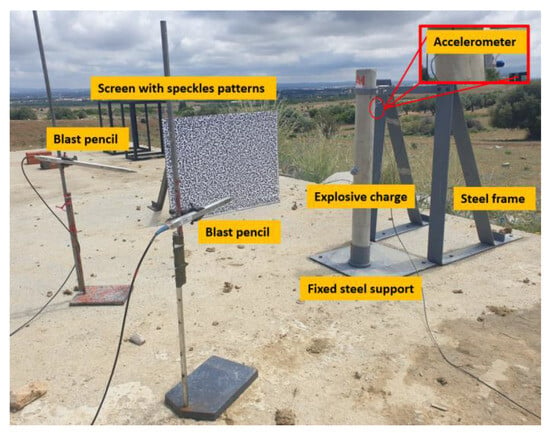
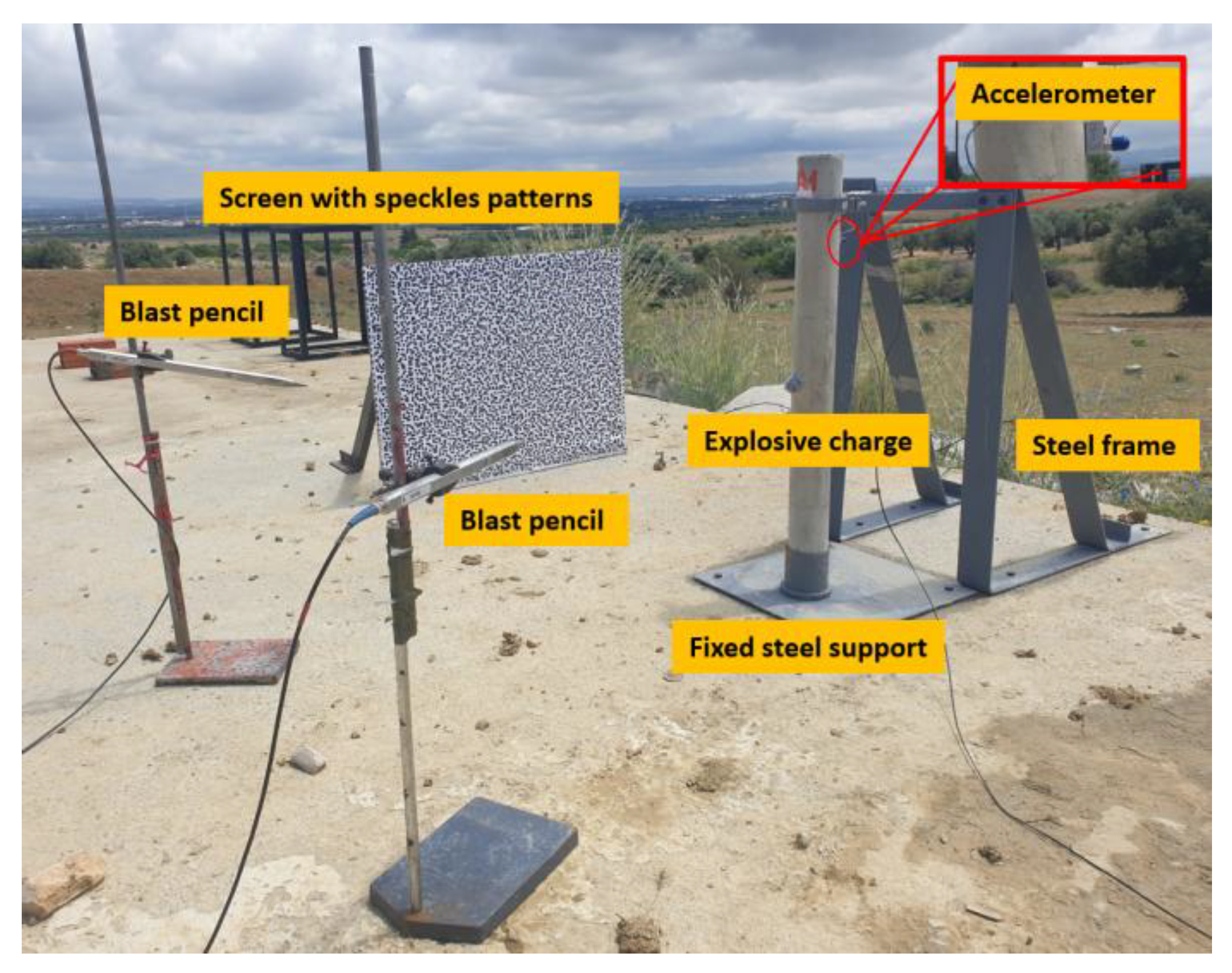
The experimental setup was designed to evaluate the blast resistance of both unretrofitted and CFRP-retrofitted reinforced concrete columns under controlled contact explosion conditions, as schematically illustrated in Figure 5. Each column specimen was anchored at both its top and bottom ends to a robust steel frame, ensuring full fixity and preventing any translational or rotational movement during the detonation event. This steel frame was specifically engineered to withstand the significant dynamic stresses generated by the blast loads, maintaining boundary conditions throughout the experiment. The explosive charges, consisting of varying masses of RDX, were centrally positioned in direct contact with the front face of each column specimen to simulate a contact explosion scenario.
Figure 5.
Experimental test setup.
4.1. Instrumentation, Data Acquisition, and Signal Processing
A comprehensive instrumentation system was employed to capture both the blast loading and the dynamic response of the columns with high temporal resolution. All measurement systems were synchronized using a common electronic trigger linked directly to the detonator firing circuit. The measurement chain, data acquisition parameters, and signal processing procedures are summarized below:
- High-Speed Optical Diagnostics: To monitor the transient structural response and visually assess damage initiation and evolution, a high-speed imaging system was employed. A high-speed camera (Phantom, Vision Research, Wayne, NJ, USA) was positioned at a standoff distance of approximately 5 m from the test specimen, outside the primary fragment field. The camera recorded the detonation, shock–structure interaction, and subsequent crack propagation and spalling processes at a frame rate of 20,000 frames per second.
- Pressure Measurement: Free-field blast overpressure was recorded using piezoelectric pressure transducers (PCB Piezotronics, Depew, NY, USA, Model 113B24; nominal range: 3447 kPa). The sensors were positioned at a standoff distance of 1.2 m from the charge centre and oriented normal to the expected blast wave propagation. Signals were conditioned using a PCB 482C05 signal conditioner and digitized at a sampling frequency of 2 MHz via a high-speed data acquisition system, ensuring accurate capture of the shock front rise time.
- Acceleration Measurement: The axial acceleration response at the column head was measured using a uniaxial piezoelectric accelerometer (PCB Piezotronics, Model 3501A; nominal range: ±5000 g). The accelerometer was mounted using a stud connection to a steel plate bonded to the concrete surface to ensure adequate coupling. Acceleration signals were similarly conditioned (PCB 482C05) and sampled at 1 MHz to resolve high-frequency dynamic response components.
- Signal Processing: All recorded signals were post-processed using a fourth-order low-pass Butterworth digital filter. Cut-off frequencies of 50 kHz for pressure signals and 25 kHz for acceleration signals were selected based on the dominant frequency content of the blast loading and the expected structural response, with the objective of suppressing high-frequency electrical noise and shock-induced ringing while preserving the physically relevant response. Filtering was applied in a forward–backward manner to eliminate phase distortion.
- Calibration and Measurement Uncertainty: All sensors were factory-calibrated with certificates traceable to national standards. Manufacturer-specified measurement uncertainties are ±1.5% full-scale for pressure transducers and ±2% full-scale for the accelerometer.
4.2. Charge Placement and Verification Protocol
To ensure consistent and reproducible contact explosion conditions, all RDX charges (20 g, 30 g, and 50 g) were positioned in direct contact with the front surface of the RC columns at mid-height. The nominal standoff distance was zero, with an effective tolerance of less than 1 mm to account for minor surface irregularities. Charge alignment was maintained within ±2 mm in both vertical and horizontal directions. Prior to detonation, high-resolution photographs were taken to verify uniform charge–surface contact and correct positioning. Additionally, the initial frames of the high-speed camera recordings were reviewed to confirm contact integrity immediately before initiation. This verification procedure ensured consistent localized blast loading across all tests.
A total of nine RC columns are tested under contact explosions with three different charges weight: 50 g, 30 g and 20 g of RDX. At each charge, three columns were tested to investigate the effectiveness of CFRP retrofitting under contact explosion. A1, A2, and A3 were used as reference specimens. Columns B1, B2, and B3, retrofitted with a single layer of unidirectional CFRP in the transverse (hoop) direction. Similarly, columns C1, C2, and C3, retrofitted with two layers of unidirectional CFRP one in the transverse direction and one in the longitudinal direction. Table 2 summarizes experimental tests.
Table 2.
Test parameters of RC columns.
The TNT equivalence factor for RDX was taken as 1.185 based on standard blast engineering reference UFC 3-340-02 [39]. Accordingly, the equivalent TNT masses for the tested charges were approximately 23.7 g, 35.55 g, and 59.25 g for the nominal 20 g, 30 g, and 50 g RDX charges, respectively.
5. Experimental Results
5.1. Pressure Time Histories
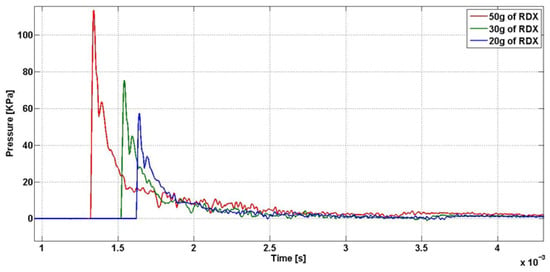
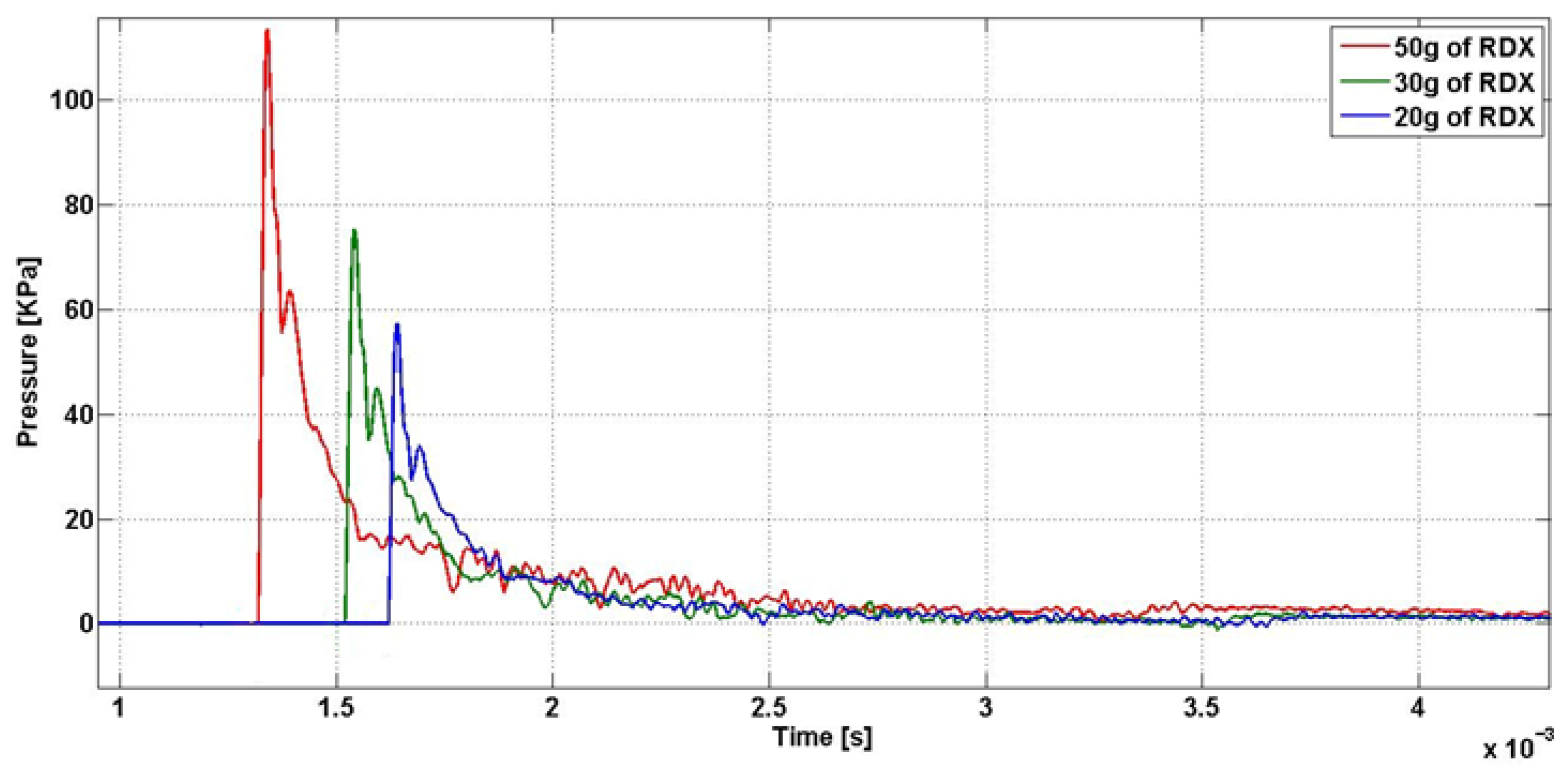
The pressure transducers located at 1.2 m from the charge provide far-field overpressure measurements, which serve to verify test repeatability and confirm relative blast intensity between different charge masses. It is important to note that these measurements do not represent the actual interface pressure acting on the column surface during contact explosion, which is several orders of magnitude higher and cannot be directly measured with conventional instrumentation. Figure 6 illustrates the pressure–time histories recorded by the pressure transducers for the three investigated explosive charges (50 g, 30 g, and 20 g of RDX). All signals exhibit a typical blast wave signature, characterized by a very steep rise to the peak overpressure followed by a gradual decay phase. The peak overpressure clearly increases with the explosive mass, reaching approximately 110 kPa for the 50 g RDX charge, compared to about 70 kPa and 55 kPa for the 30 g and 20 g charges, respectively. This trend confirms the direct relationship between charge weight and blast intensity at a given measurement distance.
Figure 6.
Pressure time profiles for varying explosive charge weights.
A slight difference in the arrival time of the blast wave can be observed among the three charge levels. The shock wave generated by the 50 g RDX charge reaches the pressure sensor first, followed by those corresponding to the 30 g and 20 g charges. This time shift is attributed to the higher energy release and faster shock front development associated with larger explosive masses. Such behaviour is consistent with the fundamental physics of detonation, where increased explosive energy results in a more intense and rapidly propagating shock wave.
In addition to the main pressure peak, a secondary pressure peak of lower amplitude is clearly visible in all recorded signals. This secondary peak is attributed to the reflection of the blast wave on the ground and its subsequent interaction with the incident wave at the sensor location. Although its amplitude is significantly lower than that of the primary peak, the reflected overpressure remains noticeable and contributes to the overall loading experienced by the structure. Ground reflection effects are characteristic of near-ground explosion scenarios and may locally amplify the pressure demand on exposed structural elements. These pressure–time profiles provide essential input for interpreting the dynamic response of the reinforced concrete columns and for correlating the intensity and timing of the blast loading with the observed damage mechanisms.
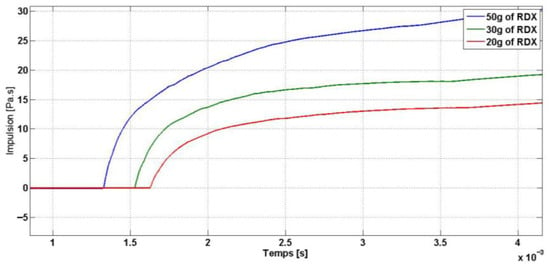
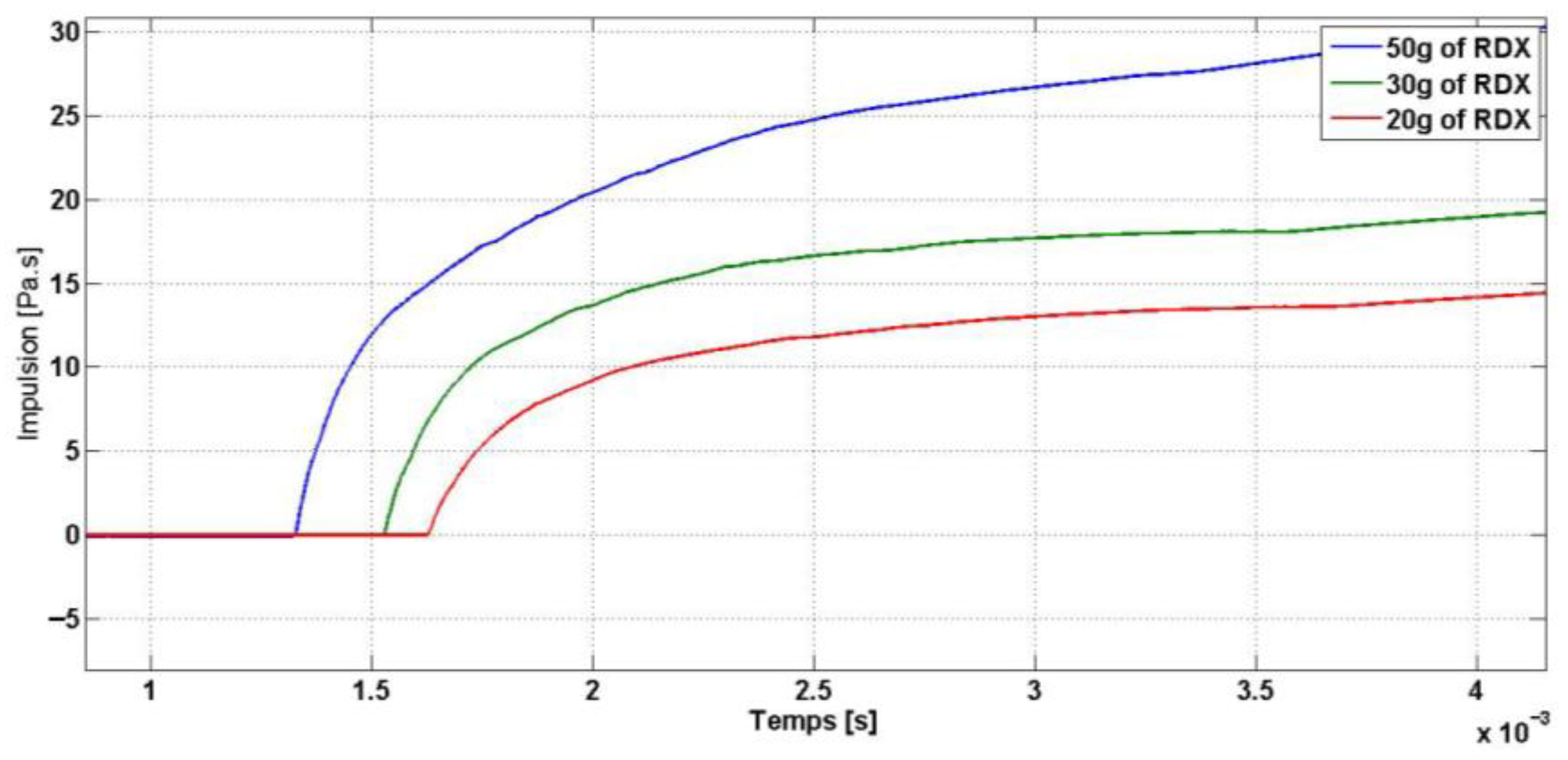
In addition to peak overpressure, blast impulse was quantified based on the time integral of the positive-phase pressure history. Figure 7 presents the impulse–time profiles for the three charge masses. As expected, impulse increases monotonically with time and scales with charge weight, with the 50 g RDX charge producing the highest cumulative impulse.
Figure 7.
Blast Impulse Evolution for Different RDX Charge Masses.
Compared to peak overpressure, impulse exhibits a stronger correlation with the observed structural response, including spalling extent, fragmentation height, and acceleration response. This confirms that cumulative energy transfer, rather than peak pressure alone, governs damage severity under contact explosion conditions.
All curves exhibit a rapid initial rise immediately following detonation, corresponding to the arrival of the shock front, followed by a more gradual increase associated with the positive phase of the blast wave. As expected, the 50 g RDX charge generates the highest impulse, reaching approximately 30 Pa·s, while the 30 g and 20 g charges reach approximately 19 Pa·s and 14 Pa·s, respectively.
5.2. Acceleration Response Analysis of RC Columns Under Contact Explosions
To investigate the dynamic behaviour of reinforced concrete (RC) columns subjected to contact explosions, accelerometers were installed at the top of each column. These sensors recorded the acceleration response throughout the blast event, offering insights into the vibratory motion, energy transmission mechanisms, and overall dynamic stability of the columns under extreme impulsive loads.
Representative acceleration-time histories reveal a sharp and immediate spike in acceleration immediately upon detonation. This instantaneous peak signifies the rapid and intense energy transfer from the explosive charge to the structural system. The magnitude of this peak acceleration directly correlates with the intensity of the incident blast wave and reflects the structure’s initial capacity, to absorb and dissipate the imparted energy.
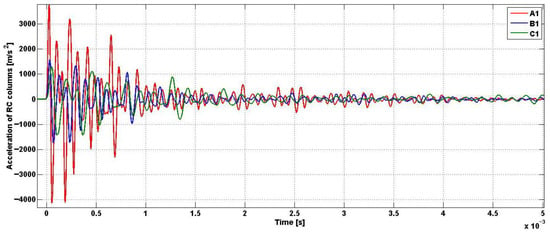
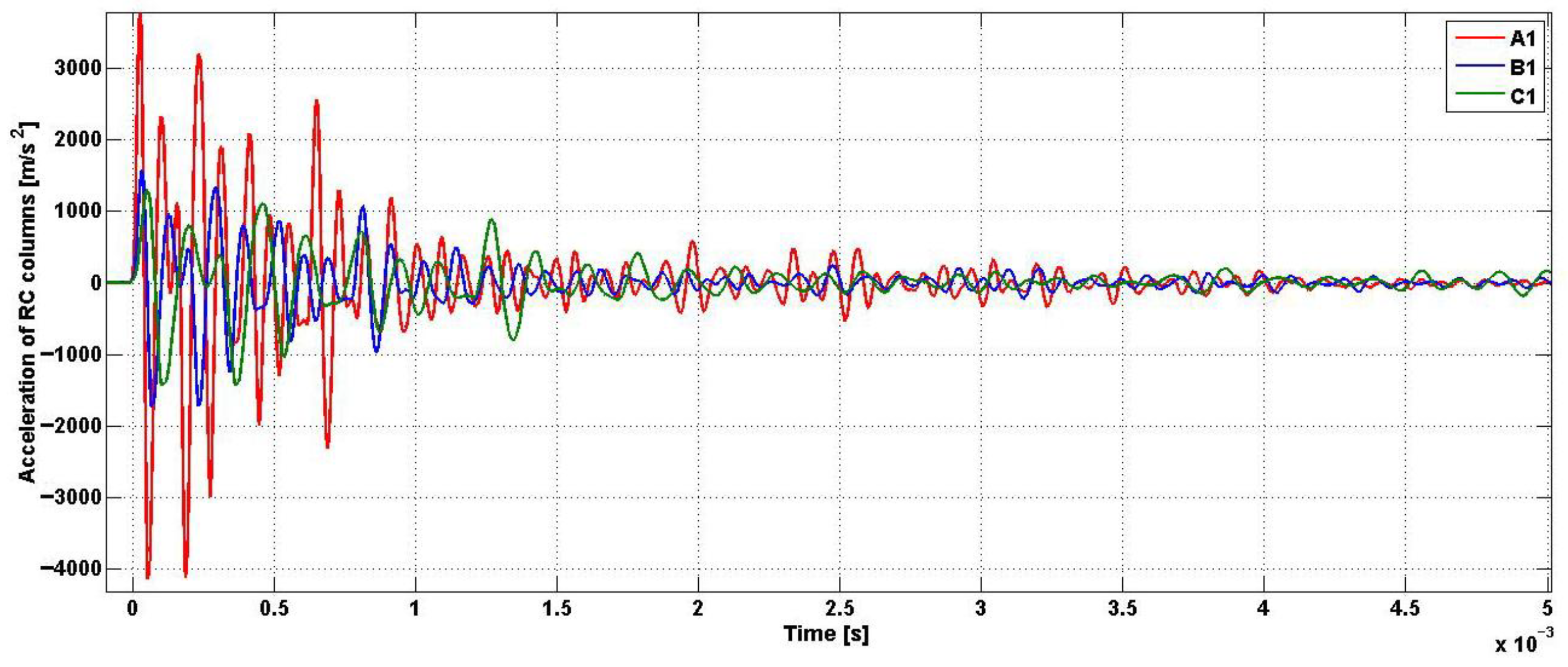
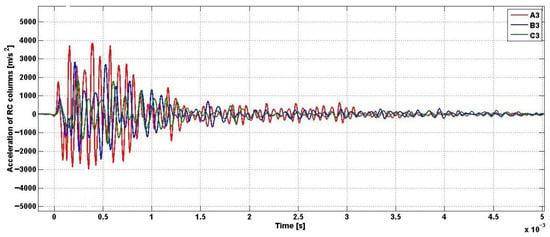
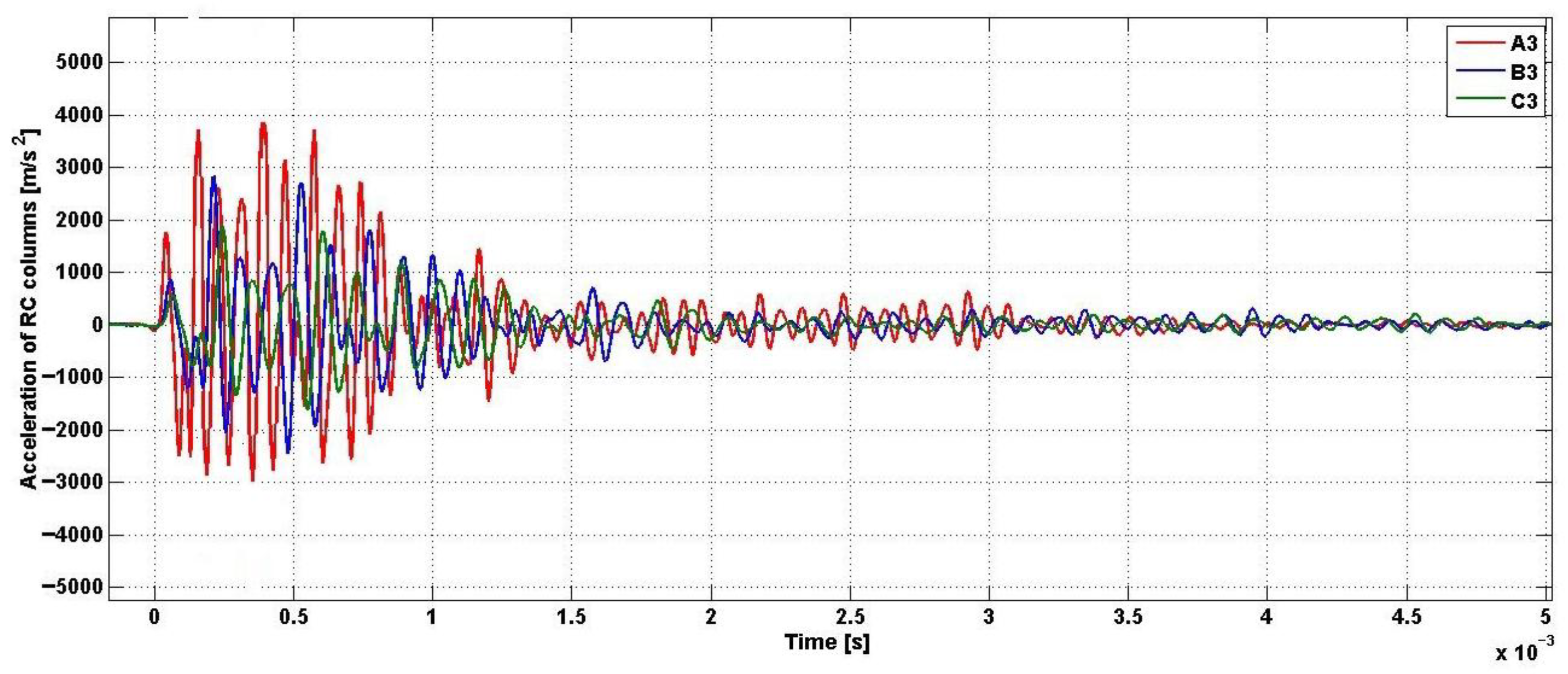
Figure 8 and Figure 9 present the acceleration time histories of reinforced concrete (RC) columns subjected to blast loading, comparing unstrengthened configurations (A1 and A3) with CFRP-strengthened columns (B1/B3 and C1/C3). The results highlight the influence of CFRP confinement on the dynamic response of RC columns under different blast intensities.
Figure 8.
Acceleration-time histories of RC columns under 50 g of RDX.
Figure 9.
Acceleration-time histories of RC columns under 20 g of RDX.
For all configurations, the acceleration response is characterized by a sharp initial peak occurring immediately after the arrival of the blast wave, followed by a high-frequency oscillatory phase with gradually decreasing amplitude. This behaviour reflects the impulsive nature of blast loading and the inertia-dominated response of RC structural elements during the blast event.
For the first loading case using 50 g of RDX (Figure 8), the unstrengthened column A1 exhibits a peak acceleration of 3800 m/s2. The application of CFRP confinement leads to a significant reduction in acceleration demand. Configuration B1 reaches a peak acceleration of 1560 m/s2, corresponding to a reduction of approximately 59% compared to A1. A further improvement is observed for configuration C1, with a peak acceleration of 1290 m/s2, representing a reduction of about 66% relative to the unstrengthened column.
For the second loading case using 20 g of RDX (Figure 9), the unstrengthened column A3 reaches a peak acceleration of 1762 m/s2. The CFRP-strengthened configuration B3 shows a reduced peak acceleration of 835 m/s2, corresponding to a reduction of approximately 53%. The most efficient configuration, C3, exhibits a peak acceleration of only 560 m/s2, achieving a reduction of nearly 68% compared to A3.
A comparison between the unstrengthened columns A1 and A3 shows a noticeable difference in peak acceleration levels, despite both specimens being subjected to blast loading. This difference highlights the sensitivity of the acceleration response to blast intensity, wave interaction effects. The magnitude of this peak acceleration directly correlates with the intensity of the incident blast wave and critically reflects the structure’s initial capacity, to absorb and dissipate the imparted energy. The acceleration data provide compelling evidence of the inherent vulnerability of unretrofitted RC columns to contact explosions. The findings illustrate that higher charge weights not only amplify the initial acceleration response but also significantly prolong the duration of structural vibration.
The results clearly demonstrate that CFRP strengthening significantly enhances the dynamic performance of RC columns under blast loading. The confinement provided by CFRP layers increases the stiffness of the column, restrains concrete cracking and lateral dilation, and improves energy dissipation mechanisms. As a result, peak acceleration are reduced by up to 68%, and the vibration response becomes more stable and rapidly attenuated. These findings confirm the effectiveness of CFRP retrofitting as a reliable mitigation strategy for improving the blast resistance of RC columns.
5.3. Damage Assessment of RC Columns Under Contact Explosion Using a High-Speed Camera
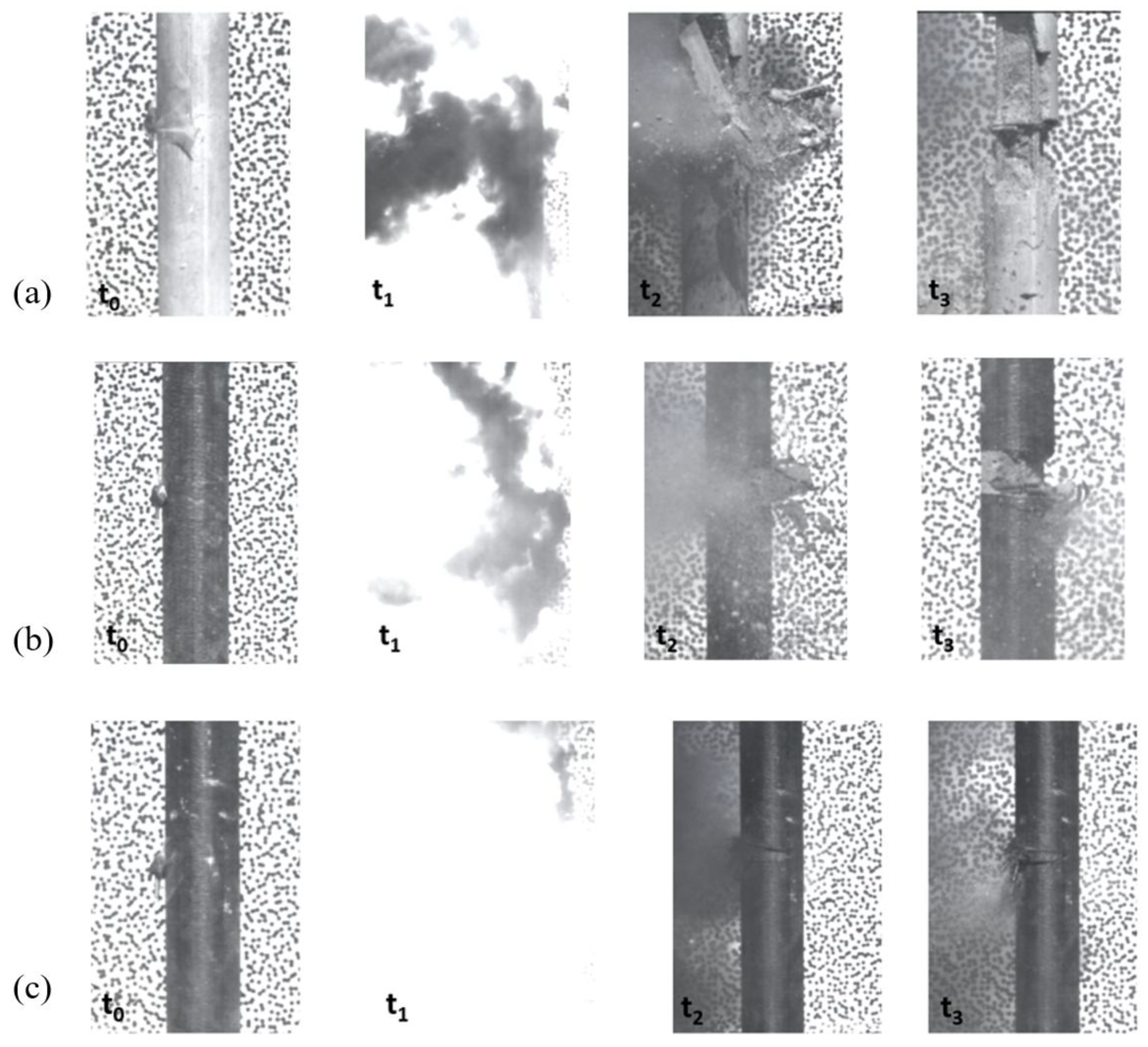
The high-speed camera system played a pivotal role in capturing and analysing the transient dynamic response and progressive damage evolution of the RC columns during the experimental blast tests. Operating at 20,000 frames per second (a 0.05 ms interval between frames), the high temporal resolution enabled the identification of key response stages, including charge initiation (t0 = 0 ms), onset of surface damage (t1 = 0.1 ms), peak deformation and spalling (t2 = 1.15 ms), and post-blast residual vibration (t3 = 5 ms). The recorded image sequences were used for qualitative damage assessment and for synchronisation with pressure and acceleration time histories. Due to the severe debris environment and lighting constraints inherent to contact explosions, the imaging system was primarily utilised for visual verification and timing analysis rather than full-field quantitative deformation measurements.
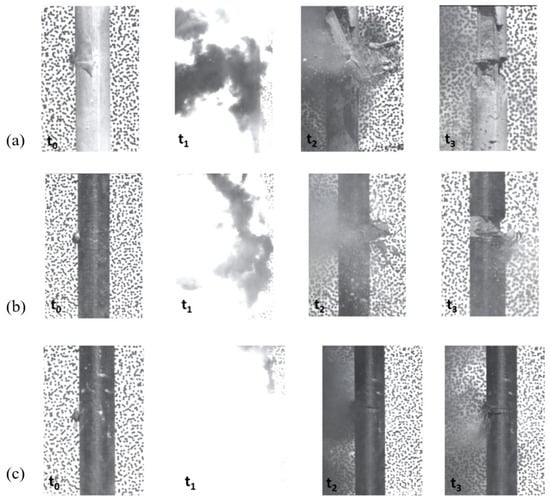
Figure 10a provides a detailed visual sequence of the progressive damage sustained by an unretrofitted reinforced concrete column (specimen A3) subjected to a 20 g RDX contact explosion. At time t0, the 20 g RDX charge is depicted centrally fixed at the column’s midspan. Upon detonation at t1, a violent release of energy is observed, characterized by an intense flash and a rapidly expanding smoke cloud. By t2, the unretrofitted column undergoes catastrophic fragmentation, with significant concrete debris expelled radially outwards, and the internal steel reinforcement becoming visibly exposed and severely deformed. At t3, the column is compromised, exhibiting extensive spalling, severe crushing, and a complete loss of structural integrity. The pronounced degree of fragmentation and the near-total disruption of the concrete cross-section demonstrate the inherent inability of the plain RC column to effectively absorb and mitigate the intense blast energy. This contact explosion induces severe damage to the reference specimen A3, characterized by widespread fragmentation, exposure of steel reinforcement, and a critical reduction in load-bearing capacity. The observed structural failure mode is distinctly brittle and catastrophic.
Figure 10.
Damage assessment of RC columns under 20 g RDX contact explosion: (a) unretrofitted column (Specimen A3); (b) single-layer hoop CFRP-retrofitted column (Specimen B3); (c) dual-layer orthogonal CFRP-retrofitted column (Specimen C3).
In stark contrast, Figure 10b illustrates the dynamic response of an RC column retrofitted with a single layer of unidirectional CFRP under an identical 20 g RDX contact explosion. The detonation at t1 presents a similar flash and smoke dispersion. However, a critical divergence in behaviour is evident by t2, where the extent of concrete fragmentation is visibly and significantly reduced. The CFRP confinement effectively contains the majority of the concrete core, preventing major debris ejection and largely preserving the geometric continuity of the column. At t3, while localized damage is discernible at the immediate contact zone, the column maintains a more coherent and intact structural form. This reduction in damage demonstrates the superior effectiveness of the single CFRP layer in absorbing a significant portion of the blast energy and providing crucial confinement to the concrete core. The external CFRP wrap functions as a robust tensile shell, effectively limiting crack propagation and containing fractured concrete elements, thereby substantially enhancing the column’s blast resistance and preserving a considerable residual load-bearing capacity.
Figure 10c further illustrates the dynamic response of an RC column retrofitted with a dual-layer orthogonal CFRP system under the same 20 g RDX contact explosion. At detonation (t1), the energy release appears similar to the previous cases. However, by t2, the extent of concrete fragmentation is minimal, with the CFRP confinement fully containing the concrete core and preventing significant debris ejection. By t3, the column maintains remarkable geometric integrity, with only superficial localized damage at the blast contact zone. This visual evidence underscores the superior multi-directional confinement and crack-bridging capacity of the dual-layer system, which collectively enhance energy dissipation and preserve structural continuity far more effectively than the single-layer configuration.
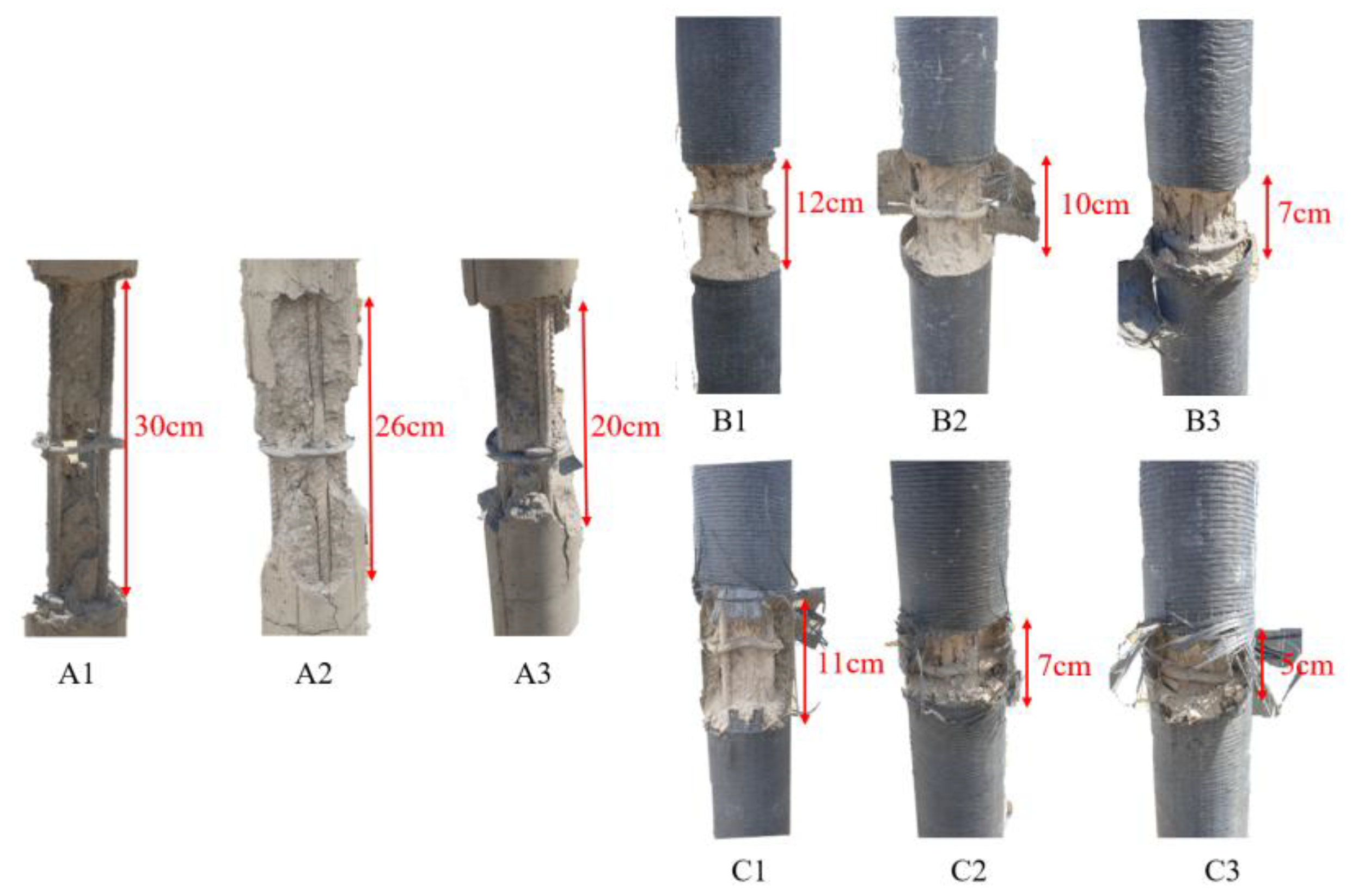
5.4. Damage Length Comparison and Quantitative Analysis
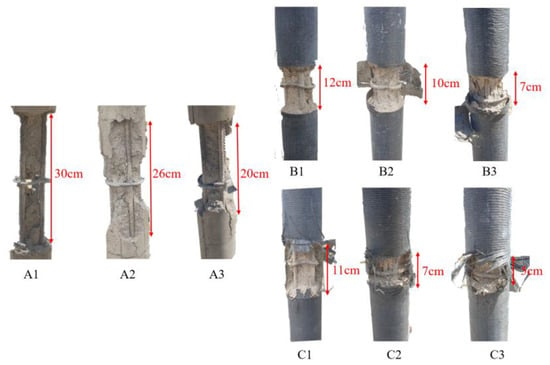
The post-blast damage assessment, as visually documented in Figure 11, reveals significant differences in damage extent between unretrofitted and CFRP-strengthened columns. Quantitative analysis of damage length, spalling height, and fragmentation patterns provides robust metrics for evaluating retrofitting efficacy.
Figure 11.
Post-blast damage profiles of RC columns with and without CFRP under contact explosions.
Columns retrofitted with a single layer of transverse (hoop) CFRP exhibited a substantial reduction in visible damage, with damage length decreasing by 60–65% compared to unretrofitted counterparts across all charge levels. This improvement is attributed to the hoop confinement mechanism, where the CFRP wrap acts as an external tensile shell that restrains lateral concrete expansion, thereby reducing debris ejection and preserving geometric continuity. Despite this significant enhancement, localized cracking and spalling at the immediate explosion site remained evident, indicating that while mitigated, a portion of the blast energy is still transmitted to the concrete core.
The dual-layer CFRP system (one transverse hoop layer and one longitudinal layer) provided superior protection, achieving damage length reductions of up to 75% representing an 8–30% improvement over the single-layer system depending on charge mass. The added longitudinal reinforcement proved particularly effective under lower charge weights (20 g and 30 g), where it enhanced resistance to tensile cracking and bending moments failure mechanisms that become more critical as blast intensity decreases.
The synergistic interaction between hoop and longitudinal CFRP layers creates a composite action that:
- Improves energy dissipation through staged activation (outer layer engages first, followed by inner layer);
- Redistributes stresses more efficiently across the column section;
- Transforms the failure mode from brittle fragmentation to a more ductile, contained response;
- Preserves post-blast load-bearing capacity by maintaining core integrity.
These quantitative findings confirm that CFRP retrofitting not only reduces visible damage but fundamentally alters the column’s response mechanism to contact explosions, with multi-layer configurations offering progressively enhanced protection that scales with retrofitting complexity.
To enable scale-independent interpretation of blast-induced damage, the observed concrete deterioration was quantified using a set of non-dimensional damage metrics. These parameters normalise absolute damage measures by characteristic geometric dimensions of the specimen, facilitating direct comparison across different experimental configurations and studies.
- Normalised Spalling Height (Sh/D): The vertical extent of spalling damage Sh was normalized by the column diameter D = 100 mm. This metric represents the proportion of the column cross-section affected by concrete ejection.
- Normalised Damage Length (Ld/L): The axial length of the visibly damaged zone Ld was normalised by the clear column height between supports L = 1000 mm, indicating the longitudinal extent of blast-induced impairment.
- Damage Depth Ratio(dd/D): The maximum depth of concrete crushing or penetration dd was normalised by the column diameter, capturing the radial severity of localised damage.
- Damage Severity Index (DSI): To provide a single scalar indicator of overall damage intensity, a Damage Severity Index was defined as the arithmetic mean of the three normalised metrics:
DSI = (Sh/D + Ld/L + dd/D)/3
This index enables a concise, comparative evaluation of damage severity across different retrofitting configurations and charge weights. Table 3 summarises the non-dimensional damage metrics and the resulting Damage Severity Index (DSI) for all tested configurations. The results demonstrate a consistent and progressive reduction in relative damage severity with increasing CFRP confinement efficiency. Across all charge masses, the orthogonal dual-layer CFRP system achieved the lowest DSI values, confirming its superior ability to limit both localised and distributed blast-induced damage.
Table 3.
Summary of non-dimensional damage metrics and Damage Severity Index (DSI).
For the unretrofitted column A1 subjected to a 50 g contact charge of RDX, the DSI approached 0.67, indicating extensive multi-directional damage and near-complete loss of sectional integrity. In contrast, the dual-layer orthogonal CFRP retrofit C1 reduced the DSI to approximately 0.18, corresponding to a reduction exceeding 70% in relative damage severity. Consistent reductions in DSI were observed across all charge levels, confirming the effectiveness of CFRP confinement in fundamentally limiting the geometric extent of blast-induced damage.
5.5. Post-Blast Inspection of CFRP Integrity
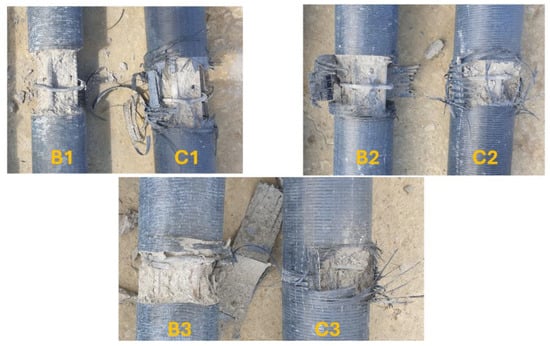
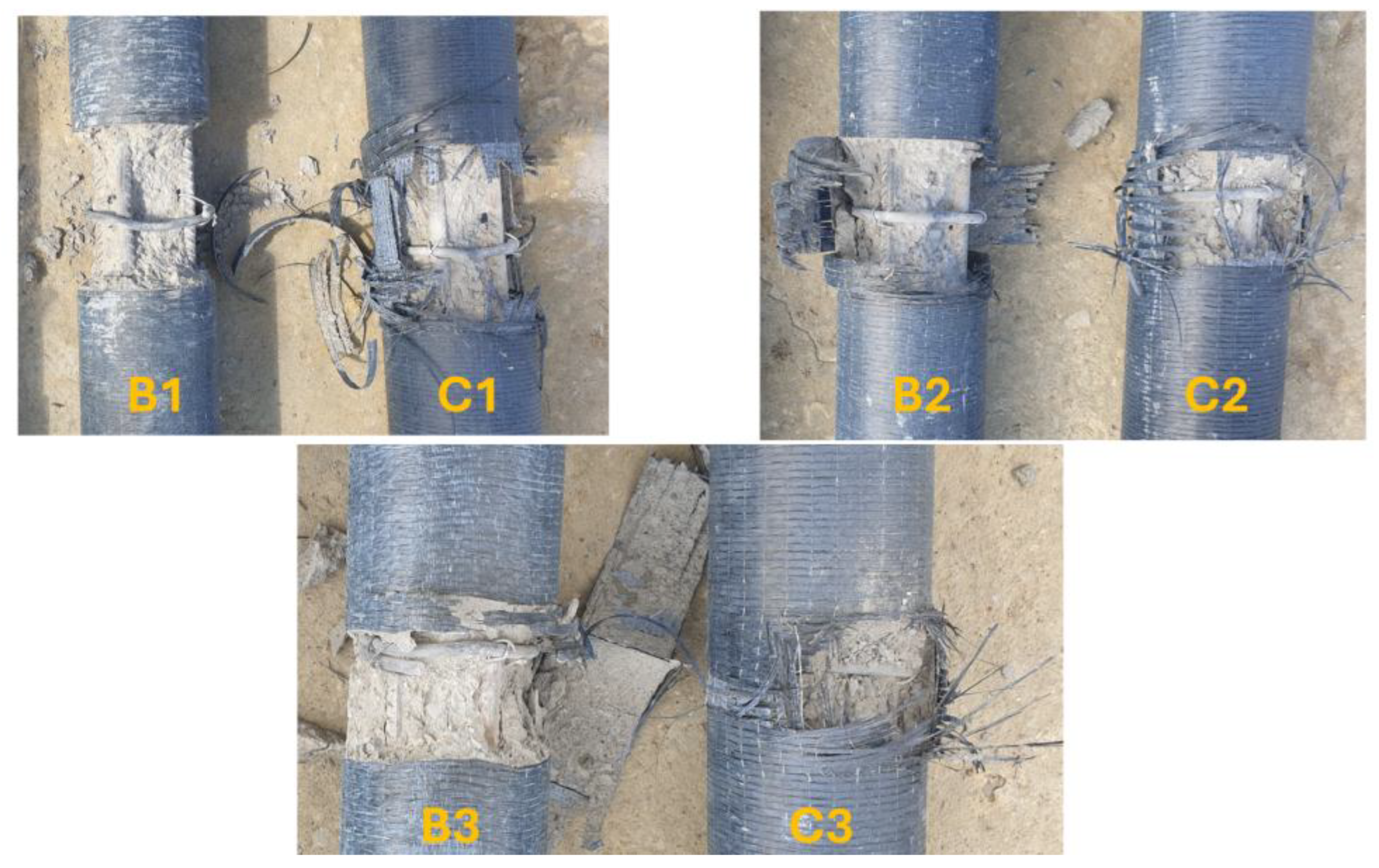
A critical aspect of validating the CFRP confinement mechanism is the assessment of the post-blast condition of the fiber wrap and the adhesive bond. Visual and tactile inspections of all retrofitted specimens, as documented in Figure 12 (Post-blast photographs of CFRP-wrapped specimens), revealed distinct damage patterns corresponding to each retrofit configuration and charge mass.
Figure 12.
Post-blast condition of CFRP-wrapped RC column specimens after contact explosion tests.
Single-layer hoop CFRP wraps (Specimens B1, B2, B3) experienced localized fiber rupture at the immediate charge contact zone, typically manifested as a star-shaped tear with a diameter of approximately 20–40 mm (see Figure 12, Specimen B1). The CFRP remained fully bonded to the concrete substrate surrounding this localized failure, with no evidence of large-scale debonding or peeling along the wrap length. The adhesive layer remained intact in bonded regions, indicating that bond failure was not the governing failure mode.
Dual-layer orthogonal CFRP wraps (Specimens C1, C2, C3) exhibited superior integrity. The outer hoop layer showed only superficial abrasion at the contact point, with no full-thickness rupture. The inner longitudinal layer remained completely intact and protected (see Figure 12, Specimen C1). Critically, no debonding was observed at either the CFRP–concrete interface or between the CFRP layers, confirming the effectiveness of the adhesive application and the multi-layer system’s capacity to redistribute stresses.
Adhesive performance: In all retrofitted specimens, the Sikadur-330 epoxy adhesive maintained a strong bond, as confirmed by the absence of hollow sounds during tap-testing and the observation that failure occurred through fibre rupture rather than interfacial delamination.
These observations validate the core confinement assumption: the CFRP wraps acted as an effective external tensile shell. Failure initiated at the most highly stressed region the blast contact point only after full mobilization of the confinement mechanism. The clear differentiation in damage extent between single-layer and dual-layer wraps visually corroborates the quantitative performance hierarchy reported in Section 5.2 and Section 5.4.
6. Discussion
The experimental findings from this comprehensive study demonstrate that CFRP retrofitting offers substantial and quantifiable improvements in the blast resistance of RC columns subjected to contact explosions. These results carry significant implications for enhancing the resilience of critical infrastructure and urban buildings against extreme dynamic threats. The following sections interpret the key findings, discuss their mechanistic basis, and contextualize their practical relevance.
6.1. Efficacy of CFRP Configurations in Blast Mitigation
The superior performance of the dual-layer CFRP configuration highlights a synergistic and highly effective protective mechanism. The transverse (hoop) CFRP fibres provide immediate and robust confinement to the concrete core, effectively resisting the lateral expansion and dilation induced by the blast wave. Concurrently, the longitudinal CFRP fibres bridge developing tensile cracks and redistribute localized stresses, thereby enhancing the flexural and axial capacity of the column. This combined action, often termed the tensile shell effect, transforms the failure mode of RC columns from brittle fragmentation to a more ductile and contained response. The effectiveness of this confinement in limiting spalling and preventing reinforcement exposure is intrinsically linked to its ability to maintain bond integrity at the steel–concrete interface under impulsive loading. Recent studies on bond–slip behaviour in CFRP-confined. Recent studies on bond–slip behaviour [40,41] have demonstrated that CFRP confinement significantly enhances bond strength and reduces slip, even in low-strength concrete, by providing lateral pressure that clamps the rebar and suppresses interfacial crack propagation. This mechanism directly supports our observations of minimal reinforcement buckling and exposure in the dual-layer retrofitted specimens, as the enhanced confinement provided by the CFRP wrap helps maintain composite action between the steel and concrete under extreme blast-induced strains.
Quantitatively, the observed reduction in spalling height (up to 75%) and damage depth (up to 60%) directly corresponds to the level of confinement and energy dissipation provided by the CFRP wraps. The single-layer system reduced damage by 60–65%, while the dual-layer system achieved improvements of 8–30% beyond that, depending on charge mass. This nonlinear enhancement suggests that multi-layer CFRP systems do not merely add confinement linearly but create a composite action where the inner and outer layers interact to optimize stress redistribution and crack arrestment.
6.2. Dynamic Response and Acceleration Characteristics
The acceleration-time histories provide crucial insights into the energy absorption and vibration control mechanisms of CFRP-strengthened columns. The reduction in peak acceleration by up to 68% (e.g., from 3800 m/s2 to 1290 m/s2 under 50 g RDX) indicates that CFRP wraps significantly moderate the initial shock transmission to the structural system. Furthermore, the more rapid attenuation of vibrations in retrofitted columns suggests enhanced damping and stiffness preservation, which are critical for preventing resonance and progressive damage in multi-story frames.
These dynamic characteristics have direct implications for Structural Health Monitoring (SHM) systems. The preserved natural frequencies and enhanced damping ratios in CFRP-strengthened specimens suggest that vibration-based damage detection methods could be more effective and reliable when applied to retrofitted structures. This opens promising avenues for integrating blast-resistant designs with smart monitoring technologies that leverage dynamic signatures to assess post-event structural integrity, enabling rapid damage assessment and informed decision-making in emergency scenarios [10,39].
6.3. Practical Implications for Infrastructure Protection and Design Guidelines
The experimental results provide insights that are directly relevant to the blast-resistant design and retrofit of reinforced concrete columns, and they can be interpreted within the conceptual frameworks of existing international guidelines [42,43,44].
UFC 3-340-02 [42] (Structures to Resist the Effects of Accidental Explosions) focuses on mitigating progressive collapse, reducing debris hazards, and enhancing occupant safety. The significant reductions in concrete spalling, fragmentation extent, and acceleration response achieved through CFRP retrofitting in this study directly support these objectives. The ability of CFRP confinement to preserve the integrity of the concrete core under localized contact explosions highlights its potential as a practical retrofit solution that complements both prescriptive and performance-based approaches outlined in the UFC.
ACI 440.2R-17 [43], which governs the design of externally bonded FRP systems for concrete strengthening, emphasises confinement efficiency and the mobilisation of tensile resistance in FRP wraps. The superior performance of dual-layer orthogonal CFRP configurations observed in this study supports these fundamental confinement concepts. In particular, the formation of an external tensile shell and the associated shift towards a more ductile damage response are consistent with the assumptions underlying FRP confinement models. While ACI 440 is primarily calibrated for static and seismic loading, the marked reductions in spalling and damage severity under contact blast conditions indicate that configuration-specific guidance could be beneficial for extreme impulsive loading scenarios.
Eurocode 1—Part 1–7 (Accidental Actions) [44] addresses structural robustness through principles such as indirect design and the design of key elements capable of sustaining localised damage. The experimental observations presented herein demonstrate that CFRP-retrofitted columns are able to maintain structural continuity and residual load-bearing capacity following severe localised blast damage. This behaviour is consistent with the robustness and damage-tolerance concepts promoted by the Eurocode, particularly for critical vertical load-bearing members.
Overall, the findings provide experimental evidence supporting the use of CFRP confinement as an effective blast-mitigation measure within the conceptual scope of existing design guidelines. The results further suggest that future code developments or guideline extensions addressing multi-layer and multi-directional CFRP systems under extreme impulsive loading could enhance the reliability and effectiveness of blast-resistant design and retrofit strategies for both new and existing structures.
6.4. Benchmarking Against Prior Experimental Studies
The blast mitigation performance observed in this study aligns with and extends findings from key experimental investigations on CFRP-strengthened RC elements under impulsive loads, while highlighting the specific efficacy under contact explosion scenarios. For comparison, Table 4 summarizes select experimental results from the literature alongside the core findings of the present work.
Table 4.
Benchmarking of key blast mitigation results from the present study against select prior experimental works.
Yan et al. [10] conducted an experimental and analytical study on CFRP-strengthened RC columns (150 mm square section) subjected to close-in blast loading with scaled distances ranging from 0.40 to 0.54 m/kg1/3. Their results demonstrated that CFRP retrofitting significantly improved blast performance by reducing maximum displacements by up to 89% and preventing secondary blast fragments. They also observed that increasing CFRP thickness from 2 mm to 4 mm reduced displacement by approximately 31%, and that retrofitting on both compressive and tensile faces could alter the failure mode from flexural to shear. Our study, focusing on the more severe contact condition (Z ≈ 0 m/kg1/3), found a comparable reduction in peak acceleration (53–68%) and spalling height (65–75%), underscoring the critical role of confinement for compressive members under extreme near-field blasts. Both studies confirm that CFRP thickness and retrofitting configuration significantly influence blast performance, with our work providing new data specifically for the contact regime.
Hu et al. [16] investigated CFRP retrofitted RC columns (200 mm square section) under close-in double-end-initiation explosions with a scaled distance of 0.67 m/kg1/3. Their field tests showed that peak displacements of CFRP-retrofitted columns decreased by 12.8% to 16.4%, while residual displacements decreased dramatically by 44.9% to 98.0% compared to unretrofitted columns. This finding strongly supports our observation that dual-layer orthogonal wrapping provides superior multi-directional damage containment and highlights the importance of comprehensive wrapping strategies.
Liu et al. [25] conducted contact explosion tests on circular RC piers (400 mm diameter) protected with 1–3 layers of CFRP. Their experimental results under 1.0 kg and 2.0 kg TNT contact explosions showed that CFRP protection reduced concrete damage height from 60 cm (unprotected) to 40–53 cm (protected). The damage extent decreased progressively with increasing CFRP layers: one layer reduced damage height by approximately 12%, while three layers achieved a 33% reduction. Their numerical analysis revealed that CFRP absorbs blast energy through deformation and that the protective effect improves with additional layers. These findings directly complement our results on scaled columns, where dual-layer wrapping achieved up to 75% spalling reduction, demonstrating that the confinement benefit scales with retrofitting intensity.
Mejía et al. [35] performed an extensive experimental and numerical investigation on RC columns under the combined effects of contact explosion and axial loads a critical factor absent in the current study. Testing 33 columns with varying cross-sections, transverse reinforcement arrangements, and concrete strengths under pentolite contact charges. This work provides essential context for our findings, confirming that the damage mechanisms observed in our scaled specimens (concrete spalling, reinforcement exposure, core fragmentation) are consistent with full-scale behaviour under contact explosions. Their demonstration that axial load enhances blast resistance supports our positioning of the current results as a conservative baseline and validates axial-load-included tests as a critical future research direction.
Collectively, these comparisons confirm that our findings on CFRP confinement and multi-directional damage containment align with the broader literature while providing new, quantitative data specifically for contact explosions on columns a regime where systematic comparative data remains limited. The consistency of observed trends across different scales, charge masses, and testing conditions strengthens the validity of our conclusions regarding the superior performance of multi-layer CFRP retrofitting.
6.5. Limitations and Future Research Directions
While this study provides novel experimental insight into the behaviour of CFRP-retrofitted reinforced concrete columns subjected to contact explosions, several methodological boundaries must be acknowledged to appropriately contextualise the findings and guide future research. These limitations, many of which are inherent to experimental blast testing, are discussed below:
- The experimental programme employed scaled column specimens with a diameter of 100 mm to enable controlled testing under repeatable boundary conditions; however, the direct quantitative extrapolation of absolute damage measures (e.g., spalling depth expressed in millimetres) to full-scale structural elements remains non-trivial due to size-dependent fracture processes, confinement efficiency, and material heterogeneity effects.
- Furthermore, a single specimen was tested for each CFRP configuration and charge mass. While this approach is common in exploratory contact–blast experiments due to the high cost, safety constraints, and logistical complexity involved, it limits the statistical characterisation of response variability.
- The effectiveness of CFRP retrofitting was evaluated primarily at the structural system level, using global response indicators such as peak acceleration reduction, damage containment, and failure-mode transformation. This assessment strategy was intentionally adopted because the highly destructive nature of contact explosions, including intense fragmentation and localized crushing, poses a significant risk to conventional material-level instrumentation such as bonded strain gauges, which are prone to severing and data loss.
- Although post-blast inspections confirmed effective CFRP engagement and sustained bond integrity, direct measurements of CFRP strain distribution, interfacial slip, or real-time delamination were not obtained. As a result, the study does not resolve fine-scale energy dissipation mechanisms within the CFRP–adhesive–concrete system. The conclusions therefore pertain to overall structural performance enhancement, rather than detailed material-level constitutive behaviour.
- All columns were tested without an externally applied service axial load in order to isolate the interaction between blast loading and CFRP confinement. In real structures, columns are subjected to axial compression, which significantly influences lateral dilation, cracking patterns, and confinement effectiveness.
Based on established findings from quasi-static and seismic research, moderate axial compression is generally expected to enhance CFRP confinement efficiency by promoting earlier mobilisation of hoop stresses. Consequently, the damage levels and performance improvements reported in this study represent a conservative scenario, in which the contribution of CFRP is evaluated without the potentially beneficial effects of pre-compression. The results may therefore be interpreted as a lower-bound estimate of CFRP retrofit effectiveness under blast loading.
Building on the behavioural trends established in this study and addressing the identified limitations, several avenues for future research are proposed:
- Influence of Service Loading Conditions: Future experimental programmes should incorporate service-level axial loads to quantify the coupled interaction between axial compression, CFRP confinement, and blast-induced damage, thereby improving the relevance of the results to in-service structural elements.
- Optimised Retrofit Architectures: Systematic evaluation of non-orthogonal, bidirectional, and hybrid CFRP layouts tailored to contact and near-contact blast stress fields could lead to more efficient and resilient retrofit strategies.
- High-Fidelity Numerical Modelling and Scaling Validation: Advanced computational models incorporating strain-rate-sensitive material behaviour, explicit bond–slip laws, and progressive delamination should be developed and validated against both scaled and full-scale blast tests. Such models are essential for assessing scalability and for translating experimental findings into reliable predictive design tools.
7. Conclusions
This study has presented a systematic experimental investigation into the blast resistance of reinforced concrete (RC) columns retrofitted with Carbon Fiber Reinforced Polymer (CFRP) wraps and subjected to destructive contact explosions. Based on the experimental results and analysis, the following conclusions are drawn:
- CFRP retrofitting significantly enhances blast resistance. Externally bonded CFRP wraps provided substantial and quantifiable improvements in blast mitigation. The dual-layer orthogonal configuration consistently delivered superior performance, achieving reductions in peak acceleration of up to 68% and spalling height of up to 75% compared to unretrofitted columns.
- The CFRP confinement mechanism, termed the “tensile shell effect,” transformed the column’s failure mode from brittle fragmentation to a ductile, contained response. Forensic post-blast inspection confirmed this mechanism, showing fiber rupture at the blast point but no global debonding, thereby validating the assumption of effective composite action.
- The dual-layer orthogonal system outperformed the single-layer hoop configuration across all charge levels, with the additional longitudinal fibers providing enhanced flexural crack bridging and stress redistribution. This confirms that multi-directional CFRP layouts offer superior damage containment for contact blast scenarios.
- Non-dimensional damage metrics (normalized spalling height, damage length, and depth) and the proposed Damage Severity Index (DSI) provided scale-independent measures of blast-induced deterioration. The DSI decreased progressively with increasing CFRP confinement, from 0.67 (unretrofitted) to 0.12 (dual-layer), confirming the effectiveness of CFRP in limiting relative damage severity.
- This research fills a specific knowledge gap by providing comparative, quantitative data on CFRP layup efficacy under contact explosions, a severe and relatively understudied loading scenario. The findings align with established principles from guidelines such as ACI 440.2R and UFC 3-340-02 while delivering novel insights for extreme conditions.
- The study acknowledges inherent methodological boundaries, including the use of scaled specimens and system-level assessment metrics, which were chosen to ensure experimental control and data integrity in the destructive contact blast environment. These boundaries clearly define the study’s contributions providing definitive comparative trends and mechanistic validation and establish a direct pathway for future research, including full-scale validation and incorporation of service-level axial loads.
In summary, this work confirms CFRP retrofitting, particularly in multi-layer configurations, as a highly effective strategy for enhancing the blast resilience of critical infrastructure. The outcomes contribute directly to the development of performance-based retrofitting frameworks, ultimately supporting improved structural protection and occupant safety in blast-prone environments.
Author Contributions
A.M. was responsible for conceptualization and resources; O.A., M.B.R. and A.M. contributed to methodology and data curation; A.M. and M.B.R. led the investigation and wrote the original draft; A.M. supervised the work. All authors have read and agreed to the published version of the manuscript.
Funding
This research received no external funding.
Data Availability Statement
The raw data supporting the conclusions of this article will be made available by the authors upon request.
Acknowledgments
The authors are grateful to the staff of the Royal Military Academy of Brussels for their support and assistance throughout the experimental process.
Conflicts of Interest
The authors declare no conflicts of interest.
References
- Anas, S.M.; Al-Dala’ien, R.N.; Benzerara, M.; Al-Ezzi, M.J. Computational and Experimental Insights into Blast Response and Failure Mechanisms of Square, Rectangular and Circular Reinforced Concrete Columns: A State-of-the-Art Review. Buildings 2025, 15, 3928. [Google Scholar] [CrossRef] [Scilit]
- Alomari, Q.A.; Al-Rousan, R.Z.; Al-Dala’ien, R.N. Response of Bare and CFRP-Retrofitted Multi-Column Bents to Post-Fire Vehicle Impact. Buildings 2025, 15, 1133. [Google Scholar] [CrossRef] [Scilit]
- Rhouma MBen Maazoun, A.; Aminou, A.; Belkassem, B.; Tysmans, T.; Lecompte, D. Damage Assessment of Laboratory-Scale Reinforced Concrete Columns Under Localized Blast Loading. Buildings 2025, 15, 1003. [Google Scholar] [CrossRef] [Scilit]
- Maazoun, A.; Matthys, S.; Belkassem, B.; Lecompte, D.; Vantomme, J. Blast response of retrofitted reinforced concrete hollow core slabs under a close distance explosion. Eng. Struct. 2019, 191, 447–459. [Google Scholar] [CrossRef] [Scilit]
- Zhang, W.; Mao, J.; Zhou, B.; Yu, X.; Hu, F.; Wang, L.; Luo, D.; Mu, C. The impacts of contact explosions on ultra-high performance reinforced concrete slabs: Experimental study and dimensional analysis. Sci. Rep. 2024, 14, 25700. [Google Scholar] [CrossRef] [Scilit]
- Kim, E.; Plyaskin, A.; Lee, C.; Jae, M. International Journal of Impact Engineering Numerical investigations of the effect of CFRP on the impact resistance of concrete under high-velocity impact. Int. J. Impact Eng. 2025, 203, 105354. [Google Scholar] [CrossRef] [Scilit]
- Mourão, R.; Maazoun, A.; Teixeira-Dias, F.; Vantomme, J.; Lecompte, D. Load-Displacement Assessment of One-Way Reinforced Concrete (RC) Slabs Externally Strengthened Using CFRP Strips under Blast Loads. Proceedings 2018, 2, 541. [Google Scholar] [CrossRef] [Scilit]
- Rhouma, M.B.; Maazoun, A.; Aminou, A.; Belkassem, B.; Vandenbruwane, I.; Tysmans, T.; Lecompte, D. Blast Loading of Small-Scale Circular RC Columns Using an Explosive-Driven Shock Tube. Buildings 2024, 14, 921. [Google Scholar] [CrossRef] [Scilit]
- Shi, Y.; Hu, Y.; Liu, S.; Cui, J.; Chen, L. Mitigation of the blast load on RC column by hanging granite slabs. Eng. Struct. 2023, 280, 115668. [Google Scholar] [CrossRef] [Scilit]
- Yan, J.; Liu, Y.; Xu, Z.; Li, Z.; Huang, F. Experimental and numerical analysis of CFRP strengthened RC columns subjected to close-in blast loading. Int. J. Impact Eng. 2020, 146, 103720. [Google Scholar] [CrossRef] [Scilit]
- Mutalib, A.A.; Hao, H. Development of P-I diagrams for FRP strengthened RC columns. Int. J. Impact Eng. 2011, 38, 290–304. [Google Scholar] [CrossRef] [Scilit]
- Maazoun, A.; Belkassem, B.; Reymen, B.; Matthys, S.; Vantomme, J.; Lecompte, D. Blast response of RC slabs with externally bonded reinforcement: Experimental and analytical verification. Compos. Struct. 2018, 200, 246–257. [Google Scholar] [CrossRef] [Scilit]
- Rathnayaka, P.T.K.; Son, J.-S.; Kwak, J.-W.; Yoo, S.-J.; Lee, J.-Y. Experimental and Numerical Investigations of Blast Resistance of Fiber-Reinforced Concrete Slabs. Buildings 2026, 16, 686. [Google Scholar] [CrossRef] [Scilit]
- Armağan, G.; Korkmaz, M.; Gürbüz, A. Experimental and Numerical Analysis of CFRP-Strengthened Reinforced Concrete Beams at Various Temperatures. Black Sea J. Eng. Sci. 2026, 9, 33–34. [Google Scholar] [CrossRef] [Scilit]
- Buchan, P.A.; Chen, J.F. Blast resistance of FRP composites and polymer strengthened concrete and masonry structures—A state-of-the-art review. Compos. Part B Eng. 2007, 38, 509–522. [Google Scholar] [CrossRef] [Scilit]
- Hu, Y.; Chen, L.; Fang, Q.; Kong, X.; Shi, Y.; Cui, J. Study of CFRP retrofitted RC column under close-in explosion. Eng. Struct. 2021, 227, 111431. [Google Scholar] [CrossRef] [Scilit]
- Mohammed, T.A.; Abebe, S. Numerical investigation on CFRP strengthening and reinforcement bar detailing of RC columns to resist blast load. Heliyon 2022, 8, e10059. [Google Scholar] [CrossRef] [Scilit]
- Alomari, Q.A.; Linzell, D.G. Performance Assessment of Fire-Damaged and CFRP-Repaired Bridge Columns Under Single Unit Truck Impact and Blast. Fire 2025, 8, 227. [Google Scholar] [CrossRef] [Scilit]
- Patchirajan, U.; Murugan, M. Mechanical properties of geopolymer concrete specimens exposed to fire retrofitted with glass and basalt fiber reinforced polymer laminates. Struct. Concr. 2025, 26, 197–211. [Google Scholar] [CrossRef] [Scilit]
- Palanivelu, R.; Panchanatham, B.; Zapris, A.G.; Kytinou, V.K. Non-Conventional and Sustainable Retrofitting of Fire-Exposed Reinforced Concrete Columns Using Basalt Fiber–Engineered Geopolymer Composites. Buildings 2025, 15, 1962. [Google Scholar] [CrossRef] [Scilit]
- Xiao, Y.; Zhu, W.; Wu, W.; Guo, P.; Xia, L. Damage modes and mechanism of RC arch slab under contact explosion at different locations. Int. J. Impact Eng. 2022, 170, 104360. [Google Scholar] [CrossRef] [Scilit]
- Reifarth, C.; Chiquito, M.; Castedo, R.; Santos, A.P. Numerical study and experimental tests on full-scale RC slabs under close-in explosions. Eng. Struct. 2021, 231, 111774. [Google Scholar] [CrossRef] [Scilit]
- Liu, Y.; Yan, J.B.; Huang, F.L. Behavior of reinforced concrete beams and columns subjected to blast loading. Def. Technol. 2018, 14, 550–559. [Google Scholar] [CrossRef] [Scilit]
- Senthil, K.; Gupta, I.; Rupali, S.; Pelecanos, L. A review on the performance of reinforced concrete structures under blast loading. J. Struct. Eng. Appl. Mech. 2020, 3, 216–228. [Google Scholar] [CrossRef] [Scilit]
- Liu, L.; Zong, Z.; Gao, C.; Yuan, S.; Lou, F. Experimental and numerical study of CFRP protective RC piers under contact explosion. Compos. Struct. 2020, 234, 111658. [Google Scholar] [CrossRef] [Scilit]
- Stewart, M.G.; Li, J. Risk-based assessment of blast-resistant design of ultra-high performance concrete columns. Struct. Saf. 2021, 88, 102030. [Google Scholar] [CrossRef] [Scilit]
- Jin, L.; Ji, Y.; Li, D.; Lei, Y.; Du, X. Size- and shape-effects analysis on the pure torsional performance of CFRP sheet-strengthened RC columns. Arch. Civ. Mech. Eng. 2024, 24, 219. [Google Scholar] [CrossRef] [Scilit]
- Abd-El-Nabi, E.; El-Helloty, A.; Summra, A.; Mahmoud, M.H. Effect of columns’ cross-section shape on resisting blast loads in reinforced concrete buildings: A numerical study. Int. J. Struct. Integr. 2025, 16, 246–272. [Google Scholar] [CrossRef] [Scilit]
- Sanginabadi, K.; Mostofinejad, D. Effect of aggregate content on the CFRP-concrete effective bond length: An experimental and analytical study. Compos. Struct. 2021, 269, 63–68. [Google Scholar] [CrossRef] [Scilit]
- Yuan, C.; Chen, W.; Pham, T.M.; Li, H.; Hao, H. Finite element modelling of dynamic bonding behaviours between fibre reinforced polymer sheet and concrete. Constr. Build. Mater. 2020, 255, 118939. [Google Scholar] [CrossRef] [Scilit]
- Xu, J.; Lu, Y. Numerical modelling for reinforced concrete response to blast load: Understanding the demands on material models. In SP-306: Analytical and Finite Element Concrete Material Models: Comparison of Blast Response Analysis of One Way Slabs; American Concrete Institute (ACI): Farmington Hills, MI, USA, 2013; pp. 41–61. [Google Scholar] [CrossRef] [Scilit]
- Jahami, A.; Temsah, Y.; Khatib, J. The efficiency of using CFRP as a strengthening technique for reinforced concrete beams subjected to blast loading. Int. J. Adv. Struct. Eng. 2019, 11, 411–420. [Google Scholar] [CrossRef] [Scilit]
- Maazoun, A.; Matthys, S.; Belkassem, B.; Atoui, O.; Lecompte, D. Experimental study of the bond interaction between CFRP and concrete under blast loading. Compos. Struct. 2021, 277, 114608. [Google Scholar] [CrossRef] [Scilit]
- Wang, W.; Wang, Z.; Li, M.; Xiong, Z.; Chen, D.; Wu, C. Thin-Walled Structures Close-range blast behavior of hybrid FRP-concrete-steel double-skin tubular member. Thin-Walled Struct. 2025, 211, 113022. [Google Scholar] [CrossRef] [Scilit]
- Mejía, N.; Peralta, R.; Tapia, R.; Durán, R.; Sarango, A. Damage assessment of RC columns under the combined effects of contact explosion and axial loads by experimental and numerical investigations. Eng. Struct. 2021, 254, 113776. [Google Scholar] [CrossRef] [Scilit]
- Pecka, J.; Gajdošová, K. The effect of preloading on carbon fibre reinforced polymers strengthened concrete columns. Structures 2025, 79, 109530. [Google Scholar] [CrossRef] [Scilit]
- Tao, Z.; Yu, Q. Behaviour of CFRP-strengthened slender square RC columns. Mag. Concr. Res. 2008, 60, 523–533. [Google Scholar] [CrossRef] [Scilit]
- Fédération Internationale du Béton (FIB). Externally Bonded FRP Reinforcement for RC Structures; FIB Bulletin 14; Fédération Internationale du Béton (FIB): Lausanne, Switzerland, 2001; 130p. [Google Scholar]
- EN 1992-1-1:2004+A1:2014; Eurocode 2: Design of Concrete Structures—Part 1-1: General Rules and Rules for Buildings. European Committee for Standardization (CEN): Brussels, Belgium, 2004.
- Jafari, A.; Ali, A.; Abdulridha, H.A.; Issa, B.I.; Akbarzadeh, H. Effect of CFRP confinement on bond-slip behavior of steel rebar in low-strength concrete: Experimentation, prediction and parametric study. Constr. Build. Mater. 2025, 477, 141333. [Google Scholar] [CrossRef] [Scilit]
- Ali, A.; Jafari, A.; Akbarzadeh, H.; Zhou, Y. Steel rebar bond-slip behavior in CFRP-strengthened low-strength concrete: ML-driven solution and reliability analysis. Constr. Build. Mater. 2025, 490, 142302. [Google Scholar] [CrossRef] [Scilit]
- U.S. Department of Defense. Unified Facilities Criteria (UFC) 3-340-02: Structures to Resist the Effects of Accidental Explosions; U.S. Department of Defense: Washington, DC, USA, 2008.
- ACI 440.2R-17; Guide for the Design and Construction of Externally Bonded FRP Systems for Strengthening Concrete Structures. American Concrete Institute: Farmington Hills, MI, USA, 2017.
- EN 1991-1-7:2006; Eurocode 1: Actions on Structures—Part 1-7: General Actions—Accidental Actions. European Committee for Standardization: Brussels, Belgium, 2006.

Disclaimer/Publisher’s Note: The statements, opinions and data contained in all publications are solely those of the individual author(s) and contributor(s) and not of MDPI and/or the editor(s). MDPI and/or the editor(s) disclaim responsibility for any injury to people or property resulting from any ideas, methods, instructions or products referred to in the content. |
© 2026 by the authors. Licensee MDPI, Basel, Switzerland. This article is an open access article distributed under the terms and conditions of the Creative Commons Attribution (CC BY) license.