


Abstract
This research intends to investigate and analyze the usage of Jordanian oil shale ash (OSA) as a replacement material for ordinary Portland cement and pozzolanic cement in mortar. To start, oil shale was collected from the Wadi Al-Shallala location, crushed, sieved and burned at 800 °C for 24 h. OSA partially replaced the ordinary Portland and pozzolanic cements with ratios of 10%, 20%, and 30%. This research looked into the effect of cement substitution on the standard consistency and hardening time for cement paste. The water contents as well as beginning and final hardening times increased due to the higher replacement ratios of the cements. Also, pozzolanic activity index (PAI) along with scanning electron microscope (SEM), energy dispersive X-ray spectroscopy (EDX) testing and mechanical properties (compressive and flexural strengths) of mortar with both types of cement substitution were evaluated. The compressive strength and flexural strength were checked following 3, 7, 14, 28, 56 and 90 days of curing, while (SEM) was conducted just at 28 days old with a 20% replacement ratio in mortar specimens. Results show that 20% OSA substitution for ordinary Portland cement or Pozzolanic cement raises compressive strength and flexural strength, plus provides better morphology. Thus, oil shale is seen as a natural pozzolanic material that increases efficiency in cement mixtures.
1. Introduction
Buildings and other infrastructure systems demand substantial amounts of construction materials, such as cement and concrete, due to the rapid growth of the population and urbanization [1,2]. The production of OPC and PPC requires a great deal of energy and releases large amounts of carbon dioxide [3,4,5]. Consequently, construction scientists have been exploring the best utilization of natural resources such as silica fume, fly ash, volcanic tuff, feldspar and oil shale ash (OSA) as substitutes in mortar mixture [6,7]. Investigations on using Jordanian OSA instead of Portland cement mortar and concrete as a major raw material or filler have created several series of mixtures at different water-to-binder ratios with various portions of OSA cement and/or sand [8,9]. Findings demonstrate that substituting OSA for around 10% by weight ensures ideal compressive strength while replacing up to 30% will not diminish its compressive strength [6,8]. In spite of the modest amount of cementitious value in OSA itself, its chemical makeup is largely affected by the components of oil shale [9]. Subsequently, silica-rich shale can produce ash with prominent pozzolanic qualities that can be combined with Portland cement to form brand new blended cement [7]. In addition, it can also be utilized in creating other building materials such as concrete and brick [10]. Pozzolanic cement is one of the first building materials still being used for all sorts of constructions today, with its usage for mortars and concretes increasing prominently over the last 25 years as a way to make high-strength concrete more efficiently [4,5,11].
From previous studies, the results indicated that when used at two percent, 10%, and 30% OSA, different types of alkali activators impacted the hydration and physical properties of specific blended cement systems containing oil shale ash [12,13]. They discovered that adding other alkali activators to the same two mixtures improved their mechanical strength, and SAIII particularly had remarkable pozzolanic characteristics compared to others [14,15]. Due to environmental friendliness and energy conservation, using pozzolanic materials as a partial cement replacement in blended cements and concretes has become popular [7]. The mechanical and thermal properties of concretes made from combinations of cement, sand, oil shale ash (OSA), and aggregates were studied, which showed that when increasing OSA concentration in the mixtures, compressive strength decreased but increased with prolonged curing duration [16]. Additionally, the thermal conductivity of the concrete mixtures was also reduced as OSA concentration rose [6]. The purpose of using soluble SiO2 and Al2O3 present in the glass phase of pozzolanic materials is to create an extra calcium silicate hydrate (CSH) gel which strengthens hardened concrete structures by reacting with Ca(OH)2 released during the hydration process of cement [17,18,19]. Utilizing OSA as a primary binder (low-strength concrete) was explored by [20], where results suggested that increasing OSA concentration in CFB binders improved water resistance and also reduced expansion. SiO2, CaO, and Al2O3 make up the majority of all OSAs examined, albeit in different amounts [16]. A number of parameters, such as raw OS properties, OS processing conditions, thermochemical conversions, gaseous cleaning treatments, boiler specifications, etc., could be the primary cause of these discrepancies.
Nearly all components found in cement paste, mortar, and concrete come from limestone or chalky limestone combined with clay minerals (shale or clay) which are rich sources of calcium oxide and silica [21]. Due to their physical and mechanical properties, oil shale ash (OSA) can replace a portion of Portland cement or PPC mortar blending. When substituting OSA for cement in mortar mixtures it can reduce costs since it is globally available [22], offering an environmentally friendly option that reduces the pollution caused by cement production. Jordan has notable oil shale reserves, an energy source native to the region [15]. These resources are estimated to be between 40 and 70 billion tons, and are mainly located in Jordan’s central areas [23]. Utilizing this rock as a construction material would reduce the amount of cement used and its accompanying carbon footprint, as it does not require heating like other oil shales [8].
Oil shale can be defined as rocks containing significant amounts of organic material and other compounds [14,24]. The organic matter in these rocks went through transformation due to decreasing levels of the Tethys Sea, resulting in marl (in northern Jordan) or oil shale (in southern Jordan) [25,26,27]. This alteration is evidenced by the presence of some oxide components such as Al2O3, SO3 and Fe2O3 being minimal in marl oil shale. The estimated nationwide capacity of oil shale is around 50 billion tons, yielding an estimated 34.172 million barrels of shale oil [10,28]. There have been 24 sites identified where deposits are located [13,25,26,27], with the major eight located in west-central parts of the country [28].
The most important oil shale is found in the lower part of the Upper Cretaceous Muwaqqar Chalk Marl Formation, which is visible across much of northern and southern Jordan [25,26,27]. This area contains the El Lajjun, Sultani, Jurf Ed-Darawish, and Attarat Um Ghudran deposits—four of Jordan’s best known—located around 100–120 km south of Amman, and near the town of Qatrana; they have a combined total of over 22 billion tons of raw oil shale.
Research Significance
The increasing demand for sustainable construction materials highlights the need to explore alternative cementitious resources that can reduce environmental impact while maintaining or improving performance. Cement production is a major contributor to global CO2 emissions, and incorporating industrial by-products such as oil shale ash (OSA) offers a promising approach to mitigating these effects. Jordan possesses vast reserves of oil shale, making OSA a locally abundant and underutilized resource with significant potential for sustainable construction applications.
This study investigates the effect of OSA as a partial replacement of cement on the mechanical properties of mortar, focusing on its role in enhancing strength, durability, and microstructural performance. Understanding the influence of OSA incorporation will not only provide insights into its pozzolanic reactivity but also contribute to reducing the consumption of natural resources, lowering carbon emissions, and offering an economical solution for the construction industry. The outcomes of this research are expected to support the development of greener cementitious composites and promote the practical utilization of Jordanian oil shale ash in future sustainable infrastructure projects.
2. Materials and Methods
2.1. Oil Shale Ash (OSA)
Wadi Shallalh, northeast of the province of Irbid, is where the Jordanian oil shale used in this experiment was located. One of the Yarmouk River’s tributaries is Wadi Shallala. It breaks down the plateaus of Irbid [26]. Wadi Shallala lies roughly 10 km northeast of the Irbid governorate (32°37′26.07″ N, 35°56′32.36″ E). The Belqa Group rocks that cover the research region range in age from Late Cretaceous to Paleogene. These rocks include Umm Rijam chert limestone (URC), which is composed of lower-middle Eocene limestone with chert bands and chalky limestone rich in chert.
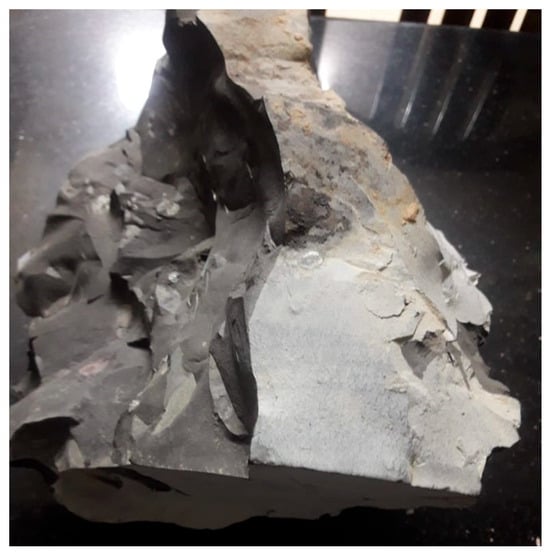
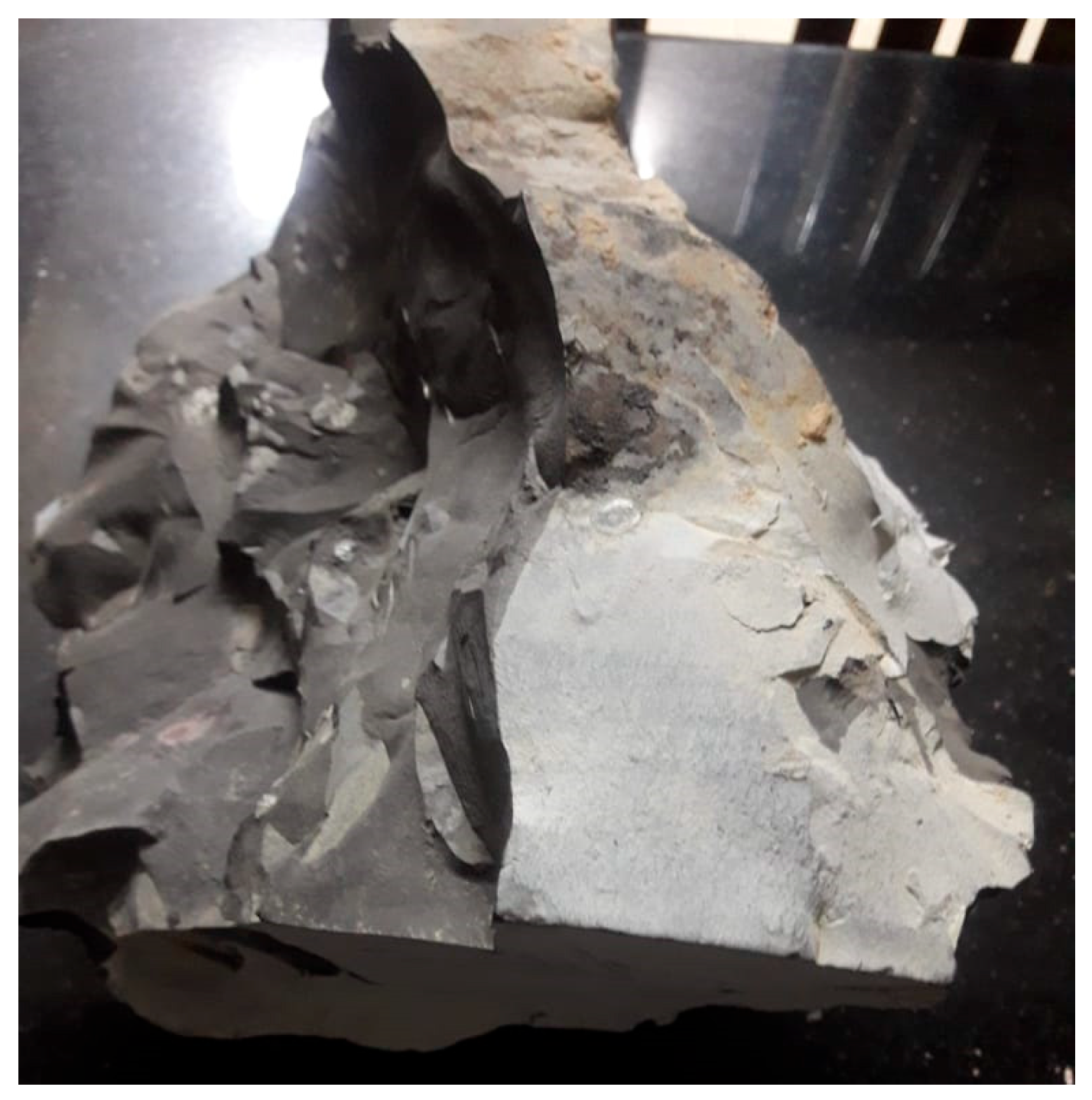
The Wadi Shallala chalk (WSC), which is located at the summit of URC, is made up of 70 m of gray to soft white chalk, limestone, and chalky limestone. The chalk beds are broken up by thin siliceous bands, and the chalk is occasionally pink in color with enormous lenses of dark gray chalk that indicate the rich organic content. Massive sequences formed in a warm outer shelf marine environment are what define WSC. Wadi Shallala oil shale is a kind of WSC that ranges in thickness from a few centimeters to 12 m and is Middle-Late Eocene in age [26]. Regarding the typical size of the extracted rocks prior to processing, based on field sampling protocols described in previous studies conducted in similar Jordanian oil shale formations [25], as shown in Figure 1, the raw oil shale samples collected from outcrops or shallow pits generally range in size from approximately 10 to 30 cm in length and 5 to 15 cm in width, with variable thickness depending on bedding planes. These dimensions are representative of hand-sized specimens typically collected for laboratory analysis before crushing and grinding.
Figure 1.
One of the samples of oil shale extracted from the site.
Upon being collected, each material was crushed in a ball mill and ground to go through a standard 200 μm sieve (0.075 mm). The pulverized oil shale was subsequently calcined under controlled laboratory conditions to produce the target condition. The specific parameters were as follows (temperature: 800 °C; duration: 24 h; and atmosphere: static air (muffle furnace)). The oil shale ash was further reduced to go through a 63 μm sieve. The selection of 800 °C for 24 h was based on prior thermogravimetric analysis (TGA) of similar Jordanian oil shales [25], which indicated that this temperature–time regime is sufficient to completely combust the kerogen (the primary organic component) while minimizing the decomposition of carbonate minerals (like calcite, which is beneficial as a filler). A significantly lower temperature might leave unburned organic residue, while a much higher temperature could lead to excessive decomposition of carbonates and undesirable phase transformations.
2.2. Cement
Based on the following criteria, Al-Manaseer Company’s (Amman, Jordan) ordinary Portland cement (OPC) of grade 42.5 was Type I, with a specific gravity of 3.26, fineness modulus of 2.03 and chemical composition as shown in Table 1 Pozzolanic Portland cement (PPC) produce by Al-Manaseer company was used based on [29] and labeled Type II, which had a grade of 42.5, specific gravity of 2.9 gr/cm3, fineness modulus 2.1, and a chemical composition which is also shown in Table 1.
Table 1.
Chemical composition of OPC—Type I; and PPC—Type II.
2.3. Fine Aggregate
The fine aggregate of natural sand had a maximum size of 1.2 mm, a fineness modulus of 3.22 and a specific gravity of 2.52. The ASTM C33/C33M-08 [30] standard specification was met by the natural sand that was utilized. Table 2 shows the fine aggregate sieve analysis distribution, and Table 3 shows its properties.
Table 2.
Fine aggregate sieve analysis.
Table 3.
Fine aggregate properties.
2.4. Specimens Preperation
Two different phases of experiments were performed, as was previously described. To serve as Control 1 for phase one, the control mix (OPC and PPC/0% ash replacement) was created. Then, OSA was used to replace a portion of the cement in the cement paste at three different ratios (10%, 20%, and 30%) and in two controls, creating eight more mixtures (Mix 1 to Mix 8). Table 4 displays the mixtures’ characteristics. The control mixture (OPC and PPC/0% ash) was prepared and classified as Control 2 for phase two. The following were the preparations for two groups of cement mortar samples. Three ratios for the substitution of OPC and ash (10%, 20%, and 30%) were utilized in the first group of specimens (Group 1). In addition, Control 2 and three replacement ratios (10%, 20%, and 30%) for PPC/ash were carried out in the second group (Group 2). According to specifications (ASTM C109/C109M-20b, 2020 [31]), the percentages of cement, fine aggregate and water for two groups was fixed at 1:2.75:0.485. The two specimen groups are shown in Table 4. Table 4 presents the specific quantities of standard cement mortar samples, and includes cement, fine aggregate (sand), and water proportions. These mixtures were prepared to evaluate the mechanical properties of mortar, such as compressive, where the presence of sand plays a critical role in load transfer, stiffness, and overall structural behavior. In this table, oil shale ash is incorporated as a partial substitute for cement, while the aggregate content is kept constant to isolate the effect of the ash on mortar performance.
Table 4.
The mixing ratio of OPC and PPC by replacement OSA.
2.5. Test Procedure
The blended cement pastes were created by mixing the blended cement (OPC and PPC)/OSA, utilizing the standard method of normal consistency and mixing the needed amount of water [6,10,32].
To investigate the effect of oil shale ash (OSA) as a partial replacement of cement on the mechanical properties of cement mortar, a series of tests were carried out following standardized procedures. The setting times of cement pastes containing various replacement levels of OSA were determined using Vicat apparatus in accordance with ASTM C191 [33], measuring the initial and final setting times to evaluate the influence of OSA on cement hydration kinetics. The pozzolanic activity index (PAI) was assessed following ASTM C311 [34], where mortar specimens incorporating 20% OSA by weight of cement were prepared, cured for 28 days, and then their compressive strength was compared to that of control specimens to determine the pozzolanic contribution of OSA. The scanning electron microscope (SEM) [35] analysis was performed on small fragments of the hardened mortar, which were dried, gold-coated, and examined to observe the microstructural characteristics and morphologies of hydration products; meanwhile, energy dispersive X-ray (EDX) [35] spectroscopy, conducted alongside SEM following ASTM E1508 [35,36], was used to identify the elemental composition of the observed phases. The compressive strength of 50 × 50 × 50 mm mortar cubes was measured at curing ages of 3, 7, 14, 28, 56 and 90 days according to ASTM C109, using a universal testing machine at a constant loading rate until failure [29,31]. The flexural strength was determined on 40 × 40 × 160 mm mortar prisms in accordance with ASTM C348, using a three-point bending test to evaluate the modulus of rupture [37]. The ASTM C642 method was selected as it is a standard and widely accepted procedure for determining the water-accessible (open) porosity of cementitious materials [38]. While this test quantifies the total volume of pores that are accessible to water, we acknowledge that it does not directly measure pore connectivity, which is a more complex parameter related to the size, distribution, and interconnection of the pore network. In this study, the open porosity values obtained are used as an indirect indicator of the overall pore structure. For each mixture, three representative specimens were tested, and the reported porosity values correspond to the average of the measured results to ensure repeatability and statistical reliability. All specimens were prepared, cured, and tested under identical conditions to minimize experimental variability. All specimens were prepared and cured under controlled laboratory conditions to ensure the validity and reproducibility of the results. All mixing and specimen preparation were carried out under controlled laboratory conditions at a temperature of (23 ± 2) °C and a relative humidity of (50 ± 5)%. After casting, the mortar specimens were demolded after 24 h and cured in water at (23 ± 2) °C until the designated testing ages [31].
3. Results
3.1. X-Ray Fluorescence “XRF”
Table 5 presents the chemical composition of OSA, which was determined by X-ray fluorescence spectroscopy. Notably, the OSA contained 0.87% Fe2O3, 21.4% SiO2, and 62.2% CaO, with less than 1% SO3. This falls within the ASTM C618 [34,39] limits for natural pozzolanic materials, which allows a maximum of 4% SO3. The OSA’s chemical composition is comparable with that of conventional cement, as presented in Table 1; however, it has lower concentrations of Al2O3, SO3 and Fe2O3 (around 4%). The oil shale used in this study, from Jordan’s northern parts, has an ideal chemical profile and thus is suitable for use as a pozzolanic material. Ultimately, the overall content of oxides (SiO2, Al2O3 and Fe2O3) must be at least 70% in order to achieve a good pozzolanic reaction.
Table 5.
Chemical composition of OSA.
3.2. Pozzolanic Activity Index (PAI)
The oil shale ash (OSA) pozzolanic activity index (PAI) after 7 and 28 days is demonstrated in Table 6. The pozzolanic activity index (PAI) was calculated following the standard approach (PAI % = 100 × (compressive strength of mix with OSA/compressive strength of control mix) at the same age, per ASTM C311 methodology). A PAI ≥ 75% at either 7 or 28 days is commonly accepted as evidence of useful pozzolanic contribution. In this study, all OSA-containing mixes at 20% replacement comfortably exceeded this benchmark: early-age PAI values were high (95–98% at 7 days) and reached 100% at 28 days for both OPC-20% and PPC-20% mixes. These results indicate that at 20% replacement the OSA provides either a filler/nucleation effect and/or sufficient latent pozzolanic reactivity to match the compressive performance of the control mortars by 28 days. The 7-day PAI values close to unity (95–98%) further suggest that OSA does not cause pronounced early-age strength dilution at this replacement level—a desirable attribute for practical use.
Table 6.
Pozzolanic activity of the OSA used in this investigation (wt. %).
Conversely, mixes with 30% OSA replacement (OPC/PPC 30%) failed to meet the PAI criterion, reflecting a pronounced dilution effect and/or insufficient reactive binder fraction at that substitution degree. The failure at 30% can be explained mechanistically as replacing a larger fraction of clinker reduces the available Ca(OH)2 and active aluminate/silicate phases needed for strength-producing hydration and secondary C–S–H formation; furthermore, any crystalline, inert, or sulfate-bearing phases in the OSA (as indicated by XRD) will further lower reactivity or introduce durability risks. The discrepancy between acceptable performance at 20% and failure at 30% aligns with observed mechanical and microstructural results (strength trends, SEM evidence of ettringite and microcracking), implying that beneficial filler/pozzolanic effects dominate up to ~20%, while deleterious effects (dilution, soluble salts, microstructural expansion) prevail at higher replacements.
3.3. Water Consistency and Setting Time
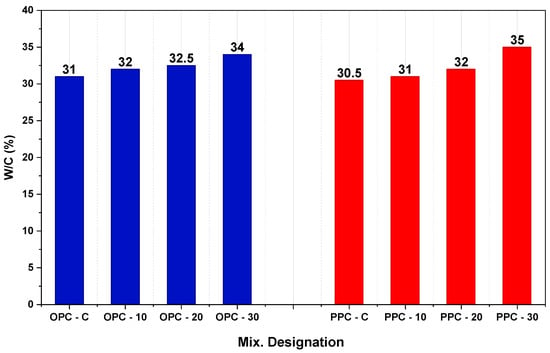
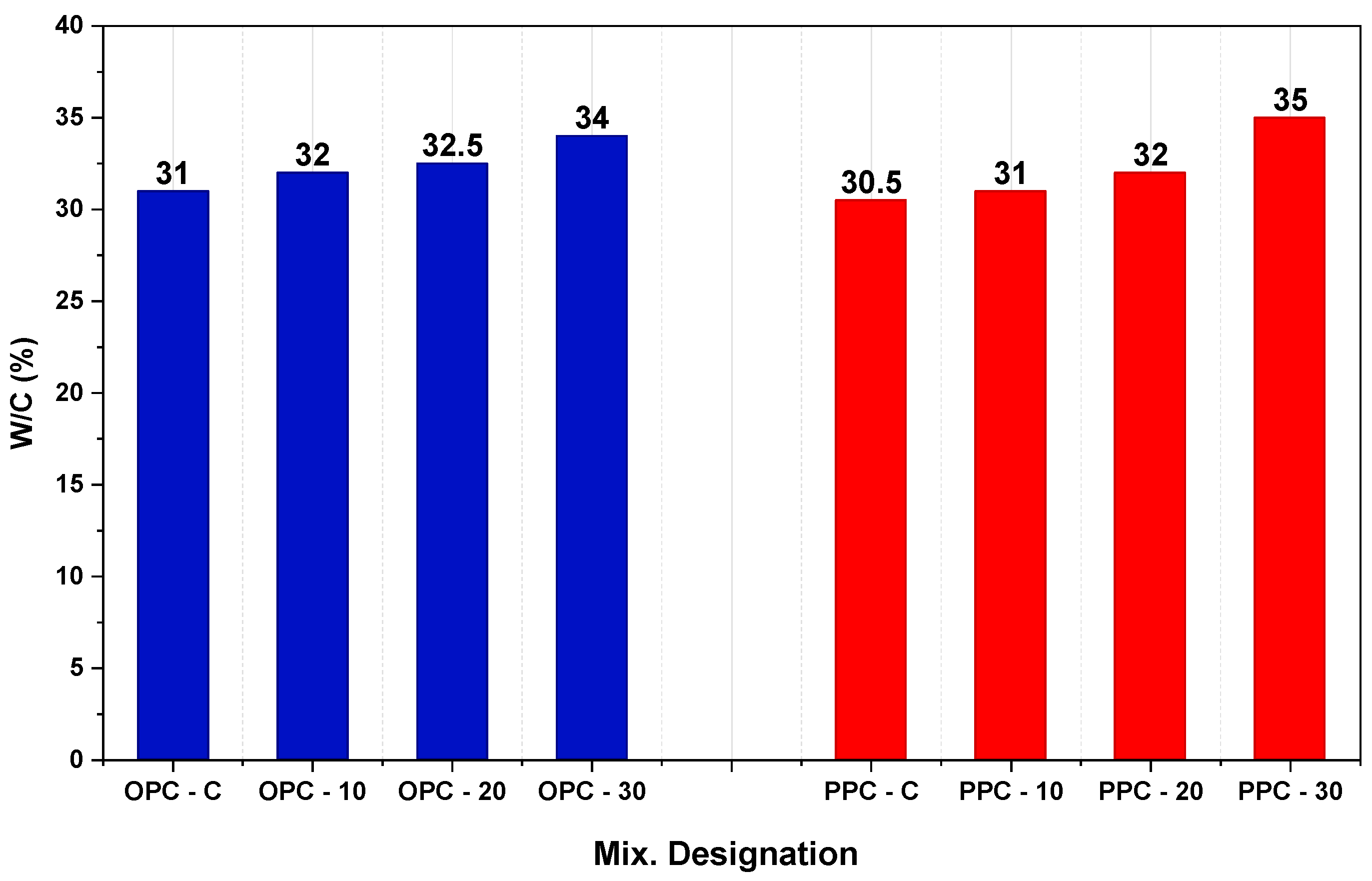
The consistency test results revealed a clear trend regarding the influence of OSA content on the water demand of cement mortars. All mix components are shown in Table 7. As shown in Figure 2, the OPC control mix (OPC-C) required a water–cement (W/C) ratio of 31%. Replacing cement with OSA gradually increased water demand: OPC-10 required 32%, OPC-20 32.5%, and OPC-30 34%. This trend reflects the higher surface area, porous texture, and lower reactivity of OSA, which reduce workability and necessitate additional water. For PPC mixes, PPC-C had a W/C ratio of 30.5%, increasing slightly to 31% and 32% for PPC-10 and PPC-20, respectively. However, PPC-30 showed a sharper rise to 35%, indicating a stronger water-demand effect due to the pozzolanic nature of PPC limiting early hydration. Based on consistency, OPC-10 and PPC-10 were the most efficient mixtures, requiring minimal additional water, while higher OSA levels—particularly 30%—had significantly increased W/C ratios which may adversely affect strength and durability. Table 7 presents the standard cement paste samples and reports only the quantities of cement (and/or oil shale ash) and water, without the inclusion of fine aggregate. These mixtures were designed to investigate the intrinsic behavior of the cementitious matrix, such as setting behavior, and microstructural development. The absence of sand allows for a clearer assessment of the influence of oil shale ash on the cement paste itself, independent of aggregate effects.
Table 7.
Relation between OSA ratio in the paste and the required water.
Figure 2.
The consistency test results regarding the influence of OSA content according to the W/C ratio.
As illustrated in Table 8, the final setting time of cement mortar is a critical indicator of the rate of hydration and the workability window during construction. In this study, the incorporation of oil shale ash (OSA) as a partial cement replacement at 10%, 20%, and 30% levels was evaluated for its effects on the final setting time of mortar prepared with ordinary Portland cement (OPC) and Portland pozzolanic cement (PPC).
Table 8.
Final setting time of OSA mixes.
For OPC-based mixes, the control sample (OPC-C), which contained 100% OPC and no OSA, exhibited a final setting time of 387 min. The incorporation of 10% OSA (OPC-10) resulted in a slight reduction to 377 min, indicating a negligible acceleration of setting (about 2.6% shorter than the control). However, a substantial reduction was observed as the OSA content increased to 20% and 30%, where the final setting times dropped to 270 min and 264 min, respectively. This represents a significant reduction of approximately 30% for OPC-20 and 32% for OPC-30 compared to the control. These results suggest that higher OSA replacement accelerates the setting reaction, possibly due to the increased fineness and pozzolanic reactivity of the OSA contributing to faster hydration [25].
For PPC-based mixes, a similar trend was observed. The control mix (PPC-C) exhibited a final setting time of 396 min. Replacing 10% of cement with OSA (PPC-10) reduced the setting time to 306 min (23%), with further reductions at higher replacement levels: 264 min for PPC-20 (33%) and 252 min for PPC-30 (36%). These results indicate that OSA accelerates the setting of PPC mortar more significantly than OPC mortar, likely due to synergistic interactions between the pozzolanic constituents of PPC and OSA. This behavior is attributed to changes in clinker phase proportions (C3S, C2S, and C3A), which govern hydration and setting. Partial replacement with OSA modifies the SO3 and Al2O3 contents, reducing C3A while increasing reactive CaO availability. These changes shorten setting times, increase water demand, and enhance calcium silicate hydrate (C–S–H) formation, contributing to the observed acceleration.
Also, partial replacement of OPC and PPC with oil shale ash (OSA) reduces the effective clinker content, especially C3A, due to the relatively low SO3 and Al2O3 contents of OSA. This reduction limits early ettringite formation and modifies early hydration reactions, contributing to changes in setting time. In addition, the fine particle size of OSA enhances the filler effect, providing nucleation sites that may accelerate hydration at higher replacement levels. Moreover, OSA increases water demand because of its finer particles and larger specific surface area. Its relatively high CaO content supplies additional calcium ions, promoting the formation of calcium silicate hydrate (C-S-H) gel. At the same time, the decrease in overall Al2O3 content favors C-S-H formation over aluminate hydrates, leading to a denser cementitious matrix. These combined effects explain the observed reduction in setting times and the improved hydration behavior of OSA-blended mortars. This aligns with findings from studies using Jordanian OSA [24,25,40].
3.4. Compressive Strength
Table 9 shows the trends in compressive strength development for mortars containing various percentages of OSA (10%, 20%, and 30%) when accompanied by different percentages of Portland pozzolanic cement replacement. Compressive strength is improved and curing time increased for all cement pastes, due to an increase in hydration products such as calcium silicate hydrate and a decrease in OSA ratio in mortar. These findings align with the results presented in references [10,41,42].
Table 9.
Compressive strength of OPC and PPC/OSA.
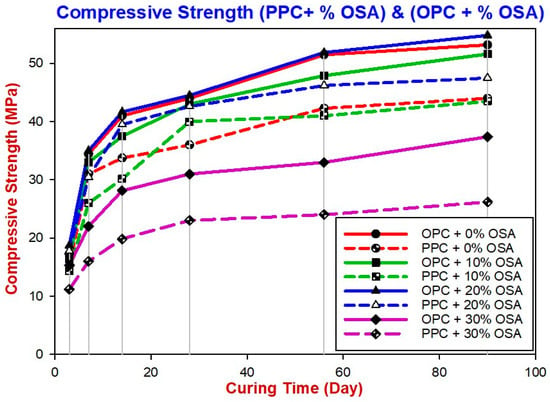
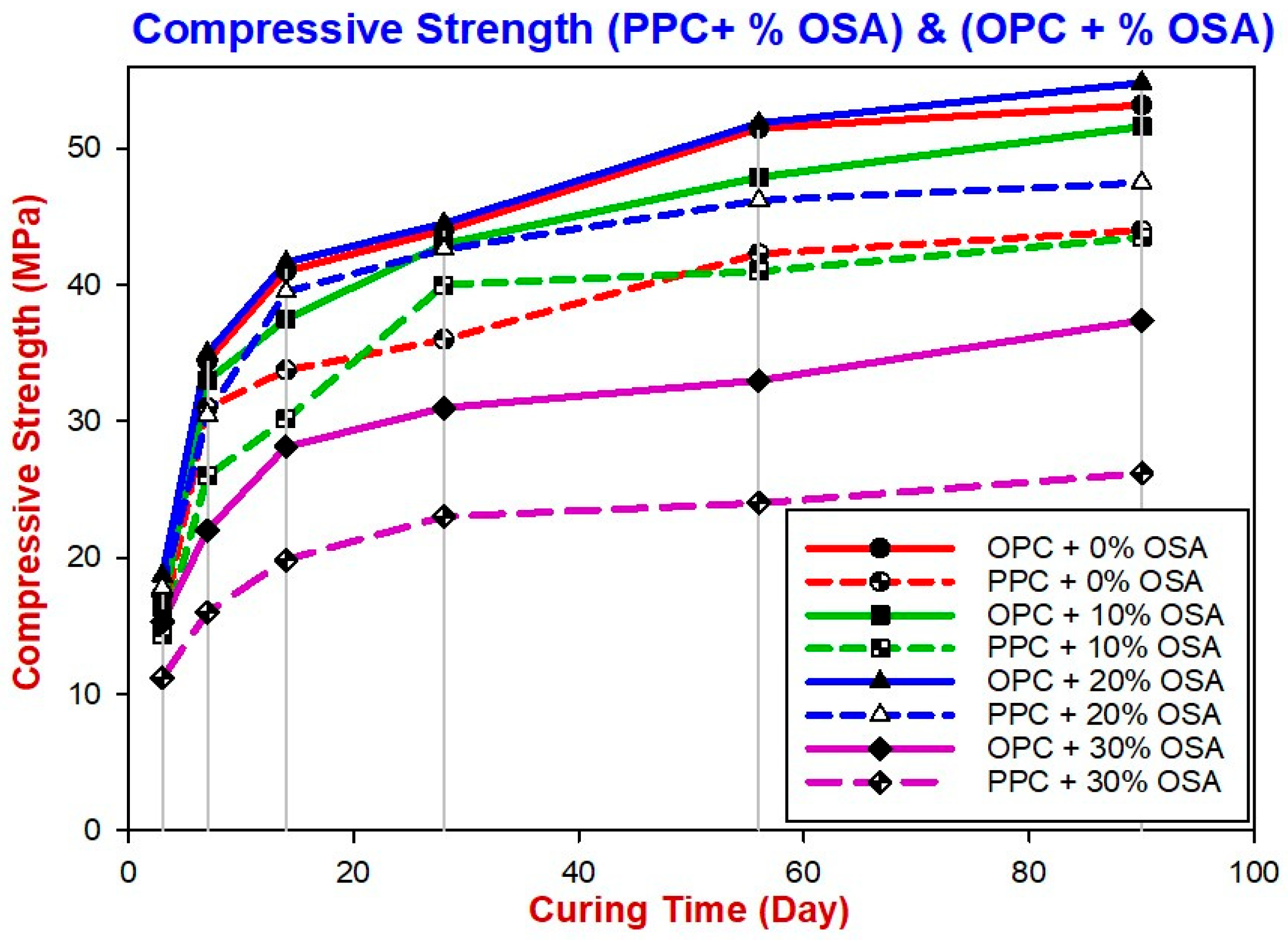
Based on the compressive strength data represented in Figure 3, clear trends emerge regarding the influence of oil shale ash (OSA) incorporation in both ordinary Portland cement (OPC) and pozzolanic Portland cement (PPC) concrete. For OPC mixes, the 20% OSA replacement (OPC-20) consistently demonstrates the highest compressive strength across all ages, outperforming the control (OPC-C). At 28 days, OPC-20 reaches 44.5 MPa, a 1.1% increase over OPC-C (44 MPa). This improvement is more pronounced at 90 days, with OPC-20 reaching 54.8 MPa, representing a 3.0% increase over the control’s 53.18 MPa. Conversely, the 30% replacement (OPC-30) shows the weakest performance, with a 28-day strength of 31 MPa, which is 29.5% lower than OPC-C. The superior performance of the OPC-20 mix is attributed to the optimal pozzolanic reaction and micro-filler effect of the ash, which refines the pore structure and enhances later-age strength. The significant strength reduction in OPC-30 is due to the dilution effect—excessive ash reduces the amount of reactive cementitious material—and potentially higher water demand, leading to a more porous and weaker matrix.
Figure 3.
The compressive strength test results regarding the influence of OSA content.
A similar trend is observed in PPC mixes, with PPC-20 showing the best performance. It reaches 42.61 MPa at 28 days, 18.4% higher than PPC-C, and 47.5 MPa at 90 days, a 7.95% improvement over the control. In contrast, PPC-30 performs poorly, achieving only 23 MPa at 28 days, 36.1% lower than PPC-C. The superior behavior of PPC-20 is attributed to a synergistic pozzolanic effect, where OSA enhances secondary C–S–H formation and microstructural densification. Strength reduction in PPC-30 results from excessive cement dilution and binder imbalance, hindering hydration. Overall, a 20% OSA replacement is optimal, whereas 30% exceeds the limits. The observed improvement in the mechanical properties can indeed be attributed to the direct correlation between the combined oxide content (CaO + Al2O3) and the pozzolanic contribution associated with Fe2O3 present in the oil shale ash. Moreover, Al2O3 contributes significantly to the reactivity of the ash by participating in aluminosilicate reactions, improving early-age strength and microstructural densification. The presence of Fe2O3, while less reactive than SiO2 and Al2O3, plays a complementary role by acting as a fluxing agent and contributing to the formation of stable ferrite phases, which enhance the pozzolanic activity when combined with sufficient CaO content.
3.5. Flexural Strength
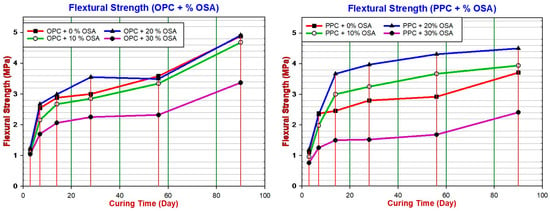
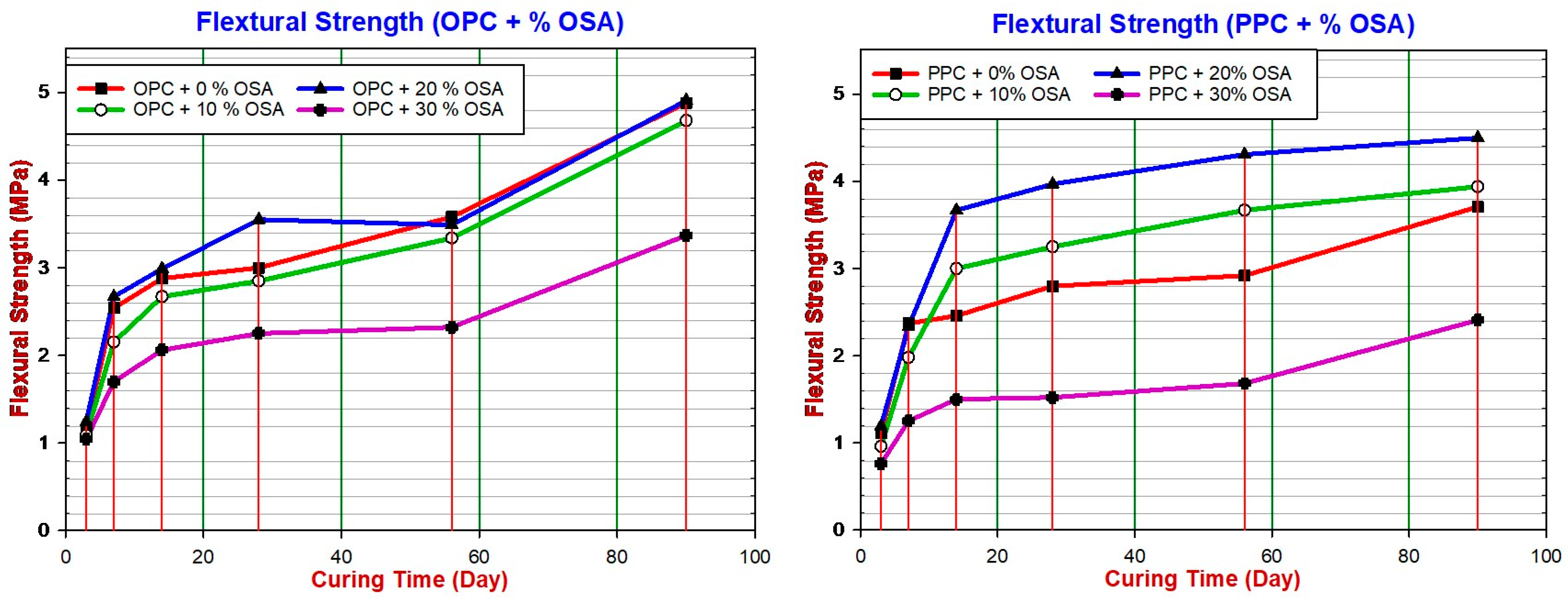
The trends in the development of flexural strength for mortars with different percentages of OSA (10%, 20%, and 30%) in conjunction with varying percentages of Portland pozzolanic cement replacement are displayed in Figure 4. Table 10 also shows the results of flexural strength of OPC and PPC/OSA
Figure 4.
The flexural strength test results regarding the influence of OSA content.
Table 10.
Flexural strength of OPC and PPC/OSA.
The flexural strength data reveals that incorporating oil shale ash (OSA) into both OPC and PPC mixes significantly influences mechanical performance over time. For OPC mixes, the highest flexural strength was recorded in OPC-20 at 90 days (4.91 MPa), representing a +0.61% increase compared to the control OPC-C (4.88 MPa), while the lowest was OPC-30 at 3 days (1.04 MPa), showing a −11.11% decrease from OPC-C (1.17 MPa). In PPC mixes, PPC-20 achieved the highest strength at 28 days (4.5 MPa), marking a +60.71% increase over PPC-C (2.8 MPa), whereas PPC-30 at 3 days (0.76 MPa) showed a −31.53% decrease from PPC-C (1.11 MPa).
These variations are attributed to the pozzolanic activity of OSA, which enhances long-term strength through secondary hydration reactions, particularly at 20% replacement where the balance between cement dilution and reactive silica is optimal. However, at 30% replacement, excessive substitution reduces early-age strength due to insufficient calcium hydroxide and slower reaction kinetics, consistent with findings in prior studies on OSA-modified cementitious systems. This underscores the importance of optimizing OSA content to maximize flexural performance without compromising early strength development. This remarkable improvement suggests that OSA effectively contributes reactive silica and alumina that synergize with the pozzolanic components in PPC, forming additional C–S–H gel that enhances flexural capacity. However, the 30% OSA mix (PPC-30) had a sharp drop to 1.66 MPa, which is a 38.5% decrease compared to the PPC control, confirming that high replacement levels adversely affect flexural performance.
3.6. Porosity
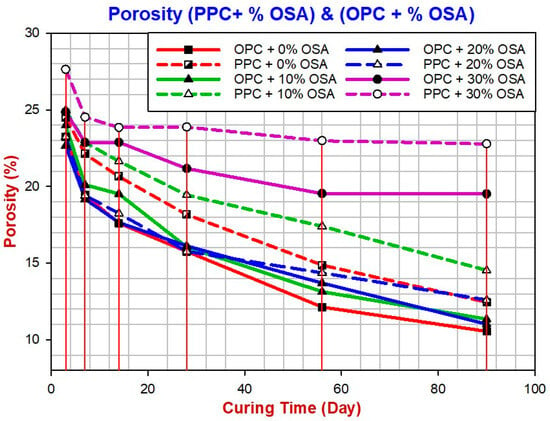
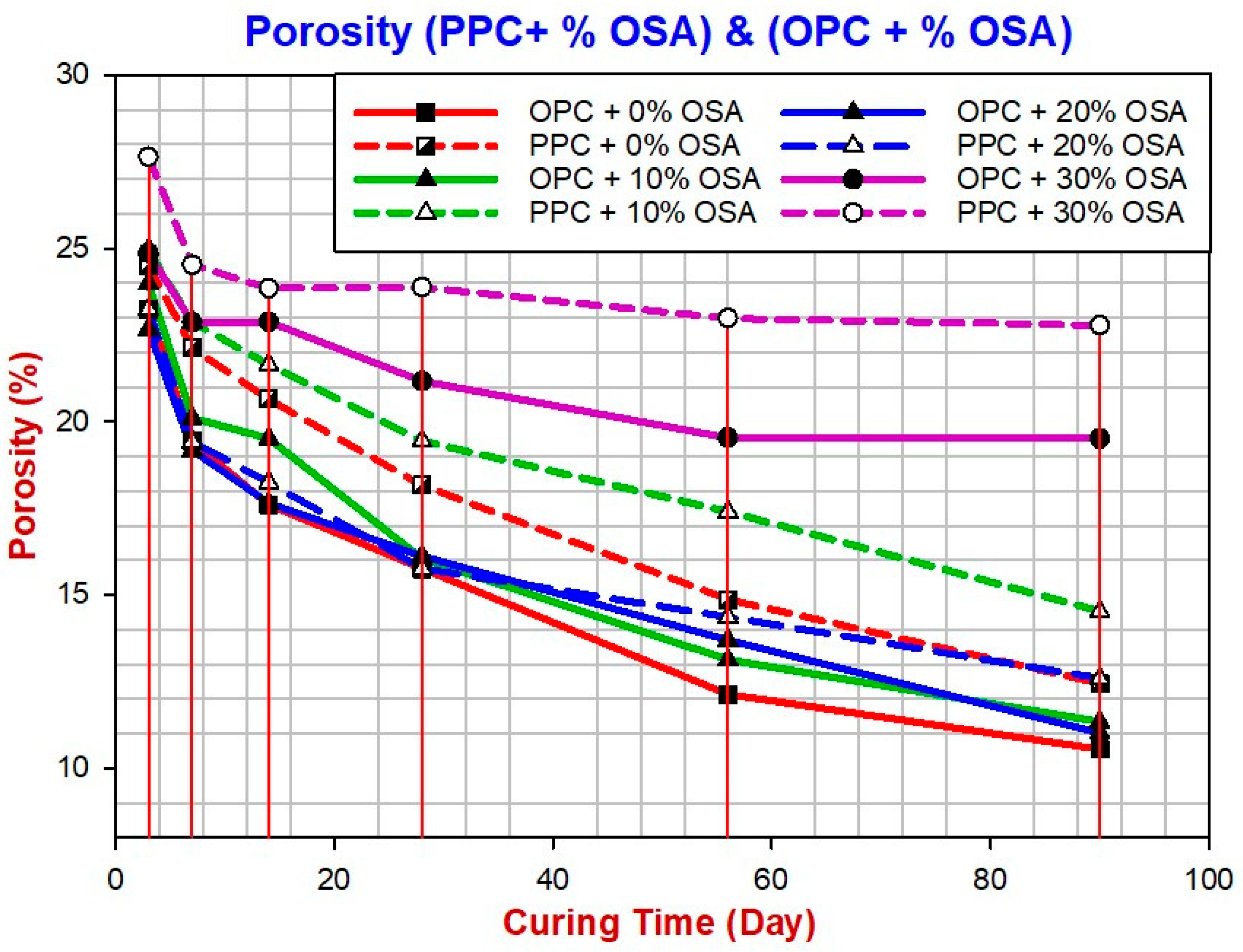
According to Table 11, the porosity data reveal a clear inverse relationship with the compressive strength trends, where optimal oil shale ash (OSA) replacement reduces porosity, while excessive replacement significantly increases it. For OPC mixes, the 20% OSA blend (OPC-20) generally maintains porosity levels closest to or slightly above the control (OPC-C), representing the most favorable microstructure among the modified mixes. At 28 days, OPC-20 porosity is 16.12%, only a 2.3% increase over OPC-C (15.76%). In contrast, the 30% replacement (OPC-30) exhibits markedly higher porosity at all ages, reaching 21.17% at 28 days—a 34.3% increase compared to the control. This trend persists at 90 days, where OPC-30 porosity (19.51%) is 84.9% higher than that of OPC-C (10.55%). The scientific reason for the performance of OPC-20 lies in the effective micro-filler effect and pozzolanic activity of the ash, which refines pore structure by filling voids and producing additional C-S-H gel. The severe porosity increase in OPC-30 is primarily due to the dilution of cement, leading to a more porous, less cohesive matrix with incomplete hydration, as well as potential water retention issues from excess fine ash particles.
Table 11.
OPC and PPC/OSA mix results from the porosity test.
As shown in Figure 5, for PPC mixes the PPC-20 blend shows the lowest porosity among the ash-containing PPC samples, nearly matching the PPC control at later ages. At 28 days, At 28 days, PPC-20 porosity is identical to PPC-C. At 90 days, PPC-20 porosity is 12.59%, slightly higher (1.1%) than PPC-C (12.45%). The worst performer, PPC-30, shows a dramatically elevated porosity of 23.88% at 28 days, which is 31.4% higher than PPC-C, and 22.78% at 90 days, representing an 83.0% increase.
Figure 5.
Porosity test results regarding the influence of OSA content.
The superior pore structure in PPC-20 results from the synergy between the pozzolans in PPC and OSA, which enhances secondary hydration and pore-filling over time. Conversely, the high porosity in PPC-30 is attributed to excessive cement replacement, which reduces the primary binder content, slows the overall reactivity, and creates a more open and less dense capillary pore network. In summary, a 20% OSA replacement optimizes pore refinement in both cement systems, while a 30% replacement critically compromises the microstructure, leading to significantly higher porosity being consistent with the observed losses in compressive strength.
3.7. Ultrasonic Pulse Velocity “UPV”
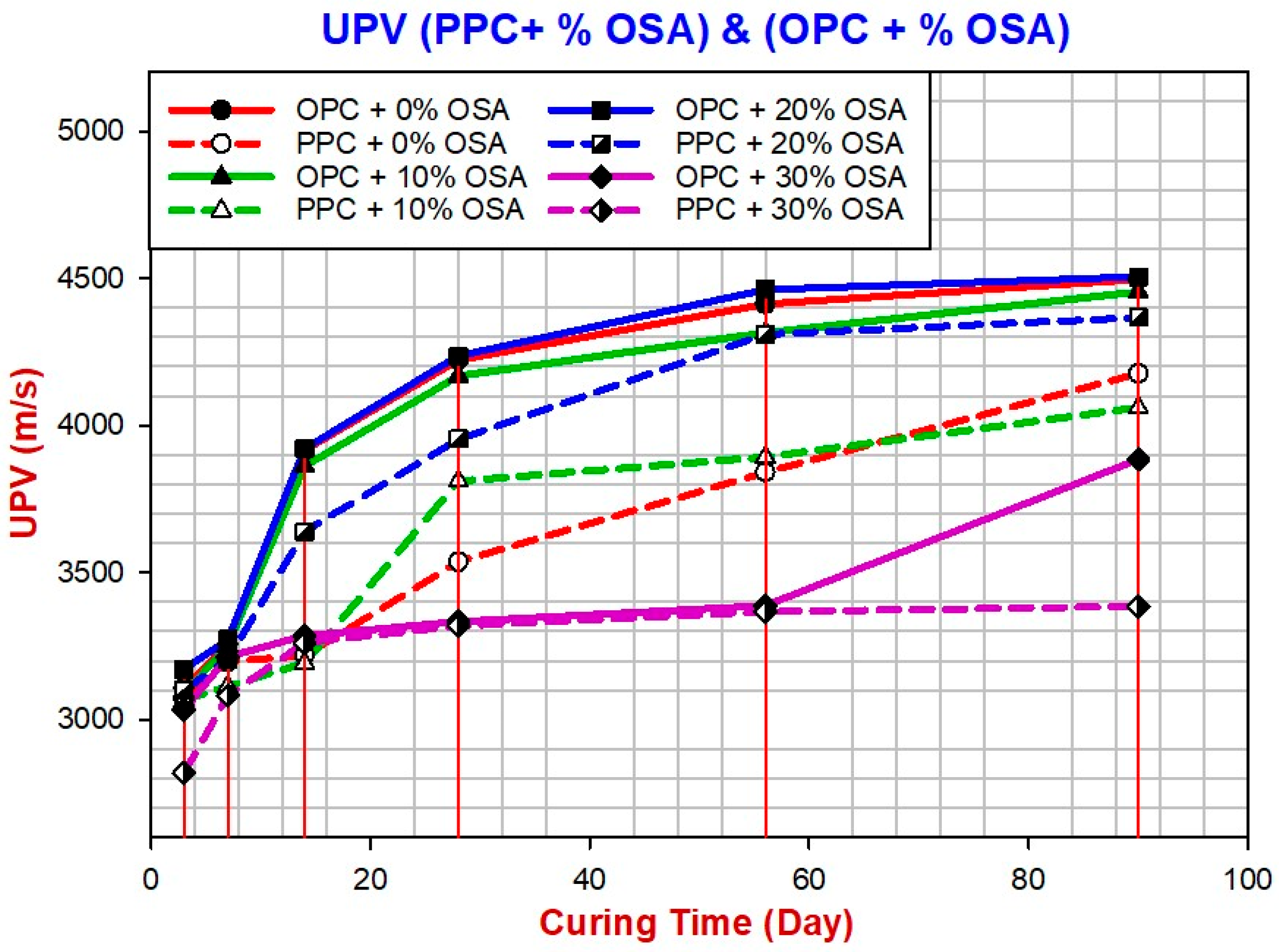
Ultrasonic pulse velocity (UPV) is a non-destructive testing method that evaluates the homogeneity and internal microstructure of concrete by measuring the speed of sound waves passing through it, with higher velocities generally indicating denser, less porous, and higher-quality materials. Table 12 provides UPV data which strongly correlate with the previously analyzed compressive strength and porosity results, confirming the microstructural impact of oil shale ash (OSA) incorporation.
Table 12.
UPV results of OPC and PPC/OSA.
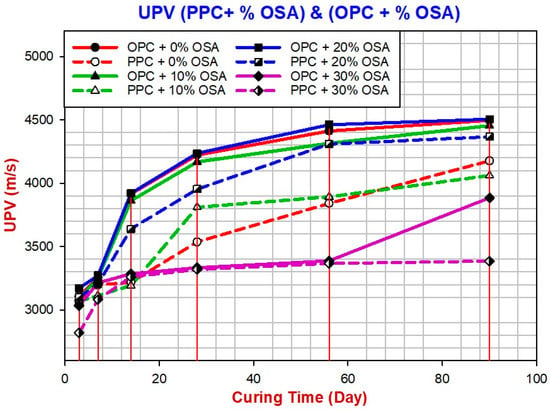
As shown in Figure 6, relative to OPC mixes, the OPC-20 blend consistently exhibits the highest UPV values from 14 days onward, indicating improved material density. At 90 days, OPC-20 reaches 4505 m/s, slightly exceeding the OPC-C control (4496 m/s), whereas OPC-30 records the lowest velocity at 3885 m/s, corresponding to a 13.6% reduction. The enhanced performance of OPC-20 is attributed to optimal pore refinement and pozzolanic reactions, which densify the microstructure and facilitate faster ultrasonic wave propagation. In contrast, the inferior performance of OPC-30 results from cement dilution, leading to higher porosity, micro-cracks, and increased wave scattering. Similar behavior is observed for PPC mixes. PPC-20 demonstrates the most refined microstructure among ash-blended samples, achieving a UPV of 4367 m/s at 90 days, which is 4.5% higher than the PPC-C control. The most pronounced improvement occurs at 56 days, with PPC-20 showing a 12.2% increase over PPC-C. Conversely, PPC-30 exhibits the weakest internal structure with a 90-day UPV of 3384 m/s, representing a 19.0% decrease. This reduction is linked to excessive porosity and poor bonding caused by over-replacement of cement. Overall, the UPV results confirm that a 20% OSA replacement enhances microstructural density in both cement systems, while a 30% replacement significantly compromises internal integrity.
Figure 6.
UPV test results regarding the influence of OSA content.
4. Discussion
The present study systematically evaluated the effects of incorporating Jordanian oil shale ash (OSA) as a partial substitute for ordinary Portland cement (OPC) and pozzolanic Portland cement (PPC) on the mechanical, microstructural, and physical properties of cement mortar. The findings reveal that OSA is a viable supplementary cementitious material with significant potential to enhance sustainability in construction, albeit with optimal performance limited to specific replacement levels.
Ordinary Portland cement (OPC, Type I) is primarily clinker-based, while Portland pozzolanic cement (PPC, Type II) already contains a predefined pozzolanic fraction (e.g., fly ash, silica fume, or natural pozzolan). This inherent difference significantly influences the interpretation of OSA’s role and the mechanisms behind the observed performance trends. Addressing this point strengthens the narrative by explaining not just that the effects are similar, but why they occur in two distinct base matrices. The similarity in optimal OSA dosage between OPC and PPC is not contradictory but rather insightful. It demonstrates that the performance of this particular Jordanian OSA in cementitious systems is governed more by its own intrinsic properties (its “beneficial capacity” and “deleterious threshold”) than by the initial pozzolanic state of the cement. The 20% level represents the universal limit for this material before its negative characteristics outweigh its positive contributions, irrespective of the host matrix being a plain (OPC) or a pre-blended (PPC) system.
The composition of that OSA indicates acts not only as a filler but also as a reactive pozzolan, contributing to secondary C–S–H formation through reactions with portlandite. Pozzolanic activity index (PAI) values exceeding 95% at 20% replacement for both OPC and PPC confirm this reactivity and agree with reported behavior of other calcareous ashes. The reduction in PAI at 30% replacement reflects a dilution effect, where reduced clinker limits available Ca(OH)2 for pozzolanic reactions. Although XRD initially identified phases such as calcite and sulfate-bearing minerals, calcite mainly enhances early strength through micro-filler and nucleation effects, while higher replacement levels may raise durability concerns consistent with the microcracking observed in SEM images.
Water demand increased with higher OSA content due to its fine particle size and porous structure, consistent with previous studies on SCMs. A 10% replacement showed minimal impact on consistency, making it suitable for workability-sensitive applications. Setting time decreased with increasing OSA content, especially beyond 10%, due to filler effects, altered hydration kinetics, and reduced C3A content. While similar trends are reported in the literature, the pronounced acceleration at 30% replacement suggests the need for retarding admixtures in practice.
Strength results identify 20% OSA as the optimal replacement level for both OPC and PPC. At this level, OSA enhances strength through additional C–S–H formation, micro-filler effects, and improved particle packing, producing a denser, more homogeneous microstructure as confirmed by SEM. Conversely, 30% replacement caused notable strength loss due to clinker dilution, increased porosity, and microcracking.
Using OSA as a cement substitute supports CO2 reduction, waste valorization, and cost savings, particularly in regions like Jordan with abundant oil shale resources, with 20% replacement offering the best balance between performance and sustainability.
5. Conclusions
This study investigated the influence of incorporating oil shale ash (OSA) as a partial cement substitute on the mechanical performance of cement mortar, aiming to evaluate its potential as a sustainable construction material.
- ▪
- Increasing OSA content generally increases water demand and W/C ratio. A total of 10% OSA is the optimum replacement level for both OPC and PPC mixes in terms of consistency, as it causes the smallest increase in water demand compared to their respective control mixes.
- ▪
- While both the 20% and 30% OSA mixes achieved substantial reductions in final setting time, the 20% replacement level offers a better balance by achieving significant acceleration without an excessive drop-in setting time. This makes the OPC-20 and PPC-20 mixes the most favorable based on the final setting time results.
- ▪
- Incorporating 20% oil shale ash as a partial cement replacement produced the highest compressive strength at 28 days for both OPC and PPC mixes. Beyond this level, particularly at 30% replacement, the compressive strength decreased sharply for both types of cement, indicating an optimum replacement level around 20%.
- ▪
- Incorporating 20% oil shale ash as a partial cement replacement produced the highest 28-day flexural strength for both OPC and PPC mixes. Beyond this level, especially at 30%, the flexural strength dropped sharply, indicating that 20% OSA is the optimal replacement level for maximizing flexural performance.
- ▪
- Replacing 30% OSA was detrimental to both types (significant reductions in compression and flexural strength); the softening/reducing effect of the clinker exceeded the potential benefits of OSA at this ratio.
Author Contributions
Conceptualization, T.I.S., A.A.-K.A.A.S. and W.F.E.; methodology, H.M.M.; software, M.A.-T. and A.A.-K.A.A.S.; validation, A.D.A., T.I.S. and W.F.E.; formal analysis, A.A.-K.A.A.S.; investigation, T.I.S., A.A.-K.A.A.S. and W.F.E.; resources, A.D.A. and W.F.E.; data curation, T.I.S. and H.M.M.; writing—original draft preparation, T.I.S. and A.A.-K.A.A.S.; writing—review and editing, A.A.-K.A.A.S., W.F.E., M.A.-T. and H.M.M.; visualization, A.D.A. and T.I.S.; supervision, W.F.E., M.A.-T. and T.I.S.; project administration, W.F.E.; funding acquisition, A.D.A. All authors have read and agreed to the published version of the manuscript.
Funding
The APC was funded by the Deanship of Graduate Studies and Scientific Research at Qassim University through financial support (QU-APC-2026).
Data Availability Statement
The original contributions presented in this study are included in the article. Further inquiries can be directed to the corresponding author.
Acknowledgments
The researchers would like to thank the Deanship of Graduate Studies and Scientific Research at Qassim University for financial support (QU-APC-2026).
Conflicts of Interest
Author Heba M. Mhedat was employed by the Higher Institute of Mining Resources Company. The remaining authors declare that the research was conducted in the absence of any commercial or financial relationships that could be construed as a potential conflict of interest.
References
- Al Sayed, A.A.-K.A.; Al-Waked, Q.F.; Shawky, S.M.; Al-Jabali, H.M.; Edris, W.F. Effect of alkali activated limestone-silica fume blended precursor on performance enhancement of recycled aggregate concrete. Case Stud. Constr. Mater. 2023, 19, e02661. [Google Scholar] [CrossRef] [Scilit]
- Saeed, M.K.; Al Sayed, A.A.-K.A.; Almutairi, A.D.; Dahish, H.A.; Al-Fasih, M.Y.M. Utilizing Alkali-Activated Recycled Concrete Aggregates from Demolished Structures to Investigate Concrete Properties in the Jeddah Region of Saudi Arabia. Sustainability 2025, 17, 1903. [Google Scholar] [CrossRef] [Scilit]
- Rehman, M.U.; MacLeod, A.J.; Aldridge, L.; Collins, F.G.; Gates, W.P. Enhancing cement replacement in calcined clay based blends using limestone and calcium hydroxide. J. Build. Eng. 2025, 112, 113913. [Google Scholar] [CrossRef] [Scilit]
- Suebsuk, J.; Kampala, A.; Waiyakorn, P.; Suksiripattanapong, C.; Chindaprasirt, P. Variations in strength and stiffness of cement-stabilized reclaimed asphalt pavement and marginal lateritic soil blends in tropical climate. Constr. Build. Mater. 2023, 409, 134062. [Google Scholar] [CrossRef] [Scilit]
- Navarrete, I.; Valdes, J.; Lopez, M.; Vargas, F. Replacement of pozzolanic blended cement by supplementary cementitious materials: Mechanical and environmental approach. Constr. Build. Mater. 2023, 394, 132263. [Google Scholar] [CrossRef] [Scilit]
- Smadi, M.M.; Haddad, R.H. The use of oil shale ash in Portland cement concrete. Cem. Concr. Compos. 2003, 25, 43–50. [Google Scholar] [CrossRef] [Scilit]
- Goncharov, A.; Zhutovsky, S. Eco-friendly belite cement from crude calcareous oil shale with low calorific value. Cem. Concr. Res. 2022, 159, 106874. [Google Scholar] [CrossRef] [Scilit]
- Alaloul, W.S.; Al Salaheen, M.; Malkawi, A.B.; Alzubi, K.; Al-Sabaeei, A.M.; Musarat, M.A. Utilizing of oil shale ash as a construction material: A systematic review. Constr. Build. Mater. 2021, 299, 123844. [Google Scholar] [CrossRef] [Scilit]
- Ghuzlan, K.; Al-Khateeb, G.; Abu Damrah, A. Using oil shale ash waste as a modifier for asphalt binders. J. Mater. Cycles Waste Manag. 2013, 15, 522–529. [Google Scholar] [CrossRef] [Scilit]
- Haddad, R.H.; Lababneh, Z.K. Geopolymer composites using natural pozzolan and oil-shale ash base materials: A parametric study. Constr. Build. Mater. 2020, 240, 117899. [Google Scholar] [CrossRef] [Scilit]
- Al-Shugaa, M.A.; Al-Fakih, A.; Al-Awsh, W.; Al-Osta, M.A. Pozzolanic performance and characteristic analysis of binary blended cement incorporating ceramic polishing sludge. J. Mater. Res. Technol. 2024, 29, 3711–3725. [Google Scholar] [CrossRef] [Scilit]
- Chhaiba, S.; Blanco-Varela, M.; Diouri, A.; Bougarrani, S. Characterization and hydration of cements and pastes obtained from raw mix containing Moroccan oil shale and coal waste as a raw material. Constr. Build. Mater. 2018, 189, 539–549. [Google Scholar] [CrossRef] [Scilit]
- Shawabkeh, R.; Al-Harahsheh, A.; Hami, M.; Khlaifat, A. Conversion of oil shale ash into zeolite for cadmium and lead removal from wastewater. Fuel 2004, 83, 981–985. [Google Scholar] [CrossRef] [Scilit]
- Wang, C.-Q.; Lin, X.-Y.; Wang, D.; He, M.; Zhang, S.-L. Utilization of oil-based drilling cuttings pyrolysis residues of shale gas for the preparation of non-autoclaved aerated concrete. Constr. Build. Mater. 2018, 162, 359–368. [Google Scholar] [CrossRef] [Scilit]
- Niu, M.; Wang, S.; Han, X.; Jiang, X. Yield and characteristics of shale oil from the retorting of oil shale and fine oil-shale ash mixtures. Appl. Energy 2013, 111, 234–239. [Google Scholar] [CrossRef] [Scilit]
- Usta, M.C.; Yörük, C.R.; Hain, T.; Paaver, P.; Snellings, R.; Rozov, E.; Gregor, A.; Kuusik, R.; Trikkel, A.; Uibu, M. Evaluation of New Applications of Oil Shale Ashes in Building Materials. Minerals 2020, 10, 765. [Google Scholar] [CrossRef] [Scilit]
- Chakchouk, A.; Trifi, L.; Samet, B.; Bouaziz, S. Formulation of blended cement: Effect of process variables on clay pozzolanic activity. Constr. Build. Mater. 2009, 23, 1365–1373. [Google Scholar] [CrossRef] [Scilit]
- Rajesh, J.; Kandasamy, S. Particle size reduction effects on fly ash pozzolanic performance in cement. Constr. Build. Mater. 2025, 494, 143458. [Google Scholar] [CrossRef] [Scilit]
- Kroehong, W.; Sinsiri, T.; Jaturapitakkul, C. Effect of Palm Oil Fuel Ash Fineness on Packing Effect and Pozzolanic Reaction of Blended Cement Paste. Procedia Eng. 2011, 14, 361–369. [Google Scholar] [CrossRef] [Scilit]
- Pihu, T.; Arro, H.; Prikk, A.; Rootamm, R.; Konist, A.; Kirsimäe, K.; Liira, M.; Mõtlep, R. Oil shale CFBC ash cementation properties in ash fields. Fuel 2012, 93, 172–180. [Google Scholar] [CrossRef] [Scilit]
- Uibu, M.; Somelar, P.; Raado, L.-M.; Irha, N.; Hain, T.; Koroljova, A.; Kuusik, R. Oil shale ash based backfilling concrete—Strength development, mineral transformations and leachability. Constr. Build. Mater. 2016, 102, 620–630. [Google Scholar] [CrossRef] [Scilit]
- Radwan, M.; Farag, L.; Abo-El-Enein, S.; El-Hamid, H.A. Alkali activation of blended cements containing oil shale ash. Constr. Build. Mater. 2013, 40, 367–377. [Google Scholar] [CrossRef] [Scilit]
- Nin Chan, S.Y.; Ji, X. Water sorptivity and chloride diffusivity of oil shale ash concrete. Constr. Build. Mater. 1998, 12, 177–183. [Google Scholar] [CrossRef] [Scilit]
- Bayaidah, R.H.; Habashneh, A.A.O.; Al-Ma’AItah, S.H.; Alfahajin, M.S.; Al-Kheetan, M.J.; Jweihan, Y.S.; Alrwashdeh, S.S.; Al-Hamaiedeh, H.; Ghaffar, S.H. Utilisation of raw oil shale as fine aggregate to replace natural sand in concrete: Microstructure, surface chemistry and macro properties. Results Eng. 2023, 19, 101265. [Google Scholar] [CrossRef] [Scilit]
- Al-Harahsheh, A.; Al-Otoom, A.; Al-Harahsheh, M.; Allawzi, M.; Al-Adamat, R.; Al-Farajat, M.; Al-Ayed, O. The leachability propensity of El-Lajjun Jordanian oil shale ash. Jordan J. Earth Environ. Sci. 2012, 4, 29–34. [Google Scholar]
- Cordova, C.E. Floodplain degradation and settlement history in Wadi al-Wala and Wadi ash-Shallalah, Jordan. Geomorphology 2008, 101, 443–457. [Google Scholar] [CrossRef] [Scilit]
- Hakimi, M.H.; Abdullah, W.H.; Alqudah, M.; Makeen, Y.M.; Mustapha, K.A. Organic geochemical and petrographic characteristics of the oil shales in the Lajjun area, Central Jordan: Origin of organic matter input and preservation conditions. Fuel 2016, 181, 34–45. [Google Scholar] [CrossRef] [Scilit]
- Rajab, J.S.A.; Al Tarazi, E. Illuminating and optimising a three-dimensional model of an oil shale seam and its volume distribution using the transient electromagnetic induction method, central part of Jordan. Geophys. Prospect. 2018, 66, 603–625. [Google Scholar] [CrossRef] [Scilit]
- ASTM C150/C150M-15; Standard Specification for Portland Cement. ASTM International: West Conshohocken, PA, USA, 2019. [CrossRef] [Scilit]
- ASTM C33/C33M-18; Standard Specification for Concrete Aggregates. ASTM International: West Conshohocken, PA, USA, 2010. [CrossRef] [Scilit]
- ASTM C109/C109M; Standard Test Method for Compressive Strength of Hydraulic Cement Mortars. ASTM International: West Conshohocken, PA, USA, 2007. [CrossRef] [Scilit]
- Vatin, N.; Barabanshchikov, Y.; Usanova, K.; Akimov, S.; Kalachev, A.; Uhanov, A. Cement-based materials with oil shale fly ash additives. IOP Conf. Ser. Earth Environ. Sci. 2020, 578, 012043. [Google Scholar] [CrossRef] [Scilit]
- ASTM C191; Time of Setting of Hydraulic Cement. ASTM International: West Conshohocken, PA, USA, 2008.
- Duran-Herrera, A.; De-León-Esquivel, J.; Bentz, D.P.; Valdez-Tamez, P. Self-compacting concretes using fly ash and fine limestone powder: Shrinkage and surface electrical resistivity of equivalent mortars. Constr. Build. Mater. 2019, 199, 50–62. [Google Scholar] [CrossRef] [Scilit]
- ASTM C1723-10; Standard Guide for Examination of Hardened Concrete Using Scanning Electron Microscopy. ASTM International: West Conshohocken, PA, USA, 2016. [CrossRef] [Scilit]
- ASTM C856-17; Standard Practice for Petrographic Examination of Hardened Concrete. ASTM International: West Conshohocken, PA, USA, 2017. [CrossRef] [Scilit]
- ASTM C1709-18; Standard Guide for Evaluation of Alternative Supplementary Cementitious Materials (ASCM) for Use in Concrete. ASTM International: West Conshohocken, PA, USA, 2000. [CrossRef] [Scilit]
- ASTM C642-13; Standard Test Method for Density, Absorption, and Voids in Hardened Concrete C642-97. ASTM International: West Conshohocken, PA, USA, 2013.
- ASTM C618-22; Standard Specification for Coal Fly Ash and Raw or Calcined Natural Pozzolan for Use in Concrete. ASTM International: West Conshohocken, PA, USA, 2019.
- Shawabkeh, R.; Al-Harahsheh, A.; Al-Otoom, A. Copper and zinc sorption by treated oil shale ash. Sep. Purif. Technol. 2004, 40, 251–257. [Google Scholar] [CrossRef] [Scilit]
- Murad, Y.; Abu-Haniyi, Y.; Alkaraki, A.; Hamadeh, Z. An experimental study on cyclic behaviour of reinforced concrete connections using waste materials as cement partial replacement. Can. J. Civ. Eng. 2018, 46, 522–533. [Google Scholar] [CrossRef] [Scilit]
- Upnere, S.; Novakova, I.; Jekabsons, N.; Krasnikovs, A.; Macanovskis, A. Bridging Law Application to Fracture of Fiber Concrete Containing Oil Shale Ash. Buildings 2023, 13, 1868. [Google Scholar] [CrossRef] [Scilit]

Disclaimer/Publisher’s Note: The statements, opinions and data contained in all publications are solely those of the individual author(s) and contributor(s) and not of MDPI and/or the editor(s). MDPI and/or the editor(s) disclaim responsibility for any injury to people or property resulting from any ideas, methods, instructions or products referred to in the content. |
© 2026 by the authors. Licensee MDPI, Basel, Switzerland. This article is an open access article distributed under the terms and conditions of the Creative Commons Attribution (CC BY) license.