Impact of Architecture Façade Design on Neurophysiological Stress Using Functional Near-Infrared Spectroscopy and Heart Rate Variability

 ,
,  , , , ,
Abstract
1. Introduction
Study Innovation and Approach
- Functional near-infrared spectroscopy (fNIRS) to monitor haemodynamic activity in the primary visual cortex.
- Heart rate variability (HRV) metrics derived from fNIRS signals as a proxy for allostatic responses.
- Self-reported Likert scale ratings assessing visual discomfort, complexity, and interest for each façade.
2. Methodology
2.1. Participants
2.2. Development of Visual Stimuli
Creating Façade Variations Utilising Generative AI (Midjourney)
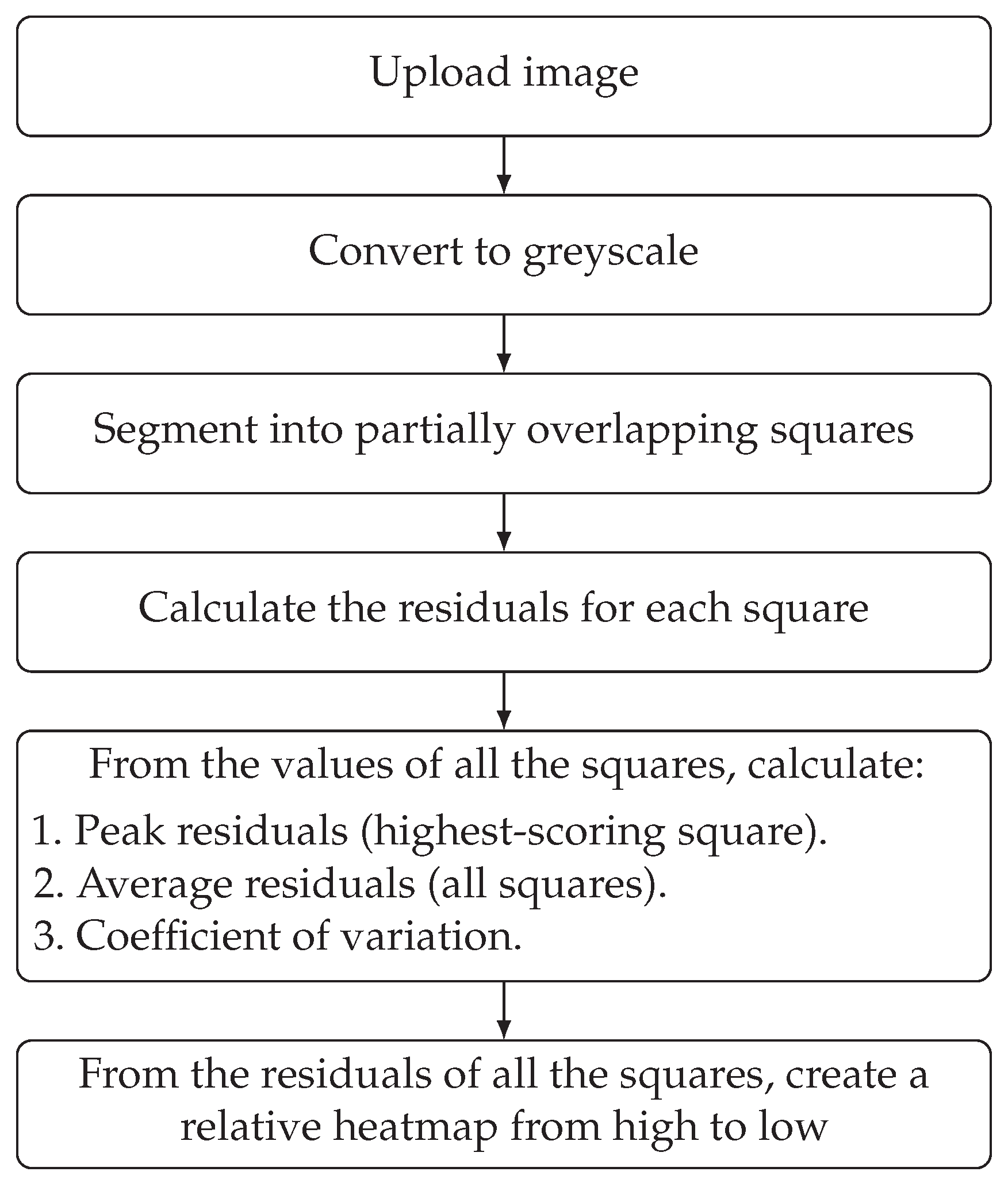
2.3. Visual Stress Analysis (ViStA) Methodology
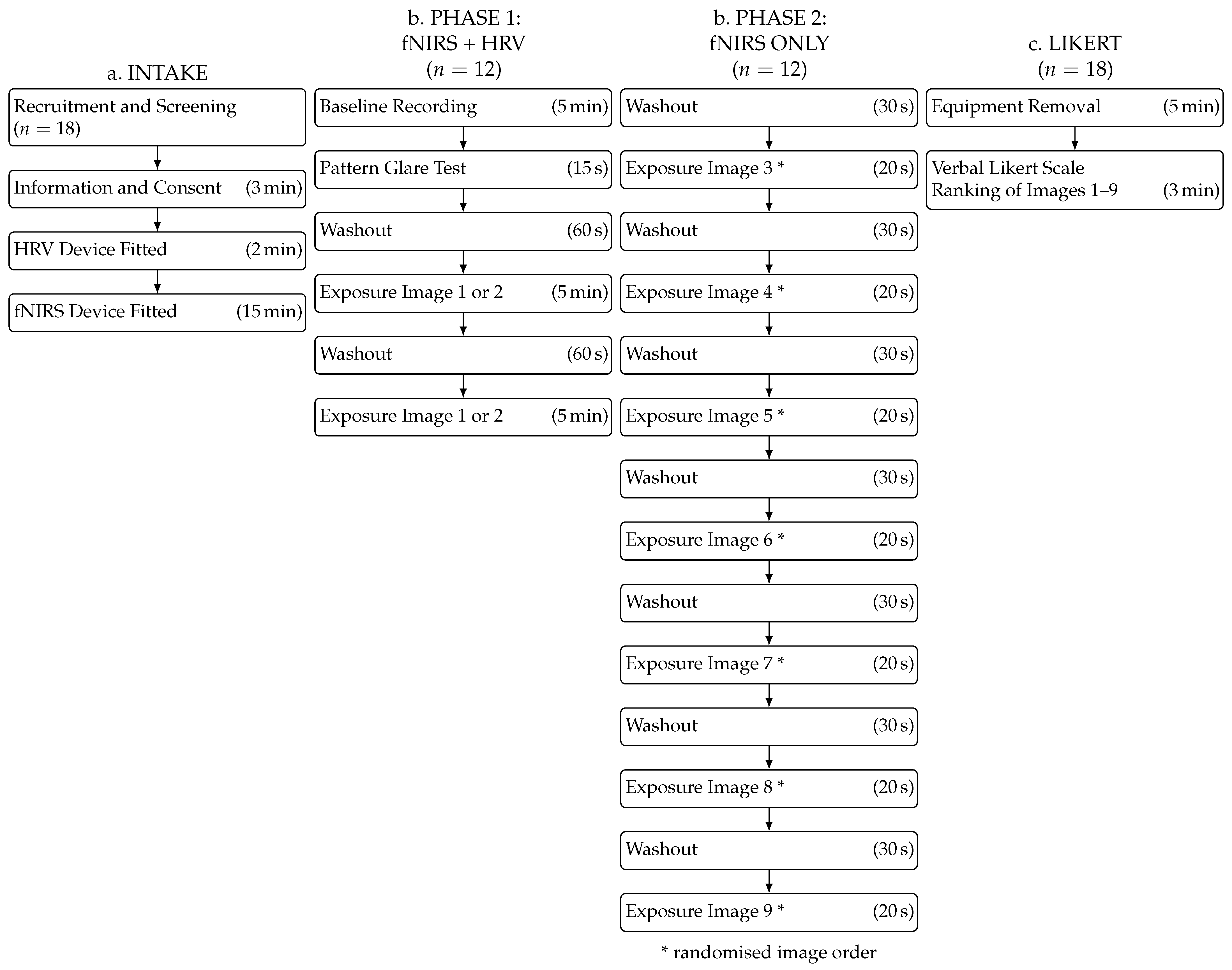
2.4. Experimental Procedure
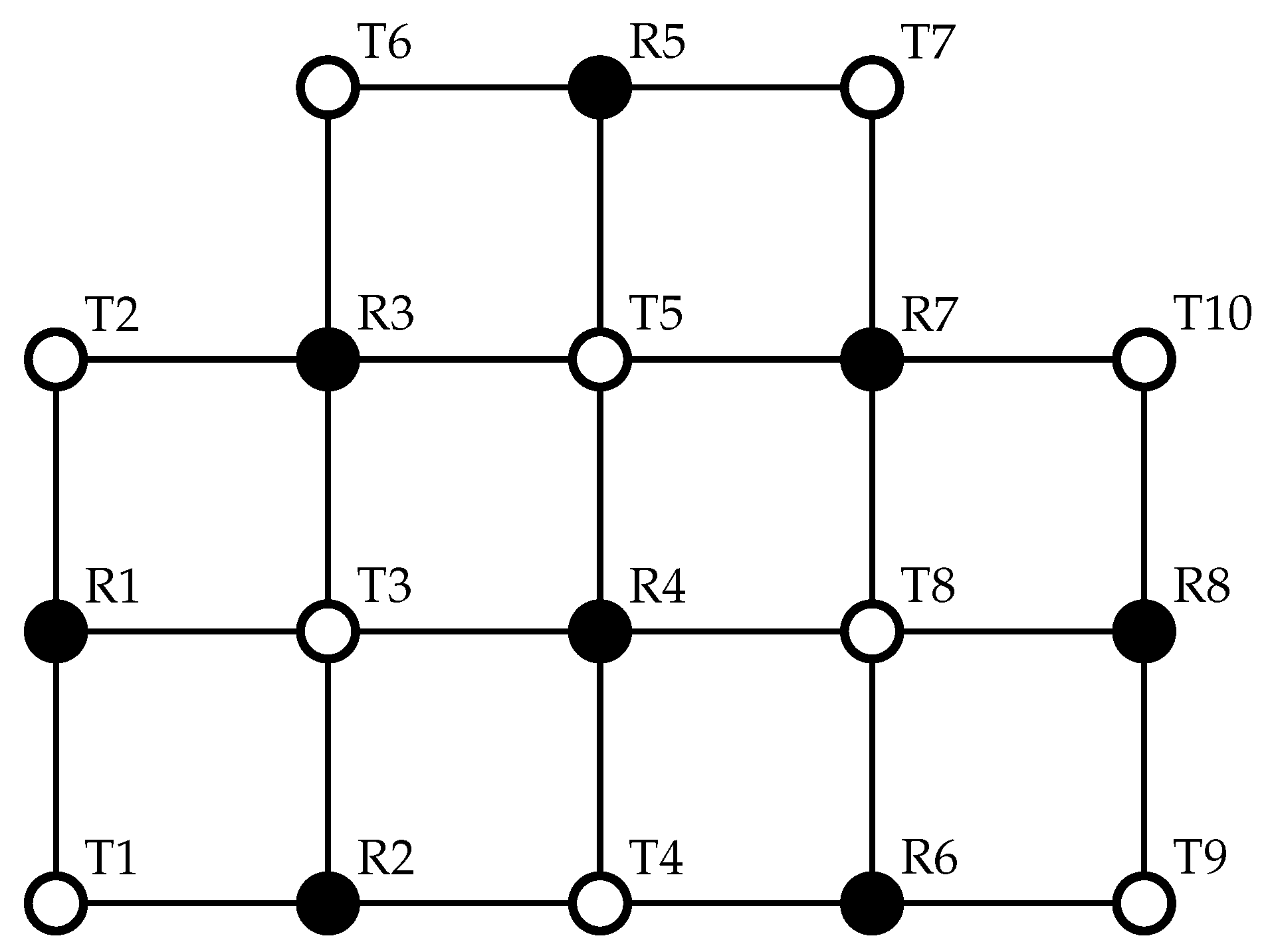
2.4.1. Measurement Instrumentation
2.4.2. Presentation of Visual Stimuli
2.4.3. Photometric Characteristics of Stimuli
2.4.4. Experimental Protocol
Phase 1: Baseline Measurement + Extended HRV Assessment
Phase 2: Extended fNIRS Assessment
2.4.5. Subjective Assessment
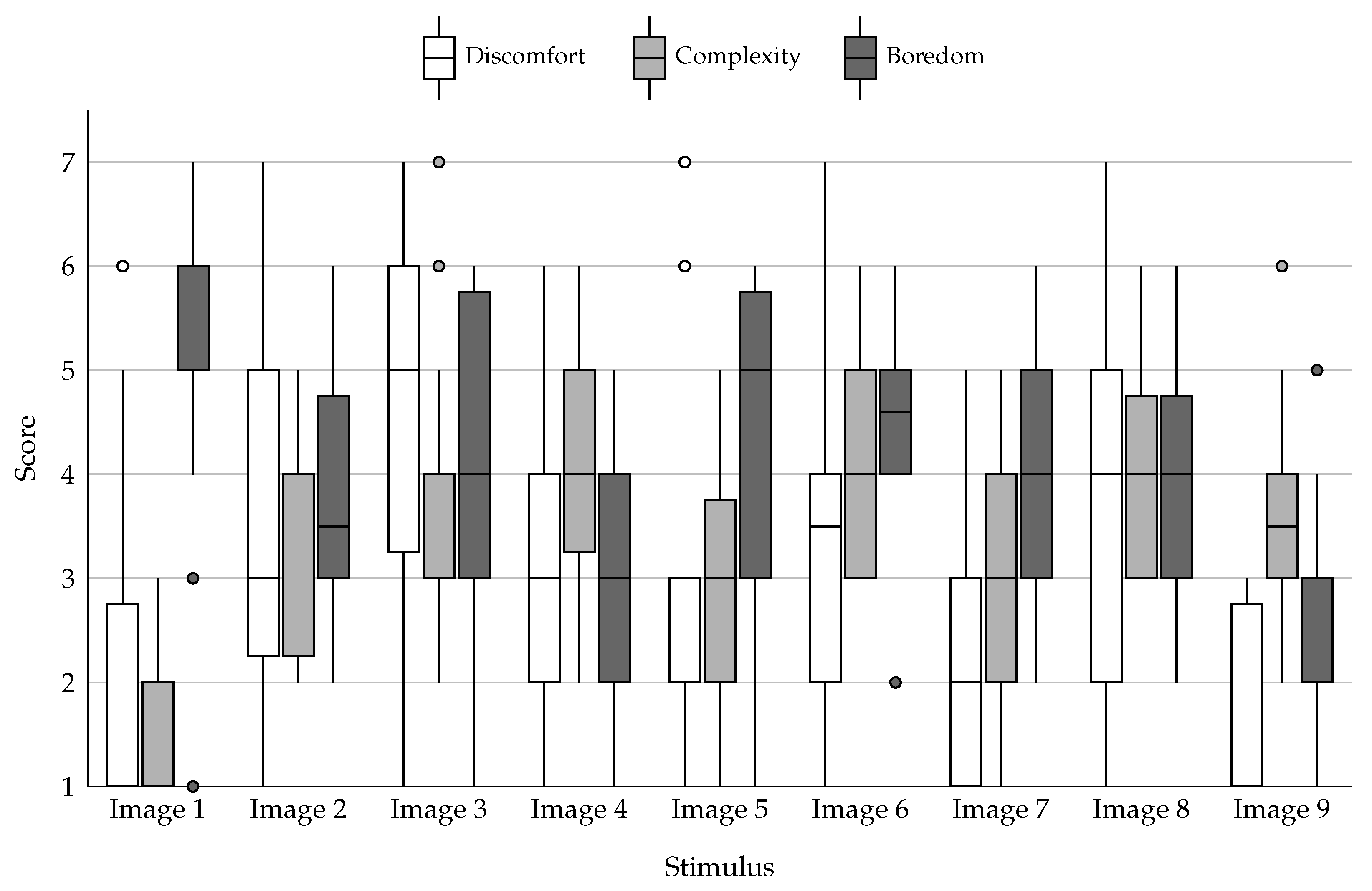
- Discomfort: Responding to the statement “I feel discomfort when looking at this building” on a scale ranging from 1 (No Discomfort: “I feel no discomfort at all”) to 7 (Extreme Discomfort: “I feel a significant and overwhelming level of discomfort”).
- Complexity: Assessing the statement “This building is visually complex” on a scale ranging from 1 (Extremely Low Complexity: “The building is exceptionally simple”) to 7 (Extremely High Complexity: “The building is exceptionally complex”).
- Interest: Rating the statement “This building is boring” on a scale ranging from 1 (Not Boring at All: “I find the building very engaging”) to 7 (Extremely Boring: “I find the building extremely boring”).
2.5. Preprocessing
2.5.1. fNIRS Data Processing
2.5.2. HRV Data Processing
3. Results
3.1. ViStA Results
3.2. Likert Scale Ratings
3.3. Heart Rate Variability
3.4. Functional Near-Infrared Spectroscopy
4. Discussion
4.1. Principal Findings and Interpretation
4.2. The Cortical–Autonomic Coupling Hypothesis Revisited
4.3. Limitations
4.3.1. Sample Size and Statistical Power
4.3.2. Technical and Methodological Constraints
4.3.3. Construct Validity and Ecological Generalisation
5. Conclusions
Author Contributions
Funding
Data Availability Statement
Acknowledgments
Conflicts of Interest
References
- Schweizer, C.; Edwards, R.D.; Bayer-Oglesby, L.; Gauderman, W.J.; Ilacqua, V.; Jantunen, M.J.; Lai, H.K.; Nieuwenhuijsen, M.; Künzli, N. Indoor time–microenvironment–activity patterns in seven regions of Europe. J. Expo. Sci. Environ. Epidemiol. 2007, 17, 170–181. [Google Scholar] [CrossRef] [PubMed]
- Valentine, C.; Mitcheltree, H. Design for Well-Being. In Routledge Handbook of Neuroscience and the Built Environment, 1st ed.; Lavdas, A.A., Sussman, A., Woodworth, A.V., Eds.; Routledge: London, UK, 2025; pp. 313–329. [Google Scholar] [CrossRef]
- Field, D.J. Relations between the statistics of natural images and the response properties of cortical cells. J. Opt. Soc. Am. A Opt. Image Sci. 1987, 4, 2379–2394. [Google Scholar] [CrossRef] [PubMed]
- Baker, D.H.; Graf, E.W. Natural images dominate in binocular rivalry. Proc. Natl. Acad. Sci. USA 2009, 106, 5436–5441. [Google Scholar] [CrossRef] [PubMed]
- Párraga, C.A.; Troscianko, T.; Tolhurst, D.J. The human visual system is optimised for processing the spatial information in natural visual images. Curr. Biol. 2000, 10, 35–38. [Google Scholar] [CrossRef]
- Wilkins, A.; Penacchio, O.; Leonards, U. The Built Environment and Its Patterns: A View From the Vision Sciences. J. Sustain. Des. Appl. Res. Innov. Eng. Built Environ. 2018, 6, 5. [Google Scholar] [CrossRef]
- Wilkins, A.; Nimmo-Smith, I.; Tait, A.; McManus, C.; Della Sala, S.; Tilley, A.; Arnold, K.; Barrie, M.; Scott, S. A neurological basis for visual discomfort. Brain J. Neurol. 1984, 107, 989–1017. [Google Scholar] [CrossRef]
- Mitcheltree, H.; Valentine, C.; Hosking, I.; Wilkins, A.; Sunikka-Blank, M.; Steemers, K. Investigating visual stress within family and domestic violence refuges in Australia. Front. Archit. Res. 2025, 15, 54–69. [Google Scholar] [CrossRef]
- Valentine, C.; Wilkins, A.J.; Mitcheltree, H.; Penacchio, O.; Beckles, B.; Hosking, I. Visual Discomfort in the Built Environment: Leveraging Generative AI and Computational Analysis to Evaluate Predicted Visual Stress in Architectural Façades. Buildings 2025, 15, 2208. [Google Scholar] [CrossRef]
- Penacchio, O.; Wilkins, A.J. Visual discomfort and the spatial distribution of Fourier energy. Vis. Res. 2015, 108, 1–7. [Google Scholar] [CrossRef]
- Fernandez, D.; Wilkins, A.J. Uncomfortable images in art and nature. Perception 2008, 37, 1098–1113. [Google Scholar] [CrossRef]
- Juricevic, I.; Land, L.; Wilkins, A.; Webster, M.A. Visual discomfort and natural image statistics. Perception 2010, 39, 884–899. [Google Scholar] [CrossRef]
- Hibbard, P.B.; O’Hare, L. Uncomfortable images produce non-sparse responses in a model of primary visual cortex. R. Soc. Open Sci. 2015, 2, 140535. [Google Scholar] [CrossRef] [PubMed]
- Penacchio, O.; Otazu, X.; Wilkins, A.J.; Haigh, S.M. A mechanistic account of visual discomfort. Front. Neurosci. 2023, 17, 1200661. [Google Scholar] [CrossRef] [PubMed]
- Le, A.T.D.; Payne, J.; Clarke, C.; Kelly, M.A.; Prudenziati, F.; Armsby, E.; Penacchio, O.; Wilkins, A.J. Discomfort from urban scenes: Metabolic consequences. Landsc. Urban Plan. 2017, 160, 61–68. [Google Scholar] [CrossRef]
- Mariotti, A. The effects of chronic stress on health: New insights into the molecular mechanisms of brain–body communication. Future Sci. OA 2015, 1, FSO23. [Google Scholar] [CrossRef]
- Klein, F.; Kohl, S.H.; Lührs, M.; Mehler, D.M.A.; Sorger, B. From lab to life: Challenges and perspectives of fNIRS for haemodynamic-based neurofeedback in real-world environments. Philos. Trans. R. Soc. B Biol. Sci. 2024, 379, 20230087. [Google Scholar] [CrossRef]
- Yücel, M.A.; Anderson, J.E.; Rogers, D.; Hajirahimi, P.; Farzam, P.; Gao, Y.; Kaplan, R.I.; Braun, E.J.; Mukadam, N.; Duwadi, S.; et al. Quantifying the Impact of Hair and Skin Characteristics on Signal Quality with Practical Recommendations for Improvement. bioRxiv 2024. [Google Scholar] [CrossRef]
- Tachtsidis, I.; Scholkmann, F. False positives and false negatives in functional near-infrared spectroscopy: Issues, challenges, and the way forward. Neurophotonics 2016, 3, 031405. [Google Scholar] [CrossRef]
- Penacchio, O.; Haigh, S.M.; Ross, X.; Ferguson, R.; Wilkins, A.J. Visual Discomfort and Variations in Chromaticity in Art and Nature. Front. Neurosci. 2021, 15, 711064. [Google Scholar] [CrossRef]
- Girolamo, T.; Parker, T.C.; Eigsti, I.M. Incorporating Dis/ability Studies and Critical Race Theory to combat systematic exclusion of Black, Indigenous, and People of Color in clinical neuroscience. Front. Neurosci. 2022, 16, 988092. [Google Scholar] [CrossRef]
- Kwasa, J.; Peterson, H.M.; Karrobi, K.; Jones, L.; Parker, T.; Nickerson, N.; Wood, S. Demographic reporting and phenotypic exclusion in fNIRS. Front. Neurosci. 2023, 17, 1086208. [Google Scholar] [CrossRef]
- Critchley, H.D.; Harrison, N.A. Visceral influences on brain and behavior. Neuron 2013, 77, 624–638. [Google Scholar] [CrossRef]



| Number | Description | Image |
|---|---|---|
| Image 1 | A minimalist white facade shows a minimalist white façade with a horizontal composition. The ground floor features a large glass window with black frames, divided into five sections with varying widths. Interior light creates a warm glow. The left side contains a recessed entrance with a black door and a small black panel mounted on the white wall. No upper-level windows are visible in this view. |  |
| Image 2 | This image introduces introduces a wooden slat screen on the upper level, creating a horizontal rectangular feature above the storefront. The wooden slats provide texture and warm tones, contrasting with the white walls. The ground floor remains consistently designed across all variations. |  |
| Image 3 | A variation with presents a variation with vertical metal slats in the upper rectangular opening. These white-coloured vertical elements are placed above a dark, unlit window, creating a high degree of contrast. The ground floor remains consistently designed across all variations. |  |
| Image 4 | Presents a wooden slat presents a wooden slat motif but shows it with light passing through and reflecting off the window behind. The light behind the slats adds depth and dimension to the façade, creating a variation in contrast. The ground floor remains consistently designed across all variations. |  |
| Image 5 | A window arrangement shows a window arrangement with three evenly spaced rectangular windows on the upper level, contrasting with the modern storefront below. |  |
| Image 6 | This image introduces introduces recessed windows and balconies with galvanised metal, vertical bar railings. The vertical elements of the balcony railings create a subtle grid pattern. |  |
| Image 7 | This image features features three large arched windows on the upper level. These curves provide a contrast to the rectangular geometry below. | 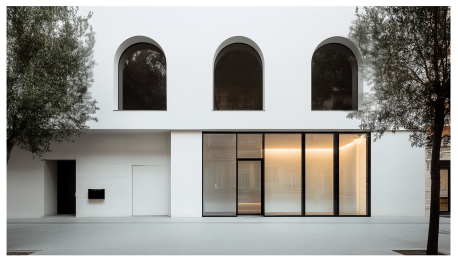 |
| Image 8 | Vertical metal screening shows vertical metal screening elements on both the upper-level windows and a recessed balcony. The consistent use of vertical lines creates a cohesive rhythm across the façade, while the varying depths and arrangements add visual depth to the façade. The warm lighting behind the screens creates an atmospheric effect. |  |
| Image 9 | This image combines arched combines arched windows with a dramatic larger arch, creating a bold geometric statement. The larger arch encompasses a lit interior space, adding depth to the façade. This variation most strongly juxtaposes curved and rectangular forms. |  |
| Image Number | Primary Feature Altered | Pattern Type | Average Residuals | Cycles/Degree | Greater or Less than 3 cpd |
|---|---|---|---|---|---|
| 1 | Blank upper wall | None | 3.50 × 10⁸ | n/a | |
| 2 | Horizontal slat screen | Horizontal repetition | 1.70 × 10⁹ | 3 | equal |
| 3 | Vertical metal slats | Vertical repetition | 8.30 × 10⁸ | 2 | less |
| 4 | Wooden slat screen | Vertical repetition | 8.50 × 10⁸ | 2.1 | less |
| 5 | Traditional windows | Regular spacing | 4.30 × 10⁸ | 1.8 | less |
| 6 | French balconies | Grid pattern | 7.50 × 10⁸ | 4.3 | more |
| 7 | Arched windows | Curved repetition | 5.60 × 10⁸ | n/a | n/a |
| 8 | Vertical screening | Layered vertical | 8.70 × 10⁸ | 7.8 | more |
| 9 | Large arch | Curved hierarchy | 5.20 × 10⁸ | n/a | n/a |
Disclaimer/Publisher’s Note: The statements, opinions and data contained in all publications are solely those of the individual author(s) and contributor(s) and not of MDPI and/or the editor(s). MDPI and/or the editor(s) disclaim responsibility for any injury to people or property resulting from any ideas, methods, instructions or products referred to in the content. |
© 2026 by the authors. Licensee MDPI, Basel, Switzerland. This article is an open access article distributed under the terms and conditions of the Creative Commons Attribution (CC BY) license.
Share and Cite
Valentine, C.; Hosking, I.; Wilkins, A.J.; Mitcheltree, H.; Smith, C.; Butters, E.; Penacchio, O. Impact of Architecture Façade Design on Neurophysiological Stress Using Functional Near-Infrared Spectroscopy and Heart Rate Variability. Buildings 2026, 16, 885. https://doi.org/10.3390/buildings16040885
Valentine C, Hosking I, Wilkins AJ, Mitcheltree H, Smith C, Butters E, Penacchio O. Impact of Architecture Façade Design on Neurophysiological Stress Using Functional Near-Infrared Spectroscopy and Heart Rate Variability. Buildings. 2026; 16(4):885. https://doi.org/10.3390/buildings16040885
Chicago/Turabian StyleValentine, Cleo, Ian Hosking, Arnold J. Wilkins, Heather Mitcheltree, Cameron Smith, Emilia Butters, and Olivier Penacchio. 2026. "Impact of Architecture Façade Design on Neurophysiological Stress Using Functional Near-Infrared Spectroscopy and Heart Rate Variability" Buildings 16, no. 4: 885. https://doi.org/10.3390/buildings16040885
APA StyleValentine, C., Hosking, I., Wilkins, A. J., Mitcheltree, H., Smith, C., Butters, E., & Penacchio, O. (2026). Impact of Architecture Façade Design on Neurophysiological Stress Using Functional Near-Infrared Spectroscopy and Heart Rate Variability. Buildings, 16(4), 885. https://doi.org/10.3390/buildings16040885