


Abstract
Urban parks play a crucial role in shaping the well-being of the community. This study integrated environmental psychology and co-creation to develop psychologically informed park design. It examined users’ psychological reactions to urban parks to establish a theoretically grounded framework for participatory design. Hence, this study integrated Attention Restorative Theory (ART) with co-creation approaches to provide conceptual clarity on translating psychological constructs into design criteria. The primary objective was to identify and rank design criteria within this integrated framework to meet user psychological demands. Also, it is hypothesized that ART could be applied through a co-creation approach. Specifically, this study administered ART scale questionnaires to 202 community members in Erbil City, and the data were analyzed using statistical analysis to provide empirical evidence for incorporating these psychological dimensions into the co-creation process. The findings reveal that validated measurement of community needs enhances participatory design effectiveness. Furthermore, the high inter-factor correlations (r = 0.79–0.88) suggest that holistic design approaches address multiple restorative dimensions simultaneously. Overall, this research demonstrates how environmental psychology can be systematically integrated into co-creation processes, thereby bridging theory and practice in urban park design. The validated framework provides practitioners with evidence-based tools for psychologically informed participatory design environments that can activate users mentally and improve cognitive function.
1. Introduction
Cities are growing rapidly, intensifying the need for public spaces that support urban health and psychological well-being through evidence-based environmental design [1,2]. This development has rendered public areas to be more appealing as strategic interventions for enhancing mental health, physical activity, and social cohesion in densely populated urban environments [3,4]. Thus, public space is a key part of keeping the public realm alive, and people are once again interested in public space. For modern societies to be healthy socially and mentally, they need good public spaces. Also, a good public space is responsive, democratic, and important [5]. The activity’s intensity and type may differ, although there is an expectation for certain experiences to be achievable at the location, along with the availability of specific resources. Examining needs is crucial, as they highlight the utilization of spaces, and this utilization is vital for success. There are locations that fail to fulfill individuals’ requirements or lack significant utility, which are unproductive and unsuccessful [6].
Among various types of public spaces, urban parks serve as particularly significant settings for promoting mental health and cognitive restoration due to their natural elements, accessibility, and capacity to support diverse recreational activities [4,7]. In other words, urban parks function as vital therapeutic environments, where interaction with nature can promote psychological restoration and enhance both physical and mental health outcomes. The creative urban place is rooted in the idea that creatively designed urban environments can enrich residents’ living experiences [8]. New urban ideas, such as green city parks and public art installations, could make life better by making areas that are more engaging and beautiful [9]. Significant influence of urban design elements on changes in mood and social behavior of the community is apparent [10]. Thus, it is the nature of urban public space which is open to users from a multiplicity of cultural backgrounds, and its uses and users are unpredictable [11]. This is because urban public spaces serve as democratic contexts in which design solutions have to balance standardized health-promoting elements with the flexibility required to accommodate multicultural utilization, thereby guaranteeing equitable access to restorative experiences for all members of the community.
Comprehending the impact of park environments on visitors necessitates insights from environmental psychology, a discipline that examines person–environment interactions and identifies particular environmental characteristics—such as natural elements, spatial openness, and aesthetic attributes—that enhance psychological well-being and facilitate restorative experiences [7,12,13]. In addition, environmental psychology, particularly the concept of “placeness”, is thought to significantly influence individual well-being and spatial utilization and thus drastically affect the experience and interaction with environments [14]. Among the theoretical frameworks within environmental psychology, Kaplan’s Attention Restoration Theory (ART) provides a compelling explanation for the most substantial scientific differentiation of mental processes, asserting that humans possess two primary forms of attention, which are directed attention and involuntary/spontaneous attention. The theory posits that an environment is restorative because it facilitates the utilization of involuntary attention (via soft fascinations), thereby permitting directed attention (the mentally active resource) to recover and regenerate. Natural areas are typically more conducive to repair than cluttered or demanding urban settings [15]. While ART has been widely applied to understand restorative experiences in natural settings, significant gaps remain in identifying the psychological needs of the users in urban parks through ART. Likewise, ART provides a scientific, cognitive framework for progressing beyond just aesthetic or functional urban design towards a user-centered, healing approach, including local culture, psychological detachment, and a sense of cohesiveness.
Following the COVID-19 pandemic, there has been more interest in interactions across generations, mental health difficulties in communities, and communal well-being. Thus, these revealed the significance of the co-creation methodology in the community design process. The findings indicated that involvement in community development via collaborative design fosters friendly relationships among diverse age groups, promotes a sense of social security, and consequently improves social well-being. It also offers new ways to build interactions between generations and create a pleasant and long-lasting community environment in the future [15]. Moreover, two common goals for community development come from broad group participation and effective problem solving [16]. Thus, the strategic effect shows how important co-creation is for bringing about new ideas, economic growth, and flexibility in city planning. Additionally, collaborative synergy stresses the importance of involving stakeholders, using group intelligence, and sharing knowledge in order to make cities more sustainable and responsive urban environments [17]. Consequently, co-creation in urban design is defined as involving inhabitants, designers, planners, policymakers, and other community members in the conceptualization, planning, design, and execution of urban settings. This strategy blends professional design expertise with local knowledge, lived experience, and community values to create parks that better meet psychological and social needs. In other words, co-creation is necessary for a sustainable society [17]. Also, co-creative processes and strategies may serve as a viable approach to foster more inclusive and responsive public spaces, as well as promoting shared responsibilities in addressing the challenges of establishing more collaborative and relational governance [18].
Urban design plays a crucial role in shaping the daily lives and well-being of the community. By applying and combining different principles such as environmental psychology, specifically ART, the co-creation approach, and urban public space design criteria, urban planners and designers can create spaces that not only meet the practical needs of residents but also enhance their emotional and psychological health through new experiences. The absence of explicit correspondence between design parameters and the four constituent dimensions of ART and the lack of localized validation of the Perceived Restorativeness Scale (PRS) within urban design frameworks, and the scarcity of empirical investigations examining Middle Eastern urban environments as not well designed enough to satisfy the needs of local users. For instance, Erbil City has undergone unprecedented urban transformation over the past two decades; for a population contending with historical trauma and economic challenges, urban parks function as critical communal spaces that enable collective gathering and social cohesion. These environments provide accessible settings for psychological restoration amid rapid urbanization. This study is intended to evaluate users’ psychological and behavioral reactions within needs in urban public parks and provide conceptual clarity on the role of the co-creation process in enhancing environmental psychology in different scales of urban public parks by the PRS. This study also investigates the ways in which environmental psychology concepts and co-creation processes might be used to create emotionally stimulating and technologically advanced creative urban spaces. It is hypothesized that the Attention Restoration Theory could be applied through a co-creation approach in identifying the psychological needs of users. This research applied structured questionnaires to ascertain community needs and preferences on park design. The statistical study supplied actual evidence for the integration of these psychological factors into the co-creation process. The finding highlights the vital role of participatory processes in fostering sustainable and resilient urban development and social sustainability in urban spaces.
2. Theoretical Background
2.1. Integration Between the Co-Creation Approach and Environmental Psychology
A study discovered that what a person does, sees, and thinks about a location are important variables in making them want to do things like talk about it, suggest it, and go back. When creating a place that has placeness, the policymakers, urban planners, and designers need to know how to encourage people to act in certain ways [14]. Place attachment can be a resource that helps with and informs spatial planning and transformation processes, which can lead to a higher level of sustainability [19]. Furthermore, it offers innovative concepts for enhancing intergenerational interactions and fostering a healthy, sustainable mental health community environment in the future [16]. In line with this, two prevalent objectives for community development are fostering widespread group participation and facilitating efficient problem resolution. This research indicates that groups characterized by positive images, constructive experiences, and favorable attributes in social contexts tend to exhibit higher levels of self-esteem, greater life satisfaction, and increased contentment. Additionally, they are more inclined to participate in addressing community issues. Individuals holding negative perspectives regarding the future, social interactions, and personal attributions are also more susceptible to depression, impaired functioning, feelings of futility, and adverse emotional outcomes [20]. This suggests that the connection between growth and physical and emotional coaching for users is a crucial part of building communities. So, in communities with people of all ages, it is essential to keep cordial relations amongst neighbors and help people stay well both physically and mentally. These are some of the trends that are being looked into right now.
In accordance with co-creation theory, the American Psychological Association defines community mental health as actions that enhance mental health in the community rather than in institutional settings [16,21]. The major goals of community mental health services are to treat people, help them avoid relapses, promote health, and provide primary prevention. The unifying thread in all areas is the emphasis on the supportive function of cultural (cross-cultural, etc.) factors within the community framework. As a result, concepts such as community mental health care [22] and community mental health team management were born [23]. This illustrates that activities that promote variety in the community are good for bringing people together and reducing negative feelings in order to keep the community growing in a positive and healthy way. Co-creation is a process that is active, creative, and social, which it needs the cooperation of both organizations and people. Co-creation gives everyone involved a chance to benefit and adds value for stakeholders [16]. The approach focuses on the process instead of the outcome. This means that it may be utilized to help research teams work together and communicate better, and that gives them more innovative ideas. Furthermore, the contribution of co-creation to the I-I of communities is complex. Ideas like the connection between democratic innovation and individualism are important for encouraging community co-creation. In communication studies, adjustment mechanisms like integration and divergence are defined by social convergence (collectivism) rather than individuality (individualism). As cities and communities aim to get better in the future, individuals are becoming more worried about their mental health, how they connect with people of all ages, and other social-level relationships in public places. Through collaborative co-creation, the role of communities is slowly changing to improve their health and produce a positive public health and all-age-friendly environment. It also sets the stage for the community to run smoothly and be maintained in the future [16]. Based on the findings, it can be concluded that the prototype exhibits a satisfactory level of usability and a capability that is relatively satisfactory in terms of capturing user requirements. Specifically, by executing a sophisticated, comprehensive design process of “needs co-creation—needs analysis—needs expression,” the system can do extensive, efficient needs elicitation, accurate analysis, and visible feedback for community users [24].
The notion of co-creation signifies a transformation in the comprehension of public engagement. Since the 1970s, discourses on participation, influenced by Sherry Arnstein, have emphasized rights and power, whereas co-creation prioritizes combining varied knowledge types to devise creative solutions for complex urban challenges. The focus has transitioned from creating inclusive environments for democratic discourse and empowering disadvantaged communities—historical objectives of participatory initiatives—to problem-solving ability as the principal metric for evaluation. This redefinition alters the duties of both people and public managers, with considerable consequences for urban administration. Consequently, a clear discourse in both scholarly and practical contexts concerning the normative substance and effects of conceptualizing participation as co-creation is essential [25]. Public participation in urban governance has evolved significantly: from early postmodernist ideals of challenging expert dominance to today’s emphasis on learning and social innovation, where participation is conceptualized as co-creation and co-production.
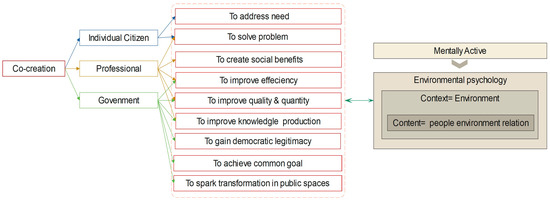
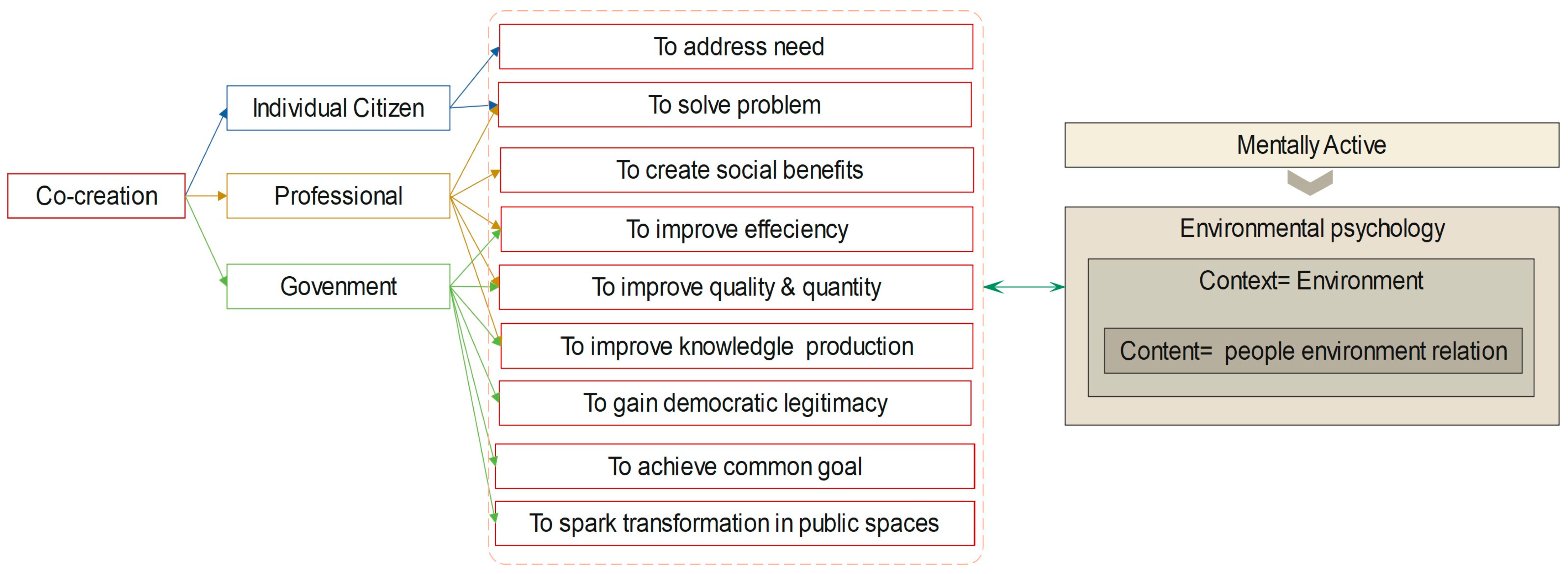
Urban design has traditionally followed a top-down approach where decisions are made by experts, often excluding community input. This creates a disconnect between design intentions and actual community needs. Participatory processes, such as co-creation, are gaining recognition as solutions to these challenges by promoting more inclusive, resilient urban development [17]. The thematic analysis identified three primary objectives of co-creation in urban design. The goal of societal impact is to improve social fairness, inclusivity, and the health of the community. Figure 1, by the authors, integrates the co-creation approach and environmental psychology [26], which makes the user mentally active. Co-creation is the collaboration between individual citizens, professionals, and the government in order to address the needs of the community, solve complex problems, create social benefits, improve efficiency, quality, and quantity, knowledge production, gain democratic legitimacy, and lastly, to spark the transformation of public spaces.
Figure 1.
The integration between the co-creation approach and environmental psychology makes the user mentally active (by authors).
2.2. Integration Between Urban Public Spaces Criteria and ART
The Attention Restoration Theory (ART) is a fundamental concept in environmental psychology that has substantial, direct connections to public health, especially through its emphasis on the cognitive and emotional advantages of exposure to nature. The ART explains why access to green spaces should be seen as an important public health resource. It connects how the built environment is designed to people’s mental and physical health [27,28]. Furthermore, enhanced cognitive function includes superior decision-making, greater problem-solving abilities, and increased academic or professional success among the general population.
The theory is employed in environmental psychology research to validate health-oriented urban planning and design solutions, as mental health emphasizes nature’s immediate physiological soothing benefits (lowering heart rate, blood pressure, and cortisol), whereas the ART pertains to cognitive recovery. Furthermore, in environmental design and planning, the theory guides the creation of healthy cities and communities, resulting in particular suggestions for public areas [29]. Kaplan discovered four essential characteristics that make an environment restorative. The first is compatibility, which means that the environment aligns with and supports one’s goals and preferences. The second extent indicate that the environment must be sufficiently rich and coherent enough to be “a whole other world,” providing people with space to explore. The third is by being away, which means being physically or mentally far away from the things that make you tired and the things that keep your attention. The fourth dimension is “soft fascination,” which occurs when environmental aspects effortlessly capture attention without requiring conscious effort. Natural settings provide soft fascination (such as clouds, sunsets, and flowing water) rather than hard fascination (such as action films and computer games) [27,28,30,31].
The ART is intrinsically linked to citizens’ engagement in urban design, as the theory’s restorative principles—fascination, being away, extent, and compatibility—are profoundly subjective and contextually dependent, requiring local user input for effective implementation. By incorporating ART into the participatory design process, urban planners transition from merely implementing green elements to collaboratively developing cognitively restorative settings that are authentically utilized, appreciated, and preserved by the citizens they want to serve. In the context of a public place, the connection between theory and co-creation is the active, mutual, and creative generating of value between the people who use the space and the people who administer or create it. The elements of the Perceived Restorative Scale (PRS) are intrinsically connected to effective spatial planning in public areas, as they convert users’ psychological requirements of ART into quantifiable design attributes [32]. The activity’s intensity and type may differ, although there is an expectation for certain experiences to be attainable at the location, along with the availability of specific resources. Five categories of reasoning appear to explain individuals’ demands in public spaces: comfort, relaxation, passive interaction with the environment, active involvement with the environment, and discovery. Any contact with a location may fulfill many objectives. Considering requirements is essential since they highlight the effective use of areas, which is vital for success [6].
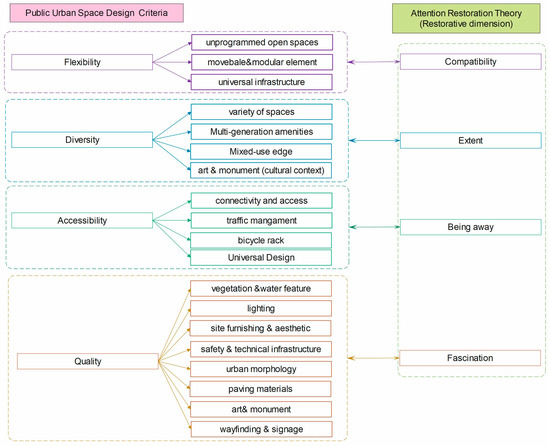
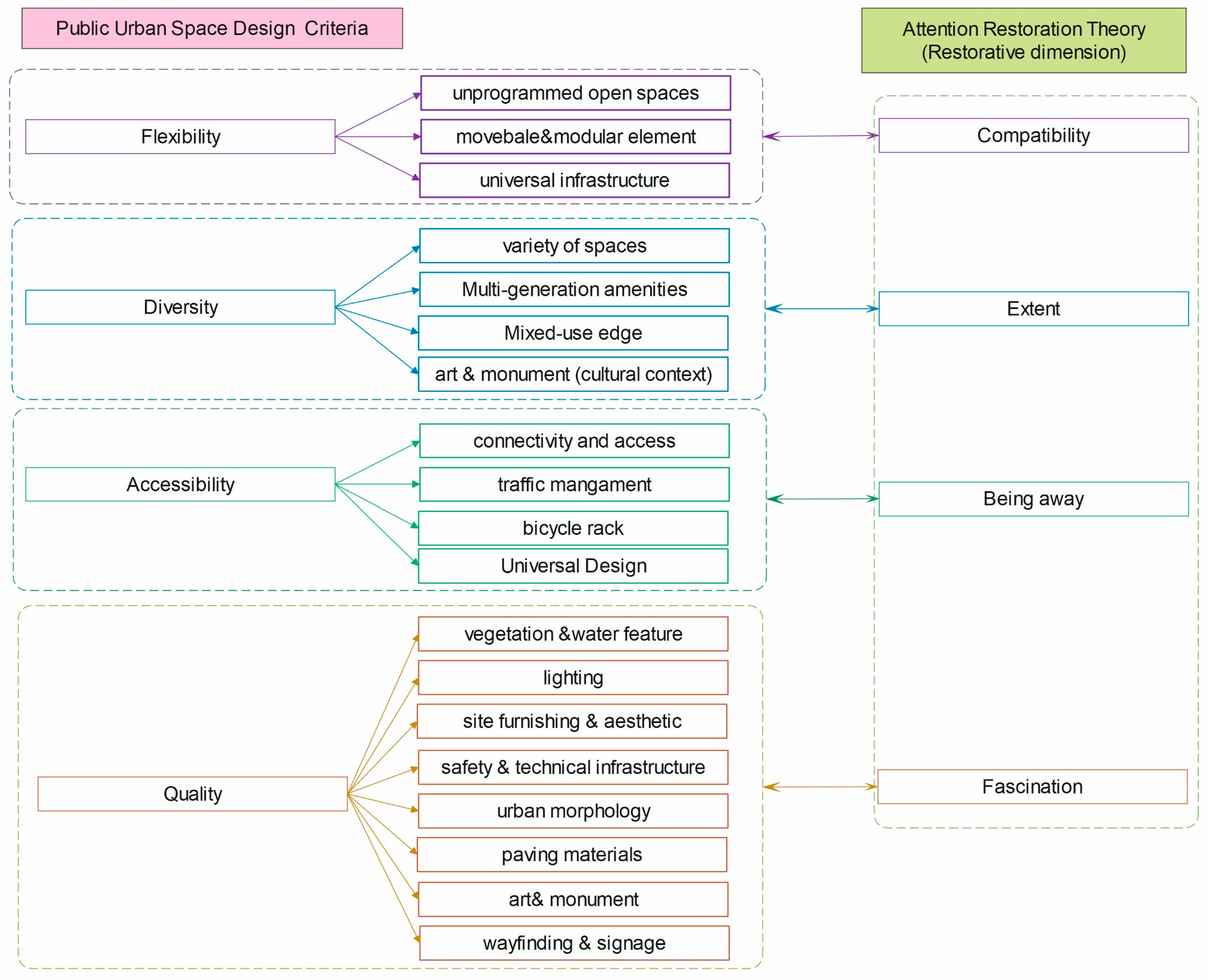
The authors have put together a complete framework that combines Kaplan’s four restorative traits with urban design criterion categories of flexibility, accessibility, diversity, and quality Figure 2. They are explained as follows:
Figure 2.
Conceptual integration framework of public urban space design criteria and ART for evaluating environmental psychology through co-creation (by the authors).
- Kaplan’s compatibility is a measure of how well an environment helps you reach your goals and do what you want to do. To achieve this compatibility, flexible urban design produces spaces that can change to meet different demands and changing situations [33,34]. This suggest that in design, spaces with numerous purposes and the ability to change throughout time allow for varied interpretations at different times of the day and year [34]. Also, modular design allows flexible configurations that adapt to different spaces and user needs [35]. Flexible urban design directly enhances this compatibility by multi-use programming that accommodates varied activities and user preferences.
- Kaplan’s idea of being away relates to accessibility in terms of providing physical and psychological distance from routine environments, ensuring that all individuals can navigate and access essential services, amenities, and opportunities regardless of abilities or socio-economic status [33,36], which is necessary for experiencing psychological distance from routine demands. To achieve this being away in the context of the design practices, it requires universal design principles, including ramps, elevators, tactile paving, and multiple access points [37]. Moreover, proximity planning (15 min city concepts) brings restorative spaces within walking distance [38]. Also, this brings affordable housing and services within close proximity to public amenities [36].
- Kaplan’s extent requires an environmentally rich and coherent world to constitute “a whole other world” [39]. While referring to diversity, it provides the necessary scope through varied functions, users, and experiences. To achieve this extent in the application of design requires diversity such as multifunctionality that accommodates informal markets, cultural performances, recreational activities, and civic gatherings [39]. Additionally, this includes diverse programming that caters to all citizens regardless of age, ability, or socio-economic status as well as mixed-use developments that promote varied activities and social interaction [33,40].
- Kaplan’s fascination refers to the quality in public spaces that encompasses protection, comfort, and amenities that engage users’ attention effortlessly [41]—the essence of soft fascination in ART [12]. To achieve fascination in a design context through quality, Jan Gehl’s 12 Quality Criteria are divided into three groups for design use. First, Safety: protection from crime, traffic, and unpleasant conditions; second, Comfort: chances to walk, stand, sit, see, converse, and play; third, Enjoyment: human scale, positive sensory experiences, and beauty [42,43] including natural aspects that are softly interesting, such as water features, plants, and natural materials (sustainable water management and solutions based on nature) [35].
3. Materials and Methods
3.1. Measurement Techniques and Parameters
The role of co-creation in enhancing environmental psychology through the Attention Restorative Theory (restoration dimensions), combined with public urban space design criteria, encourages users to be mentally active and co-creative. For this reason, a quantitative, cross-sectional questionnaire survey was conducted. The questionnaire is composed of three sections: the first section, demographic data about respondents, consists of five items: gender, age, educational level, employment status, and type of public spaces used. Also, satisfaction of users from public spaces is measured by a pattern composed of four items: who they are visiting these public parks with; level of satisfaction for public parks; how often they visit these public parks, and the reason they visit the public park that day. Second section, the Perceived Restorativeness Scale (PRS) is based on ART, which is used to measure an environment’s potential to restore exhausted attentional resources [21,22,24,36,39]. In other words, it assesses the extent to which an environment facilitates an individual’s restoration of attention, which can be utilized to discover users’ psychological needs in metropolitan public parks. This research employed the PRS, which comprises 21 items. Participants utilized a 7-point Likert scale (1 = Strongly Disagree to 7 = Extremely Agree) with the trueness of statements, which can be felt in urban public parks. Therefore, a 7-point scale is superior for capturing depth and sensitivity in psychological perceptions. The 21-item version of the PRS utilized in this study is based on the original 26-item scale developed by Hartig et al. [30,31,44] in Table 1. These 21 items are modified to match the public urban space design criteria. It evaluates design criteria across four restorative dimensions: compatibility, extent, being away, and fascination. This scale is a self-report instrument designed to assess an individual’s perception of the restorative qualities associated with particular parks in relation to their individual requirements. The last section is about positive emotions that users would have when considering all their needs through the co-creation approach [18,45,46,47].
Table 1.
The Perceived Restorative Scale factors modified due to the urban public space criteria (by the authors).
Furthermore, the main conceptual changes on the original 26 items are from an individual (“I”) point of view to a collective (“We”) point of view to reflect park events shared by many. Then, the authors improved the extent measurement by adding new items that measure the extent dimension based on the PRS 11 and 16 scales. Later, the items were rewritten to be more specific to features of urban park planning, such as benches, paths, upkeep, and accessibility. Next, putting planning ideas together, the new version clearly connects PRS factors to ideas about urban design and planning. Finally, the authors got rid of duplicates by eliminating several reverse-coded items that measured the same things and combined some others, seen in Table 2.
Table 2.
The modification of PRS items and integration with planning concept criteria by the authors.
3.2. Data Collection
A convenience sample strategy was used to select individuals who were visiting urban public parks during the data collection period. A minimum sample size of 200 was intended based on recommendations for factor analysis (at least 5–10 participants per item) [48,49]. This study was conducted in Erbil City urban public parks from 1 October 2025 to 15 November 2025. In addition, surveys were administered in person, face-to-face at five different urban public parks between 10 AM and 9 PM, on weekdays and weekends. Trained research assistants with the same specialty (Architects) approached potential participants, explained the study purpose, and invited them to participate in collecting data. Thereafter, completion took approximately 10–15 min, and a total of 202 valid responses were obtained. Next, all analyses were conducted using SPSS version 28.0 and R version 4.2.0 with the lavaan package for structural equation modeling, including descriptive analysis; the reliability of the internal consistency of the modified 21-item scale was found to be high (Cronbach’s alpha α = 0.85), along with correlation and confirmatory factor analysis. Also, statistical significance was set at p < 0.05.
3.3. Case Study
Erbil, known as Hewlêr in Kurdish, has witnessed one of the most dramatic urban developments in the Middle East over the previous two decades. Being called the “Dubai of Iraq”, Erbil has grown from an old agricultural hub into a huge city and the diplomatic/commercial capital of the Kurdistan Region of Iraq. Erbil’s rapid urban expansion—marked by extensive concrete ring roads and towering developments—has significantly transformed the city’s environmental psychology, upgrading urban parks from mere recreational spaces to vital emotional refuge. As the city evolved from the compact, fortified formations of the ancient Citadel to a car-centric “Dubai-style” metropolis, the establishment of extensive green spaces such as Sami Abdulrahman Park emerged as an essential psychological remedy to the “concrete stress” and heat islands produced by this swift expansion. For a population burdened by historical trauma and contemporary economic distress, these parks serve as communal “pressure valves”, secure, open public “living rooms” that enable the deeply social Kurdish culture to regain a sense of freedom, community, and peace amidst the rapid pace of urban modernization. The city has a population of 1,043,712 [50]. Erbil has a hot and semi-arid climate. The condition of these parks (greenery versus dust) varies significantly between Spring (March/April), Summer (July/August), and Winter (December, January, and February) [51].
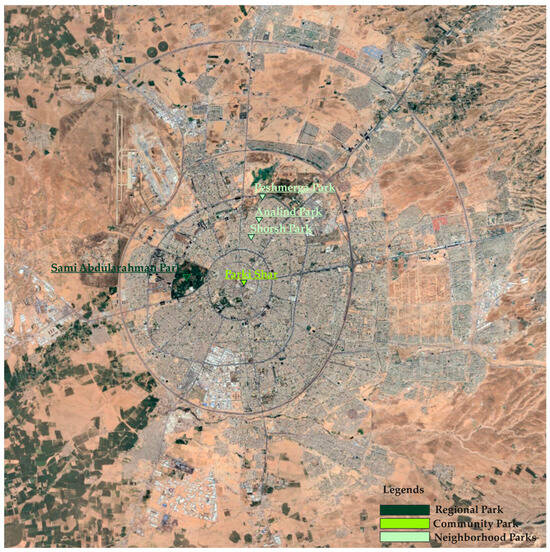
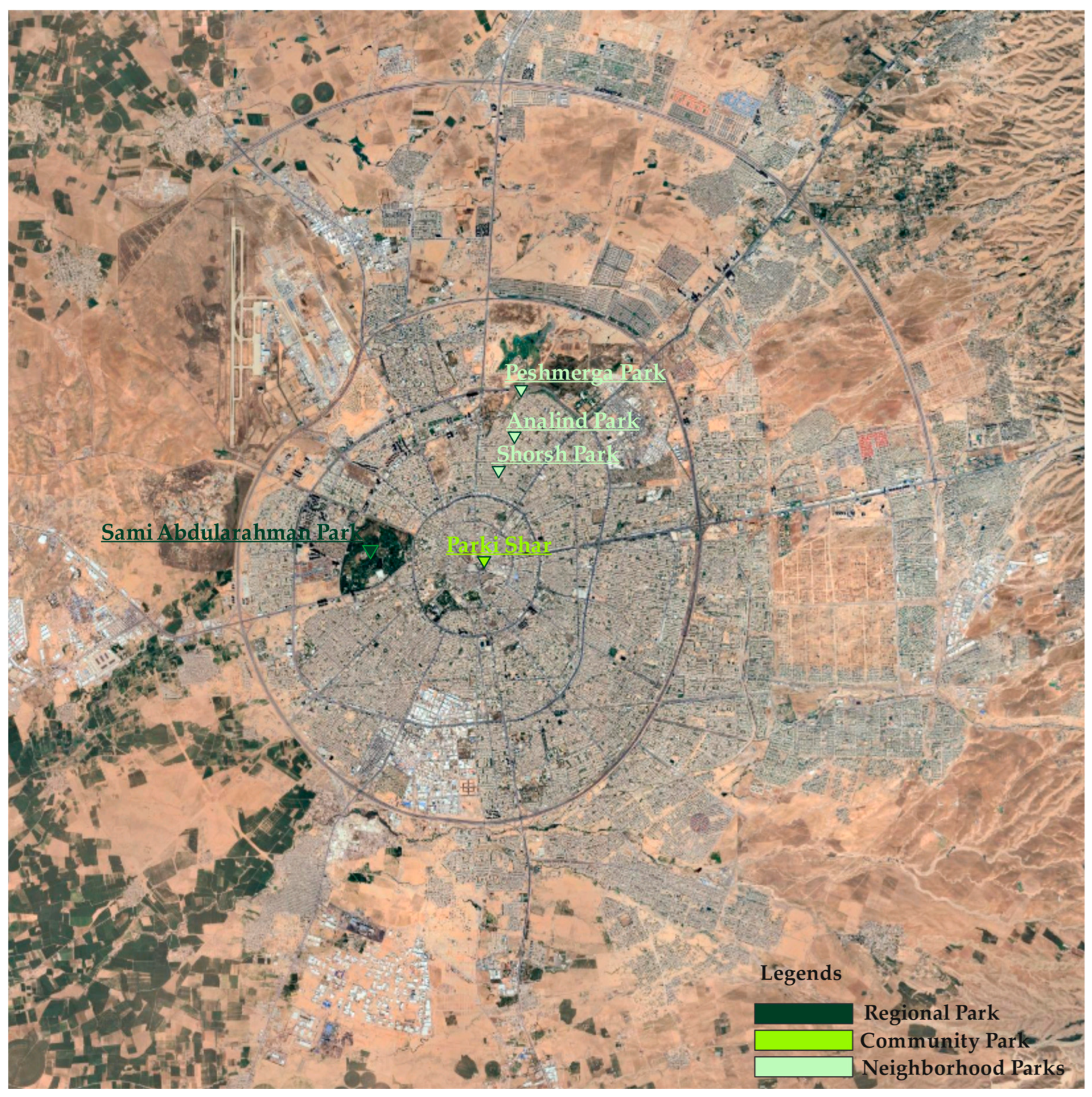
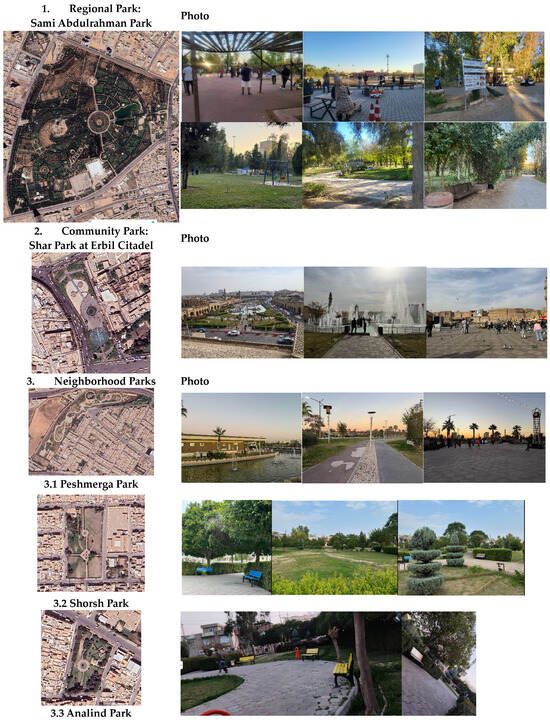
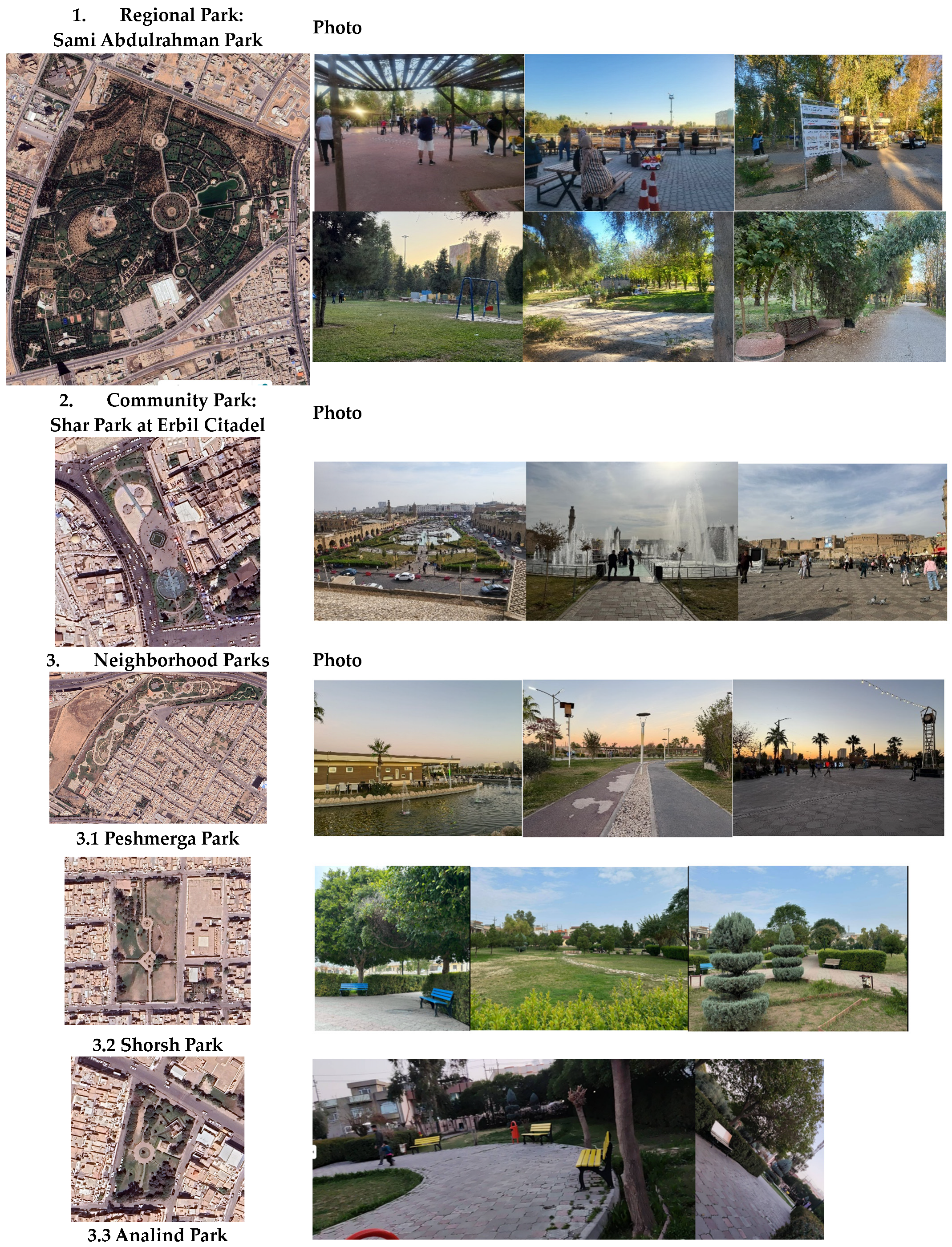
In fact, this research was carried out in Erbil City, employing the National Recreation and Park Association (NRPA) park typology to guarantee a representative sample of urban green spaces [52]. To initiate the selection process, parks were classified according to their size and service radius. The three primary categories of parks examined in this study are regional parks, community parks, and neighborhood parks. Figure 3 displays the distribution of park location in Erbil City and Figure 4 illustrates case studies in details.
Figure 3.
Geographic location of selected parks based on NRPA typology in Erbil City.
Figure 4.
The five urban public park scales in Erbil City (by the authors).
Accordingly, Sami Abdulrahman Park was selected to represent the regional park due to its vast area (approx. 200 hectares) and city-wide service catchment. The construction commenced in 1998 and was concluded within the same year. The park spans 200 hectares (2.0 km2) and features two lakes, a rose garden, the Martyrs Monument, as well as a restaurant and markets, an exhibition hall, children’s playgrounds, sports facilities, a horse-riding arena, a library, a gym, a swimming pool, and an extensive picnic area. It has eight entrances: one for the library and gym, one for the exhibition hall, three for park access, and the rest are closed/non-active. It features a monument bearing the inscription “freedom is not free”. This urban retreat features flowing pathways, lush gardens, and recreational facilities, offering a restorative retreat in the city of Erbil, harmoniously integrating nature and leisure (Figure 4).
In contrast, Shar Park was chosen as a representative community park (~8.5 hectares), serving the city center. Shar Park is located at Erbil Citadel. It is a major urban public space founded in 2010. In Kurdish it is called “Bagi Shar”, meaning “The City Park”, which was publicly owned until 2008, when Erbil’s governor turned it over to retirees, providing a calm retreat in the city center. Parki Shar sits in the middle of Erbil, right next to the old Erbil Citadel, which is listed in the UNESCO World Heritage Site and is next to the lively Qyesariyeh Bazaar, surrounded by historical mosques, a clock tower reminiscent of London’s Big Ben, with a contemporary public space that integrates modern design with cultural attraction, showcasing beautiful fountains and elegant brick facades. It functions as a peaceful place to rest for individuals desiring relief from city commotion, with verdant pathways suitable for repose, relaxation, and walking. It turned into a central spot where visitors and citizens could enjoy all national events together (Figure 4).
Finally, to capture the local resident experience, several smaller neighborhood parks (e.g., Peshmerga Park, Shorsh Park, and Analind Park) were included. First, Peshmerga Park: the park design contains multiple activities, a restaurant, children’s playgrounds, and sports activities arenas with different landscape features, such as trees, fountains, and pergolas. Second, Shorsh Park: it is a mid-size neighborhood park with seating areas and a children’s playground spot. Lastly, Analind Park is a small-sized park containing landscape features and a seating area used by the neighborhood only. Subsequently, this stratified sampling enables a comparative evaluation of the PRS across various levels of the urban environment (Figure 4).
4. Results
4.1. Descriptive Statistics
The descriptive analysis in Table 3 summarizes both the socio-demographic background of the respondents and their engagement with public spaces. In addition to standard metrics such as age, gender, education level, and employment status, the table reports behavioral characteristics, including the specific types of spaces utilized, the social context of the visits (who they visited with), and reported satisfaction levels.
Table 3.
Descriptive statistics of participants’ socio-demographics, urban public park usage patterns, companionship, levels of satisfaction, and frequency of visits.
The final samples were 202 participants (40.1% female, 59.9% male), with a mean age of 31–40 years. Most of the participants’ educational level were 56.4% college/university, followed by 23.8% high school, 7.9% MSc., 6.4% primary school, 3% illiterate, and 2.5% PhD holders. The majority were self-employed, 27.2%, while 25.2% were employed full-time, 17.8% students, 13.4% unemployed/seeking, 8.4% employed part-time, and other employment statuses, such as housewives and retired, were 2.5% and 5.4%, respectively.
Regarding the types of urban public parks used by participants, the majority used a regional park such as “Sami Abdulrahman Park” (n = 93, 46.0%). This was followed by a community park such as “Shar Park” (n = 47, 23.3%) and neighborhood parks (n = 28, 13.9%). In addition, a smaller proportion of participants indicated they used all types of urban public parks (n = 34, 16.8%) based on their daily needs. Overall, the findings suggest that urban public parks are the predominant choice among respondents, with approximately 83% of the sample reporting some form of urban public park usage.
When asked about companionship during urban public park visits, the majority of the participants were visiting with their family members (n = 78, 38.6%), followed closely by friends (n = 59, 29.2%). Also, a minority of participants reported visiting urban public parks alone (n = 20, 9.9%), while nearly one-quarter indicated visiting with all types of companions (n = 45, 22.3%), seen in Table 3. These findings suggest that public spaces are predominantly used for social activities, with the vast majority of participants (90.1%) visiting these urban public parks in the company of others rather than alone. Family and friends together account for approximately two-thirds of all urban public parks’ visits, highlighting the important role these parks play in facilitating social connections and leisure time with loved ones.
In terms of user satisfaction, participants reported on varying levels of satisfaction within urban public parks, with the distribution skewed toward positive experiences. The majority expressed satisfaction within existing urban public parks (n = 60, 29.7%), reporting being ‘Satisfied’, followed by ‘Somewhat Satisfied’ (n = 51, 25.2%), and ‘Extremely Satisfied’ (n = 50, 24.8%). Collectively, these three positive categories accounted for nearly 80% of the sample, suggesting generally favorable perceptions of the urban public parks. In contrast, only (n = 21, 10.4%) of participants reported neutral feelings, while dissatisfaction was relatively uncommon. Just (n = 10, 5.0%) were ‘Somewhat Dissatisfied’, (n = 5, 2.5%) were ‘Dissatisfied’, and (n = 5, 2.5%) were ‘Extremely Dissatisfied’, seen in Table 3. Overall, these findings indicate high levels of user satisfaction with different scales of urban public parks, with less than 10% of participants expressing any form of dissatisfaction.
Furthermore, participants demonstrated varied scales of urban public park visitation. The most frequently reported visiting pattern was once or twice a week (n = 60, 29.7%), followed by a few times a month (n = 57, 28.2%). Together, these moderate-frequency users comprised nearly 60% of the sample. Moreover, regular visitors who came several times a week represented 17.3% of participants (n = 35), while daily visitors accounted for (n = 13, 6.4%). Additionally, less frequent usage patterns were also observed, with (n = 31, 15.3%) visiting less than once a month and (n = 5, 2.5%) visiting only once a year. A minimal proportion reported never visiting public spaces (n = 1, 0.5%); see Table 3. Overall, the findings indicate that approximately three-quarters of participants visit different scales of urban public parks at least on a weekly basis, suggesting these spaces serve as regular destinations for leisure and social activities within the community.
4.2. Design Criteria Ranking Model
The restorative effectiveness of the design has been assessed by ranking the four dimensions of the PRS. A Friedman Test was implemented to determine whether or not there were significant differences between the rankings of the criteria. The findings indicated that there was a statistically significant difference in the impressions of the participants across all 21 items. Thus, the Friedman Test confirms significant differences in how participants ranked the restorative design criteria (χ2 = 77.699, df = 3, p < 0.001) for different scales of urban public parks, with being away identified as the highest-performing dimension (Mean Rank = 2.95) and extent (Mean Rank = 2.73), compatibility (Mean Rank = 2.41) and fascination as the lowest (Mean Rank = 1.91), respectively; see Table 4.
Table 4.
Ranking of Design Criteria by PRS.
Furthermore, to investigate the specific differences between design criteria, a Wilcoxon Signed Rank test was conducted as a post hoc procedure with a Bonferroni correction (α = 0.0083). The analysis revealed that ”Fascination vs. Being Away” (Z = −7.875, p < 0.001), thus ”Being Away” is much stronger than “Fascination”. Regarding “Fascination vs. Extent” (Z = −6.551, p < 0.001), “Extent” was rated significantly higher than “Fascination”. Additionally, “Being Away” was significantly more impactful than “Compatibility” (Z = −4.490, p < 0.001). However, no significant differences were detected between “Being Away” and “Extent” (p = 0.017) or “Extent” and “Compatibility” (p = 0.017); they are statistically similar (tied) and not significant. Therefore, this indicates a statistical overlap in the perceived performance of these three higher-ranked criteria. Even though urban public parks are able to effectively give a sense of psychological distance and environmental coherence, these results indicate that they are significantly less effective at catching attention through attraction in a simple manner (Table 5).
Table 5.
Pairwise comparison of PRS design criteria using Wilcoxon Signed Rank (n = 201).
4.3. Reliability and Validity of Model
The reliability and validity of the measurement model were assessed using Cronbach’s alpha coefficients. All scales demonstrated good to excellent internal consistency. Composite reliability (CR) and Average Variance Extracted (AVE) were calculated for each construct. The composite reliability values (Cronbach’s Alpha) ranged from 0.76 to 0.85, with compatibility at 0.76 (omega = 0.75) and fascination at 0.75 (omega = 0.81), being away at 0.80 (omega = 0.81), and extent at 0.85 (omega = 0.85). All CR values exceeded the recommended threshold of 0.70, indicating adequate construct reliability. The AVE values, which assess convergent validity by measuring the amount of variance captured by a construct relative to measurement error, ranged from 0.40 to 0.54. Specifically, compatibility had an AVE of 0.40, fascination 0.50, being away 0.5, and extent 0.54; see Table 6. While the AVE values for compatibility fell slightly below the commonly recommended threshold of 0.50, they approached this criterion. Overall, the measurement scales demonstrated acceptable reliability. All alpha values exceeded the 0.70 threshold, indicating items reliably measured their respective constructs. Omega coefficients were consistent with or slightly higher than alpha values, further confirming the reliability of the model. Composite reliability was strong, and AVE values were reasonably close to acceptable thresholds, supporting overall measurement quality.
Table 6.
Composite reliability (CR) and Average Variance Extracted (AVE) of parameters.
Before conducting factor analysis, the suitability of the data for this analytical technique was assessed using the Kaiser–Meyer–Olkin (KMO) measure of sampling adequacy and Bartlett’s test of sphericity; see Table 7. The KMO value was 0.936, which is considered excellent and well above the recommended minimum of 0.60, indicating that the sample size was adequate and the patterns of correlations were sufficiently compact for factor analysis. Bartlett’s test of sphericity yielded a statistically significant result (χ2 = 2193.204, df = 210, p < 0.001), rejecting the null hypothesis that the correlation matrix was an identity matrix. This significant result confirmed that there were sufficient correlations among the variables to proceed with factor analysis. Together, these results provided strong evidence that the data were appropriate for factor analytic procedures.
Table 7.
The suitability of the data for the analytical techniques was assessed using the Kaiser–Meyer–Olkin (KMO) measure of sampling adequacy and Bartlett’s test of sphericity.
Pearson correlation analyses were conducted to examine the relationships among the four key variables: compatibility, fascination, being away, and extent; see Table 8. All correlations were positive, statistically significant (p < 0.001), and of moderate to strong magnitude, indicating substantial interrelationships among the constructs. Compatibility showed strong positive correlations with fascination (r = 0.653, p < 0.001), being away (r = 0.687, p < 0.001), and extent (r = 0.656, p < 0.001). Fascination was significantly correlated with being away (r = 0.646, p < 0.001) and extent (r = 0.701, p < 0.001). The strongest correlation observed was between being away and extent (r = 0.711, p < 0.001). The sample size for these analyses ranged from 201 to 202 participants. These findings suggest that all four dimensions are interrelated yet sufficiently distinct, supporting the multidimensional nature of the construct while demonstrating convergent validity among related factors.
Table 8.
Correlation analyses were conducted to examine the relationships among the four key variables.
4.4. Confirmatory Factor Analysis (CFA)
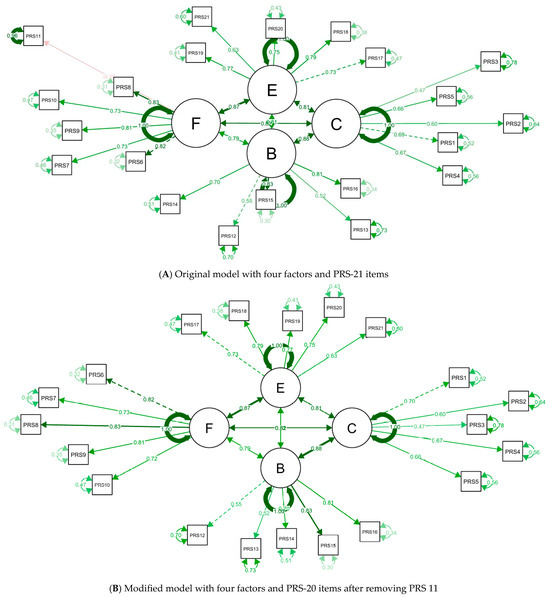
A confirmatory factor analysis was conducted to evaluate the fit of the proposed measurement model for urban public parks design criteria. To be precise, two separate applications of CFA were conducted: the first utilized the original model with PRS four factors encompassing 21 items, while the second employed the PRS four factors with 20 items, excluding the problematic factor; see Table 9. Regarding the comparison between the original model and the modified model, both demonstrated excellent fit to the data across multiple fit indices. However, the updated version is somewhat better compared to the original model. The Chi-Square decreased from (χ2 = 341.844, df = 183, p < 0.001) to (χ2 = 317.123, df = 164, p < 0.001), which is common in larger samples and does not necessarily indicate poor fit. And the Root Mean Square Error of Approximation (RMSEA) improved from 0.076 to 0.068—moving it from acceptable into the good fit range. This study also observed a gain in the Comparative Fit Index (CFI = 0.926 vs. 0.928) and Tucker–Lewis Index (TLI = 0.915 vs. 0.916), both of which exceeded the recommended threshold of 0.90, indicating good model fit. The Standardized Root Mean Square Residual (SRMR = 0.054 vs. 0.053) was well below the 0.08 cutoff, further supporting adequate model fit. In addition to the statistical enhancements, this model demonstrates improved effectiveness. It obtains a stronger fit with fewer items, yielding practical advantages in minimizing survey length and respondent fatigue. All fit indices currently satisfy the specified thresholds: CFI and TLI surpass 0.90, RMSEA is below 0.08, and SRMR is significantly under 0.08. The findings suggest that the four-factor model with 20 items offers a robust measurement framework appropriate for research purposes.
Table 9.
A confirmatory factor analysis was conducted to evaluate the fit of the proposed measurement model before and after removing the problematic factor (PRS 11).
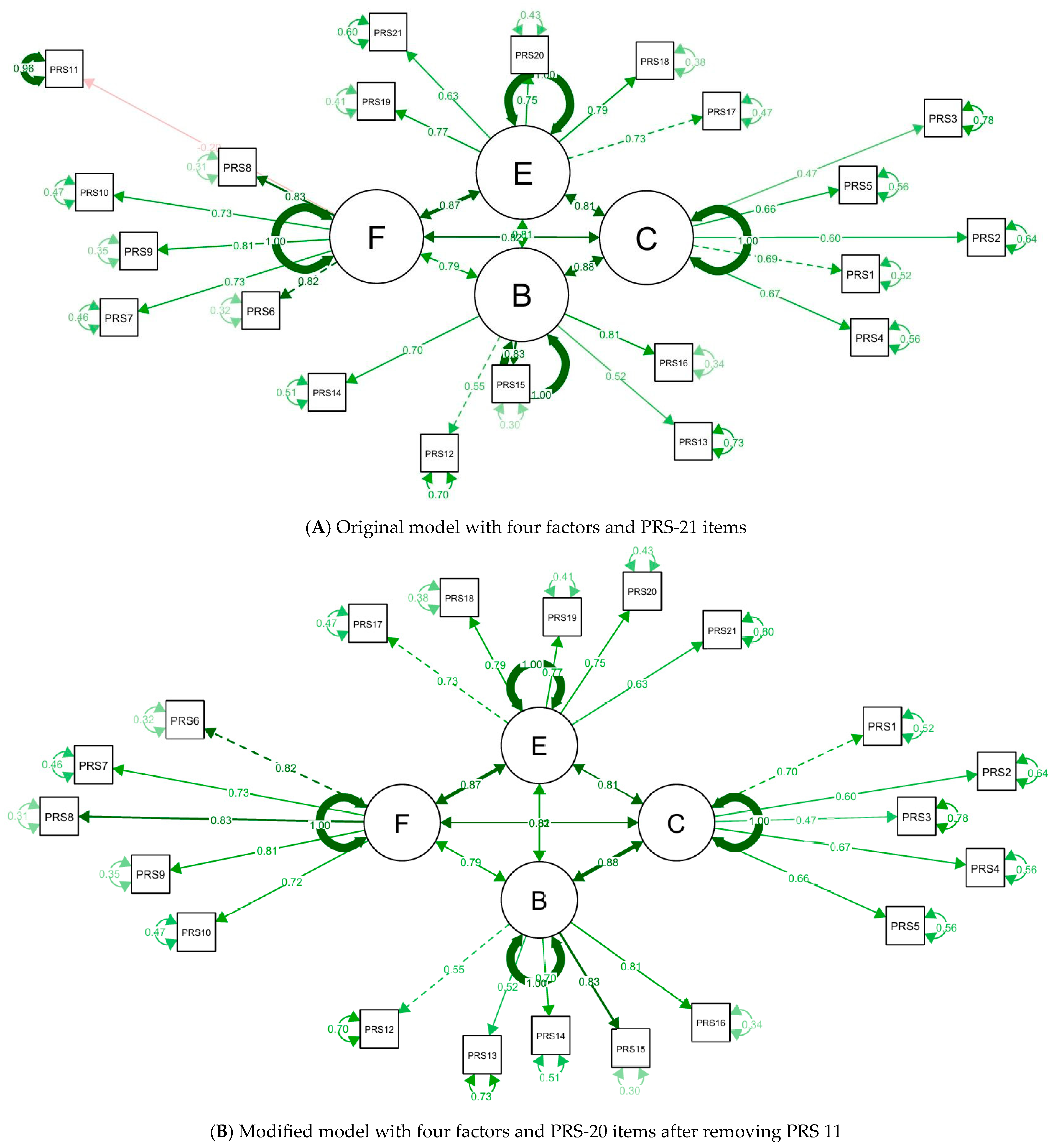
However, the comparison between the original and modified CFA path diagrams demonstrates significant improvements in model efficiency and accuracy. The original model, Figure 5A, comprised 21 items distributed across four factors: compatibility (PRS1–PRS5), fascination (PRS6–PRS11), being away (PRS12–PRS16), and extent (PRS17–PRS21). The updated model Figure 5B excluded PRS11 from the fascination factor, leading to a more balanced structure which comprised 20 items equitably distributed among the four factors.
Figure 5.
Path diagram of the CFA model of both the original and the modified model.
Reviewing the standardized factor loading patterns in both diagrams, it shows that most items have strong links to their factors (loadings > 0.60). Additionally, factor F (fascination) showed standardized factor loadings ranging from 0.73 to 0.83 across its five indicators (PRS 6-PRS 7-PRS 8-PRS 9-PRS10), with particularly strong loadings for PRS 8 (0.83) and PRS 9 (0.81). In the original model, the PRS 10 is 0.73, whereas in the updated model it is 0.72. Conversely, the PRS 11 is regarded as displaying a negative correlation within the original model framework, leading to its removal in the modified model. Similarly, factor B (being away) demonstrated robust loadings from 0.70 to 0.83 on its indicators (PRS 14- PRS 15- PRS 16), respectively, with PRS 15 showing the highest loading (0.83). Conversely, PRS 12 (0.55) and PRS 13 (0.52) are acceptable but on the lower end of the recommended (0.5) threshold. Moreover, factor E (extent) displayed loadings between 0.63 and 0.79 for its items (PRS 17-PRS 18-PRS 19-PRS 20-PRS 21), while Factor C (compatibility) had loadings ranging from 0.60 to 0.67 across its indicators (PRS 1-PRS 2-PRS 4-PRS 5); PRS3 (0.47) on factor C demonstrating a loading below the recommended (0.5) threshold is also considered to be reviewed. Also, there was a slight change following the modification in factor C: PRS 1 was 0.69 in the original model and 0.7 in the updated one. On the other hand, the latent factors that showed substantial positive intercorrelations remained unchanged.
The inter-factor correlations in both diagrams show moderate to high correlations between the latent factors (ranging from approximately 0.79 to 0.88), indicated by the double-headed dashed arrows connecting the factor circles. These correlations stayed fairly stable across models, which suggests that the four-factor structure represents related but separate parts of the construct as correlation between F and B (0.79), F and E (0.87), F and C (0.82), B and E (0.81), B and C (0.88), and E and C (0.81), all indicating substantial shared variance among constructs. The visual simplification in the modified diagram reflects this improved fit: fewer items with maintained or improved factor loadings demonstrate enhanced measurement efficiency.
The progression from the original to the modified CFA path diagram demonstrates effective scale refinement. The removal of a problematic item led to a more efficient model characterized by enhanced fit indices, greater theoretical coherence, and increased practical applicability. The revised diagram clearly illustrates a strong four-factor structure that corresponds with all established criteria for CFA model fit and is appropriate for research purposes.
5. Discussion
5.1. Co-Creation as a Mechanism for Incorporating Psychological Needs
The descriptive statistics of results indicate the importance of different scales of urban public parks’ essential role in shaping the daily life needs, well-being, and physiological and psychological aspects of the community [5]. The findings suggest that regional parks are the predominant choice among respondents, with the percentage of 83%, accompanied with family and friends rather than alone, mostly at the end of the weekend. The reasons for visiting were as follows: the change in mood, getting fresh air, walking, socializing with friends, doing sports, family meetings or gathering, walking, using the park’s gym equipment, cycling, work meetings, events such as birthday parties, social and national events as Newruz (cultural event), religious events, studying, children’s activities, and connection with nature since some live in apartments or in a house that lacks a garden. These places function as a means of escape for the community. They enable individuals to distance themselves from geopolitical instability, financial hardship, and profound social and cultural challenges. This shapes a significant portion of existence in the Middle East. Consequently, these parks go beyond their functional purpose to serve as essential centers for social cohesion, offering a restorative environment where community ties are reinforced through collective leisure activities. Based on statistical evidence, the design criteria are ranked as follows: being away (primary strength), extent, compatibility, and fascination (primary weakness). Therefore, future designs should emphasize visual stimulations. This modification will make sense of the distinction between “escape” and “active restoration”, establishing the development of the design in scientific psychological data rather than perception. Similarly, a study finding suggests that planners ought to prioritize enhancing the restorative attributes (e.g., visual fascination, escape) of parks, as this view is an essential stimulant for mental well-being and social cohesion [50,51]. Furthermore, being absent is often the initial stage of restoration and the observation that fascination is at its lowest, which may indicate that the urban public parks were static or lacked ”Soft Fascination”, the form of visual interest that does not necessitate intense focus, which is in harmony with participants’ requests during data collection. This indicates that urban public parks’ environmental psychology makes participants mentally active in every stage of decision making.
These patterns show that the four dimensions are linked to each other but remain distinct components of the overall construct. To translate this framework into practice when designing healing urban settings, it is essential to consider the following: the first dimension, “Accessibility”, is parallel to the “Being Away” dimension of ART. This involves designing arrival sequences and threshold experiences that create psychological distance while ensuring physical accessibility for all users [33,36,38,53,54]. On the other hand, research claimed that just having a park is not enough; the user needs to regard it as restoration. High scores in restorative qualities like “Compatibility” and “Extent” dimensions were strongly linked to stronger community attachment [55]. Also in China, for example, hiding places allow residents to escape the city’s auditory and visual clutter, and community engagement or creative planning can make even congested social parks feel restorative [56,57,58]. The evidence gathered suggests that the ranking design criteria are dependent upon the cultural context as well as the political, economic, and social factors within the community psychology framework.
The second dimension, “Diversity”, is parallel to the “Extent” dimension of ART. This involves making environments that are complex and layered, with enough variation and coherence to keep people interested and exploring for a long time [39]. Similarly, the findings of a study support the theory that restoration is a complex process influenced by several factors, including the individual’s mental state, their degree of activity, and their physical location. Park planners should approach different zones in their design [59]. Next, the third dimension, “Flexibility”, is parallel to the “Compatibility” dimension of ART, meaning that parks should be able to be used in a variety of ways and for a variety of purposes [34,54]. The fourth dimension is “Quality”, which is parallel to the ”Fascination” dimension of ART. This requires adding gentle fascination through natural traits, aesthetic richness, and sensory experiences that easily grab people’s attention [41]. Similarly, these findings suggest that urban public space design criteria and Attention Restorative Theory can improve communities’ mental health, decision-making, problem-solving, and academic/work performances. The ART demonstrates why green spaces are a vital public health resource by tying built environment design to mental and physical health [27,28]. Also, the integration of maintenance and nature constitute the ideal equilibrium [54,60].
Overall, co-creation involves collaboration among individual citizens, professionals, and government entities, contributing to environmental psychology that engages users cognitively. The significant reliability and the CFA results offer strong proof supporting the research hypothesis. The findings specifically affirm that utilizing ART through the PRS successfully recognizes user requirements within a co-creation framework. Thus, the model provides a systematically refined scale that conforms to all specified psychometric criteria, making it extremely appropriate for future research applications and leading to creative restorative urban public parks of different scales.
5.2. Limitations of the Study
This study is limited to examining how the co-creation approach, specifically from the individual citizen perspective, addresses user needs through Attention Restoration Theory (ART) as it relates to urban public space design criteria for creating restorative urban public spaces. More research should be carried out to explore other dimensions and stakeholder perspectives within the co-creation approach to better understand how they foster active environmental psychology among users.
The sampling strategy has certain limitations, as it attempted to encompass generational diversity by selecting two distinct members (e.g., an adult, elder, or teenager) from each participating family or social group, and the research relied on precise self-reporting of psychological needs to prevent overlapping reasons for visit from respondents. Moreover, there are limitations in socio-economic status; employment status was utilized as a proxy variable rather than direct income level to respect local cultural sensitivities regarding financial privacy, physical ability differences, and cultural background. Additionally, essential behavioral indicators include mode of access, which may influence pre-visit stress, and duration of stay, which dictates the “dosage” of exposure to nature. Further studies should enhance the evaluation of these variables and employ stratified sampling to achieve a more comprehensive understanding of user requirements. Furthermore, an effective design must transcend the generic “average user” paradigm to effectively address these varied behavioral patterns.
6. Conclusions
The environmental psychology of urban public parks can be improved through a co-creation approach that identifies user needs via the ART and PRS, thereby increasing psychological engagement and satisfaction with these spaces and promoting the development of restorative urban public areas. Further, co-creating public spaces requires commitment from all stakeholders to participate in experimentation and to appreciate unexpected, even idealistic outcomes that may stimulate innovative concepts and opportunities.
This study offers a definitive evidence-based ranking of the design criteria for the assessed urban public park settings. The results indicate that the design is most effective in fostering a sensation of being away and extent, which are the essential phases of psychological restoration. The dimensions were markedly more influential than the other criteria, indicating that the visual environment successfully establishes a “world of its own” in which people feel detached from their regular activities. In short, the hierarchy of design criteria with ART dimensions to identify users’ requirements is outlined as follows: Being Away–Accessibility (first); Extent–Diversity (second); Compatibility–Flexibility (third); and Fascination–Quality (fourth; primary target for improvement). This systematic ranking method guarantees that design choices are based on user-centered psychological facts rather than subjective intuition. This study proposes a model to identify psychological user requests based on the facts. The model demonstrates a strong four-factor structure, including 20 aspects that adhere to all specified criteria for CFA model fit and are appropriate for research purposes.
Overall, the model demonstrates how thoughtfully designed environments can activate users mentally, improving cognitive functions, including decision-making, problem-solving abilities, and overall academic or work performance within the community. Their outcome highlights the vital role of participatory processes in fostering sustainable and resilient urban development. Future research should adopt a multi-level approach, capable of relating types of space, urban scales, and categories of users, integrating quantitative and qualitative analyses. This would not only strengthen the theoretical validity of the proposed model but also make it a more effective operational tool for planners, designers, and public decision-makers. Precisely defining who participates and at what scale interventions take place is an essential step in transforming urban recreational spaces into truly regenerative, inclusive environments that respond to the complexity of contemporary urban life.
Author Contributions
Conceptualization, S.A.A. and Z.K.M.; methodology, S.A.A. and Z.K.M.; software, S.A.A.; validation, S.A.A. and Z.K.M.; formal analysis, S.A.A.; investigation, S.A.A. and Z.K.M.; resources, S.A.A. and Z.K.M.; data curation, S.A.A.; writing—original draft preparation, S.A.A.; writing—review and editing, S.A.A.; visualization, S.A.A.; supervision, S.A.A.; project administration, S.A.A.; funding acquisition, S.A.A. and Z.K.M. All authors have read and agreed to the published version of the manuscript.
Funding
This research received no external funding.
Data Availability Statement
The data presented in this study were generated or analyzed during this study, all included in this article.
Acknowledgments
We gratefully appreciate the efforts of everyone who made this research project successful.
Conflicts of Interest
The authors declare no conflicts of interest.
Abbreviations
The following abbreviations are used in this manuscript:
| ART | Attention Restorative Theory |
| PRS | Perceived Restorative Scale |
| NRPA | National Recreation and Park Association |
| CR | Composite reliability |
| AVE | Average Variance Extracted |
| CFA | A confirmatory factor analysis |
| RMSEA | Root Mean Square Error of Approximation |
| CFI | Comparative Fit Index |
| TLI | Tucker–Lewis Index |
| SRMR | Standardized Root Mean Square Residual |
References
- Markevych, I.; Schoierer, J.; Hartig, T.; Chudnovsky, A.; Hystad, P.; Dzhambov, A.M.; De Vries, S.; Triguero-Mas, M.; Brauer, M.; Nieuwenhuijsen, M.J. Exploring Pathways Linking Greenspace to Health: Theoretical and Methodological Guidance. Environ. Res. 2017, 158, 301–317. [Google Scholar] [CrossRef] [Scilit] [PubMed]
- Heo, S.; Desai, M.U.; Lowe, S.R.; Bell, M.L. Impact of Changed Use of Greenspace during COVID-19 Pandemic on Depression and Anxiety. Int. J. Environ. Res. Public Health 2021, 18, 5842. [Google Scholar] [CrossRef] [Scilit] [PubMed]
- Razani, N.; Morshed, S.; Kohn, M.A.; Wells, N.M.; Thompson, D.; Alqassari, M.; Agodi, A.; Rutherford, G.W. Effect of Park Prescriptions with and without Group Visits to Parks on Stress Reduction in Low-Income Parents: SHINE Randomized Trial. PLoS ONE 2018, 13, e0192921. [Google Scholar] [CrossRef] [Scilit] [PubMed]
- Astell-Burt, T.; Hartig, T.; Eckermann, S.; Nieuwenhuijsen, M.; McMunn, A.; Frumkin, H.; Feng, X. More Green, Less Lonely? A Longitudinal Cohort Study. Int. J. Epidemiol. 2022, 51, 99–110. [Google Scholar] [CrossRef] [Scilit]
- Mehta, V. Evaluating Public Space. J. Urban Des. 2014, 19, 53–88. [Google Scholar] [CrossRef] [Scilit]
- Carr, S.; Francis, M.; Rivlin, L.G.; Stone, A.M. Needs in Public Space. In Urban Design Reader; Routledge: London, UK, 2007; pp. 230–240. [Google Scholar]
- Nguyen, P.-Y.; Astell-Burt, T.; Rahimi-Ardabili, H.; Feng, X. Effect of Nature Prescriptions on Cardiometabolic and Mental Health, and Physical Activity: A Systematic Review. Lancet Planet. Health 2023, 7, e313–e328. [Google Scholar] [CrossRef] [Scilit]
- Rahimi Gendeshmin, S.; Hatami Khanghahi, T.; Rostamzadeh, Y. Creative Urban Place. Open House Int. 2024, 49, 163–180. [Google Scholar] [CrossRef] [Scilit]
- Zhihan, H.; Liang, Y.; Jin, T. Design of Music Training Assistant System Based on Artificial Intelligence. EAI Endorsed Trans. Scalable Inf. Syst. 2022, 9, e2. [Google Scholar] [CrossRef] [Scilit]
- Razali, G.; Mutma, F.S.; Adriana, N.P.; Angelina, D.; Saldi, Z.S. Creative Communication as a Catalyst for Change: Shaping Urban Development Through Psychology and Art. J. Commun. 2023, 1, 31–42. [Google Scholar] [CrossRef] [Scilit]
- Stevens, Q.; Daly, J.; Dovey, K. Designing for Possibility in Public Space: Affordance, Assemblage, and ANT. Urban Des. Int. 2024, 29, 94–104. [Google Scholar] [CrossRef] [Scilit]
- Kaplan, S. The Restorative Benefits of Nature: Toward an Integrative Framework. J. Environ. Psychol. 1995, 15, 169–182. [Google Scholar] [CrossRef] [Scilit]
- Guo, J.; Kwon, H. The Relationship Between the Perceived Restorativeness of Urban Parks and Sociocultural Value: A Case Study of Labor Park in Dalian, China. Land 2025, 14, 1097. [Google Scholar] [CrossRef] [Scilit]
- Dalavong, P.; Im, H.N.; Choi, C.G. In What Ways Does Placeness Affect People’s Behavior? Focusing on Personal Place Attachment and Public Place Image as Connecting Parameter. Front. Psychol. 2024, 15, 1394930. [Google Scholar] [CrossRef] [Scilit] [PubMed]
- Herzog, T.R.; Maguire, P.; Nebel, M.B. Assessing the Restorative Components of Environments. J. Environ. Psychol. 2003, 23, 159–170. [Google Scholar] [CrossRef] [Scilit]
- Wu, J.; Zhang, L.; Ren, X. Incorporating the Co-Creation Method into Social Innovation Design to Promote Intergenerational Integration: A Case Study of a Public Square. Int. J. Environ. Res. Public Health 2022, 19, 12908. [Google Scholar] [CrossRef] [Scilit]
- Oetken, K.J. Unravelling the Why: Exploring the Increasing Recognition and Adoption of Co-Creation in Contemporary Urban Design. Sustain. Communities 2025, 2, 2477788. [Google Scholar] [CrossRef] [Scilit]
- Costa, C.S.; Mačiulienė, M.; Menezes, M.; Marušić, B.G. Co-Creation of Public Open Places: Practice-Reflection-Learning; Edições Universitárias Lusófonas: Lisbon, Portugal, 2020. [Google Scholar]
- Li, X. Incorporating Place Attachment in Spatial Planning: A Literature Review. In Transformationsprozesse in Stadt und Land: Erkenntnisse, Strategien und Zukunftsperspektiven; Verlag der ARL: Hannover, Germany, 2024; pp. 74–89. [Google Scholar]
- Armstrong, L.; Bailey, J.; Julier, G.; Kimbell, L. Social Design Futures: HEI Research and the AHRC; University of Brighton: Brighton, UK, 2014. [Google Scholar]
- American Psychological Association. Community mental health. In APA Dictionary of Psychology; no date; American Psychological Association: Washington, DC, USA; Available online: https://dictionary.apa.org/community-mental-health (accessed on 25 December 2025).
- Thornicroft, G.; Deb, T.; Henderson, C. Community Mental Health Care Worldwide: Current Status and Further Developments. World Psychiatry 2016, 15, 276–286. [Google Scholar] [CrossRef] [Scilit]
- Simmonds, S.; Coid, J.; Joseph, P.; Marriott, S. Community Mental Health Team Management in Severe Mental Illness: A Systematic Review. Br. J. Psychiatry 2001, 178, 497–502. [Google Scholar] [CrossRef] [Scilit]
- Liu, C.; Zhong, M.; He, M.; Wang, X.; Gan, H.; Cao, P.; Wang, C.; Lou, Y. Research on Co-Creation of Community Public Cultural Spaces Through Generative Dynamic Workflows. Systems 2025, 13, 316. [Google Scholar] [CrossRef] [Scilit]
- Lund, D.H. Co-Creation in Urban Governance: From Inclusion to Innovation. Scand. J. Public Adm. 2018, 22, 3–17. [Google Scholar] [CrossRef] [Scilit]
- Azeez, S.A.; Mustafa, F.A.; Ahmed, R.M. The Role of the Active Design Approach in Improving the Environmental Psychology of a Healthy Built Environment: The Case of a University Campus. Buildings 2023, 13, 1999. [Google Scholar] [CrossRef] [Scilit]
- Kaplan, S.; Kaplan, R. Cognition and Environment: Functioning in an Uncertain World; Ulrichs Books: Ann Arbor, MI, USA, 1982. [Google Scholar]
- Kaplan, R.; Kaplan, S. The Experience of Nature: A Psychological Perspective; Cambridge University Press: Cambridge, UK, 1989. [Google Scholar]
- UN-Habitat; WHO. Healthier Cities and Communities Through Public Spaces: A Guidance Paper; United Nations Human Settlements Programme: Nairobi, Kenya; UN-Habitat & WHO: Geneva, Switzerland, 2025. [Google Scholar]
- Hartig, T.; Kaiser, F.G.; Bowler, P.A. Further Development of a Measure of Perceived Environmental Restorativeness; Institutet för bostads-och urbanforskning: Uppsala, Sweden, 1997. [Google Scholar]
- Hartig, T.; Korpela, K.; Evans, G.W.; Gärling, T. A Measure of Restorative Quality in Environments. Scand. Hous. Plan. Res. 1997, 14, 175–194. [Google Scholar] [CrossRef] [Scilit]
- Ohly, H.; White, M.P.; Wheeler, B.W.; Bethel, A.; Ukoumunne, O.C.; Nikolaou, V.; Garside, R. Attention Restoration Theory: A Systematic Review of the Attention Restoration Potential of Exposure to Natural Environments. J. Toxicol. Environ. Health Part B 2016, 19, 305–343. [Google Scholar] [CrossRef] [Scilit] [PubMed]
- Sepe, M. Contemporary Approaches to Healthy and Livable Public Spaces: Proximity, Flexibility, and Diversification. Urban Des. Int. 2025, 30, 115–129. [Google Scholar] [CrossRef] [Scilit]
- Geirbo, H.C.; Harboe, L.; Hoelscher, K.; Petersen, S.A. Interpretive Flexibility as an Approach to Designing Inclusive Urban Space: Learning from Medellín and Beirut. Nord. J. Urban Stud. 2022, 2, 141–160. [Google Scholar] [CrossRef] [Scilit]
- Sádaba, J.; Alonso, Y.; Latasa, I.; Luzarraga, A. Towards Resilient and Inclusive Cities: A Framework for Sustainable Street-Level Urban Design. Urban Sci. 2024, 8, 264. [Google Scholar] [CrossRef] [Scilit]
- Solá, A.G.; Vilhelmson, B.; Larsson, A. Understanding Sustainable Accessibility in Urban Planning: Themes of Consensus, Themes of Tension. J. Transp. Geogr. 2018, 70, 1–10. [Google Scholar] [CrossRef] [Scilit]
- Design, U. The Principles of Universal Design. 1997. Available online: http://www.design.ncsu.edu/cud (accessed on 25 December 2025).
- Allam, Z.; Bibri, S.E.; Chabaud, D.; Moreno, C. The ‘15-Minute City’Concept Can Shape a Net-Zero Urban Future. Humanit. Soc. Sci. Commun. 2022, 9, 1–5. [Google Scholar] [CrossRef] [Scilit]
- Gupta, A.; Yadav, M.; Nayak, B.K. A Systematic Literature Review on Inclusive Public Open Spaces: Accessibility Standards and Universal Design Principles. Urban Sci. 2025, 9, 181. [Google Scholar] [CrossRef] [Scilit]
- Sim, D. Soft City: Building Density for Everyday Life; Island Press: Washington, DC, USA, 2019. [Google Scholar]
- Dietrich, U.; Kengyel, N. What Makes a Public Open Space Liveable? In Proceedings of the 11th International Conference on Urban Regeneration and Sustainability (SC 2016), Alicante, Spain, 12–14 July 2016; WIT Press: Southampton, UK, 2016; pp. 685–696. [Google Scholar]
- Gehl, J. Cities for People; Island Press: Washington, DC, USA, 2013. [Google Scholar]
- Gehl, J.; Svarre, B. How To Study Public Life; Island Press/Center for Resource Economics: Washington, DC, USA, 2013. [Google Scholar]
- Rennit, P.; Maikov, K. Perceived Restoration Scale Method Turned into (Used as the) Evaluation Tool for Parks and Open Green Spaces, Using Tartu City Parks as an Example. City Territ. Archit. 2015, 2, 6. [Google Scholar] [CrossRef] [Scilit]
- Niu, H.-J.; Chen, M.-J. Exploring the Co-Creation Value of Residents to Tourists from the Perspective of Place Attachment and Economic Benefits. Front. Psychol. 2022, 13, 877365. [Google Scholar] [CrossRef] [Scilit] [PubMed]
- Sarkki, S.; Pihlajamäki, M.; Soini, K.; Ojala, A.; Kluvankova, T.; Spacek, M.; Mishra, H.; Hiedanpää, J. Integrative Literature Review on Co-Concepts in Connection with Nature-Based Solutions. Environ. Sci. Policy 2025, 169, 104073. [Google Scholar] [CrossRef] [Scilit]
- Fox, C.; Bassi, A.; Baines, S. Evaluation and the Evidence Base for Co-Creation. In Co-Creation in Public Services for Innovation and Social Justice; Policy Press: Bristol, UK, 2024; pp. 127–141. [Google Scholar]
- Comrey, A.L.; Lee, H.B. A First Course in Factor Analysis; Psychology Press: Hillsdale, NJ, USA, 2013. [Google Scholar]
- Kline, P. An Easy Guide to Factor Analysis; Routledge: New York, NY, USA, 2014. [Google Scholar]
- Kurdistan Region Statistics Office. 2022. Available online: https://krso.gov.krd/content/upload/1/root/kri-population-projections-on-the-distrit-level-2021-2040.pdf (accessed on 31 October 2025).
- Rasul, A.; Balzter, H.; Smith, C. Diurnal and Seasonal Variation of Surface Urban Cool and Heat Islands in the Semi-Arid City of Erbil, Iraq. Climate 2016, 4, 42. [Google Scholar] [CrossRef] [Scilit]
- Mertes, J.D.; Hall, J.R. Park, Recreation, Open Space and Greenway Guidelines; National Recreation and Park Association: Ashburn, VA, USA, 1996. [Google Scholar]
- Connell, B.R. The Principles of Universal Design, Version 2.0. 1997. Available online: https://design.ncsu.edu/wp-content/uploads/2022/11/principles-of-universal-design.pdf (accessed on 11 November 2025).
- Weng, Y.; Chen, Q.; Lin, X.; Chi, Y.; Li, K. Restorative Effects of Small Urban Parks: A Multi-Method Study Using Eye-Tracking and Psychophysiological Measures in Fuzhou, China. Front. Public Health 2025, 13, 1667502. [Google Scholar] [CrossRef] [Scilit] [PubMed]
- Jang, E.; Choi, H.B.; Kim, M. The Restorative Effects of Urban Parks on Stress Control Ability and Community Attachment. Sustainability 2024, 16, 2113. [Google Scholar] [CrossRef] [Scilit]
- Li, W.; Liu, Y. The Influence of Visual and Auditory Environments in Parks on Visitors’ Landscape Preference, Emotional State, and Perceived Restorativeness. Humanit. Soc. Sci. Commun. 2024, 11, 1491. [Google Scholar] [CrossRef] [Scilit]
- Jin, T.; Lu, J.; Shao, Y. Exploring the Impact of Visual and Aural Elements in Urban Parks on Human Behavior and Emotional Responses. Land 2024, 13, 1468. [Google Scholar] [CrossRef] [Scilit]
- Chen, L.; Ma, Y. Perceived Restorativeness of Urban Green Spaces in Southern China during Summer. Sci. Rep. 2025, 15, 38580. [Google Scholar] [CrossRef] [Scilit]
- Yang, D.; Xie, S.; Su, R.; Wu, W. Urban Park Restorative Effects in an Integrated Model of Positive Emotion and Leisure Involvement Moderation. Sci. Rep. 2025, 15, 34100. [Google Scholar] [CrossRef] [Scilit]
- Wang, H.; Liu, Y.; Zhang, M.-J.; Wang, X. Measuring Restoration Quality in Urban Forest Greenways: Insights for Planning and Management. Front. Psychol. 2025, 16, 1596154. [Google Scholar] [CrossRef] [Scilit]

Disclaimer/Publisher’s Note: The statements, opinions and data contained in all publications are solely those of the individual author(s) and contributor(s) and not of MDPI and/or the editor(s). MDPI and/or the editor(s) disclaim responsibility for any injury to people or property resulting from any ideas, methods, instructions or products referred to in the content. |
© 2026 by the authors. Licensee MDPI, Basel, Switzerland. This article is an open access article distributed under the terms and conditions of the Creative Commons Attribution (CC BY) license.