Applications of Alginate in Geotechnical Engineering and Construction: A Review



Abstract
1. Introduction
2. Methodology
2.1. Search Strategy
- Published between 2014 and 2025.
- Focused on experimental or field applications of alginate in geotechnical or construction materials.
- Reported quantitative data on at least two parameters related to mechanical performance (e.g., compressive strength, tensile strength, elastic modulus) and/or durability (e.g., water and freeze–thaw resistance, self-healing efficiency).
- Utilized standardized testing methods (e.g., ASTM, AASHTO, EN, ISO).
- Included comparisons with untreated or traditionally stabilized materials (e.g., cement, lime).
- Studies not written in English.
- Purely theoretical, computational, or review articles without original experimental data.
- Studies focusing solely on biomedical, food, or non-construction applications.
- Research with incomplete methodological descriptions or insufficient data for comparative analysis.
- Authors, publication year, and source.
- Alginate type, alginate concentration, calcium source, and gelation method.
- Material type (e.g., soil or cementitious material).
- Test methods and measured parameters.
- Key findings and comparative outcomes.
2.2. Quantitative Data Synthesis and Limitations
3. Alginate
3.1. Sources and Extraction Processes of Alginate
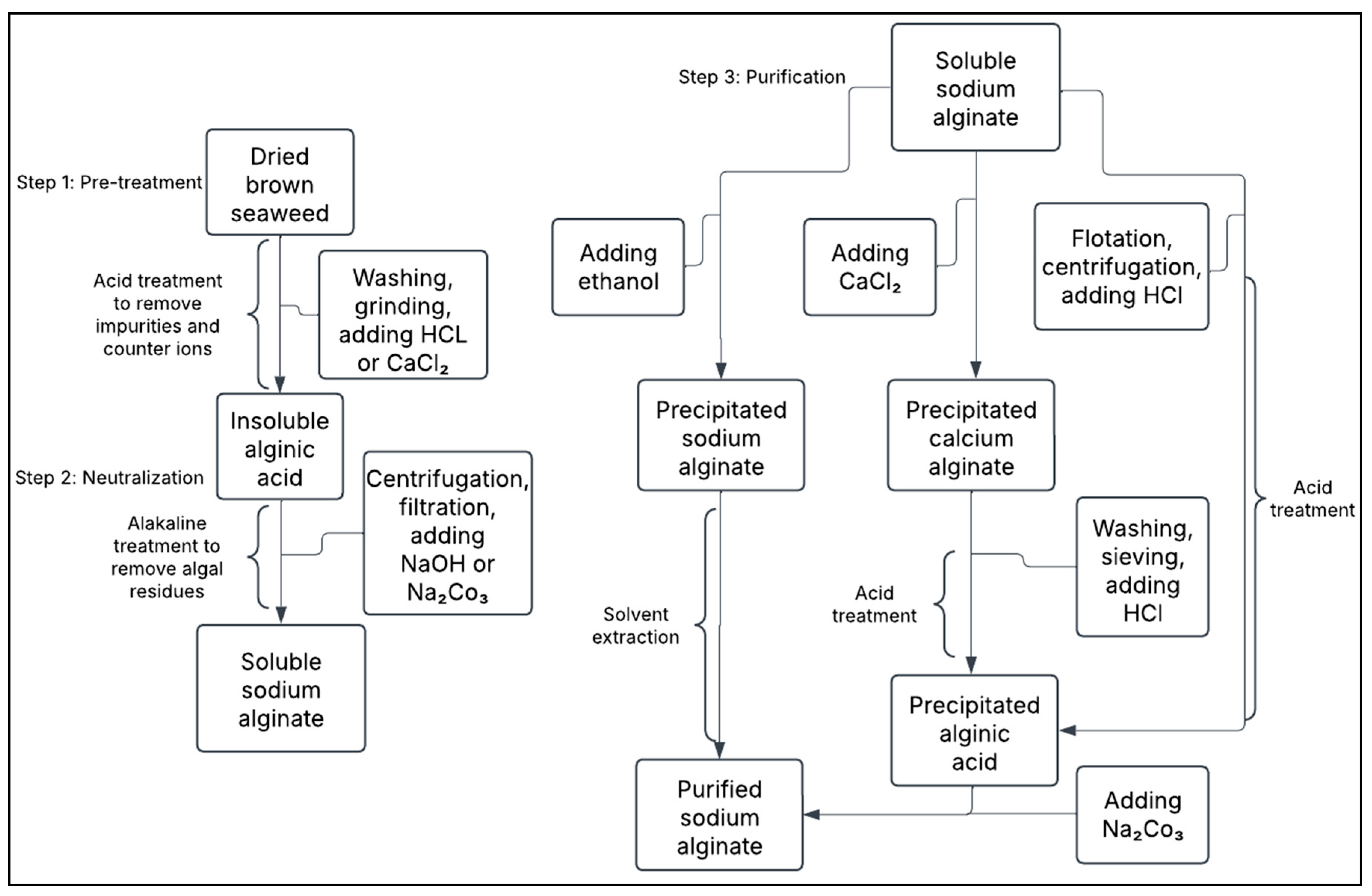
- Pre-Extraction: Harvested seaweeds are first dried and crushed into a powder, then treated with a mineral acid (typically HCl), leading to insoluble alginic acids which are easily separated from contaminants, such as other polysaccharides (e.g., laminarins, fucoidan), low molecular weight compounds, and polyphenols, either by filtration or centrifugation [40].
- Neutralization: The insoluble residue is then treated by an alkaline solution (using sodium carbonate, sodium hydroxide, or aluminum hydroxide, above pH = 6.0) to convert insoluble alginic acid into soluble sodium alginate [40].
- Purification: After another separation step, soluble sodium alginate is precipitated and then purified using techniques such as acidification, the addition of calcium chloride, or the addition of ethanol [39]. Following this, the purified sodium alginate is dried, milled, and packaged for commercial use.
3.2. Molecular Composition and Ionic Crosslinking of Alginate Hydrogels
3.3. Calcium Sources and Crosslinking Methods of Alginate Hydrogels
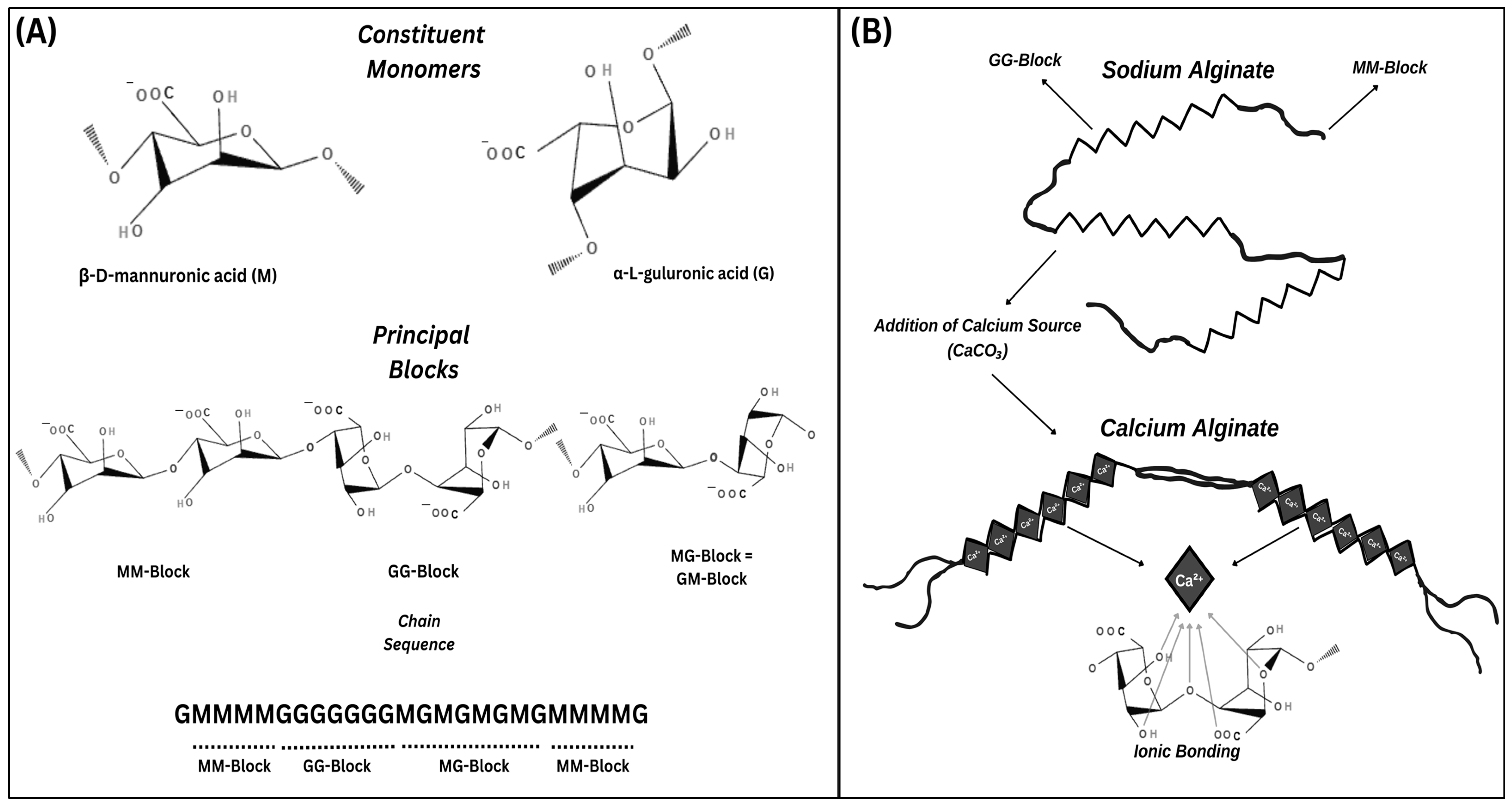
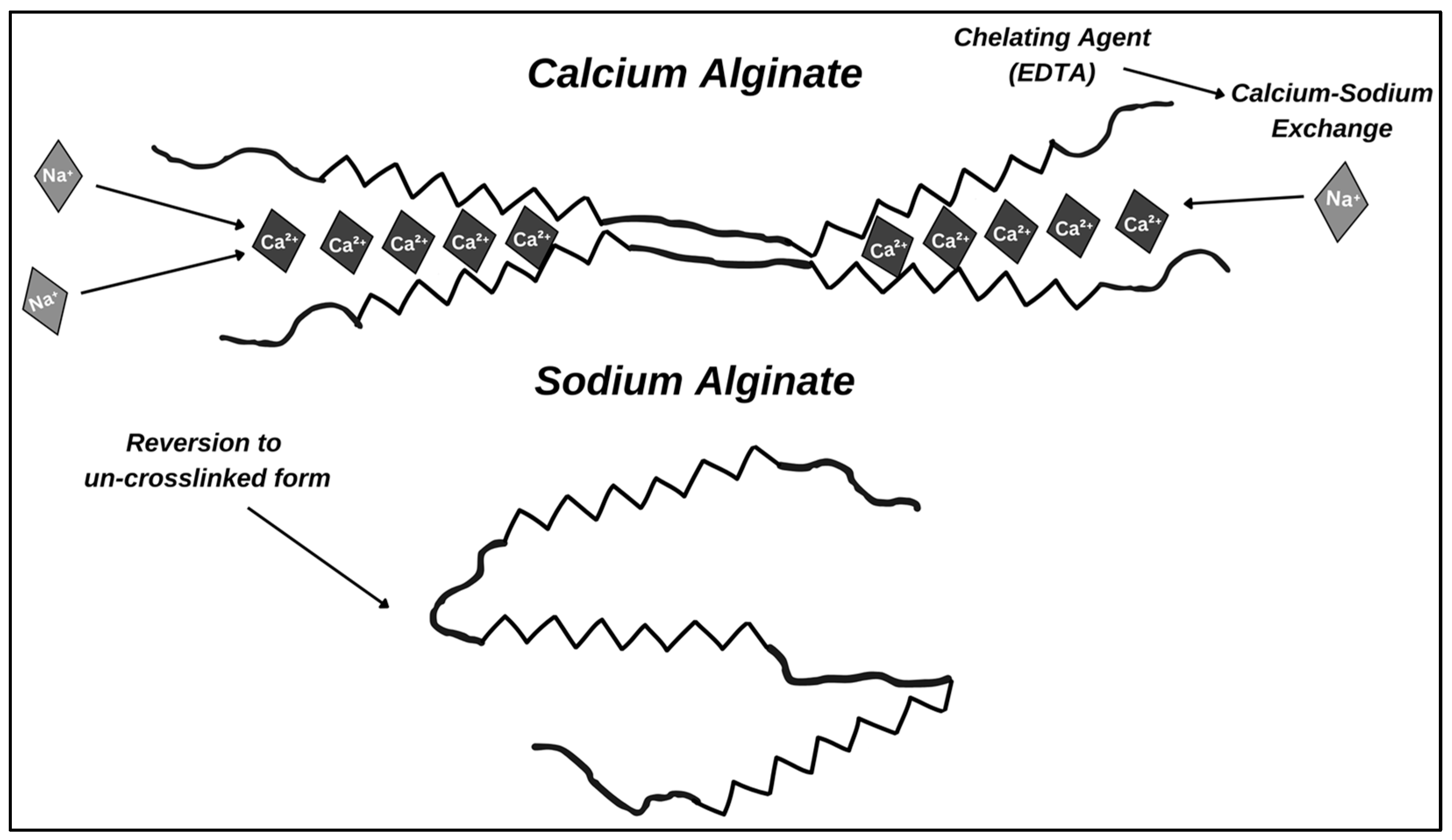
- In internal gelation, the release of calcium ions is induced by the addition of a slow acid-releasing agent into a solution containing soluble calcium salts or directly into soils, typically using GDL (D-glucono-δ-lactone), which lowers the pH of the solution, causing the source of calcium to dissolve and gradually release Ca2+ ions, forming a gel according to the reaction:
- In external gelation, a source of calcium is directly added to alginate solutions, where cations diffuse from a higher concentration region into the interior region of alginate particles, as demonstrated in Figure 4B. The diffusion method produces an alginate gel that is inhomogeneous with a high cation gradient near the gel surface, which decreases as it approaches the core [78]. At the outermost layer of the hydrogel-cation layer, gelling kinetics are rapid, and gel formation is instantaneous. This method of gelation is represented by the following reaction:
- Uncontrolled gelation refers to alginate gelation driven by divalent ions naturally present in the surrounding environment, particularly soils rich in calcium or magnesium, as displayed in Figure 4C. In this case, alginate is introduced directly into the soil without a defined external source of Ca2+. Crosslinking occurs as the alginate absorbs ions from the pore water or from native minerals, resulting in highly variable, spatially inconsistent gels. This mechanism lacks temporal or spatial control, often producing weak or non-uniform gels, and is influenced by the local ionic strength, mineral composition, and moisture content of the soil. Despite its variability, uncontrolled gelation is commonly employed in biopolymer soil treatment studies due to its simplicity and relevance to field-scale application [79,80,81].

4. Mechanical and Physical Properties of Ca-Alginate Hydrogels
4.1. Effect of M/G Ratio
4.2. Effect of Molecular Weight
4.3. Effect of Calcium Ion Concentration
4.4. Effect of Gelation Method
4.5. Impact of pH and Temperature
4.6. Stability of Alginate Gels
4.7. Implications for Durability in Engineering Environments
5. Earth Blocks
6. Poured Earth
7. Ground Improvement
7.1. Sandy Soils
7.2. Alginate-Clay Interactions
7.3. Clayey Soils
8. Cement Mixtures
8.1. Comparison of Biopolymers
8.2. Case Study Results
8.3. Variability of Results
9. Asphalt Mixtures
10. Thermal Insulation
11. Conclusions and Future Research Needs
Author Contributions
Funding
Data Availability Statement
Conflicts of Interest
References
- Plank, J. Applications of biopolymers and other biotechnological products in building materials. Appl. Microbiol. Biotechnol. 2004, 66, 1–9. [Google Scholar] [CrossRef] [PubMed]
- World Economic Forum. The Concrete Problem: How Can Cement Be More Sustainable? 2024. Available online: https://www.weforum.org/stories/2024/09/cement-production-sustainable-concrete-co2-emissions/ (accessed on 8 February 2025).
- International Energy Agency. Cement. 2024. Available online: https://www.iea.org/energy-system/industry/cement (accessed on 8 February 2025).
- Reddy, B.V.V.; Kumar, P.P. Embodied Energy in cement stabilised rammed earth walls. Energy Build. 2010, 42, 380–385. [Google Scholar] [CrossRef]
- Torgal, F.P. Introduction to nano- and biotech-based materials for Energy Building Efficiency. In Nano and Biotech Based Materials for Energy Building Efficiency; Springer: Cham, Switzerland, 2016; pp. 1–16. [Google Scholar] [CrossRef]
- Fatehi, H.; Ong, D.; Yu, J.; Chang, I. Biopolymers as green binders for soil improvement in Geotechnical Applications: A Review. Geosciences 2021, 11, 291. [Google Scholar] [CrossRef]
- Shin, H.J.; Woo, S.; Jung, G.Y.; Park, J.M. Indole-3-acetic acid production from alginate by vibrio sp. DHG: Physiology and characteristics. Biotechnol. Bioprocess Eng. 2023, 28, 695–703. [Google Scholar] [CrossRef]
- Ji, D.; Park, J.M.; Oh, M.S.; Nguyen, T.L.; Shin, H.; Kim, J.S.; Kim, D.; Park, H.S.; Kim, J. Superstrong, superstiff, and conductive alginate hydrogels. Nat. Commun. 2022, 13, 3019. [Google Scholar] [CrossRef] [PubMed]
- Temurayak, A.; Eskisar, T. Clay soil stabilization using xanthan gum and sodium alginate as biopolymers. In Lecture Notes in Civil Engineering; Springer: Berlin/Heidelberg, Germany, 2023; pp. 139–144. [Google Scholar] [CrossRef]
- Mignon, A.; Snoeck, D.; D’Halluin, K.; Balcaen, L.; Vanhaecke, F.; Dubruel, P.; Van Vlierberghe, S.; De Belie, D. Alginate biopolymers: Counteracting the impact of superabsorbent polymers on mortar strength. Constr. Build. Mater. 2016, 110, 169–174. [Google Scholar] [CrossRef]
- Boutouam, Y.; Hayek, M.; Bouarab, K.; Yahia, A. A Comprehensive Review of Plant-Based Biopolymers as Viscosity-Modifying Admixtures in Cement-Based Materials. Appl. Sci. 2024, 14, 4307. [Google Scholar] [CrossRef]
- Kohandelnia, M.; Hayek, M.; Bouarab, K.; Yahia, A. New perspectives into the rheology of earth suspensions modified with algae-derived biopolymers. Constr. Build. Mater. 2025, 503, 144523. [Google Scholar] [CrossRef]
- Fatehi, H.; Ong, D.; Yu, J.; Chang, I. The effects of particle size distribution and moisture variation on mechanical strength of biopolymer-treated soil. Polymers 2023, 15, 1549. [Google Scholar] [CrossRef]
- Wang, Y.; Lu, Y. Sodium alginate-based functional materials toward sustainable applications: Water treatment and energy storage. Ind. Eng. Chem. Res. 2023, 62, 11279–11304. [Google Scholar] [CrossRef]
- Wen, K.; Li, Y.; Huang, W.; Armwood, C.; Amini, F.; Li, L. Mechanical behaviors of hydrogel-impregnated sand. Constr. Build. Mater. 2019, 207, 174–180. [Google Scholar] [CrossRef]
- Fatehi, H.; Bahmani, M.; Noorzad, A. Strengthening of dune sand with sodium alginate biopolymer. In Eighth International Conference on Case Histories in Geotechnical Engineering; American Society of Civil Engineers: Reston, VA, USA, 2019; pp. 157–166. [Google Scholar]
- Azimi, M.; Soltani, A.; Mirzababaei, M.; Jaksa, M.B.; Ashwath, N. Biopolymer stabilization of clayey soil. J. Rock Mech. Geotech. Eng. 2024, 16, 2801–2812. [Google Scholar] [CrossRef]
- Liu, S.; Du, K.; Armwood-Godon, C.; Li, Y.; Navarro, I.; Li, L. Stabilization of expansive clayey soil through hydrogel for Mechanical Improvements. Int. J. Civ. Eng. 2023, 21, 1423–1431. [Google Scholar] [CrossRef]
- Menasria, F.; Perrot, A.; Rangeard, D. Using alginate biopolymer to enhance the mechanical properties of earth-based materials. Acad. J. Civ. Eng. 2017, 35, 143–147. [Google Scholar] [CrossRef]
- Hay, I.D.; Rehman, Z.U.; Moradali, M.F.; Wang, Y.; Rehm, B.H. Microbial alginate production, modification and its applications. Microb. Biotechnol. 2013, 6, 637–650. [Google Scholar] [CrossRef]
- Bhattacharya, S.; Das, S.; Banik, S. Fabrication and physicochemical investigation of pH-responsive alginate/pectin hybrid network hydrogel for improved stability and controlled release of diallyl thiosulfinate. Mater. Today Commun. 2024, 38, 108235. [Google Scholar] [CrossRef]
- Haug, A.; Smidsrød, O. Strontium–calcium selectivity of alginates. Nature 1967, 215, 757. [Google Scholar] [CrossRef]
- Donati, I.; Paoletti, S. Material properties of alginates. In Microbiology Monographs; Springer: Berlin/Heidelberg, Germany, 2009; pp. 1–53. [Google Scholar] [CrossRef]
- Peteiro, C. Alginate production from marine macroalgae, with emphasis on kelp farming. In Springer Series in Biomaterials Science and Engineering; Springer: Singapore, 2018; pp. 27–66. [Google Scholar] [CrossRef]
- Indergaard, M.; Skjåk-Bræk, G. Characteristics of alginate from Laminaria digitata cultivated in a high-phosphate environment. In Twelfth International Seaweed Symposium; Springer: Dordrecht, The Netherlands, 1987; pp. 541–549. [Google Scholar]
- Vauchel, P.; Kaas, R.; Arhaliass, A.; Baron, R.; Legrand, J. A new process for extracting alginate from laminaria digitata: Reactive extrusion. Food Bioprocess Technol. 2008, 1, 297–300. [Google Scholar] [CrossRef]
- Cajnko, M.M.; Novak, U.; Likozar, B. Cascade valorization process of brown alga seaweed laminaria hyperborea by isolation of polyphenols and alginate. J. Appl. Phycol. 2019, 31, 3915–3924. [Google Scholar] [CrossRef]
- Darko, C.N.; Premarathna, A.D.; Humayun, S.; Ageyi-Tuffour, B. Physico- and biochemical properties of alginates extracted from Ecklonia maxima and sargassum fluitans using a simple cascade process. J. Appl. Phycol. 2023, 36, 661–674. [Google Scholar] [CrossRef]
- Chen, Z.; Song, J.; Xia, Y.; Jiang, Y.; Murillo, L.L.; Tsigkou, O.; Wang, T.; Li, Y. High strength and strain alginate fibers by a novel wheel spinning technique for knitting stretchable and biocompatible wound-care materials. Mater. Sci. Eng. C 2021, 127, 112204. [Google Scholar] [CrossRef]
- Peña, C.; Miranda, L.; Segura, D.; Núñez, C.; Espín, G.; Galindo, E. Alginate production by Azotobacter vinelandii mutants altered in poly-β-hydroxybutyrate and alginate biosynthesis. J. Ind. Microbiol. Biotechnol. 2002, 29, 209–213. [Google Scholar] [CrossRef]
- Dudun, A.; Akoulina, E.; Zhuikov, V.; Makhina, T.; Voinova, V.; Belishev, N.; Khaydapova, D.; Shaitan, K.; Bonartseva, G.; Bonartsev, A. Competitive biosynthesis of bacterial alginate using Azotobacter vinelandii 12 for tissue engineering applications. Polymers 2021, 14, 131. [Google Scholar] [CrossRef]
- Sutherland, I.W. Alginates. In Biomaterials; Byrom, D., Ed.; Palgrave Macmillan: London, UK, 1991; pp. 309–331. [Google Scholar] [CrossRef]
- Zemke-White, W.L.; Ohno, M. World seaweed utilisation: An end-of-century summary. J. Appl. Phycol. 1999, 11, 369–376. [Google Scholar] [CrossRef]
- Susano, P.; Silva, J.; Alves, C.; Martins, A.; Pinteus, S.; Gaspar, H.; Goettert, M.I.; Pedrosa, R. Saccorhiza polyschides-A Source of Natural Active Ingredients for Greener Skincare Formulations. Molecules 2022, 27, 6496. [Google Scholar] [CrossRef]
- Díaz-Barrera, A.; Soto, E.; Altamirano, C. Alginate production and alg8 gene expression by Azotobacter vinelandii in continuous cultures. J. Ind. Microbiol. Biotechnol. 2012, 39, 613–621. [Google Scholar] [CrossRef] [PubMed]
- Bonartseva, G.A.; Akulina, E.; Myshkina, V.; Voinova, V.; Makhina, T.; Bonartsev, A. Alginate biosynthesis by Azotobacter bacteria. Appl. Biochem. Microbiol. 2017, 53, 52–59. [Google Scholar] [CrossRef]
- Galindo, E.; Peña, C.; Núñez, C.; Segura, D.; Espín, G. Molecular and bioengineering strategies to improve alginate and polydydroxyalkanoate production by Azotobacter vinelandii. Microb. Cell Factories 2007, 6, 7. [Google Scholar] [CrossRef] [PubMed]
- Remminghorst, U.; Rehm, B.H.A. Bacterial alginates: From biosynthesis to applications. Biotechnol. Lett. 2006, 28, 1701–1712. [Google Scholar] [CrossRef]
- Bojorges, H.; López-Rubio, A.; Martínez-Abad, A.; Fabra, M. Overview of alginate extraction processes: Impact on alginate molecular structure and techno-functional properties. Trends Food Sci. Technol. 2023, 140, 104142. [Google Scholar] [CrossRef]
- Łabowska, M.; Michalak, I.; Detyna, J. Methods of extraction, physicochemical properties of alginates and their applications in Biomedical Field—A Review. Open Chem. 2019, 17, 738–762. [Google Scholar] [CrossRef]
- Chee, S.Y.; Wong, P.K.; Wong, C.L. Extraction and characterisation of alginate from brown seaweeds (Fucales, Phaeophyceae) collected from Port Dickson, Peninsular Malaysia. J. Appl. Phycol. 2011, 23, 191–196. [Google Scholar] [CrossRef]
- Fertah, M.; Belfaquir, J.; Parthane, E.; Taourirte, M.; Brouillet, F. Extraction and characterization of sodium alginate from Moroccan laminaria digitata brown seaweed. Arab. J. Chem. 2017, 10, S3707–S3714. [Google Scholar] [CrossRef]
- Torres, M.R.; Sousa, A.T.S.; Filho, E.A.T.S.; Melo, D.F.; Feitosa, J.P.A.; de Paula, R.C.M.; Lima, M.G.S. Extraction and physicochemical characterization of Sargassum vulgare alginate from Brazil. Carbohydr. Res. 2007, 342, 2067–2072. [Google Scholar] [CrossRef]
- Caballero, E.; Flores, A.; Olivares, A. Sustainable exploitation of macroalgae species from Chilean coast: Characterization and food applications. Algal Res. 2021, 57, 102349. [Google Scholar] [CrossRef]
- Abraham, R.E.; Su, P.; Puri, M.; Raston, C.L.; Zhang, W. Optimisation of biorefinery production of alginate, fucoidan and laminarin from brown seaweed Durvillaea potatorum. Algal Res. 2019, 38, 101389. [Google Scholar] [CrossRef]
- Mohammed, A.; Rivers, A.; Stuckey, D.C.; Ward, K. Alginate extraction from Sargassum seaweed in the Caribbean region: Optimization using response surface methodology. Carbohydr. Polym. 2020, 245, 116419. [Google Scholar] [CrossRef]
- Mazumder, A.; Holdt, S.L.; de Francisci, D.; Alvarado-Morales, M.; Mishra, H.N.; Angelidaki, I. Extraction of alginate from Sargassum muticum: Process optimization and study of its functional activities. J. Appl. Phycol. 2016, 28, 3625–3634. [Google Scholar] [CrossRef]
- Hernández-Carmona, G.; Freile-Pelegrin, Y.; Hernández-Garibay, E. Conventional and alternative technologies for the extraction of algal polysaccharides. In Functional Ingredients from Algae for Foods and Nutraceuticals; Elsevier Ltd.: Amsterdam, The Netherlands, 2013; pp. 475–516. [Google Scholar] [CrossRef]
- Mohammed, A.; Bissoon, R.; Bajnath, E.; Mohammed, K.; Lee, T.; Bissram, M.; John, N.; Jalsa, N.K.; Lee, K.Y.; Ward, K. Multistage extraction and purification of waste Sargassum natans to produce sodium alginate: An optimization approach. Carbohydr. Polym. 2018, 198, 109–118. [Google Scholar] [CrossRef] [PubMed]
- Tiemi, N.M.; Rustici, C.L.; Yamashita, C.; Sawada, N.N.; Freitas, M.I.C.; Zanini, B.C.; Guilherme, B.I. Optimal conditions for alkaline treatment of alginate extraction from the brown seaweed Sargassum cymosum C. Agardh by response surface methodology. Appl. Food Res. 2022, 2, 100141. [Google Scholar] [CrossRef]
- Youssouf, L.; Lallemand, T.; Giraud, P.; Soule, F.; Bhavar-Gurumo, A.; Meilhac, O.; D’Hellencourt, C.L.; Junior, D.; Corpore, J. Ultrasound-assisted extraction and structural characterization by NMR of alginates and carrageenans from seaweeds. Carbohydr. Polym. 2017, 166, 55–63. [Google Scholar] [CrossRef]
- Putra, B.U.; Hardiningtyas, S.D.; Hastuti, N.; Ramadhan, W.; Uju; Razi, M.A.; Agustini, L. Alginate hydrogel incorporating cellulose nanofiber from solid waste agar industry for hydrophobic antibiotic delivery: Synthesis and characterization. Mater. Today Commun. 2024, 38, 108248. [Google Scholar] [CrossRef]
- Fenoradosoa, T.A.; Ali, G.; Delattre, C.; Laroche, C.; Petit, E.; Wadouachi, A.; Michaud, P. Extraction and characterization of an alginate from the brown seaweed Sargassum turbinarioides Grunow. J. Appl. Phycol. 2010, 22, 131–137. [Google Scholar] [CrossRef]
- Fawzy, M.A.; Gomaa, M.; Hillery, A.F.; Abdel-Gawad, K.M. Optimisation of alginate alkaline extraction technology from Sargassum latifolium and its potential antioxidant and emulsifying properties. Carbohydr. Polym. 2017, 157, 1903–1912. [Google Scholar] [CrossRef]
- Truus, K.; Vaher, M.; Taure, I. Algal biomass from fucus vesiculosus (phaeophyta): Investigation of the mineral and alginate components. Proc. Est. Acad. Sci. Chem. 2001, 50, 95–103. [Google Scholar] [CrossRef]
- Gomez, C.; Perez-Lambert, C.; Yzamo, J.E.; Rinaudo, M.; Villar, M.A. Influence of the extraction-purification conditions on final properties of alginates obtained from brown algae (Macrocystis pyrifera). Int. J. Biol. Macromol. 2009, 44, 365–371. [Google Scholar] [CrossRef] [PubMed]
- Hernández-Carmona, G.; McHugh, D.J.; Arvizu-Higuera, D.L.; Rodriguez-Montesinos, Y.E. Pilot plant scale extraction of alginates from Macrocystis pyrifera 4. Conversion of alginic acid to sodium alginate, drying and milling. J. Appl. Phycol. 2002, 14, 445–451. [Google Scholar] [CrossRef]
- Pawar, S.N.; Edgar, K.J. Alginate derivatization: A review of chemistry, properties and applications. Biomaterials 2012, 33, 3279–3305. [Google Scholar] [CrossRef] [PubMed]
- De Vos, P.; De Haan, B.J.; Wolters, G.H.J.; Strubbe, J.H.; Van Schilfgaarde, R. Improved biocompatibility but limited graft survival after purification of alginate for microencapsulation of pancreatic islets. Diabetologia 1997, 40, 262–270. [Google Scholar] [CrossRef]
- Klöck, G.; Frank, H.; Houben, R.; Zekorn, T.; Horcher, A.; Siebers, U.; Zimmermann, U. Production of purified alginates suitable for use in immunoisolated transplantation. Appl. Microbiol. Biotechnol. 1994, 40, 638–643. [Google Scholar] [CrossRef]
- Prokop, A.; Wang, T.G. Purification of polymers used for fabrication of an immunoisolation barrier. Ann. N. Y. Acad. Sci. 1997, 831, 223–231. [Google Scholar] [CrossRef]
- Davis, T.A.; Llanes, F.; Volesky, B.; Mucci, A. Metal selectivity of Sargassum spp. and their alginates in relation to their alpha-L-guluronic acid content and conformation. Environ. Sci. Technol. 2003, 37, 261–267. [Google Scholar] [CrossRef]
- Grant, G.T.; Morris, E.R.; Rees, D.A.; Smith, P.J.C.; Thom, D. Biological interactions between polysaccharides and divalent cations: The egg-box model. FEBS Lett. 1973, 32, 195–198. [Google Scholar] [CrossRef]
- Choi, I.; Lee, Y.; Lyu, J.S.; Lee, J.S.; Han, J. Characterization of ionically crosslinked alginate films: Effect of different anion-based metal cations on the improvement of water-resistant properties. Food Hydrocoll. 2022, 131, 107785. [Google Scholar] [CrossRef]
- Malektaj, H.; Drozdov, A.D.; de Claville Christiansen, J. Mechanical Properties of Alginate Hydrogels Cross-Linked with Multivalent Cations. Polymers 2023, 15, 3012. [Google Scholar] [CrossRef]
- Hasnain, M.S.; Jameel, E.; Mohanta, B.; Dhara, A.K.; Alkahtani, S.; Nayak, A.K. Alginates: Sources, structure, and properties. In Alginates in Drug Delivery; Elsevier: Amsterdam, The Netherlands, 2020; pp. 1–17. [Google Scholar] [CrossRef]
- Lacoste, C.; El Hage, R.; Bergeret, A.; Corn, S.; Lacroix, P. Sodium alginate adhesives as binders in wood fibers/textile waste fibers biocomposites for building insulation. Carbohydr. Polym. 2018, 184, 1–8. [Google Scholar] [CrossRef]
- Arab, M.G.; Omar, M.; Almajed, A.; Elbaz, Y.; Ahmed, A.H. Hybrid technique to produce bio-bricks using enzyme-induced carbonate precipitation (EICP) and sodium alginate biopolymer. Constr. Build. Mater. 2021, 284, 122846. [Google Scholar] [CrossRef]
- Bao, S.; Liu, Q.; Li, H.; Zhang, L.; Barbieri, D.M. Investigation of the release and self-healing properties of calcium alginate capsules in asphalt concrete under cyclic compression loading. J. Mater. Civ. Eng. 2021, 33, 04020401. [Google Scholar] [CrossRef]
- Cheng, L.; Yang, Y.; Chu, J. In-situ microbially induced Ca2+-alginate polymeric sealant for seepage control in porous materials. Microb. Biotechnol. 2019, 12, 324–333. [Google Scholar] [CrossRef]
- Zhang, P.; Liu, M.; Yang, Y.; Liu, H.; Gao, X.; Cheng, L. In situ microbially induced CA-alginate polymeric sealant in calcareous sand and potential engineering applications. Acta Geotech. 2024, 19, 4217–4226. [Google Scholar] [CrossRef]
- Pinel, A.; Jorand, Y.; Olagnon, C.; Charlot, A.; Fleury, E. Towards poured earth construction mimicking cement solidification: Demonstration of feasibility via a biosourced polymer. Mater. Struct. 2017, 50, 224. [Google Scholar] [CrossRef]
- Galán-Marín, C.; Rivera-Gómez, C.; Petric, J. Clay-based composite stabilized with natural polymer and fibre. Constr. Build. Mater. 2010, 24, 1462–1468. [Google Scholar] [CrossRef]
- Torfi, S.; Khayat, N.; Horpibulsuk, S. Sustainable stabilization of compacted clay using sodium alginate for subgrade application. Int. J. Geosynth. Ground Eng. 2021, 7, 82. [Google Scholar] [CrossRef]
- Feng, J.; Yap, X.Y.; Gao, J. Rapid self-sealing of macro cracks of cementitious composites by in-situ alginate crosslinking. Cem. Concr. Res. 2023, 165, 107074. [Google Scholar] [CrossRef]
- Alselwi, O.; Li, B.X.; Yue, S.L. Efficacy of sodium alginate, Xanthan Gum, and diatomite admixtures in improving the strength and shrinkage behaviour of EPS Lightweight Concrete. Eur. J. Environ. Civ. Eng. 2022, 27, 2136–2149. [Google Scholar] [CrossRef]
- Ching, S.H.; Bansal, N.; Bhandari, B. Alginate gel particles-A review of production techniques and physical properties. Crit. Rev. Food Sci. Nutr. 2017, 57, 1133–1152. [Google Scholar] [CrossRef] [PubMed]
- Quong, D.; Neufeld, R.J.; Skjåk-Braek, G.; Poncelet, D. External versus internal source of calcium during the gelation of alginate beads for DNA encapsulation. Biotechnol. Bioeng. 1998, 57, 438–446. [Google Scholar] [CrossRef]
- Zha, H.; Fu, H.; Zeng, L.; Zhu, X.; Jia, C. Use of sodium alginate as a novel cementitious material to improve the engineering properties of disintegrated carbonaceous mudstone. Bull. Eng. Geol. Environ. 2022, 81, 431. [Google Scholar] [CrossRef]
- Elkenawy, M.; Gabr, A.; Arab, M.G. Mechanical properties of unsaturated expansive soils treated with eco-friendly sodium alginate biopolymer. Int. J. Geosynth. Ground Eng. 2023, 9, 34. [Google Scholar] [CrossRef]
- Lemboye, K.; Almajed, A. Effect of Varying Curing Conditions on the Strength of Biopolymer Modified Sand. Polymers 2023, 15, 1678. [Google Scholar] [CrossRef]
- Hu, C.; Lu, W.; Mata, A.; Nishinari, K.; Fang, Y. Ions-induced gelation of alginate: Mechanisms and applications. Int. J. Biol. Macromol. 2021, 177, 578–588. [Google Scholar] [CrossRef]
- Gacesa, P. Bacterial alginate biosynthesis--recent progress and future prospects. Microbiology 1998, 144, 1133–1143. [Google Scholar] [CrossRef]
- Tøndervik, A.; Klinkenberg, G.; Aarstad, O.A.; Drabløs, F.; Ertesvåg, H.; Ellingsen, T.E.; Skjåk-Bræk, G.; Valla, S.; Sletta, H. Isolation of mutant alginate lyases with cleavage specificity for di-guluronic acid linkages. J. Biol. Chem. 2010, 285, 35284–35292. [Google Scholar] [CrossRef]
- Lee, H.Y.; Chan, L.W.; Dolzhenko, A.V.; Heng, P.W.S. Influence of viscosity and uronic acid composition of alginates on the properties of alginate films and microspheres produced by emulsification. J. Microencapsul. 2006, 23, 912–927. [Google Scholar] [CrossRef]
- Murillo-Álvarez, J.I.; Hernández-Carmona, G. Monomer composition and sequence of sodium alginate extracted at pilot plant scale from three commercially important seaweeds from Mexico. J. Appl. Phycol. 2007, 19, 545–548. [Google Scholar] [CrossRef]
- Smidsrød, O.; Draget, K.I. Chemistry and physical properties of alginates. Carbohydr. Eur. 1996, 14, 6–13. [Google Scholar]
- Draget, K.I.; Moe, S.T.; Skjak-Bræk, G.; Smidsrød, O. Alginates. In Food Polysaccharides and Their Applications; Stephen, A.M., Phillips, G.O., Williams, P.A., Eds.; CRC Press: Boca Raton, FL, USA, 2006; pp. 289–334. [Google Scholar]
- Lee, K.Y.; Mooney, D.J. Alginate: Properties and biomedical applications. Prog. Polym. Sci. 2012, 37, 106–126. [Google Scholar] [CrossRef]
- Sikorski, P.; Mo, F.; Skjåk-Braek, G.; Stokke, B.T. Evidence for egg-box-compatible interactions in calcium-alginate gels from fiber X-ray diffraction. Biomacromolecules 2007, 8, 2098–2103. [Google Scholar] [CrossRef] [PubMed]
- Kong, H.J.; Mooney, D.J. Controlling Material Properties of Ionically Cross-Linked Alginate Hydrogels by Varying Molecular Weight Distribution. MRS Proc. 2001, 711, 571. [Google Scholar] [CrossRef]
- Tansik, G.; Stowers, R. Viscoelastic and phototunable GelMA-alginate hydrogels for 3D cell culture. MRS Adv. 2024, 9, 505–511. [Google Scholar] [CrossRef]
- Smith, A.M.; Senior, J.J. Alginate Hydrogels with Tuneable Properties. Adv. Biochem. Eng./Biotechnol. 2021, 178, 37–61. [Google Scholar] [CrossRef]
- Matyash, M.; Despang, F.; Ikonomidou, C.; Gelinsky, M. Swelling and mechanical properties of alginate hydrogels with respect to promotion of neural growth. Tissue Eng. Part C Methods 2014, 20, 401–411. [Google Scholar] [CrossRef]
- Jiwei, L.; Yadong, W.; Jinmei, H.; Yudong, H. A new insight to the effect of calcium concentration on gelation process and physical properties of alginate films. J. Mater. Sci. 2016, 51, 5791–5801. [Google Scholar] [CrossRef]
- Rheolution Inc. Mechanical Testing of CELLINK Alginate Gels. 2025. Available online: https://rheolution.com/application-notes/mechanical-testing-of-cellink-alginate-gels/ (accessed on 10 March 2025).
- Chan, L.W.; Lee, H.Y.; Heng, P.W.S. Mechanisms of external and internal gelation and their impact on the functions of alginate as a coat and delivery system. Carbohydr. Polym. 2006, 63, 176–187. [Google Scholar] [CrossRef]
- Mumper, R.; Huffman, A.; Puolakkainen, P.; Bouchard, L.; Gombotz, W. Calcium-alginate beads for the oral delivery of transforming growth factor-β1 (TGF-β1): Stabilization of TGF-β1 by the addition of polyacrylic acid within acid-treated beads. J. Control. Release 1994, 30, 241–251. [Google Scholar] [CrossRef]
- Draget, K.I.; Skjåk-Braek, G.; Smidsrød, O. Alginate based new materials. Int. J. Biol. Macromol. 1997, 21, 47–55. [Google Scholar] [CrossRef] [PubMed]
- Wee, S.; Gombotz, W.R. Protein release from alginate matrices. Adv. Drug Deliv. Rev. 1998, 31, 267–285. [Google Scholar] [CrossRef]
- Oates, C.G.; Ledward, D.A. Studies on the effect of heat on alginates. Food Hydrocoll. 1990, 4, 215–220. [Google Scholar] [CrossRef]
- Leo, W.J.; McLoughlin, A.J.; Malone, D.M. Effects of sterilization treatments on some properties of alginate solutions and gels. Biotechnol. Prog. 1990, 6, 51–53. [Google Scholar] [CrossRef] [PubMed]
- Sreya, E.S.; Kumar, D.P.; Balakrishnan, P.; Gopi, S. Science and Technology of Alginates: A Review. In Handbook of Biomass; Thomas, S., Hosur, M., Pasquini, D., Jose Chirayil, C., Eds.; Springer: Singapore, 2023. [Google Scholar] [CrossRef]
- Hashemnejad, S.; Kundu, S. Rheological properties and failure of alginate hydrogels with ionic and covalent crosslinks. Soft Matter 2019, 15, 7852–7862. [Google Scholar] [CrossRef]
- Draget, K.I. Alginates: Fundamental properties and food applications. Ref. Modul. Food Sci. 2016, 1–9. [Google Scholar] [CrossRef]
- Hilbig, J.; Hartlieb, K.; Herrmann, K.; Weiss, J.; Gibis, M. Influence of calcium on white efflorescence formation on dry fermented sausages with co-extruded alginate casings. Food Res. Int. 2020, 131, 109012. [Google Scholar] [CrossRef]
- Yin, S.; Ma, H.; Zheng, M.; Ma, Y. Mechanical properties enhancement and permeability control of silty soils by modified sodium alginate. Int. J. Biol. Macromol. 2025, 333, 148412. [Google Scholar] [CrossRef]
- Castro, G.M.; Tewelde, D.; Tubaldi, E. Assessment of the use of sodium alginate for soil improvement in coastal applications. Sci. Rep. 2025, 15, 35043. [Google Scholar] [CrossRef]
- Galán-Marín, C.; Rivera-Gómez, C.; Petric-Gray, J. Animal fibres and seaweed polymers to improve unfired clay blocks characteristics. In Clay: Types, Properties and Uses; Nova Science Publishers: Hauppauge, NY, USA, 2011; pp. 115–154. [Google Scholar]
- Dove, C. The development of unfired earth bricks using seaweed biopolymers. WIT Trans. Built Environ. 2014, 142, 219–230. [Google Scholar] [CrossRef]
- Dove, C.A.; Bradley, F.F.; Patwardhan, S.V. Seaweed biopolymers as additives for unfired clay bricks. Mater. Struct. 2016, 49, 4463–4482. [Google Scholar] [CrossRef]
- Pinel, A.; Prud’Homme, E.; Charlot, A.; Fleury, E.; Jorand, Y. Earthen construction: Demonstration of feasibility at 1/2 scale of poured clay concrete construction. Constr. Build. Mater. 2021, 312, 125275. [Google Scholar] [CrossRef]
- Maierdan, Y.; Armistead, S.; Mikofsky, R.; Huang, Q. Rheology and 3D printing of alginate bio-stabilized earth concrete. Cem. Concr. Res. 2024, 175, 107380. [Google Scholar] [CrossRef]
- Lemboye, K.; Almajed, A.; Hamid, W.; Arab, M. Permeability investigation on sand treated using enzyme-induced carbonate precipitation and biopolymers. Innov. Infrastruct. Solut. 2021, 6, 167. [Google Scholar] [CrossRef]
- Almajed, A.; Lemboye, K.; Arab, M.G.; Alnuaim, A. Mitigating wind erosion of sand using biopolymer-assisted EICP technique. Soils Found. 2020, 60, 356–371. [Google Scholar] [CrossRef]
- Soldo, A.; Miletić, M.; Auad, M.L. Biopolymers as a sustainable solution for the enhancement of soil mechanical properties. Sci. Rep. 2020, 10, 267. [Google Scholar] [CrossRef]
- Li, J.; Wen, K.; Zhang, B. Investigation of mechanical behavior of sustainable construction materials: Recycled glass sand stabilized with natural binder material—Biopolymers. Constr. Build. Mater. 2024, 418, 135359. [Google Scholar] [CrossRef]
- Arab, M.G.; Refaei, M.; Alotaibi, E.; Omar, M.; Almajed, A.; Haridy, S. Optimizing the compressive strength of sodium alginate-modified EICP-treated sand using design of experiments. J. Mater. Civ. Eng. 2024, 36, 04024017. [Google Scholar] [CrossRef]
- Zhao, H.; Ahmed, M.M.M.; Yang, Y.; Li, Y.; Huang, B.-S.; Shiu, B.-C.; Peng, Q.; Shi, Q.; Lou, C.-W. Engineered clay-alginate composites for tetracycline removal: Mechanistic insights and sustainable processing. Environ. Res. 2025, 282, 122023. [Google Scholar] [CrossRef]
- Quezada, G.R.; Toledo, P.G.; Sandoval, K.K.; Miller, J.D.; Jeldres, R.I. Molecular Dynamics Study of Polyacrylamide and Polysaccharide-Derived Flocculants Adsorption on Mg(OH)2 Surfaces at pH 11. Polymers 2025, 17, 227. [Google Scholar] [CrossRef]
- Li, Y.; Chen, C.; Xia, W.; Qiu, H.; Peng, Y. The influence of sodium alginate on kaolinite flocculation in presence of metal ions: Guidance for green processing. Colloids Surf. A 2025, 707, 135893. [Google Scholar] [CrossRef]
- Arab, M.G.; Mousa, R.A.; Gabr, A.R.; Azam, A.M.; El-Badawy, S.M.; Hassan, A.F. Resilient behavior of sodium alginate–treated cohesive soils for pavement applications. J. Mater. Civ. Eng. 2019, 31, 04018361. [Google Scholar] [CrossRef]
- El Sawwaf, M.; Shahien, M.; Nasr, A.; Habib, M. Improvement of collapsible soil characteristics using environmentally friendly materials. Indian Geotech. J. 2023, 53, 1202–1212. [Google Scholar] [CrossRef]
- Bakhshizadeh, A.; Khayat, N.; Horpibulsuk, S. Surface stabilization of clay using sodium alginate. Case Stud. Constr. Mater. 2022, 16, e01006. [Google Scholar] [CrossRef]
- Kaplan, A.N.; Tufan, M.Z.; Özel, C. Investigation of some cellulose derivatives effects on concrete properties using response surface methodology. Constr. Build. Mater. 2024, 416, 135115. [Google Scholar] [CrossRef]
- Pourchez, J.; Peschard, A.; Grosseau, P.; Guyonnet, R.; Guilhot, B.; Vallée, P. HPMC and HEMC influence on cement hydration. Cem. Concr. Res. 2006, 36, 288–294. [Google Scholar] [CrossRef]
- Chang, I.; Im, J.; Prasidhi, A.K.; Cho, G.-C. Effects of xanthan gum biopolymer on soil strengthening. Constr. Build. Mater. 2015, 74, 65–72. [Google Scholar] [CrossRef]
- Phan, V.T. Evaluation of Some Rheological Properties of Xanthan Gum. Eng. Technol. Appl. Sci. Res. 2020, 10, 6172–6175. [Google Scholar] [CrossRef]
- Baykara, H.; Riofrio, A.; Garcia-Troncoso, N.; Cornejo, M.; Tello-Ayala, K.; Rada, J.F.; Caceres, J. Chitosan-Cement Composite Mortars: Exploring Interactions, Structural Evolution, Environmental Footprint and Mechanical Performance. ACS Omega 2024, 9, 24978–24986. [Google Scholar] [CrossRef] [PubMed]
- Necas, J.; Bartosikova, L. Carrageenan: A review. Vet. Med. 2013, 58, 187–205. [Google Scholar] [CrossRef]
- Cruz, C.M.; Maestrelli, S.C.; Pugine, S.M. Addition of sodium alginate capsules containing lysinibacillus sphaericus for self-healing of cracks in mortars. Res. Soc. Dev. 2023, 12, e4612340331. [Google Scholar] [CrossRef]
- Risdanareni, P.; Wang, J.; Boon, N. Performance of self-healing mortar containing bacteria immobilized in alginate coated alkali activated lightweight aggregate. Constr. Build. Mater. 2024, 429, 136351. [Google Scholar] [CrossRef]
- Soda, P.R.; Mogal, A.; Chakravarthy, K. Performance Assessment of Sustainable Biocement mortar incorporated with bacteria-encapsulated cement-coated alginate beads. Constr. Build. Mater. 2024, 411, 134198. [Google Scholar] [CrossRef]
- Fahimizadeh, M.; Abeyratne, A.D.; Mae, L.S. Biological self-healing of cement paste and mortar by non-ureolytic bacteria encapsulated in alginate hydrogel capsules. Materials 2020, 13, 3711. [Google Scholar] [CrossRef]
- Engbert, A.; Gruber, S.; Plank, J. The effect of alginates on the hydration of calcium aluminate cement. Carbohydr. Polym. 2020, 236, 116038. [Google Scholar] [CrossRef]
- Rong, H.; Hu, K.; Ma, G. Effect of sodium alginate on the properties of microbial repair materials and its repair effect on mortar crack. Front. Mater. 2022, 9, 959935. [Google Scholar] [CrossRef]
- Wang, J.; Mignon, A.; Snoeck, D. Application of modified-alginate encapsulated carbonate producing bacteria in concrete: A promising strategy for crack self-healing. Front. Microbiol. 2015, 6, 1088. [Google Scholar] [CrossRef]
- Liu, R.; Lin, Z.; Fan, S.; Cheng, Y.; Li, Y.; Li, J.; Zou, H.; Chen, Y.; Zheng, L.; Li, J. Research on the Effect of Calcium Alginate-Red Mud Microspheres on the Performance of Cement Mortar by Partially Replacing Standard Sand. Materials 2025, 18, 3326. [Google Scholar] [CrossRef]
- Li, M.; Pan, L.; Li, J.; Xiong, C. Competitive adsorption and interaction between sodium alginate and polycarboxylate superplasticizer in fresh cement paste. Colloids Surf. A 2020, 586, 124249. [Google Scholar] [CrossRef]
- Al-Mansoori, T.; Norambuena-Contreras, J.; Garcia, A. Effect of capsule addition and healing temperature on the self-healing potential of asphalt mixtures. Mater. Struct. 2018, 51, 53. [Google Scholar] [CrossRef]
- Zhang, L.; Liu, Q.; Li, H.; Norambuena-Contreras, J.; Wu, S.; Bao, S.; Shu, B. Synthesis and characterization of multi-cavity Ca-alginate capsules used for self-healing in asphalt mixtures. Constr. Build. Mater. 2019, 211, 298–307. [Google Scholar] [CrossRef]
- Norambuena-Contreras, J.; Yalcin, E.; Hudson-Griffiths, R.; Garcia, A. Mechanical and self-healing properties of stone mastic asphalt containing encapsulated rejuvenators. J. Mater. Civ. Eng. 2019, 31, 04019052. [Google Scholar] [CrossRef]
- Shu, B.; Zhang, L.; Wu, S.; Dong, L.; Liu, Q.; Wang, Q. Synthesis and characterization of compartmented Ca-alginate/silica self-healing fibers containing bituminous rejuvenator. Constr. Build. Mater. 2018, 190, 623–631. [Google Scholar] [CrossRef]
- Shu, B.; Wu, S.; Dong, L.; Norambuena-Contreras, J.; Yang, X.; Li, C.; Liu, Q.; Wang, Q. Microfluidic synthesis of polymeric fibers containing rejuvenating agent for asphalt self-healing. Constr. Build. Mater. 2019, 219, 176–183. [Google Scholar] [CrossRef]
- Zaremotekhases, F.; Idris, I.I.; Hassan, M.M.; Mohammad, L.N.; Negulescu, I.I. Effect of sodium alginate fibers encapsulating rejuvenators on the self-healing capability and cracking resistance of asphalt mixtures. J. Mater. Civ. Eng. 2020, 32, 04020355. [Google Scholar] [CrossRef]
- Ozdemir, A.M.; Yilmaz, M.; Yalcin, E.; Kok, B.V.; Norambuena-Contreras, J.; Garcia, A. Effects of capsules containing waste oils on the mechanical properties of hot mix asphalt: Experimental approach. J. Mater. Civ. Eng. 2021, 33, 04021242. [Google Scholar] [CrossRef]
- Yu, X.; Liu, Q.; Wan, P.; Song, J.; Wang, H.; Zhao, F.; Wang, Y.; Wu, J. Effect of ageing on self-healing properties of asphalt concrete containing calcium alginate/attapulgite composite capsules. Materials 2022, 15, 1414. [Google Scholar] [CrossRef]
- Aguirre, M.A.; Hassan, M.M.; Shirzad, S.; Mohammad, L.N.; Cooper, S.B., Jr.; Negulescu, I.I. Performance characteristics of asphalt binders containing sodium-alginate hollow fibers and recycled materials. MATEC Web Conf. 2019, 271, 03004. [Google Scholar] [CrossRef]
- Dove, C.; Bradley, F.; Patwardhan, S. A material characterization and embodied energy study of novel clay-alginate composite aerogels. Energy Build. 2019, 184, 88–98. [Google Scholar] [CrossRef]
- Chen, F. Study on mechanical and thermal performance of building energy-saving wall insulation materials based on sodium alginate. E3S Web Conf. 2021, 242, 02005. [Google Scholar] [CrossRef]
- Zhu, J.; Li, X.; Li, D.; Jiang, C. Thermal insulation and flame retardancy of the hydroxyapatite nanorods/sodium alginate composite aerogel with a double-crosslinked structure. ACS Appl. Mater. Interfaces 2022, 14, 45822–45831. [Google Scholar] [CrossRef] [PubMed]
- Guan, F.; Feng, S.; Sun, J.; Yang, Q.; Zhang, Y.; Li, Z.; Tao, J.; Ji, X.; Wang, Y.; Bao, D.; et al. Low–temperature superelastic, anisotropic, silane-crosslinked sodium alginate aerogel for thermal insulation. Int. J. Biol. Macromol. 2024, 262, 129800. [Google Scholar] [CrossRef]
- Zhan, H.; Liu, J.; Wang, P.; Wang, C.; Wang, Z.; Chen, M.; Zhu, X.; Fu, B. Integration of N- and P-elements in sodium alginate aerogels for efficient flame retardant and thermal insulating properties. Int. J. Biol. Macromol. 2024, 273, 132643. [Google Scholar] [CrossRef]
- Jing, N.; Feng, Y.; Ge, H.; Tang, Q.; Xie, Y.; Li, S. Sodium alginate- grapefruit peel aerogels with outstanding thermal conductivity, excellent compressive strength, and low density. Mater. Today Commun. 2025, 45, 112427. [Google Scholar] [CrossRef]
- Xu, H.; Liu, C.; Guo, W.; Li, N.; Chen, Y.; Meng, X.; Zhai, M.; Zhang, S.; Wang, Z. Sodium alginate/Al2O3 fiber nanocomposite aerogel with thermal insulation and flame retardancy properties. Chem. Eng. J. 2024, 489, 151223. [Google Scholar] [CrossRef]
- Guo, Y.; Shen, K.; Chen, Z.; Chen, S.; Wu, C.; Wu, Q.; Liu, A.; Yang, P.; Ma, Z.; Yang, L. 3D-printed fumed silica/sodium alginate aerogels for thermal insulation. Ceram. Int. 2025, 51, 17492–17502. [Google Scholar] [CrossRef]




| Major Alginate Producing Seaweed and Bacteria | Alginate Type | Major Producer Countries | Molar Mass (kDa) | Reference |
|---|---|---|---|---|
| Laminaria digitata and Laminaria hyperborea | Medium G and high G | France, Ireland, the United Kingdom, Norway | 75–297 and 220–500 | [25,26,27] |
| Ecklonia maxima | Medium G | South Africa | 58–1506 | [28] |
| Saccharina japonica | Medium G | China, Japan | 1800 | [29] |
| Azotobacter vinelandii | High G | / | 4000 | [30,31] |
| Factor | Influence on Alginate Extraction | Reference |
|---|---|---|
| Temperature | - Higher temperatures (up to a point) increase extraction yield. - Excessive temperatures (>60 °C) can degrade alginate polymers, reducing viscosity and molecular weight. - Optimal temperature varies depending on the algae species. | [41,42,43,44,45,46,47] |
| Alkaline Concentration | - Na2CO3 is commonly used to raise the pH to 9–10. - Optimal concentration ranges between 2 and 4% for maximum yield. - Higher concentrations (>4%) can decrease yield due to degradation and formation of carboxylic acids. | [47,48,49,50,51] |
| pH | - Alkaline pH (above 10) converts alginic acid into soluble sodium alginate. - A pH around 10 is generally optimal for higher yield. - Extreme pH values can cause degradation or affect the quality of the alginate. | [40,47,50,51,52,53] |
| Extraction Time | - Longer extraction times generally increase yield. - Excessive time can lead to depolymerization, reducing viscosity and altering the M/G ratio. - Optimal extraction time varies, typically ranging from 2 to 6 h. | [26,43,46,47,54,55] |
| Interactions Between Factors | - Temperature, time, and pH interact to influence yield and quality. - High temperature combined with longer extraction time can cause depolymerization. - Optimal extraction conditions depend on the specific algal species and desired alginate properties. | [46,54] |
| Precipitation Method | - Different methods (ethanol, CaCl2, HCl) impact the molecular weight and mechanical properties of alginate. - The ethanol route is simpler with higher yield and better rheological properties. - The calcium and HCl routes can lead to reduced mechanical properties. | [24,40,56] |
| Purification and Drying | - Purification methods vary and aim to remove impurities. - Standard methods are not always efficient at fully removing proteins. - Drying methods influence the final particle size and quality of the alginate. | [57,58,59,60,61] |
| Alginates | Acidic Environment | Alkaline Environment | Presence of Divalent/Trivalent Metal Cations |
|---|---|---|---|
| Alginic acid | Insoluble | Soluble | Insoluble |
| Sodium alginate | Insoluble | Soluble | Insoluble |
| Potassium alginate | Insoluble | Soluble | Insoluble |
| Calcium alginate | Insoluble | Insoluble | Insoluble |
| Ammonium alginate | Soluble | Soluble | Soluble |
| Alginate Application | Source of Calcium | Naturally Found or Additive | Gelation Method | Reference Study |
|---|---|---|---|---|
| Bio-Composite Adhesive | Calcium Sulphate (CaSO4) | Additive | Internal | [67] |
| Bio-Brick Binder | Calcium Chloride (CaCl2) | Additive | External | [68] |
| Sandy Soil Stabilizer | Calcium Chloride (CaCl2) | Additive | External | [15] |
| Clay Soil Stabilizer | Calcium Chloride (CaCl2) | Additive | External | [18] |
| Self-Healing Asphalt Concrete Emulsifier | Calcium Chloride (CaCl2) | Additive | External | [69] |
| Sandy Soil Stabilizer | Calcium Carbonate (CaCO3) | Additive | Internal | [70] |
| Sandy Soil Stabilizer | Soil | Naturally Found | Internal | [71] |
| Poured Earth Binder | Calcium Carbonate (CaCO3) | Additive | Internal | [72] |
| Unfired Earth Brick Binder | Soil | Naturally Found | Internal | [73] |
| Clay Soil Stabilizer | Soil | Naturally Found | Uncontrolled | [74] |
| Self-Healing Cement Composite | Soil | Naturally Found | Uncontrolled | [75] |
| Concrete Strengthener | Soil | Naturally Found | Uncontrolled | [76] |
| Seaweed Species | Composition | Sequence | Reference | ||||
|---|---|---|---|---|---|---|---|
| F M | F G | M/G | F MM | F GG | F MG, GM | ||
| Macrocystis pyrifera | 0.62 | 0.38 | 1.63 | 0.42 | 0.18 | 0.20 | [86] |
| Laminaria digitata | 0.59 | 0.41 | 1.43 | 0.43 | 0.25 | 0.16 | [87] |
| Laminaria hyperborea | 0.45 | 0.55 | 0.81 | 0.28 | 0.38 | 0.17 | [88] |
| Saccharina latissima | 0.45 | 0.55 | 0.82 | 0.33 | 0.43 | 0.12 | [24] |
| Ecklonia maxima | 0.55 | 0.45 | 1.22 | 0.32 | 0.22 | 0.32 | [88] |
| Ascophyllum nodosum | 0.61 | 0.39 | 1.56 | 0.46 | 0.23 | 0.16 | [24] |
| Alginate Concentration (w/w by Dry Soil Mass%) | Primary Aim | Calcium Source and Gelation Method | Soil Type | Treatment Method(s) | Variable(s) Studied | Test(s) Performed | Reference |
|---|---|---|---|---|---|---|---|
| (19.5%) | Mechanical Strength | Soil, Internal | Clay (32%), Sand (22.5%), Silt (45%) | Wet Mixing | Wool Inclusion, Mixture Composition | UCS, 3PB (Three-point bending) | [109] |
| (0.1%) | Mechanical Strength | Soil, Uncontrolled | Clay (20%), Silt (68%), Sand and Gravel (12%) | Wet Mixing | Alginate Type | UCS, 3PB, Shrinkage | [110] |
| (0.1%, 0.25%, 0.5%) | Mechanical Strength, Durability | Soil, Uncontrolled | Clay (31%, 27%, 16%), Silt (45%, 44%, 41%), Sand and Gravel (24%, 29%, 23%) | Wet Mixing | Concentration, Alginate Type, Soil Type | UCS, 3PB, Erosion, Water Sensitivity | [111] |
| (1%, 3%, 5%) | Mechanical Strength | Soil, Uncontrolled | Clay (17%), Sand (83%) | Dry Mixing | Concentration, Dry Density | UCS, 3PB | [19] |
| (0.5%, 1%, 1.5%) | Mechanical Strength, Durability | CaCl2, External | Sand (100%) | Dry Mixing | Concentration | UCS, 3PB, Water Absorption, Wet–Dry, Freeze–Thaw, Thermal Conductivity | [68] |
| SA Concentration (w/w of Dry Soil Mass%) | Primary Aim | Calcium Source and Gelation Method | Soil Type (USCS) and D50 (mm) | Treatment Method(s) | Variable(s) Studied | Test(s) Performed | Reference |
|---|---|---|---|---|---|---|---|
| (0.1%, 0.2%, 0.3%, 0.4%) | Mechanical Improvement | CaCl2, External | SP (Poorly graded) Sand, 0.35 | Wet Mixing | Concentration, Curing Time, and Temperature | UCS, CU Triaxial, Falling Head Permeability, Wet–Dry, Freeze–Thaw | [15] |
| (1%, 2%, 3%, 5%) | Mechanical Improvement | Soil, Uncontrolled | SP Sand, 0.18 | Dry Mixing | Concentration, Curing Time, and Temperature | UCS | [16] |
| (0.5%, 1%, 2%) | Erosion Control | CaCl2 (EICP), External | SP Sand, 0.24 | Spraying | Concentration, Curing Time | Surface Strength, Wind Erosion Resistance | [115] |
| (1%, 2%) | Mechanical Improvement | CaCl2, External | SW (Well-graded) Sand with Silt, 0.60 | Wet Mixing | Concentration, Curing Time | UCS | [116] |
| (0.5%) | Physical Improvement | CaCl2 (EICP), External | SP Sand, 0.62 | Dry Mixing | Concentration | Constant Head Permeability | [114] |
| (0.5%, 1%, 2%, 3%, 5%) | Mechanical Improvement | Soil, Uncontrolled | SP Sand, 0.15 | Dry Mixing | Concentration, Curing Time, and Temperature | UCS | [81] |
| (0.5%, 0.7%, 0.9%, 1.1%, 1.3%) | Mechanical Improvement | CaCl2 (MICP), External | SP Sand, N/A | Soaking | Concentration | UCS, Constant Head Permeability | [14] |
| (0.25%, 0.5%, 2%) | Mechanical Improvement | Soil, Uncontrolled | SP Sand with Silt, 0.49 | Wet Mixing | Concentration, Curing Time, Soil Type | UCS, Curing Time, Wet–Dry | [13] |
| (0.1%, 0.3%, 0.5%) | Physical Improvement | Soil, Internal | SP Sand, 0.94 | Wet Mixing | Concentration, Curing Time | UCS, Falling Head Permeability, Water Erosion Resistance | [71] |
| (0.6%, 1.2%) | Mechanical Improvement | CaCl2 (EICP), External | SP Sand, 0.36 | Wet Mixing | Concentration, Curing Time, and Temperature | UCS, Wet–Dry | [117] |
| (0.3%, 0.4%, 0.5%) | Mechanical Improvement | CaCl2, External | SP Sand, 0.51 | Wet Mixing | Concentration, Curing Time, and Temperature | UCS, Consolidated Drained (CD) Triaxial | [118] |
| (1.4%, 2.3%, 4.6%, 8%, 10%) | Mechanical Improvement | CaCl2, External | SP Sand, 0.21 | Dry Mixing, Wet Mixing | Concentration, Alginate Type, Mixing Method | UCS, Wet–Dry | [108] |
| SA Concentration (w/w% of dry soil mass) | Primary Aim | Calcium Source and Gelation Method | Soil Type(s) (USCS) | Treatment Method(s) | Variable(s) Studied | Test(s) Performed | Reference |
|---|---|---|---|---|---|---|---|
| (1%, 2%, 3%, 4%) | Subgrade Stabilization | CaCl2, External | ML (Low plasticity Silt) PI = 7.7%, CH (Fat Clay) PI = 35.8% | Wet Mixing, Dry Mixing | Concentration, Curing Time, Treatment Method, Soil Type | UCS, Compaction, Repeated Loading Triaxial | [122] |
| (0.5%, 1%, 2%, 3%) | Subgrade Stabilization | Soil, Uncontrolled | ML PI = 7.6% | Dry Mixing | Concentration, Curing Time, Treatment Type | UCS, UU (Unconsolidated Undrained) Direct Shear, Compaction, Wet–Dry | [79] |
| (0.5%, 1%, 1.5%, 2%, 3%, 4%) | Subgrade Stabilization | Soil, Uncontrolled | CL (Lean Clay) PI = 15.8% | Dry Mixing | Concentration, Soil type | Compaction, UU Triaxial, California Bearing Ratio (CBR) | [123] |
| (0.25%, 0.5%, 0.75%, 1%, 1.25%) | Surface Stabilization | Soil, Uncontrolled | CH PI = 41% | Soaking, Spraying | Concentration, Curing Time, Treatment Method | UCS, Failure Mode | [124] |
| (0.25%, 0.5%, 0.75%, 1%, 1.5%) | Mechanical Enhancement | CaCl2, External | MH (High plasticity Silt) PI = 16% | Wet Mixing | Concentration, Soil Type | UCS, UU Triaxial | [13] |
| (0.1%, 0.2%, 0.3%, 0.4%) | Swelling Reduction | CaCl2, External | CH PI = 41% | Wet Mixing | Concentration | UCS, Consolidated Undrained (CU) Triaxial, Swelling, Wet–Dry, Freeze–Thaw | [18] |
| (1%, 2%, 3%, 4%) | Mechanical Enhancement | Soil, Uncontrolled | MH PI = 14.5% | Wet Mixing | Concentration, Curing Time | UCS, Compaction, Atterberg Limits | [10] |
| (0.25%, 0.5%, 0.75%, 1%, 1.25%) | Swelling Reduction | Soil, Uncontrolled | CH PI = 41% | Wet Mixing, Spraying | Concentration, Curing Time, Treatment Method | Atterberg Limits, Compaction, Free Swelling | [74] |
| (1%, 2%, 4%) | Swelling Reduction | Soil, Uncontrolled | ML PI = 15.4%, CH PI = 39.7% | Wet Mixing, Dry Mixing | Concentration, Soil Type, Treatment Method | Compaction, Loaded Swell (LS), CU Triaxial | [80] |
| (0.25%, 0.5%, 1%, 1.5%, 2%) | Subgrade Stabilization | CaCl2, External | CH PI = 63.4% | Wet Mixing | Concentration | UCS, Compaction | [17] |
| SA Concentration (w/w% of Cementitious Binder) | Primary Aim | Calcium Source and Gelation Method | Material Type | Treatment Method(s) | Variable(s) Studied | Test(s) Performed | Reference |
|---|---|---|---|---|---|---|---|
| (2.53%) | Microbial Self-healing | CaCl2, External | OPC | MICP, Bacillus pseudofirmus Encapsulation | Concentration, Curing Time, Capsule Composition | Healing | [134] |
| (0.1%, 0.2%) | Hydration Enhancement | Cement, Internal | Calcium Aluminate Cement | Dry Mixing | Concentration | Compression, Tensile | [135] |
| (1%, 1.5%, 2%) | Microbial Self-healing | CaCl2, External | OPC, Sand | MICP, Bacillus sphaericus Encapsulation | Concentration, Mixture Composition | Flexure, Tensile | [136] |
| (0.5%, 1%) | Microbial Self-healing | CaCl2, External | OPC, Sand | MICP, Bacillus sphaericus Encapsulation | Concentration, Capsule Composition | Compression, Tensile, Water Absorption | [137] |
| (5%, 10%) | Ca-alginate Self-healing | Cement, Internal | OPC, Sand, Polyethylene Glycol | Sodium Alginate Encapsulation | Concentration, Healing Time | Compression, Flexure, Permeability | [74] |
| (0.5%, 1%) | Microbial Self-healing | CaCl2, External | OPC, Sand | MICP, Lysinibacillus sphaericus Encapsulation | Concentration | Compression, Flexure | [131] |
| (10%, 15%, 25%) | Microbial Self-healing | CaCl2, External | Portland Pozzolana Cement, Sand | MICP, Bacillus megaterium Encapsulation | Concentration, Mixture Composition | Compression | [133] |
| (0.1%) | Microbial Self-healing | Cement, Internal | OPC, Sand | MICP, Bacillus sphaericus Encapsulation | Capsule Composition | Compression | [132] |
| SA Concentration (w/w% of Total Binder) | Primary Aim | Crosslinker and Gelation Method | Material Type | Treatment Method | Variables Studied | Tests Performed | Reference |
|---|---|---|---|---|---|---|---|
| (0.1%, 0.25%, 0.5%) | Oil Self-Healing | CaCl2, External | Asphalt AC-20, Bitumen, Limestone Aggregate | Oil Encapsulation | Concentration, Temperature | 3PB, Fracture Loading, UCS, Thermal Stability | [140] |
| (0.5%) | Oil Self-Healing | CaCl2, External | Asphalt Binder AC-13 | Oil Encapsulation | Bead Usage, Bead Contents | 3PB, Fatigue Loading, Thermal Stability | [141] |
| (0.5%) | Oil Self-Healing | CaCl2, External | Stone Mastic Asphalt | Oil Encapsulation | Healing Time, Temperature | Indirect Tensile, Fatigue Loading | [142] |
| (2%) | Rejuvenator Self-Healing | CaCl2, External | Asphalt Binder 70# | Rejuvenator Encapsulation | Fibre Type | 3PB, Tensile Stress-Recovery, Fatigue Loading, Thermal Stability | [143] |
| (1%, 3%, 5%) | Rejuvenator Self-Healing | CaCl2, External | Asphalt Binder 70# | Rejuvenator Encapsulation | Concentration, Treatment Type | Tensile Stress-Recovery, Thermal Stability | [144] |
| (0.5%) | Oil Self-Healing | CaCl2, External | Asphalt Binder 70#, Basalt Aggregate | Oil Encapsulation | Temperature | 3PB, Fatigue Loading | [69] |
| (5%, 10%, 15%) | Rejuvenator Self-Healing | CaCl2, External | Asphalt Binder (Various Grades) | Rejuvenator mixture | Concentration, Binder Grade | 3PB, Tensile, Fracture Resistance, Dynamic Shear Rheometer, MSCR, LAS | [145] |
| (0.25%, 0.5%, 0.75%, 1%) | Oil Self-Healing | CaCl2, | Asphalt AC-20, Bitumen, Limestone Aggregate | Oil Encapsulation | Concentration, Capsule Contents | Indirect Tensile, Fatigue Loading, Dynamic Creep | [146] |
| (0.5%) | Oil Self-Healing | CaCl2, External | Asphalt AC-13, Basalt Aggregate | Oil Encapsulation | Treatment Time | 3PB, Fracture Loading, UCS, Thermal Stability | [147] |
| (3%, 5%, 10%) | Rejuvenator Self-Healing | CaCl2, External | Asphalt Binder (Various Grades) | Rejuvenator Encapsulation | Concentration, Binder Grade | MSCR, LAS | [148] |
| SA Concentration (w/v% of Composite Mix) | Primary Aim | Crosslinker and Gelation Method | Material Type | Treatment Method | Variables Studied | Tests Performed | Reference |
|---|---|---|---|---|---|---|---|
| (4%) | Thermal Insulation | Glutaraldehyde, N/A | SA, Wood Fibre, Waste Textile Fiber Composite | Calcium or Aldehyde Crosslinking, Air Drying | Ratio of Fibre, Crosslinker Type, Pressing Temperature and Time | UCS, Thermal Conductivity, 3PB | [67] |
| (0.1%, 0.25%, 0.5%, 1%, 2%) | Thermal Insulation | CaCO3 and CaHPO4, Internal | SA-Clay Aerogel | Calcium Crosslinking, Freeze Drying | Concentration, Clay Type, Alginate Type | UCS, 3PB, Atterberg Limits, Hygroscopicity | [149] |
| (20%) | Thermal Insulation | Glyoxal, Glutaraldehyde, N/A | SA, Wood Fibre, Straw Fiber Composite | Glyoxal or Glutaraldehyde Crosslinking, Air Drying | Fibre Type, Fiber Ratio, Crosslinker Type, Curing Conditions | UCS, Thermal Conductivity, 3PB | [150] |
| (2%) | Thermal Insulation | H3BO3, External | SA-Hydroxyapatite Nanorods (HANRs) Aerogel | Calcium from HANRs and Boric Acid Crosslinking, Freeze Drying | Amount of HANRs, Boric Acid Concentration, Freeze-Drying Conditions | UCS, Thermal Conductivity, Cone Calorimeter | [151] |
| (2%) | Thermal Insulation | Silane, N/A | SA Aerogel | Silane MTMS Crosslinking, Unidirectional Freeze Drying | Silane MTMS Ratio, Freezing Direction and Temperature, Curing Conditions | UCS, Thermal Conductivity, Fatigue | [152] |
| (2%) | Thermal Insulation | Ammonium Polyphosphate, N/A | SA-Ammonium Polyphosphate (APP) Aerogel | Calcium Crosslinking, Directional Freeze Drying | Flame Retardant Loading, APP Type, Freeze-Drying Temperature and Direction | UCS, Limiting Oxygen Index (LOI), UL94, Thermal Conductivity | [153] |
| (2%) | Thermal Insulation | CaCO3, Internal | SA-Grapefruit Peel Aerogel | Calcium Crosslinking, Freeze Drying | Ratio of Grapefruit Peel Precursor to SA | UCS, Thermal Conductivity | [154] |
| (2%) | Thermal Insulation | CaCO3, Internal | SA-Al2O3 Fibre Nano-composite Aerogel | Calcium Crosslinking, Freeze Drying | Al2O3 Fibre Concentration, Ratio of Al2O3 Fiber to SA | UCS, LOI Thermal Conductivity | [155] |
| (2%) | Thermal Insulation | CaCl2, External | SA-3D Printed Fumed Silica Aerogel | Calcium Crosslinking, Freeze Drying | Fumed Silica Loading, Printing Viscosity | UCS, Thermal Conductivity | [156] |
Disclaimer/Publisher’s Note: The statements, opinions and data contained in all publications are solely those of the individual author(s) and contributor(s) and not of MDPI and/or the editor(s). MDPI and/or the editor(s) disclaim responsibility for any injury to people or property resulting from any ideas, methods, instructions or products referred to in the content. |
© 2026 by the authors. Licensee MDPI, Basel, Switzerland. This article is an open access article distributed under the terms and conditions of the Creative Commons Attribution (CC BY) license.
Share and Cite
Alawadhi, A.; Pedrotti, M.; Tubaldi, E. Applications of Alginate in Geotechnical Engineering and Construction: A Review. Buildings 2026, 16, 775. https://doi.org/10.3390/buildings16040775
Alawadhi A, Pedrotti M, Tubaldi E. Applications of Alginate in Geotechnical Engineering and Construction: A Review. Buildings. 2026; 16(4):775. https://doi.org/10.3390/buildings16040775
Chicago/Turabian StyleAlawadhi, Abdulaziz, Matteo Pedrotti, and Enrico Tubaldi. 2026. "Applications of Alginate in Geotechnical Engineering and Construction: A Review" Buildings 16, no. 4: 775. https://doi.org/10.3390/buildings16040775
APA StyleAlawadhi, A., Pedrotti, M., & Tubaldi, E. (2026). Applications of Alginate in Geotechnical Engineering and Construction: A Review. Buildings, 16(4), 775. https://doi.org/10.3390/buildings16040775