


Abstract
Despite ongoing efforts to promote gender equity in the construction industry, women remain underrepresented at senior leadership levels. Prior studies have attempted to investigate women’s professional networks in construction through traditional survey- or interview-based approaches, which are often limited in scale and unable to capture the complexity of career mobility patterns. This study adopts a previously underexplored data source, LinkedIn, to examine and compare the career networks of female and male top managers in the Australian construction industry. Using 914 publicly available LinkedIn profiles, social network analysis was conducted in Python using the NetworkX library to construct affiliation-based career networks derived from shared organizational experience. Multiple network metrics were applied to compare network connectivity, cohesion, community structure, core and periphery positioning, and robustness. The results show that female top managers are more densely connected, more locally cohesive, and more globally integrated than their male counterparts. Female career networks also exhibit fewer but larger communities, deeper and more cohesive core structures, and greater robustness to the removal of structurally important individuals. These findings extend career capital theory by highlighting the gendered differences in professional networks and provide evidence-based guidance for women, organizations, and policymakers supporting equitable leadership pathways.
1. Introduction
1.1. Background
The construction industry in Australia remains one of the most male-dominated sectors, with women accounting for approximately 13% of the total workforce [1]. This underrepresentation becomes more pronounced when occupational distribution is considered. Women are disproportionately concentrated in clerical and administrative roles, while only a small proportion progress to senior managerial positions. Data from the Workplace Gender Equality Agency (WGEA) indicate that, among companies with more than 100 employees, only 6% of departmental head or chief executive positions are held by women [2]. Given that larger organizations are more likely to implement formal gender diversity targets and reporting requirements, gender representation at senior leadership levels may be even lower in smaller construction firms. These statistics reflect persistent gender inequality in leadership within the Australian construction industry and underscore the need for deeper investigation into the mechanisms shaping women’s career progression to top management.
Gender inequality in leadership has attracted increasing global attention, reflected in its inclusion within two of the United Nations Sustainable Development Goals, namely Goal 5 on gender equality and Goal 8 on decent work and economic growth. In line with these global commitments, the Australian Government has made substantial investments to support women’s career progression and leadership development, particularly within male-dominated industries such as construction. For example, the Government has committed Australian Dollar (AUD) 60.6 million dollars to the Building Women’s Careers Program, which aims to drive systemic, structural and cultural change across training systems and workplace environments [3]. As highlighted by the Women’s Budget Statement 2025-26, targeted funding measures to support women’s participation, leadership, and decision-making in male-dominated sectors [4]. The International Gender Equality Strategy also positions gender equality at the center of Australia’s global engagement, emphasizing women’s leadership [5]. At the organizational level, many leading construction companies in Australia have also committed to gender diversity targets, such as achieving 50 percent female representation across the workforce or increasing the proportion of women on boards and in senior managerial roles [6].
1.2. Theoretical Background
Career progression refers to the process through which individuals advance in their professional roles over time, including movement from entry-level and middle management positions to senior managerial roles [7]. As defined by Samson et al. [8], top management refers to the highest level of organizational leadership, such as chief executive officers, managing directors, and senior executives who are responsible for setting strategic direction and organizational performance. One of the most commonly used theoretical frameworks for understanding progression into senior managerial roles is career capital theory, introduced by Arthur et al. [9]. This theory conceptualizes career advancement as the accumulation and mobilization of valuable resources that enable individuals to access and succeed in higher-level positions. Career capital consists of three interconnected forms: knowing-how, knowing-why, and knowing-who. Knowing-how refers to the skills, expertise, and professional competencies developed through education, training, and work experience. For managers in the construction industry, this includes technical knowledge, project management capability, understanding of regulatory and safety requirements, and experience managing complex projects and multidisciplinary teams [10]. Knowing-why relates to individual motivation, career identity, and personal values that drive career decisions and persistence. In the construction context, knowing-why involves commitment to delivering high-quality infrastructure, professional recognition, leadership aspirations, or a strong identification with the industry despite its challenges [11]. Knowing-who refers to professional relationships and networks that provide access to information, opportunities, and influence. Managers in the construction industry require connections with senior leaders, clients, contractors, consultants, and industry bodies that can facilitate mobility and advancement [12].
Although all three forms of career capital are important for career advancement, for women working in male-dominated industries, knowing-who is often the most affected by industry culture and structural conditions. Access to professional networks is not gender neutral and is shaped by informal norms, long-standing relationships, and patterns of inclusion and exclusion [13]. In the construction industry, networking frequently occurs through informal channels such as project-based relationships, social activities, and peer referral systems that have historically been male-dominated [14]. These practices can limit women’s access to influential contacts, sponsors, and decision makers. For example, Aboagye-Nimo et al. [15] conducted semi-structured interviews with six female managers in the United Kingdom construction industry and found that women in construction often receive limited support from male managers, as their experiences and challenges are not well understood or empathized with. Similarly, through interviews with twelve women who had at least five years of career experience in the construction industry, Opoku and Williams [16] highlighted that women frequently struggle to obtain constructive feedback and career guidance due to the persistence of “old boys” networks, which restrict access to informal advice and sponsorship opportunities. This lack of network support hindering women’s progression in their careers is also documented by Bryce et al. [17], who conducted an online questionnaire survey with female engineers in Australia. As a result, women may face additional barriers in developing the professional connections that are critical for visibility, mobility, and progression into top managerial roles, even when they possess comparable levels of technical expertise and motivation.
Existing studies that investigate women’s professional networks in the construction industry have primarily adopted traditional interview- or survey-based approaches [18,19,20]. While these methods can provide insightful and personal reflections, they are often limited in scale and rely on anecdotal evidence. Few studies, if any, have attempted to quantitatively examine women’s professional networks within the construction industry. In contrast, research in other industries has applied social network analysis to examine professional networks and career progression, particularly among senior managers. For instance, Johnson, et al. [21] used social network analysis to model pathways to corporatization in United States higher education by tracing the career histories of university presidents. Hernandez, et al. [22] applied social network analysis to describe network structures, internal connections, and the values attributed to those connections in supporting women leaders in global health. Collins and Steffen-Fluhr [23] also employed social network analysis to track the career trajectories of women faculty in STEM (Science, Technology, Engineering, and Mathematics) fields and found that male academics tend to collaborate more frequently with other men, thereby reducing signaling opportunities for women. These studies highlight the potential value of applying social network analysis within the construction industry to better understand career progression, particularly at senior management levels. In addition to this methodological gap, few studies have attempted to quantitatively compare the professional networks of women and men or to investigate the potential opportunities for women to gain support through same-gender professional relationships. For instance, Palaniappan, et al. [24] suggested that women may develop alternative support mechanisms through peer networks and shared professional experiences with other women. Similarly, Francis [25] highlighted that women in construction often rely on informal female peer networks for emotional support and career advice. These findings suggest that women’s professional networks may contain both constraints and strengths that have not yet been fully explored.
1.3. Research Aim and Questions
To address these gaps, this study aims to examine female and male career networks among top managers in the construction industry. The analysis is deliberately limited to individuals who have attained top managerial positions, as these individuals can be considered to have successfully navigated the career progression process within a male-dominated industry. They can serve as role models and reference points for other women seeking similar career outcomes. Comparing female-only and male-only career networks enables a clearer examination of gender-specific network structures and allows assessment of whether women’s networks at the top differ from those of men in terms of connectivity, cohesion, and resilience. By focusing on network structures at the highest managerial level, this study moves beyond deficit-based narratives and provides a more balanced understanding of how professional networks may both constrain and enable women’s progression to senior leadership in the construction industry. This study seeks to answer two research questions: (1) What are the differences between the professional networks of female and male top managers in the construction industry across key aspects such as network scale, connectivity, cohesion, structural positioning, and resilience? and (2) Based on the observed gendered differences in professional network structures, what recommendations can be proposed for women seeking to attain top managerial positions in the construction industry?
This study goes beyond prior research in three ways. First, it employs a large-scale dataset derived from publicly available LinkedIn profiles, addressing the limitations of relatively small sample sizes and predominantly anecdotal insights associated with prior interview- or survey-based studies. This data-driven approach enables the identification of quantitative patterns in professional networks that would not be observable in smaller-scale qualitative studies. Second, it adopts social network analysis to examine the career networks among top managers, providing empirical evidence on differences in network connectivity, cohesion, structural positioning, and robustness. While social network analysis itself is not a new method, its application to gendered career networks at senior managerial levels within the construction industry remains limited. Third, rather than framing women’s career advancement in terms of the need to adapt to or fit into male-dominated networks, this study focuses on female-only networks to identify potential structural strengths and collective patterns that support women’s attainment of senior leadership positions. This perspective enables the development of evidence-informed recommendations for women seeking to progress to higher managerial levels in the construction industry.
The findings of this study extend career capital theory and shift attention from deficit-based explanations of women’s network disadvantage to the potential strengths of women’s professional networks in male-dominated industries. From a practical perspective, the findings provide evidence-based guidance for women seeking senior leadership roles, emphasizing the importance of cultivating cohesive professional networks, maintaining continuity across career moves, and developing distributed relationships rather than relying on a small number of sponsors. The results also offer actionable insights for organizations, industry associations, and policy-makers, suggesting that network-focused interventions such as industry-based leadership programs, peer networks, and cross-organizational initiatives may be more effective than individual mentoring alone in supporting women’s progression to top management in the construction industry.
2. Methods
Different methods have been used to study women’s career progression in the construction industry. Qualitative approaches, such as interviews [26] and focus groups [27], provide contextual and experiential insights into individual perceptions, motivations, and lived experiences, allowing researchers to understand how and why career barriers are perceived and navigated. However, these approaches are often limited by relatively small sample sizes and reliance on subjective or anecdotal accounts, which can constrain systematic comparison. Quantitative methods, including surveys [28] and statistical modeling [29], enable the measurement of relationships between variables across larger samples, supporting comparative analysis. As this study aims to examine gender differences in professional networks, a quantitative, network-based approach is adopted.
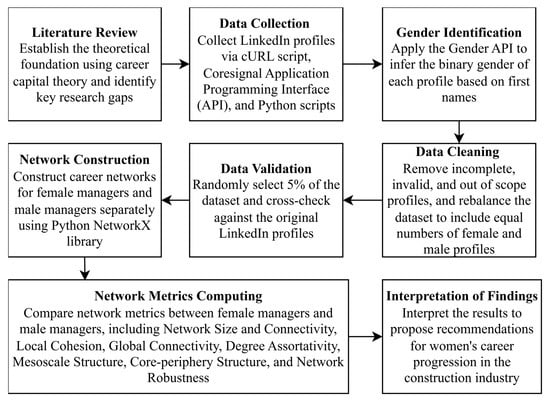
Social network analysis refers to a set of analytical techniques used to examine patterns of relationships among actors within a system, focusing on how connections between individuals or organizations shape structural outcomes [30]. Social networks are typically represented as nodes and edges, enabling the systematic analysis and visualization of social structures and the relationships that form complex network patterns [31]. It is commonly used to analyze social interactions, information flows, and mobility patterns in complex systems [32]. Unlike semantic network analysis, which uses words or concepts derived from text or knowledge bases as nodes [33], social network analysis represents individuals or organizations as nodes, making it particularly suitable for examining career progression and professional mobility, as leadership attainment is often influenced by network embeddedness, shared organizational experience, and access to interconnected professional communities [34]. Compared to traditional survey- or interview-based methods, social network analysis offers the benefit of capturing large-scale relational structures objectively and systematically, enabling the identification of community structure, cohesion, and tie strength [35]. Accordingly, this study adopts social network analysis to compare gendered career networks of top managers in the Australian construction industry. Figure 1 presents the research process.
Figure 1.
Research process.
2.1. Data Source
As one of the largest professional online networking platforms, with over one billion users globally and approximately 15 million users in Australia [36], LinkedIn was selected as the primary data source for this study. LinkedIn profiles provide detailed career histories, including lists of employing organizations and durations of employment, making them well-suited for analyzing professional mobility and network formation. Although the data are self-reported, LinkedIn incorporates endorsement and verification mechanisms that allow work experiences to be validated through official company and institutional accounts, offering an additional layer of data reliability [37].
Compared with other types of self-reported data such as surveys, LinkedIn data enables the collection of large-scale career information, overcoming common survey limitations related to sample sizes, low response rates, and recall bias [38]. This broader coverage allows for the identification of patterns in career trajectories and professional networks that are difficult to observe through survey-based approaches. In addition, unlike organizational human resources datasets, which are typically restricted to a single firm and are often inaccessible due to confidentiality constraints, LinkedIn data capture career progression across multiple organizations. This cross-organizational perspective enables the construction of professional networks based on prior affiliations, which is essential for addressing the research questions of this study.
Despite the benefits of using LinkedIn data, it has several limitations. First, although LinkedIn is widely used in the Australian construction industry, it may introduce selection bias, as not all professionals maintain a LinkedIn profile. Statistics indicate that LinkedIn users tend to be relatively younger, with a large proportion of users aged between 25 and 34 years [39]. In addition, not all users actively update their profiles. To mitigate this issue, profiles that had not been updated within six months prior to data collection were excluded from the analysis. Lastly, as with other online data sources, LinkedIn does not capture informal or offline professional relationships. However, because this study focuses on gender differences rather than population-level prevalence, these limitations are considered acceptable, as both female and male professionals are subject to the same platform-related constraints, enabling valid comparative analysis.
2.2. Data Collection
Although this study draws on LinkedIn profiles, the data are treated as human participant data and therefore subject to ethical review. Prior to data collection, the study received approval from the Institutional Human Research Ethics Committee. The ethics approval granted an exemption from seeking individual consent due to the large-scale nature of the study. Data collection was limited to information voluntarily made publicly accessible on LinkedIn.
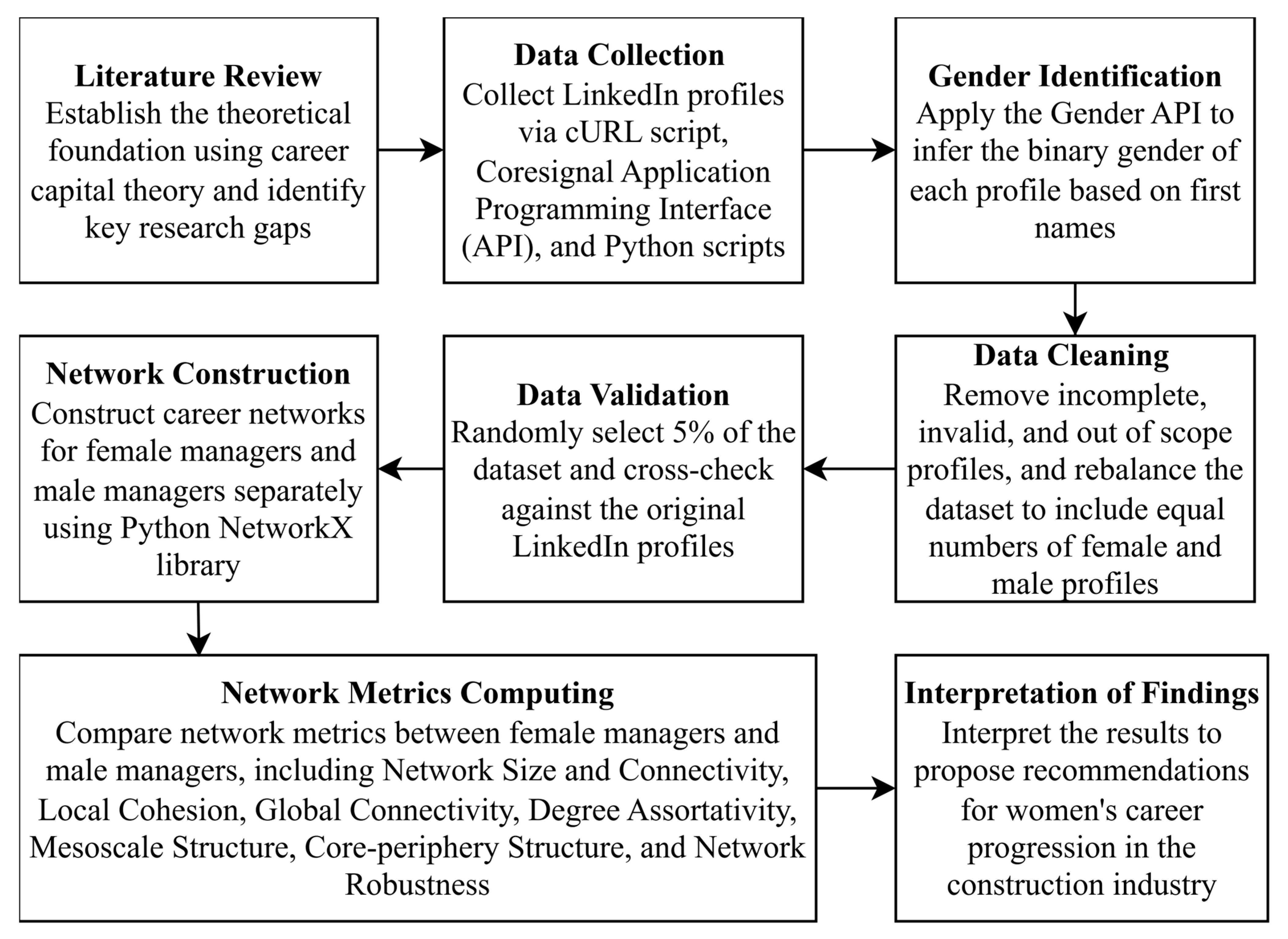
A commercial Application Programming Interface (API), Coresignal, was used to collect publicly available LinkedIn profiles in bulk, as it offers advantages in retrieval efficiency, scalability, and consistency compared to manual scraping [40]. A cURL (Client for Uniform Resource Locator) script was developed to randomly collect publicly available LinkedIn profiles that met the predefined selection criteria. The initial query yielded 20,113 profiles. As this study focuses on comparing gender differences in career networks, the gender of each profile was identified. As recommended by VanHelene, et al. [41], a commercial name-based gender classification API was employed. First names were extracted and exported as a comma-separated values (CSV) file, then processed by the API, which returned gender labels along with confidence scores and the reference sample size used for each classification. The enriched dataset was then screened to remove incomplete, invalid, and out-of-scope profiles. After data screening, 2610 profiles were retained. Of these, 457 were female. To ensure gender balance, 457 male profiles were randomly selected, resulting in a final balanced sample of 914 profiles. Figure 2 presents an overview of the data collection and screening process.
Figure 2.
Data screening process.
As the profiles were collected through an API rather than direct web scraping of the LinkedIn platform, additional validation procedures were undertaken to ensure data accuracy and reliability. Specifically, the collected profiles were cross-referenced with the corresponding LinkedIn webpages using the same LinkedIn URLs. A random sample of 46 profiles (5% of the final dataset) was selected for validation. The collected records closely aligned with the publicly available LinkedIn profiles, supporting the authenticity and reliability of the dataset.
2.3. Network Construction
A network structure is commonly used to represent affiliation relationships between two distinct sets of entities. Nodes represent entities of interest, while edges represent affiliation relationships between entities belonging to different node sets. In this study, career networks were constructed using a Python-based network analysis library, NetworkX. It is an open-source library that provides flexible data structures for the creation, manipulation, and analysis of complex networks [42]. The library is particularly well suited for affiliation-based network analysis, as it allows transparent implementation of projection methods and reproducible calculation of network metrics [43]. In this study, separate individual-level networks were constructed for female and male managers. In each network, nodes represent individuals and edges indicate shared company experience. Edges were undirected and unweighted, capturing the presence of organizational co-affiliation rather than direct interpersonal interaction.
To improve readability, a k-core backbone approach was applied to the network visualization. A k-core is defined as a maximal subnetwork in which each node is connected to at least k other nodes within the same subnetwork [44]. This approach identifies the structurally cohesive and densely connected core of the network while excluding sparsely connected individuals that contribute limited information to the overall structure. The use of a k-core backbone reduces visual clutter and enhances interpretability, allowing clearer visual comparison of the central structural patterns across networks.
2.4. Network Measures
While the figures enable a visual comparison of network structure between female and male top managers, more detailed differences are assessed through network metrics, including network size and connectivity, local cohesion, global connectivity, degree assortativity, mesoscale structure, core–periphery structure, and network robustness. Table 1 summarizes the measures used for each metric.
Table 1.
Summary of network measures.
Network size and connectivity capture the breadth of an individual’s professional ties, reflecting the extent of career capital available for information access, referrals, and career opportunities. This metric is used to assess how expansive and interconnected professional networks are, providing an overall indicator of relational reach. It was assessed using the number of edges, network density, and average degree, which together capture the overall level of interconnectedness among individuals. In the context of this study, higher connectivity indicates greater overlap in career histories among individuals, reflecting stronger collective embeddedness within the industry. Comparing these measures between female and male networks directly addresses the question of whether women and men differ in the extent to which their careers are interconnected.
Local cohesion reflects the degree of embeddedness within close professional circles, which supports trust-based relationships and sustained relational support central to career capital. This metric is included to identify tightly interconnected clusters where repeated interaction may strengthen mutual obligation and social support. It was measured using the average clustering coefficient, indicating the extent to which individuals’ connections also connect with one another. This measure was included to examine whether female and male managers differ in the degree to which their career connections are locally cohesive rather than dispersed. High clustering suggests that individuals share multiple overlapping organizational ties, forming tight career networks.
Global connectivity indicates an individual’s integration into the wider professional community, highlighting access to diverse contacts and collective visibility beyond immediate circles. This measure is used to evaluate overall network reach and the extent to which individuals avoid isolation from broader professional opportunities. It was evaluated through the size of the largest connected component, reflecting the proportion of individuals who are indirectly connected through shared affiliations, even if they have not worked at the same company directly. A larger connected component indicates greater overall reachability and integration within the network. This measure addresses whether female and male career networks differ in their ability to form an industry-wide connected structure rather than remaining fragmented.
Degree assortativity reflects the tendency to connect with others who hold similar levels of connectivity or influence, shaping the quality and strategic value of professional networks. This metric is used to reveal patterns of homophily and the presence of elite clustering within professional networks. It was calculated to assess whether highly connected individuals tend to connect with other highly connected individuals. Positive assortativity reflects stratification, where highly embedded individuals cluster together. This metric was used to examine whether gender differences exist in the tendency for career networks to be structured around highly connected individuals.
Mesoscale structure represents how professional networks are organized across multiple groups, indicating opportunities to bridge distinct circles and access resources. This metric captures the balance between cohesion and diversity in professional ties, which is critical for accumulating knowing-who career capital. It was examined using community detection based on the Louvain algorithm. Community-level analysis captures how networks are organized into subgroups with dense internal connections and fewer external ties. The number of communities, modularity, and size of the largest community were used to assess fragmentation versus integration at an intermediate scale. These measures directly address whether female and male career networks differ in their degree of structural segmentation into distinct career clusters.
Core–periphery structure reflects positional advantage within a network, where proximity to the core signals greater access to influence, information flow, and visible actors. This metric is used to identify whether individuals occupy central or peripheral positions that shape the strength of their career capital. It was analyzed using k-core decomposition. This approach identifies nested layers of increasingly cohesive subgraphs within the network. A deeper or larger core indicates the presence of a strongly interconnected backbone of individuals with extensive shared affiliations. This measure was selected to examine whether female and male managers differ in their positioning within the most structurally cohesive segments of career networks.
Network robustness indicates the stability and resilience of professional connections when key individuals are removed, indicating the durability of career sources over time. This measure is used to evaluate dependence on a small number of critical ties versus distributed and sustainable relational support. It was evaluated through targeted node removal simulations based on degree and betweenness centrality. This analysis assesses how resilient a network remains when structurally important individuals are removed. Robustness reflects whether connectivity is distributed across many individuals or concentrated in a small number of key actors. Including this measure allows assessment of whether female and male career networks differ in their structural resilience, providing insight into the stability of gender specific career networks under disruption. In addition, targeted removal was compared with random removal, which provides a baseline for assessing network resilience. This approach enables a direct comparison between vulnerability to targeted disruption and robustness under random node loss, thereby strengthening the interpretation that observed differences in network robustness are attributable to structural characteristics rather than the evaluation design. More broadly, this analysis represents a form of structural sensitivity analysis that examines how the removal of key actors affects overall network connectivity and stability.
3. Results
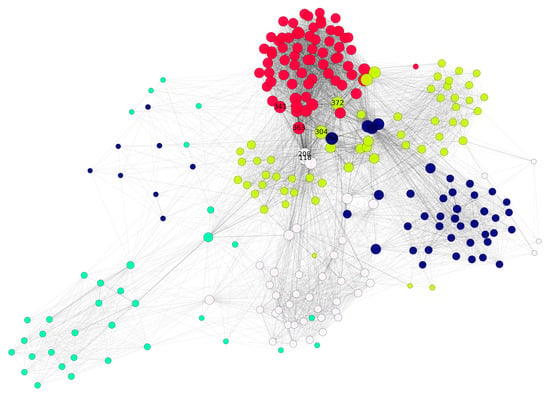
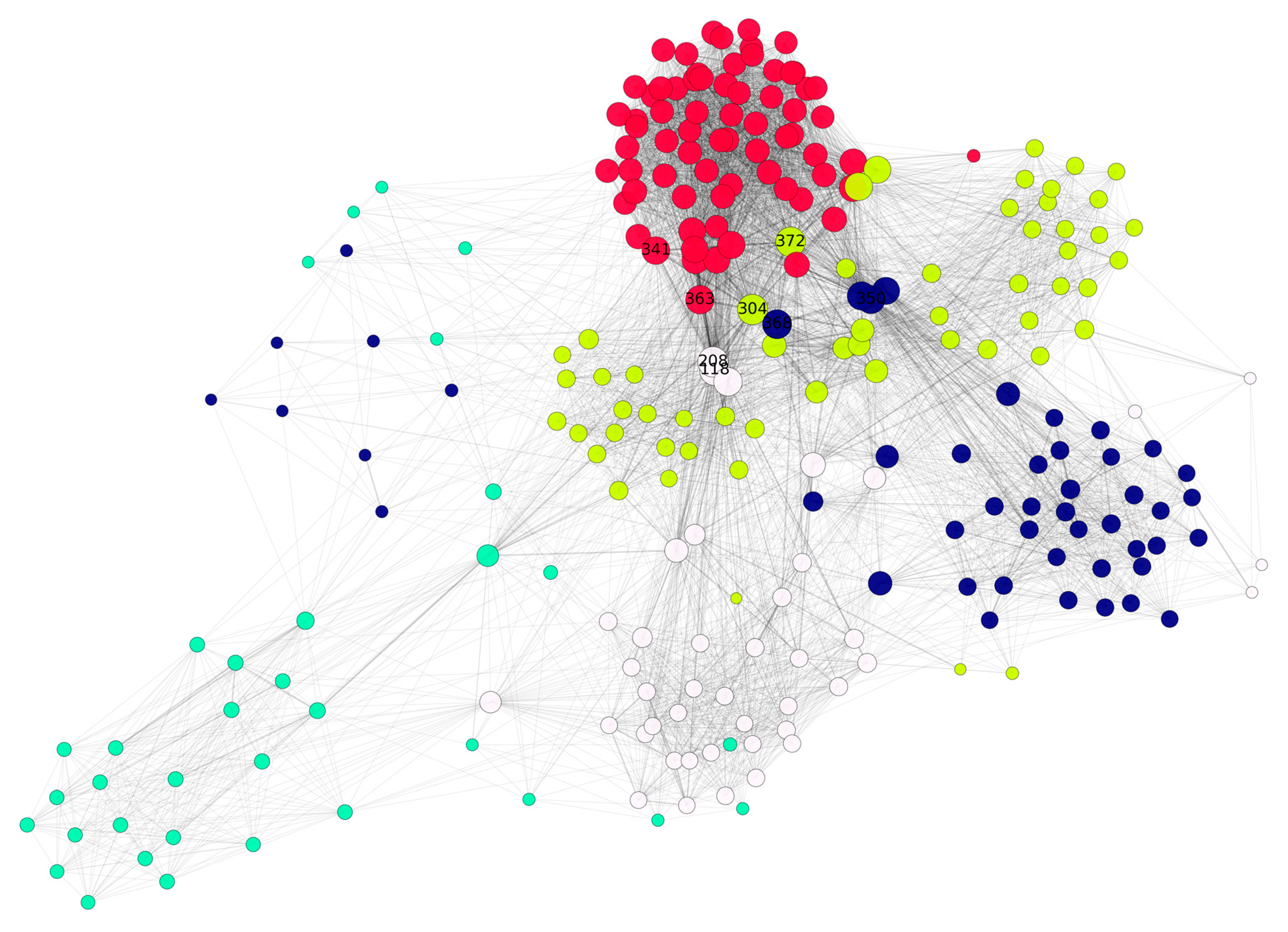
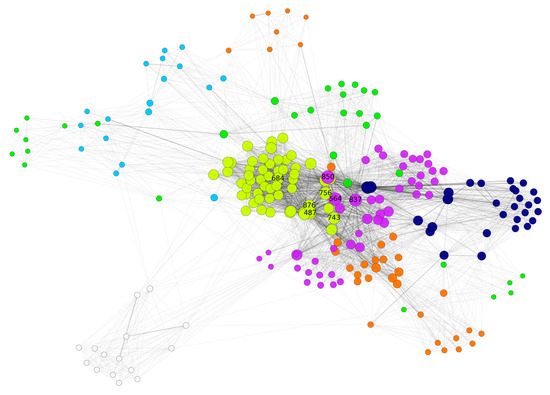
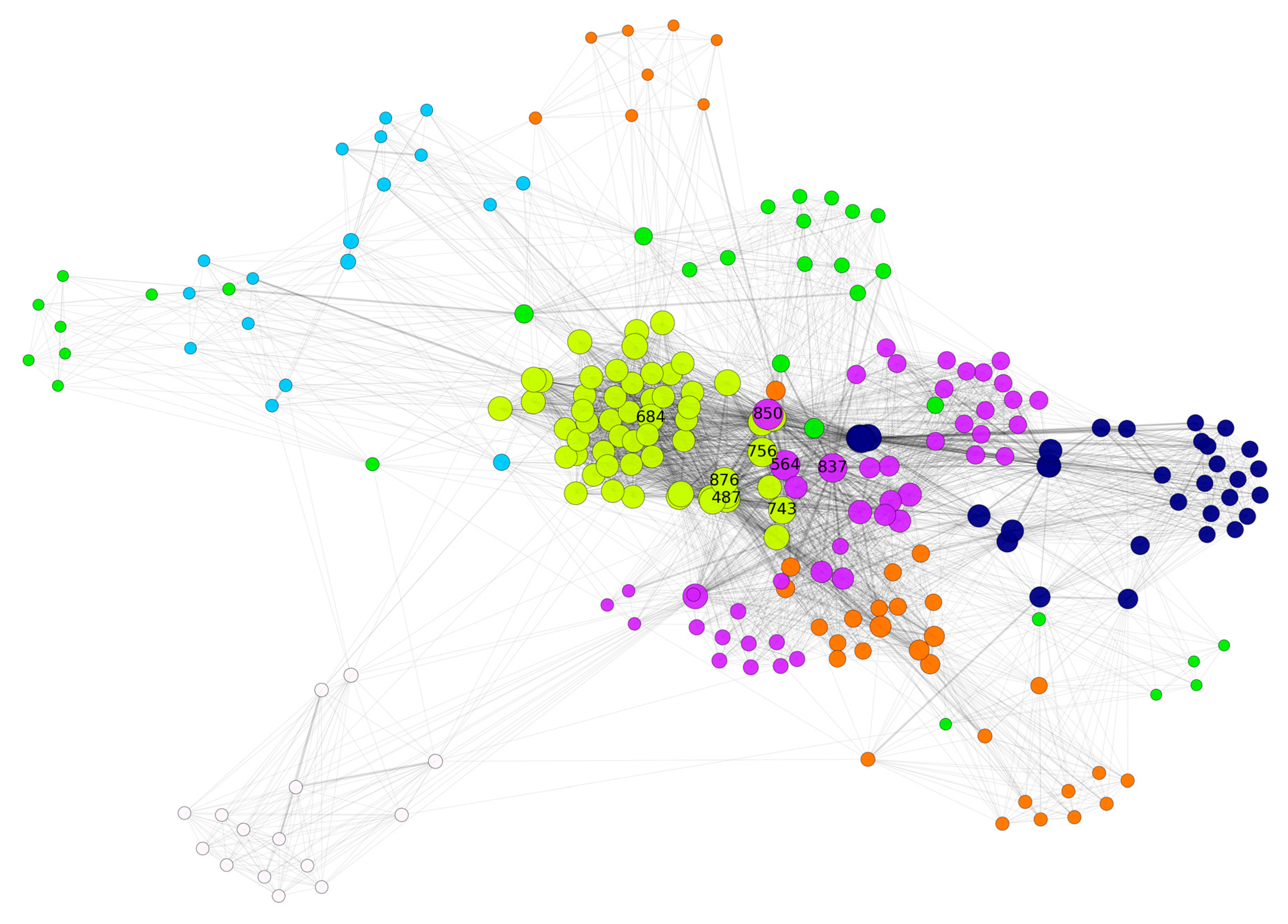
Two individual-level career networks were constructed separately for female and male top managers in the construction industry. In these networks, nodes represent individual managers, and edges represent shared organizational experience, where a connection is formed if two individuals have worked at the same company at any point in their career histories. By applying a k-core backbone approach with k greater than or equal to 10, the female network comprises 252 nodes, 6000 edges, and five communities, whereas the male network comprises 236 nodes, 4711 edges, and seven communities. This filtering enables a clearer visual comparison of the structural characteristics of the two career network figures. Female top managers’ career network (Figure 3) appears to have a more compact and densely connected core, with closer linkages between groups, indicating a higher level of integration at a descriptive level. By contrast, male top managers’ career network (Figure 4) shows a more dispersed configuration, characterized by multiple, more clearly separated communities and a relatively smaller central core, implying greater segmentation.
Figure 3.
Career network of female top managers based on k-core ≥ 10 (colored by Louvain communities).
Figure 4.
Career network of male top managers based on k-core ≥ 10 (colored by Louvain communities).
While the figures filtered by the k-core approach offered a visual comparison of network structure, more detailed and comprehensive comparisons were conducted using network metrics calculated on the full dataset. The results are presented in Table 2.
Table 2.
Summary of results.
3.1. Network Size and Connectivity
The female and male individual-level career networks each consist of 457 nodes. However, the level of connectivity differs substantially between the two networks. The female network contains 7307 edges, whereas the male network contains 5024 edges. Correspondingly, the female network exhibits a higher network density of 0.0701 compared to 0.0482 for the male network. The average degree in the female network is 31.98, indicating that each female manager is connected, on average, to approximately 32 other individuals through shared company experience. In contrast, the average degree in the male network is 21.99. These results indicate that the female network is more densely connected than the male network.
3.2. Local Cohesion
Local cohesion was assessed using the average clustering coefficient. The female network shows a higher clustering coefficient of 0.606 compared to 0.543 in the male network. This indicates that connections among female managers are more likely to form tightly interconnected groups, where shared organizational affiliations overlap among multiple individuals.
3.3. Global Connectivity
Global connectivity was examined using the size of the largest connected component. In the female network, 371 individuals, representing 81.18 percent of the network, belong to a single connected component. In the male network, the largest connected component includes 337 individuals, accounting for 73.74 percent of the network. This demonstrates that a larger proportion of female managers are indirectly connected through shared career histories than male managers.
3.4. Degree Assortativity
Both networks exhibit positive degree assortativity. The degree assortativity coefficient is 0.397 for the female network and 0.381 for the male network. These values indicate that highly connected individuals tend to connect with other highly connected individuals in both networks.
3.5. Community Structure
Community detection using the Louvain algorithm reveals differences in mesoscale structure between the two networks. The female network is partitioned into 86 communities with a modularity value of 0.421. The largest community in the female network consists of 102 individuals. In contrast, the male network is divided into 121 communities and exhibits a higher modularity of 0.463, with the largest community containing 71 individuals. These results indicate that the male network is more fragmented into smaller and more clearly separated communities, while the female network contains fewer communities and a larger dominant group.
3.6. Core–Periphery Structure
Core–periphery structure was examined using k-core decomposition. The female network exhibits a maximum core value of 79 and an average core index of 27.08. The male network shows a lower maximum core value of 61 and an average core index of 17.76. These results indicate that the female network contains a deeper and more cohesive core of individuals compared to the male network.
3.7. Network Robustness
Network robustness was assessed through targeted node removal simulations under three strategies: targeted removal based on degree, targeted removal based on betweenness centrality, and random removal. Robustness was quantified using the area under the curve (AUC) of the largest connected component fraction across removal proportions. When nodes were removed in descending order of degree, the female network achieved an AUC value of 0.366, compared to 0.268 for the male network. When nodes were removed based on betweenness centrality, the AUC values were 0.318 for the female network and 0.219 for the male network. Across both removal strategies, the female network retains a larger connected structure than the male network. Random removal was conducted as a baseline for comparison with targeted strategies and repeated 200 times to account for variability. The resulting AUC values are 0.684 for the female network and 0.609 for the male network. As expected, these baseline values are substantially higher than those obtained under targeted removal, while still confirming that the female network demonstrates greater overall robustness.
4. Discussion
By applying social network analysis, this study compared the individual-level career networks of female and male top managers in the Australian construction industry. The findings reveal that female top managers are more densely connected and exhibit higher levels of shared organizational experience than their male counterparts. Women’s career networks demonstrate stronger local cohesion, greater global integration, and fewer but larger communities, indicating more collective and less fragmented career structures. Both female and male networks display positive degree assortativity, suggesting that advancement to top management is associated with embeddedness within influential career circles for both genders. However, female managers occupy a deeper and more cohesive network core, forming a broad and strongly interconnected backbone rather than relying on a small number of central individuals. Moreover, the female network shows greater robustness to the removal of highly connected and intermediary actors, indicating more distributed influence and stronger structural resilience. These findings partially align with previous studies while also challenging common assumptions regarding women’s network disadvantage in male-dominated industries. Based on these findings, this study proposes targeted recommendations for women seeking to attain senior managerial roles and calls for action from industry stakeholders to support more inclusive pathways to senior leadership.
4.1. Network Size and Connectivity
The results revealed that the female network contains more edges, higher density, and higher average degree than the male network, indicating a more tightly connected and rich structure. Female top managers share organizational experience with a larger number of peers than male top managers. This finding indicates that, despite women being fewer in number at the top managerial level, female top managers are in fact more structurally connected to one another than their male counterparts. This pattern aligns with Martin and Barnard [45], who suggested that women often rely more strongly on relational strategies, particularly in male-dominated occupations. Consistent with this perspective, Agyekum, et al. [46] found that forming and maintaining close professional networks could be a crucial strategy for women to reach senior leadership positions in the construction industry. Given the structural barriers and limited representation faced by women, closely knit networks appear to provide access to shared information, opportunities, and support that facilitate career progression. Female professionals aspiring to senior roles may therefore benefit from actively cultivating and maintaining long-term relationships with peers who have moved across similar organizations, as these networks function as an important form of career capital that supports advancement to top management. In light of these results, professional bodies and government agencies could consider supporting cross-organizational initiatives, such as leadership forums, project-based taskforces, and peer advisory groups, to strengthen professional connectivity and facilitate the exchange of career-relevant resources among women.
4.2. Local Cohesion
This study found that the female network exhibits a higher average clustering coefficient than the male network. This indicates that female managers tend to form tightly interconnected career groups, where individuals who share one organizational connection are also likely to share others. This finding suggests that female managers, as a minority within the construction industry, may form stronger bonds with one another, resulting in closely knit professional circles. Such cohesion highlights the presence of shared organizational overlap and potentially enables mutual support and shared access to opportunities among women at the top managerial level. This evidence extends traditional narratives that emphasize women’s lack of support in male-dominated industries [19,29] by showing that female managers can develop exclusive and effective support networks despite facing structural barriers. Such clustered networks can facilitate efficient information sharing, peer mentoring, and emotional support, all of which are critical for sustaining career progression in a male-dominated working environment [47]. Based on this finding, women are encouraged to invest in sustaining tightly connected professional circles, including relationships with former colleagues and managers from previous organizations. These cohesive groups appear to support stable career progression by providing trusted channels for information exchange, referrals, and leadership opportunities. At the same time, expanding networks beyond these cohesive circles, particularly by strengthening ties with male peers and leaders, may further enhance access to diverse resources and influence across the broader industry network. To support this process, formal sponsorship programs could be introduced in which senior leaders actively introduce high-potential women to influential internal and external contacts, moving beyond mentoring to deliberately expand their professional networks.
4.3. Global Connectivity
In this study, a larger proportion of female managers were found to belong to the largest connected component compared to male managers. As highlighted by Dworkin, et al. [48], women who progress into senior managerial roles often achieve this position by maintaining strong and extensive professional connectivity. This suggests that female managers are more likely to be indirectly connected to one another through chains of shared organizational experience. At the industry level, women’s career networks form a more integrated structure, whereas men’s networks are comparatively more fragmented, with a higher proportion of individuals disconnected from the main network. Contrary to previous studies, which highlighted that women in male-dominated industries are more isolated or marginalized within professional networks [49,50], this finding shows that female top managers are more likely to be connected to one another through shared career histories. This similarity presents valuable opportunities for women to further expand their professional reach, as indirect connections can facilitate access to information, opportunities, and visibility beyond immediate contacts. Women are therefore encouraged to actively leverage this existing connectivity by engaging with broader industry networks and strengthening ties that extend beyond their immediate professional circles. This could be supported through leadership programs for women that embed network targets, such as peer connection goals, structured career planning, and personalized development plans, to help women strategically expand and sustain their professional networks.
4.4. Degree Assortativity
This study found that both female and male networks show similarly high positive degree assortativity. This indicates that highly connected managers tend to connect with other highly connected managers in both networks. High assortativity, as found by Shizuka and Farine [51], can stabilize network hierarchies by concentrating information and opportunities among similarly positioned individuals, while making it more challenging for less connected individuals to access central network positions. The similarity across genders suggests that differences in network structure are not driven by assortative mixing patterns, but by overall connectivity and cohesion. This finding reinforces existing evidence [52,53] that progression to top managerial roles is strongly linked to being embedded within influential and highly connected career circles. For women aspiring to reach senior leadership, this implies that access to well-connected peers and leaders may be particularly important, as opportunities and information tend to circulate within these elite segments of the network. Women seeking advancement are therefore encouraged to proactively build and maintain relationships with individuals who occupy central positions in the industry. At the same time, this pattern may also pose challenges. Positive assortativity can reinforce exclusivity, making it more difficult for those outside established career networks to gain access. For women who are early in their careers or positioned on the periphery of the network, breaking into highly connected groups may require intentional strategies such as sponsorship, visibility through cross-organizational projects, or participation in industry leadership programs. To support their efforts, career platforms or professional networking tools tailored for women could be developed to enhance visibility, facilitate alumni networking, and enable peer endorsement in the construction industry.
4.5. Community Structure
The results revealed that the male network contains more communities and higher modularity, while the female network contains fewer communities and a larger overall community. Zou and Ingram [54] have noted that highly modular networks can reinforce group boundaries and limit cross-community interaction, while more integrated structures can enhance coordination and shared understanding. This means that male career networks are more segmented into distinct career clusters with limited overlap. In contrast, the female network is more integrated, with larger groups connected through shared organizational histories. This finding supports Mah, et al. [55], suggesting that advancement to top management is facilitated by remaining embedded within influential professional circles. However, this result highlighted that female managers in the construction industry do not simply rely on individual ties or isolated sponsorship. Instead, they appear to advance through collective and overlapping career communities. This challenges the common assumption [20,56] that women’s career paths are necessarily more fragmented or isolated due to structural barriers in a male-dominated industry. For women aspiring to reach top management, this finding implies that career moves which preserve overlap with existing professional communities may be advantageous. Maintaining continuity in professional relationships, even when changing organizations or roles, appears to support sustained integration within influential career networks. Women seeking senior leadership positions are therefore encouraged to approach career mobility strategically, prioritizing transitions that allow them to remain connected to established professional communities. At the same time, carefully selected moves that bridge related communities can expand influence without fragmenting existing networks. This balanced approach may help aspiring female managers build broad yet coherent career networks that support long-term advancement to top management. At the organizational level, this can be reinforced by redesigning informal networking practices, such as leadership forums, strategy offsites, and innovation labs, to ensure structured cross-community interaction rather than optional or self-selected participation.
4.6. Core–Periphery Structure
The findings showed that the female network has both a higher maximum k-core and a higher average core index than the male network. As shown by Yang, et al. [57], individuals located within higher-order cores tend to benefit from greater visibility, stronger reputational capital, and more stable career support. This indicates that female managers occupy a deeper and more cohesive core of the career network. This supports the findings from Pamidimukkala and Kermanshachi [26], highlighting that occupying central or core positions in professional networks is associated with access to influence, information, and leadership opportunities. For women aspiring to advance their careers, this finding suggests the importance of actively maintaining visibility and engagement within core professional networks. This can be achieved by taking on roles that involve cross-organizational collaboration, leadership of high-impact projects, or participation in industry-wide initiatives that enhance centrality. Such strategies may help women move from peripheral positions toward the network core, increasing their access to leadership opportunities and supporting long-term career advancement. However, compared to male networks, the deeper and more cohesive core of the female network may also imply higher entry barriers for individuals who are not already integrated into core career communities. Thus, women who attain top management appear to benefit from a robust shared network backbone, while those outside the core may face greater challenges in accessing these network positions. This suggests that informal networking alone may be insufficient to support equitable career advancement, particularly for women who lack early exposure to influential professional communities. This study therefore calls for actions from government agencies and industry associations to lower barriers to entry into certain career networks. Targeted leadership development programs, industry-sponsored mentoring and sponsorship schemes, and structured cross-organizational initiatives can provide women with early opportunities to connect with core industry leaders. Such interventions can help replicate the benefits of cohesive network cores for a broader group of women, rather than limiting them to those who are already well embedded.
4.7. Network Robustness
By targeted removing highly connected or highly intermediary individuals, this study found that the female network retains a larger connected component than the male network. Artime, et al. [58] suggested that networks characterized by redundancy, dense interconnections, and multiple alternative pathways are more resilient to the loss of central individuals. This demonstrates that connectivity in the female network is more evenly distributed across individuals rather than concentrated in a few critical individuals. This suggests that female top managers’ career networks are structurally stable and less dependent on a few key players. These finding challenges common assumptions that women’s career advancement in male-dominated industries depends heavily on a small number of powerful sponsors or gatekeepers [59]. While distributed connectivity enhances resilience, it may also dilute individual visibility if women do not actively position themselves in roles that highlight leadership capability. Without clear recognition mechanisms, collective networks risk underrepresenting individual contributions. This finding echoes with Opoku and Williams [16], highlighting the lack of female role models within the industry. Women may therefore need to balance collective embeddedness with strategic self-positioning to ensure their leadership potential is visible within the network. For women aspiring to senior leadership positions, this finding suggests that cultivating a diversified set of meaningful professional relationships may be more effective than relying on a single mentor or sponsor. Building multiple strong and cross-cutting ties can enhance career resilience and reduce vulnerability to organizational changes, leadership turnover, or sponsor loss. Women should therefore aim to develop broad-based networks that provide overlapping sources of support, information, and opportunity throughout their careers. This emphasis can be reinforced through performance evaluation systems that explicitly recognize integrative work, such as cross-unit collaboration, coordination roles, and knowledge sharing, activities that are often undertaken by senior women.
5. Conclusions
This study examined gender differences of career networks among top managers in the Australian construction industry. The findings show that female top managers are more densely connected and share greater organizational overlap than their male counterparts. Women’s career networks exhibit stronger local cohesion, higher global integration, and fewer but larger communities, indicating more collective and less fragmented career structures. Both female and male networks display positive-degree assortativity, suggesting that advancement to top management is associated with embeddedness within influential career circles for both genders. However, female managers occupy a deeper and more cohesive network core, forming a broad and strongly interconnected backbone rather than relying on a small number of central individuals. In addition, the female network demonstrates greater robustness to the removal of highly connected and intermediary actors, indicating distributed influence and structural resilience. Together, these findings challenged common assumptions about women’s professional networks in male-dominated industries and highlighted cohesive, integrated, and resilient network structures as a defining feature of women’s attainment of top managerial positions in the construction industry.
This study offers theoretical, methodological, and practical contributions. Theoretically, it extends career capital theory by highlighting the structural value of professional networks as a critical resource for attaining higher managerial positions. The findings challenge traditional narratives that frame women in male-dominated industries as structurally disadvantaged in their professional networks. Instead, the results demonstrate that female career networks exhibit distinctive structural strengths, including higher connectivity, stronger cohesion, deeper core structures, and greater robustness. This shifts theoretical attention away from what women lack toward how women’s networks are organized, maintained, and mobilized in ways that support leadership attainment. In addition, this study contributes to gendered network theory by showing that gender differences are not limited to access or exclusion, but also involve differences in network integration, fragmentation, and resilience. These findings pave the way for future research aimed at advancing understanding of gendered professional networks in the construction industry.
This study also makes several methodological contributions to research on women’s career progression in the construction industry. By leveraging LinkedIn, a previously underutilized data source, this study provides a scalable and replicable approach for examining career trajectories in male-dominated industries. This approach moves beyond traditional reliance on surveys or interviews, which are often constrained by limited sample sizes, recall bias, and social desirability effects. Moreover, the study applies affiliation-based social network analysis to model individual-level career networks derived from shared organizational experience, capturing latent professional connectivity that is not observable through conventional methods. By integrating multiple network metrics, including density, clustering, assortativity, community structure, core–periphery decomposition, and targeted robustness simulations, the analysis enables systematic and quantitative comparison of network structures rather than reliance on self-reported or solely qualitative narratives. Furthermore, the study adopts a comparative design that examines female-only and male-only networks while holding network size constant. This design choice enhances internal validity by ensuring that observed differences in network structure reflect gender-related patterns.
Practically, this study offers implications for individuals, organizations, industry associations, and policy makers concerned with advancing gender equity in leadership within the construction industry. For women seeking career advancement, the findings provide evidence-based guidance on effective networking strategies, highlighting the importance of cultivating dense and cohesive professional networks, maintaining continuity across career transitions, and developing distributed relationships rather than relying on a single sponsor. These insights offer direction for women navigating senior leadership pathways in the Australian construction industry. For organizations, the study underscores the limitations of individual-focused mentoring approaches and points to the value of network-based interventions. The evidence suggests that leadership development programs should prioritize cohort-based models, peer networks, and cross-organizational collaboration to help women access and remain embedded within influential professional communities. Such approaches can enhance both individual career outcomes and organizational leadership pipelines. At the industry level, the findings highlight the role of professional associations as institutional brokers capable of facilitating connections across firms and career stages. By designing industry-wide initiatives that connect emerging female leaders with established network cores, associations can reduce barriers to entry into senior leadership and strengthen collective career pathways. For policy-makers, the study provides empirical support for continued investment in programs that promote structured network-building, cross-organizational mobility, and visibility of female leaders.
This study has several limitations, which also point to directions for future research. First, this study used self-reported data derived from LinkedIn profiles. Although LinkedIn incorporates profile verification mechanisms, the information remains self-reported and may be subject to inaccuracies, omissions, or selective presentation of career histories. Future research could adopt a multi-source triangulation approach to extend the findings of this study, for example by combining LinkedIn data with organizational human resources records, survey data, or in-depth interviews to integrate structural patterns with individual experiences and institutional contexts. Furthermore, professional connections in this study are inferred from shared organizational experience rather than direct interpersonal relationships. While affiliation-based networks are well suited for capturing latent professional connectivity and analyzing career mobility, they do not measure the strength, quality, or frequency of actual interactions between individuals. As a result, the analysis cannot distinguish between close professional relationships and weaker forms of association. Future research could integrate survey-based network data, interviews, or digital communication records to capture relational intensity and better understand how different types of ties influence career advancement. Moreover, the study focuses exclusively on top managers within the Australian construction industry. Although this focus allows in-depth analysis of elite career networks, it limits the generalizability of the findings to other career stages, industries, or national contexts. Career network structures and progression dynamics may differ for early career professionals, middle managers, or workers in other sectors. Future studies could conduct comparative analyses across career levels, industries, or countries to examine whether similar gendered network patterns emerge in different contexts. Also, this study used LinkedIn profiles limited to the Australian construction industry within a multicultural and developed economic context. Hence, the findings may not be directly generalizable to other industries or to construction sectors in countries with different economic, cultural, or labor market conditions. Future studies could adopt comparative research designs to examine how professional networks differ between female and male managers across diverse economic, cultural, and industry settings. Last but not least, although the study compares female-only and male-only networks while holding network size constant, it does not account for other potentially influential factors such as organizational size, sub-sector, project type, or intersectional characteristics including age, ethnicity, and educational background. Incorporating these dimensions in future research could provide a more nuanced and intersectional understanding of gendered career network structures and leadership progression.
Author Contributions
Conceptualization, D.Y.; methodology, D.Y.; software, D.Y. and Y.D.; formal analysis, D.Y. and Y.D.; data curation, D.Y. and Y.D.; writing—original draft preparation, D.Y.; writing—review and editing, D.Y., Y.D., C.C.W., R.Y.S. and Z.Y.; visualization, D.Y. and Y.D.; supervision, C.C.W., R.Y.S. and Z.Y. All authors have read and agreed to the published version of the manuscript.
Funding
This study was supported by the University of New South Wales (UNSW) Women in Construction project (RG220780), which is funded by the Department of the Prime Minister and Cabinet’s Office for Women, under the Australian Government’s Women’s Leadership and Development Program.
Institutional Review Board Statement
This study was approved by the UNSW Human Research Ethics Committee under reference number iRECS6382.
Informed Consent Statement
Informed consent was waived due to the large-scale nature of the study and the use of data that were voluntarily made publicly accessible on LinkedIn.
Data Availability Statement
The data presented in this study are available on request from the corresponding author due to privacy considerations.
Acknowledgments
This research has been supported by an Australian Government Research Training Program (RTP) Scholarship.
Conflicts of Interest
The authors declare no conflicts of interest.
Abbreviations
The following abbreviations are used in this manuscript:
| API | Application programming interface |
| AUC | Area under the curve |
| AUD | Australian dollar |
| CSV | Comma-separated values |
| cURL | Client for Uniform Resource Locator |
| STEM | Science, Technology, Engineering, and Mathematics |
| WGEA | Workplace gender equality agency |
References
- Jobs and Skills Australia. Construction. Available online: https://www.jobsandskills.gov.au/data/occupation-and-industry-profiles/industries/construction (accessed on 28 June 2025).
- WGEA. Industry Data Explorer. Available online: https://www.wgea.gov.au/Data-Explorer/Industry (accessed on 5 September 2025).
- Australian Government. News—Building Women’s Careers Program. Available online: https://futuremadeinaustralia.gov.au/building-womens-careers-program (accessed on 25 February 2025).
- Australian Government. Women’s Budget Statement 25-26. Available online: https://budget.gov.au/content/womens-statement/index.htm (accessed on 2 December 2025).
- Australian Government. Australia’s International Gender Equality Strategy. Available online: https://www.dfat.gov.au/publications/development/australias-international-gender-equality-strategy (accessed on 2 December 2025).
- Yan, D.; Sunindijo, R.Y.; Wang, C.C. Analysis of Gender Diversity Initiatives to Empower Women in the Australian Construction Industry. Buildings 2024, 14, 1707. [Google Scholar] [CrossRef] [Scilit]
- Croteau, J.D.; Wolk, H.G. Defining Advancement Career Paths and Succession Plans: Critical Human Capital Retention Strategies for High-Performing Advancement Divisions. Int. J. Educ. Adv. 2010, 10, 59–70. [Google Scholar] [CrossRef] [Scilit]
- Samson, D.; Donnet, T.; Daft, R.L. Manager Types. In Management, 8th ed.; Daft, R.L., Ed.; Cengage Learning: Southbank, Australia, 2020. [Google Scholar]
- Arthur, M.B.; Khapova, S.N.; Wilderom, C.P. Career Success in a Boundaryless Career World. J. Organ. Behav. Int. J. Ind. Occup. Organ. Psychol. Behav. 2005, 26, 177–202. [Google Scholar] [CrossRef] [Scilit]
- Pariafsai, F.; Behzadan, A.H. Core Competencies for Construction Project Management: Literature Review and Content Analysis. J. Civ. Eng. Educ. 2021, 147, 04021010. [Google Scholar] [CrossRef] [Scilit]
- Randeree, K.; Ghaffar Chaudhry, A. Leadership–Style, Satisfaction and Commitment: An Exploration in the United Arab Emirates’ Construction Sector. Eng. Constr. Archit. Manag. 2012, 19, 61–85. [Google Scholar] [CrossRef] [Scilit]
- Simmons, D.R.; McCall, C.; Clegorne, N.A. Leadership Competencies for Construction Professionals as Identified by Construction Industry Executives. J. Constr. Eng. Manag. 2020, 146, 04020109. [Google Scholar] [CrossRef] [Scilit]
- Greguletz, E.; Diehl, M.-R.; Kreutzer, K. Why Women Build Less Effective Networks Than Men: The Role of Structural Exclusion and Personal Hesitation. Hum. Relat. 2019, 72, 1234–1261. [Google Scholar] [CrossRef] [Scilit]
- Bridges, D.; Wulff, E.; Bamberry, L.; Krivokapic-Skoko, B.; Jenkins, S. Negotiating Gender in the Male-Dominated Skilled Trades: A Systematic Literature Review. Constr. Manag. Econ. 2020, 38, 894–916. [Google Scholar] [CrossRef] [Scilit]
- Aboagye-Nimo, E.; Wood, H.; Collison, J. Complexity of Women’s Modern-Day Challenges in Construction. Eng. Constr. Archit. Manag. 2019, 26, 2550–2565. [Google Scholar] [CrossRef] [Scilit]
- Opoku, A.; Williams, N. Second-Generation Gender Bias: An Exploratory Study of the Women’s Leadership Gap in a Uk Construction Organisation. Int. J. Ethics Syst. 2019, 35, 2–23. [Google Scholar] [CrossRef] [Scilit]
- Bryce, T.; Far, H.; Gardner, A. Barriers to Career Advancement for Female Engineers in Australia’s Civil Construction Industry and Recommended Solutions. Aust. J. Civ. Eng. 2019, 17, 1–10. [Google Scholar] [CrossRef] [Scilit]
- Oo, B.L.; Liu, X.; Lim, B.T.H. The Experiences of Tradeswomen in the Australian Construction Industry. Int. J. Constr. Manag. 2022, 22, 1408–1419. [Google Scholar] [CrossRef] [Scilit]
- Maurer, J.A.; Choi, D.; Hur, H. Building a Diverse Engineering and Construction Industry: Public and Private Sector Retention of Women in the Civil Engineering Workforce. J. Manag. Eng. 2021, 37, 04021028. [Google Scholar] [CrossRef] [Scilit]
- Lekchiri, S.; Kamm, J.D. Navigating Barriers Faced by Women in Leadership Positions in the Us Construction Industry: A Retrospective on Women’s Continued Struggle in a Male-Dominated Industry. Eur. J. Train. Dev. 2020, 44, 575–594. [Google Scholar] [CrossRef] [Scilit]
- Johnson, J.A.; Hunnicutt, S.S.; Cottom, T.M. The Ties That Corporatize: A Social Network Analysis of the Career Paths of University Presidents. Soc. Sci. J. 2025, 62, 919–931. [Google Scholar] [CrossRef] [Scilit]
- Hernandez, A.L.; Weinberg, J.L.; El-Harakeh, A.; Adeyemi, L.; Potharaj, N.; Oomman, N.; Kalbarczyk, A. Connectedness Is Critical: A Social Network Analysis to Support Emerging Women Leaders in Global Health. Ann. Glob. Health 2022, 88, 64. [Google Scholar] [CrossRef] [Scilit]
- Collins, R.; Steffen-Fluhr, N. Hidden Patterns: Using Social Network Analysis to Track Career Trajectories of Women Stem Faculty. Equal. Divers. Incl. 2019, 38, 265–282. [Google Scholar] [CrossRef] [Scilit]
- Palaniappan, K.; Rajaraman, N.; Ghosh, S. Effectiveness of Peer Support to Reduce Depression, Anxiety and Stress among Migrant Construction Workers in Singapore. Eng. Constr. Archit. Manag. 2023, 30, 4867–4880. [Google Scholar] [CrossRef] [Scilit]
- Francis, V. What Influences Professional Women’s Career Advancement in Construction? Constr. Manag. Econ. 2017, 35, 254–275. [Google Scholar] [CrossRef] [Scilit]
- Pamidimukkala, A.; Kermanshachi, S. Occupational Challenges of Women in Construction Industry: Development of Overcoming Strategies Using Delphi Technique. J. Leg. Aff. Disput. Resolut. Eng. Constr. 2023, 15, 04522028. [Google Scholar] [CrossRef] [Scilit]
- Wells, B.; Senaratne, S.; Mirza, O.; Camille, C. Overcoming Challenges Faced by Female Construction Management Graduates: An Exploratory Study in Australia. Int. J. Constr. Manag. 2025, 25, 1337–1345. [Google Scholar] [CrossRef] [Scilit]
- Rotimi, F.E.; Brauner, M.; Burfoot, M.; Naismith, N.; Silva, C.; Mohaghegh, M. Challenges Faced by Women in New Zealand’s Construction Industry and the Impact of Demographic Factors. Constr. Econ. Build. 2024, 24, 114–141. [Google Scholar] [CrossRef] [Scilit]
- Yan, D.; Ding, Y.; Sunindijo, R.Y.; Wang, C.C.; Yang, Z. Key Factors in Women’s Managerial Advancement in the Construction Industry: Insights from Machine Learning. Int. J. Constr. Manag. 2025, 1–15. [Google Scholar] [CrossRef] [Scilit]
- Marin, A.; Wellman, B. Social Network Analysis: An Introduction. SAGE Handb. Soc. Netw. Anal. 2011, 11, 25. [Google Scholar] [CrossRef] [Scilit]
- Gu, Q.; Wang, J. Analyzing Natural Disaster Risk Factors in Engineering Projects: A Social Networks Analysis Approach. Infrastructures 2025, 10, 352. [Google Scholar] [CrossRef] [Scilit]
- Brass, D.J. New Developments in Social Network Analysis. Annu. Rev. Organ. Psychol. Organ. Behav. 2022, 9, 225–246. [Google Scholar] [CrossRef] [Scilit]
- Cao, Y.; Wu, S.; Chen, Y.; Skitmore, M.; Ma, X.; Wang, J. Enhancing Knowledge of Construction Safety: A Semantic Network Analysis Approach. Buildings 2025, 15, 3036. [Google Scholar] [CrossRef] [Scilit]
- Carter, D.R.; DeChurch, L.A.; Braun, M.T.; Contractor, N.S. Social Network Approaches to Leadership: An Integrative Conceptual Review. J. Appl. Psychol. 2015, 100, 597. [Google Scholar] [CrossRef] [Scilit]
- Tabassum, S.; Pereira, F.S.; Fernandes, S.; Gama, J. Social Network Analysis: An Overview. Wiley Interdiscip. Rev. Data Min. Knowl. Discov. 2018, 8, e1256. [Google Scholar] [CrossRef] [Scilit]
- LinkedIn. About Us—Statistics. Available online: https://news.linkedin.com/about-us# (accessed on 26 June 2025).
- LinkedIn. Professional Community Policies—Be Trustworthy. Available online: https://www.linkedin.com/legal/professional-community-policies#:~:text=and%20individuals%20policy.-,Be%20Trustworthy,misleading%2C%20or%20intended%20to%20deceive (accessed on 11 December 2024).
- Andrade, C. The Limitations of Online Surveys. Indian J. Psychol. Med. 2020, 42, 575–576. [Google Scholar] [CrossRef] [Scilit]
- Servar, M. 2025 Linkedin Demographics That Matter for Your Business. Available online: https://www.linkedhelper.com/blog/linkedin-demographics/#LinkedIn-user-statistics (accessed on 15 January 2026).
- Dongo, I.; Cardinale, Y.; Aguilera, A.; Martinez, F.; Quintero, Y.; Robayo, G.; Cabeza, D. A Qualitative and Quantitative Comparison between Web Scraping and Api Methods for Twitter Credibility Analysis. Int. J. Web Inf. Syst. 2021, 17, 580–606. [Google Scholar] [CrossRef] [Scilit]
- VanHelene, A.D.; Khatri, I.; Hilton, C.B.; Mishra, S.; Gamsiz Uzun, E.D.; Warner, J.L. Inferring Gender from First Names: Comparing the Accuracy of Genderize, Gender Api, and the Gender R Package on Authors of Diverse Nationality. PLoS Digit. Health 2024, 3, e0000456. [Google Scholar] [CrossRef] [Scilit] [PubMed]
- Hagberg, A.; Swart, P.J.; Schult, D.A. Exploring Network Structure, Dynamics, and Function Using Networkx; Los Alamos National Laboratory (LANL): Los Alamos, NM, USA, 2007. [Google Scholar]
- Platt, E.L. Network Science with Python and Networkx Quick Start Guide: Explore and Visualize Network Data Effectively; Packt Publishing Ltd.: Birmingham, UK, 2019. [Google Scholar]
- Alvarez-Hamelin, J.I.; Dall’Asta, L.; Barrat, A.; Vespignani, A. K-Core Decomposition: A Tool for the Visualization of Large Scale Networks. arXiv 2005, arXiv:cs/0504107v2. [Google Scholar] [CrossRef] [Scilit]
- Martin, P.; Barnard, A. The Experience of Women in Male-Dominated Occupations: A Constructivist Grounded Theory Inquiry. SA J. Ind. Psychol. 2013, 39, 1–12. [Google Scholar] [CrossRef] [Scilit]
- Agyekum, K.; Kissi, E.; Danku, J.C.; Ampratwum, G.; Amegatsey, G.S. Factors Driving the Career Progression of Construction Project Managers. J. Eng. Des. Technol. 2020, 18, 1773–1791. [Google Scholar] [CrossRef] [Scilit]
- Khousa, E.A.; Atif, Y. Social Network Analysis to Influence Career Development. J. Ambient Intell. Humaniz. Comput. 2018, 9, 601–616. [Google Scholar] [CrossRef] [Scilit]
- Dworkin, T.M.; Ramaswami, A.; Schipani, C.A. The Role of Networks, Mentors, and the Law in Overcoming Barriers to Organizational Leadership for Women with Children. Mich. J. Gend. Law 2013, 20, 83. [Google Scholar] [CrossRef] [Scilit]
- Socratous, M. Networking: A Male Dominated Game. Gend. Manag. Int. J. 2018, 33, 167–183. [Google Scholar] [CrossRef] [Scilit]
- Bridges, D.; Wulff, E.; Bamberry, L. Resilience for Gender Inclusion: Developing a Model for Women in Male-Dominated Occupations. Gend. Work Organ. 2023, 30, 263–279. [Google Scholar] [CrossRef] [Scilit]
- Shizuka, D.; Farine, D.R. Measuring the Robustness of Network Community Structure Using Assortativity. Anim. Behav. 2016, 112, 237–246. [Google Scholar] [CrossRef] [Scilit] [PubMed]
- Yan, D.; Wang, C.C.; Sunindijo, R.Y. Framework for Promoting Women’s Career Development across Career Stages in the Construction Industry. J. Constr. Eng. Manag. 2024, 150, 04024062. [Google Scholar] [CrossRef] [Scilit]
- Sibunruang, H.; Kawai, N. Promoting Career Growth Potential: Political Skill, the Acquisition of Social Resources and Ingratiation. J. Manag. Organ. 2023, 29, 227–246. [Google Scholar] [CrossRef] [Scilit]
- Zou, X.; Ingram, P. Bonds and Boundaries: Network Structure, Organizational Boundaries, and Job Performance. Organ. Behav. Hum. Decis. Process. 2013, 120, 98–109. [Google Scholar] [CrossRef] [Scilit]
- Mah, J.; Kolev, K.D.; McNamara, G.; Pan, L.; Devers, C.E. Women in the C-Suite: A Review of Predictors, Experiences, and Outcomes. Acad. Manag. Ann. 2023, 17, 586–625. [Google Scholar] [CrossRef] [Scilit]
- Yan, D.; Ding, Y.; Sunindijo, R.Y.; Wang, C.C.; Yang, Z. Career Progression of Female and Male Managers in the Australian Construction Industry: A Comparative Analysis Using Linkedin Data. Int. J. Constr. Manag. 2025, 25, 1824–1833. [Google Scholar] [CrossRef] [Scilit]
- Yang, J.; Zhang, M.; Shen, K.N.; Ju, X.; Guo, X. Structural Correlation between Communities and Core-Periphery Structures in Social Networks: Evidence from Twitter Data. Expert Syst. Appl. 2018, 111, 91–99. [Google Scholar] [CrossRef] [Scilit]
- Artime, O.; Grassia, M.; De Domenico, M.; Gleeson, J.P.; Makse, H.A.; Mangioni, G.; Perc, M.; Radicchi, F. Robustness and Resilience of Complex Networks. Nat. Rev. Phys. 2024, 6, 114–131. [Google Scholar] [CrossRef] [Scilit]
- Dwivedi, P.; Joshi, A.; Misangyi, V.F. Gender-Inclusive Gatekeeping: How (Mostly Male) Predecessors Influence the Success of Female Ceos. Acad. Manag. J. 2018, 61, 379–404. [Google Scholar] [CrossRef] [Scilit]

Disclaimer/Publisher’s Note: The statements, opinions and data contained in all publications are solely those of the individual author(s) and contributor(s) and not of MDPI and/or the editor(s). MDPI and/or the editor(s) disclaim responsibility for any injury to people or property resulting from any ideas, methods, instructions or products referred to in the content. |
© 2026 by the authors. Licensee MDPI, Basel, Switzerland. This article is an open access article distributed under the terms and conditions of the Creative Commons Attribution (CC BY) license.