


Abstract
Disasters that destroy housing also generate vast quantities of rubble, yet debris management and reconstruction are usually treated as separate problems. This critical narrative review examines whether disaster rubble, reprocessed as feedstock for geopolymer 3D concrete printing (3DCP), could link the two, and tests the claim that such a loop reduces debris burden, cost, and delivery time simultaneously. Evidence was classified by type and directness. Construction and demolition waste, mainly ground brick, tile, and concrete, can serve as precursor and aggregate in printable alkali-activated mortars, but only at laboratory and component scale; no study has used field-collected disaster rubble, and seven of the nine studies combining all three elements come from a single institution. Circularity is partial, because activators and supplementary precursors remain imported. Environmental benefits are plausible but unquantified, and the costs of processing rubble are unmeasured. Hazardous materials, corrosive activators, durability gaps, and the absence of certification routes for high-seismic regions are binding constraints. Analogous reconstruction programs in Chile and Nepal suggest that governance will matter as much as technology. Circular geopolymer 3DCP should therefore be pursued as a staged research and demonstration program rather than presented as a ready solution.
1. Introduction
1.1. Debris and Housing: Two Problems from One Event
Disasters that destroy housing also create the debris that must be cleared before rebuilding can begin. Earthquakes generate larger waste quantities than other disaster types, because building contents also become waste [1]; after the February 2023 earthquakes in Türkiye, demolition waste was estimated at 450–920 million tons [2]. Yet debris management and housing reconstruction are usually planned and studied as separate problems: rubble is treated as an obstacle to be removed, and reconstruction depends on new materials brought in through supply chains that the disaster may itself have disrupted. Reconstruction is often slow. Post-conflict reconstruction projects in Iraq suffered large delays and cost overruns, driven mainly by contractor failure, redesign and insecurity, and slowed further by laboratory testing of substitute materials once local production facilities had been destroyed [3]. Households meanwhile move through emergency, temporary and transitional shelter before reaching permanent housing, at an uneven pace [4]. The burden falls hardest on informal settlements, where hazard exposure is concentrated, and structural quality is lower [5].
Treating these two problems separately may waste an opportunity. Rubble from collapsed concrete and masonry buildings consists largely of the materials that construction and demolition waste (CDW) research already reprocesses into aggregate and binder. If disaster rubble could be turned into feedstock for new housing, debris clearance would become the first stage of material supply rather than a disposal cost. Even the fine powder produced when crushing concrete waste can replace 30% of cement in engineered cementitious composites, increasing tensile strain capacity by 146.5% and, in a cradle-to-gate assessment, cutting carbon emissions by 25.1% and cost by 7.0% [6]. Disaster rubble, however, is more heterogeneous than planned-demolition waste and may contain hazardous materials that must be separated before recycling [7]. Whether it can be used in the same way is the question this review addresses.
1.2. Why Geopolymer 3D Concrete Printing
Three-dimensional concrete printing (3DCP) has moved from the laboratory into practice: a global survey recorded 154 printed construction projects comprising 204 buildings completed between 2013 and 2023 [8]. Because it deposits material layer by layer without formwork, 3DCP is expected to reduce material use, construction time, and labor demand [9], and a PRISMA-based review of 75 studies reports up to 60% less material waste and 50% faster construction [10]. Housing feasibility studies point in the same direction. A review of remote housing in Australia’s Northern Territory identified faster construction and lower labor, supervision, and shipping costs, and suggested 3DCP for fast post-disaster recovery [11]. A life cycle assessment in New Zealand found that a printed house emitted 20% less carbon than a timber house and 25% less than a light-steel-frame house [12]. A science-policy brief for the UN Multi-stakeholder Forum on Science, Technology and Innovation estimated a 35% reduction in total construction cost for modular printed housing in South Africa [13]. Printing has also been proposed for affordable, resilient housing in hazard-prone US regions such as the Gulf Coast [14].
Printing also opens a route for alternative binders. Printable mixes are cement-rich: cement contents of 400–700 kg/m3 are usually adopted in 3DCP, and the printed mixes in the LCA studies reviewed by Tinoco et al. contained 418–923 kg/m3, a level the authors regard as high compared with conventional concrete and attribute to the rheological requirements of buildability and extrudability [15]. This has driven interest in geopolymer binders. One-part geopolymers, made with solid activators, avoid the corrosive liquid activators of conventional two-part systems and have a lower carbon footprint than both two-part geopolymers and Portland cement, although the activator remains their most costly component and their durability is little studied [16]. Recycled sand has been used at up to full replacement in printed mixes [17], and ground brick, tile and concrete can act as precursors for alkali activation (Section 4). In principle, disaster rubble could supply both the aggregate and part of the binder for printed housing.
The same literature records persistent barriers. Scalability, high initial costs, and regulatory inconsistencies remain unresolved [10]; codes and standards for printed construction are lacking [11]; printers, mortar, and additives may have to be sourced from overseas [12]; and social acceptance is a condition for success [13]. Disaster applications so far are also narrower than often implied. After the 2011 Japan tsunami and Hurricane Maria, 3D printing mainly supplied spare parts and communication devices, and in Haiti, medical supplies; the printed housing projects described in the same review were not built in disaster response [18].
1.3. Aim, Scope and Structure
Earlier reviews have examined 3DCP with waste materials [17], one-part geopolymer printing [16], the sustainability of 3DCP [10], and 3D printing for disaster management [18]. None has examined the combined pathway from disaster debris through geopolymer printing to housing reconstruction, together with the institutional conditions under which it could work. No published study has demonstrated that pathway in a disaster setting, so the evidence can establish technical plausibility and the conditions for deployment, not a working system.
The original framing of this review proposed that such a rubble-to-residence loop could reduce debris burden, cost, and delivery time simultaneously. This critical narrative review tests that claim against the evidence rather than assuming it. Four questions guide the review:
Section 2 describes the review approach and the evidence classes used to weigh sources. Section 3, Section 4, Section 5, Section 6, Section 7, Section 8 and Section 9 address the four questions in turn, Section 10 sets out a research agenda, and Section 11 concludes.
2. Review Approach
2.1. Review Type
This article is a critical narrative review. A narrative design was chosen because the relevant evidence is fragmented across engineering, life cycle assessment, humanitarian, and urban-planning outlets and is heterogeneous in study design, which precludes quantitative aggregation and favors interpretive synthesis [19,20,21]. Its coverage is purposive rather than exhaustive, and it does not follow a systematic-review protocol or PRISMA reporting [22].
2.2. Sources and Search
Scopus, Web of Science and Google Scholar were searched using combinations of the keyword groups in Table 1, applied to titles, abstracts and keywords. Searches were conducted iteratively between April and July 2026, with targeted searches on specific questions raised during revision in October 2026. Results were limited to English-language publications from 2015 onward, with earlier works retained where a concept originates there, for example, contour crafting [23] and the 4R resilience framework [24]. The database searches were supplemented by backward and forward citation tracking from key papers and by targeted searches on topics such as hazardous materials in debris, geopolymer durability, and certification standards for printed construction. The authors’ earlier work on 3D-printed affordable housing informed the initial keyword set but is not cited as evidence.
Table 1.
Keyword groups used in database searches.
Sources were included when they were peer-reviewed or credible gray literature (for example, standards, intergovernmental guidelines and institutional reports) and addressed at least one of the following: 3DCP technology, alkali-activated binders, CDW reprocessing, post-disaster housing, circular construction, or LCA of cementitious materials. Additive manufacturing outside construction and non-cementitious printing were excluded.
2.3. Evidence Classification in Place of Formal Quality Appraisal
No formal risk-of-bias or quality-appraisal tool was applied, because available tools are designed for clinical or social-science study designs and do not transfer meaningfully to materials experiments, LCAs, and design proposals. Instead, each source was classified by the type and directness of the evidence it provides (Table 2), and the text states the class whenever a source is used beyond its own domain. Adjacent-domain studies, such as the LCA of rubberized printed concrete [25] or cast concrete reinforced with 3D-printed polymer under simulated marine exposure [26], are used only as analogies and are identified as such where cited.
Table 2.
Evidence classes used in the synthesis.
2.4. Synthesis and Frameworks
The synthesis followed the integrative logic of identifying convergent findings, conflicting or absent evidence, and gaps [19]. Three frameworks link the technical evidence to resilience and equity outcomes. Bruneau et al.’s 4R resilience model (robustness, redundancy, resourcefulness and rapidity) [24] frames the assessment of resilience trade-offs in Section 9.1. The Build Back Better principle, which emerged after the 2004 Indian Ocean tsunami and was later adopted as a priority of the Sendai Framework for Disaster Risk Reduction [27], frames the policy discussion [28]. The emergency–transitional–permanent reconstruction continuum [4] organizes the discussion of deployment phases.
The approach has limitations. The intersection of CDW, geopolymers, 3DCP and disaster reconstruction is nascent, so much of the evidence is indirect. The English-language restriction probably underrepresents practice-based knowledge from the Global South. Interpretive judgment in selecting and weighting sources cannot be eliminated, which is why evidence classes are stated explicitly.
2.5. Use of Generative AI Tools
The authors used Claude (Anthropic; May–November 2026) as an additional check that cited statements matched their sources, after reading all cited sources themselves, and to help plan the content and layout of the schematic figures, which the authors designed and built in Microsoft Word. No image-generation model was used, and the tool was not used to generate data, select sources, or draw conclusions. All decisions on the content were made by the authors.
3. 3D Concrete Printing Technology and Printable Mix Design
3.1. Platforms and Operating Parameters
3DCP deposits cementitious or alkali-activated material layer by layer without formwork. Foundational reviews map the material, processing, and structural-engineering challenges of scaling additive manufacturing to construction, including voids, anisotropy, and layer-by-layer defects [29,30], and the technology entered construction through contour crafting [23]. A global survey recorded 154 printed construction projects comprising 204 buildings completed between 2013 and 2023 [8]. Extrusion-based printing with gantry or robotic-arm systems dominates current practice. Particle-bed (binder-jetting) systems enable complex geometries; in one powder-bed study, at least 50 wt% slag was needed to prepare a printable fly ash–slag geopolymer powder, and specimens printed with 50 wt% slag/50 wt% fly ash and post-processed by immersion in alkaline solution at 60 °C for 7 days reached a compressive strength of up to 24.9 MPa [31].
Printing speed, layer height, nozzle geometry and the interval between layers jointly govern shape stability and inter-layer bond, and suitable values depend on the nozzle, pump, material rheology and element scale. There is therefore no universal optimum. Table 3 illustrates the spread of conditions in studies cited in this review. Speeds of 200–250 mm/s have been reported as optimal for concrete printing, but each value was determined for a specific mix and printer [15]; in one such study, the 200 mm/s optimum was found by trials, and varying speed between 100 and 400 mm/s had a negligible effect on most environmental impact categories [32]. Laboratory geopolymer studies have printed at 120 mm/s with a 15 × 7 mm rectangular nozzle [33] and at 10 mm/s with a 30 mm circular nozzle and 20 mm layers [34]. Inter-layer bond falls once the surface of a layer begins to dry, so print interval and ambient drying must be managed together [35]. In construction and demolition waste (CDW)-based geopolymers, longer intervals between layers (0–60 min tested) reduced bond strength [36]. These sensitivities are a significant operational challenge in field deployment, where temperature extremes, wind, and dust are common.
Table 3.
Examples of reported printing conditions. Values apply to each stated system and should not be generalized.
Mechanical performance of printed elements is anisotropic. In the potassium-activated fly ash geopolymer studied by Panda et al. [33], printed specimens were about 5% weaker in compression than cast controls in two loading directions and about 2% stronger when loaded perpendicular to the layers, but flexural strength was lowest in that same direction, because tension then acts across the layer interfaces. Other studies, particularly of CDW-based mixes, report larger directional differences and identify inter-layer bonds as the governing factor (Section 4). The magnitude of anisotropy therefore depends on mix, printing interval, loading direction, and type of loading, and a single representative value should not be assumed.
3.2. Deployment and Technology Readiness
The case for 3DCP in post-disaster reconstruction rests on speed, reduced dependence on skilled labor, and design flexibility. Reported projects illustrate the speed claim: ICON’s homes in Austin, Texas, had walls printed in under 48 h, Alquist 3D completed the exterior walls of a Habitat for Humanity house in Virginia in about 28 h, and Apis Cor and Winsun have printed larger and multi-story structures, the latter with a recycled-concrete mix [37]. These are wall-printing times for single buildings, not program-level delivery times, which also depend on site preparation, roofing, services and, in a circular scenario, rubble processing.
Most reported pilots have run in infrastructure-rich settings, such as the United States projects described above [37]. Disaster conditions differ: intermittent power, disrupted supply chains and scarce trained operators are common. Stakeholders in Kuwait identified waste reduction, design flexibility and efficiency as benefits of 3DCP, against regulatory limitations and cultural resistance as barriers [38]. An expert-based assessment places 3DCP in the region of Technology Readiness Level (TRL) 6–7 and identifies four frontiers for development: materials, process, software and building integration [39]. Within these, reinforcement integration, quality control and the absence of structural design codes remain key gaps [39,40]. That estimate concerns 3DCP generally; for CDW-based geopolymer printing, the evidence remains at laboratory and component scale (Section 4).
3.3. Fresh-State Requirements
A disaster-context mix must be printable as well as circular. 3DCP imposes four fresh-state requirements, namely pumpability, extrudability, buildability and adequate open time [41,42], compounded by moisture-dependent inter-layer bond [35]. High yield stress aids buildability but resists pumping, and early work established that these targets must be tuned jointly against pumping and extrusion parameters [43]. In geopolymers, rheology is governed by activator chemistry and reaction kinetics rather than Portland cement hydration: in slag-based geopolymer pastes, a higher Si/Na ratio of the activator reduced viscosity, yield stress, and the rate of structural build-up, while a lower ratio improved structural recovery after extrusion [44]. In Portland-cement printing inks, by contrast, nano-clay and silica fume have been used to tune structural rebuilding [45]; that evidence concerns cement systems and is not transferable to geopolymers without testing.
3.4. Binders, Aggregates and Fibers
Geopolymers based on alkali-activated fly ash, slag or metakaolin are widely studied low-carbon binders for 3DCP [42] and were proposed as a lower-emission alternative to Portland cement, with binder-level estimates of up to 80% lower CO2 emissions [46]. Panda et al. [33] printed a fly ash-based geopolymer mortar activated with potassium hydroxide and potassium silicate (with small fractions of slag and silica fume), cured it at ambient temperature for 28 days, and found that mechanical properties depended mainly on loading direction while the material retained its intrinsic performance.
Recycled concrete aggregate (RCA) can replace part of the granular fraction [42], although it shortens open time, and its attached mortar lowers mechanical performance and raises shrinkage [17]. Most printing studies with recycled sand or aggregate use Portland-cement binders (class B evidence); a review of waste materials in 3DCP documents recycled sand used at up to 100% of the aggregate in cement-based printing mortars [17]. Han et al. [47] found that increasing the recycled-aggregate ratio from 0 to 100% reduced pollutant emissions, but that printed buildings still had a larger environmental impact than cast-in-situ construction, because additional cement was needed to maintain performance; whether alkali-activated binders resolve that trade-off is examined in Section 4.
Unreinforced printed concrete is vulnerable to tensile failure at the weak planes between layers [17,35]. A multi-criteria comparison of seven fiber types in printable cement mortars ranked 13 mm glass fiber at a content of 0.1% best overall (flexural strength +16.7%, cost +5.9%, LCA impact +2.9%) and 6 mm cellulose fiber at 0.05% second [48]. Fiber contents in that study are reported as a fraction of the mixture, by weight according to the authors’ conclusions, and the highest contents tested were at the limit of printability for that mortar. These results apply to the cement mortar and fiber types tested and should not be read as a general upper limit for all fibers or for geopolymer mixes. Fibers are a small mass fraction, so the binder rather than the fiber dominates the environmental footprint [48]. Bio-based components such as cob, hempcrete and bamboo offer lower-carbon options for non-structural elements [49].
4. Evidence for the Combined CDW–Geopolymer–Printing System
The central technical claim of a rubble-to-residence loop depends on studies that combine all three elements: CDW-derived material, an alkali-activated binder, and printed (not merely cast) specimens. Table 4 summarizes the class A studies identified. Several features stand out.
Table 4.
Studies combining CDW-derived materials with alkali-activated binders in 3D-printed specimens (class A evidence).
First, in most of these studies, CDW acts mainly as the aluminosilicate precursor (ground brick, tile, concrete, and glass), sometimes also as aggregate or filler. This is a stronger form of circularity than aggregate substitution alone, but it requires fine grinding and compositional control.
Second, several formulations blend CDW with slag, silica fume, fly ash, or additives such as nano-SiO2 and calcium aluminate cement, which are industrial products rather than rubble. In one study, the strongest mix contained calcium aluminate cement [53], and another relies on 24 h of heat curing at 60 °C [34].
Third, anisotropy is a consistent finding [36,52,55,56], but studies disagree on which loading direction is strongest [56]. Bond strength is sensitive to the interval between layers [36,54].
Fourth, all results come from laboratory-processed materials: demolition or production waste sorted by type and ground under controlled conditions, not heterogeneous rubble collected after a disaster. In addition, seven of the nine studies come from researchers at a single institution (Hacettepe University, Türkiye).
Finally, the largest specimens tested are reinforced and modular wall elements [54], not buildings.
What this evidence supports is therefore narrower than a claim that recycled materials meet printability and strength thresholds for residential construction. It shows that CDW-based alkali-activated mortars can be printed at laboratory and component scale.
Reported 28-day compressive strengths of cast specimens range from 16.4 MPa for a mix made entirely from CDW [50] to 29.8 MPa for an ambient-cured mix with industrial additives [53]. Printed specimens reached 20.1–24.3 MPa at 28 days, depending on loading direction, for an ambient-cured mix containing 20% slag [36], and exceeded 25 MPa for a heat-cured brick-waste geopolymer [34]. Inter-layer bond, where measured, was about 1.1–2.2 MPa in direct tension and fell by up to 35% as the interval between layers grew to 60 min [36,52,55] (Table 4). It does not yet show that field-collected rubble can be processed to the same consistency, that printed elements meet structural requirements at building scale, or that they remain durable over a service life. A recent review of CDW in 3D-printable materials describes the approach as a promising pathway but concludes that the main challenge is not feasibility; rather, it is balancing the heterogeneity of waste streams with the precision and consistency that automated printing requires [57].
5. Scope of Circularity: Aggregate, Precursor and Imported Inputs
5.1. From Rubble to Feedstock
Debris composition varies by hazard and building stock. Earthquakes generate larger waste quantities than other disaster types, because building contents also become waste [1]. After the 2023 earthquakes in Türkiye, demolition waste (Section 1.1) was mixed with household waste and contaminants such as gas tanks, paint, chemicals, and asbestos [2]. Flood debris is often mixed with mud, clay, and hazardous materials, and tsunami debris with soils and vegetation, which makes it difficult to segregate [1]. Disaster waste guidance and reviews stress that hazardous fractions must be identified and handled separately before materials are recycled [1,7]. Disaster debris therefore arrives more heterogeneous than planned-demolition CDW, and its composition is unknown until it is tested. Yet this is not a prominent research theme: science mapping of 895 CDW publications from 2001 to 2021 grouped the field into seven research clusters, including waste quantification, environmental impacts, diversion practices and emerging technologies [58], and disaster debris does not appear as a distinct theme.
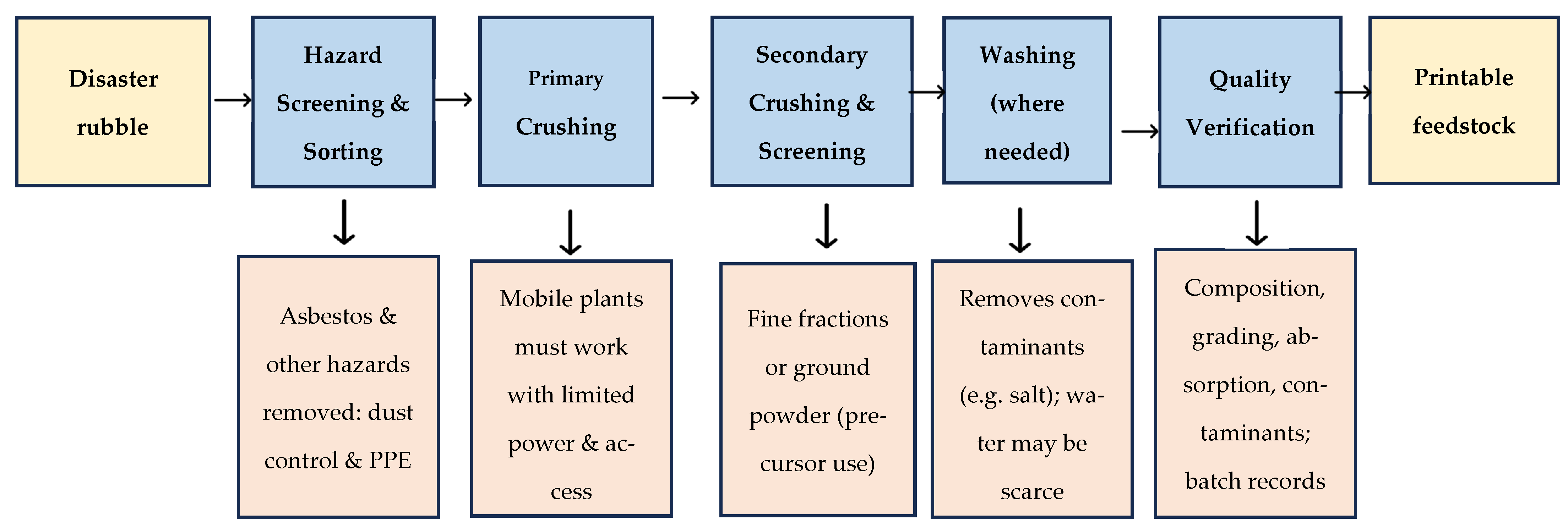
Converting rubble to feedstock involves hazard assessment and sorting, primary crushing, secondary crushing and screening, washing where needed, and quality verification (Figure 1). Printable mixes require fine fractions, and the CDW-based geopolymers in Table 4 used finely ground brick, tile and concrete. Recycled aggregates have a higher water demand than natural aggregates, which must be allowed for in mix design [36,56]. Washing may be needed to remove contaminants: after the 2011 Great East Japan Earthquake and tsunami, tsunami deposits containing hazardous substances were detoxified by washing or physical and chemical treatment, and debris timber was desalted where necessary [59]. Yet water for such processing is itself scarce immediately after many disasters.
Figure 1.
Rubble-to-feedstock processing pipeline. The lower boxes summarize the main constraint at each stage; equipment capacities and throughput depend on the specific plant and are not generalized here.
5.2. Three Roles for Rubble, and What Remains Imported
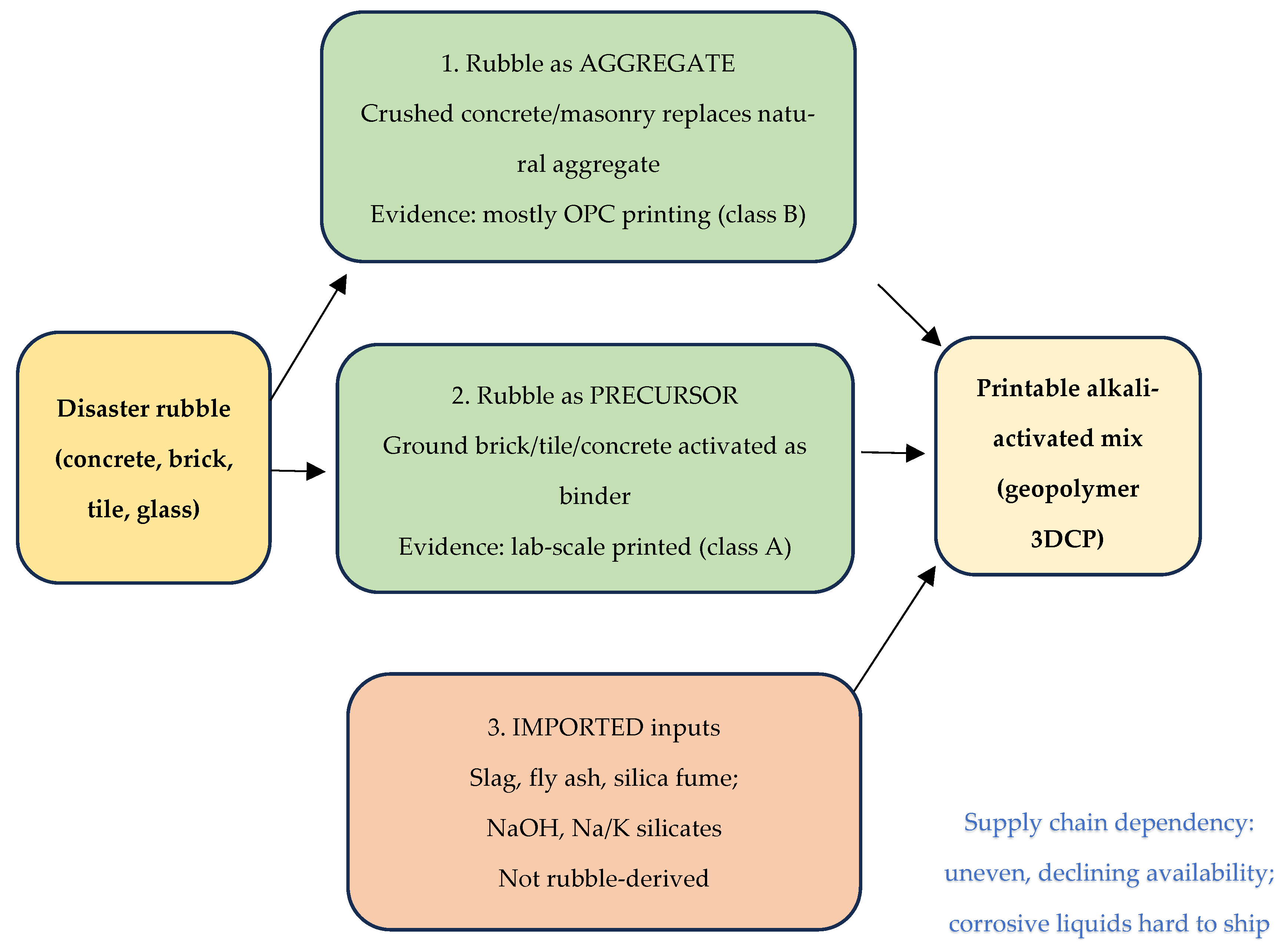
The circularity argument is strongest for aggregate and weakest for activators. Three roles need to be distinguished (Figure 2), because the evidence and the dependencies differ for each.
- •
- Rubble as aggregate: Crushed concrete and masonry can replace natural aggregate. Most evidence for printed mixes uses Portland-cement binders (class B), with recycled sand used up to full replacement [17]; recycled brick aggregate has also been used at 30–50% replacement in a one-part alkali-activated printed mortar [56]. The environmental credit depends on the transport distances of recycled versus natural aggregate: when distances are equal, recycled aggregate concrete can have higher impacts than natural aggregate concrete [47,60].
- •
- Rubble as precursor: Ground brick, tile and, to a lesser extent, concrete contain aluminosilicate phases that respond to alkaline activation. Class A studies show that such precursors can form printable binders, alone [50,51] or blended with slag [34,55,56]. This role is the most distinctive contribution of CDW to geopolymer printing, but it requires grinding to a fine powder and compositional control, both difficult with mixed disaster debris.
- •
- Imported precursors and activators: Fly ash, slag, and silica fume are industrial by-products, and sodium hydroxide, sodium silicate, and potassium silicate are manufactured chemicals. None are derived from rubble. Because slag and fly ash have much lower impacts than Portland cement, the production and transport of the activator become the main source of CO2 emissions in alkali-activated materials [15], and activator content can erode much of the expected environmental benefit [61].
Figure 2.
Three roles for disaster rubble in geopolymer 3DCP, and the inputs that remain external dependencies.
5.3. Supply-Chain Dependency in Disaster Settings
The availability of imported inputs cannot be assumed. Supplies of traditional supplementary cementitious materials such as fly ash are becoming restricted, a trend reinforced by the closure of coal-fired power plants [62]. Availability is also highly uneven between countries. Nepal, one of the case contexts discussed in Section 9, generates nearly all of its electricity from hydropower [63], so it has no domestic supply of power-station fly ash, and its steel industry has relied mainly on imported raw materials, chiefly billets from India, which domestic mills roll into bars and sheets [64]. No domestic source of ground granulated blast-furnace slag was identified in this review. In such settings, slag or fly ash would have to be imported through the same disrupted supply chains that the circular loop is intended to bypass. Activators raise a similar problem, because concentrated alkaline solutions are hazardous to transport and handle (Section 5.4).
Three options reduce this dependency, each with trade-offs. One-part formulations, in which a solid activator is pre-blended with the precursor, avoid shipping corrosive liquid solutions to a damaged site, although solid activators such as NaOH still require careful handling [65]. Sodium silicate activators synthesized from silica-rich wastes such as rice husk ash and waste glass can give mechanical properties comparable to commercial activators, although setting times can shorten or lengthen and must be adjusted through mix design [66]; such waste-derived activators also have lower environmental impacts than commercial sodium silicate [15]. Glass, one of the CDW fractions used as a precursor in several of the studies in Table 4 [36,50,51,52], is among these silica-rich wastes, so part of the activator could in principle also be recovered from rubble, which would extend circularity to the input for which it is currently weakest; this route has not yet been tested in printed mixes. Maximizing the share of rubble-derived precursor, as in the 100% CDW mixes of Table 4 [50,51], reduces the need for fly ash and slag but increases sensitivity to debris composition. Pre-positioning stocks of dry activator and supplementary precursors as part of disaster preparedness is a further option that has not been studied.
5.4. Hazardous Materials and Occupational Safety
Building rubble can contain asbestos-containing materials, arsenic-treated timber, gypsum, paints and solvents [1,2,7], reflecting the widespread historical use of asbestos in construction [67]. Disaster waste guidance calls for hazardous fractions, particularly asbestos, to be identified and handled under a dedicated plan before rubble is recycled [1]. After the February 2023 earthquakes in Türkiye, airborne dust measured over five days in the affected area averaged 30.84 mg/m3 (respirable fraction), about 6.2 times the national limit, and electron microscopy identified fibrous structures and elements associated with asbestos [67]. A focused review of the same disaster examines occupational and environmental asbestos exposure during debris removal, demolition, and reconstruction [68].
For a rubble-to-residence loop, these findings have two implications. First, sorting and crushing must include hazard screening and dust control, with respiratory protection for workers, before any material enters the feedstock stream. Second, whether a geopolymer matrix reliably immobilizes residual contaminants from mixed rubble has not been established for printed systems. Until it has, contaminated fractions should be excluded rather than encapsulated.
The activators themselves pose occupational hazards. Conventional two-part systems require concentrated aqueous alkali solutions, which are corrosive, viscous, and difficult to handle [65]. In field conditions with limited protective equipment, water for washing, and medical support, this is a significant safety concern and an argument for one-part systems and for training. These issues bear directly on equity (Section 9.4): the workers and residents most exposed to debris and chemical hazards are often those with the least protection.
6. Durability and Field Curing
Durability evidence for printed CDW-based geopolymers is limited, and several known limitations of alkali-activated materials are relevant to field deployment.
6.1. Efflorescence
Free alkalis can migrate to the surface and react with atmospheric CO2. In fly ash-based geopolymers, surface efflorescence did not change the mineralogy, but alkali loss reduced strength development and stiffness, and subflorescence beneath the surface generated crystallization pressure that may exceed the tensile strength of the binder [69]. In a printed CDW-based geopolymer, selected additives prevented surface efflorescence and cracking [53]. This suggests that the problem can be managed through formulation, but it needs confirmation over longer exposures.
6.2. Carbonation
Carbonation decalcifies calcium-bearing phases and lowers pore-solution pH, which matters for steel reinforcement. Its effect on strength depends on composition: under accelerated carbonation, both strength losses and gains have been reported for alkali-activated materials, with losses more common, and mixes activated with sodium hydroxide alone have generally shown greater resistance than those activated with sodium silicate [70].
6.3. Shrinkage
Alkali-activated slag shows drying shrinkage considerably higher than that of Portland cement, with kinetics that depend strongly on relative humidity [71]. Printed elements, which have no formwork and a high exposed surface area, are especially vulnerable to early drying, so curing protection is important in hot, dry or windy conditions. Alkali-activated slag also generally shows larger autogenous shrinkage than Portland cement, driven mainly by self-desiccation, and models developed for Portland cement do not estimate it satisfactorily [72]. Because autogenous shrinkage occurs without moisture loss to the environment, it is not prevented by curing protection and needs to be assessed in the qualification of slag-rich printed mixes.
6.4. Curing Regime
Seven of the nine CDW-based printed mixes in Table 4 were cured at ambient temperature [36,50,51,52,53,55,56], which is favorable for field use. One brick-waste geopolymer relied on 24 h of curing at 60 °C [34], which would be difficult to provide on a disaster site. Field conditions also matter for inter-layer bond, which depends on the moisture at the surface of each printed layer and therefore on bleeding and evaporation [35], and more broadly on temperature, humidity and airflow during printing [17]. Mixes intended for deployment should therefore be qualified under the range of conditions expected at the site, not only under laboratory curing.
6.5. Aggressive Environments and Reinforcement
Alkali-activated materials have different reaction products and microstructures from Portland cement, so their deterioration mechanisms require their own assessment. Reinforcement corrosion and deterioration in aggressive media can severely reduce load-bearing capacity, and the long-term deterioration of these materials is not yet fully understood [73]. Steel reinforcement has been integrated into printed CDW-based geopolymer components with substantial gains in bending capacity [54], but no long-term corrosion data exist for such systems. As an adjacent-domain analogy (class C), cast concrete beams reinforced with 3D-printed carbon-fiber-reinforced polylactic acid (PLA) patterns lost up to 30% of their flexural strength after immersion in a 3.5% NaCl solution simulating Atlantic coastal conditions [26], a caution for coastal and flood-prone contexts. Durability testing under realistic, long-duration exposure therefore remains a priority gap for debris-derived mixes, and it cannot be accelerated far beyond what multi-year monitoring allows.
7. Environmental Performance
7.1. Where Emissions Arise
LCAs under ISO 14040/14044 typically use global warming potential (GWP, kg CO2-eq) as the primary impact category. Methodological frameworks for building LCA [74,75] and calls for printed-building design to be informed by life cycle assessment [76] frame the field. Across studies using a functional unit of 1 m3 of concrete, a systematic review found median GWP values of 583.1 kg CO2-eq/m3 for the material production stage and 9.9 kg CO2-eq/m3 for the construction stage of 3DCP, compared with 596.2 and 7.3 kg CO2-eq/m3 for conventional construction [15]. Material production therefore dominates, and the differences between printing and casting at the construction stage are small. Two of the conventional-construction studies had included complex single-use formwork in the material production stage; when they were excluded, the median for that stage fell to 389.8 kg CO2-eq/m3, below that of 3DCP, and the variation among printed mixes (about 300 to 900 kg CO2-eq/m3) tracked their cement-to-binder ratio [15]. Printing’s higher binder content can thus make it more carbon-intensive than casting when Portland cement is used [15,47]. Emissions from cement production also vary with kiln and calcination technology [77].
7.2. Binder and Aggregate Substitution
Geopolymer binders change this picture. Under the cut-off allocation commonly used in LCA, waste inputs such as brick carry zero or negligible upstream burden [78]. Slag and fly ash have much lower impacts than Portland cement, so in alkali-activated materials the production and transport of the activator become the main source of CO2 emissions [15]. Large reductions relative to Portland cement have been proposed for geopolymers [46], but they are not unconditional. An ex ante LCA of geopolymer 3D printing found that, depending on the recipe, the geopolymer could have higher environmental impacts than ordinary concrete, that it still performed worse on abiotic resource depletion and stratospheric ozone depletion, and that reducing the silicate content was the most effective improvement [61]. For a printed geopolymer containing brick waste, embodied energy and carbon reductions of up to 60–80% relative to Portland-cement concrete were estimated [34]. A cradle-to-grave LCA of six construction scenarios modeled a printed, cement-free geopolymer derived from brick waste, based on that mix, and found 53.1% lower life-cycle carbon emissions than conventional construction, with chemical additives as its main remaining emission source; printed mixes with high cement content, by contrast, had higher emissions than the conventional baseline, and recycled materials offset up to 21.8% of process-related CO2 emissions across scenarios [78].
Transport distance determines whether recycled aggregate confers an environmental benefit over virgin aggregate [60]. That condition is often favorable after a disaster, when rubble lies on or near the site, although processing energy and water partly offset the credit. Han et al. modeled recycled aggregate transported 50 km against natural aggregate transported 100 km and found lower emissions with higher recycled-aggregate content [47]. As an adjacent-domain analogy (class C), avoided-burden accounting produced net-negative contributions for waste-tire rubber in printed concrete [25]; a comparable credit for avoided landfill of disaster rubble is plausible but has not been quantified.
7.3. Formwork and Process Effects
Eliminating formwork changes the process-side footprint. For a prefabricated bathroom unit, 3DCP reduced CO2 emissions by 85.9%, energy consumption by 87.1%, and cost by 25.4% relative to precast production, gains attributed mainly to formwork-free fabrication and sensitive to formwork reuse [79]. In a rubberized-concrete comparison (class C), printing had about 9.5% lower GWP than mold casting once mold production was included [25]. These gains are largest for complex or customized elements and smallest where formwork is simple and reused many times.
Table 5 summarizes the quantitative evidence. No published LCA covers a disaster-specific rubble-to-residence pathway, so the circular scenario cannot yet be quantified, and earlier estimates of the combined benefit should be treated as hypotheses. Other impacts matter too: geopolymer printing can perform worse than ordinary concrete on abiotic resource depletion and ozone depletion [61], water use for washing competes with human needs in arid regions, and crushing generates particulate matter (Section 5.4). Social dimensions that LCA does not capture, such as participation, cultural fit, and tenure, are addressed in Section 9.
Table 5.
Quantitative LCA evidence relevant to the six reconstruction pathways. Values are not directly comparable across rows because functional units and system boundaries differ.
8. Structural Design, Seismic Performance and Certification
8.1. Design Inputs: Geometry and Modularity
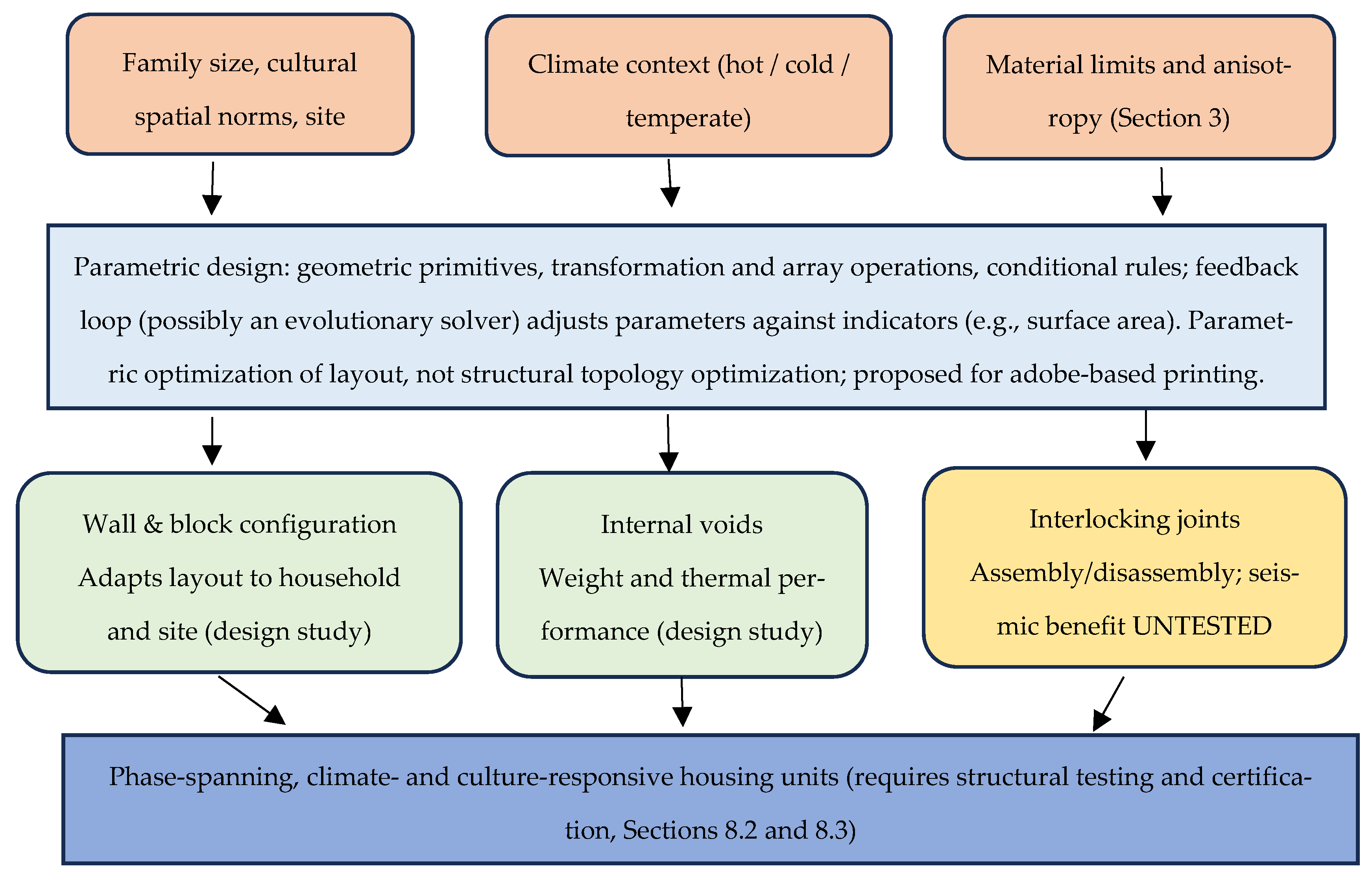
Material formulation alone does not produce a habitable dwelling; the geometry of printed units determines how material is placed, how modules connect, and how the anisotropy discussed above is accommodated. Parametric design studies (class D) propose generating wall and block configurations algorithmically. In the most detailed published model, a parametric pipeline built from geometric primitives, transformation operations and conditional rules generates housing units for different family sizes, cultural norms and sites, with a feedback loop, possibly using an evolutionary solver, that adjusts input parameters against performance indicators such as surface area [80]. In that study, “optimization” refers to iterative refinement of spatial layouts and modular configurations against criteria such as spatial efficiency, adaptability, and thermal and ventilation performance [80]. This is parametric, performance-driven design optimization. It is not topology optimization in the structural-mechanics sense, in which material distribution within a design domain is optimized, for example by density-based methods, against mechanical objectives [81]. The same model proposes interlocking, “Lego-like” base-and-roof blocks for assembly and disassembly without specialized equipment, and internal voids, with straw or lightweight infill, whose placement is optimized for weight and thermal performance [80]. Notably, this model was developed for adobe-based printing, not geopolymer concrete. Figure 3 summarizes the design logic.
Figure 3.
Parametric design logic for printed housing units, as proposed in design studies. Boxes describe design intentions; the structural effects of interlocking joints are untested hypotheses (Section 8.2).
Algorithmic configuration could support culturally responsive housing at low marginal cost. Modular construction more broadly is seen as a promising way to improve the time-efficiency of post-disaster housing reconstruction [82]. In a study with three Indigenous communities in British Columbia, Canada, a 3D-printed home design incorporated a circular form inspired by traditional pit houses, developed through site visits and community engagement, and training community members to print their own homes was identified as a way to address local workforce shortages [83]. Such findings show that geometry, and not only material, affects whether communities accept the housing offered.
8.2. Seismic Performance: Evidence and Hypotheses
Dynamic seismic performance of full-scale printed buildings under realistic ground motion has not been reported in the peer-reviewed literature reviewed here, a critical gap given that earthquakes generate much of global reconstruction demand. The available evidence is indirect, and three claims sometimes made for printed disaster housing should be treated as hypotheses rather than findings:
- •
- Thatinterlocking blocks distribute seismic forces effectively. The design study that proposes interlocking modules argues that tight connections absorb seismic forces and prevent weak points [80], but this is a design argument without structural testing. The only experimental evidence identified for modular connections in CDW-based geopolymer printing comes from direct tensile tests on components, in which a modular connection transmitted a tensile load equivalent to that of a monolithic wall and showed similar failure behavior [54]; cyclic or dynamic tests of such connections have not been reported.
- •
- That geometry is the most reliable mitigation lever. Geometry is less dependent on field conditions than mix design or process control, but no study compares the reliability of the three levers. Effective mitigation is likely to require all three together: fiber or bar reinforcement, controlled intervals between layers, and geometry.
- •
- That reinforcement can be added without compromising printing. Reinforcement integration is identified as a key unresolved engineering question for 3DCP [39,40]. Steel reinforcement improved bending capacity in printed CDW-based geopolymer components [54]. In the interim, printed elements can serve as permanent formwork for conventionally reinforced concrete, or be post-tensioned, routes that can yield code-compliant reinforced structures [39,40].
For residential structures, gravity loads act through the layered structure, whereas lateral seismic and wind loads are more sensitive to anisotropy, so shear along inter-layer interfaces is the critical concern in earthquake-prone regions. Evaluation reports issued under AC509 [84], such as ESR-4652 [85], specify an average 28-day compressive strength of at least 2500 psi (about 17.2 MPa) for the printed concrete. Among the CDW-based geopolymers in Table 4, printed specimens of an ambient-cured mix with 20% slag reached 20.1–24.3 MPa at 28 days [36], and those of a heat-cured brick-waste mix exceeded 25 MPa [34], whereas cast specimens of a mix made entirely from CDW reached only 16.4 MPa [50]. A material-level strength, moreover, does not establish structural adequacy. Acceptance requires characteristic (not mean) values, tests in each relevant loading direction, specimens representative of printed elements, and full-scale element tests, as discussed next.
8.3. Standards and Certification
Certification is a central barrier to deployment, and the available instruments are still emerging (Table 6). The ICC-ES acceptance criteria AC509 [84] evaluate printed concrete walls for compliance with the International Building Code through full-scale axial compression, flexure, and in-plane shear tests for each wall configuration and mix design, together with durability tests. The 2019 edition limited such walls to one-story, single-unit dwellings [86]. The criteria have since been extended to multi-story construction, and the current edition was approved in August 2023 and editorially revised in August 2024 [84,85]. Evaluation reports issued under AC509 still limit printed walls that form the lateral-force-resisting system to Seismic Design Categories A and B: ESR-4623, for example, covers multi-story structures up to 12 m (40 ft) in height but only in those categories [87], and ESR-4652, issued under the 2023 edition, carries the same limitation [85]. UL 3401 provides an outline of investigation for printed building elements but excludes structural design verification [88]. ISO/ASTM 52939:2023 sets quality-assurance requirements for additive construction processes, but does not cover design approvals or material property characterization and testing [89].
Table 6.
Standards and guidance relevant to certification of printed housing.
Two implications follow. First, variable, debris-derived feedstock is in tension with mix-specific qualification: either each feedstock batch must be shown to fall within a qualified range, or acceptance criteria must accommodate controlled variability. A batch-level traceability record (Section 10) would be needed in either case. Second, because existing criteria were not written for high-seismic regions, deployment in earthquake-affected areas will require additional testing and, probably, new provisions developed with local building authorities. Barriers persist even in well-resourced settings: practitioners in Singapore’s public housing sector ranked limited production size, reluctance to invest, and high upfront cost as the most critical challenges to adopting 3D printing [90]. In Kuwait, stakeholders identified the absence of regulations and standards specific to 3DCP as the largest barrier (about 40% of reported difficulties), noting that no standardized tests yet exist for buildability and inter-layer bond [38].
9. Cost, Governance and Equity
9.1. Cost Evidence and Its Gaps
The original framing of this review proposed that circular 3DCP could reduce debris burden, cost and delivery time simultaneously. The cost evidence supports only part of that claim. Several studies report cost advantages of printing itself: in a Shanghai case, 3DCP avoided the large formwork and labor costs of cast-in-situ construction, and recycled-aggregate concrete became cheaper as the recycled share rose, because natural aggregate was more expensive locally [47]; a printed bathroom unit cost 25.4% less than its precast equivalent [79]; and a desk analysis of UK housing estimated savings of up to about 35% of house price from printed walls and foundations, based partly on manufacturer claims of labor reduction [91].
None of these studies includes the costs of sorting, hazard screening, crushing, washing, testing, and quality assurance of disaster rubble, nor the cost of mobilizing processing equipment to a damaged site. Disaster waste research has found that the literature does not specifically address the organizational structures and funding mechanisms of debris management [7]. Until these processing and qualification costs are quantified, the claim that a rubble-to-residence loop reduces cost relative to conventional reconstruction remains unproven. The more defensible claim is that it could reduce debris disposal burden and dependence on imported aggregate, with cost and time effects that depend on processing capacity, quality-assurance requirements and site conditions. In terms of the 4R resilience model [24], a circular printing system could strengthen resourcefulness, by drawing on local materials, and redundancy, by reducing reliance on imported supply chains, but it would improve rapidity only if processing capacity and qualified mixes were in place before a disaster.
9.2. Governance Lessons from Analogous Programs
No published case study documents 3DCP in a post-disaster reconstruction program at scale. The governance lessons below are therefore inferences from analogous programs that did not involve 3DCP, not findings about 3DCP itself.
Chile’s reconstruction after the 2010 earthquake and tsunami is well documented. The government planned to repair or rebuild some 220,000 housing units within four years, and 94% were complete by February 2014 [92]. Subsidies of about US$18,000–20,000 per house supported reconstruction on owners’ own sites, a policy aimed at keeping families in place; owners could repair, select a model from pre-certified contractors, build themselves or buy an existing house, and new units of about 50 m2 were designed so that families could add rooms later [92]. The program combined strong leadership at national and local levels with flexible adaptation of existing institutions, but local governments and citizens were largely not engaged in post-disaster planning, and social and economic planning was left out, so reconstruction in cities such as Talca did not restore lost economic opportunity and neighborhood cohesion [92].
Incremental design was already established in Chilean social housing through Elemental’s model of building part of a house for families to complete; in Elemental’s Villa Verde project, the half-house type was built at 57 m2 and designed for expansion to 85 m2 [93]. A study of the same project roughly a decade after occupancy found that families overwhelmingly wanted to complete their houses: 84% of eligible households delayed moving in, 68% specifically to build first, and seven in ten reached their target floor area within a year of starting. The same study found that regulations constrained modification, for example by requiring neighbors’ collective endorsement for changes not specified in the building permit, and that residents built extensions beyond the designers’ parameters whose implications for structural stability remain uncertain [93]. Institutional design can thus enable and constrain resident participation at the same time.
Nepal’s owner-driven reconstruction after the 2015 earthquake provides a counterpoint. Households received housing grants of 300,000 Nepalese rupees (NPR, about US$2530) in three tranches, and rebuilding accelerated once grant deadlines were imposed, but many families rebuilt one-room or one-story earthquake-safe houses too small for their needs, with average house size falling from 51–75 m2 to 26–50 m2. The program followed a donor-preferred model without effective means of mobilizing households to rebuild, and lacked five elements of successful owner-driven practice: an effective organizational structure, technical support, public–private partnerships, policy communication and support for vulnerable groups [94]. Read together (Table 7), the two cases bound the governance problem from opposite directions: Chile shows that participation needs a scaffold precise enough to permit self-build without abandoning technical oversight, and Nepal that removing the scaffold shifts risk onto the households least able to bear it. A Build Back Better case study from Victorian bushfire reconstruction similarly found that success requires coordinated action across risk reduction, community recovery and implementation, not structural improvement alone [28].
Table 7.
Institutional conditions in two analogous reconstruction programs (neither used 3DCP).
9.3. Risks and Counter-Evidence
The same inference cuts both ways. 3DCP could work against the owner-driven and incremental models that the Chilean and Nepalese cases show to matter. Printers, proprietary mixes, software, and trained operators are concentrated in equipment owners and technology providers, and centralized printing could reduce residents’ control over the design, timing, and modification of their homes. Firms’ main incentive to adopt 3DCP has been found to be automation and the shortage of skilled labor rather than environmental benefit, and procurement rules rarely reward sustainability [95], so the incentives of technology providers may not align with circular or participatory goals. Centralized equipment logistics could also slow delivery in dispersed or informal recovery relative to community self-build. Mitigations include open or regionally owned equipment, community-operated processing, participatory parametric design that leaves room for self-completion, and procurement that rewards local capacity-building; none has yet been tested in a disaster program.
9.4. Equity
Disaster losses concentrate in low-income and informally housed populations, because informal locations concentrate hazard exposure while structural quality is lower [5]. Recovery is also unequal: household-level tracking after the 2018 Lombok earthquake found that wealth, proximity to a regency center and urban location were associated with faster reduction of shelter vulnerability, although these effects were marginal and weakened after about four months [4]. Any new technology risks reaching formally managed programs first, while tenure-insecure households remain excluded. The access gap operates at the levels of equipment, materials, skills and regulation: high upfront cost and reluctance to invest constrain adoption even in well-resourced settings [90], and proprietary mixes create supply-chain fragility that a circular model addresses only if community-scale processing, local mix calibration and practical quality assurance are available. Mainstream reconstruction has also tended to neglect gender and disability: a review of 80 studies found existing frameworks insufficiently gender-inclusive [96], and a systematic review of 89 studies found universal-design housing adoption still low despite numerous guiding principles, owing to barriers such as added cost, industry attitudes, inadequate education and the absence of binding legislation [97]. Parametric tools could embed step-free access and other universal-design features as default constraints. Finally, hazard exposure during debris processing (Section 5.4) falls on workers and residents, which makes occupational protection an equity issue as well as a technical one.
10. Research Agenda
The gaps identified above suggest a staged agenda (Table 8). The first stage is to characterize real disaster debris and test it in printable alkali-activated mixes, including hazard screening and contaminant leaching, because no study has yet used field-collected rubble. The second is durability and curing under field conditions, covering efflorescence, carbonation, shrinkage, reinforcement corrosion, and inter-layer bond under variable temperature and humidity. The third is structural testing at element and building scale, including cyclic and dynamic tests of interlocking and reinforced systems, to test the hypotheses in Section 8.2. The fourth is a disaster-specific LCA and cost assessment that includes sorting, crushing, washing, testing, and quality assurance. The fifth is institutional: certification pathways for variable feedstock and high-seismic regions, procurement that funds processing infrastructure, and participation rules calibrated between the over-restriction and under-support seen in Chile and Nepal.
Table 8.
Research priorities linked to the gaps identified in this review.
Supporting tools could help. Feedstock variability is a high-dimensional optimization problem, and explainable artificial intelligence is increasingly applied in disaster risk management to make model-based decisions interpretable to decision-makers [98]; models trained on existing geopolymer printability data might reduce the batch testing needed to adapt mixes to variable debris, although this remains untested. Material passports, which provide an inventory of all materials embedded in a building and can be compiled from Building Information Models [99], could be adapted to record each feedstock batch’s origin, hazard-clearance status, and test results, providing an audit trail for certification bodies and humanitarian agencies. Hybrid systems could further reduce imported inputs, for example by combining debris-derived geopolymer with earth-based or bio-based secondary components [100,101]; recyclable printed earth formwork made from construction waste soils has already been used to cast reinforced concrete structures [102]. Geographic coverage also needs to widen: the evidence base reviewed here is concentrated in China, Europe, Türkiye, Australia and the United States, with few studies from Sub-Saharan Africa [103,104], South and Southeast Asia or Small Island Developing States. Uneven coverage is also seen in community resilience measurement, where only one of 32 studies applying a widely used resilience index was conducted in Africa [105]. No longitudinal post-occupancy study of printed disaster housing exists.
11. Conclusions
This review examined whether disaster rubble, reprocessed for geopolymer 3D concrete printing, could link debris management and housing delivery after disasters. The main conclusions are as follows.
The combined system is feasible at laboratory and component scale only. Construction and demolition waste, mainly ground brick, tile, concrete, and glass, can serve as precursor and aggregate in printable alkali-activated mortars. Reported 28-day strengths range from about 16 MPa for cast mixes made entirely from CDW to about 30 MPa with industrial additives, and printed specimens of slag-blended mixes reached 20–25 MPa, but values depend on loading direction and fall as the interval between layers grows. No study has tested field-collected disaster rubble, full-scale printed buildings, or long-term durability, and seven of the nine studies that combine all three elements come from a single institution.
Circularity is partial. It is strongest when rubble supplies both aggregate and precursor and weakest for activators and supplementary precursors such as slag, fly ash, and silica fume, which remain external dependencies. Their availability is uneven and declining in places, and in some disaster contexts, Nepal among them, they would have to be imported.
Environmental benefits are plausible but unquantified for this pathway. Material production dominates GWP; formwork elimination and geopolymer substitution can reduce emissions, but the activator then becomes the main remaining hotspot. One cradle-to-grave LCA modeled a printed brick-waste geopolymer at about half the life-cycle emissions of conventional construction, under allocation rules that assign waste inputs no upstream burden. No disaster-specific LCA exists, however, and the cost of processing and qualifying rubble has not been measured, so claims of simultaneous reductions in cost and delivery time are not yet supported.
Safety, durability and certification are binding constraints. Hazardous materials in debris, corrosive activators, geopolymer-specific durability issues and the absence of certification routes for high-seismic regions all need to be resolved before deployment. Claims about the seismic benefit of interlocking printed blocks are hypotheses awaiting testing.
Governance is likely to matter as much as technology. By inference from analogous programs in Chile and Nepal, outcomes will depend on tenure, subsidy and participation rules, and on processing capacity, at least as much as on printing capability. 3DCP also carries a risk of centralizing control in technology providers, which could undermine owner-driven reconstruction unless deliberately countered.
Circular geopolymer 3DCP should therefore be pursued as a staged research and demonstration program rather than presented as a ready solution. Three steps would most advance it: field trials with characterized disaster debris and hazard screening; durability and structural testing at element and building scale under realistic curing and loading; and certification and procurement frameworks that accommodate variable feedstock, fund processing infrastructure and keep residents in control of their own reconstruction.
Author Contributions
Conceptualization, S.M.; methodology, S.M.; investigation, S.M.; formal analysis, S.M.; data curation, S.M.; writing—original draft preparation, S.M.; writing—review and editing, S.M. and R.B.M.; supervision, R.B.M.; validation, R.B.M. All authors have read and agreed to the published version of the manuscript.
Funding
This research received no external funding.
Institutional Review Board Statement
Not applicable.
Informed Consent Statement
Not applicable.
Data Availability Statement
No new data were created or analyzed in this study. Data sharing is not applicable to this article.
Acknowledgments
The authors thank the LSU Libraries for assistance in obtaining the sources reviewed in this study. During the preparation of this manuscript, the authors used Claude Opus 5.5 (Anthropic) for the purposes described in Section 2.5 and for drafting and language editing. The authors have reviewed and edited the output and take full responsibility for the content of this publication.
Conflicts of Interest
The authors declare no conflicts of interest.
Abbreviations
The following abbreviations are used in this manuscript:
| 3DCP | 3D concrete printing |
| AC509 | Acceptance Criteria for 3D Automated Construction Technology for 3D Concrete Walls (ICC-ES) |
| ASTM | ASTM International (formerly American Society for Testing and Materials) |
| CAC | Calcium aluminate cement |
| CDW | Construction and demolition waste |
| CO2-eq | Carbon dioxide equivalent |
| GGBS | Ground granulated blast-furnace slag |
| GWP | Global warming potential |
| ICC-ES | International Code Council Evaluation Service |
| ISO | International Organization for Standardization |
| LCA | Life cycle assessment |
| NPR | Nepalese rupee |
| OCHA | United Nations Office for the Coordination of Humanitarian Affairs |
| PLA | Polylactic acid |
| PRISMA | Preferred Reporting Items for Systematic Reviews and Meta-Analyses |
| QA | Quality assurance |
| TRL | Technology readiness level |
| UL | Underwriters Laboratories |
| UNDRR | United Nations Office for Disaster Risk Reduction |
| UNEP | United Nations Environment Programme |
References
- UNEP/OCHA. Disaster Waste Management Guidelines; UNEP/OCHA Joint Environment Unit: Geneva, Switzerland, 2013; Available online: https://wedocs.unep.org/handle/20.500.11822/27291 (accessed on 14 October 2026).
- Xiao, J.; Deng, Q.; Hou, M.; Shen, J.; Gencel, O. Where Are Demolition Wastes Going: Reflection and Analysis of the February 6, 2023 Earthquake Disaster in Turkey. Low-carbon Mater. Green Constr. 2023, 1, 17. [Google Scholar] [CrossRef] [Scilit]
- Waheeb, R.A.; Andersen, B.S. Causes of Problems in Post-Disaster Emergency Re-Construction Projects—Iraq as a Case Study. Public Works Manag. Policy 2022, 27, 61–97. [Google Scholar] [CrossRef] [Scilit]
- Lines, R.; Faure Walker, J.P.; Yore, R. Progression through Emergency and Temporary Shelter, Transitional Housing and Permanent Housing: A Longitudinal Case Study from the 2018 Lombok Earthquake, Indonesia. Int. J. Disaster Risk Reduct. 2022, 75, 102959. [Google Scholar] [CrossRef] [Scilit]
- Satterthwaite, D.; Archer, D.; Colenbrander, S.; Dodman, D.; Hardoy, J.; Mitlin, D.; Patel, S. Building Resilience to Climate Change in Informal Settlements. One Earth 2020, 2, 143–156. [Google Scholar] [CrossRef] [Scilit]
- Bai, M.; Song, L.; Chen, K.; Xiao, J. Microstructural and Mechanical Properties of ECC with Recycled Powder and PVP-Modified PE Fibers. Constr. Build. Mater. 2026, 540, 147705. [Google Scholar] [CrossRef] [Scilit]
- Brown, C.; Milke, M.; Seville, E. Disaster Waste Management: A Review Article. Waste Manag. 2011, 31, 1085–1098. [Google Scholar] [CrossRef] [Scilit] [PubMed]
- Placzek, G.; Schwerdtner, P. A Global Snapshot of 3D-Printed Buildings: Uncovering Robotic-Oriented Fabrication Strategies. Buildings 2024, 14, 3410. [Google Scholar] [CrossRef] [Scilit]
- De Souza, E.A.; Borges, P.H.R.; Stengel, T.; Nematollahi, B.; Bos, F.P. 3D Printed Sustainable Low-Cost Materials for Construction of Affordable Social Housing in Brazil: Potential, Challenges, and Research Needs. J. Build. Eng. 2024, 87, 108985. [Google Scholar] [CrossRef] [Scilit]
- Banihashemi, S.; Akbarnezhad, A.; Sheikhkhoshkar, M.; Bril El Haouzi, H.; Rolfe, B. 3D Printing in Construction: Sustainable Technology for Building Industry. Prog. Addit. Manuf. 2025, 10, 11729–11762. [Google Scholar] [CrossRef] [Scilit]
- Bazli, M.; Ashrafi, H.; Rajabipour, A.; Kutay, C. 3D Printing for Remote Housing: Benefits and Challenges. Autom. Constr. 2023, 148, 104772. [Google Scholar] [CrossRef] [Scilit]
- Khan, M.; Dani, A.A.; Lim, J.B.P.; Roy, K. Appraising the Feasibility of 3D Printing Construction in New Zealand Housing. Buildings 2024, 14, 1084. [Google Scholar] [CrossRef] [Scilit]
- van den Bergh, J.; Nieuw, C.; Slob, W.; Escalante Suarez, M.; Velema, P.L. Modular 3D Printing Construction: Towards Affordable, Adjustable and Climate-Resilient Housing; United Nations: New York, NY, USA, 2022; Available online: https://sdgs.un.org/sites/default/files/2022-05/2.4.4-14-van%20den%20Bergh%20-Modular%203D%20printing%20construction.pdf (accessed on 14 October 2026).
- Everett, B.; Soto, J.; Bakhshi, P.; Pourmokhtarian, A. Exploring 3D Printing Potentials for Sustainable, Resilient, and Affordable Housing. In Proceedings of the Creative Construction e-Conference 2022; Budapest University of Technology and Economics: Budapest, Hungary, 2022; pp. 296–306. [Google Scholar] [CrossRef] [Scilit]
- Tinoco, M.P.; De Mendonça, É.M.; Fernandez, L.I.C.; Caldas, L.R.; Mendoza Reales, O.A.; Toledo Filho, R.D. Life Cycle Assessment (LCA) and Environmental Sustainability of Cementitious Materials for 3D Concrete Printing: A Systematic Literature Review. J. Build. Eng. 2022, 52, 104456. [Google Scholar] [CrossRef] [Scilit]
- Al-Noaimat, Y.A.; Ghaffar, S.H.; Chougan, M.; Al-Kheetan, M.J. A Review of 3D Printing Low-Carbon Concrete with One-Part Geopolymer: Engineering, Environmental and Economic Feasibility. Case Stud. Constr. Mater. 2023, 18, e01818. [Google Scholar] [CrossRef] [Scilit]
- Tu, H.; Wei, Z.; Bahrami, A.; Ben Kahla, N.; Ahmad, A.; Özkılıç, Y.O. Recent Advancements and Future Trends in 3D Concrete Printing Using Waste Materials. Dev. Built Environ. 2023, 16, 100187. [Google Scholar] [CrossRef] [Scilit]
- Kantaros, A.; Petrescu, F.I.T.; Brachos, K.; Ganetsos, T.; Petrescu, N. Leveraging 3D Printing for Resilient Disaster Management in Smart Cities. Smart Cities 2024, 7, 3705–3726. [Google Scholar] [CrossRef] [Scilit]
- Torraco, R.J. Writing Integrative Literature Reviews: Guidelines and Examples. Hum. Resour. Dev. Rev. 2005, 4, 356–367. [Google Scholar] [CrossRef] [Scilit]
- Webster, J.; Watson, R.T. Analyzing the Past to Prepare for the Future: Writing a Literature Review. MIS Q. 2002, 26, xiii–xxiii. [Google Scholar] [CrossRef] [Scilit]
- Snyder, H. Literature Review as a Research Methodology: An Overview and Guidelines. J. Bus. Res. 2019, 104, 333–339. [Google Scholar] [CrossRef] [Scilit]
- Page, M.J.; McKenzie, J.E.; Bossuyt, P.M.; Boutron, I.; Hoffmann, T.C.; Mulrow, C.D.; Shamseer, L.; Tetzlaff, J.M.; Akl, E.A.; Brennan, S.E.; et al. The PRISMA 2020 Statement: An Updated Guideline for Reporting Systematic Reviews. BMJ 2021, 372, n71. [Google Scholar] [CrossRef] [Scilit] [PubMed]
- Khoshnevis, B. Automated Construction by Contour Crafting—Related Robotics and Information Technologies. Autom. Constr. 2004, 13, 5–19. [Google Scholar] [CrossRef] [Scilit]
- Bruneau, M.; Chang, S.E.; Eguchi, R.T.; Lee, G.C.; O’Rourke, T.D.; Reinhorn, A.M.; Shinozuka, M.; Tierney, K.; Wallace, W.A.; von Winterfeldt, D. A Framework to Quantitatively Assess and Enhance the Seismic Resilience of Communities. Earthq. Spectra 2003, 19, 733–752. [Google Scholar] [CrossRef] [Scilit]
- Sambucci, M.; Biblioteca, I.; Valente, M. Life Cycle Assessment (LCA) of 3D Concrete Printing and Casting Processes for Cementitious Materials Incorporating Ground Waste Tire Rubber. Recycling 2023, 8, 15. [Google Scholar] [CrossRef] [Scilit]
- Hematibahar, M.; Kharun, M.; Stashevskaya, N.A.; Milani, A.A.; Tahmasebi, A.; Kordi, O.; Rossi, A.; Martins, C.H. Evaluation of Mechanical Properties of 3D Printed PLA-CF Reinforced Concrete under Atlantic Coastal Conditions of Brazil. Discov. Civ. Eng. 2025, 2, 208. [Google Scholar] [CrossRef] [Scilit]
- UNDRR. Sendai Framework for Disaster Risk Reduction 2015–2030; UNDRR: Geneva, Switzerland, 2015; Available online: https://www.undrr.org/publication/sendai-framework-disaster-risk-reduction-2015-2030 (accessed on 16 October 2026).
- Mannakkara, S.; Wilkinson, S.; Potangaroa, R. Build Back Better: Implementation in Victorian Bushfire Reconstruction. Disasters 2014, 38, 267–290. [Google Scholar] [CrossRef] [Scilit] [PubMed]
- Ngo, T.D.; Kashani, A.; Imbalzano, G.; Nguyen, K.T.Q.; Hui, D. Additive Manufacturing (3D Printing): A Review of Materials, Methods, Applications and Challenges. Compos. Part B Eng. 2018, 143, 172–196. [Google Scholar] [CrossRef] [Scilit]
- Labonnote, N.; Rønnquist, A.; Manum, B.; Rüther, P. Additive Construction: State-of-the-Art, Challenges and Opportunities. Autom. Constr. 2016, 72, 347–366. [Google Scholar] [CrossRef] [Scilit]
- Xia, M.; Nematollahi, B.; Sanjayan, J. Printability, Accuracy and Strength of Geopolymer Made Using Powder-Based 3D Printing for Construction Applications. Autom. Constr. 2019, 101, 179–189. [Google Scholar] [CrossRef] [Scilit]
- Mohammad, M.; Masad, E.; Al-Ghamdi, S.G. 3D Concrete Printing Sustainability: A Comparative Life Cycle Assessment of Four Construction Method Scenarios. Buildings 2020, 10, 245. [Google Scholar] [CrossRef] [Scilit]
- Panda, B.; Paul, S.C.; Hui, L.J.; Tay, Y.W.D.; Tan, M.J. Additive Manufacturing of Geopolymer for Sustainable Built Environment. J. Clean. Prod. 2017, 167, 281–288. [Google Scholar] [CrossRef] [Scilit]
- Pasupathy, K.; Ramakrishnan, S.; Sanjayan, J. 3D Concrete Printing of Eco-Friendly Geopolymer Containing Brick Waste. Cem. Concr. Compos. 2023, 138, 104943. [Google Scholar] [CrossRef] [Scilit]
- Sanjayan, J.G.; Nematollahi, B.; Xia, M.; Marchment, T. Effect of Surface Moisture on Inter-Layer Strength of 3D Printed Concrete. Constr. Build. Mater. 2018, 172, 468–475. [Google Scholar] [CrossRef] [Scilit]
- Özkılıç, H.; İlcan, H.; Aminipour, E.; Tuğluca, M.S.; Aldemir, A.; Şahmaran, M. Bond Properties and Anisotropy Performance of 3D-Printed Construction and Demolition Waste-Based Geopolymers: Effect of Operational- and Material-Oriented Parameters. J. Build. Eng. 2023, 78, 107688. [Google Scholar] [CrossRef] [Scilit]
- Bayat, M.; Kharel, S.; Li, J. On the Effects of Additive Manufacturing on Affordable Housing Development: A Review. Sustainability 2025, 17, 5328. [Google Scholar] [CrossRef] [Scilit]
- Al-Raqeb, H.; Ghaffar, S.H. 3D Concrete Printing in Kuwait: Stakeholder Insights for Sustainable Waste Management Solutions. Sustainability 2025, 17, 200. [Google Scholar] [CrossRef] [Scilit]
- Ma, G.; Buswell, R.; Leal da Silva, W.R.; Wang, L.; Xu, J.; Jones, S.Z. Technology Readiness: A Global Snapshot of 3D Concrete Printing and the Frontiers for Development. Cem. Concr. Res. 2022, 156, 106774. [Google Scholar] [CrossRef] [Scilit]
- Mechtcherine, V.; Buswell, R.; Kloft, H.; Bos, F.P.; Hack, N.; Wolfs, R.; Sanjayan, J.; Nematollahi, B.; Ivaniuk, E.; Neef, T. Integrating Reinforcement in Digital Fabrication with Concrete: A Review and Classification Framework. Cem. Concr. Compos. 2021, 119, 103964. [Google Scholar] [CrossRef] [Scilit]
- Valente, M.; Sibai, A.; Sambucci, M. Extrusion-Based Additive Manufacturing of Concrete Products: Revolutionizing and Remodeling the Construction Industry. J. Compos. Sci. 2019, 3, 88. [Google Scholar] [CrossRef] [Scilit]
- Bhattacherjee, S.; Basavaraj, A.S.; Rahul, A.V.; Santhanam, M.; Gettu, R.; Panda, B.; Schlangen, E.; Chen, Y.; Copuroglu, O.; Ma, G.; et al. Sustainable Materials for 3D Concrete Printing. Cem. Concr. Compos. 2021, 122, 104156. [Google Scholar] [CrossRef] [Scilit]
- Le, T.T.; Austin, S.A.; Lim, S.; Buswell, R.A.; Gibb, A.G.F.; Thorpe, T. Mix Design and Fresh Properties for High-Performance Printing Concrete. Mater. Struct. 2012, 45, 1221–1232. [Google Scholar] [CrossRef] [Scilit]
- Zhang, D.-W.; Wang, D.; Lin, X.-Q.; Zhang, T. The Study of the Structure Rebuilding and Yield Stress of 3D Printing Geopolymer Pastes. Constr. Build. Mater. 2018, 184, 575–580. [Google Scholar] [CrossRef] [Scilit]
- Zhang, Y.; Zhang, Y.; Liu, G.; Yang, Y.; Wu, M.; Pang, B. Fresh Properties of a Novel 3D Printing Concrete Ink. Constr. Build. Mater. 2018, 174, 263–271. [Google Scholar] [CrossRef] [Scilit]
- Duxson, P.; Provis, J.L.; Lukey, G.C.; van Deventer, J.S.J. The Role of Inorganic Polymer Technology in the Development of ‘Green Concrete’. Cem. Concr. Res. 2007, 37, 1590–1597. [Google Scholar] [CrossRef] [Scilit]
- Han, Y.; Yang, Z.; Ding, T.; Xiao, J. Environmental and Economic Assessment on 3D Printed Buildings with Recycled Concrete. J. Clean. Prod. 2021, 278, 123884. [Google Scholar] [CrossRef] [Scilit]
- Alonso-Cañon, S.; Blanco-Fernandez, E.; Castro-Fresno, D.; Yoris-Nobile, A.I.; Castanon-Jano, L. Comparison of Reinforcement Fibers in 3D Printing Mortars Using Multi-Criteria Analysis. Int. J. Adv. Manuf. Technol. 2024, 134, 1463–1485. [Google Scholar] [CrossRef] [Scilit]
- Binega Yemesegen, E.; Memari, A.M. A Review of Experimental Studies on Cob, Hempcrete, and Bamboo Components and the Call for Transition towards Sustainable Home Building with 3D Printing. Constr. Build. Mater. 2023, 399, 132603. [Google Scholar] [CrossRef] [Scilit]
- Şahin, O.; İlcan, H.; Ateşli, A.T.; Kul, A.; Yıldırım, G.; Şahmaran, M. Construction and Demolition Waste-Based Geopolymers Suited for Use in 3-Dimensional Additive Manufacturing. Cem. Concr. Compos. 2021, 121, 104088. [Google Scholar] [CrossRef] [Scilit]
- İlcan, H.; Şahin, O.; Kul, A.; Yıldırım, G.; Şahmaran, M. Rheological Properties and Compressive Strength of Construction and Demolition Waste-Based Geopolymer Mortars for 3D-Printing. Constr. Build. Mater. 2022, 328, 127114. [Google Scholar] [CrossRef] [Scilit]
- Demiral, N.Ç.; Ekinci, M.Ö.; Şahin, O.; İlcan, H.; Kul, A.; Yıldırım, G.; Şahmaran, M. Mechanical Anisotropy Evaluation and Bonding Properties of 3D-Printable Construction and Demolition Waste-Based Geopolymer Mortars. Cem. Concr. Compos. 2022, 134, 104814. [Google Scholar] [CrossRef] [Scilit]
- İlcan, H.; Külak, A.Y.; Şahmaran, M. 3D-Printable Construction and Demolition Waste-Based Geopolymer: Investigating the Effects of Additives on Engineering Properties. J. Build. Eng. 2024, 87, 109094. [Google Scholar] [CrossRef] [Scilit]
- İlcan, H.; Külak, A.Y.; Şahin, O.; Aldemir, A.; Şahmaran, M.; Lachemi, M. Reinforcement and Modular System for 3DCP Geopolymer Structures Using Construction and Demolition Waste. Constr. Build. Mater. 2025, 474, 141115. [Google Scholar] [CrossRef] [Scilit]
- Kul, A.; Kocaer, Ö.; Aldemir, A.; Yıldırım, G.; Lucas, S.S. 3D Printable One-Part Alkali-Activated Mortar Derived from Brick Masonry Wastes. Case Stud. Constr. Mater. 2024, 21, e04081. [Google Scholar] [CrossRef] [Scilit]
- Al-Noaimat, Y.A.; Chougan, M.; Albar, A.; Skibicki, S.; Federowicz, K.; Hoffman, M.; Sibera, D.; Cendrowski, K.; Techman, M.; Pacheco, J.N.; et al. Recycled Brick Aggregates in One-Part Alkali-Activated Materials: Impact on 3D Printing Performance and Material Properties. Dev. Built Environ. 2023, 16, 100248. [Google Scholar] [CrossRef] [Scilit]
- Lyu, P.; Luo, D.; Özdoğru, E.; Şahin, O. 3D-Printable Materials Containing Construction and Demolition Waste: A Review. Innov. Infrastruct. Solut. 2026, 11, 505. [Google Scholar] [CrossRef] [Scilit]
- Elshaboury, N.; Al-Sakkaf, A.; Mohammed Abdelkader, E.; Alfalah, G. Construction and Demolition Waste Management Research: A Science Mapping Analysis. Int. J. Environ. Res. Public Health 2022, 19, 4496. [Google Scholar] [CrossRef] [Scilit] [PubMed]
- Sakai, S. Debris Management; Learning from Megadisasters Knowledge Note 4-4; World Bank and Global Facility for Disaster Reduction and Recovery (GFDRR): Washington, DC, USA, 2012; Available online: https://www.gfdrr.org/sites/default/files/publication/knowledge-note-japan-earthquake-4-4.pdf (accessed on 16 October 2026).
- Marinković, S.; Radonjanin, V.; Malešev, M.; Ignjatović, I. Comparative Environmental Assessment of Natural and Recycled Aggregate Concrete. Waste Manag. 2010, 30, 2255–2264. [Google Scholar] [CrossRef] [Scilit] [PubMed]
- Yao, Y.; Hu, M.; Di Maio, F.; Cucurachi, S. Life Cycle Assessment of 3D Printing Geo-polymer Concrete: An Ex-ante Study. J. Ind. Ecol. 2020, 24, 116–127. [Google Scholar] [CrossRef] [Scilit]
- Juenger, M.C.G.; Snellings, R.; Bernal, S.A. Supplementary Cementitious Materials: New Sources, Characterization, and Performance Insights. Cem. Concr. Res. 2019, 122, 257–273. [Google Scholar] [CrossRef] [Scilit]
- Climate Action Tracker. Nepal: Policies and Action. Available online: https://climateactiontracker.org/countries/nepal/policies-action/ (accessed on 14 October 2026).
- Prasain, K. Nepal Now Self-Sufficient in Iron, Steel Materials. The Kathmandu Post, 21 November 2018. Available online: https://kathmandupost.com/money/2018/11/21/nepal-now-self-sufficient-in-iron-steel-materials (accessed on 3 November 2026).
- Luukkonen, T.; Abdollahnejad, Z.; Yliniemi, J.; Kinnunen, P.; Illikainen, M. One-Part Alkali-Activated Materials: A Review. Cem. Concr. Res. 2018, 103, 21–34. [Google Scholar] [CrossRef] [Scilit]
- Alnahhal, M.F.; Kim, T.; Hajimohammadi, A. Waste-Derived Activators for Alkali-Activated Materials: A Review. Cem. Concr. Compos. 2021, 118, 103980. [Google Scholar] [CrossRef] [Scilit]
- Oral, T.; Ensari Özay, M.; Uçan, R.; Aker, D.; Can, E.; Altınten, B. Measurement and Evaluation of Dust Concentrations in the Air After the Kahramanmaraş Earthquake in Turkey. Int. J. Environ. Res. Public Health 2025, 22, 649. [Google Scholar] [CrossRef] [Scilit] [PubMed]
- Dikeç, H.; Ökçesiz Hacıseyitoğlu, A. Asbestos Exposure in Occupational and Environmental Settings Following the 2023 Earthquake in Türkiye: A Focused Review. FABAD J. Pharm. Sci. 2026, 51, 403–418. [Google Scholar] [CrossRef] [Scilit]
- Zhang, Z.; Provis, J.L.; Ma, X.; Reid, A.; Wang, H. Efflorescence and Subflorescence Induced Microstructural and Mechanical Evolution in Fly Ash-Based Geopolymers. Cem. Concr. Compos. 2018, 92, 165–177. [Google Scholar] [CrossRef] [Scilit]
- Lamaa, G.; Duarte, A.P.C.; Silva, R.V.; de Brito, J. Carbonation of Alkali-Activated Materials: A Review. Materials 2023, 16, 3086. [Google Scholar] [CrossRef] [Scilit] [PubMed]
- Ye, H.; Radlińska, A. Shrinkage Mechanisms of Alkali-Activated Slag. Cem. Concr. Res. 2016, 88, 126–135. [Google Scholar] [CrossRef] [Scilit]
- Li, Z.; Chen, Y.; Provis, J.L.; Cizer, Ö.; Ye, G. Autogenous Shrinkage of Alkali-Activated Slag: A Critical Review. Cem. Concr. Res. 2023, 172, 107244. [Google Scholar] [CrossRef] [Scilit]
- Zhang, J.; Shi, C.; Zhang, Z.; Ou, Z. Durability of Alkali-Activated Materials in Aggressive Environments: A Review on Recent Studies. Constr. Build. Mater. 2017, 152, 598–613. [Google Scholar] [CrossRef] [Scilit]
- Ochsendorf, J.; Norford, L.K.; Brown, D.; Durschlag, H.; Hsu, S.L.; Love, A.; Santero, N.; Swei, O.; Webb, A.; Wildnauer, M. Methods, Impacts, and Opportunities in the Concrete Building Life Cycle; MIT Concrete Sustainability Hub: Cambridge, MA, USA, 2011; Available online: https://hdl.handle.net/1721.1/105108 (accessed on 3 November 2026).
- Islam, H.; Jollands, M.; Setunge, S. Life Cycle Assessment and Life Cycle Cost Implication of Residential Buildings—A Review. Renew. Sustain. Energy Rev. 2015, 42, 129–140. [Google Scholar] [CrossRef] [Scilit]
- Dixit, M.K. 3-D Printing in Building Construction: A Literature Review of Opportunities and Challenges of Reducing Life Cycle Energy and Carbon of Buildings. IOP Conf. Ser. Earth Environ. Sci. 2019, 290, 012012. [Google Scholar] [CrossRef] [Scilit]
- Hottle, T.; Hawkins, T.R.; Chiquelin, C.; Lange, B.; Young, B.; Sun, P.; Elgowainy, A.; Wang, M. Environmental Life-Cycle Assessment of Concrete Produced in the United States. J. Clean. Prod. 2022, 363, 131834. [Google Scholar] [CrossRef] [Scilit]
- Mu, X.; Zhang, X.; He, G.; Liew, K.M. Toward Low-Carbon 3D Concrete Printing through Circular Construction and Waste Valorization. J. Build. Eng. 2026, 119, 115308. [Google Scholar] [CrossRef] [Scilit]
- Weng, Y.; Li, M.; Ruan, S.; Wong, T.N.; Tan, M.J.; Ow Yeong, K.L.; Qian, S. Comparative Economic, Environmental and Productivity Assessment of a Concrete Bathroom Unit Fabricated through 3D Printing and a Precast Approach. J. Clean. Prod. 2020, 261, 121245. [Google Scholar] [CrossRef] [Scilit]
- Mehdizade, A.; Ayoobi, A.W.; Inceoğlu, M. Applicable and Flexible Post-Disaster Housing Through Parametric Design and 3D Printing: A Novel Model for Prototyping and Deployment. Sustainability 2025, 17, 7212. [Google Scholar] [CrossRef] [Scilit]
- Bendsøe, M.P.; Sigmund, O. Topology Optimization: Theory, Methods, and Applications, 2nd ed.; Springer: Berlin/Heidelberg, Germany, 2004; ISBN 978-3-642-07698-5. [Google Scholar]
- Ghannad, P.; Lee, Y.-C.; Choi, J.O. Feasibility and Implications of the Modular Construction Approach for Rapid Post-Disaster Recovery. Int. J. Ind. Constr. 2020, 1, 64–75. [Google Scholar] [CrossRef] [Scilit]
- Lacava, H.; Cherrington, N.; Corrado, A.; Bigdellou, S.; Chen, Q. A Preliminary Study of 3D Printing Home Designs for Improving Efficiency and Sustainability of Indigenous Housing in Canada. Sustainability 2024, 16, 5781. [Google Scholar] [CrossRef] [Scilit]
- ICC-ES. AC509; Acceptance Criteria for 3D Automated Construction Technology for 3D Concrete Walls. ICC Evaluation Service: Brea, CA, USA, Approved August 2023, Editorially Revised August 2024. Available online: https://icc-es.org (accessed on 3 November 2026).
- ICC-ES. ESR-4652; ICON 3D-Printed Concrete Wall Systems. ICC Evaluation Service: Brea, CA, USA, Reissued June 2026.
- ICC-ES. AC509; Acceptance Criteria for 3D Automated Construction Technology for 3D Concrete Walls. ICC Evaluation Service: Brea, CA, USA, 2019.
- ICC-ES. ESR-4623; Black Buffalo 3D Concrete Walls. ICC Evaluation Service: Brea, CA, USA, Reissued June 2024.
- UL 3401; Outline of Investigation for 3D Printed Building Construction. Underwriters Laboratories: Northbrook, IL, USA, 2022.
- ISO/ASTM 52939:2023; Additive Manufacturing for Construction—Qualification Principles—Structural and Infrastructure Elements. ISO: Geneva, Switzerland, 2023.
- Won, D.; Hwang, B.-G.; Chi, S.; Kor, J.L. Adoption of Three-Dimensional Printing Technology in Public Housing in Singapore: Drivers, Challenges, and Strategies. J. Manag. Eng. 2022, 38, 05022010. [Google Scholar] [CrossRef] [Scilit]
- Mohd Tobi, A.L.; Omar, S.A.; Yehia, Z.; Al-Ojaili, S.; Hashim, A.; Orhan, O. Cost Viability of 3D Printed House in UK. IOP Conf. Ser. Mater. Sci. Eng. 2018, 319, 012061. [Google Scholar] [CrossRef] [Scilit]
- Comerio, M.C. Housing Recovery Lessons From Chile. J. Am. Plan. Assoc. 2014, 80, 340–350. [Google Scholar] [CrossRef] [Scilit]
- Carrasco, S.; O’Brien, D. Incremental Pathways of Post-Disaster Housing Self-Recovery in Villa Verde, Chile. Architecture 2022, 2, 544–561. [Google Scholar] [CrossRef] [Scilit]
- Lam, L.M. Against the Trend: Evaluation of Nepal’s Owner-Driven Reconstruction Program. Hous. Stud. 2024, 39, 1859–1886. [Google Scholar] [CrossRef] [Scilit]
- Adaloudis, M.; Bonnin Roca, J. Sustainability Tradeoffs in the Adoption of 3D Concrete Printing in the Construction Industry. J. Clean. Prod. 2021, 307, 127201. [Google Scholar] [CrossRef] [Scilit]
- Acanga, A.; Matovu, B.; Murale, V.; Arlikatti, S. Gender Perspectives in Disaster Response: An Evidence-Based Review. Prog. Disaster Sci. 2025, 26, 100416. [Google Scholar] [CrossRef] [Scilit]
- Hazlan, N.H.; Radzi, A.R.; Yusof, L.M.; Rahman, R.A. Universal Design Adoption in Housing: A Systematic Review and Future Directions. In Advances in Engineering Project, Production, and Technology; Rotimi, J.O.B., Shahzad, W.M., Sutrisna, M., Kahandawa, R., Eds.; Lecture Notes in Mechanical Engineering; Springer Nature: Cham, Switzerland, 2024; pp. 433–456. [Google Scholar] [CrossRef] [Scilit]
- Ghaffarian, S.; Taghikhah, F.R.; Maier, H.R. Explainable Artificial Intelligence in Disaster Risk Management: Achievements and Prospective Futures. Int. J. Disaster Risk Reduct. 2023, 98, 104123. [Google Scholar] [CrossRef] [Scilit]
- Honic, M.; Kovacic, I.; Rechberger, H. Improving the Recycling Potential of Buildings through Material Passports (MP): An Austrian Case Study. J. Clean. Prod. 2019, 217, 787–797. [Google Scholar] [CrossRef] [Scilit]
- Curth, A.; Pearl, N.; Castro-Salazar, A.; Mueller, C.; Sass, L. 3D Printing Earth: Local, Circular Material Processing, Fabrication Methods, and Life Cycle Assessment. Constr. Build. Mater. 2024, 421, 135714. [Google Scholar] [CrossRef] [Scilit]
- Long, W.-J.; Tao, J.-L.; Lin, C.; Gu, Y.; Mei, L.; Duan, H.-B.; Xing, F. Rheology and Buildability of Sustainable Cement-Based Composites Containing Micro-Crystalline Cellulose for 3D-Printing. J. Clean. Prod. 2019, 239, 118054. [Google Scholar] [CrossRef] [Scilit]
- Curth, A.; Pearl, N.; Wissemann, E.; Cousin, T.; Alkhayat, L.; Jackow, V.; Lee, K.; Moldow, O.; Ismail, M.; Mueller, C.; et al. EarthWorks: Zero Waste 3D Printed Earthen Formwork for Shape-Optimized, Reinforced Concrete Construction. Constr. Build. Mater. 2024, 449, 138387. [Google Scholar] [CrossRef] [Scilit]
- Afolabi, A.; Ojelabi, R.; Omuh, I.; Tunji-Olayeni, P. 3D House Printing: A Sustainable Housing Solution for Nigeria’s Housing Needs. J. Phys. Conf. Ser. 2019, 1299, 012012. [Google Scholar] [CrossRef] [Scilit]
- Aghimien, D.; Aigbavboa, C.; Aghimien, L.; Thwala, W.D.; Ndlovu, L. Making a Case for 3D Printing for Housing Delivery in South Africa. Int. J. Hous. Mark. Anal. 2020, 13, 565–581. [Google Scholar] [CrossRef] [Scilit]
- Camacho, C.; Bower, P.; Webb, R.T.; Munford, L. Measurement of Community Resilience Using the Baseline Resilience Indicator for Communities (BRIC) Framework: A Systematic Review. Int. J. Disaster Risk Reduct. 2023, 95, 103870. [Google Scholar] [CrossRef] [Scilit]

Disclaimer/Publisher’s Note: The statements, opinions and data contained in all publications are solely those of the individual author(s) and contributor(s) and not of MDPI and/or the editor(s). MDPI and/or the editor(s) disclaim responsibility for any injury to people or property resulting from any ideas, methods, instructions or products referred to in the content. |
© 2026 by the authors. Licensee MDPI, Basel, Switzerland. This article is an open access article distributed under the terms and conditions of the Creative Commons Attribution (CC BY) license.