


Abstract
Rapid and accurate identification of post-earthquake damage states in reinforced concrete (RC) columns is essential for structural safety assessment and emergency response. However, manual inspection is constrained by expert experience and site conditions, while image-based methods face challenges of data scarcity, ambiguous damage features, and background disturbances. To address these issues, this study proposes a method based on semantic-conditioned diffusion augmentation and deep ensemble learning. According to the seismic damage evolution mechanism, the damage states are classified into cracking, spalling, rebar exposure, and rebar buckling. A damage-semantics-oriented augmentation strategy is developed to generate enhanced samples with explicit failure characteristics, followed by a multi-scale feature extraction and ensemble discrimination framework for automatic classification. Using only 182 original images and low-dose targeted semantic augmentation, the proposed three-model ensemble improves the overall accuracy from 80.77% to 82.42% under stratified five-fold cross-validation, with class-specific accuracies of 91.11%, 78.26%, 83.33%, and 76.74% for cracking, spalling, rebar exposure, and rebar buckling, respectively. Further analyses using confusion matrix, Precision/Recall/F1-score, confidence distribution, and model complexity experiments demonstrate favorable class balance, stable recognition of complex damage states, and satisfactory engineering interpretability. The proposed framework offers a promising solution for intelligent post-earthquake inspection and rapid component-level damage identification, providing reliable, confidence-informed inputs to support risk-based emergency response and resource allocation decisions.
1. Introduction
Historical earthquakes have shown that strong ground motions can cause serious damage to buildings, bridges, and lifeline engineering systems [1,2], thereby affecting emergency response and post-earthquake recovery. Field investigations after the Wenchuan, Kocaeli, and Chi-Chi earthquakes also showed that reinforced concrete (RC) buildings and bridges frequently experienced cracking, cover spalling, rebar exposure, rebar buckling, and even collapse [3,4,5,6]. As critical vertical load-bearing and lateral-force-resisting members, RC columns directly influence residual capacity, deformation capacity, collapse risk, and repair decisions after earthquakes. Therefore, rapid and accurate recognition of RC-column seismic damage is essential for post-earthquake safety assessment and emergency decision-making.
Existing seismic research has mainly emphasized pre-earthquake and coseismic problems, including seismic design, nonlinear dynamic analysis, seismic demand prediction, fragility analysis, risk assessment, and response monitoring. Moehle and Deierlein established a probabilistic performance-based earthquake engineering framework that links hazard, demand, damage, and loss [7]. FEMA P58 then provided a practical procedure for seismic performance and loss evaluation of buildings [8]. Vamvatsikos and Cornell proposed incremental dynamic analysis for structural response and collapse assessment [9]. HaririArdebili and Sattar developed an analytical approach for fragility function formulation, fitting, and fusion from dynamic analysis results [10]. Machine learning methods have also been introduced for seismic demand prediction, bridge fragility assessment, building damage classification, and performance-based earthquake engineering [11,12,13,14,15,16]. In parallel, vibration-based structural health monitoring has been widely studied for damage identification and condition assessment [17,18,19,20,21]. These studies have greatly advanced seismic performance evaluation and monitoring, but most of them are still oriented toward design-stage analysis, response prediction, or sensor-based state identification rather than direct visual evaluation of structural damage immediately after earthquakes.
Post-earthquake evaluation has been addressed by several engineering procedures and recent data-driven studies. ATC20 and FEMA P154 provide rapid visual inspection and screening procedures for post-earthquake building safety evaluation [22,23]. Roohi and Hernandez developed a performance-based post-earthquake decision-making framework for instrumented buildings [24]. Zhu et al. proposed rapid post-earthquake assessment methods for the electrical function and loop systems of substation equipment using ground-motion or monitoring signals [25,26]. These studies demonstrate the value of rapid assessment, but practical post-earthquake inspection of civil structures still depends heavily on field access, expert judgement, and manual interpretation. In hazardous or large-scale disaster environments, conventional inspection may be slow, subjective, and difficult to perform comprehensively.
Structural damage identification methods can generally be divided into traditional inspection methods, sensor-based monitoring methods, and vision-based image-recognition methods. Traditional approaches include manual visual inspection, crack-width measurement, rebound hammer testing, ultrasonic testing, infrared thermography, radar detection, and empirical damage grading [27]. These methods have clear engineering meanings, but their efficiency and consistency are limited when numerous structures must be inspected within a short time. Sensor-based methods infer damage from changes in vibration, strain, displacement, modal parameters, or statistical features [28,29,30]. They are useful for continuously monitored structures, but they require pre-installed sensors and are less convenient for uninstrumented structures after unexpected earthquakes. Vision-based image-recognition methods, leveraging advances in deep learning and unmanned aerial vehicles, have emerged as a powerful alternative for rapid and automated damage assessment [31,32,33].
With the development of computer vision and deep learning, image-based structural damage recognition has become an important direction for automated inspection. Koch et al., Feng and Feng, and Spencer et al. reviewed computer-vision applications for defect detection, infrastructure inspection, and structural health monitoring [34,35,36,37,38]. For crack and multi-damage detection, Cha et al. applied convolutional neural networks to crack recognition and region-based deep learning to autonomous visual inspection [39,40]. Gao and Mosalam introduced deep transfer learning for image-based structural damage recognition [41]. Hoskere et al. developed MaDnet for multi-task semantic segmentation of structural materials and damage [42]. For post-disaster and RC-structure applications, Liang studied image-based inspection of RC bridge systems after disasters [43]. Pan and Yang developed a dual-CNN method for post-disaster damage detection and repair-cost estimation of RC buildings [44]. Bai et al. linked image-based RC component damage recognition with rapid structural safety assessment [45]. Recent studies have further explored deep learning for post-earthquake RC-element damage categorization and transfer-learning-based damage assessment [46,47,48]. Interpretable machine learning has also been applied to assess the cumulative seismic-sequence damage of reinforced concrete frames [49], and machine-learning-based methods have been developed for the seismic damage classification of RC buildings [50]. These works show the feasibility of visual intelligence for structural inspection, but image-based recognition of RC-column seismic damage remains insufficiently studied.
However, several limitations can be identified from the existing literature, as follows:
- (1)
- Many studies focus on crack detection, general surface defects, or building-level damage grading, while the damage evolution of RC columns from cracking and spalling to rebar exposure and rebar buckling has not been fully characterized in image-recognition tasks.
- (2)
- Real post-earthquake images of damaged RC columns are difficult to collect, and available datasets are often affected by shooting angle, illumination, occlusion, surface texture, and background interference.
- (3)
- Different damage categories may have subtle visual differences. For example, spalling and rebar exposure can appear together, whereas rebar exposure and buckling differ mainly in whether clear plastic deformation of the bars is visible.
- (4)
- Many existing models rely on a single network or conventional data augmentation, which may lead to category bias and unstable recognition for visually similar or severe damage states.
To address these issues, this study proposes an image-based seismic damage recognition method for RC columns that integrates semantic-conditioned diffusion augmentation with deep ensemble learning. The proposed framework first defines four representative seismic damage categories of RC columns, namely cracking, spalling, rebar exposure, and rebar buckling, according to their typical damage evolution mechanism. Then, semantic-guided diffusion augmentation is introduced to expand the training data while preserving class-specific damage characteristics [51,52]. On this basis, multiple deep learning models are used to extract complementary visual features, and their outputs are fused through a soft-voting ensemble to improve recognition stability [53,54,55]. The main contributions are as follows:
- (1)
- A semantic-conditioned diffusion augmentation strategy grounded in damage-evolution mechanics is proposed. Unlike conventional generation models that replicate visual textures alone, the prompts encode positive and negative semantic constraints—positive constraints reinforce the mechanical signatures of the target damage state (e.g., plastic-hinge buckling versus cover crushing), while negative constraints explicitly exclude early-stage features of adjacent states and non-structural backgrounds—thereby yielding synthetic images consistent with structural damage mechanics.
- (2)
- A “class-adjacent benefit transfer” (seesaw) mechanism in fine-grained damage classification is revealed. Because adjacent states in the ordinal damage continuum (spalling → rebar exposure → buckling) share the visual signature of visible reinforcement, augmentation redistributes recall among adjacent classes rather than uniformly creating it, and the two ends of this seesaw shift with the test partition and augmentation scope. On the 40-image hard set the rebar-exposure gain is borrowed from buckling (buckling regresses 10 points); in the 5-fold cross-validation the same augmentation instead lifts cracking (+6.67) and buckling (+2.32) at a slight cost to spalling (−2.17); and multi-class augmentation transfers the gain to spalling at the expense of rebar exposure and buckling. This mechanism explains why unrestricted or multi-class over-augmentation stalls overall accuracy or collapses specific classes.
- (3)
- A “lock-point” protective targeted augmentation framework is proposed. Combining heavy-ensemble feature freezing, early stopping, and very-low-dose (1:0.3) fine-tuning converts synthetic data from an indiscriminate perturbation of decision boundaries into a regularizer that steers gains toward the bottleneck class: on the 40-image hard set, rebar-exposure recall rises from 20% to 40% and overall accuracy from 55% to 60%, at the cost of only a controlled regression of the buckling class. The same freezing-plus-Focal design yields deliberately conservative confidence—correct predictions average about 67% confidence—so that the ensemble signals uncertainty on ambiguous cases instead of emitting over-confident errors, converting potentially dangerous misclassifications into deferrable review items (Section 4.3).
- (4)
- The boundary conditions of diffusion augmentation are characterized along granularity and dose/label dimensions. The framework is effective for heavily overlapping fine-grained ordinal classification but not for coarse-grained detection; multi-class or high-dose augmentation is counterproductive; and label ambiguity from single-expert annotation and overlapping multi-damage features bounds the achievable accuracy.
This paper is organized as follows. Section 2 introduces the proposed semantic-conditioned diffusion augmentation and deep ensemble framework. Section 3 describes the dataset, damage-category definitions, and pre-processing of the case study. Section 4 analyzes the recognition results, class-wise differences, confusion matrices, and confidence distributions. Section 5 summarizes the main conclusions.
2. Approach Description
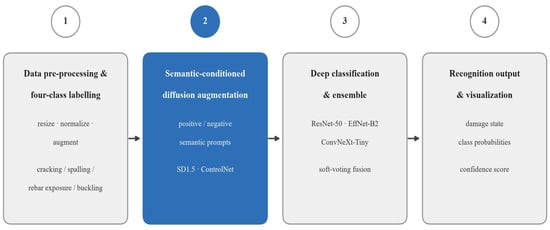
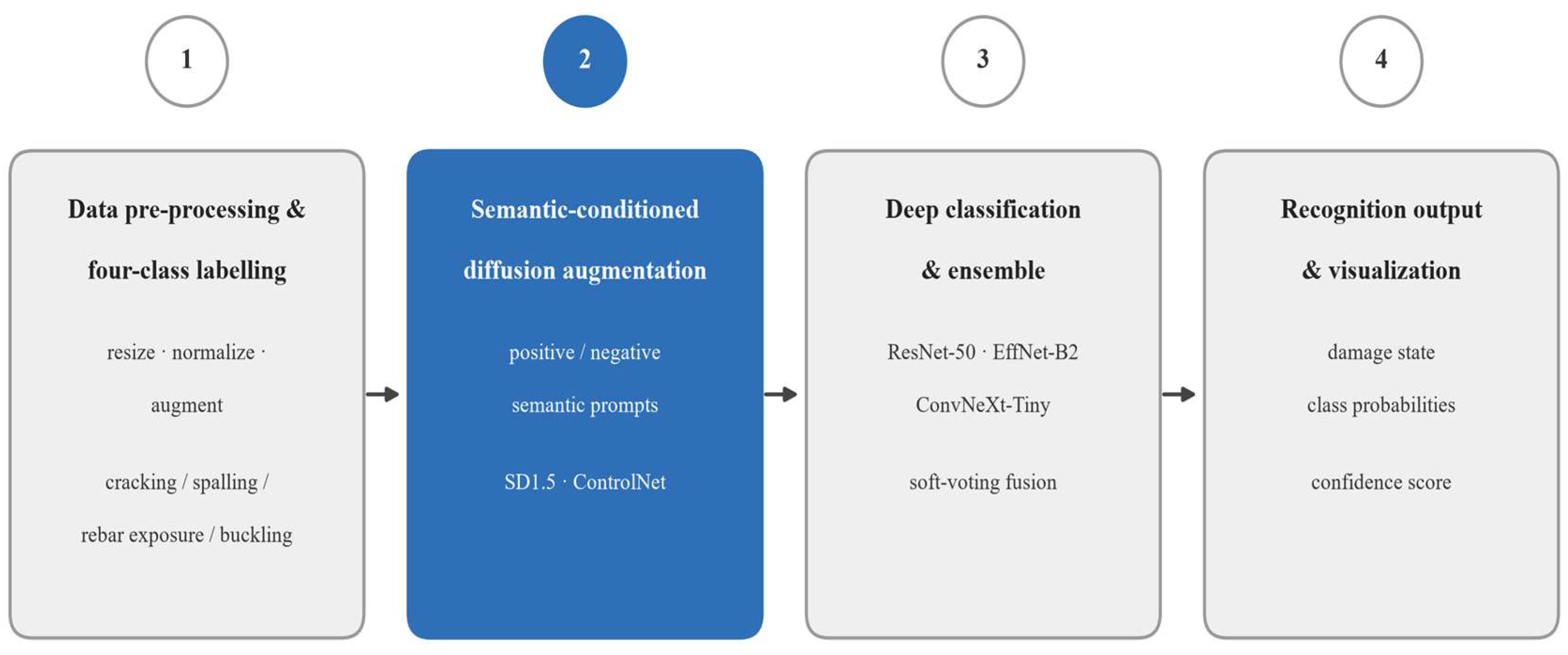
The proposed framework of the RC column damage recognition method based on semantic text-to-image augmentation and deep ensemble learning is shown in Figure 1. The method focuses on typical seismic damage patterns of RC columns and classifies the damage states into four categories: cracking, concrete spalling, rebar exposure, and rebar buckling. A complete workflow is established from data pre-processing and semantic augmentation to deep classification and final damage recognition.
Figure 1.
The proposed framework of the RC column damage recognition method.
As shown in Figure 1, the proposed method consists of four main modules: (1) dataset pre-processing and four-class damage labelling; (2) semantic text-driven image augmentation; (3) deep classification and ensemble recognition; and (4) damage recognition output and visualization. Specifically, the original RC column damage images are first organized, resized, normalized, and augmented, and a four-class damage label system is constructed. Second, class-specific semantic text prompts are used to drive Stable Diffusion or SD-Turbo to generate supplementary images, thereby improving the visual diversity of the training samples. Third, ResNet-50, EfficientNet-B2, and ConvNeXt-Tiny are employed to extract damage features, and their class probabilities are fused through a soft voting strategy. Finally, the system outputs the predicted damage category, prediction probabilities, and visual comparison results.
Compared with conventional single-network classification methods, the innovation of the proposed method lies in three aspects. First, engineering damage semantics are introduced into the image augmentation process, so that the generated images not only increase the number of samples but also emphasize the key visual characteristics of different damage states. Second, multiple pretrained deep networks are used to extract complementary features, improving the representation of crack textures, spalling regions, rebar exposure, and rebar buckling patterns. Third, a probability-level ensemble strategy is adopted to reduce the risk of misclassification by a single model and improve the stability and balance of four-class damage recognition.
2.1. Dataset Pre-Processing and Four-Class Damage Labelling
Under earthquake loading, RC columns generally experience a damage evolution process from surface cracking to concrete cover spalling, rebar exposure, and eventually rebar buckling. These damage states not only reflect the apparent damage level of the member but are also closely related to stiffness degradation, bearing capacity reduction, and post-earthquake repairability. Therefore, according to typical seismic damage patterns of RC columns, the image samples in this study are divided into four categories: cracking, spalling, rebar exposure, and rebar buckling.
During dataset pre-processing, the original images are first organized into four folders corresponding to crack, spalling, rebar exposure, and rebar buckling. Then, all images are converted into RGB three-channel format and resized to a fixed input size. To reduce the influence of differences in imaging devices, illumination conditions, and image scales, pixel normalization is performed. In addition, image augmentation strategies are introduced during training to improve the adaptability of the model to brightness variations, local occlusions, and texture differences. This module provides standardized inputs and an engineering-oriented label system for subsequent model training. Unlike ordinary image classification labels, the four categories used in this study correspond to the seismic damage evolution process of RC columns and therefore have stronger engineering interpretability.
2.2. Semantic Text-Driven Image Augmentation
Real earthquake damage images and experimental failure images of RC columns are usually difficult to obtain in large quantities, and the number and quality of samples for different damage states are often not fully balanced. Traditional approaches for acquiring such images rely heavily on time-consuming quasi-static experiments or post-earthquake field investigations—the former often requiring weeks to months for specimen fabrication, loading, and data collection, while the latter are constrained by site accessibility, safety risks, and the irregular occurrence of earthquakes, making it extremely difficult to gather sufficient and well-balanced data across all damage categories. To alleviate the problems of limited samples and inter-class confusion, this study adopts a semantic text-driven image augmentation method based on a Stable Diffusion latent diffusion model (checkpoint runwayml/stable-diffusion-v1-5) conditioned by a Canny-edge ControlNet (lllyasviel/sd-controlnet-canny), with 30 denoising steps, a classifier-free guidance scale of 5.0, a ControlNet conditioning scale of 0.8, and an output resolution of 512 × 512. Unlike conventional data collection, our diffusion-based approach generates supplementary images with specific damage characteristics (e.g., cracking patterns, spalling regions, or exposed rebar) within seconds, compressing the data preparation cycle from months to hours. This rapid, on-demand generation capability not only enriches the training set but also allows flexible balancing of sample sizes across different damage states, providing a practical and cost-effective solution for engineering applications where real damage data are scarce. Each generated image was visually screened against its target damage category, and images with incorrect reinforcement geometry (e.g., floating, duplicated, or disconnected rebars) or inconsistent damage were discarded before entering the training set. The retained images can then be directly used to train deep learning models, facilitating rapid post-earthquake structural assessment without relying on extensive experimental campaigns or hazardous field surveys.
In this module, we construct refined textual prompts for the four damage categories. Rather than merely listing visual appearances, the prompts are built upon structural damage mechanics and seismic design codes, introducing both positive semantic constraints (sufficient visual evidence for the presence of damage) and negative semantic constraints (distractor features to be explicitly excluded). Notably, the negative constraints deliberately incorporate early-stage subtle features of adjacent categories and irrelevant backgrounds (e.g., non-structural walls). This strategy forces the visual encoder to disregard superficial textural noise and focus on definitive mechanical signatures—such as the distinction between plastic hinge buckling of longitudinal rebars and crushing/spalling of the cover—thereby forming a more compact and exclusive decision boundary in the feature space. Table 1 summarizes the positive and negative semantic constraints for the four damage categories.
Table 1.
Positive and negative semantic constraints for damage categories of reinforced concrete columns.
Meanwhile, negative semantic cues are introduced to reduce confusion between similar categories. For example, the spalling category emphasizes no obvious exposed steel bars; the rebar exposure category emphasizes straight rebars without buckling; and the rebar buckling category emphasizes significant bending or plastic deformation of steel bars. In this way, the generated samples can better highlight the key visual characteristics of the target category.
2.3. Deep Classification and Ensemble Recognition
After data preprocessing and image augmentation, multiple deep neural networks are used to classify RC column damage images. Considering that different network architectures have different advantages in feature representation, ResNet-50, EfficientNet-B2, and ConvNeXt-Tiny are selected as the main classification models and fused into a three-model ensemble.
ResNet-50 enhances deep feature representation through residual connections and is suitable for extracting structural features such as crack distribution, spalling boundaries, and rebar exposure regions. EfficientNet-B2 balances network depth, width, and resolution through compound scaling and can efficiently extract multi-scale damage features. ConvNeXt-Tiny has strong capability in local texture and morphological feature modeling, making it suitable for capturing concrete surface texture variations and rebar shape differences.
To further improve recognition stability, this study adopts a soft voting strategy to fuse the output probabilities of ResNet-50, EfficientNet-B2, and ConvNeXt-Tiny. Let x denote the input image, and let Pi(c|x) denote the predicted probability of class c from the i-th model. The ensemble probability is defined as:
where N is the number of models involved in the ensemble. The final predicted category is determined by the maximum fused probability:
Soft voting considers the final class decision of each model and preserves the confidence distribution over all categories. Therefore, when a single model is unstable for boundary samples, probability fusion can reduce the influence of accidental misclassification. The innovation lies in improving the robustness of complex damage-state recognition by leveraging complementary features from multiple models.
2.4. Damage Recognition Output and Visualization
Following ensemble fusion, the system outputs both the predicted damage category—cracking, spalling, rebar exposure, or rebar buckling—and the corresponding class probabilities. The maximum probability is adopted as the prediction confidence, providing a quantitative measure of the model’s certainty for each recognition result.
During the output stage, we record the true label, predicted label, confidence score, and full probability vector for every test image. Visual comparisons between the original images and the annotated predictions are also generated. These visualizations allow for direct observation of the model’s performance across different damage types. For instance, they reveal whether the model correctly identifies cracking based on linear crack patterns, recognizes spalling from rough and fragmented surfaces, detects rebar exposure from visible steel regions, and captures rebar buckling through bending deformations.
In addition to the visual assessments, we employ a comprehensive set of quantitative metrics. Specifically, confusion matrices, Precision, Recall, and F1-score are computed to evaluate classification performance per category, while the distribution of confidence scores is analyzed to assess the reliability of the predictions. Furthermore, the model complexity (e.g., parameter count and floating-point operations) is reported to provide insight into its computational efficiency. Together, these results not only reflect the overall recognition capability of the system but also highlight the performance discrepancies among different damage categories, offering valuable guidance for future improvements.
3. Case Study
To verify the effectiveness of the proposed method, experimental analysis was conducted using seismic damage images of RC columns. As key vertical load-bearing components in frame structures and bridge piers, RC columns directly affect the residual bearing capacity, ductility, and collapse risk of structures after earthquakes. Post-earthquake damage investigations and quasi-static tests have shown that RC columns under seismic loading generally undergo a damage evolution process from crack initiation, concrete cover spalling, and rebar exposure to rebar buckling. Therefore, developing an image recognition model for these four damage states has clear engineering significance.
The image samples used in this study cover different shooting distances, lighting conditions, surface textures, and damage scales. To improve sample diversity, semantic-conditioned generated samples were introduced in addition to real damage images. Image annotation followed the principle of dominant damage characteristics. Images with obvious cracks but without significant concrete cover spalling were labeled as cracking. Images with local concrete surface spalling but without clearly exposed rebars were labeled as spalling. Images in which rebar was visible but showed no obvious plastic deformation were labeled as rebar exposure. Images with bent, bulged, or buckled rebars were labeled as rebar buckling. For images containing multiple damage features, the more severe and more distinguishable damage state from the perspective of structural safety assessment was adopted as the class label.
3.1. Definition of Damage Categories
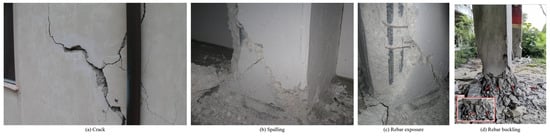
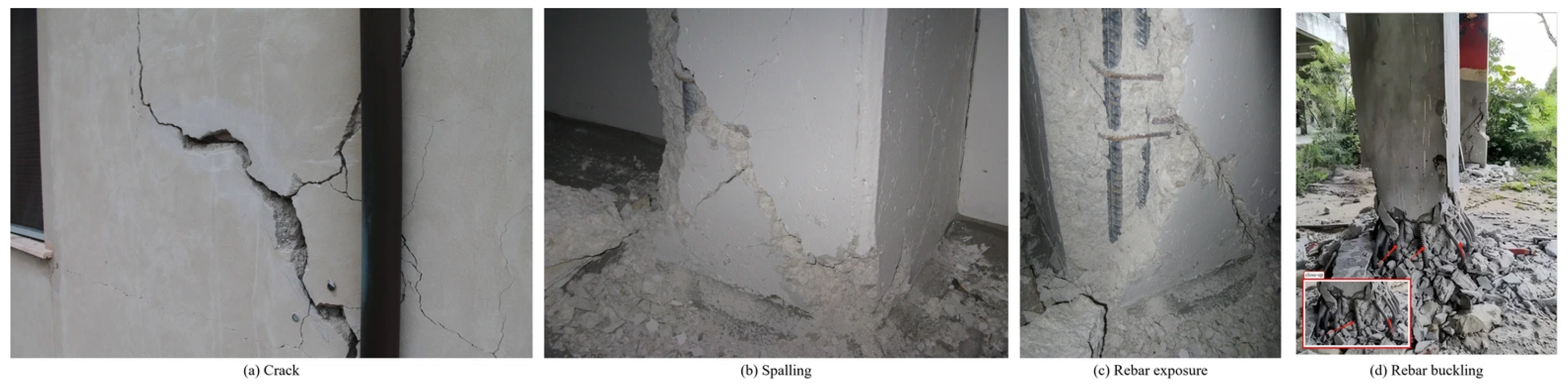
The four damage states are shown in Figure 2. Cracking is the most common visible damage in RC columns after loading and is usually manifested as transverse cracks, diagonal cracks, or network-like cracks. This type of damage indicates stiffness degradation of the member, but does not necessarily imply complete failure of the concrete cover. Spalling refers to the local detachment of the concrete cover caused by crushing, shear, or repeated loading, and is often accompanied by surface roughening and local pitting. Rebar exposure indicates that the damage of the concrete cover has progressed to the stage where the rebar becomes visible, which usually implies deterioration in load-bearing performance. Rebar buckling corresponds to an evident plastic state of the rebars and commonly occurs in the plastic hinge region at the column end, serving as an important indicator of severe member damage. It should be noted that the four categories describe visually observable damage states, and attribution of the underlying cause (e.g., seismic action versus environmental corrosion) is outside the scope of the present classifier; corrosion-induced cracking, typically manifested as longitudinal cracks parallel to the main reinforcement, may resemble seismic cracking and is a recognized source of label ambiguity.
Figure 2.
Representative images of four damage categories from the dataset. (a) Cracking; (b) Spalling; (c) Rebar exposure; (d) Rebar buckling. Images (a–c) are from the IDEA dataset (Senaldi et al., 2025) [56], DOI: 10.5281/zenodo.15120522, under the CC BY-NC 4.0 license.Image (d) was collected from a publicly available web source (e.g., Baidu Images) and is used here solely for non-commercial academic illustration.
These four damage types not only reflect the progressive evolution of seismic damage in RC columns, but also exhibit visually distinguishable features that can be extracted from images. Therefore, they are adopted as the target categories for the image recognition task in this study.
3.2. Data Collection and Pre-Processing
To construct an image dataset covering four typical seismic damage states (cracking, spalling, rebar exposure, and rebar buckling), this study collected 182 real earthquake-damage images as foundational materials, comprising 45 cracking, 46 spalling, 48 rebar-exposure, and 43 rebar-buckling images. These images were integrated from public sources—principally the IDEA dataset (Image Database for Earthquake damage Annotation, developed by the EUCENTRE Foundation [56]) together with publicly available web imagery—and were subjected to manual secondary screening, with near-duplicate images from the same source removed. Because this dataset is small and the four damage states are inherently class-imbalanced, a semantic-conditioned image augmentation method was employed to systematically expand the samples as a complement to, rather than a substitute for, real data; publicly available post-earthquake imagery (e.g., from the 2023 Kahramanmaraş earthquake sequence) provides an additional real-data source and is noted as a direction for future work. The augmentation follows a low-dose targeted protocol: only the safety-critical rebar-exposure class is augmented at a 1:0.3 synthetic-to-real ratio within each training fold, which enhances dataset diversity and class balance while avoiding the boundary perturbation caused by indiscriminate multi-class or high-dose augmentation. The dataset combines real images and semantically guided generated images, providing a reliable data foundation for model training and evaluation.
During data preprocessing, image formats were first unified and invalid samples were removed to ensure that all inputs were readable three-channel color images. Image sizes were then standardized to meet the input requirements of different models. Finally, pixel values were normalized to reduce numerical-scale discrepancies caused by variations in lighting conditions and imaging devices. A stratified splitting strategy was adopted to maintain consistent class proportions across the training and validation sets. The 182 images were evaluated under stratified five-fold cross-validation, in which each image is predicted exactly once by a model that has never seen it during training.
3.3. Experimental Settings and Evaluation Metrics
The objective of the experiments is to evaluate the effectiveness of the proposed semantic-conditioned diffusion augmentation and deep ensemble framework for four-class damage recognition of RC columns. The evaluation metrics include overall accuracy and class-wise accuracy. Overall accuracy reflects the model’s general recognition performance on all test images, whereas class-wise accuracy reflects its ability to identify specific damage states. For engineering applications, high overall accuracy alone is not sufficient; if the recognition accuracy for a severe damage category is low, the reliability of post-earthquake safety assessment may still be affected. Therefore, this study focuses on whether all four damage categories can be recognized with consistently high accuracy.
For the main experiment, a heavy three-model ensemble is considered, consisting of ResNet-50, EfficientNet-B2, and ConvNeXt-Tiny. These transfer-learning-based deep vision models utilize general visual features learned from large-scale image datasets, and their complementary class probabilities are fused through soft voting to improve recognition stability.
In the case study, all models are evaluated using the same category definitions and the same stratified five-fold cross-validation protocol to ensure comparability. The model output is one of the four damage states, namely cracking, spalling, rebar exposure, or rebar buckling.
All models were trained with a unified protocol to ensure comparability. The AdamW optimizer (learning rate 1 × 10⁻⁴, weight decay 1 × 10⁻⁴) was used to minimize a Focal loss (γ = 2.0), which down-weights well-classified samples and concentrates training on ambiguous damage states. To mitigate overfitting in this small-sample setting, the first 90% of network parameters (the pre-trained feature extractor) were frozen and only the upper layers were fine-tuned; early stopping was applied by halting training when the validation loss did not improve for 15 consecutive epochs and restoring the weights of the best validation epoch. The maximum number of epochs was 120, with a batch size of 8 and an input resolution of 224 × 224. A stratified split was adopted to keep class proportions consistent across the training, validation, and test sets, and test-time augmentation by horizontal flipping was applied during inference. Random seeds for the training pipeline were fixed to ensure reproducibility (image generation itself used stochastic sampling without a fixed seed); the synthetic images are generated once and frozen before training, so the reported classification results are fully reproducible from the stored images and the fixed training seed. All models were implemented in PyTorch2.x (CUDA 12.1 build) [57] with the torchvision library [58]. The complete training procedure is summarized in Algorithm 1.
| Algorithm 1: Lock-point targeted-augmentation training |
| (i) Initialize a pre-trained backbone and freeze its first 90% of parameters; (ii) within each training fold, generate low-dose (1:0.3) targeted synthetic images for the designated bottleneck class (rebar exposure) using the semantic-conditioned diffusion pipeline; (iii) fine-tune the unfrozen upper layers with AdamW and Focal loss (γ = 2.0), batch size 8, and up to 120 epochs; (iv) apply early stopping (patience 15) and restore the best-validation-epoch weights; and (v) at inference, fuse the three models by soft voting and apply horizontal-flip test-time augmentation. |
Let Nk denote the total number of samples of the k-th damage class in the test set, and Ck denote the number of correctly recognized samples in that class. The class-wise recognition accuracy can be expressed as Ak = Ck/Nk. The overall accuracy is defined as the ratio of the total number of correctly recognized samples across all classes to the total number of test samples. For RC-column seismic damage recognition, class-wise accuracy better reflects the engineering reliability of the model than overall accuracy alone. For example, rebar buckling usually corresponds to more severe member damage. If the recognition accuracy of this category is significantly low, severe damage may be underestimated in post-earthquake assessment even when the overall accuracy is high.
Therefore, the results are evaluated at three levels: overall performance, class-wise performance, and severe-damage recognition capability. Overall performance is used to assess the general application potential of the model. Class-wise performance is used to determine whether the model exhibits obvious category bias. Severe-damage recognition capability focuses on rebar exposure and rebar buckling, because these two damage states are usually associated with reduced load-bearing capacity, degraded durability, or the development of plastic damage in the member.
4. Results and Discussion
4.1. Accuracy Analysis
Table 2 reports the main classification results of the heavy three-model ensemble (ResNet-50, EfficientNet-B2, ConvNeXt-Tiny) under the lock-point protocol (first 90% of parameters frozen, Focal loss γ = 2.0, AdamW, early stopping), evaluated by stratified 5-fold cross-validation on 182 real images. “Real-only” denotes the pure-real baseline; “+Targeted augmentation” adds low-dose (1:0.3) rebar-exposure synthetic images to the training set.
Table 2.
Classification accuracy of the heavy three-model ensemble on the 182-image test pool (stratified 5-fold CV).
Overall accuracy improves from 80.77% to 82.42% (+1.65) as a direct result of the low-dose rebar-exposure augmentation. The benefit propagates along the shared visible-reinforcement signature: the added exposure samples sharpen the boundary separating the “no visible rebar” states (cracking, spalling) from the “visible rebar” states (exposure, buckling), so the adjacent cracking (+6.67) and rebar buckling (+2.32) classes gain, rebar exposure is maintained at its already-high recall (83.33%), and only spalling—which shares the concrete-loss appearance of exposure but differs solely in rebar visibility—regresses slightly (−2.17). The same +1.65 overall gain is reproduced under two further settings (down-weighted synthetic sampling and 320 × 320 input), confirming its robustness; multi-class or high-dose augmentation is instead counterproductive (Section 4.5).
From the category perspective, the augmented ensemble achieves recognition performance above 76% for all four damage categories. The per-class accuracies for cracking, spalling, rebar exposure, and rebar buckling are 91.11%, 78.26%, 83.33%, and 76.74%, respectively. This indicates that the model can identify surface damage such as cracking and, more importantly, recognize the severe member damage states of rebar exposure and rebar buckling with relatively stable performance, while the gain is concentrated in the classes sharing the visible-reinforcement signature.
4.2. Confusion Matrix and Precision/Recall/F1-Score Analysis
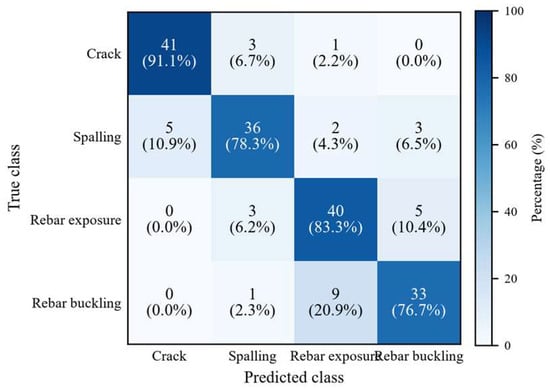
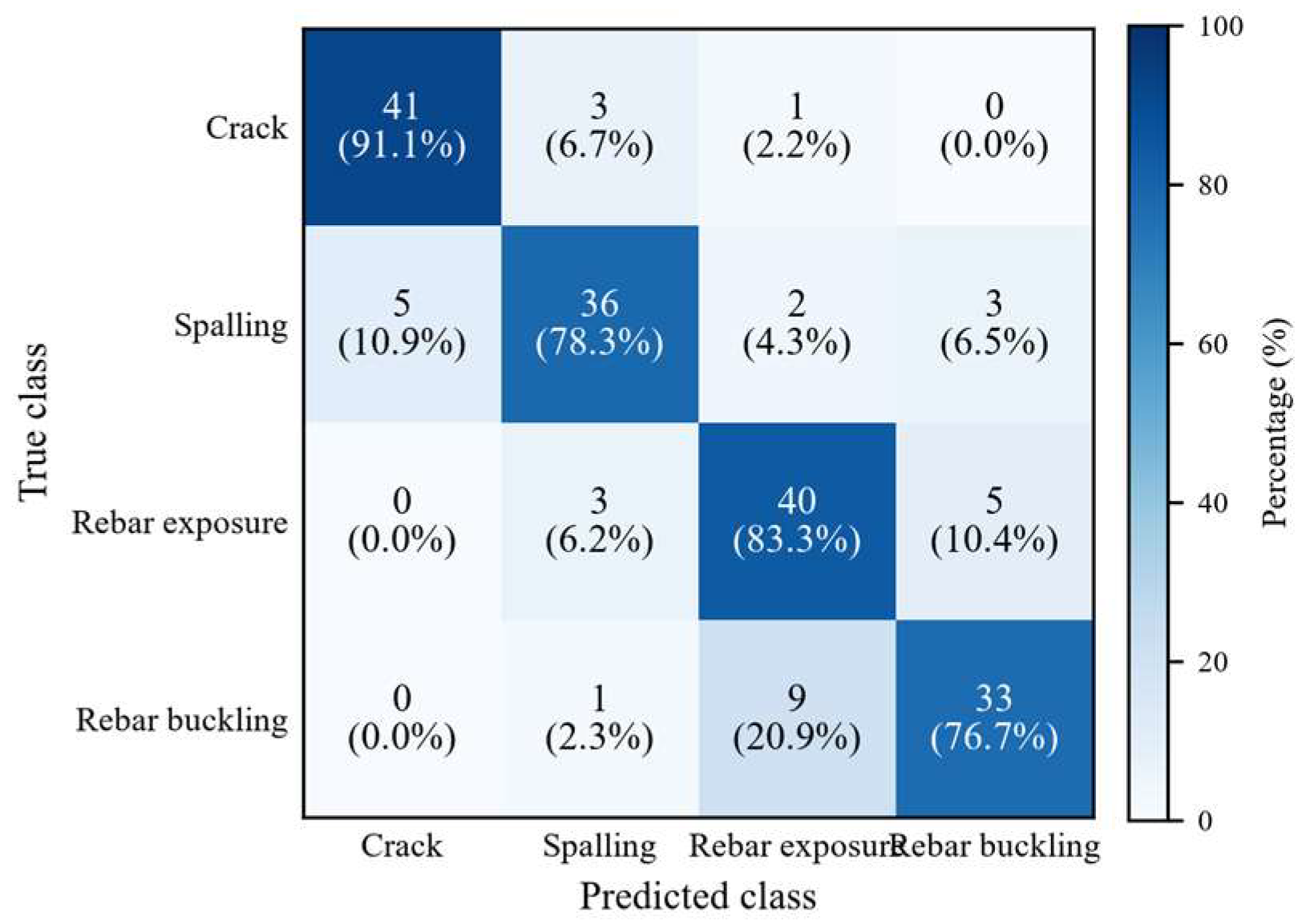
Table 3 summarizes the overall Precision, Recall, and F1-score values of the ensemble under the two conditions, while Figure 3 shows the confusion matrix of the augmented ensemble. These results provide a more detailed evaluation of model reliability than overall accuracy alone.
Table 3.
Overall Precision, Recall and F1-score of the heavy three-model ensemble under the two conditions.
Figure 3.
Confusion matrix of the three-model ensemble.
As shown in Table 3, the targeted augmentation improves the macro-averaged F1-score from 80.82% to 82.46%, consistent with the overall accuracy gain. The per-class metrics follow the same seesaw pattern observed in Table 2: precision and recall rise substantially for cracking (recall 84.44% → 91.11%) and rebar buckling (recall 74.42% → 76.74%), while spalling regresses slightly (recall 80.43% → 78.26%) and rebar exposure is essentially maintained (recall 83.33%).
The three-model ensemble under targeted augmentation achieves an accuracy of 82.42%, Macro-P of 82.57%, Macro-R of 82.36%, and Macro-F1 of 82.46%. Compared with the real-only baseline (80.77%), the augmentation improves all overall metrics, suggesting that low-dose targeted generation effectively integrates complementary information without the boundary collapse caused by unrestricted over-augmentation.
The confusion matrix in Figure 3 shows that most samples are located along the diagonal, indicating that the ensemble correctly classifies most test images. The recall values for Crack, Spalling, Rebar exposure, and Rebar buckling are 91.1%, 78.3%, 83.3%, and 76.7%, respectively. The main misclassifications occur between adjacent or visually similar damage states: nine buckling samples are confused with rebar exposure (the largest off-diagonal block), confirming that the distinction between these two categories depends strongly on whether rebar deformation is clearly visible, while cracking and spalling form a smaller mutual confusion.
4.3. Prediction Confidence Analysis
Prediction confidence was further analyzed to evaluate the reliability of model decisions. A central property of the proposed lock-point scheme is that it produces deliberately conservative confidence estimates: because Focal loss (γ = 2.0) down-weights the well-classified majority and freezing 90% of the feature extractor restrains the model from memorizing the small training set, the ensemble does not inflate its confidence on easy cases. Table 4 summarizes the average confidence of correctly classified and misclassified samples under the two conditions.
Table 4.
Average prediction confidence of the three-model ensemble, split into correctly classified and misclassified samples.
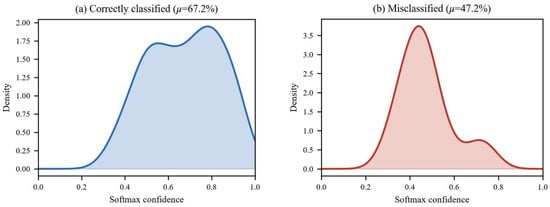
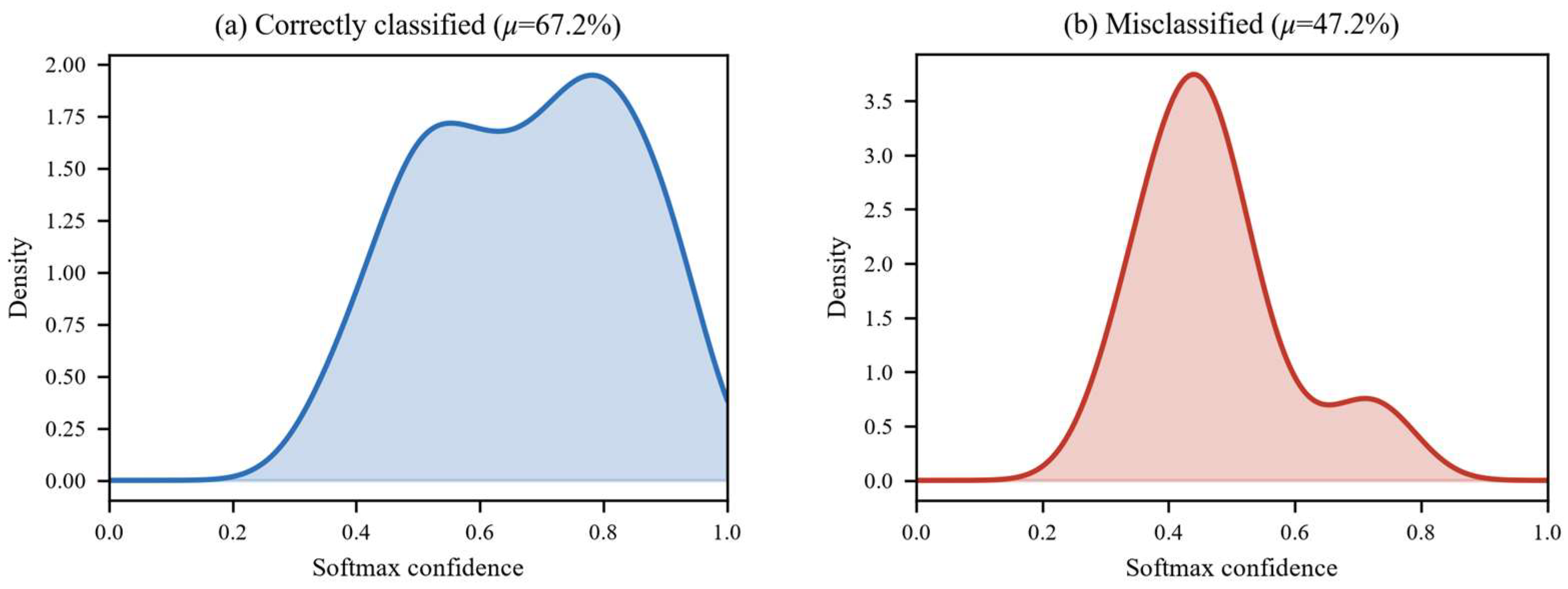
Figure 4 compares the confidence distributions of correctly classified and misclassified samples for the augmented ensemble. Correctly classified samples reach an average confidence of 67.2%, concentrated mainly in the 0.5–0.9 range, while misclassified samples average only 47.2% and scatter within 0.3–0.7. This roughly 20-point gap between correct and incorrect predictions is preserved even though the overall scale is conservative, so the confidence signal remains discriminative for screening. The conservative calibration is a protective feature rather than a defect: an over-confident misclassification—asserting, for example, “spalling” when the reinforcement is in fact buckling—is the most dangerous failure mode in post-earthquake assessment, and a model that is confident only when it truly should be is precisely the consequence-aware behavior the framework is designed to enforce.
Figure 4.
Confidence level distribution for correctly classified and misclassified samples. (a) Correctly classified samples. (b) Misclassified samples.
In terms of misclassification number, the real-only baseline produces 35 errors and the augmented ensemble 32, confirming that soft-voting fusion combined with targeted augmentation reduces misclassification while maintaining conservative confidence. For engineering applications, prediction confidence can be used as a reference for post-earthquake inspection: high-confidence results may support rapid screening, while low-confidence cases should be flagged for manual review.
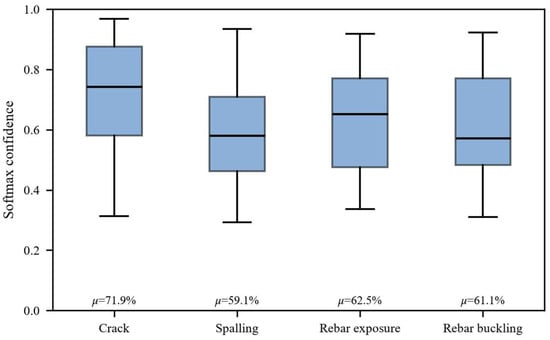
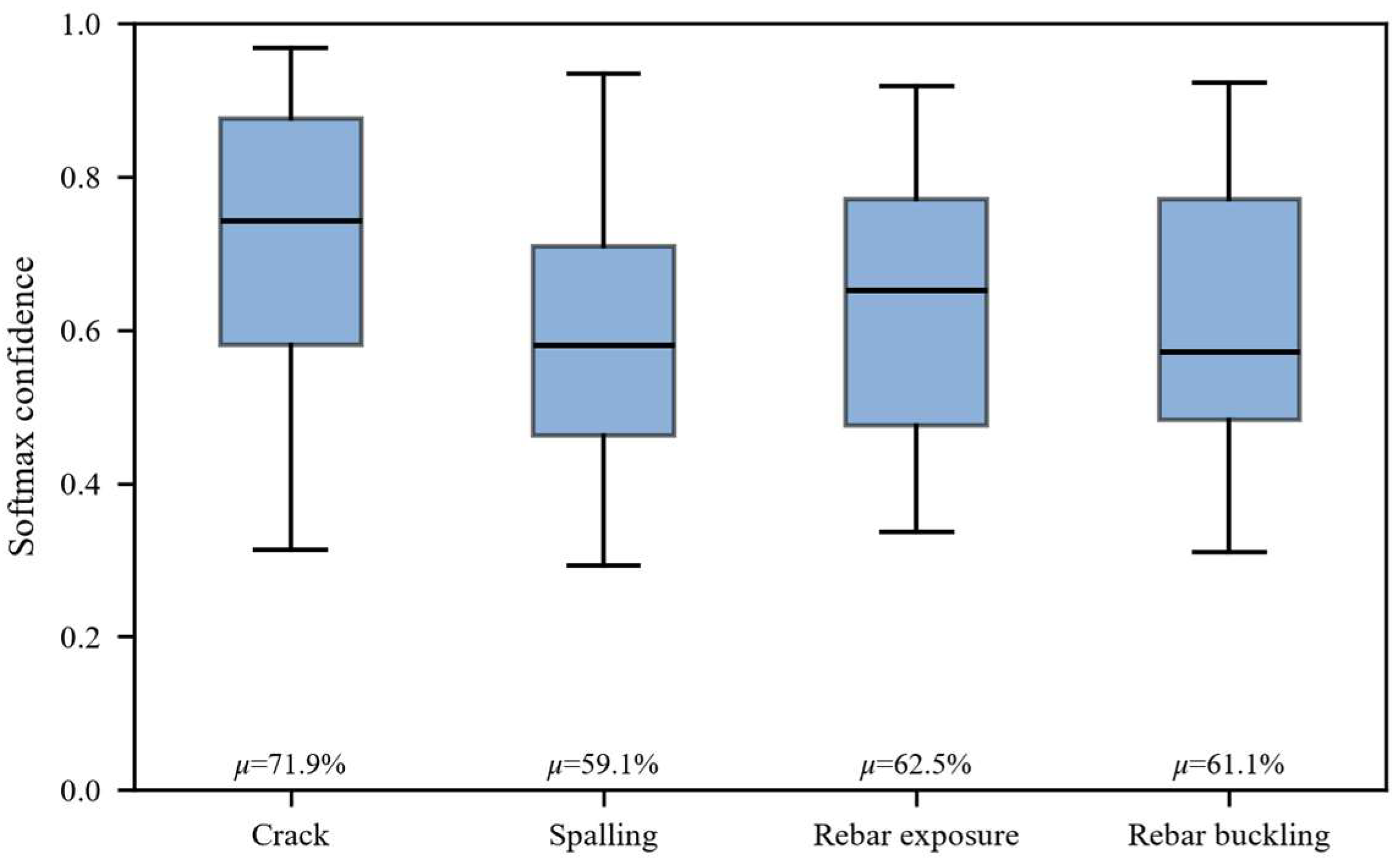
Figure 5 further presents the box plots of prediction confidence for the four damage categories obtained by the augmented ensemble. The median confidence values of all four categories remain at a moderate, conservative level rather than approaching one, reflecting the deliberate de-emphasis of easy samples by the Focal loss. Among them, the confidence distributions of Crack, Spalling, and Rebar buckling are relatively concentrated, while Rebar exposure shows a wider box range and more dispersed outliers, indicating greater intra-class image variability and a stronger influence of shooting angle, occlusion, and rebar visibility.
Figure 5.
Box plot of the prediction confidence of various categories of the model ensemble.
From the distribution of outliers, a small number of low-confidence samples exist in all categories, mainly within the range of 0.30–0.55. These samples may correspond to cases with unclear damage features, small local damage regions, strong background interference, or mixed damage patterns. In particular, there is a certain continuity between Rebar exposure and Rebar buckling; when it is difficult to determine from the image whether the rebar has undergone obvious bending or buckling, the model tends to produce lower-confidence outputs.
Overall, Figure 5 indicates that the ensemble maintains a stable, deliberately conservative confidence across the four categories, and low-confidence samples can be treated as candidates for manual review. To make this screening operationally actionable, a referral threshold of τ = 0.6 is recommended. As summarized in Table 5, at τ = 0.6 the ensemble flags 44.5% of the main set while capturing 87.5% of its misclassifications (error rate within the flagged set 34.6%); on the deliberately hardest 40 images it flags 75.0% while capturing 93.8% of misclassifications. Raising τ to 0.7 captures essentially all errors on the hard set but flags nearly 60% of the main set at an excessive review burden; lowering τ to 0.5 is more selective but misses a quarter of the main-set errors. This delineates a boundary condition of confidence-based screening: because the lock-point scheme is conservative, the strategy is efficient on representative data but flags a large fraction of uniformly difficult inputs, which should therefore be routed directly to expert review.
Table 5.
Confidence-based referral screening of the three-model ensemble on the main (182) and hard (40) test sets.
4.4. Model Complexity and Inference Efficiency
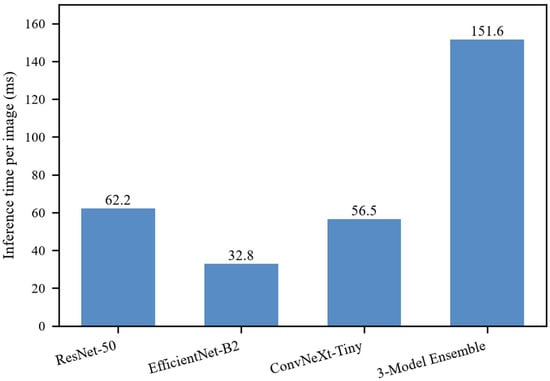
To evaluate the feasibility of engineering deployment, the parameter number, model size, and single-image inference time of the three pre-trained models and the ensemble were compared, as summarized in Table 6 and Figure 6.
Table 6.
Model parameter number, size and inference time.
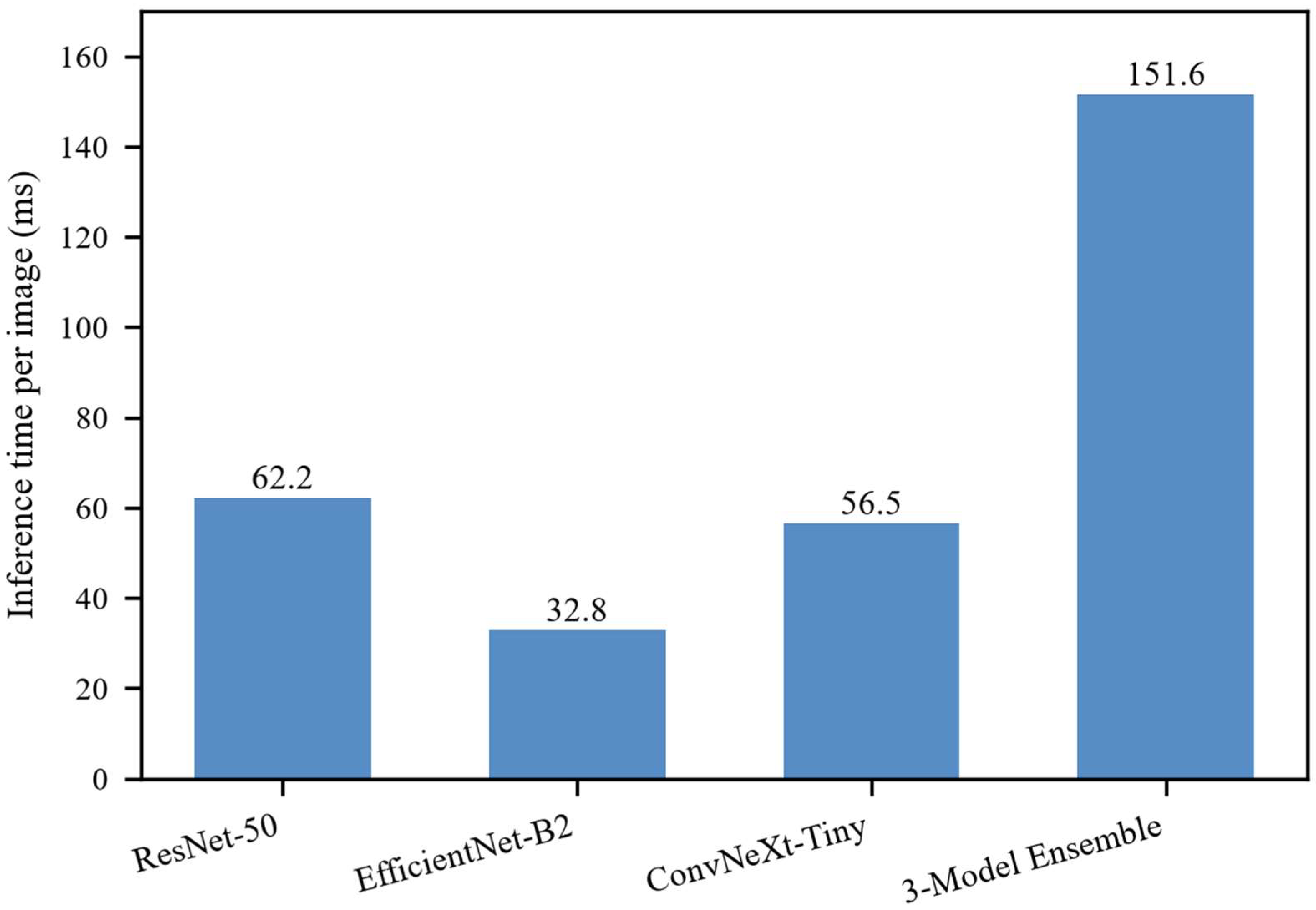
Figure 6.
Parameter size and inference time of different models.
Among the three pre-trained models, EfficientNet-B2 provides the best balance between accuracy and efficiency. It contains 8.555 million parameters and has a model size of 33.044 MB, which are much smaller than those of ResNet-50 and ConvNeXt-Tiny. Its single-image inference time is 32.840 ms, also the lowest among the pre-trained models, while its overall accuracy remains comparable to ResNet-50. This indicates that EfficientNet-B2 has relatively high structural efficiency and is suitable for scenarios where computational resources are limited.
ConvNeXt-Tiny achieves the best accuracy among the three individual models, but it also has relatively high computational cost, with 28.346 million parameters, a model size of 108.187 MB, and an inference time of 56.520 ms. ResNet-50 has 24.689 million parameters and an inference time of 62.195 ms, showing moderate accuracy but relatively high inference cost. The three-model ensemble achieves the highest recognition accuracy of 82.42%, but its parameter number and model size increase to 61.590 million and 235.709 MB, respectively. Its single-image inference time reaches 151.555 ms, which is approximately the combined cost of the three pre-trained models.
4.5. Ablation Study on a Hard Test Set
To isolate the contribution of the proposed targeted augmentation and to verify that the lock-point framework is not tied to a specific backbone, an ablation study was conducted on a dedicated hard test set of 40 real images (10 per class), each deliberately selected as one of the most ambiguous and visually confusing cases in its class. This set is substantially harder than the main test set and serves as a stress test. Two conditions were compared under an identical light three-model ensemble (ResNet-18, EfficientNet-B0, and MobileNetV3-Large), both trained with the same protocol—the first 90% of parameters frozen, Focal loss (γ = 2.0), AdamW, and early stopping: (i) a real-only baseline, and (ii) the proposed low-dose (1:0.3) targeted augmentation of the rebar-exposure class.
Table 7 reports the results. Overall accuracy improves from 55.0% to 60.0%, and the bottleneck class, rebar exposure, improves from 20.0% to 40.0% (+20 points). Spalling improves from 50% to 60% and cracking remains at 80%, while the adjacent buckling class regresses from 70% to 60% (−10 points). This is exactly the class-adjacent benefit transfer predicted by the seesaw mechanism (Section 4.1): the recall of the rebar-exposure class is gained at the expense of its ordinal neighbor that shares the visible-reinforcement signature.
Table 7.
Ablation study of low-dose targeted semantic augmentation on the 40-image hard test set (light three-model ensemble).
Two conclusions follow. First, the lock-point framework is backbone-agnostic: low-dose targeted augmentation rescues the most safety-critical but under-represented class (rebar exposure, 20% → 40%) on a light ensemble, not only on the heavy ensemble of the main experiment. Second, the framework realizes a controllable transfer rather than an unrestricted perturbation: the gain is concentrated in the designated bottleneck class at the cost of a limited regression of one neighbor (−10 points), whereas unrestricted over-augmentation collapses specific classes. This ablation therefore validates the seesaw mechanism and confirms the protective role of the proposed framework.
5. Conclusions
This study proposed an image-based seismic damage recognition method for RC columns using semantic-conditioned diffusion augmentation and deep ensemble learning. Four typical damage states, including cracking, spalling, rebar exposure, and rebar buckling, were considered. The effectiveness of the proposed method was verified through accuracy, Precision/Recall/F1-score, confidence, and model complexity analyses. The main conclusions are as follows.
- (1)
- Semantic-conditioned diffusion augmentation expanded the dataset from 182 real images through low-dose targeted generation within hours—a process that would otherwise require months of experimental or field data collection—and improved the balance among the four damage categories without indiscriminate over-augmentation.
- (2)
- The four-class damage definition reflects the seismic damage evolution of RC columns and provides clear engineering meaning for image-based recognition.
- (3)
- The lock-point protocol—freezing the first 90% of pre-trained parameters, minimizing focal loss, and early stopping—proved effective for small-sample engineering damage images, keeping training stable without over-fitting.
- (4)
- Under stratified five-fold cross-validation on 182 images, low-dose targeted rebar-exposure augmentation improved the ensemble’s overall accuracy from 80.77% to 82.42%. The accuracies for cracking, spalling, rebar exposure, and rebar buckling were 91.11%, 78.26%, 83.33%, and 76.74%, respectively, demonstrating a class-adjacent benefit transfer rather than a uniform gain.
- (5)
- The confusion matrix and confidence analysis demonstrated that the ensemble not only achieved stable recognition results but also provided meaningful, deliberately conservative uncertainty quantification. Misclassifications mainly occurred between visually similar or evolution-related damage states, and low-confidence predictions were associated with ambiguous or mixed damage features—indicating that the model can flag uncertain cases that warrant further review.
- (6)
- Model complexity analysis showed that EfficientNet-B2 offers a good balance between accuracy and efficiency, whereas the ensemble model is more suitable for accuracy-oriented offline assessment.
- (7)
- The confidence estimates provided by the ensemble enable a risk-informed inspection strategy. With a referral threshold of τ = 0.6, high-confidence predictions can support automated rapid screening of large building inventories immediately after an earthquake, while low-confidence predictions—such as unclear rebar buckling or heavily occluded spalling regions—are flagged for manual expert review. Furthermore, the comparative analysis of model complexity and inference time suggests a practical two-tier deployment pathway: the lightweight EfficientNet-B2 model is suitable for real-time, on-site edge-device inspection, whereas the full ensemble model, with its higher accuracy and robustness, can be employed for server-side, accuracy-oriented post-earthquake assessment.
- (8)
- In the critical window immediately after an earthquake, conventional data preparation requires weeks-to-months quasi-static tests or hazardous field campaigns that depend on site accessibility. Semantic-conditioned diffusion compresses this cycle to hours, enabling a four-class damage-recognition system to be deployed immediately after an event, when timeliness is decisive.
- (9)
- The most important engineering implication is consequence-aware recall allocation. Different damage states carry different consequences of missed detection: a missed buckling case (plastic hinge, approaching collapse) is far more dangerous than a missed crack. By revealing that augmentation redistributes recall among adjacent damage states rather than uniformly raising them, the proposed framework allows engineers to move from blindly maximizing overall accuracy to actively allocating recall toward the damage state whose missed detection is least acceptable—turning the model from a black box into a configurable decision tool.
- (10)
- The lock-point framework (feature freezing + early stopping + low-dose fine-tuning) provides a reproducible operating procedure: augmentation gains are steered toward a designated bottleneck class while adjacent-class disturbance is kept within a controlled regression rather than a collapse. Engineers can therefore trade off target-class recall against overall stability in an engineering-acceptable way.
- (11)
- The characterized boundary conditions tell deployers when to use the method and when not to: it is suited to fine-grained ordinal damage grading (post-earthquake component damage rating and rapid loss assessment) rather than coarse-grained detection; multi-class or high-dose augmentation is counterproductive; and label ambiguity from single-expert annotation bounds the achievable accuracy, so engineering deployment should incorporate multi-annotator labeling and agreement checks.
Overall, the proposed framework can effectively recognize typical seismic damage states of RC columns and provide technical support for rapid post-earthquake visual inspection and intelligent structural safety assessment. The proposed generation-as-a-service strategy enables rapid deployment of damage recognition systems without relying on post-earthquake site accessibility or additional experiments. Future work may further introduce object detection or semantic segmentation to locate damage regions and quantify damage parameters.
Future work will proceed along several directions: (1) introducing multi-annotator labeling with agreement metrics (e.g., Cohen’s κ) to raise the label-ambiguity ceiling; (2) extending from classification to localization and quantification—via object detection or semantic segmentation—to measure crack width, spalling area, exposed-rebar extent, and buckling deformation as inputs to residual-capacity and repair decisions; (3) generalizing the positive/negative semantic constraints from columns to beams, joints, and shear walls to validate the transferability of the prompt-design framework; (4) formalizing the seesaw mechanism into a quantitative recall-allocation model so that augmentation dose and class weights are configured automatically according to the consequence cost of missed detection; (5) closing the field loop with UAV acquisition, forming a generate–recognize–field-verify–re-label iteration so that the system evolves with real data; (6) calibrating the referral threshold on field data rather than a fixed value, with a calibration method (e.g., expected calibration error) tied to false-positive/false-negative cost; and (7) reporting quantitative image-quality metrics (e.g., Fréchet inception distance and inception score) for the generated samples together with representative generation-failure cases.
Author Contributions
All authors have accepted responsibility for the entire content of this manuscript, consented to its submission to the journal and reviewed all the results. N.Z.: Conceptualization, Methodology, Software, Validation, Formal analysis, Investigation, Data Curation, Writing—Original Draft, Visualization.; X.H.: Supervision, Writing—Review and Editing, Project Administration, Funding Acquisition. All authors have read and agreed to the published version of the manuscript.
Funding
National Natural Science Foundation of China (52508351); Natural Science Foundation of Shandong Province (ZR2024QE038); Postdoctoral Science Foundation of Qingdao (QDBSH20250101011).
Data Availability Statement
The code and, where permitted by the original data sources, a sample image subset used in this study will be deposited in a public repository upon acceptance. The full raw dataset is available from the corresponding author upon reasonable request, subject to the provenance of the original images.
Acknowledgments
This work was supported by the National Natural Science Foundation of China (Grant No. 52508351), the Natural Science Foundation of Shandong Province (Grant No. ZR2024QE038), and the Postdoctoral Science Foundation of Qingdao (Grant No. QDBSH20250101011).
Conflicts of Interest
The authors have no conflicts of interest to declare that are relevant to the content of this article.
References
- Zhu, W.; Bian, X.; Xie, Q. Refined seismic fragility curves of substation equipment considering ground motion classifications. Soil Dyn. Earthq. Eng. 2024, 187, 108995. [Google Scholar] [CrossRef] [Scilit]
- Zhu, W.; Wu, M.; Xie, Q. Comparison of engineering failures and seismic responses of 500 kV transformer-bushing systems in the 2022 Luding earthquake. Earthq. Eng. Eng. Vib. 2024, 23, 1029–1041. [Google Scholar] [CrossRef] [Scilit]
- Zhao, B.; Taucer, F.; Rossetto, T. Field investigation on the performance of building structures during the 12 May 2008 Wenchuan earthquake in China. Eng. Struct. 2009, 31, 1707–1723. [Google Scholar] [CrossRef] [Scilit]
- Sezen, H.; Whittaker, A.S.; Elwood, K.J.; Mosalam, K.M. Performance of reinforced concrete buildings during the August 17, 1999 Kocaeli, Turkey earthquake, and seismic design and construction practice in Turkey. Eng. Struct. 2003, 25, 103–114. [Google Scholar] [CrossRef] [Scilit]
- Tsai, K.C.; Hsiao, C.P.; Bruneau, M. Overview of building damages in 921 Chi-Chi earthquake. Earthq. Eng. Eng. Seismol. 2000, 2, 93–108. [Google Scholar]
- Su, N.; Tsai, K.C.; Chang, K.C. Damage to structures and buildings from the Chi-Chi (Taiwan) earthquake. Proc. Inst. Civ. Eng. Struct. Build. 2002, 152, 51–67. [Google Scholar] [CrossRef]
- Moehle, J.P.; Deierlein, G.G. A framework methodology for performance-based earthquake engineering. In Proceedings of the 13th World Conference on Earthquake Engineering, Vancouver, BC, Canada, 1–6 August 2004. Paper No. 679. [Google Scholar]
- Federal Emergency Management Agency. FEMA P-58-1: Seismic Performance Assessment of Buildings, Volume 1—Methodology, 2nd ed.; Federal Emergency Management Agency: Washington, DC, USA, 2018. [Google Scholar]
- Vamvatsikos, D.; Cornell, C.A. Incremental dynamic analysis. Earthq. Eng. Struct. Dyn. 2002, 31, 491–514. [Google Scholar] [CrossRef] [Scilit]
- Hariri-Ardebili, M.A.; Sattar, S. Formulating, Fitting and Fusing Fragility Functions (F5); National Institute of Standards and Technology: Gaithersburg, MD, USA, 2026; NIST Technical Note 2281. [Google Scholar] [CrossRef] [Scilit]
- Zhu, W.; Xie, Q. Machine learning chain models for multi-response prediction of electrical equipment in substation subjected to earthquakes. Eng. Struct. 2024, 319, 118815. [Google Scholar] [CrossRef] [Scilit]
- Mangalathu, S.; Jeon, J.S. Stripe-based fragility analysis of concrete bridge classes using machine learning techniques. Earthq. Eng. Struct. Dyn. 2019, 48, 1238–1255. [Google Scholar] [CrossRef] [Scilit]
- Mangalathu, S.; Hwang, S.H.; Choi, E.; Jeon, J.S. Rapid seismic damage evaluation of bridge portfolios using machine learning techniques. Eng. Struct. 2019, 201, 109785. [Google Scholar] [CrossRef] [Scilit]
- Zhu, W.; Paolacci, F.; Quinci, G.; Xie, Q. Machine learning-assisted seismic risk assessment of substation equipment considering material parameter uncertainty. Eng. Struct. 2025, 344, 121381. [Google Scholar] [CrossRef] [Scilit]
- Ahmed, B.; Mangalathu, S.; Jeon, J.S. Seismic damage state predictions of reinforced concrete structures using stacked long short-term memory neural networks. J. Build. Eng. 2022, 46, 103737. [Google Scholar] [CrossRef] [Scilit]
- Zhu, W.; Xie, Q.; Liu, X.; Mao, B.; Xue, Z. Towards 500 kV power transformers damaged in the 2022 Luding earthquake: Field investigation, failure analysis and seismic retrofitting. Nat. Hazards 2024, 120, 6275–6305. [Google Scholar] [CrossRef] [Scilit]
- Doebling, S.W.; Farrar, C.R.; Prime, M.B.; Shevitz, D.W. Damage Identification and Health Monitoring of Structural and Mechanical Systems from Changes in Their Vibration Characteristics: A Literature Review; Los Alamos National Laboratory: Los Alamos, NM, USA, 1998; Los Alamos National Laboratory Report LA-13070-MS. [Google Scholar]
- Farrar, C.R.; Worden, K. An introduction to structural health monitoring. Philos. Trans. R. Soc. A 2007, 365, 303–315. [Google Scholar] [CrossRef] [Scilit] [PubMed]
- Malekloo, A.; Ozer, E.; AlHamaydeh, M.; Girolami, M. Machine learning and structural health monitoring overview with emerging technology and high-dimensional data source highlights. Struct. Health Monit. 2022, 21, 1906–1955. [Google Scholar] [CrossRef] [Scilit]
- Avci, O.; Abdeljaber, O.; Kiranyaz, S.; Hussein, M.; Gabbouj, M.; Inman, D.J. A review of vibration-based damage detection in civil structures: From traditional methods to machine learning and deep learning applications. Mech. Syst. Signal Process. 2021, 147, 107077. [Google Scholar] [CrossRef] [Scilit]
- Zhu, W.; Paolacci, F.; Quinci, G.; Xie, Q. Simulation and interpretable learning co-driven framework for multi-objective seismic monitoring of substation equipment. Mech. Syst. Signal Process. 2026, 245, 113876. [Google Scholar] [CrossRef] [Scilit]
- Applied Technology Council. ATC-20: Procedures for Post-Earthquake Safety Evaluation of Buildings; Applied Technology Council: Redwood City, CA, USA, 1989. [Google Scholar]
- Federal Emergency Management Agency. FEMA P-154: Rapid Visual Screening of Buildings for Potential Seismic Hazards: A Handbook, 3rd ed.; Federal Emergency Management Agency: Washington, DC, USA, 2015. [Google Scholar]
- Roohi, M.; Hernandez, E.M. Performance-based post-earthquake decision making for instrumented buildings. J. Civ. Struct. Health Monit. 2020, 10, 775–792. [Google Scholar] [CrossRef] [Scilit]
- Zhu, W.; Wu, M.; Xie, Q.; Chen, Y. Post-earthquake rapid assessment method for electrical function of equipment in substations. IEEE Trans. Power Deliv. 2023, 38, 3312–3321. [Google Scholar] [CrossRef] [Scilit]
- Zhu, W.; Xie, Q. Post-earthquake rapid assessment for loop system in substation using ground motion signals. Mech. Syst. Signal Process. 2024, 208, 111058. [Google Scholar] [CrossRef] [Scilit]
- Mammeri, S.; Barros, B.; Conde-Carnero, B.; Riveiro, B. From traditional damage detection methods to Physics-Informed Machine Learning in bridges: A review. Eng. Struct. 2025, 330, 119862. [Google Scholar] [CrossRef] [Scilit]
- Wang, X.W.; Zhao, Y.H.; Wang, Z.H.; Hu, N. An ultrafast and robust structural damage identification framework enabled by an optimized extreme learning machine. Mech. Syst. Signal Process. 2024, 216, 111509. [Google Scholar] [CrossRef] [Scilit]
- Chen, Z.; Wang, Y.K.; Wang, H.; Liu, S.M.; Chan, T.H.T. Damage identification in bridge structures based on a novel Whale-Sand Cat Swarm Optimization algorithm and an improved objective function. Struct. Control Health Monit. 2025, 2025, 5587918. [Google Scholar] [CrossRef] [Scilit]
- Huang, J.; Yuan, S.; Li, D.; Jiang, T. A novel nonlinear output-only damage detection method based on the prediction error of PCA Euclidean distances under environmental and operational variations. Struct. Control Health Monit. 2025, 2025, 4684985. [Google Scholar] [CrossRef] [Scilit]
- Jiang, T.; Li, L.; Samali, B.; Yu, Y.; Huang, K.; Yan, W.; Wang, L. Lightweight object detection network for multi-damage recognition of concrete bridges in complex environments. Comput.-Aided Civ. Infrastruct. Eng. 2024, 39, 3646–3665. [Google Scholar] [CrossRef] [Scilit]
- Liu, C.W.; Man, J.H.; Liu, C.F.; Wang, L.; Ma, X.Y.; Miao, J.J.; Liu, Y.C. Research on damage identification of large-span spatial structures based on deep learning. J. Civ. Struct. Health Monit. 2024, 14, 1035–1058. [Google Scholar] [CrossRef] [Scilit]
- Wang, J.H.; Ueda, T.; Wang, P.J.; Li, Z.B.; Li, Y. Building damage inspection method using UAV-based data acquisition and deep learning-based crack detection. J. Civ. Struct. Health Monit. 2024, 15, 151–171. [Google Scholar] [CrossRef] [Scilit]
- Koch, C.; Georgieva, K.; Kasireddy, V.; Akinci, B.; Fieguth, P. A review on computer vision based defect detection and condition assessment of concrete and asphalt civil infrastructure. Adv. Eng. Inform. 2015, 29, 196–210. [Google Scholar] [CrossRef] [Scilit]
- Feng, D.; Feng, M.Q. Computer vision for SHM of civil infrastructure: From dynamic response measurement to damage detection—A review. Eng. Struct. 2018, 156, 105–117. [Google Scholar] [CrossRef] [Scilit]
- Spencer, B.F., Jr.; Hoskere, V.; Narazaki, Y. Advances in computer vision-based civil infrastructure inspection and monitoring. Engineering 2019, 5, 199–222. [Google Scholar] [CrossRef] [Scilit]
- Jin, T.; Ye, X.W.; Que, W.M.; Ma, S.Y. Computer vision and deep learning-based post-earthquake intelligent assessment of engineering structures: Technological status and challenges. Smart Struct. Syst. 2023, 31, 311–323. [Google Scholar] [CrossRef]
- Jia, J.; Li, Y. Deep learning for structural health monitoring: Data, algorithms, applications, challenges, and trends. Sensors 2023, 23, 8824. [Google Scholar] [CrossRef] [Scilit] [PubMed]
- Cha, Y.J.; Choi, W.; Büyüköztürk, O. Deep learning-based crack damage detection using convolutional neural networks. Comput.-Aided Civ. Infrastruct. Eng. 2017, 32, 361–378. [Google Scholar] [CrossRef] [Scilit]
- Cha, Y.J.; Choi, W.; Suh, G.; Mahmoudkhani, S.; Büyüköztürk, O. Autonomous structural visual inspection using region-based deep learning for detecting multiple damage types. Comput.-Aided Civ. Infrastruct. Eng. 2018, 33, 731–747. [Google Scholar] [CrossRef] [Scilit]
- Gao, Y.; Mosalam, K.M. Deep transfer learning for image-based structural damage recognition. Comput.-Aided Civ. Infrastruct. Eng. 2018, 33, 748–768. [Google Scholar] [CrossRef] [Scilit]
- Hoskere, V.; Narazaki, Y.; Hoang, T.A.; Spencer, B.F., Jr. MaDnet: Multi-task semantic segmentation of multiple types of structural materials and damage in images of civil infrastructure. J. Civ. Struct. Health Monit. 2020, 10, 757–773. [Google Scholar] [CrossRef] [Scilit]
- Liang, X. Image-based post-disaster inspection of reinforced concrete bridge systems using deep learning with Bayesian optimization. Comput.-Aided Civ. Infrastruct. Eng. 2019, 34, 415–430. [Google Scholar] [CrossRef] [Scilit]
- Pan, X.; Yang, T.Y. Postdisaster image-based damage detection and repair cost estimation of reinforced concrete buildings using dual convolutional neural networks. Comput.-Aided Civ. Infrastruct. Eng. 2020, 35, 495–510. [Google Scholar] [CrossRef] [Scilit]
- Bai, Z.; Liu, T.; Zou, D.; Zhang, M.; Zhou, A.; Li, Y. Image-based reinforced concrete component mechanical damage recognition and structural safety rapid assessment using deep learning with frequency information. Autom. Constr. 2023, 150, 104839. [Google Scholar] [CrossRef] [Scilit]
- Yilmaz, M.; Dogan, G.; Arslan, M.H.; Ilki, A. Categorization of post-earthquake damages in RC structural elements with deep learning approach. J. Earthq. Eng. 2024, 28, 2620–2640. [Google Scholar] [CrossRef] [Scilit]
- Ogunjinmi, P.D.; Park, S.S.; Kim, B.; Lee, D.E. Rapid post-earthquake structural damage assessment using convolutional neural networks and transfer learning. Sensors 2022, 22, 3471. [Google Scholar] [CrossRef] [Scilit] [PubMed]
- Fan, C.L. Deep neural networks for automated damage classification in image-based visual data of reinforced concrete structures. Heliyon 2024, 10, e38104. [Google Scholar] [CrossRef] [Scilit] [PubMed]
- Lazaridis, P.C.; Kavvadias, I.E.; Demertzis, K.; Iliadis, L.; Vasiliadis, L.K. Interpretable machine learning for assessing the cumulative damage of a reinforced concrete frame induced by seismic sequences. Sustainability 2023, 15, 12768. [Google Scholar] [CrossRef] [Scilit]
- Luk, S.H. Machine learning-based methods for the seismic damage classification of RC buildings. Buildings 2025, 15, 2395. [Google Scholar] [CrossRef] [Scilit]
- Ho, J.; Jain, A.; Abbeel, P. Denoising diffusion probabilistic models. Adv. Neural Inf. Process. Syst. 2020, 33, 6840–6851. [Google Scholar]
- Rombach, R.; Blattmann, A.; Lorenz, D.; Esser, P.; Ommer, B. High-resolution image synthesis with latent diffusion models. In Proceedings of the IEEE/CVF Conference on Computer Vision and Pattern Recognition (CVPR), New Orleans, LA, USA, 21–24 June 2022; pp. 10684–10695. [Google Scholar] [CrossRef] [Scilit]
- He, K.; Zhang, X.; Ren, S.; Sun, J. Deep residual learning for image recognition. In Proceedings of the IEEE Conference on Computer Vision and Pattern Recognition (CVPR), Las Vegas, NV, USA, 27–30 June 2016; pp. 770–778. [Google Scholar] [CrossRef] [Scilit]
- Tan, M.; Le, Q.V. EfficientNet: Rethinking model scaling for convolutional neural networks. In Proceedings of the 36th International Conference on Machine Learning (ICML), PMLR 97, Long Beach, CA, USA, 10–15 May 2019; pp. 6105–6114. [Google Scholar]
- Liu, Z.; Mao, H.; Wu, C.Y.; Feichtenhofer, C.; Darrell, T.; Xie, S. A ConvNet for the 2020s. In Proceedings of the IEEE/CVF Conference on Computer Vision and Pattern Recognition (CVPR), New Orleans, LA, USA, 21–24 June 2022; pp. 11976–11986. [Google Scholar] [CrossRef] [Scilit]
- Senaldi, I.E.; Dondi, P.; Casarotti, C.; Lombardi, L.; Piastra, M. IDEA: Image Database for Earthquake damage Annotation. Zenodo 2025. [Google Scholar] [CrossRef]
- Paszke, A.; Gross, S.; Massa, F.; Lerer, A.; Bradbury, J.; Chanan, G.; Killeen, T.; Lin, Z.; Gimelshein, N.; Antiga, L.; et al. PyTorch: An imperative style, high-performance deep learning library. In Advances in Neural Information Processing Systems 32; NeurIPS 2019; Curran Associates: Red Hook, NY, USA, 2019; pp. 8024–8035. [Google Scholar]
- Marcel, S.; Rodriguez, Y. Torchvision the machine-vision package of torch. In Proceedings of the 18th ACM International Conference on Multimedia, Firenze, Italy, 25–29 October 2010; pp. 1485–1488. [Google Scholar] [CrossRef] [Scilit]

Disclaimer/Publisher’s Note: The statements, opinions and data contained in all publications are solely those of the individual author(s) and contributor(s) and not of MDPI and/or the editor(s). MDPI and/or the editor(s) disclaim responsibility for any injury to people or property resulting from any ideas, methods, instructions or products referred to in the content. |
© 2026 by the authors. Licensee MDPI, Basel, Switzerland. This article is an open access article distributed under the terms and conditions of the Creative Commons Attribution (CC BY) license.