


Abstract
The high level of material consumption in the construction industry and the waste generated by construction projects not only result in substantial resource losses but also constitute major drivers of persistently high carbon emissions in the built environment. Against the backdrop of the global response to climate change, reducing material consumption and construction waste generation has become an important entry point for implementing carbon emission reduction strategies in the construction industry. This paper systematically examines the key applications, practical outcomes, and current challenges associated with the use of Building Information Modeling (BIM) to reduce material waste and construction waste generation. Particular attention is given to the carbon reduction mechanism that prioritizes construction waste minimization while using raw material consumption optimization as a complementary approach. The paper further analyzes the technical logic underlying BIM-enabled material optimization and waste management throughout the building life cycle, clarifies how BIM supports carbon reduction by informing decisions on design, material selection, construction, and resource recovery, and examines future developments and challenges in conjunction with relevant technologies and supporting tools. The findings provide theoretical guidance and practical directions for the construction industry to formulate scientifically grounded carbon emission reduction strategies.
1. Introduction
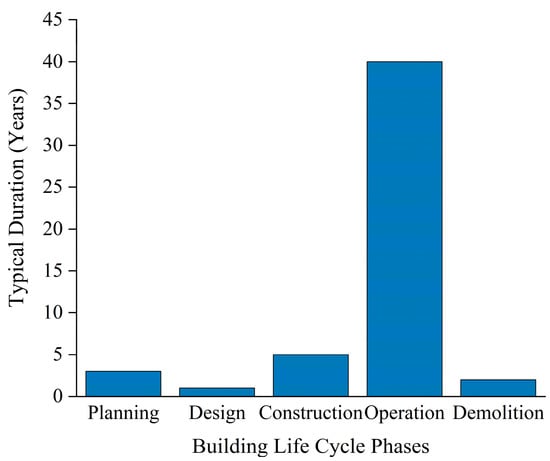
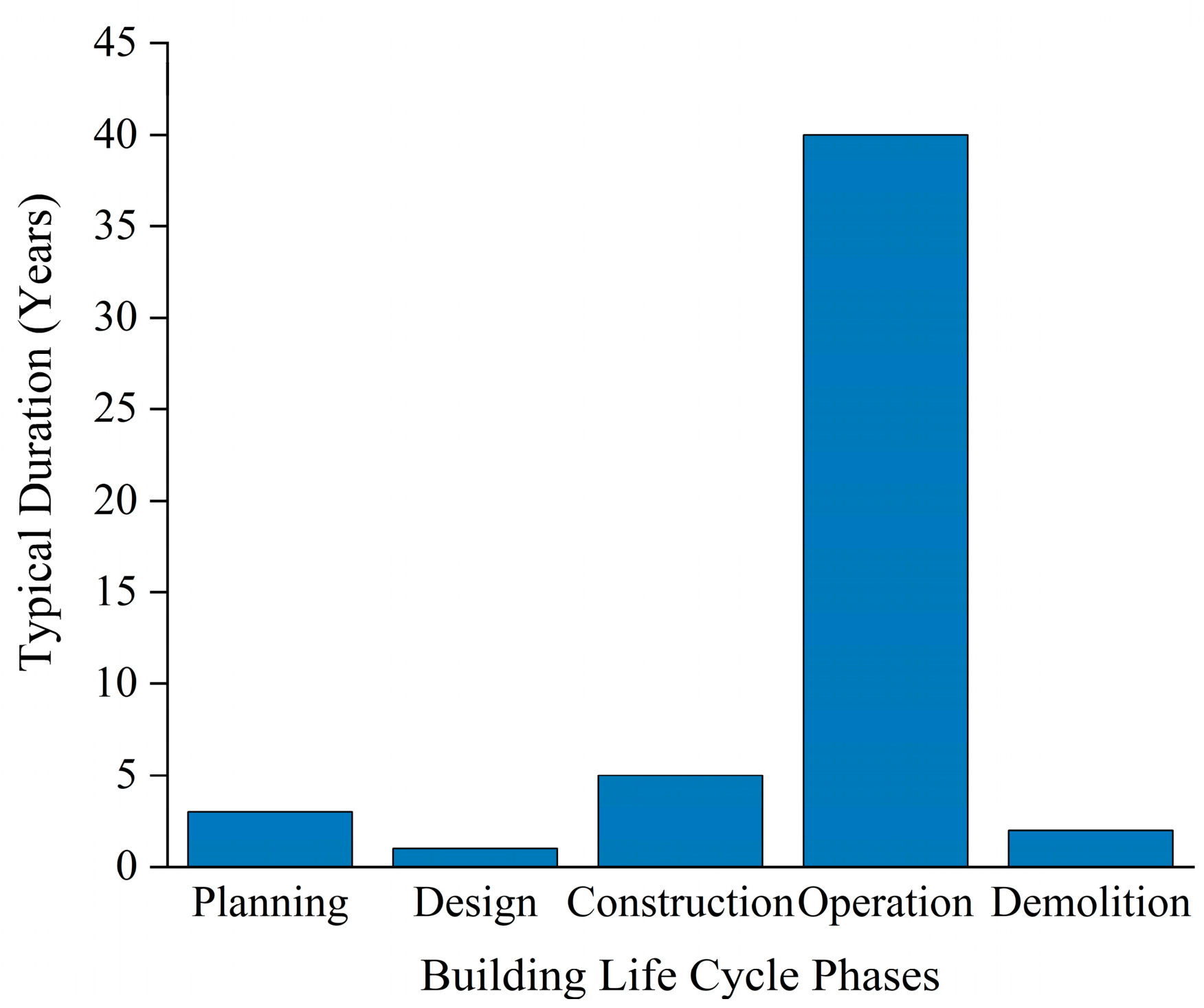
Building Information Modeling (BIM) represents a major technological direction in the contemporary construction industry [1]. Construction activities have long exerted significant impacts on soil resources, agricultural land, and natural ecosystems, while also contributing to the accumulation of atmospheric pollutants [2]. Meanwhile, the construction industry is generally characterized by high material consumption and substantial waste generation [3,4]. As shown in Figure 1, the building life cycle involves an extended time span and multiple complex phases, increasing the difficulty of resource management and emission reduction control. Previous studies have shown that a substantial proportion of construction waste originates from design deficiencies or inadequate construction management, resulting not only in economic losses but also in the ineffective release of considerable embodied carbon emissions [5,6,7]. Therefore, the industry urgently needs to adopt efficient digital technologies to prevent waste at its source and facilitate the transition toward low-carbon development.
Figure 1.
Typical Time Length of Each Phase in a Building Life Cycle.
Against the backdrop of the global response to climate change, countries worldwide have imposed increasingly stringent sustainability requirements on the built environment [8,9]. To improve energy efficiency, reduce environmental pollution, and lower carbon emissions, the concept of green building has been widely promoted worldwide [10] and has gradually become an inevitable trend in the development of the construction industry [11,12]. With the advancement of China’s “dual-carbon” goals—carbon peaking and carbon neutrality—and the broader vision of achieving net-zero emissions, the construction industry has been identified as a priority sector for emission reduction because of its high energy consumption and substantial embodied carbon emissions [13]. Consequently, reducing material consumption and construction waste is not merely a resource management issue but also a critical pathway toward the low-carbon transformation of the industry.
With the continued advancement of digitalization, BIM has gradually been applied throughout the building life cycle and has demonstrated considerable potential in design optimization, construction management, and operation and maintenance decision-making [14,15,16,17]. Under the “dual-carbon” strategy, BIM has gained increasing strategic importance as a digital tool for supporting carbon emission reduction [18]. Although existing studies have examined the application of BIM in green buildings and resource optimization, the relevant findings remain fragmented across different disciplines and life-cycle stages [19,20,21,22,23]. A systematic synthesis of how BIM contributes to carbon emission reduction through material and waste management is still lacking, making it difficult to establish a clear implementation framework for low-carbon construction.
To address this research gap, this paper conducts a systematic review based on the PRISMA 2020 guidelines, focusing on the practical applications and theoretical advances of BIM in reducing material consumption and construction waste generation. By examining how BIM informs material and waste management decisions across the building life cycle, this study clarifies its role in supporting embodied carbon reduction through design optimization, prefabrication, material selection, and resource recovery.
To achieve these objectives, this paper addresses the following five research questions (RQs):
RQ1: What global development trends and distribution patterns in this research field are revealed by bibliometric analysis?
RQ2: Through what mechanisms does BIM enable the optimization of construction materials in existing studies?
RQ3: How does BIM reduce and optimize construction waste generation in existing studies?
RQ4: What approaches have been proposed for integrating BIM with related tools?
RQ5: What conclusions can be drawn from the current body of research, and what directions should future studies pursue?
Based on the preceding discussion, this study employs a systematic review methodology. The structure of the paper is presented in Figure 2.
Figure 2.
Article Structure.
2. Materials and Methods
This study employed a systematic literature review to examine BIM-enabled material optimization and construction waste management throughout the building life cycle. No publication date restriction was applied. The included studies were published between 2012 and 2025, representing the actual publication span of the eligible literature rather than a predefined search period. Characteristics of the 82 included studies are provided in Table S1.
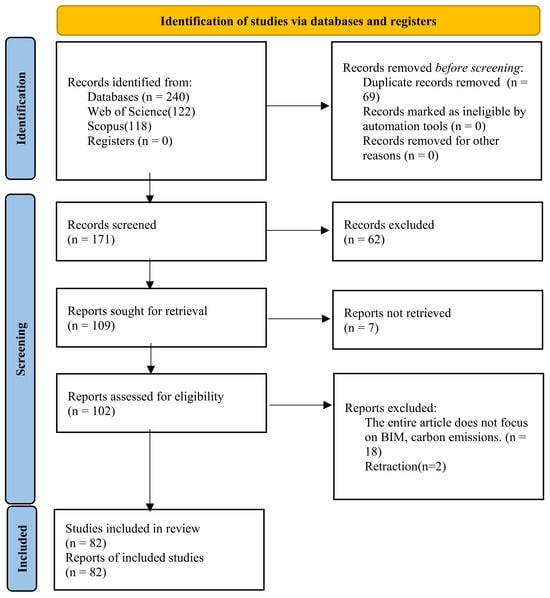
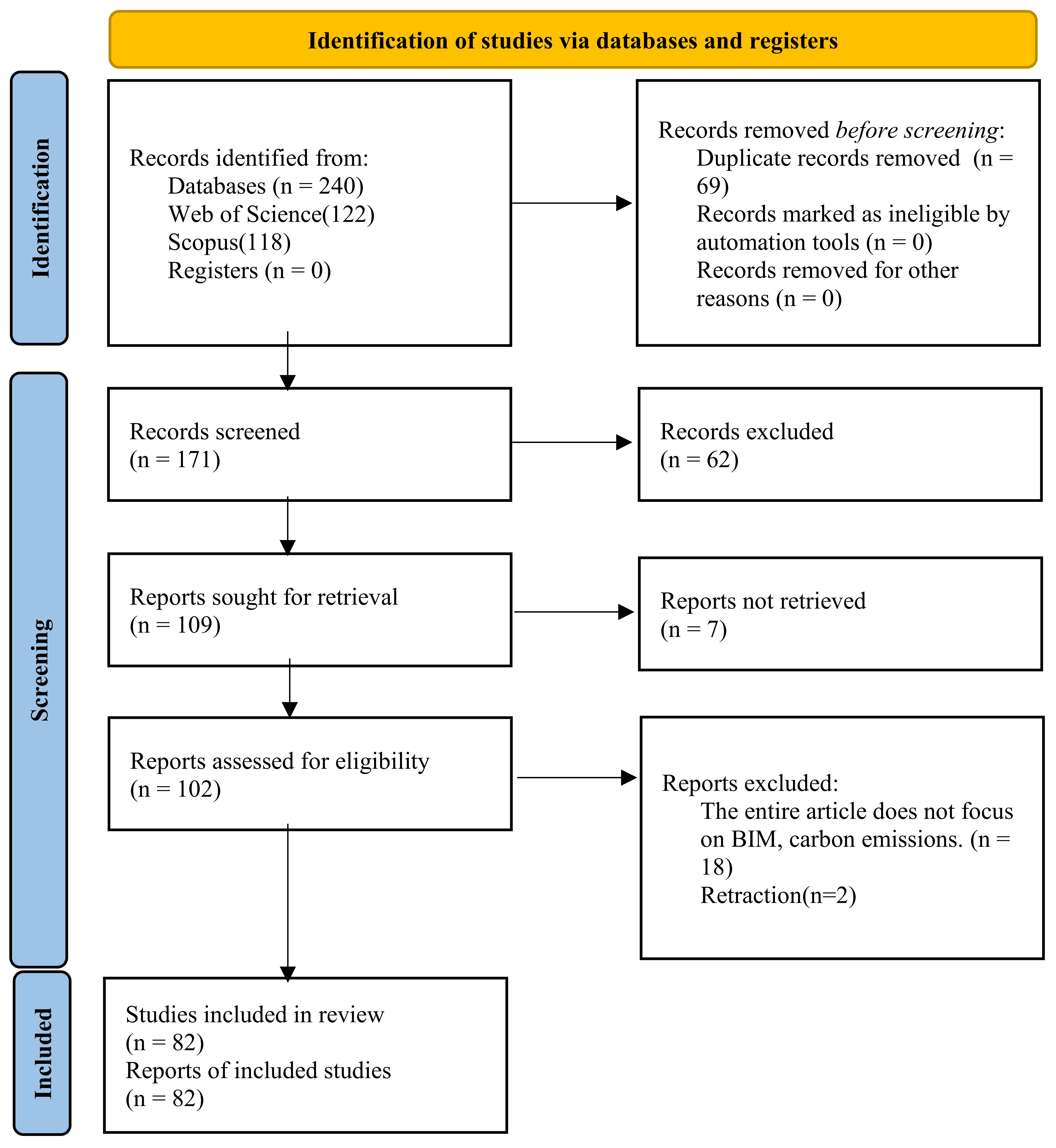
The review followed the PRISMA 2020 reporting guidelines [24]. Two authors, Yan and Zhao, reviewed the retrieved records against the eligibility criteria through title and keyword screening and subsequent full-text assessment. Disagreements regarding study eligibility were resolved through discussion between the two authors. Records were managed in Zotero, with automated duplicate detection supplemented by manual verification. The identification and screening process is presented in Figure 3. The completed PRISMA checklist and supplementary flow diagram are provided in Files S4 and S5, respectively.
Figure 3.
PRISMA-Based Systematic Review Flowchart.
Methodological quality was evaluated by the two authors using a construction-context checklist adapted from the Mixed Methods Appraisal Tool (MMAT), version 2018 [25]. The checklist retained two screening questions addressing the clarity of the research questions and the adequacy of the supporting data, followed by five design-specific criteria. These criteria examined methodological appropriateness, data collection and measurement, completeness of outcome data, support for the interpretation of findings, and integration of methodological components, as applicable to the study design. Items were rated “Yes,” “No,” or “Can’t tell.”
Inter-rater agreement was assessed using unweighted Cohen’s κ for each appraisal item [26], calculated from the original paired ratings before agreement-based aggregation. Ratings on which both authors agreed were retained in the summary table. Unresolved disagreements were recorded separately and excluded from the corresponding item-level descriptive summaries. Percentages were calculated using the available agreed ratings for each item, with unresolved counts reported alongside them. Detailed quality appraisal results and inter-rater agreement analyses are provided in Table S2.
A systematic search of Web of Science and Scopus was conducted on 10 December 2025. Google Scholar was used solely for reference tracing and background reading during the development of the review. It was not used as a formal source for study selection, and no additional studies were included through this platform. The search strategy focused on the principal concepts related to the research topic and incorporated relevant synonyms and alternative terms. The search queries used in Web of Science and Scopus are presented in Equations (1) and (2), respectively. The complete search strategies are provided in File S2.
TS = ((“Building Information Model*” OR “BIM” OR “Virtual Design and Construction”)) AND TS = ((“Construction waste” OR “Demolition waste” OR “C&D waste” OR “Material waste” OR “Material consumption” OR “Waste reduction” OR “Waste minimi*”)) AND TS = ((“Carbon” OR “CO2” OR “Embodied carbon” OR “Greenhouse gas” OR “GHG” OR “Life cycle assessment” OR “LCA”))
TITLE-ABS-KEY ((“Building Information Model*” OR “BIM” OR “Virtual Design and Construction”) AND (“Construction waste” OR “Demolition waste” OR “C&D waste” OR “Material waste” OR “Material consumption” OR “Waste reduction” OR “Waste minimi*”) AND (“Carbon” OR “CO2” OR “Embodied carbon” OR “Greenhouse gas” OR “GHG” OR “Life cycle assessment” OR “LCA”))
No document-type filters were applied during database searching. No language restrictions were imposed during initial screening. Eligibility was assessed according to the relevance of each publication to BIM-enabled material optimization or construction waste management and the associated carbon or life-cycle environmental implications. Full texts were examined for potentially relevant records and those whose eligibility could not be determined from titles and keywords. Publications whose scope did not sufficiently address the review objectives were excluded. Data extraction and coding procedures are documented in File S1.
The final set of included publications was subjected to standardized data cleaning in Microsoft Excel and subsequently imported into the R (version 4.5.2) package Bibliometrix (version 5.2.1) (BiblioShiny) for systematic descriptive statistical analysis. To further identify research trends, VOSviewer (version 1.6.20) was used to construct keyword co-occurrence and collaboration networks, while Scimago Graphica (version 1.0.53) was employed to enhance geospatial visualization. OriginLab 2024 was used to generate high-resolution charts of publication trends and journal distributions. Together, these analytical tools enabled a multidimensional examination of the knowledge structure and evolving research dynamics of the field. Software versions are listed in File S3. The bibliographic dataset, VOSviewer analysis parameters, map data, and network data are provided in Files S6–S9, respectively.
3. Bibliometric Analysis
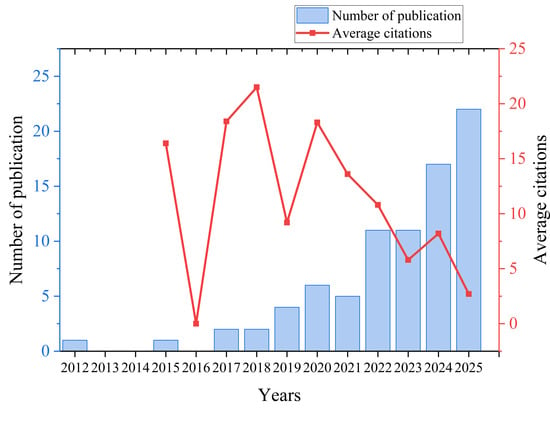
The bibliometric analysis outlines the development trends of carbon emissions research and BIM technology, showing that this topic has attracted substantial research attention over the past five years. As illustrated in Figure 4, the number of publications increased at an accelerating rate between 2012 and 2025, reflecting the urgent demand for digital solutions to support carbon emission reduction. Although publication output increased substantially in recent years, average citation counts fluctuated and were generally lower for more recent publications.
Figure 4.
Literature Quantification Trend Research Chart.
As shown in Figure 5, research in this field exhibits a broad global distribution. In terms of publication output, China holds a clearly dominant position, followed by the United Kingdom and Australia. Canada, the United States, Italy, and other Western countries also maintain relatively high levels of research output, collectively constituting the core research capacity in this field.
Figure 5.
Country Collaboration Network Map.
As the country with the world’s largest volume of scholarly publications, China demonstrates a high level of academic activity and maintains close research ties with Asia-Pacific countries, including Malaysia and Australia, as well as with the United Kingdom. The United States, Canada, and other countries form a North America–Europe–Middle East collaboration cluster. These countries cooperate closely with European countries such as Italy while also maintaining intercontinental research networks with India, Iran, and other countries. European countries, including the United Kingdom, France, and Spain, exhibit strong patterns of geographically concentrated collaboration.
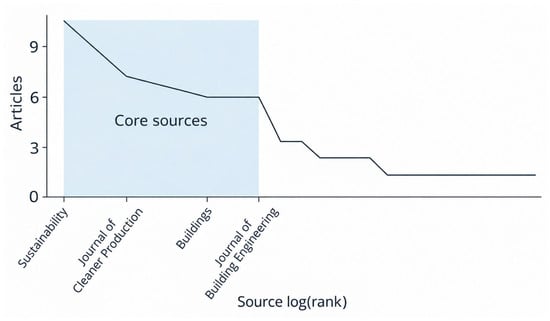
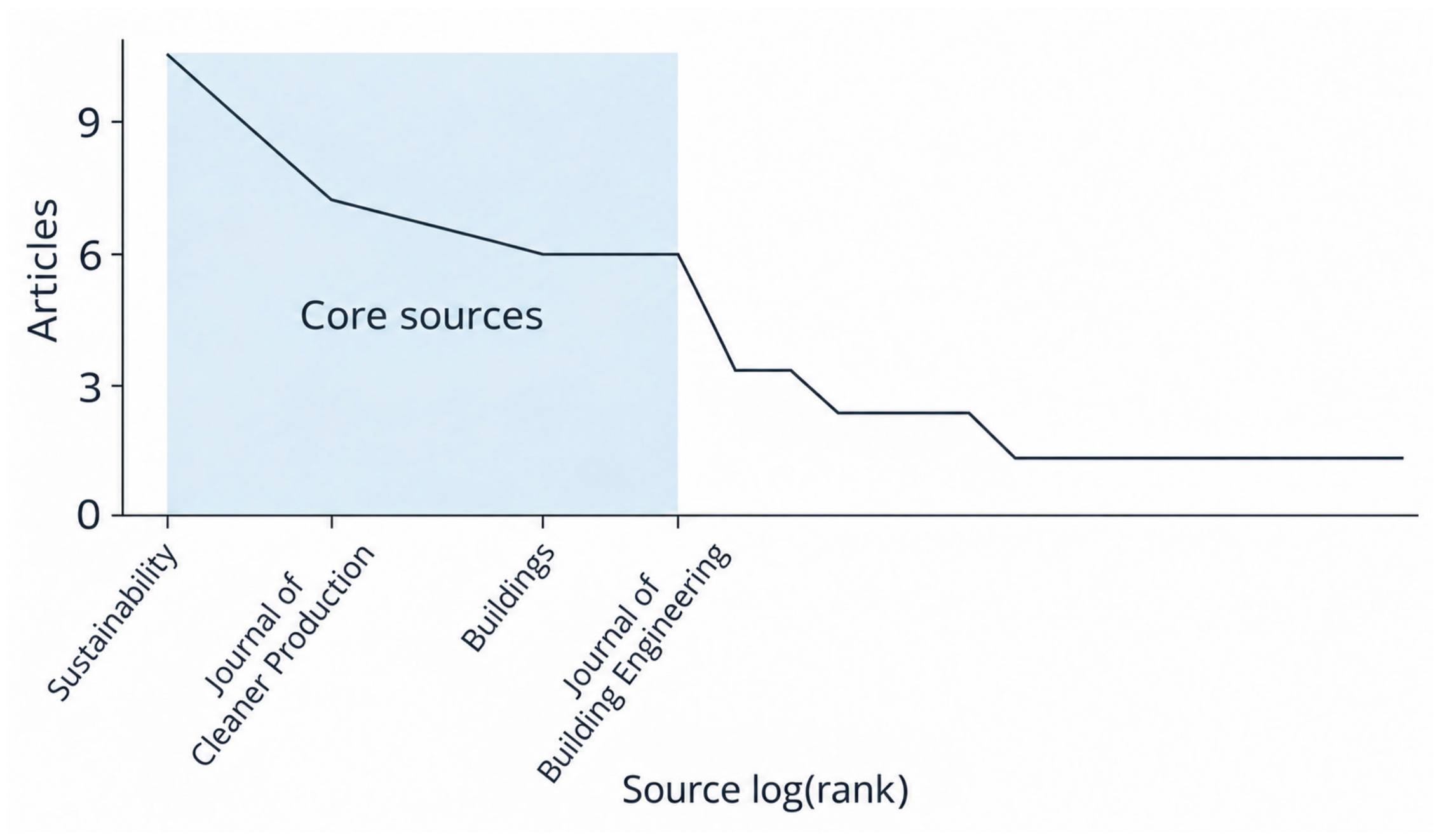
Based on Bradford’s Law, the core journals in this field were identified, as shown in Figure 6. These journals include Sustainability, Buildings, the Journal of Cleaner Production, and the Journal of Building Engineering, which collectively constitute Zone 1, the core publication zone of this research field. After declining sharply within the core zone, the curve transitions into the intermediate and peripheral zones, indicating that research outputs are highly concentrated in a limited number of publication sources. Although these core journals account for only a small proportion of all source journals, they contribute the majority of articles on this topic and therefore serve as the principal publication platforms for this research area.
Figure 6.
Core Sources by Bradford’s Law.
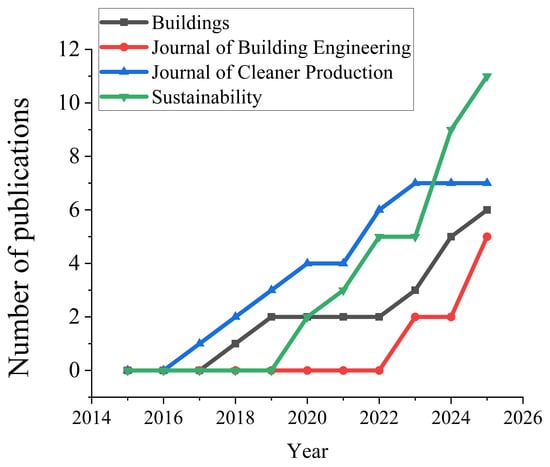
As illustrated by the line chart in Figure 7, the number of publications related to this research topic in the core journals has increased substantially over the past five years. Sustainability exhibits the most pronounced growth trend, with its publication output expanding rapidly during the past two years and considerably exceeding that of the other core journals in 2025. Meanwhile, the Journal of Cleaner Production, the Journal of Building Engineering, and Buildings have lower total publication volumes but have maintained steady growth, reflecting the increasing level of research attention devoted to this field.
Figure 7.
Journal Publication Volume.
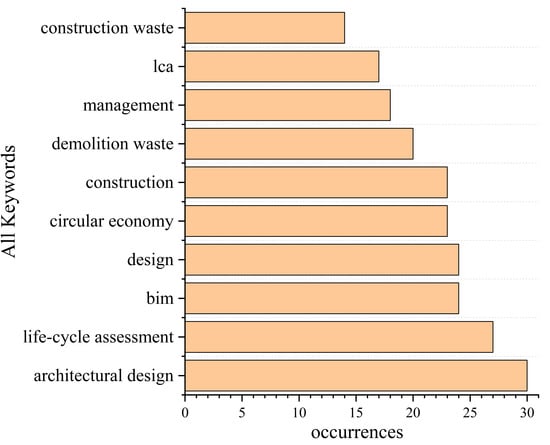
By integrating the frequency statistics generated in BiblioShiny with the co-occurrence network developed in VOSviewer, the analysis reveals the knowledge structure and evolutionary logic of this research field. As shown in Figure 8, “architectural design” has the highest occurrence count among the displayed keywords, followed by “life-cycle assessment,” “BIM,” and “design.” “Circular economy” and “demolition waste” also occur frequently. These findings indicate a research emphasis on integrating digital design and environmental assessment with construction waste management and circular resource use.
Figure 8.
Keyword frequency statistics.
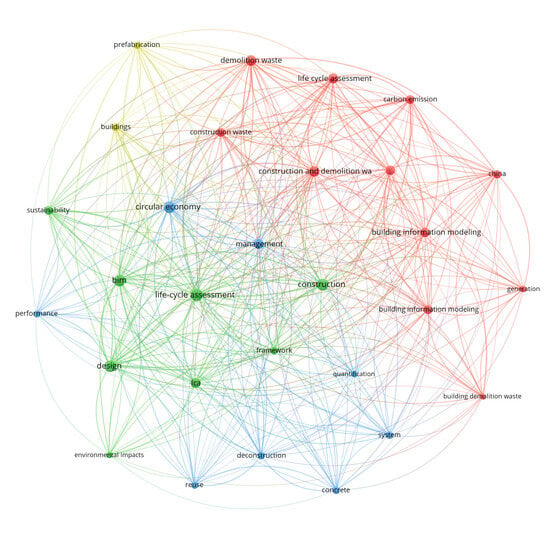
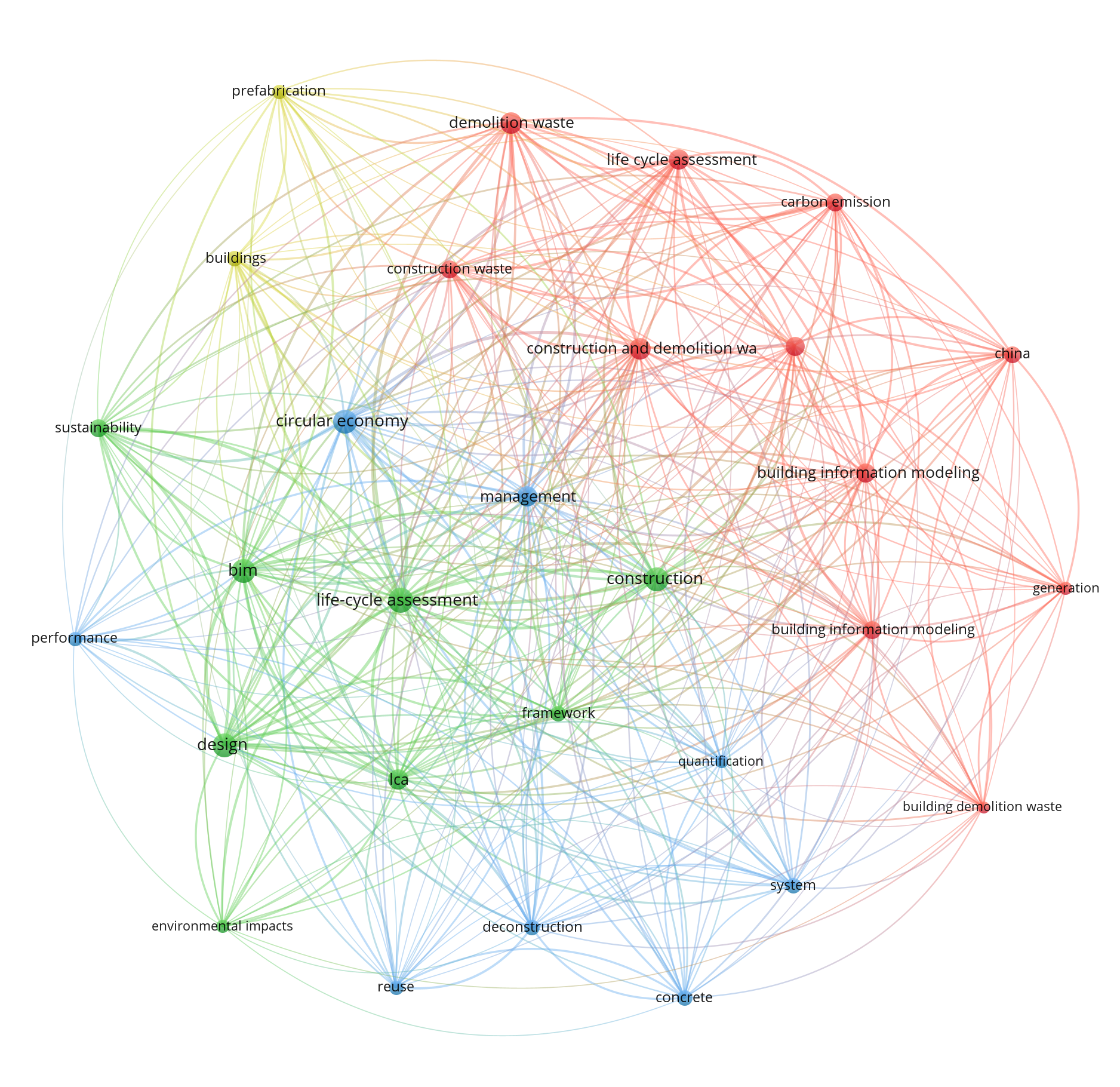
The keyword co-occurrence network generated using VOSviewer and the visualization of similarities (VOS) method [27] reveals four interconnected thematic clusters (Figure 9). The blue cluster includes “circular economy,” “management,” “reuse,” and “deconstruction,” reflecting an emphasis on circular resource management and end-of-life recovery. The green cluster connects “BIM” and “design” with “LCA,” “life-cycle assessment,” “sustainability,” and “environmental impacts,” highlighting the integration of digital design and environmental assessment. The yellow cluster comprises “prefabrication” and “buildings,” representing a focus on prefabricated building approaches. The red cluster brings together “construction waste,” “demolition waste,” “carbon emission,” and related BIM and life-cycle assessment terms, reflecting research on waste-related environmental impacts and carbon accounting. Connections among these clusters suggest that BIM-enabled design, environmental assessment, construction methods, and end-of-life resource recovery are closely associated research themes. Their co-occurrence indicates opportunities for coordinated material and waste management across the building life cycle.
Figure 9.
Keyword Co-occurrence Network Clustering.
4. Application of BIM in Materials and Waste Management
4.1. Source Control: Embodied Carbon Reduction via Material Optimization
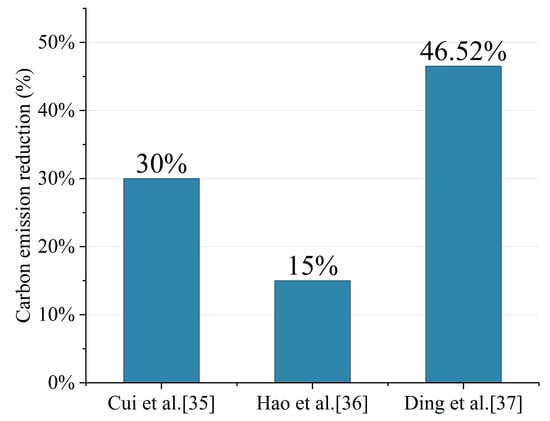
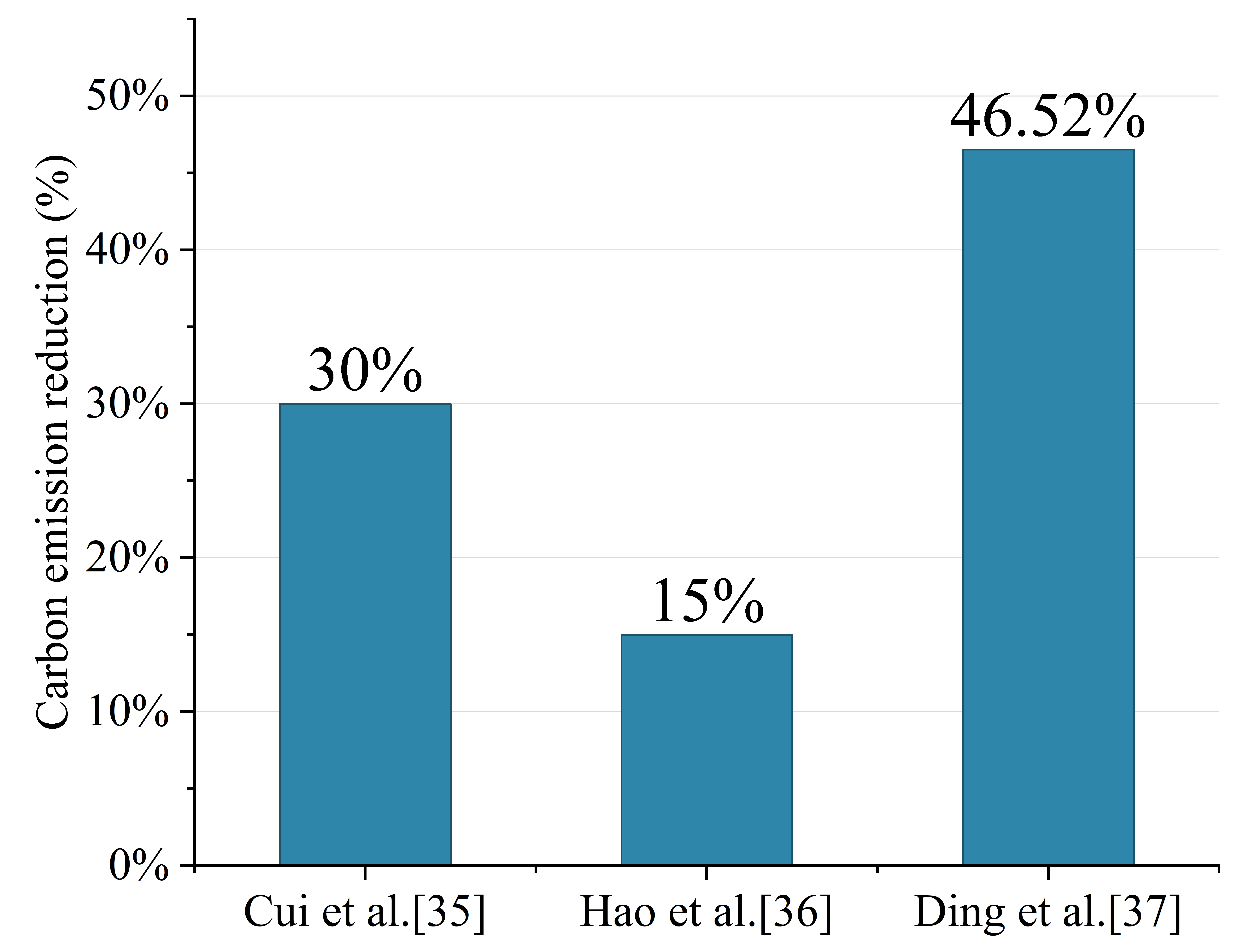
Source control of building-related carbon emissions primarily depends on the precise regulation of material quantities and material selection during the design stage, thereby minimizing material redundancy at its origin [17,28,29,30,31,32]. Previous studies have demonstrated that parametric design methods can significantly reduce carbon emissions throughout the building life cycle [33,34], while prefabricated and modular design approaches are regarded as critical pathways toward zero-carbon development. Cui et al. [35], Hao et al. [36], and Ding et al. [37] reported case-specific carbon emission reductions associated with modular construction, prefabrication, and structural optimization, with BIM supporting the evaluation and coordination of these strategies (Figure 10).
Figure 10.
Case-specific carbon emission reductions from three studies; values are not directly comparable. The 30% value is the lower bound of the reported 30–40% range.
In addition, Yevu et al. [38], Loo and Wong [39], Minunno et al. [40], and Zhao et al. [41] proposed several complementary approaches, including the use of parametric methods to lock in low-carbon targets, blockchain-based traceability, Design for Disassembly (DfD), and optimized supplier-selection models for prefabricated components to shorten transportation distances. Together, these approaches support a closed-loop, low-carbon process throughout the life cycle of building components.
During the construction stage, Cheng et al. [42] integrated BIM with the Symbiotic Organisms Search algorithm to simulate and identify the optimal material combination before construction, thereby preventing waste at its source. Process optimization for carbon-intensive activities involving reinforcing steel, formwork, and other materials also significantly reduces construction waste and embodied carbon emissions [43,44,45,46]. Furthermore, the integration of lean construction with a Design for Construction Waste Management (DfCWM) strategy, supported by 4D simulation, can eliminate hidden on-site material losses and prevent rework and demolition resulting from structural changes. These measures can achieve carbon emission reductions of more than 10.43% for carbon-intensive materials [47,48].
Regarding material selection, Sun et al. [49] and Eslami et al. [50] used BIM-supported workflows and comparative life cycle assessments to examine the environmental benefits of timber-based structural alternatives. Sun et al. [49] reported a negative global warming potential (GWP) for the cross-laminated timber (CLT) alternative under the study’s assessment assumptions, while Eslami et al. [50] demonstrated the GWP reduction potential of light-frame timber structures compared with reinforced concrete masonry systems. Furthermore, designing mechanical connections to facilitate disassembly and incorporating recycled aggregates can support component reuse and material circularity [51,52].
4.2. End-of-Life Management: Carbon Emission Avoidance Based on Waste Minimization
End-of-life management in the construction industry is transitioning from passive waste handling to proactive resource recovery. To address the limitations of conventional demolition practices, Su et al. [53] developed an assessment system integrating BIM, a geographic information system (GIS), and LCA to automatically estimate waste generation and optimize transportation routes. Building on this approach, Wang et al. [54,55,56] conducted in-depth investigations from three dimensions to support the refined assessment of waste treatment, demonstrating that high-value metal recovery and transportation control are critical to reducing end-of-life carbon emissions. The focus of future research is shifting from conventional waste management toward a “material bank” model, representing a paradigm shift from passive waste treatment to proactive resource storage and management [57,58]. To translate this concept into actionable decisions, Han et al. [59] ,Wang et al. [60] Xiao et al. [61], and Kaewunruen et al. [62] introduced hybrid algorithms, three-dimensional scanning, and digital twin technologies to support recovery decisions and enable dynamic on-site monitoring.
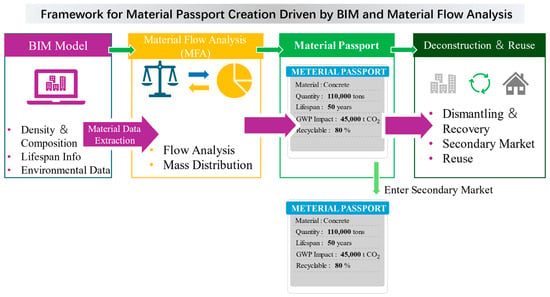
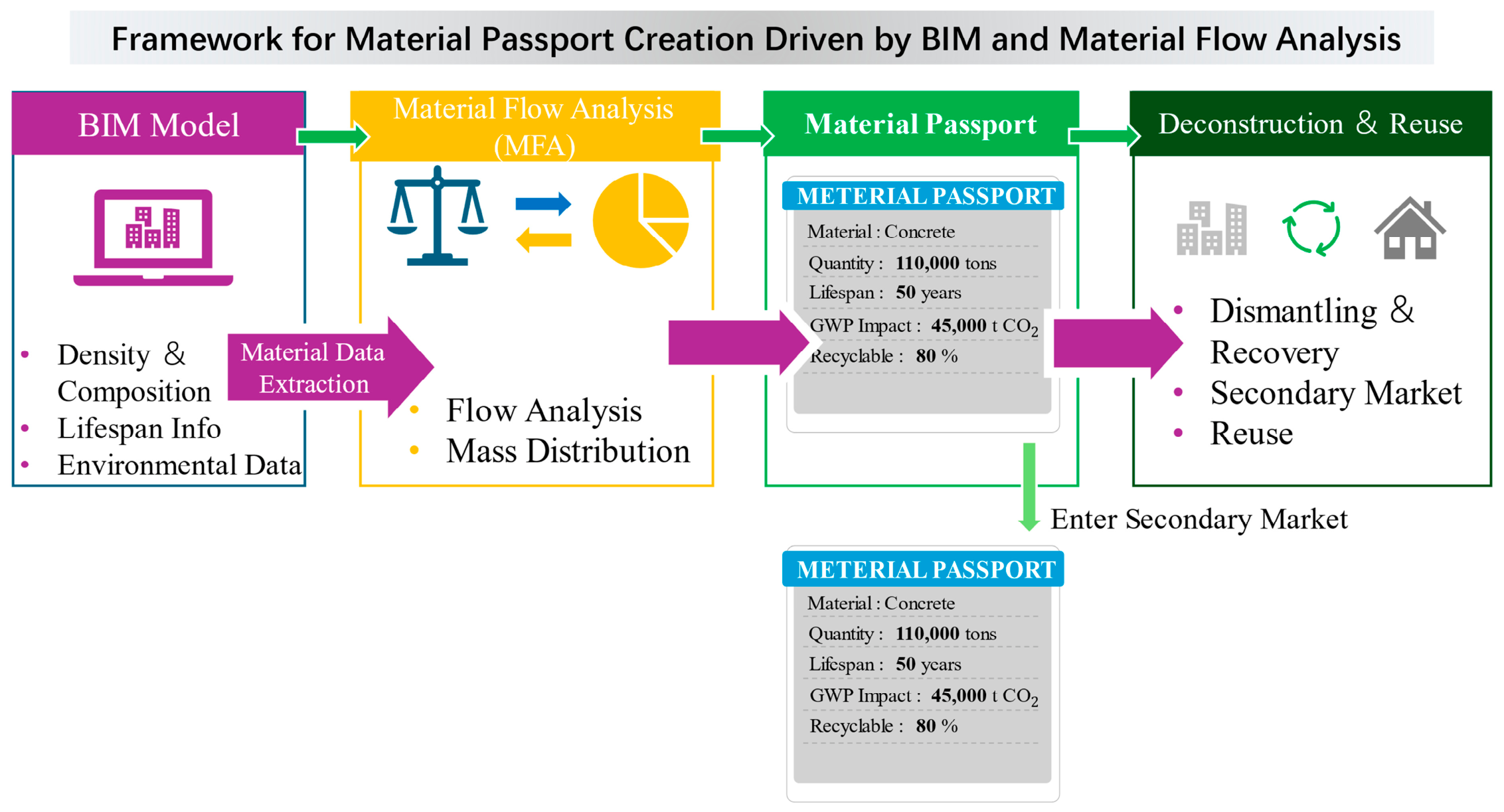
The establishment of digital storage mechanisms is a prerequisite for effective resource recovery [63,64,65]. Bertin et al. [66] and Cai et al. [67] systematized component-bank and reuse frameworks, thereby establishing a logical pathway linking waste generation, material reuse, and the consumption of new materials. Their findings also verified the substantial potential of predefined reuse pathways to reduce future structural waste. Maraqa and Spatari [68] developed a “material passport” for commercial buildings, providing dismantled materials with digital identification that facilitates their entry into secondary markets (Figure 11). Mao and Cao [69] further evaluated material passports for circularity. At the regional platform level, digital tracking supports reuse and recycling decisions that can reduce demand for virgin materials and associated carbon emissions [70,71,72]. BIM-based design and evaluation, IoT-based material tracking, predictive data analytics, and logistics network optimization are increasingly recognized as key drivers of circular construction supply chains, although the optimization of logistics networks for industrial symbiosis remains insufficiently investigated [73].
Figure 11.
Framework for Material Passport Creation Driven by BIM and Material Flow Analysis.
To facilitate the transformation of construction waste into reusable resources, increasing attention has been given to digital storage mechanisms centered on Material passports and BIM [74]. By tracking material stocks throughout the building life cycle, these mechanisms enable buildings to be transformed from future sources of waste into sustainably managed “material banks” [17,75]. The demolition waste information management systems (IMSs) and underlying LCA plug-ins developed by Xu et al. [76,77] and Jalaei et al. [78] enable the simultaneous optimization of economic and environmental performance. Revit-based LCA integration plug-ins have also been developed to provide the algorithmic foundation for the “diagnostic” functions of intelligent management systems.
At the macro-logistics level, Web Map Services (WMSs) and dynamic management frameworks support route optimization, enabling transportation-related carbon reductions through more efficient logistics [79,80]. Relevant review studies have identified waste generation rates, carbon emissions, and life-cycle-stage management as three central research topics [81,82]. Furthermore, Bouhmoud et al. [83] highlighted the role of BIM interoperability and scalability in supporting waste reduction and circularity, while Wu et al. [84] proposed a strategic framework for integrating intelligent technologies into construction and demolition waste management.
4.3. Assessment Methods: Carbon Accounting Tools Integrating BIM and LCA
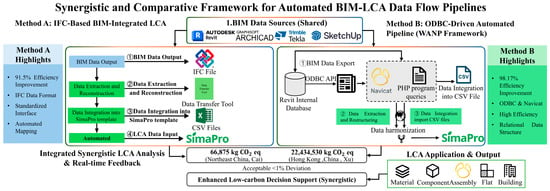
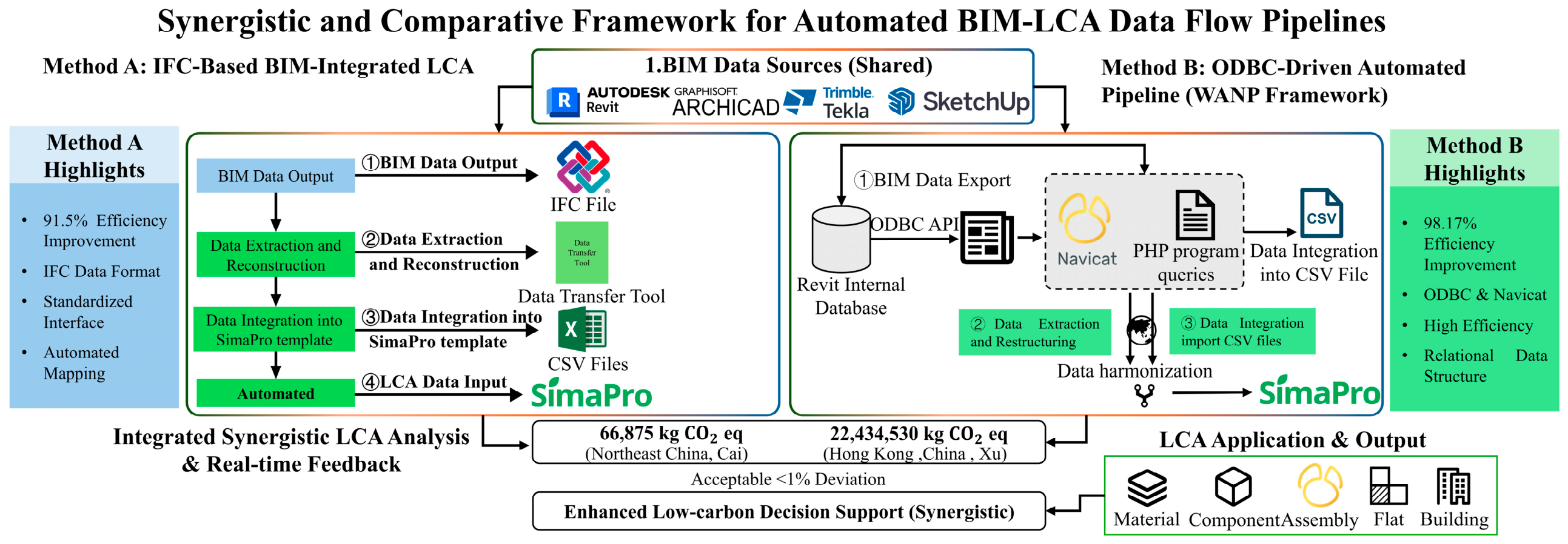
The integration of BIM and LCA is evolving toward greater automation, intelligence, and multidimensional functionality. To overcome the limitations of manual calculation [85], efficient automated data pipelines must be established. Xu et al. [86] and Cai et al. [87] developed an Industry Foundation Classes (IFC)-based automated BIM–LCA integration approach and an end-to-end automated pipeline using an Open Database Connectivity (ODBC) interface, respectively. The latter uses the Windows-Apache Web-Navicat-PHP (WANP) data integration framework to enable accurate assessments within minutes (Figure 12).
Figure 12.
Automated BIM–LCA integration: two illustrative workflows from Xu et al. [86] and Cai et al. [87].
At the multidimensional management level, the framework proposed in [88] extends 5D BIM with LCA-based environmental information, termed “6D BIM” in that study, to support the joint evaluation of cost and environmental impacts. As integration approaches continue to evolve toward enhanced semantic interoperability [89], dynamic LCA models combined with 4D BIM further overcome the limitations of static assessments and accurately quantify the real-time effects of construction schedules on carbon emissions [90].
After overcoming fundamental data interoperability barriers, Li et al. [91] achieved real-time dynamic tracking of carbon emissions during construction. Yardimci et al. [92] proposed a decision-making framework integrating LCA with the Technique for Order Preference by Similarity to Ideal Solution (TOPSIS) to balance cost and carbon reduction. With the advancement of machine learning, waste quantification is transitioning toward “predictive modeling” [93]. Embedded feedback mechanisms [94] and multidimensional digital ecosystems [95] provide the underlying logic for proactive control within the dual-track strategy of material consumption optimization and waste minimization.
Ultimately, assessment capabilities are expanding from individual buildings to the urban scale. Zubair et al. [96] integrated GIS to optimize regional waste logistics, providing an actionable solution for regional carbon reduction in developing countries. Sarigul et al. [97] further clarified the critical role of digital twins in circular waste management. The “nD BIM scalability” framework proposed by Bouhmoud et al. [98] further integrates artificial intelligence with multidimensional attributes. Together, these developments establish a comprehensive carbon assessment network that extends from individual buildings to cities, from static to dynamic analysis, and from geometric information to multidimensional data. Table 1 summarizes case-specific quantitative outcomes and the associated BIM integration approaches and mechanisms for material optimization and waste management.
Table 1.
Case-specific examples of BIM-enabled material optimization and waste management outcomes.
5. Discussion
This review indicates that BIM supports carbon reduction by connecting information on material quantities, construction processes, and end-of-life options with decisions that influence physical resource flows. The bibliometric results show growing research interest in BIM-enabled carbon management, while the qualitative synthesis identifies three interconnected pathways: upstream material optimization, construction waste control, and end-of-life resource recovery. However, increasing publication output does not necessarily indicate widespread implementation or consistent carbon savings. The environmental benefits of BIM depend on whether digital information is translated into changes in design, procurement, construction, and recovery practices.
A central finding is the shift from remedial waste treatment toward preventive intervention during the design stage. BIM-based quantity takeoff, parametric analysis, prefabrication planning, and process simulation allow alternative material and component configurations to be evaluated before procurement and construction [28,29,30,31,32,33,34,35,36,37]. These applications can reduce unnecessary material demand and prevent waste caused by design conflicts, inaccurate quantities, and poor coordination. Nevertheless, the reported benefits should not be attributed solely to BIM. In most case studies, carbon reductions resulted from the combined effects of BIM, structural optimization, prefabrication, modularization, and improved construction processes. BIM primarily functions as an information and decision-support platform that enables these physical interventions to be evaluated and coordinated.
The quantitative findings also require careful interpretation. The included studies reported carbon emission reductions of approximately 15–46.52% within their respective assessment boundaries [35,36,37], but they examined different building types, life-cycle stages, baselines, and functional units. Similarly, reductions in material waste, embodied carbon, GWP, and improvements in material circularity represent different performance indicators and should not be directly combined. The timber-based alternatives examined by Sun et al. [49] and Eslami et al. [50], for example, demonstrate the potential environmental benefits of material substitution, but the magnitude of these benefits depends on structural systems, service-life assumptions, carbon storage accounting, and end-of-life scenarios. The numerical results summarized in Table 1 should therefore be interpreted as case-specific evidence rather than as a universal average effect of BIM.
For end-of-life management, BIM creates value by preserving information needed to evaluate component reuse, material recycling, and reverse logistics. Material passports and component banks improve the visibility of material composition, quantities, locations, and potential recovery pathways [63,64,65,66,67,68,75]. This information can transform buildings into managed material stocks rather than future waste sources. However, digital documentation alone does not guarantee reuse. Recovery also depends on component condition, disassembly feasibility, certification requirements, transportation distances, market demand, and coordination among demolition contractors, recyclers, and future users. BIM should therefore be understood as digital infrastructure that supports circular decision-making rather than as an independent solution to construction and demolition waste.
The integration of BIM with LCA, GIS, IoT, and other digital technologies further expands its assessment and management capabilities. Automated BIM–LCA workflows can shorten data-processing time and provide earlier feedback on the carbon implications of design decisions [86,87]. GIS can support the spatial optimization of waste transportation, while IoT and digital twins can improve the monitoring of material and waste flows [80,96,97]. Nevertheless, computational efficiency does not automatically ensure assessment validity. Results still depend on complete material inventories, appropriate system boundaries, reliable emission factors, and transparent data-mapping rules. Semantic loss, inconsistent classification systems, and limited local databases remain major barriers to comparable and reproducible carbon assessments.
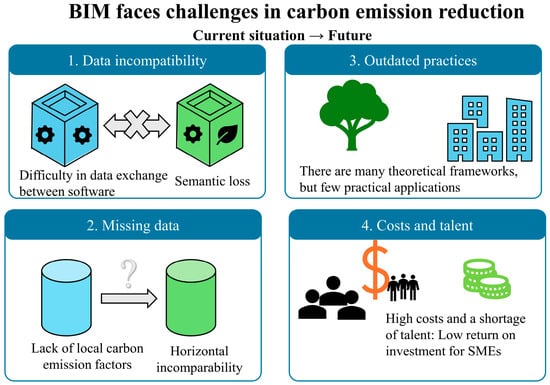
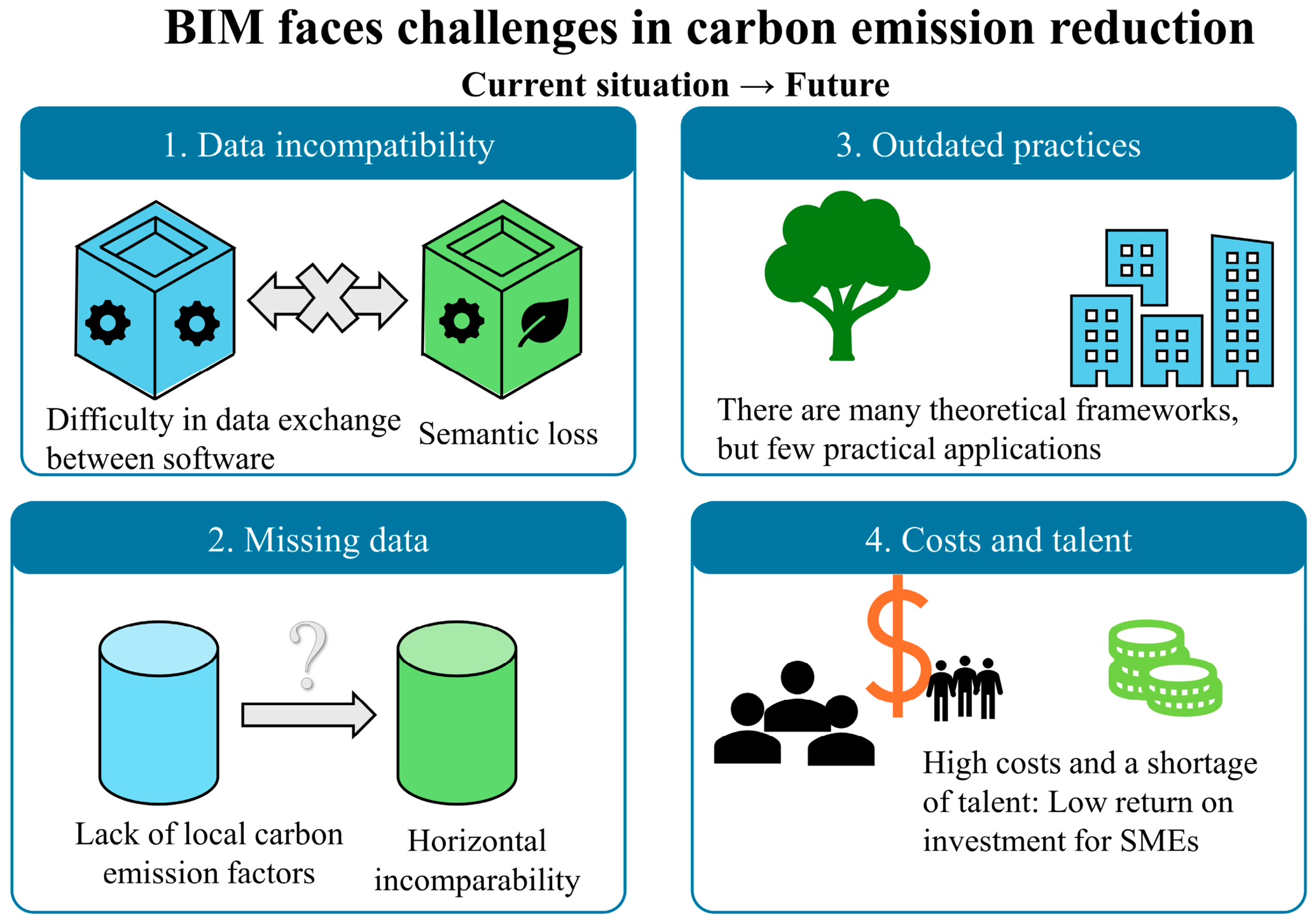
Implementation is also an organizational challenge [99,100]. The preceding synthesis shows that BIM supports carbon management through earlier evaluation of design alternatives, coordinated material use during construction, and information continuity for end-of-life recovery. Figure 13 brings together the data and organizational barriers that influence the implementation of these pathways. Limited interoperability and semantic loss hinder the transfer of material quantities and properties into LCA tools, constraining the design comparisons discussed in Section 4.1. Missing or inconsistent local emission factors affect the reliability and comparability of assessments, even when the automated workflows described in Section 4.3 accelerate data processing. For the material passports, component banks, and reverse logistics examined in Section 4.2, practical value depends on maintaining usable records and coordinating decisions among contractors, recyclers, and future users. Established management practices, implementation costs, and shortages of specialized personnel can impede this coordination. These findings indicate that translating digital assessment into material savings and resource recovery requires clear responsibilities for creating, verifying, updating, and exchanging information throughout the project life cycle. For small- and medium-sized enterprises, implementation focused on a specific decision or material stream may offer a practical starting point before expansion across the project life cycle.
Figure 13.
BIM faces challenges in carbon emission reduction.
This review relied on Web of Science and Scopus, which may underrepresent regional journals and gray literature. Google Scholar supported reference tracing and background reading. Although no language restrictions were imposed during initial screening, English-language search terms may have favored English-language publications. Bibliometric patterns should therefore be interpreted within this coverage.
The evidence combines case studies, conceptual frameworks, and reviews. Differences in building types, geographical contexts, system boundaries, functional units, and emission factors limit quantitative comparability. Reported reductions are therefore interpreted within their original assessment conditions. Future reviews would benefit from broader regional and multilingual coverage and standardized reporting of baselines, assessment boundaries, and measured versus modeled outcomes.
6. Conclusions
This systematic review examined how BIM supports carbon emission reduction through material consumption optimization and construction waste management across the building life cycle. The findings show that BIM functions not as an independent carbon reduction measure, but as a digital decision-support infrastructure that enables material quantification, design optimization, process coordination, waste traceability, and life-cycle environmental assessment. Its principal contribution is therefore to connect material-related decisions made during design and construction with waste generation, resource recovery, and embodied carbon outcomes at later life-cycle stages.
The quantitative evidence demonstrates the practical potential of BIM-enabled strategies, although the reported effects vary according to building type, system boundary, functional unit, and assessment method. Within their respective assessment boundaries, the included case studies reported carbon emission reductions of approximately 15–46.52% through the integration of BIM with modular construction, prefabrication, and structural optimization. Modular building applications reported reductions of approximately 30–40%, while material management strategies supported by BIM were associated with approximately 20–30% less material waste. More specific applications included reductions in reinforcing-steel cutting waste through cutting-pattern optimization, a maximum reduction of 71.83% in formwork-related waste generation, a 43.5% reduction in global warming potential through timber-based material substitution, and a 42.82% improvement in material circularity through recycled aggregate utilization. These values represent case-specific outcomes rather than a pooled average effect attributable exclusively to BIM.
Across the building life cycle, three complementary implementation pathways were identified. During the design stage, parametric modeling, clash detection, structural optimization, and integration with prefabricated component libraries can prevent material redundancy before physical construction begins. During construction, BIM-supported quantity takeoff, lean management, construction sequencing simulation, and real-time material tracking can inform measures to reduce overprocurement, rework, improper storage, and on-site losses. During operation, maintenance, and demolition, material passports, design for disassembly, selective deconstruction, and reverse logistics can preserve component value and transform buildings from future waste sources into material banks. The greatest carbon reduction potential is therefore achieved when these applications operate as a coordinated life-cycle strategy rather than as isolated digital tools.
The main conceptual contribution of this review is the integration of two research streams that have often been examined separately: material consumption optimization and construction waste management. Based on the synthesized evidence, this study establishes an explanatory chain linking digital material representation, source-level optimization, construction-process control, end-of-life traceability, resource recovery, and avoided embodied carbon emissions. This framework extends the understanding of BIM from a geometric modeling platform to a life-cycle resource governance mechanism. It also indicates that material efficiency and waste prevention should be treated as interconnected carbon management variables alongside cost, schedule, and quality.
The findings provide a basis for extending current research from descriptive BIM applications toward predictive and closed-loop carbon management. Future studies should distinguish the carbon reduction attributable to BIM-enabled decision-making from that produced by prefabrication, material substitution, or recycling technologies themselves. Comparable system boundaries, functional units, and locally calibrated emission factors are also needed to support cross-project synthesis. Further research should integrate BIM with artificial intelligence, the Internet of Things, digital twins, and material passports to predict waste generation and carbon consequences before construction decisions are implemented. Multi-project and longitudinal validation is particularly necessary to evaluate implementation costs, organizational readiness, and returns on investment for small- and medium-sized enterprises.
Overall, the evidence indicates that BIM can make a substantial contribution to construction-sector decarbonization when it is embedded in coordinated design, procurement, construction, and resource-recovery processes. Its future value will depend less on increasingly complex models than on interoperable data, standardized assessment methods, reliable carbon databases, and the organizational capacity to convert digital information into measurable reductions in material consumption, waste generation, and embodied carbon emissions.
Supplementary Materials
The following supporting information can be downloaded at: https://www.mdpi.com/article/10.3390/buildings16214455/s1, Table S1: Characteristics of the 82 included studies; Table S2: Quality appraisal results and inter-rater agreement analyses; File S1: Data extraction and coding procedures; File S2: Search strategies; File S3: Software versions; File S4: Completed PRISMA 2020 checklist; File S5: PRISMA 2020 flow diagram; File S6: Bibliographic dataset in RIS format; File S7: VOSviewer analysis parameters; File S8: VOSviewer map data; File S9: VOSviewer network data. References [18,35,36,37,38,39,40,41,42,43,44,45,46,47,48,49,50,51,52,53,54,55,56,57,58,59,61,62,66,67,68,70,71,72,73,76,77,78,79,80,81,82,83,84,86,87,88,89,90,91,92,93,94,95,96,97,98,101,102,103,104,105,106,107,108,109,110,111,112,113,114,115,116,117,118,119,120,121,122,123,124,125] are cited in the Supplementary Materials.
Author Contributions
Conceptualization, S.Y. and N.I.F.; methodology, S.Y. and N.I.F.; formal analysis, S.Y.; investigation, S.Y.; data curation, S.Y. and M.Z.; validation, N.I.F., Y.D.K. and S.X.; writing—original draft preparation, S.Y.; writing—review and editing, S.Y., N.I.F., Y.D.K. and S.X.; visualization, S.Y.; supervision, N.I.F. All authors have read and agreed to the published version of the manuscript.
Funding
This research received no external funding.
Institutional Review Board Statement
Not applicable.
Informed Consent Statement
Not applicable.
Data Availability Statement
The source publications analyzed in this review are identified in the reference list. The bibliographic dataset and data extraction materials are available from the corresponding author upon reasonable request.
Conflicts of Interest
The authors declare no conflicts of interest.
Abbreviations
The following abbreviations are used in this manuscript:
| BIM | Building Information Modeling |
| LCA | Life Cycle Assessment |
| GWP | Global Warming Potential |
| GHG | Greenhouse Gas |
| CO2e | Carbon Dioxide Equivalent |
| CLT | Cross-Laminated Timber |
| DfD | Design for Disassembly |
| DfCWM | Design for Construction Waste Management |
| GIS | Geographic Information System |
| IoT | Internet of Things |
| AI | Artificial Intelligence |
| IFC | Industry Foundation Classes |
| ODBC | Open Database Connectivity |
| WANP | Windows-Apache Web-Navicat-PHP |
| WMS | Web Map Service |
| IMS | Information Management System |
| TOPSIS | Technique for Order Preference by Similarity to Ideal Solution |
| BREEAM | Building Research Establishment Environmental Assessment Method |
| PRISMA | Preferred Reporting Items for Systematic Reviews and Meta-Analyses |
| MMAT | Mixed Methods Appraisal Tool |
References
- Chong, H.-Y.; Wang, X. The Outlook of Building Information Modeling for Sustainable Development. Clean Technol. Environ. Policy 2016, 18, 1877–1887. [Google Scholar] [CrossRef] [Scilit]
- Spence, R.; Mulligan, H. Sustainable Development and the Construction Industry. Habitat Int. 1995, 19, 279–292. [Google Scholar] [CrossRef] [Scilit]
- Mall, A. Reducing Material Waste with the Application of Building Information Modelling (BIM). Master’s Thesis, Durban University of Technology, Durban, South Africa, 2019. [Google Scholar] [CrossRef] [Scilit]
- Mohammed, M.; Shafiq, N.; Al-Mekhlafi, A.-B.A.; Al-Fakih, A.; Zawawi, N.A.; Mohamed, A.M.; Khallaf, R.; Abualrejal, H.M.; Shehu, A.A.; Al-Nini, A. Beneficial Effects of 3D BIM for Pre-Empting Waste during the Planning and Design Stage of Building and Waste Reduction Strategies. Sustainability 2022, 14, 3410. [Google Scholar] [CrossRef] [Scilit]
- Ajayi, S.O.; Oyedele, L.O. Critical Design Factors for Minimising Waste in Construction Projects: A Structural Equation Modelling Approach. Resour. Conserv. Recycl. 2018, 137, 302–313. [Google Scholar] [CrossRef] [Scilit]
- Wang, G.; Luo, T.; Luo, H.; Liu, R.; Liu, Y.; Liu, Z. A Comprehensive Review of Building Lifecycle Carbon Emissions and Reduction Approaches. City Built Environ. 2024, 2, 12. [Google Scholar] [CrossRef] [Scilit]
- Karunasena, G.; Gurmu, A.; Shooshtarian, S.; Udawatta, N.; Ranthika Perera, C.S.; Maqsood, T. Effect of Construction Defects on Construction and Demolition Waste Management in Building Construction: A Systematic Literature Review. Integr. Environ. Assess. Manag. 2025, 21, 233–244. [Google Scholar] [CrossRef] [Scilit] [PubMed]
- Baglivo, C. Dynamic Evaluation of the Effects of Climate Change on the Energy Renovation of a School in a Mediterranean Climate. Sustainability 2021, 13, 6375. [Google Scholar] [CrossRef] [Scilit]
- Velikov, K.; Hasan, K.N.; Lewis, G.; Menassa, C.C.; Kamat, V.R.; Thün, G. Stretch Codes and the Building Envelope. Technol. Archit. Des. 2025, 9, 156–171. [Google Scholar] [CrossRef] [Scilit]
- Zhang, Y.; Wang, H.; Gao, W.; Wang, F.; Zhou, N.; Kammen, D.M.; Ying, X. A Survey of the Status and Challenges of Green Building Development in Various Countries. Sustainability 2019, 11, 5385. [Google Scholar] [CrossRef] [Scilit]
- Wuni, I.Y.; Shen, G.Q.P.; Osei-Kyei, R. Scientometric Review of Global Research Trends on Green Buildings in Construction Journals from 1992 to 2018. Energy Build. 2019, 190, 69–85. [Google Scholar] [CrossRef] [Scilit]
- Luo, W.; Sandanayake, M.; Hou, L.; Tan, Y.; Zhang, G. A Systematic Review of Green Construction Research Using Scientometrics Methods. J. Clean. Prod. 2022, 366, 132710. [Google Scholar] [CrossRef] [Scilit]
- Zhao, Q.; Wu, Z.; Yu, Y.; Wang, T.; Huang, S. Exploring Carbon Emissions in the Construction Industry: A Review of Accounting Scales, Boundaries, Trends, and Gaps. Buildings 2025, 15, 1900. [Google Scholar] [CrossRef] [Scilit]
- Ansah, M.K.; Chen, X.; Yang, H.; Lu, L.; Lam, P.T.I. A Review and Outlook for Integrated BIM Application in Green Building Assessment. Sustain. Cities Soc. 2019, 48, 101576. [Google Scholar] [CrossRef] [Scilit]
- Akinade, O.O.; Oyedele, L.O.; Ajayi, S.O.; Bilal, M.; Alaka, H.A.; Owolabi, H.A.; Arawomo, O.O. Designing out Construction Waste Using BIM Technology: Stakeholders’ Expectations for Industry Deployment. J. Clean. Prod. 2018, 180, 375–385. [Google Scholar] [CrossRef] [Scilit]
- Abramyan, S.G.; Barkovskaya, A.Y.; Peskov, A.E.; Klenina, E.A. Concept of Sustainable Development of the Construction Sector Based on BIM-Technology. IOP Conf. Ser. Mater. Sci. Eng. 2021, 1079, 052059. [Google Scholar] [CrossRef] [Scilit]
- Atta, I.; Bakhoum, E.S.; Marzouk, M.M. Digitizing Material Passport for Sustainable Construction Projects Using BIM. J. Build. Eng. 2021, 43, 103233. [Google Scholar] [CrossRef] [Scilit]
- Liu, Z.; Li, P.; Wang, F.; Osmani, M.; Demian, P. Building Information Modeling (BIM) Driven Carbon Emission Reduction Research: A 14-Year Bibliometric Analysis. Int. J. Environ. Res. Public Health 2022, 19, 12820. [Google Scholar] [CrossRef] [Scilit] [PubMed]
- Berges-Alvarez, I.; Martínez-Rocamora, A.; Marrero, M. A Systematic Review of BIM-Based Life Cycle Sustainability Assessment for Buildings. Sustainability 2024, 16, 11070. [Google Scholar] [CrossRef] [Scilit]
- Cao, Y.; Kamaruzzaman, S.N.; Aziz, N.M. Green Building Construction: A Systematic Review of BIM Utilization. Buildings 2022, 12, 1205. [Google Scholar] [CrossRef] [Scilit]
- Carvalho, J.P.; Bragança, L.; Mateus, R. A Systematic Review of the Role of BIM in Building Sustainability Assessment Methods. Appl. Sci. 2020, 10, 4444. [Google Scholar] [CrossRef] [Scilit]
- Fonseca Arenas, N.; Shafique, M. Recent Progress on BIM-Based Sustainable Buildings: State of the Art Review. Dev. Built Environ. 2023, 15, 100176. [Google Scholar] [CrossRef] [Scilit]
- Lima, L.; Trindade, E.; Alencar, L.; Alencar, M.; Silva, L. Sustainability in the Construction Industry: A Systematic Review of the Literature. J. Clean. Prod. 2021, 289, 125730. [Google Scholar] [CrossRef] [Scilit]
- Page, M.J.; McKenzie, J.E.; Bossuyt, P.M.; Boutron, I.; Hoffmann, T.C.; Mulrow, C.D.; Shamseer, L.; Tetzlaff, J.M.; Akl, E.A.; Brennan, S.E.; et al. The PRISMA 2020 Statement: An Updated Guideline for Reporting Systematic Reviews. BMJ 2021, 372, n71. [Google Scholar] [CrossRef] [Scilit] [PubMed]
- Hong, Q.N.; Pluye, P.; Fàbregues, S.; Bartlett, G.; Boardman, F.; Cargo, M.; Dagenais, P.; Gagnon, M.-P.; Griffiths, F.; Nicolau, B.; et al. Mixed Methods Appraisal Tool (MMAT), Version 2018: User Guide; Department of Family Medicine, McGill University: Montréal, QC, Canada, 2018. [Google Scholar] [CrossRef] [Scilit]
- Cohen, J. A Coefficient of Agreement for Nominal Scales. Educ. Psychol. Meas. 1960, 20, 37–46. [Google Scholar] [CrossRef] [Scilit]
- van Eck, N.J.; Waltman, L. VOS: A New Method for Visualizing Similarities between Objects. In Proceedings of the Advances in Data Analysis; Decker, R., Lenz, H.-J., Eds.; Springer: Berlin/Heidelberg, Germany, 2007; pp. 299–306. [Google Scholar]
- Lee, G.; Sacks, R.; Eastman, C.M. Specifying Parametric Building Object Behavior (BOB) for a Building Information Modeling System. Autom. Constr. 2006, 15, 758–776. [Google Scholar] [CrossRef] [Scilit]
- Quiñones, R.; Llatas, C.; Montes, M.V.; Cortés, I. A Multiplatform BIM-Integrated Construction Waste Quantification Model during Design Phase. The Case of the Structural System in a Spanish Building. Recycling 2021, 6, 62. [Google Scholar] [CrossRef] [Scilit]
- Liu, Z.; Osmani, M.; Demian, P.; Baldwin, A. A BIM-Aided Construction Waste Minimisation Framework. Autom. Constr. 2015, 59, 1–23. [Google Scholar] [CrossRef] [Scilit]
- Wang, J.; Li, J.; Chen, X. Parametric Design Based on Building Information Modeling for Sustainable Buildings. In Proceedings of the 2010 International Conference on Challenges in Environmental Science and Computer Engineering; IEEE: New York, NY, USA, 2010; Volume 2, pp. 236–239. [Google Scholar]
- Eltaweel, A.; Su, Y. Parametric Design and Daylighting: A Literature Review. Renew. Sustain. Energy Rev. 2017, 73, 1086–1103. [Google Scholar] [CrossRef] [Scilit]
- Kamel, E.; Pittau, F.; Dal Verme, L.M.; Scatigna, P.; Iannaccone, G. A Parametric Integrated Design Approach for Life Cycle Zero-Carbon Buildings. Sustainability 2024, 16, 2001. [Google Scholar] [CrossRef] [Scilit]
- Lobaccaro, G.; Wiberg, A.H.; Ceci, G.; Manni, M.; Lolli, N.; Berardi, U. Parametric Design to Minimize the Embodied GHG Emissions in a ZEB. Energy Build. 2018, 167, 106–123. [Google Scholar] [CrossRef] [Scilit]
- Cui, D.; Zhao, H.-Y.; Zhang, R. Approaching Zero-Carbon Development through Modular Construction: A Case Study of Healthcare Buildings in London. Indoor Built Environ. 2025, 34, 1404–1421. [Google Scholar] [CrossRef] [Scilit]
- Hao, J.L.; Cheng, B.; Lu, W.; Xu, J.; Wang, J.; Bu, W.; Guo, Z. Carbon Emission Reduction in Prefabrication Construction during Materialization Stage: A BIM-Based Life-Cycle Assessment Approach. Sci. Total Environ. 2020, 723, 137870. [Google Scholar] [CrossRef] [Scilit] [PubMed]
- Ding, Y.; Guo, Z.-Z.; Zhou, S.-X.; Wei, Y.-Q.; She, A.-M.; Dong, J.-L. Research on Carbon Emissions during the Construction Process of Prefabricated Buildings Based on BIM and LCA. J. Asian Archit. Build. Eng. 2025, 24, 1426–1438. [Google Scholar] [CrossRef] [Scilit]
- Yevu, S.K.; Owusu, E.K.; Chan, A.P.C.; Oti-Sarpong, K.; Wuni, I.Y.; Tetteh, M.O. Systematic Review on the Integration of Building Information Modelling and Prefabrication Construction for Low-Carbon Building Delivery. Build. Res. Inf. 2023, 51, 279–300. [Google Scholar] [CrossRef] [Scilit]
- Loo, B.P.Y.; Wong, R.W.M. Towards a Conceptual Framework of Using Technology to Support Smart Construction: The Case of Modular Integrated Construction (MiC). Buildings 2023, 13, 372. [Google Scholar] [CrossRef] [Scilit]
- Minunno, R.; O’Grady, T.; Morrison, G.M.; Gruner, R.L.; Colling, M. Strategies for Applying the Circular Economy to Prefabricated Buildings. Buildings 2018, 8, 125. [Google Scholar] [CrossRef] [Scilit]
- Zhao, L.; Liu, Z.; Mbachu, J. Optimization of the Supplier Selection Process in Prefabrication Using BIM. Buildings 2019, 9, 222. [Google Scholar] [CrossRef] [Scilit]
- Cheng, M.-Y.; Vu, Q.-T.; Zhang, X.-K. Carbon-Footprint-Based Optimization for Building Life-Cycle Total Cost Analysis—A Case Study on MEGA House. J. Build. Eng. 2025, 114, 114273. [Google Scholar] [CrossRef] [Scilit]
- Cheng, B.; Huang, J.; Lu, K.; Li, J.; Gao, G.; Wang, T.; Chen, H. BIM-Enabled Life Cycle Assessment of Concrete Formwork Waste Reduction through Prefabrication. Sustain. Energy Technol. Assess. 2022, 53, 102449. [Google Scholar] [CrossRef] [Scilit]
- Wang, Z.; Jia, L.; Lv, J.; Huang, J. Minimization of Rebar Cutting Waste Using BIM and Cutting Pattern-Oriented Multiobjective Optimization. J. Constr. Eng. Manag. 2024, 150, 04024166. [Google Scholar] [CrossRef] [Scilit]
- Hsu, W.-Y.; Wu, T.-H.; Setiawan, B.; Hsieh, S.-H.; Chang, W.-T. Life Cycle Carbon Footprint Assessment in a BIM-Based Aluminum Formwork Layout Planning System. In Proceedings of the Construction Applications of Virtual Reality, Volume 3; Noroozinejad Farsangi, E., Rasouli, A.H., Dawood, N., Morrison, G., Eds.; Springer Nature: Singapore, 2025; pp. 413–424. [Google Scholar]
- Hao, J.L.; Zhao, W.; Gong, G.; Ma, W.; Li, L.; Zhang, Y. Catalyzing Sustainability through Prefabrication: Integrating BIM-LCA for Assessing Embodied Carbon in Timber Formwork Waste. Sustain. Chem. Pharm. 2024, 41, 101698. [Google Scholar] [CrossRef] [Scilit]
- Hassan, E.M.; Ibrahim, M.A.; Tarek, Z.M. Towards Achieving Sustainability Through Construction Waste Management by Integration of Design and Building Information Management; WIT Press: Southampton, UK, 2023; pp. 389–404. [Google Scholar]
- Jindal, S.; Singh, I.; Renganaidu, V. Integration of BIM and Lean Implementation in the Construction Industry—A Literature Review. In Proceedings of the Sustainable Lean Construction; Kashyap, A., Raghavan, N., Singh, I., Renganaidu, V., Chandramohan, A., Eds.; Springer Nature: Singapore, 2024; pp. 361–371. [Google Scholar]
- Sun, Q.; Huang, Q.; Duan, Z.; Zhang, A. Recycling Potential Comparison of Mass Timber Constructions and Concrete Buildings: A Case Study in China. Sustainability 2022, 14, 6174. [Google Scholar] [CrossRef] [Scilit]
- Eslami, H.; Yaghma, A.; Jayasinghe, L.B.; Waldmann, D. Comparative Life Cycle Assessment of Light Frame Timber and Reinforced Concrete Masonry Structural Systems for Single-Family Houses in Luxembourg. Heliyon 2024, 10, e26083. [Google Scholar] [CrossRef] [Scilit] [PubMed]
- Montalbano, G.; Aloini, D.; Martino, M.; Santi, G. Design for Disassembly as a Circular Design Strategy: Toward an Environmental and Economic Assessment of Single-Family Houses. In Proceedings of the Envisioning the Futures—Designing and Building for People and the Environment; Albatici, R., Dalprà, M., Gatti, M.P., Maracchini, G., Torresin, S., Eds.; Springer Nature: Cham, Switzerland, 2025; pp. 599–614. [Google Scholar]
- Vásquez-Cabrera, A.; Montes, M.V.; Llatas, C. The Incorporation of Recycled Aggregate Concrete as a Strategy to Enhance the Circular Performance of Residential Building Structures in Spain. Appl. Sci. 2025, 15, 3265. [Google Scholar] [CrossRef] [Scilit]
- Su, S.; Li, S.; Ju, J.; Wang, Q.; Xu, Z. A Building Information Modeling-Based Tool for Estimating Building Demolition Waste and Evaluating Its Environmental Impacts. Waste Manag. 2021, 134, 159–169. [Google Scholar] [CrossRef] [Scilit] [PubMed]
- Wang, J.; Wei, J.; Liu, Z.; Huang, C.; Du, X. Life Cycle Assessment of Building Demolition Waste Based on Building Information Modeling. Resour. Conserv. Recycl. 2022, 178, 106095. [Google Scholar] [CrossRef] [Scilit]
- Wang, J.; Wu, H.; Duan, H.; Zillante, G.; Zuo, J.; Yuan, H. Combining Life Cycle Assessment and Building Information Modelling to Account for Carbon Emission of Building Demolition Waste: A Case Study. J. Clean. Prod. 2018, 172, 3154–3166. [Google Scholar] [CrossRef] [Scilit]
- Wang, S.; Wu, Q.; Yu, J. BIM-Based Assessment of the Environmental Effects of Various End-of-Life Scenarios for Buildings. Sustainability 2024, 16, 2980. [Google Scholar] [CrossRef] [Scilit]
- Aziminezhad, M.; Taherkhani, R. BIM for Deconstruction: A Review and Bibliometric Analysis. J. Build. Eng. 2023, 73, 106683. [Google Scholar] [CrossRef] [Scilit]
- Akbarieh, A.; Jayasinghe, L.B.; Waldmann, D.; Teferle, F.N. BIM-Based End-of-Lifecycle Decision Making and Digital Deconstruction: Literature Review. Sustainability 2020, 12, 2670. [Google Scholar] [CrossRef] [Scilit]
- Han, D.; Kalantari, M.; Rajabifard, A. The Development of an Integrated BIM-Based Visual Demolition Waste Management Planning System for Sustainability-Oriented Decision-Making. J. Environ. Manag. 2024, 351, 119856. [Google Scholar] [CrossRef] [Scilit] [PubMed]
- Wang, T.-K.; Wu, Z.; Luo, C. Multi-participant construction waste demolition and transportation decision-making system. Resour. Conserv. Recycl. 2021, 170, 105575. [Google Scholar] [CrossRef] [Scilit]
- Xiao, J.; Zeng, L.; Ding, T.; Xu, H.; Tang, H. Deconstruction Evaluation Method of Building Structures Based on Digital Technology. J. Build. Eng. 2023, 66, 105901. [Google Scholar] [CrossRef] [Scilit]
- Kaewunruen, S.; Lin, Y.-H.; Guo, Y. BIM-Driven Digital Twin for Demolition Waste Management of Existing Residential Buildings. Sci. Rep. 2025, 15, 28989. [Google Scholar] [CrossRef] [Scilit] [PubMed]
- Akanbi, L.A.; Oyedele, L.O.; Akinade, O.O.; Ajayi, A.O.; Davila Delgado, M.; Bilal, M.; Bello, S.A. Salvaging Building Materials in a Circular Economy: A BIM-Based Whole-Life Performance Estimator. Resour. Conserv. Recycl. 2018, 129, 175–186. [Google Scholar] [CrossRef] [Scilit]
- de Oliveira, J.; Schreiber, D.; Jahno, V.D. Circular Economy and Buildings as Material Banks in Mitigation of Environmental Impacts from Construction and Demolition Waste. Sustainability 2024, 16, 5022. [Google Scholar] [CrossRef] [Scilit]
- Copeland, S.; Bilec, M. Buildings as Material Banks Using RFID and Building Information Modeling in a Circular Economy. Procedia CIRP 2020, 90, 143–147. [Google Scholar] [CrossRef] [Scilit]
- Bertin, I.; Mesnil, R.; Jaeger, J.-M.; Feraille, A.; Le Roy, R. A BIM-Based Framework and Databank for Reusing Load-Bearing Structural Elements. Sustainability 2020, 12, 3147. [Google Scholar] [CrossRef] [Scilit]
- Cai, G.; Waldmann, D. A Material and Component Bank to Facilitate Material Recycling and Component Reuse for a Sustainable Construction: Concept and Preliminary Study. Clean Technol. Environ. Policy 2019, 21, 2015–2032. [Google Scholar] [CrossRef] [Scilit]
- Maraqa, M.J.; Spatari, S. BIM Material Passport to Support Building Deconstruction and a Circular Economy. In Proceedings of the Construction in the 21st Century 12th International Conference (CITC 12), Amman, Jordan, 16–19 May 2022. [Google Scholar]
- Mao, S.; Cao, W.-J. Evaluating Material Passports for Circularity in the Construction Industry. Sustain. Prod. Consum. 2025, 54, 88–101. [Google Scholar] [CrossRef] [Scilit]
- Miatto, A.; Sartori, C.; Bianchi, M.; Borin, P.; Giordano, A.; Saxe, S.; Graedel, T.E. Tracking the Material Cycle of Italian Bricks with the Aid of Building Information Modeling. J. Ind. Ecol. 2022, 26, 609–626. [Google Scholar] [CrossRef] [Scilit]
- Dogaheh, R.H.; Laefer, D.F. Restructuring Construction Thinking for Urban Material Reuse. In Proceedings of the IABSE Congress, New Delhi 2023: Engineering for Sustainable Development, Report; International Association for Bridge and Structural Engineering (IABSE): Zurich, Switzerland, 2023; pp. 1113–1119. [Google Scholar]
- Llatas, C.; Quiñones, R.; Bizcocho, N. Environmental Impact Assessment of Construction Waste Recycling versus Disposal Scenarios Using an LCA-BIM Tool during the Design Stage. Recycling 2022, 7, 82. [Google Scholar] [CrossRef] [Scilit]
- Chen, Q.; Feng, H.; Garcia de Soto, B. Revamping Construction Supply Chain Processes with Circular Economy Strategies: A Systematic Literature Review. J. Clean. Prod. 2022, 335, 130240. [Google Scholar] [CrossRef] [Scilit]
- Mankata, L.M.; Antwi-Afari, P.; Frimpong, S.; Ng, S.T. Material Passports in Construction Waste Management: A Systematic Review of Contexts, Stakeholders, Requirements, and Challenges. Buildings 2025, 15, 1825. [Google Scholar] [CrossRef] [Scilit]
- Honic, M.; Kovacic, I.; Sibenik, G.; Rechberger, H. Data- and Stakeholder Management Framework for the Implementation of BIM-Based Material Passports. J. Build. Eng. 2019, 23, 341–350. [Google Scholar] [CrossRef] [Scilit]
- Shi, Y.; Xu, J. BIM-Based Information System for Econo-Enviro-Friendly End-of-Life Disposal of Construction and Demolition Waste. Autom. Constr. 2021, 125, 103611. [Google Scholar] [CrossRef] [Scilit]
- Xu, J.; Shi, Y.; Xie, Y.; Zhao, S. A BIM-Based Construction and Demolition Waste Information Management System for Greenhouse Gas Quantification and Reduction. J. Clean. Prod. 2019, 229, 308–324. [Google Scholar] [CrossRef] [Scilit]
- Jalaei, F.; Zoghi, M.; Khoshand, A. Life Cycle Environmental Impact Assessment to Manage and Optimize Construction Waste Using Building Information Modeling (BIM). Int. J. Constr. Manag. 2021, 21, 784–801. [Google Scholar] [CrossRef] [Scilit]
- Olubambi, A.; Aigbavboa, C.; Ikotun, B. Conceptualising a Dynamic BIM-Based Waste Management System in Enabling Net-Zero Cities. In Proceedings of the Institution of Civil Engineers-Waste and Resource Management; Emerald Publishing Limited: West Sussex, UK, 2025; Volume 178, pp. 237–249. [Google Scholar] [CrossRef] [Scilit]
- Huang, Y.; Pan, L.; He, Y.; Xie, Z.; Zheng, X. A BIM–WMS Management Tool for the Reverse Logistics Supply Chain of Demolition Waste. Sustainability 2022, 14, 16053. [Google Scholar] [CrossRef] [Scilit]
- Sun, W.; Tushar, Q.; Zhang, G.; Song, A.; Hou, L.; Zhang, J.; Wang, S. An Analytical Review of Construction and Demolition Waste Management and Quantification Methods Using a Science Mapping Approach. Recycling 2025, 10, 115. [Google Scholar] [CrossRef] [Scilit]
- Han, D.; Kalantari, M.; Rajabifard, A. Building Information Modeling (BIM) for Construction and Demolition Waste Management in Australia: A Research Agenda. Sustainability 2021, 13, 12983. [Google Scholar] [CrossRef] [Scilit]
- Bouhmoud, H.; Loudyi, D.; Giordano, A. BIM-Driven Transformation of Waste Management toward Enhanced Reduction and Circularity in the Built Environment. Waste Manag. 2025, 207, 115105. [Google Scholar] [CrossRef] [Scilit] [PubMed]
- Wu, Z.; Pei, T.; Bao, Z.; Ng, S.T.; Lu, G.; Chen, K. Utilizing Intelligent Technologies in Construction and Demolition Waste Management: From a Systematic Review to an Implementation Framework. Front. Eng. Manag. 2025, 12, 1–23. [Google Scholar] [CrossRef] [Scilit]
- Soust-Verdaguer, B.; Llatas, C.; García-Martínez, A. Critical Review of Bim-Based LCA Method to Buildings. Energy Build. 2017, 136, 110–120. [Google Scholar] [CrossRef] [Scilit]
- Xu, J.; Teng, Y.; Pan, W.; Zhang, Y. BIM-Integrated LCA to Automate Embodied Carbon Assessment of Prefabricated Buildings. J. Clean. Prod. 2022, 374, 133894. [Google Scholar] [CrossRef] [Scilit]
- Cai, L.; Kang, Z.; Wang, S.; Chang, S.; Yang, K.; Xia, X. Efficiency Improvement in Automated Carbon Emissions Assessment: An Empirical Study of a BIM-LCA Multi-Module Integrated System. J. Build. Eng. 2025, 114, 114339. [Google Scholar] [CrossRef] [Scilit]
- Yangyang, H.; Gong, Z. An Add Environmental Dimension Using BIM-LCA Integration Technology. E3S Web Conf. 2021, 253, 03027. [Google Scholar] [CrossRef] [Scilit]
- Chen, Z.; Chen, L.; Zhou, X.; Huang, L.; Sandanayake, M.; Yap, P.-S. Recent Technological Advancements in BIM and LCA Integration for Sustainable Construction: A Review. Sustainability 2024, 16, 1340. [Google Scholar] [CrossRef] [Scilit]
- Su, S.; Wang, Q.; Han, L.; Hong, J.; Liu, Z. BIM-DLCA: An Integrated Dynamic Environmental Impact Assessment Model for Buildings. Build. Environ. 2020, 183, 107218. [Google Scholar] [CrossRef] [Scilit]
- Li, B.; Fu, F.F.; Zhong, H.; Luo, H.B. Research on the Computational Model for Carbon Emissions in Building Construction Stage Based on BIM. Struct. Surv. 2012, 30, 411–425. [Google Scholar] [CrossRef] [Scilit]
- Yardimci, Y.; Kurucay, E. LCA-TOPSIS Integration for Minimizing Material Waste in the Construction Sector: A BIM-Based Decision-Making. Buildings 2024, 14, 3919. [Google Scholar] [CrossRef] [Scilit]
- Singhal, S.; Sharma, P.; Kumari, R. Construction and Demolition Waste Estimation Methods Research: A Science Mapping Analysis Using VOS Viewer. J. Mater. Cycles Waste Manag. 2025, 27, 4084–4103. [Google Scholar] [CrossRef] [Scilit]
- Mercader Moyano, M.D.P.; Camporeale, P.E.; Cózar-Cózar, E. Environmental Impact Assesment Applying Indicators Embedded into a Social Housing BIM Model. Rev. Hábitat Sustentable 2019, 9, 78–93. [Google Scholar] [CrossRef] [Scilit]
- Govorukha, P. Basic Concepts of the Digital Information Model in the Life Cycle of a Construction Project. In AIP Conference Proceedings; AIP Publishing LLC: Melville, NY, USA, 2022; Volume 2559, p. 040002. [Google Scholar] [CrossRef] [Scilit]
- Zubair, M.U.; Ali, M.; Khan, M.A.; Khan, A.; Hassan, M.U.; Tanoli, W.A. BIM- and GIS-Based Life-Cycle-Assessment Framework for Enhancing Eco Efficiency and Sustainability in the Construction Sector. Buildings 2024, 14, 360. [Google Scholar] [CrossRef] [Scilit]
- Sarigul, F.H.; Gunaydin, H.M. Integrated BIM, GIS and Interoperable Digital Technologies in Lifecycle Management of Building Construction Projects: Systematic Literature Review. Smart Sustain. Built Environ. 2025, 15, 1808–1845. [Google Scholar] [CrossRef] [Scilit]
- Bouhmoud, H.; Alzarrad, A. Leveraging nD BIM Scalability for Sustainable Construction: Challenges, Opportunities, and Strategic Frameworks for Carbon Emission Mitigation. In Proceedings of the 2025 IEEE Conference on Technologies for Sustainability (SusTech); IEEE: New York, NY, USA, 2025; pp. 1–8. [Google Scholar]
- Rajabi, M.S.; Rezaeiashtiani, M.; Radzi, A.R.; Famili, A.; Rezaeiashtiani, A.; Rahman, R.A. Underlying Factors and Strategies for Organizational BIM Capabilities: The Case of Iran. Appl. Syst. Innov. 2022, 5, 109. [Google Scholar] [CrossRef] [Scilit]
- Rajabi, M.S.; Radzi, A.R.; Rezaeiashtiani, M.; Famili, A.; Rashidi, M.E.; Rahman, R.A. Key Assessment Criteria for Organizational BIM Capabilities: A Cross-Regional Study. Buildings 2022, 12, 1013. [Google Scholar] [CrossRef] [Scilit]
- Öztürk, E.; Borgianni, Y.; İnce, C. Environmental Assessment of the Introduction of Digital Technologies in the Building Industry: A Literature Study. In Towards a Smart, Resilient and Sustainable Industry. ISIEA 2023; Borgianni, Y., Matt, D.T., Molinaro, M., Orzes, G., Eds.; Springer: Cham, Switzerland, 2023; Volume 745, pp. 448–458. [Google Scholar] [CrossRef] [Scilit]
- Otasowie, K.; Aigbavboa, C.; Oke, A.; Adekunle, P.; Ntuli, N. Adopting Digital Technologies in Construction and Demolition Waste (C&DW) Management: Benefits for Developing Nations. In Proceedings of the Future Technologies Conference (FTC) 2024, Volume 4; Arai, K., Ed.; Springer: Cham, Switzerland, 2024; Volume 1157, pp. 461–473. [Google Scholar] [CrossRef] [Scilit]
- Mollaei, A.; Bachmann, C.; Haas, C. Assessing the impact of policy tools on building material recovery. Resour. Conserv. Recycl. 2023, 198, 107188. [Google Scholar] [CrossRef] [Scilit]
- Weng, Y.W.; Li, M.Y.; Ruan, S.Q.; Wong, T.N.; Tan, M.J.; Yeong, K.L.O.; Qian, S.Z. Comparative economic, environmental and productivity assessment of a concrete bathroom unit fabricated through 3D printing and a precast approach. J. Clean. Prod. 2020, 261, 121245. [Google Scholar] [CrossRef] [Scilit]
- Ajayi, S.O.; Oyedele, L.O.; Bilal, M.; Akinade, O.O.; Alaka, H.A.; Owolabi, H.A.; Kadiri, K.O. Waste effectiveness of the construction industry: Understanding the impediments and requisites for improvements. Resour. Conserv. Recycl. 2015, 102, 101–112. [Google Scholar] [CrossRef] [Scilit]
- Han, D.C.; Kalantari, M.; Rajabifard, A. Identifying and prioritizing sustainability indicators for China’s assessing demolition waste management using modified Delphi-analytic hierarchy process method. Waste Manag. Res. 2023, 41, 1649–1660. [Google Scholar] [CrossRef] [Scilit]
- Kylili, A.; Fokaides, P.A. Policy trends for the sustainability assessment of construction materials: A review. Sustain. Cities Soc. 2017, 35, 280–288. [Google Scholar] [CrossRef] [Scilit]
- Yang, X.X.; Song, M.Q.; Zhou, X.H.; Liao, C.Y. Bibliometric and thematic insights into a decade of circular economy research in construction. Discov. Appl. Sci. 2025, 7, 922. [Google Scholar] [CrossRef] [Scilit]
- Hei, S.G.; Zhang, H.; Luo, S.; Zhang, R.Z.; Zhou, C.; Cong, M.; Ye, H.Y. Implementing BIM and Lean Construction Methods for the Improved Performance of a Construction Project at the Disassembly and Reuse Stage: A Case Study in Dezhou, China. Sustainability 2024, 16, 656. [Google Scholar] [CrossRef] [Scilit]
- Alghamdi, A. Sustainable Practices in Construction Management and Environmental Engineering: A Review. Sustainability 2025, 17, 10027. [Google Scholar] [CrossRef] [Scilit]
- Gao, Y.; Wang, J.Y.; Yiu, T.W. Multi-information integration-based life cycle analysis of greenhouse gas emissions for prefabricated construction: A case study of Shenzhen. Environ. Impact Assess. Rev. 2024, 104, 107330. [Google Scholar] [CrossRef] [Scilit]
- Ricciotti, L.; Frettoloso, C.; Franchino, R.; Pisacane, N.; Aversa, R. Geopolymer Materials: Cutting-Edge Solutions for Sustainable Design Building. Sustainability 2025, 17, 7483. [Google Scholar] [CrossRef] [Scilit]
- Sözer, H.; Sözen, H. Waste capacity and its environmental impact of a residential district during its life cycle. Energy Rep. 2020, 6, 286–296. [Google Scholar] [CrossRef] [Scilit]
- Cheng, Q.L.; Tayeh, B.A.; Abu Aisheh, Y.I.; Alaloul, W.S.; Aldahdooh, Z.A. Leveraging BIM for Sustainable Construction: Benefits, Barriers, and Best Practices. Sustainability 2024, 16, 7654. [Google Scholar] [CrossRef] [Scilit]
- Naghibalsadati, F.; Karimi, N.; Mim, S.J.; Ng, K.T.W. Thematic evolution of Life Cycle Assessment in construction and demolition waste management: Before and after ISO 14040 and the Paris Agreement. J. Build. Eng. 2025, 111, 113482. [Google Scholar] [CrossRef] [Scilit]
- Zhou, L.L. A bibliometric review of zero waste in the built environment using VOSviewer: Evolution, hotspots, and prospects. Front. Environ. Sci. 2024, 11, 1326458. [Google Scholar] [CrossRef] [Scilit]
- Mikulenas, M.; Seduikyte, L. Circularity and Decarbonization Synergies in the Construction Sector: Implications for Zero-Carbon Energy Policy. Energies 2025, 18, 1164. [Google Scholar] [CrossRef] [Scilit]
- Shashi; Centobelli, P.; Cerchione, R.; Ertz, M.; Oropallo, E. What we learn is what we earn from sustainable and circular construction. J. Clean. Prod. 2023, 382, 135183. [Google Scholar] [CrossRef] [Scilit]
- Liu, H.; Chen, Y.R.; Hu, Y.W.; Wang, Z.Y.; Liu, C.L. Current Status and Future Directions of Building Information Modeling for Low-Carbon Buildings. Energies 2024, 17, 143. [Google Scholar] [CrossRef] [Scilit]
- Waqar, A.; Othman, I.; Saad, N.; Azab, M.; Khan, A.M. BIM in green building: Enhancing sustainability in the small construction project. Clean. Environ. Syst. 2023, 11, 100149. [Google Scholar] [CrossRef] [Scilit]
- Soares, N.; Tavares, V. Bibliometric Analysis of the Intersection of Circular Economy, Prefabrication, and Modularity in the Building Industry. Buildings 2025, 15, 1923. [Google Scholar] [CrossRef] [Scilit]
- da Luz, F.C.R.; Pieroni, S.; Gadelha, M.A.D.; Palha, R.P. Investigating trends in Green BIM: A systematic review. Archit. Eng. Des. Manag. 2025, 21, 1117–1135. [Google Scholar] [CrossRef] [Scilit]
- Akbari, S.; Sheikhkhoshkar, M.; Rahimian, F.P.; Haouzi, H.B.E.; Najafi, M.; Talebi, S. Sustainability and building information modelling: Integration, research gaps, and future directions. Autom. Constr. 2024, 163, 105420. [Google Scholar] [CrossRef] [Scilit]
- Naghibalsadati, F.; Gitifar, A.; Ray, S.; Richter, A.; Ng, K.T.W. Temporal evolution and thematic shifts in sustainable construction and demolition waste management through building information modeling technologies: A text-mining analysis. J. Environ. Manag. 2024, 369, 122293. [Google Scholar] [CrossRef] [Scilit]
- Alwan, Z.; Jones, P.; Holgate, P. Strategic sustainable development in the UK construction industry, through the framework for strategic sustainable development, using Building Information Modelling. J. Clean. Prod. 2017, 140, 349–358. [Google Scholar] [CrossRef] [Scilit]




Disclaimer/Publisher’s Note: The statements, opinions and data contained in all publications are solely those of the individual author(s) and contributor(s) and not of MDPI and/or the editor(s). MDPI and/or the editor(s) disclaim responsibility for any injury to people or property resulting from any ideas, methods, instructions or products referred to in the content. |
© 2026 by the authors. Licensee MDPI, Basel, Switzerland. This article is an open access article distributed under the terms and conditions of the Creative Commons Attribution (CC BY) license.