


Abstract
Population aging and deteriorating housing stock increase the need to renew old residential communities, but how community environments relate to older adults’ QoL and daily behavior remains unclear. Using a mixed-methods design, we examined these associations across three renovation categories (basic, moderate, and advanced) in Hefei, China, with 816 questionnaires from 12 communities, seven-day GPS trajectories from 50 older adults, and case studies of three communities. Factor analysis identified eight environmental dimensions and four QoL domains; category-specific regressions tested their associations. GPS and case observations contextualized survey findings. Associations differed by category. In basic renovation old communities, outdoor spaces and community services were associated with psychological QoL, while roads, building facilities, the built environment, and public facilities were associated with environmental QoL. In moderate renovation old communities, outdoor spaces, roads, and community support facilities were associated with physical QoL; public and community support facilities with psychological QoL; and roads and community support facilities with environmental QoL. In advanced renovation old communities, public facilities, community support facilities, and community services were associated with psychological QoL, while community support facilities and public transportation were associated with environmental QoL. The findings support context-sensitive priorities for age-friendly renewal.
1. Introduction
Rapid global urbanization has significantly spurred economic development, facilitated cultural exchange, and promoted social progress. More than 4 billion people worldwide now live in urban areas [1]. Across most high-income countries, including Western European countries, the United States, Australia, Japan, and Middle Eastern countries, more than 80% of the population live in urban areas. In upper-middle-income countries in Eastern Europe, East Asia, North and Southern Africa, and South America, about 50% to 80% of people reside in cities and towns [2]. However, the prolonged and large-scale expansion of urban areas has introduced significant challenges to urban governance and sustainable development [3]. One of those critical challenges is the deterioration of old residential communities in many countries [4,5]. These communities, typically constructed several decades ago, are now confronted with a series of severe issues, including aging infrastructure, inadequate public services, and deteriorating living conditions, creating growing demands for urban renewal [6].
Concurrently, the world is undergoing a profound trend of population aging. According to data published by the United Nations, the global share of the population aged 65 and over increased from 5.1% in 1950 to 9.3% in 2023 and is projected to exceed 16% by 2050, reaching 2.2 billion by the late 2070s [7]. The convergence of the physical aging of urban infrastructure and the rapid aging of the urban population poses complex challenges for urban planners, policymakers, and community stakeholders worldwide [8]. Old residential communities, which are typically characterized by deteriorating buildings, inadequate accessibility, limited public open spaces, and insufficient community services, often fail to meet the evolving physiological, psychological, and social needs of residents, especially senior residents [9]. Old residential communities also constrain older adults’ mobility, social participation, and accessibility to essential public services, thereby undermining their overall quality of life (QoL) [10]. China is experiencing rapid population aging accompanied by extensive urban transformation, making the renewal of existing residential communities increasingly important for supporting older adults’ well-being.
In China, old residential communities refer to existing urban residential neighborhoods with aging physical environments, outdated infrastructure, insufficient public facilities, and inadequate community services [11]. Many of these communities require renovation to improve living conditions and adapt to the needs of an aging population. As many older adults prefer aging in place within familiar residential environments, the quality of community spaces and services plays an important role in supporting their daily activities, mobility, and social participation [12,13]. In response to these challenges, China has increasingly linked old-community renovation with broader policy initiatives such as complete residential community construction and 15-min community life circles, which local governments have implemented through community renewal projects. These initiatives emphasize improving residents’ access to everyday facilities and public spaces within walking distance, promoting age-friendly and barrier-free environments, and strengthening nearby care, health, and daily-life services [14,15,16]. However, the relationships between different renovation levels and older adults’ QoL and behavioral patterns remain insufficiently understood.
Existing research has largely treated old residential communities as homogeneous entities, overlooking important differences among residents, including physical characteristics, behavioral patterns, and sociodemographic compositions. As older adults prefer to stay in their original communities, even as these communities age [12,13], the renewal of old residential communities influences their behaviors, needs and overall QoL [17]. Therefore, a clearer understanding of senior residents’ habits and behaviors is essential to help policymakers design renovation strategies that are precisely tailored to the specific needs of older residents in diverse community contexts.
This study aimed to comprehensively evaluate living environments across different types of old communities with different renovation levels and to investigate their relationships with older adults’ QoL and behavioral patterns using mixed methods, including a large-scale questionnaire survey, GPS trajectory analysis, and in-depth case studies. Factor analysis was used to identify the key dimensions of old residential community environments and QoL factors for older adults. Regression models were developed to examine the relationships between different renovation aspects of old residential communities and various QoL domains among older adults. Case studies were conducted to compare environmental factors across three types of old communities (basic, moderate, and advanced renovation communities), thereby capturing the heterogeneity in community conditions and renovation needs. GPS trajectory analysis was applied to examine the spatiotemporal behavioral patterns of older adults residing in different types of community, providing behavioral evidence to contextualize the quantitative findings. By employing a mixed-methods design, this study sought to generate empirical evidence to promote the development of urban renovation guidelines and ultimately contribute to creating urban environments that support healthy, active, and dignified aging.
2. Literature Review
2.1. Old Residential Communities
In the field of urban renewal, the concept of old residential communities exhibits pronounced regional characteristics shaped by diverse socioeconomic trajectories, housing policies, and urban development histories across different countries. In China, old residential communities are generally understood as urban residential communities built relatively early. National renovation policy prioritizes communities built before the end of 2000, but defines the renovation object more broadly by considering maintenance conditions, municipal infrastructure, community services, and residents’ renovation needs [14]. Many of these communities have roots in the work-unit welfare housing system or early commercial housing developments [18], are often located in established urban areas, and they face the dual pressures of aging infrastructure and a lack of maintenance.
Similarly, other countries have distinctive forms of old residential communities shaped by their housing histories and demographic conditions. In Japan, large-scale Danchi housing complexes constructed during the high-growth period (1950s–1980s) increasingly face high vacancy rates and population aging [19,20]. In the United States, older inner-city and first-ring suburban areas with post-WWII housing stock often face population decline and insufficient maintenance funding [21]. In many European countries, older residential areas include pre-WWII historic districts and large-scale social housing estates built between 1945 and the 1970s, which face social challenges and deteriorating public spaces [22,23]. These differences indicate that the characteristics and renewal priorities of old residential communities are closely related to local housing histories and social conditions.
Although the definition of old residential communities varies across countries, these communities share several common renewal challenges, while their specific priorities remain context-dependent. As socioeconomic conditions have developed, residents’ expectations of their living environments have changed [24], and many older communities no longer fully meet current living requirements. Because of their long construction history, old residential communities are plagued by problems such as outdated facilities, inadequate property management, and deteriorating living environments. Moreover, in the context of accelerating global population aging, the renewal of old residential communities should consider the needs of older adults in order to support their later life and QoL [25]. These common characteristics underscore the pressing global relevance and policy imperative of advancing the regeneration and retrofitting of old residential communities from the older adults’ perspective.
Many older adults in China prefer to remain in their familiar homes and neighborhoods as they age, a preference commonly discussed as aging in place [12,13]. This orientation is consistent with China’s policy framework, which places home-based care at the center and promotes community-based services and the provision of care resources near older adults’ homes and neighborhoods [26]. Family and intergenerational relationships remain relevant to later-life living arrangements, while community environments are associated with domestic care, leisure, community activities, and grandparental childcare [27]. As mobility and functional capacity change with age, older adults may rely more heavily on nearby outdoor spaces, accessible pedestrian routes, public transportation, and community facilities; neighborhood environmental conditions are associated with their activity engagement and QoL [28]. Accordingly, the renewal of old residential communities in China should address not only physical deterioration but also the continuity of familiar daily routines, social relationships, and community-based support.
2.2. Renovation Classification of Old Residential Communities
Renovation of old residential communities is a central component of urban renewal because it addresses aging housing stock, infrastructure, and community services [29,30]. In China, the national guideline distinguishes three renovation categories, referred to in this study as basic, moderate, and advanced renovation communities, according to the scope and intensity of intervention. “Basic renovation old communities” typically refer to older neighborhoods with severely aging infrastructure and minimal public facilities, where renovations focus on fundamental improvements to essential facilities such as water supply, electricity, gas, heating, and drainage. These old residential communities often lack basic amenities and require urgent upgrades to ensure safe and functional living conditions. “Moderate renovation old communities” are those communities where the basic infrastructure is largely functional but public service facilities and communal environments still remain inadequate. Renovation efforts at this level focus on foundational upgrades and increasing public service facilities, including enhancing green spaces, installing fitness equipment, and improving accessibility features such as ramps and barrier-free pathways. “Advanced renovation old communities” are neighborhoods that already possess relatively well-developed infrastructure and environmental conditions. Renovation priorities here shift toward a comprehensive upgrading of the living environment, including the integration of smart community technologies, the installation of universal design features to accommodate residents at different ages, and the consolidation of community-based senior care resources to support aging in place [14].
International approaches to the renovation of old residential communities do not follow a single classification system. In the United States, HUD-sponsored rehabilitation guidance distinguishes minor, moderate, and substantial rehabilitation according to the scope and intensity of intervention, while the HOME program formally recognizes moderate and substantial rehabilitation as eligible forms of affordable-housing investment [31,32]. In Europe, retrofit assessment does not follow a uniform three-level classification. Instead, existing-building assessment frameworks often combine building typology with energy performance, environmental impact, and heritage value. For example, the B3-RetroTool developed for the Brussels-Capital Region uses a multi-scale and multi-criteria approach to identify suitable retrofit strategies [33]. At the EU level, the REEBUILD project distinguishes sector-specific and multi-performance assessment approaches for evaluating integrated seismic, energy, and environmental upgrades [34]. In Japan, the Urban Renaissance Agency classifies its rental housing stock into stock-utilization, stock-regeneration, and transfer-or-return categories. Older estates requiring regeneration may be addressed through rebuilding, consolidation, change of use, or improvement, with the specific approach adapted to the characteristics of each region and housing estate [35,36]. Taken together, these examples suggest a spectrum of intervention from basic maintenance and safety upgrades to more comprehensive physical, environmental, accessibility, and community-service improvements, although the categories and thresholds remain institution- and context-specific.
2.3. Dimensions of Old Residential Community Renovation
Research on age-friendly communities emphasizes that supportive environments enable older adults to maintain mobility, independence, social participation, and access to essential services. The WHO framework identifies housing, outdoor spaces and buildings, transportation, social participation, and community and health services as key domains of age-friendly urban life [37]. Environmental gerontology further conceptualizes later-life well-being as emerging from the interaction between individual capabilities and environmental demands [38,39]. Reviews of neighborhood research indicate that the physical and social characteristics of local environments are associated with older adults’ health and functioning [40], while research on aging in place links housing and neighborhood conditions to older adults’ QoL [41]. These perspectives provide a basis for examining building facilities, roads, outdoor spaces, public transportation, and community services as interconnected dimensions of old residential community renovation and for relating them to older adults’ QoL and everyday behavior.
The renovation of old residential communities encompasses multiple dimensions, ranging from the physical condition of buildings and infrastructure to the accessibility of social services and support facilities [42]. At the most immediate level, residential building facilities constitute the foundational renovation layer for old residential communities, which includes modifications such as step-free entrances, the installation of elevators in multi-story buildings, handrails, non-slip flooring, and the provision of adequate lighting in hallways and stairwells [43,44]. Beyond individual buildings, the quality of roads within residential areas and pedestrian infrastructure determines the accessibility and safety of the broader community [45]. Level road surfaces, curb ramps, adequate lighting, and traffic calming measures effectively prevent falls and safeguard older adults’ independent mobility [46,47].
Outdoor spaces within and surrounding old residential communities serve as vital arenas for physical activity and social interaction [48]. Well-maintained parks, green spaces, and rest areas equipped with benches, shaded walkways, and accessible paths encourage older residents to engage in leisure and social interaction [49]. Integrating these outdoor spaces with the broader built environment of the community enhances walking and visual accessibility and increases place attachment [50]. Commercial and leisure amenities surrounding old residential communities are a benefit in terms of reducing travel distances for older adults and supporting their daily independence [51]. Community support facilities, including community health service centers, senior activity centers, and rehabilitation stations, are renovated and upgraded to meet the health, social, and healthcare needs of older residents [52]. To support daily activities within old residential communities, well-maintained public facilities, including public toilets, benches, waste bins, and information boards, are also essential to provide a comfortable outdoor living environment for older adults [53].
Furthermore, public transportation constitutes a critical determinant of urban mobility, especially for older residents [54]. In old communities, the addition of clear traffic signs and the provision of real-time arrival information at bus stops and stations can make travel more convenient for older adults [55]. Barrier-free pathways between communities and transit stops substantially address the travel needs of older adults who no longer drive [56]. Finally, community services, including organized social activities, volunteer programs, and intergenerational interactions, help to alleviate social isolation among older adults in old residential communities, thereby enabling them to strengthen their sense of belonging within the community [57].
An old residential community renovation does not operate in isolation but rather forms an interconnected ecosystem that collectively shapes the daily experiences and well-being of older adults. The relative importance of each renovation dimension may vary depending on the old community’s physical condition and the demographic profile of its residents. Accordingly, examining the relationships between multiple renovation dimensions and older adults’ QoL is important for designing targeted renovation strategies that respond to their diverse needs. These considerations also highlight the need for comparative evidence on how different renovation levels and environmental dimensions are related to older adults’ QoL and everyday behavioral patterns.
3. Materials and Methods
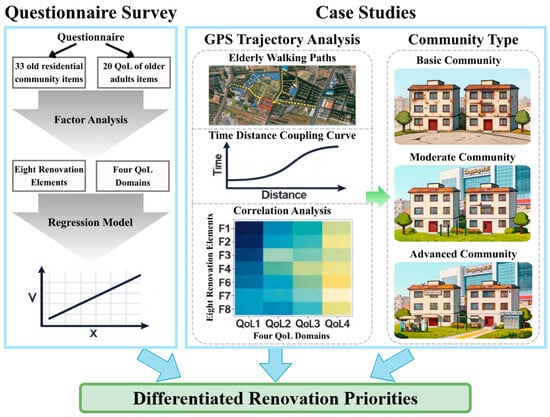
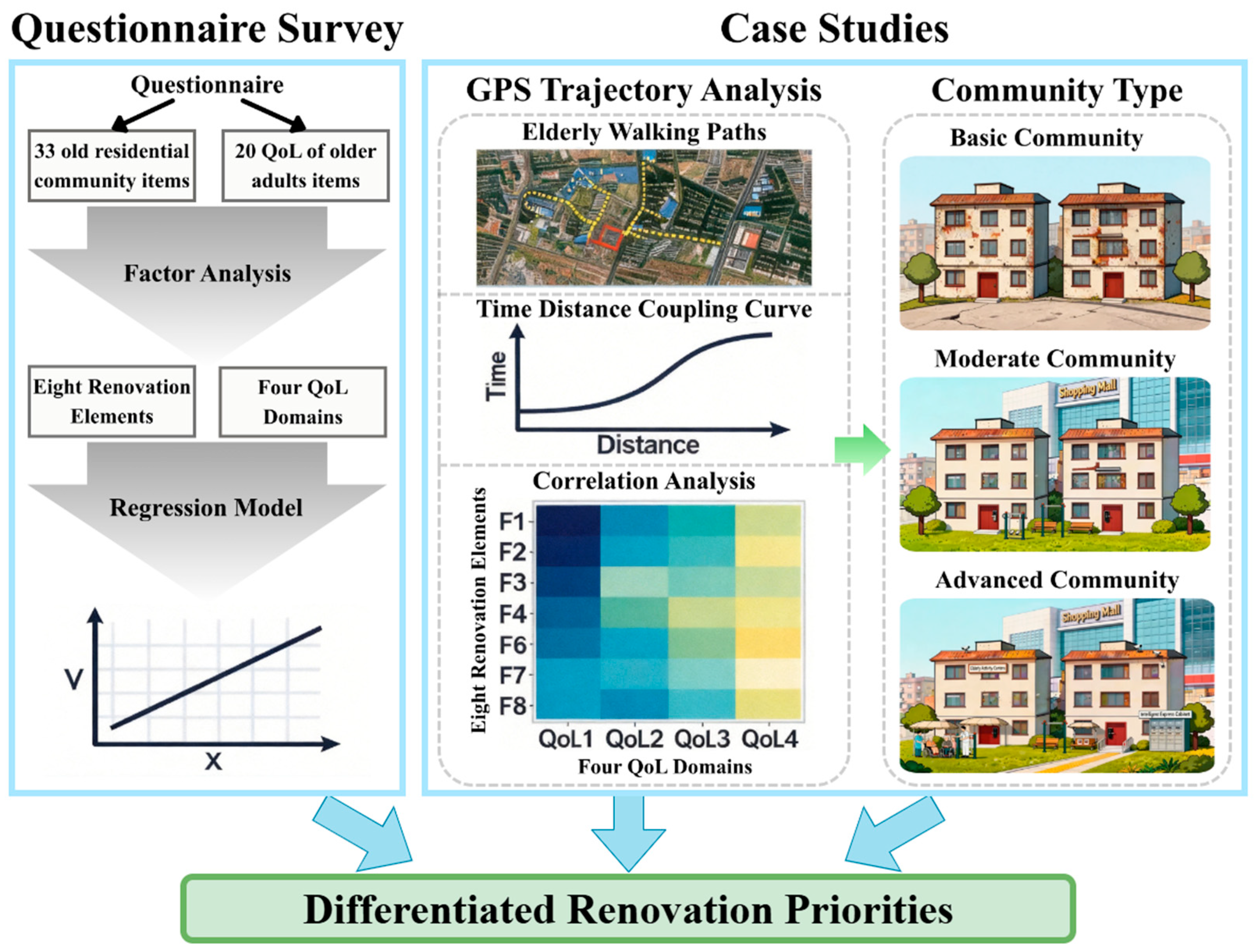
This study employed a mixed-methods research design combining a questionnaire survey, GPS trajectory analysis, and case studies to evaluate old residential community renovations and examine their associations with older adults’ QoL and behavioral patterns (Figure 1). Factor analysis was used to identify the key dimensions of old residential community environments and older adults’ QoL. Separate regression models were estimated for basic, moderate, and advanced renovation communities to examine the associations between renovation dimensions and different QoL domains. GPS trajectory analysis was conducted to examine the spatiotemporal behavioral patterns of older adults, while case studies provided contextual evidence for interpreting the questionnaire and GPS findings. Correlation analysis was used to examine associations among selected variables and support the integrated interpretation of the quantitative and case-based evidence.
Figure 1.
Research Framework.
3.1. Questionnaire Survey and Statistical Analysis
The study was conducted in four central urban districts of Hefei, China, including Luyang, Baohe, Yaohai, and Shushan Districts. Twelve old residential communities built before 2000 were included, with four communities in each of the basic, moderate, and advanced renovation categories, following the classification framework described in Section 2.2. Within each selected community, 75 eligible older residents were recruited using simple random sampling. The survey targeted residents aged 60 years or older who had lived in their communities for at least one year. A structured questionnaire was administered by trained investigators through face-to-face interviews using random sampling. A total of 900 questionnaires were distributed equally across the three renovation categories, with 300 questionnaires allocated to each category. After excluding invalid responses, 816 valid questionnaires were obtained, resulting in an overall effective response rate of 90.7%. The valid responses included 276 from basic renovation old communities (92.0%), 258 from moderate renovation old communities (86.0%), and 282 from advanced renovation old communities (94.0%). Respondents aged 60–69, 70–79, 80–89, and 90 years or older accounted for 55.64%, 32.23%, 10.78%, and 1.35% of the sample, respectively. Women constituted 51.23% of respondents, and 48.5% had primary school education or below. Most respondents had two or three children (75.3%) and had lived in their current communities for more than 10 years (92.16%). Regarding living arrangements, 56.5% lived with their spouse only, 36.6% lived with their children, and 6.86% lived alone.
The questionnaire items concerning old residential community environments were developed based on previous studies [58,59]. It comprised three sections: (1) demographic and background information, including age, gender, education level, living arrangements, health status, and length of residence; (2) elderly residents’ satisfaction with the various dimensions of old residential community renovation; (3) elderly residents’ assessment of their QoL using the WHOQOL-BREF instrument [60]. A five-point Likert scale (1 = very dissatisfied to 5 = very satisfied) was used to assess satisfaction with community environmental dimensions and QoL across physical, psychological, social relationships, and environmental domains. The questionnaire data were analyzed using factor analysis and category-specific regression models. Factor analysis was used to identify the key dimensions of the old residential community environment and older adults’ QoL, and separate regression models were estimated for the basic, moderate, and advanced renovation communities to examine their associations with the four QoL domains. The complete questionnaire is provided in the Supplementary File S1.
3.2. Case Studies and GPS Trajectory Analysis
To complement the questionnaire findings, case studies were conducted in the same 12 old residential communities, comprising four basic, four moderate, and four advanced renovation communities. Fifty older adults were recruited from the 816 questionnaire respondents based on predefined eligibility criteria, including the ability to use the GPS device and independently complete the activity-travel diary. The GPS participants included 14 from basic renovation old communities, 18 from moderate renovation old communities, and 18 from advanced renovation old communities (Table 1). For detailed analysis of representative community contexts, 18 of these participants were selected from three typical communities: Hegang Wenming Dayuan in the basic category, Shuhong Xincun in the moderate category, and Yinxingyuan Yingchunju in the advanced category. Correlation analyses were then conducted separately for the three case communities using their respective questionnaire data to examine the associations between renovation factors and older adults’ QoL.
Table 1.
Distribution of GPS Participants across Old Residential Communities.
Each older adult participant carried a portable GPS logger (N50–Q5; Hunan Newman Internet of Vehicles Co., Ltd., Changsha, China) for seven consecutive days (24 h per day) from September to November 2025. The device recorded location coordinates (latitude/longitude) every 15 s, with a positioning accuracy of approximately 5 to 10 m under open sky conditions. In addition, the participants were invited to complete daily activity-travel diaries to supplement the GPS data with contextual information on trip purpose, activity type, and mode of transport. GPS data were cleaned by removing erroneous points (e.g., indoor signal loss, outliers with implausible speeds >10 m/s or distances >1000 m from residential clusters) and then imported into ArcGIS Desktop (v10.8) for visualization and spatial analysis. The cleaned data yielded 877 valid trip trajectories (Table 2). Each trajectory represented a complete home–destination(s)–home trip chain. Trips were classified by spatial range into three categories: (1) within community trips: activities inside the community or its immediate vicinity (within a radius of approximately 300 m); (2) surrounding community trips: trips within the broader community or street boundary (approximately 300–800 m radius); (3) long-distance trips: trips beyond walking distance (>800 m) [61]. The same distance thresholds were applied across the three renovation categories to describe the spatial distribution of daily activities. GPS data were used to characterize the daily activity patterns of older adults by calculating average trip frequency, duration, and spatial range. Time-distance coupling diagrams were drawn to illustrate when and how far the older adults traveled for different activity purposes. GPS hotspots and main destinations were visualized to contextualize the general findings and uncover community-specific nuances that could inform targeted renovation policies.
Table 2.
Number of Valid Trip Trajectories by Renovation Category and Spatial Range.
4. Results
4.1. Questionnaire Survey
On the basis of an exploratory factor analysis of 33 renovation items, eight latent renovation factors for old residential communities were identified: outdoor spaces (R1), residential area roads (R2), residential building facilities (R3), built environment (R4), public facilities (R5), community support facilities (R6), public transportation (R7), and community services (R8). The QoL items for older adults were grouped into four domains: physical health (Q1), psychological health (Q2), social relationships (Q3), and living environment (Q4). The Cronbach’s α coefficients for all dimensions exceeded 0.70, indicating a highly reliable level of internal consistency among the items.
To examine the impact of the eight renovation factors on the QoL of older adults, multiple linear regression models were estimated separately for each QoL domain (i.e., physical, psychological, social, and environmental QoL). Regression models were separately run for each community type. All regressions were performed in SPSS Statistics (v27.0.1), with significance set at p < 0.05. Variance inflation factors (VIFs) were checked to ensure there was no serious multicollinearity. Table 3 summarizes the model fit and regression coefficients. None of the eight renovation dimensions was significantly associated with the social relationships domain (Q3) in the regression models for basic, moderate, and advanced renovation communities.
Table 3.
Regression Coefficients for Renovation Factors by Community Type and QoL Domain.
4.2. Case Studies
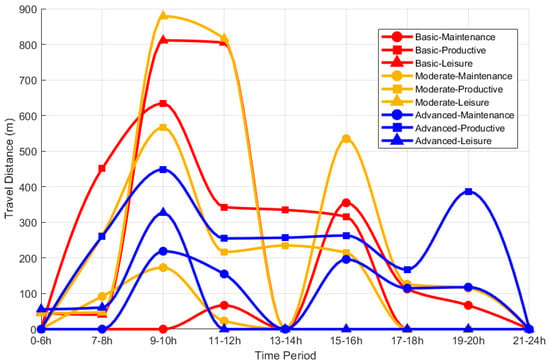
On the basis of the classification of daily activities derived from the preliminary interviews and travel diaries, older adults’ activities were categorized into three types: maintenance activities (e.g., meals, medical visits, personal care), productive activities (e.g., grocery shopping, picking up grandchildren), and leisure activities (e.g., exercise, walking, social interaction). Weighted average travel distances for each activity type were calculated across a one-week GPS collection period and 24-h time intervals for each community category.
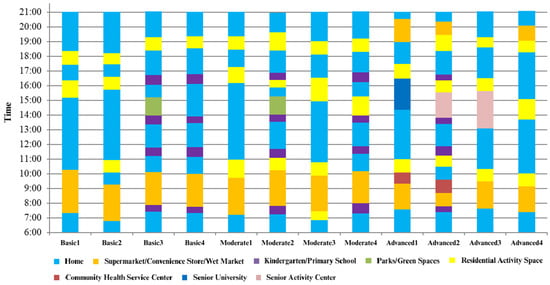
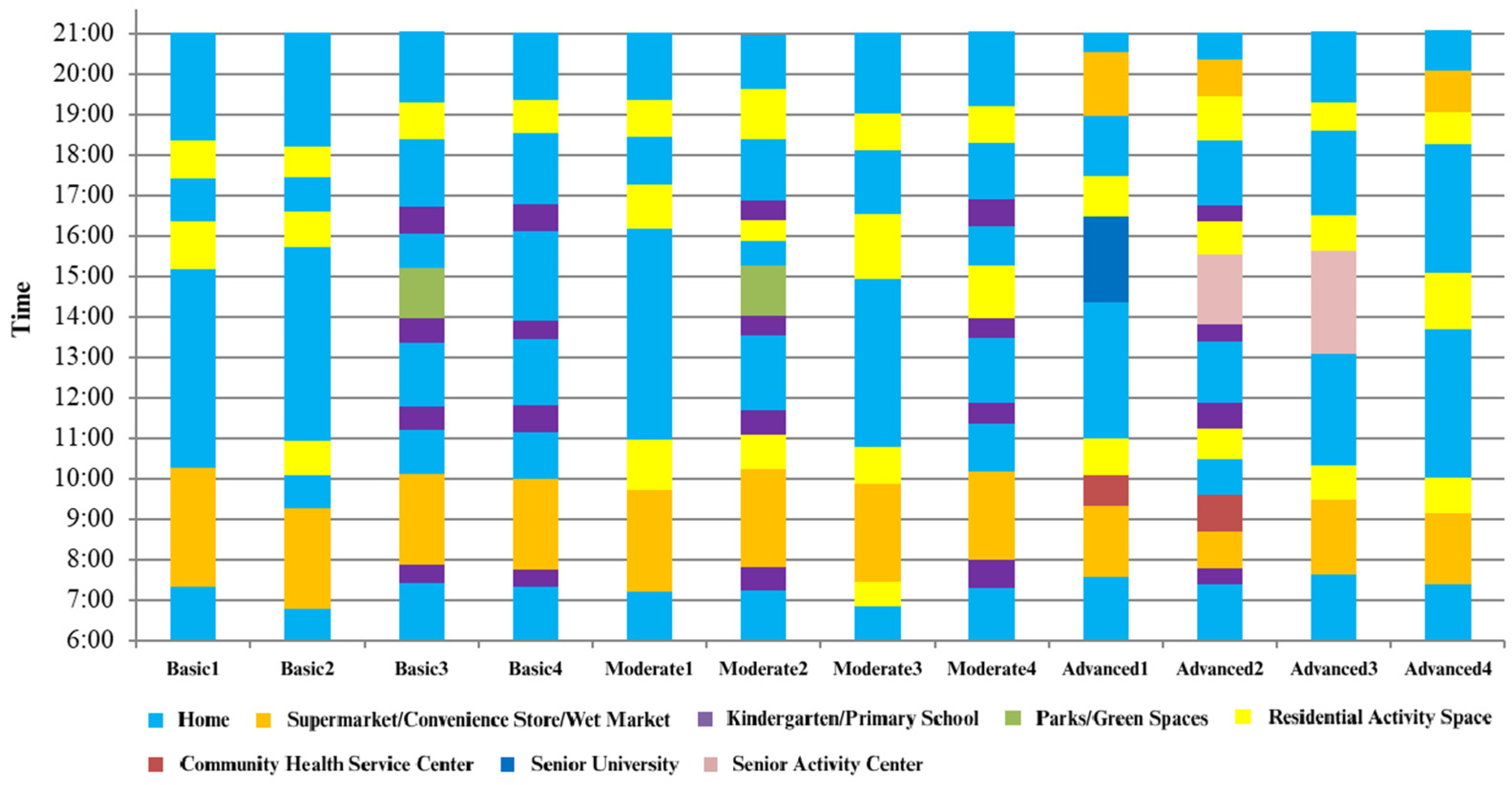
The daily activity destinations of older residents within the same old residential community were aggregated and analyzed on the basis of the GPS data. The results revealed that the daily activities of older adults in these communities followed a certain pattern. There were generally two main activity trajectories: ‘home–wet market–supermarket–home’ and ‘home–residential activity space–home’. Figure 2 illustrates the temporal behavior patterns of older residents across different community types.
Figure 2.
Daily Activity Patterns of Older Adults by Community Type.
As presented in Table 4 and Figure 3, older adults in both the basic and moderate renovation old communities exhibited average travel distances within 1000 m, with the majority concentrated within 600 m. Maintenance activities peaked between 9:00 and 12:00. Productive activities occurred primarily between 7:00 and 18:00, with a pronounced distance peak between 9:00 and 10:00, corresponding to trips to more distant supermarkets or wet markets, as indicated by the travel diaries. Leisure activities peaked between 15:00 and 16:00, suggesting that most outdoor exercise occurred during this period, with activity ranges gradually contracting to within 200 m of residences later in the day.
Table 4.
Activity Characteristics of Older Adults Across Three Community Types.
Figure 3.
Travel Distance by Community Type and Activity Type Across Time Periods.
In contrast, older adults in the advanced renovation communities benefitted from the advantage of a more concentrated activity space, with most trips concentrated within 400 m (Table 4, Figure 3). This pattern reflects the adequacy of the infrastructure and service facilities within and surrounding these communities, enabling residents to fulfill most daily needs locally, with the exception of visits to high-level hospitals. Notably, productive activities in the advanced renovation communities exhibited two distance peaks: one at 9:00–10:00 and another at 19:00–20:00. The evening peak, which was absent in the basic and moderate renovation old communities, likely reflects the availability of nearby shopping amenities that encourage post-dinner outings. Leisure activities were also more localized in the advanced renovation communities, predominantly within 200 m of residences, indicating richer on-site or proximal activity spaces that facilitate exercise and social interaction close to home.
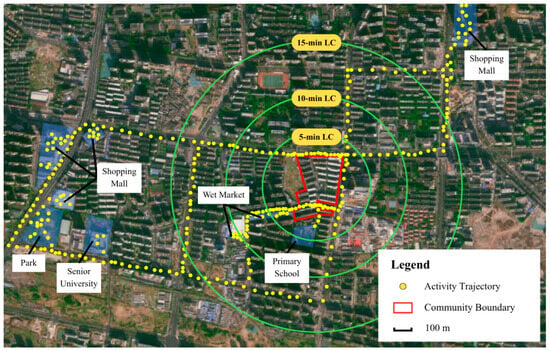
To further verify the quantitative findings and provide contextualized insights into the spatial behavior of older adults, three representative communities—one from each renovation category—were selected for in-depth case analysis. Drawing on the distance thresholds adopted for senior life circles by Wang and Ma (2023) [61], three concentric zones with radii of 300, 500, and 800 m were delineated around the community center as spatial reference areas for the 5-, 10-, and 15-min life circles (LCs), respectively. These zones provided a common spatial framework for mapping GPS trajectories and activity destinations in each case community. GPS trajectories collected from 18 senior residents were visualized to examine activity patterns and destination preferences.
- (1)
- Basic renovation old community (BROC) case
The BROC selected for case analysis was originally built in the 1970s as a unit community of a state-owned enterprise. The surrounding areas within 15 min walking distance provide several facilities, including a supermarket, a vegetable market, a community center, a primary school, and a public park.
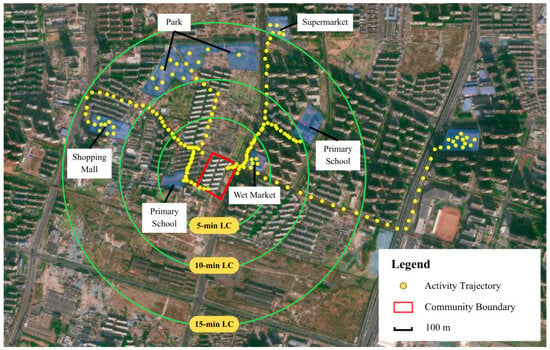
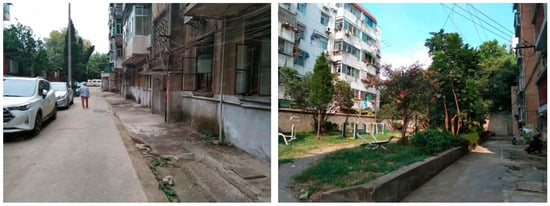
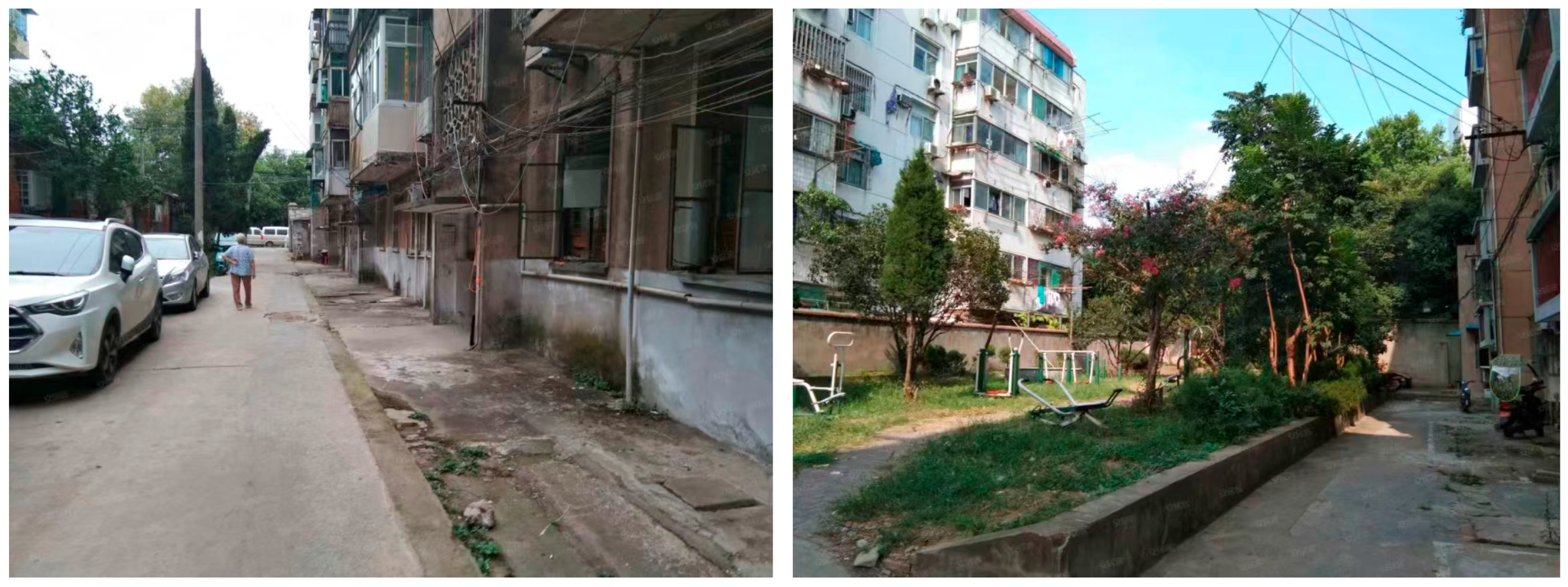
As illustrated in Figure 4, a total of 110 trajectories were recorded for older adults in this community. The activity spaces of older adults predominantly extended beyond the 15-min LC. Forty-six trajectories, accounting for 41.8% of the total trajectories, were concentrated within the 5-min LC. Among these community-scale trips, 20 were for shopping, 16 involved picking up grandchildren, and 10 were leisure activities without a fixed destination. Shopping was the primary purpose of community-scale travel, while caring for grandchildren was also common. Leisure activities accounted for only 21.7% of community-scale trips. Field observations and on-site photographs (Figure 5) showed that the internal roads were in poor condition, environmental hygiene was inadequate, and indoor and outdoor activity spaces were limited. Fitness equipment had fallen into disrepair, and limited open areas were often occupied by parked vehicles because parking was insufficient. Consequently, older residents often traveled to more distant areas, such as nearby parks, for leisure activities.
Figure 4.
GPS Trajectory of Older Adults’ Travel in Hegang Wenming Dayuan.
Figure 5.
Road and Outdoor Activity-Space Conditions in Hegang Wenming Dayuan.
Pearson correlation was conducted to analyze the relationship between BROC renovation factors and the QoL of older adults (Table 5). Physical and social QoL factors had no relationship with the renovation factors, which was consistent with the regression analysis. In the BROC case study, community support facilities and community services were related to the psychological QoL of older adults, which verified the regression results. Aligning with the regression results, environmental QoL was related to residential area roads, residential building facilities, built environment, and public facilities. In addition to these environmental factors, public transportation and community support facilities were also found to be related to environmental QoL.
Table 5.
Correlation Analysis of the QoL of Older Adults in Hegang Wenming Dayuan.
- (2)
- Moderate renovation old community (MROC) case
The selected MROC was constructed around 2000. It has internal amenities, including a community service center, retail shops, and a kindergarten. Surrounding facilities include a primary school, a middle school, a hospital, a supermarket, and a vegetable market.
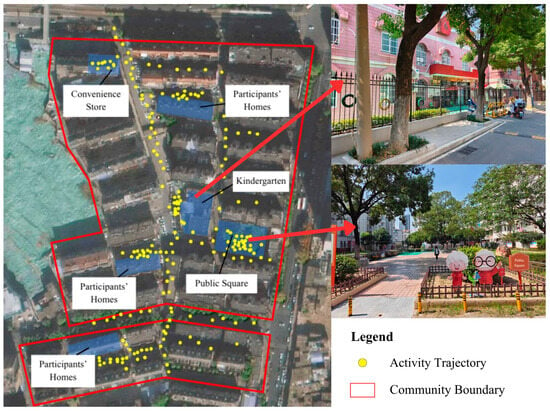
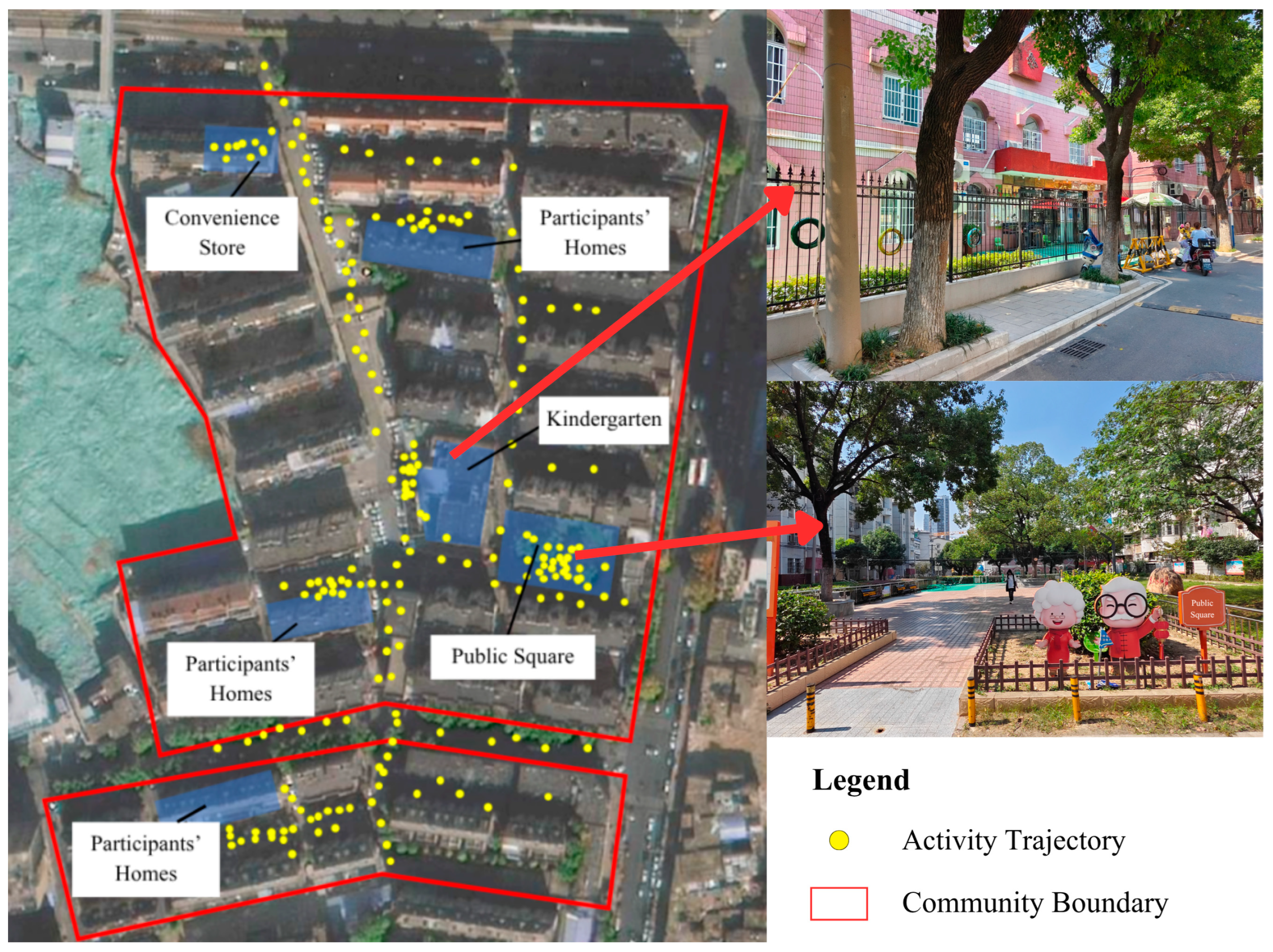
The community has a relatively large community area and a high population density. During the observation period, many daily activities of older residents took place within the community itself (Figure 6). Intra-community activity spaces were primarily concentrated in public squares, the vicinity of the kindergarten, and open areas near residential buildings. However, as shown in Figure 7, several destinations extended beyond the 15-min LC, suggesting that the existing neighborhood-scale infrastructure and services may be insufficient to fully satisfy senior residents’ needs. Primary destinations outside the community included large supermarkets, although these were generally located at considerable distances from the community. During the observation period, most older adults preferred to shop at closer small wet markets or convenience stores within the community rather than make frequent trips to distant supermarkets. Additional destinations included parks and a senior university, also located at relatively long distances from the community.
Figure 6.
GPS Trajectories and Representative On-Site Conditions in Shuhong Xincun.
Figure 7.
GPS Trajectory of Older Adults’ Travel Outside Shuhong Xincun.
Pearson correlation results (Table 6) indicated that renovation factors have no relationship with the social relationships of older adults, which was consistent with the regression analysis. In the MROC case study, residential area roads, outdoor spaces, and community support facilities were related to the physical QoL of older adults; public facilities and community support facilities were related to their psychological QoL, which aligned with the regression analysis; and residential area roads, outdoor spaces and community support facilities were related to their environmental QoL.
Table 6.
Correlation Analysis of QoL of Older Adults in Shuhong Xincun.
- (3)
- Advanced renovation old community (AROC) case
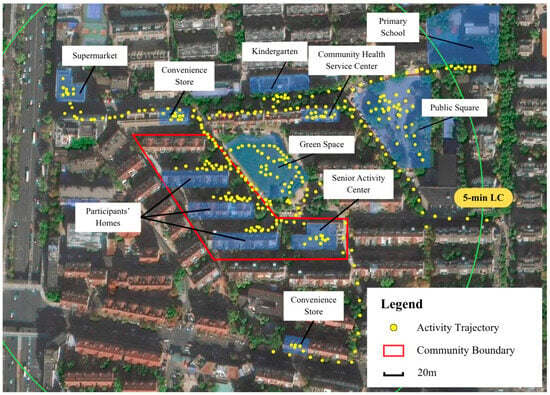
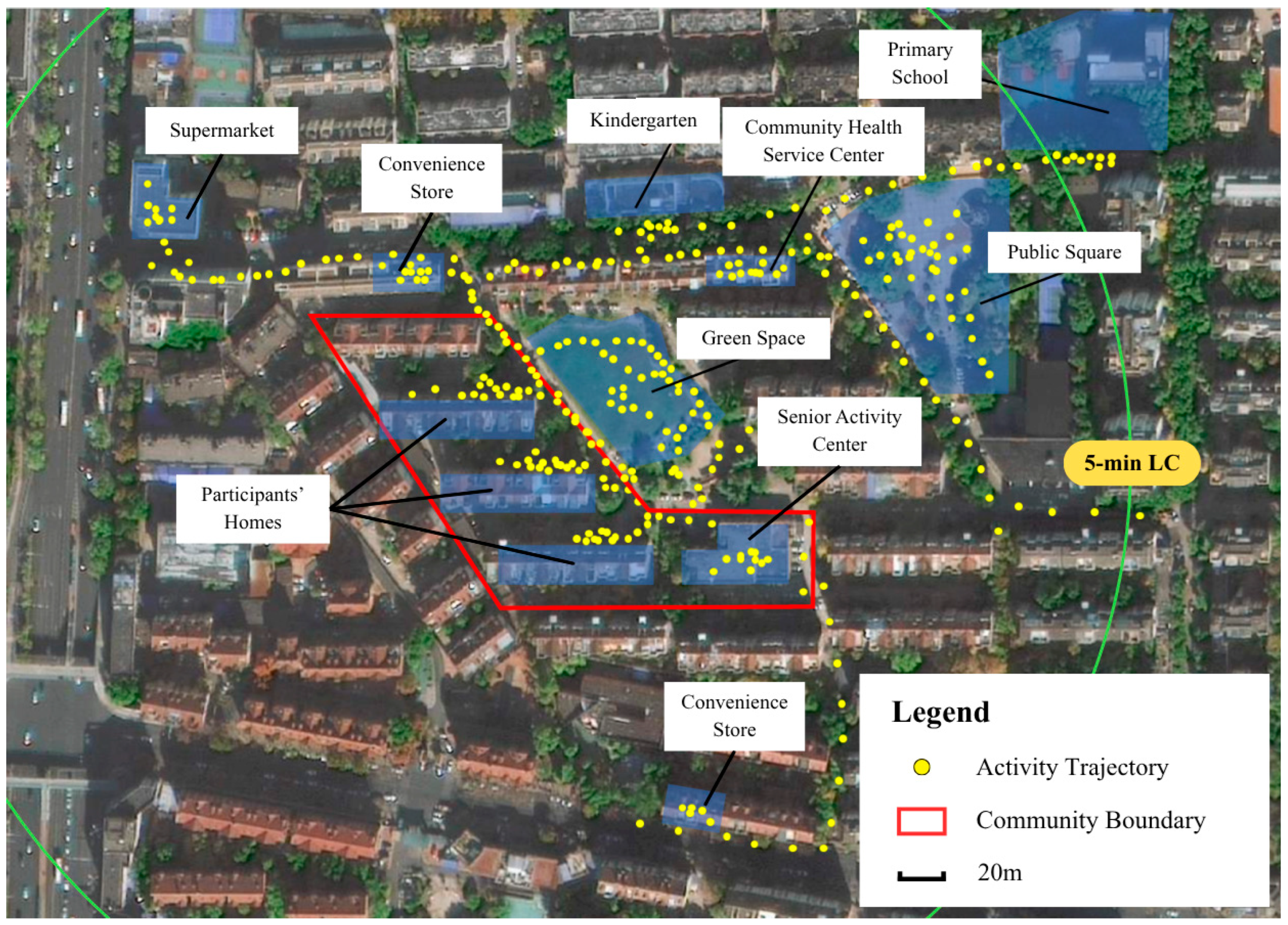
The selected AROC was developed in the 1990s. This community features well-developed public service facilities, both within and surrounding the site, including a community health service station, a senior activity center, a primary school, kindergartens, and a swimming pool. Public open spaces are ample, with large squares and green areas.
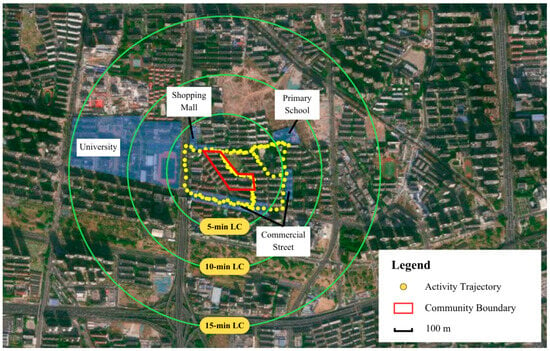
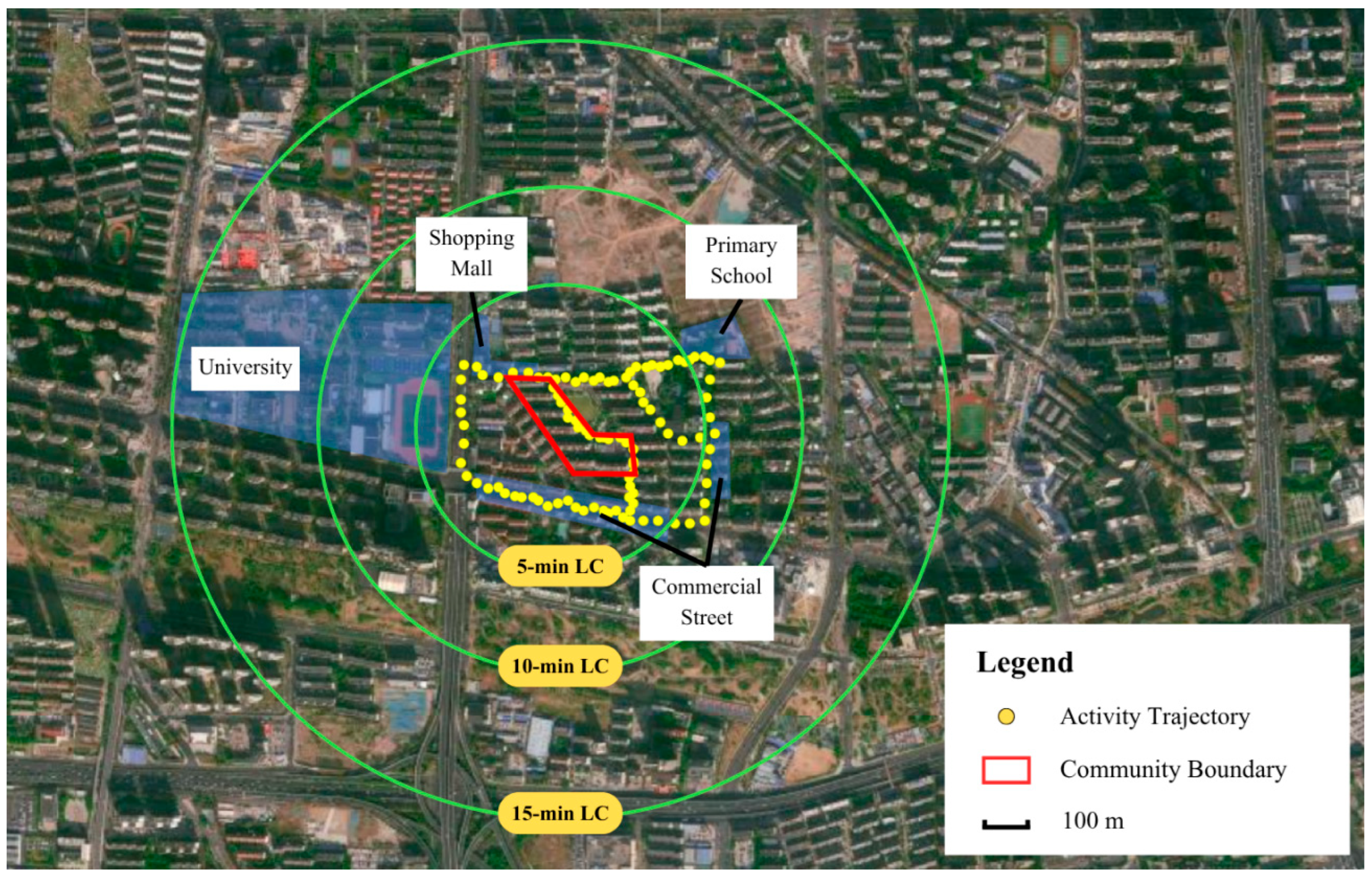
As illustrated in Figure 8 and Figure 9, the activity space of older adults in this community was more convenient compared to the previous two types, with the vast majority of trips concentrated within the 5-min LC. This indicates that most activity destinations were located within the neighborhood. Within-community trips accounted for 75 trajectories, representing 65.5% of the total trajectories. The primary destinations were green spaces and public squares within or adjacent to the community, followed by the senior activity center, health facilities, and nearby commercial amenities.
Figure 8.
GPS Trajectory of Older Adults’ Travel Outside Yinxingyuan Yingchunju.
Figure 9.
GPS Trajectory of Older Adults’ Travel Around Yinxingyuan Yingchunju.
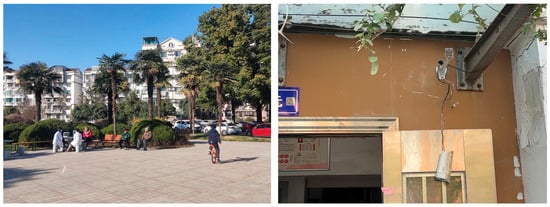
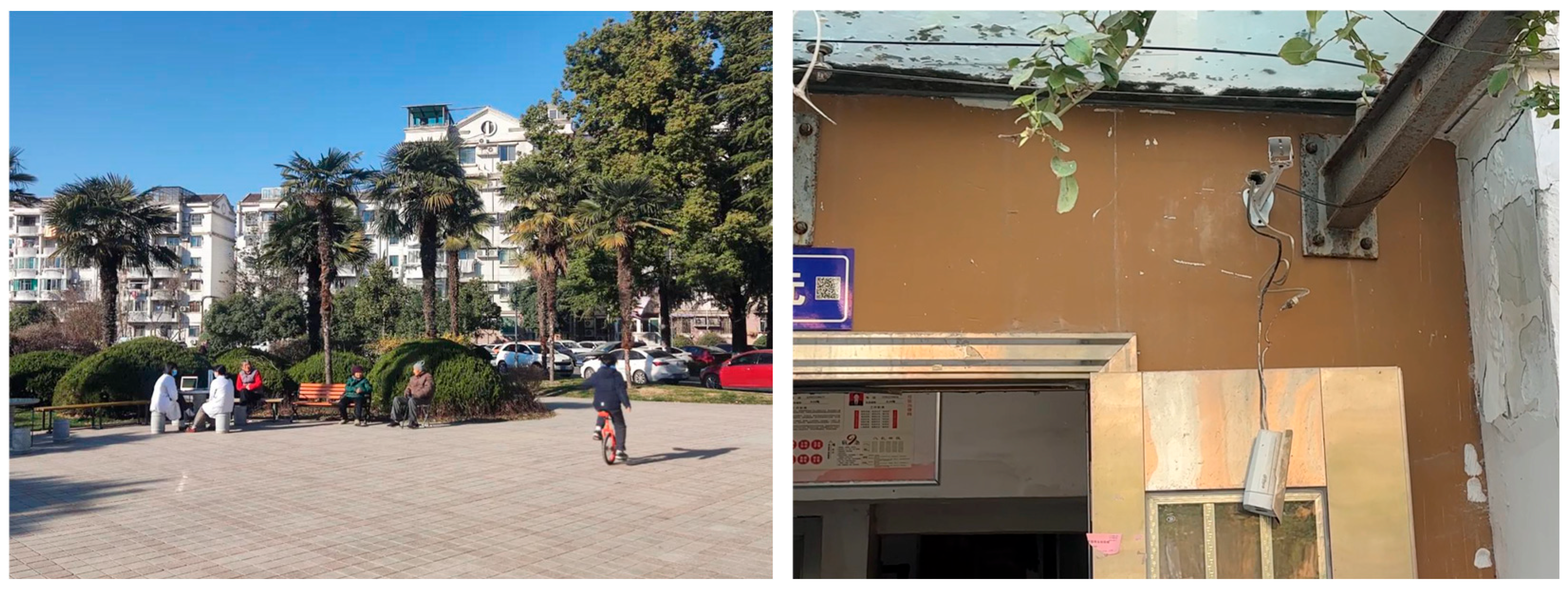
As illustrated by the on-site photographs in Figure 10, field observations confirmed that activity spaces in this community were significantly more abundant and better equipped than those in the other surveyed communities. The presence of a dedicated senior activity center effectively facilitated social and recreational activities without requiring long-distance travel. Interviews with residents revealed generally high satisfaction with outdoor activity spaces and public service facilities. However, some concerns were noted regarding aging infrastructure, including malfunctioning surveillance cameras and streetlights. A subset of older adults with mobility difficulties reported that certain internal and surrounding roads were uneven and that activity spaces were occasionally obstructed by parked vehicles. Regarding community support, several residents expressed a desire for more diverse services organized by the community, such as in-home medical visits and companionship programs. The establishment of a community canteen was also frequently mentioned during the interviews as a high-priority need.
Figure 10.
Representative on-site conditions in Yinxingyuan Yingchunju.
Pearson correlation results (Table 7) were consistent with the regression analysis. No renovation factors were related to the social QoL of older adults. In the AROC case study, public facilities, community support facilities, and community services were related to the psychological QoL of older adults, and built environment, public facilities, community support facilities, public transportation, and community services were related to their environmental QoL. Unlike the regression results, the correlation results showed that public facilities, community support facilities, public transportation, and community services also had a positive relationship with the physical QoL of older adults living in this AROC.
Table 7.
Correlation Analysis of QoL of Older Adults in Yinxingyuan Yingchunju.
5. Discussion
The study’s questionnaire results indicate that the demand for age-friendly renovation varies significantly across different types of old residential communities. Further evidence from the case studies’ GPS trajectory analyses and correlation analyses suggests that older adults in different community types experience divergent patterns in terms of their daily living needs and the accessibility and quality of services available to them. A comparative summary of the results is presented in Table 8.
Table 8.
Summary of Key Findings Across Three Types of Old Residential Communities.
The regression and case-study correlation analyses highlighted the foundational importance of the physical environment and essential community facilities for older adults’ QoL in BROCs. This pattern is consistent with research on ageing in place and age-friendly infrastructure, which emphasizes the role of the immediate residential environment in supporting safe mobility and the continued use of familiar local resources [10,39,62]. Basic-level renovation therefore appropriately prioritizes urgent deficiencies in building components, roads, drainage, and other essential infrastructure [14]. In the representative BROC case, field observations and GPS trajectories indicated that poor internal conditions and limited nearby activity spaces were accompanied by a wider range of daily trips. This provides contextual support for the interpretation that, in the least-renovated communities, improving the immediate physical environment is an important condition for more independent daily activity and better perceived living conditions among older adults [63].
For MROCs, renovation focuses on improving convenience, comfort, and livability once basic infrastructure is largely functional. At this level, the results pointed beyond basic building conditions toward shared outdoor spaces, residential roads, public facilities, and community support facilities. This interpretation accords with previous research showing that outdoor-space quality, walking accessibility, and nearby destinations shape older adults’ health-promoting activities and everyday mobility [63,64]. In the representative MROC case, many activities occurred within or near the community, but some daily destinations lay beyond the immediate neighborhood, indicating that basic infrastructure did not necessarily provide convenient access to all desired amenities. The significance of this finding is that moderate renovation should improve the usability and proximity of communal services, rather than treating physical repair alone as sufficient for a comfortable and active later life.
Compared with the lower renovation categories, the AROC results placed greater emphasis on community support facilities, community services, public transportation, and the coordination of local amenities. This pattern is consistent with age-friendly community and ageing-in-place research showing that transport access and community-based services remain relevant to QoL even when housing and basic infrastructure are relatively adequate [43,59]. Advanced renovation therefore involves not only physical improvements but also the integration and management of public spaces, commercial and leisure facilities, and community-based services [65]. In the representative AROC case, a large proportion of trips were concentrated within the immediate community, where nearby activity and service facilities supported varied daily activities. At the same time, this case suggests that the next stage of renewal concerns the quality, maintenance, and coordination of facilities, rather than their simple provision. This finding adds a differentiated perspective to age-friendly community research by showing that renovation priorities may change as basic environmental deficiencies are reduced.
Across the three renovation categories, no statistically significant associations were observed between renovation dimensions and the social relationships domain of QoL. This result does not necessarily contradict previous research linking age-friendly environments with social interaction and well-being; rather, it suggests that these relationships may operate through intermediate social processes and vary across outcomes and contexts [66,67,68]. The built environment can provide opportunities for contact, but meaningful and sustained relationships also depend on residents’ existing social networks, community management, and organized activities [67,69]. Moreover, the WHOQOL-BREF social relationships domain includes personal relationships and social support that may extend beyond the residential community [60], which could weaken its association with neighborhood-level renovation. Thus, the present finding suggests that physical renewal alone may be insufficient to improve this QoL domain and that the social dimension of community renewal requires complementary social programming and community management.
6. Conclusions
This study employed a mixed-methods design combining a questionnaire survey, GPS trajectory analysis, and case studies to examine the associations between renovation-related environmental dimensions, older adults’ QoL, and daily behavioral patterns across basic, moderate, and advanced renovation communities. The findings showed that these associations varied by renovation category: in BROCs, the main patterns concerned foundational physical conditions and essential facilities; in MROCs, they concerned the usability and proximity of shared spaces and community support facilities; and in AROCs, they concerned community services, public transportation, and the integration and management of existing facilities. GPS trajectories and case observations provided complementary behavioral evidence, with activity patterns showing progressively greater spatial concentration from the BROC to the MROC and then to the AROC case. No statistically significant associations were observed between renovation dimensions and the social relationships domain. Overall, the findings support renewal priorities tailored to existing community conditions. Overall, the study demonstrates that renewal priorities should be tailored to community conditions and understood as overlapping levels of intervention rather than as a uniform package.
The findings support a differentiated implementation strategy for age-friendly renewal. In BROCs, priority should be given to foundational infrastructure, safe and barrier-free mobility, and essential public facilities. In MROCs, interventions should focus on improving shared outdoor spaces and providing accessible community support services, including health stations, senior activity facilities, and nearby daily-life amenities suited to residents’ mobility needs. In AROCs, priorities include integrating community-based care and health services, improving the quality and management of existing facilities, and applying targeted micro-regeneration and maintenance strategies. Across all three categories, interventions should be sequenced according to existing deficiencies and accompanied by continuous maintenance and post-renovation evaluation. Current results provide empirical evidences for tailored policy making and urban planning for old resident communities. It is expected to develop and evaluate catalogues of design and service options adapted to different community contexts.
Several limitations also identify priorities for future research. The cross-sectional design, relatively small GPS sample, and limited analysis of individual heterogeneity constrain causal interpretation and generalizability. Firstly, most senior respondents in the questionnaire survey exhibit good health status and mobility which might not represent a baseline equilibrium in terms of the sample’s age structure, health level, housing age, and property quality. It is thus suggested to conduct logistic regression to analyze the impact of older adults’ demographic characteristics (e.g., health, mobility, income, marriage status, education and so on) on their satisfaction for residential communities in future. It is also encouraged to integrate GPS trajectories with GIS and POI data to identify the facility types and locations associated with older adults’ mobility and activity participation, while applying person-centered approaches that incorporate age, health status, living arrangements, and socioeconomic conditions to identify groups with distinct renovation needs. Secondly, the small GPS sample, selective recruitment, and limited case coverage restrict generalizability. Uneven trip counts and sparse long-distance records may also make some behavioral summaries sensitive to repeated trips from a few participants. Recruitment should broaden participation among older adults with chronic illness, frailty, and mobility limitations. It is also suggested to adopt standardized assessments of activities of daily living (ADL) and instrumental activities of daily living (IADL) to evaluate mobility of older adults. Thirdly, the non-significant impact of renovation factors was found out by current studies, which might be attributed to insufficient sample and community representativeness. Large scale questionnaire survey is suggested to be conducted in different cities and communities. Longitudinal studies following the same communities before and after renovation, together with larger behavioral datasets collected through GPS, wearable, or smartphone-based devices, could clarify how renovation-related environmental changes are associated with older adults’ activities, health, and QoL over time.
Supplementary Materials
The following supporting information can be downloaded at: https://www.mdpi.com/article/10.3390/buildings16214369/s1, Supplementary File S1: Questionnaire on the Environment of Old Residential Communities and Older Adults’ Quality of Life.
Author Contributions
Investigation, J.J. and J.X.; data curation, J.J. and J.X.; writing—original draft, J.J.; conceptualization, J.Y.; funding acquisition, J.Y.; methodology, J.Y.; resources, J.Y.; writing—review & editing, J.Y. and G.M.; supervision, G.M.; validation, G.M. All authors have read and agreed to the published version of the manuscript.
Funding
This research was funded by National Natural Science Foundation of China (Project No. 72274052 and Project No. 72174173).
Institutional Review Board Statement
Ethical review and approval were waived for this study because it involved anonymous questionnaires and observational studies of daily behaviors, which posed no risks to participants and did not involve any intervention or collection of sensitive personal information.
Informed Consent Statement
Informed consent was obtained from all subjects involved in the study. All participants were fully informed about the purpose of the research, the use of their data, and their right to withdraw at any time. Anonymity was assured.
Data Availability Statement
The original contributions presented in this study are included in the article. Further inquiries can be directed to the corresponding author.
Conflicts of Interest
The authors declare no conflicts of interest.
References
- United Nations Statistics Division. The Sustainable Development Goals Report 2025; United Nations: New York, NY, USA, 2025. [Google Scholar]
- United Nations Department of Economic and Social Affairs. World Urbanization Prospects 2025: Summary of Results; United Nations: New York, NY, USA, 2025. [Google Scholar]
- Zheng, H.W.; Shen, G.Q.; Wang, H. A Review of Recent Studies on Sustainable Urban Renewal. Habitat Int. 2014, 41, 272–279. [Google Scholar] [CrossRef] [Scilit]
- Hu, J.; Chen, J.; Li, P.; Yan, J.; Wang, H. Systematic Review of Socially Sustainable and Community Regeneration: Research Traits, Focal Points, and Future Trajectories. Buildings 2024, 14, 881. [Google Scholar] [CrossRef] [Scilit]
- Qian, Q.K.; Ho, W.K.O.; Jayantha, W.M.; Chan, E.H.W.; Xu, Y. Aging-in-Place and Home Modifications for Urban Regeneration. Land 2022, 11, 1956. [Google Scholar] [CrossRef] [Scilit]
- Rosenthal, S.S. Old Homes, Externalities, and Poor Neighborhoods. A Model of Urban Decline and Renewal. J. Urban Econ. 2008, 63, 816–840. [Google Scholar] [CrossRef] [Scilit]
- United Nations Department of Economic and Social Affairs, Population Division. World Population Prospects 2024: Summary of Results; United Nations: New York, NY, USA, 2024. [Google Scholar]
- Matei, A.; Dobre, A.E.; Matei, O.; Leoveanu, A.C. Active Ageing in Inclusive Urban Social Innovation. Preprints 2025. [Google Scholar] [CrossRef] [Scilit]
- Chen, T.; Luh, D.; Hu, L.; Shan, Q. Exploring Factors Affecting Residential Satisfaction in Old Neighborhoods and Sustainable Design Strategies Based on Post-Occupancy Evaluation. Sustainability 2023, 15, 15213. [Google Scholar] [CrossRef] [Scilit]
- Levasseur, M.; Généreux, M.; Bruneau, J.-F.; Vanasse, A.; Chabot, É.; Beaulac, C.; Bédard, M.-M. Importance of Proximity to Resources, Social Support, Transportation and Neighborhood Security for Mobility and Social Participation in Older Adults: Results from a Scoping Study. BMC Public Health 2015, 15, 503. [Google Scholar] [CrossRef] [Scilit] [PubMed]
- Ministry of Housing and Urban-Rural Development of the People’s Republic of China. Guidelines for the Renovation of Old Urban Residential Communities; Ministry of Housing and Urban-Rural Development of the People’s Republic of China: Beijing, China, 2020.
- Hu, X. Social Sustainability of Continuing Care Retirement Communities in China. Facilities 2023, 41, 819–838. [Google Scholar] [CrossRef] [Scilit]
- Morley, J.E. Aging in Place. J. Am. Med. Dir. Assoc. 2012, 13, 489–492. [Google Scholar] [CrossRef] [Scilit] [PubMed]
- General Office of the State Council of the People’s Republic of China. Guiding Opinions on Comprehensively Promoting the Renovation of Urban Old Residential Communities (Guoban Fa [2020] No. 23); General Office of the State Council of the People’s Republic of China: Beijing, China, 2020.
- Ministry of Housing and Urban-Rural Development of the People’s Republic of China. Guidelines for the Construction of Complete Residential Communities (Jianban Ke [2021] No. 55); Ministry of Housing and Urban-Rural Development of the People’s Republic of China: Beijing, China, 2021.
- Ministry of Natural Resources of the People’s Republic of China. Technical Guidelines for Community Life Circle Planning (TD/T 1062-2021); Ministry of Natural Resources of the People’s Republic of China: Beijing, China, 2021.
- Li, K.; Huang, Y.; Mei, W.; Wu, Q.; Liang, Q. Evaluating Age-Friendly Community Environments: Model Development and Application in Guangzhou, China. Public Health Nurs. 2026, 43, 380–393. [Google Scholar] [CrossRef] [Scilit] [PubMed]
- Shi, T.; Guo, F.; Zhang, Y. Transforming Public Spaces in Post-Socialist China’s Danwei Neighbourhoods: The Third Dormitory of the Party Committee of Shandong Province. Urban Plan. 2024, 9, 7632. [Google Scholar] [CrossRef] [Scilit]
- Miyamoto, M.; Okada, Y.; Ikebe, K. Beyond the Compact City-Housing Policy for the Increasing Number of Smaller Households. Preprints 2024. [Google Scholar] [CrossRef] [Scilit]
- Perez, J.; Araldi, A.; Fusco, G.; Fuse, T. The Character of Urban Japan: Overview of Osaka-Kobe’s Cityscapes. Urban Sci. 2019, 3, 105. [Google Scholar] [CrossRef] [Scilit]
- Podagrosi, A.; Vojnovic, I. Tearing Down Freedmen’s Town and African American Displacement in Houston: The Good, the Bad, and the Ugly of Urban Revival. Urban Geogr. 2008, 29, 371–401. [Google Scholar] [CrossRef] [Scilit]
- Diefendorf, J.M. Urban Reconstruction in Europe After World War II. Urban Stud. 1989, 26, 128–143. [Google Scholar] [CrossRef] [Scilit]
- Power, A. Estates on the Edge: The Social Consequences of Mass Housing in Northern Europe; Macmillan Press: London, UK, 1997; ISBN 9780333626422. [Google Scholar]
- Zucaro, A.; Agostinho, F. Urban Sustainability: Challenges and Opportunities for Resilient and Resource-Efficient Cities. Front. Sustain. Cities 2025, 7, 1556974. [Google Scholar] [CrossRef] [Scilit]
- Shi, J.; Liu, X.; Feng, Z. Age-Friendly Cities and Communities and Cognitive Health among Chinese Older Adults: Evidence from the China Health and Retirement Longitudinal Studies. Cities 2023, 132, 104072. [Google Scholar] [CrossRef] [Scilit]
- The Central Committee of the Communist Party of China; The State Council. Opinions on Strengthening the Work on Aging in the New Era; The Central Committee of the Communist Party of China: Beijing, China; The State Council: Beijing, China, 2021. [Google Scholar]
- Ko, P.-C.; Yeung, W.-J.J. An Ecological Framework for Active Aging in China. J. Aging Health 2018, 30, 1642–1676. [Google Scholar] [CrossRef] [Scilit] [PubMed]
- Zhang, F.; Li, D. How the Urban Neighborhood Environment Influences the Quality of Life of Chinese Community-Dwelling Older Adults: An Influence Model of “NE-QoL”. Sustainability 2019, 11, 5739. [Google Scholar] [CrossRef] [Scilit]
- Yee Sing, T.; Yoh, S. Rehabilitation Methods and Revitalization Strategies in the Old Inner-City Areas of Rapid Growth Cities in Asia: A Comparison of Four Cities: Penang, Hanoi, Shanghai, and Tokyo. Urban Reg. Plan. Rev. 2016, 3, 1–20. [Google Scholar] [CrossRef] [Scilit]
- Wei, Y.; Yuan, H.; Li, H. Exploring the Contribution of Advanced Systems in Smart City Development for the Regeneration of Urban Industrial Heritage. Buildings 2024, 14, 583. [Google Scholar] [CrossRef] [Scilit]
- Listokin, D.; Crossney, K.; Cander, A.; McManus, T.; Downs, D.; Camp, M.; Uschak, M.; Litwin, I.; Kushel, Z. Best Practices for Effecting the Rehabilitation of Affordable Housing, Volume I: Framework and Findings; U.S. Department of Housing and Urban Development, Office of Policy Development and Research: Washington, DC, USA, 2006.
- United States Congress. Eligible Uses of Investment; U.S. Government Publishing Office: Washington, DC, USA, 2019.
- Trachte, S.; Galán González, A.; Evrard, A.; Athanassiadis, A. B3-RETROTOOL: Development of a Multi-Scale and Multi-Criteria Pre-Assessment Tool for the Sustainable Retrofit of Brussels Capital Region. In 2nd Interdisciplinary Congress on Sustainable Development; UCLouvain: Louvain-la-Neuve, Belgium, 2015. [Google Scholar]
- Romano, E.; Negro, P.; Formisano, A.; Landolfo, R.; Menna, C.; Prota, A.; Hájek, P. Assessment Methodologies for the Combined Seismic and Energy Retrofit of Existing Buildings; Romano, E., Negro, P., Eds.; REEBUILD: Integrated Techniques for the Seismic Strengthening and Energy Efficiency of Existing Buildings; Publications Office of the European Union: Luxembourg, 2023. [Google Scholar]
- Urban Renaissance Agency. UR Rental Housing Stock Utilization and Regeneration Vision; Urban Renaissance Agency: Tokyo, Japan, 2018. [Google Scholar]
- Wang, H.; Luo, S.; Furuya, K. Examining the Pathways between Neighborhood Green Spaces and the Subjective Well-Being of Older Adults in Japanese Public Housing Complexes. Urban For. Urban Green. 2025, 113, 129037. [Google Scholar] [CrossRef] [Scilit]
- World Health Organization. Global Age-Friendly Cities: A Guide; World Health Organization: Geneva, Switzerland, 2007; ISBN 978-92-4-154730-7. [Google Scholar]
- Lawton, M.P.; Nahemow, L. Ecology and the Aging Process. In The Psychology of Adult Development and Aging; Eisdorfer, C., Lawton, M.P., Eds.; American Psychological Association: Washington, DC, USA, 1973; pp. 619–674. [Google Scholar]
- Wahl, H.-W.; Iwarsson, S.; Oswald, F. Aging Well and the Environment: Toward an Integrative Model and Research Agenda for the Future. Gerontologist 2012, 52, 306–316. [Google Scholar] [CrossRef] [Scilit] [PubMed]
- Yen, I.H.; Michael, Y.L.; Perdue, L. Neighborhood Environment in Studies of Health of Older Adults. Am. J. Prev. Med. 2009, 37, 455–463. [Google Scholar] [CrossRef] [Scilit] [PubMed]
- Vanleerberghe, P.; De Witte, N.; Claes, C.; Schalock, R.L.; Verté, D. The Quality of Life of Older People Aging in Place: A Literature Review. Qual. Life Res. 2017, 26, 2899–2907. [Google Scholar] [CrossRef] [Scilit] [PubMed]
- Bethune, T.J.; Grant, C.; Bayer, E.; Leavitt, T.S. Designing for Lifelong Health—A Commentary on Integrating Community Design and Healthy Aging Across the Life Course. J. Public Health Manag. Pract. 2025, 31, 143–144. [Google Scholar] [CrossRef] [Scilit] [PubMed]
- Jayantha, W.M.; Qian, Q.K.; Yi, C.O. Applicability of ‘Aging in Place’ in Redeveloped Public Rental Housing Estates in Hong Kong. Cities 2018, 83, 140–151. [Google Scholar] [CrossRef] [Scilit]
- Leung, M.; Famakin, I.O.; Wang, C. Developing an Integrated Indoor Built Environment–Quality of Life Model for the Elderly in Public and Subsidized Housing. Eng. Constr. Archit. Manag. 2019, 26, 1498–1517. [Google Scholar] [CrossRef] [Scilit]
- Tao, Y.; Zhang, W.; Gou, Z.; Jiang, B.; Qi, Y. Planning Walkable Neighborhoods for “Aging in Place”: Lessons from Five Aging-Friendly Districts in Singapore. Sustainability 2021, 13, 1742. [Google Scholar] [CrossRef] [Scilit]
- Janakiraman, B.; Temesgen, M.H.; Jember, G.; Gelaw, A.Y.; Gebremeskel, B.F.; Ravichandran, H.; Worku, E.; Abich, Y.; Yilak, F.; Belay, M. Falls among Community-Dwelling Older Adults in Ethiopia; A Preliminary Cross-Sectional Study. PLoS ONE 2019, 14, e0221875. [Google Scholar] [CrossRef] [Scilit] [PubMed]
- Su, X.; Shao, J. Research on the Integration of Age-Friendly Design into Community Elderly Care Paths in Dalian—Taking a Community in Dalian as an Example. J. Soc. Sci. Humanit. Lit. 2025, 8, 19–26. [Google Scholar] [CrossRef] [Scilit] [PubMed]
- Chau, H.-W.; Jamei, E. Age-Friendly Built Environment. Encyclopedia 2021, 1, 781–791. [Google Scholar] [CrossRef] [Scilit]
- Black, K.; Hyer, K. Generational Distinctions on the Importance of Age-Friendly Community Features by Older Age Groups. J. Appl. Gerontol. 2020, 39, 1025–1034. [Google Scholar] [CrossRef] [Scilit] [PubMed]
- Zhang, Y.; Luo, H.; Xie, J.; Meng, X.; Ye, C. The Influence and Prediction of Built Environment on the Subjective Well-Being of the Elderly Based on Random Forest: Evidence from Guangzhou, China. Land 2023, 12, 1940. [Google Scholar] [CrossRef] [Scilit]
- Cheng, L.; Chen, X.; Yang, S.; Cao, Z.; De Vos, J.; Witlox, F. Active Travel for Active Ageing in China: The Role of Built Environment. J. Transp. Geogr. 2019, 76, 142–152. [Google Scholar] [CrossRef] [Scilit]
- Cheng, L.; Yang, M.; De Vos, J.; Witlox, F. Examining Geographical Accessibility to Multi-Tier Hospital Care Services for the Elderly: A Focus on Spatial Equity. J. Transp. Health 2020, 19, 100926. [Google Scholar] [CrossRef] [Scilit]
- Yu, S.; Liu, Y.; Cui, C.; Xia, B. Influence of Outdoor Living Environment on Elders’ Quality of Life in Old Residential Communities. Sustainability 2019, 11, 6638. [Google Scholar] [CrossRef] [Scilit]
- Kim, J.; Schmöcker, J.-D.; Nakamura, T.; Uno, N.; Iwamoto, T. Integrated Impacts of Public Transport Travel and Travel Satisfaction on Quality of Life of Older People. Transp. Res. Part A Policy Pract. 2020, 138, 15–27. [Google Scholar] [CrossRef] [Scilit]
- Moran, M.E. Are Shelters in Place? Mapping the Distribution of Transit Amenities via a Bus-Stop Census of San Francisco. J. Public Transp. 2022, 24, 100023. [Google Scholar] [CrossRef] [Scilit]
- Bokolo, A.J. Inclusive and Safe Mobility Needs of Senior Citizens: Implications for Age-Friendly Cities and Communities. Urban Sci. 2023, 7, 103. [Google Scholar] [CrossRef] [Scilit]
- Aung, M.N.; Koyanagi, Y.; Ueno, S.; Tiraphat, S.; Yuasa, M. Age-Friendly Environment and Community-Based Social Innovation in Japan: A Mixed-Method Study. Gerontologist 2022, 62, 89–99. [Google Scholar] [CrossRef] [Scilit] [PubMed]
- Yu, J.; Ma, G.; Cai, S. Disparities in the Provision of Aging-Friendly Communities in Old and New Urban Neighborhoods in China. Eng. Constr. Archit. Manag. 2019, 26, 1277–1293. [Google Scholar] [CrossRef] [Scilit]
- Yu, J.; Ma, G.; Ding, W.; Mao, J.; Wang, J. Structural Model for the Relationships between Age-Friendly Communities and Quality of Life of Older Adults in Hefei, China. Eng. Constr. Archit. Manag. 2021, 29, 1376–1395. [Google Scholar] [CrossRef] [Scilit]
- The Whoqol Group. Development of the World Health Organization WHOQOL-BREF Quality of Life Assessment. Psychol. Med. 1998, 28, 551–558. [Google Scholar] [CrossRef] [Scilit] [PubMed]
- Wang, N.; Ma, W. Evaluation Study on the Layout of Community Senior Living Facilities in the Main Area of Shanghai from the Perspective of Senior Life Circle. Sustainability 2023, 15, 10362. [Google Scholar] [CrossRef] [Scilit]
- Yu, J.; Rosenberg, M.W. Aging and the Changing Urban Environment: The Relationship between Older People and the Living Environment in Post-Reform Beijing, China. Urban Geogr. 2020, 41, 162–181. [Google Scholar] [CrossRef] [Scilit]
- Tang, B.-S.; Wong, K.K.; Tang, K.S.; Wai Wong, S. Walking Accessibility to Neighbourhood Open Space in a Multi-Level Urban Environment of Hong Kong. Environ. Plan. B Urban Anal. City Sci. 2021, 48, 1340–1356. [Google Scholar] [CrossRef] [Scilit]
- Zhang, L.; Shao, K.; Tang, W.; Lau, S.S.Y.; Lai, H.; Tao, Y. Outdoor Space Elements in Urban Residential Areas in Shenzhen, China: Optimization Based on Health-Promoting Behaviours of Older People. Land 2023, 12, 1138. [Google Scholar] [CrossRef] [Scilit]
- Zeng, Y.; Chen, B. Evaluation of Aging-Friendly Public Spaces in Old Urban Communities Based on IPA Method—A Case Study of Shouyi Community in Wuhan. Buildings 2024, 14, 2362. [Google Scholar] [CrossRef] [Scilit]
- Lewis, C.; Yarker, S.; Hammond, M.; Kavanagh, N.; Phillipson, C. “Ageing in Place” and Urban Regeneration: Analysing the Role of Social Infrastructure. Urban Plan. 2022, 7, 523–533. [Google Scholar] [CrossRef] [Scilit]
- Tao, Y.; Yang, J.; Chai, Y. The Anatomy of Health-Supportive Neighborhoods: A Multilevel Analysis of Built Environment, Perceived Disorder, Social Interaction and Mental Health in Beijing. Int. J. Environ. Res. Public Health 2019, 17, 13. [Google Scholar] [CrossRef] [Scilit] [PubMed]
- Engel, L.; Chudyk, A.M.; Ashe, M.C.; McKay, H.A.; Whitehurst, D.G.T.; Bryan, S. Older Adults’ Quality of Life—Exploring the Role of the Built Environment and Social Cohesion in Community-Dwelling Seniors on Low Income. Soc. Sci. Med. 2016, 164, 1–11. [Google Scholar] [CrossRef] [Scilit] [PubMed]
- Welch, V.; Ghogomu, E.T.; Dowling, S.; Barbeau, V.I.; Al-Zubaidi, A.A.A.; Beveridge, E.; Bondok, M.; Desai, P.; Doyle, R.; Huang, J.; et al. In-Person Interventions to Reduce Social Isolation and Loneliness: An Evidence and Gap Map. Campbell Syst. Rev. Better Evid. 2024, 20, e1408. [Google Scholar] [CrossRef] [Scilit]

Disclaimer/Publisher’s Note: The statements, opinions and data contained in all publications are solely those of the individual author(s) and contributor(s) and not of MDPI and/or the editor(s). MDPI and/or the editor(s) disclaim responsibility for any injury to people or property resulting from any ideas, methods, instructions or products referred to in the content. |
© 2026 by the authors. Licensee MDPI, Basel, Switzerland. This article is an open access article distributed under the terms and conditions of the Creative Commons Attribution (CC BY) license.