


Abstract
Commercial-complex electric-thermal-hydrogen integrated energy systems (ETH-IESs) suffer from high capital costs, strong seasonal source-load fluctuations, and aggravated source-load mismatch under heatwave, cold-snap, and rainstorm conditions. Existing works usually decouple capacity configuration and storage operation strategies and cannot fully tap the complementary merits of multi-energy storage. Targeting these issues, this work investigates a typical commercial complex in the hot-summer and cold-winter zone to develop hybrid-storage collaborative operation rules and optimal capacity configuration for improving renewable-energy accommodation and techno-economic performance. A configuration model embedding multi-condition collaborative logic is solved by an improved particle swarm optimization algorithm. Simulations are conducted for benchmark (battery-only) and optimized hybrid-storage schemes across four seasonal and three extreme-weather scenarios with sensitivity analysis. Simulation results show that compared with the benchmark scheme, the optimized scheme reduces the annual investment cost, operation-and-maintenance cost, purchased-energy cost, and total annual cost by 29.7%, 38.2%, 25.4%, and 26.3%, respectively. Renewable-energy accommodation increases by 8.0–28.5% for seasonal days and 8.0–45.8% under extreme weather. This research provides a theoretical basis and engineering references for energy-storage selection, capacity planning, and multi-storage coordinated dispatch of ETH-IESs for commercial complexes, and possesses practical significance for promoting on-site renewable-energy utilization and lowering comprehensive energy costs in building-related scenarios.
1. Introduction
With the accelerated advancement of the global energy transition, building a clean, low-carbon, safe, and efficient modern energy system has become a global consensus. Traditional energy systems operate independently in a single energy form, suffering from prominent problems such as low energy utilization efficiency, insufficient accommodation of renewable energy, and high carbon emission intensity [1]. Against this background, the integrated energy system (IES) integrates multiple energy forms, including electricity, heat, gas, and hydrogen, to realize multi-energy complementation and cascade utilization, which is regarded as a crucial technical approach to address the energy dilemma [2]. Among various IES configurations, the electric-thermal-hydrogen IES (ETH-IES) has attracted extensive attention due to its unique technical advantages. It can effectively solve the difficulty of renewable energy accommodation and improve the energy supply flexibility of the system [3,4]. On the one hand, as a clean secondary energy source, hydrogen energy features high energy density, long storage cycle, and wide application scenarios, which can effectively compensate for the weakness of electricity in large-scale energy storage [5]. On the other hand, there exist multiple conversion paths among hydrogen, electricity, and heat, such as power-to-hydrogen (P2H) and combined heat and power (CHP), providing abundant regulation means for multi-energy collaborative optimization [6]. In addition, hydrogen energy can serve as a buffer for renewable energy accommodation. Surplus wind and photovoltaic power can be converted into hydrogen for storage through water electrolysis, thereby improving the operational flexibility and economic efficiency of the system [7]. Nevertheless, the high investment cost of ETH-IES and the intensified source-load fluctuations under extreme weather conditions pose severe challenges to its construction as well as safe and stable operation [8,9].
Current research on the ETH-IES is summarized as follows:
- (1)
- Analysis of multi-energy flow coupling mechanism. The core feature of ETH-IES lies in the deep coupling and mutual conversion of electricity, heat, and hydrogen. Accurate characterization of such coupling relationships is the foundation for optimal system scheduling. Existing studies are mainly carried out from steady-state and dynamic perspectives. In terms of steady-state modeling, researchers commonly adopt the energy hub model or its extended forms to describe the conversion relationship of multi-energy flows. Bozkurt et al. [10] proposed a combined electricity and heat generation model based on the Steam Rankine Cycle (SRC) and Organic Rankine Cycle (ORC), realizing the collaborative utilization of geothermal and solar energy. The system energy efficiency reached 20.13%, exergy efficiency reached 22.87%, and the hydrogen production rate is 0.05283 kg/s. Wang et al. [11] established a steady-state energy flow model coupled with electricity, heat, and hydrogen, considering the conversion characteristics of key devices such as electrolyzers, fuel cells (FCs), and CHP units. However, steady-state models are difficult to capture the dynamic operational characteristics of the system, and their applicability is limited, especially under scenarios of fluctuating renewable energy output and variable load demand. In terms of dynamic modeling, researchers have focused on the influences of device dynamic response, thermal inertia, and hydrogen pipeline transmission delay. Li et al. [12] established an optimal scheduling model considering the dynamic temperature characteristics of electrolyzers, and verified that dynamic modeling can significantly improve system operational efficiency. Ye et al. [13] proposed a real-time scheduling strategy based on deep reinforcement learning, which effectively coped with the uncertainty of source-load. Nevertheless, dynamic models generally face the challenge of high computational complexity, and how to balance model accuracy and computational efficiency remains an open issue.
- (2)
- Uncertainty quantification and mitigation. The ETH-IES is subject to multiple sources of uncertainty, including fluctuations in renewable energy output, errors in load demand forecasting, device failures, and volatility in market prices, among others. Effectively quantifying and mitigating these uncertainties is critical to ensuring the safe and reliable operation of the system. Existing studies have primarily employed three categories of methods to address uncertainties: stochastic optimization (SO), robust optimization (RO), and distributionally robust optimization (DRO).
SO methods assume that uncertainties follow specific probability distributions and solve the problem by generating typical scenarios or performing Monte Carlo simulations [14]. Zeng et al. [15] proposed a stochastic optimal scheduling method for electricity-heat-hydrogen systems based on Monte Carlo simulations. However, SO requires high accuracy in probability distribution characterization, and the computational burden increases sharply with the number of scenarios. RO methods construct uncertainty sets to seek optimal solutions under worst-case scenarios, offering the advantage of high computational efficiency [16]. Luo et al. [17] developed a bi-level robust planning model to effectively address source-load uncertainties. Yang et al. [18] proposed a bi-level RO model considering demand response and thermal comfort for the capacity planning and operation problems of IES. The upper-level optimization aims to minimize economic investment to determine the optimal configuration of the IES, while the lower-level optimization performs robust scheduling to simultaneously reduce carbon emissions and alleviate user dissatisfaction with demand response participation. However, RO often leads to overly conservative solutions, resulting in poor economic performance. To address this limitation, DRO has attracted increasing attention in recent years, as it combines the economic efficiency of SO with the reliability of RO by seeking optimal solutions within ambiguity sets [19]. Ma et al. [20] proposed a data-driven DRO method that improves economic performance while ensuring system robustness.
- (3)
- Coordinated optimization of low-carbon and economic objectives. Under the constraints of the Dual Carbon goals, optimal scheduling of the ETH-IES requires balancing economic efficiency and low-carbon performance. Existing studies have primarily focused on three perspectives: carbon trading mechanisms (CTMs), tiered carbon pricing (TCP), and carbon emission flow tracking (CEFT). CTMs serve as a key market-based instrument to guide the low-carbon operation of energy systems. Luo et al. [17] explored pathways for ETH-IES to participate in carbon trading and proposed a carbon trading model based on the Vickrey auction strategy. Wang et al. [21] investigated the optimal scheduling of electricity-heat-hydrogen systems considering carbon trading, and the results demonstrated that CTMs can significantly reduce system carbon emissions. Liu et al. [22] proposed a bi-level planning model for hydrogen-IESs considering multi-stage investment and CTMs. To further strengthen incentives for carbon emission reduction, researchers have proposed TCP mechanisms, where the unit cost of carbon emissions increases with the total emission volume [23]. Huang et al. [24] verified that compared with traditional CTMs, tiered carbon trading can reduce carbon emissions by 44.7 tons and lower operational costs by approximately 18.2%. Zhu et al. [25] proposed a low-carbon economic scheduling model for IES under tiered CTMs, which couples power-to-gas (P2G) and hydrogen-mixed gas turbines. The model improved wind power utilization by 24.5%, reduced wind curtailment costs by 86.3%, and decreased carbon dioxide emissions by 10.5%. CEFT technology offers new insights for refined carbon management. By tracking carbon emissions generated during electricity and heat production, accurate allocation of carbon responsibilities can be achieved [21].
- (4)
- Optimization of collaborative scheduling strategy. Scheduling strategies focus on source-load coordination and multi-objective optimization, which can be classified into four categories: (1) Two-stage scheduling. Cheng et al. [26] proposed a two-stage optimization strategy for hydrogen-electricity-heat multi-energy coupled systems. Sun et al. [27] constructed a two-stage scheduling model combining Information Gap Decision Theory (IGDT) and fuzzy chance-constrained programming (FCCP). He et al. [28] developed a two-stage optimization framework for a novel hybrid renewable IES. (2) RO and DRO. Ma et al. [20] established a DRO model considering source-load uncertainty. Targeting the issues of insufficient samples and inherent time-series features under uncertain scenarios, Wang et al. [29] proposed a scheduling model combining time-series generative adversarial networks (TimeGAN) and DRO. Han et al. [30] constructed a hybrid energy storage (HES) system composed of electric, thermal, hydrogen, and natural gas energy storage units. Based on the established HES system, they created an independent HES operator to deliver energy services, and further presented a novel multi-stage DRO approach to maximize the total revenue of the HES system. This approach can simultaneously meet the requirements of robustness and nonanticipativity in scheduling under uncertainties. (3) Multi-objective optimization. Song et al. [31] established a grid-connected photovoltaic-hydrogen-natural gas IES and formulated a multi-objective hierarchical optimal configuration model. They originally proposed an innovative optimization strategy that prioritizes carbon emission reduction over total system cost. Simulation results showed that this strategy increased the levelized cost of electricity by 62.24%, cut carbon emissions per unit electricity by 74.19%, and raised energy efficiency by 8.51%. Wang et al. [32] proposed and analyzed a new grid-connected hydrogen storage IES tailored for collective energy communities. A multivariable multi-objective mixed-integer nonlinear programming method integrating the maximum rectangle method and particle swarm optimization (PSO) was adopted in their work. (4) Intelligent algorithm-driven scheduling. Wang et al. [33] and Liang Tao et al. [34] adopted deep reinforcement learning to realize real-time scheduling. Zhou et al. [35] completed distributed optimization of multi-park IESs based on the Alternating Direction Method of Multipliers (ADMM). (5) Game theory-based methods. Li et al. [12] realized cross-regional collaborative optimization based on generalized Nash bargaining. Zhang et al. [36] designed a scheduling mechanism by adopting the Stackelberg game. Combining DRO with Stackelberg game theory, Cai et al. [37] put forward a bi-level strategic operation framework for integrated energy systems (IES) equipped with electricity-hydrogen hybrid charging stations.
- (5)
- Optimization of energy storage system configuration. Energy storage systems are the core facilities to enhance the flexibility of ETH-IES, including electrochemical energy storage (EES), thermal energy storage (TES), hydrogen energy storage (HES), and other forms. Optimizing the capacity configuration and operation strategy of energy storage systems is the key to improving the comprehensive performance of the system. HES has attracted widespread attention due to its advantages in large-scale and long-period energy storage. Li et al. [12] studied the collaborative optimization of cross-regional electric-thermal-hydrogen systems and found that HES can effectively smooth the fluctuation of renewable energy output. Wang et al. [4] proposed an optimal planning model of electricity-hydrogen IESs considering seasonal HES, achieving cross-seasonal energy balance.
The collaborative configuration of multiple types of energy storage has become a current research hotspot. Koholé et al. [38] comparatively analyzed the technical and economic performance of various energy storage technologies, including battery energy storage (BES), HES, pumped hydro storage, and TES, providing a reference for the selection of energy storage schemes. Zhang et al. [39] proposed a capacity-optimal configuration method for an electric-thermal-hydrogen-ammonia multi-energy storage system, and found that ammonia energy storage exhibits superior advantages over HES in terms of economic cost and operational safety.
- (6)
- Multi-park/cross-regional IES. The transition from single-park/single-region IESs to multi-park/cross-regional ones marks a major advancement of ETH-IES technologies, while also introducing greater challenges and more complicated problems. Optimizing the configuration and operational strategies of multi-park IESs is therefore a core research priority. Gao et al. [40] established a three-level model for optimal configuration and scheduling, which took into account the coordinated operation of multi-park IESs, shared energy storage power stations, and hydrogen refueling stations. This study provided a solid reference for the configuration and scheduling of complex energy systems. Li et al. [12] constructed a cooperative game framework to enable electricity-heat-hydrogen multi-energy sharing across IESs. They innovatively applied the heterogeneous energy sharing mechanism to the field of regional energy coordinated optimization. The results revealed that the proposed multi-energy sharing mechanism reduced the operating cost of regional IESs by 4.97% and cut carbon emissions by 0.81%. Luo et al. [41] proposed an optimal scheduling approach for IESs. Rooted in the Stackelberg game framework, this approach integrated the synergistic carbon reduction mechanism for electricity-heat-hydrogen systems. Case studies indicated that the proposed method raised the profit of energy retailers by 2.71%, reduced carbon emissions by 18.6%, and increased the revenue of user aggregators by 22.7%.
To further visually compare the technical schemes, simulation conditions, and existing limitations of representative studies, Table 1 summarizes key information of several similar representative studies mentioned in the Introduction. It can be observed that most current research on hybrid electric-thermal-hydrogen energy storage suffers from drawbacks including decoupling of configuration and operation strategies, simulation scenarios limited to typical regular days, and the lack of quantitative verification under seasonal and extreme meteorological conditions. To fill the above research gaps, this research investigates the coordinated operation and optimal capacity configuration of hybrid electric-thermal-hydrogen energy storage systems for commercial complexes.
Table 1.
Summary of representative related studies on ETH-IES planning.
Existing studies have laid a solid foundation for electric-thermal-hydrogen hybrid-energy-storage planning and optimal-configuration problems, yet several research gaps still remain. Many references either independently solve capacity-configuration problems with empirical simple dispatching rules, or investigate scheduling strategies on the basis of empirically given device capacities; few works realize closed-loop coupling between configuration decisions and multi-scenario collaborative operation. Moreover, most existing validations are limited to conventional typical-day cases, without sufficient investigation of seasonal source-load variation and extreme-weather disturbances.
Taking a typical commercial complex located in a hot-summer and cold-winter zone as the research object, this research establishes the ETH-IES optimal-configuration model, solves it by IPSO, and verifies the techno-economic performance of the proposed strategy under multiple scenarios. To address common drawbacks in existing electric-thermal-hydrogen hybrid energy storage (ETH-HES) planning research, including decoupled capacity configuration and scheduling strategies, single simulation scenarios, and insufficient quantitative verification under extreme weather, this work takes the integrated energy system of commercial complexes in hot-summer and cold-winter zones as the research object and sets multi-layer research objectives. First, a multi-energy coupling framework integrating battery, thermal storage tank (TST), and hydrogen storage is established, and engineering operation characteristics of hydrogen subsystem equipment are described with clear model simplification boundaries. Second, an integrated joint optimization model embedding coordinated storage scheduling into capacity optimization is constructed to realize synchronous solution of configuration and operation strategies. Third, an improved PSO (IPSO) algorithm with adaptive learning factors is adopted to enhance the optimization performance of high-dimensional models. Fourth, comparative simulations between the battery-only benchmark scheme and the hybrid-storage optimized scheme are carried out under four typical seasonal days as well as heatwave, cold snap, and rainstorm extreme weather cases. Fifth, sensitivity analyses of energy-storage investment cost and time-of-use electricity price are performed to quantify the impact of key economic parameters on system techno-economic performance, so as to provide quantitative theoretical support for storage selection, capacity planning, and coordinated dispatch of commercial-complex HES systems.
Different from the above-mentioned studies, the essential innovations of this work are summarized as follows: (1) First, a multi-condition adaptive collaborative operation strategy for ETH-HES is proposed, which realizes adaptive logic switching among battery, thermal-storage tank, and hydrogen-storage subsystems under four-season scenarios as well as heat-wave, cold-snap, and rain-storm extreme-weather conditions. (2) Second, the collaborative-operation logic is embedded into the optimal-configuration model, forming a closed-loop solution of “capacity-planning + rule-based coordinated-scheduling”, so that the complementary characteristics of different energy-storage devices in response speed, cost, and storage timescale are fully considered on both planning and operation layers. (3) Third, a comprehensive verification framework containing four seasonal typical days and three extreme-weather cases is constructed, and sensitivity analyses of energy-storage cost and energy price are supplemented to explore the application boundary of the proposed scheme. (4) Fourth, an IPSO algorithm with adaptive individual-learning factors is adopted to enhance the global-search performance for this high-dimensional mixed-integer coupled planning problem.
2. Research on Collaborative Operation Strategy of HES
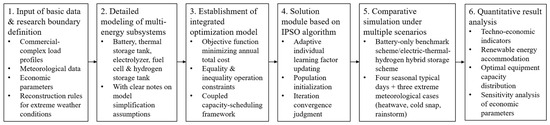
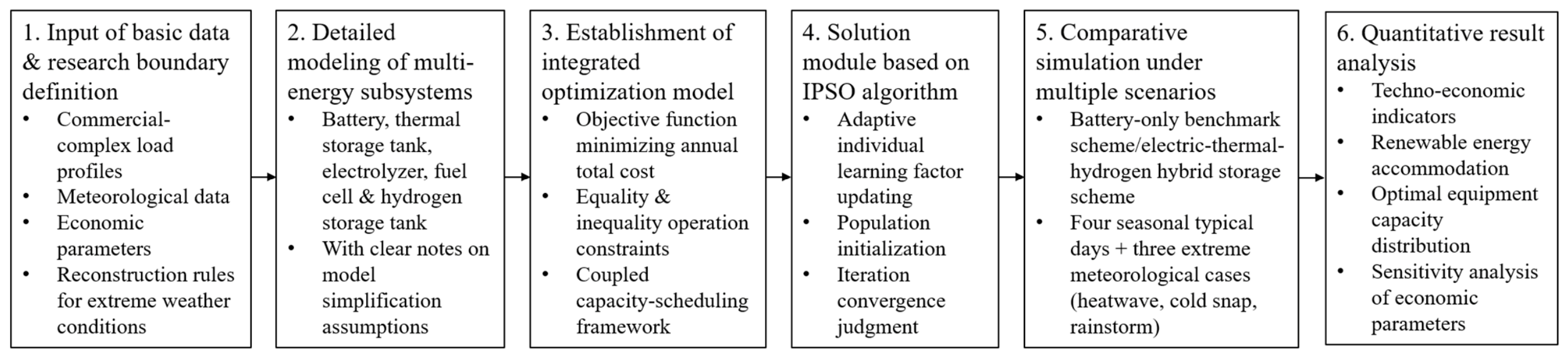
This chapter systematically constructs an integrated optimal configuration method of ETH-HES for commercial complexes. To intuitively demonstrate the complete implementation logic of the proposed method, Figure 1 summarizes the full workflow covering basic data input, multi-energy equipment modeling, construction of joint optimization models, solution via improved algorithms, multi-scenario simulation verification, and result analysis. The specific contents of each step will be elaborated one by one in the subsequent subsections of this chapter.
Figure 1.
Flowchart of the proposed integrated optimal configuration method for the ETH-HES system of a commercial complex.
The flow chart consists of six progressive modules fully consistent with the manuscript structure: (1) Input of basic data and research boundary definition: commercial-complex load profiles, meteorological data, economic parameters, reconstruction rules for extreme weather conditions; (2) Detailed modeling of multi-energy subsystems: battery, TST, electrolyzer, fuel cell and hydrogen storage tank (HST), with clear notes on model simplification assumptions; (3) Establishment of integrated optimization model: objective function minimizing annual total cost, equality and inequality operation constraints, coupled capacity-scheduling framework; (4) Solution module based on improved IPSO algorithm: adaptive individual learning factor updating, population initialization and iteration convergence judgment; (5) Comparative simulation under multiple scenarios: battery-only benchmark scheme vs. electric-thermal-hydrogen hybrid storage scheme; four seasonal typical days plus three extreme meteorological cases (heatwave, cold snap, rainstorm); (6) Quantitative result analysis: techno-economic indicators, renewable energy accommodation, optimal equipment capacity distribution, sensitivity analysis of economic parameters.
2.1. Basic Structure of the IES
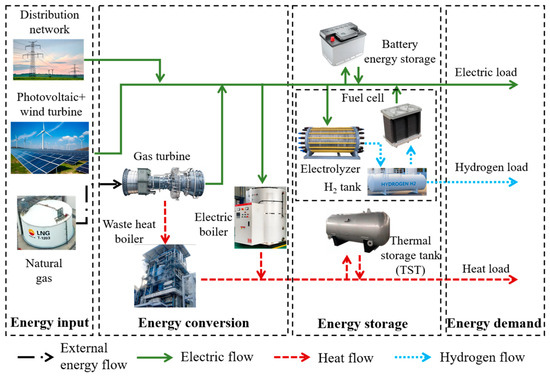
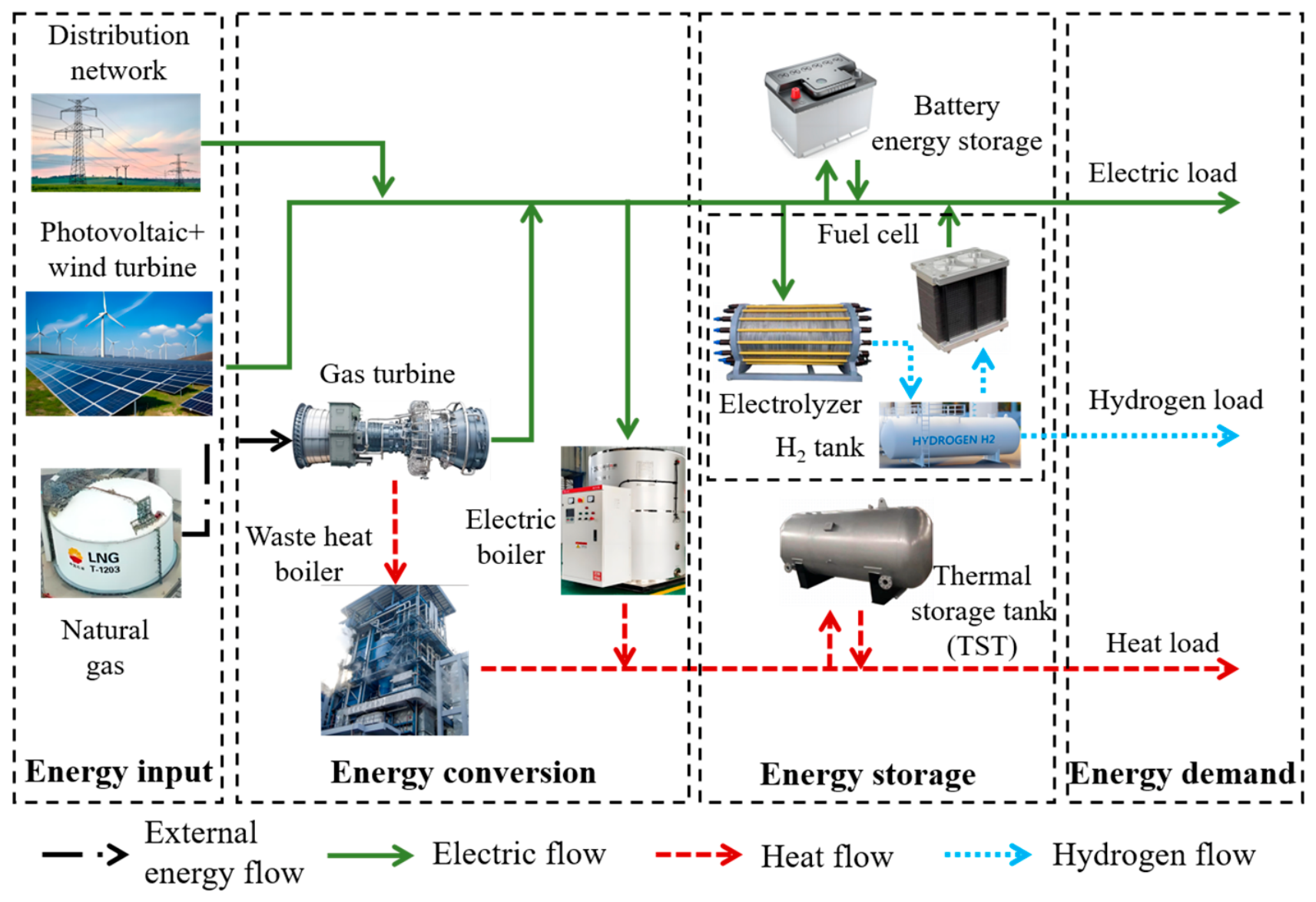
An IES is a complex energy system composed of multiple heterogeneous energy forms such as electricity, heat, and gas. It is generally divided into four functional modules: energy input, energy conversion, energy storage, and energy consumption. The structure of the ETH-IES investigated in this study is shown in Figure 2.
Figure 2.
Basic structure of the ETH-IES.
Figure 2 presents the topological framework of the ETH-IES for commercial complexes. The whole system is divided into three modules, namely the electric subsystem, thermal subsystem, and hydrogen coupling conversion subsystem. The topological structure and operational functions of each unit are specified as follows.
- (1)
- Electric subsystem: Photovoltaic (PV) panels and wind turbines (WT) act as distributed renewable power sources to supply clean electricity with volatile output. Batteries serve as short-term electric storage units: they are charged during periods of surplus renewable power and discharged at peak load to smooth power fluctuations. The system realizes bidirectional power exchange with the utility grid, purchasing electricity when power is insufficient and feeding excess power back to the grid. The terminal part connects to the daily electrical load of commercial buildings.
- (2)
- Thermal subsystem: Heat pump (HP), gas turbine, and waste heat boiler supply basic heat for space heating and domestic hot water. TSTs store redundant heat and release heat during thermal demand peaks to reduce frequent start-stop of heat-producing equipment, which matches the cooling and heating loads of the commercial complex.
- (3)
- The hydrogen coupling subsystem acts as the core hub for multi-energy complementation. The electrolyzer converts surplus renewable electricity into hydrogen via water electrolysis for long-term energy storage. The HST buffers the power mismatch between electrolyzers and FCs and enables inter-seasonal hydrogen scheduling. The FC realizes combined hydrogen-to-electricity and hydrogen-to-heat supply: generated electricity feeds electric loads, while waste heat is recycled to the thermal pipeline, forming bidirectional coupling among hydrogen, electric, and thermal systems.
Supported by coordinated operation of storage and conversion units in the three subsystems, the system fully exploits the temporal-spatial complementary advantages of electric, thermal and hydrogen storage to mitigate source-load mismatch under seasonal and extreme meteorological conditions.
2.2. Modeling of Main System Device
2.2.1. Electric Energy Storage Model
Lead-acid batteries, which feature low cost and mature technology, are selected as the EES devices. The corresponding mathematical models are expressed as follows [42]:
where, and are the electric energy stored in the lead-acid battery at time t and t − 1, respectively, in kWh. is the self-loss coefficient of the lead-acid battery, and is dimensionless. is the time interval, in h. is the output power of the lead-acid battery (positive value represents discharging, while negative value represents charging), in kW. and denote the charging efficiency and discharging efficiency, respectively, and are dimensionless. and represent the charging state and discharging state of the lead-acid battery, respectively, and are dimensionless, where ‘1’ refers to the working state of charging or discharging, and ‘0’ refers to the idle state. SOC(t) is the state of charge (SOC) of the battery at time t, and is dimensionless. SOC(0) is the initial SOC of the battery, and is dimensionless. is the rated energy storage capacity of the battery, in kWh.
2.2.2. Thermal Energy Storage Model
A TST is adopted as the TES device with water serving as the heat medium. The mathematical models are given as follows [42]:
where, is the energy loss of the TST, in kWh. U is the overall heat transfer coefficient of the tank, in W/(m2·K). A is the heat exchange area of the tank, in m2. and are the inlet and outlet medium temperatures of the tank, respectively, in K. H(t) is the thermal energy stored in the TST at time t, in kWh. is the self-dissipation coefficient of thermal energy for the TST, and is dimensionless. is the output power of the TST, in kW. A positive value represents heat release, while a negative value denotes heat storage. and are the heat charging efficiency and heat discharging efficiency, respectively, and are dimensionless. and are the binary state variables of heat charging and heat discharging, and are dimensionless. A value of ‘1’ indicates the tank is in heat charging/discharging operation, and ‘0’ represents the idle state. SOH(t) is the thermal SOC of the tank at time t, and is dimensionless. is the rated heat storage capacity of the tank, in kWh.
2.2.3. Hydrogen Energy Storage Model
The HES system is mainly composed of three key components: electrolyzers for hydrogen production, HST, and FC. The energy balance and operational characteristics are modeled as:
where, is the hydrogen energy stored in the HST at time t, quantified by equivalent electric energy, in kWh. is the self-loss coefficient of hydrogen, and is dimensionless, covering hydrogen leakage and natural dissipation. is the input electric power of the electrolyzer, in kW. is the hydrogen production efficiency of the electrolyzer, and is dimensionless. and are the binary state variables, where ‘1’ corresponds to device operation and ‘0’ corresponds to device shutdown. is the rated storage capacity of the HST, in kWh. is the SOC of the HST, defined as the ratio of residual stored energy to the rated total capacity, and is dimensionless.
The FC can recover waste heat during power generation to realize CHP operation. The corresponding mathematical model is established as:
where, is the thermal power of waste heat recovered by the FC, in kW. is the waste heat recovery efficiency, and is dimensionless.
Model simplification and assumption discussion. The hydrogen subsystem in this study adopts an equivalent energy-storage modeling approach, with several engineering simplifications applied for the electrolyzer, HST, and fuel cell. The model assumptions and applicable boundaries are explicitly stated as follows.
- (1)
- The electrolyzer model employs a fixed hydrogen-production conversion efficiency, without introducing the part-load efficiency curve and minimum operating threshold. This study carries out annual-scale capacity optimal configuration with an hourly time step. To control the computational complexity of the model, it is assumed that the electrolyzer can operate continuously from 0 to rated power with a constant efficiency at rated conditions. In practice, alkaline electrolyzers suffer efficiency degradation under low part-load conditions and have a minimum permissible operating power; the device must shut down when the power is below this threshold. This simplification slightly overestimates hydrogen output under low-power operating conditions. Hence, the present model is more suitable for medium- and long-term capacity-scheme comparison. For short-timescale refined dispatching, the part-load efficiency function and minimum operating-power constraints of the electrolyzer should be incorporated.
- (2)
- The HST is represented by an equivalent-energy storage model, which ignores the dynamic variation of hydrogen pressure and the coupled characteristics between pressure and hydrogen charge-discharge processes. This work focuses on system-level annual energy balance rather than simulating the internal pressure-fluid processes inside the storage tank. Under the simulated operating conditions of this case, the state-of-charge of the HST mostly stays in the middle range and rarely reaches the upper or lower pressure limits, so the influence caused by this simplification is limited. If operating conditions frequently hit the hydrogen charge-discharge limits of the tank, pressure constraints will restrict the actual hydrogen charging and discharging capacity. Under such circumstances, the equivalent energy-storage model will produce obvious errors, and pressure state equations need to be supplemented.
- (3)
- The model does not consider equipment aging and degradation effects of electrolyzers and fuel cells induced by operation cycles. The performance degradation of hydrogen-related equipment is strongly coupled with start-stop times and load cycles; incorporating coupled degradation models will substantially increase the computational burden of the optimization problem. As a planning-and-configuration-oriented study, this work adopts fixed annual operation-and-maintenance costs and does not distinguish differentiated equipment degradation caused by different dispatching strategies. This treatment slightly underestimates the full-life-cycle cost of the hydrogen subsystem under frequent start-stop scenarios. For future refined operation-optimization research, empirical models of condition-coupled aging degradation can be introduced.
2.3. Analysis on Collaborative Operation Strategy
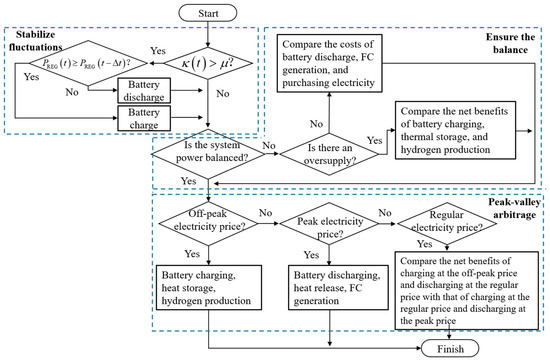
The operation strategy of ETH-HES refers to the coordinated scheduling scheme of electric, thermal, and hydrogen energy storage devices under three functional objectives: smoothing the output fluctuation of renewable energy, ensuring power supply-demand balance, and implementing peak-valley arbitrage under time-of-use electricity prices.
2.3.1. Smoothing Fluctuation
The model for smoothing renewable energy output fluctuation is established as follows [42]:
where, is the fluctuation rate of renewable energy generation power, %. is the output power of renewable energy generation, in kW. The subscript REG denotes Renewable Energy Generation. is the total installed capacity of renewable energy generation, in kW.
For the part where the smoothing power of the energy storage system exceeds the threshold μ, the mathematical expression of the smoothing strategy is given by [42]:
where μ is the threshold of power fluctuation and is dimensionless.
The physical implication of Equation (11) is described as follows: (1) when the generation power rises and the power fluctuation exceeds μ, takes a negative value, and the BES operates in the charging mode. (2) When the generation power drops and the power fluctuation exceeds μ, takes a positive value, and the BES operates in the discharging mode. (3) When the power fluctuation does not exceed μ, the energy storage battery remains in an idle state.
2.3.2. Ensuring Power Supply-Demand Balance
The supply-demand balance mainly focuses on the electric power subsystem, and the corresponding operation strategy is formulated as: (1) when the generated power exceeds the electric load demand (i.e., power surplus), the priority order of absorbing surplus power by batteries, TSTs, and hydrogen production electrolyzers is determined following the principle of economic optimality. (2) When the generated power is lower than the electric load demand (i.e., power shortage), the dispatching sequence of power output is optimized by comparing the economic cost of battery discharging, FC power generation, and grid power purchase. (3) When the generated power is equal to the electric load demand, no regulation action is required.
2.3.3. Peak-Valley Arbitrage
The peak-valley arbitrage strategy is formulated as follows:
- (1)
- The energy storage system is scheduled to charge during the valley electricity price period.
- (2)
- The energy storage system discharges energy during the peak electricity price period to reduce electricity purchase from the power grid.
- (3)
- During the flat electricity price period, the net benefit from charging at valley price and discharging at flat price is compared with that from charging at flat price and discharging at peak price, so as to select the economically optimal charge-discharge scheme. Specifically: for the electric power subsystem, if the net benefit of charging at valley price and discharging at flat price is lower than the net benefit of charging at flat price and discharging at peak price, the discharging strategy is adopted; otherwise, the charging strategy is implemented. For the thermal subsystem, if the net benefit of heat storage at valley price and heat release at flat price is less than that of heat storage at flat price and heat release at peak price, the heat release strategy is selected; otherwise, the heat storage strategy is adopted. For the HES subsystem, if the net benefit of hydrogen production at valley price and power generation at flat price is lower than that of hydrogen production at flat price and power generation at peak price, the hydrogen production strategy is executed; otherwise, hydrogen is stored.
2.4. Collaborative Operation Strategy of HES
Based on the above analysis, this section formulates an optimal collaborative operation strategy for ETH-HES, as illustrated in Figure 3.
Figure 3.
Collaborative operation strategy of the ETH-IES.
The specific contents are summarized as follows:
- (1)
- When the power fluctuation of renewable energy generation is significant, BES is prioritized to implement the strategy of smoothing power fluctuations.
- (2)
- When supply-demand imbalance occurs, the regulation costs of charging/discharging for each energy storage system and power purchase/sale from the grid are compared, and the regulation strategy is formulated in ascending order of cost.
- (3)
- Implement the peak-valley arbitrage strategy. The energy storage system stores energy during the valley electricity price period and releases energy during the peak electricity price period. In the flat electricity price period, the charging and discharging strategy of the energy storage system is formulated following the principle of maximizing the net system benefit.
3. Optimal Configuration Modeling of the ETH-IES
3.1. Optimal Configuration Strategy
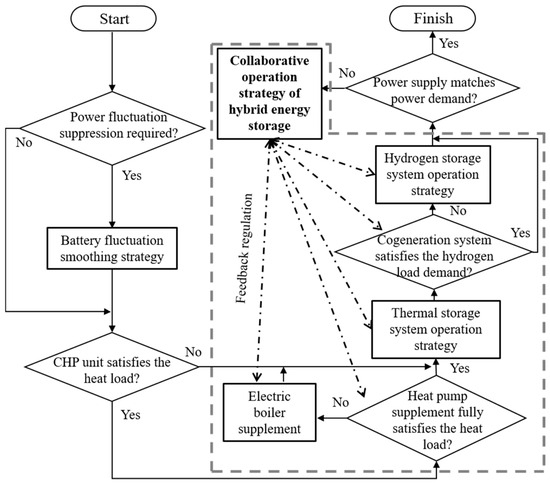
This section determines the configuration optimization strategy of the ETH-IES, as presented in Figure 4.
Figure 4.
Configuration optimization strategy of the ETH-IES.
3.1.1. Electric Power Subsystem
The total electric load model of the IES is expressed as:
where, is the total electric load, in kW. is the user-side electric load, in kW. is the output power of the HP, in kW. is the output power of the electric boiler (EB), in kW. is the output power of the hydrogen production electrolyzer, in kW. , and are the conversion efficiencies of the HP, EB and hydrogen production electrolyzer, respectively, %, and dimensionless.
3.1.2. Thermal Subsystem
If the CHP unit can fully meet the user thermal load, no other device needs to be put into operation. If the thermal load cannot be satisfied, a residual thermal load will be generated. When the HP fails to cover the residual thermal load, the EB is activated for supplementary heat supply. In the case that the heating device cannot meet the thermal load demand, the TST releases heat by outputting power. Meanwhile, the TST adjusts its output scheme according to the optimal strategy of multi-energy storage. The corresponding mathematical models are established as follows [42]:
where, is the thermal load, in kW. is the output power of the CHP unit, in kW. is the maximum output power of the CHP unit, in kW. is the maximum output power of the HP, in kW. is the maximum output power of the EB, in kW. is the maximum output power of the electrolyzer, in kW.
3.2. Optimal Configuration Model
3.2.1. Objective Function
In this study, the following objective function for optimal configuration is established, with the goal of minimizing the annual total cost [42]:
where, F is the annual system cost, in CNY. is the capacity/power of device k, capacity (kWh) for energy-storage devices and power (kW) for power-generation/conversion devices. is the unit purchase cost of device k, in CNY/kWh or CNY/kW. is the discount factor and is dimensionless. is the operation and maintenance (O&M) cost of device, in CNY. is the cost of energy purchased from external sources, in CNY. i is the discount rate and is dimensionless. is the service life of device k, in year. is the O&M cost of device, in CNY. is the operating power of device k, in kW. is the natural gas price, in CNY/m3. is the volume of natural gas consumed by the system at time t, in m3. is the grid electricity price at time t, in CNY/kWh. is the electricity purchased from the grid at time t, in kWh.
3.2.2. Constraints
The constraints for the proposed optimal configuration model of the ETH-IES are formulated as follows [42]:
- Power Balance Constraints
The expressions for the power balance constraint are as follows:
where, is the output power of PV generation, in kW. is the output power of WT generation, in kW. is the electrical power supplied by the CHP unit, in kW. is the output power of the hydrogen FC, in kW. is the thermal power supplied by the EB, in kW.
- Device Operation Constraints
The expressions for the device operation constraint are as follows:
where, is the upper limit of PV output power, in kW. is the upper limit of WT output power, in kW. and are the lower and upper limits of power purchased from the distribution grid, in kW. and are the lower and upper limits of electrical power generated by the CHP unit, in kW. and are the lower and upper limits of thermal power supplied by the CHP unit, in kW. and are the lower and upper limits of BES output power, in kW. and are the lower and upper limits of FC output power, in kW. and are the lower and upper limits of HP output power, in kW. and are the lower and upper limits of EB output power, in kW. and are the lower and upper limits of TST output power, in kW.
- Historical Maximum Electrical and Thermal Load Constraints [42]
The expressions for the historical maximum electrical and thermal load constraints are as follows:
where, and are the historical maximum electrical and thermal loads, in kW.
- Total Investment Cost Constraint [42]
The expression for the total investment cost constraint is as follows:
where, is the maximum allowable total investment cost, in CNY.
- User-Acceptable Unit Energy Cost Constraint [42]
The expression for the user-acceptable unit energy cost constraint is as follows:
where, is the maximum unit energy cost acceptable to users, in CNY/kW.
3.3. Solution Method
The whole simulation is implemented on MATLAB R2022b. For the mixed-integer linear constraint module within the proposed model, the embedded commercial CPLEX 12.10 solver is invoked to carry out constrained optimization calculations. To solve the optimal configuration model of the ETH-IES, an IPSO algorithm with adaptive individual learning speed is adopted in this research. The evolutionary velocity and position of particles in the iterative process are expressed as [43]:
where, is the evolutionary velocity of the optimal particle. is the inertia weight of the particle’s evolutionary velocity. denotes the number of neighboring particles. and are coefficients valued within the range of (0, 1). is the individual learning factor. is the social learning factor. is the historical individual fitness extreme value of the particle. is the particle position.
Traditional PSO generally adopts linearly varying inertia weights and learning factors. When solving energy system optimization models with multiple variables and complex constraints, it tends to suffer from premature convergence and struggles to escape local optima. In this work, the IPSO adaptively adjusts inertia weights and learning factors. In the early iterations, the global exploration capability is strengthened to expand the search space, which helps obtain better solutions to the objective function. In the later iterations, local exploitation is enhanced to improve convergence performance. This modification only revises the parameter updating rules of particles and does not significantly increase computation time. Meanwhile, the adaptive parameter strategy can mitigate result oscillations caused by the randomness of particle initialization and improve the stability of multiple independent runs. Since this research focuses on the scheme analysis of energy systems, the algorithm is merely employed as a solving tool, and quantitative comparative simulations between IPSO and PSO are not carried out. We plan to conduct independent algorithm-focused research in follow-up work, where quantitative comparative experiments among different optimization algorithms will be completed in a dedicated algorithm paper.
3.4. Solution Procedure
The solving procedure for the optimal configuration model of the ETH-IES is presented as follows:
- (1)
- Initialization. Set the performance parameters of the algorithm and complete algorithm initialization.
- (2)
- Fitness value calculation. According to the optimization objective and decision variables, calculate the fitness value of each particle to screen out the optimal particle.
- (3)
- Particle update. Update the velocity and position of each particle, and calculate the fitness function value after updating. If the fitness value of the particle in the current iteration is lower than the historical fitness value, the individual extreme value is updated. Otherwise, no update is performed.
- (4)
- Particle swarm iterative update. Compare the individual extreme value of each particle with the global extreme value. If the fitness of the individual extreme value is lower than that of the global extreme value, update the global extreme value and its corresponding position.
- (5)
- Particle crossover. If a particle satisfies the crossover condition, selective crossover operation is implemented. Otherwise, the crossover operation is skipped.
- (6)
- Repeat Step 2 to Step 5 cyclically.
- (7)
- Termination. When the iteration stopping criterion is satisfied, output the final optimal results.
4. Case Study
4.1. Basic Data
In this study, a typical commercial complex in the hot summer and cold winter (HSCW) zone is selected as the research object for simulation. The simulation covers one year with a time step of one hour. The historical data include annual electric load, annual heat load, annual photovoltaic generation, and annual wind power output, as well as key parameters of each device (e.g., capital cost, O&M rate, service life, efficiency) and relevant energy prices (e.g., electricity price, natural gas price).
The construction method for extreme-weather condition curves is as follows: based on publicly available meteorological statistical yearbooks and local typical-year measured meteorological datasets for the hot-summer and cold-winter zones where the research object is located, the extreme boundary characteristic parameters corresponding to heatwave, cold snap, and rainstorm periods are extracted, including maximum/minimum temperature, solar irradiation range, wind-speed range, and upper/lower limits of loads. Referring to the extreme-condition modeling approaches reported in existing similar literature, characteristic scaling and reconstruction are performed for irradiation, wind speed, and electric/thermal load on the time-series profile of typical days, so as to generate simulation conditions that satisfy the statistical characteristics of extreme meteorology for simulating the source-load variation characteristics under extreme weather.
4.2. Simulation Schemes
Two schemes are designed to validate the model. Scheme 1: Only lead-acid batteries are equipped. Scheme 2: Lead-acid batteries, TES, and HES are equipped.
4.3. Simulation Results and Discussion
4.3.1. Simulation Results
- Optimal device sizing
The optimal configurations for Scheme 1 and Scheme 2 are listed in Table 2. Compared with Scheme 1, Scheme 2 features significantly larger installed capacities of PV and WTs, while the capacities of CHP units, HPs, and batteries decrease. Scheme 2 integrates thermal storage devices (TST, EB) and hydrogen storage devices (electrolyzer, HST, FC), which facilitates higher penetration of renewable energy.
Table 2.
Configuration results for Scheme 1 and Scheme 2. Power-type devices: unit in kW; energy-storage capacity-type devices: unit in kWh.
- 2.
- Cost breakdown of different configurations
The cost components for both schemes are presented in Table 3. Compared with Scheme 1, Scheme 2 reduces the annual capital cost by 29.7% (mainly because the installed capacities of high-cost CHP units and HPs are substantially reduced), the annual O&M cost by 38.2%, the annual energy purchase cost by 25.4%, and the total annual cost by 26.3%.
Table 3.
Cost compositions of Scheme 1 and Scheme 2.
4.3.2. Impact of HES Coordination on Scheduling Strategies Across Seasons
Typical days in spring, summer, autumn, and winter are chosen to analyze the seasonal performance of the coordinated electric-thermal-hydrogen storage strategy. The typical characteristics are described as follows: spring corresponds to a mild transition season with a moderate load level; summer is characterized by high temperature, strong solar irradiance, and enormous cooling demand; autumn belongs to a cool transition season with a moderate load level; winter features cold weather, weak solar irradiance, and high heating demand.
The typical characteristics of different seasons in the HSCW zone and electric/thermal load (excluding the load of energy storage devices) data of the commercial complex are summarized in Table 4.
Table 4.
Typical characteristics of different seasons and extreme weather, and electric/thermal load data characteristics of the commercial complex.
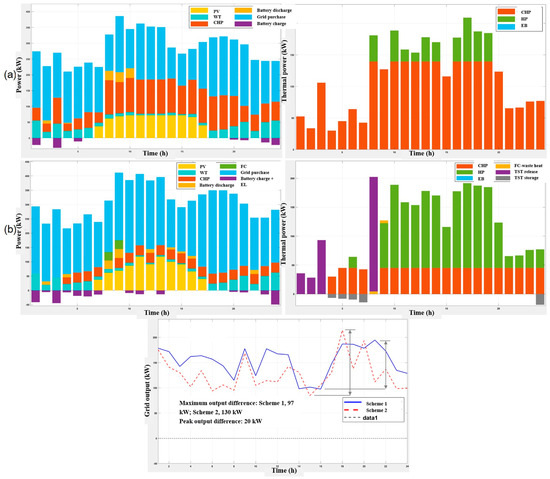
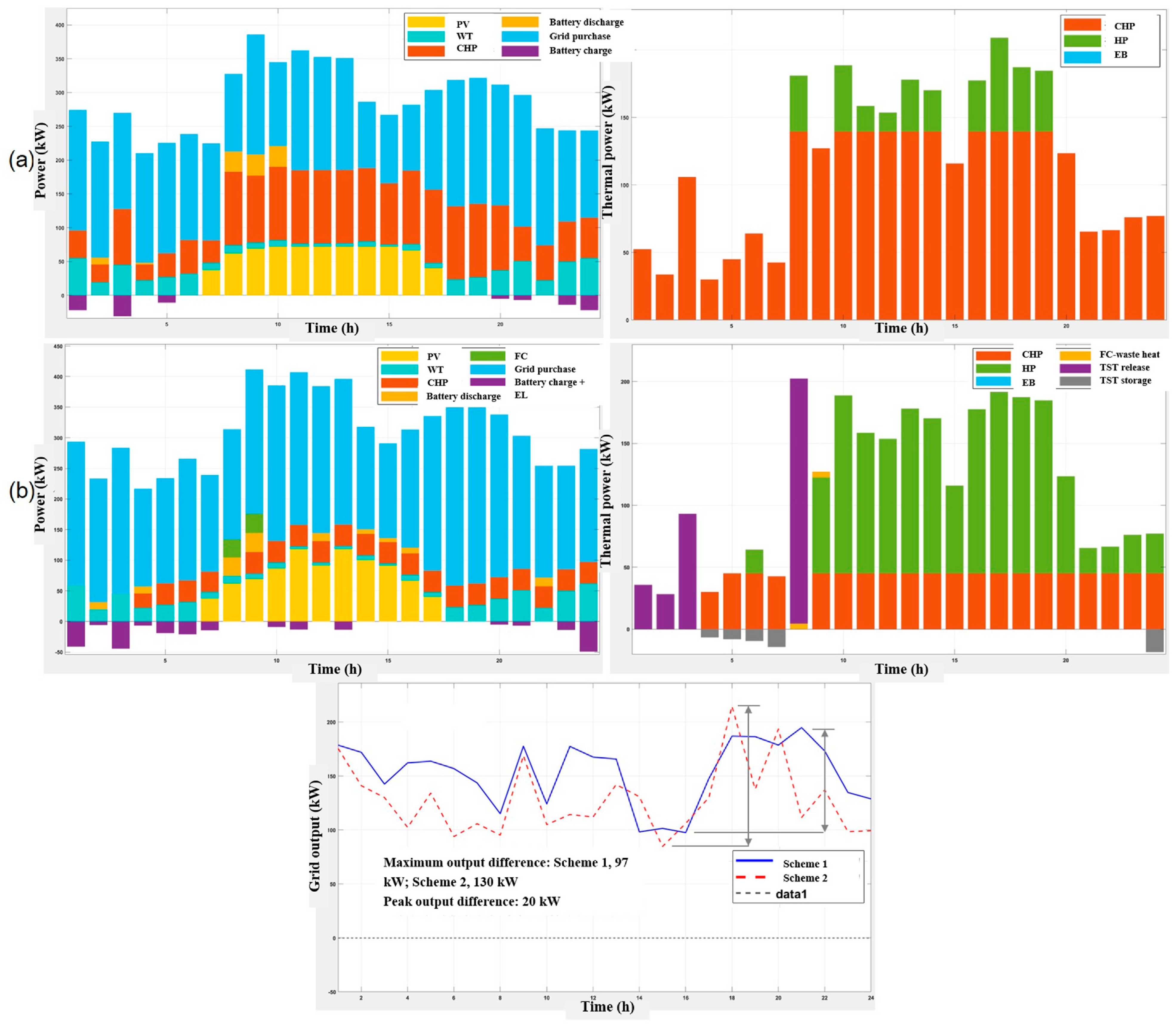
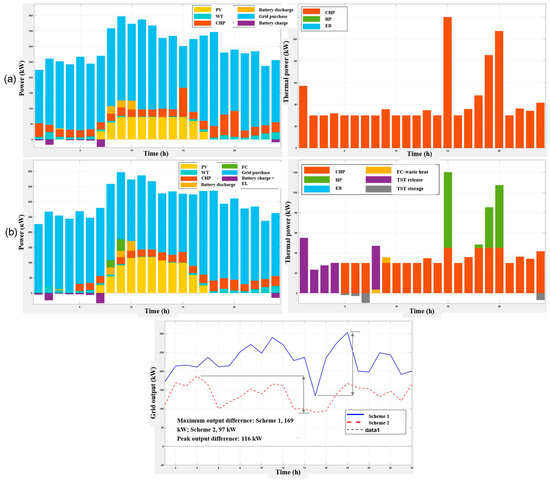
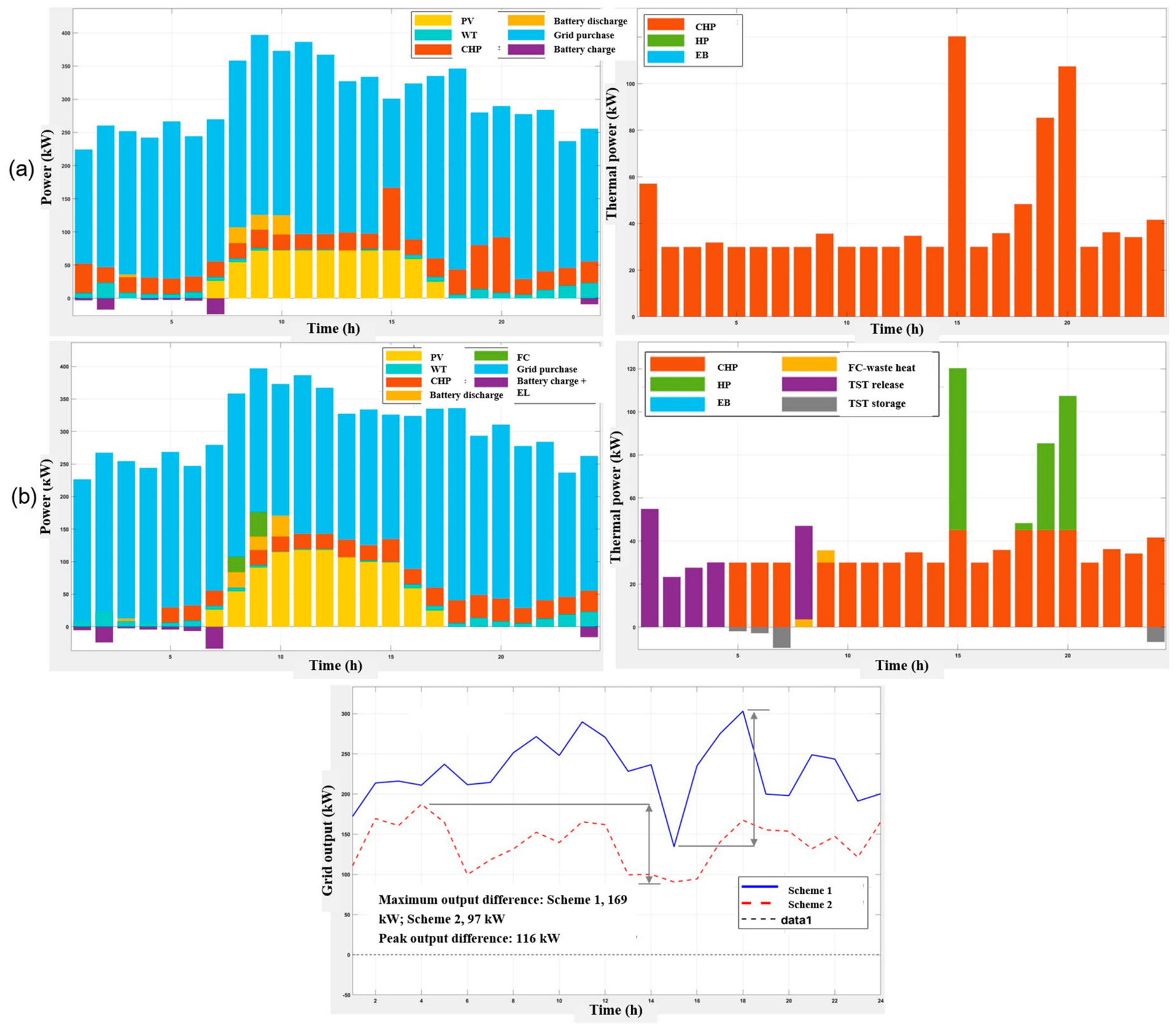
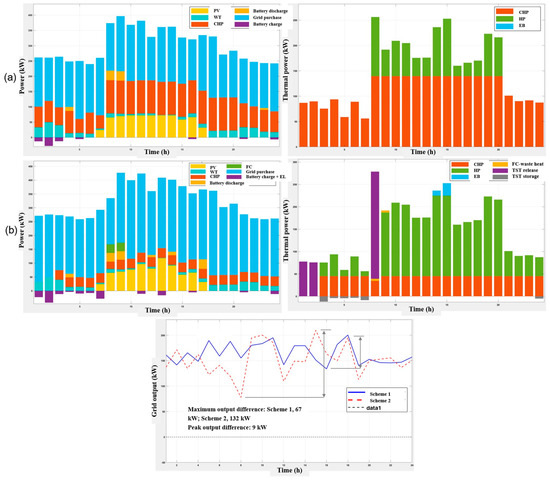
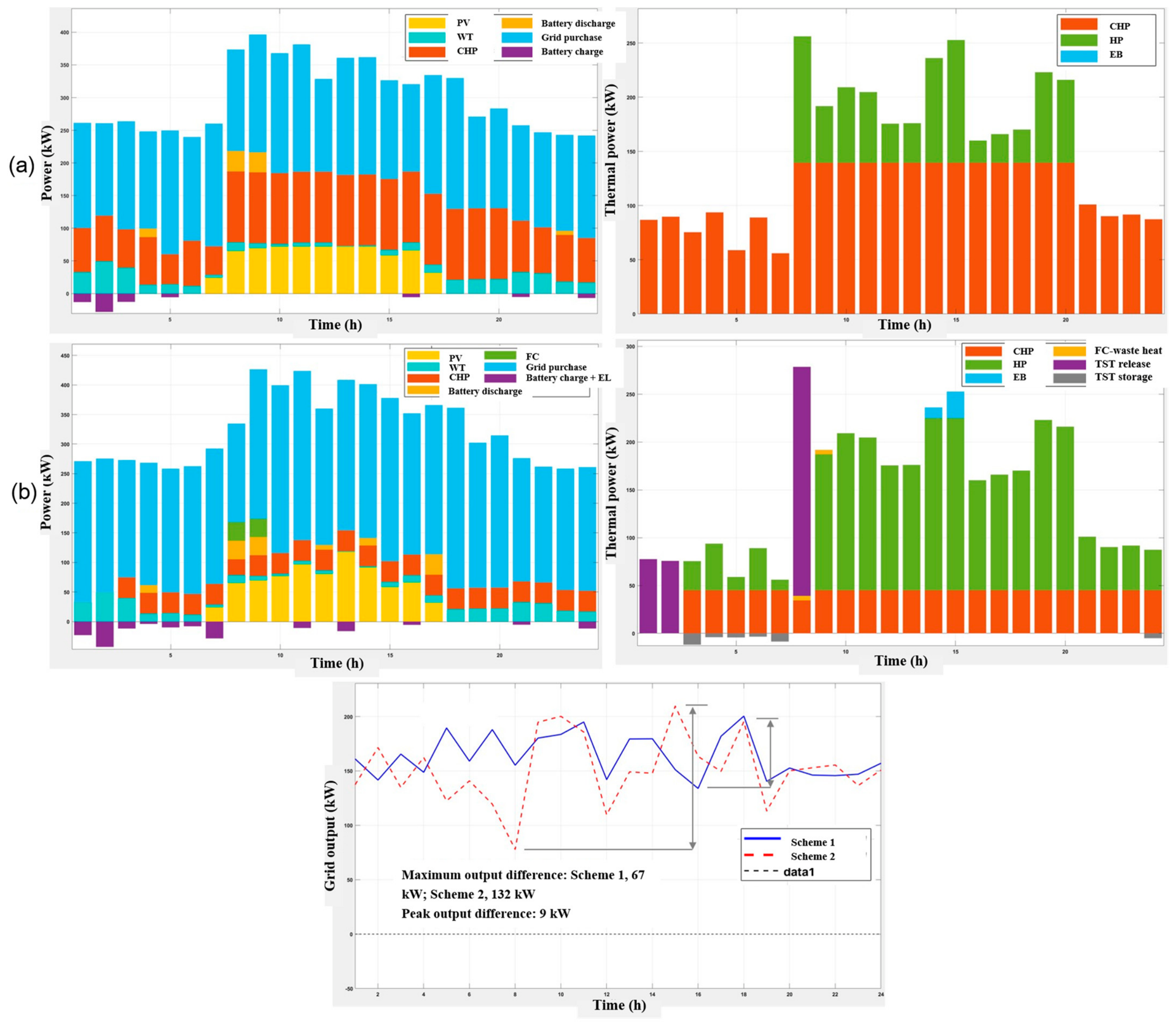
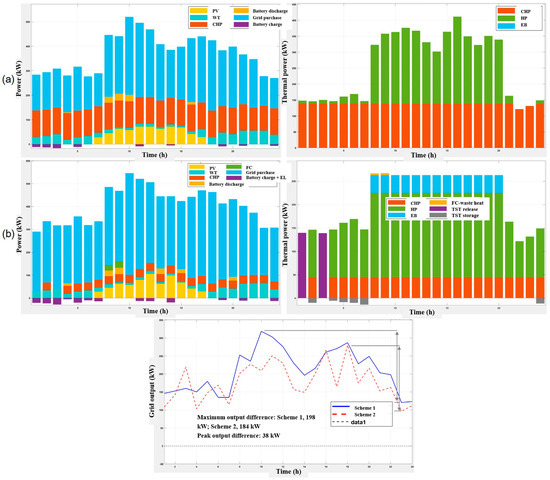
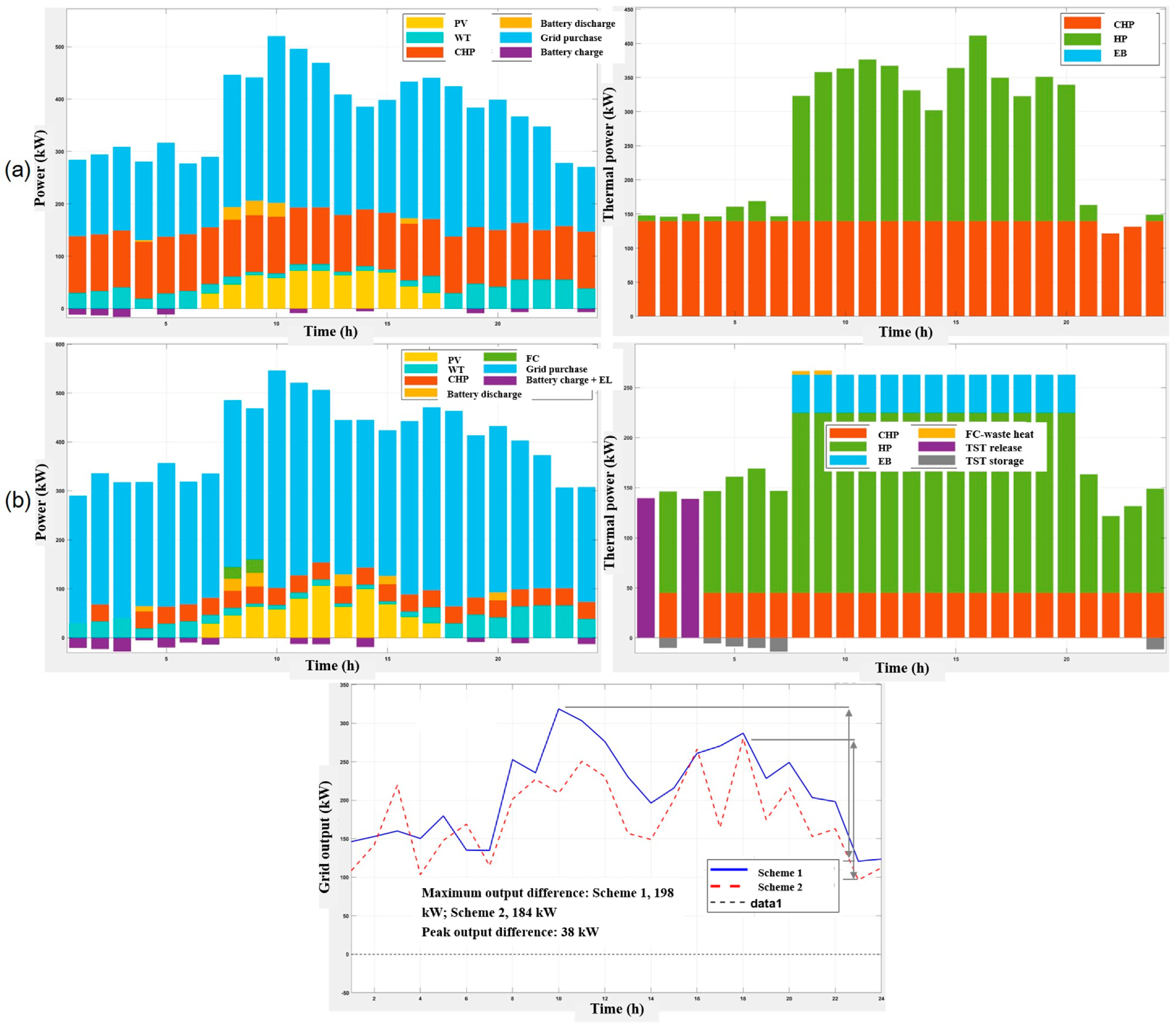
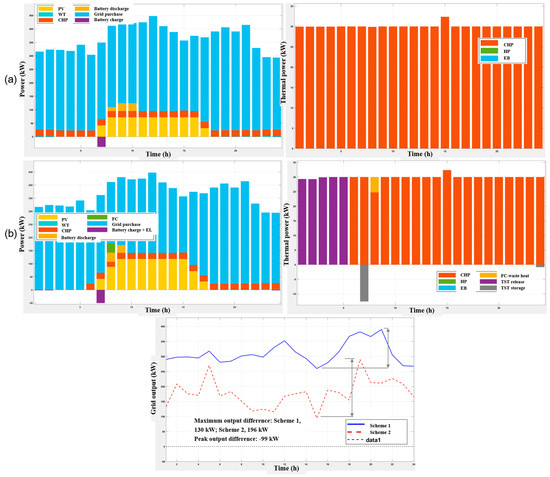
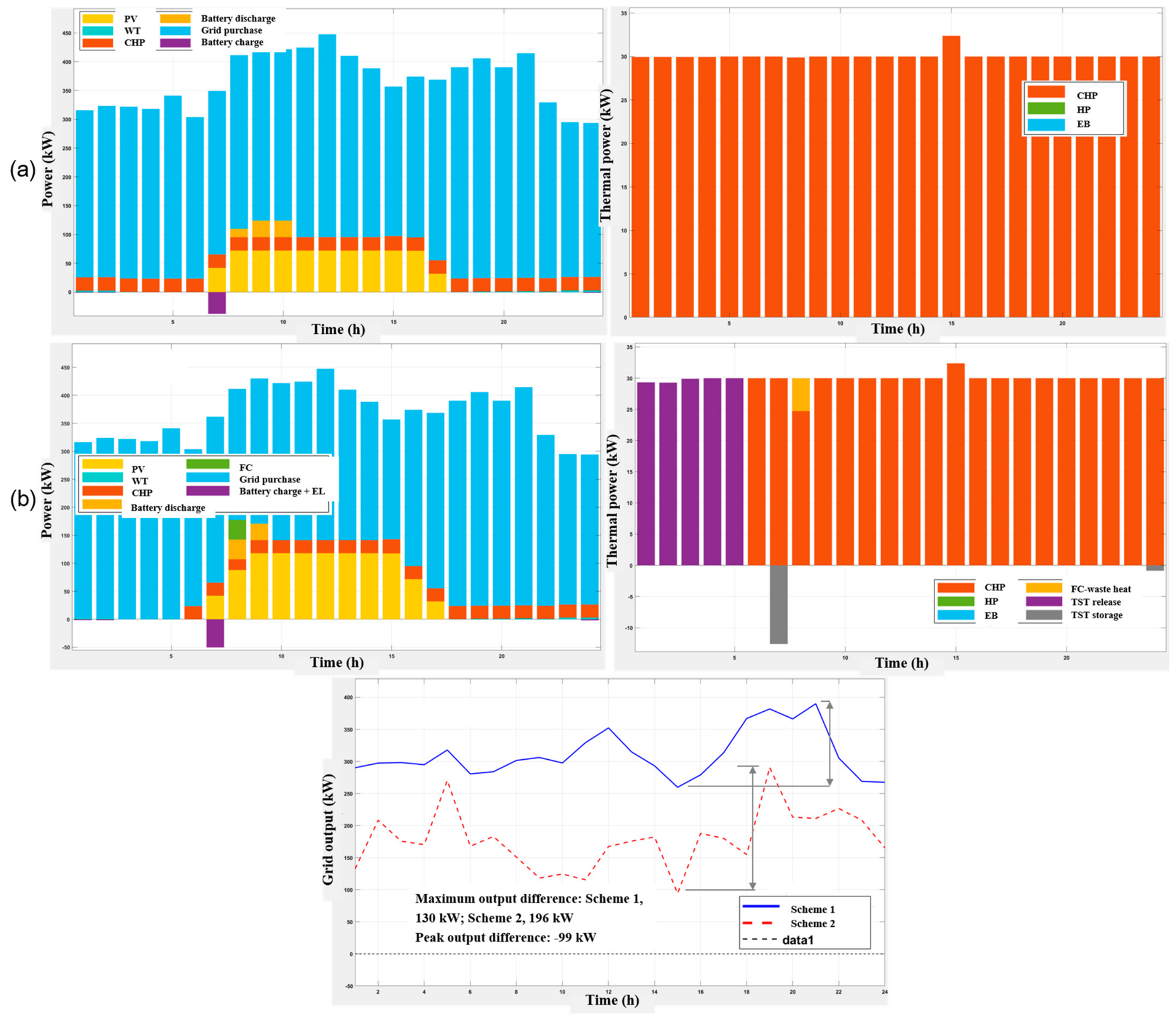
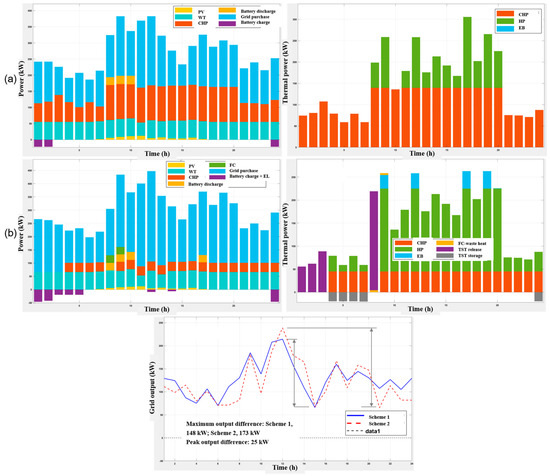
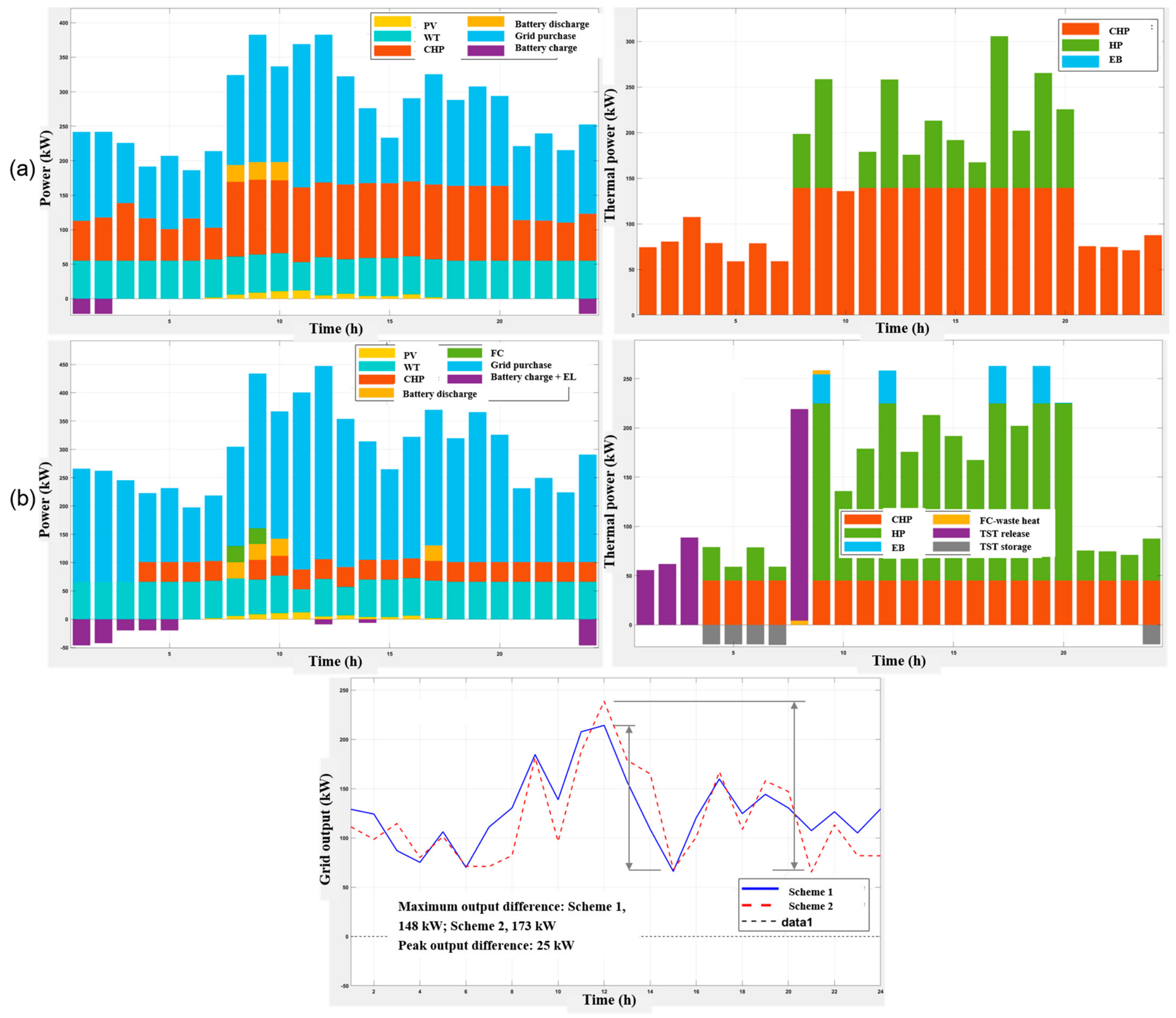
The scheduling results of the power subsystem, thermal subsystem, and grid power import for typical days in different seasons are shown in Figure 5, Figure 6, Figure 7 and Figure 8. Owing to the coordinated HES in Scheme 2, the daily renewable energy consumption increases: in spring, 1258.07 kWh → 1441.73 kWh (+14.6%); in summer, 852.62 kWh → 1095.69 kWh (+28.51%); in autumn, 1077.62 kWh → 1181.24 kWh (+9.62%); in winter, 1258.25 kWh → 1358.96 kWh (+8.0%).
Figure 5.
Dispatching strategies of the power subsystem, thermal subsystem, and grid output in different schemes in spring: (a) Scheme 1; (b) Scheme 2. The lengths of the line segments marked by the two-way arrows denote the maximum output difference of the two schemes.
Figure 6.
Dispatching strategies of the power subsystem, thermal subsystem, and grid output in different schemes in summer: (a) Scheme 1; (b) Scheme 2. The lengths of the line segments marked by the two-way arrows denote the maximum output difference of the two schemes.
Figure 7.
Dispatching strategies of the power subsystem, thermal subsystem, and grid output in different schemes in autumn: (a) Scheme 1; (b) Scheme 2. The lengths of the line segments marked by the two-way arrows denote the maximum output difference of the two schemes.
Figure 8.
Dispatching strategies of the power subsystem, thermal subsystem, and grid output in different schemes in winter: (a) Scheme 1; (b) Scheme 2. The lengths of the line segments marked by the two-way arrows denote the maximum output difference of the two schemes.
Scheme 2 deploys a large TST (739 kW), which partially replaces the output of CHP units and HPs, thereby reducing their installed capacities significantly. Meanwhile, due to the integration of thermal and hydrogen storage, grid power import in Scheme 2 is consistently lower than in Scheme 1 across all seasons. Moreover, the storage devices actively respond to time-of-use prices by implementing peak-valley arbitrage and coordinated electric-thermal-hydrogen operation. The maximum and peak power differences between the two schemes are listed in Table 5. In spring & autumn, the maximum power difference is larger in Scheme 2, but the peak difference is smaller (20 kW and 9 kW, respectively). In summer & winter, the maximum power difference is smaller in Scheme 2, while the peak difference is larger (116 kW and 38 kW, respectively). These results verify the effectiveness of the proposed HES coordination in different seasons.
Table 5.
Maximum and peak power differences between Scheme 1 and Scheme 2 in different seasons.
4.3.3. Impact of HES Coordination on Scheduling Performance Under Extreme Weather Conditions
Three typical extreme weather events are considered: heatwave, cold snap, and storm. Their typical characteristics are described as follows: a heatwave corresponds to an extremely high temperature and high cooling demand; a cold snap is characterized by an extremely low temperature and high heating demand; a storm features severe weather, strong wind, and weak solar irradiance.
The extreme weather characteristics and corresponding electric/heat loads (excluding the load of energy storage devices) are summarized in Table 4.
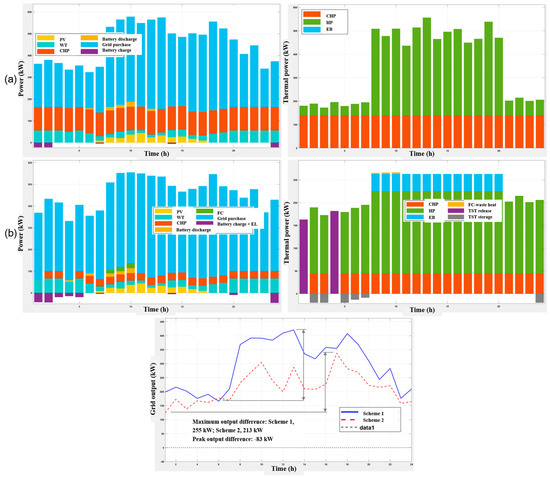
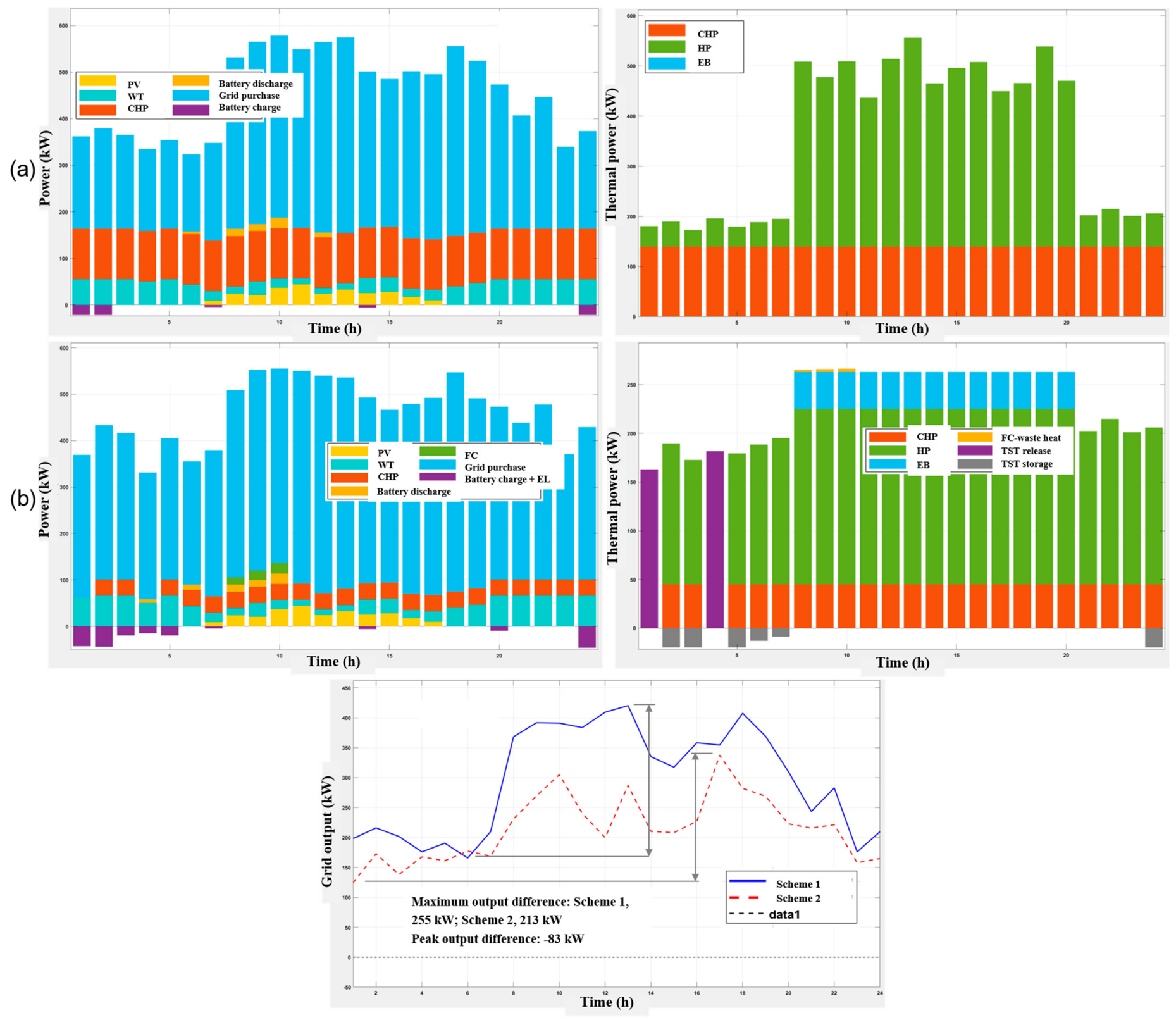
The scheduling results for extreme weather days are shown in Figure 9, Figure 10 and Figure 11. With hybrid storage coordination, Scheme 2 achieves higher renewable energy utilization under all extreme conditions: under heatwave, 736.59 kWh → 1074.06 kWh (+45.8%); under cold snap, 1173.78 kWh → 1268.18 kWh (+8.0%); under storm, 1368.97 kWh → 1605.90 kWh (+17.3%).
Figure 9.
Dispatching strategies of the power subsystem, thermal subsystem, and grid output in different schemes under high-temperature heat waves: (a) Scheme 1; (b) Scheme 2. The lengths of the line segments marked by the two-way arrows denote the maximum output difference of the two schemes.
Figure 10.
Dispatching strategies of power subsystem, thermal subsystem, and grid output in different schemes under cold waves: (a) Scheme 1; (b) Scheme 2. The lengths of the line segments marked by the two-way arrows denote the maximum output difference of the two schemes.
Figure 11.
Dispatching strategies of power subsystem, thermal subsystem and grid output in different schemes under storm: (a) Scheme 1; (b) Scheme 2. The lengths of the line segments marked by the two-way arrows denote the maximum output difference of the two schemes.
Grid power import in Scheme 2 is consistently lower than in Scheme 1 under extreme weather. The storage devices again implement peak-valley arbitrage and multi-energy coordination. The maximum and peak power differences are listed in Table 6. Under heatwave & storm, the maximum power difference is larger in Scheme 2, but the peak difference is smaller or even negative (−99 kW and 25 kW, respectively). Under a cold snap, the maximum power difference is smaller in Scheme 2, with a negative peak difference (−83 kW). These outcomes confirm that the coordinated electric-thermal-hydrogen storage strategy effectively enhances system operational adaptability and renewable energy utilization under extreme weather.
Table 6.
Maximum and peak power differences between Scheme 1 and Scheme 2 under different extreme weather conditions.
4.3.4. Horizontal Comparative Analysis with Results from Existing Literature
To further verify the superiority of the capacity-scheduling joint optimization method for ETH-HES proposed in this work, horizontal comparisons are carried out from three aspects, i.e., modeling ideas, simulation conditions, and quantitative performance indicators, with reference to representative research summarized in the literature review (see Table 1).
Most existing similar studies solve the energy storage capacity configuration and system scheduling strategy in a decoupled manner. They adopt only a single typical daily load curve for simulation verification, and fail to consider the impacts of seasonal variation and extreme meteorological conditions on system capacity configuration and energy supply reliability. Although some studies have established multi-energy coupling system models, they only focus on economic optimization under normal operating conditions, lacking quantitative evaluation of system performance under extreme scenarios.
In contrast, the joint optimization framework constructed in this work realizes the coupled solution of equipment capacity configuration and multi-condition collaborative energy storage scheduling, covering both conventional seasonal operating conditions and extreme meteorological scenarios. In terms of economy, the proposed scheme reduces the total system cost by 26.3% and the O&M cost by 38.2%. For scenario adaptability, the complementary structure of ETH-HES can maintain stable energy supply under extreme weather and meet the energy demand of the commercial complex.
The comprehensive comparison shows that the proposed method can not only obtain a better capacity allocation scheme but also achieve stronger scenario robustness. It can provide theoretical support for HES planning of IESs for commercial complexes in hot-summer and cold-winter zones.
4.3.5. Impact of Energy Storage Costs on Renewable Energy Installed Capacity
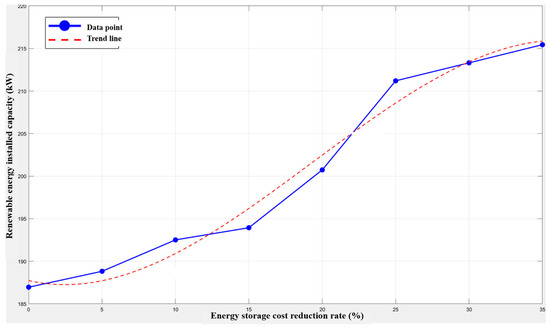
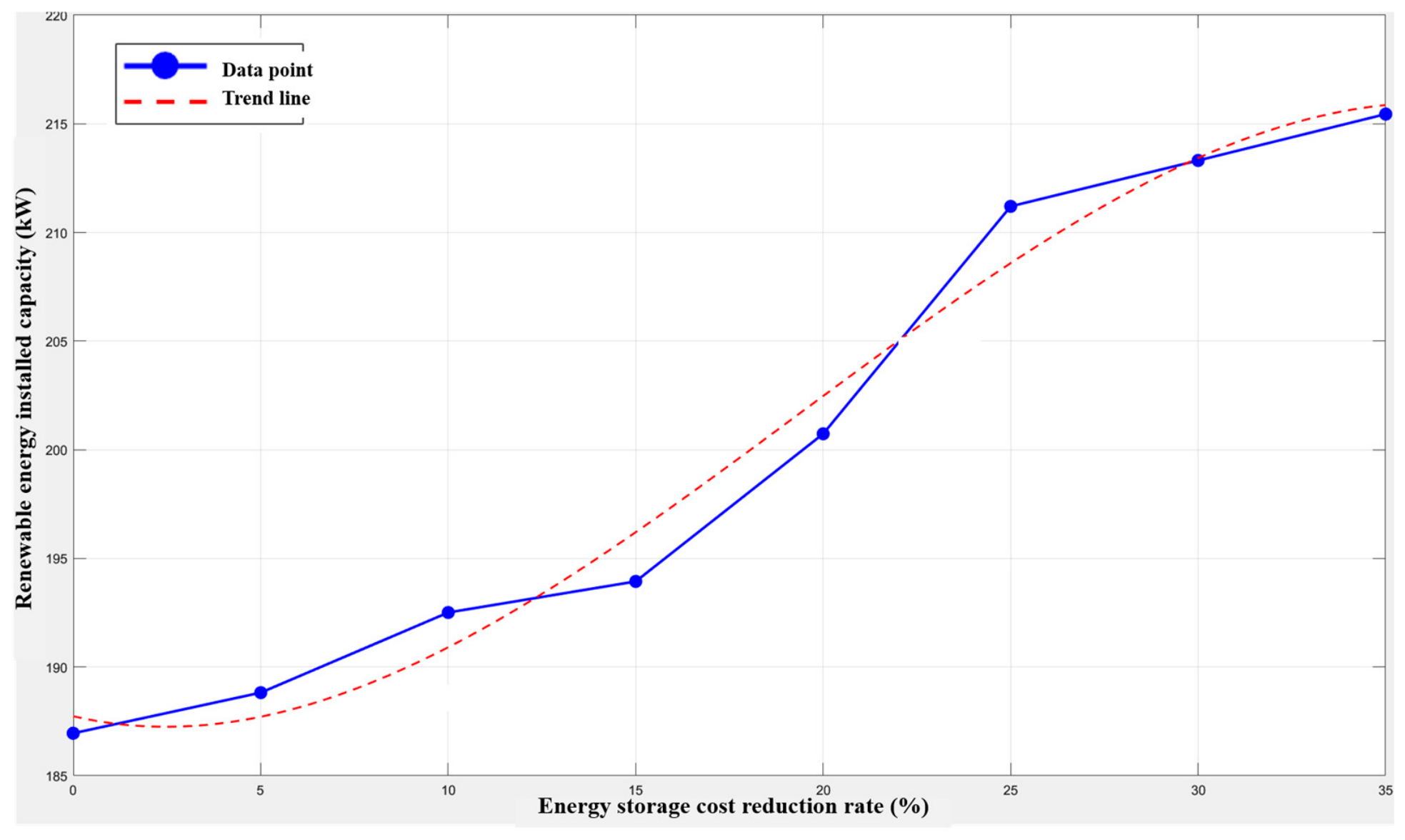
It is well known that the procurement and maintenance costs of energy storage systems will continue to decline as energy storage technology advances and achieves mass production. This section analyzes the impact of declining energy storage costs on renewable energy installed capacity. Figure 12 illustrates the variation of renewable energy installed capacity with energy storage cost. As shown in the figure, a greater reduction in energy storage costs corresponds to a higher renewable energy installed capacity. When energy storage costs decrease by 25%, the growth rate of renewable energy installed capacity slows down, which may be attributed to constraints such as renewable energy installation limits and power system stability.
Figure 12.
Variation of renewable energy installed capacity with energy storage cost.
4.3.6. Impact of Energy Prices on Annual Total Cost
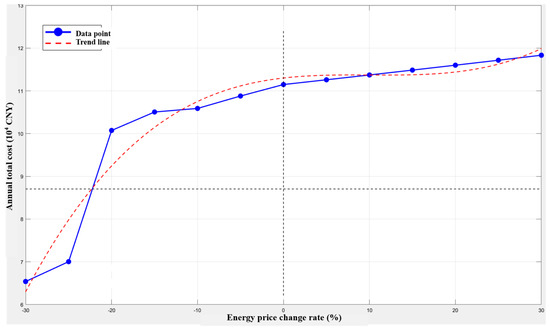
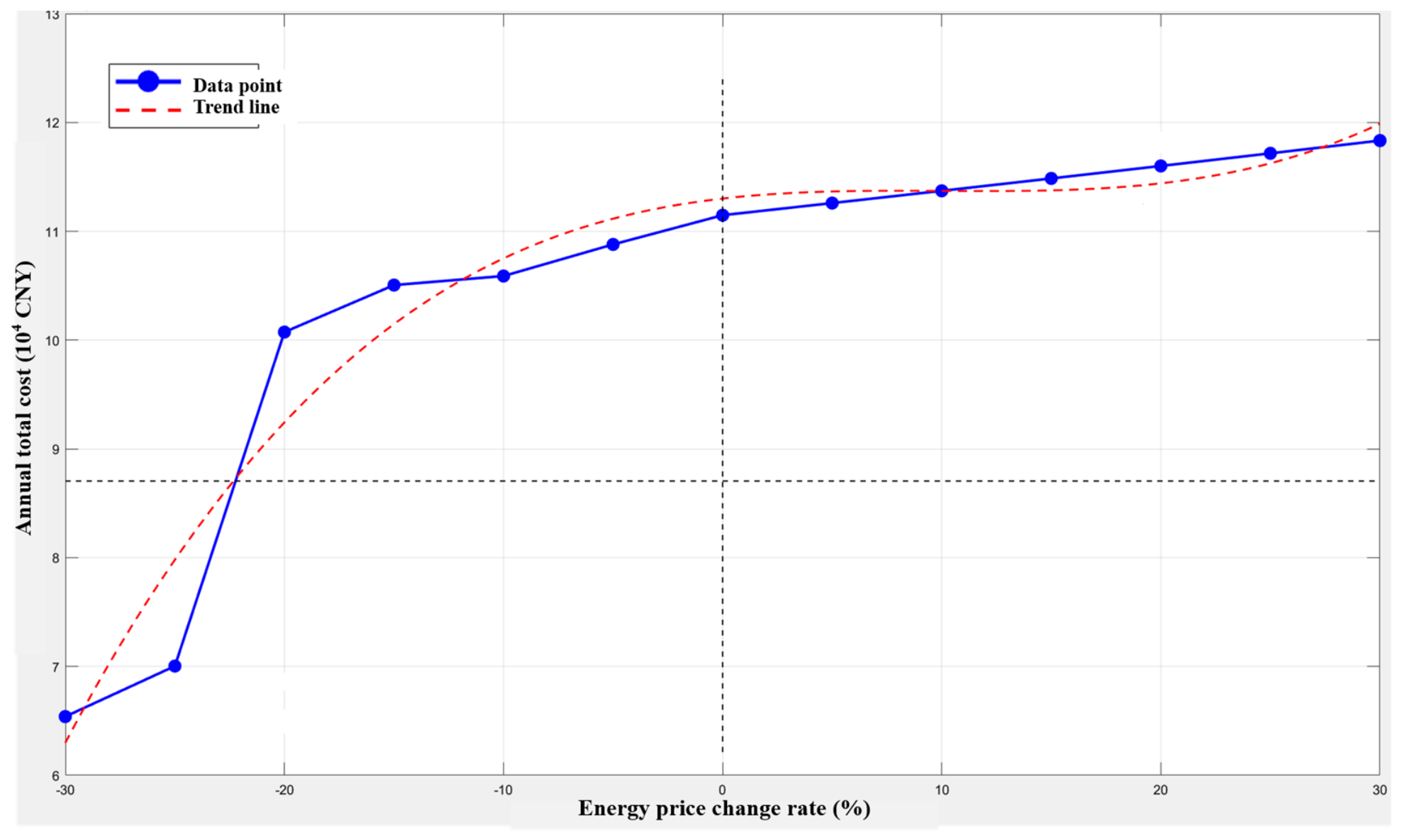
This section analyzes the impact of energy price changes on the annual total cost of the system, as shown in Figure 13. It is observed that the annual total cost increases with rising energy prices. When energy prices decrease by 20%, the growth rate of the annual total cost slows down, which may result from reduced costs of purchasing energy from external sources. When energy prices increase by 10%, the growth rate of the annual total cost slows down again. This phenomenon may be explained by increased energy supply revenue or peak-valley arbitrage gains of the system. Since the annual total cost is defined as investment cost minus revenue, higher revenue decelerates the growth of the annual total cost.
Figure 13.
Sensitivity analysis of energy prices.
5. Conclusions
To address the common shortcomings widely existing in current studies on ETH-HES planning, such as decoupling between capacity configuration and dispatch strategies, exclusive use of conventional typical days for simulation, and the lack of quantitative verification under extreme meteorological conditions, this work takes a commercial complex in the HSCW zone as the research object. The core research goal is to develop an integrated joint optimization model for HES and quantitatively evaluate the techno-economic performance and renewable energy accommodation capacity of the multi-energy-storage complementary system under seasonal normal operating conditions and extreme weather scenarios. This work establishes a complete integrated optimization method for the ETH-IES applicable to commercial complexes. Two comparative schemes are designed to carry out comparative simulations under typical days of four seasons and three extreme meteorological conditions. The core innovations of this paper are as follows: (1) An integrated coupled modeling framework for capacity and dispatch is proposed. It abandons the traditional stepwise decoupled optimization pattern and fully exploits the spatio-temporal complementary advantages of electric, thermal, and hydrogen energy storage; (2) A multi-scenario simulation verification system covering seasonal conditions and extreme meteorological events is constructed, which remedies the drawback of most existing studies that only adopt single typical-day simulation and cannot evaluate the operational resilience of the system under extreme weather. The key simulation results are presented below:
- (1)
- In the optimized device configuration scheme, the capacities of thermal and hydrogen energy storage devices are increased, leading to a 29.7% reduction in annual investment cost, a 38.2% reduction in annual maintenance cost, a 25.4% reduction in annual energy purchase cost, and a 26.3% reduction in annual total cost. This verifies the effectiveness of the proposed optimal configuration model and solution algorithm.
- (2)
- In different seasons, the optimized configuration scheme and HES coordinated operation strategy exert positive effects on system scheduling. The daily renewable energy consumption of the optimized scheme is improved, with increases of 14.6%, 28.5%, 9.6%, and 8.0% in spring, summer, autumn, and winter, respectively. By enhancing renewable energy consumption, the optimized scheme reduces grid power output and lowers electricity purchase costs. Thermal and hydrogen energy storage devices actively respond to peak-valley electricity prices, implementing peak-valley arbitrage and the ETH-HES coordinated operation strategy.
- (3)
- Under extreme weather conditions, the optimized configuration scheme and HES coordinated operation strategy also demonstrate positive performance in system scheduling. The daily renewable energy consumption of the optimized scheme is increased by 45.8%, 8.0%, and 17.3% under three extreme weather events (heatwaves, cold snaps, and storms), respectively. The increased renewable energy consumption reduces grid power output and electricity purchase costs for the optimized scheme.
- (4)
- A greater reduction in energy storage costs leads to a higher renewable energy installed capacity, with the growth rate slowing when energy storage costs decrease by 25%. The annual total cost increases with rising energy prices, and its growth rate slows when energy prices decrease by 20% or increase by 10%.
The integrated optimization model and multi-scenario simulation framework established in this paper can provide quantitative theoretical support for energy storage equipment selection, reasonable capacity ratio, and medium- and long-term planning of integrated energy systems in zero-carbon commercial parks located in HSCW zones.
This study has the following limitations: (1) Restrictions on simulation scenarios and external boundary conditions. The extreme meteorological conditions are reconstructed based on characteristic parameters from regional meteorological statistical yearbooks, without adopting complete measured time-series data of actual extreme disasters. A fixed standard time-series load curve of commercial complexes is used on the load side, failing to distinguish dynamic load fluctuations between workdays, weekends, and holidays. (2) Scenario limitation caused by single selection of EES equipment. Only lead-acid batteries are selected as the representative EES for simulation and comparison, while other mainstream EES technologies such as lithium-ion batteries and all-vanadium flow batteries are not incorporated. Accordingly, the conclusions regarding optimal capacity configuration and economic performance are only applicable to commercial complexes equipped with lead-acid energy storage, and cannot be directly extended to building-integrated energy systems installed with lithium-ion or flow batteries. (3) Limitation arising from static assumptions of external policy and market parameters. Fixed economic parameters, including time-of-use electricity prices, stepped carbon trading prices, and equipment purchase unit prices, are adopted throughout the research, which constitute static assumptions. Time-varying rules such as dynamic electricity price fluctuations, annual rises in carbon prices, and gradual declines in energy storage equipment costs are not introduced, making it impossible to analyze the long-term impacts of policy and market price fluctuations on the system’s optimal configuration over consecutive multi-year cycles.
To address the above limitations, follow-up research can be improved in the following aspects: (1) Conduct simulations of real extreme scenarios based on multi-year measured time-series meteorological disaster data, and distinguish dynamic load curves for workdays and holidays; (2) Expand comparative analysis of multiple energy storage types including lithium-ion batteries and flow batteries, and summarize matching rules for the selection of various energy storage devices; (3) Introduce time-varying dynamic parameters of electricity prices, carbon prices, and equipment costs to carry out multi-year long-cycle rolling optimization.
Author Contributions
K.B.: Conceptualization, Visualization, Validation, Software, Methodology, Formal analysis, Writing—original draft, Investigation, Data curation. Z.M.: Software, Data curation. Writing—review & editing, Supervision, Funding acquisition. C.W.: Software, Investigation. X.T.: Software, Investigation. T.W.: Writing, Validation, Software, Investigation. B.Z.: Writing, Software, Investigation. J.S.: Writing—review & editing, Supervision, Resources, Funding acquisition. All authors have read and agreed to the published version of the manuscript.
Funding
This work was supported by Smart Grid-National Science and Technology Major Project (2024ZD0800600), the Southern Power Grid Co., Ltd. Technology Project (GDKJXM20240497), the Special Fund for Science and Technology Innovation of Jiangsu Province (BE2022610), and the New Power System Technology Innovation Project of Guangdong Province (1689738169108).
Data Availability Statement
The original contributions presented in this study are included in the article. Further inquiries can be directed to the corresponding authors.
Conflicts of Interest
Author Bin Zhou was employed by the company Electric Power Research Institute, CSG. The remaining authors declare that the research was conducted in the absence of any commercial or financial relationships that could be construed as a potential conflict of interest. The authors declare that this study received funding from the Southern Power Grid Co., Ltd. Technology Project (GDKJXM20240497). The funder was not involved in the study design, collection, analysis, interpretation of data, the writing of this article, or the decision to submit it for publication.
Abbreviations
The following abbreviations are used in this manuscript:
| ADMM | Alternating Direction Method of Multipliers |
| BES | battery energy storage |
| CEFT | carbon emission flow tracking |
| CHP | combined heat and power |
| CTMs | carbon trading mechanisms |
| DRO | distributionally robust optimization |
| ETH-IES | electric-thermal-hydrogen IES |
| EES | electrochemical/electric energy storage |
| ETH-HES | electric-thermal-hydrogen hybrid energy storage |
| EB | electric boiler |
| FC | fuel cell |
| FCCP | fuzzy chance-constrained programming |
| HES | hydrogen energy storage |
| HSCW | hot summer and cold winter |
| HST | hydrogen storage tank |
| HP | heat pump |
| IES | integrated energy system |
| IGDT | Information Gap Decision Theory |
| IPSO | improved PSO |
| ORC | Organic Rankine Cycle |
| O&M | operation and maintenance |
| P2G | power-to-gas |
| P2H | power-to-hydrogen |
| PSO | particle swarm optimization |
| PV | photovoltaic generation |
| RO | robust optimization |
| SO | stochastic optimization |
| SOC | state of charge |
| SRC | Steam Rankine Cycle |
| TCP | tiered carbon pricing |
| TES | thermal energy storage |
| TST | thermal storage tank |
| WT | wind turbine |
References
- Lund, H.; Østergaard, P.A.; Connolly, D.; Mathiesen, B.V. Smart energy and smart energy systems. Energy 2017, 137, 556–565. [Google Scholar] [CrossRef] [Scilit]
- Geidl, M.; Andersson, G. Optimal Power Flow of Multiple Energy Carriers. IEEE Trans. Power Syst. 2007, 22, 145–155. [Google Scholar] [CrossRef] [Scilit]
- Yang, Y.; He, J.; Chen, W.; Li, Z.; Chen, K. Low-Carbon Economic Dispatch of Electric-Thermal-Hydrogen Integrated Energy System Based on Carbon Emission Flow Tracking and Step-Wise Carbon Price. Energy Eng. 2025, 122, 4653–4678. [Google Scholar] [CrossRef] [Scilit]
- Wang, J.; Liu, H.; Xu, C. Resource scheduling and capacity allocation optimization of an integrated electricity-heat-gas-hydrogen energy system. Energy 2025, 337, 138683. [Google Scholar] [CrossRef] [Scilit]
- IRENA GHCR. Scaling Up Electrolysers to Meet the 1.5 C Climate Goal; International Renewable Energy Agency: Abu Dhabi, United Arab Emirates, 2020. [Google Scholar]
- Clegg, S.; Mancarella, P. Integrated modeling and assessment of the operational impact of power-to-gas (P2G) on electrical and gas transmission networks. IEEE Trans. Sustain. Energy 2015, 6, 1234–1244. [Google Scholar] [CrossRef] [Scilit]
- Bertling, L.; Carlson, O.; Lundmark, S.; Steen, D. Integration of plug in hybrid electric vehicles and electric vehicles-experience from Sweden. In IEEE PES General Meeting; IEEE: New York, NY, USA, 2010; pp. 1–3. [Google Scholar]
- Zhou, Y.; Li, X.; Sun, G.; Zang, H.; Chen, S.; Wei, Z. Stochastic Distributionally Robust Resilient Planning of Electricity-Hydrogen-Heat Integrated Energy Systems Considering Waste Heat Recovery. Power Syst. Technol. 2025, 49, 2243–2251. (In Chinese) [Google Scholar] [CrossRef]
- Chen, Z.; Sun, Z.; Lin, D.; Li, Z.; Chen, J. Optimal Configuration of Multi-Energy Storage in an Electric–Thermal–Hydrogen Integrated Energy System Considering Extreme Disaster Scenarios. Sustainability 2024, 16, 2276. [Google Scholar] [CrossRef] [Scilit]
- Bozkurt, A.; Genç, M.S.; Seyitoğlu, S.S. 7E analysis of a low-temperature geothermal and solar energy integrated hybrid system for sustainable power and hydrogen generation. Therm. Sci. Eng. Prog. 2025, 66, 104073. [Google Scholar] [CrossRef] [Scilit]
- Wang, Z.; Mu, X.; Ma, Y.; Liao, P.; Ji, Y.; Han, F. Advanced energy management and optimal scheduling for integrated offshore gas-hydrogen-electricity-heat systems. Energy 2025, 319, 135091. [Google Scholar] [CrossRef] [Scilit]
- Li, J.; Chen, H.; Qi, Y.; Wang, Y.; Lei, J. Collaborative optimization for cross-regional integrated energy systems producing electricity-heat-hydrogen based on generalized Nash bargaining. Energy 2025, 333, 137444. [Google Scholar] [CrossRef] [Scilit]
- Ye, J.; Wang, X.; Hua, Q.; Sun, L. Deep reinforcement learning based energy management of a hybrid electricity-heat-hydrogen energy system with demand response. Energy 2024, 305, 131874. [Google Scholar] [CrossRef] [Scilit]
- Zheng, W.; Xiao, H.; Liu, Z.; Pei, W.; Beshir, M. Multi-scale coordinated optimal dispatch method of electricity-thermal-hydrogen integrated energy systems. IET Energy Syst. Integr. 2023, 5, 275–289. [Google Scholar] [CrossRef] [Scilit]
- Zeng, G.; Liu, M.; Lei, Z.; Huang, X. Bi-level robust planning of hydrogen energy system for integrated electricity–heat–hydrogen energy system considering multimode utilization of hydrogen. Energy 2024, 303, 132029. [Google Scholar] [CrossRef] [Scilit]
- Bertsimas, D.; Sim, M. The Price of Robustness. Oper. Res. 2004, 52, 35–53. [Google Scholar] [CrossRef] [Scilit]
- Luo, S.; Li, Q.; Pu, Y.; Xiao, X.; Chen, W.; Liu, S.; Mao, X. A carbon trading approach for heat-power-hydrogen integrated energy systems based on a Vickrey auction strategy. J. Energy Storage 2023, 72, 108613. [Google Scholar] [CrossRef] [Scilit]
- Yang, X.; Chen, Z.; Huang, X.; Li, R.; Xu, S.; Yang, C. Robust capacity optimization methods for integrated energy systems considering demand response and thermal comfort. Energy 2021, 221, 119727. [Google Scholar] [CrossRef] [Scilit]
- Mohajerin Esfahani, P.; Kuhn, D. Data-driven distributionally robust optimization using the Wasserstein metric: Performance guarantees and tractable reformulations. Math. Program. 2018, 171, 115–166. [Google Scholar] [CrossRef] [Scilit]
- Ma, M.; Long, Z.; Liu, X.; Lee, K.Y. Distributionally robust optimization of electric–thermal–hydrogen integrated energy system considering source–load uncertainty. Energy 2025, 316, 134568. [Google Scholar] [CrossRef] [Scilit]
- Wang, Y.; Wang, W.; Li, X.; Yu, W. Enhanced Management of Unified Energy Systems Using Hydrogen Fuel Cell Combined Heat and Power with a Carbon Trading Scheme Incentivizing Emissions Reduction. Processes 2024, 12, 1358. [Google Scholar] [CrossRef] [Scilit]
- Liu, L.; Qin, Z. Low-carbon planning for park-level integrated energy system considering optimal construction time sequence and hydrogen energy facility. Energy Rep. 2023, 9, 554–566. [Google Scholar] [CrossRef] [Scilit]
- Chen, Y.; Jiang, Y. Interval energy flow calculation method for electricity-heat-hydrogen integrated energy system considering the correlation between variables. Energy 2023, 263, 125678. [Google Scholar] [CrossRef] [Scilit]
- Huang, Y.; Wu, D.; Chang, X.; Xue, Y.; Tian, X.; Li, Z.; Su, J.; Sun, H. Carbon-aware IES energy management based on green hydrogen blended CHP and seasonal monitoring of carbon trading strategy. Energy 2025, 335, 137755. [Google Scholar] [CrossRef] [Scilit]
- Zhu, X.; Xue, J.; Hu, M.; Liu, Z.; Gao, X.; Huang, W. Low-carbon economy dispatching of integrated energy system with P2G-HGT coupling wind power absorption based on stepped Carbon emission trading. Energy Rep. 2023, 10, 1753–1764. [Google Scholar] [CrossRef] [Scilit]
- Cheng, J.; Zhang, B.; Bao, G. Two-Stage Optimal Scheduling Strategy for Hydrogen-Electric-Thermal Multi-Energy Coupled Hybrid Hydrogen Production Integrated Energy System. South. Power Syst. Technol. 2025, 1–12. (In Chinese) [Google Scholar]
- Sun, N.; He, H.; Dong, H. A Two-Stage Optimal Dispatch Strategy for Electric-Thermal-Hydrogen Integrated Energy System Based on IGDT and Fuzzy Chance-Constrained Programming. Energies 2025, 18, 5927. [Google Scholar] [CrossRef] [Scilit]
- He, J.; Wu, Y.; Wu, M.; Xu, M.; Liu, F. Two-stage configuration optimization of a novel standalone renewable integrated energy system coupled with hydrogen refueling. Energy Convers. Manag. 2022, 251, 114953. [Google Scholar] [CrossRef] [Scilit]
- Wang, Y.; Song, M.; Jia, M.; Shi, L.; Li, B. TimeGAN based distributionally robust optimization for biomass-photovoltaic-hydrogen scheduling under source-load-market uncertainties. Energy 2023, 284, 128589. [Google Scholar] [CrossRef] [Scilit]
- Han, F.; Zeng, J.; Lin, J.; Gao, C. Multi-stage distributionally robust optimization for hybrid energy storage in regional integrated energy system considering robustness and nonanticipativity. Energy 2023, 277, 127729. [Google Scholar] [CrossRef] [Scilit]
- Song, Y.; Mu, H.; Li, N.; Wang, H. Multi-objective optimization of large-scale grid-connected photovoltaic-hydrogen-natural gas integrated energy power station based on carbon emission priority. Int. J. Hydrogen Energy 2023, 48, 4087–4103. [Google Scholar] [CrossRef] [Scilit]
- Wang, J.; Xue, K.; Guo, Y.; Ma, J.; Zhou, X.; Liu, M.; Yan, J. Multi-objective capacity programming and operation optimization of an integrated energy system considering hydrogen energy storage for collective energy communities. Energy Convers. Manag. 2022, 268, 116057. [Google Scholar] [CrossRef] [Scilit]
- Wang, Z.; Hua, Q.; Nižetić, S.; Sun, L. Deep reinforcement learning based real-time scheduling optimization of a hybrid cooling-heat-power-hydrogen energy system. Int. J. Hydrogen Energy 2025, 176, 151321. [Google Scholar] [CrossRef] [Scilit]
- Liang, T.; Chai, L.; Tan, J.; Jing, Y.; Lü, L. Optimal scheduling of hydrogen coupled electro-thermal integrated energy system based on deep reinforcement learning algorithm. Electr. Power Autom. Equip. 2025, 45, 59–66. (In Chinese) [Google Scholar] [CrossRef]
- Zhou, H.; Wang, H.; Jia, H.; Jia, C.; Mu, Y.; Yu, X. A System Integration Method for Low-carbon Renovation of Electricity-Hydrogen-Gas-Heat PIES. Autom. Electr. Power Syst. 2025, 50, 27–38. (In Chinese) [Google Scholar] [CrossRef]
- Zhang, Y.; Li, J.; Ji, X.; Ye, P.; Yu, D.; Zhang, B. Optimal dispatching of electric-heat-hydrogen integrated energy system based on Stackelberg game. Energy Convers. Econ. 2023, 4, 267–275. [Google Scholar] [CrossRef] [Scilit]
- Cai, P.; Mi, Y.; Ma, S.; Li, H.; Li, D.; Wang, P. Hierarchical game for integrated energy system and electricity-hydrogen hybrid charging station under distributionally robust optimization. Energy 2023, 283, 128471. [Google Scholar] [CrossRef] [Scilit]
- Koholé, Y.W.; Ngouleu, C.A.W.; Fohagui, F.C.V.; Tchuen, G. A comprehensive comparison of battery, hydrogen, pumped-hydro and thermal energy storage technologies for hybrid renewable energy systems integration. J. Energy Storage 2024, 93, 112299. [Google Scholar] [CrossRef] [Scilit]
- Zhang, W.; Zhang, M.; Liu, J. Optimal multi-energy storage capacity allocation for electricity-heat-hydrogen-ammonia integrated energy systems with ammonia cycling. Renew. Energy 2026, 257, 124788. [Google Scholar] [CrossRef] [Scilit]
- Gao, F.; Gao, J.; Huang, N.; Wu, H. Optimal Configuration and Scheduling Model of a Multi-Park Integrated Energy System Based on Sustainable Development. Electronics 2023, 12, 1204. [Google Scholar] [CrossRef] [Scilit]
- Luo, Y.; Han, X.; Huang, H. Bi-level economic optimization of integrated energy systems considering electric-thermal-hydrogen synergistic carbon reduction. Int. J. Hydrogen Energy 2025, 183, 151734. [Google Scholar] [CrossRef] [Scilit]
- Li, T.; Ma, Y.; Song, Z.; Yi, L.; Li, A. Study on Integrated Energy System Planning Optimization Considering Electric-thermal Energy Storage Synergy. Oper. Res. Manag. Sci. 2024, 33, 9–16. (In Chinese) [Google Scholar] [CrossRef]
- Ma, B.; Wu, Z. Research on Supply Chain Network Equilibrium Model Based on Improved Particle Swarm Optimization. Oper. Res. Manag. Sci. 2020, 29, 122–128. (In Chinese) [Google Scholar] [CrossRef]

Disclaimer/Publisher’s Note: The statements, opinions and data contained in all publications are solely those of the individual author(s) and contributor(s) and not of MDPI and/or the editor(s). MDPI and/or the editor(s) disclaim responsibility for any injury to people or property resulting from any ideas, methods, instructions or products referred to in the content. |
© 2026 by the authors. Licensee MDPI, Basel, Switzerland. This article is an open access article distributed under the terms and conditions of the Creative Commons Attribution (CC BY) license.