


Abstract
The decarbonisation of building heating in continental climates requires reliable high-efficiency electric technologies capable of operating under demanding winter conditions. This paper examines geothermal (GSHP) and aerothermal (ASHP) heat-pump deployment in Castilla y León (Spain) using two explicitly differentiated evidence sources: (i) more than 21 years of accumulated professional and operational experience from over 200 residential installations, for which monitoring coverage is heterogeneous, and (ii) detailed 2025 energy data from three air-to-water heat-pump systems in tertiary buildings. The latter systems yielded annual/seasonal energy ratios between 3.85 and 4.17, calculated from reported useful thermal energy and electrical energy consumption. Because the historical installations were not instrumented consistently, the 21-year record is used as contextual field evidence rather than as a homogeneous longitudinal COP dataset. The monitored tertiary cases are likewise not treated as statistically representative of residential or ground-source systems. The study therefore focuses on the practical evolution of heat-pump deployment, the measured performance of the three recent cases, and the methodological limitations that must be considered when transferring field observations across applications. Economic and environmental considerations are presented as scenario-based context rather than as case-specific measured outcomes.
1. Introduction
Heating and cooling systems in buildings represent a major share of final energy consumption in continental climate regions, where long and cold winters impose high thermal demand. The progressive electrification of building energy systems, supported by renewable electricity generation, is a key strategy for reducing greenhouse gas emissions in the built environment. In this context, heat pump technologies, particularly geothermal (GSHP) and aerothermal (ASHP) systems, have become one of the most efficient solutions for providing space heating, cooling, and domestic hot water in both residential and small tertiary buildings.
This work evaluates heat-pump deployment in Castilla y León (Spain), a region characterized by continental climatic conditions. The evidence base deliberately distinguishes accumulated field experience from systematically monitored measurements. More than 21 years of professional experience from over 200 residential GSHP and ASHP installations provides historical and technical context, while quantitative performance results are reported only for installations for which both useful thermal energy and electrical consumption are available, including three tertiary-sector air-to-water systems monitored in 2025. This distinction is essential to avoid interpreting the historical portfolio as a uniform 21-year monitoring campaign.
The European Union (EU) [1] has set a bold target: full decarbonization of the residential sector by 2050, as part of its broader climate strategy, including the European Green Deal and the Fit for 55 package. This initiative aims to reduce greenhouse gas emissions by 55% by 2030, compared to 1990 levels. The residential sector, a major contributor to carbon emissions, demands a transformative shift focused on energy efficiency and the transition to clean energy.
Key strategies include:
- Energy Efficiency: Enhance building insulation and retrofit existing structures to minimize energy consumption.
- Electrification of Heating Systems: Replace fossil fuel-based heating with electric alternatives, such as heat pumps, powered by renewable energy.
- Renewable Energy Integration: Accelerate the installation of photovoltaic systems, wind turbines, and other renewable technologies in residential buildings.
- Smart Grids and Energy Storage: Optimize energy distribution and manage fluctuations in renewable energy generation.
- Building Codes and Standards: Ensure that new buildings meet stringent energy efficiency standards and are compatible with renewable energy systems.
According to the Ministry for Ecological Transition and the Demographic Challenge of Spain [2], reaching this target requires significant investment, innovation in construction technologies, and supportive policies that empower both consumers and the wider energy infrastructure transition. The EU is also expected to drive these changes with financial mechanisms such as grants, loans, and carbon pricing strategies.
Prioritizing action on existing buildings is essential, as the decarbonization of the building stock depends largely on the energy renovation of the current built environment, which will remain in use for decades. The National Building Renovation Plan (PNRE) establishes a strategic framework aimed at transforming residential and non-residential buildings into a highly energy-efficient and decarbonized stock by 2050, with particular emphasis on renovating the least efficient buildings and reducing residential energy consumption [3]. In parallel, new buildings are expected to comply with nearly zero-energy or zero-emission standards under the European Energy Performance of Buildings Directive (EPBD) [4], while the use of sustainable materials and construction practices will play an increasingly important role in minimizing lifecycle environmental impacts.
Electrification constitutes the central driver of building-sector decarbonization. National energy and climate planning frameworks project a substantial increase in electricity use in buildings as heat pumps, renewable energy systems, and smart energy management technologies are progressively deployed [5]. Long-term transition scenarios further highlight the electrification of heating and cooling systems, traditionally dependent on fossil fuels, as a key mechanism for reducing emissions in both residential and service sectors [6,7].
The transition to a net-zero building sector will be propelled by the adoption of cutting-edge technologies and increased consumer involvement in energy demand management and reduction. This is the path to achieving climate neutrality by 2050, ensuring a cleaner and more sustainable energy future for Europe.
The deployment of heat pump technology in Castilla y León is closely linked to the regional transition toward low-carbon heating systems and the electrification of thermal demand in buildings. Due to its continental climate, characterized by cold winters and high heating demand, the region presents particularly favourable conditions for the adoption of air-to-water heat pump systems, especially in residential retrofit applications involving hydronic heat distribution systems.
Although detailed annual statistics on aerothermal installations at the regional level remain limited, several indicators allow a quantitative assessment of market development. Renewable thermal energy deployment programs supported by the Institute for Energy Diversification and Saving (IDAE) within the framework of the Recovery, Transformation and Resilience Plan (PRTR) have enabled the installation of nearly 97.75 MW of renewable thermal capacity in Castilla y León, including aerothermal, biomass, and geothermal systems [8]. Assuming an average residential aerothermal installation capacity of approximately 8–10 kW, this installed capacity corresponds to roughly 8000–10,000 individual renewable thermal systems deployed in the region during recent support programs.
Additional evidence from regional heating market inventories developed in European energy transition projects indicates that air-to-water heat pumps are emerging as one of the main technological pathways for replacing oil-based heating systems in single-family dwellings, which remain common in rural areas of Castilla y León [9]. Scenario analyses suggest that the progressive substitution of fossil-fuel heating systems by renewable thermal technologies could generate regional energy savings between approximately 245 GWh and 328 GWh by 2033 [9].
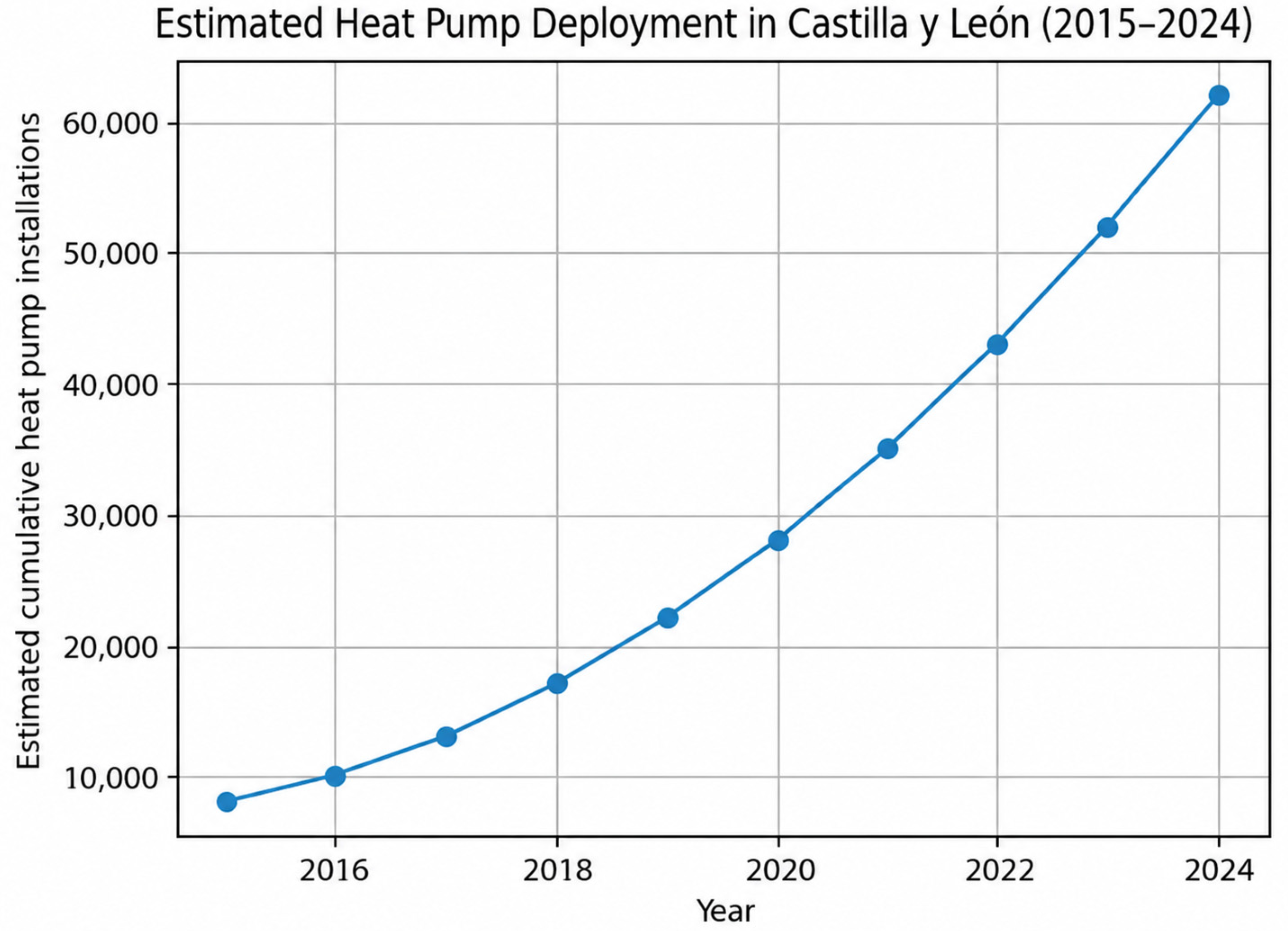
From a broader perspective, national heat pump market data provide additional context for regional estimation. Spain had more than one million heat pump systems installed by the early 2020s, with continuous growth driven by electrification policies and building renovation programs [10]. Considering Castilla y León’s demographic weight (approximately 5% of the national population) and its above-average heating demand, the total stock of heat pump systems in the region can be estimated at approximately 50,000–70,000 units by 2024, including air-to-air and air-to-water systems, with aerothermal heating systems representing a rapidly growing share of new installations.
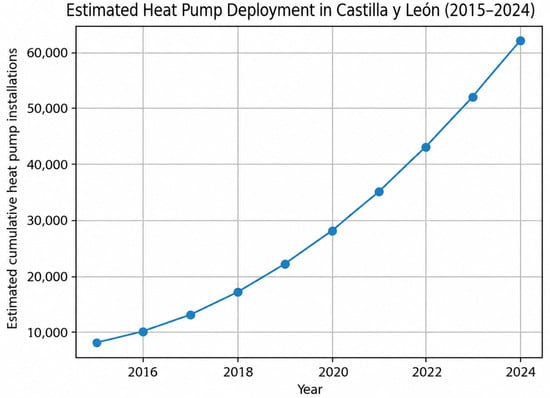
Figure 1 presents an indicative estimate of the cumulative deployment of heat pumps in Castilla y León between 2015 and 2024. The trend is intended to illustrate the progressive expansion of heat-pump technology in the region rather than to represent an official annual installation census. The estimate was constructed from the regional renewable-thermal deployment information and national heat-pump market data discussed above [8,9,10]. Accordingly, the values shown should be interpreted as approximate market-context estimates.
Figure 1.
Indicative estimate of cumulative heat-pump deployment in Castilla y León between 2015 and 2024. The values represent authors’ estimates derived from regional renewable-thermal deployment information and national heat-pump market data [8,9,10] and should not be interpreted as an official annual installation census.
The regional energy context further supports this technological transition. Castilla y León is one of the leading renewable electricity-producing regions in Spain, which facilitates the integration of electrified heating technologies such as heat pumps into the regional energy system [11]. Consequently, the deployment of aerothermal systems is expected to accelerate in the coming decade as building renovation policies, electrification strategies, and renewable energy integration continue to converge at both national and regional levels.
Recent review studies have extensively analysed the technological evolution, system configurations, and techno-economic performance of domestic electric heat pumps, highlighting their central role in the decarbonisation of residential heating and cooling. In particular, comprehensive state-of-the-art reviews have addressed advances in component design, working fluids, control strategies, and modelling methodologies, as well as the integration of heat pumps with photovoltaic systems, thermal energy storage, and smart grids. These works provide a robust theoretical and modelling framework for understanding heat pump performance under a wide range of operating conditions, while also identifying economic and policy-related barriers that may hinder large-scale deployment [12].
In parallel, integrative reviews focused on building retrofitting have consistently identified heat pumps as one of the most frequently proposed and analysed measures for reducing energy consumption and greenhouse gas emissions in existing residential buildings. These studies emphasise the relevance of adapting HVAC and domestic hot water systems to retrofit contexts, particularly in regions with ageing building stocks, and underline the importance of combining heat pump technologies with renewable energy sources and advanced control systems. However, they also point out that much of the existing literature is based on short-term simulations, fragmented case studies, or aggregated modelling approaches, with limited availability of long-term empirical evidence derived from real operating systems [13].
Despite the breadth and depth of these review-based contributions, there remains a notable gap in the literature concerning longitudinal analyses that capture the real-world performance, economic evolution, and environmental impact of heat pump systems over extended periods of operation. This gap is particularly evident for continental climates, where seasonal temperature variability and low winter outdoor temperatures impose demanding conditions on both aerothermal and geothermal systems.
The present study addresses this gap through a field-based assessment with a deliberately bounded scope. The historical evidence comprises more than 200 geothermal and aerothermal systems installed in single-family dwellings across Castilla y León over more than two decades, particularly in Burgos, Palencia, Valladolid, and León. However, monitoring coverage evolved over time: early systems generally provided electrical-consumption records only, whereas newer systems incorporated monitoring of electrical input and useful thermal output. Consequently, no seasonal COP is reconstructed for early installations lacking an independent or manufacturer-reported thermal-energy measurement. The quantitative 2025 analysis is restricted to three tertiary-sector air-to-water systems for which both energy quantities are available. The study addresses three research questions: (RQ1) what technical changes have shaped the deployment of GSHP and ASHP systems in this continental-climate region; (RQ2) what energy performance is observed in the three fully monitored 2025 cases; and (RQ3) which methodological, economic, and environmental factors constrain the transfer of these observations to residential applications and long-term assessments? The original contribution is therefore the combination of a long field-experience perspective with explicitly delimited recent measurements, rather than a claim of homogeneous monitoring across the full 21-year period.
2. Materials and Methods
2.1. Evidence Base and Study Design
The study uses two evidence layers that must not be conflated. Layer A is an historical portfolio of more than 200 residential GSHP and ASHP installations accumulated over more than 21 years. It documents technology type, application experience and the evolution of monitoring practice, but it is not a complete longitudinal measurement dataset. Layer B contains quantitative energy records from recent installations for which useful thermal energy and electrical input are simultaneously available; the 2025 analysis reported here comprises three tertiary-sector air-to-water heat-pump systems. No inferential statistics are applied to the three-case sample because it is too small and purposively selected for detailed field observation.
2.2. Historical Data Coverage and Inclusion Rules
Early residential installations were commonly equipped with electrical energy meters but not with heat meters. For those systems, useful heat output cannot be reconstructed reliably from the archived information and seasonal COP is therefore not calculated in this study. Historical observations without simultaneous thermal-output measurement are used only as qualitative/operational evidence. Quantitative performance statements are restricted to records in which both electrical energy consumption and useful thermal energy are available from integrated monitoring or dedicated metering. This rule directly addresses the different instrumentation levels across the 21-year period and prevents unsupported retrospective COP estimates.
2.3. Performance Indicators and System Boundaries
For the monitored cases, the reported field performance ratio is calculated as COP_field = Q_useful/E_electric over the stated monitoring period, where Q_useful is cumulative useful thermal energy reported for the relevant operating mode and E_electric is the corresponding cumulative electrical energy consumption. These field ratios are not standardized SCOP values obtained under EN 14825:2022 [14] test conditions. For System 3, the total value combines heating, cooling and domestic-hot-water operation and is therefore reported as a combined annual energy ratio rather than as a heating COP. The available records do not permit a consistent disaggregation of circulation pumps, controls, standby consumption, auxiliary heaters and defrost energy for every historical installation; this limitation is explicitly considered when comparing systems.
2.4. Measurement Uncertainty and Data Limitations
A retrospective uncertainty propagation cannot be performed for the complete historical portfolio because meter models, calibration certificates, sampling intervals and component-level system boundaries were not recorded consistently over the full 21-year period. Accordingly, the present study does not assign numerical uncertainty bounds to historical COP values and does not use those records for quantitative long-term COP conclusions. The 2025 results are reported at the resolution available from the installed monitoring systems. In the absence of traceable calibration and accuracy specifications for all channels, the reported ratios should be interpreted as operational field indicators rather than metrological reference measurements. This limitation also precludes defensible confidence intervals or regression models relating performance to outdoor and supply-water temperatures from the currently available dataset.
2.5. Economic and Environmental Assessment Boundaries
The economic and environmental sections are retained as contextual scenario analyses and are not presented as measured outcomes of the three monitored installations. The available submission dataset does not contain complete case-specific investment costs, maintenance costs, subsidies, time-resolved energy tariffs, boiler counterfactuals, or traceable annual emission factors for each installation. Therefore, the analysis excludes unsupported case-specific payback and CO2-reduction claims. Equations and qualitative dependencies are discussed to identify the inputs required for reproducible future comparisons, while numerical NPV, IRR, payback, and avoided-emission results are not reported without the corresponding primary data.
3. Technical Background
3.1. Evolution of Air and Ground Source Heat Pumps for Domestic Use
Air and ground source heat pumps are technologies used in heating, cooling, and domestic hot water production systems that harness natural energy sources. These technologies have experienced significant development over the past decades, especially for domestic use, due to their energy efficiency, sustainability, and increasing economic accessibility [15,16]. Below is a historical and technical overview of their development.
- Air Source Heat Pumps (ASHP):
- 2000s: Major efficiency gains through enhanced compressors, heat exchangers, and eco-friendly refrigerants like R-134a [17]. Inverter-driven compressors offered energy savings, quieter operation, and better performance [18]. ASHPs became primarily used for heating, often in combination with oil boilers for backup [16].
- 2010s: Technological innovations, such as cycle inversion for heating and cooling, along with refrigerants like R-410A, significantly boosted efficiency [19]. The systems evolved to provide both heating and domestic hot water (DHW), eliminating the need for additional energy sources [20].
- 2020s: The shift to low-GWP refrigerants such as R-32 and R-290 reduced environmental impact while improving efficiency [21]. These systems now operate effectively in extreme cold temperatures and seamlessly integrate with photovoltaic systems for optimal energy performance [22,23].
- Ground Source Heat Pumps (GSHP):
- 2000–Present: Breakthroughs in compressor technology, variable speed systems, and ground loop design made GSHPs more affordable and efficient [24]. Installation costs decreased, expanding the technology’s reach to residential users [16].
- 2010s: The integration of smart systems and Variable Refrigerant Flow (VRF) technology enhanced flexibility and efficiency [25]. New refrigerants like R-32 improved overall system performance [21].
- 2020s: GSHPs now operate efficiently at lower temperatures and integrate with renewable energy sources like photovoltaic systems and geothermal energy storage, reducing carbon emissions [26].
- Future Outlook: The integration of AI, hybrid systems, and next-generation refrigerants will further refine energy optimization and performance [27].
In summary, both air- and ground-source heat pumps are transforming the energy landscape, providing efficient and sustainable solutions compatible with renewable energy integration. These technologies are key to a greener, more efficient future [15,22].
3.2. Comparison of Air and Ground Source Heat Pumps
Table 1 shows a comparison of different features of both types of Heat pumps. It is evident that the primary benefits of heat pumps for domestic use are their high energy efficiency and relatively low maintenance cost.
Table 1.
Comparison of air-source and ground-source heat pumps.
Air and ground source heat pumps have become efficient, cost-effective solutions for home heating, cooling, and hot water. While ground source systems are ideal for space-limited areas, vertical systems are more expensive due to drilling costs. Horizontal systems are better suited for larger spaces, and open-loop systems require access to groundwater. Combining photovoltaic systems with air source heat pumps is the most efficient and affordable option for residential use.
4. Economic Aspects and Environmental Impact
Domestic heat pumps are an increasingly popular technology for heating and cooling homes, offering several economic and environmental benefits. Here’s an exploration of both the economic aspects and environmental impacts of domestic heat pumps:
4.1. Economic Aspects
- Initial Costs: The upfront cost of purchasing and installing a heat pump can be significant, with typical installations ranging from 5000 € to 15,000 €, depending on the type of system, air-source, ground-source, or water-source systems. Ground-source heat pumps generally have higher installation costs due to the need for ground loop systems [28,29].
- Operational energy use: For a common useful heating demand, an ideal electric-resistance heater requires approximately one unit of electricity per unit of useful heat, whereas a heat pump with COP = 3–5 requires approximately 0.33–0.20 units of electricity. This corresponds to an approximate 67–80% reduction in electricity use relative to resistance heating for the same useful heat demand, before accounting for auxiliaries and system-boundary differences. This comparison concerns electricity consumption, not a generic percentage increase in ‘efficiency’.
- Energy Savings: Over the long term, heat pumps can result in substantial savings on heating bills. The amount saved depends on the type of heat pump, local energy prices, and climate conditions. For example, heat pumps offer significant savings in regions with moderate heating and cooling needs [28].
- Incentives and Subsidies: In many regions, governments and utilities provide financial incentives to encourage the adoption of heat pumps. These incentives can include rebates, tax credits, and reduced-interest loans. In some places, incentives can cover a significant portion of the upfront costs, improving the economic feasibility of heat pumps for homeowners [29,30,31].
- Payback and investment metrics: Published payback ranges depend strongly on investment cost, displaced fuel, energy tariffs, maintenance, subsidies and reference-system efficiency. Because complete case-specific financial inputs are not available for all installations in the present dataset, no universal or case-specific payback period is claimed in this study. A reproducible future assessment should report these inputs explicitly and, where appropriate, include NPV, IRR and sensitivity to energy prices, inflation and subsidy level.
- Maintenance Costs: Heat pumps require regular maintenance to ensure they continue operating efficiently, which may add to long-term costs. However, maintenance costs are generally lower than those of traditional heating systems (such as boilers), as they have fewer moving parts and do not require fuel delivery [28].
4.2. Environmental Impact
- Operational greenhouse-gas emissions: A quantitative comparison requires a common useful-heating demand, the measured seasonal heat-pump performance, the electricity emission factor for a specified reference year, the fuel emission factor, and the efficiency of the counterfactual boiler. Because these complete, time-consistent inputs are not available for every investigated installation in the submitted dataset, the revision does not report a numerical percentage reduction in CO2 emissions. Refrigerant leakage and embodied impacts are outside the operational boundary considered here and are identified as limitations.
- Energy Efficiency: Heat pumps are highly efficient. As mentioned, for every unit of electrical energy consumed, 3–5 units of thermal energy are produced, making them a much more efficient option than traditional heating systems, which often convert less than 100% of the energy into usable heat [15,28].
- Lower Environmental Impact of Manufacturing: Although the manufacturing of heat pumps requires materials such as metals and refrigerants, the overall environmental impact is generally lower compared to the production and maintenance of fossil fuel-based heating systems [32]. Life-cycle assessment (LCA) studies show that most environmental impacts of heat pumps occur during the operational phase rather than manufacturing, and total life-cycle emissions remain significantly lower than combustion-based heating systems when electricity decarbonization is considered [32,33].
- Potential for Electrification: Heat pumps are an integral part of the electrification of heating systems, contributing to the reduction of reliance on fossil fuels. As electricity generation shifts to cleaner, renewable sources, the environmental benefits of using heat pumps will increase [15,26].
- Resource Efficiency: Heat pumps extract heat from natural sources, air, ground, or water, that would otherwise be wasted, making them a resource-efficient solution for domestic heating and cooling [28].
- Potential for Reduced Land Use: Ground-source heat pumps, although more expensive to install, use underground space for heat exchange rather than relying on external fossil fuel infrastructure, contributing to a reduced land use impact compared to traditional energy sources [34].
- Refrigerant Considerations: Heat pumps use refrigerants to transfer heat. Historically, refrigerants like HFCs (hydrofluorocarbons) have been used, which are potent greenhouse gases. However, newer systems use more environmentally friendly refrigerants like R-32, which have much lower global warming potentials, GWP. Ongoing research and development into refrigerant technology aim to make heat pumps even more sustainable in terms of environmental impact [21,35].
For clarity, the economic and environmental considerations presented in this work are based on typical operating conditions for residential heating systems in Castilla y León. The economic assessment assumes representative installation costs and electricity prices consistent with recent Spanish residential energy tariffs, while the reference systems used for comparison correspond primarily to conventional fossil-fuel heating systems, particularly gas and oil boilers commonly used in the region. Environmental impact estimations are derived from standard electricity emission factors reported for the Spanish electricity mix and from typical combustion emission factors associated with fossil-fuel heating systems. These assumptions provide a consistent framework for evaluating the relative economic and environmental performance of heat pump technologies under continental climate conditions.
5. Market Context
This section provides limited market context for the technological evolution discussed above. Manufacturer examples are descriptive and are not used to rank products or infer the performance of the monitored installations. Product-specific values originate from cited manufacturer or certification documentation and should be interpreted as declared operating characteristics rather than independent field measurements.
The convergence between these two technological traditions has significantly accelerated the technical maturity and market penetration of air-to-water heat pump systems across Europe. In continental regions such as Castilla y León, where cold winters and radiator-based heating systems are common, this technological convergence has been particularly important for enabling the large-scale deployment of aerothermal heating solutions.
5.1. Technology–Market Convergence
Manufacturers originating from the HVAC and refrigeration sector have historically focused on thermodynamic cycle optimisation, compressor performance, refrigerant management, and electronic system control. Their technological developments have been particularly important in improving system efficiency under low ambient temperatures and partial-load operating conditions.
- Daikin
Daikin has played a leading role in the technological development of air-to-water heat pump systems through sustained innovation in inverter-driven compressors, optimized refrigerant circuitry, and the early large-scale adoption of low-global-warming-potential refrigerants. These developments have resulted in systems characterized by high seasonal efficiencies (SCOP), precise capacity modulation, and reliable operation under low outdoor temperature conditions, which is particularly relevant for inland and continental climates [36].
Recent developments within the Altherma product range place strong emphasis on retrofit and boiler-replacement applications. High-temperature air-to-water heat pumps are capable of delivering leaving water temperatures of up to approximately 70–75 °C, enabling compatibility with existing radiator-based heating systems commonly found in residential buildings undergoing energy renovation [37]. The operating envelope has been extended to allow stable heating operation at ambient temperatures down to approximately −28 °C [36,38].
A major technological transition has been the introduction of R290 (propane) as a natural refrigerant in residential aerothermal systems. This transition significantly reduces the Global Warming Potential of the refrigerant while anticipating future European F-gas regulatory requirements [39]. In parallel, Daikin systems incorporate advanced digital control architectures enabling remote monitoring, energy management, and integration with smart-grid and photovoltaic self-consumption environments [40].
- Mitsubishi Electric
Mitsubishi Electric has contributed significantly to the development of air-to-water heat pump technology through advanced compressor control strategies and vapour injection techniques. In particular, the ZUBADAN system is designed to maintain nominal heating capacity at sub-zero outdoor temperatures, addressing one of the traditional limitations of aerothermal systems in cold inland climates [41].
The company’s Ecodan range includes residential heat pump systems based on inverter-driven compressors and low-GWP refrigerants. R32 units provide heating, cooling, and domestic hot water production while maintaining reliable operation at outdoor temperatures down to approximately −30 °C [42,43]. In addition, Mitsubishi Electric has introduced systems using the natural refrigerant R290, combining high seasonal efficiency with reduced environmental impact [44].
These systems are capable of delivering supply water temperatures of up to approximately 70 °C, enabling compatibility with both radiant floor heating systems and higher-temperature heat emitters used in retrofit applications [43,45]. Advanced control systems incorporate weather-compensated regulation and adaptive compressor modulation, while communication protocols such as Modbus and KNX enable integration with building automation and energy management systems [46].
- Panasonic
Panasonic has played an important role in the transition toward low-global-warming-potential refrigerants in residential aerothermal systems, particularly through the adoption of the natural refrigerant R290 (propane). Its design approach emphasises thermodynamic efficiency, reduced refrigerant charge, and compliance with evolving European environmental regulations [47].
The company’s Aquarea range includes air-to-water heat pumps designed for both new construction and retrofit applications, available in monobloc and split configurations [48]. The introduction of R290-based units complements existing R32 solutions and contributes to achieving very low Global Warming Potential values in residential heating systems [49].
From a performance perspective, high-temperature Aquarea systems can deliver leaving water temperatures of up to approximately 75 °C, allowing compatibility with conventional radiator systems in renovation projects [50]. Operation at outdoor temperatures down to approximately −25 °C is maintained depending on the model, while seasonal efficiency levels comply with EN 14825 and ErP requirements, with several systems achieving A+++ energy classifications [48,51].
Advanced control architectures include cloud-based monitoring and energy management platforms that enable remote supervision, weather-compensated control strategies, and integration with photovoltaic installations and smart-grid environments [52,53].
- LG
LG Electronics has progressively expanded its HVAC activities from conventional air-conditioning systems toward integrated climate control solutions incorporating high-efficiency heat pump technologies. This evolution has been supported by the development of inverter compressors, advanced electronic control systems, and digital connectivity platforms [54].
Aerothermal solutions are primarily represented by the Therma V product range, which includes air-to-water heat pumps for space heating, cooling, and domestic hot water production [55]. These systems are available in monobloc, split, and hydro-split configurations, enabling flexible integration into residential and light commercial hydronic systems.
Recent developments have focused on improving seasonal performance indicators, expanding operating envelopes for cold-climate operation, and adopting low-GWP refrigerants such as R32 and R290 [56,57]. These systems also incorporate digital platforms for remote monitoring, energy management, and integration with building automation environments.
- Samsung Climate Solutions
Samsung Climate Solutions has developed its HVAC technology based on strong expertise in electronics, power control, and system integration. The technological evolution from conventional air-conditioning systems toward advanced heat pump technologies has been supported by developments in inverter compressors, electronic expansion valves, and digital control architectures [58].
The company’s aerothermal solutions are primarily represented by the Eco Heating System (EHS) range, which integrates space heating, cooling, and domestic hot water production within a single platform [59]. These systems incorporate vapour injection technologies to improve performance at low ambient temperatures and operate across extended temperature envelopes suitable for continental climates.
Recent developments include the adoption of low-GWP refrigerants such as R32 and R290, together with enhanced connectivity through IoT platforms such as SmartThings. These technologies enable remote monitoring, advanced control functions, and integration with smart-home and smart-grid environments.
5.2. Hydronic Retrofit Context
A second group of manufacturers originates from the traditional heating sector. These companies possess extensive experience in hydronic distribution systems, thermal comfort optimisation, and hydraulic system stability. Their transition toward heat pump technology has been driven primarily by the need to integrate electrified heating solutions into existing radiator-based heating infrastructures.
- Viessmann
Viessmann has developed its heat pump technologies based on long-standing expertise in thermal engineering and hydronic heating systems. Since the early development of the Vitocal product range, the company has progressively incorporated inverter compressors, weather-compensated control strategies, and digital energy management systems into residential air-to-water heat pumps [60,61].
Modern Viessmann systems increasingly employ natural refrigerants such as R290 and are capable of delivering higher supply temperatures compatible with conventional radiator systems, making them particularly suitable for residential retrofit applications.
- Vaillant
Vaillant has consolidated its position in the residential aerothermal market through high-temperature heat pump solutions based on the natural refrigerant R290. The aroTHERM plus system is capable of delivering supply temperatures of up to approximately 75 °C while maintaining operation at outdoor temperatures down to −25 °C [62].
The integration of hydraulic modules such as the uniTOWER enables compact system configurations suitable for renovation projects. Advanced control systems provide multi-zone regulation, photovoltaic self-consumption compatibility, and remote monitoring capabilities [63]. These systems achieve seasonal performance values exceeding SCOP 4.5 while maintaining low acoustic emissions [64].
- Bosch Thermotechnology
Bosch Thermotechnology has oriented its development strategy toward the electrification of residential heating systems through the integration of aerothermal technology, photovoltaic self-consumption, and advanced connectivity platforms.
The Compress 5800i AW heat pump represents the current R290-based air-to-water solution in the Spanish market, offering A+++ energy efficiency ratings and supply temperatures of up to approximately 60 °C [65]. These systems incorporate integrated connectivity through digital control platforms, enabling remote monitoring and integration with smart home environments [66]. The transition toward natural refrigerants aligns with European F-gas regulations and nearly zero-energy building requirements [67].
- Stiebel Eltron
Stiebel Eltron specialises in high-efficiency aerothermal and geothermal systems designed for passive and low-energy buildings. Its heat pump solutions employ R290 refrigerant and can achieve supply temperatures of up to approximately 75 °C while maintaining high seasonal efficiency ratings [68].
Advanced control systems, including the WPM System and ISG gateway, enable remote management, multi-zone control, and integration with photovoltaic installations and smart-grid signals [69]. The company also offers integrated ventilation and heat pump systems for highly efficient residential buildings [70,71].
- NIBE
The Swedish manufacturer NIBE has historically focused on geothermal heat pump technologies and hydronic heating systems designed for low-temperature distribution. Its technical developments include inverter-controlled compressors and advanced thermal storage management strategies integrated with hydronic heating systems [72,73].
NIBE systems prioritise hydraulic stability, thermal inertia management, and long-term operational reliability, particularly in applications combining radiant floor heating with geothermal heat pump technologies [74,75].
- Baxi
Baxi has played an important role in the Spanish heating market through the development of compact aerothermal systems and hybrid heating solutions aimed at replacing conventional gas and oil boilers in existing dwellings. Recent developments incorporate natural refrigerants such as R290, enabling supply temperatures of up to approximately 80 °C and facilitating direct replacement of high-temperature boiler systems [76,77].
These systems achieve high seasonal efficiency levels and incorporate advanced control architectures supporting smart-home connectivity and integration with building management systems [78,79].
- Ferroli
Ferroli has contributed to the expansion of the residential aerothermal market through cost-effective and technically simplified solutions designed for compatibility with conventional hydronic heating systems. The Omnia product range includes air-to-water heat pumps capable of delivering supply temperatures of up to approximately 75 °C while maintaining operation at outdoor temperatures down to approximately −25 °C [80,81].
Advanced control architectures allow cascade operation, dynamic heating curves, and integration with smart-grid environments, supporting efficient system operation in residential applications [82].
5.3. Market Implications
The convergence between refrigeration-based and boiler-based manufacturers has resulted in heat pump systems that combine high thermodynamic efficiency with system-level robustness and retrofit capability. In regions such as Castilla y León, where cold winters, existing radiator systems, and dispersed single-family housing are common, this convergence has been essential for market consolidation.
As a result, heat pumps have evolved from niche solutions to a technically mature and versatile technology, capable of meeting the demands of both new buildings and energy renovation projects in continental climates.
5.4. Descriptive Technical Comparison
Table 2 summarizes the main technical characteristics of representative heat pump solutions currently available in the Spanish market. The comparison highlights differences in refrigerants, operating temperature ranges, system typology, and suitability for continental climates such as Castilla y León.
Table 2.
Comparative technical characteristics of representative air-to-water heat pump manufacturers.
- Technical Interpretation of the Table
- HVAC/electronics-based manufacturers primarily excel in electronic control, connectivity, inverter modulation, and power electronics, driving innovation at the component and system-control level.
- Hydronic heating specialists distinguish themselves through retrofit compatibility, hydraulic stability, thermal comfort, and long-term operational reliability, particularly in water-based distribution systems.
- R290 (propane) has clearly emerged as the key refrigerant for high-temperature air-to-water heat pumps, enabling compliance with forthcoming F-Gas regulations while supporting radiator-based retrofit applications.
- Retrofit capability with existing radiators has become one of the most decisive technical differentiators in the current European residential heat pump market.
6. Results: Monitored Installations (2025)
Discussion of Experimental Evidence
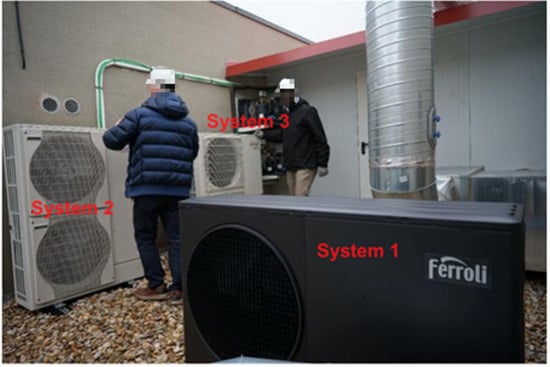
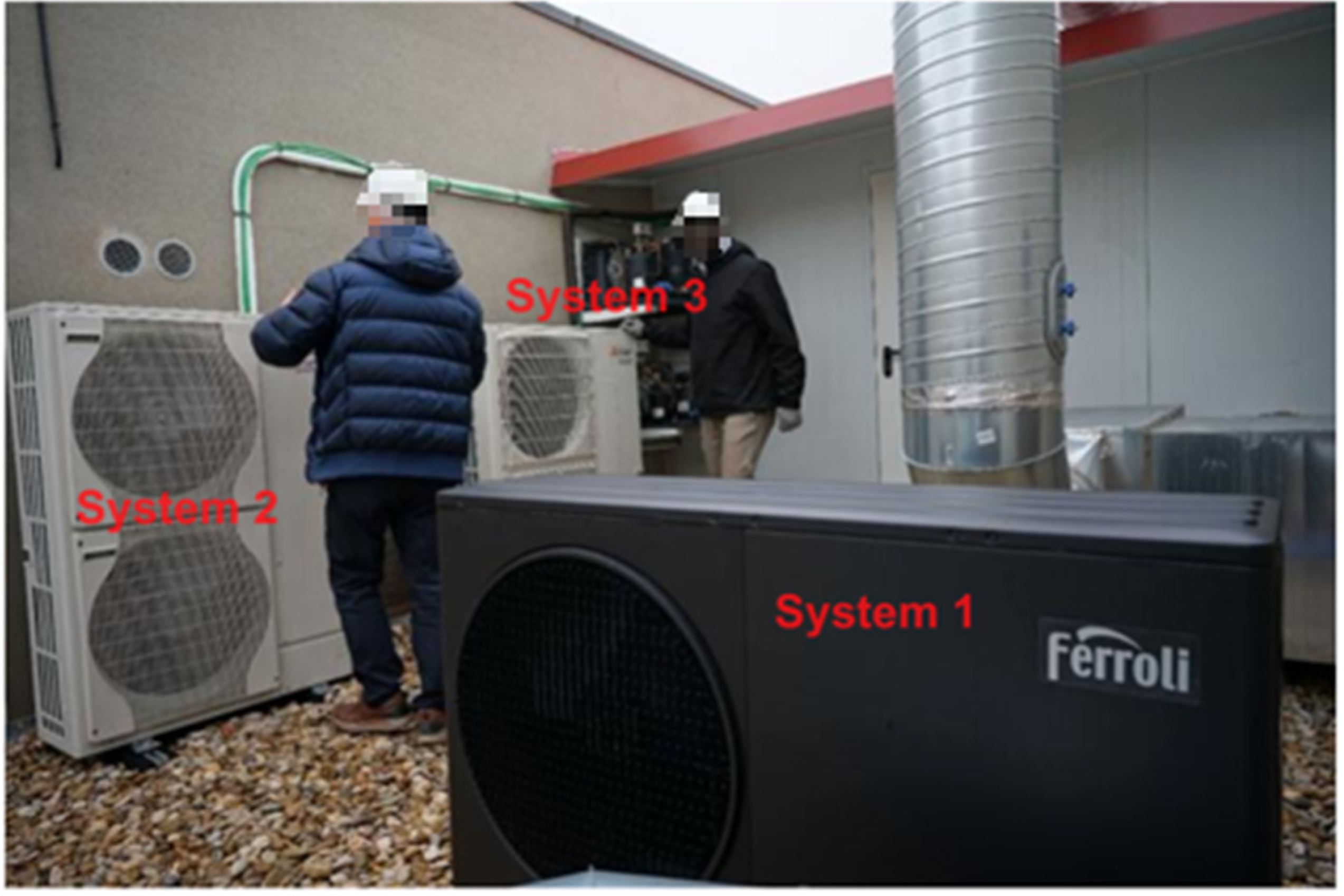
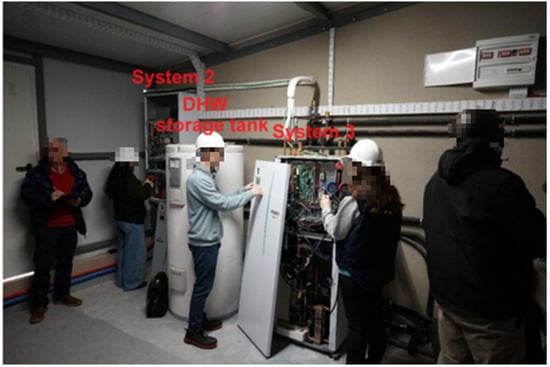
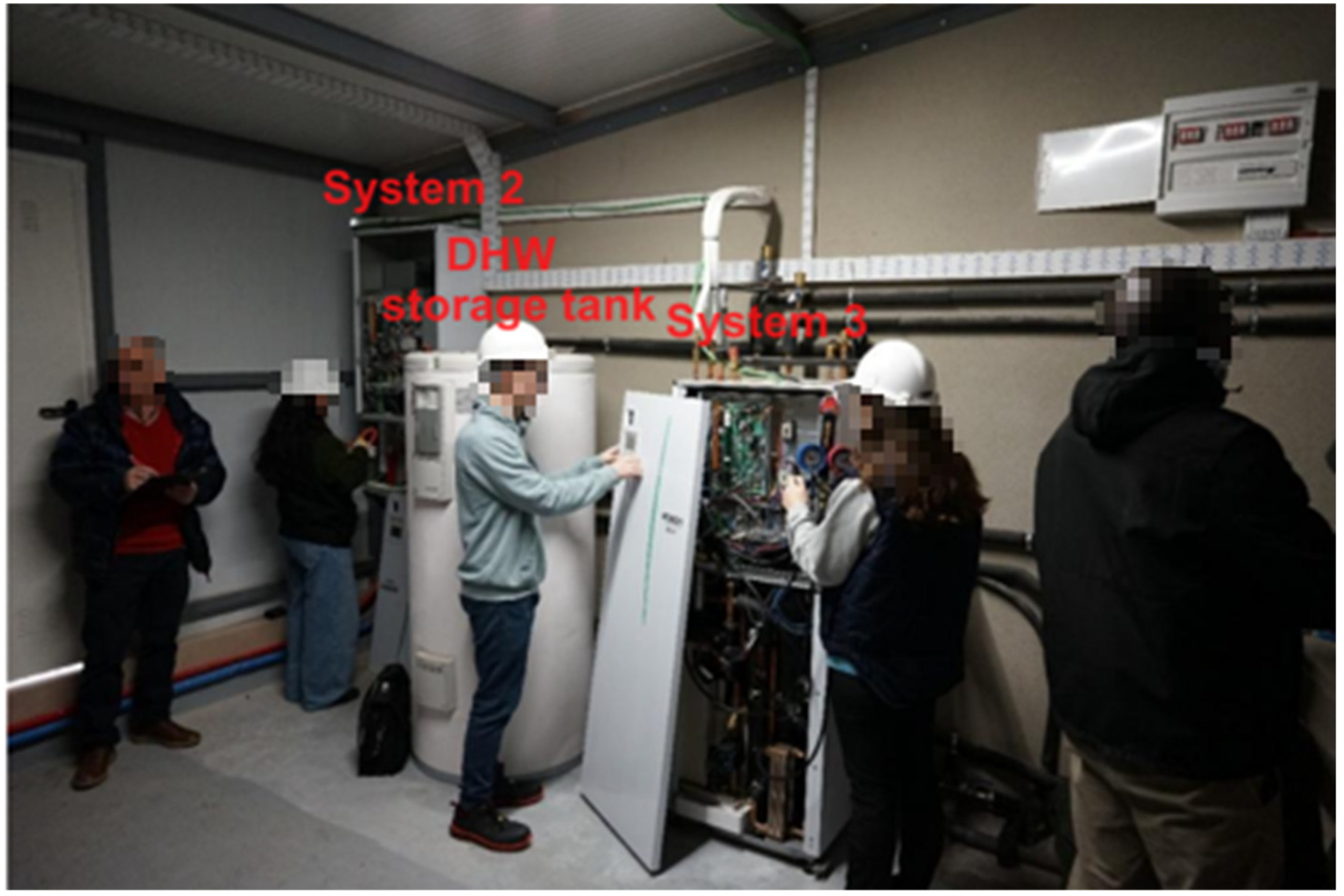
Across the three 2025 tertiary-sector air-to-water systems, the reported cumulative energy ratios range from 3.85 to 4.17. These values describe the monitored cases only and are not used to validate a 21-year residential COP range. The available aggregate energy records do not independently isolate the effects of outdoor temperature, supply/return temperature, building load, emitter type or control strategy; therefore, those factors are discussed as plausible engineering influences rather than as statistically demonstrated causal effects in this dataset. The monitored installations corresponding to Systems 1–3 are shown in Figure 2 and Figure 3.
Figure 2.
Outdoor air-to-water heat pump units of the monitored installations (Systems 1–3).
Figure 3.
Indoor hydraulic modules and DHW storage tank of the monitored heat pump installations (Systems 1–3).
The three monitored installations demonstrate technically effective operation of modern air-to-water heat pumps in tertiary buildings under the regional climate. Their hydronic configurations are relevant to residential practice, but differences in occupancy, load profile, domestic-hot-water demand and control prevent direct statistical extrapolation to residential buildings. These cases also provide no direct measured evidence for ground-source systems; conclusions concerning GSHPs are therefore limited to the historical field context and cited literature. The main performance results obtained for the three monitored systems are summarized in Table 3.
Table 3.
Performance of monitored heat pump systems in tertiary buildings (2025).
7. Discussion and Limitations
The interpretation separates what is directly measured from what is inferred from long-term professional experience. The 2025 sample contains only three tertiary-sector ASHP installations and is not statistically representative of the more than 200 historical residential installations. Accordingly, no confidence intervals, population statistics or regression relationships are claimed. The cases nevertheless provide transparent field energy balances for distinct hydronic applications and illustrate the level of performance achievable in the monitored systems.
The principal limitation of the historical evidence is instrumentation heterogeneity. Early installations with electricity meters alone cannot support a defensible seasonal COP because useful thermal output was not measured. Meter models, calibration histories, sampling intervals and auxiliary-energy boundaries are also incomplete for parts of the archive. These limitations are now treated as constraints on the conclusions rather than being bridged by retrospective estimation.
Economic and environmental conclusions are likewise bounded by data availability. Case-specific NPV, IRR, payback and avoided-emission calculations would require installation-level capital and maintenance costs, energy prices, subsidies, counterfactual boiler efficiencies, reference-year emission factors and, for a life-cycle assessment, refrigerant leakage and embodied impacts. These inputs were not recorded consistently for the historical portfolio and are therefore not reconstructed in the present study.
Future work should establish a harmonized monitoring protocol across a larger residential sample, including traceable electrical and thermal meters, outdoor and supply/return temperatures, flow rates, auxiliary consumption, defrost events and control settings. Such a dataset would permit uncertainty propagation, confidence intervals and multivariable analysis of performance as a function of climate and water temperature.
8. Conclusions
This study combines more than 21 years of accumulated field experience from over 200 residential heat-pump installations in Castilla y León with detailed 2025 energy data from three tertiary-sector air-to-water systems. The study clarifies that the historical portfolio is not a homogeneous monitored dataset: early installations lacking useful-heat measurements are not used to calculate seasonal COP.
For the three monitored 2025 cases, cumulative useful-energy-to-electricity ratios ranged from 3.85 to 4.17. These results demonstrate effective operation in the investigated tertiary applications, but the small purposive sample does not support statistical generalization to residential buildings, ground-source systems or other continental climates. Likewise, aggregate energy ratios alone do not establish causal effects of emitter temperature, hydraulic integration or outdoor temperature.
The long-term field experience remains useful for documenting technological evolution and practical deployment, while the quantitative conclusions are intentionally restricted to the measurements supported by the available instrumentation. Economic and environmental benefits are discussed as context-dependent scenarios; case-specific payback, NPV/IRR and CO2-reduction claims require additional primary data and are therefore not asserted here. Future harmonized monitoring across a larger residential sample is needed for uncertainty analysis, statistical inference and direct ASHP–GSHP comparison.
Author Contributions
Conceptualization, J.M.G.A.; methodology, J.M.G.A. and D.G.P.; formal analysis, J.M.G.A. and D.G.P.; investigation, J.M.G.A., D.G.P., O.W., J.S.C.B. and C.A.T.; writing—original draft preparation, J.M.G.A.; writing—review and editing, J.M.G.A., D.G.P., O.W., J.S.C.B. and C.A.T.; supervision, J.M.G.A. and C.A.T. Project Administration: C.A.T.; D.G.P. Funding Acquisition: C.A.T. All authors have read and agreed to the published version of the manuscript.
Funding
This research was funded by Project PDC2022-133419-I00, funded by MCIN/AEI/10.13039/501100011033 and by the European Union NextGenerationEU/PRTR, Project PID2025-172342OB-I00 funded by MICIU/AEI/10.13039/501100011033 and Project BU042G24, funded by Junta de Castilla y León.
Data Availability Statement
The original contributions presented in this study are included in the article. The historical portfolio is not a homogeneous monitoring dataset, and installation-level records may contain commercially or operationally sensitive information. Further inquiries can be directed to the corresponding author.
Conflicts of Interest
The authors declare no conflicts of interest.
References
- European Commission: Directorate-General for Climate Action. Going Climate-Neutral by 2050—A Strategic Long-Term Vision for a Prosperous, Modern, Competitive and Climate-Neutral EU Economy, Publications Office. 2019. Available online: https://data.europa.eu/doi/10.2834/02074 (accessed on 24 September 2026).
- Vicepresidencia Cuarta del Gobierno de España. The Long-Term Strategy for a Modern, Competitive, and Climate-Neutral Spanish Economy by 2050; NIPO: 665-20-015-X; Ministerio para la Transición Ecológica y el Reto Demográfico (MITECO): Madrid, Spain, 2020.
- Gobierno de España—Ministerio de Vivienda y Agenda Urbana. Plan Nacional de Renovación de Edificios (PNRE). 2025. Available online: https://www.codigotecnico.org/noticias/2025-11-28-audiencia-informacion-publica-PNRE.html (accessed on 24 September 2026).
- European Union. Directive (EU) 2024/1275 on the Energy Performance of Buildings (EPBD). 2024. Available online: https://www.boe.es/buscar/doc.php?id=DOUE-L-2024-80664 (accessed on 24 September 2026).
- Ministerio Para la Transición Ecológica y el Reto Demográfico (MITECO). Plan Nacional Integrado de Energía y Clima 2023–2030 (PNIEC). 2024. Available online: https://miteco.es (accessed on 24 September 2026).
- Gobierno de España. Spain 2050—Foundations and Proposals for a Long-Term National Strategy. 2021. Available online: https://futuros.gob.es (accessed on 24 September 2026).
- Odyssee-Mure Project, Energy Efficiency Trends and Policies in Spain. 2025. Available online: https://www.odyssee-mure.eu (accessed on 24 September 2026).
- IDAE. Programas de Incentivos a Energías Renovables Térmicas—Castilla y León, Instituto Para la Diversificación y Ahorro de la Energía. 2024. Available online: https://sede.idae.gob.es (accessed on 24 September 2026).
- REPLACE Project, Statistical Inventory of the Heating Systems Market in Castilla y León, European Union Horizon 2020 Project. 2021. Available online: https://replace-project.eu (accessed on 24 September 2026).
- European Commission Joint Research Centre (JRC). Heat Pumps in the European Union—Market Status Report. 2023. Available online: https://publications.jrc.ec.europa.eu (accessed on 24 September 2026).
- Red Eléctrica de España. The Spanish Electricity System Report. 2023. Available online: https://www.sistemaelectrico-ree.es/sites/default/files/2024-03/ISE_2023.pdf (accessed on 24 September 2026).
- Olympios, A.V.; Sapin, P.; Mersch, M.; Maghrabi, A.M.; Markides, C.N. A review of recent progress in the design and integration of domestic heat pumps. Next Energy 2024, 5, 100163. [Google Scholar] [CrossRef] [Scilit]
- Krajcik, M.; Arıcı, M.; Ma, Z. Trends in research of heating, ventilation and air conditioning and hot water systems in building retrofits: Integration of review studies. J. Build. Eng. 2023, 76, 107426. [Google Scholar] [CrossRef] [Scilit]
- EN 14825:2022; Air Conditioners, Liquid Chilling Packages and Heat Pumps, with Electrically Driven Compressors, for Space Heating and Cooling, Commercial and Process Cooling—Testing and Rating at Part Load Conditions and Calculation of Seasonal Performance. European Committee for Standardization (CEN): Brussels, Belgium, 2022.
- International Energy Agency (IEA). The Future of Heat Pumps, Paris. 2022. Available online: https://www.iea.org/reports/the-future-of-heat-pumps (accessed on 24 September 2026).
- European Heat Pump Association (EHPA). Market Report 2023; EHPA: Brussels, Belgium, 2023. [Google Scholar]
- ASHRAE. ASHRAE Handbook—HVAC Systems and Equipment, 2004–2008 ed.; ASHRAE: Atlanta, GA, USA, 2008. [Google Scholar]
- Dechesne, B.J.; Tello-Oquendo, F.M.; Gendebien, S.; Lemort, V. Residential air-source heat pump with refrigerant injection and variable speed compressor: Experimental investigation and compressor modeling. Int. J. Refrig. 2019, 108, 79–90. [Google Scholar] [CrossRef] [Scilit]
- JRC European Commission. Heat Pumps in the European Union—2010–2020 Development; JRC European Commission: Brussels, Belgium, 2021.
- IEA Heat Pump Centre. Heat Pumps for Domestic Hot Water Systems; IEA Heat Pump Centre: Sittard, The Netherlands, 2010. [Google Scholar]
- European Commission. F-Gas Regulation and Refrigerant Transition Report; European Commission: Brussel, Belgium, 2020.
- IEA. Net Zero by 2050—Buildings Sector; IEA: Paris, France, 2021. [Google Scholar]
- EHPA. Heat Pumps and Solar Integration; EHPA: Brussels, Belgium, 2022. [Google Scholar]
- Self, S.J.; Reddy, B.V.; Rosen, M.A. Ground source heat pumps: Status review. Renew. Sustain. Energy Rev. 2013, 15. [Google Scholar]
- Iwata, I.; Kumakura, E.; Furusho, K. Evaluation of Performance of VRF Air Conditioning Systems Using Low GWP Refrigerants. Trans. Jpn. Soc. Refrig. Air Cond. Eng. 2018, 35, 173–180. [Google Scholar] [CrossRef]
- IPCC. Sixth Assessment Report—Buildings Sector; IPCC: Geneva, Switzerland, 2022. [Google Scholar]
- IEA Technology Collaboration Programme on Heat Pumps. Digitalization and Heat Pumps; HPT TCP: Borås, Sweden, 2023. [Google Scholar]
- IDAE. La Bomba de Calor en la Rehabilitación Energética de Edificios, Instituto Para la Diversificación y Ahorro de la Energía, Madrid. 2023. Available online: https://www.idae.es/sites/default/files/documentos/publicaciones_idae/Guias_IDAE_La_Bomba_de_calor_2023_V11.pdf (accessed on 24 September 2026).
- IDAE. Programa de Incentivos a Energías Renovables Térmicas en Edificios (PRTR), Ministerio Para la Transición Ecológica. 2022. Available online: https://www.idae.es (accessed on 24 September 2026).
- IDAE. Bombas de Calor Para Calefacción y Producción de ACS; Instituto Para la Diversificación y Ahorro de la Energía: Madrid, Spain, 2020. [Google Scholar]
- Junta de Castilla y León—EREN. Programas Regionales de Ayudas a Renovables Térmicas en Edificios. 2023. Available online: https://energia.jcyl.es (accessed on 24 September 2026).
- Hepbasli; Kalinci, Y. A review of heat pump water heating systems and life-cycle climate performance. Renew. Sustain. Energy Rev. 2009, 13. [Google Scholar]
- European Commission Joint Research Centre (JRC). Environmental Life Cycle Assessment of Heating Technologies; JRC: Brussels, Belgium, 2021.
- IEA Heat Pump Centre. Ground Source Heat Pumps Overview; IEA Heat Pump Centre: Borås, Sweden, 2020. [Google Scholar]
- EHPA. Low-GWP Refrigerants in Heat Pump Technology; EHPA: Brussels, Belgium, 2023. [Google Scholar]
- Vulnerabilidades del Grupo Daikin Europa. Daikin Altherma 4—Product Overview. 2024. Available online: https://www.daikin.es/es_es/hogar/productos-y-recomendaciones/gama-productos/equipos-aerotermia/daikin-altherma/daikin-altherma-4.html (accessed on 24 September 2026).
- Vulnerabilidades del Grupo Daikin Europa. Daikin Altherma 4 Silent—High Temperature Air-to-Water Heat Pump. 2024. Available online: https://www.daikin.es/es_es/grupo-de-productos/bomba-de-calor-aire-agua-alta-temperatura/daikin-altherma-4-silent.html (accessed on 24 September 2026).
- Daikin Central Europe. Daikin Altherma 4 H Unveiled, Press Release. 2024. Available online: https://www.daikin-ce.com/en_us/press-releases/2024/daikin-altherma-4-h-unveiled.html (accessed on 24 September 2026).
- Cooling Post. Daikin introduces first domestic R290 heat pump. 2023. Available online: https://www.coolingpost.com/products/daikin-introduces-first-domestic-r290-heat-pump/ (accessed on 24 September 2026).
- Daikin UK. Daikin Altherma 4 H—Connectivity and Control Features. 2024. Available online: https://www.daikin.co.uk/en_gb/residential/products-and-advice/product-categories/heat-pumps/air-to-water-heat-pumps/daikin-altherma-4.html (accessed on 24 September 2026).
- Mitsubishi Electric. ZUBADAN Technology—Air Source Heat Pumps for Extreme Cold Climates, Product Documentation. 2023. Available online: https://www.mitsubishielectric.es/aire-acondicionado/profesionales/producto/grandes-proyectos/sistemas-vrf-caudal-variable/bomba-de-calor/zubadan-2/ (accessed on 24 September 2026).
- Mitsubishi Electric. Ecodan ECO Inverter R32—Technical Overview. 2024. Available online: https://www.mitsubishielectric.es/aire-acondicionado/producto/aerotermia/tecnologias-unidades-exteriores/ (accessed on 24 September 2026).
- Mitsubishi Electric. Ecodan R32 Reversible Heat Pumps—Performance Data. 2024. Available online: https://library.mitsubishielectric.co.uk/pdf/download_full/4156 (accessed on 24 September 2026).
- Mitsubishi Electric. R290 Heat Pump Solutions—Low GWP and Acoustic Performance. 2024. Available online: https://www.mitsubishielectric.es/aire-acondicionado/producto/aerotermia/serie-puz-wz-con-refrigerante-r290/ (accessed on 24 September 2026).
- Mitsubishi Electric. Hybrid PXZ Systems—Combined Air/Air and Air/Water Solutions. 2023. Available online: https://www.mitsubishielectric.es/aire-acondicionado/producto/aerotermia/ecodan-hibrido-con-serie-pxz/ (accessed on 24 September 2026).
- Mitsubishi Electric. Building Integration Interfaces—KNX and Modbus Compatibility, Technical Guide. 2023. Available online: https://www.mitsubishielectric.es/aire-acondicionado/profesionales/producto/grandes-proyectos/control-licencias/sistemas-de-integracion-2/ (accessed on 24 September 2026).
- Panasonic Corporation. Panasonic Heating & Cooling—Environmental Vision and Refrigerant Strategy. 2023. Available online: https://holdings.panasonic/global/corporate/sustainability.html (accessed on 24 September 2026).
- Panasonic Heating & Cooling Solutions. Aquarea Air-to-Water Heat Pumps—Product Overview. 2024. Available online: https://www.aircon.panasonic.eu/GB_en/happening/aquarea-heat-pump-line-up/ (accessed on 24 September 2026).
- Panasonic Heating & Cooling Solutions. Aquarea R290 Heat Pump Range. 2024. Available online: https://www.aircon.panasonic.eu/GB_en/product/all-in-one-m-series-1-phase-3-phase-r290/ (accessed on 24 September 2026).
- Panasonic Heating & Cooling Solutions. Aquarea High Temperature Heat Pumps—Technical Data. 2024. Available online: https://www.aircon.panasonic.eu/GB_en/ranges/aquarea/t-cap/ (accessed on 24 September 2026).
- Panasonic Heating & Cooling Solutions. ErP and Seasonal Efficiency Data for Aquarea Systems. 2024. Available online: https://www.panasonicproclub.com/uploads/LT/catalogues/Aquarea_range_2025-2026.pdf (accessed on 24 September 2026).
- Panasonic Heating & Cooling Solutions. Aquarea Smart Cloud and Advanced Control Functions. 2024. Available online: https://www.aircon.panasonic.eu/ES_es/happening/04-aquarea-smart-cloud/ (accessed on 24 September 2026).
- Panasonic Heating & Cooling Solutions. Smart Grid, PV Integration and HEMS Compatibility. 2023. Available online: https://www.aircon.panasonic.eu/GB_en/happening/aquarea-pv-panels/ (accessed on 24 September 2026).
- LG Corporation. History|About LG|LG. LG CORPORATION. 2013–2018. Available online: https://www.lgcorp.com/about/history/3 (accessed on 3 February 2026).
- LG Electronics. Catálogo Aerotermia 2024—Soluciones de Aerotermia Therma V R290, LG España. 2024. Available online: https://www.lg.com/content/dam/channel/wcms/es/business/climatizacion/gama-residencial/thermav-r290/Catalogo_Aerotermia-2024_DIGITAL.pdf (accessed on 24 September 2026).
- LG Electronics. LG Reinforces Strong Position in the European HVAC Market With Energy Efficient Solutions. LG Newsroom, 13 March 2023. Available online: https://www.lg.com/global/newsroom/news/home-appliance-solution/lg-reinforces-strong-position-in-the-european-hvac-market-with-energy-efficient-solutions/ (accessed on 24 September 2026).
- ESEFICIENCIA. El Sistema de Aerotermia Therma V Monobloc R290 de LG Permite un Ahorro Energético Superior al 70%. 8 February 2024. Available online: https://www.eseficiencia.es/2024/02/08/sistema-aerotermia-therma-v-monobloc-r290-lg-permite-ahorro-energetico-superior-70 (accessed on 24 September 2026).
- Samsung Climate Solutions. About Samsung Climate Solutions—HVAC History and Technology. Samsung Climate Solutions. 2024. Available online: https://samsung-climatesolutions.com/gb/b2c/about-samsung.html (accessed on 24 September 2026).
- Samsung Climate Solutions. Samsung Heat Pump Heating & Hot Water Systems. Samsung Climate Solutions. 2022. Available online: https://samsung-climatesolutions.com/gb/b2c/our-solutions/home/heat-pump-solutions/heating.html (accessed on 24 September 2026).
- Viessmann Climate Solutions. +100 years of expertise for a sustainable future. Viessmann Climate Solutions. 2022. Available online: https://www.viessmann-climatesolutions.com/en/about-us/over-a-century-of-expertise.html (accessed on 24 September 2026).
- Viessmann Climate Solutions. Heat pumps: Innovative and efficient heating solutions. Viessmann Climate Solutions. Available online: https://www.viessmann-climatesolutions.com/en/energy-and-heating-solutions/heat-pump.html (accessed on 24 September 2026).
- Vaillant España. aroTHERM Plus. 2025. Available online: https://www.myvaillantpro.es/instaladores-distribuidores/productos/arotherm-plus-101632.html#downloads (accessed on 24 September 2026).
- Vaillant Group. myVAILLANT Connect. 2025. Available online: https://www.myvaillantpro.es/instaladores-distribuidores/productos/myvaillant-connect-vr-940f-146562.html#downloads (accessed on 24 September 2026).
- EHPA. European Heat Pump Label Database—Certificate Holder: Vaillant GmbH. 2025. Available online: https://www.heatpumpkeymark.com/en/?type=109126&tx_pskeymark_frontend%5Bholder%5D=2496&tx_pskeymark_frontend%5Baction%5D=certificateHolder&tx_pskeymark_frontend%5Bcontroller%5D=Frontend&cHash=7ea71418ae92bea9a977ce9f4b4da5f4 (accessed on 24 September 2026).
- Bosch Home Comfort España. Compress 5800i AW. 2025. Available online: https://www.bosch-homecomfort.com/es/es/ocs/compress-5800i-aw-20928637-p/ (accessed on 24 September 2026).
- Bosch Home Comfort España. Bosch HomeCom Easy. 2025. Available online: https://www.bosch-homecomfort.com/es/es/servicios-y-soporte/apps/homecom-easy/ (accessed on 24 September 2026).
- EHPA. European Heat Pump Label Database—Certificate Holder: Bosch Thermotechnik GmbH. 2025. Available online: https://www.heatpumpkeymark.com/en/?type=109126&tx_pskeymark_frontend%5Bholder%5D=694&tx_pskeymark_frontend%5Baction%5D=certificateHolder&tx_pskeymark_frontend%5Bcontroller%5D=Frontend&cHash=59c53aad30dc1b4d1753d0087753c679 (accessed on 24 September 2026).
- Stiebel Eltron. Air Source Heat Pumps—04/2025. 2025. Available online: https://www.stiebel-eltron.com/en/home/products-solutions/renewables/heat_pump/air_water_heat_pumps.html (accessed on 24 September 2026).
- MyStiebel App & ISG Gateway. Gestión Inteligente y Control Remoto. 2025. Available online: https://www.stiebel-eltron.de (accessed on 24 September 2026).
- Air Source Heat Pumps. 2026. Available online: https://www.stiebel-eltron.com/content/dam/ste/com/en/products/downloads/product_group_brochures/product_group_brochure_air_source_heat_pumps.pdf (accessed on 24 September 2026).
- EHPA. European Heat Pump Label Database—STIEBEL ELTRON GmbH & Co KG. 2025. Available online: https://www.heatpumpkeymark.com/en/?type=109126&tx_pskeymark_frontend%5Bholder%5D=109&tx_pskeymark_frontend%5Baction%5D=certificateHolder&tx_pskeymark_frontend%5Bcontroller%5D=Frontend&cHash=e43453ad2c99ad891367bbc479c23524 (accessed on 24 September 2026).
- NIBE Group. Annual and Sustainability Report 2023. Markaryd, Sweden. 2023. Available online: https://www.nibegroup.com/download/18.73ecfa7d18e33e4c98d2a00/1713170301083/GB-AR-2023-W.pdf (accessed on 24 September 2026).
- NIBE Energy Systems. Installer Manual: Ground Source Heat Pump NIBE S1155. 2021. Available online: https://installer.nibe.eu/download/18.69d23679185eaf109d92e21/1676544182520/S1255-IHB-631735-2.pdf (accessed on 24 September 2026).
- European Heat Pump Association (EHPA). Quality Label Database: NIBE S-Series; EHPA: Brussels, Belgium, 2025. [Google Scholar]
- Siegenthaler, J. Heating with Renewable Energy; Cengage Learning: Boston, MA, USA, 2018; ISBN 978-1285075600. [Google Scholar]
- BAXI Corporate (2026): Strategic Integration of Hitecsa Industrial Division. Available online: https://www.baxi.es/sobre-baxi/noticias/baxi-comercializara-soluciones-hitecsa-en-2026 (accessed on 24 September 2026).
- Technical Catalog (2025/26): AstraFusion: High-Efficiency Integrated Storage and Climate Control. Available online: https://documentos.baxi.es/Catalogo_Soluciones_Comerciales_BAXI.pdf (accessed on 24 September 2026).
- Energy Performance Certification: ErP Data Sheets for R290 Heat Pumps and Split Systems. Available online: https://www.baxi.es/soluciones-comerciales/soluciones/regulacion-control (accessed on 24 September 2026).
- Control Systems Manual: Connectivity and Remote Diagnostics for HVAC Systems. Available online: https://www.eurovent-certification.com/en/ (accessed on 24 September 2026).
- European Commission (2024–2026): Directive on the Promotion of the Use of Energy from Renewable Sources (RED III) and Smart Grid Integration Standards. Available online: https://eur-lex.europa.eu/eli/dir/2023/2413/oj (accessed on 24 September 2026).
- Ferroli Technical Data (2025/26): Technical Manual: Omnia M 3.2 R290 High-Temperature Series. Available online: https://www.ferroli.com/es/products/bombas-de-calor/omnia-life-m (accessed on 24 September 2026).
- European Heat Pump Association (EHPA): Integration of Smart Grids and Residential Heat Pumps: 2024–2026 Standards. Available online: https://ehpa.org/policy-priorities/make-the-most-of-heat-pumps-efficiency-and-flexibility/ (accessed on 24 September 2026).

Disclaimer/Publisher’s Note: The statements, opinions and data contained in all publications are solely those of the individual author(s) and contributor(s) and not of MDPI and/or the editor(s). MDPI and/or the editor(s) disclaim responsibility for any injury to people or property resulting from any ideas, methods, instructions or products referred to in the content. |
© 2026 by the authors. Licensee MDPI, Basel, Switzerland. This article is an open access article distributed under the terms and conditions of the Creative Commons Attribution (CC BY) license.