


Abstract
Existing apartment buildings face increasing demands for both sustainability and accessibility improvements. These objectives are important for decarbonisation, ageing in place and inclusive housing, but they are addressed through different areas of policy and practice. This paper examines where accessibility and sustainability retrofit remain institutionally separate and where their implementation pathways converge within New South Wales (NSW) Australia strata housing. It draws on a rapid review of the Australian apartment-retrofit literature published between 2021 and 2026 and a policy case study of 30 NSW-specific and relevant national instruments. The rapid review identified 21 relevant works, of which 19 focused primarily on sustainability-related retrofit and 2 directly addressed accessibility-related retrofit. This distribution is specific to the bounded apartment-retrofit literature reviewed, with relevant accessibility research also found in adjacent fields. The policy analysis shows that accessibility and sustainability are supported through largely separate policy, funding and regulatory arrangements. However, where interventions affect existing strata buildings, both can encounter common governance arrangements involving common property, collective decision-making, costs, ownership and maintenance responsibilities. Drawing these findings together, the paper proposes that substantial repair, replacement, renovation or upgrading can provide decision points for the coordinated consideration of future accessibility and sustainability needs.
1. Introduction
People with disability and older people comprise substantial, and partly overlapping, groups within the Australian population. In 2022, 21.4% of Australians had a disability, while 17.1% were aged 65 years or over [1]. Most people with disability live in private dwellings, including strata and other forms of multi-owned housing [2]. Mainstream housing policy and design therefore have an important role in addressing accessibility alongside other housing objectives, including affordability and energy efficiency [3,4,5], with accessible housing also recognised as a human rights issue [6]. This is increasingly important as strata-titled housing accommodates a growing proportion of the Australian population [7].
Inaccessible housing can affect health, wellbeing and economic participation, and can limit the ability of older people and people with disability to live independently [8,9,10,11,12]. It is also associated with falls and their substantial social and economic costs [13]. Specialist Disability Accommodation funded through Australia’s National Disability Insurance Scheme (NDIS) is available only to a small proportion of eligible participants with very high support needs [14,15]. Most people with disability therefore rely on mainstream private and social housing [16]. Improving the accessibility of mainstream housing is consequently important for people with disability, for ageing in place, and for responding to changing needs across the life course.
Improving the environmental and energy performance of existing housing is also an important policy challenge. Global and Australian climate policies seek substantial reductions in greenhouse gas emissions [17,18,19,20], and residential buildings form an important part of this transition. Many Australian apartments have relatively poor energy and thermal performance and will remain part of the housing stock well beyond 2050 [4,21,22,23,24]. Demolition and rebuilding also involve embodied carbon and do not necessarily produce buildings performing substantially above minimum standards [25]. Retrofitting the existing apartment stock is therefore important to improving residential energy performance and contributing to decarbonisation.
Apartment retrofit, however, differs from upgrading a detached dwelling because ownership and decision-making are shared. Australian strata schemes combine individually owned lots with jointly owned common property, an owners corporation and strata by-laws [26]. Energy retrofit can be impeded by complex decision-making involving multiple stakeholders, financing constraints and uncertainty about appropriate interventions [27]. People with disability can also encounter difficulties when seeking approval for home modifications that affect common property [9], while inadequate building documentation can further complicate retrofit decisions [28,29]. Although accessibility and sustainability interventions are pursued for different purposes, these examples show that both can encounter common governance and implementation conditions within existing strata buildings.
The scope of the retrofit itself varies. The emerging ‘Retrofit First’ approach encourages the upgrading and continued use of existing buildings as an alternative to demolition [30]. Sustainability retrofit can include thermal upgrades, efficient appliances, electrification and renewable energy systems [20,24]. These interventions can reduce energy use and costs while improving thermal comfort and health [24]. Accessibility interventions have developed through a somewhat different set of approaches, ranging from specific home modifications to adaptable and universal design approaches that respond to changing needs across the life course. Universal design seeks to make housing usable by the widest possible range of people without the need for specialised adaptation [31], while adaptable housing anticipates later modification with less cost and inconvenience [32].
In this paper, accessible housing is understood using the broad definition adopted by the Australian Building Codes Board as housing incorporating features that enable use by people with disability or people transitioning through different life stages [33]. Accessibility is therefore treated as a mainstream housing issue rather than one confined to specialist disability accommodation. Sustainability retrofit in this study refers principally to improvements in the energy and thermal performance of existing apartment buildings. Although accessibility and sustainability cover different objectives, interventions in both areas can involve building constraints, financing and collective decision-making when they affect existing strata property [9,11,27,28,34].
The existing nascent apartment retrofit scholarship [18,30] and wider housing literature frames accessibility and sustainability as separate issues. The novelty of this research lies in bringing them together through a rapid review of the literature and in examining how institutional policies converge or diverge in governing apartment retrofit. The central questions addressed in this paper are as follows: Where do accessibility and sustainability retrofit remain institutionally separate, and where do their implementation pathways converge within NSW strata housing? New South Wales provides an important setting for examining this question because around a quarter of the state’s population (more than 2 million people) lives in strata properties [35].
The study examines approaches to apartment retrofit in Australia through a rapid review of the literature and uses NSW as a policy case study to examine how accessibility and sustainability are addressed within the institutional and regulatory setting for existing apartment buildings. The policy case study examines how the different treatment of accessibility and sustainability evident in the reviewed literature is reflected in policy, and where implementation of the two objectives encounters common strata governance and regulatory arrangements. Drawing on the literature review and policy case study, the paper identifies points of institutional separation and implementation convergence and develops a framework for considering how accessibility and sustainability needs might be coordinated at key points in the retrofit process.
2. Materials and Methods
2.1. Rapid Review of Literature
We conducted a rapid review of the Australian literature on apartment retrofit published between 2021 and 2026. The review was undertaken over one month during April and May 2026. Rapid reviews use streamlined methods to synthesise the literature within limited timeframes and are commonly used to address policy-relevant questions [36].
The search strategy combined terms relating to retrofit (retrofit*, modify* OR upgrade*) with terms for apartment housing (apartments, flats, “multi-owned properties” OR condominiums) and Australia across six search sources. Search results were screened by title and abstract. Simplified search combinations (“retrofit* AND apartments AND Australia” and “upgrades AND apartments AND Australia”) were also used to identify potentially missed studies. These searches did not identify any additional eligible studies.
Studies were assessed against predefined inclusion criteria relating to the retrofit of existing Australian apartment housing. Eligible studies addressed sustainability-related interventions, including energy efficiency, solar PV installation and thermal comfort, or accessibility-related interventions, including accessible, adaptable and universal housing within mainstream or social housing settings. Purpose-built disability accommodation was excluded because the study focuses on mainstream housing. Peer-reviewed journal articles and peer-reviewed research reports were included, together with one conference proceeding identified through Google Scholar because of its direct relevance to apartment retrofit (Table 1).
Table 1.
Literature searches and study selection.
To identify additional accessibility-related retrofit studies, the searches were repeated using the combination (“barrier free” OR universal OR inclusive OR disability OR adaptable OR accessible) AND (upgrades OR retrofit OR renovations OR modifications OR refurbishments) AND (apartments OR condominiums OR flats OR “multi-owned properties”) AND Australia. This supplementary search identified two additional publications through Google Scholar, while the other search sources produced no additional eligible studies. Other publications were excluded because they focused on non-Australian contexts or other dwelling types, or because they were conference proceedings and did not otherwise meet the inclusion criteria.
Despite the supplementary accessibility search, the review remained focused on literature explicitly connected with apartment retrofit and mainstream housing in Australia. It was not designed as a comprehensive review of the wider disability, home-modification, ageing-in-place or universal-design studies. The review was restricted to publications from 2021 to 2026 to focus on recent Australian research relevant to contemporary apartment retrofit practices and policy settings. The 21 included studies represent the publications identified as eligible through the specified searches and screening criteria, rather than a predetermined sample size. The review was intended to identify recurring issues and implementation conditions within this bounded literature, rather than provide an exhaustive account of Australian housing accessibility or sustainability research. The relatively small number of accessibility-focused studies should therefore be interpreted within these review boundaries and not as evidence of an absence of relevant research in adjacent fields.
2.2. NSW Policy Case Study
NSW was used as a policy case study to examine how accessibility and sustainability retrofit are addressed within the institutional and regulatory setting applying to existing apartment buildings. The analysis included NSW-specific instruments as well as relevant national instruments that operate within, or materially shape, the NSW housing and retrofit context.
Governments pursue policy objectives through different types of policy instruments, including legislation, regulation, strategic and procedural instruments, voluntary or certification schemes, and financial incentives. Financial instruments can include grants, subsidies, loans, rebates and feed-in tariffs intended to encourage actions or investments [37]. For this study, the identified instruments were grouped into four broad categories: statutory instruments, strategic instruments, regulatory standards and guidance, and financial instruments.
NSW policy instruments relevant to accessibility and sustainability retrofit were identified through the NSW Planning Portal and related NSW Government sources. Searches initially used broad accessibility and sustainability themes and were subsequently narrowed to instruments relevant to apartment housing. Relevant national instruments were included where they operate within, or materially influence, the NSW apartment retrofit context. These were identified through sources including the NDIS, My Aged Care, the National Construction Code, the Federal Register of Legislation and Standards Australia. Search terms included accessibility, disability, ageing, liveable housing design, adaptable housing, modifications, sustainability, net zero, energy, energy efficiency, energy grants and solar PV. The final policy corpus comprised 30 documents: eight statutory instruments, four strategic instruments, ten regulatory standards, guides or rating tools, and eight financial instruments.
The 30 documents were analysed using a coding framework focused on policy content rather than policy outcomes [38]. The analysis examined the objectives and target groups of each instrument, its legal or policy status, application to new or existing buildings, relevance to individual lots or common property, decision-making and approval arrangements, funding and cost responsibilities, ownership and maintenance responsibilities, and links to substantial building works or capital planning. Attention was given to identifying where accessibility and sustainability remained institutionally separate and where their implementation encountered common strata governance arrangements.
2.3. Methodological Limitations
This paper proposes an apartment retrofit framework informed by a rapid review of apartment retrofit scholarship and an analysis of institutional policies governing apartment retrofit. The two approaches are brought together through integrated accessibility and sustainability lens. However, the rapid review is limited to 21 recent Australian studies in an emerging field of research [18,30]. Only two of these studies directly address accessibility-related retrofit. The review does not comprehensively cover the wider literature on disability, home modifications, ageing in place or universal design. No formal methodological quality or risk-of-bias assessment of the selected studies was undertaken. This limits the conclusions that can be drawn about the strength of the evidence. The framework is also limited to New South Wales and remains conceptual rather than grounded in empirical case studies. Future research could test the framework through case studies of completed apartment retrofit projects and interviews with owners corporations, strata managers and residents.
3. Results
3.1. Rapid Literature Findings
The rapid review identified 21 relevant scholarly works published between 2021 and 2026. Nineteen focused primarily on sustainability-related retrofit and two directly addressed accessibility-related retrofit. Within this bounded Australian apartment-retrofit literature, sustainability-related research therefore predominated. The findings from the rapid review are organised into nine themes, summarised in Table 2. A narrative synthesis approach was used to bring together findings from the 21 included studies. The themes reflect recurring subjects in the reviewed literature, including the scope of retrofit, building and governance constraints, financial considerations, resident outcomes, and adaptability. Table 2 identifies the studies supporting the findings within each theme. Given the small and methodologically diverse evidence base, the synthesis is descriptive and involves researcher judgement rather than a formal quantitative assessment.
Table 2.
Findings from the rapid review of the literature.
3.1.1. Scope and Distribution of the Reviewed Literature
The reviewed literature was strongly weighted towards sustainability-related retrofit. The literature also used retrofit broadly, ranging from relatively limited changes to services and fittings to deeper interventions involving thermal elements and building systems [18,21,39]. Rather than imposing a single technical definition, this paper treats retrofit as a range of interventions to existing buildings that vary in scope, cost and intensity.
This breadth matters because opportunities and constraints can differ with the scale of intervention. Minor works may involve appliances, fittings or services, whereas deeper retrofit can involve windows, insulation, building services and other elements of the building fabric [18,21,39]. Retrofit can therefore occur incrementally or through more substantial building interventions rather than as a single type of project.
3.1.2. Building, Governance and Financial Conditions
Across the reviewed literature, several recurring conditions affect apartment retrofit. These include incomplete or inadequate building documentation [34,43], complex strata decision-making [34,44,46,47,51], cost and access to finance or government support [34,45,46,47,48], regulatory requirements [44], structural and infrastructure compatibility [26,34,39,44,45,46,51], and the need to coordinate access to individual lots while limiting disruption to residents [34,39]. These conditions are interrelated. Technical feasibility can depend on the quality of building information, while financial and governance arrangements influence whether technically feasible works can proceed.
Building information is a recurring concern. The literature identifies incomplete design and as-built documentation as a constraint because owners and strata bodies may have limited knowledge of existing building systems and construction [34,43]. Physical conditions can create further constraints. Existing roofs, switchboards, wiring, risers and other infrastructure may limit feasibility or increase the cost of energy upgrades [26,44,45,46,51], while access to individual apartments can require coordination with lot owners and cause disruption during works [34,39].
Governance and finance are equally important. Collective decision-making in strata schemes involves owners, owners corporations, strata committees and managers, whose interests, knowledge and capacity may differ [34,44,46,47,51]. Cost is also a persistent barrier to retrofit [34,45,46,47,48]. The reviewed literature therefore presents apartment retrofit as an institutional and financial process as well as a technical one.
3.1.3. Resident Outcomes, Incentives and Value
The reviewed literature also identifies outcomes and incentives that shape retrofit decisions. Energy retrofit has been associated with improved thermal comfort, reduced household energy costs, liveability, health and wellbeing [39,48,49]. Evidence from social and rental housing indicates that residents may particularly value improvements in comfort and affordability [39,49]. These findings connect building performance with residents’ everyday experience of the dwelling.
Perceived property value, personal values and financial incentives can also influence retrofit activity. Evidence from commercial property suggests that sustainability features can influence property value [40]. Personal values, wealth and age have also been associated with willingness to pursue sustainability improvements [41]. Government incentives can trigger retrofit activity, increase awareness and support the development of suppliers and services [34,52]. At the same time, arrangements for distributed energy resources and embedded networks raise questions about how costs, responsibilities and benefits are allocated within strata schemes [26,51].
3.1.4. Adaptability, Staged Retrofit and Future Change
Within the reviewed corpus, adaptable housing provides the clearest body of accessibility-related evidence. It is intended to allow later modification with less cost and disruption and can support ageing in place [32]. Examples include design provisions that anticipate future changes in mobility or household needs. The literature also considers more flexible internal arrangements and co-design approaches as ways of accommodating changing needs in existing housing [11,42].
International public housing case studies are also used as contextual examples of staged refurbishment rather than as part of the Australian rapid-review corpus. These studies show how major refurbishment can extend building life, improve energy performance and accessibility, and reduce displacement where residents can remain in place during works [53,54]. They also illustrate how retrofit can occur in stages and can form part of wider refurbishment or infill where building and site conditions permit.
Taken together, these findings suggest that substantial building interventions can provide an opportunity to consider future accessibility and sustainability needs. The review provides a basis for examining whether significant repair, replacement, renovation or upgrading could provide decision points at which both sets of needs are considered.
3.2. Findings from NSW Policy Analysis
The NSW policy case study identified 30 relevant instruments, comprising 14 national instruments operating in NSW and 16 NSW-specific instruments. Table 3 summarises the principal findings from the NSW policy analysis. The full inventory of 30 documents is provided in Appendix A Table A1, Table A2, Table A3 and Table A4. The policy material is grouped around strata governance, accessibility-related instruments, and sustainability and energy-related instruments.
Table 3.
Findings from the NSW policy case study.
3.2.1. Separate Policy Streams and Shared Strata Governance
Under the Strata Schemes Management Act 2015 (NSW), Section 132B provides sustainability infrastructure resolutions, while Section 132C addresses accessibility infrastructure. Both are subject to a modified special-resolution threshold under Section 5, whereby less than 50% of the value of votes cast, calculated by unit entitlement, must be against the resolution. Before approving either type of infrastructure resolution, the owners corporation must consider costs, including ongoing maintenance, ownership and maintenance responsibilities, and the extent to which the infrastructure will be available to different lots. Accessibility infrastructure resolutions additionally require consideration of the potential detriment to the person requesting the works if they are not undertaken, and whether the building can accommodate the proposed infrastructure. The provisions therefore establish comparable governance and decision-making arrangements while recognising the distinct purposes and requirements of accessibility and sustainability interventions.
Beyond this shared governance setting, accessibility and sustainability are largely organised through separate policy and support systems. The instruments, including the National Construction Code [61,67], Housing 2041 [63], the State Environmental Planning Policy (Housing) 2021 [64], the NSW Pattern Book [65] and the Apartment Design Guide [66], address aspects of both accessibility and sustainability. Although the strategic planning instruments [63,64,65,66] are primarily directed at new development, they also have implications for future apartment retrofit. The standards applying to new buildings influence the accessibility and energy performance of housing entering the existing stock. However, these requirements do not necessarily apply to retrofit works in the same way. Their application depends on the nature of the proposed works and the relevant approval requirements. In NSW, BASIX [69] provides a separate regulatory framework for residential sustainability, while national building standards [61,67] address accessibility and energy efficiency. These different regulatory arrangements highlight the need to consider the requirements applying specifically to existing apartment buildings when planning retrofit interventions.
3.2.2. Accessibility Policy, Standards and Modification Funding
Accessibility-related policy operates through a combination of disability legislation, housing and design standards, strategic policy and individual funding. The Disability Inclusion Act 2014 (NSW) [56] underpins the NSW Disability Inclusion Plan [57], while the Ageing Well in NSW strategy identifies accessible housing and ageing in place as important concerns [58]. Commonwealth disability legislation and the Disability (Access to Premises-Buildings) Standards 2010 provide broader access requirements [59,60]. Livable Housing Design Standards [61,62] and adaptable housing standards [32] provide design approaches relevant to mainstream housing, although their application varies across NSW housing programmes and development pathways. Funding for individual home modifications is available through the NDIS for eligible participants [74,75] and through aged-care programmes for eligible older people [76]. These instruments therefore support accessibility through rights, design requirements, strategic objectives and individual modification pathways, rather than through the energy and sustainability programmes discussed below.
3.2.3. Net Zero and Energy Efficiency Standards, Rating Tools and Financial Incentives
Sustainability-related policy combines statutory net zero commitments, building standards, rating tools and financial incentives. The Climate Change (Net Zero Future) Act 2023 (NSW) establishes the state’s net zero direction [68], while the State Environmental Planning Policy (Sustainable Buildings) 2022 applies BASIX requirements to relevant residential development [69]. NatHERS, Green Star and NABERS provide different forms of energy or sustainability assessment [70,71,72]. The NSW Pattern Book and Apartment Design Guide also incorporate sustainability measures for new development [65,66]. Financial incentives relevant to apartment or household energy upgrades include the Home Energy Saver Loan [77], Household Energy Savings Upgrade [78], Solar for Apartment Residents grants [79], and programmes targeting social and community housing [82,83]. These instruments provide a distinct set of policy and support mechanisms for improving energy and sustainability performance, with financial incentives and assessment tools that differ from the accessibility-related pathways described above.
4. Discussion
The rapid review and NSW policy analysis reveal a distinction between the institutional organisation of accessibility and sustainability, and the conditions encountered when interventions are implemented in existing strata housing. Within the bounded literature reviewed, sustainability-related retrofit predominated, while accessibility-related knowledge was more directly represented through adaptable housing and modification approaches [11,32,42]. The policy analysis showed a clearer institutional separation, with accessibility and sustainability supported through different combinations of legislation, standards, strategies, assessment systems and funding mechanisms [32,56,57,58,59,60,61,62,67,68,69,70,71,72,74,75,76,77,78,79,81,82,83]. Despite this separation, interventions arising from either agenda can encounter common building and strata governance conditions when applied to existing apartment buildings [55].
In this paper, substantial work refers to repair, replacement, renovation or upgrading that affects common property, shared building services, building fabric or major capital works. Such interventions can require collective decision-making and can affect the feasibility, cost or timing of subsequent accessibility or sustainability improvements.
The NSW policy case study makes this relationship particularly visible. Accessibility and sustainability are addressed through different policy and support arrangements, while interventions affecting existing strata buildings can encounter common governance arrangements. The Strata Schemes Management Act 2015 (NSW) [55] separately provides sustainability infrastructure under Section 132B and accessibility infrastructure under Section 132C, placing both within the broader strata governance system. Where works affect common property, decisions can involve approval requirements, costs, ownership and maintenance responsibilities. The important point is therefore that institutionally distinct objectives can encounter a shared governance setting in existing strata buildings.
The reviewed literature also shows that retrofit feasibility is shaped by technical, financial and governance conditions. Physical characteristics can constrain accessibility modifications [9,11] as well as sustainability interventions [34], although the specific requirements differ. Existing building systems and the availability of design and as-built documentation can affect the feasibility and cost of proposed works [26,28,34,39,43,44,45]. In multi-owned buildings, technical questions can also interact with collective governance, financing and the differing interests of owners, investors and residents [34,46,47,51].
Cost, incentives and perceived value can influence retrofit decisions. The sustainability literature identifies financial considerations, perceived value and government incentives as factors affecting retrofit activity [34,41,52]. Adaptable housing offers a different perspective by anticipating changing needs across the life course and enabling later modifications with less disruption and cost [32]. Accessibility is therefore relevant not only to immediate disability-related needs but also to ageing in place and changing household needs over time.
Resident outcomes nevertheless provide an important reason to look beyond narrowly technical definitions of retrofit. Sustainability improvements can increase thermal comfort, reduce energy costs and contribute to health and wellbeing [39,48,49], while accessibility interventions can support independent living, ageing in place and adaptation to changing needs [9,11,32]. These outcomes are different, but both concern how existing housing performs for its occupants over time.
The contrast within the reviewed corpus should therefore be interpreted cautiously. The policy analysis provides stronger evidence of institutional differentiation, showing different policy and funding arrangements alongside common strata governance arrangements where interventions affect existing multi-owned buildings.
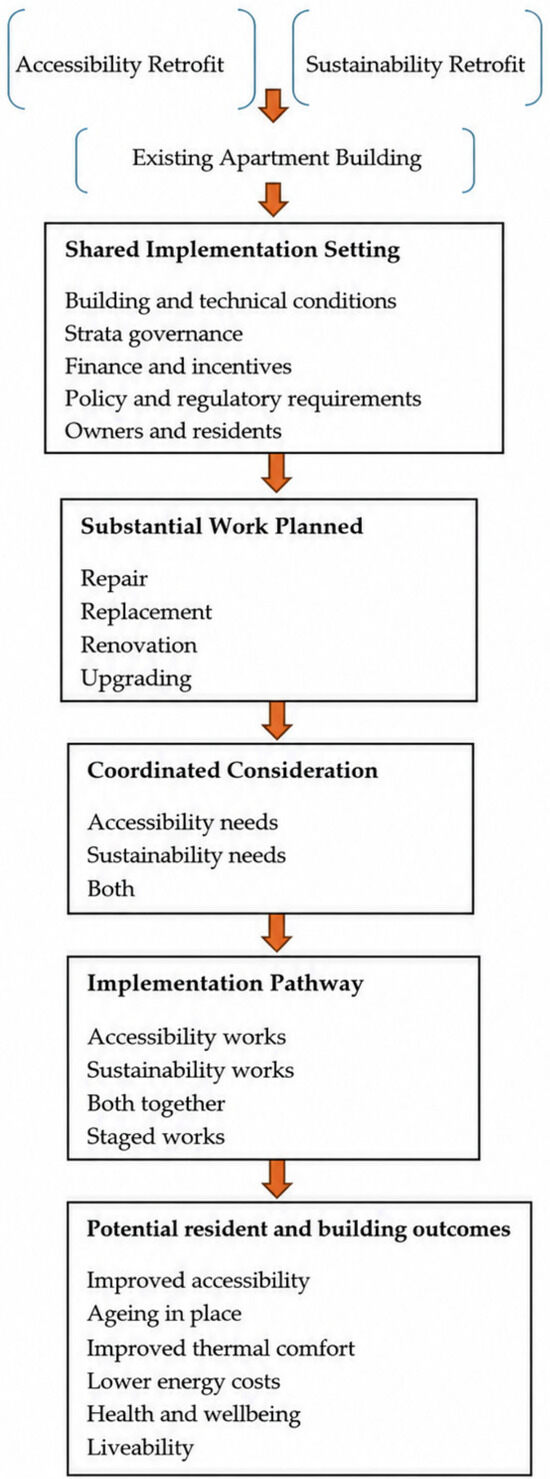
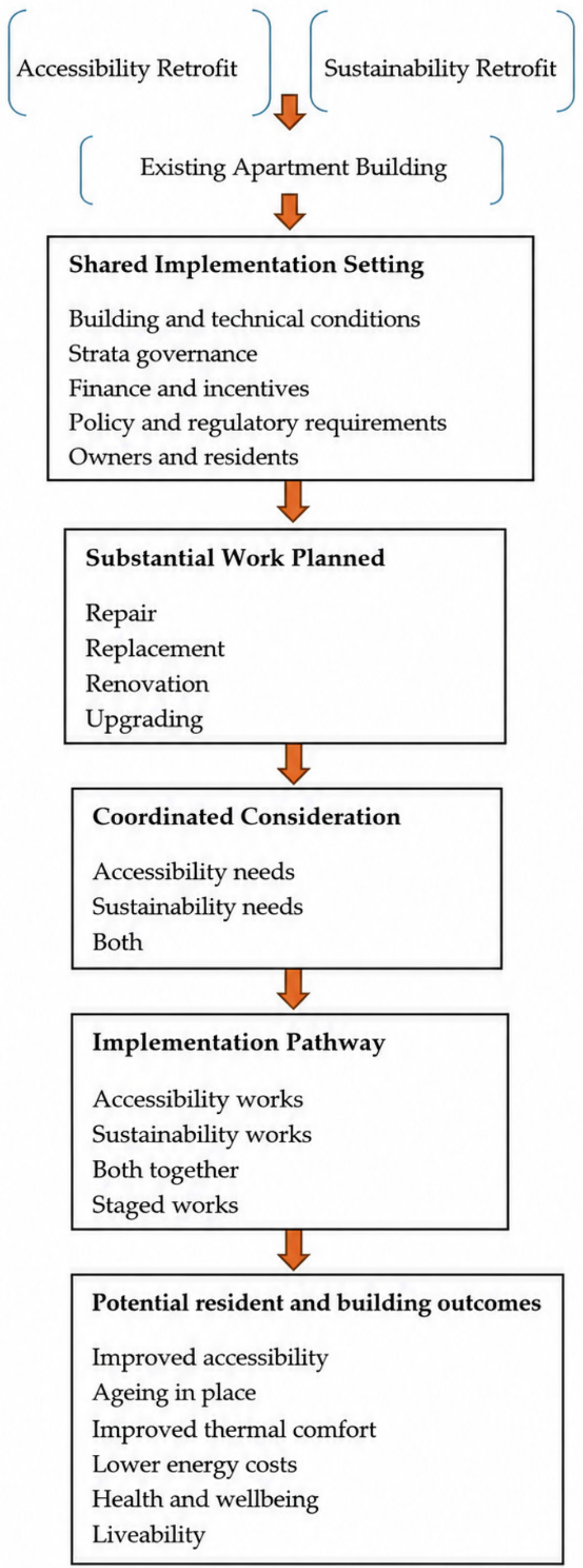
These findings support coordinated consideration rather than a requirement to physically integrate accessibility and sustainability works. When substantial repair, replacement, renovation or upgrading is planned, there may be value in considering whether the intervention affects future accessibility or sustainability needs. Depending on the building, its residents, available finance and the nature of the proposed work, improvements may be undertaken together, separately or in stages. Considering both objectives at substantial-work decision points may help avoid works that unnecessarily increase the cost or difficulty of subsequent improvements.
The resulting framework, depicted in Figure 1, has three elements. First, accessibility and sustainability remain institutionally differentiated through their policy objectives, standards, funding arrangements and support systems. Second, when interventions affect existing strata buildings, their implementation can encounter shared governance arrangements, particularly where common property and collective decisions are involved. Third, substantial repair, replacement, renovation or upgrading can provide decision points for the coordinated consideration of future accessibility and sustainability needs. Sustainability and accessibility interventions may be undertaken together, separately or in stages, according to building conditions, resident needs, governance requirements and available resources. Developed from the Australian literature and NSW policy case study, the framework provides propositions that could be examined in other Australian jurisdictions and comparable multi-owned housing contexts.
Figure 1.
Framework for coordinated consideration of accessibility and sustainability in apartment retrofit. Authors: Sajan and Piracha, 2026.
The three retrofit scenarios in Table 4 build on the framework presented in Figure 1. They are illustrative examples intended to demonstrate its potential practical application, rather than empirical case studies.
Table 4.
Illustrative retrofit scenarios.
The first scenario considers a substantial façade refurbishment incorporating glazed galleries and the installation of a lift to improve accessibility [84]. These interventions may offer opportunities to coordinate building works, construction access and associated approvals. Their technical compatibility and potential cost efficiencies would depend on the existing building configuration, structural capacity and project design. The works could be undertaken together or in stages, depending on feasibility, funding and residents’ needs. Comparable refurbishment approaches involving glazed galleries, balconies and lifts in older residential buildings have been discussed elsewhere [42,53,54]. The principal decision considerations include building typology, structural constraints, costs, ongoing maintenance and benefits to residents [55].
The second scenario considers replacing an existing entrance door with an automatic sliding door designed to provide accessible entry and improved airtightness. An appropriately designed automatic door may improve access for residents with mobility limitations by reducing the need to operate a heavy manual door [85]. Where suitable sealing and operating mechanisms are incorporated, it may also reduce air infiltration and associated energy losses [86,87]. These potential benefits depend on the existing entrance configuration, technical specifications and installation quality. The intervention therefore illustrates a possible technical synergy between accessibility and sustainability, subject to considerations of costs, maintenance requirements and benefits to residents [55].
In the final proposed intervention, a ramped threshold is retrofitted to the apartment entrance door, and LED lightings are installed to improve energy efficiency. Many older apartment blocks constructed prior to Commonwealth Disability (Access to Premises-Buildings) Standards 2010 [60] lack level thresholds leading to the apartment entrance door in lieu of most updated National Construction Code accessibility standards [61]. Retrofitting LED lighting in common areas reduces energy costs [34,50]. These interventions may be considered through separate approval processes and undertaken concurrently or in stages, depending on their scope and the applicable strata requirements. Once again, cost–benefit for residents, building structural limits, and ongoing maintenance is considered.
The three retrofit illustrations indicate that either staged, separate or simultaneous implementation pathways are likely to deliver health benefits to residents and improve building outcomes, as outlined in Figure 1. The illustrative interventions, such as the installation of new lifts, automatic sliding doors and a ramped transition to the apartment entrance door improve accessibility and facilitate ageing in place. Similarly, measures like implementing a glazed gallery on the building façade, installing airtight doors and LED lighting upgrades improve thermal comfort and lower energy costs. Collectively, these illustrative interventions can improve the health and wellbeing of the residents and enhance liveability in apartment buildings. The central argument is not that accessibility and sustainability works must always be integrated, but that significant building interventions provide opportunities to consider both objectives before decisions are finalised.
We posit NSW strata governance within an international context by comparing its approach to accessibility and sustainability infrastructure resolutions with comparable governance frameworks in the UK, and Spain, which has the highest number of condominium residents in Europe [88], to illustrate wider applicability within apartment retrofit context, noting increasing housing affordability pressures and growing need for retrofit due to ageing population and proportionate increase in people with accessibility issues. The UK commonhold has comparable forms of collective ownership to Australia’s strata governance model that require collective decision making among owners through their commonhold association over costs and building improvements. Unlike Australian strata regulations, the UK commonhold model does not have specific sustainability or accessibility resolutions and associated regulatory provisions with the reduced voting threshold, but they sit within the wider decision-making process of the commonhold association [89]. In Spain, there are two pathways for accessibility modifications. The owner-initiated approach, grounded within Article 10 of Horizontal Property Law, mandates the execution of works that guarantee basic universal accessibility like ramps, lifts, mechanical and electronic devices in common property. They do not require prior permission from the board of owners, the equivalent body of the owners corporation in NSW and commonhold association in UK, provided the applicant is ready to bear the excess cost beyond available funding. Anchored in Article 17, the board of owners can initiate both accessibility and sustainability modifications and are funded by them, subject to legal participant quota threshold requirements for specific modification [90].
5. Policy and Research Implications
First, accessibility could be given greater consideration within mainstream apartment retrofit policy. The NSW policy analysis shows that accessibility and sustainability are supported through largely separate policy, funding and professional systems, while the rapid review identified a strong sustainability orientation within the bounded Australian apartment-retrofit literature. Relevant accessibility knowledge also exists in adjacent fields concerned with adaptable housing, home modification, disability and ageing in place. This points to a gap between the wider body of accessibility research, and the Australian apartment retrofit literature examined in this study. The evidence outside the included literature notes that policy fragmentation limits retrofit opportunities for accessibility, while ageing population increases apartment retrofit need [91]. Existing adaptable apartments may offer opportunities for future modification, but their potential depends partly on adequate building records and recognition of accessibility features [32,34,65,66]. Better information about the accessibility characteristics of existing apartments could help identify where future modifications may be feasible.
Second, retrofit policy needs to recognise the institutional conditions of strata housing. Accessibility and sustainability interventions can both encounter collective decision-making, financing, ownership and maintenance responsibilities, technical information requirements and constraints arising from the existing building. The NSW policy case study shows that accessibility and sustainability infrastructure can both engage strata governance arrangements [55]. Financial assistance and technical guidance may therefore be more effective if they recognise the decision-making and implementation requirements of owners corporations rather than treating retrofit solely as a technical intervention at the dwelling or building level.
Third, substantial building works can provide decision points for the coordinated consideration of accessibility and sustainability needs. The three illustrative retrofit scenarios show different ways in which accessibility and sustainability interventions might be considered and implemented. Façade refurbishment and lift installation may offer opportunities to coordinate construction works, while an appropriately designed automatic sliding door may provide both accessibility and energy-efficiency benefits. By contrast, installing a ramped entrance threshold and upgrading LED lighting involve different technical interventions that may be considered through the same strata governance arrangements but implemented separately. The international refurbishment case studies discussed in this paper show that staged refurbishment can improve building performance while allowing residents to remain in place [53,54]. This does not mean that accessibility and sustainability works should always occur together. Rather, substantial repair, replacement, renovation or upgrading can provide an opportunity to consider whether either or both objectives could reasonably be addressed, either at the same time or in stages. Further research could examine how this approach operates across different apartment types, ownership structures and resident populations, including its costs, governance requirements and distributional effects through examining completed retrofit projects and primary data collection approaches with owners corporations, strata managing professionals and other built environment professionals.
6. Conclusions
This study identified a distinction between the institutional organisation of accessibility and sustainability, and the conditions encountered when interventions are implemented in existing strata housing. Within the bounded Australian apartment-retrofit literature reviewed, sustainability-related research predominated, while the NSW policy analysis showed that accessibility and sustainability are supported through largely separate policy, funding and regulatory arrangements. When interventions affect existing apartment buildings, however, they can encounter shared implementation conditions, particularly those associated with common property, strata governance, collective decision-making, finance and the characteristics of the existing building. The NSW case makes this relationship particularly visible because accessibility and sustainability infrastructure are separately provided for within the same strata governance system [55].
Rather than proposing that accessibility and sustainability retrofit should be integrated in every project, the findings support their coordinated consideration at key points in the life of an existing apartment building. Substantial repair, replacement, renovation or upgrading can provide decision points at which future accessibility and sustainability needs are considered together. Depending on the building, its residents, governance requirements and available resources, resulting works may address accessibility, sustainability or both, either concurrently or in stages.
The framework developed in this paper draws on a bounded rapid review of Australian apartment-retrofit literature and an NSW policy case study incorporating NSW-specific and relevant national instruments. The proposed framework should currently be viewed as a conceptual and policy synthesis rather than a confirmation that the coordinated consideration of accessibility and sustainability necessarily leads to better reconstruction outcomes. Further research is needed to examine the framework across different apartment types, ownership structures, resident populations and governance contexts, including its costs and distributional implications, through practice based retrofit projects and in consultations with owners corporation, strata professionals and built environment practitioners.
Bringing accessibility into consideration alongside sustainability at significant retrofit decision points could help existing apartment buildings respond more effectively to changing environmental conditions and the changing needs of their residents.
Author Contributions
Conceptualization, J.S. and A.P.; methodology, J.S. and A.P.; validation, J.S. and A.P.; formal analysis, J.S. and A.P.; investigation, J.S. and A.P.; data curation, J.S. and A.P.; writing—original draft preparation, J.S. and A.P.; writing—review and editing, J.S. and A.P. All authors have read and agreed to the published version of the manuscript.
Funding
This research received no external funding.
Institutional Review Board Statement
Not applicable.
Informed Consent Statement
Not applicable.
Data Availability Statement
The original contributions presented in this study are included in the article and Appendix A Table A1, Table A2, Table A3 and Table A4. Further inquiries can be directed to the corresponding author.
Acknowledgments
Conflicts of Interest
The authors declare no conflicts of interest.
Abbreviations
The following abbreviations are used in this manuscript:
| NSW | New South Wales |
| NDIS | National Disability Insurance Scheme |
| ABCB | Australian Building Codes Board |
| NCC | National Construction Code |
| ABS | Australian Bureau of Statistics |
Appendix A. Inventory of NSW Policy Analysis Documents
The Table A1, Table A2, Table A3 and Table A4 reproduce the full policy inventory used in the manuscript. The main paper contains a condensed synthesis of the policy analysis.
Table A1.
Inventory of Statutory Policies.
Table A2.
Inventory of NSW Strategic Planning Policies.
Table A3.
Inventory of Regulatory Standards, Guides and Rating Tools.
Table A4.
Inventory of Economic Incentives, Rebates, Grants.
References
- Australian Bureau of Statistics. Disability, Ageing and Carers, Australia: Summary of Findings. 2024. Available online: https://www.abs.gov.au/statistics/health/disability/disability-ageing-and-carers-australia-summary-findings/latest-release (accessed on 10 June 2026).
- Australian Institute of Health and Welfare. People with Disability in Australia. 2026. Available online: https://www.aihw.gov.au/reports/disability/people-with-disability-2026/contents/summary#housing (accessed on 10 June 2026).
- Cuskelly, M.; Owen, C.; McCann, D.; Faulkner, D.; Gusheh, M.; Hobbs, M.; Callaway, L. Improving Housing Outcomes for People with Disability: Policy and practice Initiatives; Final Report No. 462; Australian Housing and Urban Research Institute Limited: Melbourne, Australia, 2026. [Google Scholar] [CrossRef] [Scilit]
- Daniel, L.; Lang, M.; Barlow, C.; Phibbs, P.; Baker, E.; Hamilton, I. A National Roadmap for Improving the Building Quality of Australian Housing Stock; Final Report No.426; Australian Housing and Urban Research Institute Limited: Melbourne, Australia, 2024. [Google Scholar] [CrossRef] [Scilit]
- Productivity Commission. In Need of Repair: The National Housing and Homelessness Agreement: Study Report; Australian Government: Canberra, Australia, 2022. Available online: https://www.pc.gov.au/inquiries-and-research/housing-homelessness/report/ (accessed on 15 June 2025).
- Martin, C.; Lawson, J.; Milligan, V.; Hartley, C.; Pawson, H.; Dodson, J. Towards an Australian Housing and Homelessness Strategy: Understanding National Approaches in Contemporary Policy; Final Report No. 401; Australian Housing and Urban Research Institute Limited: Melbourne, Australia, 2023. [Google Scholar] [CrossRef] [Scilit]
- McHugh, K.; Minns, J. STRATA FUTURES: Building a Vibrant and Sustainable Future for Australian Strata. 12 January 2025. Available online: https://www.katemchugh.net/strata-futures.
- Wiesel, I. Lived Experience and Social, Health and Economic Impacts of Inaccessible Housing; Report Submitted to the Australian Building Codes Board RIS; University of Melbourne: Melbourne, Australia, 2020. [Google Scholar]
- Wiesel, I. Living with Disability in Inaccessible Housing: Social, Health and Economic Impacts; School of Geography, University of Melbourne: Melbourne, Australia, 2020. [Google Scholar]
- Carnemolla, P.; Bridge, C. Housing design and community care: How home modifications reduce care needs of older people and people with disability. Int. J. Environ. Res. Public Health 2019, 16, 1951. [Google Scholar] [CrossRef] [Scilit] [PubMed]
- Gusheh, M.; Murphy, C.; Valenta, L.; Bertram, N.; Maxwell, D. Adaptable Housing for People with Disability in Australia: A Scoping Study; Monash Urban Lab, Monash University: Melbourne, Australia, 2021. Available online: https://www.humanrights.gov.au/our-work/publications (accessed on 12 September 2025).
- Stone, H.; A.Batchelor, A.; Mead, M. Access Denied: The Experiences of People with Physical Disability Across the NSW Housing Sector; Physical Disability Council of NSW: Sydney, Australia, 2022; Available online: https://www.pdcnsw.org.au/wp-content/uploads/2023/03/Access-Denied-Final-PDCN-BBH.pdf (accessed on 12 September 2025).
- Australian Institute of Health and Welfare. Injury in Australia: Falls. 2026. Available online: https://www.aihw.gov.au/reports/injury/falls (accessed on 1 October 2026).
- National Disability Insurance Scheme. Home and Living. 2024. Available online: https://www.ndis.gov.au/participants/home-and-living (accessed on 10 June 2026).
- NDIS Property Australia. Latest SDA and SIL Statistics from the NDIS. 2024. Available online: https://ndis.property/latest-sda-and-sil-statistics-from-the-ndis/ (accessed on 10 June 2026).
- Wiesel, I. Housing and the National Disability Insurance Scheme. In The National Disability Insurance Scheme: An Australian Public Policy Experiment; Cowden, M., McCullagh, C., Eds.; Springer: Singapore, 2021; pp. 205–223. [Google Scholar]
- Fankhauser, S.; Smith, S.M.; Allen, M.; Axelsson, K.; Hale, T.; Hepburn, C.; Kendall, J.M.; Khosla, R.; Lezaun, J.; Mitchell-Larson, E. The meaning of net zero and how to get it right. Nat. Clim. Change 2022, 12, 15–21. [Google Scholar] [CrossRef] [Scilit]
- Amirkhani, M.; Martek, I.; Luther, M.B. Mapping research trends in residential construction retrofitting: A scientometric literature review. Energies 2021, 14, 6106. [Google Scholar] [CrossRef] [Scilit]
- Kibert, C.J.; Fard, M.M. Differentiating among low-energy, low-carbon and net-zero-energy building strategies for policy formulation. Build. Res. Inf. 2012, 40, 625–637. [Google Scholar] [CrossRef] [Scilit]
- Whaley, D.M.; Hamilton, C.M. Guide to Low Carbon Households; Low Carbon Living 2019: Sydney, Australia, 2026. [Google Scholar]
- Rajagopalan, P.; Chen, D.; Ambrose, M. Investigating envelope retrofitting potential and resilience of Australian residential buildings− A stock modelling approach. Energy Build. 2024, 325, 114990. [Google Scholar] [CrossRef] [Scilit]
- Strata Community Association. Strata Insights 2024. 2025. Available online: https://inside.strata.community/strata-insights-2024/ (accessed on 10 June 2026).
- Australian Building Codes Board. Final Regulation Impact Statement for Decision (Final RIS 2009-06); Proposal to Revise the Energy Efficiency Requirements of the Building Code of Australia for Residential Buildings-Classes 1, 2, 4 and 10; Australian Building Codes Board: Canberra, Australia, 2009. [Google Scholar]
- Climateworks Centre. Climate-Ready Homes: Building the Case for a Renovation Wave in Australia; National Report; Climateworks Centre: Docklands, Australia, 2023. [Google Scholar]
- Australian Passivhaus Association. Most Australian Homes are Uncomfortable and Inefficient. 2026. Available online: https://www.passivhausassociation.com.au/enerphit-month (accessed on 10 June 2026).
- Sherry, C. Collectively owned distributed energy resources and private property law: Embedded networks in high-density and master-planned housing. J. Energy Nat. Resour. Law 2025, 43, 383–399. [Google Scholar] [CrossRef] [Scilit]
- Volt, J.; Fabbri, M.; De Groote, M. Understanding Potential User Needs: A Survey Analysis of the Markets for Individual Building Renovation Roadmaps in Bulgaria, Poland and Portugal. 2018. Individual Building Renovation Roadmaps, iBRoad. Available online: https://apo.org.au/node/201251 (accessed on 1 October 2026).
- Crommelin, L.; Thompson, S.; Easthope, H.; Loosemore, M.; Yang, H.; Buckle, C.; Randolph, B. Cracks in the Compact City: Tackling Defects in Multi-Unit Strata Housing; Final Project Report; UNSW City Futures Research Centre: Sydney, Australia, 2021; Available online: https://www.unsw.edu.au/content/dam/pdfs/ada/city-futures/Defects_final_report_for_publication_HSGP9LW.pdf (accessed on 5 April 2026).
- Gilyana, D.; Montoya, D. Regulation of the Building Industry in New South Wales; Research Paper 3; Parliamentary Research Service: Sydney, Australia, 2023. Available online: https://www.parliament.nsw.gov.au/parliamentary-business/research-and-library/research-publications-data/regulation-of-building-industry-nsw (accessed on 12 April 2026).
- UNSW Cities Institute, Implications of a Retrofit First Policy in NSW; Cities Institute Agenda Setting; UNSW: Sydney, Australia, 2024.
- United Nations. Convention on the Rights of Persons with Disabilities: Article 2-Definitions. Available online: https://www.un.org/development/desa/disabilities/convention-on-the-rights-of-persons-with-disabilities/article-2-definitions.html (accessed on 5 April 2026).
- AS 4299–1995; Adaptable Housing. Standards Australia: Sydney, Australia, 1995.
- Australian Building Codes Board. Accessible Housing: Options Paper; Commonwealth of Australia and States and Territories of Australia, Australian Building Codes Board: Canberra, Australia, 2019. Available online: https://www.abcb.gov.au/sites/default/files/resources/2022/Options-paper-accessible-housing-2018.pdf (accessed on 12 October 2026).
- Easthope, H.; Palmer, J.; Sharam, A.; Nethercote, M.; Pignatta, G.; Crommelin, L. Delivering Sustainable Apartment Housing: New Build and Retrofit; Final Report No. 400; Australian Housing and Urban Research Institute Limited: Melbourne, Australia, 2023. [Google Scholar] [CrossRef] [Scilit]
- Easthope, H.; Hynes, D.; Lu, Y.; Wade, R. Australasian Strata Insights 2022: Report and Infographics; City Futures Research Centre, UNSW: Sydney, Australia, 2022; Available online: https://www.unsw.edu.au/content/dam/pdfs/ada/city-futures/2022_Australasian_Strata_Insights_Report_ReissueMar24.pdf (accessed on 24 June 2026).
- Garritty, C.; Hamel, C.; Trivella, M.; Gartlehner, G.; Nussbaumer-Streit, B.; Devane, D.; Kamel, C.; Griebler, U.; King, V.J. Updated recommendations for the Cochrane rapid review methods guidance for rapid reviews of effectiveness. BMJ 2024, 384, e076335. [Google Scholar] [CrossRef] [Scilit] [PubMed]
- Howlett, M. Designing Public Policies: Principles and Instruments, 2nd ed.; Routledge: London, UK, 2010. [Google Scholar]
- Badland, H.; Villanueva, K.; Dearn, E.; Alderton, A. Do Australian Disability Policies Support Accessible and Inclusive Neighbourhoods for Children with Disability and Their Families? Urban Policy Res. 2025, 43, 293–308. [Google Scholar] [CrossRef] [Scilit]
- Abousaeidi, M.; Pignatta, G.; Nazarian, N.; Ghadiri, S.B. Balancing thermal comfort, construction feasibility, carbon emissions, and cost: Multi-criteria evaluation of passive retrofits for high-rise social housing. Energy Build. 2026, 359, 117269. [Google Scholar] [CrossRef] [Scilit]
- Warren-Myers, G. Valuing sustainability Part 2: Australian valuers’ perception of sustainability in valuation practice. J. Prop. Invest. Finance 2023, 41, 351–379. [Google Scholar] [CrossRef] [Scilit]
- Ruming, K.; Williams, M.; Dong-Ju, L. Defining sustainable home renovators in Australia. J. Hous. Built Environ. 2024, 39, 227–251. [Google Scholar] [CrossRef] [Scilit]
- Loschke, S.K.; Easthope, H. The problem of aging housing: A co-and re-design approach. Archit. Aust. 2022, 111, 55–57. Available online: https://search.informit.org/doi/10.3316/informit.601764772191145 (accessed on 12 April 2026).
- Denman, M.; Ullah, F.; Qayyum, S.; Olatunji, O. Post-construction defects in multi-unit Australian dwellings: An analysis of the defect type, causes, risks, and impacts. Buildings 2024, 14, 231. [Google Scholar] [CrossRef] [Scilit]
- Ryan, D. Why don’t we see more examples in Australia of sustainability retrofits initiated by apartment owners? Sustaining the Future. In Proceedings of the 57th International Conference of the Architectural Science Association, Gold Coast, Australia, 26–29 November 2024; pp. 744–750. Available online: https://archscience.org/wp-content/uploads/2025/03/Why-dont-we-see-more-examples-in-Australia-of-sustainability-retrofits-initiated-by-apartment-owners.pdf (accessed on 12 April 2026).
- Charters, B.; Heffernan, T.; Daly, M. When individual action requires collective approval: A roadmap for solar power adoption by strata property owners. J. Soc. Mark. 2023, 13, 100–120. [Google Scholar] [CrossRef] [Scilit]
- Charters, B.; Daly, M.; Heffernan, T. Overcoming the solar PV retrofit challenge in strata properties: Identifying discrete segments for targeted interventions. Prop. Manag. 2025, 43, 448–468. [Google Scholar] [CrossRef] [Scilit]
- Dehghanimadvar, M.; Roberts, M.; Bruce, A.; Egan, R. The Rooftop Solar Potential of Australian Housing Stock by Tenure and Dwelling Type; Solar Citizens/Australian PV Institute: Sydney, Australia, 2024. [Google Scholar]
- Willand, N. Response to the Consultation on the Proposed Regulations on Minimum Standards for Rental Properties and Rooming Houses; Department of Government Services, RMIT University: Melbourne, Australia, 2025. [Google Scholar] [CrossRef]
- Baker, E.; Moore, T.; Daniel, L.; Caines, R.; Padilla, H.; Lester, L. Sustainable Social Housing Retrofit? Circular Economy and Tenant Trade-Offs; Final Report No: 397; Australian Housing and Urban Research Institute: Melbourne, Australia, 2023; Available online: https://www.ahuri.edu.au/research/final-reports/397 (accessed on 12 April 2026).
- Owolabi, A.B.; Suh, D.; Pignatta, P. Investigating the energy use in an Australian building: A case study of a west-facing apartment in Sydney. Ain Shams Eng. J. 2023, 14, 102040. [Google Scholar] [CrossRef] [Scilit]
- Poshnath, A.; Rismanchi, B.; Rajabifard, A. Adoption of Renewable Energy Systems in common properties of multi-owned buildings: Introduction of ‘Energy Entitlement’. Energy Policy 2023, 174, 113465. [Google Scholar] [CrossRef] [Scilit]
- Lang, M.; Lane, R.; Zhao, K.; Raven, R. Energy efficiency in the private rental sector in Victoria, Australia: When and why do small-scale private landlords retrofit? Energy Res. Soc. Sci. 2022, 88, 102533. [Google Scholar] [CrossRef] [Scilit]
- Hu, W. Transforming public housing in Australia: Embracing sustainable refurbishment over demolition. Urban Res. Pract. 2025, 18, 328–338. [Google Scholar] [CrossRef] [Scilit]
- Lara-Hamilton, E.; Bell, S.; Crawford, R.; Staneley, J.; Shaw, K.; Hill, D.; Pert, A.; McGarry, M.; Robinson, S.; Mintern, S.; et al. Life-Cycle Impacts of Public Housing Renewal in Victoria-Evidence Review; The University of Melbourne: Melbourne, Australia, 2024. [Google Scholar] [CrossRef]
- NSW Government. Strata Schemes Management Act 2015 No 50 (NSW). 2015. Available online: https://legislation.nsw.gov.au/view/html/inforce/current/act-2015-050 (accessed on 10 June 2026).
- NSW Government. Disability Inclusion Act 2014 No 41 (NSW). 2014. Available online: https://legislation.nsw.gov.au/view/whole/html/inforce/current/act-2014-041#sec.10 (accessed on 20 June 2026).
- NSW Department of Communities and Justice. NSW Disability Inclusion Plan 2026–2029; NSW Government: Sydney, Australia, 2025. Available online: https://dcj.nsw.gov.au/documents/community-inclusion/disability-inclusion/nsw-disability-inclusion-plan/nsw-disability-inclusion-plan-2026%E2%80%932029.pdf (accessed on 1 October 2026).
- NSW Department of Communities and Justice. Ageing Well in NSW: Seniors Strategy 2021–2031; NSW Government: Sydney, Australia, 2021. Available online: https://dcj.nsw.gov.au/documents/community-inclusion/seniors/ageing-well-in-nsw-seniors-strategy-2021-2031.pdf.
- Commonwealth of Australia. Disability Discrimination Act 1992 (Cth). 1992. Available online: https://www.legislation.gov.au/C2004A04426/2018-04-12/text (accessed on 20 June 2026).
- Commonwealth of Australia. Disability (Access to Premises–Buildings) Standards 2010 (Cth). 2010. Available online: https://www.legislation.gov.au/F2010L00668/2020-09-30/text (accessed on 20 June 2026).
- Australian Building Codes Board. Part G7 Livable Housing Design; Australian Building Codes Board: Canberra, Australia, 2025; Volume One. Available online: https://ncc.abcb.gov.au/editions/ncc-2025/adopted/volume-one/g-ancillary-provisions/part-g7-livable-housing-design (accessed on 20 June 2026).
- Australian Building Codes Board. Livable Housing Design Voluntary Standard: Beyond Minimum Standard. 2023. Available online: https://www.abcb.gov.au/sites/default/files/resources/2023/ABCB-Voluntary-Standard-Beyond-minimum-Livable-housing-design_0.pdf.
- NSW Department of Planning; Industry and Environment. Housing 2041: NSW Housing Strategy. 2021. Available online: https://www.planning.nsw.gov.au/sites/default/files/2023-03/housing-2041-nsw-housing-strategy.pdf (accessed on 15 May 2026).
- NSW Government. State Environmental Planning Policy (Housing) 2021 (NSW). 2021. Available online: https://legislation.nsw.gov.au/view/whole/html/inforce/current/epi-2021-0714 (accessed on 20 June 2026).
- NSW Department of Planning; Housing and Infrastructure. NSW Housing Pattern Book. 2026. Available online: https://www.planning.nsw.gov.au/government-architect-nsw/housing-design/nsw-housing-pattern-book (accessed on 20 June 2026).
- NSW Department of Planning and Environment. Apartment Design Guide: Tools for Improving the Design of Residential Apartment Development. 2015. Available online: https://www.planning.nsw.gov.au/sites/default/files/2023-03/apartment-design-guide.pdf (accessed on 15 May 2026).
- Australian Building Codes Board. Part J1 Energy Efficiency Performance Requirements; Australian Building Codes Board: Canberra, Australia, 2025; Volume One. Available online: https://ncc.abcb.gov.au/editions/ncc-2025/adopted/volume-one/j-energy-efficiency/part-j1-energy-efficiency-performance-requirements (accessed on 20 June 2026).
- NSW Climate and Energy Action. The Climate Change (Net Zero Future) Act 2023; NSW Government: Sydney, Australia, 2023. Available online: https://www.energy.nsw.gov.au/nsw-plans-and-progress/government-strategies-and-frameworks/climate-change-net-zero-future-act-2023 (accessed on 20 June 2026).
- NSW Department of Planning. Sustainable Buildings SEPP. 2022. Available online: https://www.planning.nsw.gov.au/the-planning-system/buildings/sustainable-buildings-sepp (accessed on 20 June 2026).
- Australian Government. Home Energy Ratings Disclosure Framework, Version 2. Australian Government: Canberra, Australia, 2024. Available online: https://www.energy.gov.au/sites/default/files/2024-12/home-energy-ratings-disclosure-framework-version-2.pdf (accessed on 20 June 2026).
- Green Building Council Australia. Green Star Buildings v1.1. 2025. Available online: https://new.gbca.org.au/green-star/rating-system/buildings/#apartments (accessed on 22 June 2026).
- NSW Government. NABERS: Apartment Buildings. Available online: https://www.nabers.gov.au/ratings/spaces-we-rate/apartment-buildings (accessed on 23 June 2026).
- NSW Climate and Energy Action. Home Energy Assessments and Ratings. 2026. Available online: https://www.energy.nsw.gov.au/households/action/initiatives/home-energy-ratings (accessed on 30 June 2026).
- Commonwealth of Australia. National Disability Insurance Scheme Act 2013 (Cth). 2013. Available online: https://www.legislation.gov.au/C2013A00020/latest (accessed on 20 June 2026).
- National Disability Insurance Agency. What Are Home Modifications. 2026. Available online: https://www.ndis.gov.au/participants/home-and-living/modifying-your-home/what-are-home-modifications (accessed on 20 June 2026).
- Australian Government Department of Health; Disability and Ageing. Assistive Technology and Home Modifications (AT-HM) Scheme. Available online: https://www.myagedcare.gov.au/aged-care-programs/assistive-technology-and-home-modifications-scheme (accessed on 20 June 2026).
- NSW Climate and Energy Action. Home Energy Saver. 2026. Available online: https://www.energy.nsw.gov.au/households/grants-rebates/home-energy-saver (accessed on 23 June 2026).
- NSW Climate and Energy Action. Household Energy Saving Upgrades. Available online: https://www.energy.nsw.gov.au/households/grants-rebates/household-energy-saving-upgrades (accessed on 23 June 2026).
- NSW Climate and Energy Action. Solar for Apartment Residents. 2026. Available online: https://www.energy.nsw.gov.au/households/grants-rebates/solar-for-apartment-residents/faqs (accessed on 23 June 2026).
- NSW Climate and Energy Action. Energy Certificate Schemes. 2025. Available online: https://www.energy.nsw.gov.au/nsw-plans-and-progress/regulation-and-policy/energy-security-safeguard/energy-certificate-schemes (accessed on 1 July 2026).
- NSW Department of Planning; Industry and Environment. Net Zero Plan Stage 1: 2020–2030. 2020. Available online: https://www.energy.nsw.gov.au/sites/default/files/2022-08/net-zero-plan-2020-2030-200057.pdf (accessed on 1 October 2026).
- NSW Climate and Energy Action. NSW Social Housing Energy Performance Initiative (SHEPI). 2025. Available online: https://www.energy.nsw.gov.au/government-and-local-organisations/programs-grants-and-schemes/shepi (accessed on 23 June 2026).
- NSW Climate and Energy Action. Community Housing Energy Performance Grant. 2025. Available online: https://www.energy.nsw.gov.au/government-and-local-organisations/programs-grants-and-schemes/shepi/community-housing-energy (accessed on 23 June 2026).
- Konstantinou, T.; Knaack, U. Refurbishment of residential buildings: A design approach to energy-efficiency upgrades. Procedia Eng. 2011, 21, 666–675. [Google Scholar] [CrossRef] [Scilit]
- Milchakova, N.E.; Milchakova, D.A. Design of the automatic door opening system for people with limited mobility. Int. J. Innov. Technol. Explor. Eng. 2020, 9, 5. [Google Scholar] [CrossRef] [Scilit]
- Syed, A.M. Building envelope. In Guide to Energy Management, 9th ed.; Mazzi, E., Ed.; River Publishers: New York, NY, USA, 2026; pp. 405–446. [Google Scholar]
- E-ZONG. Automatic Sliding Air Tight Doors Is the Future of Door Security. 2023. Available online: https://www.cleanroomsdoors.com/automatic-sliding-air-tight-door/ (accessed on 14 October 2026).
- Nasarre-Aznar, S.; Simón-Moreno, H. Housing not for all: The lack of universal accessibility to housing in multi-unit buildings in Spain, Sweden and Germany. J. Prop. Plan. Environ. Law 2020, 12, 35–54. [Google Scholar] [CrossRef] [Scilit]
- UK Government. The Commonhold Regulations 2004, SI 2004/1829. Available online: https://www.legislation.gov.uk/uksi/2004/1829/images/uksi_20041829_en_004 (accessed on 15 October 2026).
- Government of Spain. Ley 49/1960, de 21 de Julio, Sobre Propiedad Horizontal; Boletín Oficial del Estado: Madrid, Spain, 1960; Available online: https://www.boe.es/buscar/act.php?id=BOE-A-1960-10906 (accessed on 15 October 2026).
- Qian, C.; Samarasinghe, D.A.; Flemmer, C.; Kumar, V.; Zuo, K. Barriers and opportunities in age-friendly retrofitting of older residential buildings: A systematic literature review. Smart Sustain. Built Environ. 2026, 1–27. [Google Scholar] [CrossRef] [Scilit]

Disclaimer/Publisher’s Note: The statements, opinions and data contained in all publications are solely those of the individual author(s) and contributor(s) and not of MDPI and/or the editor(s). MDPI and/or the editor(s) disclaim responsibility for any injury to people or property resulting from any ideas, methods, instructions or products referred to in the content. |
© 2026 by the authors. Licensee MDPI, Basel, Switzerland. This article is an open access article distributed under the terms and conditions of the Creative Commons Attribution (CC BY) license.