


Abstract
Research on the impact of medical modernization on Chinese cities has focused primarily on the relationship between public health and urban governance, but the processes through which medical modernization was spatially realized within urban space remain underexplored, particularly in county-level cities. This study conceptualizes medical modernization in China as a dual process involving both the localization of Western medicine and the self-transformation of Chinese medicine. This study takes the medical spaces of Pingyao between 1937 and 1955 as a case study. Drawing on documentary records and the spatial features of medical spaces, including their number, footprint, distribution, street frontage, and circulation within courtyards, it examines how medical modernization was realized in this city. The findings reveal the implementation of public health institutionalization, the emergence and localization of Western medicine, the transformation and predominance of Chinese herb shops, and the different ways in which a herb shop and a hospital adapted courtyards. These findings offer an empirical case of a county-level city, illustrating how medical modernization was spatially realized within the existing urban spaces.
1. Introduction
In a global context, disease was often endowed with meanings beyond medicine, with nations imagined as bodies under assault; such metaphors emerged in diverse settings, including the Ottoman Empire [1], India [2], and Germany [3]. In the early twentieth century, as China faced internal turmoil and foreign aggression, intellectuals employed this metaphor to articulate the nation’s weakness [4]. To counter this crisis, progressive thinkers advocated scientism as a core element of Chinese modernity [5]. Within this context, medicine, closely tied to modern science and universally relevant to the human body, became a key domain of modernization. The social transformation driven by medical modernization unfolded around the framing of Chinese medicine as an indigenous tradition and Western biomedicine as “scientific” knowledge, giving rise not only to ideological conflict, but also to changes in the evolution of institutions, knowledge, and spatial practices [6], pp. 13–15. As a result, Chinese cities began to undergo urban transformation and infrastructure development grounded in public health principles [7], [8], pp. 192–224. At the same time, a range of medical spaces dominated by Western medicine, such as hospitals, medical schools, and dental clinics, began to emerge.
Scholars have already recognized the close connections between medical modernization and urban space by situating them in specific city contexts. For instance, Rogaski studied health and hygiene in the case of Tianjin, showing how sanitary separation and the removal of “unhygienic” functions and infrastructures reshaped urban space, and how colonial authorities and Chinese elites, under the banner of hygiene, reinforced social inequality and segregation [8], pp. 192–224. MacPherson’s case study of Shanghai demonstrated how the implementation of public health served as a channel for colonial power expansion, and how the dynamics of Chinese and Western powers in municipal governance, through sanitation, water supply, and disease prevention, made public health a window onto colonial authority, social tensions, and cultural difference [9]. Yang, in his study of public health institutions in early twentieth-century Beijing, examined how the establishment of the Lan Ansheng model relied on localized community mobilization [10], pp. 120–123. This process extended medical facilities into everyday living areas, merged medical and natural communities, thereby transforming established social order as well as conceptions of life and death.
Many of these studies tend to emphasize public health within medical modernization, treating it primarily as part of urban governance and social control. They illustrate its impact on urban spatial order through discourse, institutions, and policies, often conceptualized as forms of imposed governance. However, the processes through which medical modernization was spatially realized and embedded in urban space are less well explored. At the same time, existing studies have largely focused on capital cities and provincial capitals with relatively comprehensive documentary records, while the process of medical modernization in county-level cities remains underexplored.
To contribute to bridging this gap, this study takes the historical city of Pingyao (1937–1955) as a case, using its medical built heritage to examine how medical modernization was realized in county-level Chinese cities. By conducting a spatial analysis of the distribution of medical spaces, architectural forms, and functional divisions, this study aims to address the challenge arising from the limited documentary records available for county-level cities.
1.1. Western Medicine and Chinese Medicine
Many scholars argue that Western medicine was adopted in China largely because it became a symbol of pursuing the ideals of modernity [11], [12], pp. 7–13, [8], p. 8. Andrews elaborates on the term biomedicine, which is now widely used in anthropological research to emphasize modern medicine’s grounding in the biological sciences and its existence within bureaucratic institutions that regulate medical practice [12], pp. 7–13. By contrast, Chinese sources tend to use the term Western medicine, typically in comparison with Chinese medicine or old medicine, while also stressing its geographic origins, primarily in Europe and, significantly, in Japan, which, although not itself a Western country, served as the channel through which the modern notion of hygiene entered China after European public health knowledge had been translated and restructured there [8], pp. 137–164.
In line with the above definition of medical modernization, this study uses the term Western medicine to refer to the institutional systems, technical practices, and knowledge of bodies introduced from Europe that are locally reinterpreted and adapted in the process of modernization. Correspondingly, the term Chinese medicine in this study refers to indigenous medical traditions that, under the influence of modernity, underwent a process of “scientific” remaking. Importantly, this remaking did not only involve concrete medical practices such as diagnosis and treatment but also entailed transformations in premodern holistic notions of cosmology and cultural traditions [13].
Building on this, this study examines the coevolution between Chinese and Western medicine within the process of medical modernization in China, with particular attention to how this coevolution was spatially realized and embedded in urban space.
1.2. Modernizing Medicine in China
With the success of Western medicine in combating the Manchurian Plague of 1910, the Chinese government recognized the importance of public health in safeguarding national sovereignty [6], pp. 45–68. In 1912, the central authority of the Republic of China initiated the establishment of a public health management system based on Western medical concepts and inspired by colonial models [14], p. 19. Within this framework, the Department of Public Health was created under the Ministry of the Interior, responsible for epidemic prevention, quarantine [15], and the construction of sanitary infrastructure [14], pp. 268–274. Yet it was not until 1928 that the central government assumed a central role in providing medical care, overseeing all aspects of prevention, treatment, and healthcare administration [6], pp. 50–60. Meanwhile, traditional Chinese medicine, negotiating its position alongside Western medicine for state support, was subject to government-led reforms that applied scientific methods to its theories, practices, education, and social networks [10], p. 258. Under the influence of Chinese modernity, these parallel developments set Chinese and Western medicine on a complex and intertwined path of coevolution.
Much of the scholarship on medical history in Republican China has treated the survival of traditional medicine and the development of Western medicine as separate processes, as seen in Chen’s history of Chinese medicine [14], p. 173 and Deng’s study of epidemic prevention [16], pp. 1–6. However, the binary division between Chinese and Western medicine has been increasingly challenged. Lei argues that an oppositional framing between Western biomedicine and traditional Chinese medicine obscures their coevolution and that the survival of Chinese medicine is not a premodern remnant but the result of its modern remaking [6], pp. 13–15.
Building on this view, current studies move beyond the binary division of Chinese and Western medicine and instead examine the modernization of Chinese medicine as a cross-fertilizing process shaped by interactions between China and the West [6], pp. 4–5. At the same time, the modernization of Chinese medicine involved both the adoption of Western medical knowledge and a process of self-transformation. Within the medical sphere, it selected elements from Western knowledge and institutions, reinterpreting them as part of its own body of theory, practice, and institution. In terms of medical concepts, Chinese and Western understandings of the body, hygiene, and disease were also challenged and reshaped through their encounter [8], pp. 225–253, [6,17].
Overall, the encounter and negotiation of these two medical traditions and their conceptions of body and disease shaped the modernization of medicine in China. This dynamic process of interaction and mutual adaptation was realized through urban space, serving here as evidence for examining this process.
1.3. Pingyao as a Case Study: The Spatial Realization of Medical Modernization
Soja argues that modernization is a continuous process of social restructuring, in which the interwoven dimensions of social existence, time, and space are concretely expressed as the construction of society and history, and the production of human geography, and should be studied as an integrated whole [18]. Inspired by this, this study treats medical modernization as having a spatial manifestation, in which new and transformed medical functions were accommodated within existing urban space. Therefore, we argue that the practices of medical modernization should be understood as the spatial realization of localized Western medicine and the scientific remaking of Chinese medicine within specific social contexts. Pingyao offers a particularly suitable case for tracing this process.
Pingyao had a highly prosperous medical sector in the premodern period [19], pp. 185–186, and its premodern urban fabric and courtyard architecture remained largely unchanged during the study period (see Section 2.2). Within this context, the study examines the spatial realization of medical modernization at three scales. At the city scale, it examines how public health was institutionalized. It also compares the numbers and footprints of Chinese and Western medical spaces. At the street scale, it shows where herb shops were located and how their distribution and façade widths changed over time. At the courtyard scale, it compares how a Chinese medicine herb shop and a Western medicine hospital adapted existing courtyards to their medical practices.
For this analysis, medical modernization broadly encompasses public health (including vaccination, quarantine, disinfection, sanitary enforcement, and health education), the trade of medical products, and the clinical practices of diagnosis and treatment. Accordingly, the related spatial practices refer to the establishment of public health institutions, and the creation or transformation of sites for the trade in medical products and medical activities, such as Chinese herb shops, Western pharmacies, medicine workshops, private and public hospitals, a military hospital, clinics, an obstetricians’ training school, and dental clinics.
Among these spaces, herb shops were in practice the principal space through which Chinese medicine reached the general population before the establishment of a permanent public healthcare system in 1948 [20]. Specializing in Chinese medicine, they sold herbal materials, produced prepared medicines, and hosted practitioners for diagnosis and treatment. This reflects that Chinese medicine had no dedicated medical space of its own in the first half of the twentieth century. Practitioners diagnosed patients in their own homes, made house calls, or worked itinerantly. After a consultation, patients and their families took the prescription to a herb shop to buy the required materials, or, without a prescription, simply purchased the shop’s own prepared medicines. Some herb shop owners were themselves practitioners, and other shops invited practitioners to consult and diagnose on the premises, a practice known as zuotang (“sitting in the hall”) [21]. Through these arrangements, the herb shop became the main space for Chinese medical practice.
2. Materials and Methods
2.1. Historical Narratives and Urban Structures of the Study Area
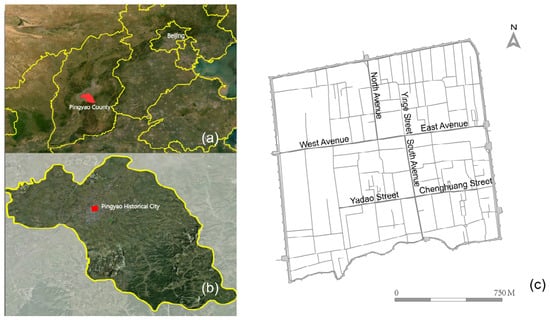
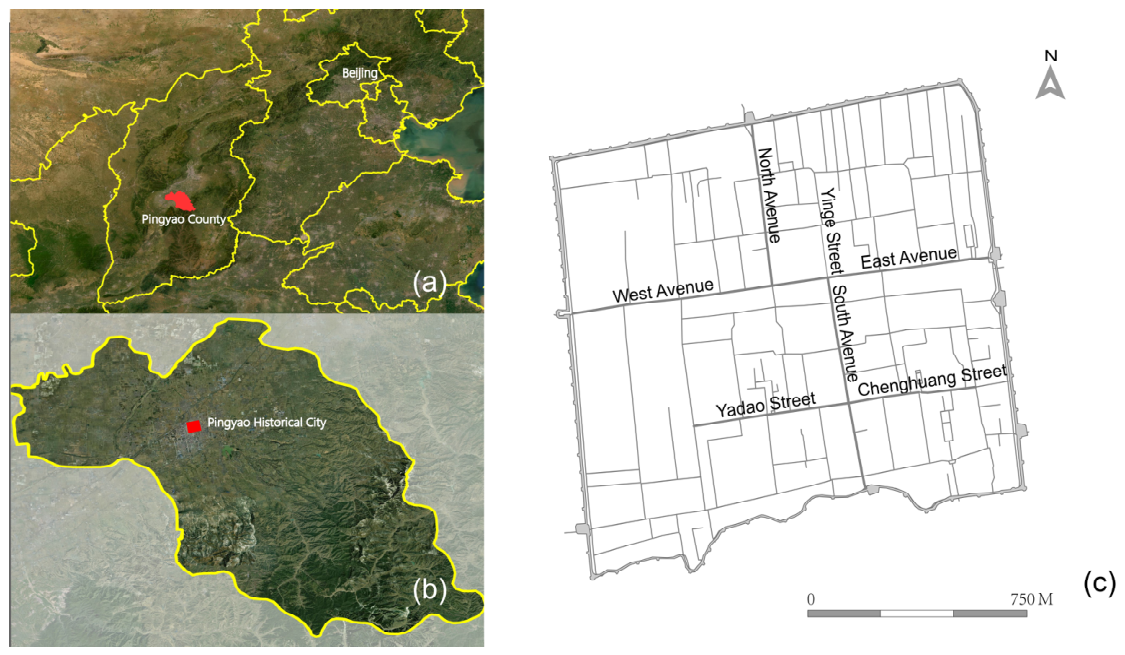
As shown in Figure 1, the study area focuses on the ancient city of Pingyao, located in Shanxi province, northern China. Enclosed by city walls on four sides, Pingyao’s size has remained fixed at around 2.25 km2 since its original establishment in the 14th century, with about 22,000 inhabitants in the mid-20th century [22]. Its limited scale and well-preserved spatial morphology of the pre-modern city make it a suitable case for studying the impact of modernization on Chinese cities.
Figure 1.
Study area: the ancient city of Pingyao (112°9′56″–112°11′10″ E, 37°11′44″–37°12′43″ N). (a) The location of Pingyao County within the province of Shanxi, (b) the position of the historical city of Pingyao within its administrative region, and (c) the city walls and main streets of the historical city of Pingyao. Source: drawing by the first author based on the administrative map of Pingyao [23,24].
Pingyao served as a county seat and a prosperous financial centre from the 14th century until 1902. After the collapse of imperial society, it was dominated by local warlords between 1912 and 1938, and again from 1945 to 1948. From 1938 to 1945, it was occupied by the Japanese forces [25], pp. 32–42. These power transitions and wars caused significant destruction to the local economy and social life [25], pp. 342–343. At the same time, during the warlord-ruled and war period (1912–1945), Western medical facilities gradually emerged. Local warlords temporarily employed biomedical epidemiological treatments to address a public epidemic crisis [26], while the Japanese occupiers established a military hospital for their soldiers, which was later transformed into a public hospital after the end of the war [27], pp. 27–31. It was not until the establishment of a new political regime in 1948 that a permanent public healthcare system was implemented [25], pp. 677–683.
The timeframe of our study, from 1937 to 1955, which is marked by a chaotic social environment followed by the establishment of a new regime and commercial recovery, provides essential context for understanding the spatial transformation of medical spaces. Each time phase represents significant shifts in social context and data availability, namely the Prewar period (1937–1938), the War period (1938–1948), and the New Regime period (1948–1955). The first two periods were marked by weak administrative control and chaotic social environments, due to the Second Sino-Japanese War [28] and the Second Chinese Civil War, while the last period was characterized by stable social environments under the new regime [25], pp. 32–42. In 1956, the joint state–private reform merged many private herb shops and clinics in the case area and placed them under public operation [27], pp. 27–31. The government thus became the dominant force over the remaining medical spaces, and the resulting changes in the spatial practices of Chinese and Western medicine lie beyond the focus of this study. The study period therefore ends in 1955, the year before the reform.
2.2. Data Collection and Dataset Creation
Examining the spatial realization of medical modernization requires detailed documentation and spatial reconstruction of historical evidence. This was achieved through spatial analysis based on the mapping of historical materials, using both quantitative and qualitative data.
Historical documents were collected from a wide range of sources, as the available information on medical spaces varies between periods. General information on the medical spaces operating between 1937 and 1955, including their names, types, periods of operation, and street locations, was mainly derived from the Gazetteer of Medicine in Pingyao [27], pp. 27–31, supplemented for the period after 1945 by the Pingyao Gazetteer [25], pp. 677–683. Data on the population within the city walls and on the military hospital reserved for Japanese soldiers during the occupation (1938–1945) were taken from the local statistics compiled by the Japanese military [22]. The most detailed spatial source is the 1948 statistical survey of the Pingyao Chamber of Commerce [25], pp. 342–343, which recorded the names, street locations, and façade widths of registered shops in the form of a map covering the main commercial streets, namely South Avenue, West Avenue, East Avenue, and Yadao–Chenghuang Street. This map therefore served as a spatial reference for locating the medical spaces recorded in other periods.
These documents, authored by diverse actor groups ranging from the ruling class to the local public, and from locals to foreign actors, reflect the motivations and approaches of those who wrote them. They were therefore analysed critically in relation to their historical context, to build up a comprehensive understanding of medical modernization in the case city.
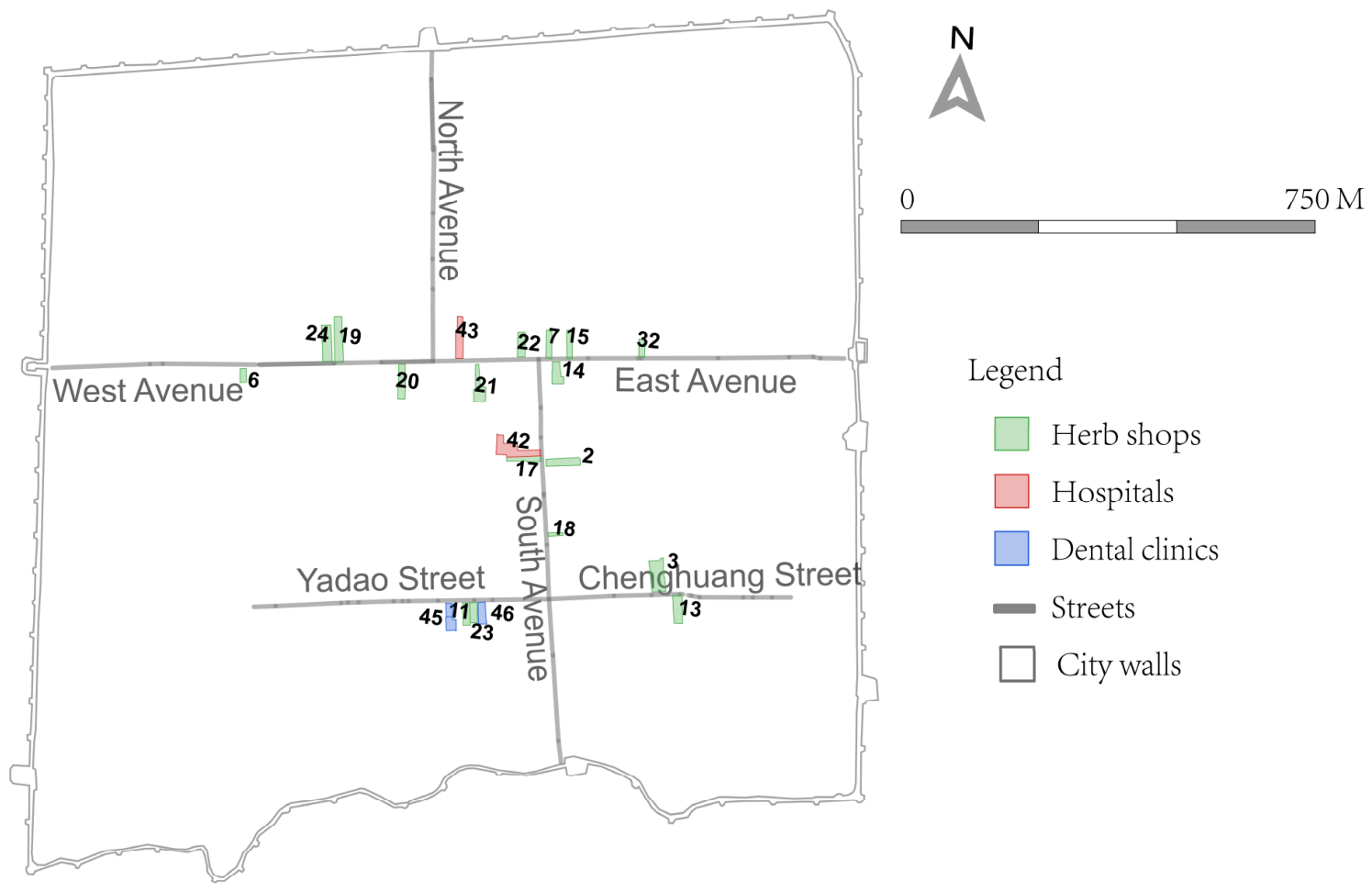
Regarding the spatial data, the dataset compiled for this study (Appendix A) comprises medical spaces whose existence and period of operation are documented in the sources and the 1948 map described above. It therefore also includes medical spaces that no longer survive. Since house numbers were revised in 1984, historical addresses were matched with current ones using the gazetteer of place names [29], and the resulting locations were verified on site during fieldwork conducted by the first author in January 2024. In this way, medical spaces whose historical addresses could be matched to identifiable historic courtyards were marked as “Location known” in Appendix A, and recorded in a GIS. Those whose records mention only a street or lane were marked as “Street-level location”, while those without any recorded location, left blank, were included only in the counts by period. The locations of the medical spaces marked as “Location known” are shown in Figure A1. Some of the located medical spaces occupied courtyards that are now listed by the local government as protected historic courtyards [30]. For each courtyard, the list records the number of yards in depth, the date of construction (Ming or Qing dynasty), the size, and the state of preservation. As these courtyards date from before 1912 and are recorded as preserved, it can be inferred that their size has remained unchanged since then, and so has their street façade width, which is constrained by the width of the plot. The 1948 records [25], pp. 342–343 of these courtyards therefore reflect their actual spatial characteristics and were used for the analysis of façade width. The footprints of the located medical spaces were used to compare the scale of different types of medical spaces. For those in listed courtyards, the footprint is the plot area of the courtyard, which, for the same reason, can be regarded as unchanged. For the others, the plot outline was determined on site from the surrounding streets and the dates of the adjacent historic courtyards. In both cases, the footprints were calculated in a GIS.
In total, the dataset contains all medical spaces identified in the case city between 1937 and 1955. For each medical space, the dataset records its name, street location, footprint, and façade width where these could be established, as well as its period of operation, type, ownership, users, and type of medical practice. The data source of each medical space specifies whether it is known only from documentary records or was also verified on site or measured during the 2024 fieldwork. Blank entries indicate that the corresponding information could not be determined.
Among the medical spaces in the dataset, two courtyards, the Yun Jin Cheng herb shop and the Sihe Hospital (No. 2 and 43 in Appendix A), were further measured and photographed during the 2024 fieldwork. Yun Jin Cheng is a listed historic courtyard with a measured footprint of about 880 m2. The Sihe Hospital courtyard is not listed, but its plot is fixed by listed courtyards on both sides and a street at the rear, so its footprint measured at about 989 m2. Its street façade of three units (one unit being the width of a space enclosed by four pillars) is consistent with the 1948 records [25], pp. 342–343 and with historical photographs [31]. Both courtyards consist of a street-front row and two yards. As they were later converted to other uses [31,32], their interiors have been altered, although the specific alterations are not documented. The analysis thus focuses on the division of functions between the street-front row and the two yards and the circulation connecting them, rather than on the functional arrangement within each individual building. The positions of the gates dividing the yards were confirmed during the fieldwork to have been retained and thus provide a reliable basis for this analysis.
2.3. Data Analysis
The analysis proceeded through three steps. First, all medical spaces in the dataset were counted by their specific type for each period to examine the implementation of institutionalized medicine and changes in the composition of medical spaces. In addition, the total footprints of herb shops and Western medical spaces with a known footprint were compared to show the relative presence of Chinese and Western medicine in urban space. Second, for the medical spaces with a known location or street, the type of medical practice was combined with street location and spatial scale to examine whether different types of medical spaces occupied more accessible streets. Accessibility was assessed by street hierarchy and width. The streets of Pingyao are divided into three levels, namely main avenues, secondary streets, and lanes, each of which corresponds to a different street width [19], pp. 57–74. Medical spaces on the main avenues, the widest streets, were regarded as more accessible than those on other streets or lanes. Their façade widths were also recorded, where available, in order to compare the operational scale of Chinese and Western medical spaces. Finally, two courtyards used for different medical practices during the study period were compared to examine how these practices adapted to existing buildings of similar scale. The two cases were selected on the basis of their architectural conditions rather than their functional layouts. They have the same number of yards and similar footprints (see Section 2.2), which kept the scale and depth of the two courtyards as consistent as possible. The choice was also constrained by the small number of Western medical spaces in Pingyao during the study period, among which the Sihe Hospital is the only one with an identifiable footprint comparable to that of Yun Jin Cheng.
To examine how the two medical practices adapted to courtyards of similar scale, the use of each courtyard was reconstructed at two levels. First, the presence of each function during the study period was established from local gazetteer. For Yun Jin Cheng, they record the retail, medicine production, and staff accommodation [27], pp. 27–31. For the Sihe Hospital, they record beds, specialized departments, operating table, and laboratory tests [25], pp. 677–683. Second, the distribution of these functions between the street-front row and the two yards was determined from the fieldwork together with other sources. For Yun Jin Cheng, reference was made to the common functional layout of herb shops in Shanxi during the Republican period [21]. For the Sihe Hospital, this distribution was further confirmed by the memoir of a former patient [33].
3. Results
3.1. Implementation of Public Health Institutionalization
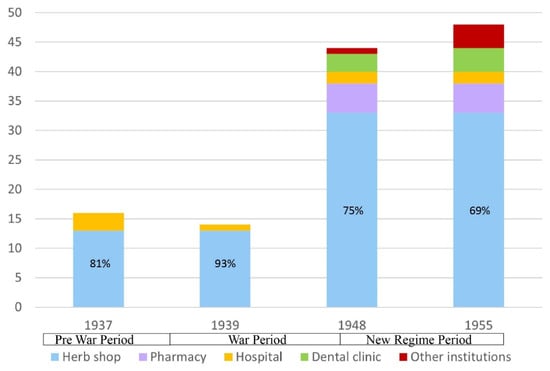
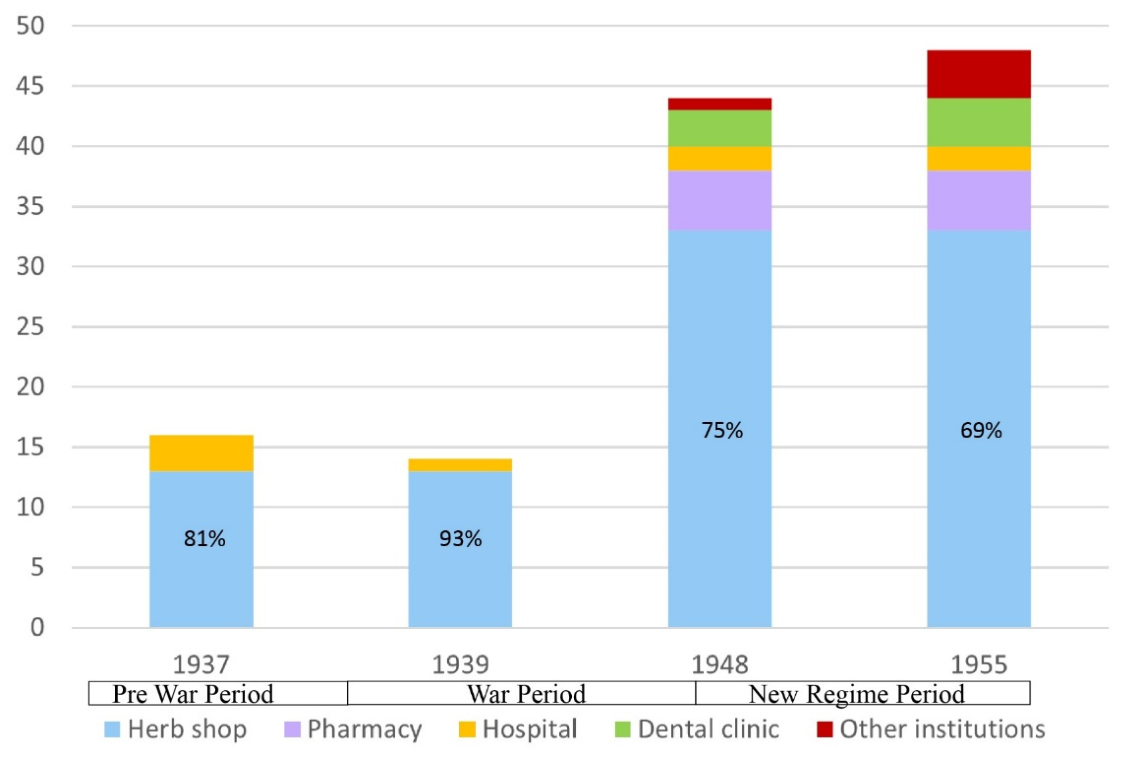
The aforementioned public health management system established by the central government did not establish specialized facilities in the case area between 1937 and 1948. In practice, the implementation of public health institutions was closely tied to police authority, with health divisions set up under provincial and local police departments. According to the records, this system was effectively implemented only at provincial and prefectural levels [14], p. 124. Yet at the county level, while some counties designated hospitals as grassroots institutions for public health administration [16], pp. 319–320, the 1938 statistics show that no hospital in the case region was given this role [22]. The hospitals operating in Pingyao at that time were either private or, from 1938, a military hospital reserved for Japanese soldiers. No public health institutions therefore existed in the case area at that time, suggesting the absence of a stable and independent grassroots public health system. Similarly, both local warlords and Japanese occupiers made little effort to build lasting healthcare institutions, utilizing modern medical strategies only in response to temporary epidemic crises. Epidemic prevention agencies were abandoned once the epidemic had subsided, and did not fundamentally change people’s habits and everyday practices for preventing infectious diseases. After the Japanese occupation (1938–1945), the local warlord government (1945–1948) transformed the military hospital into a public hospital, which undertook public health functions [27], pp. 27–31. However, it was only after the new political regime was founded in 1948 that public healthcare became a permanent and organized system. As shown in Figure 2, independent medical administrative bodies and public health institutions, such as medical training schools and epidemic control facilities, were formally established under government leadership and categorized as “Other institutions”.
Figure 2.
The number and type of medical spaces in Pingyao from 1937 to 1955. Herb shops constituted 81% and 93% of all medical spaces before and during the War period respectively, and 75% and 69% during the New Regime period. Note: Prewar hospitals were private. During the War period, the County Hospital served Japanese soldiers (1938–1945) before becoming a public hospital, and the Sihe Hospital (from 1941) was private. In the New Regime period, public and private hospitals coexisted. Source: drawing by the first author.
Figure 2 compares the numbers of medical spaces, but a hospital and a herb shop can differ greatly in size. Table 1 therefore also compares the total footprint of the herb shops and Western medical spaces whose footprint is known (see Section 2.2). Although footprints are known for only some of the medical spaces, the numbers and the footprints both show that herb shops generally exceeded Western medical spaces throughout the study period.
Table 1.
Number and known footprint of herb shops and Western medical spaces in 1939, 1948, and 1955 (sources: see Appendix A).
3.2. Spatial Practices of Localized Western Medicine
Western medicine in Pingyao was not universally accepted but rather selectively adopted in ways closely tied to the city’s social and institutional context. As shown in Figure 2, three private hospitals operated during the Prewar period, representing the earliest institutions to adopt Western medicine as their primary form of treatment, closely connected with religion and the military. For instance, two of them were founded by local Catholic merchants, and the third by retired military doctors [27], pp. 240–241. These early practitioners of Western medicine were typically linked to missionary organizations, the military, or elite families with access to Western-style education. The private Sihe Hospital, established during the War period by a physician trained at a Western medical college in China, specialized in obstetrics, amputations, routine physical examinations, and venereal disease treatment [27], p. 237. Later, in the New Regime period, an obstetrics training school was founded, producing a large number of obstetricians. By 1948, Western pharmacies and dental clinics had also appeared.
Spatially, apart from the three private hospitals that closed in 1938, the hospitals were concentrated along the city’s main commercial avenues, particularly on South Avenue and around its intersection with West Avenue, taking advantage of their convenient access and existing economic vitality. Rather than adopting distinct architectural forms or being spatially segregated from the rest of the city, these facilities were embedded within the existing urban fabric. Most of these hospitals occupied traditional courtyards, adapting their layouts to new medical functions while maintaining the spatial characteristics of Pingyao’s built environment. This pattern reveals that the localization of Western medicine was achieved not through the creation of entirely new urban spaces, but through the functional transformation of existing sites and their integration into the city’s everyday spatial order.
3.3. Operation and Transformation of Chinese Medicine Shops
Compared with the specialization and subdivision of hospitals, Chinese herb shops in the case area generally centered on the sale of medicinal materials rather than being organized around categories of diseases. The continuous functional and spatial transformation of herb shops reflects how Chinese medicine adapted to the new logic of modernization.
By the outbreak of war in the 1930s, most herb shops survived through service refinement and the modernization of their operational model. To sustain their business during the War period, herbal merchants made adjustments on several fronts. In terms of operations, they shifted from cross-regional trading to serving local customers, and moved beyond the wholesale of herbal materials toward a more integrated model that combined retailing, the production of prepared medicines, prescription sales, and on-site consultation [21]. In terms of promotion, shops used newspaper advertisements to publicize both the renowned practitioners consulting on their premises and their own prepared medicines, thereby attracting customers [20]. In terms of management, individual shops took different measures: the Yunjincheng herb shop recruited shareholders to expand its capital, while Shengmaochang replaced the manager responsible for its day-to-day operation [27], pp. 27–31. As shown in Figure 2 and Table 1, herb shops remained the predominant category of medical spaces, with their share never dropping below 69%. Their number rose from 13 in 1939 to 33 in 1948, and their total known footprint rose from 3770 m2 to 12,494 m2. After the establishment of the New Regime in 1948, the government-led public healthcare system promoting Western medicine was established, and the number of Western medical spaces rose from 11 in 1948 to 15 in 1955. The number of herb shops, however, did not decline and remained at 33 in 1955.
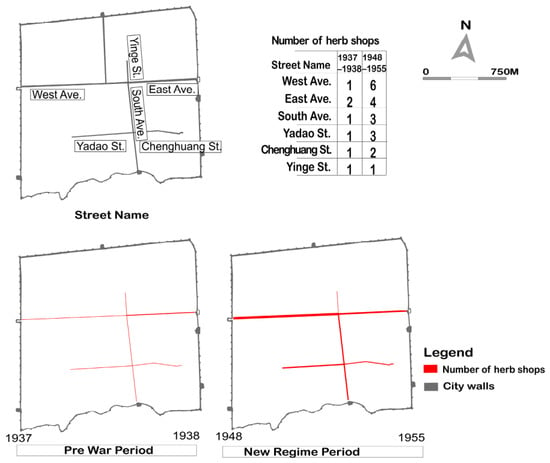
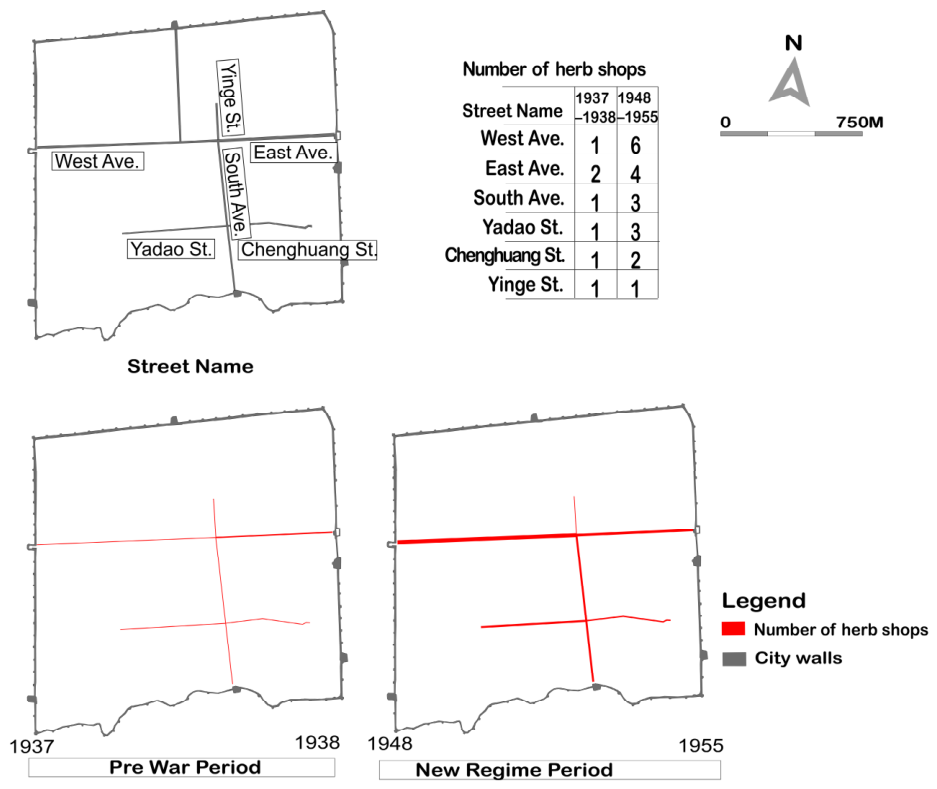
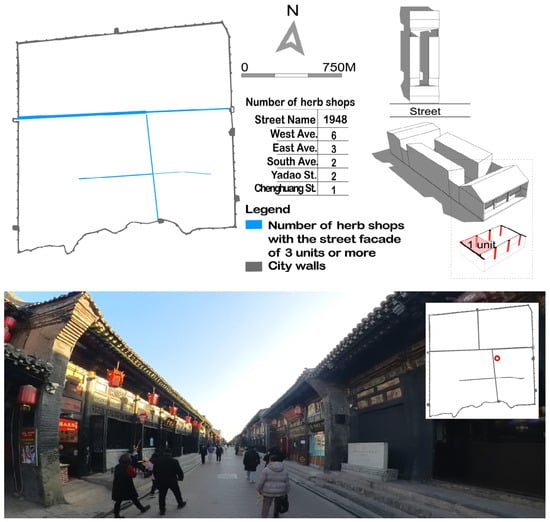
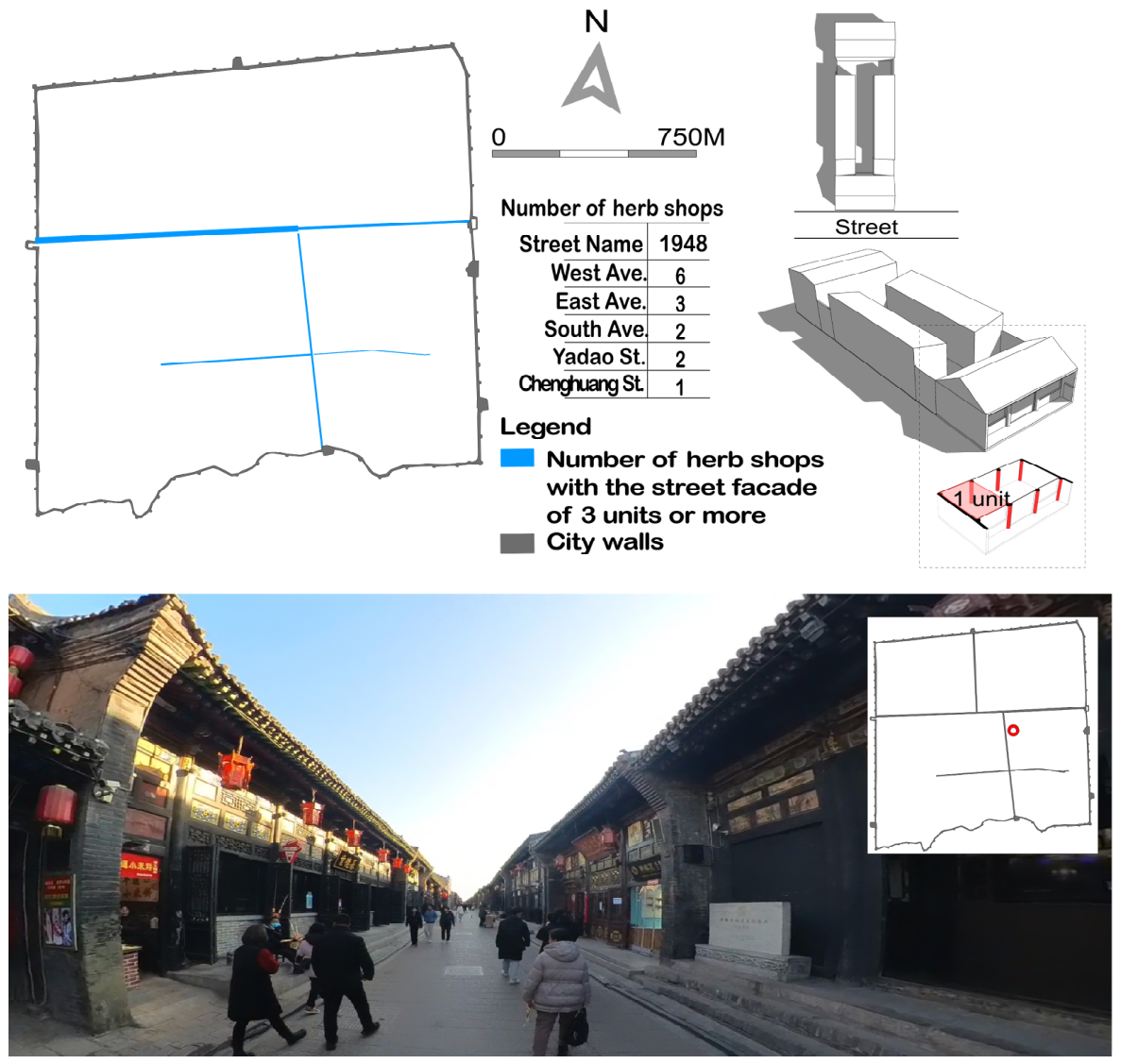
Spatially, changes in the distribution and façade characteristics of herb shops show how medical modernization was realized in urban space. Although only some of the herb shops could be located, those with a recorded address or street still reveal how their distribution changed. As shown in Figure 3, their number increased from 7 in the Prewar period to 19 in the New Regime period. West Avenue showed the largest increase, from one to six. Façade size followed a similar pattern. As shown in Figure 4, six herb shops had street façades of three units or more on West Avenue in 1948, compared with three or fewer on each of the other streets. Notably, South Avenue, the most commercialized street, had only two herb shops of this size. Such wide frontages provided more space and visual appeal for product display and for welcoming customers.
Figure 3.
The distribution of herb shops between the Pre-War period and the New Regime period. The width of the street line indicates the number of herb shops along this street, with 1 pt of street width representing 1 herb shop. Only herb shops with a recorded address or street are shown (7 of the 13 herb shops in the Prewar period and 19 of the 33 herb shops in the New Regime period). Source: drawing by the first author.
Figure 4.
Distribution of herb shops and their street façade widths in 1948 (top). The width of the street lines represents the number of herb shops along the street whose facades measured 3 units or more (1 unit being the width of a space enclosed by four pillars in traditional Chinese architecture [34]), with 1 pt of street width corresponding to 1 herb shop. Below, the street façade of the Yun Jin Cheng herb shop (left). Source: drawing by the first author. Photograph by the first author, 2024.
3.4. Adapting Courtyards
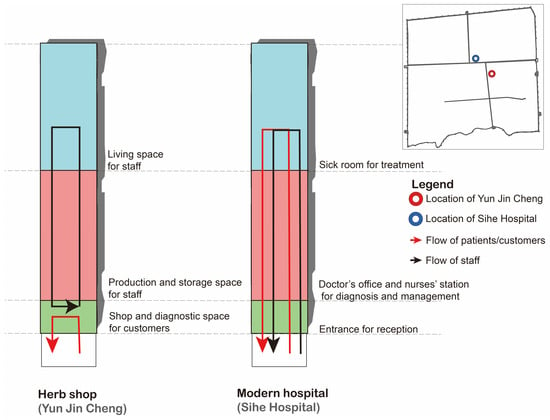
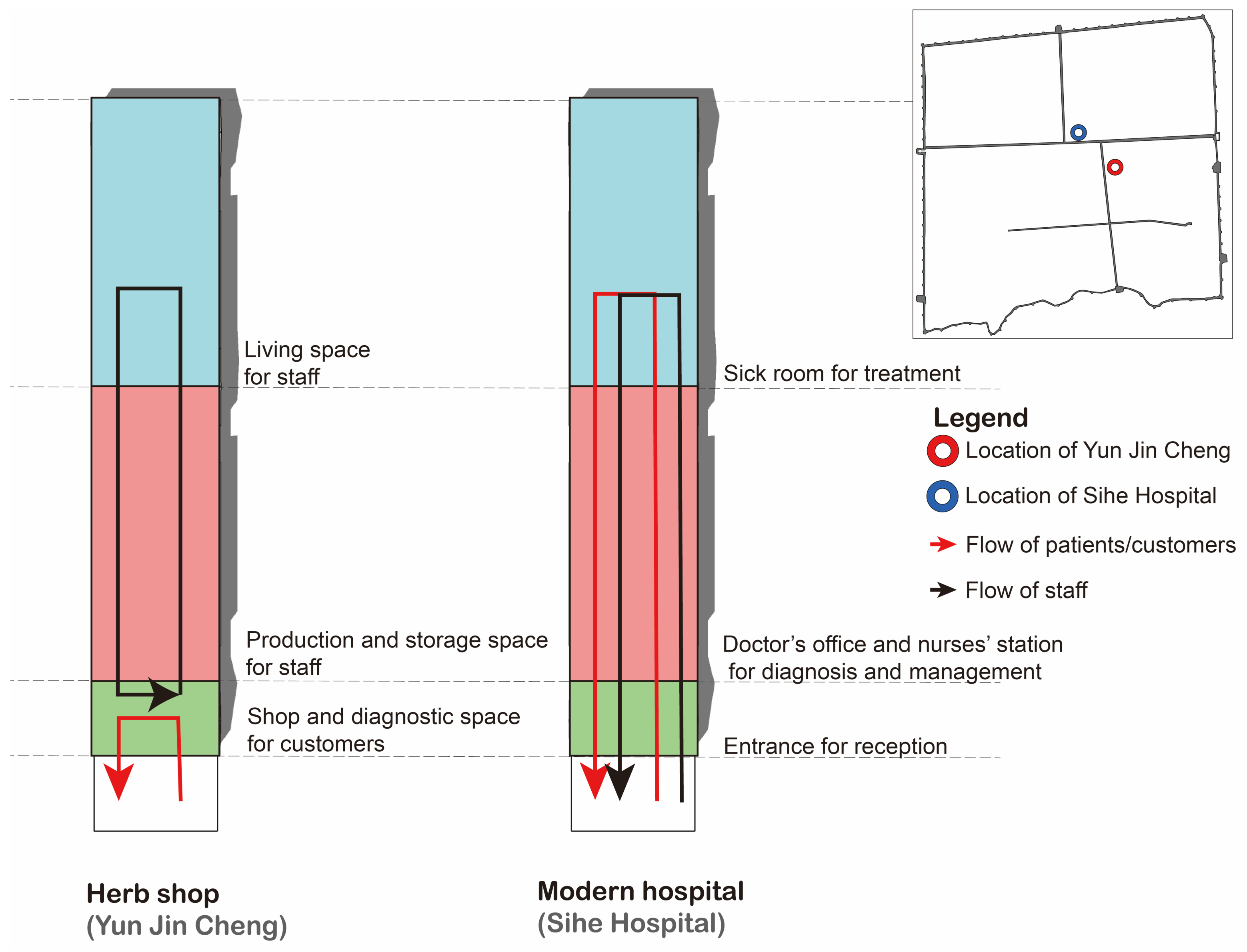
Medical modernization also took place within individual courtyards. Figure 5 compares the use of a herb shop named Yun Jin Cheng and the Sihe Hospital, two courtyards with the same number of yards and similar footprints. Neither altered the physical form of its courtyard, and the differences were in how the yards were used and how people moved through them.
Figure 5.
Differences in functional layout between the herb shop Yun Jin Cheng and the Sihe Hospital. Source: drawing by the first author, based on the 2024 fieldwork survey of both courtyards. The functions of Yun Jin Cheng are based on local gazetteer records [27], pp. 27–31 and the common layout of herb shops in the case area [21], and those of the Sihe Hospital on local gazetteer records [25], pp. 677–683, with their distribution confirmed by a patient’s memoir [33].
At Yun Jin Cheng, the street-front row was used for retail and diagnosis and was open to both customers and staff, whereas the first yard was used for medicine production and storage and the second yard as living quarters, both accessible only to staff. This layout is consistent with the common layouts of shop and workshop courtyards in Pingyao, in which the part facing the street served as a shop, and the rear part was used for production, storage, and living [35]. The herb shop was therefore not solely a medical space but also a place of business and a space that met the daily needs of its staff, forming a self-contained unit.
In contrast, the Sihe Hospital organized its yards according to the sequence of medical procedures. The street-front row served as the entrance and reception area, the first yard contained the doctors’ office and the nurses’ station for diagnosis and management, and the second yard contained the sick rooms. Unlike the herb shop, the hospital allowed patients and staff to move from front to back through all the yards and contained no living space. The entire courtyard was thus used for medical functions, making the hospital a dedicated medical space.
These differences in use reflect different medical practices. The hospital required sick rooms for inpatients and separate spaces for reception, diagnosis, and management, which can be seen as the spatial realization of Western medical practice. By contrast, in Pingyao during this period, Chinese medical treatment usually took place in patients’ homes (see Section 1.3), and the herb shop needed space only for diagnosis and the sale of medicines. At Yun Jin Cheng, therefore, only the street-front row reflected the spatial needs of Chinese medical practice, while the rest of the courtyard was organized according to the needs of business and accommodation.
These medical practices can be related to the different understandings of the body and disease in Chinese and Western medicine. Chinese medicine is originally grounded in Chinese culture and cosmological beliefs, holding a holistic view of the body in which human well-being is deeply intertwined with society and natural ecology [36]. The body remains healthy when an individual’s vital activities align with natural rhythms, such as seasonal changes and environmental shifts, while illness arises from disruptions to this harmony. Treatments, therefore, focus on restoring balance and often involve diet and lifestyle adjustments [37], which were commonly conducted in non-medical spaces such as residences. Conversely, Western medicine, based on the knowledge of pathological anatomy, diagnoses diseases through symptoms and maps the essence of diseases to specific organs [38], pp. 149–173, treating the human body as a dismantled and analysable organic totality [39]. Western diagnostic practices, which require neutral environments to distinguish and isolate individual diseases from their natural conditions, like the patient’s home, facilitated the emergence of specialised departments [38], pp. 107–121. This is consistent with the organization of the Sihe Hospital.
However, medical knowledge and practice were not the only factors shaping the use of the courtyards. The use of both courtyards was constrained by their existing form, and the layout of Yun Jin Cheng, as a shop, was also shaped by its mode of business.
4. Discussion
Medical modernization was a key domain of modernization in early twentieth-century China, involving ideological conflict as well as changes in the evolution of institutions, knowledge, and spatial practices. This study conceptualizes medical modernization in China as a dual process involving both the localization of Western medicine and the self-transformation of Chinese medicine. Using Pingyao as a case, it examines how this process was realized at the city, street, and courtyard scales. In contrast to existing studies that focus on public health and urban governance, the case shows how the different processes of medical modernization were realized in different ways in the urban space of a county-level city.
At the city scale, the findings first underscore the limited effectiveness of public healthcare institutionalization at the county level. As shown in Section 3.1, in the Prewar and War periods, the medical spaces open to the public were herb shops and private hospitals, while the County Hospital served only Japanese soldiers between 1938 and 1945. Although the local warlord government converted this hospital into a public hospital with public health functions after 1945, no permanent public health system was established before 1948. Only after 1948 did independent medical administrative bodies and public health institutions appear. This evidence shows that, despite the central government’s supportive stance, local medical institutionalisation was poorly implemented and frequently disrupted by wartime instability.
Similar challenges were observed in capital cities. In Shanghai, the tensions between the interests of local elites and the colonial governments constituted the primary obstacle to the operation of the Mercy Hospital [40]. In Nanjing, efforts to improve sanitary infrastructure in slum areas yielded limited outcomes due to insufficient government funding [41]. Likewise, in Chengdu, conflicts over cost-sharing between local authorities and the public became the key obstacles to implementing sanitation policies and maintaining the healthcare system [42]. In our case area, a county-level city, the limited implementation of public health institutionalization was also visible in space. For a long time, the new institutions, such as medical administrative bodies and public health institutions, had no dedicated spaces of their own, and these appeared only after 1948, when the new political regime established a permanent public healthcare system.
Furthermore, the numbers and footprints of Chinese and Western medical spaces in different periods show that Chinese medicine remained predominant. Despite central government efforts to promote the institutionalization of Western medicine, herb shops were consistently more numerous than Western medical spaces and accounted for at least 69% of all medical spaces. Although footprints are known for only some medical spaces, the total known footprint of herb shops exceeded that of Western medical spaces in every period and grew considerably more between 1939 and 1948, mainly as a result of the increase in the number of herb shops, although part of this increase reflects the larger number of medical spaces with a known footprint in 1948. Rather than being replaced by Western medical spaces, herb shops continued to expand alongside them between 1939 and 1948. The overall increase in both Chinese and Western medical spaces may reflect an expanding social demand for diverse healthcare-seeking strategies, within which Chinese medicine remained dominant.
At the street scale, herb shops showed different distribution patterns in the Prewar and New Regime periods (Section 3.3). In the Prewar period, they were dispersed across six streets. In the New Regime period, they became concentrated on West Avenue, which also had the most herb shops with street façades of three units or more in 1948.
Herb shops thus became concentrated on West Avenue, both in number and in façade size, rather than on South Avenue, the commercial centre in the premodern era. This pattern may be related to the socioeconomic conditions of the period. One was improved transport. The first railways in the area, the Tongpu Railway and the Pingyao–Fenyang Railway, opened in 1934 and 1935, and their stations were built outside the city gate nearest to West Avenue [25], pp. 289–290. Herb shops on West Avenue could therefore benefit from the flow of travellers and the transport of medicinal materials. Another possible condition was the cost of space. South Avenue lay at the centre of the city and had long been densely commercialized, which may have made it expensive to acquire and alter buildings there. West Avenue may have been cheaper, which would have made it easier to open new herb shops and to occupy wider façades.
These changes show how the self-transformation of Chinese medicine was realized at the street scale. The growth of privately owned herb shops was most visible on West Avenue, a pattern consistent with improved transport and lower costs of space. This suggests that medical modernization in county-level cities, such as Pingyao, was not simply imposed from above through administrative power, but may also have been propelled by local merchants. The form of this process in the case area differed from that in larger cities. In Tianjin, a treaty port, the construction of sanitary infrastructure and the implementation of public health were closely tied to colonial government power [8], pp. 192–224. In Chengdu, an inland provincial capital, improvements in residential sanitary conditions and the sanitary management of public space were led by the warlords stationed there [43].
At the courtyard scale, the localization of Western medicine did not produce new building types or a separate medical district (see Section 3.2). All Western medical spaces with a known location, namely the two hospitals and two dental clinics, occupied existing courtyards on commercial streets, alongside herb shops (Figure A1). This differs from studies of treaty ports and other large cities, which show how medical modernization reshaped urban space through sanitary infrastructure and functional separation [8], pp. 192–224, [44].
The herb shop Yun Jin Cheng and the Sihe Hospital, housed in two surveyed courtyards of similar size, both adapted the existing courtyards and differed in how their yards were used (Section 3.4). The herb shop divided its street-front row and two yards according to the people who used them, opening the street-front row to customers and reserving the rear yards for production and staff accommodation. The hospital organized the same three parts according to the sequence of reception, diagnosis, and treatment, using the entire courtyard for medical functions as a dedicated medical space.
This study has several limitations. First, the locations and footprints of some medical spaces could not be determined due to the limited data, so the spatial analysis and the comparison of footprints are based only on the medical spaces with known locations and footprints. Second, this study examines medical spaces only and does not fully consider wider demographic, economic, and infrastructural changes, which also influenced urban space. For example, the explanation of the concentration of herb shops on West Avenue considers only transport and the cost of space. Other factors may also have influenced this pattern but could not be examined with the available sources. Finally, the comparison of courtyards is based on only two cases. Western medical spaces were few in number in Pingyao during the study period, and the Sihe Hospital was the only one comparable to Yun Jin Cheng. Although the gazetteer records and the fieldwork were used as evidence, the functions of the yards in both courtyards are limited by the available historical sources. In particular, the distribution of functions in the Sihe Hospital relies partly on the memoir of a former patient. The spatial analysis is therefore limited to courtyard size and the division of yards. The comparison thus shows how a specific herb shop and a specific hospital adapted courtyards of similar scale through their medical practices and forms of organization, rather than a general difference between Chinese and Western medical buildings.
5. Conclusions
This study examined how medical modernization was realized in the existing urban space of a county-level city. Using Pingyao between 1937 and 1955 as a case, it traced this process by combining historical documents with the spatial analysis of medical spaces. The findings show that medical modernization in Pingyao took place within the existing urban fabric at the city, street, and courtyard scales. At the city scale, public health institutionalization long lacked dedicated spaces and acquired them only after 1948. Meanwhile, herb shops remained predominant in both number and footprint. At the street scale, herb shops increased in number and became concentrated on West Avenue, a pattern that may be related to improved transport and the cost of space. At the courtyard scale, Western medical spaces occupied existing courtyards on commercial streets, and the herb shop and the hospital examined in this study reorganized the functions and circulation of courtyards of similar scale without changing their physical form.
In contrast to studies that focus on public health and urban governance in large cities, this study shows how medical modernization was realized through local social forces and the adaptation of existing streets and buildings in a county-level city. The spatial approach used in this study, which combines documentary records with the spatial analysis of medical spaces, could also be applied to other cities and to the relationship between medical spaces and wider social conditions. By treating herb shops, hospitals, and courtyards as evidence of how medical modernization was realized, it also offers new perspectives on the value and use of built heritage. Future research could examine other county-level cities to test whether the approach used in Pingyao applies elsewhere, and relate medical spaces to wider social and economic factors, such as demographic, technological, and infrastructural changes.
Author Contributions
Conceptualization, A.L., T.K. and K.L.; methodology, A.L.; software, A.L.; validation, A.L.; formal analysis, A.L.; investigation, A.L.; resources, A.L.; data curation, A.L.; writing—original draft preparation, A.L.; writing—review and editing, A.L., T.K. and K.L.; visualization, A.L.; supervision, T.K. and K.L.; project administration, A.L.; funding acquisition, A.L. All authors have read and agreed to the published version of the manuscript.
Funding
The APC was funded by MOVEMENTS, MOBILITIES, NETWORKS PROJECT, grant number 1005P6303003.
Data Availability Statement
The data sources are detailed in Appendix A.
Acknowledgments
We would like to thank the anonymous reviewers and the editors for their valuable comments, which helped us to improve the paper.
Conflicts of Interest
The authors declare no conflicts of interest.
References
- Topal, A.E.; Wigen, E. Diagnosing the State: Medical Metaphors in Ottoman Political Writing. Die Welt Islams 2022, 62, 299–324. [Google Scholar] [CrossRef] [Scilit]
- Ramesh, A. The Plague in Madras: The Making of an “Immune” City. J. Urban Hist. 2023, 51, 774–792. [Google Scholar] [CrossRef] [Scilit]
- Musolff, A. Metaphor, Nation and the Holocaust: The Concept of the Body Politic; Routledge: London, UK, 2010; Volume 3, pp. 2–3. [Google Scholar]
- Gao, L. 吾人将以何法治疗社会之疾病乎 (How Do We Cure the Diseases of Society). East. J. 1922, 9, 1–5. [Google Scholar]
- Kwok, D.W.Y. Scientism in Chinese Thought, 1900–1950; Yale University Press: New Haven, CT, USA, 1965; p. 241. [Google Scholar]
- Lei, S.H.-l. Neither Donkey Nor Horse: Medicine in the Struggle over China’s Modernity; University of Chicago Press: Chicago, IL, USA; London, UK, 2014. [Google Scholar]
- Iijima, W. 鼠疫与近代中国: 卫生的制度化和社会变迁 (Plague and Modern China: The Institutionalization of Health and Social Change); Social Sciences Academic Press: Beijing, China, 2019; p. 176. [Google Scholar]
- Rogaski, R. Hygienic Modernity: Meanings of Health and Disease in Treaty-Port China; University of California Press: Berkeley, CA, USA, 2004. [Google Scholar]
- MacPherson, K.L. A Wilderness of Marshes: The Origins of Public Health in Shanghai, 1843–1893; Lexington Books: Lanham, MD, USA, 2002; pp. 8–12. [Google Scholar]
- Yang, N. 再造病人: 中西医冲突下的空间政治 (1832–1985) (Remaking the “Patient”: The Spatial Politics of Sino-Western Medical Conflicts, 1832–1985); China’s People University Press: Beijing, China, 2006. [Google Scholar]
- Zhao, H. 近代中医论争史 (The History of Chinese and Western Medicine Debate from Late Qing to 1949); Anhui Science and Technology Press: Hefei, China, 1989; pp. 105–117. [Google Scholar]
- Andrews, B. The Making of Modern Chinese Medicine, 1850–1960; UBC Press: Vancouver, BC, Canada, 2014. [Google Scholar]
- Shapiro, H. How Different are Western and Chinese Medicine? The Case of Nerves. In Medicine Across Cultures: History and Practice of Medicine in Non-Western Cultures; Selin, H., Ed.; Springer: Dordrecht, The Netherlands, 2003; pp. 351–372. [Google Scholar]
- Chen, B. 中国医学史 (Medical History in China); Commercial Press: Shanghai, China, 1937. [Google Scholar]
- The Second Historical Archives of China. 中华民国史档案资料汇编: 政治 (Compilation of Historical Archive Materials of the Republic of China: Politics); Jiangsu Ancient Books Publishing House: Nanjing, China, 1994; pp. 32–33. [Google Scholar]
- Deng, T. 中国防疫史 (Chinese History of Epidemic Prevention); Guangxi Science and Technology Publishing House: Guilin, China, 2006. [Google Scholar]
- Andrews, B. Tuberculosis and the Assimilation of Germ Theory in China, 1895–1937. J. Hist. Med. 1997, 52, 114–157. [Google Scholar] [CrossRef] [Scilit] [PubMed]
- Soja, E.W. Postmodern Geographies: The Reassertion of Space in Critical Social Theory; Verso: London, UK, 1989; pp. 22–27. [Google Scholar]
- Du, L. 平遥古城志 (The Chronicle of Pingyao Ancient City); Shanxi People’s Publishing House: Taiyuan, China, 2002. [Google Scholar]
- Shanxi Provincial Academy of History and Gazetteers. 卫生医药志 (Gazetteer of Health and Medicine); Zhonghua Shuju: Beijing, China, 1997; Volume 41, pp. 27–32. [Google Scholar]
- Wang, N. 民国山西中药铺 (Research on the Development Status of Shanxi Medicine Shops in the Republic of China). Master’s Thesis, Shanxi University of Chinese Medicine, Xianyang, China, 2017; pp. 25–26. [Google Scholar]
- Pingyao Gazetteer Research Office. 平遥旧志三种 (Three Editions of the Old Chronicles of Pingyao); Shanxi Ancient Books Publishing House: Pingyao, China, 2022; p. 247. [Google Scholar]
- The People’s Government of Pingyao. Pingyao County Map; The People’s Government of Pingyao: Pingyao, China, 1948.
- National Geomatics Center of China. Administration Division of the People’s Republic of China; National Geomatics Center of China: Beijing, China, 2025.
- Compiling Committee for Pingyao Gazetteer. 平遥县志 (Pingyao Gazetteer); Zhonghua Shuju: Beijing, China, 1999. [Google Scholar]
- Cao, S. 国家与地方的公共卫生—以1918年山西肺鼠疫流行为中心 (The State and Local Public Health: Focusing on the 1918 Pneumonic Plague in Shanxi). China Soc. Sci. 2006, 1, 178–190. [Google Scholar]
- Wang, Z.; Zhang, Z.; Zhang, X. 平遥卫生志 (Gazetteer of Medicine in Pingyao); Beiyue Wenyi Publisher: Taiyuan, China, 2008. [Google Scholar]
- The State Council Information Office. China Keywords. Available online: http://english.scio.gov.cn/featured/chinakeywords/node_8003650.htm (accessed on 12 December 2024).
- Liang, Q. 平遥地名录 (Gazetteer of Place Names in Pingyao); The People’s Government of Pingyao: Pingyao, China, 1984; p. 122.
- An, J. Pingyao shenyi shilu [Records of Pingyao’s World Heritage Nomination]; Shanxi Economy Publisher: Taiyuan, China, 2007; pp. 162–168. [Google Scholar]
- Pingyao County Gutao Town Health Centre. 古陶镇卫生院55周年前后的变化 (Changes at Gutao Town Health Centre Before and After Its 55th Anniversary). Available online: https://mp.weixin.qq.com/s/zAizncMSMd8rKPWlOD65Zw (accessed on 29 September 2026).
- Shanxi Provincial Department of Commerce. 关于对第三批“三晋老字号”拟认定名单的公示 (Public Notice on the Proposed List of the Third Batch of “Sanjin Time-Honoured Brands”). Available online: https://swt.shanxi.gov.cn/zwgk/gkml/202212/t20221221_7650774.shtml (accessed on 29 September 2026).
- Wang, Z. 亲历平遥困难时期, 一段令人刻骨铭心的回忆 (A Personal Experience of the Difficult Period in Pingyao: A Memory That Remains Deeply Engraved). Available online: https://mp.weixin.qq.com/s/8O_24Uv2e4YV6UfAyDUkgA (accessed on 10 October 2024).
- Liu, D. 中国住宅概说 (Zhongguo Zhuzhai Gaishuo); Baihua Literature and Art Publishing House: Tianjin, China, 2003; p. 70. [Google Scholar]
- Pingyao County Government; UNESCO. Practical Conservation Guidelines for Traditional Courtyard Houses and Environment in the Ancient City of Pingyao. Available online: https://unesdoc.unesco.org/ark:/48223/pf0000234622 (accessed on 20 December 2024).
- Ma, B. 中國醫學文化史 (A History of Medicine in Chinese Culture); Shanghai People Press: Shanghai, China, 1994; pp. 15–20. [Google Scholar]
- Matos, L.C.; Machado, J.P.; Monteiro, F.J.; Greten, H.J. Understanding Traditional Chinese Medicine Therapeutics: An Overview of the Basics and Clinical Applications. Healthcare 2021, 9, 257. [Google Scholar] [CrossRef] [Scilit] [PubMed]
- Foucault, M. The Birth of the Clinic: An Archaeology of Medical Perception; Pantheon Books: New York, NY, USA, 1976. [Google Scholar]
- Canguilhem, G. The Normal and the Pathological; Zone Books: New York, NY, USA, 1991; pp. 87–89. [Google Scholar]
- Ma, J. Negotiating Shanghai Mercy Hospital: Philanthropy, Business and Control of Madness in Republican China. Soc. Hist. Med. 2023, 36, 359–385. [Google Scholar] [CrossRef] [Scilit] [PubMed]
- Tsui, C. State Capacity in City Planning: The Reconstruction of Nanjing, 1927–1937. Cross-Curr. East Asian Hist. Cult. Rev. 2011, 1, 12–46. [Google Scholar] [CrossRef] [Scilit]
- Liu, X. 社会进步与社会矛盾: 民国成都现代卫生管理中的官民冲突 (Social Progress and Social Contradictions: Conflicts Between the Government and the People in Modern Health Management in Chengdu). J. Chengdu Univ. (Soc. Sci.) 2016, 165, 19–26. [Google Scholar]
- Rowe, W.T. Urban Agency in Early Modern and Modern China. Urban Hist. 2017, 44, 123–129. [Google Scholar] [CrossRef] [Scilit]
- Stapleton, K. Civilizing Chengdu: Chinese Urban Reform, 1895–1937; Harvard University Asia Center: Cambridge, MA, USA, 2000; pp. 250–260. [Google Scholar]

Disclaimer/Publisher’s Note: The statements, opinions and data contained in all publications are solely those of the individual author(s) and contributor(s) and not of MDPI and/or the editor(s). MDPI and/or the editor(s) disclaim responsibility for any injury to people or property resulting from any ideas, methods, instructions or products referred to in the content. |
© 2026 by the authors. Licensee MDPI, Basel, Switzerland. This article is an open access article distributed under the terms and conditions of the Creative Commons Attribution (CC BY) license.