


Abstract
Old residential community renovation projects are implemented in continuously occupied living environments, where changing site conditions, evolving resident demands, and multi-stakeholder coordination cannot be fully addressed through advance planning alone. Project organizations must therefore maintain operational continuity and adapt promptly to ongoing disturbances. Focusing on organizational resilience in old residential community renovation projects, this study identifies six core factors through a literature review and expert screening and applies α-cut fuzzy DEMATEL, ISM, and MICMAC analyses to examine their influence relationships, hierarchical structure, and driving–dependency characteristics. The DEMATEL results identify information interaction, organizational structural flexibility, and crisis leadership as driving-group factors, whereas collaborative governance, risk perception, and organizational improvisation are identified as effect-group factors. The ISM analysis reveals a three-level hierarchical structure: information interaction, organizational structural flexibility, and crisis leadership constitute the fundamental driving layer; collaborative governance occupies the intermediate linkage layer; and risk perception and organizational improvisation form the surface outcome layer. The MICMAC analysis further indicates that information interaction, organizational structural flexibility, and crisis leadership are independent driving factors, whereas collaborative governance, risk perception, and organizational improvisation are dependent factors. These findings demonstrate that the factors underlying project organizational resilience differ in their influence characteristics and hierarchical positions, providing a basis for understanding their interrelationships and improving organizational management in old residential community renovation projects.
1. Introduction
Improving housing conditions, infrastructure, and public services in old residential communities is an important component of building inclusive, safe, and sustainable cities [1]. A large number of residential communities built in earlier periods are entering a period of concentrated revitalization, making renovation of these communities an important practice in urban renewal [2]. From 2019 to 2024, renovation projects were initiated in 280,000 old residential communities in urban China, benefiting more than 120 million residents [3]. While improving living conditions, these ongoing renovation efforts also place greater demands on project organizations to dynamically maintain operations and coordinate actions in complex environments.
Compared with new, conventional construction projects, the renovation of old residential communities is typically undertaken in built environments where residents remain in continuous occupancy, making it difficult to separate construction from daily life. Inconsistencies between existing documentation and site conditions, concealed works, constrained workspaces, and evolving resident demands also make design adjustments, construction arrangements, quality and safety control, and multi-actor coordination closely intertwined [2,4,5]. These issues may propagate across actors and implementation activities, resulting in repeated plan revisions, reduced coordination efficiency, and rework.
Conventional risk identification, construction planning, and coordination mechanisms can address some known problems but cannot be used to anticipate all on-site changes. When disturbances persist and spread across actors, project management must extend beyond risk prevention to encompass maintenance of basic operations, integration of dispersed information, coordination of interorganizational actions, and timely adjustments based on site feedback. Organizational resilience, which emphasizes maintaining basic functions, responding to disturbances, and adapting to change under uncertainty [6,7], therefore provides an appropriate perspective for examining these challenges.
In this study, project organization is defined as a temporary interorganizational system formed around renovation tasks for old residential communities, mainly comprising project owners; design, construction, and supervisory units; and related professional organizations, which continuously interact with government departments, subdistrict and community organizations, and residents. The focus is not on the resilience of any single organization or stakeholder, but on the ability of the core participants to sustain the overall project through information integration, resource coordination, and action adjustment. Although government departments, community organizations, and residents are not completely linked to the project organization, they continuously influence its operation through information feedback, demand expression, and participation in project activities.
Existing studies on renovations of old residential communities have mainly focused on policy governance, interest distribution, resident participation, and renovation performance [2,4,5], whereas research on project organizational resilience has largely examined major infrastructure projects, general construction projects, and construction enterprises [6,7]. Although various resilience factors have been identified, they are often treated as parallel elements for identification, evaluation, or ranking, with less attention paid to their interactions, hierarchical relationships, and differentiated roles. Such relational and structural characteristics remain particularly underexplored in the context of the renovation of old residential communities, where continuous occupancy, dispersed information and authority, and changing site conditions create unique organizational demands.
Accordingly, this study addresses two questions: First, what core factors influence project organizational resilience during the renovation of old residential communities? Second, what influence relationships, hierarchical structures, and driving–dependency characteristics exist among these factors? Rather than treating resilience factors as parallel elements, this study examines their interrelationships and structural differences. The core factors are first identified through literature-based analysis and expert evaluation, after which α-cut fuzzy DEMATEL, ISM, and MICMAC analyses are combined to analyze their influence relationships, hierarchical structures, and driving–dependency characteristics, thereby revealing the differentiated roles of the factors underlying project organizational resilience in this context.
2. Literature Review and Theoretical Foundations
2.1. Old Residential Community Renovation Projects and Organizational Resilience
Initially, the term organizational resilience was used to emphasize an organization’s ability to recover from shocks, but it has gradually evolved to encompass the dynamic capacity to maintain basic functions, coordinate resources, and adapt to changes under uncertainty [8,9,10,11,12,13,14,15]. Accordingly, organizational resilience in this study refers to an organization’s ability to maintain basic functions, coordinate internal and external relationships, and adapt to change by adjusting its actions under conditions of uncertainty and external disturbance.
Research on organizational resilience is increasingly extending to the fields of project management and construction engineering [6,7,16,17,18,19,20,21]. In project research, it is also necessary to distinguish between project resilience and project organizational resilience. Project resilience takes the project as a whole as the unit of analysis, focusing on the continuity and recovery of project objectives, processes, and performance under disturbances; by contrast, project organizational resilience, which is the focus of this study, takes the interorganizational system within the project as the unit of analysis, emphasizing its ability to sustain operations, coordinate actions, and adapt to change under disturbances. Because projects are temporary and interorganizational, information, resources, and authority are often distributed among participating actors. Project organizational resilience therefore depends not only on the capabilities of individual organizations but also on interorganizational integration, coordination, and joint adjustment of information. Accordingly, this study defines project organizational resilience during the renovation of old residential communities as the ability of the project organizers to maintain basic project operations and adapt to environmental changes under ongoing disturbances through information integration, interorganizational coordination, and adjustments to resources, responsibilities, and implementation arrangements.
Existing studies on the renovation of old residential communities have mainly addressed policy governance, interest distribution, resident participation, spatial improvement, and implementation performance [2,4,5,22], with less attention paid to core participants such as project owners and design, construction, and supervisory units as an interdependent temporary project organization. Given the continuous occupancy, open organizational boundaries, and dispersed information and authority characteristic of such projects, an organizational resilience perspective provides a basis for examining the relationships and hierarchical characteristics among resilience factors.
2.2. Factors Influencing Organizational Resilience
Research on the factors influencing organizational resilience can be broadly grouped into four perspectives: psychological and cognitive factors, organizational governance, resource capabilities, and the contextual environment. The psychological and cognitive perspective concerns how individuals and teams understand, assess, and respond to uncertainty. Shared cognition, team trust, organizational identification, self-efficacy, and individual resilience can influence organizational response capacity through member interaction and behavioral coordination [23,24,25,26,27,28].
The organizational governance perspective focuses on organizational structure, leadership, institutional arrangements, and cross-actor coordination. Flexible structures and appropriate decentralization can shorten decision-making chains and facilitate adjustments to responsibilities and resources, while leadership, contractual and relational governance, information exchange, and stakeholder participation support interorganizational decision-making and coordinated action [7,18,21,29,30,31,32]. Recent urban regeneration studies have further emphasized the roles of collaborative governance, stakeholder participation, and institutional coordination in multi-actor interactions and the implementation of regeneration projects [33,34].
The resource capability perspective emphasizes both resource foundations and their mobilization. Financial, material, and redundant resources can buffer shocks; human, social, and knowledge capital support access to information and external assistance; and capabilities such as resource integration, reconfiguration, digital applications, and knowledge sharing facilitate resource mobilization and reallocation [18,21,30,35,36,37,38,39,40]. Recent studies have further highlighted the roles of digital technologies, BIM-enabled information integration, and data-driven decision support in strengthening organizational adaptability, improving information sharing, and supporting resource coordination and decision-making in projects [39,41,42,43].
The contextual and environmental perspective concerns external conditions such as environmental uncertainty, policies and institutions, project networks, and stakeholder relationships [6,29,31,36,44,45,46]. These conditions may increase difficulties related to prediction and coordination but can also support organizational responses through institutional support, network relationships, and information exchange. They are, however, generally difficult to be altered by project organizations directly.
Overall, although existing research has identified numerous resilience factors, two limitations remain. First, factors are often treated as parallel elements for identification, assessment, or statistical testing, with limited attention paid to their interactions, hierarchical positions, and differentiated roles. Second, most findings come from studies of general enterprises, infrastructure projects, new construction projects, or construction enterprises and may not fully reflect the context of renovating old residential communities. Similar factors also vary in terms of terminology and level of analysis across studies. Accordingly, this study consolidates, standardizes, and screens relevant factors based on both their conceptual meanings and the specific project context, as detailed in Section 3.3.
2.3. Theoretical Foundation
The renovation of old residential communities involves multiple actors, interdependent tasks, and open organizational boundaries, with information, professional knowledge, resources, and authority distributed across participants. When site conditions, resident demands, or interorganizational coordination change, project organizations must not only identify emerging problems but also integrate information and resources and adjust responsibilities, decision-making, and implementation arrangements. Dynamic capabilities theory is therefore used to explain the relationships among the core factors underlying project organizational resilience.
Dynamic capabilities theory emphasizes organizations’ ability to identify threats and opportunities, integrate internal and external resources, and reconfigure capabilities and action arrangements in response to changing conditions [47,48,49]. During the renovation of old residential communities, planners cannot fully anticipate on-site changes in advance. Project organizations must identify emerging changes through information acquisition and feedback, assess problems based on the professional judgments of multiple participants, and develop responses through leadership decision-making, interorganizational coordination, and adjustments to responsibilities and resources. Project organizational resilience can therefore be understood as involving interrelated processes of change identification, problem assessment, resource integration, cross-actor coordination, and action adjustment. These processes do not necessarily follow a fixed sequence but jointly support responses to disturbances and adaptation through continuous interaction.
3. Methods
3.1. Research Process
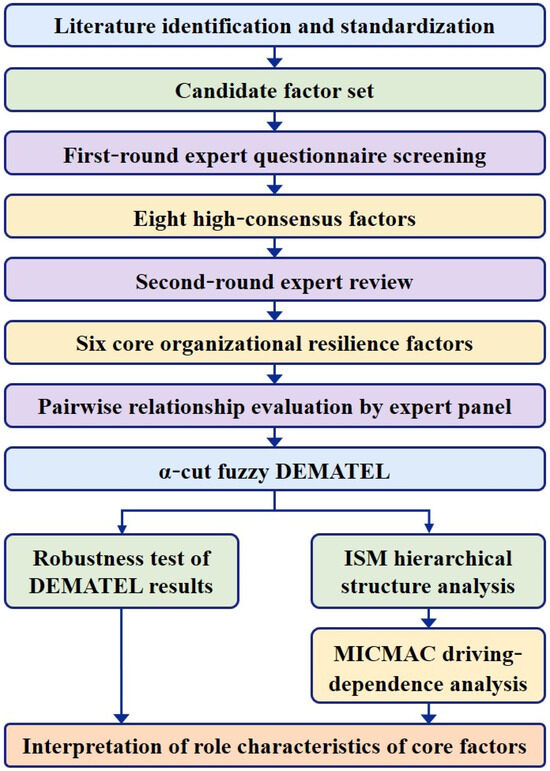
This study comprises four stages: factor identification, relationship evaluation, structural analysis, and integrated interpretation (Figure 1). Candidate factors were first identified from the literature, standardized, and then screened through a first-round expert assessment and a second-round online expert review to determine the core factors. Experts subsequently conducted pairwise evaluations of direct influencing relationships among the core factors, with their linguistic judgments converted into fuzzy data. α-cut fuzzy DEMATEL was used to analyze influence degree, influenced degree, centrality, causality, and the main influence paths, while ISM and MICMAC analyses were applied to identify hierarchical relationships and driving–dependency characteristics, respectively [50]. The results were then integrated to interpret the differentiated roles of the core factors.
Figure 1.
Research framework and analytical process.
3.2. Expert Panel and Data Sources
This study involved two expert panels serving different purposes, with participants selected according to the requirements of each task and their relevant practical or research experience. The selection criteria included professional background, experience with renovating old residential communities, urban renewal, or construction project management, and familiarity with the corresponding evaluation tasks.
Panel A comprised 10 members who participated in factor identification through questionnaire screening and an online discussion. Seven had engineering backgrounds in construction, supervision, design, and related fields, while three were representatives of subdistricts, communities, and residents with renovation-related participation or coordination experience. This composition provided perspectives from both project implementation and community governance.
Panel B comprised 13 professionals from construction, supervision, and design organizations and universities who evaluated direct influence relationships among the six core factors. Standardized factor definitions were provided in advance to ensure a consistent understanding, and the resulting pairwise evaluations were used in the subsequent α-cut fuzzy DEMATEL, ISM, and MICMAC analyses. All participants completed their assigned tasks, yielding 10 valid screening questionnaires and 13 valid relationship-evaluation datasets.
The two expert panels served complementary functions in this study. Panel A incorporated both project implementation and community governance perspectives to identify contextually relevant factors, whereas Panel B focused on pairwise evaluations of direct influence relationships among the factors and comprised professionals familiar with project implementation processes, interorganizational coordination, responsibility arrangements, and resource allocation. Anonymous codes A1–A10 and B1–B13 are used in the Supplementary Materials, with detailed participant information provided in S1. Given that there is no single fixed standard for expert panel size, the two panel sizes were determined according to the task requirements and participant backgrounds [51]. The composition of the two expert panels is summarized in Table 1.
Table 1.
Expert panel composition.
3.3. Identification of Core Factors of Project Organizational Resilience
To balance theoretical grounding with contextual applicability, core factors were identified through literature-based extraction and standardization, first-round expert screening, and a second-round expert review.
To identify potential factors influencing project organizational resilience, relevant literature was searched primarily using Web of Science, Google Scholar, and the China National Knowledge Infrastructure (CNKI). No fixed publication-year restriction was imposed in order to capture both recent research developments and relevant classic studies, with particular attention given to studies published in SCI-, SSCI-, and CSSCI-indexed journals and Peking University Core Journals. Representative search terms included “organizational resilience,” “project resilience,” “engineering resilience,” “project organizational resilience,” “construction project,” “engineering project,” and “construction enterprise,” which were combined as appropriate for the research topic. Given the limited research directly addressing project organizational resilience in the context of the renovation of old residential communities, the retrieved literature mainly covered organizational resilience in engineering and construction projects [18,30,52], organizational resilience in construction enterprises [35], and representative general studies on organizational resilience [9,10,11,53,54].
The literature was screened by reviewing titles and abstracts, followed by full-text review. Studies addressing antecedents, influencing factors, capability foundations, or organizational responses related to organizational resilience were included, whereas studies focusing only on resilience outcomes or individual-level resilience and those with clearly inconsistent levels of analysis were excluded. A total of 39 studies relevant to factor identification were retained. Relevant factor expressions were then extracted, and conceptually similar factors were consolidated and standardized to form the candidate factor set. The original expressions, standardized factors, and supporting literature are reported in Table S3.
The first-round questionnaire used binary yes-or-no judgments to assess the practical relevance of each candidate factor. To ensure a high level of practical consensus while limiting the cognitive burden of subsequent DEMATEL pairwise evaluations, factors endorsed by at least nine of the ten panel members (≥90%) were retained. Eight factors met this criterion: crisis leadership, risk perception, team mindfulness, organizational improvisation, collaborative governance, information interaction, material supply assurance capability, and organizational structural flexibility. Full screening results are provided in Table S4.
In addition, factors such as digital capability, organizational learning capability, innovation capability, and resource integration capability have also received attention in the existing organizational resilience literature and were therefore included in the initial candidate factor set. It should be noted that the first-round screening was not intended to assess the general theoretical importance of these factors in organizational resilience research, but rather to evaluate their practical relevance in the context of the renovation of old residential communities and identify core factors suitable for subsequent relationship analyses. The first-round screening results showed that none of these factors reached the predefined 90% retention threshold and therefore did not proceed to the second-round review. This result does not negate their importance for organizational resilience; rather, it indicates that they did not achieve sufficiently high expert consensus within the specific context examined in this study.
The 10 panel members then reviewed these eight factors through an online discussion based on contextual applicability, consistency in the level of analysis, conceptual independence, and interpretability for subsequent relationship evaluation. No quantitative voting was used in the second-round review. Instead, the 10 experts discussed the factors and determined whether to retain or exclude each factor by unanimous agreement. Team mindfulness was not retained because it primarily reflects a team-level shared cognitive state and overlaps conceptually with risk perception. Material supply assurance capability was also excluded because it mainly represents a general engineering resource condition with limited distinctiveness in the renovation context. Six core factors were therefore retained in the second-round review: crisis leadership, risk perception, organizational improvisation, collaborative governance, information interaction, and organizational structural flexibility (Table 2). Detailed review criteria and decisions are provided in Table S5.
Table 2.
Core factor screening results.
To provide a consistent basis for the subsequent relationship evaluation, the six factors were further defined according to their conceptual boundaries (Table 3). Information interaction concerns information collection, verification, transmission, and feedback, whereas risk perception refers to organizational judgments regarding risk characteristics and response priorities. Organizational structural flexibility concerns adjustments to responsibilities, authority, and modes of collaboration, whereas organizational improvisation concerns the rapid development of alternative arrangements when predefined plans are insufficient. Crisis leadership focuses on managerial judgment, decision-making, and resource coordination, while collaborative governance concerns joint decision-making and coordinated action across participating organizations.
Table 3.
Definitions of the six core factors.
Importantly, in this study, risk perception refers to a shared organizational-level judgment rather than the initial detection of risk by an individual actor. Information identified by different participants must be communicated, verified, and jointly assessed before a collective judgment can be formed regarding the nature, impact, and response priority of a risk [44].
3.4. α-Cut Fuzzy DEMATEL
This study employs α-cut fuzzy DEMATEL to analyze the direct and overall influence relationships among the six core factors. Expert linguistic evaluations are first converted into fuzzy numbers and then transformed into interval matrices at different α levels. DEMATEL is then used to calculate influence degree, influenced degree, centrality, and causality and to identify the main influence paths [55].
- (1)
- Fuzzification of Expert Linguistic Evaluations
Experts on panel B conducted pairwise evaluations of direct influence relationships among the six core factors using five linguistic variables—no influence, very low, low, high, and very high—each represented by a triangular fuzzy number (Table 4). When an evaluation falls between two adjacent levels, a trapezoidal fuzzy number spanning their combined range is used. For example, an evaluation between very low and low is represented as (0, 0.25, 0.5, 0.75).
Table 4.
Linguistic scales and triangular fuzzy numbers.
- (2)
- Aggregation Using Extreme Values and Means
A hybrid extreme-value–mean method is used to aggregate individual evaluations while preserving both their overall tendency and variation. Triangular fuzzy numbers are converted into degenerate trapezoidal fuzzy numbers to ensure a consistent computational form. Group aggregation is performed using Equations (1)–(5), where N denotes the number of experts, n denotes the expert index, and i and j denote the factor indices.
xij = (aij,bij,cij,dij)
- (3)
- α-Cuts and Construction of Interval Matrices
Eleven α levels are specified (P = 11), and the lower and upper bounds of each trapezoidal fuzzy number are calculated using Equations (6)–(8). Here, α denotes the membership level of the fuzzy set rather than a statistical confidence level.
αp ∈ {0, 0.1, 0.2,…, 0.9, 1}, P = 1, 2,…, P
- (4)
- Centroid Calculation Based on a Probability Density Function
At each α level, the lower bound L and upper bound U are retained, and the centroid Z is calculated assuming a uniform distribution within the interval. Three deterministic matrices are then constructed for the pessimistic (lower-bound), rational (centroid), and optimistic (upper-bound) perspectives and used as inputs to DEMATEL. The probability density function and centroid are given in Equations (9) and (10), respectively.
When the lower and upper bounds coincide, the centroid is set to the common bound value.
- (5)
- Calculation of DEMATEL Indicators
DEMATEL calculations were performed separately for the three perspective-specific matrices. Here, K denotes the number of factors (K = 6), and S ∈ {L,Z,U} denotes the pessimistic (lower-bound), rational (centroid), and optimistic (upper-bound) perspectives, respectively. The normalized direct-relation and overall influence matrices are obtained using Equations (11) and (12), followed by the calculation of influence degree Di, influenced degree Ci, centrality Mi and causality Ri using Equations (13)–(16). Centrality reflects the overall association of a factor with the system; Ri > 0 indicates classification into the driving group, whereas Ri < 0 indicates classification into the effect group. These DEMATEL-based classifications reflect the direction of influence derived from expert judgments rather than empirically established causal relationships.
Mi = Di + Ci
Ri = Di − Ci
To reduce dependence on a single α level, the influence and influenced degrees were averaged across the 11 α levels. The consistency of the driving/effect-group classifications, centrality rankings, and main influence paths was then compared across the pessimistic, rational, and optimistic perspectives to assess robustness.
3.5. ISM Hierarchical Structure Analysis
ISM was used to transform the influence relationships identified by DEMATEL into a hierarchical structure. Based on the average overall influence matrix from the rational perspective in Section 3.4, the structural positions and main directions of influence among the six core factors were identified through threshold determination, adjacency matrix construction, reachability matrix calculation, and hierarchical partitioning [56].
First, the mean of the off-diagonal elements of the average overall influence matrix is used as the binary threshold λ, and the adjacency matrix A is then constructed based on this threshold to retain stronger influence relationships. The use of a mean-based threshold follows an existing data-driven approach to threshold setting in DEMATEL–ISM studies [57]. In this study, the mean was calculated from the off-diagonal elements because these elements represent influence relationships between different factors and thus provide a basis for distinguishing relatively stronger from weaker relationships. Given that threshold selection may affect the hierarchical structure, a sensitivity analysis was further conducted in Section 4.2. The relevant calculations are given in Equations (17)–(20). When aij = 1, factor i is considered to exert an effective influence on factor j; when aij = 0, the corresponding relationship is relatively weak or absent.
The identity matrix is then added to the adjacency matrix, and Boolean operations are performed iteratively until convergence to obtain the final reachability matrix, as shown in Equations (21)–(24). The reachability set R(i), antecedent set Q(i), and intersection set H(i) are subsequently determined using Equations (25)–(27).
M0 = A ∨ I
1∨1 = 1, 1∨0 = 1, 0∨0 = 0, 1∧1 = 1, 1∧0 = 0, 0∧0 = 0
R(i) = {j|mij = 1}
Q(i) = {j|mji = 1}
H(i) = R(i) ∩ Q(i)
Finally, hierarchical partitioning is performed according to Equation (28). A factor is assigned to the current highest level when its reachability set is equal to the intersection of its reachability and antecedent sets; it is then removed, and the procedure is repeated until all factors are classified. The resulting hierarchy reflects relative structural positions and main directions of influence rather than a strict temporal sequence or importance ranking.
R(i) = H(i)
3.6. MICMAC Driving–Dependency Analysis
MICMAC analysis was used to analyze the driving power and dependence power of the core factors. Based on the final reachability matrix obtained from ISM, driving power and dependency power were calculated from the row and column sums, respectively, and the factors were classified according to their driving–dependency characteristics [58], as shown in Equations (29)–(33).
A greater driving power indicates that a factor can directly or indirectly influence more factors, whereas a greater dependency power indicates stronger influence received from others. Using the mean values of driving power and dependency power as quadrant boundaries, a MICMAC diagram was constructed, and the factors were classified as autonomous, dependent, linkage, or independent driving factors according to Equations (34)–(37).
Although MICMAC classifications and ISM hierarchical levels are related, they are not equivalent. Therefore, the influence directions identified by DEMATEL, hierarchical positions obtained from ISM, and driving–dependence categories derived from MICMAC are jointly considered to interpret the relational roles of the six core factors.
4. Results
Based on the factor relationship evaluations provided by Panel B, α-cut fuzzy DEMATEL, ISM, and MICMAC analyses were applied sequentially to examine the influence relationships, hierarchical structure, and driving–dependency characteristics of the six core factors.
4.1. Results of α-Cut Fuzzy DEMATEL
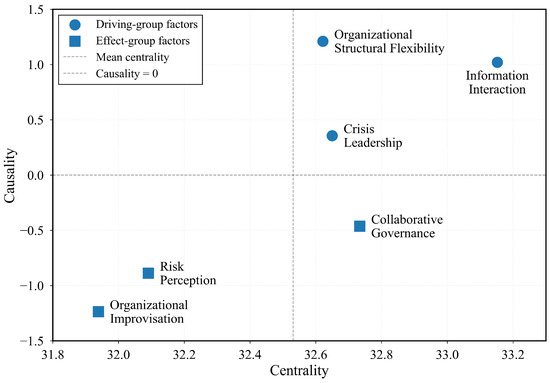
The results of α-cut fuzzy DEMATEL are presented in Table 5 and Figure 2. Centrality values differ only slightly among the six factors, with information interaction exhibiting the highest centrality and thus the strongest overall association with the other factors. Organizational structural flexibility, information interaction, and crisis leadership have positive causality values and are classified as driving-group factors, with organizational structural flexibility exhibiting the highest DEMATEL causality value, followed by information interaction. Collaborative governance, risk perception, and organizational improvisation have negative causality values and are classified as effect-group factors, with the latter receiving the strongest net influence from the other factors.
Table 5.
DEMATEL results for the core factors.
Figure 2.
DEMATEL cause–effect diagram.
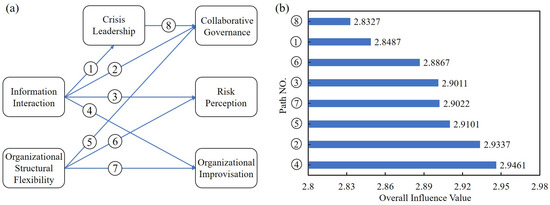
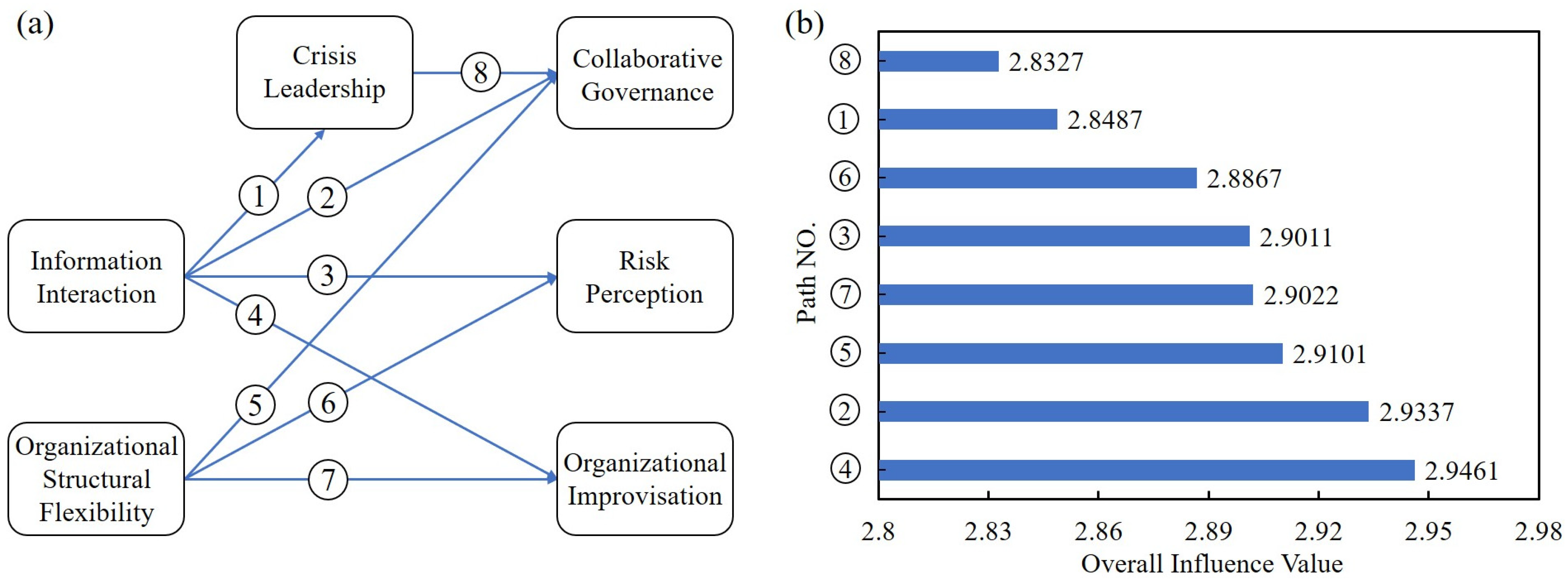
Ranking the off-diagonal elements of the average overall influence matrix under the rational perspective shows that the eight strongest paths originate mainly from information interaction and organizational structural flexibility and are directed primarily toward collaborative governance, risk perception, and organizational improvisation (Table 6 and Figure 3). Information interaction exerts the strongest overall influence on organizational improvisation, while the influence of crisis leadership on collaborative governance is also among the eight strongest paths.
Table 6.
Main influence paths among the core factors.
Figure 3.
Main influence paths among the core factors: (a) structural relationships; (b) ranked overall influence values.
Robustness was further assessed by comparing the pessimistic, rational, and optimistic perspectives and by conducting a leave-one-expert-out analysis. The driving/effect-group classifications of all six factors are identical across the three perspectives. Using the rational perspective as the baseline, the Spearman coefficients for the centrality rankings range from 0.8857 to 0.9429, and the eight strongest paths show an 87.50% overlap with each alternative perspective. In the leave-one-expert-out analysis, the overall retention rate for the driving/effect-group classifications is 97.44%, the mean Spearman coefficient for the centrality rankings is 0.8725, and the mean overlap rate for the eight strongest influence paths is 80.77%. Overall, the main influence relationships among the factors show relatively good stability, although the specific rankings, group classifications, and main influence paths of some factors remain somewhat sensitive to expert composition. Detailed results are provided in Table 7 and Supplementary Materials S3.
Table 7.
DEMATEL robustness tests.
4.2. Results of ISM Hierarchical Structure Analysis
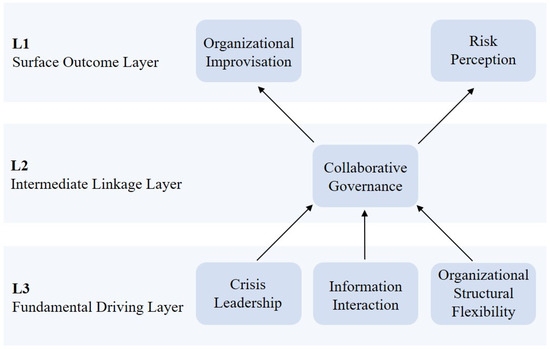
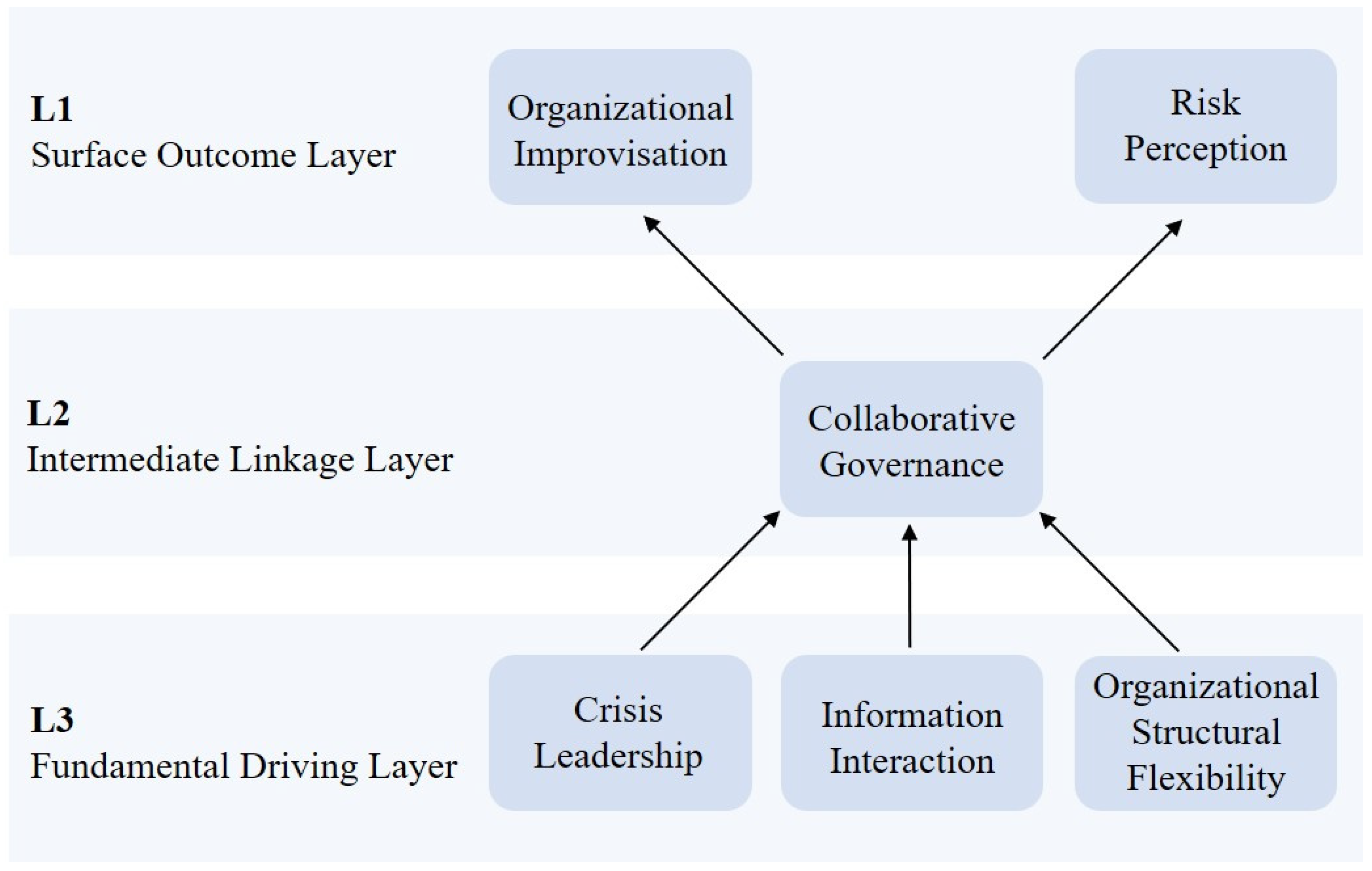
Using the mean of the off-diagonal elements of the average overall influence matrix under the rational perspective as the binary threshold yields λ = 2.7377. The resulting adjacency and reachability matrices produce a three-level ISM structure (Table 8 and Figure 4): information interaction, organizational structural flexibility, and crisis leadership form the L3 fundamental driving layer; collaborative governance occupies the L2 intermediate linkage layer; and risk perception and organizational improvisation form the L1 surface outcome layer.
Table 8.
ISM hierarchical structure of the core factors.
Figure 4.
Three-level ISM hierarchical structure of the core factors.
This structure is broadly consistent with the DEMATEL results. Information interaction, organizational structural flexibility, and crisis leadership occupy fundamental driving positions. Collaborative governance, although classified as an effect-group factor in DEMATEL, serves as an intermediate link through which influences from the fundamental drivers are transmitted to risk perception and organizational improvisation. The latter two primarily exhibit surface-level outcome characteristics under multiple influences.
A threshold sensitivity analysis was further conducted (Table 9). At the baseline threshold of 2.7377, 16 effective relationships are retained, yielding a three-level structure. The level assignments remain unchanged within the interval (2.7015, 2.7418]. Below this interval, some fundamental driving factors merge with collaborative governance, whereas above it, crisis leadership separates from the fundamental driving layer. Detailed results are provided in Supplementary Materials S4. This variation mainly results from the filtering effect of the threshold on influence relationships: a lower threshold retains more influence relationships and increases reachability among the factors, potentially causing some hierarchical levels to merge; by contrast, a higher threshold removes more influence relationships, producing a sparser network structure and potentially causing factors originally located at the same level to separate. Overall, alternative threshold values within this stable interval do not change the three-level hierarchical structure, whereas values outside the interval lead to changes in the level assignments of some factors and produce different hierarchical configurations. This indicates that the baseline hierarchical structure exhibits a certain degree of local stability around the selected threshold, while the specific hierarchical configuration remains relatively sensitive to larger deviations from the threshold.
Table 9.
ISM threshold sensitivity analysis.
4.3. Results of MICMAC Driving–Dependence Analysis
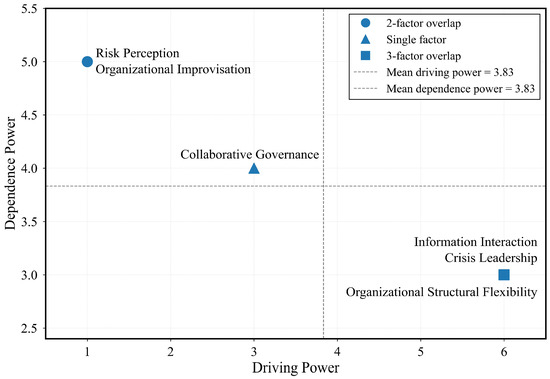
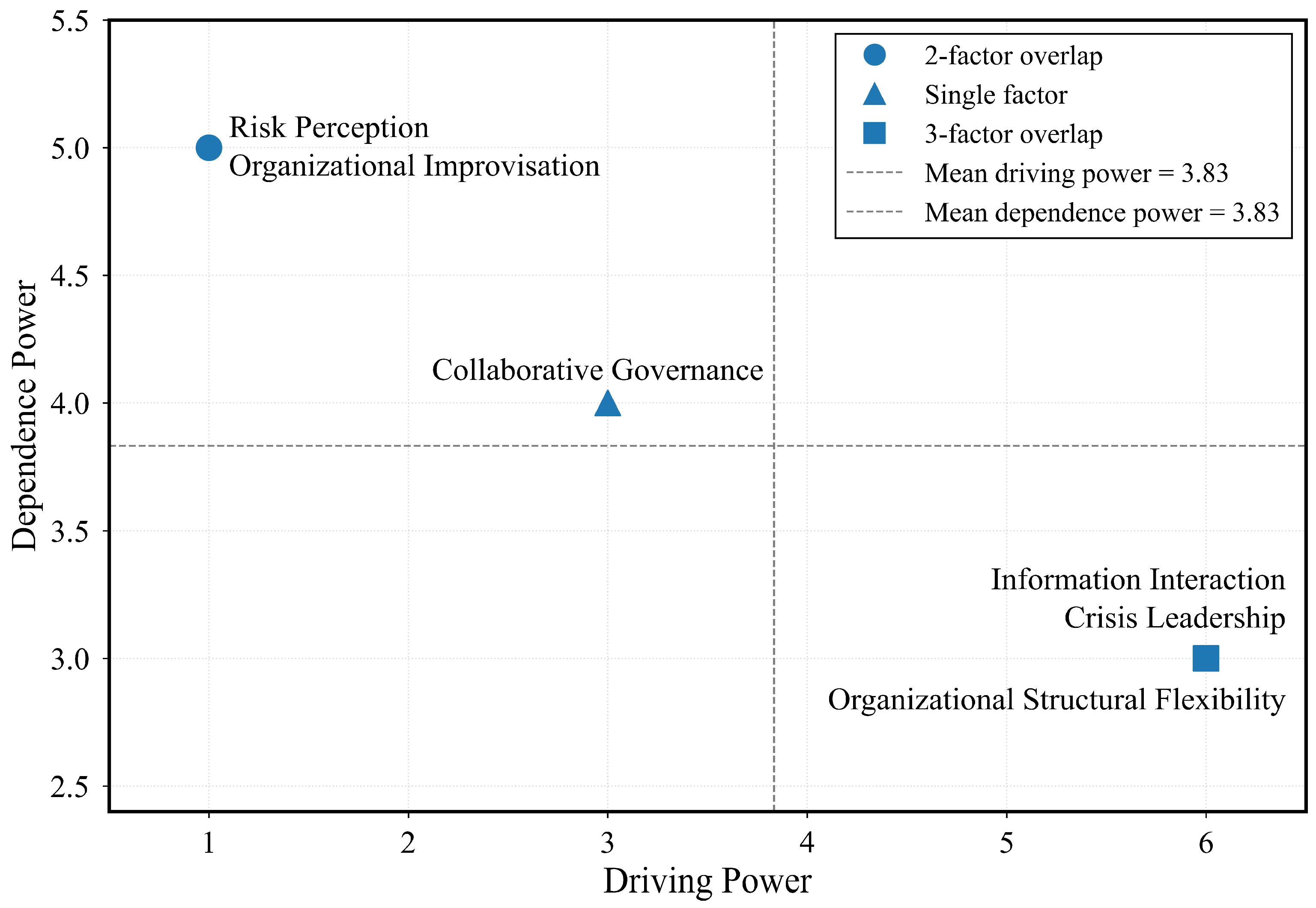
Driving and dependency powers were calculated from the final reachability matrix, with the mean values of both equal to 3.83. The results are presented in Table 10 and Figure 5. Information interaction, organizational structural flexibility, and crisis leadership each have a driving power of 6 and a dependency power of 3 and are therefore classified as independent driving factors, consistent with their positions in the fundamental driving layer of the ISM structure. Collaborative governance, risk perception, and organizational improvisation are classified as dependent factors. Collaborative governance has a driving power of 3 and a dependency power of 4, whereas risk perception and organizational improvisation each have a driving power of 1 and a dependency power of 5. No autonomous or linkage factors were identified.
Table 10.
MICMAC driving–dependence results.
Figure 5.
MICMAC driving–dependency diagram.
5. Discussion
5.1. Context-Specific Characteristics and Theoretical Interpretation
The resilience of project organizations during the renovation of old residential communities does not primarily depend on a set of capabilities that is entirely different from those found in other construction projects; rather, these capabilities must function within a more open and dynamic implementation environment. Such projects are typically carried out while residents continue to occupy the buildings, meaning that construction activities proceed alongside daily life and community governance. Although communities, subdistrict offices, and residents are not part of the core project organization, they can continuously influence construction arrangements and problem resolution. At the same time, existing building conditions often need to be continuously verified as construction proceeds, while residents’ demands may continue to change, exposing project organizations to uncertainty arising from both site conditions and user needs. As a result, effective responses depend more heavily on continuous information updates, cross-actor coordination, and dynamic adjustment than on prior planning and formal control alone.
In this context, several factors commonly identified in the broader organizational resilience literature take on more specific functional meanings. Information interaction not only facilitates information exchange among professional participants but also encompasses changes in site conditions, existing building information, and resident feedback. Collaborative governance likewise extends beyond routine cooperation among project participants to the coordination of actors outside the formal boundaries of the project organization who can directly affect project implementation. Organizational structural flexibility and improvisation, meanwhile, enable responsibilities, resources, and implementation arrangements to be adjusted in project organizations in response to changing site conditions. Therefore, the contextual specificity of this study lies not in the uniqueness of these factors to the renovation of old residential communities, but in how continuous occupancy, open organizational boundaries, and dynamic information conditions reshape their specific functions and interrelationships.
From the perspective of dynamic capabilities theory, this context further explains why project organizations continuously need to identify changes, coordinate resources, and adjust their actions. Specifically, the six factors can be interpreted from the perspective of the three core functions of dynamic capabilities: sensing, seizing, and reconfiguring. Information interaction supports the continuous acquisition and updating of site and stakeholder information, while risk perception reflects organizational judgments formed through the integration of information from multiple sources, corresponding to the sensing function. Crisis leadership and collaborative governance primarily involve problem interpretation, resource coordination, and the organization of cross-actor actions, corresponding to the seizing function. Organizational structural flexibility and organizational improvisation, in turn, support the adjustment and reconfiguration of responsibilities, resource allocation, and implementation arrangements, corresponding to the reconfiguring function. Together, the six factors reflect different functional dimensions of dynamic capabilities, enabling project organizations to maintain operations and make adaptive adjustments under ongoing disturbances.
5.2. Differentiated Roles of the Fundamental Driving Layer
Information interaction, organizational structural flexibility, and crisis leadership all occupy the fundamental driving layer and exhibit driving characteristics, but their roles differ in terms of information support, structural adjustment, and leadership decision-making.
Information interaction provides the basis for acquiring, verifying, and integrating dispersed site information. When renovating old residential communities, information regarding building conditions, concealed works, resident demands, and construction constraints is distributed across multiple actors. Continuous interorganizational communication therefore supports shared judgment, information sharing, environmental monitoring, and risk identification [7,31,44]. Information interaction has the highest centrality in this study, indicating its broad connective role. However, more information does not necessarily improve responses, as information overload may delay action [59]; effective information interaction also requires the screening, verification, and timely feedback of critical information. In addition, digital capabilities such as BIM, digital twins, and collaborative data environments can serve as important enabling mechanisms for information interaction by facilitating cross-organizational data integration and real-time feedback, thereby supporting the accurate acquisition, sharing, and coordination of information.
Organizational structural flexibility enables the project organization to adjust responsibilities, authority, and resource allocation as conditions and tasks change. When documentation is incomplete, site conditions evolve, and resident demands shift, rigid responsibility arrangements and lengthy approval chains may constrain on-site adjustments. Previous studies have shown that decentralization, cross-departmental collaboration, and resource reconfiguration can support responses to uncertainty [21,37,38]. In this study, organizational structural flexibility has the highest DEMATEL causality value and exerts relatively strong influences on collaborative governance, risk perception, and organizational improvisation, indicating a pronounced fundamental driving role.
Crisis leadership involves problem interpretation, priority setting, decision-making, and resource coordination under disturbances, and previous studies of engineering projects have identified leadership as an important driver of organizational resilience [18,30,32]. In this study, crisis leadership is relatively strongly influenced by information interaction and, in turn, exerts a relatively strong influence on collaborative governance. Thus, in the renovation of old residential communities, where information, authority, and responsibilities are dispersed, leadership depends not only on formal authority but also on the ability to interpret information from multiple sources and coordinate resources and actions across actors.
5.3. Intermediate Linking Role of Collaborative Governance
Although collaborative governance is classified as an effect-group factor in DEMATEL analysis and a dependent factor in MICMAC analysis, its intermediate position in the ISM structure indicates that it does not simply represent an endpoint of influence. Rather, it links the influences of information interaction, organizational structural flexibility, and crisis leadership to risk perception and organizational improvisation.
Previous studies have suggested that resilience in interorganizational projects depends on both formal governance, which clarifies roles and responsibilities, and relational governance, which supports shared cognition and resource exchange [29,31]. During the renovation of old residential communities, on-site responses typically require design confirmation, supervision review, construction implementation, and coordination with communities and residents [5,22,46]. Therefore, collaborative governance does not involve simply increasing participation or the number of coordination meetings but aligning responsibilities, decisions, resources, and actions across actors. Its effect-group and dependence characteristics are thus consistent with, rather than contradictory to, its intermediate linkage position.
5.4. Organizational-Level Responses of Risk Perception and Organizational Improvisation
Risk perception and organizational improvisation occupy the surface outcome layer and exhibit relatively strong effect-group and dependency characteristics. This does not imply that they are less important; rather, it indicates that both are more strongly shaped by other factors within the current relationship structure.
Risk perception in this study refers to a shared organizational-level judgment formed after information from multiple sources is communicated, integrated, and jointly assessed, rather than the initial detection of risk by a single actor. Its formation therefore depends on information interaction, cross-actor coordination, decision-making, and organizational arrangements. Its surface position thus reflects the structural position of shared organizational risk judgment rather than the initial sensing of environmental change and therefore does not conflict with the sensing function emphasized in dynamic capabilities theory.
Organizational improvisation likewise depends on the combined support of informational, structural, leadership, and collaborative conditions. Previous studies have emphasized that improvisation is not a random or unprepared action, but a context-specific response grounded in experience, organizational memory, and existing skills [60,61,62,63,64,65]. More improvisation is not necessarily beneficial, as temporary responses lacking professional judgment, clear authority boundaries, or coordination may increase quality and safety risks [63,64]. Its value therefore lies in the rapid development of feasible alternative arrangements within basic rules and shared objectives when existing plans are insufficient.
5.5. Theoretical Contributions
This study makes three theoretical contributions. First, it extends research on project organizational resilience to the context of the renovation of old residential communities under continuous occupancy and reveals how continuous occupancy, open organizational boundaries, and dynamic information conditions shape the specific functions and interrelationships of resilience factors, thereby deepening the understanding of the relationship between project context and organizational resilience. Second, drawing on dynamic capabilities theory, this study explains the differentiated roles of the six core factors and shows how adaptive functions related to sensing, seizing and integration, and reconfiguring are distributed across different factors and operate in coordination, thereby deepening the understanding of how project organizations respond to ongoing disturbances. Third, this study distinguishes initial risk identification by individual actors from shared risk judgments formed at the level of the project organization and further conceptualizes risk perception as an organizational-level judgment based on the integration of information from multiple actors, thereby refining the conceptual boundary of risk perception in interorganizational project contexts.
5.6. Managerial Implications
Based on the above findings, the organizational management mechanisms of projects renovating old residential communities can be strengthened in three areas—information communication and digital support, cross-actor coordination, and risk assessment and on-site adjustment—to enhance the project organization’s capacity to respond to ongoing disturbances.
First, a continuous information communication mechanism should be established to respond to changing site conditions and resident demands. For issues such as resident requests, concealed works, design changes, construction conflicts, and on-site risks, a unified issue register can be used to record the source and location of each issue, the responsible party, the expected resolution time, the current status, and the final confirmation result, with designated personnel responsible for updating the records and providing feedback. Project owners can use this mechanism to coordinate the follow-up of key information, while designers, contractors, and supervisory units can update relevant professional information in a timely manner. Where conditions permit, mobile on-site recording, shared information platforms, and BIM-based digital tools can be used to centrally document site photographs, design adjustments, proposed solutions, and progress updates, thereby creating a consistent information record and reducing missing information, repeated transmission, and version inconsistencies among participants. Responsibility matrices and appropriate delegation can also be used to clarify decision-making authority for different types of issues and improve the efficiency of on-site problem resolution.
Second, a joint coordination mechanism should be established to address cross-actor issues. For changes in resident demands, concealed-work treatment, design adjustments, and construction activities affecting residents’ daily lives, core participants such as project owners, designers, contractors, and supervisory units can jointly review and confirm solutions, while subdistrict offices, community organizations, and resident representatives should be involved when community affairs or resident interests are affected. Project owners can take the lead in organizing coordination, while relevant professional participants can provide technical and implementation input within their respective responsibilities. Responsibilities, solution confirmation, feedback requirements, and escalation procedures for unresolved issues should be clearly defined, with progress continuously tracked through a unified issue register.
Finally, an on-site adjustment mechanism that balances rapid response with accountability should be established. For site changes that cannot be adequately addressed by existing plans, the applicable circumstances, scope of authorization, responsible parties for confirmation, and escalation conditions for temporary responses can be specified in advance, enabling site teams to develop feasible alternatives promptly within clear safety, quality, and accountability boundaries. During this process, contractors can propose adjustments based on site conditions, while designers and supervisory units can provide relevant professional input as needed. Temporary measures, together with the rationale behind them and their implementation process and outcomes, should be promptly documented and reviewed after the issue is resolved to inform the handling of similar issues in the future.
6. Conclusions
Focusing on project organizational resilience during the renovation of old residential communities, this study identified six core factors—information interaction, organizational structural flexibility, crisis leadership, collaborative governance, risk perception, and organizational improvisation—through literature-based identification and expert screening. α-cut fuzzy DEMATEL, ISM, and MICMAC analyses were then applied to examine their relational and structural characteristics.
The results show that primarily information interaction, organizational structural flexibility, and crisis leadership play fundamental driving roles, with information interaction exhibiting the highest centrality and organizational structural flexibility exhibiting the highest DEMATEL causality value. Collaborative governance serves an intermediate linkage role, whereas risk perception and organizational improvisation exhibit relatively strong effect-group and dependency characteristics. Overall, the six factors do not operate in parallel but differ in their influence characteristics, hierarchical positions, and systemic roles.
This study has several limitations. First, given its exploratory nature, the contextual specificity of project organizational resilience during the renovation of old residential communities is primarily demonstrated through conceptual discussion and empirical evidence is still lacking. Therefore, the relationships among the factors are mainly based on expert judgment and reflect subjectively perceived influence relationships rather than relationships independently validated through empirical data. Second, the focus on six factors may not capture all conditions relevant to project organizational resilience. Third, DEMATEL, ISM, and MICMAC analyses identify relational and structural characteristics rather than strict causal relationships or fixed temporal sequences. Fourth, the applicability of the findings to other urban renewal and construction contexts requires further validation. Future research could empirically validate these contextual characteristics and factor relationships through comparative case studies, survey data, and performance or process-tracking data from a larger number of projects, while further expanding the range of influencing factors.
Supplementary Materials
The following supporting information can be downloaded at: https://www.mdpi.com/article/10.3390/buildings16193939/s1, Section S1: Expert Information. Table S1. Characteristics of members in the factor identification panel. Table S2. Characteristics of experts in the relationship evaluation panel.; Section S2: Literature-Based Factor Identification, Table S3. Literature sources and standardization of candidate factors. Table S4. Candidate factor screening results. Table S5. Criteria and results of the second-round expert review.; Section S3: DEMATEL Robustness Analysis. Table S6. Comparison of DEMATEL results across three perspectives. Table S7. Cross-perspective comparison of the main influence paths. Table S8. Overall results of the leave-one-expert-out sensitivity analysis. Table S9. Consistency between each leave-one-expert-out group and the full-sample results.; Section S4: ISM Threshold Sensitivity Analysis. Table S10. Overall influence matrix. Table S11. Baseline adjacency matrix. Table S12. Baseline final reachability matrix. Table S13. Stable interval of the baseline ISM results. Table S14. ISM hierarchical stability under threshold perturbations. References [66,67,68,69,70,71,72,73,74,75,76,77,78,79,80,81,82,83,84,85,86,87,88,89,90,91,92] are cited in the Supplementary Materials.
Author Contributions
Conceptualization, Y.G. and Y.W.; methodology, Y.G.; software, Y.G.; validation, H.Z. and Y.W.; formal analysis, Y.G.; investigation, Y.G.; data curation, Y.G.; funding acquisition, Y.W.; writing—original draft preparation, Y.G.; writing—review and editing, H.Z. and Y.W.; visualization, H.Z.; supervision, Y.W. All authors have read and agreed to the published version of the manuscript.
Funding
This research was funded by the Project of MOE (Ministry of Education) Foundation on Humanities and Social Sciences, grant number 24YJCZH332.
Institutional Review Board Statement
Ethical review and approval were waived for this study by the Academic Committee of the School of Architecture and Civil Engineering, Xihua University, because the study was a minimal-risk social science study involving no personally identifiable or sensitive information. The exemption was granted on 3 September 2026.
Informed Consent Statement
Informed consent was obtained from all participants involved in the study.
Data Availability Statement
The data presented in this study are available on request from the corresponding author. The data are not publicly available due to privacy considerations.
Conflicts of Interest
The authors declare no conflicts of interest.
References
- United Nations Department of Economic and Social Affairs. Goal 11: Make Cities and Human Settlements Inclusive, Safe, Resilient and Sustainable. Available online: https://sdgs.un.org/goals/goal11 (accessed on 6 July 2026).
- Shen, T.; Yao, X.; Wen, F. The Urban Regeneration Engine Model: An analytical framework and case study of the renewal of old communities. Land Use Policy 2021, 108, 105571. [Google Scholar] [CrossRef] [Scilit]
- The State Council of the People’s Republic of China. China’s Renovation of Old Residential Communities Benefits 120 Million People by End-2024. Available online: https://english.www.gov.cn/news/202505/20/content_WS682c3d0dc6d0868f4e8f2b22.html (accessed on 6 July 2026).
- Li, D.; Xiong, Q.; Huang, G.; Du, B.; Feng, H. How to share benefits of old community renewal project in China? An improved Shapley Value approach. Habitat Int. 2022, 126, 102611. [Google Scholar] [CrossRef] [Scilit]
- Zhang, Z.; Pan, J.; Qian, Y. Collaborative Governance for Participatory Regeneration Practices in Old Residential Communities within the Chinese Context: Cases from Beijing. Land 2023, 12, 1427. [Google Scholar] [CrossRef] [Scilit]
- Naderpajouh, N.; Matinheikki, J.; Keeys, L.A.; Aldrich, D.P.; Linkov, I. Resilience and projects: An interdisciplinary crossroad. Proj. Leadersh. Soc. 2020, 1, 100001. [Google Scholar] [CrossRef] [Scilit]
- Yan, P.; Zhang, F.; Lin, S.; Dang, P. Project organizational resilience to unforeseen challenges: Scale development and empirical validation. Eng. Constr. Archit. Manag. 2026, 33, 6489–6513. [Google Scholar] [CrossRef] [Scilit]
- Linnenluecke, M.K. Resilience in business and management research: A review of influential publications and a research agenda. Int. J. Manag. Rev. 2017, 19, 4–30. [Google Scholar] [CrossRef] [Scilit]
- Williams, T.A.; Gruber, D.A.; Sutcliffe, K.M.; Shepherd, D.A.; Zhao, E.Y. Organizational response to adversity: Fusing crisis management and resilience research streams. Acad. Manag. Ann. 2017, 11, 733–769. [Google Scholar] [CrossRef] [Scilit]
- Duchek, S. Organizational resilience: A capability-based conceptualization. Bus. Res. 2020, 13, 215–246. [Google Scholar] [CrossRef] [Scilit]
- Hillmann, J.; Guenther, E. Organizational resilience: A valuable construct for management research? Int. J. Manag. Rev. 2021, 23, 7–44. [Google Scholar] [CrossRef] [Scilit]
- Chowdhury, M.M.H.; Quaddus, M. Supply chain resilience: Conceptualization and scale development using dynamic capability theory. Int. J. Prod. Econ. 2017, 188, 185–204. [Google Scholar] [CrossRef] [Scilit]
- Annarelli, A.; Nonino, F. Strategic and operational management of organizational resilience: Current state of research and future directions. Omega 2016, 62, 1–18. [Google Scholar] [CrossRef] [Scilit]
- Buzzao, G.; Rizzi, F. The role of dynamic capabilities for resilience in pursuing business continuity: An empirical study. Total Qual. Manag. Bus. Excell. 2023, 34, 1353–1385. [Google Scholar] [CrossRef] [Scilit]
- Madani, F.; Parast, M.M. An integrated approach to organizational resilience: A quality perspective. Int. J. Qual. Reliab. Manag. 2023, 40, 192–225. [Google Scholar] [CrossRef] [Scilit]
- Iao-Jørgensen, J. Antecedents to bounce forward: A case study tracing the resilience of inter-organisational projects in the face of disruptions. Int. J. Proj. Manag. 2023, 41, 102440. [Google Scholar] [CrossRef] [Scilit]
- Tvedt, I.M.; Tommelein, I.D.; Klakegg, O.J.; Wong, J.M. Organizational values in support of leadership styles fostering organizational resilience: A process perspective. Int. J. Manag. Proj. Bus. 2023, 16, 258–278. [Google Scholar] [CrossRef] [Scilit]
- Liu, W.; Hu, Y.; Huang, Q. Research on critical factors influencing organizational resilience of major transportation infrastructure projects: A hybrid fuzzy DEMATEL-ISM-MICMAC approach. Buildings 2024, 14, 1598. [Google Scholar] [CrossRef] [Scilit]
- Fang, Y.; Ni, G.; Song, C.; Zhou, Q.; Mei, Y.; Zhang, W.; Wang, W. Evaluation of organizational resilience in the construction phase of prefabricated building project based on a combined weighted cloud model. Eng. Constr. Archit. Manag. 2026, 1–38. [Google Scholar] [CrossRef] [Scilit]
- Zhang, F.; Zheng, W. Measurement and evaluation of organizational resilience in safety management for super-tall building projects—Model development based on an improved fuzzy comprehensive evaluation method utilizing the cloud model and empirical analysis. J. Appl. Sci. Eng. 2026, 29, 1021–1034. [Google Scholar] [CrossRef]
- Ren, X.; Yuan, F.; Li, Y.; Lin, F.; Xie, J. Enhancing organizational resilience of construction enterprises in uncertain environments: A perspective based on dynamic capabilities. Eng. Constr. Archit. Manag. 2026, 1–23. [Google Scholar] [CrossRef] [Scilit]
- Chen, W.; Cheshmehzangi, A.; Yu, J.; Mangi, E.; Heath, T.; Zhang, Q. An analysis of patterns of public engagement in China’s community micro-rehabilitation projects: A case study of Guangzhou. World Dev. Sustain. 2023, 3, 100108. [Google Scholar] [CrossRef] [Scilit]
- Hartmann, S.; Weiss, M.; Newman, A.; Hoegl, M. Resilience in the workplace: A multilevel review and synthesis. Appl. Psychol. 2020, 69, 913–959. [Google Scholar] [CrossRef] [Scilit]
- Jiang, S.; Ling, F.Y.Y.; Ma, G. Fostering resilience in project teams: Adaptive structuration perspective. J. Manag. Eng. 2024, 40, 04023047. [Google Scholar] [CrossRef] [Scilit]
- Pavez, I.; Gómez, H.; Laulié, L.; González, V.A. Project team resilience: The effect of group potency and interpersonal trust. Int. J. Proj. Manag. 2021, 39, 697–708. [Google Scholar] [CrossRef] [Scilit]
- Siddiquei, A.N.; Ahmad, S.; Asmi, F. Fostering team resilience with servant leadership: A multi-level study of the construction industry. Acta Psychol. 2025, 253, 104732. [Google Scholar] [CrossRef] [Scilit] [PubMed]
- Gao, L.; Li, H.; Zhang, N.; Deng, X. From individuals to teams: Resilience as a driver of international construction success. Eng. Constr. Archit. Manag. 2026, 1–25. [Google Scholar] [CrossRef] [Scilit]
- Britt, T.W.; Shen, W.; Sinclair, R.R.; Grossman, M.R.; Klieger, D.M. How much do we really know about employee resilience? Ind. Organ. Psychol. 2016, 9, 378–404. [Google Scholar] [CrossRef] [Scilit]
- Yang, X.; Wang, L.; Zhu, F.; Müller, R. Prior and governed stakeholder relationships: The key to resilience of inter-organizational projects. Int. J. Proj. Manag. 2022, 40, 64–75. [Google Scholar] [CrossRef] [Scilit]
- Qiao, L.; Wang, W.; Mi, L.; Wang, S.; Zhang, Y.; Zhang, Y.; Tao, M. Unveiling synergistic enhancement mechanisms of organizational resilience in engineering projects: An integrated ISM-MICMAC and Bayesian network framework. Eng. Constr. Archit. Manag. 2025, 1–26. [Google Scholar] [CrossRef] [Scilit]
- Liu, Y.; Mao, S.; Zhang, B.; Xu, Q.; Zhu, Q. Relational Governance and Project Performance: Unveiling the Mediating Role of Organizational Resilience. Buildings 2025, 15, 1585. [Google Scholar] [CrossRef] [Scilit]
- Wang, D.; Zhao, X.; Zhang, K. Factors affecting organizational resilience in megaprojects: A leader–employee perspective. Eng. Constr. Archit. Manag. 2023, 30, 4590–4608. [Google Scholar] [CrossRef] [Scilit]
- Li, X.; Li, B.; Jiang, W. State-led versus market-led: How institutional arrangements impact collaborative governance in participatory urban regeneration in China. Habitat Int. 2024, 150, 103134. [Google Scholar] [CrossRef] [Scilit]
- Lu, W.; Qiu, B.; Wu, Y. Exploration of urban community renewal governance for adaptive improvement. Habitat Int. 2024, 144, 102999, Erratum in Habitat Int. 2025, 159, 103371. [Google Scholar] [CrossRef] [Scilit]
- Zungu, Z.; Laryea, S.; Nkado, R. A critical literature review on organizational resilience: Why current frameworks are insufficient for contracting firms in the construction industry. Int. J. Constr. Manag. 2025, 25, 1847–1858. [Google Scholar] [CrossRef] [Scilit]
- Xue, H.; Ding, R.; Sun, T.; Ye, C. Configurational effects of social capital and dynamic capability on project resilience in megaprojects. Proj. Manag. J. 2025, 56, 620–638. [Google Scholar] [CrossRef] [Scilit]
- Wang, D.; Zhao, X. Effect of resource integration on organizational resilience of megaprojects: Role of dynamic capability and resource availability. J. Asian Archit. Build. Eng. 2025, 24, 1578–1593. [Google Scholar] [CrossRef] [Scilit]
- Wang, D.; Wu, Y.; Zhang, K. Interplay of resources and institutions in improving organizational resilience of construction projects: A dynamic perspective. Eng. Manag. J. 2023, 35, 346–357. [Google Scholar] [CrossRef] [Scilit]
- Lin, J.; Fan, Y. Seeking sustainable performance through organizational resilience: Examining the role of supply chain integration and digital technology usage. Technol. Forecast. Soc. Change 2024, 198, 123026. [Google Scholar] [CrossRef] [Scilit]
- Li, K.; Bashiri, M.; Lim, M.K.; Akpobi, T. How to improve supply chain sustainable performance by resilience practices through dynamic capability view: Evidence from Chinese construction. Resour. Conserv. Recycl. 2025, 212, 107965. [Google Scholar] [CrossRef] [Scilit]
- Ma, T.; Zhao, K. Research on the resilience path of digitally driven project-based organizations: Configuration analysis based on multivalue-set qualitative comparative analysis. Eng. Constr. Archit. Manag. 2026, 33, 3025–3048. [Google Scholar] [CrossRef] [Scilit]
- Braun, T.; Ekstedt, E.; Lundin, R.A.; Sydow, J. Managing stability and change in interorganizational projects: The ambiguous role of digital tools for relational dynamics. Proj. Manag. J. 2025, 56, 522–542. [Google Scholar] [CrossRef] [Scilit]
- Sheikhkhoshkar, M.; Bril El-Haouzi, H.; Aubry, A.; Hamzeh, F.; Rahimian, F. A data-driven and knowledge-based decision support system for optimized construction planning and control. Autom. Constr. 2025, 173, 106066. [Google Scholar] [CrossRef] [Scilit]
- Machiels, T.; Compernolle, T.; Coppens, T. Stakeholder perceptions of uncertainty matter in megaprojects: The Flemish A102 infrastructure project. Int. J. Proj. Manag. 2023, 41, 102437. [Google Scholar] [CrossRef] [Scilit]
- Li, Y.; Ouyang, L.; Zheng, X.; Liu, Y.; Zhu, L. Value exchanges within stakeholder networks throughout a megaproject’s lifecycle. Int. J. Proj. Manag. 2024, 42, 102585. [Google Scholar] [CrossRef] [Scilit]
- Morkan, B.; Bertels, H.M.J.; Sheth, A.; Holahan, P.J. Building megaproject resilience with stakeholders: The roles of citizenship behavior and critical transition mechanisms. Int. J. Proj. Manag. 2023, 41, 102485. [Google Scholar] [CrossRef] [Scilit]
- Teece, D.J.; Pisano, G.; Shuen, A. Dynamic capabilities and strategic management. Strateg. Manag. J. 1997, 18, 509–533. [Google Scholar] [CrossRef] [Scilit]
- Eisenhardt, K.M.; Martin, J.A. Dynamic capabilities: What are they? Strateg. Manag. J. 2000, 21, 1105–1121. [Google Scholar] [CrossRef] [Scilit]
- Teece, D.J. Explicating dynamic capabilities: The nature and microfoundations of (sustainable) enterprise performance. Strateg. Manag. J. 2007, 28, 1319–1350. [Google Scholar] [CrossRef] [Scilit]
- Feng, X.; Li, E.; Li, J.; Wei, C. Critical influencing factors of employees’ green behavior: Three-stage hybrid fuzzy DEMATEL–ISM–MICMAC approach. Environ. Dev. Sustain. 2024, 26, 17783–17811. [Google Scholar] [CrossRef] [Scilit]
- Calleo, Y.; Pilla, F. Delphi-based future scenarios: A bibliometric analysis of climate change case studies. Futures 2023, 149, 103143. [Google Scholar] [CrossRef] [Scilit]
- Ranasinghe, U.; Jefferies, M.; Davis, P.; Pillay, M. Enabling a resilient work environment: An analysis of causal relationships between resilience engineering factors in construction refurbishment projects. J. Constr. Eng. Manag. 2023, 149, 04023078. [Google Scholar] [CrossRef] [Scilit]
- Lee, A.V.; Vargo, J.; Seville, E. Developing a tool to measure and compare organizations’ resilience. Nat. Hazards Rev. 2013, 14, 29–41. [Google Scholar] [CrossRef] [Scilit]
- Lengnick-Hall, C.A.; Beck, T.E.; Lengnick-Hall, M.L. Developing a capacity for organizational resilience through strategic human resource management. Hum. Resour. Manag. Rev. 2011, 21, 243–255. [Google Scholar] [CrossRef] [Scilit]
- Zhang, Z.X.; Wang, L.; Wang, Y.M.; Martínez, L. A novel alpha-level sets based fuzzy DEMATEL method considering experts’ hesitant information. Expert Syst. Appl. 2023, 213, 118925. [Google Scholar] [CrossRef] [Scilit]
- Attri, R.; Dev, N.; Sharma, V. Interpretive Structural Modelling (ISM) Approach: An Overview. Res. J. Manag. Sci. 2013, 2, 3–8. [Google Scholar]
- Liu, X.; Liu, Y.; Li, H.; Wen, D. Identification and analysis of barriers to the effectiveness of ISO 45001 certification in Chinese certified organisations: A DEMATEL-ISM approach. J. Clean. Prod. 2023, 383, 135447. [Google Scholar] [CrossRef] [Scilit]
- Janssen, M.; Luthra, S.; Mangla, S.; Rana, N.P.; Dwivedi, Y.K. Challenges for adopting and implementing IoT in smart cities: An integrated MICMAC-ISM approach. Internet Res. 2019, 29, 1589–1616. [Google Scholar] [CrossRef] [Scilit]
- Jiang, K.; Le, Y.; Zheng, X.; Cui, J.; Skitmore, M. Confronting information dilemma: How does collective mindfulness foster team improvisation in megaprojects. Int. J. Proj. Manag. 2025, 43, 102767. [Google Scholar] [CrossRef] [Scilit]
- Malucelli, G.; Barbosa, M.T.J.; de Carvalho, M.M. Facing the challenge of improvisation in project management: A critical review. Int. J. Manag. Proj. Bus. 2021, 14, 369–389. [Google Scholar] [CrossRef] [Scilit]
- Klein, L.; Biesenthal, C.; Dehlin, E. Improvisation in project management: A praxeology. Int. J. Proj. Manag. 2015, 33, 267–277. [Google Scholar] [CrossRef] [Scilit]
- Leybourne, S.A.; Sadler-Smith, E. The role of intuition and improvisation in project management. Int. J. Proj. Manag. 2006, 24, 483–492. [Google Scholar] [CrossRef] [Scilit]
- Miner, A.S.; Bassoff, P.; Moorman, C. Organizational improvisation and learning: A field study. Adm. Sci. Q. 2001, 46, 304–337. [Google Scholar] [CrossRef] [Scilit] [PubMed]
- Hadida, A.L.; Tarvainen, W.; Rose, J. Organizational improvisation: A consolidating review and framework. Int. J. Manag. Rev. 2015, 17, 437–459. [Google Scholar] [CrossRef] [Scilit]
- Jiang, K.; Le, Y.; Zheng, X.; Zhang, X.; Ouyang, L. Toward a systematic understanding of megaproject improvisation. Int. J. Proj. Manag. 2023, 41, 102529. [Google Scholar] [CrossRef] [Scilit]
- Burnard, K.; Bhamra, R.; Tsinopoulos, C. Building organizational resilience: Four configurations. IEEE Trans. Eng. Manag. 2018, 65, 351–362. [Google Scholar] [CrossRef]
- McManus, S.; Seville, E.; Vargo, J.; Brunsdon, D. Facilitated process for improving organizational resilience. Nat. Hazards Rev. 2008, 9, 81–90. [Google Scholar] [CrossRef] [Scilit]
- Barasa, E.; Mbau, R.; Gilson, L. What is resilience and how can it be nurtured? A systematic review of empirical literature on organizational resilience. Int. J. Health Policy Manag. 2018, 7, 491–503. [Google Scholar] [CrossRef] [Scilit] [PubMed]
- Weick, K.E. The collapse of sensemaking in organizations: The Mann Gulch disaster. Adm. Sci. Q. 1993, 38, 628–652. [Google Scholar] [CrossRef] [Scilit]
- Burnard, K.; Bhamra, R. Organisational resilience: Development of a conceptual framework for organisational responses. Int. J. Prod. Res. 2011, 49, 5581–5599. [Google Scholar] [CrossRef] [Scilit]
- Khurana, I.; Dutta, D.K.; Singh Ghura, A. SMEs and digital transformation during a crisis: The emergence of resilience as a second-order dynamic capability in an entrepreneurial ecosystem. J. Bus. Res. 2022, 150, 623–641. [Google Scholar] [CrossRef] [Scilit]
- Andersson, T.; Cäker, M.; Tengblad, S.; Wickelgren, M. Building traits for organizational resilience through balancing organizational structures. Scand. J. Manag. 2019, 35, 36–45. [Google Scholar] [CrossRef] [Scilit]
- Kantur, D.; İşeri-Say, A. Organizational resilience: A conceptual integrative framework. J. Manag. Organ. 2012, 18, 762–773. [Google Scholar] [CrossRef] [Scilit]
- He, Z.; Huang, H.; Choi, H.; Bilgihan, A. Building organizational resilience with digital transformation. J. Serv. Manag. 2023, 34, 147–171. [Google Scholar] [CrossRef] [Scilit]
- Browder, R.E.; Dwyer, S.M.; Koch, H. Upgrading adaptation: How digital transformation promotes organizational resilience. Strateg. Entrep. J. 2024, 18, 128–164. [Google Scholar] [CrossRef] [Scilit]
- Lv, L.; Chen, C.; Wang, Z. Resource and cognitive perspectives: Unraveling the influence mechanism of project governance on organizational resilience in infrastructure projects. Buildings 2023, 13, 2878. [Google Scholar] [CrossRef] [Scilit]
- Li, Y.; Wang, X.; Gong, T.; Wang, H. Breaking out of the pandemic: How can firms match internal competence with external resources to shape operational resilience? J. Oper. Manag. 2023, 69, 384–403. [Google Scholar] [CrossRef] [Scilit]
- Do, H.; Budhwar, P.; Shipton, H.; Nguyen, H.-D.; Nguyen, B. Building organizational resilience, innovation through resource-based management initiatives, organizational learning and environmental dynamism. J. Bus. Res. 2022, 141, 808–821. [Google Scholar] [CrossRef] [Scilit]
- Vogus, T.J.; Sutcliffe, K.M. Organizational resilience: Towards a theory and research agenda. In Proceedings of the 2007 IEEE International Conference on Systems, Man, and Cybernetics, Montreal, QC, Canada, 7–10 October 2007; pp. 3418–3422. [Google Scholar] [CrossRef] [Scilit]
- Sahebjamnia, N.; Torabi, S.A.; Mansouri, S.A. Integrated business continuity and disaster recovery planning: Towards organizational resilience. Eur. J. Oper. Res. 2015, 242, 261–273. [Google Scholar] [CrossRef] [Scilit]
- Jiao, P.; Bu, W. The impact of organizational learning on organizational resilience in construction projects. Buildings 2024, 14, 975. [Google Scholar] [CrossRef] [Scilit]
- Xie, X.; Wu, Y.; Palacios-Marqués, D.; Ribeiro-Navarrete, S. Business networks and organizational resilience capacity in the digital age during COVID-19: A perspective utilizing organizational information processing theory. Technol. Forecast. Soc. Change 2022, 177, 121548. [Google Scholar] [CrossRef] [Scilit]
- Wang, B.; Geng, L.; Dang, P.; Zhang, L. Developing a framework for dynamic organizational resilience analysis in prefabricated construction projects: A project life cycle perspective. J. Constr. Eng. Manag. 2022, 148, 04022110. [Google Scholar] [CrossRef] [Scilit]
- Anwar, A.; Coviello, N.; Rouziou, M. Weathering a crisis: A multi-level analysis of resilience in young ventures. Entrep. Theory Pract. 2023, 47, 864–892. [Google Scholar] [CrossRef] [Scilit]
- Hu, D.M.; Zhao, L.; Chen, W.Z. The mechanisms and effects of top management team heterogeneity on organizational resilience in listed companies. Soc. Sci. Res. 2021, 5, 73–83. (In Chinese) [Google Scholar]
- Ozanne, L.K.; Chowdhury, M.; Prayag, G.; Mollenkopf, D.A. SMEs navigating COVID-19: The influence of social capital and dynamic capabilities on organizational resilience. Ind. Mark. Manag. 2022, 104, 116–135. [Google Scholar] [CrossRef] [Scilit]
- Bustinza, O.F.; Vendrell-Herrero, F.; Perez-Arostegui, M.N.; Parry, G. Technological capabilities, resilience capabilities and organizational effectiveness. Int. J. Hum. Resour. Manag. 2019, 30, 1370–1392. [Google Scholar] [CrossRef] [Scilit]
- Wang, D.; Wang, P. Effect of employee resilience on organizational resilience in construction projects: Considering the role of project tasks. Eng. Constr. Archit. Manag. 2024, 31, 4236–4254. [Google Scholar] [CrossRef] [Scilit]
- Zhang, M.T.; Zhang, S.T. The effect of relationship network on organizational resilience: The mediating role of ambidextrous innovation. Sci. Res. Manag. 2022, 43, 163–170. (In Chinese) [Google Scholar] [CrossRef]
- Xue, C.; Wang, J. Proactive boundary-spanning search, organizational resilience, and radical green innovation. Bus. Strategy Environ. 2024, 33, 1834–1852. [Google Scholar] [CrossRef] [Scilit]
- Zhang, S.F.; Xu, M.S.; Zhu, Y.; Wang, Z.Q. Technological innovation, organizational resilience and high-quality development of manufacturing enterprises. Sci. Technol. Prog. Policy 2023, 40, 81–92. (In Chinese) [Google Scholar] [CrossRef]
- Feng, W.N.; Chen, H. The effects of ambidextrous innovation on organizational resilience of high-tech enterprises: The moderating role of knowledge scope and knowledge balance. Sci. Sci. Manag. S&T 2022, 43, 117–135. (In Chinese) [Google Scholar]

Disclaimer/Publisher’s Note: The statements, opinions and data contained in all publications are solely those of the individual author(s) and contributor(s) and not of MDPI and/or the editor(s). MDPI and/or the editor(s) disclaim responsibility for any injury to people or property resulting from any ideas, methods, instructions or products referred to in the content. |
© 2026 by the authors. Licensee MDPI, Basel, Switzerland. This article is an open access article distributed under the terms and conditions of the Creative Commons Attribution (CC BY) license.