


Abstract
Low-plasticity silt with a loose and weakly cemented structure often exhibits low strength and poor water stability, limiting its engineering performance. In this study, a low-dosage bio-based composite hydrogel consisting of sodium alginate (SA), calcium lignosulfonate (CLS), and Ca2+ was proposed for low-plasticity silt stabilization. An EDTA–Ca/GDL-mediated internal gelation process was employed to moderate Ca2+ availability and promote gradual in situ crosslinking within the soil matrix. A three-factor, three-level orthogonal design was used to investigate the effects of SA dosage, CLS dosage, and Ca2+/SA ratio on unconfined compressive strength (UCS), shear strength, and water stability, while scanning electron microscopy (SEM) and Fourier transform infrared spectroscopy (FTIR) were employed to characterize the associated microstructural and chemical changes. The best-performing combination, containing 0.6% SA, 0.8% CLS, and a Ca2+/SA ratio of 0.1, achieved a 28 d UCS of 3768.93 kPa and a cohesion of 138 kPa. Range analysis and analysis of variance showed that SA dosage was the dominant factor governing UCS and cohesion, whereas the investigated mix-proportion factors had limited effects on the internal friction angle. The optimized stabilized silt also retained its structural integrity after 24 h of static-water immersion, demonstrating substantially improved short-term resistance to water-induced disintegration. SEM analysis revealed particle coating, pore filling, and interparticle bridging, while FTIR analysis indicated changes in the local chemical environments of hydroxyl and carboxylate groups. These microstructural and spectroscopic changes, together with the macroscopic results, are consistent with enhanced interparticle bonding and modification of the pore structure, thereby contributing to improved mechanical performance and water stability in the investigated low-plasticity silt.
1. Introduction
Silt is widely distributed in many regions of China and is frequently encountered in transportation infrastructure, hydraulic engineering, slope protection, and foundation engineering. According to the Code for Design of Building Foundation (GB 50007-2011) [1], silt is characterized by a particle fraction larger than 0.075 mm of no more than 50% and a plasticity index below 10. When poorly consolidated and loosely structured, silty soils can exhibit pronounced water sensitivity and structural instability. Jian et al. [2] showed that wetting can substantially alter the compressibility and pore-structure evolution of loess, while Liu et al. [3] related wetting-induced collapse to its loose microstructure and particle bonding characteristics. Delage et al. [4] further demonstrated the engineering significance of water-induced structural collapse in loess deposits. For fine-grained soils, Boulanger and Idriss [5] identified plasticity index as an important indicator distinguishing sand-like and clay-like cyclic behavior, whereas Bray and Sancio [6] demonstrated that liquefaction susceptibility depends jointly on plasticity and the relationship between natural water content and liquid limit. These water- and loading-sensitive characteristics can compromise the performance of weak silty soils in engineering applications. Conventional inorganic stabilizers, particularly cement and lime, remain widely used because of their effectiveness in improving soil strength and engineering performance. Firoozi et al. [7] reviewed the stabilization mechanisms of cement and lime and demonstrated their effectiveness in modifying soil strength, permeability, and volumetric stability. However, the environmental burden associated with conventional binders remains an important concern. Andrew [8] quantified the substantial contribution of cement production to global anthropogenic CO2 emissions, while Scrivener et al. [9] emphasized the need to reduce clinker use and develop lower-carbon cementitious systems. These concerns have stimulated increasing interest in alternative soil-stabilization materials with lower environmental burdens. Bio-based polymers have attracted considerable attention in geotechnical engineering because of their renewability and ability to modify interparticle bonding and soil structure. Cabalar et al. [10] showed that xanthan gum treatment can improve the CBR and UCS of road-subgrade materials. Muguda et al. [11] reported that guar gum and xanthan gum enhanced the mechanical performance of soil-based construction materials, although their effects differed between tensile and compressive loading. Dagliya et al. [12] demonstrated that sodium alginate and other biopolymers can improve the wind-erosion resistance of desert soil through polymer-mediated particle bonding. These studies demonstrate the potential of biopolymers for modifying different aspects of soil engineering behavior. Among these biopolymers, sodium alginate (SA), a renewable polysaccharide derived from brown algae, is particularly attractive because its carboxylate-rich chains can undergo ionic crosslinking with divalent cations. Grant et al. [13] established the classical “egg-box” model to describe Ca2+-mediated association between alginate chains. Kuo and Ma [14] subsequently demonstrated that calcium availability and gelation rate strongly influence the structure and mechanical properties of ionically crosslinked alginate hydrogels. More recently, Makarova et al. [15] quantitatively examined the binding characteristics of different divalent cations within alginate junction zones, while Donati and Christensen [16] reviewed alginate–metal interactions and confirmed the continuing relevance of the egg-box framework for interpreting ion-induced gelation. The potential of alginate for soil stabilization has also been demonstrated in recent geotechnical studies. Yin et al. [17] reported that modified SA improved the mechanical performance and permeability control of compacted silt. Castro et al. [18] showed that crosslinked SA enhanced the strength of coastal sand, while also identifying strength degradation under repeated seawater wetting–drying cycles. Alawadhi et al. [19] recently reviewed alginate applications in geotechnical and construction materials and highlighted the strong dependence of engineering performance on alginate dosage, substrate type, crosslinking method, and curing conditions. Calcium lignosulfonate (CLS) has also been investigated as a biomass-derived soil stabilizer, although its reported effects depend strongly on soil type and dosage. Ta’negonbadi and Noorzad [20] showed that lignosulfonate treatment improved the strength and stiffness of high-plasticity clay, while its performance gradually deteriorated under repeated wetting–drying. Alazigha et al. [21] attributed lignosulfonate stabilization of expansive soil primarily to surface adsorption, particle aggregation, and cation-exchange-related interactions rather than the formation of new mineral phases. Chen and Indraratna [22] reported increased peak and residual shear strength in lignosulfonate-treated sandy silt. Wu et al. [23] further showed that CLS increased UCS and reduced swelling in expansive soil, accompanied by changes in pore structure and particle interactions. Therefore, combining SA as the primary gel-forming polymer with CLS as an auxiliary biomass-derived component provides a potential route for constructing a composite polymer network capable of simultaneously improving particle bonding and pore-scale stability.
Despite these advances, several gaps remain. Chang et al. [24] noted that most biopolymer soil-treatment studies have focused on individual polymers and emphasized the need for further evaluation of durability and field applicability. Alawadhi et al. [25] similarly showed that alginate performance is strongly dependent on formulation, crosslinking conditions, and substrate characteristics. From an unsaturated-soil perspective, Zhang and Liu [26] highlighted remaining uncertainties concerning water retention, permeability, and the applicability of biopolymer treatment to different soils. Huang et al. [27] further identified durability, standardized evaluation, and the connection between polymer–soil interactions and engineering performance as continuing research needs. Within this broader context, the combined effects of SA, CLS, and Ca2+ on the mechanical performance and water stability of low-plasticity silt remain insufficiently understood. In particular, it remains unclear how the relative effects of SA dosage, CLS dosage, and Ca2+/SA molar ratio evolve with curing age and how these effects are reflected in compressive strength, shear-strength components, water-induced disintegration, and microstructural characteristics.
Internal gelation provides one approach to moderate the rapid crosslinking associated with direct calcium addition. Yamamoto et al. [28] characterized the local structure of Ca2+-crosslinked alginate formed through ligand-exchange gelation and showed its structural consistency with the established CaEDTA–GDL route. Paiboon et al. [29] demonstrated that Ca–EDTA can serve as an internally released calcium source, allowing acid-triggered Ca2+ availability during alginate gelation. Chan et al. [30], through comparison of external and internal gelation, showed that the gelation route can substantially affect the spatial distribution of crosslinking even when the overall degree of calcium incorporation is similar. Based on these established internal-gelation principles, an EDTA–Ca/GDL-mediated route was adopted in the present study as the preparation method for the SA/CLS/Ca2+ composite system. In this process, Ca2+ is initially chelated by EDTA and subsequently released as GDL hydrolysis gradually decreases the pH, thereby providing a controlled calcium source for SA crosslinking. This controlled-release mechanism provides a methodological basis for moderating the rate and spatial development of alginate crosslinking, as established in previous internal-gelation studies [28,29,30]. This study investigates the stabilization effect of a low-dosage SA/CLS/Ca2+ composite hydrogel system on a low-plasticity silt collected from the Xishan area of Taiyuan, Shanxi Province, China. The primary objective is to quantify the impacts of SA dosage, CLS dosage, and the Ca2+/SA molar ratio on compressive strength, shear strength parameters, and resistance to water-induced disintegration at various curing ages.
Specifically, this study addresses three research questions: (1) how SA dosage, CLS dosage, and the Ca2+/SA molar ratio jointly affect the mechanical properties and water stability of the stabilized soil; (2) whether the relative importance of these formulation factors changes with curing age; and (3) how the observed macroscopic variations in compressive strength, cohesion, internal friction angle, and water stability can be explained by microstructural evolution and chemical evidence.
Based on the proposed stabilization mechanisms, it was hypothesized that (1) the relative proportions of SA, CLS, and Ca2+ would significantly influence the mechanical performance and water stability of the stabilized soil; (2) the relative contributions of the formulation factors would evolve with curing age; and (3) the resulting gel–soil structure would enhance interparticle bonding and pore-scale structural stability, with the improvement in shear strength expected to be manifested primarily through increased apparent cohesion rather than a substantial change in the internal friction angle.
The contribution of this study lies in establishing a formulation–curing age–performance relationship for the investigated SA/CLS/Ca2+ system and in relating the observed factor sensitivity to compressive strength, shear-strength components, water stability, and microstructural characteristics. Rather than assuming general applicability to all silty soils, the findings provide experimental evidence for the mixture design and mechanistic interpretation of this composite stabilization system in the investigated low-plasticity silt.
The remainder of this paper is organized as follows. Section 2 describes the materials, experimental design, specimen preparation, and testing methods. Section 3 presents results on mechanical performance, short-term water stability, and microstructural characterization. Section 4 discusses the stabilization mechanisms in relation to the working hypotheses and previous studies, together with the implications and future research directions. Section 5 summarizes the main conclusions and identifies directions for future research.
2. Materials and Methods
The experimental program was designed to evaluate the formulation-dependent mechanical performance and water stability of the SA/CLS/Ca2+-stabilized silt and to interpret the observed macroscopic behavior through microstructural and chemical characterization. The program consisted of three stages. First, preliminary control experiments involving untreated, single-component, binary-component, and ternary-component systems were conducted to evaluate the individual and combined effects of SA, CLS, and Ca2+ and to provide a basis for the subsequent mixture design. Second, a three-factor, three-level orthogonal experiment was performed to quantify the effects of SA dosage, CLS dosage, and the Ca2+/SA molar ratio at different curing ages. UCS, direct shear, and wetting-disintegration tests were used to characterize compressive strength, shear-strength parameters, and resistance to water-induced structural deterioration, respectively. Finally, SEM and FTIR analyses were conducted to interpret the observed macroscopic behavior from morphological and chemical perspectives.
2.1. Materials
2.1.1. Soil
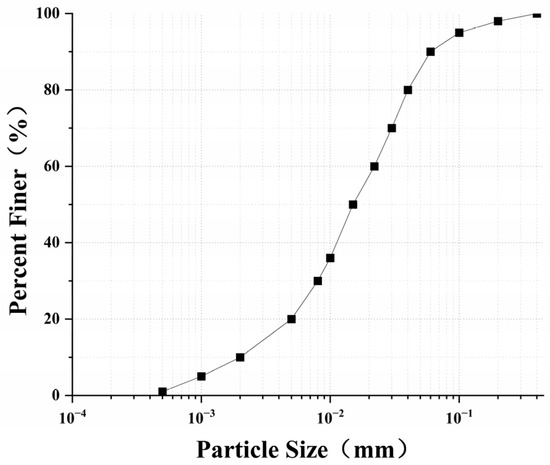
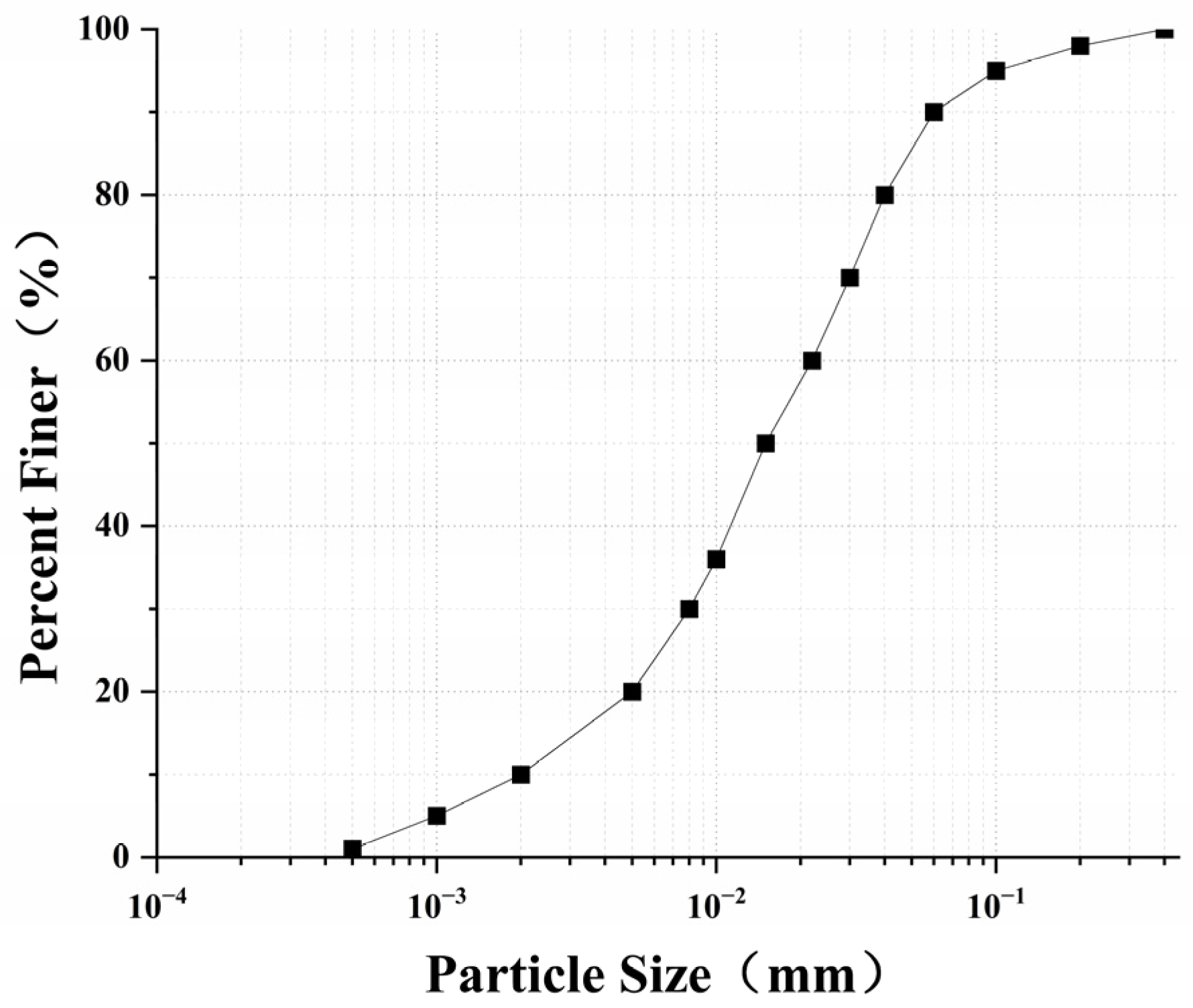
The soil used in this study was collected from Xishan District, Taiyuan City, Shanxi Province, at a depth of 3–5 m. The soil was selected as the study case because it is a representative low-plasticity silt encountered in local geotechnical engineering and provides a suitable material for evaluating the mechanical and water-stability responses to the proposed bio-based stabilization system. The soil samples were oven-dried at 100 °C for 24 h and then passed through a 2 mm sieve. The processed samples were sealed in bags for subsequent use. Its basic physical properties were determined according to the Standard for Geotechnical Testing Method (GB/T 50123-2019) [31] and are summarized in Table 1, while the particle-size distribution is shown in Figure 1.
Table 1.
Basic properties of the silt.
Figure 1.
Particle size distribution curve of the silt.
2.1.2. Reagents
The chemical reagents used in the experiments are listed in Table 2.
Table 2.
Reagents used in the tests.
2.2. Preparation of the Precursor Solution and Specimens
2.2.1. Preparation of the Hydrogel Precursor
An EDTA–Ca/GDL-mediated internal gelation method was adopted to prepare the precursor solution based on previously established alginate internal-gelation approaches [28,29]. A self-prepared 0.20 mol/L EDTA–Ca solution was used as the calcium source. Briefly, EDTA and CaCl2 were dissolved in deionized water at the designed molar proportion, and the pH was adjusted to obtain a stable EDTA–Ca solution. Chelation of Ca2+ by EDTA was used to limit premature ionic crosslinking during precursor preparation.
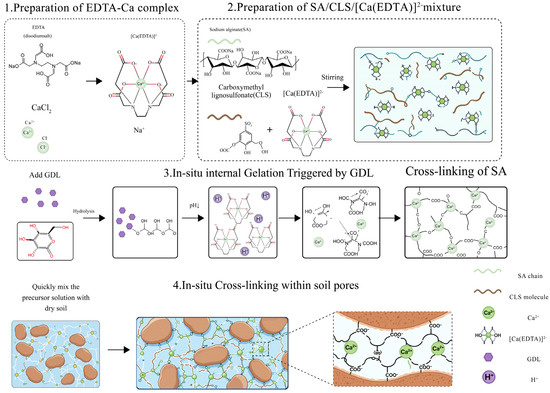
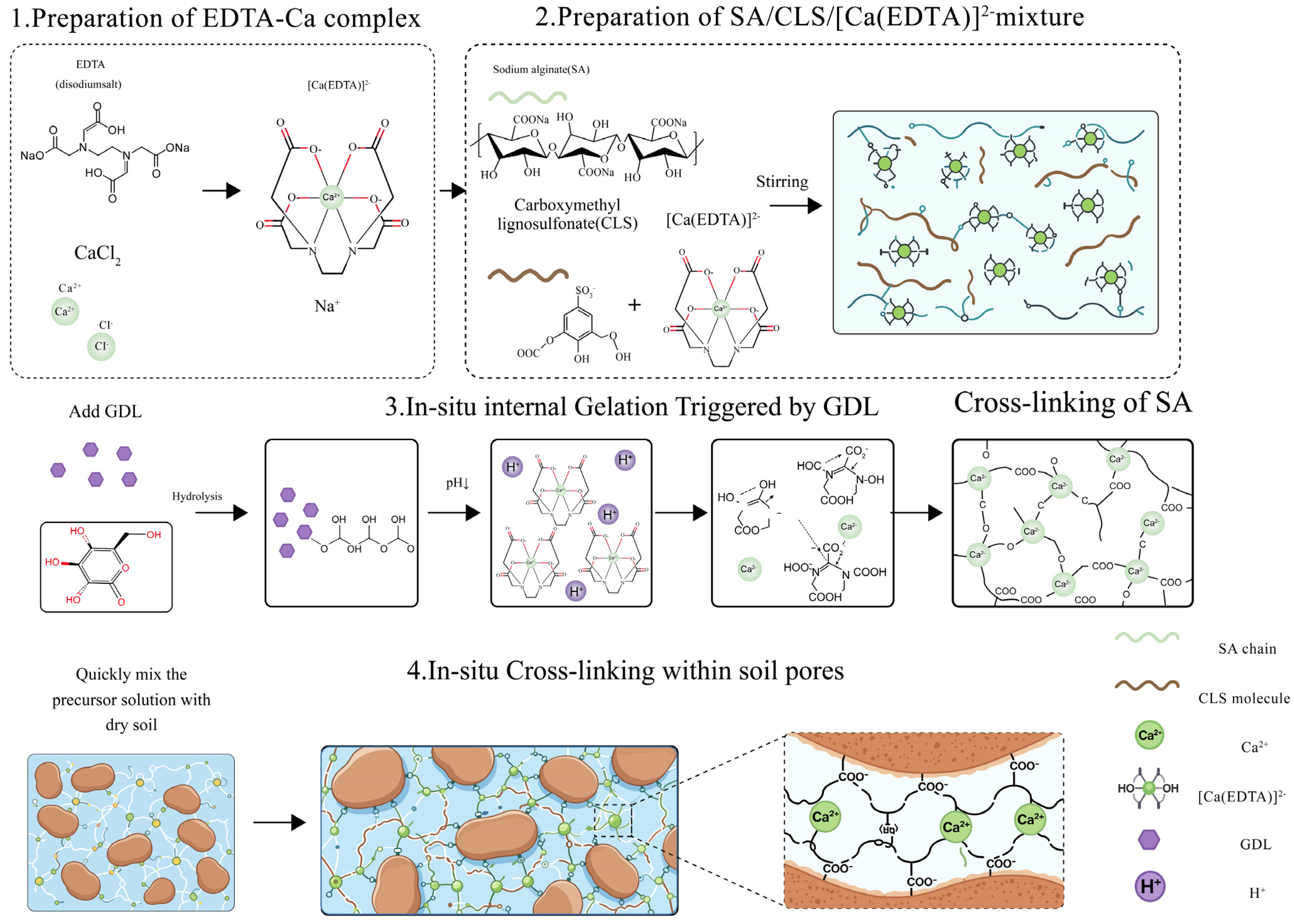
The precursor solution was prepared according to the formulation assigned to each experimental group. CLS was first dissolved in a predetermined amount of deionized water according to its dosage relative to the dry soil mass. SA powder was then slowly added under continuous stirring until a homogeneous SA/CLS solution was obtained. Subsequently, the prepared EDTA–Ca solution was added according to the prescribed Ca2+/SA molar ratio and continuously stirred. Finally, 2.0 g of GDL was added as an acidifying agent immediately before soil mixing. GDL-induced acidification promoted the release of Ca2+ from the EDTA–Ca complex and subsequent ionic crosslinking of SA [29]. The resulting precursor solution was immediately mixed with the prepared dry soil to facilitate in situ gel formation within the soil matrix. The proposed internal gelation process is schematically illustrated in Figure 2.
Figure 2.
Schematic illustration of the proposed internal gelation process of the SA/CLS/Ca2+ system.
2.2.2. Specimen Preparation and Curing
To minimize preparation-induced variability among different treatment groups, all specimens were prepared following the same basic mixing, compaction, and curing procedures unless otherwise specified. The required amounts of dry soil and precursor solution were determined based on the optimum moisture content of 18.3% and the formulation assigned to each experimental group. The freshly prepared precursor solution was gradually added to the dry soil and thoroughly mixed until a visually homogeneous mixture was obtained. The treated soil was then compacted to 95% of the maximum dry density in accordance with GB/T 50123-2019 [31].
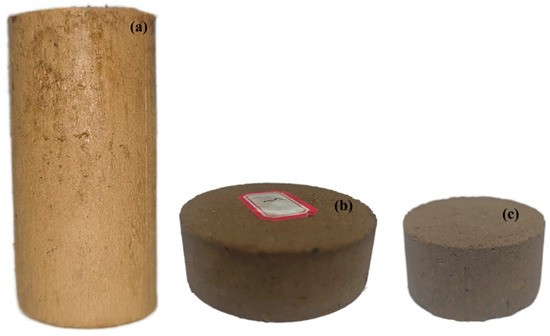
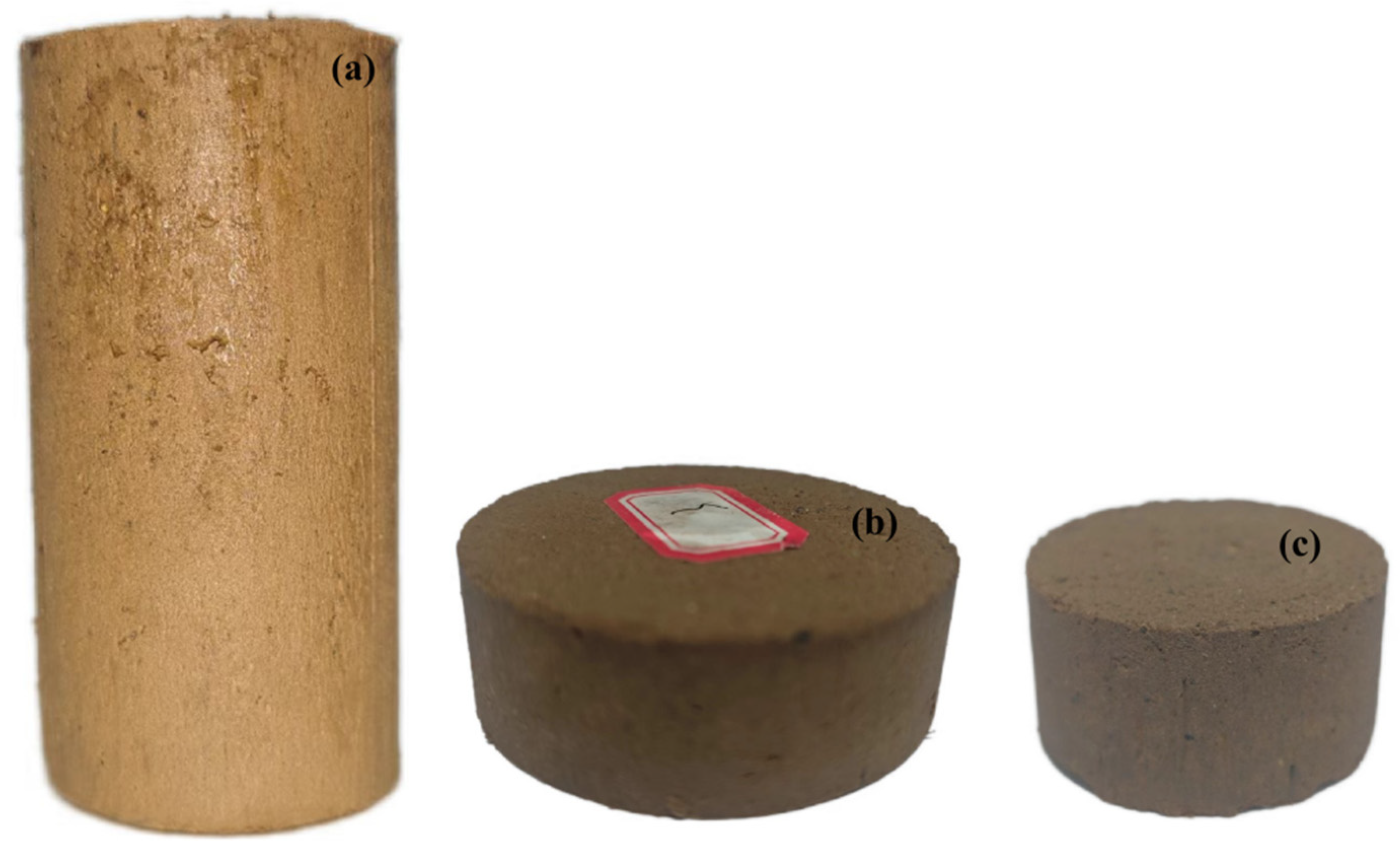
Specimens of different dimensions were prepared according to the requirements of the subsequent tests, as shown in Figure 3. Cylindrical specimens with a diameter of 39.1 mm and a height of 80 mm were prepared for the unconfined compressive strength (UCS) tests; specimens with a diameter of 61.8 mm and a height of 20 mm were prepared for the direct shear tests; and specimens with a diameter of 39.1 mm and a height of 20 mm were prepared for the wetting-disintegration tests. After molding, the specimens were cured at 20 ± 2 °C and a relative humidity of 70%. The specific curing ages and numbers of replicate specimens used in the preliminary and orthogonal experimental programs are described in the corresponding subsections.
Figure 3.
Stabilized silt specimens for different tests: (a) UCS test; (b) direct shear test; and (c) wetting-disintegration test.
2.3. Experimental Program and Mixture Design
The experimental design consisted of two stages. First, a preliminary experiment was conducted to compare the strength responses of untreated, single-component, binary-component, and ternary-component systems and to provide an experimental basis for retaining SA, CLS, and Ca2+ in the composite stabilization system. Subsequently, an L9(33) orthogonal experiment was performed to investigate the effects of SA dosage, CLS dosage, and the Ca2+/SA molar ratio at different curing ages.
2.3.1. Preliminary Experiment
Prior to the orthogonal experiment, a preliminary experiment was conducted to compare the strength improvement achieved by individual, binary, and ternary treatments containing SA, CLS, and Ca2+. Eight treatment groups were established, including untreated silt (P0), three single-component treatments containing SA, CLS, or Ca2+ (P1–P3), three binary-component treatments containing SA + CLS, SA + Ca2+, or CLS + Ca2+ (P4–P6), and one ternary treatment containing SA + CLS + Ca2+ (P7). The compositions of the preliminary groups are summarized in Table 3.
Table 3.
Compositions and 7 d UCS results of the preliminary experiment.
The preliminary dosages were selected by considering material workability and previously reported effective dosage ranges. An SA dosage of 0.50% by dry soil mass was adopted because higher SA contents substantially increased the viscosity of the precursor solution and reduced its workability during soil mixing. A CLS dosage of 0.50% was selected within the effective dosage range reported for lignosulfonate-treated soils [32,33]. Where applicable, Ca2+ was introduced at a concentration of 0.20 mol/L. All specimens were prepared at the optimum moisture content and 95% compaction degree following the procedure described in Section 2.2.2. Three replicate specimens were prepared for each group and cured for 7 d before UCS testing.
As shown in Table 3, the 7 d UCS of the untreated silt was 113 kPa. The single-component SA, CLS, and Ca2+ treatments yielded UCS values of 324, 335, and 147 kPa, respectively, while the binary SA + CLS, SA + Ca2+, and CLS + Ca2+ treatments yielded 435, 471, and 393 kPa, respectively. The ternary SA + CLS + Ca2+ treatment exhibited the highest UCS of 578 kPa, corresponding to increases of 32.87%, 22.72%, and 47.07% relative to the SA + CLS, SA + Ca2+, and CLS + Ca2+ binary treatments, respectively. These preliminary results demonstrate that retaining all three components produced a higher 7 d UCS than the corresponding single- and binary-component treatments under the investigated conditions and therefore supported the selection of the ternary system for the subsequent orthogonal experiment. However, because this preliminary comparison was limited to 7 d UCS and was not designed as a complete factorial analysis, it was not used to quantitatively separate the independent contributions of the three constituents or to establish a synergistic efficiency coefficient.
2.3.2. Orthogonal Experimental Design
Based on the preliminary experiment, the factor levels of SA dosage, CLS dosage, and the Ca2+/SA molar ratio were determined, as summarized in Table 4. A three-factor, three-level orthogonal experimental design was then adopted to investigate their effects on the performance of stabilized silt. An L9 orthogonal array was employed to generate the final experimental combinations, as shown in Table 5. The dosages of SA and CLS were defined as their respective mass ratios to the dry soil mass.
Table 4.
Factors and levels of the orthogonal experimental design.
Table 5.
Three-factor and three-level orthogonal experimental design.
2.4. Macroscopic Performance Tests
Three macroscopic tests were conducted to evaluate the stabilization performance of the treated silt from complementary perspectives. The unconfined compressive strength test was used to characterize strength development with curing age, while the direct shear test was performed to determine the shear-strength parameters and distinguish the contributions of cohesion and internal friction angle. The wetting-disintegration test was conducted to evaluate the resistance of the stabilized silt to structural deterioration upon water exposure.
2.4.1. Unconfined Compressive Strength Test
After curing for 3, 7, 14, and 28 d, the unconfined compressive strength of specimens from each orthogonal experimental group was measured using a universal testing machine to evaluate the stabilization effect of the gel material on the soil. The specimens were continuously loaded under displacement-control mode at a rate of 0.8 mm/min, corresponding to an axial strain rate of 1% per minute. The peak axial stress was taken as the UCS of the specimen. Three replicate specimens were tested for each formulation and curing age, and the average value was used for subsequent analysis.
2.4.2. Direct Shear Test
Direct shear tests were conducted using an STSJ-6A fully automatic quadruple direct shear apparatus. The shear stresses of the stabilized soil specimens were measured under vertical normal stresses of 50, 100, 150, and 200 kPa, and the shear rate was set to 0.8 mm/min. The shear-strength parameters were determined according to the Mohr–Coulomb relationship based on the measured peak shear stresses. Three replicate specimens were tested under each condition, and the average values were used for analysis.
2.4.3. Wetting-Disintegration Test
Wetting-disintegration tests were conducted to evaluate the resistance of the stabilized specimens to structural deterioration upon water exposure. The specimens were completely immersed in water, and their morphological changes and disintegration characteristics were recorded at 30 s, 3 min, 1 h, 6 h, and 24 h after immersion. Particular attention was paid to the development of surface cracking, particle detachment, and loss of structural integrity during immersion.
2.5. Microstructural Characterization
2.5.1. Scanning Electron Microscopy
Untreated soil and Group 9 specimens, which exhibited the best stabilization performance, were selected for SEM analysis. After gold sputter coating, the microstructures were examined using a ZEISS GeminiSEM 300. Quantitative analysis was performed on 5000× images using three-class Otsu thresholding to identify the pore phase. The two-dimensional pore-area fraction was calculated from the segmented images, and group differences were evaluated using Welch’s t-test (p < 0.05).
2.5.2. Fourier-Transform Infrared Spectroscopy
Fourier-transform infrared (FTIR) spectroscopy was performed to characterize the chemical interactions associated with the stabilization system. Five types of samples were analyzed: SA, CLS, the SA/CLS/Ca2+ composite hydrogel, untreated silt, and stabilized silt. Changes in characteristic absorption bands were evaluated by comparing the individual components, composite hydrogel, and soil samples before and after stabilization. The spectra were collected over 400–4000 cm−1 with 32 scans per sample. For semi-quantitative analysis, the carboxylate bands near 1600 and 1400 cm−1 were integrated after conversion from transmittance to absorbance and local baseline correction. The integrated-area ratio A1600/A1400 was used to characterize relative changes in the carboxylate environment.
3. Results
3.1. Unconfined Compressive Strength
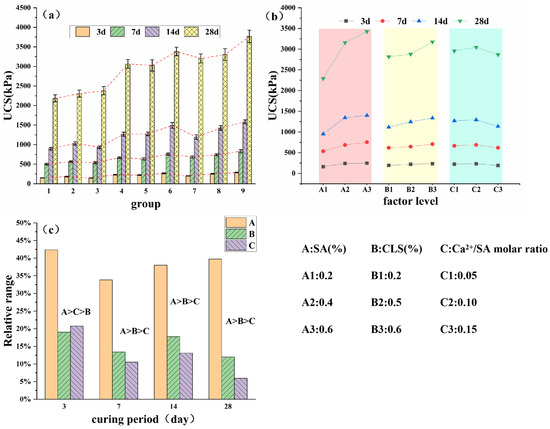
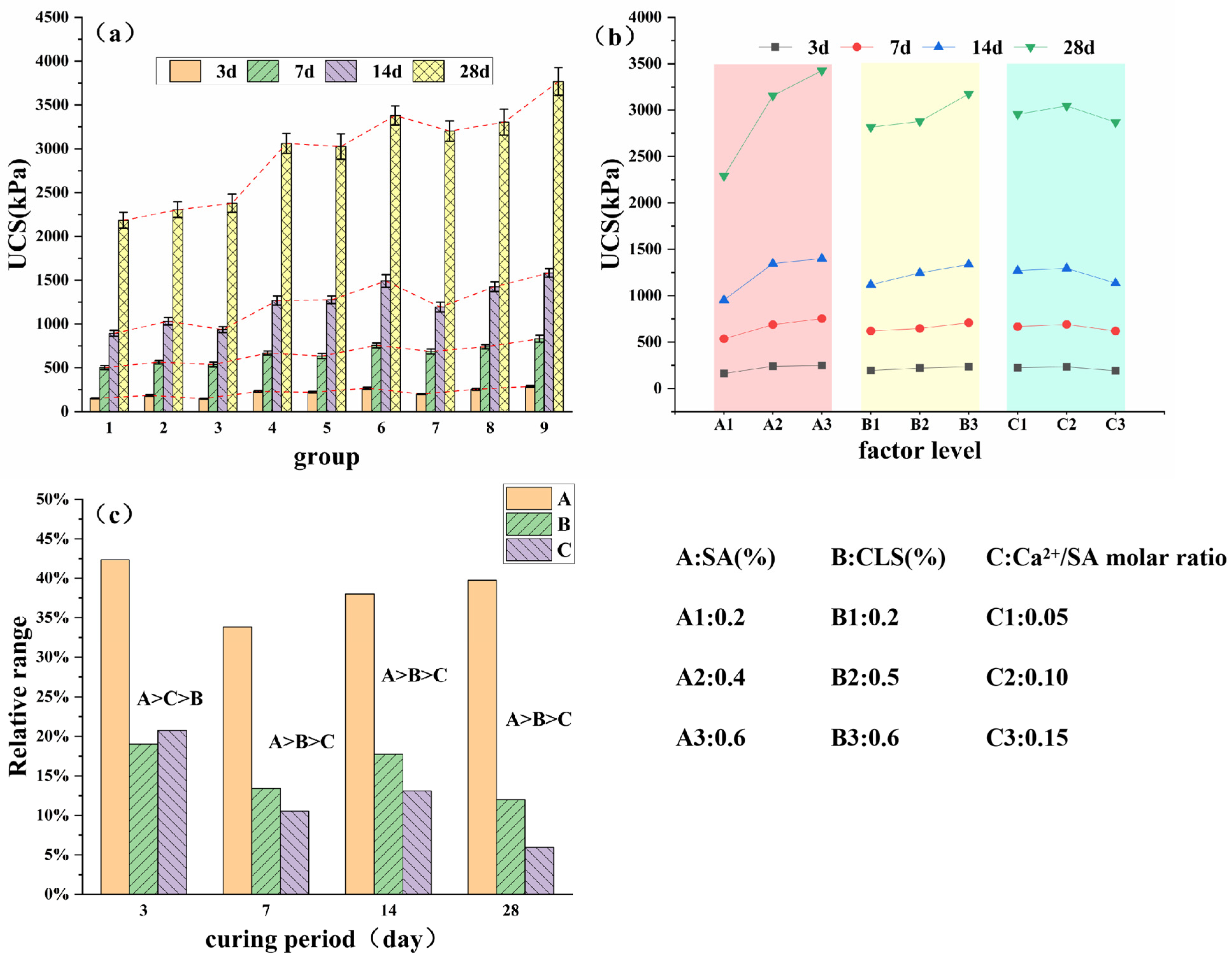
Figure 4a presents the unconfined compressive strength (UCS) of the stabilized silt specimens at curing ages of 3, 7, 14, and 28 d. The UCS of all stabilized groups increased continuously with curing age, although considerable differences were observed among the different mix proportions. Group 9 exhibited the highest UCS at all curing ages. At 28 d, its UCS reached 3768.93 kPa, which was 72.57% higher than that of Group 1 (2184 kPa).
Figure 4.
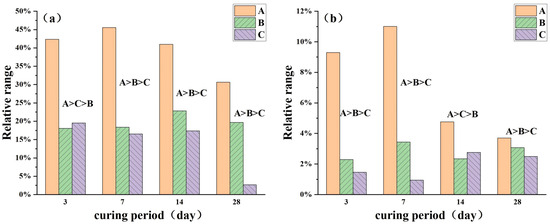
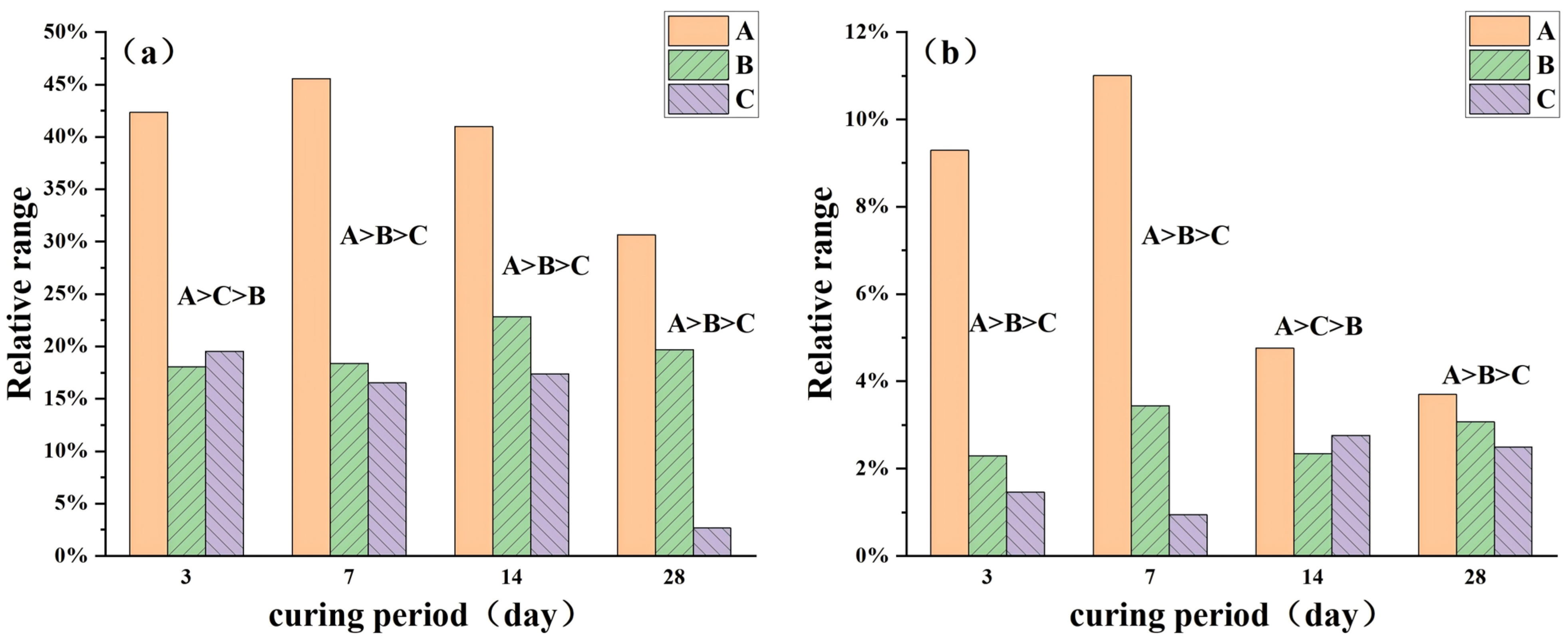
(a) UCS of stabilized soil specimens after 3, 7, 14, and 28 days of curing; (b) influence trends of factor levels; (c) relative range analysis results of UCS.A, B, and C denote SA dosage, CLS dosage, and Ca2+/SA molar ratio, respectively. The red dotted lines denote the trend lines of UCS at each curing age.
The effects of the three experimental factors are shown in Figure 4b. Factor A exhibited the most pronounced influence on UCS. At 28 d, the mean UCS at level A3 reached 3425.36 kPa, which was 8.53% and 49.60% higher than those at levels A2 and A1, respectively. Factor B also showed an overall positive effect, with the mean UCS at level B3 being 12.77% higher than that at B1 at 28 d. In contrast, factor C exhibited a non-monotonic response, with the highest UCS generally occurring at level C2.
The relative range analysis in Figure 4c further showed that factor A consistently had the largest contribution throughout the curing period, accounting for approximately 33–42% of the total relative range. The ranking of factor effects changed with curing age: A > C > B was observed at the early stage, whereas A > B > C became dominant at later curing ages.
The ANOVA results in Table 6 were generally consistent with the range analysis. Factor A showed a statistically significant effect on UCS at all curing ages (p < 0.05). The influence of factor B became more pronounced with curing age, whereas the statistical contribution of factor C decreased at later ages. At 28 d, the corresponding (p)-values for factors A, B, and C were 0.0044, 0.0403, and 0.1667, respectively.
Table 6.
ANOVA summary for UCS. A, B, and C denote SA dosage, CLS dosage, and Ca2+/SA molar ratio, respectively.
Within the investigated factor ranges, the best-performing combination was A3B3C2, corresponding to an SA dosage of 0.6%, a CLS dosage of 0.8%, and a CSR of 0.1.
3.2. Direct Shear Test Results
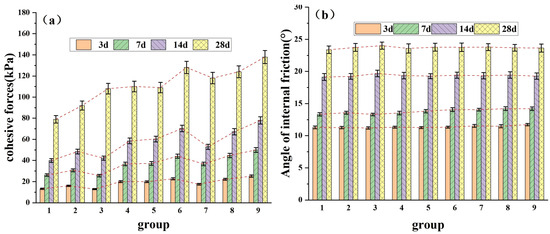
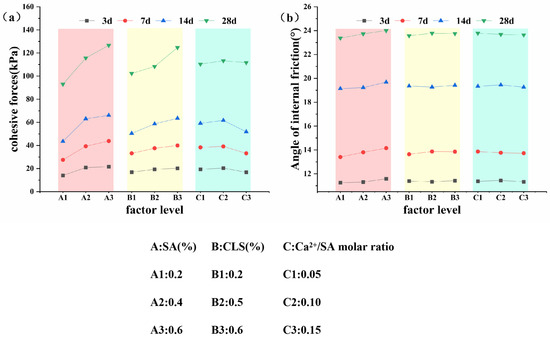
Figure 5 shows the cohesion and internal friction angle of the stabilized silt specimens at different curing ages. Cohesion increased progressively with curing age for all mix proportions. Group 9 exhibited the highest cohesion throughout the curing period, reaching 138 kPa at 28 d, approximately 75% higher than that of Group 1 (79 kPa).
Figure 5.
(a) Cohesion of stabilized soil specimens cured for 3, 7, 14, and 28 days; (b) internal friction angle of stabilized soil specimens cured for 3, 7, 14, and 28 days. The red dotted lines denote the trend lines of cohesion and internal friction angle at each curing age.
In contrast to cohesion, the internal friction angle varied only slightly among the different groups and curing ages. No clear monotonic variation with mix proportion was observed, and the overall variation remained considerably smaller than that of cohesion.
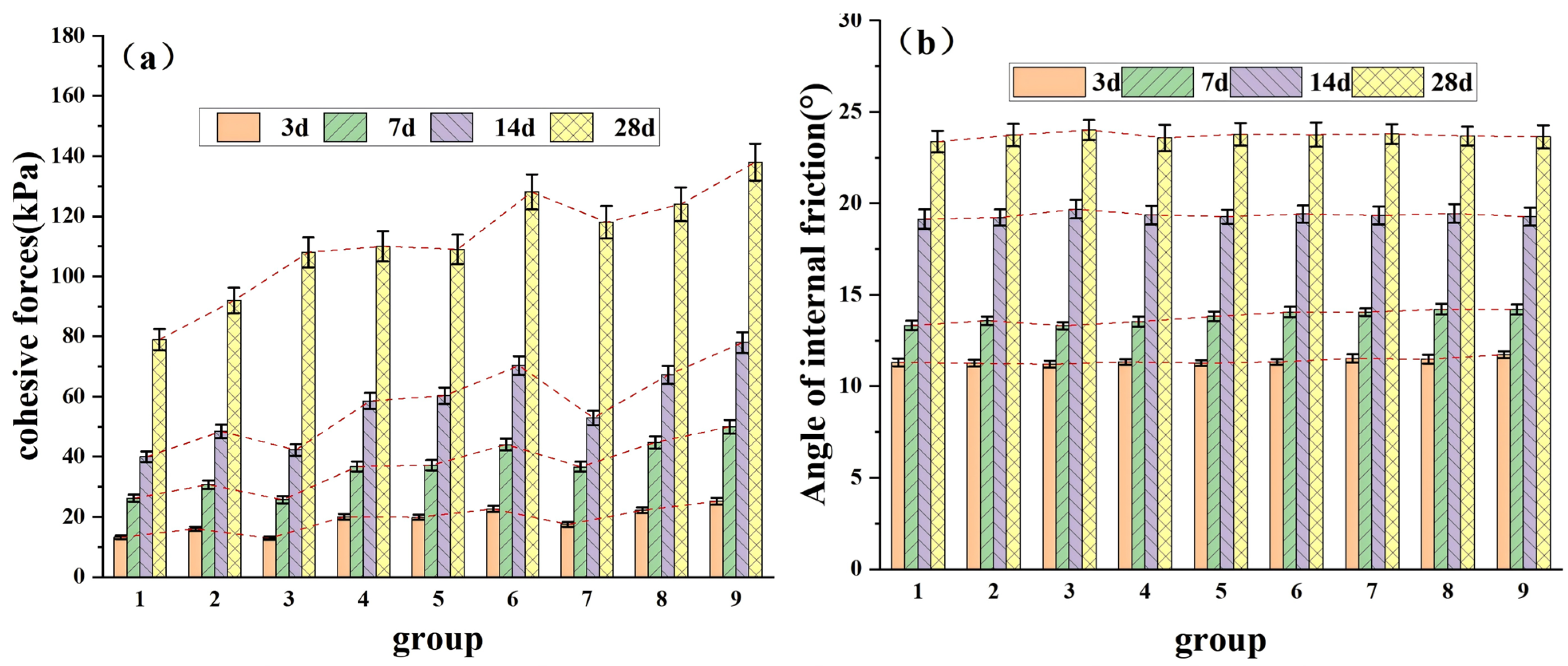
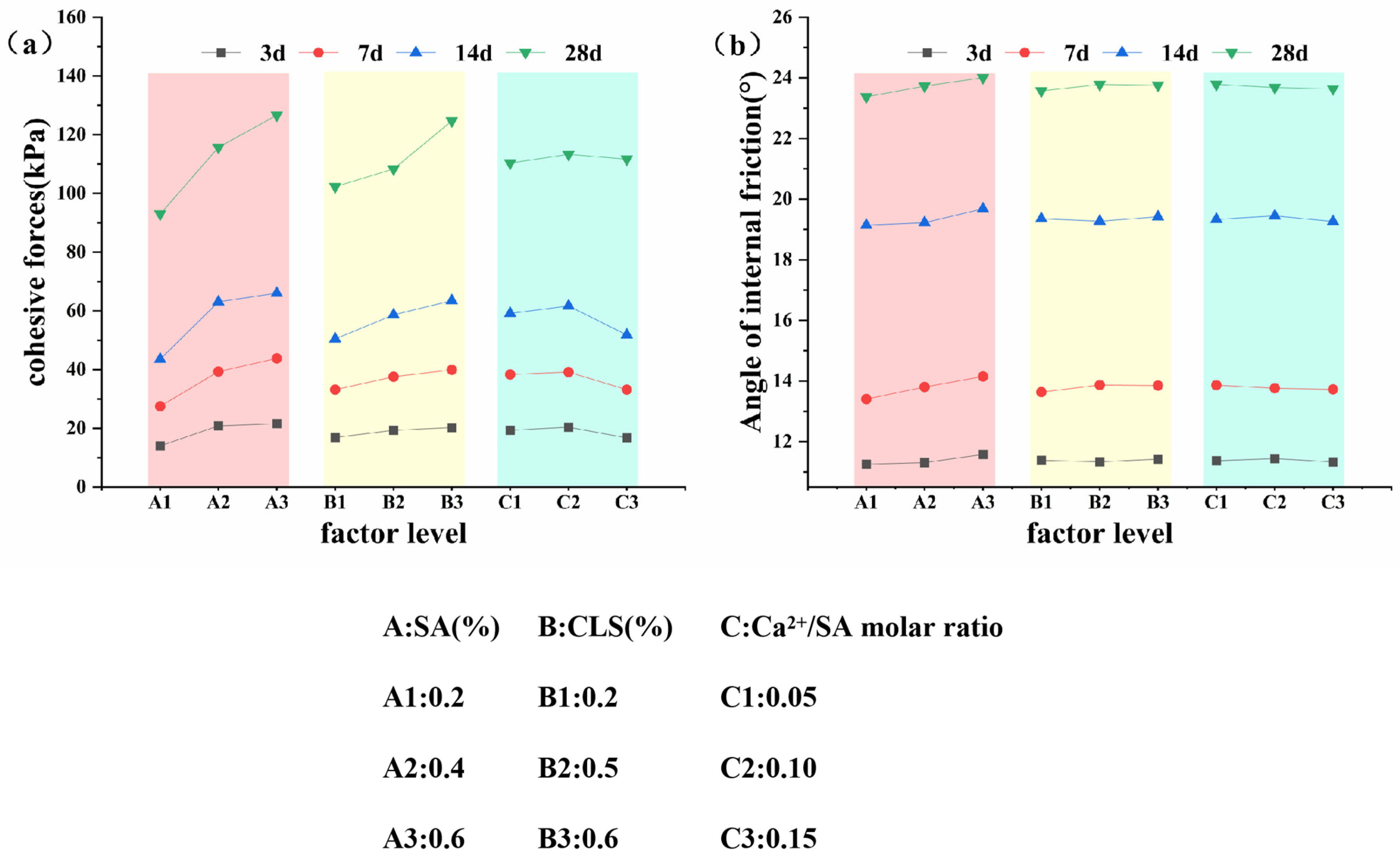
Figure 6 and Figure 7 show the factor-level trends and relative range analyses for cohesion and internal friction angle, respectively. For cohesion, factor A consistently exhibited the largest range value, followed generally by factor B, whereas factor C showed a non-monotonic response. Cohesion increased with increasing SA dosage and generally increased with CLS dosage, while the highest values associated with CSR were obtained at level C2.
Figure 6.
(a) Influence trends of factor levels on cohesion; (b) influence trends of factor levels on internal friction angle. A, B, and C denote SA dosage, CLS dosage, and Ca2+/SA molar ratio, respectively.
Figure 7.
(a) Relative range analysis of cohesion c; (b) relative range analysis of internal friction angle φ. A, B, and C denote SA dosage, CLS dosage, and Ca2+/SA molar ratio, respectively.
The ANOVA results for cohesion are summarized in Table 7. Factor A was statistically significant at all curing ages (p < 0.05). Factor B showed marginal significance at 3, 7, 14, and 28 d, while factor C was marginally significant at early curing ages but became statistically insignificant at 14 and 28 d. At 28 d, the (p)-values of factors A, B, and C were 0.0256, 0.0546, and 0.7776, respectively.
Table 7.
ANOVA summary for Cohesion. A, B, and C denote SA dosage, CLS dosage, and Ca2+/SA molar ratio, respectively.
For the internal friction angle, the relative range values of all three factors were substantially smaller than those obtained for cohesion. As shown in Table 8, none of the investigated factors reached the conventional significance threshold of (p < 0.05) at any curing age. Factor A showed marginal significance at 7 d (p = 0.0766) and 28 d (p = 0.0774), whereas the effects of factors B and C remained statistically insignificant throughout the curing period.
Table 8.
ANOVA summary for Internal Friction Angle. A, B, and C denote SA dosage, CLS dosage, and Ca2+/SA molar ratio, respectively.
Overall, the direct shear results show that changes in shear strength among the different formulations were primarily reflected in cohesion, while the internal friction angle remained comparatively stable.
3.3. Static-Water Disintegration Behavior
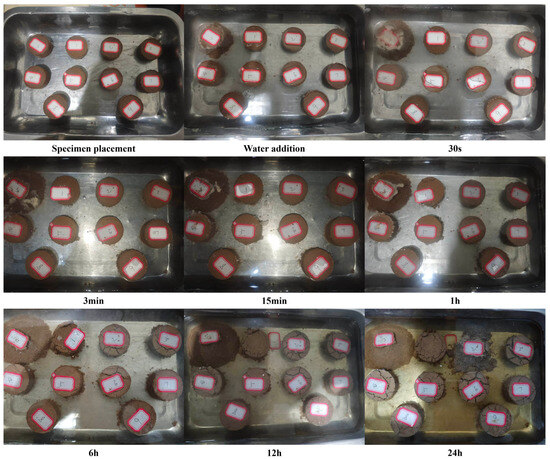
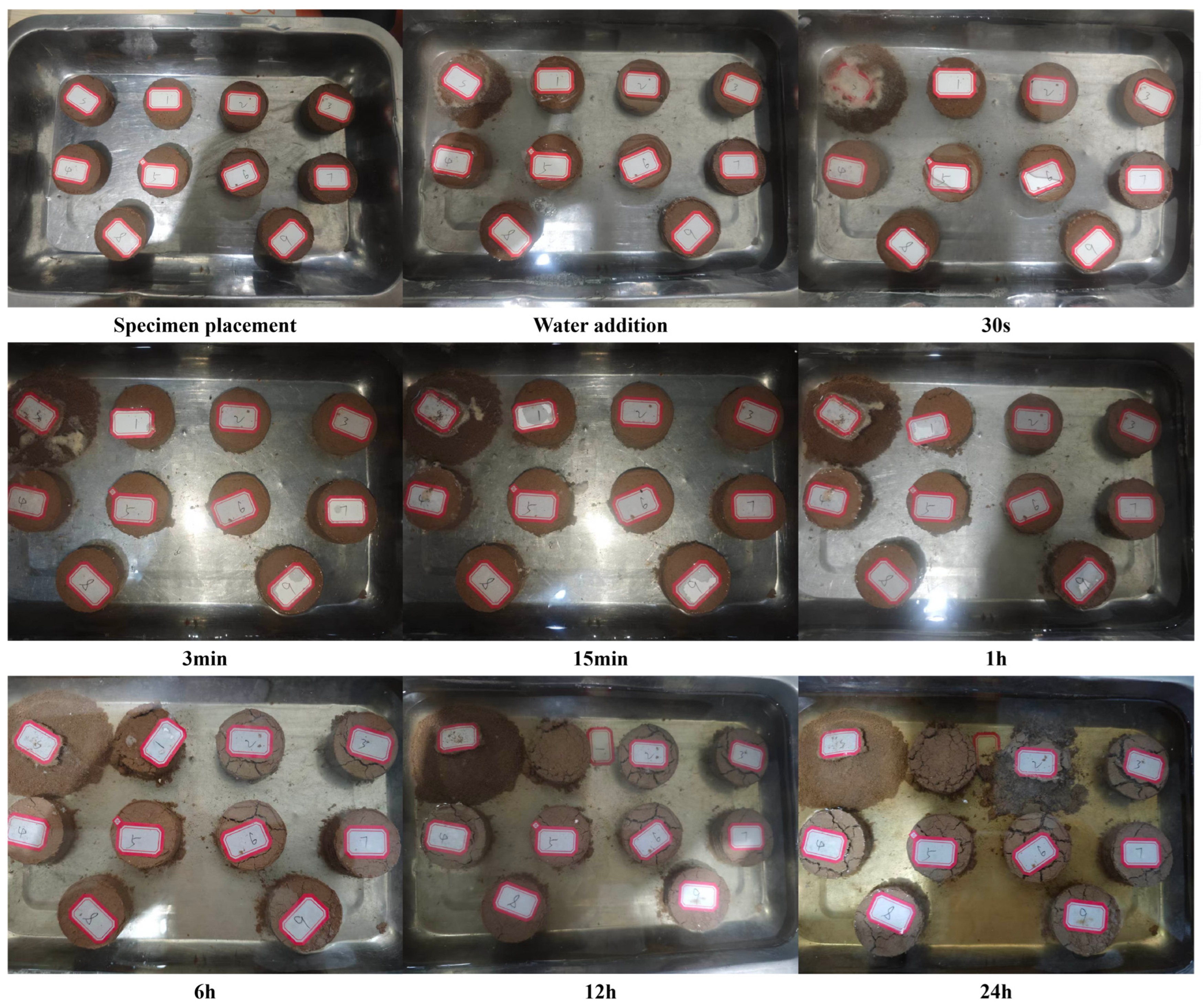
Figure 8 presents the macroscopic evolution of the untreated and stabilized silt specimens during 24 h of static-water immersion. The untreated silt exhibited rapid structural degradation after immersion. Bubble generation and progressive collapse occurred at an early stage, followed by severe structural loss and ultimately complete disintegration after 24 h.
Figure 8.
Evolution of specimen disintegration during 24 h of static-water immersion.
In contrast, the stabilized specimens showed substantially greater resistance to water-induced disintegration. No obvious changes were observed in most stabilized specimens during the early immersion period. Differences among the formulations became more apparent with prolonged immersion, primarily in the form of edge particle spalling, crack development, and loss of specimen shape.
After 24 h of immersion, Groups 1–6 retained their structure to varying degrees, although several specimens exhibited visible cracking, edge spalling, or partial loss of shape. Groups 7–9 showed the best performance: only slight edge particle spalling was observed after 6 h, and the specimens remained almost unchanged after 24 h. Their final integrity was therefore qualitatively categorized as “Excellent” in Table 9.
Table 9.
Qualitative assessment of disintegration characteristics during static-water immersion.
3.4. SEM Observation
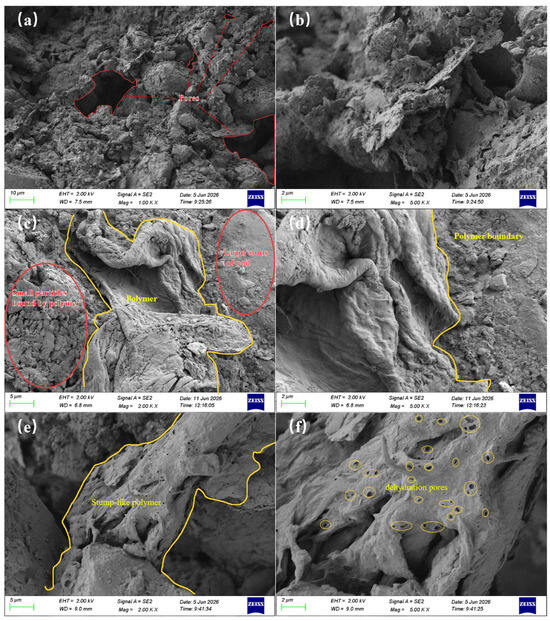
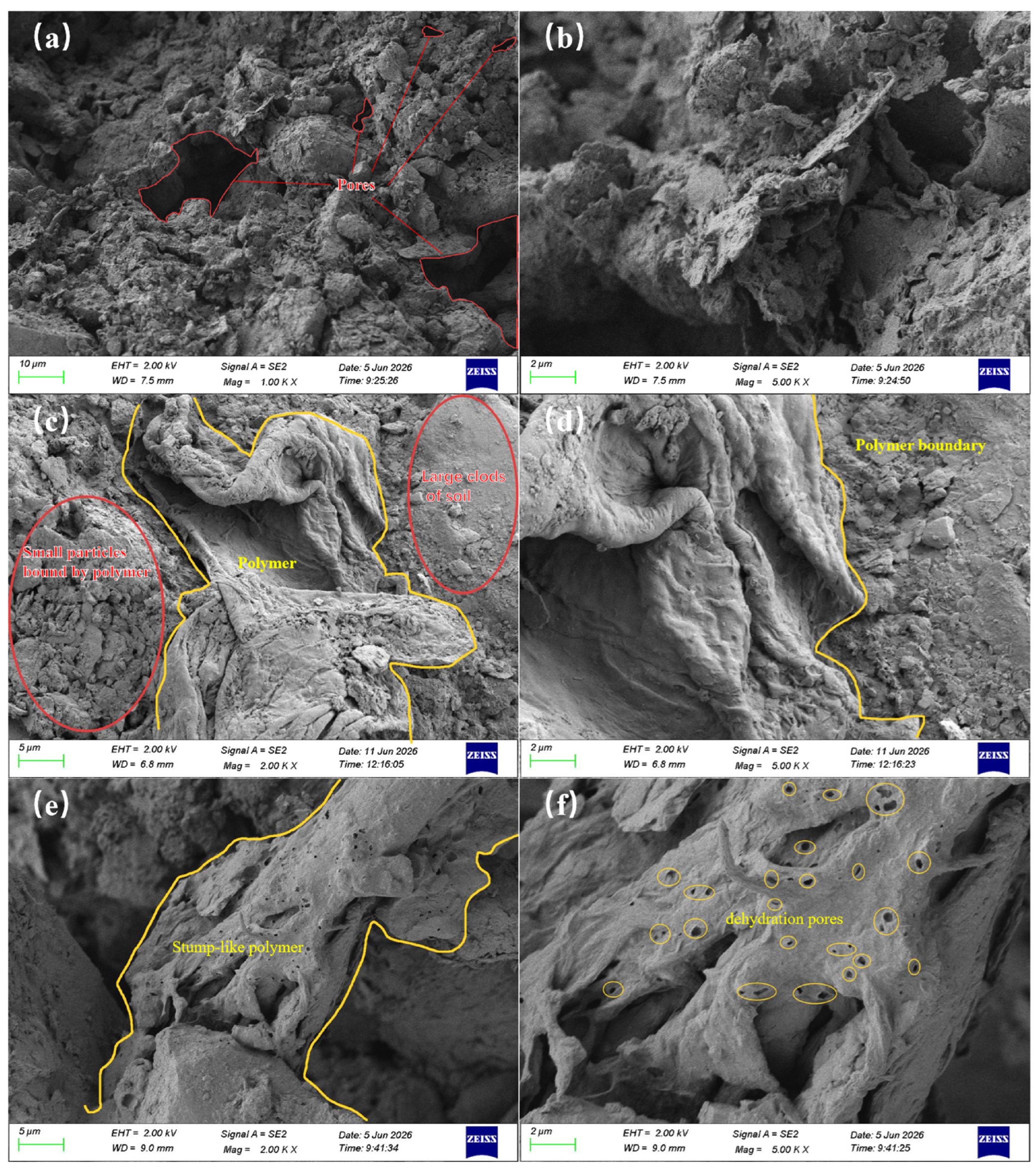
Figure 9 compares the microstructures of untreated silt and the polymer-stabilized silt from Groups 1-9 of the orthogonal experiment. As shown in Figure 9a,b, the untreated silt consisted of particles with relatively rough surfaces and limited continuous bonding between adjacent particles. Particle contacts were mainly point-to-point or edge-to-edge, and numerous interconnected pores were observed within the silt skeleton.
Figure 9.
(a,b) Untreated soil; (c–f) polymer-stabilized soil.
After stabilization, marked changes in the microstructure were observed. As shown in Figure 9c,d, polymer-rich phases were distributed around the silt particles and formed coating-like layers. Fine particles showed a greater degree of aggregation, and the interfaces between adjacent particles became less distinct. Meanwhile, some of the interparticle voids visible in the untreated silt were occupied by polymer-rich material.
Figure 9e,f further show that polymeric material occupied part of the original interparticle void space and formed bridging structures between adjacent silt particles. Compared with the untreated silt, the stabilized specimen therefore exhibited a denser and more integrated particle arrangement. Small pores observed within the polymer-rich phase may have resulted from dehydration during SEM sample preparation.
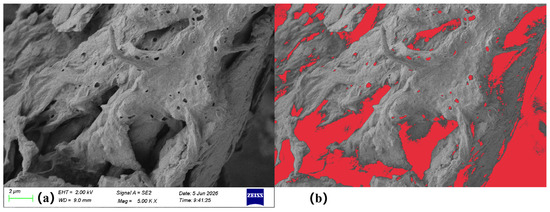
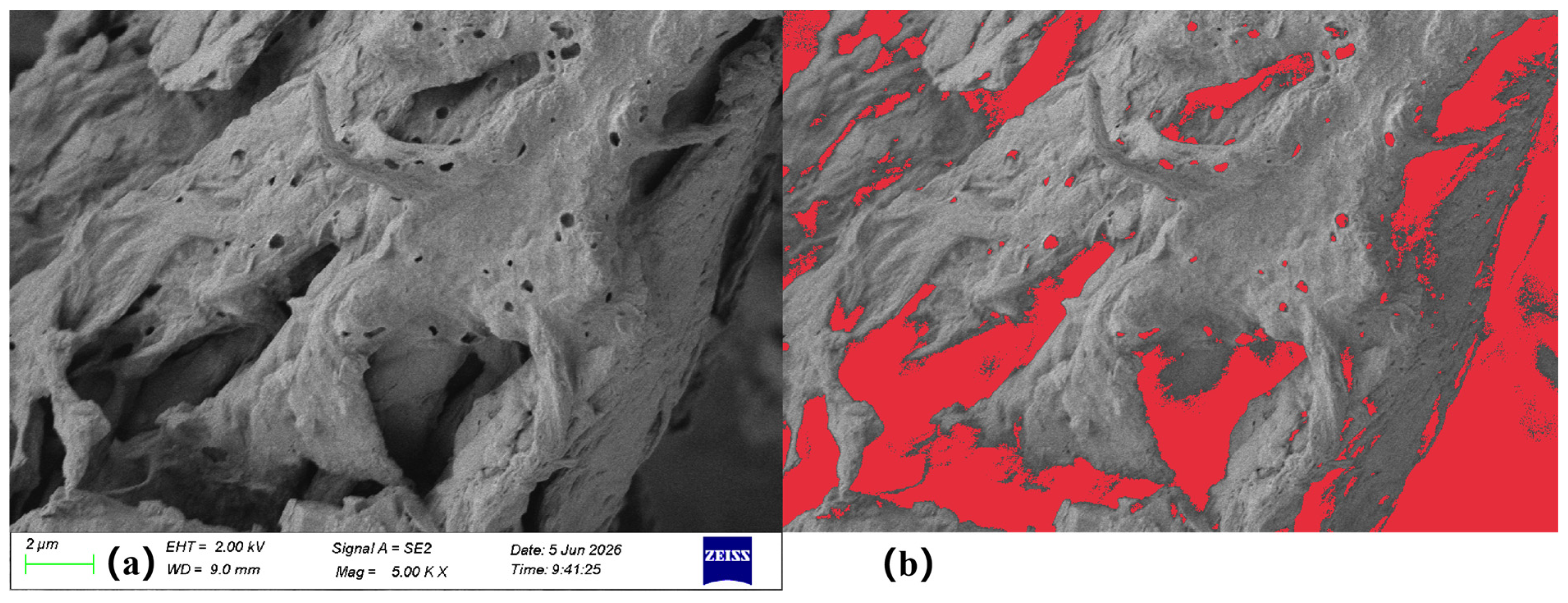
A representative segmentation result is shown in Figure 10, where the highlighted regions represent the identified pore phase used to calculate the two-dimensional pore-area fraction. Quantitative analysis of the 5000× SEM images showed that the mean pore-area fraction decreased from 34.61 ± 6.04% in the untreated silt to 30.08 ± 5.70% and 29.69 ± 6.30% in the two stabilized batches, respectively. No significant difference was observed between the two stabilized batches (p = 0.925), and their combined mean value was 29.92%, representing a decrease of 4.69 percentage points relative to the untreated silt. However, this reduction was not statistically significant (Welch’s t-test, p = 0.154). Therefore, the quantitative results indicate a decreasing trend in the two-dimensional pore-area fraction after stabilization, consistent with the qualitative observations of pore filling and a denser particle arrangement in Figure 9.
Figure 10.
Representative SEM pore segmentation: (a) original image; (b) segmented image.
3.5. FTIR Analysis
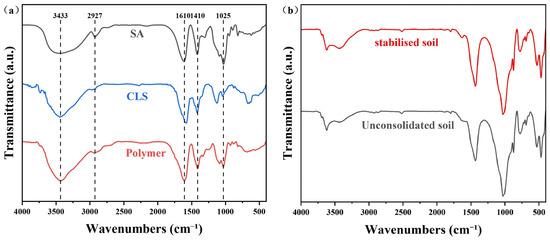
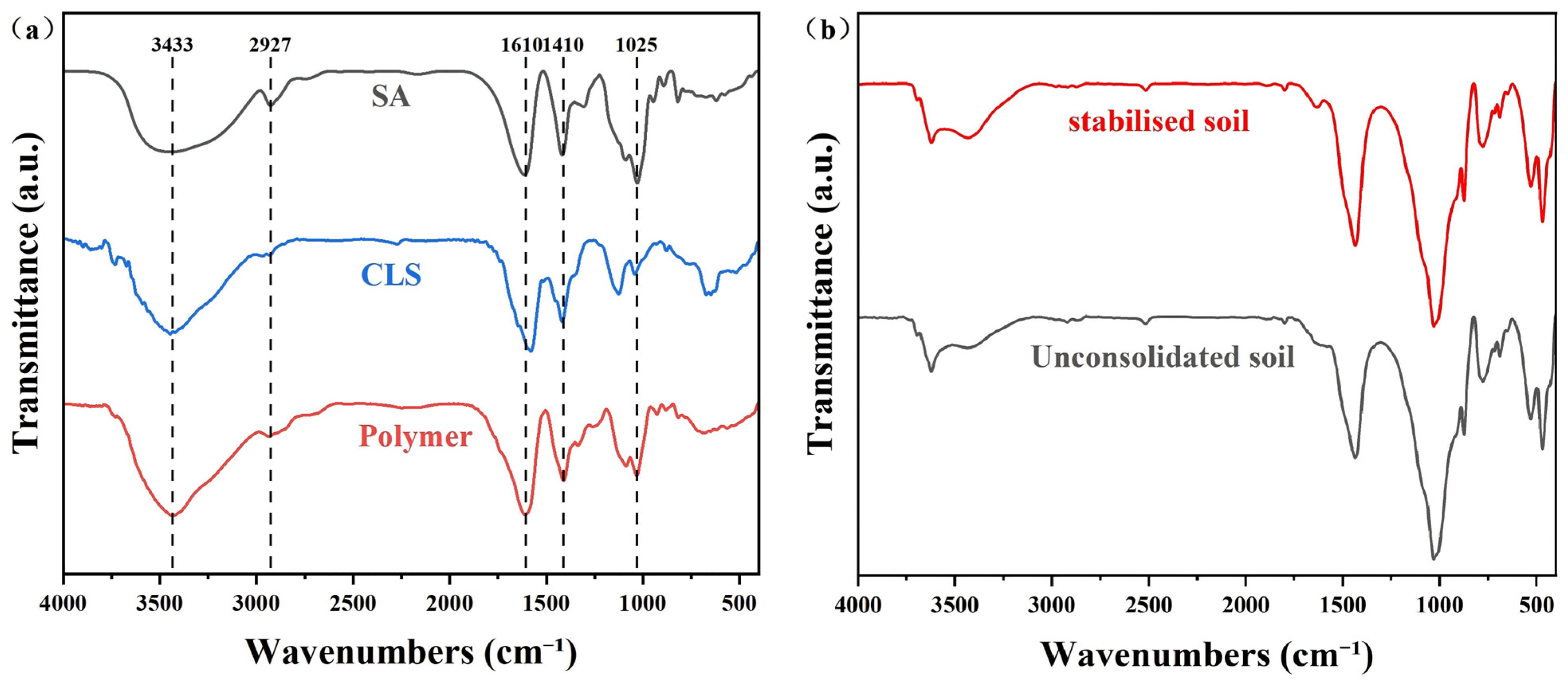
Figure 11 presents the FTIR spectra of SA, CLS, the composite hydrogel, untreated silt, and stabilized silt. The SA spectrum exhibited a broad absorption band at approximately 3433 cm−1, corresponding to O-H stretching vibrations. The characteristic bands near 1600 and 1400 cm−1 were assigned to the asymmetric and symmetric stretching vibrations of carboxylate groups -COO−, respectively, while the absorption band near 1030 cm−1 was associated with C-O and/or C-O-C stretching vibrations.
Figure 11.
FTIR spectra of (a) SA, CLS, and polymer and (b) untreated and stabilized soil.
After formation of the composite hydrogel, the principal characteristic bands of the precursor materials remained present, and no distinct new bands attributable to newly formed covalent bonds were observed. The asymmetric and symmetric –COO− stretching peaks shifted from 1612.4 and 1418.3 cm−1 in SA to 1606.7 and 1411.2 cm−1 in the composite hydrogel, respectively. Semi-quantitative peak-area analysis further showed that the integrated-area ratio A1600/A1400 increased from 1.921 to 2.127, corresponding to a relative increase of approximately 10.7%. The simultaneous shifts in the two carboxylate bands and the change in their relative integrated areas indicate modification of the local chemical environment of -COO− groups after formation of the composite hydrogel.
The overall FTIR spectrum of the stabilized silt remained similar to that of the untreated silt, with the strong absorption band at approximately 1000–1030 cm−1 remaining dominant. No distinct new mineral-related characteristic bands were observed after stabilization. Changes were nevertheless observed in the hydroxyl- and carboxylate-related spectral regions. Together with the spectral changes observed in the composite hydrogel, these results suggest that stabilization primarily involved changes in the local chemical environment of existing functional groups rather than the formation of new covalent structures.
4. Discussion
4.1. Mechanism of Strength and Water-Stability Improvement
The results of this study support the working hypothesis that the SA/CLS/Ca2+ composite system can improve the mechanical performance and water stability of investigated low-plasticity silt through the combined effects of polymer network formation, interparticle bonding, and pore-structure modification. The orthogonal test results showed that the best-performing combination, consisting of 0.6% SA, 0.8% CLS, and a Ca2+/SA molar ratio of 0.1, produced the highest 28 d UCS and cohesion. The different sensitivities of the measured properties to the three formulation factors indicate that the stabilization response was governed by their combined effects rather than by a single component.
Among the three factors, SA dosage exerted the greatest influence on both UCS and cohesion. This dominance was determined directly from the range and variance analyses of the present experiments and should therefore be interpreted as formulation-specific rather than as a general property of alginate-stabilized soils. From a mechanistic perspective, the sensitivity to SA dosage is compatible with the established role of alginate as the principal gel-forming component: Makarova et al. [15] characterized the binding of divalent metal ions within alginate junction structures, while Donati and Christensen [16] described the role of metal-ion interactions in alginate gel formation. These studies do not establish the factor ranking observed here, but they provide a chemical basis for interpreting why changes in SA content can strongly affect the resulting composite network. CLS showed a comparatively stronger influence at later curing ages. This time-dependent tendency is an observation of the present experiments rather than a conclusion derived from previous studies. Alazigha et al. [21] associated lignosulfonate stabilization with adsorption, particle aggregation, and ion-exchange interactions, while Wu et al. [23] reported concurrent changes in strength and pore characteristics in CLS-treated expansive soil. The present curing-age dependence is qualitatively compatible with progressive polymer–soil interaction, although its specific origin in the SA/CLS/Ca2+ system cannot be established from the present data alone.
The Ca2+/SA molar ratio exhibited an optimum rather than a monotonic effect. Within the investigated range, the intermediate ratio of 0.1 produced the most favorable mechanical response. Kuo and Ma [14] showed that calcium availability and gelation conditions can substantially influence the structure and mechanical properties of ionically crosslinked alginate gels, indicating that increasing the amount of crosslinking species does not necessarily produce a proportionally improved network. At the soil scale, Castro et al. [18] likewise reported a non-monotonic mechanical response with increasing crosslinked-SA content. The present result therefore qualitatively aligns with previous observations that alginate-based systems require an appropriate formulation rather than maximization of individual constituents. However, because the Ca2+/SA ratio and soil system investigated here differ from those in previous studies, the optimum ratio of 0.1 should be regarded as specific to the present formulation range.
The microstructural and spectroscopic results provide complementary evidence for this interpretation. SEM observations revealed polymer-rich coating, interparticle bridging, and partial filling of interparticle voids. Quantitative image analysis showed an approximately 13.6% decrease in the mean two-dimensional pore-area fraction after stabilization, although this trend was not statistically significant (p = 0.154). FTIR analysis further revealed shifts in the O–H and –COO− bands and an increase in the A1600/A1400 ratio, indicating changes in the relative spectral characteristics of the carboxylate groups. Together, these observations are consistent with modifications in the local environments of hydroxyl and carboxylate groups and the development of a more integrated soil–polymer structure.
4.2. Comparison with Previous Studies
The mechanical response observed in this study generally agrees with previous findings that the effectiveness of biopolymer stabilization depends on both polymer dosage and soil characteristics. Chang et al. [24] identified enhanced interparticle cohesion as an important contribution of biopolymer treatment, which is consistent with the present direct-shear results showing a substantially stronger formulation dependence of cohesion than of the internal friction angle. Azimi et al. [34] further reported a non-monotonic dosage effect for several biopolymers, including SA, with UCS increasing to an optimum and subsequently decreasing at higher dosages. More recent studies have likewise demonstrated pronounced formulation dependence. Wang et al. [35] identified optimum chitosan contents for both sand and kaolin, while a 2026 comparative study [36] showed that the same biopolymer can produce substantially different cohesion and permeability responses in soils with different mineralogical compositions. These findings align with the present observation that stabilization performance cannot be inferred from stabilizer dosage alone. The optimum SA/CLS/Ca2+ combination identified here should therefore be regarded as specific to the investigated low-plasticity silt and formulation range.
The predominance of cohesion enhancement over changes in the internal friction angle also has support in recent studies, although the response is not universal. Amiri Tasuji et al. [37] reported a marked increase in cohesion after chitosan treatment of sand, accompanied by improvements in compressive strength and hydraulic behavior. For lignosulfonate-containing systems, Khajeh et al. [38] concluded from previous studies that lignosulfonate can enhance UCS and cohesion through adsorption, intermolecular interactions, and the development of a bonding network. More specifically for silty soil, Zhang et al. [39] found that calcium-lignosulfonate-containing treatment altered the shear-strength response of silt under freeze–thaw conditions, with cohesion being more sensitive than the internal friction angle. These observations are consistent with the cohesion-dominated strengthening obtained here. However, the recent comparative study [36] also reported that xanthan gum reduced cohesion in some soil types because of lubrication and particle-separation effects. Thus, enhancement of cohesion should not be regarded as an inherent consequence of biopolymer addition; it depends on polymer chemistry, soil mineralogy, and the resulting interfacial interactions.
The contribution of CLS in the present composite system can be further compared with previous lignosulfonate-based stabilization studies. Ji et al. [33] found that CLS improved the disintegration and erosion resistance of dispersive soil, while its UCS exhibited an optimum with dosage; excessive CLS was associated with polymer aggregation, increased porosity, and reduced mechanical performance. This non-monotonic behavior is compatible with the present finding that balanced component proportions are more important than maximizing an individual constituent. The recent review by Khajeh et al. [38] similarly identified an optimum lignosulfonate dosage range across previous studies and emphasized bonding and adsorption as major stabilization mechanisms. Nevertheless, an important distinction is that CLS acts here as an auxiliary constituent within an SA/Ca2+ composite network rather than as the primary stabilizer. Therefore, the increasing influence of CLS with curing age observed in the present experiments cannot be directly inferred from single-lignosulfonate systems and remains a formulation-specific feature requiring further verification.
The microstructural observations are broadly consistent with recent studies linking macroscopic improvement to polymer-mediated bonding and pore-structure modification. Fatehi et al. [40] reported that carrageenan treatment enhanced the compressive and shear performance of fine-grained soil, with SEM and FTIR evidence indicating polymer-mediated particle bonding and chemical interactions. More recently, Liao et al. [41] reported that a hydrogel-based stabilization system reduced apparent porosity by 41.7% and transformed loose particle contacts into more stable bonded structures, accompanied by improved erosion resistance. These findings qualitatively agree with the polymer-rich coating, interparticle bridging, and partial pore filling observed in the present SEM images. However, the quantitative evidence obtained here is weaker: although the mean two-dimensional pore-area fraction decreased by approximately 13.6%, the difference was not statistically significant (p = 0.154). The present SEM results therefore indicate a trend toward pore-structure densification rather than statistically confirming pore reduction. Similarly, the observed changes in the O–H and –COO− regions of the FTIR spectra are compatible with changes in the local chemical environment, but they do not independently quantify individual coordination or hydrogen-bonding mechanisms.
The water-stability results are also consistent with the broader finding that crosslinked or network-forming biopolymers can improve resistance to water-induced deterioration, but the degree of improvement depends strongly on the exposure regime. Kumar et al. [42] reported that crosslinked xanthan/guar-gum treatment reduced erosion depth by more than 80% and improved resistance to repeated wetting–drying cycles compared with the individual polymers. Xi et al. [43] likewise found that guar-gum treatment substantially reduced the disintegration rate of loess, which was attributed to hydrogel-mediated pore filling and structural reinforcement. These results align with the improved structural integrity of the stabilized specimens during the 24 h immersion test in the present study. Nevertheless, previous studies have also documented progressive deterioration of biopolymer-treated soils under repeated environmental cycling. Chen et al. [44] observed substantial loss of the strength gained by xanthan-gum-treated sand after wetting, while Chang et al. [45] and Lee et al. [46] reported progressive strength degradation under repeated wetting–drying or severe weathering cycles. Accordingly, the present results demonstrate improved short-term static-water stability, but they should not be interpreted as evidence of long-term durability under cyclic wetting, freeze–thaw, or other field exposure conditions.
Taken together, comparison with previous studies indicates that the present results generally align with established and recent observations of formulation-dependent strengthening, enhanced interparticle bonding, and microstructural modification in biopolymer-treated soils. At the same time, the literature also demonstrates that biopolymer stabilization is strongly dependent on soil type, polymer chemistry, dosage, curing conditions, and environmental exposure. The present study differs from most previous investigations by combining SA, CLS, and Ca2+ within a single formulation framework and evaluating their relative effects at different curing ages. Accordingly, the observed dominance of SA, the increasing influence of CLS with curing age, and the optimum Ca2+/SA ratio should be regarded as findings specific to the investigated low-plasticity silt rather than universal characteristics of biopolymer-stabilized soils.
4.3. Engineering Implications
The improvements in UCS, cohesion, and short-term water stability observed in this study demonstrate the potential of the SA/CLS/Ca2+ composite system for the stabilization of low-plasticity silt where insufficient strength and susceptibility to water-induced deterioration are of concern. Potential applications include subgrade improvement, shallow foundation treatment, and slope protection involving soils with similar characteristics. The relatively low dosages used in the present system also support its potential as a bio-based stabilization approach. Nevertheless, the present results were obtained under controlled laboratory conditions and should be regarded as a basis for formulation design and further engineering evaluation rather than as direct evidence of field-scale performance.
The orthogonal test results provide practical guidance for mixture proportioning. Within the investigated ranges, stabilization performance depended on the relative proportions of SA, CLS, and Ca2+ rather than simply increasing the dosage of an individual component. The substantially greater variation in cohesion than in the internal friction angle further indicates that the engineering improvement was primarily associated with enhanced interparticle bonding. Accordingly, mixture design for similar low-plasticity silts should emphasize balanced component proportions and curing conditions. The combination of 0.6% SA, 0.8% CLS, and a Ca2+/SA molar ratio of 0.1 provided the best overall mechanical performance under the present experimental conditions and may therefore serve as a laboratory reference for subsequent optimization.
However, several issues must be resolved before field application. The present water-stability assessment was limited to 24 h static-water immersion and does not represent long-term durability under repeated wetting–drying, freeze–thaw, groundwater flow, or other environmental actions. In addition, field performance may be affected by soil heterogeneity, moisture content, compaction state, mixing uniformity, and curing conditions. Future engineering-oriented studies should therefore evaluate long-term durability, hydraulic and dynamic performance, field-scale constructability, and the economic and environmental feasibility of the composite system under representative service conditions.
5. Conclusions
In this study, a low-dosage SA/CLS/Ca2+ composite system based on EDTA–Ca/GDL-mediated internal gelation was investigated for the stabilization of low-plasticity silt. Orthogonal experiments were used to evaluate the effects of SA dosage, CLS dosage, and the Ca2+/SA molar ratio on mechanical performance and water stability, while SEM and FTIR analyses were employed to characterize the associated microstructural and spectroscopic changes. The main conclusions are as follows:
- (1)
- Within the investigated factor ranges, the best-performing combination was A3B3C2, corresponding to 0.6% SA, 0.8% CLS, and a Ca2+/SA molar ratio of 0.1. This formulation achieved a 28 d UCS of 3768.93 kPa and a cohesion of 138 kPa.
- (2)
- SA dosage exerted the greatest influence on UCS and cohesion, while the influence of CLS became more pronounced with curing age. The Ca2+/SA molar ratio exhibited a non-monotonic effect, with the best mechanical response occurring at the intermediate ratio of 0.1. In contrast, the internal friction angle varied comparatively little, indicating that the improvement in shear strength was predominantly reflected in increased cohesion.
- (3)
- The composite treatment markedly improved short-term resistance to water-induced disintegration. Untreated silt rapidly lost structural integrity during static-water immersion, whereas the stabilized specimens retained their shape to varying degrees. Groups 7–9 exhibited the best water stability and remained nearly unchanged after 24 h of immersion.
- (4)
- SEM observations revealed polymer-rich coating, particle aggregation, pore filling, and interparticle bridging after stabilization. Quantitative image analysis further indicated a decrease in the mean two-dimensional pore-area fraction, although the difference was not statistically significant. FTIR analysis showed shifts in the O–H and –COO− absorption bands together with a change in the
\( A_{1600}/A_{1400}\) ratio. These microstructural and spectroscopic changes are consistent with enhanced interparticle bonding and modification of the pore structure.
The conclusions are specific to the investigated low-plasticity silt, formulation ranges, and laboratory conditions. Further research should focus on long-term durability under cyclic environmental exposure, hydraulic and dynamic performance, the applicability of the formulation to different soil types, and field-scale validation. Single-component and binary control groups, direct characterization of Ca2+ release, and three-dimensional pore-structure characterization would also help further distinguish the contributions of individual constituents and clarify the controlled-gelation process.
Author Contributions
Conceptualization, X.W.; methodology, X.W., G.Z. and Y.J.; data curation, G.Z. and B.P.; writing—original draft preparation, X.W.; writing—review and editing, Y.J.; funding acquisition, Y.J. All authors have read and agreed to the published version of the manuscript.
Funding
This research was funded by the National Natural Science Foundation of China, Grant No. 51879180, and the Science and Technology Development Project of Taiyuan Rail Transit Group Co., Ltd., China, Grant No. KY20201001.
Data Availability Statement
The raw data supporting the conclusions of this article will be made available by the authors on request.
Acknowledgments
The authors gratefully acknowledge the financial support from the National Natural Science Foundation of China (Grant No. 51879180) and the Science and Technology Development Project of Taiyuan Rail Transit Group Co., Ltd., China (Grant No. KY20201001).
Conflicts of Interest
Author Baoguo Pei was employed by Taiyuan Rail Transit Group Co., Ltd. The remaining authors declare that the research was conducted in the absence of any commercial or financial relationships that could be construed as a potential conflict of interest.
References
- GB 50007-2011; Code for Design of Building Foundation. China Architecture & Building Press: Beijing, China, 2011.
- Jian, T.; Kong, L.; Bai, W.; Sun, Z. Investigation on Compressibility and Microstructure Evolution of Intact Loess at Different Wetting States. Front. Earth Sci. 2022, 10, 923358. [Google Scholar] [CrossRef] [Scilit]
- Liu, Z.; Liu, F.; Ma, F.; Wang, M.; Bai, X.; Zheng, Y.; Yin, H.; Zhang, G. Collapsibility, Composition, and Microstructure of Loess in China. Can. Geotech. J. 2016, 53, 673–686. [Google Scholar] [CrossRef] [Scilit]
- Delage, P.; Cui, Y.J.; Antoine, P. Geotechnical Problems Related with Loess Deposits in Northern France. arXiv 2005, arXiv:0803.1435. [Google Scholar] [CrossRef] [Scilit]
- Boulanger, R.W.; Idriss, I.M. Liquefaction Susceptibility Criteria for Silts and Clays. J. Geotech. Geoenviron. Eng. 2006, 132, 1413–1426. [Google Scholar] [CrossRef] [Scilit]
- Bray, J.D.; Sancio, R.B. Assessment of the Liquefaction Susceptibility of Fine-Grained Soils. J. Geotech. Geoenviron. Eng. 2006, 132, 1165–1177. [Google Scholar] [CrossRef] [Scilit]
- Firoozi, A.A.; Guney Olgun, C.; Firoozi, A.A.; Baghini, M.S. Fundamentals of Soil Stabilization. Int. J. Geo-Eng. 2017, 8, 26. [Google Scholar] [CrossRef] [Scilit]
- Andrew, R.M. Global CO2 Emissions from Cement Production. Earth Syst. Sci. Data 2018, 10, 195–217. [Google Scholar] [CrossRef] [Scilit]
- Scrivener, K.L.; John, V.M.; Gartner, E.M. Eco-Efficient Cements: Potential Economically Viable Solutions for a Low-CO2 Cement-Based Materials Industry. Cem. Concr. Res. 2018, 114, 2–26. [Google Scholar] [CrossRef] [Scilit]
- Cabalar, A.F.; Akbulut, N.; Demir, S.; Yildiz, O. Use of a Biopolymer for Road Pavement Subgrade. Sustainability 2023, 15, 8231. [Google Scholar] [CrossRef] [Scilit]
- Muguda, S.; Booth, S.J.; Hughes, P.N.; Augarde, C.E.; Perlot, C.; Bruno, A.W.; Gallipoli, D. Mechanical Properties of Biopolymer-Stabilised Soil-Based Construction Materials. Géotechnique Lett. 2017, 7, 309–314. [Google Scholar] [CrossRef] [Scilit]
- Dagliya, M.; Satyam, N.; Garg, A. Biopolymer Based Stabilization of Indian Desert Soil against Wind-Induced Erosion. Acta Geophys. 2022, 71, 503–516. [Google Scholar] [CrossRef] [Scilit]
- Grant, G.T.; Morris, E.R.; Rees, D.A.; Smith, P.J.C.; Thom, D. Biological Interactions between Polysaccharides and Divalent Cations: The Egg-box Model. FEBS Lett. 1973, 32, 195–198. [Google Scholar] [CrossRef] [Scilit]
- Kuo, C.K.; Ma, P.X. Ionically Crosslinked Alginate Hydrogels as Scaffolds for Tissue Engineering: Part 1. Structure, Gelation Rate and Mechanical Properties. Biomaterials 2001, 22, 511–521. [Google Scholar] [CrossRef] [Scilit] [PubMed]
- Makarova, A.O.; Derkach, S.R.; Khair, T.; Kazantseva, M.A.; Zuev, Y.F.; Zueva, O.S. Ion-Induced Polysaccharide Gelation: Peculiarities of Alginate Egg-Box Association with Different Divalent Cations. Polymers 2023, 15, 1243. [Google Scholar] [CrossRef] [Scilit] [PubMed]
- Donati, I.; Christensen, B.E. Alginate-Metal Cation Interactions: Macromolecular Approach. Carbohydr. Polym. 2023, 321, 121280. [Google Scholar] [CrossRef] [Scilit] [PubMed]
- Yin, S.; Xu, X.; Zeng, G.; Ju, Y. Mechanical Properties Enhancement and Permeability Control of Silty Soils by Modified Sodium Alginate. Int. J. Biol. Macromol. 2025, 333, 148412. [Google Scholar] [CrossRef] [Scilit] [PubMed]
- Castro, G.M.; Tewelde, D.; Tubaldi, E. Assessment of the Use of Sodium Alginate for Soil Improvement in Coastal Applications. Sci. Rep. 2025, 15, 38714. [Google Scholar] [CrossRef] [Scilit] [PubMed]
- Alawadhi, A.; Pedrotti, M.; Tubaldi, E. Applications of Alginate in Geotechnical Engineering and Construction: A Review. Buildings 2026, 16, 775. [Google Scholar] [CrossRef] [Scilit]
- Ta’negonbadi, B.; Noorzad, R. Stabilization of Clayey Soil Using Lignosulfonate. Transp. Geotech. 2017, 12, 45–55. [Google Scholar] [CrossRef] [Scilit]
- Alazigha, D.P.; Indraratna, B.; Vinod, J.S.; Heitor, A. Mechanisms of Stabilization of Expansive Soil with Lignosulfonate Admixture. Transp. Geotech. 2018, 14, 81–92. [Google Scholar] [CrossRef] [Scilit]
- Chen, Q.; Indraratna, B. Shear Behaviour of Sandy Silt Treated with Lignosulfonate. Can. Geotech. J. 2015, 52, 1180–1185. [Google Scholar] [CrossRef] [Scilit]
- Wu, D.; She, W.; Wei, L.; Zuo, W.; Hu, X.; Hong, J.; Miao, C. Stabilization Mechanism of Calcium Lignosulphonate Used in Expansion Sensitive Soil. J. Wuhan Univ. Technol.-Mater. Sci. Ed. 2020, 35, 847–855. [Google Scholar] [CrossRef] [Scilit]
- Chang, I.; Lee, M.; Tran, A.T.P.; Lee, S.; Kwon, Y.-M.; Im, J.; Cho, G.-C. Review on Biopolymer-Based Soil Treatment (BPST) Technology in Geotechnical Engineering Practices. Transp. Geotech. 2020, 24, 100385. [Google Scholar] [CrossRef] [Scilit]
- Fernández, M.T.; Orlandi, S.; Codevilla, M.; Piqué, T.M.; Manzanal, D. Performance of Calcium Lignosulfonate as a Stabiliser of Highly Expansive Clay. Transp. Geotech. 2021, 27, 100469. [Google Scholar] [CrossRef] [Scilit]
- Zhang, J.; Liu, J. A Review on Soils Treated with Biopolymers Based on Unsaturated Soil Theory. Polymers 2023, 15, 4431. [Google Scholar] [CrossRef] [Scilit] [PubMed]
- Huang, J.; Kogbara, R.B.; Hariharan, N.; Masad, E.A.; Little, D.N. A State-of-the-Art Review of Polymers Used in Soil Stabilization. Constr. Build. Mater. 2021, 305, 124685. [Google Scholar] [CrossRef] [Scilit]
- Yamamoto, K.; Yuguchi, Y.; Stokke, B.T.; Sikorski, P.; Bassett, D.C. Local Structure of Ca2+ Alginate Hydrogels Gelled via Competitive Ligand Exchange and Measured by Small Angle X-Ray Scattering. Gels 2019, 5, 3. [Google Scholar] [CrossRef] [Scilit] [PubMed]
- Paiboon, N.; Surassmo, S.; Rungsardthong Ruktanonchai, U.; Kappl, M.; Soottitantawat, A. Internal Gelation of Alginate Microparticle Prepared by Emulsification and Microfluidic Method: Effect of Ca-EDTA as a Calcium Source. Food Hydrocoll. 2023, 141, 108712. [Google Scholar] [CrossRef] [Scilit]
- Chan, L.W.; Lee, H.Y.; Heng, P.W.S. Mechanisms of External and Internal Gelation and Their Impact on the Functions of Alginate as a Coat and Delivery System. Carbohydr. Polym. 2006, 63, 176–187. [Google Scholar] [CrossRef] [Scilit]
- GB/T 50123-2019; Standard for Geotechnical Testing Method. China Planning Press: Beijing, China, 2019.
- Du, X.; Wu, Q.; Ma, Q.; Tian, Y.; Zhang, J. Study on Strengthening and Waterproofing Mechanism of Calcium Lignosulfonate in Silty Soil Sites. Coatings 2023, 13, 1402. [Google Scholar] [CrossRef] [Scilit]
- Ji, S.; Wang, B. Experimental Study of Dispersive Clay Modified by Calcium Lignosulfonate. Rock Soil Mech. 2021, 42, 2405. [Google Scholar] [CrossRef]
- Azimi, M.; Soltani, A.; Mirzababaei, M.; Jaksa, M.B.; Ashwath, N. Biopolymer Stabilization of Clayey Soil. J. Rock Mech. Geotech. Eng. 2024, 16, 2801–2812. [Google Scholar] [CrossRef] [Scilit]
- Wang, R.; Ong, D.E.L.; Sadighi, H.; Goli, M.; Xia, P.; Fatehi, H.; Yao, T. Optimizing Soil Stabilization with Chitosan: Investigating Acid Concentration, Temperature, and Long-Term Strength. Polymers 2025, 17, 151. [Google Scholar] [CrossRef] [Scilit]
- Ceylan, Ç. The Influence of Xanthan Gum and Guar Gum Biopolymers on the Geotechnical Properties of Three Different Soils. Polymers 2026, 18, 2006. [Google Scholar] [CrossRef] [Scilit] [PubMed]
- Amiri Tasuji, M.; Ghadir, P.; Hosseini, A.; Javadi, A.A.; Habibnejad Korayem, A.; Ranjbar, N. Experimental Investigation of Sandy Soil Stabilization Using Chitosan Biopolymer. Transp. Geotech. 2024, 46, 101266. [Google Scholar] [CrossRef] [Scilit]
- Khajeh, A.; Nazari, Z.; Movahedrad, M.; Vakili, A.H. A State-of-the-Art Review on the Application of Lignosulfonate as a Green Alternative in Soil Stabilization. Sci. Total Environ. 2024, 943, 173500. [Google Scholar] [CrossRef] [Scilit] [PubMed]
- Zhang, H.; Li, H.; Zhang, H.; Duan, D.; Ding, Q.; Ding, L.; Liu, Y. Experimental Study on Mechanical Characteristics of Stabilized Soil with Rice Husk Carbon and Calcium Lignosulfonate. Materials 2024, 17, 5201. [Google Scholar] [CrossRef] [Scilit] [PubMed]
- Fatehi, H.; Ong, D.E.L.; Yu, J.; Chang, I. Sustainable Soil Treatment: Investigating the Efficacy of Carrageenan Biopolymer on the Geotechnical Properties of Soil. Constr. Build. Mater. 2024, 411, 134627. [Google Scholar] [CrossRef] [Scilit]
- Liao, R.; Zhang, X.; He, K.; Pei, X.; Zhao, X.; Yang, X. Multiscale Mechanisms of Hydrogel-Induced Structural Stabilization and Erosion Resistance in Slag-Amended Soils. Land Degrad. Dev. 2026, 37, 9621–9635. [Google Scholar] [CrossRef] [Scilit]
- Kumar, M.A.; Moghal, A.A.B.; Rasheed, R.M.; Rehman, A.U. Enhancing Durability and Erosion Resistance of Soils with Varying Plasticity Using Crosslinked Biopolymers. Sci. Rep. 2025, 15, 12572. [Google Scholar] [CrossRef] [Scilit] [PubMed]
- Xi, Y.; Sun, M.; Li, H.; Li, G.; Wang, P.; Li, L. Permeability and Disintegration Characteristics of Loess Solidified by Guar Gum and Basalt Fiber. Materials 2024, 17, 3150. [Google Scholar] [CrossRef] [Scilit] [PubMed]
- Chen, C.; Wu, L.; Harbottle, M. Exploring the Effect of Biopolymers in Near-Surface Soils Using Xanthan Gum–Modified Sand under Shear. Can. Geotech. J. 2020, 57, 1109–1118. [Google Scholar] [CrossRef] [Scilit]
- Chang, I.; Im, J.; Lee, S.-W.; Cho, G.-C. Strength Durability of Gellan Gum Biopolymer-Treated Korean Sand with Cyclic Wetting and Drying. Constr. Build. Mater. 2017, 143, 210–221. [Google Scholar] [CrossRef] [Scilit]
- Lee, M.; Kwon, Y.-M.; Park, D.-Y.; Chang, I.; Cho, G.-C. Durability and Strength Degradation of Xanthan Gum Based Biopolymer Treated Soil Subjected to Severe Weathering Cycles. Sci. Rep. 2022, 12, 19453. [Google Scholar] [CrossRef] [Scilit] [PubMed]

Disclaimer/Publisher’s Note: The statements, opinions and data contained in all publications are solely those of the individual author(s) and contributor(s) and not of MDPI and/or the editor(s). MDPI and/or the editor(s) disclaim responsibility for any injury to people or property resulting from any ideas, methods, instructions or products referred to in the content. |
© 2026 by the authors. Licensee MDPI, Basel, Switzerland. This article is an open access article distributed under the terms and conditions of the Creative Commons Attribution (CC BY) license.