


Abstract
Waste soil generated by building and underground construction is commonly characterized by high water content and low strength, while conventional cement stabilization entails high cement consumption. This study develops two low-cement binders incorporating ordinary Portland cement (P), carbide slag (CS), ground granulated blast-furnace slag (GGBS), and fly ash (FA) and establishes projection pursuit regression (PPR) models for predicting the unconfined compressive strength (UCS) of stabilized soil. Orthogonal and supplementary tests were conducted by varying total binder content, curing age, solid-waste replacement ratio, and compaction pressure. Separate PPR models were calibrated for the P–CS–GGBS (PC) and P–CS–GGBS–FA (PF) systems using 12 training and 10 within-domain validation mixtures. The mean relative errors for the training and validation sets were 3.46% and 5.68% for PC and 3.09% and 4.87% for PF, respectively. For both systems, the solid-waste replacement ratio was the dominant variable, followed by curing age, binder content, and compaction pressure. Model-based optimization identified binder compositions containing 75% solid waste for PC and 60% for PF, with recommended internal proportions of 25% P–18.75% CS–56.25% GGBS and 40% P–15% CS–22.5% GGBS–22.5% FA, respectively. The proposed framework provides a practical tool for strength prediction and mixture design of low-cement-stabilized waste soil.
1. Introduction
Rapid urbanization and the expansion of building and underground-space construction generate substantial quantities of excavated soil from foundation pits, basements, utility corridors, and related earthworks [1,2,3,4]. Such materials commonly exhibit high water content, low strength, and high compressibility, which restrict their direct reuse as engineered fill [5,6,7]. Conventional stockpiling or off-site disposal also increases land occupation, transportation demand, and the risk of secondary environmental impacts. Developing technically reliable routes for converting excavated soil into usable construction material is therefore important for both resource efficiency and sustainable construction.
Ordinary Portland cement is widely used to improve the mechanical properties of weak soils because its hydration products bind soil particles and fill internal pores [8,9,10,11,12]. Nevertheless, cement-intensive stabilization increases material cost and embodied carbon, which conflicts with the demand for lower-carbon construction practices [13,14]. Partial replacement of ordinary Portland cement with industrial solid wastes provides a potentially effective alternative [15,16,17]. In particular, carbide slag is rich in calcium-bearing alkaline phases, ground granulated blast-furnace slag contains reactive calcium–silicate–aluminate components, and fly ash can contribute additional siliceous and aluminous phases [18,19,20,21,22]. When appropriately proportioned, these materials may promote the formation of cementitious reaction products, densify the soil skeleton, and reduce the amount of virgin cement required [23,24,25].
Previous studies have demonstrated that combinations of slag, fly ash, carbide slag, gypsum, steel slag, red mud, and other industrial by-products can improve the strength, bearing capacity, water stability, and durability of different soils [26]. However, the reported performance varies markedly with soil type, binder chemistry, curing condition, and compaction procedure. In particular, FA [27,28,29] generally reacts more slowly than highly calcium-rich constituents, whereas CS [30,31] can alter the alkalinity of the reaction environment, and GGBS [32,33,34] can contribute to both early- and later-age strength development. Consequently, the mechanical response of cement–solid-waste-stabilized soil cannot be inferred from the effect of an individual component alone. The coupled influences of total binder content, curing age, solid-waste replacement ratio, and compaction pressure must be evaluated simultaneously.
Most mixture-design studies on stabilized soils rely on orthogonal tests, response-surface analysis, or conventional regression to identify influential variables and optimum proportions [35,36,37]. These approaches are useful, but they may provide limited representations when the response is nonlinear and several factors interact. More complex machine learning models can improve prediction accuracy, although their internal relationships are often difficult to interpret, and their reliability may be uncertain for small experimental datasets. Projection pursuit regression (PPR) offers an alternative by expressing a multivariable response as a sum of smooth ridge functions constructed from linear projections of the original predictors [38]. This formulation can capture nonlinear relationships while reducing the effective dimensionality of the problem. Nevertheless, its use for jointly predicting strength and supporting mixture optimization in cement–industrial-solid-waste-stabilized excavated soil remains comparatively limited.
The present study investigates two composite binder systems: a P–CS–GGBS blend, denoted as PC, and a P–CS–GGBS–FA blend, denoted as PF. The solid-waste replacement ratio is defined as the mass fraction of CS, GGBS, and, where applicable, FA in the total binder. Orthogonal and supplementary experiments were conducted by varying total binder content, curing age, solid-waste replacement ratio, and compaction pressure, with unconfined compressive strength (UCS) used as the principal performance indicator. Separate PPR models were then developed and validated for the PC and PF systems. The research findings can provide a scientific reference for the mixture design of stabilized construction excavated soil under different strength requirements.
2. Materials and Methods
2.1. Materials
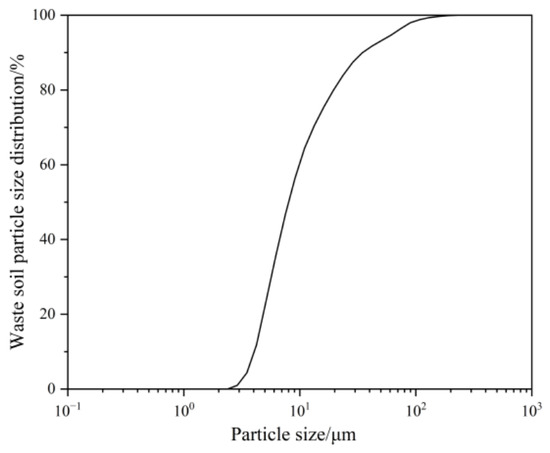
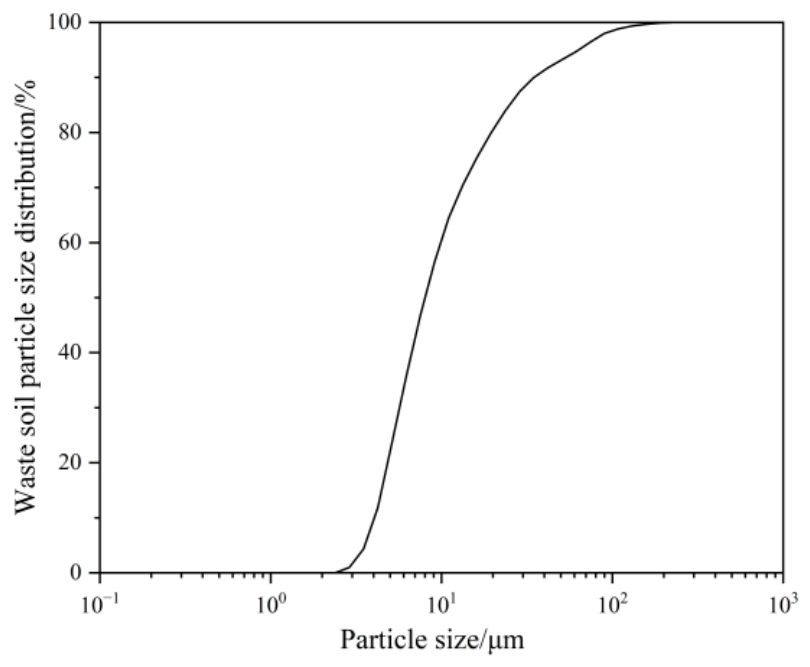
The waste soil used in this study was collected from an excavation site of a foundation pit project in Hangzhou, Zhejiang Province, China. The basic physical properties of the waste soil were determined according to the Test Methods of Soils for Highway Engineering (JTG 3430-2020) [39], and the results are summarized in Table 1. The particle size distribution of the soil used in the experiment is shown in Figure 1.
Table 1.
Basic physical properties of the waste soil.
Figure 1.
Particle size distribution curve of experimental soil.
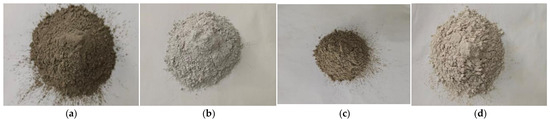
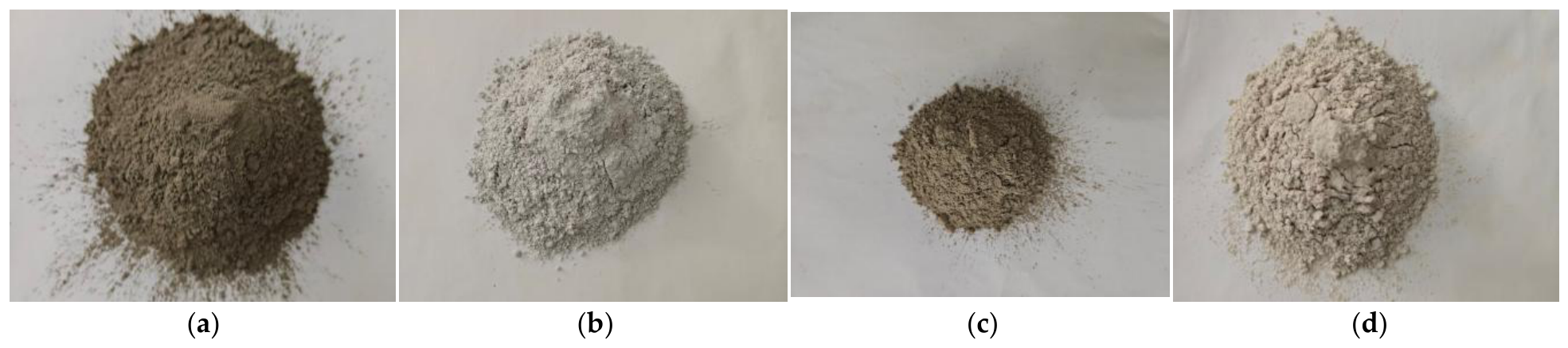
The cementitious materials used in this study included ordinary Portland cement (P), ground granulated blast-furnace slag (GGBS, S75 grade), Class C fly ash (FA), and carbide slag (CS). The P was supplied by Tianshan Cement Co., Ltd., Urumqi, China. The GGBS was obtained from Baoxin Shengyuan Co., Ltd., Urumqi, China. The fly ash was collected from a thermal power plant located in Changji, Xinjiang, China. The carbide slag was obtained from the acetylene production process of Huatai Chemical Co., Ltd., Xinjiang, China. The physical appearances of the cementitious materials are shown in Figure 2. The chemical compositions of P, CS, FA, and GGBS were determined using XRF analysis, and the results are presented in Table 2.
Figure 2.
Photographs of cementitious materials: (a) P; (b) GGBS; (c) FA; (d) CS.
Table 2.
Chemical compositions of cementitious materials (wt.%).
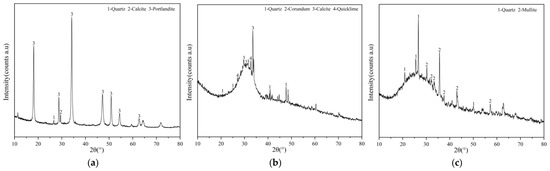
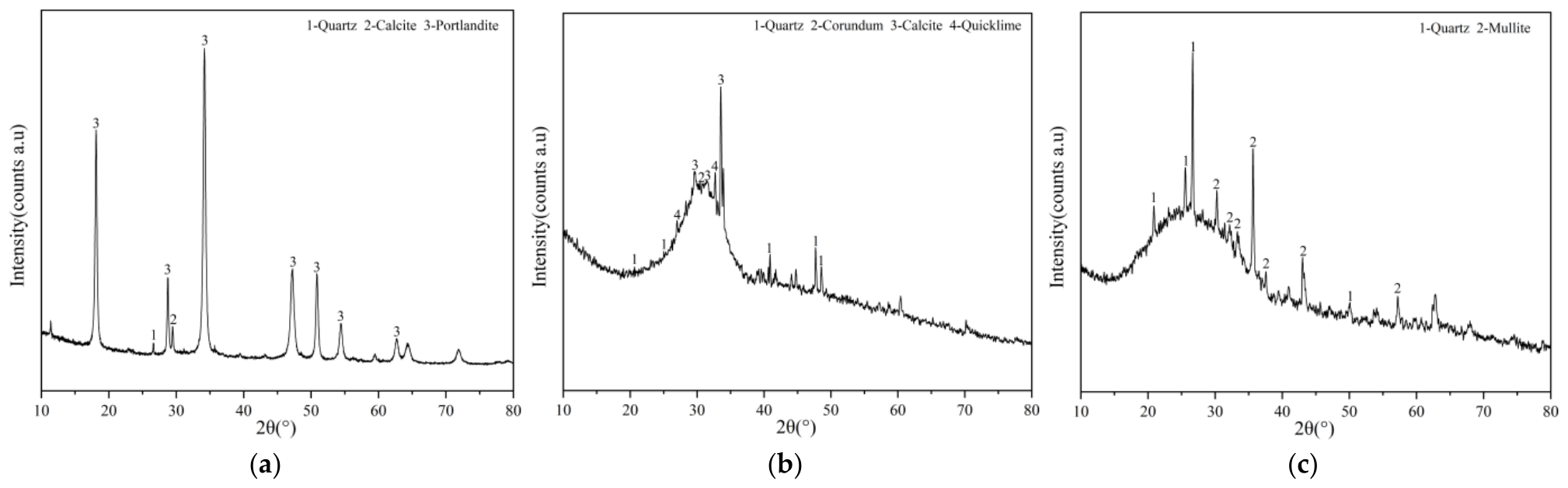
The mineralogical characteristics of the cementitious materials were further analyzed using XRD. As shown in Figure 3, the main characteristic diffraction peaks corresponded to quartz, calcite, and portlandite, which represent the primary calcium source and aluminosilicate components required for alkali-activation reactions.
Figure 3.
XRD patterns of cementitious materials: (a) CS; (b) GGBS; (c) FA.
2.2. Sample Preparation and UCS Testing Method
The stabilized waste soil specimens were prepared according to the Test Methods of Materials Stabilized with Inorganic Binders for Highway Engineering (JTG 3441-2024) [40]. Cylindrical specimens with dimensions of 50 mm in diameter and 50 mm in height were prepared using steel molds. According to the design mix proportion, the required amounts of dry waste soil and bonding material were accurately weighed and mixed evenly, where the sum of the content of dry waste soil and bonding material is 100%. Then, 12% water by mass of the dry mixture was added, and the mixture was stirred for 2 min. The mixtures were then gradually placed into the molds in several layers. The filled molds were placed on a universal testing machine and compacted under predetermined pressures. After compaction, the specimens were maintained under pressure for 2 min to ensure sufficient densification and structural stability. Subsequently, the specimens were demolded, and their dimensions and masses were measured using a vernier caliper and electronic balance. The prepared specimens were wrapped with plastic film, labeled, and cured in a controlled curing chamber. The curing conditions were maintained at a temperature of 20 ± 2 °C and a relative humidity above 95%. Specimens were collected at different curing ages for subsequent UCS testing.
UCS testing method:
The UCS is tested using the CMT5204 Electronic Universal Testing Machine (Shandong Wanchen Testing Machine Co., Ltd., Jinan, China). The loading rate of the device is fixed at 1 mm/min, and each set of experiments is repeated three times. The strength values used in this study are the arithmetic mean values calculated from the three replicate measurements. These mean values were explicitly used as the target values in the PPR modeling.
2.3. Experimental Design of Cement–Solid-Waste-Stabilized Waste Soil
Preliminary tests were conducted to develop two optimal geopolymer binder formulations, namely the 25% CS + 75% GGBS system (C) and the 25% CS + 37.5% GGBS + 37.5% FA system (F) [41], and the optimal proportions of each component were determined. The two geopolymer mixtures were adopted to partially replace P. A four-factor and four-level orthogonal test with an L16(44) design was implemented to investigate the mechanical performance of stabilized waste soil. The orthogonal experimental scheme is listed in Table 3.
Table 3.
Orthogonal experimental design for stabilized waste soil.
The four influencing factors and corresponding levels included: binder content (A) of 12%, 15%, 18%, and 21%; curing age (B) of 7 d, 14 d, 28 d, and 56 d; binder type (C) including C, F, PC, and PF (for the PC group, CS + GGBS blends account for 50% of the total binder, while cement accounts for the other 50%; for the PF group, the CS + GGBS + FA mixture replaces 50% of the cement within the total binder); and compaction pressure (D) of 15 MPa, 20 MPa, 25 MPa, and 30 MPa. A total of 16 groups of experimental combinations were designed.
Based on the measured post-compaction dimensions and masses of all specimens, the 15, 20, 25, and 30 MPa molding pressures corresponded to average compaction degrees of approximately 93.7%, 96.5%, 98.2%, and 99.6%. Thus, the optimum molding pressure of 25 MPa identified in this study corresponds to a compaction degree of approximately 98.22% under the laboratory conditions investigated.
2.4. Projection Pursuit Regression-Based UCS Prediction Model
Projection pursuit regression (PPR) is a nonlinear statistical modeling approach that transforms high-dimensional datasets into low-dimensional projection spaces [42]. By identifying optimal projection directions and analyzing the structural characteristics of projected data, PPR can establish nonlinear relationships between multiple input variables and output responses without assuming a predefined mathematical function.
Assuming that X represents a p-dimensional independent variable vector and Y represents the dependent variable, the general expression of the PPR model can be written as:
where fi represents the ith ridge function; M is the maximum predefined number of candidate ridge functions; Mu is the number of significant ridge functions actually retained in the final model; βi represents the contribution coefficient of each ridge function; and αij represents the projection direction coefficient.
The projection direction satisfies: .
The PPR model determines the optimal projection direction through iterative optimization. The objective function can be expressed as:
where Wi is the weighting coefficient.
In this study, UCS data obtained from the orthogonal experiments were used to construct PPR prediction models. The model accuracy was evaluated by comparing predicted and measured UCS values. A relative error of ≤10% was considered an acceptable prediction result.
The modeling procedure followed a chronological sequence to ensure predictive consistency:
- (1)
- Experimental data were divided into training samples and within-domain validation samples.
- (2)
- The initial PPR model was established using solely the training samples under a trial Span value.
- (3)
- The within-domain validation dataset was then introduced to evaluate the prediction error.
- (4)
- If the prediction accuracy did not meet the adopted engineering tolerance, the Span parameter was adjusted, and the model was rebuilt using the training set.
This tuning process was repeated until the predictive consistency on the validation set was satisfactory, after which the final performance evaluation was conducted.
Parameter settings for assumption-free modeling and calculation of the PPR model are specified as follows: P denotes the number of influencing factors in the model; Q stands for the number of dependent variables; and Span is the smoothing coefficient that determines the sensitivity of the calculation model, with a value ranging from 0 to 1. Establish the PPR model by adjusting the value of Span.
The projection direction of the model is determined based on experimental data, followed by the calculation of ridge functions and their corresponding contribution weight coefficients β. Combined with Formulas (1) and (2), the calculation model for unconfined compressive strength is established using the obtained ridge functions. Meanwhile, the weight coefficients of each influencing factor are quantified. Ultimately, the stability and prediction accuracy of the constructed model are verified with within-domain validation samples. If the predicted values of the constructed model deviate significantly from the values of the within-domain validation samples, it is necessary to change the value of Span, rebuild the model, and then loop until the constructed model has stability and prediction accuracy.
3. Results
3.1. UCS Test Results of Cement–Solid-Waste-Stabilized Waste Soil
The UCS results obtained from the orthogonal experiments are summarized in Table 4. The numbers before the parentheses represent the factor levels, while the values in parentheses indicate the corresponding experimental parameters, including binder content, curing age, binder type, and compaction pressure.
Table 4.
Orthogonal experimental results of stabilized waste soil.
According to the orthogonal experimental results, specimen No.8 (A2B4C3D2) exhibited the highest stabilization performance, with a UCS value of 6.87 MPa. The corresponding experimental conditions were a binder content of 15%, curing age of 56 days, PC binder type, and compaction pressure of 20 MPa.
The range analysis results showed that the range values (R) of binder content, curing age, binder type, and compaction pressure were 2.10, 2.66, 3.49, and 0.74, respectively. Therefore, the sensitivity of UCS to the investigated factors followed the order: binder type > curing age > binder content > compaction pressure.
The binder type exhibited the greatest influence on UCS development, indicating that the chemical composition and reaction activity of the cement–solid-waste binder system played a dominant role in controlling the strength evolution of stabilized waste soil. Therefore, PPR models were further developed for PC and PF stabilization systems to reveal the nonlinear relationships between influencing factors and UCS.
3.2. Performance Analysis of PC-Stabilized Waste Soil
3.2.1. PPR-Based UCS Prediction Model
The PPR model was established based on the UCS results of PC-stabilized waste soil. Twelve experimental datasets were selected as training samples, while ten additional experimental datasets were used for model validation. The training samples were first employed to establish the nonlinear prediction model, and the within-domain validation samples were subsequently introduced to evaluate the predictive capability and stability of the model. The PPR parameters were set as follows: P = 4, Q = 1, Span = 0.5, M = 5, Mu = 3.
After PPR optimization, the projection direction vector of the PC stabilization model was obtained as:
The contribution coefficients of the ridge functions were calculated as:
By substituting the projection directions, ridge functions, and contribution coefficients into Equation (1), the UCS prediction model for PC-stabilized waste soil was obtained.
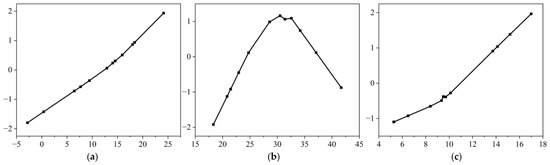
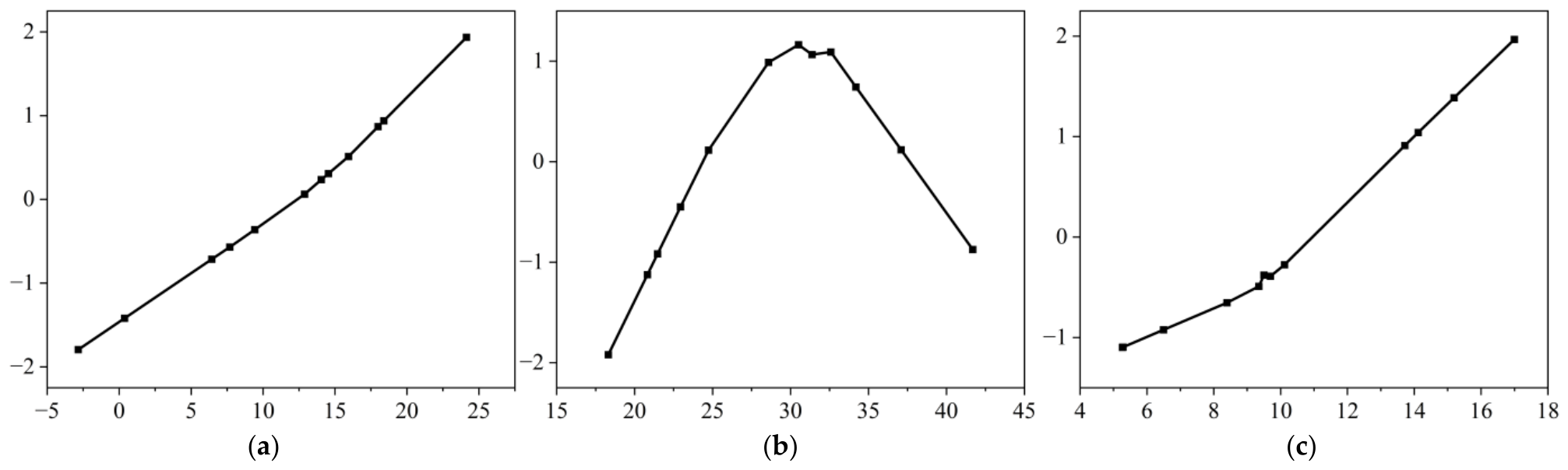
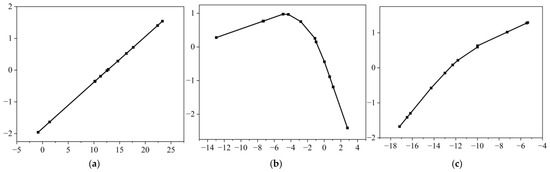
The nonlinear relationships between individual influencing factors and UCS are illustrated by the ridge functions in Figure 4.
Figure 4.
Ridge functions of the PPR model for UCS prediction of PC-stabilized waste soil: (a) f1; (b) f2; (c) f3.
After establishing the PPR model, the contribution coefficients of different influencing factors were calculated. The results are presented in Table 5.
Table 5.
Relative importance coefficients of influencing factors in the PC-PPR model.
As shown in Table 5, the influence ranking of the investigated factors on the UCS of PC-stabilized waste soil was: solid-waste replacement ratio > curing age > binder content > compaction pressure.
The solid-waste replacement ratio exhibited the highest importance coefficient, indicating that the proportion of solid-waste-based binder replacing P was the critical parameter affecting strength development.
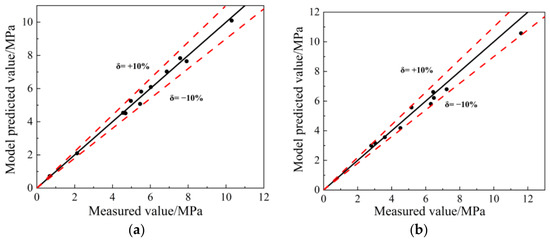
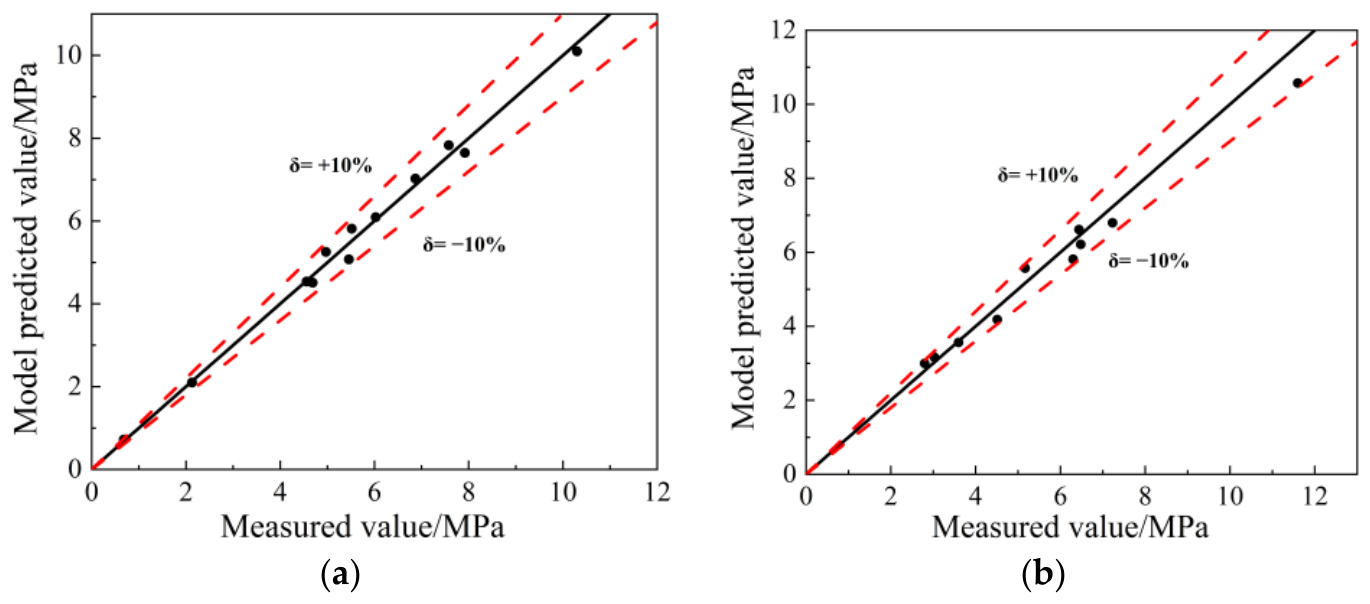
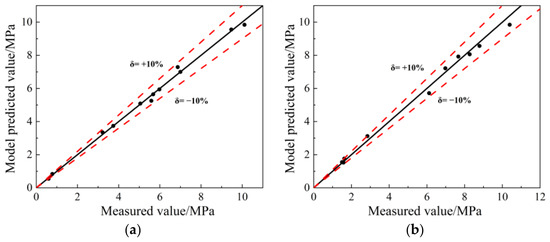
To verify the prediction accuracy of the PPR model, the predicted and measured UCS values of both training and within-domain validation samples were compared, and the results are shown in Figure 5. A relative error within ±10% was considered acceptable. The standard regression performance indicators of the PC-PPR model are shown in Table 6.
Figure 5.
Comparison between measured and predicted UCS values of PC-stabilized waste soil: (a) training samples; (b) within-domain validation samples.
Table 6.
Standard regression-performance metrics for the PC-PPR model.
All predictions for both the training and within-domain validation datasets fell within the adopted ±10% engineering tolerance. The average relative errors were 3.46% and 5.68%, respectively. The narrow difference between the training and validation errors indicates good within-domain predictive consistency for the investigated dataset. These results indicate that the developed PPR model provides practically acceptable predictions within the specified experimental domain for PC-stabilized waste soil.
3.2.2. Effect of Solid-Waste Replacement Ratio on UCS of PC-Stabilized Waste Soil
Figure 6 illustrates the variation in UCS of PC-stabilized waste soil under different solid-waste replacement ratios and curing ages at a binder content of 12%.
Figure 6.
Effect of solid-waste replacement ratio and curing age on UCS of PC-stabilized waste soil.
As shown in Figure 6, the UCS of fully solid-waste-based alkali-activated stabilized soil (solid-waste replacement ratio = 100%) remained relatively stable at different curing ages, indicating that the alkali-activated binder exhibited relatively rapid reaction characteristics during early curing. However, the UCS of the fully solid-waste-based system was only approximately 2 MPa, corresponding to about 30% of the strength achieved by P-stabilized waste soil. This result indicates that, although solid-waste-based binders possess certain cementitious activity, complete replacement of P may significantly reduce early-age strength.
The strength development of PC-stabilized waste soil was mainly controlled by the P content in the composite binder. Increasing the solid-waste replacement ratio reduced the amount of reactive cement clinker available for hydration, thereby decreasing the formation of hydration products and weakening particle bonding.
At the same curing age, the UCS of PC-stabilized waste soil decreased continuously with increasing solid-waste replacement ratio. In contrast, increasing curing age promoted continuous strength development due to the gradual generation of hydration products and densification of the internal structure.
These results demonstrate that partial replacement of P with solid-waste-based alkali-activated materials is feasible. By appropriately controlling the ratio between P and solid-waste-based binders, a balance between mechanical performance and environmental benefits can be achieved. Under suitable curing conditions, solid-waste-based materials can effectively reduce cement consumption while maintaining acceptable stabilization performance.
3.3. Performance Analysis of PF-Stabilized Waste Soil
3.3.1. PPR-Based UCS Prediction Model
The UCS prediction model for PF-stabilized waste soil was developed using the same PPR methodology described above. Twelve experimental datasets were selected as training samples, and ten additional experimental datasets were employed as within-domain validation samples. The training samples were used to establish the nonlinear regression relationship between input parameters and UCS, while the within-domain validation samples were applied to assess model reliability. The PPR parameters were set as follows: P = 4, Q = 1, Span = 0.5, M = 5, Mu = 3.
After optimization, the projection direction matrix of the PF stabilization model was obtained:
The contribution coefficients of the ridge functions were calculated as:
By substituting the projection directions, ridge functions, and contribution coefficients into Equation (1), the UCS prediction model for PF-stabilized waste soil was established.
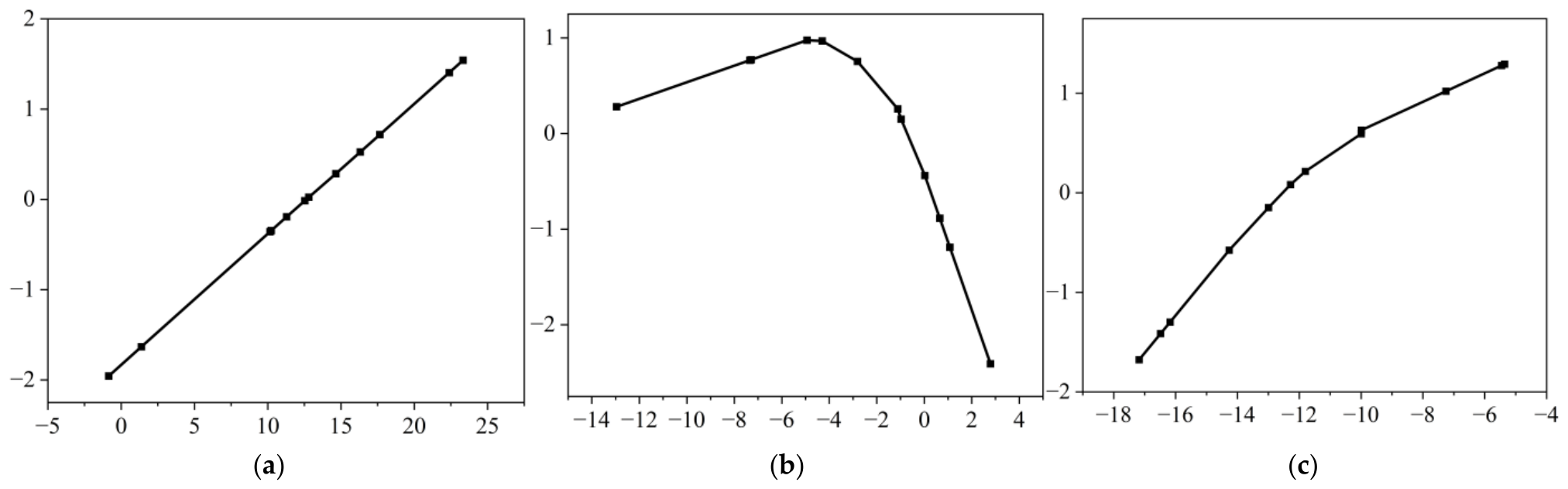
The ridge functions describing the nonlinear relationships between different factors and UCS are shown in Figure 7.
Figure 7.
Ridge functions of the PPR model for UCS prediction of PF-stabilized waste soil: (a) f1; (b) f2; (c) f3.
The relative importance coefficients of the influencing factors obtained from the PPR model are summarized in Table 7.
Table 7.
Relative importance coefficients of influencing factors in the PF-PPR model.
The influence ranking of the investigated factors on the UCS of PF-stabilized waste soil was: solid-waste replacement ratio > curing age > binder content > compaction pressure.
The solid-waste replacement ratio remained the dominant factor controlling UCS development. Compared with the PC system, the curing age exhibited a greater influence on PF-stabilized waste soil, indicating that the incorporation of fly ash enhanced the long-term strength development capability of the composite binder.
This phenomenon can be attributed to the relatively slow pozzolanic reaction of fly ash. During early curing stages, fly ash particles exhibit limited activity; however, with increasing curing time, continuous dissolution of aluminosilicate components promotes the formation of additional cementitious products, resulting in progressive densification of the stabilized soil structure.
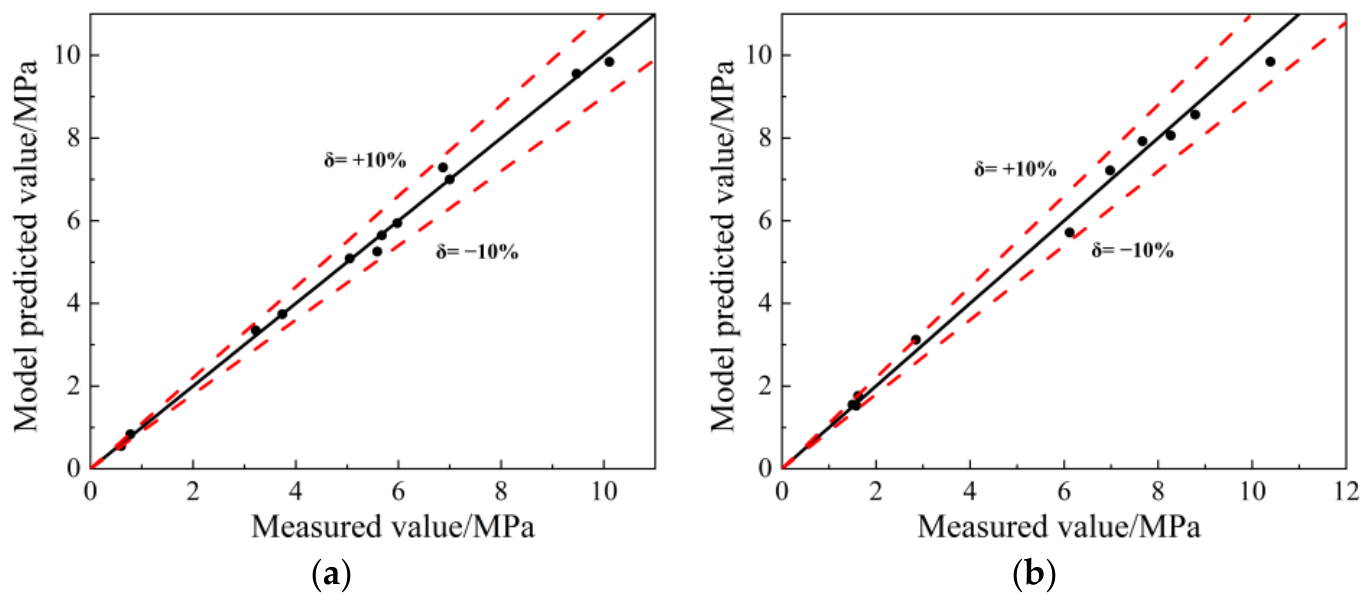
To evaluate the prediction accuracy of the PF-PPR model, the predicted UCS values were compared with the measured values, and a relative error within ±10% was considered acceptable. The results are shown in Figure 8. The standard regression performance indicators of the PF-PPR model are shown in Table 8.
Figure 8.
Comparison between measured and predicted UCS values of PF-stabilized waste soil: (a) training samples; (b) within-domain validation samples.
Table 8.
Standard regression-performance metrics for the PF-PPR model.
All predictions for both the training and within-domain validation samples fell within the adopted ±10% engineering tolerance. The average relative errors were 3.09% and 4.87%, respectively. The narrow difference between the training and validation errors indicates good within-domain predictive consistency for the investigated dataset. These results confirm that the PPR model provides satisfactory interpolation accuracy within the specified experimental domain for PF-stabilized waste soil.
3.3.2. Effect of Solid-Waste Replacement Ratio on UCS of PF-Stabilized Waste Soil
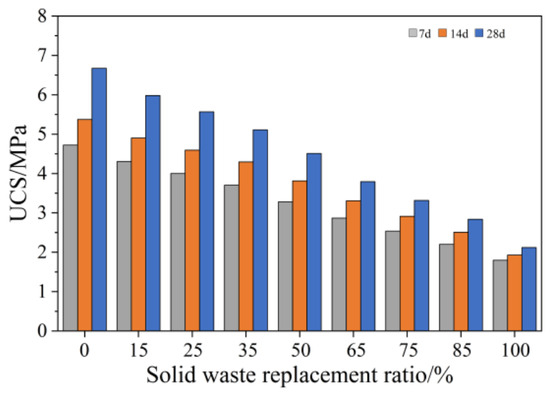
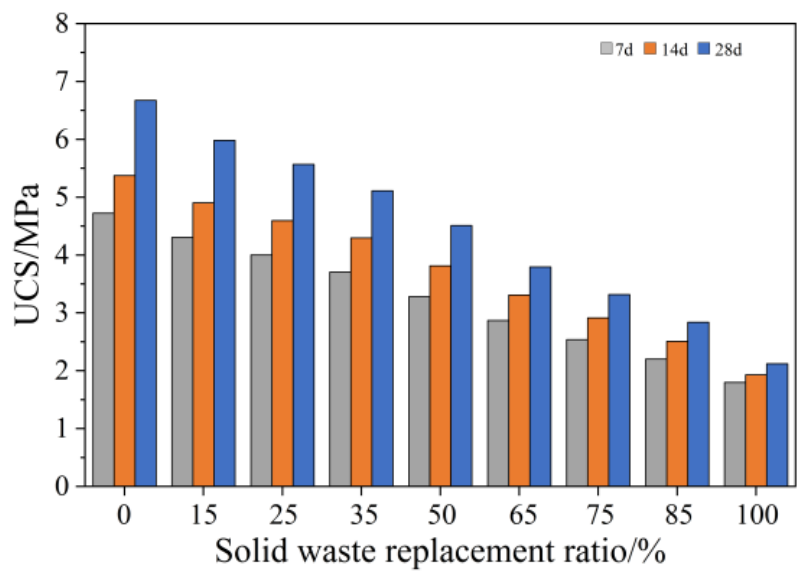
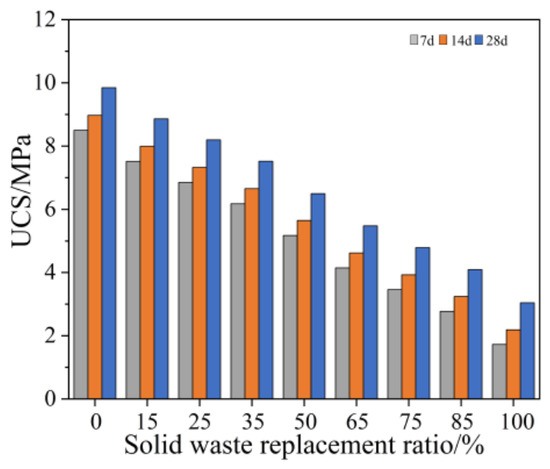
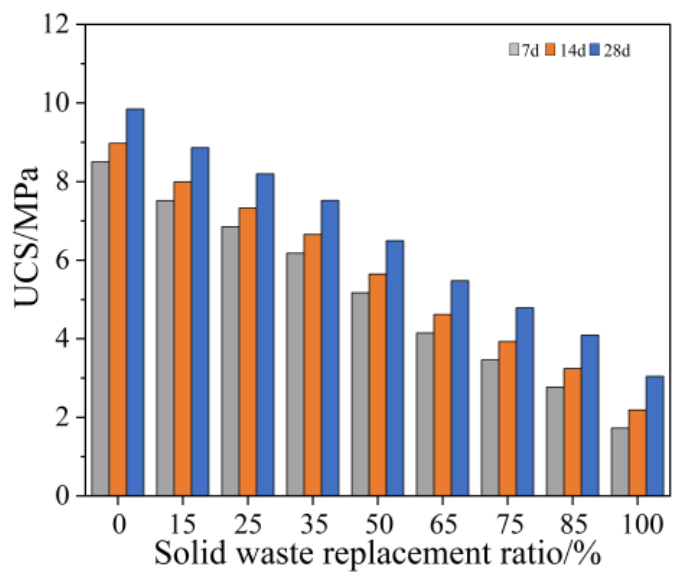
Figure 9 presents the variation in UCS of PF-stabilized waste soil under different solid-waste replacement ratios and curing ages at a binder content of 18%.
Figure 9.
Effect of solid-waste replacement ratio and curing age on UCS of PF-stabilized waste soil.
For comparison, the UCS values at curing ages of 7, 14, and 28 days were analyzed. As shown in Figure 9, the fully solid-waste-based PF binder system (solid-waste replacement ratio = 100%) exhibited significant strength development with increasing curing age. The UCS values at 7, 14, and 28 days were 1.73, 2.19, and 3.04 MPa, respectively, corresponding to an increase of 1.31 MPa from 7 to 28 days.
Furthermore, the strength growth rate increased with increasing solid-waste replacement ratio and curing age. This indicates that PF-stabilized waste soil possesses superior long-term strength development characteristics compared with early-age performance.
The relatively slower early-age strength development of PF-stabilized waste soil is mainly associated with the incorporation of fly ash. Compared with P, fly ash has lower early reactivity due to its glassy aluminosilicate structure. However, under alkaline conditions provided by carbide slag and cement hydration products, the aluminosilicate components in fly ash gradually dissolve and participate in secondary pozzolanic reactions, continuously generating additional calcium aluminosilicate hydrate (C–A–S–H) gels [26,27].
Therefore, although PF-stabilized waste soil exhibits relatively lower initial strength, it maintains continuous strength growth during long-term curing. This characteristic makes PF binders suitable for engineering applications where long-term mechanical performance is required.
3.4. Effect of Compaction Pressure on UCS of Stabilized Waste Soil
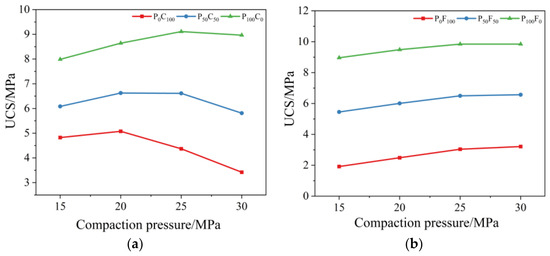
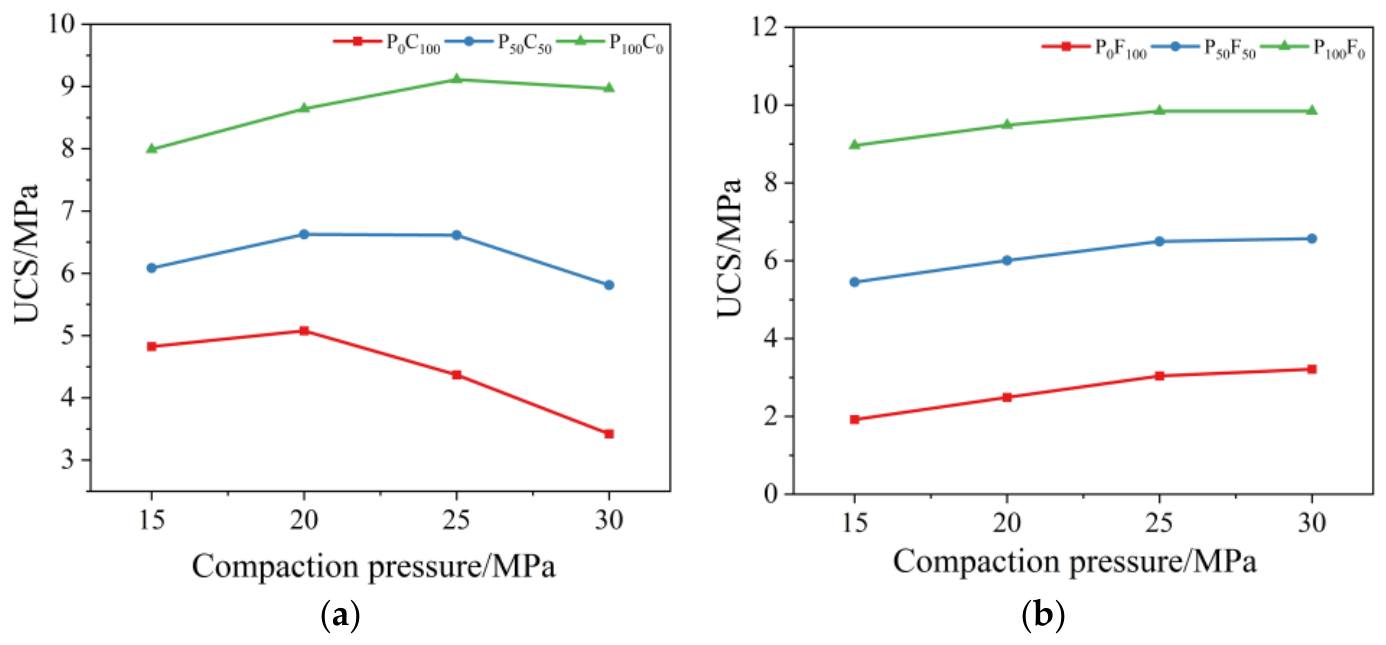
Figure 10 illustrates the relationship between compaction pressure and UCS of PC- and PF-stabilized waste soil. To eliminate the effects of binder content and curing age, all specimens were prepared with a binder content of 18% and cured for 28 days. PXCYFY represents the proportion of P, C, and F in the binder. For example, P50F50 denotes a binder containing 50% P and 50% F blend; P0C100 denotes a binder containing 100% C blend without P.
Figure 10.
Effect of compaction pressure on UCS of stabilized waste soil: (a) PC-stabilized waste soil; (b) PF-stabilized waste soil.
The notation in Figure 10 represents the binder composition. For example, P100C0 indicates that the binder consists of 100% P and 0% solid-waste-based binder, whereas P50F50 represents a binder containing 50% P and 50% PF-based binder.
As shown in Figure 10a, compaction pressure significantly affected the UCS of PC-stabilized waste soil. Moreover, the optimal compaction pressure corresponding to maximum UCS increased with decreasing solid-waste replacement ratio.
For the fully solid-waste-based binder system, the maximum UCS was achieved at a compaction pressure of 20 MPa. Further increasing the pressure resulted in a slight reduction in UCS. With decreasing solid-waste replacement ratio, the pressure required to reach the maximum UCS increased to 25 MPa, after which the UCS gradually decreased. This behavior can be explained by the effect of compaction on particle arrangement and pore structure. Moderate compaction improves particle contact, reduces void ratio, and enhances the effectiveness of hydration products in bonding soil particles. However, excessive compaction may disrupt the internal structure and restrict pore connectivity required for hydration reactions, resulting in reduced strength development.
In contrast, the influence of compaction pressure on PF-stabilized waste soil was relatively limited (Figure 10b). Increasing compaction pressure from 15 MPa to 30 MPa increased UCS by only approximately 0.7 MPa on average. Moreover, when the pressure increased from 25 MPa to 30 MPa, the improvement became insignificant.
Therefore, under the studied conditions, the recommended compaction pressures for the PC and PF stabilization systems are 25 MPa and 20 MPa, respectively. Further increasing compaction pressure does not provide additional strength improvement and may even negatively affect UCS development.
4. Discussion
4.1. Optimization of Solid-Waste-Based Binder System for PC-Stabilized Waste Soil
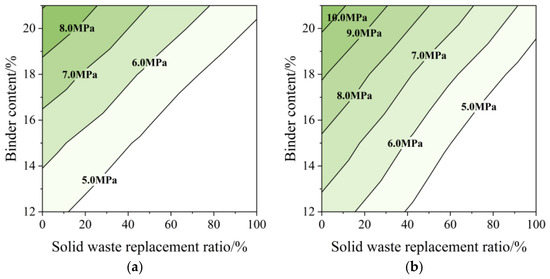
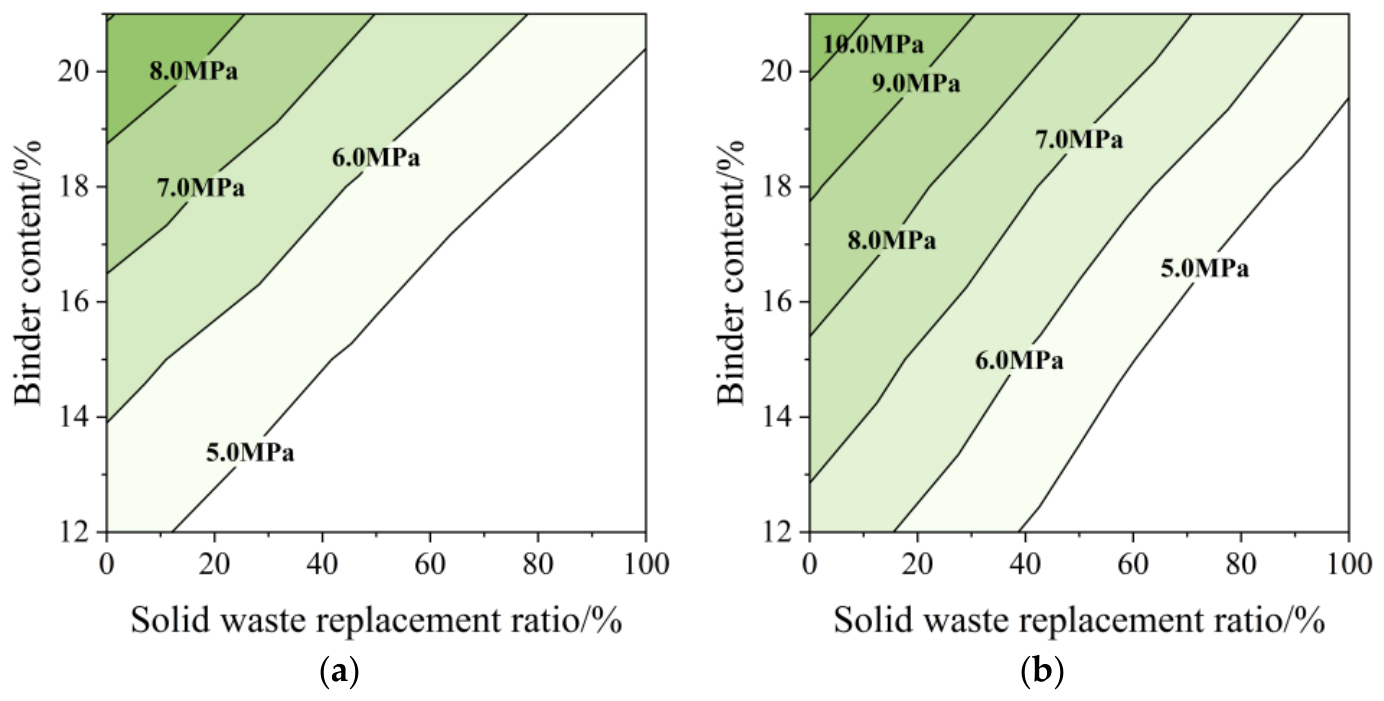
To further optimize the PC stabilization system, the optimal compaction pressure was determined as 25 MPa, and curing ages of 14 and 28 days were selected. The established PC-PPR model was then used to predict UCS under different binder contents and solid-waste replacement ratios. Based on the PPR prediction results, UCS contour maps were generated to investigate the combined effects of binder content and solid-waste replacement ratio, as shown in Figure 11.
Figure 11.
UCS contour maps of PC-stabilized waste soil at different curing ages: (a) 14 days; (b) 28 days.
The contour distribution demonstrates clear variation patterns between binder content, solid-waste replacement ratio, and UCS. Under identical curing conditions and compaction pressure, increasing binder content resulted in continuously increasing UCS, whereas increasing solid-waste replacement ratio reduced strength development.
Comparison between 14-day and 28-day curing conditions showed that UCS increased continuously with curing age, while the influence trend of solid-waste replacement ratio remained unchanged. This confirms that curing age promotes strength development but does not alter the dominant controlling factors.
Based on the PPR optimization results and practical engineering requirements, the optimization objective was to maximize the solid-waste replacement ratio while maintaining UCS ≥ 5 MPa under the specified binder-content, curing-age, and compaction-pressure constraints. Where the binder content generally ranges from 15% to 18% and the strength requirement is greater than 5 MPa, the recommended solid-waste replacement ratio for the PC system was determined to be 75%. It should be noted that this selected ratio represents recommended values specifically within the investigated experimental domain rather than universally optimal mixtures.
4.2. Optimization of Solid-Waste-Based Binder System for PF-Stabilized Waste Soil
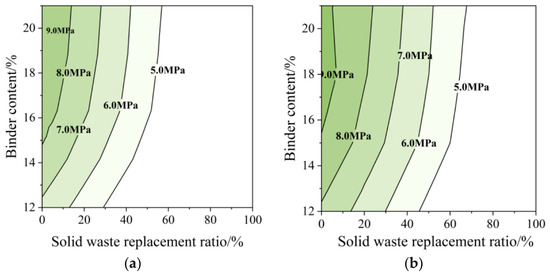
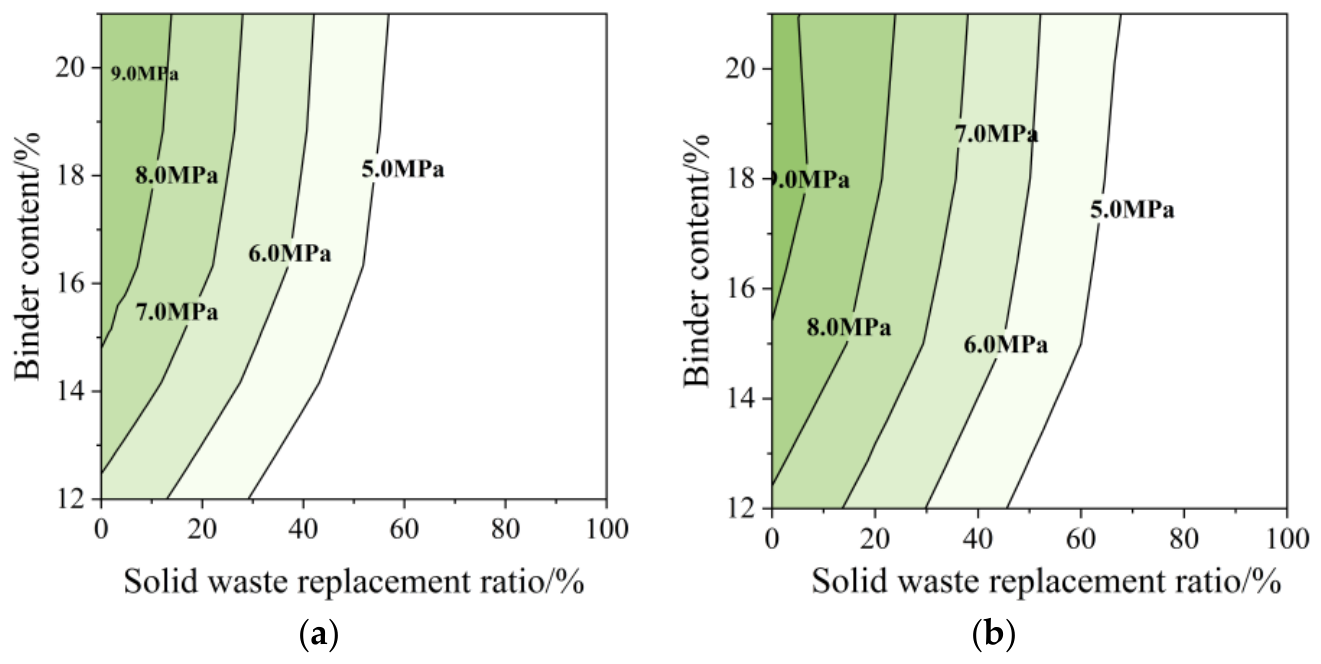
To further optimize the PF stabilization system, the optimal compaction pressure was determined as 20 MPa based on the previous experimental results. The UCS prediction model developed by PPR was employed to evaluate the effects of binder content and solid-waste replacement ratio on the strength performance of PF-stabilized waste soil under curing ages of 14 and 28 days. The predicted UCS values were used to construct contour maps, as shown in Figure 12.
Figure 12.
UCS contour maps of PF-stabilized waste soil at different curing ages: (a) 14 days; (b) 28 days.
As illustrated in Figure 12, the variation trends of PF-stabilized waste soil were generally consistent with those observed in the PC system. Under identical curing age and compaction pressure conditions, increasing binder content resulted in a continuous increase in UCS. However, the PF system exhibited improved long-term strength development compared with the PC system. The incorporation of fly ash contributed to sustained strength enhancement during extended curing periods.
The comparison between 14-day and 28-day curing conditions demonstrated that prolonged curing significantly enhanced UCS while maintaining the same influence trends of binder content and solid-waste replacement ratio. This indicates that curing age mainly affects the degree of reaction but does not change the dominant mechanisms controlling strength development.
Based on the experimental results and PPR model predictions, the recommended solid-waste replacement ratio for the PF stabilization system was determined to be 60% with practical binder contents of 15–18%, achieving a strength requirement greater than 5 MPa. It should be noted that this selected ratio represents recommended values specifically within the investigated experimental domain rather than universally optimal mixtures.
4.3. Sustainability and Cost–Benefit Analysis
The incorporation of industrial solid wastes, including CS, GGBS, and FA, into stabilization binders can effectively reduce P consumption and improve the sustainability of waste soil treatment. Since P production is one of the major sources of the industrial raw-material-stage carbon footprint, replacing cement with industrial by-products provides significant environmental benefits [43].
To quantitatively evaluate the sustainability performance of the proposed stabilization systems, the energy consumption, raw-material-stage carbon footprint, and material costs of P and solid-waste-based materials were compared. As suggested by the functional unit clarification, this analysis represents a preliminary raw-material-stage comparison rather than a complete life-cycle assessment (LCA). Table 9 summarizes the environmental impact and cost per ton of individual raw materials.
Table 9.
Energy consumption, raw-material-stage carbon footprint, and costs of raw materials.
Based on the single-component data in Table 9, the subsequent quantitative comparison was strictly conducted based on one ton of blended binder. The production cost of ordinary Portland cement is estimated at 450–500 CNY/t, with a carbon footprint of 1000 kg CO2/t and an energy consumption of 5500 MJ/t. In contrast, the emissions and costs associated with industrial solid wastes are significantly lower due to their by-product characteristics.
By calculating the weighted average of the components, the metrics per ton of blended binder were determined. Compared with conventional 100% P stabilization, the optimized PC binder system (25% P, 18.75% CS, 56.25% GGBS) reduces the binder material cost to 348.8–393.1 CNY/t. Meanwhile, the raw-material-stage carbon footprint and energy consumption are reduced to 335.5 kg CO2/t and 2713.2 MJ/t, respectively.
Similarly, for the optimized PF binder system (40% P, 15% CS, 22.5% GGBS, 22.5% FA), the cost is reduced to 366.8–412.3 CNY/t, while the carbon footprint and energy consumption are lowered to 435.1 kg CO2/t and 2757.8 MJ/t, respectively.
These results demonstrate that partial replacement of P with industrial solid wastes can simultaneously achieve economic and environmental benefits. The proposed cement–solid-waste composite stabilization systems not only reduce dependence on energy-intensive cement production but also provide an effective pathway for large-scale utilization of industrial solid wastes. From the perspective of sustainable geotechnical engineering, the developed stabilization strategy demonstrates preliminary potential for contributing to circular economy principles by transforming industrial by-products into value-added construction materials at the laboratory scale. Life-cycle and field-scale assessments are required to confirm these benefits in actual infrastructure development.
4.4. Applicability and Limitations of the Optimized Mixtures
The recommended solid-waste replacement ratios of 75% for the PC system and 60% for the PF system were obtained using a specific waste soil collected from Hangzhou and specific binder materials sourced from Xinjiang. These values should therefore be interpreted as recommended proportions within the material characteristics and experimental ranges investigated in this study, rather than as universally applicable optimum values. Variations in soil mineralogy, grading, organic content, water demand, and binder oxide composition, fineness, and reactivity may alter the soil–binder interaction and consequently shift the appropriate replacement ratio. Before applying the proposed mixtures to waste soils or industrial by-products from other regions or production batches, material characterization and laboratory-scale recalibration should be performed.
The mechanical characterization in this study was limited to UCS at curing ages of 7, 14, 28, and 56 days. Tensile strength (splitting or flexural), elastic modulus, and 90-day or longer-term strength were not evaluated. While UCS is the primary design parameter for preliminary mixture proportioning of stabilized soils and the observed monotonic strength increase up to 56 days indicates strength development during the investigated curing period, long-term durability requires further validation. Additional mechanical tests—particularly if the optimized mixtures are intended for load-bearing subgrade layers in actual projects—should be conducted before field application. The empirical correlations between UCS and other mechanical properties commonly adopted in preliminary design should be used with caution for these specific material systems.
5. Conclusions
This study developed cement–solid-waste composite stabilization systems using CS, GGBS, FA, and P for engineering waste soil treatment. Orthogonal experiments and PPR models were employed to investigate strength development mechanisms, quantify influencing factors, and optimize binder compositions. The main conclusions are summarized as follows:
- (1)
- The replacement of P with solid-waste-based binders is feasible for waste soil stabilization. The developed cement–solid-waste composite systems (PC and PF) exhibited effective strength-regulation capabilities. The PPR models established for both systems demonstrated good within-domain predictive performance, with all predictions for both training and within-domain validation datasets falling within the adopted ±10% engineering tolerance. The influence ranking of factors affecting UCS was determined as follows: solid-waste replacement ratio > curing age > binder content > compaction pressure.
- (2)
- The incorporation of fly ash improved the long-term strength development of PF-stabilized waste soil. Increasing the solid-waste replacement ratio generally reduced UCS, whereas increasing binder content and curing age enhanced strength development. Compaction pressure exhibited a significant influence on the PC system but a relatively limited effect on the PF system. Considering mechanical performance and engineering applicability, a compaction pressure of 25 MPa is recommended for the PC system and 20 MPa for the PF system. Under practical binder contents of 15–18%, within the investigated material sources and experimental domain, the recommended solid-waste replacement ratios were 75% for the PC system and 60% for the PF system.
- (3)
- The utilization of industrial solid wastes as partial replacements for P shows preliminary potential for reducing cement consumption, lowering embodied carbon, and decreasing material costs at the raw material stage. The optimized cement–solid-waste stabilization systems provide a laboratory-scale basis for developing more sustainable approaches to waste soil treatment.
Author Contributions
Conceptualization, A.S. and M.G.; methodology, A.S.; software, Y.W.; validation, M.W., J.D. and Y.W.; formal analysis, Y.W.; investigation, M.W.; resources, M.W.; data curation, A.S.; writing—original draft preparation, A.S.; writing—review and editing, M.G. and J.D.; visualization, Y.W.; supervision, J.D.; project administration, M.W.; funding acquisition, M.W. and M.G. All authors have read and agreed to the published version of the manuscript.
Funding
This research was funded by “Pioneer” and “Leading Goose” R&D Program of Zhejiang, grant number 2024C03126, and Talent Research and Development Project of Xinjiang Agricultural University, grant number 6660946/2522GCCRC.
Data Availability Statement
The original UCS test records and orthogonal experimental raw data generated during this study are included within the article and Appendix A. The datasets are also available from the corresponding author upon reasonable request.
Acknowledgments
The authors sincerely thank the research team for their assistance with laboratory tests, sample preparation, and data sorting. Technical support from the laboratory is greatly appreciated. All authors have approved the final version of the manuscript. During the preparation of this manuscript, the authors used artificial intelligence tools (Gemini 3.1 Pro) for English grammar polishing and sentence optimization. The authors have fully reviewed, revised, and edited all AI-generated content and take complete responsibility for the final published results and conclusions.
Conflicts of Interest
Author Mingyuan Wang was employed by Powerchina Huadong Engineering Corporation (China). The remaining authors declare that the research was conducted in the absence of any commercial or financial relationships that could be construed as a potential conflict of interest.
Abbreviations
The following abbreviations are used in this manuscript:
| P | ordinary Portland cement |
| CS | carbide slag |
| GGBS | ground granulated blast-furnace slag |
| FA | fly ash |
| PPR | projection pursuit regression |
| UCS | unconfined compressive strength |
Appendix A
Table A1.
Training and test sample data for PPR modeling of PC-stabilized waste soil.
Table A2.
Training and test sample data for PPR modeling of PF-stabilized waste soil.
Table A3.
PPR modeling of PC-stabilized waste soil.
Table A4.
PPR modeling of PF-stabilized waste soil.
References
- Magnusson, S.; Lundberg, K.; Svedberg, B.; Knutsson, S. Sustainable management of excavated soil and rock in urban areas—A literature review. J. Clean. Prod. 2015, 93, 18–25. [Google Scholar] [CrossRef] [Scilit]
- Zhang, N.; Duan, H.; Sun, P.; Li, J.; Zuo, J.; Mao, R.; Liu, G.; Niu, Y. Characterizing the generation and environmental impacts of subway-related excavated soil and rock in China. J. Clean. Prod. 2020, 248, 119242. [Google Scholar] [CrossRef] [Scilit]
- Hale, S.E.; Roque, A.J.; Okkenhaug, G.; Sørmo, E.; Lenoir, T.; Carlsson, C.; Kupryianchyk, D.; Flyhammar, P.; Žlender, B. The reuse of excavated soils from construction and demolition projects: Limitations and possibilities. Sustainability 2023, 13, 6083. [Google Scholar] [CrossRef] [Scilit]
- Katsumi, T. Soil excavation and reclamation in civil engineering: Environmental aspects. Soil Sci. Plant Nutr. 2015, 61, 22–29. [Google Scholar] [CrossRef] [Scilit]
- Beddaa, H.; Ouazi, I.; Fraj, A.B.; Lavergne, F.; Torrenti, J. Reuse potential of dredged river sediments in concrete: Effect of sediment variability. J. Clean. Prod. 2020, 265, 121665. [Google Scholar] [CrossRef] [Scilit]
- Li, W.T.; Yi, Y.L.; Puppala, A.J. Comparing carbide sludge-ground granulated blastfurnace slag and ordinary Portland cement: Different findings from binder paste and stabilized clay slurry. Constr. Build. Mater. 2022, 321, 126382. [Google Scholar] [CrossRef] [Scilit]
- Zeng, L.L.; Hong, Z.S.; Tian, W.B.; Shi, J.W. Settling behavior of clay suspensions produced by dredging activities in China. Mar. Georesour. Geotechnol. 2018, 36, 30–37. [Google Scholar] [CrossRef] [Scilit]
- Xu, C.; Wang, X.; Liu, L.; Li, Y. Investigation on the Properties of Alkali-Activated Industrial Solid Waste and Excavated-Soil-Based Controlled Low-Strength Materials. Materials 2025, 18, 2474. [Google Scholar] [CrossRef] [Scilit] [PubMed]
- Tomatis, M.; Jeswani, H.K.; Stamford, L.; Azapagic, A. Assessing the environmental sustainability of an emerging energy technology: Solar thermal calcination for cement production. Sci. Total Environ. 2020, 742, 140510. [Google Scholar] [CrossRef] [Scilit] [PubMed]
- Gu, K.; Jin, F.; Al-Tabbaa, A.; Shi, B.; Liu, J. Mechanical and hydration properties of ground granulated blastfurnace slag pastes activated with MgO–CaO mixtures. Constr. Build. Mater. 2014, 69, 101–108. [Google Scholar] [CrossRef] [Scilit]
- Meyer, C. The greening of the concrete industry. Cem. Concr. Compos. 2009, 31, 601–605. [Google Scholar] [CrossRef] [Scilit]
- Xinjie, W.; Wei, Y.; Hui, L.I.U.; Pinghua, Z.H.U.; Ningwen, Z.; Jincai, F. Strength and Microstructural Analysis of Geopolymer Prepared with Recycled Geopolymer Powder. J. Wuhan Univ. Technol. Sci. 2021, 36, 439–445. [Google Scholar] [CrossRef] [Scilit]
- Sheen, Y.N.; Zhang, L.H.; Le, D.H. Engineering properties of soil-based controlled low-strength materials as slag partially substitutes to Portland cement. Constr. Build. Mater. 2013, 48, 822–829. [Google Scholar] [CrossRef] [Scilit]
- Mneina, A.; Soliman, A.M.; Ahmed, A.; El Naggar, M.H. Engineering properties of Controlled Low-Strength Materials containing Treated Oil Sand Waste. Constr. Build. Mater. 2018, 159, 277–285. [Google Scholar] [CrossRef] [Scilit]
- Zhang, J.X.; Wang, J.G.; Li, X.H.; Zhou, T.J.; Guo, Y.Y. Rapid-hardening controlled low strength materials made of recycled fine aggregate from construction and demolition waste. Constr. Build. Mater. 2018, 173, 81–89. [Google Scholar] [CrossRef] [Scilit]
- Do, T.M.; Kang, G.O.; Kim, Y.S. Development of a new cementless binder for controlled low strength material (CLSM) using entirely by-products. Constr. Build. Mater. 2019, 206, 576–589. [Google Scholar] [CrossRef] [Scilit]
- Qian, J.S.; Hu, Y.Y.; Zhang, J.K.; Xiao, W.X.; Ling, J.M. Evaluation the performance of controlled low strength material made of excess excavated soil. J. Clean. Prod. 2019, 214, 79–88. [Google Scholar] [CrossRef] [Scilit]
- Tang, C.W.; Cheng, C.K. Partial Replacement of Fine Aggregate Using Water Purification Sludge in Producing CLSM. Sustainability 2019, 11, 1351. [Google Scholar] [CrossRef] [Scilit]
- Ghanad, D.A.; Soliman, A.; Godbout, S.; Palacios, J. Properties of bio-based controlled low strength materials. Constr. Build. Mater. 2020, 262, 120742. [Google Scholar] [CrossRef] [Scilit]
- Kim, Y.S.; Dinh, B.H.; Do, T.M.; Kang, G.O. Development of thermally enhanced controlled low-strength material incorporating different types of steel-making slag for ground-source heat pump system. Renew. Energy 2020, 150, 116–127. [Google Scholar] [CrossRef] [Scilit]
- Chen, H.J.; Lin, H.C.; Tang, C.W. Application of the Taguchi Method for Optimizing the Process Parameters of Producing Controlled Low-Strength Materials by Using Dimension Stone Sludge and Lightweight Aggregates. Sustainability 2021, 13, 5576. [Google Scholar] [CrossRef] [Scilit]
- Li, Y.C.; Liu, L.; Deng, Y.F.; Chen, Y.G.; Li, Y.H.; Wu, J. Unlocking the potential of iron ore tailings in controlled low-strength material: Feasibility, performance, and evaluation. J. Clean. Prod. 2023, 423, 138772. [Google Scholar] [CrossRef] [Scilit]
- Wang, Y.; Zhong, L.; Sun, J.; Ji, H.; Chen, W.; Liu, Z. Preparation of Ternary Solid Waste-Based Composite Cementitious Material and Its Performance in Stabilized Gravel. Materials 2026, 19, 2870. [Google Scholar] [CrossRef] [Scilit] [PubMed]
- Wang, M.; Xu, J.; Li, T.; Liu, H.; Qu, L. Comprehensive Performance Evaluation of Steel Slag–Slag–Desulfurization Gypsum Ternary Solid Waste Cementitious Material Based on Principal Component Analysis. Buildings 2025, 15, 645. [Google Scholar] [CrossRef] [Scilit]
- Yang, P.; Liu, L.; Suo, Y.L.; Qu, H.S.; Xie, G.; Zhang, C.X.; Deng, S.; Lv, Y. Investigating the Synergistic Effects of Magnesia-Coal Slag Based Solid Waste Cementitious Materials and Its Basic Characteristics as a Backfill Material. Sci. Total Environ. 2023, 880, 163209. [Google Scholar] [CrossRef] [Scilit] [PubMed]
- Shen, S.; Tian, J.; Zhu, Y.; Zhang, X.; Hu, P. Explore the Synergic and Coupling Relationships of Multiple Industrial Solid Wastes in the Preparation of Alkali-Activated Materials under Different Curing Regimes. Mater. Today Sustain. 2022, 19, 100169. [Google Scholar] [CrossRef] [Scilit]
- Mohsen, M.O.; Aburumman, M.O.; Al Diseet, M.M.; Taha, R.; Abdel-Jaber, M.; Senouci, A.; Abu Taqa, A. Fly Ash and Natural Pozzolana Impacts on Sustainable Concrete Permeability and Mechanical Properties. Buildings 2023, 13, 1927. [Google Scholar] [CrossRef] [Scilit]
- Abu-Jdayil, B.; Mourad, A.-H.; Hittini, W.; Hassan, M.; Hameedi, S. Traditional, state-of-the-art and renewable thermal building insulation materials: An overview. Constr. Build. Mater. 2019, 214, 709–735. [Google Scholar] [CrossRef] [Scilit]
- Mousavinezhad, S.; Garcia, J.M.; Toledo, W.K.; Newtson, C.M. A Locally Available Natural Pozzolan as a Supplementary Cementitious Material in Portland Cement Concrete. Buildings 2023, 13, 2364. [Google Scholar] [CrossRef] [Scilit]
- Pan, H.; Yan, X.; Wagland, S.T.; Liu, Q. Reaction Mechanisms and Early-Stage Properties of Sustainable Calcium Carbide Residue-Granulated Blast Furnace Slag-Fly Ash Alkali-Activated Composites. Materials 2026, 19, 2382. [Google Scholar] [CrossRef] [Scilit] [PubMed]
- Kolhe, S.S.; Chang, T.-P.; Chen, C.-T.; Shih, J.-Y. Potential application of thermally treated calcium carbide residue as solid CaO activator for No-cement slag-FGDG composite. Constr. Build. Mater. 2022, 359, 129530. [Google Scholar] [CrossRef] [Scilit]
- Pratap, B. Strength and Microstructural Properties of Phosphogypsum/GGBS-Based Geopolymer Concrete. Iran. J. Sci. Technol. 2025, 49, 2503–2515. [Google Scholar] [CrossRef] [Scilit]
- Gutsalenko, T. Solidification/Stabilization of Harbor Sediments Using GGBS-Based Hydraulic Binders. Ph.D. Thesis, University of Paris-Saclay, Orsay, France, 2020. [Google Scholar]
- Gu, K.; Jin, F.; Al-Tabbaa, A.; Shi, B. Activation of ground granulated blast furnace slag by using calcined dolomite. Constr. Build. Mater. 2014, 68, 252–258. [Google Scholar] [CrossRef] [Scilit]
- Gu, Q.; Shu, S.; Ke, Y.; Zhou, Z.N.; Liu, N. Experimental study on mechanical properties and thermal insulation performance of glass lightweight stone concrete. J. Wuhan Univ. Technol. 2015, 37, 92–95. (In Chinese) [Google Scholar]
- Jierula, A.; Li, H.; Oh, T.-M.; Li, X.; Wu, J.; Zhao, S.; Chen, Y. Multi-Objective Optimization of Steel Slag–Ceramsite Foam Concrete via Integrated Orthogonal Experimentation and Multivariate Analytics. Appl. Sci. 2025, 15, 8591. [Google Scholar] [CrossRef] [Scilit]
- Zhang, Q. Mix design and performance prediction of EPS lightweight structural concrete based on orthogonal experimentation. Sci. Rep. 2025, 15, 21420. [Google Scholar] [CrossRef] [Scilit] [PubMed]
- Kong, X.; Gong, M.; Chen, M.; Gong, J.; Jia, L.; Yang, L.; Wang, Y. Comprehensive Performance Evaluation of C Class Fly Ash Stability and Activity Index Based on Projection Pursuit Regression. Buildings 2025, 15, 4344. [Google Scholar] [CrossRef] [Scilit]
- Standard JTG 3430—2020; Test Methods of Soils for Highway Engineering. Ministry of Transport of the People’s Republic of China: Beijing, China, 2020.
- Standard JTG 3441—2024; Test Methods of Materials Stabilized with Inorganic Binders for Highway Engineering. Ministry of Transport of the People’s Republic of China: Beijing, China, 2024.
- Gong, M.; Shen, A.; Wang, Y. Alkali and sulfate effects on mechanical properties and microscopic mechanisms of slag and fly ash geopolymers. Sci. Rep. 2025, 15, 3681. [Google Scholar] [CrossRef] [Scilit] [PubMed]
- Ma, J.L.; Yang, H.H.; Fan, X.H. Study on Stress-Strain Law of Fine-Grained Soil Based on PPR. Chin. Sci.-Tech. J. Database (Eng. Technol.) 2021, 10, 81–84. (In Chinese) [Google Scholar]
- Zhu, X.; Jamal, A.S.; Zhang, M.; Liu, B.; Shi, J. Energy Consumption, Carbon Emissions and Cost Analysis of Accelerated Curing: A Case Study of Hybrid Alkali-Activated Cement. Renew. Sustain. Energy Rev. 2025, 210, 115206. [Google Scholar] [CrossRef] [Scilit]

Disclaimer/Publisher’s Note: The statements, opinions and data contained in all publications are solely those of the individual author(s) and contributor(s) and not of MDPI and/or the editor(s). MDPI and/or the editor(s) disclaim responsibility for any injury to people or property resulting from any ideas, methods, instructions or products referred to in the content. |
© 2026 by the authors. Licensee MDPI, Basel, Switzerland. This article is an open access article distributed under the terms and conditions of the Creative Commons Attribution (CC BY) license.