


Abstract
Carbonation-induced pH reduction is a key factor triggering steel depassivation and corrosion initiation in reinforced concrete. However, the influence of pore solution chemistry on passive film (PF) stability remains unclear. In this study, ordinary Portland cement simulated pore solution (OPC-SCP) and ferrite-aluminate cement simulated pore solution (FAC-SCP) were used to investigate the evolution of PF formed at pH 12.5 and subsequently exposed to pH 11.0 and 9.5 environments. Electrochemical and microscopic techniques were employed to investigate the degradation behavior of PF under reduced alkalinity. The results show that PF in both systems degraded with decreasing pH, but exhibited markedly different stability. In the OPC-SCP system, the PF resistance decreased slightly from 4.24 × 10⁶ to 2.85 × 10⁵ Ω·cm2, indicating that the steel remained in a highly passive state. In contrast, the PF resistance in the FAC-SCP system dropped significantly from 1.13 × 10⁶ to 5.57 × 10³ Ω·cm2. AFM and SEM observations further revealed greater surface roughness and more severe local damage in the FAC-SCP system. The superior stability of PF in OPC-SCP may be attributed to the higher Ca2+ concentration, which is likely beneficial for the formation of a relatively dense and protective film. Conversely, the higher SO42− concentration and lower Ca2+ content in FAC-SCP may facilitate defect growth and local dissolution, thereby contributing to depassivation. These findings highlight the critical role of pore solution chemistry in regulating PF stability under reduced alkalinity conditions.
1. Introduction
Steel corrosion is one of the major causes of durability deterioration and service-life reduction in reinforced concrete structures. The resulting concrete cracking and degradation of the steel–concrete interfacial bond have become critical safety concerns for marine infrastructures, cross-sea bridges, and other large-scale engineering structures during long-term service [1,2,3]. The relatively low corrosion rate of steel embedded in cement-based materials primarily depends on the highly alkaline environment provided by the cement pore solution and the stable passive film (PF) formed on the steel surface [4,5,6]. In ordinary Portland cement (OPC) systems, the pore solution usually exhibits a high pH and strong alkalinity buffering capacity, promoting the formation of a dense Fe3O4-dominated PF that effectively suppresses the anodic dissolution of steel [7,8]. However, under actual service conditions, reinforced concrete structures are inevitably exposed to carbonation, acidic media ingress, and environmental ion transport, resulting in the gradual reduction in pore solution alkalinity. Consequently, the PF undergoes dissolution, defect propagation, and structural destabilization, eventually causing the transition of steel rebars from a passive state to an active corrosion state [9,10,11].
In recent years, the rapid development of low-carbon cementitious materials has shifted the focus of steel corrosion research from conventional OPC systems to novel systems with more complex pore solution chemistries. Previous studies have shown that the corrosion behavior of steel rebars is governed not only by pore solution pH, but also by the influence of pore solution chemistry on PF formation, stability, and repassivation behavior [12,13]. Therefore, the effects of pore solution chemistry on PF stability and depassivation behavior in different cementitious systems require further clarification.
Compared with the OPC system, ferrite-aluminate cement (FAC) pore solutions exhibit distinctly different chemical characteristics, including lower overall alkalinity and buffering capacity, higher concentrations of active ions such as SO42− and aluminate species, and relatively lower Ca2+ concentrations [14,15]. Such differences in pore solution composition imply that even under the same pH condition, the formation mechanism, film structure, and interfacial stability of PF on steel rebars may differ fundamentally between the two systems [7,16]. Previous studies have indicated that the high Ca2+ concentration in OPC pore solutions is beneficial for maintaining the compactness and stability of PF, whereas elevated SO42− concentrations may promote local defect formation and accelerate PF destabilization. Consequently, in FAC systems, the corrosion behavior of steel rebars may not be governed solely by pH, but also by the influence of pore solution chemistry on PF evolution [17]. Particularly under carbonation or acidification conditions, continuous pH reduction may induce higher pH sensitivity, earlier depassivation, and distinct destabilization pathways of PF in FAC systems compared with OPC systems. Nevertheless, current studies on steel passivation and depassivation have mainly focused on OPC-based systems, while investigations concerning PF stability and depassivation mechanisms under high SO42−/low Ca2+ conditions in FAC pore solutions remain limited [18,19]. In particular, under chloride-free conditions, systematic experimental evidence regarding the influence of pore solution chemistry on PF structural evolution and interfacial electrochemical behavior is still lacking. Therefore, elucidating the PF stability and pH-sensitive depassivation behavior under different pore solution chemistries is of great scientific significance for establishing durability theories of low-carbon cementitious systems and improving service-life assessment methods for FAC concrete.
Based on the above considerations, HRB400 steel rebars were employed in this study, with ordinary Portland cement simulated pore solution (OPC-SCP) used as the reference system. The destabilization behavior and pH-sensitive mechanism of PF formed in low-carbon FAC pore solutions were systematically investigated under different pH conditions. Electrochemical techniques, including open circuit potential (OCP), electrochemical impedance spectroscopy (EIS), together with X-ray diffraction (XRD), atomic force microscopy (AFM), and SEM-EDS analyses, were used to characterize the electrochemical response, phase evolution, and interfacial morphology of PF during pH reduction. Particular attention was paid to the destabilization and depassivation behavior of PF in FAC pore solutions with relatively high SO42− and low Ca2+ concentrations. The novelty of this study lies in systematically comparing the destabilization behavior of passive films formed in OPC-SCP and FAC-SCP systems under identical pH-controlled conditions. The results provide new insights into the electrochemical and morphological evolution of passive films in alternative cement environments and offer theoretical support for corrosion assessment and durability design of low-carbon cementitious systems under carbonation environments.
2. Materials and Methods
2.1. Materials
The cementitious materials used in this study were ordinary OPC and FAC, and their chemical compositions are listed in Table 1.
Table 1.
Chemical composition of cement (wt.%).
The fly ash used in the experiments was Class F Grade I fly ash, and the chemical admixture was a polycarboxylate-based high-performance superplasticizer. HRB400 steel was employed as the reinforcing material, and its chemical composition is presented in Table 2.
Table 2.
Chemical composition of HRB400 steel (wt.%).
2.2. Sample Preparation
2.2.1. Preparation of Steel Bar Electrodes
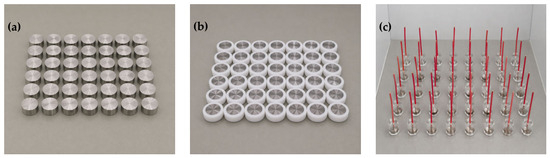
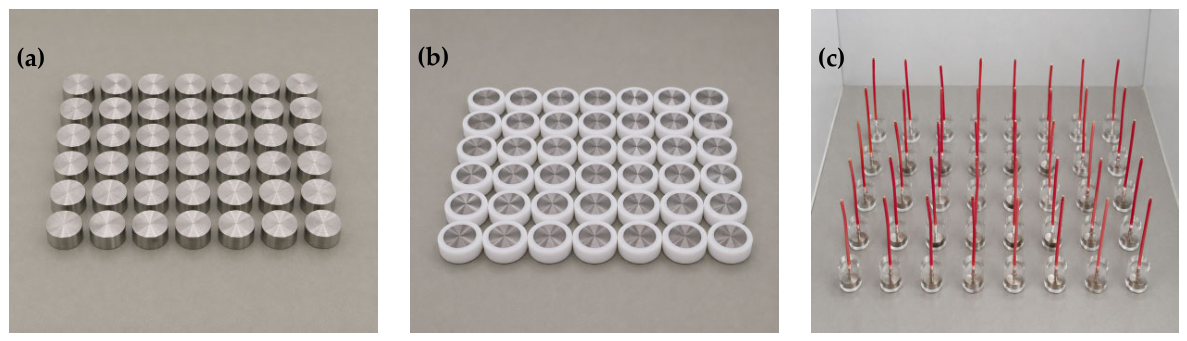
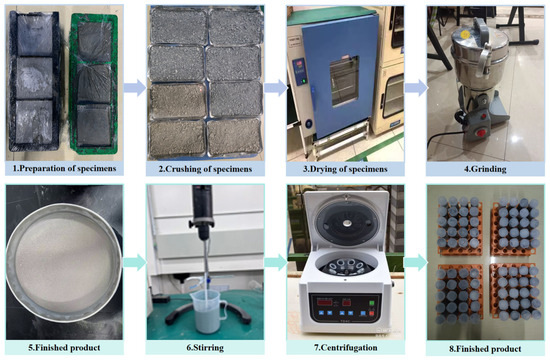
HRB400 steel was machined into cylindrical specimens with a diameter of Ø11.3 mm and a height of 5 mm, as shown in Figure 1a. To prevent crevice corrosion on the lateral surface of the steel specimen, a polytetrafluoroethylene (PTFE) ring was used to tightly confine the specimen, and a PTFE–metal adhesive was applied at the interface between the PTFE ring and the steel surface, as illustrated in Figure 1b. Subsequently, a copper wire was welded to one side of the steel specimen as the electrical lead. The specimen was then placed into a cylindrical mold with an inner diameter of Ø20 mm and a height of 18 mm. Epoxy resin was used to seal the lateral surface of the specimen and the welded area of the copper wire, leaving only the bottom surface exposed as the working electrode with an exposed area of 1 cm2, as shown in Figure 1c.
Figure 1.
Preparation of HRB400 steel electrodes: (a) Specimen (b) PTFE ring (c) Working electrode.
The exposed working surface was sequentially ground using 320, 800, and 2000 grit SiC abrasive papers, followed by polishing with a metallographic polishing agent until a mirror-like finish was obtained. After polishing, the specimens were ultrasonically cleaned in absolute ethanol, rinsed with distilled water, and naturally dried at room temperature prior to subsequent electrochemical measurements.
2.2.2. Preparation of Concrete Pore Solution
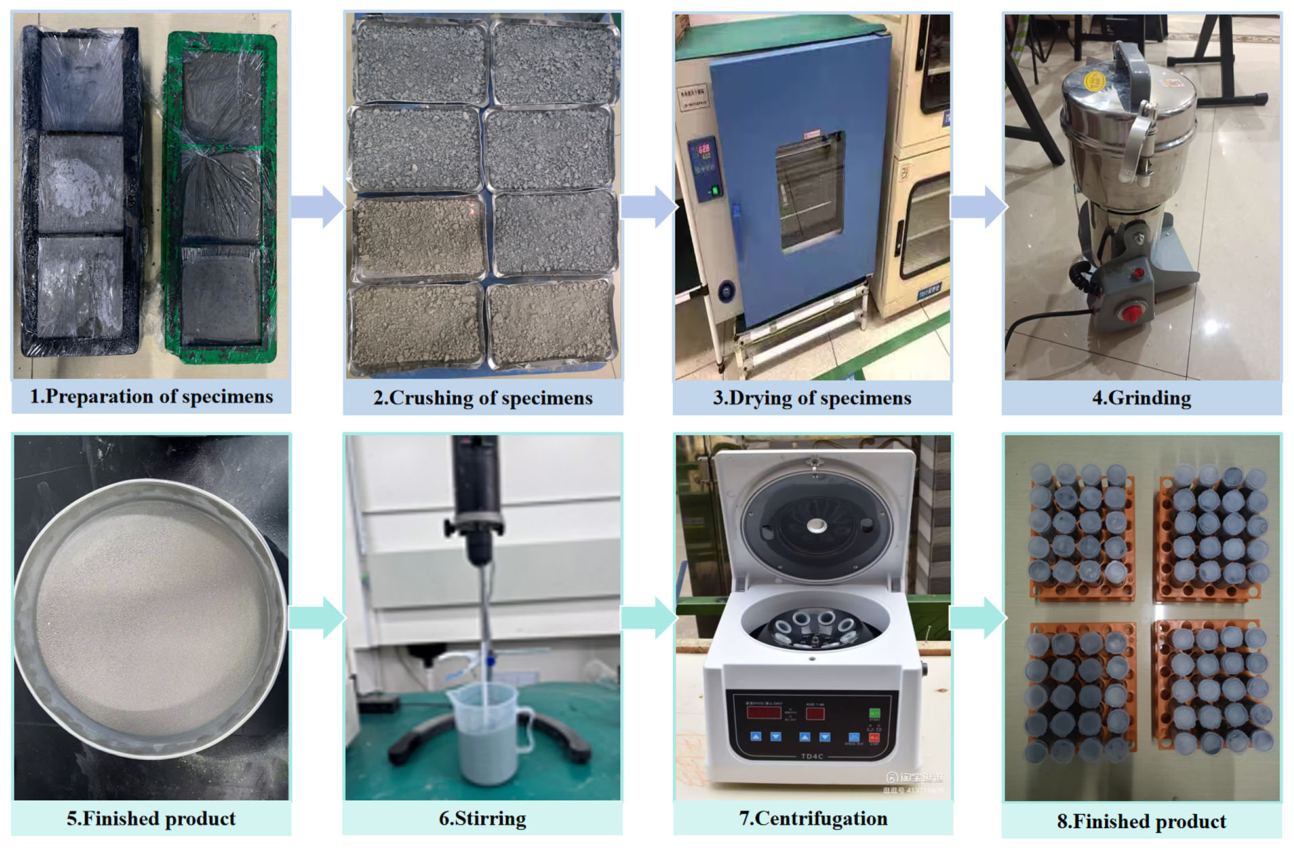
According to the mix proportions listed in Table 3, OPC and FAC paste specimens with dimensions of 10 mm × 10 mm × 10 mm were prepared and cured under standard curing conditions for 7 d. After curing, the specimens were initially crushed using a hammer crusher, and the obtained fragments were subsequently immersed in absolute ethanol to terminate the hydration reaction. The samples were then dried in a vacuum oven at 40 °C for 24 h, followed by grinding and sieving through a 200-mesh standard sieve.
Table 3.
Mix proportions of cementitious specimens used for SCP solution (kg/m3).
The obtained powders were mixed with deionized water at a solid-to-liquid ratio of 1:1 and continuously stirred for 10 min [20], followed by centrifugation. The supernatant was collected and filtered through a sand-core filter to obtain the SCP solutions of OPC and FAC, respectively. The preparation procedure is illustrated in Figure 2. The obtained SCP solutions were characterized by inductively coupled plasma optical emission spectroscopy (ICP-OES, Optima 8000, PerkinElmer, Waltham, MA, USA), and the main ionic compositions and concentrations are listed in Table 4. Subsequently, NaHCO3 was added to adjust the solution pH to 12.5, 11.0, and 9.5, respectively, thereby establishing different alkalinity levels representative of carbonation-induced pH reduction.
Figure 2.
Preparation of SCP solution.
Table 4.
Ionic composition of OPC-SCP and FAC-SCP solutions (mmol/L).
2.3. Electrochemical Test
All electrochemical measurements were conducted using a conventional three-electrode system. A Hg/HgO electrode and a platinum electrode were employed as the reference electrode and counter electrode, respectively, while the steel rebar electrode with an exposed area of 1 cm2 served as the working electrode. Electrochemical tests were performed using a Princeton VersaSTAT 3 electrochemical workstation (Princeton Applied Research, Oak Ridge, TN, USA). The solution volume was selected to ensure sufficient electrolyte coverage and stable electrochemical response during testing. The solution-to-exposed area ratio was approximately 0.2 mL/mm2, based on previous electrochemical studies on reinforcing steel in simulated concrete pore solutions [21]. Accordingly, 150 mL of solution was used in each five-neck flask. The immersion cells were sealed with rubber stoppers throughout the exposure period to minimize atmospheric CO2 ingress and reduce carbonation effects. However, the pH values of the simulated pore solutions were not continuously monitored during immersion, which represents a limitation of the present study. All electrochemical measurements were performed at room temperature (~25 °C). The test solutions were not intentionally aerated or deaerated. The working electrode with an exposed area of 1 cm2 was used, and all electrochemical parameters were normalized to the exposed surface area.
The prepared electrodes were first pre-passivated in OPC and FAC solutions at pH 12.5 for 7 d. The evolution of OCP and Rct during the pre-passivation stage indicated that the passive film reached a quasi-steady state before subsequent pH adjustment. Subsequently, the pre-passivated electrodes were immersed in OPC and FAC solutions with pH values of 12.5, 11.0, and 9.5, respectively. EIS measurements were carried out under stable OCP conditions over a frequency range from 10−2 to 105 Hz with a sinusoidal perturbation amplitude of 10 mV. The destabilization behavior of HRB400 steel in OPC-SCP and FAC-SCP solutions was recorded, and the EIS data were fitted and analyzed. Parallel specimens were prepared during the electrochemical testing program to verify the reproducibility of the experimental trends. Representative results from the repeated measurements are presented in this study.
2.4. Microstructure and Composition Characterization
2.4.1. XRD
XRD (SmartLab, Rigaku Corporation, Tokyo, Japan) was employed to characterize the phase composition of the passive film and corrosion products formed on HRB400 steel after destabilization. The measurements were conducted using Cu Kα radiation (λ = 1.54056 Å) with an operating voltage of 30 kV and a current of 10 mA. XRD patterns were collected over a 2θ range of 5–90° with a step size of 0.02° and a scanning rate of 2°/min.
2.4.2. AFM and SEM-EDS
AFM (Dimension Edge, Bruker Corporation, Billerica, MA, USA) was employed to characterize the surface morphology and roughness of the passive films formed on HRB400 steel after destabilization in SCP solutions. Prior to testing, the samples were cleaned with absolute ethanol and naturally dried at room temperature. AFM measurements were then performed in tapping mode over a scanning area of 5.0 μm × 5.0 μm using a commercial silicon probe (manufacturer-specified nanometer-scale tip radius). Ra and Rq were selected due to their wide application in corrosion-related AFM studies.
In addition, the surface morphology of the passive films was observed using SEM (Sigma 300, Carl Zeiss AG, Oberkochen, Germany), while the elemental composition and elemental distribution were analyzed by EDS mapping.
3. Results and Discussion
3.1. OCP Test
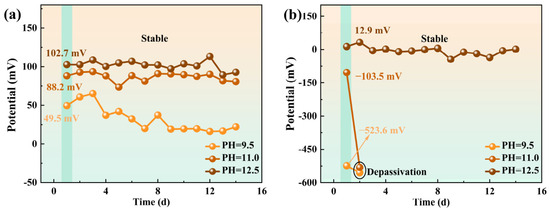
Figure 3 presents the evolution of the OCP of HRB400 steel immersed in OPC-SCP and FAC-SCP solutions under different pH conditions. For the OPC-SCP system (Figure 3a), the initial OCP values of the PF at pH 12.5, 11.0, and 9.5 were 102.7 mV, 88.2 mV, and 49.5 mV, respectively. During the 14 d exposure period, no obvious potential drop or continuous negative shift was observed under any pH condition. Only slight fluctuations appeared during the initial immersion stage, indicating that the PF formed on the steel surface possessed relatively good corrosion resistance and stability, and that the low-pH environment exerted only a limited effect on PF stability within a short exposure duration. In addition, the OCP values consistently followed the order of pH 12.5 > 11.0 > 9.5 throughout the entire test period, suggesting that the stability of the PF gradually decreased with decreasing alkalinity. This behavior can be attributed to the fact that higher OH- concentrations are favorable for maintaining the structural stability of the PF and suppressing local film dissolution as well as defect propagation [22,23].
Figure 3.
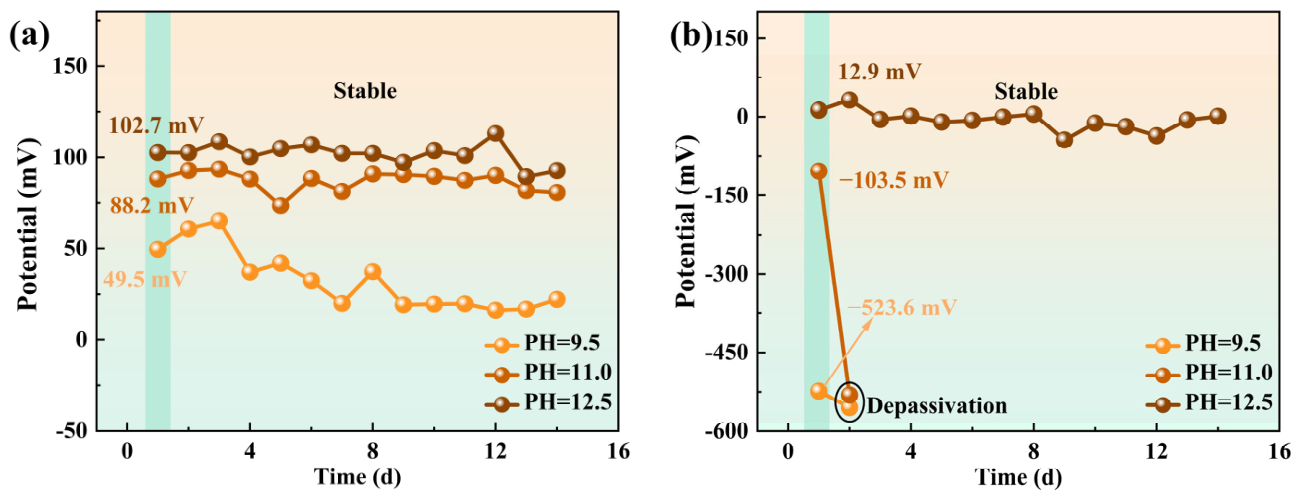
OCP of HRB400 steel in (a) OPC-SCP and (b) FAC-SCP solutions under different pH conditions.
In contrast, the FAC-SCP system (Figure 3b) exhibited a much more pronounced negative shift in OCP with decreasing pH, demonstrating a significant pH-sensitive characteristic of the PF. The initial OCP values at pH 12.5, 11.0, and 9.5 were 12.9 mV, −103.5 mV, and −523.6 mV, respectively. Compared with the OPC-SCP system, the overall OCP values in the FAC-SCP solution were substantially lower, suggesting relatively lower PF stability. At pH 12.5, the OCP remained relatively stable around 0 mV throughout the test period with only slight fluctuations, suggesting that the steel surface could still maintain a relatively stable passive state under highly alkaline conditions. However, when the pH decreased to 11.0 and 9.5, the OCP values shifted rapidly toward more negative potentials and quickly entered the active corrosion region, indicating significant degradation of PF and rapid depassivation of the HRB400 steel. Particularly at pH 9.5, the OCP remained at a persistently low level during the entire exposure period, implying that the PF formed under low-alkalinity conditions could no longer provide effective interfacial protection, and the steel surface remained in an actively corroding state. These results suggest that the corrosion behavior of steel in the FAC-SCP system was more sensitive to pH variation, and that the tendency toward depassivation increased with decreasing pore solution alkalinity.
The above phenomenon may be associated with the combined influence of the relatively high SO42− concentration and low Ca2+ concentration in the FAC-SCP solution. Previous studies have suggested that elevated SO42− concentrations may affect the structural stability of passive films, promote the initiation and propagation of local film defects, and facilitate interfacial charge transfer, thereby shifting the OCP toward more negative values [7,24]. In addition, the relatively low Ca2+ concentration may reduce the alkalinity buffering capacity and repassivation ability at the steel/solution interface, which could be unfavorable for maintaining the compact structure of the passive film. As the pH further decreases, the reduction in OH− concentration is likely to further weaken passive film stability, while the combined effects of high SO42− and low Ca2+ may become more significant, contributing to passive film destabilization and depassivation. Therefore, compared with the OPC-SCP system, HRB400 steel in the FAC-SCP system exhibited a greater tendency toward early depassivation and active corrosion under the present experimental conditions.
3.2. EIS Test
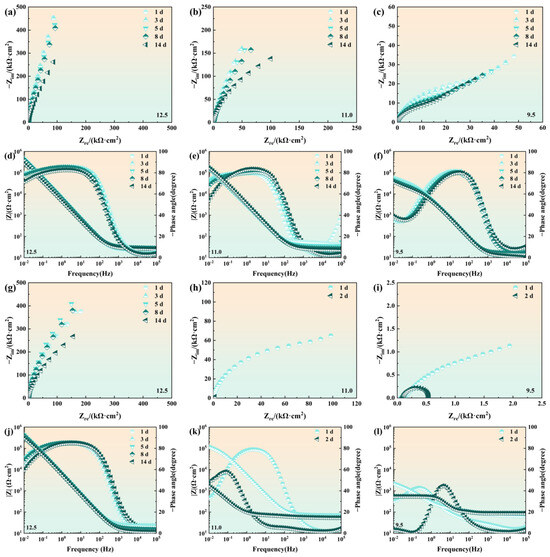
To further compare the stability of PF formed on HRB400 steel in OPC-SCP and FAC-SCP solutions under different pH conditions, EIS was employed to continuously monitor the evolution of the PF during immersion, and the results are presented in Figure 4. As shown in Figure 4a–c, the Nyquist plots of HRB400 steel in OPC-SCP solutions under different pH conditions all exhibited large capacitive arcs. With increasing immersion time, the radius of the capacitive arc showed only slight variations, while the phase angle and |Z|0.01Hz in the Bode plots remained relatively stable (Figure 4d–f), without any abrupt changes compared with the initial immersion stage. These results indicate that the PF formed on the steel surface maintained good integrity throughout the entire testing period and did not undergo significant degradation [25]. This demonstrates that the PF formed in the OPC-SCP system possesses high compactness and stability, exhibiting low sensitivity to pH variation and consequently superior corrosion resistance.
Figure 4.
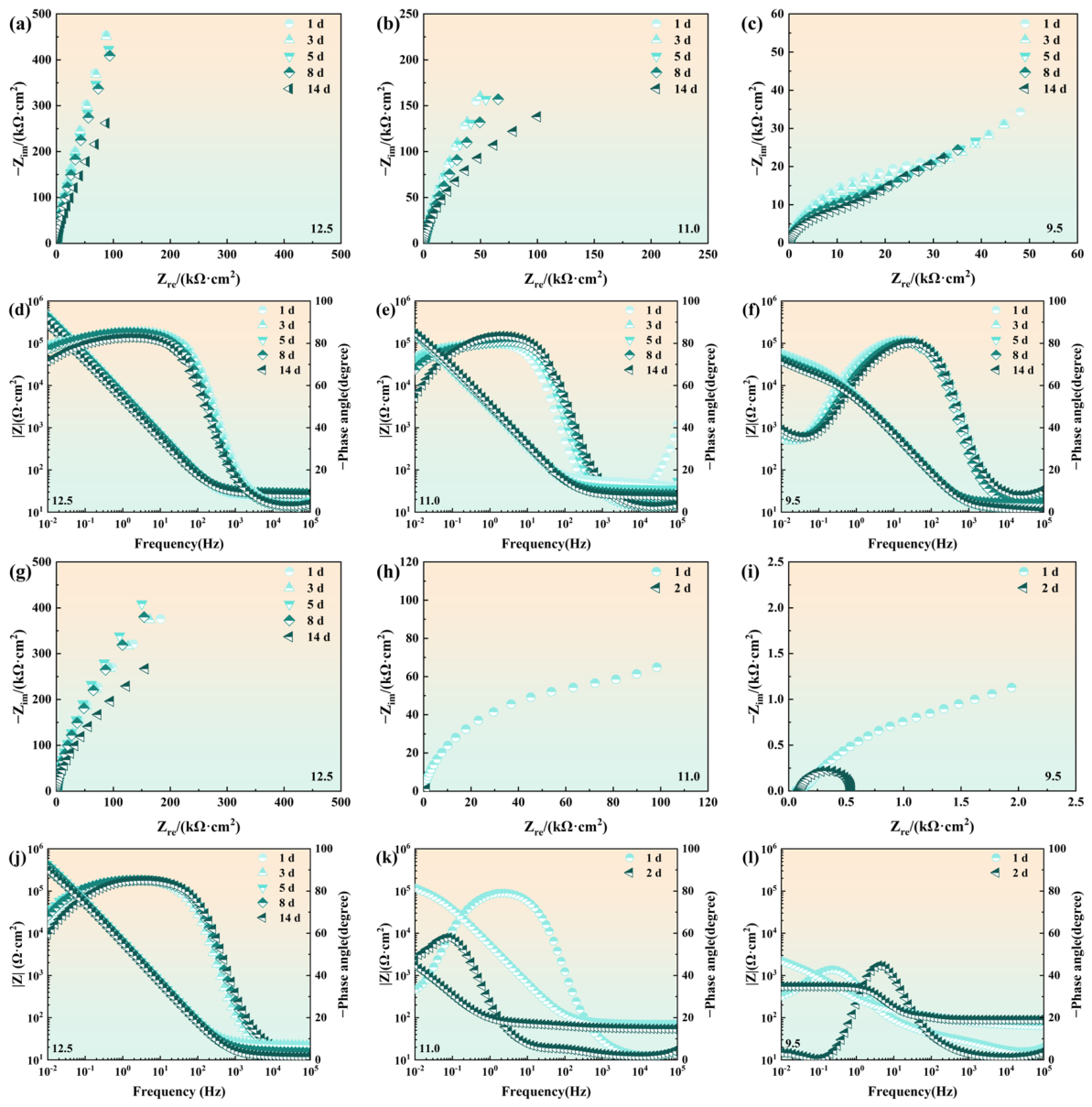
Nyquist and Bode plots of HRB400 steel in OPC-SCP (a–f) and FAC-SCP (g–l) solutions at pH values of 12.5, 11.0, and 9.5.
In contrast, the stability of the PF formed in FAC-SCP solutions was significantly poorer. Under the condition of pH = 12.5 (Figure 4g,j), the capacitive arc radius, phase angle, and |Z|0.01Hz of the HRB400 steel decreased only gradually during the 14 d immersion period, without any sudden drop, indicating that the PF remained relatively stable and no obvious failure occurred. However, when the pH decreased to 11.0 (Figure 4h,k), the capacitive arc radius decreased significantly on the second day of immersion, accompanied by a rapid decline in the low-frequency |Z|0.01Hz, suggesting that the PF had begun to deteriorate. When the solution pH was further reduced to 9.5 (Figure 4i,l), both the capacitive arc radius and the low-frequency |Z| sharply decreased on the first day of immersion, indicating that the PF failed within a short period and the HRB400 steel rapidly transformed from the passive state to the active corrosion state. These results demonstrate that the PF formed in the FAC-SCP system is more sensitive to pH variation, and its stability is significantly lower than that formed in the OPC-SCP system [26]. This behavior may be associated with the combined influence of the relatively high SO42− concentration and low Ca2+ concentration in the FAC-SCP solution, which may facilitate passive film degradation and consequently promote steel depassivation.
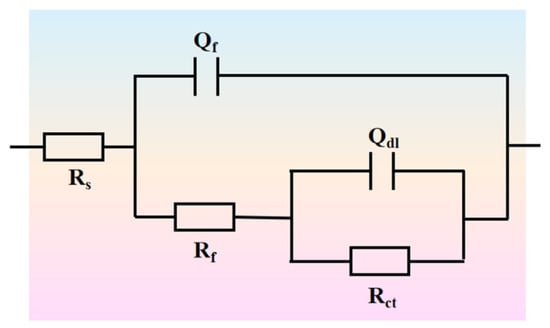
To quantitatively analyze the electrochemical behavior during the depassivation process of reinforcing steel, the EIS data were fitted using the equivalent circuit shown in Figure 5 [27]. In this circuit, Rs represents the solution resistance, while Rf and Qf correspond to the resistance and capacitive characteristics of the PF formed on the steel surface, respectively. Rct denotes the charge transfer resistance associated with the corrosion reaction of reinforcing steel, and Qdl represents the double-layer capacitance at the steel/solution interface. The equivalent circuit shown in Figure 5 was applied only when two distinguishable time constants associated with the passive film and the steel/electrolyte interface could be identified from the impedance spectra. For the FAC-SCP system at pH 11.0 and 9.5, fitting was terminated once severe passive film degradation occurred and reliable separation of the two electrochemical processes was no longer possible.
Figure 5.
Equivalent circuit model.
The EIS fitting parameters (Rf and Rct) of reinforcing steel in OPC-SCP and FAC-SCP solutions under different pH conditions are presented in Table 5, Table 6, Table 7, Table 8, Table 9 and Table 10. The CPE exponent (n) reflects the deviation from ideal capacitive behavior and is associated with the heterogeneity and surface non-uniformity of the passive film. Lower n values generally indicate increased surface heterogeneity caused by passive film degradation. The chi-square values (χ2) of all fitting results were on the order of 10−4–10−3, indicating that the selected equivalent circuit could effectively characterize the electrochemical behavior of the system and that the fitting results were highly reliable [28,29]. It can be observed that, under different pH conditions, the Rf and Rct values of the PF formed in OPC-SCP solutions remained relatively stable, showing only slight decreases, which indicates that the PF maintained good stability and corrosion resistance throughout the immersion period. In contrast, the PF formed in FAC-SCP solutions remained relatively stable only at pH = 12.5. When the pH decreased to 11.0 and 9.5, the Rct values rapidly declined on the second and first day of immersion, respectively, indicating that the PF on the steel surface became unstable and deteriorated, causing the HRB400 steel to gradually transform from the passive state to the active corrosion state.
Table 5.
EIS fitting parameters of OPC-SCP at pH 12.5.
Table 6.
EIS fitting parameters of OPC-SCP at pH 11.0.
Table 7.
EIS fitting parameters of OPC-SCP at pH 9.5.
Table 8.
EIS fitting parameters of FAC-SCP at pH 12.5.
Table 9.
EIS fitting parameters of FAC-SCP at pH 11.0.
Table 10.
EIS fitting parameters of FAC-SCP at pH 9.5.
3.3. XRD Analysis
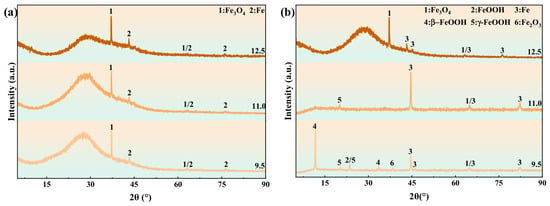
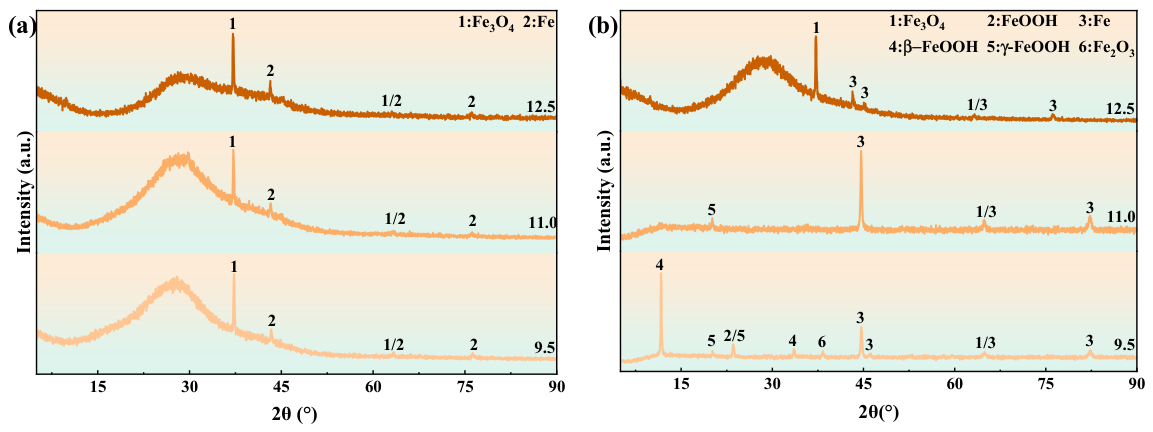
To investigate the phase evolution of steel PF after destabilization, XRD measurements were performed on steel specimens immersed for 14 days in OPC-SCP and FAC-SCP solutions under different pH conditions, as shown in Figure 6. A distinct diffraction peak of the Fe substrate is observed in all patterns, indicating that the X-ray penetration depth exceeds the thickness of the PF. Therefore, the phase composition of both the PF and corrosion products can be effectively characterized. Phase identification was performed according to the standard PDF database and previous studies on iron oxide corrosion products [30]. Considering that several diffraction peaks are relatively weak and partially overlap with the broad background in the 25–35°(2θ) range, the phase assignments were made based on both diffraction peak positions and previous literature [31].
Figure 6.
XRD patterns of PF formed on HRB400 steel after immersion in (a) OPC-SCP and (b) FAC-SCP solutions under different pH conditions.
In the OPC-SCP system, the XRD patterns under different pH conditions exhibit highly consistent phase characteristics. The dominant diffraction peaks can be mainly assigned to Fe3O4 [32]. No obvious diffraction peaks that can be assigned to typical corrosion products such as γ-FeOOH, β-FeOOH, or Fe2O3 are detected. This result is consistent with the electrochemical measurements, suggesting that in this system, the PF formed on the steel surface remains relatively stable even under short-term pH reduction, without obvious destabilization or structural transformation. In contrast, the phase composition of the passive film in the FAC-SCP system shows a pronounced sensitivity to pH variation. At pH 12.5, the steel surface is also mainly characterized by diffraction peaks assigned to Fe3O4, suggesting a similar initial passivation state to that in the OPC system. However, when the pH decreases to 11.0, the diffraction peak assigned to Fe3O4 becomes significantly weaker, while a weak diffraction peak at approximately 2θ = 20.8° can be assigned to γ-FeOOH [33], suggesting passive film destabilization accompanied by the formation of initial corrosion products. When the pH is further reduced to 9.5, diffraction peaks at approximately 2θ = 11.7°, 20.2°, and 38.2° can be assigned to β-FeOOH, γ-FeOOH and Fe2O3, respectively, suggesting severe passive film degradation accompanied by the formation of multiple corrosion products.
By comparing the destabilization behavior of PF in OPC-SCP and FAC-SCP systems under different pH conditions, the passive film formed in the FAC-SCP system exhibited greater sensitivity to pH reduction and a higher tendency toward destabilization and depassivation. This behavior may be associated with the combined influence of the relatively high SO42− concentration and low Ca2+ concentration in the FAC-SCP solution. Previous studies have suggested that elevated SO42− concentrations may affect the stability of iron oxide structures through competitive adsorption or complexation reactions, thereby promoting the formation and propagation of passive film defects [8]. In addition, the relatively low Ca2+ concentration may reduce the interfacial precipitation-based protection capacity, which could be likely unfavorable for maintaining PF integrity [34]. Under decreasing pH conditions, these effects may become more pronounced, thereby contributing to preferential destabilization of the PF and the formation of multiple corrosion products in the FAC system.
It should be noted that the present study compares passive film behavior in OPC-SCP and FAC-SCP systems with different chemical compositions. Therefore, the individual contributions of SO42− and Ca2+ to passive film destabilization cannot be independently quantified. The proposed mechanism is based on the correlations observed among solution chemistry, electrochemical responses, and surface characterization results, together with evidence reported in previous studies [35]. Further studies employing controlled solution compositions, such as independently adjusting SO42− or Ca2+ concentrations, are required to clarify the specific roles of these ions in passive film destabilization.
In addition, the Al3+ concentration in FAC-SCP (2.310 mmol/L) is substantially higher than that in OPC-SCP (0.028 mmol/L). Although the discussion mainly focuses on SO42− and Ca2+ because their effects on passive film stability have been widely reported in the literature, the potential influence of aluminate species on passive film formation and destabilization cannot be excluded [36]. However, the role of Al-containing species was not specifically investigated in the present study and therefore could not be conclusively assessed. Further studies are needed to clarify the contribution of aluminate species to passive film evolution and depassivation behavior.
3.4. AFM Analysis
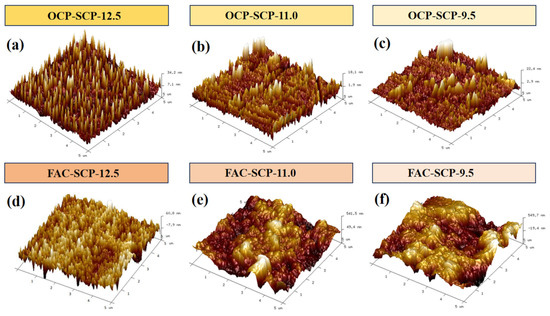
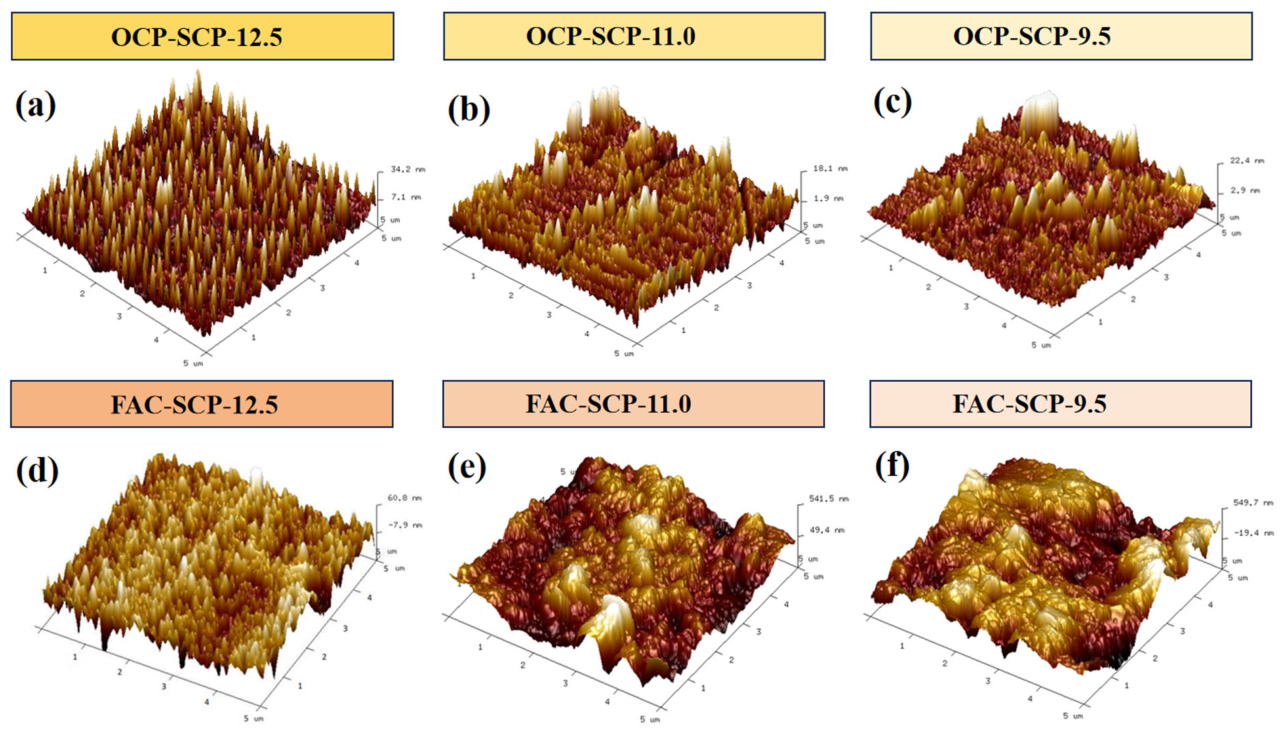
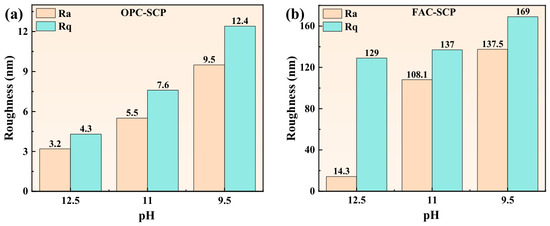
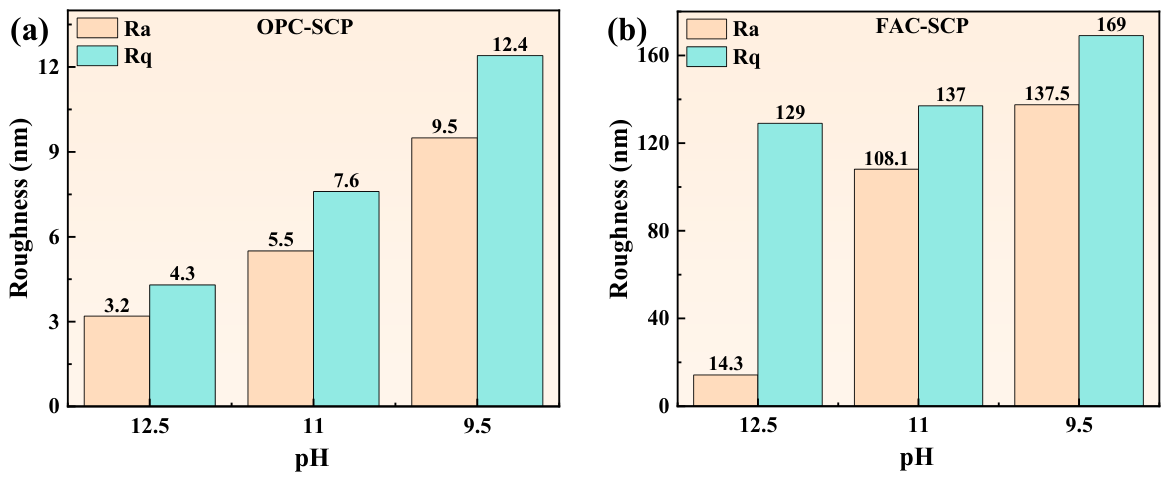
To further reveal the evolution of surface morphology and roughness of PF after destabilization and corrosion, AFM characterization was performed on the PF formed on HRB400 steel in OPC-SCP and FAC-SCP systems, as shown in Figure 7. As observed, the PF formed in the OPC-SCP system exhibited a noticeable reduction in surface peak structures with decreasing pH, while the overall surface remained relatively smooth. Under pH conditions of 12.5, 11.0, and 9.5, the average surface roughness (Ra) values were 3.2 nm, 5.5 nm, and 9.5 nm, respectively, whereas the root mean square roughness (Rq) values were 4.3 nm, 7.6 nm, and 12.4 nm, respectively, indicating only a slight increase in surface roughness (Figure 8). These results suggest that although local dissolution and defect propagation occurred in the PF of the OPC-SCP system as the pH decreased, the PF still maintained relatively good continuity and compactness, resulting in limited changes in surface morphology [37].
Figure 7.
Surface morphologies of PF formed in (a–c) OPC-SCP and (d–f) FAC-SCP solutions after pH reduction.
Figure 8.
Surface roughness of PF formed in (a) OPC-SCP and (b) FAC-SCP solutions after pH reduction.
In contrast, the PF formed in the FAC-SCP system exhibited much more pronounced surface roughening after pH reduction. At pH values of 12.5, 11.0, and 9.5, the corresponding Ra values increased to 14.3 nm, 108.1 nm, and 137.5 nm, respectively, while the Rq values increased to 19.0 nm, 137 nm, and 169 nm, respectively, all of which were significantly higher than those of the OPC-SCP system. With decreasing pH, a large number of protrusions, depressions, and irregular corroded regions gradually appeared on the film surface, indicating severe local damage and structural destabilization of the PF. This behavior may be associated with the combined influence of the relatively high SO42− concentration and low Ca2+ concentration in the FAC-SCP system. Previous studies have suggested that elevated SO42− concentrations may promote PF defect formation, while relatively low Ca2+ concentrations may reduce interfacial protection and repassivation ability [38]. Under reduced alkalinity, these combined effects may contribute to enhanced local dissolution and PF destabilization, resulting in the substantial increase in surface roughness observed in the FAC-SCP system.
3.5. SEM-EDS Analysis
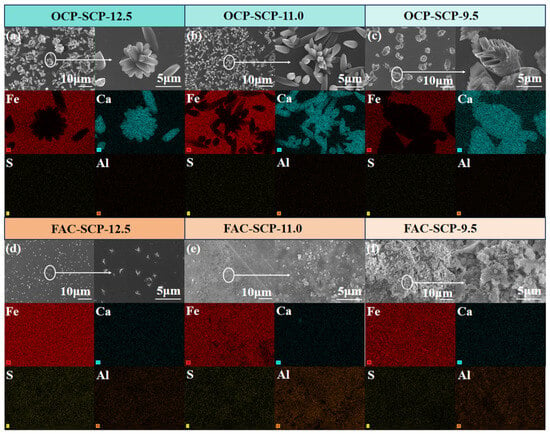
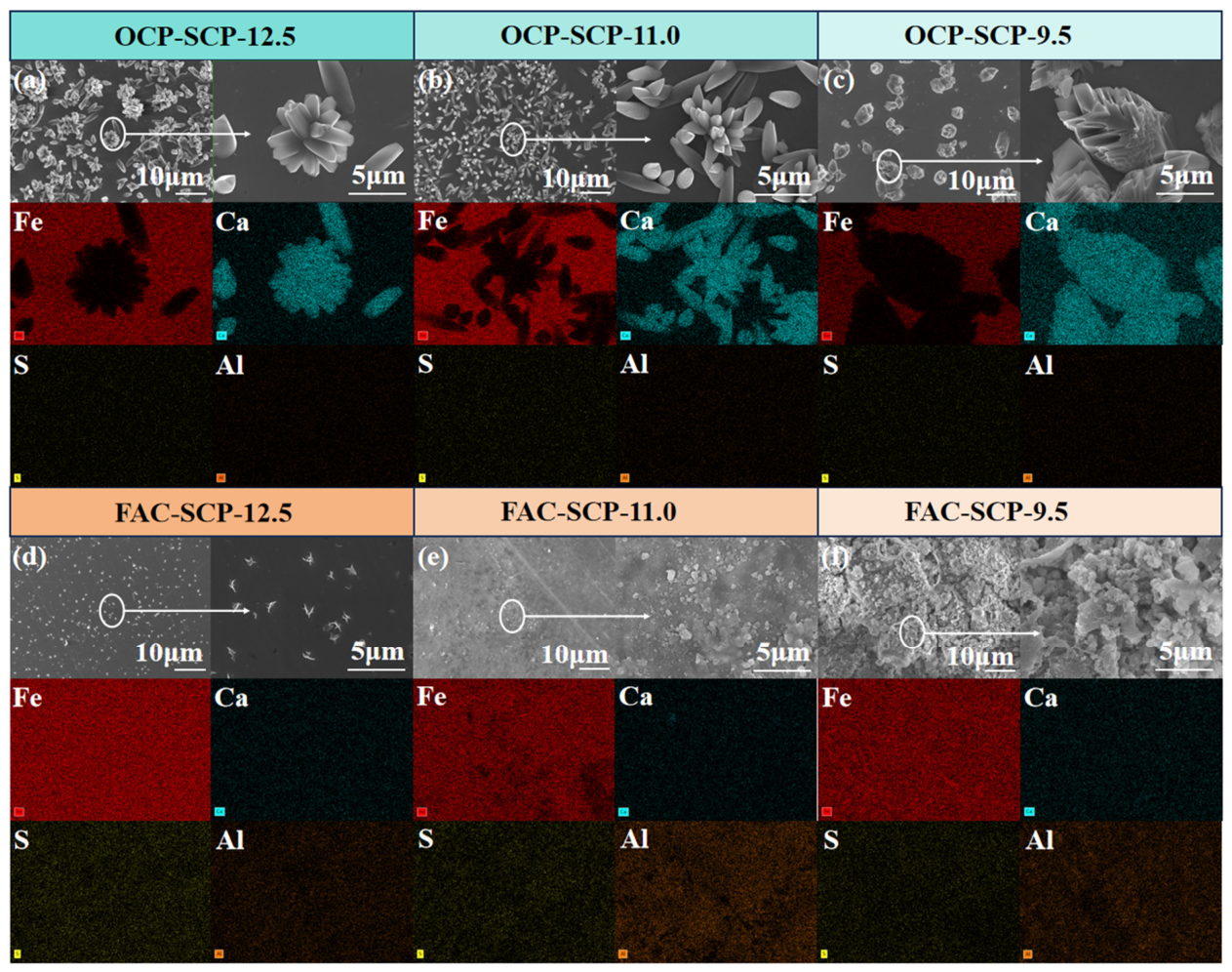
After immersion for 14 d under different pH conditions, the SEM morphologies and EDS elemental analysis results of the PF formed on HRB400 steel in OPC-SCP and FAC-SCP systems are presented in Figure 9. In the OPC-SCP system, when the pH was 12.5, the PF on the steel surface appeared relatively dense and smooth, without obvious cracks, and typical flower-like structures were observed on the surface. Combined with the EDS results, these regions were enriched in Ca, which suggests that they were mainly composed of CaCO3 precipitation products [39]. When the pH decreased to 11.0, the flower-like structures on the PF surface gradually became irregular; however, their overall morphology remained distinguishable, and the PF surface still maintained relatively good compactness without obvious damage. As the pH further decreased to 9.5, the surface particles gradually transformed into block-like structures with uneven surface features. Nevertheless, the PF remained relatively smooth overall, and no obvious cracks or large-scale spallation were observed, suggesting that the PF formed in the OPC-SCP system remained relatively stable even under reduced alkalinity.
Figure 9.
Surface morphology and elemental distribution of PF formed in (a–c) OPC-SCP and (d–f) FAC-SCP solutions after pH reduction.
In contrast, the PF formed in the FAC-SCP system exhibited much more pronounced destabilization characteristics with decreasing pH. At pH 12.5, the PF surface was also relatively smooth and compact, without obvious cracks. However, when the pH decreased to 11.0, the PF surface became markedly uneven, accompanied by the accumulation of a large amount of layered structures, indicating local destabilization of the PF and deposition of corrosion products. When the pH further decreased to 9.5, the layered structures became increasingly loose and exhibited obvious stacked growth characteristics, while the integrity of the PF significantly deteriorated, suggesting severe active corrosion on the steel surface. The elemental mapping results further show that, compared with the OPC-SCP system, the FAC-SCP system exhibits higher S and Al signals under all pH conditions [40]. The enrichment of S suggests that sulfate-related species participate in interfacial reactions and are closely associated with corrosion product formation and passive film degradation. In addition, the increased Al signal reflects the much higher Al3+ concentration in the FAC-SCP solution. Although Al-containing species may participate in interfacial reactions and influence PF evolution, their specific role was not independently investigated in the present study and therefore could not be quantitatively assessed [41]. Accordingly, their potential contribution is discussed here only in a qualitative manner. These results further demonstrate that, compared with the OPC-SCP system, the PF formed in the FAC-SCP system was more susceptible to structural degradation and depassivation under low-pH conditions.
4. Limitations of This Study
The use of simulated pore solutions allows the chemical effects of different cement systems to be investigated under controlled conditions but does not fully reproduce the complex ion transport, buffering capacity, and steel–concrete interfacial processes occurring in real concrete. In addition, the 1:1 solid-to-water leaching method used to prepare the simulated pore solutions cannot completely represent the ionic strength and pore solution chemistry of actual cementitious materials.
The present study focuses on the short-term electrochemical evolution of PF over a 14-day exposure period under chloride-free conditions. Therefore, the results should not be directly extrapolated to the long-term durability performance of reinforced concrete exposed to simultaneous carbonation and chloride ingress. Further studies are required to investigate the combined effects of carbonation and chlorides under more realistic service conditions. Furthermore, NaHCO3 was used to adjust the solution pH in order to simulate carbonation-induced alkalinity reduction. Although this approach provides a practical method for controlling pH, the introduced carbonate species may also influence PF stability, and this effect could not be fully separated from the influence of pH in the present study.
Finally, although triplicate experiments were performed, standard deviations were not reported because the complete raw datasets were not fully retained. In addition, the absence of Mott–Schottky and XPS analyses limits further interpretation of the semiconductor properties and chemical states of the PF. XPS analysis may be considered in future work to further clarify the chemical states and oxidation states of passive films. Future studies may consider multi-parameter roughness analysis to better describe surface heterogeneity [42,43].
5. Conclusions
This study systematically investigated the stability evolution of PF formed on reinforcing steel in OPC-SCP and FAC-SCP under decreasing alkalinity. Electrochemical measurements and microstructural characterization techniques were employed to elucidate the destabilization mechanisms of PF in different pore solution environments. The main conclusions are as follows:
- (1)
- As the pore solution pH decreased from 12.5 to 11.0 and 9.5, PF in both OPC-SCP and FAC-SCP systems underwent varying degrees of degradation, but exhibited significantly different stability characteristics. Compared with the FAC-SCP system, reinforcing steel in the OPC-SCP system exhibited a relatively more stable passive state, showing higher PF resistance and charge transfer resistance, as well as smaller changes in PF thickness, surface morphology, and phase composition. In contrast, PF in the FAC-SCP system rapidly deteriorated, accompanied by the gradual formation of corrosion products and a significant increase in surface roughness, indicating a greater tendency toward steel depassivation.
- (2)
- The chemical composition of the pore solution plays an important role in influencing PF stability. The higher Ca2+ concentration in the OPC-SCP system may promote the formation and maintenance of a relatively dense and stable PF, thereby enhancing its resistance to degradation under low-alkalinity conditions. In contrast, the higher SO42− concentration and lower Ca2+ concentration in the FAC-SCP system may promote defect propagation and localized dissolution within the PF, thereby contributing to PF destabilization. The results suggest that steel depassivation is influenced not only by pore solution pH but also by pore solution chemistry, and that these factors jointly determine the stability of PF and the corrosion susceptibility of reinforcing steel.
- (3)
- From an engineering perspective, FAC-based cementitious systems may exhibit reduced PF stability in carbonation-prone or low-alkalinity environments. Therefore, caution should be exercised when applying FAC-containing binders in reinforced concrete structures where pH reduction is likely to occur. Further studies are needed to isolate the individual effects of SO42−-, Ca2+-, and Al-containing species on PF stability and to evaluate PF evolution under long-term exposure and more realistic service conditions.
Author Contributions
Conceptualization, Y.L. and Q.X.; methodology, Y.L., Q.X. and Z.D.; formal analysis, Q.X.; investigation, Q.X. and J.L.; data curation, Q.X.; writing—original draft preparation, Q.X.; writing—review and editing, Y.L. and Q.X.; visualization, Q.X.; supervision, Y.L.; project administration, Y.L.; funding acquisition, Y.L. All authors have read and agreed to the published version of the manuscript.
Funding
This research is financially supported by the National Key R&D Program of China (Grant No. 2023YFB3711402).
Data Availability Statement
The data presented in this study are available from the corresponding author upon reasonable request.
Conflicts of Interest
The authors declare no conflict of interest.
References
- Rodrigues, R.; Gaboreau, S.; Gance, J.; Ignatiadis, I.; Betelu, S. Reinforced concrete structures: A review of corrosion mechanisms and advances in electrical methods for corrosion monitoring. Constr. Build. Mater. 2021, 269, 121240. [Google Scholar] [CrossRef] [Scilit]
- Tian, Y.; Zhang, G.; Ye, H.; Zeng, Q.; Zhang, Z.; Tian, Z.; Jin, X.; Jin, N.; Chen, Z.; Wang, J. Corrosion of steel rebar in concrete induced by chloride ions under natural environments. Constr. Build. Mater. 2023, 369, 130504. [Google Scholar] [CrossRef] [Scilit]
- Alexander, M.; Beushausen, H. Durability, service life prediction, and modelling for reinforced concrete structures–review and critique. Cem. Concr. Res. 2019, 122, 17–29. [Google Scholar]
- Angst, U.; Elsener, B.; Larsen, C.K.; Vennesland, Ø. Critical chloride content in reinforced concrete—A review. Cem. Concr. Res. 2009, 39, 1122–1138. [Google Scholar]
- Bertolini, L.; Elsener, B.; Pedeferri, P.; Redaelli, E.; Polder, R.B. Corrosion of Steel in Concrete: Prevention, Diagnosis, Repair; John Wiley & Sons: Hoboken, NJ, USA, 2013. [Google Scholar]
- Pourbaix, M. Atlas of Electrochemical Equilibria in Aqueous Solutions; Association for Materials Protection and Performance (AMPP): Houston, TX, USA, 1974. [Google Scholar]
- Ghods, P.; Isgor, O.; McRae, G.; Miller, T. The effect of concrete pore solution composition on the quality of passive oxide films on black steel reinforcement. Cem. Concr. Compos. 2009, 31, 2–11. [Google Scholar] [CrossRef] [Scilit]
- Schmuki, P. From Bacon to barriers: A review on the passivity of metals and alloys. J. Solid State Electrochem. 2002, 6, 145–164. [Google Scholar] [CrossRef] [Scilit]
- Fuhaid, A.F.A.; Niaz, A. Carbonation and corrosion problems in reinforced concrete structures. Buildings 2022, 12, 586. [Google Scholar] [CrossRef] [Scilit]
- Liu, G.; Zhang, P.; Liu, C.; Zhang, Y. Influence of pH on passivation of mild steel in simulated concrete pore solution: Electrochemical, ToF-SIMS and ReaxFF study. Dev. Built Environ. 2024, 19, 100502. [Google Scholar]
- Liu, X.; Niu, D.; Li, X.; Lv, Y.; Fu, Q. Pore solution pH for the corrosion initiation of rebars embedded in concrete under a long-term natural carbonation reaction. Appl. Sci. 2018, 8, 128. [Google Scholar]
- Wang, L.; Zhan, S.; Tang, X.; Xu, Q.; Qian, K. Pore solution chemistry of calcium sulfoaluminate cement and its effects on steel passivation. Appl. Sci. 2019, 9, 1092. [Google Scholar] [CrossRef] [Scilit]
- Scott, A.; Alexander, M. Effect of supplementary cementitious materials (binder type) on the pore solution chemistry and the corrosion of steel in alkaline environments. Cem. Concr. Res. 2016, 89, 45–55. [Google Scholar] [CrossRef] [Scilit]
- Glasser, F.P.; Marchand, J.; Samson, E. Durability of concrete—Degradation phenomena involving detrimental chemical reactions. Cem. Concr. Res. 2008, 38, 226–246. [Google Scholar]
- Andaç, M.; Glasser, F. Pore solution composition of calcium sulfoaluminate cement. Adv. Cem. Res. 1999, 11, 23–26. [Google Scholar] [CrossRef] [Scilit]
- Xu, X.; Hu, X.; Khaskhoussi, A.; Shi, C. Passivation and depassivation of reinforcement steel in alkali-activated materials—A review. Cem. Concr. Compos. 2024, 154, 105802. [Google Scholar]
- Gevaudan, J.P.; Timounay, Y.; Mayrhofer, L.; Zarshenas, M.; Moseler, M. How does the pore solution chemistry influence the passivation of reinforced alkali-and salt-activated slag materials? J. Am. Ceram. Soc. 2024, 107, 1625–1635. [Google Scholar]
- Shi, X.; Xie, N.; Fortune, K.; Gong, J. Durability of steel reinforced concrete in chloride environments: An overview. Constr. Build. Mater. 2012, 30, 125–138. [Google Scholar] [CrossRef] [Scilit]
- Geng, Z.; Shi, J. Passivation behavior of steel in novel low-carbon binders with belitic calcium sulfoaluminate cement. Cem. Concr. Compos. 2024, 152, 105686. [Google Scholar] [CrossRef] [Scilit]
- Du, Z.; Jin, Z.; Pang, B.; Li, S.; Wang, C. Ion Evolution in Pore Solution of Alkali-activated Slag System and Its Effect on Passivation Behaviour of Steel Bars. J. Adv. Concr. Technol. 2024, 22, 499–515. [Google Scholar] [CrossRef] [Scilit]
- Moser, R.D.; Singh, P.M.; Kahn, L.F.; Kurtis, K.E. Chloride-induced corrosion resistance of high-strength stainless steels in simulated alkaline and carbonated concrete pore solutions. Corros. Sci. 2012, 57, 241–253. [Google Scholar]
- Macdonald, D.D. The point defect model for the passive state. J. Electrochem. Soc. 1992, 139, 3434–3449. [Google Scholar] [CrossRef] [Scilit]
- Holland, B.; Alapati, P.; Kurtis, K.E.; Kahn, L. Effect of different concrete materials on the corrosion of the embedded reinforcing steel. Corros. Steel Concr. Struct. 2023, 199–218. [Google Scholar] [CrossRef] [Scilit]
- Liu, G.; Zhang, Y.; Wu, M.; Zhang, Y.; Pang, B. Electrochemical analysis of carbon steel corrosion induced by chloride and sulfate ions in simulated concrete pore solution. Int. J. Electrochem. Sci. 2018, 13, 6248–6258. [Google Scholar] [CrossRef] [Scilit]
- Freire, L.; Carmezim, M.; Ferreira, M.; Montemor, M. The electrochemical behaviour of stainless steel AISI 304 in alkaline solutions with different pH in the presence of chlorides. Electrochim. Acta 2011, 56, 5280–5289. [Google Scholar] [CrossRef] [Scilit]
- Hunkeler, F. Corrosion in reinforced concrete: Processes and mechanisms. Corros. Reinf. Concr. Struct. 2005, 1–45. [Google Scholar] [CrossRef] [Scilit]
- Tranchida, G.; Di Franco, F.; Megna, B.; Santamaria, M. Semiconducting properties of passive films and corrosion layers on weathering steel. Electrochim. Acta 2020, 354, 10. [Google Scholar] [CrossRef] [Scilit]
- Zhao, W.; Zhao, J.; Zhang, S.; Yang, J. Application of electrochemical impedance spectroscopy to evaluate the corrosion behavior of 2304 duplex stainless steel reinforced rebar in concrete exposed in chloride-rich environment. Int. J. Electrochem. Sci. 2019, 14, 8039–8047. [Google Scholar] [CrossRef] [Scilit]
- Zhao, P.; Xu, G.; Wang, Q.; Zeng, Z. Corrosion behavior of steel bars in simulated concrete pore solution under the coupling action of chloride salt and DC stray current. Constr. Build. Mater. 2024, 455, 139126. [Google Scholar] [CrossRef] [Scilit]
- Cornell, R.M.; Schwertmann, U. The Iron Oxides: Structure, Properties, Reactions, Occurrences and Uses; John Wiley & Sons: Hoboken, NJ, USA, 2003. [Google Scholar]
- De Faria, D.L.; Venâncio Silva, S.; de Oliveira, M.T. Raman microspectroscopy of some iron oxides and oxyhydroxides. J. Raman Spectrosc. 1997, 28, 873–878. [Google Scholar]
- Misawa, T.; Asami, K.; Hashimoto, K.; Shimodaira, S. The mechanism of atmospheric rusting and the protective amorphous rust on low alloy steel. Corros. Sci. 1974, 14, 279–289. [Google Scholar] [CrossRef] [Scilit]
- Yamashita, M.; Miyuki, H.; Matsuda, Y.; Nagano, H.; Misawa, T. The long term growth of the protective rust layer formed on weathering steel by atmospheric corrosion during a quarter of a century. Corros. Sci. 1994, 36, 283–299. [Google Scholar] [CrossRef] [Scilit]
- Taylor, H.F. Cement Chemistry; Emerald Publishing: Leeds, UK, 1997. [Google Scholar]
- Angst, U.M. Challenges and opportunities in corrosion of steel in concrete. Mater. Struct. 2018, 51, 4. [Google Scholar] [CrossRef] [Scilit]
- De Weerdt, K.; Lothenbach, B.; Geiker, M. Comparing chloride ingress from seawater and NaCl solution in Portland cement mortar. Cem. Concr. Res. 2019, 115, 80–89. [Google Scholar] [CrossRef] [Scilit]
- Veselý, J. Nanoscale AFM and TEM Observations of Elementary Dislocation Mechanisms; Springer: Berlin/Heidelberg, Germany, 2016. [Google Scholar]
- Liu, G.; Zhang, Y.; Ni, Z.; Huang, R. Corrosion behavior of steel submitted to chloride and sulphate ions in simulated concrete pore solution. Constr. Build. Mater. 2016, 115, 1–5. [Google Scholar] [CrossRef] [Scilit]
- Matschei, T.; Lothenbach, B.; Glasser, F.P. The role of calcium carbonate in cement hydration. Cem. Concr. Res. 2007, 37, 551–558. [Google Scholar] [CrossRef] [Scilit]
- Chen, C.; Jiang, L.; Guo, M.-Z.; Xu, P.; Chen, L.; Zha, J. Effect of sulfate ions on corrosion of reinforced steel treated by DNA corrosion inhibitor in simulated concrete pore solution. Constr. Build. Mater. 2019, 228, 116752. [Google Scholar] [CrossRef] [Scilit]
- Lothenbach, B.; Scrivener, K.; Hooton, R. Supplementary cementitious materials. Cem. Concr. Res. 2011, 41, 1244–1256. [Google Scholar] [CrossRef] [Scilit]
- Thomas, T. Characterization of surface roughness. Precis. Eng. 1981, 3, 97–104. [Google Scholar] [CrossRef] [Scilit]
- Kabir, H.; Garg, N. Rapid prediction of cementitious initial sorptivity via surface wettability. npj Mater. Degrad. 2023, 7, 52. [Google Scholar] [CrossRef] [Scilit]

Disclaimer/Publisher’s Note: The statements, opinions and data contained in all publications are solely those of the individual author(s) and contributor(s) and not of MDPI and/or the editor(s). MDPI and/or the editor(s) disclaim responsibility for any injury to people or property resulting from any ideas, methods, instructions or products referred to in the content. |
© 2026 by the authors. Licensee MDPI, Basel, Switzerland. This article is an open access article distributed under the terms and conditions of the Creative Commons Attribution (CC BY) license.