


Abstract
Adhesive-free bonding technology for alkali-treated wood eliminates the need for aldehyde-based adhesives. In this study, poplar wood was treated separately with sodium hydroxide (NaOH) and citric acid. The treated poplar panels were sealed and stored for a predetermined period, followed by pretreatment processes including rinsing and air-drying. Subsequently, deionized water was applied to the surface of the citric acid-treated poplar, which was then laminated with the NaOH-treated poplar to complete the panel assembly. Finally, adhesive-free bonded poplar glulam was fabricated through a hot-pressing process. The bonding strength was evaluated, and the optimal process parameters were determined as follows: NaOH solution mass fraction of 5%, citric acid solution mass fraction of 8%, hot-pressing time of 90 min, hot-pressing temperature of 130 °C, and hot-pressing pressure of 2 MPa. Under these optimal conditions, the bonding strength reached 5.82 MPa. Fourier transform infrared spectroscopy and scanning electron microscopy analyses of the bondline were conducted. The results showed significant degradation of hemicellulose within the bondline, accompanied by slight degradation of lignin and cellulose, which promoted the formation of a molten fiber-encapsulating structure during the hot-pressing process.
1. Introduction
Alkaline treatment enables the selective removal of lignin and hemicellulose through nucleophilic substitution reactions. In the alkaline sodium sulfite process, sulfite ions (SO32−) undergo sulfonation reactions with lignin macromolecules, introducing sulfonic acid groups that render lignin water-soluble while simultaneously promoting the cleavage of various ether linkages within lignin [1]. Hydroxide ions act as nucleophiles that attack the structural units of lignin, resulting in ether bond cleavage and the degradation of macromolecules into low-molecular-weight fragments that can be readily leached out [2]. In addition, nucleophilic sulfite further enhances lignin removal through supplementary sulfonation reactions [3].
Under alkaline conditions, the hydrolytic removal of acetyl groups from hemicellulose occurs. Fourier transform infrared (FTIR) spectroscopy confirmed that the C=O stretching vibration peak at 1738 cm−1 almost completely disappeared, while the characteristic lignin peaks at 1510 cm−1 and 1244 cm−1 were significantly weakened. In addition, the intensities of peaks associated with lignin aromatic rings and C–O bonds at 1600 cm−1, 1507 cm−1, and 1261 cm−1 were markedly reduced, and the intensity of the O–H stretching vibration peak at 3425 cm−1 also decreased [4,5,6,7]. A blue shift of the hydroxyl-related peaks within the 3000–3700 cm−1 range was observed, indicating disruption of the hydrogen bonding network within the wood cell wall.
Moderate delignification weakens the intercellular bonding between wood cells, thereby exposing more cellulose molecular chains [8]. Delignification treatment partially removes lignin and disrupts the amorphous regions of cellulose, resulting in the exposure of abundant hydroxyl active sites [9], while an appropriate amount of residual lignin helps maintain water transport within the wood matrix [10]. In addition, the saponification reaction between alkali and resin acids facilitates the removal of carbohydrates and extractives from wood by converting them into soluble salts that can be readily eluted [11]. The delignification process also removes most of the middle lamella and increases the micro- and nanoporous structure of wood. Although the mechanical integrity of the veneer itself is significantly compromised, delignified wood exhibits substantial enhancement after polymer impregnation due to its high cellulose content and efficient stress transfer mechanism [12].
Alkaline treatment, through the selective removal of lignin and hemicellulose, significantly modifies the microstructure of wood and bamboo, reduces the interfibrillar spacing of cellulose microfibrils, and establishes a critical foundation for the subsequent densification process [6]. During hot pressing, the wood cell walls collapse and form tightly interlocked bonds, while porosity is substantially reduced, resulting in the formation of a dense interconnected network structure [13]. NaOH hydrolysis treatment also induces nanoscale redistribution of chemical components within the wood, generating a partially open and wrinkled cell wall structure that not only provides sufficient compressible space but also enhances strain-bearing capacity [14]. Furthermore, alkaline treatment exposes additional hydroxyl active sites, facilitating the formation of an extensive inter-fiber hydrogen bonding network during hot pressing and enabling strong interfacial bonding without the use of external adhesives [15]. The continuous formation, breakage, and reconstruction of hydrogen bonds dissipate a large amount of energy, thereby simultaneously enhancing both strength and toughness [13] while also remarkably improving the mechanical performance under both dry and wet conditions [16]. Materials fabricated through alkaline treatment followed by densification exhibit substantial improvements in mechanical properties, with flexural strength reaching up to 578 MPa, tensile strength up to 410 MPa, compressive strength up to 145 MPa, and flexural modulus increasing from 6.4 GPa to 46.1 GPa [7]. Optimally treated cellulose films achieve an ultrahigh tensile strength of 530.1 ± 28.3 MPa while retaining excellent toughness [15]. In addition, multiscale cellulose hybrid paper attains an isotropic tensile strength of 811 MPa and a Young’s modulus of 36.1 GPa [17]. Plywood with a Bouligand structure, fabricated using a specialized cushion-layer assembly method, exhibits tensile strengths of 235.2 MPa and 203.9 MPa in the parallel and perpendicular directions, respectively, demonstrating outstanding in-plane isotropy [15].
For alkali-treated wood, hot pressing under an optimal pressure of 15–20 kg·cm−2 generally produces a bondline thickness of less than 10 μm, with no macroscopic voids observed [18]. Alkaline treatment of bamboo using 20 wt% NaOH at 160 °C partially removes lignin and hemicellulose, resulting in a mass loss of 41.4 wt%, the formation of internal wrinkles and pores, and the exposure of abundant surface functional groups. During subsequent hot pressing, the residual lignin penetrates and embeds into the pores of the cellulose fiber network, forming a dense bonding interface through hydrogen bonding and physical entanglement. As a result, the bonding strength reaches 4.4 ± 0.3 MPa, which is significantly higher than the 0.88 MPa recorded for the untreated control sample [19].
Following partial delignification treatment using 2.5 mol/L NaOH combined with 0.4 mol/L Na2SO3 at 95 °C for 3 h, the hemicellulose content of the wood decreases from 16.6% to 7.3%, while the lignin content is reduced from 25.9% to 11.1%. Partial dissolution of the wood surface infiltrates the interstices of the nanofiber network and subsequently regenerates to form a nanocellulose interlocking structure, resulting in an ultrahigh interfacial bonding strength of 10.51 MPa [20]. In addition, delignification pretreatment opens the middle lamella and cell wall layers of bamboo, creates additional pathways for resin penetration, enables a neural network-like distribution of resin throughout the hierarchical structure, and enhances the average modulus and hardness of the cell wall [21].
Optimization of process parameters exerts a decisive influence on the effectiveness of alkaline treatment for wood and bamboo. An orthogonal experiment on the bamboo cooking process identified the optimal parameter combination as a temperature of 100 °C, a treatment duration of 2 h, and a NaOH dosage of 12%. Under these conditions, the lignin content decreased from 30.94% in the raw material to 21.24%, while the cellulose content increased to 52.78%, thereby achieving uniform fiber separation and moderate delignification [22]. For the sodium chlorite delignification process, treated wood achieved a light transmittance of 68% under conditions of a 6 h treatment duration, a temperature of 85 °C, and a mass fraction of 1%. However, excessive delignification leads to deterioration of mechanical properties, necessitating a balance between optical performance and structural integrity [23]. The introduction of a composite additive system further expands the optimization dimension. During the freeze-activation process, when the mass ratio of sodium hydroxide, polyethylene glycol, and urea is 7:4.2:12, the thickness swelling rate upon water absorption is effectively reduced, while both the internal bonding strength and modulus of elasticity are simultaneously enhanced [24]. In addition, a low-temperature alkaline treatment system (7 wt% NaOH, −6 °C, 24 h) induces cell wall swelling and cellulose dissolution–regeneration, leading to the formation of a dense lamellar structure with a light transmittance of 71%. This system also significantly inhibits water penetration, achieving a synergistic improvement in both mechanical strength and water resistance [15]. Moisture content control is critical to the effectiveness of heat treatment. Bamboo with an initial moisture content of 12% exhibits optimal softening behavior, accompanied by a 21.05% reduction in porosity and a relative crystallinity of 42.06%. In addition, hygroscopicity is effectively reduced through the decrease in free hydroxyl groups, thereby ensuring excellent dimensional stability [25].
In this study, the surfaces of poplar wood were separately treated with sodium hydroxide and citric acid, followed by sequential pretreatment steps including sealed humidity conditioning at 5 °C, rinsing to remove residual surface solutions, sufficient water immersion, and air-drying. Finally, deionized water was applied to the treated surfaces prior to panel assembly, and adhesive-free poplar glulam was fabricated via a hot-pressing process.
The adhesive-free bonding strategy is distinct from the high-temperature protocols involving boiling impregnation with 2.5 M NaOH and 0.4 M Na2SO3 for 7 h [13] or impregnation with 20 wt% NaOH at 160 °C for 1 h [19], as well as the freezing protocol of storage at −6 °C for 24 h [16]. Instead, we applied a low-concentration solution via surface coating followed by sealed incubation at 5 °C for 6 h, thereby reducing energy consumption during the pretreatment process.
The pretreatment scheme adopted the combined use of acid and alkali. Through rinsing and immersion with deionized water, the moisture applied via coating before hot pressing evaporates and migrates during the hot-pressing process, which maintains the pH value of the fabricated panels at that of natural wood. During hot pressing, the wood largely retains its original properties. The maximum hot-pressing pressure was set at 2.0 MPa, which is significantly lower than the previously reported 20 MPa [19]. The hot-pressing time was set to 60–120 min, which is comparable with the 120 min protocol proposed by Zhou et al. [16] and far shorter than the 1-day hot-pressing duration reported by Meng et al. [19].
Collectively, alkali treatment has been extensively employed for delignification to produce transparent wood or super-strong wood in the existing literature. In contrast, the present study aims to fabricate adhesive-free wood composites under relatively mild processing conditions while preserving the inherent porous characteristics of wood.
2. Materials and Methods
2.1. Materials
The poplar veneers had dimensions of 100 mm × 100 mm × 6 mm, with a density ranging from 0.50 to 0.61 g/cm3 and a moisture content of 12–15%.
Chemically pure sodium hydroxide (NaOH) with a purity of 99.5% was supplied by Shanghai Aladdin Biochemical Technology Co., Ltd. (Shanghai, China). Citric acid with a purity of 99.5% was supplied by Bkmamlab Biochemical Technology Co., Ltd. (Shanghai, China).
Three NaOH solutions with mass percentage concentrations of 5%, 10%, and 20% were prepared by dissolving 5 g, 10 g, and 20 g of NaOH in 95 g, 90 g, and 80 g of water, respectively. Similarly, three citric acid solutions with mass percentage concentrations of 8%, 16%, and 32% were prepared by dissolving 8 g, 16 g, and 32 g of citric acid in 92 g, 84 g, and 68 g of water, respectively. Each solution was stirred at 1000 rpm for 5 min until a clear solution was obtained.
2.2. Experimental Design
2.2.1. Prepared Specimen
In this study, prior to hot pressing, the sodium hydroxide (NaOH) and citric acid applied to the wood surfaces were not immediately subjected to compression. Instead, the two treated wood substrates were separately sealed in polyethylene bags and conditioned at 5 °C for 6 h. Subsequently, residual free NaOH and citric acid on the wood surfaces were rinsed off with deionized water, followed by air-drying at room temperature for 6 h. The substrates were then rinsed again with deionized water and fully immersed for 6 h, after which they were removed and air-dried to a target moisture content of approximately 15%. Prior to mat assembly, deionized water at a dosage of 120 g/m2 was applied to the surface of the citric acid-treated board. The treated boards were then assembled with the NaOH-treated and citric acid-treated surfaces facing each other and subsequently hot-pressed to fabricate the bonded specimens.
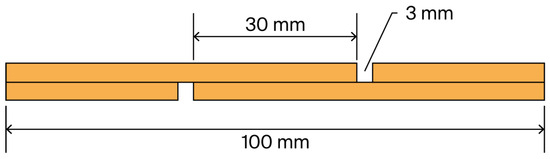
According to the study by Zhou, it demonstrated that wood treated at 160 °C for 120 min exhibited enhanced modulus of elasticity (MOE) and impact toughness relative to untreated controls, with only a modest reduction in modulus of rupture (MOR) from 52.75 MPa to 48.20 MPa [26]. These results indicated that wood maintains relatively stable mechanical performance under such thermal treatment conditions. Furthermore, extensive literature has demonstrated that longer thermal treatment times are commonly used in similar fields. Specifically, Song [13] and Meng [19] systematically investigated hot pressing of alkali-treated wood and bamboo at 140 °C and 100 °C, respectively, with treatment durations extending up to 24 h, and reported substantial enhancements in mechanical performance. So, the hot-pressing process in this study was controlled by three key parameters: hot-pressing temperature, holding time, and specific pressure. Three levels were set for each parameter, namely 110 °C, 130 °C, and 150 °C for temperature; 60 min, 90 min, and 120 min for holding time; and 1 MPa, 1.5 MPa, and 2 MPa for specific pressure. After hot pressing, the bonded panels were conditioned at room temperature for 24 h and then sawn into bonding strength test specimens with standard dimensions of 100 mm × 20 mm, as illustrated in Figure 1. The bonding area of 30 mm × 20 mm adopted in this study was selected to be consistent with the parameters used in previous relevant studies [19], based on the Chinese national standard GB/T 17657-2022 (Test methods of evaluating the properties of wood-based panels and surface decorated wood-based panels) [27].
Figure 1.
Schematic diagram of slotting in wood veneers.
2.2.2. Bonding Strength Test
Bonding strength was tested using a universal testing machine (WDW-300E, Jinan Popwil Co., Ltd., Jinan, China). Both ends of the specimen were clamped, and the specimen was fractured by downward movement of the crosshead. Five specimens were tested for each group.
2.2.3. Analysis of Variance
The F-test was used to determine whether the effect of each factor on the adhesive-free self-bonding strength was statistically significant in this study. A replicated orthogonal design was adopted, and the within-group pure error was used as the error term to avoid bias associated with empty column error. As shown in Table 1 and Table 2, the total number of specimens was , the bonding strength of each specimen was , the mean bonding strength of each group was , and the total sum of bonding strength was , while the total mean was . Furthermore, the total sum of squares could be calculated by , and the pure error sum of squares (within-group) was . The error degrees of freedom was . The significance critical values were and .
Table 1.
Four factors and their three levels.
Table 2.
Raw data statistics.
2.2.4. Scanning Electron Microscope (SEM)
The sample was directly mounted onto conductive adhesive tape and sputter-coated with gold for 45 s using an SC7620 sputter coater (Quorum Technologies, East Sussex, UK) operated at 10 mA. Morphological characterization and energy-dispersive X-ray spectroscopy (EDS) elemental mapping were performed on a Sigma 300 scanning electron microscope (ZEISS, Oberkochen, Germany). Specifically, morphological imaging was acquired with the secondary electron (SE2) detector at an acceleration voltage of 3 kV, while EDS elemental mapping was recorded at 15 kV using the same detector.
2.2.5. Fourier Transform Infrared Spectroscopy (FT-IR)
FT-IR spectra were recorded using a Nicolet iS20 spectrometer (Thermo Fisher Scientific, Waltham, MA, USA). Prior to measurement, the samples were thoroughly ground into fine powder, homogeneously mixed with potassium bromide (KBr) powder, and pressed into uniform thin pellets. All spectra were collected over the wavenumber range of 4000–400 cm−1 at a spectral resolution of 4 cm−1, with each spectrum averaged from 32 cumulative scans per sample.
3. Results and Discussion
3.1. The Properties of the Specimens
This study adopted a standard L9(34) orthogonal array, with four factors each set at three levels (Table 1), and five replicate specimens for each experimental group. In the studies by other scholars, bonding strength was also adopted as the primary evaluation index in their work [13,19], and the relevant mechanical properties showed an upward trend within the process range [26]. Furthermore, given that specimen requirements differed across various mechanical property tests, this study prioritized bonding strength as the core indicator under different process parameters. Investigations into other mechanical properties will be carried out sequentially in subsequent research.
As shown in Table 2, specimens in Group 5 exhibited the best bonding performance, with the corresponding process parameters set as follows: hot-pressing temperature of 130 °C, hot-pressing time of 90 min, hot-pressing pressure of 2 MPa, and NaOH/citric acid solution concentrations of 5% and 8%, respectively.
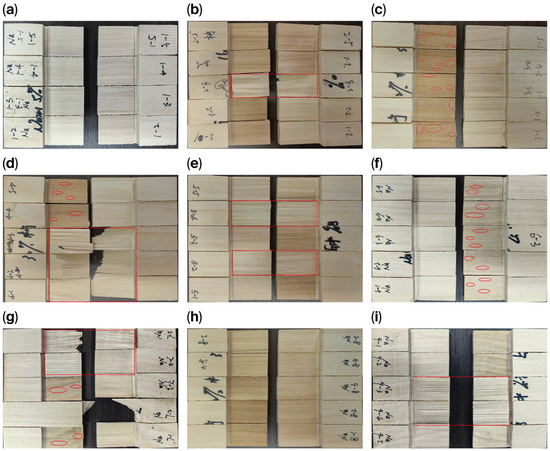
As illustrated in Figure 2, wood failure was observed on the NaOH-treated surface of Specimen 3 in Group 2. In Group 3, all specimens exhibited clear evidence of wood fibers from the citric acid-treated surface on the NaOH-treated bonding interface, indicating the formation of strong interfacial bonding between the two poplar wood substrates and suggesting that the acid–alkali treatment did not cause significant degradation of the intrinsic mechanical properties of the wood. For Group 4, wood failure on the citric acid-treated surface was observed in Specimens 1, 2, and 3, whereas in Specimens 4 and 5, wood fibers from the citric acid-treated surface were detected on the NaOH-treated surface. In Group 5 (the group with optimal overall performance), the failure mode was characterized by mutual fiber pull-out and tensile tearing between the two bonding surfaces. Wood tearing failure on the citric acid-treated surface was observed in Specimens 2 and 4. For Group 6, wood fibers from the citric acid-treated surface were detected on the NaOH-treated surface. In Group 7, wood failure on the NaOH-treated surface occurred in Specimens 2, 4, and 5, while fibers from the citric acid-treated surface were visible on the NaOH-treated surface of Specimens 1 and 3. For all specimens in Group 8, wood fibers from the citric acid-treated surface were observed on the NaOH-treated surface. In Group 9, wood failure on the citric acid-treated surface was observed in Specimens 3 and 4.
Figure 2.
Failure surfaces at the bonding interface for specimens from Groups 1–9, presented in (a–i).
3.2. Significance Analysis (Analysis of Variance)
As presented in Table 3, the influence of each factor on the bonding strength of adhesive-free self-bonded poplar glulam was ranked as follows: hot-pressing time > NaOH/citric acid solution concentration > hot-pressing pressure > hot-pressing temperature. Among these factors, hot-pressing time, NaOH/citric acid solution concentration, and hot-pressing pressure had highly significant effects on the bonding strength, whereas hot-pressing temperature showed no statistically significant effect.
Table 3.
Significance analysis.
It should be noted that the L9(34) orthogonal array used in this study is primarily intended for preliminary screening of process parameters. Its degrees of freedom only support the analysis of four main effects and cannot strictly isolate all two-factor interaction effects. Based on prior knowledge of the hot-pressing process and preliminary observations, the interaction between temperature and time was the most critical interaction affecting adhesive-free bonding strength. In future work, response surface methodology will be used to systematically analyze all interactions between factors and establish a more accurate process prediction model.
3.3. Range Analysis
A larger range (R) indicates a stronger influence of factor level changes on bonding strength, and therefore a higher importance of the factor.
: Total sum of bonding strength at the level j of the factor (sum of strength of all 15 specimens at this level);
: Average bonding strength at the j-th level of the factor, ;
Range : , where represents the maximum difference among the average bonding strengths at different factor levels.
Factor A (hot-pressing temperature) was set as an example.
Level 1 (110 °C):
Level 2 (130 °C):
Level 3 (150 °C):
Range:
By applying the identical analytical procedure outlined in the preceding section, , , and .
Based on the range values in descending order, the influence of each factor from strongest to weakest is:
That is, hot-pressing time > solution concentration > hot-pressing pressure > hot-pressing temperature, which is consistent with the F-value ranking obtained from the variance analysis.
3.4. FT-IR Analysis
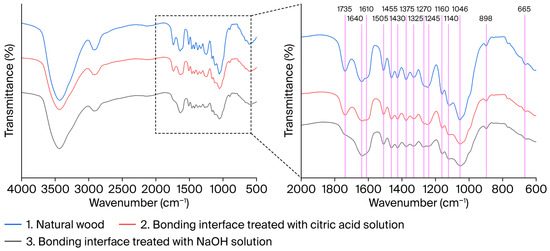
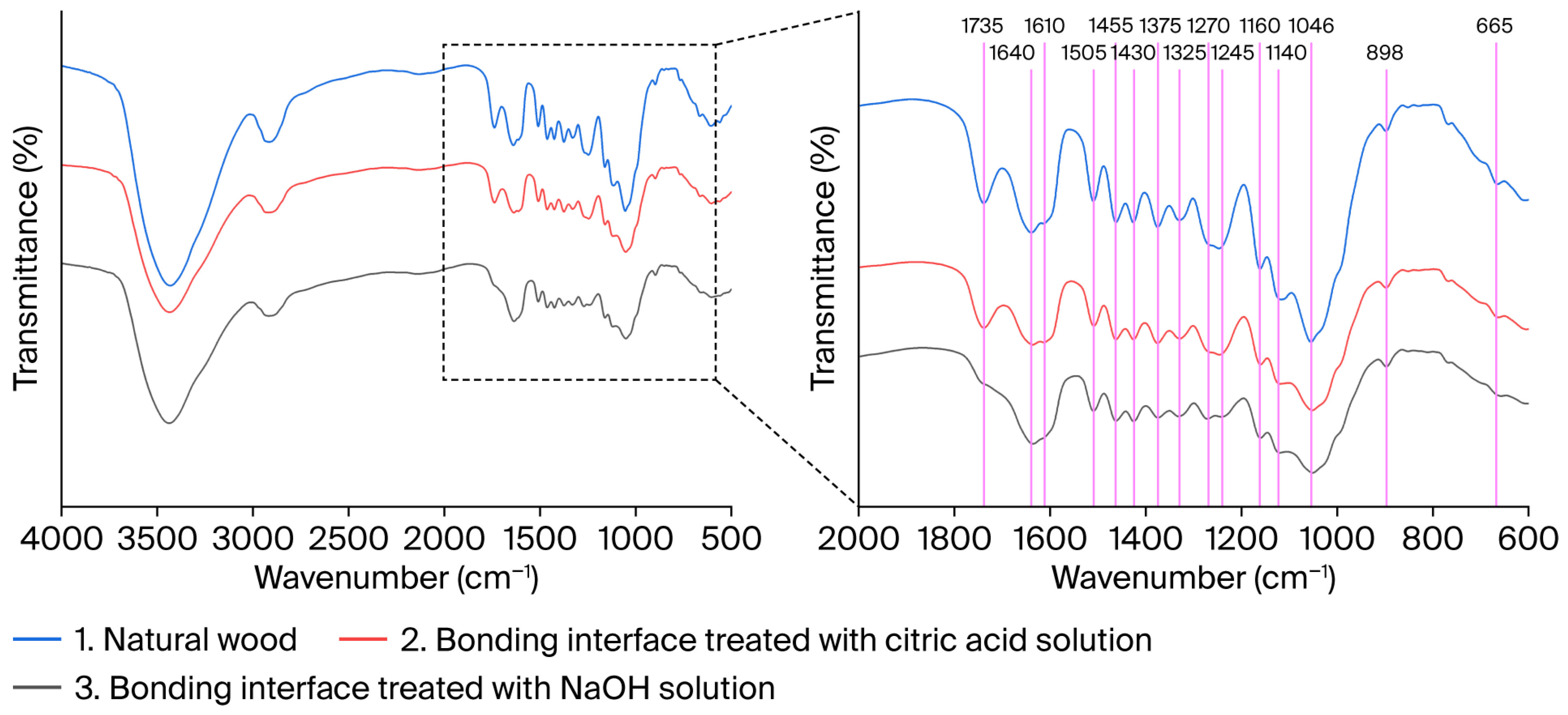
Table 4 presents the assignment of characteristic FT-IR absorption peaks of functional groups in wood. After treatment with sodium hydroxide or citric acid solution followed by hot pressing, the intensities of multiple infrared characteristic peaks of the samples changed, reflecting that the structures of the three main wood components including cellulose, hemicellulose, and lignin were affected by the synergistic alkali-heat or acid-heat action (Figure 3). The specific variation patterns are summarized as follows.
Table 4.
Characteristic FT-IR peaks of functional groups in wood.
Figure 3.
FT-IR spectra of the natural wood and bonding interface from Group 5.
The absorption peaks at 1375 cm−1, 1430 cm−1, 2920 cm−1, and 2850 cm−1 all correspond to C–H vibrations of methyl (–CH3) and methylene (–CH2–) groups [28]. Specifically, the peak at 1375 cm−1 is assigned to C–H bending vibrations of the groups in cellulose and hemicellulose; the peak at 1430 cm−1 is attributed to C–H bending vibrations of the groups in cellulose and lignin; the peaks at 2920 cm−1 and 2850 cm−1 arise from C–H stretching vibrations of the groups in cellulose and hemicellulose. The intensities of all four peaks decreased slightly after hot pressing, indicating that the synergistic effect of sodium hydroxide or citric acid with high temperature causes partial degradation of the molecular chains and amorphous regions of cellulose and hemicellulose.
The 3600–3000 cm−1 region, which corresponds to O–H stretching vibrations of hydroxyl (–OH) groups in cellulose, hemicellulose, and lignin, also showed a reduction in peak intensity [29]. This phenomenon is driven by two combined factors: first, partial degradation of lignin and hemicellulose reduces the total content of hydroxyl groups in the system; and second, hydroxyl groups in the amorphous regions of cellulose are oxidized to form aldehyde (–CHO) and carboxyl (–COOH) groups, and this oxidation process simultaneously weakens the absorption peak at 1640 cm−1 associated with H–O–H bending vibrations of adsorbed water. In addition, the decreased intensity of the peak at 1505 cm−1, corresponding to aromatic ring skeletal vibrations in lignin, confirms that lignin also undergoes partial degradation under synergistic alkali-heat or acid-heat treatment.
Two characteristic absorption peaks of hemicellulose exhibited a remarkable reduction in intensity. The peak at 1245 cm−1, corresponding to C–O–C stretching vibrations of ester linkages in hemicellulose, was markedly weakened. In particular, the peak at 1735 cm−1, assigned to C=O stretching vibrations of acetyl groups in hemicellulose, almost completely disappeared on the bonding surface treated with sodium hydroxide. These changes collectively verify that the synergistic alkali-heat or acid-heat treatment conditions adopted in this study induce substantial degradation of hemicellulose.
The characteristic peaks related to the skeletal structures of lignin and cellulose only showed slight intensity fluctuations, indicating that the main structures of both components were not significantly damaged. For lignin, the intensities of the peak at 665 cm−1 (out-of-plane bending vibrations of benzene rings), the peak at 1325 cm−1 (vibrations of guaiacyl and syringyl units), as well as the peaks at 1455 cm−1 and 1595 cm−1 (aromatic ring skeletal vibrations) all exhibited minor variations. This result suggests that the treatment only exerts a local effect on lignin, and its primary structure is largely retained without extensive degradation. For cellulose, the characteristic peak of β-glycosidic linkages at 898 cm−1, together with the peaks of glycosidic bond stretching vibrations at 1046 cm−1 and 1160 cm−1, also showed only slight fluctuations. This indicates that although the treatment conditions in this experiment exert a certain effect on the cellulose backbone, the overall skeleton of cellulose remains intact without significant structural disruption.
Compared with bamboo samples treated only with sodium hydroxide, the separate acid and alkali treatments applied to the bonding surfaces in this study have a mild effect on the benzene ring skeleton of lignin and the cellulose structure. In contrast, no detectable effect on the lignin aromatic skeleton or cellulose structure was observed in samples subjected to single sodium hydroxide treatment [30].
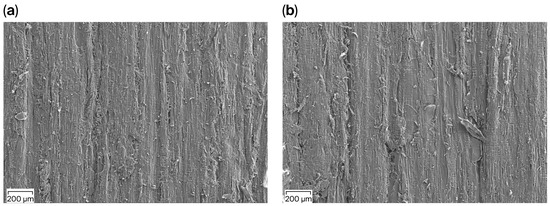
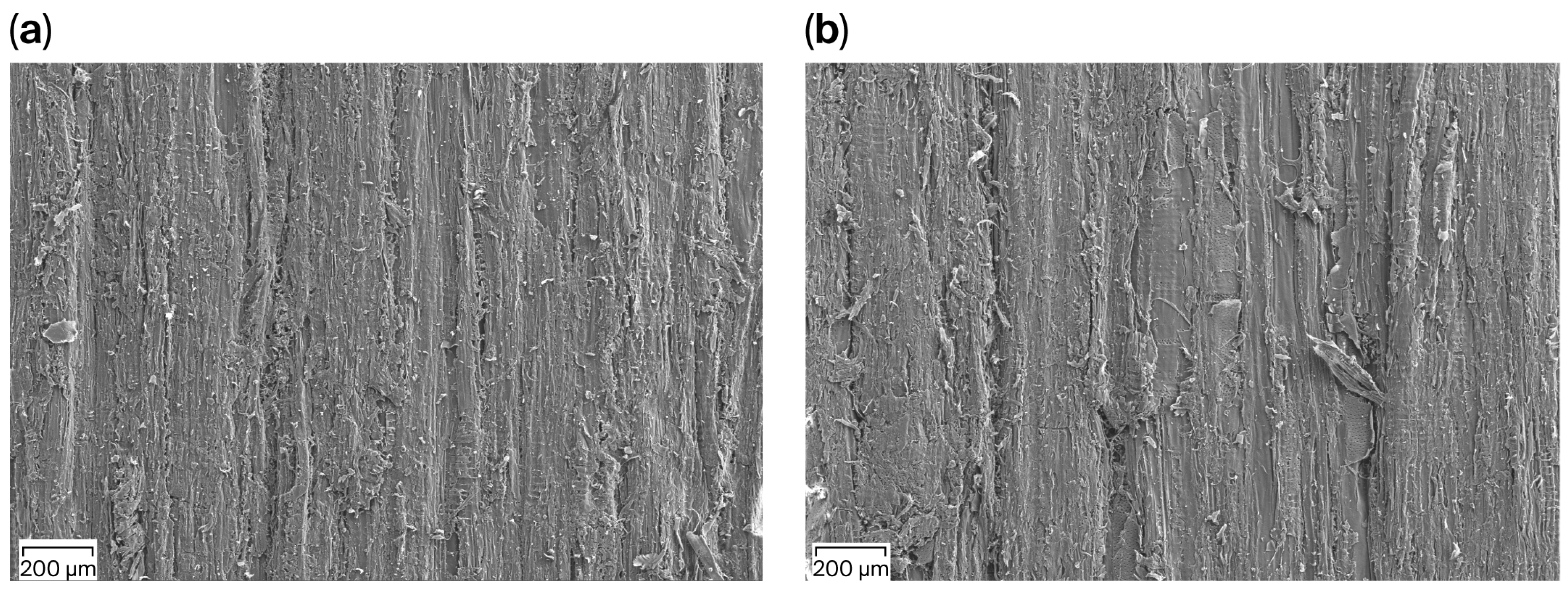
3.5. SEM Analysis
The microstructure of Group 5 specimens was observed using scanning electron microscopy. Figure 4a illustrates the morphology of the bonding surface pretreated with sodium hydroxide (NaOH), while Figure 4b presents the morphology of the bonding surface pretreated with citric acid. In both cases, a coating of fibers by molten, flowable material was observed, along with fiber fracture resulting from bonding failure at the bonding interface. As the only thermoplastic component in wood, lignin transitions from a glassy to rubbery state above its glass transition temperature (Tg). For air-dried wood used in this study, lignin Tg is 80–130 °C. At 130 °C, lignin exhibits sufficient viscous flow to spread across the interface, penetrate micro-pores, and encapsulate cellulose fibers, forming the observed molten structure. Hemicellulose undergoes mild deacetylation above 140 °C, producing small amounts of acetic acid and low-molecular-weight oligosaccharides. These act as plasticizers to further reduce lignin viscosity, but excessive degradation at 150 °C forms a weak boundary layer that reduces bonding strength. Cellulose remains thermally stable below 200 °C and serves as the rigid structural skeleton encapsulated by softened lignin.
Figure 4.
The morphology of the bonding interface pretreated by NaOH (a) and citric acid (b) from Group 5.
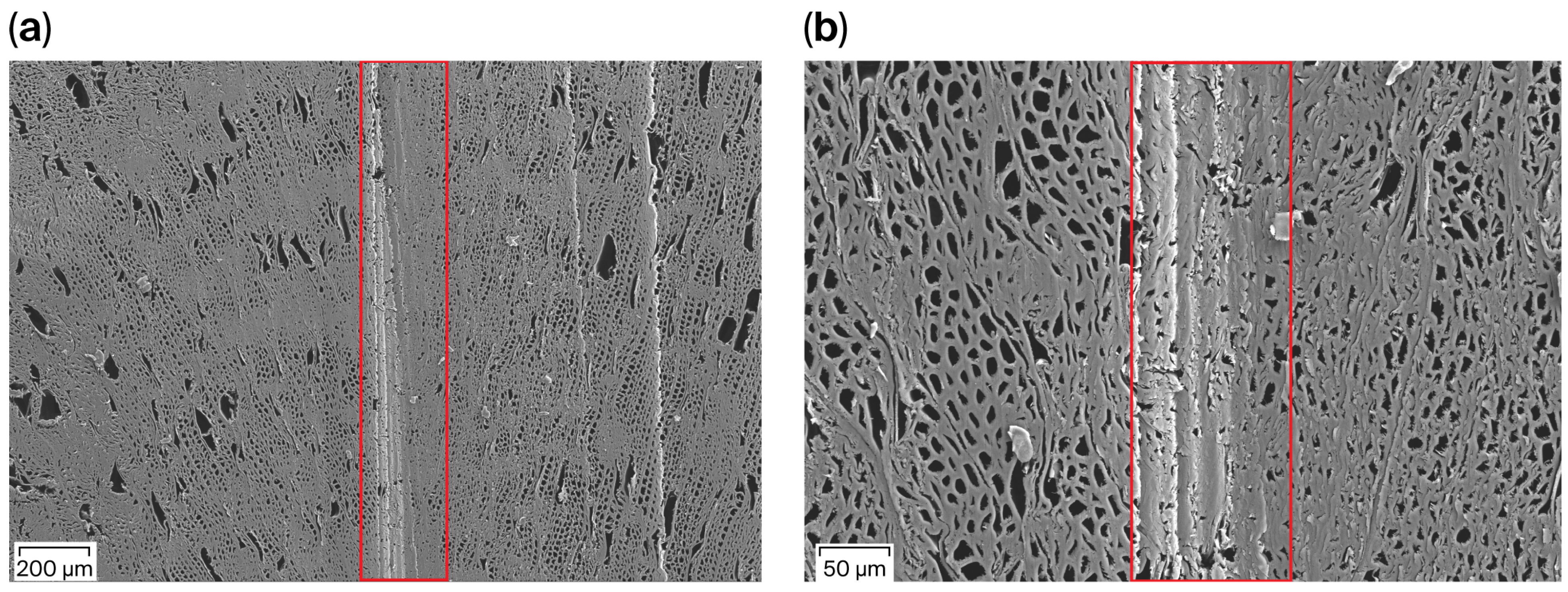
Figure 5 illustrates the cross-sectional morphology of the sample, with the bonding layer highlighted by the red box. The pores in the bonding layer were significantly compressed and formed an interwoven structure, whereas those in regions distant from the bonding layer retained their polygonal or elliptical shapes. This indicates that, under the synergistic effect of acid–alkali treatment and hot pressing, substantial structural compression occurred mainly within the bonding layer, while no significant structural changes were observed in regions away from the bonding layer.
Figure 5.
Cross-sectional morphology of the bonding interface (a) ×50 and (b) ×200 from Group 5.
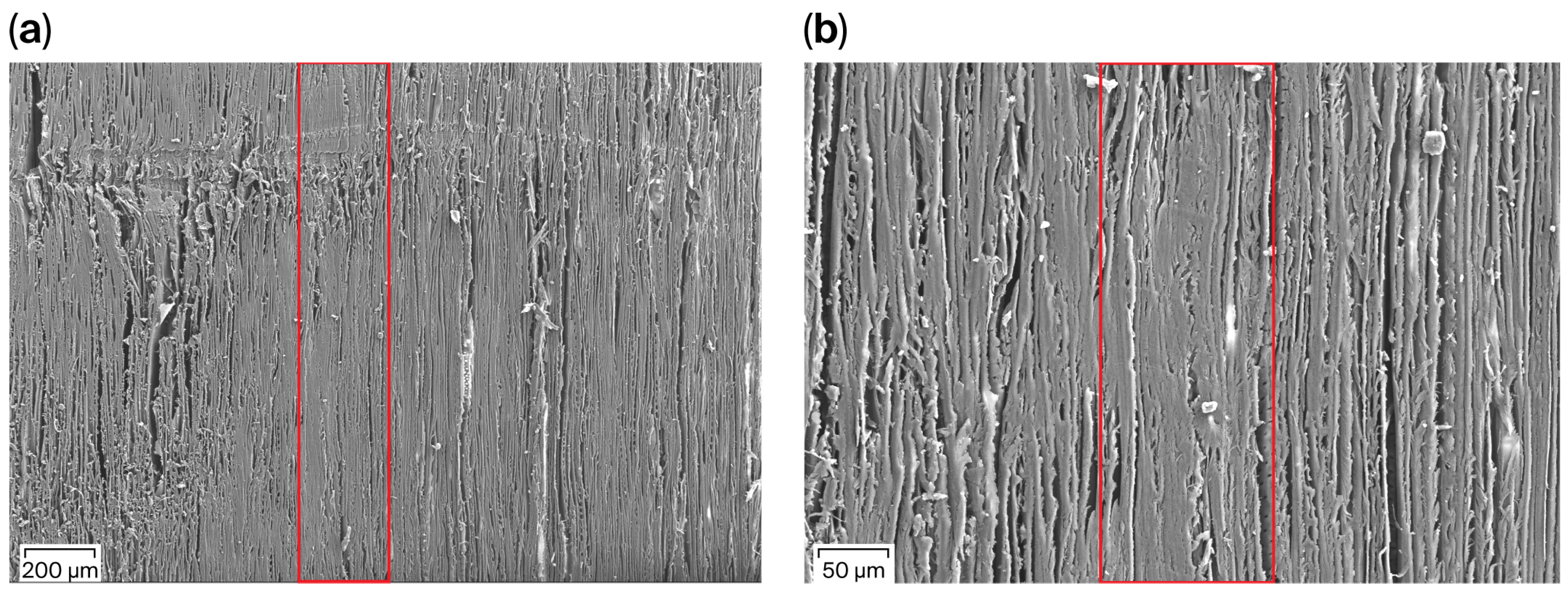
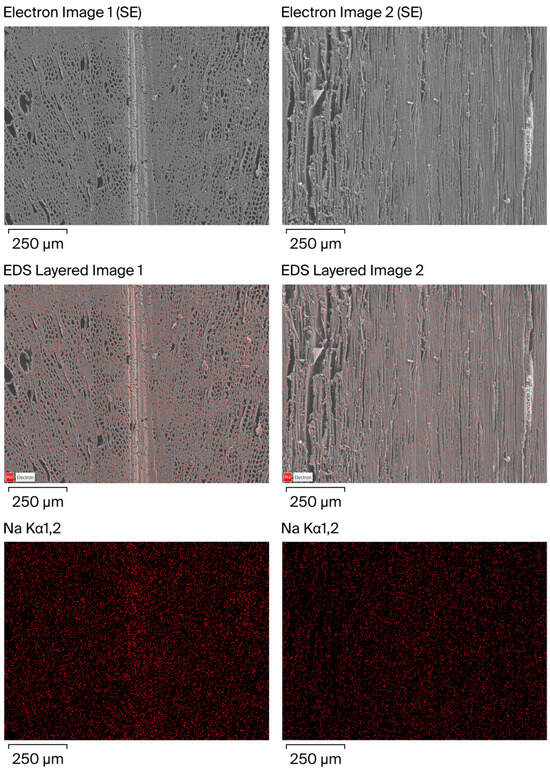
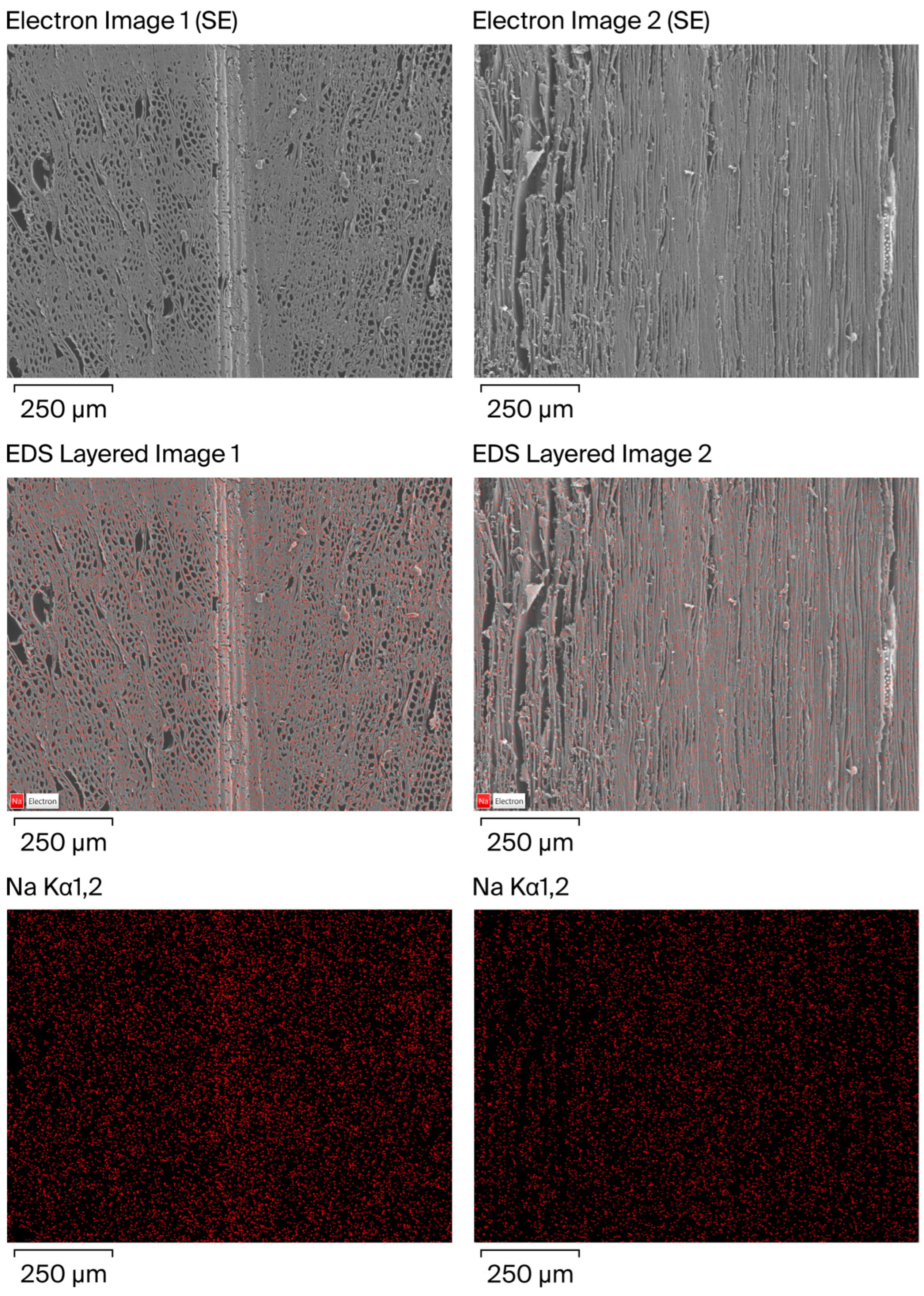
Figure 6 illustrates the radial section morphology of the sample containing the bonding layer, where the bonding layer is almost indistinguishable from the original radial section of the wood. Elemental mapping of the cross-section and radial section revealed that sodium was not only present in the molten bonding region but also uniformly distributed throughout the entire observable area (Figure 7). This indicates that the NaOH pretreatment fully swelled the wood matrix. Meanwhile, prior to hot pressing, deionized water was applied to the surface of the citric acid-treated wood, which was then placed onto the NaOH-treated wood to complete panel assembly. The neutralization reaction between NaOH and citric acid occurred via a water migration mechanism, further promoting the formation of the bonding layer.
Figure 6.
Radial morphology of the bonding interface (a) ×50 and (b) ×200 from Group 5.
Figure 7.
The elemental mapping of the bonding interface from Group 5.
4. Conclusions
The optimal process parameters obtained in this study were a sodium hydroxide (NaOH) solution mass fraction of 5%, a citric acid solution mass fraction of 8%, a hot-pressing time of 90 min, a hot-pressing temperature of 130 °C, and a hot-pressing pressure of 2 MPa. Under these optimal conditions, the bondline strength reached 5.82 MPa.
Under the synergistic effect of acid–alkali treatment and hot pressing, substantial degradation of hemicellulose, accompanied by slight degradation of lignin and cellulose, occurred in poplar wood. The resulting molten, flowable material encapsulated the fibers, thereby facilitating the formation of strong interfacial bonding within the bondline.
In this study, adhesive-free bonded laminated timber was prepared from poplar wood through combined acid–alkali pretreatment followed by adhesive-free hot pressing, and its bonding strength and bondline morphology were analyzed. However, other mechanical properties and water resistance still remain to be further explored. The application of coupling agents, filler particles, and other materials at the adhesive-free bonding interface also serves as one of the follow-up research directions.
Author Contributions
Conceptualization, X.Z. and Y.G.; methodology, X.Z. and Y.X.; validation, X.Z., Y.G., Y.X., G.Y., and M.L.; data curation, X.Z., Y.X., G.Y., and M.L.; writing—original draft preparation, X.Z.; writing—review and editing, Y.X. and Y.G.; funding acquisition, X.Z. All authors have read and agreed to the published version of the manuscript.
Funding
This research was funded by the National Natural Science Foundation of China (Grant No. 31901252) and the Natural Science Foundation of the High Education Institutions of Jiangsu Province (Grant No. 22KJA220003).
Data Availability Statement
The original contributions presented in this study are included in the article. Further inquiries can be directed to the corresponding authors.
Conflicts of Interest
The authors declare no conflicts of interest.
References
- Lin, T.; Fan, J.; Yin, X.F.; Tian, X.H.; Wang, Z.X. Process in preparation of transparent wood composites. Mod. Chem. Ind. 2019, 39, 43–48. [Google Scholar] [CrossRef]
- Zhao, H.; Miao, Q.X.; Huang, L.L.; Zhou, X.X.; Chen, L.H. Preparation of long bamboo fiber and its reinforced polypropylene membrane composites. J. For. Eng. 2021, 6, 96–103. [Google Scholar] [CrossRef]
- Chen, C.J.; Song, J.W.; Zhu, S.Z.; Li, Y.J.; Kuang, Y.D.; Wan, J.Y.; Kirsch, D.L.; Xu, L.S.; Wang, Y.B.; Gao, T.T.; et al. Scalable and sustainable approach toward highly compressible, anisotropic, lamellar carbon sponge. Chem 2018, 4, 544–554. [Google Scholar] [CrossRef] [Scilit]
- Ye, H.R.; Shi, Y.; Xu, B.B.; Guo, Z.H.; Fan, W.; Zhang, Z.F.; Mulvihill, D.M.; Zhang, X.H.; Shi, P.J.; He, X.M.; et al. Sustainable ultra-strong thermally conductive wood-based antibacterial structural materials with anti-corrosion and ultraviolet shielding. EcoMat 2023, 5, e12420. [Google Scholar] [CrossRef] [Scilit]
- Pang, X.N.; Yang, X.; Li, X.J.; Cao, M.; Yang, X. Improvement of porosity and dye permeability of moso bamboo splints by alkali etching. J. For. Eng. 2021, 6, 44–50. [Google Scholar] [CrossRef]
- Qian, J.; Yue, K.; Liu, S.D.; Lu, D.; Wu, P.; Li, Q. Augmenting bamboo strength and thermal stability for sustainable construction. J. Clean. Prod. 2024, 451, 142073. [Google Scholar] [CrossRef] [Scilit]
- Lian, H.Y.; Li, P.S.; Xu, Y.T.; Zhang, X.C. A simple and sustainable method for preparing high-strength, lightweight, dimensional stable, and mildew resistant multifunctional bamboo. Constr. Build. Mater. 2024, 415, 135027. [Google Scholar] [CrossRef] [Scilit]
- He, S.Y.; An, N.; Li, W.H.; Zhu, S.Z.; Dong, X.F.; Gan, W.T.; Li, Y.J.; Song, J.W.; Shen, S.P. Ion-mediated nanoengineering enables superflexible and mechanically robust wood-based aerogel. Nano Lett. 2026, 26, 5009–5018. [Google Scholar] [CrossRef] [Scilit] [PubMed]
- Han, J.W.; Li, J.P.; Zhang, W.J.; Yao, S.S.; Yu, X.L.; Yu, X.; Guo, X.X.; He, S.; Guo, D.K.; Lu, Y. Nature-inspired tooth-mimetic bamboo hierarchical composites with superhard, waterproof, and stain-resistant protective structures. Adv. Compos. Hybrid Mater. 2025, 8, 345. [Google Scholar] [CrossRef] [Scilit]
- Wang, B.; He, Y.R.; Yang, Z.H.; Sun, Q.; Zhang, X.P.; Shen, X.J.; Wen, J.L.; Chen, C.J.; Yuan, T.Q. Reconstitution of woody biomass framework via dual-functional lignin engineering toward efficient and salt-resistant solar desalination. Nat. Commun. 2026, 17, 3758. [Google Scholar] [CrossRef] [Scilit] [PubMed]
- Shi, Q.; Zhang, S.G.; Lv, J.X.; Bao, F.C.; Sun, X.M. Research status and prospect of Larix spp. Wood modification. J. Cent. South Univ. For. Technol. 2012, 32, 210–215. [Google Scholar] [CrossRef]
- Jungstedt, E.; Montanari, C.; Ostlund, S.; Berglund, L. Mechanical properties of transparent high strength biocomposites from delignified wood veneer. Compos. Part A Appl. Sci. Manuf. 2020, 133, 105853. [Google Scholar] [CrossRef] [Scilit]
- Song, J.W.; Chen, C.J.; Zhu, S.Z.; Zhu, M.W.; Dai, J.Q.; Ray, U.; Li, Y.J.; Kuang, Y.D.; Li, Y.F.; Quispe, N.; et al. Processing bulk natural wood into a high-performance structural material. Nature 2018, 554, 224–228. [Google Scholar] [CrossRef] [Scilit] [PubMed]
- Yang, Y.S.; Dang, B.K.; Wang, C.; Chen, Y.P.; Chen, K.C.; Chen, X.J.; Li, Y.Y.; Sun, Q.F. Anisotropic nature of lightweight wooden metamaterials with mechanical thermomechanical multistability. Adv. Funct. Mater. 2023, 33, 2307242. [Google Scholar] [CrossRef] [Scilit]
- Li, W.H.; An, N.; He, S.Y.; Dong, X.F.; Gan, W.T.; Zhu, S.Z.; Li, Y.J.; Wang, Y.F.; Song, J.W.; Shen, S.P. Isotropic bouligand wood with high strength and toughness. ACS Appl. Mater. Interfaces 2026, 18, 25337–25347. [Google Scholar] [CrossRef] [Scilit] [PubMed]
- Zhou, J.; Liu, Y.H.; Du, X.Y.; Xu, J.H.; Jin, Y.C.; Li, D.G.; Xu, Z.Y.; Chen, C.C. Facile green strategy for high-strength, wet-resistant, and transparent wood film via alkali cell wall swelling. Chem. Eng. J. 2026, 532, 174604. [Google Scholar] [CrossRef] [Scilit]
- Liao, L.Q.; Li, B.B.; Shi, Z.P.; Li, K.; Lu, Y.; Liu, Y.X.; Zhou, Q. Ultrastrong and tough paper structure from densified hybrids of multiscale cellulose fibers. Nat. Commun. 2026, 17, 3889. [Google Scholar] [CrossRef] [Scilit] [PubMed]
- Yu, W.J.; Yu, Y.L.; Jiang, Z.H. Bonding properties of bamboo surface. J. Bamboo Res. 2006, 25, 30–36. [Google Scholar]
- Meng, T.T.; Ding, Y.; Liu, Y.; Xu, L.; Mao, Y.M.; Gelfond, J.; Li, S.K.; Li, Z.H.; Salipante, P.F.; Kim, H.; et al. In Situ Lignin Adhesion for High-Performance Bamboo Composites. Nano Lett. 2023, 23, 8411–8418. [Google Scholar] [CrossRef] [Scilit] [PubMed]
- Jing, X.; Hu, J.B.; Li, Z.H.; Zhang, J.Y.; Chen, Y.F.; Li, S.Y.; Zhu, M.W. Scalable ultrastrong bamboo strips via interfacial homogeneous fusion. J. Bioresour. Bioprod. 2026, 11, 100248. [Google Scholar] [CrossRef] [Scilit]
- Hu, J.; Wu, J.Y.; Huang, Y.X.; He, Y.Q.; Lin, J.; Zhang, Y.M.; Zhang, Y.H.; Yu, Y.L.; Yu, W.J. Super-strong biomimetic bulk bamboo-based composites by a neural network interfacial design strategy. Chem. Eng. J. 2023, 475, 146435. [Google Scholar] [CrossRef] [Scilit]
- Fan, H.Y.; Chen, L.H.; Miao, Q.X.; Huang, L.L.; Zhou, X.X. Preparation and characterization of natural moso bamboo fiber. For. Mach. Wood Work. Equip. 2020, 48, 37–41. [Google Scholar] [CrossRef]
- Wu, Y.; Han, Y.; Huang, N.; Wu, J.M.; Tang, C.Y.; Zhou, J.C.; Huang, Q.T. Effect of delignification process on properties of transparent wood. J. For. Eng. 2019, 4, 98–104. [Google Scholar] [CrossRef]
- Guo, Z.X.; Wang, H.; Di, M.W.; Zhao, J.N. Freezing activation of wood fibers and preparation of binder-free boards. Biomass Chem. Eng. 2022, 56, 16–22. [Google Scholar] [CrossRef]
- Zhao, S.C.; Zhang, W.G.; Meng, F.D.; Wei, J.G.; Bao, Y.J.; Li, N.; Lin, F.; Wang, Z.; Bao, M.Z. Effect of thermo-mechanical treatment with different initial moisture content on bamboo cell walls. Constr. Build. Mater. 2024, 411, 134801. [Google Scholar] [CrossRef] [Scilit]
- Zhou, J.B.; Deng, C.J.; Jiang, S.X.; Zhang, Q.S. Study on Physical and Mechanical Property of Carbonized Wood. China For. Prod. Ind. 2008, 28–31+41. [Google Scholar] [CrossRef]
- GB/T 17657-2022; Test Methods of Evaluating the Properties of Wood-Based Panels and Surface Decorated Wood-Based Panels. Standards Press of China: Beijing, China, 2022.
- Chen, W.H.; Kuo, P.C. Isothermal torrefaction kinetics of hemicellulose, cellulose, lignin and xylan using thermogravimetric analysis. Energy 2011, 36, 6451–6460. [Google Scholar] [CrossRef] [Scilit]
- Yang, Y.S.; Shen, H.J.; Qiu, J. Fabrication of biomimetic robust self-cleaning superhydrophobic wood with canna-leaf-like micro/nanostructure through morphgenetic method improved water-, UV-, and corrosion resistance properties. J. Mol. Struct. 2020, 1219, 128616. [Google Scholar] [CrossRef] [Scilit]
- Zhu, X.D.; Xue, Y.Y.; Qian, L.; Mei, C.T.; Gao, Y. Fabrication of self-bonding laminated bamboo via a dual-treatment method combining alkali treatment and hot pressing. Constr. Build. Mater. 2025, 490, 142553. [Google Scholar] [CrossRef] [Scilit]

Disclaimer/Publisher’s Note: The statements, opinions and data contained in all publications are solely those of the individual author(s) and contributor(s) and not of MDPI and/or the editor(s). MDPI and/or the editor(s) disclaim responsibility for any injury to people or property resulting from any ideas, methods, instructions or products referred to in the content. |
© 2026 by the authors. Licensee MDPI, Basel, Switzerland. This article is an open access article distributed under the terms and conditions of the Creative Commons Attribution (CC BY) license.