


Abstract
With the increasing adoption of the Engineering, Procurement, and Construction (EPC) contracts in government-funded and large-scale infrastructure projects, bill-of-quantities bidding based on preliminary design has emerged as a new procurement approach. Although this approach improves early-stage investment control, it also imposes higher requirements on contractors’ cost-management capabilities. Based on whole-process cost-control theory, this study develops a design-driven full-process cost-control framework for EPC projects using a reclaimed water plant project in northwest China as a case study. The model comprises three layers: a design-driven decision-making layer, a whole-process cost-control layer, and a collaborative management support layer. It covers the key stages of bidding, design, procurement, construction, and final settlement, and integrates design, cost, and procurement management with Building Information Modeling (BIM) and dynamic monitoring based on Earned Value Management (EVM). The case results show that the model can effectively identify and control cost risks, promote the integration of design optimization and cost control, and improve cost management performance. The final settlement price was 0.93% below the contractual settlement ceiling and about 6.6% below the initial investment estimate. This study provides both theoretical support and practical guidance for enhancing full-process cost control in EPC projects under preliminary-design bill-of-quantities bidding.
1. Introduction
In recent years, General Contracting System contracts have been widely promoted in the construction industry. For instance, South Korea’s Public Works General Contracting Promotion Act stipulates that government-funded projects should, in principle, adopt general contracting [1]. In Malaysia, relevant policy documents also specify the adoption of general contracting for government investment projects to better control cost and schedule [2]. In China, many provinces have further mandated the Engineering, Procurement, and Construction (EPC) model for government-funded building and municipal projects starting in 2026, aiming to promote the deep integration of design, procurement, construction, and production [3]. For example, the Hubei Province issued the Notice on Further Promoting the Reform of the Engineering General Contracting System (Ezhengban Fa [2025] No. 42), which clearly requires government-invested housing and municipal engineering projects to adopt the EPC model [4]. These policy-driven measures have led to a rapid increase in EPC projects, posing significant challenges to the management capabilities of general contracting units.
EPC projects are increasingly being tendered after the approval of the preliminary design and project cost estimates, against the backdrop of increasingly stringent requirements for investment limits and cost controllability in government-funded projects. Under this model, the owner may conduct tendering based on the preliminary design scheme and adopt bill-of-quantities-based pricing where the design depth allows. This approach helps clarify the technical scheme and project scope at the preliminary design stage, strengthens investment control through the approved design estimate and maximum bid price, and introduces market competition through tendering. It is typically associated with bill-of-quantities-based pricing, settlement based on actual quantities for agreed unit-price items, and an overall ceiling price.
While this approach enhances investment constraints through preliminary design outcomes, it also transfers risks associated with insufficient design depth, unclear bill boundaries, and uncertainty in subsequent implementation to the EPC contractor [5,6,7]. In addition to bearing the technical risks arising from design development, contractors must also address the risks of quantity variations and billing inaccuracies caused by the limited completeness of preliminary design documents. These risks are particularly pronounced in complex industrial projects such as reclaimed water treatment plants, which involve multiple technical alternatives, the selection and integration of high-value equipment, complex interdisciplinary coordination, and substantial information gaps between preliminary design and construction drawing design. Existing studies on EPC cost control have mainly focused on pricing mechanisms, risk allocation, and cost management at individual project stages [6,8]. Some scholars have also explored the application of Building Information Modeling (BIM) and Earned Value Management (EVM) in EPC cost control [9,10,11]. Nevertheless, systematic research on cost-control mechanisms and system development for EPC projects under the preliminary-design bill-of-quantities bidding model remains limited.
To address this gap, this study adopts a whole-process cost-control perspective and focuses on practical challenges in this procurement model, including the strong coupling between design and cost, insufficient forward placement of control checkpoints, and weak dynamic feedback during project implementation. Accordingly, this study seeks to answer the following research questions:
- Q1: How can a design-driven full-process cost-control framework be developed to integrate bidding, design, procurement, construction, and final settlement stages?
- Q2: How can BIM and EVM be incorporated into the proposed framework to support dynamic cost monitoring and deviation correction?
- Q3: What cost-control effects can be achieved when the proposed framework is applied to a reclaimed water plant EPC project?
To answer these questions, this study develops and validates a design-driven, full-process cost-control system for EPC projects through a case study of a reclaimed water plant project. The results provide both a theoretical basis and a practical reference for general contractors seeking to improve cost management on similar projects.
2. Literature Review
2.1. EPC Procurement, Pricing Mechanisms, and Contractor Risk Allocation
Compared with traditional construction general contracting, EPC projects under the post-preliminary-design bill-of-quantities tendering model place greater demands on the general contractor’s comprehensive capabilities [11,12]. First, it is necessary to have a strong ability to identify risks at the bidding stage, abandon simple quotation-based decision-making, and conduct in-depth reviews, such as verifying preliminary design drawings and bills of quantities, and predicting potential omissions [11,12,13]. Second, it is necessary to design in depth, implement cost-linkage control, and establish a collaborative decision-making mechanism that integrates design, cost, and procurement to avoid the disconnect between technical decisions and economic constraints [14,15,16]. Third, it is necessary to have strong skills in interpreting contracts, managing settlements, processing data, and building the chain of evidence to avoid being in a passive position during settlements [12,14]. Fourth, it is necessary to establish a cross-departmental linkage mechanism to achieve full-process coordination from bid evaluation to settlement management [14,15,16]. Finally, whether a project can achieve its expected profit and cost target largely depends on its ability to manage across stages, specialties, and organizations [15,16].
In total, the difficulty lies not only in how the contract price is formed but also in how front-end design deviations are magnified during subsequent implementation, ultimately leading to cost overruns and settlement disputes [13,14]. Previous research contributes to understanding the higher managerial requirements imposed on EPC contractors, particularly regarding bidding risk identification, design–cost coordination, contract interpretation, settlement management, and cross-departmental collaboration [11,12,16]. Nevertheless, the existing literature remains relatively fragmented. Most studies discuss risk allocation, pricing, design management, or settlement control separately, rather than explaining how cost risks are transmitted and amplified across project stages. Therefore, EPC cost control should be examined as a cross-stage, closed-loop management issue rather than as a set of isolated, stage-based control measures.
2.2. BIM- and EVM-Based Cost Control in EPC Projects
Previous studies have explored the application of BIM and EVM in EPC project cost control [9,10,11]. BIM contributes to cost management by supporting quantity takeoff, clash detection, design coordination, and cost visualization, while EVM provides quantitative indicators, such as cost variance and cost performance index, for monitoring cost deviations during project implementation [9,10,11,17,18]. These studies provide useful technical tools for improving the accuracy, timeliness, and transparency of project cost management. However, less attention has been paid to how BIM and EVM can be embedded into a design-driven, full-process cost-control framework that connects bidding risk assessment, design optimization, procurement price verification, construction-stage deviation correction, and final settlement management. This limitation is particularly important under preliminary-design bill-of-quantities bidding, where early design uncertainty and later implementation risks coexist. Therefore, the novelty of this study does not lie in the independent use of BIM or EVM, but in integrating these digital tools with design optimization, procurement coordination, and settlement evidence management within a contractor-oriented closed-loop framework.
3. Research Methodology
3.1. Research Design
To address the research gaps and answer the research questions, this study adopts a theoretical framework development and case validation research design. The purpose of this design is to develop a design-driven full-process cost-control framework for EPC projects under preliminary-design bill-of-quantities bidding and then validate its applicability through an actual engineering project. The research process includes three main steps. First, the study identifies the key research questions related to design-driven full-process cost control in EPC projects under preliminary-design bill-of-quantities bidding. Second, a design-driven, full-process cost-control framework is developed based on prior studies and practical project management requirements. Third, the proposed framework is validated through an EPC project for a real reclaimed water plant in northwest China.
3.2. Framework Development Basis
The proposed framework was developed based on three foundations. The first is whole-process cost-control theory, which emphasizes continuous cost management from early decision-making and design to procurement, construction, and final settlement. The second is the risk-transmission logic of EPC projects under preliminary-design bill-of-quantities bidding, where insufficient preliminary design depth, unclear bill boundaries, and subsequent implementation uncertainty may be transmitted across bidding, design development, procurement, construction, and settlement. The third is the practical integration of design optimization, procurement coordination, BIM-based quantity and clash checking, and EVM-based dynamic monitoring.
3.3. Case Selection
The proposed framework was validated through an EPC project for a reclaimed water plant in northwest China. The project was selected because it provides an appropriate practical scenario for examining the proposed model. As a typical environmental infrastructure project, the reclaimed water plant has a complex process flow and involves many high-value pieces of equipment. Equipment investment accounts for approximately 35–40% of the total investment, making cost control particularly difficult. The project has a processing capacity of 14,000 m3/d. The construction scope includes regulating tanks, softening tanks, membrane workshops, MVR evaporation systems, and supporting pipelines. The total investment for the project is 196 million yuan, and the EPC contract price is 145 million yuan, including 142.63 million yuan for construction and installation. The project adopted the preliminary-design bill-of-quantities bidding model, and the contract clearly included a total settlement cap clause.
3.4. Justification for Single-Case Validation
Although this study uses a single-case validation design, the selected case is information-rich and suitable for examining the proposed framework. The project was delivered under the preliminary-design bill-of-quantities bidding model, involved complex process systems and the procurement of high-value equipment, and included strict settlement-ceiling requirements. These characteristics make it a typical case for analyzing cost-risk transmission and full-process cost control in EPC projects. Therefore, the case is appropriate for analytical validation of the proposed framework. However, because the study is based on one project, the findings should be understood as analytical validation rather than statistical generalization.
3.5. Data Collection and Analytical Procedures
Project data were collected from preliminary design documents, tender bill-of-quantities documents, EPC contract records, target cost breakdown records, design optimization records, procurement records, BIM-based quantity and clash-checking outputs, monthly EVM monitoring records, change and claim records, and final settlement documents. The analytical procedures included process tracing of cross-stage cost-risk transmission, stage-based cost comparison, benchmark comparison against the contractual settlement ceiling and the initial investment estimate, EVM-based performance analysis, and sensitivity analysis. The effectiveness of the framework was evaluated using both process-based and outcome-based criteria. The process-based criteria included early risk identification, design–cost–procurement coordination, dynamic monitoring, deviation correction, dispute control, and evidence-chain completeness. The outcome-based criteria included cost savings, procurement cost reduction, avoided rework, EVM-based cost performance, settlement-cycle improvement, and final settlement performance.
4. Development of the EPC Full-Process Cost-Control Framework
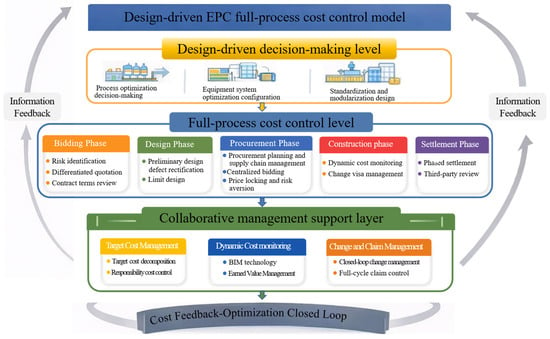
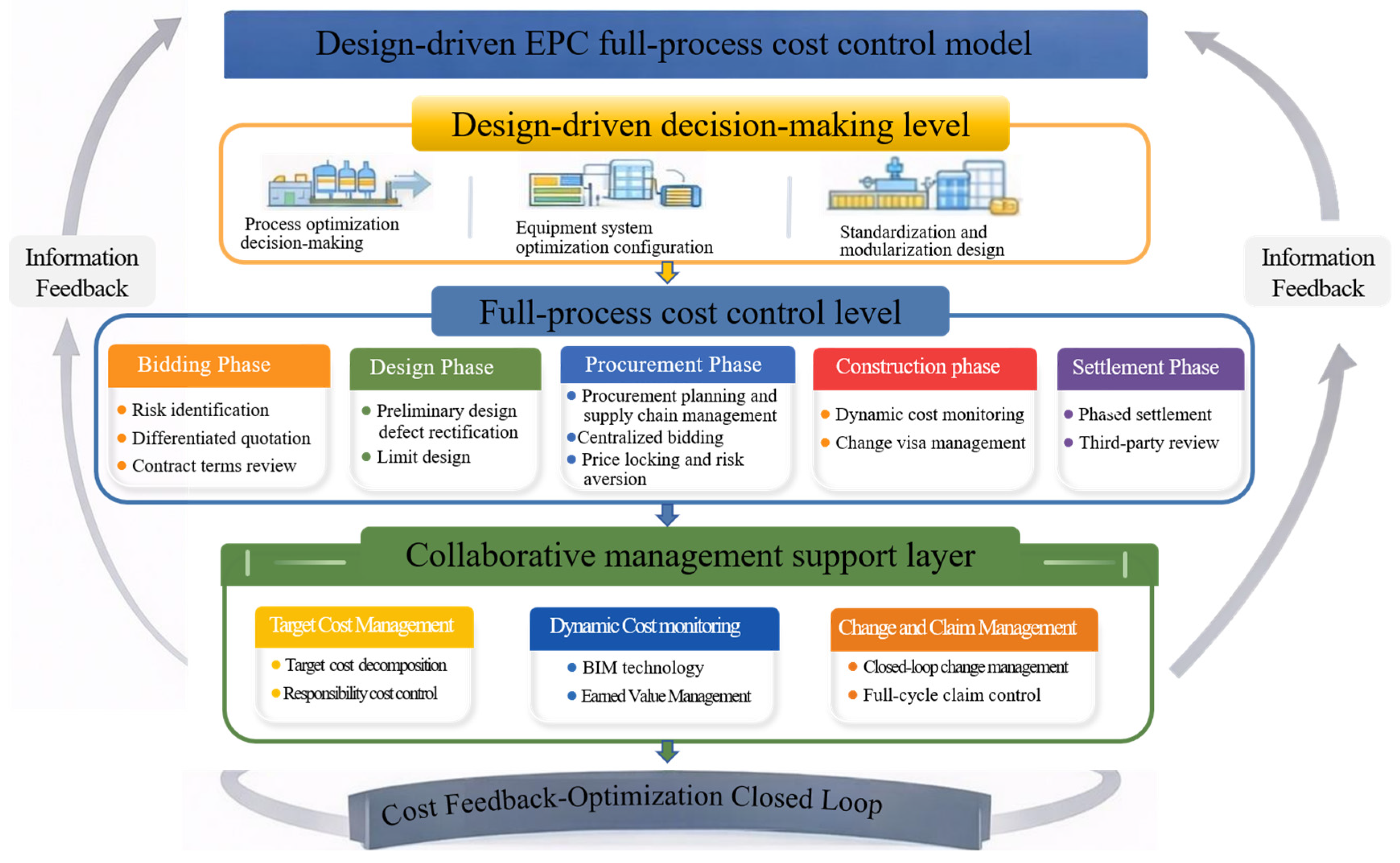
This study focuses on EPC projects under the post-design bill-of-quantities bidding model. It considers both the cost-control characteristics of this procurement model and the design-led strengths of traditional design institutes during their transition to EPC general contracting. Based on these, a three-layer closed-loop model for design-driven whole-process cost control is developed, as illustrated in Figure 1. From top to bottom, the model comprises the design-driven decision-making layer, the whole-process cost-control layer, and the collaborative management support layer. These three layers are interconnected through bidirectional information feedback, forming a linked control system in which dynamic cost control is achieved through a closed-loop management mechanism. Specifically, (1) the design-driven decision-making layer emphasizes cost control at the source and defines the fundamental framework of project cost; (2) the whole-process cost-control layer spans the entire project implementation stage and serves as the primary carrier for cost-control execution; and (3) the collaborative management support layer provides institutional, technical, and data support for the other two layers, thereby ensuring the systematicity and effectiveness of the overall cost-control system. Through coordinated operations, the three-layer system enables systematic management of EPC projects across the entire process, from cost target setting to execution monitoring and deviation correction, effectively overcoming the fragmentation of traditional stage-based cost control and the disconnect between design and cost management.
Figure 1.
Framework of full-process cost control for EPC projects.
4.1. Design-Driven Decision-Making Level
The design decision-making stage is the core link in cost control of EPC projects. Research shows that the owner’s or project team’s ability to influence project cost is greatest during the early engineering and design stages, while actual expenditures at this stage remain relatively low [19]. Therefore, the design-driven decision-making stage is the source of cost control throughout the entire process. Through optimization decisions regarding process, equipment, and design, cost control is achieved in advance, thereby avoiding the risk of cost overruns in later stages [20]. Design-driven decision-making mainly focuses on three core dimensions: process optimization decision, equipment system optimization configuration, and standardization and modularization design.
4.1.1. Process Optimization Decision
Based on the functional requirements of the project, multi-scheme technical and economic comparison of the core process route should be conducted by comprehensively considering construction investment, operating cost, operation and maintenance difficulty, and project regional adaptability. The optimal process scheme should then be selected to achieve cost optimization throughout the construction and operation cycle [21,22].
4.1.2. Equipment System Optimization Configuration
Equipment selection and system-matching standards should be determined in conjunction with the process plan. Through equipment parameter optimization and system integration design, equipment procurement investment can be reduced while meeting process requirements, and later equipment operation and maintenance costs, energy consumption, and other operating costs can also be reduced [19].
4.1.3. Standardization and Modular Design
Standardized design for professional projects and modular layout of core structures and equipment systems should be promoted to simplify construction procedures, enhance construction efficiency and feasibility, reduce on-site construction management costs and the risk of project delays, and create conditions for centralized procurement and large-scale construction [23,24].
4.2. The Full-Process Cost Control Level
The full-process cost control level is the core of EPC project cost control, covering the five project implementation stages: bidding, design, procurement, construction, and final settlement. Each stage develops targeted control mechanisms based on the characteristics of post-design bill-of-quantities bidding to achieve seamless connections and precise cost control at each stage, and to ensure consistency of cost control objectives through information feedback between stages [25,26,27]. This layer is the specific implementation layer of cost control, covering five key stages [14].
4.2.1. Bidding Phase
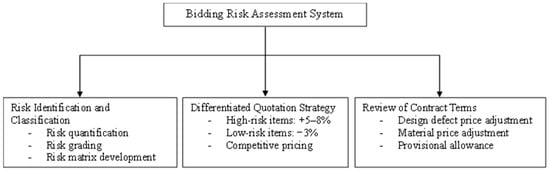
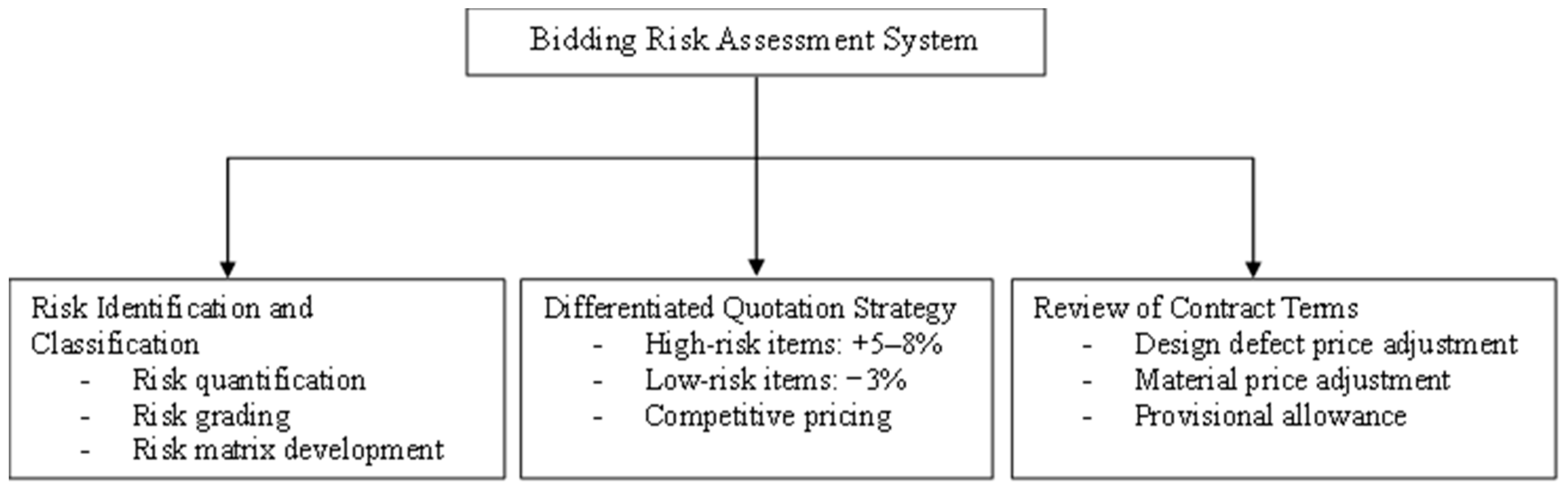
The core objective of the bidding stage is to accurately identify risks, formulate scientific quotation strategies, optimize contract terms, reserve reasonable risk space for subsequent cost control, and clarify the basis for cost adjustment [28]. At this stage, the study established a “design-driven + cost early warning” bidding risk assessment system, as shown in Figure 2. This system, through pre-positioned identification of initial design defects and quantified risk classification, enables contractors to precisely reserve risk space at the bidding stage, enhancing risk predictability compared to traditional empirical quotations.
Figure 2.
Bidding risk assessment system.
4.2.2. Design Phase
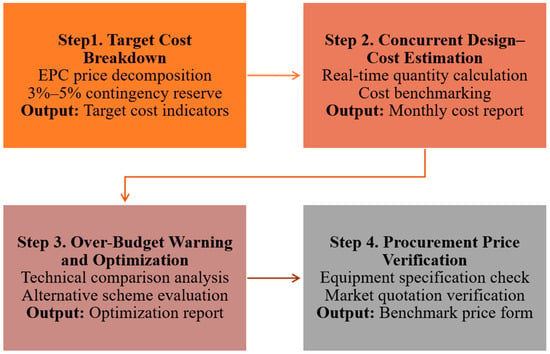
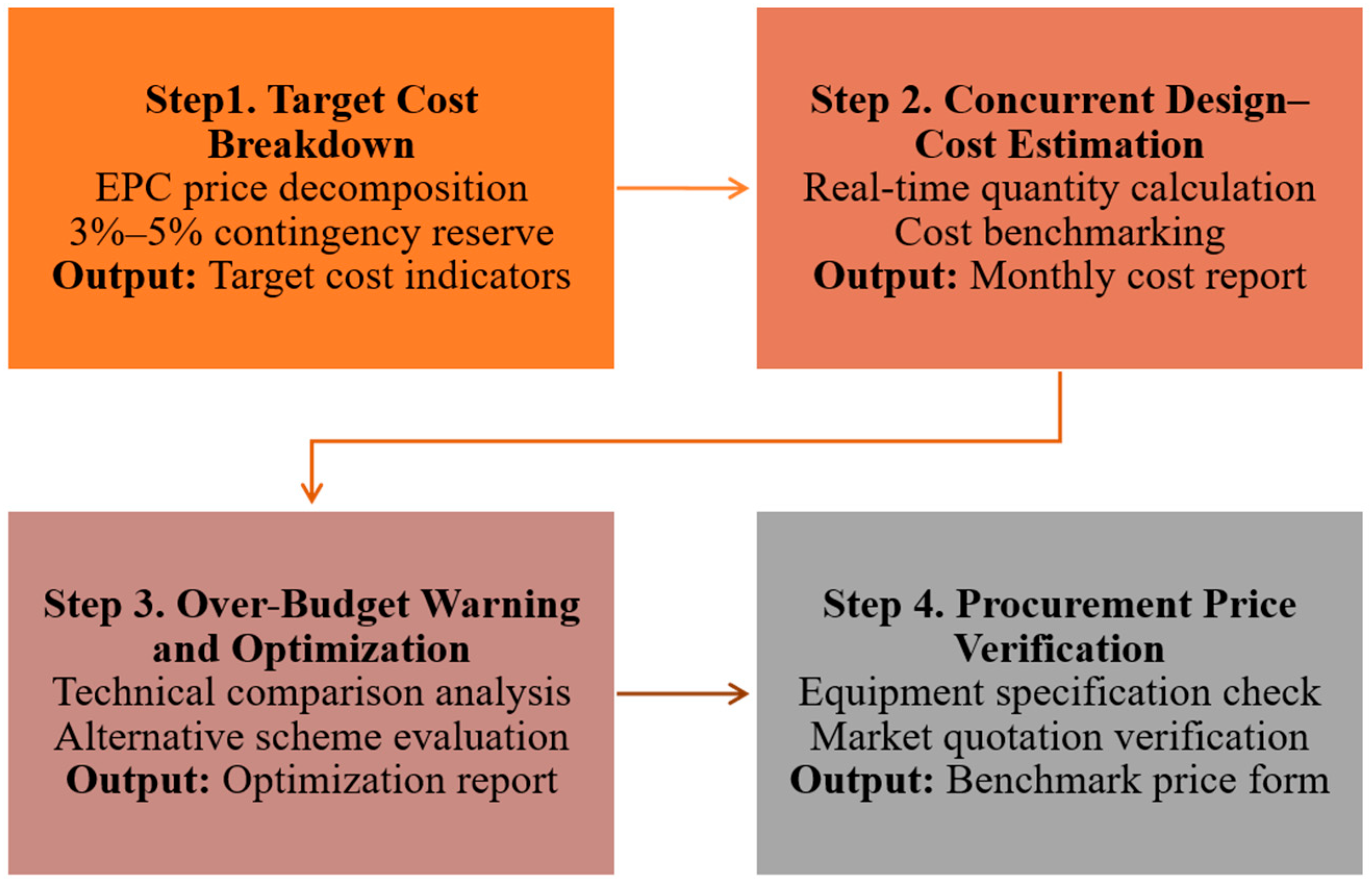
The design phase focuses on rectifying initial design defects and limiting design and integrates cost control into the entire design process through the three-in-one linkage of design, cost, and procurement to avoid overruns in the later stage due to the disconnection between design and cost. The core mechanism is the linkage between the limit design and the cost [27]. The execution of the limit design is shown in Figure 3 and was implemented through a four-step process. First, the EPC contract price was decomposed into discipline-level target costs, and a 3–5% contingency reserve was established to provide flexibility for potential design and implementation risks. Second, concurrent design and cost estimation were carried out by the design and cost departments. During this process, real-time quantity calculation and cost benchmarking were conducted to ensure that design decisions remained consistent with the target cost requirements. Third, when a potential over-budget issue was identified, a technical comparison and optimization process was triggered. Instead of simply reporting the overrun, the project team developed alternative technical schemes, estimated their cost impacts, and verified their economic feasibility. Fourth, procurement price verification was conducted to confirm equipment specifications and the range of market quotations, thereby ensuring that design optimization was aligned with actual procurement conditions. Through these steps, the limit-design process formed a closed linkage among target cost breakdown, design–cost coordination, over-budget warning, and procurement verification.
Figure 3.
Execution process of the limit design phase.
4.2.3. Procurement Stage
During the procurement stage, cost control was implemented through three main strategies. First, phased procurement planning and supply-chain management were adopted to align procurement activities with on-site construction progress and strengthen supplier evaluation and management [29]. This helped reduce the risks of supply delays and poor coordination between procurement and construction. Second, centralized bidding was used for key equipment, such as membrane modules and MVR systems [28]. By inviting multiple suppliers to compete, the project enhanced its bargaining power in procurement and achieved economies of scale. Third, price-locking mechanisms were adopted for key materials and resources through long-term supply agreements, thereby reducing the impact of market price fluctuations [30,31]. Together, these measures helped connect design requirements, procurement decisions, and construction needs and supported cost control during the procurement stage.
4.2.4. Construction Phase
The construction phase is key to achieving the cost-control target. The core is to ensure that actual costs remain within the target range through dynamic monitoring and standardized management, and to promptly correct cost deviations. Two control mechanisms are mainly implemented in this phase: dynamic cost monitoring and performance analysis, and standardized management of change visa.
Establish a monthly cost monitoring system using Earned Value Management (EVM) methods. Key indicators:
CV = EV − AC
CPI = EV/AC
Among them are EV (budgeted value of completed work), AC (actual cost), CV (cost deviation), CPI (cost performance index).
Early warning mechanism: Trigger correction when CPI < 1, early warning threshold ±10% (set according to the proportion of contract measure fees).
To strengthen the forecasting function of EVM, two additional indicators were introduced: estimate at completion (EAC) and to-complete performance index (TCPI). EAC was used to forecast the expected final cost based on current cost performance, while TCPI was used to evaluate the cost efficiency required to meet the target cost for the remaining work. These indicators are expressed as follows:
where BAC represents the budget at completion. Compared with CPI and CV, which mainly reflect current cost performance, EAC and TCPI provide forward-looking information for cost forecasting and corrective decision-making. When EAC approaches or exceeds the target cost, or when TCPI becomes significantly higher than 1.0, the project team should initiate corrective actions, including design optimization, procurement adjustment, construction-method review, or change-control tightening.
EAC = BAC/CPI
TCPI = (BAC − EV)/(BAC − AC)
Establish the principle of “no change without basis, no construction without instructions”, and all changes must be based on legal grounds such as initial design defect filing, specification update, changes in site conditions, and written instructions from the owner. In addition, a standardized change-management process should be established, including change application, technical assessment, cost estimation, graded approval, implementation, and document filing. This process helps ensure full traceability of change orders and keeps change-related costs within the target cost’s controllable range.
4.2.5. Final Settlement Stage
The final settlement stage aims to accelerate fund recovery, resolve settlement disputes, and ensure the achievement of project revenue targets [2]. To achieve these objectives, two control mechanisms are adopted: phased settlement promotion and third-party review. For phased settlement promotion, the traditional one-time settlement model after project completion is replaced by a staged settlement approach. Settlement work is carried out sequentially for foundation works, main process works, equipment installation and commissioning, and disputed items. Undisputed items are confirmed and settled in a timely manner, while disputed items are handled separately to improve settlement efficiency and accelerate fund recovery [2]. For unresolved cost disputes, third-party review is introduced. Industry associations, independent consulting agencies, or other professional third parties may be invited to provide impartial assessments. This mechanism helps resolve differences through objective professional opinions, reduces administrative disputes, and promotes timely settlement closure.
4.3. Collaborative Management Support Layer
This layer provides institutional assurance, information support, and dynamic feedback for cost control. The core consists of three major modules: target cost management, dynamic cost monitoring, and change and claim management.
In target cost management, the total project cost target needs to be broken down into implementation phases. It can be mathematically expressed as:
Among them are the project target total cost and cost-control targets at each stage .
The target cost is broken down through a four-level progressive structure. The total project cost is first decomposed into stage-level cost targets, including the design, procurement, and construction stages. These stage-level targets are then further divided into specialized cost targets, such as civil engineering, equipment procurement, and installation engineering. Finally, the specialized targets are assigned to responsible departments, including the design department, procurement department, and construction department, to form responsibility-based cost targets.
Through the target cost breakdown, the cost-control responsibilities of each participating entity can be clarified, thereby improving the efficiency of project cost management execution. In reclaimed water plant projects, target cost management can lock in key equipment investment ratios in advance and focus on controlling procurement costs for high-value equipment, such as membrane and evaporation systems.
The dynamic cost monitoring is primarily achieved by combining BIM technology and EVM methods (see Equations (1) and (2)). First, a three-dimensional model of the project was established using BIM technology, and the quantities of work were automatically calculated for each stage. Then, by combining the engineering quantity data with the construction schedule, the project cost execution can be calculated in real time. By combining BIM and EVM, dynamic monitoring and real-time cost analysis can be achieved, thereby improving the accuracy and timeliness of cost control.
For change management, a standardized procedure is established to cover change application, technical assessment, cost estimation, graded approval, implementation, and documentation archiving. This procedure supports accurate calculation of quantities and costs for each change and ensures that change-related costs remain within the target cost’s controllable range. For claims control, the claim process is standardized across the full project cycle by promptly identifying claim events, retaining evidence materials such as contracts, site instructions, site records, and images, conducting claim cost assessment and compliance review, and completing claim procedures in accordance with the owner’s requirements. These measures help safeguard the project’s legitimate rights and interests and improve the traceability and controllability of change and claim management.
Cost Feedback Optimization Closed-Loop Mechanism
This mechanism establishes a closed-loop system that includes cost target formulation, execution monitoring, deviation analysis, optimization adjustment, and target correction. It also feeds actual cost data from the construction and settlement stages back to the design and procurement stages, thereby forming a dynamically optimized cost-control ecosystem.
5. Results of Practice of Cost Control Based on the Framework
5.1. Application of Design-Driven Decision-Making in Projects
The design-driven decision-making layer of the proposed framework was applied during the early stage of design for construction drawings. The purpose was to advance cost control from the construction and settlement stages to the design stage by identifying cost-saving opportunities in process layout, equipment configuration, and modular design prior to project implementation. Through technical and economic comparison, two key process optimizations were identified. First, the water inlet layout of the evaporation pond was redesigned from a side-inlet arrangement to a main-pipe inlet scheme with a central main pipe, along with parallel optimization of the pond layout. This adjustment reduced earthwork, pipeline length, and membrane-related quantities, resulting in a cost saving of approximately 3.0 million yuan. Second, the stirring method of the high-density sedimentation tank was optimized by replacing mechanical stirring with compressed-air stirring. This reduced equipment investment and operating costs, generating an additional saving of approximately 1.2 million yuan. Overall, process optimization achieved a total cost saving of 4.2 million yuan. These results indicate that the proposed framework helped transform design decisions into measurable cost-control outcomes by embedding cost analysis into early process selection and design optimization.
In addition to process optimization, equipment system optimization was carried out for the membrane and MVR systems. Instead of treating equipment selection as an isolated procurement activity, the project team integrated process requirements, equipment parameters, system compatibility, and cost constraints during the design stage. Through equipment parameter optimization and system integration design, the joint optimization of the membrane and MVR systems achieved a net cost saving of approximately 1.2 million yuan. Modular design was also adopted to improve constructability and procurement efficiency. The MVR workshop was designed around integrated equipment packages, while the evaporation pond adopted standardized unit replication. These measures simplified on-site construction procedures, reduced management complexity, and created favorable conditions for centralized procurement and large-scale construction.
5.2. Application Results of the Whole-Process Cost-Control Layer
The whole-process cost-control layer of the proposed framework was applied across the bidding, design, procurement, construction, and settlement stages. The purpose of this layer was to prevent cost control from being limited to a single project stage and to establish a continuous mechanism for risk identification, cost correction, and settlement control.
At the bidding stage, the framework supported early risk identification and differentiated quotation. Before bidding, the project team established a risk matrix to quantify and classify potential cost risks (Table 1). Extremely high-risk items mainly included unclear process configuration and missing or unclear bill-of-quantities items, with a combined potential cost impact of 11.1 million yuan. Medium-risk items included ambiguity in equipment selection and possible non-compliance with updated specifications. Based on this risk classification, the project adopted a differentiated quotation strategy. High-risk items were assigned higher risk premiums, medium-risk items were adjusted within a moderate range, and low-risk items were priced more competitively. As a result, the total risk reserve reached 11.8 million yuan. The final bid price was 145.43 million yuan, which was only 1.9% higher than the tender list price of 142.63 million yuan and 3.9% lower than the initial estimate of 151.3 million yuan. This indicates that the framework helped reserve risk space while maintaining market competitiveness.
Table 1.
Bidding-stage risk identification and control responses.
At the design stage, the framework supported design-defect identification, BIM-based checking, and limit-design control. More than ten initial design defects, including issues related to concrete grade and anti-corrosion standards, were identified and filed. These defects involved a potential cost impact of 11.8 million yuan and were confirmed in writing. BIM-based checking further identified four collision issues. The design-stage adjustment cost was 260,000 yuan, while the avoided construction rework cost was 1.55 million yuan, resulting in a net benefit of 1.29 million yuan. In addition, although the adjustment pool initially exceeded the budget by 1.85 million yuan, it was brought back within the cost limit through design optimization. The remaining specialized works were controlled within their target cost indicators. These results show that the framework helped transform design review and BIM checking into measurable cost-control outcomes.
At the procurement stage, the framework linked procurement decisions with design requirements and cost targets. The planned procurement cost was 40.6 million yuan, while the actual procurement cost was 40.3 million yuan. Compared with the initial budget, the procurement stage achieved a cost saving of 1.45 million yuan. Among the procurement items, membrane modules yielded savings of 1.2 million yuan through centralized bidding and multi-supplier competition. In addition, long-term supply agreements were used to lock the prices of key materials and reduce the risk of market price fluctuations. These results indicate that procurement cost control was not treated as an isolated purchasing activity but was integrated with design optimization and supply-chain risk management.
At the construction stage, the framework supported dynamic cost monitoring through EVM (Table 2). The cumulative actual investment was 130 million yuan, while the cumulative planned investment was 135 million yuan. The cost performance index was 1.23, exceeding the target value of 1.0 and indicating favorable cost performance. The cost variance was +0.50 million yuan, indicating a positive deviation from the cost baseline. Two cost warnings were triggered during construction, in February and June, and both were corrected through timely control measures. This suggests that EVM was not only used as a reporting tool, but also functioned as a dynamic feedback mechanism for identifying short-term deviations and supporting corrective action.
Table 2.
EVM-based cost performance and forecasting indicators.
To strengthen the EVM-based analysis, the revised framework further incorporates forecasting indicators, including the estimate at completion and the complete performance index. Estimate at completion can be used to forecast the expected final cost based on current cost performance, while the to-complete performance index can be used to evaluate the cost efficiency required for the remaining work to meet the target cost. Because the available project records provide monthly monitoring points rather than a large statistical sample, the EVM analysis in this study was used for trend-based project control and cost forecasting rather than inferential statistical testing. Future studies with multi-project or multi-period datasets may further test the statistical significance of EVM trends across different EPC project types.
At the settlement stage, the framework supported phased settlement, standardized change pricing, and dispute control. The project adopted a phased settlement model to confirm undisputed items promptly and handle disputed items separately. A total of 39 changes occurred during the project, including 23 bill-of-quantities omissions, 10 quantity adjustments, and six equipment-parameter changes. The total change cost was approximately 32 million yuan, with a net increase of 15 million yuan. All changes were priced based on the comprehensive unit prices in the bidding contract, which helped ensure standardized settlement and reduce the risk of uncontrolled cost increases.
5.3. Application Results of the Collaborative Management Support Layer
The collaborative management support layer was applied through target cost management, change and claim management, performance benchmarking, and key success-factor analysis. This layer provided organizational, data, and procedural support for implementing the design-driven and whole-process cost-control mechanisms.
5.3.1. Target Cost Management
Target cost management was implemented by decomposing the total project target cost into a multi-level responsibility system. The total project target cost was 144.596 million yuan and was managed by the project department. This total target was further divided into stage-level targets, including the design, procurement, and construction stages, with responsibilities assigned to the design department, purchasing department, and construction department. Specialized sub-targets were also established for key project components. For example, the membrane workshop had a target cost of 23.508 million yuan and was jointly controlled by the design and procurement teams. This hierarchical target-cost decomposition clarified cost-control responsibilities and provided a basis for deviation monitoring during project implementation.
5.3.2. Change, Claim, and Settlement Management
Change and claim management was implemented through standardized procedures and full-cycle evidence control. During the project, only one minor delay dispute occurred, and it was resolved through contract negotiation. No major disputes were reported during project implementation or final settlement. This result indicates that the collaborative management support layer helped improve the traceability of changes and claims, reduce dispute escalation, and support the smooth completion of project settlement.
5.3.3. Overall Performance Evaluation
The overall application results indicate that the proposed framework improved cost-control and settlement performance (Table 3). The final settlement price was 141.30 million yuan, which was 1.33 million yuan, or 0.93%, lower than the contractual settlement ceiling of 142.63 million yuan. Compared with the initial investment estimate of 151.30 million yuan, the final settlement price was reduced by 10.00 million yuan, representing a saving of 6.6%. In terms of settlement efficiency, the settlement cycle was shortened from the industry benchmark of 18 months to 12 months, a reduction of 6 months (33%). In terms of dispute control, eight settlement disputes occurred, three of which were resolved through third-party review. The dispute rate was less than 1%, and the review resolution rate reached 75%. In addition, the evidence chain was complete for all cost adjustments, ensuring that each adjustment had a traceable basis.
Table 3.
Overall benchmarking of the project life cycle cost control results.
The cumulative cost-control benefits were generated across multiple project stages. The bidding stage reserved 11.8 million yuan of risk space through risk identification and differentiated quotation. The design stage achieved 13.09 million yuan of risk avoidance, including 11.8 million yuan from initial design-defect confirmation and 1.29 million yuan from BIM-based clash avoidance. The procurement stage achieved 1.45 million yuan of cost savings, while the construction stage achieved 0.50 million yuan of cost optimization through dynamic monitoring. These results show that the framework did not rely on a single measure but produced cost-control effects through coordinated actions across bidding, design, procurement, construction, and settlement.
5.3.4. Key Success Factors
The key success factors of the framework can be summarized in five aspects. First, design-driven pre-control moved cost management earlier in the design stage through process and equipment optimization and modular design. Second, the design–cost–procurement linkage avoided stage fragmentation by allowing technical decisions, cost targets, and market prices to be checked simultaneously. Third, refined risk classification during bidding enabled the project team to reserve risk space more precisely and reduce later disputes. Fourth, BIM and EVM supported dynamic cost monitoring, early warning, and corrective actions. Fifth, the phased settlement system accelerated fund recovery by confirming undisputed items early and resolving disputed items through third-party review. Together, these factors explain why the framework achieved both cost savings and improved settlement efficiency.
6. Discussions and Suggestions
6.1. Discussion
6.1.1. Design-Driven Pre-Control
The results show that cost control for EPC projects under the preliminary-design bill-of-quantities bidding model should not remain limited to passive cost compression during the construction stage. Instead, cost control should be moved forward to the design decision-making stage, where key technical choices shape subsequent procurement, construction, operation, and settlement costs. This finding is consistent with previous studies emphasizing that front-end design quality and bill-of-quantities accuracy are critical to EPC cost control [27]. However, this study further extends previous research by showing that front-end design is not only a source of cost uncertainty but also a proactive control point. In this case, the optimization of the evaporation pond layout, the high-density sedimentation tank stirring method, and the membrane and MVR systems demonstrate that design decisions can be directly converted into measurable cost-control outcomes.
6.1.2. Cross-Stage Transmission of Cost Risks
The case shows that cost risks are transmitted and amplified from initial design defects and bill-of-quantities deviations to design deepening, procurement adjustment, construction changes, and settlement disputes. This finding supports previous research on EPC risk allocation and contract-boundary uncertainty and further clarifies the process by which such risks move across project stages [22,25]. In this case, more than ten initial design defects were identified during the design phase, involving a potential cost impact of 11.8 million yuan. In addition, 39 changes occurred during project implementation, including omissions in the bill of quantities, quantity adjustments, and changes to equipment parameters. These results indicate that EPC cost control under this procurement model is not merely a matter of pricing or cost calculation. Rather, it is a systematic management issue involving design quality, bill-of-quantities accuracy, contract-boundary clarity, change traceability, and evidence-chain completeness. Compared with previous studies that discuss pricing, risk allocation, or settlement management separately, this study highlights the need for a closed-loop mechanism that connects risk identification, cost monitoring, corrective action, and settlement evidence management.
6.1.3. Design–Cost–Procurement Coordination as an Implementation Mechanism
Previous studies have emphasized the importance of integrated management in EPC projects, but many of them remain at a general conceptual level. The findings of this study provide a more specific implementation path by showing how design, cost estimation, and procurement can be linked in a synchronized decision-making process. In traditional EPC cost control, design, cost estimation, and procurement often operate independently. This can result in cost overruns being discovered only after the technical solution has been finalized, or in design parameters being found inconsistent with market prices only when procurement is executed. The three-in-one design–cost–procurement mechanism addresses this problem by embedding procurement price verification and cost benchmarking into the design process. Through limit design, real-time cost checking, procurement price verification, and over-budget warning, the project team was able to identify and correct cost deviations before they expanded into construction-stage rework or settlement disputes. This finding extends previous research by demonstrating that collaborative EPC cost control requires not only organizational coordination but also a structured procedure for evaluating technical feasibility, economic reasonableness, and procurement implementability together.
6.1.4. BIM and EVM as Embedded Tools Rather than Isolated Technologies
The case results show that BIM and EVM can enhance timeliness, transparency, and refinement of EPC cost control. BIM supported quantity checking and clash detection, while EVM supported monthly monitoring of cost deviations and corrective actions during construction. These findings are consistent with previous BIM- and EVM-based cost-control studies, which have shown that digital tools can improve visualization, quantity extraction, and performance monitoring. However, this study also indicates that BIM and EVM should not be treated as isolated technical tools. Their effectiveness depends on whether they are embedded in a broader management mechanism. In the proposed framework, BIM and EVM are connected with design optimization, procurement verification, target-cost control, change management, and settlement evidence management. This extends previous BIM/EVM research by showing that the value of digital tools lies not only in generating data, but also in supporting decision-making, early warning, and closed-loop correction. Without unified data standards, clear accountability mechanisms, and timely corrective procedures, BIM and EVM may remain at the reporting or visualization level and fail to lead to substantive cost-control improvements.
6.1.5. Implementation Barriers and Adoption Requirements
Although the proposed framework achieved positive results in the case project, its implementation also requires attention to several practical barriers. First, the framework requires cross-departmental coordination among the design, cost, procurement, construction, and contract management teams. In practice, these departments may have different objectives, data formats, work routines, and decision-making priorities. If organizational responsibilities are not clearly defined, the design–cost–procurement linkage may become formalistic rather than effective. Second, the framework requires additional effort for data collection, documentation, and evidence chain management. Preliminary design defects, bill-of-quantities omissions, design changes, procurement quotations, site instructions, and settlement adjustments must be recorded and confirmed promptly. This increases the workload of project teams, especially during the design and construction stages. However, such effort is necessary to reduce later settlement disputes and to support traceable cost adjustment. Third, the adoption of BIM- and EVM-based dynamic monitoring requires digital infrastructure, trained personnel, and consistent data standards. The project team needs to ensure that BIM models, quantity data, schedule data, procurement records, and cost records can be connected. This may require software investment, staff training, data coding standards, and changes in existing work processes. Therefore, the framework may be easier to implement in contractors or design institutes with stronger digital management capabilities, while smaller organizations may face higher adoption costs. Fourth, the effectiveness of the framework depends on contract conditions and owner cooperation. For example, design-defect confirmation, change pricing, third-party review, and settlement adjustment all require clear contractual provisions and timely owner responses. If the contract does not provide reasonable price-adjustment mechanisms or if the owner delays confirming design changes and cost impacts, the contractor may still face difficulties in realizing the full benefits of the framework. Therefore, the proposed framework should be understood not only as a technical cost-control model, but also as an organizational and procedural system. Its successful application requires management commitment, cross-functional collaboration, digital capability, standardized documentation, and appropriate contract mechanisms.
6.2. Implications and Recommendations
6.2.1. Theoretical Implications
This study contributes to EPC cost-control research by extending the discussion from stage-based cost management to a design-driven full-process cost-control logic. Existing studies have mainly discussed EPC pricing mechanisms, risk allocation, BIM-based cost management, or EVM-based performance monitoring separately. In contrast, this study explains how cost risks under the preliminary-design bill-of-quantities bidding model are transmitted across bidding, design development, procurement, construction, and final settlement. By proposing a three-layer closed-loop framework, the study provides a theoretical explanation of how design-driven decision-making, whole-process cost control, and collaborative management support can be integrated to manage cross-stage cost risks.
6.2.2. Practical Recommendations for EPC Contractors
For EPC contractors, the proposed framework provides a practical path for improving cost-control performance under the preliminary-design bill-of-quantities bidding model. Contractors should advance cost control to the design stage, strengthen preliminary design reviews, conduct target-cost decomposition, verify procurement prices during design development, and use BIM and EVM to support dynamic cost monitoring. Contractors should not treat cost control as the sole responsibility of the cost department. Instead, they should establish a comprehensive process mechanism that integrates bidding risk identification, limit design, procurement price verification, construction-stage monitoring, change management, and settlement review. This can help contractors avoid passive cost compression during construction and improve their ability to manage risks transferred from insufficient preliminary design depth and unclear bill-of-quantities boundaries.
6.2.3. Managerial and Organizational Recommendations
From a managerial perspective, EPC cost control requires cross-departmental coordination rather than isolated actions by individual departments. General contractors should establish a collaborative mechanism among the design, cost, procurement, construction, and contract management teams. A project-centered matrix organizational structure can be adopted to form a collaborative team in which design leads technical optimization, cost management provides economic constraints, procurement verifies market feasibility, and construction provides feedback on implementation conditions. At the same time, contractors should strengthen evidence chain management throughout the project life cycle. Matters involving design defects, quantity adjustments, owner instructions, specification changes, site conditions, change orders, and claims should be recorded, confirmed, and archived promptly. For important matters involving cost increases or decreases, technical justification, cost estimation, and written confirmation should be completed simultaneously. These managerial arrangements can improve the traceability of cost adjustments, reduce settlement disputes, and support timely corrective actions during project implementation.
6.2.4. Technical and Digital Implementation Recommendations
The findings also have technical implications for the integrated use of BIM, EVM, and cost-management platforms. BIM and EVM should not be used only as visualization or reporting tools. Instead, they should be embedded into the project’s cost-control workflow. BIM can support quantity checking, clash detection, design coordination, and change traceability, while EVM can support cost deviation monitoring, early warning, and corrective decision-making. To implement this mechanism effectively, contractors should promote data integration among BIM models, quantity calculation, schedule planning, procurement records, cost monitoring, and settlement documents. A unified coding system, standardized data formats, early warning thresholds, and responsibility-based correction procedures should also be established. Although this requires investment in software, staff training, data standardization, and process adjustment, these efforts are necessary to transform cost control from post-event statistics to real-time warning and proactive management.
6.2.5. Policy and Future Research Recommendations
From an industry and policy perspective, the preliminary-design bill-of-quantities bidding model combines bill pricing, actual-quantity settlement, and total settlement capping. If the risk-sharing mechanism is not clearly defined, this model may create tension between the owner’s early investment-control objective and the contractor’s fair allocation of risk. Therefore, industry associations and regulatory authorities should further improve the rules [32]. For example, the liability boundaries and price-adjustment principles should be clarified for initial design defects, bill-of-quantities omissions, specification changes, changes to owner requirements, and site-condition variations. Future research should further test the proposed framework through multi-case comparative studies involving different EPC project types, such as transportation, municipal infrastructure, energy facilities, and building projects. Longitudinal cost, schedule, procurement, and EVM data from multiple projects can also be collected to conduct statistical tests and trend analysis. In addition, emerging technologies such as artificial intelligence, big data analytics, and digital twins can be integrated into the proposed framework to support intelligent early warning, automatic identification of risk of change, and dynamic prediction of cost deviations.
7. Conclusions
Post-design bill-of-quantities tendering is a challenging EPC implementation model because it strengthens the owner’s early control over investment. To address this challenge, this study developed a design-driven full-process cost-control framework for EPC projects. The framework consists of three interrelated layers: the design-driven decision-making layer, the full-process cost-control layer, and the collaborative management support layer. These layers jointly support early design optimization, cross-stage risk control, dynamic cost monitoring, and settlement evidence management. The framework was validated through an EPC project for a reclaimed water plant in northwest China. The case results show that the proposed framework helped move cost control forward to the design stage, integrate design optimization with procurement coordination, strengthen risk identification during bidding, and support dynamic cost monitoring through BIM and EVM. The application results indicate that the framework can help EPC contractors identify and pre-control cost risks, reduce unnecessary costs, improve settlement efficiency, and strengthen dispute control under the preliminary-design bill-of-quantities bidding model.
This study has several limitations. First, the framework was validated using one reclaimed water plant EPC project, which limits the robustness and generalizability of the findings. Although the selected case is information-rich and suitable for analytical validation, the results do not support statistical generalization. Second, the available project data primarily support benchmark comparisons, stage-based cost analyses, EVM-based evaluations, and sensitivity analyses, rather than inferential statistical testing. Third, the framework’s applicability may vary across project types, contract conditions, owner management practices, contractor capabilities, and levels of digital infrastructure.
Future research can extend this study in several directions. First, the proposed framework should be tested through multi-case comparative studies involving different EPC project types, such as transportation, municipal infrastructure, energy facilities, and building projects. Second, future studies can collect longitudinal data on costs, schedules, procurement, and EVM from multiple projects to conduct statistical tests and trend analyses. Finally, emerging technologies such as artificial intelligence, big data analytics, and digital twins can be integrated into the proposed framework to support intelligent early warning, automatic identification of risk of change, and dynamic prediction of cost deviations.
Author Contributions
Conceptualization, X.W., F.C. and J.L.; methodology, X.W., F.C. and J.L.; validation, F.C. and J.L.; writing—original draft preparation, X.W., F.C. and J.L.; writing—review and editing, X.W., F.C. and J.L. All authors have read and agreed to the published version of the manuscript.
Funding
This research received no external funding.
Data Availability Statement
The original contributions presented in this study are included in the article. Further inquiries can be directed to the corresponding author.
Conflicts of Interest
Fengyin Chen and Jilong Liu were employed by Central & Southern China Municipal Engineering Design and Research Institute Co., Ltd. The remaining author declare no conflicts of interest.
References
- Korea Ministry of Government Legislation. Large public works contracts: Turnkey bidding and alternative-design bidding under the Enforcement Decree of the Act on Contracts to Which the State is a Party. In Easy Law; Korea Ministry of Government Legislation: Sejong-si, Republic of Korea, 2026. [Google Scholar]
- Saaidin, S.; Endut, I.R.; Abu Samah, A.; Mohd Ridzuan, A.R. The current practice of design and build procurement process in Malaysia. Soc. Manag. Res. J. 2016, 13, 81–95. [Google Scholar] [CrossRef] [Scilit]
- Jian Shi Gui [2019] No. 12; Measures for the Administration of General Contracting for Housing Construction and Municipal Infrastructure Projects. Ministry of Housing and Urban-Rural Development of the People’s Republic of China: Beijing, China; National Development and Reform Commission: Beijing, China, 2019.
- Hubei Provincial Department of Housing and Urban-Rural Development. Letter Soliciting Comments on the Implementation Measures for the Administration of General Contracting for Housing Construction and Municipal Infrastructure Projects in Hubei Province (Draft for Comments); Hubei Provincial Department of Housing and Urban-Rural Development: Wuhan, China, 2026.
- Demetracopoulou, V.D.; O’Brien, W.J.; Khwaja, N. Influential factors for risk assessment and allocation on complex design-build infrastructure projects: The Texas experience. Front. Built Environ. 2024, 10, 1330506. [Google Scholar]
- Bakr, A.F.; El Hagla, K.; Abo Rawash, A.N. Heuristic approach for risk assessment modeling: EPCCM application (Engineer Procure Construct Contract Management). Alex. Eng. J. 2012, 51, 305–323. [Google Scholar] [CrossRef] [Scilit]
- Han, S.; Love, P.E.D.; Peña-Mora, F. A system dynamics model for assessing the impacts of design errors in construction projects. Math. Comput. Model. 2013, 57, 2044–2053. [Google Scholar] [CrossRef] [Scilit]
- Li, L. The analysis on influencing factor of cost control of EPC project based on the DEMATEL-ISM. Stavební Obz.—Civ. Eng. J. 2022, 31, 66–84. [Google Scholar] [CrossRef] [Scilit]
- Marzouk, M.; Hisham, M. Implementing earned value management using bridge information modeling. KSCE J. Civ. Eng. 2014, 18, 1302–1313. [Google Scholar] [CrossRef] [Scilit]
- Cárdenas, C.; Zapata, P.; Lozano, N. Building Information Modeling 5D and Earned Value Management methodologies integration through a computational tool. Rev. Ing. Construcción 2018, 33, 263–278. [Google Scholar] [CrossRef] [Scilit]
- Tran, D.Q.; Molenaar, K.R. Comparison of risk allocation in highway design-build and design-bid-build projects. J. Constr. Eng. Manag. 2015, 141, 04015020. [Google Scholar] [CrossRef] [Scilit]
- El-Sayegh, S.M. Risk assessment and allocation in the UAE construction industry. Int. J. Proj. Manag. 2008, 26, 431–438. [Google Scholar] [CrossRef] [Scilit]
- Wang, X.; Owusu, E.K.; Ye, K. Impacts of external environmental factors on the collusive team scale in bidding: The case of China. J. Manag. Eng. 2023, 39, 04023020. [Google Scholar] [CrossRef] [Scilit]
- Lee, S.; Peña-Mora, F.; Park, M. Web-Enabled System Dynamics Model for Error and Change Management on Concurrent Design and Construction Projects. J. Comput. Civ. Eng. 2006, 20, 290–300. [Google Scholar] [CrossRef] [Scilit]
- Zhang, J.; Li, J.; You, J. Research on Influencing Factors of Cost Control of Centralized Photovoltaic Power Generation Project Based on DEMATEL-ISM. Sustainability 2024, 16, 5289. [Google Scholar] [CrossRef] [Scilit]
- Kim, E.H.; Wells, W.G.; Duffey, M.R. A model for effective implementation of earned value management methodology. Int. J. Proj. Manag. 2003, 21, 375–382. [Google Scholar] [CrossRef] [Scilit]
- Elseufy, S.M.; Hussein, A.; Badawy, M. A Comprehensive Framework for Evaluating Bridge Project Rework through Earned Value Management (EVM) and Building Information Modeling (BIM). Sci. Rep. 2026, 16, 7197. [Google Scholar] [CrossRef] [Scilit] [PubMed]
- Lee, J.-S.; Hwang, H.; Choi, J. Process–cost integrated management and data utilization based on OpenBIM. Appl. Sci. 2026, 16, 2547. [Google Scholar] [CrossRef] [Scilit]
- Paulson, B.C., Jr. Designing to reduce construction costs. J. Constr. Div. 1976, 102, 587–592. [Google Scholar] [CrossRef] [Scilit]
- Cantarelli, C.C.; Flyvbjerg, B.; van Wee, B.; Molin, E.J.E. Lock-in and its influence on the project performance of large-scale transportation infrastructure projects: Investigating the way in which lock-in can emerge and affect cost overruns. Environ. Plan. B Plan. Des. 2013, 40, 792–807. [Google Scholar]
- Gransberg, D.D.; Jeong, H.D.; Gransberg, N.J. How to visualize the cost impact of design decisions. Civil Engineering Magazine, 4 March 2024.
- National Institute of Building Sciences. Design for maintainability: The importance of operations and maintenance considerations during the design phase of construction projects. In Whole Building Design Guide; National Institute of Building Sciences: Washington, DC, USA, 2026. [Google Scholar]
- McGraw-Hill Construction. Prefabrication and Modularization: Increasing Productivity in the Construction Industry; National Institute of Standards and Technology: Gaithersburg, MD, USA, 2011.
- Pasello, B.J.O.; Almeida, R.M.S.F.; Moura, J.D.M. What Does Modular Mean? A Systematic Review on Definitions, Ambiguities, and Terminological Gaps in Construction. Buildings 2025, 15, 3017. [Google Scholar] [CrossRef] [Scilit]
- Lu, Q.; Won, J.; Cheng, J.C.P. A Financial Decision Making Framework for Construction Projects Based on 5D Building Information Modeling (5D BIM). Autom. Constr. 2016, 68, 3–21. [Google Scholar] [CrossRef] [Scilit]
- Dias, D.C.; Miceli Junior, G.; Pellanda, P.C. Information requirement-driven BIM verification for construction cost estimation: OpenBIM workflow based on Information Delivery Specification (IDS). Autom. Constr. 2026, 189, 107043. [Google Scholar] [CrossRef] [Scilit]
- Laryea, S.; Hughes, W. How contractors price risk in bids: Theory and practice. Constr. Manag. Econ. 2008, 26, 911–924. [Google Scholar] [CrossRef] [Scilit]
- Hanák, T.; Drozdová, A.; Marović, I. Bidding strategy in construction public procurement: A contractor’s perspective. Buildings 2021, 11, 47. [Google Scholar] [CrossRef] [Scilit]
- Ravaghi, K.; Alves, T.C.L.; Needy, K.L. Supplier selection in EPC projects: An overview of the process and its main activities. Constr. Res. Congr. 2016, 2016, 210–219. [Google Scholar]
- Micheli, G.J.L.; Cagno, E.; Di Giulio, A. Reducing the total cost of supply through risk-efficiency-based supplier selection in the EPC industry. J. Purch. Supply Manag. 2009, 15, 166–177. [Google Scholar] [CrossRef] [Scilit]
- Ke, H.; Xu, J. Research and control of the risk of EPC contractor based on the supply chain. In Proceedings of the 2015 International Conference on Education Technology, Management and Humanities Science, Xi’an, China, 21–22 March 2015. [Google Scholar]
- Wang, X.; Yang, Y.; Chan, A.P.; Chi, H.L.; Yung, E.H. A regulatory framework for the use of small unmanned aircrafts (SUAs) in the construction industry. Eng. Constr. Archit. Manag. 2024, 31, 3024–3049. [Google Scholar]

Disclaimer/Publisher’s Note: The statements, opinions and data contained in all publications are solely those of the individual author(s) and contributor(s) and not of MDPI and/or the editor(s). MDPI and/or the editor(s) disclaim responsibility for any injury to people or property resulting from any ideas, methods, instructions or products referred to in the content. |
© 2026 by the authors. Licensee MDPI, Basel, Switzerland. This article is an open access article distributed under the terms and conditions of the Creative Commons Attribution (CC BY) license.