


Abstract
Seismic retrofitting is widely used to enhance the dynamic performance of steel structures. This study experimentally investigates the effect of seismic damper retrofitting on a scaled steel frame using ambient vibration testing. Both as-built and retrofitted configurations were evaluated under low-amplitude excitations generated on a shake table. Modal parameters, including natural frequencies, mode shapes, and damping ratios, were identified using output-only Operational Modal Analysis (OMA) based on the Enhanced Frequency Domain Decomposition (EFDD) method. The results show a significant increase in damping ratios, with more than a 23-fold improvement in the first mode, along with mode-dependent frequency variations ranging from 17.63% to 142.74%. Mode shape comparison confirms strong consistency between configurations. The findings indicate that the integration of the damping devices enhanced the overall energy dissipation capacity of the scaled steel frame by increasing its global damping ratios and modifying the modal responses. The results suggest that output-only OMA can provide valuable insights into damper effectiveness, offering a practical alternative when controlled input excitation is not available.
1. Introduction
Most structures in earthquake-prone regions suffer various types of damage under seismic loads, particularly in critical elements such as columns and beams. Considering the seismic performance of such buildings, there is a strong need to strengthen frame elements, ideally without significantly altering the building mass. This highlights the importance of investigating the relationship between technical strengthening procedures, including seismic dampers, and the load-bearing capacity of structural frames [1,2,3,4,5,6]. Experimental studies on damping identification in passively controlled structures have demonstrated that passive devices can significantly alter modal damping characteristics and influence dynamic responses more realistically than models assuming constant damping. In particular, Ji et al. [7] provided experimental evidence on damping identification in full-scale passively controlled frames, highlighting the importance of accurately capturing damping mechanisms for realistic seismic response predictions. Similarly, Shen et al. [8] examined the effects of supplemental passive damping systems on the seismic performance of structural frames. Viscous dampers integrated with self-centering and conventional structural systems were found to significantly influence structural responses, including peak displacements, residual drifts, and total floor accelerations, underscoring the need for careful evaluation of passive energy dissipation devices in performance-based seismic design. Chang et al. [9] investigated steel frames equipped with viscoelastic dampers, demonstrating that such devices can notably modify structural dynamic responses. These tests revealed significant changes in modal properties and improved damping behavior, emphasizing the critical role of accurately characterizing passive energy dissipation mechanisms in seismic design and performance evaluation. Previous studies consistently indicate that supplemental damping systems, such as fluid viscous dampers, enhance structural responses by increasing energy dissipation and reducing seismic demands. Experimental and detailed finite element (FE) studies, such as [10], have shown that seismic dampers significantly improve the seismic performance of steel frame structures by reducing inter-story drifts and controlling damage distribution. These studies also highlight the importance of damage control and structural repairability, as dampers help concentrate inelastic deformations in replaceable elements, thereby enhancing post-earthquake reparability. Kang and Tagawa [11] proposed a seesaw-based vibration control system with fluid viscous dampers, showing reduced story drifts and lateral displacements under earthquake excitation. Similarly, Aguirre and Sánchez [12] experimentally studied a prototype seismic damper consisting of multiple U-shaped mild steel elements under cyclic loading. Their results demonstrated that such devices could transfer inelastic deformation from primary frame members to the damper elements, enhancing overall damping capacity and altering the hysteretic response of steel frames. Qiu et al. [13] explored hybrid damping systems combining shape memory alloy (SMA) dampers with steel energy dissipation components. Experimental investigations revealed enhanced hysteretic behavior, increased equivalent damping ratios, and improved recentering performance under cyclic loading. Parametric analyses indicated that both stiffness and damping can be tuned through geometric and material properties, demonstrating the potential of hybrid dampers for improved seismic performance. Liu et al. [14] proposed a hybrid chevron and scissor-jack brace-damper system, which significantly reduced peak inter-story drift, top displacement, and story shear forces compared to conventional brace-damper systems, while increasing energy dissipation. Recent analytical studies have developed predictive tools linking physical damper properties to structural damping behavior. For example, Diamantis et al. [15] established empirical relationships between viscous damper coefficients and equivalent viscous damping ratios, quantifying the contribution of supplemental dampers to overall seismic response reduction. Qiu et al. [16] investigated the impact of environmental degradation on viscous dampers in multi-story steel frames, demonstrating that corrosion can reduce energy dissipation efficiency and affect seismic fragility, highlighting the importance of considering durability in design. Jia and Ma [17] showed that the spatial arrangement of viscous dampers significantly affects structural response, including inter-story drifts and story shear forces. Zhao et al. [18] experimentally evaluated advanced energy dissipation devices integrated into steel frames, showing notable improvements in damping capacity and reduced seismic responses compared to traditional systems. Bruschi et al. [19] characterized a novel friction damper for seismic retrofitting, demonstrating high energy dissipation and stable hysteretic behavior, effectively limiting lateral deformations and controlling internal forces. Hu et al. [20] investigated combined viscous–friction systems, revealing that integrating multiple passive devices can synergistically improve energy dissipation and reduce inter-story drifts. Liu et al. [21] conducted shake table experiments with variable-coefficient viscous dampers (VVDs), showing dynamic adjustment of damping forces at different displacement levels, leading to reduced seismic responses. In summary, numerous studies using shake table testing confirm that supplemental damping devices significantly enhance energy dissipation, increase equivalent damping ratios, reduce inter-story drifts, and modify natural frequencies and mode shapes of steel structures under seismic excitation [22,23,24,25,26]. Javidan et al. [27] proposed a steel hysteretic damper specifically designed for seismic design and retrofit, demonstrating that such dampers can be effectively installed in frame systems to enhance energy dissipation and reduce structural responses under seismic excitation. This work highlights the potential of tailored passive damper configurations for improving dynamic performance and motivates further experimental evaluation of damping mechanisms under ambient and realistic excitation conditions. In addition, research on rubber buckling-restrained braces has been conducted, providing ideas and contributions to this study. In study [28], the strength behavior of steel connecting elements under different loading scenarios was investigated within the scope of capacity design and safety evaluation. The study specifically addressed the effects of partial safety factors and section-based load-bearing capacity approaches used in the design on structural safety, and evaluated the conditions under which the connecting elements reach their plastic capacity. In study [29], the behavior of buckling-prevented cross braces (BRBs) made of low-yield-strength steel under cyclic loads was investigated experimentally and numerically. The study showed that the elements exhibited stable hysteretic behavior, had a high energy dissipation capacity, and significantly increased ductility. In study [30], a novel hybrid structural system (TGHSS) combining three different steel grades (high-strength columns, normal-strength beams, and low-yield-point BRBs) was proposed, and cyclic loading tests were performed on eight full-scale specimens. The results showed that the proposed system formed an ordered yield mechanism, and provided high seismic performance and significant energy dissipation capacity. In studies [31,32], the cyclic behavior and numerical model of a hybrid steel structure system with triple strength levels were investigated in detail. The results showed that the system exhibits stable hysteretic behavior, offers superior seismic performance thanks to its high energy dissipation capacity, and plasticization develops in a controlled manner.
As is well established, vibration testing of large-scale civil engineering structures can be conducted using either forced vibration methods such as shaker excitation, impact testing, pull-back or quick-release techniques, or ambient vibration approaches. Although forced vibration methods allow for controlled input and precise excitation, they are often complex to implement, time-consuming, and associated with high operational costs, particularly for large and in-service structures. In contrast, ambient vibration testing, also referred to as Operational Modal Analysis (OMA), provides a cost-effective and non-destructive alternative for acquiring dynamic response data without the need for artificial excitation. In OMA, the structural response is obtained under naturally occurring excitations such as traffic loads, wind, microtremors, machinery-induced vibrations, and other environmental sources. These low-amplitude, broadband inputs enable the identification of key modal parameters through output-only system identification techniques. The selection of appropriate response quantities such as displacement, velocity, or acceleration depends on the characteristics of the excitation and the sensitivity of the measurement system. Furthermore, the accuracy of modal parameter estimation is closely related to the frequency content and amplitude distribution of the ambient vibrations, which govern the excitation of different structural modes [33,34,35,36,37,38]. Microtremors are low-amplitude (micrometer) ground vibrations caused by anthropogenic (traffic, industrial activities, machinery) and natural (wind, ocean waves) surface factors. Therefore, they are classified as ambient vibrations [39,40]. Since they are constantly present without the need for a controlled external stimulus (forced vibration), they are ideal for determining structural dynamic parameters (natural frequency, damping, mode shapes) with purely output-based methods such as operational modal analysis (OMA) [41,42,43,44]. Vitanova and Gičev [45] analyzed microtremors through ambient vibration tests; defining microtremors as low-amplitude vibrations of man-made or atmospheric origin, they evaluated dynamic site characteristics (dominant frequency, amplification) with accelerometer measurements. The study emphasizes that microtremor recordings are a practical tool in understanding ground dynamics. The shake table is a bench-scale earthquake simulator widely utilized in structural dynamics and control applications, particularly in civil, aerospace, and mechanical engineering research and education. It provides a controlled experimental platform for simulating seismic excitations and investigating the dynamic behavior of structural systems, bridging the gap between theoretical analysis and real-world seismic performance [46]. In this study, ambient vibration excitations were applied to a shaking table to capture the global modal parameters, including natural frequencies, damping ratios, and mode shapes, while evaluating the macroscopic influence of the auxiliary damping devices on the global structural responses. The experimental setup enables direct observation of dynamic characteristics, energy dissipation tendencies, and the variations in modal responses under the tested low-amplitude laboratory conditions, providing a practical framework for output-only dynamic evaluation of the scaled steel frame specimen.
As noted in the literature, most existing studies rely on numerical simulations or controlled input excitations, which do not fully capture the real dynamic behavior of structures under ambient vibration conditions. Moreover, experimental studies that comprehensively evaluate changes in damping characteristics, natural frequencies, and mode shapes under low-amplitude real-world excitations remain scarce. In particular, the simultaneous experimental identification of modal parameter evolution due to seismic damper installation without forced vibration input is still not well established. To address these limitations, this study is conducted in three sequential phases: (i) shake-table-based ambient vibration testing of a scaled steel frame, (ii) implementation of seismic damper reinforcement to assess its influence on structural dynamic properties, and (iii) extraction of modal parameters for both configurations using Enhanced Frequency Domain Decomposition (EFDD) within an Operational Modal Analysis (OMA) framework. The primary novelty of this work lies in providing a purely output-based experimental quantification of dynamic property modifications induced by seismic dampers under true ambient vibration conditions (shake-table-reproduced real microtremor excitations) without the use of any controlled or forced excitation. Unlike previous studies, the proposed approach enables direct identification of damping enhancement, frequency shifts, and mode shape alterations under realistic operational conditions, offering more reliable and practical insight into the effectiveness of damping systems in real structures.
2. Modal Parameter Extractions
Early studies on ambient vibration measurements of structures were comprehensively reviewed by Ventura and Schuster [47], providing a foundation for subsequent developments in output-only system identification. Over the past decades, output-only model identification (OOMI) techniques have been widely adopted for structural vibration analysis, enabling the estimation of modal parameters without requiring measured input forces. System identification aims to develop or improve mathematical representations of physical systems based on measured data. Kasimzade [48] described system identification as the process of developing or refining a mathematical representation of a physical system. Experimental studies on system identification have been conducted by [49,50,51,52,53,54,55,56]. Applications in civil engineering structures have demonstrated the effectiveness of these methods for extracting modal properties and updating numerical models. Applications in civil engineering structures have been reported in studies [23,24,25,26,27,28,29,30,31,32,33,34,35,36,37,38,39,40,41,42,43,44,45,46,47]. Extraction of physical parameters from identified state-space representations has been further explored in [48,49,50,51,52,53,54,55,56]. Methods for solving the algebraic Riccati equation and performing orthogonality projections, which are widely employed in system identification, were investigated by [57,58,59,60,61,62,63,64,65,66,67,68,69,70,71,72,73,74,75]. Advanced mathematical formulations, such as solutions of the algebraic Riccati equation, play a critical role in system identification algorithms. In structural dynamics, three primary identification approaches are widely utilized for modal analysis: modal parameter identification, which focuses on extracting key dynamic properties such as natural frequencies, damping ratios, and mode shapes; structural–modal parameter identification, which integrates physical structural characteristics with modal estimates for enhanced accuracy; and control-oriented model identification, tailored for real-time applications like structural health monitoring or active control systems. Among these, frequency-domain techniques such as Frequency Domain Decomposition (FDD) and Enhanced Frequency Domain Decomposition (EFDD) rely on singular value decomposition of spectral density matrices, whereas time-domain approaches are typically based on Stochastic Subspace Identification (SSI) methods. Frequency domain techniques, including the classical Frequency Domain Decomposition (FDD) and its advanced variant, Enhanced Frequency Domain Decomposition (EFDD), operate by performing singular value decomposition (SVD) on power spectral density (PSD) matrices derived from output-only vibration data, enabling clear separation of structural modes from noise.
The Frequency Domain Decomposition (FDD) method is a non-parametric approach for identifying modal parameters directly from measured responses. It is an extension of the Basic Frequency Domain (BFD) or Peak-Picking technique, which relies on estimating structural modes from spectral density matrices under the assumption of white noise input and lightly damped behavior. FDD uses Singular Value Decomposition (SVD) on the measured data to separate the dominant single-degree-of-freedom (SDOF) responses corresponding to each mode [60]. Although FDD provides accurate estimates of natural frequencies and mode shapes, it does not directly yield modal damping ratios. The Enhanced Frequency Domain Decomposition (EFDD) technique extends FDD by enabling estimation of both damping ratios and mode shapes in addition to natural frequencies [76]. In EFDD, the identified SDOF Power Spectral Density (PSD) function at a resonance peak is transformed back to the time domain using the Inverse Discrete Fourier Transform (IDFT). The natural frequency is obtained by analyzing the zero-crossings of the autocorrelation function, while damping ratios are derived from the logarithmic decrement of the normalized autocorrelation of the corresponding SDOF system [62]. This approach allows a robust and output-only determination of key dynamic parameters from ambient or low-amplitude excitations, making it particularly suitable for structural health monitoring and experimental modal analysis of in-service structures. By extracting modal parameters from measured responses without requiring controlled excitation, EFDD facilitates realistic evaluation of structural behavior under ambient conditions. For all these reasons, and as can be understood from the literature studies, EFDD is widely used in operational modal analysis.
In this research, modal parameter identification is implemented by the Enhanced Frequency Domain Decomposition. The relationship between the input and responses in the EFDD technique can be written as
where is the Power Spectral Density (PSD) matrix of the input, is the Power Spectral Density (PSD) matrix of the output, is the mxr Frequency Response Function (FRF) matrix, and ∗ and superscript T denote complex conjugate and transpose, respectively. The FRF can be reduced to a pole/residue form as follows:
where is the number of modes, is the pole, and is the residue. Then Equation (1) becomes:
where is the singular value, denotes complex conjugate and transpose. Multiplying the two partial fraction factors and making use of the Heaviside partial fraction theorem, after some mathematical manipulation, the output PSD can be reduced to a pole/residue form as follows:
where is the th residue matrix of the output PSD. In the EFDD identification, the first step is to estimate the PSD matrix. The estimation of the output PSD known at discrete frequencies is then decomposed by taking the SVD (singular value decomposition) of the matrix:
where the matrix is a unitary matrix holding the singular vectors and , and G is a diagonal matrix holding the scalar singular values. The first singular vector is an estimation of the mode shape. PSD function is identified around the peak by comparing the mode shape estimation with the singular vectors for the frequency lines around the peak. From the piece of the SDOF density function obtained around the peak of the PSD, the natural frequency and the damping can then be obtained.
3. Description of Model Steel Structure
The Shake Table, a bench-scale earthquake simulator widely used in structural dynamics, control, and seismic research, was employed to experimentally investigate model steel structures. Recorded microtremor data at the ground level were applied as ambient vibration input to the shake table, enabling controlled yet realistic excitation conditions without artificially imposed forces. This approach allows for high-fidelity Operational Modal Analysis (OMA), facilitating the identification of modal parameters, including natural frequencies, damping ratios, and mode shapes, under low-amplitude broadband excitations that realistically simulate operational and environmental vibrations. The use of a shake table also allows precise control of boundary conditions and supports the comparison between original and damper-reinforced configurations, enabling quantitative assessment of damping improvements, frequency shifts, and changes in mode shapes induced by passive damping devices.
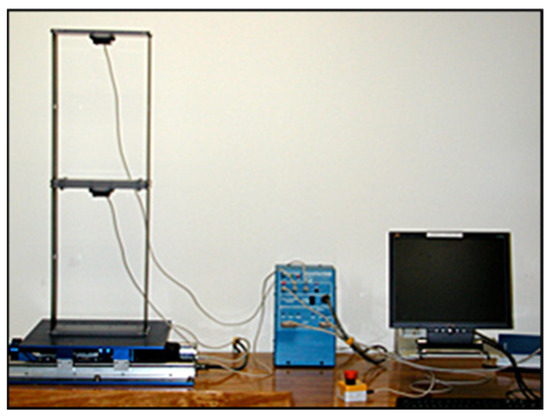
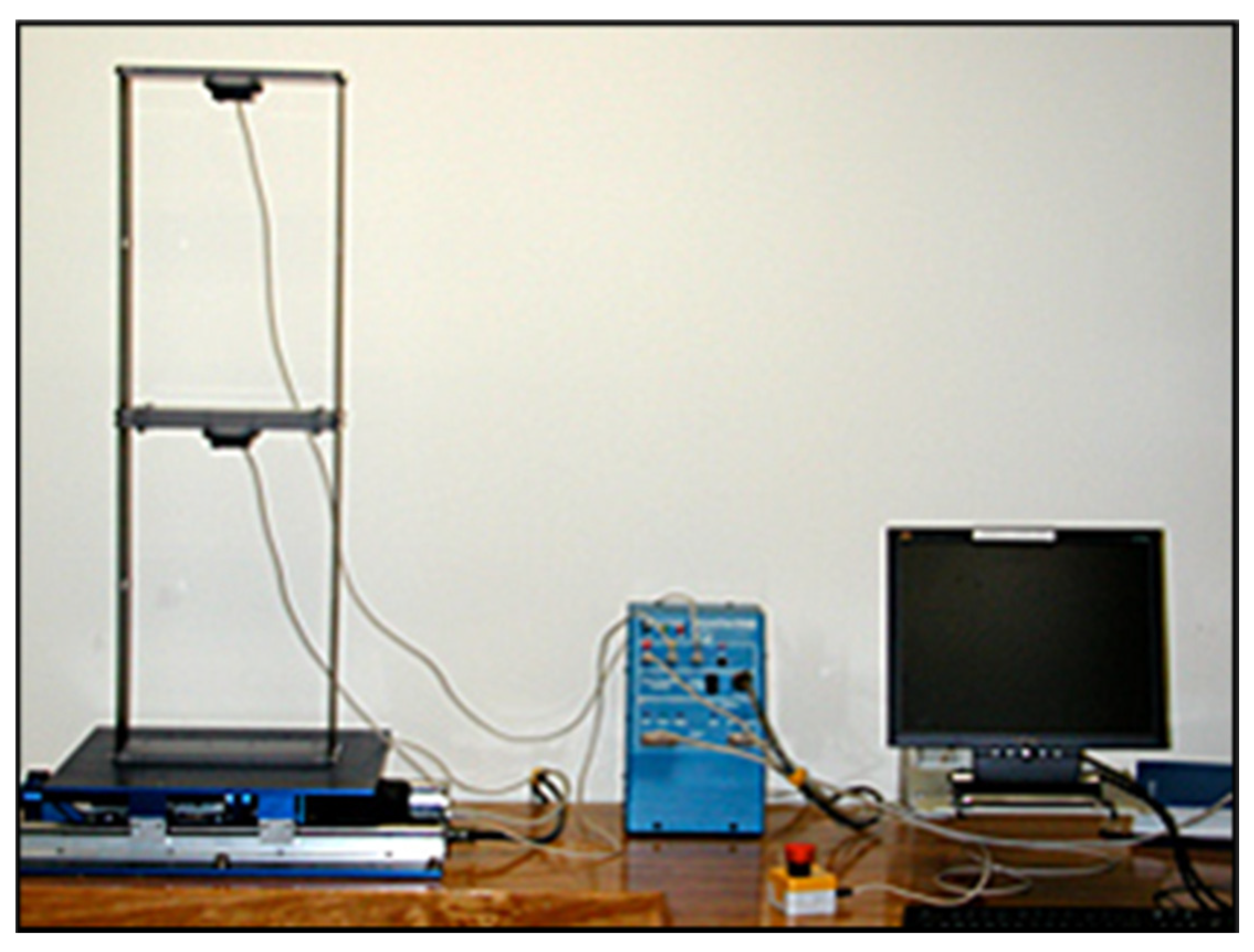
The Quanser Shake Table II (Quanser, Markham, ON, Canada) is a uniaxial, bench-scale shake table designed for precise control via dedicated software, as illustrated in Figure 1, with technical specifications given in Table 1. It proves highly effective for a wide range of experiments involving civil engineering structures and scaled models [77].
Figure 1.
Illustration of model steel structure and shake table.
Table 1.
Specifications of the shake table.
Accurate evaluation of the performance of shaking tables used in earthquake simulation systems necessitates the use of advanced data acquisition systems. In this context, datalogger systems form the basis of engineering analyses by enabling accurate recording of dynamic responses during the experiment. Simultaneous collection of parameters such as acceleration, velocity, displacement, and force allows for detailed examination of structural behavior. Thanks to their high sampling frequency and precise measurement capabilities, dataloggers accurately reveal the time-dependent variation in earthquake effects. Furthermore, Fast Fourier Transform (FFT) analysis, used in datalogger systems, plays a significant role in determining the dynamic characteristics of structural systems by decomposing the obtained time-domain data into its frequency components. Thanks to FFT, dominant frequencies, natural vibration modes, and resonance effects within the signal can be identified. This makes it possible to both verify the conformity of the shaking table’s motion to the target spectrum and to evaluate the behavior of structures under seismic effects more comprehensively. The technical specifications of the datalogger integrated into the shaking table system used in this study are given in Table 2.
Table 2.
The technical specifications of the data loggers.
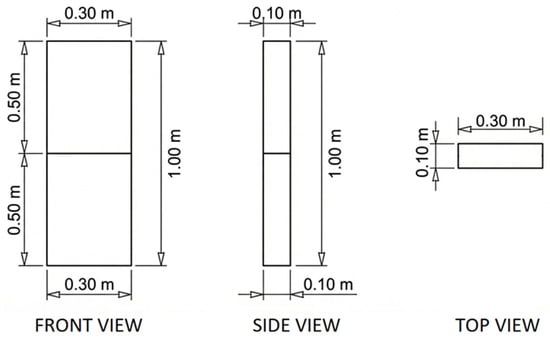
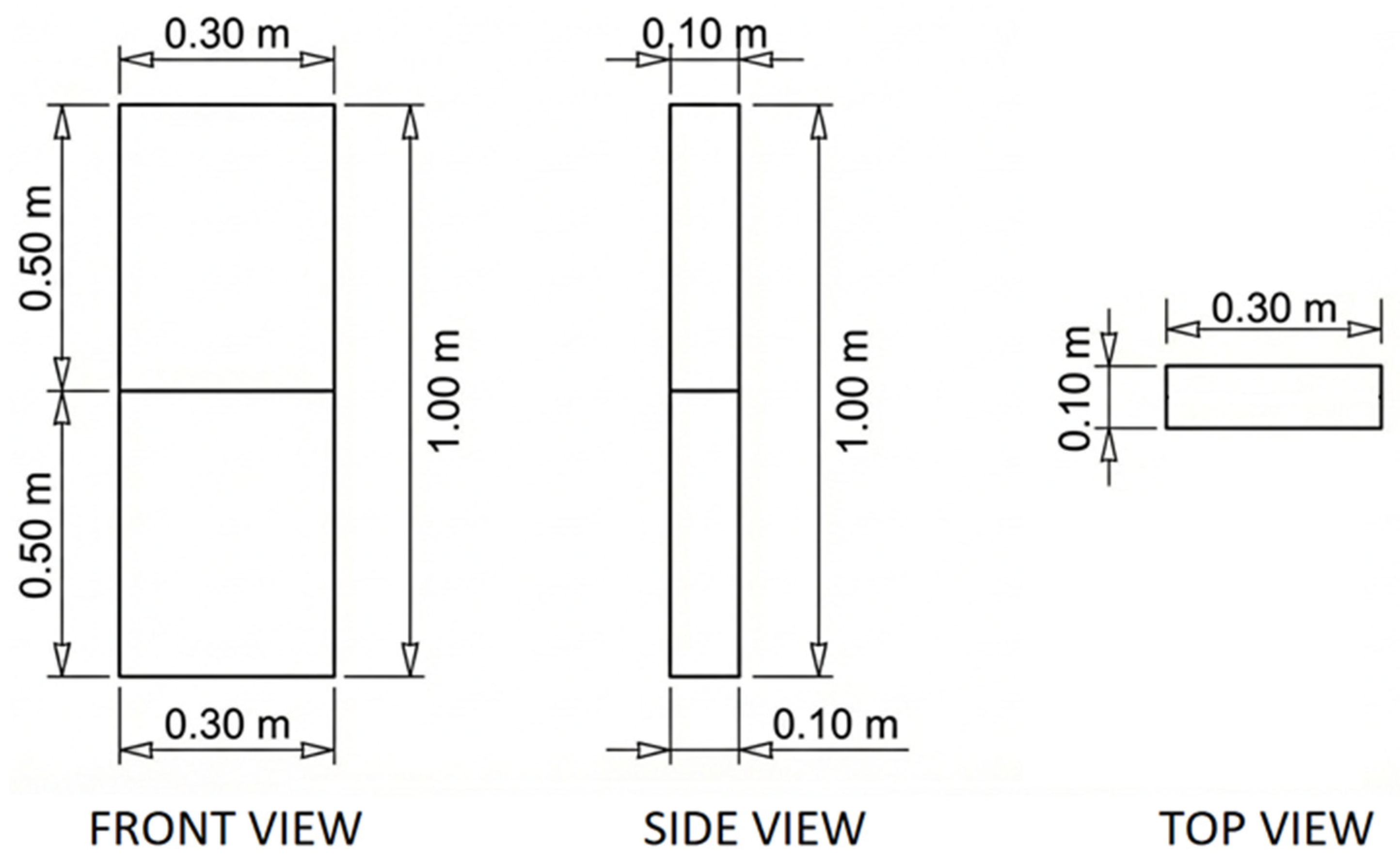
The scaled steel frame specimen was designed to represent the fundamental dynamic characteristics of a typical steel frame system while maintaining experimental simplicity and repeatability. Particular attention was given to preserving the relative stiffness distribution, mass configuration, and global deformation mechanism of the structural system. The model steel structure has a total height of 1.00 m, and the thickness of its structural elements is 0.0015 m. The geometry and overall configuration of the structure were specially designed for experimental studies. Detailed dimensions and geometric properties of the model are given in Figure 2. The connections between the structural elements (beams and columns) were constructed as fully rigid joints using high-strength bolts and screws to ensure monolithic behavior and prevent any structural slippage during the shake table tests. The shake table used in the experiments was rigidly mounted on the heavy laboratory strong floor to minimize any unwanted external high-frequency environmental noise.
Figure 2.
Illustration of the model steel structure’s dimensions.
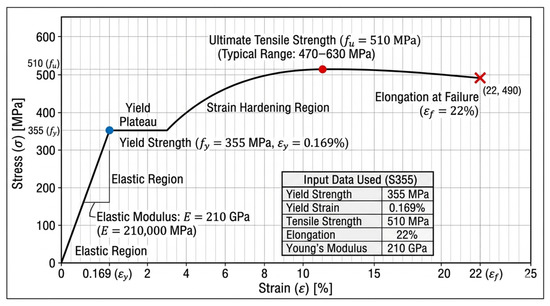
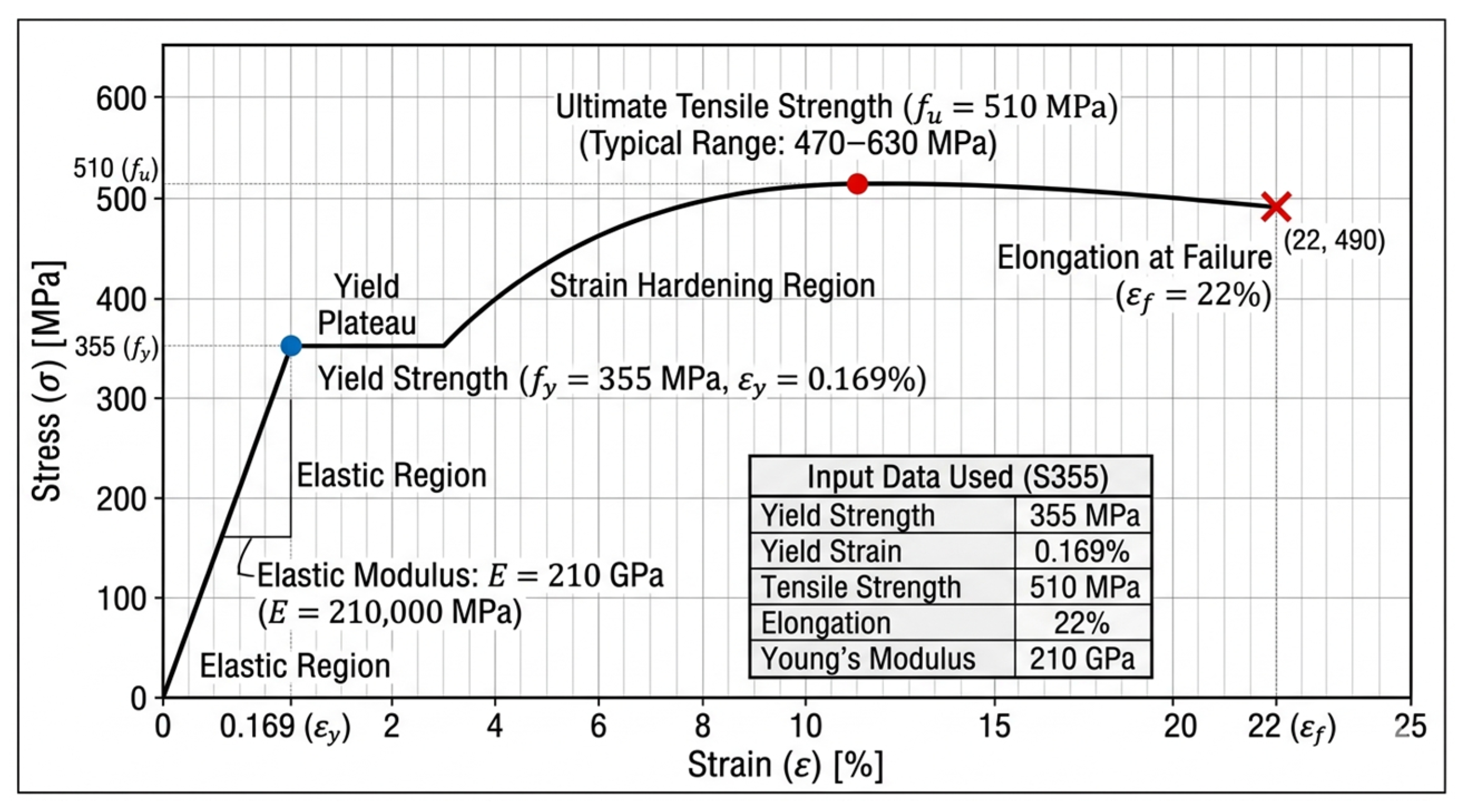
The mechanical parameters of the steel grade used in the model are given in Table 3. The scaled frame structure was constructed using standard S355 grade steel structural elements. The stress–strain relationship and mechanical values illustrated in Figure 3 represent the standard nominal (characteristic design) properties of S355 steel as specified in product standards (EN 10025 [78]) rather than individual destructive coupon test results or a specific statistical fractile.
Table 3.
The mechanical parameters of the steel grade used in the model.
Figure 3.
The stress–strain curve of S355 structural steel.
The stress–strain curve of S355 structural steel is given in Figure 3.
4. Operational Modal Analysis of Model Steel Structure
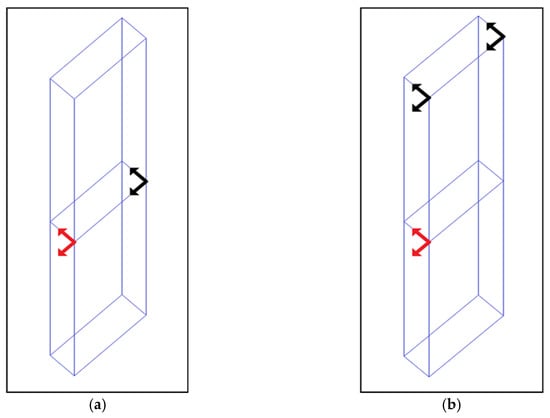
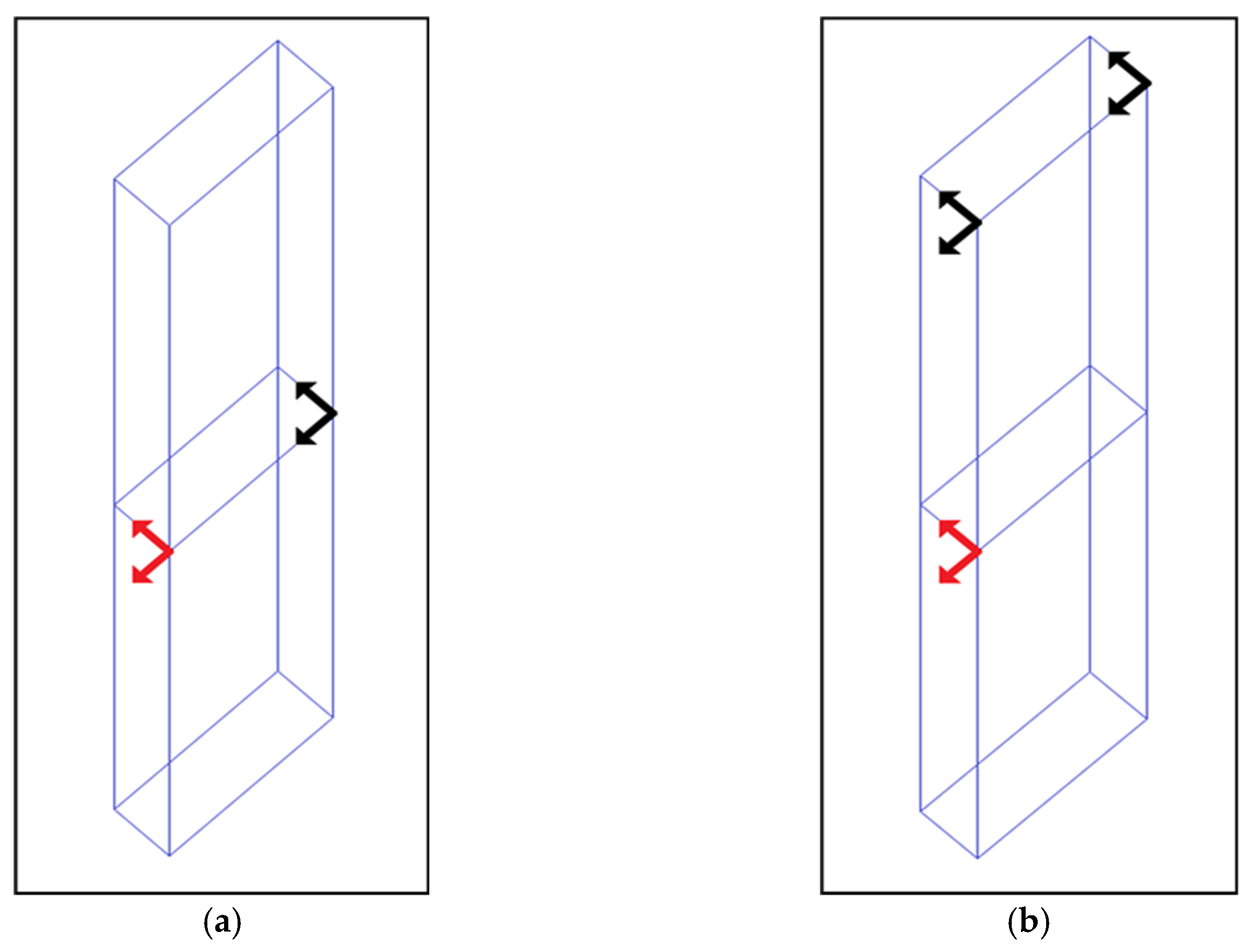
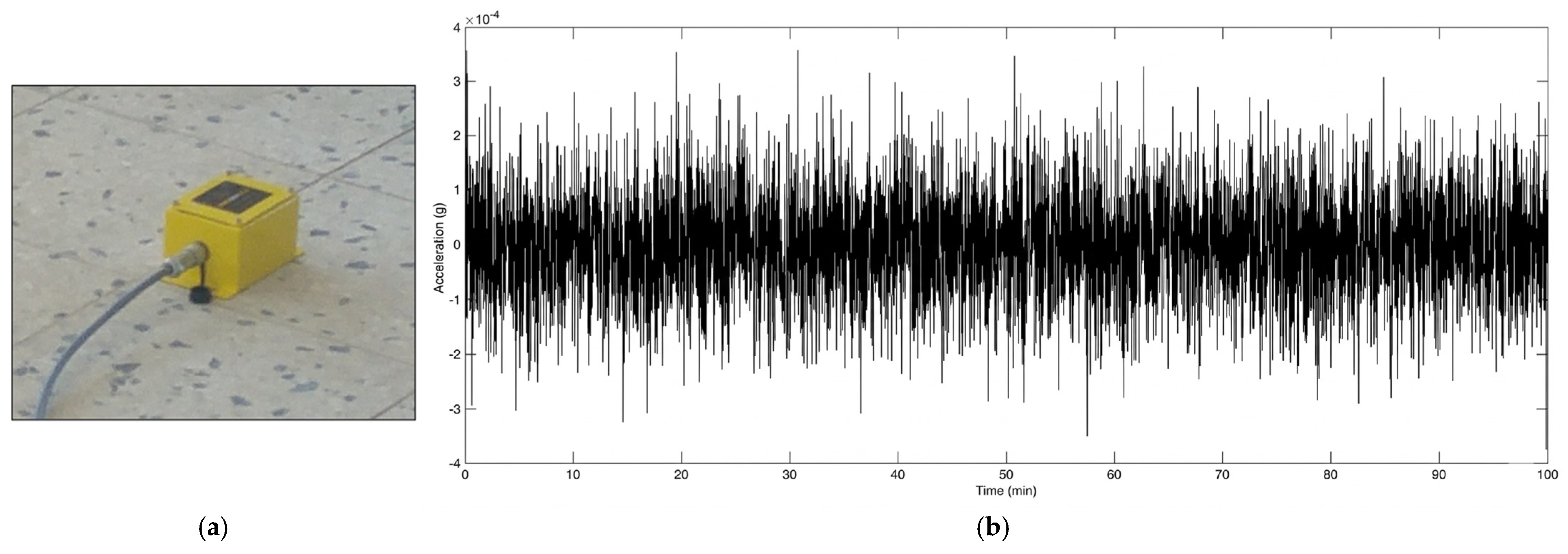
The ambient excitation in this study was generated using recorded microtremor data obtained at ground level, ensuring a realistic representation of low-amplitude environmental vibrations. To capture the dynamic response of the structure, three accelerometers capable of measuring in both the x and y directions were employed. One of these sensors was designated as the reference accelerometer, indicated by red arrows in Figure 4, and was consistently positioned on the first floor to provide a stable baseline for all measurements, while the remaining two were used as roving sensors and relocated among predefined measurement points. The use of a reference accelerometer is critical for the accuracy of measurements and the reliable acquisition of modal parameters. In OMA, since the system is measured only under environmental (random) influences, data from all sensors must be evaluated against a common time and phase reference. At this point, the reference accelerometer provides the opportunity to compare data from other (roving) sensors by continuously measuring at a fixed position One of the most important advantages of a reference sensor is that it ensures data continuity and consistency between different measurement sets. Especially in experiments with a limited number of sensors, while the roving sensors are moved to different points, the reference sensor remains stationary and acts as a bridge connecting all data sets. In this way, data measured at different times can be analyzed as a single system and accurate mode shapes can be obtained. Also, the reference accelerometer helps in accurately determining the relative amplitude and phase relationships used in deriving mode shapes. In OMA methods (such as FDD and SSI techniques), inter-sensor correlation is of great importance, and the reference sensor ensures that this correlation is reliably established. In measurements made without a reference sensor, phase shifts and scaling errors may occur between datasets, leading to inaccurate determination of modal parameters. The selected measurement points and directions were determined to effectively capture the dominant dynamic characteristics of the system. The experimental campaign was conducted in two separate datasets to enable comprehensive modal identification of the structure. Responses were recorded in the first and second datasets. Each dataset was collected over a duration of 100 min to ensure sufficient data length for reliable analysis. The locations of the sensors and their corresponding measurement directions are illustrated in Figure 4.
Figure 4.
Accelerometer’s location in model steel structure: (a) test layout for first measurement; (b) test layout for second measurement.
A dedicated computer system was used for the acquisition of ambient vibration records, ensuring stable and continuous data logging throughout each measurement campaign. After the completion of each measurement sequence, the recorded data files were transferred to a separate high-performance analysis workstation via dedicated data transfer software. This dual-computer setup allowed uninterrupted data acquisition on one system while enabling real-time or near-real-time processing and evaluation on the second workstation. Consequently, this configuration improved the efficiency of the experimental workflow and supported systematic quality control of the recorded signals.
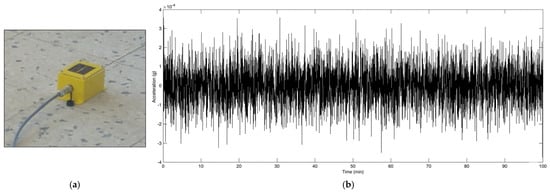
During the post-acquisition stage, each dataset was subjected to a preliminary inspection to assess data quality and reliability. Records exhibiting abnormal signal drift, excessive noise levels, or any form of corruption were excluded from further analysis, and the corresponding measurements were repeated to ensure data integrity. The measurement phase conducted using ambient vibration accelerometers, as well as the ambient excitation signals derived from recorded ground-level microtremor data which were subsequently used to drive the shake table, are presented in Figure 5a and Figure 5b, respectively.
Figure 5.
(a) Ambient vibrations recorded by the accelerometer; (b) ambient excitation data from the recorded microtremor data at ground level used in the shake table.
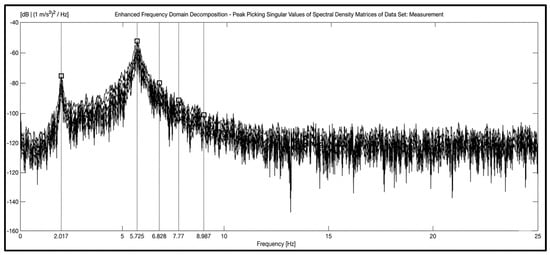
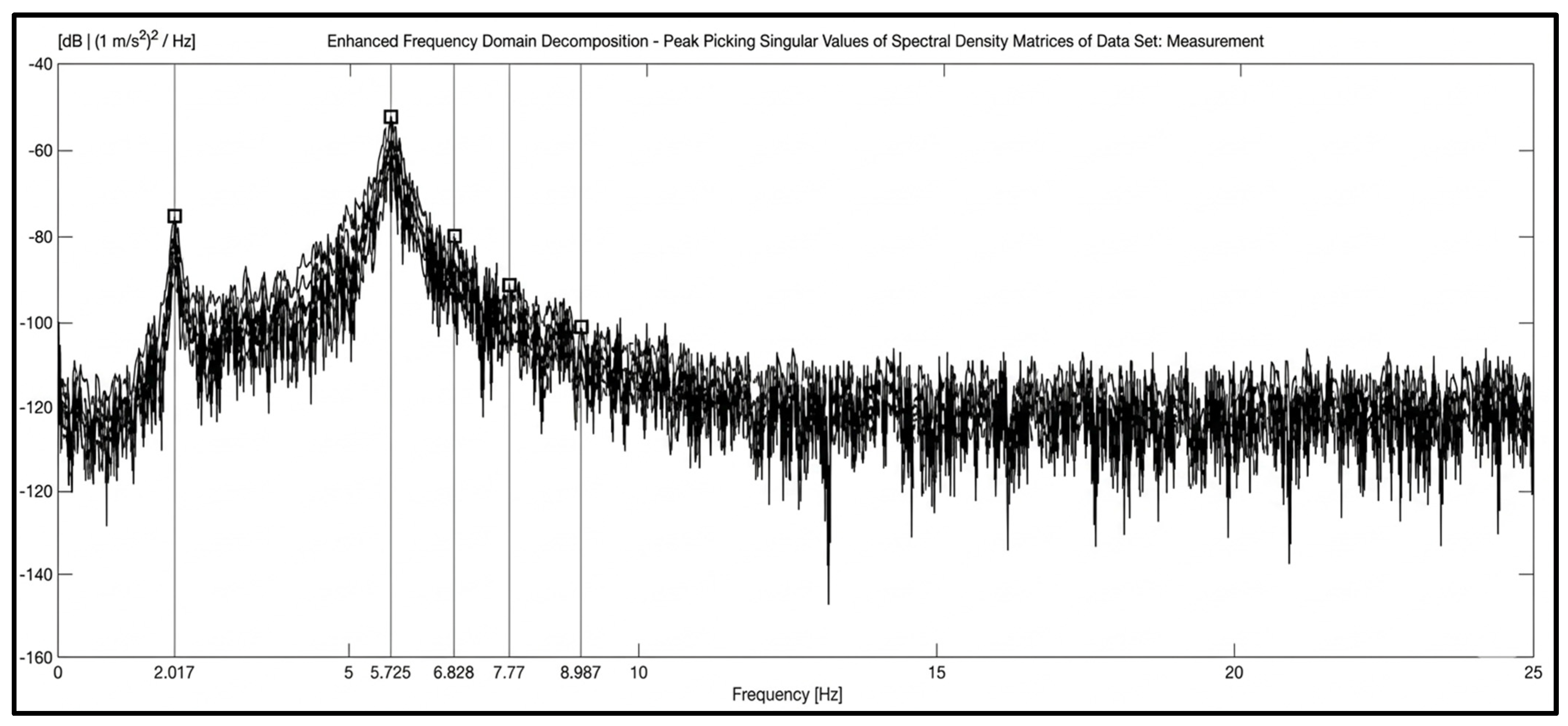
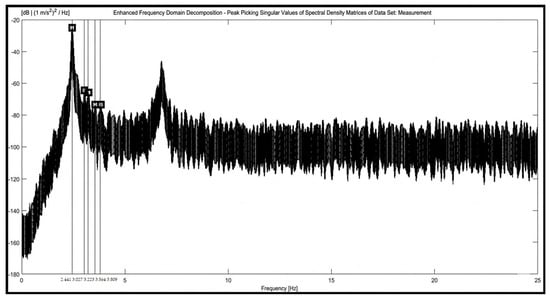
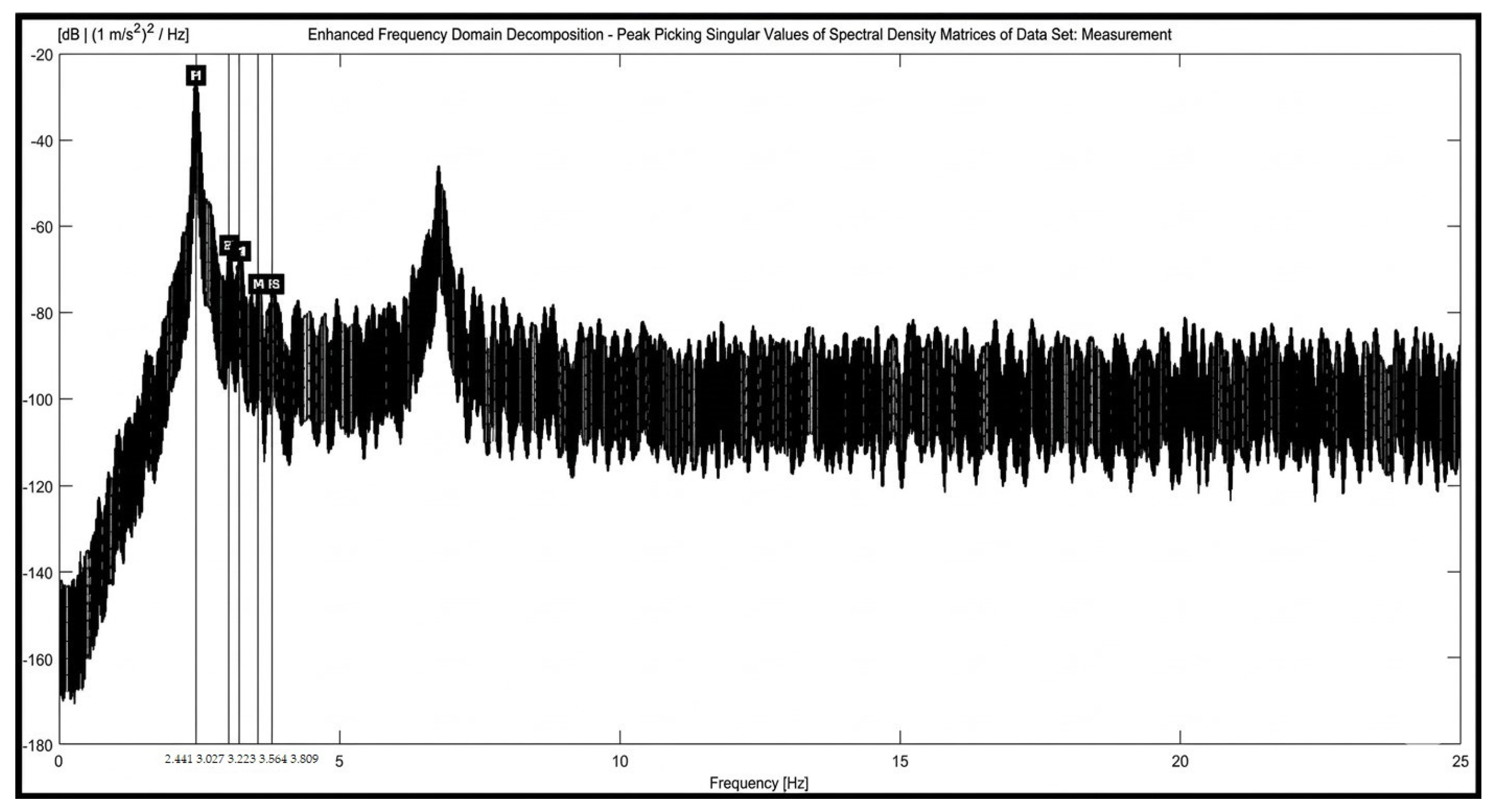
Before commencing the experimental measurements, all sensor cabling connected to the data acquisition system was carefully arranged to ensure stable signal transmission and to reduce potential electromagnetic interference and noise. During the experimental campaign, the roving accelerometers were systematically relocated to successive floor levels after each measurement stage, enabling a comprehensive assessment of the spatial variation in the structural response. Data acquisition was carried out using the MATLAB 2023a Data Acquisition Toolbox [79], ensuring synchronized recording of all channels. Ambient vibration data were subsequently processed using operational modal analysis (OMA) in ARTeMIS Modal Pro 4.0 [80], from which natural frequencies, mode shapes, and damping ratios were identified for structural dynamic characterization. The singular values of the spectral density matrices obtained from the measurements using the peak-picking method are given in Figure 6.
Figure 6.
Singular values of spectral density matrices for model steel structure.
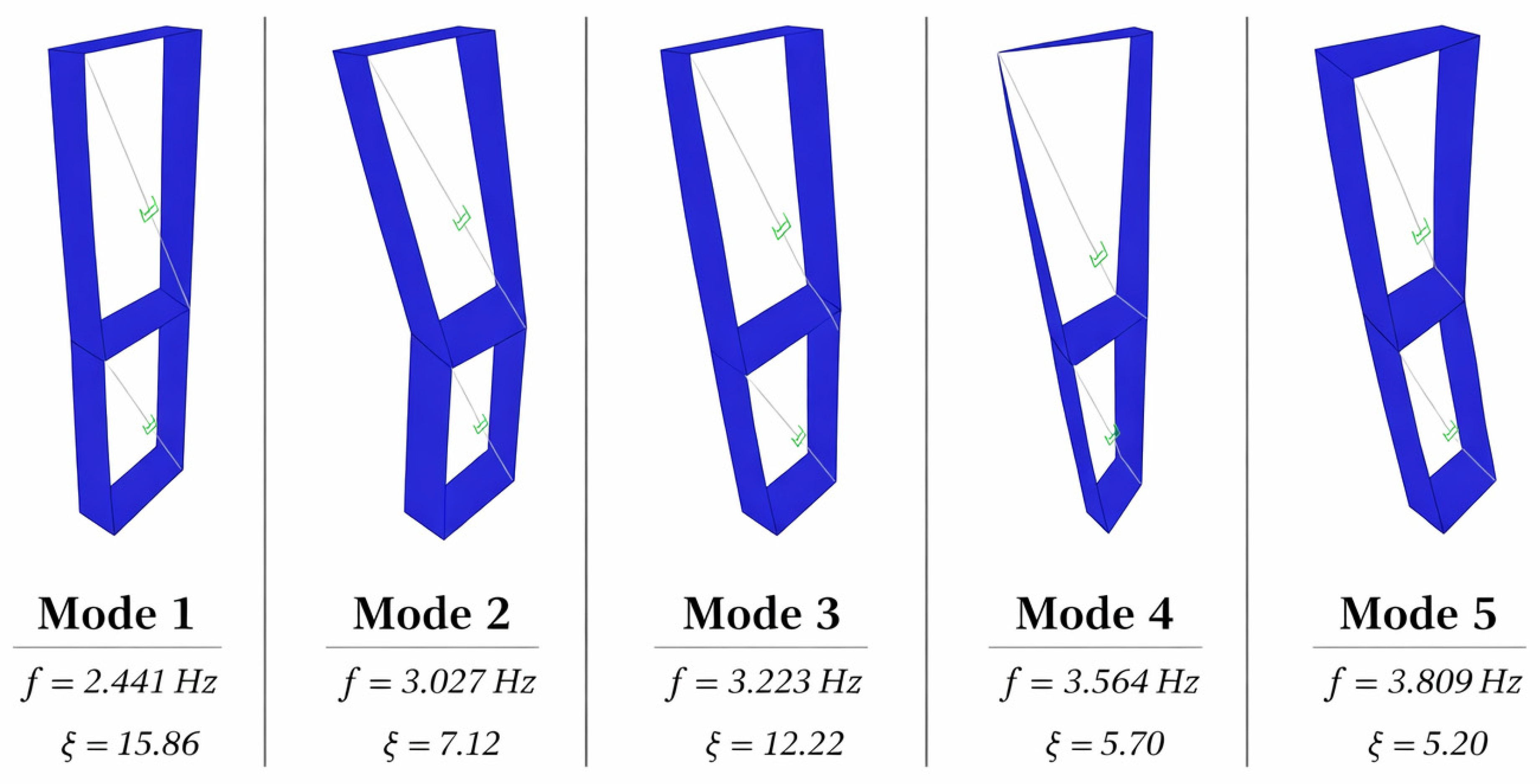
Table 4 summarizes the experimentally identified natural frequencies and damping ratios of the first five modes of the model steel structure.
Table 4.
Operational modal analysis results of the model steel structure.
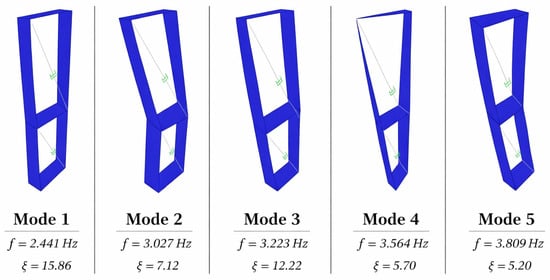
The first five mode shapes of the model steel structure identified through operational modal analysis are depicted in Figure 7.
Figure 7.
Experimentally identified mode shapes of the steel structural model based on operational modal analysis.
5. Operational Modal Analysis of Retrofitted Model Steel Structure
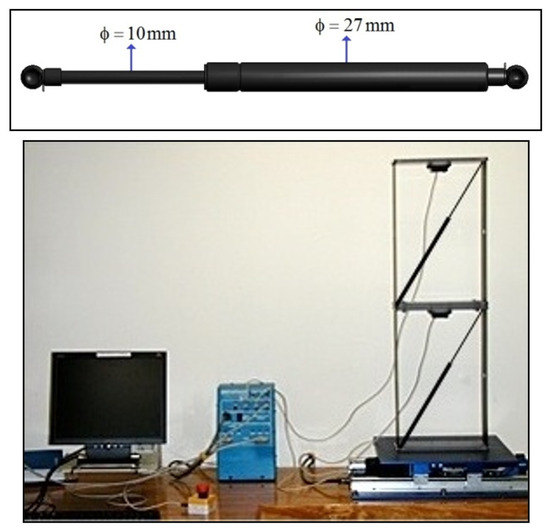
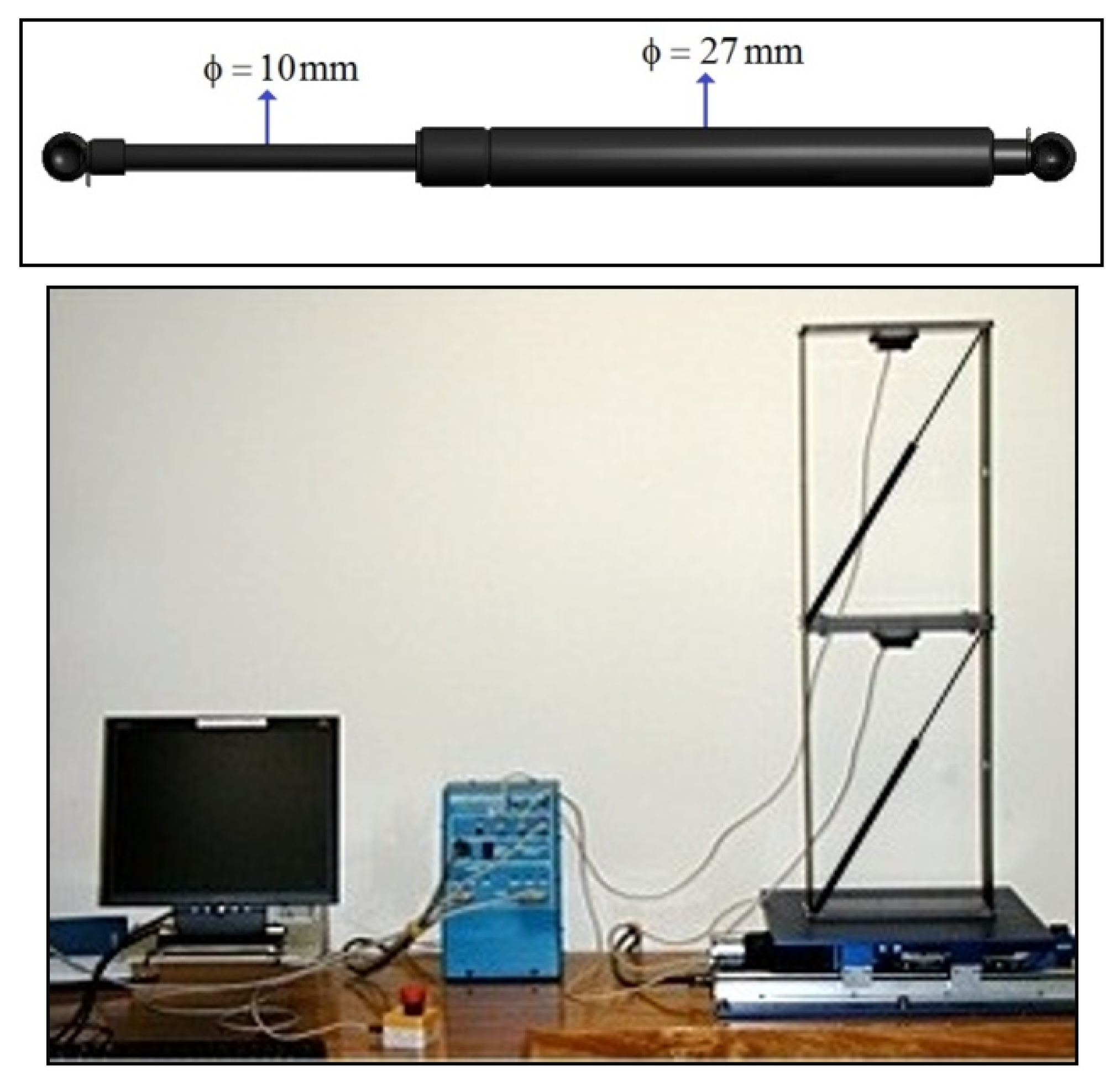
In the case of the retrofitted model steel structure, the following are studies which deploy it to check and examine the efficiency of using dampers (gas springs): the model steel structure is retrofitted with two dampers (diagonal placement). The damper (gas spring) and its component Sam-Gas is a product of Sam-Gas Corporation. The properties of the damper (gas spring) are: the Gas Spring K-Factor is the ratio of the compressed force (P2) and extended force (P1) expressed as P2/P1 = 1.2, rod diameter = 10 mm, tube diameter = 27 mm, extended length min = 200 mm, and max. = 900 mm.
The K-factor is influenced by several design and operational parameters. The rod-to-body diameter ratio plays a critical role, where a smaller rod diameter relative to the cylinder results in a lower K-factor and, consequently, reduced force variation. Additionally, the oil volume within the gas spring can be adjusted to control the progression characteristics, allowing for fine-tuning of the force response. Temperature effects also contribute to variations in the K-factor, primarily due to changes in the oil’s viscosity index, which influence the internal damping behavior. A K-factor value greater than unity indicates an increase in force along the stroke. For instance, a K-factor of 1.3 corresponds to a 30% increase in force from the extended position to the compressed position. In practical applications, gas springs typically exhibit K-factor values ranging from 1.05 to 1.8, corresponding to a force progression between 5% and 80%; however, specialized applications may require higher ratios. The gas spring K-factor (or progression) is the ratio of compressed force (P2) to extended force (P1), typically ranging from 1.05 to 1.8. It represents the force increase as the rod enters the cylinder, which increases internal pressure. A lower K-factor indicates a flatter force curve throughout the stroke [80].
The relationship between the applied forces and the K-factor can be expressed as:
where P1 is the initial extended force, P2 is the compressed force, and K represents the progression factor.
Figure 8 presents the damper (gas spring) system together with the retrofitted steel structural model, highlighting the configuration and implementation details of the strengthening application.
Figure 8.
Damper (gas spring) and the retrofitted model steel structure.
Initially, two dampers (gas springs) are installed diagonally on the structural frame, as illustrated in Figure 8. The seismic damper was securely integrated into the frame using bolted connections, providing efficient load transfer without geometric clearances. Following the installation, ambient vibration tests are performed under identical boundary and environmental conditions to those applied to the undamped (baseline) model in order to ensure consistency and enable a reliable comparative evaluation of the dynamic characteristics. The corresponding. singular values of spectral density matrices are given in Figure 9.
Figure 9.
Singular values of spectral density matrices (retrofitted model steel structure).
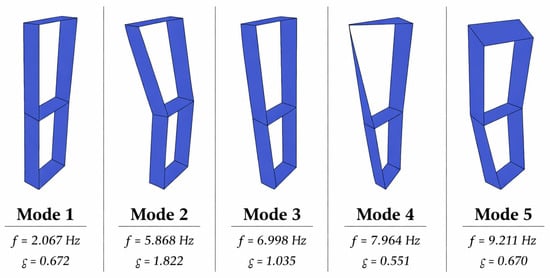
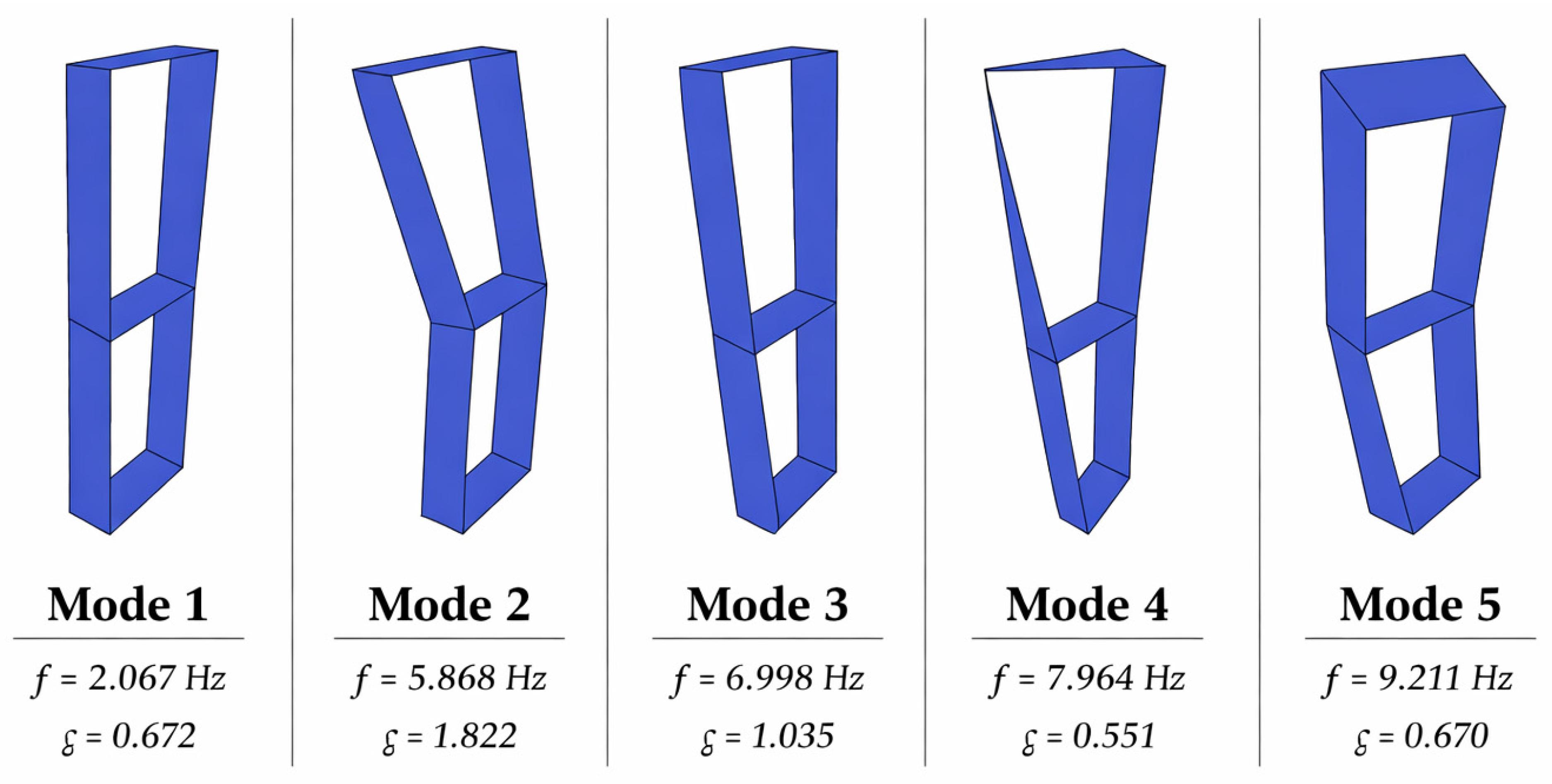
Table 5 summarizes the experimentally identified natural frequencies and damping ratios of the first five modes of the retrofitted model steel structure.
Table 5.
Operational modal analysis results of the retrofitted model steel structure.
The first five mode shapes of the retrofitted model steel structure identified through operational modal analysis are depicted in Figure 10.
Figure 10.
Experimentally identified mode shapes of the retrofitted steel structural model based on operational modal analysis.
6. Comparison of Results
This section presents a comprehensive comparison of the dynamic characteristics obtained for the as-built and damper-retrofitted steel structure models based on Operational Modal Analysis (OMA). The evaluation focuses on natural frequencies, damping ratios, and mode shapes to assess the effectiveness of the seismic damper system.
Table 6 presents a comparison of the natural frequencies of the first five modes obtained from operational modal analysis for the model steel structure and damper-retrofitted model steel structure.
Table 6.
Comparison of natural frequencies of existing and retrofitted steel structure models (E: Existing model, R: Retrofitted model).
The comparative evaluation of the existing (E) and damper-retrofitted (R) steel frame models reveals notable changes in the dynamic characteristics, particularly in terms of natural frequencies. As presented in Table 5, the retrofitted configuration exhibits a different modal distribution compared to the existing model, with frequency variations ranging from 17.63% in the first mode to 142.74% in the fifth mode.
For the fundamental mode (Mode 1), the natural frequency increases from 2.075 Hz to 2.441 Hz, corresponding to a 17.63% rise. This increase is consistent with the expected enhancement in global stiffness due to the integration of the damper system. The limited magnitude of this change suggests that the primary structural behavior remains largely governed by the original system characteristics. In contrast, higher-order modes (Modes 2–5) show significant frequency shifts exceeding 90%, notable reductions compared to the as-built configuration. This indicates a redistribution of modal characteristics following damper installation, particularly affecting higher-order modes. Since seismic dampers primarily modify the effective stiffness distribution and energy dissipation mechanisms of the structure, the relative ordering and participation of higher modes may change slightly. In other words, while the first mode remains dominant, higher modes can experience minor shifts in frequency values and mode shape contributions, leading to a potential re-ranking of modal properties. Since dampers primarily add energy dissipation rather than stiffness, they cause complex higher-mode interactions; observed frequency drops reflect increased damping, altered boundaries, and modal coupling—not necessarily global stiffness loss. Since dampers primarily dissipate energy by converting it into heat, they do not directly increase the stiffness of the structure; they do not behave like stiffness elements. In the fundamental mode (Mode 1), where rigid body motion predominates, the damper effect remains limited, and the frequency increases slightly. However, in higher modes (Mode 2 and above), local deformations create relative motion, dampers absorb energy through phase shift, and complex intermodal interactions occur. This leads to changes in frequencies. In short, while stiffness increases the frequency steadily, damping complicates the mode interaction through additional mass transformation. Thus, the dynamic response of the structure becomes more controlled due to the additional energy dissipation mechanism introduced by the dampers. These devices increase the overall damping ratio of the system, which reduces the amplitude of resonance peaks and limits vibration amplification around natural frequencies. As a result, the structural response is not only reduced in magnitude but also becomes less sensitive to external excitations, particularly in the higher-frequency range. From a dynamic systems perspective, the increased damping leads to greater attenuation of higher-frequency components, since these modes are more sensitive to energy dissipation mechanisms and exhibit lower participation in the global response. Consequently, the modified system demonstrates improved vibration suppression characteristics and reduced susceptibility to high-frequency excitation content, resulting in more stable and controlled dynamic behavior. Similar findings appear in prior damper retrofit studies [7,18,19,20,21,22,23,41,48,70,74]. The limited variation observed in the natural frequencies after damper installation can be explained by the fact that seismic dampers primarily contribute to additional energy dissipation rather than a significant increase in global stiffness. Since the added damping devices introduce negligible additional mass and only locally modify the lateral stiffness distribution, the overall dynamic stiffness of the structural system remains largely unchanged. Consequently, the eigenvalues of the system are only slightly affected, resulting in minor shifts in natural frequencies. Furthermore, the modal properties of low-rise steel frames are generally governed by the global flexural stiffness of the main structural system, while dampers mainly engage in energy dissipation through relative displacement rather than contributing substantially to the primary load-carrying stiffness. Therefore, the observed frequency changes are limited and consistent with the expected theoretical behavior of damping-dominated retrofit systems. The results indicate that the damper-retrofitted structure exhibits enhanced energy dissipation capacity and modified dynamic characteristics. The increase in the fundamental frequency, together with the controlled behavior of higher modes, suggests the potential effectiveness of the implemented damping system in modifying the structural performance within the limitations of the tested low-amplitude laboratory excitations.
Table 7 presents a comparison of the damping ratios of the first five modes obtained from operational modal analysis for the model steel structure and damper-retrofitted model steel structure.
Table 7.
Comparison of modal damping ratios of existing and retrofitted steel structure models (E: Existing model, R: Retrofitted model).
The modal damping ratios of the first five modes for the existing (E) and damper-retrofitted (R) configurations are compared in Table 6. The results clearly demonstrate a substantial increase in damping for all modes after the implementation of seismic dampers.
For the first mode, the damping ratio increases dramatically from 0.672% to 15.86%, corresponding to an approximately 23.60-fold increase. This significant enhancement indicates that the damper system is highly effective in dissipating vibrational energy associated with the fundamental mode, which typically governs the global structural response. In the second mode, the damping ratio increases from 1.822% to 7.12%, representing nearly a 3.9-fold improvement. Similarly, the third mode shows a remarkable increase from 1.035% to 12.22%, corresponding to an approximate 11.8-fold rise, indicating strong energy dissipation across intermediate modes. For the fourth mode, the damping ratio increases from 0.551% to 5.70%, while in the fifth mode, it rises from 0.670% to 5.20%, corresponding to approximately 10.3-fold and 7.8-fold increases, respectively. These results confirm that the damper system effectively enhances damping over a wide frequency range [7,9,17,21,22,74].
The comparison of mode shapes between the existing (E) and damper-retrofitted (R) steel frame models reveals clear distinctions in the deformation characteristics and energy dissipation mechanisms. In the existing configuration, the fundamental mode exhibits a global sway pattern with relatively higher amplitude, while higher-order modes display localized distortions concentrated in specific regions of the frame. This behavior reflects the limited damping capacity of the existing system, which allows vibrational energy to accumulate in critical joints and members. In contrast, the retrofitted model demonstrates more moderated displacement profiles across all modes, with deformation patterns becoming more uniformly distributed along the structural height. The fundamental mode retains its global sway character but with reduced amplitude, indicating improved control of overall flexibility. Higher-order modes, which previously showed sharp curvature and localized oscillations, are significantly suppressed in the retrofitted system, highlighting the dampers’ role in mitigating resonance effects and enhancing global stability. Collectively, these observations confirm that damper integration not only reduces modal frequencies but also reshapes the vibrational response toward a more resilient and energy-efficient dynamic behavior, thereby validating the effectiveness of the retrofitting strategy in seismic performance enhancement. Similarly, Ji et al. [7] reported global sway control of mode shapes with OMA in a five-story steel building with full-scale dampers, while Liu et al. [21] showed that post-damper deformations were more uniformly distributed along the height in shaking table tests. Kasimzade et al. [41] also confirmed the suppression of local vibrations in pre/post-retrofit mode analysis of a steel arch bridge, and Ni et al. [74] reported a significant reduction in high mode resonances in a high-rise damper structure. The obtained findings are in full agreement with observations in the literature and confirm that damper retrofitting makes mode shapes more controlled and energy efficient.
While the experimental results obtained from the 1.00 m scaled steel frame provide critical insights into the efficiency of seismic damper retrofitting, the transition from laboratory-scale models to full-scale engineering structures requires careful consideration of scaling laws (similitude requirements). In this study, the scaled model was designed to represent the fundamental dynamic behavior of a multi-story steel frame under ambient and low-amplitude excitations. According to the Buckingham π theorem and Cauchy’s similitude requirements for structural dynamics, maintaining the same stress levels and dynamic characteristics across scales involves a trade-off between geometry, material density, and timescale. Since the scaled model in this experiment uses the same material (steel) as full-scale structures, the gravitational effects and mass-stiffness proportions were adjusted to maintain dynamic similarity. Specifically, the natural frequencies of the scaled model are significantly higher than those of a prototype structure, following the relationship , where λ is the length scale factor. The 23-fold increase in the damping ratio observed in the scaled model demonstrates the high energy dissipation capacity of the gas-spring dampers. However, in a full-scale application, the absolute damping value would be influenced by the additional participation of non-structural elements and soil–structure interaction, which were not modeled here. Furthermore, the ‘added stiffness’ effect observed in the higher modes of the scaled model may appear more distributed in larger structures due to the higher modal density. Despite these scaling challenges, the OMA-based identification of modal parameters confirms that the retrofitting strategy is highly effective at suppressing micro-vibrations. This suggests that for full-scale structures, particularly those sensitive to wind-induced vibrations or low-level seismic tremors, the integration of such dampers could significantly enhance structural resilience and serviceability [81,82,83,84]. Future studies may focus on ‘Hybrid Simulation’ methods to bridge the gap between these laboratory-scale OMA findings and the nonlinear performance of full-scale buildings during major seismic events.
The first-mode effective mass participation of the investigated steel frame was estimated to be dominant in the global dynamic response, as expected for low-rise and regular planar steel frames. In such structures, the first vibration mode typically governs the overall lateral response, and its effective mass ratio is generally the largest among all modes. The addition of seismic dampers does not significantly alter the total mass of the system; therefore, no substantial change in the absolute modal mass is expected. However, damper installation may modify the stiffness distribution and energy dissipation characteristics of the structure, which can lead to slight variations in modal shapes and consequently in the distribution of modal participation factors. In particular, changes in mode shape vectors may result in minor redistribution of effective modal mass among higher modes, while the first-mode effective mass generally remains dominant. Generally, while the presence of dampers can influence modal characteristics such as frequencies and damping ratios, their effect on the first-mode effective mass is expected to be limited and primarily indirect, arising from changes in mode shape rather than a change in physical mass.
The proposed methodology based on EFDD-based Operational Modal Analysis (OMA) provides a reliable output-only framework for identifying modal parameters of structures subjected to ambient vibration. The results demonstrate that natural frequencies, damping ratios, and mode shapes can be effectively extracted without the need for controlled excitation, making the approach suitable for practical engineering applications. However, certain limitations should be acknowledged. The accuracy of damping estimation is influenced by the level of ambient excitation and signal-to-noise ratio, which may affect the stability of identified parameters. In addition, the method is fundamentally based on the assumption of linear structural behavior within the considered vibration range; therefore, it is not directly applicable to strongly nonlinear response regimes. Despite these limitations, the proposed approach has significant practical implications. It is particularly useful for in situ structural health monitoring, post-installation assessment of seismic damping systems, and performance evaluation of existing structures where forced vibration testing is not feasible. The non-destructive nature of the method allows for repeated measurements under operational conditions, enabling continuous or periodic tracking of changes in dynamic properties such as stiffness degradation, frequency shifts, and damping variations. Consequently, the methodology offers a practical and efficient tool for evaluating the effectiveness of seismic dampers and assessing structural conditions in real-world applications.
7. Conclusions
The findings indicate that the integration of the damping devices enhanced the overall energy dissipation capacity of the scaled steel frame by increasing its global damping ratios and modifying the modal responses. Within the limitations of the output-only operational modal analysis under low-amplitude ambient vibrations, the implemented damping elements proved effective in improving the dynamic characteristics of the frame structure.
This study experimentally investigated the effect of seismic damper retrofitting on the dynamic characteristics of a scaled steel frame structure using output-only Operational Modal Analysis (OMA). The comparative evaluation between the as-built and damper-retrofitted configurations provided clear evidence of significant changes in modal parameters, including natural frequencies, damping ratios, and mode shapes.
The results indicate that the integration of the auxiliary damping devices leads to a pronounced modification in the dynamic response of the tested structure. A consistent increase in the first natural frequency suggests a modification in the overall stiffness characteristics under low-amplitude conditions. In contrast, higher-order modes exhibit notable shifts in their frequency values, indicating changes in modal distribution and dynamic interaction effects associated with the introduced damping configuration.
A key outcome of this study is the substantial increase in modal damping ratios across all modes. The most significant improvement is observed in the fundamental mode, where damping increases by more than 20-fold compared to the as-built configuration. This confirms the strong capability of the damper system in dissipating vibrational energy, particularly in the low-frequency range governing global structural response. Although the global deformation patterns remain similar, the strengthened structure exhibits a more controlled and uniformly distributed response due to the additional energy dissipation provided by the seismic dampers, which reduce localized deformation demands and improve overall response regularity.
The mode shape analysis shows that, although the overall deformation patterns remain consistent in terms of global behavior, the retrofitted structure exhibits more controlled and uniformly distributed responses. Localized deformations observed in the as-built configuration are significantly reduced after damper installation, indicating improved vibration control performance.
This study addresses a key gap in the literature by providing experimentally validated, output-only, OMA-based results under realistic ambient vibration conditions (shake-table-reproduced real microtremor excitations), overcoming limitations associated with numerical simulations and controlled excitation tests.
Future studies may focus on evaluating the performance of advanced damping systems under realistic environmental vibration conditions, considering different structural types and damper configurations. In particular, further research could extend output-only Operational Modal Analysis (OMA)-based approaches to full-scale structures, enabling long-term monitoring of damping effectiveness and modal property evolution under varying ambient conditions.
Author Contributions
Conceptualization, S.T. and F.G.; Methodology, S.T., F.G., V.K. and Z.Z.; Software, S.T.; Validation, Z.Z.; Formal analysis, Z.Z.; Investigation, S.T. and F.G.; Resources, V.K.; Data curation, V.K.; Writing—review and editing, S.T. and F.G. All authors have read and agreed to the published version of the manuscript.
Funding
This research received no external funding.
Data Availability Statement
Data are contained within the article; further inquiries can be directed to the authors.
Conflicts of Interest
The authors declare no conflicts of interest.
Abbreviations
The following abbreviations are used in this manuscript:
| ADC | Analog-To-Digital Converter |
| BFD | Basic Frequency Domain |
| CPU | Central Processing Unit |
| DSP | Digital Signal Processing |
| EFDD | Enhanced Frequency Domain Decomposition |
| FDD | Frequency Domain Decomposition |
| FEM | Finite Element Method |
| FFT | Fast Fourier Transform |
| FRF | Frequency Response Function |
| IDFT | Inverse Discrete Fourier Transform |
| OMA | Operational Modal Analysis |
| PSD | Power Spectral Density |
| SDOF | Single Degree of Freedom |
| SSI | Stochastic Subspace Identification |
| SVD | Singular Value Decomposition |
References
- Cheng, C.T.; Chen, F.L. Seismic performance of a rocking bridge pier substructure with frictional hinge dampers. Smart Struct. Syst. 2014, 14, 501–516. [Google Scholar] [CrossRef] [Scilit]
- Shen, S.; Pan, P.; Sun, J.; Gong, R.; Wang, H.; Li, W. Development of a double-sliding friction damper (DSFD). Smart Struct. Syst. 2017, 20, 151–162. [Google Scholar] [CrossRef]
- Behnamfar, F.; Almohammad-Albakkar, M. Development of steel yielding seismic dampers used to improve seismic performance of structures: A comprehensive review. Int. J. Eng. 2023, 36, 746–775. [Google Scholar] [CrossRef] [Scilit]
- Ke, K.; Yam, M.C.; Zhang, P.; Shi, Y.; Li, Y.; Liu, S. Self-centring damper with multi-energy-dissipation mechanisms: Insights and structural seismic demand perspective. J. Constr. Steel Res. 2023, 204, 107837. [Google Scholar] [CrossRef] [Scilit]
- Al-Sadoon, Z.A.; Almohammad-Albakkar, M. Seismic resilience of steel-braced frames incorporating steel slit dampers: A review and comparative numerical analysis. Civ. Eng. J. 2024, 10, 1310–1335. [Google Scholar] [CrossRef] [Scilit]
- Pu, W.; He, C. Seismic design framework for steel structures with hysteretic and viscous dampers. J. Constr. Steel Res. 2022, 194, 107330. [Google Scholar] [CrossRef] [Scilit]
- Ji, X.; Hikino, T.; Kasai, K.; Nakashima, M. Damping identification of full-scale passively controlled five-story steel building structure. Earthq. Eng. Struct. Dyn. 2013, 42, 277–295. [Google Scholar] [CrossRef] [Scilit]
- Shen, X.; Wang, X.; Ye, Q.; Ye, A. Seismic performance of transverse steel damper seismic system for long span bridges. Eng. Struct. 2017, 141, 14–28. [Google Scholar] [CrossRef] [Scilit]
- Chang, K.C.; Soong, T.T.; Oh, S.-T.; Lai, M.L. Seismic behavior of steel frame with added viscoelastic dampers. J. Struct. Eng. (ASCE) 1995, 121, 1418–1426. [Google Scholar] [CrossRef] [Scilit]
- Valente, M.; Castiglioni, C.A.; Kanyilmaz, A. Dissipative devices for earthquake resistant composite steel structures: Bolted versus welded solution. Bull. Earthq. Eng. 2016, 14, 3613–3639. [Google Scholar] [CrossRef] [Scilit]
- Kang, J.D.; Tagawa, H. Seismic performance of steel structures with seesaw energy dissipation system using fluid viscous dampers. Eng. Struct. 2013, 56, 431–442. [Google Scholar] [CrossRef] [Scilit]
- Aguirre, M.; Sánchez, A.R. Structural seismic damper. J. Struct. Eng. (ASCE) 1992, 118, 1158–1171. [Google Scholar] [CrossRef] [Scilit]
- Qiu, C.; Wang, H.; Liu, J.; Qi, J.; Wang, Y. Experimental tests and finite element simulations of a new SMA–steel damper. Smart Mater. Struct. 2020, 29, 035023. [Google Scholar] [CrossRef] [Scilit]
- Liu, X.; Ding, Y.; Zhang, H.; Zhao, H.; Li, A. A novel brace-damper system for seismic response suppression of high-rise steel frame structures. J. Build. Eng. 2023, 72, 106655. [Google Scholar] [CrossRef] [Scilit]
- Diamantis, P.; Katsimpini, P.; Hatzigeorgiou, G.D. Development of a methodology for seismic design of framed steel structures incorporating viscous dampers. Eng 2025, 6, 308. [Google Scholar] [CrossRef] [Scilit]
- Qiu, W.; Wen, H.; Gong, C.; Zhang, Z.; Li, W.; Li, S. Seismic fragility and loss assessment of a multi-story steel frame with viscous damper in a corrosion environment. Buildings 2025, 15, 2515. [Google Scholar] [CrossRef] [Scilit]
- Jia, S.; Ma, P. Comparative assessment of seismic damping scheme for multi-storey frame structures. Infrastructures 2025, 10, 258. [Google Scholar] [CrossRef] [Scilit]
- Zhao, L.; Chen, J.; Song, H. Enhancing Seismic Resilience of Steel Frames through a Novel Passive Control System with Non-Buckling Metal Braces. J. Eng. Appl. Sci. 2024, 71, 223. [Google Scholar] [CrossRef] [Scilit]
- Bruschi, E.; Zoccolini, L.; Cattaneo, S.; Quaglini, V. Experimental characterization, modeling, and numerical evaluation of a novel friction damper for the seismic upgrade of existing buildings. Materials 2023, 16, 1933. [Google Scholar] [CrossRef] [Scilit] [PubMed]
- Hu, R.; Hu, S.; Yang, M.; Zhang, Y. Metallic Yielding Dampers and Fluid Viscous Dampers for Vibration Control in Civil Engineering: A Review. Int. J. Struct. Stab. Dyn. 2022, 22, 2230006. [Google Scholar] [CrossRef] [Scilit]
- Liu, M.; Cao, C.; Zhu, Z.; Xu, W.; Du, D.; Wang, S.; Sun, C. Shaking table tests and numerical analysis of a steel frame employing novel variable-coefficient viscous dampers. Buildings 2025, 15, 1046. [Google Scholar] [CrossRef] [Scilit]
- Lan, X.; Zhang, L.; Sun, B.; Pan, W. Study on the damping efficiency of a structure with additional viscous dampers based on the shaking table test. Buildings 2024, 14, 1506. [Google Scholar] [CrossRef] [Scilit]
- Sun, L.; Lai, Z.; Bai, Y. Research on Seismic Wave Delay and Amplification Methods in the Shaking Table Test of Large-Span Structures in Mountain Areas. Appl. Sci. 2023, 13, 6728. [Google Scholar] [CrossRef] [Scilit]
- Basili, M.; Angelis, M.D. Experimental Dynamic Response of a Multi-Story Frame Structure Equipped with Non-Conventional TMD Implemented via Inter-Story Isolation. Appl. Sci. 2022, 12, 9153. [Google Scholar] [CrossRef] [Scilit]
- Di Cesare, A.; Ponzo, F.C.; Lamarucciola, N.; Nigro, D. Dynamic Seismic Response of Nonlinear Displacement Dependent Devices versus Testing Required by Codes: Experimental Case Studies. Appl. Sci. 2020, 10, 8857. [Google Scholar] [CrossRef] [Scilit]
- González-Sanz, G.; Escolano-Margarit, D.; Benavent-Climent, A. A New Stainless-Steel Tube-in-Tube Damper for Seismic Protection of Structures. Appl. Sci. 2020, 10, 1410. [Google Scholar] [CrossRef] [Scilit]
- Javidan, M.M.; Ali, A.; Kim, J. A Steel Hysteretic Damper for Seismic Design and Retrofit of Precast Portal Frames. J. Build. Eng. 2022, 57, 104958. [Google Scholar] [CrossRef] [Scilit]
- Shi, G.; Zhao, H.; Gao, Y. Research on high-performance steel structure with high-strength steel column, ordinary-strength steel beam, and low-yield-point steel BRB. CE/Papers 2023, 6, 645–649. [Google Scholar] [CrossRef] [Scilit]
- Zhao, H.; Shi, G.; Gao, Y. Experimental study on cyclic behaviour of low yield point steel buckling-restrained braces. Eng. Struct. 2023, 277, 115464. [Google Scholar] [CrossRef] [Scilit]
- Shi, G.; Zhao, H.; Gao, Y. Development of triple grades hybrid high-performance steel structure (TGHSS): Concept and experiments. Eng. Struct. 2022, 266, 114654. [Google Scholar] [CrossRef] [Scilit]
- Huang, J.; Zhao, H.; Gao, Y.; Shi, G. Finite element analysis and design of triple grades hybrid high-performance steel structure (TGHSS). Eng. Struct. 2025, 330, 119909. [Google Scholar] [CrossRef] [Scilit]
- Huang, J.; Zhao, H.; Gao, Y.; Shi, G. Numerical study on cyclic behaviour of triple grades hybrid high-performance steel structure. Eng. Struct. 2025, 327, 119605. [Google Scholar] [CrossRef] [Scilit]
- ANSI S2.47-1990; Vibration of Buildings—Guidelines for the Measurement of Vibrations and Evaluation of Their Effects on Buildings. ANSI: New York, NY, USA, 1990.
- ISO 10137:2007; Bases for Design of Structures—Serviceability of Buildings and Walkways Against Vibrations. ISO: Geneva, Switzerland, 2007.
- ISO 4866:2010; Mechanical Vibration and Shock—Vibration of Buildings—Guidelines for the Measurement of Vibrations and Evaluation of Their Effects on Buildings. ISO: Geneva, Switzerland, 2010.
- Reynders, E. Introduction to operational modal analysis. In Encyclopedia of Structural Health Monitoring; Boller, C., Chang, F.-K., Fujino, Y., Eds.; Wiley: Chichester, UK, 2009. [Google Scholar]
- Au, S.-K. Operational Modal Analysis; Springer: Singapore, 2017. [Google Scholar]
- Pau, A.; De Sortis, A.; Marzellotta, R.; Vestroni, F. Health Monitoring of Cultural Heritage Using Ambient and Forced Vibrations. In WIT Transactions on the Built Environment; WIT Press: Southampton, UK, 2005; Volume 82, pp. 331–340. [Google Scholar]
- Okada, H.; Suto, K. The Microtremor Survey Method; Society of Exploration Geophysicists: Tulsa, OK, USA, 2003. [Google Scholar]
- Molnar, S.; Sirohey, A.; Assaf, J.; Bard, P.-Y.; Castellaro, S.; Cornou, C.; Cox, B.; Guillier, B.; Hassani, B.; Kawase, H.; et al. A review of the microtremor horizontal-to-vertical spectral ratio (MHVSR) method. J. Seismol. 2022, 26, 653–685. [Google Scholar] [CrossRef] [Scilit] [PubMed]
- Kasimzade, A.A.; Tuhta, S.; Günday, F.; Aydın, H. Obtaining dynamic parameters by using ambient vibration recordings on model of the steel arch bridge. Period. Polytech. Civ. Eng. 2021, 65, 608–618. [Google Scholar] [CrossRef] [Scilit]
- Tuhta, S.; Koç, V.; Günday, F. Effect of temperature changes on the experimental modal analysis of a galvanized steel benchmark structure. Buildings 2026, 16, 1069. [Google Scholar] [CrossRef] [Scilit]
- Tuhta, S.; Günday, F. Determination of the effect of TiO2 on the dynamic behavior of scaled concrete chimney by OMA. Mater. Technol. 2021, 55, 459–466. [Google Scholar] [CrossRef] [Scilit]
- Tuhta, S.; Günday, F. Investigation of effect of using nano coating on wooden sheds on dynamic parameters. Wood Res. 2021, 66, 1006–1014. [Google Scholar] [CrossRef] [Scilit]
- Vitanova, M.; Gicev, V. Analysis of microtremors by measuring and processing of ambient vibrations tests. Geol. Maced. 2024, 38, 105–114. [Google Scholar] [CrossRef] [Scilit]
- Vasdravellis, G.; Valente, M.; Castiglioni, C.A. Dynamic response of composite frames with different shear connection degree. J. Constr. Steel Res. 2009, 65, 2050–2061. [Google Scholar] [CrossRef] [Scilit]
- Ventura, C.E.; Schuster, N.D. Structural dynamic properties of a reinforced concrete high-rise building during construction. Can. J. Civ. Eng. 1996, 23, 950–972. [Google Scholar] [CrossRef] [Scilit]
- Kasimzade, A.A. Coupling of the control system and the system identification toolboxes with application in structural dynamics. In Proceedings of the International Control Conference (ICC2006), Glasgow, UK, 30 August–1 September 2006. [Google Scholar]
- HO, Β.; Kalman, R.E. Effective construction of linear state-variable models from input/output functions. at-Automatisierungstechnik 1966, 14, 545–548. [Google Scholar] [CrossRef] [Scilit]
- Kalman, R.E. A new approach to linear filtering and prediction problems. J. Basic. Eng. 1960, 82, 35–45. [Google Scholar] [CrossRef] [Scilit]
- Ibrahim, S.R.; Miculcik, E.C. A method for the direct identification of vibration parameters from the free response. Shock. Vib. Bull. 1977, 47, 183–194. [Google Scholar]
- Ibrahim, S.R. Random decrement technique for modal identification of structures. J. Spacecr. Rocket. 1977, 14, 696–700. [Google Scholar] [CrossRef] [Scilit]
- Bendat, J.S. Nonlinear Systems Techniques and Applications; Wiley: Hoboken, NJ, USA, 1998. [Google Scholar]
- Ljung, L. System Identification: Theory for the User; Prentice Hall: Hoboken, NJ, USA, 1999. [Google Scholar]
- Juang, J.N. Applied System Identification; Prentice Hall: Hoboken, NJ, USA, 1994. [Google Scholar]
- Van Overschee, P.; De Moor, B.L. Subspace Identification for Linear Systems: Theory-Implementation-Applications; Springer Science-Business Media: Berlin/Heidelberg, Germany, 1996. [Google Scholar]
- Trifunac, M.D. Comparisons between ambient and forced vibration experiments. Earthq. Eng. Struct. Dyn. 1972, 1, 133–150. [Google Scholar] [CrossRef] [Scilit]
- Günday, F. Structural Health Monitoring of Steel Garage Model with Stochastic Subspace Identification–Covariance Variance Analysis. Buildings 2025, 15, 944. [Google Scholar] [CrossRef] [Scilit]
- Günday, F. Investigation of the Effect of Coating Light Steel Container Houses with Nano-TiO2 on Dynamic Parameters Using OMA. Buildings 2025, 15, 909. [Google Scholar] [CrossRef] [Scilit]
- Brincker, R.; Zhang, L.; Andersen, P. Modal identification from ambient responses using frequency domain decomposition. In Proceedings of the 18th International Modal Analysis Conference (IMAC), San Antonio, TX, USA, 7–10 February 2000. [Google Scholar]
- Roeck, G.D. The state-of-the-art of damage detection by vibration monitoring: The SIMCES experience. J. Struct. Control 2003, 10, 127–134. [Google Scholar] [CrossRef] [Scilit]
- Peeters, B. System Identification and Damage Detection in Civil Engineering. Ph.D. Dissertation, Katholieke Universiteit Leuven, Leuven, Belgium, 2000. [Google Scholar]
- Cunha, A.; Caetano, E.; Magalhaes, F.; Moutinho, C. From input-output to output-only modal identification of civil engineering structures. In Proceedings of the 1st International Operational Modal Analysis Conference (IOMAC), Copenhagen, Denmark, 26–27 April 2005. [Google Scholar]
- Wenzel, H.; Pichler, D. Ambient Vibration Monitoring; John Wiley & Sons: Hoboken, NJ, USA, 2005. [Google Scholar]
- Kasimzade, A.A.; Tuhta, S.; Uslu, A. Ambient vibration analysis of steel structure. In Experimental Vibration Analysis of Civil Engineering Structures (EVACES’07); Springer: Berlin/Heidelberg, Germany, 2007. [Google Scholar]
- Kasimzade, A.A.; Tuhta, S. Particularities of monitoring, identification, model updating hierarchy in experimental vibration analysis of structures. In Experimental Vibration Analysis of Civil Engineering Structures (EVACES’07); Springer: Berlin/Heidelberg, Germany, 2007. [Google Scholar]
- Kasimzade, A.A.; Tuhta, S. Optimal estimation the building system characteristics for modal identification. In Proceedings of the 3rd International Operational Modal Analysis Conference (IOMAC), Porto Novo, Ancona, Italy, 4–6 May 2009. [Google Scholar]
- Ni, Y.Q.; Zhang, F.L.; Xia, Y.X.; Au, S.K. Operational modal analysis of a long-span suspension bridge under different earthquake events. Earthq. Struct. 2015, 8, 859–887. [Google Scholar] [CrossRef] [Scilit]
- Lam, H.F.; Yang, J. Bayesian structural damage detection of steel towers using measured modal parameters. Earthq. Struct. 2015, 8, 935–956. [Google Scholar] [CrossRef] [Scilit]
- Papadimitriou, C.; Papadioti, D.C. Component mode synthesis techniques for finite element model updating. Comput. Struct. 2013, 126, 15–28. [Google Scholar] [CrossRef] [Scilit]
- Au, S.K.; Zhang, F.L. Fundamental two-stage formulation for Bayesian system identification, Part I: General theory. Mech. Syst. Signal Process. 2016, 66, 31–42. [Google Scholar] [CrossRef] [Scilit]
- Zhang, F.L.; Au, S.K. Fundamental two-stage formulation for Bayesian system identification, Part II: Application to ambient vibration data. Mech. Syst. Signal Process. 2016, 66, 43–61. [Google Scholar] [CrossRef] [Scilit]
- Zhang, F.L.; Ni, Y.C.; Au, S.K.; Lam, H.F. Fast Bayesian approach for modal identification using free vibration data, Part I-Most probable value. Mech. Syst. Signal Process. 2016, 70, 209–220. [Google Scholar]
- Ni, Y.; Lu, X.; Lu, W. Operational modal analysis of a high-rise multi-function building with dampers by a Bayesian approach. Mech. Syst. Signal Process. 2017, 86, 286–307. [Google Scholar] [CrossRef] [Scilit]
- Sevgen, Y.N.; Kasimzade, A.A.; Günday, F.; Novruzov, M.; Nematli, E.; Tunç, B. Structural Health Monitoring System and Providing Data to Control of Intelligent Building’s Power Systems. In Proceedings of the 2025 12th International Conference on Electrical and Electronics Engineering (ICEEE), Istanbul, Turkey, 24–26 September 2025. [Google Scholar]
- Jacobsen, N.J.; Andersen, P.; Brincker, R. Using Enhanced Frequency Domain Decomposition as a Robust Technique to Harmonic Excitation in Operational Modal Analysis; International Conference on Noise and Vibration Engineering (ISMA): Leuven, Belgium, 2006. [Google Scholar]
- Quanser. Position control and earthquake analysis. In Quanser Shake Table II User Manual, Nr 632, Rev 3.50; Quanser Inc.: Markham, ON, Canada, 2008. [Google Scholar]
- EN 10025-2; Hot Rolled Products of Structural Steels—Part 2: Technical Delivery Conditions for Non-Alloy Structural Steels. European Committee for Standardization (CEN): Brussels, Belgium, 2019.
- The MathWorks, Inc. MATLAB, Version R2023a; The MathWorks, Inc.: Natick, MA, USA, 2023. [Google Scholar]
- Structural Vibration Solutions A/S. ARTeMIS Modal Pro: Operational Modal Analysis Software; Structural Vibration Solutions A/S: Aalborg, Denmark, 2015. [Google Scholar]
- John, B. The original presentation of Boyle’s law. J. Appl. Physiol. 1999, 87, 1543–1545. [Google Scholar] [CrossRef] [Scilit]
- Moncarz, P.D.; Krawinkler, H. Theory and Application of Experimental Model Analysis in Earthquake Engineering; Report No. 50; The John, A. Blume Earthquake Engineering Center, Stanford University: Stanford, CA, USA, 1981. [Google Scholar]
- Seed, H.B.; Idriss, I.M. Ground Motions and Soil Liquefaction during Earthquakes; Earthquake Engineering Research Institute: Oakland, CA, USA, 1982. [Google Scholar]
- Krawinkler, H.; Bertero, V.V. Seismic Design and Analysis of Steel Structures; Report No. 65; The John, A. Blume Earthquake Engineering Center, Stanford University: Stanford, CA, USA, 1983. [Google Scholar]

Disclaimer/Publisher’s Note: The statements, opinions and data contained in all publications are solely those of the individual author(s) and contributor(s) and not of MDPI and/or the editor(s). MDPI and/or the editor(s) disclaim responsibility for any injury to people or property resulting from any ideas, methods, instructions or products referred to in the content. |
© 2026 by the authors. Licensee MDPI, Basel, Switzerland. This article is an open access article distributed under the terms and conditions of the Creative Commons Attribution (CC BY) license.