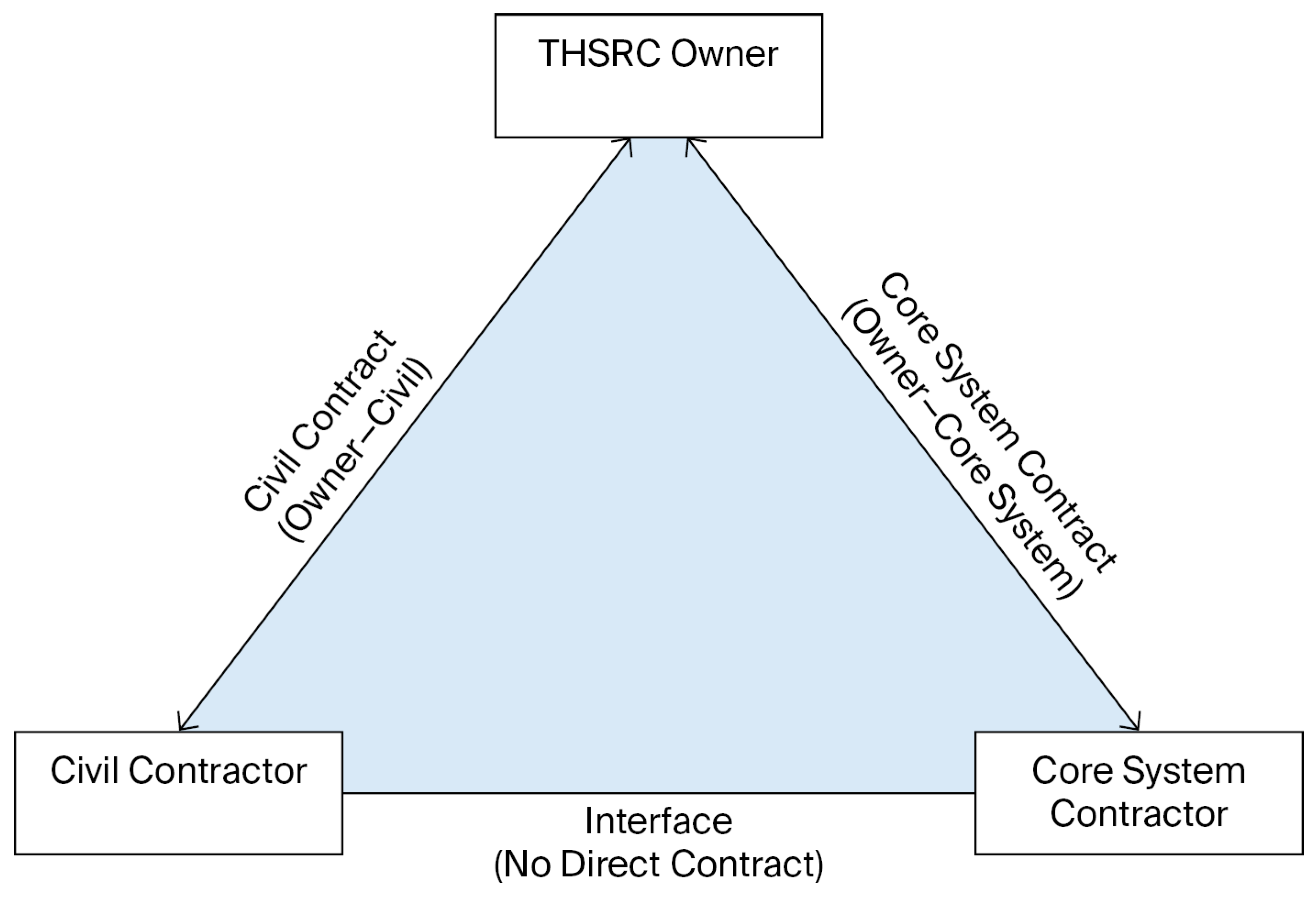
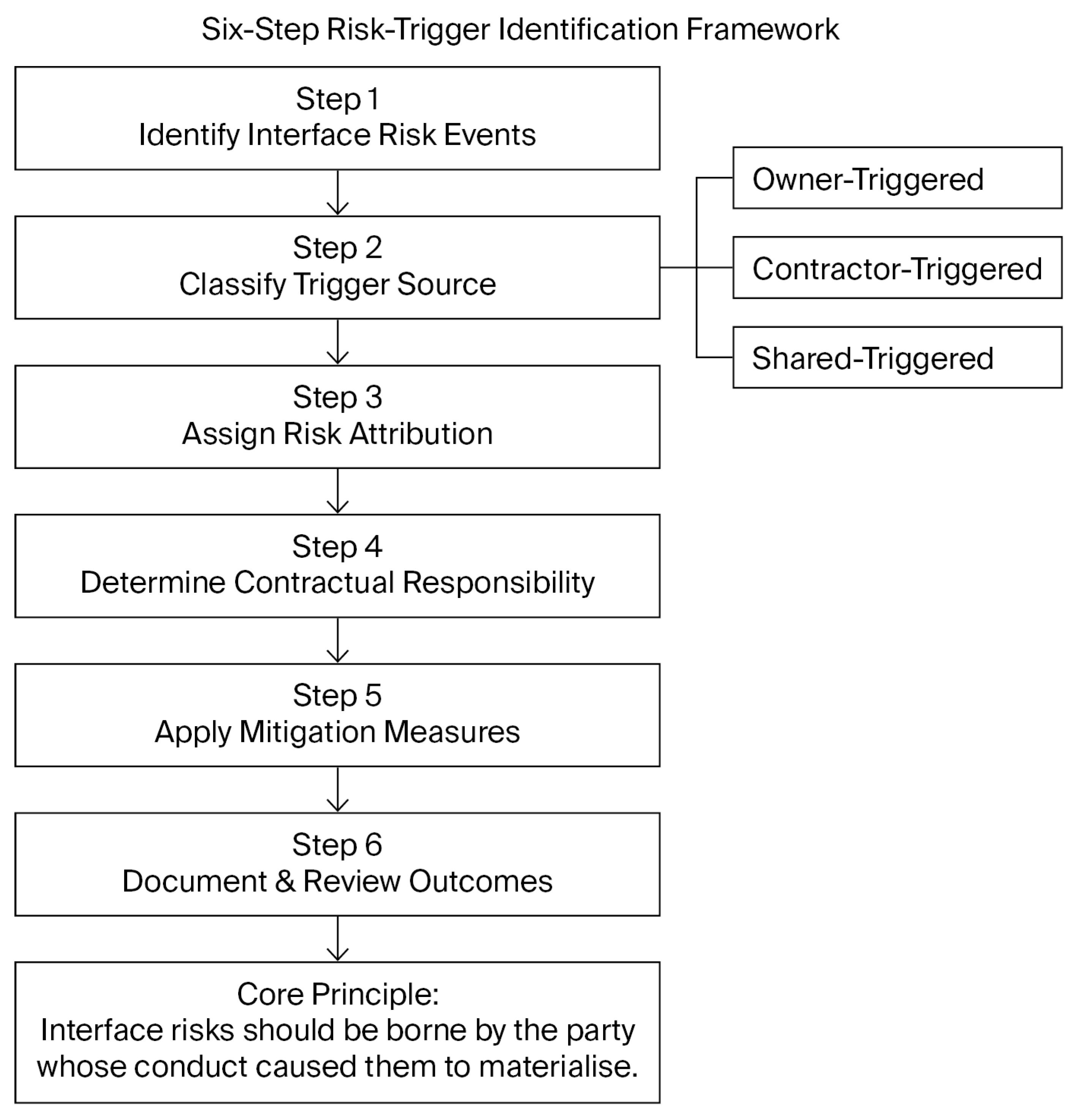
Risk Allocation at Engineering Interfaces in Construction Contracts: A Case Study of the Taiwan High Speed Rail Project

Abstract
1. Introduction
1.1. Background and Research Motivation
1.2. Research Objectives and Scope
- Empirical identification and ranking of interface risk factors through a structured survey targeting practitioners with direct THSR involvement or comparable experience in analogous multi-party infrastructure projects;
- Comparative analysis of risk allocation provisions across five internationally recognised standard-form contracts (FIDIC, AIA, NEC/ECC, ENAA) and THSR-specific documentation;
- Formulation of a risk-trigger principle as a practical basis for improving interface risk allocation in future multi-party infrastructure contracts.
- RQ1: Which interface risk factors are regarded as most critical by practitioners with experience in high-speed rail projects involving separate civil and core system contracts?
- RQ2: What are the predominant risk-initiation patterns for each interface risk category—that is, which party (owner, civil contractor, or core system contractor) most frequently triggers each type of risk?
- RQ3: How do internationally recognised standard-form contracts (FIDIC, AIA, NEC/ECC, ENAA) and THSR-specific documentation allocate interface risks, and do any of them explicitly link risk responsibility to the party whose conduct initiated the risk?
- RQ4: Can documented THSR dispute cases illustrate the survey findings and demonstrate the practical applicability of a risk-trigger allocation principle?
1.3. Research Gap
- No trigger analysis. Existing studies rank interface risks by severity or frequency but do not systematically attribute each risk to its originating party (owner, civil contractor, or core system contractor). Without this attribution, it is impossible to assess whether conventional risk allocation clauses assign responsibility to the correct party.
- No cross-contract comparison. Previous THSR research relies primarily on project-specific contract documents without benchmarking their provisions against internationally recognised standard forms (FIDIC, AIA, NEC/ECC, ENAA). This leaves open the question of whether the allocation deficiencies observed in THSR contracts are idiosyncratic or systemic across the industry.
- No principle-level synthesis. Existing work documents allocation problems but stops short of proposing a governing principle that could guide future contract drafting. The risk-trigger principle advanced in this study fills that gap.
1.4. Significance and Contribution
1.5. Organization of the Paper
2. Literature Review
2.1. Risk Allocation Principles in Construction Contracts
2.2. Legal Basis for Risk Allocation
2.3. Interface Management in Multi-Party Projects
2.4. Interface Risk Management and Stakeholder Integration
2.5. Contract Governance Mechanisms
3. Research Contributions
3.1. Empirical Contribution: Interface Risk Identification and Ranking
3.2. Analytical Contribution: Systematic Contract Comparison
3.3. Conceptual Contribution: Risk-Trigger Principle
4. Research Methodology
4.1. Research Design Overview
4.2. Survey Methodology
4.2.1. Survey Instrument Development
- Category A: Variation (7 factors): scope modifications, design changes, and variation order administration.
- Category B: Care of Works (6 factors): protection of completed work, temporary works, and work-in-progress.
- Category C: Suspension (4 factors): work stoppages, demobilisation, and remobilisation.
- Category D: Cooperation and Coordination (6 factors): information exchange, joint planning, and collaborative problem resolution.
- Category E: Indemnity (5 factors): third-party claims, intellectual property, and liability distribution.
- Category F: Delay (5 factors): schedule impacts, critical path disruption, and time extension entitlement.
- Category G: Force Majeure (4 factors): unforeseeable events, natural disasters, and regulatory changes.
4.2.2. Sampling and Data Collection
- Organisational affiliation: 14 owner representatives, 13 civil contractors, 11 core system contractors.
- Professional role: 16 project managers, 12 contract administrators, 10 claims and dispute resolution specialists.
- Experience: Mean 18.3 years in the construction industry; mean 8.7 years on multi-party infrastructure projects.
4.2.3. Data Analysis
4.3. Contract Document Analysis
4.3.1. Contract Selection
- (1)
- FIDIC Red Book (1995)—Conditions of Contract for Construction—widely used in international infrastructure projects and representative of civil-law drafting traditions.
- (2)
- AIA A201 (1997)—General Conditions of the Contract for Construction—predominant in North American projects and representative of common-law drafting conventions.
- (3)
- NEC/ECC (1995)—New Engineering Contract/Engineering and Construction Contract—the leading relational contracting model, increasingly adopted in UK and Commonwealth projects.
- (4)
- ENAA Model Form (1996)—Model Form of International Contract for Process Plant Construction—widely used in the power and industrial sectors.
- (5)
- THSR Contract Documentation—The actual civil construction and core system contracts used in the Taiwan High Speed Rail project.
4.3.2. Analytical Framework
4.4. Case Study Methodology
4.4.1. Case Selection
- Case 1: A variation-related dispute arising from owner-directed design changes affecting both civil and core system scopes.
- Case 2: A care-of-works dispute arising from alleged inadequate protection of completed civil structures by the core system contractor.
- Case 3: A coordination dispute arising from conflicting schedule assumptions embedded in the civil and core system contracts.
4.4.2. Data Collection and Analysis
4.5. Validity and Reliability
- Construct validity: The survey instrument was developed with direct practitioner input and pilot-tested to confirm that risk factors were clearly defined and pertinent to interface management challenges.
- Internal validity: Convergence across the survey data, contract analysis, and case studies provided multiple independent lines of evidence supporting the principal findings.
- External validity: Including respondents with experience across project types beyond THSR improves the applicability of findings to other multi-party infrastructure contexts.
- Reliability: Structured analytical protocols, independent coding by two researchers, and inter-coder reliability assessment ensure consistency in the contract document analysis.
5. Results
5.1. Survey Findings: Interface Risk Rankings
- A07—Delayed or ambiguous variation orders (Variation): weighted score 290/300.
- D04—Insufficient coordination meetings and information exchange (Cooperation and Coordination): weighted score 285/300.
- B01—Inadequate protection of completed civil works during core system installation (Care of Works): weighted score 284/300.
5.2. Risk-Trigger Analysis
5.3. Comparative Contract Analysis
5.4. Key Findings from Contract Comparison
- Variation provisions. Every examined contract confers broad discretionary authority on the owner to direct variations and imposes a corresponding duty on the contractor to comply. Yet none explicitly addresses the interface scenario in which an owner-ordered variation to one contractor’s scope generates consequential disruption to a co-located contractor’s scope. The NEC/ECC Compensation Event mechanism approaches this gap most closely by providing a structured process for quantifying time and cost consequences of owner instructions, but it does not extend automatically to secondary contractors.
- Care-of-works provisions. Standard forms typically impose blanket care obligations without distinguishing damage attributable to the responsible contractor’s own operations from damage caused by a co-located contractor’s activities. The AIA A201 and THSR-specific contracts carve out partial exceptions for owner-caused or separate-contractor-caused damage, but the burden of proving causation falls on the affected party—a demanding standard in complex interface environments.
- Cooperation provisions. General cooperation duties appear in all five contracts; however, most offer limited operational guidance regarding specific coordination mechanisms, information exchange protocols, or joint programme management. The NEC/ECC early-warning obligation (Clause 16) represents the most developed approach, requiring parties to proactively surface and jointly address foreseeable risks. THSR contract documents specify interface control documents and coordination meetings, but do not clearly apportion liability for coordination breakdowns.
- Delay provisions. The majority of examined contracts distinguish excusable delays (time extension without cost recovery) from compensable delays (time extension plus cost recovery), with compensable events generally confined to owner-initiated causes. Guidance on attributing delays in multi-contractor interface scenarios—where concurrent activities interact—remains limited. The NEC/ECC Compensation Event mechanism again provides the most structured pathway by tethering relief to identifiable triggering events.
- Risk-trigger principle gap. Across all five instruments, no provision systematically allocates interface risks to the party whose conduct initiated the risk event. Partial mechanisms exist—owner-fault exceptions, Compensation Events triggered by owner instructions—but these are fragmented and do not constitute a coherent risk-trigger framework applicable to multi-contractor interface situations.
6. Case Study Analysis
6.1. Case 1: Variation-Related Dispute (Owner-Triggered Risk)
6.1.1. Factual Background
6.1.2. Contractual Provisions
6.1.3. Dispute Resolution
- The owner’s variation instruction to the civil contractor produced foreseeable and unavoidable consequences for the core system contractor’s scope.
- The core system contractor bore no contractual obligation to absorb costs attributable to owner-initiated design changes.
- The absence of a direct variation instruction to the core system contractor did not bar recovery for secondary consequences flowing from the owner’s own conduct.
6.1.4. Alignment with Risk-Trigger Principle
6.2. Case 2: Care-of-Works Dispute (Contractor-Triggered Risk)
6.2.1. Factual Background
6.2.2. Contractual Provisions
6.2.3. Dispute Resolution
- The damage was directly attributable to the core system contractor’s plant and operations.
- The civil contractor’s care obligation did not extend to protecting completed works against damage caused by another contractor’s negligence.
- The core system contractor owed an independent duty to conduct installation activities in a manner that avoided harm to existing structures.
6.2.4. Alignment with Risk-Trigger Principle
6.3. Case 3: Coordination Dispute (Shared-Trigger Risk)
6.3.1. Factual Background
6.3.2. Contractual Provisions
6.3.3. Dispute Resolution
6.3.4. Alignment with Risk-Trigger Principle
6.4. Cross-Case Synthesis
- Variation risks are predominantly owner-initiated. Case 1 confirms that variation-related interface risks typically originate from owner decisions—design changes, specification revisions—and should be allocated to the owner regardless of which contractor’s scope is directly affected by the instruction.
- Care-of-works risks are predominantly contractor-initiated. Case 2 confirms that care-of-works interface risks typically originate from a contractor’s own operations and should rest with the contractor whose activities caused the damage, notwithstanding any continuing care obligation held by the affected party.
- Coordination risks frequently involve shared initiation. Case 3 confirms that coordination interface risks often arise from the interaction of multiple parties’ conduct rather than from any single party’s unilateral decision, making collaborative resolution more appropriate than unilateral risk transfer.
- Standard contract provisions are structurally deficient. All three disputes exposed gaps in conventional risk allocation clauses that fail to connect risk responsibility to risk causation in interface settings, generating avoidable disputes and inefficient outcomes.
7. Discussion
7.1. Theoretical Implications: The Risk-Trigger Principle
7.2. Practical Implications
7.3. Contract Drafting Implications
7.3.1. Variation Clauses
“Where a Variation instructed to one Contractor produces foreseeable impacts on another Contractor’s scope, programme, or cost, the Owner shall compensate the affected Contractor for those consequential effects, irrespective of whether a separate Variation instruction has been issued to that Contractor. The affected Contractor shall give prompt notice of such impacts and shall cooperate in limiting the consequences.”
7.3.2. Cooperation Clauses
“The Parties shall manage interface risks collaboratively through: (1) monthly interface coordination meetings; (2) joint preparation and maintenance of interface control documents; (3) early warning of emerging interface issues; and (4) cooperative problem resolution. Where a coordination failure results from one Party’s failure to provide information on time, attend coordination meetings, or comply with agreed interface procedures, that Party shall bear the time and cost consequences of the failure.”
8. Conclusions
8.1. Key Findings
- Interface risk rankings: Survey data from 38 practitioners identified delayed or ambiguous variation orders (A07, weighted score 290/300), inadequate protection of completed civil works (B01, 284/300), and insufficient coordination meetings (D04, 285/300) as the three most consequential interface risk factors.
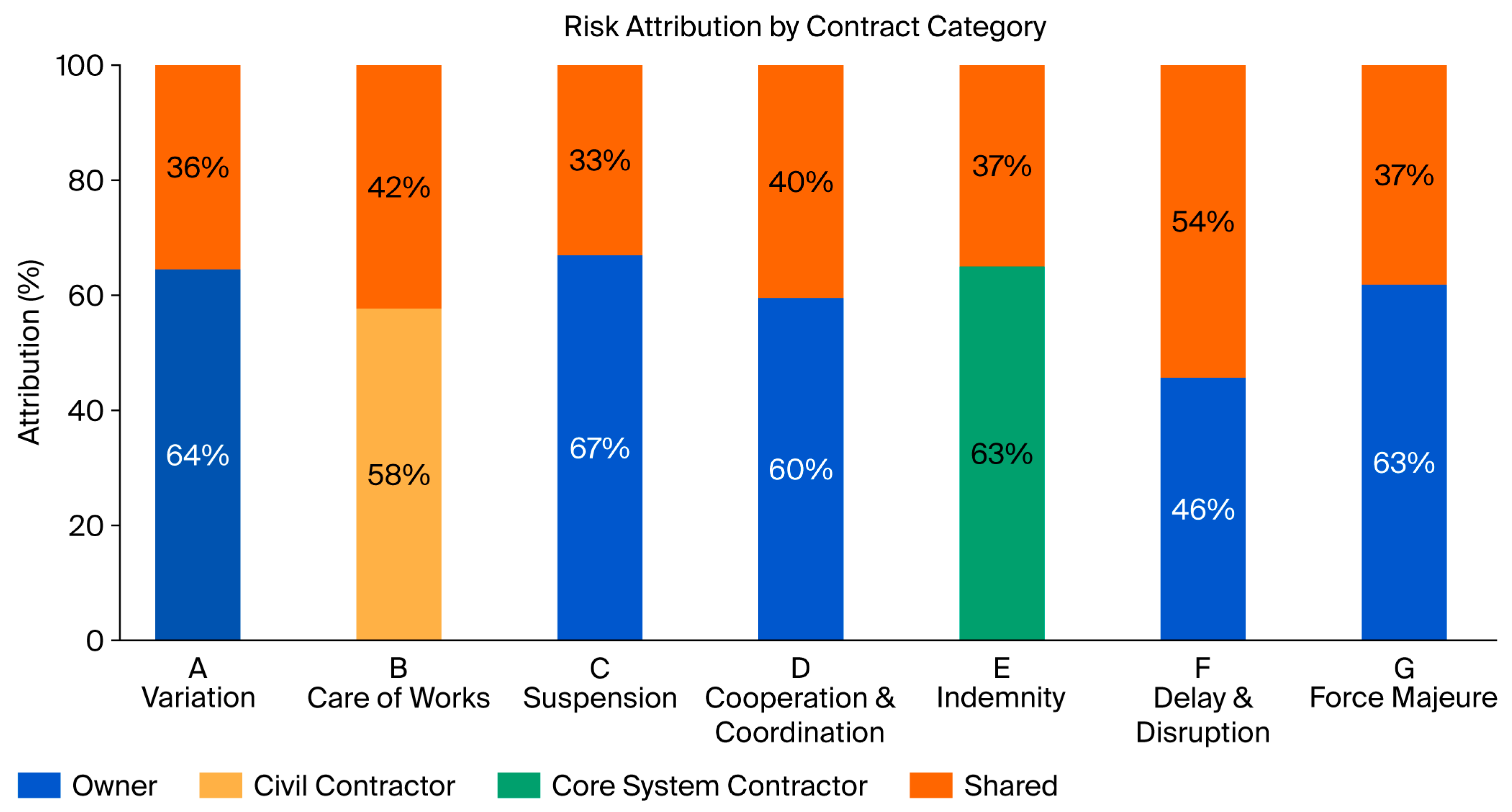
- Risk-initiation patterns: Analysis of who triggers each risk revealed clear systematic tendencies: variation-related risks are predominantly owner-initiated (66–78% attribution); care-of-works risks are predominantly contractor-initiated (57–68% attribution); and coordination risks are predominantly shared (44–62% attribution).
- Contractual deficiencies: Comparative analysis of five standard form contracts (FIDIC, AIA, NEC/ECC, ENAA, THSR) revealed a common structural weakness: none incorporates explicit provisions linking interface risk responsibility to the party whose conduct gave rise to the risk.
- Illustration of the risk-trigger principle: Three anonymised THSR dispute narratives are consistent with the proposed risk-trigger principle and show how causal responsibility may help explain interface-risk allocation in practice.
8.2. Practical Recommendations
8.3. Limitations and Future Research
Author Contributions
Funding
Data Availability Statement
Conflicts of Interest
Appendix A. Survey Questionnaire
Appendix A.1. Category A: Variation
- A01.
- The owner issues a formal variation order that changes the scope of civil works.
- A02.
- The owner-directed scope change requires the civil contractor to coordinate with the core system contractor.
- A03.
- The owner modifies the design specification after civil works have commenced.
- A04.
- The owner orders acceleration of civil works to meet a revised programme milestone.
- A05.
- The owner instructs a suspension of civil works pending design clarification.
- A06.
- The owner-issued variation creates an interface conflict between civil and core system works.
- A07.
- The owner fails to issue a timely variation order despite a known scope change.
Appendix A.2. Category B: Care of Works
- B01.
- The civil contractor fails to protect completed works from damage during ongoing construction.
- B02.
- The civil contractor’s operations cause physical damage to the core system contractor’s installed equipment.
- B03.
- The civil contractor does not maintain adequate site security, resulting in theft or vandalism.
- B04.
- The civil contractor’s subcontractor causes damage to shared infrastructure.
- B05.
- The civil contractor fails to comply with temporary works requirements, causing structural damage.
- B06.
- Damage to works occurs during the defects liability period due to the civil contractor’s inadequate maintenance.
Appendix A.3. Category C: Suspension
- C01.
- The owner suspends civil works due to unresolved design issues originating from owner-supplied information.
- C02.
- The owner orders a suspension to allow the core system contractor to complete prior works.
- C03.
- The owner suspends the contract due to funding or regulatory approval delays.
- C04.
- The owner issues a partial suspension affecting only certain sections of the civil works.
Appendix A.4. Category D: Cooperation and Coordination
- D01.
- The civil contractor and core system contractor fail to agree on a shared construction programme.
- D02.
- Interface meetings between the civil and core system contractors are inadequate or infrequent.
- D03.
- The owner fails to facilitate timely resolution of interface disputes between contractors.
- D04.
- Ambiguity in the contract documents creates uncertainty about which party is responsible for interface coordination.
- D05.
- The core system contractor’s late delivery of technical data delays civil works.
- D06.
- The civil contractor’s late completion of structural works prevents the core system contractor from commencing installation.
Appendix A.5. Category E: Indemnity
- E01.
- The core system contractor’s plant or equipment causes damage to the civil contractor’s completed works.
- E02.
- The core system contractor’s operations result in personal injury to the civil contractor’s workers.
- E03.
- The core system contractor’s activities cause environmental damage within the project site.
- E04.
- The core system contractor fails to indemnify the owner against third-party claims arising from its operations.
- E05.
- The core system contractor’s negligence causes delay to the overall project completion.
Appendix A.6. Category F: Delay and Disruption
- F01.
- The owner’s late approval of shop drawings causes delay to the civil contractor’s works.
- F02.
- Concurrent delays caused by both the owner and the civil contractor make it difficult to apportion responsibility.
- F03.
- The owner’s failure to hand over the site on time disrupts the civil contractor’s planned programme.
- F04.
- The civil contractor’s inefficiency contributes to delay, but the owner’s instructions also cause disruption.
- F05.
- Force majeure events affect the project programme, but the extent of impact is disputed between the parties.
Appendix A.7. Category G: Force Majeure
- G01.
- A typhoon causes physical damage to partially completed civil works and delays the construction programme.
- G02.
- An earthquake results in ground movement that affects both civil and core system works.
- G03.
- A pandemic-related restriction prevents workers from accessing the site, causing project delay.
- G04.
- An unforeseen subsurface condition is encountered that was not identifiable from the owner-provided site investigation data.
References
- Love, P.E.D.; Ackermann, F.; Smith, J.; Irani, Z.; Edwards, D.J. Making Sense of Rework Causation in Offshore Hydrocarbon Projects. Proj. Manag. J. 2016, 47, 16–28. [Google Scholar] [CrossRef]
- Kumaraswamy, M.M.; Thorpe, D.A.S. Systematizing Construction Project Evaluations. J. Manag. Eng. 1996, 12, 34–39. [Google Scholar] [CrossRef]
- Lowe, D.; Leiringer, R. Commercial Management of Projects: Defining the Discipline; Blackwell Publishing: Oxford, UK, 2006. [Google Scholar]
- Doloi, H. Understanding Impacts of Time and Cost Related Construction Risks on Operational Performance of PPP Projects. Int. J. Strateg. Prop. Manag. 2012, 16, 316–337. [Google Scholar] [CrossRef]
- Tah, J.H.M.; Carr, V. Towards a Framework for Project Risk Knowledge Management in the Construction Supply Chain. Adv. Eng. Softw. 2001, 32, 835–846. [Google Scholar] [CrossRef]
- Chiang, Y.H.; Cheng, E.W.L. Construction Loans and Industry Development: The Case of Hong Kong. Constr. Manag. Econ. 2010, 28, 959–969. [Google Scholar] [CrossRef]
- Yu, C.C. Risk Allocation of Interfaces between Construction and Core System Contractors: A Case Study on Taiwan High Speed Railroad Project. Master’s Thesis, National Yunlin University of Science and Technology, Yunlin, Taiwan, 2006. Available online: https://ndltd.ncl.edu.tw/cgi-bin/gs32/gsweb.cgi?o=dnclcdr&s=id=%22094YUNT0028001%22 (accessed on 15 June 2026).
- Tsai, T.-C.; Yen, C.-C. Risk Allocation of Interfaces between Construction and Core System Contracts: A Case Study on Taiwan High Speed Railroad Project. In Proceedings of the 23rd International Symposium on Automation and Robotics in Construction (ISARC 2006), Tokyo, Japan, 3–5 October 2006; pp. 454–459. [Google Scholar] [CrossRef] [PubMed]
- Creswell, J.W.; Plano Clark, V.L. Designing and Conducting Mixed Methods Research, 3rd ed.; SAGE Publications: Thousand Oaks, CA, USA, 2017; Available online: https://us.sagepub.com/en-us/nam/designing-and-conducting-mixed-methods-research/book241842 (accessed on 15 June 2026).
- Cheung, S.O.; Pang, K.H.Y. Anatomy of Construction Disputes. J. Constr. Eng. Manag. 2013, 139, 15–23. [Google Scholar] [CrossRef]
- Tiong, R.L.K. CSFs in Competitive Tendering and Negotiation Model for BOT Projects. J. Constr. Eng. Manag. 1996, 122, 205–211. [Google Scholar] [CrossRef]
- Akintoye, A.; MacLeod, M.J. Risk Analysis and Management in Construction. Int. J. Proj. Manag. 1997, 15, 31–38. [Google Scholar] [CrossRef]
- Lam, K.C.; Wang, D.; Lee, P.T.K.; Tsang, Y.T. Modelling Risk Allocation Decision in Construction Contracts. Int. J. Proj. Manag. 2007, 25, 485–493. [Google Scholar] [CrossRef]
- Wang, S.Q.; Dulaimi, M.F.; Aguria, M.Y. Risk Management Framework for Construction Projects in Developing Countries. Constr. Manag. Econ. 2004, 22, 237–252. [Google Scholar] [CrossRef]
- Ng, A.; Loosemore, M. Risk Allocation in the Private Provision of Public Infrastructure. Int. J. Proj. Manag. 2007, 25, 66–76. [Google Scholar] [CrossRef]
- Williamson, O.E. Transaction Cost Economics: The Governance of Contractual Relations. J. Law Econ. 1979, 22, 233–261. [Google Scholar] [CrossRef]
- Rooke, J.; Seymour, D.; Fellows, R. Planning for Claims: An Ethnography of Industry Culture. Constr. Manag. Econ. 2004, 22, 655–662. [Google Scholar] [CrossRef]
- Wang, J.; Yu, J.; Gu, X.; Xie, M.L.; Ma, W.B. Integrated Risk Response Decision-Making Frameworks for EPC+PPP Projects: A Consideration of the Dual Status of the Private Sector. Eng. Constr. Archit. Manag. 2025. ahead of printing. [Google Scholar] [CrossRef]
- Ford, D.N. Achieving Multiple Project Objectives through Contingency Management. J. Constr. Eng. Manag. 2002, 128, 30–39. [Google Scholar] [CrossRef]
- Bajari, P.; Tadelis, S. Incentives versus Transaction Costs: A Theory of Procurement Contracts. Rand J. Econ. 2001, 32, 387–407. [Google Scholar] [CrossRef]
- Mosey, D. Collaborative Construction Procurement and Improved Value; Wiley-Blackwell: Oxford, UK, 2009. [Google Scholar]
- Eriksson, E.; Westerberg, M. Effects of Cooperative Procurement Procedures on Construction Project Performance: A Conceptual Framework. Int. J. Proj. Manag. 2011, 29, 197–208. [Google Scholar] [CrossRef]
- Broome, D.; Hayes, J. A Comparison of the Clarity of Traditional Construction Contracts and of the New Engineering Contract. Int. J. Proj. Manag. 1997, 15, 255–261. [Google Scholar] [CrossRef]
- Beale, H.; Dugdale, T. Contracts between Businessmen: Planning and the Use of Contractual Remedies. Br. J. Law Soc. 1975, 2, 45–60. [Google Scholar] [CrossRef]
- Act for Promotion of Private Participation in Infrastructure Projects. Promulgated 2000, Last Amended 2022. Available online: https://law.moj.gov.tw/ENG/LawClass/LawAll.aspx?pcode=D0060001 (accessed on 19 June 2026).
- Chinese Arbitration Association, International (CAAI). Arbitration Practice in Construction Disputes: Selected Awards and Commentary; CAAI: Taipei, Taiwan, 2018. [Google Scholar]
- Taiwan High Court. Civil Judgment No. 108-Jian-Shang-2 (2019). In Construction Law Review of Taiwan; Taiwan Construction Law Association: Taipei, Taiwan, 2020; Volume 12, pp. 45–58. [Google Scholar]
- He, Q.; Tian, Z.; Wang, T. Performance Measurement Methods in Megaprojects: An Analytical Review. Int. J. Proj. Manag. 2022, 40, 634–645. [Google Scholar] [CrossRef]
- Shen, Q.; Li, H.; Chung, J.; Hui, P.-Y. A Framework for Identification and Representation of Client Requirements in the Briefing Process. Constr. Manag. Econ. 2004, 22, 213–221. [Google Scholar] [CrossRef]
- Shen, L.C.; Chan, A.P.C.; Akintoye, A. Comparative Study of Public Private Partnership Schemes in Hong Kong and the United Kingdom. J. Surv. Built Environ. 2007, 18, 71–81. [Google Scholar]
- Flyvbjerg, B.; Holm, M.S.; Buhl, S. Underestimating Costs in Public Works Projects: Error or Lie? J. Am. Plan. Assoc. 2002, 68, 279–295. [Google Scholar] [CrossRef]
- Merrow, E.W. Industrial Megaprojects: Concepts, Strategies, and Practices for Success; Wiley: Hoboken, NJ, USA, 2011. [Google Scholar]
- Malek, M.S.; Bhatt, V. Investigating the effect of risk reduction strategies on the construction of mega infrastructure project (MIP) success: A SEM-ANN approach. Eng. Constr. Archit. Manag. 2023, 30, 3831–3852. [Google Scholar] [CrossRef]
- Pryke, S. Towards a Social Network Theory of Project Governance. Constr. Manag. Econ. 2005, 23, 927–939. [Google Scholar] [CrossRef]
- Castelblanco, G.; Fenoaltea, E.M.; De Marco, A.; Demagistris, P.; Petruzzi, S.; Zeppegno, D. Combining Stakeholder and Risk Management: Multilayer Network Analysis for Complex Megaprojects. J. Constr. Eng. Manag. 2024, 150, 04023161. [Google Scholar] [CrossRef]
- Zhang, L.; Fu, Y.; Lai, J. Complements or Substitutes? Recipes of Contract Design, Contract Enforcement, and Trust for Megaproject Performance. Int. J. Proj. Manag. 2024, 42, 102587. [Google Scholar] [CrossRef]
- Luo, L.; Liu, Y.; Yang, Y.; Xie, J.; Wu, G. Interactive Roles of Megaproject Governance Mechanisms and Their Effects on Governance Performance. Eng. Constr. Archit. Manag. 2025, 32, 5943–5964. [Google Scholar] [CrossRef]
- Alqershy, M.T.; Shi, Q.; Zhang, F. Exploring Governance Mechanisms in Megaprojects: A Mixed-Methods Systematic Review. Eng. Manag. J. 2025, 37, 90–113. [Google Scholar] [CrossRef]
- Patel, M.; Robinson, H. Impact of Governance on Project Delivery of Complex NHS PFI/PPP Schemes. J. Financ. Manag. Prop. Constr. 2010, 15, 216–234. [Google Scholar] [CrossRef]
- Davies, A.; Gann, D.; Douglas, T. Innovation in Megaprojects: Systems Integration at London Heathrow Terminal 5. Calif. Manag. Rev. 2009, 51, 101–125. [Google Scholar] [CrossRef]
- Aven, T. Risk Assessment and Risk Management: Review of Recent Advances on Their Foundation. Eur. J. Oper. Res. 2016, 253, 1–13. [Google Scholar] [CrossRef]
- Yin, R.K. Case Study Research and Applications: Design and Methods, 6th ed.; Sage Publications: Thousand Oaks, CA, USA, 2018; Available online: https://us.sagepub.com/en-us/nam/case-study-research-and-applications/book250150 (accessed on 15 June 2026).
- Denzin, N.K. The Research Act: A Theoretical Introduction to Sociological Methods; Transaction Publishers: New Brunswick, NJ, USA, 2009. [Google Scholar]
- Davis, P.R. A Relationship Approach to Construction Supply Chains. Ind. Manag. Data Syst. 2008, 108, 310–327. [Google Scholar] [CrossRef]
- Merschbrock, C.; Munkvold, B.E. Effective Digital Collaboration in the Construction Industry: A Case Study of BIM Platform Use in a Hospital Construction Project. Comput. Ind. 2015, 73, 1–7. [Google Scholar] [CrossRef]
- Krippendorff, K. Content Analysis: An Introduction to Its Methodology, 4th ed.; Sage Publications: Thousand Oaks, CA, USA, 2018; Available online: https://us.sagepub.com/en-us/nam/content-analysis/book258450 (accessed on 15 June 2026).
- Murdoch, J.; Hughes, W. Construction Contracts: Law and Management, 4th ed.; Taylor & Francis: London, UK, 2008; Available online: https://centaur.reading.ac.uk/35469/ (accessed on 15 June 2026).
- Eggleston, B. The NEC 3 Engineering and Construction Contract: A Commentary, 2nd ed.; Blackwell Publishing: Oxford, UK, 2006. [Google Scholar]
- Miles, M.B.; Huberman, A.M.; Saldaña, J. Qualitative Data Analysis: A Methods Sourcebook, 3rd ed.; SAGE Publications: Thousand Oaks, CA, USA, 2014. [Google Scholar]
- Cao, M.; Zhang, Q. Supply Chain Collaboration: Impact on Collaborative Advantage and Firm Performance. J. Oper. Manag. 2011, 29, 163–180. [Google Scholar] [CrossRef]
- Holmström, B. Moral Hazard and Observability. Bell J. Econ. 1979, 10, 74–91. [Google Scholar] [CrossRef] [PubMed]
- Ostrom, E. Collective Action and the Evolution of Social Norms. J. Econ. Perspect. 2000, 14, 137–158. [Google Scholar] [CrossRef]



| Research Element | Yu (2006) [7] | Present Study |
|---|---|---|
| Interface risk factor identification | ✓ | ✓ |
| Weighted influence ranking (probability × severity) | Partial | ✓ (full 37-factor ranking) |
| Risk-trigger attribution (who initiates each risk) | ✗ | ✓ |
| Cross-contract comparison (FIDIC/AIA/NEC/ENAA) | ✗ | ✓ |
| THSR dispute case illustration | Limited | ✓ (3 documented cases) |
| Risk-trigger principle formulation | ✗ | ✓ |
| Rank | Code | Risk Factor | Category | Weighted Score | Primary Risk Trigger |
|---|---|---|---|---|---|
| 1 | A07 | Delayed or ambiguous variation orders | Variation | 290 | Owner (30/38, 78%) |
| 2 | D04 | Insufficient coordination meetings | Cooperation and Coordination | 285 | Shared (20/38, 52%) |
| 3 | B01 | Inadequate protection of completed works | Care of Works | 284 | Core System (26/38, 68%) |
| 4 | A03 | Inconsistent specifications across contracts | Variation | 278 | Owner (27/38, 71%) |
| 5 | F02 | Cascading delays across interfaces | Delay and Disruption | 276 | Shared (18/38, 48%) |
| 6 | D01 | Late provision of interface control documents | Cooperation and Coordination | 273 | Owner (24/38, 64%) |
| 7 | B04 | Damage to temporary works | Care of Works | 268 | Core System (22/38, 59%) |
| 8 | A05 | Scope gaps at interface boundaries | Variation | 265 | Owner (26/38, 69%) |
| 9 | D06 | Conflicting schedule assumptions | Cooperation and Coordination | 262 | Shared (21/38, 55%) |
| 10 | E03 | Ambiguous liability for interface defects | Indemnity | 258 | Owner (23/38, 61%) |
| 11 | F04 | Disputed entitlement to time extensions | Delay and Disruption | 255 | Shared (18/38, 47%) |
| 12 | B06 | Inadequate site access coordination | Care of Works | 251 | Civil (21/38, 54%) |
| 13 | A02 | Variation order pricing disputes | Variation | 248 | Shared (19/38, 51%) |
| 14 | C01 | Unilateral suspension by owner | Suspension | 245 | Owner (31/38, 82%) |
| 15 | D03 | Inadequate early warning mechanisms | Cooperation and Coordination | 242 | Shared (19/38, 49%) |
| 16 | E01 | Third-party claims at interfaces | Indemnity | 238 | Shared (17/38, 46%) |
| 17 | B03 | Contamination of works by adjacent activities | Care of Works | 235 | Core System (22/38, 57%) |
| 18 | F01 | Critical path disputes | Delay and Disruption | 232 | Shared (20/38, 53%) |
| 19 | A06 | Cumulative impact of minor variations | Variation | 228 | Owner (25/38, 66%) |
| 20 | D05 | Language and cultural barriers | Cooperation and Coordination | 225 | Shared (17/38, 44%) |
| 21 | C03 | Demobilization cost disputes | Suspension | 221 | Owner (28/38, 74%) |
| 22 | E05 | Intellectual property disputes | Indemnity | 218 | Core System (24/38, 63%) |
| 23 | B05 | Inadequate temporary utilities | Care of Works | 215 | Civil (22/38, 58%) |
| 24 | A01 | Unauthorized variations | Variation | 212 | Civil (20/38, 52%) |
| 25 | F05 | Concurrent delay attribution | Delay and Disruption | 208 | Shared (24/38, 62%) |
| 26 | G02 | Regulatory changes affecting interfaces | Force Majeure | 205 | Owner (21/38, 56%) |
| 27 | C02 | Prolonged suspension impacts | Suspension | 201 | Owner (26/38, 68%) |
| 28 | E04 | Professional indemnity gaps | Indemnity | 198 | Owner (22/38, 59%) |
| 29 | D02 | Inadequate dispute escalation procedures | Cooperation and Coordination | 195 | Owner (22/38, 57%) |
| 30 | B02 | Inadequate site security | Care of Works | 192 | Civil (23/38, 61%) |
| 31 | F03 | Float ownership disputes | Delay and Disruption | 188 | Shared (22/38, 58%) |
| 32 | A04 | Variation valuation methodology disputes | Variation | 185 | Shared (19/38, 49%) |
| 33 | G01 | Force majeure definition disputes | Force Majeure | 182 | Owner (20/38, 53%) |
| 34 | C04 | Remobilization delays | Suspension | 178 | Shared (17/38, 45%) |
| 35 | E02 | Insurance coverage gaps | Indemnity | 175 | Owner (24/38, 62%) |
| 36 | G03 | Pandemic or epidemic impacts | Force Majeure | 168 | Shared (27/38, 72%) |
| 37 | G04 | Political risk and expropriation | Force Majeure | 162 | Owner (31/38, 81%) |
| Contract | Variation Definition | Owner’s Right to Order | Contractor’s Obligation | Valuation Method | Risk-Trigger Link |
|---|---|---|---|---|---|
| FIDIC 1995 | Clause 51: Any change to design, quantity, quality, or sequence | Broad discretion (Clause 51.1) | Must execute unless unreasonable (Clause 51.1) | Rates & prices, or reasonable cost (Clause 52) | No explicit link |
| AIA A201 1997 | Article 7.1: Changes in Work authorized by Change Order | Unilateral right (Article 7.2.1) | Must proceed promptly (Article 7.3.1) | Mutual agreement or cost-plus (Article 7.3.3) | No explicit link |
| NEC/ECC 1995 | Clause 44: Instruction changing Scope of Work | PM may instruct (Clause 44.1) | Contractor must comply (Clause 27.3) | Compensation Events (Clause 60–65) | Partial: CE triggered by PM instruction |
| ENAA 1996 | Article 23: Variation of Contract | Owner may order (Article 23.1) | Contractor must execute (Article 23.2) | Agreed rates or actual cost (Article 23.3) | No explicit link |
| THSR Civil | Section 8: Variations | Owner’s discretion | Contractor must comply | Schedule of rates or negotiation | No explicit link |
| THSR Core | Section 9: Changes | Owner may direct | Contractor must implement | Cost-plus with markup | No explicit link |
| Contract | Care Obligation | Scope of Care | Exceptions | Remedial Work | Risk-Trigger Link |
|---|---|---|---|---|---|
| FIDIC 1995 | Clause 20: Contractor responsible for care until Taking-Over | All Works, including temporary works | Owner’s risks (Clause 20.4) | Contractor must rectify at own cost | No explicit link |
| AIA A201 1997 | Article 10.2: Contractor protects Work | Work and materials at site | Owner’s fault or separate contractor | Contractor bears cost unless Owner caused | Partial: exception for Owner fault |
| NEC/ECC 1995 | Clause 80: Contractor cares for Works | Until Completion Certificate | Compensation Events | Contractor corrects defects | Partial: CE mechanism |
| ENAA 1996 | Article 17: Care of Works | Until Taking-Over | Force majeure, Owner’s risks | Contractor repairs at own cost | No explicit link |
| THSR Civil | Section 12: Care of Works | Until handover to Core System | Owner-caused damage | Contractor responsible unless Owner fault | Partial: exception for Owner |
| THSR Core | Section 11: Protection | Core System works and civil interface | Civil contractor’s negligence | Core System repairs unless Civil caused | Partial: exception for Civil |
| Contract | Cooperation and Coordination Duty | Coordination Mechanisms | Information Exchange | Joint Planning | Risk-Trigger Link |
|---|---|---|---|---|---|
| FIDIC 1995 | Clause 4.6: Co-operation with other contractors | General duty to cooperate | As reasonably required | Not specified | No explicit link |
| AIA A201 1997 | Article 6.2: Mutual responsibility | Coordinate with separate contractors | Timely information | Not specified | No explicit link |
| NEC/ECC 1995 | Clause 25: Early warning; Clause 10: Mutual trust | Early warning system, risk register | Open communication | Collaborative planning | Partial: early warning obligation |
| ENAA 1996 | Article 6: Cooperation and Coordination | Cooperate with other contractors | Provide necessary information | Not specified | No explicit link |
| THSR Civil | Section 5: Coordination | Interface meetings, ICDs | Monthly reports | Interface schedule | No explicit link |
| THSR Core | Section 6: Interface Management | Joint coordination committee | Weekly updates | Integrated schedule | No explicit link |
| Contract | Delay and Disruption Definition | Excusable Delays | Compensable Delays | Time Extension | Cost Recovery | Risk-Trigger Link |
|---|---|---|---|---|---|---|
| FIDIC 1995 | Clause 44: Extension of time for completion | Variations, exceptional events | Variations, Owner delays | Clause 44 | Clause 52 (if variation) | Partial: links to cause |
| AIA A201 1997 | Article 8.3: Delays and extensions | Owner-caused, force majeure | Owner-caused only | Article 8.3.1 | Article 15.1.6 | Partial: distinguishes causes |
| NEC/ECC 1995 | Clause 60: Compensation Events | CE events (Clause 60.1) | CE events | Clause 62 | Clause 63 | Yes: CE mechanism links cause to compensation |
| ENAA 1996 | Article 28: Extension of time | Owner delays, force majeure | Owner delays | Article 28.2 | Article 28.3 | Partial: links to cause |
| THSR Civil | Section 14: Time Extensions | Variations, Owner delays, force majeure | Variations, Owner delays | Section 14.2 | Section 14.3 | Partial: links to cause |
| THSR Core | Section 15: Schedule Relief | Owner changes, Civil delays | Owner changes | Section 15.2 | Section 15.3 | Partial: links to cause |
Disclaimer/Publisher’s Note: The statements, opinions and data contained in all publications are solely those of the individual author(s) and contributor(s) and not of MDPI and/or the editor(s). MDPI and/or the editor(s) disclaim responsibility for any injury to people or property resulting from any ideas, methods, instructions or products referred to in the content. |
© 2026 by the authors. Licensee MDPI, Basel, Switzerland. This article is an open access article distributed under the terms and conditions of the Creative Commons Attribution (CC BY) license.
Share and Cite
Lu, T.-C.; Tsai, T.-C. Risk Allocation at Engineering Interfaces in Construction Contracts: A Case Study of the Taiwan High Speed Rail Project. Buildings 2026, 16, 2547. https://doi.org/10.3390/buildings16132547
Lu T-C, Tsai T-C. Risk Allocation at Engineering Interfaces in Construction Contracts: A Case Study of the Taiwan High Speed Rail Project. Buildings. 2026; 16(13):2547. https://doi.org/10.3390/buildings16132547
Chicago/Turabian StyleLu, Teng-Che, and Tsung-Chieh Tsai. 2026. "Risk Allocation at Engineering Interfaces in Construction Contracts: A Case Study of the Taiwan High Speed Rail Project" Buildings 16, no. 13: 2547. https://doi.org/10.3390/buildings16132547
APA StyleLu, T.-C., & Tsai, T.-C. (2026). Risk Allocation at Engineering Interfaces in Construction Contracts: A Case Study of the Taiwan High Speed Rail Project. Buildings, 16(13), 2547. https://doi.org/10.3390/buildings16132547