


Abstract
Based on grounded theory, this study examines how Building Information Modeling (BIM) technology supports practice-oriented teaching reform in engineering management. Primary data were collected through in-depth interviews with engineering management educators, industry experts, and students, and an interview-based theoretical framework was developed by using qualitative research methods. The findings indicate that BIM technology significantly improves practical teaching in engineering management by improving management capabilities, such as teamwork, collaboration, and communication and coordination, as well as technical and modeling capabilities. A comprehensive evaluation based on the entropy method and the extensible cloud model further indicates that the application of BIM technology effectively promotes innovation in engineering management education. The study provides a theory-driven reference for cultivating engineering management professionals with digital and international competencies.
1. Introduction
Against the backdrop of global economic integration and digital transformation, engineering management is undergoing profound changes. China and other emerging economies show strong potential in infrastructure development [1]. This trend places increasingly high demands on the professional knowledge, practical competence, and innovative thinking of engineering management graduates [2]. However, traditional teaching models often emphasize one-way transmission of theoretical knowledge and provide limited systematic training in practical skills. As a result, many graduates find it difficult to adapt quickly to complex project environments [3].
Meanwhile, Building Information Modeling (BIM) technology, as a key driver of digital transformation in the construction industry, is reshaping traditional engineering management practices [4]. By integrating information across the full project lifecycle, BIM technology enables coordinated work across the design, construction, and operation stages, supports more accurate project management decisions, and improves resource utilization efficiency [5]. For developing countries, BIM adoption can enhance the competitiveness of the construction sector, but it also creates new requirements for engineering management education [6].
From a global perspective, BIM education has become an international trend. Developed countries, including the United States and the United Kingdom, have long integrated BIM technology into their education systems [7]. Through diverse teaching methods, they comprehensively cultivate students’ BIM application skills, innovative thinking, and interdisciplinary collaboration abilities [8]. By contrast, many developing countries still face shortages of teaching resources, qualified faculty, practical platforms, and updated curricula. These constraints slow down the modernization of engineering management education. Therefore, identifying feasible pathways for BIM-enabled practice teaching has become an important issue for both academia and industry [9].
Management capabilities serve as the critical safeguard for successful project implementation and goal attainment [10]. This requires engineering management professionals to possess strong organizational and coordination skills, teamwork spirit, and problem-solving abilities [11]. Technical proficiency forms the foundation for effective BIM application and value creation, demanding that engineering management professionals master BIM software operation, deeply understand BIM technical principles, and possess data processing and analytical capabilities. Modeling capability is central to realizing the full lifecycle application and value extraction of BIM models, requiring engineering management professionals to adopt systematic management thinking encompassing mastery of modeling standards, control of model accuracy, and integration of multi-disciplinary models [12].
Rather than treating BIM only as a technical teaching tool, this study examines the mechanisms through which BIM reshapes practice-oriented teaching in engineering management. It focuses on how BIM-supported learning environments contribute to students’ management competence, technical competence, and modeling competence [13]. Based on grounded theory, this study uses in-depth interviews, qualitative coding, and case-based interpretation to identify the key factors, operational mechanisms, and implementation pathways through which BIM supports engineering management practice-oriented teaching [14]. The entropy method and the extensible cloud model are subsequently employed to validate the relative importance and expert-evaluated performance of the competency dimensions generated from the grounded-theory analysis [15,16].
In summary, this study responds to the educational needs of developing countries while adopting an international perspective. It develops a grounded-theory-based explanatory framework for BIM-enabled practice-oriented teaching in engineering management and then verifies the framework through quantitative expert evaluation. In doing so, the study provides a localized but transferable reference for engineering management education reform and contributes to the digital transformation of practice teaching.
2. Literature Review
Building Information Modeling (BIM) is reshaping the teaching models and practical methods used in engineering management education [16]. Currently, both domestic and international research on the application of BIM technology in engineering management practice teaching has achieved phased progress. This study summarizes the existing research status by analyzing the international advancements and theories in BIM technology education, as well as the applicability of grounded theory in BIM technology education research.
2.1. International Progress and Theoretical Development in BIM Technology Education Applications
In the field of international engineering management education, BIM technology has evolved from a standalone technical tool into a strategic teaching resource [17]. Developed nations, exemplified by the United States and the United Kingdom, have established a three-dimensional educational ecosystem integrating “technology-management-innovation” by deeply embedding BIM technology into their curriculum systems, practical teaching, and industry-academia-research collaboration platforms [18]. Some universities have established BIM virtual laboratories and integrated BIM technology into core engineering management courses [19]. In such environments, students engage in interdisciplinary teamwork and simulate collaboration across the entire project lifecycle [20]. This approach not only equips students with BIM software proficiency but also cultivates cross-disciplinary communication and collaboration skills. Other institutions have developed BIM-based case libraries covering diverse project types and scales; through case analysis, these resources strengthen students’ decision-making capabilities in complex engineering scenarios [21]. Universities in developed countries have also established industry-academia-research collaboration platforms with enterprises and research institutions. These partnerships support BIM technology research and application by sharing real-world project data, industry expert guidance, and academic research resources. At the curriculum reform level, some studies focus on integrating BIM technology into engineering management curricula by optimizing course design and updating teaching content [22,23]. Several universities have added BIM-related courses and incorporated BIM technology into other specialized courses, thereby achieving comprehensive integration of BIM technology [24].
Nevertheless, existing research still has several theoretical limitations. First, many studies rely on quantitative analysis [25] or single-case evidence [26]. These studies often focus on BIM as an operational tool and evaluate outcomes such as software proficiency or model accuracy. Less attention has been paid to the mechanisms through which BIM reshapes teaching philosophies, teaching methodologies, and talent development models such as fostering students’ interdisciplinary thinking, cultivating innovation capabilities, and enhancing teamwork skills [27]. Concurrently, case studies predominantly describe and analyze isolated success stories, lacking universality and representativeness, thereby struggling to establish a theoretical framework with broad applicability. On the other hand, mainstream international research is largely grounded in the educational contexts and technological ecosystems of developed nations [28], rendering its conclusions ill-suited to application in developing countries. Universities in developed countries possess advanced hardware facilities and abundant software resources, whereas developing nations commonly grapple with resource constraints, faculty shortages, and outdated curricula. Directly transplanting developed-country experiences proves ineffective. This gap highlights the need to develop localized theories of BIM education for developing countries.
2.2. Adaptability Analysis of Grounded Theory in BIM Technology Education Research
Grounded theory is a core qualitative research methodology that develops theory from empirical data [29,30,31]. This study follows the classical grounded theory approach proposed by Glaser and Strauss. It develops localized theory through open coding, axial coding, and selective coding. The three-stage process of coding, categorization, and theory generation is well suited to practice-oriented BIM technology education research. BIM education is currently shifting from tool-based instruction to methodological transformation [32]. Traditional quantitative methods are often limited in explaining the cognitive mechanisms and behavioral logic behind technology adoption. By using in-depth interviews and case tracking, grounded theory can capture the tacit knowledge of teachers, students, and administrators during BIM adoption, knowledge transfer, and collaborative innovation.
In the realm of technology adoption and organizational change research, grounded theory has shown that resistance to BIM education is not caused only by technical barriers. It may also stem from organizational inertia, power structures, and cognitive frameworks [33]. Research in the Saudi construction industry suggests that BIM adoption proceeds through three stages: tool piloting, process restructuring, and cultural permeation. Cognitive change among middle managers is a critical bottleneck [34]. This finding moves beyond technological determinism and emphasizes the joint role of organizational learning and institutional innovation. In interdisciplinary knowledge integration research, grounded theory has also been used to identify a three-dimensional model involving technology, management, and design [35]. Interviews with the Shanghai Tower BIM team showed a learning progression from model visualization to parametric design and then to full lifecycle management. This progression provides a theoretical basis for university curriculum reform and multidisciplinary BIM teaching [36]. At the regional level, grounded theory has been applied to analyze the ecological evolution of BIM education. Research on the Guangdong-Hong Kong-Macao Greater Bay Area identified a quadruple structure of policy-driven, enterprise-led, university-responsive, and industry-feedback mechanisms. The efficiency of knowledge flow between enterprises and universities was found to be a core indicator of ecosystem health [37].
The reviewed studies indicate that grounded theory is particularly suitable for examining BIM-enabled teaching reform as a complex educational system. Unlike predefined evaluation-index approaches, grounded theory allows competency categories and their relationships to emerge from empirical data. This study therefore uses a bottom-up qualitative paradigm to move from interview evidence to theoretical modeling. By integrating perspectives from engineering management educators, industry experts, and students, it constructs a hierarchical framework consisting of 14 initial categories, 3 main categories, and 1 core category. The methodological value of this design is reflected in the following aspects:
- Depth and breadth of data collection: The study employed a snowball sampling strategy, covering institutions and industry organizations across diverse geographic regions, levels, and types to ensure sample representativeness. The interview outline was designed to address three dimensions: technical operations, management thinking, and educational ecosystems. Each interview was time-controlled to guarantee information richness while preventing cognitive overload among respondents.
- Systematic and Dynamic Nature of Coding Analysis: The study followed a three-tiered analytical process comprising open coding, axial coding, and selective coding. Through continuous comparison and theoretical sampling, it achieved the elevation from “data fragments” to a “conceptual network”.
- Criteria for Testing Theoretical Saturation: The study employed a cyclical iterative mechanism of “theoretical sampling-data collection-coding analysis-theoretical testing”. Theoretical saturation was determined when newly added interview data no longer generated new concepts or categories. The final theoretical model incorporates core elements, with their interactive pathways visualized through a conditional matrix, ensuring the theory’s explanatory and predictive power.
In addition, this study treats the entropy method and the extensible cloud model as quantitative validation tools rather than as the sole methodological contribution. After the grounded-theory framework was generated, entropy-based weighting was used to estimate the informational contribution of each indicator, and the extensible cloud model was used to evaluate the expert-perceived performance of the proposed teaching pathway.
In summary, existing BIM education research often relies on technology-acceptance models, predefined evaluation indicators, or single-case analysis. These approaches are useful but provide limited explanation of how BIM-supported teaching generates competency structures in developing-country contexts. This study therefore develops a three-dimensional framework of management competence, technical competence, and modeling competence through grounded theory and then validates it through a mixed-method design.
3. Model Construction
3.1. Research Design and Data Collection
This study used semi-structured in-depth interviews as the main qualitative data-collection method. Participants included university faculty members in engineering management, BIM industry experts, and undergraduate students in engineering management. A combined purposive and snowball sampling strategy was adopted. In total, 47 participants were recruited between June 2025 and March 2026. The sample included 10 university faculty members with more than five years of BIM teaching experience from four universities, 7 industry experts in BIM consulting or construction management from three enterprises, and 30 undergraduate students who had completed at least one BIM course. All participants had at least six months of BIM learning or practical experience. Interviews were conducted either online or in person, and each interview lasted 30–60 min. Before the interviews, all participants signed informed consent forms and were informed that they could withdraw from the study at any time. The interview outline is provided in Appendix A. The interviews focused on the current implementation status, pain points, enabling pathways, and optimization suggestions for BIM practice teaching. Audio recordings were transcribed within 24 h. Invalid information was removed, and standardized analytical texts were prepared for subsequent coding and model construction.
To improve coding rigor and reduce subjective inconsistency, a coding team of three researchers was established. First, the three coders independently conducted open and axial coding on the same set of initial interview transcripts, which accounted for approximately 30% of the total corpus. The coding comparison function in NVivo 14 was then used to calculate pairwise Kappa coefficients. The average Kappa value was 0.87, indicating almost perfect agreement. For nodes with coding discrepancies, the coders discussed the original interview records and reached consensus. The codebook was then revised accordingly. Next, the first coder independently coded the remaining texts, while the second coder randomly selected 30% of the texts for verification. When new disagreements emerged, the same discussion procedure was repeated until consensus was reached. The coding team also held weekly meetings to compare and calibrate the coding logic. After all coding was completed, the third coder reviewed the overall coding structure and category names to confirm their internal consistency and logical coherence. These procedures ensured inter-coder reliability.
After initial coding and model construction, the research team conducted supplementary interviews with three additional participants: two university instructors and one industry expert. Open coding of these new interview data produced no new initial or main categories and did not require any substantive revision of the core category, namely “Innovative Pathways of BIM-Enabled Engineering Management Practice Teaching”. This result indicates that theoretical saturation was achieved.
3.2. Open Coding
Open coding, also known as initial coding, primarily involves extracting and labeling keywords, key sentences, or key events within the data. It serves as the first step to break down raw information, such as interview transcripts, into meaningful pieces. Each piece is given a conceptual label, forming numerous initial codes. Through constant comparison, similar codes are grouped to develop preliminary categories, which represent a higher level of conceptual understanding. For instance, this process yielded categories like “Cultivation of Team Collaboration Awareness” in this study. These initial categories, as previewed in Table 1, form the essential foundation for all subsequent, more abstract stages of analysis.
Table 1.
Open Coding.
Taking a typical statement from a respondent as an example: “BIM enables students to achieve cross-disciplinary collaboration and clarify their respective responsibilities”. In this process, the researcher did not stop at the surface semantics but delved into the underlying pedagogical logic. The quote was deconstructed into two core concepts: the first concerned the transformation of collaboration modes, coded as “Cultivation of Teamwork Awareness”; the second concerned the clarification of rights and responsibilities, coded as “Cognition of Responsibility Division”. This process demonstrates how one can ascend from concrete empirical observations to conceptual-level understanding, thereby establishing a substantive link between data segments and the research theme.
Another example comes from a student interviewee: “When we used BIM for our graduation project, we had to constantly check model clashes and discuss solutions with teammates. That really trained our communication skills”. This statement was coded as “Communication and Coordination Skills Training”, reflecting how BIM-based collaborative tasks enhance students’ interpersonal competencies.
3.3. Axial Coding
Axial coding is achieved through cluster analysis [38], which discovers and establishes various relationships between categories in order to provide a more comprehensive and in-depth interpretation of the phenomenon. This step helps to transform the raw data into more theoretically significant abstract concepts and lays the foundation for subsequent selective coding and theoretical construction. The initial categories are summarized and classified as shown in Table 2. A representative statement from an industry expert is presented as an example: “In cross-regional BIM projects, students must clarify responsibilities and resolve model conflicts in real time”. During open coding, this statement was decomposed into the concepts of “Understanding of Responsibility Assignment” and “Conflict Resolution Skills Development”. In the subsequent axial coding phase, based on their functional interrelationships, these two concepts were clustered under the category of “management perspective”.
Table 2.
Axial coding.
A faculty member also noted: “Students who master software like Revit and Navisworks are much more confident in tackling real-world projects. But without team coordination, they still struggle”. This statement links technical proficiency (coded under “Proficiency in BIM Core Software Operations”) with management awareness, illustrating why these two dimensions were clustered under separate but related main categories.
During the axial coding phase, clustering was primarily based on functional and structural relationships among the initial categories. Categories related to interpersonal interaction and management coordination were grouped under the management perspective. Categories related to hard skills were grouped under the technical perspective. Categories related to model construction and management were grouped under the modeling perspective. In this way, the 14 initial categories were consolidated into 3 main categories. To further validate the rationality and validity of the clustering results, the research team conducted member checking by inviting three interviewee experts who had not participated in the coding process to independently review the categorization and definitions of the main categories. The expert reviewers unanimously endorsed the rationality of the reduction logic and the scientific soundness of the category delineation, thereby confirming the correspondence between the main categories and the initial categories.
3.4. Selective Coding
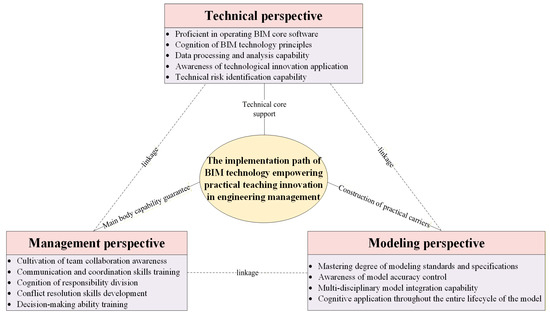
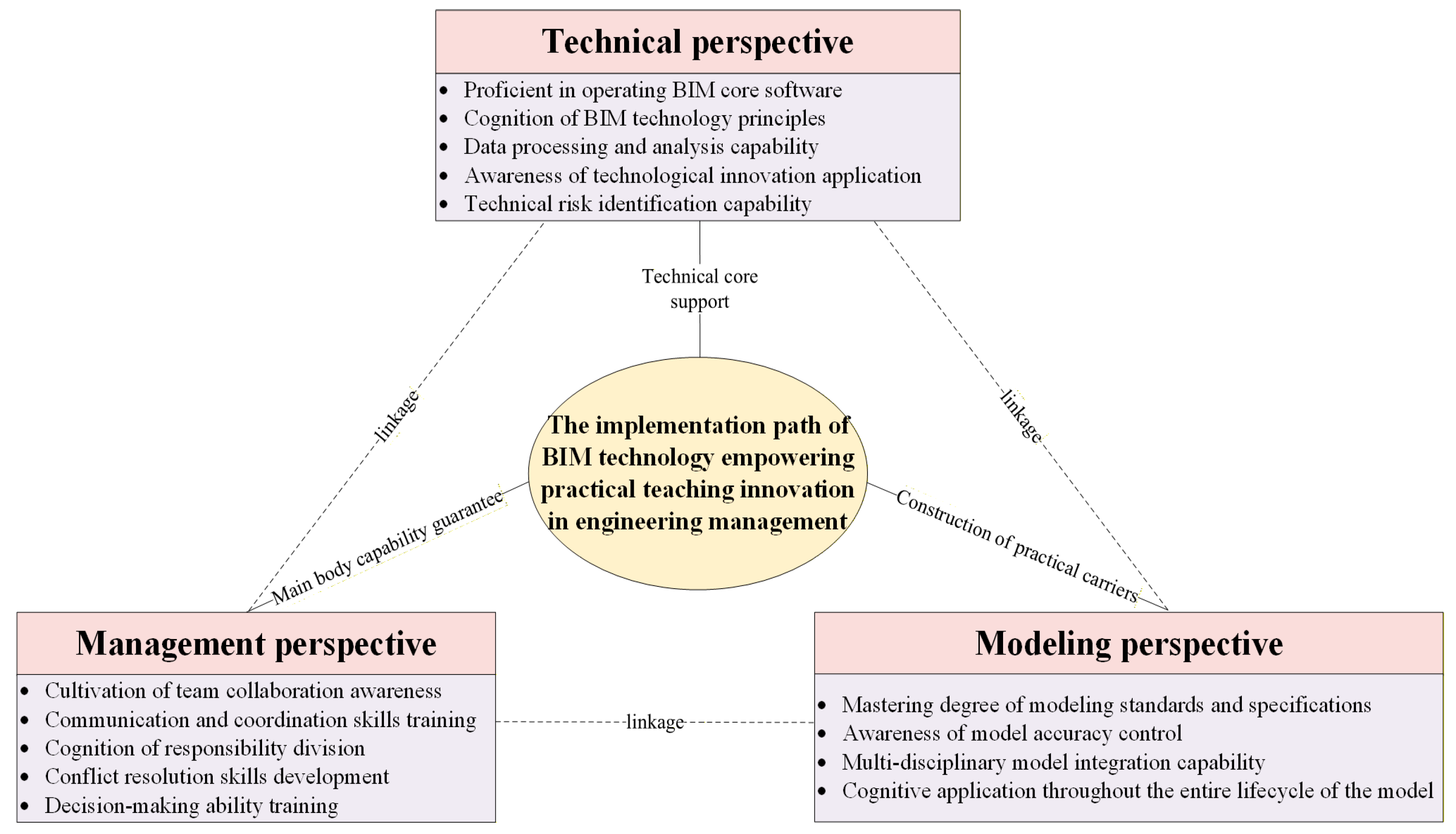
Selective coding [39] aims to distill core categories from primary categories that can integrate all categories and explain central phenomena. Through continuous comparison, this study established “BIM Technology-Empowered Pathways for Innovation in Engineering Management Practice Teaching” as the core category. Centering on this core, it systematically integrated three primary categories—human management perspective, human technology perspective, and modeling perspective—to construct a more internally consistent theoretical model [40], as shown in Figure 1.
Figure 1.
BIM Technology-Empowered Teaching Theory Model.
3.5. Implementation Pathways for BIM Technology-Empowered Innovation in Engineering Management Practice Teaching
“The Implementation Pathways for BIM Technology-Empowered Innovation in Engineering Management Practice Teaching” serves as the core logical thread integrating all initial and primary categories. Its central objective is to establish an innovative implementation framework for the deep integration of BIM technology and engineering management practice teaching. The three primary categories—corresponding to the three key dimensions of “Core Competency Assurance”, “Technical Core Support”, and “Practice Vehicle Construction”—are not isolated entities. They are closely intertwined with the core category, collectively forming a complete “Objective-Support-Implementation” logical chain that facilitates the implementation of the core category [41]. Among these, the “Human Management Perspective” primary category focuses on cultivating collaborative and managerial competencies among teaching entities. By strengthening teamwork, communication, and coordination skills, it provides organizational and human resource safeguards for the implementation pathway. The “Human Technical Perspective” category centers on cultivating BIM core competencies among teaching entities. It solidifies technical foundations through software operation and comprehension of technical principles, serving as the core technical support for implementation pathways. The “Modeling Perspective” category focuses on developing BIM model construction and application capabilities. By mastering modeling standards and integrating multi-disciplinary models, it provides practical platforms and scenario support for implementation pathways. In summary, these three primary domains interconnect the core domain comprehensively and multilaterally from distinct dimensions. They synergize and mutually reinforce each other, collectively forming a complete competency system for implementing the core domain. Ultimately, this system serves the core objective of empowering BIM technology to drive innovation in engineering management practice-oriented teaching.
The three-dimensional structure of “management competence–technical competence–modeling competence” proposed in this study was not predetermined but rather emerged naturally from the interview data. The 14 initial categories generated through open coding were clearly clustered into three main categories during the axial coding phase based on functional and structural relationships. These correspond respectively to the interpersonal coordination and organizational management competencies required of engineering management professionals in a BIM environment (management), the software operation and data processing execution competencies (technical), and the model creation, standards compliance, and lifecycle application competencies (modeling). This three-dimensional division more systematically integrates soft skills, hard skills, and information carrier construction capabilities. To test the possibility of alternative structures, the research team attempted other clustering schemes during the coding process, such as categorizing “model accuracy control awareness” under the technical dimension or placing “decision-making competency training” under the modeling dimension. Through continuous comparative analysis and verification, the results demonstrated that the three-dimensional structure presented in this study outperformed all alternative proposals in terms of category distinctiveness, logical self-consistency, and theoretical explanatory power, and was therefore established as the final model.
4. Empirical Testing
4.1. Determining Objective Weights of Indicators Using the Entropy Method
The entropy method is a multi-indicator decision analysis approach based on information entropy theory. Its core principle involves determining indicator weights by calculating the entropy value of each indicator, thereby enabling comprehensive ranking of evaluation subjects. After the grounded-theory framework had been established, the entropy method was used as a supplementary quantitative procedure to estimate the relative informational contribution of each competency indicator. The method is based on information entropy: indicators with greater score dispersion contain more discriminating information and therefore receive higher weights, whereas indicators with more concentrated scores receive lower weights. In this study, the entropy method was used to examine the relative importance of the 14 indicators derived from qualitative coding.
To ensure the professionalism and authority of the evaluation, this study invited 20 experts, including core faculty members of university Engineering Management programs and senior engineers from BIM-related enterprises, to form an expert panel. All panel members possess more than 5 years of practical experience in either BIM teaching or project management. The experts cover three major domains: university teaching, enterprise application, and industry management. The specific composition is as follows: 14 university BIM teachers (70%), 3 enterprise BIM technical personnel (15%), and 3 industry association experts (15%). In terms of educational background, 14 hold doctoral degrees, 4 hold master’s degrees, and 2 hold bachelor’s degrees. Regarding working experience, 13 have 5–7 years of experience and 7 have 7 or more years of experience. A questionnaire was designed using a 5-point Likert scale, requiring each expert to independently score the aforementioned 14 secondary indicators based on the current status of BIM technology application in teaching (where 1 represents “very poor” and 5 represents “excellent”). A total of 20 questionnaires were distributed, and 20 valid questionnaires were collected, yielding an effective response rate of 100%.
Before scoring, all experts received the same scoring sheet and indicator definitions. Each secondary indicator was evaluated using a 5-point Likert scale. The scale was defined as follows: 1 = very poor, indicating that the indicator is not reflected in current BIM practice teaching; 2 = poor, indicating that the indicator is weakly reflected and lacks systematic implementation; 3 = fair, indicating that the indicator is basically reflected but implementation remains incomplete; 4 = good, indicating that the indicator is substantially reflected with relatively systematic implementation; and 5 = excellent, indicating that the indicator is fully reflected and implemented at an advanced level. The individual-level raw scoring matrix is not publicly disclosed because the experts signed confidentiality agreements and the dataset will be used in follow-up research.
- (1)
- Construction of the raw scoring matrix
The expert scoring results were arranged as a two-dimensional matrix, in which each row represents an expert and each column represents a competency indicator derived from the grounded-theory coding:
- (2)
- Dimensionalization of Data
To eliminate dimensional differences, the raw scores were normalized using min-max scaling. Since all indicators in this study are positively oriented, the transformation is defined as:
Note: and represent the maximum and minimum values of the j-th indicator, respectively, where denotes its original data; denotes the calculated value obtained after dimensionless transformation.
- (3)
- Calculate the ratio of each evaluation object under each indicator
The proportion of each expert’s normalized score to the total score of the corresponding indicator was calculated using the following formula:
Note: denotes the weight value of the j-th indicator for the i-th evaluation object.
- (4)
- Calculate the entropy values for each indicator
Information entropy is used to measure the amount of information and the degree of data dispersion of each indicator, calculated as follows:
Note: = 1, 2, 3…, = 1, 2, 3…. > 0, denotes the natural logarithm, .
- (5)
- Calculate the indicator weights
The difference coefficient (redundancy) reflects the utility of the information provided by the indicator (). The weights are obtained by normalizing the difference coefficients:
Note: The sum of all weights equals 1 ().
The raw scores were used as input data to calculate the weight of each indicator using the SPSSAU system (25.0). The final calculated weights are shown in Table 3. The results show that “Proficiency in BIM Core Software Operation” has the highest weight (12.652%), due to large variance in expert scores combined with high recognition, whereas “Data Processing and Analysis Capability” has a relatively low weight (3.707%). This result objectively reflects the current priorities in resource allocation and the capability gaps in BIM practical teaching.
Table 3.
Objective Weights of Qualitative Indicators Based on the Entropy Method.
4.2. Evaluation Model Based on the Extensible Cloud Model
4.2.1. Applicability Analysis of the Extensible Cloud Model
The extensible cloud model is a comprehensive evaluation method integrating extensional theory and cloud theory, demonstrating significant advantages in addressing complex system evaluations involving fuzziness, randomness, and contradictions [42]. Compared to traditional models, it utilizes matter–element theory to construct a multidimensional indicator system, effectively addressing contradictions and incompatibilities among indicators, making it suitable for multi-objective conflict decision-making. Leveraging the probabilistic and statistical properties of cloud models (Expectation , Entropy , and Hyperentropy ), it achieves bidirectional conversion between qualitative and quantitative aspects, balancing expert subjective judgment with data objectivity to reduce uncertainty. Its associativity-based extensional transformation enables dynamic adjustment of evaluation outcomes to adapt to changes in the evaluated object or environment. This model is suitable for evaluating complex systems that involve both fuzzy and random elements, with the cyber-physical coupling mechanism providing a more scientific and flexible analytical framework.
4.2.2. Determination of the Evaluated Object
The entropy-weight calculation in Section 4.1 was based on the original 1–5 Likert scores. However, the extensible cloud model in this study evaluates teaching effectiveness on a percentage scale of 60–100. Therefore, before the cloud-model calculation, the 1–5 Likert scores were linearly transformed into percentage scores. Based on the evaluation matrix defined in Section 4.1 (consisting of experts and indicators), the evaluation model was constructed. The matrix contains the scores provided by experts for each indicator, serving as the input for the cloud model analysis.
4.2.3. Determination of Evaluation Grade Standards
This study categorizes evaluations into five levels based on BIM technology’s role in empowering engineering management practice teaching: Poor, Average, Fair, Good, and Excellent:
- (1)
- Poor indicates teaching fails to cover basic BIM operations and conceptual instruction, with practical projects having no connection to BIM, preventing students from accessing or applying the technology. Teaching resources are scarce, lacking specialized software and hardware, and instructors lack relevant teaching capabilities, resulting in students failing to acquire any BIM-related engineering management skills.
- (2)
- Average indicates that teaching merely involves simple demonstrations of basic operations. Practical projects have only a loose connection to BIM, with its use confined to isolated steps. Students can only complete extremely basic BIM tasks, struggle to understand complex functions and application scenarios, and are unable to apply BIM to solve real-world problems.
- (3)
- Fair indicates a more systematic introduction of BIM technology covering primary application areas. Students learn basic operational workflows and common functions, though problem-solving capabilities and efficiency require improvement. Teaching resources and faculty generally meet instructional needs.
- (4)
- Good indicates in-depth application of BIM technology, encompassing not only core operations but also advanced features and extended applications. Students can proficiently complete complex tasks and flexibly apply the technology to solve problems. Teaching resources are advanced, and faculty possess extensive teaching experience and diverse methodologies.
- (5)
- Excellent indicates that BIM application reaches industry-leading standards, enabling innovative research and practice aligned with the latest trends. Students engage in cross-disciplinary integrated projects, driving engineering management transformation. Teaching resources are world-class, faculty teams comprise industry experts, and close industry partnerships provide students with premium development platforms.
The five-level evaluation thresholds (score range of 60–100 and the division of each level) adopted in this study were determined based on the following principles: First, the score range of 60–100 was divided into five evaluation intervals based on expert consultation rather than strict equal-interval grouping. This approach is consistent with the percentage-based evaluation conventions in Chinese higher education, facilitating direct understanding and application by educators and practitioners. Second, the qualitative descriptors for each level (ranging from “Poor” to “Excellent”) and the corresponding score interval divisions were determined through expert panel review: the research team invited 7 experts with experience in BIM teaching or industry application to conduct two rounds of collective deliberation and independent scoring on the preliminarily drafted level definitions and corresponding score ranges, until more than 80% consensus was reached on the classification scheme of “60–70 as Poor, 70–80 as Average, 80–90 as Fair, 90–95 as Good, and 95–100 as Excellent”. To further test the robustness of different classification approaches, the research team evaluated two alternative schemes: the first adopted the quartile method (defining 90–100 as Excellent, 80–90 as Good, 70–80 as Average, and 60–70 as Passing), and the second adopted unequal-interval grouping (e.g., Excellent: 95–100, Good: 90–95, Average: 80–90, Passing: 70–80, and Failing: 60–70). Using the same set of expert scoring data, the comprehensive cloud model evaluation results were calculated under each scheme, respectively. The results showed that all schemes yielded a final rating of “Excellent”, and the rank-order correlation coefficients of the comprehensive scores across all indicators were above 0.95. This indicates that the evaluation conclusions of this study are insensitive to the threshold division method and possess good robustness.
Regarding evaluation methodology, this study incorporates cloud model theory to construct an assessment framework based on three core parameters: Expectation (), Entropy (), and Hyperentropy (). Specifically: represents the typical numerical center of evaluation grades, reflecting the benchmark state of teaching quality; describes the fuzziness and randomness inherent in the evaluation process, embodying the uncertainty of expert judgments; and measures the dispersion of evaluation outcomes, reflecting cognitive differences among various evaluators.
The standard cloud digital feature values corresponding to the evaluation interval are , calculated using the following formula:
In the formula, is a constant that requires adjustment based on the actual degree of fuzziness required for the project. This study adopts a value of 0.5.
4.2.4. Calculation of Association Degree and Evaluation Grade
By combining the indicator weights with the following formula, the digital characteristics of the comprehensive evaluation cloud can be calculated:
To visualize the evaluation results, cloud drops were generated via the forward cloud generator. Based on the generated parameters, namely drop position and conditional entropy, the membership degree of each cloud drop is calculated as:
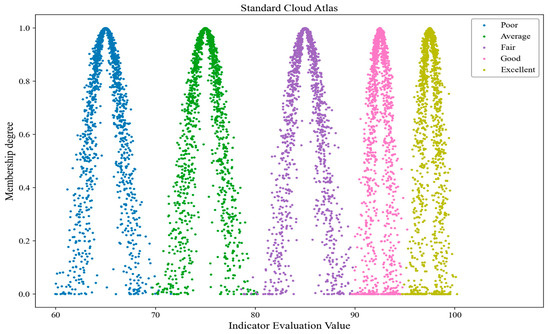
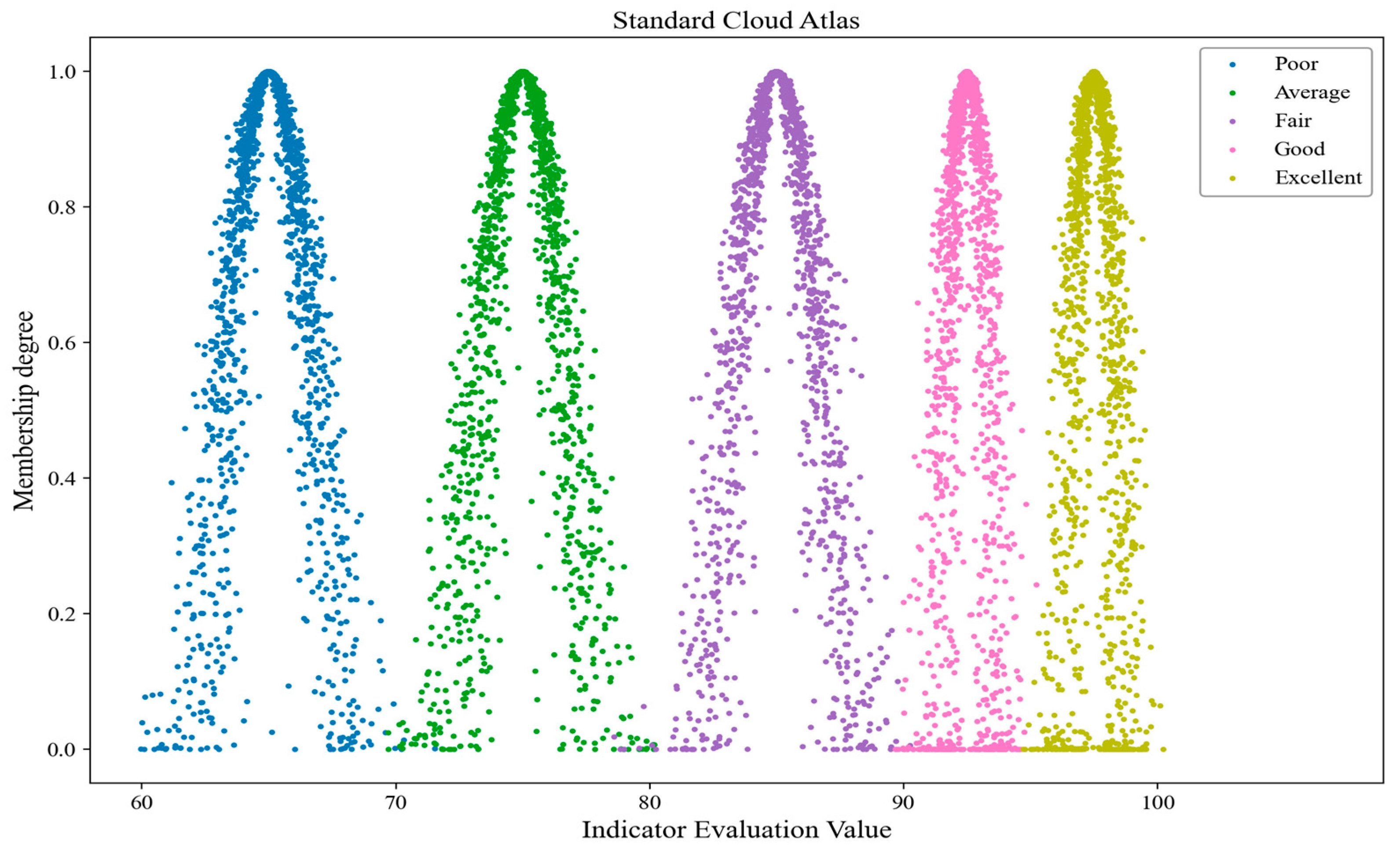
Through calculation, the evaluation grade standards were determined, as shown in Table 4. Using MATLAB software, corresponding standard cloud maps were generated based on the characteristic parameters of the cloud model, as shown in Figure 2.
Table 4.
Evaluation Grades.
Figure 2.
Standard Cloud Diagram.
4.3. Evaluation Results
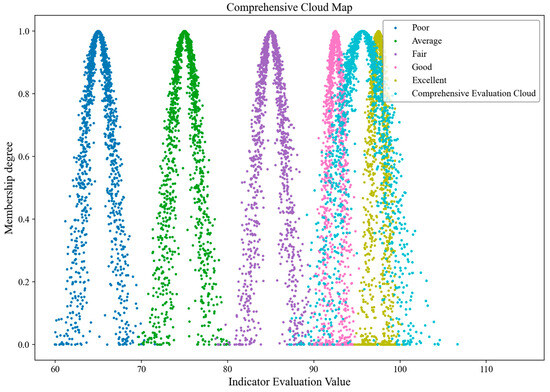
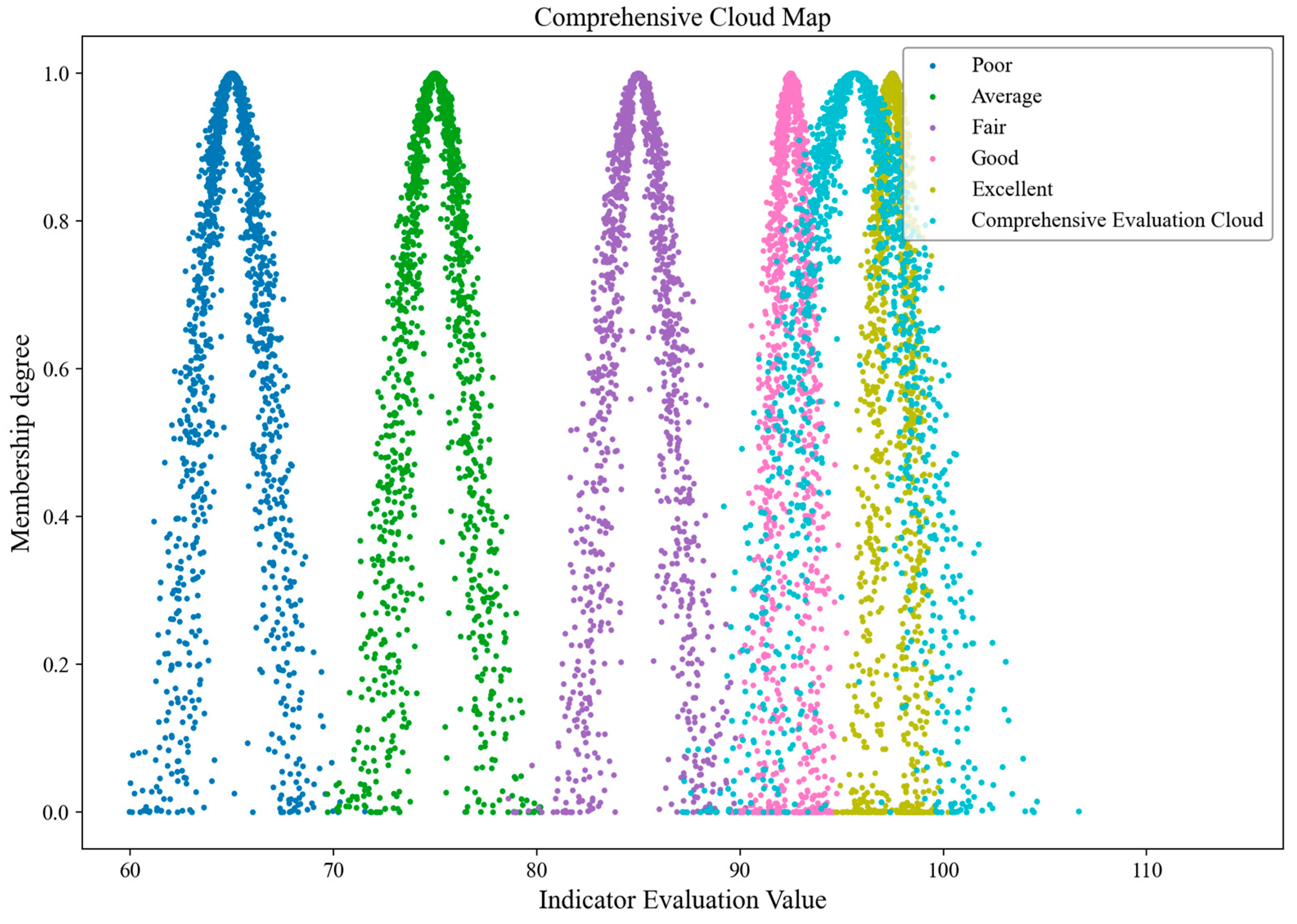
To verify the actual effectiveness of BIM technology in empowering practical teaching of engineering management, this study conducted a comprehensive evaluation based on the objective weights of indicators determined by the entropy weight method, combined with the matter–element matrix to be evaluated (i.e., the scoring dataset from 20 experts). Specifically, the original scores of the 14 secondary indicators provided by the experts were first normalized, and then the formulas above were used to calculate the Expectation (), Entropy (), and Hyperentropy () of each indicator as well as the comprehensive evaluation cloud. The characteristic parameters of each specific indicator are presented in detail in Table 5. To further enhance the reproducibility and visualization of the calculations, cloud drop generation, superposition, and the plotting of the comprehensive cloud chart were implemented using MATLAB R2023b software, ultimately producing the comprehensive cloud chart of evaluation grades shown in Figure 3.
Table 5.
Cloud Model Characteristic Parameters for Each Evaluation Metric.
Figure 3.
Comprehensive Cloud Map of BIM Teaching Effectiveness Evaluation Levels.
Using MATLAB, a composite cloud map of the evaluation grades was generated, as shown in Figure 3:
As can be seen from the comprehensive evaluation cloud in Figure 3, the comprehensive Expectation value of BIM technology empowering practical teaching of engineering management is Ex = 96.2, which falls within the “Excellent” grade interval (95–100). Within this evaluation model, this result suggests that the teaching innovation pathway aligns with advanced industry standards as perceived by the expert panel. The relatively small values of comprehensive cloud Entropy and Hyper-entropy reflect low fuzziness and randomness in the evaluation results, with cloud drops concentrated in the Excellent grade interval and clear grade boundaries, demonstrating high expert consensus and result credibility. The dimension-specific data show that the Management Capability dimension has Ex = 95.8 (Excellent), the Technical Capability dimension has Ex = 96.5 (Excellent), and the Modeling Capability dimension has Ex = 95.1 (Excellent). Among these, the Technical Capability dimension performs most prominently. Combined with the weight data in Table 3, the technical capability indicator represented by “Proficiency in BIM Core Software Operation” (weight: 12.652%) serves as the core driving force pushing the overall evaluation to the Excellent level. According to this evaluation model, this finding suggests the pivotal role of technical capability as a “hard foundation” in teaching effectiveness within the context of this expert-based evaluation.
The final rating of “Excellent” for the model in this study is presented as a model-based expert evaluation rather than an absolute factual claim; its objectivity and reliability have been verified through multiple rigorous procedures. In terms of data sources, the evaluation data were derived from anonymous expert ratings spanning three domains: university teaching, enterprise practice, and industry management. The sample selection ensured both representativeness and randomness, and the data collection process was standardized and uniform without subjective screening, thereby eliminating selective data bias at the source. In terms of the evaluation method, the entropy weight method was employed for objective weighting, determining indicator weights entirely based on the inherent dispersion characteristics of the data, thus completely excluding human interference from subjective weighting. Concurrently, the extensible cloud model was integrated to effectively address the fuzziness and randomness inherent in the evaluation process. The methodological design is highly adapted to the complex evaluation scenarios of BIM practice teaching, and no methodological bias exists. In terms of robustness testing, this study verified the stability of the results through the following approaches: sequentially removing each expert’s rating data and recalculating (leave-one-out method), during which the comprehensive cloud model expectation value fluctuated by less than 2%, and the evaluation rating consistently. When the entropy weight method weights were replaced with an equal-weight scheme, the evaluation rating remained “Excellent”, and the Spearman correlation coefficient of the indicator rankings reached 0.92 (p < 0.01). Randomly drawing 80% of the sample for recalculation 100 times yielded results that did not deviate from the “Excellent” rating. Taken together, these tests indicate that, under the defined evaluation model and expert scoring scheme, the “Excellent” rating is relatively robust.
5. Discussion
5.1. Data Interpretation
The innovation pathway for BIM technology-enabled engineering management practice teaching based on grounded theory was rated as excellent. This signifies that the expert panel considered the teaching path to have reached a relatively advanced industry standard. Within such a teaching system, the management and development of the teaching team constitute a critical component. The institution actively recruits seasoned industry experts and scholars to continuously enhance the faculty’s keen insight into the latest BIM technology trends, enabling them to integrate cutting-edge concepts and methodologies into their teaching.
5.2. Theoretical Innovation and Contributions
This study contributes to BIM education research by shifting the focus from tool application to competency-generation mechanisms. It constructs a three-dimensional framework of Management Competence, Technical Competence, and Modeling Competence based on grounded-theory analysis, and then validates this framework through entropy weighting and the extensible cloud model. The contribution therefore lies not only in evaluating BIM teaching performance, but also in explaining how BIM-enabled teaching can support different dimensions of engineering-management competency development in developing-country contexts.
5.3. Practical Validation and Achievements
To connect the theoretical framework with educational practice, this section presents selected contextual evidence from Chinese higher education. These examples are used to illustrate how the three-dimensional competency framework may operate in real teaching settings. They are not used as input data for the entropy-weight calculation or the extensible cloud-model evaluation.
The practical validation evidence in this section is based on three types of sources: (1) published or institutional reports on BIM education development, such as the 2025 China Mainland BIM Education Report; (2) internal teaching records and graduation project archives from Xinjiang University and its partner institutions; and (3) internal tracking records from the cooperative education program involving enterprise mentors. The internal institutional data were used only as contextual evidence to illustrate the practical relevance of the proposed framework.
1. Validation of the Management Dimension:
The theoretical model emphasizes collaborative management capabilities. Within the multi-dimensional ecosystem of BIM technology–enabled, practice-oriented teaching for engineering management, the faculty teams from Xinjiang University and Yangzhou University leveraged remote collaboration platforms to conduct cross-spatial collaborative learning and teaching application practices using BIM technology. The inter-university remote collaborative teaching initiative also served as a practical verification of this capability. By leveraging BIM platforms, institutions transcend geographical barriers, simulating the cross-regional coordination required in modern engineering projects. This initiative directly addresses the “Cultivation of Team Collaboration Awareness” and “Training of Communication and Coordination Skills”. Through authentic industry-academia linkage and cross-domain cooperation, this case demonstrates that the management dimension of the proposed model possesses not only theoretical rigor but also significant practical applicability, effectively enhancing students’ organizational and coordination competencies within complex engineering environments.
2. Validation of the Technology and Modeling Dimensions:
The empirical results highlight “BIM Core Software Operations” as the highest-weighted indicator. According to the 2025 China Mainland BIM Education Report jointly published by the China BIM Alliance and NATSPEC, BIM-related teaching has been increasingly incorporated into higher-education curricula in mainland China [43]. Furthermore, based on internal teaching records and graduation project archive data from Xinjiang University and its partner institutions between 2021 and 2025, 73% of the reviewed graduation projects used BIM platforms, and 45% reached the LOD400 requirement according to the institutional graduation-project assessment criteria. Students at Xinjiang University utilized BIM for complex scenarios such as tower crane monitoring and high-formwork simulation. These activities directly correspond to the “Modeling Perspective” and “Technical Perspective” in our model, illustrating the feasibility of cultivating high-precision modeling and technical risk identification capabilities.
3. Industry-Academia Integration:
Furthermore, the involvement of enterprises in curriculum design and competition judging supports the “Innovation Application” capability defined in the theoretical framework. According to the internal tracking records of the cooperative education program, student participation in hands-on BIM projects increased from 18% before the introduction of enterprise mentors to 59% after their involvement. The closed-loop ecosystem of “government-industry-academia-research” helps ensure that the technical skills taught align with industry demands, reinforcing the robustness of the evaluation system’s “Excellent” rating.
6. Conclusions
This study yields three main findings. First, based on grounded theory analysis of interviews with 47 participants, 14 initial categories were identified and clustered into three dimensions: management competence (e.g., teamwork, communication), technical competence (e.g., software operation, data analysis), and modeling competence (e.g., standards mastery, multidisciplinary integration). Second, the entropy weight method reveals that “Proficiency in BIM Core Software Operations” carries the highest weight (12.652%), indicating its foundational role in teaching effectiveness. Third, the cloud model evaluation yields an overall Expectation value of = 96.2, falling within the “Excellent” grade (95–100) under the defined evaluation criteria, suggesting that the proposed pathway aligns with advanced industry standards as perceived by the expert panel.
From the perspective of decision-making skills training, BIM technology plays a role in empowering innovative approaches to engineering management practice teaching, offering students a platform for honing decision-making abilities. The virtual building information models constructed by BIM technology integrate information across the entire lifecycle of construction projects, encompassing design, construction, operation, and other phases. When participating in BIM-based practical projects, students confront diverse complex problems and challenges, which encourage them to apply acquired knowledge and make decisions tailored to real-world scenarios. BIM technology also supports real-time simulation and dynamic adjustments, helping students refine decisions based on project progress and cultivate adaptability. According to the interviewed educators and industry experts, repeated engagement in such projects may provide systematic training in decision-making and help students navigate complex situations in future engineering management careers. It should be noted, however, that this study did not directly measure students’ actual improvement in decision-making skills. Therefore, this finding should be interpreted as an expert-based teaching implication rather than direct causal evidence.
In terms of technical risk identification, BIM technology can support innovative approaches to engineering management practice teaching by constructing a highly realistic and complex technical risk identification environment. BIM models incorporate rich architectural elements and detailed technical parameters, enabling the simulation of various potential technical issues and risk scenarios. Through in-depth analysis of BIM models, students may learn to identify potential technical risks and establish corresponding risk assessment models. This further reflects the practical relevance of the technical competence and modeling competence dimensions identified in this study.
BIM technology can also integrate with risk management software to provide students with more comprehensive risk analysis tools. Interviewees suggested that by studying real-world project data, students can gradually master the patterns and methodologies of technical risk identification, developing risk assessment models tailored to different project types and scales. This BIM-based training can enhance students’ risk awareness and response abilities, and may help cultivate innovative talent with professional risk assessment skills for the engineering management field. Again, these outcomes were not directly measured in this study; they reflect expert opinions rather than causal evidence. Accordingly, future empirical studies are needed to test whether BIM-based training produces measurable improvements in students’ decision-making and risk-identification performance.
It should be noted that the model in this study was primarily constructed and validated based on data from Chinese universities and industries, and has not yet been tested on datasets from other countries or different cultural contexts; therefore, its international generalizability warrants further examination. This reliance on the Chinese context constitutes both a limitation of the study and its core value—it offers an in-depth revelation of BIM competency development pathways in developing countries under resource constraints, providing a useful theoretical framework for educational transformation in comparable economies. Future research will collect empirical data from other developing countries to conduct cross-cultural comparative analyses, thereby testing the cross-contextual stability of the model and facilitating its localized adaptation. Furthermore, subsequent studies may also explore the application of this model in differentiated contexts across different educational levels (vocational education versus undergraduate education) or disciplinary backgrounds (civil engineering versus architecture), further expanding the applicability of the existing findings. In summary, this study provides a localized theoretical and methodological reference for BIM practice teaching reform, while its broader applicability still requires further validation.
Author Contributions
Conception–methodology, X.H.; writing—review and editing, H.H., J.W. and Q.X.; experimentation–editing, X.L.; investigation–data curation, X.G. All authors have read and agreed to the published version of the manuscript.
Funding
This research was funded by the Teaching Reform Research Project of Xinjiang Uygur Autonomous Region (Grant No. XJGXJGPTA-2025003); the National Natural Science Foundation of China (Grant No. 75261027); the Postgraduate Education and Teaching Reform Project of Xinjiang University (Grant No. XJDX2024YJG72); and the Teaching Case Library Construction Project for Professional Degree Postgraduates of Xinjiang University (Grant No. XJDX2025YALK07).
Institutional Review Board Statement
This study is classified as a minimal-risk, non-interventional social science research (involving only anonymous interviews and questionnaire surveys). In accordance with the academic ethics policies of the affiliated institution, formal Institutional Review Board (IRB) approval was not required; however, the research process strictly adhered to the Declaration of Helsinki and the academic ethics guidelines of the affiliated institution.
Informed Consent Statement
After being informed of the research purpose and content, all participants provided informed consent. Participants were informed that they could withdraw from the study at any time without conditions, and that all data would be used solely for academic analysis.
Data Availability Statement
Some or all data that support the findings of this study are available from the corresponding author upon reasonable request.
Acknowledgments
The authors would like to apologize to researchers whose important works could not be cited due to space limitations. We are particularly grateful to those who have contributed directly or indirectly to the field of engineering management teaching and research. Additionally, we would like to express our special thanks to Xinjiang University for its support of our research.
Conflicts of Interest
Author Xuekelaiti Haiyirete was employed by the company Xinjiang Xindewang Construction Project Management Consulting Co., Ltd. The remaining authors declare that the research was conducted in the absence of any commercial or financial relationships that could be construed as a potential conflict of interest.
Appendix A
Interview Outline
“Hello! We are currently conducting a study on ‘Innovative Pathways of BIM Teaching in Universities,’ aiming to establish a more scientific teaching evaluation system. We have invited you to participate in this interview primarily to hear your valuable insights, help us verify whether this new training model is truly feasible, and understand the challenges and effectiveness of current BIM teaching in practical application. This interview is for academic research purposes only, and all information will be kept strictly confidential. Thank you very much for your support and cooperation”.
How is BIM currently integrated into the curriculum? Is it taught as a standalone course, embedded as modules, or mainly used in graduation projects?
In your opinion, what is the biggest weakness in BIM skills among fresh graduates?
What do you think is the biggest difficulty in promoting BIM teaching at present (e.g., faculty, software, class hours)?
Which BIM software do you think students must master? Why?
What standard of modeling accuracy (LOD) do you think students should achieve upon graduation?
Besides drafting, do students need to master advanced applications such as clash detection and construction simulation (e.g., tower crane monitoring)?
How do you view the importance of ‘teamwork’ and ‘communication skills’ in engineering practice?
Do you think cross-university remote collaborative teaching, like that between Xinjiang University and Yangzhou University, is helpful for cultivating management capabilities?
Do you think it is necessary for industry mentors (e.g., experts from Glodon or Luban) to participate in teaching? What role should they play?
Can the content taught in universities keep up with the latest demands of the industry?
In your view, which is more important: ‘software operation’ or ‘management thinking’? Why does ‘BIM Core Software Operation’ have the highest weight (12.652%) in this study?
Overall, what level do you think the current BIM teaching pathway can achieve (Excellent/Good/Average)? Why?
Do you have any other suggestions regarding BIM talent cultivation?
References
- Nour, S.; Arbussà, A. Driving innovation through organizational restructuring and integration of advanced digital technologies: A case study of a world-leading manufacturing company. Eur. J. Innov. Manag. 2025, 28, 3262–3283. [Google Scholar] [CrossRef] [Scilit]
- Rover, D.T. Engineering for a Changing World: A Roadmap to the Future of Engineering Practice, Research, and Education. J. Eng. Educ. 2008, 97, 389–392. [Google Scholar] [CrossRef] [Scilit]
- Zhang, J.; Wu, W.; Li, H. Enhancing Building Information Modeling Competency among Civil Engineering and Management Students with Team-Based Learning. J. Prof. Issues Eng. Educ. Prac. 2018, 144, 13. [Google Scholar] [CrossRef] [Scilit]
- Zhao, X.F.; Li, W.B.; Luo, Q.W.; Liu, J.Q.; Sun, Z.; Sun, J.; Zhu, H.L.; Huang, C.; Li, M.X.; Ji, W.Y. Closed-Loop Management System for Design of a Building Information Modeling Curriculum to Meet Industry Requirements. Int. J. Eng. Educ. 2023, 39, 1386–1399. [Google Scholar]
- Luo, S.-M.; Xu, J.; Li, B.-K. Practice and Exploration on Teaching Reform of Engineering Project Management Course in Universities Based on BIM Simulation Technology. Eurasia J. Math. Sci. Technol. Educ. 2018, 14, 1827–1835. [Google Scholar] [CrossRef] [Scilit] [PubMed]
- Pikas, E.; Sacks, R.; Hazzan, O. Building Information Modeling Education for Construction Engineering and Management. II: Procedures and Implementation Case Study. J. Constr. Eng. Manag. 2013, 139, 13. [Google Scholar] [CrossRef] [Scilit]
- Baqués, N.L.; Ferrero, J.D.; Pozo, G.R. Implementation of Education for Sustainable Development in Higher Education: Engineering Studies. Afinidad 2025, 82, 385–398. [Google Scholar] [CrossRef] [Scilit]
- Lozano-Galant, F.; Porras, R.; Mobaraki, B.; Calderón, F.; Gonzalez-Arteaga, J.; Lozano-Galant, J.A. Enhancing Civil Engineering Education through Affordable AR Tools for Visualizing BIM Models. J. Civ. Eng. Educ. 2024, 150, 14. [Google Scholar] [CrossRef] [Scilit]
- Lee, S.; Lee, J.; Ahn, Y. Sustainable BIM-Based Construction Engineering Education Curriculum for Practice-Oriented Training. Sustainability 2019, 11, 6120. [Google Scholar] [CrossRef] [Scilit]
- Li, N.; Han, Y.; Gao, F. Theory and practice of BIM skills of construction management professional based on conceive–design–implement–operate engineering teaching mode. Comput. Appl. Eng. Educ. 2024, 32, e22719. [Google Scholar] [CrossRef] [Scilit]
- Correa, J.G.A.; Alves, J.L.; Homrich, A.S.; de Carvalho, M.M. Evolving skillsets of architecture, engineering and construction sector: Unveiling the interplay between project management, BIM, strategic and operational skills. Eng. Constr. Arch. Manag. 2025, 33, 2422–2447. [Google Scholar] [CrossRef] [Scilit]
- Wu, W.; Issa, R.R.A. BIM Education and Recruiting: Survey-Based Comparative Analysis of Issues, Perceptions, and Collaboration Opportunities. J. Prof. Issues Eng. Educ. Pract. 2014, 140, 9. [Google Scholar] [CrossRef] [Scilit]
- Sotelino, E.D.; Natividade, V.; do Carmo, C.S.T. Teaching BIM and Its Impact on Young Professionals. J. Civ. Eng. Educ. 2020, 146, 7. [Google Scholar] [CrossRef] [Scilit]
- Taghizadeh, K.; Alizadeh, M.; Roushan, T.Y. Cooperative Game Theory Solution to Design Liability Assignment Issues in BIM Projects. J. Constr. Eng. Manag. 2021, 147, 19. [Google Scholar] [CrossRef] [Scilit]
- Sacks, R.; Wang, Z.; Ouyang, B.; Utkucu, D.; Chen, S. Toward artificially intelligent cloud-based building information modelling for collaborative multidisciplinary design. Adv. Eng. Inform. 2022, 53, 101711. [Google Scholar] [CrossRef] [Scilit]
- Lee, S.; Yu, J. Longitudinal Study on Construction Organization’s BIM Acceptance. Appl. Sci. 2020, 10, 5358. [Google Scholar] [CrossRef] [Scilit]
- Brokbals, S.; Cadez, I. Academic teaching of BIM—Development—Status quo—Demand for action. Bautechnik 2017, 94, 851–856. [Google Scholar] [CrossRef] [Scilit]
- Zhao, T.; Jian, Z.; Zhu, J.; Liu, G.; Yu, S.; Zhang, P. Leveraging BIM technology in vocational education: An Information-Driven teaching reform for prefabricated buildings. Educ. Inf. Technol. 2025, 30, 23467–23497. [Google Scholar] [CrossRef] [Scilit]
- Zhang, J.X.; Xie, H.Y.; Li, H. Competency-Based Knowledge Integration of BIM Capstone in Construction Engineering and Management Education. Int. J. Eng. Educ. 2017, 33, 2020–2032. [Google Scholar]
- Ao, Y.; Peng, P.; Li, M.; Li, J.; Wang, Y.; Martek, I. Empowering architecture, engineering and construction students through building information modeling competitions: A deep dive into behavioral motivation. Eng. Constr. Arch. Manag. 2025, 32, 4475–4494. [Google Scholar] [CrossRef] [Scilit]
- Zuo, W.; Mei, T.; Zhong, S.; Jiang, X.; Yan, N. How to improve performance of Chinese BIM-supported civil engineering projects based on the qualitative comparative analysis method. Sci. Rep. 2025, 15, 15. [Google Scholar] [CrossRef] [Scilit] [PubMed]
- Li, X.; Liao, Q. Research on the computer-aided teaching model of the engineering management specialty based on BIM in China. Comput. Appl. Eng. Educ. 2021, 29, 321–328. [Google Scholar] [CrossRef] [Scilit]
- Del Savio, A.A.; Velarde, K.G.; Díaz-Garay, B.; Pollard, E.V. A Methodology for Embedding Building Information Modelling (BIM) in an Undergraduate Civil Engineering Program. Appl. Sci. 2022, 12, 12203. [Google Scholar] [CrossRef] [Scilit]
- Ahmed, N. Constructing an implementation plan for integrating green BIM into undergraduate architecture programs. Sci. Rep. 2025, 15, 22. [Google Scholar] [CrossRef] [Scilit]
- Nguyen, T.A.; Le, T.-T.; Tran, D.-H.; Jin, R.; Chohan, N.; Guo, B.H.W. BIM-Based Learning Outcomes and Teaching and Learning Activities in Higher Education: A Social Network Analysis. J. Civ. Eng. Educ. 2025, 151, 19. [Google Scholar] [CrossRef] [Scilit]
- Nikolic, D.; Castronovo, F.; Leicht, R. Teaching BIM as a collaborative information management process through a continuous improvement assessment lens: A case study. Eng. Constr. Arch. Manag. 2021, 28, 2248–2269. [Google Scholar] [CrossRef] [Scilit]
- Li, J.; Yang, M.; Liu, C.; Li, A.; Guo, B. Listen to the Companies: Exploring BIM Job Competency Requirements by Text Mining of Recruitment Information in China. J. Constr. Eng. Manag. 2023, 149, 16. [Google Scholar] [CrossRef] [Scilit]
- Meana, V.; Bello, A.; García, R. Análisis de la implantación de la metodología BIM en los grados de ingeniería industrial en España bajo la perspectiva de las competencias. Rev. Ing. Construcción 2019, 34, 169–180. [Google Scholar] [CrossRef] [Scilit]
- Yang, F.; Akanbi, T.; Chong, O.W.; Zhang, J.; Debs, L.; Chen, Y.; Hubbard, B.J. Project-Based Introduction to Computing in Construction Management Curriculum: A Case Study. J. Civ. Eng. Educ. 2024, 150, 12. [Google Scholar] [CrossRef] [Scilit]
- Stough, L.M.; Lee, S. Grounded Theory Approaches Used in Educational Research Journals. Int. J. Qual. Methods 2021, 20, 13. [Google Scholar] [CrossRef] [Scilit]
- Liu, X.; Feng, X.; Zhang, M.; Liu, J.; Chen, M. Educational Advices for New-Graduate Nurse on Social Media in China: A Grounded Theory Study. J. Nurs. Manag. 2024, 2024, 1276010. [Google Scholar] [CrossRef] [Scilit]
- Asgharinajib, M.; Aalipour, S.; Sorooshian, S. Designing a model of indifference in theorizing in management research with grounded theory approach. Front. Res. Metr. Anal. 2024, 9, 1460135. [Google Scholar] [CrossRef] [Scilit]
- Olowa, T.; Witt, E.; Morganti, C.; Teittinen, T.; Lill, I. Defining a BIM-Enabled Learning Environment—An Adaptive Structuration Theory Perspective. Buildings 2022, 12, 292. [Google Scholar] [CrossRef] [Scilit]
- Iqbal, M.; Ullah, I.; Abdou, H.; Alzara, M.; Yosri, A.M. Blueprint for progress: Understanding the driving forces of BIM adoption in Kingdom of Saudi Arabia (KSA) construction industry. PLoS ONE 2025, 20, e0313135. [Google Scholar] [CrossRef] [Scilit] [PubMed]
- Dena, A.J.G.; Hipola, M.D.G.; Bandera, C.F. Optimization testing for the modeling and characterization of three-dimensional elements to enhance interoperability from building information modeling (BIM) to building energy modeling (BEM). Energy Build. 2024, 317, 114394. [Google Scholar] [CrossRef] [Scilit]
- Deng, Y.; Li, J.; Wu, Q.; Pei, S.; Xu, N.; Ni, G. Using Network Theory to Explore BIM Application Barriers for BIM Sustainable Development in China. Sustainability 2020, 12, 3190. [Google Scholar] [CrossRef] [Scilit]
- Locke, K.; Feldman, M.; Golden-Biddle, K. Coding Practices and Iterativity: Beyond Templates for Analyzing Qualitative Data. Organ. Res. Methods 2022, 25, 262–284. [Google Scholar] [CrossRef] [Scilit]
- Purcell, S.M.; Manoach, D.S.; Demanuele, C.; Cade, B.; Mariani, S.; Cox, R.; Panagiotaropoulou, G.; Saxena, R.; Pan, J.Q.; Smoller, J.W.; et al. Characterizing sleep spindles in 11,630 individuals from the National Sleep Research Resource. Nat. Commun. 2017, 8, 15930. [Google Scholar] [CrossRef] [Scilit]
- Feng, Z.; Hou, H.Y.; Lan, H. Understanding university students’ perceptions of classroom environment: A synergistic approach integrating grounded theory (GT) and analytic hierarchy process (AHP). J. Build. Eng. 2024, 83, 108446. [Google Scholar] [CrossRef] [Scilit]
- Marchiori, R.; Song, S.; Moon, J.; Awoyemi, D.; Ghooreian, A.; Ramenzapour, E. A Systematic Review of Technology-Enhanced Learning Approaches to Foster Construction Engineering and Management Competencies. Comput. Appl. Eng. Educ. 2025, 33, e70074. [Google Scholar] [CrossRef] [Scilit]
- Yang, M.; He, J.; Shi, L.; Lv, Y.; Li, J. Integrating policy quantification analysis into ecological security pattern construction: A case study of Guangdong–Hong Kong–Macao Greater Bay Area. Ecol. Indic. 2024, 162, 112049. [Google Scholar] [CrossRef] [Scilit]
- Godager, B.; Onstein, E.; Huang, L. The Concept of Enterprise BIM: Current Research Practice and Future Trends. IEEE Access 2021, 9, 42265–42290. [Google Scholar] [CrossRef] [Scilit]
- BIM Education—Global—2025 Update Report V12.0. Available online: https://www.icis.org/publications/papers/ (accessed on 24 May 2026).

Disclaimer/Publisher’s Note: The statements, opinions and data contained in all publications are solely those of the individual author(s) and contributor(s) and not of MDPI and/or the editor(s). MDPI and/or the editor(s) disclaim responsibility for any injury to people or property resulting from any ideas, methods, instructions or products referred to in the content. |
© 2026 by the authors. Licensee MDPI, Basel, Switzerland. This article is an open access article distributed under the terms and conditions of the Creative Commons Attribution (CC BY) license.