A Data-Driven Lean Continuous-Improvement Training System Using Markerless Motion Capture for Built-Environment Work: A Quasi-Experimental Field Evaluation

Abstract
1. Introduction
1.1. Research Question and Hypothesis
- Q1: Is the app-supported onboarding approach associated with shorter time to qualification and lower training cost than the traditional onboarding approach?
- Q2: Is the app-supported onboarding approach associated with higher task accuracy during qualification?
- Q3: How do site-level safety indicators and implementation features align with the proposed closed-loop coaching mechanism?
1.2. Novelty and Contribution
- Provides a clearer and more defensible description of an integrated intervention that combines markerless motion capture, ergonomic scoring, and Lean/CI routines.
- Reports field outcomes using a quasi-experimental sequential-cohort design with transparent independent-group statistics for the primary outcomes.
- Clarifies the practical mechanism by which pose-derived risk signals were converted into coaching prompts, standard work revisions, and A3 follow-up actions while preserving worker privacy through posture-feature retention rather than routine raw video storage.
2. Related Work
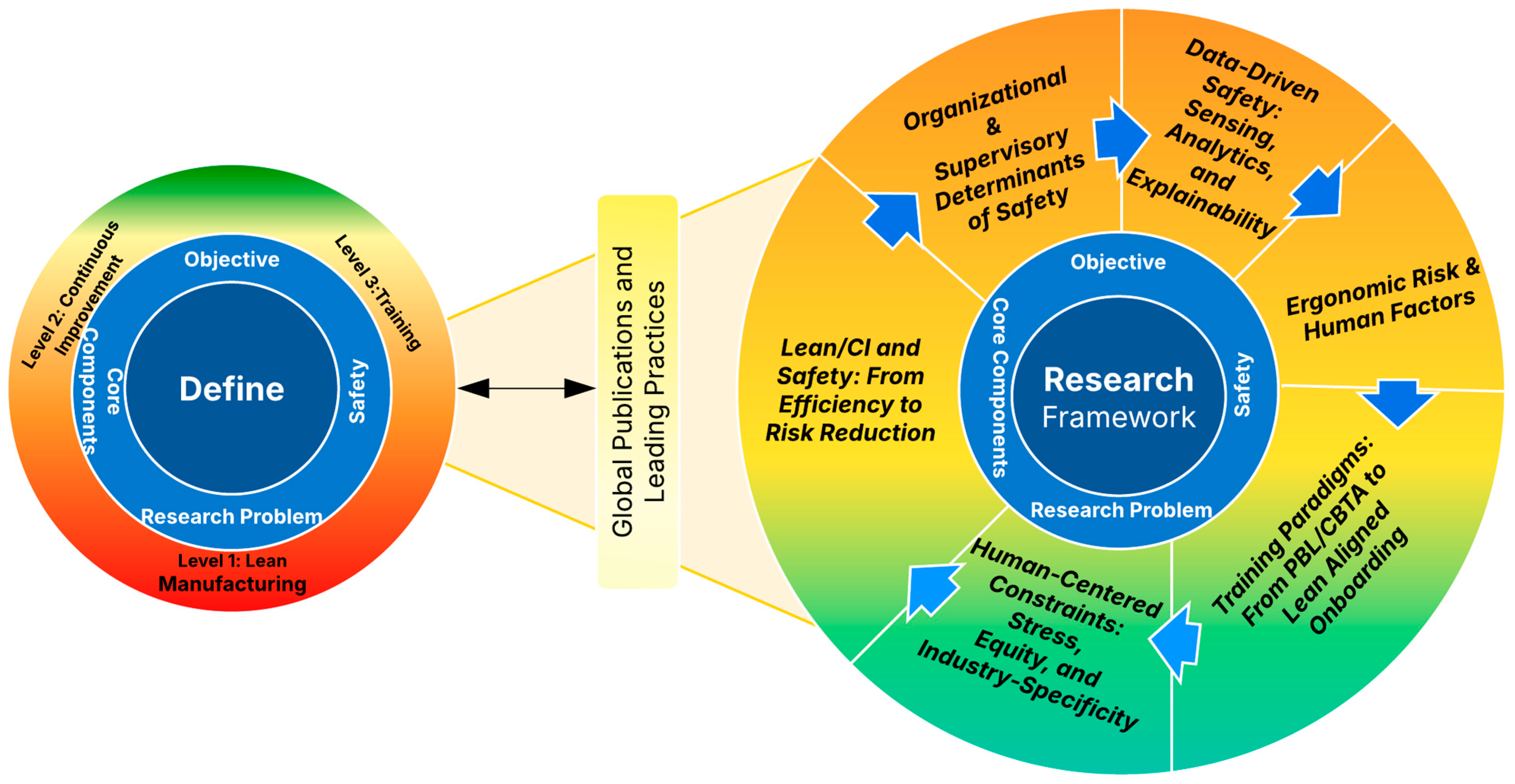
2.1. Lean/CI and Safety: From Efficiency to Risk Reduction
2.2. Digital Ergonomics, Motion Capture, and Workplace Feedback
2.3. Construction Safety Training Effectiveness and Immersive Learning
2.4. Synthesis, Gap, and Positioning of the Present Work
3. Materials and Methods
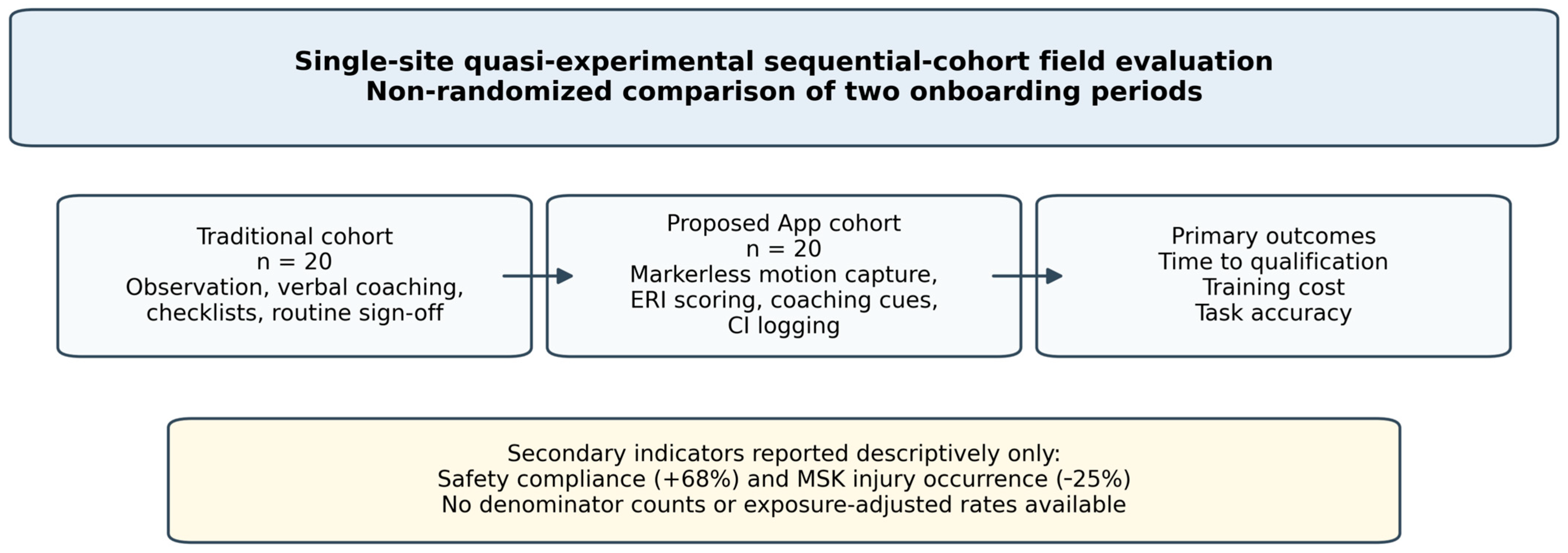
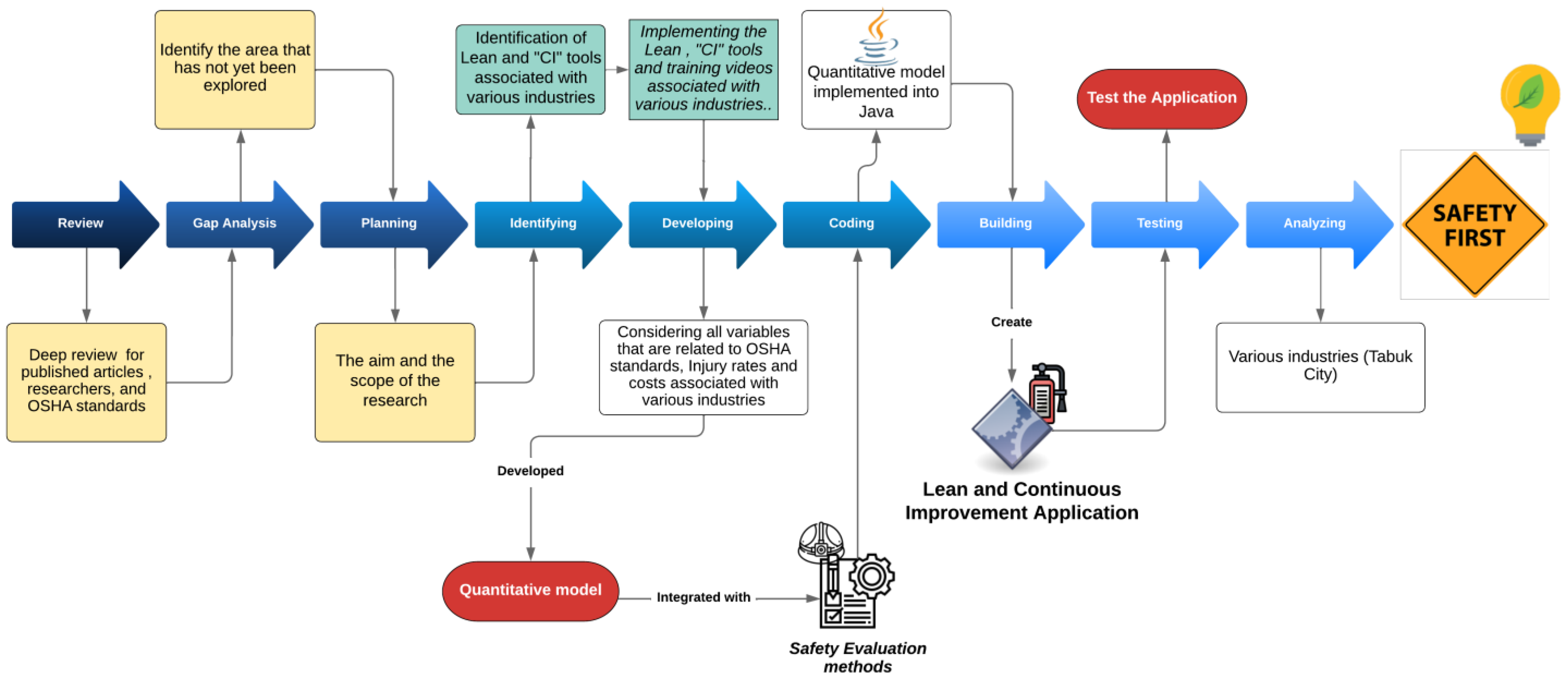
3.1. Study Design and Setting
3.2. Participants and Eligibility
- Physical coordination;
- Posture control;
- Adherence to standardized procedures.
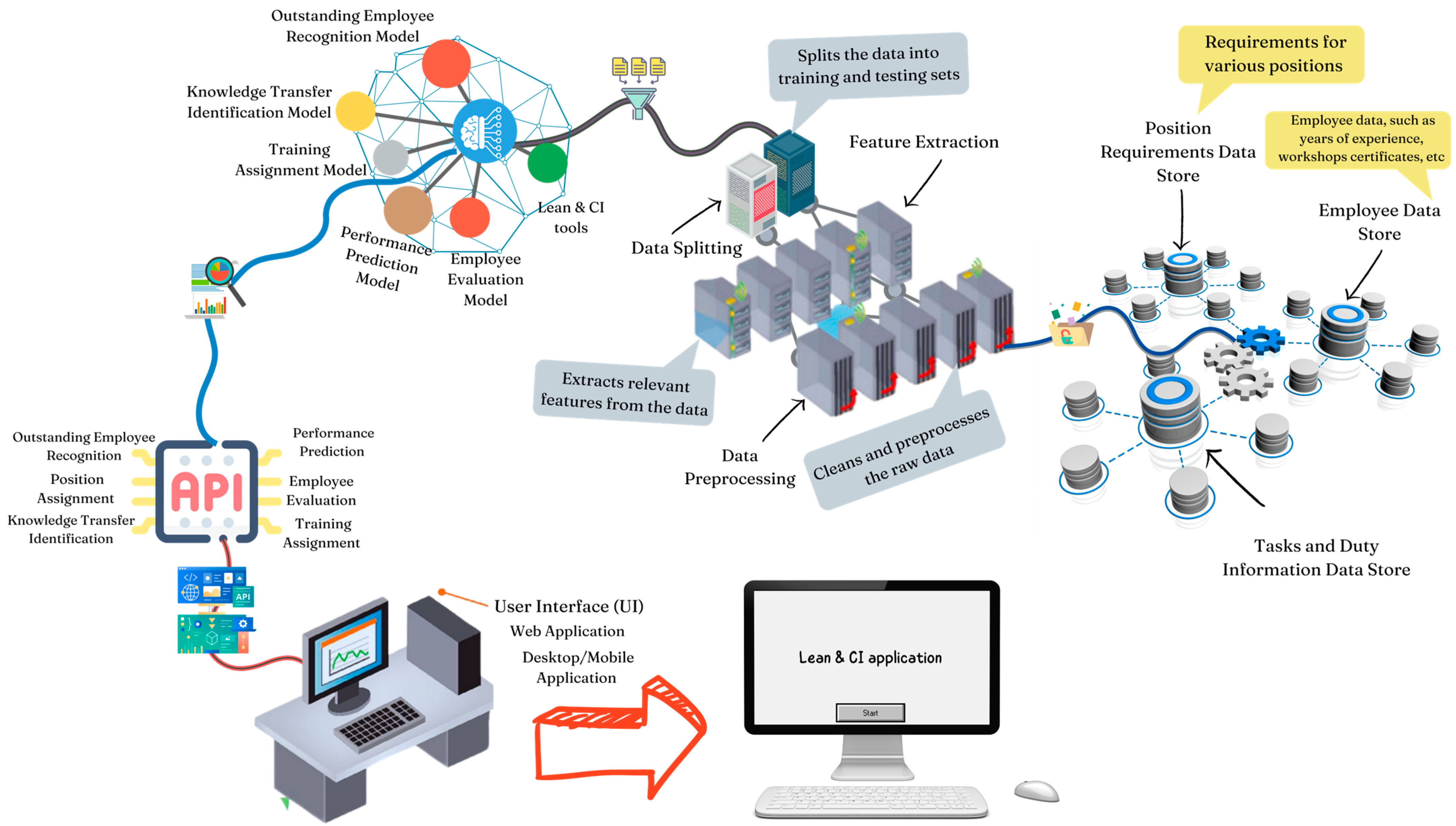
3.3. System Architecture
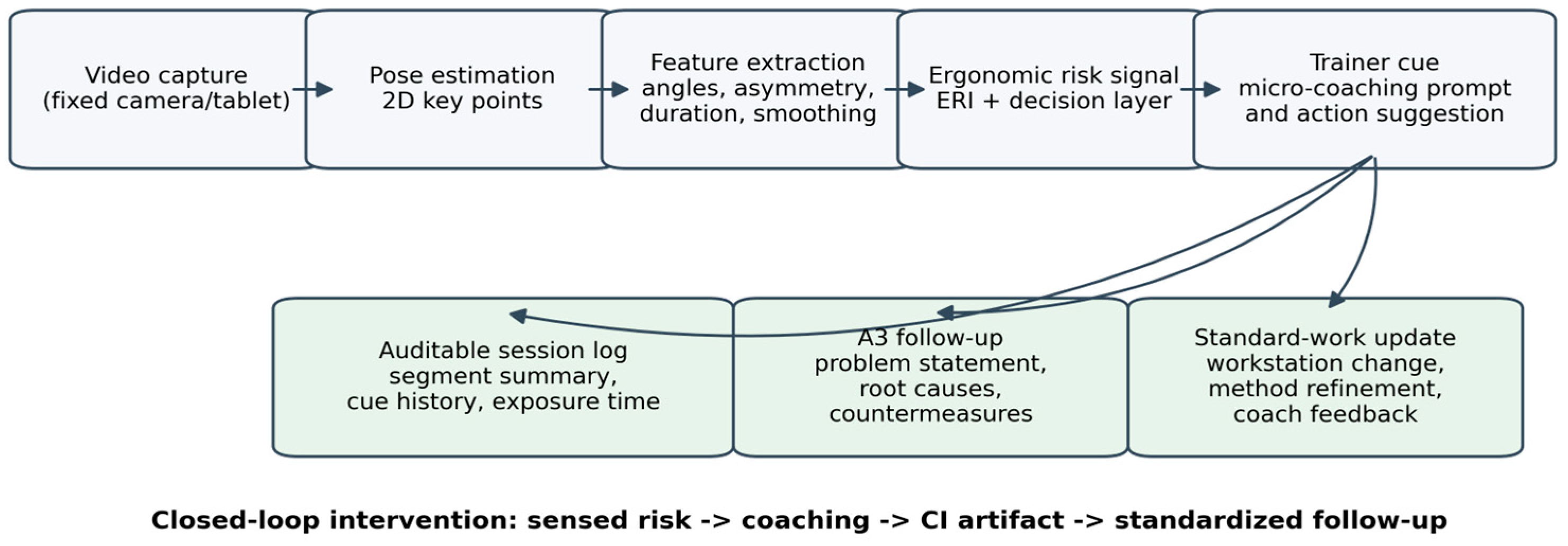
- Acquisition and pose estimation: markerless video capture (fixed tablet/camera) runs a pose estimation engine to obtain 2D joint key points and derived angles.
- Learning-based risk classification and feedback: a lightweight ML scorer converts features to risk class and personalized recommendations (micro coaching cues; suggested Lean tools).
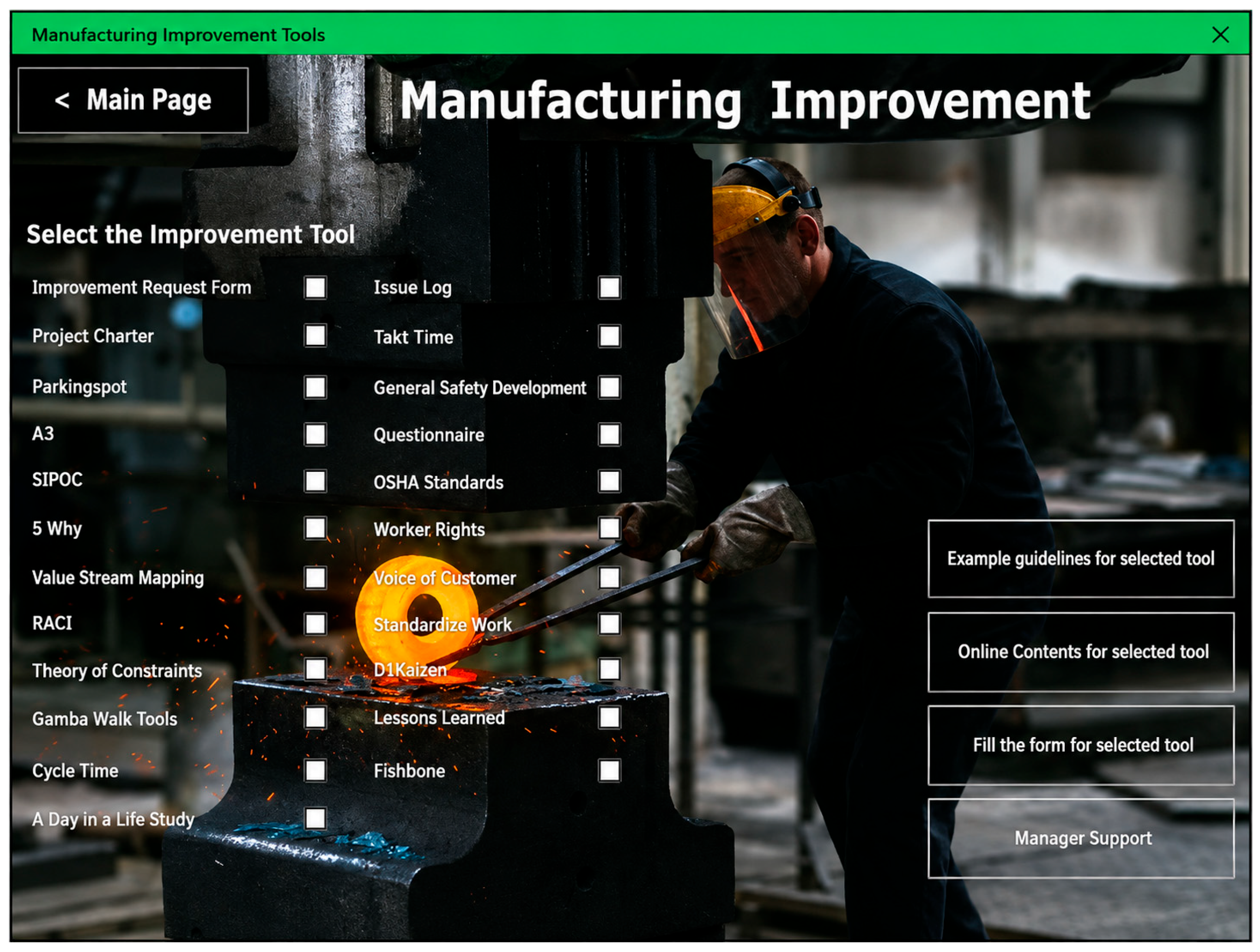
- Lean/CI integration and records: results are linked to standard work, A3 forms, and checklists, closing the measure → decide → act → control loop. Figures also depict the database ER diagram and the end to end flow used during training sessions.
3.4. Technology Implementation
- Design Phase: Definition of user requirements, task analyzes, and interface layouts based on field observations and stakeholder input.
- Development Phase: Integration of motion capture, ML scoring, and database modules within a unified Lean/CI framework.
- Testing Phase: Validation of performance through pilot sessions, latency checks, and privacy control verification.
3.5. Core Algorithms
| Algorithm 1. Real-time ergonomic feedback loop |
|
3.6. Data Management, Privacy, and Ethics
3.7. Testing and Validation
3.8. Evaluation Plan (Study Design and Statistics)
3.9. Implementation and Training (Change Management)
- First, the site team configured industry-standard work templates and risk thresholds in the app, then held a brief orientation on reading the ergonomic risk index (ERI), interpreting on-screen cues, and opening A3/standard work links from within a session.
- Next, coaches ran shadowed practice sessions with an advisory-only week in which cues were displayed but not used for grading, to build trust and calibrate thresholds. Go-live introduced weekly CI huddles to review session logs, update standard work, and capture countermeasures.
- Adoption and training quality were monitored using built-in KPIs sessions per coach, cue-acknowledgment rate, A3s opened from cues, average ERI exposure per task, and time-to-competence with quick-reference job aids embedded in the UI.
- Access is role-based, raw video retention is minimized in favor of posture features, and all coaching actions are audit-logged to support compliance reviews.
3.10. Machine Learning Pipeline and Data Preprocessing
3.11. Ergonomic Classification Module
4. Results
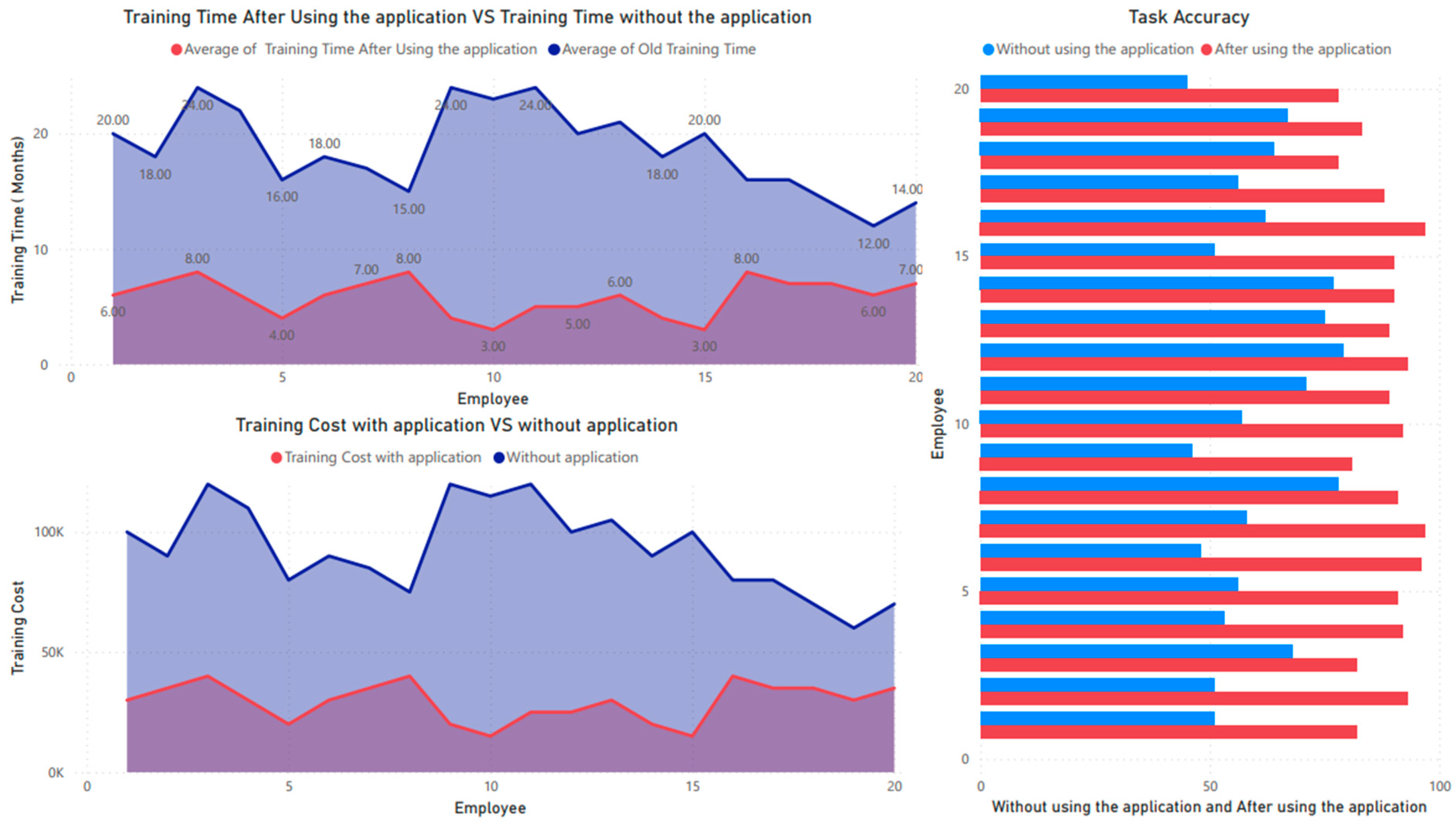
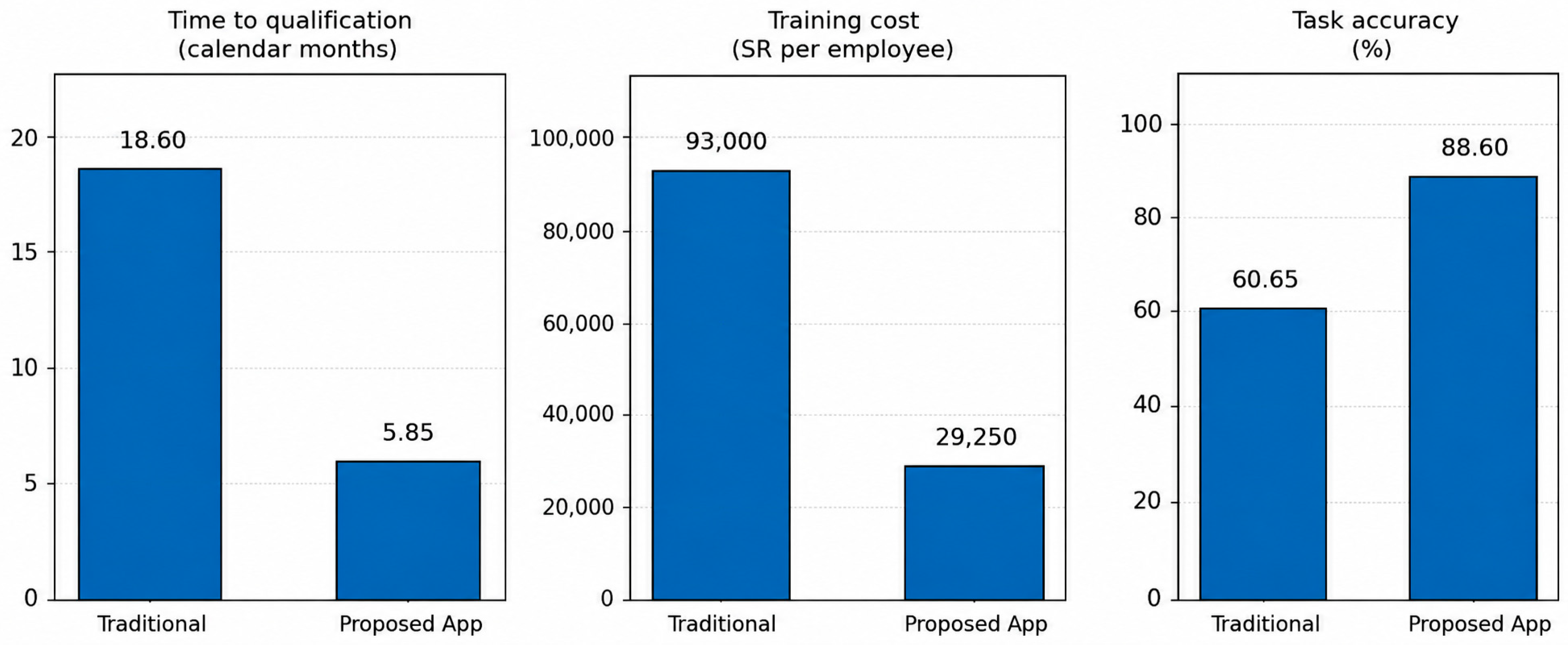
- Time to qualification: elapsed calendar time from onboarding entry until formal qualification sign-off.
- Training cost: total onboarding labor and supervision cost per trainee using the organization’s internal costing basis.
- Task accuracy: percentage of correctly completed required task elements during qualification assessment.
4.1. Inferential Tests (Welch’s t-Test)
4.2. Variability and Process Stability
- Time SD 3.50 → 1.50 months (−57%);
- Cost SD 17,348 → 7603 SR (−56%);
- Accuracy SD 10.60 → 5.70 pp (−46%).
4.3. Secondary Indicators: Compliance and MSK Injuries
- Safety compliance: site-level percentage compliance with required observed safety practices.
- MSK injury occurrence: reported musculoskeletal injury events during the observation period.
5. Discussion
5.1. Implementation Considerations for Built-Environment Work
5.2. Limitations
6. Conclusions
Funding
Data Availability Statement
Conflicts of Interest
References
- Rantsatsi, N.P. Health and safety induction training in the construction industry: A review. J. Facil. Manag. 2024, 23, 561–575. [Google Scholar] [CrossRef] [Scilit]
- Lin, J.; Cai, Y.; Li, Q. Development of safety training in construction: Literature review, scientometric analysis, and meta-analysis. J. Manag. Eng. 2023, 39, 03123001. [Google Scholar] [CrossRef] [Scilit]
- Wu, X.; Yuan, H.; Wang, G.; Li, S.; Wu, G. Impacts of lean construction on safety systems: A system dynamics approach. Int. J. Environ. Res. Public Health 2019, 16, 221. [Google Scholar] [CrossRef] [Scilit]
- Nahmens, I.; Ikuma, L.H. An empirical examination of the relationship between lean construction and safety in the industrialized housing industry. Lean Constr. J. 2009, 2009, 1–12. [Google Scholar] [CrossRef] [Scilit]
- Heydari, M.; Heravi, G.; Raeisinafchi, R.; Karimi, H. A dynamic model to assess the role of site supervision systems in the safety performance of construction projects. J. Constr. Eng. Manag. 2024, 150, 04024001. [Google Scholar] [CrossRef] [Scilit]
- Moaveni, S.; Banihashemi, S.Y.; Mojtahedi, M. A conceptual model for a safety-based theory of lean construction. Buildings 2019, 9, 23. [Google Scholar] [CrossRef] [Scilit]
- Vukićević, A.M.; Petrović, M. Advances in the use of artificial intelligence and sensor technologies for managing industrial workplace safety. In Applied Artificial Intelligence: Medicine, Biology, Chemistry, Financial, Games, Engineering; Springer: Cham, Switzerland, 2023; pp. 1–28. [Google Scholar] [CrossRef] [Scilit]
- Pisu, A.; Elia, N.; Pompianu, L.; Barchi, F.; Acquaviva, A.; Carta, S. Enhancing workplace safety: A flexible approach for personal protective equipment monitoring. Expert Syst. Appl. 2024, 238, 122285. [Google Scholar] [CrossRef] [Scilit]
- Truong, T.; Yanushkevich, S. Visual relationship detection for workplace safety applications. IEEE Trans. Artif. Intell. 2024, 5, 956–961. [Google Scholar] [CrossRef] [Scilit]
- Rajabi, M.S.; Taghaddos, H.; Zahrai, S.M. Improving emergency training for earthquakes through immersive virtual environments and anxiety tests: A case study. Buildings 2022, 12, 1850. [Google Scholar] [CrossRef] [Scilit]
- Brunner, O.; Mertens, A.; Nitsch, V.; Brandl, C. Accuracy of a markerless motion capture system for postural ergonomic risk assessment in occupational practice. Int. J. Occup. Saf. Ergon. 2022, 28, 1865–1873. [Google Scholar] [CrossRef] [Scilit] [PubMed]
- Ojelade, A.; Rajabi, M.S.; Kim, S.; Nussbaum, M.A. A data-driven approach to classifying manual material handling tasks using markerless motion capture and recurrent neural networks. Int. J. Ind. Ergon. 2025, 107, 103755. [Google Scholar] [CrossRef] [Scilit]
- Hamilton, B.C.S.; Dairywala, M.I.; Highet, A.; Nguyen, T.C.; O’Sullivan, P.; Chern, H.; Soriano, I.S. Artificial intelligence based real-time video ergonomic assessment and training improves resident ergonomics. Am. J. Surg. 2023, 226, 741–746. [Google Scholar] [CrossRef] [Scilit]
- Künkel, F.; Bader, S.; Karcher, M.; Mertens, A.; Schlick, C.; Dilger, K. Concept on using visual and tactile sensors for knowledge management in manual manufacturing processes. Procedia CIRP 2022, 112, 186–190. [Google Scholar] [CrossRef] [Scilit]
- Salisu, S.; Ruhaiyem, N.I.R.; Eisa, T.A.E.; Nasser, M.; Saeed, F.; Younis, H.A. Motion capture technologies for ergonomics: A systematic literature review. Diagnostics 2023, 13, 2593. [Google Scholar] [CrossRef] [Scilit]
- Vukadinovic, S.; Macuzic, I.; Djapan, M.; Milosevic, M. Early management of human factors in lean industrial systems. Saf. Sci. 2019, 119, 392–398. [Google Scholar] [CrossRef] [Scilit]
- Ziakkas, D.; Sarikaya, I.; Natakusuma, H.C. EBT-CBTA in aviation training: The Turkish Airlines case study. In Human-Computer Interaction—INTERACT 2023 Adjunct; Springer: Cham, Switzerland, 2023. [Google Scholar]
- Ahn, S.; Kim, T.; Park, Y.-J.; Kim, J.-M. Improving effectiveness of safety training at construction worksite using 3D BIM simulation. Adv. Civ. Eng. 2020, 2020, 2473138. [Google Scholar] [CrossRef] [Scilit]
- Chan, A.P.C.; Guan, J.; Choi, T.N.Y.; Yang, Y.; Wu, G.; Lam, E. Improving safety performance of construction workers through learning from incidents. Int. J. Environ. Res. Public Health 2023, 20, 4570. [Google Scholar] [CrossRef] [Scilit]
- Dou, Y.; Li, H.; Zhou, C.; Luo, X.; Skitmore, M.; Luo, H. Tracking the research on ten emerging digital technologies in the AECO industry. J. Constr. Eng. Manag. 2023, 149, 03123003. [Google Scholar] [CrossRef] [Scilit]
- Fang, W.; Love, P.E.D.; Luo, H.; Ding, L. Computer vision for behaviour-based safety in construction: A review and future directions. Adv. Eng. Inform. 2020, 43, 100980. [Google Scholar] [CrossRef] [Scilit]
- Li, J.; Miao, Q.; Zou, Z.; Gao, H.; Zhang, L.; Li, Z.; Wang, N. A Review of Computer Vision-Based Monitoring Approaches for Construction Workers’ Work-Related Behaviors. IEEE Access 2024, 12, 7134–7155. [Google Scholar] [CrossRef] [Scilit]
- Rasouli, M.; Karimi, H.; Hatami, J. Reconstructing construction safety training: A systematic review based on learning theories and instructional design principles. Saf. Sci. 2025, 184, 106769. [Google Scholar] [CrossRef] [Scilit]
- Maali, O.; Ko, C.-H.; Nguyen, P.H.D. Applications of existing and emerging construction safety technologies. Autom. Constr. 2024, 158, 105231. [Google Scholar] [CrossRef] [Scilit]
- Daniel, E.I.; Oshodi, O.S.; Nwankwo, N.I.; Emuze, F.A.; Chinyio, E. The use of digital technologies in construction safety: A systematic review. Buildings 2025, 15, 1386. [Google Scholar] [CrossRef] [Scilit]
- Zhu, H.; Hwang, B.-G. Real-time safety and worker self-assessment: Sensor-based mobile system for critical unsafe behaviors. Autom. Constr. 2025, 169, 105879. [Google Scholar] [CrossRef] [Scilit]
- Niu, M.; Leicht, R.M. Evaluating the safety climate in construction projects: A longitudinal mixed-methods study. Buildings 2024, 14, 4070. [Google Scholar] [CrossRef] [Scilit]
- Kim, G.Y.; Kwon, Y.B.; Ban, H.; Kim, H.K.; Park, J.Y. The impact of work sequence-based safety training on workers’ cognitive effectiveness at construction sites. Buildings 2025, 15, 1409. [Google Scholar] [CrossRef] [Scilit]
- Zhou, Z.; Wei, L.; Yuan, J.; Cui, J.; Zhang, Z.; Zhuo, W.; Lin, D. Construction safety management in the data-rich era: A hybrid review based upon three perspectives of nature of dataset, machine learning approach, and research topic. Adv. Eng. Inform. 2023, 58, 102144. [Google Scholar] [CrossRef] [Scilit]
- Mayo-Alvarez, L.; Apaza-Surco, A.; Quispe-Bellido, W.; Paredes-Soria, J. Critical Factors in the Implementation of Lean Construction: A Literature Review 2015–2025. Buildings 2026, 16, 825. [Google Scholar] [CrossRef] [Scilit]
- Weeks, K.; Safa, M.; Zamiran, S. The Productivity-Safety Nexus: The Impact of Human Factors on Operational Efficiency in Construction Projects. Buildings 2026, 16, 87. [Google Scholar] [CrossRef] [Scilit]
- Liu, K.; Luo, X.; Feng, J.; Li, H.; Liu, B.; Jian, Y. Research on the Impact of Managers’ Safety Perception on Construction Workers’ Safety Behaviors. Buildings 2024, 14, 3467. [Google Scholar] [CrossRef] [Scilit]
- Alruqi, W.M.; Hoque, M.N.; Ahmed, S.; Abudayyeh, O. The Impact of Safety Training on Safety Behavior Among Multinational Construction Workers: The Mediating Role of Responsibility and the Moderating Role of Nationality. Buildings 2026, 16, 94. [Google Scholar] [CrossRef] [Scilit]
- Munoz-La Rivera, F.; Mora-Serrano, J.; Onate, E.; Montecinos-Orellana, S. A Comprehensive Framework for Integrating Extended Reality into Lifecycle-Based Construction Safety Management. Appl. Sci. 2025, 15, 5690. [Google Scholar] [CrossRef] [Scilit]
- Drozd, W.; Kowalik, M. Analysis of Employees’ Visual Perception During Training in the Field of Occupational Safety in Construction. Appl. Sci. 2025, 15, 9323. [Google Scholar] [CrossRef] [Scilit]
- Demirkesen, S.; Arditi, D. Construction safety personnel’s perceptions of safety training practices. Int. J. Proj. Manag. 2015, 33, 1160–1169. [Google Scholar] [CrossRef] [Scilit]
- Rehman, A.; Hassan, M.U.; Zubair, M.U.; Aziz, T.; Ahmed, K. A Framework for Effective Construction Workers Safety Training Using Flipped Learning. J. Civ. Eng. Manag. 2025, 31, 206–223. [Google Scholar] [CrossRef] [Scilit]
- Daneni, A.B.; Lovreglio, R.; Feng, Z.; Paes, D. Identifying the Long-Term Effects of Construction Safety Training Methods: A Systematic Literature Review. In Technologies and Innovations for Sustainable Future in Building and Construction; Springer: Singapore, 2025; Chapter 30. [Google Scholar] [CrossRef] [Scilit]
- Shringi, A.; Arashpour, M.; Mohammadi Golafshani, E.; Rajabifard, A.; Dwyer, T.; Li, H. Efficiency of VR-Based Safety Training for Construction Equipment: Hazard Recognition in Heavy Machinery Operations. Buildings 2022, 12, 2084. [Google Scholar] [CrossRef] [Scilit]
- Xiong, Z.; Ding, Z.; Li, Y.; Zhang, J. Investigating VR Safety Training Transfer in Construction Hazard Recognition: A Neurocognitive Perspective. Adv. Eng. Inform. 2026, 71, 104412. [Google Scholar] [CrossRef] [Scilit]
- Chen, Q.; Yin, X.; Yuan, B.; Chen, Q. Personalized Safety Training for Construction Workers: A Large Language Model-Driven Multi-Agent Framework Integrated with Knowledge Graph Reasoning. Comput. Ind. 2026, 174, 104399. [Google Scholar] [CrossRef] [Scilit]
- Liu, R.; Wang, P.; Chen, C. Lean-Enhanced Virtual Reality Training for Productivity and Ergonomic Safety Improvements. Buildings 2025, 15, 4534. [Google Scholar] [CrossRef] [Scilit]
- Xia, N.; Griffin, M.A.; Xie, Q.; Hu, X. Antecedents of workplace safety behavior: Meta-analysis in the construction industry. J. Constr. Eng. Manag. 2023, 149, 04023009. [Google Scholar] [CrossRef] [Scilit]
- Gao, Y.; Gonzalez, V.A.; Yiu, T.W. The effectiveness of traditional tools and computer-aided technologies for health and safety training in the construction sector: A systematic review. Comput. Educ. 2019, 138, 101–115. [Google Scholar] [CrossRef] [Scilit]
- Babalola, A.; Manu, P.; Cheung, C.; Yunusa-Kaltungo, A.; Bartolo, P. A systematic review of the application of immersive technologies for safety and health management in the construction sector. J. Saf. Res. 2023, 85, 66–85. [Google Scholar] [CrossRef] [Scilit] [PubMed]
- Man, S.S.; Wen, H.; So, B.C.L. Are virtual reality applications effective for construction safety training and education? A systematic review and meta-analysis. J. Saf. Res. 2024, 88, 230–243. [Google Scholar] [CrossRef] [Scilit] [PubMed]
- Stefan, H.; Mortimer, M.; Horan, B. Evaluating the effectiveness of virtual reality for safety-relevant training: A systematic review. Virtual Real. 2023, 27, 2839–2869. [Google Scholar] [CrossRef] [Scilit]
- Yoo, J.W.; Park, J.S.; Park, H.J. Understanding VR-Based Construction Safety Training Effectiveness: The Role of Telepresence, Risk Perception, and Training Satisfaction. Appl. Sci. 2023, 13, 1135. [Google Scholar] [CrossRef] [Scilit]
- Seo, S.; Park, H.; Koo, C. Impact of interactive learning elements on personal learning performance in immersive virtual reality for construction safety training. Expert Syst. Appl. 2024, 251, 124099. [Google Scholar] [CrossRef] [Scilit]
- Guo, X.; Liu, Y.; Tan, Y.; Xia, Z.; Fu, H. Hazard identification performance comparison between virtual reality and traditional construction safety training modes for different learning style individuals. Saf. Sci. 2024, 180, 106644. [Google Scholar] [CrossRef] [Scilit]
- Mosly, I.; Makki, A.A. Safety climate perceptions in the construction industry of Saudi Arabia: The current situation. Int. J. Environ. Res. Public Health 2020, 17, 6717. [Google Scholar] [CrossRef] [Scilit]





| Criteria | Representative Prior Work | This Work |
|---|---|---|
| Methodology | Traditional Lean or isolated digital tools (e.g., AHP routines, VR scenarios, PPE monitoring) | Integrated Lean Six Sigma + motion capture + ML with CI loops |
| Ergonomic risk | Manual/periodic checks or standalone classifiers | Real-time ergonomic scoring driving training feedback |
| Training efficiency | Limited measurement of learning curves | Quantified reductions in time and cost with inference tests |
| Safety outcomes | Moderate gains | Substantial gains (+68% compliance; −68.5% time/cost; +46.1% accuracy) |
| Statistical design | Often descriptive | Welch/Student t-tests, effect sizes, 95% CIs |
| Deployment scope | Point solutions | Unified tool for high-risk settings |
| Literature Stream | What is Commonly Reported | Remaining Gap | How This Study Responds |
|---|---|---|---|
| Lean/CI and construction safety | Lean practices can improve workflow reliability and may support safety through standardization, supervisory routines, education, and management alignment; recent review and buildings evidence also stress managerial perception and accountability [3,4,5,6,30,31,32,33]. | Many Lean and management studies still treat training or safety implementation broadly and do not show how real-time ergonomic evidence is translated into day-to-day coaching during onboarding. | The intervention links detected ergonomic risk to standardized coaching cues, A3 follow-up, and standard work updates during onboarding. |
| Digital safety technologies | Computer vision, sensing, immersive learning, and XR-based safety systems are growing quickly, but recent framework work shows they often remain fragmented from broader workflows unless tied to BIM, Lean, and formal safety management [18,19,20,21,22,23,24,25,26,27,28,29,34]. | Many systems remain point solutions that are not embedded in supervisory routines, training governance, or CI cycles. | The app is framed as a supervisory decision-support tool rather than as an isolated technology benchmark. |
| Markerless motion capture and ergonomics | Markerless motion capture can estimate posture and support ergonomic assessment; adjacent eye-tracking work shows training and experience also reshape visual hazard recognition behavior [11,12,13,14,15,27,28,35]. | Technical studies rarely report onboarding outcomes such as qualification time, training cost, or how sensed risk is translated into coaching. | The field evaluation focuses on onboarding outcomes while preserving a conservative non-benchmark framing of the ML component. |
| Construction safety training | Construction safety training is strongest when it is task-based, feedback-rich, reinforced over time, and increasingly differentiated by transfer demand, multilingual-workforce context, and worker profile [1,2,16,18,19,20,33,36,37,38,39,40,41]. | Most studies stop at classroom, lab, simulation, or content-generation settings and rarely evaluate live onboarding workflows linked to ergonomic sensing and Lean artifacts. | The study tests that integration under live operating conditions using a sequential-cohort field design. |
| Lean-enhanced immersive training | Recent buildings evidence shows that immersive VR can improve hazard recognition and, in some cases, productivity and ergonomic safety when paired with structured feedback or Lean concepts [39,40,42]. | The strongest published examples still center on simulation or laboratory-style training rather than live field onboarding and supervisory CI routines. | The present study examines live onboarding, markerless motion capture, and standard work-linked coaching in operational conditions. |
| Safety–productivity linkage | Recent buildings evidence frames safety compliance and human factors as mechanisms that connect training, management practice, and operational productivity [31,32,33]. | These models clarify the safety–productivity relationship but do not examine ergonomic feedback during onboarding. | The present study treats safety and onboarding efficiency as linked outcomes, while remaining cautious about causal claims. |
| Method | Strengths | Limitations |
|---|---|---|
| Random Forest | Robust to noise, provides feature importance | Poor temporal modeling |
| SVM | Effective in high-D spaces, versatile kernels | Sensitive to parameters |
| CNN | Automatic feature extraction, image processing | Computationally intensive |
| LSTM | Temporal modeling, RUL prediction | Long training times |
| Autoencoder | Anomaly detection, unsupervised | False positives |
| Transformer | Multivariate analysis, attention | High resource needs |
| Outcome | Δ (Proposed−Traditional) | 95% CI | Welch t (df) | p-Value | Hedges g | r/R2 |
|---|---|---|---|---|---|---|
| Training Time (months) | −12.75 months | [−14.50, −11.00] | −14.97 (25.75) | 3.2 × 10⁻¹⁴ | −4.64 | −0.95/0.90 |
| Training Cost (SR) | −63,750 SR | [−72,455, −55,045] | −15.05 (26.04) | 2.3 × 10⁻¹⁴ | −4.67 | −0.95/0.90 |
| Task Accuracy (%) | +27.95 pp | [22.45, 33.45] | 10.39 (29.14) | 2.6 × 10⁻¹¹ | 3.22 | 0.89/0.79 |
Disclaimer/Publisher’s Note: The statements, opinions and data contained in all publications are solely those of the individual author(s) and contributor(s) and not of MDPI and/or the editor(s). MDPI and/or the editor(s) disclaim responsibility for any injury to people or property resulting from any ideas, methods, instructions or products referred to in the content. |
© 2026 by the author. Licensee MDPI, Basel, Switzerland. This article is an open access article distributed under the terms and conditions of the Creative Commons Attribution (CC BY) license.
Share and Cite
Albalawi, O.H. A Data-Driven Lean Continuous-Improvement Training System Using Markerless Motion Capture for Built-Environment Work: A Quasi-Experimental Field Evaluation. Buildings 2026, 16, 2144. https://doi.org/10.3390/buildings16112144
Albalawi OH. A Data-Driven Lean Continuous-Improvement Training System Using Markerless Motion Capture for Built-Environment Work: A Quasi-Experimental Field Evaluation. Buildings. 2026; 16(11):2144. https://doi.org/10.3390/buildings16112144
Chicago/Turabian StyleAlbalawi, Omar H. 2026. "A Data-Driven Lean Continuous-Improvement Training System Using Markerless Motion Capture for Built-Environment Work: A Quasi-Experimental Field Evaluation" Buildings 16, no. 11: 2144. https://doi.org/10.3390/buildings16112144
APA StyleAlbalawi, O. H. (2026). A Data-Driven Lean Continuous-Improvement Training System Using Markerless Motion Capture for Built-Environment Work: A Quasi-Experimental Field Evaluation. Buildings, 16(11), 2144. https://doi.org/10.3390/buildings16112144