


Abstract
Background: Indoor Environmental Quality (IEQ) in housing plays a critical role in supporting health, comfort, and daily well-being, yet research and practice often address thermal, visual, acoustic, and air quality conditions in isolation. Objective: This systematic review synthesizes findings from peer-reviewed studies to examine how residential IEQ is experienced and shaped through interactions among physical building factors, environmental conditions, occupant behaviors, and socio-economic contexts. Methods: A systematic literature review was conducted following PRISMA guidelines, including 110 peer-reviewed studies published between 2015 and 2025. Data were extracted and coded from 10,838 quotations and corresponding measured environmental parameters, enabling cross-domain thematic synthesis across eight IEQ domains and four analytical themes. Results: The results show persistent perception-to-measurement gaps, particularly in ventilation usability, low-frequency noise, nighttime thermal conditions, and moisture control. Demographic factors, including age, life stage, health sensitivity, and housing tenure, influence how IEQ conditions are perceived. Integrated IEQ assessments indicate that sleep-critical spaces, moisture robustness, and simple, quiet control systems exert disproportionate influence on overall environmental satisfaction. Conclusions: The findings highlight the need to prioritize preventive design strategies addressing moisture, thermal comfort, acoustics, and lighting, while improving usability of environmental controls. Future research should expand longitudinal and cross-context studies, particularly in low-income communities, and strengthen links between IEQ performance and health outcomes. Healthy residential environments require understanding IEQ not only as a technical performance metric but as a spatial and social condition.
1. Introduction
Indoor Environmental Quality (IEQ) significantly shapes human health, comfort, and overall well-being, as people spend nearly 90% of their time indoors, much of it at home. IEQ involves interrelated factors such as thermal comfort, indoor air quality, acoustic quality, and visual quality, that together influence both physiological and psychological experiences. In residential settings, these conditions affect not only comfort but also mood, social interaction, productivity, and long-term wellness. U.S. housing conditions highlight the urgency of this issue, as nearly 45% of homes contain at least one health or safety hazard, including mold, leaks, radon, or poor air quality [1]. Additionally, about 30 million Americans live with asthma, highlighting the public-health importance of healthy indoor environments [1]. The US 2025 Health Housing fact sheet emphasizes that IEQ hazards disproportionately affect low-income communities, and events such as the COVID-19 pandemic and climate-change-related extreme weather have amplified the need for safer, healthier and more resilient housing [1]. Housing has increasingly been recognized as a determinant of health, linking the built environment with quality-of-life outcomes [2]. Growing attention to issues such as climate adaptation and housing affordability has intensified the need to understand how IEQ interacts with both physical building design and occupant characteristics. Despite the growing body of research on IEQ in residential environments, the literature remains fragmented across disciplines including building science, architecture, environmental health, and social research [3].
Many studies focus on individual IEQ parameters such as thermal comfort, indoor air quality, acoustics, or lighting independently, with limited synthesis examining how these conditions interact with occupant behaviors and socio-economic contexts. Moreover, differences in methodological approaches, inconsistent definitions of IEQ sub-factors, limited attention to vulnerable populations and socio-economic disparities, and the limited integration of occupant perceptions with measured environmental data highlight the need for greater synthesis and critical reflection in the literature. These gaps create challenges in understanding how IEQ is experienced in real residential settings.
To address this gap, this study conducts a systematic literature review of peer-reviewed research published between 2015 and 2025. The review synthesizes how residential indoor environmental quality (IEQ) is conceptualized and evaluated across the literature and examines how physical building factors, environmental variables, occupant behaviors and perceptions, and socio-economic conditions interact to shape occupants’ comfort, satisfaction, and well-being. Recognizing that recent scholarship has increasingly moved beyond purely technical or comfort-based models, this review consolidates existing studies to better understand the multidimensional interactions that influence residential IEQ through these four interconnected lenses.
2. Methodology
This study employed a systematic literature review conducted in accordance with the Preferred Reporting Items for Systematic Reviews and Meta-Analyses (PRISMA) guidelines to ensure transparency, rigor, and reproducibility in the identification, screening, and synthesis of relevant literature.
2.1. Step 1: Review Scope and Research Focus
The review was designed to synthesize empirical research examining indoor environmental quality (IEQ) in residential settings, with a particular focus on how occupants perceive, experience, and respond to thermal, visual, acoustic, and indoor air quality conditions. The review targeted peer-reviewed journal articles published between 2015 and 2025, reflecting contemporary approaches to residential IEQ and occupant-centered evaluation.
2.2. Step 2: Search Strategy and Information Sources
A comprehensive search strategy was developed and applied across Web of Science, Scopus, and Google Scholar. Search strings combined key terms related to IEQ and residential experience, including indoor environmental quality, housing, residential, post-occupancy evaluation, occupant satisfaction, thermal comfort, indoor air quality, acoustics, noise, daylighting, visual comfort, and perception. To enhance coverage, reference lists of eligible articles were manually screened to identify additional relevant studies.
2.3. Step 3: Identification of Records
All records retrieved from the database searches were compiled, and duplicate entries were removed. This step produced the initial pool of studies subjected to further screening, consistent with the PRISMA identification phase.
2.4. Step 4: Screening of Titles and Abstracts
Titles and abstracts were systematically screened to assess relevance to the review scope. Studies were excluded at this stage if they focused on non-residential environments, addressed IEQ solely through simulation, laboratory, or material-level analyses, or lacked an explicit focus on occupant perceptions, satisfaction, or behavioral responses. Studies that initially appeared relevant but did not meet these criteria upon closer review were excluded to ensure alignment with the review’s focus on empirical, occupant-centered research in residential contexts.
2.5. Step 5: Eligibility Assessment
The remaining articles underwent full-text review to determine eligibility. Studies were included if they empirically examined occupant-related outcomes associated with thermal, visual, acoustic, or indoor air quality conditions in residential settings. Both qualitative and quantitative studies were retained. To ensure methodological credibility, only peer-reviewed empirical studies reporting clearly defined research methods and occupant-related outcomes were included. Studies lacking sufficient methodological description were excluded during the eligibility assessment. Articles were excluded if they did not report occupant-centered outcomes, did not focus on residential contexts, or lacked sufficient methodological detail.
2.6. Step 6: Inclusion of Final Studies
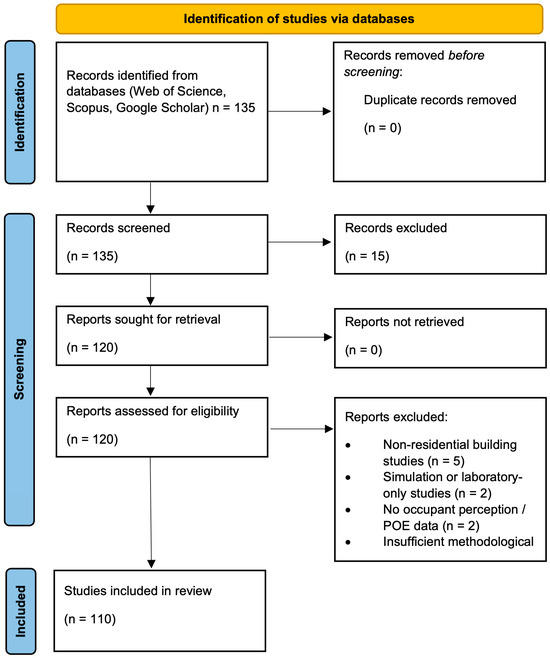
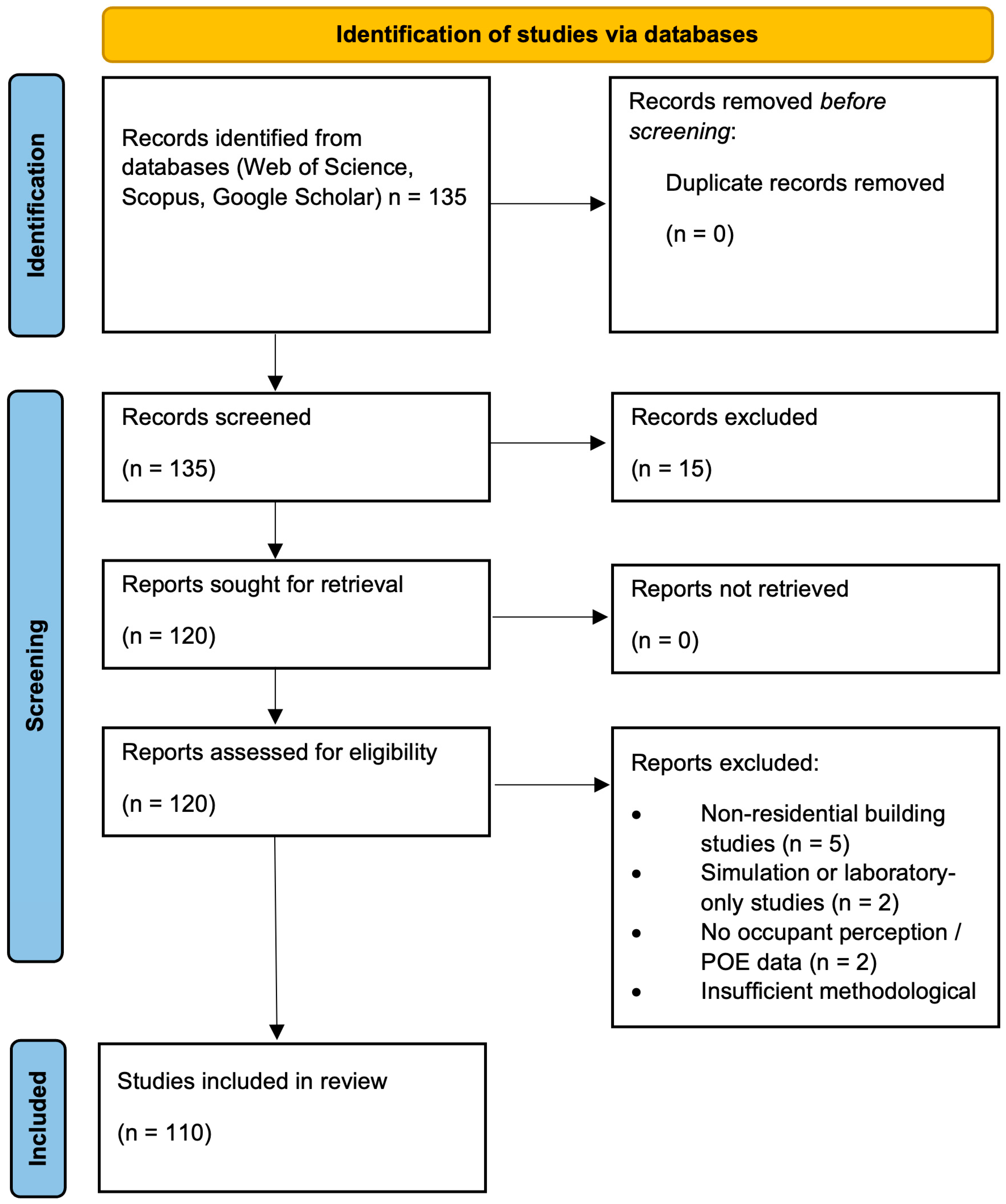
The study selection process followed the PRISMA 2020 guidelines [4] and the PRISMA checklist was shown in Supplementary Materials [4]. A total of 135 records were identified through database searches across Web of Science, Scopus, and Google Scholar. After screening titles and abstracts and reviewing for eligibility assessment, 120 articles were retained for full-text review. Studies were included if they empirically examined occupant-related outcomes associated with indoor environmental conditions, including perception, satisfaction, behavioral responses, or post-occupancy evaluation results. This inclusion criterion enabled the review to examine relationships between perceived IEQ conditions and measured environmental parameters reported in the literature. Following eligibility assessment, 110 studies met the inclusion criteria and were included in the final synthesis. The detailed screening process is illustrated in the PRISMA flow diagram (Figure 1).
Figure 1.
PRISMA 2020 flow diagram.
A detailed list of the studies included in the review, including authors, publication year, geographic context, and IEQ factors examined, is provided in Table A1 in Appendix A.
2.7. Step 7: Data Extraction
Qualitative data were extracted from the included studies using a structured protocol in the form of reported findings, observations, and occupant-related quotations describing IEQ conditions and experiences. A total of 10,838 quotations were extracted and coded. The coding framework was developed inductively through iterative review of the extracted text and organized into eight IEQ domains.
Two members of the research team independently reviewed and coded the extracted data using the shared coding framework. Differences in interpretation were discussed and resolved through consensus to ensure consistency in classification. The coding process was iterative, allowing refinement of categories as patterns emerged across studies. This approach enabled the synthesis of qualitative evidence across diverse methodological contexts while maintaining consistency in interpretation. The studies included in the review represent research conducted across multiple geographic contexts, including Europe, North America, and parts of East Asia, reflecting diverse climatic and socio-economic housing conditions.
2.8. Step 8: Risk of Bias Assessment
Due to the heterogeneity of study designs included in this review, a formal risk of bias assessment tool was not applied. Instead, methodological rigor was addressed through the inclusion criteria, which limited the review to peer-reviewed empirical studies with clearly defined research methods and reported occupant-related outcomes. During data extraction and coding, studies were evaluated for clarity in methodological description, consistency between reported findings and supporting evidence, and relevance to the review objectives. Additionally, the use of independent coding by two researchers and consensus-based resolution of discrepancies helped reduce interpretive bias and improve the reliability of the synthesized findings.
2.9. Step 9: Synthesis and Analysis
Qualitative findings were inductively coded and synthesized into four analytical themes: physical building factors, occupant-related factors, environmental variables, and socio-economic conditions. Quantitative results were integrated through narrative synthesis to support and triangulate thematic interpretations, enabling a comprehensive understanding of how residential IEQ conditions shape occupant comfort, satisfaction, and well-being.
2.10. Step 10: Certainty Assessment
Due to the qualitative nature of the included literature, a formal certainty of evidence assessment was not applied. Instead, confidence in the synthesized findings was established through the consistency and recurrence of patterns across multiple studies, triangulation between qualitative insights and quantitative measurements, and the inclusion of peer-reviewed empirical research with clearly defined methodologies.
3. Results
The included studies demonstrated variability in methodological approaches, including qualitative interviews, surveys, post-occupancy evaluations, and mixed-method designs. While a formal risk of bias assessment tool was not applied due to this heterogeneity, all studies met the inclusion criteria of being peer-reviewed and reporting clearly defined research methods and occupant-related outcomes.
To facilitate synthesis across studies, findings were organized into eight IEQ domains and interpreted through four broader analytical themes: physical building factors, occupant-related factors, environmental variables, and socio-economic conditions as summarized in Table 1. This structure allows comparison of recurring patterns across studies and highlights cross-domain interactions shaping residential IEQ.
3.1. Indoor Air Quality (IAQ) Parameters
This review synthesizes 4399 IAQ-related quotations across 109 studies (28,170 code instances; 4544 unique IAQ codes). Three interlinked conditions consistently shape residents’ IAQ appraisals in Post-Occupancy Evaluations (POEs), which are ventilation adequacy and usability, moisture/damp and mold, and particulate or chemical loads from cooking, smoking, materials, or traffic. Perception measurement gaps frequently emerge where ventilation systems are noisy, intermittent, or poorly explained and residents report “stale” or “heavy” air despite measured compliance [5]. Moisture is a pivotal driver, as cold bridges, leaks, and persistent humidity are tied to visible mold, musty odor, irritation, and dissatisfaction, particularly in social or affordable housing where maintenance delays are common [6,7]. Cross-country comparison indicates that the relative importance of IAQ sub-factors is context-dependent [8]. High-rise developments in dense subtropical climates emphasize separate evaluation of each IAQ domain to avoid masking local priorities. In lower-income contexts, IAQ burdens are attributed to inadequate ventilation, fuel choice, crowding, and broader economic stressors, whereas in higher-income housing, studies pairing CO2/Particle Matter (PM)/Volatile Organic Compounds (VOC)/formaldehyde with surveys reveal nonlinear links between pollutant levels and perceived air quality moderated by odor sensitivity and comprehension of environmental information [5]. Taken together, these findings highlight the design priorities that ensure balanced mechanical ventilation with quiet, intuitive controls, eliminate thermal bridges and moisture pathways through appropriate detailing, specify low-emitting materials with effective filtration, and establish clear maintenance protocols that prevent system degradation.
3.2. Acoustical Environment Factors
This review synthesizes 3880 acoustical-related quotations across 110 studies (24,604 code instances; 3656 unique codes). Across post-occupancy evaluation (POE) and perception-related studies, noise consistently ranked alongside thermal and visual conditions as a primary determinant of residential satisfaction [9,10]. Dominant noise exposures are road traffic [11], neighbor noise through shared walls & floors [12], and building-services/ventilation noise [13,14]. Complaints intensify where bedrooms face noisy façades or where residents must trade fresh air for quiet at night [15]. Evidence from multiple POEs reveals that satisfaction improves when design and retrofit interventions restore acoustic control [16]. Effective strategies include quiet-mode or demand-controlled ventilation allowing window closure overnight, acoustically decoupled floor and wall assemblies with enhanced mass, high-performance glazing with well-sealed operable windows, and dwelling layouts that buffer sleeping areas from noise sources [17]. Material choices directly shape acoustic outcomes such as timber-frame and lightweight construction systems consistently generating higher neighbor noise complaints than mass-based construction, particularly for impact transmission [18]. Cross-domain interactions emerge between acoustic comfort, thermal regulation, and indoor air quality, with residents frequently forced to choose between fresh air and quiet [15]. Demographic factors moderate perception, with families prioritizing nighttime quiet in children’s bedrooms and older adults reporting vulnerability to daytime disturbance [13]. Taken together, these findings point to practical priorities highlighting bedroom acoustic performance, integrating quiet mechanical ventilation, specifying construction systems that attenuate both airborne and impact transmission across the full frequency spectrum, designing layouts that spatially separate noise-sensitive spaces from sources and developing standardized residential protocols capturing nighttime conditions weighted to sleep quality impacts.
3.3. Thermal Comfort Variables
The review synthesizes 4690 quotations related to thermal comfort across 109 studies (30,685 code instances; 4788 unique thermal codes). Across POEs and perception studies, residents describe thermal comfort as the product of airtightness, solar gains and shading, ventilation, heating and cooling systems, air movement, humidity, and the affordability and availability of controls. Patterns are seasonally consistent as summer overheating is most common in lightweight or highly glazed dwellings with limited shading or cross-ventilation, while winter under-heating persists where leaky envelopes and energy costs depress setpoints [8,19,20]. Studies that triangulate instrumented measurements with resident narratives consistently show that adding adaptive options widens the acceptable comfort band and lowers complaints [7]. The most salient levers are room-level thermostats, operable windows when outdoor conditions allow [7], and quiet ceiling/exhaust fans that residents will use. In rental and social-housing settings, where access to controls and timely maintenance is constrained, perception–measurement gaps are larger; simplifying interfaces and ensuring responsiveness narrows these gaps [21]. Research indicates that pairing airtightness with exposure-appropriate shading and balanced mechanical ventilation yields the most durable comfort gains. Importantly, overheating mitigation need not compromise winter warmth when designs support night-purge potential and make control logic simple and visible to occupants [16,22]. Regional studies add nuance: for example, work on unit-type student apartments in Western China documents higher tolerance for warm conditions when airflow and glare are well managed, underscoring how expectations and climate-shaped behaviors mediate comfort appraisals. Taken together, these findings align with practical design and retrofit priorities, which are controlling solar gains, making quiet and continuous ventilation the default, while preserving resident agency through usable controls, and verifying that interfaces and maintenance regimes support the intended operation through the seasons.
3.4. Damp and Mold
The review synthesizes 1970 quotations related to damp and mold across 108 studies (16,069 code instances; 456 unique damp/mold codes). Across POEs and perception studies, damp and mold emerge as cross-cutting threats that simultaneously degrade indoor air quality, psychological well-being, and respiratory health [23,24]. Evidence consistently links visible mold, musty odors, and elevated relative humidity to occupant dissatisfaction, respiratory symptoms, and mental health burdens including stress, anxiety, and depression [25,26]. These conditions are disproportionately concentrated in social and affordable housing, where building envelope failures, inadequate ventilation, maintenance delays, and unclear accountability amplify exposure and prolong remediation cycles [20]. Structural and operational factors dominate the pathway to moisture accumulation caused by cold bridges and thermal bypasses, roof and plumbing leaks, insufficient mechanical ventilation or single-sided natural ventilation, and occupant behaviors such as clothes drying indoors or limited window opening in winter months [25,26]. POEs reveal that moisture-related complaints persist even in nominally code-compliant buildings when design fails to anticipate regional climate patterns [26,27,28,29]. Studies examining fuel poverty document a vicious cycle where residents reduce heating to manage costs, thereby increasing surface condensation and mold growth, which in turn worsens respiratory health and comfort [30,31]. Health literature documents well-established links between damp/mold exposure and asthma exacerbation, wheeze, and upper respiratory infections [32,33], with emerging evidence extending into mental health domains showing correlations with depression and anxiety [34]. Renters report higher awareness of risks but lower perceived control over remediation [27,29,35], while information gaps persist as residents may not recognize early condensation signs or understand ventilation operation [36]. Taken together, these findings point to multi-level intervention priorities such as strengthening building envelopes to eliminate cold bridges and control infiltration, installing quiet, continuous mechanical ventilation with humidity-responsive controls, ensuring rapid and transparent maintenance protocols in rental and social housing, and providing clear and practical guidance on moisture-source reduction and ventilation operation to empower residents as moisture management partners.
3.5. Visual Environment Parameters
The review synthesizes 2416 quotations on visual environment parameters across 106 studies (19,976 code instances; 436 unique visual codes). Natural daylight, view access, and user control over lighting and shading consistently rank among the most valued IEQ dimensions [8]. Evidence links daylight exposure to improved mood, circadian alignment, and perceived residential quality [37], while insufficient daylight correlates with reduced well-being, eye strain, and increased artificial lighting use [8,38,39]. Design parameters co-determine both daylight sufficiency and glare risk [16,40]. POEs document that highly glazed façades without exposure-appropriate shading generate summer overheating and discomfort glare [41], while deep floor plates or limited fenestration constrain daylight autonomy and reduce satisfaction [42]. Multi-unit residential POEs emphasize equity dimensions: upper-floor units receive abundant daylight and expansive views, while ground-floor units report persistent dimness and reduced outdoor connection [43]. Adjustable blinds or automated shading enable residents to balance competing priorities such as daylight admission versus glare protection, solar gain versus overheating prevention, thus significantly improving satisfaction [7,21]. Cross-domain interactions are prominent as residents often tolerate lower daylight to avoid solar-driven overheating or accept glare for passive winter heat [14,39], while operable windows admitting daylight may simultaneously introduce traffic noises [15]. Regional contexts modulate preferences, with northern European residents prioritizing natural daylight year-round while subtropical contexts show greater acceptance of lower illuminance when paired with effective heat management [8]. Taken together, these findings point to design priorities such as integrating daylight modeling with thermal and glare analysis; providing user-operable shading; ensuring equitable daylight distribution across unit types; and considering visual–thermal–acoustic interactions holistically [44,45].
3.6. Building Characteristics
The reviewed articles (n = 110) yielded 2359 quotations related to building characteristics with 17,191 code instances (3141 unique codes). Occupants’ IEQ appraisals map predictably to system decisions embedded in dwellings. Older or lightweight constructions exhibit larger temperature swings, higher infiltration, and greater inter-dwelling noise transmission [46], while thermal bridges and cold surfaces intensify condensation and damp complaints in winter [19,27]. By contrast, envelopes that pair airtightness with moisture-robust detailing and balanced mechanical ventilation show fewer reports of “stale” air and more stable comfort [5,35]. Highly glazed façades without exposure-appropriate shading are consistently linked to summer overheating and glare [47], whereas fixed plus user-adjustable shading improves comfort without sacrificing views [7,38,39]. Timber and lightweight assemblies draw higher reports of impact and low-frequency neighbor noise [46], while decoupled, mass-added floors reduce annoyance [48]. Materials and finishes act as pollutant reservoirs where cleaning/filtration is inconsistent, generating persistent odors despite compliant measurements [5,49]. In social and affordable housing, maintenance delays sustain IAQ and noise complaints independent of design intent [19,20]. Taken together, durable IEQ gains arise when upgrades are coupled with balanced, quiet ventilation, exposure-appropriate shading, and maintenance regimes that keep systems performing as designed.
3.7. Occupant Demographics
Demographic context consistently shapes how residents perceive, tolerate, and respond to IEQ. Across the 110 studies with 8557 coded quotations, factors such as gender, socioeconomic status, age, life-stage, tenure, health sensitivity, information/awareness, and, less frequently, crowding and migration status, influence what conditions occupants notice and how they evaluate comfort [5,6,46]. Gendered patterns recur where women more often express dissatisfaction with thermal and acoustic conditions and prefer quieter, more precise controls, while men tend to accept wider thermal ranges and under-report low-frequency or impact noise [5,7,46]. Lower-income and social-housing residents experience more damp/mold, traffic noise, and combustion-related IAQ issues, often constrained by heating costs and limited access to functioning ventilation or filtration, widening the gap between measured conditions [5] and perceived comfort [6,20,25,30,31]. Age and life-stage shift priorities, with caregivers emphasizing quiet and stable nighttime temperatures, older adults reporting sensitivity to drafts, and adolescents tolerating warmer spaces when airflow and glare are managed [8,38]. Renters frequently report limited control over ventilation and temperature settings and slower maintenance responses, reinforcing perceptions of “stale air” or “noisy nights” [6,7]. Households managing asthma or allergies have lower tolerance for moisture, odors, and particulates, valuing continuous, quiet ventilation and reliable source control [31,34]. Information access further moderates experience, as clear guidance narrows perception and measurement gaps, while unclear communication heightens concern even when readings are compliant [5]. These demographic effects appear across at least nine national contexts in our analysis (e.g., the United Kingdom, United States, Sweden, China, Australia, Denmark, Chile, Nigeria, and Tanzania), indicating that who lives in a dwelling is as influential as how the dwelling is built in terms of IEQ [7,8,20,25,38].
3.8. Integrated IEQ Assessments
Across the reviewed studies, 1314 quotations addressed integrated or cross-domain assessments of residential IEQ. Rather than evaluating thermal, air quality, visual, and acoustic conditions independently, these studies examine how combinations of environmental conditions shape overall environmental satisfaction (OES) [50]. A key finding is that OES is context-dependent. High-rise subtropical housing places greater weight on acoustic privacy and ventilation trade-offs, whereas temperate low-rise housing prioritizes thermal stability and daylight [38]. Because of this, studies caution against collapsing IEQ domains into a single undifferentiated index; instead, they recommend assessing each domain separately and modeling OES as a combined outcome of thermal, acoustic, visual, and IAQ appraisals. A second consistent finding is that cross-domain interactions, not single environmental metrics, drive satisfaction and comfort. Studies pairing acoustics with non-acoustic factors consistently show that sleep-relevant variables dominate OES even when average sound levels meet guidance [18,46]. Similarly, moisture-robust construction and timely maintenance mediate the IAQ, health and OES pathway, as damp and mold complaints reduce satisfaction even when temperatures meet guidelines [20,25]. Third, occupant characteristics and information access shape integrated outcomes. Gender, age, and life-stage affect sensitivity to noise, temperature drift, and perceived air quality, while clear communication about controls reduces perception and measurement gaps [5,7]. Methodologically, integrated IEQ studies most often use separate satisfaction scores feeding combined OES models, latent-variable or path analysis to identify indirect effects (e.g., acoustics to sleep and OES), and POE triangulation combining measurements with resident reports [50].
Table 1.
Summary of IEQ domains, environmental factors, drivers, and implications identified in reviewed studies.
4. Analysis and Discussion
Previous reviews have examined individual IEQ components such as thermal comfort or indoor air quality in residential environments. For example, Ortiz and Bluyssen [3] reviewed the relationship between IEQ and energy performance in housing retrofits, while other studies have focused primarily on behavioral drivers of occupant comfort. In contrast, the present review synthesizes evidence across eight IEQ domains (IAQ parameters, Acoustical environment factors, Thermal comfort variables, Damp and Mold, Visual environment parameters, Building characteristics, Occupant demographics, Integrated IEQ assessment) and explicitly integrates occupant perceptions, building characteristics, and socio-economic contexts. By combining findings from post-occupancy evaluations, perception studies, and environmental measurements, this review highlights cross-domain interactions that are often overlooked in single-parameter analyses. This perspective provides new insights into how IEQ conditions are experienced as interconnected aspects of everyday residential life rather than isolated performance indicators.
Across the reviewed literature, the eight IEQ domains consistently interacted to shape occupants’ lived experiences of home environments, and these relationships can be meaningfully interpreted through four overarching thematic categories, which are Physical Building Factors, Occupant-Related Factors, Environmental Variables, and Socio-Economic Conditions.
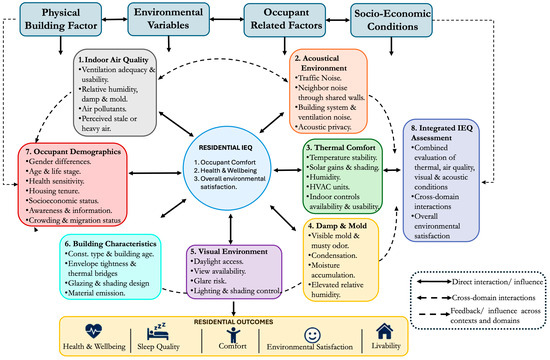
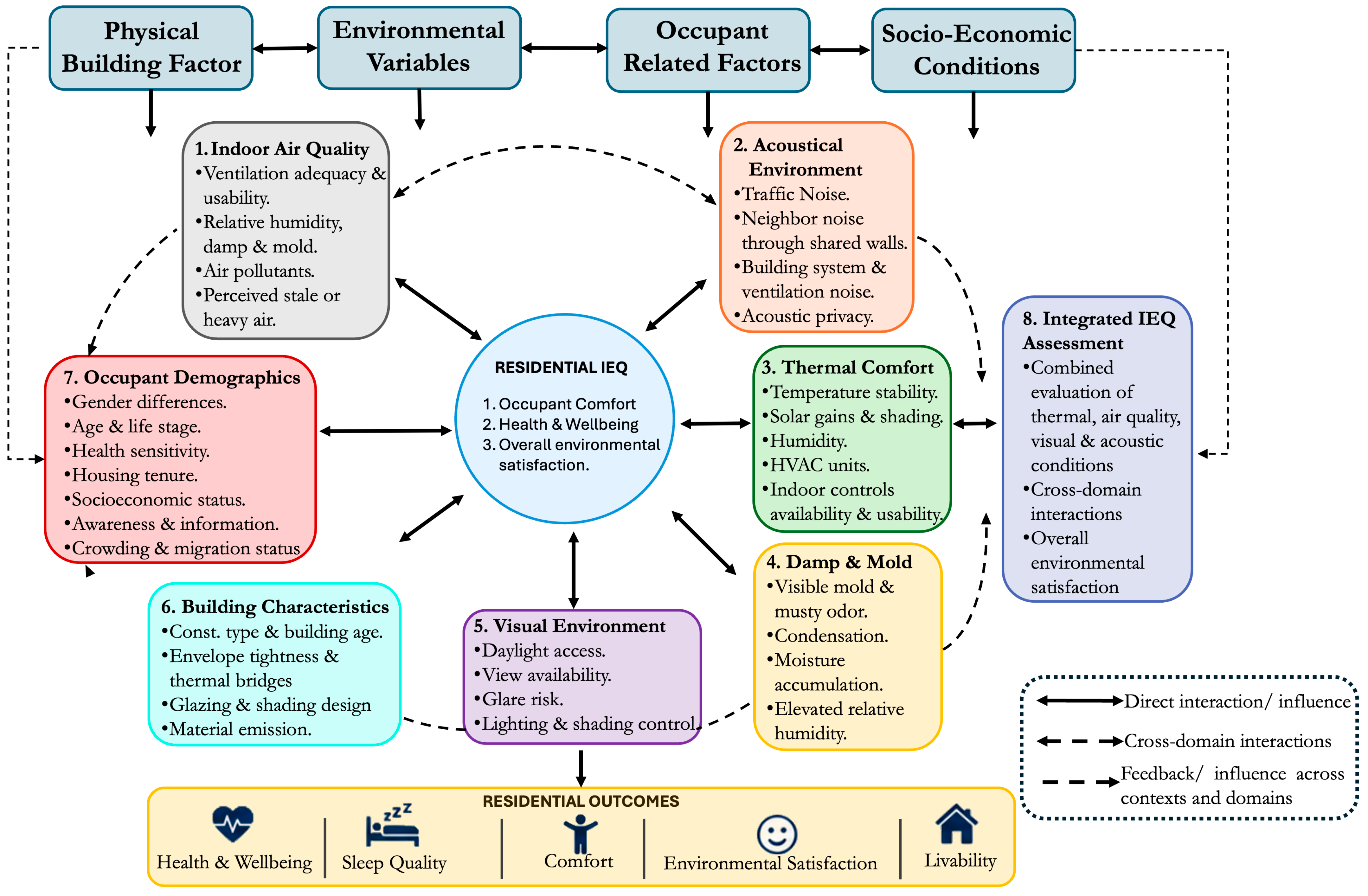
Figure 2 illustrates the conceptual framework developed from the review, showing how the eight IEQ domains interact through four broader thematic categories to shape residential comfort, satisfaction, and well-being.
Figure 2.
Conceptual framework.
The physical building factors theme captures how construction systems, material choices, envelope continuity, and ventilation strategies embed performance outcomes into the dwelling. For example, residents in lightweight or aging construction frequently described homes as “hard to keep warm or cool” and reported “hearing everything from the neighbors”, reflecting insufficient thermal mass and poor acoustic separation. These patterns are well-documented in studies examining sound insulation performance in multifamily housing [18,46,48]. Moisture-related deterioration and mold also emerged where envelope detailing and ventilation strategies were inadequate, with residents describing “rooms that never fully dry” or mold repeatedly returning after cleaning [20,25,26]. Visual comfort, particularly daylight access and glare control, was similarly shaped by glazing ratios and shading strategies [8,38,42,43]. Across these domains, occupants emphasized that material and design decisions made before they moved in “set the conditions of daily life”.
The second theme, occupant-related factors, highlights residents’ role in shaping indoor environments through adaptation, behavioral routines, and expectations. Satisfaction was strongly determined by the degree of perceived control rather than by measured environmental conditions alone. Residents frequently contrasted situations where “I can make the room comfortable when I need to” with situations where controls were “confusing,” “locked,” “too noisy to use,” or “seem to work against me.” Studies show that ventilation, heating, and shading systems often failed not because performance was poor, but because interfaces, feedback, and operation logic were unclear [5]. Health status also influenced perception, with households managing allergies or asthma reporting heightened sensitivity to odors, moisture, and stale air cues, aligning with studies documenting the relationship between IAQ conditions and respiratory symptoms [34,51]. In these contexts, comfort was experienced not only physically but emotionally, tied to security, predictability, and trust in the home environment.
The third theme, environmental variables, highlights how climate, seasonal changes, and urban exposure shape indoor environmental experience. Residents in warm climates emphasized nighttime ventilation and shading, whereas those in colder climates prioritized envelope tightness and stable temperatures. Similarly, urban residents navigated trade-offs between ventilation and noise, describing situations where they could “choose quiet or fresh air, but not both.” These patterns are evident in studies evaluating façade exposure and noise intrusion in dense residential contexts [9,11]. Thus, even identical building designs yielded different comfort outcomes depending on outdoor conditions and environmental load.
Finally, socio-economic factors shaped both exposure and the ability to respond to environmental stressors. Lower-income households, renters, and social housing residents reported higher rates of dampness, mold, noise intrusion, and restricted control over heating or ventilation systems, often describing feeling “stuck with the problem.” These disparities are consistently documented in studies linking fuel poverty, tenure constraints, and maintenance delays to IEQ burdens [6,30,31]. Meanwhile, owners and higher-income residents were more likely to install supplementary ventilation, shading, filtration, or acoustic treatments. Demographic factors such as age, caregiving responsibilities, and sensory sensitivity also influenced what residents prioritized in the home [7].
Despite the growing body of research on residential IEQ, several important research gaps remain. First, many studies rely on short-term measurements, cross-sectional surveys, or single-domain assessments (e.g., thermal comfort, IAQ, lighting, or acoustics), which limits the ability to understand long-term exposure patterns and interactions among multiple IEQ domains. While occupant perceptions and post-occupancy evaluations provide valuable insights into comfort and satisfaction, they often capture conditions at a single point in time and therefore cannot fully explain how prolonged exposure to environmental stressors influences health and well-being.
Second, the geographic distribution of studies remains uneven. A large portion of the literature originates from Europe, North America, and parts of East Asia, where building performance monitoring and IEQ research infrastructures are more established. In contrast, limited empirical data exist for regions experiencing rapid urbanization, particularly in Africa, South Asia, and Latin America, where housing conditions, climate pressures, and population density may create unique IEQ challenges. The absence of data from these regions restricts the global applicability of current findings and highlights the need for broader geographic representation in future IEQ studies.
Third, only five out of the 110 peer-reviewed studies included in this review directly link IEQ conditions with longitudinal health outcomes, highlighting a significant methodological gap in the field. These studies include investigations such as the home health longitudinal natural experiment [52], which tracks housing conditions and health indicators over time, as well as post-renovation and retrofit studies that examine changes in occupant symptoms following building interventions [53,54]. Other studies explore associations between environmental exposures, such as noise, odors, and ventilation conditions and mental or physical health outcomes across housing contexts [12,55]. However, these studies remain relatively limited in number compared with the broader body of IEQ research focused primarily on occupant satisfaction, comfort perception, or short-term environmental measurements.
IEQ is experienced as interdependent conditions mediated by building characteristics, occupant behavior, environmental context, and social resources. Comfort depends on occupants’ ability to maintain livable conditions, not just meeting technical standards. Improving IEQ requires integrated strategies addressing design and construction detailing, control usability, ongoing maintenance, and structural housing inequities.
5. Limitations of the Review
While this study provides a comprehensive synthesis of recent research on residential IEQ, it has multiple limitations. First, the review includes only peer-reviewed journal articles published in English between 2015 and 2025, which may introduce language and publication bias by excluding relevant studies published in other languages or grey literature. Second, methodological heterogeneity across studies, including differences in measurement methods, survey instruments, and IEQ indicators, limits direct comparison of quantitative findings. Third, although the review integrates multiple IEQ domains, some environmental factors such as microbial exposures, emerging pollutants, and detailed building operation data remain underrepresented in the literature. Finally, the geographic distribution of studies is uneven, with a concentration in Europe, North America, and East Asia, which may limit the global generalizability of the findings. Future research should expand longitudinal and cross-regional investigations to better capture diverse housing contexts and long-term health outcomes. Variations in study design and reporting quality across included studies may introduce potential bias in the synthesis.
6. Conclusions
This systematic literature review demonstrates that IEQ in residential settings is shaped through the interaction of physical building characteristics, environmental conditions, occupant behaviors, and socio-economic factors. Across the eight IEQ domains examined, evidence shows that comfort and well-being in the residence cannot be explained by single variables or performance standards alone. Instead, residential IEQ emerges as an experience shaped by how buildings are constructed and maintained, how controls are provided and understood, how climate and site conditions interact with building systems, and how occupants’ health and daily routines influence what is possible within the dwelling. The review highlights persistent perception measurement gaps, most notably in ventilation, noise exposure, thermal comfort, and damp/mold conditions. These gaps are amplified where controls are hard to operate, maintenance is delayed, or energy costs constrain usage. Demographic and social inequities also affect IEQ, meaning a resident’s comfort depends not only on building design but also on their housing situation, ability to afford utilities, and health needs. Additionally, studies that incorporate POE and participatory approaches show that when residents have clear information, intuitive control interfaces, and responsive maintenance systems, satisfaction improves, even when environmental conditions remain within typical ranges.
Taken together, the findings suggest that improving residential IEQ requires us to think beyond single-issue solutions and instead approach residences as lived environments shaped by multiple interacting factors. This means designing and maintaining housing that prevents moisture, provides adequate ventilation that supports closed-window operation at night, protects bedrooms from noise, and offers daylight and shading that balance visual and thermal needs. Just as importantly, residents need clear and supportive communication about how to use the systems, so they feel confident and in control.
Based on the findings of this review, several priority actions emerge for improving residential IEQ. First, housing design should prioritize moisture prevention strategies, including improved envelope detailing and continuous ventilation systems to reduce dampness and mold risks. Second, bedroom-oriented design strategies should address acoustic protection and nighttime thermal stability to support sleep quality. Third, ventilation and environmental control systems should incorporate intuitive interfaces and clear user guidance to ensure residents can effectively operate building systems. Fourth, housing policies should support maintenance accountability and targeted interventions in social and low-income housing, where IEQ risks are disproportionately concentrated.
Future research should expand on comparative and longitudinal studies, with particular attention to groups who are most affected by poor IEQ. It is also essential to link building decisions to real health outcomes beyond technical performance metrics. Ultimately, creating healthy homes means recognizing that IEQ is not only about airflow rates or insulation values, but it is about how people live, sleep, care for one another, and feel at home.
Supplementary Materials
The following supporting information can be downloaded at: https://www.mdpi.com/article/10.3390/buildings16102006/s1, Table S1: PRISMA 2020 Checklist [4].
Author Contributions
Conceptualization, S.B. and M.M.; methodology, S.B. and M.M.; investigation, S.B. and M.M.; data curation, S.B., M.M. and S.A.; data analysis, S.B., M.M. and S.A.; original draft preparation, S.B.; review and editing, S.B., M.M. and S.A.; visualization, S.B. All authors have read and agreed to the published version of the manuscript.
Funding
Financial support was provided by the University of Oklahoma Libraries’ Open Access Fund.
Data Availability Statement
The data supporting the findings of this study are derived from publicly available published literature included in the systematic review. No new datasets were generated during this study. A list of the reviewed studies is provided in Appendix A.
Conflicts of Interest
The authors declare no conflicts of interest.
Correction Statement
This article has been republished with a minor correction to the Funding statement. This change does not affect the scientific content of the article.
Appendix A
Table A1.
Summary of peer-reviewed studies published between 2015 and 2025.
References
- NCHH. United States 2025 Healthy Housing Fact Sheet; National Center for Healthy Housing (NCHH): Columbia, MD, USA, 2025. [Google Scholar]
- Mansour, A.; Bentley, R.; Baker, E.; Li, A.; Martino, E.; Clair, A.; Daniel, L.; Mishra, S.R.; Howard, N.J.; Phibbs, P. Housing and Health: An Updated Glossary. J. Epidemiol. Community Health 2022, 76, 833–838. [Google Scholar] [CrossRef] [Scilit]
- Ortiz, M.; Bluyssen, P.M. Indoor Environmental Quality, Energy Efficiency and Thermal Comfort in the Retrofitting of Housing: A Literature Review. In Routledge Handbook of Resilient Thermal Comfort; Routledge: Abingdon, UK, 2022; pp. 433–445. [Google Scholar]
- Page, M.J.; McKenzie, J.E.; Bossuyt, P.M.; Boutron, I.; Hoffmann, T.C.; Mulrow, C.D.; Shamseer, L.; Tetzlaff, J.M.; Akl, E.A.; Brennan, S.E. The PRISMA 2020 statement: An updated guideline for reporting systematic reviews. BMJ 2021, 372, n71. [Google Scholar] [CrossRef] [Scilit]
- Alapieti, T.; Vornanen-Winqvist, C.; Mikkola, R.; Salonen, H. Measured and Perceived Indoor Air Quality in Three Low-Energy Wooden Test Buildings. Wood Mater. Sci. Eng. 2023, 18, 827–840. [Google Scholar] [CrossRef] [Scilit]
- Hernandez, D.; Khan, F.; Albert, D.; Giovenco, D.; Branas, C.; Valeri, L.; Navas-Acien, A. A Randomized Control Trial to Support Smoke-Free Policy Compliance in Public Housing. Trials 2023, 24, 551. [Google Scholar] [CrossRef] [Scilit] [PubMed]
- Stazi, F.; Naspi, F.; D’Orazio, M. A Literature Review on Driving Factors and Contextual Events Influencing Occupants’ Behaviours in Buildings. Build. Environ. 2017, 118, 40–66. [Google Scholar] [CrossRef] [Scilit]
- Aslanoğlu, R.; Kazak, J.K.; Yekanialibeiglou, S.; Pracki, P.; Ulusoy, B. An International Survey on Residential Lighting: Analysis of Winter-Term Results. Build. Environ. 2021, 206, 108294. [Google Scholar] [CrossRef] [Scilit]
- Araújo Alves, J.; Neto Paiva, F.; Torres Silva, L.; Remoaldo, P. Low-Frequency Noise and Its Main Effects on Human Health—A Review of the Literature between 2016 and 2019. Appl. Sci. 2020, 10, 5205. [Google Scholar] [CrossRef] [Scilit]
- Park, S.H.; Lee, P.J.; Yang, K.S. Perception and Reaction to Floor Impact Noise in Apartment Buildings: A Qualitative Approach. Acta Acust. United Acust. 2016, 102, 902–911. [Google Scholar] [CrossRef] [Scilit]
- Andargie, M.S.; Touchie, M.; O’Brien, W.; Müller-Trapet, M. Assessment of Indoor Exposure to Outdoor Environmental Noise and Effects on Occupant Comfort in Multi-Unit Residential Buildings. Build. Acoust. 2023, 30, 293–313. [Google Scholar] [CrossRef] [Scilit]
- Benz, S.L.; Kuhlmann, J.; Schreckenberg, D.; Wothge, J. Contributors to Neighbour Noise Annoyance. Int. J. Environ. Res. Public Health 2021, 18, 8098. [Google Scholar] [CrossRef] [Scilit]
- Wang, J.; Norbäck, D. Home Environment & Noise Disturbance in a Sample of Multi-Family Buildings in Sweden Associations with Medical Symptoms. BMC Public Health 2021, 21, 1989. [Google Scholar]
- Zalejska-Jonsson, A. Perceived Acoustic Quality and Effect on Occupants’ Satisfaction in Green and Conventional Residential Buildings. Buildings 2019, 9, 24. [Google Scholar] [CrossRef] [Scilit]
- Torresin, S.; Albatici, R.; Aletta, F.; Babich, F.; Oberman, T.; Stawinoga, A.E.; Kang, J. Indoor Soundscapes at Home During the COVID-19 Lockdown in London–Part II: A Structural Equation Model for Comfort, Content, and Well-Being. Appl. Acoust. 2022, 185, 108379. [Google Scholar] [CrossRef] [Scilit]
- Neto, M.R.; Silva, C.S.; Pinto, A. Evaluating Comfort and Well-Being: A Post-Occupancy Approach for Improvements–Insights from 10 Residential Case Studies. Build. Environ. 2025, 283, 113334. [Google Scholar] [CrossRef] [Scilit]
- Hongisto, V.; Mäkilä, M.; Suokas, M. Satisfaction with Sound Insulation in Residential Dwellings–the Effect of Wall Construction. Build. Environ. 2015, 85, 309–320. [Google Scholar] [CrossRef] [Scilit]
- Frescura, A.; Lee, P.J. Annoyance Provoked by Single and Combined Sound Sources from Neighbours in Wooden Residential Buildings. Build. Environ. 2021, 205, 108248. [Google Scholar] [CrossRef] [Scilit]
- Ascione, F.; de Rossi, F.; Iovane, T.; Manniti, G.; Mastellone, M. Energy Demand and Air Quality in Social Housing Buildings: A Novel Critical Review. Energy Build. 2024, 319, 114542. [Google Scholar] [CrossRef] [Scilit]
- Benton, E. Damp and Mould—The Big Picture. How Do We Tackle the Damp and Mould Crisis in Social Housing: Lessons from the UK. Front. Environ. Health 2024, 3, 1340092. [Google Scholar] [CrossRef] [Scilit]
- Tang, H.; Ding, Y.; Liu, X.; Singer, B.C. Investigating Influence of Environmental Information on Occupants Perceived Indoor Environmental Quality: An Exploratory Study. J. Build. Eng. 2022, 48, 103933. [Google Scholar] [CrossRef] [Scilit]
- Colclough, S.; Hegarty, R.O.; Murray, M.; Lennon, D.; Rieux, E.; Colclough, M.; Kinnane, O. Post Occupancy Evaluation of 12 Retrofit Nzeb Dwellings: The Impact of Occupants and High in-Use Interior Temperatures on the Predictive Accuracy of the Nzeb Energy Standard. Energy Build. 2022, 254, 111563. [Google Scholar] [CrossRef] [Scilit]
- Gatto, M.R.; Mansour, A.; Li, A.; Bentley, R. A State-of-the-Science Review of the Effect of Damp-and Mold-Affected Housing on Mental Health. Environ. Health Perspect. 2024, 132, 86001. [Google Scholar] [CrossRef] [Scilit]
- Brooks, S.K.; Patel, S.S.; Weston, D.; Greenberg, N. Psychological Effects of Mould and Damp in the Home: Scoping Review. Hous. Stud. 2025, 40, 323–345. [Google Scholar] [CrossRef] [Scilit]
- Bonderup, S.; Middlemiss, L. Mould or Cold? Contrasting Representations of Unhealthy Housing in Denmark and England and the Relation to Energy Poverty. Energy Res. Soc. Sci. 2023, 102, 103176. [Google Scholar] [CrossRef] [Scilit]
- Aziz, G.; Hardy, A. A Predictive Model for Damp Risk in English Housing with Explainable AI. Sci. Rep. 2025, 15, 12658. [Google Scholar] [CrossRef] [Scilit]
- Gonzalez-Caceres, A.; Bobadilla, A.; Karlshøj, J. Implementing Post-Occupancy Evaluation in Social Housing Complemented with Bim: A Case Study in Chile. Build. Environ. 2019, 158, 260–280. [Google Scholar] [CrossRef] [Scilit]
- Hashemi, A.; Dungrani, M. Indoor Environmental Quality and Health Implications of Building Retrofit and Occupant Behaviour in Social Housing. Sustainability 2025, 17, 264. [Google Scholar] [CrossRef] [Scilit]
- Baharetha, S.; Hassanain, M.A.; Alshibani, A.; Ouis, D.; Gomaa, M.M.; Ezz, M.S. A Post-Occupancy Evaluation Framework for Enhancing Resident Satisfaction and Building Performance in Multi-Story Residential Developments in Saudi Arabia. Architecture 2025, 5, 8. [Google Scholar] [CrossRef] [Scilit]
- Sharpe, R.A.; Tu, G.; Puttock, G.; Osborne, N.J. Cross-Sectional Study of Housing Tenures, Risk of Indoor Mold Growth & Adult Asthma in the UK. Arch. Environ. Occup. Health 2025, 80, 125–137. [Google Scholar]
- Sharpe, R.A.; Thornton, C.R.; Nikolaou, V.; Osborne, N.J. Fuel Poverty Increases Risk of Mould Contamination, Regardless of Adult Risk Perception & Ventilation in Social Housing Properties. Environ. Int. 2015, 79, 115–129. [Google Scholar] [CrossRef] [Scilit]
- Holden, K.A.; Lee, A.R.; Hawcutt, D.B.; Sinha, I.P. The Impact of Poor Housing and Indoor Air Quality on Respiratory Health in Children. Breathe 2023, 19, 230058. [Google Scholar] [CrossRef] [Scilit]
- Coulburn, L.; Miller, W.; Susilawati, C. How Do Occupants Experience the Onset and Triggering of Building-Related Symptoms in Damp Australian Housing? An Inductive-Deductive Content Analysis. Build. Environ. 2024, 266, 112038. [Google Scholar] [CrossRef] [Scilit]
- Gatto, M.R.; Li, A.; Bentley, R. Health and Social Impacts of Exposure to Mould-Affected Housing in Australia: A Qualitative Study. Public Health Res. Pract. 2025, 35, PU24024. [Google Scholar] [CrossRef] [Scilit]
- Booker, D.; Petrou, G.; Chatzidiakou, L.; Das, D.; Farooq, F.; Ferguson, L.; Jutila, O.E.I.; Milczewska, K.; Modlich, M.; Moreno-Rangel, A. Ten Questions Concerning the Future of Residential Indoor Air Quality and Its Environmental Justice Implications. Build. Environ. 2025, 278, 112957. [Google Scholar] [CrossRef] [Scilit]
- Reames, T.G.; Bravo, M.A. People, Place and Pollution: Investigating Relationships between Air Quality Perceptions, Health Concerns, Exposure, and Individual-and Area-Level Characteristics. Environ. Int. 2019, 122, 244–255. [Google Scholar] [CrossRef] [Scilit]
- Morales-Bravo, J.; Navarrete-Hernandez, P. Enlightening Wellbeing in the Home: The Impact of Natural Light Design on Perceived Happiness and Sadness in Residential Spaces. Build. Environ. 2022, 223, 109317. [Google Scholar] [CrossRef] [Scilit]
- Aslanoğlu, R.; Kazak, J.K.; Yekanialibeiglou, S.; Pracki, P.; Ulusoy, B. An International Survey on Residential Lighting: Analysis of Summer-Term Results. Build. Environ. 2023, 232, 109972. [Google Scholar] [CrossRef] [Scilit]
- Bae, S.; Martin, C.S. The Impact of Measurable Findings from Pre-and Post-Occupancy Evaluations of Indoor Environmental Quality in the Primary Workspace. Buildings 2023, 13, 2486. [Google Scholar] [CrossRef] [Scilit]
- Dong, Z.; Zhao, K.; Ren, M.; Ge, J.; Chan, I.Y.S. The Impact of Space Design on Occupants’ Satisfaction with Indoor Environment in University Dormitories. Build. Environ. 2022, 218, 109143. [Google Scholar] [CrossRef] [Scilit]
- Lolli, F.; Marinello, S.; Coruzzolo, A.M.; Butturi, M.A. Post-Occupancy Evaluation’s (Poe) Applications for Improving Indoor Environment Quality (Ieq). Toxics 2022, 10, 626. [Google Scholar] [CrossRef] [Scilit] [PubMed]
- Rastegari, E.; Adamsson, M.R.; Aries, M.B.C. Daylight Potential of Swedish Residential Environments: Visual and Beyond-Vision Effects and the Relationship with Well-Being Assessment. Light. Res. Technol. 2025, 57, 156–180. [Google Scholar] [CrossRef] [Scilit]
- Peters, T.; Kesik, T. Daylight Simulation for Multi-Unit Residential Buildings: Occupant-Centered Approaches to Assessment. In Proceedings of the eSim 2018: 10th Conference of IBPSA-Canada, Montreal, QC, Canada, 9–10 May 2018. [Google Scholar]
- Nkini, S.; Nuyts, E.; Kassenga, G.; Swai, O.; Verbeeck, G. Evaluation of Occupants’ Satisfaction in Green and Non-Green Office Buildings in Dar Es Salaam-Tanzania. Build. Environ. 2022, 219, 109169. [Google Scholar] [CrossRef] [Scilit]
- Dam-Krogh, E.P.; Rupp, R.F.; Clausen, G.; Toftum, J. Scoping Review of Post Occupancy Evaluation of Office Buildings with Focus on Indoor Environmental Quality and Productivity. J. Build. Eng. 2024, 86, 108911. [Google Scholar] [CrossRef] [Scilit]
- Ljunggren, F.; Simmons, C. Airborne Sound Insulation between Dwellings, from 50 Vs. 100 Hz–A Compilation of Swedish Field Surveys. Appl. Acoust. 2018, 133, 58–63. [Google Scholar] [CrossRef] [Scilit]
- Vakalis, D.; Touchie, M.; Tzekova, E.; MacLean, H.L.; Siegel, J.A. Indoor Environmental Quality Perceptions of Social Housing Residents. Build. Environ. 2019, 150, 135–143. [Google Scholar] [CrossRef] [Scilit]
- Yeon, J.O.; Kim, K.W.; Yang, K.S. A Correlation between a Single Number Quantity and Noise Level of Real Impact Sources for Floor Impact Sound. Appl. Acoust. 2017, 125, 20–33. [Google Scholar] [CrossRef] [Scilit]
- Ferguson, L.; Taylor, J.; Davies, M.; Shrubsole, C.; Symonds, P.; Dimitroulopoulou, S. Exposure to Indoor Air Pollution across Socio-Economic Groups in High-Income Countries: A Scoping Review of the Literature and a Modelling Methodology. Environ. Int. 2020, 143, 105748. [Google Scholar] [CrossRef] [Scilit]
- Carton, Q.; Kolarik, J.; Breesch, H. Analysis of Occupant Satisfaction with Ieq in Residential Buildings. In Proceedings of the CLIMA 2022: The 14th REHVA HVAC World Congress, Rotterdam, The Netherlands, 22–25 May 2022. [Google Scholar]
- Gabel, C.; Sigsgaard, T.; Petersen, S.; Elholm, G. The Prevalence and Association of Measured and Perceived Indoor Air Quality, Housing Characteristics, and Residents’ Behavior and Health. Front. Environ. Health 2024, 3, 1358546. [Google Scholar] [CrossRef] [Scilit]
- Gabel, C.; Elholm, G.; Rasmussen, M.K.; Broholt, T.H.; Jensen, S.R.; Petersen, S.; Sigsgaard, T. The Home-Health (Housing, Environment, and Health) Study; Description of a Danish Natural Experiment, Designed as a Longitudinal Study with Repeated Measurements, Providing Internal-and External Validity of the Study. Environ. Health Insights 2023, 17, 11786302231181489. [Google Scholar] [CrossRef] [Scilit]
- Haverinen-Shaughnessy, U.; Pekkonen, M.; Leivo, V.; Prasauskas, T.; Turunen, M.; Kiviste, M.; Aaltonen, A.; Martuzevicius, D. Occupant satisfaction with indoor environmental quality and health after energy retrofits of multi-family buildings: Results from INSULAtE-project. Int. J. Hyg. Environ. Health 2018, 221, 921–928. [Google Scholar] [CrossRef] [Scilit]
- Pedersen, E.; Borell, J.; Li, Y.; Stålne, K. Good indoor environmental quality (IEQ) and high energy efficiency in multifamily dwellings: How do tenants view the conditions needed to achieve both? Build. Environ. 2021, 191, 107581. [Google Scholar] [CrossRef] [Scilit]
- Kirkegaard, A.M.; Kloster, S.; Davidsen, M.; Christensen, A.I.; Martiny, K.; Volf, C.; Nielsen, N.S.; Ersbøll, A.K.; Gunnarsen, L. Perceived indoor annoyances at home and risk of incident depression: A Danish register-based cohort study, 2000–2018. Environ. Epidemiol. 2025, 9, e380. [Google Scholar] [CrossRef] [Scilit]
- Kurmanbekova, M.; Du, J.; Sharples, S. A Review of Indoor Air Quality in Social Housing across Low-and Middle-Income Countries. Appl. Sci. 2025, 15, 1858. [Google Scholar] [CrossRef] [Scilit]
- Park, S.H.; Lee, P.J.; Jeong, J.; Kim, Y. Railway and Road Traffic Noise Annoyance of Residents in High-Rise Apartments. Transp. Res. Part D Transp. Environ. 2025, 146, 104856. [Google Scholar] [CrossRef] [Scilit]
- Şentop Dümen, A.; Rasmussen, B. Neighbour Noise in Multi-Storey Housing: Public Experiences, Attitudes and the Need for Acoustic Labelling to Ensure Consumer Protection. Build. Acoust. 2025, 32, 25–49. [Google Scholar] [CrossRef] [Scilit]
- Lozinsky, C.H.; Casquero-Modrego, N.; Walker, I.S. The Health and Indoor Environmental Quality Impacts of Residential Building Envelope Retrofits: A Literature Review. Build. Environ. 2025, 270, 112568. [Google Scholar] [CrossRef] [Scilit]
- Rojas, G.; Fletcher, M.; Johnston, D.; Siddall, M. A Review of the Indoor Air Quality in Residential Passive House Dwellings. Energy Build. 2024, 306, 113883. [Google Scholar] [CrossRef] [Scilit]
- Pineo, H.; Clifford, B.; Eyre, M.; Aldridge, R.W. Health and Wellbeing Impacts of Housing Converted from Non-Residential Buildings: A Mixed-Methods Exploratory Study in London, UK. Wellbeing Space Soc. 2024, 6, 100192. [Google Scholar] [CrossRef] [Scilit]
- Song, W.; Calautit, J.K. Inclusive Comfort: A Review of Techniques for Monitoring Thermal Comfort among Individuals with the Inability to Provide Accurate Subjective Feedback. Build. Environ. 2024, 257, 111463. [Google Scholar] [CrossRef] [Scilit]
- Gamero-Salinas, J.; López-Hernández, D.; González-Martínez, P.; Arriazu-Ramos, A.; Monge-Barrio, A.; Sánchez-Ostiz, A. Exploring Indoor Thermal Comfort and Its Causes and Consequences Amid Heatwaves in a Southern European City—An Unsupervised Learning Approach. Build. Environ. 2024, 265, 111986. [Google Scholar] [CrossRef] [Scilit]
- Hampo, C.C.; Schinasi, L.H.; Hoque, S. Surviving Indoor Heat Stress in United States: A Comprehensive Review Exploring the Impact of Overheating on the Thermal Comfort, Health, and Social Economic Factors of Occupants. Heliyon 2024, 10, e25801. [Google Scholar] [CrossRef] [Scilit]
- Repace, J.L. Secondhand Smoke Infiltration in Multiunit Housing: Health Effects and Nicotine Levels. Indoor Environ. 2024, 1, 100013. [Google Scholar] [CrossRef] [Scilit]
- Perko, T.; Thijssen, P.; Hevey, D.; Turcanu, C.; Muric, M. Measuring Societal Attitudes and Behaviours Towards Radon Indoors: A Case Study of Slovenia. J. Environ. Radioact. 2024, 272, 107355. [Google Scholar] [CrossRef] [Scilit]
- Khan, S.M.; Pearson, D.D.; Eldridge, E.L.; Morais, T.A.; Ahanonu, M.I.C.; Ryan, M.C.; Taron, J.M.; Goodarzi, A.A. Rural Communities Experience Higher Radon Exposure Versus Urban Areas, Potentially Due to Drilled Groundwater Well Annuli Acting as Unintended Radon Gas Migration Conduits. Sci. Rep. 2024, 14, 3640. [Google Scholar] [CrossRef] [Scilit]
- Seymour, V.; Xenitidou, M.; Valappil, A.K.; Omidvarborna, H.; Emygdio, A.P.M.; Jones, C.R.; Kumar, P. Exploring Public Perceptions of Indoor Air Quality under Different Quasi-Experimental Conditions: A UK Case Study. Adv. Build. Energy Res. 2024, 18, 403–425. [Google Scholar] [CrossRef] [Scilit]
- Dearfield, C.T.; Ulfers, M.; Horn, K.; Bernat, D.H. Resident Support for the Federally Mandated Smoke-Free Rule in Public Housing: 2018–2022. Int. J. Environ. Res. Public Health 2024, 21, 102. [Google Scholar] [CrossRef] [Scilit] [PubMed]
- Psomas, T.; O’Sullivan, P.; Kolias, P.; O’Donovan, A.; Wargocki, P. Gender Differences in the Perception of the Indoor Environment: Findings from Residential Buildings in a Nordic Climate. Indoor Environ. 2024, 1, 100052. [Google Scholar] [CrossRef] [Scilit]
- Feng, K.; Chokwitthaya, C.; Lu, W. Exploring Occupant Behaviors and Interactions in Buildings with Energy-Efficient Renovations: A Hybrid Virtual-Physical Experimental Approach. Build. Environ. 2024, 265, 111991. [Google Scholar] [CrossRef] [Scilit]
- Mylonas, A.; Tsangrassoulis, A.; Pascual, J. Modelling Occupant Behaviour in Residential Buildings: A Systematic Literature Review. Build. Environ. 2024, 265, 111959. [Google Scholar] [CrossRef] [Scilit]
- Chen, K.; Kang, J.; Ma, H. Effects of Sound-Source Characteristics and Personal Factors on the Perceived Controllability of Indoor Acoustic Environments in High-Rise Multi-Unit Residences. Build. Environ. 2024, 264, 111935. [Google Scholar] [CrossRef] [Scilit]
- Rabito, F.A.; Werthmann, D.W.; Straubing, R.; Adamkiewicz, G.; Reponen, T.; Ashley, P.J.; Chew, G.L. A Multi-City Study of Indoor Air Quality in Green Vs Non-Green Low-Income Housing. Environ. Res. 2024, 240, 117576. [Google Scholar] [CrossRef] [Scilit]
- Croffi, J.; Soebarto, V.; Kroll, D.; Barrie, H. Indoor Environmental Quality and Occupants’ Satisfaction in High-Rise Mixed-Use Buildings: Preliminary Results from a Case Study. In ASA 2023 Proceedings–Sustainability and Health: The Nexus of Carbon Neutral Architecture and Well-Being: Proceedings of the 56th International Conference of the Architectural Science Association (ANZAScA); Dewsbury, M., Tandon, D., Eds.; University of Tasmania: Launceston, Tasmania, 2024. [Google Scholar]
- Ma, N.; Zhang, Q.; Murai, F.; Braham, W.W.; Samuelson, H.W. Learning Building Occupants’ Indoor Environmental Quality Complaints and Dissatisfaction from Text-Mining Booking.com Reviews in the United States. Build. Environ. 2023, 237, 110319. [Google Scholar]
- Andargie, M.S.; Touchie, M.; O’Brien, W.; Müller-Trapet, M. A Field Study of the Relationship between Sound Insulation and Noise Annoyance, Activity Disturbance and Wellbeing in Multi-Unit Residences. Appl. Acoust. 2023, 206, 109291. [Google Scholar] [CrossRef] [Scilit]
- Yang, T.; Kang, J. Sound Environment in an Urban Apartment Building During and after the Covid-19 Lockdown. Front. Psychol. 2023, 14, 1136201. [Google Scholar] [CrossRef] [Scilit]
- Elsayed, M.; Pelsmakers, S.; Pistore, L.; Castaño-Rosa, R.; Romagnoni, P. Post-Occupancy Evaluation in Residential Buildings: A Systematic Literature Review of Current Practices in the EU. Build. Environ. 2023, 236, 110307. [Google Scholar] [CrossRef] [Scilit]
- Perez-Bezos, S.; Grijalba, O.; Hernandez-Minguillon, R.J. Multifactorial Approach to Indoor Environmental Quality Perception of Social Housing Residents in Northern Spain. Build. Res. Inf. 2023, 51, 392–410. [Google Scholar] [CrossRef] [Scilit]
- Kim, J.; Lee, S.; Kim, S.; Song, H.; Ryu, J. Quantitative Study on the Influence of Non-Acoustic Factors on Annoyance Due to Floor Impact Noise in Apartments. Appl. Acoust. 2023, 202, 109144. [Google Scholar] [CrossRef] [Scilit]
- Ruano-Ravina, A.; Martin-Gisbert, L.; Kelsey, K.; Pérez-Ríos, M.; Candal-Pedreira, C.; Rey-Brandariz, J.; Varela-Lema, L. An Overview on the Relationship between Residential Radon and Lung Cancer: What We Know and Future Research. Clin. Transl. Oncol. 2023, 25, 3357–3368. [Google Scholar] [CrossRef] [Scilit]
- Psomas, T.; Kolias, P.; Teli, D.; Langer, S. Influence of Indoor Environmental Quality and Dwelling Satisfaction Aspects on Overall Satisfaction: Findings from a Swedish National Survey. E3S Web Conf. 2023, 396, 01033. [Google Scholar] [CrossRef] [Scilit]
- Park, S.H.; Shin, H.-K.; Kim, K.-W. Relationship between Indoor Noise Perception and Remote Work During the Covid-19 Pandemic. PLoS ONE 2023, 18, e0286481. [Google Scholar] [CrossRef] [Scilit]
- Perez-Bezos, S.; Guerra-Santin, O.; Grijalba, O.; Hernandez-Minguillon, R.J. Occupants’ Behavioural Diversity Regarding the Indoor Environment in Social Housing. Case Study in Northern Spain. J. Build. Eng. 2023, 77, 107290. [Google Scholar] [CrossRef] [Scilit]
- Son, Y.J.; Pope, Z.C.; Pantelic, J. Perceived Air Quality and Satisfaction During Implementation of an Automated Indoor Air Quality Monitoring and Control System. Build. Environ. 2023, 243, 110713. [Google Scholar] [CrossRef] [Scilit]
- Lee, J.-W.; Lee, S.-M.; Lee, S.-E. Importance of indoor environmental quality surveys for evaluating renovation effects. J. Build. Eng. 2023, 78, 107726. [Google Scholar] [CrossRef] [Scilit]
- Christensen, L.R.L.; Broholt, T.H.; Barthelmes, V.M.; Khovalyg, D.; Petersen, S. A Mixed-Methods Case Study on Resident Thermal Comfort and Attitude Towards Peak Shifting of Space Heating. Energy Build. 2022, 276, 112501. [Google Scholar] [CrossRef] [Scilit]
- Wang, Z.; Wu, Y.; Jia, Z.; Gao, Q.; Gu, Z. Research on Health and Thermal Comfort of Unit-Type Student Apartments in the Western China Science and Technology Innovation Harbor. Front. Public Health 2022, 10, 850107. [Google Scholar] [CrossRef] [Scilit]
- Cori, L.; Curzio, O.; Donzelli, G.; Bustaffa, E.; Bianchi, F. A Systematic Review of Radon Risk Perception, Awareness, and Knowledge: Risk Communication Options. Sustainability 2022, 14, 10505. [Google Scholar] [CrossRef] [Scilit]
- Foster, B.; Ledgerwood, D.M.; Struble, C.A.; Fodor, M.C.; Jordan, P.; Krishnan, A.C.; Turner, B.; Pearson, C.; Twiner, M.J.; Levy, P.D. Public Housing Resident Perspectives on Smoking, Barriers for Smoking Cessation, and Changes in Smoking Mandates. Inq. J. Health Care Organ. Provis. Financ. 2022, 59, 00469580221092814. [Google Scholar] [CrossRef] [Scilit] [PubMed]
- MacCutcheon, D. Negative Responses to Urban Residential Noise as a Social Rebound Effect of Increasing Population Density: Legislative Challenges and Auditory Territoriality. Noise Health 2021, 23, 35–41. [Google Scholar] [CrossRef] [Scilit] [PubMed]
- Pedersen, E.; Gao, C.; Wierzbicka, A. Tenant Perceptions of Post-Renovation Indoor Environmental Quality in Rental Housing: Improved for Some, but Not for Those Reporting Health-Related Symptoms. Build. Environ. 2021, 189, 107520. [Google Scholar] [CrossRef] [Scilit]
- Ferguson, L.; Taylor, J.; Zhou, K.; Shrubsole, C.; Symonds, P.; Davies, M.; Dimitroulopoulou, S. Systemic Inequalities in Indoor Air Pollution Exposure in London, UK. Build. Cities 2021, 2, 425. [Google Scholar] [CrossRef] [Scilit]
- Jiang, N.; Gill, E.; Thorpe, L.E.; Rogers, E.S.; de Leon, C.; Anastasiou, E.; Kaplan, S.A.; Shelley, D. Implementing the Federal Smoke-Free Public Housing Policy in New York City: Understanding Challenges and Opportunities for Improving Policy Impact. Int. J. Environ. Res. Public Health 2021, 18, 12565. [Google Scholar] [CrossRef] [Scilit]
- Tong, H.; Aletta, F.; Mitchell, A.; Oberman, T.; Kang, J. Increases in Noise Complaints During the Covid-19 Lockdown in Spring 2020: A Case Study in Greater London, UK. Sci. Total Environ. 2021, 785, 147213. [Google Scholar] [CrossRef] [Scilit]
- Torresin, S.; Albatici, R.; Aletta, F.; Babich, F.; Oberman, T.; Stawinoga, A.E.; Kang, J. Indoor Soundscapes at Home During the Covid-19 Lockdown in London–Part I: Associations between the Perception of the Acoustic Environment, Occupantś Activity and Well-Being. Appl. Acoust. 2021, 183, 108305. [Google Scholar] [CrossRef] [Scilit]
- Lee, P.J.; Jeong, J.H. Attitudes Towards Outdoor and Neighbour Noise During the Covid-19 Lockdown: A Case Study in London. Sustain. Cities Soc. 2021, 67, 102768. [Google Scholar] [CrossRef] [Scilit]
- Pinsonnault-Skvarenina, A.; Carrier, M.; Manolache, D.-E.; Bockstael, A.; Gagné, J.-P.; Leroux, T. Predictors of Noise Annoyance from Construction of a Large Metropolitan Highway Project. Transp. Res. Part D Transp. Environ. 2021, 94, 102787. [Google Scholar] [CrossRef] [Scilit]
- Guo, X.; Lee, K.; Wang, Z.; Liu, S. Occupants’ Satisfaction with Leed-and Non-Leed-Certified Apartments Using Social Media Data. Build. Environ. 2021, 206, 108288. [Google Scholar] [CrossRef] [Scilit]
- Ortiz, M.; Itard, L.; Bluyssen, P.M. Indoor Environmental Quality Related Risk Factors with Energy-Efficient Retrofitting of Housing: A Literature Review. Energy Build. 2020, 221, 110102. [Google Scholar] [CrossRef] [Scilit]
- Wojnarowska, M.; Sołtysik, M.; Sagan, A.; Stobiecka, J.; Plichta, J.; Plichta, G. Impact of Odor Nuisance on Preferred Place of Residence. Sustainability 2020, 12, 3181. [Google Scholar] [CrossRef] [Scilit]
- Wojnarowska, M.; Plichta, G.; Sagan, A.; Plichta, J.; Stobiecka, J.; Sołtysik, M. Odour Nuisance and Urban Residents’ Quality of Life: A Case Study in Kraków’s in Plaszow District. Urban Clim. 2020, 34, 100704. [Google Scholar] [CrossRef] [Scilit]
- Licitra, G.; Ascari, E.; Brambilla, G. Comparative Analysis of Methods to Estimate Urban Noise Exposure of Inhabitants. Acta Acust. United Acust. 2012, 98, 659–666. [Google Scholar] [CrossRef] [Scilit]
- Esan, D.T.; Obed, R.I.; Afolabi, O.T.; Sridhar, M.K.; Olubodun, B.B.; Ramos, C. Radon Risk Perception and Barriers for Residential Radon Testing in Southwestern Nigeria. Public Health Pract. 2020, 1, 100036. [Google Scholar] [CrossRef] [Scilit]
- Weitensfelder, L.; Moshammer, H.; Öttl, D.; Payer, I. Exposure-Complaint Relationships of Various Environmental Odor Sources in Styria, Austria. Environ. Sci. Pollut. Res. 2019, 26, 9806–9815. [Google Scholar] [CrossRef] [Scilit]
- Khan, S.M.; Chreim, S. Residents’ Perceptions of Radon Health Risks: A Qualitative Study. BMC Public Health 2019, 19, 1114. [Google Scholar] [CrossRef] [Scilit] [PubMed]
- Na, S.; Paik, I.; Yun, S.-h.; Truong, H.C.; Roh, Y.-S. Evaluation of the Floor Impact Sound Insulation Performance of a Voided Slab System Applied to a High-Rise Commercial Residential-Complex Building. Int. J. Concr. Struct. Mater. 2019, 13, 3. [Google Scholar] [CrossRef] [Scilit]
- Park, S.H.; Lee, P.J. Reaction to Floor Impact Noise in Multi-Storey Residential Buildings: The Effects of Acoustic and Non-Acoustic Factors. Appl. Acoust. 2019, 150, 268–278. [Google Scholar] [CrossRef] [Scilit]
- Thomas, N.M.; Calderón, L.; Senick, J.; Sorensen-Allacci, M.; Plotnik, D.; Guo, M.; Yu, Y.; Gong, J.; Andrews, C.J.; Mainelis, G. Investigation of Indoor Air Quality Determinants in a Field Study Using Three Different Data Streams. Build. Environ. 2019, 154, 281–295. [Google Scholar] [CrossRef] [Scilit]
- Patino, E.D.L.; Siegel, J.A. Indoor environmental quality in social housing: A literature review. Build. Environ. 2018, 131, 231–241. [Google Scholar] [CrossRef] [Scilit]
- Park, S.H.; Lee, P.J.; Yang, K.S.; Kim, K.W. Relationships between Non-Acoustic Factors and Subjective Reactions to Floor Impact Noise in Apartment Buildings. J. Acoust. Soc. Am. 2016, 139, 1158–1167. [Google Scholar] [CrossRef] [Scilit]
- Sanni-Anibire, M.O.; Hassanain, M.A.; Al-Hammad, A.-M. Post-Occupancy Evaluation of Housing Facilities: Overview and Summary of Methods. J. Perform. Constr. Facil. 2016, 30, 04016009. [Google Scholar] [CrossRef] [Scilit]
- Pretlove, S.; Kade, S. Post Occupancy Evaluation of Social Housing Designed and Built to Code for Sustainable Homes Levels 3, 4 and 5. Energy Build. 2016, 110, 120–134. [Google Scholar] [CrossRef] [Scilit]
- Xue, P.; Mak, C.M.; Ai, Z.T. A Structured Approach to Overall Environmental Satisfaction in High-Rise Residential Buildings. Energy Build. 2016, 116, 181–189. [Google Scholar] [CrossRef] [Scilit]
- Amasyali, K.; El-Gohary, N.M. Energy-Related Values and Satisfaction Levels of Residential and Office Building Occupants. Build. Environ. 2016, 95, 251–263. [Google Scholar] [CrossRef] [Scilit]
- Wang, C.; Si, Y.; Abdul-Rahman, H.; Wood, L.C. Noise Annoyance and Loudness: Acoustic Performance of Residential Buildings in Tropics. Build. Serv. Eng. Res. Technol. 2015, 36, 680–700. [Google Scholar] [CrossRef] [Scilit]
- de Paiva Vianna, K.M.; Cardoso, M.R.A.; Rodrigues, R.M.C. Noise Pollution and Annoyance: An Urban Soundscapes Study. Noise Health 2015, 17, 125–133. [Google Scholar] [CrossRef] [Scilit]
Disclaimer/Publisher’s Note: The statements, opinions and data contained in all publications are solely those of the individual author(s) and contributor(s) and not of MDPI and/or the editor(s). MDPI and/or the editor(s) disclaim responsibility for any injury to people or property resulting from any ideas, methods, instructions or products referred to in the content. |
© 2026 by the authors. Licensee MDPI, Basel, Switzerland. This article is an open access article distributed under the terms and conditions of the Creative Commons Attribution (CC BY) license.