


Abstract
The proactive safety behavior of construction workers is crucial for accident prevention. This study examines the mechanism through which altruistic leadership influences such behavior, proposing a theoretical model grounded in social exchange theory, self-determination theory, and situational strength theory. The model positions psychological empowerment as a mediator and perceived organizational support as a moderator. Hypotheses were tested using survey data from 718 construction workers in China. The data were analyzed using Partial Least Squares Structural Equation Modeling (PLS-SEM), complemented by a multi-group analysis based on the workers’ age and weekly working hours. The results show that altruistic leadership significantly enhances proactive safety behavior. Psychological empowerment partially mediates this relationship, while perceived organizational support positively moderates the link between psychological empowerment and proactive safety behavior. Furthermore, the positive effect of altruistic leadership was more substantial among older workers and those with longer weekly working hours. In contrast, the mediating role of psychological empowerment was more pronounced among younger workers. These findings reveal the dual influence of internal psychological mechanisms and external contextual factors in the relationship between altruistic leadership and proactive safety behavior. This study helps managers foster safety proactivity by promoting altruistic leadership and supportive organizational environments.
1. Introduction
The construction industry is labor-intensive and characterized by hazardous working conditions. Construction accidents have a fatality rate two to three times higher than other industries [1]. It is shown that human behavior is the most important factor leading to construction accidents. Yang et al. [2] argued that workers’ proactive safety behavior can also help reduce workplace accidents. While construction workers typically comply passively with safety regulations, they frequently neglect proactive safety participation [3]. The mechanisms driving construction workers’ proactive safety behavior remain inadequately explored. Consequently, investigating the mechanisms through which these factors operate is critical.
Previous studies have largely focused on unsafe behaviors among construction workers [4]. However, effective safety management should not only prevent unsafe behaviors but also encourage workers to act proactively on safety, yet the driving mechanism of proactive safety behavior remains unclear [5,6]. Leadership style has an important impact on the safety behavior and the proactivity of employees [7]. Existing research on leadership and safety behavior has mainly focused on transformational and benevolence leadership, with little attention to altruistic leadership [8]. Altruistic leadership is more effective than other leadership styles in promoting proactive safety behavior. Unlike transformational leadership’s visionary inspiration or paternalistic leadership’s demand for compliance, altruistic leadership centers on selfless care and is fundamentally dedicated to fostering employee well-being and safety. Proactive safety behavior is voluntary and requires intrinsic motivation. Altruistic leaders foster trust and psychological safety through showing selfless concern for workers’ well-being. Workers feel secure in proactive safety improvements and report hazards without fear. Furthermore, grounded in social exchange theory, workers are more likely to reciprocate the leader’s genuine care by engaging in extra-role safety behaviors. Therefore, altruistic leadership is particularly critical for motivating proactive safety behavior than other leadership. However, scholars mostly focus on the direct relationship between altruistic leadership and proactive behavior [9]. The theoretical mechanism between altruistic leadership and proactive safety behavior through internal psychological and external conditions remains unclear.
Psychological empowerment is an internal motivational state in which an individual perceives the meaning of work [10]. Altruistic leadership fosters psychological empowerment by enhancing employees’ sense of work value and promoting their proactive assumption of safety responsibilities [11]. Psychological empowerment may mediate the effect of altruistic leadership on proactive safety behavior by bridging psychological factors. Furthermore, the impact of leadership on behavior is often influenced by the interaction between the organizational environment and psychological factors. Perceived organizational support is often considered a moderator of related factors on safety behavior [12]. Therefore, it is necessary to explore the roles of psychological empowerment and perceived organizational support between altruistic leadership and proactive safety behavior.
This study explores the effects of altruistic leadership on construction workers’ proactive safety behavior, the mediating role of psychological empowerment, and the moderating role of perceived organizational support. This study addresses the following questions: (1) Does altruistic leadership promote proactive safety behavior? (2) How does altruistic leadership influence construction workers’ proactive safety behavior through psychological empowerment? (3) Can perceived organizational support moderate the relationship between psychological empowerment and proactive safety behavior? (4) Are the effects of altruistic leadership and proactive safety behavior different because of individual characteristics differences?
The rest of the paper is structured as follows. Section 2 reviews the literature on altruistic leadership and proactive safety behavior. Section 3 introduces the research hypothesis and related theories of this study. Section 4 introduces the research methods from three aspects: research design, participants and procedure, and questionnaire design. Section 5 presents an empirical analysis to test the reliability and validity of the scale, to verify the structural model, and the hypothesis path. Section 6 discusses the research results and presents the theoretical contributions, practical implications, and the results of generalizability in different cultural and regional contexts. Section 7 summarizes this study.
2. Literature Review
2.1. Altruistic Leadership
Altruistic leadership prioritizes employees’ interests above the leader’s own, willingly accepting personal costs [13]. Altruistic leadership is defined by self-sacrifice and a commitment to addressing employees’ needs through care, understanding, and support. Guided by empathic and altruistic leaders, employees are more proactive in pursuing organizational interests. Altruistic leadership has been shown to influence employees’ behavior, such as innovative behavior and knowledge hiding behavior [14,15]. However, the impact of altruistic leadership on proactive safety behavior among construction workers remains unclear, and its underlying theoretical mechanisms require further investigation.
In addition, existing research offers profound insights into altruistic leadership’s effects on diverse behaviors; applying these findings to the construction industry requires particular caution. The construction sector is characterized by transient organizational structures, short-term supervisory relationships, and substantial dependence on a fluid labor force. These factors collectively shape a leadership context markedly distinct from conventional organizational settings. Consequently, this study systematically examines the efficacy of altruistic leadership and its underlying mechanisms in promoting proactive safety behavior within the construction industry.
2.2. Proactive Safety Behavior
Research on construction safety has primarily focused on analyzing workers’ unsafe behaviors, including the factors influencing such behaviors and methods for prevention [16,17]. Currently, studies on proactive safety behavior among construction workers remain relatively scarce.
Proactive safety behavior refers to voluntary actions taken by individuals to address foreseeable hazards and contribute to safety enhancement initiatives proactively. Empirical evidence indicates that employees with high proactivity tend to exhibit greater participation in protective measures and comply with training [18]. Some scholars have increasingly focused on proactive safety behavior. For example, Ji et al. [19] studied the impact of safety attitude and safety climate on proactive safety behavior of flight attendants. Liu et al. [20] explained the key antecedents and cognitive mechanisms of proactive safety behavior of construction workers. Kadher et al. [21] used the PLS-SEM to explore the impact of perceived leadership support on employees’ proactive safety behavior. Notably, research on leadership’s influence on construction workers’ proactive safety behavior remains scarce.
2.3. Altruistic Leadership and Safety Behavior
Although there is a connection between altruistic leadership and safety behavior, there are still key theoretical gaps in its internal mechanism. Some existing studies explore this relationship from the perspective of mediating mechanisms. For instance, Salas et al. [22] found that affiliative humor plays a mediating role between altruistic leadership and safety behavior. Kayapali et al. [23] took organizational communication as the mediating variable and investigated the influence of altruistic leadership on the safety behavior of coal miners. The analysis of psychological mechanisms is crucial for understanding how altruistic leadership transforms into safety behavior, as it reveals the motives and cognitive processes behind this relationship. Furthermore, the study also identified several moderating variables, such as individual risk perception and safety climate. However, the role of external organizational situational factors remains unclear.
Regarding the construction industry, scholars have conducted research on the relationship between leadership and safety behaviors, including benevolent leadership, supportive leadership, and temporal leadership [24,25,26]. However, altruistic leadership has not yet been systematically explored. Although Salas et al. [22] and Kayapali et al. [23] studied the impact of altruistic leadership on safety behavior in other industries, these conclusions are difficult to be directly transferred to the construction industry, and the psychological driving mechanisms of workers and external support conditions may be significantly different.
Against this backdrop, psychological empowerment and perceived organizational support deserve close attention. On the one hand, psychological empowerment has been regarded as a key factor influencing safety behavior in the field of construction safety. Alrawashdeh et al. [27] explored the role of transformational leadership in safety behavior through psychological empowerment. Compared with other industries, construction workers often need to make quick decisions in the face of risks. Therefore, the perception of autonomy and influence covered by psychological empowerment is more explanatory. On the other hand, perceived organizational support has also been proven to have a promoting effect on safety behavior. For instance, Lim et al. [28] pointed out that organizational support positively influences safety compliance behavior, and Waseem et al. [29] found that it plays a mediating role between organizational commitment and safety behavior. Especially in the construction industry, workers are more sensitive to organizational support signals, and their moderating or mediating effects may be more prominent.
However, it remains unclear whether psychological empowerment and perceived organizational support mediate or moderate the effect of altruistic leadership on proactive safety behavior. Therefore, this paper intends to construct an integration model to systematically investigate the mechanism of psychological empowerment and perceived organizational support between altruistic leadership and proactive safety behavior.
3. Research Hypothesis
3.1. Altruistic Leadership and Proactive Safety Behavior
The emotional experience of employees at work is greatly influenced by leadership style [30]. Altruistic leaders differ from other leadership styles in prioritizing employees’ needs and sacrificing their own interests for the benefit of their employees [31]. Positive emotions elicited by leaders promote proactive behavior [32,33]. Altruistic leadership helps employees increase positive behaviors such as job satisfaction, interpersonal humor, and proactivity [34]. Proactive safety behavior is also a kind of proactive behavior. Therefore, altruistic leadership may positively affect the proactive safety behavior of construction workers [35,36].
Social exchange theory posits that interpersonal relationships are governed by reciprocal norms, wherein individuals feel obligated to repay beneficial favors received from others. Altruistic leaders prioritizing employee safety essentially provide valuable socioemotional resources beyond formal job requirements [37]. In accordance with the reciprocity norm, employees who receive these valued resources will feel compelled to reciprocate the leader’s benevolence [38]. Consequently, employees will be more likely to engage in proactive behavior to maintain equity in the social exchange relationship with an altruistic leader. Therefore, we hypothesize:
H1.
Altruistic leadership positively influences the proactive safety behavior of construction workers.
3.2. Mediating Role of Psychological Empowerment
While social exchange theory frames the leader-employee relationship in terms of reciprocal safety behaviors, it fails to fully explain the underlying psychological mechanisms. The social exchange theory mainly explains an external exchange logic. The theory explains the initial reciprocal impulse but cannot fully account for the sustained volition underlying employees’ continuous proactive endeavors. Proactive safety behavior is an extra-role behavior. It requires employees to invest additional cognitive and emotional resources and can involve interpersonal risks. It is difficult to sustain its persistence and spontaneity merely based on a sense of obligation to give back. A key theoretical gap thus centers on whether a more fundamental, intrinsic motivation-based mechanism transmits the effect of altruistic leadership to workers’ proactive safety behavior.
To fill this theoretical gap, this study introduces the self-determination theory and proposes that psychological empowerment is a key mediating variable connecting altruistic leadership and proactive safety behavior. Self-determination theory holds that individuals have three innate basic psychological needs, namely autonomy, competence, and relationship [39]. When these needs are met, an individual’s intrinsic motivation will be fully stimulated, thereby demonstrating more proactive behavior. Altruistic leadership meets employees’ basic psychological needs: empowerment supports autonomy, fostering trust and support enhances competence, and selfless care fulfills relatedness. Satisfaction of this basic psychological need manifests as a highly empowered state and can influence work outcomes.
Therefore, social exchange theory and self-determination theory form an effective complement. The former explains the initial motivation of employees to engage in safety behavior out of duty. The latter reveals how to internalize this extrinsic motivation into a stable intrinsic driving force. Specifically, altruistic leadership directly meets employees’ basic psychological needs for autonomy, ability, and relationship through empowerment and trust. This process transforms the initial reciprocal obligation into a continuous psychological empowerment, and promotes employees to maintain long-term initiative in safety behaviors.
Structurally, psychological empowerment includes four dimensions: meaning, competence, self-determination, and impact. Meaning is an individual’s perception of the value of work goals and purposes. Competence is an individual’s perception of their ability to complete work. Self-determination refers to an individual’s degree of autonomy in making work-related decisions. Impact refers to the belief that an employee’s actions can contribute to the achievement of organizational goals [40]. Altruistic leadership is closely related to these four dimensions. (i) Altruistic leaders typically value employees’ work, increasing the likelihood that they view it as valuable and meaningful. (ii) The support of altruistic leaders may enhance employees’ confidence and competence in completing tasks. (iii) Altruistic leaders give workers autonomy to act through trust and empowerment. (iv) Altruistic leadership makes workers feel that their voices and behavior have an impact by listening and responding. In conclusion, altruistic leadership promotes psychological empowerment and its four sub-dimensions.
Correspondingly, psychological empowerment and the four dimensions may also be related to proactive safety behavior. (i) Meaning transforms external security requirements into internal personal goals, providing a continuous and self-driven reason for proactive safety behavior. (ii) Competence removes workers’ self-doubt and fear, giving them confidence to take initiative. (iii) Self-determination enables workers to turn intrinsic motivation and confidence into action [41]. (iv) Impact ensures that proactive safety behavior can obtain intrinsic psychological rewards. In conclusion, meaning motivates employees to work, competence builds confidence, self-determination enables action, and impact provides feedback that sustains engagement. This intrinsic motivation, stimulated by psychological empowerment, is the driving force that prompts workers to continuously and spontaneously implement proactive safety behavior.
Based on the above theoretical deduction, the following mediating effect hypothesis is proposed:
H2.
Altruistic leadership positively influences construction workers’ psychological empowerment.
H3.
Psychological empowerment positively influences construction proactive safety behavior.
H4.
Psychological empowerment plays a mediating role between altruistic leadership and construction workers’ proactive safety behavior.
3.3. Moderating Role of Perceived Organizational Support
Although the psychological empowerment mechanism based on self-determination theory reveals the key role of individual intrinsic motivation, it cannot fully explain the process of proactive safety behavior. According to self-determination theory, strong intrinsic motivation is essential but insufficient to sustain behavior without supportive external environmental conditions. Specifically, psychological empowerment provides impetus for construction workers to practice proactive safety behavior. However, when workers decide to act on these intentions, they inevitably consider whether the organizational environment supports such proactive behavior.
To fill this theoretical gap, this study applies situational strength theory to identify the conditions under which psychological empowerment leads to proactive safety behavior. The situational strength theory points out that strong situations can guide the desired behavior by providing clear, consistent, and binding clues [42]. Within the framework of this study, perceived organizational support is regarded as such a key situational signal [43,44]. It represents construction workers’ overall belief about whether the organization values their contributions and well-being.
When workers perceive a high level of organizational support, it means they are in a strong situation that encourages proactive behavior. This strong situation will send the following signals to workers: (i) The organization supports workers and expects workers to respond in the same positive way (such as proactively maintaining collective safety); (ii) The additional efforts and proactive behaviors will be recognized and rewarded by the organization, rather than being ignored or regarded as meddling. (iii) Even if proactive safety behavior slows work or involves others, the organization ensures no undue punishment follows [45]. Therefore, in a context supported by strong organizations, the intrinsic motivation stimulated by psychological empowerment can be enhanced by the external environment. Workers will likely have more confidence and courage to turn their safety initiative into concrete actions. On the contrary, when the perceived organizational support is weak, situational cues are vague and powerless. Workers cannot predict the consequences of proactive behavior and may even perceive potential risks. In such weak situations, the translation of empowerment into action is inhibited by pervasive uncertainty. This suppression weakens the positive relationship between psychological empowerment and proactive safety behavior.
Based on the above theoretical deduction, we propose the following moderating effect hypothesis:
H5.
Perceived organizational support positively moderates the relationship between psychological empowerment and construction workers’ proactive safety behavior.
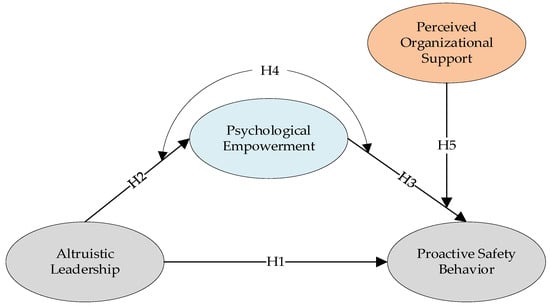
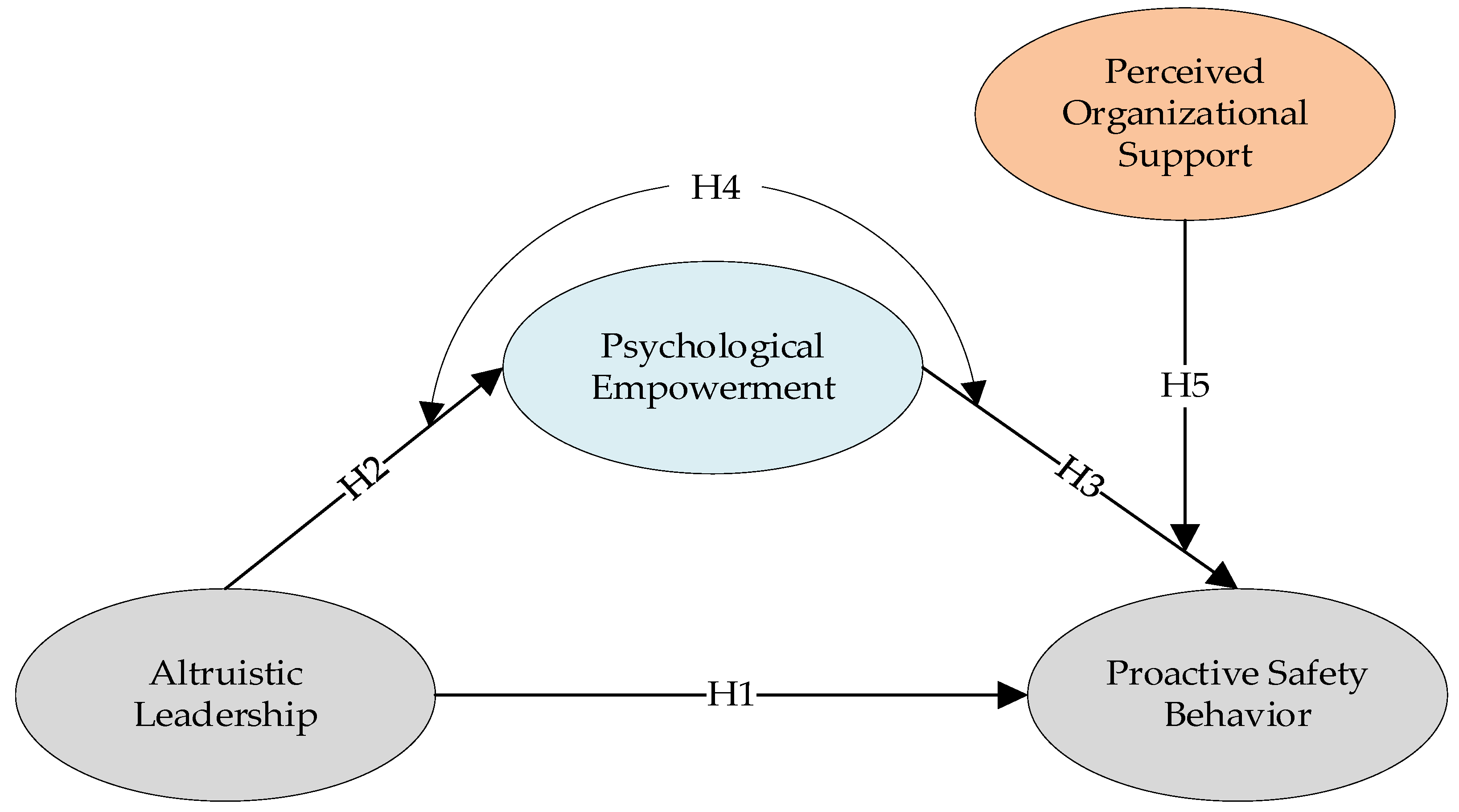
Based on the aforementioned assumptions, a research model is proposed to elucidate the mechanism by which altruistic leadership influences proactive safety behavior among construction workers through internal psychological empowerment and perceived external organizational support, as illustrated in Figure 1.
Figure 1.
The proposed research model.
4. Method
4.1. Research Design
This study employed a quantitative research approach using a cross-sectional survey design. A cross-sectional design was appropriate for efficiently collecting data from a large sample at a single point in time to examine the relationships among key variables (i.e., altruistic leadership, psychological empowerment, perceived organizational support, and proactive safety behavior).
4.2. Participants and Procedure
To ensure content validity, a pilot test was conducted by distributing the preliminary questionnaire to five industry experts for review. Their opinions and feedback were collected. To improve readability and relevance for construction workers, the questionnaire was revised accordingly based on expert feedback. Revisions included deleting select items and adding explanatory notes to form the final version. The questionnaire consists of five parts: (a) demographic characteristics, (b) altruistic leadership, (c) proactive safety behavior, (d) psychological empowerment, and (e) perceived organizational support.
The data collection procedure was designed to ensure validity and ethical standards. Respondent selection was conducted in two steps: initial coordination with on-site management to identify workgroups and break schedules, followed by survey administration in common areas during these designated breaks. Data were collected from frontline construction workers across 35 sites spanning diverse geographical regions of China, including the developed eastern coast (Jiangsu, Zhejiang, Shanghai), the south (Guangdong), central heartland (Henan, Hubei), southwest (Sichuan, Chongqing), and north (Hebei). The sample encompassed key project types such as large-scale commercial, residential, and infrastructure construction. This multi-regional sampling strategy enhances the external validity and generalizability of our findings. To ensure that the data are reasonable and accurate, stratified sampling was employed to collect data and implement quota sampling to increase the sample size of underrepresented groups when the initial sample showed imbalance.
A total of 751 construction workers completed the questionnaire assessing altruistic leadership, proactive safety behavior, psychological empowerment, perceived organizational support, and demographic details (age, gender, education, job category, and weekly working hours). After removing responses with incomplete or identical answers, 718 valid questionnaires were retained, yielding an effective response rate of 96%. The demographic characteristics of the final sample are presented in Table 1.
Table 1.
Statistical data of respondents.
4.3. Questionnaire Design
Referring to the scale developed by Barbuto et al. [46], four items were used to measure altruistic leadership. The items measuring proactive safety behavior were designed with reference to the scale developed by Kang et al. [47]. Psychological empowerment was measured with reference to the scale of Seibert et al. [10]. Based on the scale of perceived organizational support developed by Revelle et al. [48], we designed five items for construction workers’ perceived organizational support. The detailed contents of the questionnaire are shown in Table 2. A five-point Likert scale was used for all four scales, with scores ranging from 1 = “strongly disagree” to 5 = “strongly agree.“
Table 2.
Questionnaire items.
A comprehensive multicollinearity assessment was conducted using SPSS 27. The highest correlation between constructs was 0.773, below the 0.90 threshold. Furthermore, all variance inflation factor (VIF) values ranged from 1.847 to 2.817, well below the conservative benchmark of 3.3, and all tolerance values exceeded 0.10. These results collectively indicate the absence of multicollinearity concerns. Detailed results are presented in Table 3.
Table 3.
Multicollinearity assessment results.
5. Results
Data analysis and hypothesis testing were performed using PLS-SEM. A PLS-SEM model consists of two core components: a measurement model and a structural model. The measurement model delineates the relationship between the observed and latent variables, while the structural model represents the hypothesized relationships among exogenous and endogenous latent variables. Therefore, model evaluation requires a comprehensive assessment of both components.
5.1. Evaluation of the Measurement Model
The reliability of each variable was assessed using Cronbach’s alpha (CA) and Composite reliability (CR). The value of CA ranges from 0 to 1, with higher values denoting stronger reliability. Generally, a value below 0.6 is considered untrustworthy, and the questionnaire should be redesigned or data collected and analyzed again. A value higher than 0.7 indicates that the variable shows good reliability [49]. The results of the reliability and convergent validity analysis are shown in Table 4. We can see that the values of CA for all the variables exceed 0.70. Composite reliability (CR) is often used to judge the internal consistency of multiple indicators. When the CR value of all constructs is greater than the critical value of 0.7, it shows that a model has good internal consistency. Therefore, the four variables in this study scale have good reliability.
Table 4.
Reliability, convergent validity, and empirical results of the structural model.
Average variance extracted (AVE) is used to evaluate convergent validity. Convergent validity is considered adequate when the average variance extracted (AVE) is at least 0.5. The results are presented in Table 4. AVE values exceed 0.5, indicating that each variable has good convergence validity and combination reliability [50]. The discriminant validity is determined by the Fornell-Larcker and Heterotrait-Monotrait ratio test. When the square root of the AVE value is greater than the correlation coefficient between potential variables, the discriminant validity is acceptable. As shown in Table 5, the square root of the AVE for each variable exceeds its correlations with all other variables, thus demonstrating established discriminant validity. The details are shown in Table 4 and Table 5.
Table 5.
Discriminant validity of the measurement model.
5.2. Evaluation of the Structural Model
The evaluation of structural models mainly includes goodness-of-fit tests and significance analysis of path coefficients. Common structural model quality indicators include the coefficient of determination (R2) and cross-validation redundancy (Q2), which are, respectively, used to measure the model’s explanatory power and predictive ability for specific variables. According to standard research criteria, an R2 value above 0.2 indicates that the model possesses good explanatory power, and a Q2 value greater than 0 confirms that its predictive validity is acceptable. The model exhibits robust explanatory power for the endogenous variables, as the R2 values for proactive safety behavior (0.693) and psychological empowerment (0.522) substantially exceed the standard threshold of 0.2. In particular, the interpretability of proactive safety behavior is close to 0.7, demonstrating a strong interpretive ability. In terms of predictive validity, the Q2 value of proactive safety behavior is 0.465, and that of psychological empowerment is 0.391. Both are significantly higher than the baseline requirement of 0, confirming that the model has a good predictive correlation. The details are shown in Table 4.
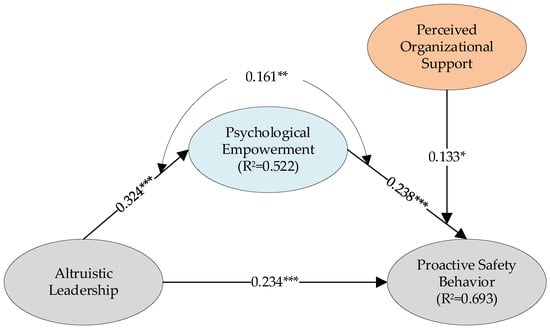
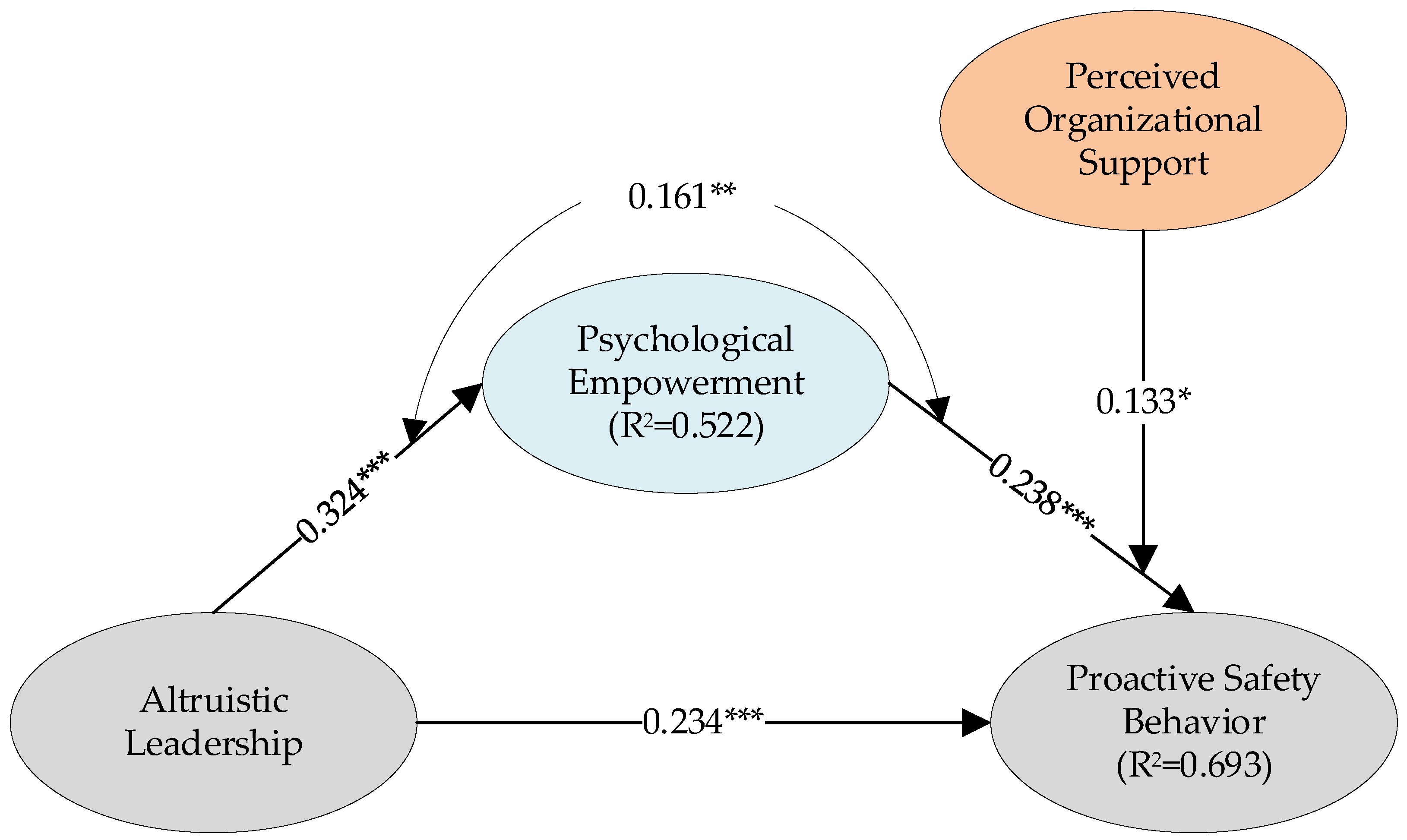
The path test results are shown in Figure 2. The path coefficient (β) of the influence of altruistic leadership on proactive safety behavior is 0.234 (T = 3.623, p < 0.001), indicating that altruistic leadership has a positive impact on proactive safety behavior, thereby validating H1. The path coefficient (β) of the influence of altruistic leadership on psychological empowerment is 0.324 (T = 5.124, p < 0.001), thereby H2 is supported, indicating that altruistic leadership has a positive impact on psychological empowerment. The path coefficient of the effect of psychological empowerment on proactive safety behavior is 0.238 (T = 3.579, p < 0.001), indicating that H3 is supported. This result indicates that psychological empowerment has a positive effect on proactive safety behavior. The results of assumed path coefficients are shown in Figure 2.
Figure 2.
The results of the assumed path coefficients. Note: * p < 0.05, ** p < 0.01, and *** p < 0.001.
Table 6 presents the mediating effect of psychological empowerment. The results show that the mediating path coefficient of psychological empowerment is 0.161 (T = 2.952, p < 0.01), indicating that H4 is valid. Because altruistic leadership has a significant direct impact on proactive safety behavior, psychological empowerment plays a partial mediating role between altruistic leadership and proactive safety behavior.
Table 6.
Results of the hypothesis test.
Table 6 shows that the moderating effect of perceived organizational support on the effect of psychological empowerment on proactive safety behavior is 0.133 (T = 2.018, p < 0.05). This indicates that H5 is supported, i.e., the perceived organizational support plays a positive moderating role between psychological empowerment and proactive safety behavior.
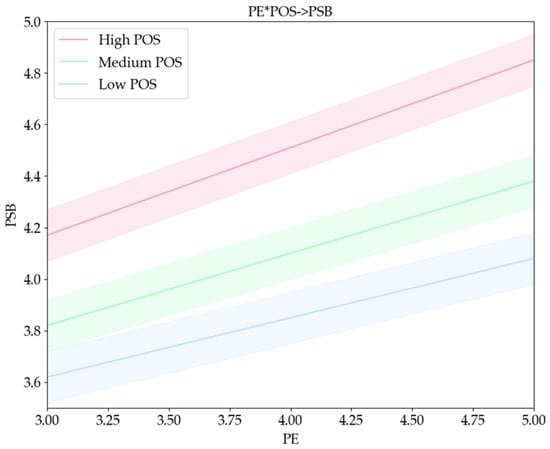
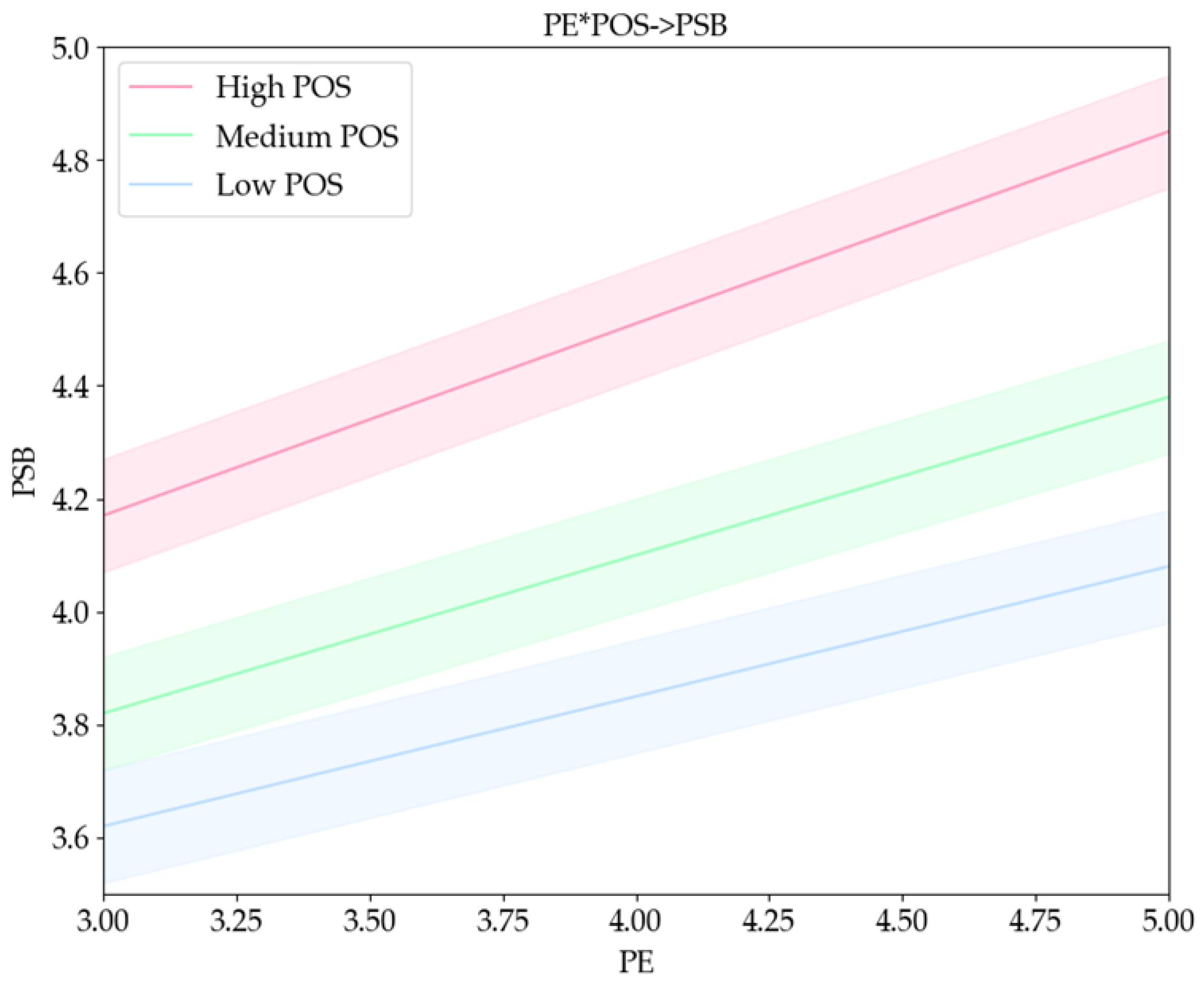
The moderating role of different levels of perceived organizational support between psychological empowerment and proactive safety behavior is further analyzed, and the results are shown in Figure 3. Perceived organizational support is categorized into three levels: high (at mean +1 standard deviation, shown in green), medium (at mean level, shown in red), and low (at mean −1 standard deviation, shown in blue). Figure 3 shows that the effect of psychological empowerment on proactive safety behavior is more significant at high levels of perceived organizational support than at low levels of perceived organizational support.
Figure 3.
Moderating effects of POS on the relationships between PE and PSB. Note: AL (altruistic leadership), PSB (proactive safety behavior), PE (psychological empowerment), POS (Perceived organizational support).
Given the gender composition of our sample, we conducted a supplementary analysis to examine whether the hypothesis test for significant differences between male and female participants. The results of this subgroup analysis are summarized in Table 7. Crucially, all key hypothesized paths remained statistically significant in both the male and female subgroups. This suggests that the underlying effect path linking altruistic leadership and proactive safety behavior is robust across genders, despite the sample imbalance. We additionally utilized robust standard errors to reduce the impact of heteroscedasticity and control for elevated Type I error rates associated with imbalance in group size. All path coefficients were tested for significance using bootstrapping with 5000 subsamples and bias-corrected confidence intervals, which provide robust inference against non-normality and heteroscedasticity.
Table 7.
The heterogeneity analysis of gender.
Table 7 shows the result of the gender effect. The results revealed that the path coefficient of the influence of altruistic leadership on proactive safety behavior for male workers is 0.252, which is larger than that of female workers. The mediating effect of psychological empowerment is more pronounced among male workers, with a path coefficient is 0.227, higher than that of female workers. Perceived organizational support plays a greater mediating role in the influence of altruistic leadership on proactive safety behavior for male workers, with a path coefficient of 0.151.
The results showed that male workers have a significant effect on the proposed relationships in our model than female workers. This result is related to the male-dominated labor force in the construction industry [51]. Male workers may be more inclined to view the altruistic behavior of their leaders as a favor and feel a stronger obligation to repay it through proactive safety behavior [52]. Female workers may be more inclined to view the care from their leaders as a fundamental management quality rather than an additional favor that requires special rewards. Furthermore, the sense of self-determination and impact bestowed by psychological empowerment can more precisely meet the intrinsic need of male workers for control over their work. Therefore, the incentive effect of altruistic leadership on the proactive safety behavior of construction workers is more obvious among male workers.
5.3. Multi-Group Analysis (MGA)
The effect of altruistic leadership on workers’ proactive safety behavior may vary depending on individual characteristics such as weekly working hours and age. Investigating how these personal characteristics affect the relationship can assist managers in tailoring strategies to encourage safety initiatives based on workforce demographics. We employed a multigroup analysis (MGA) to assess differences in the influence of altruistic leadership on proactive safety behavior across groups categorized by different age or work hours. Based on workers’ age, the sample was categorized into two age groups: younger workers (<40 years old, n = 294) and older workers (≥40 years old, n = 424). Based on workers’ weekly hours, the sample was categorized into two groups: shorter hours (<40 h per week, n = 404) and longer hours (≥40 h per week, n = 314).
The measurement invariance of composite models (MICOM) test serves as a validation approach for assessing the reliability of multigroup analysis (MGA) [53]. This method comprises three sequential stages. The first involves examining configural invariance across groups to confirm that multiple groups share equivalent data structures and model specifications. Compositional invariance is evaluated in the second stage using a permutation test. The criterion for establishing invariance is that each original correlation coefficient must be at least as high as the 5% quantile of its permuted distribution. The third stage focuses on testing composite invariance to ensure the structural model meets full invariance criteria. This includes two assessments: the mean-variance difference test (a) and the variance difference test (b). Full measurement invariance is established when both differences fall within the corresponding confidence interval (2.5–97.5%). If only one difference lies within this range, partial invariance is supported. Conversely, if neither difference is within the interval, measurement invariance is not achieved.
As presented in Table 8 and Table 9, the MICOM results for both age and weekly working hours fall within acceptable thresholds, indicating adequate measurement invariance for these variables. First, for age groups, all constructs achieved configural invariance, confirming equivalent model structures across groups. Second, all correlation quantile values (C-value) were 0.999 or 1.000, exceeding the 5% quantile threshold. Permutation p-values were non-significant (p > 0.05), establishing compositional invariance. Third, the composite variance ratio differences fell within the 95% confidence intervals, supporting full or partial measurement invariance. Similarly, measurement invariance was supported for weekly working hours at all three levels, validating that observed differences are structural rather than artifactual.
Table 8.
Measurement invariance testing results for ages using MICOM.
Table 9.
Measurement invariance testing results for weekly working hours using MICOM.
Table 10 presents the hypothetical path coefficients derived from the MICOM analysis, revealing a good model fit and significant differences between groups. The results indicate that the effect of altruistic leadership on proactive safety behavior varies according to workers’ age. Specifically, for older construction workers, the path coefficient is 0.339, which exceeds that observed in younger workers (β = 0.168, p < 0.01). The difference in path coefficients between the two age groups yields a p-value of 0.026, falling below the 0.05 threshold, suggesting that altruistic leadership exerts a stronger influence on proactive safety behavior among older employees.
Table 10.
MGA results for ages.
Furthermore, Table 10 shows that psychological empowerment mediates the relationship between altruistic leadership and proactive safety behavior. The mediating role of psychological empowerment was stronger for younger workers (β = 0.509, p < 0.001) than older workers (β = 0.154, p < 0.01), with a significant between-group difference in mediation strength (p = 0.035).
For weekly working hours, altruistic leadership showed a stronger direct effect in the longer hours group (β = 0.432, p < 0.001) compared to the shorter hours group (β = 0.183, p < 0.001), with a significant between-group difference (p = 0.043). However, the mediating effect of psychological empowerment did not differ significantly between working hour groups (p = 0.078), indicating that this indirect effect does not vary substantially based on the length of weekly work hours. The results are shown in Table 11.
Table 11.
MGA results for weekly working hours.
6. Discussions and Managerial Implications
6.1. Discussions
(1) Discussions on the hypothesis testing results
The results showed that altruistic leadership has a significant positive effect on proactive safety behavior. This supports the findings of Ruiz et al. [54]. Ruiz’s findings have verified that altruistic leadership has a positive impact on employees’ proactive behavior. Given the constant physical risks inherent in construction, a leader’s self-sacrificial dedication serves as a powerful signal of genuine concern. This demonstration helps overcome the inherent skepticism within temporary project teams, where trust cannot be taken for granted. This action fosters trust, promoting workers to reciprocate not just out of a general norm of reciprocity, but out of a specific commitment to a leader. Furthermore, by exemplifying and reinforcing core values, altruistic leadership enables workers to internalize safety principles [55]. This enhances job satisfaction and organizational commitment, thereby encouraging voluntary engagement in extra-role safety behaviors [56].
Psychological empowerment mediates the positive effects of altruistic leadership on proactive safety behavior. This result is similar to the finding of Domingo et al. [57]. They found that in manufacturing, leadership support (including altruistic behavior) indirectly reduces workers’ violation behavior through psychological empowerment and improves workers’ proactive behavior. Altruistic leadership creates conditions for psychological empowerment, making it an antecedent to promote proactive safety behavior. This is because altruistic leaders create an environment where employees feel valued and trusted [58]. This leadership directly enhances the psychological empowerment of employees. In the built environment, unpredictable hazards require immediate and voluntary intervention, and psychological empowerment makes workers more willing to go beyond passive obedience. Psychological empowerment shifts workers’ safety role from passive compliance to proactive engagement, including risk identification, problem-solving, and safety advocacy. Therefore, psychological empowerment plays a mediating role between altruistic leadership and proactive safety behavior.
Perceived organizational support positively moderates the relationship between psychological empowerment and proactive safety behavior of construction workers. This is similar to Choi et al.’s [59] research, which found that perceived organizational support reinforces the impact of psychological empowerment on proactive safety behavior. The construction industry is characterized by complex subcontracting chains and ambiguous lines of responsibility. In this context, a worker’s decision to engage in a proactive safety behavior carries career risks. A high level of perceived organizational support assures workers that the company values their initiative and will support them in their proactive behavior. This organizational endorsement drastically lowers the perceived cost of proactivity [60]. In addition, strong perceived organizational support enhances employees’ sense of belonging. It provides them with psychological security and necessary resources, fostering a supportive work environment. The autonomous decision-making ability and innovative intention stimulated by psychological empowerment will be more effectively transformed into proactive safety behavior.
(2) Discussions on the MGA results
The multi-group analysis revealed that the positive effect of altruistic leadership on proactive safety behavior was significantly stronger for older workers than for their younger counterparts. In the construction context, older workers have often witnessed or experienced serious safety incidents, forging a deep-seated appreciation for a leader who demonstrably values their safety. This leader’s altruism fosters a potent form of reciprocity based on mutual respect for survival, which is less salient for younger workers who are still building their risk perception. Consequently, older workers are more likely to reciprocate this genuine care by engaging in extra-role behaviors that benefit the collective, such as voluntarily engaging in safety monitoring and helping colleagues.
The results also show that the psychological empowerment of younger workers serves as a more prominent mediator between altruistic leadership and proactive safety behavior. This is because younger workers’ greater responsiveness to psychological empowerment stems from intergenerational differences. Younger workers grow up in an environment that values personal worth and a sense of participation. They have a strong desire for a sense of meaning in their work, autonomy, and impact. The care and trust of altruistic leaders precisely meet these high-level psychological needs. Through psychological empowerment, the external care of leaders can be more effectively internalized into the responsibility and initiative of younger workers, thereby significantly stimulating their proactive safety behavior. In contrast, older workers may respond more directly to the material care and sense of stability brought by altruistic leadership. Their proactive safety behavior relies more on habits and experience, so the mediating leverage effect of psychological empowerment in this process is relatively weak.
When further considering the specific context of the construction industry, young workers generally face the dual challenges of insufficient skills and job adaptation. They are more clearly aware of their own lack of experience and security vulnerabilities, and thus are particularly sensitive to the autonomy, ability, trust, and participation opportunities granted by altruistic leadership. For these young workers, psychological empowerment is not only a mechanism for stimulating motivation but also the foundation for dealing with on-site dangers and enhancing their confidence in work. Older workers, with their rich on-site experience, have established a relatively mature safety capability system and may consider being empowered as the norm. Therefore, the mediating role of psychological empowerment is not as obvious among older workers as it is among younger ones.
The impact of altruistic leadership on proactive safety behavior has a stronger effect on workers with longer weekly hours. It can be explained through the lens of the job demands-resources (JD-R) model [61]. For construction workers, long weekly hour leads to cumulative fatigue and cognitive depletion. In this state of depletion, workers are more likely to resort to cognitive shortcuts and complacency, making them vulnerable to overlooking risks [62]. In this context of heightened vulnerability, an altruistic leader proactively monitoring for signs of fatigue is perceived as positive support. The leader’s altruism becomes a valuable job resource that is acutely felt precisely when the worker’s personal resources are at their lowest ebb. This perception triggers an exceptionally potent form of reciprocity. They feel a strong obligation to reciprocate this life-affirming care through proactive safety behavior, such as vigilantly watching out for their fatigued colleagues, voicing concerns about unsafe conditions, or taking the time to correct a hazard [63]. Thus, for the long-hours workers group, altruistic leadership not only enhances work motivation but also serves as a crucial buffer to alleviate high work stress.
(3) The generalizability of results
The survey was administered to construction workers in China, and the generalizability of the findings is discussed below. Firstly, the influence mechanism of altruistic leadership on proactive safety behavior may be culture-dependent. Within China’s collectivist culture, the emphasis on organizational responsibility strengthens the moderating role of perceived organizational support [64]. However, in individualistic cultures, psychological empowerment stems more from personal initiative than organizational support [65]. Consequently, the moderating effect of organizational support may diminish. Second, the effectiveness of altruistic leadership in promoting proactive safety behavior among construction workers varies across regions with different economic development levels. Developed regions typically feature construction enterprises with stronger safety infrastructures, including comprehensive training systems and advanced protective gear [66]. Workers exhibit stronger perceived organizational support and psychological empowerment, thereby facilitating the translation of altruistic leadership into proactive safety behavior. Finally, regulatory environments may affect altruistic leadership’s impact on proactive safety behavior. Under strong regulation, construction workers primarily focus on compliance with safety management systems, reducing personal initiative. Consequently, the mediating role of psychological empowerment’s influence on altruistic leadership may weaken. Conversely, in weakly regulated environments, employees respond more strongly to perceived organizational safety support, enhancing altruistic leadership’s impact.
6.2. Theoretical Contribution
This study, by breaking through the framework of a single theoretical explanation, constructed and verified such a cross-theoretical integrated model (SET → SDT → SST), clearly depicting the complete chain from leadership behavior → psychological state → organizational boundaries. This integrated model clarifies how and when altruistic leadership affects proactive safety behavior, thereby making significant contributions at the theoretical level. Specifically, the theoretical contributions of this study are reflected in two aspects:
(i) This study integrates social exchange theory with self-determination theory by linking extrinsic motivation derived from social exchange and intrinsic motivation from self-determination, thereby elucidating the influence mechanism of altruistic leadership on proactive safety behavior among construction workers. Social exchange theory falls short in explaining the proactiveness of safety behaviors, which often exceed the bounds of simple reciprocity. By introducing self-determination theory, we provide a more detailed psychological mechanism explanation for this process. Our theoretical and empirical research shows that altruistic leadership not only creates obligations but also profoundly meets employees’ basic psychological needs. This satisfaction of needs transforms employees’ motivation from external obligations into internal driving forces. Thus, this study explains how the social exchange triggered by leaders evolves into internalized and self-sustaining motivations, thereby constructing a more complete correlation mechanism between leadership and proactive safety behavior.
(ii) This study advanced the research on the theory of proactive motivation by introducing and empirically testing the situational boundaries of psychological empowerment transformation. Although self-determination theory emphasizes internal psychological needs, it should be acknowledged that external factors can also promote or hinder their expression. Based on the situational strength theory, we believe that psychological empowerment needs to rely on a supportive external environment to be reliably transformed into visible actions. The significant moderating effect of perceived organizational support confirms this view. In a high-level organizational support environment, the supportive signals of the organization construct a strong context, clearly conveying the signal that proactive safety behavior are not only allowed but also valued and rewarded. Integrating situational strength and self-determination theories reveals that intrinsic motivation’s efficacy is not automatic but contingent on a supportive and strong organizational context.
6.3. Practical Implications
Firstly, the results show that altruistic leadership has a positive effect on proactive safety behavior. Organizations can take the following measures to cultivate altruistic leadership, thereby promoting workers’ proactive safety behavior. (i) Altruistic leadership course can be designed for managers and enhance managers’ altruistic decision-making ability in emergencies through situational simulation training. (ii) Managers can establish a leadership behavior assessment mechanism, incorporate safety care behaviors into performance evaluations, and assess the altruistic leadership performance of managers through anonymous ratings by workers. (iii) Managers can demonstrate genuine care by personally checking on workers’ safety and well-being, such as consistently prioritizing safety protocols over tight deadlines when risks are present.
Secondly, this study demonstrated that psychological empowerment plays a mediating role in the influence of altruistic leadership on the active safety behaviors of construction workers. Measures can be taken to enhance workers’ psychological empowerment based on the four dimensions of psychological empowerment. (i) Managers may grant workers certain responsibilities and rights related to on-site safety observations, reminders, and reporting. Timely feedback should be provided to workers regarding the adoption of their safety suggestions, the progress of hazard rectification, and the results of accident investigations, enabling them to see the positive impact of their individual and collective efforts on safety construction practices. (ii) Managers can provide systematic safety skills training to cultivate workers’ mastery of safety operating procedures and develop emergency response capabilities. Diverse training methods such as hands-on drills, case studies, and VR simulations can be used to enhance their job competence and self-efficacy. (iii) Managers can establish a routine channel for collecting safety suggestions and take workers’ suggestions seriously. This can encourage workers to actively participate in identifying safety risks. In addition, managers can involve workers in safety planning and problem-solving meetings, giving them a genuine voice. (iv) Managers should reward workers who proactively report hazards, propose safety improvement suggestions, and stop others from violating safety regulations. By highlighting how workers’ actions contribute to collective safety, managers cultivate a heightened sense of work purpose among employees.
Thirdly, the findings indicate that perceived organizational support plays a positive moderating role in the impact of psychological empowerment on proactive safety behavior. Managers can take the following measures to enhance workers’ perceived organizational support, thereby increasing their commitment to the organization and their sense of responsibility for safe construction. (i) Managers incorporate perceived organizational support into the training and assessment indicators for managers’ safety leadership. Managers need to actively listen to employees’ safety concerns in their daily work, respond promptly, and provide support. (ii) Construction workers often face high-risk conditions and are prone to safety accidents due to physical fatigue and weather fluctuations. Managers can equip workers with wearable smart safety devices to monitor their unsafe behaviors in real time and issue early warnings of potential dangers. (iii) Managers can build a safety culture centered on open communication, knowledge sharing, and trust collaboration to create a supportive environment for employees to perform tasks safely and efficiently. (iiii) Organizational policymakers can develop and communicate organization-wide safety values that explicitly state the company’s commitment to employee well-being above production pressure, ensure HR and safety policies are consistently and fairly applied to all workers, and recognize and reward supervisors who exemplify altruistic leadership.
Finally, the results of multi-group analysis indicated that the promoting effect of altruistic leadership on proactive safety behavior is more pronounced among older workers and workers with long weekly working hours. The mediating role of psychological empowerment in the influence of altruistic leadership on proactive safety behavior is more pronounced among young workers. The mediating role of psychological empowerment varies little among workers with different weekly working hours. To this end, it is recommended to implement differentiated leadership and management strategies based on the different characteristics of employees, such as age and weekly working hours. (i) For older workers and workers with long weekly working hours, altruistic leaders can enhance direct care and respect through public recognition and establishing emotional bonds. Specific measures include listening to their safety advice in public, giving them full respect and the right to speak, and caring about their physical health and living difficulties. (ii) For young workers, leaders can create meaningful and autonomous work from the various sub-dimensions of psychological empowerment to stimulate their intrinsic motivation. Specific measures include encouraging young workers to join safety meetings and experience the impact of their autonomy in decision-making and actions. By explaining the principles and significance behind safety regulations to young workers, the meaning of proactive safety behavior can be made clear to them.
7. Conclusions
This study examines the underlying mechanisms through which altruistic leadership influences construction workers’ proactive safety behavior by constructing a moderated mediation model. It makes significant contributions to both theory and practice. First, this study extends research on the effectiveness of altruistic leadership to safety behaviors in high-risk industries. By introducing psychological empowerment as a mediator and perceived organizational support as a moderator, it clarifies the underlying psychological pathway through which leadership empowers construction workers to stimulate safety behaviors, as well as the critical role of organizational support in reinforcing this pathway. Second, we incorporated individual differences to examine how the impact of altruistic leadership on construction workers’ proactive safety behavior varies across different age groups and work weekly hours. By revealing how the effectiveness of altruistic leadership differs based on individual characteristics, this study deepens our understanding of the micro-mechanisms through which leadership influences safety behaviors and provides valuable insights for managers to develop targeted intervention strategies tailored to distinct worker groups. Third, this research offers practical guidance for leaders seeking to promote safety through supportive and empowering behaviors. It also supports the shift in construction safety culture from rule-based compliance to active participation.
Although this research has made some contributions, there are still some limitations. First, the cross-sectional design limits causal inferences. Future longitudinal or experimental studies are needed to robustly establish causality. Second, despite procedural and statistical controls that indicated common method bias was not a primary concern, the use of self-reported data from a single source remains a limitation. Collecting multi-source data (e.g., supervisor-rated behaviors) in the future would further strengthen the findings. Finally, the model was tested within the specific context of China. Its cross-cultural generalizability and the potential moderating role of cultural values should be explored in other regions.
Author Contributions
Writing—review and editing, data curation, visualization, software, validation, Z.C.; conceptualization, writing—review and editing, methodology, M.C.; formal analysis, investigation, supervision. L.Z. All authors have read and agreed to the published version of the manuscript.
Funding
This research received no external funding.
Institutional Review Board Statement
The study was conducted in accordance with the Declaration of Helsinki and approved by the Ethics Committee of Shanghai University, ECSHU 2025-135, 14 July 2025.
Informed Consent Statement
Informed consent was obtained from all subjects involved in the study.
Data Availability Statement
The original contributions presented in the study are included in the article, further inquiries can be directed to the corresponding author.
Conflicts of Interest
The authors declare no conflicts of interest.
References
- Selleck, R.; Cattani, M.; Hassall, M. Proposal for and validation of novel risk-based process to reduce the risk of construction site fatalities (Major Accident Prevention (MAP) program). Saf. Sci. 2023, 158, 105986. [Google Scholar] [CrossRef] [Scilit]
- Yang, L.Q. Abusive supervision, thwarted belongingness, and workplace safety: A group engagement perspective. J. Appl. Psychol. 2020, 105, 230–244. [Google Scholar] [CrossRef] [Scilit]
- Liu, S.X.; Zhou, Y.; Cheng, Y. Multiple mediating effects in the relationship between employees’ trust in organizational safety and safety participation behavior. Saf. Sci. 2020, 125, 104611. [Google Scholar] [CrossRef] [Scilit]
- Zhu, J.; Zhang, C.; Wang, S.; Yuan, J.; Li, Q. Evolutionary game analysis of construction workers’ unsafe behaviors based on incentive and punishment mechanisms. Front. Psychol. 2022, 13, 907382. [Google Scholar] [CrossRef] [Scilit] [PubMed]
- Wang, D.W.; Mao, W.X.; Zhao, C.Y. The cross-level effect of team safety-specific transformational leadership on workplace safety behavior: The serial mediating role of team safety climate and team safety motivation. J. Saf. Res. 2023, 87, 285–296. [Google Scholar] [CrossRef] [Scilit]
- He, C.; McCabe, B.; Jia, G. Effect of leader-member exchange on construction worker safety behavior: Safety climate and psychological capital as the mediators. Saf. Sci. 2021, 142, 105401. [Google Scholar] [CrossRef] [Scilit]
- Wang, L.X.; Luo, X.; Li, H.J. The impact of foremen’s paternalistic leadership on construction workers’ safety behaviors: Considering the effects of team safety climate, workers’ psychological safety and power distance. Front. Public Health 2025, 13, 1633467. [Google Scholar] [CrossRef] [Scilit]
- Abdillah, M.R.; Wu, W.; Anita, R. Can altruistic leadership prevent knowledge-hiding behaviour? Testing dual mediation mechanisms. Knowl. Manag. Res. Pract. 2020, 20, 352–366. [Google Scholar] [CrossRef] [Scilit]
- Liu, S.X.; Yang, X.; Mei, Q. The effect of perceived organizational support for safety and organizational commitment on employee safety behavior: A meta-analysis. Int. J. Occup. Saf. Ergon. 2021, 27, 1154–1165. [Google Scholar] [CrossRef] [Scilit]
- Seibert, S.E.; Wang, G.; Courtright, S.H. Antecedents and consequences of psychological and team empowerment in organizations: A meta-analytic review. J. Appl. Psychol. 2011, 96, 981–1003. [Google Scholar] [CrossRef] [Scilit] [PubMed]
- Mehta, A.; Mall, S.; Kothari, T.; Deshpande, R. Hotel employees’ intention to stay through psychological contract fulfillment and positive emotions in the post-lockdown era. Tour. Rev. 2023, 79, 104–118. [Google Scholar] [CrossRef] [Scilit]
- Lyubykh, Z.; Gulseren, D.; Turner, N. Shared transformational leadership and safety behaviours of employees, leaders, and teams: A multilevel investigation. J. Occup. Organ. Psychol. 2022, 95, 431–458. [Google Scholar] [CrossRef] [Scilit]
- Chen, X.; Liu, J. How does altruistic leader behavior foster radical innovation? The mediating effect of organizational learning capability. Technol. Forecast. Soc. Change 2024, 201, 123287. [Google Scholar] [CrossRef] [Scilit]
- Zhang, L.; Liu, Y.X.; Chu, Z.W. The influence of the mechanism of owner’s safety management behavior on construction workers’ safety citizenship behavior. Behav. Sci. 2023, 13, 721. [Google Scholar] [CrossRef] [Scilit]
- Michalová, T.; Marsíková, K.; Falát, L.; Madzík, P. Altruistic leadership and its role in reducing knowledge hiding: The mediating effects of team learning and knowledge culture. J. Innov. Knowl. 2024, 9, 100592. [Google Scholar] [CrossRef] [Scilit]
- Mohajeri, M.; Ardeshir, A.; Malekitabar, H. Diagnostic intervention program based on construction workers’ internal factors for persistent reduction of unsafe behavior. Eng. Constr. Archit. Manag. 2023, 30, 478–495. [Google Scholar] [CrossRef] [Scilit]
- Zong, Z.; Long, T.; Ou, Y.; Zhang, S. Dual-path influence of risk perception on construction workers’ safety participation and the moderating role of mindfulness. J. Constr. Eng. Manag. 2025, 151, 04024194. [Google Scholar] [CrossRef] [Scilit]
- Lv, W.Q.; Shen, L.C.; Tsai, C.H. Servant leadership elevates supervisor-subordinate guanxi: An investigation of psychological safety and organizational identification. Int. J. Hosp. Manag. 2022, 101, 103114. [Google Scholar] [CrossRef] [Scilit]
- Ji, M.; Liu, B.; Li, H.W.; Yang, S.Y. The effect of safety attitude and safety climate on flight attendants’ proactive personality with regard to safety behaviors. J. Air Transp. Manag. 2019, 78, 80–86. [Google Scholar] [CrossRef] [Scilit]
- Liu, Q.; Xu, N.; Jiang, H. Psychological driving mechanism of safety citizenship behaviors of construction workers: Application of the theory of planned behavior and norm activation model. J. Constr. Eng. Manag. 2020, 146, 04020027. [Google Scholar] [CrossRef] [Scilit]
- Kadher, Y.; Alzubi, A.; Berberoglu, A. Perceived Leadership Support, Safety Citizenship, and Employee Safety Behavior in the Construction Industry: The Role of Safety Learning. Buildings 2024, 14, 3260. [Google Scholar] [CrossRef] [Scilit]
- Salas-Vallina, A.; Ferrer-Franco, A.; Fernandez, R. Altruistic leadership and affiliative humor’s role on service innovation: Lessons from Spanish public hospitals. Int. J. Health Plan. Manag. 2018, 33, 861–872. [Google Scholar] [CrossRef] [Scilit]
- Kayapali, Y.; Naktiyok, S.; Basci, A. The Mediating Role of Organizational 1Communication in the Effect of Altruistic Leadership on Organizational Identification and Absenteeism. J. Organ. Stud. Innov. 2025, 12, 39–56. [Google Scholar] [CrossRef] [Scilit]
- Usman, M.; Shahzad, K.; Khan, A. Role of safety-specific transformational leadership in fostering extra-role behaviors through psychological contract fulfillment among frontline workers during COVID-19. Int. J. Occup. Saf. Ergon. 2023, 30, 119–128. [Google Scholar] [CrossRef] [Scilit]
- Cui, L.B.; Mo, J.W. How does supportive leadership impact the safety behaviors of the new generation of construction workers? Behav. Sci. 2025, 15, 110. [Google Scholar] [CrossRef] [Scilit]
- Zheng, J.; Gou, X.; Griffin, M.A.; Goh, Y.M.; Xia, N. Temporal leadership, attentiveness, and safety behaviors: The moderating roles of abusive supervision and safety consciousness. Saf. Sci. 2022, 147, 105633. [Google Scholar] [CrossRef] [Scilit]
- Alrawashdeh, A.; Alzghoul, A.; Al-Mkhadmeh, A.; Tamasevicius, V.; Pauliene, R.; Casas, R. The role of psychological empowerment in the impact of inclusive leadership on employee innovative behavior. Int. Stud. Manag. Organ. 2025. [Google Scholar] [CrossRef] [Scilit]
- Lim, M.S.H.; Tang, Y.C.; Du, S. Beyond Compliance: A Two-Axis Model of Design for Safety Implementation in Mandatory Contexts. J. Mang. Eng. 2025, 41, 04025029. [Google Scholar] [CrossRef] [Scilit]
- Waseem, M.; Khan, K.; Kiran, R. Cultivating loyalty: The role of inclusive leadership in fostering organizational commitment through mediating effect of psychological safety and perceived organizational support. J. Facil. Manag. 2025, 23, 861–885. [Google Scholar] [CrossRef] [Scilit]
- He, Y.; Wei, X. Preventing knowledge hiding behaviors through workplace friendship and altruistic leadership, and the mediating role of positive emotions. Front. Psychol. 2020, 13, 905890. [Google Scholar] [CrossRef] [Scilit] [PubMed]
- Usman, M.; Ali, M.; Ogbonnaya, C. Fueling the intrapreneurial spirit: A closer look at how spiritual leadership motivates employee intrapreneurial behaviors. Tour. Manag. 2021, 83, 104227. [Google Scholar] [CrossRef] [Scilit]
- Golabchi, H.; Pereira, E.; Lefsrud, L.; Mohamed, Y. Proposal of a safety maturity framework in construction: Implementing leading indicators for proactive safety management. J. Saf. Sustain. 2025, 2, 207–221. [Google Scholar] [CrossRef] [Scilit]
- Zheng, J.W.; Feng, C.Y.; Xie, H.T.; Zhao, X.; Wu, G. Ambidextrous leadership and innovative behaviors in construction projects: Dual-edged sword effects and social information processing perspective. J. Mang. Eng. 2023, 39, 04022070. [Google Scholar] [CrossRef] [Scilit]
- Wan, X.; He, R.; Zhang, G.; Zhou, J. Employee engagement and open service innovation: The roles of creative self-efficacy and employee innovative behaviour. Front. Psychol. 2022, 13, 921687. [Google Scholar] [CrossRef] [Scilit] [PubMed]
- Warmerdam, A.; Newnam, S.; Wang, Y. High performance workplace systems’ influence on safety attitudes and occupational driver behaviour. Saf. Sci. 2018, 106, 146–153. [Google Scholar] [CrossRef] [Scilit]
- Wang, Y.; Li, Z.; Zhang, J. Ethical leadership and employee unethical behavior: A dual-processing model. Manag. Decis. 2023, 61, 1501–1516. [Google Scholar] [CrossRef] [Scilit]
- Wang, D.; Huang, R.P.; Qiao, Y.H.; Sheng, Z.; Li, K.; Zhao, L. How perceived leader-member exchange differentiation affects construction workers’ safety citizenship behavior: Organizational identity and felt safety responsibility as mediators. J. Constr. Eng. Manag. 2023, 149, 04023110. [Google Scholar] [CrossRef] [Scilit]
- Seyb, S.K.; Shepherd, D.A.; Maitlis, S. Meaningful venturing: Examining how entrepreneurs generate meaning in life. J. Bus. Ventur. 2025, 40, 106526. [Google Scholar] [CrossRef] [Scilit]
- Tomlinson, M.; Souto, M. Graduates’ conceptions of meaningful work. Br. Educ. Res. J. 2025, 51, 401–418. [Google Scholar] [CrossRef] [Scilit]
- Lee, G.; Choi, B.; Jebelli, H.; Lee, S. Assessment of construction workers’ perceived risk using physiological data from wearable sensors: A machine learning approach. J. Build. Eng. 2021, 42, 102824. [Google Scholar] [CrossRef] [Scilit]
- Khayat, A.H.; Keshky, M.; Elewiat, S. Self-efficacy, group effectiveness, and individual work performance in Saudi employees with disabilities: The mediation roles of intrinsic and extrinsic motivation. Sage Open 2024, 14, 21582440241286361. [Google Scholar] [CrossRef] [Scilit]
- Keeler, K.R.; Kong, W.; Dalal, R.S. Situational strength interactions: Are variance patterns consistent with the theory? J. Appl. Psychol. 2019, 104, 1487–1513. [Google Scholar] [CrossRef] [Scilit] [PubMed]
- Rubel, M.; Kee, D.; Rimi, N. Unpacking the eco-friendly path: Exploring organizational green initiatives, green perceived organizational support and employee green behavior. Int. J. Contemp. Hosp. Manag. 2025, 37, 2049–2071. [Google Scholar] [CrossRef] [Scilit]
- Kurt, T.; Duyar, I.; Ayyildiz, P.; Fidan, T.; Arastaman, G. Examining the relationship between perceived organizational support and teachers’ resistance to change: The mediating effects of climate for initiative and psychological safety. Curr. Psychol. 2024, 43, 34335–34351. [Google Scholar] [CrossRef] [Scilit]
- Pattali, S.; Sankar, J.; Menon, N.; Kim, C. Effect of leadership styles on turnover intention among staff nurses in private hospitals: The moderating effect of perceived organizational support. BMC Health Serv. Res. 2024, 24, 199. [Google Scholar] [CrossRef] [Scilit]
- Barbuto, J.E.; Wheeler, D.W. Scale development and construct clarification of servant leadership. Group Organ. Manag. 2006, 31, 300–326. [Google Scholar] [CrossRef] [Scilit]
- Kang, J.H.; Matusik, J.G.; Kim, T.Y.; Phillips, J.M. Interactive effects of multiple organizational climates on proactive safety behavior in entrepreneurial firms: A cross-level investigation. J. Bus. Ventur. 2016, 31, 628–642. [Google Scholar] [CrossRef] [Scilit]
- Revelle, W.; Condon, D. Developing an index of national research capacity. Quant. Sci. Stud. 2024, 5, 954–974. [Google Scholar] [CrossRef] [Scilit]
- Hair, J.F.; Hult, G.T.M.; Ringle, C.M.; Arstad, M. A Primer on Partial Least Squares Structural Equation Modeling (PLS-SEM); Sage: London, UK, 2014. [Google Scholar]
- Si, H.; Li, N.; Cheng, L. Are you a happy traveler? Exploring ride-sourcing travelers’ satisfaction and subjective well-being. Transp. Res. Part D Transp. Environ. 2024, 128, 104108. [Google Scholar] [CrossRef] [Scilit]
- National Bureau of Statistics of China. China Statistical Yearbook 2022; China Statistics Press: Beijing, China, 2022.
- Xi, J.; Lee, M.; Carter, J. Gender Differences in Purpose in Life: The Mediation Effect of Altruism. J. Humanist. Psychol. 2022, 62, 352–376. [Google Scholar] [CrossRef] [Scilit]
- Si, H.; Duan, X.; Cheng, L. Determinants of consumers’ continuance intention to use dynamic ride-sharing services. Transp. Res. Part D Transp. Environ. 2022, 104, 13201. [Google Scholar] [CrossRef] [Scilit]
- Ruiz, P.; Linuesa, J.; Elche, D. Team-level servant leadership and team performance: The mediating roles of organizational citizenship behavior and internal social capital. Bus. Ethics Environ. Responsib. 2023, 32, 127–144. [Google Scholar] [CrossRef] [Scilit]
- He, Y.; Sheng, Z.; Griffin, M.; Yao, X. A multilevel model linking altruistic motivation to workplace safety: The role of servant leadership. J. Organ. Behav. 2023, 45, 497–517. [Google Scholar] [CrossRef] [Scilit]
- Song, Z.; Gu, Q.; Cooke, F.L. The effects of high-involvement work systems and shared leadership on team creativity: A multilevel investigation. Hum. Resour. Manag. 2020, 59, 201–213. [Google Scholar] [CrossRef] [Scilit]
- Domingo, M.; Gallagher, P.; Mathieu, J. I Feel Safe, Do We? Differentiating the Multilevel Moderation of Psychological Safety on the Psychological Empowerment-Performance Relationship. Group Organ. Manag. 2025. [Google Scholar] [CrossRef] [Scilit]
- Sun, B.; Zhu, F.; Lin, S.; Sun, J.; Wu, Y. How is professional identity associated with teacher career satisfaction? A cross-sectional design to test the multiple mediating roles of psychological empowerment and work engagement. Int. J. Environ. Res. Public Health 2022, 19, 9009. [Google Scholar] [CrossRef] [Scilit]
- Choi, B.; Ahn, S.; Lee, S. Role of social norms and social identifications in safety behavior of construction workers. I: Theoretical model of safety behavior under social influence. J. Constr. Eng. Manag. 2017, 143, 04016124. [Google Scholar] [CrossRef] [Scilit]
- Li, G.Q.; Tao, Y.Y.; Meng, Y.; Lu, M. Change or paradox: The double-edged sword effect of organizational crisis on employee behavior. J. Organ. Change Manag. 2024, 37, 439–462. [Google Scholar] [CrossRef] [Scilit]
- Hawkes, A.; Biggs, A.; Hegerty, E. Work Engagement: Investigating the Role of Transformational Leadership, Job Resources, and Recovery. J. Psychol. 2017, 151, 509–531. [Google Scholar] [CrossRef] [Scilit]
- Bakker, A.B.; Demerouti, E. Job demands–resources theory: Taking stock and looking forward. J. Occup. Health Psychol. 2017, 22, 273–285. [Google Scholar] [CrossRef] [Scilit] [PubMed]
- Ye, P.; Liu, L.; Tan, J. The influence of organisational justice and ethical leadership on employees’ innovation behaviour. Eur. J. Innov. Manag. 2023, 26, 1129–1149. [Google Scholar] [CrossRef] [Scilit]
- Zhang, Y.; Chen, X.B.; Gong, S.J. Dual hierarchical modelling for the influence of job role demands on psychosocial safety behavior: Evidence from coal industry. Int. J. Indus. Ergon. 2022, 89, 103291. [Google Scholar] [CrossRef] [Scilit]
- Eylon, D.; Au, K. Exploring empowerment cross-cultural differences along the power distance dimension. Int. J. Intercult. Relat. 2009, 23, 373–385. [Google Scholar] [CrossRef] [Scilit]
- Zhang, B.; Zhang, Q.; Yao, C. The Signaling Paradox: Revisiting the Impacts of Overeducation in the Chinese Labor Market. Educ. Sci. 2024, 14, 900. [Google Scholar] [CrossRef] [Scilit]

Disclaimer/Publisher’s Note: The statements, opinions and data contained in all publications are solely those of the individual author(s) and contributor(s) and not of MDPI and/or the editor(s). MDPI and/or the editor(s) disclaim responsibility for any injury to people or property resulting from any ideas, methods, instructions or products referred to in the content. |
© 2025 by the authors. Licensee MDPI, Basel, Switzerland. This article is an open access article distributed under the terms and conditions of the Creative Commons Attribution (CC BY) license.