When Sound Helps or Hurts: Behavioral and EEG Evidence on the Dual Effects of Indoor Acoustic Environments on Office Work Performance




_Hou.png)
Abstract
1. Introduction
1.1. Background and Motivation
1.2. Literature Insights on Impact of Acoustic Intensity and Sound Types on Work Performance
1.3. Role of Emotional States and Mental Workload
1.4. Neurocognitive Rationale for Employing EEG in Acoustic Environment Research
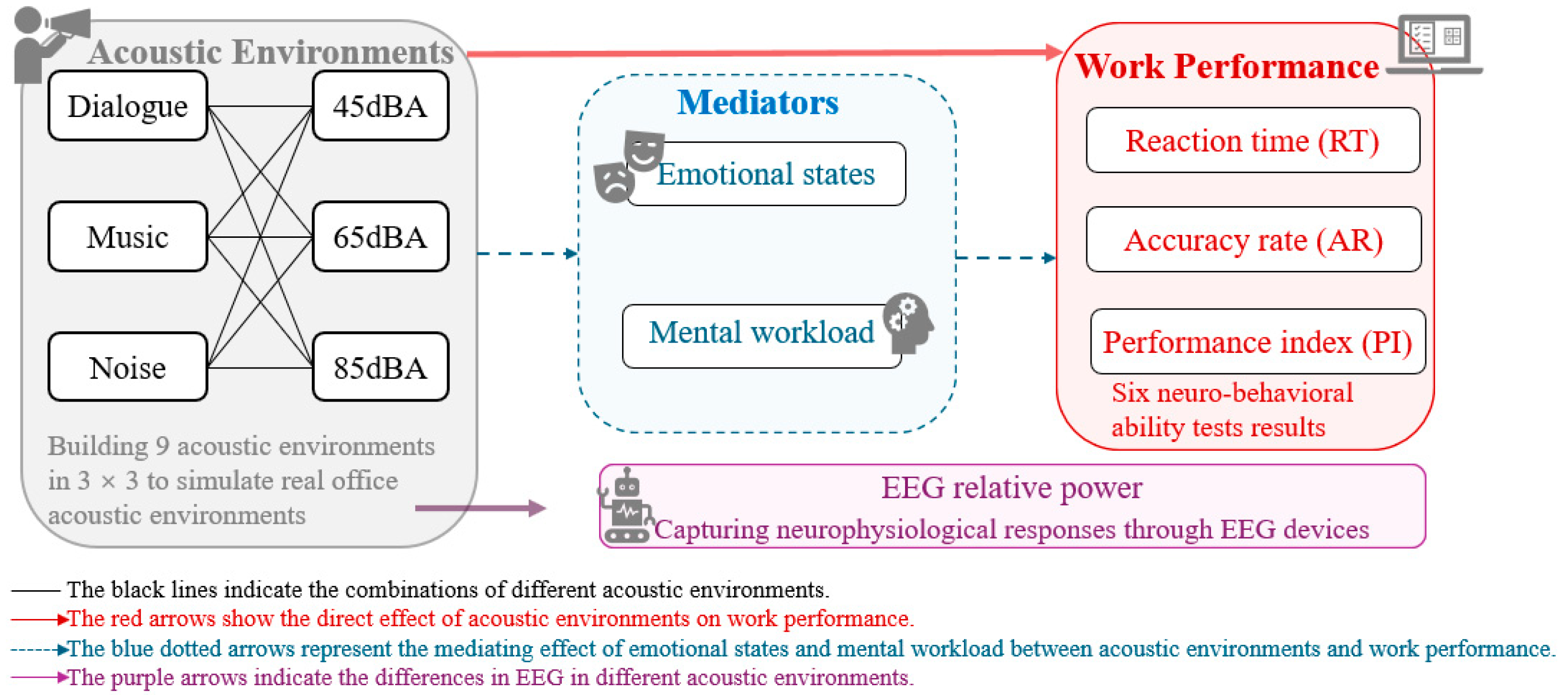
1.5. Research Gaps and Objectives
2. Materials and Methods
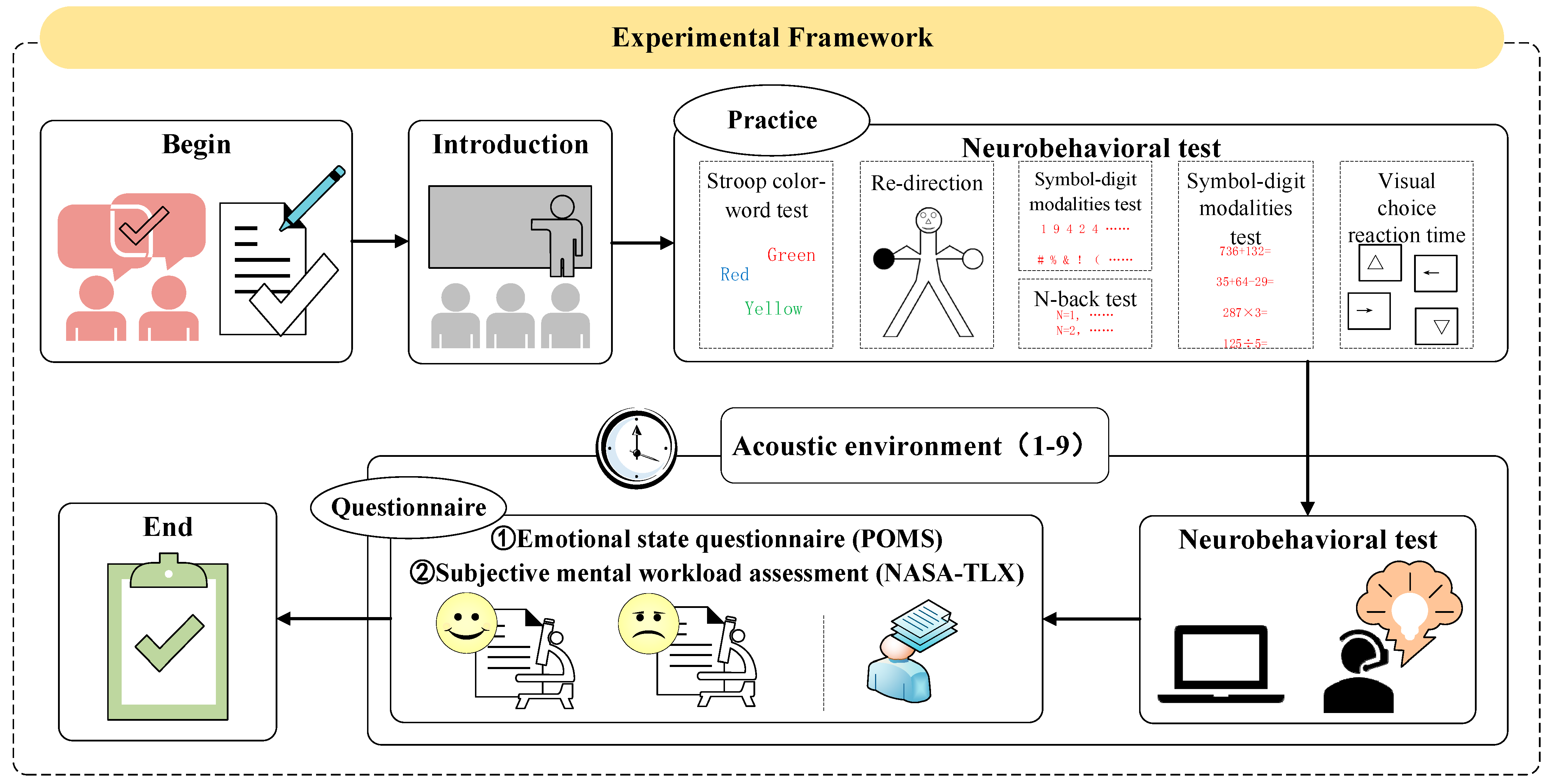
2.1. Experimental Framework
2.2. Sound Materials
2.3. Neurobehavioral Test Materials
2.4. Questionnaire Survey Materials
2.5. Participants and Apparatus
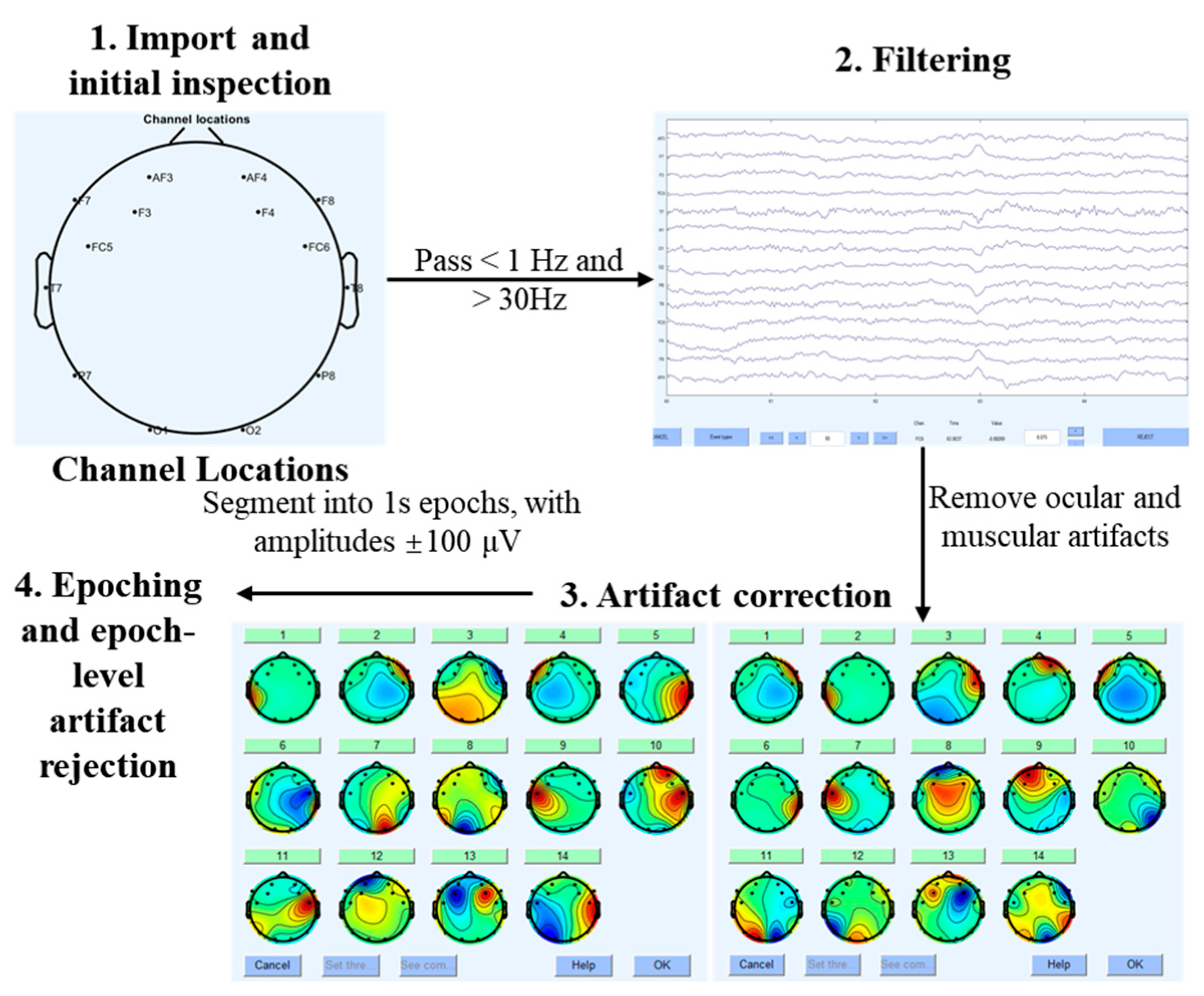
2.6. EEG Data Process
- (1)
- Data preprocessing
- (2)
- Feature extraction
2.7. Statistical Analysis
3. Results
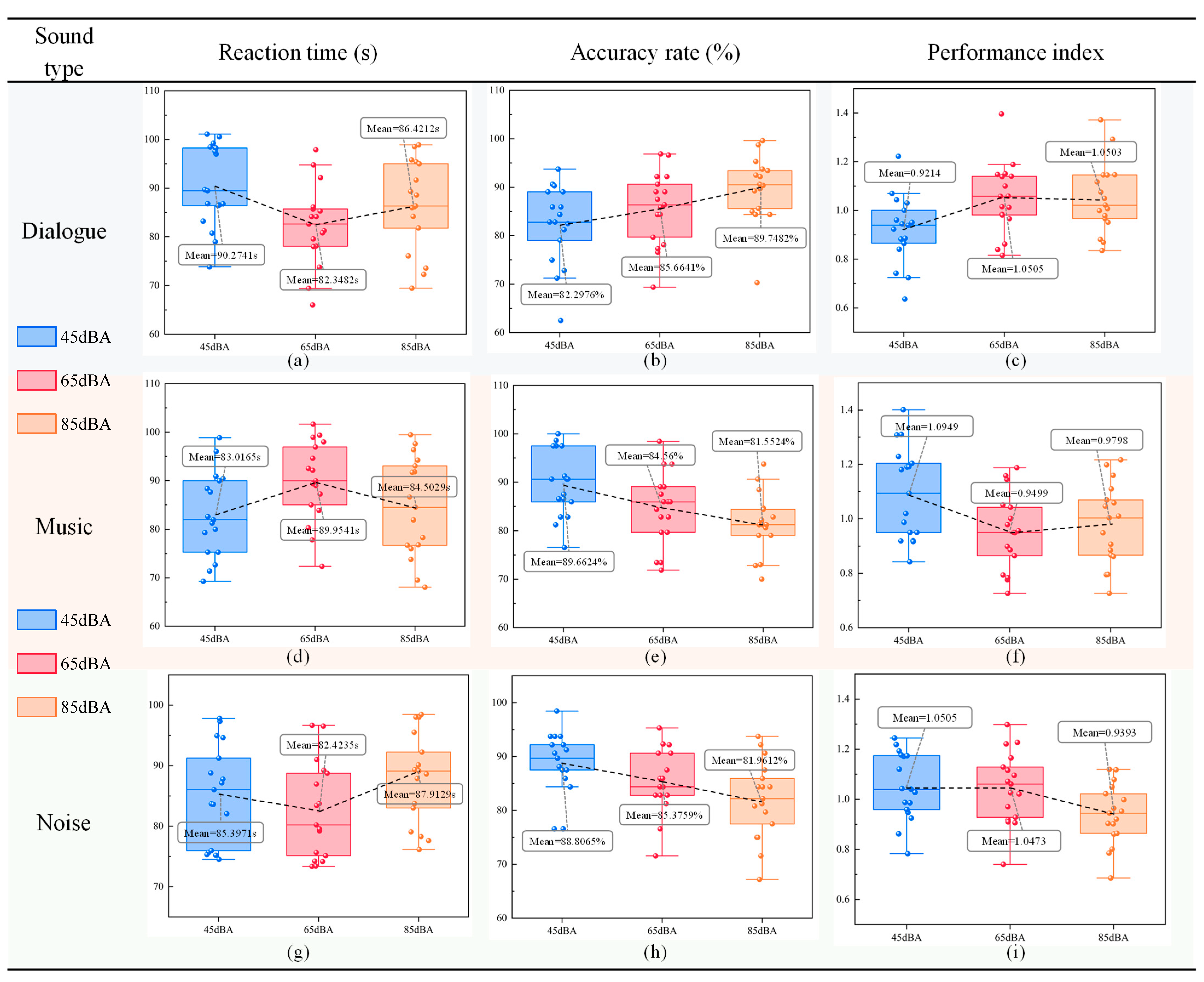
3.1. Interaction Effect of Indoor Acoustic Environments on Office Employees’ Work Performance
3.2. Simple Effects Analysis of Sound Type and Intensity
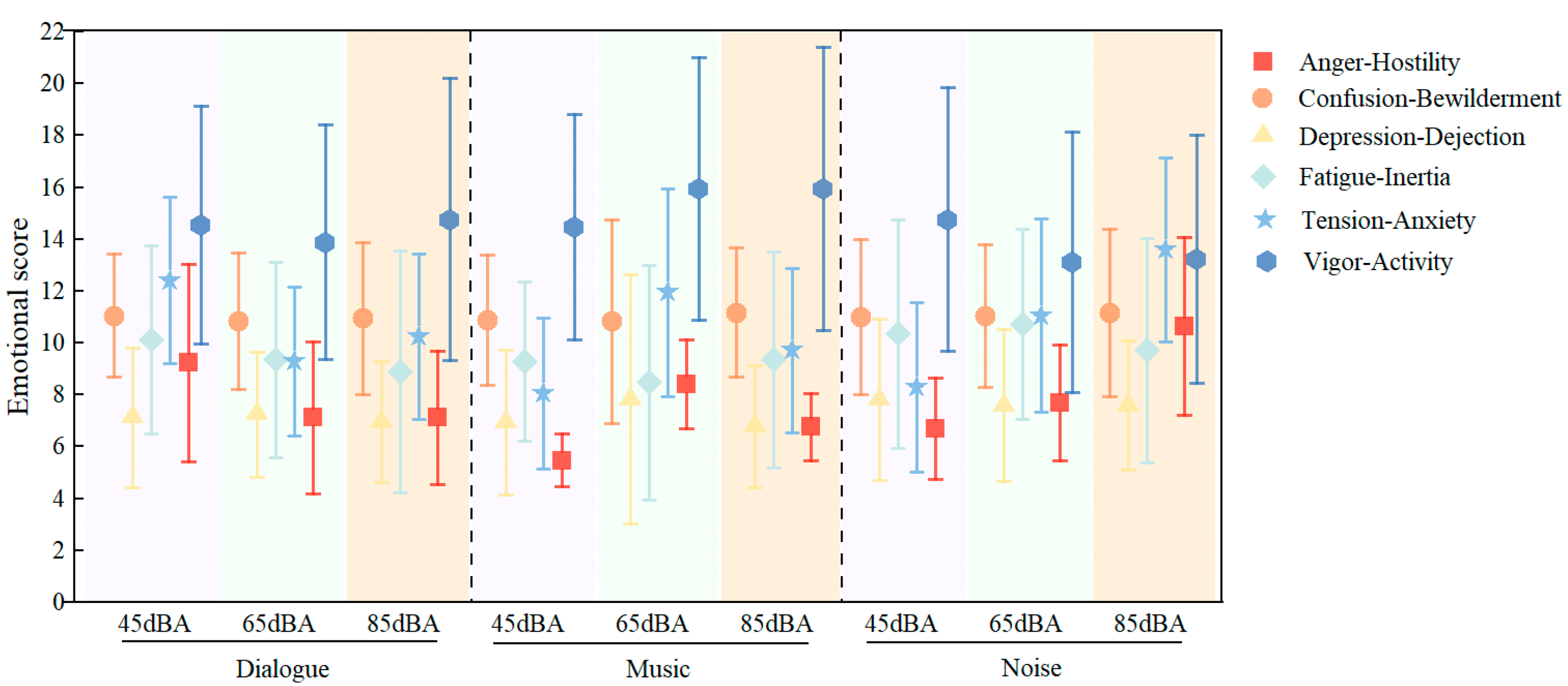
3.3. Mediation Analysis of Emotional States
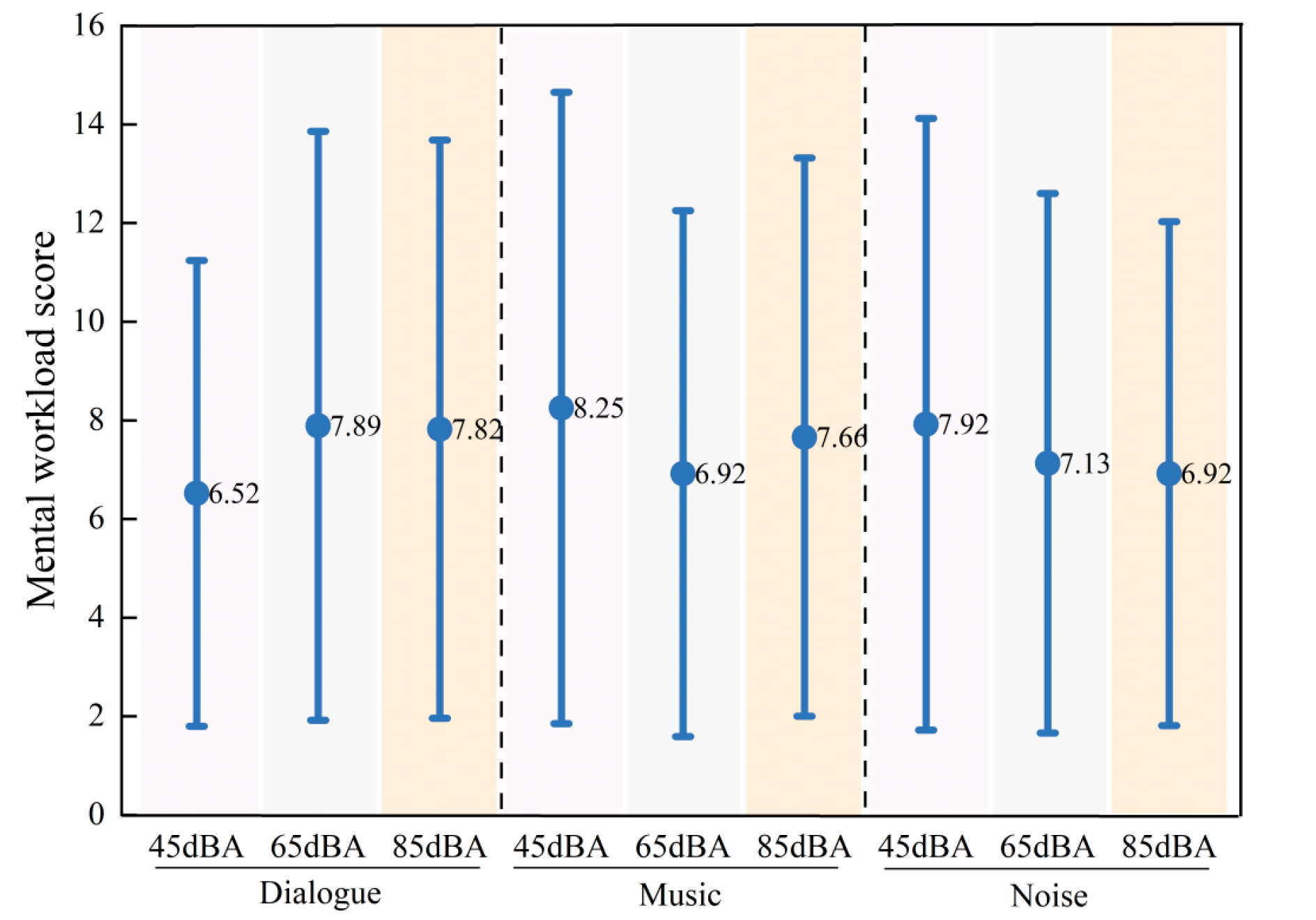
3.4. Mediation Effects of Mental Workload
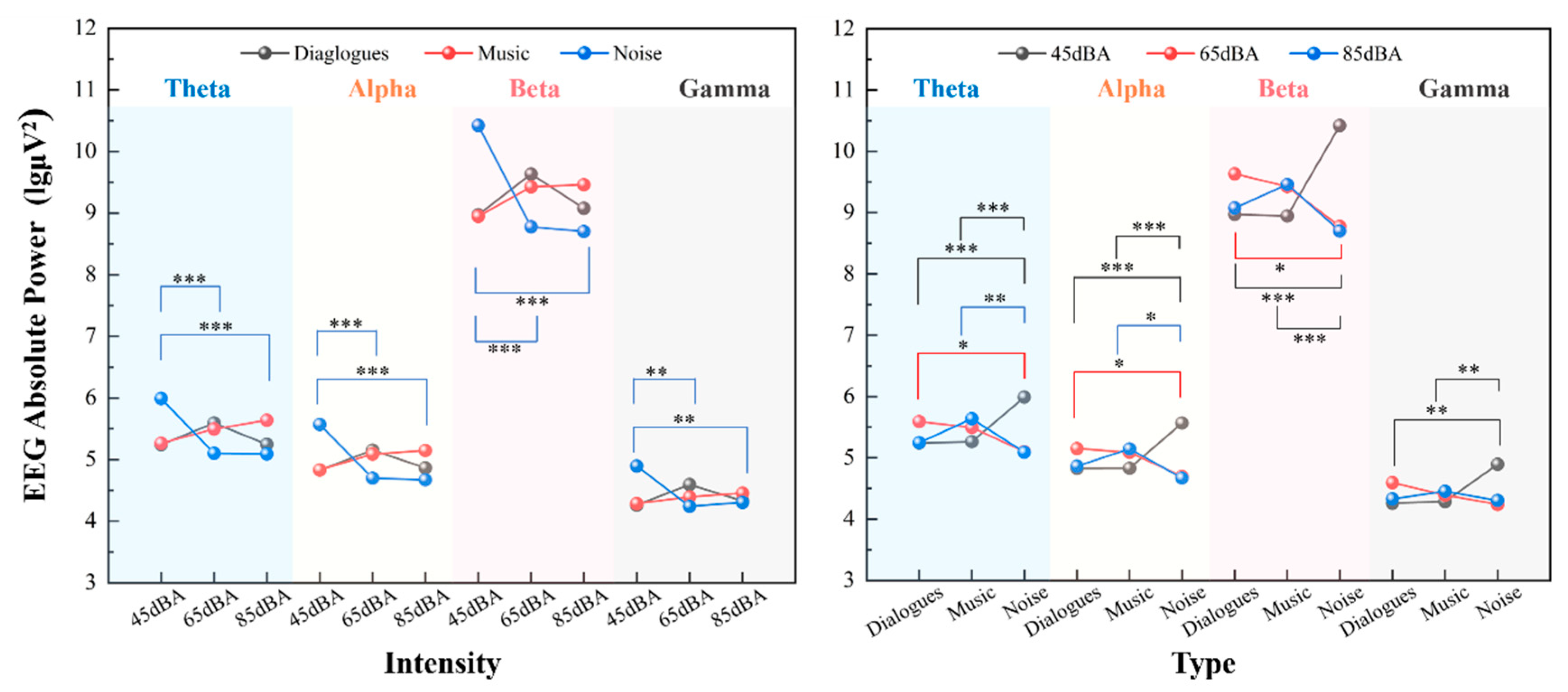
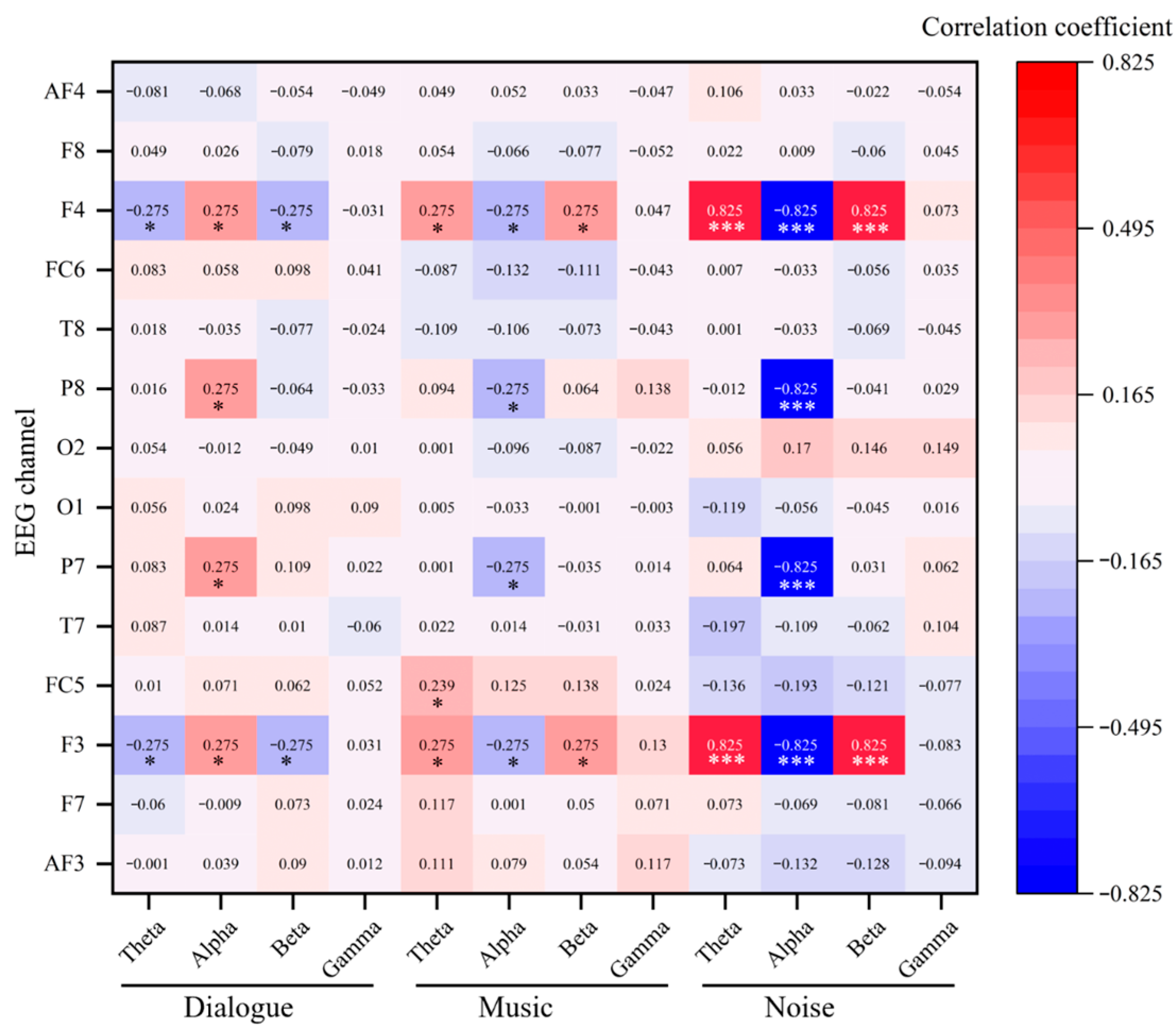
3.5. Neurophysiological Evidence from EEG
4. Discussion
4.1. Distinct Cognitive Mechanisms
4.2. The Mediating Roles of Emotion and Mental Workload
4.3. Practical Implications for Office Acoustic Design
5. Conclusions
Author Contributions
Funding
Institutional Review Board Statement
Informed Consent Statement
Data Availability Statement
Conflicts of Interest
References
- Zehra, S.; Sharma, D.C. Impact Assessment of Nature Sound on Human Health and Well-Being: A Review. J. Exp. Zool. India 2023, 26, 353–357. [Google Scholar] [CrossRef]
- World Health Organization. Burden of Disease from Environmental Noise: Quantification of Healthy Life Years Lost in Europe; World Health Organization: Geneva, Switzerland, 2011. [Google Scholar]
- Slabbekoorn, H.; Ripmeester, E.A.P. Birdsong and Anthropogenic Noise: Implications and Applications for Conservation. Mol. Ecol. 2008, 17, 72–83. [Google Scholar] [CrossRef]
- Meng, Q.; An, Y.; Yang, D. Effects of Acoustic Environment on Design Work Performance Based on Multitask Visual Cognitive Performance in Office Space. Build. Environ. 2021, 205, 108296. [Google Scholar] [CrossRef]
- Kaarlela-Tuomaala, A.; Helenius, R.; Keskinen, E.; Hongisto, V. Effects of Acoustic Environment on Work in Private Office Rooms and Open-Plan Offices–Longitudinal Study during Relocation. Ergonomics 2009, 52, 1423–1444. [Google Scholar] [CrossRef]
- Park, S.H.; Shin, H.-K.; Lee, S.-M.; Kim, K.W. Evaluation of the Acoustic Environments of Open-Plan Offices in Korean Public Buildings. J. Acoust. Soc. Korea 2023, 42, 42–49. [Google Scholar]
- Haapakangas, A.; Hongisto, V.; Hyönä, J.; Kokko, J.; Keränen, J. Effects of Unattended Speech on Performance and Subjective Distraction: The Role of Acoustic Design in Open-Plan Offices. Appl. Acoust. 2014, 86, 1–16. [Google Scholar] [CrossRef]
- Lee, Y.; Nelson, E.C.; Flynn, M.J.; Jackman, J.S. Exploring Soundscaping Options for the Cognitive Environment in an Open-Plan Office. Build. Acoust. 2020, 27, 185–202. [Google Scholar] [CrossRef]
- Golmohammadi, R.; Darvishi, E.; Faradmal, J.; Poorolajal, J.; Aliabadi, M. Attention and Short-Term Memory during Occupational Noise Exposure Considering Task Difficulty. Appl. Acoust. 2020, 158, 107065. [Google Scholar] [CrossRef]
- Jafari, M.J.; Khosrowabadi, R.; Khodakarim, S.; Mohammadian, F. The Effect of Noise Exposure on Cognitive Performance and Brain Activity Patterns. Open Access Maced. J. Med. Sci. 2019, 7, 2924. [Google Scholar] [CrossRef]
- Lee, S.; Hwang, S.; Lee, M.; Lee, S. The Impact of Different Types and Levels of Construction Noise on Physiological Responses: Focusing on Standardization and Habituation. Sustain. Cities Soc. 2024, 112, 105644. [Google Scholar] [CrossRef]
- Samardzic, N.; Best, V.; Hammond, C.; Karatas, A.; Esmaeili, B.; Sarsam, H. Construction Site Noise Exposure Assessment Using Binaural Measurements and Analysis. Safety 2024, 10, 92. [Google Scholar] [CrossRef]
- Tseng, L.-P.; Chuang, M.-T.; Liu, Y.-C. Effects of Noise and Music on Situation Awareness, Anxiety, and the Mental Workload of Nurses during Operations. Appl. Ergon. 2022, 99, 103633. [Google Scholar] [CrossRef]
- Kiss, L.; Linnell, K.J. The Effect of Preferred Background Music on Task-Focus in Sustained Attention. Psychol. Res. 2021, 85, 2313–2325. [Google Scholar] [CrossRef]
- Perlovsky, L.I.; Masataka, N.; Cabanac, M. Is Cognitive Dissonance Compatible with Human Evolution? In Proceedings of the 2013 International Joint Conference on Neural Networks, Dallas, TX, USA, 4–9 August 2013; pp. 1–3. [Google Scholar]
- Newbold, J.W.; Luton, J.; Cox, A.L.; Gould, S.J. Using Nature-Based Soundscapes to Support Task Performance and Mood. In Proceedings of the 2017 CHI Conference Extended Abstracts on Human Factors in Computing Systems, Denver, CO, USA, 6–11 May 2017; pp. 2802–2809. [Google Scholar]
- Burkhard, A.; Elmer, S.; Kara, D.; Brauchli, C.; Jäncke, L. The Effect of Background Music on Inhibitory Functions: An ERP Study. Front. Hum. Neurosci. 2018, 12, 293. [Google Scholar] [CrossRef]
- Koo, S. Sound of the Border: Music and Identity of Korean Minority in China; University of Hawaii Press: Honolulu, HI, USA, 2021. [Google Scholar]
- Chew, A.S.-Q.; Yu, Y.-T.; Chua, S.-W.; Gan, S.K.-E. The Effects of Familiarity and Language of Background Music on Working Memory and Language Tasks in Singapore. Psychol. Music 2016, 44, 1431–1438. [Google Scholar] [CrossRef]
- Di Blasio, S.; Shtrepi, L.; Puglisi, G.E.; Astolfi, A. A Cross-Sectional Survey on the Impact of Irrelevant Speech Noise on Annoyance, Mental Health and Well-Being, Performance and Occupants’ Behavior in Shared and Open-Plan Offices. Int. J. Environ. Res. Public Health 2019, 16, 280. [Google Scholar] [CrossRef] [PubMed]
- Zhang, J.; Huang, J.; Wu, Z.; Li, Z. Construction Noise Reduction Research on Rail Transit Projects: A Case Study in China. Buildings 2024, 14, 1678. [Google Scholar] [CrossRef]
- Nejati, V. A Structured Framework for Emotion-Cognition Dynamics: Implications for Assessment and Intervention. J. Neural Transm. 2025, 132, 793–802. [Google Scholar] [CrossRef]
- Hu, X.; Wang, F.; Zhang, D. Similar Brains Blend Emotion in Similar Ways: Neural Representations of Individual Difference in Emotion Profiles. Neuroimage 2022, 247, 118819. [Google Scholar] [CrossRef] [PubMed]
- Longo, L.; Wickens, C.D.; Hancock, G.; Hancock, P.A. Human Mental Workload: A Survey and a Novel Inclusive Definition. Front. Psychol. 2022, 13, 883321. [Google Scholar] [CrossRef] [PubMed]
- Dolcos, F.; Iordan, A.D.; Dolcos, S. Neural Correlates of Emotion–Cognition Interactions: A Review of Evidence from Brain Imaging Investigations. J. Cogn. Psychol. 2011, 23, 669–694. [Google Scholar] [CrossRef] [PubMed]
- Fan, Y.; Liang, J.; Cao, X.; Pang, L.; Zhang, J. Effects of Noise Exposure and Mental Workload on Physiological Responses during Task Execution. Int. J. Environ. Res. Public Health 2022, 19, 12434. [Google Scholar] [CrossRef]
- Sun, Z.; Hu, S.; Xie, S.; Wu, L.; Jiang, C.; Ding, S.; Zhang, Z.; Xu, W.; Li, H. Does Background Sound Impact Cognitive Performance and Relaxation States in Enclosed Office? Build. Environ. 2025, 267, 112313. [Google Scholar]
- Yan, T.; Jin, H.; Jin, Y. The Mediating Role of Emotion in the Effects of Landscape Elements on Thermal Comfort: A Laboratory Study. Build. Environ. 2023, 233, 110130. [Google Scholar] [CrossRef]
- Fiebig, A.; Jordan, P.; Moshona, C.C. Assessments of Acoustic Environments by Emotions–the Application of Emotion Theory in Soundscape. Front. Psychol. 2020, 11, 573041. [Google Scholar] [CrossRef]
- Rachman, Z.; Aletta, F.; Kang, J. Exploring Soundscape Assessment Methods in Office Environments: A Systematic Review. Buildings 2024, 14, 3408. [Google Scholar] [CrossRef]
- Torresin, S.; de Souza, L.P.; Dicle, S.Y.; Al-Assaad, D.; Aletta, F.; Balderrama, A.; Bivolarova, M.P.; Lee, P.-J.; Llorca-Bofí, J.; Maula, H. Definition and Performance of Acoustic Personalised Environmental Control Systems (Acoustic PECS): A Systematic Review. Build. Environ. 2025, 282, 3. [Google Scholar] [CrossRef]
- Jeon, J.; Cai, H. Classification of Construction Hazard-Related Perceptions Using: Wearable Electroencephalogram and Virtual Reality. Autom. Constr. 2021, 132, 103975. [Google Scholar] [CrossRef]
- Chen, J.; Wang, X.; Huang, C.; Hu, X.; Shen, X.; Zhang, D. A Large Finer-Grained Affective Computing EEG Dataset. Sci. Data 2023, 10, 740. [Google Scholar] [CrossRef]
- Hwang, S.; Jebelli, H.; Choi, B.; Choi, M.; Lee, S. Measuring Workers’ Emotional State during Construction Tasks Using Wearable EEG. J. Constr. Eng. Manag. 2018, 144, 04018050. [Google Scholar] [CrossRef]
- Jebelli, H.; Khalili, M.M.; Hwang, S.; Lee, S. A Supervised Learning-Based Construction Workers’ Stress Recognition Using a Wearable Electroencephalography (EEG) Device. In Proceedings of the Construction Research Congress, New Orleans, LA, USA, 2–4 April 2018; pp. 40–50. [Google Scholar]
- Wang, D.; Chen, J.; Zhao, D.; Dai, F.; Zheng, C.; Wu, X. Monitoring Workers’ Attention and Vigilance in Construction Activities through a Wireless and Wearable Electroencephalography System. Autom. Constr. 2017, 82, 122–137. [Google Scholar] [CrossRef]
- Wang, D.; Li, H.; Chen, J. Detecting and Measuring Construction Workers’ Vigilance through Hybrid Kinematic-EEG Signals. Autom. Constr. 2019, 100, 11–23. [Google Scholar] [CrossRef]
- Li, H.; Wang, D.; Chen, J.; Luo, X.; Li, J.; Xing, X. Pre-Service Fatigue Screening for Construction Workers through Wearable EEG-Based Signal Spectral Analysis. Autom. Constr. 2019, 106, 102851. [Google Scholar] [CrossRef]
- Tehrani, B.M.; Wang, J.; Truax, D. Assessment of Mental Fatigue Using Electroencephalography (EEG) and Virtual Reality (VR) for Construction Fall Hazard Prevention. Eng. Constr. Archit. Manag. 2022, 29, 3593–3616. [Google Scholar] [CrossRef]
- Ke, J.; Zhang, M.; Luo, X.; Chen, J. Monitoring Distraction of Construction Workers Caused by Noise Using a Wearable Electroencephalography (EEG) Device. Autom. Constr. 2021, 125, 103598. [Google Scholar] [CrossRef]
- Chae, J.; Hwang, S.; Seo, W.; Kang, Y. Relationship between Rework of Engineering Drawing Tasks and Stress Level Measured from Physiological Signals. Autom. Constr. 2021, 124, 103560. [Google Scholar] [CrossRef]
- Newby, R.W.; Simpson, S. Basketball Performance as a Function of Scores on Profile of Mood States. Percept. Mot. Ski. 1994, 78, 1142. [Google Scholar] [CrossRef]
- Hart, S.G.; Staveland, L.E. Development of NASA-TLX (Task Load Index): Results of Empirical and Theoretical Research. Adv. Psychol. 1988, 52, 139–183. [Google Scholar]
- Jaiswal, M. Implicit Design Choices and Their Impact on Emotion Recognition Model Development and Evaluation. arXiv 2023, arXiv:2309.03238. [Google Scholar] [CrossRef]
- Mathy, F.; Chekaf, M. Experiments and Modeling in Cognitive Science: MATLAB, SPSS, Excel and E-Prim; ISTE Press: London, UK, 2018. [Google Scholar]
- Barbarotto, R.; Laiacona, M.; Frosio, R.; Vecchio, M.; Farinato, A.; Capitani, E. A Normative Study on Visual Reaction Times and Two Stroop Colour-Word Tests. Ital. J. Neurol. Sci. 1998, 19, 161–170. [Google Scholar] [CrossRef] [PubMed]
- Lang, X.; Wargocki, P.; Liu, W. Investigating the Relation between Electroencephalogram, Thermal Comfort, and Cognitive Performance in Neutral to Hot Indoor Environment. Indoor Air 2022, 32, e12941. [Google Scholar] [CrossRef]
- Lan, L.; Lian, Z.; Pan, L.; Ye, Q. Neurobehavioral Approach for Evaluation of Office Workers’ Productivity: The Effects of Room Temperature. Build. Environ. 2009, 44, 1578–1588. [Google Scholar] [CrossRef]
- Kim, H.; Hong, T. Determining the Optimal Set-Point Temperature Considering Both Labor Productivity and Energy Saving in an Office Building. Appl. Energy 2020, 276, 115429. [Google Scholar] [CrossRef]
- Liu, W.; Zhong, W.; Wargocki, P. Performance, Acute Health Symptoms and Physiological Responses during Exposure to High Air Temperature and Carbon Dioxide Concentration. Build. Environ. 2017, 114, 96–105. [Google Scholar] [CrossRef]
- Brysbaert, M. How Many Participants Do We Have to Include in Properly Powered Experiments? A Tutorial of Power Analysis with Reference Tables. J. Cogn. 2019, 2, 16. [Google Scholar] [CrossRef]
- Kumle, L.; Võ, M.L.-H.; Draschkow, D. Estimating Power in (Generalized) Linear Mixed Models: An Open Introduction and Tutorial in R. Behav. Res. Methods 2021, 53, 2528–2543. [Google Scholar] [CrossRef]
- Vimalanathan, K.; Ramesh Babu, T. The Effect of Indoor Office Environment on the Work Performance, Health and Well-Being of Office Workers. J. Environ. Health Sci. Eng. 2014, 12, 113. [Google Scholar] [CrossRef]
- Richardson, J.T. The Use of Latin-Square Designs in Educational and Psychological Research. Educ. Res. Rev. 2018, 24, 84–97. [Google Scholar] [CrossRef]
- Jebelli, H.; Hwang, S.; Lee, S. EEG Signal-Processing Framework to Obtain High-Quality Brain Waves from an off-the-Shelf Wearable EEG Device. J. Comput. Civ. Eng. 2018, 32, 04017070. [Google Scholar] [CrossRef]
- Ju, J.; Li, H. A Survey of EEG-Based Driver State and Behavior Detection for Intelligent Vehicles. IEEE Trans. Biom. Behav. Identity Sci. 2024, 6, 420–434. [Google Scholar] [CrossRef]
- Pieper, K.; Spang, R.P.; Prietz, P.; Möller, S.; Paajanen, E.; Vaalgamaa, M.; Voigt-Antons, J.-N. Working with Environmental Noise and Noise-Cancelation: A Workload Assessment with EEG and Subjective Measures. Front. Neurosci. 2021, 15, 771533. [Google Scholar] [CrossRef]
- Becher, A.; Höhne, M.; Axmacher, N.; Chaieb, L.; Elger, C.E.; Fell, J. Intracranial Electroencephalography Power and Phase Synchronization Changes during Monaural and Binaural Beat Stimulation. Eur. J. Neurosci. 2015, 41, 254–263. [Google Scholar] [CrossRef] [PubMed]
- MacKinnon, D.P.; Krull, J.L.; Lockwood, C.M. Equivalence of the Mediation, Confounding and Suppression Effect. Prev. Sci. 2000, 1, 173–181. [Google Scholar] [CrossRef] [PubMed]
- Zhao, X.; Lynch, J.G., Jr.; Chen, Q. Reconsidering Baron and Kenny: Myths and Truths about Mediation Analysis. J. Consum. Res. 2010, 37, 197–206. [Google Scholar] [CrossRef]
- Wiesman, A.I.; Koshy, S.M.; Heinrichs-Graham, E.; Wilson, T.W. Beta and Gamma Oscillations Index Cognitive Interference Effects across a Distributed Motor Network. Neuroimage 2020, 213, 116747. [Google Scholar] [CrossRef]
- Melnik, N.; Mapelli, I.; Özkurt, T.E. Modulation of Alpha Oscillations Is Required for the Suppression of Semantic Interference. Neurobiol. Learn. Mem. 2017, 144, 11–18. [Google Scholar] [CrossRef]
- Cavanagh, J.F.; Frank, M.J. Frontal Theta as a Mechanism for Cognitive Control. Trends Cogn. Sci. 2014, 18, 414–421. [Google Scholar] [CrossRef]
- Picazio, S.; Veniero, D.; Ponzo, V.; Caltagirone, C.; Gross, J.; Thut, G.; Koch, G. Prefrontal Control over Motor Cortex Cycles at Beta Frequency during Movement Inhibition. Curr. Biol. 2014, 24, 2940–2945. [Google Scholar] [CrossRef]
- Georgi, M.; Leist, L.; Klatte, M.; Schlittmeier, S.J. Investigating the Disturbance Impact of Background Speech on Verbal and Visual-Spatial Short-Term Memory: On the Differential Contributions of Changing-State and Phonology to the Irrelevant Sound Effect. Audit. Percept. Cogn. 2023, 6, 52–71. [Google Scholar] [CrossRef]
- Dou, W.; Morrow, A.; Iemi, L.; Samaha, J. Pre-Stimulus Alpha-Band Phase Gates Early Visual Cortex Responses. Neuroimage 2022, 253, 119060. [Google Scholar] [CrossRef]
- Whedon, M.; Perry, N.B.; Bell, M.A. Relations between Frontal EEG Maturation and Inhibitory Control in Preschool in the Prediction of Children’s Early Academic Skills. Brain Cogn. 2020, 146, 105636. [Google Scholar] [CrossRef] [PubMed]
- Bonnefond, M.; Jensen, O. Gamma Activity Coupled to Alpha Phase as a Mechanism for Top-down Controlled Gating. PLoS ONE 2015, 10, e0128667. [Google Scholar] [CrossRef]
- García, P.S.; Kreuzer, M.; Hight, D.; Sleigh, J.W. Effects of Noxious Stimulation on the Electroencephalogram during General Anaesthesia: A Narrative Review and Approach to Analgesic Titration. Br. J. Anaesth. 2021, 126, 445–457. [Google Scholar] [CrossRef] [PubMed]
- Kim, H.; Seo, P.; Choi, J.W.; Kim, K.H. Emotional Arousal Due to Video Stimuli Reduces Local and Inter-Regional Synchronization of Oscillatory Cortical Activities in Alpha-and Beta-Bands. PLoS ONE 2021, 16, e0255032. [Google Scholar] [CrossRef]
- Rossi, L.; Prato, A.; Lesina, L.; Schiavi, A. Effects of Low-Frequency Noise on Human Cognitive Performances in Laboratory. Build. Acoust. 2018, 25, 17–33. [Google Scholar] [CrossRef]
- Young, C.B.; Raz, G.; Everaerd, D.; Beckmann, C.F.; Tendolkar, I.; Hendler, T.; Fernández, G.; Hermans, E.J. Dynamic Shifts in Large-Scale Brain Network Balance as a Function of Arousal. J. Neurosci. 2017, 37, 281–290. [Google Scholar] [CrossRef]
- Vanhollebeke, G.; De Smet, S.; De Raedt, R.; Baeken, C.; van Mierlo, P.; Vanderhasselt, M.-A. The Neural Correlates of Psychosocial Stress: A Systematic Review and Meta-Analysis of Spectral Analysis EEG Studies. Neurobiol. Stress 2022, 18, 100452. [Google Scholar] [CrossRef] [PubMed]
- Muhammad, F.; Al-Ahmadi, S. Human State Anxiety Classification Framework Using EEG Signals in Response to Exposure Therapy. PLoS ONE 2022, 17, e0265679. [Google Scholar] [CrossRef]
- Hahad, O.; Kuntic, M.; Al-Kindi, S.; Kuntic, I.; Gilan, D.; Petrowski, K.; Daiber, A.; Münzel, T. Noise and Mental Health: Evidence, Mechanisms, and Consequences. J. Expo. Sci. Environ. Epidemiol. 2025, 35, 16–23. [Google Scholar] [CrossRef]
- Mennella, R.; Patron, E.; Palomba, D. Frontal Alpha Asymmetry Neurofeedback for the Reduction of Negative Affect and Anxiety. Behav. Res. Ther. 2017, 92, 32–40. [Google Scholar] [CrossRef]
- Lainidi, O.; Johnson, J.; Griffin, B.; Koutsimani, P.; Mouratidis, C.; Keyworth, C.; O’Connor, D.B. Associations between Burnout, Employee Silence and Voice: A Systematic Review and Meta-Analysis. Psychol. Health 2025, 1–21. [Google Scholar] [CrossRef]
- He, W.-J.; Wong, W.-C.; Hui, A.N.-N. Emotional Reactions Mediate the Effect of Music Listening on Creative Thinking: Perspective of the Arousal-and-Mood Hypothesis. Front. Psychol. 2017, 8, 1680. [Google Scholar] [CrossRef]
- Chee, Z.J.; Chang, C.Y.M.; Cheong, J.Y.; Malek, F.H.B.A.; Hussain, S.; de Vries, M.; Bellato, A. The Effects of Music and Auditory Stimulation on Autonomic Arousal, Cognition and Attention: A Systematic Review. Int. J. Psychophysiol. 2024, 199, 112328. [Google Scholar] [CrossRef]
- Schubring, D.; Schupp, H.T. Emotion and Brain Oscillations: High Arousal Is Associated with Decreases in Alpha-and Lower Beta-Band Power. Cereb. Cortex 2021, 31, 1597–1608. [Google Scholar] [CrossRef] [PubMed]
- Wei, J.; Zou, H.; Tang, Q.; Yao, Z.; Huang, G.; Liang, Z.; Zhang, L.; Ren, L.; Cai, X.; Yao, C. Enhancing Visual Perception by Modulating Prestimulus Alpha and Beta Power with tRNS. Commun. Biol. 2025, 8, 1182. [Google Scholar] [CrossRef] [PubMed]
- Gigliotti, M.F.; Lauret, D.; Delevoye-Turrell, Y.N. The Sonic Energy of Background Music Impacts Cognitive Performances: A Behavioral and Physiological Investigation. Cogn. Res. Princ. Implic. 2025, 10, 80. [Google Scholar] [CrossRef] [PubMed]
- Chabin, T.; Gabriel, D.; Chansophonkul, T.; Michelant, L.; Joucla, C.; Haffen, E.; Moulin, T.; Comte, A.; Pazart, L. Cortical Patterns of Pleasurable Musical Chills Revealed by High-Density EEG. Front. Neurosci. 2020, 14, 565815. [Google Scholar] [CrossRef]



| Testing Capability | Test Items | Description |
|---|---|---|
| Attention | Stroop color–word test [46] | Participants identify either font color or word meaning during color–semantic conflict trails. |
| Re-direction [47] | Spatial judgment of schematic figures’ hand positions across varying orientations. | |
| Memory | Symbol–digit modalities test [48] | Memorize symbol–digit pairs within 60 s, then recall associations. |
| 3-back test [49] | Letter matching comparing current stimuli to those presented 3 positions earlier. | |
| Execution | Number calculation [50] | Timed arithmetic operations including 3-digit + 3-digit addition, combined 2-digit addition/subtraction, and 3-digit ×/÷ 1-digit operations. |
| Visual choice reaction time [50] | Rapid response to directional stimuli (Δ, ←, →) appearing randomly on screen. |
| Questionnaire Scale | Objective | Number of Questions | Description |
|---|---|---|---|
| POMS | Emotional states | 30 questions | 30 items expressing different emotional states with 5-point Likert scale. |
| NASA-TLX | Mental workload | 6 questions | 6 dimensions including metal demand, physical demand, temporal demand, performance, effort, and frustration with 10-point Likert scale. |
| Dependent Variable | Sum of Squares | df | Mean Square | F | Significance | ||
|---|---|---|---|---|---|---|---|
| Sound type | RT | 31.070 | 2 | 15.535 | 0.272 | 0.764 | 0.017 |
| AR | 11.967 | 2 | 5.983 | 0.190 | 0.828 | 0.012 | |
| PI | 0.001 | 2 | 0.000 | 0.034 | 0.966 | 0.002 | |
| Sound intensity | RT | 61.615 | 2 | 30.807 | 0.425 | 0.655 | 0.006 |
| AR | 167.130 | 2 | 83.565 | 1.761 | 0.176 | 0.024 | |
| PI | 0.030 | 2 | 0.015 | 0.742 | 0.478 | 0.010 | |
| Type × intensity | RT | 1182.868 | 4 | 295.717 | 23.827 | 0.000 *** | 0.598 |
| AR | 1275.964 | 4 | 318.991 | 54.278 | 0.000 *** | 0.772 | |
| PI | 0.494 | 4 | 0.123 | 45.782 | 0.000 *** | 0.741 |
| Acoustic Environment | (I–J) | RT | AR | PI | ||||||||||||
|---|---|---|---|---|---|---|---|---|---|---|---|---|---|---|---|---|
| (I–J) | SE | p | 95% CI | (I–J) | SE | p | 95% CI | (I–J) | SE | p | 95% CI | |||||
| Dialog | a–b | 7.926 | 1.553 | 0 *** | 3.774 | 12.078 | −3.366 | 0.525 | 0 *** | −4.769 | −1.964 | −0.129 | 0.016 | 0 *** | −0.172 | −0.087 |
| a–c | 3.853 | 1.061 | 0.007 ** | 1.017 | 6.689 | −7.451 | 0.718 | 0 *** | −9.37 | −5.531 | −0.129 | 0.019 | 0 *** | −0.179 | −0.079 | |
| b–c | −4.073 | 1.937 | 0.155 | −9.251 | 1.105 | −4.084 | 0.6 | 0 *** | −5.688 | −2.48 | 0 | 0.025 | 1 | −0.066 | 0.066 | |
| Music | a–b | −6.938 | 1.216 | 0 *** | −10.187 | −3.688 | 5.102 | 0.825 | 0 *** | 2.897 | 7.308 | 0.145 | 0.017 | 0 *** | 0.099 | 0.191 |
| a–c | −1.486 | 1.574 | 1 | −5.694 | 2.722 | 8.11 | 1.016 | 0 *** | 5.394 | 10.826 | 0.115 | 0.026 | 0.001 ** | 0.045 | 0.185 | |
| b–c | 5.451 | 1.183 | 0.001 ** | 2.289 | 8.613 | 3.008 | 0.946 | 0.018 * | 0.478 | 5.537 | −0.03 | 0.019 | 0.428 | −0.082 | 0.022 | |
| Noise | a–b | 2.974 | 0.824 | 0.007 ** | 0.771 | 5.176 | 3.431 | 0.575 | 0 *** | 1.893 | 4.968 | 0.003 | 0.016 | 1 | −0.039 | 0.046 |
| a–c | −2.516 | 0.582 | 0.002 ** | −4.072 | −0.96 | 6.845 | 0.98 | 0 *** | 4.224 | 9.466 | 0.111 | 0.015 | 0 *** | 0.07 | 0.153 | |
| b–c | −5.489 | 0.889 | 0 *** | −7.865 | −3.113 | 3.415 | 0.744 | 0.001 ** | 1.426 | 5.404 | 0.108 | 0.012 | 0 *** | 0.076 | 0.14 | |
| 45 dBA | 1–2 | 7.258 | 1.952 | 0.006 ** | 2.041 | 12.474 | −7.365 | 1.265 | 0 *** | −10.746 | −3.983 | −0.174 | 0.025 | 0 *** | −0.241 | −0.106 |
| 1–3 | 4.877 | 1.507 | 0.016 * | 0.849 | 8.905 | −6.509 | 1.313 | 0 *** | −10.019 | −2.999 | −0.129 | 0.024 | 0 *** | −0.194 | −0.065 | |
| 2–3 | −2.381 | 1.89 | 0.678 | −7.433 | 2.672 | 0.856 | 1.028 | 1 | −1.892 | 3.603 | 0.044 | 0.03 | 0.466 | −0.035 | 0.124 | |
| 65 dBA | 1–2 | −7.606 | 1.829 | 0.002 ** | −12.496 | −2.716 | 1.104 | 1.443 | 1 | −2.754 | 4.962 | 0.101 | 0.026 | 0.004 ** | 0.031 | 0.171 |
| 1–3 | −0.075 | 1.964 | 1 | −5.326 | 5.175 | 0.288 | 0.876 | 1 | −2.054 | 2.63 | 0.003 | 0.026 | 1 | −0.067 | 0.073 | |
| 2–3 | 7.531 | 1.554 | 0.001 ** | 3.376 | 11.685 | −0.816 | 1.282 | 1 | −4.242 | 2.61 | −0.097 | 0.023 | 0.002 ** | −0.158 | −0.037 | |
| 85 dBA | 1–2 | 1.918 | 1.695 | 0.823 | −2.612 | 6.449 | 8.196 | 1.63 | 0 *** | 3.838 | 12.553 | 0.07 | 0.027 | 0.053 | −0.001 | 0.142 |
| 1–3 | −1.492 | 1.907 | 1 | −6.59 | 3.607 | 7.787 | 0.842 | 0 *** | 5.537 | 10.037 | 0.111 | 0.022 | 0 *** | 0.053 | 0.168 | |
| 2–3 | −3.41 | 1.775 | 0.218 | −8.154 | 1.334 | −0.409 | 1.743 | 1 | −5.068 | 4.25 | 0.04 | 0.023 | 0.273 | −0.02 | 0.101 | |
| Emotions | Sum of Squares | Degree of Freedom | Mean Square | F | p | |
|---|---|---|---|---|---|---|
| Anger-Hostility | 893.203 | 4 | 223.301 | 3.1 | 0.021 * | 0.162 |
| Error 1 | 4609.686 | 64 | 72.026 | |||
| Confusion-Bewilderment | 0.967 | 4 | 0.242 | 0.074 | 0.99 | 0.005 |
| Error 2 | 210.366 | 64 | 3.287 | |||
| Depression-Dejection | 7.098 | 4 | 1.775 | 0.377 | 0.824 | 0.023 |
| Error 3 | 301.124 | 64 | 4.705 | |||
| Fatigue-Inertia | 20.418 | 4 | 5.105 | 0.697 | 0.597 | 0.042 |
| Error 4 | 468.471 | 64 | 7.32 | |||
| Tension-Anxiety | 385.137 | 4 | 96.284 | 67.162 | 0.000 *** | 0.808 |
| Error 5 | 91.752 | 64 | 1.434 | |||
| Vigor-Activity | 57.085 | 4 | 14.271 | 1.274 | 0.289 | 0.074 |
| Error 6 | 716.693 | 64 | 11.198 |
| Acoustic Environment | Emotions | F | p | Post Hoc Comparison |
|---|---|---|---|---|
| Dialog | Tension-Anxiety | 38.94 | <0.001 | 45 dBA > 85 dBA > 65 dBA |
| Dialog | Anger-Hostility | 44.14 | <0.001 | 45 dBA > 85 dBA = 65 dBA |
| Music | Tension-Anxiety | 52.20 | <0.001 | 65 dBA > 85 dBA > 45 dBA |
| Noise | Anger-Hostility | 27.86 | <0.001 | 85 dBA > 65 dBA > 45 dBA |
| Noise | Tension-Anxiety | 62.59 | <0.001 | 85 dBA > 65 dBA > 45 dBA |
| 45 dBA | Tension-Anxiety | 38.40 | <0.001 | Dialog > Noise > Music |
| 65 dBA | Tension-Anxiety | 11.03 | 0.001 | Music > Noise > Dialog |
| 85 dBA | Anger-Hostility | 20.34 | <0.001 | Noise > Dialog > Music |
| 85 dBA | Tension-Anxiety | 49.59 | <0.001 | Noise > Dialog > Music |
| Dependent Variable | Emotions | Path | Coefficient | T | p | LLCI | ULCI | Effect Size |
|---|---|---|---|---|---|---|---|---|
| Dialog PI | Tension-Anxiety | a | −0.0544 | −1.9758 | 0.0538 | −0.1098 | 0.0009 | 29.71% (Partial) |
| b | 0.0039 | 3.9953 | 0.0002 *** | 0.0019 | 0.0058 | |||
| c’ | −0.0209 | −3.11 | 0.0033 ** | −0.0345 | −0.0074 | |||
| Dialog PI | Anger-Hostility | a | −0.0529 | −1.9578 | 0.056 | −0.1073 | 0.0014 | 40.01% (Suppression) |
| b | 0.0295 | 5.7557 | 0 *** | 0.0192 | 0.0399 | |||
| c’ | 0.0039 | 3.9953 | 0.0002 *** | 0.0019 | 0.0058 | |||
| Nosie RT | Tension-Anxiety | a | 0.1324 | 4.4378 | 0.0001 *** | 0.0724 | 0.1923 | Full Mediation |
| b | 1.3229 | 2.5301 | 0.0151 * | 0.2684 | 2.3774 | |||
| c’ | −0.0847 | −0.8586 | 0.3953 | −0.2837 | 0.1143 | |||
| The 95% CI of all other emotional pathways includes 0, with no significant mediating or suppression. | ||||||||
| Dependent Variable | Predictive Variables | Correlation Coefficient | Coefficient | T | p | LLCI | ULCI | Effect Size |
|---|---|---|---|---|---|---|---|---|
| Music PI | Mental workload | a | −0.0231 | −2.0456 | 0.0462 * | −0.0459 | −0.0004 | Full mediation |
| b | 0.0354 | 2.1685 | 0.0351 * | 0.0026 | 0.0682 | |||
| c’ | −0.0021 | −1.5287 | 0.1329 | −0.0048 | 0.0006 | |||
| The 95% CIs of the remaining paths all contain 0, with no significant mediating or suppression. | ||||||||
| Independent Variable | Total | ||||
|---|---|---|---|---|---|
| Theta | Alpha | Beta | Gamma | ||
| Noise type | |||||
| Dialogs | 5.36 ± (0.12) | 4.95 ± (0.09) | 9.23 ± (0.33) | 4.40 ± (0.12) | 23.94 |
| Music | 5.47 ± (0.27) | 5.02 ± (0.22) | 9.28 ± (0.76) | 4.38 ± (0.16) | 24.15 |
| Noise | 5.38 ± (0.63) | 4.97 ± (0.66) | 9.28 ± (2.48) | 4.47 ± (0.53) | 24.10 |
| Noise intensity | |||||
| 45 dBA | 5.49 ± (0.61) | 5.07 ± (0.62) | 9.43 ± (2.39) | 4.47 ± (0.50) | 24.46 |
| 65 dBA | 5.40 ± (0.21) | 4.98 ± (0.18) | 9.28 ± (0.61) | 4.41 ± (0.14) | 24.07 |
| 85 dBA | 5.32 ± (0.20) | 4.89 ± (0.15) | 9.08 ± (0.51) | 4.36 ± (0.17) | 23.65 |
| Source | Dependent Variable | Type III Sum of Squares | df | Mean Square | F | Significance |
|---|---|---|---|---|---|---|
| Type | Theta | 0.300 | 2 | 0.150 | 0.546 | 0.580 |
| Alpha | 0.139 | 2 | 0.070 | 0.267 | 0.766 | |
| Beta | 0.134 | 2 | 0.067 | 0.069 | 0.933 | |
| Gamma | 0.300 | 2 | 0.150 | 0.623 | 0.538 | |
| Intensity | Theta | 0.769 | 2 | 0.384 | 1.400 | 0.250 |
| Alpha | 0.832 | 2 | 0.416 | 1.594 | 0.207 | |
| Beta | 3.410 | 2 | 1.705 | 1.765 | 0.175 | |
| Gamma | 0.350 | 2 | 0.175 | 0.727 | 0.485 | |
| Type × Intensity | Theta | 10.583 | 4 | 2.646 | 9.634 | 0.000 *** |
| Alpha | 9.769 | 4 | 2.442 | 9.354 | 0.000 *** | |
| Beta | 34.878 | 4 | 8.719 | 9.023 | 0.000 *** | |
| Gamma | 5.234 | 4 | 1.309 | 5.428 | 0.000 *** |
Disclaimer/Publisher’s Note: The statements, opinions and data contained in all publications are solely those of the individual author(s) and contributor(s) and not of MDPI and/or the editor(s). MDPI and/or the editor(s) disclaim responsibility for any injury to people or property resulting from any ideas, methods, instructions or products referred to in the content. |
© 2025 by the authors. Licensee MDPI, Basel, Switzerland. This article is an open access article distributed under the terms and conditions of the Creative Commons Attribution (CC BY) license.
Share and Cite
Chong, D.; Zhu, W.; Liu, T.; Hou, H.; Zhang, Y.; Su, Y. When Sound Helps or Hurts: Behavioral and EEG Evidence on the Dual Effects of Indoor Acoustic Environments on Office Work Performance. Buildings 2026, 16, 69. https://doi.org/10.3390/buildings16010069
Chong D, Zhu W, Liu T, Hou H, Zhang Y, Su Y. When Sound Helps or Hurts: Behavioral and EEG Evidence on the Dual Effects of Indoor Acoustic Environments on Office Work Performance. Buildings. 2026; 16(1):69. https://doi.org/10.3390/buildings16010069
Chicago/Turabian StyleChong, Dan, Wangling Zhu, Tao Liu, Huiying (Cynthia) Hou, Ying Zhang, and Yuqiao Su. 2026. "When Sound Helps or Hurts: Behavioral and EEG Evidence on the Dual Effects of Indoor Acoustic Environments on Office Work Performance" Buildings 16, no. 1: 69. https://doi.org/10.3390/buildings16010069
APA StyleChong, D., Zhu, W., Liu, T., Hou, H., Zhang, Y., & Su, Y. (2026). When Sound Helps or Hurts: Behavioral and EEG Evidence on the Dual Effects of Indoor Acoustic Environments on Office Work Performance. Buildings, 16(1), 69. https://doi.org/10.3390/buildings16010069