Article

Collapse of an RC Building Under Construction with a Flat Slab System: Reasons, Calculations, and FE Simulations


by
Esin Ertürk Atmaca
1,
Ahmet Can Altunişik
1,2,3,*,
Murat Günaydin
1 and
Barbaros Atmaca
1
1
Department of Civil Engineering, Karadeniz Technical University, Trabzon 61080, Türkiye
2
Earthquake and Structural Health Monitoring Research Center, Karadeniz Technical University, Trabzon 61080, Türkiye
3
Dynamic Academy Software, Construction Ind. Trade Co., Ltd., Trabzon 61080, Türkiye
*
Author to whom correspondence should be addressed.
Buildings 2025, 15(1), 20; https://doi.org/10.3390/buildings15010020

Submission received: 14 October 2024 / Revised: 15 November 2024 / Accepted: 18 November 2024 / Published: 25 December 2024
(This article belongs to the Section Building Structures)

Abstract

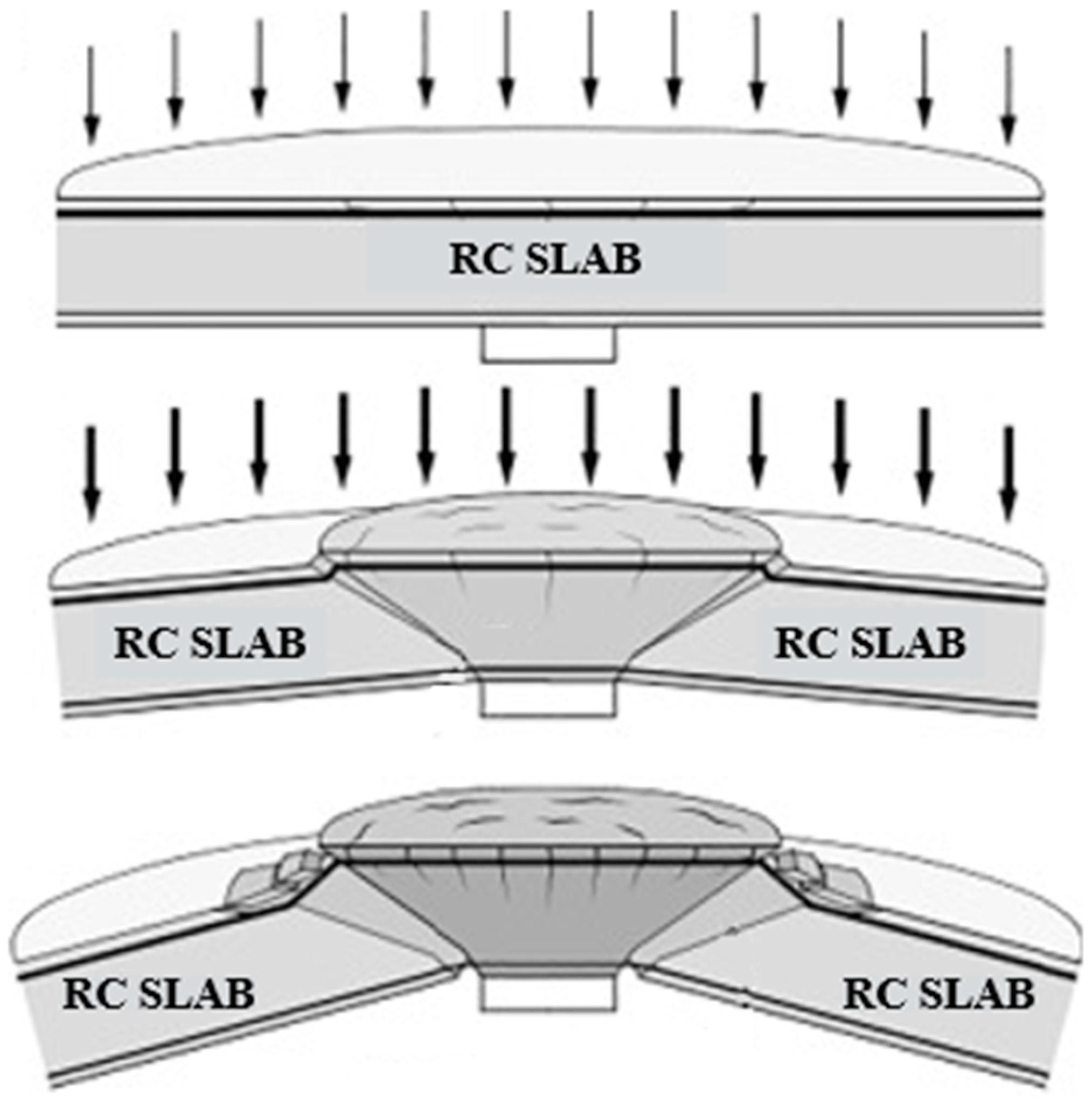
The using of flat slab systems is a common structural solution for residential and commercial buildings as they are a cost-effective structural solution that simplifies and speeds up the construction phase. However, the flat slab systems have complex behavior, particularly in the slab–column connection zones, because of punching shear. Therefore, to prevent brittle flat slab collapse because of punching shear, there are some conditions which must be met in regulations such as Eurocode 2, American Concrete Institute’s Code, and Türkiye Building Earthquake Code—2018. Flat slab collapses because of punching shear can be caused by deficiencies in the design phase as well as deficiencies in the construction phase. The purpose of this study is to investigate the causes of flat slab collapses due to punching shear, focusing on whether these failures arise from design or construction deficiencies. The study highlights the importance of adhering to regulations to prevent brittle flat slab collapses. A case study of an actual building collapse due to punching shear was conducted. Theoretical punching shear strength was calculated based on the Türkiye Building Earthquake Code—2018. A finite element model of the collapsed part of the building was created, and collapse mechanism simulations were performed. It was examined whether the punching collapse mechanism was caused by deficiencies in the design or the construction phase. The findings revealed the critical role of proper design phases and construction practices in ensuring structural integrity.
Keywords: finite element simulation; punching shear strength; RC flat slab finite element simulation; punching shear strength; RC flat slab