Article

An Improved Inspection Process and Machine-Learning-Assisted Bridge Condition Prediction Model

1
School of Civil Engineering and Architecture, Guangzhou City Construction College, Guangzhou 510925, China
2
School of Civil and Architecture Engineering, East China University of Technology, Nanchang 330013, China
3
College of Engineering and Applied Science, University of Cincinnati, Cincinnati, OH 45221, USA
4
School of Civil Engineering and Architecture, Guangxi University, Nanning 530004, China
5
School of Civil Engineering, Guangzhou University, Guangzhou 510006, China
*
Author to whom correspondence should be addressed.
Buildings 2023, 13(10), 2459; https://doi.org/10.3390/buildings13102459

Submission received: 28 August 2023 / Revised: 19 September 2023 / Accepted: 19 September 2023 / Published: 27 September 2023

Abstract

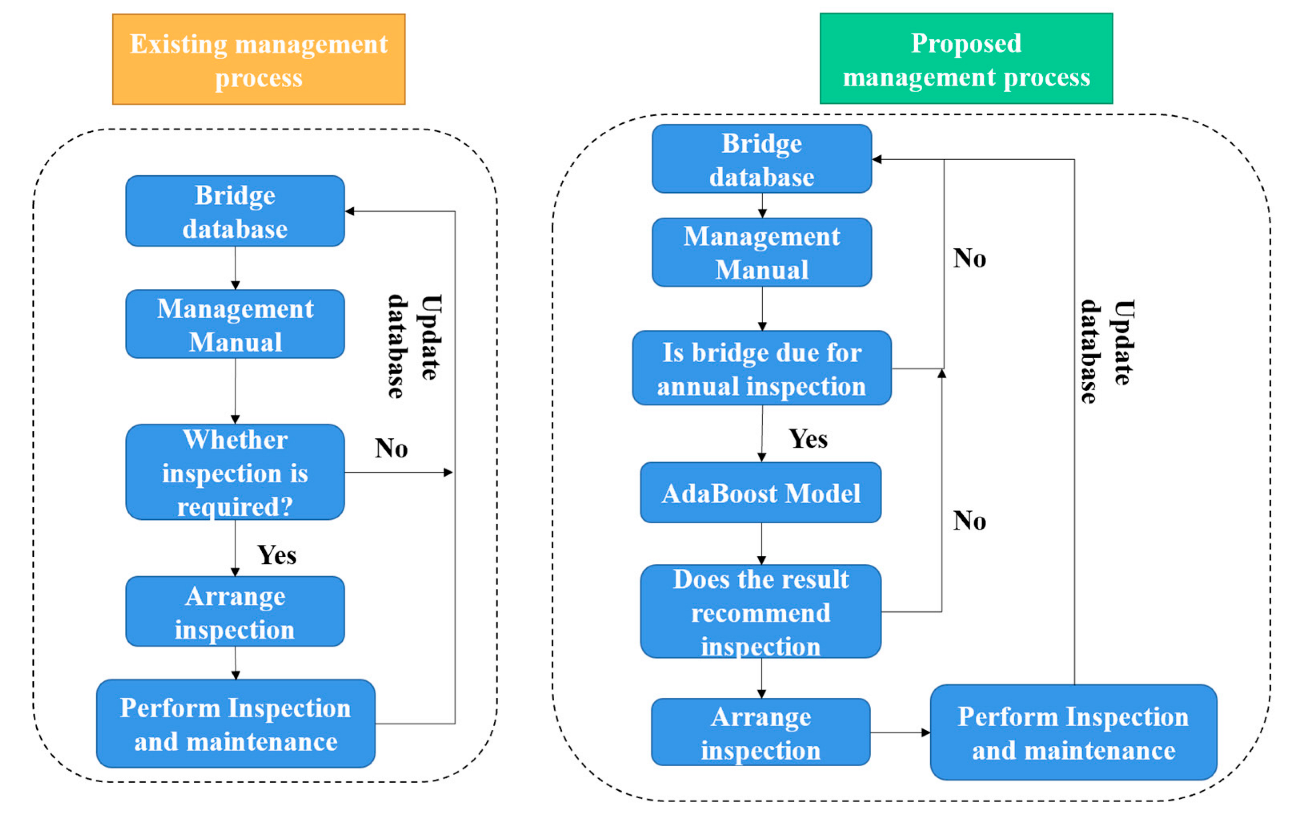
Bridges have a special place in transportation infrastructures and road networks due to their direct relationship with other places. These structures have the purpose of maintaining the traffic loads of the highway, crossing any obstacle, and performing effective communication between two destinations. Costs associated with bridge maintenance continue to be expensive due to their widespread use and stringent inspection requirements. Many researchers have been working on methods to use machine-learning (ML) techniques to forecast specific situations rather than physically checking bridges as part of the maintenance process in recent years. The practical value of the models has, however, been severely constrained by issues such relatively poor model evaluation results, unstable model performances, and the ambiguous application of established models in real-world scenarios. This work showed a thorough method of bridge condition prediction model building from feature engineering to model evaluation, along with a clear procedure of applying the produced model to actual usage, using data from the United States National Bridge Inventory (NBI) and the Adaboost algorithm. Multiple ML model assessment metrics’ findings revealed that the given model outperformed the majority of earlier studies in terms of values and stability. The case study demonstrated that there is a 30% reduction in the number of bridges that need to be inspected. This study serves as a crucial resource for the practical application of ML approaches in the forecast of the status of civil infrastructure. Additionally, it shows that boosted ML models may be a superior option as modeling algorithms advance. To explore the main influencing aspects of bridge conditions, a predictor importance analysis is also offered.
Keywords: bridge condition prediction; automated inspection; infrastructure maintenance; machine learning; AdaBoost bridge condition prediction; automated inspection; infrastructure maintenance; machine learning; AdaBoost