


Abstract
Triply periodic minimal surface (TPMS) lattices are an emerging class of cellular architectures whose smooth, mathematically defined surfaces enable highly tailorable mechanical performance. This study quantifies the compressive elastic response of three sheet-based TPMS topologies, i.e., Diamond, Gyroid, and Lidinoid, through finite element (FE) analysis and experimental validation. For each topology, the effective Young’s modulus was computed by single-cell finite element analysis under uniaxial compression boundary conditions on a 2 mm unit cell across five wall thicknesses (0.35, 0.45, 0.65, 0.95, and 1.30 mm), corresponding to relative densities from approximately 25% to 95%. Experimentally, cylindrical specimens of 316L stainless steel at 70% relative density were fabricated by laser powder bed fusion (LPBF) and tested in uniaxial compression with a strain rate of 10−3 s−1 per ISO 13314:2011 (i.e., 0.02 mm/s). The Diamond topology exhibited the highest effective modulus across the full density range, followed by Lidinoid and Gyroid. FE predictions agreed with experimental moduli within 4.7% for Diamond (100.2 GPa vs. 95.5 ± 3.9 GPa), 0.04% for Gyroid (79.8 GPa vs. 79.8 ± 0.88 GPa), and 1.5% for Lidinoid (85.6 GPa vs. 86.9 ± 3.5 GPa). Moreover, the Gibson–Ashby exponents determined span the range from stretching- to bending-dominated deformation with n = 1.69 for Diamond, 1.74 for Lidinoid, and 2.08 for Gyroid. Single-cell FE analysis accurately captured the effective elastic response of LPBF 316L stainless steel TPMS lattices examined.
1. Introduction
Triply periodic minimal surface (TPMS) structures are mathematically derived surfaces of zero mean curvature that are continuous, smooth, and periodic in three independent directions [1]. Their geometric continuity and absence of sharp stress raisers allow mechanical loads to flow along multiple pathways, distributing stress more efficiently than conventional strut-based lattices [2]. As a result, TPMS lattices have attracted significant attention for diverse engineering applications, including heat exchangers, aerospace structural components, fluid transport, acoustic insulation, and energy-absorbing systems [3,4,5,6,7].
Additive manufacturing (AM)—in particular, laser powder bed fusion (LPBF)—has been a key enabler for the practical production of TPMS structures with metallic alloys [8]. LPBF is a metal AM process in which a high-power laser selectively melts metallic powder to build a three-dimensional part layer by layer. LPBF enables fabrication of TPMS architectures with intricate internal features and controlled porosity at sub-millimeter feature scales [3,9]. Compared with subtractive manufacturing, LPBF reduces material waste, enables lighter structures with enhanced mechanical behavior, and allows rapid design iteration [10,11]. 316L stainless steel (316L SS) is among the most widely studied alloys for LPBF, owing to its excellent corrosion resistance, ductility, and well-characterized, favorable response under a broad range of LPBF process parameters, and has been specifically examined in TPMS lattice form in prior work [12,13].
Despite the growing body of work, the relationship between TPMS topology, relative density, and effective elastic modulus must be established for each material and processing combination, particularly when these lattices are intended to serve as building blocks for functionally graded or stiffness-matched components. Finite element (FE) homogenization, in which a single periodic unit cell is meshed at high resolution and its response to applied load is used to extract effective elastic properties, offers a computationally efficient route to characterizing this relationship without resolving the full lattice geometry [14]. The validity of this approach, however, requires experimental verification against experimentally fabricated specimens.
The present study addresses this need by combining FE homogenization with uniaxial compression testing of three sheet-based TPMS topologies, i.e., Diamond, Gyroid, and Lidinoid fabricated from 316L SS by LPBF under a single, fixed set of process parameters. Among these, the Lidinoid topology in particular remains comparatively unexplored relative to the Diamond and Gyroid, having been examined mainly in the context of acoustic and thermal performance rather than validated LPBF compressive elastic response [15,16]. The specific objectives of the study are: (i) to compute the effective Young’s modulus of each topology across a range of wall thicknesses using FE analysis; (ii) to fit Gibson–Ashby power laws to the homogenized data and interpret the resulting exponents in terms of the underlying deformation mechanism; and (iii) to validate the homogenized predictions against experimentally measured moduli obtained from compression testing of LPBF-fabricated specimens. Since the alloy and LPBF process parameters were held constant in this study, any difference in mechanical behavior would arise solely from topological variation.
The novelty of this work lies in the following. First, while the elastic response of Gyroid and Diamond sheet networks has been reported extensively, the Lidinoid topology has received comparatively little experimental attention [2,17]. Moreover, to the authors’ knowledge, no study has directly compared its LPBF-fabricated compressive elastic modulus in a metallic alloy against Diamond and Gyroid produced under an identical LPBF process parameter set, though comparative experimental testing of Lidinoid alongside other TPMS topologies has been reported for polymer material extrusion [18]. Second, although FE homogenization frameworks for TPMS lattices have been validated against experiment, this is most often reported in the low relative-density regime ( [19,20]. The present work extends experimental validation to the higher relative-density regime (), relevant to stiffness-matched, load-bearing components. Third, the three topologies were built in a single build, from a single powder lot, with one fixed, previously optimized parameter set, and tested in an identical orientation, so that the measured differences in modulus are attributable to topology alone rather than to confounded process variation [12].
2. Materials and Methods
2.1. Triply Periodic Minimal Surface Structures
In this study, the Diamond, Gyroid, and Lidinoid TPMS topologies were chosen due to their porous architectures and distinct mechanical responses [21]. Triply periodic minimal surfaces exist as infinitely thin surfaces that partition a three-dimensional volume into two interpenetrating subspaces. Solid lattices were generated by offsetting the surface symmetrically in both normal directions to produce a sheet-based lattice of finite wall thickness. The Diamond, Gyroid, and Lidinoid surfaces are described by the implicit functions expressed by:
where n is the unit cell size and x, y, z are the spatial coordinates. The relative density is controlled through wall thickness rather than through a level-set constant. All TPMS structures examined in this study were modeled and meshed for FE analysis using nTop v5.38.3 (nTop, New York, NY, USA).
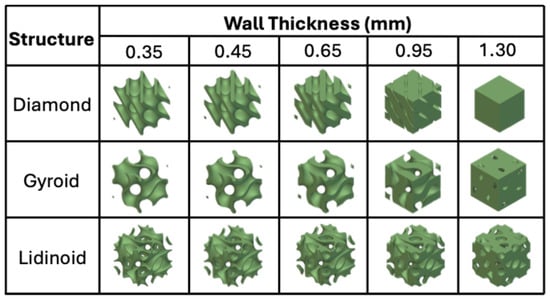
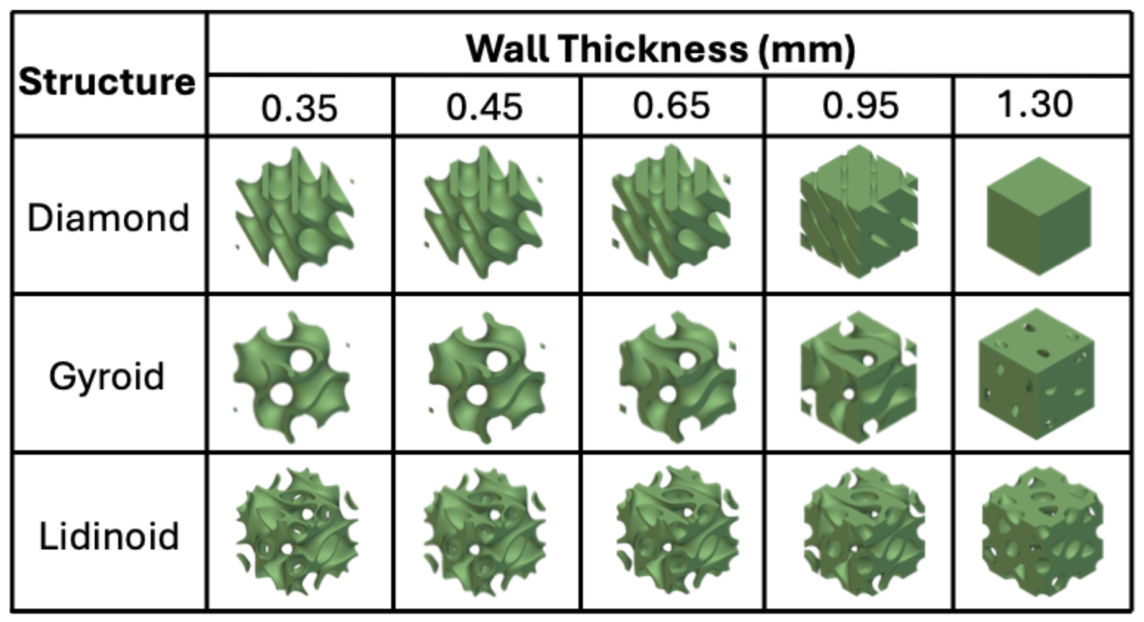
Cylindrical compression specimens were generated as non-graded lattices with a uniform unit cell size of n = 5 mm throughout. The 5 mm unit cell was selected based on LPBF manufacturability and commonly reported values for TPMS structures in the literature, while also ensuring that several complete unit cells were contained within each specimen to minimize boundary effects during testing. For each topology, five wall thicknesses (0.35, 0.45, 0.65, 0.95, and 1.30 mm) were generated to span the relative density range of approximately 25% to 95% [22]. The resulting unit cells used for FE analysis are presented in Figure 1.
Figure 1.
Diamond, Gyroid, and Lidinoid TPMS unit cells generated at wall thicknesses of 0.35, 0.45, 0.65, 0.95, and 1.30 mm, used for finite element homogenization.
The Gibson–Ashby power-law [23] is a foundational set of scaling equations used to predict the mechanical properties of cellular solids, such as TPMS, as expressed for elastic modulus by:
where is the effective elastic modulus of the TPMS, is the elastic modulus of the solid bulk, is the relative density of TMPS, and C and n are empirical constants associated with the topology of the TPMS. The FE homogenization methodology employed is scale-independent because the coefficients C and n are dimensionless quantities and carry no dependence on absolute unit cell dimensions. The constitutive model is linear-elastic with no intrinsic length scale, so the homogenized response is governed entirely by topology and volume fraction. It should be noted that surface-area-to-volume ratio and LPBF process-induced geometric deviation are scale-dependent; however, these effects pertain to fabrication fidelity and fall outside the scope of the elastic homogenization framework employed here.
2.2. Laser Powder Bed Fusion
All compression specimens were fabricated from gas-atomized 316L stainless steel powder using an SLM 125HL LPBF system (Nikon SLM Solutions AG, Lübeck, Germany) equipped with a 400 W, 1070 nm fiber laser with an approximate beam diameter of 70 µm. Process parameters were selected based on previously published process optimization work for the same alloy and machine, which identified volumetric energy densities of 46–127 J/mm3 as producing near-fully dense 316L SS [12]. The optimized parameter set reported [12] was 200 W laser power, 800 mm/s scan speed, 0.12 mm hatch spacing, 0.03 mm slice thickness, and 67° scan rotation between layers, corresponding to a volumetric energy density of 69.4 J/mm3.
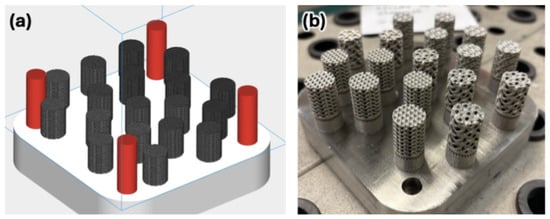
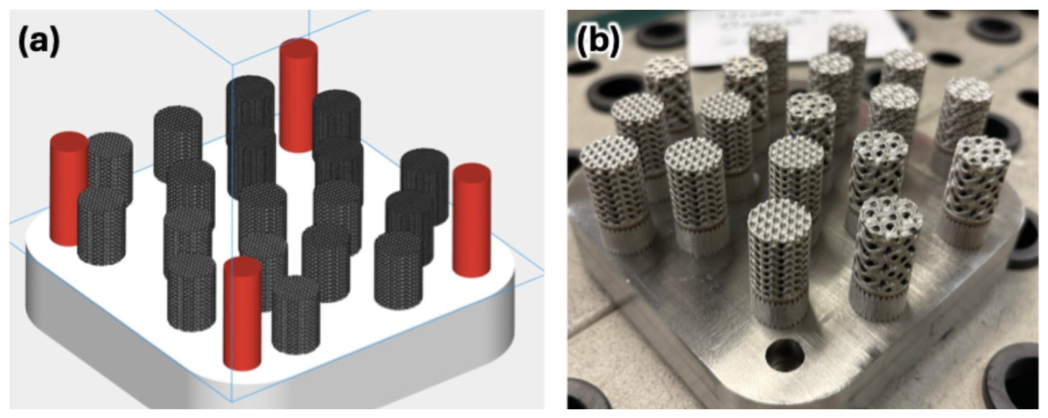
An identical LPBF parameter set was applied to build all samples to isolate the effect of lattice geometry on mechanical response. Sacrificial supports were generated to anchor the specimens to the build plate, and parts were removed from the plate by mechanical cleaving through the support structure, followed by SiC grinding parallel to the top surface. Figure 2 shows the CAD layout and as-built 316L SS TPMS compression specimens for the three topologies. The cylindrical samples, 7.5 mm radius and 20 mm height, were produced along the build direction (z), parallel to the incident laser beam.
Figure 2.
316L stainless steel TPMS compression specimens, 7.5 mm radius and 20 mm height, fabricated via LPBF: (a) CAD layout of the build file; and (b) as-built specimens.
2.3. Compression Testing
All compression specimens were built and tested in the same orientation, with the uniaxial compressive load applied parallel to the build (z) direction and the TPMS unit cells oriented identically for all three topologies. Uniaxial compression testing was performed in accordance with ISO 13314:2011 [24] using a Shimadzu AGS-X 300 kN universal testing machine (Shimadzu Corporation, Kyoto, Japan). Tests were conducted at room temperature under quasi-static loading at a crosshead displacement rate of 0.02 mm/s which corresponds to a nominal strain rate of 10−3 s−1. Cylindrical specimens of 7.5 mm radius and 20 mm height, composed of 5 mm cubic unit cells, were tested for each of the three topologies, with three replicates per topology (n = 3 per topology; nine specimens in total) to assess repeatability. Strain was computed from crosshead displacement, and load was recorded continuously throughout the test. Engineering stress–strain curves were generated for each specimen, and the effective Young’s modulus was extracted from the slope of the linear elastic region. Toughness was calculated as the area under the engineering stress–strain curve up to fracture via numerical integration.
2.4. Finite Element Analysis
Finite element analysis was performed to predict the effective Young’s modulus of each TPMS topology as a function of wall thickness. A reduced-order approach was employed in which the effective stiffness of each lattice was estimated from a single representative unit cell rather than by resolving the full lattice geometry [14]. For each TPMS topology, five wall thicknesses (0.35, 0.45, 0.65, 0.95, and 1.30 mm) were modeled in a 2 mm × 2 mm × 2 mm unit cell. The analyses were performed in ANSYS Mechanical 2025 R2 (ANSYS, Inc., Canonsburg, PA, USA) using a uniform mesh of second-order (quadratic) tetrahedral elements with a nominal element size ranging from 0.03 mm to 0.10 mm to stay within solving limits. The resulting element counts, node counts, and nominal element sizes for every topology and wall thickness are summarized in Table 1. All analyses were run on AMD Ryzen 7 7800x3D (8 cores, 32GB RAM). The constituent alloy, i.e., bulk 316L SS, was modeled as a linear elastic, isotropic medium with 185 GPa and ν = 0.3 [25].
Table 1.
Finite element analysis statistics.
The unit cell was loaded in uniaxial compression under the following assumptions and boundary conditions. A uniform displacement of 0.002 mm (nominal applied strain of 0.001) was prescribed on the top face in the loading direction only; the two in-plane translational degrees of freedom at each node on this face were left unconstrained, which is kinematically equivalent to a frictionless, freely sliding platen. The bottom face was restrained against displacement in the loading direction. Rigid-body motion was eliminated without further constraining the loaded face: one lateral face was constrained against displacement normal to itself, and a single corner node on that face was additionally constrained in the remaining unconstrained direction. No other constraints or contact conditions were applied. Self-contact between opposing walls was not modelled, as wall closure does not occur at the infinitesimal strain applied. Gravity, residual stress, and any as-built geometric or microstructural deviation from the nominal CAD geometry were neglected. The reaction force on the loaded face was extracted and used to compute the effective Young’s modulus, from:
This formulation should be distinguished from the two boundary-condition families commonly used for rigorous homogenization of periodic media. A periodic boundary condition (PBC) enforces displacement periodicity and traction anti-periodicity across opposing face pairs and yields the exact effective response of an infinite periodic medium [14]. A kinematic uniform boundary condition (KUBC) imposes a uniform strain field on the entire boundary of the unit cell and provides an upper bound on the effective stiffness. The scheme used here applies a kinematic constraint on the loaded and restrained faces in the loading direction only, with the lateral faces left unconstrained apart from the minimal kinematic constraints needed to remove rigid-body motion, and is therefore more accurately described as a uniaxial compression of an isolated unit cell rather than as a formal PBC or KUBC. It is computationally simpler than either and is commonly used as an engineering approximation for screening lattice stiffness, particularly for cubic-symmetric topologies under aligned loading. Its accuracy for the present configuration is assessed by direct comparison with experimental compression results.
For each topology, the resulting modulus–density data were fit to the Gibson–Ashby power law to determine the topology-specific constants C and n [23]. The accuracy of the framework was then assessed by comparing the predicted modulus at ≈ 0.7 with the experimentally measured modulus from compression testing.
3. Results
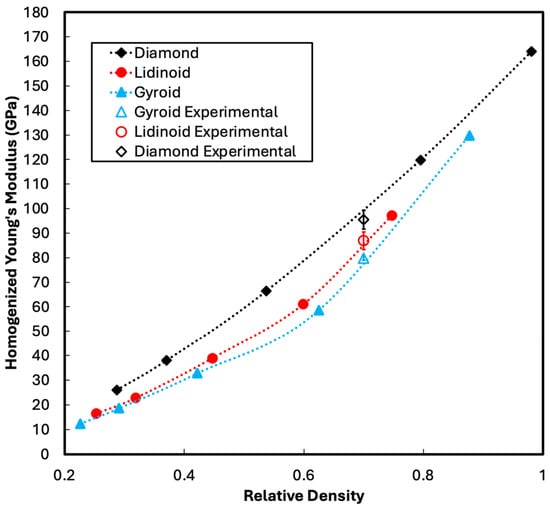
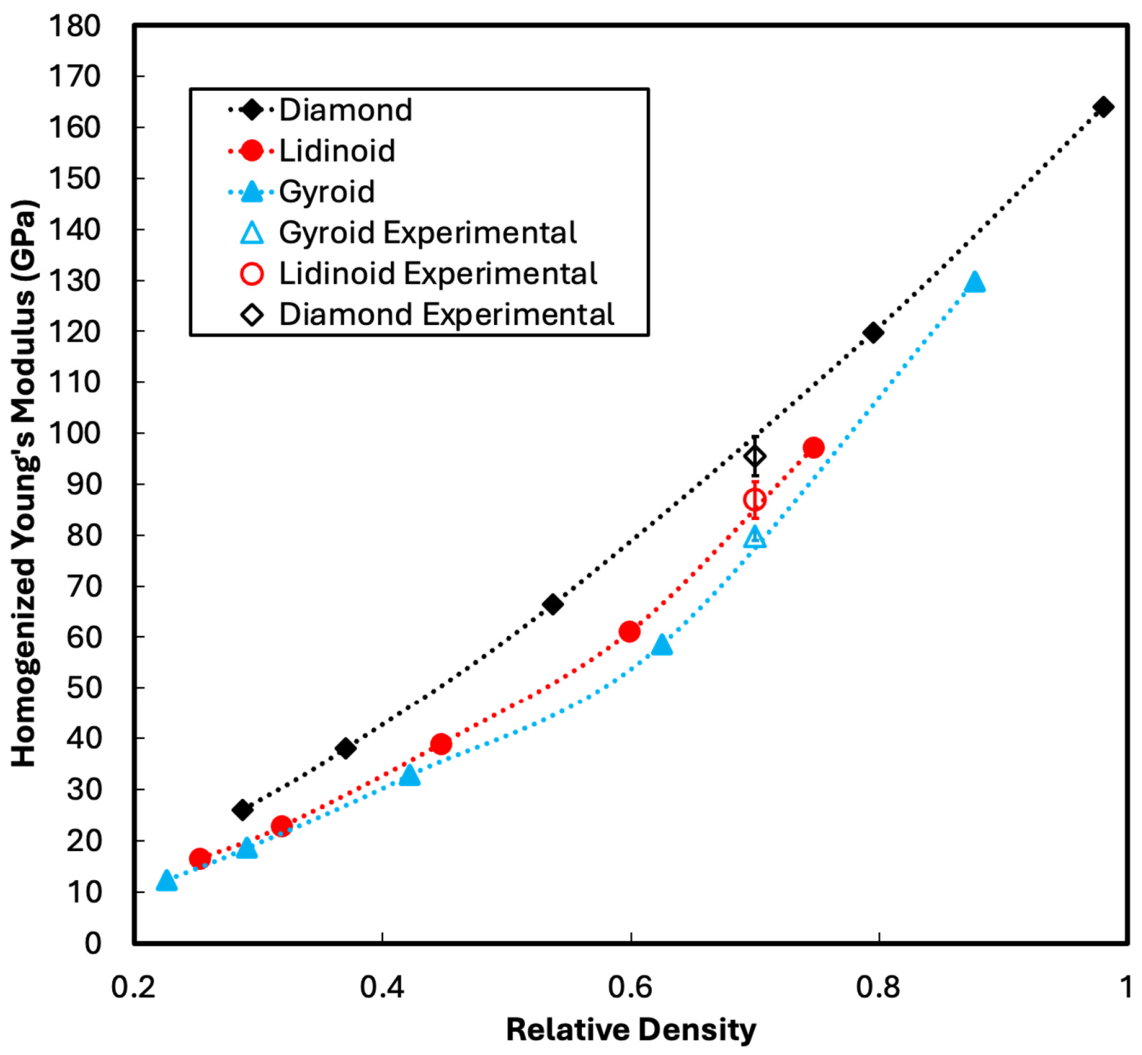
Figure 3 presents the FE homogenized Young’s modulus (E*) as a function of relative density for the Diamond, Gyroid, and Lidinoid topologies at five wall thicknesses per topology, corresponding to relative densities ranging from approximately 0.25 to 0.95. All three topologies exhibit a non-linear power-law relationship between relative density and effective modulus, consistent with the Gibson–Ashby scaling law for cellular solids [23].
Figure 3.
Homogenized Young’s modulus E* versus relative density for the Diamond, Gyroid, and Lidinoid TPMS topologies. Hollow symbols smoothened with dotted lines represent FE homogenization calculations while solid symbols correspond to experimentally measured moduli from uniaxial compression testing of LPBF 316L stainless steel specimens. Error bars on the markers indicate ± one standard deviation across three specimens per topology (Note: smaller than the symbol size for experimental Gyroid).
Across the relative density range investigated by FE, the Diamond topology exhibited the highest effective Young’s modulus at every wall thickness, followed by the Lidinoid and then the Gyroid. This ordering reflects a topology-dependent variation in load-transfer mechanism: the comparatively planar Diamond sheet regions transmit load predominantly through axial (stretching) stresses that engage the full wall cross-section, whereas the smoothly curved, helicoidal Gyroid sheets transmit a greater fraction of load through wall bending, which is intrinsically less efficient at converting solid-material modulus into effective stiffness [17]. The Lidinoid surface combines features of both architectures and lies between them. The effective modulus of each topology varies continuously with relative density, indicating that wall thickness alone can be used as a smoothly varying design parameter for tuning LPBF 316L SS TPMS stiffness across more than an order of magnitude.
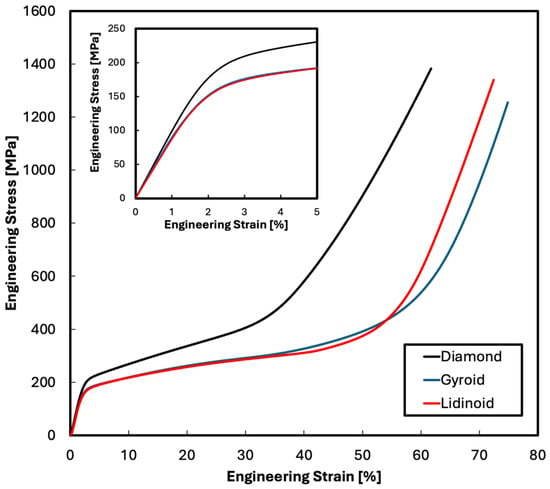
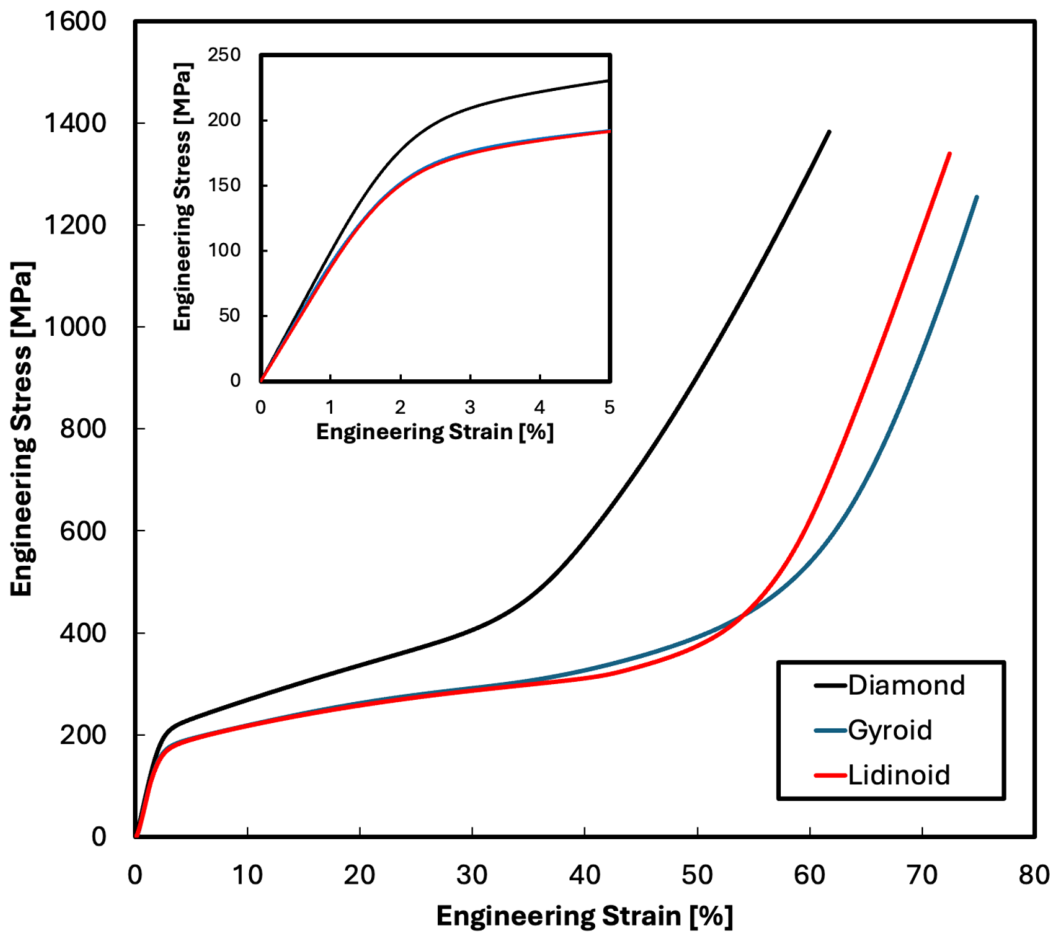
Figure 4 presents typical engineering stress vs. engineering strain curves obtained from compression testing of the three TPMS topologies at a nominal relative density of 0.7. They exhibited the characteristic three-stage response of porous metallic lattices: an initial linear elastic regime, a plateau region associated with progressive cell collapse, and a final densification stage in which the stress rises sharply as collapsed cells contact one another. The linear elastic region, used to extract the experimental Young’s modulus, was clearly distinguishable for all three topologies. Mechanical behaviors assessed for each topology from experimental compression testing are reported in Table 2 and in Figure 3 with solid symbols and agree well with those calculated by FE homogenization.
Figure 4.
Experimental stress–strain curves from uniaxial compression testing of LPBF 316L stainless steel Diamond, Gyroid, and Lidinoid lattice cylinders. Inset provides linear region where Young’s modulus was determined from.
Table 2.
Mechanical properties determined from compression testing of LPBF SS316L samples.
The Diamond specimens exhibited the highest initial stiffness and yield strength, consistent with a more stretching-dominated load-bearing architecture. The Lidinoid and Gyroid specimens showed similar initial slopes, with the Gyroid exhibiting a marginally lower stiffness, in agreement with the homogenization predictions in Figure 3. All three topologies showed near-perfect repeatability across the three specimens tested per topology as reported in Table 2, confirming the dimensional consistency of the LPBF fabrication process under the selected parameter set.
4. Discussion
Table 3 summarizes the homogenized modulus calculations, the fitted Gibson–Ashby power-law expressions and their coefficients of determination, the experimentally measured moduli, and the resulting percentage errors for each TPMS topology. The Gibson–Ashby power law models the elastic response of cellular materials as a function of their relative density [23]. The Gyroid topology achieved the closest agreement between FE analysis and experiment, with a percentage error of 0.04% (79.8 GPa calculated vs. 79.8 GPa measured). The Lidinoid showed a 1.5% error (85.6 GPa calculated vs. 86.9 GPa measured), and the Diamond showed a 4.7% error (100.2 GPa calculated vs. 95.5 GPa measured). All three topologies achieved prediction errors below 5%, satisfying the validation criterion adopted for this study and confirming that the FE homogenization framework accurately captures the effective elastic behavior of LPBF-fabricated 316L SS TPMS lattices. All three power-law fits achieved R2 > 0.99, indicating that the Gibson–Ashby framework provides an excellent description of the modulus–density relationship across the wall-thickness range investigated.
Table 3.
Comparison of FE homogenization predictions and experimental compression test results for the Diamond, Gyroid, and Lidinoid TPMS topologies fabricated in 316L SS by LPBF.
The stiffness variation observed by FE homogenization cannot be explained solely by small differences in relative density at a given wall thickness. It reflects a fundamental distinction in how load is carried through each structure. Stretching-dominated structures are inherently efficient under uniaxial loading because the full cross-section of each load-bearing element transmits the applied stress, maximizing the structural contribution of the solid material. By contrast, bending-dominated deformation is less efficient because the stress distribution across the wall thickness is non-uniform, with peak values at the surfaces and near-zero stress at the neutral axis. This distinction is captured mathematically by the Gibson–Ashby power-law exponent, n: bending-dominated cellular solids scale as or higher, while stretching-dominated structures approach [23]. The exponents fitted in the present study (1.69 for Diamond, 2.08 for Gyroid, 1.74 for Lidinoid) are consistent with this interpretation. The Gyroid’s higher exponent indicates stronger bending-dominated character, while the Diamond’s lower exponent reflects more stretching-dominated behavior. The Lidinoid lies in between.
The consistent agreement between FE homogenization and experimental measurement for Young’s modulus, i.e., <5%, across all three topologically distinct lattice types, combined with R2 values exceeding 0.99 for all power-law fits, confirms that the Gibson–Ashby framework reliably captures the stiffness–density behavior of LPBF-fabricated 316L SS TPMS structures. Therefore, the FE unit cell homogenization approach demonstrated here may serve as a useful predictive design tool for other 316L SS TPMS topologies fabricated by LPBF. Extending it to other unit cell sizes or bulk materials would require additional validation but could ultimately help reduce the number of samples needed for experimental characterization.
The compressive mechanical properties summarized in Table 2 reveal topology-dependent trends past the elastic region under uniaxial compression. The Diamond topology exhibited the highest stiffness and yield strength, consistent with its more stretching-dominated character, and further recorded the highest toughness at 343.5 MJ/m3 compared to 305.6 MJ/m3 for Gyroid and 298.9 MJ/m3 for Lidinoid. The Diamond topology thus combines high stiffness and yield strength with superior energy absorption, indicating that its more stretching-dominated architecture carries load efficiently through axial forces while still sustaining substantial plastic deformation prior to failure [26]. Under uniaxial compression, Gyroid and Lidinoid topologies, along with their lower stiffness, deform through a greater contribution of bending and local buckling mechanisms that dissipate energy across a wide strain range, yielding toughness values that approach but do not exceed that of Diamond.
The finite element model idealizes the lattice as nominal CAD geometry with isotropic, homogeneous material properties, and therefore does not explicitly resolve surface roughness or the crystallographic anisotropy inherent to LPBF fabrication. Anisotropy from the columnar, build-direction-aligned grain structure is also not considered since all specimens shared a common build orientation and loading direction. Therefore, any resulting bias is expected to be systematic across topologies rather than a source of differential error. These simplifications are consistent with common engineering-level lattice screening approaches.
5. Conclusions
This study quantified the effective elastic response of three sheet-based TPMS topologies, namely, Diamond, Gyroid, and Lidinoid, fabricated from 316L stainless steel by laser powder bed fusion, using a combination of FE unit cell homogenization and experimental testing via uniaxial compression. The principal findings are as follows:
- FE homogenization predicted the experimentally measured Young’s modulus within 0.04% for the Gyroid (79.8 GPa vs. 79.8 ± 0.9 GPa), 1.5% for the Lidinoid (85.6 GPa vs. 86.9 ± 3.5 GPa), and 4.7% for the Diamond (100.2 GPa vs. 95.5 ± 3.9 GPa).
- The Diamond topology exhibited the highest effective stiffness across the relative-density range investigated (), followed by the Lidinoid and then the Gyroid, demonstrating that topology selection enables stiffness tuning at constant relative density.
- Fitted Gibson–Ashby power-law exponents of 2.08 (Gyroid), 1.74 (Lidinoid), and 1.69 (Diamond), with R2 > 0.99 in all cases, indicate a progressive transition from bending-dominated to stretching-dominated deformation across the three topologies.
The FE homogenization method can provide a computationally efficient predictive tool for designing LPBF 316L SS TPMS components with target stiffness values.
Author Contributions
Conceptualization, A.-S.S.; methodology, N.A.; validation, A.-S.S.; formal analysis, A.-S.S.; investigation, A.-S.S. and N.A.; resources, Y.S.; data curation, A.-S.S. and Y.S.; writing—original draft preparation, A.-S.S.; writing—review and editing, A.-S.S. and Y.S.; visualization, A.-S.S.; supervision, N.A. and Y.S.; project administration, Y.S.; funding acquisition, Y.S. All authors have read and agreed to the published version of the manuscript.
Funding
This research received no external funding.
Data Availability Statement
The raw data supporting the conclusions of this article will be made available by the authors on request.
Acknowledgments
This work originated as a science fair project at Orlando Science High School (Orlando, Florida), and portions of the manuscript were presented at the Nelson Ying Orange County (FL) Science Competition. This study received no external grant funding. During the preparation of this manuscript/study, the author(s) used Claude Version 1.15200.0 for editorial purposes. The authors have reviewed and edited the output and take full responsibility for the content of this publication.
Conflicts of Interest
The authors declare no conflicts of interest.
References
- Savoldi, L.; Cammi, A.; Ferretto, W.; Tanzi, A.Q.; Marocco, L. Use of Triply Periodic Minimal Surface Lattices for Heat Transfer Applications: A Systematic Literature Investigation. Energies 2026, 19, 833. [Google Scholar] [CrossRef] [Scilit]
- Chatzigeorgiou, C.; Piotrowski, B.; Chemisky, Y.; Laheurte, P.; Meraghni, F. Numerical investigation of the effective mechanical properties and local stress distributions of TPMS-based and strut-based lattices for biomedical applications. J. Mech. Behav. Biomed. Mater. 2022, 126, 105025. [Google Scholar] [CrossRef] [Scilit] [PubMed]
- Zhang, H.; Zhao, J.; Niu, Q.; Xu, C.; Huo, R. A study of energy absorption properties of Heteromorphic TPMS and Multi-morphology TPMS under quasi-static compression. Thin-Walled Struct. 2024, 205, 112519. [Google Scholar] [CrossRef] [Scilit]
- Alemayehu, D.B.; Todoh, M. Enhanced Energy Absorption with Bioinspired Composite Triply Periodic Minimal Surface Gyroid Lattices Fabricated via Fused Filament Fabrication (FFF). J. Manuf. Mater. Process. 2024, 8, 86. [Google Scholar] [CrossRef] [Scilit]
- Sargana, S.H.; Nazir, A.; Waqar, S.; Ali, U.A.; Gokcekaya, O. Effect of additive manufactured hybrid and functionally graded novel designed cellular lattice structures on mechanical and failure properties. Int. J. Adv. Manuf. Technol. 2023, 128, 4873–4891. [Google Scholar] [CrossRef] [Scilit]
- Shi, K.; Yang, W.; Mei, H.; Yan, Y.; Xu, L.D.; Cheng, L.; Zhang, L. Characterization and enhancement of quasi-static and shear mechanical properties of 3D printed lightweight SiOC lattices: Effects of structural design and parameters. J. Eur. Ceram. Soc. 2023, 43, 5882–5893. [Google Scholar] [CrossRef] [Scilit]
- Wang, J.; Chen, K.; Zeng, M.; Ma, T.; Wang, Q.; Cheng, Z. Investigation on flow and heat transfer in various channels based on triply periodic minimal surfaces (TPMS). Energy Convers. Manag. 2023, 283, 116955. [Google Scholar] [CrossRef] [Scilit]
- Feng, J.; Fu, J.; Yao, X.; He, Y. Triply periodic minimal surface (TPMS) porous structures: From multi-scale design, precise additive manufacturing to multidisciplinary applications. Int. J. Extrem. Manuf. 2022, 4, 022001. [Google Scholar] [CrossRef] [Scilit]
- Yu, S.; Sun, J.; Bai, J. Investigation of functionally graded TPMS structures fabricated by additive manufacturing. Mater. Des. 2019, 182, 108021. [Google Scholar] [CrossRef] [Scilit]
- Fidan, I.; Naikwadi, V.; Alkunte, S.; Mishra, R.; Tantawi, K. Energy Efficiency in Additive Manufacturing: Condensed Review. Technologies 2024, 12, 21. [Google Scholar] [CrossRef] [Scilit]
- Paris, H.; Mokhtarian, H.; Coatanéa, E.; Museau, M.; Ituarte, I.F. Comparative environmental impacts of additive and subtractive manufacturing technologies. CIRP Ann. 2016, 65, 29–32. [Google Scholar] [CrossRef] [Scilit]
- Diaz-Vallejo, N.; Lucas, C.; Ayers, N.; Graydon, K.; Hyer, H.; Sohn, Y.H. Process Optimization and Microstructure Analysis to Understand Laser Powder Bed Fusion of 316L Stainless Steel. Metals 2021, 11, 832. [Google Scholar] [CrossRef] [Scilit]
- Ravichander, B.B.; Jagdale, S.H.; Kumar, G. Surface Morphology, Compressive Behavior, and Energy Absorption of Graded Triply Periodic Minimal Surface 316L Steel Cellular Structures Fabricated by Laser Powder Bed Fusion. Materials 2022, 15, 8294. [Google Scholar] [CrossRef] [Scilit] [PubMed]
- Hollister, S.J.; Kikuchi, N. A Comparison of Homogenization and Standard Mechanics Analyses for Periodic Porous Composites. Comput. Mech. 1992, 10, 73–95. [Google Scholar] [CrossRef] [Scilit]
- Chouhan, G.; Gunji, B. Additive manufacturing TPMS lattice structures: Experimental study on airflow resistivity. Results Mater. 2023, 20, 100478. [Google Scholar] [CrossRef] [Scilit]
- Barakat, A.; Sun, B. Enhanced convective heat transfer in new triply periodic minimal surface structures: Numerical and experimental investigation. Int. J. Heat Mass Transf. 2024, 227, 125538. [Google Scholar] [CrossRef] [Scilit]
- Naghavi, S.A.; Tamaddon, M.; Marghoub, A.; Wang, K.; Babamiri, B.B.; Hazeli, K.; Xu, W.; Lu, X.; Sun, C.; Wang, L.; et al. Mechanical Characterisation and Numerical Modelling of TPMS-Based Gyroid and Diamond Ti6Al4V Scaffolds for Bone Implants: An Integrated Approach for Translational Consideration. Bioengineering 2022, 9, 504. [Google Scholar] [CrossRef] [Scilit] [PubMed]
- Miralbes, B.R.; Ranz, D.; Pascual, F.J.; Zouzias, D.; Maza, M. Characterization of additively manufactured triply periodic minimal surface structures under compressive loading. Mech. Adv. Mater. Struct. 2020, 29, 1841–1855. [Google Scholar] [CrossRef] [Scilit]
- Ramírez, E.A.; Béraud, N.; Montemurro, M.; Pourroy, F.; Villeneuve, F. Effective elastic and strength properties of triply periodic minimal surfaces lattice structures by numerical homogenization. Mech. Adv. Mater. Struct. 2023, 31, 9571–9583. [Google Scholar] [CrossRef] [Scilit]
- Pais, A.; Alves, J.L.; Jorge, R.N.; Belinha, J. Multiscale Homogenization Techniques for TPMS Foam Material for Biomedical Structural Applications. Bioengineering 2023, 10, 515. [Google Scholar] [CrossRef] [Scilit] [PubMed]
- Qiu, N.; Wan, Y.; Shen, Y.; Fang, J. Experimental and numerical studies on mechanical properties of TPMS structures. Int. J. Mech. Sci. 2024, 261, 108657. [Google Scholar] [CrossRef] [Scilit]
- Wu, Z.; Narra, S.P.; Rollett, A. Exploring the fabrication limits of thin-wall structures in a laser powder bed fusion process. Int. J. Adv. Manuf. Technol. 2020, 110, 191–207. [Google Scholar] [CrossRef] [Scilit]
- Gibson, L.J.; Ashby, M.F. Cellular Solids: Structure and Properties, 2nd ed.; Cambridge University Press: Cambridge, UK, 1997. [Google Scholar]
- ISO 13314:2011; Mechanical Testing of Porous and Cellular Metals—Part 1: Requirements for Compression Testing. International Organization for Standardization (ISO): Geneva, Switzerland, 2011.
- Renishaw PLC. RenAM 500 Series Material Data Sheet: Stainless Steel 316L (1.4404). Part No. H-5800-6796-03-A.; Renishaw PLC: Wotton-under-Edge, UK, 2024. [Google Scholar]
- Deshpande, A.V.S.; Ashby, M.F.; Fleck, N.A. Foam topology: Bending versus stretching dominated architectures. Acta Mater. 2001, 49, 1035–1040. [Google Scholar] [CrossRef] [Scilit]

Disclaimer/Publisher’s Note: The statements, opinions and data contained in all publications are solely those of the individual author(s) and contributor(s) and not of MDPI and/or the editor(s). MDPI and/or the editor(s) disclaim responsibility for any injury to people or property resulting from any ideas, methods, instructions or products referred to in the content. |
© 2026 by the authors. Licensee MDPI, Basel, Switzerland. This article is an open access article distributed under the terms and conditions of the Creative Commons Attribution (CC BY) license.