


Abstract
Hydrogen diffusion plays a central role in the susceptibility of steels to hydrogen embrittlement, yet reported diffusivity values often exhibit significant variability due to differences in experimental methodology. Gaseous hydrogen permeation experiments, while more representative of service conditions, are highly sensitive to surface boundary conditions and trapping effects, which can bias the diffusivity obtained from analysis. In this work, a gaseous hydrogen permeation methodology was developed at the High-Performance Powertrain Materials Laboratory (HPPM) at the University of British Columbia, Okanagan. A dedicated gas management system (GMS) was implemented to enable controlled pressure step transients, allowing partial permeation transients to be collected under gaseous charging conditions. This approach was applied to commercially pure iron and API 5L X60 pipeline steel to evaluate diffusion and trapping behaviour across materials with differing microstructural complexity. The results demonstrate that diffusivity obtained from transients spanning the full charging–discharging range (0–2 MPa) reflects an effective parameter influenced by reversible hydrogen trapping, whereas transients measured over incremental pressure steps (1–2 MPa) provide a more consistent estimate of lattice-controlled diffusion. The application of palladium coatings to the charging surface was found to promote hydrogen entry, reducing surface impedance effects and further improving agreement with Fickian diffusion behaviour.
1. Introduction
Hydrogen embrittlement (HE) remains a major barrier to the safe and reliable operation of hydrogen-containing and transporting pipelines [1]. The construction of dedicated hydrogen pipeline networks presents a significant economic burden, reducing the overall viability of hydrogen as an energy vector. As a result, the utilization of existing natural gas pipeline infrastructure for hydrogen transport represents a compelling economic opportunity. However, multiple grades of steel comprise these networks, each exhibiting varying susceptibility to hydrogen embrittlement [2]. Consequently, it is critical to understand the material properties governing hydrogen transport and accumulation in steels intended for gaseous hydrogen service.
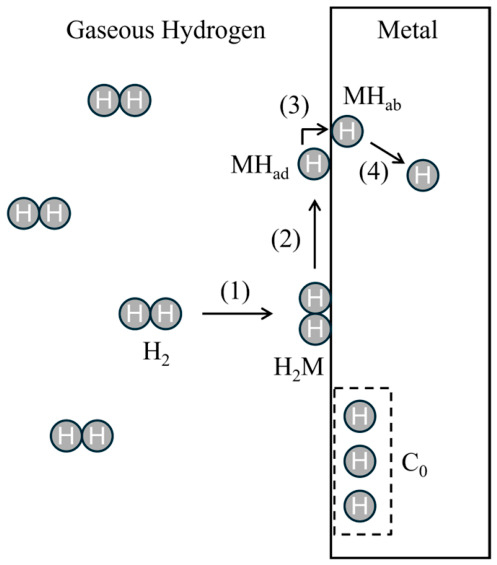
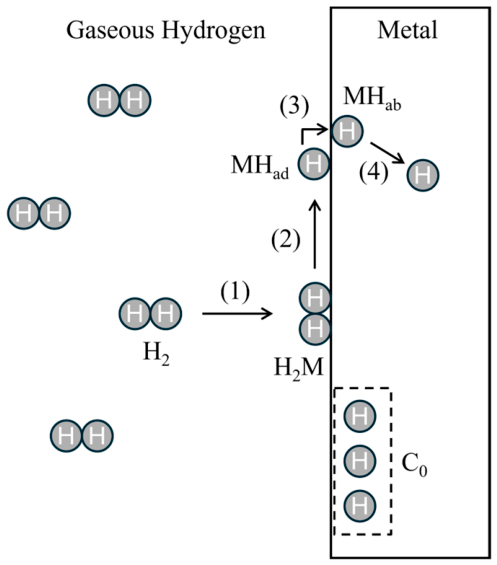
A conceptual illustration of the uptake of hydrogen in metals is shown in Figure 1. This occurs through a sequence of processes including physisorption, chemisorption, absorption, desorption and dissolution (steps 1–4). These represent the surface-related steps of hydrogen uptake into the metal. A core assumption of hydrogen permeation studies is that these steps are effectively instantaneous upon exposure to hydrogen, and a constant subsurface hydrogen concentration (C0) exists immediately below the charging surface [3].
Figure 1.
Uptake of hydrogen in metals.
Hydrogen embrittlement is strongly influenced by both the concentration and mobility of hydrogen within the microstructure. For example, Ronevich et al. demonstrated that banded pearlite in X65 pipeline steel selectively impedes hydrogen mobility depending on the orientation of flux relative to the banding direction. This resulted in reduced hydrogen-assisted fatigue crack growth rates for cracks propagating across the banded structure [4]. Similarly, Xu et al. investigated hydrogen embrittlement in X52 pipeline steel using in situ gaseous slow strain rate testing (SSRT) and found that increasing temperature, thereby increasing hydrogen diffusivity (D), led to an increase in the hydrogen embrittlement index (HEI), while subsurface hydrogen concentration (C0) remained relatively unchanged [4].
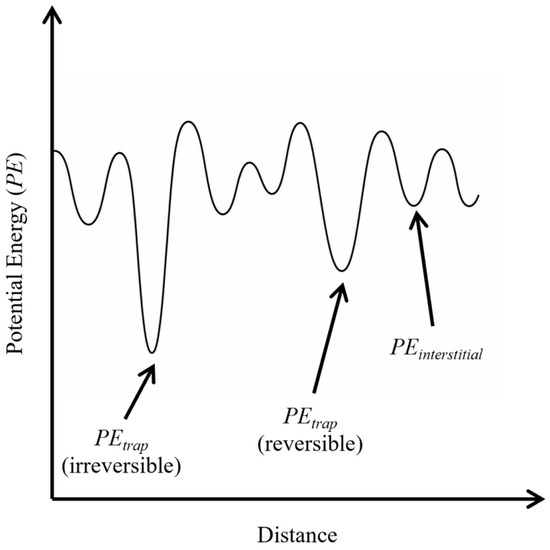
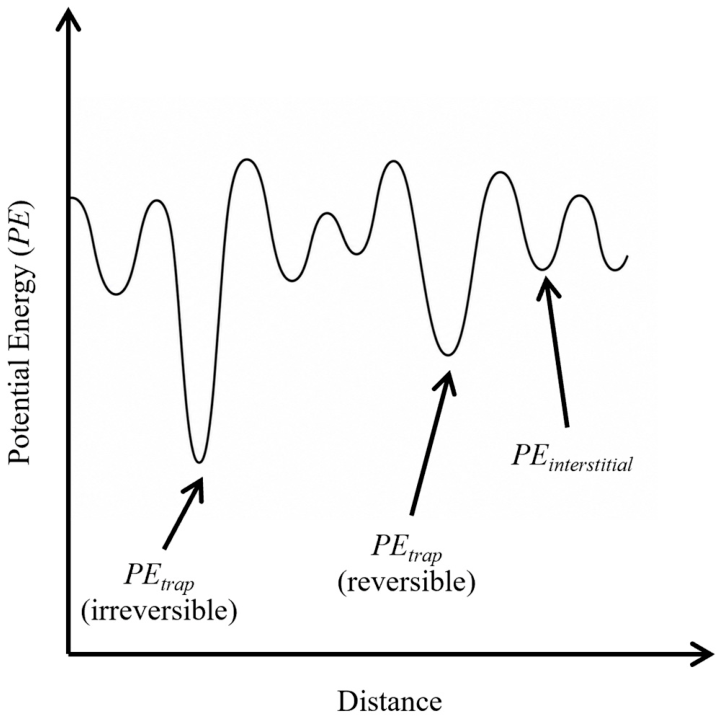
In addition to lattice diffusion, hydrogen transport is influenced by interactions with microstructural features that act as trapping sites. If these locations possess a lower potential energy state, PE, compared to an interstitial lattice site, they are thermodynamically favourable (i.e., PEtrap < PEinterstitial), and the hydrogen atoms will possess an increased residence time at the location (Figure 2). Sites such as grain boundaries, cementite interfaces, and dislocations are generally considered reversible trapping sites at room temperature, as trapped hydrogen atoms will typically desorb over a finite timescale [2]. In contrast, features such as microvoids, oxide interfaces, and MnS inclusions may act as irreversible traps at room temperature, possessing higher binding energies and very long residence times compared to the experimental timescale.
Figure 2.
Representative potential energy (PE) of interstitial and trapping sites.
In some cases, increasing the density of trapping sites may enhance resistance to hydrogen embrittlement by limiting hydrogen mobility. For example, Song et al. used laser peening to introduce dislocations in 2205 stainless steel, resulting in increased resistance to hydrogen embrittlement, attributed to inhibited hydrogen ingress due to enhanced trapping [5].
1.1. Hydrogen Permeation Testing
Once absorbed into the bulk of a material, hydrogen transport is governed by diffusion driven by concentration gradients within the lattice. Diffusivity, D, quantifies the rate at which hydrogen spreads through the material with respect to the concentration gradient. Hydrogen permeation experiments are therefore designed to establish conditions under which mass transport is limited by bulk diffusion, allowing the application of Fick’s first and second laws to describe steady-state and transient hydrogen flux.
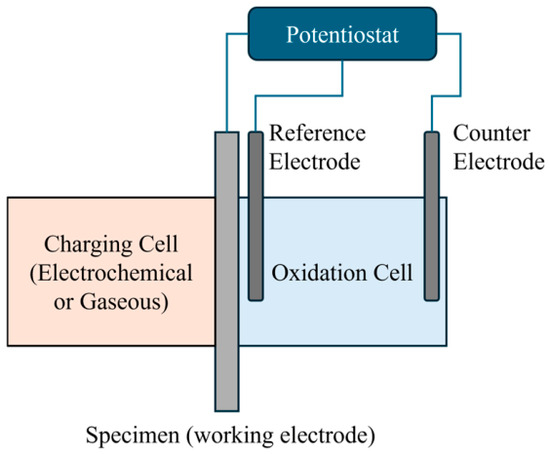
The predominant method for quantifying hydrogen diffusion in metals is the Devanathan–Stachurski technique [6], with standardized procedures outlined in ASTM G148 [7]. In this method, a metallic membrane separates two chambers: one for hydrogen generation (charging) and one for hydrogen detection (oxidation), as illustrated in Figure 3.
Figure 3.
Schematic of a typical Devanathan–Stachurski apparatus for hydrogen permeation testing.
Hydrogen charging may be achieved through either electrochemical or gaseous means. In electrochemical charging, a cathodic potential applied to the specimen generates atomic hydrogen at the surface, which subsequently diffuses through the material. Alternatively, high-pressure gaseous hydrogen may be used to emulate gaseous service conditions. On the detection side, an anodic potential is applied to oxidize permeating hydrogen in an alkaline electrolyte (typically 0.1 M NaOH), producing a measurable current density, (A/m2), which is directly proportional to the hydrogen flux. Monitoring the evolution of over time enables determination of diffusivity based on Fickian analysis, as discussed in Section 2.5.
While gaseous hydrogen charging may be a more representative approximation of service conditions, it introduces additional experimental challenges compared to electrochemical methods, including safety considerations associated with handling high-pressure flammable gas. Despite these challenges, gaseous charging has been increasingly adopted to better replicate hydrogen uptake in pure hydrogen or hydrogen blended applications [4,8,9]. A further limitation of gaseous permeation methods is the difficulty in implementing controlled charging transients. Electrochemical systems allow precise control of hydrogen generation via applied potential, enabling automated step changes in variable charging intensity which are useful for isolating lattice diffusivity and trapping behaviour [10,11].
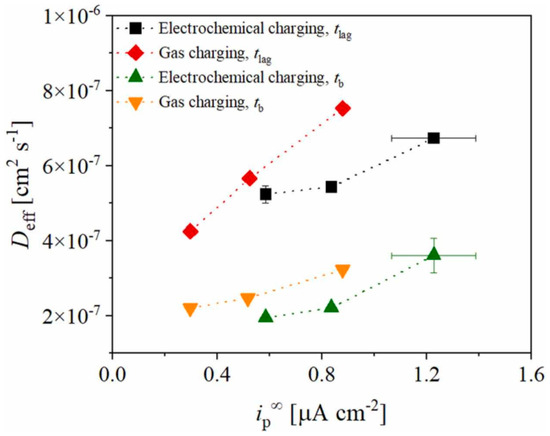
Importantly, it has been shown that the method of hydrogen delivery can significantly influence the diffusivity measured in permeation experiments, even at equivalent overall hydrogen flux. This is illustrated in Figure 4, which highlights the differences in effective diffusivity measured using electrochemical and gaseous charging methods, as reported by Koren et al. in a comparative study on X65 pipeline steel [12]. Figure 4 demonstrates that for a single material, a wide range of diffusivity values may be obtained depending on the calculation method: whether diffusivity is determined from the lag time (tL) (time to 63% of steady-state; Deff,tL) or from the initial breakthrough detection of hydrogen (Deff,tb), as well as the charging method and intensity.
Figure 4.
Variance in effective diffusivity of X65 pipeline steel obtained with electrochemical and gaseous hydrogen [12].
More broadly, reported diffusivity values in the literature exhibit significant variability, often spanning orders of magnitude, even for nominally similar materials [4,8,9,13,14,15,16,17,18]. This variability arises not only from differences in hydrogen charging methods but also from variations in data analysis approaches and material characteristics. In non-ideal materials, deviations from Fickian behaviour, arising from trapping or non-uniform boundary conditions, can result in multiple “effective diffusivities” being extracted from the same permeation transient, depending on the analysis method employed. This will be discussed further in Section 2.5 of this manuscript.
Additionally, variations in a materials microstructure and chemical composition will contribute to the observed spread in reported diffusivity values. Steels produced to the same API specification may exhibit significant differences in microstructure due to processing variations between manufacturers, leading to different hydrogen diffusion or embrittlement behaviour [19]. As a result, comparative studies of hydrogen diffusion and embrittlement susceptibility benefit from testing multiple materials within a single experimental framework, thereby minimizing variability introduced by differences in methodology.
1.2. Applications of Palladium Coatings
On the detection surface, gaseous permeation experiments may be challenged by low signal magnitude. Electrochemical charging can typically produce permeation current densities on the order of µA/cm2 to mA/cm2 [2,20,21,22], whereas gaseous charging at room temperature yields significantly lower values (0.01–1 µA/cm2) [4,9,23]. At these levels, measurement noise becomes more significant. A source of this noise is the oxidative current arising from passivation of the surface, such as the formation of Fe(OH)2. This current, commonly referred to as “background oxidation current”, decays according to a power law upon the onset of anodic polarization. ASTM G148 recommends waiting until the magnitude of background current is less than 0.1 µA/cm2 before introducing hydrogen into the experiment to allow permeation current to dominate the response.
Palladium coatings on the detection surface have been shown to reduce both the magnitude and stabilization time of the background oxidation current, while nickel coatings are commonly employed as a lower-cost alternative [3,10]. Both nickel and palladium also catalyze hydrogen oxidation at the detection surface, enabling complete detection at lower overpotentials, with palladium exhibiting greater catalytic effectiveness [24]. Furthermore, passive films inhibit hydrogen transport and oxidation. As a result, hydrogen detection at bare surfaces may be limited by surface reaction kinetics, violating the assumed “sink” condition (CL = 0) used in Fickian analysis.
On the charging surface, palladium coatings may be utilized for their strong affinity for hydrogen, promoting rapid uptake and increasing subsurface hydrogen concentration. However, the influence on measured diffusivity and hydrogen flux is not consistent across charging conditions. For example, Zakroczymski reported that palladium applied to the entry surface reduced both the effective diffusivity (Deff) and subsurface concentration (C0) in electrochemically charged Armco iron membranes [25]. In contrast, gaseous charging studies have demonstrated the opposite trend. Notably, Kumnick and Johnson observed that palladium coatings on the charging surface of zone-refined iron effectively eliminate surface impedance, an effect known to be significant at room temperature, thereby enhancing hydrogen transport across the membrane [26]. This distinction has important implications for permeation analysis. Measurements on uncoated surfaces may yield apparent diffusivities that are influenced by surface impedance, whereas palladium-coated surfaces are more likely to yield values representative of diffusion-controlled transport.
1.3. Aims and Objectives
The objective of this work is to develop and iterate on a hydrogen permeation methodology for characterizing diffusion behaviour under gaseous hydrogen charging conditions. A key feature of the approach is a gas management system capable of applying controlled pressure steps, enabling the collection of transient responses under non-zero baseline pressure. This allows reversible trapping sites to remain occupied, such that the measured response is dominated by lattice diffusion rather than trapping-influenced behaviour. The methodology is demonstrated using commercially pure iron and API 5L X60 pipeline steel to assess robustness across materials of differing microstructural complexity. In addition, the influence of charging surface boundary conditions is examined through the use of palladium coatings, providing insight into the role of surface impedance in biassing permeation-derived transport parameters.
2. Materials and Methods
2.1. Materials
The primary material tested was a commercially pure iron rod with a 25 mm diameter. Chemical composition was quantified using a Bruker Q4 TASMAN inductively coupled plasma (ICP) optical emission spectrometer (Billerica, MA, USA). Carbon content was below detection limits (<0.0025 wt.%), while elevated aluminum and manganese were detected (0.28 wt.% Al, 0.13 wt.% Mn), and balance iron (99.42 wt.%). This material provides a baseline case with high hydrogen diffusivity and low trapping compared to other materials.
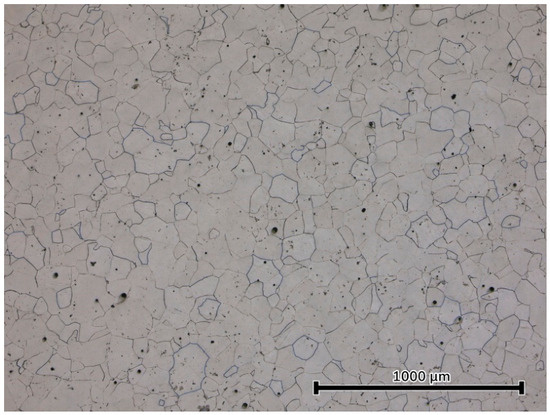
For microstructural characterization, a specimen was polished with 1 µm alumina and etched for 5 s in a 5% nital solution. Optical microscopy was performed using a Zeiss Axio Observer optical microscope (Carl Zeiss AG, Jena, Germany). This revealed a completely ferritic microstructure with average grain size of 85 µm (ASTM E112-12 [27]), shown below in Figure 5.
Figure 5.
Optical micrograph of commercially pure iron.
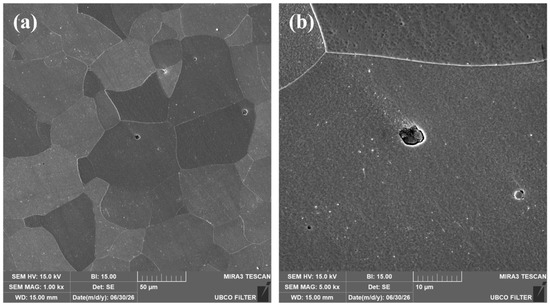
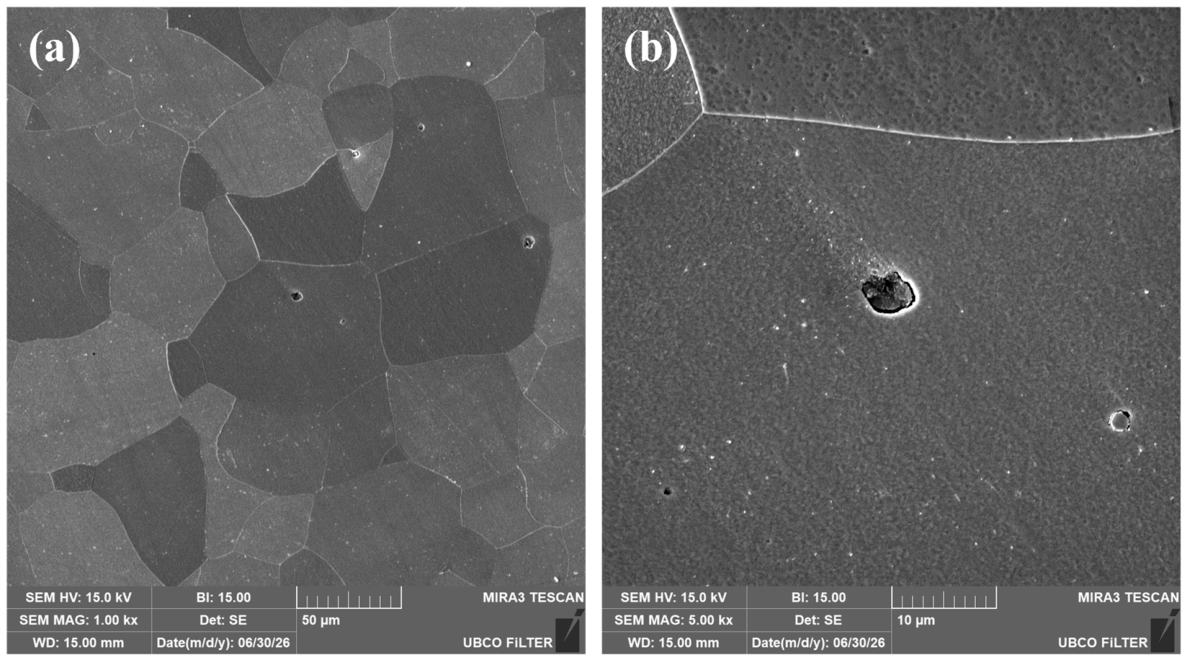
Small dark features were observed throughout the ferritic matrix. Scanning electron microscopy was performed using a Tescan Mira 3 XMU (Brno, Czech Republic). Based on their morphology in optical microscopy and scanning electron microscopy (Figure 6), these features are interpreted as non-metallic inclusions, likely introduced during material processing or casting. The relatively high aluminum content of the material suggests that alumina-based inclusions may be present. However, compositional confirmation through EDS was not performed.
Figure 6.
Scanning electron micrographs of commercially pure iron. (a) 1000× magnification showing pitting among ferrite grains. (b) 5000× magnification of an inclusion.
The secondary material tested was a section of API 5L X60 pipeline steel which was provided by FortisBC (Surrey, BC, Canada). This material was not used in service. Outer diameter measured 762 mm with a wall thickness of 19.1 mm. The chemical composition was measured using spark OES, with results shown in Table 1.
Table 1.
Chemical composition of X60 pipeline steel (wt.%).
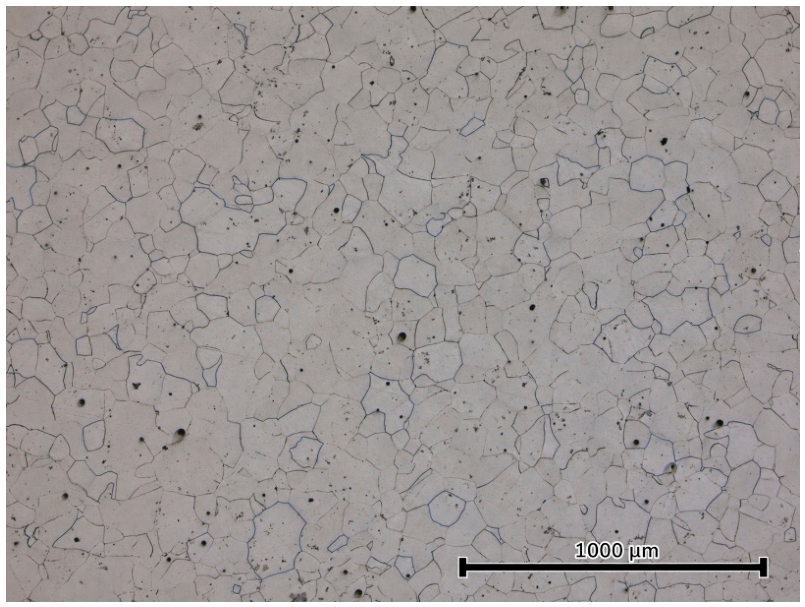
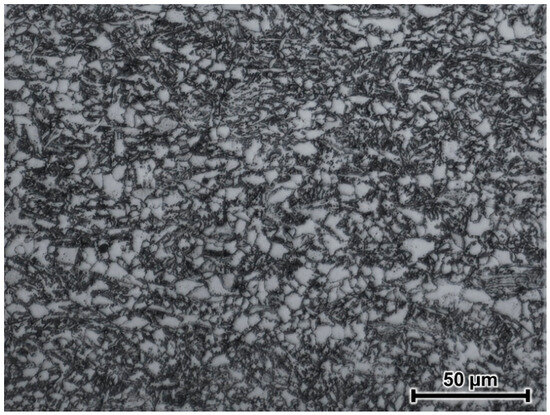
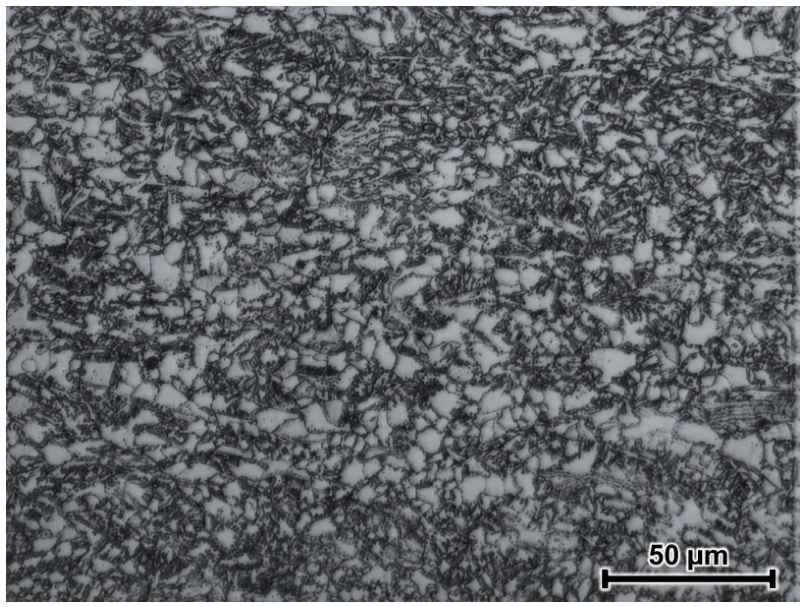
Optical microscopy revealed a ferritic–bainitic composition with an average grain size of 3.5 µm (Figure 7).
Figure 7.
Optical micrograph of API 5L X60 material tested [28].
Three iron specimens of varying thicknesses were used to assess the thickness dependence and internal consistency of the developed method under comparatively rapid permeation conditions. In contrast, a single X60 pipeline steel specimen was included as a representative engineering material case study rather than as a thickness series investigation, because its slower permeation kinetics required substantially longer testing durations for each specimen.
Circular samples with a 25 mm diameter and various thicknesses were extracted from the base materials. Pure iron samples were cut perpendicular to the longitudinal axis of the rod via wire EDM. X60 samples were cut such that the diffusion path was along the radial axis, also via wire EDM. After machining, all samples were progressively ground with SiC pads of 240, 400, 600, and 750 grit (ANSI), followed by a diamond grinding disc of P1500, and a final polishing with 1 µm alumina to a mirror-like finish. After grinding and polishing, the iron specimens measured 1.86, 1.33, and 0.85 mm thick, while the X60J specimen was 1.15 mm.
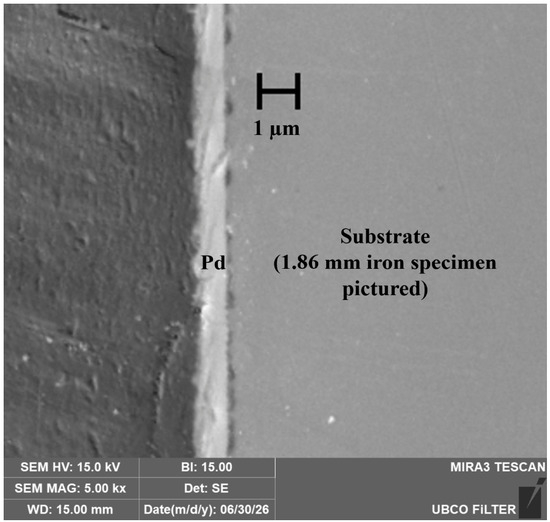
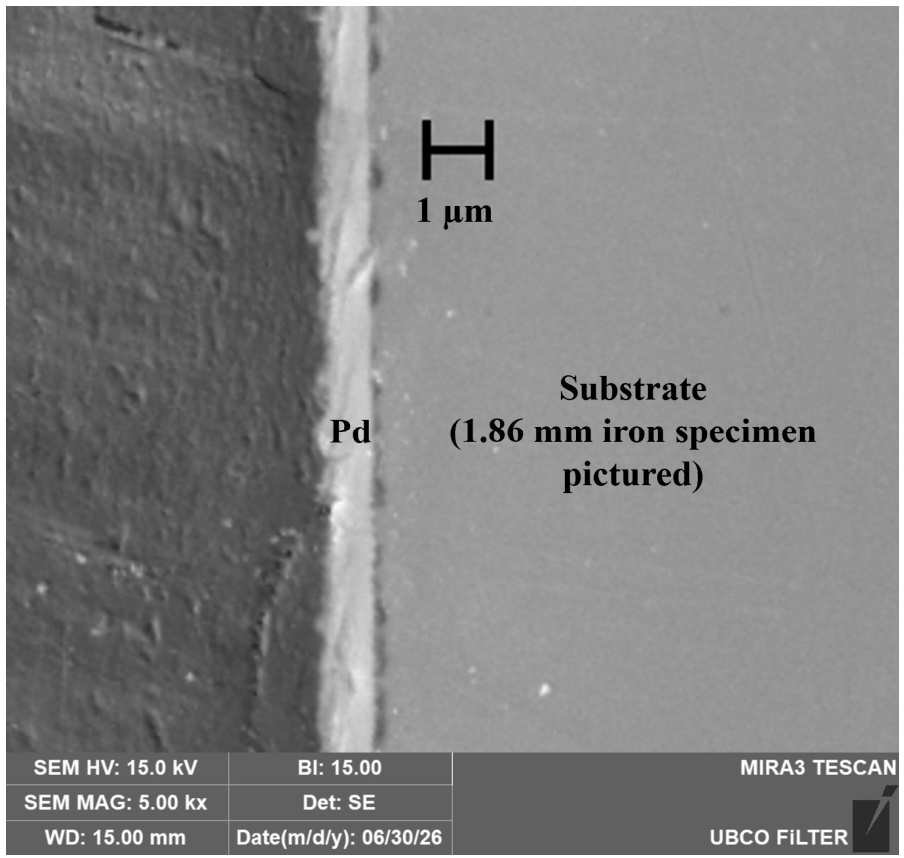
All specimens were electroplated with palladium using a commercially available solution (0.8% palladium ethylenediamine sulfate). Prior to plating, specimens were rinsed thoroughly in 0.1 M NaOH, distilled water, and pickled for 30 s in 1 M HCl. The above steps were performed to increase adhesion to the steel substrate, thus improving corrosion resistance and reduced chance of blistering, which may skew permeation results [29]. The specimens were plated in a well-stirred solution held at 50 °C for a duration of 5 min and a current density of 10 mA/cm2. Scanning electron microscopy (SEM) was used to capture cross-sectional images of the coating and identify the deposited thickness on each specimen. Figure 8 depicts an image captured of the palladium coating on the 1.86 mm iron specimen. The thickness of the palladium coating was measured in 6 locations per specimen for a total of 24 points. The thickness of the palladium across all specimens was 1.1 µm ± 0.3 µm.
Figure 8.
Cross-sectional SEM image depicting the thickness of electroplated palladium on the 1.86 mm iron specimen.
Each specimen was tested once with this palladium coating intact on both the charging and detection surfaces. These specimens are designated “DC” for double-coated. Then, the charging surface was re-ground to 600 grit as per the recommended surface finish in ASTM G148, and the test was repeated. Specimens with a re-ground (P600) charging surface are designated “SC” for single-coated. Palladium was present on the detection surface in all tests, as it has been shown to enhance repeatability of experiments and reduce background noise [10,24,30].
For gaseous charging conditions, mechanically polished and ground charging surfaces have been reported to produce similar permeation responses [31]. Under electrochemical charging, the results across literature are mixed. Peral et al. found that P600 and P2500 finishes gave comparable results, while a coarser P120 finish inhibited uptake and reduced apparent diffusivity [32]. Other electrochemical charging studies have reported stronger, but conflicting, surface finish effects, with roughened surfaces increasing uptake in some cases [33] and polished surfaces increasing uptake in others [34]. These results indicate that surface finish effects are not universal and likely depend on factors such as the charging method and material.
2.2. Setup Development: Revision 1
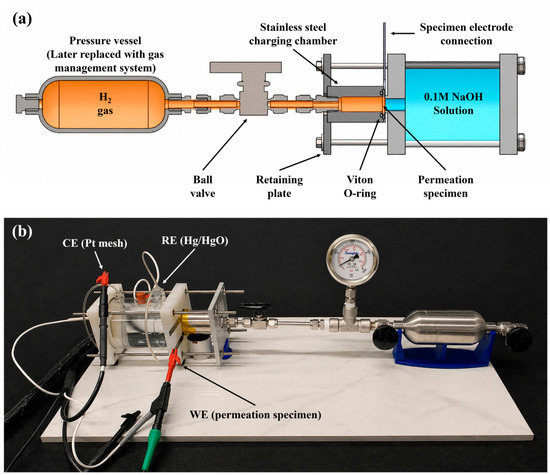
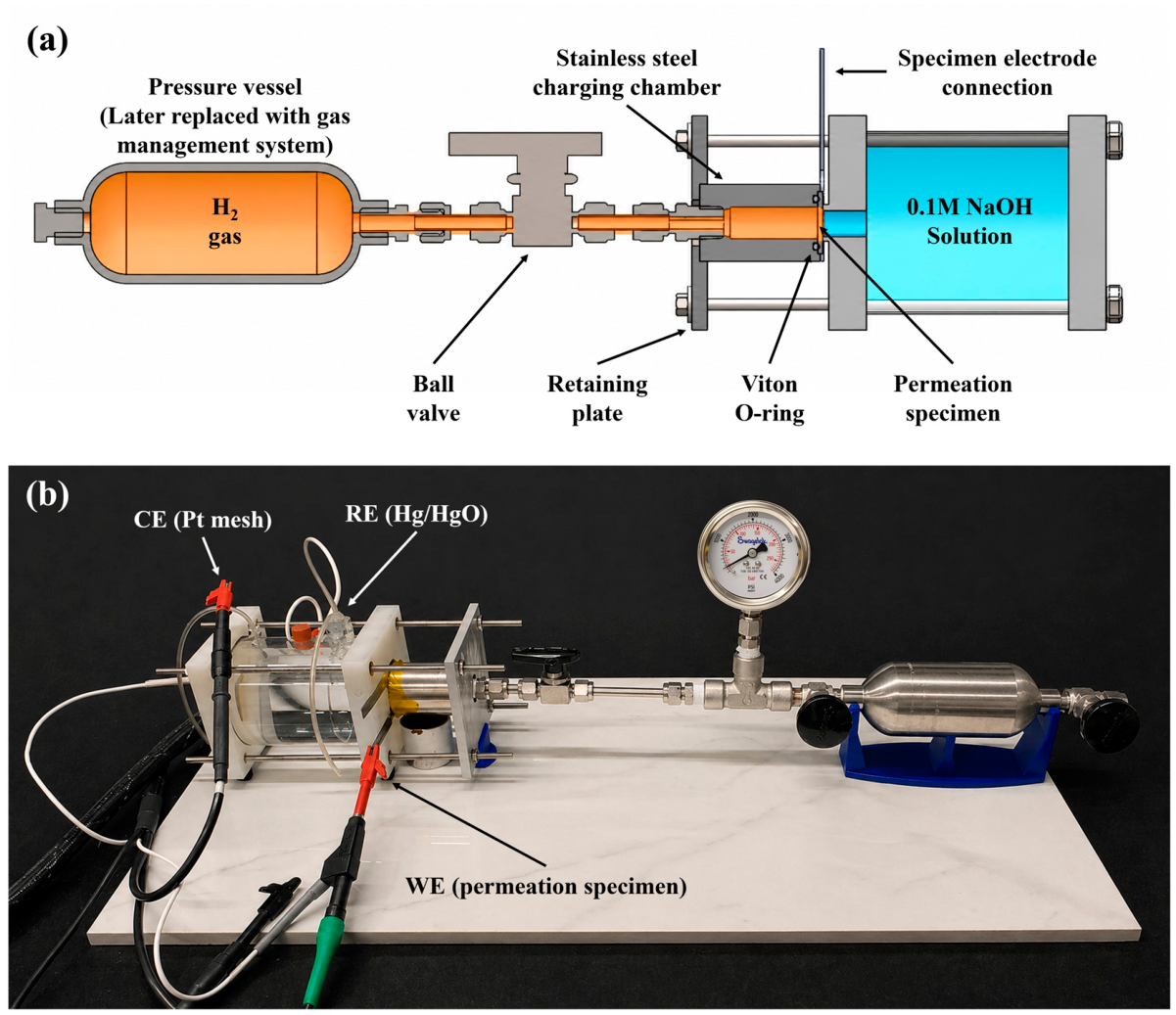
A 3-electrode electrochemical cell, originally used for corrosion studies, was adapted for gaseous hydrogen permeation testing. A charging chamber was fabricated from AISI 316 stainless steel to ensure resistance to hydrogen-assisted degradation. This was sealed against the sample with a Viton O-ring. The sample and chamber were held in place by a 6 mm aluminum backplate with clamping force applied via threaded rods. The area of the sample exposed to pressurized gas was 2.3 cm2, and the area exposed to electrolyte was 0.44 cm2. The detection side area was intentionally smaller than the charging side area to minimize edge effects and flux error arising from lateral diffusion, following the geometric analysis of Hutchings, Ferriss, and Turnbull [35]. This setup revision used a portable pressure vessel that was pre-charged with hydrogen (Grade 5 UHP, 99.999% purity) at a separate on-site facility and then transported to the electrochemical workstation. Prior to hydrogen charging, the system was evacuated and purged with nitrogen (Grade 5 UHP, 99.999% purity). A cross-sectional render of the first revision hydrogen permeation setup is shown below in Figure 9a, and a photo in Figure 9b.
Figure 9.
(a) Section view of the first revision permeation test setup, showing the pressure vessel, sealing mechanisms, and wetted regions. (b) Photo of the first revision permeation test setup. Working (WE), reference (RE), and counter (CE) electrodes are indicated.
2.3. Setup Development: Revision 2
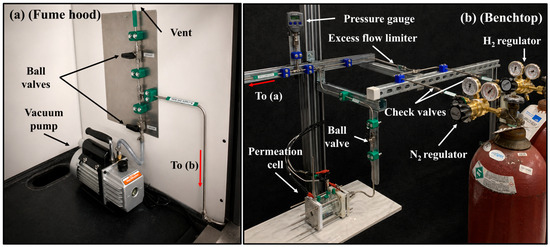
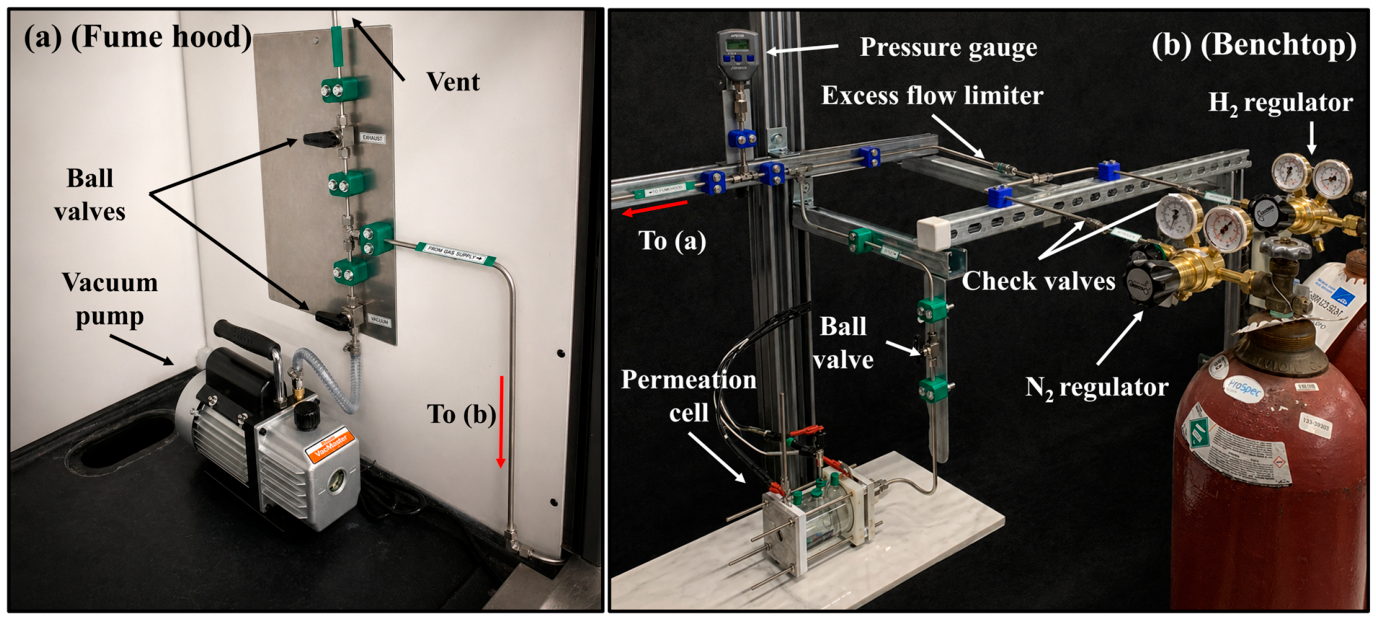
A dedicated gas management system was constructed to enable precision pressure control during permeation testing. This system enabled the use of incremental pressure steps (e.g., 1 to 2 MPa), thereby mitigating the effects of trapping on the apparent diffusion rate (discussed in Section 2.5). A photo of the gas management system is shown in Figure 10, with vacuum and purging functionality detailed in Figure 10a, and integration of the benchtop permeation cell in Figure 10b.
Figure 10.
Second-revision permeation setup and gas management system (GMS). (a) Vacuum pump and exhaust located in fume hood. (b) Benchtop integration of the GMS and permeation cell.
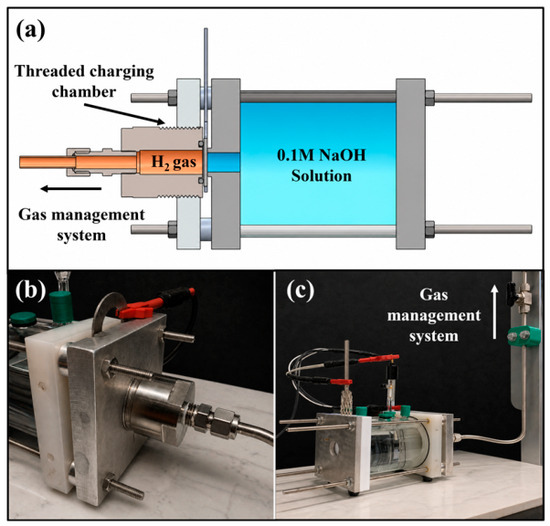
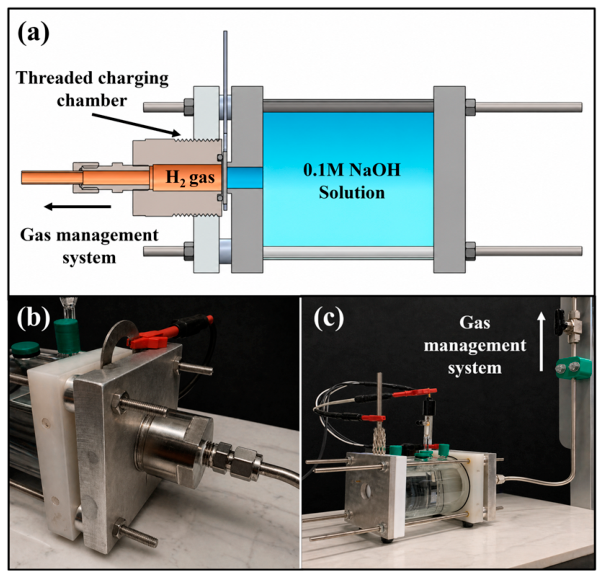
The charging chamber retention mechanism was also improved in this revision. As shown in the cross-sectional view in Figure 11a, the external threaded rods were replaced with a single M30 external thread machined directly into the charging chamber and the aluminum retention plate. This change simplified assembly and improved reliability of the gas sealing. Figure 11b shows the revised retention mechanism, while Figure 11c shows the fully assembled apparatus. Using the gas management system, transients were collected in a pressure sequence of 0 MPa, 2 MPa, 1 MPa, 2 MPa, 0 MPa for each experiment.
Figure 11.
(a) Section view of the second-revision permeation test setup, showing the threaded charging chamber and retention plate. (b) Photo of the charging chamber retention mechanism. (c) Photo of the second-revision test setup.
2.4. Detection Cell
The detection cell was filled with 0.1 M NaOH electrolyte, which was exposed to a 0.44 cm2 area on the test specimen. The electrolyte was purged with nitrogen gas (99.999% purity) for 1 h prior to each test to deoxygenate the solution. Afterward, the cell was sealed with airtight caps, seen in Figure 11c. Electrochemical detection was performed using a PARSTAT 4000 potentiostat (Princeton Applied Research, Oak Ridge, TN, USA), which applied a +0.3 V polarization vs. a mercury oxide reference electrode (Hg/HgO, 1 M KOH). This reference electrode was employed for its stability when used in alkaline environments [36]. Oxidation current was recorded in real time through the accompanying software (VersaStudio 2.66.2.0).
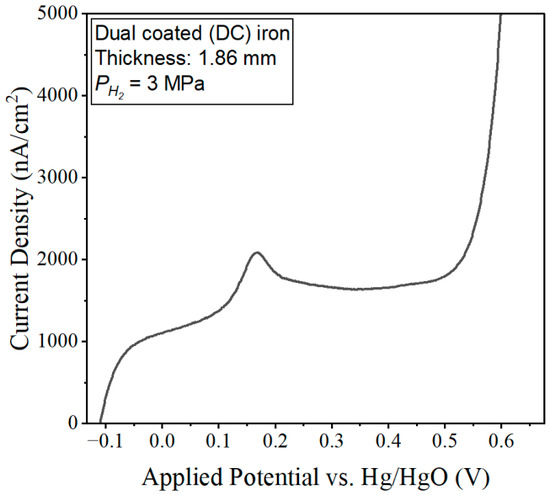
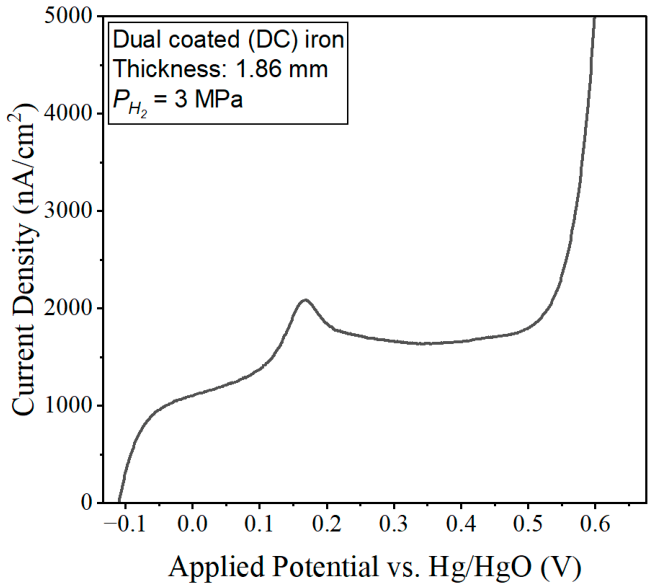
The applied anodic (oxidative) potential to the working electrode (WE) must be sufficiently high as to completely oxidize hydrogen as it permeates [3,7,37]. ASTM G148 recommends a potential of +0.3 V vs. a saturated calomel electrode (SCE), with the stipulation that the potential must be sufficiently high to ensure that mass transport through the sample is the rate-limiting step [7]. The value of this potential depends on the surface condition, with palladium shown to lower the required oxidative potential [7,20]. To determine the appropriate potential, a potentiodynamic sweep at 0.1 mV/s from −0.1 to +0.7 V (vs. Hg/HgO) was performed. Oxidation current was recorded at a hydrogen gas pressure of 3 MPa, with an iron specimen coated with palladium on both the charging and detection surfaces to maximize the hydrogen flux. The results of this test are shown below in Figure 12.
Figure 12.
Oxidation current density vs. applied potential at 3 MPa of hydrogen charging pressure.
Vijayshankar et al. performed a similar test and observed a remarkably flat plateau in oxidation current from +0.2 V to +0.7 V (vs. Ag/AgCl) on a section of palladium foil [20]. Similar current vs. potential profiles have been observed in nickel plated and bare polished iron [24,32]. The results of this test show a plateau in current between +0.3 V and +0.5 V (vs. Hg/HgO), followed by a dramatic increase at higher potentials, indicating oxidation of the palladium coating. An appropriate polarization was selected at +0.3 V vs. Hg/HgO because it achieves near-complete hydrogen oxidation at the detection surface according to the results of this test.
2.5. Calculation Methods
The constant concentration (CC) solutions to Fick’s second law describe the evolution of permeation current over time. The equations for a build-up and decay transient are shown in Equations (1) and (2) respectively. The underlying assumptions are a constant subsurface concentration (Cx=0 = C0) at the charging surface, complete hydrogen oxidation at the detection surface (Cx=L = 0), constant diffusivity (D), and that trapping does not occur in the material. This solution was described in 1966 by Mcbreen, Nanis, and Beck [38]. This solution is typically fitted to experimental data through least squares regression to determine diffusivity (Dfit)
where i = measured oxidation current density at time t, i0 = initial current density, i∞ = steady-state current density as t → ∞, L = specimen thickness, and Dfit = fitted diffusivity. Given that these equations are derived from Fick’s laws, they are often a poor fit for experimental data, which is influenced by trapping or surface effects [39,40]. Thus, this method is typically applied to transients which display near-ideal Fickian diffusion behaviour. For quantifying diffusivity of non-ideal materials, ideally a diffusion–trapping model such as that proposed by Mcnabb and Foster would be used [41]. However, such an analysis is not trivial, and the more common approach is to obtain an effective diffusivity (Deff,tL) using the lag time method. Given that different materials will possess varying magnitudes of i∞, it is convenient to normalize permeation transients to a scale from 0 to 1 according to the following equations:
Lag time, tL, is defined as the time when inorm = 0.63 (build-up transient). This is related to effective diffusivity by Equation (5).
Calculation of subsurface hydrogen concentration, C0, is achieved through Fick’s first law [39]. Assuming a linear internal concentration gradient of hydrogen within the metallic membrane under steady-state permeation, the apparent subsurface hydrogen concentration can be calculated as shown in Equation (6)
where F is Faraday’s constant (96,485 C/mol), and D may be either Deff or DL, the lattice diffusivity of the material. A. Turnbull in “Gaseous Hydrogen Embrittlement of Materials in Energy Technologies” [39] provides the interpretation that when using Deff, C0 is representative of the sum of lattice-dissolved hydrogen and hydrogen present in reversible trap sites at the subsurface, with the stipulation that reversible trap site occupancy fraction is very low. If using DL, Zheng et al. state that C0 represents the concentration of hydrogen in subsurface lattice sites only [42]. In this work, C0 was calculated using the experimentally estimated DL; therefore, the resulting value is interpreted as an apparent subsurface lattice concentration and does not explicitly include hydrogen associated with subsurface trapping.
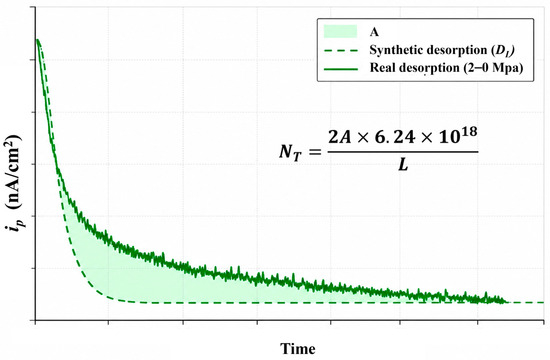
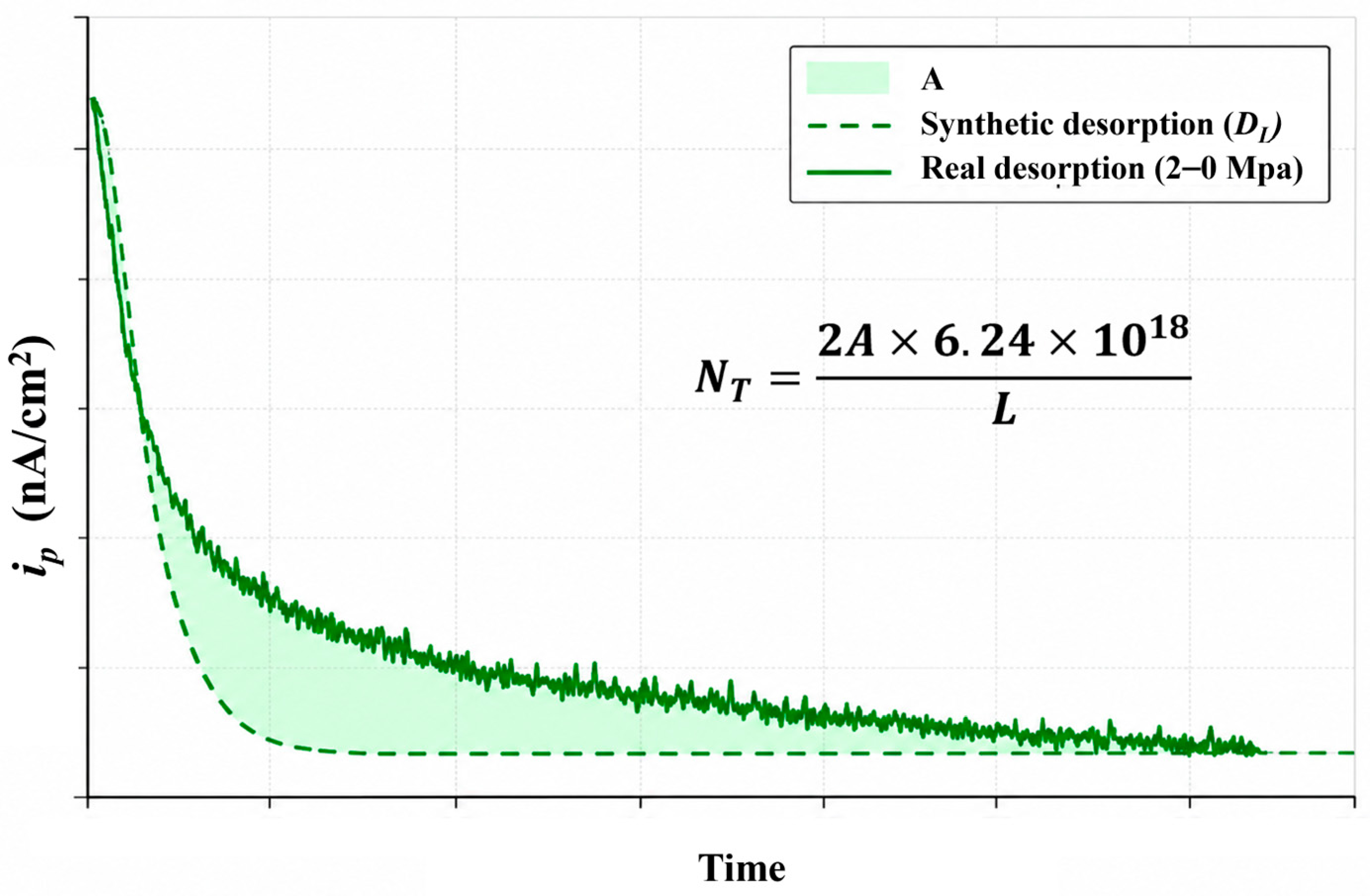
As demonstrated by Zacrocymski in 2006 [43] and replicated many times in the literature [10,11,22], reversible hydrogen trapping density may be calculated through the utilization of transients taken between intermediate charging intensities. These “partial transients” are performed by introducing charging step changes while maintaining high baseline hydrogen flux (e.g., a partial build-up transient from 1 to 2 MPa). By ensuring hydrogen traps remain saturated, partial transients offer a better estimate of lattice diffusivity, DL, rather than an effective diffusivity which is skewed by trapping effects. In contrast, full desorption transients (e.g., 2 to 0 MPa) reflect both the diffusion of hydrogen out of a charged material, as well as the hindered release of hydrogen from reversible trap sites at the given temperature. In Zacrocymski’s method, a synthetic desorption transient is generated using Equation (2) and the DL value acquired from a partial build-up transient. The difference in area (A) between the synthetic and real desorption transients is related to reversible hydrogen trap density according to Equations (7) and (8) [10]
where is the number of reversible hydrogen trap sites per cm3, assuming one hydrogen atom occupies a trapping site. This method as utilized by the referenced author requires the utilization of electrochemical charging, as upon desorption, the entry side is immediately switched to anodic polarization to act as an additional detection cell, ensuring that hydrogen desorbing from both sides of the membrane is detected. Zakroczymski found that, for Armco iron, only approximately 12% of total reversibly trapped hydrogen was recovered in the detection side permeation transient, while the remaining fraction was detected in the charging side transient. This was attributed to higher residual concentration of hydrogen near x = 0. Therefore, under gaseous charging where there is no possibility for charging side detection, trap density estimates based on this method will underestimate the absolute trapping concentrations and must be used as comparative values.
3. Results and Discussion
3.1. Full Permeation Transients: Iron
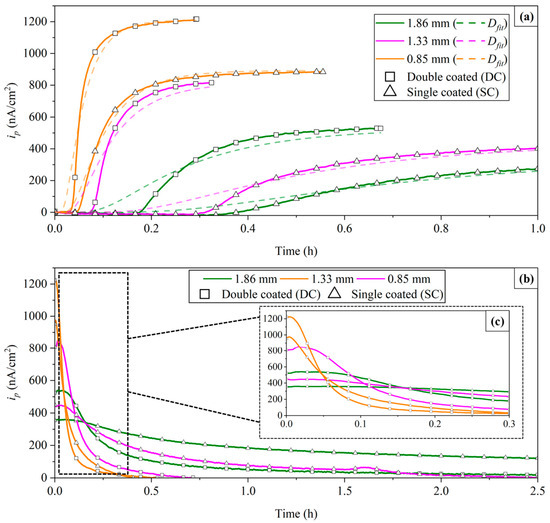
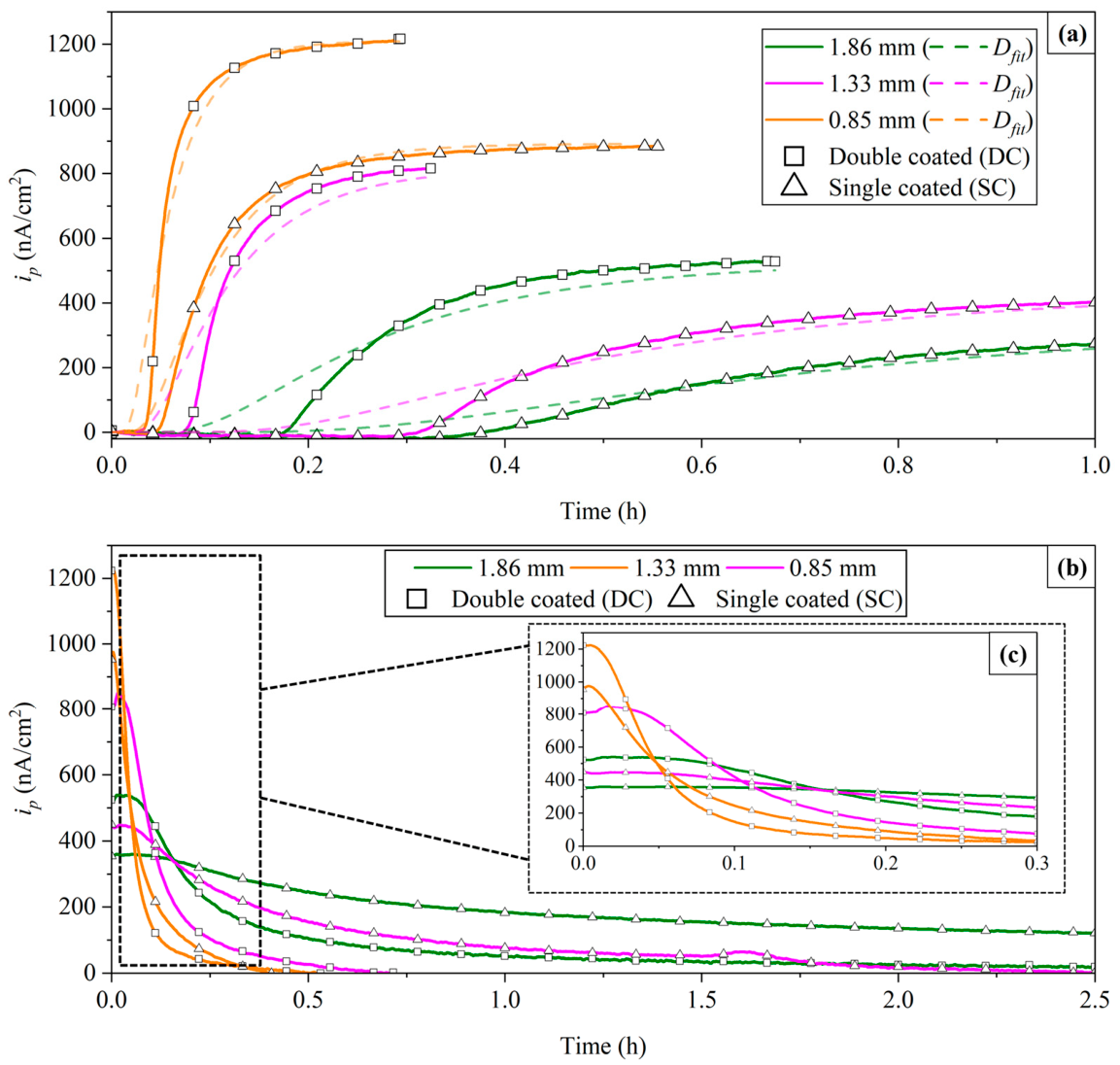
Figure 13a shows full build-up permeation transients obtained from a step change of hydrogen pressure from 0 to 2 MPa for iron specimens of varying thickness, tested with and without a palladium coating on the charging surface. The first build-up transient was excluded from analysis due to the presence of irreversible trapping effects, as evidenced by a deviation from subsequent transient behaviour [43]. Figure 13b shows the full desorption transients from 2 to 0 MPa obtained from all iron specimens, with early time response detailed in Figure 13c.
Figure 13.
(a) Full build-up permeation transients (0–2 MPa) of dual-coated (DC) and single-coated (SC) iron specimens of 1.86, 1.33, and 0.85 mm. (b) Full desorption permeation transients (2–0 MPa). (c) Zoomed view of full desorption permeation transients showing early time response.
The presence of palladium on the charging surface resulted in a reduction in breakthrough time and an increase in steady-state hydrogen flux for all specimen thicknesses. Fitting of the build-up transients using Equation (3) yielded apparent diffusivities that were 1.7–4.5 times higher for double-coated (DC) specimens than for single-coated (SC) specimens. The magnitude of this effect was not uniform with respect to thickness. The ratio of fitted diffusivity between DC and SC specimens was 2.8 for the 1.86 mm specimen, 4.5 for the 1.33 mm specimen, and 1.7 for the 0.85 mm specimen. The steady-state permeation current followed a similar trend, with DC/SC current ratios of 1.5, 1.8, and 1.4 for the 1.86, 1.33, and 0.85 mm specimens, respectively. The statistical significance of this trend is uncertain, as only one full-rise transient was performed for each specimen condition. Therefore, there was no clear correlation observed between the relative influence of the charging side palladium coating and specimen thickness. The effect of increasing effective diffusivity was also observed in full desorption transients (Figure 13b), where DC specimens displayed a faster settling time to 0 nA/cm2 of permeation current ip. The results are summarized in Table 2, including Dfit from both build-up and desorption transients (Equation (1) and Equation (2) respectively), Deff,tL (Equation (5)), and the magnitude of steady-state permeation current (i∞ − i0).
Table 2.
Results from iron full permeation transients (0–2 MPa).
The diffusivities obtained from these full transients are not representative of true lattice diffusivity. The extracted values show poor agreement with literature values for palladium-coated iron under gaseous charging conditions. For example in a gaseous-charged study, Bruzzoni et al. reported diffusivities on the order of 10−9 m2/s for palladium-coated iron [44], which is significantly higher than the values obtained in this study. Similarly, early work in electrochemical charging by Devanathan and Stachurski also reported diffusivity on the order of m2/s [37]. These discrepancies indicate that the measured diffusivity from full transients is influenced by non-ideal effects, including trapping and surface boundary conditions.
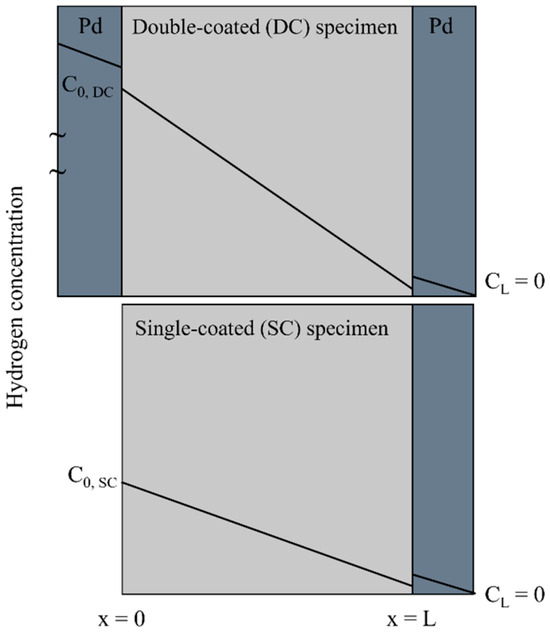
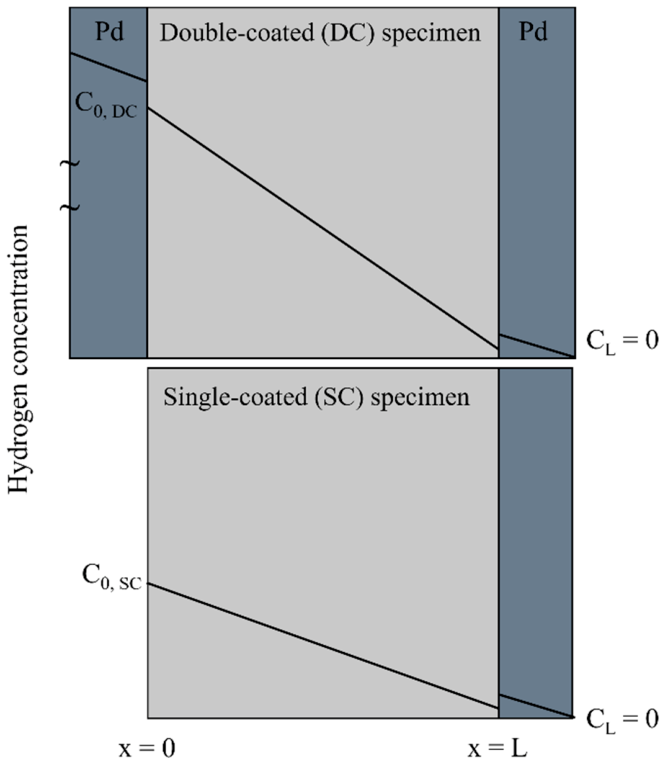
The observed increase in steady-state flux with palladium coating is consistent with the expected behaviour of a palladium–iron system. The steady-state concentration profile of hydrogen within a DC and SC specimen is illustrated in Figure 14.
Figure 14.
Steady-state hydrogen concentration profile for DC and SC specimens.
Palladium coatings applied to the charging surface fundamentally alter the boundary condition governing hydrogen entry. Palladium readily dissociates molecular hydrogen and forms a hydride phase (PdHx), enabling rapid equilibration between gaseous hydrogen and absorbed atomic hydrogen at the surface. Additionally, the presence of palladium inhibits the growth of oxides on the entry surface which would impede hydrogen entry.
The net effect is an apparent increase in measured diffusivity, reflecting the rapid establishment of C0, along with an increase in steady-state flux due to the higher subsurface hydrogen concentration sustained at the interface. Under these conditions, hydrogen transport becomes more limited by bulk diffusion, whereas uncoated surfaces exhibit surface-limited or mixed-control behaviour. This observation aligns with results of Kumnick and Johnson, who demonstrated that palladium coatings under gaseous charging conditions eliminate surface-controlled transport limitations [26]. Conversely, in electrochemical charging conditions, Zakroczymski and Szklarska-Smialowska reported that palladium coatings reduced apparent diffusivity [25]. The present results support the interpretation that under gaseous charging conditions, uncoated specimens are subject to surface impedance effects that suppress apparent diffusivity.
3.2. Full Permeation Transients: X60
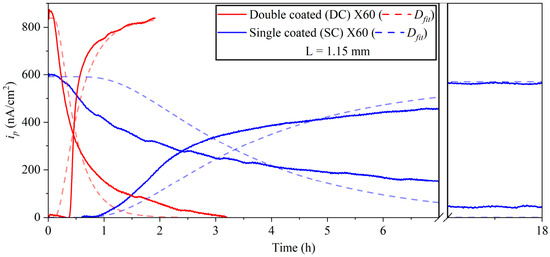
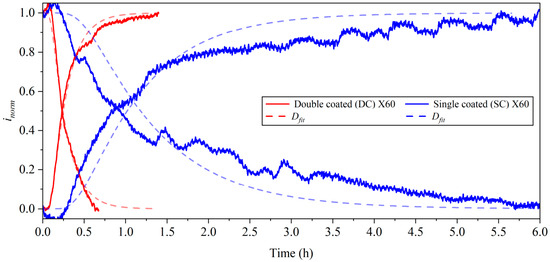
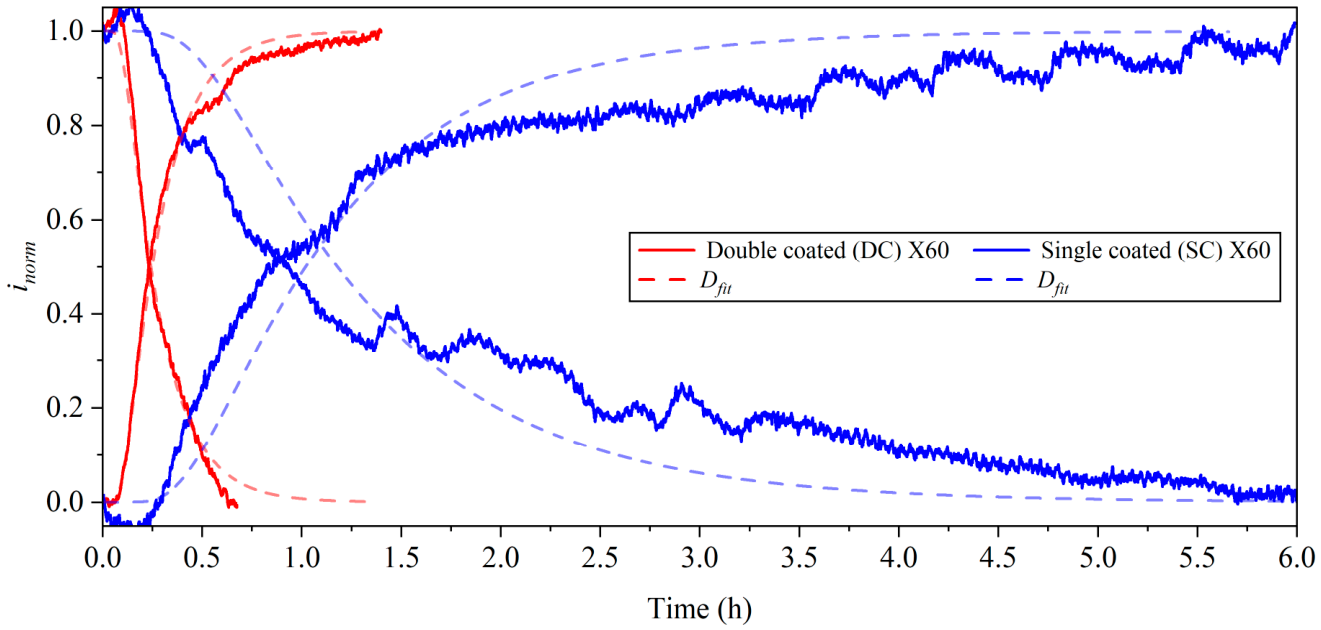
Figure 15 shows full build-up and desorption transients obtained from X60 pipeline steel specimens (thickness = 1.15 mm). The results are summarized in Table 3. Compared to iron, X60 exhibits significantly stronger deviation from ideal Fickian behaviour. The addition of a palladium coating to the charging side (DC specimens) increased the apparent diffusivity by nearly an order of magnitude for both build-up and decay transients.
Figure 15.
Full build-up (0–2 MPa) and full desorption (2–0 MPa) permeation transients of DC and SC X60 specimens (thickness = 1.15 mm).
Table 3.
Results from X60 full permeation transients (0–2 MPa).
The goodness of fit (R2) to Equations (1) and (2) remains poor for both DC and SC specimens. This behaviour is attributed to reversible trapping, which is expected to be more pronounced in X60 than in iron due to its more complex microstructure, including smaller grains, elevated GND density, and the presence of ferrite–pearlite phase boundaries [28]. During build-up transients, delayed breakthrough is observed, consistent with hydrogen being temporarily immobilized at trapping sites prior to saturation. Similarly, desorption transients are disproportionately extended due to the gradual release of hydrogen from these traps. The resulting diffusivity is therefore an apparent transport parameter rather than an intrinsic material constant, as it depends on microstructure, specimen condition, and experimental boundary conditions.
The reduction in breakthrough time and increase in steady-state flux seen in DC specimens suggests that, like seen in iron specimens (3.1), hydrogen entry kinetics at the charging surface play a significant role in governing the overall permeation response. The results are consistent with DC specimens exhibiting a transport response that is less surface-influenced and more diffusion-dominated than that of SC specimens. The diffusivity of double-coated X60 specimens (1.0–1.2 × 10⁻¹⁰ m2/s) is in reasonable agreement with the literature. Koren et al. reported diffusivities on the order of 1.5 × 10⁻¹⁰ m2/s for X65 pipeline steel under similar conditions [11].
3.3. Partial Permeation Transients: Iron
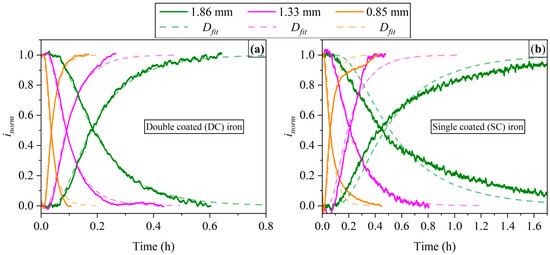
To isolate lattice diffusion behaviour, partial permeation transients were collected between 1 and 2 MPa (build-up) and 2 and 1 MPa (desorption). The resulting transients for iron specimens are shown in Figure 16a (DC specimens) and Figure 16b (SC specimens). Partial transients are expected to reduce the influence of trapping by maintaining a non-zero baseline hydrogen concentration, ensuring that reversible trapping sites remain largely occupied [43].
Figure 16.
Partial build-up (1–2 MPa) and desorption (2–1 MPa) transients) of DC iron specimens (a) and SC iron specimens (b).
A high degree of symmetry was observed between the build-up and desorption transients of both DC and SC specimens, with near-identical fitted diffusivity and lag time values. This symmetry indicates that the system response is dominated by lattice diffusion, with minimal distortion from trapping effects. In trap-influenced transients, delayed hydrogen release from reversible trap sites would be expected to lengthen the desorption response and produce a lower apparent diffusivity relative to the corresponding build-up transient. As such, diffusivity values were averaged between build-up and desorption transients and are reported as lattice diffusivity, DL, in Table 4. The uncertainty from this averaging is reported in Table 4.
Table 4.
Results from iron partial permeation transients (1–2 MPa).
3.4. Partial Permeation Transients: X60
Partial permeation transients for X60 are shown in Figure 17, with results summarized in Table 5. As observed for the iron specimens, the DC X60 specimen exhibited higher fitted diffusivity than the corresponding SC specimen. The partial build-up and desorption transients were obtained from pressure steps between 1 and 2 MPa and used to estimate DL. The DC specimen showed strong agreement between build-up and desorption, indicating a primarily diffusion-dominated response under these conditions.
Figure 17.
Partial build-up (1–2 MPa) and desorption (2–1 MPa) transients of DC and SC X60 specimens.
Table 5.
Results from X60 partial permeation transients (0–2 MPa).
The SC specimen showed greater asymmetry, with fitted diffusivities of 5.0 × 10⁻¹¹ m2/s for build-up, compared with 4.3 × 10⁻¹¹ m2/s for desorption. This suggests that the SC response may not be fully diffusion-dominated, and that de-trapping effects may contribute to the lower fitted diffusivity obtained from the desorption transient. This highlights a possible limitation of using partial permeation transients from 1 to 2 MPa to mitigate trapping effects in complex, high-trapping materials such as X60 pipeline steel.
3.5. Diffusivity vs. Thickness
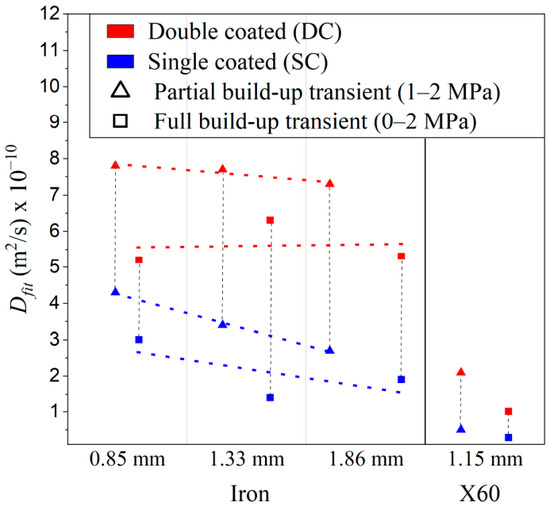
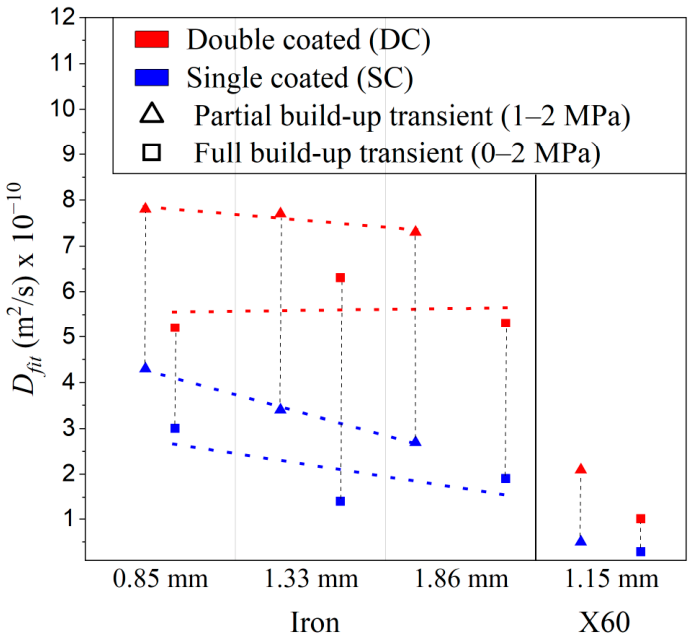
Figure 18 summarizes the values of Dfit from all specimens (SC and DC) obtained full and partial build-up transients.
Figure 18.
Dfit vs. thickness for all specimens. The effect of palladium-coated charging surfaces on the fitted diffusivity is indicated by vertical dotted lines.
Across all iron specimens, Pd-coated charging surfaces (DC) produced consistently higher measured diffusivities than ground steel charging surfaces (SC), indicating that the Pd layer reduced the kinetic impedance associated with hydrogen uptake and promoted more diffusion-controlled transport. Partial build-up transients also yielded higher diffusivity values than the corresponding full build-up transients for both DC and SC conditions, consistent with the intended effect of maintaining a non-zero hydrogen pressure baseline to reduce the influence of reversible trap filling during the transient. For the iron specimens, DC partial build-up diffusivities were the highest and showed comparatively little variation with thickness, clustering near 7.3–7.8 × 10⁻¹⁰ m2/s. In contrast, SC specimens showed lower diffusivities and a stronger apparent thickness dependence, particularly for full build-up transients, suggesting that surface-limited uptake and/or trapping effects remained more influential without the Pd coated charging surface.
For most conditions, thinner specimens exhibited higher apparent diffusivity. This thickness dependence may be related to the higher permeation flux achieved in thinner specimens, consistent with Koren’s reported positive correlation between ip and D (Figure 4). Higher current density may promote faster saturation of reversible trapping sites, thereby reducing trap-related delays during the transient and increasing the fitted apparent diffusivity.
An exception was observed for the DC iron specimens, which showed a marginal increase in Dfit with increasing specimen thickness. The statistical significance of this behaviour is unclear and cannot be assigned to a specific mechanism based on the present data. Therefore, this observation is not used as a basis for further interpretation. The X60 specimen exhibited substantially lower diffusivity than iron under all comparable conditions, consistent with a material with lower diffusivity and greater hydrogen trapping.
3.6. Subsurface Concentration
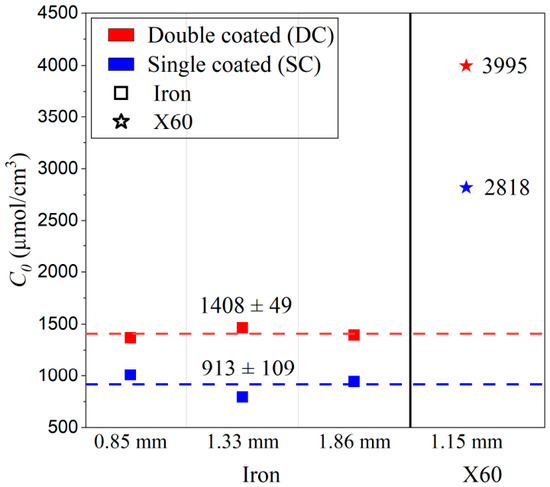
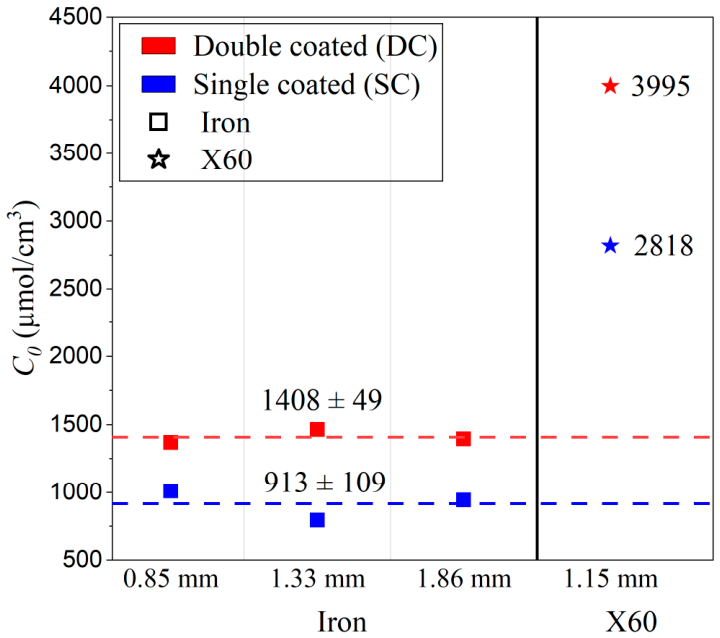
To evaluate the effect of palladium coatings on hydrogen uptake, subsurface concentration (C0) was calculated according to Equation (6), with the steady-state permeation current (i∞ − i0) obtained from a full build-up transient at 300 psi (Table 3). The value of D used in Equation (6) was DL, obtained from a partial build-up transient and DC specimen (Table 4 and Table 5). Thus, the value of C0 acquired is an estimate of lattice-dissolved hydrogen at equilibrium with 300 psi of hydrogen charging pressure [40]. The results are summarized in Figure 19. C0 was found to be independent of specimen thickness, with palladium-coated charging surfaces increasing the mean from 913 to 1408 µmol/cm3 in iron specimens.
Figure 19.
Subsurface concentration of all specimens at 2 MPa of hydrogen pressure. Horizontal dashed lines indicate the average C0 obtained across three iron specimens of varying thickness.
3.7. Trapping Quantification
Using the lattice diffusivity obtained from partial transients, synthetic desorption curves were generated using Equation (2) and compared to experimentally measured full desorption transients (Figure 20).
Figure 20.
Graphical representation of reversible trap site density (NT) calculation.
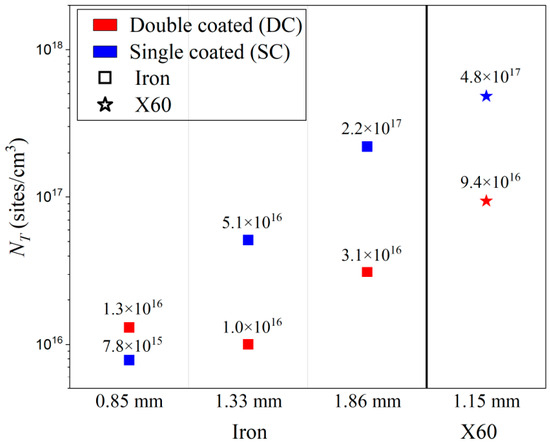
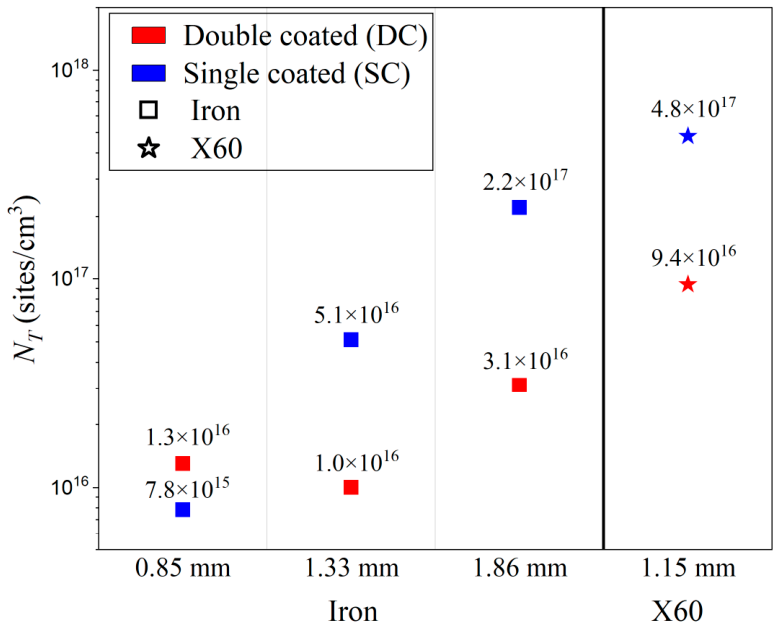
The quantity of reversible trapping sites per unit volume, NT, was calculated according to Equation (8), with the results for all specimens summarized in Figure 21. DC iron specimens exhibited relatively consistent NT across all thicknesses, with a variance of 2.1 × 10¹⁶ sites/cm3 and a maximum-to-minimum difference of 3.1-fold. In contrast, SC specimens showed a stronger thickness dependence, with a variance of 2.1 × 10¹⁷ sites/cm3 and a maximum-to-minimum difference of 28.2-fold. Both DC and SC X60 show a higher trap density than iron. This is to be expected given the smaller grain size and presence of bainite within the X60, both of which are known to increase trapping relative to pure ferrite [2]. The microstructural inclusions identified in Figure 6 are expected to act as trapping sites within the iron specimens, contributing to the magnitudes presented.
Figure 21.
NT vs. thickness for all specimens tested.
SC iron specimens display a strong linear relationship of increasing NT with respect to thickness. This trend contrasts with results reported by Latypova et al. [10], who observed decreasing trap density estimates with increasing thickness in martensitic stainless steel under electrochemical charging. One possible explanation is the difference in surface chemistry between the two material systems. Stainless steels form comparatively stable chromium oxide surface films, which may act as near-surface trapping regions or hydrogen entry barriers. As specimen thickness decreases, the relative contribution of this surface-affected region to the overall permeation response becomes more significant, potentially producing higher apparent NT values in thinner specimens. This effect is less likely to dominate in iron, which forms a comparatively less protective oxide layer.
In the present SC iron specimens, the increasing apparent NT with thickness may instead reflect the combined effects of lower effective hydrogen flux and increased bulk trapping capacity in thicker specimens. These factors would suppress the effective diffusivity obtained from full permeation transients (Figure 19), and thereby increase the calculated NT. In contrast, DC iron specimens showed a much weaker dependence of NT on thickness, although true thickness independence cannot be confirmed from the present dataset.
A notable limitation of the presented method for trap site density quantification is that hydrogen egress is captured only at the exit surface of the specimen. In their original study on the topic, Zakroczymski was able to detect hydrogen egress from the charging surface in addition to the detection surface due to their use of both electrochemical charging and detection. They found a bulk of the hydrogen to desorb from the entry surface, which remains undetected in this method with gaseous charging [43]. Thus, it can be assumed that the method presented is under-representing the density of reversible trap sites within the material. Nonetheless, this technique allowed for quantification of the relative trapping densities of iron and X60 pipeline steel.
3.8. Validation of Fickian Behaviour
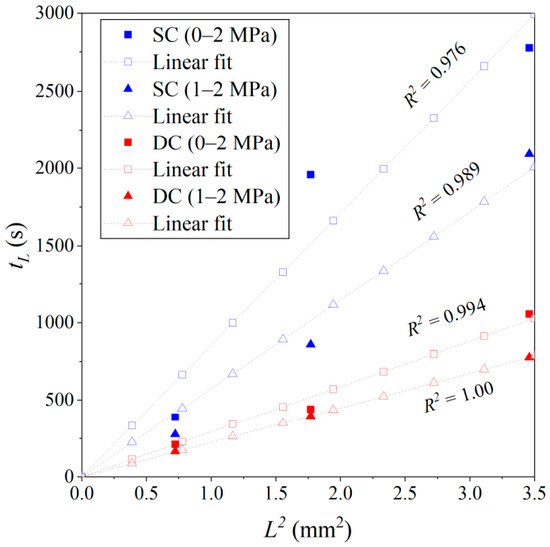
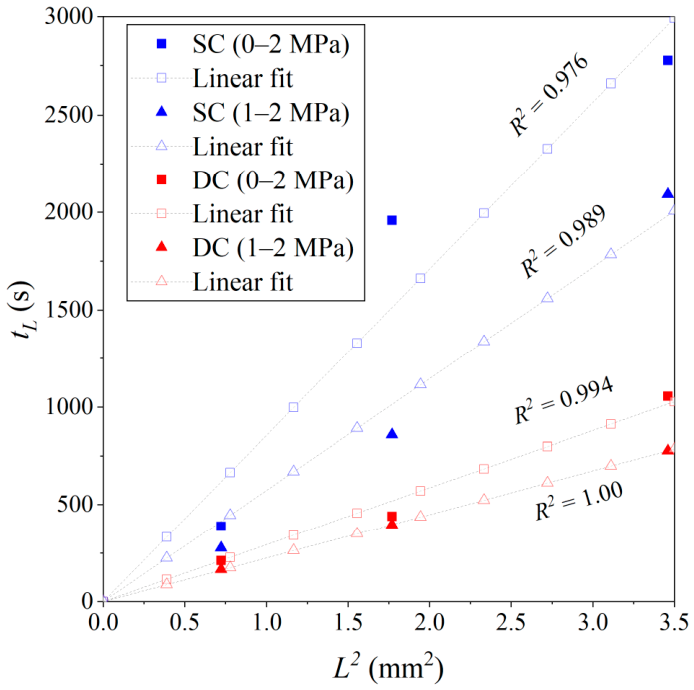
To evaluate the consistency of the measured diffusivity with Fick’s laws, lag time (tL) was plotted as a function of squared thickness (L2). According to Equation (5), a linear relationship passing through the origin is expected for diffusion-controlled transport [37]. This relationship is shown in Figure 22, along with R2 for each linear fit.
Figure 22.
Lag time vs. squared thickness of iron specimens with and without Pd coated charging surfaces. A good linear fit indicates agreement with Fick’s laws of diffusion.
It is shown that DC iron specimens combined with partial transients (1–2 MPa) produce the strongest linear fit (R2 = 1.00). SC specimens combined with full transient analysis show the weakest linear fit (R2 = 0.976), further confirming the influence of non-ideal surface conditions and trapping effects, which cause deviation from ideal behaviour.
4. Conclusions
Collectively, this work demonstrates the feasibility of using gaseous hydrogen permeation experiments to quantify hydrogen diffusivity and trapping. More importantly, the results show that the obtained diffusivity is strongly dependant on the charging side boundary conditions and pressure transient type (full vs. partial) and therefore cannot be interpreted as an intrinsic material property unless these effects are carefully controlled. Neglecting the influence of hydrogen uptake kinetics can lead to artificially suppressed diffusivity values, inconsistent trapping estimates, and misleading comparisons between materials. The presented approach provides a foundation for consistent and physically representative measurement of hydrogen permeation in materials under gaseous, lattice-diffusion-dominant conditions, and establishes a framework for future studies aimed at linking diffusion behaviour to hydrogen embrittlement susceptibility.
Key findings are summarized as follows:
- Charging side palladium coating is strongly recommended under gaseous charging conditions when the objective is to establish lattice-diffusion-dominated mass transport and improve agreement with Fickian diffusion behaviour.Palladium coatings promote hydrogen entry by accelerating molecular hydrogen dissociation and surface equilibration, thereby reducing non-ideal boundary effects at the gas metal interface. In iron specimens, palladium-coated charging surfaces increased the measured diffusivity and improved consistency in diffusivity and trap-site density calculations across different specimen thicknesses.
- Partial pressure step transients provide an improved basis for estimating lattice-dominated diffusivity by reducing the influence of reversible trap filling.Diffusivity values obtained from partial transients were consistently higher and more self-consistent than those obtained from full-range transients, indicating that maintaining a non-zero baseline pressure maintains trap occupancy and reduces trapping-related suppression of the measured diffusivity.
- The combined use of palladium-coated charging surfaces and partial pressure step transients provided the most ideal diffusion-controlled response.This combined approach produced improved agreement with Fickian behaviour, demonstrating that both the surface boundary condition and the internal trap state must be controlled to obtain physically meaningful diffusivity values. While this approach produced near-ideal behaviour in iron, X60 pipeline steel retained residual non-ideal behaviour attributed to reversible trapping in its more complex microstructure.
Author Contributions
Conceptualization, M.S., R.W., M.C.H. and D.S.; methodology, M.S., R.W., M.C.H. and D.S.; software, M.S.; validation, M.S., R.W. and D.S.; formal analysis, M.S., R.W. and D.S.; investigation, M.S., R.W., M.C.H. and D.S.; resources, M.S., R.W., M.C.H. and D.S.; data curation, M.S.; writing—original draft preparation, M.S.; writing—review and editing, M.S., R.W. and D.S.; visualization, M.S.; supervision, R.W. and D.S.; project administration, R.W. and D.S.; funding acquisition, R.W. and D.S. All authors have read and agreed to the published version of the manuscript.
Funding
This work was supported by the FortisBC Clean Growth Innovation Fund (CGIF); Mitacs Accelerate, IT48953, “Advanced Assessment of Hydrogen Embrittlement in the Pipeline Steels and Welded Joints Used for H2 and HENG Transmission and Distribution”; and the Natural Sciences and Engineering Research Council of Canada (NSERC) Discovery Grant, RGPIN-2025-05302, “The Development of Sustainable Metallic and Composite Materials for Next Generation High-Efficiency Automotive Powertrains.”
Data Availability Statement
The original contributions presented in the study are included in the article. Further inquiries can be directed to the corresponding authors.
Acknowledgments
We acknowledge FortisBC for providing financial support and the pipeline materials required to conduct this study. The authors are grateful to Jamie King for his role as project lead and curator at FortisBC, as well as John Quinn, Vincent Chou, and Kim Walker, for their technical expertise and guidance. The authors further thank Lukas Bichler of UBC Okanagan for providing access to the spark OES, potentiostat, and electrochemical cell and Kyle Lessoway and Jade Matthews for technical assistance. The authors declare the usage of generative artificial intelligence tools for the purposes of text editing, grammar correction, and photo editing for figure creation.
Conflicts of Interest
The authors declare no conflicts of interest. The funders had no role in the design of the study; in the collection, analyses, or interpretation of data; in the writing of the manuscript; or in the decision to publish the results.
References
- Erdener, B.C.; Sergi, B.; Guerra, O.J.; Lazaro Chueca, A.; Pambour, K.; Brancucci, C.; Hodge, B.-M. A review of technical and regulatory limits for hydrogen blending in natural gas pipelines. Int. J. Hydrogen Energy 2023, 48, 5595–5617. [Google Scholar] [CrossRef] [Scilit]
- Islam, A.; Li, Q.; Storimans, E.; Ton, K.; Alam, T.; Farhat, Z.N. Effect of microstructure on hydrogen permeation and trapping in natural gas pipeline steels. npj Mater. Degrad. 2025, 9, 70. [Google Scholar] [CrossRef] [Scilit] [PubMed]
- Li, Q.; Ghadiani, H.; Jalilvand, V.; Alam, T.; Farhat, Z.; Islam, M. Hydrogen Impact: A Review on Diffusibility, Embrittlement Mechanisms, and Characterization. Materials 2024, 17, 965. [Google Scholar] [CrossRef] [Scilit] [PubMed]
- Xu, X.; Zhang, R.; Wang, C.; Liu, C.; Zhang, J.; Li, Y. Experimental study on the temperature dependence of gaseous hydrogen permeation and hydrogen embrittlement susceptibility of X52 pipeline steel. Eng. Fail. Anal. 2024, 155, 107746. [Google Scholar] [CrossRef] [Scilit]
- Song, Y.; Huang, S.; Sheng, J.; Agyenim-Boateng, E.; Jiang, Y.; Liu, Q.; Zhu, M. Improvement of hydrogen embrittlement resistance of 2205 duplex stainless steel by laser peening. Int. J. Hydrogen Energy 2023, 48, 18930–18945. [Google Scholar] [CrossRef] [Scilit]
- Devanathan, M.A.V.; Stachurski, Z. The Adsorption and Diffusion of Electrolytic Hydrogen in Palladium. In Proceedings of the Royal Society of London. Series A, Mathematical and Physical Sciences; The Royal Society: London, UK, 1962; Available online: https://www.jstor.org/stable/2416199?seq=1 (accessed on 10 January 2024).
- ASTM G148-97; Standard Practice for Evaluation of Hydrogen Uptake, Permeation, and Transport in Metals by an Electrochemical Technique. American Society for Testing Materials: West Conshohocken, PA, USA, 2018. Available online: https://store.astm.org/standards/g148 (accessed on 10 January 2024).
- Wang, C.; Zhang, J.; Liu, C.; Hu, Q.; Zhang, R.; Xu, X.; Yang, H.; Ning, Y.; Li, Y. Study on hydrogen embrittlement susceptibility of X80 steel through in-situ gaseous hydrogen permeation and slow strain rate tensile tests. Int. J. Hydrogen Energy 2023, 48, 243–256. [Google Scholar] [CrossRef] [Scilit]
- Zhang, R.; Yuan, C.; Liu, C.; Wang, C.; Xu, X.; Zhang, J.; Li, Y. Experimental and molecular dynamics study of the hydrogen embrittlement behavior of X52 steel: Analysis of abnormal hydrogen embrittlement susceptibility. Int. J. Hydrogen Energy 2024, 83, 987–1002. [Google Scholar] [CrossRef] [Scilit]
- Latypova, R.; Nyo, T.T.; Seppälä, O.; Hahtonen, K.; Hänninen, H.; Kömi, J.; Pallaspuro, S. The effect of Pd and Ni coatings on hydrogen permeation experiments of as-quenched martensitic steel. Corros. Rev. 2023, 41, 537–544. [Google Scholar] [CrossRef] [Scilit]
- Koren, E.; Yamabe, J.; Lu, X.; Hagen, C.M.H.; Wang, D.; Johnsen, R. Hydrogen diffusivity in X65 pipeline steel: Desorption and permeation studies. Int. J. Hydrogen Energy 2024, 61, 1157–1169. [Google Scholar] [CrossRef] [Scilit]
- Koren, E.; Hagen, C.M.H.; Wang, D.; Lu, X.; Johnsen, R.; Yamabe, J. Experimental comparison of gaseous and electrochemical hydrogen charging in X65 pipeline steel using the permeation technique. Corros. Sci. 2023, 215, 111025. [Google Scholar] [CrossRef] [Scilit]
- New Insights into Hydrogen Permeation in Steels: Measurements Through Thick Membranes. Available online: https://ifp.hal.science/hal-02475533v1/document (accessed on 1 March 2025).
- Jack, T.A.; Pourazizi, R.; Ohaeri, E.; Szpunar, J.; Zhang, J.; Qu, J. Investigation of the hydrogen induced cracking behaviour of API 5L X65 pipeline steel. Int. J. Hydrogen Energy 2020, 45, 17671–17684. [Google Scholar] [CrossRef] [Scilit]
- Zhou, C.; Ye, B.; Song, Y.; Cui, T.; Xu, P.; Zhang, L. Effects of internal hydrogen and surface-absorbed hydrogen on the hydrogen embrittlement of X80 pipeline steel. Int. J. Hydrogen Energy 2019, 44, 22547–22558. [Google Scholar] [CrossRef] [Scilit]
- Olden, V.; Alvaro, A.; Akselsen, O.M. Hydrogen diffusion and hydrogen influenced critical stress intensity in an API X70 pipeline steel welded joint—Experiments and FE simulations. Int. J. Hydrogen Energy 2012, 37, 11474–11486. [Google Scholar] [CrossRef] [Scilit]
- Zhao, W.; Zhang, T.; He, Z.; Sun, J.; Wang, Y. Determination of the Critical Plastic Strain-Induced Stress of X80 Steel through an Electrochemical Hydrogen Permeation Method. Electrochim. Acta 2016, 214, 336–344. [Google Scholar] [CrossRef] [Scilit]
- Xu, Z.; Zhang, P.; Meng, G.; Wang, Y.; Wang, J.; Shao, Y.; Wang, F. Influence of low tensile stress on the kinetics of hydrogen permeation and evolution behavior in alkaline environment. Int. J. Hydrogen Energy 2022, 47, 33803–33812. [Google Scholar] [CrossRef] [Scilit]
- Walallawita Kankanamge, R.W. The Development of In-Situ Testing Infrastructure and Characterization of Hydrogen Embrittlement in Pipeline Steels; University of British Columbia: Vancouver, BC, Canada, 2025. [Google Scholar] [CrossRef]
- Vijayshankar, D.; Tran, T.H.; Bashir, A.; Evers, S.; Rohwerder, M. Hydrogen Permeation as a Tool for Quantitative Characterization of Oxygen Reduction Kinetics at Buried Metal-Coating Interfaces. Electrochim. Acta 2016, 189, 111–117. [Google Scholar] [CrossRef] [Scilit]
- Study of Diffusible Behavior of Hydrogen in First Generation Advanced High Strength Steels. Available online: https://hal.science/hal-03345095v1/file/metals-11-00782-v2.pdf (accessed on 1 April 2026).
- Liu, Q.; Atrens, A. Reversible hydrogen trapping in a 3.5NiCrMoV medium strength steel. Corros. Sci. 2015, 96, 112–120. [Google Scholar] [CrossRef] [Scilit]
- Zhao, W.; Zhang, T.; Zhao, Y.; Sun, J.; Wang, Y. Hydrogen permeation and embrittlement susceptibility of X80 welded joint under high-pressure coal gas environment. Corros. Sci. 2016, 111, 84–97. [Google Scholar] [CrossRef] [Scilit]
- Ouyang, Y.J.; Yu, G.; Hu, L.; Wang, X.J.; Xu, W.J.; Zhan, Y.G.; Zhang, X.Y. Influence of Ni or Pd coatings on oxidation of permeated hydrogen. Surf. Eng. 2013, 29, 312–317. [Google Scholar] [CrossRef] [Scilit]
- Zakroczymski, T.; Szklarska-Smialowska, Z. Activation of the Iron Surface to Hydrogen Absorption Resulting from a Long Cathodic Treatment in NaOH Solution. J. Electrochem. Soc. 1985, 132, 2548–2552. [Google Scholar] [CrossRef] [Scilit]
- Kumnick, A.J.; Johnson, H.H. Steady state hydrogen transport through zone refined irons. Met. Trans. A 1975, 6, 1087–1091. [Google Scholar] [CrossRef] [Scilit]
- ASTM E112-24; Standard Test Methods for Determining Average Grain Size. American Society for Testing Materials: West Conshohocken, PA, USA, 2024. Available online: https://store.astm.org/e0112-24.html (accessed on 5 April 2026).
- Walallawita, R.; Hinchliff, M.C.; Sediako, D.; Quinn, J.; Chou, V.; Walker, K.; Hill, M. Evaluating the Effect of Blended and Pure Hydrogen in X60 Pipeline Steel for Low-Pressure Transmission Using Hollow-Specimen Slow-Strain-Rate Tensile Testing. Metals 2024, 14, 1132. [Google Scholar] [CrossRef] [Scilit]
- Manolatos, P.; Jerome, M.; Galland, J. Necessity of a palladium coating to ensure hydrogen oxidation during electrochemical permeation measurements on iron. Electrochim. Acta 1995, 40, 867–871. [Google Scholar] [CrossRef] [Scilit]
- Park, J.S.; Hwang, E.H.; Kim, S.J. Effect of thin films coated steel membrane on electrochemical hydrogen permeation measurement: Palladium vs. nickel. Int. J. Electrochem. Sci. 2023, 18, 1–5. [Google Scholar] [CrossRef] [Scilit]
- Louthan, M.R.; Derrick, R.G. Hydrogen transport in austenitic stainless steel. Corros. Sci. 1975, 15, 565–577. [Google Scholar] [CrossRef] [Scilit]
- Peral, L.B.; Díaz, A.; Alegre, J.M.; Cuesta, I.I. Hydrogen uptake and diffusion kinetics in a quenched and tempered low carbon steel: Experimental and numerical study. Int. J. Hydrogen Energy 2023, 48, 35347–35365. [Google Scholar] [CrossRef] [Scilit]
- Van Den Eeckhout, E.; Verbeken, K.; Depover, T. Methodology of the electrochemical hydrogen permeation test: A parametric evaluation. Int. J. Hydrogen Energy 2023, 48, 30585–30607. [Google Scholar] [CrossRef] [Scilit]
- Alzein, S.; Barnier, V.; Maurice, C.; Nakhoul, A.; Lenci, M.; Dreano, A.; Christien, F. Influence of mechanical roughening on hydrogen uptake, diffusion and trapping in iron-chromium alloy. Corros. Sci. 2026, 268, 113916. [Google Scholar] [CrossRef] [Scilit]
- Hutchings, R.B.; Ferriss, D.H.; Turnbull, A. Ratio of specimen thickness to charging area for reliable hydrogen permeation measurement. Br. Corros. J. 1993, 28, 309–313. [Google Scholar] [CrossRef] [Scilit]
- Kawashima, K.; Márquez, R.A.; Son, Y.J.; Guo, C.; Vaidyula, R.R.; Smith, L.A.; Chukwuneke, C.E.; Mullins, C.B. Accurate Potentials of Hg/HgO Electrodes: Practical Parameters for Reporting Alkaline Water Electrolysis Overpotentials. ACS Catal. 2023, 13, 1893–1898. [Google Scholar] [CrossRef] [Scilit]
- Devanathan, M.A.V.; Stachurski, Z. The Mechanism of Hydrogen Evolution on Iron in Acid Solutions by Determination of Permeation Rates. J. Electrochem. Soc. 1964, 111, 619. [Google Scholar] [CrossRef] [Scilit]
- McBreen, J.; Nonis, L.; Beck, W. A Method for Determination of the Permeation Rate of Hydrogen Through Metal Membranes. J. Electrochem. Soc. 1966, 113, 1218. [Google Scholar] [CrossRef] [Scilit]
- Gangloff, R.P.; Somerday, B.P. (Eds.) Mechanisms, Modelling and Future Developments; Gaseous hydrogen embrittlement of materials in energy technologies; Woodhead Pub: Cambridge, UK; Phildelphia, PA, USA, 2012. [Google Scholar]
- Griffiths, A.J.; Turnbull, A. On the effective diffusivity of hydrogen in low alloy steels. Corros. Sci. 1995, 37, 1879–1881. [Google Scholar] [CrossRef] [Scilit]
- Mcnabb, A.; Foster, P.K. A new analysis of diffusion of hydrogen in iron and ferritic steels. Trans. Metall. Soc. AIME 1963, 227, 618. [Google Scholar]
- Zheng, S.; Qin, Y.; Li, W.; Huang, F.; Qiang, Y.; Yang, S.; Wen, L.; Jin, Y. Effect of hydrogen traps on hydrogen permeation in X80 pipeline steel—A joint experimental and modelling study. Int. J. Hydrogen Energy 2023, 48, 4773–4788. [Google Scholar] [CrossRef] [Scilit]
- Zakroczymski, T. Adaptation of the electrochemical permeation technique for studying entry, transport and trapping of hydrogen in metals. Electrochim. Acta 2006, 51, 2261–2266. [Google Scholar] [CrossRef] [Scilit]
- Bruzzoni, P. Influence of palladium films on hydrogen gas entry into iron: A study by electrochemical impedance spectroscopy. Int. J. Hydrogen Energy 2000, 25, 61–65. [Google Scholar] [CrossRef] [Scilit]

Disclaimer/Publisher’s Note: The statements, opinions and data contained in all publications are solely those of the individual author(s) and contributor(s) and not of MDPI and/or the editor(s). MDPI and/or the editor(s) disclaim responsibility for any injury to people or property resulting from any ideas, methods, instructions or products referred to in the content. |
© 2026 by the authors. Licensee MDPI, Basel, Switzerland. This article is an open access article distributed under the terms and conditions of the Creative Commons Attribution (CC BY) license.