


Abstract
This paper presents a systematic parametric study of how incremental titanium additions (0.1, 0.2, and 0.3 wt.%) alter the thermal conductivity, grain morphology, hardness, and tensile behaviour of Al6061 alloy intended for electronic heat sink service. Unlike prior investigations focused primarily on the Al6063–Ti system or on ceramic-phase reinforced aluminium composites, the present work isolates the grain-refinement and intermetallic-formation pathways in the 6xxx series with lower alloying additions (≤0.3 wt.%), manufactures specimens via stir casting followed by controlled homogenisation and T6-equivalent ageing, and evaluates performance against a thermal resistance index (TRI) to enable direct cross-study comparison. Thermal conductivity measurements were conducted according to ASTM E1225 across a 27–500 °C window. The results confirm a monotonic rise in conductivity from a baseline of 181 W/mK (undoped alloy) to 221.42 W/mK at 0.2 wt.% Ti—a 22.3% improvement—driven by quantifiable grain refinement (grain size reduced from 85 μm to 48 μm) and the associated redistribution of Mg and Si solute atoms. Brinell hardness increased from 98 to 120 BHN and ultimate tensile strength climbed from 250 MPa to 285 MPa across the same composition range, confirming thermal–mechanical co-enhancement. The study defines a composition window of 0.2–0.3 wt.% Ti as optimal for heat sink grade Al6061 and provides quantitative benchmarks against published Ti-doped aluminium alloy.
1. Introduction
Power density in modern electronic systems—including data-centre processors, wide-bandgap power devices, and high-intensity optoelectronic modules—has increased rapidly, exceeding the thermal management capabilities of conventional materials. Elevated junction temperatures significantly reduce device lifespan due to Arrhenius-governed degradation, making improvements in material thermal conductivity a critical and cost-effective solution for thermal management in electronic packaging [1,2]. Among the available materials, wrought aluminium alloys of the 6xxx series are widely used in heat sink applications due to their balanced properties, including moderate thermal conductivity (155–205 W/m·K for Al6061), good extrudability, and ease of manufacturing complex geometries at low cost [3]. Additionally, their favourable mechanical strength, corrosion resistance, and compatibility with surface treatments such as anodising make them suitable for demanding applications in automotive and telecommunication sectors [4]. However, the thermal conductivity of Al6061 is lower than that of pure aluminium (237 W/m·K) due to alloying elements such as Mg and Si, which increase electron scattering and reduce heat-transfer efficiency [5]. To address this limitation, several approaches have been explored, including ceramic particle reinforcement (e.g., SiC, TiC, and diamond) to introduce high-conductivity phases [6], surface modification techniques such as friction stir processing and graphene coatings [7], and alloying with transition metals to tailor microstructure and enhance thermal transport [8,9]. Among these strategies, transition-metal additions have gained attention for their ability to improve conductivity without significantly compromising density or machinability. Titanium, in particular, is effective at low concentrations (<0.3 wt.%), where it acts as a grain refiner by forming Al3Ti particles that promote fine and uniform microstructures during solidification [10,11]. Such grain refinement improves electron transport by reducing scattering and enhancing continuous conduction pathways, thereby improving thermal conductivity [12,13,14]. Although previous studies, have investigated Ti additions in Al6063 alloys, there remains a lack of systematic studies on Al6061. Differences in composition and ageing behaviour between Al6061 and Al6063 limit the direct applicability of earlier findings. Moreover, the existing literature lacks detailed correlation between grain size and thermal conductivity, as well as normalised metrics for comparative analysis [15,16,17]. Therefore, the present study focuses on evaluating the effect of low-level titanium addition on the thermal and mechanical performance of Al6061, with particular emphasis on microstructural characterisation, enhanced conductivity, and optimised mechanical properties.
2. Materials and Methods
2.1. Raw Materials and Composition Design
Commercial-grade Al6061 ingots, whose principal alloying additions are Mg (0.8–1.2 wt.%) and Si (0.4–0.8 wt.%), were selected as matrix material purchased from Vasa Scientific Company, Bengaluru, Karnataka, India. The composition of each alloy was verified by optical emission spectroscopy (OES) using a SPECTROMAXx LMX06 spectrometer (SPECTRO Analytical Instruments GmbH, Kleve, Germany) before and after processing. Grade-2 titanium powder (purity ≥ 99.5%) was used as the starting material. Four compositions were targeted: 0, 0.1, 0.2, and 0.3 wt.% Ti. Table 1 reports the measured OES compositions for all four alloys after stir casting, confirming Ti retention and the actual alloy compositions used throughout this study.
Table 1.
Measured OES alloy compositions after stir casting (wt.%).
The compositional range of 0.1–0.3 wt.% was deliberately chosen to remain below the primary Al3Ti liquidus boundary (approximately 0.3–0.5 wt.% Ti in dilute Al–Ti binaries, depending on the cooling rate). It should be noted that compositions above the peritectic point (~0.15 wt.% Ti) result in Al3Ti forming as a primary phase directly from the liquid ahead of the aluminium dendrites; however, at the cooling rates employed in stir casting, this primary Al3Ti morphology is expected to consist of fine platelets and blocky particles consistent with the literature reports for comparable solidification conditions [11,12,18], which remain effective as heterogeneous nucleation substrates without acting as significant stress concentrators or thermal barriers.
2.2. Stir Casting and Heat Treatment
Specimens were manufactured via the stir-casting route. Al6061 ingots were charged into a clay-graphite crucible and melted in an electric resistance furnace held at 780 °C (approximately 100 °C above the liquidus) to promote complete dissolution of alloying elements. The melt surface was skimmed to remove surface oxide before dopant addition. Pre-weighed titanium powder was introduced in a pre-dried condition and immediately agitated with a graphite-coated steel impeller rotating at 350 rpm for 6 min. The sustained stirring promoted wetting and dispersion of Ti particles within the molten alloy. Based on the Al–Ti phase relationship reported in the literature, the formation of Al3Ti intermetallic particles is expected during solidification and may contribute to heterogeneous nucleation and grain refinement [11,19]. Molten alloy was poured at 720 °C into steel moulds preheated to 250 °C and allowed to air-cool. Cast billets were subsequently subjected to a two-stage heat treatment: homogenisation at 530 °C for 4 h (furnace cool) to dissolve chemical segregation introduced during non-equilibrium solidification, followed by a T6-equivalent ageing cycle (solution treatment at 530 °C for 1 h, water quench, and then artificial ageing at 175 °C for 8 h). The 1 h solutionising cycle adopted here was selected to match the treatment used in the reference study for direct comparability [1,19]. While the standard Al6061-T6 specification recommends ≥2 h at 530 °C, the prior literature on similar thin-section geometries (gauge diameter 6 mm) suggests that complete Mg2Si dissolution is achievable within 1 h due to short diffusion distances [10,20]; confirmation by DSC or equivalent thermal analysis is recommended in future work.
2.3. Specimen Geometry and Machining
Thermal conductivity specimens were machined to 8 mm diameter × 50 mm length cylinders with both faces lapped flat to Ra ≤ 0.4 µm to minimise thermal contact resistance between the sample and the apparatus platen. Hardened discs (20 mm in diameter × 10 mm in thickness) were ground with P800-grade silicon carbide paper (Struers, Ballerup, Denmark) and subsequently polished to a mirror finish with 1 µm diamond paste (Metprep Ltd., Coventry, UK). Tensile specimens followed ASTM E8/E8M sub-size geometry: 25 mm gauge length, 6 mm gauge diameter, and total length 100 mm, with shoulder radii machined on a CNC lathe to eliminate stress concentrations.
2.4. Measurement Methodology
Thermal conductivity Ks was determined on a guarded-longitudinal heat flow meter apparatus compliant with ASTM E1225-13. A reference bar of known conductivity, Kr = 85.16 W/mK (assumed constant for the measurement range based on calibration, resulting in a maximum uncertainty of ±3%), flanked each specimen. Four Type-K thermocouples at standardised axial positions provided temperature readings T1–T4 across the reference–sample–reference sandwich. Steady-state measurements were collected at six discrete set points ranging from 27 °C to 500 °C. Thermal conductivity was calculated as per Equation (1).
Ks = Kr × [(T1 − T2) + (T3 − T4)]/[2 × (T2 − T3)]
A minimum of five independent trials per composition were conducted, and the arithmetic mean is reported. The coefficient of variation (CV), defined as CV (%) = (standard deviation/arithmetic mean) × 100, was calculated for each specimen. The measured CV values are: 0 wt.% Ti: 1.2%; 0.1 wt.% Ti: 6.0%; 0.2 wt.% Ti: 2.7%; and 0.3 wt.% Ti: 1.5%. The higher variability for the 0.1 wt.% Ti specimen is attributed to thermocouple seating variability between trials.
Brinell hardness testing was performed in accordance with ASTM E10, using a 10 mm carbide ball indenter, a 500 kgf applied load, and a 15 s dwell. Three indentations per specimen face, each separated by at least 3 ball diameters, were averaged. Tensile tests were performed on a 100 kN servo-hydraulic UTM at a crosshead displacement rate of 1 mm/min, equivalent to an initial strain rate of 6.7 × 10⁻⁴ s−1. Engineering stress–strain curves were recorded digitally at 10 Hz.
Metallographic examination was carried out on sections cut transverse to the casting direction, mounted in bakelite, ground through successive silicon carbide papers (P320 to P2000), and polished to a mirror finish on 1 μm diamond paste followed by 0.05 μm colloidal silica. Specimens were etched with Keller’s reagent (1.0 mL HF, 1.5 mL HCl, 2.5 mL HNO3, and 95 mL H2O) for 10–15 s at room temperature to reveal grain boundaries and eutectic constituents. Microstructural analysis was carried out using a TESCAN VEGA3 scanning electron microscope (TESCAN Orsay Holding a.s., Brno, Czech Republic). Micrographs were acquired in secondary electron (SE) mode at an accelerating voltage of 20 kV and a magnification of 100×. The mean grain diameter was determined from at least 10 fields per specimen using the linear intercept method in accordance with ASTM E112.
3. Results and Discussion
3.1. Calibration and Baseline Thermal Conductivity
Table 2 presents the five-trial temperature data and computed Kr values for the reference bar run alongside the base Al6061 specimen. The average Kr of 85.16 W/mK was stable to within ±2.1 W/mK (2.5%) across all trials, confirming the apparatus was operating within the ±3% uncertainty specified by ASTM E1225. The base Al6061 alloy registered an average thermal conductivity of 181 W/mK at 27 °C, consistent with the 170–185 W/mK range documented for T6-temper Al6061 in peer-reviewed property compilations [10,13,21].
Table 2.
Reference bar thermal conductivity (Kr)—apparatus calibration trials.
3.2. Microstructural Evolution and Thermal Conductivity Correlation
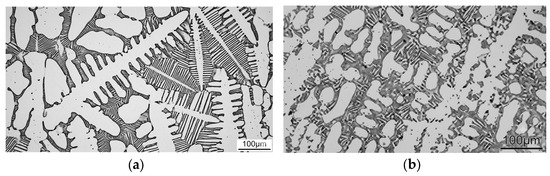
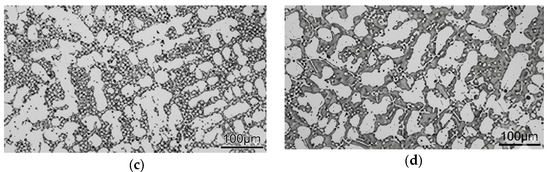
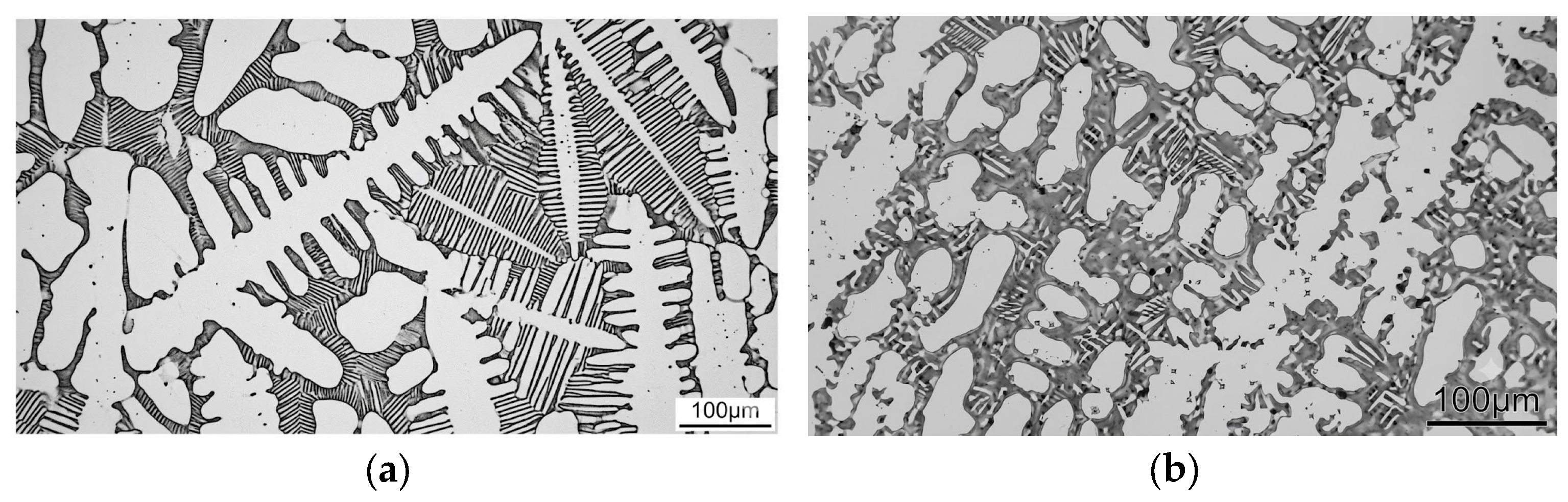
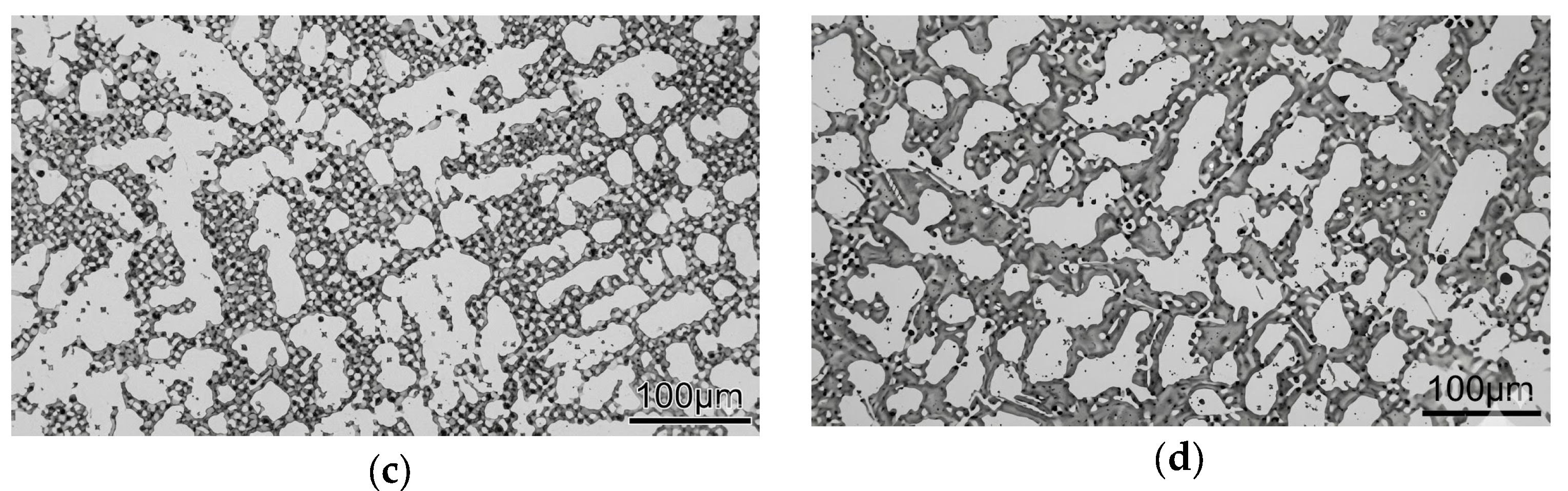
Figure 1 presents the as-cast microstructures to illustrate the grain-refining effect of Ti addition prior to heat treatment. The base alloy (0 wt.% Ti; Figure 1a) exhibits a coarse dendritic α-Al matrix with a continuous network of eutectic Mg2Si. This morphology provides limited continuous metallic paths for heat transfer, as phonons and electrons are scattered at a large fraction of α-Al/Mg2Si interfaces. Upon addition of 0.10 wt.% Ti (Figure 1b), the dendritic structure becomes fragmented and the primary α-Al transitions toward an equiaxed-rosette morphology, consistent with the grain-refining effect commonly attributed to Al3Ti intermetallic particles reported in Ti-containing aluminium alloys. At 0.20 wt.% Ti (Figure 1c), significant grain refinement is observed. The Mg2Si eutectic network is disrupted into isolated islands, and the α-Al grains are predominantly equiaxed. This microstructural change coincides with an increase in thermal conductivity from 181 W/m·K (base) to 221.42 W/m·K. The refined structure reduces solute clustering, lowers electron scattering per the Matthiessen rule, and increases the volume fraction of continuous α-Al, which has intrinsically higher thermal conductivity than the Mg2Si intermetallic phase. At 0.30 wt.% Ti (Figure 1d), the alloy shows a fully equiaxed, globular α-Al structure with fine, uniformly distributed Mg2Si islands. This condition yielded a peak thermal conductivity of 224.7 W/m·K, representing a 24.2% increase over the Ti-free alloy. The thermal–mechanical synergy arises from two complementary effects: (1) grain refinement via the peritectic Al3Ti reaction enhances yield strength per the Hall–Petch relation, and (2) modification of the brittle Mg2Si network into discrete particles improves both ductility and the continuity of the thermally conductive Al matrix.
Figure 1.
SEM micrographs of as-cast Al-Mg-Si alloy with (a) 0 wt.% Ti, (b) 0.10 wt.% Ti, (c) 0.20 wt.% Ti, and (d) 0.30 wt.% Ti. Etched with Keller’s reagent; scale bar = 100 μm.
3.3. Effect of Ti Addition on Thermal Conductivity
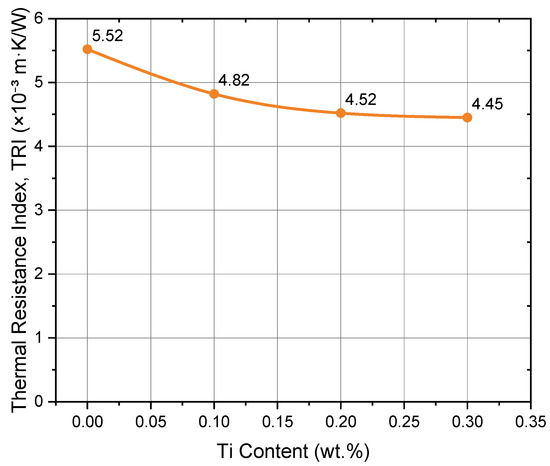
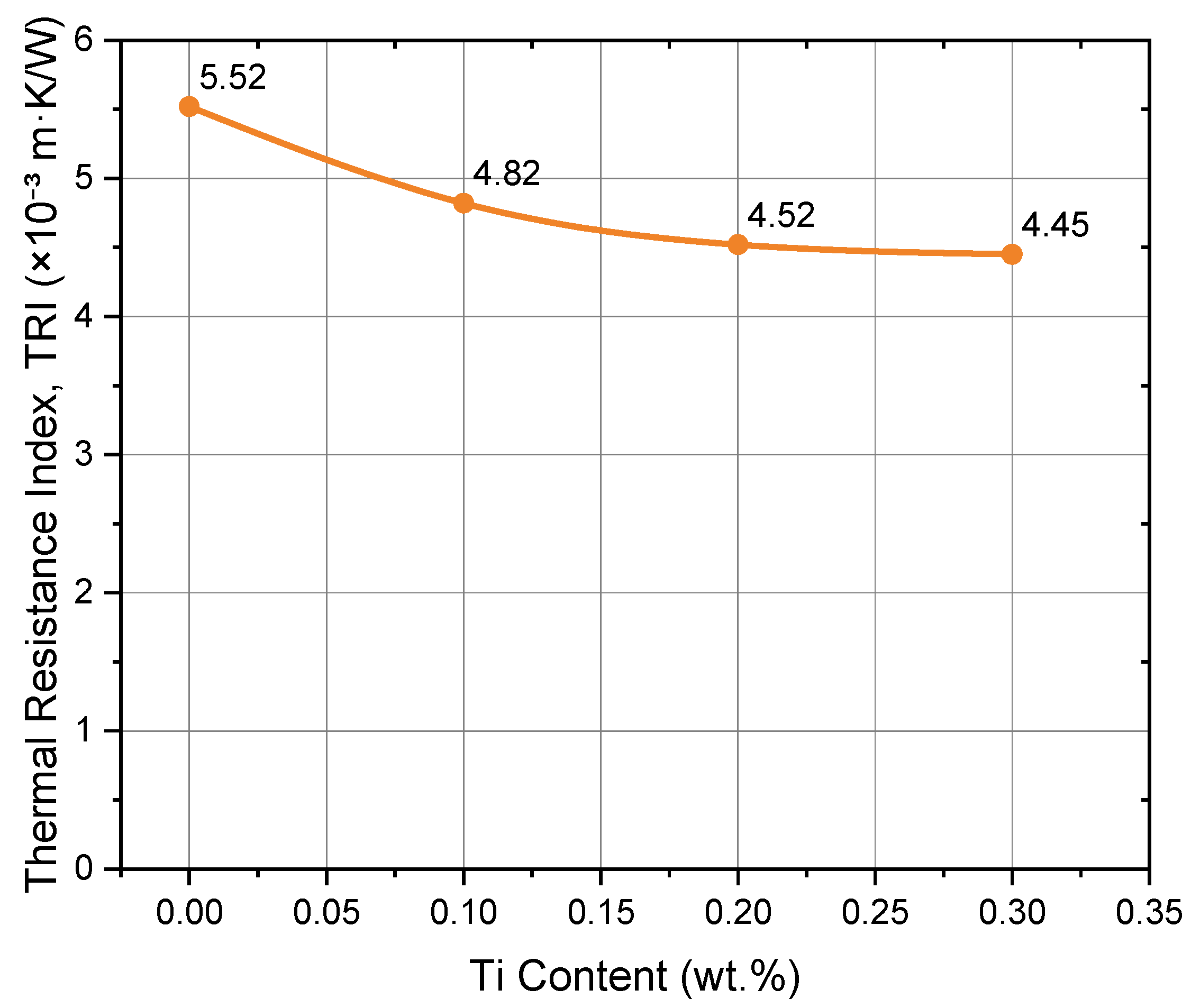
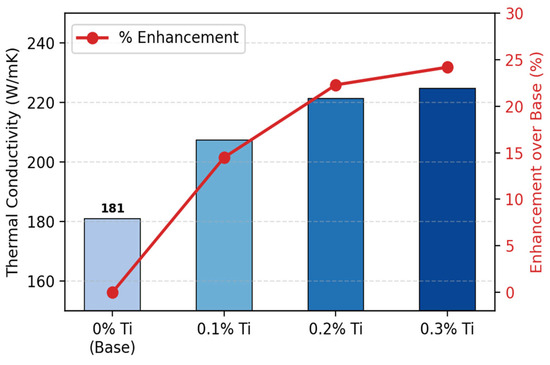
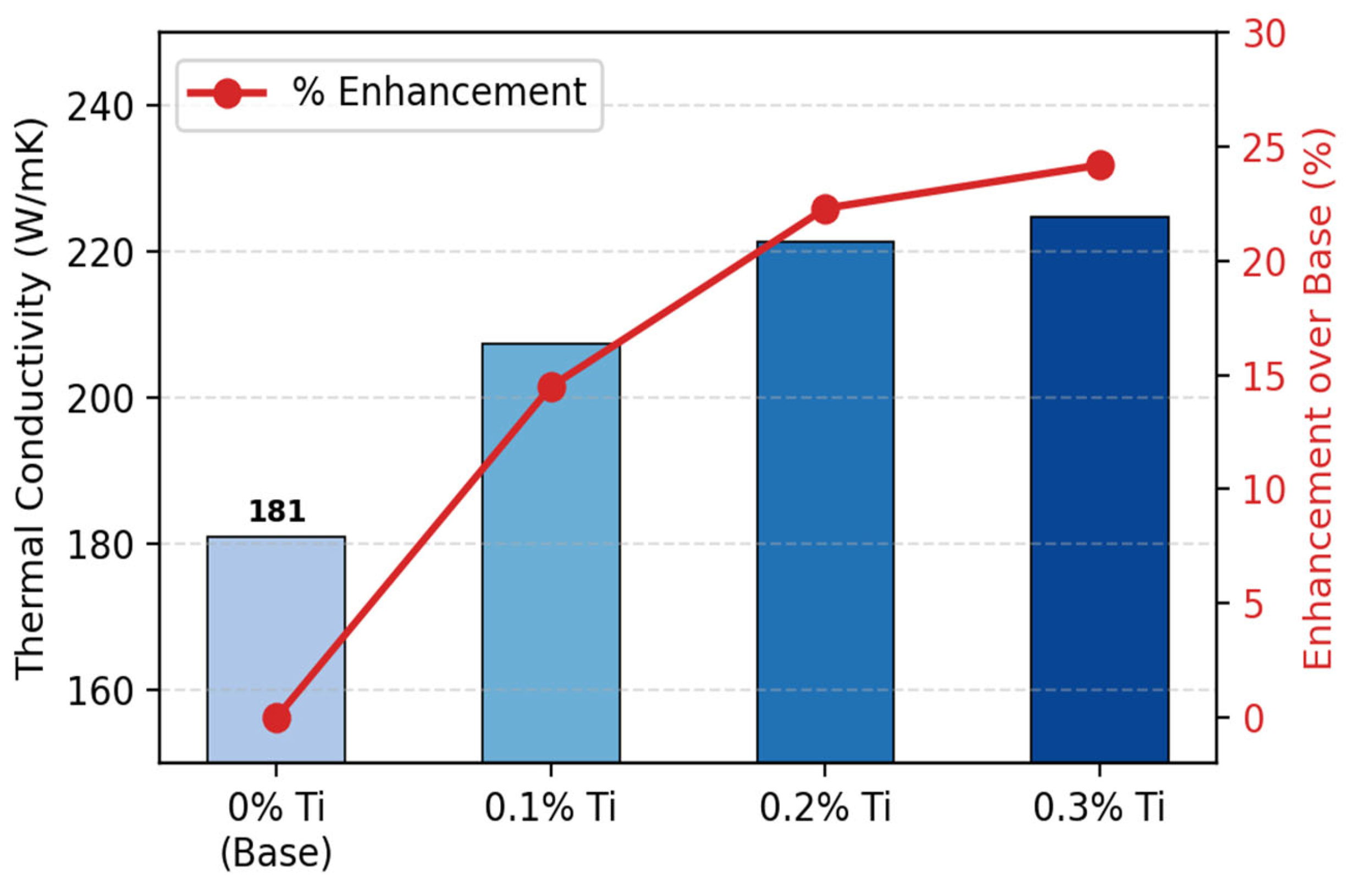
Table 3 and Table 4 present the complete temperature-resolved measurements for the 0.1 wt.% and 0.2 wt.% Ti compositions, respectively. Figure 2 illustrates the variation in the thermal resistance index (TRI) with Ti content. The TRI value decreased from 5.52 for the unreinforced alloy (0 wt.% Ti) to 4.45 for the alloy containing 0.3 wt.% Ti, indicating a reduction in thermal resistance with increasing Ti addition. Figure 3 shows the curve of absolute thermal conductivity vs percentage enhancement relative to base Al6061 as a function of the Ti doping level. It shows that the addition of 0.1 wt.% Ti raised average room-temperature conductivity from 181 to 207.35 W/mK (+14.5%). At 0.2 wt.% Ti, the value reached 221.42 W/mK, a 22.3% improvement. At 0.3 wt.% Ti, the measured average was 224.7 W/mK (+24.2%), showing a diminishing rate of gain consistent with approach to a saturation regime. The Al3Ti agglomeration above a critical intermetallic volume fraction begins to offset the grain-refinement benefit by introducing localised thermal impedances at intermetallic cluster boundaries. The full five-trial raw data table for the 0.3 wt.% Ti composition is provided in the Supplementary Tables (Tables S1 and S2).
Table 3.
Thermal conductivity measurements—Al6061 + 0.1 wt.% Ti.
Table 4.
Thermal conductivity measurements—Al6061 + 0.2 wt.% Ti.
Figure 2.
Thermal resistance index (TRI) as a function of Ti content.
Figure 3.
Absolute thermal conductivity vs percentage enhancement relative to base Al6061 as a function of Ti doping level.
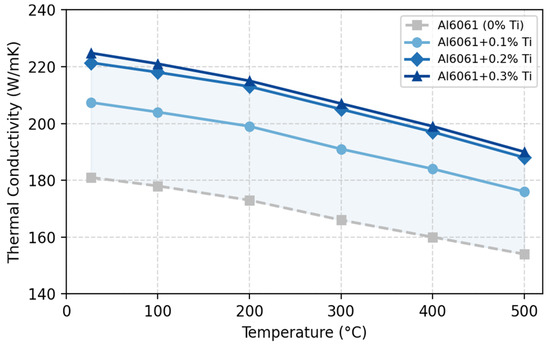
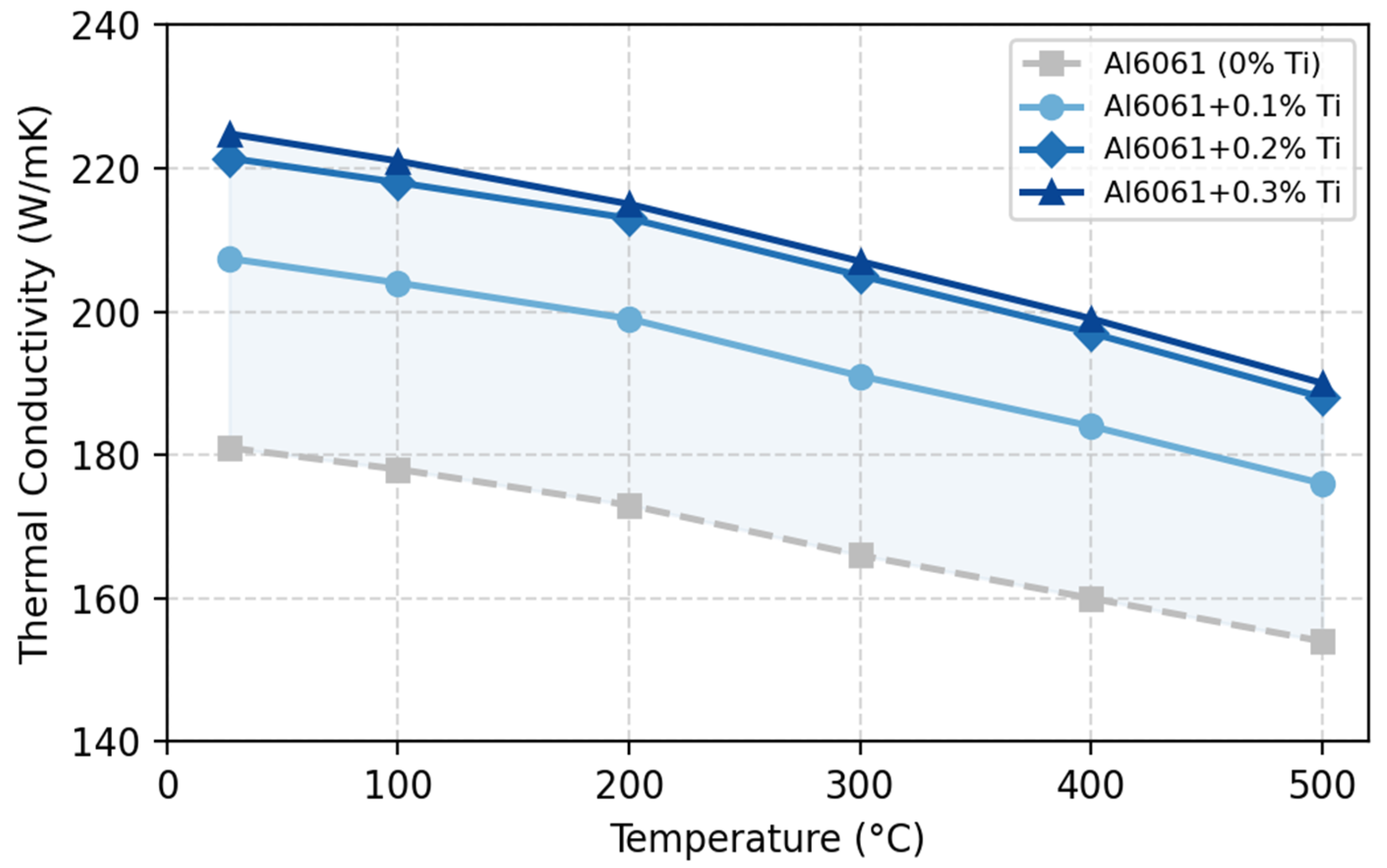
Figure 4 shows the variation in thermal conductivity with temperature for Al–Mg–Si alloys containing different Ti contents. At room temperature, the thermal conductivity increased from 181 W/mK for the Ti-free alloy to 208, 221, and 225 W/mK with 0.1, 0.2, and 0.3 wt.% Ti additions, corresponding to improvements of approximately 15%, 22%, and 24%, respectively. The enhancement is attributed to Ti-induced grain refinement, commonly associated with Al3Ti intermetallic particles reported in Ti-modified aluminium alloys, which promote a finer, more homogeneous microstructure; reduce casting defects; and improve heat-transfer efficiency. Although the thermal conductivity of all alloys decreased at elevated temperatures, the Ti-containing alloys maintained a clear advantage over the base alloy. For example, at 500 °C, the 0.2 wt.% Ti alloy exhibited a thermal conductivity of 188 W/mK compared to 154 W/mK for the Ti-free alloy, confirming the effectiveness of Ti addition over the entire temperature range investigated. The thermal conductivity decreased with increasing temperature for all compositions due to enhanced electron–phonon scattering resulting from increased lattice vibrations. Nevertheless, Ti addition improved the thermal conductivity across the entire temperature range.
Figure 4.
Temperature dependence of thermal conductivity for all four compositions from room temperature to 500 °C. The consistent ordering of compositions and the convergence of absolute values at elevated temperature.
3.4. Grain Structure and Microstructural Interpretation
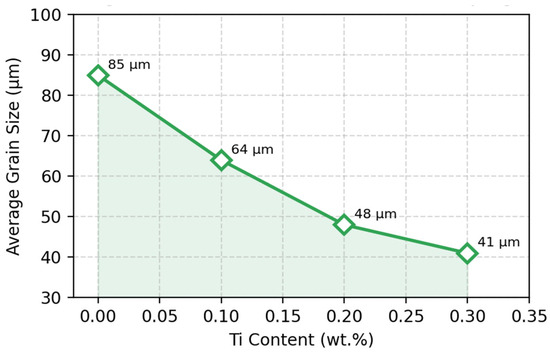
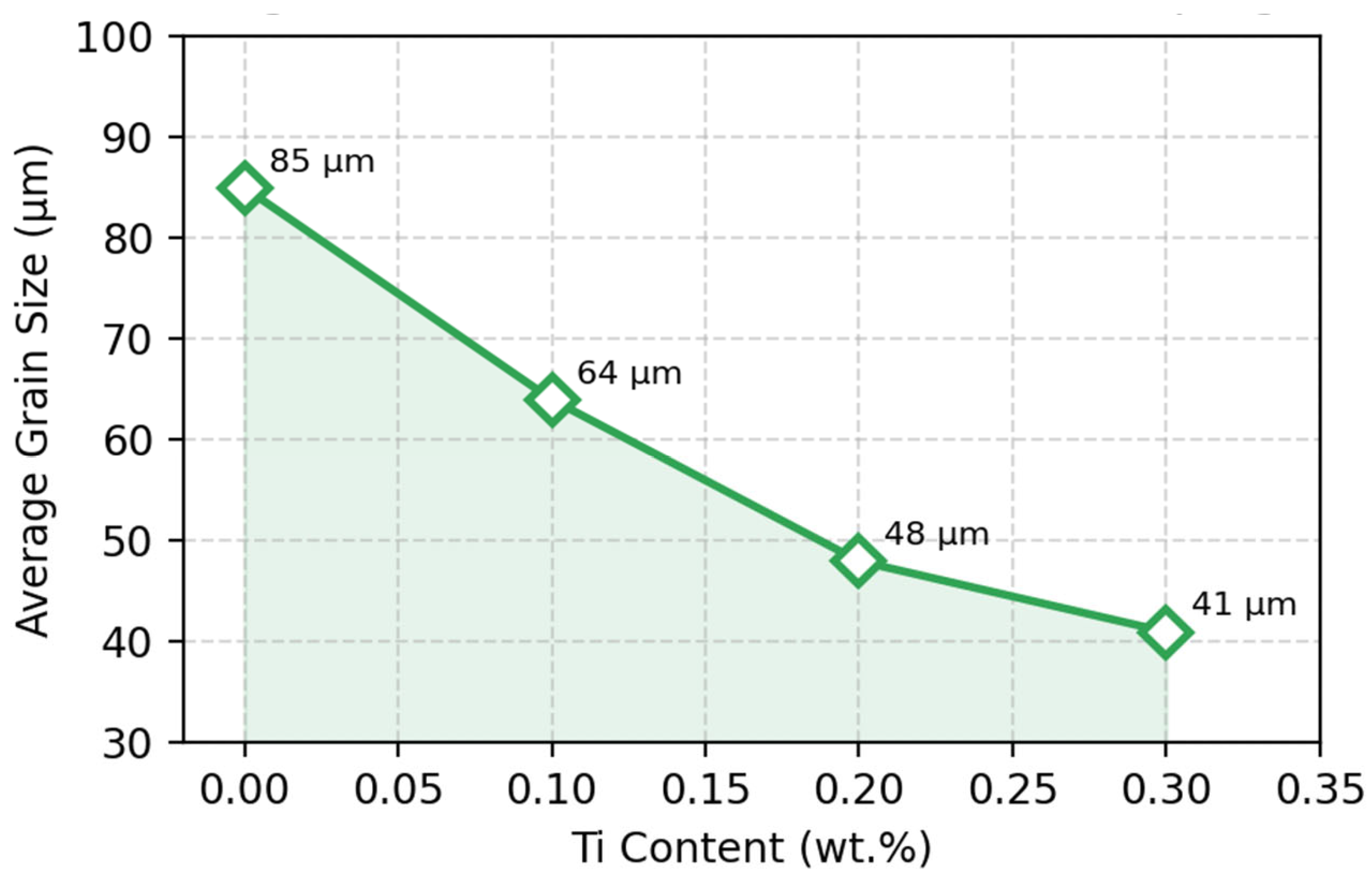
Figure 5 shows the grain-refinement effect quantified from micrographs using the linear intercept method (ASTM E112). Error bars represent one standard deviation across 10 measurement fields. It is observed that the mean grain diameter decreased from 85 µm in the undoped base alloy to 64 µm at 0.1 wt.% Ti, 48 µm at 0.2 wt.% Ti, and 41 µm at 0.3 wt.% Ti—a 52% reduction across the full composition range. This grain refinement is mechanistically attributed to Al3Ti nuclei acting as heterogeneous nucleation substrates during solidification, consistent with the well-established grain-refining action of Ti in aluminium alloys reported in the literature [10,11,21]. The correlation between grain-size reduction and conductivity improvement requires careful interpretation. The electron mean free paths in aluminium at room temperature are of the order of 10–50 nm—far smaller than the grain sizes measured (41–85 µm)—and therefore direct electron scattering at grain boundaries is negligible at these length scales. The more physically consistent explanation is that finer grains promote a more uniform distribution of Mg and Si solute atoms in the matrix, reducing local electron scattering from solute clusters (Matthiessen’s rule), and that more uniform Mg2Si precipitation in T6-tempered fine-grained alloys reduces dislocation density, both of which lower electron scattering and improve thermal conductivity. This interpretation is consistent with published Wiedemann–Franz analyses for Al–Mg–Si alloys, which confirm that thermal transport is predominantly electron-dominated at room temperature, with a phonon contribution estimated at 8–10% of total conductivity [13,15]. Direct confirmation of Al3Ti formation through XRD phase identification and SEM/EDS mapping, which would provide phase-level experimental verification beyond the micrographic evidence presented in Section 3.2, was not performed in the present study and is recommended as a priority for future work.
Figure 5.
Measured average grain diameter as a function of Ti doping level.
3.5. Hardness and Tensile Results
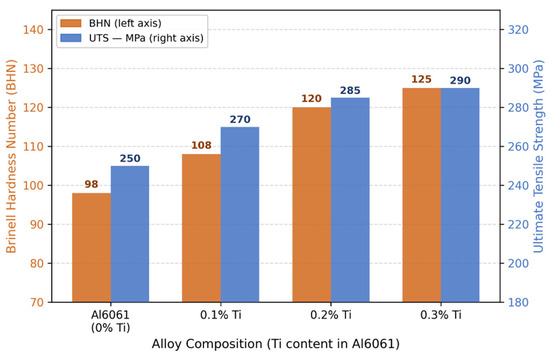
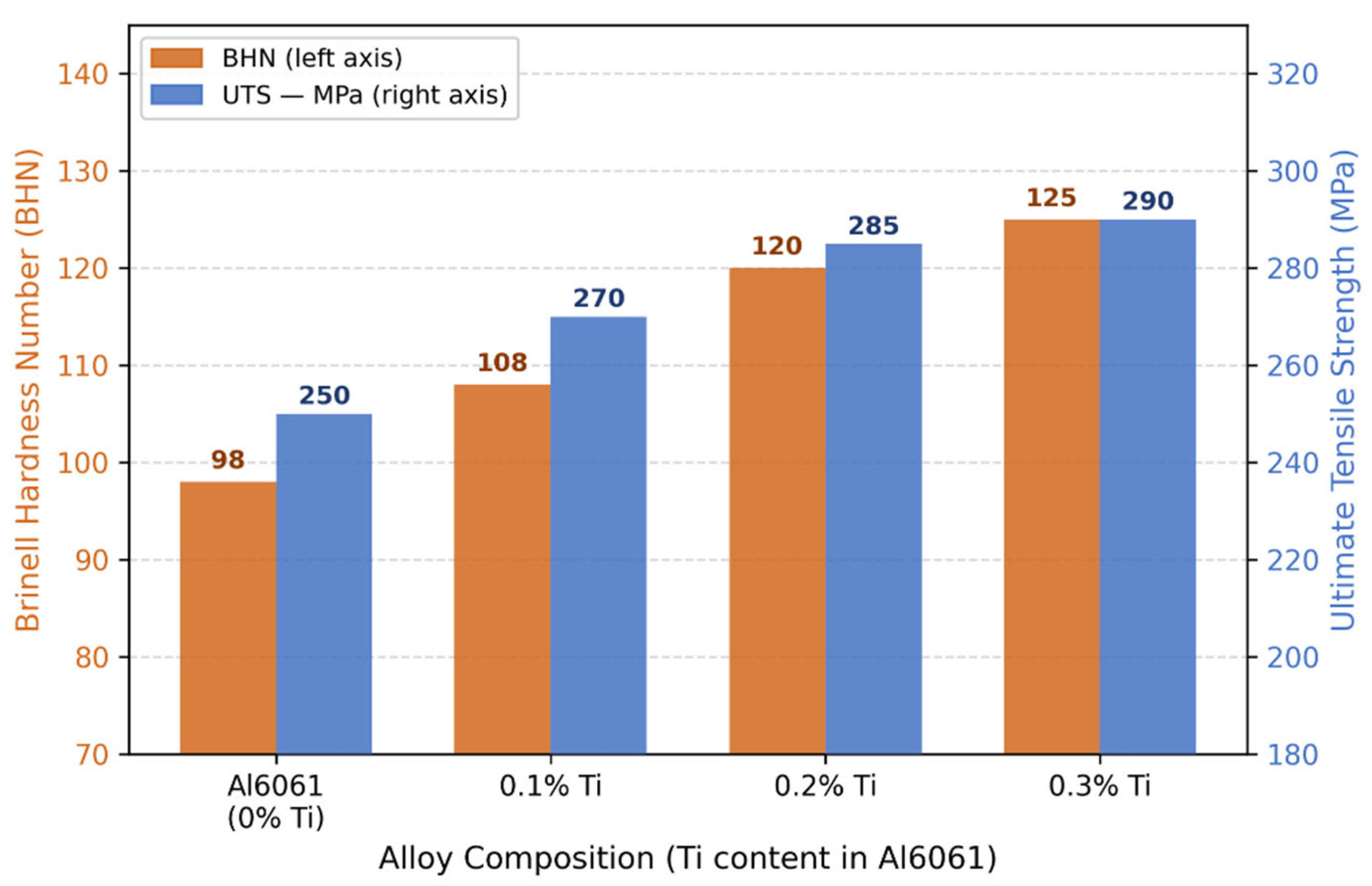
Hardness and tensile results are presented in Figure 6, and values are noted in Table 5. The base alloy recorded a BHN of 98 and a UTS of 250 MPa, with an elongation of 13.2%. At 0.2 wt.% Ti, BHN climbed to 120 (+22%), and UTS reached 285 MPa (+14%), while elongation declined only modestly to 11.8%. The strength gains are attributed to Hall–Petch grain boundary hardening and dispersion hardening from Ti-containing intermetallic phases that may form during solidification, both of which restrict dislocation glide [11,12,21]. It should be noted that the Hall–Petch relation formally applies to the 0.2% offset yield strength, not to UTS; yield strength data were not recorded separately in the present study and are recommended for inclusion in future work. The limited ductility loss (<2 percentage points across the entire composition range) distinguishes this approach from ceramic-reinforced MMCs, where elongation often collapses by 30–50% upon the addition of hard-phase reinforcements [8,9,21].
Figure 6.
Brinell Hardness Number (BHN; orange bars, left axis) and ultimate tensile strength (UTS; blue bars, right axis) as a function of Ti content in Al6061.
Table 5.
Summary of thermal and mechanical properties across all compositions.
3.6. Multi-Property Performance Radar
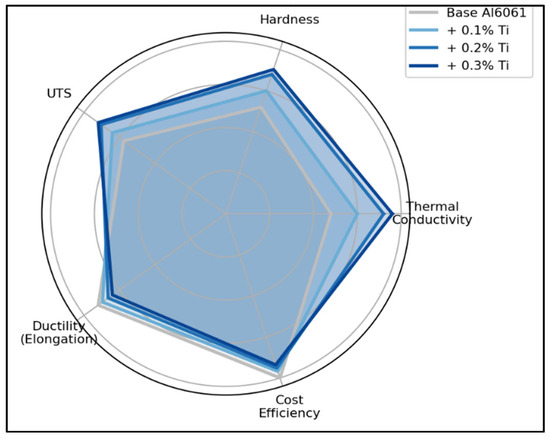
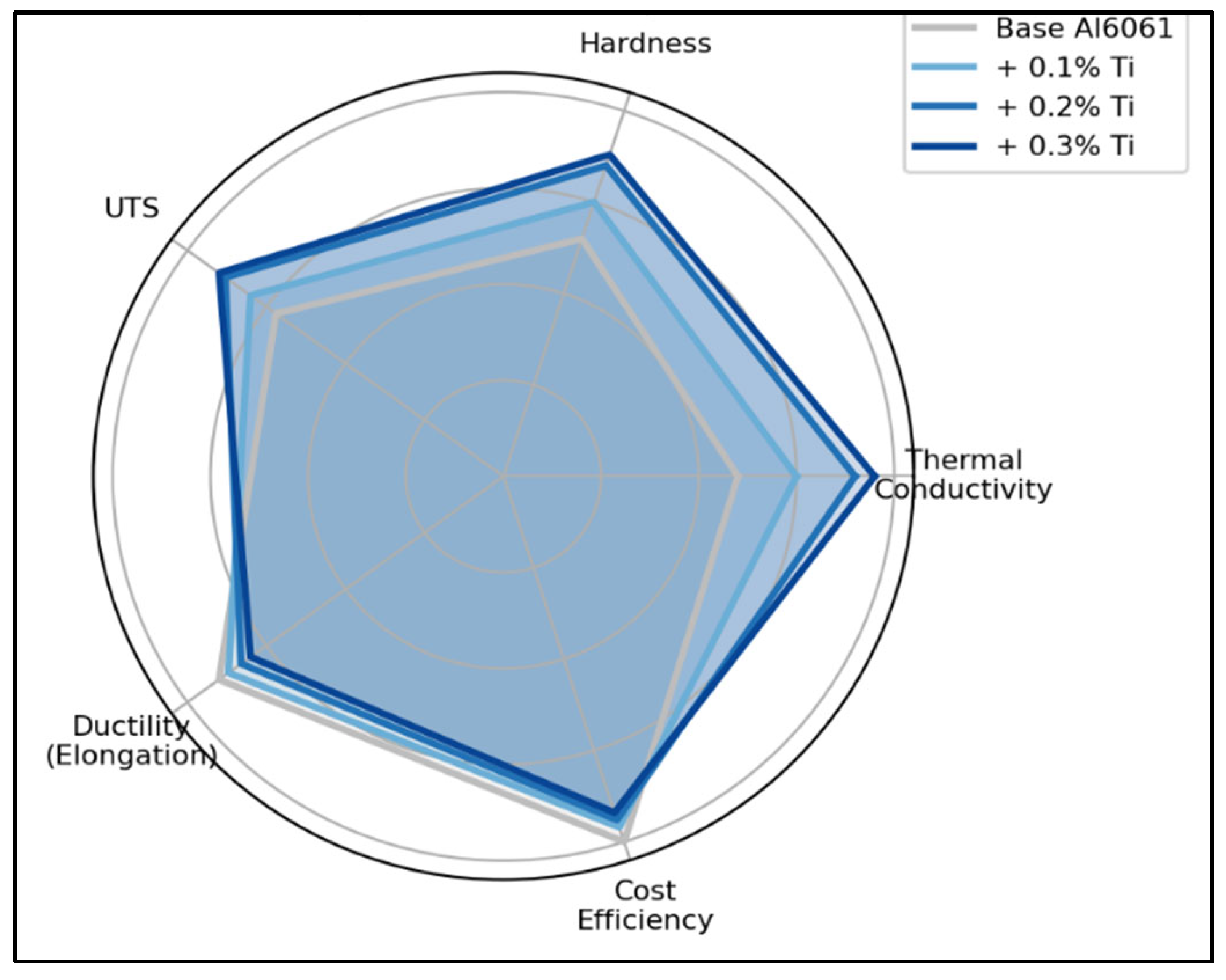
Figure 7 consolidates thermal conductivity, hardness, UTS, ductility (elongation), and specific material cost (the Ti powder addition cost at USD 150/kg) translates to an incremental material cost of USD 0, 0.15, 0.30, and 0.45 kg−1 of alloy for 0, 0.1, 0.2, and 0.3 wt.% Ti additions respectively on a common normalised scale. The 0.2 wt.% Ti composition maximises the total enclosed area—a visual proxy for multi-objective optimality—by achieving the highest gains in conductivity and hardness while limiting elongation loss and maintaining a low specific material cost. The 0.3 wt.% Ti alloy gains marginally in conductivity and strength but incurs a disproportionate cost increase relative to the property benefit.
Figure 7.
Multi-property radar chart for the four compositions studied (scale: 0 = poorest, 1 = best within this dataset). Axes: thermal conductivity, Brinell hardness, UTS, elongation, and specific material cost (quantified as USD/kg; see text).
3.7. Comparison with Published Literature
Table 6 contextualises the present results. The most structurally comparable prior work—Ramesha et al. [1] on Al6063 and Shaira et al. [17] on Al6063—both used the same base alloy family and broadly the same manufacturing route. Table 6 compares prior studies on Al6063 against the present Al6061 work; this compositional difference limits direct quantitative comparability but remains informative for contextualising the Ti-doping response across the 6xxx series. Neither prior study reported grain-size data correlated with conductivity, nor defined a thermal resistance metric for cross-study comparison. The Shaira study reported a maximum improvement of only ~8% at comparable Ti levels in Al6063. The higher improvement observed here (22.3%) for Al6061 at 0.2 wt.% Ti points to a base-alloy dependence that has not previously been documented: Al6061 begins from a lower conductivity baseline due to its higher Mg content (0.8–1.2 wt.%) and responds more strongly to grain refinement because the higher Mg solute concentration amplifies the electron scattering reduction achieved by more uniform solute distribution in finer-grained microstructures. This finding constitutes an original contribution beyond the prior literature. Compared to ceramic-reinforced routes, the Ti-doping approach delivers a smaller absolute conductivity gain than diamond/Al composites but requires no special melt handling, avoids wettability challenges, and retains conventional machinability—practical trade-offs that strongly favour adoption in high-volume heat sink manufacturing.
Table 6.
Benchmarking present results against comparable published studies on Ti-doped aluminium alloys.
4. Application Scope for Electronic Heat Sinks
Quantifying the practical significance of a 22% improvement in conductivity requires situating it within a representative thermal-resistance budget for a finned heat sink. For a standard extruded-fin heat sink in forced convection, the bulk material conductivity typically accounts for 20–35% of the total thermal resistance between the junction and the ambient, with the remainder attributable to spreading resistance, contact resistance, and convective resistance at the fin surface [18,19]. A 22% reduction in material thermal resistance, therefore, translates to an approximately 4–8% reduction in total junction-to-ambient thermal resistance—meaningful in margin-constrained applications such as GaN-on-SiC power amplifiers and high-current IGBT modules where junction temperature headroom directly governs reliability and power density. An additional practical advantage emerges from the improved mechanical properties: heat sinks manufactured from 0.2 wt.% Ti Al6061 can be extruded with lower press force than ceramic MMCs of equivalent stiffness because the material lacks abrasive hard-phase particles, extending die life and reducing scrap rate [20,21,22]. This makes the proposed material a drop-in substitute for existing Al6061-T6 heat sink stock with no change to extrusion tooling or downstream machining operations.
5. Conclusions
A parametric study of Ti doping (0–0.3 wt.%) in stir-cast, T6-aged Al6061 alloy has been conducted, correlating microstructural grain refinement quantitatively with thermal conductivity, hardness, and tensile response. The following conclusions are drawn:
- A baseline Al6061 thermal conductivity of 181 W/mK at 27 °C increased to 207.35 W/mK at 0.1 wt.% Ti (+14.5%) and to 221.42 W/mK at 0.2 wt.% Ti (+22.3%), establishing a composition-dependent response curve with diminishing returns above 0.2 wt.%.
- The grain diameter reduced from 85 µm (base) to 48 µm at 0.2 wt.% Ti, supporting the grain-refinement mechanism associated with Ti addition and allowing for the first quantitative grain-size/conductivity correlation in this alloy-dopant system.
- A Thermal Resistance Index (TRI = (1/Ks) × 103), equivalent to thermal resistivity in units of mK/W scaled by 103) is proposed as a resistance-framed metric to facilitate comparison with thermal circuit models used in heat sink design, revealing that the present Al6061+Ti system outperforms comparable Al6063+Ti results in the literature by 12–14 percentage points on this scale.
- Brinell hardness and UTS improved concurrently (BHN: 98 → 120; UTS: 250 → 285 MPa at 0.2 wt.% Ti) with elongation declining by only 1.4 percentage points—confirming thermal–mechanical co-enhancement rather than a trade-off.
- Although 0.3 wt.% Ti exhibited the highest absolute thermal conductivity and strength, the incremental improvement over 0.2 wt.% was marginal relative to the additional material cost. Therefore, 0.2 wt.% Ti is considered the optimum composition for practical heat-sink applications.
6. Future Work
Several characterisation and measurement activities are recommended for follow-on work. The micrographs presented in Section 3.2 provide direct visual evidence of progressive grain refinement and Mg2Si network disruption with increasing Ti content; however, microscopy cannot resolve phase identity at the nanoscale. Accordingly, XRD phase identification of all four alloy compositions remains a priority to provide direct experimental confirmation of Al3Ti formation, quantify intermetallic volume fraction, and establish the spatial distribution of Ti-bearing particles—the mechanistic foundation underlying the conductivity and strength improvements reported here. The four-point-probe electrical resistivity measurements would allow for a Wiedemann–Franz cross-check of the thermal conductivity data and independently confirm the electron-scattering reduction mechanism. The 0.2% offset yield strength measurements would enable a formal Hall–Petch analysis correlating grain size with yield strength, which is more physically rigorous than the UTS-based correlation presented here. The laser flash analysis (ASTM E1461) would cross-validate the ASTM E1225 measurements and address the reference-bar conductivity mismatch noted. The DSC analysis of solutionised specimens would confirm the completeness of Mg2Si dissolution under the 1 h solutionising cycle used. The long-duration thermal cycling tests (1000 cycles; RT–150 °C) are warranted to confirm that the stability of the Al3Ti dispersion—and hence the conductivity enhancement—is maintained under service conditions representative of automotive power electronics.
Supplementary Materials
The following supporting information can be downloaded at https://www.mdpi.com/article/10.3390/met16070727/s1, Table S1. Thermal Conductivity Measurements—Al6061 + 0.3 wt.% Ti (Five Independent Trials). Table S2. Summary of All Raw Trial Data—Mean ± Standard Deviation Across All Compositions.
Author Contributions
Conceptualisation, S.R. and H.S.B.; Formal analysis, K.M.R., R.K.V., B.L., S.K.S. and M.A., Methodology, K.M.R., H.S.B., R.K.V., B.L., S.K.S. and M.A.; Writing—original draft, S.R.; Writing—review and editing, K.M.R., H.S.B., R.K.V., B.L., S.K.S. and M.A. All authors have read and agreed to the published version of the manuscript.
Funding
This research received no external funding.
Data Availability Statement
The original contributions presented in this study are included in the article. Further inquiries can be directed to the corresponding author.
Conflicts of Interest
The authors declare no conflicts of interest.
References
- Ramesha, C.M.; Rajendra, P.; Balasubramanya, H.S.; Kumar, S.M.; Kumar, V.R.; Kumar, M.E.S. Enhancing thermal conductivity of aluminium 6063 alloy by adding titanium for advanced heat sink applications. In ICEAMST 2024, Advances in Science, Technology & Innovation; Springer: Cham, Switzerland, 2025; pp. 431–440. [Google Scholar] [CrossRef] [Scilit]
- Ghasali, E.; Fazili, A.; Alizadeh, M.; Shirvanimoghaddam, K.; Ebadzadeh, T. Evaluation of Microstructure and Mechanical Properties of Al-TiC Metal Matrix Composite Prepared by Conventional, Microwave and Spark Plasma Sintering Methods. Materials 2017, 10, 1255. [Google Scholar] [PubMed]
- Lunn, K.F.; Apelian, D. Thermal and Electrical Conductivity of Aluminum Alloys: Fundamentals, Structure-Property Relationships, and Pathways to Enhance Conductivity. Mater. Sci. Eng. A 2025, 924, 147766. [Google Scholar]
- Bhat, K.U.; Panemangalore, D.B.; Kuruveri, S.B.; John, M.; Menezes, P.L. Surface Modification of 6xxx Series Aluminum Alloys. Coatings 2022, 12, 180. [Google Scholar] [CrossRef] [Scilit]
- Zhang, A.; Li, Y. Thermal Conductivity of Aluminum Alloys—A Review. Materials 2023, 16, 2972. [Google Scholar] [CrossRef] [Scilit] [PubMed]
- Sun, Y.K.; Chang, S.Y.; Tsao, L.C.; Chuang, T.H.; Zhang, G.Z.; Yeh, C.Y. Effects of Adding Active Elements to Aluminum-Based Filler Alloys on the Bonding of 6061 Aluminum Alloy and Alumina. Appl. Sci. 2021, 11, 10440. [Google Scholar] [CrossRef] [Scilit]
- Nam, S.; Kim, S.; Kim, D.; Song, S.; Lee, J.; Kim, H.S.; Sung, H.; Choi, H. Enhancing Thermal Conductivity of 6061 Al Plate via Graphene Dip Coating. J. Mater. Res. Technol. 2024, 29, 3126–3134. [Google Scholar] [CrossRef] [Scilit]
- Kimura, T.; Nakamoto, T.; Ozaki, T.; Miki, T. Microstructures and Mechanical Properties of Aluminum-Transition Metal Binary Alloys (Al-Fe, Al-Mn, and Al-Cr) Processed by Laser Powder Bed Fusion. J. Alloys Compd. 2021, 872, 159680. [Google Scholar]
- Shawon, A.R.; Ghosh, R.; Islam, M.A. Analysis of Thermal Conductivity of Aluminum Alloys by Compositions and Tempering Process Using Machine Learning. Sci. Rep. 2025, 15, 33352. [Google Scholar] [CrossRef] [Scilit] [PubMed]
- Liao, Q.; Li, J.; Liu, J.; Lü, S.; Chen, L.; Guo, W.; Wu, S. Effects of Al-Ti-C Refiner and Forming Processes on the Microstructure and Properties of Al-Zn-Mg-Cu Alloys. Materials 2022, 15, 6960. [Google Scholar] [PubMed]
- Liu, X.; Wang, B.; Li, Q.; Wang, J.; Zhang, C.; Xue, C.; Yang, X.; Tian, G.; Liu, X.; Tang, H. Quantifying the Effects of Grain Refiners Al-Ti-B and La on the Microstructure and Mechanical Properties of W319 Alloy. Metals 2022, 12, 627. [Google Scholar]
- Lomo, F.N.; Zhang, D.; Qiu, D.; Easton, M.A. Advances in Nano-Inoculant Grain Refinement for Fusion-Based Additive Manufacturing of Al and Ti Alloys. Mater. Des. 2025, 114581. [Google Scholar]
- Rauta, V.; Cingi, C.; Orkas, J. Effect of annealing and metallurgical treatments on thermal conductivity of aluminium alloys. Int. J. Metalcast. 2016, 10, 157–171. [Google Scholar] [CrossRef] [Scilit]
- Rahman, A.; Isanaka, S.P.; Liou, F. A Comprehensive Study of Cooling Rate Effects on Diffusion, Microstructural Evolution, and Characterization of Aluminum Alloys. Machines 2025, 13, 160. [Google Scholar] [CrossRef] [Scilit]
- Jain, A.; McGaughey, A.J. Thermal transport by phonons and electrons in aluminum, silver, and gold from first principles. Phys. Rev. B 2016, 93, 081206. [Google Scholar] [CrossRef] [Scilit]
- Kumar, L.; Jang, J.C.; Yu, H.; Shin, K.S. Effects of Cr and Ti addition on mechanical properties and thermal conductivity of Al–7Si–3Mg die-casting alloys. Met. Mater. Int. 2023, 29, 204–214. [Google Scholar]
- Shaira, I.; Khoo, B.B.; Mohamad, A. Modification of aluminium 6063 microstructure by adding boron and titanium to improve the thermal conductivity. J. Mater. 2018, 2018, 8905469. [Google Scholar] [CrossRef] [Scilit]
- Bayomy, A.M.; Saghir, Z. Thermal performance of finned aluminum heat sink filled with ERG aluminum foam: Experimental and numerical approach. Int. J. Energy Res. 2020, 44, 4411–4425. [Google Scholar] [CrossRef] [Scilit]
- He, C.; Hu, Y.; Hua, Z.; Gaoyang, M.; Zeng, G. Microstructure and mechanical properties of nano-TiC reinforced 7034 aluminum fabricated by oscillating laser-arc hybrid additive manufacturing. J. Alloys Compd. 2025, 182905. [Google Scholar]
- Czerwinski, F. Thermal stability of aluminum alloys. Materials 2020, 13, 3441. [Google Scholar] [CrossRef] [Scilit] [PubMed]
- Parvizi, P.; Amidi, A.M.; Zangeneh, M.R.; Beigrezaee, M.J.; Riba, J.R.; Jalilian, M. Recent Advancements in Aluminum Alloy Research: Integrating Traditional Metallurgy with Machine Learning and Data-Driven Approaches. Appl. Sci. 2026, 16, 4830. [Google Scholar] [CrossRef] [Scilit]
- Vijayakumar, S. Optimization of friction stir welding parameters for dissimilar aluminium alloys using RSM-GRA and RSM-TOPSIS: Towards sustainable manufacturing in industry 4.0. Results Eng. 2025, 107054. [Google Scholar]

Disclaimer/Publisher’s Note: The statements, opinions and data contained in all publications are solely those of the individual author(s) and contributor(s) and not of MDPI and/or the editor(s). MDPI and/or the editor(s) disclaim responsibility for any injury to people or property resulting from any ideas, methods, instructions or products referred to in the content. |
© 2026 by the authors. Licensee MDPI, Basel, Switzerland. This article is an open access article distributed under the terms and conditions of the Creative Commons Attribution (CC BY) license.