


Abstract
In this work, 2.0 wt.% SiCp/AZ91D magnesium matrix composite was fabricated by stir casting, and its microstructure and properties were optimized through a coupled process of parallel equal-channel angular combined extrusion (PC-ECAP) and T6 heat treatment. The results indicate that the extrusion temperature has a significant influence on the microstructure and mechanical properties of the material. At an extrusion temperature of 350 °C followed by T6 heat treatment, the 2.0 wt.% SiCp/AZ91D composite exhibits a tensile strength of 221 MPa, an elongation of 19.2%, and a product of tensile strength and elongation (PSE) of 4.24 GPa%, which represent increases of 14.5%, 128.6%, and 161.7%, respectively, compared with the as-cast specimen. To elucidate the microscopic mechanism of the enhanced ductility, first-principles calculations were further performed. It is found that Al solute atoms can reduce the electron localization in the Mg–Mg bond region, causing a downward shift of the d-band center, thereby weakening the interatomic bonding strength on the slip plane. This effect is equivalent to reducing the stacking fault energy of non-basal slip. The finding provides a theoretical explanation for the activation of multiple slip systems and the suppression of twinning observed in the experiments. By combining experiments with calculations, this study systematically reveals the mechanism underlying the synergistic regulation of strength and ductility in the composite by PC-ECAP coupled with T6 heat treatment, offering a theoretical basis and process reference for the fabrication of high-performance magnesium matrix composites.
1. Introduction
Magnesium alloys possess high specific strength and specific stiffness, excellent damping capacity, electromagnetic shielding effectiveness, and good castability, and are hailed as “the green engineering material of the 21st century”. They have been widely used in automotive manufacturing, rail transit, aerospace, 3C products, logistics, and construction, with their advantages being particularly pronounced in the manufacturing sector [1,2,3,4]. In addition, magnesium alloys have also shown broad prospects in the biomedical field, and research on additive manufacturing and rare-earth magnesium alloys has provided new possibilities for further expanding their applications [5,6]. By incorporating hard SiC particles (SiCp) into the magnesium alloy matrix, the shortcomings of low strength and ductility, poor heat resistance, and inferior creep resistance can be addressed. However, traditional fabrication methods for magnesium matrix composites often fail to achieve a uniform distribution of the reinforcement in the matrix, which limits their application in industrial production [7,8].
Compared with traditional plastic working processes such as rolling and forging, equal-channel angular pressing (ECAP), owing to its unique pure shear deformation mode, is capable of inducing a high density of dislocations in the material under extremely large accumulated strain and subsequently achieving a uniform and significantly refined grain structure through dynamic recovery and recrystallization [9,10]. This characteristic endows ECAP with great potential in the fabrication of ultrafine-grained/nanocrystalline materials [11,12]. However, to reach the required accumulated strain, conventional single-angle ECAP often requires multiple passes, which not only makes the process tedious, time-consuming, and inefficient, but also easily introduces operational errors, accelerates die wear, and may lead to reduced geometric accuracy or surface damage to the specimen due to repeated loading and unloading. Parallel equal-channel angular combined extrusion (PC-ECAP), through optimized die channel design, realizes an efficient severe plastic deformation characterized by “two shear deformations in a single extrusion stroke” [13], thereby achieving a higher equivalent strain per pass and significantly improving the processing efficiency and microstructural uniformity. In the as-cast or as-deformed microstructure of magnesium matrix composites, a coarse network of β-Mg17Al12 phase exists. This hard and brittle phase not only severely splits the matrix but also strongly impedes dislocation slip, representing one of the key factors responsible for the poor plastic deformability of the material [14,15]. Therefore, through the synergistic optimization of T6 solution treatment and aging treatment, a simultaneous enhancement in the tensile strength and elongation of magnesium alloys has been achieved [16,17].
In this study, the 2.0 wt.% SiCp/AZ91D composite was taken as the research object, and the following work was systematically carried out: (1) investigating the effects of PC-ECAP at different extrusion temperatures on the microstructure and mechanical properties of the composite and determining the optimal extrusion process parameters; (2) analyzing the role of T6 heat treatment in the microstructural reconstruction and property enhancement of the extruded material; (3) employing first-principles calculations to construct a Mg–Al solid solution model and, through electron localization function (ELF) and density of states (DOS) analysis, revealing the influence mechanism of Al solute on the slip behavior of the magnesium matrix from the electronic scale and corroborating this with experimental results. The findings of this study are expected to provide support for the process optimization and engineering application of PC-ECAP technology in fabricating uniform fine-grained magnesium matrix composites.
2. Experiment
2.1. Experimental Materials
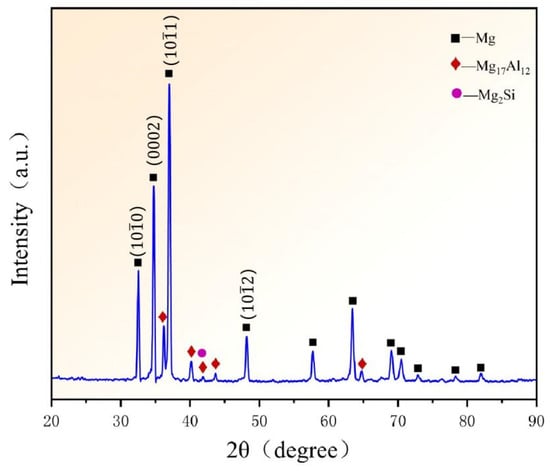
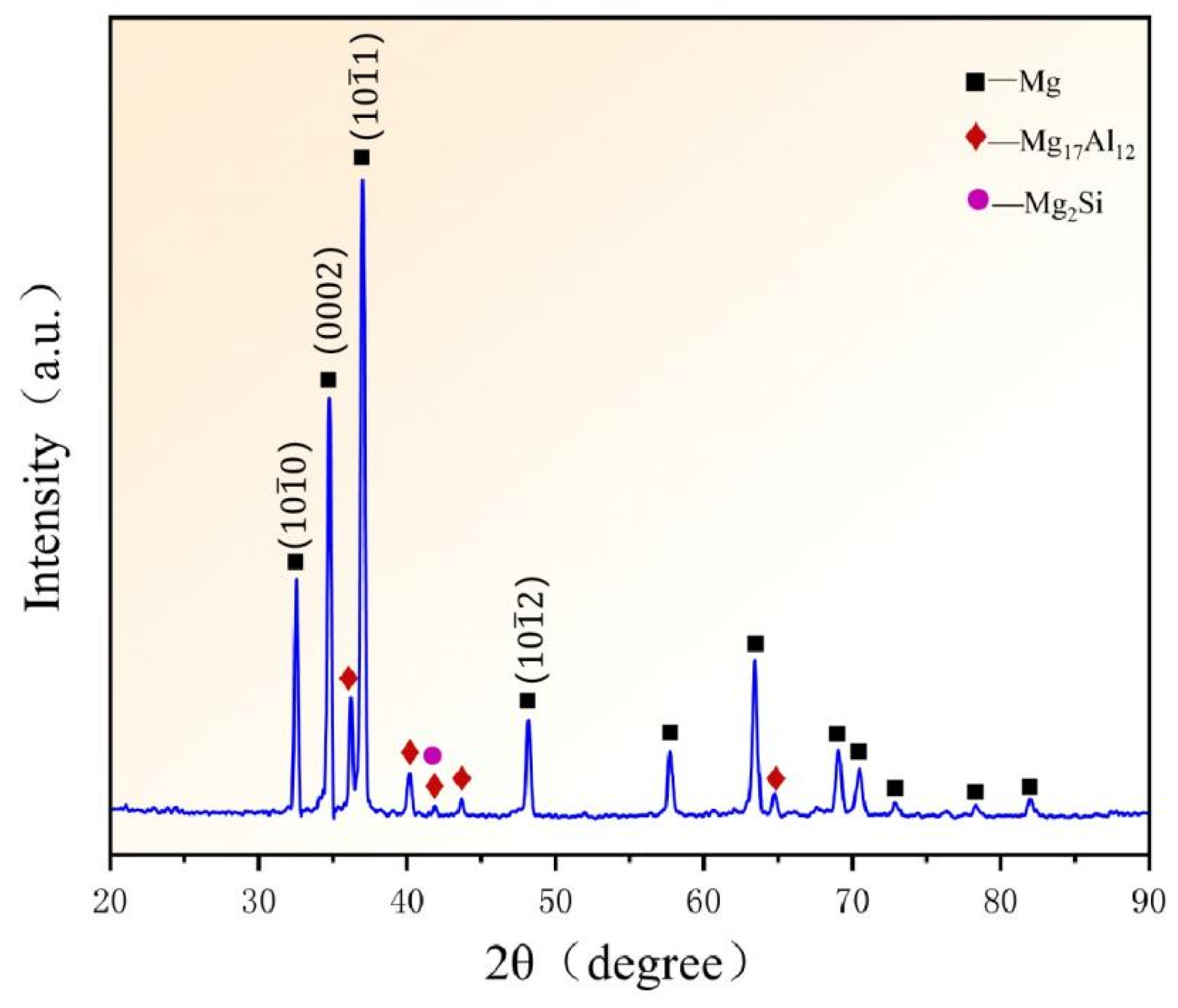
The 2.0 wt.% SiCp/AZ91D composite was fabricated by stir casting [18] combined with a remelting process. The SiCp content of 2.0 wt.% was selected based on preliminary experimental results, which demonstrated that this content provides a favorable balance between strengthening effectiveness and workability. The chemical composition of the AZ91D alloy used in this work is listed in Table 1, and the average particle size of the SiC particles is 60 μm. Figure 1 shows the XRD pattern of the 2.0 wt.% SiCp/AZ91D composite.
Table 1.
Chemical components of AZ91D alloy (wt.%).
Figure 1.
XRD patterns of SiCp/AZ91D composites with 2.0 wt.% SiCp.
XRD analysis was performed using Cu Kα radiation at 40 kV and 30 mA, with a scanning range of 10–90° and a scanning speed of 2°/min. Optical microscopy observation was conducted on a ZEISS-Vert.A1 optical metallographic microscope. The specimens were ground and polished, then etched with a picric acid ethanol solution consisting of 5.5 g picric acid, 5 mL acetic acid, 90 mL ethanol, and 10 mL distilled water. Scanning electron microscopy observation was conducted on a ZEISS-Sigma500 field-emission scanning electron microscope equipped with an energy-dispersive spectrometer (Carl Zeiss Microscopy GmbH, Jena, Germany). Optical microscopy was used to observe the macroscopic morphology and grain characteristics of the composite, while scanning electron microscopy was employed for detailed observation of the microstructure, precipitate morphology and distribution, as well as micro-area compositional analysis. The combination of OM and SEM enables multi-scale microstructural characterization from macroscopic to microscopic levels. Tensile testing was conducted on a CMT5305 microcomputer-controlled electronic universal testing machine with a maximum load capacity of 30 kN and a loading speed accuracy of ±0.5%.
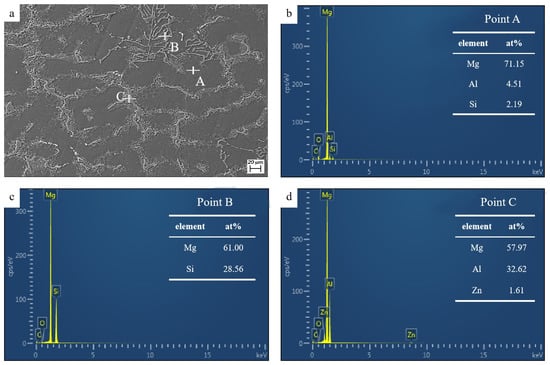
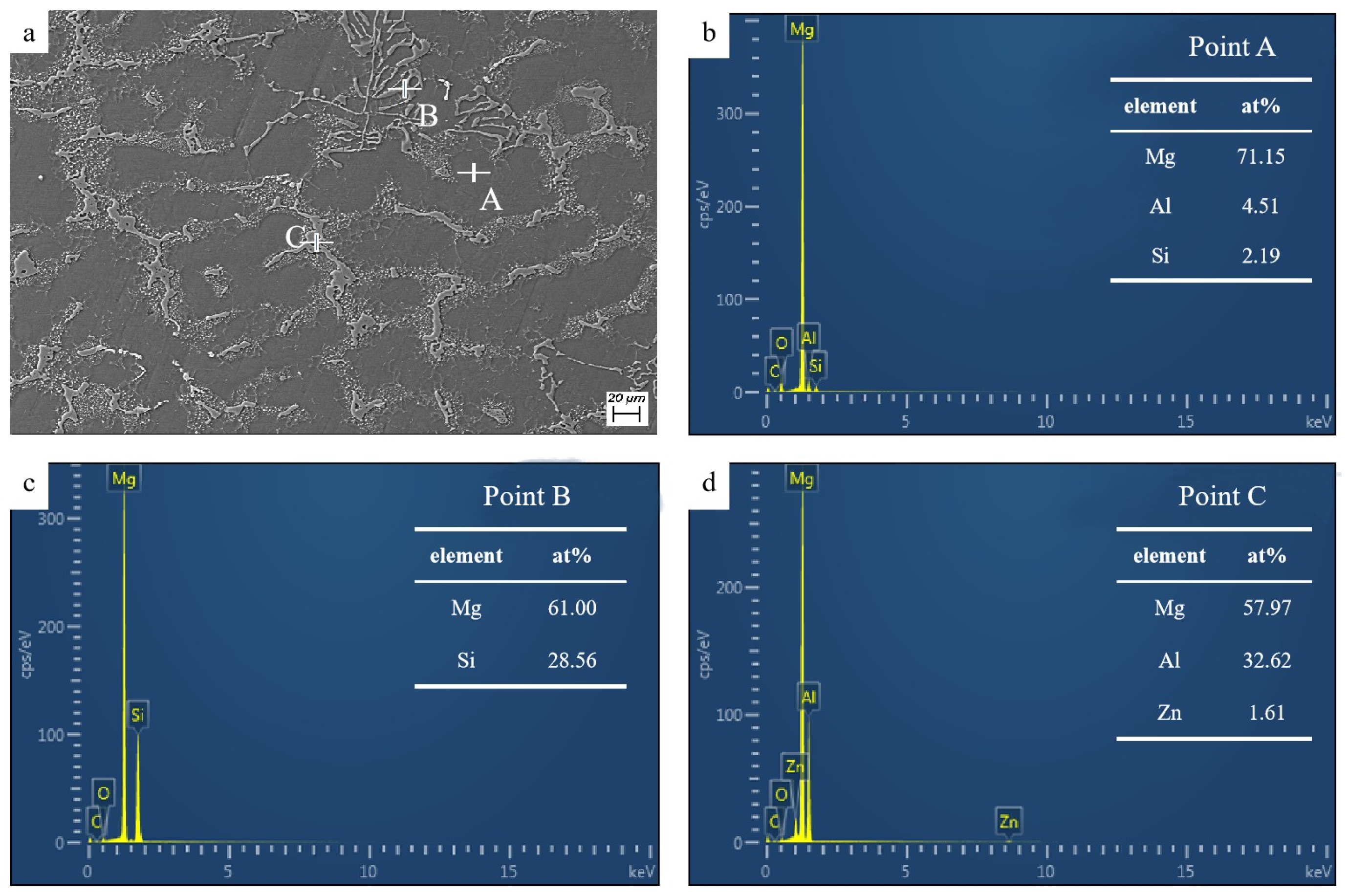
No diffraction peaks corresponding to SiCp are detected in the XRD pattern of the SiCp/AZ91D composite, nor are diffraction peaks of Mg2Si or Al4C3 clearly identifiable. This is primarily attributed to the relatively low content of the SiCp reinforcement (2.0 wt.%) and its coarse particle size (60 μm), which makes these phases fall below the detection limit of conventional XRD. Nevertheless, as shown in the SEM-EDS analysis of Figure 2, Mg2Si phases with dendritic and skeletal morphologies are clearly observed, confirming that the interfacial reaction between SiCp and the Mg-Al melt indeed occurred [19]:
Figure 2.
SEM and EDS analysis of 2.0 wt.% SiCp/AZ91D composites: (a) SEM image of 2.0 wt.% SiCp/AZ91D; (b), EDS spectrum of point A in (a); (c) EDS spectrum of point B in (a); (d) EDS spectrum of point C in (a).
The absence of Al4C3 diffraction peaks is likely due to its hydrolysis reaction with water during specimen preparation [19], as well as its potential low content or poor crystallinity.
2.2. Experimental Methods
A section of pure aluminum bar was first placed in the die to serve as a guide and back pressure for the specimen [20,21], with the aim of improving the PC-ECAP workability of the magnesium matrix composite. During the operation, the PC-ECAP die was cleaned, and MoS2 lubricant was sprayed into the extrusion channel; subsequently, the two sides of the die were heated using an induction heating plate wrapped with refractory cotton, and the die was held for 30 min after the temperature measured by the thermocouple reached the experimental temperature. Meanwhile, the specimens with dimensions of ϕ 20 mm × 80 mm were ground smooth, sprayed with MoS2, placed in a muffle furnace, heated to the experimental temperature, and held for 15 min. Afterwards, the specimens were placed into the preheated die extrusion channel for extrusion. Finally, the extruded specimens processed at the optimal extrusion temperature were subjected to T6 heat treatment. Solution treatment was conducted in a box-type resistance furnace. The specimens were heated to 415 °C and held for 5 h, followed by rapid water quenching to room temperature. Aging treatment was performed at 200 °C for 16 h, followed by air cooling to room temperature [22,23,24]. The selected process parameters are listed in Table 2 and Table 3.
Table 2.
Selection of PC-ECAP extrusion temperature.
Table 3.
Heat treatment of PC-ECAP.
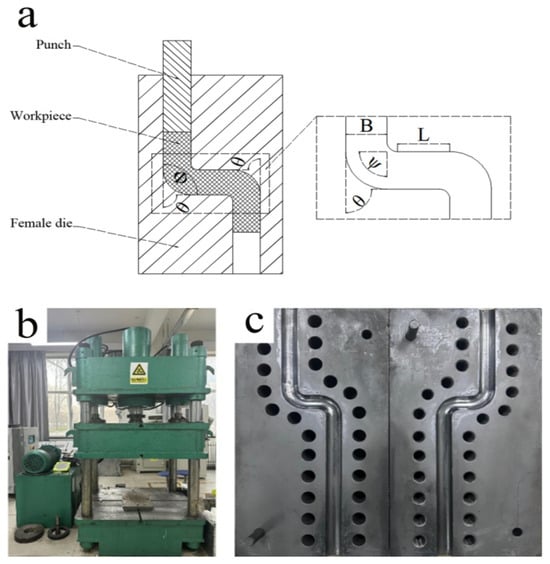
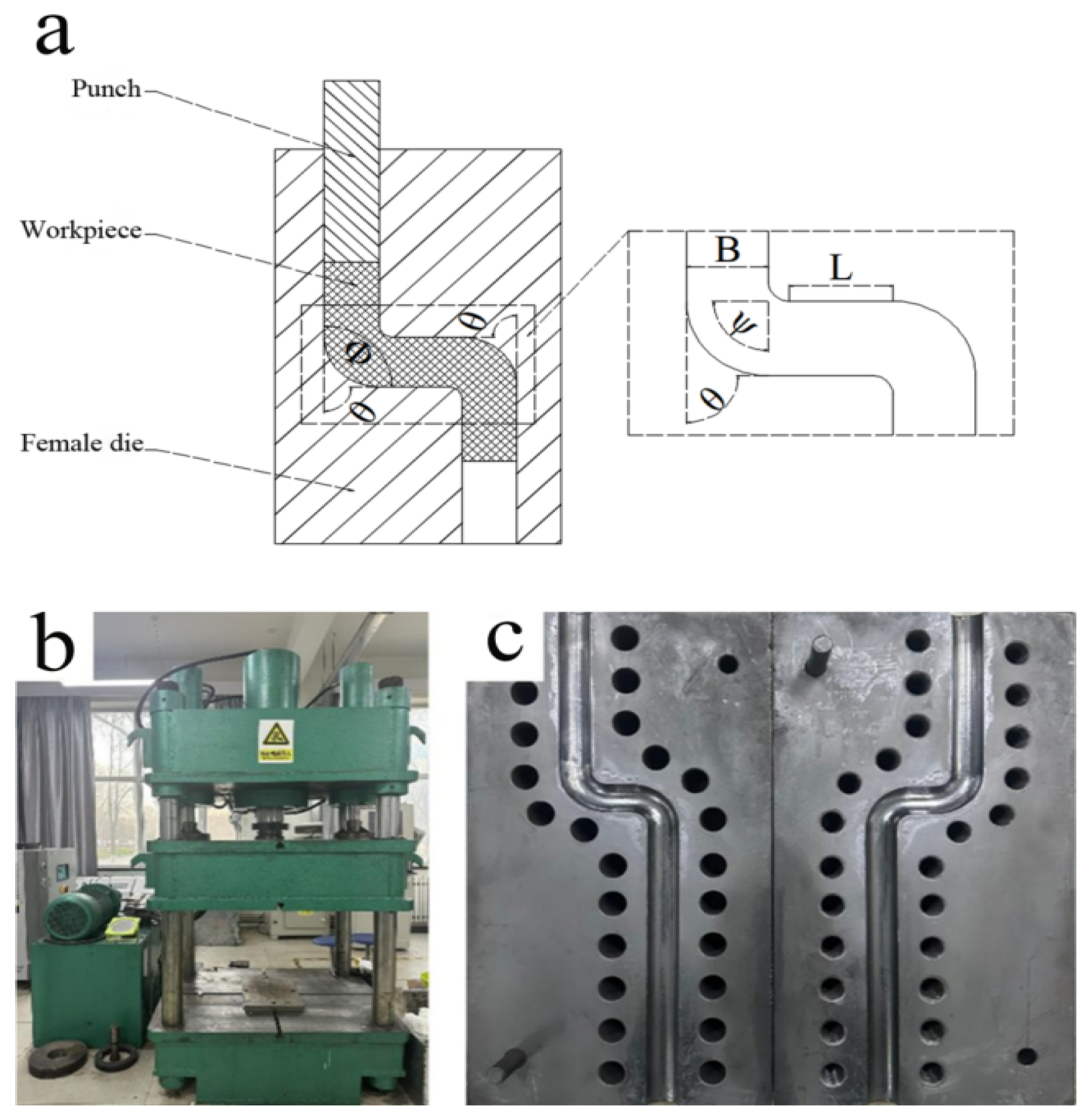
The principle of PC-ECAP is schematically illustrated in Figure 3a, where θ denotes the equal-channel extrusion angle, Φ denotes the inner corner angle, ψ denotes the outer arc angle, B denotes the channel width or the billet width, and L denotes the length of the transition segment between the two corners. PC-ECAP incorporates two corners of equal magnitude but opposite directions within the equal-diameter channel; the workpiece undergoes shear deformation first at one corner and then at the second, thereby realizing severe plastic deformation characterized by “one extrusion, two shear deformations.” The PC-ECAP equipment and die used in this study were independently designed and developed by our research group, as shown in Figure 3b,c. The die is made of H13 hot-work die steel. The inner corner angle Φ and the outer arc angle ψ of the die channel are both 90°, and the cross-sectional dimension of the channel upon die closure is ϕ 20 mm. During the corner extrusion process, the magnesium matrix composite was subjected to a pressure of 185 ± 20 MPa, and the extrusion speed was 3 mm/s.
Figure 3.
(a) PC-ECAP extrusion principle and die geometry diagram. (b) PC-ECAP extrusion equipment. (c) PC-ECAP extrusion mold.
2.3. First-Principles Calculation Method
In Mg–Al system alloys, the solid-solution behavior of Al is a key factor influencing the plastic deformability of the matrix; however, its atomic-scale mechanism is difficult to observe directly through conventional experimental approaches. In this study, first-principles calculations based on density functional theory (DFT) were employed to construct an Mg–Al solid solution model, and to systematically analyze the changes in Mg–Mg bonding characteristics and their mechanical implications upon the introduction of Al atoms. The simulations were performed using the first-principles calculation software VASP 5.4.4 (Vienna Ab-initio Simulation Package) based on DFT [25]. The exchange-correlation functional was treated within the generalized gradient approximation (GGA) in the PBE form, and the interaction between ionic cores and valence electrons was described by the projector augmented wave (PAW) method. A plane-wave cutoff energy of 450 eV and a k-point grid of 3 × 3 × 2 were adopted. Full relaxation of atomic positions and cell shape was carried out until the residual forces on the atoms were less than 0.03 eV/Å and the total energy change was less than 1 × 10⁻⁵ eV.
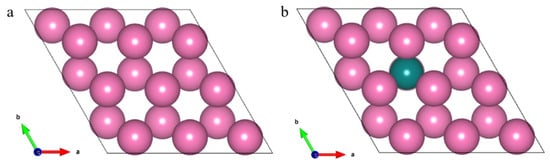
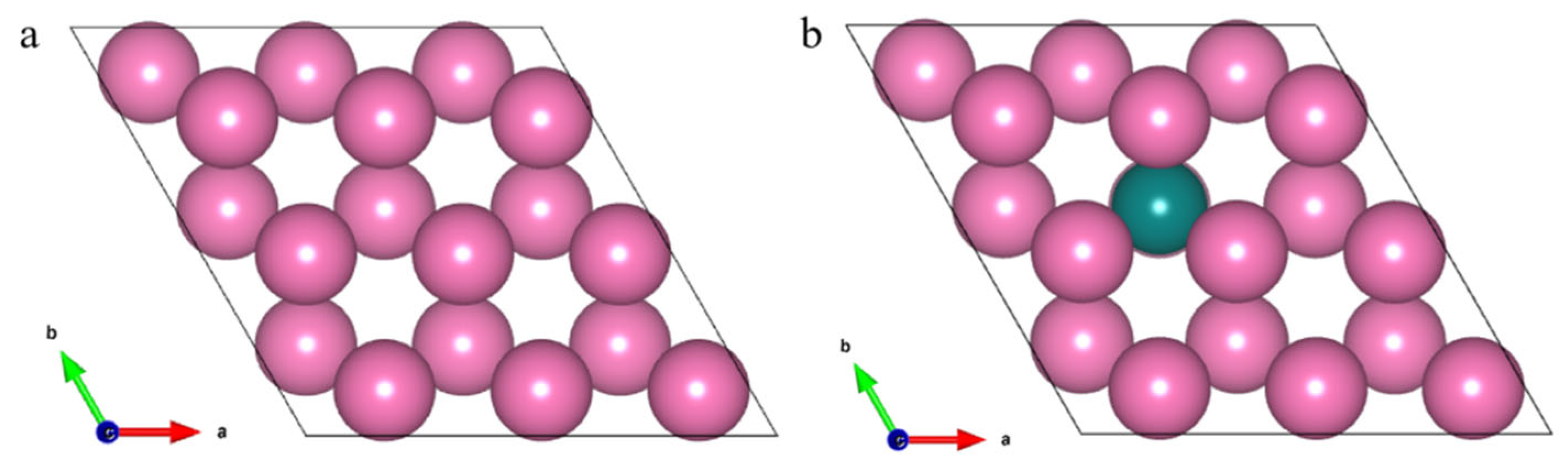
To simulate the solid-solution effect of Al in the AZ91D alloy, a supercell model containing multiple Mg atoms was constructed, and one Mg atom was replaced by an Al atom, yielding a solid-solution concentration of approximately 3.1 at.%. This concentration is close to the equilibrium solid solubility of Mg–Al alloys at typical hot working temperatures (350–400 °C), making the model compositionally relevant to actual process conditions. It should be explicitly noted that this computational model is a deliberately simplified ideal solid solution, which does not include the phase interfaces, the high-density dislocations introduced by ECAP, or the non-equilibrium characteristics present in the real composite. This simplification aims to decouple the complex synergistic effects of the multiphase system and to focus on a fundamental scientific question: the perturbation of the local electronic structure of the magnesium matrix caused by a single Al solute atom, a topic that differs from previous first-principles studies on Mg–Al systems [26,27] which primarily focused on solid-solution strengthening effects rather than the electronic origin of ductility enhancement.
3. Results and Discussion
3.1. Effect of Extrusion Temperature on the Microstructure and Properties of the Magnesium Matrix Composite
3.1.1. Microstructure of the SiCp/AZ91D Magnesium Matrix Composite at Different Extrusion Temperatures
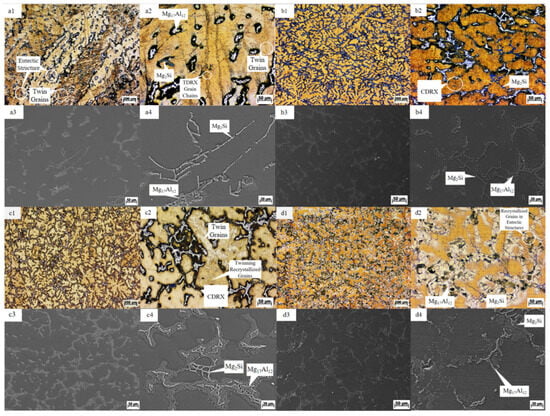
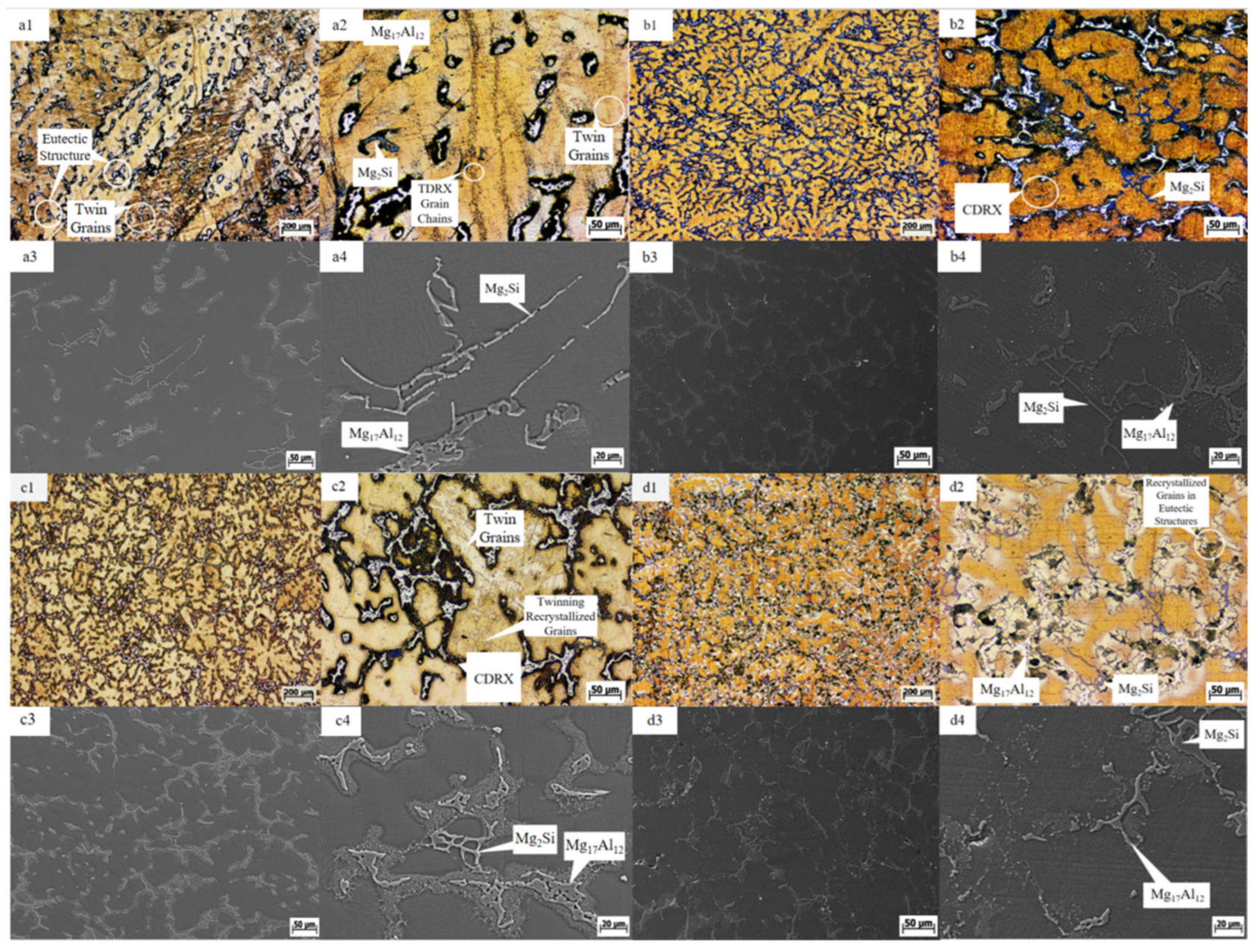
Figure 4 shows the microstructural evolution of the 2.0 wt.% SiCp/AZ91D composite after PC-ECAP at different extrusion temperatures.
Figure 4.
OM and SEM micrographs of the specimens extruded at different temperatures. (a1) OM at 100× for 250 °C; (a2) OM at 500× for 250 °C; (a3) SEM at 300× for 250 °C; (a4) SEM at 1000× for 250 °C; (b1) OM at 100× for 300 °C; (b2) OM at 500× for 300 °C; (b3) SEM at 300× for 300 °C; (b4) SEM at 1000× for 300 °C; (c1) OM at 100× for 350 °C; (c2) OM at 500× for 350 °C; (c3) SEM at 300× for 350 °C; (c4) SEM at 1000× for 350 °C; (d1) OM at 100× for 400 °C; (d2) OM at 500× for 400 °C; (d3) SEM at 300× for 400 °C; (d4) SEM at 1000× for 400 °C.
In the specimen extruded at 250 °C, numerous twinned grains and twin dynamic recrystallization (TDRX) chains formed by twin intersections are observed in the matrix, and most grains become indistinguishable due to their blurred outlines after deformation. Xu, S. and Ma, Q., et al. [28,29] suggested that these recrystallized chains are formed in twinned regions through twin intersections, and this microstructural evolution process is termed twin dynamic recrystallization (TDRX). Furthermore, the eutectic region is small; the β-Mg17Al12 phase is sparsely distributed as particles or short rods, and the Mg2Si phase appears as slender strips that are severely fractured. At 300 °C, the TDRX chains disappear, and the number of recrystallized grains in the eutectic region increases. The content of the β-Mg17Al12 phase increases, predominantly exhibiting a skeletal rod-like morphology with a small amount of granular particles; the Mg2Si phase is distributed as elongated strips along grain boundaries and within grains. At 350 °C, only a small number of coarse twins and fine twin dynamic recrystallized grains remain in the matrix, and the continuous recrystallized grains decrease. The β-Mg17Al12 phase still exists as coarse skeletal structures, but internal cavities appear, indicating a tendency to dissolve; the Mg2Si phase is partially distributed as granular particles in the eutectic region and partially as rosette-shaped morphologies within the grains. At 400 °C, twins basically disappear, the matrix exhibits a bright white contrast induced by Al solid solution, the eutectic region is significantly reduced, and the continuous recrystallized grains decrease. The β-Mg17Al12 phase is largely dissolved, with the residual phase distributed as slender rods along grain boundaries and within grains, and a small amount re-precipitates in the eutectic region; the Mg2Si phase shows no obvious change.
At 250 °C, the β-Mg17Al12 phase is sparsely distributed as particles or short rods in the eutectic region. Because the deformation is dominated by basal slip and twinning, the twinning-induced reorientation of small grains into favorable slip orientations accommodates the deformation of large grains. The β phase at grain boundaries dissolves through dynamic recrystallization triggered by high stress concentration and dislocation pile-ups, while the elongated Mg2Si phase fractures. At 300 °C, recrystallization becomes the primary accommodation mechanism, with continuous dynamic recrystallization and twin dynamic recrystallization coexisting. The stress concentration at grain boundaries is weakened, the dissolution of the β phase is reduced, and recrystallized grains extend from the eutectic boundaries into the grain interiors around the Mg2Si phase. At 350 °C, the remaining twins and twin dynamic recrystallized grains in the matrix further reduce the stress concentration at the grain boundary β phase. Continuous recrystallization weakens and becomes localized in the eutectic region; the area of the granular eutectic region increases, while the Mg2Si phase remains unaffected. At 400 °C, non-basal slip increases and twinning decreases. Dislocations accumulate at the grain boundary β phase and in the eutectic region. The high temperature promotes extensive dissolution of the β phase, and recrystallization near the Mg2Si phase increases significantly.
The above microstructural evolution indicates that the deformation mechanism of the SiCp/AZ91D composite during PC-ECAP undergoes a temperature-driven stage-wise transition, which in turn determines the grain refinement effect and the behavior of the second phases.
- (1)
- 250 °C: Twinning-dominated stage. The appearance of abundant twins and twin dynamic recrystallization (TDRX) chains in the microstructure at this temperature suggests that twinning may be the primary mechanism for accommodating plastic deformation [30]. Since non-basal slip systems are difficult to activate, the deformation in inhomogeneity is relatively high, leading to localized stress concentrations at grain boundaries and phase interfaces. Under this condition, the β-Mg17Al12 phase undergoes partial dissolution, while the brittle Mg2Si phase fractures due to its inability to accommodate the high strain. The above phenomena are similar to the deformation characteristics of magnesium alloys at low temperatures, which are dominated by basal slip and twinning.
- (2)
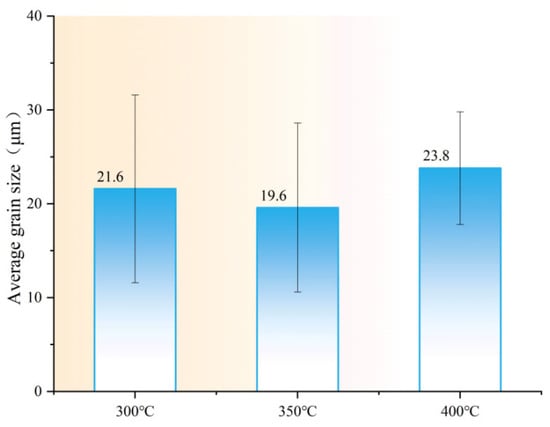
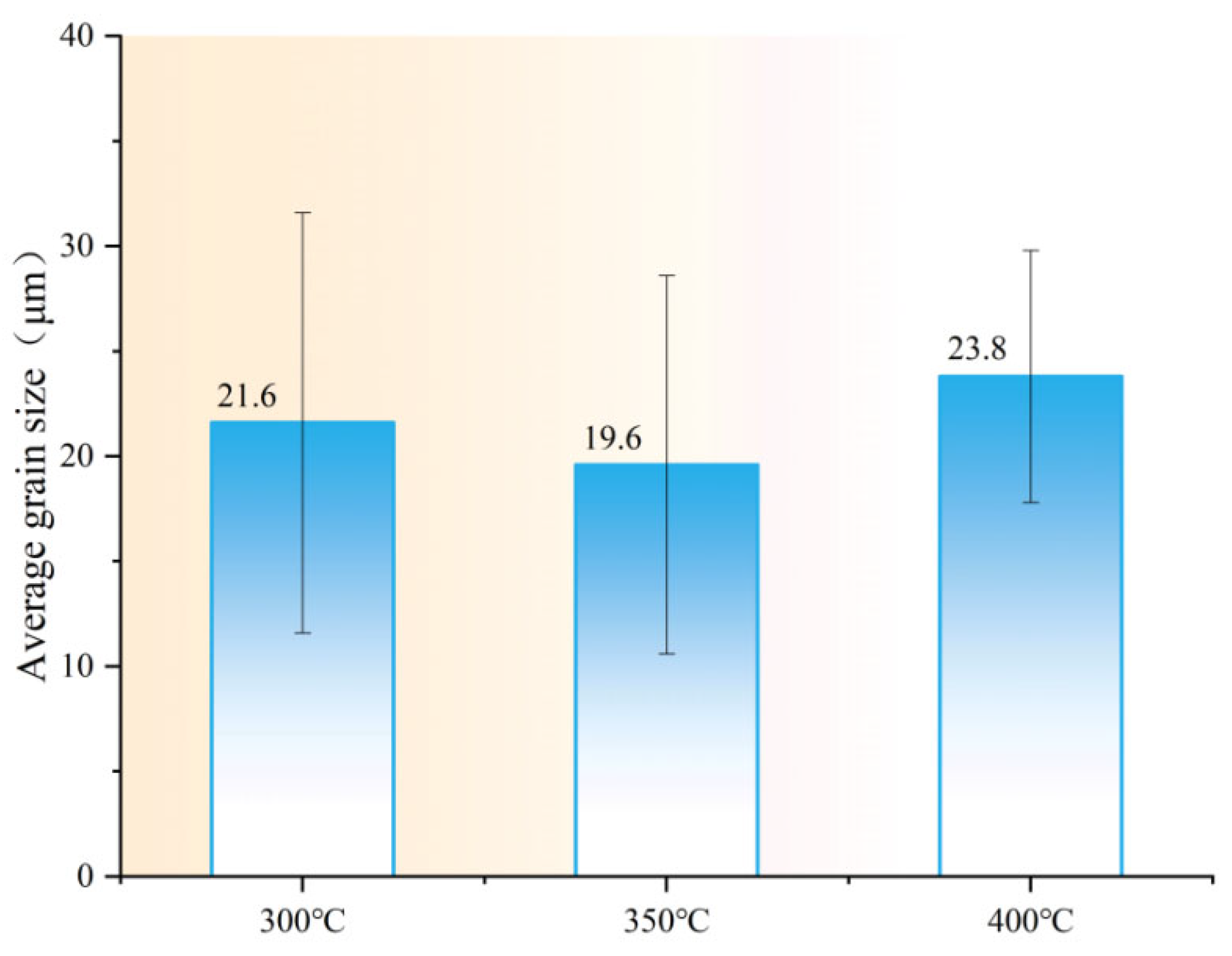
- 300–350 °C: Twinning-to-recrystallization transition stage. As the temperature rises to 300 °C, the critical resolved shear stress for non-basal slip systems decreases and the slip activity increases. The twin chains in the microstructure essentially disappear, and continuous dynamic recrystallization (CDRX) grains increase significantly, indicating that recrystallization has gradually replaced twinning as an important deformation accommodation mechanism [31,32]. The β-Mg17Al12 phase stops dissolving due to the alleviation of stress concentration at grain boundaries and coarsens into a continuous skeletal morphology. When the temperature is further raised to 350 °C, twinning and CDRX coexist, producing a synergistic refinement effect [31]. On the one hand, a small amount of residual twins contribute fine grains through twin dynamic recrystallization (TDRX); on the other hand, CDRX proceeds continuously in the eutectic region and around the Mg2Si phase. At this temperature, cavities appear inside the β-Mg17Al12 phase, suggesting that it has entered the initial stage of dissolution, while the overall skeletal framework is still retained. Grain size statistics, as shown in Figure 5, show that the average grain size at 350 °C is 19.6 μm, slightly finer than the 23.8 μm observed at 400 °C. Although the error bars overlap between adjacent temperatures, the microstructural evidence in Figure 4 reveals distinct deformation and recrystallization mechanisms across temperatures. The grain size of the 250 °C specimen could not be determined reliably because the severe deformation resulted in blurred grain boundaries that could not be resolved by the linear intercept method. Therefore, this value is not included in Figure 5.Figure 5. Grain size statistics of SiCp/AZ91D composites at different extrusion temperatures.
- (3)
- 400 °C: Recrystallization-dominated and grain-coarsening stage. At 400 °C, non-basal slip is fully activated and twinning is almost completely suppressed. CDRX remains the dominant mechanism but is accompanied by pronounced grain boundary migration, leading to the coarsening of recrystallized grains to 23.8 μm. Under the combined effect of high temperature and high strain, the β-Mg17Al12 phase largely dissolves, leaving only a small amount of fine rod-like residues distributed at grain boundaries and within grains; the area of the eutectic region is significantly reduced, reflecting a higher degree of Al homogenization.
In summary, the grain refinement effect of the 2.0 wt.% SiCp/AZ91D composite during PC-ECAP depends on the competition and synergy between twinning-assisted refinement and continuous dynamic recrystallization (CDRX) refinement. The temperature of 350 °C is the critical point at which the contributions of the two mechanisms are balanced: below this temperature, twinning dominates, but recrystallization is insufficient; above this temperature, recrystallization is sufficient but grain growth accelerates. The determination of this critical temperature provides a microstructural basis for the selection of the subsequent T6 heat treatment process window.
3.1.2. Mechanical Properties of the SiCp/AZ91D Composite at Different Extrusion Temperatures
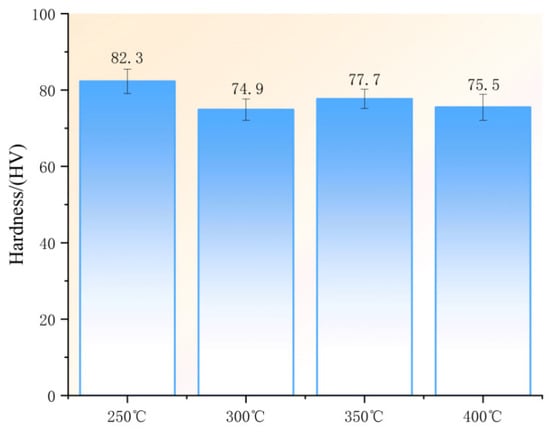
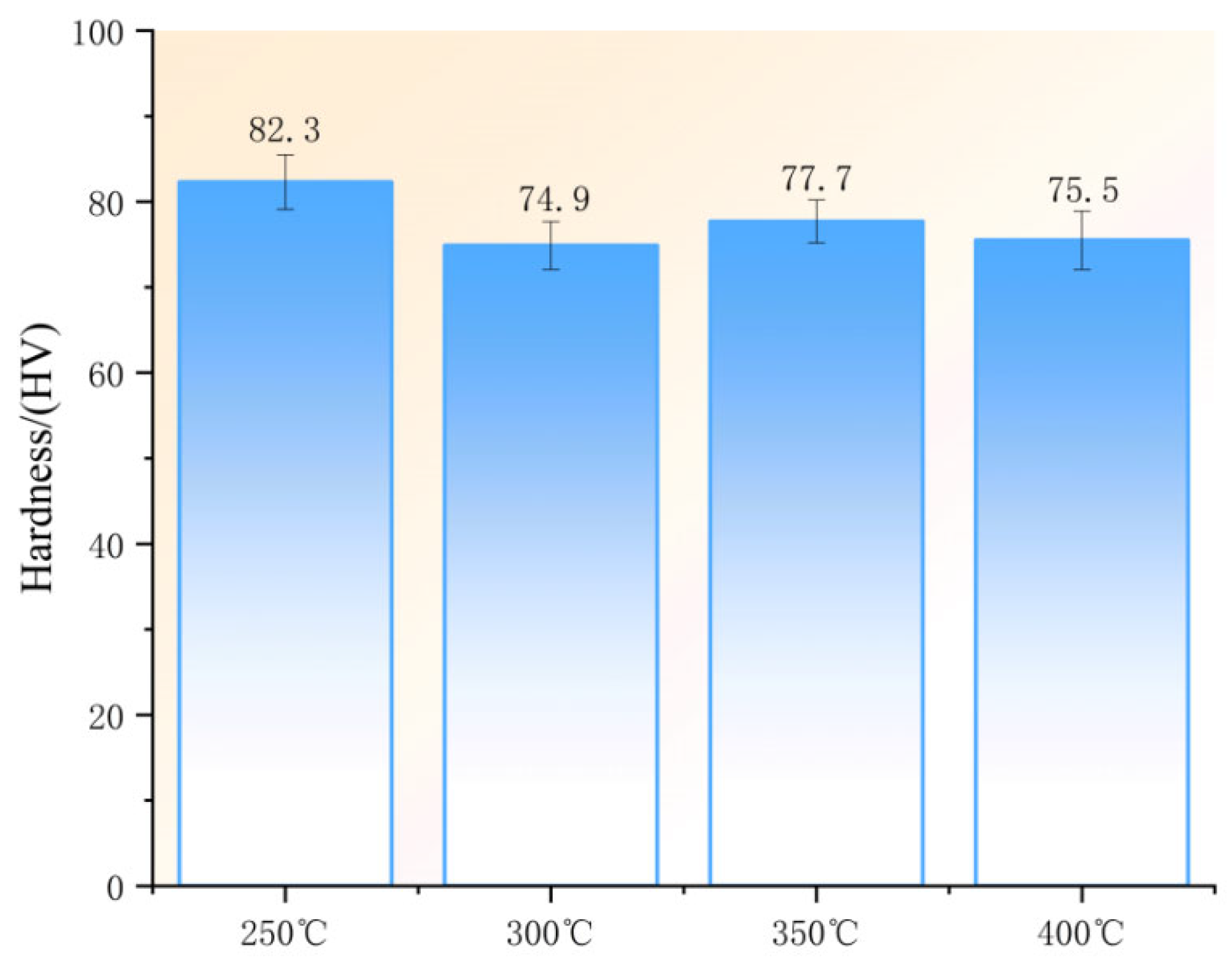
Figure 6 presents the microhardness (HV4.9) test results of the 2.0 wt.% SiCp/AZ91D composite at different extrusion temperatures. The hardness values exhibit a non-monotonic variation with increasing temperature: the highest value of 82.3 HV4.9 is recorded at 250 °C, followed by a decrease at 300 °C, a slight recovery at 350 °C, and another decrease at 400 °C. Although the error bars show some overlap between adjacent temperatures, the overall trend and the underlying mechanisms are discussed below. At 250 °C, the low temperature suppressed non-basal slip and dynamic recrystallization (as shown in Figure 4(a2)), and plastic deformation relied primarily on basal slip and twinning. The accumulation of high dislocation density together with Al solid solution resulted in work hardening and solid solution strengthening, thereby yielding the highest hardness. When the temperature increased to 300 °C, non-basal slip systems were gradually activated, continuous dynamic recrystallization (CDRX) reduced the dislocation density, and partial dissolution of the β phase weakened the second-phase strengthening, causing the hardness to drop to 74.9 HV4.9. At 350 °C, non-basal slip and recrystallization became more pronounced, but the β phase still partially persisted in a skeletal form (see Figure 4(c4)), and the grains were refined to 19.6 μm. Grain refinement strengthening and the residual second phase compensated for the softening, leading to a hardness recovery to 77.7 HV4.9. At 400 °C, the high temperature promoted dislocation climb and dynamic recovery, significantly reducing the dislocation density. As shown in Figure 4(d2), the β phase largely dissolved and the recrystallized grains coarsened, resulting in a hardness decrease to 75.5 HV4.9. In summary, the non-monotonic variation in microhardness reflects the competitive relationship among work hardening, solid solution strengthening, second-phase strengthening, and recrystallization softening at different temperatures. At 250 °C, work hardening dominates; at 300 °C, recrystallization softening prevails; at 350 °C, grain refinement strengthening and residual second-phase strengthening achieve a balance; and at 400 °C, recovery and phase dissolution lead to the lowest hardness.
Figure 6.
Microhardness (HV4.9) values of PC-ECAP of SiCp/AZ91D composites at different extrusion temperatures.
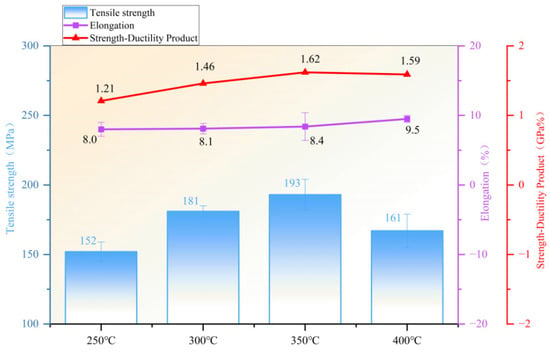
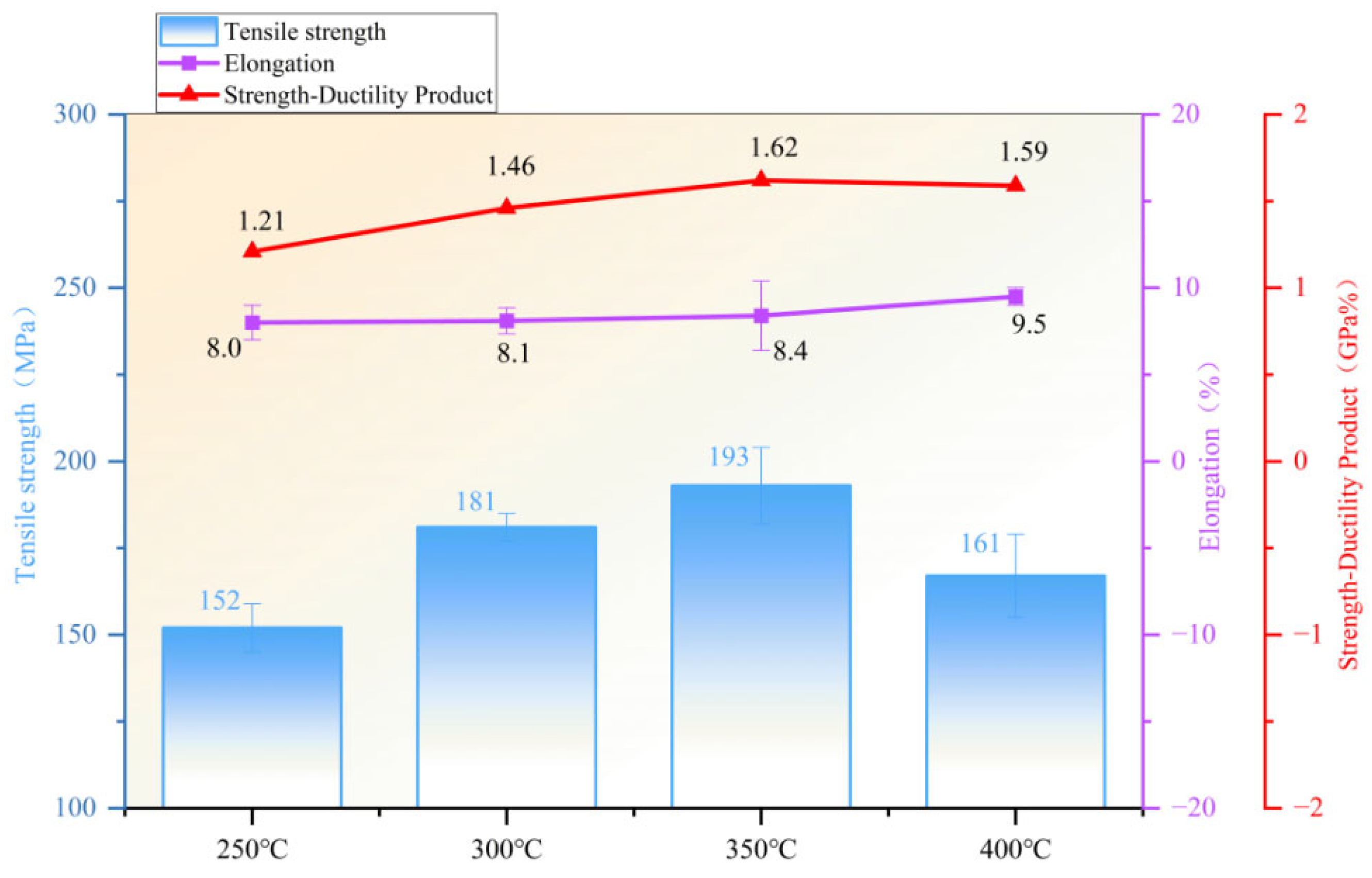
The tensile properties of the SiCp/AZ91D composite at different extrusion temperatures are presented in Figure 7. Overall, the tensile strength, elongation, and product of tensile strength and elongation (PSE) all exhibit a clear temperature dependence, with the optimal comprehensive tensile performance achieved at an extrusion temperature of 350 °C, where the tensile strength is 193 MPa, the elongation is 8.4%, and the PSE reaches 1.62 GPa%. At 250 °C, the tensile strength of the material is relatively low, which is mainly attributed to two factors: the brittle Mg2Si phase undergoes significant fracture under severe shear deformation, impairing its load-bearing capacity; meanwhile, the limited extent of recrystallization at low temperatures results in stress concentrations at grain boundaries caused by twinning and dislocation pile-ups, and these jointly lead to premature failure. When the temperature rises to 300 °C, the integrity of the Mg2Si phase is improved, and the β-Mg17Al12 phase is primarily distributed as a continuous skeletal network in the eutectic region, providing a certain degree of load transfer and grain boundary strengthening, thereby enhancing the tensile strength. At 350 °C, the tensile strength reaches its peak. At this temperature, a large number of fine dynamic recrystallization grains are induced in the vicinity of the β-Mg17Al12 and Mg2Si phases, which significantly refines the matrix structure. The combined effects of grain refinement strengthening and second-phase strengthening enable the material to achieve a relatively high strength while maintaining a certain ductility. As the temperature further increases to 400 °C, although the recrystallization process becomes more extensive, the rosette-shaped Mg2Si phase inside the grains notably disrupts the continuity of the matrix, while the extensive dissolution of the β-Mg17Al12 phase eliminates its strengthening contribution. These two factors jointly induce the formation and growth of microvoids in the matrix (see Figure 8d), resulting in a marked decrease in tensile strength. Meanwhile, the elongation reaches its maximum at 400 °C because the fully activated non-basal slip systems provide more slip modes to accommodate plastic deformation, and the extensive dynamic recovery reduces the dislocation density, thereby delaying strain localization and premature fracture [31].
Figure 7.
Tensile properties of SiCp/AZ91D composites at different extrusion temperatures.
Figure 8.
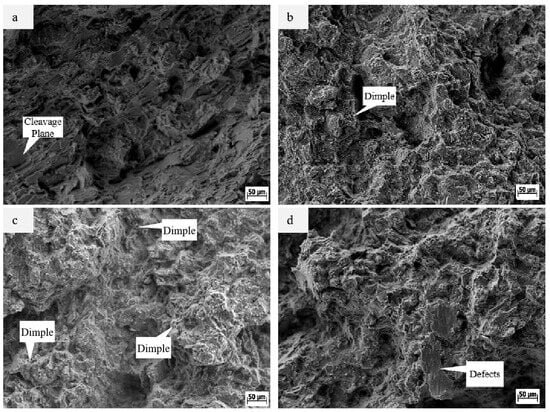
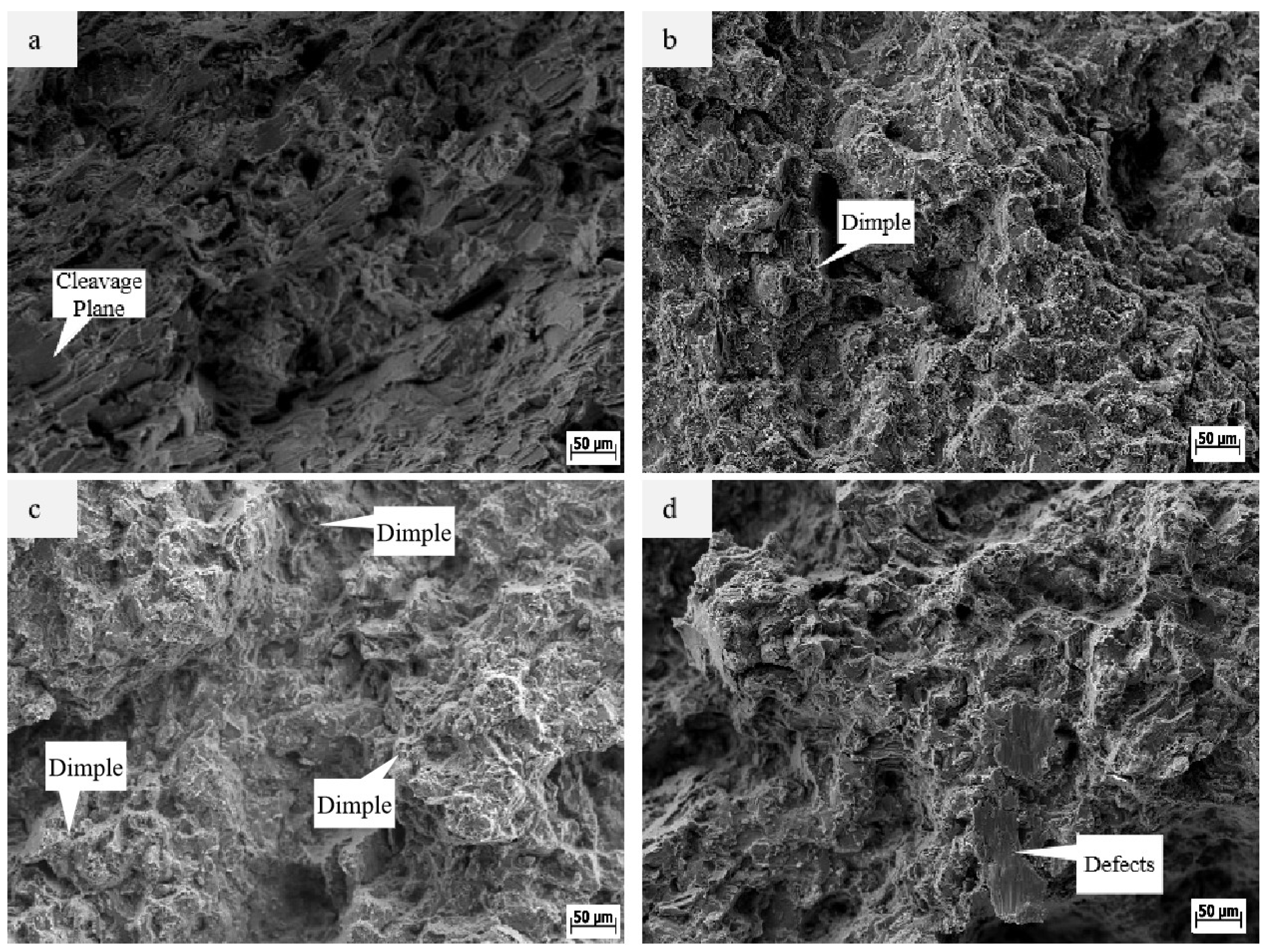
Fracture morphology of SiCp/AZ91D composites at different extrusion temperatures. (a) 250 °C, (b) 300 °C, (c) 350 °C, (d) 400 °C.
Figure 8 presents the tensile fracture morphologies of the 2.0 wt.% SiCp/AZ91D composite at different extrusion temperatures. As the extrusion temperature increases, the fracture morphology transitions from brittle cleavage to ductile fracture. The fracture surface of the specimen extruded at 250 °C is dominated by large-area cleavage facets with only scattered shallow dimples, as shown in Figure 8a, corresponding to the lowest elongation, which originates from low-temperature twinning deformation and the fracture of the Mg2Si phase. At 300 °C, the cleavage facets are reduced, and the dimples become more numerous and larger (Figure 8b), indicating a shift to a mixed fracture mode. In the 350 °C specimen, cleavage facets are still locally visible, but the majority of the surface consists of dimples (Figure 8c), reflecting improved ductility with some localized brittleness. At 400 °C, the fracture surface is covered with dense, deep dimples and is free of cleavage facets (Figure 8d), signifying a complete transition to microvoid coalescence ductile fracture, which corresponds to the highest elongation. In summary, the evolution of the fracture morphology directly corroborates the influence of temperature on the fracture behavior of the SiCp/AZ91D composite: from brittle cleavage at 250 °C, to mixed fracture at 300–350 °C, and finally to fully ductile fracture at 400 °C, which is highly consistent with the variation trend of the tensile properties with temperature.
3.2. Microstructure and Mechanical Properties of the 2.0 wt.% SiCp/AZ91D Composite After Heat Treatment
3.2.1. Microstructure of the 2.0 wt.% SiCp/AZ91D Composite After Heat Treatment
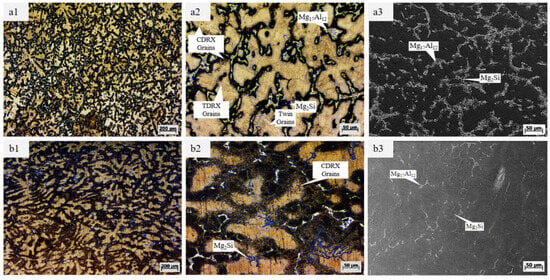
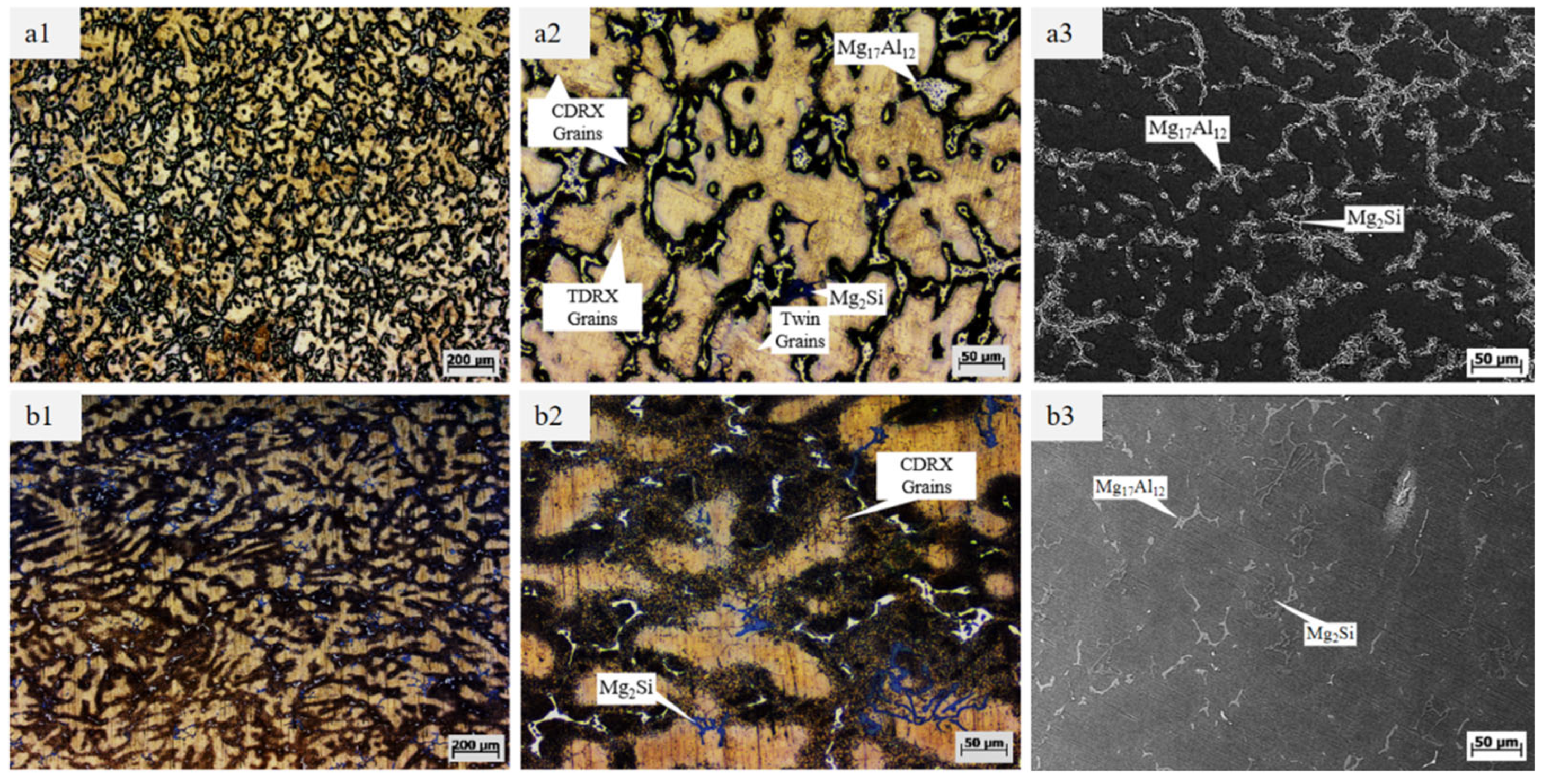
Based on the process window established in Section 3.1, the 2.0 wt.% SiCp/AZ91D composite extruded at 350 °C was selected for T6 heat treatment to investigate the regulatory mechanism of the solution-aging process on the microstructure of the material. Figure 9 compares the microstructures of the specimens before and after heat treatment.
Figure 9.
OM and SEM Micrographs of SiCp/AZ91D Composites Before and After Heat Treatment. (a1) OM at 100× without heat treatment, (a2) OM at 500× without heat treatment, (a3) SEM image without heat treatment, (b1) OM at 100× heat treated by T6, (b2) OM at 500× heat treated by T6, (b3) SEM image heat treated by T6.
Before heat treatment, as shown in Figure 9(a1–a3), the microstructure retains pronounced deformation features: numerous twins and twin dynamic recrystallization (TDRX) chains are visible in the matrix; the number of continuous dynamic recrystallization (CDRX) grains near grain boundaries is limited; the β-Mg17Al12 phase is distributed in the eutectic region as coarse skeletal structures and granular particles; the Mg2Si phase is mostly concentrated in this region, with a relatively low degree of precipitation and a morphology dominated by slender strips. After T6 heat treatment, as shown in Figure 9(b1–b3), the microstructure undergoes a fundamental reconstruction: the matrix grains are significantly refined, with the average grain size decreasing from 19.6 μm to 8.9 μm as presented in Table 4, and twins and TDRX chains essentially disappear; CDRX grains increase drastically, appearing as fine equiaxed grains uniformly distributed in the eutectic region and within the grain interiors; the morphology of the β-Mg17Al12 phase changes dramatically: the coarse skeletal phase dissolves and is replaced by slender rod-like and fine granular precipitates, which are still predominantly located in the eutectic region; the precipitation of the Mg2Si phase is enhanced, and it is extensively distributed as slender strips and rosette-shaped morphologies in both the eutectic region and the grain interiors.
Table 4.
Average grain size of SiCp/AZ91D composites before and after T6 treatment.
The microstructural reconstruction induced by T6 heat treatment can be attributed to the synergistic effect of solution treatment and aging. During the solution treatment stage, during holding at 415 °C, the coarse β-Mg17Al12 phase dissolves, and Al atoms diffuse into the α-Mg matrix, forming a supersaturated solid solution. This process produces two effects: first, it eliminates the pinning and splitting effect of the coarse β-Mg17Al12 phase on grain boundaries; second, the solid solution of Al atoms causes lattice distortion, reduces the dislocation energy of the matrix, and promotes the activation of non-basal slip systems. During the aging holding process, the supersaturated solid solution decomposes, and fine β-Mg17Al12 and Mg2Si phases re-precipitate. These dispersedly distributed precipitates, on the one hand, enhance the strength through precipitation strengthening, and on the other hand, inhibit grain growth through grain boundary pinning. The superimposed effect of the above processes is as follows, and this mechanism is supported by the comparative microstructural data before and after T6 treatment as shown in Figure 9b and Table 4: the activation of non-basal slip during the solution stage increases the mobile dislocation density, providing more nucleation sites for continuous dynamic recrystallization (CDRX); the fine phases precipitated during the aging stage stabilize the recrystallized grain size through pinning, and as shown in Table 4, the average grain size is refined from 19.6 μm to 8.9 μm. Together, these effects lead to significant grain refinement after T6 treatment and the virtual disappearance of twins.
3.2.2. Room-Temperature Tensile Properties of the 2.0 wt.% SiCp/AZ91D Composite After Heat Treatment
Table 5 compares the room-temperature tensile properties of the 2.0 wt.% SiCp/AZ91D composite before and after heat treatment. After T6 treatment, the specimen exhibits a significant synergistic enhancement of strength and ductility: the tensile strength increases from 193 MPa to 221 MPa, an increase of 14.5%; the elongation improves substantially from 8.4% to 19.2%, an increase of 128.6%; and the product of tensile strength and elongation (PSE) correspondingly increases from 1.62 GPa% to 4.24 GPa%, an increase of approximately 161.7%. This property improvement can be attributed to the synergistic effect of the following micro-mechanisms: grain refinement—as shown in Table 4, the grain size is refined from 19.6 μm to 8.9 μm after T6 treatment; the grain refinement strengthening effect directly contributes to the strength increase, and the increased number of grain boundaries facilitates the accommodation of plastic deformation; second-phase optimization—the dissolution of the coarse β-Mg17Al12 phase eliminates its splitting effect on grain boundaries, and the fine, dispersed precipitates provide precipitation strengthening while avoiding excessive damage to ductility; solid solution softening effect—the solid solution of Al activates non-basal slip systems, increases the density of mobile dislocations, and promotes uniform plastic deformation, which is the core mechanism responsible for the substantial improvement in elongation. Among the above mechanisms, the solid solution softening effect explains why the increase in strength (14.5%) is far smaller than the increase in elongation (128.6%): while Al solid solution reduces the stacking fault energy and promotes slip, it also partially weakens the work hardening capacity; however, its positive contribution to ductility far outweighs its negative effect on strength [33].
Table 5.
Room-temperature tensile properties of SiCp/AZ91D composites before and after T6 treatment.
Compared with similar materials reported in the literature, the T6-treated specimen in this study exhibits a unique combination of strength and ductility. Qiao et al. [34] fabricated a 1.0 wt.% SiCp/AZ91 composite by stir casting combined with variable channel extrusion and ECAP; its tensile properties are listed in Table 6. Compared with that composite, the present specimen shows a slightly lower tensile strength of 221 MPa, but a significantly higher elongation of 19.2%, resulting in a PSE of 4.24 GPa%, which is approximately 5.4 times higher than the optimal literature value of 0.66 GPa%. This difference mainly originates from the different process routes: the literature adopted multi-pass ECAP to pursue ultimate strength at the expense of ductility; in contrast, this study achieves a better balance between strength and ductility through single-pass PC-ECAP forming combined with T6 heat treatment. The substantial improvement in PSE indicates that the material obtained in this study possesses superior formability in subsequent processing (e.g., wire drawing, stamping) [35].
Table 6.
Tensile properties of 1.0 wt.% SiCp/AZ91D composites in different states [34].
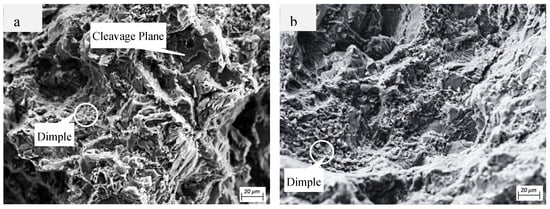
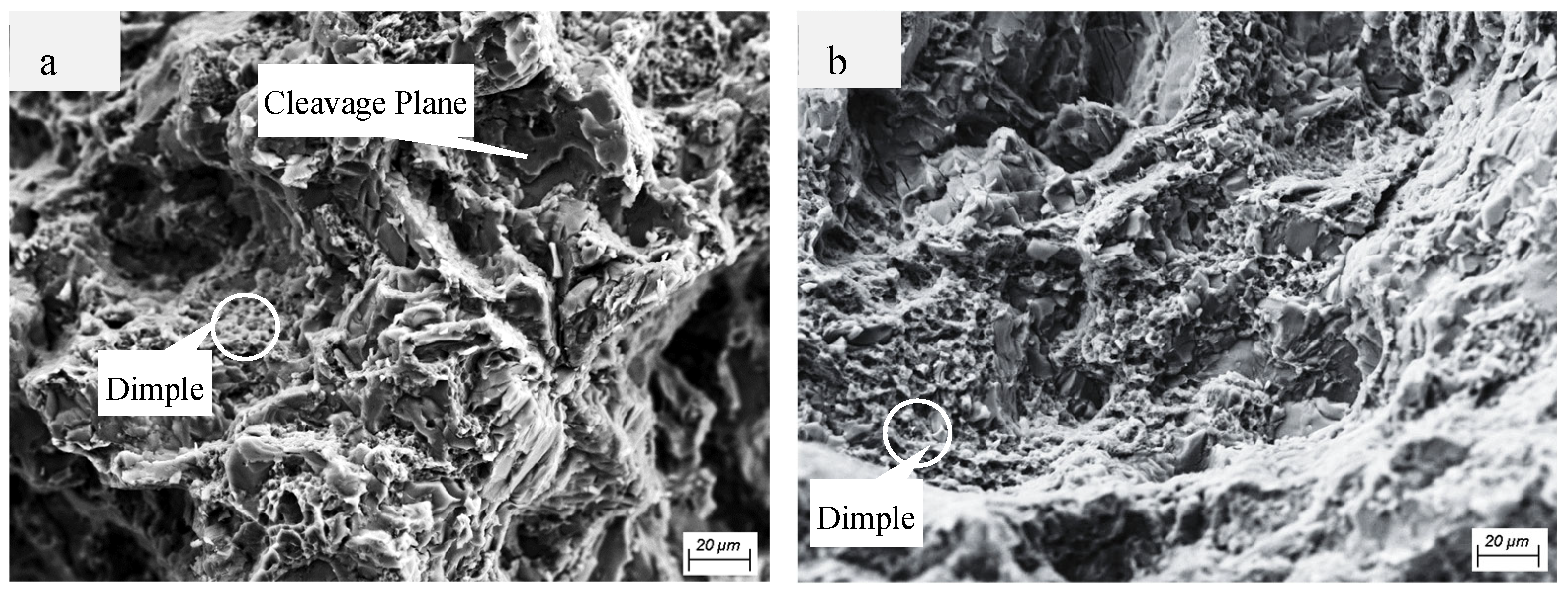
Figure 10 compares the tensile fracture morphologies of the specimens before and after heat treatment. Before heat treatment, the fracture surface of the specimen, as shown in Figure 10a, exhibits typical brittle cleavage fracture characteristics, dominated by large, flat cleavage facets with only a few tear ridges and shallow dimples, which is consistent with the low elongation of 8.4% of the as-extruded condition and is attributable to premature cracking induced by the coarse β-Mg17Al12 phase and the undissolved Mg2Si phase. After T6 treatment, as shown in Figure 10b, the fracture morphology undergoes a fundamental transition: cleavage facets disappear completely and are replaced by dense, uniform, and deep dimples, presenting typical microvoid coalescence ductile fracture, which is highly consistent with the substantial increase in elongation to 19.2%. The evolution of the fracture morphology is attributed to the microstructural reconstruction induced by T6 treatment: the dissolution of the coarse β phase eliminates crack nucleation sites; the fine precipitates and improved interfacial bonding enhance crack propagation resistance; grain refinement and activation of non-basal slip promote uniform plastic deformation, enabling the material to accommodate larger plastic strain during tension and form a large number of dimples.
Figure 10.
Tensile fracture SEM morphologies of SiCp/AZ91D composites before and after heat treatment: (a) as-extruded (before heat treatment); (b) T6-treated.
3.3. First-Principles Analysis of the Effect of Al Solid Solution on the Electronic Structure and Deformation Mechanism of Mg
3.3.1. Calculation Objective and Model Description
The experimental results presented in Section 3.2 show that the elongation of the 2.0 wt.% SiCp/AZ91D composite increases by 128.6% after T6 heat treatment, and this macroscopic ductility improvement is closely related to the solid-solution behavior of Al in the matrix. However, how the Al solid solution affects the intrinsic slip capability of the magnesium matrix at the atomic scale is difficult to observe directly using existing experimental approaches. It should be emphasized that high-density dislocations, precipitates, and complex interfaces exist in the real composite, and these factors are coupled with the solid-solution effect, making it impossible to independently evaluate the intrinsic contribution of Al atoms to the ductility of the matrix. To decouple these interfering factors, first-principles calculations are employed in this study, in which an ideal Mg–Al solid solution model is deliberately constructed to simplify the problem to the local perturbation of the electronic structure of the magnesium matrix caused by the substitution of a single Al atom, as illustrated in Figure 11.
Figure 11.
Top view of the supercell models: (a) pure Mg, (b) with an Al substitutional atom.
3.3.2. Electronic Structure Calculation Results
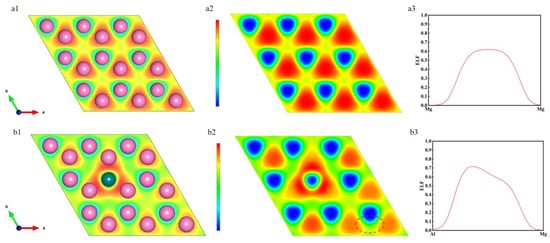
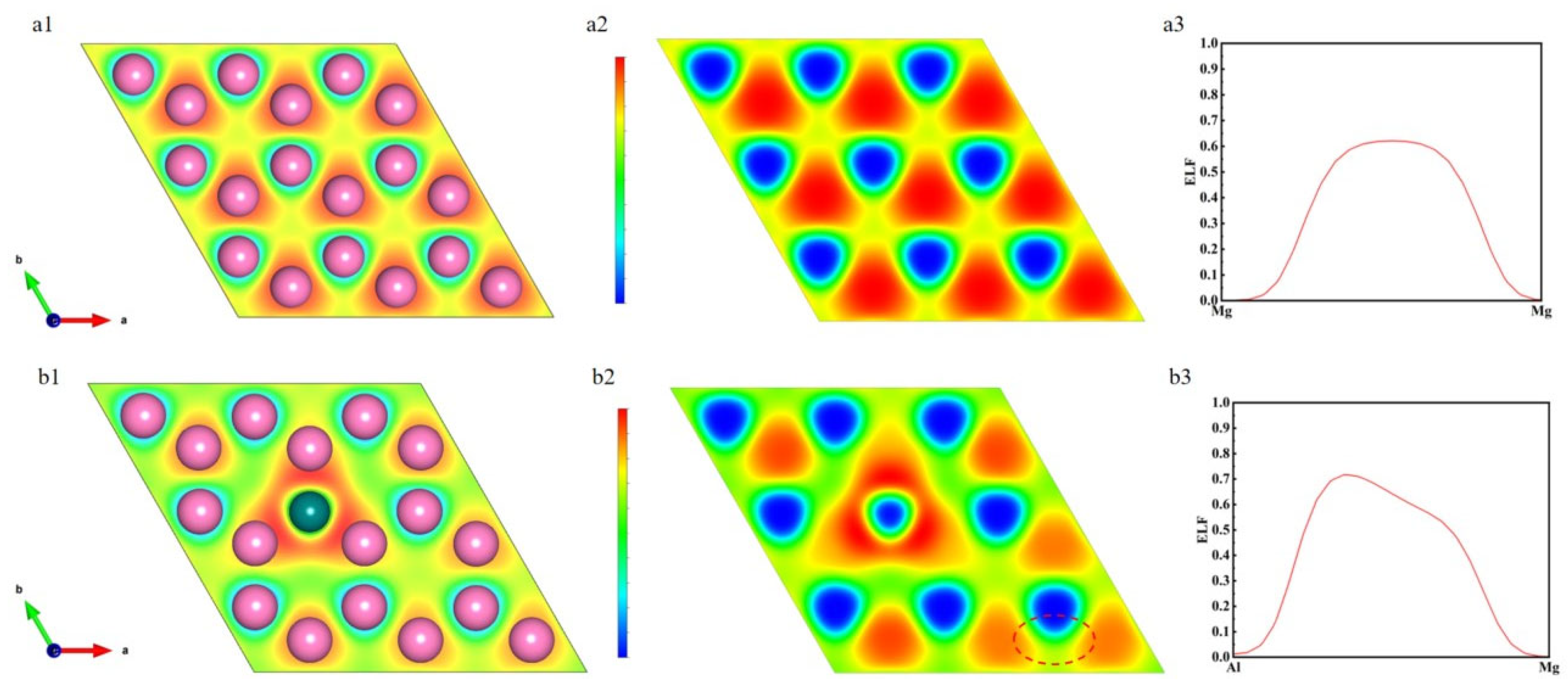
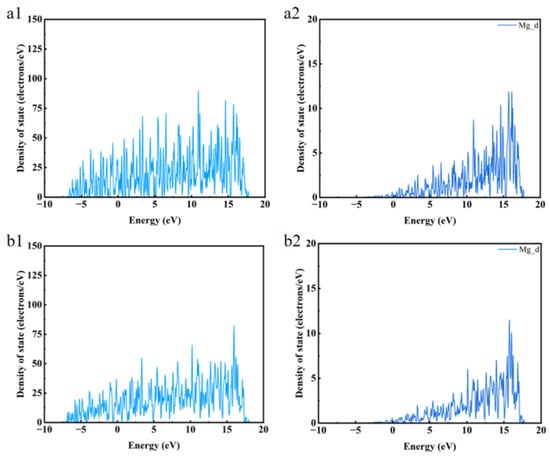
Figure 12 and Figure 13 show the electron localization function (ELF) and density of states (DOS) distributions of pure Mg and the Mg–3.1 at.% Al solid solution, respectively.
Figure 12.
ELF distribution: (a) pure Mg (a1) ELFCAR-3d (a2) ELFCAR-2d (a3) ELF; (b) Mg-Al solid solution (b1) ELFCAR-3d (b2) ELFCAR-2d (b3) ELF.
Figure 13.
ELF distribution: (a) pure Mg (a1) TDOS (a2) pDOS; (b) Mg-Al solid solution (b1) TDOS (b2) pDOS.
- (1)
- ELF analysis
In pure Mg, as shown in Figure 12a, the ELF value between adjacent Mg atoms is approximately 0.6–0.7 (yellow-green region), exhibiting typical metallic bonding characteristics. After Al solid solution (see Figure 12b), a red highly localized region with ELF ≈ 0.9 forms around the Al atom, which has a higher electronegativity (1.61), indicating charge accumulation toward the Al atom. Meanwhile, the ELF values in the Mg–Mg bond regions away from the Al atom generally decrease to 0.50–0.55 (blue-green region), directly demonstrating that the Al solid solution induces delocalization of the electron cloud in the Mg–Mg bonds.
- (2)
- DOS analysis
Compared with pure Mg, the total density of states (TDOS) of the Mg–Al solid solution exhibits a broadened and more continuous distribution near the Fermi level (see Figure 13(a1,b1)), indicating electron band hybridization. The key change is manifested in the partial density of states (PDOS) of the Mg-3d orbital: after the Al solid solution, the d-band center shifts to lower energies and the peak width increases significantly (see Figure 13(a2,b2)). The downward shift of the d-band center and the increased bandwidth provide clear electronic-structure evidence for enhanced electron delocalization and weakened directionality of metallic bonding.
- (3)
- Mechanical implications of the electronic structure
The above electronic-level changes have clear mechanical implications: the electron delocalization of Mg–Mg bonds (decreased ELF) and the downward shift of the d-band center collectively point to a weakening of the interatomic bonding strength. According to the Peierls-Nabarro dislocation model, a reduction in the interatomic bonding force directly leads to a decrease in the dislocation core energy and a reduction in the lattice resistance to dislocation slip. Physically, this is equivalent to reducing the generalized stacking fault energy (GSFE) of both basal and non-basal slip, with the reduction being relatively more pronounced for non-basal slip systems, which intrinsically have higher stacking fault energies, a mechanism that is experimentally validated in the present work through the significant enhancement of ductility.
- (4)
- Correlation with experimental observations
The reduction in stacking fault energy will promote the activation of non-basal slip systems, increase the number of mobile slip systems, and thereby enhance the uniformity of plastic deformation. This theoretical prediction is highly consistent in trend with the experimentally observed reduction in twinning and the substantial 128.6% increase in elongation after T6 treatment. In other words, the present calculations confirm from the atomic scale that the Al solid solution “possesses” the electronic structure basis for activating non-basal slip and suppressing twinning.
3.3.3. Cross-Scale Linkage from Electronic Structure to Macroscopic Plastic Deformation Mechanism
Integrating the calculations and experiments, at the electronic scale, first-principles calculations (Figure 12 and Figure 13) demonstrate that Al solid solution induces electron delocalization in Mg–Mg bonds, with the ELF value decreasing from 0.6 to 0.5, accompanied by a downward shift of the d-band center, proving that the directionality of the Mg–Mg metallic bond is weakened, and the bonding strength is reduced. According to the dislocation model, the weakened bonding strength is equivalent to a reduction in the generalized stacking fault energy (GSFE), especially for non-basal slip systems, thereby decreasing their critical resolved shear stress and reducing the barrier for slip activation. The activation of non-basal slip manifests at the microstructural level as the increased number of slip systems makes plastic deformation more uniform, and reduces the need for twinning, consistent with the virtual disappearance of twins after T6 treatment shown in Figure 9b; the increased density of mobile dislocations provides more nucleation sites for continuous dynamic recrystallization, leading to grain refinement from 19.6 μm to 8.9 μm, as shown in Figure 9b and Table 5. Meanwhile, the dissolution of the β-Mg17Al12 phase and the formation of fine precipitates optimize the second-phase distribution. The above microstructural changes ultimately manifest at the macroscopic property level as a synergistic enhancement of strength and ductility: grain refinement and precipitation strengthening increase the tensile strength from 193 MPa to 221 MPa, an increase of 14.5%; the activation of non-basal slip improves deformation uniformity, and the reduction of twins eliminates early crack sources, causing the elongation to increase substantially from 8.4% to 19.2%, an increase of 128.6%, with the PSE correspondingly increasing by 161.7%, as listed in Table 5.
4. Conclusions
- (1)
- The PC-ECAP extrusion temperature significantly influences the microstructural evolution and mechanical properties of the 2.0 wt.% SiCp/AZ91D composite. As the extrusion temperature increases from 250 °C to 400 °C, the deformation mechanism gradually transitions from twinning-dominated to recrystallization-dominated, with the grain size first refining and then coarsening, and the optimal comprehensive mechanical properties are achieved at 350 °C.
- (2)
- T6 heat treatment leads to a significant microstructural reconstruction of the composite extruded at 350 °C; the coarse β-Mg17Al12 phase dissolves and re-precipitates as fine dispersed particles, the average grain size is refined from 19.6 μm to 8.9 μm, and twins virtually disappear. After T6 treatment, the tensile strength increases from 193 MPa to 221 MPa, the elongation increases substantially from 8.4% to 19.2%, and the product of tensile strength and elongation (PSE) increases from 1.62 GPa% to 4.24 GPa%, representing improvements of 14.5%, 128.6%, and 161.7%, respectively.
- (3)
- First-principles calculations reveal that Al solid solution reduces the electron localization in Mg-Mg bonds and shifts the d-band center downward, weakening the interatomic bonding strength, which is equivalent to reducing the stacking fault energy of non-basal slip. This explains, from the electronic scale, the physical mechanism by which Al solid solution promotes the activation of non-basal slip and suppresses twinning, providing theoretical support for the significant improvement in elongation observed experimentally after T6 treatment.
Author Contributions
Conceptualization, L.M. (Lixing Min) and G.G.; methodology, G.G.; software, J.W., S.B. and L.M. (Liying Ma); validation, J.W., S.B. and L.M. (Liying Ma); formal analysis, Y.Z.; investigation, L.M. (Lixing Min), J.W., S.B. and L.M. (Liying Ma); resources, L.M. (Lixing Min) and G.G.; data curation, J.W., S.B. and L.M. (Liying Ma); writing—original draft preparation, L.M. (Lixing Min); writing—review and editing, G.G. and Y.Z.; visualization, L.M. (Lixing Min); supervision, G.G. and Y.Z.; project administration, G.G.; funding acquisition, G.G. All authors have read and agreed to the published version of the manuscript.
Funding
This work was supported by the National Natural Science Foundation of China (Grant No. 52361001 and No. 52061002) and Helanshan Laboratory “Climbing Plan” Research Project (HLS-2025-PDJH-015).
Data Availability Statement
The original contributions presented in this study are included in the article. Further inquiries can be directed to the corresponding author.
Conflicts of Interest
The authors declare that they have no known competing financial interests or personal relationships that could have appeared to influence the work reported in this paper.
References
- Wang, J.; Zou, Y.; Dang, C.; Wan, Z.; Wang, J.; Pan, F. Research Progress and the Prospect of Damping Magnesium Alloys. Materials 2024, 17, 1285. [Google Scholar] [CrossRef] [Scilit]
- Çam, G.; Günen, A. Challenges and opportunities in the production of magnesium parts by directed energy deposition processes. J. Magnes. Alloys 2024, 12, 1663–1686. [Google Scholar] [CrossRef] [Scilit]
- Liu, B.; Yang, J.; Zhang, X.; Yang, Q.; Zhang, J.; Li, X. Development and application of magnesium alloy parts for automotive OEMs: A review. J. Magnes. Alloys 2023, 11, 15–47. [Google Scholar] [CrossRef] [Scilit]
- Nirala, A.; Soren, S.; Kumar, N.; Garg, R.; Sharma, S.K.; Shrivastava, A.K.; Singh, D.B.; Yadav, D.; Yadav, J.K. Comprehensive study of magnesium based metal matrix composite. Mater. Today Proc. 2021, 46, 6587–6591. [Google Scholar] [CrossRef] [Scilit]
- Kumar, A.; Choudhari, A.; Gupta, K.A.; Kumar, A. Rare-Earth based magnesium alloys as a potential biomaterial for the future. J. Magnes. Alloys 2024, 12, 3841–3897. [Google Scholar] [CrossRef] [Scilit]
- Sezer, N.; Evis, Z.; Koç, M. Additive manufacturing of biodegradable magnesium implants and scaffolds: Review of the recent advances and research trends. J. Magnes. Alloys 2021, 9, 392–415. [Google Scholar] [CrossRef] [Scilit]
- Bharathi, P.; Sampath Kumar, T. Latest research and developments of ceramic reinforced magnesium matrix composites—A comprehensive review. Proc. Inst. Mech. Eng. Part E J. Process Mech. Eng. 2023, 237, 1014–1035. [Google Scholar]
- Zhang, C.; Li, Z.; Tu, Y.; Wang, J.; Weng, F.; Zhang, J.; Tang, H. Regulation on microstructure and mechanical properties of SiC particles reinforced AZ31 magnesium matrix composites fabricated by synchronous feeding of powder and wire in wire-arc directed energy deposition. J. Mater. Res. Technol. 2024, 30, 7789–7802. [Google Scholar]
- Manjunath, G.K.; Udaya Bhat, K.; Preetham Kumar, G.V. Microstructure Evolution in Cast Al-Zn-Mg Alloys Processed by Equal Channel Angular Pressing. Metallogr. Microstruct. Anal. 2018, 7, 77–87. [Google Scholar]
- Praveen, T.; Nayaka, H.S.; Swaroop, S. Influence of equal channel angular pressing and laser shock peening on fatigue behaviour of AM80 alloy. Surf. Coat. Technol. 2019, 369, 221–227. [Google Scholar] [CrossRef] [Scilit]
- Martynenko, N.; Lukyanova, E.; Serebryany, V.; Gorshenkov, M.; Shchetinin, I.; Raab, G.; Dobatkin, S.; Estrin, Y. Increasing strength and ductility of magnesium alloy WE43 by equal-channel angular pressing. Mater. Sci. Eng. A 2018, 712, 625–629. [Google Scholar] [CrossRef] [Scilit]
- Yan, K.; Sun, J.; Bai, J.; Liu, H.; Huang, X.; Jin, Z.; Wu, Y. Preparation of a high strength and high ductility Mg-6Zn alloy wire by combination of ECAP and hot drawing. Mater. Sci. Eng. A 2019, 739, 513–518. [Google Scholar] [CrossRef] [Scilit]
- Zhao, Y.; Li, H.; Wei, X.; Zhao, F.; Zhang, D. Effect of extrusion parameters on microstructure and mechanical properties of Mg-6Zn-1Mn-0.2Gd alloy. Emerg. Mater. Res. 2023, 12, 297–306. [Google Scholar]
- Avvari, M.; S, N.; Able, M. Microstructure evolution in AZ61 alloy processed by equal channel angular pressing. Adv. Mech. Eng. 2016, 8, 1687814016651820. [Google Scholar] [CrossRef] [Scilit]
- Davis, A.E.; Kennedy, J.R.; Lunt, D.; Guo, J.; Strong, D.; Robson, J.D. Preageing of magnesium alloys. Mater. Sci. Eng. A 2021, 809, 141002. [Google Scholar] [CrossRef] [Scilit]
- Yang, Z.; Ma, A.; Liu, H.; Song, D.; Wu, Y.; Yuan, Y.; Jiang, J.; Sun, J. Managing strength and ductility in AZ91 magnesium alloy through ECAP combined with prior and post aging treatment. Mater. Charact. 2019, 152, 213–222. [Google Scholar] [CrossRef] [Scilit]
- Xu, Q.; Hu, J.; Yao, N.; Li, S.; Mu, Y.; Lei, X. Effect of heat treatment on microstructure and properties of a new low-cost Ti-5Al-1.5Mo-1.8Fe alloy. Emerg. Mater. Res. 2025, 14, 107–115. [Google Scholar]
- Li, X.W.; Nie, F.Y.; Wang, D.D. Mechanical Behavior of CNTs/SiCp/AZ91D Magnesium Matrix Composites. Mater. Sci. Forum 2011, 694, 635–639. [Google Scholar]
- Esmaily, M.; Mortazavi, N.; Svensson, J.E.; Halvarsson, M.; Jarfors, A.; Wessén, M.; Arrabal, R.; Johansson, L. On the microstructure and corrosion behavior of AZ91/SiC composites produced by rheocasting. Mater. Chem. Phys. 2016, 180, 29–37. [Google Scholar]
- Wang, Y.L.; Lapovok, R.; Wang, J.T.; Qi, Y.S.; Estrin, Y. Thermal behavior of copper processed by ECAP with and without back pressure. Mater. Sci. Eng. A 2015, 628, 21–29. [Google Scholar] [CrossRef] [Scilit]
- Wang, Y.L.; Molotnikov, A.; Diez, M.; Lapovok, R.; Kim, H.-E.; Wang, J.T.; Estrin, Y. Gradient structure produced by three roll planetary milling: Numerical simulation and microstructural observations. Mater. Sci. Eng. A 2015, 639, 165–172. [Google Scholar] [CrossRef] [Scilit]
- Ding, H.; Liu, L.; Kamado, S.; Ding, W.; Kojima, Y. Study of the microstructure, texture and tensile properties of as-extruded AZ91 magnesium alloy. J. Alloys Compd. 2008, 456, 400–406. [Google Scholar] [CrossRef] [Scilit]
- Cui, J.; Li, Y.; Mu, T.; Ye, X.; An, L.; Lai, D.; Yi, C.; Liu, H. Optimization of T6 Heat Treatment for Enhanced Microstructural Stability and Mechanical Properties of EV31A Magnesium Alloy. Metals 2025, 16, 4. [Google Scholar] [CrossRef] [Scilit]
- Chen, S.; Yu, H.; An, J.; Shang, Z.; Wang, Z.; Ding, W. Regulating the GP Zone to T′ Phase Evolution and Achieving Strength–Ductility Synergy in an Al-Mg-Zn-Cu Alloy via a Two-Step Aging (T4P-BH) Process. Metals 2025, 15, 1347. [Google Scholar]
- Ivanov, A.V.; Patterson, A.; Bothe, M.; Sünderhauf, C.; Berntson, B.K.; Mortensen, J.J.; Kuisma, M.; Campbell, E.; Izsák, R. Quantum Computation of Electronic Structure with Projector Augmented-Wave Method and Plane Wave Basis Set. J. Chem. Theory Comput. 2025, 21, 7360–7377. [Google Scholar] [CrossRef] [Scilit] [PubMed]
- Chen, T.; Yuan, Y.; Mi, X.; Wu, J.; Tang, A.; Wang, J.; Moelans, N.; Pan, F. Interaction of elements in dilute Mg alloys: A DFT and machine learning study. J. Mater. Res. Technol. 2022, 21, 4512–4525. [Google Scholar] [CrossRef] [Scilit]
- Liu, X.; Liu, Z.; Liu, G.; Wang, W.; Li, J. First-principles study of solid solution strengthening in Mg–X (X = Al, Er) alloys. Bull. Mater. Sci. 2019, 42, 16. [Google Scholar]
- Xu, S.W.; Kamado, S.; Honma, T. Recrystallization mechanism and the relationship between grain size and Zener–Hollomon parameter of Mg–Al–Zn–Ca alloys during hot compression. Scr. Mater. 2010, 63, 293–296. [Google Scholar]
- Ma, Q.; Li, B.; Marin, E.; Horstemeyer, S. Twinning-induced dynamic recrystallization in a magnesium alloy extruded at 450 °C. Scr. Mater. 2011, 65, 823–826. [Google Scholar]
- Xue, Y.; Chen, S.; Liu, H.; Zhang, Z.; Ren, L.; Bai, B. Effect of Cyclic Expansion-Extrusion Process on Microstructure, Deformation and Dynamic Recrystallization Mechanisms, and Texture Evolution of AZ80 Magnesium Alloy. Adv. Mater. Sci. Eng. 2019, 2019, 3268276. [Google Scholar] [CrossRef] [Scilit]
- Xu, Y.; Chen, C.; Zhang, X.; Dai, H.; Jia, J.; Bai, Z. Dynamic recrystallization kinetics and microstructure evolution of an AZ91D magnesium alloy during hot compression. Mater. Charact. 2018, 145, 39–52. [Google Scholar] [CrossRef] [Scilit]
- Basu, I.; Al-Samman, T. Twin recrystallization mechanisms in magnesium-rare earth alloys. Acta Mater. 2015, 96, 111–132. [Google Scholar] [CrossRef] [Scilit]
- Shi, H.; Xu, C.; Hu, X.; Gan, W.; Wu, K.; Wang, X. Improving the Young’s modulus of Mg via alloying and compositing—A short review. J. Magnes. Alloys 2022, 10, 2009–2024. [Google Scholar]
- Qiao, X.; Ying, T.; Zheng, M.; Wei, E.; Wu, K.; Hu, X.; Gan, W.; Brokmeier, H.; Golovin, I. Microstructure evolution and mechanical properties of nano-SiCp/AZ91 composite processed by extrusion and equal channel angular pressing (ECAP). Mater. Charact. 2016, 121, 222–230. [Google Scholar]
- Shang, Z.; Sun, T.; Ding, J.; Richter, N.A.; Heckman, N.M.; White, B.C.; Boyce, B.L.; Hattar, K.; Wang, H.; Zhang, X. Gradient nanostructured steel with superior tensile plasticity. Sci. Adv. 2023, 9, eadd9780. [Google Scholar] [CrossRef] [Scilit] [PubMed]

Disclaimer/Publisher’s Note: The statements, opinions and data contained in all publications are solely those of the individual author(s) and contributor(s) and not of MDPI and/or the editor(s). MDPI and/or the editor(s) disclaim responsibility for any injury to people or property resulting from any ideas, methods, instructions or products referred to in the content. |
© 2026 by the authors. Licensee MDPI, Basel, Switzerland. This article is an open access article distributed under the terms and conditions of the Creative Commons Attribution (CC BY) license.