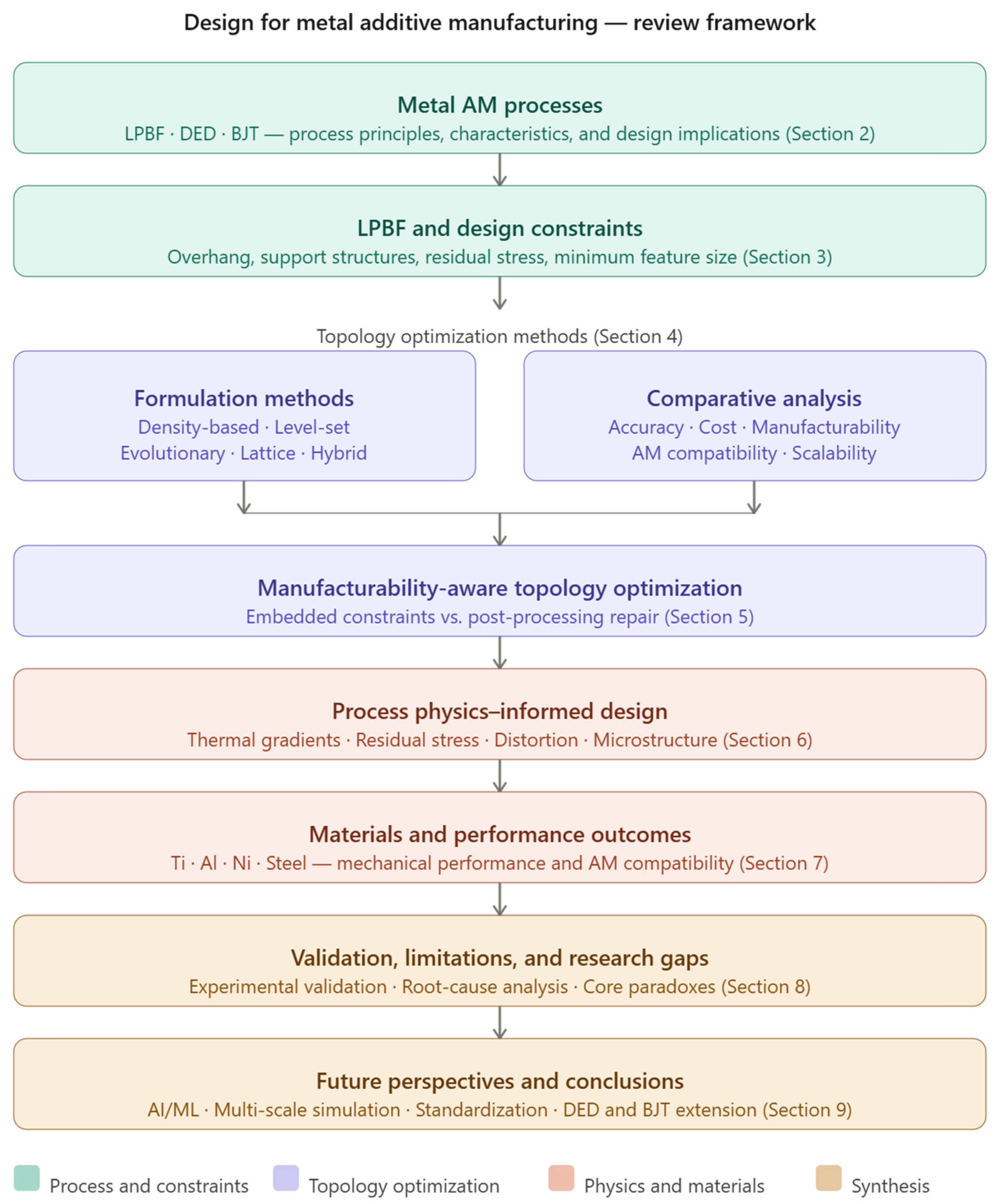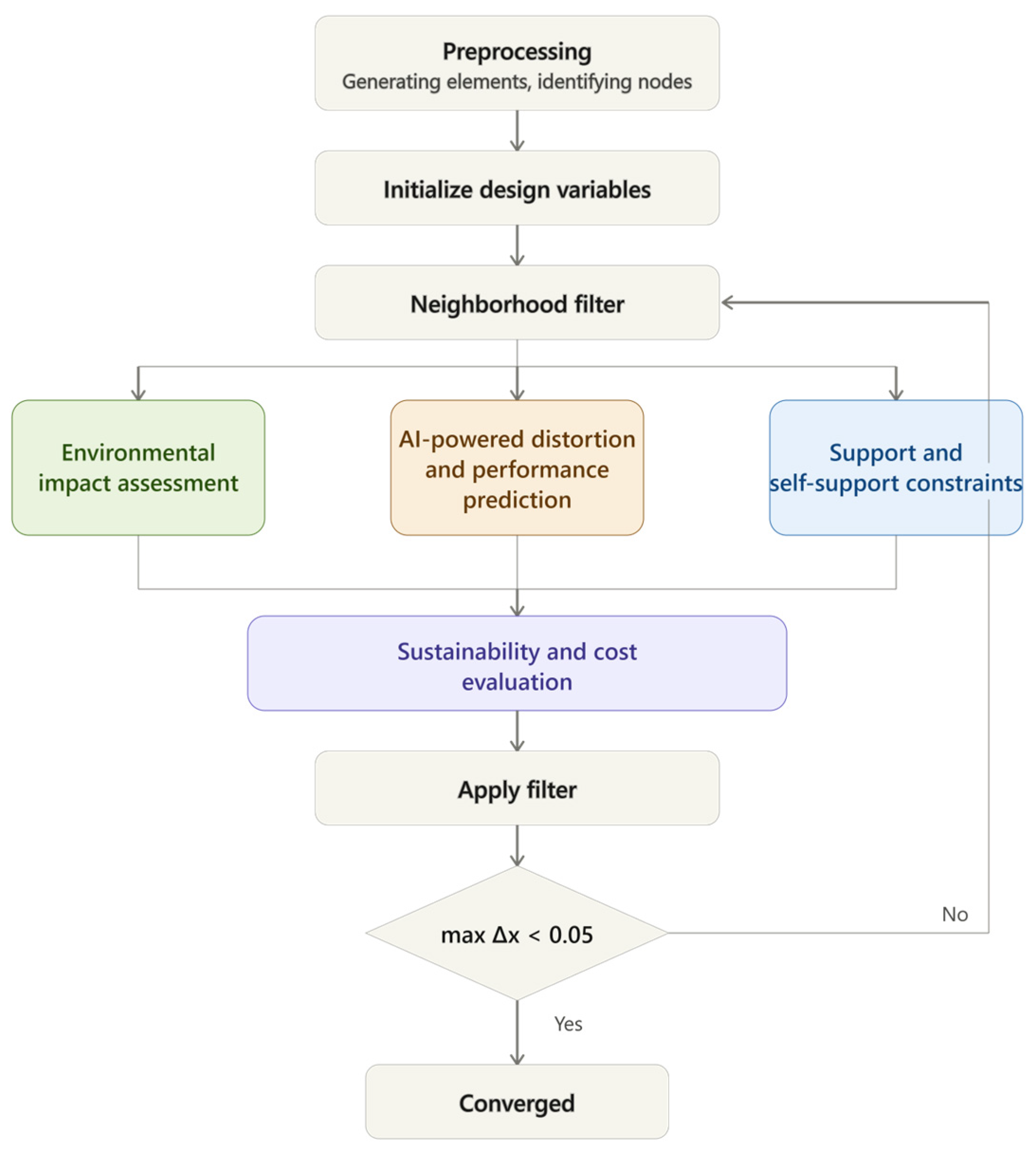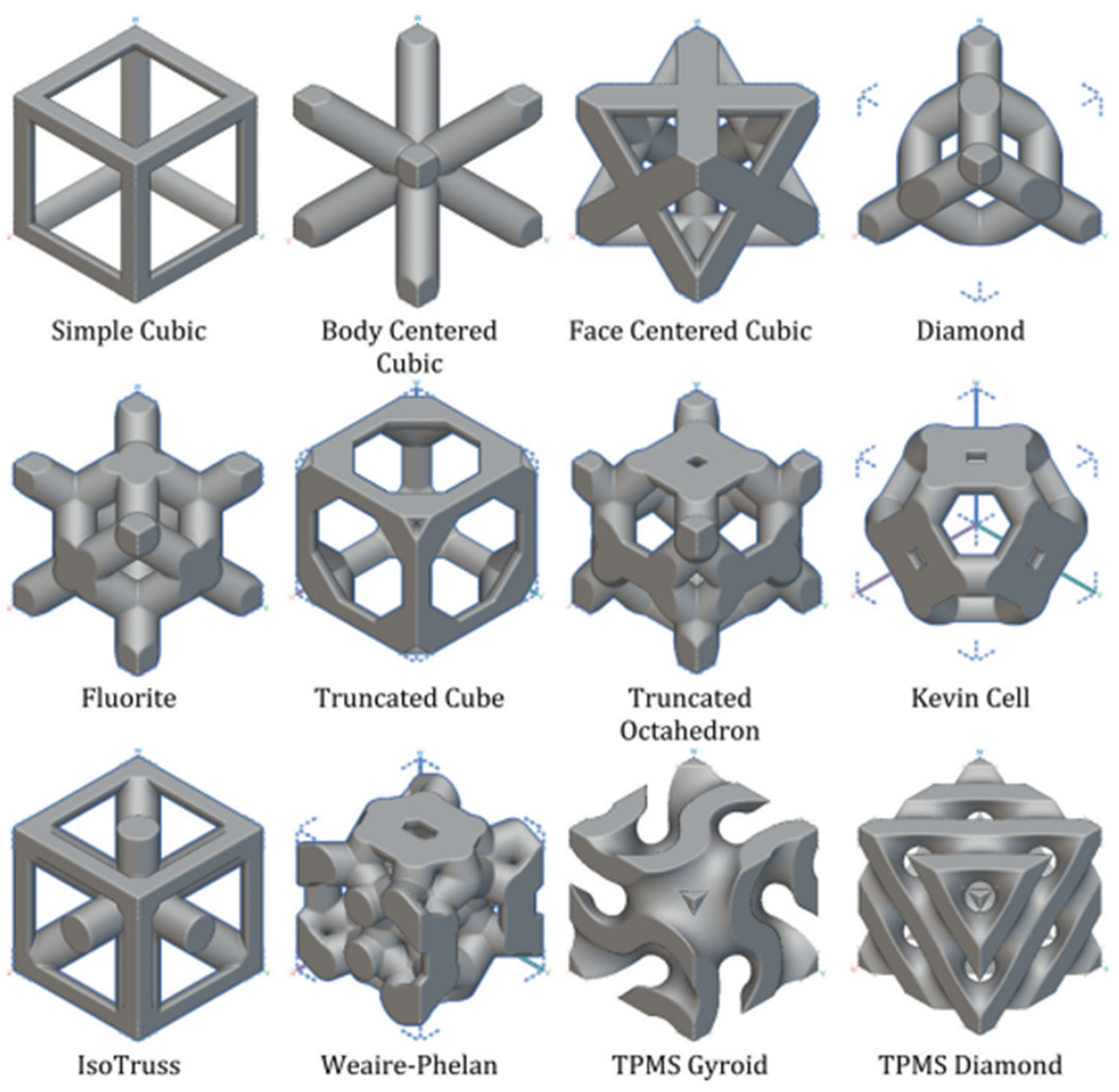

Design for Metal Additive Manufacturing: A Review of Design Strategies and Process Constraints




Abstract
1. Introduction
Positioning Relative to Prior DfAM Literature
2. Metal AM Methods
3. Laser Powder Bed Fusion and Design Constraints
3.1. LPBF Process Characteristics
3.2. Geometric and Manufacturability Constraints
3.3. Process-Induced Anisotropy and Defects
4. Topology Optimization Methods for Metal AM
4.1. Density-Based Methods
4.2. Level-Set Methods
4.3. Lattice—Based Methods
4.4. Comparative Analysis
4.5. Emerging Hybrid Approaches
5. Manufacturability-Aware Topology Optimization
5.1. Overhang, Length-Scale, and Surface Constraints
5.2. Embedded Constraints vs. Post-Processing Repair
6. Process Physics-Informed Design
6.1. Thermal Effects, Residual Stress, and Distortion
6.2. Coupling TO with LPBF Process Modeling
7. Materials and Performance Outcomes
8. Validation, Limitations, and Research Gaps
8.1. Current State of Experimental Validation
8.2. Research Gaps and Root-Cause Analysis
8.3. Core Challenges and Inherent Paradoxes
9. Future Perspectives and Conclusions
9.1. Emerging Trends and Critical Advances (2024–2025)
9.1.1. Manufacturability-Aware Topology Optimization with Residual Stress and Distortion Constraints
9.1.2. Multi-Scale Process Simulation Across the Full AM Process Chain
9.1.3. Integration of Artificial Intelligence and Machine Learning in DfAM
9.1.4. Standardization and Benchmarking in DfAM
9.2. Summary
Author Contributions
Funding
Data Availability Statement
Acknowledgments
Conflicts of Interest
Abbreviations
| AM | Additive Manufacturing |
| BJT | Binder Jetting |
| CAD | Computer-Aided Design |
| CNC | Computer Numerical Control |
| DED | Directed Energy Deposition |
| DfAM | Design for Additive Manufacturing |
| EBPBF | Electron beam PBF |
| FEA | Finite Element Analysis |
| FEM | Finite Element Method |
| HIP | Hot Isostatic Pressing |
| LPBF | Laser Powder Bed Fusion |
| SEM | Scanning Electron Microscopy |
| SIMP | Solid Isotropic Material with Penalization |
| TO | Topology Optimization |
| STL | Stereolithography |
References
- Bracken, J.; Pomorski, T.; Armstrong, C.; Prabhu, R.; Simpson, T.W.; Jablokow, K.; Cleary, W.; Meisel, N.A. Design for metal powder bed fusion: The geometry for additive part selection (GAPS) worksheet. Addit. Manuf. 2020, 35, 101163. [Google Scholar] [CrossRef]
- Zinovieva, O.; Romanova, V.; Dymnich, E.; Zinoviev, A.; Balokhonov, R. A Review of Computational Approaches to the Microstructure-Informed Mechanical Modelling of Metals Produced by Powder Bed Fusion Additive Manufacturing. Materials 2023, 16, 6459. [Google Scholar] [CrossRef] [PubMed]
- Jain, R.; Singh, S.K.; Upadhyay, R.K.; Agrawal, B.N. Design and development of topology-optimized aircraft bracket using additive manufacturing. Int. J. Interact. Des. Manuf. (IJIDeM) 2025, 19, 1051–1059. [Google Scholar] [CrossRef]
- Costa, J.M. From Technology to Strategy: A Gated Decision Framework for Integrating Metal Additive Manufacturing into Sustainable Industrial Systems. Metals 2026, 16, 537. [Google Scholar] [CrossRef]
- Mhapsekar, K.; McConaha, M.; Anand, S. Additive Manufacturing Constraints in Topology Optimization for Improved Manufacturability. J. Manuf. Sci. Eng. 2018, 140, 051017. [Google Scholar] [CrossRef]
- Langelaar, M. An additive manufacturing filter for topology optimization of print-ready designs. Struct. Multidiscip. Optim. 2017, 55, 871–883. [Google Scholar] [CrossRef]
- Dalpadulo, E.; Pini, F.; Leali, F. Assessment of Computer-Aided Design Tools for Topology Optimization of Additively Manufactured Automotive Components. Appl. Sci. 2021, 11, 10980. [Google Scholar] [CrossRef]
- Ranjan, R.; Samant, R.; Anand, S. Integration of Design for Manufacturing Methods with Topology Optimization in Additive Manufacturing. J. Manuf. Sci. Eng. 2017, 139, 061007. [Google Scholar] [CrossRef]
- Zhu, J.; Zhou, H.; Wang, C.; Zhou, L.; Yuan, S.; Zhang, W. A review of topology optimization for additive manufacturing: Status and challenges. Chin. J. Aeronaut. 2021, 34, 91–110. [Google Scholar] [CrossRef]
- Miki, T. Self-support topology optimization considering distortion for metal additive manufacturing. Comput. Methods Appl. Mech. Eng. 2023, 404, 115821. [Google Scholar] [CrossRef]
- Xu, Y.; Zhang, D.; Zhou, Y.; Wang, W.; Cao, X. Study on Topology Optimization Design, Manufacturability, and Performance Evaluation of Ti-6Al-4V Porous Structures Fabricated by Selective Laser Melting (SLM). Materials 2017, 10, 1048. [Google Scholar] [CrossRef] [PubMed]
- Nirish, M.; Rajendra, R. Suitability of metal additive manufacturing processes for part topology optimization—A comparative study. Mater. Today Proc. 2020, 27, 1601–1607. [Google Scholar]
- Chtioui, N.; Gaha, R.; Benamara, A. Design for additive manufacturing: Review and framework proposal. Sustain. Eng. Innov. 2023, 5, 73–84. [Google Scholar] [CrossRef]
- Asapu, S.; Kumar, Y.R. Design for Additive Manufacturing (DfAM): A Comprehensive Review with Case Study Insights. JOM 2025, 77, 3931–3951. [Google Scholar] [CrossRef]
- Reinke, G.; dos Santos, A.C. A systematic review and unified framework for design for additive manufacturing (DfAM). Int. J. Adv. Manuf. Technol. 2026, 143, 4507–4535. [Google Scholar] [CrossRef]
- Gu, D.D.; Meiners, W.; Wissenbach, K.; Poprawe, R. Laser additive manufacturing of metallic components: Materials, processes and mechanisms. Int. Mater. Rev. 2012, 57, 133–164. [Google Scholar] [CrossRef]
- Raghavan, N.; Babu, S.S.; Dehoff, R.; Pannala, S.; Simunovic, S.; Kirka, M.; Turner, J.; Carlson, N. Numerical modeling of heat-transfer and the influence of process parameters on tailoring the grain morphology of IN718 in electron beam additive manufacturing. Acta Mater. 2016, 112, 303–314, Corrigendum in Acta Mater. 2017, 140, 472. https://doi.org/10.1016/j.actamat.2017.08.067. [Google Scholar] [CrossRef]
- Cunningham, C.; Flynn, J.; Shokrani, A.; Dhokia, V.; Newman, S. Invited review article: Strategies and processes for high quality wire arc additive manufacturing. Addit. Manuf. 2018, 22, 672–686. [Google Scholar] [CrossRef]
- Lewandowski, J.J.; Seifi, M. Metal Additive Manufacturing: A Review of Mechanical Properties. Annu. Rev. Mater. Res. 2016, 46, 151–186. [Google Scholar] [CrossRef]
- Yap, C.; Chua, C.; Dong, Z.; Liu, Z.; Zhang, D.; Loh, L.; Sing, S. Review of selective laser melting: Materials and applications. Appl. Phys. Rev. 2015, 2, 041101. [Google Scholar] [CrossRef]
- Patel, S.; Liu, Y.; Siddique, Z.; Ghamarian, I. Metal additive manufacturing: Principles and applications. J. Manuf. Process. 2024, 131, 1179–1201. [Google Scholar] [CrossRef]
- Yadroitsev, I.; Yadroitsava, I.; Du Plessis, A. Basics of laser powder bed fusion. In Fundamentals of Laser Powder Bed Fusion of Metals; Elsevier: Amsterdam, The Netherlands, 2021; pp. 15–38. [Google Scholar] [CrossRef]
- Fox, H.; Kamaraj, A.B.; Drake, D. Investigating the effect of powder recoater blade material on the mechanical properties of parts manufactured using a powder-bed fusion process. Manuf. Lett. 2022, 33, 561–568. [Google Scholar] [CrossRef]
- Murr, L.E.; Gaytan, S.M.; Ramirez, D.A.; Martinez, E.; Hernandez, J.; Amato, K.N.; Shindo, P.W.; Medina, F.R.; Wicker, R.B. Metal Fabrication by Additive Manufacturing Using Laser and Electron Beam Melting Technologies. J. Mater. Sci. Technol. 2012, 28, 1–14. [Google Scholar] [CrossRef]
- Rafi, H.K.; Karthik, N.V.; Gong, H.; Starr, T.L.; Stucker, B.E. Microstructures and Mechanical Properties of Ti6Al4V Parts Fabricated by Selective Laser Melting and Electron Beam Melting. J. Mater. Eng. Perform. 2013, 22, 3872–3883. [Google Scholar] [CrossRef]
- Al-Bermani, S.S.; Blackmore, M.L.; Zhang, W.; Todd, I. The Origin of Microstructural Diversity, Texture, and Mechanical Properties in Electron Beam Melted Ti-6Al-4V. Metall. Mater. Trans. A-Phys. Metall. Mater. Sci. 2010, 41, 3422–3434. [Google Scholar] [CrossRef]
- Dowling, L.; Kennedy, J.; O’Shaughnessy, S.; Trimble, D. A review of critical repeatability and reproducibility issues in powder bed fusion. Mater. Des. 2020, 186, 108346. [Google Scholar] [CrossRef]
- Mostafaei, A.; Elliott, A.M.; Barnes, J.E.; Li, F.; Tan, W.; Cramer, C.L.; Nandwana, P.; Chmielus, M. Binder jet 3D printing—Process parameters, materials, properties, modeling, and challenges. Prog. Mater. Sci. 2021, 119, 100707. [Google Scholar] [CrossRef]
- Utela, B.; Storti, D.; Anderson, R.; Ganter, M. A review of process development steps for new material systems in three dimensional printing (3DP). J. Manuf. Process. 2008, 10, 96–104. [Google Scholar] [CrossRef]
- Malgave, S.; Shanthappa, P.; Polidas, C.; Nagaraja, A. Evaluation of Binder Jet 3D Printed (BJT) M2 Tool Steel against the Wrought M2, Powder Metallurgy (PM) M2 and Laser Powder Bed Fusion (LPBF) Maraging Steel for Mould Application. J. Jpn. Soc. Powder Powder Metall. 2025, 72, S395–S401. [Google Scholar] [CrossRef]
- Liu, F.Q.; Wei, L.; Shi, S.Q.; Wei, H.L. On the varieties of build features during multi-layer laser directed energy deposition. Addit. Manuf. 2020, 36, 101491. [Google Scholar] [CrossRef]
- Herzog, D.; Seyda, V.; Wycisk, E.; Emmelmann, C. Additive manufacturing of metals. Acta Mater. 2016, 117, 371–392. [Google Scholar] [CrossRef]
- Herzog, D.; Asami, K.; Scholl, C.; Ohle, C.; Emmelmann, C.; Sharma, A.; Markovic, N.; Harris, A. Design guidelines for laser powder bed fusion in Inconel 718. J. Laser Appl. 2022, 34, 012015. [Google Scholar] [CrossRef]
- Attar, H.; Ehtemam-Haghighi, S.; Kent, D.; Wu, X.; Dargusch, M.S. Comparative study of commercially pure titanium produced by laser engineered net shaping, selective laser melting and casting processes. Mater. Sci. Eng. A-Struct. Mater. Prop. Microstruct. Process. 2017, 705, 385–393. [Google Scholar] [CrossRef]
- Le Roux, S.; Salem, M.; Shabbar, M.; Vicharapu, B.; Muthu, N.; Moussaoui, K.; Hor, A.; Velay, V. Effect of process parameters on surface integrity in laser powder bed fusion of Ti-6Al-4V alloy. Sci. Rep. 2025, 15, 43786. [Google Scholar] [CrossRef] [PubMed]
- Widomski, P.; Kaszuba, M.; Dobras, D.; Terefinko, D.; Kołodziński, M. Comparative Study of Different Additive Manufacturing Methods for H13 Tool Steel. Materials 2025, 18, 5299. [Google Scholar] [CrossRef] [PubMed]
- Contuzzi, N.; Campanelli, S.L.; Caiazzo, F.; Alfieri, V. Design and Fabrication of Random Metal Foam Structures for Laser Powder Bed Fusion. Materials 2019, 12, 1301. [Google Scholar] [CrossRef] [PubMed]
- Haase, F.; Siemers, C.; Rösler, J. Laser powder bed fusion (LPBF) of commercially pure titanium and alloy development for the LPBF process. Front. Bioeng. Biotechnol. 2023, 11, 1260925. [Google Scholar] [CrossRef] [PubMed]
- Ceccanti, F.; Giorgetti, A.; Arcidiacono, G.; Citti, P. Laser Powder Bed Fusion: A Review on the Design Constraints. IOP Conf. Ser. Mater. Sci. Eng. 2021, 1038, 012023. [Google Scholar] [CrossRef]
- Zhang, Y.; Yang, S.; Zhao, Y.F. Manufacturability analysis of metal laser-based powder bed fusion additive manufacturing—A survey. Int. J. Adv. Manuf. Technol. 2020, 110, 57–78. [Google Scholar] [CrossRef]
- Giorgetti, A.; Ceccanti, F.; Baldi, N.; Kemble, S.; Arcidiacono, G.; Citti, P. Axiomatic Design of a Test Artifact for PBF-LM Machine Capability Monitoring. Machines 2024, 12, 199. [Google Scholar] [CrossRef]
- Faludi, J.; Baumers, M.; Maskery, I.; Hague, R. Environmental Impacts of Selective Laser Melting: Do Printer, Powder, or Power Dominate? J. Ind. Ecol. 2017, 21, S144–S156. [Google Scholar] [CrossRef]
- Jeon, J.M.; Park, J.M.; Yu, J.-H.; Kim, J.G.; Seong, Y.; Park, S.H.; Kim, H.S. Effects of microstructure and internal defects on mechanical anisotropy and asymmetry of selective laser-melted 316L austenitic stainless steel. Mater. Sci. Eng. A-Struct. Mater. Prop. Microstruct. Process. 2019, 763, 138152. [Google Scholar] [CrossRef]
- Pitrmuc, Z.; Šimota, J.; Beránek, L.; Mikeš, P.; Andronov, V.; Sommer, J.; Holešovský, F. Mechanical and Microstructural Anisotropy of Laser Powder Bed Fusion 316L Stainless Steel. Materials 2022, 15, 551. [Google Scholar] [CrossRef] [PubMed]
- Zhang, H.; Chan, C.-W.; Li, Y.; Chu, F.; Wu, X.; Cao, Z.; Li, L.; Yi, Y.; Wang, X.; Cao, S. Anisotropic microstructure and tensile property of laser powder bed fusion fabricated Al-Mn-Mg-Sc-Zr alloy built at different layer thickness. J. Mater. Res. Technol. 2024, 33, 845–860. [Google Scholar] [CrossRef]
- Deaton, J.D.; Grandhi, R.V. A survey of structural and multidisciplinary continuum topology optimization: Post 2000. Struct. Multidiscip. Optim. 2014, 49, 1–38. [Google Scholar] [CrossRef]
- Cunha, B.R.; Guimarães, B.M.; Figueiredo, D.; Vieira, M.F.; Costa, J.M. Development of a Workflow for Topological Optimization of Cutting Tool Milling Bodies. Metals 2026, 16, 116. [Google Scholar] [CrossRef]
- Ercolini, E.; Calignano, F.; Galati, M.; Viccica, M.; Iuliano, L. Redesigning a flexural joint for metal-based additive manufacturing. Procedia CIRP 2021, 100, 469–475. [Google Scholar] [CrossRef]
- Han, Y. Stress-based bi-directional evolutionary topology optimization for structures with multiple materials. Eng. Comput. 2024, 40, 2905–2923. [Google Scholar] [CrossRef]
- Liu, W.; Huang, G.; Xie, W. An efficient cross-platform multi-material topology optimization approach occupying enhanced BESO method. Meccanica 2025, 60, 173–193. [Google Scholar] [CrossRef]
- Gu, X.; Yu, Q.; Dong, Y.; He, S.; Qu, J. Structural topology optimization for additive manufacturing with free choice of self-supporting and infill-supporting structures. Comput. Methods Appl. Mech. Eng. 2024, 421, 116788. [Google Scholar] [CrossRef]
- Makhija, D.; Maute, K. Numerical instabilities in level set topology optimization with the extended finite element method. Struct. Multidiscip. Optim. 2014, 49, 185–197. [Google Scholar] [CrossRef]
- Moussa, A.; Melancon, D.; El Elmi, A.; Pasini, D. Topology optimization of imperfect lattice materials built with process-induced defects via Powder Bed Fusion. Addit. Manuf. 2021, 37, 101608. [Google Scholar] [CrossRef]
- Yamada, T.; Izui, K.; Nishiwaki, S.; Takezawa, A. A topology optimization method based on the level set method incorporating a fictitious interface energy. Comput. Methods Appl. Mech. Eng. 2010, 199, 2876–2891. [Google Scholar] [CrossRef]
- Maconachie, T.; Leary, M.; Lozanovski, B.; Zhang, X.; Qian, M.; Faruque, O.; Brandt, M. SLM lattice structures: Properties, performance, applications and challenges. Mater. Des. 2019, 183, 108137. [Google Scholar] [CrossRef]
- Wang, R.; Shi, H.; Gu, J.; He, X.; Zhang, P.; Yu, Z.; Yan, H.; Lu, Q. Additive manufacturing of metal lattice structures: A comprehensive review of technologies, mechanical properties, applications, and future trends. Mater. Today Phys. 2025, 59, 101933. [Google Scholar] [CrossRef]
- Yavari, S.A.; Ahmadi, S.; Wauthle, R.; Pouran, B.; Schrooten, J.; Weinans, H.; Zadpoor, A. Relationship between unit cell type and porosity and the fatigue behavior of selective laser melted meta-biomaterials. J. Mech. Behav. Biomed. Mater. 2015, 43, 91–100. [Google Scholar] [CrossRef] [PubMed]
- Jiwane, V.; Tiwari, G.; Goel, M.D.; Andraskar, N.; Sirdesai, N.; Venkateswaran, K.P. Crashworthiness of Ultrathin Aluminum Honeycomb Structure. Mech. Solids 2024, 59, 1588–1602. [Google Scholar] [CrossRef]
- Dong, L.; Deshpande, V.; Wadley, H. Mechanical response of Ti-6Al-4V octet-truss lattice structures. Int. J. Solids Struct. 2015, 60–61, 107–124. [Google Scholar] [CrossRef]
- Bernard, A.R.; Elsayed, M.S.A. Crashworthiness of 3D Lattice Topologies under Dynamic Loading: A Comprehensive Study. Materials 2024, 17, 1597. [Google Scholar] [CrossRef] [PubMed]
- Mun, J.; Yun, B.-G.; Ju, J.; Chang, B.-M. Indirect additive manufacturing based casting of a periodic 3D cellular metal—Flow simulation of molten aluminum alloy. J. Manuf. Process. 2015, 17, 28–40. [Google Scholar] [CrossRef]
- Panesar, A.; Abdi, M.; Hickman, D.; Ashcroft, I. Strategies for functionally graded lattice structures derived using topology optimisation for Additive Manufacturing. Addit. Manuf. 2018, 19, 81–94. [Google Scholar] [CrossRef]
- Vaneker, T. The role of Design for Additive Manufacturing in the successful economical introduction of AM. Procedia CIRP 2017, 60, 181–186. [Google Scholar] [CrossRef]
- Costa, J.M.; Sequeiros, E.W.; Figueiredo, D.; Reis, A.R.; Vieira, M.F. Optimizing Metal AM Potential through DfAM: Design, Performance, and Industrial Impact. In Additive Manufacturing—Present and Sustainable Future, Materials and Applications; Montealegre-Meléndez, I., Ed.; IntechOpen: Rijeka, Croatia, 2024. [Google Scholar]
- Queheillalt, D.T.; Wadley, H.N. Cellular metal lattices with hollow trusses. Acta Mater. 2005, 53, 303–313. [Google Scholar] [CrossRef]
- Feppon, F.; Michailidis, G.; Sidebottom, M.A.; Allaire, G.; Krick, B.A.; Vermaak, N. Introducing a level-set based shape and topology optimization method for the wear of composite materials with geometric constraints. Struct. Multidiscip. Optim. 2017, 55, 547–568. [Google Scholar] [CrossRef]
- Allaire, G.; Jouve, F.; Toader, A.-M. Structural optimization using sensitivity analysis and a level-set method. J. Comput. Phys. 2004, 194, 363–393. [Google Scholar] [CrossRef]
- Tang, T.; Wang, L.; Zhu, M.; Zhang, H.; Dong, J.; Yue, W.; Xia, H. Topology Optimization: A Review for Structural Designs Under Statics Problems. Materials 2024, 17, 5970. [Google Scholar] [CrossRef] [PubMed]
- Afazov, S.; Roberts, A.; Wright, L.; Jadhav, P.; Holloway, A.; Basoalto, H.; Milne, K.; Brierley, N. Metal powder bed fusion process chains: An overview of modelling techniques. Prog. Addit. Manuf. 2022, 7, 289–314. [Google Scholar] [CrossRef]
- Trovato, M.; Cicconi, P. A Decision Tree approach for an early evaluation of 3D models in Design for Additive Manufacturing. Procedia CIRP 2024, 128, 96–101. [Google Scholar] [CrossRef]
- Sigmund, O. Morphology-based black and white filters for topology optimization. Struct. Multidiscip. Optim. 2007, 33, 401–424. [Google Scholar] [CrossRef]
- Jansen, M.; Pierard, O. A hybrid density/level set formulation for topology optimization of functionally graded lattice structures. Comput. Struct. 2020, 231, 106205. [Google Scholar] [CrossRef]
- Geyer, S.; Hölzl, C. Comparison of CAD Software for Designing Cellular Structures for Additive Manufacturing. Appl. Sci. 2024, 14, 3306. [Google Scholar] [CrossRef]
- Cheng, L.; Liang, X.; Bai, J.; Chen, Q.; Lemon, J.; To, A. On utilizing topology optimization to design support structure to prevent residual stress induced build failure in laser powder bed metal additive manufacturing. Addit. Manuf. 2019, 27, 290–304. [Google Scholar] [CrossRef]
- Levkulich, N.; Semiatin, S.; Gockel, J.; Middendorf, J.; DeWald, A.; Klingbeil, N. The effect of process parameters on residual stress evolution and distortion in the laser powder bed fusion of Ti-6Al-4V. Addit. Manuf. 2019, 28, 475–484. [Google Scholar] [CrossRef]
- Xin, H.; Tang, D.; Dang, L.; Gao, L.; Yang, Z.; Wu, B.; He, X.; Zhan, Z. Fatigue failure mechanisms and life prediction of additive manufactured metallic lattices: A comprehensive review. Virtual Phys. Prototyp. 2025, 20, e2451124. [Google Scholar] [CrossRef]
- Li, W.; Chen, X.; Yan, L.; Zhang, J.; Zhang, X.; Liou, F. Additive manufacturing of a new Fe-Cr-Ni alloy with gradually changing compositions with elemental powder mixes and thermodynamic calculation. Int. J. Adv. Manuf. Technol. 2018, 95, 1013–1023. [Google Scholar] [CrossRef]
- Ibhadode, O.; Zhang, Z.; Sixt, J.; Nsiempba, K.M.; Orakwe, J.; Martinez-Marchese, A.; Ero, O.; Shahabad, S.I.; Bonakdar, A.; Toyserkani, E. Topology optimization for metal additive manufacturing: Current trends, challenges, and future outlook. Virtual Phys. Prototyp. 2023, 18, e2181192. [Google Scholar] [CrossRef]
- Akula, S.B.; Sastry, C.; Seshagirirao, D.V.; Suryakumar, S.; Rahman, A.H.; Reddy, N.S. Metallic lattice structures via additive manufacturing: Applications, challenges and opportunities in aerospace and defence. J. Manuf. Process. 2026, 157, 1308–1336. [Google Scholar] [CrossRef]
- Costa, J.M.; Sequeiros, E.W.; Santos, R.F.; Vieira, M.F. Benchmarking L-PBF Systems for Die Production: Powder, Dimensional, Surface, Microstructural and Mechanical Characterisation. Metals 2024, 14, 520. [Google Scholar] [CrossRef]
- Bryndza, G.; Tchuindjang, J.T.; Chen, F.; Habraken, A.M.; Sepúlveda, H.; Tuninetti, V.; Mertens, A.; Duchêne, L. Review of the Microstructural Impact on Creep Mechanisms and Performance for Laser Powder Bed Fusion Inconel 718. Materials 2025, 18, 276. [Google Scholar] [CrossRef] [PubMed]
- Xiao, D.-M.; Yang, Y.-Q.; Su, X.-B.; Wang, D.; Luo, Z.-Y. Topology optimization of microstructure and selective laser melting fabrication for metallic biomaterial scaffolds. Trans. Nonferrous Met. Soc. China 2012, 22, 2554–2561. [Google Scholar] [CrossRef]
- Costa, J.M.; Maia, M.C.; Fernandes, A.P.; Oliveira, E.C.; Vieira, M.F.; Sequeiros, E.W. Topology optimization of an aluminum bicycle pedal crank using laser powder bed fusion. Mater. Sci. Addit. Manuf. 2025, 4, 025040003. [Google Scholar] [CrossRef]
- Celik, B.B.; Mirzaei, A.H.; Razavi, N.; Van Hooreweder, B. Mode shape-informed design of lightweight metal lattice structures produced by laser powder bed fusion for enhanced dynamic properties. Addit. Manuf. Lett. 2025, 15, 100347. [Google Scholar] [CrossRef]
- Villanueva, C.H.; Maute, K. Density and level set-XFEM schemes for topology optimization of 3-D structures. Comput. Mech. 2014, 54, 133–150. [Google Scholar] [CrossRef]
- Tian, X.; Li, Q.; Zhao, G.; Qu, Z.; Ai, S. Fatigue behavior of selective laser melted 316L stainless steel: Experiments and modeling. Eng. Fract. Mech. 2024, 298, 109942. [Google Scholar] [CrossRef]



| Reference | Scope | AM Process Focus | Design Focus | Industrial Implementation | Qualification/Validation | Sustainability/Decision Support | Gap Addressed by This Review |
|---|---|---|---|---|---|---|---|
| Chtioui et al. (2023) [13] | DfAM rules, guidelines, and design tools | General (multi-process) | Early design stage decision-making | Limited discussion | Not addressed | Not addressed | No treatment of TO formulations, manufacturability-aware constraint integration, or process physics |
| Asapu & Ravi Kumar (2025) [14] | Comprehensive DfAM review with case studies | General (multi-process), case study on bearing bracket | Support structure optimization, STL conversion, lattice lightweighting | Discussed via case study | Briefly discussed (ASTM/ISO standards) | Cost analysis included | Limited treatment of TO mathematical formulations; no systematic process physics or residual stress discussion |
| Reinke & dos Santos (2026) [15] | Systematic PRISMA-based review and unified DfAM framework | General (multi-process) | Foundational principles and computational strategies | Discussed as barrier to scalability | Identified as a barrier (lack of standardized criteria) | Briefly discussed | No focus on TO formulation selection criteria, embedded vs. post-processing strategies, or LPBF/DED/BJT-specific constraint differentiation |
| This review | TO methods and manufacturability-aware design for metal AM | LPBF-centered, with explicit extension to DED and BJT | Six TO formulations compared; embedded vs. post-processing constraint strategies; process physics coupling | Discussed throughout (Section 5, Section 6 and Section 9) | Root-cause gap analysis (Section 8.2); qualification barriers explicitly discussed | Sustainability gap identified (Section 8.2); decision criteria provided for TO method and constraint strategy selection | Integrates TO formulation selection, constraint integration strategy, process physics, and material-specific implications within a single decision-oriented structure |
| Category | LPBF | DED | BJT |
|---|---|---|---|
| Process Principle | A laser selectively melts successive layers of metal powder spread across a powder bed inside a closed chamber | Metallic feedstock (powder or wire) is directly delivered into a melt pool generated by a laser, electric arc, or electron beam. | A liquid binder is selectively deposited onto a metal powder bed to form a green part, which is subsequently cured and sintered. |
| Process Characteristics | High dimensional accuracy and geometric resolution; relatively low build rate due to thin layers and localized laser scanning. | High deposition rate and productivity for large-scale components; lower dimensional accuracy and rougher surface finish. | High throughput with the capability for simultaneous multi- part fabrication; The build speed is high and the overall cycle time is strongly dependent on thermal post-processing. |
| Energy Source and Consolidation | Full melting of powder by laser; consolidation occurs instantaneously layer by layer. | High thermal energy input via laser, arc, or electron beam; consolidation occurs continuously during material deposition. | No melting during printing; densification is achieved exclusively through post-process sintering. |
| Typical Materials | Titanium alloys, nickel-based superalloys, stainless steels, aluminum alloys, and high- performance alloys. | Steels, titanium alloys, nickel-based superalloys, and repair materials for structural components. | Stainless steels, nickel-based superalloys, copper alloys, and sinterable metal systems. |
| Dimensional Accuracy | Very high; fine tolerances and excellent repeatability achievable. | Moderate; post- process machining is frequently required to meet dimensional tolerances. | Moderate; sintering- induced shrinkage introduces dimensional variability that must be compensated at the design stage. |
| Surface Finish | Best among the three processes; mechanical finishing may still be required for functional surfaces. | Relatively rough Due to the large melt pool size and deposition bead geometry. | Intermediate; generally smoother than DED but inferior to LPBF. |
| Geometric Capability | Excellent for complex geometries, lattice structures, and internal channels. | Limited capability for fine features and high geometric complexity; better suited for near-net- shape robust structures. | Good geometric freedom; surrounding powder The bed provides natural support for complex shapes. |
| Support Structures | Frequently required for overhanging features and thermally stressed regions. | Less critical than in LPBF but still necessary for certain geometries. | Generally not required; the powder The bed acts as a natural support medium. |
| Manufacturability Constraints | Overhangs below ~45° typically require supports; removal of powder from enclosed channels can be challenging. | Resolution is limited by the melt pool and bead size; small channels and fine Features are difficult to fabricate reliably. | Sintering-induced shrinkage and distortion limit dimensional precision in thin- walled and delicate geometries. |
| Typical Part Size | Limited by build chamber dimensions; generally suited for small-to-medium components. | Well-suited for large-scale components and in- situ repair applications. | Moderate scale; primarily constrained by sintering furnace dimensions. |
| Process-Induced Anisotropy | Significant; driven by rapid solidification and layer-wise thermal cycling. | Pronounced; characterized by columnar grain growth along the build direction. | Comparatively low; relatively isotropic microstructure obtained after homogeneous sintering. |
| Mechanical Performance | Excellent mechanical properties; strongly dependent on build orientation and process parameters. | Good structural performance; lower property homogeneity compared to LPBF. | Generally lower mechanical properties than LPBF and DED due to residual porosity after sintering. |
| Residual Stresses | Very high; generated by steep thermal gradients and rapid solidification. | High; resulting from continuous and concentrated heat input during deposition. | Low during printing; residual stress develop primarily during the sintering stage. |
| Typical Porosity | Lack of fusion and keyhole porosity associated with laser–powder interaction. | Gas entrapment and the melt pool instability. | Incomplete densification during sintering; porosity The level is strongly dependent on sintering parameters. |
| Common Defects | Lack of fusion, warping, keyhole porosity, and thermal cracking. | Excessive dilution, hot cracking, inclusions, and weak inter-track bonding. | Non-uniform shrinkage, delamination, geometric distortion, and residual porosity. |
| Typical Final Density | Very high (>99%); suitable for structural and safety-critical applications. | High (95–99%); dependent on process parameters and deposition strategy. | Moderate to high (90–98%); dependent on sintering efficiency and powder characteristics. |
| Post-Processing Requirements | Support removal, stress-relief heat treatment, HIP, and surface machining are commonly required. | Machining and heat treatment are generally essential to achieve dimensional and microstructural targets. | Debinding, depowdering, and sintering are mandatory; metal Infiltration may also be applied to reduce residual porosity. |
| Main Advantages | Highest dimensional precision, near-full density, and excellent geometric complexity capability. | High deposition rate, suitability for large components, and effective repair and cladding capability. | High throughput, relatively lower equipment and material costs, and no support structure requirement. |
| Main Disadvantages | High equipment cost, low build rate, and severe residual stress accumulation. | Lower geometric resolution, poor surface finish, and significant post- processing requirements. | Dimensional shrinkage during sintering, lower mechanical performance than fusion-based processes. |
| Typical Applications | Aerospace structures, biomedical implants, complex tooling, and high- performance components. | Turbine blade repair, cladding, large structural components, and industrial maintenance. | Mass production of complex metal parts, cost-sensitive applications, and sintered structural components. |
| Aspect | Density-Based | Level-Set | Evolutionary | Network -Based | Hybrid | Lattice-Based |
|---|---|---|---|---|---|---|
| Structural Representation | Pseudo-density field distributed over finite elements | Implicit boundary represented by a signed distance function | Material distribution governed by iterative element addition/removal rules | Graph/network encoding structural connectivity through nodes and edges | Combination of two or more formulations | Discrete periodic or graded microstructure defined by unit- cell geometry |
| Design Variables | Continuous element density (0–1) | Level-set function values at nodes | Element survival/removal criteria | Node and edge parameters | Mixed variables depending on coupled formulations | Geometric parameters of unit cells (strut diameter, cell size, relative density) |
| Boundary Definition | Diffuse; intermediate densities produce unclear solid–void interfaces | Excellent, sharp and smooth boundaries defined by the zero-contour | Discrete and jagged; staircase effects common | Connectivity- driven; dependent on graph resolution | Improved relative to single-method formulations | Cell-dependent; boundary quality depends on unit-cell type and resolution |
| Gray Regions | Present; require post-processing projection or filtering | Absent | Absent | Generally absent | Reduced or controlled | Absent |
| Implementation Complexity | Low | Medium to High | Medium | High | High | High |
| Computational Cost | Low | Medium to High | Medium | High | High to Very High | High |
| Manufacturability Enforcement | Moderate | Good | Moderate | Good | Excellent | Excellent |
| Compatibility with AM | Moderate | High | Moderate | High | Very high | Very high |
| Scalability | High | Medium | Medium | Medium/Low | Medium | Limited |
| Typical Applications | General structural optimization; compliance minimization | Geometric boundary control; interface and shape optimization problems | Conceptual structural design; material distribution problems | Multi-scale systems; complex interconnected and load-path structures | High- performance AM components with simultaneous manufacturability and performance requirements | Metamaterials; lightweight and multifunctional structures |
| Manufacturing Constraints Addressed | Minimum member size; density filtering; overhang angle control | Smooth boundary curvature; minimum wall thickness | Connectivity preservation; minimum feature thickness | Node connectivity; printable link geometry | Overhang angle, minimum feature size, and residual stress; combined constraints | Unit-cell printability; minimum strut diameter; maximum aspect ratio |
| Key Strengths | Simple implementation; robust and well- established convergence behavior | Sharp boundary definition; precise geometric control; no gray regions | Intuitive material evolution; clear black-and-white designs | Efficient representation of complex structural interactions and multi- scale connectivity | Best balance between structural performance and manufacturability compliance | Excellent specific stiffness; tailorable mechanical, thermal, and acoustic properties |
| Key Limitations | Gray regions require post- processing; limited geometric precision at boundaries | Numerical instability; reinitialization challenges; higher computational demand | Slow convergence; susceptibility to checkerboarding; limited constraint integration | High modeling complexity; limited scalability to large domains | High implementation and computational complexity; limited software availability | Difficult scalability to large components; high homogenization simulation cost |
| Typical Validation Approaches | Benchmark compliance optimization (MBB beam, cantilever) | Shape optimization and interface tracking benchmarks | Cantilever and compliance minimization case studies | Multi-scale structural and network optimization problems | AM-oriented structural optimization benchmarks with experimental verification | Experimental AM fabrication and mechanical testing; homogenization analysis |
| Constraint | Definition | Physical Origin | Impact on AM | Impact on TO | Mitigation Strategies |
|---|---|---|---|---|---|
| Overhang Constraint | Geometric limitation associated with inclined surfaces lacking adequate support during fabrication | Gravity, incomplete solidification, and insufficient thermal and mechanical support of the melt pool | Layer collapse, local deformation, and excessive support structure requirements | Restricts free-form geometries and limits lattice member orientation | Angular filtering, directional density constraints, self-supporting geometry optimization |
| Minimum Feature Size | Lower bound on the thickness of struts, walls, or geometric features | Process resolution limits imposed by laser spot diameter, layer thickness, and melt-pool stability | Fabrication of fragile or non-manufacturable thin members | Prevents checkerboarding and eliminates degenerate members from the optimized design | Density filtering, Heaviside projection, length-scale enforcement |
| Surface Roughness | Surface irregularities generated during powder fusion and layer deposition | Layer stair-stepping, partially melted powder particles, and build orientation effects | Reduced surface quality and increased stress concentration at functional interfaces | Affects the mechanical performance and contact behavior of optimized surfaces | Post-process finishing, optimized build orientation, geometric boundary refinement |
| Residual Stress | Internal stresses accumulated during rapid solidification and cooling | High thermal gradients and differential shrinkage across successive layers | Warping, cracking, and structural failure during or after fabrication | May invalidate theoretically optimal geometries if not accounted for during optimization | Thermomechanical simulation, geometric compensation, thermal management strategies |
| Geometric Distortion | Dimensional deviation between the designed and fabricated geometry | Thermal shrinkage and redistribution of residual stresses after fabrication | Loss of dimensional accuracy and functional misalignment | Reduces the fidelity of optimized solutions relative to as-built performance | Distortion compensation models, optimized support placement, thermal control |
| Anisotropy | Direction-dependent mechanical properties arising from the build process | Layer-by-layer deposition, directional solidification, and process-induced crystallographic texture | Non-uniform mechanical behavior along different loading directions | Requires anisotropic constitutive modeling to ensure accurate performance prediction | Build orientation optimization, anisotropic homogenization, orientation-aware TO formulations |
| Fatigue Performance | Progressive mechanical degradation under cyclic loading conditions | Internal defects, surface roughness, residual stress concentration, and microstructural heterogeneity | Reduced service life and premature crack initiation at defect sites | Requires durability-oriented objective functions and fatigue life constraints | Fatigue-aware optimization models, geometric smoothing, TPMS-based lattice structures |
| Post-processing Requirements | Additional operations required after fabrication to achieve the final dimensional and surface quality | Need for support removal, surface finishing, and heat treatment to relieve residual stresses | Increased production cost, lead time, and manufacturing complexity | Must be integrated into the design stage to minimize post-processing burden | DfAM principles, support structure minimization, accessible internal geometry design |
Disclaimer/Publisher’s Note: The statements, opinions and data contained in all publications are solely those of the individual author(s) and contributor(s) and not of MDPI and/or the editor(s). MDPI and/or the editor(s) disclaim responsibility for any injury to people or property resulting from any ideas, methods, instructions or products referred to in the content. |
© 2026 by the authors. Licensee MDPI, Basel, Switzerland. This article is an open access article distributed under the terms and conditions of the Creative Commons Attribution (CC BY) license.
Share and Cite
Nhanga, J.N.; Vieira, M.F.; Costa, J.M. Design for Metal Additive Manufacturing: A Review of Design Strategies and Process Constraints. Metals 2026, 16, 721. https://doi.org/10.3390/met16070721
Nhanga JN, Vieira MF, Costa JM. Design for Metal Additive Manufacturing: A Review of Design Strategies and Process Constraints. Metals. 2026; 16(7):721. https://doi.org/10.3390/met16070721
Chicago/Turabian StyleNhanga, José Nascimento, Manuel Fernando Vieira, and Jose Manuel Costa. 2026. "Design for Metal Additive Manufacturing: A Review of Design Strategies and Process Constraints" Metals 16, no. 7: 721. https://doi.org/10.3390/met16070721
APA StyleNhanga, J. N., Vieira, M. F., & Costa, J. M. (2026). Design for Metal Additive Manufacturing: A Review of Design Strategies and Process Constraints. Metals, 16(7), 721. https://doi.org/10.3390/met16070721