


Abstract
Hexagonal close-packed (hcp) metals rely on twinning to accommodate plastic deformation at room temperature. These twins often impede dislocation mobility and can lead to brittle failure. Significant research has been done to identify methods to mitigate this brittle failure; however, a gap exists in the work on the mechanisms behind the brittle failure. All hcp twin modes require atomic shuffling to place sheared atoms in the correct lattice sites. While shuffling for the twin is well defined, most of the shuffle processes for twinning in hcp are not defined, and the displacement field due to the introduction of a twin has not been detailed. This work serves to present new mechanical equations to compute atomic shuffles and introduce an algorithm to calculate the displacement map and insert an arbitrarily shaped twin into a defect-free lattice using those shuffle vectors. We substantiate the algorithm by placing , , and twins in Mg and Ti and show that the twins undergo glissile transformation using molecular dynamics.
1. Introduction
Shuffling in hexagonal close-packed (hcp) materials adds a subtle layer of complexity to the already complex process of deformation twinning [1]. Using the definition of martensitic transformations introduced by Clapp [2], deformation twinning is considered a type of martensitic transformation which reproduces the original phase rather than a new phase [1,3]. Due to the lower symmetry of the hcp structure, some atomic rearrangements are necessary along with the shear due to martensitic transformations to reproduce the reoriented lattice structure [4,5,6,7,8]. These rearrangements, which are independent of the driving shear and serve to move sheared atoms back to their proper lattice positions, are known as shuffles. Shuffling also occurs in face-centered cubic (fcc) and body-centered cubic (bcc) structures, but more rarely due to their higher symmetry. In phase transformations between bcc and hcp, they are generally required [8]. Transformations of hcp to fcc may be accomplished by only shear. In plastic deformation of hcp and other materials of lower symmetry, twinning is more favored than slip to accommodate deformation for many loading directions. All observed hcp twin modes have required shuffles. There is a type I twin that would not require shuffles, but simulation and experiment show that twins are type II, which require shuffles [9,10,11]. Similarly, the twin geometrically could migrate by a mechanism involving a disconnection with a height of one layer and no shuffling [12], but in fact it activates a disconnection with a smaller Burgers vector and a height of three layers. The energetically preferred three-layer mechanism requires shuffles [1,12,13]. Notably, some molecular dynamics (MD) potentials fail to accurately model twinning as they produce the one-layer disconnection rather than the three-layer disconnection. This inability appears to correlate with the complexity of the interatomic potential. Embedded atom method potentials fail to capture twin movement accurately, while the modified embedded atom method (MEAM), and MEAM-spline potentials, as well as newer machine learning-based potentials, capture it correctly [14,15].
The shuffling complexity of the various twin modes is a significant factor influencing which modes are predominant for a given stress state: e.g., versus twinning for c-axis tension or versus twinning for c-axis compression [16,17]. For this work, we will follow the notation of Braisaz [18] in denoting the Burgers vector as where p and q represent the height of the interfacial step in terms of lattice planes for the transformed and untransformed structures, respectively. Generally, twinning disconnections (TDs) with a high Burgers vector or step height are more difficult to activate than those with a smaller Burgers vector, but TDs with a very low Burgers vector may also not be activated if the shuffling is too complex. This is clearly exhibited by the case of the twin which has several candidate Burgers vectors with varying magnitudes and shuffle complexities [12]. The with no shuffles and the largest Burgers vector is not observed experimentally, but neither is the which has the smallest Burgers vector and the most complex shuffles. An intermediate candidate in terms of both shuffling complexity and Burgers vector magnitude, , is preferred over both of them [19]. Some studies also rank ease of twin movement by the core width of the disconnection [13,20,21]. Core width measurement requires high-resolution transmission electron microscopy (HRTEM) or reliable MD potentials and has a complex relationship with the TD Burgers vector and shuffling complexity which may both be computed geometrically.
The twin mode is the most prominent twin in hcp materials [1,22]. The other prominent twin modes are in -axis extension and , , , and in -axis contraction. At least one mode for -axis extension and another for contraction are necessary to produce the five independent plastic systems necessary for formability [23]. Because of the limited ductility arising from twinning, hcp materials tend to suffer brittle failure more easily than cubic metals [24,25,26,27,28,29,30,31]. In principle, plasticity could be accommodated by slip rather than twinning [32,33,34,35], but in all hcp metals elevated temperatures are necessary to activate enough to suppress twinning. At room temperature, twinning activates.
The fact that hcps undergo room temperature twinning even though slip is active at higher temperatures suggests that there may be potential using alloying with microstructural refinement to improve their mechanical properties by upsetting the preference for twinning [33,36,37,38,39,40,41]. Under room temperature -axis compression of magnesium, for instance, twins rapidly consume the microstructure which then twins again with twins [30,42,43]. The boundaries produced by this double twinning tend to be high energy and immobile, forming barriers to dislocation motion, leading eventually to brittle failure. Considerable research has been done to better understand this process with efforts focusing primarily on solid solution alloying strategies which can promote easier activation of slip instead of twins [44,45,46,47,48]. Rare earth alloys have demonstrated some improved ductility generated by more slip and retarded twin growth [47,49]. Despite this improvement, magnesium alloys remain too brittle for many industrial applications which would would require room temperature stamping or deep drawing, and progress on improving ductility seems to have stalled [50,51].
Magnesium is a prominent example of a relatively common hcp metal with promising properties but limited ductility. Other hcp alloys such as those formed from titanium, zinc, and zirconium also have relatively low ductility. Resolving the design challenges of producing more highly ductile hcp alloys requires formulating a more robust understanding of how brittle failure arises in these materials. This understanding requres insight into the displacement and stress fields due to twinning at the atomistic scale as well as the boundary and defect interactions that arise from twinning. When the shuffles are explicitly known, as for twins, specific twinning scenarios can be generated geometrically as an initial condition for a molecular dynamics (MD) simulation. This ability enables setting up and studying a wide variety of defect interactions and twin growth scenarios which would be nearly impossible to probe by MD otherwise.
Despite the critical significance of the shuffle vectors, most shuffling processes for the various twin and phase transformation modes have not been robustly defined. This is somewhat surprising since most of them can be identified geometrically using only crystallography. Most authors have not identified shuffles using crystallography, but have used molecular dynamics, and in some cases microscopy. In principle, these methods produce superior accuracy rather than reliance on geometry alone, but in most cases there is only one shuffling pattern which is feasible. If more than one is available, energetic concerns rather than pure geometry are needed to identify which one is appropriate. Explicit definition of the shuffles for a given twin mode makes possible the explicit definition of a displacement field due to introduction of a twin. Although shuffle patterns for twinning systems such as the twin are defined, the procedure to explicitly define the full displacement field for an arbitrarily shaped twin embryo has, to our knowledge, never been elaborated.
The purpose of this work is to specify how the full displacement field due to the introduction of an arbitrarily shaped twin embryo is computed and to demonstrate its use to create twin embryos in an initially defect-free lattice. Finally, we demonstrate molecular dynamics with pregenerated twin embryos which do not require the high stresses and strain rates necessary to achieve spontaneous nucleation, and have realistic lenticular shapes in contrast to the typically flat boundaries constructed by other means.
2. Crystallography of Shuffling
Deformation twinning involves the uniform and coordinated movement of atoms which reproduces the original phase rather than a new phase and should be considered a stress-induced martensitic transformation [1,3]. Since the disconnection deformation does not map each atom in the initial crystal to the correct location in the final crystal, the atoms rearrange themselves slightly to get to the relaxed positions. This movement is termed atomic shuffling in traditional literature [1,5,6,52]. Shuffling mathematics has been addressed in detail for compound twin modes in HCP structures [12], and individual shuffle patterns have been proposed based on geometric theory [1,52] and atomistic calculations [10,12]. However, a general method for shuffle calculations of disconnections has not been previously elaborated to our knowledge. Since shuffling is not induced by external deviatoric stress, but rather is a response to the mismatch between partial coordinates in a deformed lattice and a rotated lattice, it has no deformation component. Shuffles shall not induce strain.
In order to geometrically define the shuffles, it is necessary to define a unit cell corresponding to the martensitic transformation that we shall call a transformation unit cell. We will use the superscript to denote pre-transformation and the superscript to denote post-transformation. An appropriate transformation unit cell may be defined as being spanned by three independent full lattice vectors which remain full lattice vectors after undergoing the transformation. This may be verified by using the lattice correspondence for that transformation, which has been previously published in most cases [1]. Lattice correspondences for all the common hcp transformations are given below. Generally it is desired also that the vectors be as small as possible to obtain a primitive transformation cell. This cell may be the hcp primitive cell; its volume is always an integer multiple of that of the hcp primitive cell. If all shuffles in a given transformation unit cell are summed up, the sum will be zero. Moreover, the shuffles in the neighboring transformation unit cells will be identical to those in the chosen transformation unit cell. We will denote the vectors spanning the transformation unit cell as , , and . For cases where the habit plane is rational, as for all observed twin modes in hcp, it is simplest to have and lie in the invariant plane and be the vector with the shortest possible component normal to the invariant plane.
Care must be taken in defining the origin of the transformation unit cell. For twins, the origin is the point on the interface with a rotation acting about to map all atoms to atoms. This origin usually does not lie on an atomic site in a low-symmetry lattice. The most likely choice for the origin is the inversion point of the lattice. However, in semi-coherent interfaces (or phase transformations), this is not always the rotation center as argued by Barrett and El Kadiri [53]. Generally, transmission electron microscopy or atomistic simulations may be the most convenient way to determine the correct point for centering the rotation. As a verification, once the shuffle vectors within the transformation unit cell are determined, they must all sum to zero.
We will denote the list of atomic coordinates contained in the unit cell as . The amount of shuffle required for each atom is obtained by recognizing that the transformation gives the exact positions of the transformed atoms, while gives the positions of the atoms obtained by deformation alone. Thus, the shuffle is the difference between one and the other. However, atoms in are not always mapped to the corresponding atomic position in . Instead, the shuffles are obtained by matching all of the atom positions in to atom positions in in a fashion that the total movement of atoms is minimized. To rigorously compute each possible total movement of atoms in order to find this minimum, we adopt the following procedure:
The initial atom coordinates are denoted where is the first permutation of a list of elements from 1 to q and q is the number of atoms per transformation unit cell. The final atom coordinates are given by where is the ith element of the kth permutation of the elements from 1 to q. The positions of the atoms after deformation are given by . permutations of the q atoms are used to denote the final coordinates because there is no guarantee that atom i in the initial structure will be mapped to the position of atom i in the final structure. All possible mappings are generated to identify the best choice.
The structure matrix for the crystal being deformed is given as
This matrix is a linear transformation from crystal coordinates to Cartesian coordinates. In crystal coordinates the atomic points are given by
Atoms which are partly contained in the unit cell, such as those lying on faces, edges, or corners of it, should be represented by a single vector denoting one side, edge, or corner; the other vectors will belong to different unit cells.
Likewise, the structure matrix for the crystal after deformation is given by
The metric for the crystal coordinate system is given by
Use of the crystal coordinates and metric allows us to readily account for all shuffle possibilities which move the atoms outside the unit cell.
The total shuffle distances for the permutations matching initial and final positions of all the atoms in the unit cell is given by
However, this expression does not account for shuffles that match initial atom positions in this unit cell to final atom positions in other unit cells. An expression which accomplishes this is obtained by making use of crystal coordinates:
Here, the rounding operation eliminates integer units of the unit cell length, depth, and height to produce the smallest distance to the equivalent atomic position in any unit cell. Then the total shuffle distances are given by
Then, K is defined as the index k which minimizes . Once this is done, the individual shuffle displacements for atoms at the initial coordinates are given by the following:
The final position of each atom is given by
The results of following this process display certain symmetries which are obvious in retrospect, but have not previously been documented. Twin plane boundaries are fully symmetric and polar. A shear stress in the twinning direction causes boundary migration upward, while a reverse shear stress causes boundary migration downward, which is called detwinning. Another way to express this is that the parent is the twin of the twin. Looking at the shuffles from this perspective, it is evident that the shuffles in the forward twinning process from the parent’s perspective, and the shuffles in the reverse twinning process from the twin’s perspective should be identical. In other words, the shuffle vectors must be shear invariant—retaining their magnitude under the deformation . For this to occur, they are required to lie either within the (twinning) plane, or lie along , the conjugate twinning direction. Additionally, since the atom positions in the hcp cell are rational vectors in crystal coordinates, the shuffle vectors also must be rational since they are strictly differences between one atom position in the cell and another position in the cell—with cell distortion accounted for separately by the shear. Examination of previously reported shuffle vectors [12] show that they meet these conditions, as do the results for all twin modes analyzed below.
For martensitic phase transformations, such as hcp to bcc, the procedure described above follows the same steps, the only difference being that is no longer a simple shear deformation but also includes volumetric change. On the habit plane, is still a plane strain deformation of the form
where i is the interface normal unit vector and h is the step height. The difference in density is obtained by having the Burgers vector, b, not lie entirely in the plane of i. With F thus defined in accordance with the phenomenological model, the shuffles may be explicitly computed as above.
For twins, it is convenient for the structure matrix S to form a box having one face in the interface and the box thickness normal to that face equal to h. This arrangement is always possible for twin modes and helps visualization, but it is not essential to the derivation of the shuffles. For phase transformations, it is often not possible to construct the matrix in this way because the habit plane is irrational. The structures illustrated in Figures 5–7 in Dickel and Barrett [54] can be used to create appropriate structure matrices which satisfy the lattice correspondence between fcc, bcc, and hcp.
3. Algorithm for Generating Inclusions with Shuffles
The process of generating inclusions approximating generalized shapes is based upon defining a series of disconnection loops enclosing the structure. The displacement field of these loops defines the shape change due to the martensitic transformation both within and surrounding the inclusion. The shuffling vectors are applied to the original atomic coordinates within the enclosure only, and when summed with the disconnection displacement field produce the twinning structure. In this work, we apply three approximations which greatly ease the computational complexity with minimal effect on the structure’s accuracy:
- Image forces are neglected. The domain is approximated as infinite.
- Disconnection lines are divided into an arbitrary number of straight line segments.
- The isotropic approximation is used.
- when the computed structure is introduced into a molecular statics or dynamics simulation, the inaccuracies produced by these approximations may be rapidly removed by energy minimization under an applied load to stabilize the inclusion.
The displacement field due to a single disconnection line made up of a series of straight line segments was expressed analytically by Balluffi [55], following work by others [56,57,58,59,60]. Here we give the solution for an arbitrary number of connected disconnection segments, which may be easily derived from the superposition of triangle loops given by Balluffi [55]. The displacement field for one such disconnection loop is given by
where
Here, b is the Burgers vector, is Poisson’s ratio, and are a series of n points which define a polygon making a closed disconnection loop. In this definition, is used to connect the final point back to the first one. then gives the displacement of the point P due to the disconnection polygon.
Finally, is the solid angle projected by the disconnection polygon onto a unit sphere about P. This may be computed as
so long as the points all lie on one plane. For this work, each loop should lie within a single twin or habit plane so the condition is satisfied.
To define an inclusion of nearly arbitrary shape, we begin by identifying its cross section slice in a series of habit planes. Each of these slices is represented by a series of bounding points which connect to form the disconnection polygon. The displacement of each atom, P, due to the disconnections both within and surrounding the inclusion is given by Equation (11). The points must be listed in order, going counterclockwise relative to a habit plane normal pointed from the first plane with points upon it toward the subsequent planes.
In addition to identifying the shear, it is necessary to identify the shuffles for each atom within the inclusion. To do this, an algorithm determining whether any point P is inside or outside the inclusion is needed. Algorithm 1 works as follows:
| Algorithm 1 To determinine whether an arbitrary atom lies within a twinning inclusion defined by a series of points encircling it on progressive twin planes. |
|
Algorithm 1 works by creating a series of tetrahedrons which in total comprise the inclusion. Concavities in the shape of the inclusion are allowed by considering that some of the tetrahedrons may be left-handed. Inclusion of a point in a left-handed tetrahedron cancels its inclusion in a right-handed one. Each point which is inside the inclusion should produce a value while those outside should produce a value .
For all points which are determined to be within the twin, shuffles are applied as well as shear. The correct shuffle vector for each atom is determined by identifying that atom’s coordinates relative to a transformation unit cell:
the value of j is then determined by comparing to the coordinates of all the atoms contained in the transformation unit cell , one of which should be identical to the coordinates obtained from P. The corresponding shuffle vector is .
An example of the algorithm written in Python and applied to twin insertion is given in the Supplementary Materials.
4. Results
4.1. -Axis Twinning
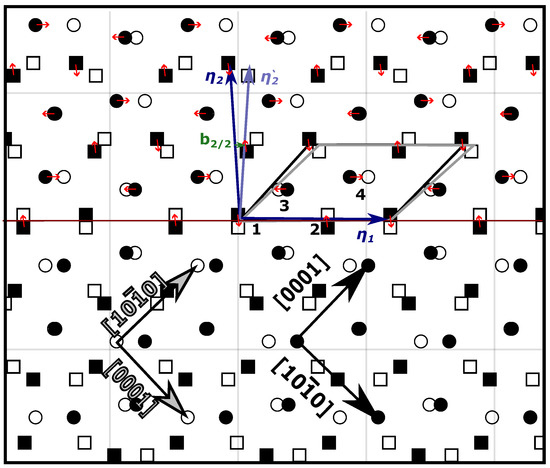
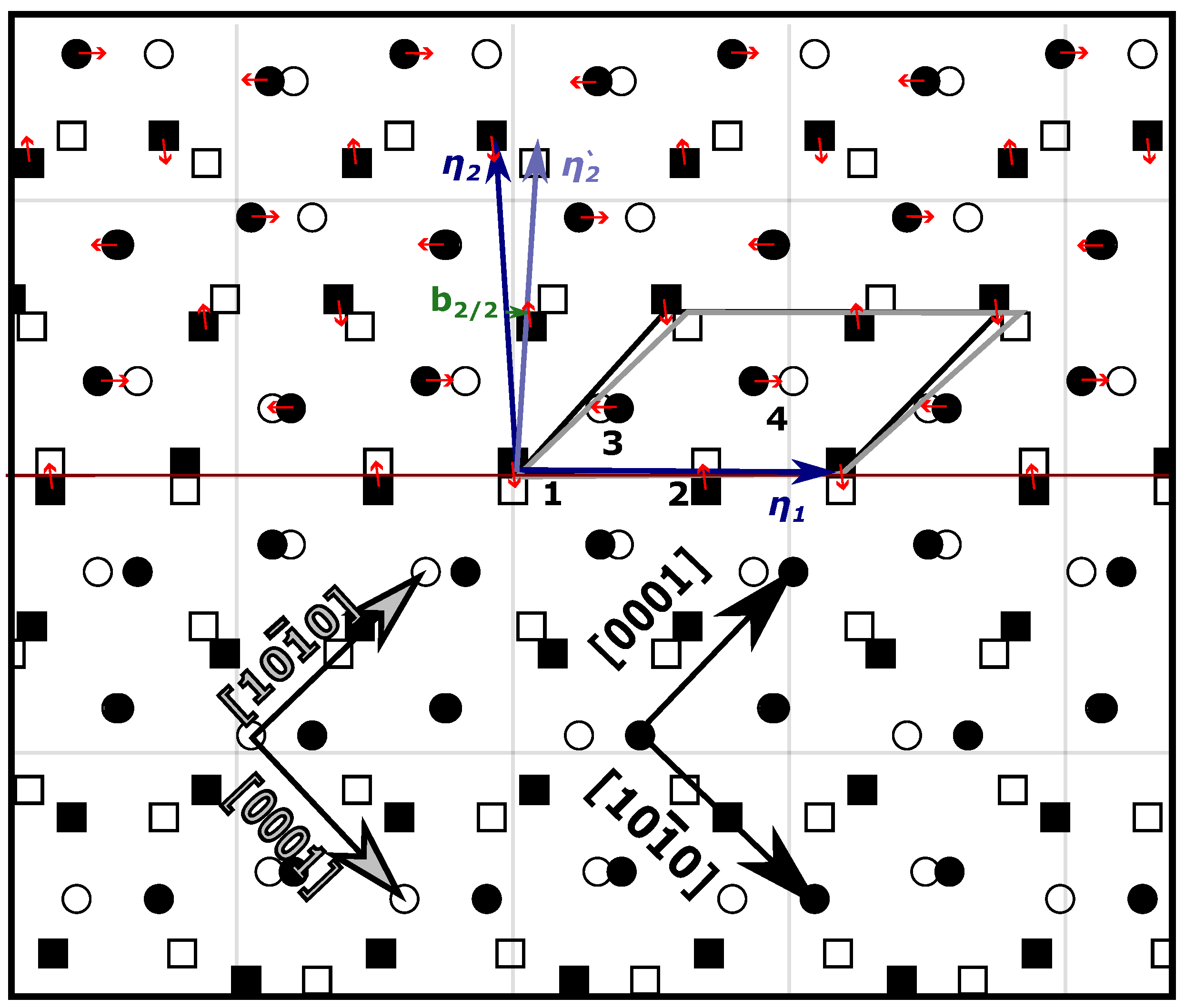
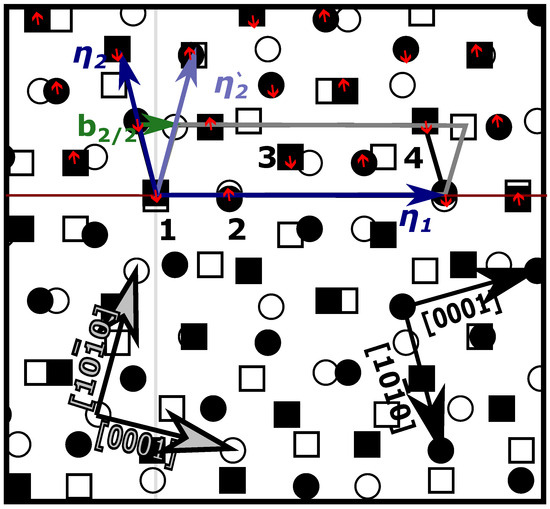
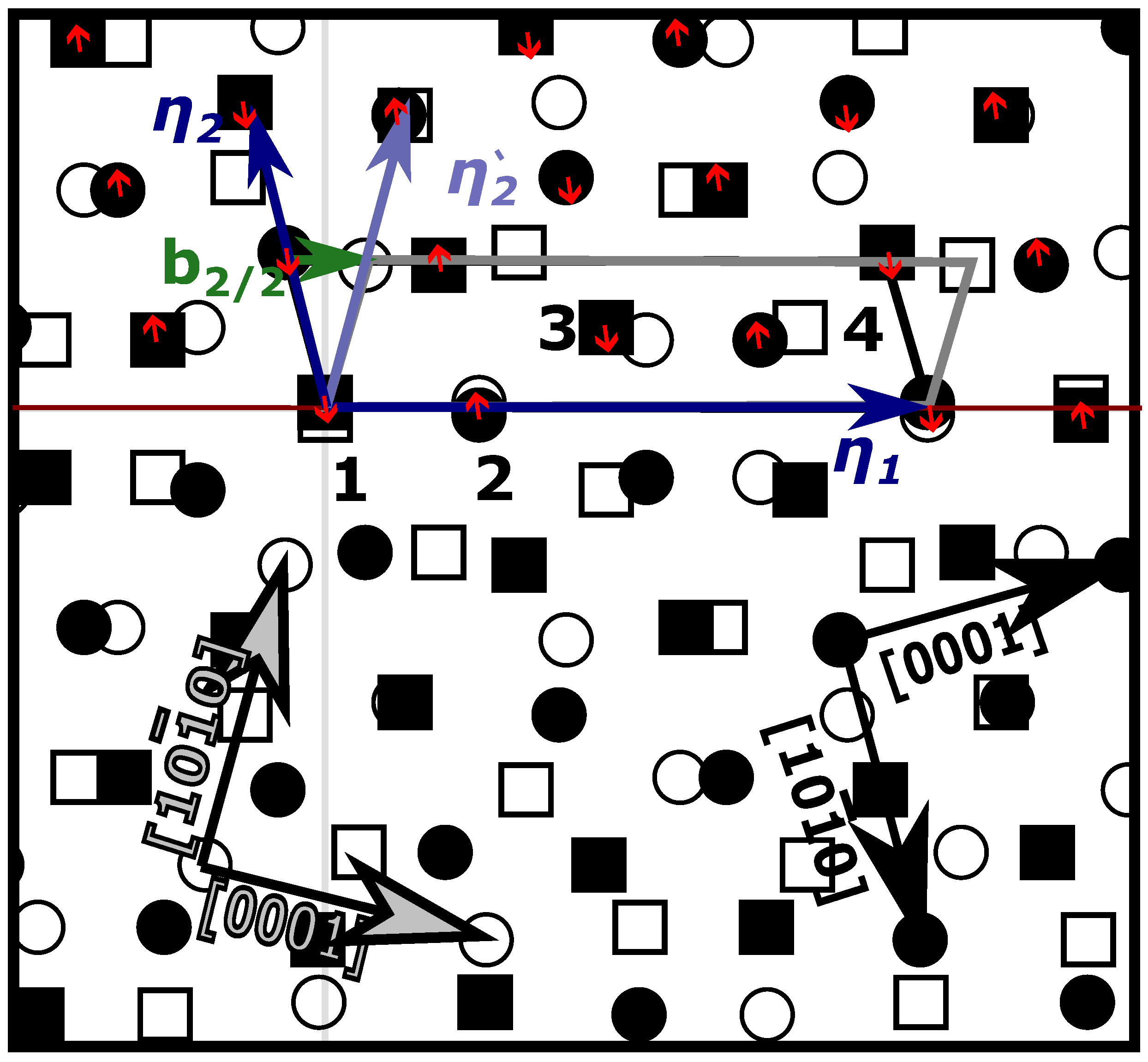
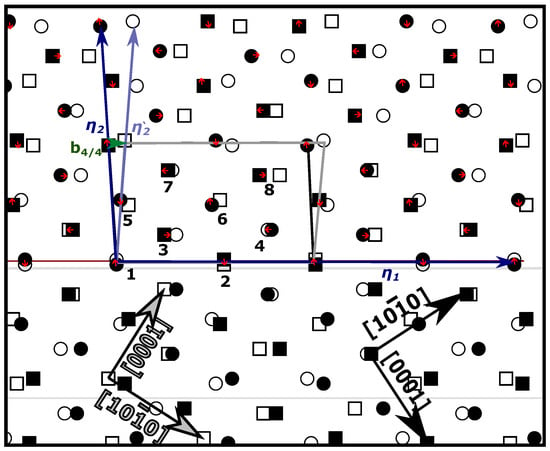
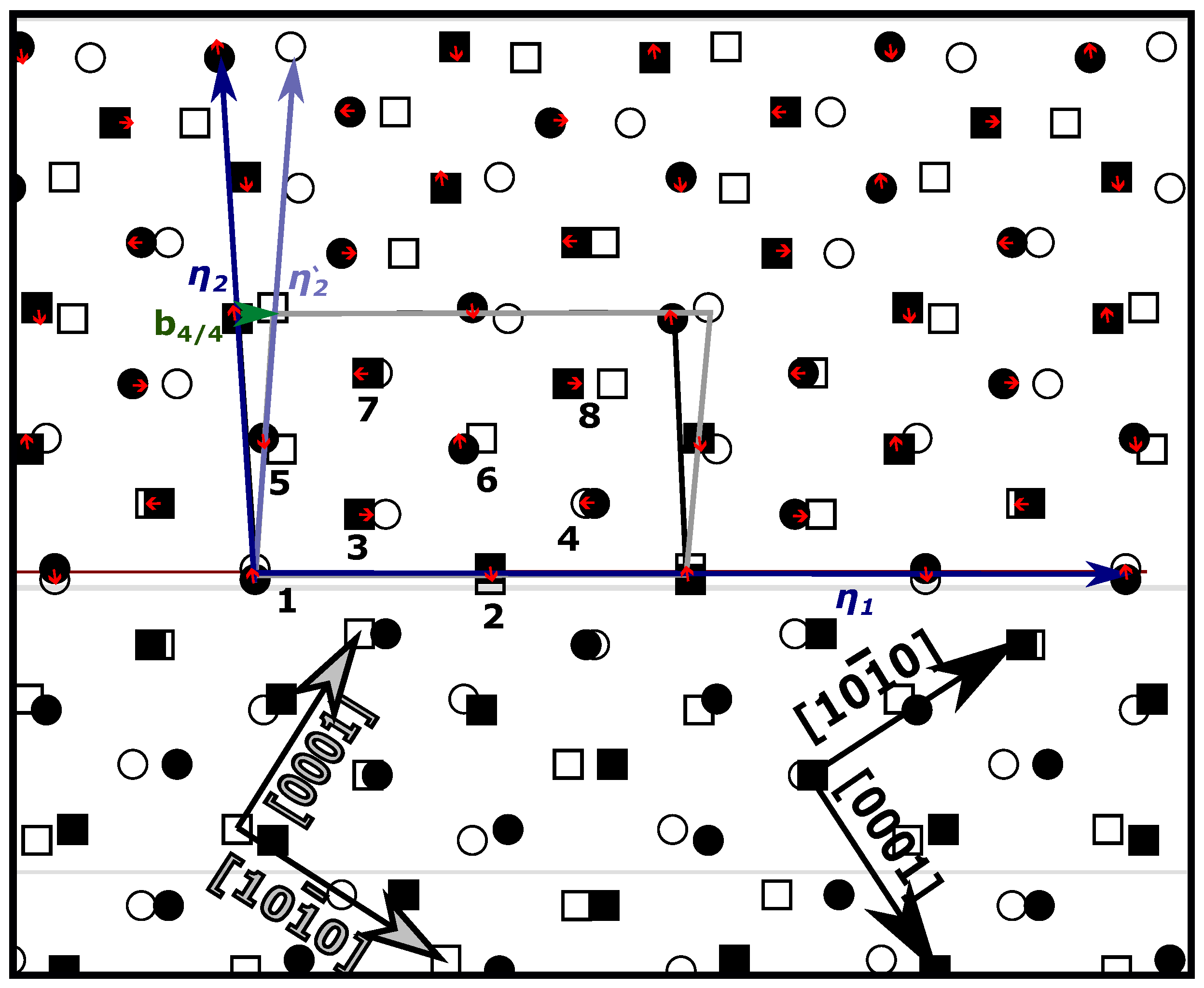
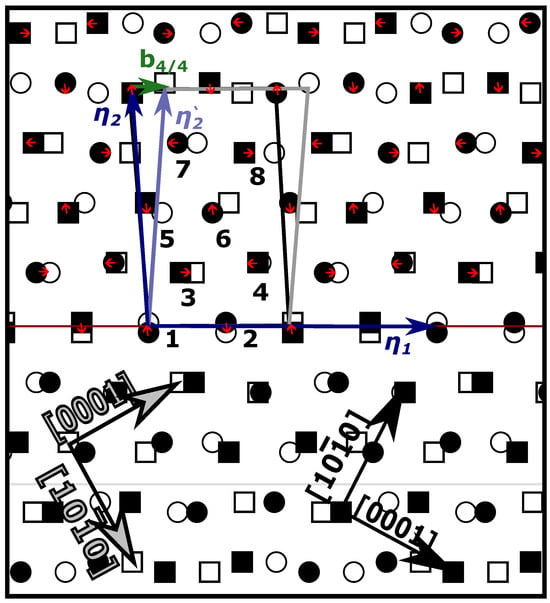
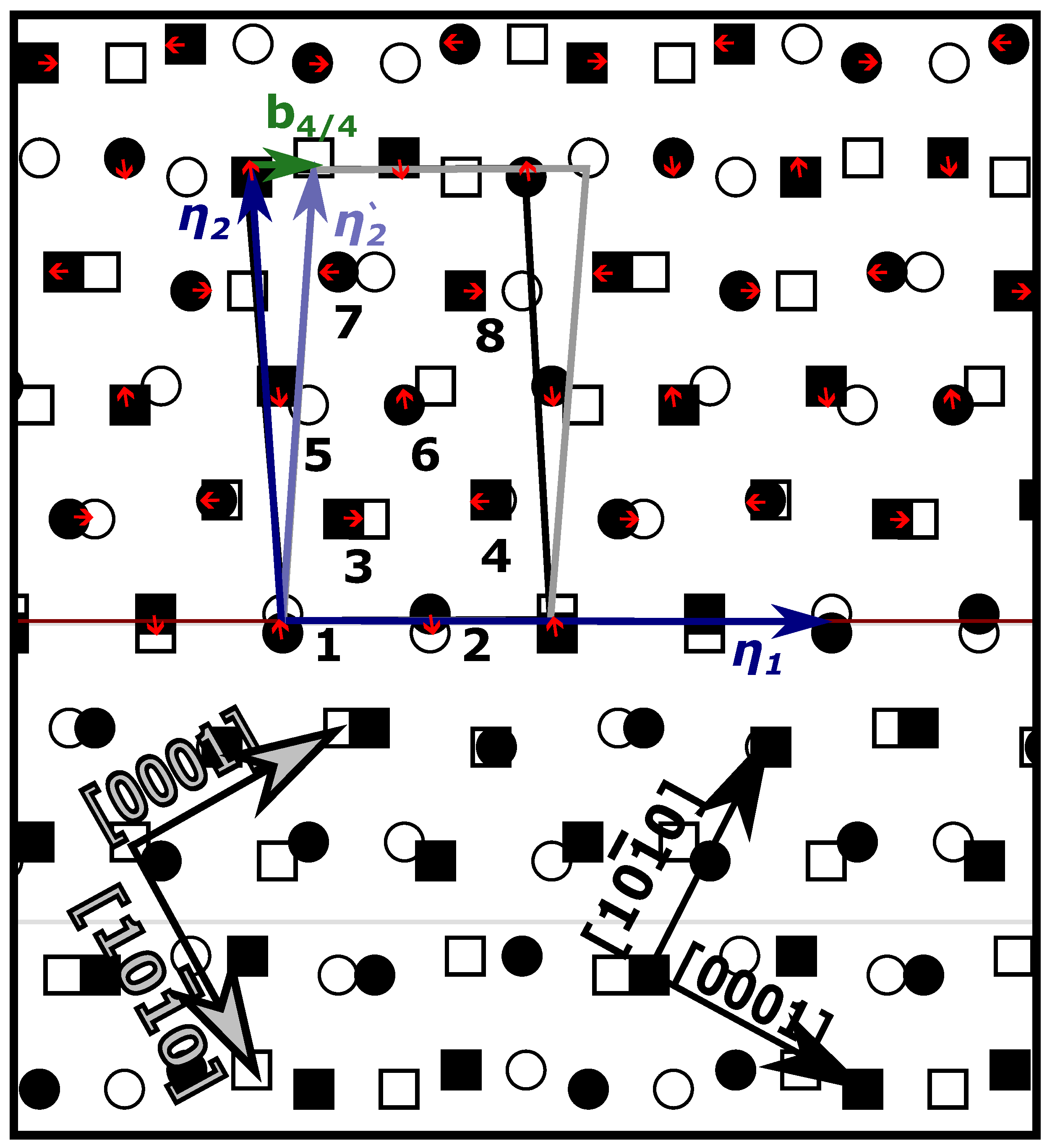
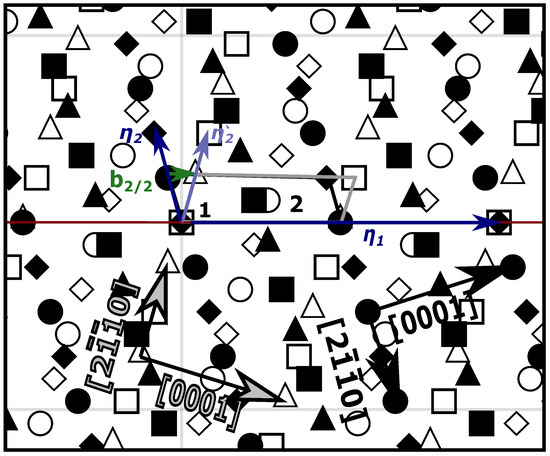
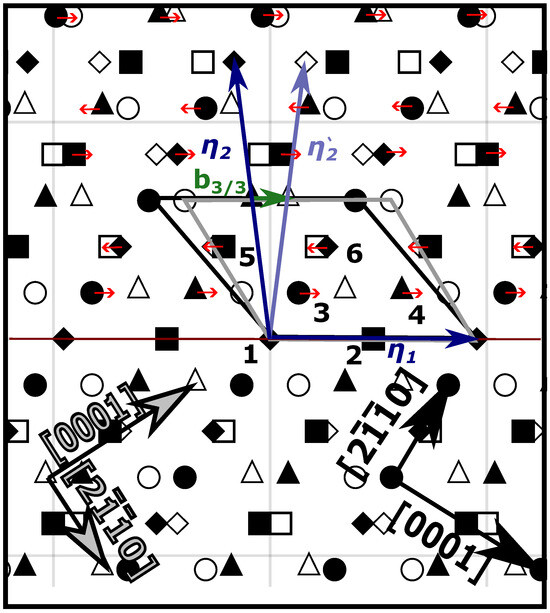
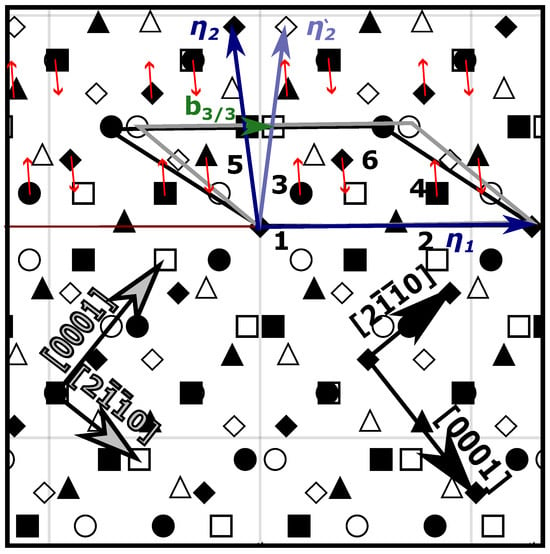
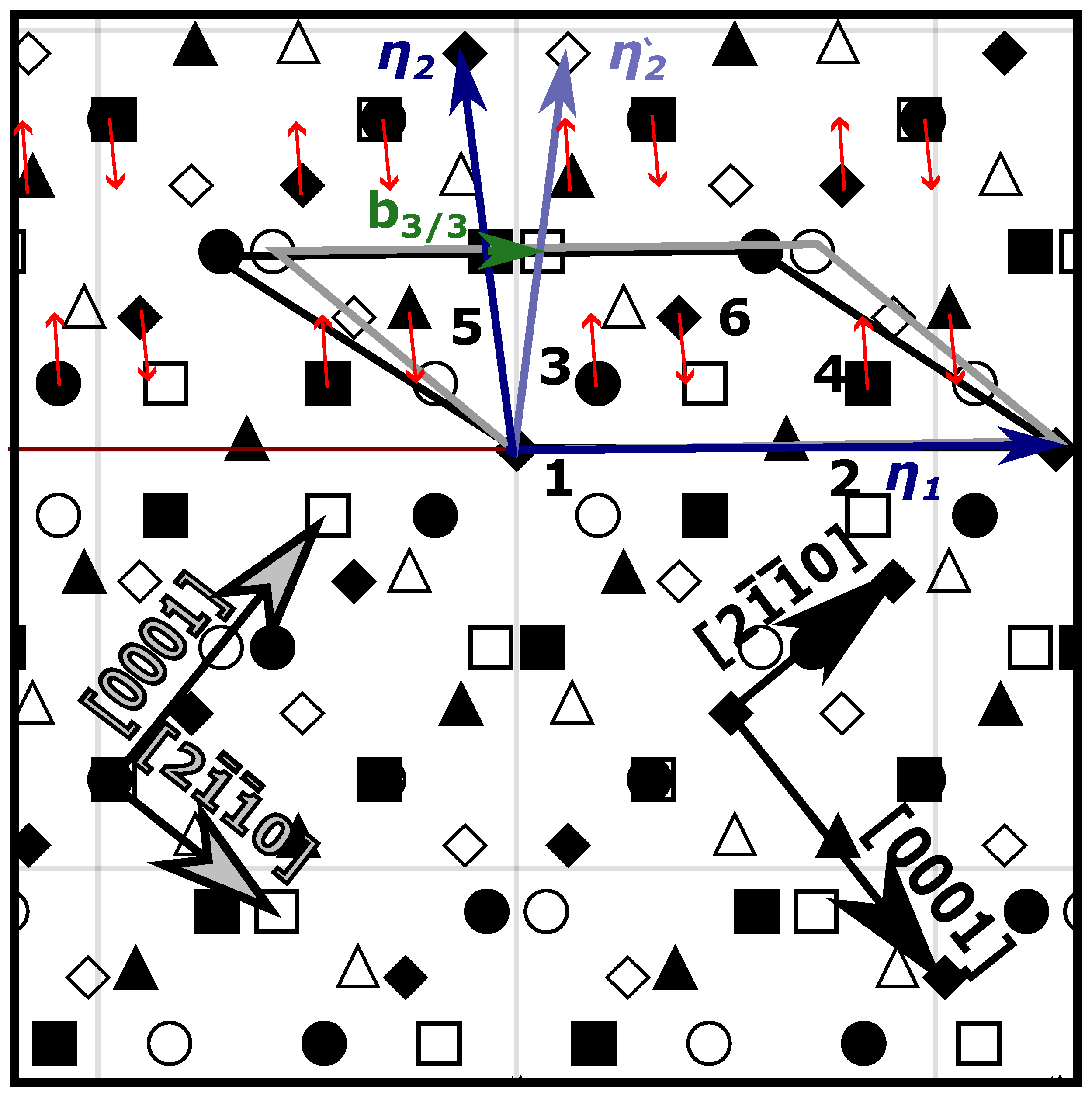
Table 1 shows the results obtained for the four common twins observed on the tilt axis, and they are illustrated using dichromatic complexes in Figure 1, Figure 2, Figure 3 and Figure 4. In these figures, the parent is represented using black filled shapes and the twin with outlined shapes. planes have ABAB stacking sequence and so atoms on A layers are represented as circles and B layers as squares. The shape change is illustrated with black and gray parallelograms, the Burgers vector with green arrows, and the shuffles with red arrows above the boundary plane. The atom positions inside the parallelogram in the parent are numbered in each figure corresponding to the atom number in Table 1. For most of these twins, the nearest atom sites in the parent and twin do not lie precisely on the twin plane but rather slightly above and below it alternating. When this occurs, the shuffle happens in two parts; the atoms shuffle to lie exactly on the twin interface as it migrates to coincide with that plane, and then they complete their shuffle as the interface passes on to the next layer.
Table 1.
-axis twin shuffling parameters. q represents the number of atoms withing the transformation unit cell, is the twinning direction, is the conjugate twinning direction, represent the vectors spanning the transformation unit cell, b is the Burgers vector, s is the twinning shear, h is the step height, represents the crystal coordinate of atom i, is the shuffle vector for atom i, and represents the ratio.
Figure 1.
twin dichromatic complex with shuffle vectors indicated above the coincident plane.
Figure 2.
twin dichromatic complex with shuffle vectors indicated above the coincident plane.
Figure 3.
twin dichromatic complex with shuffle vectors indicated above the coincident plane.
Figure 4.
twin dichromatic complex with shuffle vectors indicated above the coincident plane.
The Supplementary Materials contain a Python script which generates unit cells corresponding to the parallelograms for parent and twin depicted in Figure 1, Figure 2, Figure 3 and Figure 4 and demonstrating the atomic mapping between parent and twin based on the values in Table 1.
As discussed above, it is seen that all shuffles lie on either the or plane with rational directions and magnitudes, and may be easily expressed using components along either or with some of them having added components along . If the shuffles are defined to occur before shear, then from the parent should be used, while if they are defined as post-shear, the twinned should be used for motion on the plane.
Wang and Beyerlein have simulated the distribution of all -axis boundaries for Mg and identified that these four are the only energy cusps [61]. While the depth of cusps will vary for other HCP metals, we may infer that no other twins on this axis should be significant, except for those produced by double twinning of these modes. This conclusion seems to be supported by experimental and modeling data. Incidental reports of other active boundaries appear to be best explained by compound twinning [1]. The and modes show much simpler shuffle patterns which should give them higher mobility. When the consideration is added that the Burgers vector for twinning is much smaller than that of for all HCP metals, it is evident why twinning is by far the most profuse of these twins. It is also notable that and twins have the same shuffle patterns. This is to be expected because these twin modes are conjugate to one another. In other words, the shape change and displacement maps for and differ only by a small rotation which may be visualized in Figure 3 and Figure 4 by rotating and to coincide with one another. In effect, this rotation swaps and . The rotation alters the shearing of atom positions but has no impact on their shuffles. twins have a conjugate of and have a conjugate of which already has mirror symmetry, so the effect on the axis of multiple modes sharing the same shuffle pattern is unique to and .
4.2. -Axis Twinning
Table 2 shows the parameters obtained for the twins on the axis. Wang and Beyerlein have also studied the whole range of boundaries on this tilt axis and reported four energy cusps on , , , and [62]. The cusp for is slight and its structure appears distorted, and it has not been reported to be a twin mode, so we will concentrate our analysis on the other three twin planes. The plane has a stacking sequence of ABCDABCD so the dichromatic complexes in Figure 5, Figure 6 and Figure 7 depict four shapes to represent the different layers uniquely. Though there exists a type I twin, both simulation and experiment show the twin is a type II twin, indicating that it has a rotational symmetry rather than a mirror symmetry [9,10,11]. This produces the effect clearly evident in Figure 5 that atoms above the plane do not have mirror symmetry with those below in the other lattice, unlike all the other twin modes. has the simplest shuffle pattern with only two shuffles along the twinning axis. This should make it highly profuse, but for all HCP materials it has a restrictively high shear, and in fact it is not even observed in several of them. and are conjugate modes and thus share the same shuffle pattern. They have a relatively small shear, but a large step height coupled with a complex shuffle pattern which restricts their mobility.
Table 2.
-axis twin shuffling parameters. q represents the number of atoms within the transformation unit cell, is the twinning direction, is the conjugate twinning direction, represent the vectors spanning the transformation unit cell, b is the Burgers vector, s is the twinning shear, h is the step height, represents the crystal coordinate of atom i, is the shuffle vector for atom i, and represents the ratio.
Figure 5.
twin dichromatic complex with shuffle vectors indicated above the coincident plane.
Figure 6.
twin dichromatic complex with shuffle vectors indicated above the coincident plane.
Figure 7.
twin dichromatic complex with shuffle vectors indicated above the coincident plane.
4.3. Validation
Using MATLAB R2024A, we developed a code which can take the shear displacements and shuffles for a particular twin mode of arbitrary geometry and insert the twin into an initially pristine lattice using Equations (11)–(14) and Algorithm 1. The results of this algorithm may be initially verified by visual inspection to produce a correct twin embryo. More robust validation is performed by minimizing the structure and applying stress to simulate twin growth or shrinkage. As this work deals with the mechanics of deformation twinning, rather than the energetics, several different interatomic potentials were used. The most mobile boundaries, and , will detwin under minimization without any detwinning stress unless a very large embryo is introduced. To simulate their growth, we minimized and then equilibrated under an applied stress to stabilize the embryo. The evidence that the twin both grows and shrinks readily under appropriate stresses or lack thereof, and particularly that no defects are left behind as the boundary moves, indicates that the algorithm creates the embryo correctly. Minimization and molecular dynamics were performed using LAMMPS [63] and visualization was done using Ovito 3.6.0 [64] with coloring by local atomic orientation. Loading conditions, potentials, and temperatures were varied as specified below, in part to demonstrate the versatility of the algorithm.
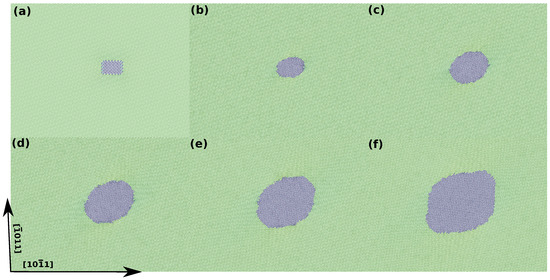
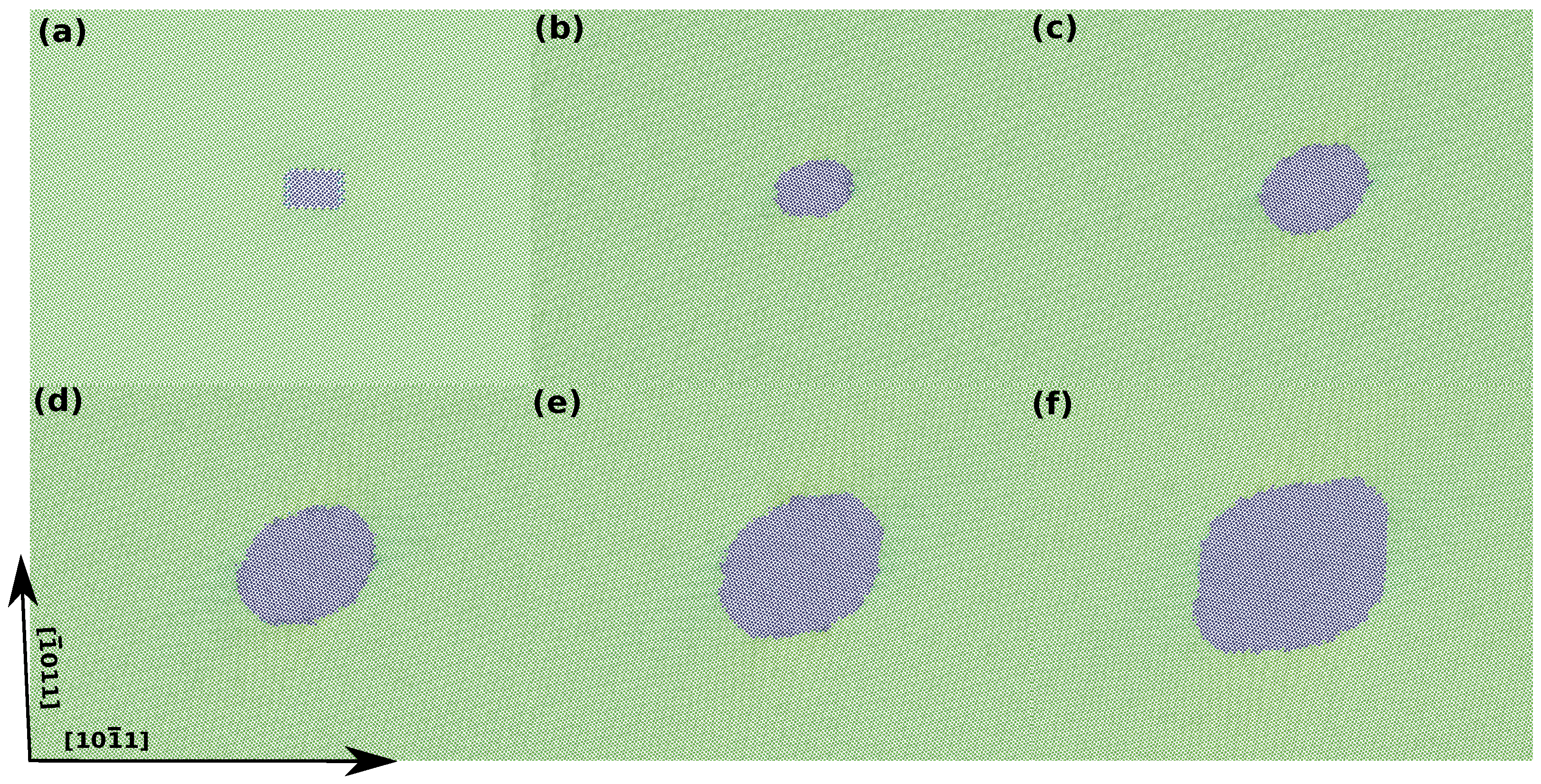
Figure 8 shows a twin embryo inserted into a very large matrix of Mg. The simulation cell was a 124 nm × 114 nm × 114 nm cube with 64 million atoms. Figure 8a shows the initial structure created by the algorithm and the successive images show the evolution of the twin in MD using the Liu EAM potential [65] which was displaced to a constant strain initially producing 2GPa shear stress and plastically relaxed at 100 K.This embryo detwinned if it was minimized under a smaller stress, but with a large shear stress applied to stabilize it, it grew outward in all directions. In fact, the growth rate accelerates as it gets larger and volumetric strain energy relaxation can dominate over twin boundary energy which scales with surface area. Notably, the Basal–Prismatic and Prismatic–Basal boundaries are preferred by the small embryo, but as it gets larger, it adopts the and boundaries which have no coherency strain [53,66].
Figure 8.
(a) Initial twin embryo inserted into a matrix of Mg. (b–f) Progression of twin in MD using the Liu EAM potential [65].
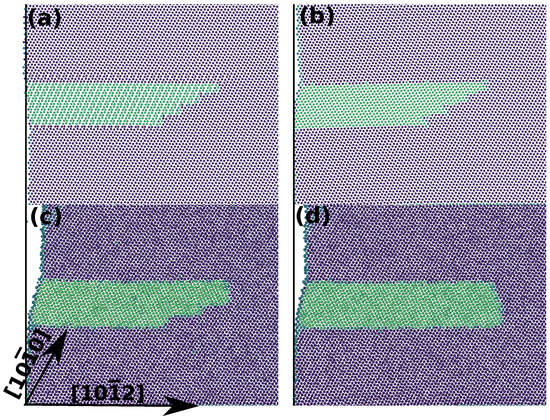
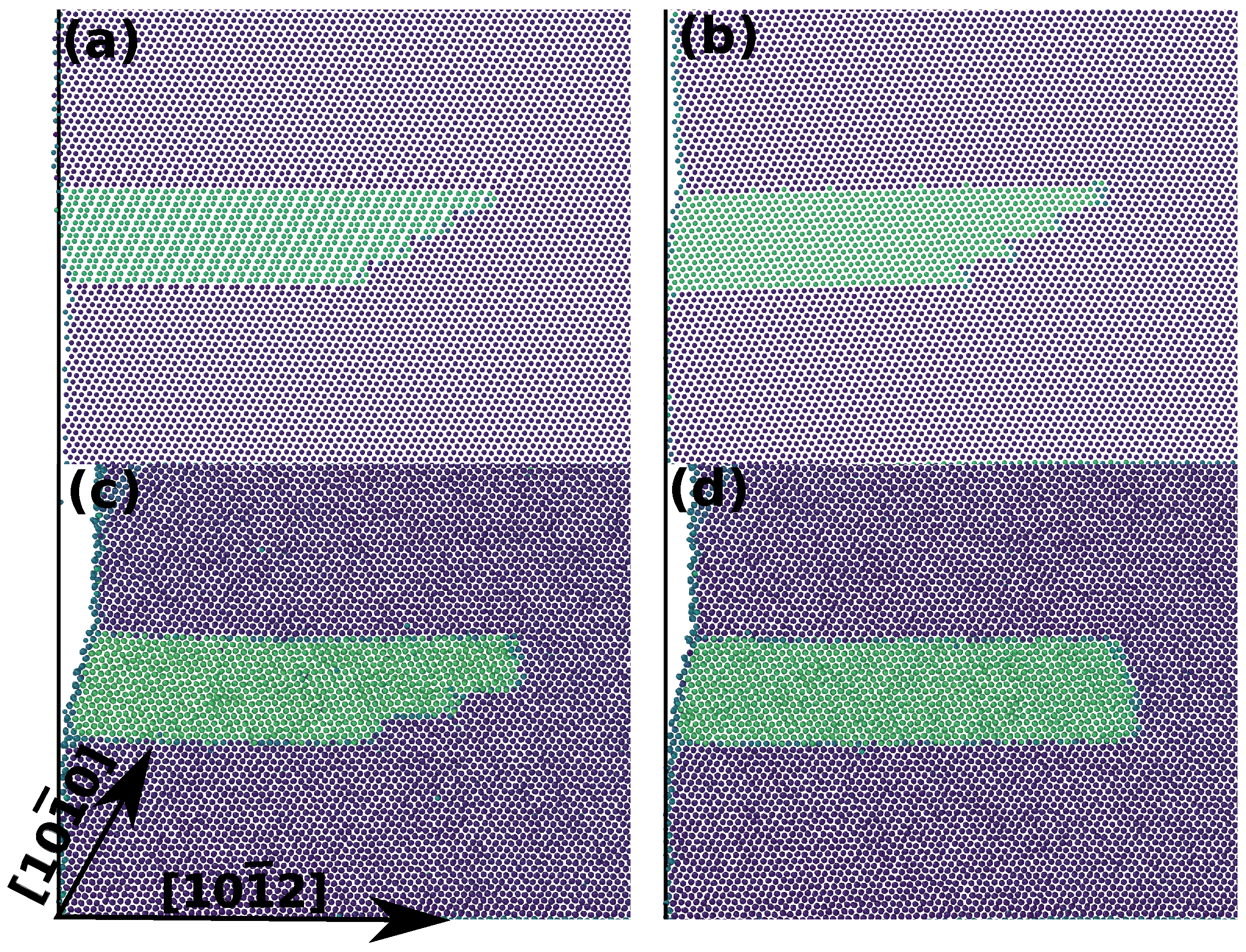
Figure 9 shows a twin embryo inserted into a matrix of Mg extending from a free surface with a box size of 49 nm × 3.9 nm × 24 nm with 176-thousand atoms. Figure 9a shows the structure created by the code, Figure 9b shows the structure after relaxation with a MEAM potential [67], and Figure 9c,d show twin growth under an applied shear stress of 800 MPa at 600 K. This twin also detwinned under a reverse shear stress coupled with the presence of basal dislocations. The need for a reverse shear stress is consistent with the twin being far less mobile than the twin. Interestingly, a twin nucleated at the boundary of the twin during detwinning. This is in agreement with the fact that twins are often seen as a double twin along with twins.
Figure 9.
(a) Initial twin embryo inserted into a matrix of Mg extending from a free surface. (b) twin after relaxation with a MEAM potential [67]. (c,d) Progression of the twin under applied shear stress.
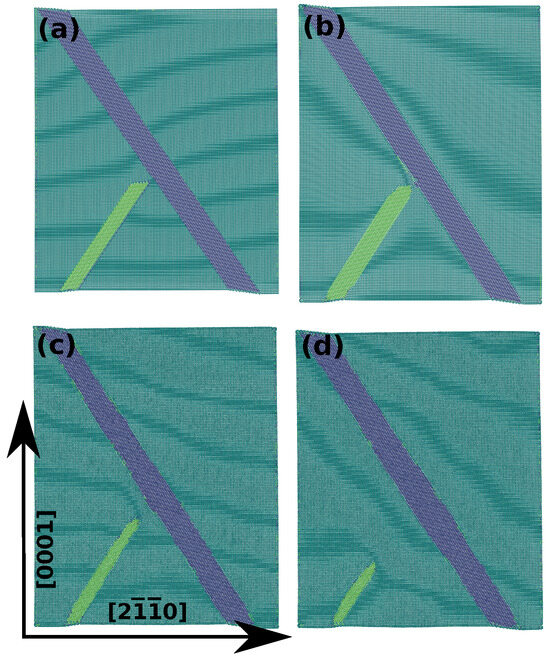
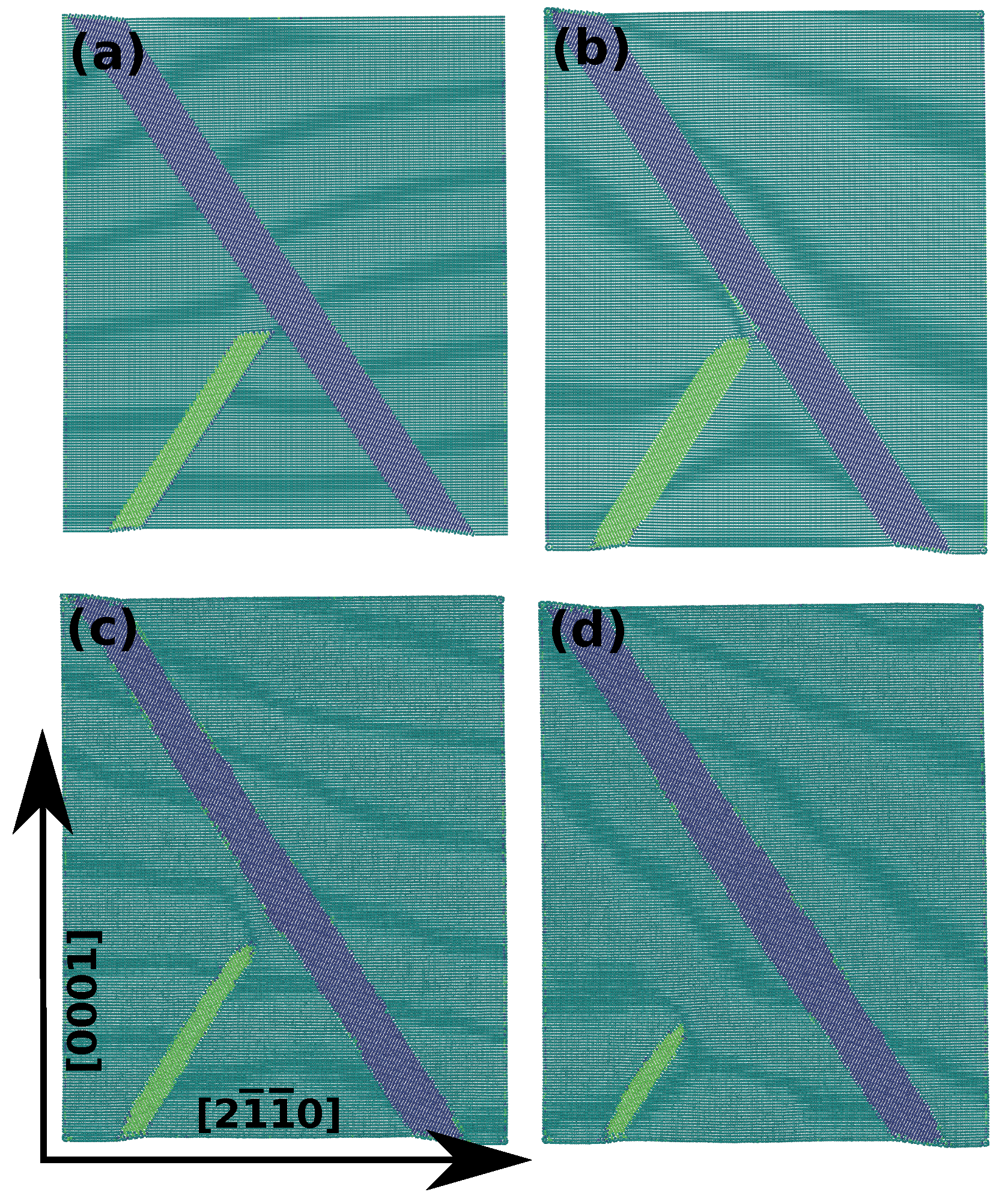
Figure 10 shows and three-layer disconnection embryos inserted together into a titanium simulation box with one poised to collide with the other with a box size of 43 nm × 2.1 nm × 55 nm and 183-thousand atoms. When the box was loaded using a MEAM/spline potential [68] at 300 K in 100 MPa of -axis compression which favors growth of both embryos, the larger one grew slowly, but the other was repelled strongly from it and shrunk away, eventually almost disappearing.
Figure 10.
(a) Initial and three-layer disconnection twin embryos inserted into a Ti matrix. (b–d) Progression of and twins using a MEAM/spline potential [68].
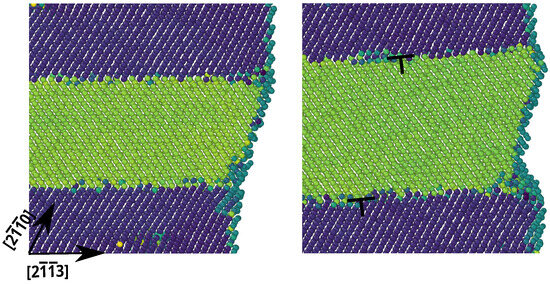
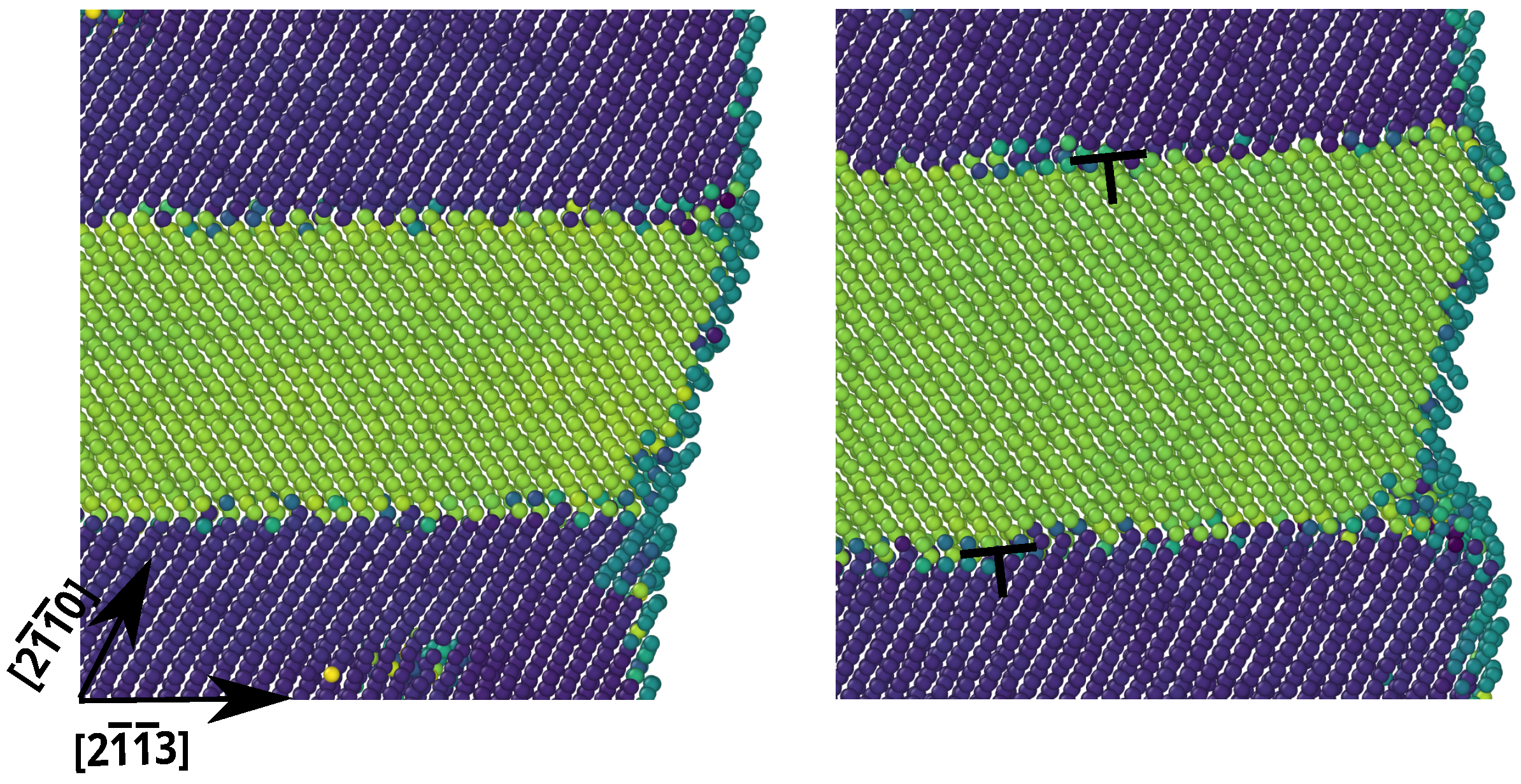
Figure 11 shows a twin inserted into Zn near a free surface and simulated using a MEAM potential [69] with a box size of 36 nm × 1.8 nm × 40 nm and 156-thousand atoms. After minimization, a shear stress of 800 MPa was applied at 300 K. This particular twin mode has not been observed experimentally in Zn to our knowledge, but its properties have been speculated about, particularly because the c/a ratio of Zn is so high [1]. Notably, although the twin is clearly glissile, the activated twinning disconnection is , rather than , which is active in other hcp materials. The difference in shear between the and the is clearly visible on the free surface where the offset due to the insertion of the twin with disconnections differs from the offset due to the disconnections activated during molecular dynamics. Figure 11 shows two active disconnections which clearly show a single layer step height and the Burgers vector matching analytical results by El Kadiri [12]. Christian [1] noted that the shear for the disconnection in Zn is much greater than in materials where it is readily observed such as Zr and Ti. The simulation results seem to bear this out by showing the preference for the disconnection, although this could also be due to an inaccurate potential, as has been previously noted for Ti [70].
Figure 11.
Two snapshots from MD simulation of twin in Zn. The second snapshot shows twin thickening with active disconnections indicated on the upper and lower twin boundaries.
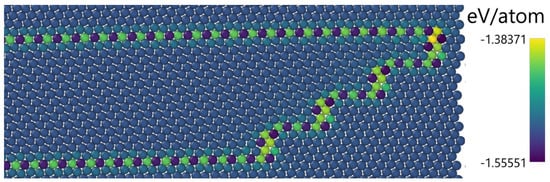
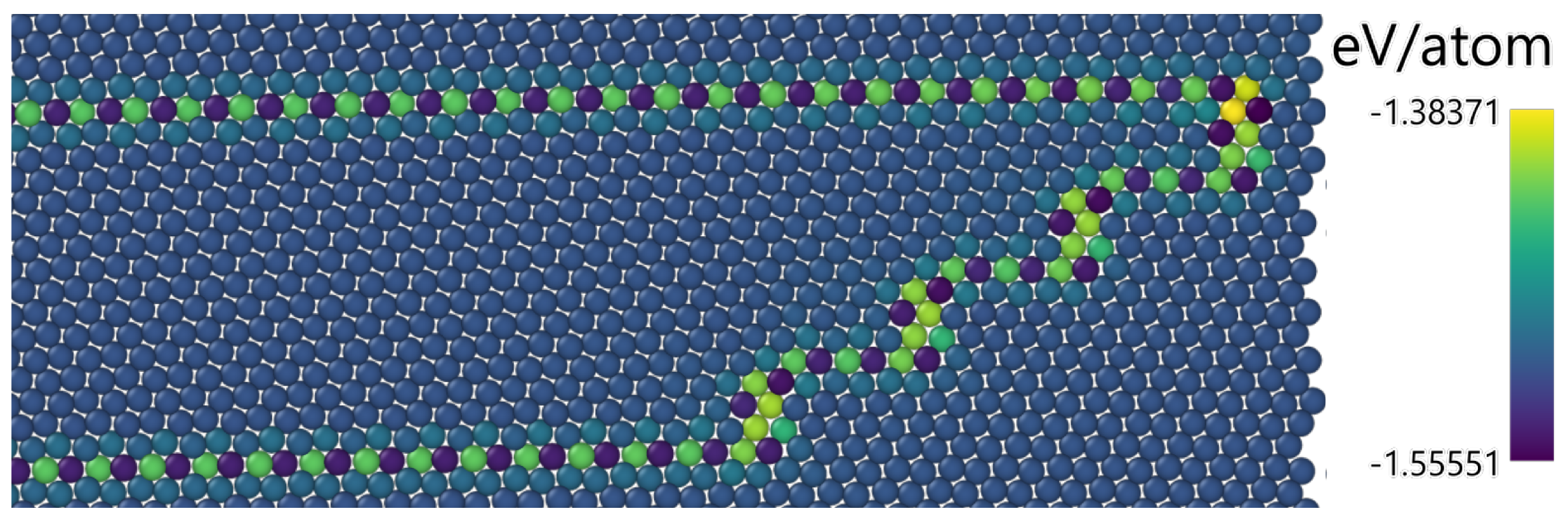
Finally, Figure 12 shows a close-up view of the embryo in Mg with per-atom energy coloring after running a conjugate gradient energy minimization using [67]. This view shows clearly the atomic structure and boundary energy densities, which match well with the structure previously shown by [61]. The twin tip shows slightly higher energy than the straight boundary segments, as should be expected.
Figure 12.
twin embryo structure in Mg. The twin has the most stable boundary, with very low overall energy of ≈75 mJ/m2.
5. Conclusions
In conclusion, the shuffles for all observed twin modes in hexagonal close-packed metals were analyzed and explicitly defined. New mechanical equations were derived which make explicit the computation of the shuffles, and it was demonstrated that all shuffle vectors must lie on either to or plane and be rational fractions of lattice vectors. An algorithm was presented which can compute the displacement map due to a twin of nearly arbitrary shape and enables, along with explicit definitions of the shuffle vectors, the insertion of any twin mode with custom geometry into an initially pristine lattice. The use of this algorithm was demonstrated and validated by inserting , , and twins in Mg and Ti and demonstrating that they underwent glissile deformation. These tools not only give new insights into the mechanics of the twinning process but also make possible far more realistic and complex twinning simulations at the atomic scale by greatly enhancing the available starting conditions for molecular dynamics.
Supplementary Materials
The following supporting information can be downloaded at: https://www.mdpi.com/article/10.3390/met16060624/s1, File S1: Shuffle Tables Verifications; File S2: Twin Insertion Algorithm Example.
Author Contributions
Conceptualization, C.B.; methodology, C.B. and M.N.; software, C.B. and M.N.; validation, C.B. and M.N.; formal analysis, C.B.; investigation, C.B. and M.N.; resources, C.B.; data curation, M.N.; writing—original draft preparation, C.B.; writing—review and editing, C.B. and M.N.; visualization, C.B. and M.N.; supervision, C.B.; project administration, C.B.; funding acquisition, C.B. All authors have read and agreed to the published version of the manuscript.
Funding
This material is based on work supported by the National Science Foundation under grant number 2237217. Any opinions, findings, and conclusions or recommendations expressed in this material are those of the author(s) and do not necessarily reflect the views of the National Science Foundation.
Data Availability Statement
The original contributions presented in this study are included in the article/Supplementary Materials. Further inquiries can be directed to the corresponding author.
Conflicts of Interest
The authors declare no conflicts of interest.
References
- Christian, J.; Mahajan, S. Deformation twinning. Prog. Mater. Sci. 1995, 39, 1–157. [Google Scholar] [CrossRef] [Scilit]
- Clapp, P. How would we recognize a martensitic transformation if it bumped into us on a dark & austy night? J. Phys. IV 1995, 5, C8–C11. [Google Scholar]
- Christian, J. The Theory of Transformations in Metals and Alloys: Part I + II; Elsevier: Amsterdam, The Netherlands, 2002; p. 933. [Google Scholar]
- Niggli, P. Geometrisches zue Theorie der Kristallschiebungen. Z. Krist. 1929, 71, 413. [Google Scholar]
- Kiho, H. The Crystallographic Aspect of the Mechanical Twinning in Metals. J. Phys. Soc. Jpn. 1954, 9, 739. [Google Scholar] [CrossRef] [Scilit]
- Kiho, H. The Crystallographic Aspect of the Mechanical Twinning in Ti and α-U. J. Phys. Soc. Jpn. 1958, 13, 269. [Google Scholar] [CrossRef] [Scilit]
- Paidar, V. Shuffling in displacive phase transformations. Mater. Sci. Eng. A 2008, 481, 243–246. [Google Scholar] [CrossRef] [Scilit]
- Yang, X.S.; Sun, S.; Ruan, H.H.; Shi, S.Q.; Zhang, T.Y. Shear and shuffling accomplishing polymorphic fcc γ→ hcp ε→ bct α martensitic phase transformation. Acta Mater. 2017, 136, 347–354. [Google Scholar] [CrossRef] [Scilit]
- He, Y.; Fang, Z.; Wang, C.; Wang, G.; Mao, S.X. In situ observation of the atomic shuffles during the twinning in hexagonal close-packed rhenium. Nat. Commun. 2024, 15, 2994. [Google Scholar] [CrossRef] [Scilit] [PubMed]
- Khater, H.; Serra, A.; Pond, R. Atomic shearing and shuffling accompanying the motion of twinning disconnections in Zirconium. Philos. Mag. 2013, 93, 1279–1298. [Google Scholar] [CrossRef] [Scilit]
- Minonishi, Y.; Ishioka, S.; Koiwa, M.; Morozumi, S.; Yamaguchi, M. The core structures of a 1/3 edge dislocation under applied shear stresses in an hcp model crystal. Philos. Mag. A 1982, 45, 835–850. [Google Scholar] [CrossRef] [Scilit]
- El Kadiri, H.; Barrett, C.D.; Tschopp, M.A. The candidacy of shuffle and shear during compound twinning in hexagonal close-packed structures. Acta Mater. 2013, 61, 7646–7659. [Google Scholar] [CrossRef] [Scilit]
- Serra, A.; Bacon, D.; Pond, R. The crystallography and core structure of twinning dislocations in HCP metals. Acta Metall. 1988, 36, 3183–3203. [Google Scholar] [CrossRef] [Scilit]
- Rawat, S.; Mitra, N. Compression twinning and structural phase transformation of single crystal titanium under uniaxial compressive strain conditions: Comparison of inter-atomic potentials. Comput. Mater. Sci. 2017, 126, 228–237. [Google Scholar] [CrossRef] [Scilit]
- Barrett, C.; Martinez, J.; Nitol, M. Faceting and Twin–Twin Interactions in and Twins in Titanium. Metals 2022, 12, 895. [Google Scholar] [CrossRef] [Scilit]
- Lainé, S.J.; Knowles, K.M. deformation twinning in commercial purity titanium at room temperature. Philos. Mag. 2015, 95, 2153–2166. [Google Scholar] [CrossRef] [Scilit]
- Lainé, S.J.; Knowles, K.M.; Rugg, D. Very high strain rate deformation twinning behaviour of Ti–6Al–4V. Materialia 2020, 12, 100762. [Google Scholar] [CrossRef] [Scilit]
- Braisaz, T. High-resolution electron microscopy study of the twin and defects analysis in deformed polycrystalline alpha titanium. Philos. Mag. Lett. 1996, 74, 331–338. [Google Scholar] [CrossRef] [Scilit]
- Paton, N.; Backofen, W. Plastic deformation of titanium at elevated temperatures. Metall. Mater. Trans. B 1970, 1, 2839–2847. [Google Scholar] [CrossRef] [Scilit]
- Serra, A.; Bacon, D. Computer simulation of twinning dislocation in magnesium using a many-body potential. Philos. Mag. A 1991, 63, 1001–1012. [Google Scholar] [CrossRef] [Scilit]
- Serra, A.; Bacon, D.J. A new model for twin growth in HCP metals. Philos. Mag. A 1996, 73, 333–343. [Google Scholar] [CrossRef] [Scilit]
- Thompson, N.; Millard, D. Twin formation in cadmium. Phil. Mag. 1952, 43, 422–440. [Google Scholar] [CrossRef] [Scilit]
- Taylor, G.I. Plastic strain in metals. J. Inst. Met. 1938, 62, 307–324. [Google Scholar]
- El Kadiri, H.; Oppedal, A. A crystal plasticity theory for latent hardening by glide twinning through dislocation transmutation and twin accommodation effects. J. Mech. Phys. Solids 2010, 58, 613–624. [Google Scholar] [CrossRef] [Scilit]
- Oppedal, A.L.; El Kadiri, H.; Tomé, C.N.; Kaschner, G.C.; Vogel, S.C.; Baird, J.C.; Horstemeyer, M.F. Effect of dislocation transmutation on modeling hardening mechanisms by twinning in magnesium. Int. J. Plast. 2012, 30–31, 41–61. [Google Scholar] [CrossRef] [Scilit]
- Koike, J.; Kobayashi, T.; Mukai, T.; Watanabe, H.; Suzuki, M.; Maruyama, K.; Higashi, K. The activity of non-basal slip systems and dynamic recovery at room temperature in fine-grained AZ31B magnesium alloys. Acta Mater. 2003, 51, 2055–2065. [Google Scholar] [CrossRef] [Scilit]
- Koike, J. Enhanced deformation mechanisms by anisotropic plasticity in polycrystalline Mg alloys at room temperature. Metall. Mater. Trans. A 2005, 36, 1689–1696. [Google Scholar] [CrossRef] [Scilit]
- Bieler, T.; Crimp, M.; Yang, Y.; Wang, L.; Eisenlohr, P.; Mason, D.; Liu, W.; Ice, G. Strain heterogeneity and damage nucleation at grain boundaries during monotonic deformation in commercial purity Titanium. JOM J. Miner. Met. Mater. Soc. 2009, 61, 45–52. [Google Scholar] [CrossRef] [Scilit]
- Bieler, T.; Eisenlohr, P.; Roters, F.; Kumar, D.; Mason, D.; Crimp, M.; Raabe, D. The role of heterogeneous deformation on damage nucleation at grain boundaries in single phase metals. Int. J. Plast. 2009, 25, 1655–1683. [Google Scholar] [CrossRef] [Scilit]
- Ma, L.; Mishra, R.K.; Peng, L.; Luo, A.A.; Ding, W.; Sachdev, A.K. Texture and mechanical behavior evolution of age-hardenable Mg-Nd-Zn extrusions during aging treatment. Mater. Sci. Eng. A 2011, 529, 151–155. [Google Scholar] [CrossRef] [Scilit]
- Barrett, C.; Tschopp, M.; El Kadiri, H. Automated analysis of twins in hexagonal close-packed metals using molecular dynamics. Scr. Mater. 2012, 66, 666–669. [Google Scholar] [CrossRef] [Scilit]
- Bell, R.L.; Cahn, R.W. The dynamics of twinning and the interrelation of slip and twinning in zinc crystals. Proc. R. Soc. Lond. Ser. A Math. Phys. Sci. 1957, 239, 494–521. [Google Scholar] [CrossRef] [Scilit]
- Price, P. Nonbasal Glide in Dislocation-Free Cadmium Crystals. II. The System. J. Appl. Phys. 1961, 32, 1750–1757. [Google Scholar] [CrossRef] [Scilit]
- Price, P. Nucleation and growth of twins in dislocation-free zinc crystals. Proc. R. Soc. Lond. Ser. A Math. Phys. Sci. 1961, 260, 251–262. [Google Scholar] [CrossRef] [Scilit]
- Rosenbaum, H.S. Non-basal slip and twin accommodation in zinc crystals. Acta Metall. 1961, 9, 742–748. [Google Scholar] [CrossRef] [Scilit]
- Lavrentev, F.; Salita, O.; Vladimirova, V. Dislocation Mobility in the Slip System of Zinc Single Crystals. Phys. Status Solidi (B) 1968, 29, 569–574. [Google Scholar] [CrossRef] [Scilit]
- Lavrentev, F.; Pokhil, Y. Effect of Forest Dislocations in the system on hardening in Mg single crystals under basal slip. Phys. Status Solidi (A) 1975, 32, 227–232. [Google Scholar] [CrossRef] [Scilit]
- Lavrentev, F.; Pokhil, Y.; Zolotukhina, I. Pair interaction of pyramidal dislocations and its contribution to flow stresses in Mg crystals during slip in system. Mater. Sci. Eng. 1978, 32, 121–127. [Google Scholar] [CrossRef] [Scilit]
- Imandoust, A.; Barrett, C.D.; Oppedal, A.L.; Whittington, W.R.; Paudel, Y.; El Kadiri, H. Nucleation and preferential growth mechanism of recrystallization texture in high purity binary magnesium-rare earth alloys. Acta Mater. 2017, 138, 27–41. [Google Scholar] [CrossRef] [Scilit]
- Ball, E.; Prangnell, P. Tensile-compressive yield asymmetries in high strength wrought magnesium alloys. Scr. Metall. Mater. 1994, 31, 111–116. [Google Scholar] [CrossRef] [Scilit]
- Barrett, C.D. Analysis of twinning via automated atomistic post-processing methods. Philos. Mag. 2017, 97, 1102–1128. [Google Scholar] [CrossRef] [Scilit]
- Yoo, M. Slip, twinning, and fracture in hexagonal close-packed metals. Metall. Mater. Trans. A 1981, 12, 409–418. [Google Scholar] [CrossRef] [Scilit]
- Kadiri, H.E.; Baird, J.; Kapil, J.; Oppedal, A.; Cherkaoui, M.; Vogel, S.C. Flow asymmetry and nucleation stresses of twinning and non-basal slip in magnesium. Int. J. Plast. 2013, 44, 111–120. [Google Scholar] [CrossRef] [Scilit]
- Bohlen, J.; Yi, S.; Letzig, D.; Kainer, K.U. Effect of rare earth elements on the microstructure and texture development in magnesium-manganese alloys during extrusion. Mater. Sci. Eng. A 2010, 527, 7092–7098. [Google Scholar] [CrossRef] [Scilit]
- Hantzsche, K.; Bohlen, J.; Wendt, J.; Kainer, K.U.; Yi, S.B.; Letzig, D. Effect of rare earth additions on microstructure and texture development of magnesium alloy sheets. Scr. Mater. 2010, 63, 725–730. [Google Scholar] [CrossRef] [Scilit]
- Stanford, N. Micro-alloying Mg with Y, Ce, Gd and La for texture modification: A comparative study. Mater. Sci. Eng. A 2010, 527, 2669–2677. [Google Scholar] [CrossRef] [Scilit]
- Hadorn, J.P.; Agnew, S.R. A new metastable phase in dilute, hot-rolled Mg-Nd alloys. Mater. Sci. Eng. A 2012, 533, 9–16. [Google Scholar] [CrossRef] [Scilit]
- Sandlöbes, S.; Zaefferer, S.; Schestakow, I.; Yi, S.; Gonzalez-Martinez, R. On the role of non-basal deformation mechanisms for the ductility of Mg and Mg-Y alloys. Acta Mater. 2011, 59, 429–439. [Google Scholar] [CrossRef] [Scilit]
- Nie, J.; Zhu, Y.; Liu, J.; Fang, X.Y. Periodic segregation of solute atoms in fully coherent twin boundaries. Science 2013, 340, 957–960. [Google Scholar] [CrossRef] [Scilit]
- Joost, W.J.; Krajewski, P.E. Towards magnesium alloys for high-volume automotive applications. Scr. Mater. 2017, 128, 107–112. [Google Scholar] [CrossRef] [Scilit]
- Agnew, S.R.; Duygulu, Ö. Plastic anisotropy and the role of non-basal slip in magnesium alloy AZ31B. Int. J. Plast. 2005, 21, 1161–1193. [Google Scholar] [CrossRef] [Scilit]
- Bilby, B.; Crocker, A. The theory of the crystallography of deformation twinning. Proc. R. Soc. Lond. Ser. A. Math. Phys. Sci. 1965, 288, 240. [Google Scholar] [CrossRef] [Scilit]
- Barrett, C.D.; El Kadiri, H. The roles of grain boundary dislocations and disclinations in the nucleation of twinning. Acta Mater. 2014, 63, 1–15. [Google Scholar] [CrossRef] [Scilit]
- Dickel, D.E.; Barrett, C.D. Methods for the determination of diffusionless transformation conditions from atomistic simulations. Model. Simul. Mater. Sci. Eng. 2019, 27, 023001. [Google Scholar] [CrossRef] [Scilit]
- Balluffi, R.W. Introduction to Elasticity Theory for Crystal Defects; World Scientific Publishing Company: Singapore, 2016. [Google Scholar]
- Hirth, J.; Lothe, J. Theory of Dislocations; John Wiley and Sons, Inc.: Hoboken, NJ, USA, 1982; p. 857. [Google Scholar]
- Peach, M.; Koehler, J. The forces exerted on dislocations and the stress fields produced by them. Phys. Rev. 1950, 80, 436. [Google Scholar] [CrossRef] [Scilit]
- Barnett, D.; Balluffi, R. The displacement field of a triangular dislocation loop—A correction with commentary. Philos. Mag. Lett. 2007, 87, 943–944. [Google Scholar] [CrossRef] [Scilit]
- Barnett, D. The displacement field of a triangular dislocation loop. Philos. Mag. A 1985, 51, 383–387. [Google Scholar] [CrossRef] [Scilit]
- Devincre, B. Three dimensional stress field expressions for straight dislocation segments. Solid State Commun. 1995, 93, 875–878. [Google Scholar] [CrossRef] [Scilit]
- Wang, J.; Beyerlein, I. Atomic structures of symmetric tilt grain boundaries in hexagonal close packed (hcp) crystals. Model. Simul. Mater. Sci. Eng. 2012, 20, 024002. [Google Scholar] [CrossRef] [Scilit]
- Wang, J.; Beyerlein, I.J. Atomic Structures of Symmetric Tilt Grain Boundaries in Hexagonal Close-Packed (hcp) Crystals. Metall. Mater. Trans. A 2012, 43, 3556–3569. [Google Scholar] [CrossRef] [Scilit]
- Plimpton, S. Fast parallel algorithms for short-range molecular dynamics. J. Comput. Phys. 1995, 117, 1–19. [Google Scholar] [CrossRef] [Scilit]
- Stukowski, A. Visualization and analysis of atomistic simulation data with OVITO—The Open Visualization Tool. Model. Simul. Mater. Sci. Eng. 2010, 18, 015012. [Google Scholar] [CrossRef] [Scilit]
- Liu, X.; Adams, J.; Ercolessi, F.; Moriarty, J. EAM potential for magnesium from quantum mechanical forces. Model. Simul. Mater. Sci. Eng. 1996, 4, 293. [Google Scholar] [CrossRef] [Scilit]
- Barrett, C.D.; El Kadiri, H. Impact of deformation faceting on , and embryonic twin nucleation in hexagonal close-packed metals. Acta Mater. 2014, 70, 137–161. [Google Scholar] [CrossRef] [Scilit]
- Dickel, D.E.; Baskes, M.I.; Aslam, I.; Barrett, C.D. New interatomic potential for Mg–Al–Zn alloys with specific application to dilute Mg-based alloys. Model. Simul. Mater. Sci. Eng. 2018, 26, 045010. [Google Scholar] [CrossRef] [Scilit]
- Hennig, R.; Lenosky, T.; Trinkle, D.; Rudin, S.; Wilkins, J. Classical potential describes martensitic phase transformations between the α, β, and ω titanium phases. Phys. Rev. B 2008, 78, 054121. [Google Scholar] [CrossRef] [Scilit]
- Jang, H.S.; Kim, K.M.; Lee, B.J. Modified embedded-atom method interatomic potentials for pure Zn and Mg-Zn binary system. Calphad 2018, 60, 200–207. [Google Scholar] [CrossRef] [Scilit]
- Dickel, D.; Barrett, C.D.; Carino, R.L.; Baskes, M.I.; Horstemeyer, M.F. Mechanical instabilities in the modeling of phase transitions of titanium. Model. Simul. Mater. Sci. Eng. 2018, 26, 065002. [Google Scholar] [CrossRef] [Scilit]

Disclaimer/Publisher’s Note: The statements, opinions and data contained in all publications are solely those of the individual author(s) and contributor(s) and not of MDPI and/or the editor(s). MDPI and/or the editor(s) disclaim responsibility for any injury to people or property resulting from any ideas, methods, instructions or products referred to in the content. |
© 2026 by the authors. Licensee MDPI, Basel, Switzerland. This article is an open access article distributed under the terms and conditions of the Creative Commons Attribution (CC BY) license.