


Abstract
The potassium-rich mother liquor generated from the sulfuric acid process for lithium extraction from spodumene cannot be directly used for the production of battery-grade lithium salts, resulting in lithium resource loss. To address the issues of slow reaction rate and high seed crystal dosage in the traditional jarosite process for potassium removal, this paper systematically optimizes the type, dosage, and particle size of seed crystals based on the mechanisms of crystal nucleation and growth, ion occupancy competition, and interfacial crystallization-driven behavior. Results show that potassium jarosite seed offers high crystallographic compatibility, ease of preparation, and the best overall performance. Seed particle size must balance specific surface area and dispersibility; either too large or too small is detrimental to uniform crystal growth. Thermodynamic and kinetic analyses confirm that jarosite precipitation is strongly spontaneous and chemically controlled. Under the optimal process conditions (pH = 1.5, n(Fe3+)/n(K+) = 3.5:1, 1 g of potassium jarosite seed, 95 °C, 1 h), the potassium removal rate reaches (92.60 ± 0.48)%, and the lithium recovery rate is (95.20 ± 0.34)%. Lithium loss mainly arises from precipitate entrainment and insufficient washing; enhanced washing can further improve recovery. This study elucidates seed-mediated crystallization regulation and provides both theoretical guidance and technical reference for efficient potassium removal and high-value lithium recovery from potassium-rich mother liquor.
1. Introduction
With the rapid development of the new energy industry, market demand for lithium resources is growing steadily. Due to its high lithium oxide content [1], spodumene is the primary raw material for producing battery-grade lithium hydroxide and lithium carbonate. The sulfuric acid process is the most commonly used method for extracting lithium from spodumene [2,3,4]; natural spodumene contains certain amounts of potassium and sodium due to ionic substitution; these elements are converted into water-soluble ions during the acid roasting step and subsequently enter the slurry. Most of the sodium can be removed as mirabilite (Na2SO4·10H2O) during freezing, but potassium continuously accumulates because no dedicated removal step exists. Lithium salts produced using this potassium-rich mother liquor fail to meet battery-grade requirements (K+ ≤ 0.005% for monohydrate lithium hydroxide and K+ ≤ 0.01% for battery-grade lithium carbonate) [5,6]. Consequently, they must be discharged or downgraded for the production of industrial-grade lithium salts, resulting in significant waste of lithium resources and environmental pressure.
The utilization of potassium-rich mother liquors currently focuses primarily on lithium recovery. Common processes include extraction [7,8], adsorption [9], membrane separation [10], sodium precipitation [11], precipitation [12], and electrochemical methods; however, these methods generally suffer from high costs, complex processes, a tendency to introduce impurities, and poor lithium–potassium selectivity. Some researchers have investigated methods for potassium removal, primarily including the potassium aluminum sulfate method, complexation methods [13], and washing and crystallization methods [14]. Jarosite (AFe3(SO4)2(OH)6, where A represents K+, Na+, NH4+, etc.) possesses a stable crystal structure. It has long been applied in the hydrometallurgical removal of iron from metals such as zinc [15,16,17], manganese [18], and nickel [19], and has also been extended to the selective removal of potassium in lithium metallurgy [20].
Conventional potassium removal methods using potassium ferric sulfate suffer from issues such as slow reaction rates, high seed crystal requirements, and frequent pH adjustments [21]. To address these issues, this study, grounded in the thermodynamic and kinetic mechanisms of crystallization, systematically investigates the effects of seed type, dosage and particle size on the crystallization behavior and potassium–lithium separation selectivity of potassium ferric sulfate. It elucidates the mechanisms of seed-mediated heterogeneous nucleation, crystal growth, ion exchange, and morphological evolution, and establishes structure–property relationships between process, structure, and performance. This work provides theoretical guidance and industrially viable technical solutions for the efficient removal of potassium from potassium-rich mother liquors and the recovery of lithium resources.
2. Experimental Section
2.1. Main Materials, Reagents, and Equipment Used in the Experiment
Raw Materials:The potassium-rich mother liquor is prepared by dissolving anhydrous sodium sulfate, hydrated lithium hydroxide, potassium hydroxide, and sodium hydroxide in deionized water. The concentrations of K+, Li+, Na+, and SO42−, as well as the pH, were identical to those of the actual potassium-rich mother liquor from a domestic spodumene processing plant (Table 1). The potassium jarosite seed (referred to as the KJ seed) is prepared by reacting a potassium sulfate solution, acidified with sulfuric acid, with iron sulfate. The hydronium jarosite seed (referred to as the CJ seed) is produced by reacting dilute sulfuric acid with ferrous sulfate; the potassium-removed residue seed (referred to as the FJ seed) is produced by drying the filter cake obtained from solid–liquid separation after potassium removal from the potassium-rich mother liquor. Except for Section 3.3, all seeds were ground and passed through a 200-mesh sieve before use.
Table 1.
Concentrations of major metal ions in potassium-rich mother liquor.
Reagents: Lithium hydroxide hydrate, sodium hydroxide, sulfuric acid, ferrous sulfate hydrate (analytical grade, Sinopharm Chemical Reagents Co., Ltd., Shanghai, China), anhydrous sodium sulfate (analytical grade, Beijing InnoCare Technology Co., Ltd., Beijing, China), potassium hydroxide (analytical grade, Shanghai McLean Biochemical Technology Co., Ltd., Shanghai, China), and deionized water (in-house preparation).
Instruments: Inductively Coupled Plasma Emission Spectrometer (Model 6100D, Hangzhou Puyu Technology Development Co., Ltd., Hangzhou, China); X-ray Diffractometer (Rigaku SmartLab SE, Japan); and Field Emission Scanning Electron Microscope (Tescan Mira4, Brno, Czech Republic). All experiments were performed in triplicate, and the reported values are the averages of three measurements under identical conditions, with relative standard deviations calculated.
The potassium removal rate (Pk) and lithium recovery (PLi) were calculated using Equations (1) and (2):
where and are the initial mass concentrations (g·L−1) of K and Li in the mother liquor, and are the mass concentrations (g·L−1) after reaction and filtration, and and are the initial volume of mother liquor and the filtrate volume (L), respectively.
2.2. Potassium Removal Experiment
Take 100 mL of potassium-rich stock solution, add sulfuric acid to adjust the pH to 5, heat it to 95 °C, and then add the seed crystals. Add ferric sulfate hydrate according to the ratio n(Fe3+)/n(K+) = 3.5:1. Stir and react for 1 h, then filter while hot. The filter cake was washed with 50 mL of dilute sulfuric acid (pH 1.5, preheated to 95 °C) to minimize dissolution of the product. Determine the concentrations of potassium and lithium in the filtrate using ICP-OES, and calculate the potassium removal rate and lithium recovery rate. Characterize the phase and morphology of the dried and ground precipitate using XRD and SEM.
3. Results and Discussion
3.1. Mechanisms by Which Seed Crystal Type Regulates Potassium Removal
Jarosite is a mineral belonging to the Jarosite group in the trigonal crystal system. Its framework consists of FeO6 octahedra and SO4 tetrahedra connected by oxygen bridges, forming a stable porous structure; the A-site cavities exhibit size and charge selectivity for cations. The thermodynamic tendency and kinetic rate order for various cations to enter the A-site and form precipitates are K+ > NH4+ > Na+. Under low pH conditions, H3O+ often replaces alkali ions to enter Jarosite, forming a solid-solution-type eutectic with the molecular formula (A, H3O)Fe3(SO4)2(OH)6 [22].
When 1.00 g each of KJ, CJ, and FJ seed crystals were added to the potassium-rich mother liquor, the potassium removal rate and lithium recovery rate after the reaction are shown in Table 2. The CJ seed gave the highest potassium removal and lithium recovery, The KJ seed crystal exhibits the highest lattice compatibility with the target product, potassium ferric sulfate. It has a low heterogeneous nucleation barrier and good crystallization integrity, resulting in relatively high potassium removal and lithium recovery rates, as well as simple preparation and high stability. The FJ seed crystal exhibits low crystallization rates because residual Na+ adsorbs onto the crystal faces, occupying active sites and inhibiting K+ insertion, resulting in the lowest potassium removal and lithium recovery rates.
Table 2.
Relationship between the seed crystal type and the rate of potassium removal and lithium recovery. [Reaction conditions: pH = 1.5, n(Fe3+)/n(K+) = 3.5:1, reaction time = 60 min, temperature = 95 °C, and seed dosage = 1 g].
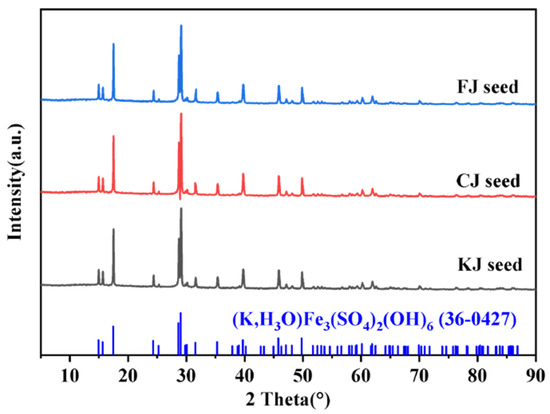
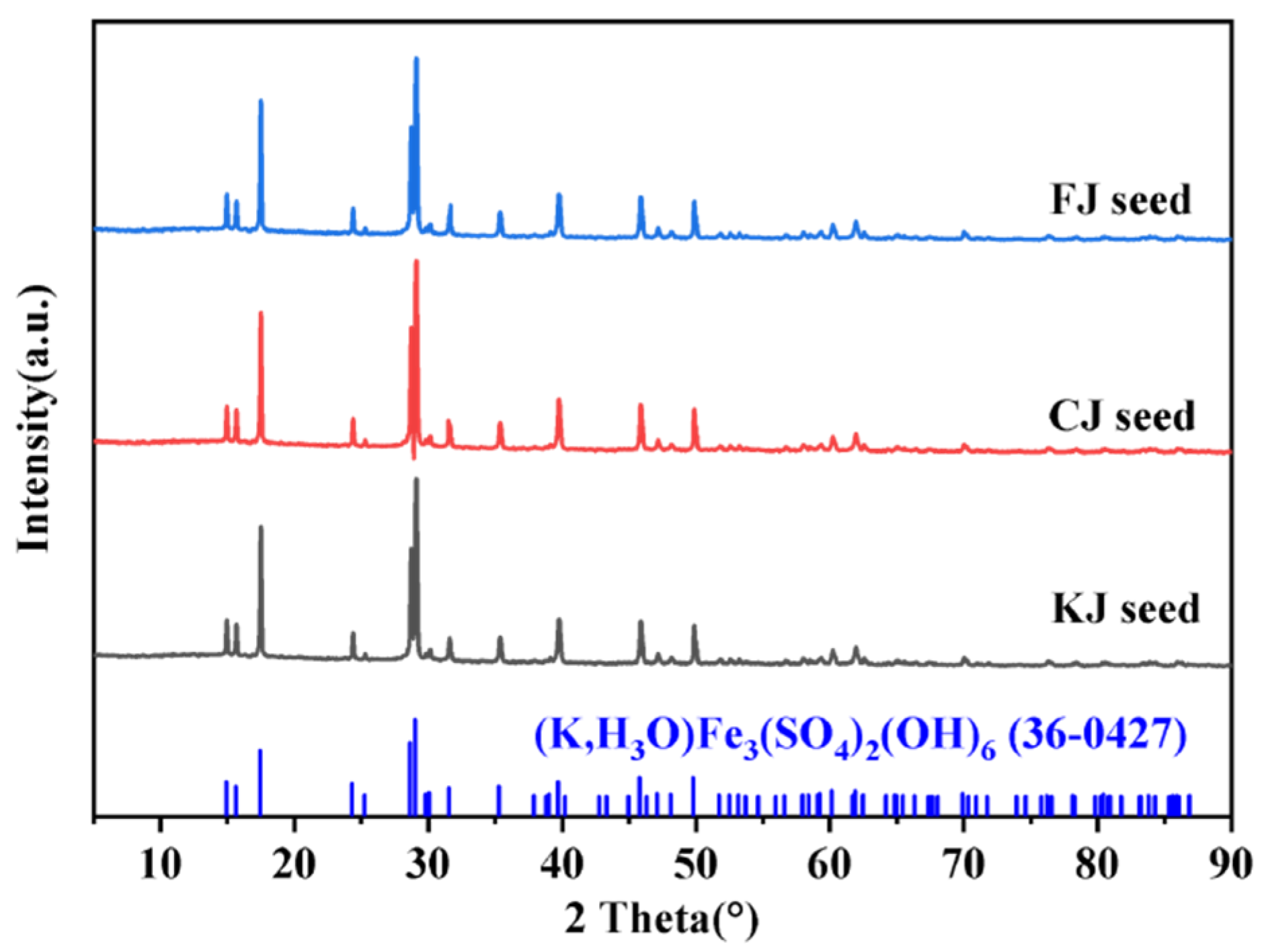
The XRD test results for the precipitates after the reaction are shown in Figure 1. It can be seen that the precipitates obtained after potassium removal using the three seed crystals are all eutectic mixtures of potassium ferric sulfate and ferric sulfate, with the chemical formula (K,H3O)Fe3(SO4)2(OH)6. This result is consistent with that described in the literature [22]; no significant impurity phases were formed, although the intensity of the diffraction peaks was slightly lower when using the FJ seed crystal.
Figure 1.
XRD pattern results of precipitated product.
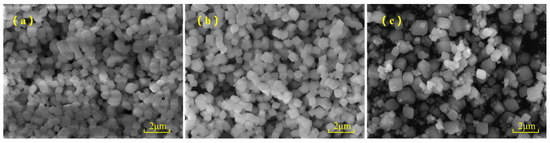
The SEM results of the precipitates after potassium removal are shown in Figure 2. The images (Figure 2) reveal that the products induced by KJ and CJ seeds are well-faceted cubic crystals (~500 nm in size). The average crystallite size calculated by the Scherrer equation is about 50 nm, indicating high crystallinity and moderate specific surface area, which facilitates solid–liquid separation and lithium retention. In contrast, the product from FJ seed is irregular in shape with a wide particle size distribution, likely causing lithium entrainment loss. From an industrial perspective, KJ seed offers broad availability, fast preparation, good storage stability, and recyclability, whereas CJ seed has drawbacks such as slow preparation, low yield, and poor storage stability. Therefore, KJ seed was selected as the optimal seed.
Figure 2.
SEM observation results of precipitated product. (a–c): Seed crystals: KJ, CJ, and FJ, respectively. [Reaction conditions: pH = 1.5, n(Fe3+)/n(K+) = 3.5:1, reaction time = 60 min, temperature = 95 °C, and seed dosage = 1 g].
3.2. Mechanism of Nucleation-Growth Kinetics Mediated by Seed Quantity
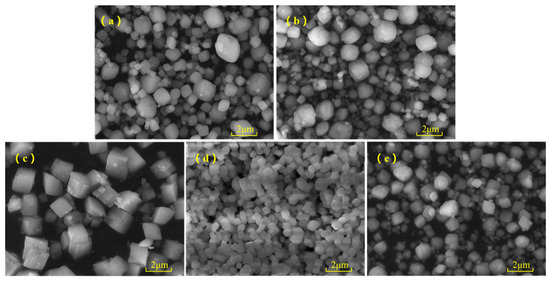
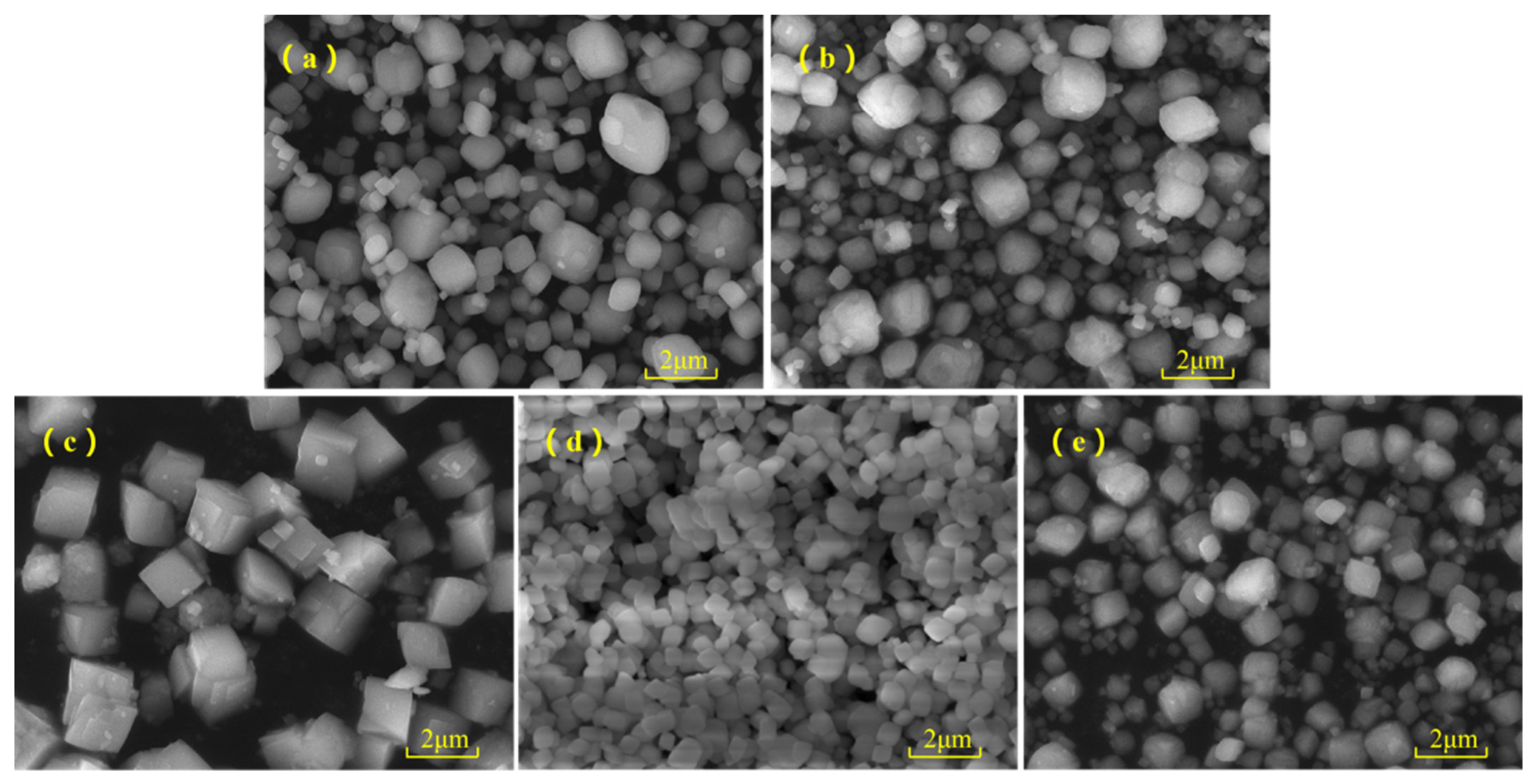
The addition of seed crystals reduces crystallization kinetics resistance and increases the formation rate of potassium ferric sulfate [23,24]. When 0 g, 0.25 g, 0.50 g, 1.00 g, and 2.00 g of KJ seed crystals were added to the potassium-rich mother liquor, respectively, the potassium removal rates and lithium recovery rates after the reaction are shown in Table 3, and the SEM test results of the precipitated products are shown in Figure 3. It can be seen that the potassium removal rate after adding seed crystals is significantly higher than when no seed crystals were added; the potassium removal rate shows a trend of first increasing and then decreasing with increasing seed crystal dosage. Since seed crystals provide heterogeneous nucleation sites, reducing the critical supersaturation and surface energy barrier required for homogeneous nucleation, the system primarily undergoes homogeneous nucleation without seed crystals. This results in high supersaturation, random nucleation, and severe grain coarsening, yielding a potassium removal rate of only 88.19%; as the amount of seed crystals increases, the density of nucleation sites rises, the crystallization rate accelerates, and grain sizes become more uniform, leading to a gradual increase in the potassium removal rate; when the amount reaches 1.00 g, nucleation and growth reach a kinetic equilibrium, resulting in well-defined grains and complete crystallization, with the potassium removal rate peaking at 92.60%. An excess of seed crystals (2.00 g) led to insufficient solute supply per site, excessive grain refinement, increased particle agglomeration, and higher mass transfer resistance, causing the potassium removal rate to drop to 90.47%.
Table 3.
Relationship between the amount of seed crystal added and the rate of potassium removal and lithium recovery. [Reaction conditions: pH = 1.5, n(Fe3+)/n(K+) = 3.5:1, reaction time = 60 min, and temperature = 95 °C].
Figure 3.
SEM observation results of precipitated product. (a–e): Seed crystal dosage: 0, 0.25, 0.50, 1.00, and 2.00, respectively. [Reaction conditions: pH = 1.5, n(Fe3+)/n(K+) = 3.5:1, reaction time = 60 min, and temperature = 95 °C].
The effect of seed dosage on lithium recovery rate is minimal, indicating that ferric potassium sulfate exhibits intrinsic selectivity for K+. Due to the poor match in ionic radius and charge, Li+ has difficulty entering the A-site, thereby achieving efficient lithium–potassium separation.
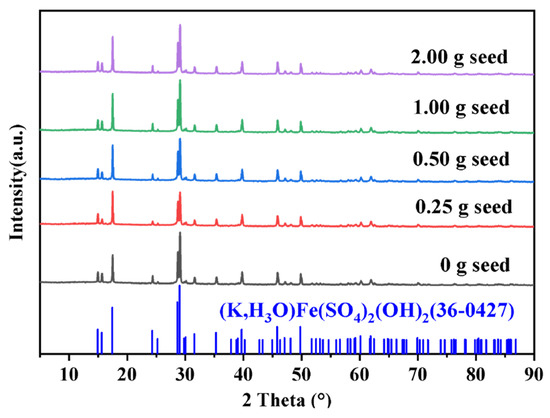
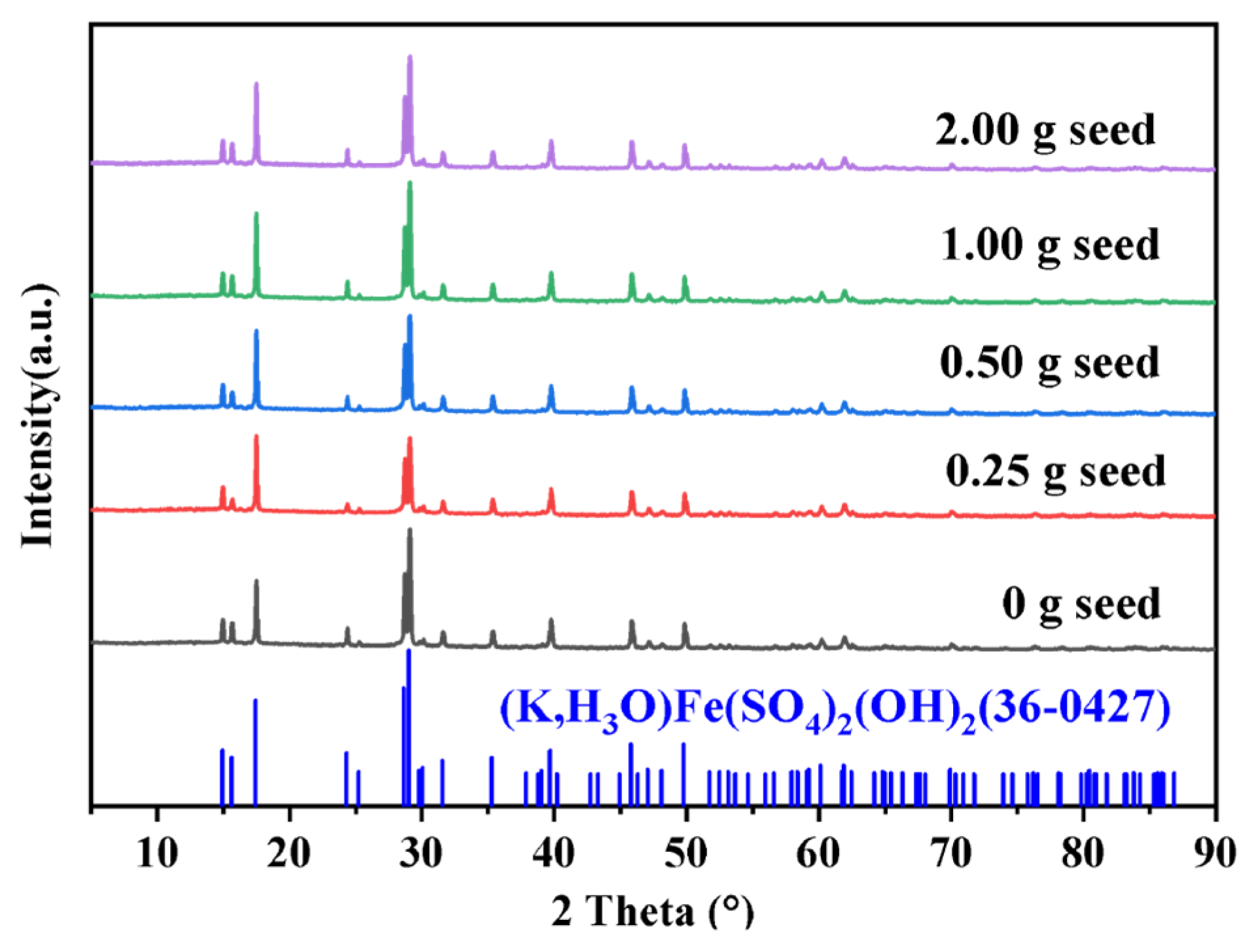
The XRD test results for the precipitates after potassium removal are shown in Figure 4. It can be seen that all precipitate products are (K,H3O)Fe3(SO4)2(OH)6, with no obvious impurity phases present. Notably, when the seed crystal amount was 1.00 g, the diffraction peaks of the precipitate product were sharp and symmetrical, with high diffraction intensity, indicating good crystallization of the grains at this point.
Figure 4.
XRD pattern results of precipitated product. [Reaction conditions: pH = 1.5, n(Fe3+)/n(K+) = 3.5:1, reaction time = 60 min, and temperature = 95 °C].
3.3. Mechanisms Governing the Influence of Seed Particle Size on Interfacial Crystallization and Aggregation Behavior
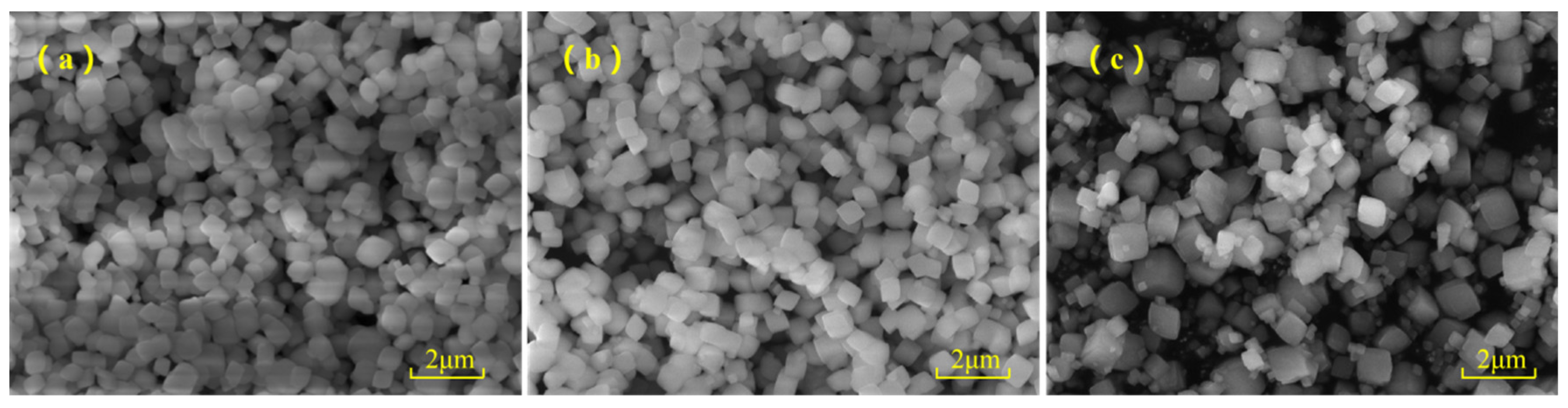
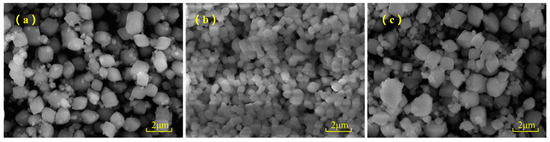
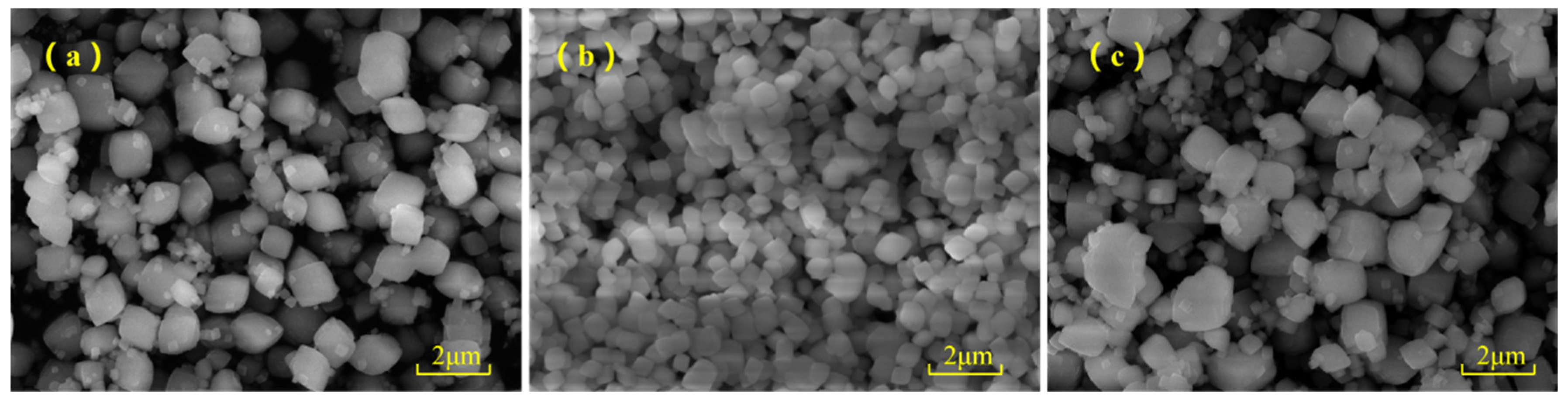
KJ seed crystals that had not been sieved, as well as those sieved through a 200-mesh and a 300-mesh screen, were added to the potassium-rich mother liquor. The post-reaction potassium removal rates and lithium recovery rates are shown in Table 4, and the SEM test results for the precipitated products are shown in Figure 5. It can be seen that the potassium removal rates follow this order: 200-mesh sieve-residue seed > unscreened seed > 300-mesh sieve-residue seed. Since seed particle size determines specific surface area, dispersion, and the effectiveness of nucleation sites, it directly affects crystallization uniformity and potassium removal efficiency. Unsifted seed crystals contain coarse particles; their small specific surface area results in insufficient active sites, which easily leads to localized homogeneous nucleation and the formation of a fine powder, resulting in a lower potassium removal rate. Their high surface energy makes them thermodynamically unstable and prone to mutual aggregation, leading to local supersaturation inhomogeneity and wide grain size distribution, giving the lowest potassium removal. In contrast, 200-mesh seed crystals have a moderate particle size, achieving an optimal balance between specific surface area and dispersibility: they provide abundant and uniform nucleation sites while avoiding agglomeration, effectively suppressing secondary nucleation and grain coarsening, and inducing the formation of cubic crystals with regular morphology and uniform particle size. These crystals exhibit the highest mass transfer and ion exchange efficiencies, resulting in the highest potassium removal rate. The seed particle size has no significant effect on lithium recovery, further demonstrating that separation selectivity is determined by the intrinsic properties of the crystal structure.
Table 4.
Relationship between the seed crystal size and the rate of potassium removal and lithium recovery. [Reaction conditions: pH = 1.5, n(Fe3+)/n(K+) = 3.5:1, reaction time = 60 min, temperature = 95 °C, and seed dosage = 1 g].
Figure 5.
SEM observation results of precipitated product. (a–c): Seed crystal sizes correspond to unsieved, sieved through 200 mesh, and sieved through 300 mesh, respectively. [Reaction conditions: pH = 1.5, n(Fe3+)/n(K+) = 3.5:1, reaction time = 60 min, and temperature = 95 °C, and KJ seed dosage = 1 g].
3.4. Thermodynamic and Kinetic Analysis of Potassium Removal
For a constant-temperature (298.15 K) constant-pressure reaction, the standard molar Gibbs free energy change () determines spontaneity (Equation (3)). If < 0, the reaction can proceed spontaneously.
The thermodynamic calculations were performed under the following assumptions: (1) all substances are in their thermodynamic standard states (298.15 K, 100 kPa), and the reaction proceeds under constant temperature and pressure; (2) due to the lack of reliable activity coefficient data for the highly concentrated multi-component system, concentrations were used instead of activities as a first-order approximation; (3) the effect of temperature on the reaction enthalpy and entropy is neglected, i.e., ΔrH and ΔrS are considered constant within the temperature range investigated; (4) the precipitated phases are assumed to be pure solid phases, and the contributions of solid solutions or lattice defects to the Gibbs free energy are not taken into account. The thermodynamic data used herein are primarily derived from the high-temperature calorimetric and heat capacity measurements by Majzlan et al. [25,26,27], with the Gibbs free energies cross-validated against the solubility data of Baron and Palmer [28].
Calculations show that potassium jarosite precipitation is strongly spontaneous under our experimental conditions ( = −21.30 kJ·mol−1). In contrast, sodium jarosite precipitation is non-spontaneous ( = 13.45 kJ·mol−1), indicating that despite the much higher Na+ concentration (60 g/L) than K+ (11.5 g/L), the system preferentially forms potassium jarosite. Hydronium jarosite is weakly spontaneous ( = −7.50 kJ·mol−1), suggesting that hydronium jarosite may form as a metastable intermediate phase in the initial stage or in locally high-acid regions, and it has a large thermodynamic driving force to transform into potassium jarosite ( = −105.00 kJ·mol−1). Hence, the final solid phase remains predominantly potassium jarosite.
Kinetic experiments were carried out at 80 °C and 95 °C under the optimal conditions. Zero-order, first-order, and second-order homogeneous reaction models were tested (Equations (4)–(6)):
where α is the potassium removal rate, t is reaction time (min, start timing after feeding is fully completed), and K1, K2 and K3 are the rate constants.
K0t = α
K1t = −ln(1 − α)
K2t = 1/(1 − α) − 1
Correlation coefficients (R2) are listed in Table 5. At 80 °C, the first-order model gives the highest RR2, indicating that the reaction rate is mainly controlled by K+ concentration in solution. At 95 °C, the zero-order model shows the highest R2 (0.9901), while the first-order model gives a relatively lower R2 (0.9197). This suggests that with increasing temperature, the reaction gradually shifts from first-order to zero-order kinetics as the rate becomes independent of K+ concentration.
Table 5.
Correlation coefficients of different kinetic models during potassium. Removal by jarosite method with seed crystal addition. [Reaction conditions: pH = 1.5, n(Fe3+)/n(K+) = 3.5:1, and KJ seed dosage = 1 g].
The calculation of activation energy must be based on the same kinetic model. Since the potassium removal reaction follows a first-order model at 80 °C and the first-order model also shows a reasonably good correlation at 95 °C (R2 = 0.9197), the first-order model was consistently used to calculate the rate constants at both temperatures. The comparison of R2 values among different models serves only to discuss the temperature-dependent trend in the reaction mechanism and is not involved in the calculation of activation energy. Using the Arrhenius equation (Equation (7)) and its logarithmic form (Equation (8)), taking the natural logarithm of both sides of the Arrhenius equation (Equation (7)) yields Equation (8), from which the activation energy is calculated using Equation (9).
where k is the rate constant, Ea is the activation energy, A is the pre-exponential factor, R is the gas constant (8.314 × 10⁻³ KJ·mol−1·K−1), and T is the temperature (K).
k = A·exp[−Ea/(RT)]
Lnk = lnA − Ea/RT
The calculated apparent activation energy is 54.30 kJ·mol−1, which lies in the range of chemical reaction control (>40 kJ·mol−1). This indicates that the rate-determining step for potassium removal by the jarosite method is the chemical reaction on the seed surface, rather than liquid-film diffusion or product-layer diffusion.
3.5. Characterization of the Product Under Optimal Conditions
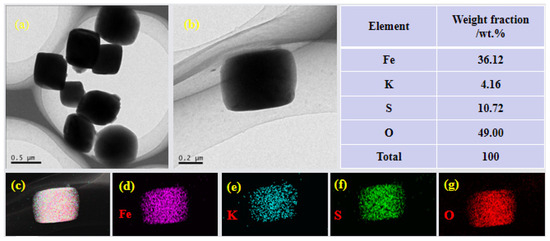
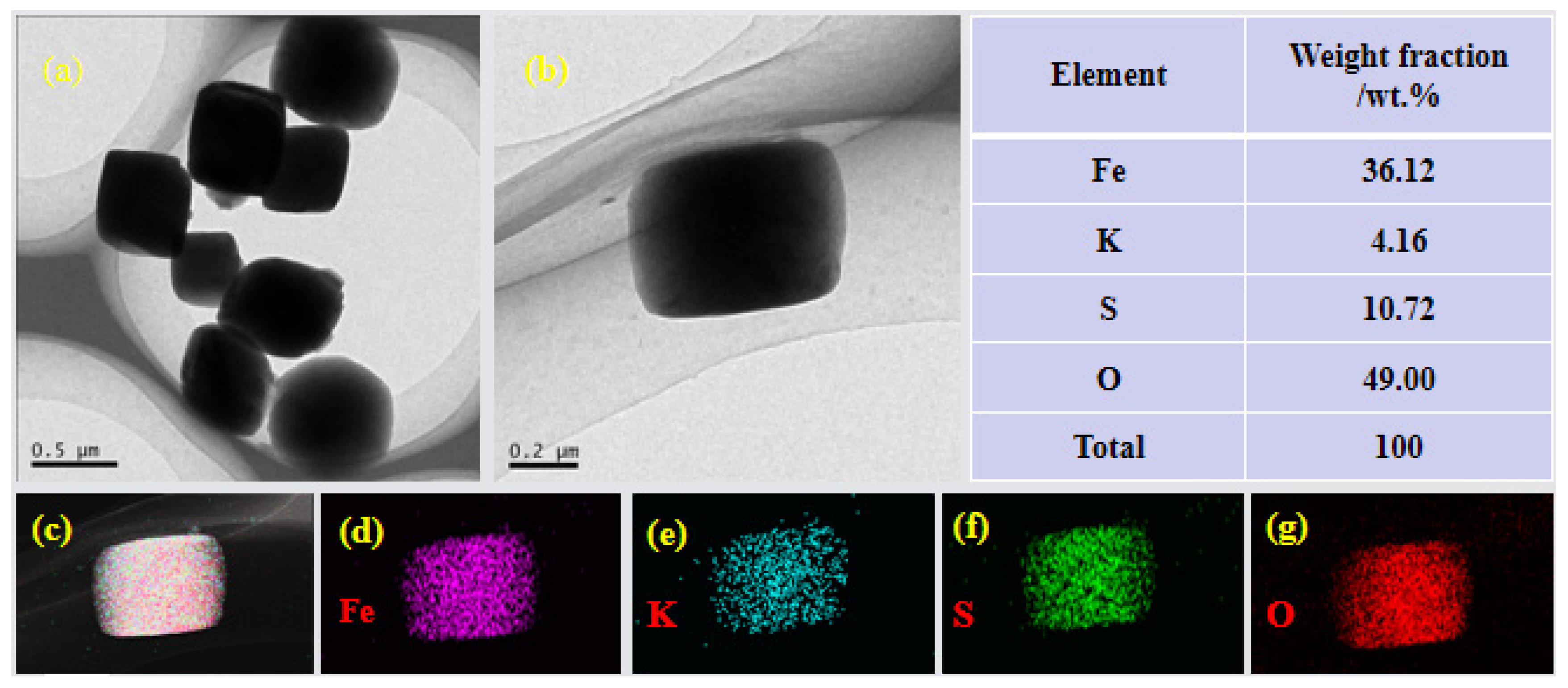
TEM analysis of the precipitate obtained under the optimal conditions (Figure 6) shows uniform cubic crystals (≈500 nm), consistent with the SEM observations. Energy-dispersive X-ray mapping reveals that Fe, K, S, and O are homogeneously distributed within the particles, with no elemental segregation, phase separation, or core–shell structure, confirming that the product is a single-phase, uniform crystal rather than a mixture.
Figure 6.
TEM characterization of the precipitate obtained with KJ seed under optimal conditions: (a): distribution diagram of multiple grains; (b): magnified view of single particle; (c–g): overall and individual elemental distribution maps. [Reaction conditions: pH = 1.5, n(Fe3+)/n(K+) = 3.5:1, reaction time = 60 min, temperature = 95 °C, and KJ seed dosage = 1 g].
3.6. Analysis of Lithium Loss Pathways
Under the optimal conditions (pH = 1.5, n(Fe3+)/n(K+) = 3.5:1, 1 g KJ seed, 95 °C, 1 h), the lithium recovery was 95.20%, meaning 4.80% of the initial lithium was lost. To identify where the loss occurs, the lithium content in the precipitate was measured, and intensified washing experiments were performed.
After potassium removal, the filter cake was dried and digested. ICP-OES analysis showed that the lithium remaining in the precipitate accounted for only 1.13% of the initial total lithium.
In the intensified washing experiment, the filter cake was washed repeatedly with a total of 500 mL of dilute sulfuric acid (pH = 1.5) in 10 portions. Each washing solution was collected and analyzed for lithium, and the results were expressed as a percentage of the initial lithium mass. The cumulative percentage after 10 washes was about 1.72% (as shown in the Figure 7), with the first two washes accounting for 72.28% of that cumulative amount. Increasing the washing steps beyond two, especially beyond six, did not substantially improve lithium recovery, indicating that the 1.72% of lithium is not efficiently recovered under conventional washing conditions.
Figure 7.
Percentage and cumulative percentage of lithium in each section of washing solution relative to initial lithium mass of mother liquor in enhanced washing experiments. [Reaction conditions: pH = 1.5, n(Fe3+)/n(K+) = 3.5:1, reaction time = 60 min, temperature = 95 °C, and KJ seed dosage = 1 g].
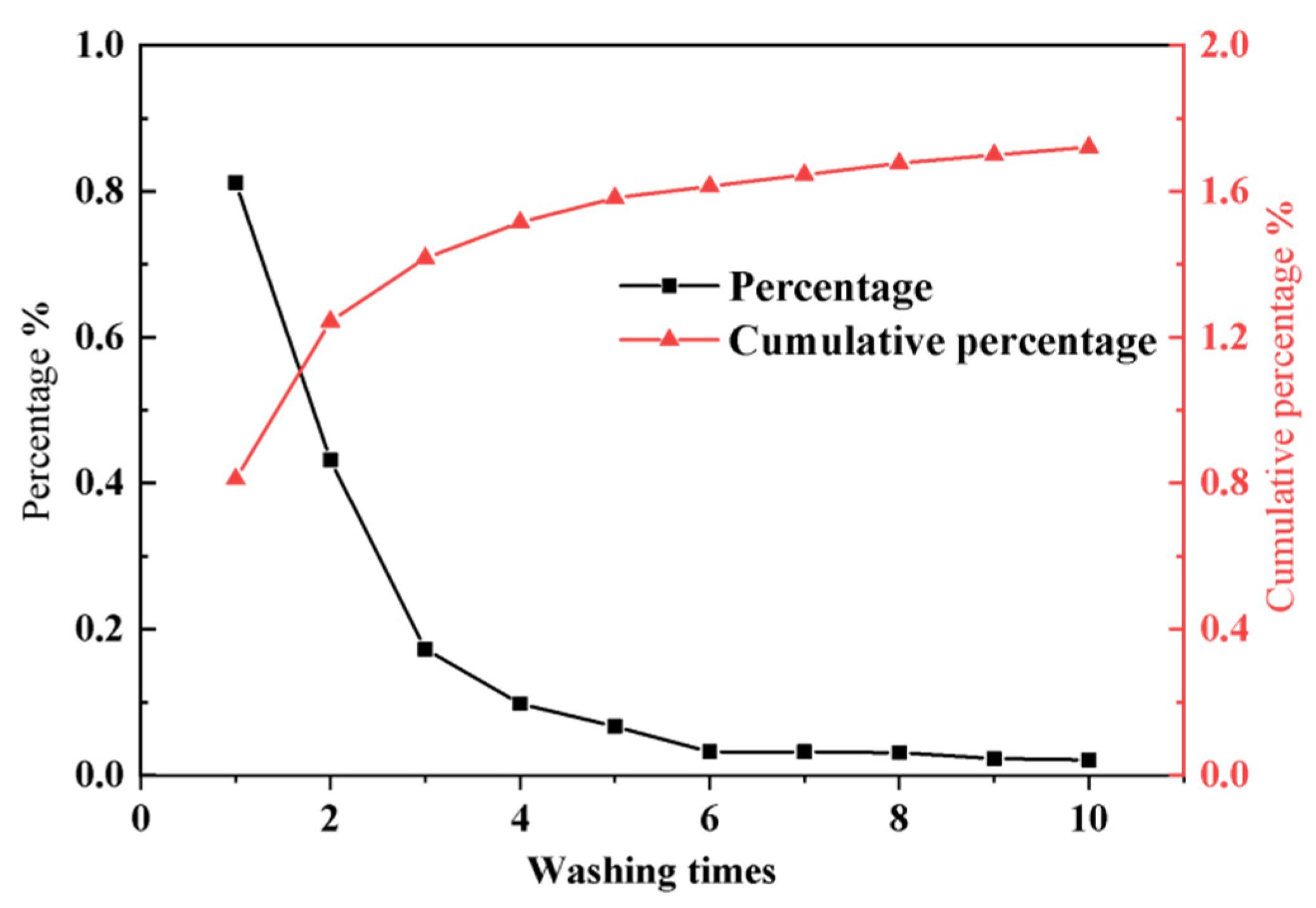
Based on these data, a lithium mass balance was constructed. Taking the initial lithium in the mother liquor as 100%, the accounted fractions are: lithium recovered under optimal conditions (95.20%), lithium remaining in the precipitate (1.13%), and lithium additionally recovered by intensified washing (1.72%). These sum to 98.05%, leaving 1.95% of lithium unaccounted for. The remaining 1.95% is likely attributable to analytical error and process losses. First, the relative standard deviation (RSD) of the ICP-OES measurements for standard samples (n = 5) is 1.2–1.8%, and the average analytical uncertainty could contribute about ±1.5% systematic deviation. Second, process factors may also cause lithium loss: (a) some fine particles may pass through the filter paper or adhere to vessel walls during repeated filtration and washing, preventing complete extraction by the washing solution; (b) evaporation or spattering during transfer may cause physical loss.
Overall, of the 4.80% lithium loss, 1.72% can be recovered by intensified washing. Hence, the total lithium recovery could potentially be increased to about 97% by optimizing the washing procedure (e.g., more washing stages or counter-current washing), although the concentration of washing effluent and wastewater treatment costs must be considered.
3.7. Statistical Analysis
To quantitatively evaluate the statistical significance of differences in potassium removal rate and lithium recovery rate under different experimental conditions, independent samples t-tests (for pairwise comparisons of seed crystal type and particle size) or one-way ANOVA followed by post hoc pairwise comparisons (for multiple comparisons of seed dosage) were performed. Each experiment was repeated three times (n = 3). The significance level was set at α = 0.05, with p < 0.05 considered statistically significant and p < 0.01 considered highly significant. The results are summarized in Table 6.
Table 6.
Statistical difference analysis of potassium removal rate and lithium recovery rate under different process conditions (independent-samples t-test, α = 0.05).
As shown in Table 6, among the tested process conditions, significant differences in potassium removal rate were observed only in a few comparison groups. Specifically, the CJ seed group exhibited a significantly higher potassium removal rate than the FJ seed group (p = 0.014). Regarding seed dosage, compared with the control group without seed addition, the addition of 0.50 g and 1.00 g of seed both resulted in a highly significant increase in potassium removal rate (p = 0.002 and p = 0.003, respectively). Moreover, the potassium removal rate of the 0.25 g seed group was significantly lower than that of the 0.50 g seed group (p = 0.011). In contrast, no significant differences in lithium recovery rate were found in any of the comparisons (all p > 0.05), further confirming that the jarosite process can achieve efficient potassium removal while maintaining a high lithium recovery rate.
It should be noted that each experimental group in this study had only three replicates (n = 3), which limits the statistical power to detect moderate or small differences. Therefore, a non-significant result should not be interpreted as “no difference”, but rather as “no statistically significant difference detectable with the current sample size”. Future scale-up studies with a larger number of replicates may further validate the statistical reliability of the conclusions drawn from this work.
3.8. Industrial Feasibility Analysis
Table 7 presents a rough profit estimation for treating one cubic meter of potassium-rich mother liquor under the optimal process conditions (pH = 1.5, n(Fe3+)/n(K+) = 3.5:1, 1 g of potassium jarosite seed, 95 °C, 1 h). Equipment investment costs are excluded, whereas material, labor, and wastewater treatment costs are taken as industry averages.
Table 7.
Preliminary profit estimation for treating one cubic meter of mother liquor.
As shown in Table 7, using the proposed potassium removal process, a profit of approximately 290 USD can be obtained per cubic meter of mother liquor, excluding equipment investment costs. Moreover, the product after potassium removal can be returned to the lithium salt production process and directly used for the preparation of battery-grade lithium hydroxide or lithium carbonate. Compared with the conventional approach of downgrading the potassium-rich mother liquor to industrial-grade lithium salts, the proposed process offers better application prospects in the lithium-ion battery industry.
It should be noted that the above economic assessment is only preliminary, and the following engineering issues remain to be addressed in detail: (1) process scale-up: mixing and heat transfer need to be validated at the pilot scale; (2) seed crystal regeneration: the recovered seed crystals (FJ seed) used in this study gave a potassium removal rate of 91.70%, which is lower than that of KJ seed crystals (92.60%), indicating that the seeds are recyclable but with some performance loss; (3) long-term stability: fouling and corrosion during continuous operation require further evaluation; (4) side-stream handling: the recycling of filtrate and washing solutions needs to be designed based on a full-stream mass balance. Therefore, the techno-economic data presented herein should be regarded as laboratory-stage estimates, and the actual net profit may deviate from this value. More accurate evaluation will be conducted based on pilot-scale data in future work.
4. Conclusions
- The role of seed crystals is dual in nature. An appropriate amount of seed promotes crystallization by providing heterogeneous nucleation sites, whereas an excessive amount reduces process efficiency. The effect of seed particle size is essentially a trade-off between surface energy and dispersibility. When the seed particles are too fine, their large specific surface area may lead to aggregation, which undermines the effective distribution of nucleation sites; when they are too coarse, the number of active sites is insufficient. An optimal particle size range exists that best balances nucleation site density and dispersibility.
- Li+ cannot stably occupy the A-site cavity because its ionic radius is far smaller than the cavity size; thus, lithium hardly enters the crystal lattice, and lithium loss arises only from physical entrainment and insufficient washing. The potassium removal reaction shifts from being controlled by K+ concentration (first-order kinetics) at low temperature (80 °C) to being controlled by the surface chemical reaction (zero-order kinetics) at high temperature (95 °C). This indicates that raising the temperature eliminates liquid-phase diffusion limitations, making the surface reaction on the seed crystals the sole rate-determining step.
- By optimizing the type, dosage, and particle size of the seed crystals, the system can be shifted from being dominated by homogeneous nucleation to being dominated by heterogeneous nucleation, thereby yielding crystals with regular morphology and uniform size. This strategy is potentially transferable to other hydrometallurgical processes for impurity removal or resource recovery.
Author Contributions
Conceptualization, J.L.; Methodology, L.W., T.L. and J.L.; Validation, L.W. and T.L.; Formal analysis, L.W. and T.L.; Investigation, L.W. and T.L.; Resources, L.W. and J.L.; Data curation, L.W. and T.L.; Writing—original draft, L.W. and T.L.; Supervision, J.L.; Project administration, J.L.; Funding acquisition, J.L. All authors have read and agreed to the published version of the manuscript.
Funding
This work is supported by the Major Science and Technology Project of Hunan Province “Development of All-Solid-State Batteries for New Energy Vehicles” (Grant No. 2024QK2004) and the Major Special Project of Changsha City “Key Technology Breakthrough for the Preparation of LiMnxFe1−xPO4 Cathode Materials” (Grant No. kh2401022).
Data Availability Statement
The original contributions presented in this study are included in the article. Further inquiries can be directed to the corresponding author.
Conflicts of Interest
Author Lichao Wang was employed by the company Hainan Xingzhihai New Materials Co., Ltd. The remaining authors declare that the research was conducted in the absence of any commercial or financial relationships that could be construed as a potential conflict of interest.
References
- Zhang, X.; Zeng, X.; Shan, Y.; Li, Z.; Zeng, Y.; Asselin, E. Solubility and Modeling of Li2SO4·H2O in Aqueous H2SO4–MgSO4 Solutions for Lithium Extraction from Spodumene. J. Chem. Eng. Data 2022, 67, 919–931. [Google Scholar] [CrossRef] [Scilit]
- Xiong, J.; He, L.; Zhao, Z. Lithium extraction from high-sodium raw brine with Li0.3FePO4 electrode. Desalination 2022, 535, 115822. [Google Scholar] [CrossRef] [Scilit]
- Rioyo, J.; Tuset, S.; Grau, R. Lithium Extraction from Spodumene by the Traditional Sulfuric Acid Process: A Review. Miner. Process. Extr. Metall. Rev. 2020, 43, 97–106. [Google Scholar] [CrossRef] [Scilit]
- Dmytro, Y.; Anatoliy, M. Processing of lithium ores: Industrial technologies and case studies—A review. Hydrometallurgy 2021, 201, 105578. [Google Scholar] [CrossRef] [Scilit]
- GB/T 26008-2020; Battery Grade Lithium Hydroxide Monohydrate. China Standards Press: Beijing, China, 2020.
- YS/T 582-2023; Battery Grade Lithium Carbonate. Metallurgical Industry Press: Beijing, China, 2023.
- Chen, W.; Li, X.; Chen, L.; Zhou, G.; Lu, Q.; Huang, Y.; Zhu, W. Tailoring hydrophobic deep eutectic solvent for selective lithium recovery from the mother liquor of Li2CO3. Chem. Eng. J. 2020, 420, 127648–127652. [Google Scholar] [CrossRef] [Scilit]
- Zhang, X.; Zhang, F.; He, Z.; Guo, W. Application of Centrifugal Extraction for the Efficient Recovery of Lithium from Lithium-Containing Mother Liquor. Pap. Mak. Equip. Mater. 2024, 53, 65–67. [Google Scholar] [CrossRef]
- Peng, J. A Study on a New Process for Lithium Recovery from Lithium Carbonate Precipitation Mother Liquor. Master’s Thesis, Chengdu University of Technology, Chengdu, China, 2021. [Google Scholar]
- Zhang, C. A Study on the Process for Recovering Lithium Resources from Lithium Carbonate Precipitation Mother Liquor. Contemp. Chem. Res. 2023, 146–148. [Google Scholar] [CrossRef]
- Li, S.C.; Qu, Z.; Liu, D.R.; Gao, G.M.; Zhang, Y.F.; Hong, Y.; Zhang, J. Recent Advances in Lithium Recovery from Lithium-Containing Mother Liquor. Rare Met. Cem. Carbides 2024, 52, 11–17+44. [Google Scholar] [CrossRef]
- Wu, S.; Zhang, M.; Zan, C.; Zhou, H. A Study on the Process for the Advanced Recovery of Lithium from Lithium-Containing Mother Liquor Using the Phosphate Precipitation Method. J. Tianjin Univ. Sci. Technol. 2023, 38, 35–41. [Google Scholar] [CrossRef]
- Han, H.; Wang, Y.; Sun, W.; Wang, Y.; Song, Y.; Liu, R.; Zhai, Q.; Zhu, X.; Xie, Z.; Mao, Z. A Method for the Selective Separation of Lithium and Potassium CN114231741B, 15 November 2024.
- Wang, C.; Jiang, J.; Xie, C.; Qiu, Y.; Cheng, C.; Xiang, Q.; Zhao, M. Research on Potassium Removal Processes for Battery-Grade Lithium Salts. Sichuan Chem. Ind. 2024, 27, 23–25+52. [Google Scholar] [CrossRef]
- Zhang, G.; Zhu, B.; Chen, X.; Yao, Y.; Cheng, S.; Li, Y.; Li, K. A Study on Methods and Applications of Zinc-Iron Separation in Hydrometallurgical Zinc Production. Non-Ferr. Met. Smelt. 2021, 20–26. [Google Scholar] [CrossRef]
- Wang, H.; Wang, X.; Jin, Z.; Wang, Z.; Li, Y.; Wang, P.; Zhao, L. A Study on the Application of the Three-Stage Potassium Ferric Sulfate Leaching Process in Hydrometallurgical Zinc Production. Energy Conserv. Nonferrous Metall. 2022, 38, 26–30+45. [Google Scholar] [CrossRef]
- Lei, W.; Li, J.; He, Q.; Niu, F.; Li, J.; Shen, Y. Recent Advances in Wet-Process Zinc Production and Iron Removal. Hydrometallurgy 2023, 42, 458–463+479. [Google Scholar] [CrossRef]
- Lu, Y.; Huang, Y.; Huang, R.; Cen, X.; Su, L. Experimental Study on the Removal of Iron from Manganese Oxide Leachate Using the Potassium Ferric Sulfate Method. China Manganese Ind. 2020, 38, 28–30+6. [Google Scholar]
- Yan, M. A Study on Factors Affecting the Removal of Iron and Aluminum from Nickel-Containing Leachate Using the Sodium Ferrate Precipitation Method. Master’s Thesis, Central South University, Changsha, China, 2022. [Google Scholar]
- Wang, Y.; Song, Y.; Zhai, Q.; Mao, Z.; Liu, R.; Sun, W.; Hu, Y. A Method for the Synergistic Extraction of Lithium from Spodumene and Mica CN116240373A, 9 June 2023.
- Zhai, Q.; Song, Y.; Liu, R.; Wang, Y.; Zhu, X.; Xie, Z.; Sun, W. An innovative scheme for the separation of potassium from lithium-bearing solution: A jarosite precipitation method. Sep. Purif. Technol. 2023, 322, 124283. [Google Scholar] [CrossRef] [Scilit]
- Zou, X. Theoretical Analysis of Iron Removal Using Potassium Ferric Sulfate. Metall. Ser. 1998, 15+18–20. [Google Scholar] [CrossRef]
- Eftekhari, N.; Kargar, M.; Zamin, F.R.; Rastakhiz, N.; Manafi, Z. A Review on Various Aspects of Jarosite and Its Utilization Potentials. Ann. Chim. Sci. Matériaux 2020, 44, 43–52. [Google Scholar] [CrossRef] [Scilit]
- Monrserrat, C.; Antoni, R. Jarosites: Formation, Structure, Reactivity and Environmental. Metals 2022, 12, 802–808. [Google Scholar] [CrossRef] [Scilit]
- Drouet, C.; Navrotsky, A. Synthesis, characterization, and thermochemistry of K-Na-H3O jarosites. Geochim. Cosmochim. Acta 2003, 67, 2063–2076. [Google Scholar] [CrossRef] [Scilit]
- Majzlan, J.; Stevens, R.; Boerio-Goates, J.; Woodfield, B.F.; Navrotsky, A.; Burns, P.C.; Amos, T.G. Thermodynamic properties, low-temperature heat-capacity anomalies, and single-crystal X-ray refinement of hydronium jarosite, (H3O)Fe3(SO4)2(OH)6. Phys. Chem. Miner. 2004, 31, 518–531. [Google Scholar] [CrossRef] [Scilit]
- Majzlan, J.; Glasnák, P.; Fisher, R.A.; White, M.A.; Johnson, M.B.; Woodfield, B.; Boerio-Goates, J. Heat capacity, entropy, and magnetic properties of jarosite-group compounds. Phys. Chem. Miner. 2010, 37, 635–651. [Google Scholar] [CrossRef] [Scilit]
- Baron, D.; Palmer, C.D. Solubility of jarosite at 4–35 °C. Geochim. Cosmochim. Acta 1996, 60, 185–195. [Google Scholar] [CrossRef] [Scilit]

Disclaimer/Publisher’s Note: The statements, opinions and data contained in all publications are solely those of the individual author(s) and contributor(s) and not of MDPI and/or the editor(s). MDPI and/or the editor(s) disclaim responsibility for any injury to people or property resulting from any ideas, methods, instructions or products referred to in the content. |
© 2026 by the authors. Licensee MDPI, Basel, Switzerland. This article is an open access article distributed under the terms and conditions of the Creative Commons Attribution (CC BY) license.