


Abstract
The microstructure and mechanical behavior during 100 °C warm rolling of the high-Zn-content Al80Zn14Li2Mg2Cu2 alloy were investigated. The alloy plate was warm-rolled to reductions of 40%, 60%, and 80%. Hardness and tensile strength decreased continuously with increased rolling up to 60%, demonstrating work softening, followed by a slight increase at 80% reduction, indicating work hardening. Systematic characterization revealed that this non-monotonic mechanical response arises from a competition between particle-stimulated nucleation (PSN)-assisted recrystallization and dislocation-driven hardening. The multi-scale intermetallic particles in this alloy play a dual role: coarse Al5CuLi3 particles generate high-strain particle deformation zones (PDZs) that serve as potent PSN sites, while fine nano particles pin the recrystallized grain boundaries and restrict their growth. The unusually low PSN activation temperature is attributed to the synergistic effects of the high PDZ storage energy and the progressive subgrain rotation mechanism within the PDZ. The ability to control PSN via micro- and nano-scale intermetallics presents a viable pathway for achieving grain refinement in Al-based alloys and enhancing the machinability of high-Zn-content Al alloys.
1. Introduction
In general, when deformed at low temperatures, the strength and hardness of an alloy will increase, while its plasticity and toughness typically decrease, which is called the work-hardening effect. However, a phenomenon with the opposing effect has been reported in some alloys, that is, work softening during cold or warm deformation. This is usually accompanied by severe deformation and subgrain formation. For example, in the Cu-Cr-Ti-Si alloy [1], cold deformation greater than 85% can induce the dynamic recovery, and in the Al-Fe alloy [2], the dislocation density decreases and subgrain structures polygonize under 80% cold rolling. Furthermore, shot peening on Al-Li alloys [3], grain refinement in Mg-Zn-Li alloys [4], and the split of ordered domains in Fe-Si alloys [5] are all reported to have a relationship with work softening behaviors. In addition, the particle-stimulated nucleation (PSN) [6,7] is another important softening mechanism, which makes it feasible to estimate the recrystallized grain size in the industry, for example, for selected aluminum alloys. Such deformation softening fosters the possibility of improving the machinability of alloys and can facilitate the performance control of the fabricated components.
High entropy alloys (HEAs) have aroused wide concern for their adjustable and attractive properties compared to the conventional alloys, such as exceptionally high/low-temperature strength and good thermo-stability [8,9,10,11], which are derived from their special entropy-increasing design principle [12]. Recent first-principles studies have further revealed that, beyond the configurational entropy effect, the electronegativity difference between constituent elements in multi-component alloys induces charge transfer mechanisms at the electronic-structure level, which fundamentally contributes to enhanced bonding, solid-solution strengthening, and improved ductility [13]. Recently, this entropy-increasing method has been used in the compositional design of lightweight alloys [14,15,16]. Due to the strong activity of light main-group elements, their mixing entropy is not as high as that of other transitional-group-element HEAs, but is higher than traditional light alloys. These lightweight HEAs exhibit some attractive mechanical properties. For example, the Al80Zn5Li5Mg5Cu5 alloy shows high compressive strength and high micro-machinability [17], the Al19.9Li30Mg35Si10Ca5Y0.1 alloy has high compressive strength exceeding 700 MPa [18], and the maximum microhardness value of the Al65Cu5Mg5Si15Zn5X5 alloy can reach 264 HV0.1 [19]. Besides compositional design, deformability is also one of the properties that must be considered during the preparation of engineering structural parts. However, so far, most of the reported lightweight HEAs are too brittle to deform, and limited research has systematically reported their deformation behaviors. In this case, it is suggested that the research and utilization of the work softening behavior may help to improve the deformability of lightweight HEAs during intermediate processing stages, which is a critical prerequisite for their practical engineering application.
Based on our previously designed high-strength lightweight HEA Al80Zn5Li5Mg5Cu5 [17], another high-Zn-content Al80Zn14Li2Mg2Cu2 alloy has been designed [20] using the concept of alloying-elements increasing. In this paper, its deformability and plasticity are further improved by work softening under warm rolling, which is dominated by the PSN-related recrystallization. Changes in the microstructures, grain sizes, and textures under different deformations have been systematically studied, and the mechanisms of the work softening and work hardening are thoroughly analyzed.
2. Experiment
The raw materials used in the experiments were pure aluminum ingots [99.7 wt.% (weight percent) purity], pure zinc ingots (99.9 wt.% purity), magnesium–lithium alloys (Mg-20 wt.% Li), and pure copper ingots (99.9 wt.% purity). The experimental alloys with a nominal chemical composition of Al80Zn14Li2Mg2Cu2 (in at.%) were melted and cast into a water-cooled steel mold to prepare an ingot with the size of 220 mm (length) × 120 mm (width) × 100 mm (thickness). Small blocks with a thickness of 20 mm were cut from the ingot, with the same sampling location as our previous work [20], followed by the hot rolling from 20 mm to 3.5 mm at 350 °C and the subsequent warm rolling at 100 °C. The plate directly after hot rolling was labeled as the 0CR sample. During warm deformation, alloys were rolled by reductions of 40%, 60%, and 80% in thickness, and they were labeled as 40CR, 60CR, and 80CR samples, respectively. It should be noted that no dedicated homogenization treatment was applied before hot rolling. This was an intentional choice to retain the coarse intermetallic particles formed during solidification, which serve as the nucleation sites for the PSN mechanism investigated in this work.
Microstructural characterization under different rolling conditions was selected on the normal direction (ND) surface, and it was conducted using scanning electron microscopy (SEM, SUPRA 55, Carl Zeiss SMT AG, Oberkochen, Germany), electron-backscattered diffraction (EBSD), and energy-dispersive spectroscopy (EDS). The TEM and SAED operated at 300 kV were also conducted (Tecnai G2 F30, FEI Company, Hillsboro, OR, USA), and samples for EBSD and TEM testing were prepared by ion beam milling using a Gatan Precision Ion Polishing System (Model 691, Gatan Inc., Pleasanton, CA, USA). Oxford HKL Channel 5 software was used to deeply analyze the phase map, inverse pole figures (IPF), grain boundary distribution map, and the kernel average misorientation (KAM) map. Different colors of the IPF map explain the grain orientation, e.g., red for <001>, blue for <111>, and green for <101>. In the KAM maps, red and yellow denote regions with relatively high KAM value, suggesting stronger local deformation and higher defect accumulation, whereas blue and green denote regions with low KAM value, corresponding to comparatively less deformed regions. High-angle grain boundary (HAGB) and low-angle grain boundary (LAGB) were defined as the grain boundary with an angle of over 15° and 2–15°, respectively, and were highlighted with black and red lines, respectively.
The mechanical hardness of the sheet surface [along rolling direction (RD)] was measured by a Vickers hardness tester (401MVD, Wolpert Wilson Instruments, Aachen, Germany) with an average value of ten different points at a load of 200 g for 15 s. Room-temperature tensile properties were evaluated using a universal electronic tensile testing machine (CMT4105, Shenzhen SANS Testing Machine Co., Ltd., Shenzhen, China) with an initial strain rate of 4 × 10⁻⁴ s−1. The dog-bone specimens for the tensile test were machined parallel to the RD, and the tensile fractured surfaces were observed by the SEM.
3. Results
3.1. Mechanical Properties
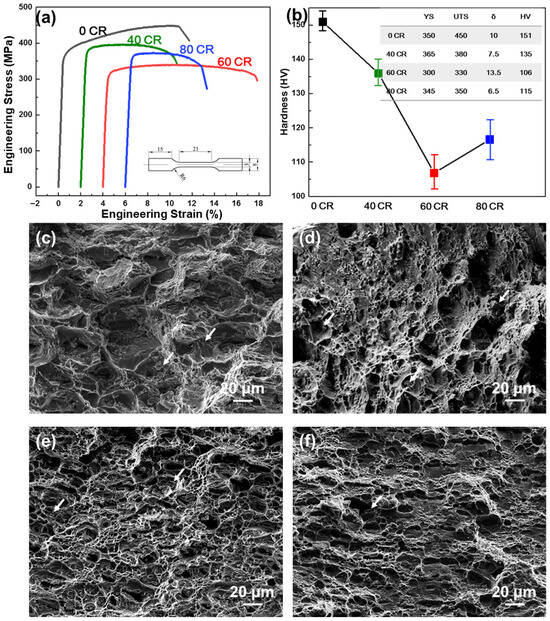
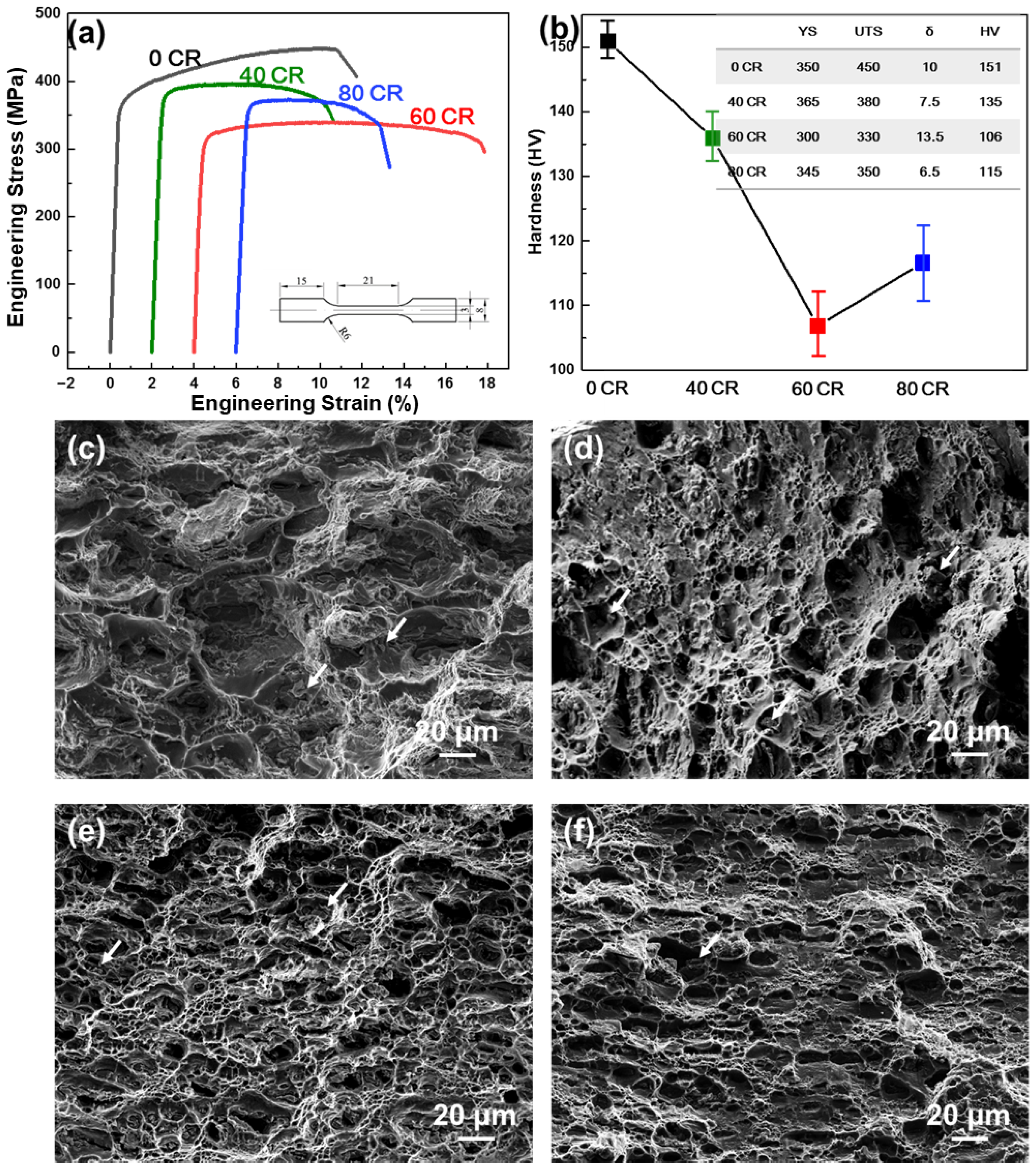
The engineering stress–strain curves and the hardness curve of 0CR, 40CR, 60CR, and 80CR alloys are shown in Figure 1a and Figure 1b, respectively, and the table inside Figure 1b gives details of their mechanical properties. Overall, these four alloys show an obvious first softening and then hardening trend; that is, as the amount of warm deformation increases, the strength and hardness of the alloys first decline and then rise.
Figure 1.
Mechanical properties and the tensile fracture morphology of the Al80Zn14Li2Mg2Cu2 alloy under different rolling deformations. (a) Tensile engineering stress–strain curves of the four samples. (b) Hardness curve of the four samples. Inset table shows the detailed mechanical properties. (c) Tensile fracture morphology of the 0CR sample. (d) Tensile fracture morphology of the 40CR sample. (e) Tensile fracture morphology of the 60CR sample. (f) Tensile fracture morphology of the 80CR sample.
The yield strength and the ultimate strength of the 0CR sample are 350 MPa and 450 MPa, respectively. Compared with the 0CR sample, the yield strength of the 40CR sample increases slightly, while the ultimate strength and the plasticity decrease. When the deformation is further increased by 20%, the strength and hardness further decrease, and the plasticity is significantly improved. Compared with the 40CR alloy, the strength of the 60CR alloy is reduced by 10%, and the plasticity is increased by 60%. It can be seen that the work softening improves the plasticity at the expense of a notable reduction in strength. This trade-off is consistent with the classical strength–ductility relationship, and the as-rolled mechanical properties should not be regarded as the final optimized condition for structural service. Finally, in the 80CR sample, the strength and hardness in turn increase, and the plasticity starts to rapidly decrease, which indicates that 80% warm deformation can stop work softening and promote normal work hardening. It should be noted that the hardness–yield strength correlation in the present alloy does not strictly follow a simple Tabor-type proportionality. This is likely due to the heterogeneous multiphase microstructure, localized PSN-related structural evolution, texture variation, and the difference between local indentation response and macroscopic tensile yielding [21].
The tensile fracture morphologies of the 0CR, 40CR, 60CR, and 80CR alloys are given in Figure 1c, Figure 1d, Figure 1e, and Figure 1f, respectively, which are consistent with their mechanical properties. Compared with the 0CR sample, the dimples of the other three samples become smaller and more numerous. The finest circular dimples can be seen on the fracture surface of the 60CR alloy, which is related to the best ductility. Furthermore, a few coarse particles can be found in all four fracture morphologies, as indicated by the white arrows. Generally, stress concentration and premature failure easily happen because of the coarse second-phase particles, while in our work, as there are few second-phase particles visible on the fracture, the damage effects of them can be insignificant.
3.2. Microstructure Evolution
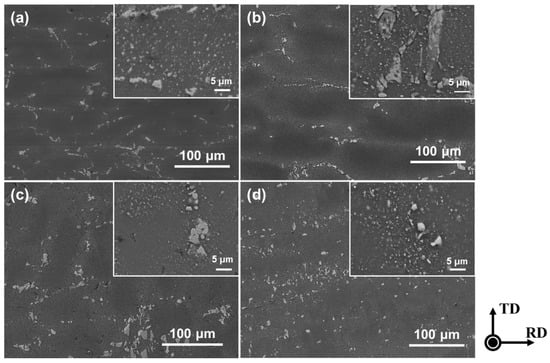
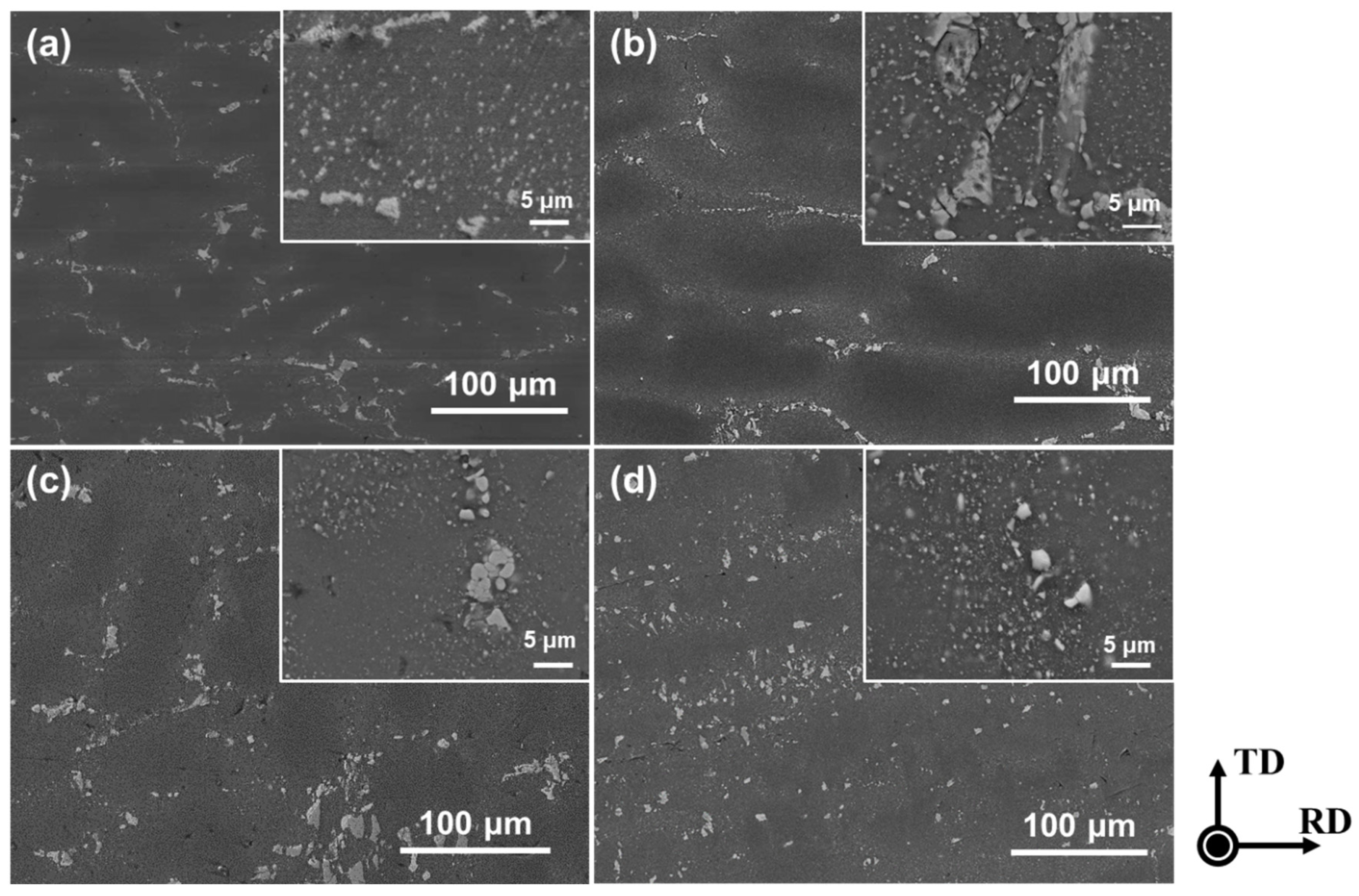
Figure 2 shows the metallographic microstructures of the Al80Zn14Li2Mg2Cu2 alloys after different amounts of warm rolling at low and high magnifications. Microstructures do not change much in the four samples, and two phases with white and gray contrasts are distributed on the Al matrix along the rolling direction. The two types of micro-scale intermetallic particles were identified by combining multiple characterization techniques. The white-contrast phase has an EDS composition of approximately 21 at.% Mg, 28 at.% Al, 40 at.% Zn, and 11 at.% Cu, with a Mg:Zn atomic ratio close to 1:2, which is consistent with the MgZn2 phase. This identification is further supported by the XRD diffraction peaks shown in Supplementary Figure S1. The gray-contrast phase contains approximately 53 at.% Al, 3 at.% Mg, 11 at.% Zn, and 33 at.% Cu as measured by EDS. It should be noted that Li cannot be reliably detected by conventional EDS due to its low atomic number. Therefore, to establish the identity of this phase, we employed the following complementary evidence: (1) in our previous work on the identical alloy composition [20], this phase was unambiguously identified as Al5CuLi3 by the combination of XRD peak indexing, TEM imaging, and SAED pattern analysis; (2) XRD patterns of the present warm-rolled samples (Supplementary Figure S1a,b) confirm the retention of Al5CuLi3 diffraction peaks; and (3) SAED analysis performed directly on this phase in the 0CR sample (Figure S1c) yields a diffraction pattern indexable to the Al5CuLi3 structure. SEM pictures of four samples at high magnification are shown in the inset, Figure 2. The Al5CuLi3 phase is large and irregular. As the amount of warm deformation increases, large-sized Al5CuLi3 particles are partially broken under the rolling shear stress, with their sizes slightly reduced and densities slightly increased. The MgZn2 phase is submicron or nanometer spheres. They are inhomogeneously distributed in the matrix, mainly near the bulk Al5CuLi3 particles.
Figure 2.
SEM images of the (a) 0CR, (b) 40CR, (c) 60CR, and (d) 80CR samples with different rolling deformation. Inset figure is the corresponding SEM image at high magnification.
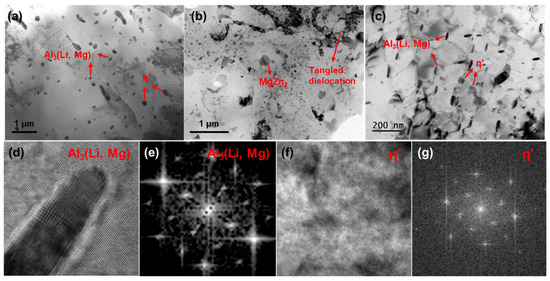
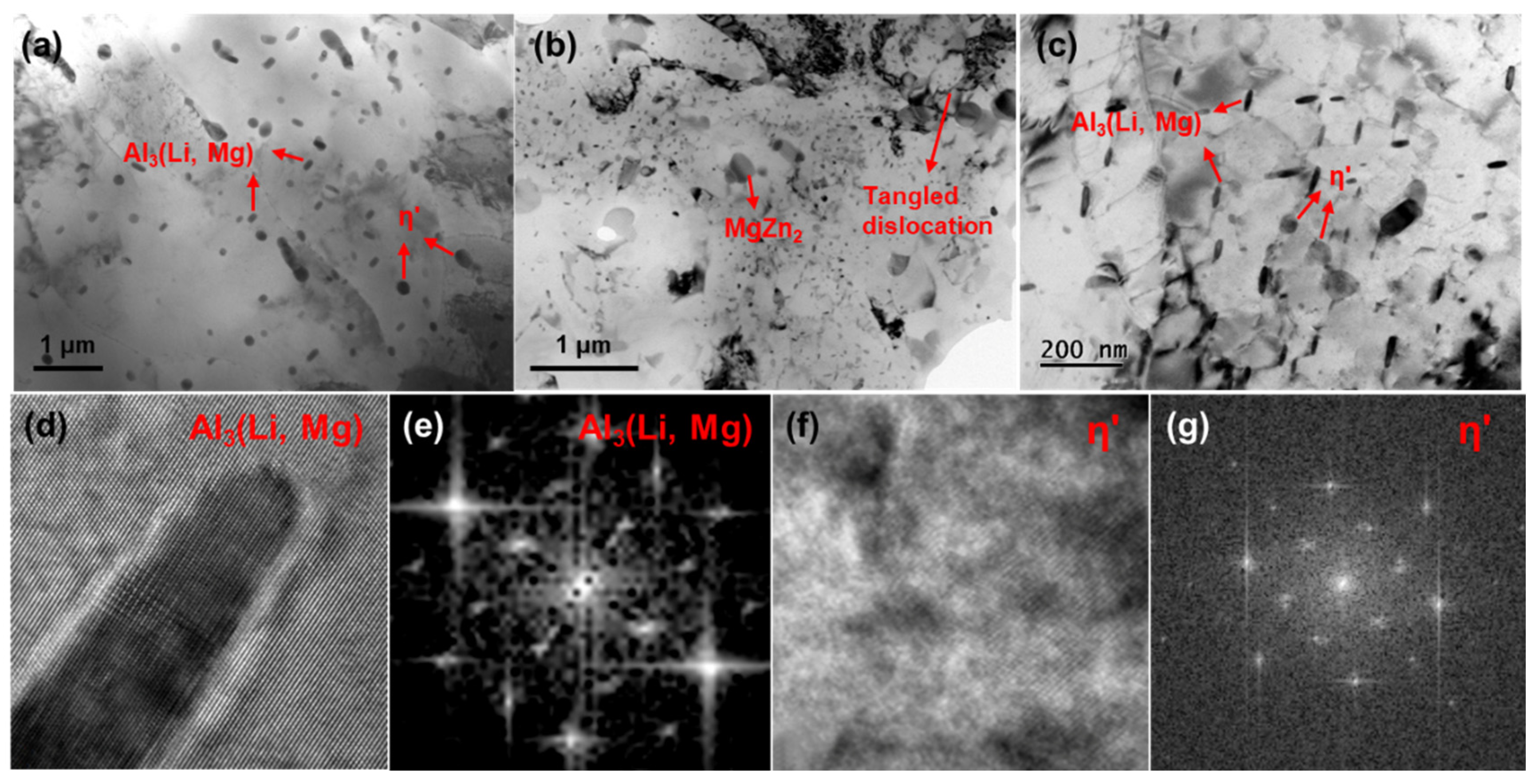
In order to further reveal the structural changes, nano-scale TEM images taken under the [110]Al zone axis of the 0CR and the 60CR samples are shown in Figure 3. Figure 3c is a partially enlarged view of Figure 3b,d–g are HRTEM and the corresponding fast Fourier transform (FFT) analysis. High-density precipitates with needle-like and spherical shapes are both present in the 0CR and 60CR samples, indicating that dynamic precipitation occurred during rolling deformations. It can be inferred that the needle-shaped precipitate is the Al3(Li, Mg) phase and the spherical particle is the η’ phase. Warm rolling deformation obviously changes the density and distribution of nanoprecipitates. The average sizes of both Al3(Li, Mg) and η’ particles decrease from the 0CR to 60CR sample, and the η’ particles have a greater size drop. Furthermore, the Al3(Li, Mg) particles change from a small axial ratio to a large axial ratio induced by rolling. It can also be observed that there is a changing trend that all the number densities increase with the increase in warm rolling, among which the number density of Al3(Li, Mg) has the most obvious increase (from 3 μm−2 to 32 μm−2). This proved that deformation can significantly increase the defect (e.g., vacancy, dislocation) concentration, which could increase the effective diffusion constant of solute atoms and, consequently, induce an accelerated increasing kinetics of some precipitates [22].
Figure 3.
Bright-field TEM micrographs of the Al80Zn14Li2Mg2Cu2 alloy under different rolling deformations. (a) TEM image of the 0CR sample. (b) TEM image of the 60CR sample. (c) TEM image of the 60CR sample at higher magnification. (d) HRTEM image of the Al3(Li, Mg) precipitate. (e) FFT image of the Al3(Li, Mg) precipitate. (f) HRTEM image of the η’ precipitate. (g) FFT image of the η’ precipitate.
3.3. EBSD Grain Structure Analysis
Although the above microstructure characterization confirms that the morphology of each phase has changed under different rolling deformations, it still cannot explain the reason for the variable softening and hardening phenomenon. To gain more insights into the grain structure evolution, EBSD analysis of the four samples is presented in Figure 4 and Figure 5.
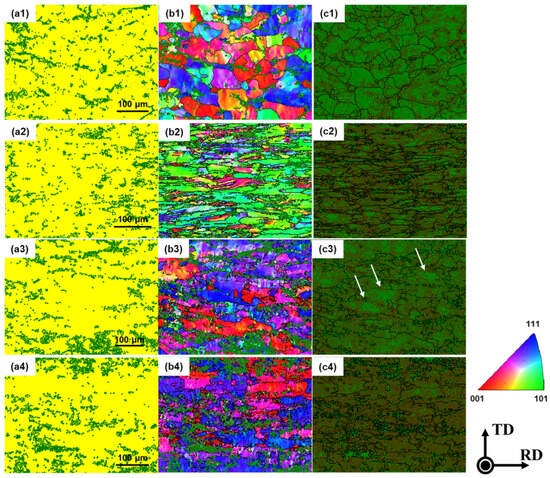
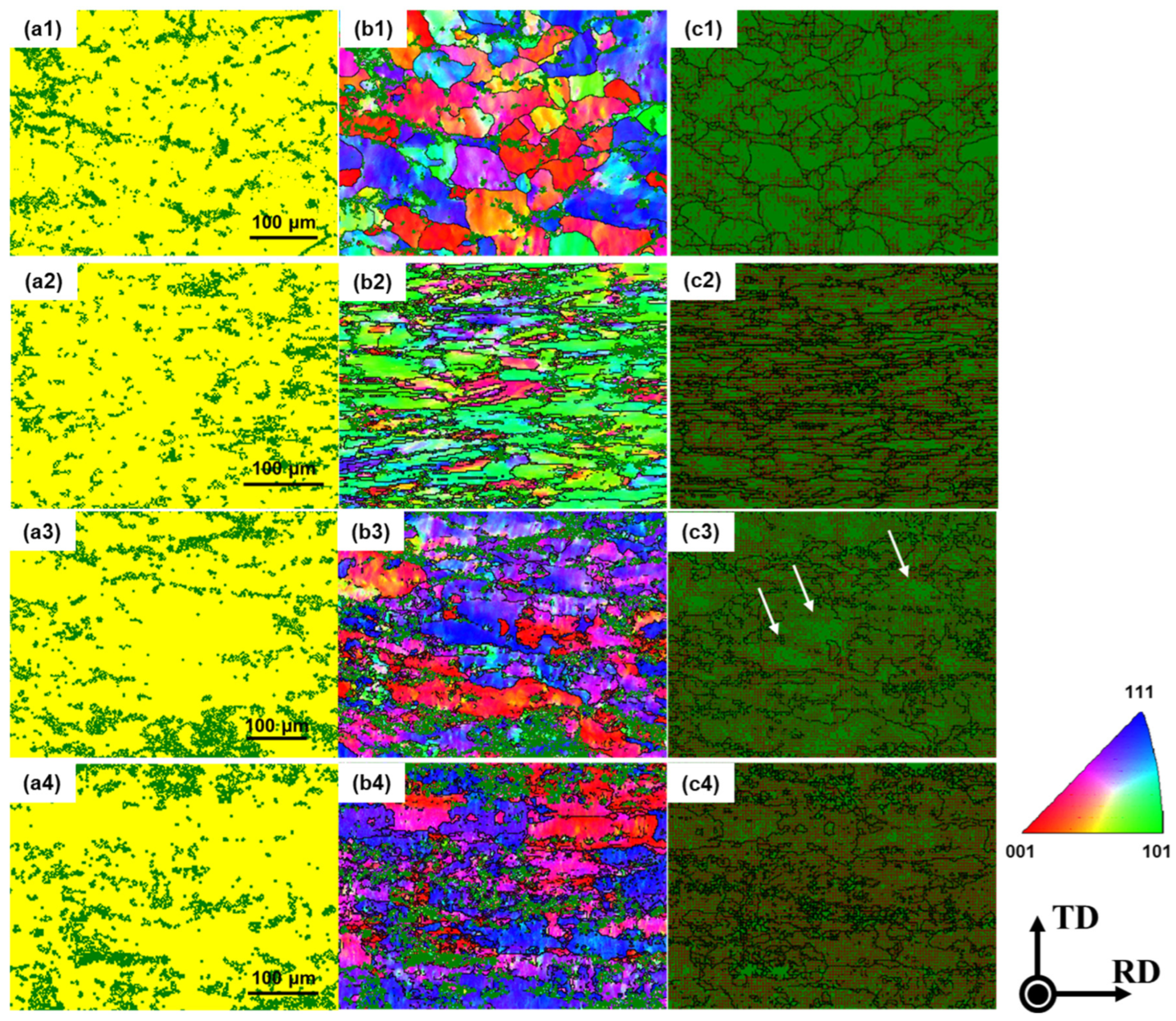
Figure 4.
EBSD patterns of the Al80Zn14Li2Mg2Cu2 alloy. (a1) Phase map, (b1) IPF map, and (c1) grain boundary map of the 0CR sample. (a2) Phase map, (b2) IPF map, and (c2) grain boundary map of the 40CR sample. (a3) Phase map, (b3) IPF map, and (c3) grain boundary map of the 60CR sample. (a4) Phase map, (b4) IPF map, and (c4) grain boundary map of the 80CR sample.
Figure 5.
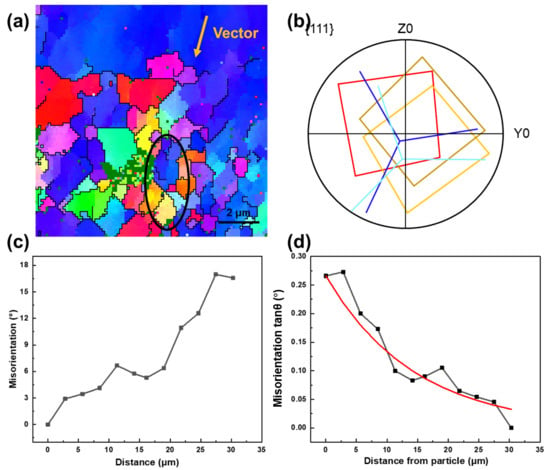
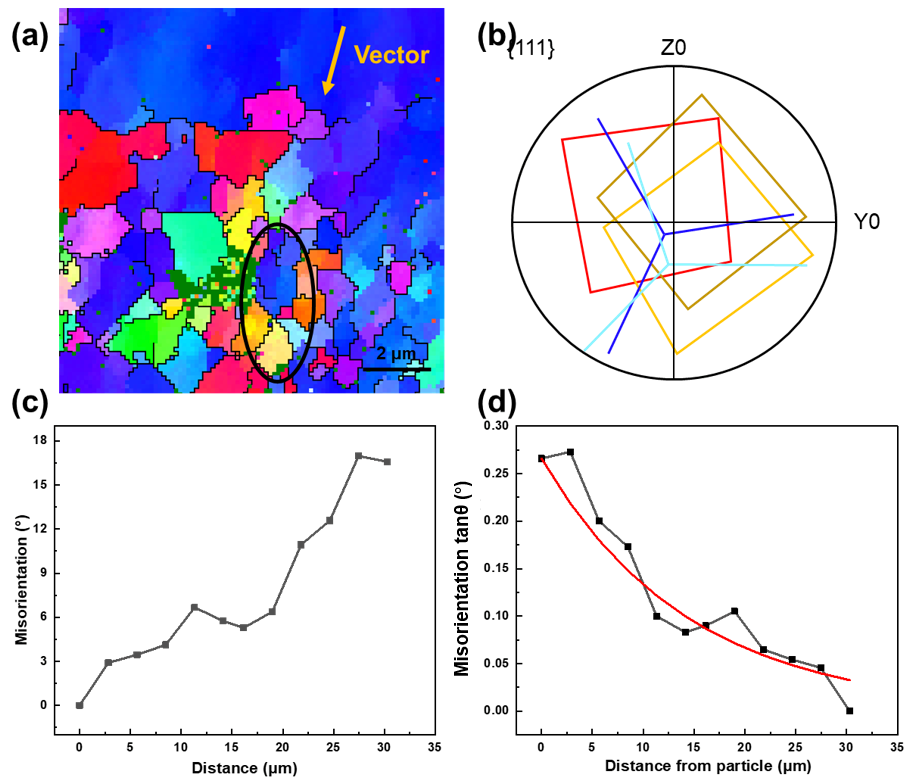
(a) EBSD IPF map showing PSN grains in the 60CR sample. (b) PSN grains orientations on the 111 pole figure. (c) Misorientation profiles along the vector as indicated in (a). (d) The measured misorientation profile compared with an empirical model.
Figure 4(a1–a4) are EBSD phase map without any noise correction. Here, yellow is the Al phase, and green is the detection blind zone. When the SEM images are spatially overlaid with the corresponding EBSD phase maps, the non-indexed blind zones (green) show a strong spatial correspondence with the microscale intermetallic particles (Al5CuLi3 and MgZn2), which are knocked out during ion polishing. Quantitative overlay analysis for the 60CR sample indicates that approximately 86% of EBSD blind zones can be directly matched to SEM-visible particles. The remaining ~14% of blind zones that lack direct SEM counterparts are attributed to two secondary sources: (1) PDZ-related pattern degradation in the severely deformed Al matrix immediately adjacent to particles; (2) strain fields from sub-surface particles not visible on the polished surface.
The corresponding EBSD IPF maps are presented in Figure 4(b1), Figure 4(b2), Figure 4(b3), and Figure 4(b4), respectively. In the 0CR sample, randomly oriented and equiaxed grains can be observed. After warm rolling at 40%, the grains were obviously crushed and elongated. The structure exhibits obvious directionality, and the (101) is the dominant grain. As the amount of deformation increases, in the 60CR and 80CR samples, what is unusual is that the grains not only do not continue to be fibrillated, but also become slightly thicker and larger. Two main orientations for the matrix microstructures are <111>//ND and <001>//ND according to the IPF coloring, which is commonly formed in rolled Al alloys because of the preferred orientation [23]. It is also revealed that some newly formed small recrystallization grains are developed at the junction of two large elongated grains. These well-restricted nucleation sites in the vicinity of micron particles are a typical feature of PSN-related recrystallization.
In terms of the grain boundary distribution, as the amount of deformation during warm rolling increases, the proportion of LAGB increases monotonically, from 40% (0CR) to 74% (80CR), reflecting massive dislocation accumulation and subgrain formation, while the proportion of HAGB undergoes a significant increase followed by a slight decrease. From 0CR to 40CR, the HAGB fraction increases from 7% to 16% (and the HAGB/LAGB ratio increases from 0.175 to 0.267), indicating the conversion of LAGBs into HAGBs-a quantitative signature of progressive recrystallization. From 40CR to 80CR, the HAGB fraction slightly decreases (from 16% to 12%), consistent with our interpretation that PSN recrystallization slows down while new LAGBs continue to be generated by ongoing deformation. This non-monotonic HAGB trend provides quantitative support for the competition between PSN-related recrystallization (LAGB → HAGB conversion) and dislocation accumulation (new LAGB generation).
The IPF map of the 60CR sample is enlarged, and the formation of PSN grains is accurately analyzed and determined at high magnification. PSN grain orientations on the (111) pole figure in the black circle of Figure 5a are shown in Figure 5b. It is clear that the orientations of PSN grains are random in all directions, as they originate from the deformation zones with orientations over a wide range depending on the operation of slip systems. It has also been reported by Zang et al. that PDZ can help randomize texture, and sometimes one large second-phase particle can even contribute to 2–3 different orientations [7]. Figure 5c shows the measured misorientation profiles along the orange vector in Figure 5a, confirming that there is a continuous rotation of the lattice from the matrix to the particle. Previous work on Al-Si alloys has shown that the misorientation gradient surrounding large particles may be fitted to an empirical equation of the form [24]:
where θ is the lattice rotation at a distance x from a particle of diameter d, θmax is the maximum rotation, and c1 is a constant equal to 1.8. Figure 5d shows the misorientation profile predicted by this relationship compared with the measured misorientation, with the effective diameter of the particle cluster taken as 30 μm, which is not significantly different from the average size of the Al5CuLi3 phase in the 60CR alloy shown in Figure 2c. Therefore, it can be determined that as the warm rolling progresses, the PSN-related phenomenon occurs in the alloy, which can be regarded as one of the main reasons for the macroscopic softening.
3.4. EBSD KAM Analysis
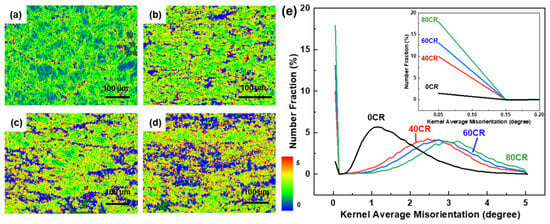
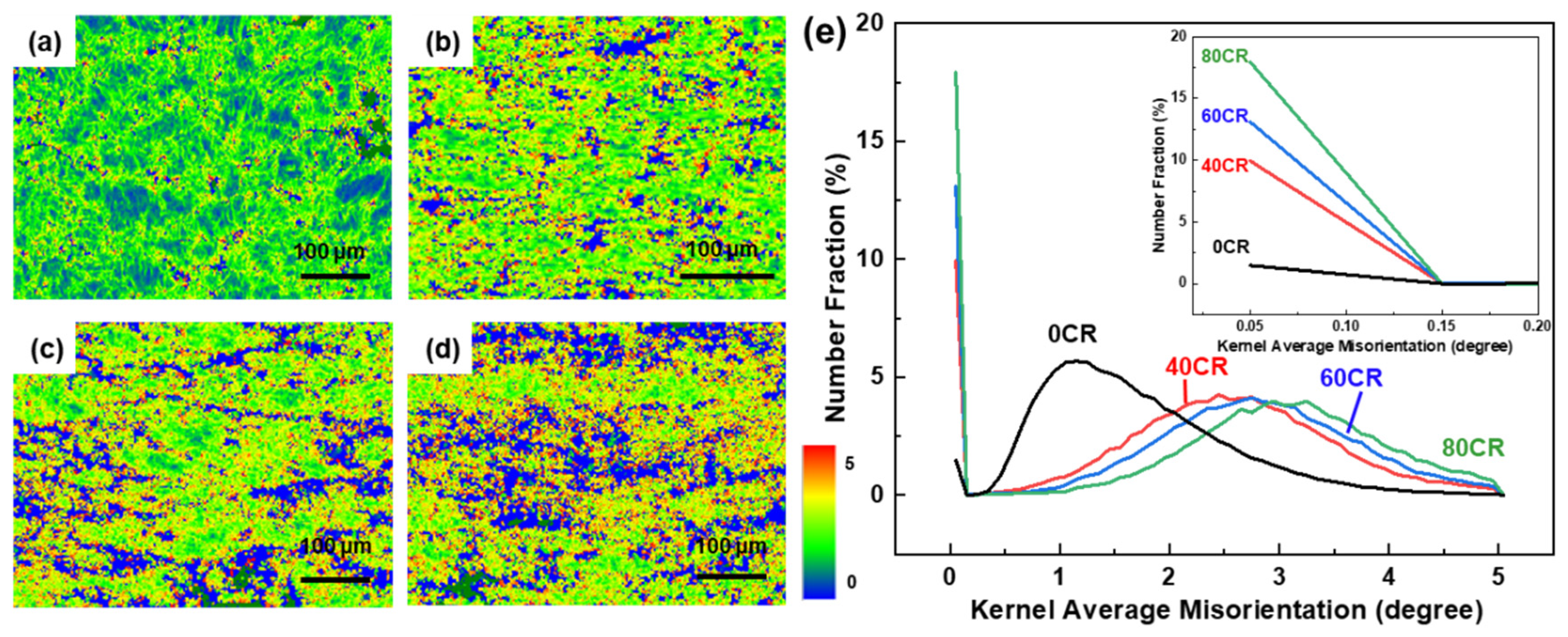
In order to further analyze the progression rate of the PSN-related recrystallization with the increasing rolling deformation, after proper noise correction, KAM maps are presented and quantitatively described in Figure 6. In the 0CR sample, low stored energy in deformed grains is revealed by the predominantly green and blue color. The average KAM increases modestly from 1.6° to 2.5° with rolling, but the spatial heterogeneity is far more informative: KAM values in the PDZ regions (3.5–5.0°) are 3–4 times higher than in the matrix far from particles (1.0–2.0°). This quantitative contrast confirms the strong strain concentration around intermetallic particles that drives PSN. The data statistics in Figure 6e reflect this change more clearly; that is, as the rolling strain increases, on the one hand, the low-angle KAM values increase, and on the other hand, the high-angle KAM values move to a larger angle area. This shows that with the increase in deformation, undistorted recrystallization grains are continuously formed, and the rapid accumulation of dislocations is also continuously proceeding. These two changing trends compete with each other and cause opposite effects on the mechanical properties. The area fraction of low KAM recrystallization zones (blue zones) with an angle of 0–0.5° is estimated, and it is determined as 2.4%, 8.0%, 14.8%, and 16.7% in the 0CR, 40CR, 60CR, and 80CR samples, respectively. Clearly, as the rolling deformation increases from 0 to 60%, the PSN-related process proceeds rapidly, and the recrystallized grains also increase sharply. When the deformation further increases to 80%, the recrystallization process seems to be hindered and slowed down, and the increase in the low-distortion recrystallized grain region is also reduced.
Figure 6.
KAM maps of (a) 0CR, (b) 40CR, (c) 60CR, and (d) 80CR samples. (e) Distribution of KAM values of the four samples.
It is important to note that the low-KAM (blue) zones observed near intermetallic particles in Figure 6 represent strain-free regions within the Al matrix (FCC phase), not the intermetallic particles themselves. The intermetallic particles correspond to non-indexed blind zones (green regions in Figure 4(a1–a4)) and do not contribute to the KAM maps. This is confirmed by overlaying the phase maps (Figure 4(a1–a4)) with the KAM maps (Figure 6), which shows that the low-KAM zones are indexed as Al phase and are spatially adjacent to, but distinct from, the particle blind zones. These strain-free Al-matrix zones, combined with the equiaxed grain morphology and random orientations demonstrated in Figure 4 and Figure 5, are identified as PSN-related recrystallization grains.
3.5. Texture Analysis
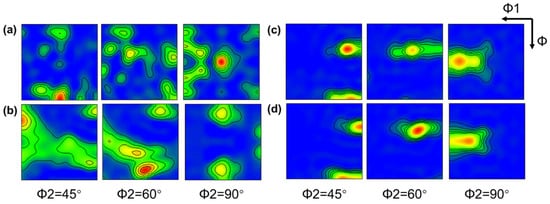
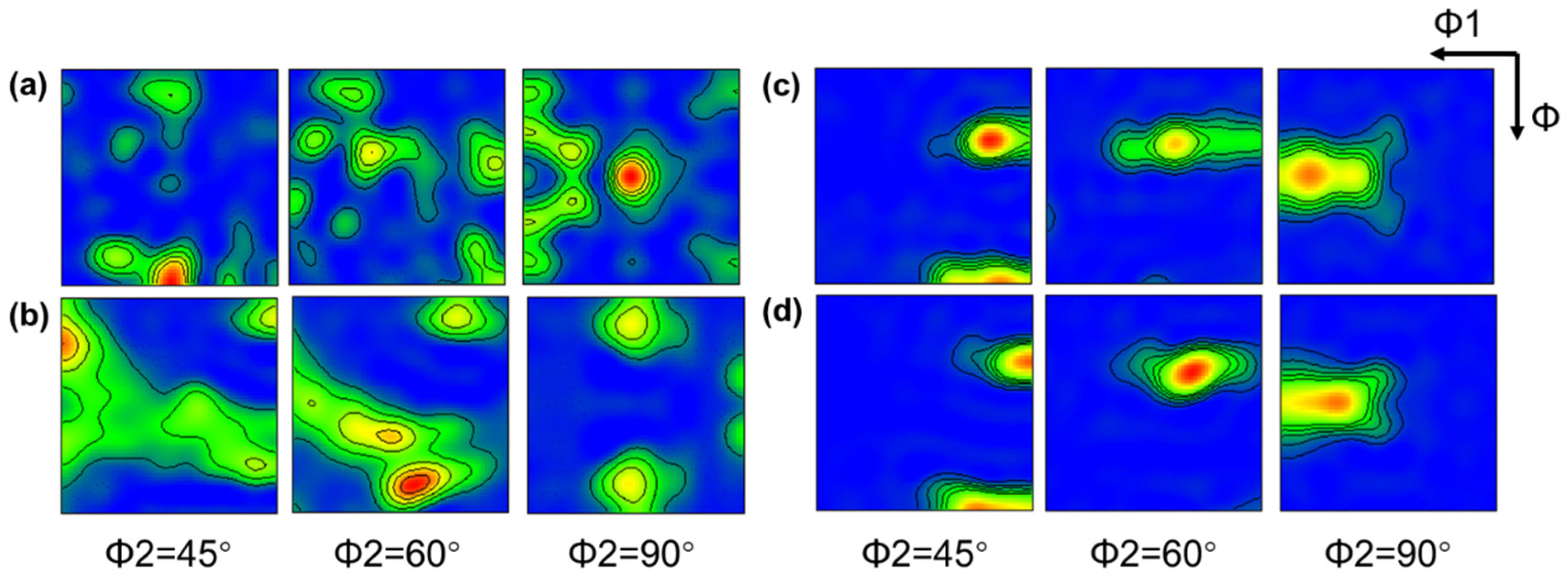
As an important microstructure feature, textures significantly influence the mechanical properties of Al alloys. It was reported that textures can strengthen the metallic materials processed by the warm deformation [25]. Figure 7 gives the φ2 = 45°, φ2 = 65° and φ2 = 90° ODF sections of the four samples. In the 0CR sample, the strong Brass textures (011)<211> and weak Cube textures (001)<100> are obtained, and they transform into Rotated Cube textures (001)<110> when the sample is warm-rolled by 40%. It has already been accepted that the Rotated Cube texture is a typical shear texture component and tends to appear in the recrystallized Al alloys [26]. Therefore, 40CR alloy may still retain some of the hot-rolling microstructures and property characteristics. The texture morphology quickly changes into strong copper (112)<111>, Brass (011)<211>, and S (123)<634> rolling textures in the 60CR, and it remains almost unchanged in the 80CR sample. The recrystallization Goss texture (011)<100> can also be observed in these two alloys. However, we notice that no P textures are presented in all four samples, which is generally regarded as a preferred growth selection of nuclei around particles [27]. This may be due to insufficient recrystallization driving force provided by warm rolling and too few PSN grains formed.
Figure 7.
φ2 = 45°, 65°, and 90° ODF sections of (a) 0CR, (b) 40CR, (c) 60CR, and (d) 80CR samples.
4. Discussion
4.1. Softening Induced by PSN-Related Local Recrystallization
The present study did not include a 100 °C heated-only, non-deformed reference sample. Therefore, the contributions of thermal relaxation and deformation-induced structural evolution cannot be completely decoupled. It is necessary to address whether the observed softening could be attributed solely to the recovery of residual stored energy from prior hot rolling. Several observations rule out this interpretation: (1) the 0CR shows minimal residual stored energy (Figure 6); (2) recovery cannot generate the new HAGBs observed around particles (Figure 4(c1–c4)); (3) recovery retains the deformation texture, whereas PSN grains show random orientations (Figure 5b); (4) the bimodal KAM evolution (Figure 6e) is diagnostic of recrystallization, not recovery; and (5) the non-monotonic softening–hardening trend requires a competition between recrystallization and work hardening that cannot be explained by recovery alone.
Therefore, we conclude that local recrystallization behavior dominated by PSN-related characteristics around local particles in the alloy during 100 °C warm rolling is observed. It is worth noting that even for Al alloys with a slightly lower activation temperature to promote nucleation and recrystallization, a temperature of about 200 °C is required [28,29,30]. Therefore, we will discuss in detail from a thermodynamic and kinetic perspective why this alloy can recrystallize at such a low temperature as 100 °C.
From a thermodynamic perspective, the thermodynamic driving force for PSN-related recrystallization originates from the deformation energy stored within the PDZ, and the energy stored per unit volume can be estimated from the dislocation density [31]:
where α ≈ 0.5 is the dislocation interaction constant [32], G ≈ 26 GPa is the shear modulus [33], b = 0.286 nm is the Burgers vector [33], and ρ is the dislocation density. The geometrically necessary dislocation (GND) density in the PDZ region can be estimated numerically using EBSD-KAM [34]:
where θKAM is the KAM value, u is the EBSD step size (0.1 μm in this study), and b is the Burgers vector. Calculated with KAM = 5°, the local GND density around the particle is approximately 6.1 × 10¹⁵ m−2, and the energy stored per unit volume in the PDZ region is approximately 6.49 MJ/m3.
The critical condition for recrystallization nucleation requires the driving force to exceed the interfacial energy resistance for the formation of new grain boundaries [31]:
where γgb ≈ 0.32 J/m2 is the HAGB energy [35], and rc is the critical nucleation radius. Therefore, driven by the energy stored in the PDZ, the critical nucleation radius is on the order of 100 nm, indicating that there is sufficient space within the PDZ to accommodate multiple critical nuclei, and the thermodynamic conditions for recrystallization grain nucleation are fully satisfied. The ability of this alloy to accumulate such high dislocation densities at only 100 °C, comparable to those in conventional Al alloys deformed at 300–400 °C, is attributed to three factors: (1) the reduced stacking fault energy resulting from the synergistic effects of high-concentration Zn (14 at.%), Mg (2 at.%), and Cu (2 at.%) solutes, which suppresses cross-slip and dynamic recovery [36]; (2) the high volume fraction of non-deformable intermetallic particles, which generates severe strain incompatibility and amplifies GND accumulation in the PDZ; and (3) the dynamic precipitation of fine dispersoids within the PDZ, which may indirectly promote PSN by pinning dislocations and suppressing dynamic recovery, thereby increasing the stored energy available for recrystallization nucleation.
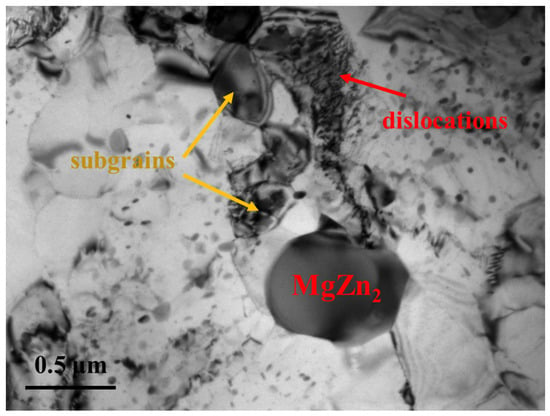
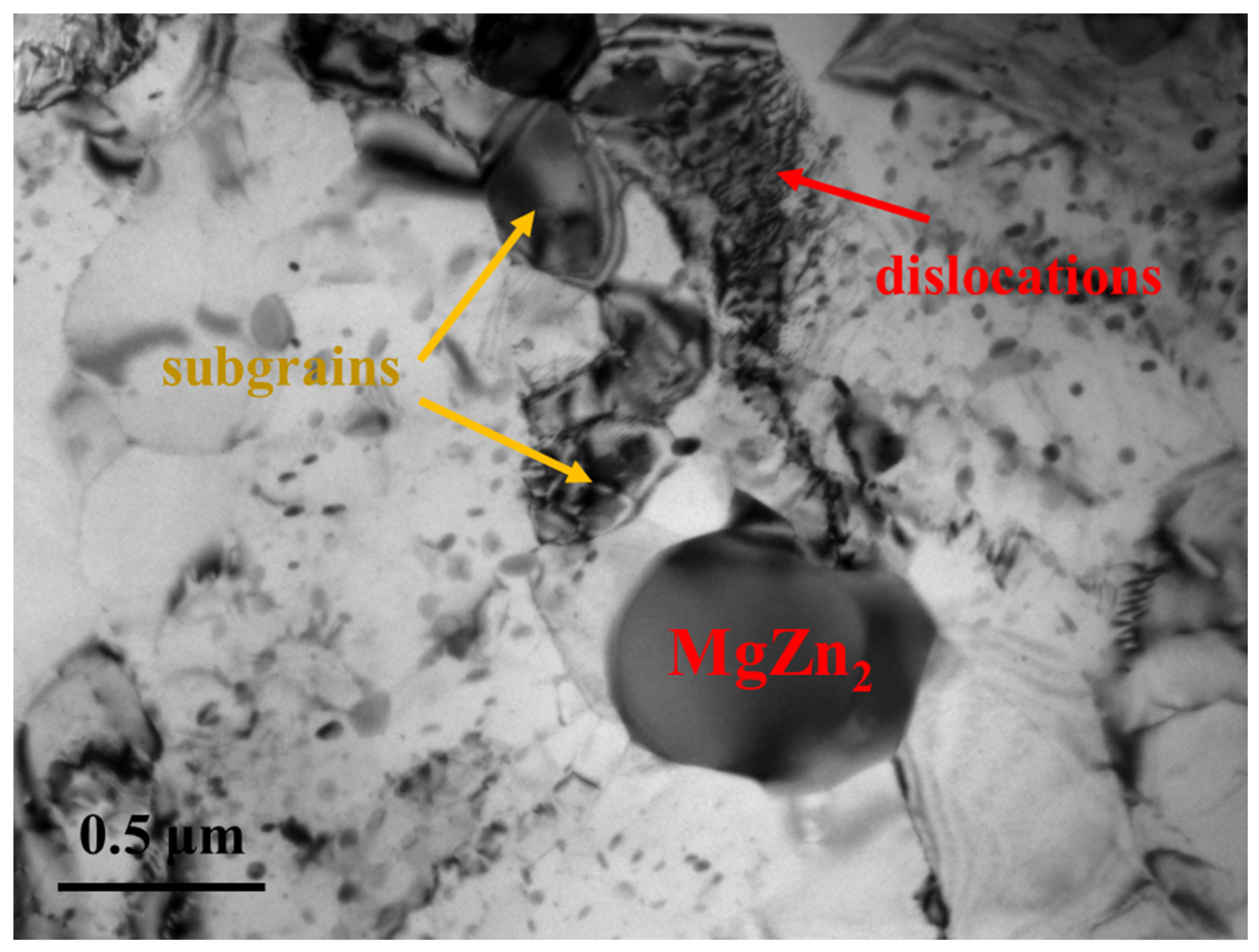
On the other hand, from a kinetic perspective, the migration rate of conventional thermally activated grain boundaries is negligible at 100 °C. However, under active deformation, the main mechanism of PSN is the progressive rotation of subgrains within the PDZ, driven by the continuous incorporation of dislocations into subgrain boundaries during rolling, rather than by thermally activated long-range diffusion. This is confirmed by the well-developed subgrains within the PDZ region in the TEM image (Figure 8). Furthermore, the dense substructure network and the excess vacancies generated by deformation provide short-circuit diffusion paths. The combined effect of these thermodynamic and kinetic factors enables PSN in this high-concentration multi-component alloy to occur at an exceptionally low temperature of 100 °C.
Figure 8.
Bright-field TEM image of the 60CR sample.
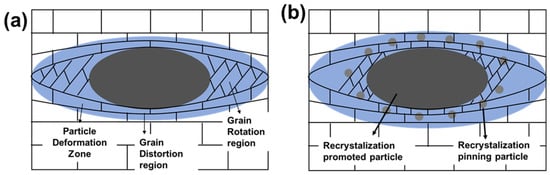
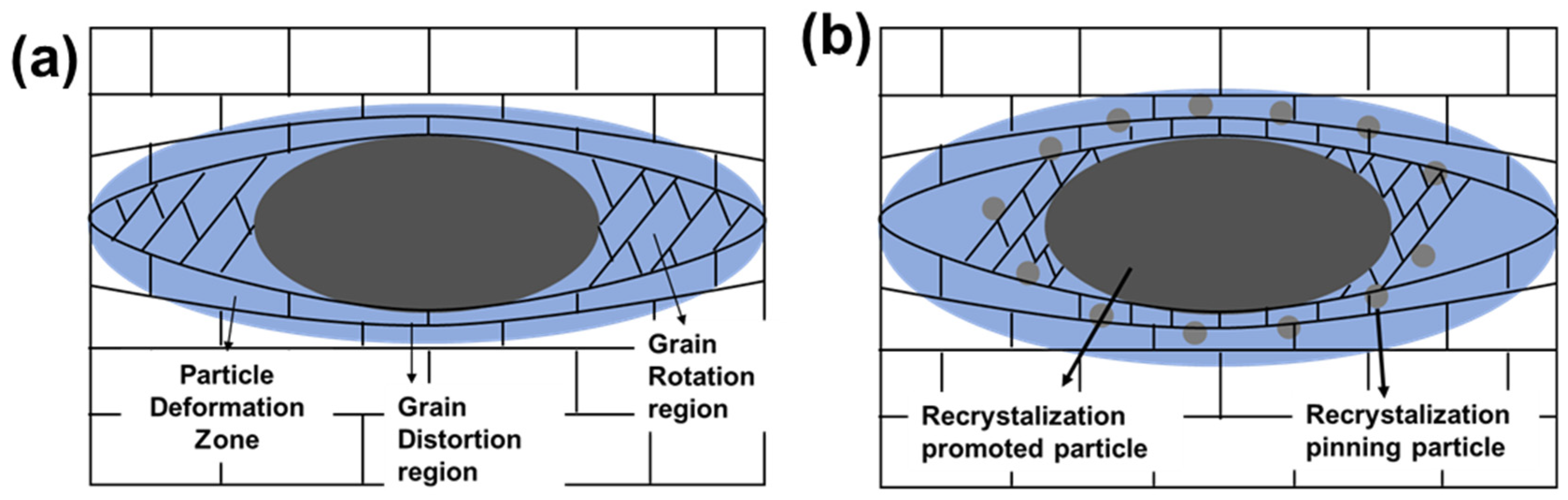
The schematic diagram of the PSN-related recrystallization is shown in Figure 9. As the large Al5CuLi3 particle cannot deform with the matrix when the external shear stress is applied, a local strain incompatibility and different slip systems will be set up around the particle. According to the shadowing theory [37], different slip systems are superimposed and they have an effect on one another; thus, the strain around a particle is different everywhere. Furthermore, there is also a strain gradient from the particle to the unaffected matrix far enough away from the particle. Therefore, centered on the large particle, the deformations at different radii or at different positions of the same radius are different everywhere, and this incompatibility results in different crystal rotations and crystal distortions everywhere. Figure 9a exhibits the particle deformation zone (PDZ) around the large Al5CuLi3 particle, including the grain rotation zone and the grain distortion zone. A potential recrystallization nucleus can be formed within PDZ. Then, three small particles, MgZn2, Al3(Li, Mg), and η’, act as pinning agents and inhibit the further development of PSN-related recrystallized grains, as shown in Figure 9b.
Figure 9.
Schematic diagram of (a) particle deformation zone; (b) recrystallized grain growth under the interaction of large particles and small particles.
Therefore, from the 0CR to 40CR to 60CR samples, the strength and hardness decrease, and the plasticity increases with the development of PSN-related recrystallization. Then, PSN grains get pinned by the small particle. Since the energy provided by warm rolling is not enough to allow HAGBs to cross these obstacles, the growth rate of recrystallized grains slows down, and they are restricted to the above small-particle-free area. At this time, the dislocation storage and hardening effect are stronger than the recrystallization softening effect, and therefore, in the 80CR sample, the strength and hardness start to increase.
It should be noted that the mechanical properties of the warm-rolled samples, particularly the 60CR condition, do not represent an optimal combination for direct structural applications where both high strength and adequate ductility are simultaneously required. The 60CR sample exhibits a decreased yield strength and ultimate strength compared with the 0CR sample, despite a 20% improvement in elongation. This trade-off between strength and ductility is a well-documented phenomenon in metallic materials and must be carefully considered in application-oriented alloy design. However, the primary significance of the present work lies in two aspects: (1) the mechanistic understanding of the anomalous low-temperature PSN-related recrystallization at 100 °C, which has rarely been reported in aluminum alloys, and (2) the demonstrated feasibility of using PSN-related work softening to improve the processability of otherwise brittle high-Zn-content Al alloys during intermediate fabrication stages. In practice, the warm-rolled plate with PSN-refined microstructure can serve as a semi-finished product for subsequent aging treatment, which is expected to recover a significant portion of the strength through precipitation hardening while retaining the benefits of the refined grain structure. The optimization of post-rolling aging treatment and the evaluation of final service properties will be the subject of future work.
4.2. Hardening in a Single Alloy During Tension
Section 4.1 discussed the PSN-related recrystallization that occurs during warm rolling at 100 °C. In this section, we analyze the room-temperature tensile deformation behavior of the four pre-rolled conditions, focusing on their work-hardening characteristics. It should be emphasized that the tensile tests probe the mechanical response of the microstructural states established by warm rolling, and the work-hardening analysis below characterizes the tensile behavior rather than the rolling process.
In the engineering stress–strain curve in Figure 1, the hardening behaviors after the yielding point of these alloys are also different from each other; that is, the 0CR alloy mainly exhibits work hardening during the plastic deformation stage, while the other three only show a slight hardening with the increase in tensile strain.
Here, the work-hardening rate θ is used to evaluate the hardening and softening behavior in the tensile stress–strain curve; that is:
where σ represents the macroscopic true stress and ε corresponds to the true strain. Here, σ and ε are calculated from the engineering stress and strain, using the equations σ = σeng(1 + εeng) and εtrue = ln(1 + εeng), respectively.
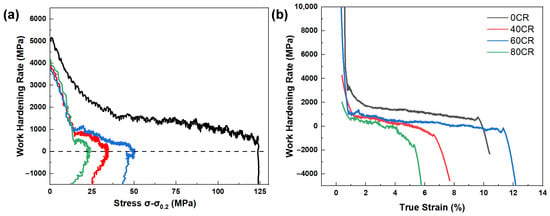
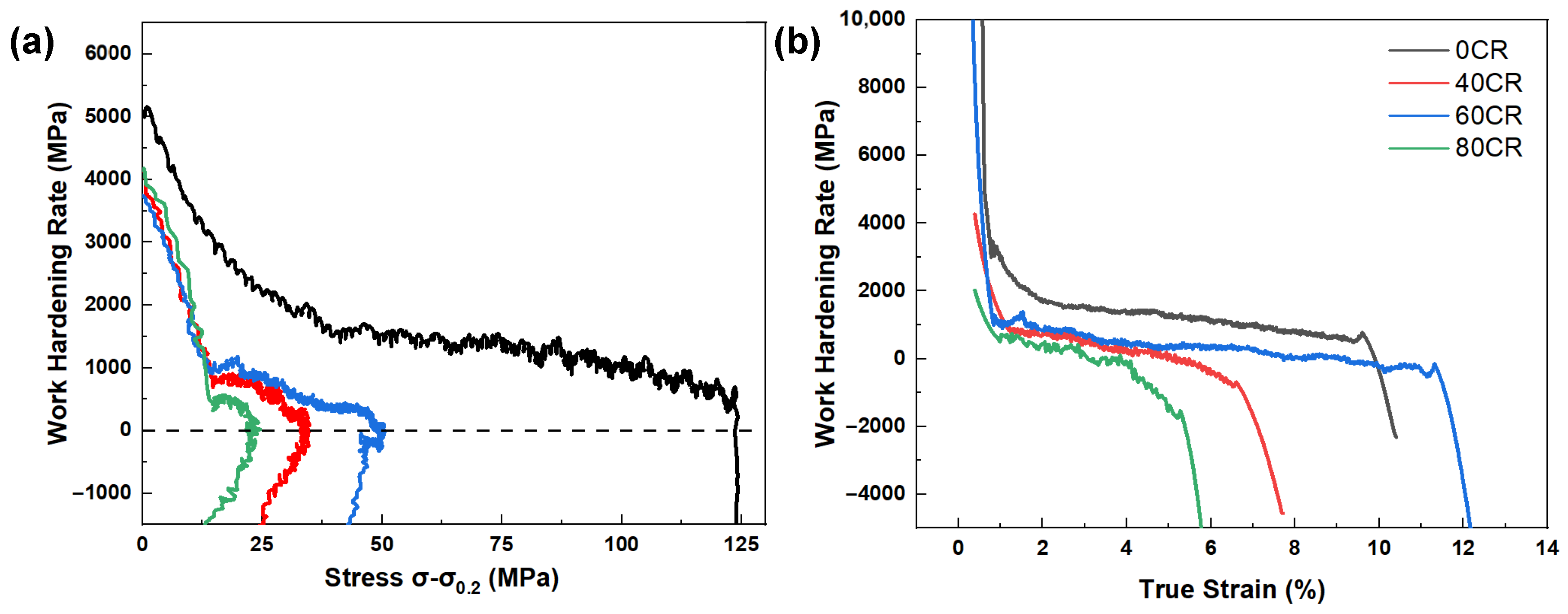
The curves of θ with (σ − σ0.2) and θ with strain are presented in Figure 10a and Figure 10b, respectively. As observed, there is no stage I and stage II, but the dynamic recovery stage (stage III) and the large-strain work-hardening stage (stage IV) obviously appear. That is, the hardening curve first rapidly drops and then linearly decreases with an increase of (σ − σ0.2) or ε. In both stages, the work-hardening rate θ of 0CR is significantly the highest, and the work-hardening rate of 60CR is slightly higher than the other two alloys.
Figure 10.
(a) The curve of work-hardening rate θ with (σ − σ0.2). (b) The curve of work-hardening rate θ with true strain.
The differences in work-hardening rates can be analyzed by the dislocation movement. In this work, it is the original dislocation density that plays the most important role. The 0CR alloy has undergone dynamic recrystallization and has the lowest initial dislocation density, so it can activate more dislocations during tensile deformation. Dislocations can fully entangle and move, resulting in the largest work-hardening value in stage III and stage IV. In contrast, warm-rolled 40CR, 60CR, and 80CR alloys already have a high original dislocation density. Dislocations that have been entangled and hindered each other are difficult to move further during tensile deformation, so the work-hardening value is significantly reduced. In the 60CR alloy, as the predominant PSN-related recrystallization absorbs some dislocations, the work-hardening value is slightly higher than the other two alloys. It had also been reported that the larger the grain size, the weaker the interaction between dislocation and grain boundary, making it difficult to form dislocation cell structures. The larger grain size (as observed in Figure 4) may also be one of the reasons for the minimum value of 80CR alloy in stage IV.
5. Conclusions
We examined the microstructure evolution and mechanical behaviors of the Al80Zn14Li2Mg2Cu2 alloy under 100 °C warm rolling. The main conclusions are as follows:
(1) The alloy exhibits a non-monotonic mechanical response during warm rolling. With increasing rolling reduction up to 60%, the hardness and ultimate strength decrease and the elongation increases, demonstrating pronounced work softening. Upon further rolling to 80%, the strength partially recovers while the elongation decreases to 5.5%, indicating a transition to work-hardening dominance. It should be noted, however, that the as-rolled condition exhibits a strength–ductility trade-off, and subsequent aging or heat treatment will be necessary to achieve an optimized balance of mechanical properties for structural applications.
(2) The work softening is governed by PSN-related recrystallization, as evidenced by the following: (i) the formation of fine equiaxed Al-matrix grains with random crystallographic orientations specifically at the periphery of coarse intermetallic particles; (ii) a bimodal KAM distribution with the simultaneous growth of strain-free recrystallized zones and high-strain deformation zones; and (iii) a continuous lattice rotation gradient toward particles consistent with the Humphreys PDZ model.
(3) The multi-scale intermetallic particles in this alloy play a dual role in controlling the PSN process. Coarse Al5CuLi3 particles serve as potent nucleation sites by generating PDZs with high stored deformation energy and dislocation densities. Fine nano-scale precipitates exert a Zener pinning pressure that restricts the growth of recrystallized grains, leading to the re-hardening observed at 80% reduction when the pinning effect and continued dislocation accumulation overcome the PSN softening contribution.
(4) The PSN-related recrystallization at 100 °C is attributed to the unique thermodynamic and kinetic synergistic factors inherent in this high-zinc-content multi-element alloy. Thermodynamically, the high alloying element content leads to a decrease in stacking fault energy, inhibiting cross-slip and dynamic recovery. Combined with the influence of multi-scale intermetallic compounds, this results in an exceptionally high dislocation accumulation in the PDZ. Kinetically, the progressive subgrain rotation mechanism within the PDZ provides a mechanically driven pathway for recrystallization nucleation. Furthermore, the dislocation network and vacancies provide rapid diffusion channels, promoting the growth of recrystallized grains.
Supplementary Materials
The following supporting information can be downloaded at: https://www.mdpi.com/article/10.3390/met16040398/s1.
Author Contributions
Conceptualization, Y.Z.; Methodology, R.L. and Y.Z.; Formal analysis, R.L.; Investigation, R.L. and Y.Z.; Writing—original draft, R.L.; Writing—review & editing, R.L.; Supervision, Y.Z.; Funding acquisition, Y.Z. All authors have read and agreed to the published version of the manuscript.
Funding
This research was funded by the National Natural Science Foundation of China (No. 52273280).
Data Availability Statement
The original contributions presented in this study are included in the article/Supplementary Materials. Further inquiries can be directed to the corresponding author.
Conflicts of Interest
Author Ruixuan Li was employed by Beijing GAONA Materials & Technology Co., Ltd. The remaining author declares that the research was conducted in the absence of any commercial or financial relationships that could be construed as a potential conflict of interest.
References
- Yuan, J.; Gong, L.; Zhang, W.; Zhang, B.; Wei, H.; Xiao, X.; Wang, H.; Yang, B. Work softening behavior of Cu–Cr–Ti–Si alloy during cold deformation. J. Mater. Res. Technol. 2019, 8, 1964–1970. [Google Scholar] [CrossRef] [Scilit]
- Pan, Y.F.; Zhao, P.Z.; Shen, Y.F.; Shi, X.J.; Jiang, T. A Study on the deformation behaviours of Al-1.4Fe-0.2Mn alloy sheets. Mater. Sci. Forum 2016, 877, 380–386. [Google Scholar] [CrossRef] [Scilit]
- Tao, X.; Gao, Y.; Kang, J.; Wang, Y. Softening Effects Induced by Shot Peening for an Aluminum-Lithium Alloy. Metall. Mater. Trans. A 2020, 51, 410–418. [Google Scholar] [CrossRef] [Scilit]
- Fu, K.; Wang, J.; Qiu, M.; Gao, F.; Wu, R.; Hou, L.; Zheng, H.; Zhang, J.; Zhang, M. Effects of Cold Rolling on Microstructural Evolution and Mechanical Properties of Mg–14Li–1Zn Alloy. Adv. Eng. Mater. 2019, 21, 1801344. [Google Scholar] [CrossRef] [Scilit]
- Wang, X.; Li, H.; Zhang, W.; Liu, Z.; Wang, G.; Luo, Z.; Zhang, F. The Work Softening by Deformation-Induced Disordering and Cold Rolling of 6.5 wt pct Si Steel Thin Sheets. Metall. Mater. Trans. A 2016, 47, 4659–4668. [Google Scholar] [CrossRef] [Scilit]
- Wang, X.-Y.; Jiang, J.-T.; Li, G.-A.; Wang, X.-M.; Shao, W.-Z.; Zhen, L. Particle-stimulated nucleation and recrystallization texture initiated by coarsened Al2CuLi phase in Al–Cu–Li alloy. J. Mater. Res. Technol. 2020, 10, 643–650. [Google Scholar] [CrossRef] [Scilit]
- Zang, Q.; Chen, H.; Lee, Y.S.; Yu, H.; Kim, M.S.; Kim, H.W. Improvement of anisotropic tensile properties of Al-7.9Zn-2.7Mg-2.0Cu alloy sheets by particle stimulated nucleation. J. Alloys Compd. 2020, 828, 154330. [Google Scholar] [CrossRef] [Scilit]
- Lin, Q.; Liu, J.; An, X.; Wang, H.; Zhang, Y.; Liao, X. Cryogenic-deformation-induced phase transformation in an FeCoCrNi high-entropy alloy. Mater. Res. Lett. 2018, 6, 236–243. [Google Scholar] [CrossRef] [Scilit]
- Chen, J.; Zhou, X.; Wang, W.; Liu, B.; Lv, Y.; Yang, W.; Xu, D.; Liu, Y. A review on fundamental of high entropy alloys with promising high–temperature properties. J. Alloys Compd. 2018, 760, 15–30. [Google Scholar] [CrossRef] [Scilit]
- Deng, L.; Luo, J.; Liang, Y.; Jiang, J.; Liaw, P.K.; Zhang, Y. Synergistic increasing the Strength–Elasticity in a CoNiV medium-entropy alloy via cold drawing. Mater. Sci. Eng. A 2025, 941, 148577. [Google Scholar]
- Liu, X.F.; Tian, Z.L.; Zhang, X.F.; Chen, H.H.; Liu, T.W.; Chen, Y.; Wang, Y.J.; Dai, L.H. “Self-sharpening” tungsten high-entropy alloy. Acta Mater. 2020, 186, 257–266. [Google Scholar] [CrossRef] [Scilit]
- Zhang, Y.; Zuo, T.T.; Tang, Z.; Gao, M.C.; Dahmen, K.A.; Liaw, P.K.; Lu, Z.P. Microstructures and properties of high-entropy alloys. Prog. Mater. Sci. 2014, 61, 1–93. [Google Scholar] [CrossRef] [Scilit]
- Sharma, P.; Johnson, D.D.; Balasubramanian, G.; Singh, P. Unraveling the connection of electronic and phononic structure with mechanical properties of commercial AZ80 alloy. Mater. Lett. 2024, 366, 136501. [Google Scholar] [CrossRef] [Scilit]
- Chauhan, P.; Yebaji, S.; Nadakuduru, V.N.; Shanmugasundaram, T. Development of a novel light weight Al35Cr14Mg6Ti35V10 high entropy alloy using mechanical alloying and spark plasma sintering. J. Alloys Compd. 2020, 820, 153367. [Google Scholar] [CrossRef] [Scilit]
- Baek, E.J.; Ahn, T.Y.; Jung, J.G.; Lee, J.M.; Cho, Y.R.; Euh, K. Effects of ultrasonic melt treatment and solution treatment on the microstructure and mechanical properties of low-density multicomponent Al70Mg10Si10Cu5Zn5 alloy. J. Alloys Compd. 2017, 696, 450–459. [Google Scholar] [CrossRef] [Scilit]
- Feng, R.; Gao, M.C.; Zhang, C.; Guo, W.; Poplawsky, J.D.; Zhang, F.; Hawk, J.A.; Neuefeind, J.C.; Ren, Y.; Liaw, P.K. Phase stability and transformation in a light-weight high-entropy alloy. Acta Mater. 2018, 146, 280–293. [Google Scholar] [CrossRef] [Scilit]
- Yang, X.; Chen, S.Y.; Cotton, J.D.; Zhang, Y. Phase stability of low-density, multiprincipal component alloys containing Aluminum, Magnesium, and Lithium. JOM 2014, 66, 2009–2020. [Google Scholar] [CrossRef] [Scilit]
- Jia, Y.; Jia, Y.; Wu, S.; Ma, X.; Wang, G. Novel ultralight-weight complex concentrated alloys with high strength. Materials 2019, 12, 1136. [Google Scholar] [CrossRef] [Scilit]
- Sanchez, J.M.; Vicario, I.; Albizuri, J.; Guraya, T.; Acuna, E.M. Design, microstructure and mechanical properties of cast medium entropy Aluminium alloys. Sci. Rep. 2019, 9, 6792. [Google Scholar] [CrossRef] [Scilit] [PubMed]
- Li, R.; Ren, Z.; Wu, Y.; He, Z.; Liaw, P.K.; Ren, J.; Zhang, Y. Mechanical behaviors and precipitation transformation of the lightweight high-Zn-content Al–Zn–Li–Mg–Cu alloy. Mater. Sci. Eng. A 2021, 802, 140637. [Google Scholar] [CrossRef] [Scilit]
- Mohammadi, A.; Enikeev, N.A.; Murashkin, M.Y.; Arita, M.; Edalati, K. Examination of inverse Hall-Petch relation in nanostructured aluminum alloys by ultra-severe plastic deformation. J. Mater. Sci. Technol. 2021, 91, 78–89. [Google Scholar] [CrossRef] [Scilit]
- Robson, J. Deformation Enhanced Diffusion in Aluminium Alloys. Metall. Mater. Trans. A 2020, 51, 5401–5413. [Google Scholar] [CrossRef] [Scilit]
- Huo, W.T.; Shi, J.T.; Hou, L.G.; Zhang, J.S. An improved thermo-mechanical treatment of high-strength Al–Zn–Mg–Cu alloy for effective grain refinement and ductility modification. J. Mater. Process. Technol. 2017, 239, 303–314. [Google Scholar] [CrossRef] [Scilit]
- Humphreys, F. Local lattice rotations at second phase particles in deformed metals. Acta Metall. 1979, 27, 1801–1814. [Google Scholar] [CrossRef] [Scilit]
- Wang, X.; Guo, M.; Zhang, Y.; Xing, H.; Li, Y.; Luo, J.; Zhang, J.; Zhuang, L. The dependence of microstructure, texture evolution and mechanical properties of Al–Mg–Si–Cu alloy sheet on final cold rolling deformation. J. Alloys Compd. 2016, 657, 906–916. [Google Scholar] [CrossRef] [Scilit]
- Su, L.; Lu, C.; Gazder, A.A.; Saleh, A.A.; Deng, G.; Tieu, K.; Li, H. Shear texture gradient in AA6061 aluminum alloy processed by accumulative roll bonding with high roll roughness. J. Alloys Compd. 2014, 594, 12–22. [Google Scholar] [CrossRef] [Scilit]
- Tangen, S.; Sjølstad, K.; Furu, T.; Nes, E. Effect of concurrent precipitation on recrystallization and evolution of the P-texture component in a commercial Al-Mn alloy. Metall. Mater. Trans. A 2010, 41, 2970–2983. [Google Scholar] [CrossRef] [Scilit]
- Moghanaki, S.K.; Kazeminezhad, M.; Logé, R. Recrystallization behavior of multi-directionally forged over-aged and solution treated Al-Cu-Mg alloy during non-isothermal annealing. Mater. Des. 2017, 132, 250–256. [Google Scholar] [CrossRef] [Scilit]
- Adam, K.F.; Long, Z.; Field, D.P. Analysis of particle-stimulated nucleation (PSN)-dominated recrystallization for hot-rolled 7050 Aluminum alloy. Metall. Mater. Trans. A 2017, 48, 2062–2076. [Google Scholar] [CrossRef] [Scilit]
- Moghanaki, S.K.; Kazeminezhad, M.; Logé, R. Heating rate effect on particle stimulated nucleation and grains structure during non-isothermal annealing of multi-directionally forged solution treated AA2024. Mater. Charact. 2017, 127, 317–324. [Google Scholar] [CrossRef] [Scilit]
- Humphreys, F. The nucleation of recrystallization at second phase particles in deformed aluminium. Acta Metall. 1977, 25, 1323–1344. [Google Scholar] [CrossRef] [Scilit]
- Kuhlmann-Wilsdorf, D. Theory of plastic deformation:-properties of low energy dislocation structures. Mater. Sci. Eng. A 1989, 113, 1–41. [Google Scholar] [CrossRef] [Scilit]
- Hirth, J.P.; Lothe, J.; Mura, T. Theory of dislocations. J. Appl. Mech. 1983, 50, 476–477. [Google Scholar] [CrossRef] [Scilit]
- Calcagnotto, M.; Ponge, D.; Demir, E.; Raabe, D. Orientation gradients and geometrically necessary dislocations in ultrafine grained dual-phase steels studied by 2D and 3D EBSD. Mater. Sci. Eng. A 2010, 527, 2738–2746. [Google Scholar] [CrossRef] [Scilit]
- Olmsted, D.L.; Foiles, S.M.; Holm, E.A. Survey of computed grain boundary properties in face-centered cubic metals: I. Grain boundary energy. Acta Mater. 2009, 57, 3694–3703. [Google Scholar] [CrossRef] [Scilit]
- Muzyk, M.; Pakiela, Z.; Kurzydlowski, K. Ab initio calculations of the generalized stacking fault energy in aluminium alloys. Scr. Mater. 2011, 64, 916–918. [Google Scholar] [CrossRef] [Scilit]
- Ko, L. Particle Stimulated Nucleation: Deformation Around Particles. Ph.D. Thesis, The University of Manchester, Manchester, UK, 2014. [Google Scholar]
Disclaimer/Publisher’s Note: The statements, opinions and data contained in all publications are solely those of the individual author(s) and contributor(s) and not of MDPI and/or the editor(s). MDPI and/or the editor(s) disclaim responsibility for any injury to people or property resulting from any ideas, methods, instructions or products referred to in the content. |
© 2026 by the authors. Licensee MDPI, Basel, Switzerland. This article is an open access article distributed under the terms and conditions of the Creative Commons Attribution (CC BY) license.