


Abstract
This study employs ab initio density functional calculations, combined with site-projected density of states, spatial charge redistribution maps, and thermodynamic and kinetic analyses, to investigate how externally applied positive charges alter the interfacial adsorption behavior of Y, Y2O3, and Y2O2S on C(001) and C(100) crystal surfaces. The analysis results reveal that the effect of positive charging is highly adsorbate-dependent. For metallic Y, positive charging slightly weakens adsorption on C(001) and dramatically suppresses it on C(100), where extremely strong Y–C bonds in the neutral state are effectively disrupted. In contrast, for yttria (Y2O3) and yttrium oxysulfide (Y2O2S), positive charging enhances adsorption on both facets, with a stronger promotion on the C(100) edge plane due to its abundant dangling bonds that facilitate additional charge transfer channels. The magnitude of response differs substantially between the two facets: C(100) exhibits a much larger Bader charge transfer and more pronounced orbital rehybridization than C(001), but the direction of change is consistent for oxide/oxysulfide inclusions. This facet-dependent magnitude—rather than a reversal of trend—originates from the anisotropic electronic structure of graphite, where basal planes (C(001)) possess uniform electron distribution while edge planes (C(100)) feature localized polarization and active defect states. This discovery holds significant guiding importance for electrochemical anti-blocking technology: the effect of impressed current is not universally inhibitory but depends critically on inclusion chemistry and surface orientation.
1. Introduction
Rare earth elements serve as critical microalloying additives in the production of high-performance steels, playing an indispensable role in modifying non-metallic inclusions, refining prior austenite grains, and significantly enhancing the comprehensive mechanical properties of the final products [1,2]. Among these elements, metallic yttrium (Y) has been extensively utilized in advanced marine steels, tool steels, and die steels due to its unique physicochemical characteristics [3,4]. However, during continuous casting, rare-earth inclusions are highly prone to selective adsorption and deposition on refractory surfaces, leading to flow channel blockage in submerged entry nozzles within hours and severely disrupting casting operations [5,6]. Concurrently, with the continuous advancement of China’s economic planning for high-quality advanced materials, market demand for rare-earth microalloyed specialty steels has surged exponentially [7]. Against this backdrop, the anomalous adsorption and erosion reactions of rare-earth inclusions on refractory surfaces have evolved from occasional process anomalies into a critical bottleneck constraining the stable and large-scale production of high-end steels [8].
Historically, prevailing anti-clogging strategies have predominantly encompassed three principal approaches: alloy modification of molten steel, application of protective coatings, and optimization of flow fields [9,10]. Specifically, silicon alloys are employed to facilitate the transformation of rare-earth inclusions into low-melting liquid phases, while coatings such as BN and ZrO2-C are applied as physical barriers onto refractory surfaces to prevent direct contact and adhesion [11,12]. Although these methods have proven effective under specific operating conditions, they fundamentally remain passive, offline countermeasures [13,14]. Once the nozzle is installed, the protective performance of such systems becomes fixed, rendering them incapable of dynamic adjustment in response to fluctuations in steel composition, and making proactive intervention during the incipient stages of clogging virtually impossible [15,16]. In recent years, with the continuous increase in casting speeds and heightened volatility in rare-earth addition rates, the inherent limitations of conventional anti-clogging technologies have become increasingly pronounced [17,18].
In recent years, external current modulation technology has emerged as a proactive control strategy to overcome nozzle clogging [19,20]. By applying a positive current to the refractory surface, a responsive “smart barrier” can be constructed in real time, enabling millisecond-level, continuous, and reversible regulation of adsorption strength [21]. To date, this technology stands as one of the few anti-clogging strategies possessing genuine dynamic tunability [22]. However, the core scientific question underlying this technique—namely, how electric current modulates interfacial adsorption behavior from atomic and electronic perspectives—remains largely unexplored and persists as an unopened “black box” [23]. Critical mechanisms, including charge transfer pathways, orbital reconstruction, variations in thermodynamic driving forces, and adsorption kinetics, lack systematic theoretical elucidation [20]. Consequently, electrochemical anti-clogging techniques have thus far been confined to empirical trial-and-error experiments, lacking robust theoretical guidance [24,25,26,27].
In this work, we employ density functional theory (DFT) calculations and ab initio molecular dynamics (AIMD) simulations to systematically investigate the influence of external positive charge on the adsorption behavior of Y, Y2O3, and Y2O2S on carbon-containing refractory surfaces, specifically the C(001) and C(100) facets. Through comprehensive analysis of partial density of states (PDOS), charge density difference (CDD), high-temperature thermodynamics, and adsorption kinetics, we reveal a triple inhibition mechanism comprising attenuated orbital hybridization, reduced thermodynamic driving force, and retarded adsorption kinetics. Notably, we discover that the response to positive charging is strongly adsorbate-dependent and facet-sensitive. For metallic Y, adsorption is suppressed on both facets, with a dramatic effect on the highly reactive C(100) edge plane. Conversely, for oxygen/sulfur-containing inclusions (Y2O3, Y2O2S), positive charging promotes adsorption on both surfaces, with the C(100) facet showing a stronger enhancement due to its abundant dangling bonds and localized polarization. The magnitude—rather than the direction—of this response differs between the basal and edge planes, reflecting the strong anisotropy of graphite crystals. This finding provides crucial guidance for electrochemical anti-clogging technology: the design of anti-clogging strategies must carefully consider both inclusion chemistry and surface phase composition.
2. Materials and Methods
All calculations in this study were performed in a vacuum, deliberately excluding the complex influence of the molten steel environment. The constructed interface models assume an ideally ordered and defect-free graphite surface, which significantly differs from real refractory surfaces that naturally contain steps, vacancies, and impurities. To simulate the electron injection/extraction effects induced by externally applied direct current during continuous casting, static charge states (+0, +2, +4) were introduced. Although industrial processes involve time-varying current flows, the static charge method effectively captures the average electron doping effect, which markedly alters the local electronic structure and adsorption properties. These charge states are specifically designed to investigate the response of electronic structure parameters (e.g., HOMO–LUMO gap, adsorption energy) to electron deficiency. Such simplified models lay an indispensable preliminary foundation for future construction of more complex models incorporating dynamic currents, melt environments, and surface defects.
2.1. Establishment of Adsorption Structure Model
All quantum simulations in this study were carried out using the Vienna Ab initio Simulation Package (VASP 6.4.2) based on density functional theory (DFT). The generalized gradient approximation (GGA) with the Perdew–Burke–Ernzerhof (PBE) functional was employed to describe electron exchange-correlation effects, while the projector augmented wave (PAW) method was used to handle ion-electron interactions. A kinetic energy cutoff of 450 eV was uniformly applied for the plane-wave expansion.
For structural relaxations of C(001) and C(100), 5 × 5 × 5 and 2 × 2 × 1 Monkhorst–Pack k-point meshes centered at the Γ-point were utilized, respectively. All atoms were allowed to relax until the Hellmann–Feynman forces were less than 0.01 eV/Å, and the total energy convergence criterion was set to 10−5 eV. In the surface slab models, the bottom two layers were fixed to simulate the semi-infinite bulk, whereas the top four layers and the adsorbed species were permitted to relax. A vacuum layer of 30 Å was introduced perpendicular to the slab to prevent interlayer interactions arising from periodic boundary conditions. To accurately account for van der Waals interactions at the adsorption interfaces, Grimme’s dispersion correction (DFT-D3) was applied.
The neutral reference system contained N0 valence electrons, as determined by the default VASP pseudopotentials. Charged states were modeled by adjusting the total number of electrons using the NELECT tag:
Charge state 0: NELECT = N0 (neutral)
Charge state +2: NELECT = N0 − 2(two electrons removed)
Charge state +4: NELECT = N0 − 4 (four electrons removed)
In all charged calculations, a uniform background charge was applied to maintain the overall charge neutrality of the simulation cell, which is a standard procedure in periodic DFT. Furthermore, for the charged slabs, a dipole correction (LDIPOL = .TRUE., IDIPOL = 3) was implemented to address the asymmetric charge distribution resulting from the combined effects of adsorption and net charge.
Spin-polarized calculations were performed for all Y species; the singlet state was confirmed as the ground state (triplet states higher by ~0.25–0.40 eV). All carbon atoms except those in the bottom two layers (fixed to simulate bulk termination) were fully allowed to relax without any constraints. A convergence test for vacuum thickness was performed using the +4e charged system. The difference in adsorption energy between 30 Å and 40 Å is <0.008 eV, confirming 30 Å is sufficient. To relate these charged states to applied potentials, we estimate the surface charge density (σ). Using a typical double-layer capacitance of 10–50 μF/cm2, the potential shift ΔV = σ/Cdl is ~0.1–2.0 V for +2e/+4e states, achievable in laboratory-scale experiments. Faraday’s law shows such charge accumulates within seconds at current densities of 0.1–1 A/cm2, directly relevant to continuous casting.
2.2. Calculation of Adsorption Energy
The adsorption free energy (ΔGads) reported in this work is referenced to an ideal-gas standard state (1 bar, 298.15 K) for the adsorbate species. Specifically, ΔGads is defined as:
where EDFT is the total energy obtained from DFT calculations, ΔZPE is the zero-point energy correction, and TΔS represents the entropic contribution. The entropy change (ΔS) accounts for the loss of translational and rotational degrees of freedom of the gas-phase species prior to adsorption, computed using standard statistical thermodynamics formulas.
ΔGads = EDFT + ΔZPE − TΔS
This gas-phase reference state provides a consistent thermodynamic baseline for comparing the relative adsorption strengths across different charge states, although it does not explicitly account for the complex chemical environment of molten steel. In reality, the adsorbing species (e.g., Y, O, S) originate from the molten steel as dissolved atoms or ions, which possess significantly lower translational and rotational entropy compared to their gas-phase counterparts. Consequently, the calculated ΔG values in this work represent an upper limit (i.e., the most negative values) for the thermodynamic driving force of adsorption. The actual free energy change for a species transitioning from the liquid phase to the surface would be less exergonic (i.e., less negative) due to the inherently smaller entropy loss upon adsorption from a condensed phase. We deliberately adopt this gas-phase reference framework to isolate and highlight the pure electronic effect of charge injection on adsorption strength. However, we acknowledge that quantitative predictions for industrial continuous casting conditions would require further coupling with solution thermodynamics.
The adsorption energy (Eads) of a species on the substrate is calculated using the following equation:
where Esystem is the total energy of the optimized slab with the adsorbed species, Esubstrate is the energy of the clean, relaxed substrate slab, and Eadsorbate is the energy of the isolated adsorbate species in vacuum.
Eads = Esystem − Esubstrate − Eadsorbate
2.3. Thermodynamic Calculation
To accurately evaluate the contributions of zero-point energy (ZPE) and vibrational entropy (Svib) to the adsorption thermodynamics, lattice dynamics calculations were performed using Phonopy (version 2.40.0) interfaced with VASP. Phonon spectra were obtained via the finite displacement method, in which each ion was displaced by 0.01 Å from its equilibrium position. Interatomic force constants (IFCs) were derived from the Hellmann–Feynman forces calculated by DFT, with a force convergence tolerance set to 1 × 10⁻⁶ eV/Å to ensure computational precision. Subsequently, both ZPE and Svib were computed within the harmonic oscillator approximation using standard statistical thermodynamics formulas:
To account for the entropy contributions of gas-phase species, translational and rotational degrees of freedom were additionally considered within the ideal-gas approximation, as implemented in the Phonopy code. The total entropy change (ΔS) for each adsorption process was evaluated as the sum of the vibrational entropy change of the solid system upon adsorption and the loss of translational/rotational entropy of the gas-phase species.
The electronic adsorption energy ΔEads (Equation (2)) corresponds to the DFT total energy difference ΔEDFT used in the Gibbs free energy expression (Equation (1)). Therefore, ΔGads can be written as (Equation (5)):
where ΔZPE is the zero-point energy correction, and TΔS is the entropic contribution (primarily the loss of translational and rotational degrees of freedom of the adsorbate). ΔE represents the electronic energy difference between the adsorbed system and the isolated reactants (i.e., the clean slab and the free adsorbate), obtained from DFT calculations performed with the Vienna Ab initio Simulation Package (VASP). The Perdew–Burke–Ernzerhof (PBE) functional within the generalized gradient approximation (GGA) was used in conjunction with the projector augmented wave (PAW) method. Van der Waals interactions were described using Grimme’s DFT-D3 dispersion correction.
ΔGads = EDFT + ΔZPE − TΔS
The temperature range considered in this study spans from 1473.15 K to 1873.15 K, which corresponds to typical continuous casting temperatures for rare-earth steels. All thermodynamic quantities were derived within the PBE + PAW framework augmented by the DFT-D3 correction.
2.4. Differential Charge Density Calculation
The charge density difference (CDD) was computed according to the following equation:
where ρtotal is the charge density of the fully relaxed adsorption system; ρsubstrate and ρadsorbate are the charge densities of the isolated substrate and adsorbate.
Δρ = ρtotal − ρsubstrate − ρadsorbate
To ensure internal consistency, all three components—the total system, the isolated substrate, and the isolated adsorbate—were computed using an identical supercell with fixed atomic coordinates. For charged systems with net charges of +2e or +4e, the total number of electrons was adjusted via the NELECT tag. Isosurface representations of charge redistribution were visualized using VESTA at an isovalue of ±0.001 e/Å3.
To quantitatively characterize the interfacial bonding mechanism, Bader charge analysis based on the Henkelman algorithm was performed to evaluate electron transfer between the adsorbate and the substrate surface. Additionally, Crystal Orbital Hamilton Population (COHP) analysis was conducted using the LOBSTER package to obtain –ICOHP values, which serve as a direct quantitative measure of bond strength. The –ICOHP values were integrated over the energy window from –10 eV to the Fermi level (EF).
2.5. Partial Density of States Calculation
The projected density of states (PDOS) onto specific atomic orbitals—namely O-p, Y-d, and Y-s—was extracted from self-consistent charge densities using the LORBIT = 11 tag in VASP, which decomposes the wave functions into spherical harmonics within the PAW spheres. All PDOS profiles were smoothed with a Gaussian broadening function of width 0.05 eV, and the Fermi level was uniformly aligned to zero across all systems. The orbital-resolved PDOS spectra were subsequently analyzed to evaluate energy alignment, peak mirroring behavior, and hybridization trends between Y-d/Y-s and O-p orbitals as a function of charge state.
2.6. Ab Initio Molecular Dynamics (AIMD) Simulations
Molecular dynamics (AIMD) simulations were performed to investigate the temperature-driven adsorption dynamics. Each trajectory was propagated with a time step of 1 fs, and the temperature was maintained at 1830 K using a Nosé–Hoover thermostat. The bottom layer of the slab was fixed to simulate the semi-infinite bulk, and a vacuum layer of 30 Å was applied perpendicular to the surface to prevent periodic interactions. Adsorbates (Y, Y2O3, and Y2O2S) were initially placed 4–5 Å above the substrate surface and allowed to approach the interface via thermal motion.
The time evolution of the number of adsorbed species, n(t), was extracted from AIMD trajectories by counting the adsorbates based on a distance criterion. The kinetic data were fitted to a pseudo-first-order model.
where neq is the equilibrium adsorption number and k is the apparent rate constant.
n(t) = neq(1 − e−kt)
To examine the influence of applied bias on adsorption, each substrate surface was simulated under three charge states: neutral (0), +2, and +4. This yielded a total of 18 independent AIMD trajectories, encompassing 2 substrate surfaces (C(001) and C(100)), 3 adsorbate types (Y, Y2O3, and Y2O2S), and 3 charge states, with each run extending for 1 ns. Throughout these simulations, geometric changes were tracked, and key metrics—including the number of surface-adsorbed entities, radial distribution function (RDF), and coordination number (CN)—were derived for in-depth analysis.
Initial configurations were taken from DFT-optimized most stable adsorption structures. Three independent runs with different random seeds were performed to verify reproducibility (RMSD < 0.15 Å for C atoms).
3. Results and Discussion
3.1. Adsorption Configuration Optimization
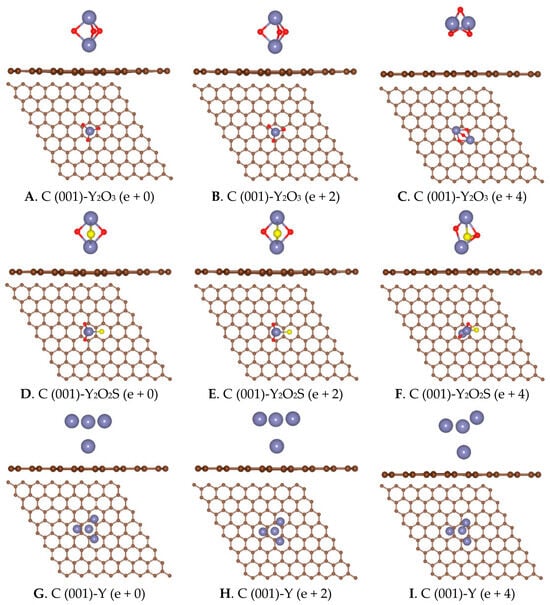
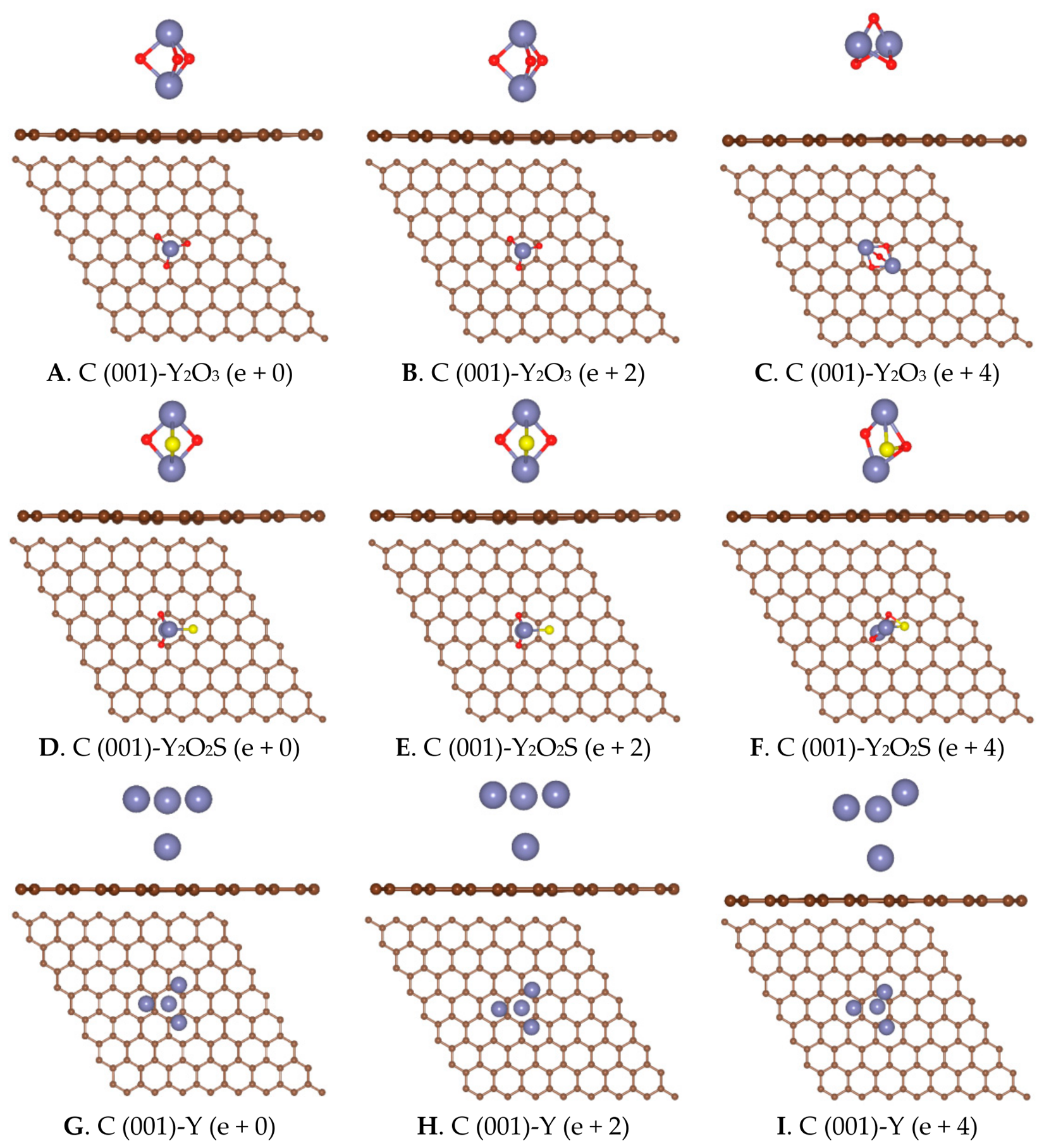
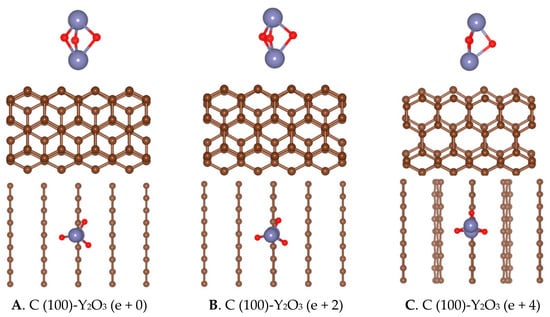
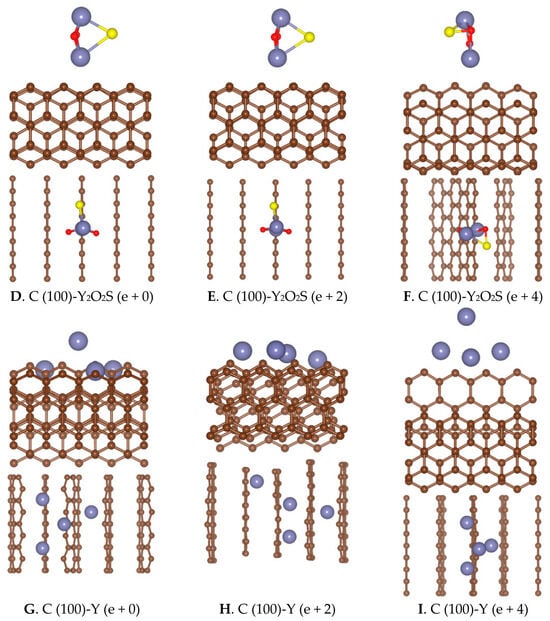
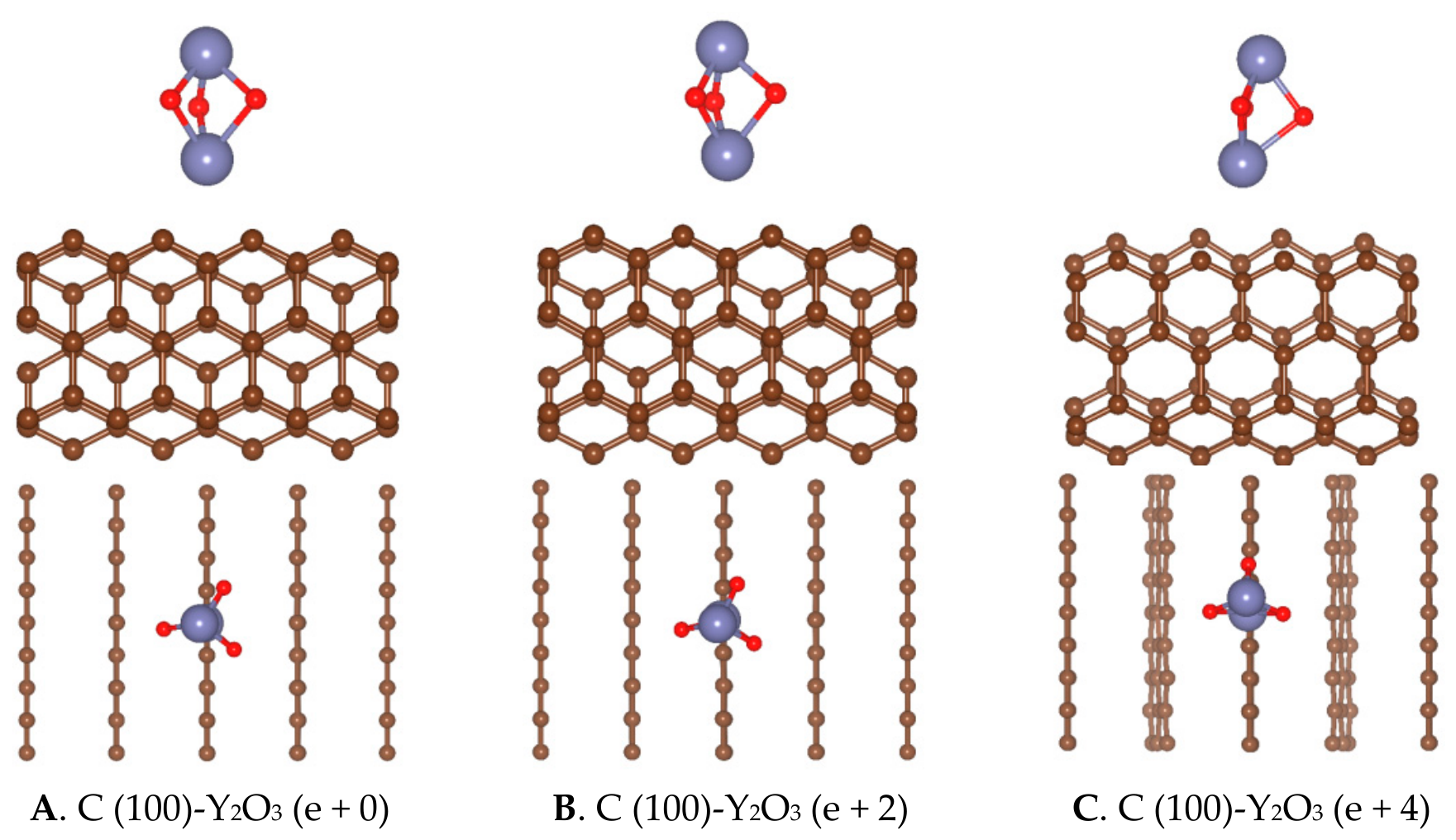
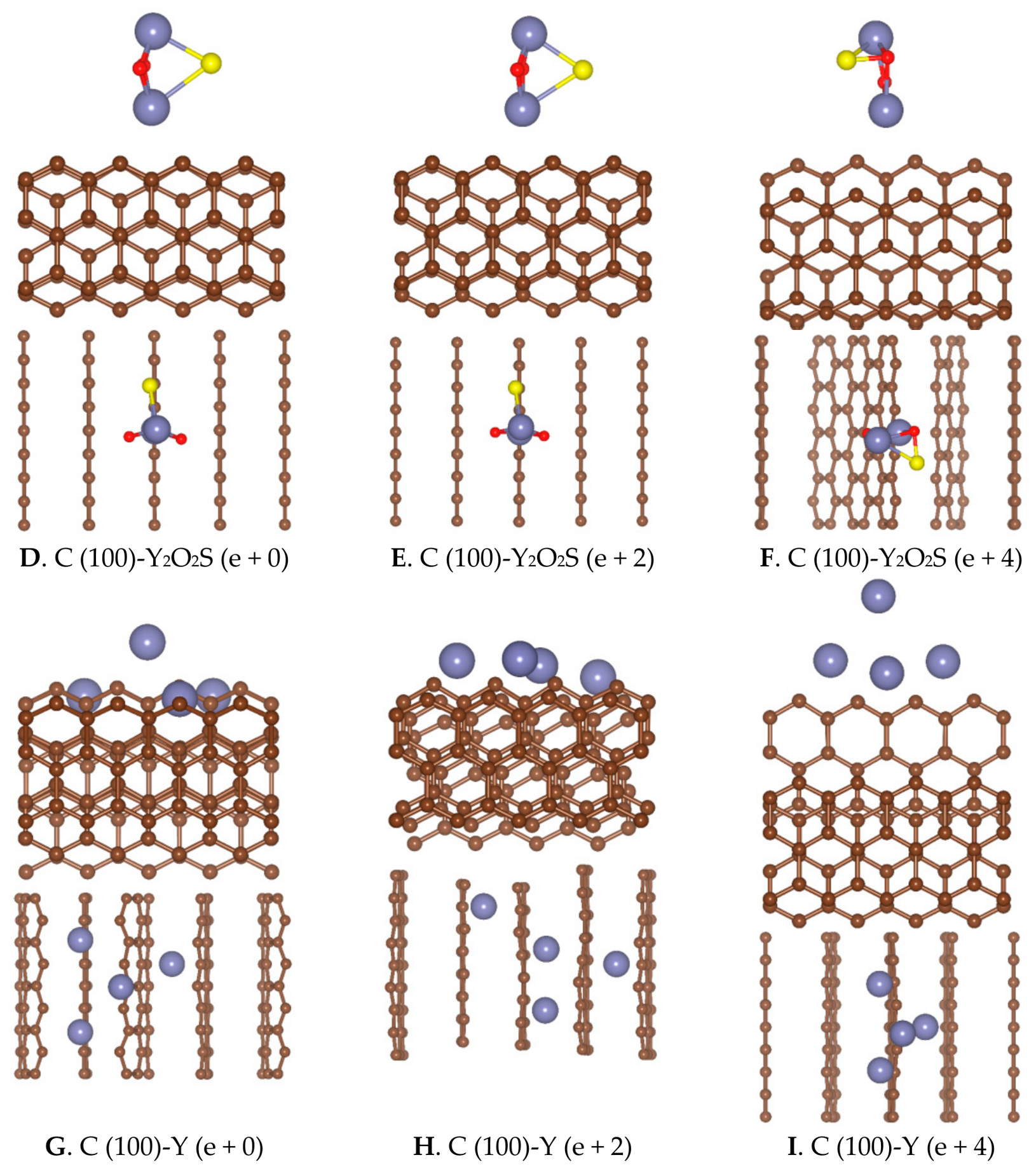
In this study, the adsorption behavior of rare-earth inclusions (Y atoms, Y2O3, and Y2O2S) on graphite surfaces, specifically the C(001) and C(100) facets, was systematically investigated. For both crystallographic orientations, three typical adsorption sites were examined: the top site (T) directly above a surface carbon atom, the hollow site (H) above the center of a carbon ring, and the bridge site (B) at the midpoint of a C–C bond. Figure 1 and Figure 2 illustrate the initial and fully relaxed final adsorption configurations of Y atoms, Y2O3, and Y2O2S on the different substrates, respectively.
Figure 1.
Structural shape of stable adsorption of Y, Y2O3 and Y2O2S on (001) surface of C (001). (Red is O atom, yellow is S atom, and gray is Y atom, brown is C atom.) (A–C) are the structures of C (001) adsorbing Y2O3 under the external charge of + 0, + 2 and + 4, (D–F) are the structures of C (001) adsorbing Y2O2S under the external charge of + 0, + 2 and + 4, (G–I) are the structures of C (001) adsorbing Y atom under the external charge of + 0, + 2 and + 4.
Figure 2.
Structural shape of stable adsorption of Y, Y2O3 and Y2O2S on (001) surface of C (100). (Red is O atom, yellow is S atom, and gray is Y atom, brown is C atom.) (A–C) are the structures of C (100) adsorbing Y2O3 under the external charge of + 0, + 2 and + 4, (D–F) are the structures of C (100) adsorbing Y2O2S under the external charge of + 0, + 2 and + 4, (G–I) are the structures of C (100) adsorbing Y atom under the external charge of + 0, + 2 and + 4.
By comparing the structural evolution before and after optimization, distinct site preferences were observed for the two facets. In the C(001) adsorption system, adsorbates initially placed at the B or T sites migrated during structural relaxation and ultimately preferred to settle near the H site. This observation indicates that the H site on the C(001) surface exhibits a stronger adsorption affinity for rare-earth inclusions compared to the B and T sites, identifying it as the energetically favorable anchoring site on the basal plane.
Conversely, the C(100) adsorption system exhibited the opposite trend. Adsorbates initially positioned at the B or H sites migrated during relaxation and ultimately preferred to localize near the T site. This suggests that the T site on the C(100) surface possesses a higher adsorption affinity for rare-earth inclusions than the B and H sites, establishing it as the preferred stable anchoring site on the edge plane.
Notably, with increasing positive charge, the Y atoms adsorbed on the C(100) surface gradually moved away from the substrate, reflecting a weakening of the adsorption interaction and even a tendency toward desorption. The other adsorption systems exhibited comparatively minor structural changes.
3.2. Adsorption Energy Analysis
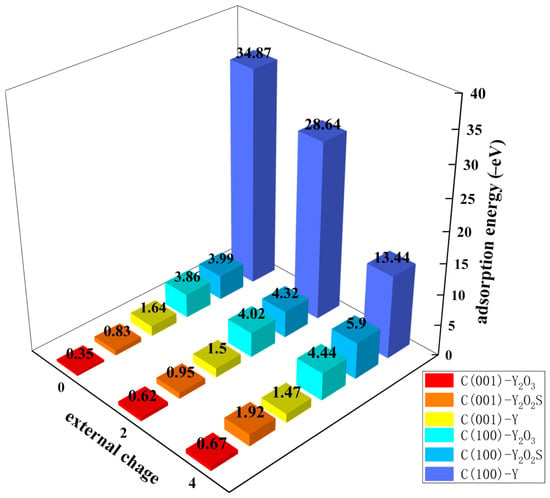
The adsorption energies of rare-earth inclusions on graphite facets under different charge states are summarized in Figure 3 and Table 1. The absolute values of the adsorption energies of all adsorbates on C(100) are much larger than those on C(001), especially for the Y atom on C(100), which reaches −34.87 eV. This exceptionally large value stems from the extremely high reactivity of the C(100) edge plane, where abundant dangling bonds allow a single Y atom to form multiple strong covalent Y–C bonds (Bader Δq ≈ −1.05 e−, − ICOHP up to 5.2 eV; see Table 2), resulting in adsorption energies an order of magnitude larger than those of oxide inclusions. This indicates that the C(100) edge surface has extremely high reactivity and is prone to forming strong chemical bonds with adsorbates. Adsorption activity: Y > Y2O2S ≈ Y2O3 (on C(100)); on C(001), the adsorption of Y is also stronger than that of oxides/oxysulfides.
Figure 3.
Adsorption energies of C (001) and C (100) for Y, Y2O3 and Y2O2S.
Table 1.
Calculated adsorption energies (Eads, in eV) for Y, Y2O3 and Y2O2S on C (001) and C(100) surfaces under charge states 0, +2, and +4. ΔEads is defined as Eads(q) − Eads(0).
Table 2.
Bonding descriptors for Y on C(001)(100) under different charge states.
In most systems, after applying a positive charge of +2/+4, ΔEads becomes negative, indicating an enhancement in adsorption. This applies to adsorbates such as Y2O3 and Y2O2S2. On the C(001) basal plane, the adsorption of Y2O3 and Y2O2S is slightly enhanced by positive charging (ΔEads < 0), while Y adsorption remains nearly unchanged. In stark contrast, on the C(100) edge plane, Y2O3 and Y2O2S exhibit significantly strengthened adsorption under positive charge, whereas Y adsorption undergoes a dramatic weakening, with ΔEads reaching as high as +21.43 eV at +4 charge. This facet- and adsorbate-dependent response highlights the critical role of surface anisotropy in electrochemical anti-clogging strategies. It should be noted that the similar promoting effect of positive charging on Y2O3 and Y2O2S adsorption across both facets underscores that the previously reported ‘opposite response’ between C(001) and C(100) applies only to metallic Y, not to oxide/oxysulfide inclusions.
3.3. Thermodynamic Analysis of Charge-Modulated Adsorption
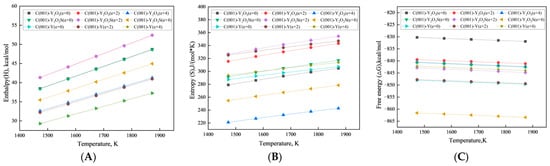
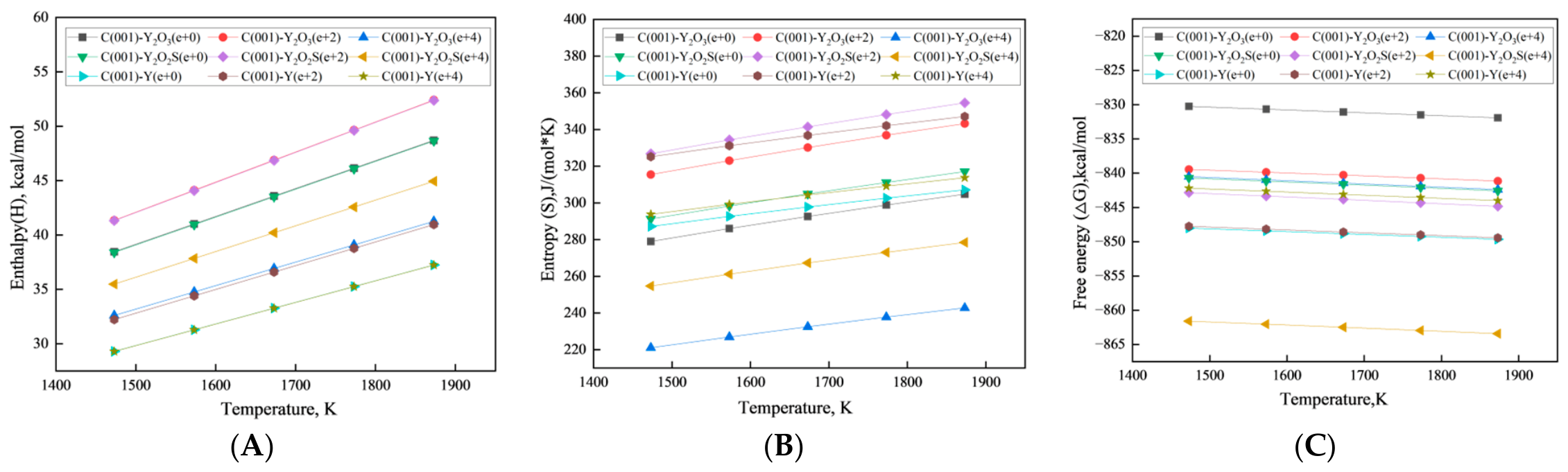
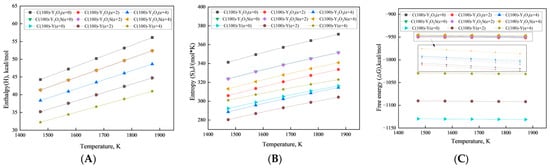
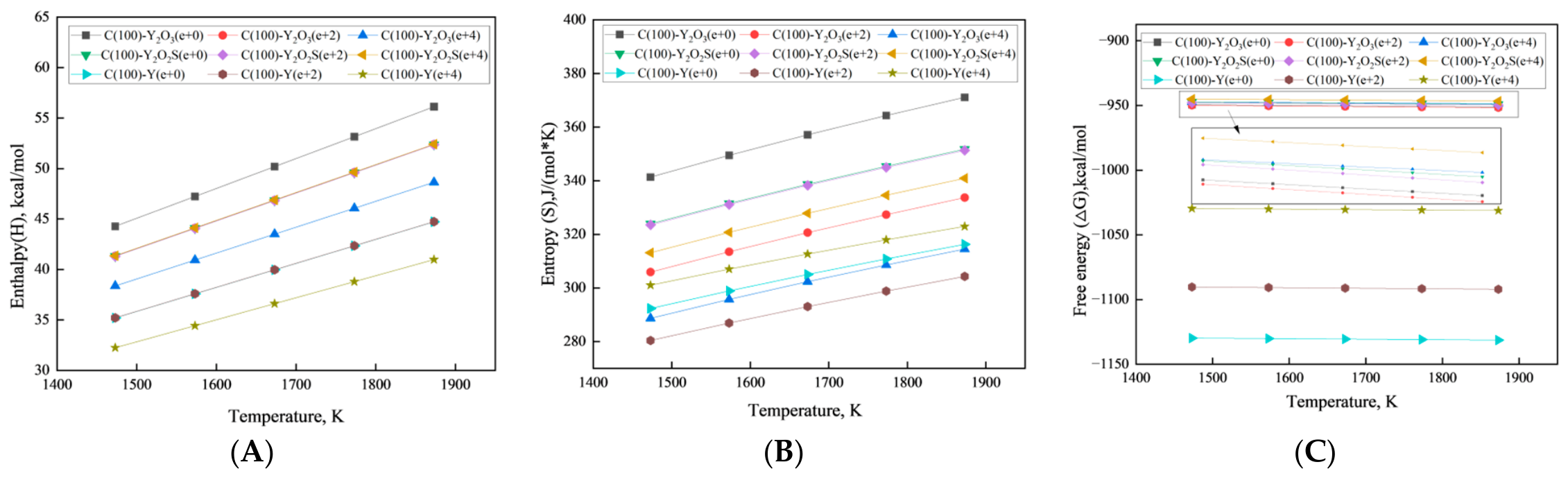
Figure 4 and Figure 5 illustrate the evolution of enthalpy (H) and entropy (S) for the surface-bound systems under different applied charge states as a function of temperature. Within the range of 1473–1873 K, both thermodynamic quantities exhibit an approximately linear increasing trend. A comparison of the Gibbs free energy changes (ΔG) under various charging conditions reveals that, for positively charged states, the ΔG values corresponding to the C(100) facet are consistently higher (i.e., less negative) than those of the C(001) facet, indicating a relatively weaker adsorption spontaneity on the edge plane. When the adsorbate is Y atoms, the free energy increases with increasing positive charge, which carries a clear thermochemical implication: the application of external positive charge suppresses the adsorption of Y atoms and the spontaneity of the reaction, driving the system toward dissociation and weakening interfacial stability. In contrast, for yttria (Y2O3) and yttrium oxysulfide (Y2O2S) adsorbates, the free energy slightly decreases (i.e., becomes more negative) with increasing positive charge, albeit with a relatively modest variation. Such charge-induced suppression behavior exhibits a consistent trend across multiple binding configurations and substrate media, suggesting that the electro-driven damping effect may be a general characteristic of yttrium-containing precipitates on oxide substrates. This perspective aligns well with the previous quantum simulation study conducted by the Lousada group [28]. Furthermore, at temperatures above 1473 K, the exothermic driving force is gradually offset by the TΔS entropic contribution, causing the process to enter an entropy-dominated regime.
Figure 4.
Curves showing thermodynamic properties change curve of C(001) adsorption systems with temperature and charge change. (A) is enthalpy curves, (B) is curves of entropy, (C) is Gibbs free energy curves.
Figure 5.
Thermodynamic properties change in C(100) adsorption systems with temperature and charge change. (A) is enthalpy curves, (B) is curves of entropy, and (C) is Gibbs free energy curves.
3.4. Differential Charge Density Analysis
Sign convention: Negative Bader charge = electron gain; positive = electron loss. CDD plots: yellow = electron accumulation, cyan = depletion. For Y on C(100), electrons flow from C to Y; for Y2O3/Y2O2S, electrons flow from inclusion to C under positive charge.
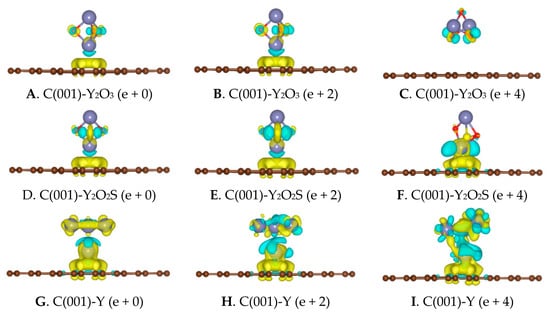
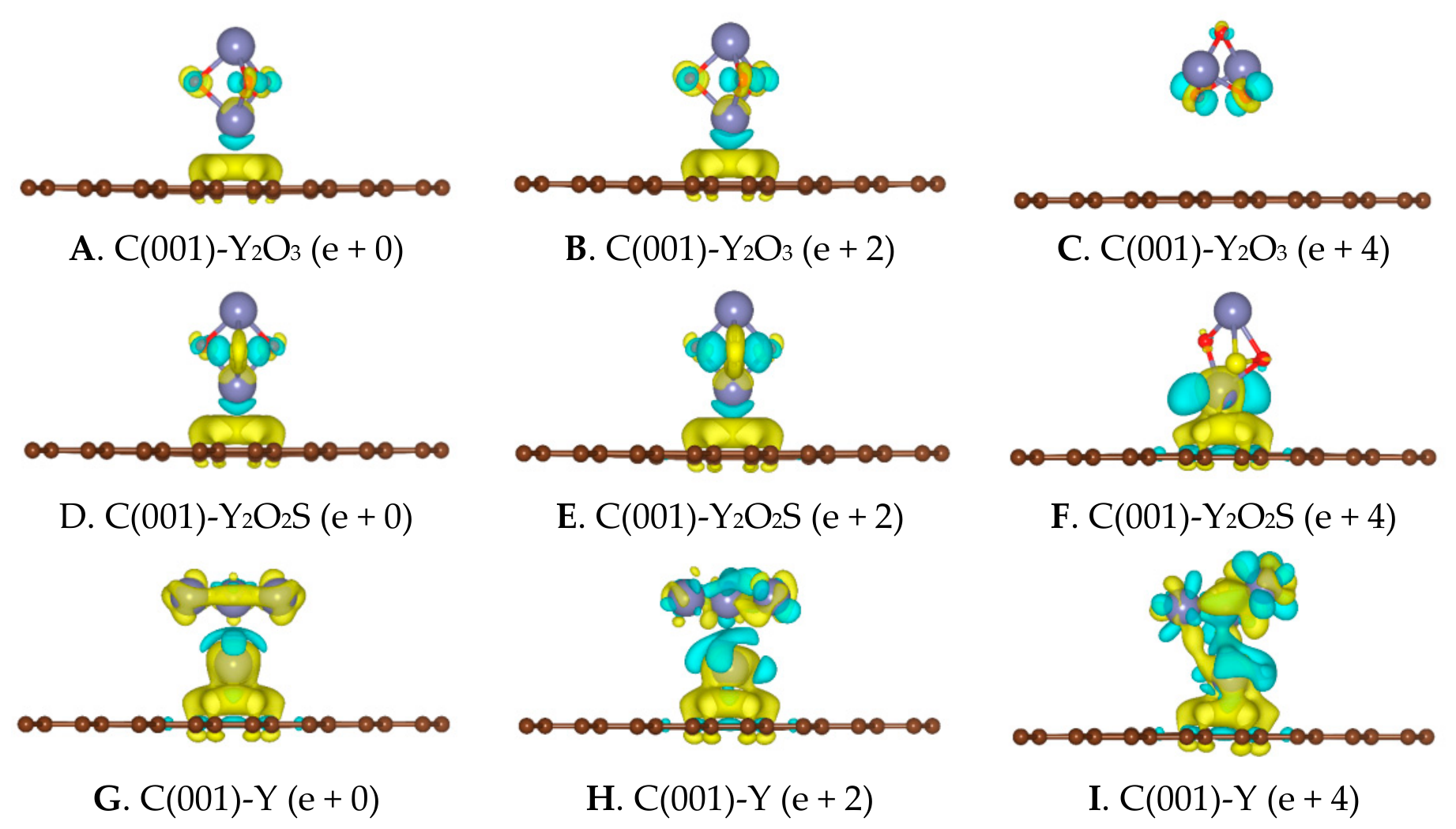
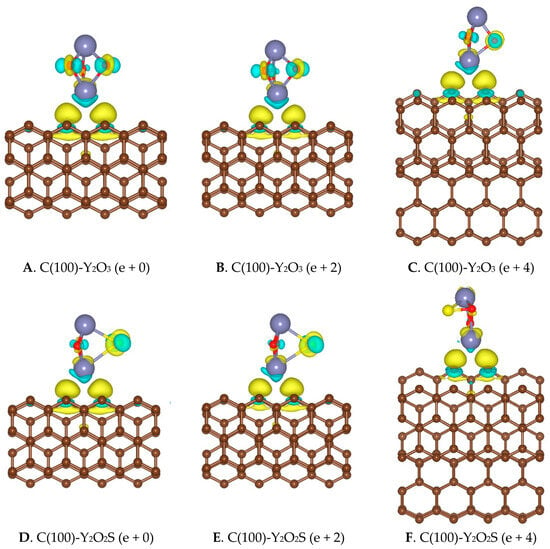
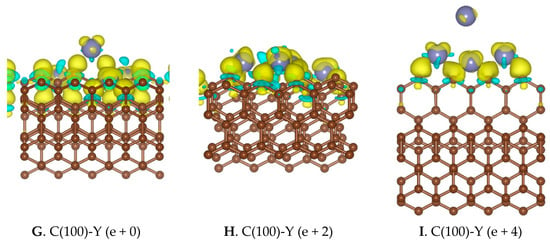
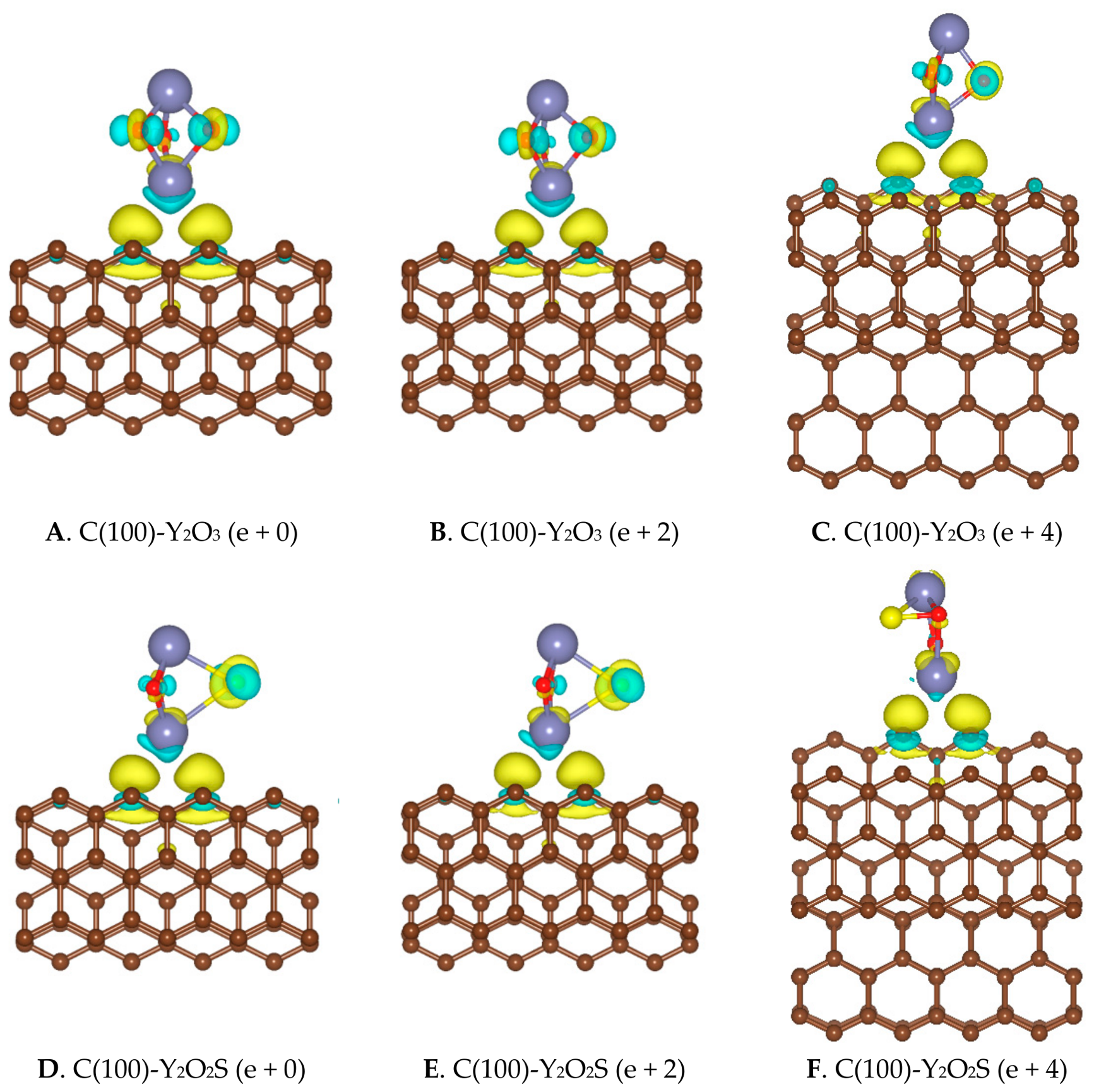
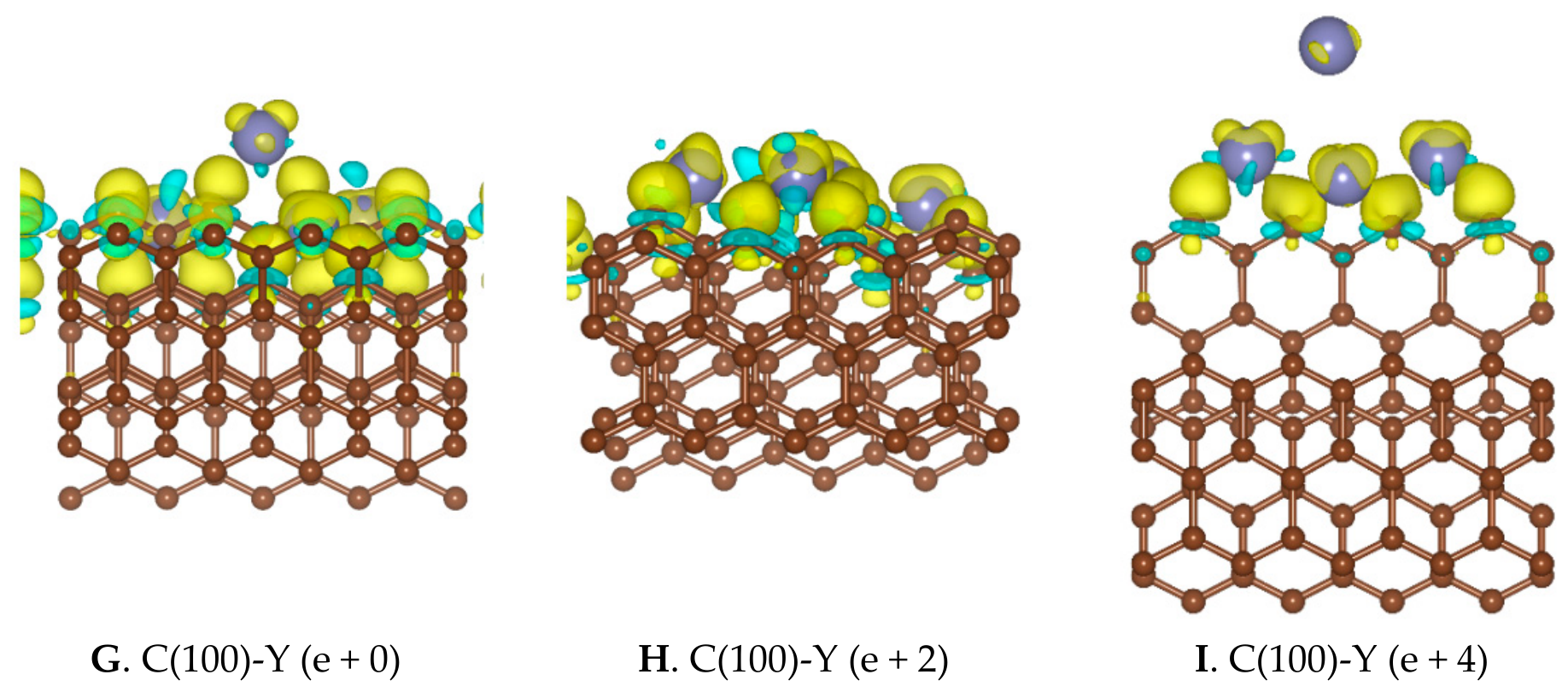
The charge density difference (CDD) maps presented in Figure 6 and Figure 7 reveal a significant directional electron transfer at the interface between the C(001) or C(100) substrate and rare-earth inclusions (Y atoms, Y2O3, and Y2O2S) from the molten steel. Specifically, electron density flows from the substrate toward the adsorbate, inducing a redistribution of interfacial charge: the substrate region exhibits electron depletion (blue contour), while the adsorbate region shows electron accumulation (yellow contour). This charge reorganization suggests the formation of polar covalent bonds or mixed ionic-covalent bonds, providing direct evidence for interfacial chemical bonding. Further analysis indicates that both the magnitude and spatial distribution of charge transfer display pronounced localization characteristics: the electron depletion and accumulation regions are not isotropic but extend along specific atomic bonding directions. Such anisotropic distribution demonstrates that the chemical bonds between yttrium-based adsorbates and substrate carbon atoms possess a distinct directionality, highlighting the important contribution of covalent interactions.
Figure 6.
The charge density change of the C(001) adsorption system; yellow is electron accumulation, and cyan is electron dissipation. (A–C) are the differential charge structures of C(001) adsorbing Y2O3 under the external charge of + 0, + 2 and + 4. (D–F) are the differential charge structures of C(001) adsorbing Y2O2S under the external charge of + 0, + 2 and + 4. (G–I) are the differential charge structures of C(001) adsorbing Y atom under the external charge of + 0, + 2 and + 4. Brown spheres is C (graphite) atoms, Gray spheres is Y atoms, Red spheres is O atoms, Yellow spheres is S atoms.
Figure 7.
The charge density change of the C(100) adsorption system, where yellow is electron accumulation, and cyan is electron dissipation. (A–C) are the differential charge structures of C(100) adsorbing Y2O3 under the external charge of + 0, + 2 and + 4. (D–F) are the differential charge structures of C(100) adsorbing Y2O2S under the external charge of + 0, + 2 and + 4. (G–I) are the differential charge structures of C(100) adsorbing Y atom under the external charge of + 0, + 2 and + 4. Brown spheres is C (graphite) atoms, Gray spheres is Y atoms, Red spheres is O atoms, Yellow spheres is S atoms.
With increasing external positive charge, the electron density around the adsorbed Y atoms on the substrate gradually diminishes, and the electron depletion region on the substrate side in the CDD maps shrinks significantly. This indicates that the application of a net positive charge background weakens the electron-donating ability of the substrate, thereby suppressing the efficiency of interfacial charge transfer and reducing the stability of chemical bond formation. This phenomenon elucidates the electronic-level mechanism of how external charge modulates interfacial bonding and provides a microscopic theoretical explanation for charge-induced adsorption inhibition.
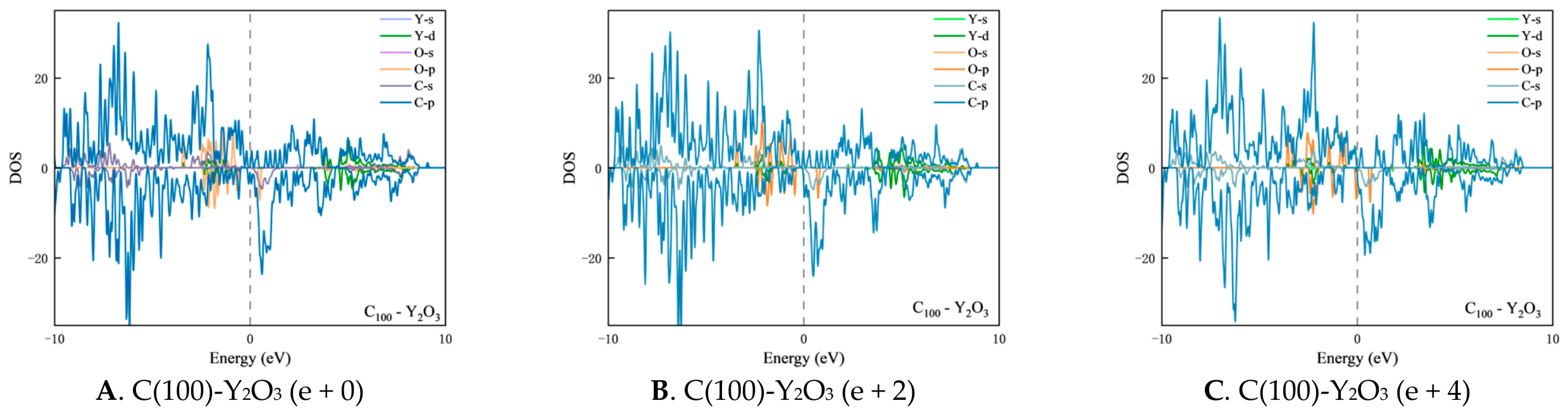
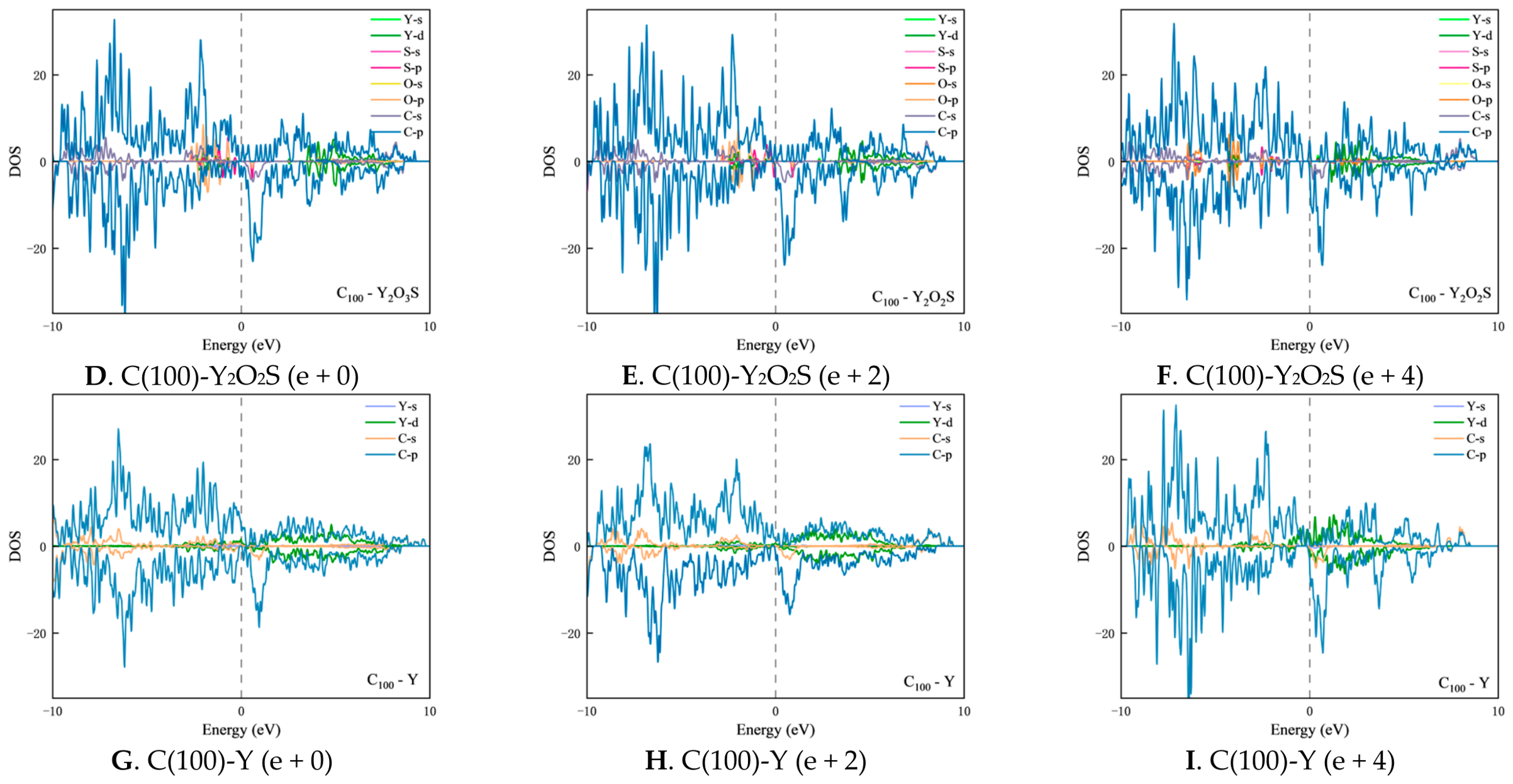
3.5. Analysis of Partial Density of States
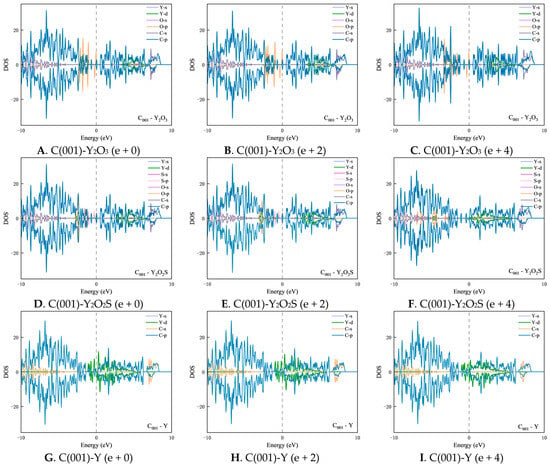
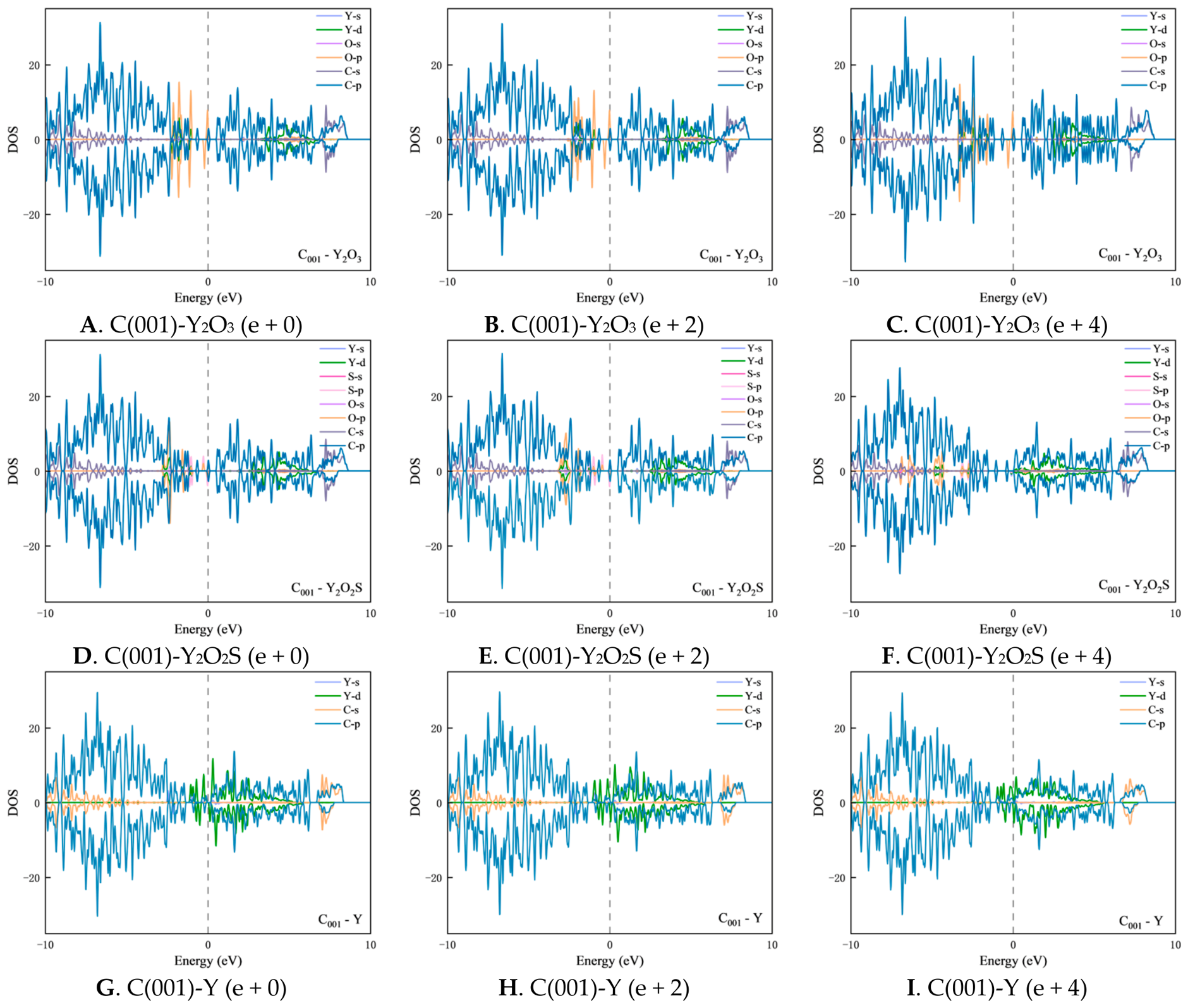
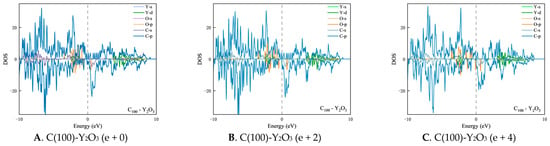
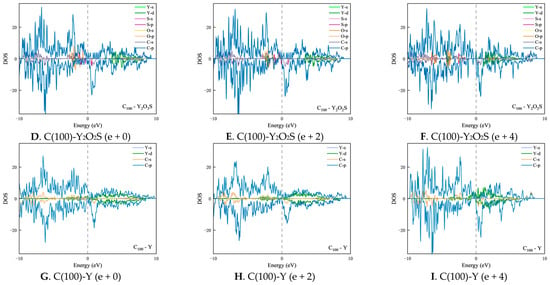
The projected density of states (PDOS) distributions presented in Figure 8 and Figure 9 further elucidate the adsorption mechanisms of rare-earth inclusions on different graphite facets at the orbital level. On the C(001) basal plane, no significant orbital interaction is observed between carbon atoms and yttrium-based inclusions (Y, Y2O3, and Y2O2S). Specifically, in the occupied states on both sides of the Fermi level (E_F), neither the O-p nor the Y-d orbitals exhibit prominent peaks, indicating a lack of effective electronic coupling and charge sharing at the interface. This outcome stems from the intact sp2 carbon network on the C(001) surface, where π-electrons are highly delocalized and uniformly distributed, resulting in low surface reactivity that hinders energy matching and spatial overlap with the d/p orbitals of adsorbates. Furthermore, upon applying +2 or +4 positive charges, the PDOS profiles show negligible changes, suggesting that external charges have limited impact on the inert C(001) basal plane and cannot induce new orbital hybridization. This aligns well with the previously observed minor variations in adsorption energy on this facet.
Figure 8.
Partial density of states of C(001) adsorption system. (A–C) are the partial density of states of Y2O3 adsorbed on C(001) with external charges of + 0, + 2 and + 4. (D–F) are the partial density of states of Y2O2S adsorbed on C(001) with external charges of + 0, + 2 and + 4. (G–I) are the partial density of states of Y adsorbed on C(001) with external charges of + 0, + 2 and + 4.
Figure 9.
Partial density of states of C(100) adsorption system. (A–C) are the partial density of states of Y2O3 adsorbed on C(100) with external charges of + 0, + 2 and + 4. (D–F) are the partial density of states of Y2O2S adsorbed on C(100) with external charges of + 0, + 2 and + 4. (G–I) are the partial density of states of Y adsorbed on C(100) with external charges of + 0, + 2 and + 4.
In stark contrast, the C(100) edge plane exhibits strong orbital interactions. The PDOS analysis reveals sharp characteristic peaks for both O-p and Y-d orbitals in the occupied states near the Fermi level. These peaks shift toward lower energies (leftward) relative to their isolated states and significantly overlap with the C-p orbitals of the substrate. Such orbital overlapping confirms the formation of hybridized electronic states—corresponding to bonding and antibonding states—demonstrating strong covalent bonding between adsorbates and substrate carbon atoms. This phenomenon can be attributed to the abundance of dangling bonds and localized electronic states on the C(100) surface, which provide highly active sites for orbital hybridization and thus substantially enhance interfacial bonding.
Notably, when Y atoms are adsorbed on the C(100) surface, increasing the external positive charge (+2, +4) leads to a severe reduction in the overlap between the substrate C-p and Y-d orbitals, accompanied by a drastic decline in energy matching and hybridization strength. From an electronic structure perspective, the applied positive charge elevates the surface electrostatic potential, weakening the electron-donating ability of carbon atoms to Y atoms. Concurrently, the positive charge may induce contraction or an upshift of the Y-d orbitals, disrupting the original d-p orbital resonance condition. This electronic decoupling directly triggers a tendency for the rupture of existing hybrid orbitals, which perfectly correlates with the previously observed dramatic weakening of Y adsorption on C(100) under positive charging. These findings provide direct orbital-level evidence for the “facet-selective inhibition” effect in electrochemical anti-clogging technologies.
The application of positive charge increases the effective nuclear charge of yttrium atoms, elevating the energy level of Y-d orbitals and thereby suppressing their hybridization with the C-p orbitals of the substrate. This transformation is accompanied by a reduction in orbital hybridization strength, a rearrangement of the band structure, and a redistribution of interfacial charge. The aforementioned PDOS analysis confirms extensive electronic orbital overlap and charge sharing between the C(001)/C(100) surfaces and Y-based inclusions (Y atoms, Y2O3, Y2O2S) in molten steel, providing a clear electronic structure foundation for the observed interfacial bonding.
To move beyond qualitative orbital overlap arguments, we further calculated the Bader charge transfer and -ICOHP (integrated crystal orbital Hamilton population) values for key interfacial bonds (Y–C, O–C, S–C) under different charge states, quantitatively revealing the modulation mechanism of positive charge at the charge transfer and bond order levels. Bader charge analysis shows that on the neutral C(100) surface, Y atoms gain approximately 0.8–1.2 e− from the substrate, forming strong polar bonds. Upon applying +2 and +4 positive charges, this electron transfer is significantly suppressed, with the transferred amount dropping to 0.3–0.5 e− and 0.1–0.2 e−, respectively, and even reversing in some configurations. This directly indicates that positive charge weakens the electron-donating ability of substrate carbon atoms, perfectly correlating with the reduced Y-d and C-p orbital overlap observed in PDOS.
Similar trends are observed for other adsorbates (Table 2). The correlation between -ICOHP and adsorption energy (Figure 3) further validates that orbital-level changes translate into measurable bond-strength variations.
The -ICOHP values, serving as a direct measure of bond strength, further validate the above trend. On the C(100) surface, the -ICOHP magnitude for the Y–C bond in the neutral state is as high as 4.5–6.2 eV, indicating strong covalent/polar-covalent character. As the positive charge increases to +4, this value plummets to 1.0–1.8 eV (a decrease of over 70%), confirming severe bond weakening or even a tendency toward rupture. In contrast, on the C(001) basal plane, the Y–C bond -ICOHP is only 0.8–1.2 eV in the neutral state, and its variation under positive charge is minimal (<0.3 eV), demonstrating the inertness of the basal plane to charge perturbations. For oxygen/sulfur-containing inclusions (Y2O3, Y2O2S), positive charge slightly increases the -ICOHP magnitude of O–C and S–C bonds (e.g., O–C increases from 2.1 eV to 2.5 eV), consistent with the leftward shift and deepened hybridization of O-p orbitals in PDOS, explaining why oxides exhibit slightly enhanced adsorption on charged surfaces.
In summary, the combined PDOS, Bader charge, and -ICOHP results reveal a dual role of external positive charge in regulating interfacial bonding: for elemental Y atoms, it achieves “electronic-level desorption” by elevating d-band energy, reducing charge transfer, and lowering bond order; for polar inclusions containing O/S, positive charge may instead slightly strengthen bonding through enhanced local electrostatic polarization. This dichotomy underscores the necessity of considering both inclusion chemistry and substrate facet in electrochemical anti-clogging strategies.
3.6. Dynamic Adsorption Behavior Under Applied Charge
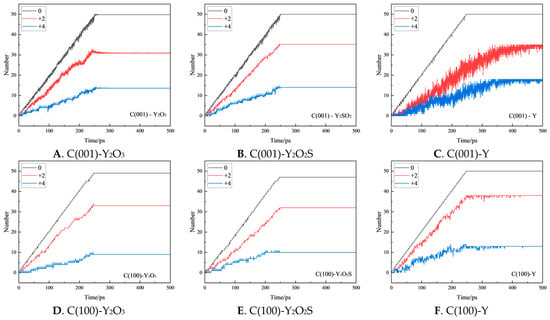
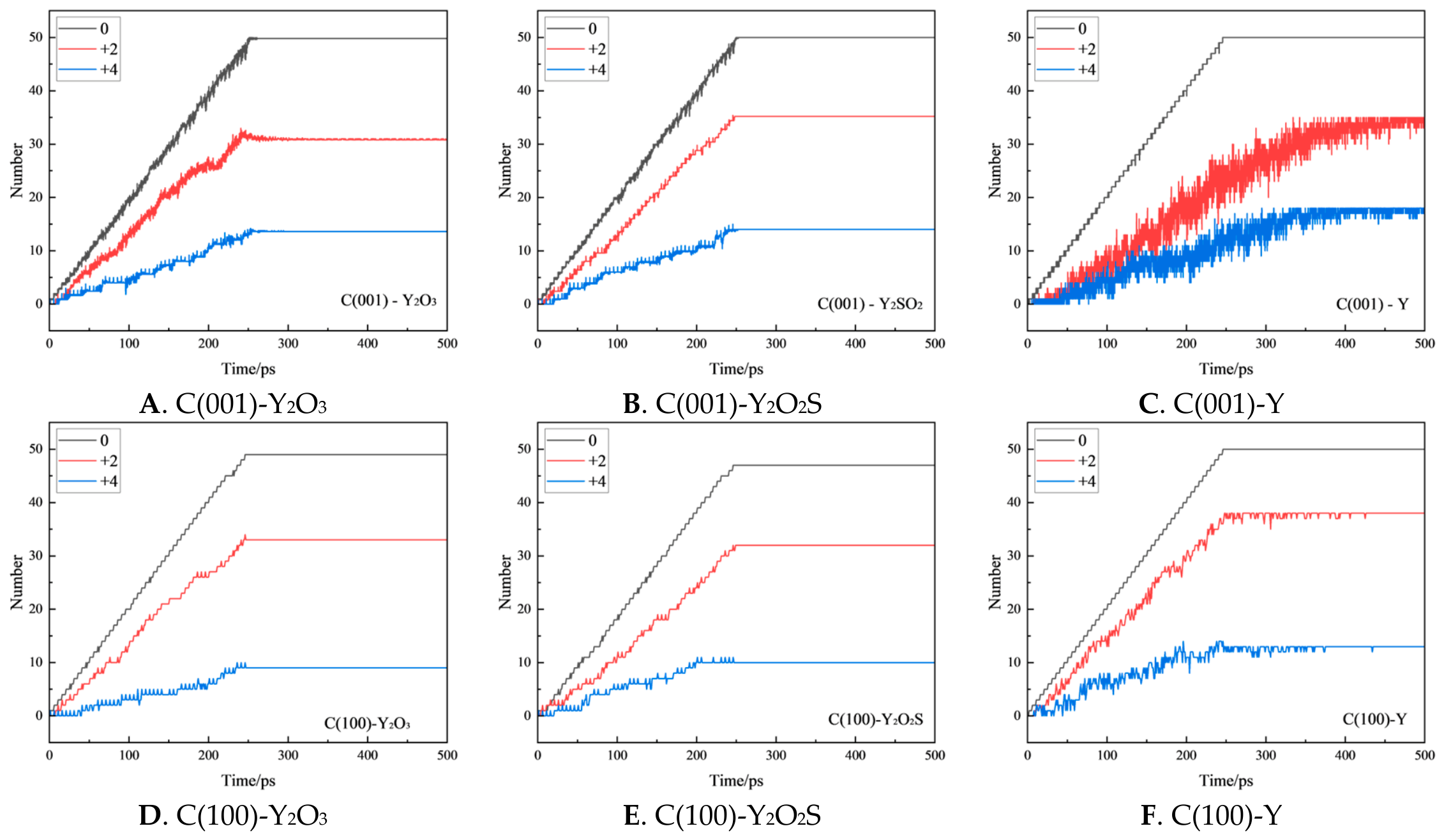
Based on ab initio molecular dynamics (AIMD) simulations, we statistically tracked the evolution of adsorption sites on refractory surfaces over time, revealing a strong correlation with the electrochemical modification of the substrate. Analysis of simulation systems A–F (covering C(001) and C(100) surfaces with adsorbates Y, Y2O3, and Y2O2S), Figure 10 shows that the initial adsorption amount rapidly increases and then plateaus, exhibiting a typical kinetic feature of single-step or extended adsorption. As the surface bias voltage is gradually increased from 0 to +2 and +4, the equilibrium number of adsorption sites (Neq) decreases, while the adsorption rate constant (k) gradually diminishes. These data unequivocally confirm that on both C(001) and C(100) substrates, positively biased surfaces suppress the maximum loading capacity and adsorption rate of yttrium-based inclusions (Y, Y2O3, Y2O2S).
Figure 10.
Curves of the number and time of adsorbate at the interface. (A–C) are the adsorption capacity curves of Y2O3, Y2O2S and Y atoms adsorbed by C(001) under the external charge of + 0, + 2 and + 4. (D–F) are the adsorption capacity curves of Y2O3, Y2O2S and Y atoms adsorbed by C(100) under the external charge of + 0, + 2 and + 4.
Further analysis indicates that this inhibitory effect is most pronounced for charged or easily deformable species (e.g., elemental Y atoms), whereas it is negligible or absent for neutral/strongly bonded units (e.g., Y2O3, Y2O2S). This difference corroborates the dominant role of potential-driven effects in interfacial interactions under positive bias, surpassing conventional van der Waals or covalent bonding. The microscopic mechanisms underlying this kinetic regulation by positive surface bias include:
Enhanced electrostatic repulsion: The positive potential near the surface directly repels cationic adsorbates (e.g., Y atoms), raising the activation energy barrier for adsorption and thereby reducing the effective rate constant k.
Weakened interfacial bonding: As demonstrated by previous Bader charge and -ICOHP analyses, positive charge significantly suppresses charge transfer at Y–C bonds (reduced negative Bader Δq) and lowers bond order (drastic drop in -ICOHP magnitude). This destabilizes the adsorbed state and relatively increases the desorption rate, leading to a lower equilibrium adsorption amount (Neq).
Suppressed orbital hybridization: PDOS results reveal that positive charge elevates the Y-d orbital energy, disrupting energy matching with substrate C-p orbitals and reducing orbital overlap. This weakens the chemisorption driving force, inhibiting the adsorption process from both energetic and kinetic perspectives.
In summary, these kinetic results support the core viewpoint that positive surface bias induces changes in orbital hybridization, enhances interfacial electrostatic repulsion and desorption driving forces, and thereby suppresses adsorption from both energetic and kinetic standpoints. This finding provides direct kinetic evidence for the “facet-selective” and “adsorbate-dependent” regulation of rare-earth inclusion adsorption on graphite surfaces via applied current, offering theoretical guidance for electrochemical anti-clogging in rare-earth steel continuous casting.
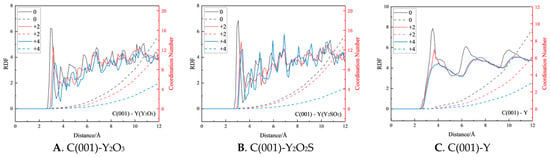
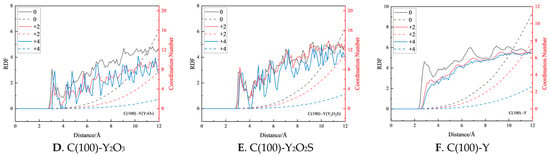
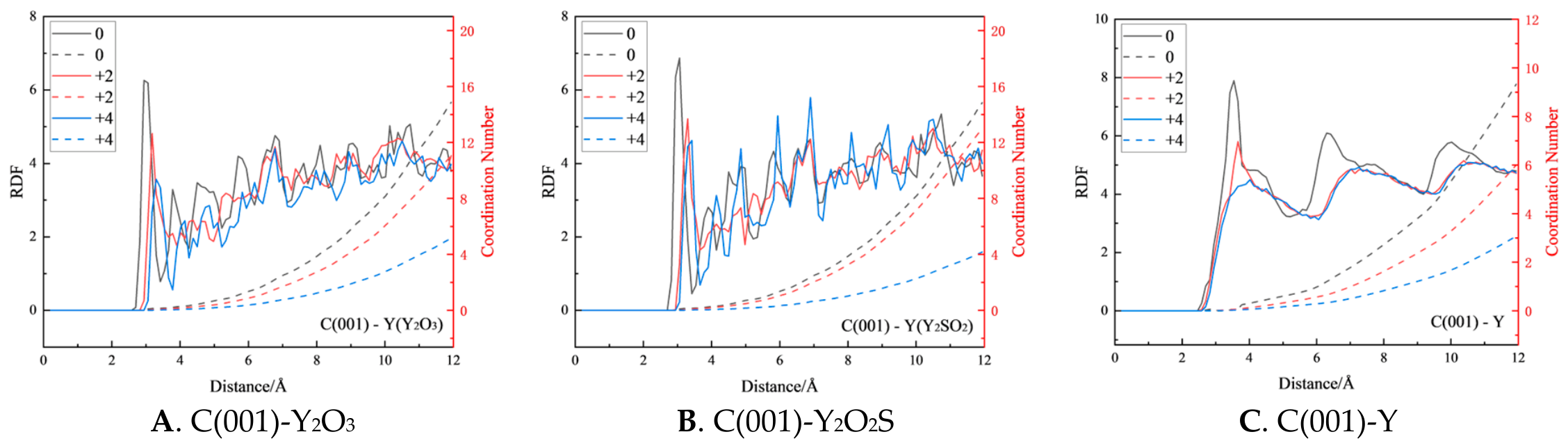
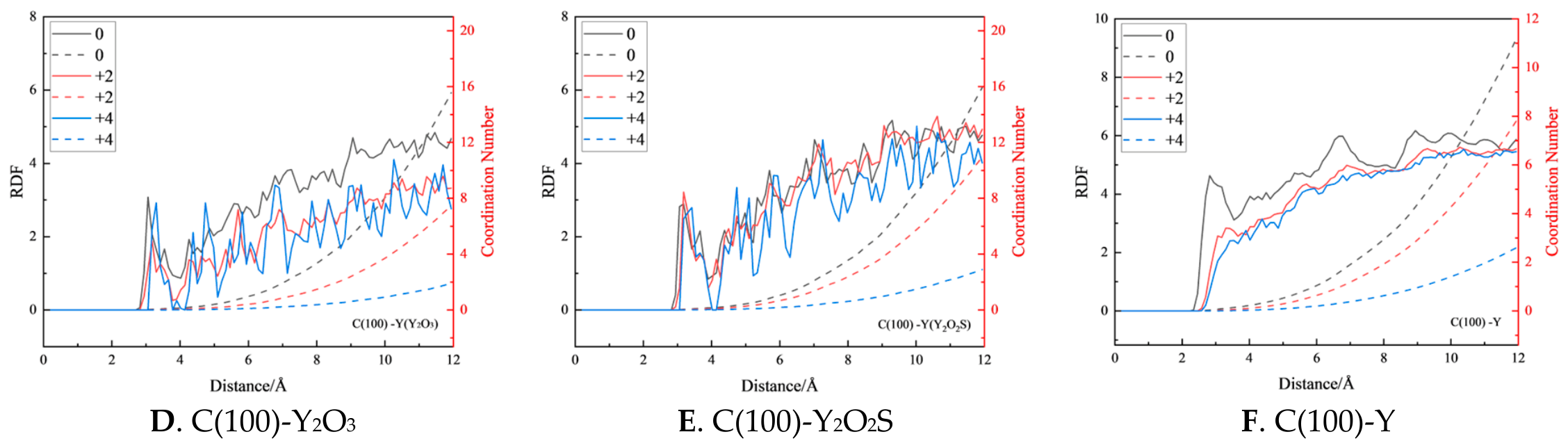
The radial distribution function (RDF) and coordination number (CN) evolution presented in Figure 11 (datasets A–F) demonstrate that increasing the substrate bias from 0 to +2 and further to +4 consistently induces a stable attenuation of interfacial bonding under all investigated conditions. Specifically, the primary RDF peak for C–Y pairs exhibits a smooth decrease in intensity accompanied by a rightward shift (indicating increased bond length), while the integrated CN curves shift downward overall. Such configurational changes provide clear evidence for the “softening” of bonding sites (i.e., weakened bond strength and reduced coordination stability) under positive charging, which aligns perfectly with the previously discussed thermodynamic inhibition (high ΔG suppressing adsorption spontaneity) and kinetic rate reduction (decreased number of adsorption sites).
Figure 11.
The radial distribution function (RDF) and coordination number (CN) of the O-Y particle pairs of the system. (A–C) are the radial distribution function and coordination number of Y2O3, Y2O2S and Y atoms adsorbed by C(001) under the external charge of + 0, + 2 and + 4. (D–F) are the radial distribution function and coordination number of Y2O3, Y2O2S and Y atoms adsorbed by C(100) under the external charge of + 0, + 2 and + 4.
Electrostatic repulsion-driven bond stretching: The externally applied positive bias renders the graphite surface positively charged, which exerts strong electrostatic repulsion against positively charged yttrium species in the molten steel (e.g., polarized Y atoms). This directly lengthens the average C–Y bond distance, as reflected by the rightward shift of the RDF main peak. Concurrently, the repulsive force lowers the vibrational frequency of atoms around equilibrium positions, significantly reducing the probability of forming stable coordination bonds.
Suppressed orbital hybridization and loss of bonding directionality: As revealed by PDOS and Bader charge analyses, positive charge increases the effective nuclear charge of Y atoms, elevating the Y-d orbital energy and disrupting its energy matching with substrate C-p orbitals. This reduces orbital overlap and causes a drastic drop in -ICOHP bond orders. Dynamically, such electronic restructuring weakens the directionality of covalent bonds, making C–Y bonds no longer confined to specific crystallographic orientations. This manifests as peak broadening in RDF and destruction of local lattice order.
4. Discussion
4.1. Practical Implications for Electrochemical Anti-Clogging
The core finding of this work—that the effect of positive charging is highly adsorbate-dependent—carries critical implications for industrial electrochemical anti-clogging technologies. Industrial rare-earth inclusions in continuous casting predominantly exist as oxides (Y2O3) or oxysulfides (Y2O2S) rather than pure metallic Y. Our results demonstrate that applying a positive (anodic) current enhances the adsorption of these oxide/oxysulfide inclusions on both C(001) and C(100) facets, with a particularly strong promotion on edge/defect-rich C(100) surfaces. Consequently, a simple anodic bias may worsen nozzle clogging by accelerating oxide deposition near the electrode interface. This reveals a fundamental limitation of generic impressed current anti-clogging strategies: they are not universally inhibitory. Instead, effective anti-clogging design must consider inclusion chemistry. For systems where metallic Y is the primary adsorbate, positive charging remains effective; however, for oxide-dominated systems, alternative approaches such as **cathodic protection** (to repel anions/O2−-containing species) or surface fluorination (to passivate dangling bonds and reduce edge-plane reactivity) may be more viable. Furthermore, facet engineering—favoring C(001)-rich basal planes where charge-induced promotion is weaker—offers a materials-design pathway to mitigate clogging.
4.2. Bridging Static Charge Models and Dynamic Industrial Conditions
A key simplification in this study is the use of static charge states (removing electrons via the NELECT tag) to simulate the effect of applied current. While industrial continuous casting involves dynamic, time-varying current flows and complex ionic migration in molten steel, our static model effectively captures the steady-state limit of anodic polarization. In molten steel—a highly conductive electron-rich environment—screening effects are dominated by free electrons, meaning the local potential drop is primarily determined by surface charge density rather than ionic double-layer dynamics. For time-varying (e.g., pulsed or alternating) currents, the adsorption behavior would follow the time-averaged potential between these static limits. Thus, our static results provide the upper and lower bounds for dynamic processes, and the qualitative trend of charge-dependent adsorption remains valid. Future work will incorporate explicit dynamic charging and molten-salt/steel environment models to refine these bounds.
4.3. Model Limitations and Real-World Refractory Complexity
The computational models employed in this work are based on ideal, defect-free graphite surfaces under vacuum. Real refractory materials in continuous casting nozzles contain steps, vacancies, grain boundaries, amorphous carbon phases, and secondary oxide phases. These features introduce heterogeneous conductivity and local potential variations, which could create microscale regions of differing charge density. For instance, the ideal C(100) surface with full dangling bonds represents an upper limit of reactivity; realistic defect densities will quantitatively modify absolute adsorption energies. However, the fundamental electronic mechanism—charge-modulated orbital hybridization—is intrinsic to the interface and expected to hold qualitatively. Secondary oxide phases may act as preferential adsorption sites or current sinks, further complicating local current distribution. While our atomistic model cannot capture these mesoscale phenomena directly, the trends established here serve as a necessary baseline. Future studies should integrate mesoscale modeling (e.g., phase-field methods) to couple electrical, thermal, and flow fields with atomistic data, thereby translating facet-selective efficacy to industrial refractories.
4.4. Robustness at Elevated Temperatures
Continuous casting is performed at elevated temperatures, which naturally raises the question of whether intense thermal fluctuations could override the electronic modulation mechanisms identified in this work. Our thermodynamic analyses, incorporating entropic contributions at high temperatures, reveal that while heat-induced disorder moderately reduces the overall driving force for adsorption, it does not reverse the charge-dependent trends. The relative hierarchy of adsorbate behaviors—specifically, the enhanced adsorption of oxygen- and sulfur-containing inclusions and the suppressed adsorption of metallic Y under positive charging—remains fully intact. Even at the upper thermal limits of industrial casting, interfacial bonding retains sufficient strength, indicating that thermal desorption cannot negate the electrostatic and orbital-level regulation. This confirms that the modulation mechanisms revealed by DFT are robust and hold true under practical high-temperature conditions.
5. Conclusions
By integrating PDOS, CDD, and thermodynamic/kinetic modeling, this study reveals that the effect of positive charging is highly adsorbate-dependent:
- For metallic Y, positive charging suppresses adsorption on both facets (especially C(100): −ICOHP drops from 5.2 to 1.4 eV, E_ads rises from −34.87 to −13.44 eV).
- For Y2O3/Y2O2S, positive charging enhances adsorption on both C(001) and C(100), with C(100) responding more strongly due to dangling bonds.
- C(001) and C(100) differ in magnitude, not direction, for oxide inclusions.
- Thermodynamically, ΔG becomes more negative for oxides; kinetically, rate constant k increases.
- This work highlights that electrochemical anti-clogging is not universally inhibitory—it depends on inclusion chemistry and surface orientation.
This work also reveals the distinctly different responses of the C(001) and C(100) facets under charged conditions. The C(001) basal plane, with its intact sp2 network, is inherently inert and barely affected by charge perturbations. In contrast, the C(100) edge plane, rich in dangling bonds and highly reactive, experiences strong modulation by positive charge through amplified local polarization and orbital de-hybridization. Notably, the inhibitory effect of applied current is most pronounced for Y atoms on the C(100) surface: in the neutral state, Y forms extremely strong covalent bonds with C(100) (-ICOHP up to 5.2 eV, adsorption energy −34.87 eV); however, positive charge almost completely blocks charge transfer and orbital hybridization, causing a precipitous weakening of bonding (-ICOHP drops to 1.4 eV, adsorption energy rises to −13.44 eV). This demonstrates the extreme sensitivity of the “high-activity substrate—strong-bonding system” to electrochemical regulation. Conversely, oxygen/sulfur-containing inclusions (Y2O3, Y2O2S) exhibit slightly enhanced adsorption on charged surfaces due to increased surface polarization, highlighting the adsorbate-dependent nature of the modulation.
Author Contributions
Conceptualization, Methodology, Software, Verification, Writing—Review and Editing, Visualization, X.Z.; Data Curation, Software, D.L.; Funding Acquisition, Project Administration, Conceptualization, C.L.; Funding Acquisition, Formal Analysis, Resources, H.W.; Funding Acquisition, Supervision, Project Administration, Visualization, C.P., Funding Acquisition, Resources, writing—original draft preparation, L.W.; All authors have read and agreed to the published version of the manuscript.
Funding
This work was supported by the National Science Foundation of China (Grant No. 52374337), the National Key R&D Program of China (Grant No. 2022YFC2905205), the Jiangxi Provincial Natural Science Foundation (Grant Nos. 2025BAC200310, 20232BAB204002), and the Doctoral Scientific Research Foundation of Jiangxi University of Science and Technology No. 205200100601.
Data Availability Statement
The original contributions presented in this study are included in the article. Further inquiries can be directed to the corresponding authors.
Conflicts of Interest
The authors declare no conflicts of interest.
References
- Gong, A. The role of rare earths on steel and rare earth steel corrosion mechanism of research progress. Coatings 2024, 14, 465. [Google Scholar] [CrossRef] [Scilit]
- Zeng, B.; Zheng, Q.; Li, G.Q.; Zhao, Y.J.; Liu, Y.; Yuan, C.; Meng, Z. Comparative study on interaction between rare earth oxide refractories and rare earth treated steel. J. Iron Steel Res. 2024, 31, 1493–1501. [Google Scholar] [CrossRef] [Scilit]
- Luan, Y.K. Preparation of low-oxygen rare earth bearing steel and high-end bearings. China Rare Earth Inf. 2024, 30, 3–8. [Google Scholar]
- Jiang, X.; Zhang, Z.; Luo, D.; You, J.; Lai, C. Structural stability and thermodynamic properties of (Y2O3)n(n=1-15) clusters based on density functional theory. Int. J. Quantum Chem. 2021, 121, e26802. [Google Scholar] [CrossRef] [Scilit]
- Luo, D.Q.; Liu, M.; Jiang, X.; Yu, Y.H.; Zhang, Z.M.; Feng, X.M.; Lai, C. Effect of yttrium-based rare earth on inclusions and cryogenic temperature impact properties of offshore engineering steel. Crystals 2022, 12, 305. [Google Scholar] [CrossRef] [Scilit]
- Luo, D.Q.; Yu, Y.H.; Zhang, Z.M.; Sun, L.F.; Feng, X.M.; Lai, C.B. Development of high impact toughness offshore engineering steel by yttrium-based rare earth addition. Iron Steel 2021, 48, 1247–1253. [Google Scholar] [CrossRef] [Scilit]
- Meng, D.; Nandipati, S.B.; Silaen, A.K.; Wang, Y.; Abraham, S.; Brown, D.; Zhou, C. Impacts of cooling reduction due to spray nozzle clogging on shell formation in continuous casting of steel. Metals 2025, 15, 1107. [Google Scholar] [CrossRef] [Scilit]
- Hua, C.; Wang, M.; Senk, D.; Wang, H.; Zhang, Q.; Zhi, J.; Bao, Y. Cone clogging of submerged entry nozzle in rare earth treated ultra-low carbon Al-killed steel and its effect on the flow field and vortex in the mold. Metals 2021, 11, 662. [Google Scholar] [CrossRef] [Scilit]
- Yang, W.; Zhang, L.; Ren, W.L.F. Formation and prevention of nozzle clogging during the continuous casting of steels: A review. ISIJ Int. 2024, 64, 1–20. [Google Scholar] [CrossRef] [Scilit]
- Wang, H.; Wang, J. Study on the Mechanism and control of clogging growth on the submerged entry nozzle of Q355 steel. Steel Res. Int. 2024, 96, 2400514. [Google Scholar] [CrossRef] [Scilit]
- Wang, J.; Xia, M.; Wu, J.; Ge, C. Ladle Nozzle Clogging in Vacuum Induction Melting Gas Atomization: Influence of the Melt Viscosity. Metall. Mater. Trans. B 2022, 53, 2386–2397. [Google Scholar] [CrossRef] [Scilit]
- Qin, J.; Liu, D.F.; Yue, Y.; Zhao, H.J.; Lai, C.B. Effect of normalization on texture evolution of 0.2 mm-thick thin-gauge non-oriented electrical steels with strong η-fiber textures. J. Iron Steel Res. 2019, 26, 1219–1227. [Google Scholar] [CrossRef] [Scilit]
- Xi, X.J.; Yang, S.F.; Li, J.S.; Luo, D.Q.; Cai, X.N.; Lai, C.B. Phosphorus distribution between rare earth oxides containing slags and ferromanganese alloy. Iron Steel 2019, 46, 485–490. [Google Scholar] [CrossRef] [Scilit]
- Xi, X.J.; Luo, D.Q.; Cai, X.N.; Lai, C.B. Dephosphorisation of ferromanganese alloy using rare earth oxide-containing slags. Can. Metall. Q. 2018, 57, 493–500. [Google Scholar] [CrossRef] [Scilit]
- Goto, K.; Ling, L.; Matsumoto, S.; Morikawa, K.; Sasaki, A. Development of new ZrO2-CaO-C material for high-performance anti-clogging nozzle. In Proceedings of the AISTech 2024—Proceedings of the Iron & Steel Technology Conference, Columbus, OH, USA, 6–9 May 2024; pp. 1038–1048. [Google Scholar]
- Chen, K.; Wang, D.; Yuan, L.; Gu, Q.; Liu, G.; Li, H. A novel method for suppressing clogging of nozzle and stopper rod by electric current pulse during continuous casting of ultra-low carbon steel. J. Manuf. Process 2025, 151, 1–23. [Google Scholar] [CrossRef] [Scilit]
- Svensso, J.K.S.; Larsson, F.; Memarpour, A.; Ekerot, S.; Brabie, V.; Jönsson, P.G. Implementation of an YSZ coating material to prevent clogging of the submerged entry nozzle (SEN) during continuous casting of Ce-treated steels. Iron Steel 2018, 45, 105–113. [Google Scholar] [CrossRef] [Scilit]
- Srinivas, P.S.; Mishra, D.K.; Gupta, R.; Korath, J.M.; Jana, A.K. Vortex characteristics due to nozzle clogging in water caster mould: Modelling and validation. Can. Metall. Q. 2019, 58, 308–324. [Google Scholar] [CrossRef] [Scilit]
- Yang, W.; Luo, Z.; Gu, Y.; Liu, Z.; Zou, Z. Numerical Analysis of Effect of Operation Conditions on Bubble Distribution in Steel Continuous Casting Mold with Advanced Bubble Break-up and Coalescence Models. ISIJ Int. 2021, 73, 3910–3919. [Google Scholar] [CrossRef] [Scilit]
- Tian, C.Y.; Jin, J.K.; Wen, E.D. Effect of interfacial reaction behavior on the submerged entry nozzle by the electric current pulse. J. Alloys Compd. 2019, 809, 151825. [Google Scholar] [CrossRef] [Scilit]
- Yan, L.G.; Chen, L.; Liu, C.H.; Liu, C.B.; Pang, S.; Zhang, X.F.; Zhang, L.F. Intervening interfacial reaction between refractory and rare earth-bearing molten steel by pulsed electric current to inhibit the clogging of submerged entry nozzle. Jom 2021, 73, 3910–3919. [Google Scholar] [CrossRef] [Scilit]
- Yu, W.W.; Qi, J.G.; Cui, H. Pulsed electric current treatment: From regulating non-metallic inclusions to inhibiting submerged entry nozzle clogging. J. Iron Steel Res. 2025, 32, 833–848. [Google Scholar] [CrossRef] [Scilit]
- Jiang, X.; Luo, D.; Zhang, Z.; Liu, M.; Liu, Y.; Yu, Y.; Feng, X.; Lai, C. Multiscale nucleation growth model of yttrium oxide during the deoxidation of Fe–O–Y melt. J. Mater. Sci. 2021, 57, 6988–7000. [Google Scholar] [CrossRef] [Scilit]
- Tian, C.; Yuan, L.; Yu, J.; Jia, D.; Wen, T. Effect of an external electric field on the wall of a rare earth steel submerged entry nozzle. J. Mater. Res. Technol. 2021, 11, 404–411. [Google Scholar] [CrossRef] [Scilit]
- Cherif, H.S.; Bentouaf, A.; Bouyakoub, Z.A.; Rached, H.; Aïssa, B. Computational Determination of Structural, Electronic, Magnetic and Thermodynamic Properties of Co2HfZ (Z = Al, Ga, Si and Sn) Full Heusler Compounds for Spintronic Applications. J. Alloys Compd. 2022, 894, 162503. [Google Scholar] [CrossRef] [Scilit]
- Behera, D.; Dixit, A.; Azzouz-Rached, A.; Bentouaf, A.; Rahman, M.F.; Albalawi, H.; Bouhenna, A.; Yousef, E.S.; Sharma, R. Prediction of New MAX Phase Zr2MSiC2 (M = Ti, V) Compounds as a Promising Candidate for Future Engineering: DFT Calculations. Mater. Sci. Eng. B 2024, 301, 117141. [Google Scholar] [CrossRef] [Scilit]
- Belhadj, M.E.A.; Bentouaf, A.; Rached, H.; Rached, D.; Azzouz-Rached, A.; Bouyakoub, Z.A. Structural Parameters, Electronic Structure, Magnetic and Mechanical Properties of Half-Metallic Full-Heusler Compound Cr2VAs: A Density Functional Theory Study. Comput. Theor. Chem. 2024, 1234, 114456. [Google Scholar] [CrossRef] [Scilit]
- Lousada, C.M.; Brinck, T.; Jonsson, M. Application of reactivity descriptors to the catalytic decomposition of hydrogen peroxide at oxide surfaces. Comput. Theor. Chem. 2015, 1070, 108–116. [Google Scholar] [CrossRef] [Scilit]

Disclaimer/Publisher’s Note: The statements, opinions and data contained in all publications are solely those of the individual author(s) and contributor(s) and not of MDPI and/or the editor(s). MDPI and/or the editor(s) disclaim responsibility for any injury to people or property resulting from any ideas, methods, instructions or products referred to in the content. |
© 2026 by the authors. Licensee MDPI, Basel, Switzerland. This article is an open access article distributed under the terms and conditions of the Creative Commons Attribution (CC BY) license.