


Abstract
China’s iron and steel industry relies heavily on imported ores, whose hematite/limonite blending ratio markedly affects sinter strength and metallurgical properties; however, how the ratio acts through microscopic mineral phases remains insufficiently clarified. To this end, six imported iron ore fines were characterized for their high-temperature bonding phase properties (compressive strength of compacts roasted at 1280 °C), and seven gradient ratio schemes (30–60% limonite) were designed for sinter pot tests; the sinters were analyzed by XRD, optical microscopy and SEM-EDS. The bonding phase strength of hematite-type fines was on average higher than that of limonite-type fines (1364.14 N vs. 1011.15 N), although some limonite fines are heavier than some hematite fines. Techno-economic indices and metallurgical properties responded asynchronously to the ratio: the highest yield, productivity coefficient and vertical sintering speed were obtained at 45% limonite, whereas RDI+6.3 deteriorated sharply at 60% limonite (falling from 51.97% at 55% to 43.16%). Fe2O3 content first decreased and then increased with the limonite ratio, and reduction degradation was governed by the mode of occurrence of Fe2O3 rather than its total content; skeletal secondary hematite recrystallized from the liquid phase triggered crack propagation during reduction. Accordingly, limiting the limonite proportion to 40–45% (not exceeding 55%) while promoting acicular silico-ferrite of calcium and aluminum (SFCA) and suppressing skeletal secondary hematite is recommended for industrial ore blending.
1. Introduction
China’s iron and steel industry relies heavily on imported iron ores, among which hematite and limonite are the principal ore types for sintering production. Moreover, the microscopic mineral phase determines the yield, strength and metallurgical properties of the sinter [1], while the phase composition evolves from the raw material ratio through high-temperature processes such as decomposition of water of crystallization, assimilation reactions, liquid phase generation and consolidation during cooling. Therefore, elucidating the correspondence between the hematite/limonite ratio and sinter properties at the microscopic mineralogical level is of great theoretical significance and engineering value for optimizing the ore blending structure and realizing the safe utilization of limonite at high proportions (up to 60% limonite in this work).
The differences in ore characteristics are the starting point of this evolution. Limonite exhibits a low assimilation temperature but poor bonding phase strength, whereas hematite shows high bonding phase strength and a strong calcium ferrite formation ability, so that the two ore types are complementary [2,3,4]. Sintering tests show that when the limonite proportion increases from 33% to 50%, the content of acicular–columnar calcium ferrite decreases from 50.13% to 41.35% and its morphology becomes fine and fibrous, with a corresponding decrease in the tumbler strength [2,3,4], whereas optimizing the moisture and coke breeze dosage allows the limonite proportion to be raised to 60% with acceptable indices [5]. In addition, goethitic limonite ores have a low bulk density and high porosity, which tend to limit sinter productivity, while their easy-melting nature favors melt formation and yield retention [6]; replacing hematite sinter feed with goethite sinter feed at proportions below 30% does not markedly deteriorate the chemical and metallurgical properties of the sinter [7].
The ratio differences are transmitted to the consolidation process mainly through liquid phase behavior. The loose structure and large liquid absorption depth of limonite weaken the effective liquid phase fluidity and the consolidation strength of the sintered body [8], and the amount of liquid phase, together with its formation temperature range, determines the strength and mineral phase structure of sinter to a large extent [9]. The melt chemical composition and the maximum sintering temperature govern the tumbler strength and yield by reshaping the pore structure of the bonding phase [10], and Que et al. [11] further quantified the contribution of the quantity and quality of the bonding phase to sinter strength, identifying bonding phase strength as the primary governing factor, followed by the fluidity of the original melt.
The composition and morphology of the mineral phases formed upon melt cooling constitute the structural origin of the property differences. In hematite-type sinter, the formation rules of calcium ferrite with different morphologies have been clarified: the cooling stage is the main period of calcium ferrite formation, whereas skeletal hematite precipitated at the high-temperature stage is an important inducement of low-temperature reduction degradation (RDI) [12]. The principal bonding phase of sinter is silico-ferrite of calcium and aluminum (SFCA), whose phase chemistry, crystal structure and formation conditions have been systematically reviewed [13]; the solid-state formation of secondary hematite has been shown to be quantitatively correlated with the reduction degradation performance [14]; and maintaining the SiO2 mass fraction within 4.52–5.12% favors the formation of SFCA and silicate bonding phases, simultaneously improving the yield, tumbler index and RDI+3.15 [15].
The differences in mineral phase structure are ultimately reflected in macroscopic property indices. A quantifiable correlation exists between the fundamental properties of iron ore fines and the tumbler index, and optimized ore blending based on this correlation improves the tumbler strength and the productivity coefficient simultaneously [16,17]; sinter pot tests further show that the composition of the ore mixture alters the tumbler strength, reducibility, RDI and softening–melting properties at the same time, corresponding to different microstructures [18,19]. Notably, the high-temperature characteristics of blended ores cannot be simply superposed linearly from those of individual ores, with the largest additive deviation occurring in liquid phase fluidity and bonding phase strength [20]. This implies that the blending scheme can hardly be extrapolated from single-ore data, but must rely on direct experimental observation of the liquid phase behavior and mineral phase evolution of the blend itself.
Overall, existing studies have focused either on the evaluation of the fundamental characteristics of individual ore types (such as assimilation temperature, liquid phase fluidity and bonding phase strength) or on single-factor regulation of liquid phase behavior and chemical composition, and most of them are based on one or two ratio points or a simple comparison of two or three ores. Systematic studies that cover the full hematite/limonite ratio gradient within one ore system, connect the bonding phase characteristics of individual ores with the mineral phases of blended sinters, and establish a closed-loop “ratio–macroscopic performance–microscopic mineral phase” relationship remain lacking, so that the determination of the hematite/limonite ratio still relies largely on experience. To this end, this work takes six commonly used imported hematite and limonite ores as raw materials: the differences in the high-temperature bonding phase characteristics of individual ores are first identified, and seven gradient ratio schemes are then designed for sinter pot tests, so as to systematically investigate the influence of the hematite/limonite ratio on sinter properties and its underlying microscopic mechanism along the pathway of “raw material ratio–macroscopic sintering performance–microscopic mineral phase structure”, and to provide a basis for industrial ore blending.
2. Raw Materials and Research Methods
2.1. Raw Materials
Six types of imported iron ore fines were selected in this test, among which Super Special Fine (SS, Fortescue Metals Group (FMG), Port Hedland, Australia), Jimblebar Blend Fines (JMB, BHP Iron Ore Pty Ltd., Newman, Australia) and Pilbara Blend Fines (PB, Rio Tinto, Tom Price, Australia) belong to the limonite group, while PFC1 Concentrate (PFC1, Vale, Carajás, Brazil), Carajas Sinter Feed (CS, Vale, Carajás, Brazil) and Newman Fines (NM, BHP Iron Ore Pty Ltd, Newman, Australia) fall into the hematite group. PFC1 is not a magnetite concentrate: optical examination and XRD identify it as martite, a pseudomorph of hematite after magnetite, in which iron occurs predominantly as Fe2O3 rather than as Fe3O4, so the exothermic oxidation of magnetite is not a significant factor for this ore. The group names used here denote the dominant iron-bearing mineral rather than a single phase; PB and JMB, for example, are hematite–goethite blends. FeO was not determined and no quantitative modal analysis of the raw ores was carried out; the classification above rests on the chemical composition (TFe, LOI) and on phase identification by XRD and optical microscopy. The main chemical compositions and particle size distributions of these iron ore fines are shown in Table 1 and Table 2, respectively. The limonite group shows lower total iron (TFe) grades but, on average, higher SiO2, Al2O3 and water of crystallization contents, whereas the hematite group exhibits generally higher TFe grades, lower SiO2 and Al2O3 contents and lower LOI. In addition, the −0.15 mm fraction of PFC1 is as high as 85%, which would be expected to impair granulation; the limonite group and NM possess favorable 1–6.3 mm fractions, which would favor granulation; CS and JMB contain relatively high +6.3 mm coarse fractions, which can act as the structural skeleton of the sintering bed, but an excessively high coarse fraction tends to cause incomplete high-temperature assimilation and thus impairs sinter consolidation. The two groups differ in mineral form rather than in grade alone: the limonite fines carry combined water, with LOI of 5.00–8.58% and TFe of 56.54–61.01%, whereas the hematite fines have LOI of 2.18–3.60% and TFe of 61.69–65.19% (Table 1).
Table 1.
Main chemical composition and loss on ignition of the iron ore fines (mass fraction, %; total iron (TFe)).
Table 2.
Size distribution of the iron ore fines (mass fraction, %).
2.2. Characterization and Testing Methods
(1) Compressive strength test. The iron ore fines were ground to −0.075 mm, homogeneously mixed with analytical-grade CaO reagent (150–200 mesh, Yibin Huangbaozhu Daily Chemical Co., Ltd., Yibin, China) to a binary basicity (R) of 2.0, and pressed into cylindrical compacts of φ8 mm × 10 mm using a tablet press (MTLQ-WXSJ-2-B6, Chongqing Academy of Safety Science and Technology Co., Ltd., Chongqing, China) at 10 MPa (2 min holding), with each compact maintaining a constant mass of about 0.6 g. The green compacts were roasted in a horizontal tube furnace (SRJX 4-13A, the same manufacturer) under a flowing air atmosphere with a tailored heating schedule, and held at 1280 °C for 5 min. 1280 °C is the temperature commonly used in micro-sinter tests and lies within the industrial sintering range; all six fines were treated identically, so the comparison is relative. After thermal treatment, the samples were furnace-cooled to ambient temperature for compressive strength testing. Each roasted compact was compressed between flat platens on an iron ore compressive strength tester (SDO-KSKY-1, Chongqing Stio Measurement and Control Technology Co., Ltd., Chongqing, China) at a constant crosshead speed of 5 mm/min, and the maximum load at fracture was recorded as the compressive strength; the average of three compacts was taken as the bonding phase strength of the iron ore fines.
(2) XRD phase analysis. A Rigaku SmartLab SE X-ray diffractometer (Rigaku Corporation, Tokyo, Japan) with Cu Kα radiation was used, with a scanning range of 5–90°, a scanning speed of 2°/min and a step size of 0.02°. Samples were ground to −0.075 mm and pressed into the sample holder. Qualitative phase identification and reference intensity ratio (RIR) semi-quantitative analysis were performed using JADE 9.0 software(Materials Data Inc., Livermore, CA, USA). Phases were identified against the PDF-2 database: Fe2O3 (PDF 33-0664), Fe3O4 (PDF 19-0629), Ca2Fe2O5 (PDF 47-1744), CaFeSi2O6 (PDF 70-1876) and SFCA (ICDD 01-080-0850, Hamilton structure model). The phase contents reported in this work were obtained by XRD-RIR analysis, not by point counting or image analysis.
(3) Optical microscopy analysis. A Leica DM4P upright materials microscope (Leica Microsystems, Wetzlar, Germany) was used to observe the mineral phases of the sinter samples, analyzing the morphology, size, distribution and intergrowth relationships of the minerals. For each scheme, 3 samples were taken from the center and the upper and lower parts of the sinter cake after cooling, crushed to 10–16 mm, mounted in resin, polished and examined; the micrographs shown are representative fields of these samples.
(4) SEM-EDS microstructure and elemental analysis. A scanning electron microscope (SEM, Zeiss Sigma 300, Carl Zeiss Microscopy GmbH, Jena, Germany) equipped with an Oxford X-Max 50 EDS detector (Oxford Instruments, Oxford, UK)was employed. Secondary-electron (SE) imaging mode was used for microstructure observation with an accelerating voltage of 15 kV. EDS point analysis was performed for selected micro-regions, and element quantification was completed using the standardless ZAF correction method. The SEM was used to observe the microscopic mineral phases, pore structure and typical phase morphologies of the sinter samples, and EDS was used to determine the elemental distribution of characteristic regions, assisting in phase identification.
3. Fundamental Characteristics of the High-Temperature Bonding Phase of Individual Ore Types
During high-temperature sintering, CaO from the flux reacts with Fe2O3 to form low-melting calcium ferrite liquid phases and undergoes assimilation reactions with components such as SiO2 and Al2O3; after cooling and crystallization, bonding phases such as SFCA and Ca2SiO4 are formed, consolidating the solid particles into high-strength lumps. The compressive strength of the bonding phase characterizes its consolidation ability for surrounding nucleus (core) particles and reflects the amount of liquid phase generated and the crystallization quality. Differences in the bonding phase characteristics of individual ore types constitute the intrinsic material cause of mineral phase evolution in blended sinters; higher strength generally indicates better liquid phase generation, more complete crystallization and a denser and more stable bonding network.
3.1. Phases and Compressive Strength of the Bonding Phase
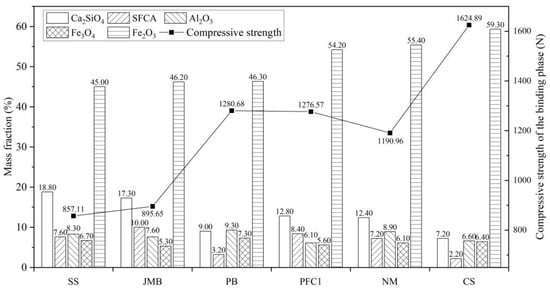
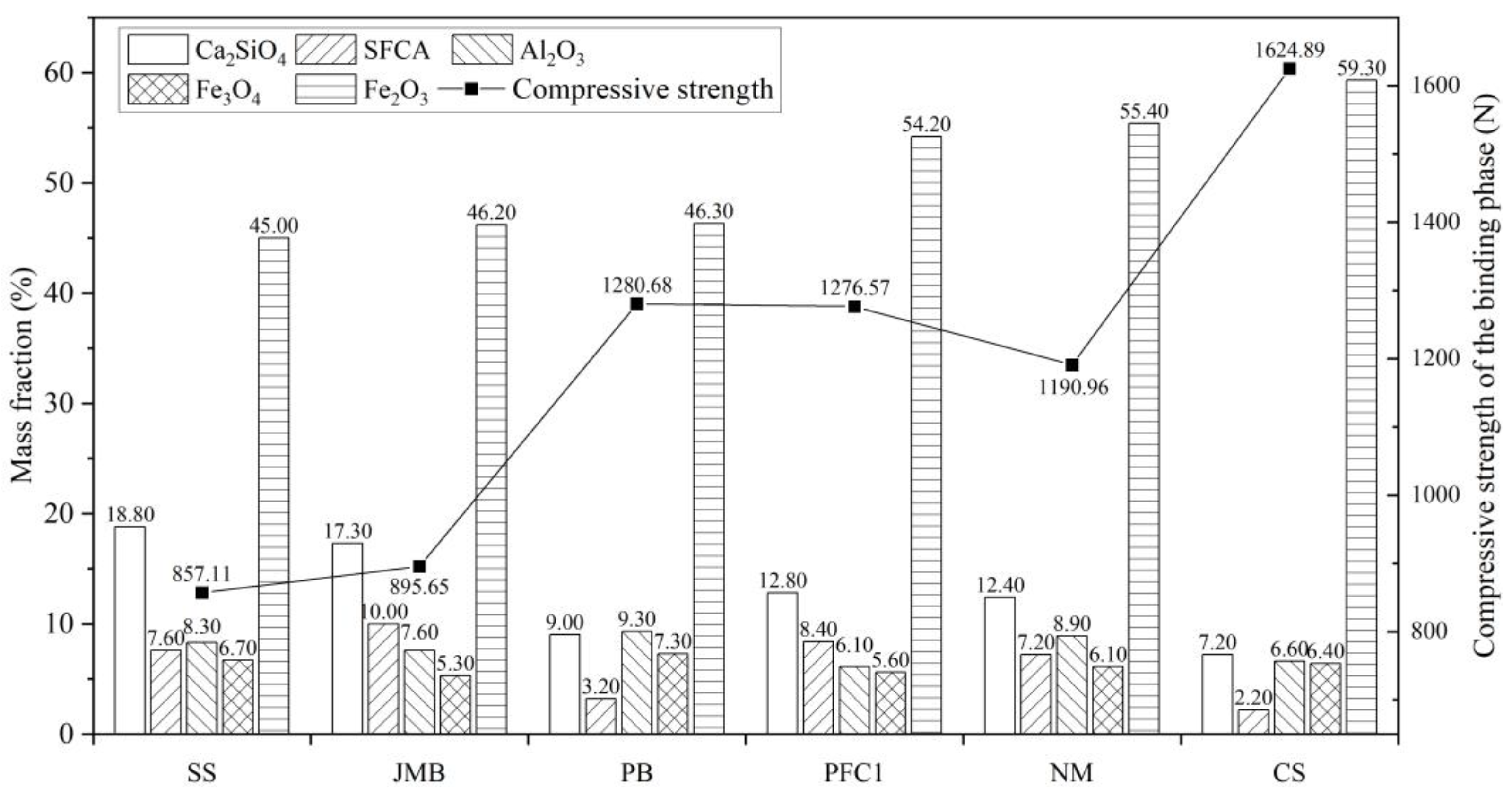
The compressive strength of the bonding phase and the quantitative XRD analysis results of the iron ore fines are shown in Figure 1. Phase contents were obtained by RIR semi-quantitative analysis and refer to the crystalline phases identified; the difference from 100% corresponds to glassy and poorly crystalline phases not included in the quantification. Strength is expressed as the maximum load at fracture (N); the values reported below correspond to approximately 17–32 MPa on the nominal cross-section of 50.3 mm2. CS exhibits the highest bonding phase strength, followed by PB, PFC1 and NM, all exceeding 1000 N; SS shows the lowest strength of 857.11 N. The average bonding phase strength of the hematite group is 1364.14 N, higher than that of the limonite group (1011.15 N), although the two groups overlap: PB (1280.68 N) exceeds NM (1190.96 N). Fe2O3 is the main component of all bonding phases, and its content is generally positively correlated with the bonding phase strength; the hematite group contains more Fe2O3 than the limonite group, whereas the content of the brittle silicate phase Ca2SiO4 shows the opposite trend, indicating that the bonding phase strength is synergistically controlled by the Fe2O3 skeleton and the proportion of brittle phases. The magnetite detected in the roasted compacts (5.3–7.3%) is not attributable to a reducing furnace atmosphere, since roasting was carried out in flowing air; it is ascribed to oxygen diffusion limitation within the dense compact and to local oxygen deficiency at the CaO–Fe2O3 reaction interface, together with phase changes during furnace cooling.
Figure 1.
Bonding phase strength and quantitative XRD analysis results of the iron ore fines.
3.2. Microstructure of the Bonding Phase
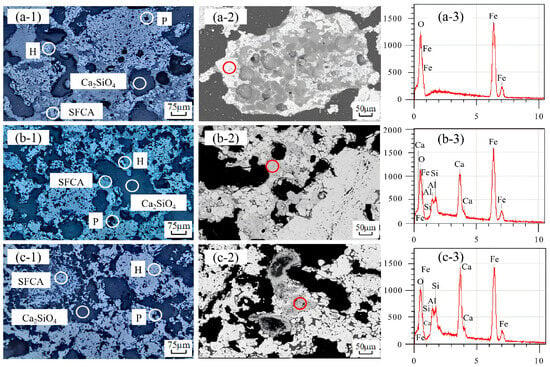
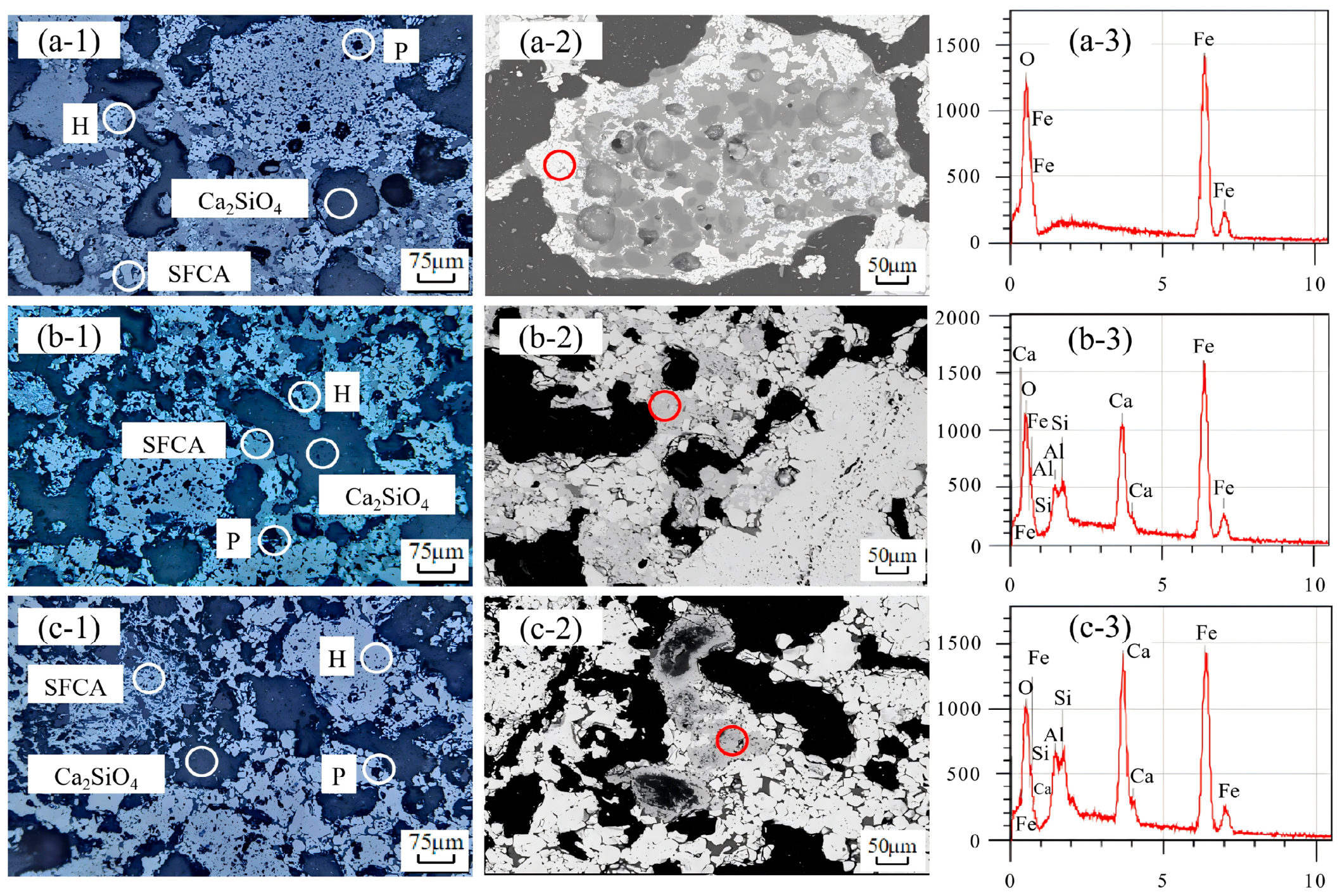
Three iron ore fines with low, medium and high bonding phase strength—SS, PB and CS—were selected, and the optical microscopy, SEM and EDS results of their bonding phases are shown in Figure 2. Under reflected light, bright white areas are hematite, gray areas are silicate phases, light blue areas are calcium ferrite phases and dark areas are pores; EDS at the red circles in Figure 2(a-2,b-2,c-2) was used to verify the phase compositions of typical micro-regions. SS are high-silica fines with the highest proportion of silicate phases; EDS (Figure 2(a-3)) confirms that the spot area is hematite, and the bonding phase is dominated by hematite intermixed with silicates and low-iron calcium ferrite; with well-developed large and honeycomb pores and uneven liquid phase spreading, its strength is the lowest. PB generates a relatively sufficient liquid phase but contains excessive pores and a loose structure; angular hematite tends to cause stress concentration, and the boundaries between platy calcium ferrite and hematite are distinct, so cracks readily propagate along the two-phase interfaces under load, resulting in lower strength than CS. CS has a low SiO2 content, few and uniformly distributed pores, hematite fully corroded through solid-state crystal intergrowth, and calcium ferrite in a corroded form containing acicular SFCA, which interweaves and bonds well with hematite, forming a continuous and dense skeleton and thus the highest strength. The comparison of the three fines indicates that the bonding phase strength is governed jointly by the phase types and by three morphological and structural attributes: the grain habit of hematite (intermixed with silicates and low-iron calcium ferrite in SS, angular with sharp two-phase boundaries in PB, and corroded and intergrown with the melt in CS), the crystal habit of calcium ferrite (low-iron and interstitial in SS, platy in PB, and acicular SFCA interwoven into a network in CS) and the pore structure (large honeycomb pores with uneven liquid spreading in SS, an excess of pores in a loose matrix in PB, and few, fine and uniformly dispersed pores in CS). These attributes together control the effective load-bearing section and the crack path, and thus provide a direct mineralogical basis for the ratio regulation of blended ores.
Figure 2.
Microscopic mineral phases of individual ore types. (a-1) Optical micrograph of the bonding phase of SS; (a-2) SEM image of the bonding phase of SS; (a-3) EDS of the bonding phase of SS; (b-1) optical micrograph of the bonding phase of PB; (b-2) SEM image of the bonding phase of PB; (b-3) EDS of the bonding phase of PB; (c-1) optical micrograph of the bonding phase of CS; (c-2) SEM image of the bonding phase of CS; (c-3) EDS of the bonding phase of CS. SFCA—silico-ferrite of calcium and aluminum; Ca2SiO4—dicalcium silicate; H—hematite; P—pore.
In summary, high-grade hematite with low SiO2 and Al2O3 contents readily forms well-crystallized acicular SFCA with low visible porosity and high bonding phase strength; limonite generates abundant pores due to the decomposition of water of crystallization, and high-silica limonite further forms brittle silicate phases, resulting in a loose structure and lower strength. These differences in phases and structure are the fundamental cause of the divergence in the fundamental sintering characteristics of different ore fines and the microscopic basis for hematite/limonite ratio regulation, providing a reference benchmark for the mineral phase evolution and property differences in blended sinters in Section 4.
4. Influence of the Hematite/Limonite Ratio on Sinter Properties
4.1. Test Schemes
Based on the complementary characteristics of the high-temperature bonding phases of the two ore groups revealed in Section 3, seven gradient hematite/limonite ratio tests were designed to systematically investigate the influence of the ratio on sinter properties. The schemes were designed according to the following principles:
(1) Exploiting the complementarity of the high-temperature bonding phase characteristics of the two ore groups, with the hematite group providing the skeleton and high-strength bonding phase and the limonite group providing liquid phase generation and assimilation ability;
(2) Taking the TFe grade of 61.5% of the Minmetals standard fines [21] as the target constraint to balance the chemical composition of each scheme, eliminating the interference of grade fluctuations on property evaluation;
(3) Setting the limonite proportion over the full gradient of 30–60% at 5% intervals to capture the inflection points of property evolution with the ratio;
(4) Following the principle that “high-silica fines (SS and JMB) are restricted as the total limonite proportion increases, while low-silica limonite (PB) is preferentially supplemented” for ore matching within each scheme, so as to suppress the excessive formation of brittle silicate phases.
The limonite proportion increased stepwise from 30% to 60%, while the hematite proportion decreased from 70% to 40%, as shown in Table 3.
Table 3.
Test schemes of gradient hematite/limonite ratios (mass fraction, %).
The sintering parameters were unified as follows: coke breeze proportion of 4.60%, return fines proportion of 15.00%, MgO/Al2O3 ratio of 1.0 and basicity of 2.0, with fluxes, fuel and return fines added externally; the blended mixture was granulated after primary mixing and then charged into a φ330 mm sinter pot with a bed height of 800 mm, an ignition temperature of 1050 °C, an ignition time of 90 s, an ignition suction pressure of 8 kPa, a heat preservation suction pressure of 14 kPa and a heat preservation time of 90 s, followed by cooling for 30 min before sampling and testing.
The sintering parameters were unified as follows: coke breeze 4.6%, return sinters 12.0% and bedding 3.0%, all added externally; basicity (CaO/SiO2) 2.0 and MgO/Al2O3 1.0; granulation moisture 7.8–8.3%, adjusted to the optimum of each blend. Basicity was maintained by calculating the quicklime addition (5.0–5.5%) from the SiO2 content of each iron ore blend, which varies with the proportions of the six fines in Table 3, and the MgO/Al2O3 ratio was controlled with dolomite (6.3–6.4%). The blended mixture was granulated after primary mixing and then charged into a φ330 mm sinter pot with a bed height of 800 mm, an ignition temperature of 1050 °C, an ignition time of 90 s, an ignition suction pressure of 8 kPa, a heat preservation suction pressure of 14 kPa and a heat preservation time of 90 s, followed by cooling for 30 min before sampling and testing. The sinter quality indices were determined as follows. The tumbler index (TI, +6.3 mm) was measured according to ISO 3271:2015 [22]; the yield was calculated as the mass of product sinter (+5 mm) divided by the mass of the finished sinter bed; the productivity coefficient was obtained as the product sinter mass per unit area and time, and the vertical sintering speed as the bed height divided by the sintering time.
4.2. Sintering Techno-Economic Indices and Metallurgical Properties
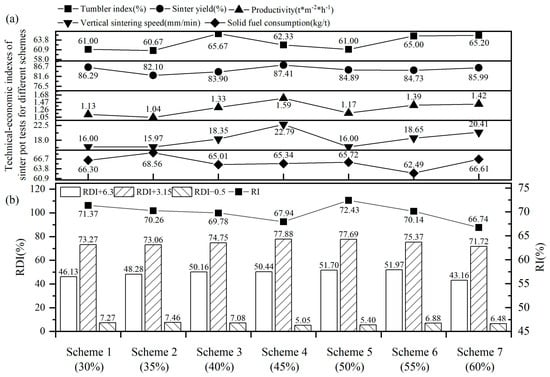
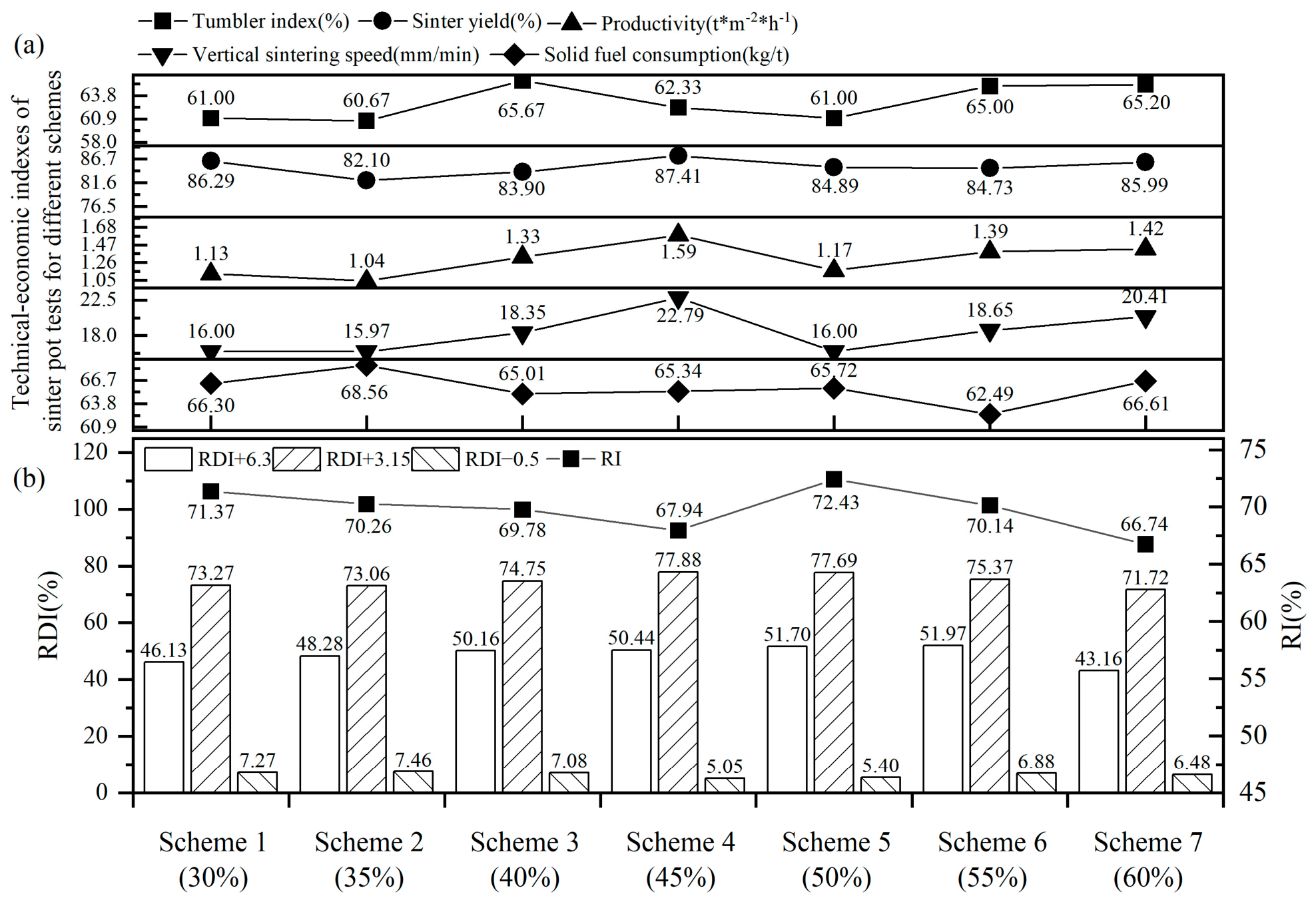
The sintering techno-economic indices, RI and RDI, of all schemes are compared in Figure 3. For the techno-economic indices, as the limonite ratio increases from 30% to 60%, the yield, vertical sintering speed and productivity coefficient remain at relatively high levels overall. Scheme 4 achieves the best overall performance, with the highest yield (87.41%), productivity coefficient (1.59 t/(m2·h)) and vertical sintering speed (22.79 mm/min) among all schemes. The tumbler index reaches its maximum at 40% limonite (65.67%, Scheme 3) and its minimum at 35% (59.67%, Scheme 2). Even when the limonite ratio increases to 60% in Scheme 7, the yield, tumbler index and productivity coefficient remain at relatively high levels, indicating that increasing the limonite ratio does not significantly impair the sintering techno-economic indices.
Figure 3.
Comparison of sintering performance among different schemes. (a) Techno-economic indices of the sinter pot tests; (b) RI and RDI.
For Scheme 1 and Scheme 2, the low limonite proportion leaves the liquid phase insufficient and the sinter weakly consolidated—as evidenced by the incomplete encapsulation of the grains and the interfacial microcracks discussed in Section 4.3.2—so that the reduction degradation resistance is the poorest among all schemes, with RDI−0.5 as high as 7.27% and 7.46% and RDI+6.3 only 46.13% and 48.28%, respectively. As the ratio increases to 40–55%, the liquid phase improves and consolidation strengthens, and the degradation resistance increases significantly and remains at a favorable level: Scheme 4 shows the highest RDI+3.15 (77.88%) and the lowest RDI–0.5 (5.05%), and Scheme 6 shows the highest RDI+6.3 (51.97%). When the ratio reaches 60% (Scheme 7), RDI+6.3 plunges to 43.16%, whereas RDI+3.15 and RDI−0.5 change only slightly (71.72% and 6.48%). For reducibility, Scheme 5 shows the highest RI (72.43%) and Scheme 7 the lowest (66.74%), with the other schemes in between.
The coupling of the two categories of indices determines that 40–45% limonite is the overall optimum ratio range, and the limonite ratio should not exceed 55%. The above macroscopic property rules are the external manifestation of the raw material ratio acting on the sinter mineral phases through high-temperature processes, and their intrinsic origins need to be identified from the phase composition and microstructure of the sinter.
Integrating the above two categories of indices, an excessively low limonite ratio leaves the liquid phase insufficient for complete grain encapsulation, so the sinter is weakly consolidated and its degradation resistance is poor, whereas an excessively high ratio causes sharp deterioration of low-temperature reduction degradation; neither is desirable, while the techno-economic indices remain at high levels over a wide ratio range. Because the individual indices reach their maxima at different ratios—the tumbler index at 40% (Scheme 3), the yield, productivity coefficient, vertical sintering speed and RDI+3.15 at 45% (Scheme 4), RI at 50% (Scheme 5) and RDI+6.3 at 55% (Scheme 6)—and because the differences between adjacent schemes are comparable to the scatter of sinter pot tests, the optimum is defined here by a robustness criterion rather than by a single peak: the recommended window is the interval in which no index shows manifest deterioration and which retains a margin from the sharp RDI deterioration observed at 60% limonite. On this criterion, the window is 40–45%, and 55% is retained only as an upper limit, since RDI+6.3 reaches its maximum at 55% but falls to 43.16% at 60%, leaving no margin for fluctuation in raw material or process conditions. The above macroscopic property rules are the external manifestation of the raw material ratio acting on the sinter mineral phases through high-temperature processes, and their intrinsic origins need to be identified from the phase composition and microstructure of the sinter. RI is the exception: it is highest at 50% limonite (72.43%) and lower within the recommended window, so the recommendation favors yield, strength and degradation resistance over reducibility.
4.3. Microscopic Mineral Phase Analysis of the Sinter
The sinter pot tests show that the hematite/limonite ratio has a limited influence on the sintering techno-economic indices but a significant influence on metallurgical properties such as RDI and RI, and the two categories of indices exhibit a “trend divergence” at high ratios, the cause of which needs to be ascertained through microscopic mineralogical analysis. In this section, XRD semi-quantitative analysis, optical microscopy and SEM observation are used to reveal the microscopic mechanism by which the hematite/limonite ratio affects sinter properties from the aspects of phase composition and microstructure.
4.3.1. Phase Analysis of the Sinter
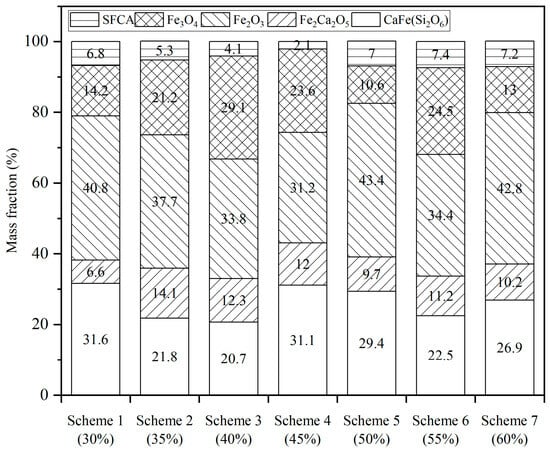
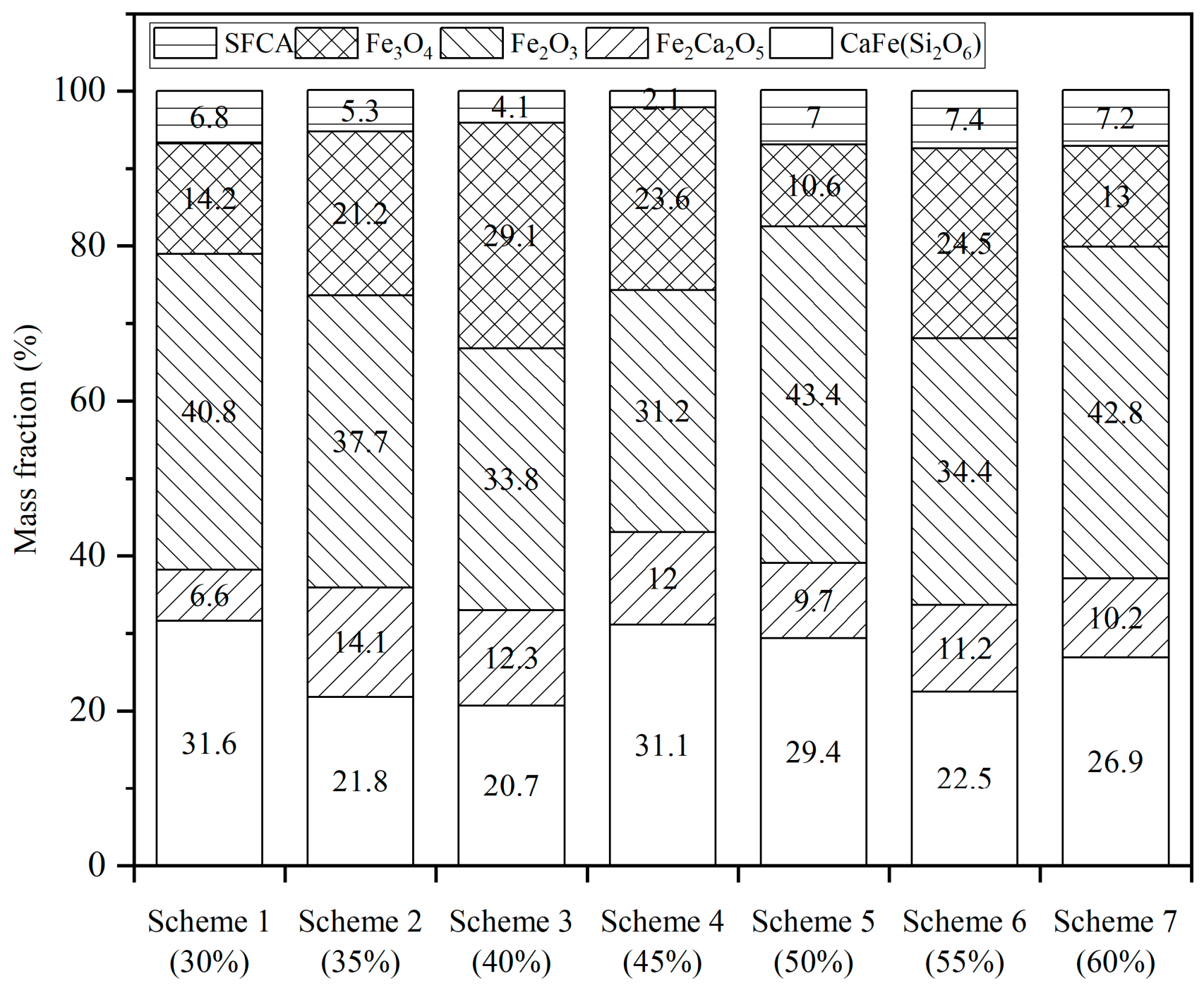
Phase identification was performed on the XRD patterns of the seven sinter groups, and the main semi-quantitative phase analysis results are shown in Figure 4. The main phases of the sinters in all schemes are hematite (Fe2O3), magnetite (Fe3O4), dicalcium ferrite (2CaO·Fe2O3), and SFCA and hedenbergite (CaFeSi2O6), whose relative contents vary regularly with the hematite/limonite ratio.
Figure 4.
Quantitative phase analysis of the sinters from different schemes.
Hematite (Fe2O3) is the most abundant phase, and its relative content shows a non-monotonic variation, first decreasing and then increasing with increasing limonite ratio. At 30–45% limonite, Fe2O3 decreases from 40.8% to 31.2%, while Fe3O4 increases relatively. On the one hand, the decomposition of water of crystallization in limonite improves the bed permeability and enhances the local reducing atmosphere in the combustion zone, so that part of Fe2O3 is reduced to Fe3O4; on the other hand, the liquid phase generation increases gradually within this range, and Fe2O3 is continuously assimilated and dissolved into the bonding phase in the form of calcium ferrite, further reducing the residual Fe2O3. Beyond 50% limonite, Fe2O3 rebounds overall but fluctuates, while Fe3O4 decreases non-monotonically, which is related to the excessive liquid phase at high limonite ratios and the precipitation of Fe2O3 as secondary hematite during cooling. The precipitation amount depends on the liquid phase amount and cooling crystallization conditions, which do not vary synchronously with the ratio, resulting in the non-monotonic variation in the relative contents of Fe2O3 and Fe3O4.
The phase composition corresponds to the metallurgical property indices, but the total Fe2O3 content cannot explain the differences in the degradation resistance of the sinters. Specifically, Scheme 4 has the lowest Fe2O3 content (31.2%) among all schemes, with less material undergoing the Fe2O3→Fe3O4 phase transformation and weaker transformation stress, corresponding to the best degradation resistance; Scheme 5 has the highest Fe2O3 content (43.4%) and the lowest Fe3O4 content (10.6%), providing abundant reducible components and corresponding to the highest RI; in Scheme 6, Fe3O4 rebounds to 24.5%, the SFCA content is the highest (7.4%) and the brittle phase CaFeSi2O6 is relatively low, resulting in better bonding and jointly supporting the highest RDI+6.3. It is noteworthy that the Fe2O3 content of Scheme 7 is close to that of Scheme 5, but its RDI+6.3 plunges to 43.16%, indicating that the main controlling factor of low-temperature reduction degradation is not the total Fe2O3 content but is probably related to its mode of occurrence, which needs to be confirmed by microscopic morphological evidence. Moreover, the tumbler index of Scheme 7 does not deteriorate synchronously, indicating that a cold-strength skeleton is retained rather than physical consolidation being destroyed, which is also the mineralogical origin of the “trend divergence” between the techno-economic indices and metallurgical properties at high limonite ratios.
In addition, the content of SFCA, which represents a high-quality bonding phase, is generally low in all schemes, in sharp contrast to the relatively high content of CaFeSi2O6, indicating local segregation of CaO during sintering and insufficient formation of the desirable SFCA bonding phase; meanwhile, the low SFCA content is also related to its low crystallinity and the systematic underestimation by XRD semi-quantitative analysis (see Section 2.2), so the contents here are only used for lateral comparison among schemes. The high-quality SFCA bonding phase is beneficial to the simultaneous improvement of reducibility and degradation resistance, whereas CaFeSi2O6 is a brittle phase that, if forming a structure encapsulating hematite, seriously impairs the reducibility and physical strength of the sinter.
4.3.2. Microstructure of the Sinter
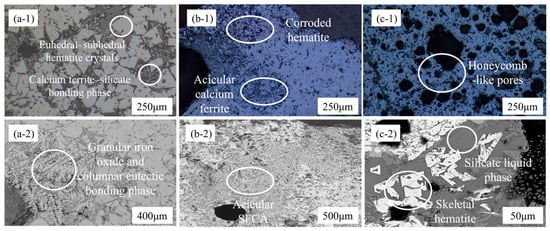
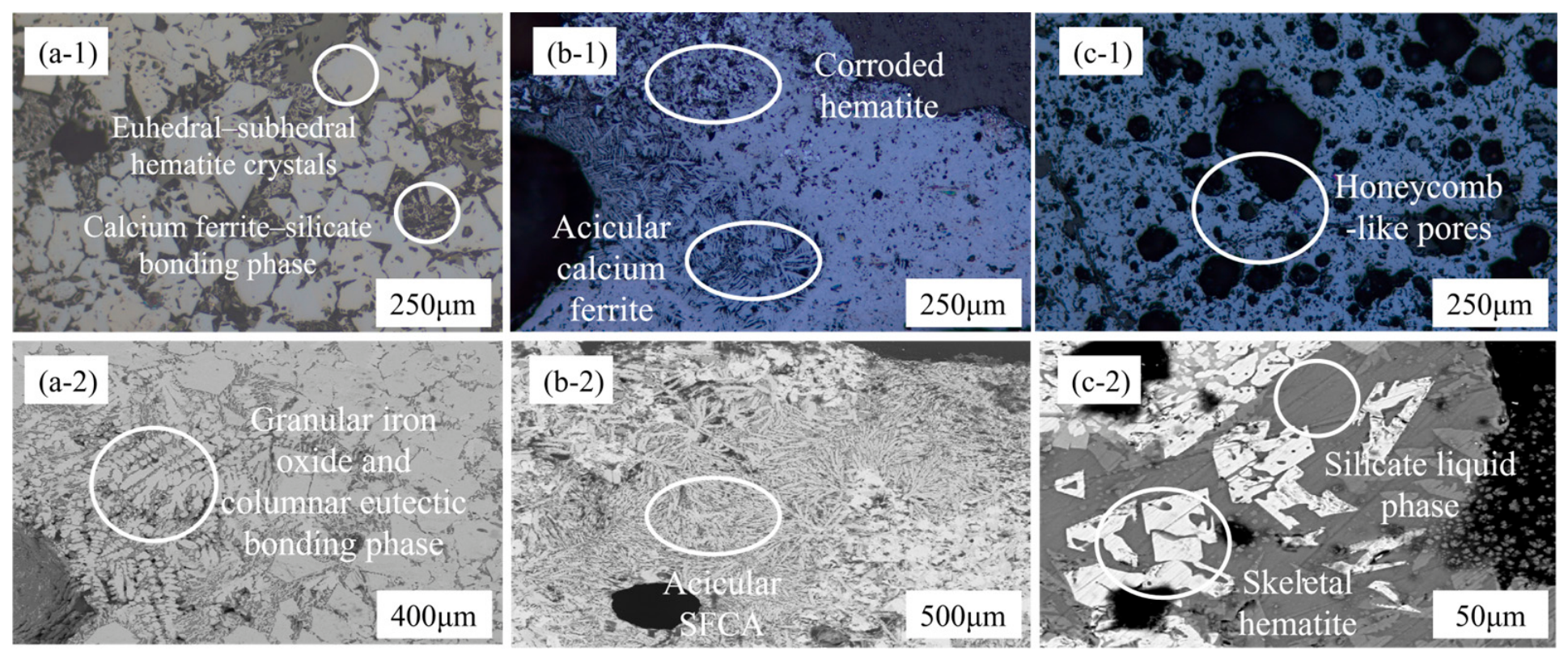
The phase composition lays the “compositional foundation” of the sinter, while the microscopic mineralogical features such as the morphology, distribution and bonding state of the phases determine whether each phase can fully play its role and serve as the key link between phase composition and macroscopic properties. All seven schemes were characterized by XRD (Figure 4), along with sintering and metallurgical tests (Figure 3). Micrographs are provided only for three representative schemes: the two extremes of the ratio range (Scheme 1 and Scheme 7) and the optimum (Scheme 4). These selected samples capture the contrasting microstructures, and the results are presented in Figure 5.
Figure 5.
Microscopic mineral phases of the sinters from different schemes. (a-1) Optical micrograph of Scheme 1; (a-2) SEM image of Scheme 1; (b-1) optical micrograph of Scheme 4; (b-2) SEM image of Scheme 4; (c-1) optical micrograph of Scheme 7; (c-2) SEM image of Scheme 7.
The microstructure of Scheme 1 is characterized by a coarse-grained skeleton and insufficient liquid phase. Under the optical microscope (Figure 5(a-1)), bright white euhedral–subhedral hematite grains dominate, which are coarse (mostly 50–150 μm in size) and belong to primary hematite residues not fully assimilated by the liquid phase; the intergranular spaces are filled with dark calcium ferrite–silicate bonding phases, but due to insufficient liquid phase generation, the bonding phase incompletely encapsulates the grains, with microcracks locally present at grain boundaries. SEM observation (Figure 5(a-2)) further reveals clear interfaces between the iron oxide grains and the columnar eutectic bonding phase, with local microcracks. The coarse primary hematite skeleton endows the sinter with an acceptable tumbler index, but the incomplete encapsulation by the bonding phase and the interfacial microcracks caused by insufficient liquid phase are the main structural origins of its poor degradation resistance.
Scheme 4 exhibits the densest structure. Under the optical microscope (Figure 5(b-1)), acicular and fibrous calcium ferrite develops abundantly and interweaves with corroded hematite, with refined and uniformly distributed grains and fine, dispersed pores, indicating an optimal match between the liquid phase amount and the solid skeleton at this ratio; the corroded hematite is mainly the residue of primary hematite corroded and assimilated by the liquid phase. Under SEM (Figure 5(b-2)), acicular SFCA interweaves radially into a network, penetrating among the iron oxide grains and tightly fusing with them, showing the best interfacial bonding state. The continuous skeleton and dense bonding network endow the sinter with both excellent strength and improved resistance to degradation.
The microstructure of Scheme 7 deteriorates significantly. Under the optical microscope (Figure 5(c-1)), the visible porosity increases markedly, with dense honeycomb-like large pores up to hundreds of micrometers in diameter; mineral grains are separated and surrounded by pores, and the skeleton continuity decreases, which is the combined result of massive decomposition of water of crystallization in limonite and excessive liquid phase development. Platy hematite crystals coexisting with silicate phases can be observed around the pore walls, but the residual consolidation still maintains the cold strength. Under SEM (Figure 5(c-2)), a large number of lath-shaped and skeletal secondary hematite crystals are embedded in the bonding phase and cemented with the silicate liquid phase, accompanied by numerous interconnected pores, leading to an abrupt change in the low-temperature reduction degradation rate. This also indicates that the rebound of Fe2O3 at high limonite ratios originates from the increase in Fe2O3 recrystallized from the liquid phase, and that the mode of occurrence of Fe2O3, rather than its total content, is the main controlling factor of the degradation resistance, which is consistent with the analysis of Scheme 7 in Section 4.3.1.
In summary, at 30% limonite, the structure is dominated by a primary hematite coarse-grained skeleton with relatively insufficient liquid phase; at 45% limonite, the liquid phase amount matches the skeleton best, forming a dense structure interwoven with acicular SFCA; at 60% limonite, the pores formed by the decomposition of water of crystallization are excessive and interconnected, and skeletal secondary hematite, together with loose packing, deteriorates the skeleton continuity. Therefore, the hematite/limonite ratio regulates the phase composition and the mode of occurrence of Fe2O3 by changing the liquid phase generation and cooling crystallization behavior, while the morphology and distribution of the phases ultimately determine the strength and metallurgical properties of the sinter.
The degradation behavior at the two ends of the ratio range reflects two different limiting steps. Secondary hematite and pores determine the number of crack initiation sites, whereas bonding-phase continuity and boundary strength determine how readily a crack propagates; a high proportion of primary hematite limits the former but does not by itself ensure degradation resistance when the latter is weak. At 30–35% limonite, the propagation step is limiting: the bonding phase only partially encapsulates the grains and interfacial microcracks are already present (Figure 5(a-1,a-2)), so the Fe2O3→Fe3O4 expansion is accommodated by these weak boundaries and cracks propagate even though little secondary hematite has formed. At 60% limonite, the initiation step is limiting, as skeletal secondary hematite and interconnected pores multiply the available sites (Figure 5(c-1,c-2)). Degradation is therefore lowest at 40–45% limonite, where neither step is limiting. SFCA is subject to the same constraint: it requires sufficient melt as well as Fe2O3; its maximum occurs at 55% limonite (7.4%, Scheme 6) rather than at the low-ratio end; and it is underestimated by semi-quantitative XRD (Section 4.3.1), so these values serve only for lateral comparison.
4.4. Directions for Industrial Ore Blending Regulation
Integrating the macroscopic property rules in Section 4.2 with the microscopic mineralogical observations in Section 4.3, it can be seen that the hematite/limonite ratio first changes the amount of the decomposition of water of crystallization, liquid phase generation and cooling crystallization behavior, thereby regulating the phase composition and the mode of occurrence of Fe2O3 in the sinter, and, finally, the morphology, distribution and bonding state of the phases determine the yield, strength and metallurgical properties of the sinter. At 40–45% limonite, the liquid phase amount matches the solid skeleton best, with acicular SFCA interweaving into a network and fine, dispersed pores, so that the yield, strength and degradation resistance are all excellent; beyond 55% limonite, the pores brought by the decomposition of water of crystallization and the skeletal secondary hematite recrystallized from the liquid phase jointly deteriorate the matrix structure, causing sharp deterioration of low-temperature reduction degradation, which completes the microscopic mechanistic interpretation of the macroscopic property evolution.
Based on the above mechanistic relationships, the optimization of sinter properties can be carried out in the following two aspects, both of which act on a common microscopic target—the morphology and arrangement of the product phases—so that the ratio and ore type are morphological variables as much as compositional ones:
(1) Ratio regulation. The limonite ratio should be controlled at 40–45% with an upper limit of 55% under the robustness criterion defined in Section 4.2, balancing liquid phase generation and skeleton stability.
(2) Mineral phase regulation. High-grade, low-silica hematite (e.g., CS) should be used as the skeleton material, matched with low-silica limonite (e.g., PB), while the proportions of high-silica fines (e.g., SS and JMB) should be controlled, so as to suppress the formation of brittle CaFeSi2O6 and promote the development of acicular SFCA.
Morphology is thus a controllable rather than an accidental outcome. Within the range tested, this control is exercised through the ratio and the ore type, other sintering parameters being held constant. Changing only the hematite/limonite ratio shifted the morphology assemblage from a coarse primary hematite skeleton bonded by a columnar eutectic phase (Scheme 1, Figure 5(a-2)), through acicular SFCA interwoven radially with corroded hematite (Scheme 4, Figure 5(b-2)), to lath-shaped and skeletal secondary hematite cemented by silicate (Scheme 7, Figure 5(c-2)). The expected morphology in structure can therefore be defined as follows: (i) an acicular or fibrous SFCA bonding phase interweaving into a continuous network, rather than a columnar eutectic; (ii) iron oxide retained as corroded, rounded residual grains tightly fused with SFCA, rather than coarse primary grains incompletely encapsulated by the bonding phase or lath-shaped skeletal secondary hematite; and (iii) pores that are fine and uniformly dispersed, rather than coarse honeycomb pores that are interconnected. These three features coexist in Scheme 4 at 45% limonite and constitute the structural signature of its optimum yield, strength and degradation resistance.
5. Conclusions
(1) The bonding phase strength of the six fines differs with mineral form: high-grade, low-silica hematite forms well-crystallized acicular SFCA with low visible porosity, whereas limonite develops pores on dehydration and, at high silica, brittle silicates. Strength is governed by skeletal continuity, SFCA development and the proportion of pores and brittle silicates rather than by Fe2O3 content alone.
(2) The ratio affects techno-economic indices and metallurgical properties asynchronously: the indices remain high over a wide range, with the best combination at 40–45% limonite, whereas degradation resistance is poorest at 30–35% and RDI+6.3 falls to 43.16% at 60% limonite.
(3) The mechanism follows a “ratio–mineral phase–property” chain: the ratio controls liquid phase formation and its crystallization on cooling, and hence both the content of Fe2O3 and its mode of occurrence. Skeletal secondary hematite precipitated at high limonite ratios is considered to initiate cracks during reduction, which is the origin of RDI deterioration, whereas the interwoven acicular SFCA and corroded hematite at 45% limonite account for the simultaneous excellence of yield, strength and degradation resistance. The evidence is correlative and morphological, and the liquid phase volume was not measured.
(4) Industrial blending is therefore recommended at 55–60% hematite and 40–45% limonite, with limonite not exceeding 55%; high-grade, low-silica fines such as CS should serve as the skeleton, high-silica limonite (SS, JMB) should be limited, and low-silica limonite (PB) may be relaxed.
Author Contributions
Conceptualization, W.T., K.L. and H.B.; Methodology, W.T., K.L. and Z.C.; Validation, N.W., L.Z. and W.Z.; Investigation, W.T., K.L., N.W., L.Z., W.Z. and Z.C.; Resources, H.B.; Data curation, W.T.; Writing—original draft, W.T.; Writing—review & editing, H.B.; Project administration, H.B.; Funding acquisition, N.W. All authors have read and agreed to the published version of the manuscript.
Funding
This research received no external funding.
Data Availability Statement
The original data supporting the findings of this study are included in the article. Further enquiries may be directed to the corresponding author.
Conflicts of Interest
Authors Weijian Tian, Kuan Lu, Ning Wang, Lei Zhang, Wei Zhao and Zhiqiang Cai were employed by the company Minmetals (Tangshan) Ore Development Co., Ltd. The remaining author declares that the research was conducted in the absence of any commercial or financial relationships that could be construed as a potential conflict of interest.
Abbreviations
The following abbreviations are used in this manuscript:
| EDS | Energy-dispersive spectroscopy |
| TFe | Total iron |
| RDI | Reduction degradation index |
| RI | Reducibility index |
| SEM | Scanning electron microscope |
| SFCA | Silico-ferrite of calcium and aluminum |
| SS | Super Special Fine |
| JMB | Jimblebar Blend Fines |
| PB | Pilbara Blend Fines |
| PFC1 | PFC1 Concentrate |
| NM | Newman Fines |
| CS | Carajas Sinter Feed |
References
- Zhong, Q.; Gao, Z.; Zhao, Y.; Jiang, W.; Liu, H.; Zhang, X. Research progress on the influence of mineral composition and mineral phase structure on sinter quality. J. Cent. South Univ. (Sci. Technol.) 2026, 57, 1–14. [Google Scholar]
- Zhang, G.; Luo, G.; Song, W.; Song, W.; Tian, S.; Hao, S.; Ren, Q. Analysis of the fundamental sintering characteristics of different types of imported iron ore fines. Sinter. Pellet. 2021, 46, 7–13. [Google Scholar]
- Zhang, G.; Luo, G.; Chai, Y.; Song, W. Effect of limonite on the morphology and micro-area composition of calcium ferrite in sinter. Iron Steel 2024, 59, 22–32. [Google Scholar]
- Zhang, G.; Luo, G.; Chai, Y.; Tian, S.; Hao, S.; Ren, Q. Optimal allocation of limonite in the sintering process. Chin. J. Eng. 2022, 44, 39–49. [Google Scholar]
- Lin, E. Experimental study on the optimization of the sintering process with a high limonite proportion. Sinter. Pellet. 2020, 45, 15–20. [Google Scholar]
- Loo, C.E. A perspective of goethitic ore sintering fundamentals. ISIJ Int. 2005, 45, 436–448. [Google Scholar] [CrossRef] [Scilit]
- Pereira, I.J.U.V.; Coelho, H.C.S.; Santos, C.G.; Brocchi, E.A.; Souza, R.F.M.; Oliveira, V.A.A. Batch sintering of FeO·OH and Fe2O3 blends: Chemical and metallurgical characterization. Metals 2024, 14, 598. [Google Scholar] [CrossRef] [Scilit]
- Peng, J.; Li, H. Effect of the liquid absorption characteristics of iron ore fines on the consolidation strength of the sintered body. Sinter. Pellet. 2025, 50, 38–45. [Google Scholar]
- Wang, X.; Xing, H.; Tian, T.; Fu, J.; Wang, H. Study on the liquid phase formation behavior during the sintering of iron ore fines. Foundry Technol. 2017, 38, 633–636. [Google Scholar]
- Loo, C.E.; Leung, W. Factors influencing the bonding phase structure of iron ore sinters. ISIJ Int. 2003, 43, 1393–1402. [Google Scholar] [CrossRef] [Scilit]
- Que, Z.; Wang, L.; Fu, Y.; Gu, F.; Shi, J. Influence of quantity and quality of bonding phases on strength of iron ore sinters. Metals 2025, 15, 47. [Google Scholar] [CrossRef] [Scilit]
- Han, X.; Du, L.; Chen, Q.; Liu, L.; Wang, C.; Zhao, K. Study on the formation rules of calcium ferrite with different morphologies in hematite-type sinter. Sinter. Pellet. 2021, 46, 1–7. [Google Scholar]
- Nicol, S.; Chen, J.; Pownceby, M.I.; Webster, N.A.S. A review of the chemistry, structure and formation conditions of silico-ferrite of calcium and aluminum (‘SFCA’) phases. ISIJ Int. 2018, 58, 2157–2172. [Google Scholar] [CrossRef] [Scilit]
- Chen, Y.-B.; Du, Y.; Guo, Y.-F.; Guo, X.-M. Quantitative investigation of MgO, Al2O3 and SiO2 effects on solid-state formation of secondary hematite in sintering process of iron ore fines. Minerals 2022, 12, 282. [Google Scholar] [CrossRef] [Scilit]
- Liu, J.; Jiang, W.; Cheng, D.; Zhong, Q.; Liu, C.; Jiang, Y.; Zhu, J.; Zhang, H.; Xu, L.; Ma, X. Effect of silica content on iron ore sintering. Metals 2023, 13, 1009. [Google Scholar] [CrossRef] [Scilit]
- Xie, Y.; Zhang, Z.; Wang, Z.; Chun, T. Fundamental sintering characteristics of iron ore fines commonly used in an iron and steel enterprise and optimized ore blending. China Metall. 2018, 28, 9–15. [Google Scholar]
- Xie, Y.; Zhang, Z.; Mo, L.; Wang, Z.; Chun, T. Study on the relationship between the fundamental sintering characteristics of iron ore fines and the tumbler index. Sinter. Pellet. 2017, 42, 34–38. [Google Scholar]
- Ooi, T.C.; Campbell-Hardwick, S.; Zhu, D.; Pan, J. Sintering performance of magnetite-hematite-goethite and hematite-goethite iron ore blends and microstructure of products of sintering. Miner. Process. Extr. Metall. Rev. 2014, 35, 266–281. [Google Scholar] [CrossRef] [Scilit]
- Cores, A.; Babich, A.; Muñiz, M.; Ferreira, S.; Mochon, J. The influence of different iron ores mixtures composition on the quality of sinter. ISIJ Int. 2010, 50, 1089–1098. [Google Scholar] [CrossRef] [Scilit]
- Yi, F.; Li, F.; Sun, K.; Bai, R.; Lv, Q. Relationship between the fundamental sintering characteristics and chemical composition of blended iron ores. Sinter. Pellet. 2013, 38, 1–5. [Google Scholar]
- Wang, N.; Zhao, W.; Lu, K.; Cai, Z.; Wang, X.; Sun, J.; Tian, W.; An, N. Study on ore blending using Ukrainian concentrate to replace part of Carajás fines. Shanxi Metall. 2025, 48, 19–22+25. [Google Scholar]
- ISO 3271:2015; Iron Ores for Blast Furnace and Direct Reduction Feedstocks—Determination of the Tumble and Abrasion Indices. International Organization for Standardization: Geneva, Switzerland, 2015.

Disclaimer/Publisher’s Note: The statements, opinions and data contained in all publications are solely those of the individual author(s) and contributor(s) and not of MDPI and/or the editor(s). MDPI and/or the editor(s) disclaim responsibility for any injury to people or property resulting from any ideas, methods, instructions or products referred to in the content. |
© 2026 by the authors. Licensee MDPI, Basel, Switzerland. This article is an open access article distributed under the terms and conditions of the Creative Commons Attribution (CC BY) license.