


Abstract
Safe long-term storage of spent nuclear fuel requires materials that combine high neutron absorption with excellent corrosion resistance. In this study, two Gd-doped Fe-based amorphous coatings (2X5 + Gd and PC + Gd) containing 6.0 wt.% Gd were fabricated by high-velocity air–fuel (HVAF) spraying. The coatings exhibit macroscopic neutron absorption cross-sections 16.8 and 15.8 times that of borated stainless steel with a B content of 0.6 wt.%, respectively. Electrochemically, both coatings show spontaneous passivation and superior localized corrosion resistance, with PC + Gd outperforming 2X5 + Gd due to a Cr2O3-enriched passive film facilitated by P addition. A unique “dissolution–passivation” mechanism governs corrosion: Gd particles dissolve preferentially as anodes, while the amorphous matrix rapidly repassivates, ensuring durable protection. This work provides a viable strategy for designing high-performance neutron-absorbing composite coatings.
1. Introduction
The global pursuit of carbon neutrality has brought nuclear power to the forefront as a sustainable and high-density energy source [1]. However, the operation of nuclear reactors inevitably generates spent nuclear fuel (SNF), which remains highly radioactive and continues to emit a significant flux of thermal neutrons [2]. At present, wet storage, in which SNF assemblies are housed in pools containing H3BO3, remains one of the most prevalent and secure interim storage strategies [3]. In such an aggressive environment, the structural materials employed for neutron-absorbing racks and storage canisters are subject to stringent requirements: they must exhibit exceptional neutron absorption capabilities to maintain subcriticality and, simultaneously, outstanding corrosion resistance to withstand the chemically challenging H3BO3 containing impurities such as Cl− [4,5].
To achieve adequate neutron absorption, borated stainless steels (BSSs) have been widely used in the nuclear industry due to their favorable mechanical properties and workability [6,7]. The neutron shielding effectiveness of BSS is intrinsically linked to its B content [8]. However, B has limited solubility in the austenitic matrix, approximately 100–150 ppm. Exceeding this solubility limit leads to the precipitation of continuous networks of secondary borides, such as (Cr,Fe)2B [9]. The resulting Cr-depleted zones adjacent to the boride precipitates significantly destabilize the passive film, making the alloy highly susceptible to localized pitting corrosion [10,11]. Consequently, the neutron absorption capacity of conventional BSS is fundamentally constrained by the trade-off between B addition and corrosion resistance [12].
To overcome these limitations, the application of Fe-based amorphous alloy coatings (AACs) has emerged as a highly effective approach [13,14]. Due to their unique disordered atomic structure and compositional homogeneity, Fe-based AACs are renowned for their exceptional resistance to localized corrosion [15,16]. Crucially, these coatings can be engineered with substantially higher B contents without compromising their protective nature, thereby providing a significant enhancement in neutron attenuation performance compared to conventional BSSs [17,18]. Nevertheless, the growing demands for criticality safety in high-density SNF storage require even more potent neutron absorbers. Gadolinium (Gd), with its remarkably higher thermal neutron absorption cross-section, offers a far superior alternative to B [19,20]. While Gd can be incorporated through conventional alloying routes, adding excessive amounts of Gd severely destabilizes the glass-forming ability, leading to the precipitation of deleterious crystalline phases that severely degrade the corrosion resistance of the amorphous matrix [21,22]. An alternative approach to overcome this issue is the physical addition of Gd particles to pre-existing Fe-based amorphous powders, creating a composite coating architecture. This approach decouples the compositional design of the corrosion-resistant amorphous matrix from the neutron-absorbing function of the Gd particles, potentially allowing for high Gd loading while preserving the inherent passivation capability of the amorphous alloy [23].
In this study, two novel Gd-doped Fe-based AACs were developed via a high-velocity air–fuel (HVAF) thermal spraying process. The neutron absorption properties and corrosion resistance of these coatings were systematically evaluated. Furthermore, the roles of the Gd particles and the amorphous matrix in the corrosion process are discussed in detail. This work seeks to provide a foundational understanding for the design of advanced neutron-absorbing materials that combine superior shielding performance with exceptional durability in nuclear applications.
2. Materials and Methods
2.1. Materials Preparation
The Gd-doped Fe-based AACs were based on two alloys: SAM2X5 (Fe49.7Cr18Mn1.9Mo7.4W1.6B15.2C3.8Si2.4) and PC (Fe50Cr18Mo7.5Ni3.5P12B3C3.5Si2.5). Both were doped with 6.0 wt.% Gd and are referred to as 2X5 + Gd and PC + Gd, respectively. Fe-based amorphous alloy powders were prepared by gas atomization, followed by mechanical mixing with Gd particles (99.9 wt.% purity). The coatings were deposited onto 921A steel surfaces (Table 1) using an AcuKote high-velocity air–fuel (HVAF) thermal spraying system (Kermetico Inc., Benicia, CA, USA). The spraying parameters employed in the HVAF process are displayed in Table 2.
Table 1.
Composition of the 921A steel.
Table 2.
Spraying parameters employed in the HVAF process.
2.2. Structure Characterization
The microstructures and compositions of the powders and coatings were evaluated using a Zeiss Supra 55 SEM (ZEISS Microscopy GmbH, Jena, Germany) equipped with an energy-dispersive spectrometer (EDS, X-Max, Oxford Instruments, Oxford, UK). The composition of the passive films was analyzed by XPS (ESCALAB250 with Al Kα, Thermo Scientific, Thermo Fisher Scientific, Waltham, MA, USA). For XPS analysis, the C 1s peak at 284.6 eV was used as the binding energy calibration reference. Charge compensation was applied during all measurements to correct for surface charging effects. Prior to data acquisition, argon ion beam sputtering was performed for 10 s to remove surface contaminants, ensuring that the acquired spectra reflect the intrinsic passive film composition. In addition, the VCPD between the Gd particles and the amorphous matrix was evaluated via SKPFM (Scanning Kelvin Probe Force Microscopy), utilizing an MFP-3D instrument from Asylum Research (AR SPM 16, Santa Barbara, CA, USA). Especially, the probe was an ASYELEC-01-R2 tip with a conductive Ti/Ir coating on a silicon base. The scanning mode was non-contact amplitude modulation KPFM, and the lift height was 50 nm.
2.3. Simulation of Neutron-Absorption Properties
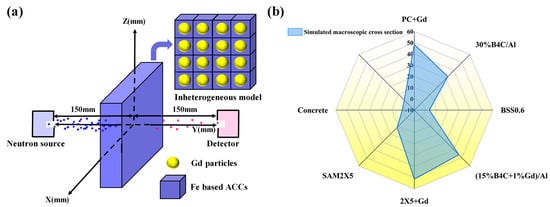
A physical model for neutron absorption was developed using the Monte Carlo N-Particle Transport Code (MCNP 6. 3. 0). A 0.023-eV isotropic thermal-neutron point source was used to generate neutrons, which were then enclosed in a cylindrical channel. By employing the “Fill” and “Universe” cards (which enable repetitive structuring), heterogeneous models were placed in front of the channel. In these models, Gd particles were treated as spheres with a diameter of 50 μm, embedded in amorphous matrix cubes of 102.96 μm edge length. Each specimen received 107 simulated neutrons. Once the simulation was completed, the code directly provided the numbers of transmitted neutrons inside and outside the sample, allowing the calculation of the thermal-neutron transmission ratio. In our previous work, this MCNP heterogeneous model has been proven to have a higher accuracy rate compared to the actual experimental results.
2.4. Electrochemical Tests
Electrochemical tests on the Gd-doped Fe-based AACs and substrate were performed in a solution of 1.5 wt.% H3BO3 + 200 ppm Cl− using a GAMRY Reference 600+ workstation (Gamry Instruments, Warminster, PA, USA). Potentiodynamic polarization (PDP) was conducted from −0.4 VOCP at a rate of 0.333 mV s−1 to 1.5 VSCE or a steep current rise. Potentiostatic polarization (PSP) was carried out at 0 mVSCE for 3600 s. Electrochemical impedance spectroscopy (EIS) was performed over 100 kHz–10 mHz with a ±10 mV sinusoidal perturbation.
3. Results and Discussion
3.1. Microstructure of the Powders and Coatings
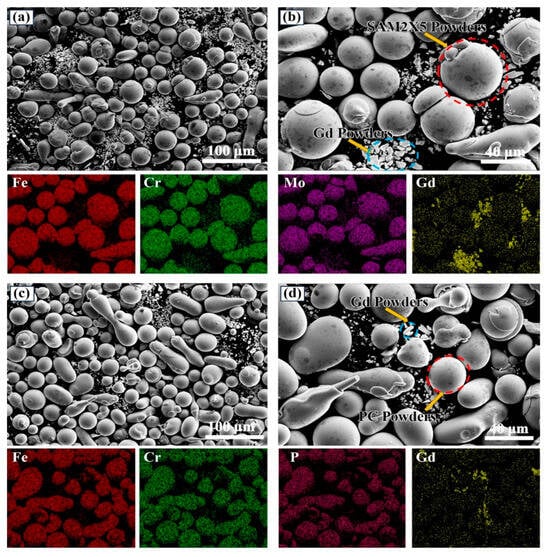
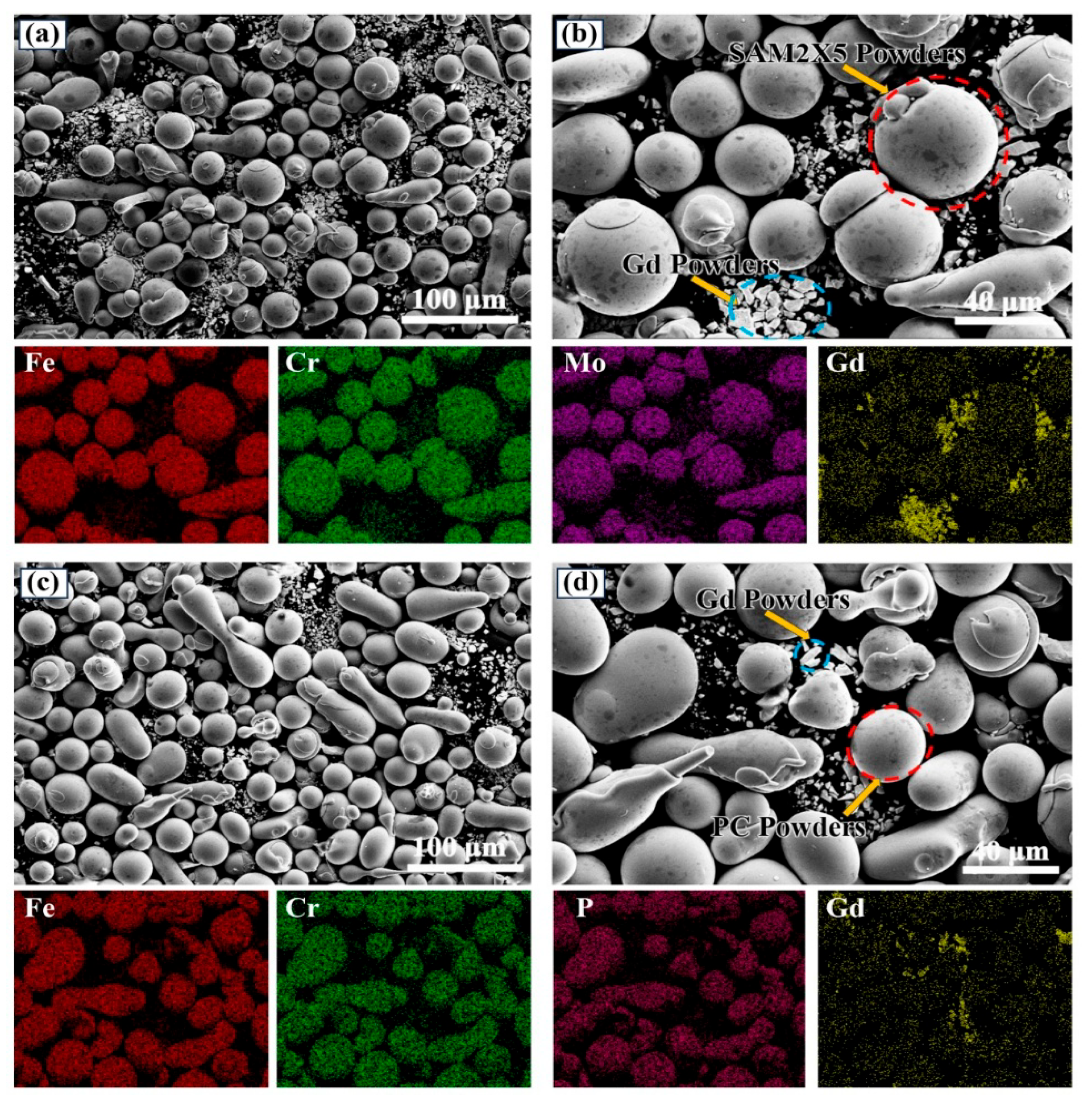
Figure 1 presents the morphology and corresponding elemental maps of the spherical Fe-based amorphous powders and bulk Gd powders for the 2X5 + Gd (Figure 1a,b) and PC + Gd samples (Figure 1c,d). Morphological analysis revealed that the amorphous alloy particles and Gd particles had size distributions mainly in the ranges of 25–45 μm and 2–15 μm, respectively.
Figure 1.
(a) Low-magnification and (b) high-magnification SEM images and corresponding EDS mapping of the 2X5 + Gd powders; (c) low-magnification; and (d) high-magnification SEM images and corresponding EDS mapping of the PC + Gd powders.
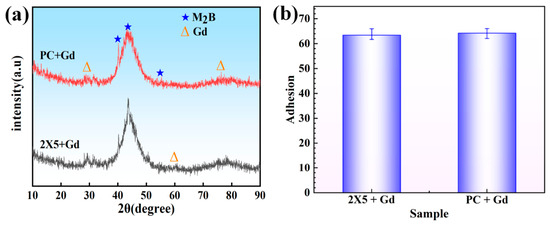
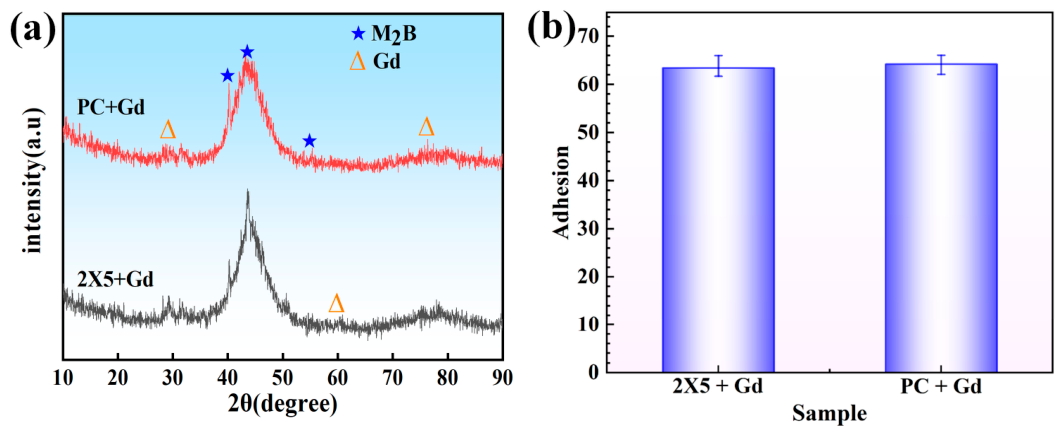
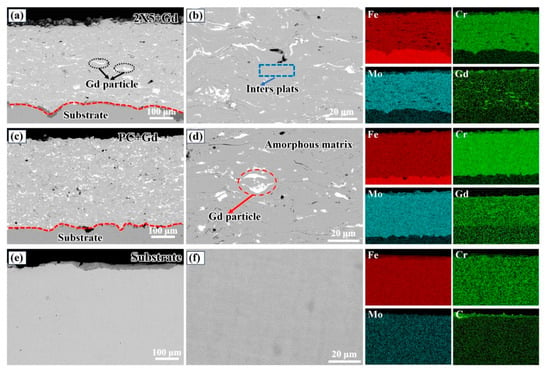
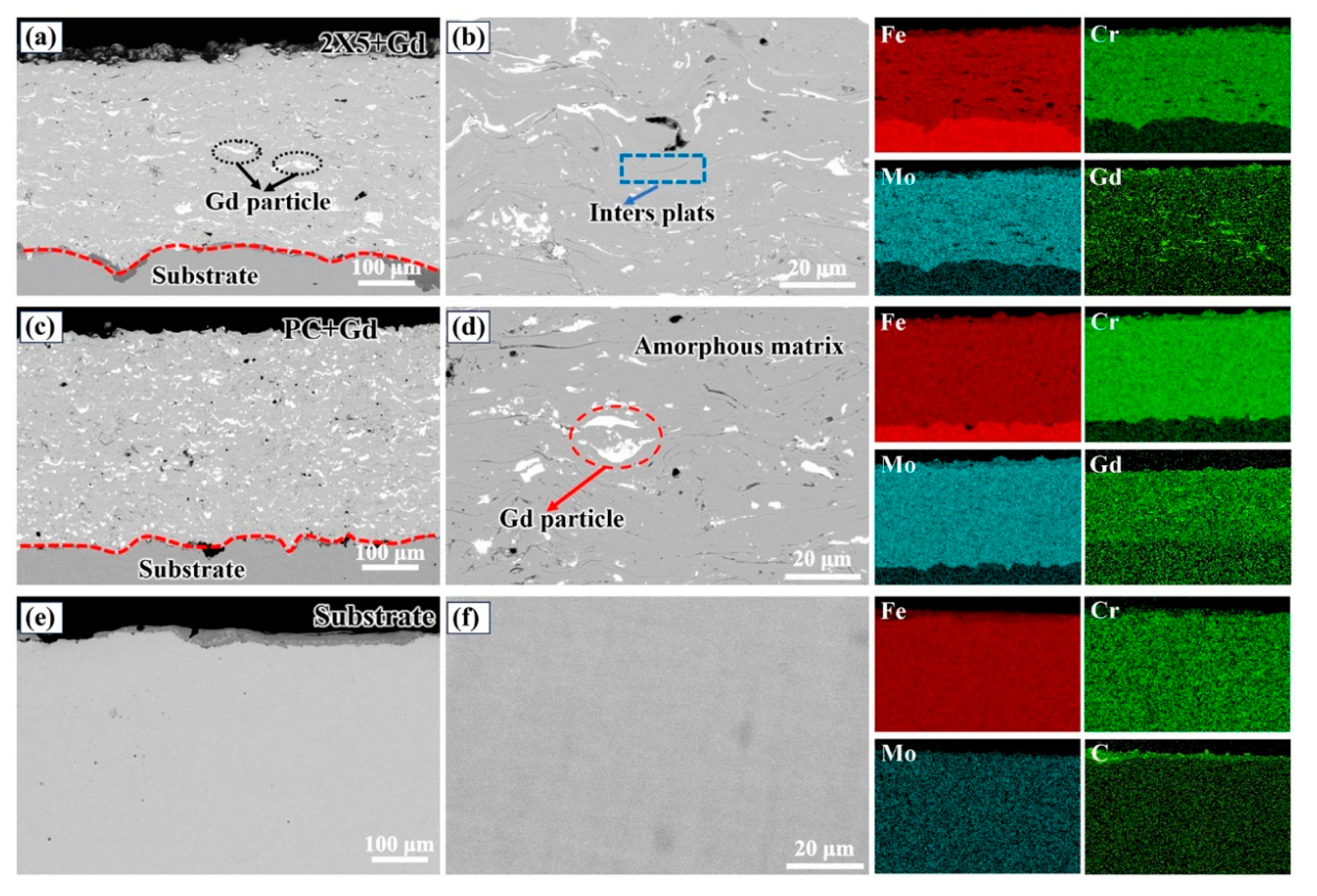
Figure 2a shows the XRD patterns of the two coatings, where both 2X5 + Gd and PC + Gd coatings exhibit a broad diffuse halo, confirming that the amorphous matrix is well retained after Gd doping and HVAF spraying. Weak diffraction peaks corresponding to Gd and minor M2B phase are also detected. Moreover, both coatings adhere well to the 921A steel substrate, with average bonding strength of 63.4 MPa and 64.2 MPa, respectively (Figure 2b). No interfacial delamination was found. The morphology of the cross-section and corresponding EDS mapping for the 2X5 + Gd coating, PC + Gd coating, and substrate are displayed in Figure 3. The thicknesses of the two Gd-doped Fe-based AACs are approximately 400 μm, and both exhibit good adhesion to the steel substrate. A small number of micropores are evenly dispersed throughout the coating microstructures. The porosities of the 2X5 + Gd coating and PC + Gd coating are about 0.32% and 0.33%, respectively. Compositional mapping reveals that the bright regions within the coatings are Gd-rich particles, which are homogeneously distributed. High-magnification SEM images (Figure 3b,d,f) show that the amorphous particles are separated by distinct intersplat boundaries. The formation of these intersplat features is attributed to oxidation reactions occurring on the particle surfaces during the thermal spray process [24]. Additionally, the Gd particles appear not only in granular form but also as strip-like intersplat structures. This morphology is mainly attributed to the partial melting of some Gd particles and their mutual impingement during spraying. To ensure reliable determination of the Gd content, for each sample we randomly selected 10 SEM images at 200× magnification from the coating cross-sections. The Gd content in each image was measured using ImageJ (version 1.54, National Institutes of Health, Bethesda, MD, USA), and the average value was taken as the final Gd content. By contrast, the substrate shows a homogeneous microstructure free from apparent preparation-induced defects, with a uniform distribution of alloying elements. The carbon-rich regions observed on the surface are likely residues from the polishing compound, rather than inherent compositional features of the alloy.
Figure 2.
(a) XRD and (b) adhesion evaluation of the 2X5 + Gd coating and PC + Gd coating.
Figure 3.
Morphology and corresponding EDS mapping of the cross-section for the (a,b) 2X5 + Gd coating, (c,d) PC + Gd coating and (e,f) substrate.
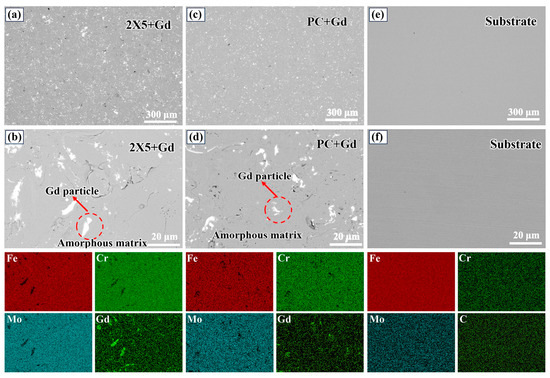
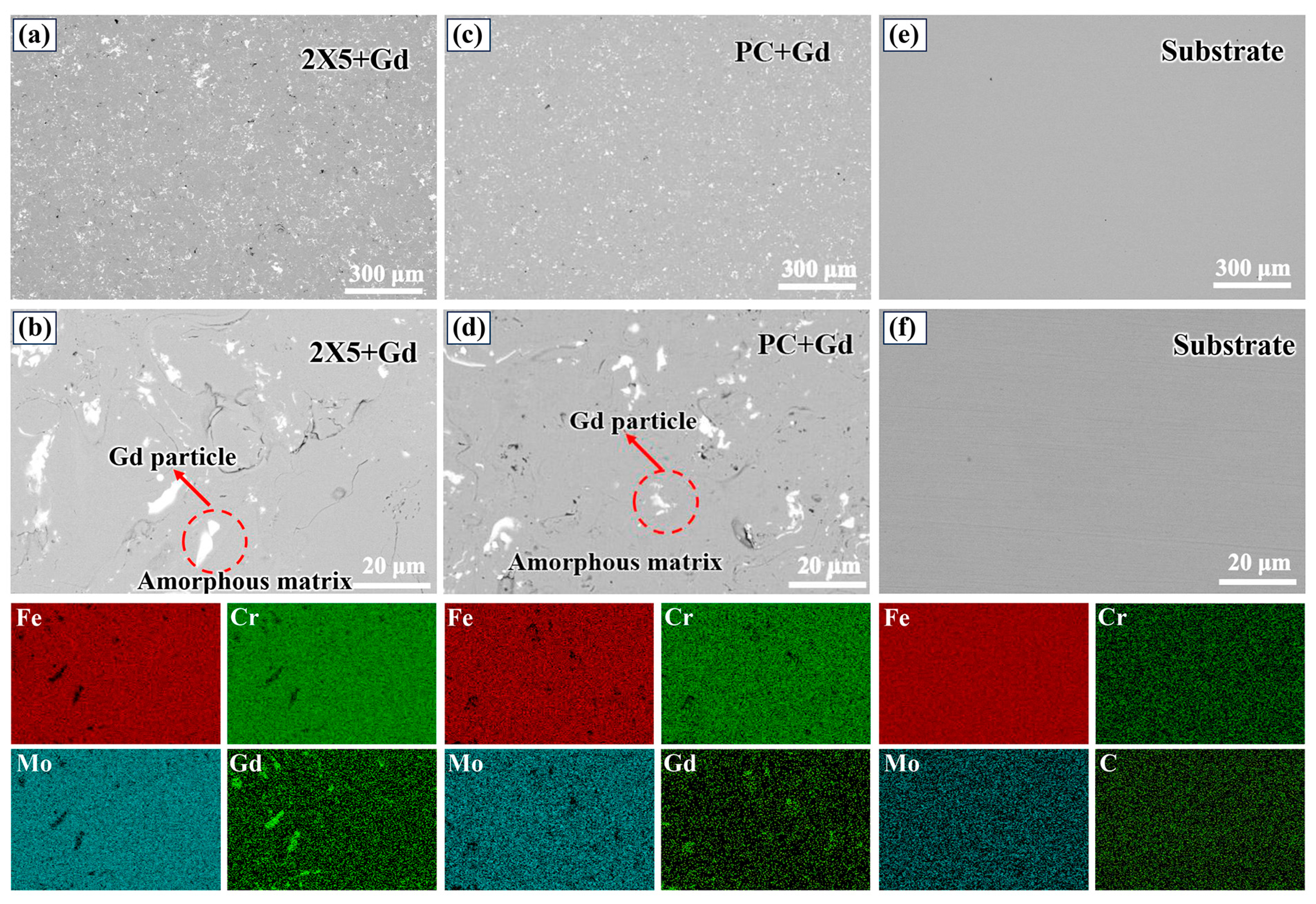
Figure 4 shows the morphology of the surface section and corresponding EDS mapping for the 2X5 + Gd coating, PC + Gd coating, and substrate. It is observed that the amorphous particles, which appear circular, are each encased by an intersplat. Similar to the cross-section, a small number of micropores are evenly dispersed throughout the coating microstructures. Furthermore, Gd particles are present on the amorphous matrix in a dispersed manner, and these particles are mutually independent and not connected to one another.
Figure 4.
Morphology and corresponding EDS mapping of the surface-section for the (a,b) 2X5 + Gd coating, (c,d) PC + Gd coating and (e,f) substrate.
3.2. Neutron Absorbing Property
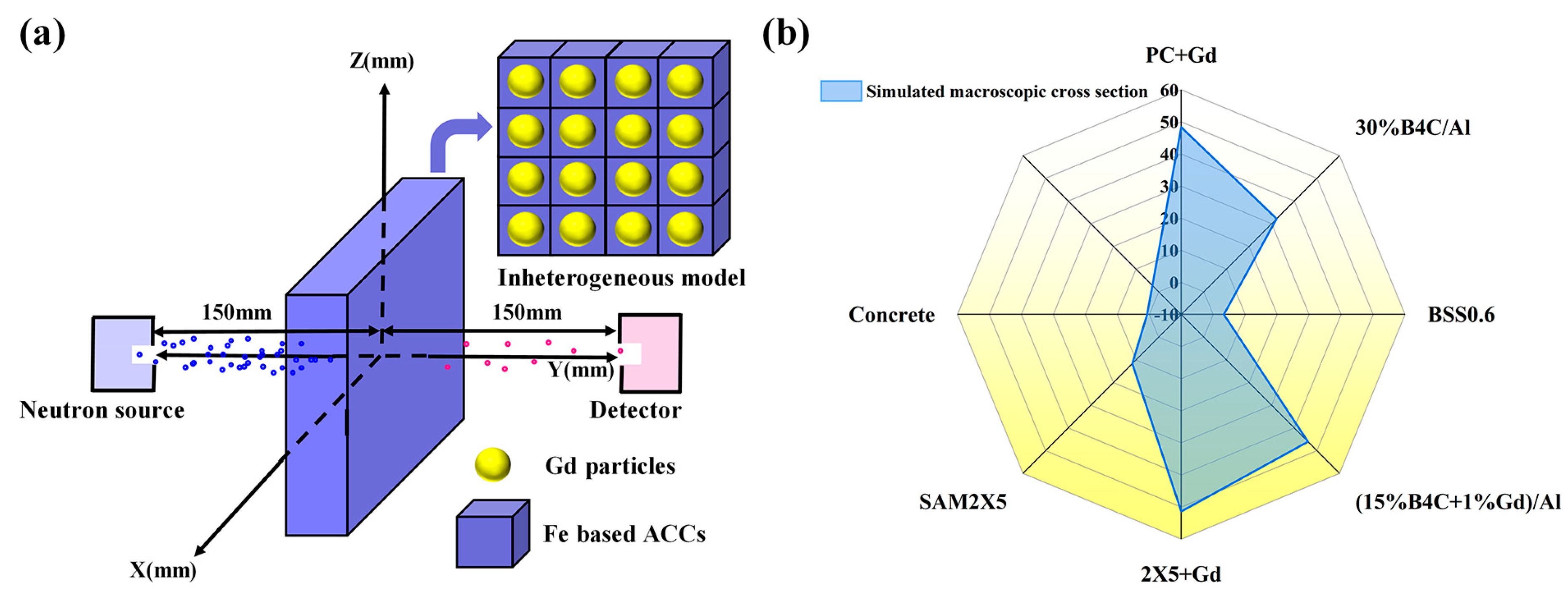
To predict and assess the neutron absorption performance of the coatings, the neutron transmission of the Gd-doped Fe-based AACs was calculated using MCNP simulations in the present work. Details of the computational procedure are available in our previous work [23]. An inhomogeneous model was constructed based on the density and content of the Gd particles (assumed spherical) and the amorphous matrix (assumed cubic), as illustrated in Figure 5a.
Figure 5.
(a) Working schematic diagram of HRND and (b) comparison of macroscopic neutron absorption cross sections of different neutron-absorbing materials.
The simulated determined macroscopic neutron absorption cross-sections are summarized in Figure 5b. The results reveal that the neutron absorption capacities of the 2X5 + Gd coating and PC + Gd coating are 51.3758 cm−1 and 48.3312 cm−1. These are approximately 16.8 and 15.8 times higher, respectively, than that of the BSS [23]. This significant enhancement implies that, compared with the BSS, the Gd-containing coatings can achieve superior neutron shielding performance with a substantially reduced thickness.
The Fe-based amorphous matrix possesses intrinsic radiation-resistant properties originating from its metastable atomic configuration. For the current Gd-doped composite coatings, neutron capture reactions of 155Gd and 157Gd generate secondary γ-ray emission via the (n, γ) channel. Owing to the above-mentioned structural advantages of the amorphous phase, the matrix is expected to tolerate such secondary irradiation-induced damage reasonably well [25]. Distinct from crystalline alloys with long-range periodic lattices, amorphous materials accommodate irradiation-induced point-defect-like species through local atomic rearrangement rather than forming persistent defect clusters such as dislocation loops or voids that commonly accumulate in their crystalline counterparts [26]. The excess free-volume distributed within the amorphous network acts as a high-efficiency sink for both interstitials and vacancies, facilitating defect redistribution and intrinsic self-healing effects to mitigate radiation-driven structural degradation.
3.3. Electrochemical Results
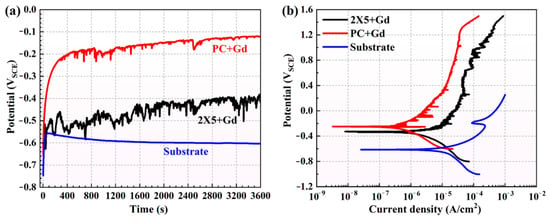
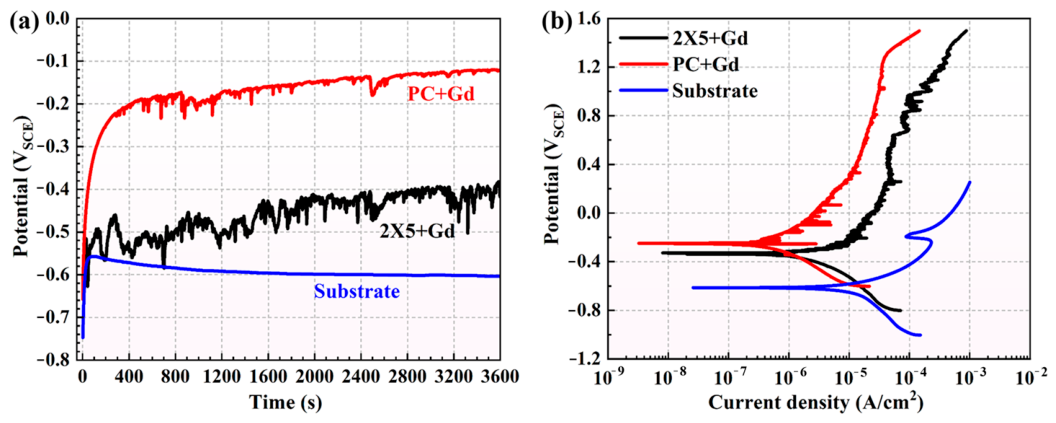
The open-circuit potential (OCP) curves of the two coatings and the substrate are shown in Figure 6a. After stabilizing for one hour in a simulated spent fuel storage environment, the corrosion potentials of the 2X5 + Gd coating, PC + Gd coating, and substrate were measured as −0.387 VSCE, −0.121 VSCE, and −0.604 VSCE, respectively. This result indicates that, thermodynamically, both coatings, especially the PC + Gd coating, exhibit greater thermodynamic stability and a lower corrosion tendency in this corrosive environment [27]. Figure 6b shows the PDP curves of the two coatings and the substrate. As the anodic polarization potential increases, the current for the substrate increases rapidly, indicating that the substrate surface cannot form a protective passive film. In contrast, the two coatings exhibit spontaneous passive behavior, evidenced by no active-to-passive transition region in the anodic polarization curves. The passive current densities are lower than 100 μA/cm2, indicating the passivity and low corrosion rates of the coatings. Furthermore, the PC + Gd coating exhibits a significantly lower passive current density than the 2X5 + Gd coating, suggesting better corrosion resistance of the former.
Figure 6.
(a) OCP and (b) PDP curves of the 2X5 + Gd coating, PC + Gd coating, and substrate.
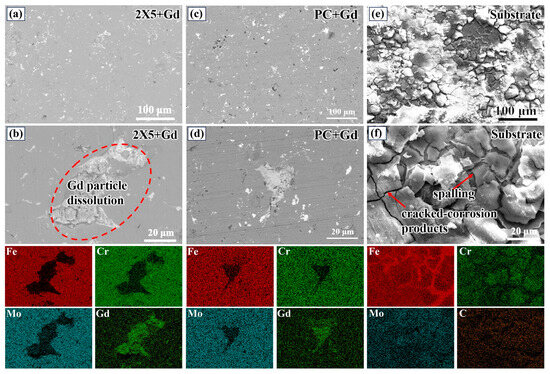
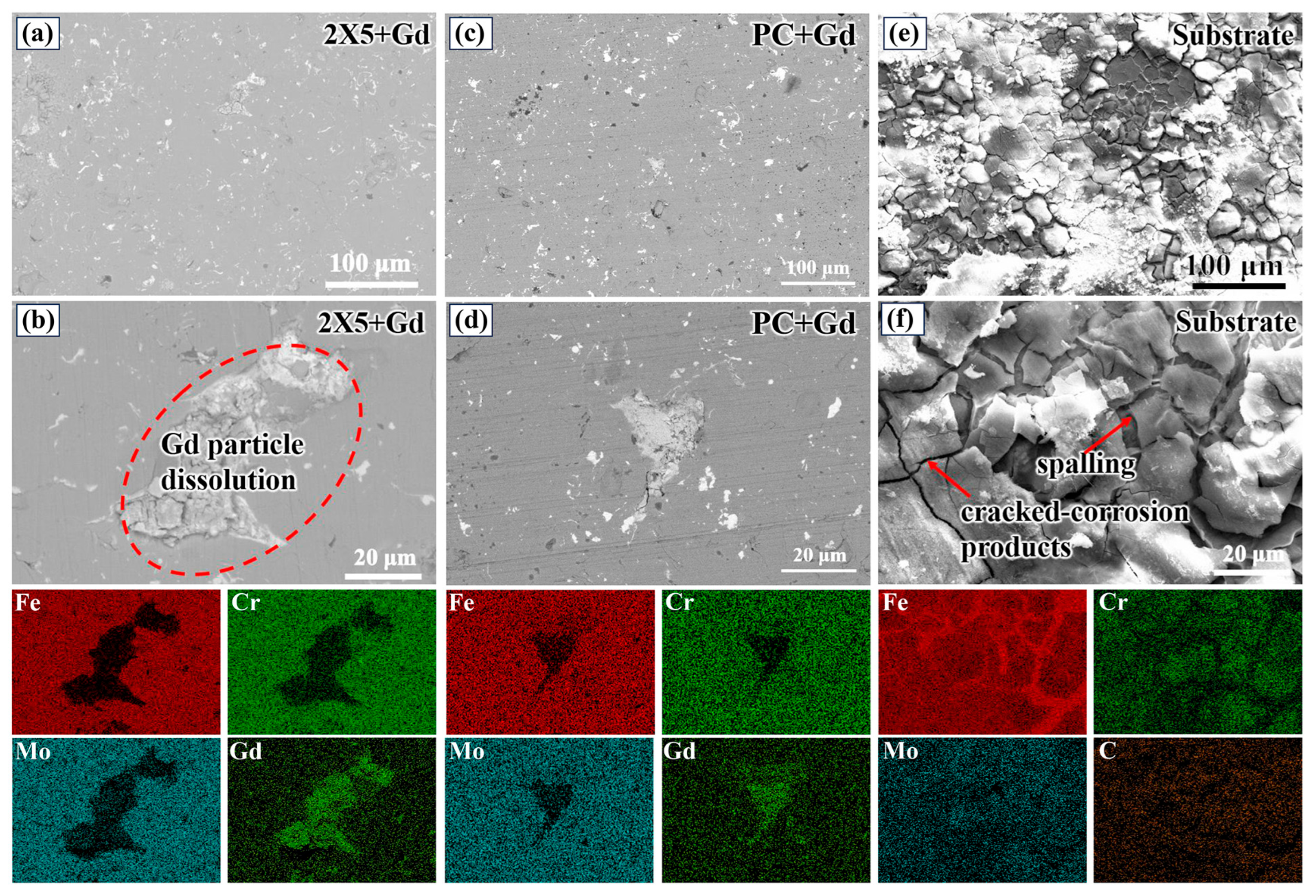
The corrosion morphology of the Gd-doped coatings and the substrate after PDP measurements is displayed in Figure 7. For the 2X5 + Gd coating and PC + Gd coating, it can be seen that corrosive attack was mainly confined to the Gd particles, while the amorphous matrix exhibited virtually no visible corrosion evidence (Figure 7a,d). This suggests that the Gd particles on the coating surface undergo preferential corrosion dissolution when exposed to the corrosive environment. Notably, no significant corrosion damage was observed on either coating. In contrast, the 921A steel substrate exhibited severe corrosion pits and cracks following electrochemical testing, as shown in Figure 7e–f, demonstrating its inferior corrosion resistance.
Figure 7.
Corrosion morphology and related composition information of (a,b) 2X5 + Gd coating, (c,d) PC + Gd coating and (e,f) substrate.
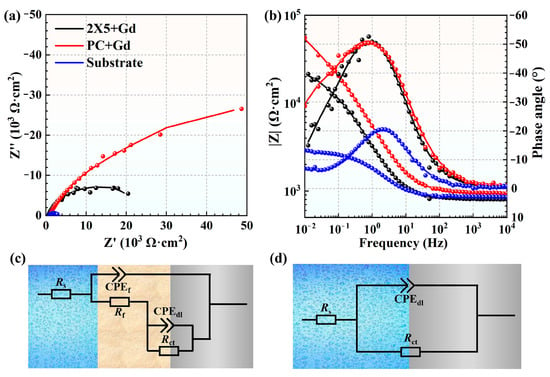
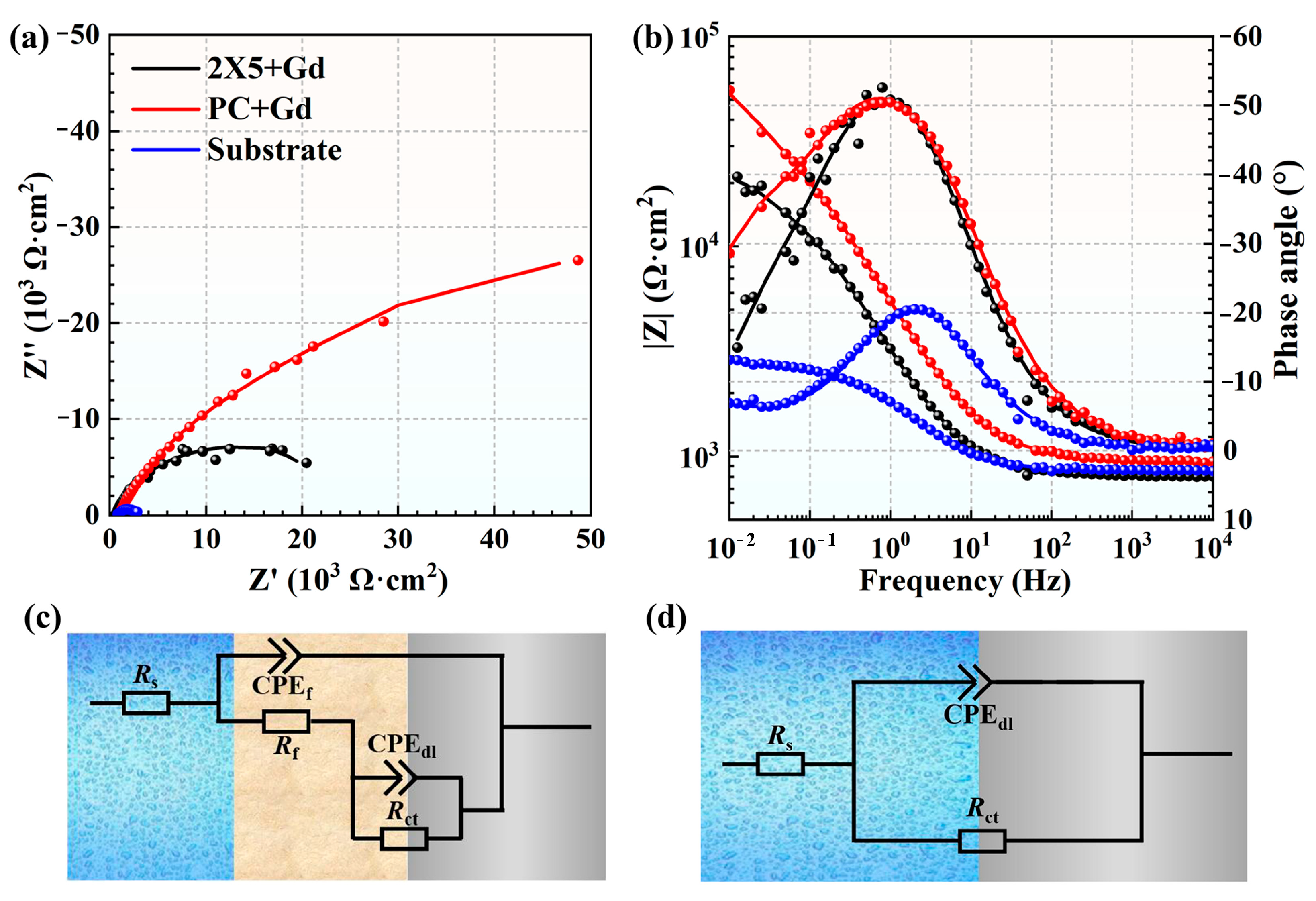
EIS was further performed after 1 h of OCP measurement to assess the corrosion performance of the Gd-doped coatings, and the results are displayed in Figure 8. Figure 8a presents the Nyquist plots, where both plots exhibit an incomplete semi-arc, indicating similar electrochemical behavior of the two coatings. Notably, the semi-arc radius of the PC + Gd is distinctly larger than that of the 2X5 + Gd coating, suggesting improved corrosion resistance. The Bode plots (Figure 8b) exhibit a maximum phase angle at medium frequency for the two coatings, indicating the capacitive behavior of the passive film. Moreover, the impedance modulus at low frequency (|Z|10 mHz) for the two coatings is remarkably higher than that of the substrate, confirming the superior corrosion resistance of the Gd-doped Fe-based AACs.
Figure 8.
(a) Nyquist plot, (b) Bode plot and (c,d) EEC models for the EIS results of the 2X5 + Gd coating, PC + Gd coating, and substrate.
To further elucidate the electrochemical processes that occur during corrosion, the EIS results of the coatings were fitted through the equivalent electrical circuit (EEC) model shown in Figure 8c, where Rct, Rf and Rs represent the resistances of the charge transfer, passive film and the solution, respectively, while CPEdl and CPEf indicate the constant phase element that describes the capacitive response for the double layer and passive film [28]. In contrast, the EIS results of the substrate were fitted through the EEC model shown in Figure 8d due to the absence of passive film on its surface. The fitted curves agree well with the experimental data and the fitting parameters are listed in Table 3. It was found that the fitted equivalent resistance values decreased in the order of PC + Gd coating, 2X5 + Gd coating, and substrate, which indicates the superior corrosion resistance of the PC + Gd coating.
Table 3.
Fitting parameters of EIS results for the Gd-doped coatings and substrate.
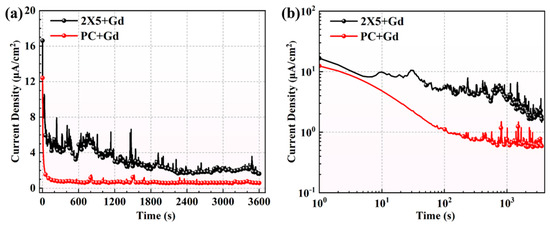
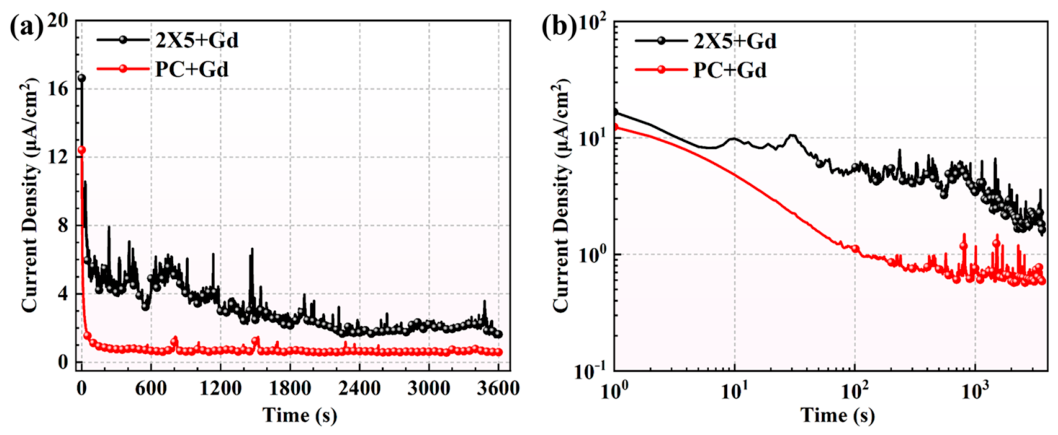
The PDP and EIS results indicate that the PC + Gd coating exhibits a superior corrosion resistance than that of the 2X5 + Gd coating since it has a larger Rf. Therefore, PSP measurements were performed to investigate the passive film growth behavior of the two Gd-doped Fe-based AACs, and the results are shown in Figure 9. Both coatings exhibited current peaks on their potentiostatic polarization curves, likely due to Gd particle dissolution. The PC + Gd coating exhibited a rapid current drop to a low level immediately after potential application, followed by a stable plateau, implying the rapid formation of a protective passive film [29]. Conversely, the 2X5 + Gd coating displayed a slower current decay, indicating delayed passive film formation and inferior protectiveness compared to the PC + Gd coating.
Figure 9.
(a) i-t result, (b) log i - log t result of the PSP measurements for the 2X5 + Gd coating and PC + Gd coating.
3.4. Passive Film Composition
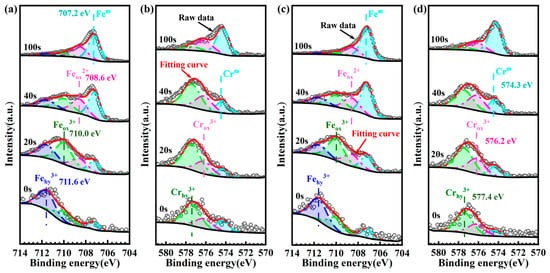
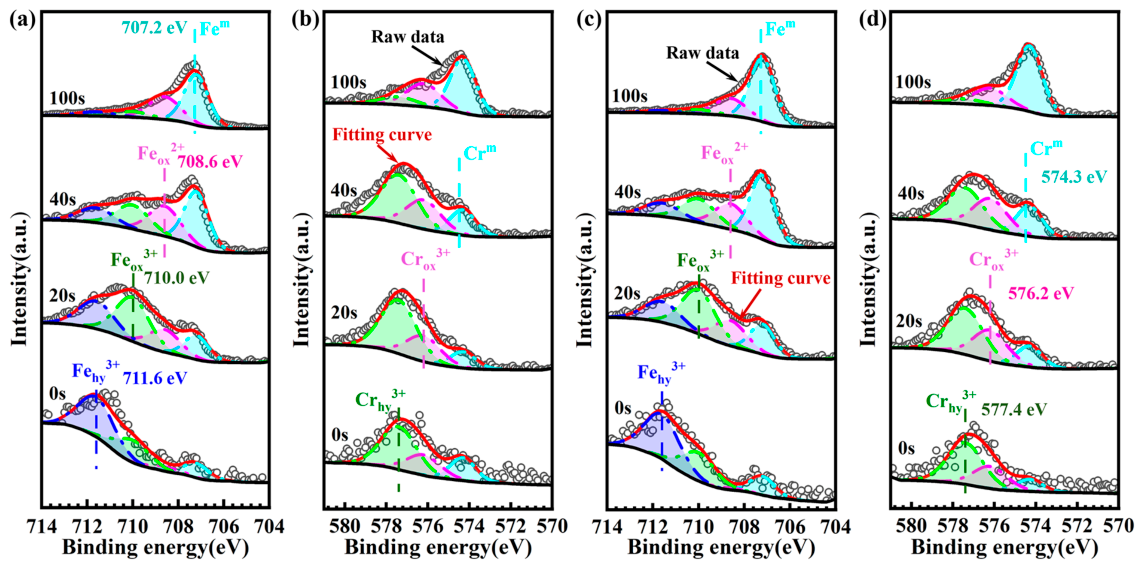
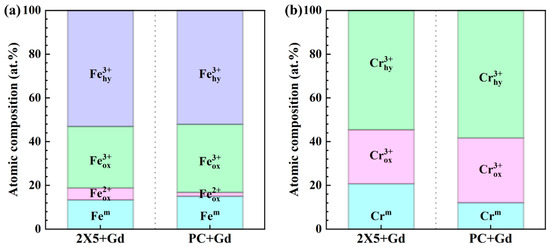
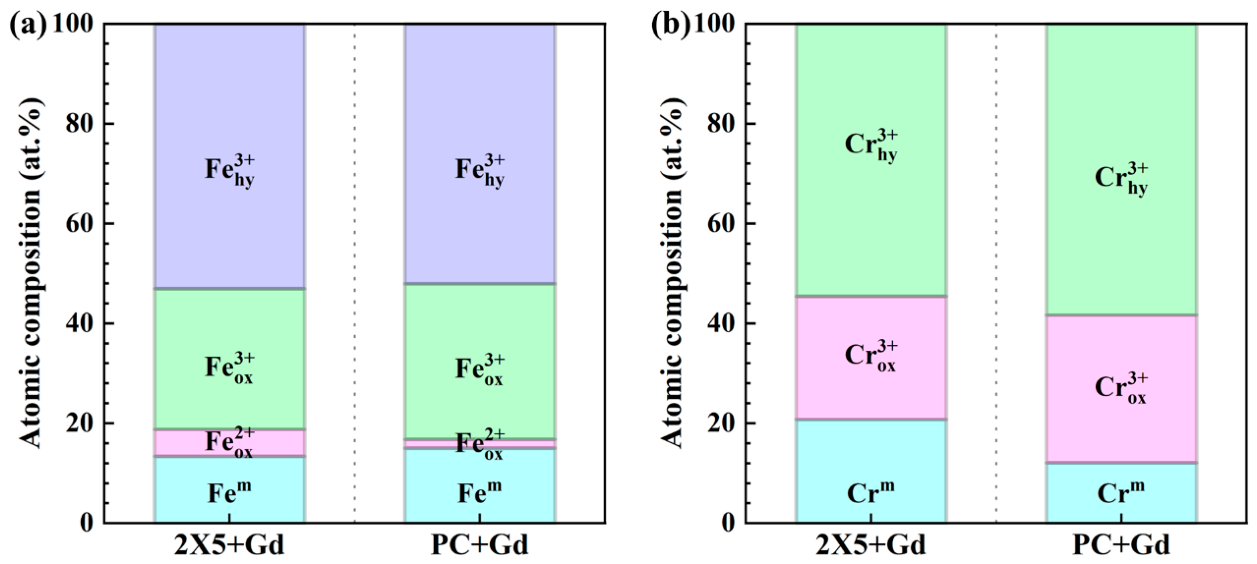
The composition of the passive film is crucial to its stability [30]. Therefore, XPS analysis was conducted to determine the composition of the passive film formed on the surfaces of the 2X5 + Gd coating and the PC + Gd coating, and to further clarify the difference in corrosion resistance of the two coatings. The passive film on the coatings mainly consists of Fe/Cr hydroxides and oxides. The Fe 2p3/2 in the passive film can be classified into four peaks including Fem, Feox2+, Feox3+ and Fehy3+ (Figure 10a,c). The Cr 2p3/2 spectra deconvolute into three signals of Crm, Crox3+ and Crhy3+ (Figure 10b,d), among which Crox3+ is critical to passive film stability. The content of the metallic state increases with increasing sputtering time.
Figure 10.
The XPS results of the passive film of (a) Fe 2p3/2 and (b) Cr 2p3/2 for 2X5 + Gd coating; (c) Fe 2p3/2 and (d) Cr 2p3/2 for PC + Gd coating.
The Fe and Cr species with different valence states in the passive films of the two Gd-doped Fe-based AACs are shown in Figure 11. A significantly higher content of Cr oxides, most notably Cr2O3, is observed in the passive film of the PC + Gd coating than in that of the 2X5 + Gd coating. Cr2O3 critically reinforces the passive film on Fe-based alloys by forming a highly compact, thermodynamically stable oxide skeleton that effectively suppresses the inward diffusion of aggressive chlorides and reduces ionic charge transfer across the metal/film interface [31]. Additionally, it promotes rapid repassivation kinetics and lowers the defect density, thereby significantly enhancing the film’s resistance to localized pitting corrosion and ensuring sustained protective performance under aggressive electrochemical conditions [32].
Figure 11.
Statistical content of various species of (a) Fe and (b) Cr in the passive film for the 2X5 + Gd coating and PC + Gd coating.
This raises the question of why the passive film formed on the PC + Gd coating contains more Cr oxides. The increased Cr2O3 content in the passive film upon P addition originates from two synergistic effects. First, in the early stage of film formation, P preferentially reacts with dissolved Fe ions to form a porous ferric phosphate thin layer on the alloy surface. This porous structure acts as a “sieve” or template, which suppresses further massive dissolution of iron while allowing chromium ions to migrate through the pores, accumulate locally, and eventually precipitate as a Cr-rich oxide (Cr2O3) [33]. Second, because Fe dissolution is hindered, the relative chromium concentration at the alloy/solution interface rises [34]. Meanwhile, P has been observed to directly promote chromium enrichment within the growing oxide, and this enhanced enrichment markedly increases the Cr2O3 content in the inner layer of the passive film [35]. Consequently, the PC + Gd coating exhibits enhanced corrosion resistance.
3.5. SKPFM Results
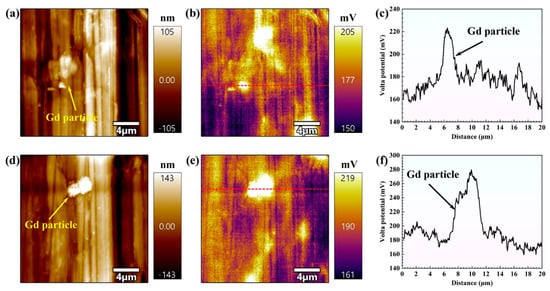
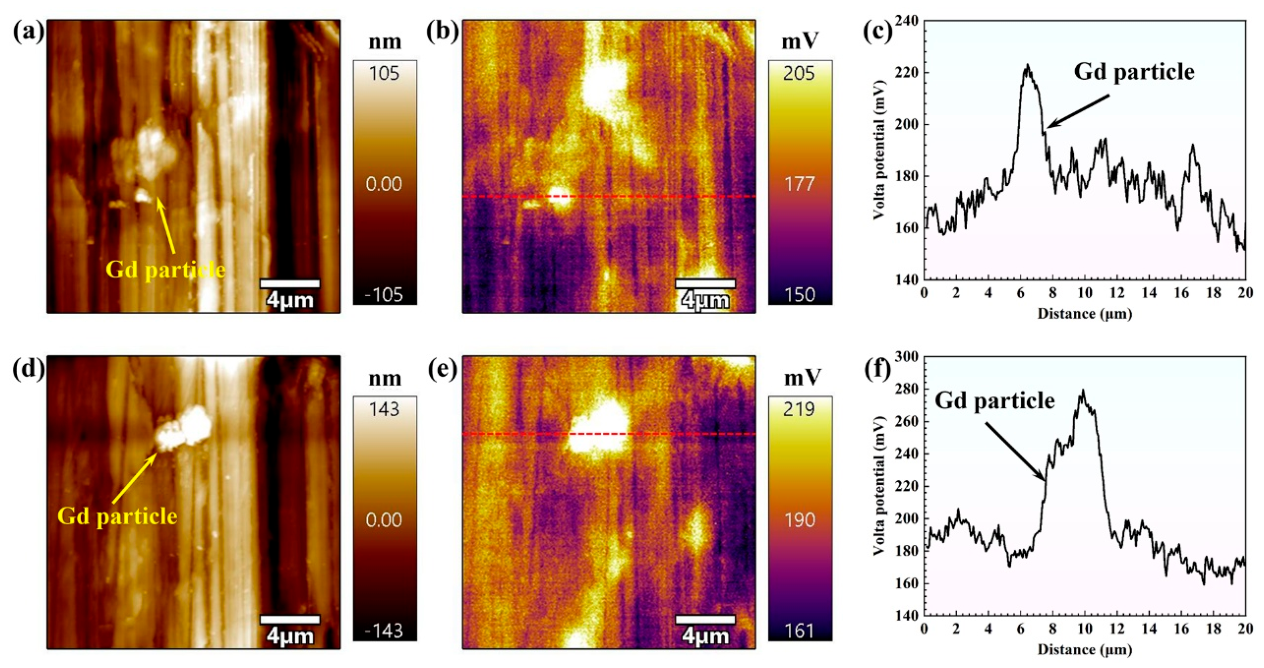
In addition to the passive film’s stability, the overall corrosion rate of the Gd-doped Fe-based AACs is also governed by the electrochemical interaction between the Gd particles and the amorphous matrix. When the potential difference is sufficiently large, a local galvanic cell is established, which promotes further anodic dissolution. To evaluate this effect, SKPFM measurements were performed, and the results are shown in Figure 12. Gd particles with higher VCPD values possess higher electrochemical activity and smaller electron-escape barriers, implying that they are prone to electron loss and can act as anodes during galvanic corrosion [36]. Moreover, the Gd particles exhibit a contact potential about 60 mV higher than that of the amorphous matrix. This marked potential gradient provides a strong thermodynamic impetus for galvanic corrosion between the two constituents, thereby expediting the dissolution of Gd [37].
Figure 12.
SKPFM results for the two coatings. (a) Surface morphology, (b) VCPD maps and (c) line scanning results of VCPD for 2X5 + Gd coating; (d) surface morphology, (e) VCPD maps and (f) line scanning results of VCPD for PC + Gd coating.
Despite the fact that Gd particles are selectively dissolved when exposed to the corrosive environment, the PDP curves and corrosion morphology indicate that there is no notable localized corrosion of the two Gd-doped Fe-based AACs even when polarized to 1.5 VSCE. This is because the Gd particles in the coating are isolated and not interconnected with each other. When Gd particles on the surface dissolve, the underlying amorphous alloy matrix becomes exposed to the corrosive solution, which then re-forms a passive film and reduces the corrosion rate. In contrast, if the Gd content is excessively high and the particles become interconnected, corrosion will propagate along the Gd particles into the coating interior toward the substrate, eventually leading to coating failure [23].
3.6. Corrosion Mechanisms of the Two Gd-Doped Fe-Based AACs
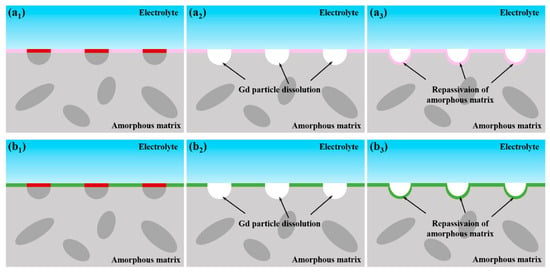
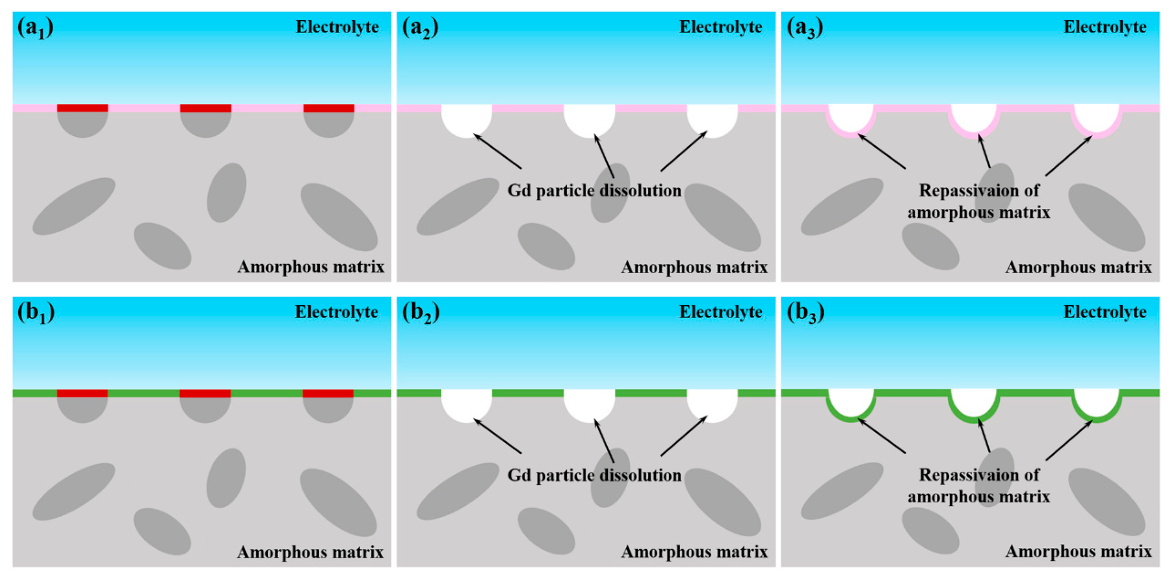
Based on the foregoing analysis, a schematic of the corrosion mechanism for the two Gd-doped Fe-based AACs is proposed in Figure 13. The corrosion process can be divided into three stages. Initially, the Gd particles exposed on the coating surface act as anodic sites and thus undergo preferential dissolution compared to the surrounding amorphous matrix (Figure 13(a1,b1)). Concurrently, the amorphous matrix undergoes passivation, forming a continuous and uniform passive film. Eventually, after the Gd particles are completely dissolved, a number of small pits remain (Figure 13(a2,b2)). However, because these pits are still situated on the amorphous matrix, a highly protective passive film is able to form on the whole surface of the amorphous alloy, with this “dissolution–passivation” process thereby hindering further corrosion propagation (Figure 13(a3,b3)). Furthermore, it is worth noting that the passive film formed on the amorphous matrix of the PC + Gd coating develops more rapidly and offers greater protection, which accounts for its superior corrosion performance. In addition, it is worth noting that porosity defects in the coating can also affect the corrosion resistance of the coating. Previous studies [13,15,16] have reported that through-porosity mainly controls short-term substrate attack, while non-through pores act as local electrolyte reservoirs and can form continuous channels only after long-term pore expansion and interconnection. In the present tests, no through-thickness channel or 921A substrate corrosion was observed, and the amorphous matrix around the pores remained passive and repassivated rapidly. We acknowledge that under prolonged exposure isolated pores may gradually interconnect and eventually promote electrolyte penetration. Therefore, long-term corrosion tests will be performed in future work.
Figure 13.
Schematic illustration of the corrosion mechanism for the (a) 2X5 + Gd coating and (b) PC + Gd coating, (a1, b1): Stage I: Anodic dissolution of exposed Gd sites concurrent with matrix passivation, (a2, b2): Stage II: Residual pits remaining on the amorphous matrix following Gd depletion, (a3, b3): Stage III: Repassivation of the matrix surface effectively blocking corrosion pathways.
4. Conclusions
In this study, two Gd-doped Fe-based AACs, 2X5 + Gd and PC + Gd, were successfully prepared via HVAF thermal spraying, and their neutron absorption properties and corrosion resistance in a simulated SNF wet storage environment were comprehensively evaluated. The main conclusions are drawn as follows:
(1) The incorporation of Gd particles significantly enhances neutron shielding performance. MCNP simulations confirm that the 2X5 + Gd and PC + Gd coatings possess macroscopic neutron absorption cross-sections approximately 16.8 and 15.8 times higher than that of the BSS containing 0.6 wt.% B, respectively, enabling superior neutron attenuation with a substantially reduced coating thickness.
(2) Both Gd-doped Fe-based AACs exhibit markedly better corrosion resistance than the 921A steel substrate, as evidenced by spontaneous passivation, low passive current densities, and high low-frequency impedance moduli. The PC + Gd coating outperforms the 2X5 + Gd counterpart, primarily because the presence of P promotes rapid formation of a Cr2O3-enriched passive film with superior protectiveness.
(3) The corrosion process follows a distinctive “dissolution–passivation” mechanism. The isolated Gd particles on the coating surface act as preferential anodic sites and dissolve selectively, while the surrounding amorphous matrix simultaneously develops a continuous and stable passive film. After Gd dissolution, the exposed amorphous matrix retains its rapid repassivation capability, effectively preventing localized corrosion propagation and ensuring coating integrity even under aggressive anodic polarization.
Author Contributions
Methodology, W.L., D.W., J.Z., C.Y., T.L. and S.Z. (Suode Zhang); investigation, W.L., D.W. and J.Z.; resources, D.W.; data curation, W.L., D.W., J.Z., C.Y., T.L., S.Z. (Suode Zhang) and S.Z. (Song Zhang); writing—original draft preparation, W.L., D.W., C.Y., S.Z. (Suode Zhang) and S.Z. (Song Zhang); writing—review and editing, W.L., D.W., C.Y., T.L. and S.Z. (Song Zhang). All authors have read and agreed to the published version of the manuscript.
Funding
This work was supported by the National Natural Science Foundation of China (Nos. 52501234 and 52471186), the China Postdoctoral Science Foundation (No. 2025M770129) and the Doctoral Scientific Research Foundation of Liaoning Province (No. 2025-BS-0169).
Data Availability Statement
The original contributions presented in this study are included in the article. Further inquiries can be directed to the corresponding authors.
Acknowledgments
The authors would like to thank Jin Gao, Baoting Ji, Xinyu Zhang, Bo Liu, Hao Yu, Pengfei Qin, Wanjuan Huang, and Fan Yang for their valuable assistance with the experimental work and manuscript preparation.
Conflicts of Interest
The authors declare no conflicts of interest.
References
- Liu, L.M.; Guo, H.; Dai, L.H.; Liu, M.L.; Xiao, Y.; Cong, T.L.; Gu, H.Y. The role of nuclear energy in the carbon neutrality goal. Prog. Nucl. Energy 2023, 162, 9. [Google Scholar] [CrossRef] [Scilit]
- Xie, Y.; Chen, C.L.; Ren, X.M.; Wang, X.X.; Wang, H.Y.; Wang, X.K. Emerging natural and tailored materials for uranium-contaminated water treatment and environmental remediation. Prog. Mater. Sci. 2019, 103, 180–234. [Google Scholar] [CrossRef] [Scilit]
- Wang, D.B.; Wu, J.; Wang, Q.; Wan, L.; Emori, W.; Zhang, S.D.; Wang, J.Q. Temperature-dependent corrosion behaviour of the amorphous steel in simulated wet storage environment of spent nuclear fuels. Corros. Sci. 2021, 188, 109529. [Google Scholar] [CrossRef] [Scilit]
- Farmer, J.C.; Haslam, J.J.; Day, S.D.; Lian, T.; Saw, C.K.; Hailey, P.D.; Choi, J.S.; Rebak, R.B.; Yang, N.; Payer, J.H.; et al. Corrosion resistance of thermally sprayed high-boron iron-based amorphous-metal coatings: Fe49.7Cr17.7Mn1.9Mo7.4W1.6B15.2C3.8Si2.4. J. Mater. Res. 2007, 22, 2297–2311. [Google Scholar] [CrossRef] [Scilit]
- Farmer, J.; Choi, J.S.; Saw, C.; Haslam, J.; Day, D.; Hailey, P.; Lian, T.G.; Rebak, R.; Perepezko, J.; Payer, J.; et al. Iron-Based Amorphous Metals: High-Performance Corrosion-Resistant Material Development. Metall. Mater. Trans. A-Phys. Metall. Mater. Sci. 2009, 40, 1289–1305. [Google Scholar] [CrossRef] [Scilit]
- Ha, H.Y.; Jang, J.H.; Lee, T.H.; Kim, S.D.; Lee, C.H.; Moon, J. Enhancement of the resistance to localized corrosion of type 304 borated stainless steels through hot rolling. Corros. Sci. 2021, 192, 109798. [Google Scholar] [CrossRef] [Scilit]
- Wang, Z.-J.; Li, Y.-W.; Gao, S.-B.; Wang, G.-D.; Liu, H.-T. Enhanced strength-ductility synergy in brittle high borated steel by tailoring strain hardening behaviour. Scr. Mater. 2023, 230, 115398. [Google Scholar] [CrossRef] [Scilit]
- Saeed, A. Developed borated austenitic stainless steel alloys as nuclear reactor control rods. Nucl. Eng. Des. 2023, 413, 112515. [Google Scholar] [CrossRef] [Scilit]
- Ha, H.Y.; Jang, J.H.; Lee, T.H.; Won, C.; Lee, C.H.; Moon, J.; Lee, C.G. Investigation of the Localized Corrosion and Passive Behavior of Type 304 Stainless Steels with 0.2–1.8 wt % B. Materials 2018, 11, 2097. [Google Scholar] [CrossRef] [Scilit]
- Wang, D.; Cui, J.; Ma, A.; Ji, B.; Shi, J.; Liu, Z.; Yu, B.; Chen, X.; Ma, H.; Zhang, S.; et al. Unveiling the pitting corrosion mechanism of borated stainless steel in the wet storage environment of spent nuclear fuels. Acta Mater. 2024, 263, 119477. [Google Scholar] [CrossRef] [Scilit]
- Sun, Y.; Tan, X.; Lan, R.; Ran, G.; Li, J.; Jiang, Y. Mechanisms of inclusion-induced pitting of stainless steels: A review. J. Mater. Sci. Technol. 2024, 168, 143–156. [Google Scholar] [CrossRef] [Scilit]
- Lu, W.Y.; Wang, D.B.; Ji, B.T.; Cui, J.P.; Shi, J.; Liu, Z.W.; Li, T.R.; Liu, B.; Yang, F.; Zhang, S.; et al. Insight into the long-term corrosion evolution of borated stainless steels in the wet storage environment for spent nuclear fuel. Corros. Sci. 2024, 237, 112348. [Google Scholar] [CrossRef] [Scilit]
- Wang, D.B.; Wu, J.; Cui, J.P.; Wang, Q.; Li, T.R.; Emori, W.; Zhang, S.D.; Wang, J.Q. Long-term corrosion evolution associated with the structural heterogeneities of an Fe-based amorphous coating in H3BO3 solution at various temperatures. J. Mater. Sci. Technol. 2023, 140, 233–248. [Google Scholar] [CrossRef] [Scilit]
- Nayak, S.K.; Kumar, A.; Laha, T. Fe-based metallic glass coatings by thermal spraying: A focused review on corrosion properties and related degradation mechanisms. Int. Mater. Rev. 2022, 68, 404–485. [Google Scholar] [CrossRef] [Scilit]
- Zou, G.; Qi, Y.; Wang, Q.; Xiong, F.; Zhu, S.; Yu, F.; Mo, H.; Sun, B.; Cai, M.; Guo, Z.; et al. Enhanced anti-wear properties of HVOF-sprayed Fe-Cr-Mo-C-B high-entropy amorphous composite coatings via heat input modulation. Tribol. Int. 2026, 219, 111848. [Google Scholar] [CrossRef] [Scilit]
- Wang, M.; Li, X.; Li, W.; Cheng, B.; Zhang, X.; Zhai, H. Structural, mechanical and tribocorrosion performances of Fe-based amorphous coating via cryogenic cycling treatment. J. Non-Cryst. Solids 2026, 687, 124138. [Google Scholar] [CrossRef] [Scilit]
- Huang, P.; Wang, D.B.; Cui, J.P.; Liu, J.Q.; Zhang, S.D.; Ren, Y.L.; Qiu, K.Q.; Wang, J.Q. Potential-dependent Cr/Mo ratio effect on the passivity of Fe-based metallic glass in simulated wet storage environment of spent nuclear fuels. Corros. Sci. 2025, 249, 112862. [Google Scholar] [CrossRef] [Scilit]
- Lv, Y.; Di, J.; Wang, N.; Li, H.; Li, Q.; Bai, H.; Huang, J.; Wang, Z.; Li, Z.; Fan, H.; et al. Unveiling Temperature-Dependent Corrosion Behaviors of FeNiCrMoCBY Amorphous Alloy Coatings In Spent-Fuel Storage Environments. Rare Met. 2026, 45, e70260. [Google Scholar] [CrossRef] [Scilit]
- Li, X.X.; Cui, D.Y.; Zou, C.Y.; Ren, C.L.; Chen, J.E. Neutron shielding analysis for a gadolinium doped nickel alloy. Mater. Today Commun. 2024, 38, 10. [Google Scholar] [CrossRef] [Scilit]
- Mustafa, S.S. Neutronic investigation of enriched gadolinium, natural gadolinium and Zirconium-erbium as burnable poisons in the advanced PWR assemblies by MCNPX code. Radiat. Phys. Chem. 2023, 212, 111129. [Google Scholar] [CrossRef] [Scilit]
- Park, J.S.; Kim, J.; Yi, S.H. Effects of Gadolinium in Fe based amorphous ribbons with high boron contents on the neutron shielding efficiency. Ann. Nucl. Energy 2017, 109, 365–369. [Google Scholar] [CrossRef] [Scilit]
- Peng, J.; Tang, B.; Wang, Q.; Bai, C.; Wu, Y.; Chen, Q.; Li, D.; Ding, D.; Xia, L.; Guo, X.; et al. Effect of heavy rare-earth (Dy, Tb, Gd) addition on the glass-forming ability and magneto-caloric properties of Fe89Zr7B4 amorphous alloy. J. Alloys Compd. 2022, 925, 166707. [Google Scholar] [CrossRef] [Scilit]
- Ji, B.T.; Wang, D.B.; Li, T.R.; Xia, Y.H.; Cao, F.Y.; Zhang, S.D.; Li, H.; Wang, J.Q. Corrosion-resistant Gd particles-doped Fe-based amorphous coatings with excellent neutron absorption properties. Corros. Sci. 2024, 238, 112376. [Google Scholar] [CrossRef] [Scilit]
- Ye, Y.Z.; Guo, Z.J.; Zhou, Z.J.; Zhang, B.S.; Wang, Q.Q.; Shen, B.L. Improved corrosion and corrosion-wear properties of Fe-based high-entropy amorphous coatings by modulating heat input of HVAF. Corros. Sci. 2024, 232, 17. [Google Scholar] [CrossRef] [Scilit]
- Zhao, T.X.; Cheng, S.Y.; Wang, N.; Peng, E.; Ning, Z.L.; Sun, J.F.; Zhang, Y.M.; Huang, Y.J. Microstructural evolution and mechanical performance of AlNiCe amorphous thin films under proton irradiation. Surf. Coat. Tech. 2025, 515, 8. [Google Scholar] [CrossRef] [Scilit]
- Schuler, J.D.; Grigorian, C.M.; Barr, C.M.; Boyce, B.L.; Hattar, K.; Rupert, T.J. Amorphous intergranular films mitigate radiation damage in nanocrystalline Cu-Zr. Acta Mater. 2020, 186, 341–354. [Google Scholar] [CrossRef] [Scilit]
- Cao, F.-H.; Zhang, Q.-H.; Li, X.-R.; Zhang, J.-Q. What is the future of modern corrosion electrochemistry? Corros. Commun. 2026, 22, 1–5. [Google Scholar] [CrossRef] [Scilit]
- Wang, D.B.; Zhang, S.D.; Cui, J.P.; Zeng, S.; Zou, Y.; Liu, J.Q.; Han, D.; Liu, C.X.; Chen, X.Q.; Ma, H.; et al. Ultra-high pitting resistance in high-entropy alloys by simultaneous enhancement of complex oxide stability and bond energy. J. Mater. Sci. Technol. 2026, 279, 154–164. [Google Scholar] [CrossRef] [Scilit]
- Yu, K.; Feng, S.; Ding, C.; Gu, M.; Yu, P.; Huang, M. A sequential dual-passivation strategy for designing stainless steel used above water oxidation. Mater. Today 2023, 70, 8–16. [Google Scholar] [CrossRef] [Scilit]
- Duan, X.; Han, T.; Guan, X.; Wang, Y.; Su, H.; Ming, K.; Wang, J.; Zheng, S. Cooperative effect of Cr and Al elements on passivation enhancement of eutectic high-entropy alloy AlCoCrFeNi2.1 with precipitates. J. Mater. Sci. Technol. 2023, 136, 97–108. [Google Scholar] [CrossRef] [Scilit]
- Zhao, Y.G.; Liu, W.; Fan, Y.M.; Fan, E.D.; Dong, B.J.; Zhang, T.Y.; Li, X.G. Effect of Cr content on the passivation behavior of Cr alloy steel in a CO2 aqueous environment containing silty sand. Corros. Sci. 2020, 168, 17. [Google Scholar] [CrossRef] [Scilit]
- Olsson, C.O.A.; Landolt, D. Passive films on stainless steels—Chemistry, structure and growth. Electrochim. Acta 2003, 48, 1093–1104. [Google Scholar] [CrossRef] [Scilit]
- Shan, T.; Gao, J.; Huang, M.; Qin, Y.; Yang, S. Effect of W, Ni, and P addition on the glass-forming ability and properties of Fe-based amorphous alloys. J. Non-Cryst. Solids 2025, 666, 11. [Google Scholar] [CrossRef] [Scilit]
- Virtanen, S.; Elsener, B.; Böhni, H. Effect of metalloids on the passivity of amorphous Fe–Cr alloys. J. Less Common Met. 1988, 145, 581–593. [Google Scholar] [CrossRef] [Scilit]
- Li, H.X.; Lu, Z.C.; Wang, S.L.; Wu, Y.; Lu, Z.P. Fe-based bulk metallic glasses: Glass formation, fabrication, properties and applications. Prog. Mater. Sci. 2019, 103, 235–318. [Google Scholar] [CrossRef] [Scilit]
- Wei, L.; Qin, W.-M.; Chen, J.-Y.; Lei, W.-X.; Xi, J.-Y. L21-strengthened face-centered cubic high-entropy alloy with well pitting resistance. Corros. Sci. 2023, 215, 111043. [Google Scholar] [CrossRef] [Scilit]
- Zhang, J.Y.; Chou, T.H.; Zhang, J.X.; Luan, J.H.; Zhao, Y.L.; Yang, T. Understanding the impacts of L12 nanoprecipitates on the electrochemical and passive behavior of CoCrNiAlTi-type high-entropy alloys. Corros. Sci. 2024, 235, 112211. [Google Scholar] [CrossRef] [Scilit]

Disclaimer/Publisher’s Note: The statements, opinions and data contained in all publications are solely those of the individual author(s) and contributor(s) and not of MDPI and/or the editor(s). MDPI and/or the editor(s) disclaim responsibility for any injury to people or property resulting from any ideas, methods, instructions or products referred to in the content. |
© 2026 by the authors. Licensee MDPI, Basel, Switzerland. This article is an open access article distributed under the terms and conditions of the Creative Commons Attribution (CC BY) license.