


Abstract
Developing efficient non-precious electrocatalysts for the hydrogen evolution reaction (HER) is crucial to advancing scalable green hydrogen generation. Herein, vertically aligned TiO2 nanotube arrays were directly grown on Ti substrates via electrochemical anodization and subsequently employed as a scaffold for the in situ hydrothermal growth of MoS2 nanosheets. Among the investigated electrodes, MoS2/TNT-2 exhibits the best electrochemical HER performance, achieving a current density of 10 mA cm−2 at an overpotential of 353 mV in 1 M KOH. Moreover, the electrode maintains good electrochemical stability during a 24 h chronoamperometric test and after 2000 cyclic voltammetry sweeps. This work provides a facile route for constructing self-supported MoS2/TiO2 heterostructured electrodes for alkaline HER.
1. Introduction
With the growing demand for energy supply and the necessity of reducing carbon emissions, intensive research has been conducted in renewable and sustainable energy technologies [1,2]. Hydrogen is the most popular energy carrier among the different ones because of its high gravimetric energy density and zero carbon emissions [3]. Electrochemical water splitting is considered to be a promising route for producing green hydrogen; however, the sluggish kinetics of the HER remain a major challenge in achieving efficient hydrogen production, particularly in alkaline electrolytes [4,5]. Therefore, the development of highly active electrocatalysts is essential to accelerate HER kinetics and reduce the associated energy loss. Although platinum (Pt)-based catalysts exhibit excellent HER activity and durability, their scarcity and high cost severely hinder large-scale applications [6]. For this reason, many efforts have been devoted to developing economical non-noble metal electrocatalysts, such as transition-metal carbides, nitrides, sulfides, and carbon-based materials [7,8,9,10,11,12].
Molybdenum disulfide (MoS2), with a unique layered structure, abundant natural resources, and excellent catalytic properties, has received significant interest among the various non-precious metal electrocatalysts [13,14]. The unsaturated coordinated sulfur atoms at the edges of MoS2 layers are responsible for the majority of the catalytic activity, as they have near-optimal hydrogen adsorption properties [15,16,17]. Nevertheless, the intrinsic low conductivity of semiconducting MoS2 and the limited exposure of active edge sites due to nanosheet restacking seriously restrict the full exploitation of its HER performance [18,19]. Therefore, the preparation of MoS2-based composite structures on suitable supports has been widely recognized as an effective strategy to overcome these limitations, achieving results such as increasing the dispersion of catalysts, exposing more catalytic interfaces, and enhancing charge transportation properties [20,21].
With their one-dimensional ordered nanotube structure, chemical stability, and ability to be directly integrated with Ti substrates, TiO2 nanotube arrays (TNTs) have become an attractive supporting material in the construction of electrocatalytic electrodes [22,23]. The vertically aligned nanotube channels offer a vast number of anchoring sites for catalyst growth while maintaining open channels for electrolyte diffusion and mass transport [24,25]. Moreover, TNTs can be directly fabricated on Ti substrates by electrochemical anodization, possessing integrated electrodes with strong adhesion and intimate electrical contact to the substrate without using polymer binders [26,27,28,29,30]. Furthermore, intimate heterojunctions can be achieved by combining MoS2 with the TiO2 nanotube arrays, leading to interfacial charge redistribution and efficient electron transfer in the electrocatalytic process. The structural advantages make TNTs potential base materials for fabricating MoS2-based electrodes with enhanced catalytic accessibility and durability.
Although MoS2/TiO2 composites have been widely explored in photocatalytic and photoelectrochemical applications, their application as self-supported electrodes for electrocatalytic HERs remains relatively less explored. In particular, the influence of precursor conditions on the growth and microstructure of MoS2 on TiO2 nanotube arrays and the resulting HER performance requires further investigation. In this work, MoS2 nanostructures were directly grown on TiO2 nanotube arrays through a facile hydrothermal route. The precursor concentration was varied to regulate the growth and surface coverage of MoS2, and the corresponding variations in electrode microstructure and electrochemical HER performance were investigated. This study provides further insight into the relationship among precursor conditions, microstructural characteristics, and HER performance of self-supported MoS2/TiO2 nanotube electrodes.
2. Experimental
2.1. Fabrication of Titanium Dioxide Nanotube Arrays
TiO2 nanotube arrays were prepared on titanium sheets (99.9%) by electrochemical anodization. The Ti substrates were polished with 100-mesh, 800-mesh, and 1500-mesh sandpaper before anodization to remove surface oxides and impurities. The substrates were then washed with ethanol and deionized water under ultrasonic treatment, and dried for subsequent use. The anodization process utilized a two-electrode electrochemical cell, in which a polished Ti sheet acted as the working electrode and a commercial Pt plate served as the counter electrode. The electrolyte comprised a solution of ethylene glycol, 0.5 wt% NH4F, and 5 mL of HF. A constant voltage of 60 V was applied for 4 h during the process, with the temperature of electrolyte maintained in 10–15 °C. Subsequently, the as-prepared samples were rinsed with ethanol, dried in air, and annealed at 450 °C for 2 h to facilitate the formation of anatase TiO2.
2.2. Fabrication of MoS2/TiO2 Electrodes
The MoS2/TiO2 composite electrodes were fabricated via a hydrothermal approach. The sources of molybdenum and sulfur were sodium molybdate (Na2MoO4·2H2O) and dibenzyldisulfide ((C6H5CH2)2S2), respectively. Different amounts of Na2MoO4·2H2O (6.25 mg, 12.5 mg, 25 mg, 100 mg, 400 mg) and (C6H5CH2)2S2 (5.9375 mg, 11.875 mg, 23.75 mg, 95 mg, 380 mg) were employed to regulate the MoS2 deposition. An aqueous solution of Na2MoO4·2H2O was prepared by dissolving in 30 mL of deionized water, and the (C6H5CH2)2S2 was dispersed in 30 mL of ethanol using ultrasonication. This sulfur-source suspension was then gradually introduced into the molybdate solution, followed by ultrasonic treatment for 30 min to get a homogeneous precursor. The resulting mixture was transferred into a 100 mL autoclave containing the pre-prepared TNT substrate and hydrothermally treated at 170 °C for 24 h. The obtained samples were denoted as MoS2/TNT-1, MoS2/TNT-2, MoS2/TNT-3, MoS2/TNT-4, and MoS2/TNT-5 according to the increasing molar concentrations of the Mo/S precursor.
2.3. Characterization
The morphological features were investigated using a field-emission scanning electron microscope (ZEISS Sigma 300, Carl Zeiss Microscopy GmbH, Jena, Germany), and the elemental distribution was concurrently mapped via energy-dispersive X-ray spectroscopy. The crystal phase identification and structural analysis were achieved by X-ray diffraction (Rigaku Ultima IV, Rigaku Corporation, Tokyo, Japan), scanning the 2θ range from 5° to 80° at a stepwise rate of 10° per minute. The surface chemical composition and state information were analyzed through X-ray photoelectron spectroscopy (ESCALAB 250Xi, Thermo Fisher Scientific, Waltham, USA); all binding energies were referenced to the adventitious carbon C 1s peak at 284.8 eV for accurate calibration.
2.4. Electrochemical Testing
All electrochemical tests were conducted using a three-electrode setup on a CHI electrochemical workstation. The working electrodes consisted of the as-prepared TNT and MoS2/TNT electrodes, with an effective area of 1 cm2. A platinum foil was used as the counter electrode, while a Hg/HgO reference electrode (in 1 M KOH) provided potential control. Experiments were carried out in ambient air at room temperature using 1 M aqueous KOH as the electrolyte. Linear sweep voltammetry (LSV) data were acquired at a scan rate of 5 mV s−1. To convert measured potentials to the reversible hydrogen electrode (RHE) scale, the following calibration equation was applied:
The electrochemical double-layer capacitance (Cdl) was evaluated from cyclic voltammetry (CV) curves between −0.5 V and −0.4 V (vs. Hg/HgO). CV cycles were acquired at varying scan rates (20, 40, 60, 80, and 100 mV s−1). The electrochemical impedance spectroscopy (EIS) was conducted with a frequency range of 105 to 10−2 Hz (with an AC amplitude of 5 mV). The electrochemical stability was evaluated by 2000 CV cycles at 100 mV s−1 followed by LSV polarization measurements, together with a chronoamperometric measurement at a fixed overpotential of 353 mV for 24 h.
3. Results and Discussion
3.1. Characterization Analysis
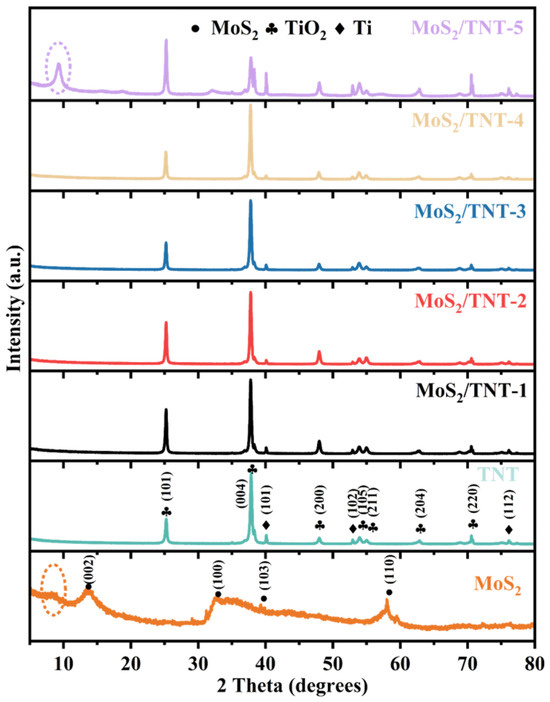
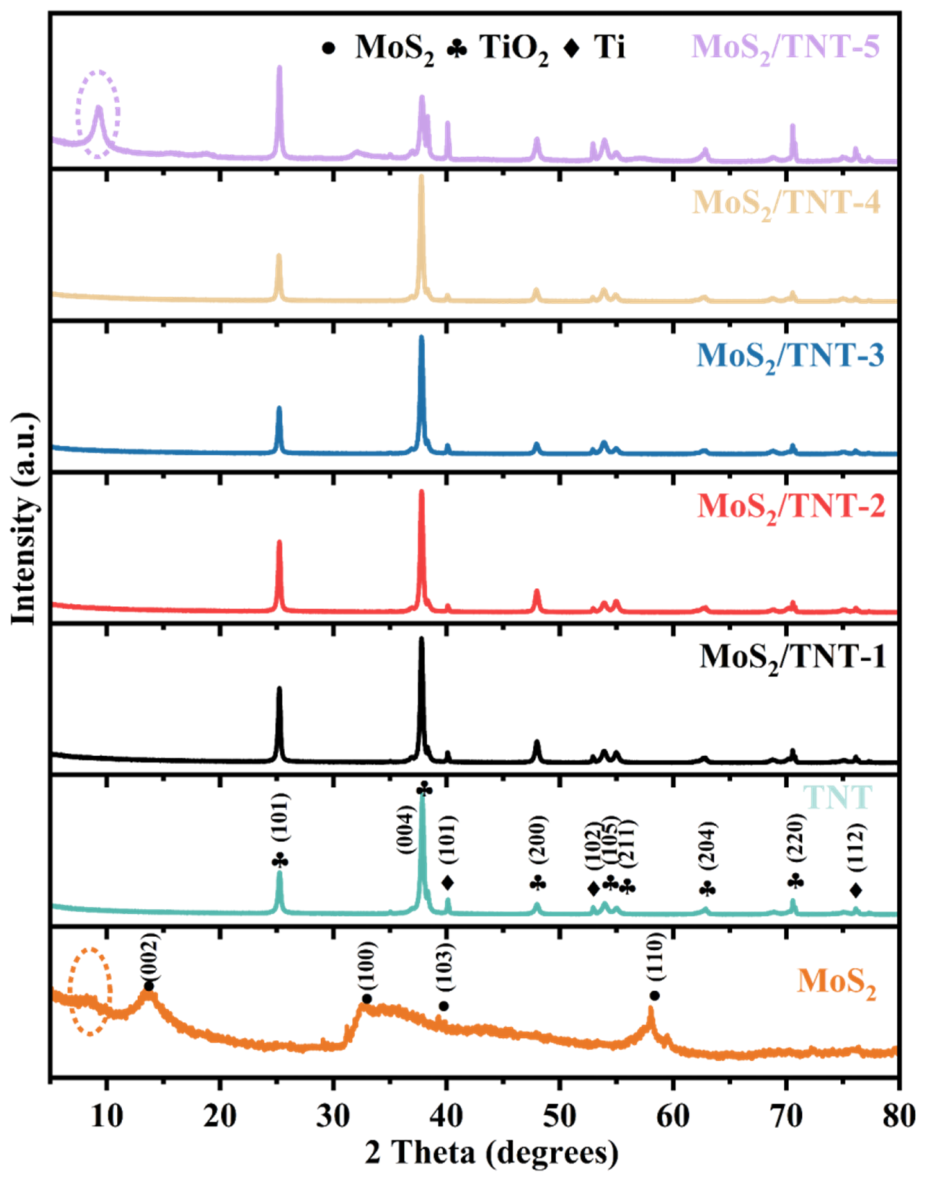
The crystal structure characteristics of TNT, MoS2, and MoS2/TNT composites were investigated using an XRD analysis, as shown in Figure 1. The diffraction peaks located at 25.26°, 37.86°, 47.98°, 53.92°, 55.04°, 62.84°, and 70.58° can be indexed to the (101), (004), (200), (105), (211), (204), and (220) reflections of anatase phase TiO2 (JCPDS No. 21-1272), verifying the successful crystallization of TiO2 nanotubes following thermal annealing. In addition, several diffraction peaks originating from the Ti substrate are also observed. For the MoS2 sample, the diffraction peaks at 14.36°, 32.68°, 39.58°, and 58.06° match the (002), (100), (103), and (110) planes of the hexagonal MoS2 (JCPDS No. 37-1492), indicating that 2H-MoS2 was the dominant crystalline phase. In addition, a broad low-angle diffraction peak was observed at around 9.2°, suggesting an expanded interlayer spacing that has been commonly associated with expanded-layer structures [31,32]. For the MoS2/TNT composites prepared at relatively low precursor concentrations (MoS2/TNT-1 to MoS2/TNT-4), no obvious diffraction peaks of MoS2 can be observed. This is mainly attributed to the highly dispersed nature and limited crystallite size of the in situ grown MoS2, together with the strong diffraction signals from the Ti substrate and TiO2 nanotube arrays, which obscure the relatively weak diffraction signals of MoS2. When the precursor concentration was further increased (MoS2/TNT-5), a relatively weak diffraction peak attributable to MoS2 became discernible, consistent with the increased growth and surface coverage of MoS2 observed by SEM.
Figure 1.
XRD patterns of the TNT, MoS2/TNT composite, and MoS2 samples.
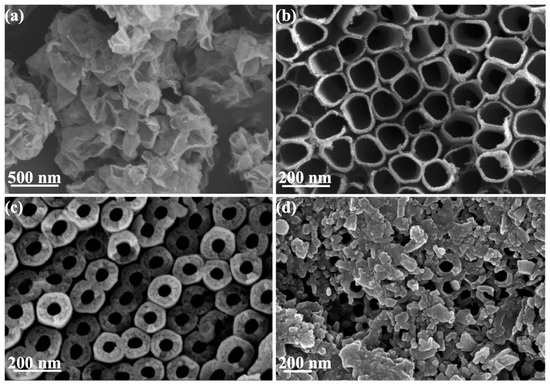
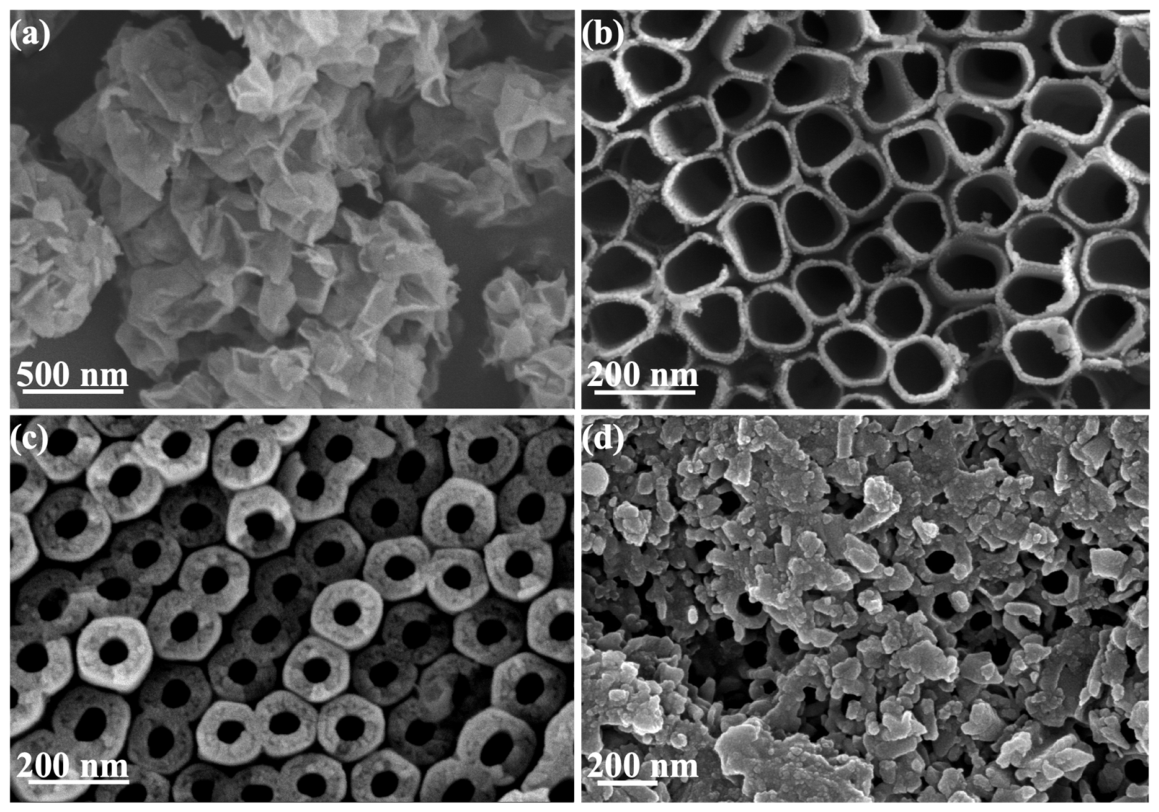
The surface morphologies of MoS2, TNT, and the MoS2/TNT-2 composite were investigated by SEM. As shown in Figure 2a, the as-synthesized MoS2 exhibited a typical flower-like morphology consisting of interconnected ultrathin nanosheets formed through self-assembly [33]. The TNT sample (Figure 2b) consists of highly ordered nanotube arrays with uniform tube diameters, providing abundant anchoring sites and open transport channels for catalyst loading [34]. After the hydrothermal treatment process, the morphology of MoS2 underwent a significant change. Instead of forming large aggregated nanosheets, MoS2 was anchored onto the nanotube walls, while the ordered tubular architecture remained well preserved (Figure 2c). As compared to the pristine TNT, the nanotube walls exhibit a modestly increased thickness in the MoS2/TNT-2 composite, while the nanotube channels remain largely open, which may facilitate electrolyte penetration and improve the accessibility of catalytic sites [35]. At a higher precursor concentration, the MoS2/TNT-5 electrode exhibits increased MoS2 coverage and more pronounced aggregation, accompanied by partial obstruction of the nanotube openings (Figure 2d). The corresponding EDS mapping confirms the presence of Mo and S across the electrode surface (Figure S1).
Figure 2.
SEM images of (a) MoS2, (b) TNT, (c) MoS2/TNT-2, and (d) MoS2/TNT-5 electrodes.
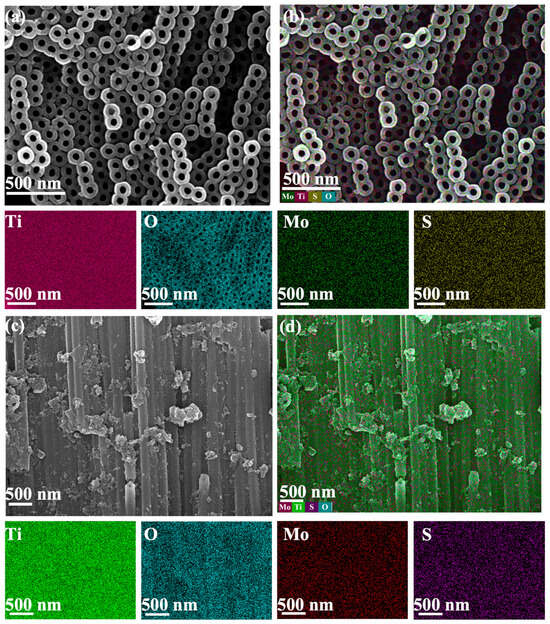
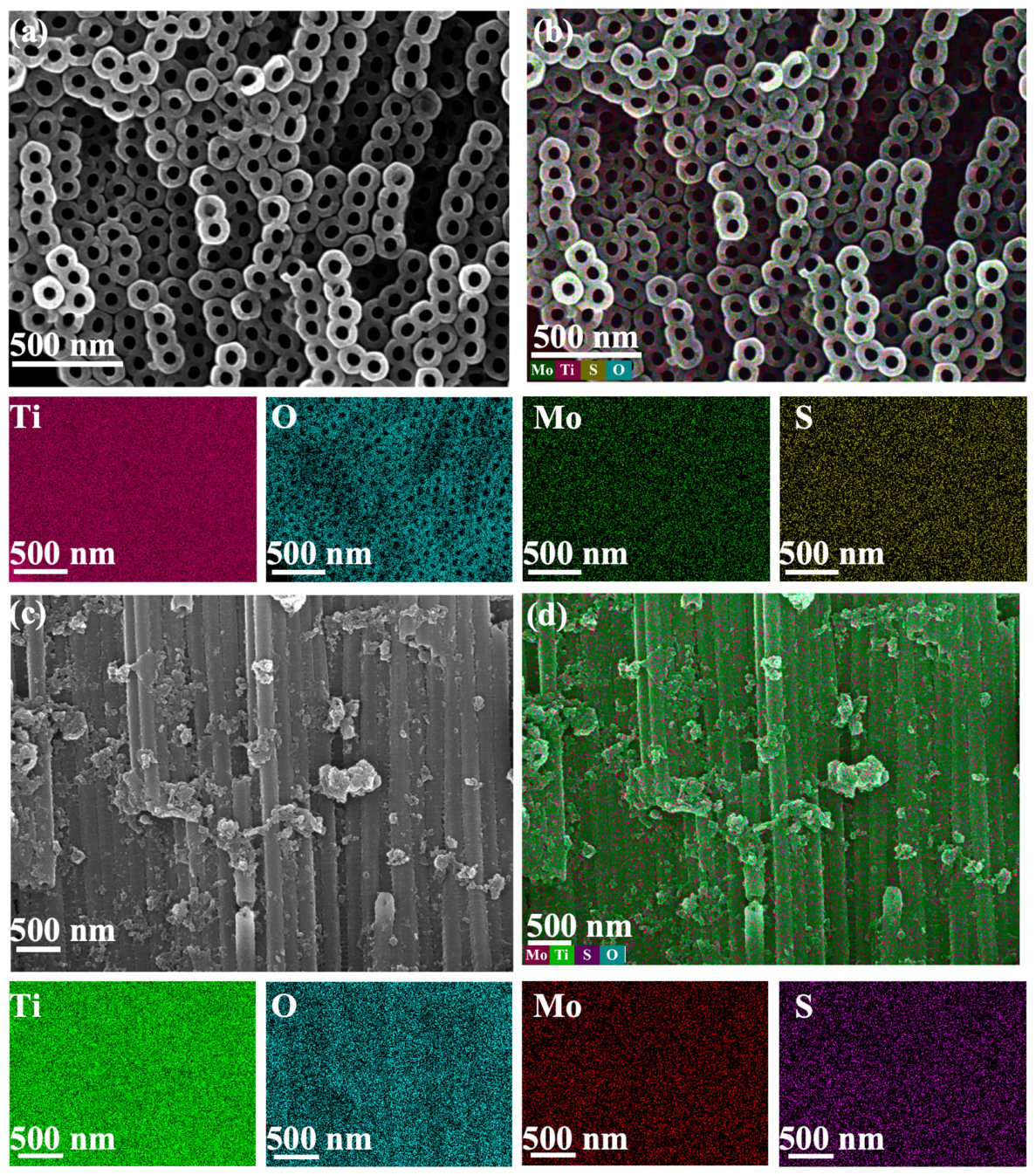
The surface and cross-sectional elemental distributions of the MoS2/TNT-2 electrode were further examined by SEM-EDS mapping (Figure 3). The surface mapping (Figure 3a,b) clearly shows the coexistence of Ti, O, Mo, and S, with Mo and S distributed over the nanotube array, supporting the successful growth of MoS2 on the TNT framework. Furthermore, the cross-sectional SEM shows that the vertically aligned nanotubular architecture is retained after the hydrothermal treatment (Figure 3c). The corresponding cross-sectional elemental mapping (Figure 3d) reveals the presence of Mo and S along the nanotube walls, indicating that MoS2 is distributed not only on the top surface but also along the nanotubular structure.
Figure 3.
SEM images and corresponding EDS elemental mapping results of the MoS2/TNT-2 electrode: (a,b) surface and (c,d) cross-section.
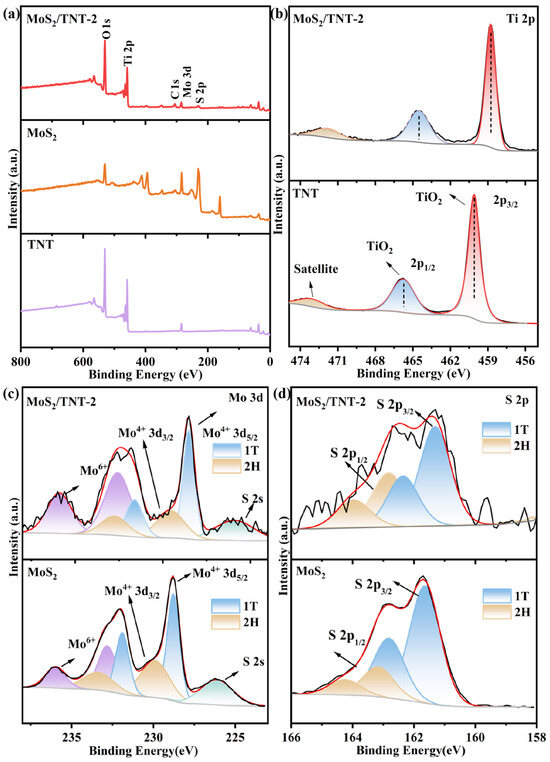
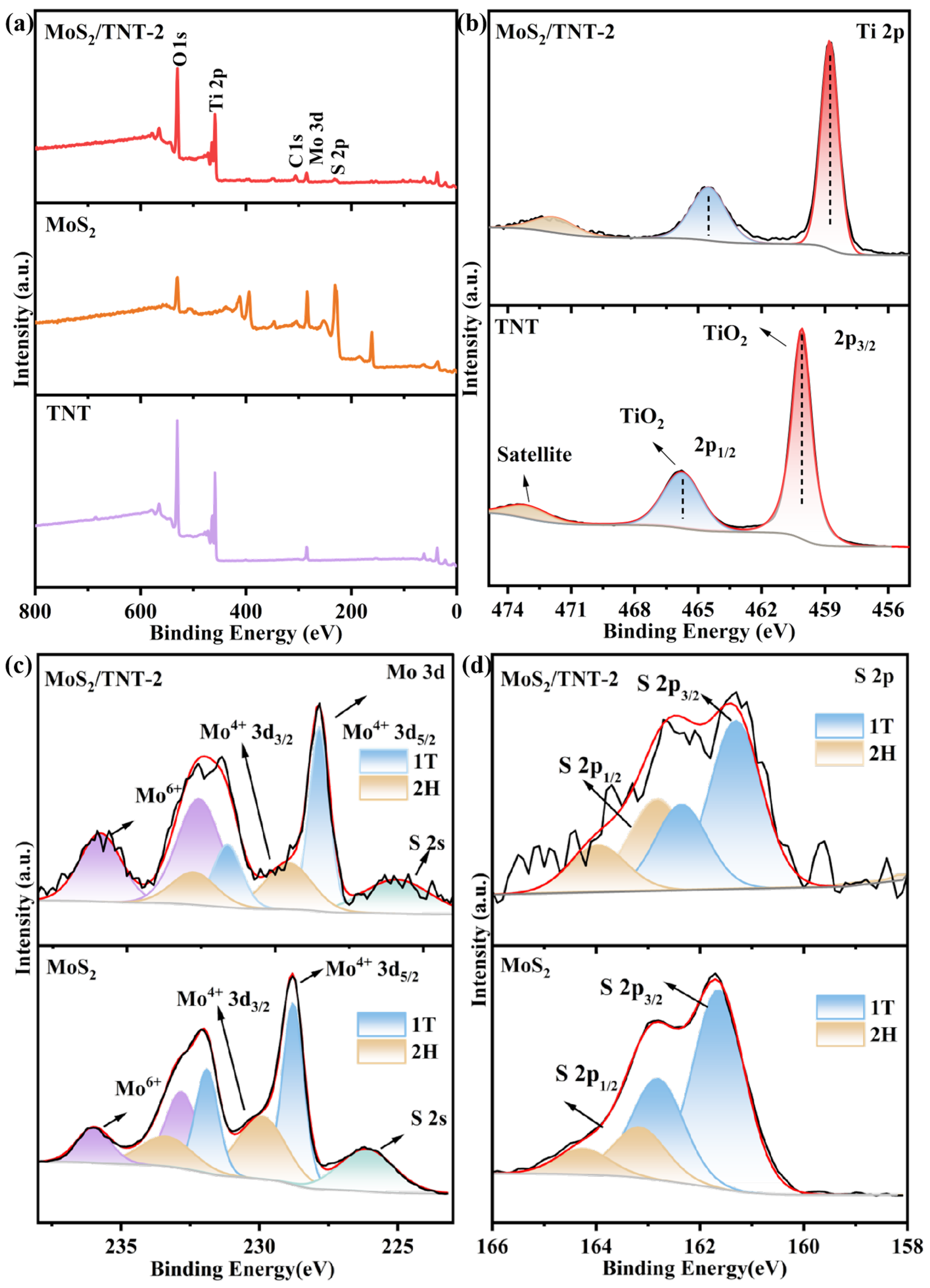
XPS analysis was carried out to characterize the surface composition and chemical states of the TNT, MoS2, and MoS2/TNT-2 composite. The survey spectrum of the MoS2/TNT-2 shown in Figure 4a clearly displays the characteristic signals of Ti, O, Mo, and S elements, confirming the effective integration of MoS2 with the TiO2 nanotube framework. The chemical environments of the constituent elements were further examined by high-resolution XPS spectra. In the Ti 2p spectrum (Figure 4b), two distinct peaks located at approximately 459.9 eV and 465.6 eV are assigned to Ti 2p3/2 and Ti 2p1/2 of Ti4+ species in anatase TiO2, respectively [36]. Compared to pristine TNT, the Ti 2p peaks of MoS2/TNT-2 exhibit a slight negative shift. This phenomenon suggests a change in the local electronic environment of Ti species associated with the interaction between MoS2 and TiO2 [37].
Figure 4.
XPS spectra of TNT, MoS2, and MoS2/TNT-2: (a) survey spectra and high-resolution spectra of (b) Ti 2p, (c) Mo 3d, and (d) S 2p.
The high-resolution Mo 3d spectra were deconvoluted to investigate the chemical states of Mo species (Figure 4c). For MoS2/TNT-2, the peaks at 229.5 and 232.7 eV are assigned to the Mo 3d5/2 and Mo 3d3/2 states of 2H-MoS2, respectively, while another pair of peaks appears at lower binding energies of 228.5 and 231.6 eV. These components are shifted by approximately 1 eV toward lower binding energies relative to the corresponding 2H components, which is consistent with the characteristic electronic states reported for 1T-like MoS2 [38]. Similar features are observed in the S 2p spectra (Figure 4d). For MoS2/TNT-2, the peaks at 162.8 and 163.9 eV are attributed to the S 2p3/2 and S 2p1/2 states of 2H-MoS2, respectively, whereas the components at 161.3 and 162.4 eV are assigned to 1T-like MoS2 [39]. The consistent assignments from both the Mo 3d and S 2p spectra support the coexistence of 1T-like and 2H components in MoS2/TNT-2. Based on the deconvoluted Mo 3d peak areas, the estimated 1T-like fractions are approximately 60.4% for MoS2/TNT-2 and 57.5% for pristine MoS2. The corresponding binding energies, FWHM values, and peak areas are summarized in Table S1. Compared with pristine MoS2, the Mo 3d and S 2p components of MoS2/TNT-2 exhibit slight shifts in binding energy, indicating a change in the local electronic environment of MoS2 associated with the MoS2/TiO2 interface [40].
3.2. Electrochemical HER Performance
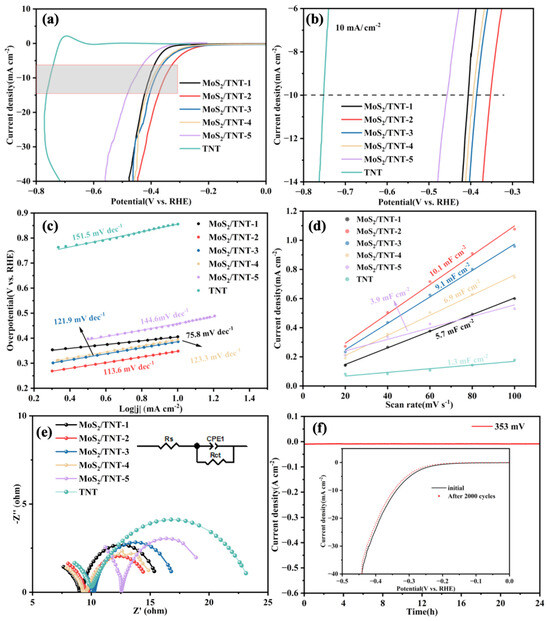
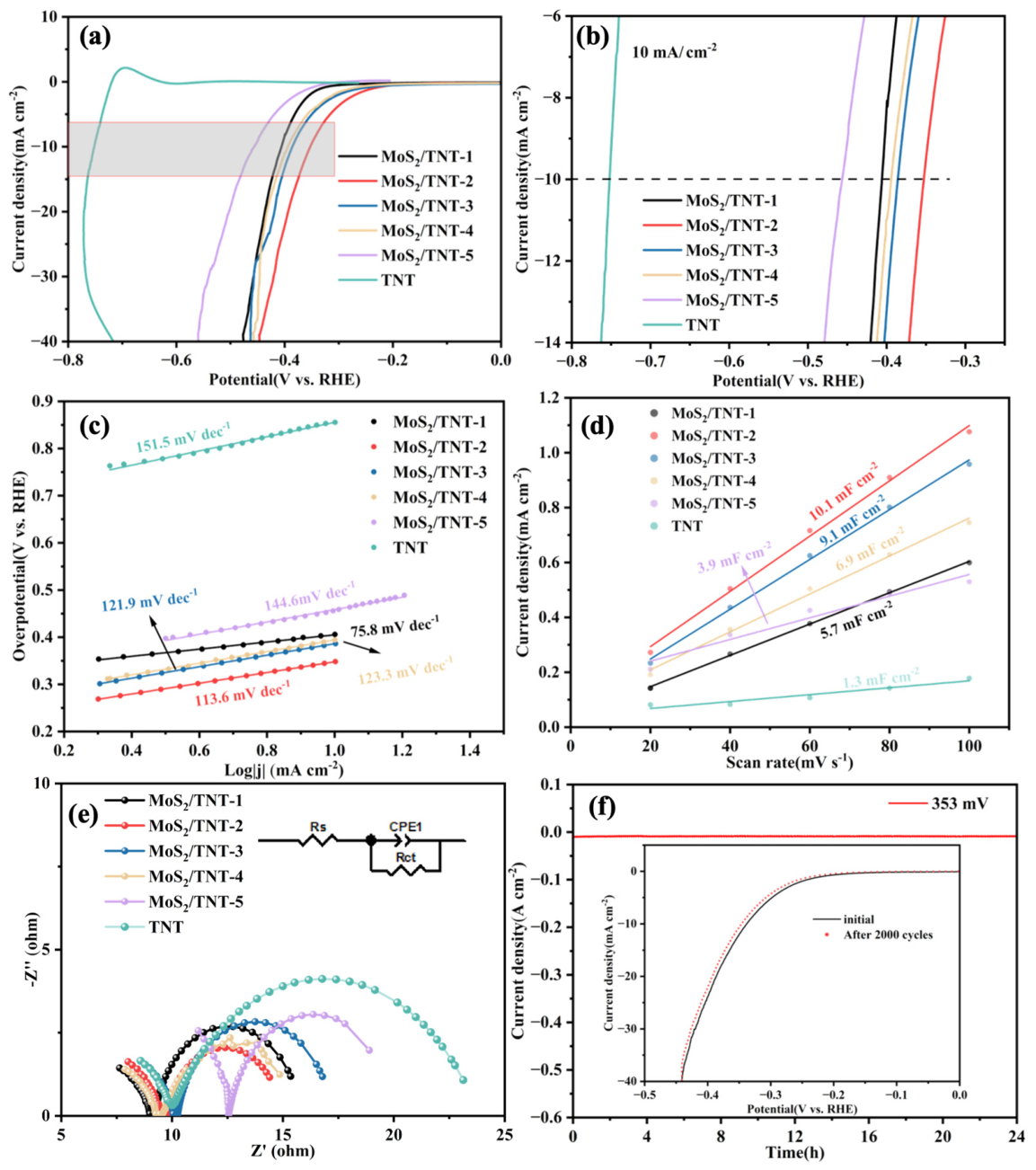
To evaluate the influence of precursor concentration on the HER performance, the electrocatalytic behaviors of the TNT, MoS2/TNT-1, MoS2/TNT-2, MoS2/TNT-3, MoS2/TNT-4, and MoS2/TNT-5 electrodes were investigated in 1 M KOH electrolyte. As shown by the results of LSV curves in Figure 5a, all MoS2-modified electrodes exhibit substantially enhanced cathodic current densities compared with pristine TNT, indicating that the introduction of MoS2 effectively improves the intrinsic HER activity of the TiO2 nanotube substrate. Among these electrodes, MoS2/TNT-2 delivers the most favorable catalytic performance. According to the enlarged view (Figure 5b), MoS2/TNT-2 achieves a current density of 10 mA cm−2 at an overpotential of 353 mV, which is lower than those of MoS2/TNT-1 (406 mV), MoS2/TNT-3 (386 mV), MoS2/TNT-4 (394 mV), and MoS2/TNT-5 (457 mV), and significantly lower than that of bare TNT (752 mV). The reproducibility of the electrochemical response of MoS2/TNT-2 was further evaluated by repeated measurements, with the corresponding standard deviations provided in Figure S2.
Figure 5.
Electrochemical measurement of the as-synthesized TNT and MoS2/TNT composite electrodes. (a) LSV polarization curves measured in 1 M KOH; (b) overpotential values required to achieve a current density of 10 mA cm−2; (c) corresponding Tafel plots; (d) Cdl estimated from the capacitive current density related to scan rate; (e) Nyquist plots; (f) chronoamperometric stability test of MoS2/TNT-2 performed at a fixed overpotential of 353 mV for 24 h (inset: LSV curves before and after 2000 CV cycles).
The improved HER activity of the MoS2/TNT electrodes may be associated with the synergistic effects of the catalytically active MoS2 phase and the highly ordered TiO2 nanotube framework. The nanotube structure provides a vertically aligned scaffold for MoS2 growth and may facilitate electrolyte penetration and the accessibility of catalytic interfaces. Meanwhile, the abundant edge sites of MoS2 nanosheets act as the primary active centers for hydrogen adsorption and evolution reactions [41,42]. Notably, further increasing the precursor concentration does not continuously improve the HER performance. As observed for MoS2/TNT-5 in Figure 2d, increased MoS2 coverage and aggregation are accompanied by partial obstruction of the nanotube openings, which may restrict electrolyte penetration and reduce the accessibility of electrochemically active interfaces.
The HER kinetics were further investigated by Tafel analysis (Figure 5c). The calculated Tafel slopes of MoS2/TNT-1, MoS2/TNT-2, MoS2/TNT-3, MoS2/TNT-4, MoS2/TNT-5, and TNT are 75.8, 113.6, 121.9, 123.3, 144.6, and 151.5 mV dec−1, respectively. According to previous studies, the Tafel slope values of approximately 120, 40, and 30 mV dec−1 are generally associated with the Volmer, Heyrovsky, and Tafel rate-determining steps, respectively [43,44]. Therefore, the Tafel slope of MoS2/TNT-2 suggests that the HER process may proceed through a Volmer–Heyrovsky pathway, with the Volmer step involving water dissociation playing an important role in the reaction kinetics under alkaline conditions. The improved kinetics may be associated with the coexistence of 1T-like and 2H components in MoS2 and the preserved nanotubular architecture, which may favor charge transport within the MoS2/TNT electrode.
The double-layer capacitance (Cdl) was determined from CV measurements recorded at various scan rates (Figure 5d), and the corresponding CV curves are provided in Figure S3. For all electrodes, the capacitive current response increases progressively with increasing scan rate from 20 to 100 mV s−1. The calculated Cdl values follow the order: MoS2/TNT-2 (10.1 mF cm−2) > MoS2/TNT-3 (9.1 mF cm−2) > MoS2/TNT-4 (6.9 mF cm−2) > MoS2/TNT-1 (5.7 mF cm−2) > MoS2/TNT-5 (3.9 mF cm−2) > TNT (1.3 mF cm−2). Since Cdl is commonly used as a qualitative indicator of electrochemically accessible surface area, the higher Cdl value of MoS2/TNT-2 suggests greater electrochemical surface accessibility under the tested conditions [45,46,47]. This result is consistent with the relatively open nanotubular morphology observed for MoS2/TNT-2 (Figure 2c). In contrast, excessive MoS2 deposition at higher precursor concentrations partially obstructs the nanotube openings, which can reduce electrolyte accessibility and consequently contribute to the lower Cdl values.
The interfacial charge transfer behavior was further investigated by electrochemical impedance spectroscopy (EIS). The EIS measurements were performed at the corresponding overpotential required for each electrode to reach a current density of 10 mA cm−2. As presented in Figure 5e, the Nyquist plots exhibit distinct semicircles whose diameters correlate with the charge transfer resistance (Rct), while the corresponding Bode plots are provided in Figure S4. The fitted Rct values are 13.96 Ω for TNT, 6.64 Ω for MoS2/TNT-1, 5.29 Ω for MoS2/TNT-2, 6.76 Ω for MoS2/TNT-3, 5.91 Ω for MoS2/TNT-4, and 7.67 Ω for MoS2/TNT-5. After the introduction of MoS2, all MoS2-modified electrodes have lower Rct values than pristine TNT, which is indicative of faster interfacial electron transport. Among them, the MoS2/TNT-2 electrode exhibits the lowest Rct value, indicating the most favorable interfacial charge transfer behavior among the investigated electrodes. This result suggests that an appropriate degree of MoS2 growth provides a favorable balance between electrochemical surface accessibility and interfacial charge transfer [48].
The electrochemical stability of the MoS2/TNT-2 electrode was evaluated by chronoamperometry at a fixed overpotential of 353 mV, corresponding to a current density of approximately 10 mA cm−2 on the initial LSV curve (Figure 5f). After continuous operation for 24 h, the electrode maintained a relatively stable current density with only minor fluctuations, indicating good electrochemical stability under the tested conditions. The inset curve shows a comparison of the initial LSV polarization curve with that recorded after 2000 CV cycles. Only a slight change in polarization behavior is observed, further confirming the good electrochemical durability of the electrode. The corresponding CV curves recorded during the 2000 cycles are provided in Figure S5. The observed stability of MoS2/TNT-2 may be attributed to the intimate contact between the MoS2 nanosheets and TiO2 nanotube framework, which provides a favorable structural configuration for electrochemical operation [49].
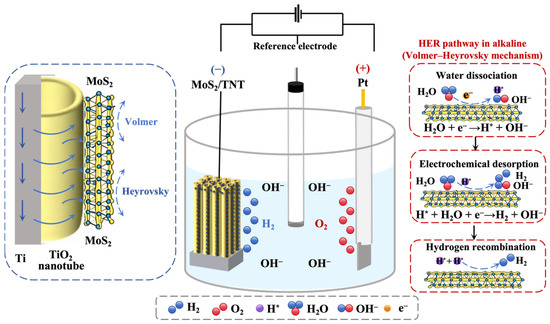
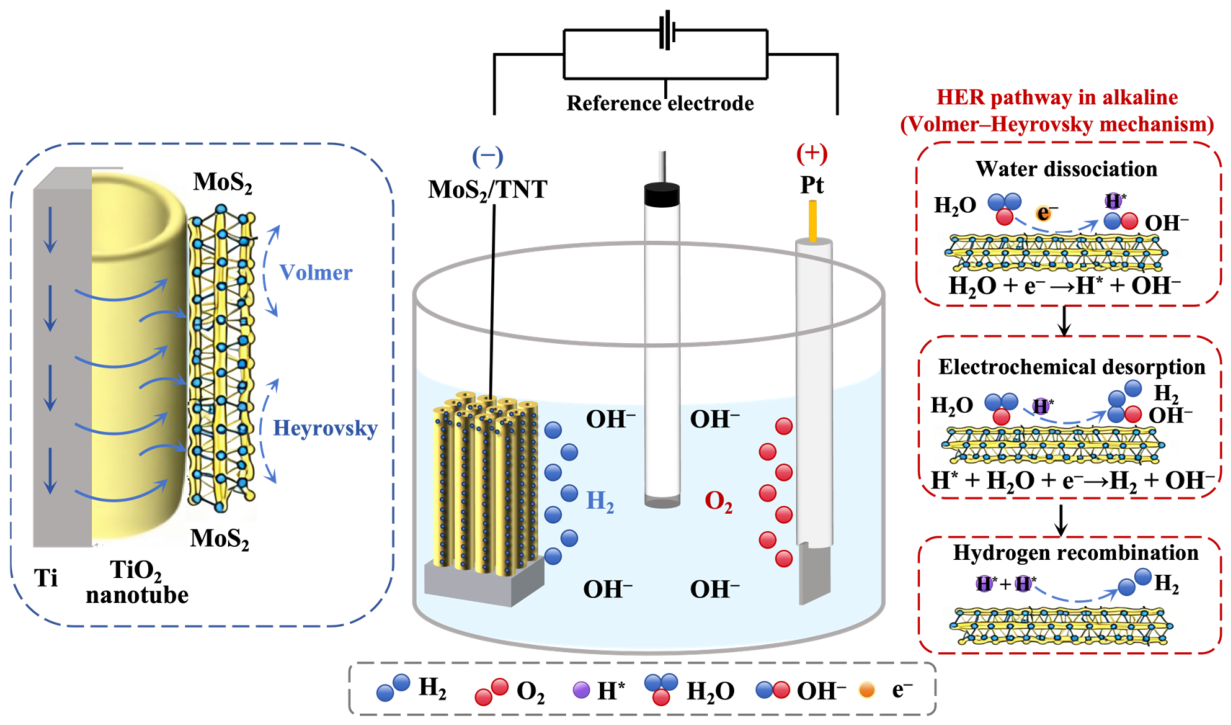
Based on the above electrochemical results and structural characterization, a possible HER pathway for the MoS2/TNT electrode in an alkaline electrolyte is schematically illustrated in Figure 6. The Ti substrate acts as an efficient electron collector, while the ordered TiO2 nanotube array provides a stable scaffold for uniform MoS2 growth and facilitates electrolyte accessibility. The observed XPS binding energy shifts indicate changes in the local chemical environment of MoS2 after its growth on the TiO2 nanotubes, while the EIS results demonstrate favorable charge transfer characteristics of the composite electrode. During alkaline HER, the electrochemical behavior suggests that the reaction may proceed through the Volmer and Heyrovsky steps. Water molecules are first dissociated through the Volmer step (H2O+e−→H*+OH−) followed by hydrogen evolution through the Heyrovsky step (H*+H2O+e−→H2+OH−). The enhanced HER activity of MoS2/TNT is attributed to the accessible MoS2 active sites, the intimate MoS2/TiO2 interface, and the favorable charge transfer characteristics of the composite electrode.
Figure 6.
The HER process of the MoS2/TNT electrode in alkaline electrolytes.
4. Conclusions
In conclusion, a self-supported MoS2/TNT electrode for alkaline hydrogen evolution was fabricated by a simple hydrothermal deposition of MoS2 nanosheets on highly ordered TiO2 nanotube arrays. Variation in the precursor concentration resulted in corresponding differences in MoS2 growth characteristics, electrode microstructure, and electrochemical HER performance. Among the tested electrodes, the MoS2/TNT-2 electrode exhibited the best HER activity, requiring an overpotential of 353 mV to achieve a current density of 10 mA cm−2. The electrode also exhibited good electrochemical stability during a 24 h chronoamperometric test and showed only a slight change in polarization behavior after 2000 CV cycles. The observed HER activity is consistent with the preserved nanotube structure, accessible catalytic interfaces, and favorable charge transfer characteristics. These findings may provide useful guidance for the further optimization and development of self-supported MoS2-based heterostructured electrodes for alkaline water electrolysis.
Supplementary Materials
The following supporting information can be downloaded at https://www.mdpi.com/article/10.3390/met16101109/s1: Figure S1: Surface SEM image and EDS elemental mapping of the MoS2/TNT-5 electrode; Figure S2: Variation ofΔη/ΔLog|j| with current density. Error bars represent standard deviation; Figure S3: Cyclic voltammograms of TNT and MoS2/TNT electrodes measured at different scan rates; Figure S4: Bode plots of TNT and MoS2/TNT electrodes at the overpotentials corresponding to 10 mA cm−2; Figure S5: Cyclic voltammograms of MoS2/TNT-2 over 2000 CV cycles. Table S1: XPS deconvolution parameters of the Mo 3d and S 2p spectra for MoS2 and MoS2/TNT-2.
Author Contributions
Conceptualization, F.Z.; methodology, Y.Y. and F.Z.; formal analysis, L.H. and Q.S.; investigation, Y.Y., L.H. and H.Z.; resources, H.Z. and F.Z.; data curation, S.B. and Q.S.; writing—original draft preparation, Y.Y.; writing—review and editing, F.Z.; visualization, Y.Y. and S.B.; supervision, F.Z.; project administration, F.Z.; funding acquisition, F.Z. All authors have read and agreed to the published version of the manuscript.
Funding
The authors would like to acknowledge the funding support from the Natural Science Foundation of Liaoning Province (2025-BS-0362, 2025-BS-0338, 2025-BS-0353), the Special Fund of Basic Scientific Research Expenses for Undergraduate Universities in Liaoning Province (LJ212610144023), and the High-level Talent Project of Shenyang Ligong University (6030109792).
Data Availability Statement
The original contributions presented in this study are included in the article/supplementary material. Further inquiries can be directed to the corresponding author.
Conflicts of Interest
The authors declare no conflict of interest.
References
- Falcone, P. Sustainable Energy Policies in Developing Countries: A Review of Challenges and Opportunities. Energies 2023, 16, 6682. [Google Scholar] [CrossRef] [Scilit]
- Babayomi, O.; Dahoro, D.; Zhang, Z. Affordable clean energy transition in developing countries: Pathways and technologies. iScience 2022, 25, 104178. [Google Scholar] [CrossRef] [Scilit] [PubMed]
- Tharun, V.; Kumar, P. A Comprehensive Review on Hydrogen Production, Purification, Storage, and Utilization: Challenges and Future Directions. Renew. Sustain. Energy Rev. 2025, 224, 116067. [Google Scholar] [CrossRef] [Scilit]
- Wu, Q.; Luo, M.; Han, J.; Peng, W.; Zhao, Y.; Chen, D.; Peng, M.; Liu, J.; Groot, F.; Tan, Y. Identifying Electrocatalytic Sites of the Nanoporous Copper–Ruthenium Alloy for Hydrogen Evolution Reaction in Alkaline Electrolyte. ACS Energy Lett. 2020, 5, 192–199. [Google Scholar] [CrossRef] [Scilit]
- Yang, W.; Chen, S. Recent progress in electrode fabrication for electrocatalytic hydrogen evolution reaction: A mini review. Chem. Eng. J. 2020, 393, 124726. [Google Scholar] [CrossRef] [Scilit]
- Li, B.; Liu, J.; Yang, K.; Ji, X.; Xu, Z.; Long, J. Review: Influencing Factors and Design Strategies of High-Performance Single-Atom Platinum-Based Electrocatalysts for Hydrogen Evolution Reaction. Int. J. Hydrogen Energy 2024, 110, 234–250. [Google Scholar] [CrossRef] [Scilit]
- Nie, X.; Guo, T.; Du, Q.; Liu, R.; Liu, L.; Zhao, R.; Zhang, J.; Du, J.; Li, J. Mesoporous Carbon Nanotablets Coupled with Mo2C Nanoparticles: Combining Morphology and Structure to Realize High Activity for Efficient Hydrogen Evolution. Chemistryselect 2020, 5, 5974–5980. [Google Scholar] [CrossRef] [Scilit]
- Theerthagiri, J.; Lee, S.; Murthy, A.; Madhavan, J.; Choi, M. Fundamental aspects and recent advances in transition metal nitrides as electrocatalysts for hydrogen evolution reaction: A review. Curr. Opin. Solid State Mater. Sci. 2020, 24, 100805. [Google Scholar] [CrossRef] [Scilit]
- Ghanashyam, G.; Jeong, H. Flower-like Molybdenum Disulfide for Efficient Hydrogen and Oxygen Evolution Reaction. Inorganica Chim. Acta 2022, 541, 121098. [Google Scholar] [CrossRef] [Scilit]
- Mir, R.; Kaur, G.; Pandey, O. Facile Process to Utilize Carbonaceous Waste As a Carbon Source for the Synthesis of Low Cost Electrocatalyst for Hydrogen Production. Int. J. Hydrogen Energy 2020, 45, 23908–23919. [Google Scholar] [CrossRef] [Scilit]
- Xu, J.; Zhao, Z.; Wei, W.; Chang, G.; Xie, Z.; Guo, W.; Liu, D.; Qu, D.; Tang, H.; Li, J. Tuning the Intrinsic Activity and Electrochemical Surface Area of MoS2 Via Tiny Zn Doping: Toward an Efficient Hydrogen Evolution Reaction (HER) Catalyst. Chem.-A Eur. J. 2021, 27, 15992–15999. [Google Scholar] [CrossRef] [Scilit] [PubMed]
- Yang, Z.; Zhu, J.; Xu, X.; Wang, L.; Zhou, G.; Yang, Z.; Zhang, Y. Defect and Strain Engineered MoS2/graphene Catalyst for an Enhanced Hydrogen Evolution Reaction. RSC Adv. 2023, 13, 4056–4064. [Google Scholar] [CrossRef] [Scilit] [PubMed]
- Fu, Q.; Han, J.; Wang, X.; Xu, P.; Yao, T.; Zhong, J.; Zhong, W.; Liu, S.; Gao, T.; Zhang, Z.; et al. 2D Transition Metal Dichalcogenides: Design, Modulation, and Challenges in Electrocatalysis. Adv. Mater. 2021, 33, 1907818. [Google Scholar] [CrossRef] [Scilit] [PubMed]
- Marinov, A.; Priegue, L.; Shah, A.; Miller, T.; Howard, C.; Hinds, G.; Shearing, P.; Cullen, P.; Brett, D. Ex Situ Characterization of 1T-like/2H MoS2 and Their Carbon Composites for Energy Applications, a Review. ACS Nano 2023, 17, 5163–5186. [Google Scholar] [CrossRef] [Scilit] [PubMed]
- Komba, N.; Zhang, G.; Pu, Z.; Wu, M.; Rosei, F.; Sun, S. MoS2-supported on Free-Standing TiO2-nanotubes for Efficient Hydrogen Evolution Reaction. Int. J. Hydrogen Energy 2020, 45, 4468–4480. [Google Scholar] [CrossRef] [Scilit]
- Sose, A.T.; Mohammadi, E.; Wang, F.; Deshmukh, S.A. Investigation of Structure and Dynamics of Water Confined Between Hybrid Layered Materials of Graphene, Boron Nitride, and Molybdenum Disulfide. J. Mater. Sci. 2022, 57, 10517–10534. [Google Scholar] [CrossRef] [Scilit]
- Hanslin, S.; Jónsson, H.; Akola, J. Sulfur-deficient Edges as Active Sites for Hydrogen Evolution on MoS2. Phys. Chem. Chem. Phys. 2023, 25, 32541–32548. [Google Scholar] [CrossRef] [Scilit] [PubMed]
- Lee, W.Y.; Kang, M.S.; Park, N.W.; Kim, G.S.; Nguyen, A.; Choi, J.; Yoon, Y.G.; Kim, Y.; Jang, H.; Saitoh, E.; et al. Layer Dependence of Out-of-plane Electrical Conductivity and Seebeck Coefficient in Continuous Mono- to Multilayer MoS2 Films. J. Mater. Chem. A 2021, 9, 26896–26903. [Google Scholar] [CrossRef] [Scilit]
- Shan, A.; Teng, X.; Zhang, Y.; Zhang, P.; Xu, Y.; Liu, C.; Li, H.; Ye, H.; Wang, R. Interfacial Electronic Structure Modulation of Pt-MoS2 Heterostructure for Enhancing Electrocatalytic Hydrogen Evolution Reaction. Nano Energy 2022, 94, 106913. [Google Scholar] [CrossRef] [Scilit]
- Yu, L.; Luo, H.; Xue, K.; Liu, C.; Chen, N.; Ding, R.; Zhu, H.; Zhang, Y. Design for All-round PHE/HER/OER Sandwich Nanostructure Catalyst: Ultrathin Nanosheet ZnIn2S4-Encapsulated Rich-Mo Edge Active Site Mo2C-N Schottky Junction. Appl. Catal. B Environ. Energy 2024, 357, 124266. [Google Scholar] [CrossRef] [Scilit]
- Gowrisankar, A.; Subhashini, D.; Sureka, K.; Selvaraju, T. Enhanced Active Edge Sites on MoSe2 Nanostructures for Stable Electrocatalytic and Photocatalytic Hydrogen Evolution Reaction. Ionics 2024, 30, 457–469. [Google Scholar] [CrossRef] [Scilit]
- Farrugia, C.; Mauro, A.; Lia, F.; Zammit, E.; Rizzo, A.; Privitera, V.; Impellizzeri, G.; Buccheri, M.; Rappazzo, G.; Grech, M.; et al. Suitability of Different Titanium Dioxide Nanotube Morphologies for Photocatalytic Water Treatment. Nanomaterials 2021, 11, 708. [Google Scholar] [CrossRef] [Scilit] [PubMed]
- Abela, S.; Farrugia, C.; Xuereb, R.; Lia, F.; Zammit, E.; Rizzo, A.; Refalo, P.; Grech, M. Photocatalytic Activity of Titanium Dioxide Nanotubes Following Long-Term Aging. Nanomaterials 2021, 11, 2823. [Google Scholar] [CrossRef] [Scilit] [PubMed]
- Kadja, G.; Mardiana, S.; Nanomaterials, A. 2D Nanomaterials for Photocatalytic Hydrogen Production. 2D Nanomater. 2024, 263–288. [Google Scholar] [CrossRef] [Scilit]
- Ma, H.; Tang, X.; Wang, C.; Zhang, Z.; Ben, S.; Wang, S.; Zhang, J.; Shang, Y.; Liu, K. Biomimetic soft magnetic cilia array actuator for rapid transport of solid microspheres. Rare Met. 2025, 44, 7751–7762. [Google Scholar] [CrossRef] [Scilit]
- Wei, K.; Armutlulu, A.; Wang, Y.; Yao, G.; Xie, R.; Lai, B. Visible-light-driven Removal of Atrazine by Durable Hollow Core-Shell TiO2@LaFeO3 Heterojunction Coupling with Peroxymonosulfate Via Enhanced Electron-Transfer. Appl. Catal. B-Environ. 2022, 303, 120889. [Google Scholar] [CrossRef] [Scilit]
- He, B.; Wang, Z.; Xiao, P.; Chen, T.; Yu, J.; Zhang, L. Cooperative Coupling of H2O2 Production and Organic Synthesis over a Floatable Polystyrene-Sphere-Supported TiO2/Bi2O3 S-Scheme Photocatalyst. Adv. Mater. 2022, 34, 2203225. [Google Scholar] [CrossRef] [Scilit] [PubMed]
- Tang, Z.; Xu, L.; Shu, K.; Yang, J.; Tang, H. Fabrication of TiO2 @MoS2 Heterostructures with Improved Visible Light Photocatalytic Activity. Colloids Surf. A-Physicochem. Eng. Asp. 2022, 642, 128686. [Google Scholar] [CrossRef] [Scilit]
- Zhang, H.; Song, J.; Li, J.; Feng, J.; Ma, Y.; Ma, L.; Liu, H.; Qin, Y.; Zhao, X.; Wang, F. Interlayer-Expanded MoS2 Nanoflowers Vertically Aligned on MXene@Dual-Phased TiO2 As High-Performance Anode for Sodium-Ion Batteries. ACS Appl. Mater. Interfaces 2022, 14, 16300–16309. [Google Scholar] [CrossRef] [Scilit] [PubMed]
- Dao, T.; Ha, T.; Nguyen, T.; Le, H.; Ha-Thuc, C.N.; Nguyen, T.; Perre, P.; Nguyen, D. Effectiveness of Photocatalysis of MMT-supported TiO2 and TiO2 Nanotubes for Rhodamine B Degradation. Chemosphere 2021, 280, 130802. [Google Scholar] [CrossRef] [Scilit] [PubMed]
- Chen, X.; Wang, Z.; Wei, Y.; Zhang, X.; Zhang, Q.; Gu, L.; Zhang, L.; Yang, N.; Yu, R. High Phase-Purity 1T-like-MoS2 Ultrathin Nanosheets by a Spatially Confined Template. Angew. Chem. (Int. Ed Engl.) 2019, 58, 17621–17624. [Google Scholar] [CrossRef] [Scilit] [PubMed]
- Zhang, T.; Yang, T.; Qu, G.; Huang, S.; Cao, P.; Gao, W. Phase Control and Stabilization of 1T-like-MoS2 Via Black TiO2-x Nanotube Arrays Supporting for Electrocatalytic Hydrogen Evolution. J. Energy Chem. 2022, 68, 71–77. [Google Scholar] [CrossRef] [Scilit]
- Kumar, N.; Siroha, P.; Sharma, Y.; Singh, D.; Dey, K.; Kumar, R.; Borkar, H.; Gangwar, J. Probing on Crystallographic Structural and Surface Morphology of Hydrothermally Synthesized MoS2 Nanoflowers Consisting of Nanosheets. Appl. Surf. Sci. Adv. 2021, 6, 100167. [Google Scholar] [CrossRef] [Scilit]
- Kim, M.; Shin, N.; Lee, J.; Lee, K.; Kim, Y.; Choi, J. Photoelectrochemical Water Oxidation in Anodic TiO2 Nanotubes Array: Importance of Mass Transfer. Electrochem. Commun. 2021, 132, 107133. [Google Scholar] [CrossRef] [Scilit]
- Maciel, L.; Freitas, D.; Sousa, F.; Oliveira, L.; Alves, O.; Ribeiro, F.; Machado, G. Boosting Hydrogen Evolution Kinetics with MoS2-Decorated TiO2 Nanotubes. ACS Omega 2026, 11, 20079–20090. [Google Scholar] [CrossRef] [Scilit] [PubMed]
- Prabhu, M.; Groot, I. Atomic-level Insights into Single-Layer Co-promoted MoS2 Clusters Supported on a Rutile TiO2(110) Model Oxide Support. Surf. Sci. 2024, 739, 122385. [Google Scholar] [CrossRef] [Scilit]
- El-Gendy, R.A.; El-Bery, H.M.; Farrag, M.; Fouad, D. Metal Chalcogenides (Cus or MoS2)-modified TiO2 as Highly Efficient Bifunctional Photocatalyst Nanocomposites for Green H2 Generation and Dye Degradation. Sci. Rep. 2023, 13, 7994. [Google Scholar] [CrossRef] [Scilit] [PubMed]
- Li, J.; Listwan, A.; Liang, J.; Shi, F.; Li, K.; Jia, J. High Proportion of 1 T Phase MoS2 Prepared by a Simple Solvothermal Method for High-Efficiency Electrocatalytic Hydrogen Evolution. Chem. Eng. J. 2021, 422, 130100. [Google Scholar] [CrossRef] [Scilit]
- Hu, X.; Zeng, X.; Liu, Y.; Lu, J.; Yuan, S.; Yin, Y.; Hu, J.; McCarthy, D.; Zhang, X. Nano-layer Based 1T-like-rich MoS2/g-C3N4 Co-Catalyst System for Enhanced Photocatalytic and Photoelectrochemical Activity. Appl. Catal. B Environ. 2020, 268, 118466. [Google Scholar] [CrossRef] [Scilit]
- Lin, C.; Liu, Y.; Sun, Y.; Wang, Z.; Xu, H.; Li, M.; Feng, J.; Hou, B.; Yan, W. TiO2 Nanorods Based Self-Supported Electrode of 1T-like/2H MoS2 Nanosheets Decorated by Ag Nano-Particles for Efficient Hydrogen Evolution Reaction. Chin. Chem. Lett. 2023, 34, 108265. [Google Scholar] [CrossRef] [Scilit]
- Samosir, L.; Nugroho, V.; Fauzia, V. Enhancing Electrochemical Hydrogen Evolution Efficiency Via UV Ozone Treatment: 3D Electrode Carbon Cloths with Defect-Enriched MoS2. Electrochim. Acta 2024, 496, 144483. [Google Scholar] [CrossRef] [Scilit]
- AlAqad, K.; Kandiel, T.; Basheer, C. Synergy Between In-Situ Immobilized MoS2 Nanosheets and TiO2 Nanotubes for Efficient Electrocatalytic Hydrogen Evolution. Int. J. Hydrogen Energy 2021, 47, 2366–2377. [Google Scholar] [CrossRef] [Scilit]
- Wang, J.; Zang, W.; Liu, X.; Sun, J.; Xi, S.; Liu, W.; Kou, Z.; Shen, L.; Wang, J. Switch Volmer-Heyrovsky to Volmer-Tafel Pathway for Efficient Acidic Electrocatalytic Hydrogen Evolution by Correlating Pt Single Atoms with Clusters. Small 2024, 20, 2309427. [Google Scholar] [CrossRef] [Scilit] [PubMed]
- Zang, X.; Qin, Y.; Wang, T.; Li, F.; Shao, Q.; Cao, N. 1T-like/2H Mixed Phase MoS2 Nanosheets Integrated by a 3D Nitrogen-Doped Graphene Derivative for Enhanced Electrocatalytic Hydrogen Evolution. ACS Appl. Mater. Interfaces 2020, 12, 55884–55893. [Google Scholar] [CrossRef] [Scilit] [PubMed]
- Cao, J.; Teng, F.; Zhang, Y.; Huang, J.; Liu, X.; Zhou, Q.; Zhang, C.; Guan, J. Defect-Rich 1T-like-MoS2 Nanosheets Towards Efficient Electrochemical Hydrogen Evolution by Simultaneous Phase and Defect Engineering. Int. J. Hydrogen Energy 2024, 51, 529–535. [Google Scholar] [CrossRef] [Scilit]
- Khan, Z.; Akram, M.; Basit, M.; Mujahid, M.; Javed, S. Boosted Hydrogen Evolution Reaction Based on Synergistic Effect of Graphene, MoS2 and RuO2 Ternary Electrocatalyst. Int. J. Hydrogen Energy 2024, 92, 1423–1438. [Google Scholar] [CrossRef] [Scilit]
- Peng, K.; Wang, Y.; Chen, H.; Su, L.; Niu, M.; Lu, D.; Wang, H. Defect-induced Growth of MoS2 Nanosheets on Selectively Etched SiC Nanowires Aerogel for Efficient Electrocatalytic Hydrogen Evolution. Chem. Eng. J. 2025, 518, 164783. [Google Scholar] [CrossRef] [Scilit]
- Cao, D.; Wang, Q.; Zhu, S.; Zhang, X.; Li, Y.; Cui, Y.; Xue, Z.; Gao, S. Hydrothermal Construction of Flower-Like MoS2 on TiO2 NTs for Highly Efficient Environmental Remediation and Photocatalytic Hydrogen Evolution. Sep. Purif. Technol. 2021, 265, 118463. [Google Scholar] [CrossRef] [Scilit]
- Guo, D.; Wan, Z.; Fang, G.; Zhu, M.; Xi, B. A Tandem Interfaced (Ni3S2-MoS2)@TiO2 Composite Fabricated by Atomic Layer Deposition As Efficient HER Electrocatalyst. Small 2022, 18, 2201896. [Google Scholar] [CrossRef] [Scilit] [PubMed]
Disclaimer/Publisher’s Note: The statements, opinions and data contained in all publications are solely those of the individual author(s) and contributor(s) and not of MDPI and/or the editor(s). MDPI and/or the editor(s) disclaim responsibility for any injury to people or property resulting from any ideas, methods, instructions or products referred to in the content. |
© 2026 by the authors. Licensee MDPI, Basel, Switzerland. This article is an open access article distributed under the terms and conditions of the Creative Commons Attribution (CC BY) license.