
Article

Effect of H2–CO Ratio on Reduction Disintegration Behavior and Kinetics of Vanadium–Titanium Magnetite Pellets


1
State Key Laboratory of Vanadium and Titanium Resources Comprehensive Utilization, Panzhihua 617000, China
2
School of Minerals Processing and Bioengineering, Central South University, Changsha 410083, China
*
Authors to whom correspondence should be addressed.
Metals 2025, 15(8), 823; https://doi.org/10.3390/met15080823
Submission received: 18 June 2025 / Revised: 16 July 2025 / Accepted: 18 July 2025 / Published: 23 July 2025
(This article belongs to the Special Issue Innovation in Efficient and Sustainable Blast Furnace Ironmaking)

Abstract

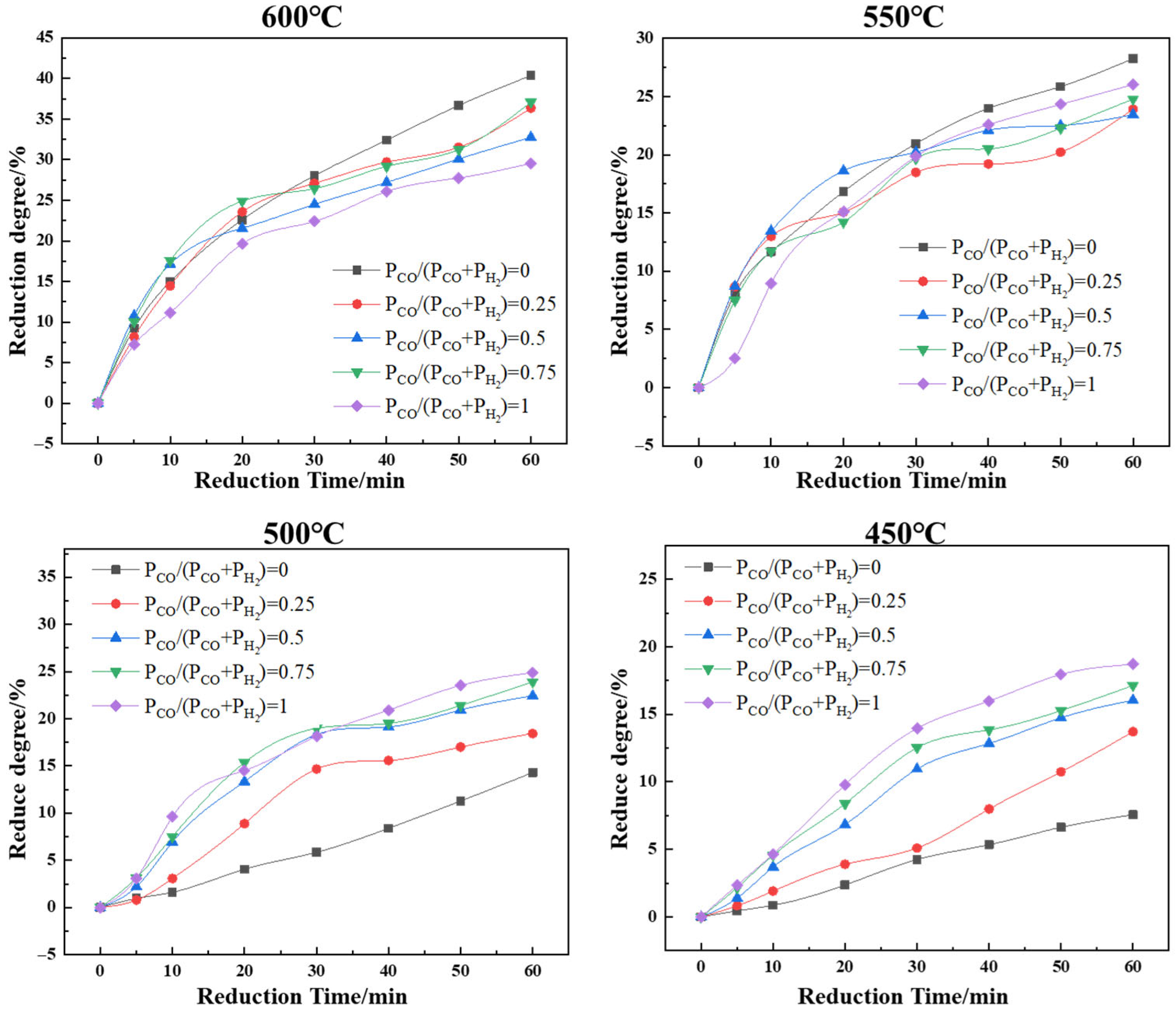
There are many advantages of the smelting of vanadium–titanium magnetite pellets by hydrogen-based shaft furnace pre-reduction and electric arc furnace process, including high reduction efficiency, low carbon dioxide emission and high recovery of titanium and so on. However, vanadium–titanium magnetite pellets are highly susceptible to severe reduction disintegration when reduced in the gas-based shaft furnaces. H2 and CO are the primary reducing gas components in the gas-based shaft furnace process, which significantly influences the reduction behavior of vanadium–titanium magnetite pellets. In this study, the reduction disintegration behavior and reduction kinetics of vanadium–titanium magnetite under mixed H2–CO atmospheres at low temperatures (450–600 °C) were investigated. The differences in the reduction capacities and rates of H2 and CO on iron oxides and titanium–iron oxides were revealed, along with their impact on the reduction disintegration behavior of the pellets at low temperatures. At lower temperatures, CO exhibited a greater reducing capability for vanadium–titanium magnetite. As the reduction temperature increased, the reduction capacities of both H2 and CO improved; however, the reduction capacity of H2 was more significantly influenced by the temperature. The disparity in the reduction capacities of H2 and CO for vanadium–titanium magnetite pellets caused an inconsistent expansion rate in different regions of the pellet, increasing internal stress, contributing to a more severe reduction disintegration of vanadium–titanium magnetite pellets in the mixed H2–CO atmospheres.
Keywords: hydrogen-based reduction; reduction kinetics; reduction disintegration; vanadium–titanium magnetite hydrogen-based reduction; reduction kinetics; reduction disintegration; vanadium–titanium magnetite