


Abstract
Environmental interpretation (EI) in protective forests remains an underexplored field, despite its demonstrated potential for fostering emotional place attachment and conservation attitudes. This study aims to design and evaluate in situ the “Magical Portal of Biodiversity and Culture” self-guided interpretive trail at the “Los Arrayanes” Protective Forest (16 ha, Montúfar Canton, Carchi Province, Ecuador), a native arrayan forest (Myrcianthes hallii) deeply rooted in the ancestral territory of the Pasto-Tuza people, and to formulate educommunicational strategies. The trail design is grounded in Tilden’s interpretive principles, Morales’s topic–theme structure, and Ham’s TORE model, and it formulates Environmental Education and Communication Strategies. A qualitative, multimethod design was employed, with in situ field observation, participatory action research (PAR) workshops with the de Monteverde community, and in-depth interviews with seven key informants (March–April 2026); data were analyzed through the hermeneutic interpretive method and validated through categories, method, and theory triangulation, member checking, and researcher reflexivity. The analysis yielded five emergent categories: (1) vital and heritage place attachment; (2) psychological restoration and sensory reconnection; (3) environmental curiosity and empathy; (4) situated conservation learning; and (5) community governance and intergenerational education. Additionally, it identified six educommunicational strategies: (1) sensory learning; (2) storytelling; (3) participatory interaction; (4) guided self-learning; (5) situated learning; and (6) the biocultural approach. These findings provide empirical evidence that biocultural interpretation promotes conservation attitudes and community participation. In practical terms, this research offers protected-area managers, community organizations, and interpretation planners a model replicable for designing self-guided interpretive trails in biodiverse territories where living biocultural heritage is at risk.
1. Introduction
Environmental interpretation (EI) constitutes a key strategy for influencing pro-environmental behavior through meaningful experiences in contact with nature [1,2,3]. Recent studies demonstrate that EI fosters emotional connection, enriches visitor experience, and cultivates conservation attitudes [4,5,6].
In the context of indigenous Andean forests, this educational-interpretive tool acquires an expanded dimension by integrating biocultural heritage as both an interpretive axis and a conservation framework within natural protected areas [7]. In Ecuador, studies conducted at the Peguche Waterfall in Otavalo show that the integration of interpretation, hiking, and ancestral knowledge strengthens community governance and environmental learning [8,9,10], while also lending significance to the communicative process through a biocultural lens, fostering meaningful understanding and positive environmental attitudes in the protection of the Otavalo people’s cultural and identity heritage.
Nevertheless, empirical literature on the effectiveness of EI in protected natural areas remains limited, particularly regarding the integration of indigenous biocultural heritage as an interpretive axis rather than merely as a backdrop in Andean indigenous contexts [9,10], settings that, while undeniably attractive to visitors, do not consistently generate pro-environmental behavioral attitudes or ecological sensitivity.
Within this framework, educommunication, understood as the convergence of environmental education and communication for development [11], emerges as a complementary approach that amplifies the reach of classical EI by incorporating the active participation of local communities in the design and transmission of messages. Educommunicative EI not only informs visitors about biodiversity but also positions them as agents of change, connected to ancestral knowledge and the practices of the host community, which shares and participates in its own biocultural heritage.
Research addressing this socio-educational and environmental gap is therefore warranted, through the design and evaluation of an educommunicational interpretive trail in the “Los Arrayanes” Protected Forest, a site whose Andean cosmovision of the Pasto people, along with their agricultural practices and communal rituals, constitutes a living biocultural heritage of high scientific, educational, and cultural value [7]. Despite this significant ecological and cultural richness, the forest lacked a systematic interpretive program before this study.
The “Magical Portal of Biodiversity and Culture” interpretive trail spanning 1200 m with eight interpretive stops in a self-guided format was designed and implemented as an Environmental Interpretation program grounded in Tilden’s six principles of interpretation [12]; Morales’s topic-theme design structure [13], and Ham’s TORE quality model [14]. A distinctive feature of the design is the use of first-person narrative as a strategy to foster empathy and emotional engagement with the visitor [14].
This article pursues four research objectives: (1) to structure the design and theoretical foundation of the eight interpretive stops along the “Magical Portal of Biodiversity and Culture” trail; (2) to document and analyze the interests and needs of the indigenous community of “Monteverde,” located adjacent to the natural area, through participatory action research (PAR) workshops; (3) to describe and interpret the perceptions of key informants regarding the interpretive program through in-depth interviews; and (4) to formulate educommunicational strategies.
This study advances prior work on interpretive-trail design in three specific ways. Theoretically, it repositions indigenous biocultural heritage from a decorative backdrop to the organizing interpretive axis of the trail, and it provides hermeneutic evidence that first-person resource narrative can generate place attachment and conservation co-responsibility in Andean native-forest settings—a context in which the TORE model had not previously been tested. Methodologically, it couples participatory action research with a hermeneutic analysis of visitor testimony, offering a replicable, community-embedded evaluation device for protected areas that lack the resources for large-scale quantitative monitoring. Practically, it delivers a fully specified, low-cost interpretive template—eight stops, topic–theme scripts, sensory-activation techniques, and impact indicators—that community organizations and protected-area managers can adapt to other biodiverse territories. The central thesis of the study is that interpretation designed around, rather than merely about, biocultural heritage transforms visitors from recipients of information into co-responsible participants in conservation.
This study contributes to strengthening previous work on interpretive-trail design in the following ways: (1) Theoretically, it repositions and adds value to Indigenous biocultural heritage by transforming it from a tangible natural resource into an articulating and functional axis within the process of environmental interpretation and conservation. It provides hermeneutic evidence that first-person narrative fosters place attachment and co-responsibility in the conservation not only of Andean native forests but also of cultural heritage, in a context where Ham’s TORE model had not been previously evaluated. (2) Methodologically, it integrates participatory action research with a hermeneutic analysis of the testimonies of visitors, local government representatives, academics, environmental specialists, and community members, offering a replicable tool for environmental awareness in community-managed protected areas that lack the resources for large-scale qualitative monitoring. (3) Practically, it delivers a complete, low-cost, and replicable interpretive model that includes eight sequential interpretive stops, topic–theme scripts, sensory-activation techniques, and impact indicators that community organizations and protected-area managers can adapt to other biodiverse territories. In this sense, environmental interpretation designed from the ontology of place, rather than solely from biocultural heritage, transforms visitors and the general public from passive recipients of information into active and co-responsible participants in the conservation of cultural and natural heritage. (4) Scientifically and educationally, it demonstrates that environmental interpretation grounded in the voice of the territory and in the stewardship of natural and cultural resources generates deeper, emotionally meaningful, and culturally situated educational processes, expanding the scope of classical environmental interpretation toward a biocultural educommunication approach.
2. Theoretical Framework
2.1. Environmental Interpretation and Educommunication
Environmental interpretation (EI), as an effective tool of Environmental Education (EE), has evolved from informational dissemination approaches toward innovative models [5,14] aimed at generating meaningful experiences, memorable environmental learning, and behavioral change.
The foundational principles of the EI, as proposed by Tilde [12], constitute the theoretical basis for the design of interpretive programs. Among the most relevant are: interpretation as a dynamic process that connects content to the visitor’s own experience and reveals relevant meanings; its provocative rather than instructive character, which establishes a direct link with the interpreted resource; and its integrative focus, which presents a coherent whole in the generation of emotional and cognitive connections within the visitor.
Ham [14] subsequently systematized and operationalized these principles through the TORE model (Thematic, Organized, Relevant, and Enjoyable), providing concrete criteria for the effective design of interpretive messages oriented toward visitor understanding and appreciation of both natural and cultural heritage.
Contemporary research in education and neuroscience confirms that the effectiveness of learning and interpretation depends on the dynamic articulation among perception, cognition, emotion, experience, action, and reflection [15,16,17,18]. Recent studies demonstrate that EI significantly influences the formation of pro-environmental attitudes by mediating variables such as emotional connection to place, quality of the interpretive experience, perception of authenticity, and the construction of meanings, all of which function as key mediators in the adoption of responsible behaviors toward the environment [16,19,20]. Within this framework, emotion emerges not merely as a complementary component but as the organizing axis through which interpretive content is linked to the internalization of the conservation message, thereby reinforcing the visitor’s attitudinal disposition toward sustainable conservation practices [17,20,21].
In this context, Moscardo’s concept of mindful visitors [21] proposes that effective interpretation promotes reflective processes that transform the visitor into an active agent of learning, transcending the passive role of information recipient.
2.2. Psychological Restoration and Visitor Experience
Biocultural place attachment, understood from an interpretive perspective as the intrinsic bond between people and identity-laden places, where these spaces function as key mediators of pro-environmental behavior [16,17,18]. It is constructed through meaningful experiences and through engagement with the symbolic and cultural values of the interpreted site.
In this regard, Kaplan and Kaplan’s Attention Restoration Theory [22] posits that natural spaces generate fascination, detachment from everyday life, immersion, and compatibility, insofar as they respond to the needs and purposes of the individual elements that contribute to improved concentration, reduced mental fatigue, and enhanced psychological well-being. Complementing this, Ulrich’s Stress Reduction Theory [23] demonstrates that the mere perception of nature, such as natural landscapes, trees, and plants, triggers an automatic biological response in human beings that reduces blood pressure, anxiety, and tension, improving emotional state almost immediately [24,25].
Likewise, the concept of “cultural ecosystem services” highlights that natural environments provide non-material benefits such as identity, recreation, and a sense of belonging [26]. This perspective is further enriched by the biocultural approach, which integrates the cultural and ecological dimensions of a territory, positioning the visitor’s experience as one constructed in interaction with locally embedded meanings [7].
2.3. Experiential Learning
Experience constitutes a form of learning that is built in an evolutionary and cumulative manner. Experiential learning implies that direct experience is transformed into knowledge through cyclical processes of perception, reflection, conceptualization, and action [2]. In environmental interpretation, this approach enables the design of experiences that facilitate the active construction of meaning.
From this perspective, interpretation is not confined to the transmission of information but extends to the sharing of meaningful experiences that allow visitors to construct their own understanding. Bruner [3] complements this framework by highlighting the role of narrative in meaning-making, while Damasio [1] demonstrates that emotional processes are inseparable from cognition, reinforcing the idea that effective learning emerges from the integration of emotion and experience. Taken together, these contributions confirm that meaningful learning arises from emotionally engaged experiences.
Recent research demonstrates that participatory and emotionally active interpretive experiences increase the internalization of content and promote pro-environmental behaviors [4,9,10]. In this regard, Pine and Gilmore [27] establish that memorable experiences constitute a fundamental factor in value generation within tourism contexts, producing greater visitor satisfaction and enduring memories.
2.4. Biocultural Heritage and Governance in Socio-Ecological Systems
Biocultural heritage recognizes the interdependence between biological and cultural diversity, particularly in territories where traditional knowledge guides environmental management [7], as has been evidenced in participatory conservation processes at the Peguche Waterfall [8]. This approach holds that the conservation of such emblematic spaces requires the integration of local ancestral knowledge into environmental management strategies. Along these lines, community governance strengthens these processes by promoting the decisive participation of communities in decision-making, grounded in the principle of self-determination of indigenous peoples and nationalities. Recent studies show that the incorporation of cultural and emotional dimensions into the tourism experience reinforces territorial identity and fosters responsible behaviors of high intergenerational significance [9,10].
Additionally, ref. [28] highlights that resilient socio-ecological systems depend on the interaction between traditional knowledge and adaptive management. In this context, the EI consolidates itself as a key tool of Environmental Education, one that bridges education, culture, and sustainability, serving as the nexus between the biocultural approach and its educational function, and emerging as a strategy for community empowerment and socio-ecological sustainability. Within this vision, nature and culture are conceived as an inseparable system, incorporating the processes of meaning construction associated with territory and the bonds between communities and their natural environment [29].
3. Materials and Methods
3.1. Location of the “Los Arrayanes” Protective Forest
The “Los Arrayanes” Protected Forest, the second most emblematic forest ecosystem in Latin America, encompasses 16 hectares of native arrayan woodland (Mycianthes hallii) in the community of “Monteverde,” Cantón Montúfar, Carchi Province, Ecuador (approx. 0°35′ N, 77°49′ W; 28,050–3000 m.a.s.l.), formally designated as a protected forest in 2021 by the MAATE [30].
The forest represents one of the few remaining native arrayan formations in the northern Andes, harboring ancient trees alongside subarborial flora species of medicinal significance (Oreopanax ecuadorensis, Cestrum nigrescens, Campyloneurum cochense, Dioscorea villosa, Anthurium oxybelium) and threatened fauna, including the Andean armadillo (Dasypus novemcinctus), the Andean fox (Lycalopex culpaeus), and endemic bird species. The Pasto-Tuza (Cuasmal) cacical bohío adjacent to the natural area serves as the entry point to the interpretive trail, framing the identity of both the natural and cultural heritage within the broader biocultural territorial context.
The forest is deeply rooted in the ancestral territory of the Pasto-Tuza (Cuasmal) people, whose Andean cosmovision is articulated through principles such as duality; opposition-complementarity; a cosmological principle; and a communal life system. The ancestral medicine practices, myths, and legends of the Pasto-Tuza culture, particularly the minga as a community system of sociocultural integration, constitute a living biocultural heritage that the interpretive trail explicitly integrates at each stop.
3.2. Methodological Approach
The research is grounded in a qualitative approach for being holistic and flexible, experiential and lived, establishing a direct and subjective relationship between the observer and the observed [31] through a set of interpretive practices that render the world visible, studying phenomena and living beings in their natural environments and in their everyday contexts to uncover sense and meaning [32].
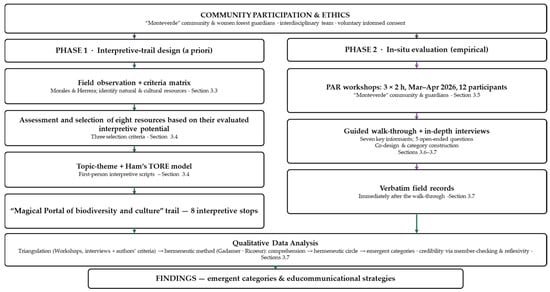
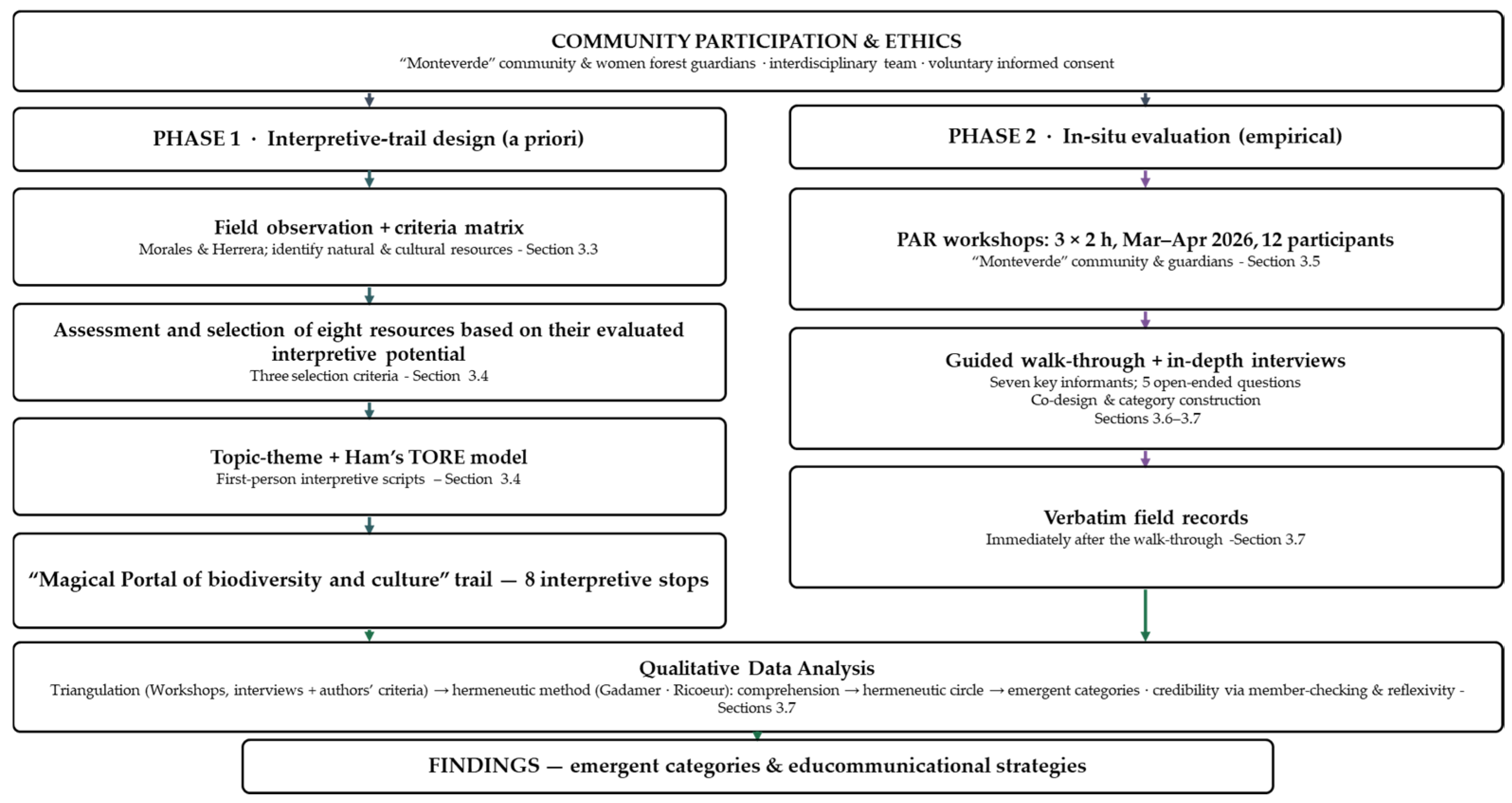
The study was organized in two complementary phases. In the design phase (Section 3.3 and Section 3.4), the interpretive trail was designed a priori through field observation, resource assessment, and the application of established interpretive-design standards. In the evaluation phase (Section 3.5, Section 3.6 and Section 3.7), key informants experienced the completed trail, which was examined empirically through PAR workshops and in-depth interviews analyzed by means of the hermeneutic method. Figure 1 summarizes this methodological workflow, from community participation through interpretive-trail design to data analysis.
Figure 1.
Methodological workflow—from community participation to interpretive-trail design and data analysis.
3.2.1. Target Audience and Visitor Profile
Following Ham’s audience-centered principle [14], the trail was designed for a defined, non-captive audience rather than an undifferentiated public. During Phase 2, in the participatory action research (PAR) workshops, three primary visitor segments were identified: (1) school and university groups from Montúfar Canton and Carchi Province engaged in environmental education (arriving in organized groups, motivated by curricular learning, and requiring guided, activity-based content); (2) domestic nature and cultural tourists, mostly family groups from northern Ecuador (motivated by recreation, psychological restoration, and contact with Andean heritage, and requiring accessible, emotionally engaging self-guided content); and (3) specialized and international visitors, including researchers, bird-watchers, and ecotourists (motivated by biodiversity, ethnobotany, and Pasto-Tuza culture, and requiring scientifically accurate, in-depth content).
This segmentation informed the selection of interpretive resources and the reading level of the interpretive scripts. The self-guided, first-person format with graduated sensory activation was chosen precisely so that a single physical infrastructure could accommodate these heterogeneous needs while allowing each visitor to construct a personalized interpretive pathway.
3.2.2. Researcher Positionality and Reflexivity
This research was carried out by an interdisciplinary team. The design of the trail and the development of the interpretive scripts were undertaken by the members responsible for conceptualization, research design, and field methodology, which included data collection. The action-research workshops, in-depth interviews with key actors, and guided evaluations of the interpretive trail were deliberately distributed among other team members to reduce the risk that the same individual who designed the interpretive content would also collect and record its evaluation. The team combined expertise in environmental interpretation, qualitative methodology, educommunication, Andean biocultural studies, and maintains long-standing research relationships with Pasto communities in northern Ecuador.
3.3. Field Observation and Criteria Matrix
An unstructured direct observation technique was applied within the “Los Arrayanes” Protected Forest to identify natural and cultural elements with interpretive potential in their real context, without disrupting the dynamics of the environment. This observational technique is characterized by its flexible and open-ended nature, which enables the identification of phenomena in their natural context without the imposition of predefined categories [33,34].
Field data were recorded in a criteria matrix adapted from Morales and Herrera [35] (Table S1) and applied in situ, enabling the identification and systematic organization of the forest’s interpretive resources according to attributes such as ecological, cultural, and educational value, thereby facilitating the identification of key points for the design of the interpretive trail.
3.4. Design of the Interpretive Trail
The “Magical Portal of Biodiversity and Culture” trail was designed following a consolidated interpretive methodology grounded in Tilden [12], Morales [13] y Ham [14]: comprising four stages: (1) assessment of the forest’s interpretive potential through a field observation guide and adapted criteria for selecting resources with interpretive potential, prioritizing ecological significance, sensory activation potential, and visitor connection; (2) systematization and description of the eight selected resources; (3) formulation of a topic-theme for each interpreted resource, applying Ham’s TORE quality standard [14]; design of first-person narrative messages for each resource with interpretive potential.
Eight resources with interpretive potential were selected based on three criteria: (a) high ethnobotanical and symbolic significance for the Pasto-Tuza people; (b) synergistic potential for sensory activation (tactile, olfactory, visual, auditory, or kinesthetic); and (c) relevance to the trail’s overarching conservation theme: the forest as the living biocultural heritage of the ancestral people.
3.5. Participatory Action Research (PAR) Workshops
The PAR workshops consisted of three two-hour sessions conducted between March and April 2026 with 12 community participants from the “Monteverde” community, including the women guardians of the protected forest. Following Kolb’s experiential learning cycle [2], the sessions progressed from concrete experience and reflective observation (a collective walk through the protected forest and a facilitated discussion of the guardians’ lived experiences with each resource) to the abstract and symbolic conceptualization of each interpretive resource. Drawing on their direct experiential and ethnobotanical knowledge of the forest, the women guardians contributed to refining the topic-theme assigned to each resource, although the interpretive scripts and the educommunicational strategies derived from the hermeneutic analysis (Section 4.6) were authored by the research team and subsequently presented to community members and the Montúfar municipal GAD council for observations and validation (Section 3.7.1), rather than co-created in the workshops themselves. All sessions were documented through field notes.
The selection of PAR as the methodological approach reflects its capacity to bridge the divide between knowledge production and transformative action [36,37], a consideration particularly relevant in an indigenous biocultural heritage context, where research must simultaneously advance academic understanding and foster the empowerment of the “Monteverde” community, originating from the Pasto Tuza people, in the environmental stewardship of the forest.
3.6. Selection of Key Informants for Depth Interviews
In-depth interviews were conducted with each key informant using semi-structured questions immediately after completing the interpretive walk-through, with the aim of capturing the visitor’s immediate experience and the meanings constructed through their interaction with the interpretive environment [38].
The selection of the seven key informants followed analytical sampling criteria, including subject-matter expertise, sector knowledge, community experience and leadership, continued involvement in local activities, and the administrative and local representativeness that each individual could contribute to understanding the phenomenon under study. The sample size was determined according to the logic of purposeful, information-oriented sampling rather than statistical representativeness [34,39].
The study did not seek theoretical saturation as a sampling criterion; instead, it aimed to obtain diverse and in-depth perspectives from actors occupying different positions within the social and institutional context of the interpretive trail. The selected participants represented the main stakeholder groups associated with the case, including local authorities, environmental specialists, a community leader and forest ranger, an academic educator, and both national and international visitors. See Table 1.
Table 1.
Selection criteria for key informants to validate the interpretive trail.
3.7. Data Collection of the In-Depth Interviews
The in-depth interviews consisted of five open-ended questions, administered verbally by the environmental interpreter (researcher) immediately after key informants completed the trail; responses were recorded verbatim in a field notebook to preserve the spontaneity of the experience during the visit [38,39]. The five questions applied in the in-depth interviews were:
- What does the forest mean to you in your life?
- What sensations do you experience while walking through this forest?
- What feelings do the interpretive signs evoke in you?
- What environmental learning did your visit to this forest generate?
- What recommendations would you offer for the conservation of this place?
The information obtained through the PAR workshops strengthened the individual interviews through the collective construction of subcategories, categories, and meanings, via plenary discussion of perceptions about the interpretive trail and the identification of conservation priorities from the perspective of different visitor groups, the local community, and consulted authors’ criteria (triangulation) to ensure the validity and reliability of the research and present findings before the Municipal GAD council chamber.
3.7.1. Application of the Hermeneutic Interpretive Method
The information obtained from the in-depth interviews and PAR workshops was processed using the hermeneutic interpretive method, grounded in Gadamer [40] and Ricoeur [41]. The interpretive process followed three phases: (1) initial comprehension, through a global reading of all testimonies to capture the general meaning of the narrated experiences; (2) deep interpretation, applying the hermeneutic circle to articulate the meaning of each testimony with the theoretical context of biocultural heritage [7] and environmental interpretation [5,13], identifying textual excerpts and expressions of literal, contextual, and latent meaning; and (3) construction of emergent categories, through the integration of individual analyses into a shared horizon of understanding that brings together the voices of key stakeholders and the theoretical frameworks of the study.
To make the analytical process transparent rather than merely asserted, the following example illustrates the three-phase hermeneutic procedure applied to a single testimony. Initial comprehension: the excerpt “It is a sacred place, as if time had not passed” was first read within the entire corpus to grasp its global sense. Deep interpretation (hermeneutic circle): the part (this utterance) was interpreted in relation to the whole (the informant’s full narrative and the theoretical horizon of biocultural heritage and place attachment), distinguishing a literal meaning (the forest is old), a contextual meaning (the forest anchors community time), and a latent meaning (a fusion of the visitor’s present horizon with the ancestral past [39]. Construction of emergent categories: this excerpt and related expressions were integrated into the category “vital and heritage place attachment,” articulating place identity, place dependence, and the sacred meaning of place [16,18]. The same three-phase movement was applied to every testimony, and the resulting categories were confirmed through member checking.
The credibility of the analysis was strengthened through member-checking of the emergent categories with participants from the Montúfar municipal council chamber, older adults from the “Monteverde” community, and an environmental educator participant present at an expanded meeting convened for their confirmation and further supported through researcher reflexivity notes documenting positional awareness throughout the process [35,37].
3.7.2. Trustworthiness and Rigor
The analytical process was systematically documented through a matrix with sequential columns, providing a clear audit trail from participants’ verbatim accounts to the final emergent categories. The matrix included: (i) the participant’s original verbatim quotation, (ii) the identified meaningful excerpt, (iii) the interpreted expression of meaning, (iv) the color code assigned based on the semantic convergence of participants’ narratives, and (v) the corresponding emergent category. Consistent with the principles of dependability and confirmability, this analytical traceability enhanced the transparency of the study by enabling the interpretive pathway from the primary data to the final categories to be explicitly reconstructed [42]. The systematic documentation of analytical decisions also contributed to the establishment of a transparent audit trail and methodological rigor throughout the research process [43].
3.8. Consideraciones Éticas
Voluntary informed consent was obtained from all key informants to assess their perceptions of the interpretive scripts of the trail and its respective interpretive stops [31].
4. Results
4.1. Assessment of the Interpretive Potential of the Selected Forest Resources
The application of the evaluation criteria matrix enabled the identification and assessment of eight natural and cultural resources with interpretive potential in the “Los Arrayanes” Protected Forest (Table S1).
The results reveal that all evaluated sites exhibit high singularity and attractiveness value. The arrayan tree (Myrcianthes hallii), the pumamaqui (Oreopanax ecuadorensis), and the site known as “The Forest Cathedral” emerged as the elements of greatest interpretive relevance. These resources harmonize distinctive ecological, medicinal, and symbolic characteristics with high landscape and cultural value, positioning them as central axes for the design of the interpretive trail and for the generation of unique visitor experiences.
4.2. Analysis of the Selected Forest Resources
With respect to the criteria applied, a degree of homogeneity was observed across the variables contained in the observation guide, including singularity, attractiveness, significance, didactic and environmental representativeness, thematic coherence, level of access, and seasonality, which were rated predominantly as “good” across the majority of the selected interpretive resources.
In contrast, the criteria of resistance to environmental impact, ease of interpretive adaptation, and visitor flow showed predominantly “fair” ratings, revealing limitations in terms of public use management, suggesting the need to strengthen interpretive planning and management strategies for the natural area.
4.3. Classification of the Selected Interpretive Resources
The resources identified with interpretive potential were classified into three main categories: (1) ecological resources, such as the arrayan tree, the pumamaqui, and wild anthuriums; (2) ethnobotanical resources, represented by medicinal species such as calahuala, elderberry (sauco), and papa china; and (3) landscape and symbolic resources, such as the site known as “The Forest Cathedral” and the “forest coins”.
This classification reveals that the protected forest constitutes an Andean ecosystem embedded within a biocultural context, in which natural elements are closely intertwined with cultural practices, ancestral knowledge, and the symbolic meanings of the territory.
4.4. Interpretive Trail Design: Eight Stops or Stations
Following the application of the Environmental Interpretation principles described above, Table 2 presents the eight interpretive stops that constitute the body of the “Magical Portal of Biodiversity and Culture” trail. Each station includes: the interpreted species (topic-theme), the resource’s first-person message, the sensory activation technique, and the specific impact indicator (Figures S1–S3).
Table 2.
Interpretive stops of the “Magical Portal of Biodiversity and Culture” trail, “Los Arrayanes” Protected Forest, Montúfar, Carchi, Ecuador.
The design of the eight stops of the “Magical Portal of Biodiversity and Culture” trail (Table 2) achieves four design objectives identified in the Environmental Interpretation literature as predictors of visitor engagement and attitudinal change: (a) thematic coherence; (b) sensory diversity; (c) biocultural integration; and (d) progressive emotional deepening. The first-person narrative technique applied across all eight stops constitutes the most distinctive and significant design feature of the interpretive trail, positioning the visitor not as a passive recipient of information but as an interlocutor in a conversation with a living, active, and speaking subject.
4.5. Visitor Perceptions: Findings from the Hermeneutic Analysis
The hermeneutic analysis of the seven testimonies from key informants, including visitors, GAD representatives, interpretive professionals, forest guardians, and an academic specialist (Tables S2 and S3), articulated with data produced during the PAR workshops, generated five categories corresponding to the five open-ended questions of the in-depth interviews. Table 3 presents each question, its emergent thematic category, representative verbatim testimonies from key informants (original in Spanish), and the hermeneutic interpretation.
Table 3.
Findings from the hermeneutic analysis of key informants’ perceptions of the “Magical Portal of Biodiversity and Culture” interpretive trail at the “Los Arrayanes” Protected Forest, April 2026.
Following the table, the triangulation of information (categories) is presented:
4.5.1. Category 1: Vital and Heritage Place Attachment
In response to the question about the meaning of the forest in their lives, the selected informants consistently positioned the forest as constitutive of personal and community identity:
It is a sacred place, as if time had not passed; I feel I am in the presence of something very ancient and powerful that gives me life, air…
This forest is part of my history, of my family’s history, and of my Pasto people.
It is the lung of our community; without it, we are nothing.
The hermeneutic analysis reveals three dimensions of place attachment [16,18] in these testimonies: place identity (part of my history, of my Pasto people); place dependence (the lung of our community; without it, we are nothing); and the sacred meaning of place (something very ancient and powerful). With respect to the temporal dimension, the hermeneutic interpretation points to a fusion of horizons [40] between the subject’s present and the ancestral past of the forest: the encounter with the arrayan produces an experience of temporal continuity that transcends the individual visit and inscribes itself within collective biocultural memory [5].
4.5.2. Category 2: Psychological Restoration and Sensory Reconnecti
Informants reported a consistent pattern of restorative experiences characterized by psychological decompression (relief from accumulated stress), heightened sensory awareness, and temporal displacement:
I feel peace, tranquility, as if the noise of the world disappeared for an instant.
I feel as if I am in another time, connected with nature, with life; it is a sensation of mental cleansing and renewal of the soul.
The trees speak to me; they invite me to contemplate them. I feel that I breathe differently; I feel, ultimately, peace, right here inside!
These responses align with the four dimensions of ART [22]. The expression I breathe differently here inside points to a pre-reflective somatic response to the forest ecosystem environment, consistent with empirical evidence linking immersion in native forests to reduced cortisol levels and improved respiratory function and general well-being. Hermeneutically, this testimony reveals that the forest operates not only as an ecosystemic element of cognitive interpretation but as a physically read literary environmental text—one whose decoding occurs at the level of sensory experience, before any conscious reflection.
4.5.3. Category 3: Environmental Curiosity and Empathy
When asked about the feelings generated by the interpretive panels and scripts, informants expressed an affective engagement that extended beyond cognitive understanding to include moral responsibility toward the interpreted resource:
The signs make me feel that the trees are speaking directly to me; they awaken in me the urge to embrace them, to care for them because embracing a tree is natural medicine.
They generate curiosity in me and a desire to learn more; they make me see the forest through different eyes.
Reading in the first person of the tree and the plants of this forest, I felt that I have a great responsibility toward every living being, toward every plant, however small, and every tree beside me.
The expression: the signs make me feel that the trees are speaking directly to me provides direct hermeneutic evidence of the effectiveness of first-person narrative interpretation: the participant experiences the interpretive scripts displayed on the information panels as interlocutors, fulfilling precisely the dialogic and emotional relationship that the design intended. The spontaneous emergence of “responsibility” confirms that first-person interpretive messages activate the higher-order attitudinal objective of conservation co-responsibility in natural spaces [14,15].
4.5.4. Category 4: Situated Conservation Learning
In response to the question about environmental learning, informants who evaluated the trail expressed the presence of an integrated form of learning encompassing factual, ethnobotanical, and attitudinal-behavioral dimensions:
I learned that the arrayans are unique in the world and that they are at risk of extinction!
I never knew that sauco was medicine; ¡now I see plants differently!
I understood that the forest belongs to everyone and that its conservation depends on each one of us.
This three-dimensional pattern is consistent with Tilden’s three objectives of EI [12] and with Kolb’s experiential learning cycle [2]. The learning about the medicinal properties of the sauco: now I see plants differently is hermeneutically significant: it reflects not merely factual acquisition but perceptual reframing; that is, a restructuring of the informant’s horizon of understanding and apprehension [40] upon encountering Pasto-Tuza ethnobotanical knowledge as part of cultural identity. This type of transformative learning is consistent with Ham’s argument [14] that thematically organized and personally relevant interpretation generates lasting cognitive and attitudinal change.
4.5.5. Category 5: Community Governance and Intergenerational Education
The conservation recommendations offered by key informants converged spontaneously around two strategic priorities:
That community mingas continue to be held to keep this place clean and that the community takes care of it, that they take ownership of it!
That children and young people come to know the forest; education is the foundation of conservation and of knowledge.
That Pasto culture be valued alongside the forest, because they are inseparable, because it is their identity!
That visits be regulated so as not to damage it; the number of visitors should be recorded, and before entering they should receive environmental orientation talks.
The spontaneous identification of community mingas as a mechanism of collective integration constitutes an identity-based strength for primary conservation, one that was not prompted in any way by the interview question and is therefore considered a finding of particular significance. Hermeneutically, it reveals that the interpretive trail has successfully transmitted the Pasto-Tuza concept of collective co-responsibility (minga) as a frontline conservation instrument, to the extent that key informants reproduce this identity framework as their own recommendation.
The statement protect Pasto culture together with the forest; they are inseparable directly reflects the biocultural heritage framework [7], confirming that the structural design of the trail has achieved successful conceptual mediation between participants and the biocultural heritage argument. The PAR workshops further corroborated that this convergence is not coincidental: community participants engaged with high levels of involvement and contributed detailed environmental management proposals grounded in a thorough knowledge of the socio-ecological context, validating the relevance of PAR as a methodological device complementary to individual interviews.
4.6. Educommunicational Strategies
Based on the results obtained from the hermeneutic analysis of the interpretive trail design, six educommunicational strategies are identified that articulate learning processes, communication, and experience within the “Los Arrayanes” Protected Forest. These strategies integrate cognitive, emotional, sensory, and sociocultural dimensions of environmental learning, positioning the visitor as an active subject in the construction of meaning.
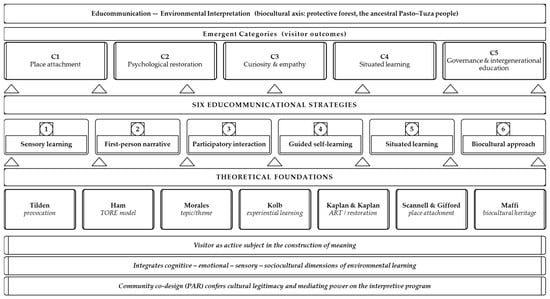
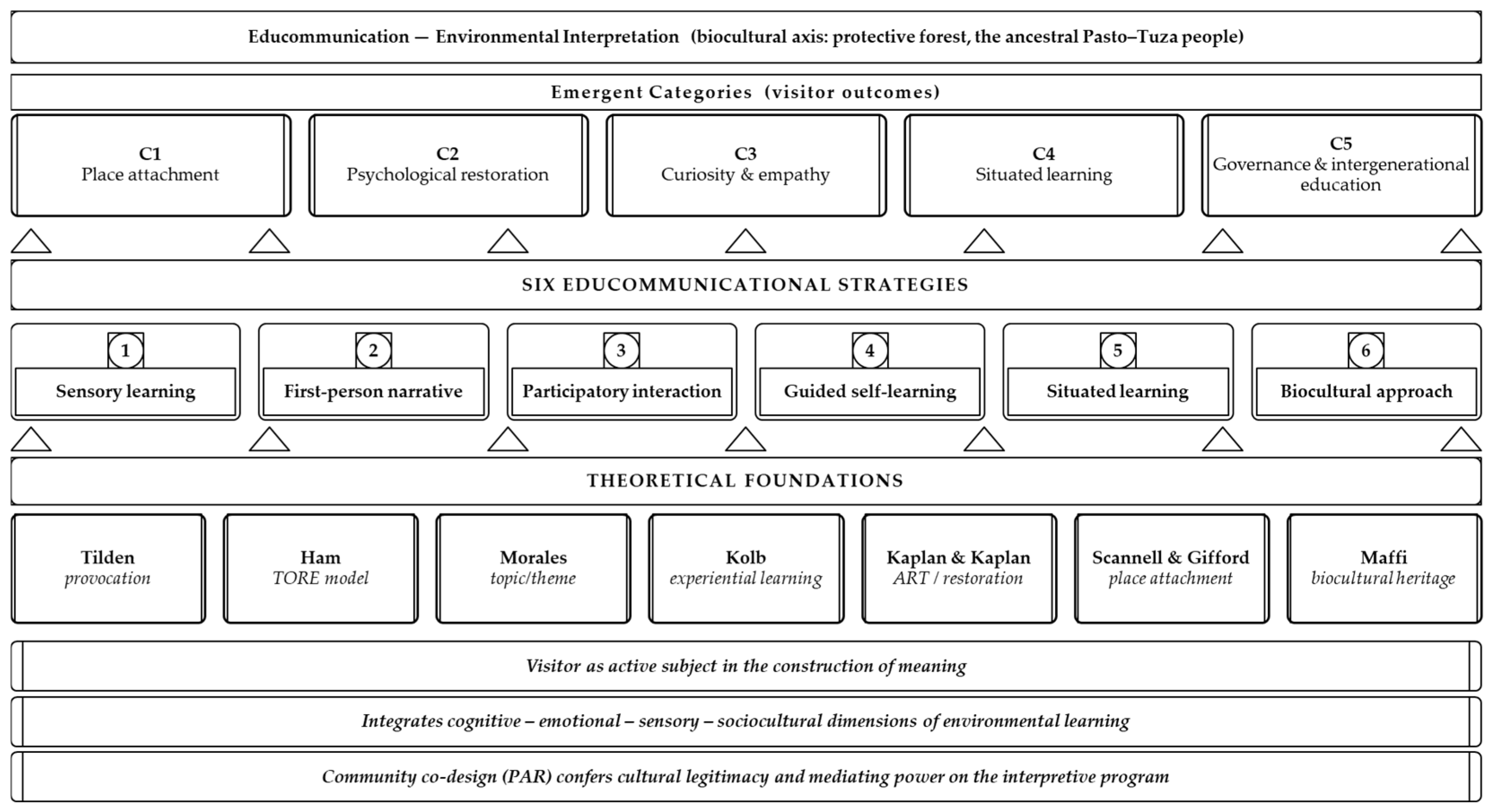
Figure 2 presents six strategies in an integrated model, mapping each strategy onto the emergent categories it most strongly activates and onto its theoretical foundation, and situating the whole within the educommunication-environmental-interpretation framework.
Figure 2.
Integrated model of educommunicational strategies.
4.6.1. Sensory Learning
Sensory learning constitutes a central strategy of the interpretive trail, directly engaging the visitor’s senses through tactile, olfactory, visual, and kinesthetic experiences.
Interactive activities such as direct contact with the emblematic arrayan tree, olfactory stimulation with medicinal species, and observation of plant structures enable an experiential understanding of the interpretive environment that strengthens emotional connection with the forest [1,15]. This strategy facilitates the internalization of knowledge by linking perception and emotion, both fundamental elements of meaningful and environmental learning.
4.6.2. First-Person Narrative (Storytelling)
First-person narrative constitutes the most distinctive educommunicational strategy of the trail, presenting interpretive messages through the inner voice of the natural resource itself. This technique transforms the visitor into an interlocutor engaging with a living subject (flora species), generating empathy, identification, and a sense of responsibility within the forest context. The results demonstrate that this strategy activates interpretive provocation processes consistent with Tilden’s principles [12] and Ham’s TORE model [5,14].
The key informant’s appropriation of the message reflects effective communicative mediation, in which the discourse of the forest is internalized as personal experience.
4.6.3. Participatory Interaction
The active participation of the visitor in interpretive experiences—including morphological comparison, guided exploration, and direct interaction with interpreted resources—fosters the collective construction of meanings and environmental understanding. This strategy aligns with the principles of participatory action research, promoting learning through experience and reflection while simultaneously strengthening the bond between visitor, community, and territory [36,37].
Participatory interaction enables the transformation of the visitor from passive observer to active agent in the learning experience.
4.6.4. Guided Self-Learning
The self-guided design of the trail promotes self-directed learning processes, through which the visitor constructs their own interpretive pathway based on the stimuli, questions, and activities proposed at each interpretive stop.
This strategy fosters cognitive autonomy and individual reflection, aligning with Kolb’s experiential learning approach [2] and Moscardo’s concept of mindful visitors [21]. The visitor assumes an active role in the construction of their own knowledge, generating more lasting and personalized learning outcomes that can subsequently be shared with others.
4.6.5. Situated Learning
Situated learning is evidenced in the contextualization of interpretive content within the axiological environment of the forest, where knowledge emerges from direct experience with the territory as an interpreted resource.
Flora and fauna species, landscapes, and ancestral knowledge are understood and internalized within their ecological and cultural context, facilitating the construction of relevant and applicable meanings [2,7]. This strategy strengthens the relationship between knowledge and context, integrating environmental, cultural, and social dimensions of environmental learning.
4.6.6. Biocultural Approach
The biocultural approach articulates the biodiversity of the forest ecosystem with the ancestral knowledge of the Pasto-Tuza people, bringing together nature and culture as inseparable components of the interpretive process.
Ancestral medicine practices, symbolic narratives, and the community minga as a system of social integration constitute central elements of this strategy, reinforcing territorial identity and community governance [7,28]. This approach enables an understanding of the forest not merely as an ecosystem but as a living socio-ecological system, in which conservation is intrinsically linked to cultural continuity and the collective memory of its ancestral people.
5. Discussion
5.1. Effectiveness of First-Person Narrative Interpretation in Andean Forest Contexts
The findings of the hermeneutic analysis provide empirical support for three design decisions embedded in the “Magical Portal of Biodiversity and Culture” trail. First, the empathy and conservation responsibility documented in Category 3 extend Ham’s TORE framework [14] and Tilden’s provocation principle [12] beyond their original Anglo-American case base into an indigenous Andean forest context that had not previously been empirically tested. That visitors experienced the first-person scripts authored by the research team through the four-stage design process described in Section 3.4, and only subsequently presented to the community for validation (Section 3.7.1) as if the resource itself were addressing them directly suggests that narrative provocation does not require the messages to originate from the community being represented; what appears decisive is the interpretive fidelity with which the community’s own biocultural vocabulary is reconstructed and voiced.
Second, the restorative experiences documented in Category 2 validate the contemplative design of Stop 6 (Cathedrals of Light) and extend Attention Restoration Theory [28] to a native Andean arrayan forest environment, a vegetation type not previously examined in the ART literature. This finding carries a design implication beyond the present case: interpretive trails in high-biodiversity native forest environments that deliberately incorporate contemplative, low-stimulus stops may activate restorative benefits independently of the specific narrative content delivered at those stops.
Third, the situated conservation learning documented in Category 4 integrating factual ecological knowledge, ethnobotanical knowledge, and attitudinal change within a single testimony confirms Kolb’s experiential learning cycle [2] as a valid framework not only for sequencing PAR workshop activities (Section 3.5) but for the trail’s pedagogical structure as experienced by visitors, extending the cycle’s application from a facilitation tool to an outcome-level explanatory framework.
Together, these results indicate that environmental interpretation in protected areas functions not merely as an information channel but as a mediator between pro-environmental intention and behavior [45], consistent with recent evidence that interpretation constitutes an active tool for attitudinal change linking local experience to global conservation action [46].
5.2. Biocultural Integration as an Interpretive and Educommunicational Strategy
A central contribution of this study is that treating Pasto-Tuza biocultural heritage as an interpretive axis rather than as a decorative complement to biodiversity content generated a distinctive subjective experience in visitors, as reflected in Category 5. This extends Maffi’s biocultural heritage framework [7] beyond its largely theoretical and policy-oriented formulation by showing that it is not only conceptually valid but experientially accessible: visitors with no prior relationship to the Pasto-Tuza community spontaneously reproduced its own conservation vocabulary (the minga) as their personal recommendation.
This experiential accessibility, however, should not be attributed to community co-authorship of the interpretive messages. The women guardians of the “Los Arrayanes” Forest contributed to the design process by helping refine the topic-theme assigned to each resource, drawing on their direct ethnobotanical and experiential knowledge of the site (Section 3.5); but the interpretive scripts themselves, and the six educommunicational strategies identified in Section 4.6, were derived by the research team through hermeneutic analysis of key informants’ testimonies, and only subsequently presented to the community and the Montúfar municipal GAD for observation and validation (Section 3.7.1).
The biocultural effect documented here therefore did not depend on community co-creation of content, but on a hermeneutic process capable of surfacing and re-articulating the community’s own biocultural vocabulary with sufficient fidelity that visitors and, notably, the community members present at the validation meeting recognized it as authentic. This is arguably a more demanding, and more replicable, condition than co-authorship: it does not require securing sustained community participation in message drafting, but it does require an analytical method rigorous enough to preserve the community’s own meanings rather than translate them into an outside interpretive register.
This interdependence between biodiversity and culture is consistent with ethnobotanical research on high-biocultural-diversity understories, where species such as those of the Piperaceae family fulfill simultaneous medicinal, symbolic, and ritual functions [44]; the present study extends that literature by showing that this interdependence can be reconstructed analytically through hermeneutic interpretation of community testimony and communicated to outside visitors without requiring the community’s direct participation in message design
5.3. Unexpected Findings and Limitations
Contrary to the overall coherence observed in the assessment of the trail’s interpretive potential (Section 4.1), the resources rated highest in symbolic significance and visitor attractiveness, the arrayan tree, the pumamaqui, and “The Forest Cathedral,” were simultaneously among those rated only “fair” for resistance to environmental impact, ease of interpretive adaptation, and visitor-flow management (Section 4.2). This inverse relationship between interpretive appeal and physical resilience was not anticipated by the Tilden, Morales, Ham framework guiding trail design, none of which treats carrying capacity as a design variable. It points to a practical tension documented in protected-area visitor-management literature but rarely connected explicitly to interpretive-design research: the same features that make a resource pedagogically powerful accessibility, proximity, tactile and olfactory engagement may be the features that render it most vulnerable to degradation as visitation increases. Future interpretive design in similarly fragile Andean forest sites should treat physical carrying capacity as a design constraint from the outset, rather than as a management issue to be addressed after the trail is operational.
A second unanticipated pattern was the absence of any ambivalent, indifferent, or critical testimony among the seven key informants: all five emergent categories were uniformly confirmatory of the trail’s interpretive effectiveness. This homogeneity is more plausibly attributed to the study’s purposive, non-probabilistic sampling strategy and to the timing of data collection immediately after trail completion, when engagement is at its highest, than to an actual absence of mixed visitor reactions in the broader visiting public. Reporting this pattern explicitly, rather than allowing the uniformly positive categories to stand without comment, is intended to guard against an unwarranted impression of unconditional efficacy.
These two observations should be read alongside four further limitations of the study. First, it is a single-site, bounded case study of one 16-ha forest, so the findings are qualitative rather than statistically generalizable. Second, the evidence rests on seven key informants from an intentional sample and twelve participants across three PAR workshop sessions. Third, the proximity between the interpretive experience and the immediately subsequent interview cannot fully rule out social-desirability effects. Fourth, the study documents in situ, short-term perceptions; it does not assess whether the reported attitude changes persist over time or translate into sustained conservation behavior.
6. Conclusions
This study has demonstrated that an eight-stop interpretive trail applying Tilden’s provocation principles [12], Morales’s topic-theme design structure [13], Ham’s TORE quality model [14], and the first-person resource narrative technique generates five empirically documented outcomes in an indigenous Andean native forest context: vital and heritage place attachment; psychological restoration consistent with Attention Restoration Theory [28]; environmental curiosity and conservation responsibility activated by first-person interpretive signs and scripts; and situated conservation learning integrating ecological, ethnobotanical, and attitudinal dimensions.
The central theoretical contribution of this study is the empirical validation through hermeneutic analysis of first-person narrative interpretation as an effective technique for generating place attachment and conservation responsibility in the three visitor segments identified in this study (school and university groups, domestic nature/cultural tourists, and specialized/international visitors; Section 3.2.1) that represent diverse audiences in Indigenous Andean Forest environments. The finding that key informants spontaneously recommended community mingas and intergenerational environmental education as conservation priorities, reproducing the Pasto-Tuza community governance framework without prompting, confirms that the integration of biocultural heritage into interpretive design achieves conceptual mediation that extends well beyond the visit itself.
The interpretive model developed here offers a guiding framework—rather than a directly transferable template—for other Andean territories characterized by high native biodiversity and living indigenous biocultural heritage. Its successful replication depends critically on adaptation to each site’s specific ecology, community organization, and local governance structures, as well as on genuine community willingness to participate in design and implementation. The minimum conditions for replication include: adaptation of the topic-theme structure to the specific ecological and cultural resources of each site with interpretive potential; decisive community participation in the design of messages and the training of interpreter guides; implementation of PAR workshops as a participatory evaluation methodological device; and systematic assessment of visitor impact through the hermeneutic interpretive method.
As a future research agenda, we recommend longitudinal evaluation of visitors’ environmental attitudes and behaviors beyond the immediate post-visit period, as well as comparative studies with other Andean biocultural interpretive trails to further test the transferability of the model. On the practical side, the findings support differentiated recommendations: for environmental educators, integration of the trail into local curricular programs; for tourism and conservation authorities, the development of visitor-flow management protocols and training programs for community interpreter guides-particularly given that the resources rated most attractive were also those most vulnerable to physical degradation (Section 5.3); and for policymakers, the design of funding mechanisms and the formal recognition of Pasto-Tuza community governance in the management of the protected forest, including a sustainable entrance-fee scheme that supports the forest guardians who currently sustain the site on minimal resources.
Supplementary Materials
The following supporting information can be downloaded at https://www.mdpi.com/article/10.3390/soc16090277/s1, Table S1: Natural and cultural sites and resources of interpretive significance in the “Los Arrayanes” Protective Forest; Table S2: Key informants and interview schedule; Table S3: In-depth interview questions and hermeneutic analysis; Figure S1: Stops along the “Magical Portal of Biodiversity and Culture” self-guided interpretive trail in the “Los Arrayanes” Protective Forest. Source: Prepared by the authors; Figure S2: Welcome sign for the “Magical Portal of Biodiversity and Culture” interpretive trail in the “Los Arrayanes” Protective Forest. Source: Photograph by the authors; Figure S3: Visitors at stops along the “Magical Portal of Biodiversity and Culture” interpretive trail in the “Los Arrayanes” Protective Forest. Source: Photographs by the authors.
Author Contributions
Conceptualization, C.A.T. and R.L.-C.; methodology, C.A.T. and R.L.-C.; investigation, C.A.T.; formal analysis, C.A.T., R.L.-C. and J.P.F.R.; data curation, C.A.T. and R.L.-C.; writing—original draft preparation, C.A.T.; writing—review and editing, R.L.-C., J.P.F.R. and F.E.C.G.; supervision, R.L.-C.; project administration, C.A.T.; funding acquisition, R.L.-C. All authors have read and agreed to the published version of the manuscript.
Funding
This research was funded by Universidad Técnica del Norte, project number InvestigaUTN-2025-1440.
Institutional Review Board Statement
The qualitative research involving visitors was conducted in accordance with the Declaration of Helsinki. Voluntary informed consent was obtained from all participants or their legal guardians (for participants under 18 years of age). No personally identifiable information was collected. Ethical approval: UTN-Ethics-2024-XXX.
Informed Consent Statement
Informed consent was obtained from all participants involved in the study. For participants under 18 years of age, written informed consent was obtained from their parents or legal guardians before participation.
Data Availability Statement
The verbatim transcripts from the qualitative study are available from the corresponding author upon reasonable request, subject to applicable institutional and ethical considerations.
Conflicts of Interest
The author declares no conflicts of interest.
Abbreviations
The following abbreviations are used in this manuscript:
| ART | Attention Restoration Theory [22] |
| EI | Environmental Interpretation |
| MAATE | Ministerio del Ambiente, Agua y Transición Ecológica del Ecuador |
| TORE | Thematic, Organized, Relevant, Enjoyable [14] |
References
- Damasio, A.R. The Feeling of What Happens: Body and Emotion in the Making of Consciousness; Harcourt: New York, NY, USA, 1999. [Google Scholar]
- Kolb, D.A. Experiential Learning: Experience as the Source of Learning and Development; Prentice Hall: Englewood Cliffs, NJ, USA, 1984. [Google Scholar]
- Bruner, J. Acts of Meaning; Harvard University Press: Cambridge, MA, USA, 1990. [Google Scholar]
- Ballantyne, R.; Packer, J. Promoting Environmentally Sustainable Attitudes and Behaviour through Free-choice Learning Experiences: What Is the State of the Game? Environ. Educ. Res. 2005, 11, 281–295. [Google Scholar] [CrossRef] [Scilit]
- Ham, S.H. Interpretation: Making a Difference on Purpose; Fulcrum Publishing: Golden, CO, USA, 2013. [Google Scholar]
- Weiler, B.; Black, R. Tour Guiding Research: Insights, Issues and Implications; Channel View Publications: Bristol, UK, 2015. [Google Scholar]
- Maffi, L.; Woodley, E. Biocultural Diversity Conservation: A Global Sourcebook; Earthscan: London, UK, 2010. [Google Scholar]
- Lomas Tapia, K.R.; Trujillo, C.A.; Naranjo Toro, M. Sustainability of the Protective Forest “Cascada de Peguche’’, Otavalo–Imbabura (Ecuador). Holopraxis 2018, 2, 1–10. [Google Scholar]
- Tapia, K.R.L.; Trujillo, C.A.; Toro, M.N.; Andrade, A.B. Investigación Cualitativa Indigena Para el Progreso Comunitario: Caso Peguche Ecuador; New Trends in Qualitative Research; Ludomedia: Oliveira de Azeméis, Portugal, 2022; Volume 14. [Google Scholar]
- Lomas Tapia, K.R.; Trujillo, C.A.; Chiliquinga Cevallos, L.A.; Chiliquinga Jaramillo, L.A. Alianzas de Gobernanza Indígena Para El Desarrollo Comunitario Del Etnoturismo: Caso Peguche Ecuador. LATAM Rev. Latinoam. Cienc. Soc. Humanid. 2024, 5, 2468–2484. [Google Scholar] [CrossRef] [Scilit]
- Kaplún, M. Una Pedagogía de la Comunicación; Ediciones de la Torre: Madrid, Spain, 1998. [Google Scholar]
- Tilden, F. Interpreting Our Heritage; University of North Carolina Press: Chapel Hill, NC, USA, 1957. [Google Scholar]
- Morales, J. Manual Para la Interpretación del Patrimonio; Junta de Andalucía: Sevilla, Spain, 2001. [Google Scholar]
- Ham, S.H. Environmental Interpretation; North American Press: Golden, CO, USA, 1992. [Google Scholar]
- Immordino-Yang, M.H.; Damasio, A. We Feel, Therefore We Learn: The Relevance of Affective and Social Neuroscience to Education. Mind Brain Educ. 2007, 1, 3–10. [Google Scholar] [CrossRef] [Scilit]
- Vaske, J.J.; Kobrin, K.C. Place Attachment and Environmentally Responsible Behavior. J. Environ. Educ. 2001, 32, 16–21. [Google Scholar] [CrossRef] [Scilit]
- Larson, L.R.; Green, G.T.; Castleberry, S.B. Emotional Affinity toward Nature. Environ. Behav. 2011, 43, 33–55. [Google Scholar]
- Scannell, L.; Gifford, R. Defining Place Attachment: A Tripartite Organizing Framework. J. Environ. Psychol. 2010, 30, 1–10. [Google Scholar] [CrossRef] [Scilit]
- Lee, T.H. A Structural Model to Examine How Destination Image, Attitude, and Motivation Affect the Future Behavior of Tourists. Tour. Manag. 2009, 30, 55–64. [Google Scholar] [CrossRef] [Scilit]
- Powell, R.B.; Ham, S.H. Can Interpretation Influence Environmental Behavior? J. Interpret. Res. 2008, 13, 21–36. [Google Scholar]
- Moscardo, G. Making Visitors Mindful; Sagamore Publishing: Champaign, IL, USA, 1996. [Google Scholar]
- Kaplan, R.; Kaplan, S. The Experience of Nature; Cambridge University Press: Cambridge, UK, 1989. [Google Scholar]
- Ulrich, R.S. View Through a Window May Influence Recovery from Surgery. Science 1984, 224, 420–421. [Google Scholar] [CrossRef] [Scilit]
- Ulrich, R.S.; Simons, R.F.; Losito, B.D.; Fiorito, E.; Miles, M.A.; Zelson, M. Stress Recovery during Exposure to Natural and Urban Environments. J. Environ. Psychol. 1991, 11, 201–230. [Google Scholar] [CrossRef] [Scilit]
- Parsons, R.; Tassinary, L.G.; Ulrich, R.S.; Hebl, M.R.; Grossman-Alexander, M. The View from the Road: Implications for Stress Recovery and Immunization. J. Environ. Psychol. 1998, 18, 113–140. [Google Scholar] [CrossRef] [Scilit]
- Millennium Ecosystem Assessment. Ecosystems and Human Well-Being; Island Press: Washington, DC, USA, 2005. [Google Scholar]
- Pine, B.J.; Gilmore, J.H. The Experience Economy; Harvard Business School Press: Boston, MA, USA, 1999. [Google Scholar]
- Berkes, F. Sacred Ecology, 4th ed.; Routledge: New York, NY, USA, 2018. [Google Scholar]
- Masterson, V.A.; Stedman, R.C.; Enqvist, J.; Tengö, M.; Giusti, M. The Contribution of Sense of Place to Social–Ecological Systems Research: A Review and Research Agenda. Ecol. Soc. 2017, 22, 49. [Google Scholar] [CrossRef] [Scilit]
- Ministerio del Ambiente Agua y Transición Ecológica (MAATE). Declaratoria del Bosque Protector “Los Arrayanes”; Quito, Ecuador, 2021. [Google Scholar]
- Trujillo, C.A.; Naranjo Toro, M.; Lomas Tapia, K.R.; Merlo, M. Investigación Cualitativa: Epistemología, Métodos y Ejemplos Prácticos; Universidad Técnica del Norte: Ibarra, Ecuador, 2019. [Google Scholar]
- Hernández-Sampieri, R.; Fernández-Collado, C.; Baptista, M.P. Metodología de la Investigación, 6th ed.; McGraw-Hill: Ciudad de México, Mexico, 2014. [Google Scholar]
- Flick, U. An Introduction to Qualitative Research, 5th ed.; SAGE Publications: London, UK, 2014. [Google Scholar]
- Creswell, J.W. Qualitative Inquiry and Research Design: Choosing Among Five Approaches, 3rd ed.; SAGE Publications: Thousand Oaks, CA, USA, 2013. [Google Scholar]
- Morales, J.; Herrera, S. Guía Metodológica Para la Planificación Interpretativa en Áreas Naturales; Junta de Andalucía: Sevilla, Spain, 1986. [Google Scholar]
- Kemmis, S.; McTaggart, R. Participatory Action Research: Communicative Action and the Public Sphere. In The SAGE Handbook of Qualitative Research; Denzin, N.K., Lincoln, Y.S., Eds.; SAGE Publications: Thousand Oaks, CA, USA, 2005; pp. 559–603. [Google Scholar]
- Fals-Borda, O. Action and Knowledge: Breaking the Monopoly with Participatory Action Research; Apex Press: New York, NY, USA, 1991. [Google Scholar]
- Kvale, S.; Brinkmann, S. InterViews: Learning the Craft of Qualitative Research Interviewing, 2nd ed.; SAGE Publications: Thousand Oaks, CA, USA, 2009. [Google Scholar]
- Patton, M.Q. Qualitative Research & Evaluation Methods: Integrating Theory and Practice, 4th ed.; Sage Publications: Thousand Oaks, CA, USA, 2014. [Google Scholar]
- Gadamer, H.-G. Truth and Method, 2nd ed.; Continuum: New York, NY, USA, 2004. [Google Scholar]
- Ricoeur, P. Interpretation Theory: Discourse and the Surplus of Meaning; Texas Christian University Press: Fort Worth, TX, USA, 1976. [Google Scholar]
- Lincoln, Y.S.; Guba, E.G. Naturalistic Inquiry; Sage Publications: Beverly Hills, CA, USA, 1985. [Google Scholar]
- Nowell, L.S.; Norris, J.M.; White, D.E.; Moules, N.J. Thematic Analysis: Striving to Meet the Trustworthiness Criteria. Int. J. Qual. Methods 2017, 16, 1–13. [Google Scholar] [CrossRef] [Scilit]
- Martínez-Bautista, B.G.; Bernal-Ramírez, L.A.; Bravo-Avilez, D.; Samain, M.-S.; Amezcua, J.M.R.; Rendón-Aguilar, B. Traditional Uses of the Family Piperaceae in Oaxaca, Mexico. Trop. Conserv. Sci. 2019, 12, 1–22. [Google Scholar] [CrossRef] [Scilit]
- Torabi, Z.-A.; Hall, C.M.; Tavakoli, M.; Vahed, Z. Environmental Interpretation and Environmentally Responsible Behavior of Tourists in Heritage Villages. Int. J. Environ. Sci. Technol. 2025, 22, 5513–5528. [Google Scholar] [CrossRef] [Scilit]
- Moscardo, G.; Hughes, K. Rethinking Interpretation to Support Sustainable Tourist Experiences in Protected Natural Areas. J. Interpret. Res. 2023, 28, 76–94. [Google Scholar] [CrossRef] [Scilit]

Disclaimer/Publisher’s Note: The statements, opinions and data contained in all publications are solely those of the individual author(s) and contributor(s) and not of MDPI and/or the editor(s). MDPI and/or the editor(s) disclaim responsibility for any injury to people or property resulting from any ideas, methods, instructions or products referred to in the content. |
© 2026 by the authors. Licensee MDPI, Basel, Switzerland. This article is an open access article distributed under the terms and conditions of the Creative Commons Attribution (CC BY) license.