


Abstract
Migrant workers have become a structural feature of agriculture across the global core, yet whether this dependence is deepening has not been established over a long time series or tested against a major shock. This article revisits the question through a longitudinal comparative case study of seven core states—the United States, Canada, Australia, New Zealand, Japan, Spain and Italy—selected on a most-dissimilar-systems logic and read through the world-ecology framework, in which cheap food rests on cheap labour. Drawing on primary statistical portals and administrative registers, it reconstructs the legal channels of entry into agricultural work and traces their evolution across roughly a decade and into the post-pandemic period, correcting and completing the evidentiary base of earlier studies. In every case, the dependence has persisted or intensified: where it has not continued to rise, it has settled at a historically high plateau, and nowhere has it reverted to its earlier level. It held, moreover, under conditions designed to curtail it—anti-immigrant administrations and COVID-19 border closures—as states reconfigured their migration channels to preserve the supply. The findings confirm that the migrantisation of agricultural labour is a structural and expanding condition of accumulation in the global core.
1. Introduction
Migrant workers have become a structural feature of agriculture across the global core. Their growing presence has generated a substantial literature, long established in settings such as the United States [1] or Canada [2] and more recent in Europe [3,4], the Pacific [5,6] and Asia [7,8], where the near-simultaneity of these trajectories points to a single, globally expanding process. Yet despite the breadth of this literature, its geographic reach has remained limited. Most contributions are grounded in single enclaves or regions, or in single national cases; cross-national comparisons are rare and, where they exist, tend to pair only two countries or cover a small number of cases (see, for instance, Howes [9] or Bojarczuk et al. [10]). Whether the patterns documented in these settings reflect a common structural dynamic or the parallel unfolding of nationally specific processes has therefore received little systematic attention.
This scholarship has accounted for the displacement of national workers by migrants mainly on two grounds: a productive one, tied to the industrialisation of farming in specialised enclaves that demand abundant wage labour [11], and a sociological one, whereby rising welfare in the core’s rural areas has rendered poorly paid, low-status and physically gruelling farm work unappealing to local populations [12].
What these accounts have tended to overlook is that the phenomenon is not merely local, national or supranational but global, and that its synchrony betrays systemic roots in the trajectory of global capitalism. To foreground this, the present study adopts the concept of “migrantisation” [13]—the constitution of the migrant as a distinct social category, set apart by the legal, social and mobility conditions that apply to migrants alone. In agriculture, the term names the expanding and structural dependence of the core’s primary sector on migrant labour. The pattern is not new: as in the colonial monocultures once worked by displaced and enslaved populations, workers drawn from the global periphery remain decisive for the production of cheap food [14,15].
An earlier study [16] read this dependence through the world-ecology paradigm, casting migrant labour as a contemporary global reserve army whose cheapness underwrites not only farming but also the accumulation cycles of the capitalist world-system, of which cheap food is a load-bearing pillar [14]. That argument, however, rested on illustrative cases rather than measurement. A later comparative analysis [17] addressed the deficit by assembling secondary statistics to gauge both the scale of agricultural migrantisation across the core and its upward trend, in the spirit of testing and reinforcing the theory through a comparative case study [18]. It confirmed a continuous, apparently irreversible process across all core settings examined.
Two constraints, though, leave that conclusion open. The series only reached 2016 or 2018, depending on the case, since the analysis was carried out that year, leaving a period of up to 10 years that can now be examined. During this period, the COVID-19 pandemic provided an unforeseen natural experiment [19]. A subsequent chapter [20] showed that, even amid border closures and confinements, states deployed exceptional measures that preserved—and at times enlarged—their migrant farm workforce. Yet that evidence covered only 2020–2021, a too-short window to tell whether it was a temporary rebound from a lasting trend.
This article confronts both shortcomings. Reproducing the comparative design of the two earlier studies [17,20], it adopts a longitudinal perspective that lengthens the series by roughly a decade and carries it into a post-pandemic landscape reshaped by big institutional changes. A few salient developments, by way of example, warrant renewed attention: wholly new schemes have appeared, such as Australia’s Pacific Australia Labour Mobility (PALM programme, which absorbed its two predecessors in 2022 [6], or Japan’s Specified Skilled Worker visa, launched in 2019 [7]) and established schemes have been recast, as with Spain’s extension of origin-country recruitment toward Latin America [21] against a falling supply of Eastern European labour increasingly diverted elsewhere, notably to Germany [22].
Against this backdrop, the article pursues two objectives. The first is substantive: to establish, over a longer series and into the post-pandemic period, whether the migrantisation of agricultural labour in the global core has persisted, intensified or merely reconfigured, and thus whether the world-ecology hypothesis still holds once the historical perspective the previous studies lacked is restored. The second is methodological: to correct and complete the evidentiary base on which those studies rested. To pursue the first, the analysis replicates their comparative case design, examining the same set of core states and, for each, tracing the legal channels of entry into agricultural work and their evolution over time. To pursue the second, it draws directly on the official statistical portals and administrative registers of each country, turning to other sources only in isolated cases where these did not provide the required series. This grounding in primary data allows it to revise inaccurate figures and to recover recruitment channels that were then unknown or undisaggregated—most visibly in New Zealand and Canada—while confronting a problem the earlier pieces left implicit: the heterogeneity of the available metrics (visas granted, visa holders, employment counts, labour-market authorisations), which must be reconciled with care, lest a change in source be mistaken for a change in reality.
The article first sets out the world-ecology framework and the criteria for delimiting the global core and then examines the structural nexus between migration and agriculture; it next presents the comparative design and its sources, discusses the cases by region, and draws the comparison together in its concluding remarks.
2. Locating the Core of the World-Ecology
World-systems analysis holds that the world-economy is a single capitalist system organised into core and peripheral zones, a premise central to Structuralist International Relations [23] and traceable to the dependency theory of Raúl Prebisch and the Economic Commission for Latin America (CEPAL) in the 1950s. In Wallerstein’s formulation, core zones concentrate monopolistic, capital-intensive production and appropriate surplus from the rest of the system, while peripheral zones, abundant in variable capital, trade on the unequal terms imposed by the core [24]. Coreness, on this view, is relational rather than territorial: it follows the production processes that command the greatest surplus at a given moment—textiles in the nineteenth century, global value chains today—so that an activity is core-like only while it remains scarce and monopolisable. States are indispensable units because sustaining such quasi-monopolies requires considerable juridical, military and political capacity; this is why, the relational definition notwithstanding, it remains meaningful to speak of core and peripheral states.
This article reads agricultural migrantisation through world-ecology, Jason W. Moore’s reformulation of that tradition, which incorporates nature into the analysis of accumulation and treats the history of capitalism as the successive appropriation of cheap natures—food, labour, energy and raw materials—among which cheap food, sustained by cheap labour, is decisive [14]. Like the world-systems analysis it extends, world-ecology takes the division of the system into core, semi-periphery and periphery as given rather than as something to be established anew, an assumption that is unproblematic for its own purposes. For the present study, however, identifying which states constitute the core is not incidental but foundational, since the comparison depends on selecting cases that belong to it. That identification has to be drawn from the Structuralist classifications devised for the purpose.
Several such classifications exist. Their authors weigh different variables—aggregate income, centrality in trade networks, political power—but converge on a similar set of core areas [25,26,27]. For a study that returns to these cases a decade on, it is significant that the map has not been redrawn since [17]. Work published after 2019 has confirmed and refined the hierarchy rather than revising it: Kostoska et al. [28] recover the three-tier structure from sectoral trade networks, and Valizade et al. [29] apply the core/semi-periphery/periphery scheme to a contemporary panel dataset. Most directly, Jacinto [30], examining the trade ties of 191 countries across the 2008–09 crisis, finds the top of the hierarchy—the United States, Germany, the Netherlands, the United Kingdom, France, Italy, Japan and the other advanced economies—unchanged, with mobility limited to a few semi-peripheral countries. The stability these studies document supports retaining the same cases as the earlier work.
Table 1 brings together the classifications used here alongside those of the United Nations’ World Economic Situation and Prospects, which, though not Structuralist, broadly classifies the same states as “developed economies” and thus corroborates the mapping from outside the tradition [31]1. The agreement among them is considerable, and the disagreements are confined to the fringes of the core. All place Canada and the United States in the core without exception; in Asia-Pacific, the differences concern only whether to include borderline cases such as Singapore, Israel or the Chinese Special Administrative Regions; and the chief locus of disagreement is the European Union, treated as core in its entirety by some classifications and only in part by others. Because these divergences are minor and fall outside the cases that concern this study, and because the aim is not to propose a classification of its own, the analysis follows the earlier work in adopting Chase-Dunn, Kawano and Brewer [25]—that is, in working with the states that qualify as core under every classification rather than only under one.
Table 1.
Comparative list of classifications of the world-system core.
From that list, the study draws the cases examined here. The criterion for selection is belonging to the core; these are the same states examined in the two earlier studies [17,20]: the United States and Canada; Australia, New Zealand, and Japan; and, within the European Union, Spain and Italy. Taking only Spain and Italy from the Union, rather than each of its core members, is a deliberate choice grounded in the structure of European agricultural production, set out below when the European case is introduced.
3. Migration and Agriculture: A Structural Nexus
Agriculture has historically depended on mobile labour. Long before the present configuration of global agri-food chains, the work was usually performed by mobile populations in many contexts: poor rural workers from neighbouring regions, enslaved populations forcibly moved to plantation economies, or seasonal labourers recruited through state or employer schemes. What changes across periods is not the need for mobile labour itself but the political, legal and institutional forms through which it is made available, disciplined and cheapened. In the contemporary capitalist world-ecology, this function has increasingly been fulfilled by migrant labour [16].
The structural link derives, first, from the organisation of production. In the enclaves that supply fresh fruit and vegetables to core markets, seasonality, perishability and just-in-time logistics generate intense labour peaks, requiring large numbers of workers for short periods at short notice; and although the sector has been transformed technologically, many labour-intensive tasks remain difficult to mechanise, leaving production deeply integrated into global markets yet dependent on abundant, flexible and disposable labour [32]. This work has, at the same time, become progressively unattractive to local populations, marked as it is by low wages, long days, physical exhaustion, risk, isolation, and low status [4], with migrants concentrated in its most demanding, least protected, and lowest-paid positions [33]. Migrant labour does not merely fill temporary shortages, then, but resolves a structural contradiction: the need to sustain labour-intensive production in economies where the labour required has become socially devalued and increasingly rejected by the national workforce [16].
Migrants are channelled into farm work not only because they are present in receiving countries but also because their legal, social and economic positions make them available for precisely the work that locals abandon. Wage differentials between origin and destination remain crucial [34], but they do not exhaust the explanation: for many migrants, agriculture is also an entry point to the labour market, a means of sustaining a migration project, or a stage within longer trajectories of mobility [35]. The sector, therefore, depends on both structure and agency—employers and states design the formal architecture of admission, but the recruitment process has historically relied on migrant social networks as a constitutive infrastructure of supply in its own right; migrants engage with both formal channels and informal circuits to pursue their own ends.
This dual movement is central to the concept of migrantisation. The migrant farmworker is not simply a foreign worker but one placed in a differentiated social position: temporary visas, employer-tied permits, irregular status, language barriers, dependence on employer-provided housing, and the threat of dismissal or deportation together produce a labour force legally and materially distinct from the national one [15]. Such differentiation is not a side effect of agricultural labour regimes but one of their conditions of possibility. Across the global core, the legal route may differ—guest-worker programmes, training schemes, working-holiday visas, seasonal permits, posted work, origin-country recruitment or irregular employment—but the outcome is comparable: a workforce that is mobile, temporary, segmented and weakly protected [36]. Migrantisation thus rests not on any single instrument but on a layered migration infrastructure that can be recomposed whenever one channel becomes insufficient.
Irregularity is central to that infrastructure, but not in isolation from formal channels. In many enclaves, irregular employment coexists with authorised work, producing a continuum between regular, informal and “grey” labour [37]: a contract may regularise residence without securing decent work, while a permit-holder may labour without a formal contract or below legal standards [38]. For seasonal workers, legality itself is precarious, with the right to reside tied to a single employer, a short stay, and the obligation to return [39]. Intermediaries, whether legal or informal, convert this vulnerability into labour supply by controlling dimensions that, in some cases, extend beyond access to work, such as housing, transport, and documentation, and by translating the abstract demand for cheap, flexible labour into concrete dependency [40].
Gender and racialisation further shape these regimes. The selection and allocation of workers are routinely justified by stereotypes about nationality, endurance, obedience, or supposedly gendered capacities, producing internally segmented workforces in which tasks, wages, risk, and autonomy are distributed along lines of gender, nationality, race, and status [41].
Migrant workers are not, however, passive bearers of this vulnerability. The literature documents agency ranging from mobility strategies and occupational trajectories to resistance, legal mobilisation and union engagement [35,42]. Migrants may accept exploitative conditions because they serve broader projects, yet they also contest them when opportunities arise. Resistance, however, often triggers recomposition: employers replace organised groups with newer or more vulnerable workers, while states and intermediaries adjust recruitment to restore supply [34]. Agency modifies the system without dissolving the structural demand that draws migrants into it.
The COVID-19 pandemic made that demand unusually visible. As border closures and lockdowns threatened the circuits on which harvests depend, states acted overwhelmingly to preserve migrant labour rather than to reorganise production: agricultural workers were declared “essential”, visas were extended, undocumented workers were regularised or tolerated, and those already present were redirected into farm work [43]. The pandemic did not suspend migrantisation but revealed the institutional elasticity through which migrant labour is maintained under crisis. Workers deemed necessary enough to be exempted from closures were not protected enough to secure improved rights, housing, or healthcare, and the language of essential work rarely yielded durable improvements [44]. The crisis did not create the vulnerability of migrant farmworkers; it exposed and legitimised the mechanisms already producing it [11].
The implication for this article is that agricultural migrantisation must be analysed longitudinally, not as a single stock of workers, nor as the rise or fall of one programme, but as a system of channels that may expand, contract or substitute for one another: a fall in seasonal entries may conceal longer stays, and a new programme may formalise a dependence that previously operated informally. The task is not only to count migrant workers but to reconstruct the changing institutional architecture that makes them available to agriculture. Seen through the world-ecology, that architecture performs a systemic function: by supplying labour that is cheap, flexible and differentiated, migration sustains the production of cheap food in the core. The migrantisation of agricultural labour is therefore not an anomaly of poorly regulated markets nor a temporary response to local shortages, but a recurrent solution to the structural contradiction of industrial agriculture identified above. This is the premise that the following comparative and longitudinal analysis sets out to test.
4. Methodology
The study is designed as a longitudinal comparative case study. It retains the comparative architecture of the two earlier works mentioned [17,20] and extends the analysis over time. The comparison rests on a most-dissimilar-systems logic [45]. The cases are selected because they share a common structural position within the core of the capitalist world-ecology, as centres of global accumulation. Within it, however, the cases are highly heterogeneous: they are located on four continents, rely on dissimilar agricultural structures, and govern the admission of foreign labour through migration regimes that differ markedly in design—from the bilateral schemes of the Pacific to the seasonal-permit systems of southern Europe and the training-based channels of Japan, for instance. If cases that share this structural position but differ so substantially across institutional, geographic, and agricultural dimensions nonetheless move in the same direction, the shared outcome is unlikely to be an artefact of any single national setting. It can instead be more plausibly interpreted in relation to the systemic dynamics described by the world-ecology framework.
Within each case, migrantisation is operationalised as the volume and trajectory of migrant labour entering agricultural work through its various legal channels. The analysis, therefore, identifies, for each country, the full set of visa categories and admission routes that supply the sector, and reconstructs, for each country, the longest and most consistent available series. The scope sought is deliberately narrow: the labour-intensive, largely seasonal harvest work of horticulture and viticulture, rather than livestock and dairy farming or food processing that draw on migrant labour in different ways. The available statistics do not always allow this scope to be isolated, however. In some countries, the figures can be confined to horticulture, whereas in others, only a broader “primary agriculture” aggregate—taking in dairy and livestock farming—can be obtained. The analysis aspires to the narrower category throughout and, where it cannot be separated, uses the closest available approximation, noting the difference in coverage on a case-by-case basis. Read across the period, three outcomes are possible, mirroring the question posed in the introduction: a generalised decline would suggest that the dependence is contingent and reversible; a generalised rise, or a sustained high level, would confirm its structural character; and a heterogeneous pattern, advancing in some cases and receding in others, would qualify the thesis and call for case-specific explanation. It should be noted that this criterion is directional rather than quantitative: the analysis identifies whether the dependence has risen, stabilised or declined across cases, but does not measure the magnitude of change relative to the overall size of agricultural employment in each country. The total volume of agricultural labour is not held constant, a constraint arising from the heterogeneity of the available sources and acknowledged as a boundary condition of the comparative design. Because the object of measurement is the process of migrantisation itself, two dimensions present in the 2020 study are set aside. The national composition of the workforce, treated there as a separate aim, is retained only as qualitative characterisation within each case rather than as data to be charted; and irregular employment, which cannot be quantified consistently across systems so different, enters only through the narrative of each case, where it bears on the reading of the legal figures, with the partial exception of the United States, Spain and Italy, where the survey-based sources (NAWS, EPA and ISTAT respectively) measure the workforce directly irrespective of legal status and therefore incorporate a substantial share of irregular employment within the figures themselves, as detailed in the following paragraph.
The empirical base is built, as far as possible, from primary sources: the official statistical portals and administrative registers maintained by each state’s immigration, labour and agriculture authorities, rather than the secondary compilations on which comparative work of this kind often relies (see Appendix A, Table A1). Only in isolated instances does the analysis resort to alternative material. This grounding in primary data underwrites the article’s second methodological contribution. Returning to the sources a decade on, with channels now better documented and statistics more finely disaggregated, makes it possible to correct figures that were inaccurate in the earlier works and to incorporate recruitment routes that were then unknown or could not be isolated—shortcomings most pronounced in the New Zealand and Canadian cases, where several channels had been overlooked or conflated. The map of legal entry routes into agricultural work is thus completed and, where necessary, revised.
This reconstruction confronts a difficulty that the earlier studies left implicit and that becomes acute over a long series: the available data are heterogeneous in two respects—in the nature of their source and in the unit they count. As to source, most of the cases are documented through administrative registers compiled by the migration or labour authorities, but three draw, wholly or in part, on sample surveys: NAWS, for the resident crop workforce in the United States, and the national labour-force surveys for the foreign agricultural workforce in Spain (EPA) and Italy (ISTAT). This difference is consequential: a register captures only those who pass through the legal channel it administers, whereas a survey measures the workforce directly, irrespective of legal status, and so takes in much of the irregular employment that permit-based registers miss, which is precisely why the European cases are read through labour-force data rather than visa counts. As to unit, the registers themselves are not commensurable: they variously report visas granted (a flow), visa or permit holders on a given date (a stock), employment counts derived from tax or social security records, and labour-market authorisations issued to employers, which licence posts rather than count people; the surveys, for their part, yield estimates of an active or employed population, subject to sampling error rather than exact enumeration. These quantities are not freely interchangeable, and a series assembled from more than one of them can register apparent movements that reflect a change in source rather than a change on the ground. The analysis handles this in three ways: by preferring, for each country, the longest internally consistent series and stating which metric it represents; by splicing series only where the underlying definitions are comparable, and signalling the join where they are not; and by declining to read discontinuities at such joins as substantive. The Japanese case illustrates the stakes—what looks at first like a fall in the agricultural workforce between 2011 and 2012 resolves, on inspection, into a change in reporting source rather than a movement on the ground, with a higher trainee count giving way to a lower employment count for substantially the same workers. Throughout, the aim is to ensure that the trends reported track the phenomenon rather than the instruments used to record it.
The cases are presented by region in the sections that follow, each setting out its channels, sources and series in detail before the comparative discussion draws them together.
5. Core Areas in North America: The United States and Canada
5.1. The United States
US agriculture is the longest-documented case of dependence on migrant labour and the one in which that dependence is most openly institutionalised. The reliance on Mexican workers in particular long predates the contemporary period: the Bracero programme (1942–1964) already organised the temporary admission of hundreds of thousands of Mexican labourers for the fields, fixing a template—temporary, employer-tied, nationally concentrated—that the sector has reproduced ever since in different ways worldwide [1].
Today, a migrant reaches agricultural work in the US by one of three routes. The first is to hold lawful permanent residence—or another status carrying work authorisation—and take employment in the sector; the second is to work without authorisation, in the irregular condition that has long characterised a large part of the crop workforce; the third is to enter on a temporary H-2A visa. Created by the Immigration Reform and Control Act of 1986 as the agricultural strand of the older guest-worker provisions, the H-2A visa lets employers recruit foreign workers for seasonal tasks once they have certified to the Department of Labour that no domestic workers are available and that the hire will not depress local wages or conditions [46]. It sets no numerical ceiling, binds the worker to the sponsoring employer for the term of the contract—initially up to a year and renewable in yearly increments to a maximum of three, after which the worker must leave the country before being readmitted—and obliges the employer to provide housing, transport and a guaranteed minimum wage; by the same definition, it is confined to seasonal work, excluding the year-round labour—dairy above all—that does not qualify.
For a longitudinal test, the question is therefore not whether this dependence exists but whether it has deepened, and two complementary sources allow it to be tracked. The first two routes are captured together by the National Agricultural Workers Survey (NAWS), an employment-based sample survey of the resident crop workforce that, by design, excludes H-2A workers. The earlier study established that this workforce was overwhelmingly foreign-born—around three-quarters of the total—and drawn very largely from Mexico. The most recent NAWS estimates, which now extend to 2022, leave that picture essentially unchanged: according to the author’s calculations using the survey data, migrants still make up roughly 75 per cent of the workforce, and Mexican nationals account for close to 90 per cent of them in the period 2015–2022, which continues the precedent series that stopped in 2014. The stability is itself the finding.
The two sources are complementary rather than competing, and each registers a different dimension of the same dependence. NAWS, a periodic sample survey, measures the standing crop workforce—the stable and irregular routes together—and shows a migrantisation that is already structural and stabilised at a high level: a resident base that has been overwhelmingly foreign-born and Mexican for three decades. The H-2A, for its part, is a continuous administrative count and, being uncapped, tracks employer demand almost directly; it therefore registers the other face of the process—not the stable base but its growth, the rising increment of guest-worker labour drawn in on top of that base. Migrantisation over time is then most visible in the H-2A, but because the other routes seem to have reached their peak and stabilisation. Layered on top of that already migrant-dominated resident base rather than contained within it, the H-2A series has risen steeply (Figure 1). After holding near 30,000 through the early 2000s and reaching a first peak of around 60,000 in 2008, followed by a dip during the recession, it entered a near-uninterrupted climb from 2011, multiplying it several times over within a decade, passing 200,000 by the end of the 2010s and reaching 315,328 workers in 2024.
Figure 1.
H2A Visas Issued during the period 1997–2024; Source: US Department of State, Bureau of Consular Affairs (2026).
That ascent did not pause for the pandemic; if anything, it quickened. The COVID-19 emergency might have been expected to interrupt the inflow, yet H-2A workers were exempted from the 2020 entry restrictions, designated essential, and admitted in greater numbers even in that first year. The stretch from 2020 to 2022, far from registering the contraction the pandemic seemed to threaten, is one of the sharpest rises in the entire series.
Further evidence of the programme’s structural character lies in its persistence across administrations pursuing restrictive immigration policies [47]. Under the first Trump administration (2017–2021), an enforcement-and-restriction agenda did not halt the growth of H-2A admissions, which continued to rise throughout the period. The same pattern reappeared after 2024. The administration that took office in 2025 adopted mass deportation as a central policy, and the consequent removal of undocumented workers—who, by US Department of Agriculture estimates, still represent around two-fifths of the agricultural labour force2—produced labour shortages on many farms. Rather than curtail the programme, as the Project 2025 blueprint had recommended [48], the administration expanded it, expediting H-2A processing [49] and relaxing its conditions by lowering the mandated wage floor and introducing a housing adjustment that reduces the cash wage payable to workers given employer-provided accommodation [50]. That a government pursuing the expulsion of undocumented migrants simultaneously enlarged the principal legal channel supplying agricultural labour indicates that the dependence is not contingent on policy orientation but structural. The rate of expansion has nonetheless slowed: the series has continued to rise since 2022, though more moderately than during the rapid growth of 2010–2022. The Department of Labour [50], however, projects that the lower wages introduced in 2025 will attract an additional 119,000 workers and bring the programme beyond 500,000 by 2030, surpassing even the peak of the Bracero era.
5.2. Canada
Canada’s reliance on managed seasonal migration is the most deeply institutionalised after that of the United States, and among the oldest anywhere. Its Seasonal Agricultural Worker Program (SAWP) has run continuously since 1966—beginning with Jamaica and extended to Mexico and other Caribbean states thereafter—making it one of the longest-running bilateral guest-worker schemes in the world [9] and Canada one of the settings with the longest research tradition on agricultural migration [2]. The longitudinal test, therefore, carries particular weight in this case: in a system that has organised migrant farm labour for six decades, what is at issue is no longer the existence of the dependence but whether it continues to deepen or has settled at a stable level.
Agricultural admissions in Canada are processed through the Temporary Foreign Worker Program (TFWP), which includes several distinct channels for the “primary agriculture” group. The SAWP remains the historic core: bilateral, restricted to Mexico and participating Caribbean states, with a stay of up to eight months, and tied to a named employer who must provide housing. Besides, it sits the Agricultural Stream, formalised in 2011 (with antecedents dating back to 2002), open to workers of any nationality and admitting stays of up to two years, including year-round on-farm production; in this sense, it resembles the US H-2A visa more closely than the bilateral SAWP does [51]. Although nominally open to any nationality, in practice it draws heavily on Guatemalan workers—its largest national group—whereas Mexicans and Caribbean nationals predominate in the SAWP3. Smaller low- and high-wage agricultural streams complete the group. Two permanent-residence measures also affect the sector without adding to temporary inflows. The Agri-Food Pilot, launched in 2020, offered workers in a handful of non-seasonal agri-food industries—meat processing, mushroom and greenhouse production, and livestock raising—a route to permanent residence once they had accumulated qualifying work experience in Canada, in place of the repeated renewal of temporary permits; it was a small, capped scheme whose intake peaked at just 1570 admissions for agriculture in 2024 before its closure in 2025. The one-time In-Canada Workers Initiative, launched in 2026, accelerates the transition of existing temporary workers—including Agri-Food Pilot applicants—to permanent residence, though it is still too early to gauge its impact.
This study analyses Labour Market Impact Assessment (LMIA) positions, the one register reported consistently by channel from the first available year, 2018, to the present, and therefore the only sound basis for comparison across the streams. Positions are authorisations, not people: an approved LMIA licences an employer to fill a number of posts, the permit for each worker is issued afterwards by Immigration, Refugees and Citizenship Canada (IRCC), the federal immigration department, and not every position yields a permit or an arrival, so positions exceed permits, which in turn exceed arrivals—in 2022, for instance, the SAWP recorded 48,909 positions against 37,035 permit holders4. For the purpose of tracking the trend in migrantisation, however, this gap is immaterial: the series is consistent over time, and what is at issue is the direction of change rather than the exact headcount in any given year. IRCC does publish stock data on permit holders, but its year-end snapshot understates the seasonal SAWP almost entirely, since those workers have departed by 31 December, and it is not disaggregated by channel for the full period; for comparison between streams, it is therefore unsuitable and is not used here.
Figure 2 plots these positions from 2018 to 2025. Primary-agriculture positions rose from just under 70,000 in 2018. The series also bears on whether the pandemic arrested the process: it did so for only a single year—the count held flat in 2020—before climbing to a historic peak of 100,354 positions in 2023, with an exemption from the Quarantine Act keeping the border open to agricultural workers throughout the emergency.
Figure 2.
LMIA positions in primary agriculture by channel, 2018–2025; Source: ESDC, Temporary Foreign Worker Program LMIA Statistics, Table 09 (2026).
After 2023, the total fell back, easing to about 83,000 by 2025. The composition of that decline, however, is decisive. It is driven almost wholly by the SAWP, whose positions dropped from roughly 55,000 in 2023 to some 41,000 in 2025, while the Agricultural Stream held close to 42,000—having climbed from around 18,000 in 2018 to draw level with the SAWP by the end of the series. One plausible reading of this recomposition is that the longer, two-year permits of the Agricultural Stream reduce the headcount a farm requires: where the SAWP would fill a given span with two or three successive eight-month placements, the Agricultural Stream can cover it with a single worker retained throughout, so that a shift toward it lowers the number of positions even where the labour input is unchanged—a substitution employers may favour, for certain crops, in order to retain their workforce for longer. On this reading, the contraction of the seasonal channel reflects a change in how migrant labour is recruited, rather than a retreat from it.
A longer-run reading is consistent with this. The level reached in 2025, around 83,000 positions, remains well above the just under 70,000 of 2018, so that even after the fall, dependence remains higher than before the pandemic. In a country that has institutionalised migrant farm labour since 1966, this may mark not the reversal of a rising dependence but the plateau of one long since structural: a migrantisation that may have ceased to grow not because it is receding but because it is already saturated. Where the United States shows continued intensification, Canada shows the mature form of the same process—a high, recomposing plateau in the oldest of the core’s agricultural-migration systems.
6. Core Areas in the Asia-Pacific: Australia, New Zealand and Japan
6.1. Australia
Australia’s agricultural sector has drawn on migrant labour through two main channels, and its recent history is largely the story of a shift between them. The older and, until lately, larger source is the working holidaymaker—the backpacker on a temporary visa for whom farm work funds travel and, above all, extends the visa. The newer is a purpose-built Pacific labour scheme, developed from the late 2000s to place workers from the Pacific islands and Timor-Leste in seasonal and longer-term rural jobs. The longitudinal question is whether, across this recomposition, the sector’s overall reliance on migrant labour has deepened.
Working Holiday Maker visas—subclasses 417 (Working Holiday) and 462 (Work and Holiday), each granted for an initial twelve months—admit young people for a working holiday and have long supplied the bulk of Australia’s seasonal farm labour [52]. These backpackers come overwhelmingly from the high-income economies of Europe and East Asia—the United Kingdom, Germany, France and Italy, alongside South Korea, Taiwan and Japan—rather than from the developing countries that supply the managed Pacific scheme [53]. The link to agriculture is built into the visa: completing a stipulated period of specified work in regional Australia, eighty-eight days, earns a second-year visa, and a further period a third, an incentive that channels backpackers into agricultural work; eligibility has also been widened, the upper age limit raised to thirty-five for several nationalities. Because that qualifying work is predominantly, though not exclusively, agricultural, the second- and third-year grants serve as a proxy for backpacker farm labour, while first-year grants track the inflow of backpackers in general, where it is not possible to identify who performed agricultural work. Figure 3 plots all three. First-year visas, after holding between roughly 165,000 and 200,000 through the 2010s, fell precipitously in 2020 when the borders closed, then recovered to about 196,000 by 2024. The agricultural proxy moved even more sharply: second-year grants, which had run near 35,000–45,000 before the pandemic, dropped to around 5000 in 2021 and then surged to a record of around 90,000 in 2024, while third-year grants—available only since 2019—reached roughly 37,000 by 2025. Backpacker farm labour, in short, not only recovered from the border closures but returned above its pre-pandemic peak.
Figure 3.
Working Holiday Maker visas granted by year, 2005–2025 (first-, second- and third-year); Source: Department of Home Affairs, Working Holiday Maker visa programme statistics (2026).
The Pacific channel runs in parallel, through a clear genealogy. It began as the Pacific Seasonal Worker Pilot Scheme (2008), confined to agriculture; became the Seasonal Worker Programme (2012), offering seasonal placements of up to nine months (under the visa’s Seasonal Worker Program stream, having first used the now-closed Special Program visa, subclass 416); was joined by the Pacific Labour Scheme (2018), which added longer-term placements of one to four years; and was consolidated, announced in November 2021 and operating from April 2022, into the single Pacific Australia Labour Mobility (PALM) scheme [6], retaining a short-term (seasonal) and a long-term stream. Two further measures belong to the pandemic moment: a temporary COVID-19 visa (subclass 408 Temporary Activity, Pandemic Event stream, granted for up to twelve months and since closed to new applicants) that allowed workers already in the country remain and work in critical sectors, including agriculture, and a short-lived Australian Agriculture Visa, announced in September 2021 and likewise framed under subclass 403, which brought in no workers before being folded into PALM.
Over time, following this channel’s agricultural component requires more than one administrative register: the Department of Home Affairs’ holder counts (BP0019) and the Department of Employment and Workplace Relations’ PALM data by sector. The resulting series, plotted in Figure 4, combines these sources, and its joins are signalled rather than concealed. Its earliest years (2008–2011) are pilot visas granted, a flow; from 2012 to 2019 it is the stock of Seasonal Worker Programme holders present on 30 June; for 2020 and 2021 it adds the Pacific holders of the COVID-19 visa, whose attribution to agriculture is an estimate—the count itself is drawn from the register, but assigning it wholly to farm work is an assumption; and from 2022 it is the PALM agricultural total reported by sector, which deliberately excludes the long-term stream’s large meat-processing component. The step between 2021 and 2022 is, consequently, part genuine growth and part a change in coverage, and should not be read as a true doubling.
Figure 4.
Migrant agricultural workers from the Pacific in Australia, 2008–2026. Source: own elaboration from Department of Home Affairs (BP0019) and Department of Employment and Workplace Relations, PALM scheme data (2026). Spliced series: pilot visas granted (2008–2011), Seasonal Worker Programme holders (2012–2019), Seasonal Worker Programme holders plus an estimate of the COVID-19 visa (2020–2021), and PALM agricultural workers by sector (2022–2026).
With that caution, the trajectory is unambiguous (Figure 4). The Pacific agricultural workforce climbed from a few dozen at the 2008 pilot to around 5700 by 2019; it dipped only slightly in 2020—even as the working-holiday inflow collapsed—sustained through the emergency by the COVID-19 visa, which retained Pacific workers already in the country; and it then rose steeply as PALM consolidated, reaching a peak of 22,445 in 2023 before easing to 18,295 in 2026. The post-2023 decline, as in Canada, reads as a settling rather than a retreat: the channel stands several times larger than a decade earlier and well above any pre-pandemic level.
Australia, therefore, confirms the dependence while displaying it in motion. The composition of the migrant workforce has shifted—backpackers, whose presence proved fragile the moment the borders closed, giving ground to a purpose-built Pacific scheme designed precisely to secure a stable supply—yet the reliance itself has not loosened but grown. The pandemic is the revealing episode: it removed the backpacker workforce within a single season, while the managed Pacific channel, cushioned by the COVID-19 visa, held and then expanded. Both streams emerged from the emergency at or above their earlier highs—the working-holiday route at record numbers of farm-qualifying visas, the Pacific scheme on a plateau several times its pre-pandemic size—so that the sector now rests on two enlarged migrant channels rather than one.
6.2. New Zealand
New Zealand’s horticulture and viticulture—kiwifruit, apples and wine above all—turn on a seasonal labour peak that the domestic workforce has long been unable to meet, and the country has assembled an unusually layered set of migrant channels to fill it [54,55]. Four supply the sector, each with its own legal form and its own logic.
The principal channel is New Zealand’s temporary migration program: the Recognised Seasonal Employer (RSE) scheme, introduced in 2007. It admits workers from eligible Pacific Island states—Vanuatu, Samoa and Tonga foremost, alongside Fiji, the Solomon Islands and the smaller states of the region—on the RSE Limited Visa, confined to horticulture and viticulture and tied to an approved employer, for up to seven months in any eleven (nine for the more distant Kiribati and Tuvalu), under an annual cap set by the government: 19,500 in 2023/24, raised to 20,750 for 2024/2025 [54]. It is the cleanest of the four series, a count of workers.
The second channel is the working holiday. The Working Holiday Scheme visa allows young people from roughly forty countries with reciprocal agreements to stay for 12 months, and a substantial part of the seasonal harvest is gathered by these backpackers, drawn—as in Australia—overwhelmingly from Europe and East Asia rather than from the global periphery. The visa records no sector; however, the number of working holidaymakers cannot be attributed to agriculture, as many never set foot on a farm, though many do. As in Australia, the figure is still worth reporting in full, for its magnitude and because its movements bear directly on the sector. What can be assigned to agriculture with certainty is the second-stage visa. The Working Holidaymaker Extension (WHE) grants a further three months in return for three months of horticultural or viticultural work, is available once, and is taken up onshore; it is therefore the agricultural component of the working-holiday channel. Figure 5 shows both. The first visa held at around 60,000 to 70,000 before the pandemic, collapsed to 894 in 2021 when the border closed, and rebounded to a record 74,910 in 2022; the WHE, an order of magnitude smaller at four to five thousand, fell almost to nothing in 2021–2022, when few backpackers remained onshore to extend, and recovered from 2023.
Figure 5.
Working Holiday visas (first visa, all sectors) and the WHE (horticulture/viticulture), New Zealand, 2016–2025 (calendar year). Source: MBIE Migration Data Explorer, W1 Work Visa Decisions 2025.
The third channel is the Supplementary Seasonal Employment (SSE) visa, the successor to the short-lived Transitioning to Recognised Seasonal Employer (TRSE) scheme and—contrary to what the earlier study implied—has been in operation since 2009/10 rather than 2015. It allows student and visitor visa holders already in the country to take up horticultural or viticultural work for up to six months, once only, when New Zealanders are not available. It is small by design.
The fourth is the Accredited Employer Work Visa (AEWV), which replaced the Essential Skills visa in July 2022. The Essential Skills visa had been the country’s principal employer-sponsored temporary work visa: a migrant-led permit, tied to a named employer and granted for up to three years, to fill a post for which no New Zealander was available, subject to a labour-market test that obliged the employer to advertise the role first [55]. The AEWV reorganised the same route around the employer rather than the worker—requiring the employer to obtain accreditation and pass a job check before the migrant can apply—and extended the maximum stay to five years (three for lower-skilled roles). Employer- and job-specific, it is the general labour route and applies across agriculture and many other sectors. The two visas are one channel under successive names, and Figure 6 treats them as such: the series records Essential Skills employment alone from 2016 to 2021, and the combined Essential Skills and AEWV total from 2022, capturing the workforce’s migration from the old scheme to the new. In 2022, the Essential Skills visa still made up 99 per cent of the channel’s agricultural employment; by 2023, only 26 per cent; and by 2024, just 5 per cent—the AEWV having all but completed the takeover. Because the Essential Skills visa was closed to crop-harvest work and the route is not seasonal, the channel captures the year-round agricultural workforce—dairy farming above all, with livestock and non-harvest horticultural roles—rather than the seasonal harvest covered by the other three. It is shown here on that broader agricultural basis; since the channels are set side by side rather than summed, this series need not be confined to horticulture as the others are, and the wider coverage is simply noted. Two further seasonal visas opened under the same framework in December 2025, but remain negligible.
Figure 6.
Migrant agricultural labour in New Zealand by channel, 2016–2024. Source: own elaboration. RSE (RSE scheme statistics): workers. WHE and SSE (MBIE Migration Data Explorer; SSE by fiscal year, aligned to its start year): visa decisions. Essential Skills and AEWV agriculture (MBIE Migrant Employment Data, Sectoral output): PAYE employment headcount—Essential Skills alone for 2016–2021, Essential Skills plus AEWV for 2022–2024. The metrics differ, and the series are not summed.
These four channels are recorded in incommensurable units—the RSE in workers, the WHE and SSE in visa decisions, the employer-sponsored route (Essential Skills and AEWV) in employment counts drawn from payroll records. They cannot meaningfully be added, and no aggregate total is therefore offered. Figure 6 instead sets the four series side by side, each on its own metric, so that the trajectory of each can be read without implying a false common denominator. The working-holiday extension reappears here, carried over from Figure 5, because it is the one agriculturally defined part of that channel.
The series describes a deepening reliance, interrupted but not reversed by the pandemic. The RSE, the backbone, climbed from under 7000 in 2011 to a pre-pandemic peak above 12,000, collapsed to barely 2000 in 2020 when the border shut, and recovered not merely to its earlier level but beyond it, to some 17,000 from 2022 onwards—a workforce now larger than before the disruption. The working-holiday extension followed the same pattern of collapse and recovery: steady at four to five thousand, near zero in 2021, and restored by 2024.
The SSE follows a more revealing curve. Marginal throughout the 2010s, with a few dozen approvals a year, it rose abruptly to nearly 5000 in 2020/21 and then fell back to a few hundred by 2024/25. The spike is not an anomaly, but the system is operating under stress. With the border closed and both the Pacific and the backpacker inflows cut off, the government turned to the labour already onshore, expanding the SSE so that stranded students, visitors and former working holidaymakers could bring in the harvest: it waived the usual police and medical checks and moved expiring working-holiday holders across, measures explicitly confined to the 2020/21 season5. As the border reopened in 2022 and the RSE and backpackers returned, the supplementary route was no longer needed and was phased out. Its peak is, in this sense, counter-cyclical—it rose precisely because the other channels had failed and fell as they recovered. Finally, the employer-sponsored route is the second-largest agricultural channel after the RSE. The Essential Skills visa and, from 2022, the AEWV together sustained a year-round agricultural workforce of roughly 4000 to 6000 throughout the period, with dairy dominating. Most of its visible movement after 2022 reflects the changeover between the two visas rather than any real change on the ground; what the series records is a substantial and stable migrant presence in year-round farm work, alongside and distinct from the seasonal harvest channels.
New Zealand thus confirms the thesis and, in the SSE episode, exposes part of its mechanism. The dependence did not lessen across the decade but deepened—the RSE alone now stands larger than ever—and the pandemic, far from loosening it, showed how readily the system improvises substitutes when its usual supply is interrupted. When the Pacific workers and the backpackers could not come, the harvest was still gathered by redirecting the migrants already in the country. The composition shifted and the channels multiplied, yet the reliance on migrant labour held and grew.
6.3. Japan
Japan presents the most distinctive institutional configuration in the core, having admitted migrant farm labour for three decades under the legal fiction that it was not labour at all. Where the other cases organised migration through openly designated work or seasonal-worker schemes, Japan channelled foreign workers into agriculture through a training programme, a “side door” [56], and only recently has it begun to reconstitute that dependence as labour migration in name as well as in fact [8]. The longitudinal question is therefore twofold: whether the reliance has deepened, and what the change in legal form reveals about it.
The older channel is the Technical Intern Training Programme (TITP), descended from the Foreign Trainee Programme of 1990 and established in 1993 to “transfer skills” to developing countries. Agriculture was introduced in 2000–2001—horticulture and livestock first, then crop farming and dairy—and from 2010 the scheme was restructured into successive stages (Technical Intern Training I, II, and III), permitting a stay of up to three years, later extendable to five. The trainee is tied to a single accepting employer, cannot change workplace, and may not bring family; recruitment runs through sending organisations in the country of origin and supervising organisations in Japan. Although framed as training, the programme has throughout functioned as a source of low-cost labour, and its documented abuses—debt-financed recruitment, confinement to a single employer, sub-standard conditions—have drawn sustained domestic and international criticism. It was largely this criticism that prompted the reforms that followed [57].
Two further channels opened the sector to foreign labour. The first was a limited experiment: from September 2017, under the Act on National Strategic Special Zones, a “Foreigners for Agricultural Support” scheme admitted workers on a designated-activity visa for up to three years in four designated zones—Aichi, Kyoto and Okinawa prefectures and the city of Niigata—placing them through certified dispatch agencies rather than tying them to a single farm. Conceived as a pilot to test the admission of foreign agricultural workers outside the training fiction, it admitted only a few hundred workers over 2017–2019 before being absorbed into the SSW [57] and is excluded from Figure 7.
Figure 7.
Migrant agricultural workers in Japan by channel, 1999–2024 (TITP agriculture and SSW agriculture). Source: TITP: JITCO Reports worker counts (1999–2011), MHLW agricultural-employment counts by visa status (2012–2022; “Summary of Employment of Foreign Nationals”, reproduced by MAFF) and ISA residence counts (2023–2024); SSW: ISA, “Number of Specified Skilled Worker Residents” (via MAFF). The 2011–2012 step reflects a change in source, not a real fall; the National Strategic Special Zones scheme (249 workers, 2017–2019) is excluded.
The Specified Skilled Worker visa (SSW), introduced in April 2019, was the first to openly and at scale admit foreign labour to agriculture [7]. Its lower tier, SSW (I), grants a stay of up to five years without family accompaniment; unlike the trainee, the specified skilled worker may change employer within the agricultural field, and agriculture is among the few fields in which dispatch, rather than only direct, employment is permitted. Workers who complete the second stage of the TITP may transition into the SSW without sitting the skills or language tests, so that the two schemes operate as much as a sequence as they do as alternatives [58]. The whole edifice is now set to be recast once more: under legislation passed in 2024, the TITP is to be abolished and replaced by a new Employment for Skill Development scheme (ESD), due to take effect by 2027, which abandons the language of training, treats the workers as labour, and is designed to feed into the SSW6.
The series is recorded on different bases, and the agricultural TITP figure is itself drawn from three successive sources: the Reports from the Japan International Training Cooperation Organisation (JITCO) for 1999–2011, the Ministry of Health, Labour and Welfare (MHLW) for 2012–2022, and the Immigration Services Agency (ISA) for 2023–2024; the SSW figure is the ISA’s throughout. JITCO reported trainee numbers; the MHLW figure counts foreign nationals in agricultural employment as of October each year, by visa status (its “Summary of Employment of Foreign Nationals”, reproduced by the Ministry of Agriculture, Forestry and Fisheries, MAFF); and the ISA figure counts holders of the relevant residence status. Two joins follow from this. The first, from 2011 to 2012, is a change in source rather than a movement on the ground: JITCO’s trainee estimate ran some 3000 to 6000 above the MHLW’s employment count, so the level steps down in 2012—from 18,556 to 13,841—although the underlying reality barely changed. The second, at 2022–2023 (30,575 under the MHLW to 30,171 under the ISA), is, by contrast, almost seamless. The agricultural TITP series is therefore homogeneous from 2012 onward, and the step at that year must not be read as a decline. For the same reason, the two channels cannot simply be added before 2023: a sum of the MHLW employment count and the ISA residence count for 2019–2022 runs above the homogeneous official total (about 43,562 in 2022), and only from 2023, with both drawn from the ISA, is the combined figure internally consistent (54,032 that year, matching MAFF). Figure 7 plots the two series, each on its stated basis.
The trajectory is unambiguous. Agricultural TITP numbers climbed from around 1000 at the end of the 1990s to 18,556 in 2011. The apparent fall to 13,841 in 2012 is the change in source described above rather than a real contraction; on the homogeneous MHLW basis, the series resumed its rise from 2015, climbing steeply to a peak of 33,004 in 2020. That peak and the decline that followed are genuine pandemic effects, both internal to the MHLW series: the 2020 high reflects in part trainees who could not return home under the border closures, and the fall to 30,030 in 2021 reflects the suspension of new entries, with recovery thereafter—the ISA figures for 2023–2024 standing at around 30,000–31,500. The SSW agricultural series, starting from almost nothing in 2019, reached a few thousand by 2021, then rose sharply to 27,786 by mid-2024, and has continued to rise. Across all channels, the foreign agricultural workforce numbered roughly 54,000 in 2023 and around 58,000 by October 2024 (ISA and MHLW counts, reproduced by MAFF), far above the level of a decade earlier and still rising.
The pandemic, which in Japan took the form of unusually prolonged border closures that all but suspended new foreign entries between 2020 and 2022, did not reverse this. The agricultural TITP count dipped only modestly under those closures before recovering; the government permitted foreign workers laid off from factories to move into farm work as an emergency measure [59]; and the SSW expanded throughout, its growth fed partly by onshore transitions from the TITP that required no border crossing. As elsewhere in the core, a shock that might have curtailed the inflow instead demonstrated the system’s capacity to sustain its agricultural workforce by recomposing its channels.
Japan thus confirms the thesis while displaying its most revealing institutional signature. For two decades, the migrantisation of its agriculture advanced under the euphemism of “training”; it is now being openly reconstituted as labour migration, first through the SSW and soon through the scheme that will replace the TITP altogether. The change in legal form is not a loosening of the dependence but its formalisation—the law catching up with a reliance long since structural—and across the decade, and through the pandemic, that reliance has only grown.
7. Core Areas in Europe: Spain and Italy
Within the European Union, the analysis focuses only on Spain and Italy, a choice that follows from the structure of European agricultural production rather than convenience. The classifications used to delimit the core do not treat the Union as core in its entirety (see the corresponding section); and, more to the point, the fresh fruit and vegetables consumed across the core European states—and in Switzerland, which imports much of its food from the Union [60]—are grown disproportionately in the Mediterranean south. Spain and Italy are the Union’s two dominant producers and exporters of fresh produce [61]: as Table 2 shows, between them, they account for close to half of EU-27 output, far ahead of France, Poland, the Netherlands or Germany. The remaining core members are, in large measure, consumers of agriculture produced elsewhere. Spain and Italy thus operate as the market gardens of Europe [17], and because their agricultural sectors and their migration dynamics have followed closely parallel paths, they are examined here together as a single European case.
Table 2.
Production of fresh fruit and vegetables in the EU-27, by member state (thousand tonnes and share of the EU-27 total) in 2024.
Two features distinguish the European cases from the others. First, the legal architecture of supply is itself plural: foreign agricultural labour reaches the fields through intra-EU free movement (above all of Romanians and Bulgarians since the 2007 enlargement), through origin-country recruitment and seasonal-permit schemes for third-country nationals, and through a large irregular component—channels that, as the framework argued, substitute for one another as conditions change. Second, and consequently, the figures used here are not visa counts but labour-force survey aggregates: the Spanish Labour Force Survey (EPA) and the Italian Labour Dataset compiled by ISTAT. These capture the foreign agricultural workforce directly—including much of the irregular employment that permit-based registers miss—but at two costs that must be kept in view: they measure slightly different quantities (the data from EPA used here reports the foreign active population, that is, the labour force, while ISTAT reports the employed), and neither can be confined to horticulture, each covering the whole of agriculture (in the Italian series, agriculture, forestry and fishing together). They are, in other words, the broadest available measure of the phenomenon rather than its narrowest.
7.1. Spain
Spain’s transformation into a destination for agricultural migrants is recent and rapid. As late as the early 1990s, the foreign presence in its fields was negligible; the country was still a sender rather than a receiver of farm labour [62]. The industrialisation of the Mediterranean enclaves—the greenhouses of Almería, the berry farms of Huelva, the orchards of Murcia and the fruit of Lleida—turned it, within two decades, into one of the core’s largest importers of agricultural labour, organised through a characteristic mix of channels: the free movement of Romanians and Bulgarians, who came to dominate several enclaves after 2007; the origin-country recruitment scheme known since 2014 as the Gestión Colectiva de Contrataciones en Origen (GECCO), used above all to bring Moroccan women to the Huelva harvest under the selection criteria described earlier; and a substantial irregular workforce, largely sub-Saharan, that serves as a reserve across the southern enclaves [21].
The trajectory is measured here using the EPA’s count of the foreign active population in agriculture, a series that runs uninterrupted from 1987 and, drawn from a household survey, captures the workforce irrespective of legal status (Figure 8). It rose from around 2400 in 1987—and fewer still in the early 1990s—to 34,000 by 1999, then climbed steeply through the 2000s, passing 122,000 in 2003 and 193,000 in 2007, reaching a first peak of 247,300 in 2012. The financial crisis and its aftermath produced a retreat to a trough of 206,800 in 2014, followed by an uneven recovery across the second half of the decade.
Figure 8.
Foreign active population in Spanish agriculture, 1987–2025. Source: own elaboration from INE, Encuesta de Población Activa (foreign active population, agriculture).
The pandemic and its aftermath bear directly on the longitudinal question. The 2020 figure dipped to 210,575 as the closure of the Moroccan border interrupted GECCO recruitment and confinement disrupted the harvest; the state responded by declaring agricultural work essential, extending permits, and encouraging the hiring of unemployed residents and even unaccompanied minors to bring in the crop [43]. What followed was not a retreat but a recomposition. As Moroccan supply proved fragile and Romanian labour, long central to the enclaves, was increasingly drawn toward better-paid work in Germany [22], the GECCO scheme was extended toward Latin America to diversify its origins [21]. The series rebounded immediately to 248,850 in 2021 and 249,600 in 2022, and, after a brief dip, reached a record 252,275 in 2025—the highest level in the entire series. The dependence did not weaken across the decade; it deepened, even as the channels supplying it were reshuffled.
7.2. Italy
Italy’s agriculture rests on a comparable, and comparably plural, dependence, organised through the free movement of Romanians and Bulgarians—the largest foreign groups in its fields—alongside a strong North African presence (Moroccans and Tunisians above all) and a substantial sub-Saharan one (notably Malians, Senegalese and Gambians, many of them among the country’s large population of asylum seekers and refugees) [63], recruited through annual quota decrees (decreto flussi) for non-EU seasonal workers [64] and through an irregular workforce mediated by intermediaries such as caporali (informal gangmasters) and by legal labour agencies [40].
The series used here is ISTAT’s count of employed foreign nationals in agriculture, forestry, and fishing, drawn from the labour force survey (Figure 9). It records an almost uninterrupted rise: from 51,039 in 2008 to 102,028 in 2012, then to 146,924 in 2016, and finally to 157,453 in 2019. A change in the survey’s underlying dataset from 2018 introduces a methodological join in the series, flagged here rather than smoothed; the definitions are close, and the join does not interrupt the trend. The figure continued upward through the pandemic to a peak of 164,842 in 2021, eased to about 152,000 in 2022–2023, and then rose again to 163,692 in 2024 and a record 179,700 in 2025.
Figure 9.
Employed foreign nationals in Italian agriculture, forestry and fishing, 2008–2025. Source: own elaboration from ISTAT, Labour Force Survey (occupati, foreign citizenship, agriculture, forestry and fishing).
The pandemic is again the revealing episode, though Italy’s response took a different form from Spain’s. Rather than dip, the count rose in 2020 (to 161,050), in part because the government, facing the threatened loss of its harvest labour, regularised undocumented agricultural and domestic workers under the 2020 emergency legislation and retained those already present [44]. The regularisation drew part of the sector’s large irregular workforce into the recorded figures—an instance of the institutional elasticity the framework described, in which a channel that had operated informally was, under pressure, formalised. The latter easing in 2022–2023 did not reverse the longer-term trend: by 2025, the foreign agricultural workforce stood at its highest recorded level.
Analysing the two market gardens of Europe jointly confirms the thesis in the clearest terms the study affords, for here the measure is the workforce itself rather than the legal channels that supply it. Both series stand at record highs at the end of the period—some 252,000 foreign actives in Spanish agriculture, some 180,000 foreign employees in Italian agriculture—having grown severalfold across the series and absorbed the pandemic without lasting interruption. The European case also displays the recomposition of channels more visibly than any other: as Moroccan recruitment faltered and Romanian labour was drawn toward Germany, Spain turned to Latin America; as the harvest was threatened in Italy, the state regularised the irregular. The origins and legal routes shifted; the dependence did not. That this is registered not in visas issued but in the surveyed presence of foreign workers—irregular labour included—makes the European evidence the firmest confirmation that the migrantisation of the core’s agriculture is structural rather than an artefact of any one admission scheme.
8. Final Remarks
The study set out to subject a standing claim to a longitudinal test. Two earlier analyses had argued that the agriculture of the global core depends structurally on migrant labour, and that this dependence was deepening; but each rested on foundations that left the conclusion provisional. The first [17] drew on a strictly pre-pandemic cross-section (most updated data went until 2018) and could only forecast that the trend would continue; the second [20] observed the dependence through the pandemic itself, but across a window of two years too short to distinguish a durable pattern from a momentary rebound. By lengthening the series over roughly a decade and extending it into the post-pandemic period—and by reconstructing the legal channels of entry from primary sources, this article was able to adjudicate among the three outcomes posed at the outset. A generalised decline would have shown the dependence to be contingent and reversible; a generalised rise, or a sustained high level, would have confirmed its structural character; a heterogeneous pattern, advancing in some settings and receding in others, would have qualified the thesis and demanded case-specific explanation. The evidence falls decisively under the second.
In none of the six cases did the dependence recede to anything approaching its earlier baseline. Where it continued to climb, it reached historic highs: the H-2A channel that supplies seasonal labour to the United States agriculture more than doubled over the decade and exceeded 300,000 workers, and the foreign agricultural workforces of Spain and Italy both stand at record levels. Where the upward movement has flattened, it has done so at a plateau far above that of a decade earlier rather than reversing: Canadian agricultural positions, after peaking in 2023, remain well above their pre-pandemic level, and the contraction observed is confined almost wholly to the seasonal stream while the longer-term one holds, a recomposition in how migrant labour is recruited rather than a retreat from it; Australia’s purpose-built Pacific channel, similarly, has eased from its peak yet remains several times its pre-pandemic size. New Zealand and Japan complete the picture from two further angles: in the former, the dependence not only recovered from a near-total pandemic collapse but surpassed its previous level, while in the latter, it has been openly reconstituted in a new legal form, the fiction of “training” giving way to an explicit labour-migration framework that formalises rather than relaxes the reliance. The trajectories differ in shape, but they differ within a single direction. The generalised decline that would have marked the dependence as contingent appears nowhere in the record.
Two features of this convergence give it particular weight. The first is that the dependence held, and in several cases intensified, under precisely the conditions that might have been expected to reverse it. The clearest instance is the United States, where an administration that made mass deportation a central policy simultaneously expanded the principal legal channel supplying agricultural labour, expediting its processing and lowering its wage floor; a government committed to expelling undocumented migrants thus enlarged the route through which documented ones enter agricultural work. That the dependence proved indifferent to so hostile a policy orientation indicates that it is not a policy preference but a structural condition.
The second, and more telling, feature is the behaviour of the system under the pandemic—the closest approximation to a natural experiment that the question admits. An unprecedented and near-simultaneous closure of borders was the moment when a contingent dependence should have broken down. It did not. States overwhelmingly acted to preserve their migrant farm labour rather than to reorganise production without it: agricultural workers were designated essential and exempted from entry restrictions, visas were extended, and labour already present was redirected into the fields. The declines that did occur were, with one exception, neither deep nor durable, and were reversed within a season or two. The exception is instructive. Where a channel did collapse outright—the working-holiday backpackers in Australia and New Zealand, whose presence depended on open borders and collapsed once those borders closed—the shortfall was met not by a contraction of output but by the rapid enlargement of a substitute: the COVID-19 bridging visa in Australia, which retained Pacific workers already in the country, and the supplementary seasonal route in New Zealand, whose counter-cyclical peak rose precisely because the other channels had failed. The pandemic, in short, did not suspend the migrantisation of agricultural labour; it exposed the institutional elasticity through which that labour is secured when its usual supply is interrupted.
This elasticity is also visible in the longer-run proliferation of channels. Across the cases, new schemes have been created and old ones recast: Australia consolidated its Pacific programmes into a single mobility scheme; Japan launched a skilled-worker visa and legislated its successor; New Zealand opened further seasonal routes; and Spain extended origin-country recruitment toward Latin America as its Eastern European supply was diverted elsewhere. The reconfiguration is the mechanism of its persistence: as one route proves insufficient or politically contentious, another is opened or enlarged to take its place, so that migrantisation rests not on any single instrument but on a layered infrastructure that can be recomposed at need. The channels change; the reliance does not.
That six cases so unlike one another—dispersed across four continents, built on dissimilar agricultural structures, and governed by migration regimes ranging from bilateral seasonal compacts to training schemes— should nonetheless move in the same direction is the central result. Under the most-dissimilar-systems logic that organises the comparison, a shared outcome across settings that differ in almost every particular cannot plausibly be an artefact of any one national configuration; it points instead to a cause the cases hold in common. That cause, on the reading advanced here, is systemic: the place agriculture occupies in the capitalist world-ecology, where the provision of cheap food rests on the appropriation of cheap labour, and where, in the core, that labour is increasingly migrant [16]. The dependence is not a transitional feature of particular labour markets but a structural and expanding condition of accumulation in the core.
The article’s contribution to the literature is threefold. First, it moves beyond the case-specific and regional analyses that have dominated the field to provide longitudinal, primary-source evidence across seven dissimilar core states simultaneously—establishing empirically what the accumulation of national studies had been able only to suggest: that the migrantisation of agricultural labour is not a cluster of parallel local phenomena but a globally operating process driven by systemic dynamics rather than by the particular productive requirements of each affected context. Second, it extends and corrects the evidentiary base of the world-ecology argument over a substantially longer and more recent series, incorporating legal channels that earlier comparative work had overlooked and reconstructing others from primary sources rather than secondary compilations. Third, by treating the COVID-19 pandemic and successive restrictive administrations as stress tests of the dependence, it provides what case-by-case analysis cannot: evidence that the process withstands conditions expressly designed to curtail it, which constitutes the most direct empirical confirmation yet of its structural character.
Several limitations of the analysis should, however, be acknowledged. The study deliberately sets aside the sociodemographic characterisation of the migrant agricultural workforce—its gender composition, age structure, and nationally concentrated patterns of recruitment—in order to maintain analytical focus on the volume and trajectory of legal entry channels; this restriction limits the account of how migrantisation is experienced and contested at the level of individual workers and labour regimes. A further limitation concerns the measurement criterion itself: the analysis identifies the direction of change across cases but does not quantify it relative to the overall size of agricultural employment in each country or to changes in the agricultural sector’s share of the economy over the period. Total agricultural employment is not held constant, and a more rigorous test would read the trajectory of migrant labour against these denominators rather than in absolute terms alone.
These limitations point toward productive directions for future research. One is to extend the comparison beyond the core to examine whether the same systemic logic operates in semi-peripheral and peripheral settings where comparable patterns have been documented—as in Poland, where the mass recruitment of Ukrainian and Asian workers into agriculture has converted a long-standing emigration country into a significant migration hub, or countries such as the Dominican Republic or Argentina, which occupy analogous positions in regional agri-food chains. If the dynamics identified here extend across positional boundaries within the world-system, the world-ecology argument would gain considerably wider empirical support. A second direction concerns the relationship between migrant labour and mechanisation. Throughout the period under analysis, the reliance on migrant farm labour has deepened consistently and has not been displaced by the expansion of agro-robotic or AI-driven technologies, which remain unevenly developed and largely concentrated in specific crops and operations. This finding is itself theoretically significant: it suggests that, at least within the period and cases examined here, cheap migrant labour and technological substitution have not operated as simple alternatives, and that the structural conditions sustaining the former have outweighed the incentives to invest in the latter. Whether the accelerating development of agricultural robotics and AI will alter this balance—shifting core agriculture toward a different mix of labour and technology, or eventually toward a more thoroughgoing substitution—remains an open empirical question that the present analysis cannot settle. Future research in this line will need to track not only the trajectory of migrant labour flows but also their relationship to mechanisation trends, paying particular attention to whether technological change modifies the structural conditions on which the world-ecology argument rests or simply reconfigures the channels through which cheap labour is appropriated.
The arrangement is, however, on its own terms, less secure than its scale suggests: it depends on a supply of workers willing to accept conditions the local workforce will not, and the same agency that makes migrants available also makes them capable of contesting those conditions, as the recurrent recourse to recomposition under pressure already suggests [65]. Across a longer series, into a post-pandemic landscape, and under conditions designed to curtail it, the migrantisation of agricultural labour in the global core has not receded but deepened—confirming, on firmer empirical ground than was previously available, that the current systemic strategy for producing cheap food structurally depends on employing the cheapest possible migrant workforce.
Funding
This research received no external funding.
Institutional Review Board Statement
Not applicable.
Informed Consent Statement
Not applicable.
Data Availability Statement
The data supporting the results reported in this article are publicly available. All statistical series and administrative registers used are listed in Table A1 of Appendix A, with their issuing institutions and years of access. No new datasets were generated in the course of this study.
Acknowledgments
I would like to especially thank my colleague and friend Takahiko Ueno, from Tsuru University, for his patience in explaining to me how the complex Japanese system works, and how to get and interpret data from this country.
Conflicts of Interest
The author declares no conflicts of interest.
Abbreviations
The following abbreviations are used in this manuscript:
| AEWV | Accredited Employer Work Visa (New Zealand) |
| CEPAL | Economic Commission for Latin America |
| COVID-19 | Coronavirus Disease 2019 |
| EPA | Encuesta de Población Activa (Spanish Labour Force Survey) |
| ESD | Employment for Skill Development scheme (Japan) |
| ESDC | Employment and Social Development Canada |
| EU | European Union |
| GECCO | Gestión Colectiva de Contrataciones en Origen (Spain) |
| INE | Instituto Nacional de Estadística (Spain) |
| IRCC | Immigration, Refugees and Citizenship Canada |
| ISA | Immigration Services Agency (Japan) |
| ISTAT | Istituto Nazionale di Statistica (Italy) |
| JITCO | Japan International Training Cooperation Organisation |
| LMIA | Labour Market Impact Assessment (Canada) |
| MAFF | Ministry of Agriculture, Forestry and Fisheries (Japan) |
| MBIE | Ministry of Business, Innovation and Employment (New Zealand) |
| MHLW | Ministry of Health, Labour and Welfare (Japan) |
| NAWS | National Agricultural Workers Survey (United States) |
| PALM | Pacific Australia Labour Mobility scheme (Australia) |
| PAYE | Pay As You Earn (New Zealand) |
| RSE | Recognised Seasonal Employer scheme (New Zealand) |
| SAR | Special Administrative Region |
| SAWP | Seasonal Agricultural Worker Program (Canada) |
| SSE | Supplementary Seasonal Employment visa (New Zealand) |
| SSW | Specified Skilled Worker visa (Japan) |
| TFWP | Temporary Foreign Worker Program (Canada) |
| TITP | Technical Intern Training Programme (Japan) |
| TRSE | Transitioning to Recognised Seasonal Employer scheme (New Zealand) |
| WHE | Working Holidaymaker Extension (New Zealand) |
Appendix A
Table A1.
Statistical sources consulted.
Notes
| 1 | The WESP labels these states “developed economies” rather than “core”. The 2018 edition used in the earlier study [17] listed the EU-28; the 2026 edition reflects the United Kingdom’s departure from the Union (EU-27, with the United Kingdom now classified as a developed economy outside the EU). The grouping is otherwise unchanged. |
| 2 | See “Legal status of hired crop farmworkers, fiscal 1991–2022” available at https://www.ers.usda.gov/data-products/chart-gallery/63466 [consulted 26 June 2026]. |
| 3 | See “Temporary foreign agricultural workers: From far afield to our fields” Statistics Canada available at https://www.statcan.gc.ca/o1/en/plus/9179-temporary-foreign-agricultural-workers-far-afield-our-fields [consulted 25 June 2026]. |
| 4 | This data on permit holders comes from “Temporary Residents: Temporary Foreign Worker Program (TFWP) and International Mobility Program (IMP) Work Permit Holders—Monthly IRCC Updates” available at https://open.canada.ca/data/en/dataset/360024f2-17e9-4558-bfc1-3616485d65b9 [consulted 26 June 2026]. |
| 5 | See “New Year border exception for seasonal workers in the horticulture and wine industries” available at https://www.beehive.govt.nz/release/new-year-border-exception-seasonal-workers-horticulture-and-wine-industries [consulted 26 June 2026]. |
| 6 | See “ESDP (Employment for Skill Development Program)” available at https://yourjapancareer.jp/esdp-japan/ [consulted 26 June 2026]. |
References
- Calavita, K. Inside the State: The Bracero Program, Immigration and the I.N.S.; Routledge: New York, NY, USA, 1992. [Google Scholar]
- Boyd, M.; Taylor, C.; Delaney, P. Temporary Workers in Canada: A Multifaceted Program. Int. Migr. Rev. 1986, 20, 929–950. [Google Scholar] [CrossRef] [Scilit]
- Rye, J.F.; O’Reilly, K. International Labour Migration to Europe’s Rural Regions; Routledge: London, UK; New York, NY, USA, 2020. [Google Scholar]
- Nori, M.; Farinella, D. Mobility and Migrations in the Rural Areas of Mediterranean EU Countries. In Migration, Agriculture and Rural Development: IMISCOE Short Reader; IMISCOE Research Series; Springer: Cham, Switzerland, 2020; pp. 39–67. [Google Scholar] [CrossRef] [Scilit]
- Petrou, K.; Connell, J. Our ‘Pacific Family’. Heroes, Guests, Workers or a Precariat? Aust. Geogr. 2023, 54, 125–135. [Google Scholar] [CrossRef] [Scilit]
- Withers, M. Depletion through Transnational Social Reproduction: Guestworker Migration and Uneven Development in the South Pacific. Work Glob. Econ. 2024, 4, 30–51. [Google Scholar] [CrossRef] [Scilit]
- Ishida, K. Outline of New Status of Residence ‘Specific Skills’: Focusing on the Acceptance of Foreigners in the Agricultural Field. Mon. Rev. Agric. For. Fish. Financ. 2018, 71, 709–725. [Google Scholar]
- Molinero-Gerbeau, Y.; Ueno, T.; Fukasawa, H. The Triple-Win Illusion: Temporary Migration and Cheap Labour in Japanese and Spanish Agriculture. Problemy Polityki Społecznej Soc. Policy Issues 2026, 72, 1–27. [Google Scholar] [CrossRef] [Scilit]
- Howes, S. Seasonal Worker Programs: A Four-Country Comparison. Asia Pac. Policy Stud. 2026, 13, e70079. [Google Scholar] [CrossRef] [Scilit]
- Bojarczuk, S.; Matuszczyk, K.; Scott, S. Temporary Labour Migration and Restricted Rights: Comparative Perspectives From European Agriculture. Comp. Migr. Stud. 2026. Online first. [Google Scholar] [CrossRef] [Scilit]
- Molinero-Gerbeau, Y. The Problem Is Not Covid-19, It’s the Model! Industrial Agriculture and Migrant Farm Labour in the EU. EuroChoices 2021, 20, 69–74. [Google Scholar] [CrossRef] [Scilit]
- Urrego-Parra, H.N.; Rodriguez-Guerrero, L.A.; Pastells-Peiró, R.; Mateos-García, J.T.; Gea-Sanchez, M.; Escrig-Piñol, A.; Briones-Vozmediano, E. The Health of Migrant Agricultural Workers in Europe: A Scoping Review. J. Immigr. Minor. Health 2022, 24, 1580–1589. [Google Scholar] [CrossRef] [Scilit] [PubMed]
- Charsley, K.; Hoellerer, N. Migrantisation: A Key Concept. Comp. Migr. Stud. 2025, 13, 73. [Google Scholar] [CrossRef] [Scilit] [PubMed]
- Moore, J.W. Capitalism in the Web of Life: Ecology and the Accumulation of Capital; Verso: New York, NY, USA, 2015. [Google Scholar]
- Sayad, A. The Suffering of the Immigrant; Polity Press: Cambridge, UK, 2004. [Google Scholar]
- Molinero Gerbeau, Y.; Avallone, G. Producing Cheap Food and Labour: Migrations and Agriculture in the Capitalistic World-Ecology. Soc. Change Rev. 2016, 14, 121–148. [Google Scholar] [CrossRef] [Scilit]
- Molinero-Gerbeau, Y. La Creciente Dependencia de Mano de Obra Migrante Para Tareas Agrícolas En El Centro Global. Una Perspectiva Comparada. Estud. Geogr. 2020, 81, e031. [Google Scholar] [CrossRef] [Scilit]
- King, G.; Keohane, R.O.; Verba, S. The Science in Social Science. In Designing Social Inquiry. Scientific Inference in Qualitative Research; Princeton University Press: Princeton, NJ, USA, 1994; pp. 3–33. [Google Scholar]
- Thomson, B. The COVID-19 Pandemic. A Global Natural Experiment. Circulation 2020, 142, 14–16. [Google Scholar] [PubMed]
- Molinero-Gerbeau, Y. El Imparable Proceso de «Migrantización» del Trabajo Agrícola en los Estados del Centro Global. La COVID-19 como Experimento Natural. In Sociología Rural y de la Agricultura: Nuevos Avances en Investigación Social de los Campos de la Globalización Agroalimentaria; Centro de Investigaciones Sociológicas (CIS): Madrid, Spain, 2025; pp. 117–144. [Google Scholar]
- Molinero-Gerbeau, Y. ¿Quién Trabaja en la Agricultura Española? Fragmentación, Parcialidad, Opacidad y Ausencia de Datos Fiables sobre Trabajadores Migrantes en un Sector Clave para el Estado y la UE. In Cuadernos de Estrategia IEEE n.232; Instituto Español de Estudios Estratégicos: Madrid, Spain, 2025; pp. 207–245. [Google Scholar]
- Șerban, M.; Croitoru, A. The COVID-19 Pandemic as an Opportunity to Bring the Migration of Agricultural Workers into Focus through Media Coverage. Estud. Geogr. 2022, 83, 293. [Google Scholar]
- Brown, C.; Ainley, K. Understanding International Relations; Palgrave Macmillan: Basingstoke, UK; New York, NY, USA, 2009. [Google Scholar]
- Wallerstein, I. World-Systems Analysis. In The Essential Wallerstein; The New Press: New York, NY, USA, 2000; pp. 129–148. [Google Scholar]
- Chase-Dunn, C.; Kawano, Y.; Brewer, B.D. Trade Globalization since 1795: Waves of Integration in the World-System. Am. Sociol. Rev. 2000, 65, 77–95. [Google Scholar] [CrossRef] [Scilit]
- Babones, S.J. The Country-Level Income Structure of the World-Economy. J. World-Syst. Res. 2005, 11, 29–55. [Google Scholar] [CrossRef] [Scilit]
- Dunaway, W.A.; Clelland, D.A. Moving toward Theory for the 21st Century: The Centrality of Nonwestern Semiperipheries to World Ethnic/Racial Inequality. J. World-Syst. Res. 2017, 23, 400–464. [Google Scholar] [CrossRef] [Scilit]
- Kostoska, O.; Mitikj, S.; Jovanovski, P.; Kocarev, L. Core-Periphery Structure in Sectoral International Trade Networks: A New Approach to an Old Theory. PLoS ONE 2020, 15, e0229547. [Google Scholar] [CrossRef] [Scilit] [PubMed]
- Valizade, D.; Ali, M.; Stuart, M. Inequalities in the Disruption of Paid Work during the Covid-19 Pandemic: A World Systems Analysis of Core, Semi-Periphery, and Periphery States. Ind. Relat. J. Econ. Soc. 2023, 62, 189–213. [Google Scholar] [CrossRef] [Scilit] [PubMed]
- Jacinto, M. Assessing the Stability of the Core/Periphery Structure and Mobility in the Post-2008 Global Crisis Era. A World-Systems Analysis of the International Trade Network. J. World-Syst. Res. 2023, 29, 401–430. [Google Scholar]
- United Nations. World Economic Situation and Prospects 2026; United Nations: New York, NY, USA, 2026. [Google Scholar]
- Corrado, A.; De Castro, C.; Perrotta, D. Migration and Agriculture. Mobility and Change in the Mediterranean Area; Routledge: London, UK, 2017. [Google Scholar]
- Pedreño Cánovas, A. La Cuestión Jornalera entre Dos Crisis: Condición Inmigrante, Desafiliación y Riesgo de Contagio. Sociol. Trab. 2020, 96, 1–15. [Google Scholar] [CrossRef] [Scilit]
- Pradella, L.; Cillo, R. Bordering the Surplus Population across the Mediterranean: Imperialism and Unfree Labour in Libya and the Italian Countryside. Geoforum 2021, 126, 483–494. [Google Scholar] [CrossRef] [Scilit]
- Molinero-Gerbeau, Y. Ejerciendo Agencia en las Cadenas Agrícolas Globales. Del Modelo Boliviano en la Agricultura Argentina a la Situación de los Migrantes Marroquíes en la Agricultura de la Piana del Sele (Salerno, Italia). Theomai. Estud. Crít. Soc. Desarro. 2018, 38, 68–90. [Google Scholar]
- Molinero-Gerbeau, Y. Políticas de Estado y Gobernanza Global de las Migraciones: Escollos para la Gestación de un Régimen Internacional sobre Movilidad Humana. In Cuadernos de Estrategia IEEE n.222; Instituto Español de Estudios Estratégicos: Madrid, Spain, 2024; pp. 99–124. [Google Scholar]
- Anderlini, J. Fitful Circulations: Unauthorized Movements in the Sicilian Transit Zone. Int. Migr. 2022, 62, 245–257. [Google Scholar] [CrossRef] [Scilit]
- Palumbo, L. Exploitation in the Agri-Food Sector in Europe: A Comparative Analysis of the Impact of Migration and Labour Regimes in Producing Migrants’ Vulnerabilities. Eur. J. Migr. Law 2022, 24, 287–312. [Google Scholar]
- Bruzelius, C.; Seeleib-Kaiser, M. Enforcing Outsiders’ Rights: Seasonal Agricultural Workers and Institutionalised Exploitation in the EU. J. Ethn. Migr. Stud. 2023, 49, 4188–4205. [Google Scholar] [CrossRef] [Scilit]
- Perrotta, D.; Raeymaekers, T. Caporalato Capitalism. Labour Brokerage and Agrarian Change in a Mediterranean Society. J. Peasant Stud. 2023, 50, 2002–2023. [Google Scholar] [CrossRef] [Scilit]
- Reigada, A. A Link in Global Agrifood Chains: Recruitment Policies, Work, and Sexuality in the Strawberry Fields of Andalusia (Spain). Curr. Anthropol. 2022, 63, 519–540. [Google Scholar]
- Papadopoulos, A.G.; Fratsea, L.M.; Mavrommatis, G. Governing Migrant Labour in an Intensive Agricultural Area in Greece: Precarity, Political Mobilization and Migrant Agency in the Fields of Manolada. J. Rural Stud. 2018, 64, 200–209. [Google Scholar] [CrossRef] [Scilit]
- Molinero-Gerbeau, Y.; López-Sala, A. Immigrant Workers in the European Agricultural Sector in Times of COVID-19: Regulations, Working Conditions and New (In)Mobilities. Estud. Geogr. 2022, 83, e106. [Google Scholar] [CrossRef] [Scilit]
- Corrado, A.; Palumbo, L. Essential Farmworkers and the Pandemic Crisis: Migrant Labour Conditions, and Legal and Political Responses in Italy and Spain. In Migration and Pandemics: Spaces of Solidarity and Spaces of Exception; IMISCOE Research Series; Springer: Cham, Switzerland, 2022; pp. 145–166. [Google Scholar] [CrossRef] [Scilit]
- Caramani, D. Comparative Politics; Oxford University Press: New York, NY, USA, 2008. [Google Scholar]
- Martin, P. Farm Guest Workers: US Experience. Asia Pac. Policy Stud. 2025, 12, e70035. [Google Scholar] [CrossRef] [Scilit]
- Gutiérrez-Li, A.; Rubalcaba, J.A.-A. The Effects of Ongoing Internal Immigration Enforcement on the US Agricultural Labor Supply. J. Agric. Appl. Econ. Assoc. 2025, 4, 466–482. [Google Scholar] [CrossRef] [Scilit]
- Heritage Foundation. Mandate for Leadership 2025: The Conservative Promise; Heritage Foundation: Washington, DC, USA, 2023. [Google Scholar]
- US Department of Homeland Security. Facilitating Earlier Filing of Certain Electronically Submitted H-2A Petitions; Document No. 2025-19235; DHS Docket No. USCIS-2025-0238; US Department of Homeland Security: Washington, DC, USA, 2025.
- US Department of Labor. Adverse Effect Wage Rate Methodology for the Temporary Employment of H-2A Nonimmigrantsc in Non-Range Occupations in the United States; Interim Final Rule. Federal Register; Document No. 2025-19365; DOL Docket No. ETA-2025-0008; US Department of Labor: Washington, DC, USA, 2025.
- Hennebry, J.L.; Preibisch, K. A Model for Managed Migration? Re-Examining Best Practices in Canada’s Seasonal Agricultural Worker Program. Int. Migr. 2012, 50, e19–e40. [Google Scholar] [CrossRef] [Scilit]
- Curtain, R.; Dornan, M.; Howes, S.; Sherrell, H. Pacific Seasonal Workers: Learning from the Contrasting Temporary Migration Outcomes in Australian and New Zealand Horticulture. Asia Pac. Policy Stud. 2018, 5, 462–480. [Google Scholar] [CrossRef] [Scilit]
- Department of Home Affairs. Working Holiday Maker Visa Program Report; Department of Home Affairs: Canberra, Australia, 2024.
- Bedford, C.; Bedford, R. New Zealand’s Recognised Seasonal Employer Scheme: Pathways and Prospects. Asia Pac. Policy Stud. 2025, 12, e70034. [Google Scholar] [CrossRef] [Scilit]
- Stringer, C.; Collins, F.L.; Michailova, S. Temporary Migrant Worker Exploitation in New Zealand: A Qualitative Study of Migrants’ and Stakeholders’ Views. N. Z. J. Employ. Relat. 2022, 47, 3–16. [Google Scholar] [CrossRef] [Scilit]
- Thränhardt, D. Closed Doors, Back Doors, Side Doors: Japan’s Nonimmigration Policy in Comparative Perspective. J. Comp. Policy Anal. 1999, 1, 203–223. [Google Scholar] [CrossRef] [Scilit]
- Roberts, G.S.; Fujita, N. Low-Skilled Migrant Labor Schemes in Japan’s Agriculture: Voices From the Field. Soc. Sci. Jpn. J. 2024, 27, 21–40. [Google Scholar] [CrossRef] [Scilit]
- Onuki, H. Informalization and Temporary Labor Migration: Rethinking Japan’s Technical Intern Training Program From a Denationalized View. Crit. Sociol. 2025, 51, 35–53. [Google Scholar] [CrossRef] [Scilit]
- Godo, Y.; Miyairi, T. Employment for Skill Development Program: A Global Labor Standard for Foreign Agricultural Workers in Japan. FFTC Agricultural Policy Platform, 2026. Available online: https://ap.fftc.org.tw/article/3909 (accessed on 12 August 2026).
- OECD. OECD Review of Agricultural Policies: Switzerland 2015; OECD Publishing: Paris, France, 2015. [Google Scholar]
- Van Rijswick, C. World Vegetable Map 2024: Turbulent Times for the Global Vegetable Sector; Rabobank: Utrecht, The Netherlands, 2024. [Google Scholar]
- Moraes, N.; Gadea, M.E.; Pedreño, A.; De Castro, C. Enclaves Globales Agrícolas y Migraciones de Trabajo: Convergencias Globales y Regulaciones Transnacionales. Política Soc. 2012, 49, 13–34. [Google Scholar] [CrossRef] [Scilit]
- Ambrosini, M. Immigrant Work and the Production of Italian Agrifood: The Variants of Subordinate Integration. J. Immigr. Refug. Stud. 2024. Online First. [Google Scholar] [CrossRef] [Scilit]
- Coresi, F. Ero Straniero. IV Rapporto di Monitoraggio sugli Ingressi per Lavoro; Ero Straniero Campaign: Rome, Italy, 2026. [Google Scholar]
- Mezzadra, S.; Neilson, B. Border as Method, or, the Multiplication of Labor; Duke University Press: Durham, NC, USA; London, UK, 2013. [Google Scholar]
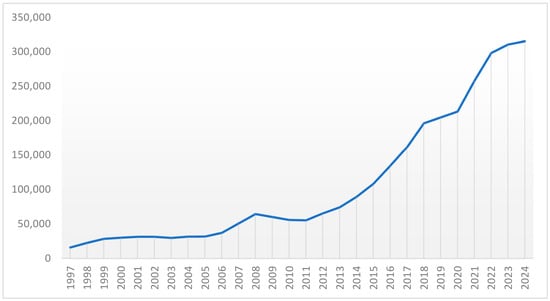
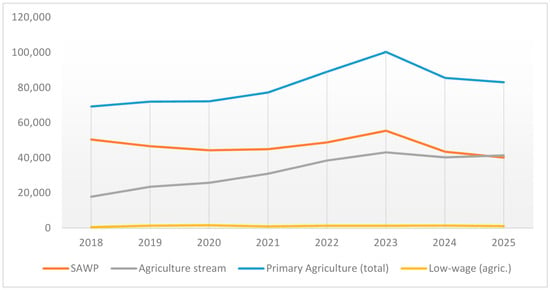
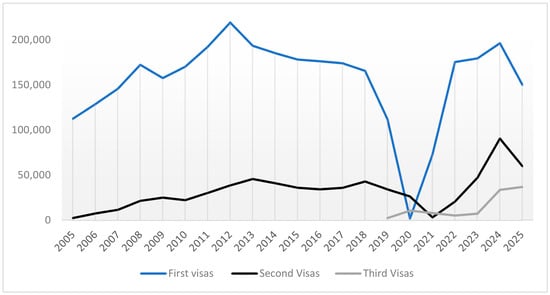
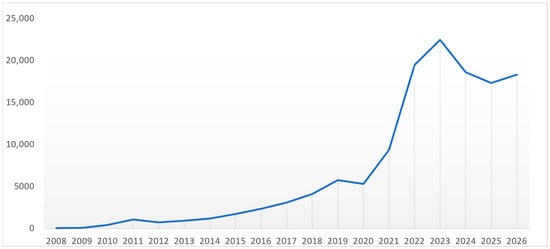
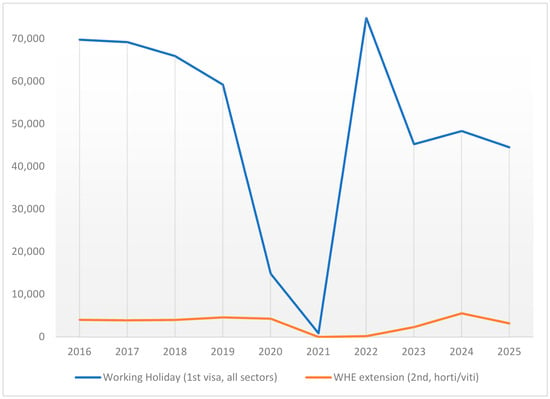
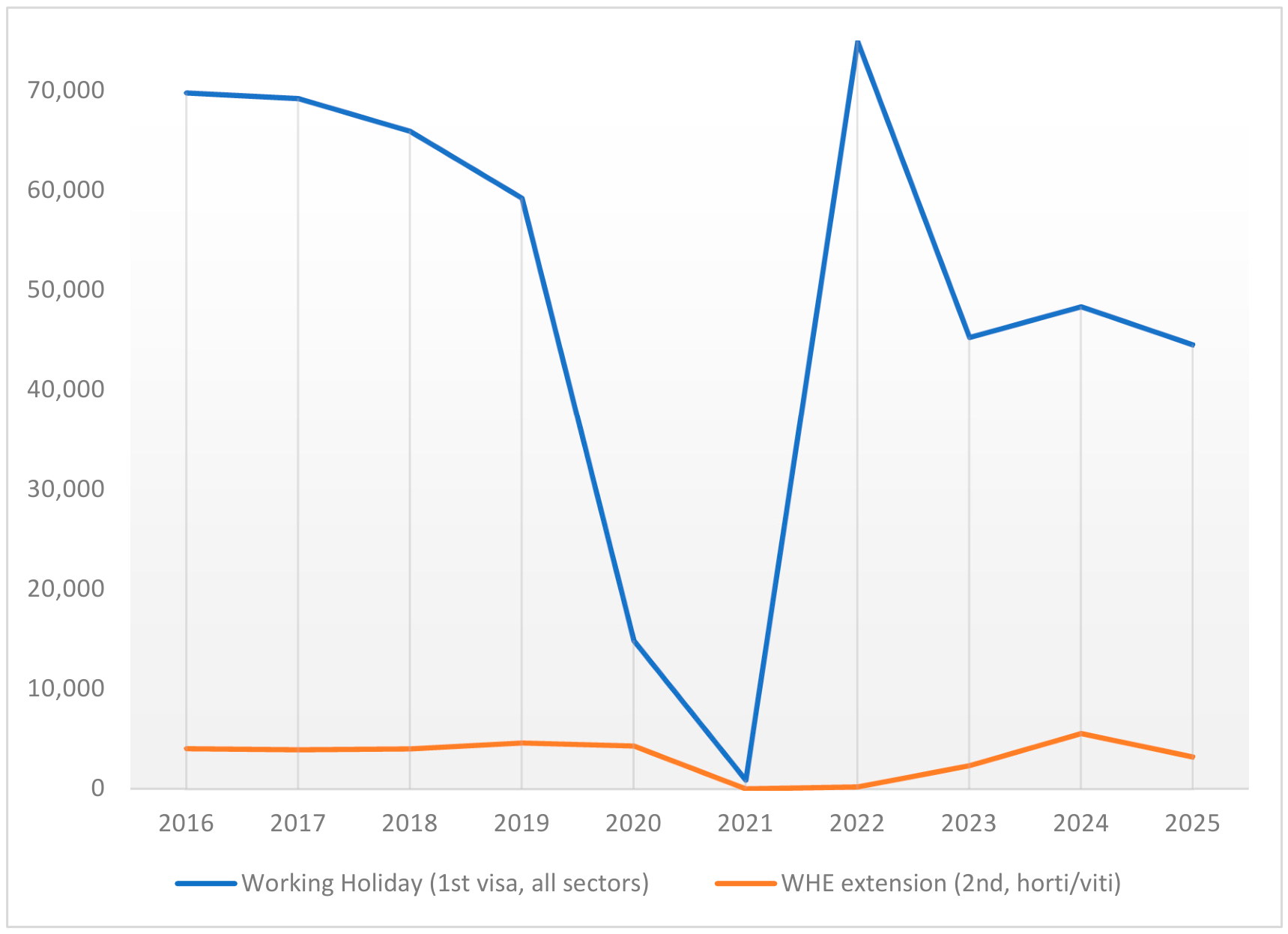
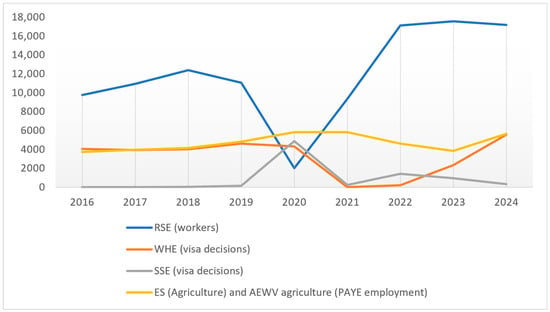
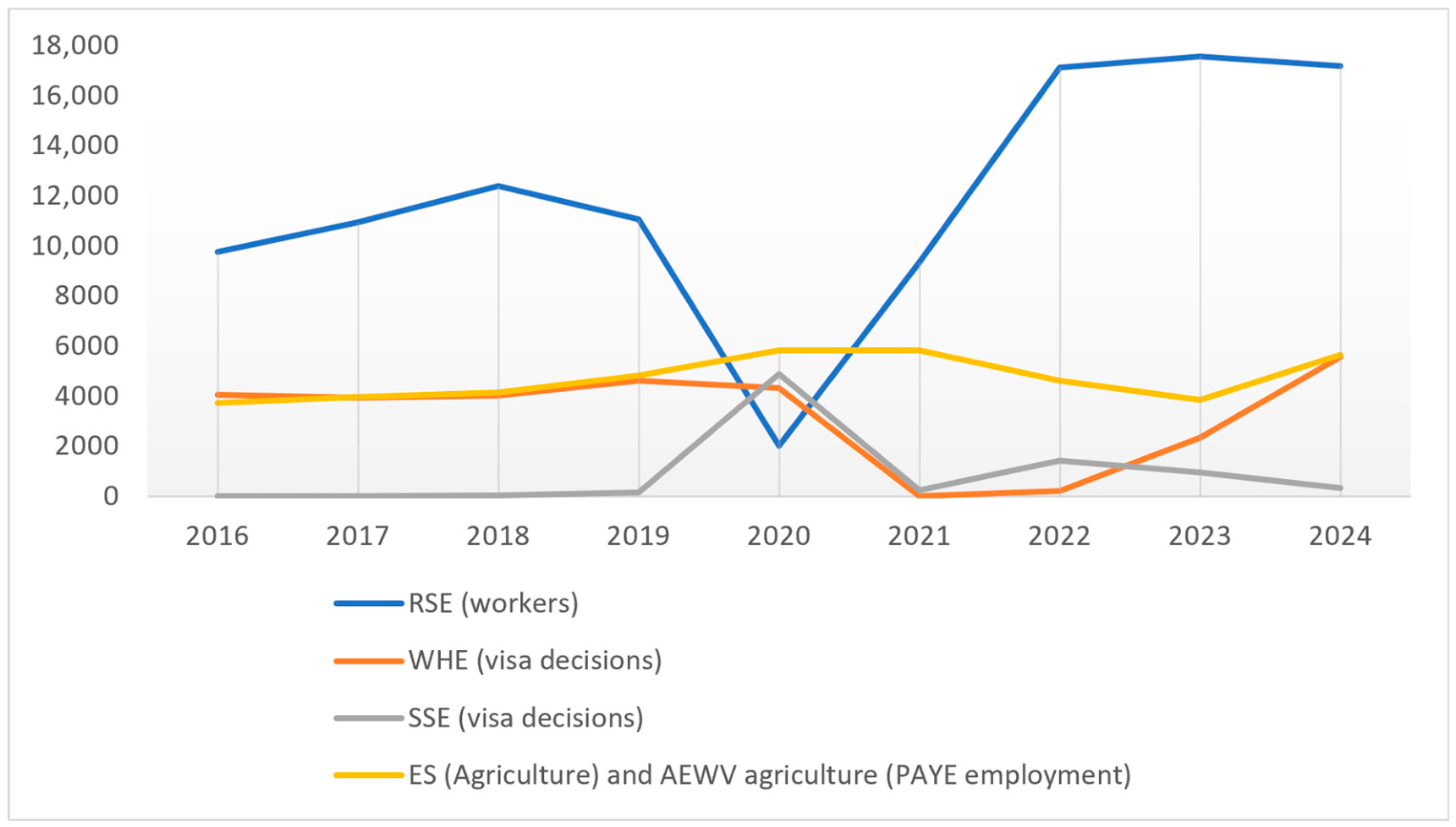
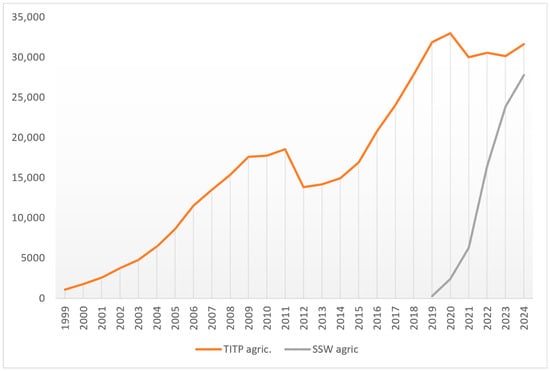
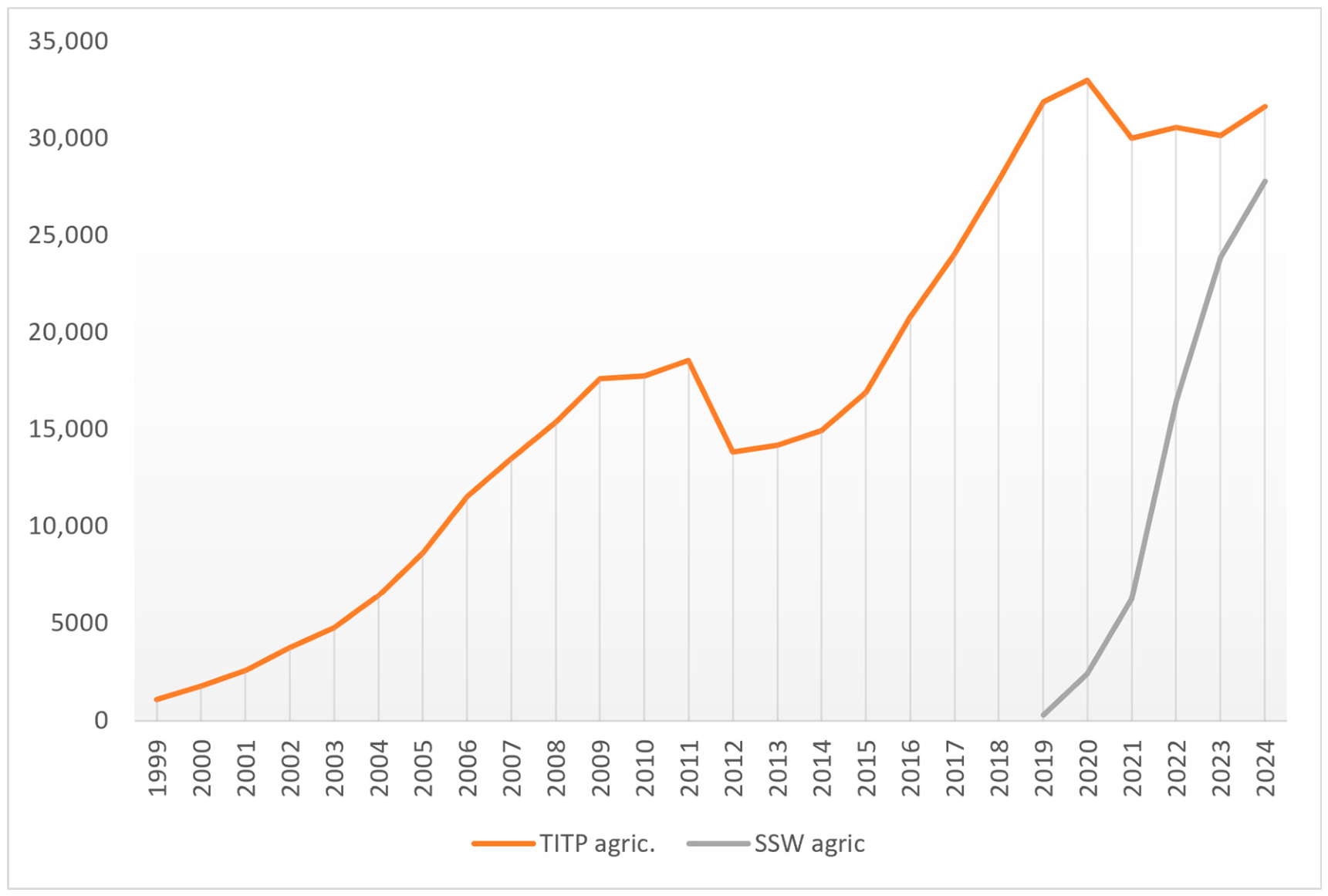
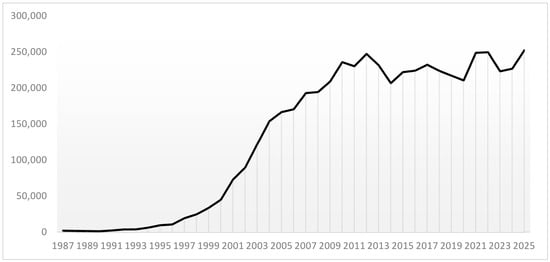
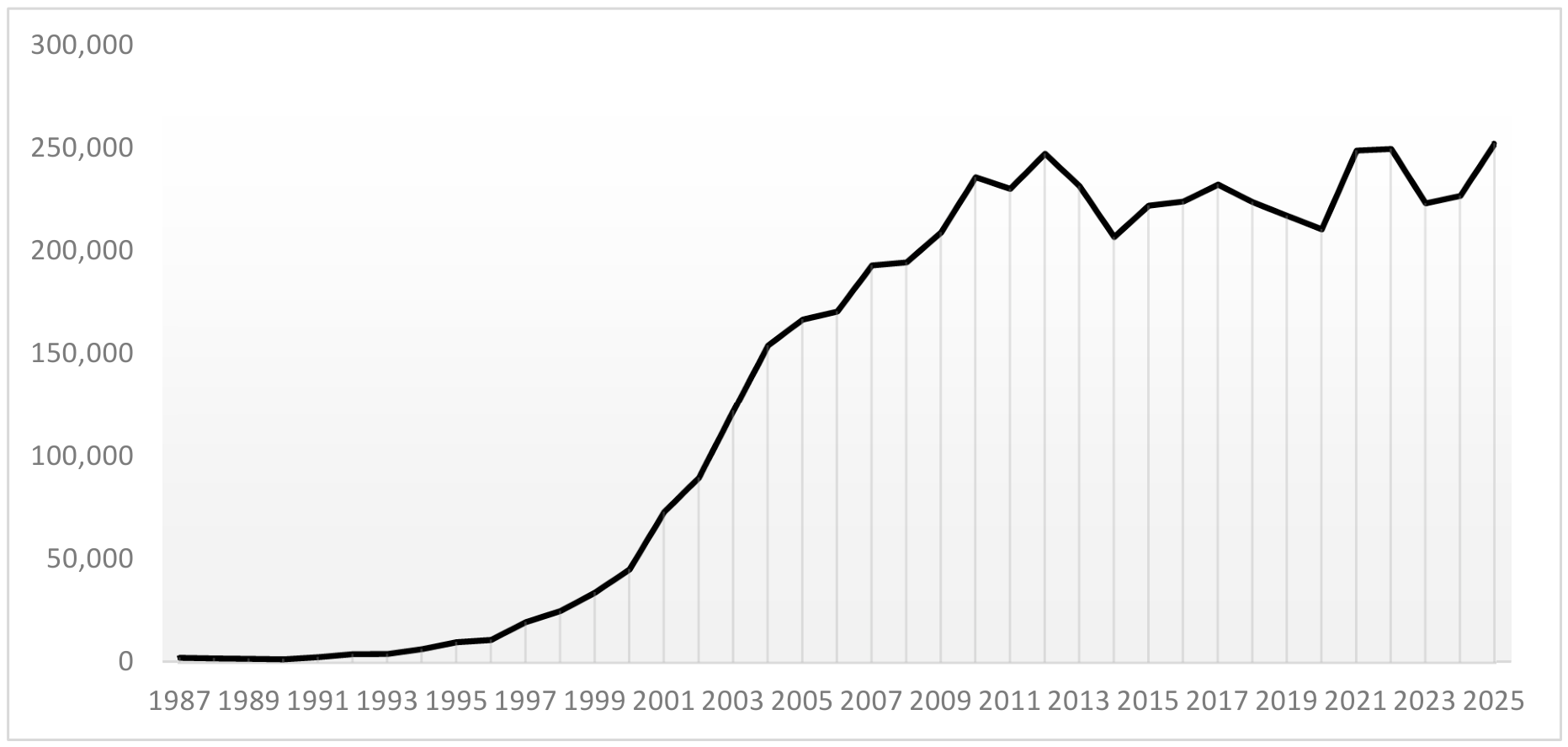
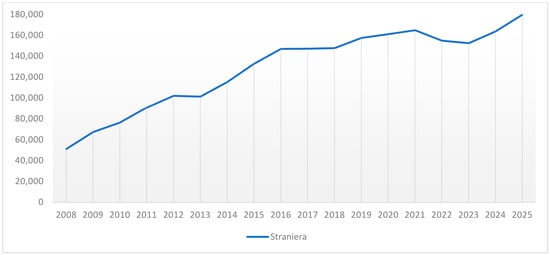
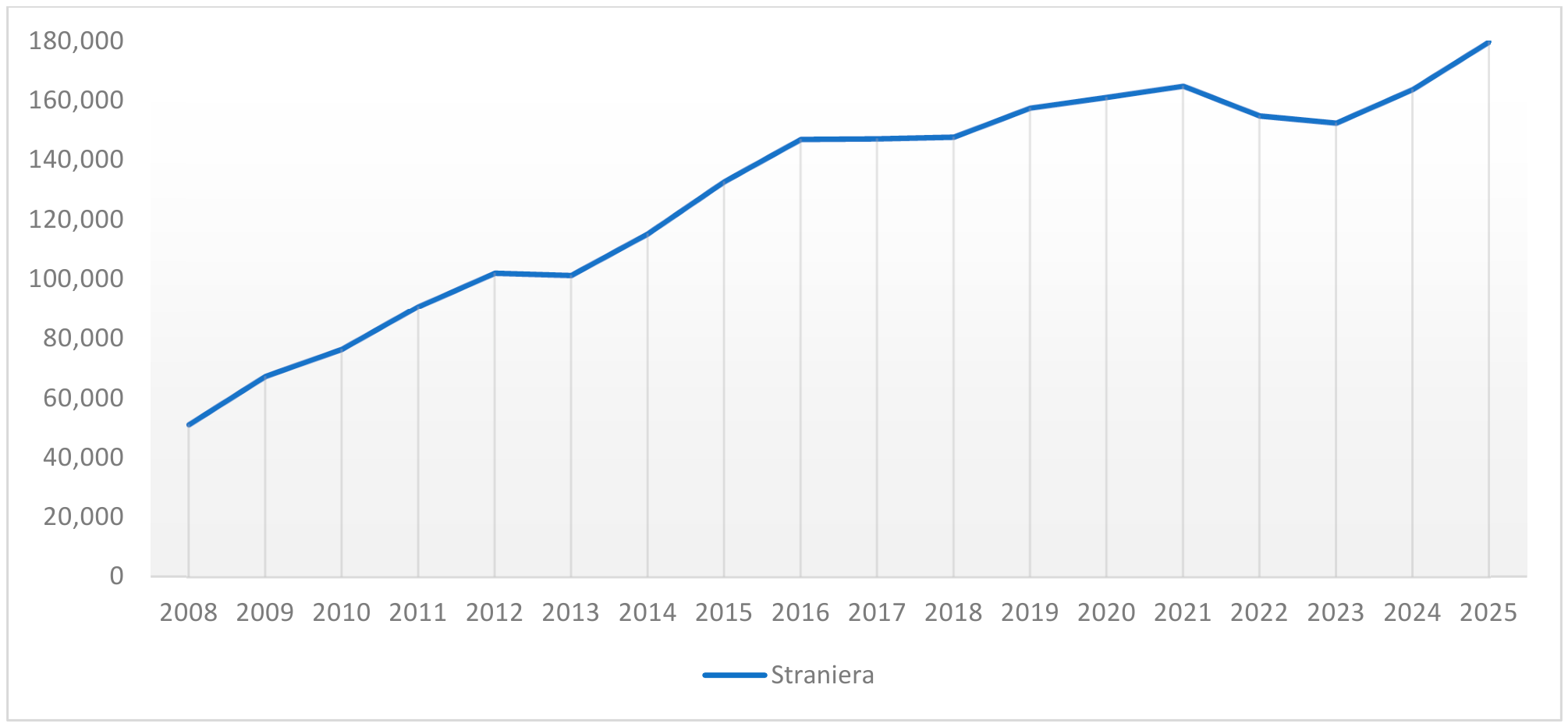

Disclaimer/Publisher’s Note: The statements, opinions and data contained in all publications are solely those of the individual author(s) and contributor(s) and not of MDPI and/or the editor(s). MDPI and/or the editor(s) disclaim responsibility for any injury to people or property resulting from any ideas, methods, instructions or products referred to in the content. |
© 2026 by the author. Licensee MDPI, Basel, Switzerland. This article is an open access article distributed under the terms and conditions of the Creative Commons Attribution (CC BY) license.