


Abstract
With the expansion of the digital economy, platform-based content creation has become a common route through which young people participate in flexible employment. However, the occupational identity of young we-media bloggers remains unstable because platform work combines low entry barriers, ambiguous labour relations, algorithmic governance and uncertain income. This qualitative study examines factors shaping occupational identity among young we-media bloggers in Hangzhou and Shaoxing, China. Data were collected through participatory observation and semi-structured interviews with 20 bloggers active on Xiaohongshu, TikTok and Bilibili. Fifteen interviews were used for open, axial and selective coding, and five additional interviews were used to assess theoretical saturation. The analysis identifies five key factors: perceived occupational competence, occupational development expectations, perceived occupational meaning, external environmental conditions and platform mechanisms. These factors operate through the interaction of internal cognition and external conditions: competence, future expectations and meaning provide internal support for occupational identity, whereas family attitudes, social evaluation, industry conditions, platform feedback and monetisation opportunities shape its stability. The findings suggest that young bloggers’ occupational identity is not a fixed status but a negotiated process formed through content production, platform feedback and social recognition.
1. Introduction
In an era of platformisation, algorithmic distribution and flexible work, content creation has become a visible route through which young people seek income, recognition and occupational possibility. Platform-based flexible employment is no longer only a supplementary channel; its quality depends on working conditions, platform type and the availability of social protection [1]. Within this broader shift, we-media creation has developed from a marginal online activity into a regular form of flexible employment. Because this work is mediated by platform visibility, monetisation rules and social evaluation, it raises a question that is not only economic but occupational: when do young creators begin to recognise blogging as a legitimate occupation?
In this article, we use “we-media” as a context-specific term for platform-based self-media creation in China, including short-video, livestreaming, review and knowledge-sharing accounts operated by individual creators. For international readers, the term overlaps with, but is not identical to, self-media, influencer and content-creator work, because it also reflects the Chinese platform ecology, monetisation channels and public discourse surrounding flexible digital employment.
Compared with traditional employment, we-media blogging provides young people with low entry barriers and more flexible working times. It can therefore partly relieve pressure caused by youth unemployment and occupational restructuring. However, the same flexibility and openness are accompanied by ambiguous labour relations, unclear work boundaries and limited occupational stability. Young people who participate in we-media work consequently differ in how strongly they recognise blogging as an occupation, which may affect the long-term stability and development of the industry. This study uses qualitative methods to analyse the factors that shape the occupational identity of young we-media bloggers and the mechanisms through which these factors interact.
2. Literature Review
2.1. Real-World Difficulties of We-Media Labour
With the development of the platform economy and the digital content industry, we-media labour based on short-video, livestreaming and social media platforms has become an increasingly common way for people in China to participate in employment. Unlike traditional enterprise employment, which is organised around fixed positions and explicit employment relationships, we-media labour uses digitised knowledge and information as key production materials. Critical digital-labour scholarship treats such digitally mediated activity as labour embedded in communication infrastructures, commodity production and value creation [2].
We-media platforms do not directly produce most content. Instead, they provide creators with spaces for display, channels for dissemination and tools for monetisation. As a result, creators often do not form clear employment relationships with platforms. More broadly, platform work reorganises labour by mediating market access, task allocation and evaluation through platform infrastructures [3]. It can expand temporal and spatial flexibility, but dependence on platforms and uncertain demand also make platform workers vulnerable to precarity [4].
Three difficulties are particularly important. First, low entry barriers and visibility-based competition encourage creators to invest unpaid or underpaid labour in self-branding, audience building and curated self-presentation [5]. Since almost anyone can enter the field quickly, rapid growth in the number of content producers dilutes traffic and income opportunities and leaves workers exposed to replacement. Second, algorithmic distribution and traffic-oriented platform logic strengthen uncertainty in labour outcomes. Exposure, income and development prospects depend heavily on platform rules and recommendation systems, and labour input does not have a stable relationship with actual return. Cross-platform evidence suggests that, when algorithmic control exceeds a certain level, insecurity among gig workers rises sharply [6]. Third, much we-media labour resembles on-demand and crowdwork arrangements in which workers perform task-based labour outside standard employment protections [7]. It is often project-based and individualised, and it lacks clear promotion channels and platform protection. Many workers therefore treat we-media creation as a temporary experiment or transitional option rather than a stable career.
These entry barriers also involve affective and emotional labour. Young creators must continuously display enthusiasm, authenticity and responsiveness to audiences while absorbing uncertainty about visibility and income. This labour includes not only technical production but also the management of self-presentation, audience feeling and creator–audience relationships [5].
2.2. Occupational Identity and Young We-Media Bloggers
Occupational identity is an important concept in organisational behaviour and career research. Ibarra defined it as a self-concept formed by occupational attributes, beliefs, values, motivations and experiences [8]. Subsequent studies have emphasised that professional identity is constructed through work and identity-learning cycles, and can change as individuals experiment with and customise professional roles [9].
Prior research has identified three broad paths through which occupational identity is shaped. The first concerns individual-level factors. Identification research links identity to self-definition and therefore to how individuals understand their place in occupational or organisational roles [10]. Positive feedback and achievement experiences in work can strengthen self-confirmation in a professional role. The second path concerns occupational development. Expected future career prospects help to stabilise occupational identity. Social cognitive career theory suggests that self-efficacy and outcome expectations shape career interests, choices and persistence [11]. The third path concerns organisational and environmental factors. Work support can strengthen professional identity through job autonomy and organisational commitment [12]. Contextual supports and barriers at family, social and institutional levels also shape career choice and occupational identification [13].
In recent years, scholars have extended occupational identity research to flexible employment groups in the platform economy. Research indicates that many platform workers operate in networked activity fields, with personalised work motivations, diverse group composition and loose organisational connections. Gig workers’ work identities can therefore be precarious and personalised, requiring ongoing support and identity work [14]. For young bloggers, these issues are intensified by task-based content work, high occupational mobility and dependence on algorithmic visibility, which can make income and career prospects difficult to stabilise [15].
Studies of social media influencers suggest that young people become bloggers not only because of opportunities created by the digital economy but also because of needs for self-expression and social attention. Through continuous content creation and image construction, young bloggers engage in self-branding and micro-celebrity practices that help position them as recognisable social media actors [16]. Research on digital freelance work further shows that such self-positioning depends on the curation of a professional image and the accumulation of social capital through social media. However, this self-positioning is also tied to unstable digital work and the continual need to maintain visibility and relationships [17]. From the perspective of platform mechanisms, young bloggers and platforms do not exist in a simple relationship of control and resistance. Instead, they interact through technical rules and algorithmic imaginaries. Bloggers test platform rules, understand traffic logic and adjust their self-positioning through account operation, while platforms’ ranking and visibility systems shape what counts as successful creator practice [18].
2.3. Research Gaps and Present Study
Taken together, existing studies have examined the background conditions and practical difficulties of youth participation in we-media labour from the perspectives of digital labour and platform economies. They have also discussed how individual experience, development expectations and organisational environments affect occupational identity. Some work has begun to address the bloggerisation of young people and the formation of occupational identity in platform interactions. However, the literature remains fragmented. Research on we-media labour often focuses on platform mechanisms and labour instability, whereas occupational identity research is still largely rooted in traditional occupational settings. These two strands have not been sufficiently connected.
Here, “bloggerisation” refers to the process through which young people increasingly organise self-expression, platform visibility, personal branding and income-seeking around blogger or influencer-like practices. Existing work on self-branding, micro-celebrity and algorithmic visibility helps explain why this process links identity formation to platform feedback and visibility management [16,18].
In particular, systematic analysis of the factors shaping occupational identity among young we-media bloggers remains limited. This study addresses this gap by integrating the digital labour context with occupational identity theory. It explores how young we-media bloggers construct occupational identity through content production, platform feedback, external recognition and future-oriented interpretation. The aim is to provide an empirical and theoretical reference for understanding occupational identity in new forms of flexible employment.
3. Materials and Methods
3.1. Research Design
This study used a qualitative research design and collected data through participatory observation and semi-structured interviews. The fieldwork focused on Hangzhou and Shaoxing, two cities with active digital economies. The study participants were young we-media bloggers active on platforms such as Xiaohongshu, TikTok and Bilibili, including e-commerce/review bloggers and content-creation bloggers.
The Chinese research context is important for interpreting the findings. Hangzhou and Shaoxing are located in Zhejiang Province, a region with active e-commerce, livestreaming and digital-content industries. Xiaohongshu, TikTok/Douyin and Bilibili provide different visibility rules, audience cultures and monetisation opportunities, so participants’ occupational identity was formed within a regional platform ecology rather than in a generic social-media environment. At the same time, the mechanisms identified here—competence formation, future expectation, perceived meaning, external recognition and platform feedback—also connect to international debates on influencer work and platform-based creative labour.
In the early stage, the researchers built contact with different types of young bloggers through local we-media training activities and platform-operation communication groups. With the consent of participants, the researchers observed their content creation and account-operation practices. The observation focused on content production, operational routines and interaction feedback, which provided contextual materials for the subsequent analysis of occupational identity.
3.2. Participants and Data Collection
In the later stage, snowball sampling was used to expand the sample and include bloggers from different platforms and development stages. The sample selection considered working duration, content type, educational background and the degree of connection with platforms or institutions. Following the principle of combining typicality with difference, the study selected 20 young we-media bloggers for semi-structured interviews. Each interview lasted between 0.5 and 1.5 h. Fifteen interview records were randomly selected for coding analysis and model construction, while the remaining five records were used to test theoretical saturation.
All interviews were conducted in Chinese. Interview materials used for analysis were translated into English for manuscript reporting, while participant identifiers (P01–P15) were retained in the coded sample to protect anonymity and distinguish participants during analysis. The 15/5 split was used to separate model construction from saturation checking: fifteen interviews were used to build the initial category system, and five additional interviews were reserved to test whether the established categories could account for further materials without generating new main categories.
The interviews focused on participants’ basic information, entry opportunities and motivations, everyday content creation and account-operation experience, understanding of occupational identity and expectations for future development. The basic characteristics of the 15 coded interviewees are shown in Table 1.
Table 1.
Basic characteristics of the young bloggers included in the coded sample.
3.3. Coding and Analytic Procedure
The analysis followed the logic of grounded theory coding. Open coding was first applied to the 15 model-building interview records to identify initial concepts from participants’ original statements and to preserve the empirical diversity of the materials. Axial coding then grouped related initial categories, clarified relationships among categories and generated the main categories and subcategories. Selective coding was used to integrate these categories around the core issue of occupational identity and to construct the model of influencing factors.
The remaining five interview records were coded after the initial model had been developed. They were compared against the existing categories, subcategories and relationship structure to assess theoretical saturation. No new main category, relationship structure or constituent factor was identified, which indicated that the model was sufficiently saturated within the available qualitative material.
4. Results
4.1. Open Coding
To preserve the analytic connection to the interview data, initial concepts were extracted from translated representative excerpts from participants’ Chinese interview statements. After the 15 interview records were organised and analysed, 21 initial categories were formed, as shown in Table 2.
Table 2.
Concepts and initial categories formed through open coding.
4.2. Axial Coding
On the basis of open coding, axial coding was used to identify the internal relationships among the initial categories and to build a more systematic theoretical framework. Five main categories and ten subcategories were generated, as shown in Table 3.
Table 3.
Main categories formed through axial coding.
4.3. Selective Coding and Model Construction
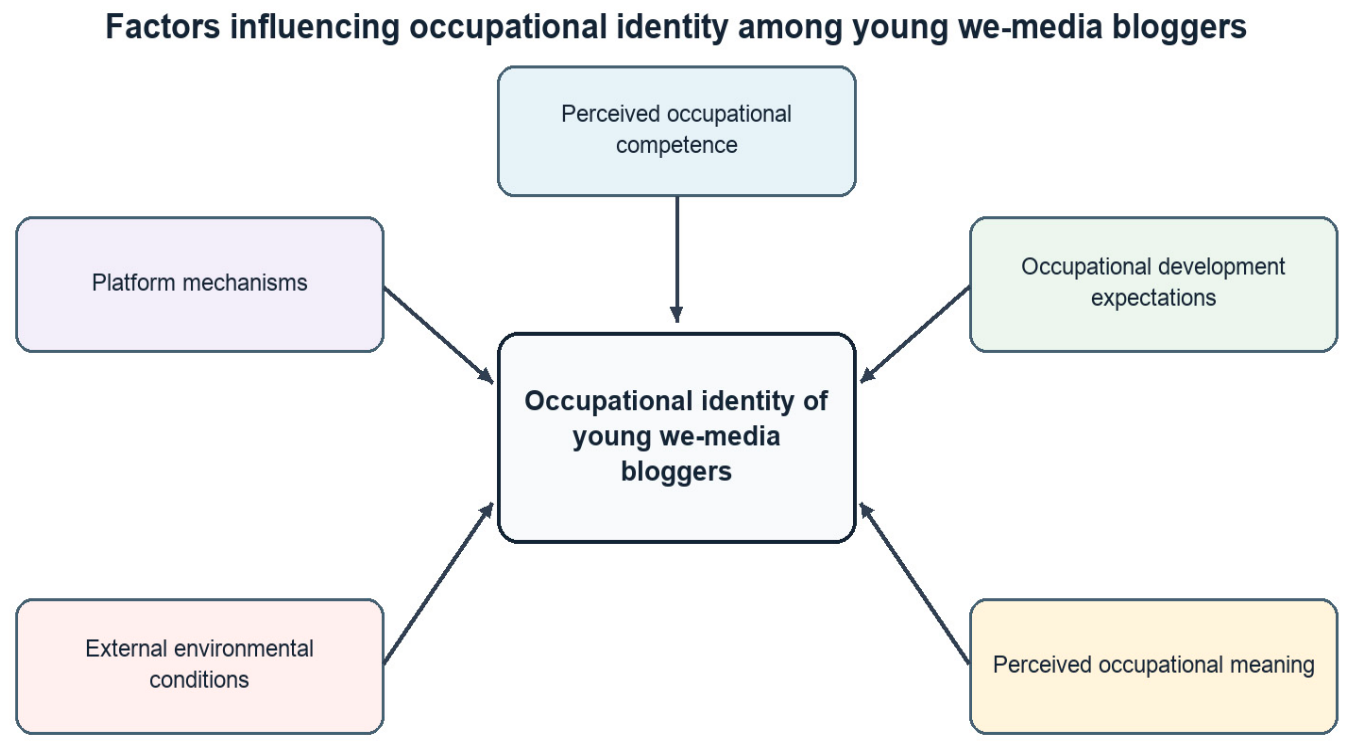
After open and axial coding, selective coding was used to determine the factors influencing the occupational identity of young we-media bloggers. The typical relationship structures are shown in Table 4. On this basis, the model of influencing factors was constructed, as shown in Figure 1.
Table 4.
Typical relationship structures among the main categories.
Figure 1.
Model of factors influencing the occupational identity of young we-media bloggers.
The “meanings” reported in Table 4 are analytic summaries inferred from the interview materials and the coding relationships; they are not verbatim transcript excerpts. They explain how each main category contributes to the formation of occupational identity.
4.4. Theoretical Saturation
Theoretical saturation was assessed by coding the remaining five interview records. No new main category, relationship structure or constituent factor was identified. This suggests that the model of factors influencing occupational identity among young we-media bloggers had reached theoretical saturation in the available qualitative material.
5. Discussion
The coding results show that the occupational identity of young we-media bloggers is shaped by five main factors: perceived occupational competence, occupational development expectations, perceived occupational meaning, external environmental conditions and platform mechanisms. Perceived occupational competence, development expectations and perceived meaning mainly concern internal cognition, whereas external environmental conditions and platform mechanisms concern the external conditions that sustain or weaken occupational interpretation. Internal cognition and external context work together in specific occupational practices to shape young workers’ overall cognition and emotional experience of blogging as an occupation.
5.1. Perceived Occupational Competence as an Internal Basis
Perceived occupational competence is treated here as a form of self-efficacy: a person’s belief that they can organise and execute the actions needed to perform specific tasks [19]. For young we-media bloggers, especially in contexts with limited team support, competence depends heavily on long-term autonomous practice and accumulated experience. The question of whether one can perform the work therefore becomes a key starting point in the formation of occupational identity.
The interviews indicate that, when young bloggers perceive stable capacities in content planning, expression and video editing, their confidence in the blogger identity increases. One participant stated that they initially did not dare to look at the camera and could not speak smoothly, but after gradual practice they became able to control the rhythm of content and began to feel that they could do the work well. Occupational competence is therefore not only a matter of being able to do the work but also of being able to do it well. Some participants regarded the ability to control content rhythm and attract audiences steadily as an important sign of occupationalisation.
Platform-provided data feedback further reinforces this competence perception. Reflection on views, completion rates and follower growth turns content production from a casual activity into occupational practice that requires strategic judgement and accumulated experience. In this process, young bloggers use competence as a core basis for understanding the occupation. We-media labour shifts from being imagined as dependent on luck or external conditions to being understood as practice supported by professional ability. Such competence building also involves forms of free and relational labour because creators must continually learn how to connect with audiences before returns are stable [20,21].
5.2. Occupational Development Expectations as a Guiding Mechanism
Occupational development expectations guide the formation of occupational identity among young we-media bloggers. In an era in which flexible employment continues to expand, we-media labour is situated in an unstable occupational environment. Traffic fluctuations, changes in platform rules and shifts in collaboration opportunities create substantial uncertainty. Development expectation is therefore not simply about income. It concerns the imagined viability of blogging as a path: how far the path can go, what supports continuation and what it may become in the future. This expectation is closely tied to visibility labour and to the platformisation of cultural production, through which creators must adapt cultural content to changing platform infrastructures and market signals [22,23].
When future expectations are formed, young bloggers begin to understand content production and account operation as occupational investment characterised by individual agency and movement across social spaces. Once editing and publishing content changes from casual behaviour into a stable work task, occupational identity can move from a wavering state toward relative stability. Conversely, when development expectations are difficult to establish or the future path is highly ambiguous, the emotional attachment and belief structure underpinning occupational identity can be shaken. The threat of algorithmic invisibility further explains why creators may experience career planning as unstable even when they work continuously [24]. The interviews therefore suggest that occupational development expectations act as both a guiding and regulating mechanism in identity formation.
5.3. Perceived Occupational Meaning as an Ideational Factor
Perceived occupational meaning refers to an individual’s understanding and judgement of whether work has practical value and social meaning [25]. A positive sense of purpose and meaning can support career development and occupational action, whereas a negative understanding may hinder occupational behaviour and career development [26].
The interviews show that young bloggers’ occupational identity strengthens when they understand online content production as work with practical value, such as transmitting information, sharing experience or providing emotional value. Perceived meaning is formed through at least two pathways. The first is a result–meaning pathway. Views, follower growth and commercial returns enable bloggers to see that their labour is not ineffective but has been recognised and valued. The second is a concept–meaning pathway. As bloggers gain a deeper understanding of industry operations and the division of labour in we-media work, they come to see blogging as a labour form with a complete occupational process, including scripting, filming, editing and operation. In this sense, we-media work is no longer treated as a temporary or subsidiary activity but becomes included within the category of occupation.
5.4. External Environmental Conditions as Practical Support
External environmental conditions include family, social and institutional contexts in which young we-media bloggers produce content and operate accounts. These conditions include changes in family attitudes, feedback from publics and audiences, industry development and policy or public opinion environments. External conditions do not directly determine occupational identity, but they strongly affect its stability and continuity.
At the family level, when attitudes in intimate relationships shift from doubt or rejection to understanding and recognition, the burden of explaining the occupation is reduced. The blogger identity is less frequently challenged by evaluations that frame it as improper work. Participants reported that family members became less opposed once they saw regular updates and income. At the broader social and institutional levels, as the number of we-media participants grows and the industry becomes more normalised, public views of young bloggers become more routine. Reduced stigma and lower identity pressure allow young we-media bloggers to maintain occupational emotion and belief more steadily.
5.5. Platform Mechanisms as Organisational Support
Occupational identity is not only derived from internal cognition; it is also maintained through identity work within organisational and occupational contexts [27]. For young we-media bloggers, platform mechanisms operate through algorithmic distribution, data feedback and commercial collaboration systems, providing a work environment that combines flexibility with rules.
On the one hand, we-media creation provides a high degree of autonomy in time arrangement and content selection. Young bloggers can produce content according to personal preferences. On the other hand, platforms use data indicators, such as views, completion rates and interaction rates, along with income settlement, task goals and collaboration invitations, to embed free creation in a quantifiable and feedback-based operating system. These mechanisms reflect a broader social media logic and a new screen ecology in which platform metrics, commercial intermediaries and audience flows jointly shape cultural production [28,29]. Platforms therefore do not only constrain individuals directly; they also guide content adjustment through feedback and benefit distribution. Data feedback provides a basis for content adjustment, while income and collaboration opportunities increase the certainty of returns. At the same time, creators often rely on informal interpretation of platform behaviour, including what has been described as algorithmic gossip, to manage visibility under opaque ranking systems [30]. These mechanisms shift content production from scattered experimentation toward more regulated occupational practice.
This interpretation is consistent with Bishop’s recent account of “influencer creep,” in which optimisation, authenticity and self-branding increasingly shape creative work beyond conventional influencer labour [31]. In the present study, similar pressures appear in participants’ reliance on platform data, continuous content adjustment and efforts to remain visible while presenting an authentic persona.
5.6. Practical Implications
Because the empirical material is drawn from young we-media bloggers in China, the practical implications are directed primarily to Chinese creators, platform operators, training organisations and policy actors concerned with flexible digital employment. For international self-content creators, the implications should be read comparatively: similar mechanisms may apply where platform visibility, self-branding and monetisation shape creative work, but institutional conditions, labour protections and platform ecosystems differ across countries.
The findings have several implications for improving the occupational identity of young we-media bloggers and for promoting flexible employment as a high-quality employment pathway. First, professional competence should be strengthened. Training in script writing, expression, platform rules and data review can improve young bloggers’ grasp of content production and platform operation. When young people develop clear competence judgements and mastery experiences, their confidence in blogging as work is strengthened.
Second, young bloggers should be guided to form rational occupational expectations and extensible development goals. By reflecting on creative experience, development stage and growth trajectory, they can better understand their current position and future direction. This may transform vague expectations into clearer and more rational career planning. Third, the value and labour meaning of we-media content should be emphasised. Young bloggers should be encouraged to move beyond a single focus on traffic and income and to recognise the communicative and social functions of content creation, including knowledge sharing, information provision and emotional support.
Fourth, the external environment should be improved. Changes in family understanding, public evaluation and industry rules can reduce negative labels attached to blogging and increase the social acceptability of the occupation. At the same time, platform data feedback and commercial collaboration opportunities can help young bloggers experience a rule-based system similar to formal work. When external evaluation becomes more rational, operational rules become clearer and platform embeddedness becomes stronger, occupational identity is likely to deepen.
5.7. Limitations and Future Research
Several limitations should be noted. First, the study is based on qualitative interviews with young bloggers in Hangzhou and Shaoxing, and the findings should not be treated as statistically generalisable to all we-media workers. Second, the coded sample included 15 interviews, with five additional interviews used for saturation testing; a larger and more diverse sample would help examine whether the model applies across regions, platforms and content types. Third, the study relies on self-reported experiences and participatory observation, which may reflect participants’ retrospective interpretations of their work. Future research could combine qualitative interviews with longitudinal observation, platform data or comparative analysis across different forms of digital labour.
6. Conclusions
This study explored the factors influencing occupational identity among young we-media bloggers through participatory observation and semi-structured interviews. The analysis identified five factors: perceived occupational competence, occupational development expectations, perceived occupational meaning, external environmental conditions and platform mechanisms. These factors jointly shape occupational identity through the interaction between internal cognition and external context. The study suggests that occupational identity among young bloggers is not naturally stable but is continuously constructed through content production, platform feedback, social recognition and future-oriented interpretation. Improving competence training, guiding realistic expectations, strengthening value recognition and optimising platform and social environments may support the long-term development of young we-media bloggers in flexible employment.
Overall, the findings show how a China-based case can contribute to wider discussions of platform labour by specifying the conditions under which young creators come to treat content production as occupational work rather than temporary online activity.
Author Contributions
Conceptualization, K.C. and K.D.; methodology, K.C. and K.D.; software, K.C.; validation, K.C. and K.D.; formal analysis, K.C.; investigation, K.C.; resources, K.D.; data curation, K.C. and K.D.; writing—original draft preparation, K.C. and K.D.; writing—review and editing, K.C. and K.D.; visualization, K.C.; supervision, K.D.; project administration, K.D.; funding acquisition, K.D. All authors have read and agreed to the published version of the manuscript.
Funding
This research was funded by the Zhejiang Provincial Philosophy and Social Science Planning Project, “Research on Value Choices and Faith Formation among Generation Z College Students”, grant number 23GXSZ028YB.
Institutional Review Board Statement
The study was conducted in accordance with the Declaration of Helsinki. Ethical review and approval were waived for this study because the research involved voluntary, non-invasive interviews with adult participants, used anonymised materials and did not collect identifiable sensitive personal information. The School of Marxism at Shaoxing University has approved the above research ethics review exemption.
Informed Consent Statement
Informed consent was obtained from all subjects involved in the study. Participation was voluntary and data were collected anonymously.
Data Availability Statement
The data are not publicly available due to privacy and ethical restrictions associated with qualitative interview materials.
Conflicts of Interest
The authors declare no conflict of interest. The funder had no role in the design of the study; in the collection, analyses, or interpretation of data; in the writing of the manuscript; or in the decision to publish the results.
References
- Wang, T.; Li, S.; Gao, D. What factors have an impact on the employment quality of platform-based flexible workers? An evidence from China. Heliyon 2024, 10, e24654. [Google Scholar] [CrossRef] [Scilit] [PubMed]
- Fuchs, C.; Sandoval, M. Digital workers of the world unite! A framework for critically theorising and analysing digital labour. tripleC Commun. Capital. Crit. 2014, 12, 486–563. [Google Scholar] [CrossRef] [Scilit]
- Vallas, S.; Schor, J.B. What do platforms do? Understanding the gig economy. Annu. Rev. Sociol. 2020, 46, 273–294. [Google Scholar] [CrossRef] [Scilit]
- Schor, J.B.; Attwood-Charles, W.; Cansoy, M.; Ladegaard, I.; Wengronowitz, R. Dependence and precarity in the platform economy. Theory Soc. 2020, 49, 833–861. [Google Scholar] [CrossRef] [Scilit] [PubMed]
- Duffy, B.E.; Hund, E. Having it all on social media: Entrepreneurial femininity and self-branding among fashion bloggers. Soc. Media Soc. 2015, 1, 2056305115604337. [Google Scholar] [CrossRef] [Scilit]
- Wood, A.J.; Graham, M.; Lehdonvirta, V.; Hjorth, I. Good gig, bad gig: Autonomy and algorithmic control in the global gig economy. Work Employ. Soc. 2019, 33, 56–75. [Google Scholar] [CrossRef] [Scilit] [PubMed]
- De Stefano, V. The rise of the just-in-time workforce: On-demand work, crowdwork and labour protection in the gig-economy. Comp. Labor Law Policy J. 2016, 37, 471–504. [Google Scholar] [CrossRef] [Scilit]
- Ibarra, H. Provisional selves: Experimenting with image and identity in professional adaptation. Adm. Sci. Q. 1999, 44, 764–791. [Google Scholar] [CrossRef] [Scilit] [PubMed]
- Pratt, M.G.; Rockmann, K.W.; Kaufmann, J.B. Constructing professional identity: The role of work and identity learning cycles in the customization of identity among medical residents. Acad. Manag. J. 2006, 49, 235–262. [Google Scholar] [CrossRef] [Scilit]
- Ashforth, B.E.; Harrison, S.H.; Corley, K.G. Identification in organizations: An examination of four fundamental questions. J. Manag. 2008, 34, 325–374. [Google Scholar] [CrossRef] [Scilit]
- Lent, R.W.; Brown, S.D.; Hackett, G. Toward a unifying social cognitive theory of career and academic interest, choice, and performance. J. Vocat. Behav. 1994, 45, 79–122. [Google Scholar] [CrossRef] [Scilit]
- Cheng, Y.; Jiang, S. Influence of work support on social workers’ professional identity: The mediating mechanisms of job autonomy and organizational commitment. J. Soc. Serv. Res. 2022, 48, 781–793. [Google Scholar] [CrossRef] [Scilit]
- Lent, R.W.; Brown, S.D.; Hackett, G. Contextual supports and barriers to career choice: A social cognitive analysis. J. Couns. Psychol. 2000, 47, 36–49. [Google Scholar] [CrossRef]
- Petriglieri, G.; Ashford, S.J.; Wrzesniewski, A. Agony and ecstasy in the gig economy: Cultivating holding environments for precarious and personalized work identities. Adm. Sci. Q. 2019, 64, 124–170. [Google Scholar] [CrossRef] [Scilit]
- Duffy, B.E.; Meisner, C. Platform governance at the margins: Social media creators’ experiences with algorithmic (in)visibility. Media Cult. Soc. 2023, 45, 285–304. [Google Scholar] [CrossRef] [Scilit]
- Khamis, S.; Ang, L.; Welling, R. Self-branding, micro-celebrity and the rise of social media influencers. Celebr. Stud. 2017, 8, 191–208. [Google Scholar] [CrossRef] [Scilit]
- Gandini, A. Digital work. Mark. Theory 2016, 16, 123–141. [Google Scholar] [CrossRef] [Scilit]
- Cotter, K. Playing the visibility game: How digital influencers and algorithms negotiate influence on Instagram. New Media Soc. 2019, 21, 895–913. [Google Scholar] [CrossRef] [Scilit]
- Bandura, A. Self-efficacy: Toward a unifying theory of behavioral change. Psychol. Rev. 1977, 84, 191–215. [Google Scholar] [CrossRef] [PubMed]
- Terranova, T. Free labor. Soc. Text 2000, 18, 33–58. [Google Scholar] [CrossRef] [Scilit]
- Baym, N.K. Connect with your audience! The relational labor of connection. Commun. Rev. 2015, 18, 14–22. [Google Scholar] [CrossRef] [Scilit]
- Abidin, C. Visibility labour: Engaging with influencers’ fashion brands and #OOTD advertorial campaigns on Instagram. Media Int. Aust. 2016, 161, 86–100. [Google Scholar] [CrossRef] [Scilit]
- Nieborg, D.B.; Poell, T. The platformization of cultural production: Theorizing the contingent cultural commodity. New Media Soc. 2018, 20, 4275–4292. [Google Scholar] [CrossRef] [Scilit]
- Bucher, T. Want to be on the top? Algorithmic power and the threat of invisibility on Facebook. New Media Soc. 2012, 14, 1164–1180. [Google Scholar] [CrossRef] [Scilit]
- Rosso, B.D.; Dekas, K.H.; Wrzesniewski, A. On the meaning of work: A theoretical integration and review. Res. Organ. Behav. 2010, 30, 91–127. [Google Scholar] [CrossRef] [Scilit]
- Dik, B.J.; Duffy, R.D.; Allan, B.A.; O’Donnell, M.B.; Shim, Y.; Steger, M.F. Purpose and meaning in career development applications. Couns. Psychol. 2015, 43, 558–585. [Google Scholar] [CrossRef] [Scilit]
- Caza, B.B.; Vough, H.; Puranik, H. Identity work in organizations and occupations: Definitions, theories, and pathways forward. J. Organ. Behav. 2018, 39, 889–910. [Google Scholar] [CrossRef] [Scilit]
- Van Dijck, J.; Poell, T. Understanding social media logic. Media Commun. 2013, 1, 2–14. [Google Scholar] [CrossRef] [Scilit]
- Cunningham, S.; Craig, D.; Silver, J. YouTube, multichannel networks and the accelerated evolution of the new screen ecology. Convergence 2016, 22, 376–391. [Google Scholar] [CrossRef] [Scilit]
- Bishop, S. Managing visibility on YouTube through algorithmic gossip. New Media Soc. 2019, 21, 2589–2606. [Google Scholar] [CrossRef] [Scilit]
- Bishop, S. Influencer Creep: How Optimization, Authenticity, and Self-Branding Transform Creative Culture; University of California Press: Oakland, CA, USA, 2025. [Google Scholar]

Disclaimer/Publisher’s Note: The statements, opinions and data contained in all publications are solely those of the individual author(s) and contributor(s) and not of MDPI and/or the editor(s). MDPI and/or the editor(s) disclaim responsibility for any injury to people or property resulting from any ideas, methods, instructions or products referred to in the content. |
© 2026 by the authors. Licensee MDPI, Basel, Switzerland. This article is an open access article distributed under the terms and conditions of the Creative Commons Attribution (CC BY) license.